Article

Optimized Fermentation with Bacillus licheniformis on Flaxseed Cake Modulates Microbiota Toward Higher Propionate Production in Piglets

1
Laboratory of Animal Nutrition and Biotechnology, National Research and Development Institute for Biology and Animal Nutrition-IBNA Balotesti, Calea Bucuresti No. 1, 077015 Balotesti, Romania
2
Faculty of Biotechnology, University of Agricultural Sciences and Veterinary Medicine, 011464 Bucharest, Romania
3
Department of Pharmacotherapy, Faculty of Pharmacy Campus C, “Ovidius” University of Constanta, Captain Al. Serbănescu Street, No. 6, 900001 Constanta, Romania
*
Author to whom correspondence should be addressed.
Agriculture 2026, 16(7), 757; https://doi.org/10.3390/agriculture16070757 (registering DOI)
Submission received: 27 January 2026 / Revised: 19 March 2026 / Accepted: 27 March 2026 / Published: 29 March 2026

Abstract

Solid-state fermentation (SSF) is a long-established biotechnological approach gaining renewed interest for its ability to enhance nutrient availability and improve the functional properties of agro-industrial by-products. This strategy is particularly relevant for early post-weaning piglets, which are highly susceptible to weaning stress due to an immature digestive system and a gut microbiota not yet adapted to solid feed. In this study, the fermentation parameters of flaxseed cake were optimized using a Plackett–Burman experimental design. Protease activity was selected as the response variable due to its relevance for improving protein degradation and potential digestibility in fermented feed ingredients. Accordingly, based on the statistical analysis, the conditions selected for the in vivo trial were 1% molasses, 0.5% yeast extract, 0.05% CaCl2, 0.5% NaCl, 7.5% inoculum (4.12 × 10⁹ CFU/mL), 60% moisture, and 72 h fermentation. Fermentation time was identified as the main factor positively influencing protease production, while higher CaCl2 concentrations and inoculum levels negatively affected enzyme activity. Optimization increased protease activity, microbial viability and free amino acid content. In addition, SSF reorganizes the carbohydrate profile by reducing structural fiber fractions, with neutral detergent fiber and acid detergent fiber decreasing by 27% and 29%, respectively, while simultaneously increasing soluble carbohydrates by 14.67%. Phytic acid content being also reduced by 23.81%. A pilot nutritional trial on post-weaned piglets (35 days old) showed that including 8% fermented flaxseed cakes (FFSC group) improved body weight, average daily gain, feed conversion ratio, and diarrhea score, without affecting average daily feed intake, compared with 8% unfermented flaxseed cakes (FSC group). These performance improvements were accompanied by changes in fermentation metabolites and gut microbial composition. Lower isovalerate concentrations suggested reduced proteolysis, while higher propionate levels may contribute to increased blood glucose availability in the FFSC group. These changes coincided with a shift in microbial composition, characterized by a reduced abundance of methanogenic archaea and increased abundances of taxa such as Lactobacillus, Enterococcus, and members of the Lachnospiraceae and Eubacteriaceae families.

1. Introduction

The demand for sustainable and functional feed ingredients in swine nutrition is increasingly oriented towards agro-industrial by-products with high nutritional value and bioactive potential. Flaxseed (Linum usitatissimum L.), a well-documented oilseed crop, has garnered interest for its rich composition in α-linolenic acid (omega-3 fatty acids), proteins, dietary fibers, as well as bioactive compounds such as lignans (secoisolariciresinol diglucoside) and phenolic acids (p-coumaric acid and ferulic acid) [1]. The high content of omega-3 fatty acids is considered nutritionally beneficial; however, their high degree of unsaturation may also increase susceptibility to lipid oxidation. It represents a potential nutritional trade-off when included at elevated levels in animal diets [2]. In addition, flaxseed exhibits a distinctive amino acid profile, being rich in arginine, aspartic acid, and glutamic acid, with appreciable levels of sulfur-containing amino acids such as methionine and cysteine, while lysine remaining relatively limited [3].
Flaxseed fiber includes both soluble and insoluble dietary fractions. The insoluble fraction is primarily composed of cellulose and lignin, whereas the soluble fraction consists mainly of mucilage (gum) polysaccharide. The proportions range from approximately 20:80 to 40:60 [4]. Flaxseed soluble fiber consists mainly of two polysaccharide fractions: a neutral arabinoxylan (~75%), composed primarily of arabinose, xylose, and galactose, and an acidic rhamnogalacturonan (~25%) containing rhamnose, fucose, galactose, and galacturonic acid [5]. Both fractions are readily fermentable by intestinal microbiota and can contribute to the production of short-chain fatty acids (SCFAs) [5].
Despite its nutritional and bioactive components, flaxseed contains antinutritional factors including cyanogenic glycosides, phytic acid which can negatively affect nutrient digestibility [6], and linatine, a naturally occurring dipeptide that acts as a vitamin B6 antagonist [7]. However, in pig nutrition the inclusion of flaxseed meals is generally limited to low lysine content of its proteins, the high mucilage content, and its lower energy density. Nevertheless, pigs can maintain normal growth performance when diets include up to 15% flaxseed meals, provided that digestible energy and amino acid levels are properly balanced [8,9].
During weaning, piglets switch from highly digestible maternal milk to less-digestible solid feed. At this stage, gastric acid secretion is still limited. This results in a relatively high gastric pH that can impair proteolysis by reducing pepsinogen activation and pepsin activity, while also weakening the stomach’s barrier function against ingested pathogens [10]. Consequently, the incomplete digestion of these solid feeds provides substrates favorable for the growth of pathogenic bacteria like increasing the ratio of Escherichia coli relative to beneficial Lactobacillus species [11]. This imbalance can disrupt intestinal barrier function and alter gut microbiota composition and metabolic functions, including the production of SCFAs [12].
One strategy to overcome these limitations is solid-state fermentation (SSF), a technique that utilizes microbial activity to bio transform substrates under low-moisture conditions. SSF is particularly suitable for valorizing plant-derived feedstocks like oilseed meals, enabling the degradation of antinutritional compounds and the release of digestible nutrients and functional metabolites [13]. In this context, Bacillus licheniformis emerges as a promising candidate, primarily due to its robust enzymatic profile, particularly the ability to produce alkaline proteases [14]. During fermentation, this microorganism effectively hydrolyzes proteins, liberating free amino acids and bioactive peptides, as well as generating flavor-enhancing compounds (umami and kokumi taste ants), which significantly contribute to the improved nutritional value, palatability, and functional properties of the fermented substrate [15].
Studies in pigs have demonstrated that the inclusion of fermented flaxseed meal in the diet at 10%,15% and 20% leads to increased abundances of the genera Lactobacillus and Bacillus, as well as Clostridium_sensu_stricto_1, along with elevated levels of butyric acid and total SCFAs in feces [16]. Additionally, dietary supplementation with flaxseed oil at 4% in weaned pigs has been shown to reduce the prevalence of pathogenic Spirochaetes, while increasing the relative abundance of Actinobacteria at the phylum level and the genera Blautia and Bifidobacterium in the colonic digesta [17].
This study builds upon our previous research, where solid-state fermentation using Bacillus licheniformis on flaxseed meals significantly increased the soluble peptide content and improved the in vitro protein digestibility (IVPD) from 67% to 80% [18]. This is particularly relevant in weaned piglets, where limited gastric acid secretion and immature digestive enzyme activity can impair proteolysis, allowing undigested nutrients to reach the distal gut. In fiber-rich diets, these substrates may influence microbial fermentation processes and the production of SCFAs. In this study, we investigate the synergistic effects of incorporating fermented flaxseed cakes (FFSC) and fiber-rich diets alongside optimized fermentation conditions to develop a bioactive preparation enriched with highly digestible proteins. Our aim was to investigate how these interventions influence shifts in piglets gut microbiota and to explore potential connections with health and growth performance parameters during the post-weaning period and to generate new hypotheses for future larger targeted studies.

2. Materials and Methods

2.1. Chemicals

For this study were used analytical and chromatographic grade buffers, chemicals and solvents purchased from Sigma-Aldrich (Saint-Louis, MO, USA) and Carl Roth (Karlsruhe, Germany). Certified reference standards were used for all analytical determinations, brought from Sigma-Aldrich (Saint-Louis, MO, USA). Culture media was bought from OxoidTM (Basingstoke, UK).

2.2. Plant Material and Microorganism

Flaxseed (Linum usitatissimum L.) cakes (FSC) which resulted as by-products from oil cold-pressing production processes were brought from Eco Vial SRL (Calarasi, Romania). The microbial strain employed for fermentation, Bacillus licheniformis ATCC 21424 (BL), was obtained from the American Type Culture Collection (ATCC) in Manassas, VA, USA.

2.3. Fermentation Process

The inoculum was prepared from a frozen stock of Bacillus licheniformis, revitalized through two passages on Luria–Bertani agar, then transferred to Luria–Bertani broth medium, follow by incubation at 37 °C with shaking at 150 rpm for 20 h in a rotatory shaking incubator. After incubation, the OD600 (optical density at 600 nm) reached 4.5 (equivalent to 4.12 × 10⁹ CFU/mL), measured following a 1:10 dilution in ultrapure water.
Flaxseed cakes (FSC) were fermented using a solid-state fermentation (SSF) process. For optimization experiments, 50 g batches of substrate were placed in aluminum trays (149 × 109 × 45 mm, 550 mL). The substrate moisture was adjusted to the desired level (60–70%) by adding the corresponding volume of ultrapure water (approximately 70 or 110 mL, depending on the target moisture content and inoculum volume used). Molasses, yeast extract, CaCl2, and NaCl were first dissolved in the measured water volume, and the solution was then poured evenly over the substrate. The mixtures were thoroughly homogenized, covered with aluminum foil, and autoclaved at 121 °C for 15 min. After cooling, the substrate was inoculated with a designated volume of Bacillus licheniformis (3.5 or 7.5 mL) culture and uniformly homogenized. Afterwards, the trays were incubated at 37 °C, (48 or 72 h).
For the in vivo study, SSF was carried out in autoclavable bags, with substrate layers of 3–4 cm in height. The bags were sealed with cotton plugs and autoclaved in 2 kg (relative to dry substrate) batches. The optimized fermentation conditions identified in the screening experiments were applied by proportionally scaling the quantities of molasses, yeast extract, CaCl2, NaCl, inoculum, and water according to the dry substrate mass. Specifically, the amounts of each component were calculated based on the same percentages used during optimization, using 2 kg of flaxseed cake as the reference substrate. The obtained product was dried in an oven at 60 °C for 2 days, spread evenly in trays, forming a thin layer of approximately 3 cm thickness, turned over after the first 24 h. After drying, the substrate was ground using a laboratory mill to achieve a particle size of approximately 700 µm.

2.4. Microbial Enumeration

Viable counts were determined from appropriate serial dilutions by plating 0.1 mL on Luria–Bertani agar after homogenization of substrate with sterile saline in a stomach blender (Interscience, BagMixer, Saint-Nom-la-Bretèche, France) for 1 min.

2.5. Fermentation Optimization Using Placket-Burman Design

The Plackett–Burman design is a two-level fractional factorial experimental design that enables the simultaneous evaluation of multiple variables using a minimal number of experimental runs in order to identify the most significant factors affecting the process [19]. This design was employed to optimize the SSF conditions (Table 1), with protease activity as the response variable. The primary goal was to screen and identify significant factors affecting the enzymatic activity of the substrate inoculated with Bacillus licheniformis. Variables investigated, each defined at low- and high concentration levels, included molasses (%), yeast extract (%), calcium chloride (CaCl2, %), sodium chloride (NaCl, %), inoculum volume (%), moisture content (%), and fermentation time (h).
Higher moisture levels were selected to support sustained growth and maintain metabolic activity. A related study using flaxseed cakes with Bacillus spp. applied 60% moisture, 2% NaCl, and a 6% inoculum, confirming good adaptation and metabolic activity [20]. Another study reported optimal Bacillus spp. alkaline protease production at 70% moisture, 10% inoculum and 1% glucose over 72 h [21]. Considering drying constraints, a range of 60–70% moisture was selected. In liquid media, maximum activity was at an inoculum level of 10% and a range between 5 and 20% supported stable production in the presence of 0.5% NaCl, 0.5% yeast extract, and 0.5% dextrose [22]. Under SSF, maximal protease activity at 72 h was reported with 2% yeast extract and beneficial Ca2+ and Na+ ions [23]; thus, yeast extract (0.5–2%), as a source of essential growth factors, NaCl (0.5–2%), contributing to osmotic balance and ionic strength, and inoculum levels (7.5–15%) were selected. Molasses was included at 1–3%, to provide an easily available carbon source for rapid initial growth, considering its stimulatory effect at 1% on mustard cake and potential catabolite inhibition at higher levels [24].
CaCl2 was included at 5 mM (≈0.05%) due to its reported positive effects on protease production and stability within the 1–5 mM range [25].

2.6. Bacillus Enzymes Extraction and Activity

Enzymes were extracted from fermented flaxseed cakes after 48 h and 72 h of solid-state fermentation according to the experimental design established for the protease assay. For cellulase, xylanase, and phytase assays, only samples obtained under optimized fermentation conditions were processed. All samples were processed without prior drying. Extraction was performed at room temperature (22 °C) after 2 min of homogenization in a BagMixer stomacher (Interscience, Saint-Nom-la-Bretèche, France), followed by agitation using an orbital shaker at 35 revolutions per minute (rpm) for 30 min, with a sample to buffer ratio of 1:10 (w/v). The extraction buffer was 0.1 M Tris-HCl at pH 8.5. Protease activity was determined using the Casein–Folin–Ciocalteu method, with some modifications. Specifically, the phosphate buffer was replaced with 0.1 M Tris-HCl at pH 8.5. Cellulase and xylanase activities were determined using 1% carboxymethyl cellulose or 1% beechwood xylan, respectively, by the 3,5-dinitrosalicylic acid (DNS) method at pH 7 and 37 °C for 1 h. Phytase activity was determined using 6.2 mM sodium phytate and 2 mM CaCl2 at pH 7 and 37 °C. All three methods are briefly explained here [26]. One unit (U) of enzyme activity was defined as the amount of enzyme releasing 1 µmol of reaction product per minute under the assay conditions.

2.7. Free Amino Acids

Amino acids were extracted from FSC and from dried FFSC obtained under the optimized fermentation conditions in 0.1 M HCl for 1 h at room temperature (22 °C) under constant agitation at 150 rpm. After centrifugation (15 min at room temperature at 10,700× g) using an Eppendorf 5804 R centrifuge (Hamburg, Germany), 10 mL of the resulting solution was subjected to protein precipitation by adding 5 mL of 6% sulfosalicylic acid solution and incubating for 30 min at room temperature. The samples were then centrifuged, and the resulting supernatant was collected for analysis [27].
For the ninhydrin reaction, 1 mL of supernatant was mixed with 0.5 mL of 2% ninhydrin solution (Sigma-Aldrich, St. Louis, MO, USA), and the mixture was incubated for 15 min at 95 °C. After cooling, the solution was diluted by adding 8 mL of 80% ethanol. Absorbance was measured at 570 nm using a UV–Vis spectrophotometer Eppendorf BioSpectrometer® basic (Hamburg, Germany), against an L-leucine standard calibration curve [28].

2.8. Proximate Composition

Proximal composition of feed samples (dry matter, crude protein, crude fat, crude fiber) was determinates following standard procedures as outlined in the European Commission Regulation (EC) No. 152 (OJEU, 2009) [29]. The neutral detergent fiber (NDF) and acid detergent fiber (ADF) were determined using a fiber analyzer (FibertecTM 1023, Höganäs, Sweden) according to ISO standards 16472:2006 [30] and 13906:2008 [31]. NDF values were determined using heat-stable α-amylase and expressed as ash-corrected NDF.

2.9. Phytic Acid

Phytic acid was determined using a Phytic Acid (Phytate/Total Phosphorus) Assay Kit (Megazyme Ltd., Bray, Co., Ltd., Wicklow, Ireland) from FSC and dried FFSC according to the manufacturer’s instructions. A sample-to-extraction solvent ratio of 1:50 (w/v) was used.

2.10. Reducing Sugars

For reducing sugars analysis, 1 g of FSC or dried FFSC was extracted twice with 80% ethanol at 80 °C for 20 min, with vortexing for 30 s every 5 min. The supernatants were pooled and adjusted to a final volume of 25 mL. Reducing sugars were quantified using the dinitrosalicylic acid (DNS) method described by Miller [32]. Absorbance was measured at 540 nm using a spectrophotometer and expressed as xylose equivalents.

2.11. Water-Soluble Carbohydrates

Water-soluble carbohydrates were extracted from FSC and dried FFSC using a slightly modified version Oomah et al. [33]. Briefly, 1 g of sample was extracted with 20 mL of 20 mM potassium phosphate buffer (pH 7.0) for 2 h at 80 °C, with vortexing for 30 s every 20 min. The extracts were centrifuged at room temperature (22 °C) for 15 min at 10,700× g and the supernatants were collected. Samples were diluted 1:100 prior to analysis. Total soluble carbohydrates were quantified using the phenol–sulfuric acid method of Dubois et al. [34]. Briefly, 0.5 mL of sample and 0.025 mL of 80% phenol were mixed in a glass test tube, followed by rapid addition of 2.5 mL of 95–97% sulfuric acid. The reaction mixture was incubated for 20 min at 30 °C and absorbance was measured spectrophotometrically at 490 nm and expressed as xylose equivalents.

3. In Vivo Pilot Experiment

3.1. Ethics Statement

The Animal Ethics Committee of the Research-Development Institute for Animal Biology and Nutrition (IBNA), Balotești, Romania approved this experiment (Number 42/10-07-2024).

3.2. Animals, Feeding and Management

The experiment was conducted in 2024 using a total of 24 crossbred healthy male piglets (♀ TN70 [F1 cross between the Topigs Large White and Norsvin Landrace] × ♂ TN Talent [purebred boar of Duroc origin] by Topigs Norsvin) aged ~35 days and weighing 13.54 ± 0.503 kg (mean ± SEM) were used in a 28-day feeding trail. The piglets were weaned and purchased from Interprod Invest SRL (Periș, Ilfov, Romania) and selected based on the uniformity of live body weight. On arrival at the IBNA Biobase (Balotești, Ilfov, Romania), the piglets were ear tagged, weighed, and randomly assigned to two dietary groups (each group included three replicates and four piglets per replicates or pen). They were fed a complete feed based on rye, barley and soybean meal with 8% unfermented flaxseed cakes (FSC group), or 8% fermented flaxseed cakes (FFSC group) as the main sources of protein (Table 2). The diets and vitamin–mineral premix were configured to meet the nutritional needs of piglets as recommended by the NRC (2012) [35]. The temperature of the piglets’ house was kept at 24–28 °C, and the relative humidity was controlled at 60–70%. Each pen was equipped with a stainless-steel feeder and nipple water to allow piglets free access to feed and drinking water. The room containing the pens was cleaned daily.

3.3. Experimental Observations and Sample Collection

During the experiment, the piglets’ body weight (BW) was measured at 0 d (start) and 28 d (finish) of the experiment to calculate the average daily gain (ADG). The feed consumption was measured every day to calculate the average daily feed intake (ADFI) and feed conversion ratio (FCR). Diarrhea was evaluated daily by visual observation (n = 6; 3 pens per group), and a scoring system was applied to indicate the presence and severity of diarrhea as following: 1 = hard feces; 2 = soft, partially formed feces; 3 = loose, semiliquid feces; 4 = watery, mucous-like feces). Blood samples were collected from the morning of the last experimental day. The last feeding occurred at 17:00 on the previous day, and sampling was performed at 08:00 the following morning. Blood samples (n = 24 individual pigs; 12 pigs per group) were collected via the anterior vena cava using a winged infusion set (22G) connected to an EDTA-K3 (for hemoleucogram) and lithium-heparin (for biochemistry) blood collection tube (Avena Medica SRL, Bucharest, Romania). All blood samples were transported to the laboratory at a temperature of 2–8 °C within 2 h after sample collection. Fresh fecal samples were collected from all pigs from the rectal ampulla by rectal swabbing for SCFAs analysis (n = 24 individual pigs; 12 pigs per group) on the last experimental day. For microbiota analysis, fecal samples from one pig per replicate were randomly selected (n = 6; 3 pens per group), and were stored at −80 °C.

3.4. Blood Analysis

A complete blood count was performed in an external laboratory by using the ADVIA 2120i automated hematology analyzer (Siemens Healthcare Diagnostics Inc., Erlangen, Germany), based on flow cytometry with peroxidase reaction and laser detection. Moreover, 6 mL of blood from each sample was centrifuged at 3000× g for 10 min at 4 °C to obtain plasma for biochemical studies. A total of 16 biochemical parameters were analyzed using an automated dry chemistry system SPOTCHEM EZ SP-4430 (ARKRAY Global Business Inc., Kyoto, Japan) according to the manufacturer’s instructions.

3.5. Microbiota Analysis by 16 s rRNA Sequencing

Frozen fecal samples were shipped frozen at −20 °C to BMR Genomics (Padova, Italy), where DNA extraction and sequencing procedures were carried out. DNA extraction was performed using the Qiacube HT instrument and the DNeasy 96 PowerSoil Pro kit (Qiagen, Hilden, Germany), according to the manufacturer’s instructions. Approximately 100–200 μg of matrix were combined with 100 μL zirconia beads and 800 μL lysis solution (CD1 solution, Qiagen). Samples were incubated for 15 min at 76 °C, lysed subsequently in a Tissue Lyser (Qiagen, Hilden, Germany) at 25 Hz, and centrifuged at 13,000× g for 1 min. A total of 550 μL of supernatant was then used as starting material for DNA extraction. Library preparation and sequencing were conducted using primers modified according to Takahashi [36], with amplicon testing performed on a 1.5% agarose gel. Amplicons were purified with Thermolabile Exonuclease I (NEB), diluted 1:2, and further amplified using Nextera XT indexes. Amplicon normalization was carried out with the SequalPrep kit (Thermo Fisher, Waltham, MA, USA), followed by multiplexing and purification using Agencourt XP magnetic beads 1X. Samples were sequenced on a Miseq platform (Illumina Inc., San Diego, CA, USA), employing the 300PE strategy with V3 chemistry. Bioinformatics analysis was performed using the Qiime2 platform (version 2023.7). The obtained reads were initially processed with Cutadapt software (version 4.9) for primer removal [37], and denoise analysis was conducted using the denoised-paired plugin from the DADA2 software (version 1.32.0). Sequences were truncated and filtered based on quality and length, dereplicated, and merged to obtain unique sequences. After removal of chimeric sequences, 1080 ASVs were obtained, subsequently filtered by length (>370 bases) and frequency (>0.01%). Sample normalization was performed through rarefaction to 39,871 reads per sample. ASV taxonomies were assigned using the Silva (v.138) database.

3.6. SCFAs Determination

Short-chain fatty acids (acetic, propionic, butyric, valeric and isovaleric acid) were determined by high-performance liquid chromatography (HPLC) using a Thermo Dionex Ultimate 3000 system (Thermo Fisher, Waltham, MA, USA) coupled with a photodiode array (PDA) detector. The method was based on a slightly modified version of De Baere et al. [38]. Chromatographic separation was achieved on a Hypersil GOLD™ aQ C18 (4.6 × 150 mm, 3 μm) maintained at 30 °C. The injection volume was 10 μL, and detection was performed at 210 nm. A gradient elution program was applied with a flow rate ranging from 0.8 to 1.5 mL/min. The mobile phase consisted of A: 20 mM sodium dihydrogen phosphate (NaH2PO4), adjusted to pH 2.2 with phosphoric acid and B: Acetonitrile. Quantification was carried out using an external standard calibration curve in the range of 25 to 900 μg/mL, with succinic acid added as an internal standard. A quantity of 400 mg of fecal matter was extracted in 2 mL of ultrapure water containing the internal standard by vortexing for 1 min. Subsequently, 1 mL of the supernatant was subjected to liquid–liquid extraction using diethyl ether.

4. Statistical Analysis

The data was processed with SPSS Statistics software, v.25.0 for Windows (IBM SPSS Statistics, Armonk, NY, USA). For each selected piglet, growth performance (initial BW, final BW, and ADG), changes in blood parameters, and fecal SCFAs levels were assessed as the experimental unit (n = 12 piglets/group). ADFI, FCR, diarrhea incidence and fecal microbiota composition were calculated using the pen as the experimental unit (n = 3; 3 pens/group and 4 piglets/pen).
The difference in diarrhea rate was analyzed by chi-square contingency test, whereas statistical differences in chemical composition and other data except for the microbiota were analyzed via t-test. For microbiota, alpha and beta diversity analyses were carried out using indices such as Observed Features, Shannon, Pielou’s evenness, Faith’s PD, Bray–Curtis, Jaccard, and Unifrac, with statistical significance of differences between experimental conditions evaluated using the Kruskal–Wallis and PERMANOVA tests. Differential abundance analysis was performed using ANCOM and ANCOM-BC methods using the Qiime2 platform (version 2023.7).
The graphs were made in GraphPad Prism software, version 9 (GraphPad Software, La Jolla, CA, USA). Results are reported as means and standard error of the mean (SEM) or as means and standard deviations (SD). A Plackett–Burman experimental design matrix was generated and analyzed using Minitab v.21.2 (State College, PA, USA), and a first-order linear regression model was fitted to estimate the main effects of the variables. Significance was declared at p < 0.05, whereas a tendency was considered when 0.05 ≤ p < 0.10.

5. Results

5.1. In Vitro Experiment

5.1.1. Fermentation Optimization

Based on the statistical analysis conducted for optimizing solid-state fermentation (SSF) with Bacillus licheniformis on a flaxseed substrate to maximize protease activity (U/gds), clear conclusions regarding relevant factors were identified.
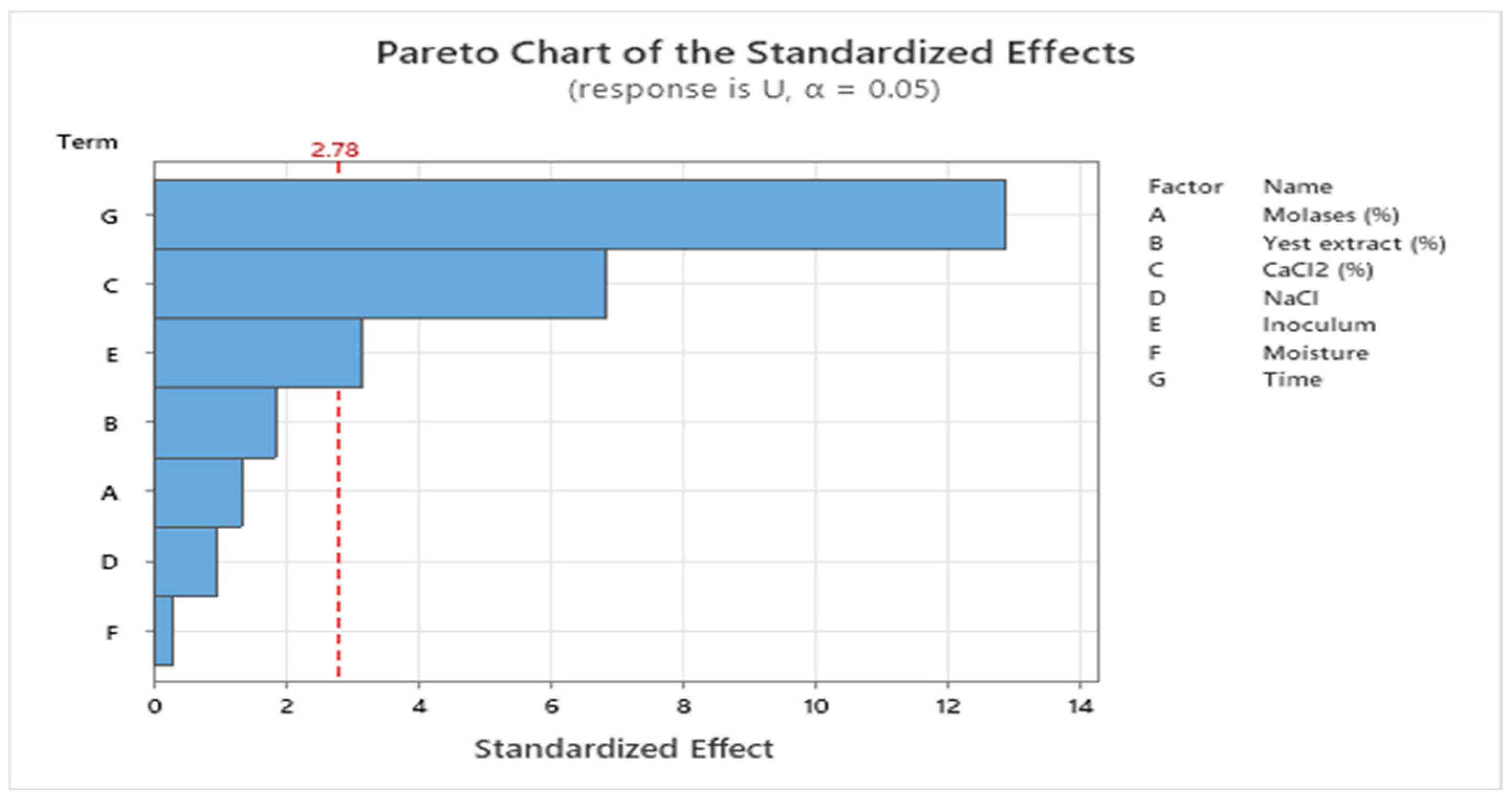
The Pareto chart of standardized effects ranks the studied factors according to their relative influence on protease activity (Figure 1), with the red vertical line indicating the statistical significance threshold (α = 0.05). In this study, fermentation time (G) had the largest positive and statistically significant effect, followed by CaCl2 concentration (C) and inoculum level (E).
After identifying the potentially significant effects from the Pareto chart, statistical analysis was performed to confirm their significance (Table 3). The factor time has a positive and significant coefficient (+1.993), indicating that a longer fermentation duration (72 h) significantly enhances protease activity. Conversely, factors such as CaCl2 (%) and inoculum exhibit negative and significant coefficients (−1.060 and −0.491), suggesting that lower levels of these parameters (0.05% for CaCl2 and 7.5% inoculum) are recommended to achieve optimal results. Factors like humidity, molasses, yeast extract, and NaCl did not show statistically significant effects on the response within the range studied, indicating that variations within these tested intervals do not substantially influence protease activity.
The highest experimental activity (143.82 U/g DW) was observed in Run 6 (Table 1) under the following conditions: 3% molasses, 0.5% yeast extract, 0.05% CaCl2, 0.5% NaCl, 15% inoculum, 70% moisture, and 72 h fermentation. However, based on the regression coefficients and ANOVA results, time, CaCl2 concentration, and inoculum size were identified as the most significant factors affecting protease production. Therefore, for process scale-up considerations, these variables were fixed at the levels predicted to maximize enzyme production within the tested range, namely 72 h fermentation time, 0.05% CaCl2, and 7.5% inoculum. The remaining factors (molasses, yeast extract, NaCl, and moisture), which did not show statistically significant effects on the response, were maintained at their lower levels to ensure process stability and economic efficiency. Accordingly, the conditions selected for further process development were 1% molasses, 0.5% yeast extract, 0.05% CaCl2, 0.5% NaCl, 7.5% inoculum, 60% moisture, and 72 h fermentation.
A first-order regression model was fitted to describe protease activity (U), according to Equation (1):
U0.5 = 3.69 − 0.208 Molasses (%) − 0.381 Yeast extract (%) − 14.13 CaCl2 (%) − 0.199 NaCl (%) − 0.131 Inoculum (%) − 0.0096 Moisture (%) + 0.1661 Time (h).
Predicted values (Table 1) were calculated for each experimental run by inserting the corresponding actual factor levels (e.g., −0.208 × 1 for 1% molasses) into the regression equation, and the resulting square-root-transformed response was then squared to obtain values in the original scale. The regression model showed a high coefficient of determination (R2 = 0.9828), indicating a very good fit of the model to the experimental data. Based on this regression equation, we validated the model using our experimental data. We obtained a model agreement (%) ranging between 87.65% and 117.54%. Using the regression equation, the protease activity predicted under the statistically optimal conditions was 166.05 U/g DW.

5.1.2. Scale-Up Evaluation of Protease Activity and Viable Cell Counts

Protease productivity was validated experimentally by scaling up the solid-state fermentation process to a 2 kg flaxseed cake batch (by a factor of 40) using the fermentation conditions identified in the previous optimization step, achieving a protease activity of 128.68 U/g DW versus 71.46 U/g DW (before optimization) and a viable count after drying of 1.4 × 10⁹ CFU/g compared with 1.1 × 10⁸ CFU/g (obtained without any supplementation). Productivity obtained at this scale aligns closely with previous laboratory-scale results.

5.1.3. Chemical Composition Changes

Solid-state fermentation markedly influenced the proximate and nutritional profile of the flaxseed cake (Table 4). Dry matter content decreased by approximately 7% (p < 0.001), reflecting higher moisture levels in the treated samples. Crude protein content declined moderately (~3%, p < 0.001), whereas crude fat content showed a pronounced reduction of about 31% (p < 0.001). Fiber fractions were also reduced, with neutral detergent fiber (NDF) and acid detergent fiber (ADF) decreasing by ~27% and ~29%, respectively (p < 0.001 for both). In contrast, crude fiber remained statistically unchanged.
The process also resulted in a marked increase in soluble metabolites. Free amino acids increased substantially (p < 0.001), rising from 0.49 to 2.6 mg g−1 DM, corresponding to an increase of approximately 431%. Reducing sugars also increased (p = 0.004), from 6.1 to 11.5 mg g−1 DM (≈88% increase). A similar trend was observed for soluble carbohydrates, which increased from 141.8 to 162.6 mg g−1 DM (p = 0.018), representing an increase of about 15%. Phytic acid, a well-known antinutritional factor in plant-derived feed ingredients, showed a reduction (p = 0.026), decreasing from 2.1% to 1.6% DM, corresponding to a reduction of approximately 23.8%.

5.1.4. Additional Bacillus Licheniformis Enzymatic Activities

The three classes of hydrolytic enzymes were detected and quantified after 72 h of fermentation. Cellulase activity reached 6.18 ± 1.214 U/g DW, xylanase activity 0.47 ± 0.073 U/g DW, and phytase activity 0.27 ± 0.110 U/g DW.

5.2. In Vivo Evaluation of Fermented Diet on Weaned Piglets

5.2.1. Growth Performance

Feeding diet with fermented flaxseed cakes (FFSC group) resulted in higher final body weight (BW) and average daily gain (ADG) compared to the FSC group fed non-fermented flaxseed cakes (p < 0.001), indicating improved growth performance (Table 5). Although average daily feed intake (ADFI) did not differ between groups (p > 0.05), but feed conversion ratio (FCR) was improved (p < 0.001) in piglets from the FFSC group. Additionally, the incidence of post-weaning diarrhea was lower (p = 0.03) in the FFSC group, suggesting beneficial health effects (Table 5). All the piglets were healthy throughout the study and no mortality was recorded.

5.2.2. Hematological and Biochemical Profile

FFSC group exhibited higher red blood cell count (RBC; p = 0.049) and hemoglobin concentration (HGB; p = 0.049), indicating potential enhancements in hematopoiesis and oxygen-carrying capacity (Table 6). Furthermore, the absolute neutrophil count (#NEUT) was higher (p < 0.05), whereas the percentage of monocytes (MONO%) and absolute count of monocytes (#MONO) were lower (p = 0.022 and p = 0.010 respectively). There was also a trend towards reduced mean corpuscular volume (MCV; p = 0.069) and increased neutrophil percentage (%NEUT; p = 0.057), suggesting subtle diet-induced changes in the leukocyte profile (Table 6). The calculated neutrophil-to-lymphocyte ratio (NLR) was 0.66 for the FSC group and 0.77 for the FFSC group.
Overall, the diet with fermented flaxseed cake had limited effects on the plasma biochemical profile (Table 7). The only difference observed was an elevated plasma glucose (GLU; p = 0.007) concentration in the FFSC group. Several biologically relevant trends that did not reach statistical significance included slightly increased (p = 0.084) total bilirubin (BIL), increased hepatic enzyme AST activity (p = 0.056), and a minor reduction in plasma magnesium (Mg) concentration (p = 0.078). These trends suggest subtle metabolic alterations induced by dietary fermentation that warrant further investigation.

5.2.3. Fermented Flaxseed Cake Effects on Fecal Microbiota

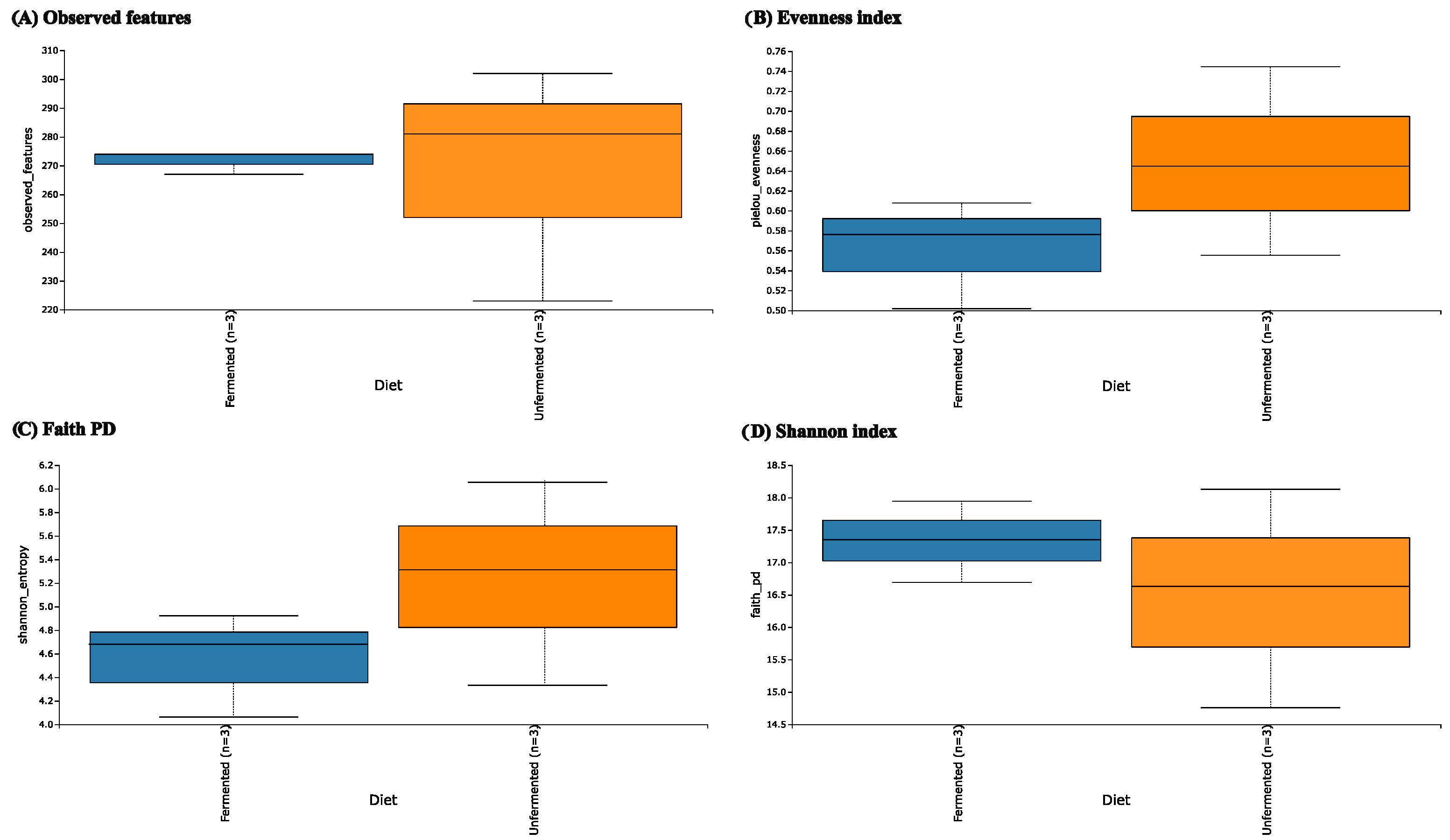
Although alpha diversity metrics such as Observed Features, Faith’s Phylogenetic Diversity, Shannon Index, and Pielou’s Evenness showed subtle numerical differences between the FFSC and FSC group, none of these reached statistical significance (p > 0.05, Kruskal–Wallis test). Notably, the FFSC group tended to have lower Shannon diversity and evenness, suggesting a community increasingly shaped by dominant species, likely influenced by the dietary intervention. However, the preservation of phylogenetic diversity (Faith’s PD) implies potential functional redundancy and resilience within the microbial community (Figure 2).
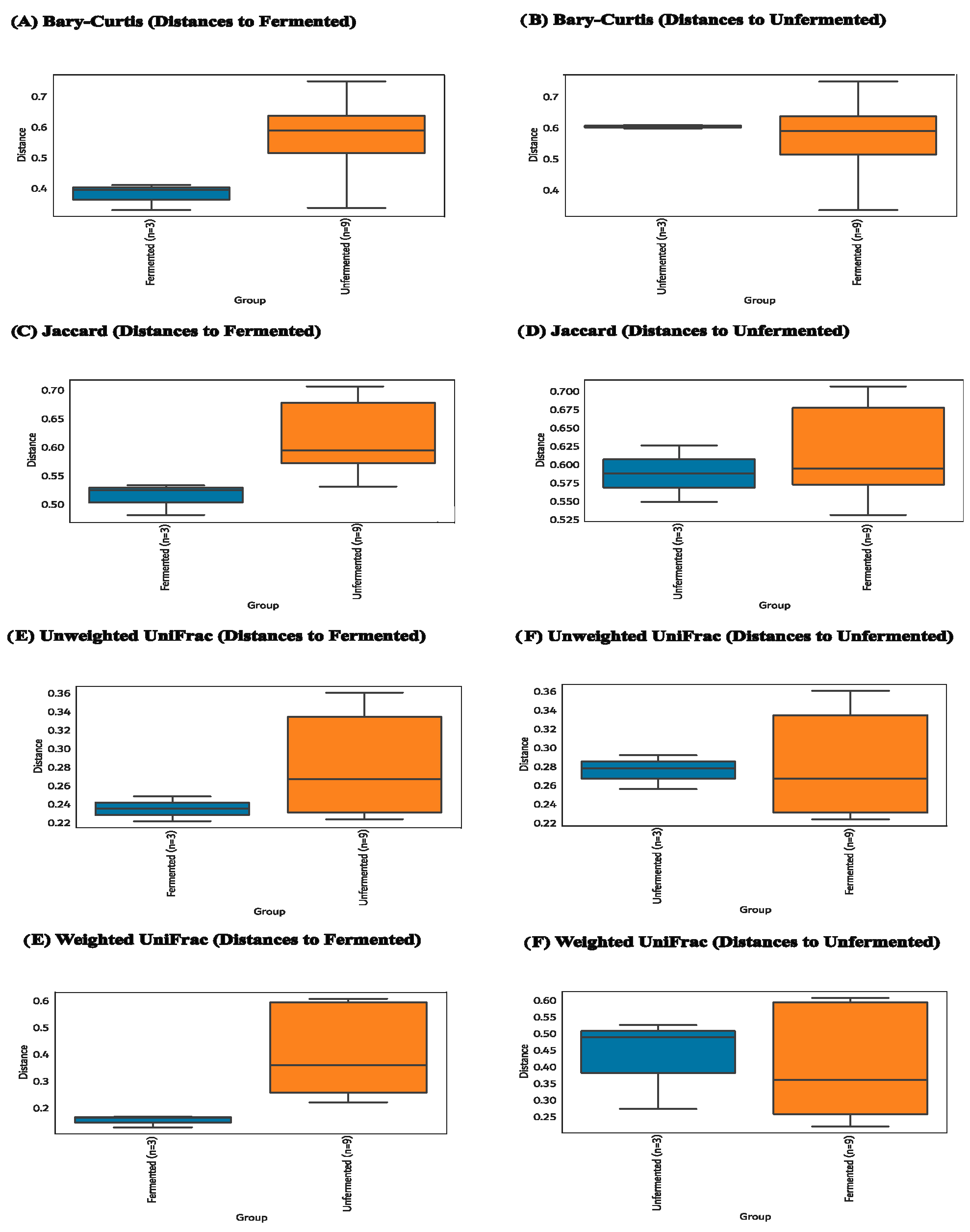
Beta diversity metrics (Figure 3) revealed trends toward microbial community separation between FFSC and FSC group. PERMANOVA based on Bray–Curtis and Jaccard dissimilarities yielded identical pseudo-F values of 1.77 (p = 0.104), indicating subtle compositional shifts not reaching statistical significance. Similarly, Unweighted UniFrac (pseudo-F = 1.71, p = 0.097) suggested potential differences in phylogenetic community membership (Figure 3). Notably, Weighted UniFrac showed the strongest trend (pseudo-F = 2.97, p = 0.09), reflecting changes in both phylogenetic structure and taxa abundance. Although none of the comparisons achieved conventional significance, the consistent trends and visual separations in the boxplots may warrant further investigation in larger cohorts.

5.2.4. Taxonomic Composition of Gut Microbiota

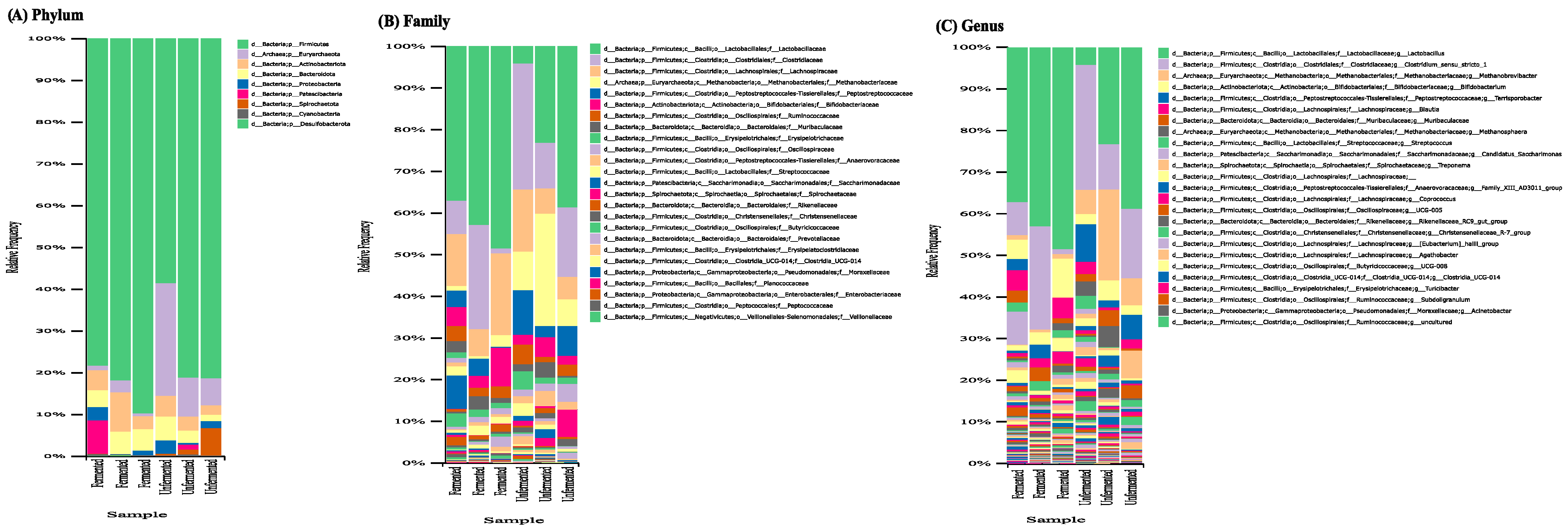
Following sequencing and taxonomic classification, a total of nine phyla, 54 families, 134 genera, and 531 unique features (ASVs or species-level operational units) were identified across all samples (Figure 4). At the phylum level, both groups were dominated by Firmicutes, though a higher average relative abundance was observed in the fermented group (83.75%) compared to the unfermented group (72.98%). Notably, Archaea (specifically Euryarchaeota) accounted for a considerably higher proportion in the FSC group (14.91%) versus the FFSC group (1.48%). Other phyla such as Proteobacteria, Bacteroidota, and Actinobacteriota were present in both groups, but with modest variations. At the family level, clear differences were observed between FFSC and FSC samples (Figure 4).
Lactobacillaceae exhibited the most substantial increase, rising from 22.9% in the FSC samples to 42.7% in the FFSC ones. In contrast, Methanobacteriaceae showed a marked decrease, from 14.9% to 1.5%. Other notable changes included a reduction in Clostridiaceae (from 18.5% to 12.4%) and Peptostreptococcaceae (from 6.6% to 2.9%), while Lachnospiraceae increased slightly from 8.3% to 12.2%. These differences highlight a shift in the microbial community structure associated with flaxseed cake fermentation.
At the genus level, fermentation led to marked shifts in microbial composition. Lactobacillus showed the most pronounced increase, rising from 22.93% in the FSC sample to 42.66% in the FFSC one. In contrast, Methanobrevibacter decreased substantially, from 11.97% to 0.94%. A similar decline was noted for Clostridium sensu stricto 1 (from 18.42% to 12.32%) and Terrisporobacter (from 5.37% to 2.22%). Additionally, an unclassified archaeal taxon dropped from 2.95% to 0.54%.

5.2.5. Differential Abundance Analysis of Gut Microbiota

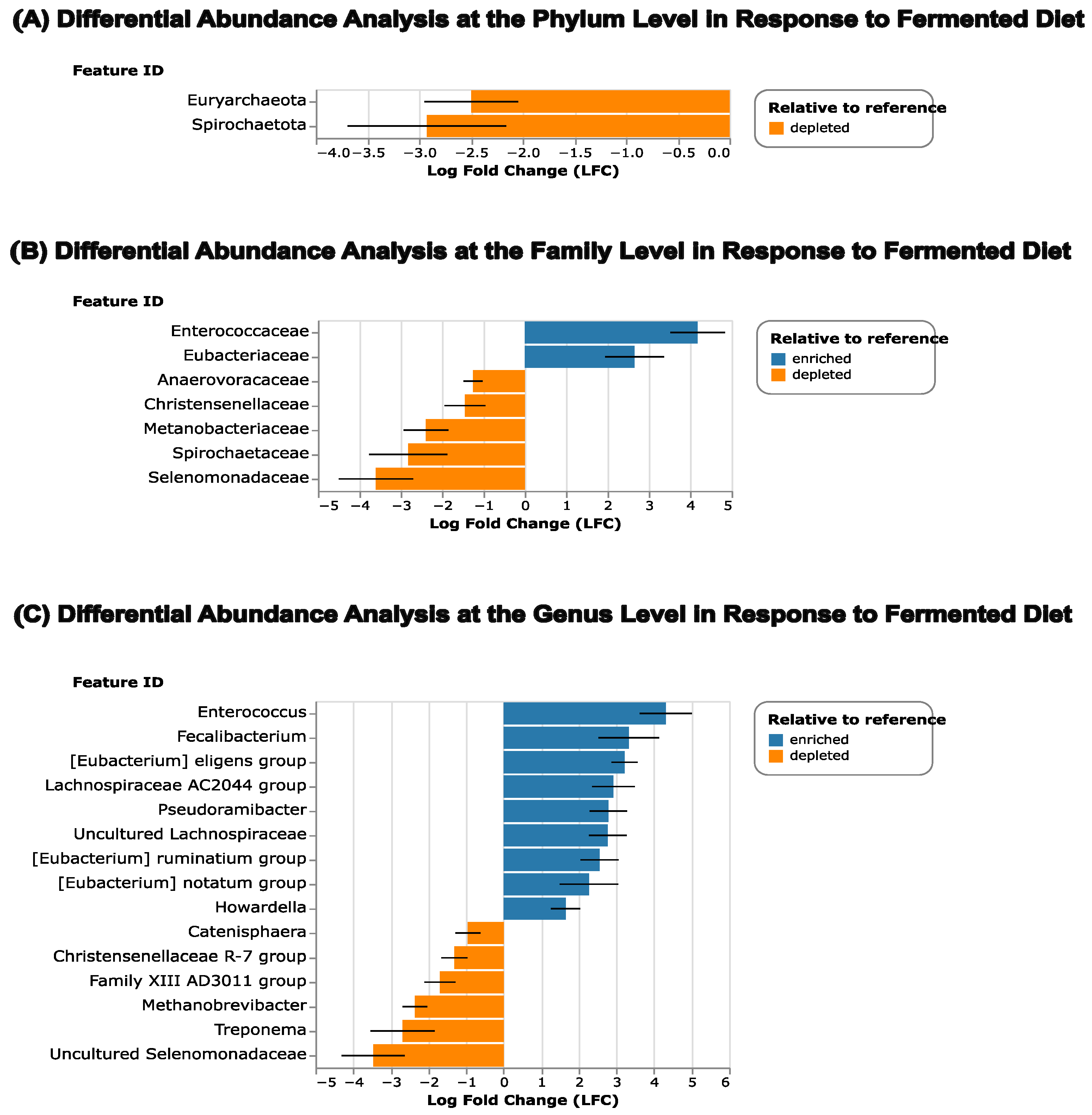
Differential abundance analysis (Figure 5) revealed a depletion of Euryarchaeota (log2FC = −2.60) and Spirochaetota (log2FC = −3.03) in response to the fermented flaxseed cake (FFSC group), relative to the FSC group, indicating a marked shift in microbial community structure at higher taxonomic level. At the family level, the diet with FFSC induced pronounced shifts in microbial composition. Notably, Enterococcaceae and Eubacteriaceae were enriched (log2FC = +4.18 and +2.65) all FDR < 0.05, suggesting a stimulation of taxa commonly associated with lactic acid production and SCFAs. In contrast, several families were markedly depleted, including Selenomonadaceae (log2FC = −3.60), Methanobacteriaceae (log2FC = −2.39), and Spirochaetaceae (log2FC = −2.82), all FDR < 0.05, indicating a suppression of taxa linked to methanogenesis.
Among the enriched genera were Enterococcus (log2FC = +4.31), Faecalibacterium (log2FC = +3.33), [Eubacterium] eligens group (log2FC = +3.22), Lachnospiraceae AC2044 group (log2FC = +2.92), Pseudoramibacter (log2FC = +2.79), and [Eubacterium] nodatum group (log2FC = +2.27, all FDR < 0.05). In contrast, several genera were depleted, including Methanobrevibacter (log2FC = −2.36), Treponema (log2FC = –2.69), uncultured Selenomonadaceae (log2FC = −3.47), and Christensenellaceae R-7 group (log2FC = −1.31), all FDR < 0.05.

5.2.6. Fecal SCFAs Analysis

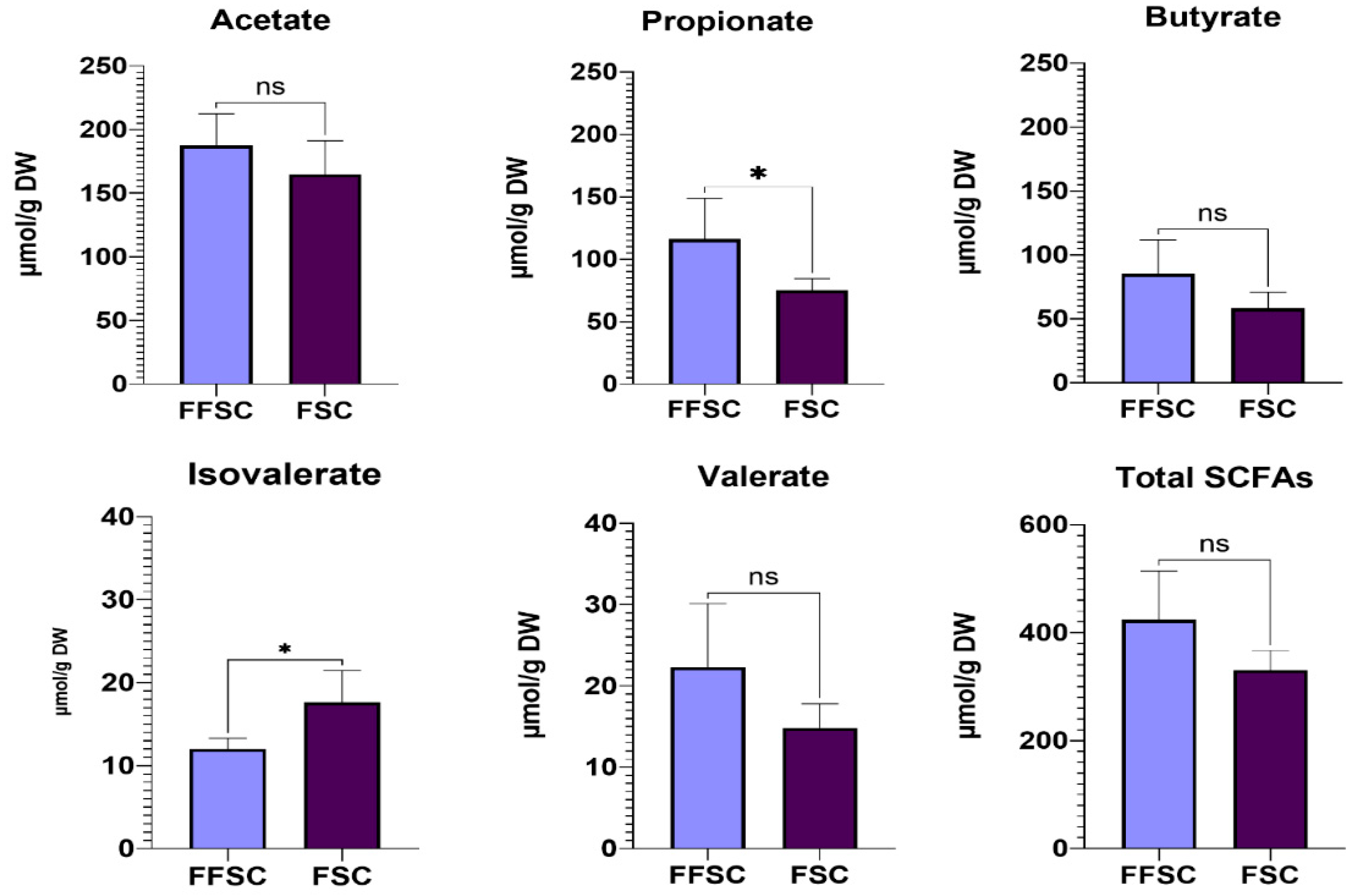
Both dietary treatments augmented SCFAs production (Figure 6), likely related to fiber availability. The inclusion of FFSC led to a shift in the SCFAs profile, with some significant differences. Propionate was higher in FFSC group (116.23 ± 29.18 vs. 75.35 ± 8.16 µmol/g DW, p < 0.05), whereas isovalerate was lower (12.02 ± 1.15 vs. 17.63 ± 3.44 µmol/g DW, p < 0.05). Butyrate and total SCFAs did not reach statistical significance; however, the results show a positive trend in favor of FFSC group (1 > p > 0.05). In contrast, FFSC inclusion in diet did not alter total acetate and valerate production in comparison with unfermented FSC; however, valerate showed a tendency towards change (p = 0.503). Succinate and lactate were both below the limit of detection.

6. Discussion

Given the lower digestibility of flaxseed protein compared with soybean protein, we developed a solid-state fermentation process, taking into account that proteases hydrolyze complex feed proteins into peptides and amino acids, thereby improving nutrient utilization in animals, particularly in young animals with an immature gastrointestinal system [39]. The use of recombinant or purified proteases, such as Alcalase™ (a serine endopeptidase from Bacillus licheniformis, 3000 U/g) or Flavourzyme™ (a protease complex derived from Aspergillus oryzae, 120 U/g), enables rapid protein hydrolysis [40]. Meta-analyses in weaned piglets indicate that exogenous enzyme (proteases, phytases, carbohydrases) supplementation can improve nutrient digestibility and sometimes improve gain: feed, but responses are variable and depend on diet composition and enzyme combinations [41]. In contrast, solid-state fermentation (SSF) with Bacillus spp. may provide multiple functional benefits. These include improvement of nutritional quality, reduction in structural polysaccharides, of antinutritional factors such as phytate and the production of metabolites that can influence gut microbial ecology [42]. SSF with Bacillus spp. functions as a biological preconditioning step, the microorganism produces a suite of extracellular enzymes in situ while simultaneously modifying substrate structure and reducing specific antinutrients [43]. This can increase nutrient availability without relying on enzyme stability in the gastrointestinal tract. In addition, improvements in feed efficiency with fermented feed are often achieved without changes in ADFI [44] suggesting that benefits derive primarily from nutrient availability/utilization.
Using a Plackett–Burman screening design to optimize the SSF process for increased protease production we found time as the most important parameter in SSF, with maximal production observed at 72 h being consistent with studies liquid culture where Bacillus licheniformis was employed. However, the titter was lower when flaxseed cake was used in comparation to soybean meal to induce protease expression [45] or when cultivation is attempted in a tray bioreactor with ventilation where faster production can be achieved with Bacillus licheniformis [46]. Other studies demonstrated positive of yeast extract (1%) and negative effects of higher concentration CaCl2 in Bacillus cereus [47], consistent with our results. Although CaCl2 in an essential cofactor for protease activity [48], it becomes detrimental in higher concentrations indicating an concentration-dependent effect.
Following SSF, flaxseed cake showed a nutritional profile consistent with enzymatic pre-digestion and matrix remodeling. Most notably, we observed pronounced reductions in the detergent fiber fractions (NDF by 27.36%; ADF by 29.24%) and an increase in free amino acids (reflecting proteolysis). In parallel, reducing sugars and water-soluble carbohydrates increased, consistent with partial depolymerization of structural carbohydrates into smaller, more soluble fractions. Mechanistically, Bacillus licheniformis secretes a diverse array of glycoside hydrolases, including cellulases, xylanases, and pectinases, which depolymerize complex plant fibers such as cellulose, hemicellulose (e.g., xylan and xyloglucan), and pectin into smaller saccharides. This enzymatic activity results in partial cellulose hydrolysis and efficient cleavage of hemicellulose, generating oligosaccharides, simple sugars, and other soluble by-products [49]. Comparable SSF with Bacillus spp. studies in plant meals show that such multi-enzyme activity can reduce NDF/ADF and increase the degree of protein hydrolysis, improving the accessibility of nutrients [50]. Additionally, previous studies have reported increases in free amino acids [51] and peptide content [52], which may further enhance protein digestibility. Consistent with these biochemical modifications, microscopic analyses using SEM and CLSM have shown that fermentation of flaxseed with Bacillus spp. induces pronounced microstructural changes, including formation of a microporous matrix, structural collapse, and degradation of the cellulose superstructure. These modifications enhance oil and water retention capacities [53] and may further increase substrate accessibility to hydrolases produced by commensal microbiota, thereby influencing fermentation kinetics and shaping gut microbiome composition [54].
To investigate the in vivo implications of these effects during the nutritionally sensitive post-weaning transition, we conducted a 28-day pilot nutritional trial in post-weaned piglets (35 days old) designed to evaluate the dietary intervention and generate hypotheses related to host–microbiota interactions and associated physiological parameters. In this regard, the only dietary modification consisted of substituting flaxseed cake with fermented flaxseed at the same inclusion level (8%). In this study, we observed an improvement in growth performance parameters with significative increase in final body weight, ADG, and decrease in FCR without a modification in ADFI. This pattern suggests that fermentation primarily enhanced nutrient utilization efficiency rather than feed intake, likely by improving nutrient accessibility within the feed matrix. The reduction in FCR observed in the present study indicates improved efficiency of feed utilization, a key determinant of economic performance in pig production systems. Consistent with this interpretation, a study with Bacillus subtilis fermentation of flaxseed meal showed a decrease in gain-to-feed ratio however without increase in ADG or ADFI along with reduction in NDF and ADF [16]. Other study also using fermentation with Bacillus subtilis in flaxseed meal showed a reduction on NDF and ADF along with increasing apparent digestibility of CP, NDF, ADF, Ca, and P of growing pigs [55] similar effect of increasing crude protein apparent ileal digestibility being shown when rapeseed meal was fermented with Bacillus subtilis [56] along with an increase in final body weight and ADG [57].
A central question is whether the observed improvements in growth performance reflect a reduction in antinutritional factors relative to the unfermented flaxseed cake diet or an increase in nutrient digestibility. Previous studies have shown that dietary inclusion of 12% or 30% flaxseed reduced feed intake and negatively affected growth performance in pigs [58], this was likely due to the presence of antinutritional factors, high fiber content that can impair digestibility, and increased digesta viscosity [59]. Among these antinutritional factors, phytate (phytic acid) plays an important role due to its ability to chelate minerals and reduce nutrient bioavailability [60]. In the present study, phytate content decreased by 23.81% following SSF. Although microbial phytase activity during fermentation can promote phytate degradation and improve mineral utilization in monogastric animals, the experimental diets were supplemented with exogenous phytase as part of the premix. Therefore, it is unlikely that the improvements in growth performance observed here were primarily driven by the reduction in phytate levels. Other antinutritional compounds present in flaxseed products may have played a role. In particular, microbial fermentation of flaxseed meals has been reported to reduce cyanogenic glycosides while increasing metabolizable energy [55]. Although these compounds were not quantified in the present study, their degradation during fermentation and processing may partly explain the improved FCR observed, despite similar crude nutrient composition of the diets.
Beyond improvements in nutrient accessibility, another mechanism that may contribute to the observed performance responses is the modulation of hindgut microbial fermentation. SCFAs and their association with gut health are particularly important in swine production, especially during the weaning period, when infections with pathogens such as Clostridium spp. and Escherichia coli can dramatically impair animal performances [61]. SCFAs produced in the cecum and colon through gut microbial fermentation are rapidly absorbed by intestinal epithelial cells. Acetate is primarily absorbed into the portal vein and redirected toward systemic energy metabolism, butyrate is readily metabolized via mitochondrial β-oxidation and supplies approximately 60–70% of the total energy requirements of colonic epithelial cells, while propionate is transported to the liver, where it serves as a substrate for gluconeogenesis [62]. We observed that diets rich in soluble fiber can significantly augment SCFAs production. Specifically, the inclusion of rye, barley, and FFSC in piglet’s diet increased total SCFAs concentrations, compared with a diet without FFSC. Previous work [63] has reported total SCFAs concentrations of 154.25 μmol/g dry weights (DW) of feces in a standard maize-based diet, which increased to 205.72 μmol/g DW following supplementation with maize bran, further supporting the capacity of fermentable fibers to enhance colonic SCFAs production. In the present study, SSF increased the total soluble carbohydrate fraction by approximately 15%. However, only a small proportion of this increase was accounted for by reducing sugars, which rose only marginally. Together with the observed reductions in NDF and ADF and the detection of cellulase and xylanase activities during fermentation, these results suggest that SSF partially depolymerized structural polysaccharides, generating smaller and more readily fermentable fiber fractions. The increased availability of these substrates likely promoted microbial fermentation in the hindgut, which may explain the higher concentrations of propionate observed in the FFSC diet.
In this context, our alpha and beta diversity analyses did not indicate an overall increase in microbial diversity. Instead, the results suggest a shift toward microbial specialization, with the enrichment of specific taxa potentially adapted to utilize the fermentation-derived substrates, which may have contributed to the increased propionate production. Methanogens consume H2 and CO2 that could otherwise be redirected toward SCFAs production, thereby representing a potential energetic loss for the host. Although methane formation accounts for only a minor fraction of total energy loss in pigs, a higher abundance of methanogens has been consistently associated with leaner phenotypes, suggesting that fermentative energy is preferentially diverted toward methane production rather than acetate and propionate synthesis [64].
In addition, Christensenellaceae, also depleted in our study, have been linked to lean body composition and are known to co-occur with methanogens, facilitating interspecies H2 transfer and enhancing methanogenic activity [65]. Methanogen abundance has been reported to increase under pectin-rich dietary conditions [66]. However, under SSF of pectin-rich substrates such as flaxseed cakes, the substrate profile is substantially altered, leading to enhanced fiber degradation and the creation of an intestinal environment less favorable to methanogenic archaea. This shift is likely driven by the depletion of key syntrophic bacterial taxa, including Selenomonadaceae and Anaerovoracaceae.
Concomitantly, the reduction in Spirochaetaceae and Christensenellaceae suggests a restructuring of the microbial niche, potentially substituted by Enterococcaceae. This microbial replacement may redirect metabolic hydrogen and electron flow toward alternative reductive pathways, such as fumarate- and succinate-linked propionate synthesis, thereby favoring more energetically efficient SCFAs production for the host [67].
In parallel, shifts toward saccharolytic metabolism are often accompanied by a reduction in proteolytic fermentation processes. Consistent with this pattern, isovalerate concentrations, a marker of microbial protein fermentation, was significantly lower in the fermented group, suggesting reduced proteolytic activity [57]. This reduction may also reflect lower availability of protein substrates in the distal intestine. Furthermore, several studies have reported that diets promoting saccharolytic fermentation and SCFA production can support the growth of beneficial lactic acid bacteria, including Lactobacillus whose abundance was higher in FFSC group, while limiting the proliferation of enteric pathogens associated with post-weaning diarrhea in piglets [68]. SCFAs, contribute to intestinal health by lowering luminal pH, inhibiting pathogen growth, and supporting epithelial barrier function, which may collectively contribute to reduced diarrhea incidence and improved growth performance in weaned piglets [69].
Nevertheless, several limitations of this exploratory study should be acknowledged. Although shifts in gut microbiota composition were observed, the mechanistic links between dietary products and microbial dynamics remain unclear and require further investigation. In addition, antinutritional factors naturally present in flaxseed, such as cyanogenic glycosides, were not quantified in the present study. However, microbial fermentation and substrate preconditioning processes are known to contribute to the degradation of such compounds, which may partially explain the improved growth performance observed. Finally, the metabolomic profile of the fermentation process, including potential microbial metabolites such as organic acids, antimicrobial peptides and nutrients, was not investigated and should be addressed in future studies to better clarify the mechanisms underlying the observed effects

7. Conclusions

Solid-state fermentation of flaxseed cakes with Bacillus licheniformis was optimized using a Plackett–Burman design, identifying 1% molasses, 0.5% yeast extract, 0.05% CaCl2, 0.5% NaCl, 7.5% inoculum, 60% moisture, and 72 h fermentation as the most favorable conditions for protease production. Under these conditions, fermentation improved the nutritional profile of flaxseed cakes by increasing total soluble carbohydrates, reducing structural fiber fractions (NDF and ADF), and decreasing phytic acid content.
In a 28-day feeding trial, dietary inclusion of 8% fermented flaxseed cakes (FFSC) improved growth performance in weaned piglets, as reflected by increased final body weight and average daily gain, improved feed conversion ratio, and reduced diarrhea incidence, without affecting feed intake. These effects were accompanied by shifts in gut microbiota composition, including higher abundance of Lactobacillus, reduced methanogenic archaea, increased fecal propionate concentrations, and lower levels of isovalerate, a marker of proteolytic fermentation.
Overall, these findings indicate that fermentation-based preconditioning of flaxseed cakes may represent a promising strategy to enhance the nutritional functionality of plant-derived feed ingredients and support gut microbial balance and performance during the critical post-weaning period.

Author Contributions

Conceptualization, D.R., G.C. and E.V.; methodology, D.R., G.C. and E.V.; software, D.R., M.D., and S.M.T.; validation, N.-M.B. and M.D.; formal analysis, D.R., M.D., S.M.T., and N.-M.B.; investigation, G.C.; resources, G.C.; data curation E.V.; writing—original draft preparation, D.R., M.D. and S.M.T.; writing—review and editing M.D., N.-M.B. and E.V.; project administration, G.C. and E.V.; funding acquisition, G.C. All authors have read and agreed to the published version of the manuscript.

Funding

The author(s) declare financial support was received for the research and/or publication of this article. This research was funded by the Romanian Ministry of Agriculture and Rural Development (Project ADER 8.1.7) and the Romanian Ministry of Education and Research (PN 23-20.04.01). Dan Rambu was supported by a doctoral scholarship awarded by the University of Agronomic Sciences and Veterinary Medicine of Bucharest (USAMV).

Institutional Review Board Statement

This study was conducted in accordance with the experimental protocol (no. 42/10-07-2024)) approved by the Ethics Commission of the National Research-Development Institute for Animal Biology and Nutrition, Balotești, Romania. All procedures complied with the provisions of European Directive (2010/63/EU) and Romanian Law 43/04.2014 on the protection of animals used for scientific purposes.

Informed Consent Statement

Not applicable.

Data Availability Statement

The original contributions presented in the study are included in the article, further inquiries can be directed to the corresponding author. Raw sequencing data have been deposited in the NCBI Sequence Read Archive (SRA) under accession number: PRJNA1413981.

Conflicts of Interest

The authors declare no conflicts of interest.

References

  1. Goyal, A.; Sharma, V.; Upadhyay, N.; Gill, S.; Sihag, M. Flax and flaxseed oil: An ancient medicine and modern functional food. J. Food Sci. Technol. 2014, 51, 1633–1653. [Google Scholar] [CrossRef] [PubMed]
  2. Czyż, K.; Sokoła-Wysoczańska, E.; Wyrostek, A.; Cholewińska, P. An Attempt to Enrich Pig Meat with Omega-3 Fatty Acids Using Linseed Oil Ethyl Ester Diet Supplement. Agriculture 2021, 11, 365. [Google Scholar] [CrossRef]
  3. Pramanik, J.; Kumar, A.; Prajapati, B. A review on flaxseeds: Nutritional profile, health benefits, value added products, and toxicity. eFood 2023, 4, e114. [Google Scholar] [CrossRef]
  4. Goyal, A.; Patel, A.; Sihag, M.K.; Shah, N.; Tanwar, B. Therapeutic Potential of Flaxseed. In Therapeutic, Probiotic, and Unconventional Foods; Academic Press: Cambridge, MA, USA, 2018; pp. 255–274. [Google Scholar] [CrossRef]
  5. Safdar, B.; Pang, Z.; Liu, X.; Jatoi, M.A.; Mehmood, A.; Rashid, M.T.; Ali, N.; Naveed, M. Flaxseed gum: Extraction, bioactive composition, structural characterization, and its potential antioxidant activity. J. Food Biochem. 2019, 43, e13014. [Google Scholar] [CrossRef]
  6. Nowak, W.; Jeziorek, M. The role of flaxseed in improving human health. Healthcare 2023, 11, 395. [Google Scholar] [CrossRef]
  7. Mayengbam, S.; Raposo, S.; Aliani, M.; House, J.D. A Vitamin B-6 Antagonist from Flaxseed Perturbs Amino Acid Metabolism in Moderately Vitamin B-6-Deficient Male Rats. J. Nutr. 2016, 146, 14–20. [Google Scholar] [CrossRef]
  8. Eastwood, L.; Kish, P.R.; Beaulieu, A.D.; Leterme, P. Nutritional value of flaxseed meal for swine and its effects on the fatty acid profile of the carcass. J. Anim. Sci. 2009, 87, 3607–3619. [Google Scholar] [CrossRef]
  9. Montoya, C.A.; Leterme, P. Validation of the net energy content of canola meal and full-fat canola seeds in growing pigs. Can. J. Anim. Sci. 2010, 90, 213–219. [Google Scholar] [CrossRef]
  10. Wei, X.; Tsai, T.; Howe, S.; Zhao, J. Weaning Induced Gut Dysfunction and Nutritional Interventions in Nursery Pigs: A Partial Review. Animals 2021, 11, 1279. [Google Scholar] [CrossRef]
  11. Tang, X.; Xiong, K.; Fang, R.; Li, M. Weaning stress and intestinal health of piglets: A review. Front. Immunol. 2022, 13, 1042778. [Google Scholar] [CrossRef]
  12. Li, Y.; Guo, Y.; Wen, Z.; Jiang, X.; Ma, X.; Han, X.; Yang, Y.; Yang, X. Weaning stress perturbs gut microbiome and its metabolic profile in piglets. Sci. Rep. 2018, 8, 18068. [Google Scholar] [CrossRef]
  13. Olukomaiya, O.; Fernando, C.; Mereddy, R.; Li, X.; Sultanbawa, Y. Solid-state fermented plant protein sources in the diets of broiler chickens: A review. Anim. Nutr. 2019, 5, 319–330. [Google Scholar] [CrossRef]
  14. Aguilar, J.G.S.; Castro, R.J.S.; Sato, H.H. Alkaline protease production by Bacillus licheniformis LBA 46 in a bench reactor: Effect of temperature and agitation. Braz. J. Chem. Eng. 2019, 36, 615–625. [Google Scholar] [CrossRef]
  15. Canoy, T.S.; Wiedenbein, E.S.; Bredie, W.L.P.; Meyer, A.S.; Wösten, H.A.B.; Nielsen, D.S. Solid-State Fermented Plant Foods as New Protein Sources. Annu. Rev. Food Sci. Technol. 2024, 15, 189–210. [Google Scholar] [CrossRef]
  16. Xu, L.; Wei, Z.; Guo, Y.; Guo, B.; Cai, L.; Yan, J.; Ma, L.; Sun, W.; Li, Y.; Jiang, X.; et al. Effects of dietary supplementation with fermented flaxseed meal on the growth performance, immune function, and intestinal microbiota of growing pigs. Anim. Feed Sci. Technol. 2024, 316, 116079. [Google Scholar] [CrossRef]
  17. Che, L.; Hu, L.; Zhou, Q.; Peng, X.; Liu, Y.; Luo, Y.; Fang, Z.; Lin, Y.; Xu, S.; Feng, B.; et al. Flaxseed oil supplementation improves intestinal function and immunity, associated with altered intestinal microbiome and fatty acid profile in pigs with intrauterine growth retardation. Food Funct. 2019, 10, 8149–8160. [Google Scholar] [CrossRef]
  18. Rambu, D.; Dumitru, M.; Ciurescu, G.; Vamanu, E. Solid-state fermentation using Bacillus licheniformis: Driven changes in composition, viability and in vitro protein digestibility of oilseed cakes. Agriculture 2024, 14, 639. [Google Scholar] [CrossRef]
  19. Plackett, R.L.; Burman, J.P. The design of optimum multifactorial experiments. Biometrika 1946, 33, 305–325. [Google Scholar] [CrossRef]
  20. Banerjee, S.; Kari, Z.A.; Téllez-Isaías, G.; Ghosh, K. The use of linseed oil cake in the diets of rohu, Labeo rohita (Hamilton), after solid-state fermentation with a fish gut bacterium, Bacillus pumilus (KF640221): An appraisal on growth, digestibility, body composition, and hematobiochemical profile. Front. Mar. Sci. 2023, 10, 1278704. [Google Scholar] [CrossRef]
  21. Ellaiah, P.; Adinarayana, K.; Rajyalakshmi, P.; Srinivasulu, B. Optimization of process parameters for alkaline protease production under solid state fermentation by alkalophilic Bacillus sp. Asian J. Microbiol. Biotechnol. Environ. Sci. 2003, 5, 49–54. [Google Scholar]
  22. Saggu, S.K.; Mishra, P.C. Characterization of thermostable alkaline proteases from Bacillus infantis SKS1 isolated from garden soil. PLoS ONE 2017, 12, e0188724. [Google Scholar] [CrossRef] [PubMed]
  23. Vijayaraghavan, P.; Lazarus, S.; Vincent, S.G. De-hairing protease production by an isolated Bacillus cereus strain AT under solid-state fermentation using cow dung: Biosynthesis and properties. Saudi J. Biol. Sci. 2014, 21, 27–34. [Google Scholar] [CrossRef] [PubMed]
  24. Singh, R.; Meena, R.; Kumar, H.D.; Lal, B. Production, Purification, and Characterization of an Industrially Important Enzyme Alkaline Protease Produced from Locally Isolated Bacillus Bacteria. Int. J. Microbiol. Biotechnol. 2021, 6, 95–103. [Google Scholar] [CrossRef]
  25. Nascimento, W.C.A.D.; Martins, M.L.L. Production and properties of an extracellular protease from thermophilic Bacillus sp. Braz. J. Microbiol. 2004, 35, 91–96. [Google Scholar] [CrossRef]
  26. Dumitru, M.; Râmbu, D.-T.; Ciurescu, G.; Cornescu, G.M.; Panaite, T.D. Enhanced Enzyme Production and Probiotic Viability in Oilseed Cakes Fermented with Bacillus subtilis for Piglet Nutrition. Fermentation 2025, 11, 607. [Google Scholar] [CrossRef]
  27. ISO 13903:2005; Animal Feeding Stuffs—Determination of Amino Acids Content. International Organization for Standardization: Geneva, Switzerland, 2005.
  28. Moore, S.; Stein, W.H. A modified ninhydrin reagent for the photometric determination of amino acids and related compounds. J. Biol. Chem. 1954, 211, 907–913. [Google Scholar] [CrossRef]
  29. Commission of the European Communities. Commission Regulation (EC) No 152/2009 of 27 January 2009 laying down the methods of sampling and analysis for the official control of feed. Off. J. Eur. Union 2009, L54, 1–130. [Google Scholar]
  30. ISO 16472:2006; Animal feeding stuffs—Determination of amylase-treated neutral detergent fibre content (aNDF). International Organization for Standardization: Geneva, Switzerland, 2006.
  31. ISO 13906:2008; Animal feeding stuffs—Determination of acid detergent fibre (ADF) and acid detergent lignin (ADL) contents. International Organization for Standardization: Geneva, Switzerland, 2008.
  32. Miller, L.G. Use of Dinitrosalicylic Acid Reagent for Determination of Reducing Sugar. Anal. Chem. 1959, 31, 426–428. [Google Scholar] [CrossRef]
  33. Oomah, B.D.; Kenaschuk, E.O.; Cui, W.; Mazza, G. Variation in the composition of water-soluble polysaccharides in flaxseed. J. Agric. Food Chem. 1995, 43, 1484–1488. [Google Scholar] [CrossRef]
  34. Dubois, M.; Gilles, K.; Hamilton, J.K.; Rebers, P.A.; Smith, F. A colorimetric method for the determination of sugars. Nature 1951, 168, 167. [Google Scholar] [CrossRef]
  35. National Research Council (NRC). Nutrient Requirements of Swine, 11th rev. ed.; The National Academies Press: Washington, DC, USA, 2012. [Google Scholar]
  36. Takahashi, S.; Tomita, J.; Nishioka, K.; Hisada, T.; Nishijima, M. Development of a prokaryotic universal primer for simultaneous analysis of Bacteria and Archaea using next-generation sequencing. PLoS ONE 2014, 9, e105592. [Google Scholar] [CrossRef] [PubMed]
  37. Martin, M. Cutadapt Removes Adapter Sequences from High-Throughput Sequencing Reads. EMBnet J. 2011, 17, 10–12. [Google Scholar] [CrossRef]
  38. De Baere, S.; Eeckhaut, V.; Steppe, M.; De Maesschalck, C.; De Backer, P.; Van Immerseel, F.; Croubels, S. Development of an HPLC-UV method for the quantitative determination of four short-chain fatty acids and lactic acid produced by intestinal bacteria during in vitro fermentation. J. Pharm. Biomed. Anal. 2013, 80, 107–115. [Google Scholar] [CrossRef]
  39. Wei, C.-K.; Thakur, K.; Liu, D.-H.; Zhang, J.-G.; Wei, Z.-J. Enzymatic hydrolysis of flaxseed (Linum usitatissimum L.) protein and sensory characterization of Maillard reaction products. Food Chem. 2018, 263, 186–193. [Google Scholar] [CrossRef]
  40. Torres-Pitarch, A.; Hermans, D.; Manzanilla, E.G.; Bindelle, J.; Everaert, N.; Beckers, Y.; Torrallardona, D.; Bruggeman, G.; Gardiner, G.E.; Lawlor, P.G. Effect of feed enzymes on digestibility and growth in weaned pigs: A systematic review and meta-analysis. Anim. Feed Sci. Technol. 2017, 233, 145–159. [Google Scholar] [CrossRef]
  41. Qi, N.; Zhan, X.; Milmine, J.; Chang, K.-H.; Li, J. A novel thermophilic strain of Bacillus subtilis with antimicrobial activity and its potential application in solid-state fermentation of soybean meal. Microbiol. Spectr. 2024, 12, e02784-23. [Google Scholar] [CrossRef]
  42. Álvarez, A.; Rodríguez, A.; Chaparro, S.; Borrás, L.M.; Rache, L.Y.; Brijaldo, M.H.; Martínez, J.J. Solid-State Fermentation as a Biotechnological Tool to Reduce Antinutrients and Increase Nutritional Content in Legumes and Cereals for Animal Feed. Fermentation 2025, 11, 359. [Google Scholar] [CrossRef]
  43. Xu, B.; Li, Z.; Wang, C.; Fu, J.; Zhang, Y.; Wang, Y.; Lu, Z. Effects of fermented feed supplementation on pig growth performance: A meta-analysis. Anim. Feed. Sci. Technol. 2019, 259, 114315. [Google Scholar] [CrossRef]
  44. Amin, O.E.; Aboul-Enein, A.M.; Abd-Elsalam, I.S.; Wahba, M.I.; Helmy, Y.S. Optimization of protease production by newly isolated Bacillus sp. from the Red Sea using defatted soybean cake. Sci. Rep. 2025, 15, 32118. [Google Scholar] [CrossRef]
  45. Pouryafar, F.; Najafpour, G.D.; Noshadi, N.; Jahanshahi, M. Thermostable alkaline protease production via solid-state fermentation in a tray bioreactor using Bacillus licheniformis ATCC 21424. Int. J. Environ. Res. 2015, 9, 1127–1134. [Google Scholar] [CrossRef]
  46. Abdella, M.A.A.; Ahmed, S.A. Stable protease from Bacillus licheniformis-MA1 strain: Statistical production optimization, kinetic and thermodynamic characterization, and application in silver recovery from used X-ray films. Microb. Cell Factories 2025, 24, 98. [Google Scholar] [CrossRef] [PubMed]
  47. Zhang, J.; Wang, J.; Zhao, Y.; Li, J.; Liu, Y. Study on the interaction between calcium ions and alkaline protease of Bacillus. Int. J. Biol. Macromol. 2019, 124, 121–130. [Google Scholar] [CrossRef]
  48. Ngom, S.I.; Maski, S.; Rached, B.; Chouati, T.; Oliveira Correia, L.; Juste, C.; Meylheuc, T.; Henrissat, B.; El Fahime, E.; Amar, M.; et al. Exploring the hemicellulolytic properties and safety of Bacillus paralicheniformis as stepping stone in the use of new fibrolytic beneficial microbes. Sci. Rep. 2023, 13, 22785. [Google Scholar] [CrossRef]
  49. Qi, N.; Zhan, X.; Milmine, J.; Sahar, M.; Chang, K.-H.; Li, J. Isolation and characterization of a novel hydrolase-producing probiotic Bacillus licheniformis and its application in the fermentation of soybean meal. Front. Nutr. 2023, 10, 1123422. [Google Scholar] [CrossRef]
  50. Hou, C.; Zhang, Y.; Chen, J.; Hu, J.; Yang, C.; Chen, F.; Zhu, T.; Xin, Y.; Geng, X. Optimization of solid-state fermentation process for dietary fiber in flaxseed meal and analysis of its microstructure and functional properties. Foods 2025, 14, 1722. [Google Scholar] [CrossRef]
  51. Meldrum, O.W.; Yakubov, G.E. Journey of dietary fiber along the gastrointestinal tract: Role of physical interactions, mucus, and biochemical transformations. Crit. Rev. Food Sci. Nutr. 2025, 65, 4264–4292. [Google Scholar] [CrossRef] [PubMed]
  52. Park, S.; Lee, J.J.; Yang, B.M.; Cho, J.H.; Kim, S.; Kang, J.; Oh, S.; Park, D.-J.; Perez-Maldonado, R.; Cho, J.-Y.; et al. Dietary protease improves growth performance, nutrient digestibility, and intestinal morphology of weaned pigs. J. Anim. Sci. Technol. 2020, 62, 21–30. [Google Scholar] [CrossRef]
  53. Zhang, Y.; Ishikawa, M.; Koshio, S.; Yokoyama, S.; Wang, W.; Zhu, K. Optimization of soybean meal fermentation using Bacillus subtilis natto by response surface methodology. Fermentation 2021, 7, 306. [Google Scholar] [CrossRef]
  54. Liu, D.; Guo, Y.; Ma, H. Production of value-added peptides from agro-industrial residues by solid-state fermentation using a thermophilic protease-producing strain. Food Biosci. 2023, 53, 102534. [Google Scholar] [CrossRef]
  55. Wei, Z.; Xu, L.; Guo, Y.; Guo, B.; Sun, W.; Li, Y.; Jiang, X.; Li, X.; Pi, Y. Evaluation of available energy and standardized ileal digestibility of amino acids in fermented flaxseed meal for growing pigs. Animals 2024, 14, 228. [Google Scholar] [CrossRef]
  56. Czech, A.; Wlazło, Ł.; Łukaszewicz, M.; Florek, M.; Nowakowicz-Dębek, B. Fermented rapeseed meal enhances the digestibility of protein and macro- and microminerals and improves the performance of weaner pigs. Anim. Feed Sci. Technol. 2023, 300, 115656. [Google Scholar] [CrossRef]
  57. Shuai, C.; Chen, D.; Yu, B.; Luo, Y.; Zheng, P.; Huang, Z.; Yu, J.; Mao, X.; Yan, H.; He, J. Effect of fermented rapeseed meal on growth performance, nutrient digestibility, and intestinal health in growing pigs. Anim. Nutr. 2023, 9, 420–429. [Google Scholar] [CrossRef]
  58. Xu, L.; Wei, Z.; Guo, B.; Bai, R.; Liu, J.; Li, Y.; Sun, W.; Jiang, X.; Li, X.; Pi, Y. Flaxseed meal and its application in animal husbandry: A review. Agriculture 2022, 12, 2027. [Google Scholar] [CrossRef]
  59. Koo, B.; Kim, J.W.; Nyachoti, C.M. Standardized ileal digestible amino acid contents in flaxseed and flaxseed meals fed to growing–finishing pigs. Can. J. Anim. Sci. 2020, 101, 381–385. [Google Scholar] [CrossRef]
  60. Erdman, J.W. Oilseed phytates: Nutritional implications. J. Am. Oil Chem. Soc. 1979, 56, 736–741. [Google Scholar] [CrossRef]
  61. Liu, Y. Fatty acids, inflammation and intestinal health in pigs. J. Anim. Sci. Biotechnol. 2015, 6, 41. [Google Scholar] [CrossRef]
  62. Yang, P.; Zhao, J. Variations in gut health and energy metabolism in pigs and humans induced by dietary fiber intake. Food Sci. Nutr. 2021, 9, 4639–4654. [Google Scholar] [CrossRef] [PubMed]
  63. Bai, Y.; Zhang, K.; Liu, Y.; Wang, Z. Dietary fiber sources affect short-chain fatty acid production and absorption in the hindgut. Front. Nutr. 2022, 8, 719935. [Google Scholar] [CrossRef]
  64. Luo, Y.-H.; Su, Y.; Wright, A.-D.G.; Smidt, H.; Zhu, W.-Y. Lean breed Landrace pigs harbor fecal methanogens at higher diversity and density than obese breed Erhualian pigs. Archaea 2012, 2012, 605289. [Google Scholar] [CrossRef] [PubMed]
  65. Akbuğa-Schön, T.; Suzuki, T.A.; Jakob, D.; Vu, D.L.; Waters, J.L.; Ley, R.E. The keystone gut species Christensenella minuta boosts gut microbial biomass and host metabolic activity. mBio 2024, 15, e02836-23. [Google Scholar] [CrossRef] [PubMed]
  66. Xu, R.; Li, Q.; Wang, H.; Su, Y.; Zhu, W. Reduction of redox potential exerts a key role in modulating gut microbial taxa and function by dietary supplementation of pectin in a pig model. Microbiol. Spectr. 2023, 11, e03283-22. [Google Scholar] [CrossRef] [PubMed]
  67. Wang, K.; Nan, X.; Chu, K.; Tong, J.; Yang, L.; Zheng, S.; Zhao, G.; Jiang, L.; Xiong, B. Shifts of hydrogen metabolism from methanogenesis to propionate production in response to replacement of forage fiber with non-forage fiber sources in vitro. Front. Microbiol. 2018, 9, 2764. [Google Scholar] [CrossRef] [PubMed]
  68. Valeriano, V.D.V.; Balolong, M.P.; Kang, D.-K. Probiotic roles of Lactobacillus spp. in swine: Insights from gut microbiota studies. J. Appl. Microbiol. 2017, 122, 554–567. [Google Scholar] [CrossRef]
  69. Connolly, K.R.; Sweeney, T.; O’Doherty, J.V. Sustainable Nutritional Strategies for Gut Health in Weaned Pigs: The Role of Reduced Dietary Crude Protein, Organic Acids and Butyrate Production. Animals 2025, 15, 66. [Google Scholar] [CrossRef] [PubMed]
Figure 1. Pareto chart showing the standardized effects of medium components and process parameters on response.
Agriculture 16 00757 g001
Figure 2. Alpha diversity Figure 1. Alpha diversity of gut microbiota. Boxplots showing within-sample microbial diversity between dietary treatment groups (fermented vs. unfermented) across four indices: (A) Observed features, (B) Evenness index, (C) Faith’s PD and (D) Shannon index. Diversity comparisons were tested using the Kruskal–Wallis test.
Agriculture 16 00757 g002
Figure 3. Beta diversity of gut microbiota. Boxplots illustrating differences in microbial community structure between dietary treatment groups, based on Bray–Curtis, Jaccard, unweighted UniFrac, and weighted UniFrac distance metrics. Differences were tested using PERMANOVA.
Agriculture 16 00757 g003
Figure 4. Taxonomic composition of gut microbiota. (A) Relative abundance at the phylum level (B) at the family level, and (C) at the genus level (displaying the 25 most abundant taxons across all samples).
Agriculture 16 00757 g004
Figure 5. Differential abundance analysis of gut microbiota. Barplots displaying differentially abundant taxa in response to fermented diet at three taxonomic levels: (A) phylum, (B) family, and (C) genus. Log Fold Change (LFC) values were calculated relative to the unfermented control group. Analysis was performed using ANCOM-BC, and only taxa with significant differences between groups are displayed.
Agriculture 16 00757 g005
Figure 6. Fecal concentrations of SCFAs in piglets from the FFSC and FSC group. Statistical analysis was performed using unpaired Welch’s t-test. Asterisks indicate statistically significant differences between groups (* indicates p < 0.05; ns = not significant).
Agriculture 16 00757 g006
Table 1. Matrix of the Plackett–Burman experimental design employed for optimizing SSF with Bacillus licheniformis.
Run OrderMolasse (%)Yest
Extract
(%)
CaCl2
(%)
NaCl
(%)
Inoculum (%)Moisture (%)Time (h)Protease Activity (U/g DW)Predicted Activity
(U/g DW)
Model Agreement
(%)
110.50.050.57.5604880.1979.2198.78
210.50.05215704851.6956.59109.49
3120.227.57072102.6496.0593.58
4320.052156072108.73112.74103.69
530.50.227.5704836.6135.6497.36
630.50.050.5157072143.82129.7790.23
7120.20.515604831.1627.3187.65
830.50.20.57.56072100.34107.14106.78
9120.050.57.57072141.14149.30105.78
1010.50.2215607288.2389.98101.98
11320.0527.5604860.7657.9795.41
12320.20.515704818.9122.22117.54
Variables were investigated at low- and high concentration levels for each experimental run. Protease activity (U/g DW) values represent the mean of two determinations per condition; each measured in triplicate. DW, dry weight. Predicted values were obtained by applying the regression equation for the square-root-transformed response (Equation (1)) to the corresponding actual factor levels, followed by back-transformation to the original scale. Model agreement (%) was calculated as the ratio between predicted activity and protease activity.
Table 2. Composition of experimental diets for piglets.
ItemFSCFFSC
Ingredients (g/kgas-fed)
Maize206.1206.1
Barley100.0100.0
Rye150.0150.0
Wheat 190.0190.0
Soybean meal, 45.5% CP166.1166.1
Flaxseed cake, 33.6% CP80.00
Fermented flaxseed cake, 32.49% CP 080.0
Maize gluten meal, 60% CP40.740.7
Whey powder20.020.0
Vegetable oil8.88.8
DL-Methionine, 99% Met1.01.0
L-Lysine-HCl, 78% Lys4.14.1
Calcium carbonate 14.514.5
Monocalcium phosphate3.23.2
Salt3.53.5
Choline chloride 50%2.02.0
Vitamin–mineral premix *, no antibiotic10.010.0
Total1000.01000.0
Analyzed chemical composition (%)
Dry matter90.4990.51
Crude protein22.3521.11
Ether extract3.102.96
Crude fiber4.143.81
Ash4.515.45
NDF11.6311.27
ADF4.484.19
Calcium0.800.89
Phosphorus, total0.620.77
Nutritive value
Metabolizable energy, MJ/kg **13.3613.33
Abbreviation: FSC, flaxseed cakes; FFSC, fermented flaxseed cakes; CP, crude protein; NDF, neutral detergent fiber assayed with a heat-stable amylase and expressed inclusive of residual ash; ADF, acid detergent fiber. * Premix provided the following per kilogram of basal diet: 3500 IU vitamin A; 1000 IU vitamin D3; 20 IU vitamin E; 2 mg vitamin K3; 1 mg vitamin B; 4.8 mg vitamin B2; 10 mg vitamin B3; 6.3 mg vitamin B5; 1.5 mg vitamin B6; 0.06 mg vitamin B7; 0.4 mg vitamin B9; 0.02 mg vitamin B12; 15 mg Mn; 110 mg Fe; 25 mg Cu; 112 mg Zn; 0.22 mg I; 0.36 mg Se; 0.2 mg Co; 60 mg antioxidant; 0.2 g Axtra PHY 5000 L (1000 FTU). ** Metabolizable energy calculated from the specified raw nutrient content.
Table 3. Regression coefficients and ANOVA results for the Plackett–Burman design (transformed response U0.5).
SourceCoefficientSE CoefAnova F-ValueAnova p-ValueSignificance
Molasses (%)−0.2080.1551.800.250ns
Yest extract (%)−0.2860.1553.400.139ns
CaCl2 (%)−1.0600.15546.660.002**
NaCl−0.1490.1550.920.391ns
Inoculum−0.4910.15510.030.034*
Moisture−0.0480.1550.100.772ns
Time1.9930.155165.100.000***
SE Coef = standard error of coefficient; ns = not significant; *** p < 0.001, ** p < 0.01, * p < 0.05.
Table 4. Changes in chemical composition after fermentation.
ParameterFSCFFSCp-ValueChange (%)
Proximate composition (% DM)
Dry Matter90.93 ± 0.13084.51 ± 0.109<0.001−7.06
Crude Protein33.60 ± 0.08132.49 ± 0.068<0.001−3.30
Crude fat15.54 ± 0.17310.75 ± 0.079<0.001−30.85
Crude fiber8.13 ± 0.1228.12 ± 0.0900.622−0.12
NDF23.83 ± 0.21417.31 ± 0.255<0.001−27.36
ADF14.11 ± 0.0929.98 ± 0.216<0.001−29.24
Ash4.32 ± 0.1134.74 ± 0.0580.0049.55
Soluble compounds
(mg g−1 DM)
Free amino acids0.49 ± 0.0512.55 ± 0.084<0.001430.61%
Reducing sugars6.12 ± 0.14811.5 ± 0.3470.00488.52%
Soluble carbohydrates141.88 ± 2.545162.6 ± 2.790.01814.67%
Antinutrients (% DM)
Phytic acid2.10 ± 0.0461.62 ± 0.0730.026−23.81%
Abbreviation: NDF, neutral detergent fiber assayed with a heat-stable amylase and ex-pressed inclusive of residual ash; ADF; acid detergent fiber. Each value represents the mean ± standard deviation (n = 3 independent replicates). Proximate composition and antinutrient parameters are expressed as % of dry matter (DM), whereas soluble compounds are expressed as mg g−1 DM.
Table 5. Effects of fermented flaxseed cake on the growth performance of weaned piglets 1.
ItemFSCFFSCSEMp-Value
Initial BW, kg13.5013.500.4830.997
Final BW, kg24.7528.251.1690.009
ADG, kg/d0.4020.5270.025<0.001
ADFI, kg/d0.9530.9590.0320.850
FCR2.371.820.051<0.001
Diarrhea incidence, %2.392.140.1460.036
Abbreviation: FSC, flaxseed cake; FFSC, fermented flaxseed cake; BW, body weight; ADG, average daily gain; ADFI, average daily feed intake; FCR, feed conversion ratio; SEM, standard error of the mean. 1 n = 12 piglets per treatment for initial BW, final BW, and ADG; n = 3 for ADFI, FCR and Diarrhea incidence (3 pens per treatment/4 piglets per pen).
Table 6. Hematological parameters.
ItemsUnitFSCFFSCSEMp-Value
WBCK/µL17.7817.981.0490.997
RBCM/µL6.356.830.1580.049
HGBg/dL11.6012.030.1580.049
HCT%38.1039.531.0230.439
MCVfL60.0557.870.8100.069
MCHpg18.2517.230.1490.145
MCHCg/dL30.4530.500.2170.599
RDW%18.1518.030.5400.527
PLTK/µL379.50314.0050.1810.378
MPVfL9.5510.600.3370.111
%RET%4.915.310.6750.734
%NEUT%37.2540.831.2060.057
%LYMPH%55.0053.401.4100.519
%MONO%4.152.470.3500.022
%EOS%2.652.100.4970.817
%BASO%0.650.670.1490.145
#RETK/µL313.35362.6347.6150.481
#NEUTK/µL6.537.330.2170.004
#LYMPHK/µL9.879.620.7450.541
#MONOK/µL0.710.440.1490.010
#EOSK/µL0.510.370.2170.599
#BASOK/µL0.120.120.0010.998
Abbreviation: FSC, flaxseed cake; FFSC, fermented flaxseed cake; WBC, white blood cells; RBC, red blood cells; HGB, hemoglobin; HCT, hematocrit; MCV, mean corpuscular volume; MCH, mean corpuscular hemoglobin; MCHC, mean corpuscular hemoglobin concentration; RDW, red cell distribution width; PLT, platelets; MPV, mean platelet volume; RET, absolute and percentage value of reticulocytes; NEUT, absolute and percentage value of neutrophil; LYMPH, absolute and percentage value of lymphocyte; MONO, absolute and percentage value of monocytes; EOS, absolute and percentage value of eosinophil; BASO, absolute and percentage value of basophilic granulocyte; SEM, standard error of mean.
Table 7. Biochemical plasma indices.
ParametersFSCFFSCSEMp-Value
GLU, mg/dL106.50126.133.7310.007
TG, mg/dL39.1736.881.8500.597
TCho, mg/dL90.3384.752.6570.364
HDL, mg/dL38.5033.632.0290.296
TP, g/dL5.035.130.0750.638
ALB, g/dL3.073.000.0920.779
BIL, mg/dL0.180.250.0100.084
BUN, mg/dL12.5013.940.4410.143
UA, mg/dL0.370.400.0340.695
CRE, mg dL0.980.960.0330.817
ALT, U/L51.9267.634.6140.124
AST, U/L16.9226.942.4390.056
GGT, U/L39.8337.883.0620.783
Ca, mg dL13.0313.630.1570.106
Mg, mg dL2.352.280.0240.078
IP, mg dL9.858.950.2810.150
Abbreviation: FSC, flaxseed cake; FFSC, fermented flaxseed cake; GLU, glucose; TG, triglycerides; TCho, total cholesterol; HDL, high-density lipoprotein cholesterol; TP, total protein; ALB, albumin; BIL, bilirubin; BUN, blood urea nitrogen; UA, uric acid; CRE, creatinine; ALT, alanine aminotransferase; AST, aspartate aminotransferase; GGT, gamma-glutamyl transferase; Ca, calcium; Mg, magnesium; IP, inorganic phosphorus; SEM, standard error of mean.
Disclaimer/Publisher’s Note: The statements, opinions and data contained in all publications are solely those of the individual author(s) and contributor(s) and not of MDPI and/or the editor(s). MDPI and/or the editor(s) disclaim responsibility for any injury to people or property resulting from any ideas, methods, instructions or products referred to in the content.