Article

Dietary Supplementation with Vitamin C and E Produces Trait-Specific Responses in Egg and Meat Quality of Laying Japanese Quail (Coturnix japonica)


by
Rubí Cotonieto-Sánchez
1,
Ana B. Hernández-Rivera
1,
Natalia Frías-Reid
2,
Diego E. Navarro-López
2,
José E. Aguilar-Toalá
1,
Monzerrat Rosas-Espejel
1,
Jorge L. Mejía-Méndez
2 and
Rosy G. Cruz-Monterrosa
1,*
1
Departamento de Ciencias de la Alimentación, División de Ciencias Biológicas y de la Salud, Universidad Autónoma Metropolitana, Unidad Lerma (UAML), Av. de las Garzas 10, Col. El Panteón, Lerma de Villada 52005, Mexico
2
Escuela de Ingeniería y Ciencias, Tecnológico de Monterrey, Epigmenio González 500, San Pablo, Santiago de Querétaro 76130, Mexico
*
Author to whom correspondence should be addressed.
Agriculture 2026, 16(6), 710; https://doi.org/10.3390/agriculture16060710
Submission received: 13 February 2026 / Revised: 17 March 2026 / Accepted: 20 March 2026 / Published: 23 March 2026
(This article belongs to the Section Farm Animal Production)

Simple Summary

Egg and meat quality are important for both farmers and consumers, yet simple dietary strategies to improve these traits in quail are not always clear. This study aimed to determine whether adding vitamins C and E to the feed of laying Japanese quail could improve egg production, egg quality, and meat yield. Sixty laying quail were fed diets containing vitamin C, vitamin E, or a combination of both, and their eggs and body weight were evaluated during the final days of the study. The results showed that quail receiving vitamin C produced heavier eggs with better yolk and egg white color. Birds given both vitamins C and E had eggs with stronger and thicker shells, which aids to reduce breakage. Quail fed vitamin C also reached a higher final body weight, indicating improved meat production. In conclusion, adding vitamin C alone, or together with vitamin E, to quail diets can improve the quality of eggs and increase meat yield. These findings are valuable to society because they suggest a low-cost and natural way for small and large poultry producers to produce higher-quality food, improve efficiency, and increase the availability of nutritious animal products for consumers.

Abstract

The objective of this study was to evaluate the effects of dietary supplementation with vitamins C and E on productivity and egg and meat quality in laying Japanese quail (Coturnix japonica). A total of 60 laying quail were assigned to treatments consisting of supplementation with vitamin C, vitamin E, or a combination of vitamins C and E. A repeated-measures analysis of variance was conducted to assess differences among treatments. Data from egg quality traits and meat characteristics were analyzed using R studio software (version 4.3.1), focusing on the final five days of the experimental period. Significant differences were observed in whole egg weight in quail supplemented with vitamin C (p = 0.020; mean = 12.92 g). Shell weight and shell thickness (excluding shell membranes) were significantly higher in birds receiving the combined vitamin C and E treatment. Improved yolk and albumen coloration was also associated with vitamin C supplementation. In terms of meat production, quail supplemented with vitamin C showed a significantly higher final body weight (p < 0.05; mean = 298.7 g). These results indicate that dietary supplementation with vitamin C, alone or in combination with vitamin E, can positively influence egg quality parameters and growth performance in laying Japanese quail.

1. Introduction

Japanese quail (Coturnix japonica) play an increasingly important role in both global and small-scale poultry production systems due to their adaptability, efficiency, and low production costs [1]. At the commercial level, quail are valued as a complementary species to chickens, particularly in regions where limited space, rapid turnover, and diversified poultry products are desirable [2]. In small-scale and backyard systems, quail production is especially attractive because it requires minimal infrastructure, allows for high stocking density without compromising welfare when properly managed, and provides a reliable source of animal protein for households and local markets [3].
One of the main advantages of Japanese quail production is their rapid growth rate and early sexual maturity, with females beginning egg production at approximately five to six weeks of age. Quail maintain a relatively high egg-laying rate for their body size, producing eggs consistently throughout the laying period [4]. Additionally, their small body size and calm behavior reduce space and feed requirements, resulting in efficient feed conversion and lower overall production costs. These characteristics make quail an ideal species for resource-limited environments and sustainable production systems [5]. From an economic and nutritional perspective, quail eggs and meat are highly valued for their quality and nutrient density.
Environmental and metabolic challenges in Japanese quail production such as high laying intensity, heat exposure, handling stress, and rapid growth, create a physiological imbalance characterized by the increased generation of reactive oxygen species (ROS). When ROS production exceeds the endogenous antioxidant capacity of quails, oxidative stress occurs, leading to lipid peroxidation, protein oxidation, and cellular dysfunction [6]. In laying quail, this imbalance is particularly critical because nutrients and metabolic energy are heavily partitioned toward egg formation, leaving limited reserves to maintain redox homeostasis. As a result, oxidative stress can impair shell gland function, reduce calcium deposition, destabilize yolk and muscle pigments, and compromise membrane integrity in reproductive and muscle tissues [7]. These physiological disruptions directly affect egg mass, shell strength, meat color, and overall productive performance.
Antioxidant vitamins are mechanistically relevant because they operate at complementary sites of oxidative protection. Vitamins C (VC) and E (VE) are essential micronutrients that play complementary roles in maintaining physiological balance and productive performance in poultry [8]. VC, also known as ascorbic acid, is a water-soluble vitamin involved in metabolic regulation, stress reduction, and immune support. Although birds can synthesize vitamin C in their bodies, endogenous production may be insufficient under conditions of high production demand or environmental stress [9]. VE, known as tocopherol, is a fat-soluble vitamin that functions primarily as a cellular protector, safeguarding tissues from damage caused by harmful oxidative processes and supporting reproductive and muscle health [10]. The potential synergistic action between VC and VE lies in their coordinated roles in antioxidant protection.
Despite this mechanistic rationale, empirical evidence regarding the effects of VC and VE supplementation in Japanese quail remains limited, with current or past studies focusing on supplementation with lycopene [11], zinc [12], enzymes [13], and powders from planktonic filamentous cyanobacterium (Arthrospira platensis) or commercial crops (Vaccinium corymbosum) with significant agricultural, health, and innovative implications [14,15,16]. This knowledge gap is particularly relevant given the increasing production intensity and environmental challenges faced by quail systems, where oxidative and metabolic stress may constrain both egg and meat quality while representing possible detrimental effects for agricultural practices, food industry, and food security [17]. Thus, a systematic evaluation of individual versus combined VC and VE supplementation is therefore needed to clarify their functional roles and expand the knowledge about their implications in the development of precision nutrition strategies tailored in Japanese quail management.
Therefore, the objective of this study was to systematically evaluate the effects of dietary supplementation with VC, VE, and their combined inclusion on growth performance, egg quality, and selected meat quality traits in laying Japanese quail (Coturnix japonica), with particular emphasis on identifying trait-specific responses rather than generalized productivity outcomes. By integrating univariate and multivariate analytical approaches, the study aimed to elucidate how individual and combined antioxidant supplementation influences body weight development, egg morphometric characteristics, eggshell structural integrity, and meat color attributes during the laying phase. This work sought to address the limited and fragmented evidence regarding the functional role and potential synergism of VC and VE in quail nutrition, thereby providing mechanistically grounded information to support targeted, evidence-based dietary strategies for improving egg and meat quality in quail production systems.

2. Materials and Methods

2.1. Maintenance of C. japonica

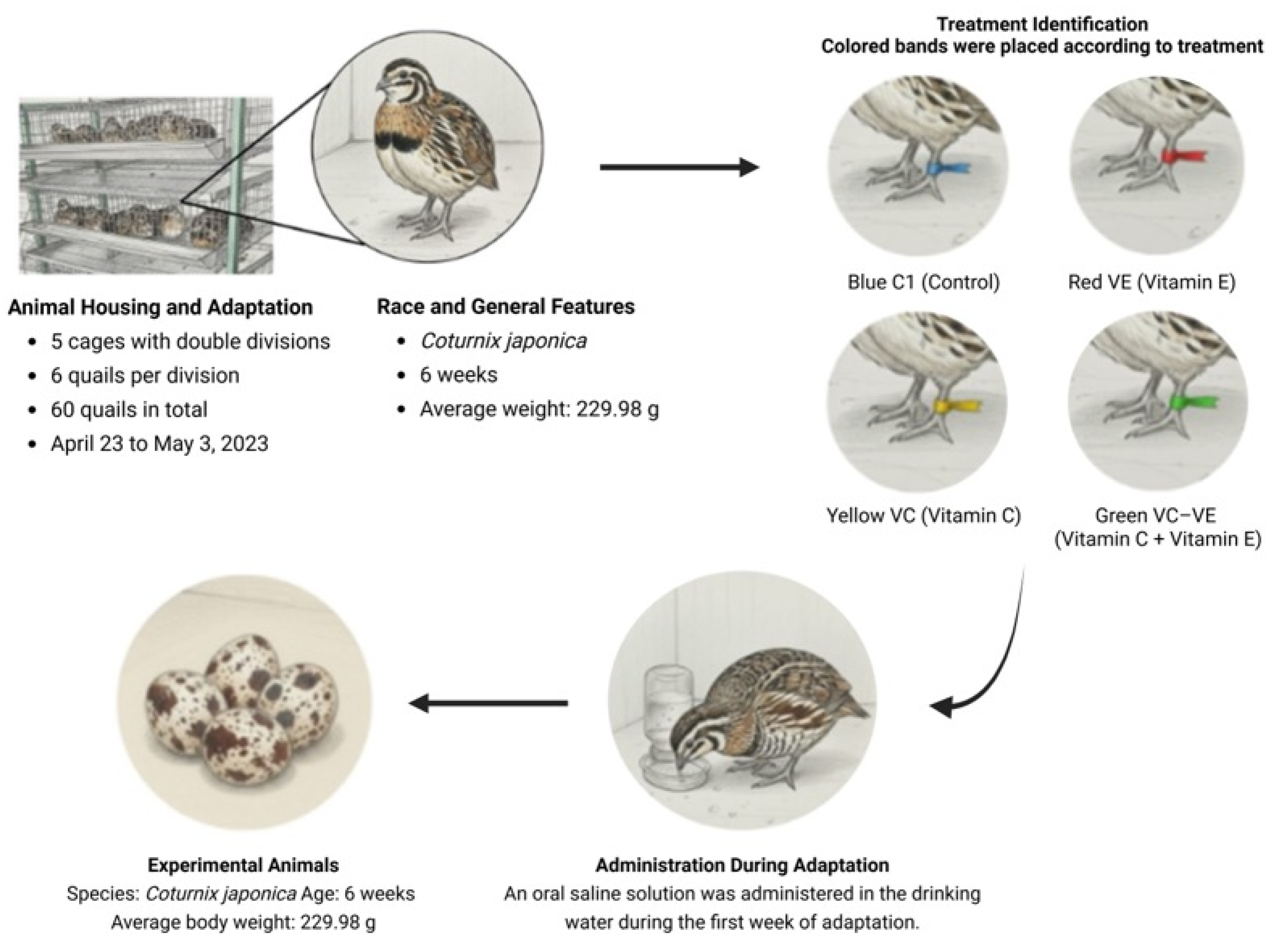
Sixty laying quail of the C. japonica breed, with an average weight of 229.98 g and an age of 6 weeks, were used. The birds were acclimated for 10 days, from 23 April 2023 to 3 May 2023, before the start of the diet. The implementation of diet started from 10 May 2023 and maintained until 31 July 2023. Egg samples were collected on 29 and 30 April and 1–3 May 2023. The birds were divided into five double-divided cages, each containing six laying quail, identified by colored ribbons (yellow—VC, red—VE, green—VC–VE, blue—C1). Birds were housed in cages under controlled environmental conditions with an average temperature of 20–24 °C and relative humidity of 55–65%; they were not exposed to thermal stress or maintained under thermoneutral conditions. A photoperiod of 16 h light and 8 h darkness was maintained to stimulate egg production. Japanese quail remained at the Universidad Autónoma Metropolitana (UAM) Unidad Lerman, Estado de México, México. Oral saline solutions were administered during the first week of acclimation to aid their recovery after transport. The process of maintenance is illustrated in Scheme 1. The ingredients and diet composition are presented in Table S1. This study considered C1 and C2 as reference points for the specific traits intended to be evaluated in this work. Together with this, both were included for assessing a robust baseline for evaluating the effects of vitamin supplementation on Japanese quails.

2.2. Supplementation of C. japonica

The quail were fed UNION brand poultry feed with 21% protein. Additionally, for the vitamin C treatment (ascorbic acid, 500 mg tablets, REDOXON brand), 350 mg was added per kilogram of feed (500 mg/1.43 kg), and 100 mg of vitamin E (tocopherol, 100 mg capsules, Brand Blue brand) per kilogram of feed. For the treatment with both vitamins, 350 mg of vitamin C and 100 mg of vitamin E were mixed per kilogram of feed. The procedure for mixing the vitamins with the feed was as follows: one vitamin C tablet was crushed, and one vitamin E capsule was opened. Then, 100 g of feed was weighed and mixed with the vitamins. This mixture was then added to another 900 g of feed for better distribution, and the mixture was shaken in a sealed bag to prevent feed loss.

2.3. Analysis of the Effects with Supplementation

Egg, carcass, and component weights were determined using a 5 kg capacity digital scale (Metaltex®, Genestrerio, Switzerland) for gross measurements and a 120 g capacity Pioneer™ PA124 analytical balance (OHAUS®, Parsippany, NJ, USA) for high-precision determinations of yolk, albumen, shell, and tissue samples. Colorimetric evaluations of yolk, albumen, and meat were conducted using a portable tristimulus colorimeter (CR-410, Konica Minolta®, Tokyo, Japan) operating in the CIE L*a*b* color space, ensuring standardized and reproducible color assessment. Eggshell thickness, measured after the removal of shell membranes, was determined using a digital Vernier caliper (Stainless Hardened®, China) with millimeter resolution. Meat water activity was assessed using a portable water activity meter for food (HDB5-MS2100Wa, Graigar Technology Co., Ltd., Shenzhen, China), allowing for the accurate determination of Aw under controlled conditions. Meat texture parameters were evaluated using a texture analyzer (CT3, AMETEK, Brookfield®, Middleboro, MA, USA) equipped with appropriate probes to quantify the mechanical resistance of the muscle tissue.

2.4. Approval by Ethics Committee

This study was approved by the Comité de Estudios de Proyectos Terminales from Universidad Autonóma Metropolitana (UAM) Unidad Lerma, Estado de México, México on 26 January 2023, under protocol numbers 23-1 and 23-P. Animal handling and experimental procedures were conducted in accordance with the national and institutional guidelines for the care and use of experimental animals.

2.5. Statistical Analysis

All statistical analyses were conducted using R version 4.3.1 (R Core Team, 2023) with the following packages: tidyverse for data manipulation [18], rstatix for ANOVA, mixOmics for multivariate analysis [19], and ggplot2 for visualization [20]. Significance was set at α = 0.05 for all tests. Treatment effects on individual parameters were assessed using one-way analysis of variance (ANOVA). For parameters showing significant overall treatment effects (p < 0.05), Tukey’s honestly significant difference (HSD) post hoc test was applied for pairwise comparisons. Effect sizes were calculated using eta-squared (η2) and interpreted as small (0.01), medium (0.06), or large (0.14) according to Cohen’s conventions [21]. Partial Least Squares Discriminant Analysis (PLS-DA) was employed to identify combinations of variables that best discriminated between treatment groups. Data were auto-scaled (mean-centered and unit-variance scaled) prior to analysis. The optimal number of components was determined through 10-fold cross-validation repeated 10 times, minimizing the balanced error rate. Variable importance in projection (VIP) scores was calculated to identify parameters that most contributed to group discrimination, with VIP > 1.0 considered influential. For the time-course analysis of egg parameters (Shell thickness), linear mixed-effects models were fitted with treatment, day, and their interaction as fixed effects, and bird identity as a random effect to account for repeated measures. Restricted maximum likelihood (REML) estimation was used, and the significance of fixed effects was assessed using Satterthwaite’s approximation for degrees of freedom.

3. Results

3.1. Analysis of the Effects of Supplementation in Productive Features and Meat Quality

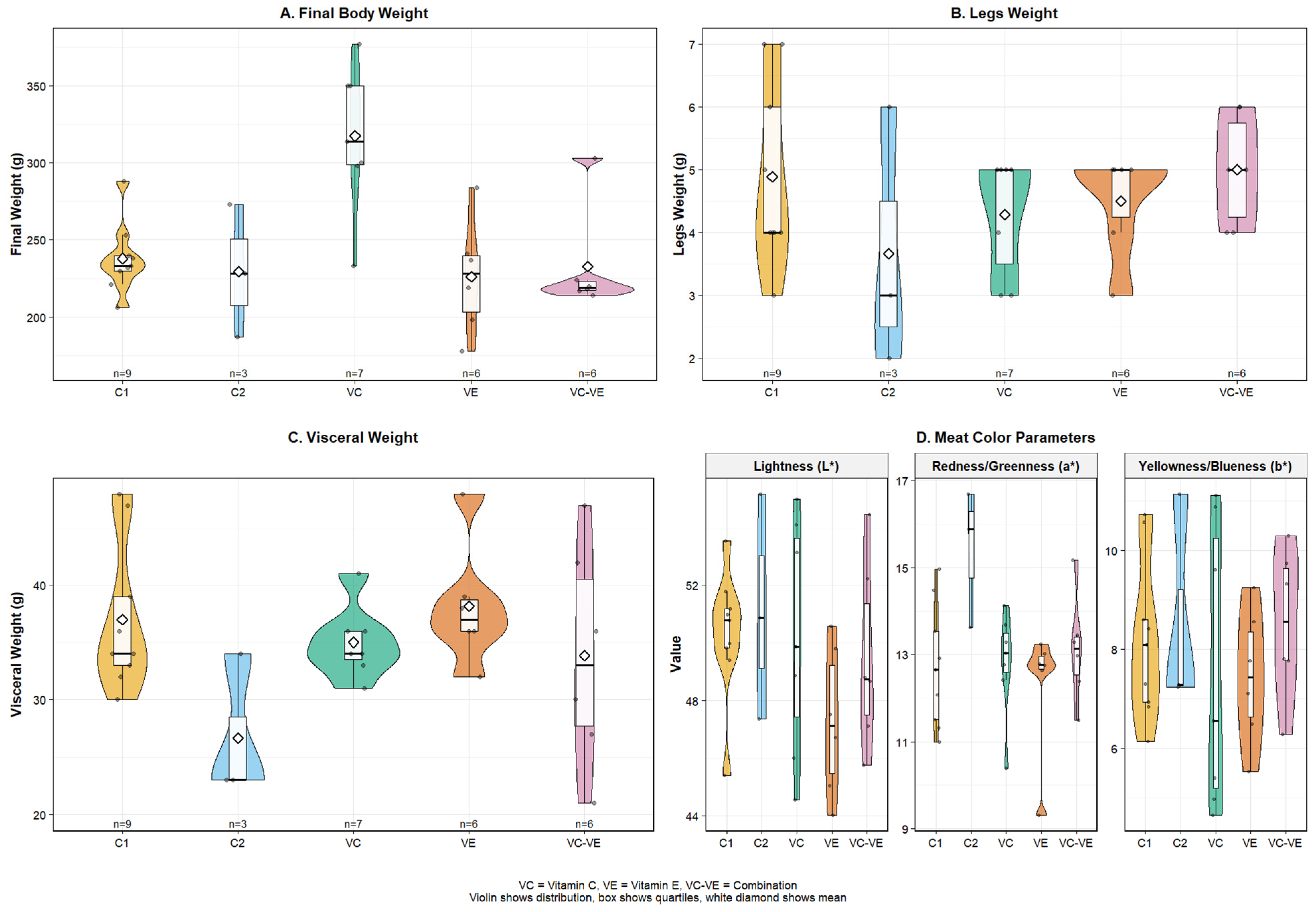
Final body weight differed markedly among treatments and was one of the most discriminating variables in the multivariate analysis (see Figure 1A). Japanese quails supplemented with VC exhibited the highest final body weight, averaging 327.0 ± 32.7 g. The VC–VE combination resulted in intermediate final body weights (232.7 ± 33.2 g), comparable to the control groups but notably lower than with VC alone. C1 birds averaged 237.9 ± 23.7 g, whereas C2 birds averaged 229.3 ± 43.1 g, indicating inconsistent growth responses in the absence of antioxidant supplementation. The VE group also displayed moderate final weight (226.2 ± 36.6 g). The effect of supplementation on the weight of legs is represented in Figure 1B.
As noted in Figure 1C, the VE treatment induced the highest visceral weight (38.2 ± 5.4 g), which was significantly greater than C2 (26.7 ± 6.4 g; p < 0.05). However, visceral weight in the VE group did not differ significantly from C1 (37.0 ± 6.5 g) or VC (35.0 ± 3.2 g) (p > 0.05). The VC–VE group (33.8 ± 9.7 g) did not differ statistically from either the higher (C1, VC, VE) or lower (C2) treatments (p > 0.05). Head weight exhibited no statistically significant differences among treatments (p > 0.05). For example, mean head weights were 11.0 ± 2.2 g (C1), 8.0 ± 2.7 g (C2), 12.1 ± 2.7 g (VC), 13.0 ± 3.4 g (VE), and 13.0 ± 1.8 g (VC–VE). Meat lightness values showed moderate but consistent differences among treatments. The C1 control group exhibited an average L* value of 50.32 ± 2.43, reflecting moderately light meat with limited dispersion (see Figure 1D). A comparable mean lightness was observed in the VC treatment (50.22 ± 3.88), although this group displayed greater variability, indicating heterogeneous responses to vitamin C supplementation. The C2 group showed a slightly higher average lightness (51.14 ± 3.90), driven by one notably pale sample, which increased within-treatment variance. In contrast, birds receiving VE produced darker meat, with the lowest mean L* value (47.29 ± 2.39), suggesting a treatment-related shift toward reduced lightness. The VC–VE combined treatment resulted in intermediate L* values (49.51 ± 3.23). These results are presented in Figure 1D.
Yellowness values also varied among treatments, reflecting differences in pigment stability and muscle composition. The C2 group displayed the highest average b* value (8.55 ± 2.28), driven by a wide range of responses and substantial variability (see Figure 1D). Similarly elevated b* values were observed in the VC–VE treatment (8.54 ± 1.52) and the C1 control (8.18 ± 1.52), indicating comparable degrees of yellowness across these groups. In contrast, birds receiving vitamin C alone showed lower yellowness (7.60 ± 2.61) but with the greatest dispersion, suggesting inconsistent effects of VC on yellow pigment expression. The VE treatment exhibited the lowest mean b* (7.45 ± 1.29), consistent with the darker and less chromatic meat observed for this group (see Figure 1D). Redness values exhibited clearer treatment-associated patterns and contributed strongly to treatment separation. The C2 treatment showed the highest redness, with a mean a* value of 15.41 ± 1.57, indicating distinctly redder meat compared with all other treatments. The VC–VE group also exhibited elevated redness (13.13 ± 1.24), exceeding the C1 control (12.72 ± 1.32) and VE (12.29 ± 1.39) groups. Meat from birds supplemented with vitamin C alone showed similar redness (12.82 ± 1.22) to the control, suggesting that VC alone did not markedly enhance red pigmentation (see Figure 1D).

3.2. Multivariate Analysis of Supplementation in Meat and Egg Quality Profiles: Key Discriminating Variables and Treatment Effects

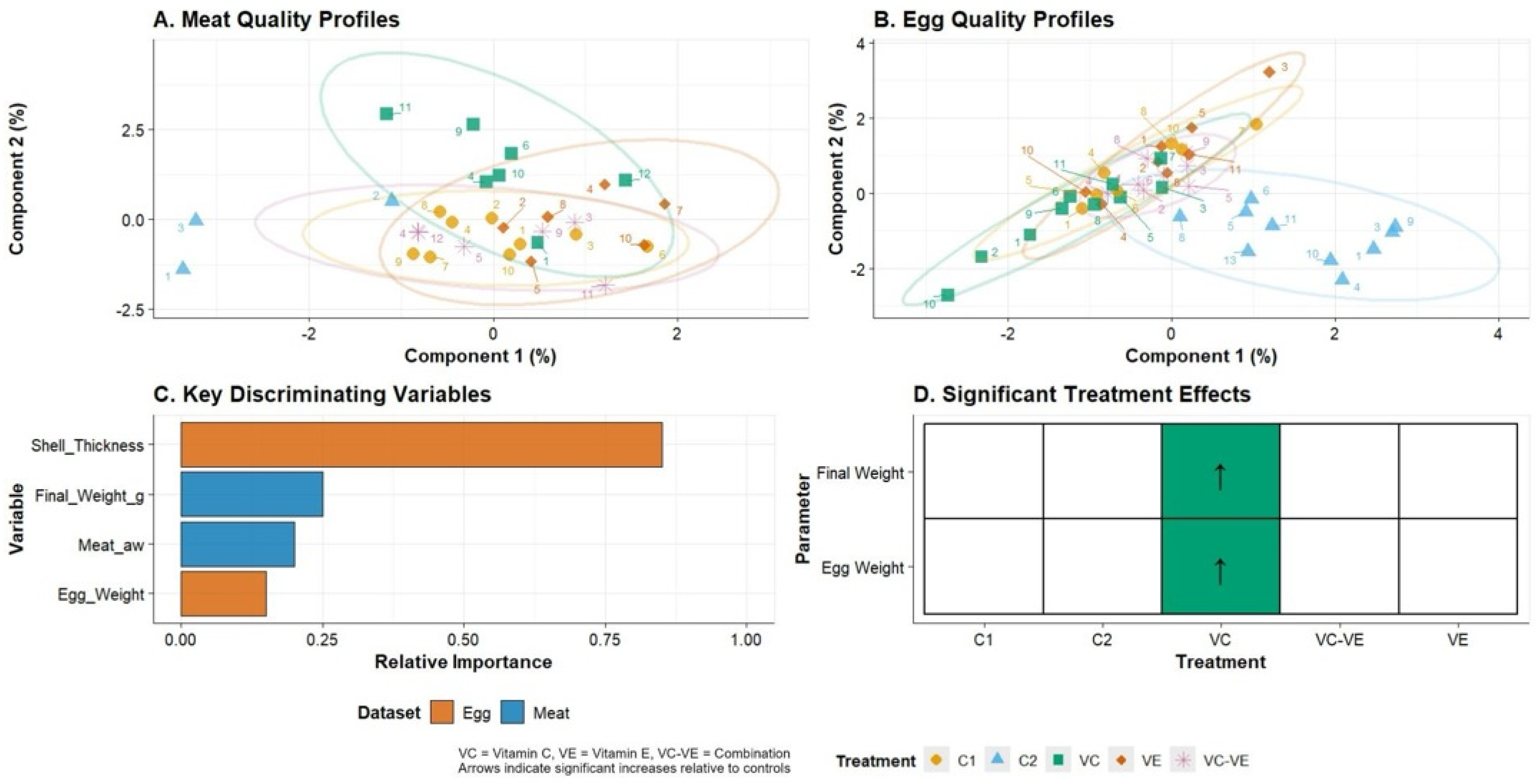
Egg length and width followed similar trends, with VC eggs showing slightly greater dimensions (length ≈ 3.45 ± 0.15 cm; width ≈ 2.75 ± 0.10 cm) compared with the VE and control treatments (see Figure 2B). As illustrated in Figure 2C, Japanese quails supplemented with VC produced the heaviest eggs, with a mean egg weight of approximately 14.1 ± 1.3 g, consistently exceeding both the control groups and the VE treatment. This aligns with the PCA structure, where VC samples were displaced along the primary axis associated with egg mass. The VC–VE combination resulted in intermediate egg weights (12.7 ± 1.1 g) comparable to the controls but with reduced variability, suggesting a stabilizing effect of combined antioxidant supplementation. In contrast, C1 (12.6 ± 1.3 g) and C2 (12.8 ± 0.8 g) exhibited lower average egg weights with overlapping distributions, indicating no clear improvement in egg mass in the absence of supplementation.
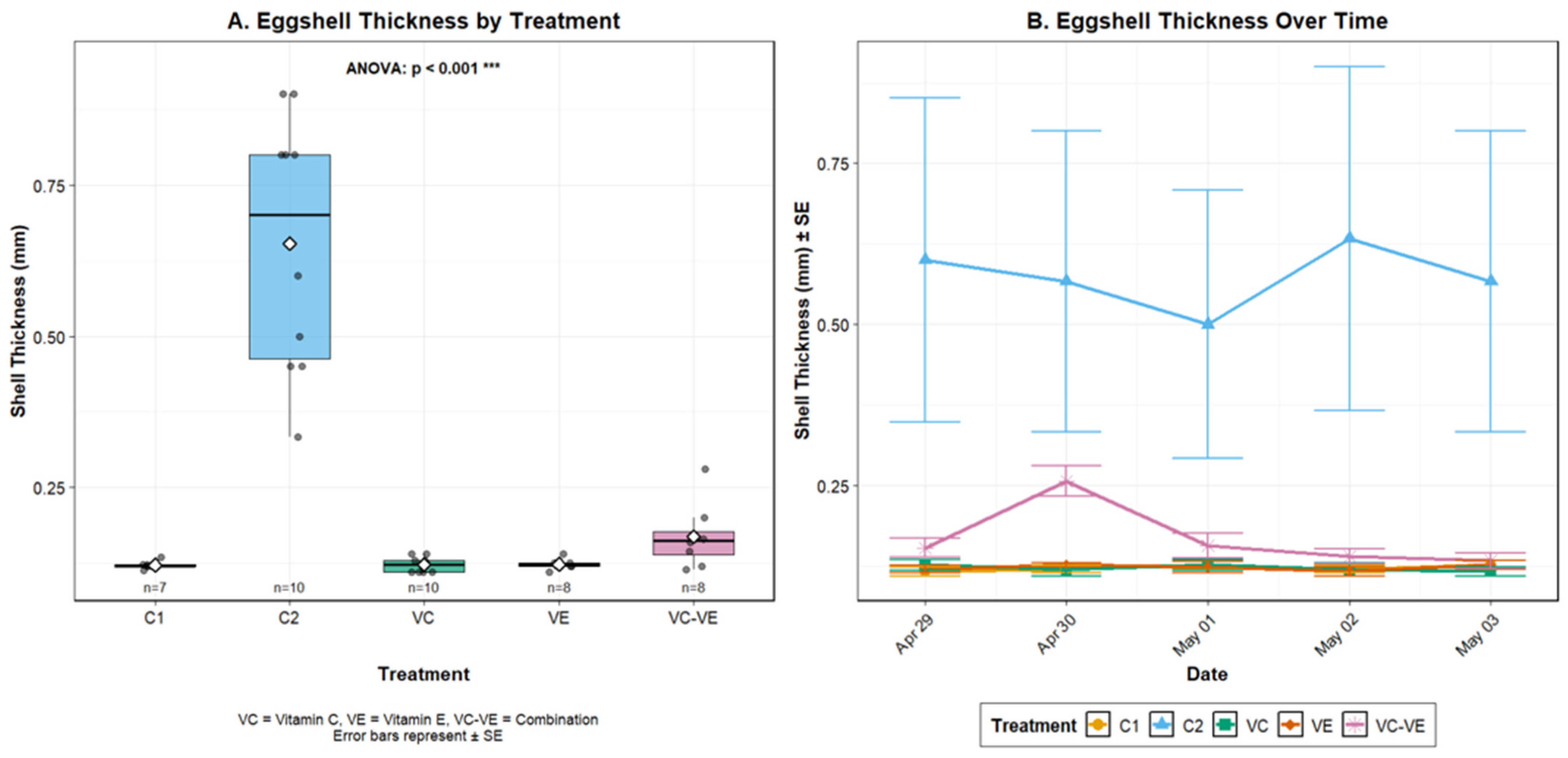
Shell thickness differed significantly among treatments (p < 0.001), with clear quantitative separation (see Figure 3A). Eggs from the C2 treatment exhibited by far the greatest shell thickness, with a mean value of 0.70 ± 0.19 mm, significantly exceeding all other treatments. Although variability within this group was relatively high, all observations remained well above those of the remaining treatments, indicating a strong and consistent enhancement of shell deposition. In contrast, shells from the C1 control group were uniformly thin, averaging 0.12 ± 0.01 mm, and showed minimal dispersion. A very similar response was observed in birds receiving VC, whose eggshell thickness averaged 0.12 ± 0.01 mm, and in the VE group, which averaged 0.12 ± 0.01 mm. These three treatments did not differ statistically from one another (p > 0.05). Importantly, the combined VC–VE treatment resulted in a significant intermediate response, with shell thickness averaging 0.17 ± 0.05 mm.
As noted in Figure 3A, eggs produced under the C2 treatment exhibited markedly greater shell thickness (0.70 ± 0.19 mm), which was statistically superior to all other treatments (p < 0.001). In contrast, eggs from the C1 control group (0.12 ± 0.01 mm), VC (0.12 ± 0.01 mm), and VE supplemented group (0.12 ± 0.01 mm) did not differ statistically from one another (p > 0.05). Notably, the combined VC–VE treatment produced a significant intermediate increase in shell thickness (0.17 ± 0.05 mm), which was significantly greater than C1, VC, and VE (p < 0.05), yet substantially lower than C2. Temporal analysis of shell thickness reinforced these findings, as C2 consistently maintained the highest values across all sampling dates, whereas VC–VE remained stably elevated relative to C1, VC, and VE, and the latter three treatments exhibited flat and overlapping trajectories (see Figure 3B).

4. Discussion

Oxidative stress refers to a physiological condition in which the production of ROS, generated during normal metabolism and intensified by environmental stressors, exceeds the host endogenous antioxidant defense capacity [22]. Because of this, oxidative stress can impair cellular membranes, reduce pigment stability, and negatively affect mineralization processes in the shell gland. VC, a water-soluble antioxidant, can aid in mitigating systemic oxidative damage, supports immune and metabolic functions, and improves nutrient utilization [23]. Similarly, VE, a lipid-soluble antioxidant, protects cell membranes and muscle lipids from peroxidative damage.
The present study demonstrates that dietary supplementation with VC and VE elicits distinct, trait-specific responses in laying Japanese quail, affecting egg characteristics, growth performance, and selected meat quality attributes. In this study, the acclimation period was selected based on previous studies that have mentioned that egg samples must be collected from 7 to 10 days to avoid potential aberrations caused by environmental fluctuations such albumen dilution, toxin formation, and limited nutrient reservoir [24]. In this sense, it is important to note that rather than producing uniform improvements across all measured parameters, antioxidant supplementation modulated specific physiological processes, highlighting the complexity of nutrient–trait interactions in Japanese quails. One of the most pronounced effects observed in this study was the significant increase in final body weight in quail supplemented with VC alone, which can be attributed to different mechanisms. For instance, recent studies have reported that supplementation with VC can enhance body weight by acting as a stress modulator during high productivity activities such as laying, as well as being a natural agent with the capacity of improving feed intake, feed efficiency, and the accretion of somatic tissue [25].
Multivariate analyses reinforced the trait-specific nature of the responses, with final body weight, egg weight, shell thickness, and meat water activity emerging as key discriminating variables among treatments. The clear separation of VC-supplemented birds in multivariate space highlights the central role of VC in modulating growth and egg mass, whereas the clustering of VC–VE birds reflect a stabilizing but not maximizing effect on multiple quality traits. Collectively, these results indicate that dietary supplementation with VC and VE should not be viewed as a uniform strategy to enhance all aspects of quail productivity. Instead, VC appears most effective for improving body weight and egg mass, whereas the combined supplementation of VC and VE offers targeted benefits for eggshell quality. VE alone exerts more subtle effects, primarily related to meat quality attributes associated with oxidative stability.
VC, also known as ascorbic acid, is a water-soluble antioxidant vitamin that poultry can normally synthesize in the kidneys, but endogenous production may be insufficient during periods of stress [26]. Contrary to other vitamins, VC protects tissues from oxidative damage, supports immune function by enhancing resistance to infections, and contributes to collagen synthesis for healthy bones, joints, and blood vessels. Supplementation has been shown to improve feed intake, growth performance, feed efficiency, and survivability [27]. In laying and breeder birds, VC can also assist in maintaining egg production, shell quality, and fertility, making it a valuable nutritional tool for improving overall poultry health and productivity [28]. Here, it is noted that Japanese quail receiving VC reached the highest mean body weight among all treatments, clearly exceeding both control groups and the VE-supplemented birds. This response suggests that VC supplementation enhanced growth-related processes even during the laying phase, a period in which nutrient partitioning is primarily directed toward egg production rather than somatic tissue accretion [29]. The growth-promoting effect of VC may be attributed to its involvement in collagen synthesis, adrenal function, and stress modulation. This finding is of great importance since it has been documented that although poultry can synthesize VC endogenously, the metabolic demand associated with egg production, handling, and environmental adaptation may exceed the endogenous synthesis capacity [30].
Visceral weight refers to the combined or individual mass of the internal organs within the body cavity, typically including the liver, heart, gizzard, intestines, spleen, and reproductive organs. In laying Japanese quail, visceral weight is influenced by multiple factors such as age, body weight, genetic strain, plane of nutrition, dietary energy and protein levels, micronutrient balance, environmental conditions, health status, and physiological stage of production [31]. Determination of visceral weight in laying Japanese quail is required for determining valuable indicators for evaluating dietary treatments, optimizing feed formulation, assessing health and welfare, and interpreting laying performance and egg quality responses in experimental and applied quail nutrition studies [32]. Here, it was observed that visceral weight showed a different pattern, with VE supplementation producing the highest values. Increased visceral mass may reflect changes in lipid metabolism or organ activity, particularly in tissues such as the liver, which possess a central role in lipid transport and yolk precursor synthesis. This interpretation is supported by the known function of VE as a lipid-soluble antioxidant that accumulates in cell membranes and lipid-rich tissues.
Meat color parameters were differentially affected by vitamin supplementation, with VE exerting a clear influence on lightness and chromaticity. Here, it was observed that Japanese quail receiving VE produced darker meat, characterized by lower L* values and reduced yellowness, suggesting enhanced pigment stability and reduced oxidative discoloration. This response aligns with the role of VE in protecting muscle lipids and myoglobin from oxidative degradation, thereby stabilizing color attributes associated with the consumer perception of freshness [33]. In contrast, VC supplementation alone did not produce consistent changes in the meat color parameters, as evidenced by higher variability in L* and b* values. This variability may reflect individual differences in VC metabolism or differential partitioning of the vitamin toward systemic antioxidant functions rather than localized muscle protection. The combined VC–VE treatment resulted in intermediate color values, suggesting partial complementarity between the two antioxidants but without a dominant synergistic effect on meat pigmentation. The high redness observed in the C2 group, despite the absence of antioxidant supplementation, indicates that factors other than dietary antioxidants such as individual variation in muscle fiber composition or heme pigment concentration may also influence meat color traits [34].
Egg weight emerged as one of the most responsive egg quality traits, particularly in birds supplemented with VC. Quail receiving VC consistently produced heavier eggs with slightly greater length and width, indicating enhanced egg component deposition rather than changes limited to shell or albumen alone [35]. Increased egg weight is economically relevant, as it directly influences market value and consumer acceptance. The mechanism underlying this response may involve improved nutrient absorption or metabolic efficiency, allowing for the greater deposition of yolk and albumen solids. Moreover, the intermediate egg weights and reduced variability observed in the VC–VE group suggest that combined antioxidant supplementation may stabilize egg formation processes, albeit without maximizing egg mass. The absence of egg weight improvement in the VE group indicates that VE does not play a primary role in regulating egg size under the conditions evaluated, reinforcing the concept that antioxidant effects are trait-specific [36].
Eggshell thickness exhibited the clearest evidence of treatment-dependent differentiation, with pronounced contrasts among dietary groups. The combined VC and VE supplementation produced an increased shell thickness (0.17 mm); however, it was not as high as the samples utilized as the control (0.70 mm). This can be related to the differences among the composition of diet, where the diet appraised for control quails was higher in calcium and phosphorous content (see Table S1), which have been documented as necessitated minerals for optimal egg weight, shell quality, production performance, and nutrient utilization [37]. This finding supports the hypothesis that coordinated antioxidant protection may enhance calcium metabolism and shell matrix formation, potentially by preserving shell gland epithelial function and reducing oxidative damage during shell calcification [38]. However, the most striking response was observed in the C2 treatment, which produced shells substantially thicker than all other groups. This result suggests that factors unrelated to vitamin supplementation—such as differences in basal diet intake, mineral availability, or physiological adaptation—played a dominant role in shell deposition in this group. The consistency of elevated shell thickness across all sampling days in C2 further supports a sustained, treatment-specific effect rather than a transient response. Importantly, VC and VE alone did not improve the shell thickness, indicating that single antioxidant supplementation was insufficient to influence mineralization processes independently. The intermediate response observed in the VC–VE group suggests that antioxidant synergy can partially enhance shell quality, but that this effect remains modest compared with other nutritional or physiological drivers of shell formation.

5. Conclusions

This study aimed to evaluate the effects of dietary VC (350 mg/kg), VE (100 mg/kg), and their combination on productive performance, meat quality, and egg quality parameters in laying Japanese quail. The results demonstrated that VC supplementation significantly increased the final body weight and egg weight compared with the controls. The combined VC–VE treatment significantly improved the eggshell thickness, whereas vitamin C or E alone did not produce comparable effects on this parameter. The C2 group exhibited the greatest eggshell thickness overall. Vitamin E supplementation was associated with higher visceral weight and darker meat (lower L* values), while treatment-related variations were observed in meat color attributes (a* and b*). Multivariate analysis identified shell thickness, final body weight, meat water activity, and egg weight as the primary variables discriminating among treatments. Overall, the effects of supplementation were trait-specific, with vitamin C primarily influencing growth and egg mass, and the combined treatment enhancing shell structural quality.

Supplementary Materials

The following supporting information can be downloaded at: https://www.mdpi.com/article/10.3390/agriculture16060710/s1, Table S1. Ingredients and diet composition with and without VC and E supplementation in laying quail.

Author Contributions

Conceptualization, N.F.-R. and R.G.C.-M.; validation, N.F.-R., D.E.N.-L., J.E.A.-T., M.R.-E., J.L.M.-M. and R.G.C.-M.; investigation, R.C.-S., A.B.H.-R., N.F.-R., J.L.M.-M. and R.G.C.-M.; writing—original draft preparation, N.F.-R., J.L.M.-M., D.E.N.-L. and R.G.C.-M.; writing—review and editing, R.C.-S., A.B.H.-R., N.F.-R., D.E.N.-L., J.E.A.-T., M.R.-E., J.L.M.-M. and R.G.C.-M.; visualization, N.F.-R.; supervision, D.E.N.-L., J.E.A.-T., M.R.-E. and R.G.C.-M.; funding acquisition; D.E.N.-L., J.L.M.-M. and R.G.C.-M.; project administration, R.G.C.-M. All authors have read and agreed to the published version of the manuscript.

Funding

This research received no external funding.

Institutional Review Board Statement

This study was approved by the Comité de Estudios de Proyectos Terminales from Universidad Autonóma Metropolitana (UAM) Unidad Lerma, Estado de México, México on 26 January 2023, under protocol numbers 23-1 and 23-P. Animal handling and experimental procedures were conducted in accordance with the national and institutional guidelines for the care and use of experimental animals.

Data Availability Statement

The original contributions presented in this study are included in the article/Supplementary Materials. Further inquiries can be directed to the corresponding author.

Acknowledgments

N.F.-R. acknowledges the Secretaría de Ciencia, Humanidades, Tecnología e Innovación (SECIHTI) and Tecnológico de Monterrey for the economic support for completing her doctoral studies.

Conflicts of Interest

The authors declare no conflicts of interest.

References

  1. Sharifi, S.D.; Rahimi, A.; Rouhanipour, H.; Zanussi, H.P. Raising Systems and Diet Type in Japanese Quails Production: Effects on Growth Performance, Carcass Characteristics, Fatty Acid Profiles and Meat Quality. Poult. Sci. 2025, 104, 105706. [Google Scholar] [CrossRef] [PubMed]
  2. Lobato, H.C.; Vieira, M.C.; Araújo, V.F.; Rezende, R.M.; Ferreira, F.; Lara, L.J.C.; Araújo, I.C.S. Japanese Quail Production in Brazil: Historic, Challenges and Opportunities. World’s Poult. Sci. J. 2025, 81, 755–774. [Google Scholar] [CrossRef]
  3. Białek, M.; Wojtak, W.; Czauderna, M.; Zaworski, K.; Białek, A. Lipidomic Insight into Eggs and Meat of Quail (Coturnix japonica) as Potential ‘Superfoods’. Molecules 2026, 31, 407. [Google Scholar] [CrossRef] [PubMed]
  4. Mohammadi, S.; Torki, M.; Darbemamieh, M. Effects of Mealworm-Based Synbiotics on Productive Performance, Egg Quality, Blood Metabolites, and Gut Health in Laying Japanese Quails. Food Sci. Nutr. 2025, 13, e71281. [Google Scholar] [CrossRef] [PubMed]
  5. Oke, O.E.; Oliyide, K.M.; Akosile, O.A.; Oni, A.I.; Adekunle, E.O.; Oyebanji, B.O.; Aremu, O.P.; Adeoba, I.M.; Eletu, T.A.; Daramola, J.O. Innovations in Quail Welfare: Integrating Environmental Enrichment, Nutrition and Genetic Advances for Improved Health and Productivity. Vet. Med. Sci. 2025, 11, e70424. [Google Scholar] [CrossRef]
  6. Truong, L.; King, A.J. Lipid Oxidation and Antioxidant Capacity in Multigenerational Heat Stressed Japanese Quail (Coturnix coturnix japonica). Poult. Sci. 2023, 102, 103005. [Google Scholar] [CrossRef]
  7. Ma, Y.; Lu, L.; Chen, Q.; Hua, X.; Zhang, X.; Zhao, X.; Liu, X. Comparison of Laying Performance and Egg Quality between Peak and Late Laying Phases in Korean Quail. Poult. Sci. 2025, 104, 105262. [Google Scholar] [CrossRef]
  8. Zeferino, C.P.; Canavessi, A.M.O.; Gasparin, G.; Felicio, A.M.; Sartori, J.R.; Mourão, G.B.; Coutinho, L.L.; Moura, A.S.A.M.T. Gene Expression in the Skeletal Muscle of Broilers Fed Diets Supplemented with Vitamins C and E Under Acute or Chronic Heat Stress. Livest. Sci. 2025, 298, 105752. [Google Scholar] [CrossRef]
  9. Al-Khalaifah, H.; Kamel, N.N.; Gabr, S.; Gouda, A. The Synergistic Effect of Vitamin C Supplementation and Early Feed Withdrawal on Heat Stress Mitigation in Broiler Chickens. Animals 2025, 15, 2996. [Google Scholar] [CrossRef]
  10. Andreaki, R.; Kyriakaki, P.; Giamouri, E.; Arsenakis, I.; Koulocheri, S.D.; Iliopoulos, V.; Simitzis, P.; Sotirakoglou, K.; Haroutounian, S.A.; Pappas, A.C.; et al. Broiler Chickens’ Response to Dietary Replacement of Synthetic Vitamin E with Extracts and Derivatives from Vinification by-Products: Effects on Growth Performance, Meat Quality, Health Status, and Intestinal Integrity. Ital. J. Anim. Sci. 2025, 24, 1138–1154. [Google Scholar] [CrossRef]
  11. Sahin, K.; Onderci, M.; Sahin, N.; Gursu, M.F.; Khachik, F.; Kucuk, O. Effects of Lycopene Supplementation on Antioxidant Status, Oxidative Stress, Performance and Carcass Characteristics in Heat-Stressed Japanese Quail. J. Therm. Biol. 2006, 31, 307–312. [Google Scholar] [CrossRef]
  12. Lima, L.A.d.A.; Moraes, T.d.A.; Morais, L.K.d.C.; de Amorim, M.L.C.M.; Veríssimo, T.N.S.; dos Santos, J.D.C.; Maia, M.I.L.; dos Santos, S.G.C.G.; da Costa, F.G.P.; Guerra, R.R.; et al. Effect of Zinc Level and the Thermal Environment on the Zootechnical Performance and Tibia-Breaking Strength of Japanese Quails. Front. Vet. Sci. 2025, 11, 1467487. [Google Scholar] [CrossRef]
  13. dos Anjos Lima, L.A.; Maia, M.I.L.; Afo, D.I.B.; Maia, A.F.; Givisiez, P.E.N.; Guerra, R.R.; Braz, C.U.; Saraiva, E.P. Effects of Exogenous Phytase Supplementation on the Modulation of Hormonal Responses in Japanese Quails (Coturnix japonica) at High Environmental Temperatures during the Production Phase. Poult. Sci. 2025, 104, 105590. [Google Scholar] [CrossRef]
  14. Isazaei, A.; Bagherzadeh-Kasmani, F.; Ghazaghi, M.; Mehri, M.; Esfandiari, J. Dietary Supplementation of Spirulina Powder (Arthrospira platensis) Enhances Growth, Antioxidant Status, Immune Function, and Cardiac Health in Japanese Quails. Poult. Sci. 2025, 104, 105874. [Google Scholar] [CrossRef]
  15. Naimati, S.; Doğan, S.C.; Asghar, M.U.; Sajid, Q.U.A. Effect of Dietary Addition of Blueberry (Vaccinium corymbosum) Powder on Fattening Performance, Meat Quality, Oxidative Stability and Storage Quality in Japanese Quails (Coturnix coturnix Japonica). Animals 2025, 15, 1633. [Google Scholar] [CrossRef] [PubMed]
  16. Bhatti, A.; Mejía-Méndez, J.L.; Mamhoud, S.S.; Sanchez-Martinez, A.; Sánchez-Ante, G.; Silva-Jara, J.M.; Sánchez-Arreola, E.; Lozano, L.M.; Tortella, G.; López-Mena, E.R.; et al. From Bench to Greenhouse: The Comparative Nano-Bio System Effects of Green-Synthesized TiO2-NPs and Plant-Growth-Promoting Microorganisms in Capsicum Annuum. Plants 2025, 14, 3672. [Google Scholar] [CrossRef] [PubMed]
  17. Ludoški, M.; Grković, N.; Suvajdžić, B.; Vićić, I.; Branković Lazić, I.; Baltić, T.; Čobanović, N. Eggshell Colour Affecting the Safety and Quality of Japanese Quail Eggs (Coturnix coturnix Japonica). Br. Poult. Sci. 2026, 67, 60–72. [Google Scholar] [CrossRef]
  18. Wickham, H.; Averick, M.; Bryan, J.; Chang, W.; McGowan, L.D.; François, R.; Grolemund, G.; Hayes, A.; Henry, L.; Hester, J.; et al. Welcome to the Tidyverse. J. Open Source Softw. 2019, 4, 1686. [Google Scholar] [CrossRef]
  19. Rohart, F.; Gautier, B.; Singh, A.; Cao, K.-A.L. mixOmics: An R Package for ‘omics Feature Selection and Multiple Data Integration. PLoS Comput. Biol. 2017, 13, e1005752. [Google Scholar] [CrossRef]
  20. Wickham, H. Programming with Ggplot2. In ggplot2: Elegant Graphics for Data Analysis; Wickham, H., Ed.; Springer International Publishing: Cham, Switzerland, 2016; pp. 241–253. [Google Scholar]
  21. Cohen, J. Statistical Power Analysis for the Behavioral Sciences, 2nd ed.; Routledge: New York, NY, USA, 2013. [Google Scholar]
  22. Alejandro, V.; Hernández, A.; Pérez-Rodríguez, L.; Montoya, B. Oxidative Challenges Do Not Impact Pheomelanin-Dependent Coloration in Male Japanese Quails. J. Exp. Zool. Part A Ecol. Integr. Physiol. 2025, 343, 59–69. [Google Scholar] [CrossRef]
  23. Maia, A.F.; Ribeiro, A.G.; Silva, R.d.S.; Silva, E.G.d.; Lima, L.A.d.A.; Saraiva, E.P.; Queiroga, F.L.P.G.; Ferreira, A.C.S.; Rousseau, X.; Costa, F.G.P.; et al. Egg Production and Biochemical Evaluation of Laying Quails Fed Diets Containing Phytase Overdosage Under Different Thermal Conditions. Animals 2025, 15, 2762. [Google Scholar] [CrossRef]
  24. Próchniak, T.; Kasperek, K.; Drabik, K.; Ramankevich, A.; Wengerska, K.; Batkowska, J. Hatching Performance of Japanese Quail from Eggs Stored for Different Periods—A Preliminary Study. BMC Vet. Res. 2025, 21, 108. [Google Scholar] [CrossRef] [PubMed]
  25. Gashew, M.; Reda, G.K.; Almira, F.N.; Abdelbary, E.M.; Gulyás, G.; Knop, R.; Csernus, B.; Szabó, C.; Lendvai, Á.Z.; Czeglédi, L. Dietary Arginine Modulates Egg Production and mTOR Signalling Pathway Gene Expression in Adult Japanese Quail (Coturnix japonica). Vet. Anim. Sci. 2026, 31, 100567. [Google Scholar] [CrossRef]
  26. Sugiharto, S.; Pinyosnit, N.; Nuengjamnong, C. A Review of Dietary Interventions to Alleviate Harmful Effects of Stress on Poultry Health and Production. Discov. Sustain. 2026, 7, 258. [Google Scholar] [CrossRef]
  27. Kop Bozbay, C.; Yıldırım, M.M.; Karaoğlu, N.C.; Özdöngül, B. Growth Performance, Carcass Characteristics and Meat Quality of Quails Fed Diets Containing Helichrysum Italicum Essential Oil. Trop. Anim. Health Prod. 2025, 58, 7. [Google Scholar] [CrossRef] [PubMed]
  28. Kianfar, R.; Kanani, R.; Janmohammadi, H.; Olyaee, M.; Besharati, M.; Lackner, M. Implications of High-Dose Vitamin D3 with and without Vitamin C on Bone Mineralization and Blood Biochemical Factors in Broiler Breeder Hens and Their Offspring. PeerJ 2025, 13, e18983. [Google Scholar] [CrossRef]
  29. Gül, E.T.; Olgun, O.; Kılınç, G.; Yıldız, A.; Sarmiento-García, A. Effects of Dietary Niacin Supplementation on Performance, Egg Quality and Yolk Antioxidant Status in Laying Quails. Trop. Anim. Health Prod. 2025, 57, 530. [Google Scholar] [CrossRef]
  30. Olayiwola, S.F.; Adedokun, S.A. Heat Stress in Poultry: The Role of Nutritional Supplements in Alleviating Heat Stress and Enhancing Gut Health in Poultry. Front. Vet. Sci. 2025, 12, 1691532. [Google Scholar] [CrossRef]
  31. Ghiasvand, A.R.; Shirzadi, H.; Ghasemi, H.A.; Taherpour, K.; Hasanvand, S.; Khatibjoo, A. Optimal Dietary Arginine Improves Productive Performance, Gut Morphology, and Expression of Growth-Related and Stress-Response Genes in Japanese Quails. Poult. Sci. 2025, 104, 105684. [Google Scholar] [CrossRef]
  32. Valentim, J.K.; Serpa, F.C.; Burbarelli, M.F.d.C.; Almeida, A.A.d.; Heiss, V.A.R.d.C.; Braz, P.H.; Cardoso, C.A.L.; Komiyama, C.M.; Caldara, F.R.; Calderano, A.A.; et al. Influence of Lipid Sources on Performance, Egg Quality, and Metabolism in Laying Quails. Animals 2025, 15, 3120. [Google Scholar] [CrossRef]
  33. Sonmez, G.; Arslan, E.; Culha, M.H.; Tok, M. Expression of Myogenic, Growth Related, Mitochondrial and Antioxidant Genes across Developmental Stage, Muscle Type, and Genotype in Japanese Quail Skeletal Muscle. Poult. Sci. 2026, 105, 106351. [Google Scholar] [CrossRef] [PubMed]
  34. Kovalev, L.I.; Kovaleva, M.A.; Ovseychik, E.A.; Klein, O.I.; Koshelkova, D.A.; Gessler, N.N.; Danilova, M.A.; Deryabina, Y.I.; Isakova, E.P. Changes in the Proteome of Japanese Quails’ Muscles Fed with the Supplements of Phytases of Fungal and Bacterial Origin. ACS Agric. Sci. Technol. 2025, 5, 962–980. [Google Scholar] [CrossRef]
  35. Valentim, J.K.; de Almeida, A.A.; Serpa, F.C.; de Castro Burbarelli, M.F.; Felix, G.A.; Gomes, K.M.; Ouros, C.C.d.; Caldara, F.R.; Martelli, S.M.; Komiyama, C.M.; et al. Improvement in the Coloration and Quality of Japanese Quail Eggs Through Supplementation with Natural Pigments. Poultry 2025, 4, 25. [Google Scholar] [CrossRef]
  36. Roza, L.F.; de Oliveira, E.M.; Staub, L.; Dornelas, T.C.E.; Pintro, P.T.M.; Hermoso, D.A.M.; Iwamoto, E.L.I.; Murakami, A.E.; Santos, T.C. Supplementation of Japanese Quail (Coturnix coturnix Japonica) Breeders with Tagetes Erecta Flower Extract and Vitamin E Improves the Oxidative Status of Embryos and Chicks. Poultry 2023, 2, 449–462. [Google Scholar] [CrossRef]
  37. Mehri, M.; Sargazi, M.; Ghazaghi, M.; Bagherzadeh-Kasmani, F.; Asghari-Moghadam, M.; Behboodi, H.-R.; Rokouei, M. Phosphorus Requirements of Laying Japanese Quails. Poult. Sci. 2025, 104, 105346. [Google Scholar] [CrossRef] [PubMed]
  38. Wei, Y.; Liu, Y.; Lei, J.; Jiang, Q.; Geng, X.; Guo, Y.; Zhang, B. Quercetin-Based Treatment Improves Eggshell Quality in Aged Laying Hens by Modulating Immune Response, Eggshell Gland Health and Serum Metabolome. J. Sci. Food Agric. 2025, 105, 5674–5684. [Google Scholar] [CrossRef]
Scheme 1. Adaptation and distribution of C. coturnix japonica and sample collection. Created in BioRender.com.
Agriculture 16 00710 sch001
Figure 1. Effect of vitamin supplementation on the productive parameters and meat quality of Japanese quails: (A) Final body weight, showing a marked increase in the VC group compared with controls and other treatments. (B) Leg weight, with moderate treatment-related variation but no clear enhancement relative to VC-driven body weight gains. (C) Visceral weight, highest in VE-supplemented birds, suggesting treatment-specific effects on organ mass. (D) Meat color parameters (CIE L*, a*, b*), indicating darker meat (lower L*) in VE birds, elevated redness (a*) in C2, and variable yellowness (b*) across treatments. Violin plots represent data distribution; boxplots indicate interquartile range and median; diamonds denote mean values. Treatments: C1 and C2 = controls; VC = vitamin C (350 mg/kg feed); VE = vitamin E (100 mg/kg feed); VC–VE = combined supplementation.
Agriculture 16 00710 g001
Figure 2. Multivariate analysis of vitamin supplementation effects: (A) PLS-DA score plot of meat quality traits showing clear separation of the VC group, primarily associated with increased final body weight and changes in color parameters (L*, a*, b*). VE and control groups partially overlapped, while VC–VE showed an intermediate profile. (B) PLS-DA of egg quality traits indicating VC-associated increases in egg weight and dimensions, and distinct separation of C2 driven by markedly greater shell thickness. (C) Variable Importance in Projection (VIP) scores identifying shell thickness, final body weight, meat water activity, and egg weight as key discriminating variables. (D) Summary of significant treatment effects (ANOVA, α = 0.05). VC increased the final body weight and egg weight, whereas VC–VE improved the shell thickness. Ellipses represent 95% confidence intervals.
Agriculture 16 00710 g002
Figure 3. Effects of treatment and time on shell thickness. (A) Eggshell thickness (mm) by treatment at the end of the experimental period. A significant treatment effect was detected (ANOVA, p < 0.001). The C2 group exhibited markedly greater shell thickness compared with all other treatments, while VC–VE showed a moderate but significant increase relative to C1, VC, and VE. VC and VE alone did not differ from the controls. (B) Temporal variation in eggshell thickness (mean ± SE) from 29 April to 3 May. C2 consistently maintained the highest shell thickness across sampling days, whereas VC–VE showed stable intermediate values. C1, VC, and VE remained low and largely overlapping over time. Treatments: C1 and C2 = controls; VC = vitamin C (350 mg/kg feed); VE = vitamin E (100 mg/kg feed); VC–VE = combined supplementation. *** indicates statistical differences (p < 0.001).
Agriculture 16 00710 g003
Disclaimer/Publisher’s Note: The statements, opinions and data contained in all publications are solely those of the individual author(s) and contributor(s) and not of MDPI and/or the editor(s). MDPI and/or the editor(s) disclaim responsibility for any injury to people or property resulting from any ideas, methods, instructions or products referred to in the content.