Article

Rapid Calibration of DEM Parameters for Corn Straw–Pig Manure Mixtures Under Variable Moisture Content for Composting Applications
1
School of Aerospace and Astronautics, Xihua University, Chengdu 610039, China
2
School of Mechanical Engineering, Xihua University, Chengdu 610039, China
3
Institute of Modern Agricultural Equipment, Xihua University, Chengdu 610039, China
*
Author to whom correspondence should be addressed.
Agriculture 2026, 16(5), 612; https://doi.org/10.3390/agriculture16050612
Submission received: 29 January 2026 / Revised: 25 February 2026 / Accepted: 3 March 2026 / Published: 6 March 2026
(This article belongs to the Section Agricultural Technology)

Abstract

Moisture content varies continuously during aerobic composting, which changes material flowability and can limit the use of a single set of discrete element method (DEM) parameters. To address this issue for a multi-component corn straw–pig manure mixture, we developed a rapid calibration workflow covering a moisture content range of 29–80%. Angle of repose (AoR) images were obtained using a cylinder-lifting test. To improve robustness for irregular pile contours, we proposed an AoR extraction method that combines LOESS smoothing with least-squares line fitting. Key DEM contact parameters affecting AoR were screened using a Plackett–Burman design, and their effective ranges were refined using a steepest-ascent test. A Box–Behnken design was then used to establish a response surface linking AoR to the significant DEM parameters. In addition, a polynomial relationship between moisture content and AoR was fitted and coupled with the AoR-parameter response surface to predict key DEM parameters directly from moisture content. Validation results showed that the predicted AoR exhibited a relative error below 10% across the tested moisture contents. An independent baffle-lifting validation test yielded a relative error below 5%. Overall, this workflow provided a practical strategy for setting DEM simulations of composting feedstocks under variable moisture content and supports numerical analysis and structural optimization of composting-related machinery.

1. Introduction

Aerobic composting is an economical and sustainable approach for treating agricultural solid waste. During composting, microorganisms convert biodegradable organic matter into stable humus products for soil improvement or fertilization [1,2]. In practice, multiple feedstocks (e.g., livestock manure and crop straw) are co-composted to optimize aeration, the carbon-to-nitrogen ratio, and microbial activity [3,4,5,6]. Microbial activity and environmental conditions can cause moisture content to vary continuously, thereby altering flowability, cohesion, and the mechanical behavior of the mixture [7,8,9]. With advances in digital design and modern agricultural equipment, the discrete element method (DEM) has become an important tool for simulating granular materials and their interactions with agricultural machinery [10,11]. DEM has been widely applied in soil–tool interactions studies, seed and fertilizer handling, biomass processing, and composting equipment design [10,12,13,14,15,16]. Because DEM simulation accuracy depends strongly on parameter selection, calibration is a crucial step in DEM-based analysis.
In recent years, considerable efforts have been devoted to calibrating DEM parameters for agricultural materials such as organic fertilizers, livestock manure, soil, and crop straw. Many studies use the angle of repose (AoR) as a macroscopic response and apply designed experiments (e.g., Plackett–Burman screening, steepest-ascent tests, and Box–Behnken designs) for parameter calibration. Wang et al. [17] calibrated the parameters of pig manure at different moisture contents and developed fitting equations between moisture content and AoR, as well as a second-order regression model linking AoR to significant parameters. Wang et al. [18] calibrated the DEM parameters of sheep manure at different moisture contents and developed a regression model linking moisture content to key contact parameters; validation showed a relative error below 4.89%. Notably, these studies were all conducted on single manure substrates and did not involve lignocellulosic straw matrices, which are characterized by pronounced geometric irregularity, high porosity, and unique physicomechanical properties. Furthermore, none of these studies took into account that practical composting systems typically consist of multiple materials such as straw and manure. Liu et al. [19] and Chen et al. [20] also performed parameter calibration for organic fertilizer and columnar granular organic fertilizer under variable moisture contents and established regression models between moisture content and DEM parameters, which still focused on single and relatively homogeneous organic fertilizer matrices. Ma et al. [21] measured physical parameters of a corn straw–cattle manure mixture, calibrated the DEM parameters of the blended material, and employed a particle swarm optimization algorithm to identify an optimal parameter set matching the measured AoR. However, the study did not consider varying moisture content. Overall, these studies indicate that higher moisture content generally enhances particle cohesion, and DEM models for moist materials are commonly built using the JKR model. Different from calibrations performed for a single manure material, straw–manure substrates are heterogeneous mixtures in which fibrous particles and cohesive wet particles coexist. Therefore, both the contact model choice and the parameter-transfer strategy across moisture contents become more challenging. This study targets this mixed-substrate scenario and provides a moisture-to-parameter coupling route to avoid repeating full calibration for each moisture level.
Despite this progress, DEM models for practical composting materials still face important limitations. First, most DEM calibration efforts focus on single materials and/or fixed moisture content. For example, Jiang et al. [22] simulated a cotton root–soil mixture using the Hertz–Mindlin contact model, calibrated the relevant parameters, and validated the model with an error of 2.36%. In practice, composting feedstocks are multi-component mixtures whose moisture content varies continuously [1,23]. Second, fibrous biomass (e.g., corn straw) introduces pronounced geometric irregularity, which produces uneven pile surfaces and reduces the accuracy of AoR measurement methods based on simple linear fitting [18,24,25]. AoR is typically obtained by manual measurement or image processing. Because manual measurement often yields large errors, image-processing techniques have been increasingly adopted. For instance, Klanfar et al. [24] calculated AoR using the area-weighted average slope of triangular meshes on a 3D-imaged pile surface, and Muller et al. [25] introduced a pile-contour filling algorithm based on graphics-processing techniques to improve contour fitting. Although these approaches performed well for regular piles of spherical or uniform particles, they may be inaccurate for irregular mixed piles with uneven surfaces (e.g., corn straw–pig manure mixtures). In addition, these methods often require high-quality image acquisition, which limits their practicality under real experimental conditions.
In this study, we establish a rapid predictive framework that maps moisture content to macroscopic behavior (angle of repose) and further to key microscopic contact parameters (rolling friction and effective JKR surface energies). We first collected AoR images of the mixture at different moisture contents and developed an improved image-processing method for AoR extraction that combines LOESS smoothing with least-squares fitting. On this basis, a Plackett–Burman design was used to screen key DEM parameters influencing AoR, and a steepest-ascent test was employed to refine their effective ranges. Subsequently, Box–Behnken response surface methodology was applied to establish the relationship between the key contact parameters and AoR. By coupling the moisture content–AoR relationship with the AoR-parameter response surface, we built a model that directly predicts key DEM contact parameters from moisture content. Finally, a baffle-lifting test was used to validate the reliability of the calibrated parameters. This proposed predictive framework provides a dynamic and practical parameter input method for DEM simulations of composting materials under continuously varying moisture content and supports numerical analysis and equipment optimization for compost turning, fertilizer conveying, and application.

2. Materials and Methods

2.1. Test Materials

The test materials were a mixture of corn straw and pig manure, with the test being carried out from April to June 2025. Corn straw was collected from the experimental field of Xihua University, air-dried, and then crushed using a 9ZT-1.0 straw crusher (Henan Chuangmao Machinery, Zhengzhou, China) to obtain segments of 0–7 mm for later use. Pig manure was obtained from a pig farm near Chengdu and had undergone solid–liquid separation prior to use. The initial moisture contents of corn straw and pig manure were 77.98% and 79.67%, respectively. The two materials were mixed at a dry-weight ratio of 1:2 (corn straw:pig manure). After mixing, the moisture content of the mixture was 79.36%.
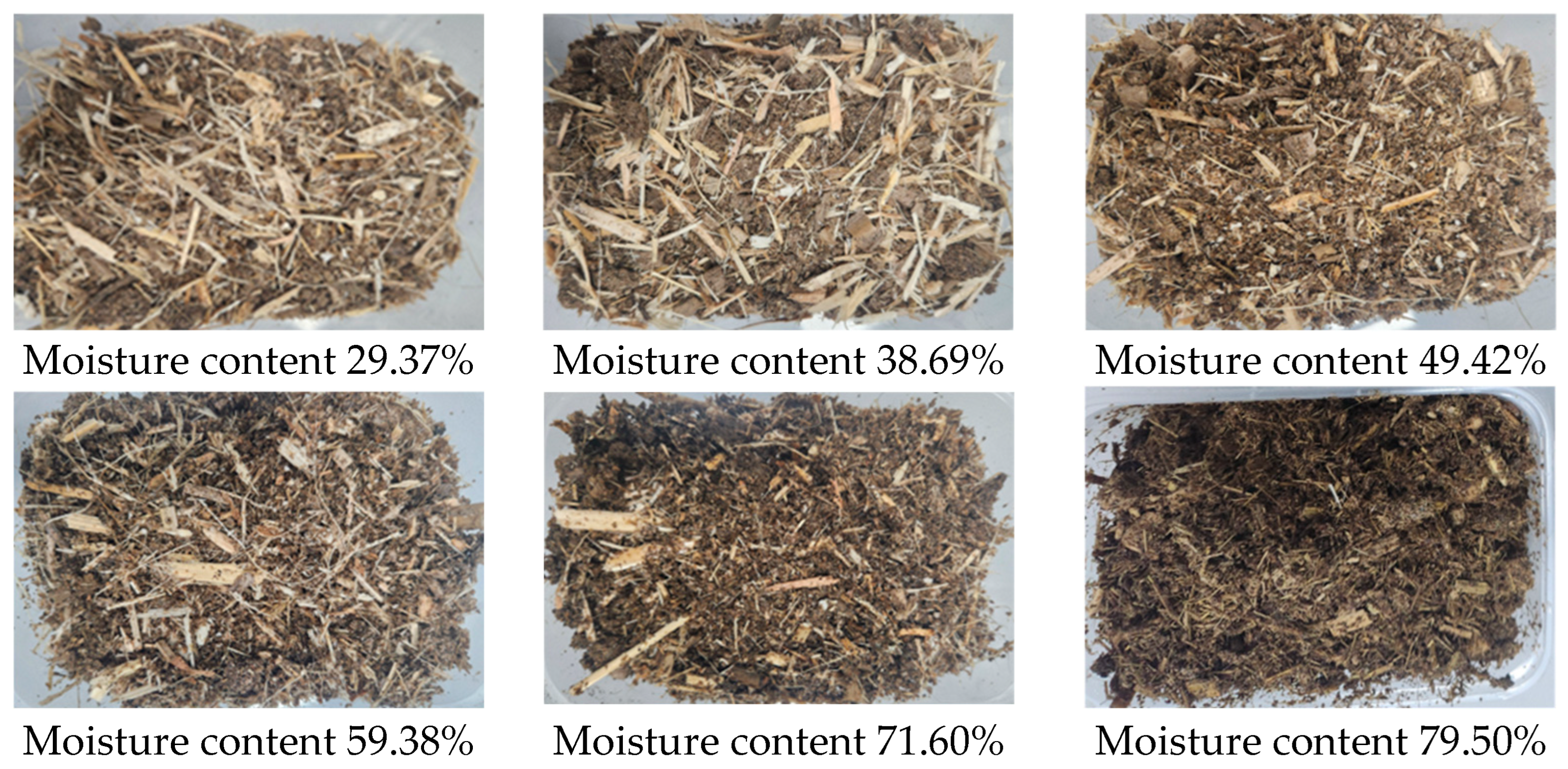
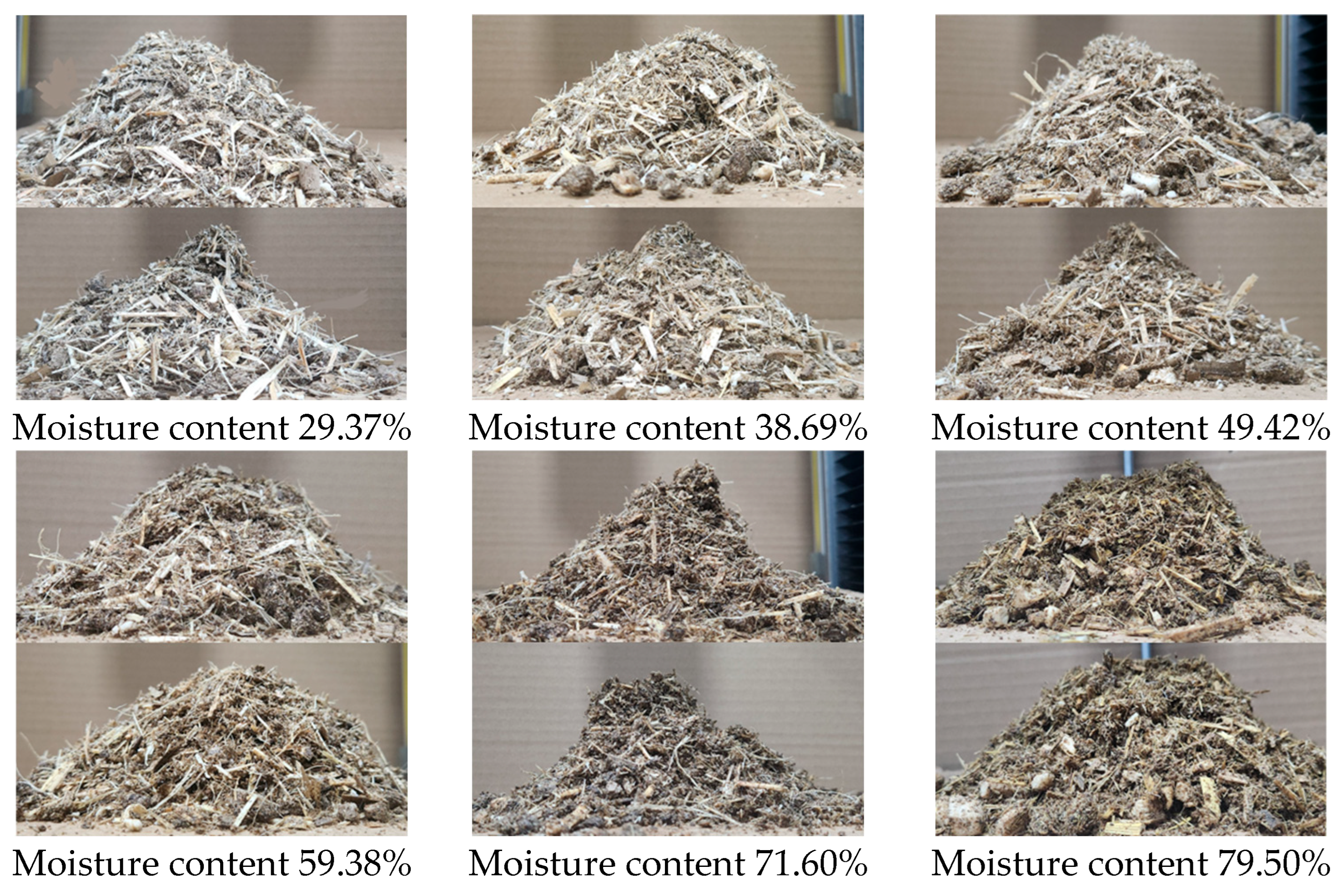
To investigate the effect of moisture content on AoR, the mixture at its initial moisture content was air-dried. Based on the moisture variation during composting, five additional moisture levels were prepared from the initial mixture, resulting in six moisture gradients in total. The moisture content before and after water adjustment was measured using the dry-weight method. Figure 1 shows the appearance of the mixture at each moisture level (wet basis).

2.2. Determination of Parameters for Simulation Experiment

Materials at different moisture contents exhibit markedly different physical properties, and moisture variation strongly affects flowability [20]. Because some parameters of wet pig manure are difficult to measure directly, previous studies have sometimes adopted values from analogous materials (e.g., soil, vermicompost, and organic fertilizer) [26,27,28], which may bias the simulated AoR of the blended materials.

2.2.1. Determination of Intrinsic Parameters

Density reflects the compactness of material accumulation, while particle size distribution can determine the size characteristics used in simulation. Because the initially crushed corn straw was non-uniform and contained large voids, it was further pulverized using a high-speed grinder (20,000 r·min−1) and then passed through standard sieves before density measurement. Mass and volume were measured using an electronic balance (accuracy: 0.1 mg) and a 50 mL graduated cylinder, respectively. Density was calculated using Equation (1):
ρ = m v
where m is the mass of the crushed sample (kg); v is the sample volume (m3).
The density of pig manure was measured using the core cutter method [29]. A core cutter with a volume of 100 cm3 was used to collect random samples of pig manure. After sampling, the material was transferred into a sealed bag for storage to prevent moisture loss. The sample was weighed, and the density was calculated using Equation (2).
ρ = m 1 m 2 v
where m1 is the total mass (g); m2 is the mass of the sealed bag (g); and v is the sample volume (cm3).
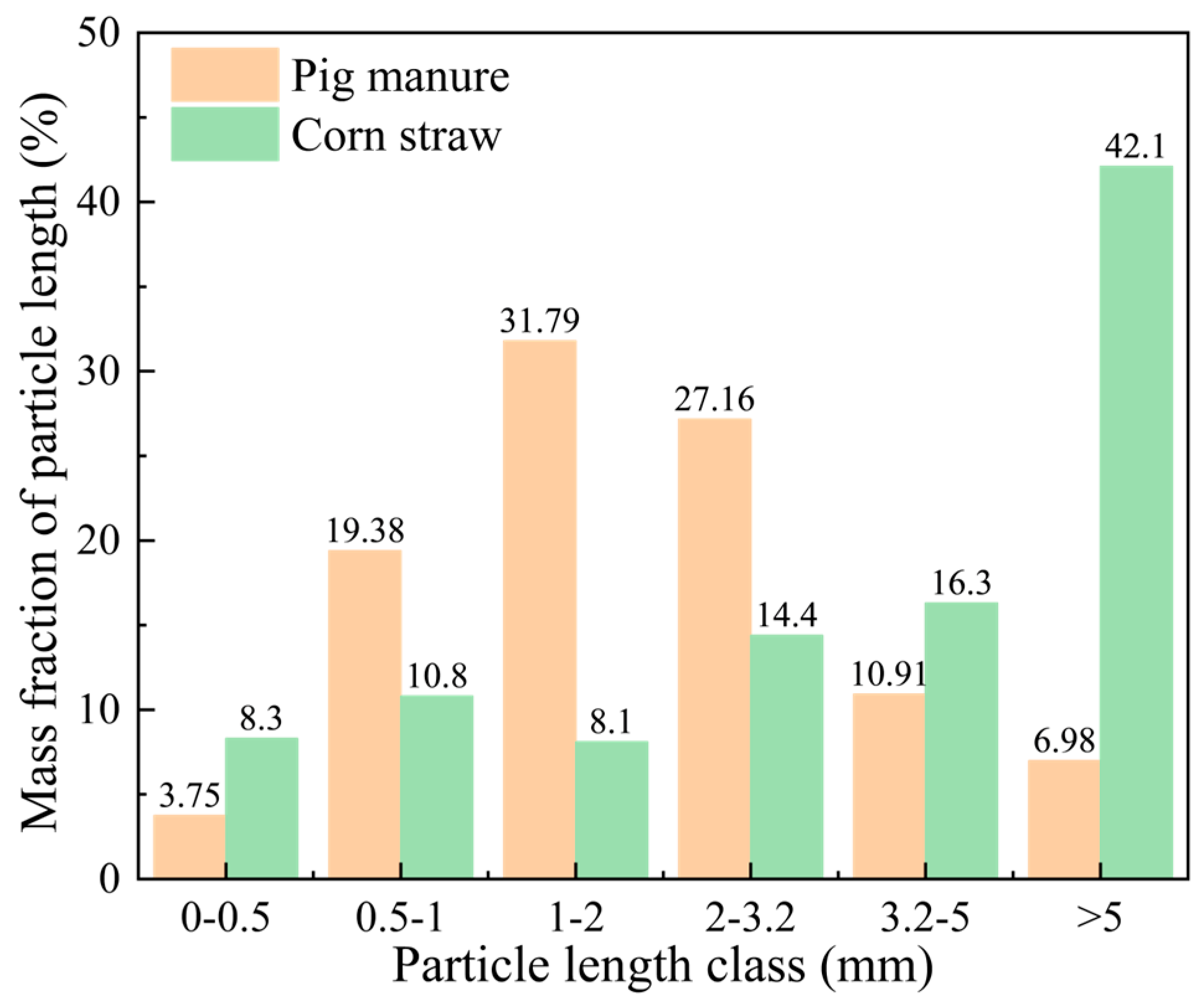
Particle size distribution was measured using sieve analysis [18]. Because the pig manure had a high moisture content and tended to aggregate, it was dried prior to measurement. Random samples of 50 g corn straw and 300 g pig manure were sieved, and the particle size distributions are shown in Figure 2.
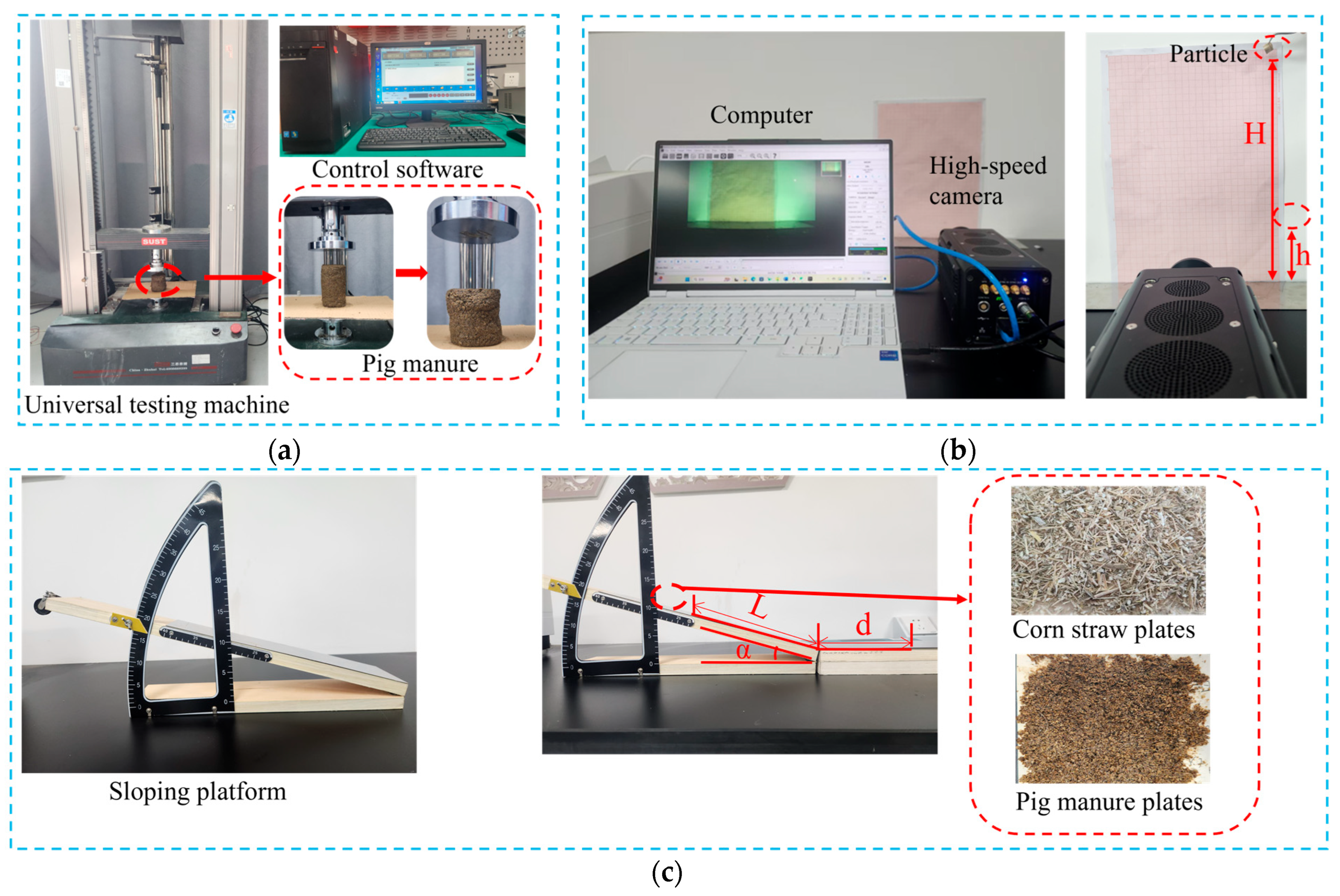
In accordance with the loading and calculation procedures specified in GB/T 1041-2008 [30], compression tests were conducted on pig manure using a SUSTCMT400 universal testing machine (SUST, Zhuhai, China) to estimate Poisson’s ratio and shear modulus. The test setup is shown in Figure 3a. Pig manure samples were prepared in regular cylindrical specimens to achieve smooth surfaces. The specimens were placed on the compression platform, ensuring good contact between the specimens and the loading head. During the test, the compression device applied axial loading at a speed of 0.1 mm/s. The original size of the sample is a cylinder with a height of 100 mm and a diameter of 50 mm. When the sample cracked, loading was immediately stopped, and the maximum compressive force (P) sustained by the sample during compression, along with its lateral and axial deformation, was recorded. The measurement data are shown in Table 1. The test was repeated five times, and Poisson’s ratio, elastic modulus and shear modulus were calculated using Equations (3)–(5). The intrinsic parameters of pig manure and corn straw are listed in Table 2.
ε = b / B l / L = ( H 1 H 2 ) / B ( A 1 A 2 ) / L
E = P L S l
G = E [ 2 ( 1 + ε ) ]
where b is the transverse deformation; B is the sample diameter; l is the axial deformation; L is the sample length; H1 and H2 are the transverse dimensions of the sample before and after compression; A1 and A2 are the axial dimensions of the sample before and after compression (all in mm); P is the maximum load during the compression stage (N); and S is the cross-sectional area of the sample (mm2).

2.2.2. Determination of Collision Recovery Coefficient

The collision recovery coefficient, which characterizes the energy dissipation capacity of a material upon impact, was measured using the free-all method with the experimental setup shown in Figure 3b (comprising a computer, grid paper, and an IDT MotionPro Y3 high-speed camera (DEL Imaging, NH, USA)). Separate tests were conducted using a steel plate, a corn straw plate, and a pig manure plate as the base. Pig manure and corn straw particles were released from a fixed height with zero initial velocity and allowed to collide with the base plate. The maximum rebound height was recorded using the high-speed camera operating at 3750 fps. Recovery coefficients were determined for the following pairs and were calculated using Equation (6): corn straw–pig manure, corn straw–corn straw, corn straw–steel, pig manure–pig manure, and pig manure–steel.
e = V y V = h H
where e is the collision recovery coefficient; Vy is the radial velocity of the material after contact (mm·s−1); V is the velocity of the material after contact (mm·s −1); h is the maximum rebound height after collision (mm); and H is the distance of the material from the base plate (mm).

2.2.3. Measurement of Friction Coefficient

Friction coefficients are important parameters affecting AoR. In this study, friction coefficients were measured using an inclined-plane method. The test setup (Figure 3c) consisted of an inclined-plane device, a steel plate, and material plates. To measure the static friction coefficient between the material and the steel plate, as well as between different materials, the device was first placed horizontally, and the sample was placed on the contact plate. The inclination angle was increased slowly until the sample began to slide. The angle indicated by the protractor at that moment was recorded as the static friction angle. Twenty tests were performed, and the static friction coefficient was calculated using Equation (7).
f j = tan γ j
where fj is the static friction coefficient; γj is the static friction angle (rad).
The rolling friction coefficient was measured using the same apparatus. A horizontal plate was placed at the end of the inclined-plane apparatus. The inclined plane was set to a fixed angle, and the sample was positioned at a designated starting point on the incline and released from rest to roll freely. The distance traveled before stopping on the horizontal steel plate was recorded. The rolling friction coefficient was calculated according to Equation (8). The measured ranges of recovery and friction coefficients are presented in Table 3.
f d = sin α × L cos α × L + d
where fd is the rolling friction coefficient; α is the angle between the inclined plate and the ground; L is the distance from the bottom of the inclined plate to the sample (mm); and d is the horizontal rolling distance (mm).

2.3. Physical AoR Test

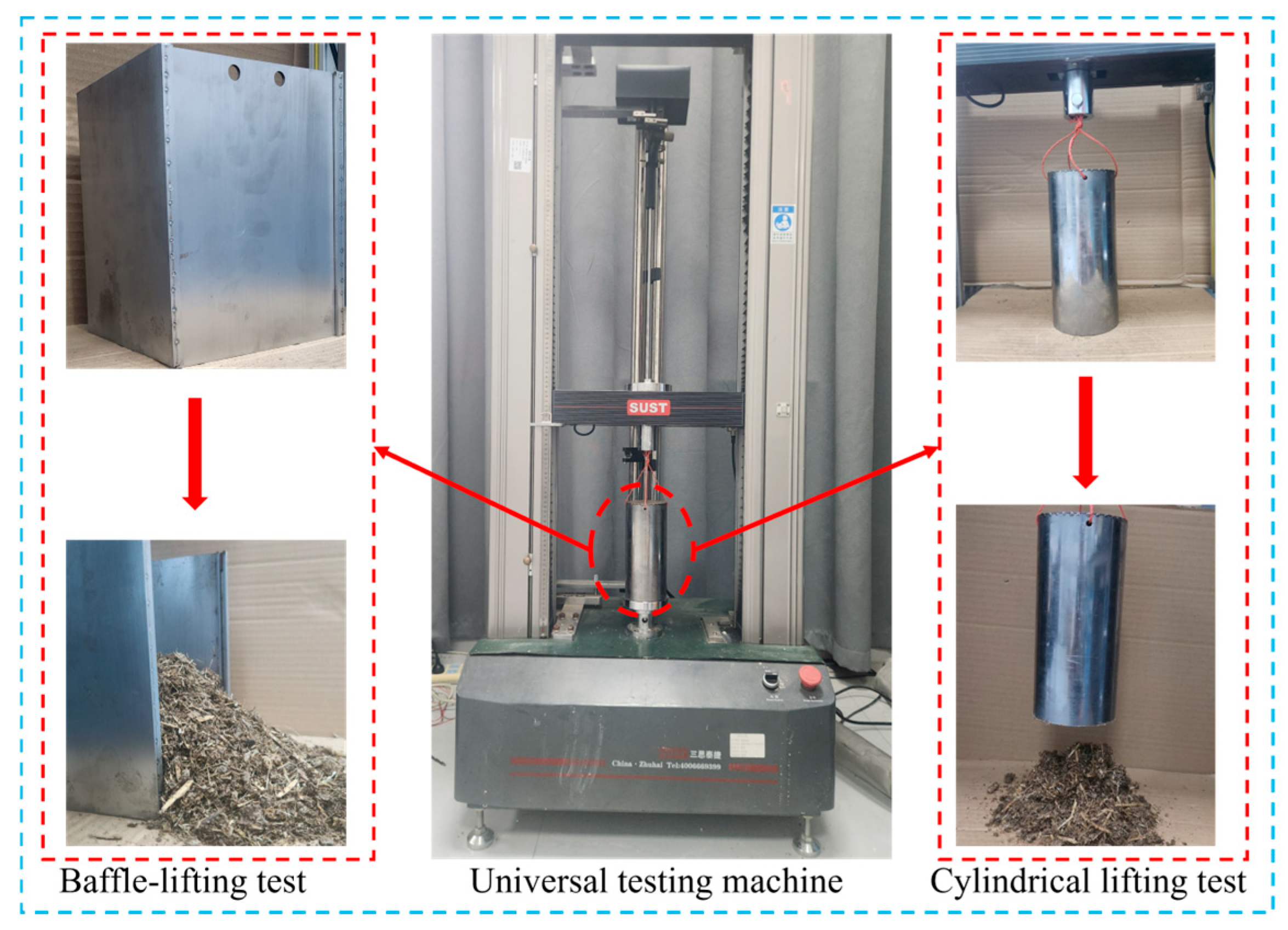
AoR is an important parameter characterizing bulk material flow behavior. In this study, AoR images of the corn straw–pig manure mixture were obtained through physical experiments and DEM simulations. Because the mixture has poor flowability and fibrous straw can cause clogging, a cylinder-lifting test was adopted for AoR measurement [20]. A baffle-lifting test was conducted for independent validation.
The pile formed by cylinder-lifting test was approximately conical, but its contour profiles could vary around the perimeter [18]. Because photographing all sides of the pile was not feasible, images were captured from two orthogonal directions (front and side), yielding four AoR values (left and right in each view). The final AoR was calculated as the mean of the four measurements. In contrast, the pile formed by the baffle-lifting test can be characterized using a single image because the two orthogonal views are identical.
The AoR test setups are shown in Figure 4. For the cylinder-lifting method, the apparatus consisted of a universal testing machine, a steel cylinder (inner diameter: 40 mm, height: 200 mm), and a base plate. A preset mass of the mixture was loaded into the cylinder, which was lifted vertically at a constant speed of 500 mm·min−1. The material fell onto the base plate to form a pile. After the pile stabilized, high-definition images (with a resolution of 50 megapixels) were captured from two perpendicular directions (X and Y) using a camera.
For the baffle-lifting method, the setup included a universal testing machine, a hopper (150 mm × 150 mm × 200 mm), a base plate, and a baffle. Both the baffle and the hopper were made of 45 steel. After the material was loaded into the hopper, the baffle was lifted upward at a constant speed of 500 mm·min−1. After the pile stabilized, a high-resolution image was captured from the Y direction for AoR calculation.

2.4. Simulated AoR Test

2.4.1. Particle Contact Model

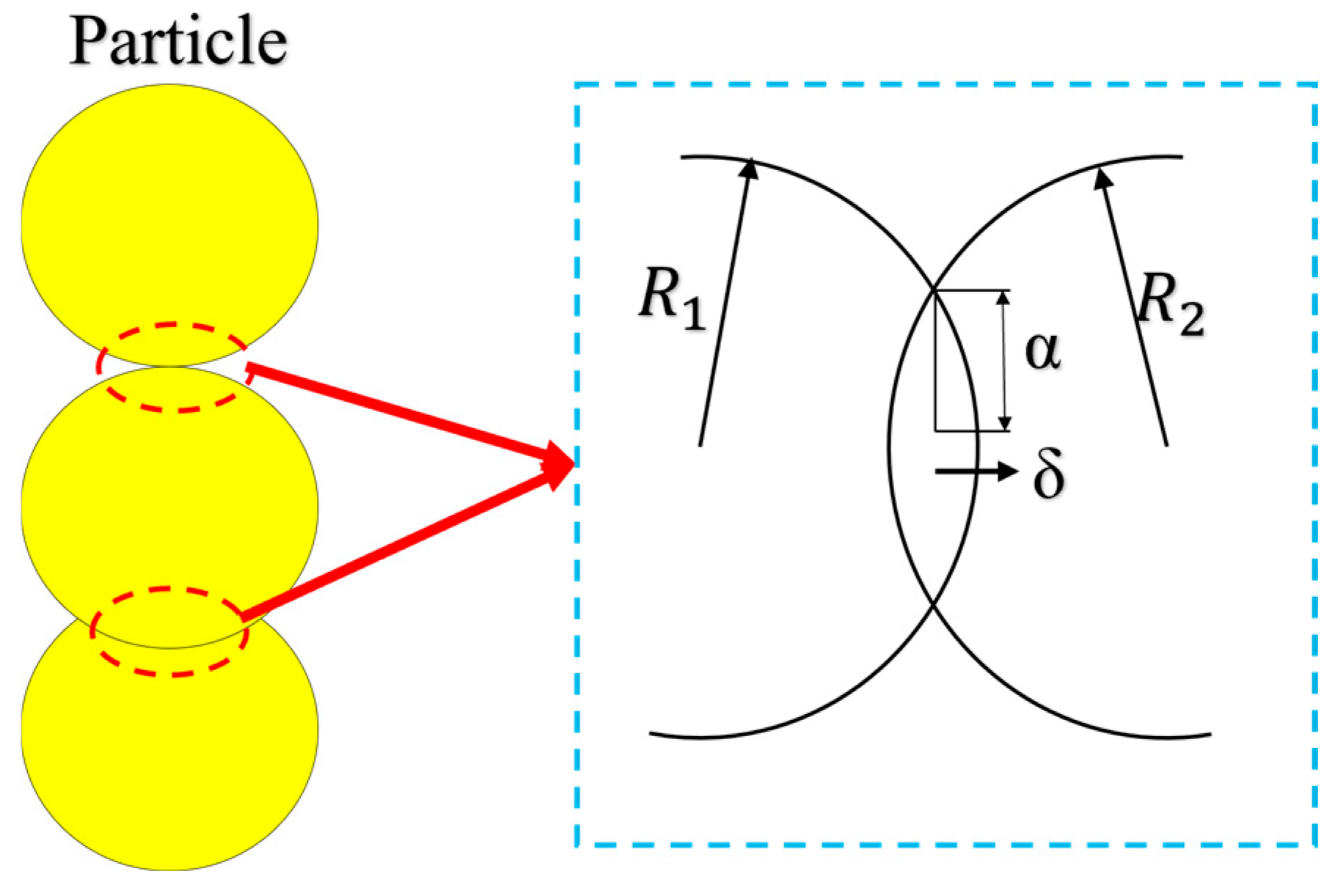
In this study, both corn straw and pig manure exhibited hygroscopicity and strong cohesion. In EDEM, the Hertz–Mindlin with JKR model incorporates surface energy into particle interactions, enabling simulation of cohesive agglomerates and wet, viscous particles [21,27]. EDEM 2024 software was used to simulate AoR testing. A schematic of this model is shown in Figure 5. In the JKR model, the normal contact force depends on particle overlap and surface energy [31] and can be rewritten as follows:
F J K R = 4 E * 3 R * α 3 4 π γ E * α 3 2
σ = α 2 R * 4 π γ α E *
1 E * = ( 1 V 1 2 ) E 1 + ( 1 V 2 2 ) E 2
1 R * = 1 R 1 + 1 R 2
where FJKR is the JKR force component (N); R* is the equivalent contact radius (m); E* is the equivalent elastic modulus (kg·m−1·s−2); α is the contact surface radius (m); γ is the particle surface energy (kg·m−1·s−2); σ is the overlap amount between the two particles (m); E1 and E2 are the elastic moduli of the two particles (kg·m−1·s−2); V1 and V2 are the Poisson’s ratios of the two particles; and R1 and R2 are the particle radii (m).

2.4.2. Simulated Test Process

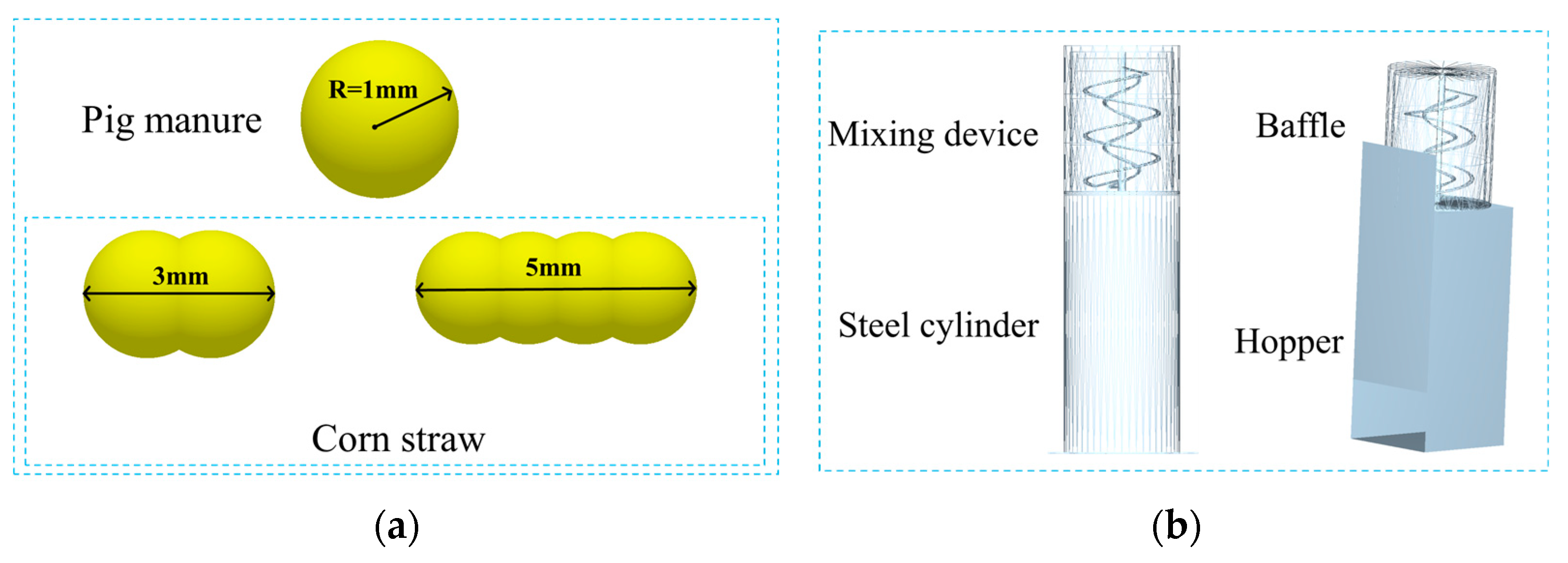
Particle size and shape can significantly influence the outcomes of DEM simulations [18]. Actual corn straw particles exhibit diverse morphologies, and explicitly modeling this diversity would substantially increase computational costs and reduce simulation efficiency [32]. Pig manure, in contrast, is primarily composed of fine, cohesive particles. To achieve a balance between model simplicity and physical representativeness, the corn straw was modeled as elongated agglomerates composed of bonded spherical particles with a base radius of 1 mm, based on measured particle size distribution and previous studies [21,32,33]. Specifically, agglomerates consisting of two spheres were generated with a size scaling factor ranging from 0.1 to 1.0 times the base radius, while those composed of four spheres were generated with a scaling factor from 0.6 to 1.5 times the base radius. Pig manure particles were represented as individual spheres with a base radius of 1 mm (Figure 6a), generated using a size scaling factor from 0.1 to 5.5. The agglomerate model representation of corn straw effectively captures its macroscopic fibrous characteristics, particularly the aspect ratio, which plays a key role in determining the angle of repose (AoR) and promoting interparticle mechanical interlocking. The spherical representation of pig manure aligns with its intrinsic fine and cohesive nature and adequately reflects the interparticle cohesive bridging behavior prevalent in the compost mixture. This simplified geometric modeling strategy is well-aligned with the primary objective of this study, namely the rapid calibration of DEM contact parameters using the AOR as a macroscopic response index. Simulation parameters were assigned based on measured values where available; otherwise, values were adopted from the literature [17,26,27,33]. Detailed parameter settings are summarized in Table 2 and Table 3.
Nevertheless, the clump–sphere approximation and particle-size scaling adopted here aim to balance physical representativeness and computational efficiency; they may not fully capture fine-scale straw entanglement/bridging, and the influence of discretization density (particle-size scaling) on AoR was not systematically evaluated in this study. A dedicated sensitivity analysis on particle-shape fidelity and discretization density effects will be considered in future work.
To maintain consistency with the physical experiments, the mixing device, steel cylinder, and hopper used in the baffle-lifting method were modeled in SolidWorks 2022 [34] and then exported in STL format for import into EDEM. The imported assembly is shown in Figure 6b. In the mixer, a total of 7000 corn straw particles were generated at a rate of 3500 particles per second, and 14,000 pig manure particles were generated at a rate of 7000 particles per second. After generation, the materials were thoroughly mixed and subsequently allowed to flow into the steel cylinder and hopper. A fixed time step corresponding to 30% of the Rayleigh time step (calculated as 3.0033 × 10⁻⁶ s) was used, with a data recording interval of 0.1 s. The total simulation time was 14 s. High-resolution images of the final particle pile were recorded to extract the AoR.

2.5. Image-Based Method for Measuring the Angle of Repose

The AoR is widely used as a macroscopic response in DEM studies of granular materials [18], and accurate AoR measurement is essential for reliable calibration. Common AoR measurement methods include manual measurement using a protractor, angle annotation in CAD software, calculation from pile height and base diameter [20], and digital image analysis [24,25]. In this study, the pile surface formed by the corn straw–pig manure mixture was irregular and uneven, which limited the application of conventional methods. Therefore, digital image processing was used to determine AoR.
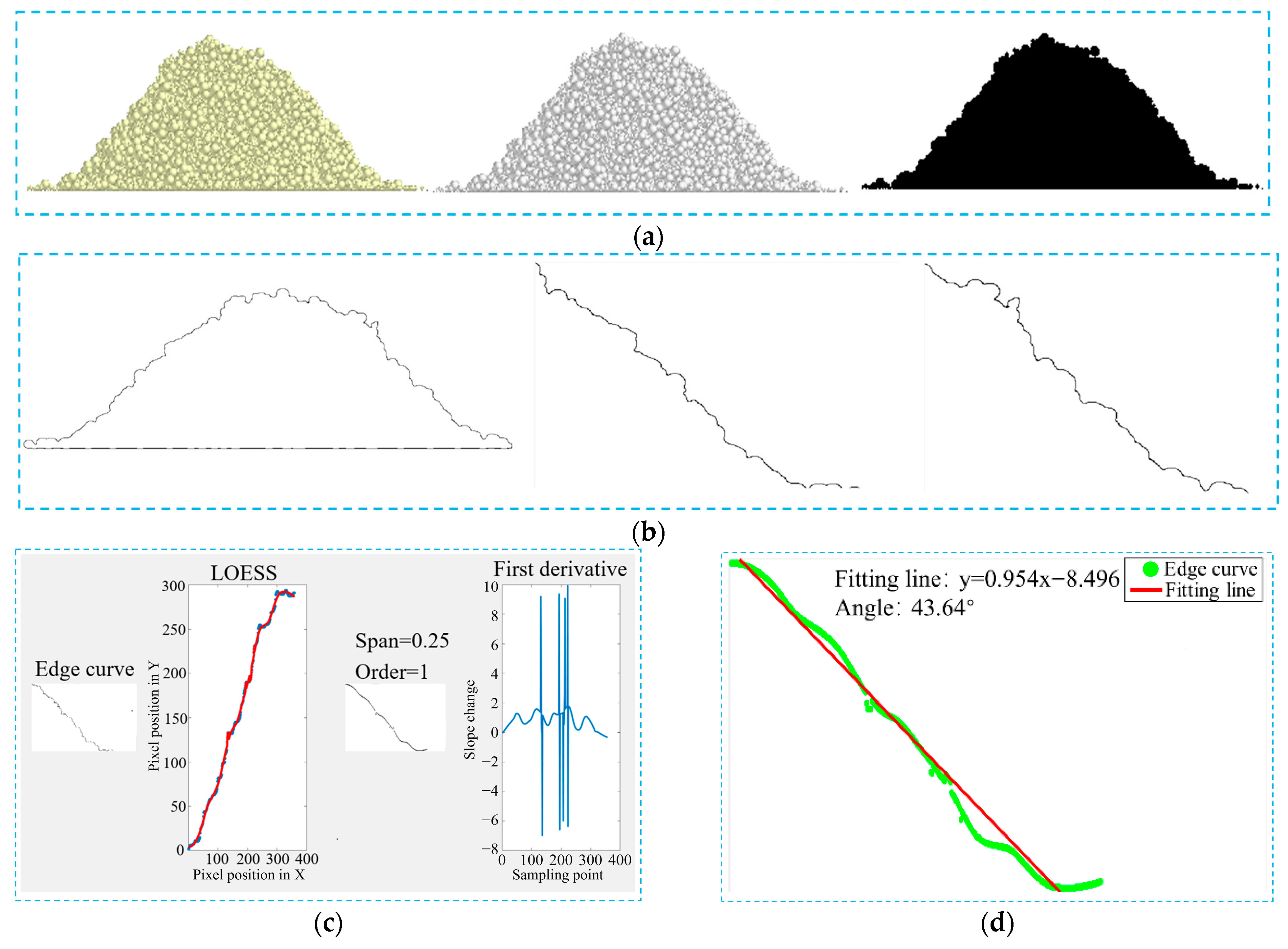
Scattered material around the pile can interfere with digital image analysis. Therefore, each acquired image was first converted to grayscale and binarized. The pile contour was then extracted using the Canny edge detector. To eliminate the internal cavities within the contour, an erosion operation was applied after edge detection. Finally, the image was cropped to obtain separate contours for the left and right sides, as shown in Figure 7a,b.
Least-squares line fitting is often employed to fit extracted contours for spherical particles because it is convenient and accurate when protrusions are minor. However, its performance diminishes when edge irregularities are pronounced. In this study, the fibrous nature of corn straw introduced prominent protrusions along the pile contour. Therefore, the extracted contour was first smoothed using LOESS to suppress local protrusions. A least-squares line was then fitted to the smoothed contour to compute AoR. This two-step process (LOESS smoothing followed by linear regression) could improve robustness compared with direct least-squares fitting (Figure 7c).
LOESS smoothing is a nonparametric fitting method based on locally weighted polynomial regression. For each data point xi, a neighborhood is defined and adjacent data points are used for fitting. A tricube weight function is employed to assign weight with the neighborhood.
ω j = ( 1 x j x i d 3 ) 3
where d is the neighborhood radius.
A second-order polynomial is fitted within the neighborhood using weighted least squares:
y = β 0 + β 1 x x i + β 2 x x i 2
The coefficients β are obtained by minimizing the weighted residual sum of squares:
ω j ( y j y j ^ ) 2
The above process is repeated for each data point to generate the smoothed curve. During LOESS smoothing, the span parameter controls curve smoothness by defining the proportion of data points used in each local regression. A larger span yields a smoother curve but may over-smooth local features. Therefore, the span should be selected based on the signal characteristics: a larger value is recommended when the noise level is high or the feature frequency is low, whereas a smaller value is preferable when fine-scale features should be retained.
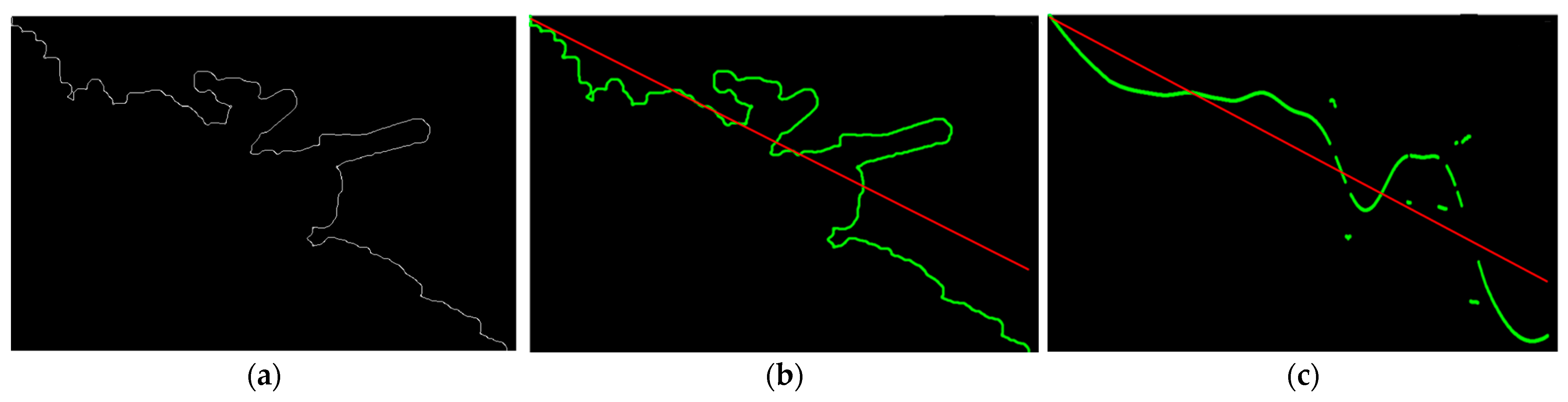
The proposed AoR extraction method, which integrates LOESS smoothing and least-squares fitting, effectively suppresses local protrusions and contour irregularities induced by fibrous corn straw (as illustrated in Figure 8). Compared with direct least-squares fitting (without LOESS smoothing), the fitted straight line obtained using this method exhibited better agreement with the actual pile contour. For the six moisture gradient samples considered in this study, the AoR values extracted via the proposed method yielded a low coefficient of variation (CV < 2.5%, with an average CV of 1.61% calculated from four repeated orthogonal image measurements per moisture content), indicating satisfactory measurement stability.

3. Results and Discussion

3.1. Construction of the Moisture Content-AoR Model

To quantify the relationship between moisture content and AoR, cylinder-lifting tests were conducted for six mixture groups ranging from 29% to 80% moisture content (Figure 9). Within this moisture content range, the mixture consistently formed stable piles. As moisture content increased, AoR showed a clear increasing trend, indicating reduced flowability. This behavior was mainly attributed to increased interparticle cohesion induced by moisture, including stronger capillary (liquid-bridge) effects and adhesion. These factors collectively reduced material flowability and increased AoR.
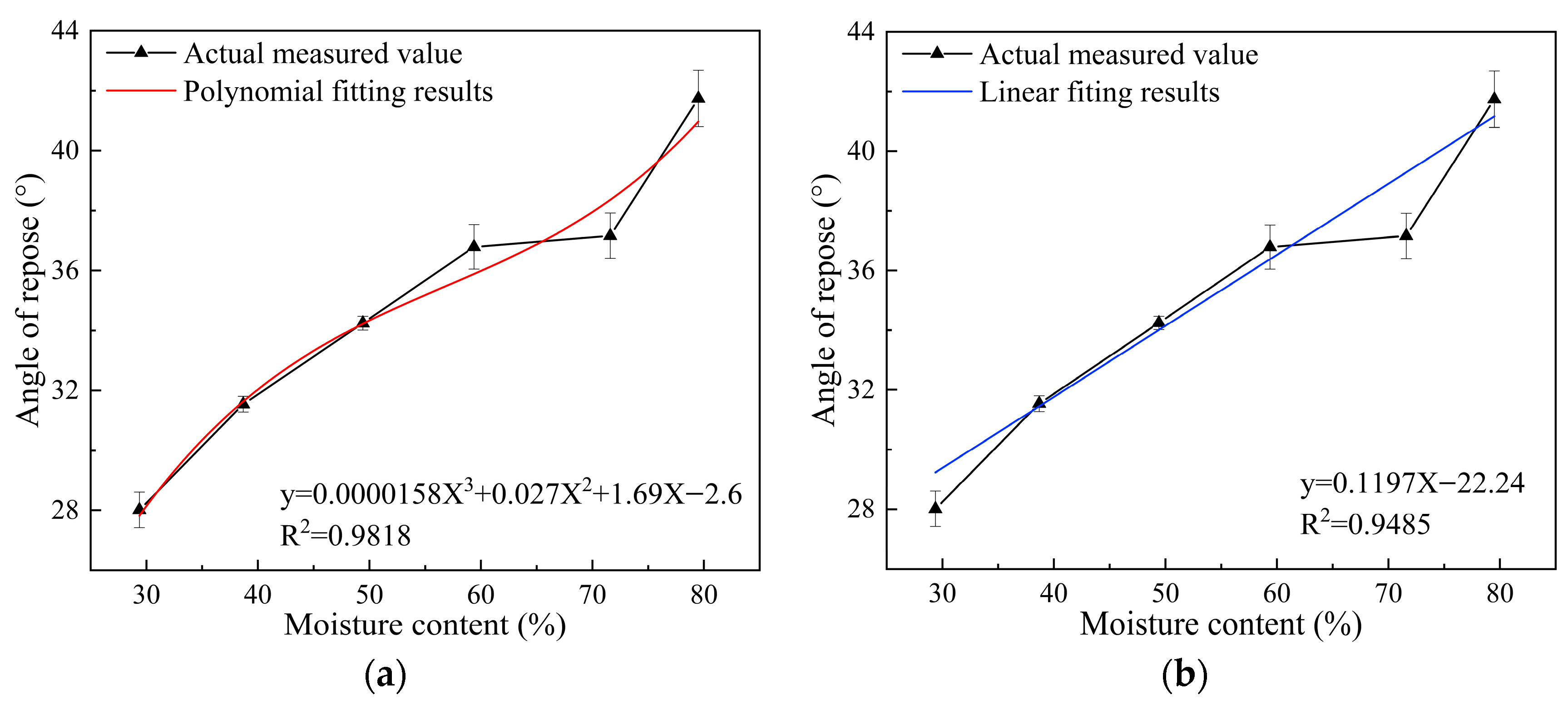
Both linear and polynomial functions were used to fit the relationship between moisture content and AoR (Figure 10). The polynomial fit provided a substantially improved description of the nonlinear increase in AoR compared with the linear fit, as evidenced by a higher coefficient of determination (R2 = 0.9818). Therefore, the polynomial model (Equation (16)) was used to predict AoR from moisture content.
y = 0.0000158 x 3 + 0.027 x 2 + 1.69 x 2.6   ( R 2 = 0.9818 )

3.2. Plackett–Burman Screening of Influential DEM Parameters

A Plackett–Burman (PB) design was employed to identify the DEM parameters that significantly affect AoR from a larger candidate set. The PB screening design was generated using Design-Expert (v13). This method identified main effects by assigning high and low levels to each parameter, thereby reducing the experimental burden for subsequent optimization. The lower and upper bounds of candidate DEM parameters were determined from a combination of measured material properties (restitution and friction coefficients), literature ranges for similar wet agricultural granular materials [17,33,35,36], and preliminary DEM trials to exclude numerically unstable or physically unrealistic combinations (e.g., excessive particle overlap or non-forming piles). The final bounds used in Table 4 reflect this combined, evidence-based selection.
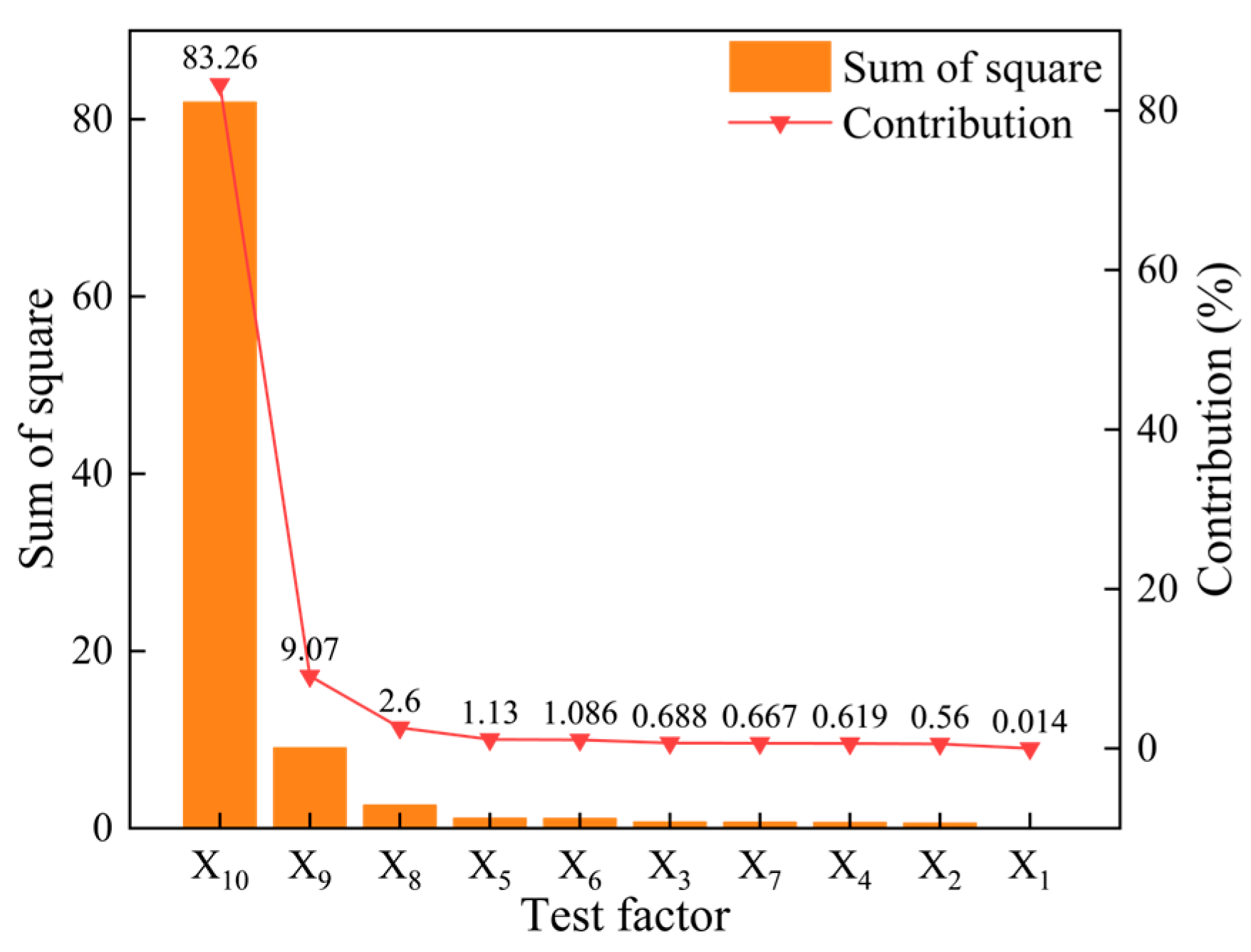
The PB design matrix and AoR responses are summarized in Table 5. ANOVA results (Table 6) indicated that the screening model exhibited excellent goodness of fit (R2 = 0.998). Standardized effects and their relative contributions are presented in the Pareto chart (Figure 11). Among the tested parameters, the JKR surface energy between pig manure particles (X10) had the most significant effect on AoR, followed by the JKR surface energy between pig manure and corn straw (X9) and the rolling friction coefficient between pig manure and steel (X8). The remaining parameters were not statistically significant within the tested ranges. Accordingly, X8, X9, and X10 were selected for the steepest-ascent experiment.

3.3. Steepest-Ascent Experiment

A steepest-ascent experiment was conducted to rapidly approach the region of optimal values for the three significant factors (X8, X9, and X10). Non-significant factors were fixed at their intermediate levels, whereas the step direction and step size for X8–X10 were determined according to the effect signs and magnitudes obtained from PB screening. The relative error between the measured AoR (41.7°) and the simulated AoR was used as the evaluation metric and calculated as follows:
δ   =   Y 1 Y Y   ×   100 %
where δ is the relative error; Y is the Physical AoR (°); and Y1 is the Simulated AoR (°).
The experimental design and results are shown in Table 7. Run 4 yielded the minimum relative error of 0.3% and was therefore selected as the central point for the subsequent Box–Behnken design (BBD). Runs 3 and 5 were used to define the low and high levels, respectively, for response-surface modeling.

3.4. Box–Behnken Experiment

3.4.1. Regression Model, Variance, and Residual Analysis

A three-factor, three-level Box–Behnken design was employed to establish the quantitative relationship between AoR and the key DEM parameters (X8, X9, and X10). The coded and actual factor levels are listed in Table 8, and the design matrix and simulation results are shown in Table 9. A second-order (quadratic) regression model was fitted to the AoR response (Equation (18)).
Y = 41.83 + 1.72 X 8   + 1.08 X 9   + 0.87 X 10 + 0.67 X 8 X 9   1.07 X 8 X 10   0.56 X 9 X 10 3.35 X 8 2 1.34 X 9 2 2.33 X 10 2
ANOVA (Table 10) indicated that the quadratic model was highly significant (p < 0.01), demonstrating a significant association between the selected factors and AoR. The model exhibited a high coefficient of determination (R2 = 0.9817) and an adjusted R2 of 0.9487, indicating that 94.87% of the response variation could be explained by the model. The coefficient of variation (CV) was 1.66%, suggesting good correlation between predicted and observed values. In addition, the adequate precision (signal-to-noise ratio) was 18.09 (>4), indicating that the model had sufficient accuracy for predictive analysis.
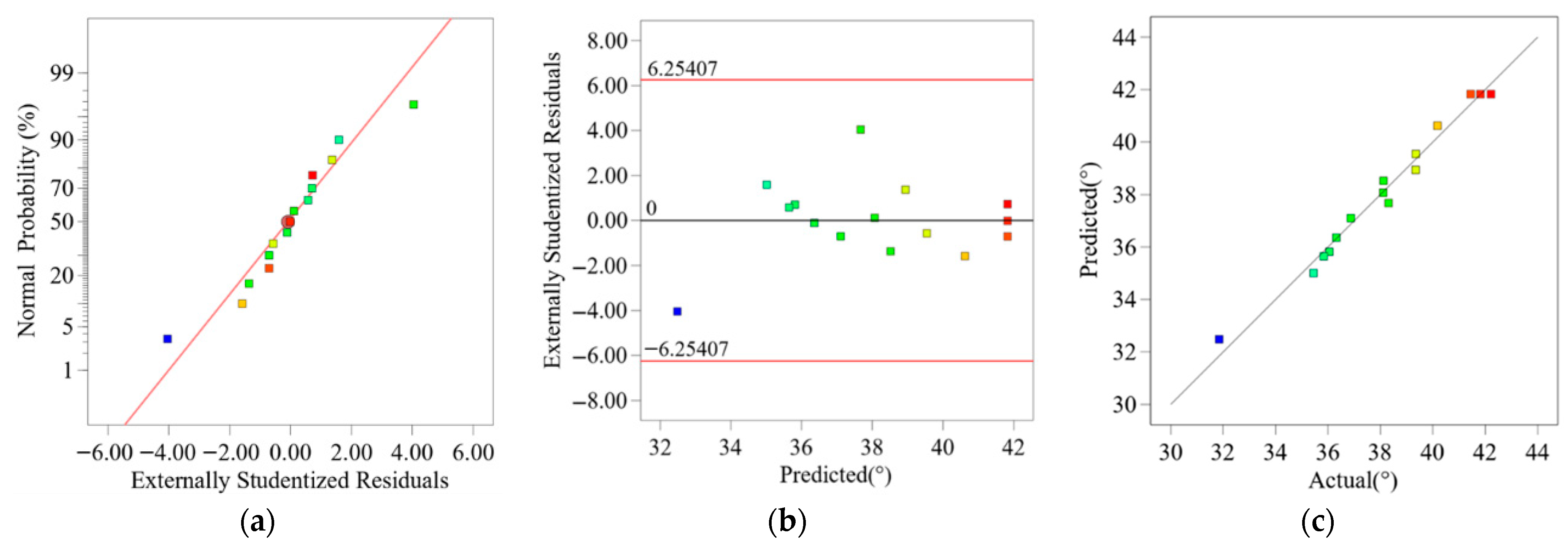
Residual analysis (Figure 12) further supported model adequacy. The residuals followed an approximately normal distribution (Figure 12a), and the residuals were randomly scattered around zero without obvious patterns (Figure 12b). Predicted AoR values also agreed well with measured values (Figure 12c). These results indicated that the model provided reliable predictions within the calibrated range.

3.4.2. Single Factor and Interaction Analysis

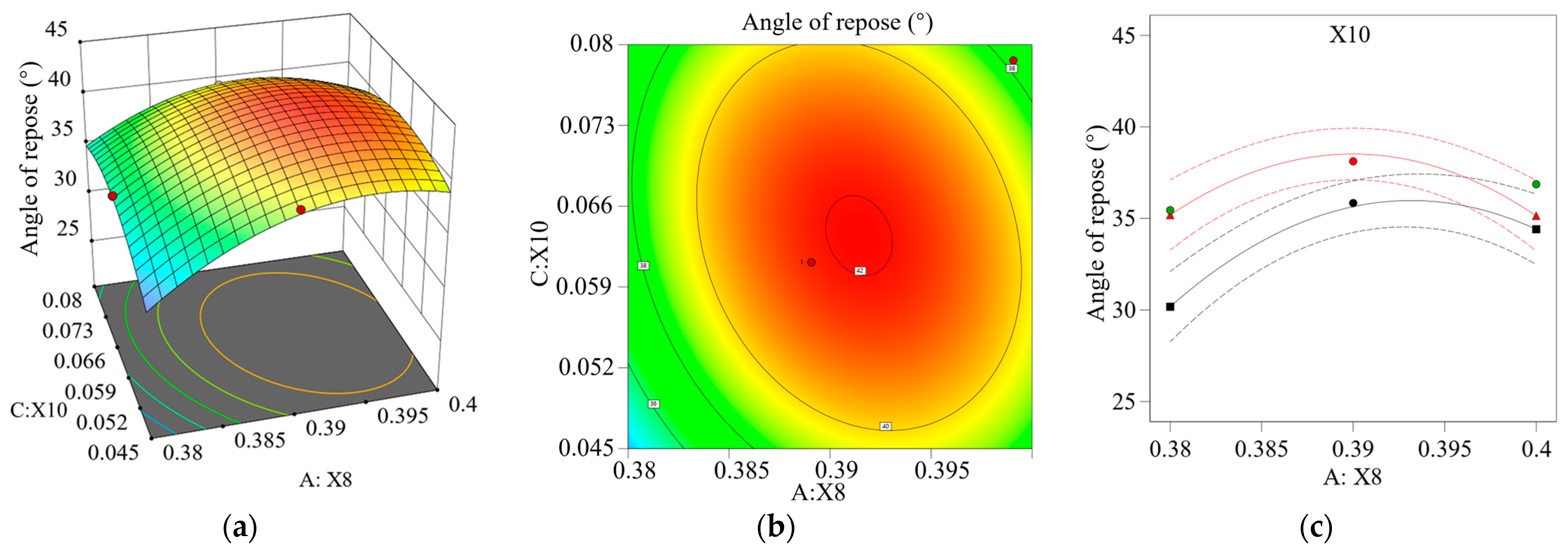
According to Table 10, the linear terms X8 and X9 had extremely significant effects on AoR (p < 0.01), whereas X10 had a significant effect (p < 0.05). Among the interaction terms, X8X10 significantly affected AoR, while X8X9 and X9X10 were not significant. All quadratic terms (X82, X92, and X102) were significant, indicating pronounced nonlinearity in the response, which reflects the complex relationship between the macroscopic flow behavior of the mixture and the microscopic contact parameters. The response surface and contour plots for the significant interaction, X8X10, are shown in Figure 13, where the contour lines exhibited a distinct elliptical distribution, characterizing the strong mutual coupling between X8 and X10. At a fixed rolling friction coefficient between pig manure and steel (X8), AoR initially increased with increasing pig manure–pig manure surface energy (X10) and then decreased slightly at higher X10 values within the model space. This trend could be attributed to stronger interparticle cohesion captured by the JKR model (e.g., moisture-induced adhesion and capillary effects), which stabilized the pile and increased AoR [20]. However, when cohesion became sufficiently high, particle agglomeration or clustering became pronounced, altering the discharge and deposition mode and potentially reducing the effective pile angle. At a fixed X10, AoR also showed a non-monotonic trend with X8, increasing initially and then decreasing, which was dominated by the highly significant quadratic effect of X8 (p < 0.001). A moderate increase in rolling friction inhibited particle rolling, suppressed outward spreading, and enhanced pile stability, thereby increasing AoR [37]. Beyond a certain threshold, further increases in rolling friction may alter packing and promote local rearrangements during deposition, leading to a reduced AoR as predicted by the response surface, as reflected in the downward slope of the 3D response surface at high X8 levels in Figure 13a. This non-monotonic behavior, consistent with the significant quadratic terms (X82 and X102) and the interaction term (X8·X10) in the fitted response surface model, implies the existence of an optimal region rather than a monotonic trend.
After removing non-significant terms (p > 0.05), a reduced regression model was obtained (Equation (19)) and used for subsequent optimization and coupling with the moisture content–AoR model:
Y = 41.83 + 1.72 X 8 + 1.08 X 9 + 0.87 X 10 1.07 X 8 X 10 3.35 X 8 2 1.34 X 9 2 2.33 X 10 2

3.5. Model Validation

3.5.1. Validation of the AoR-DEM Model

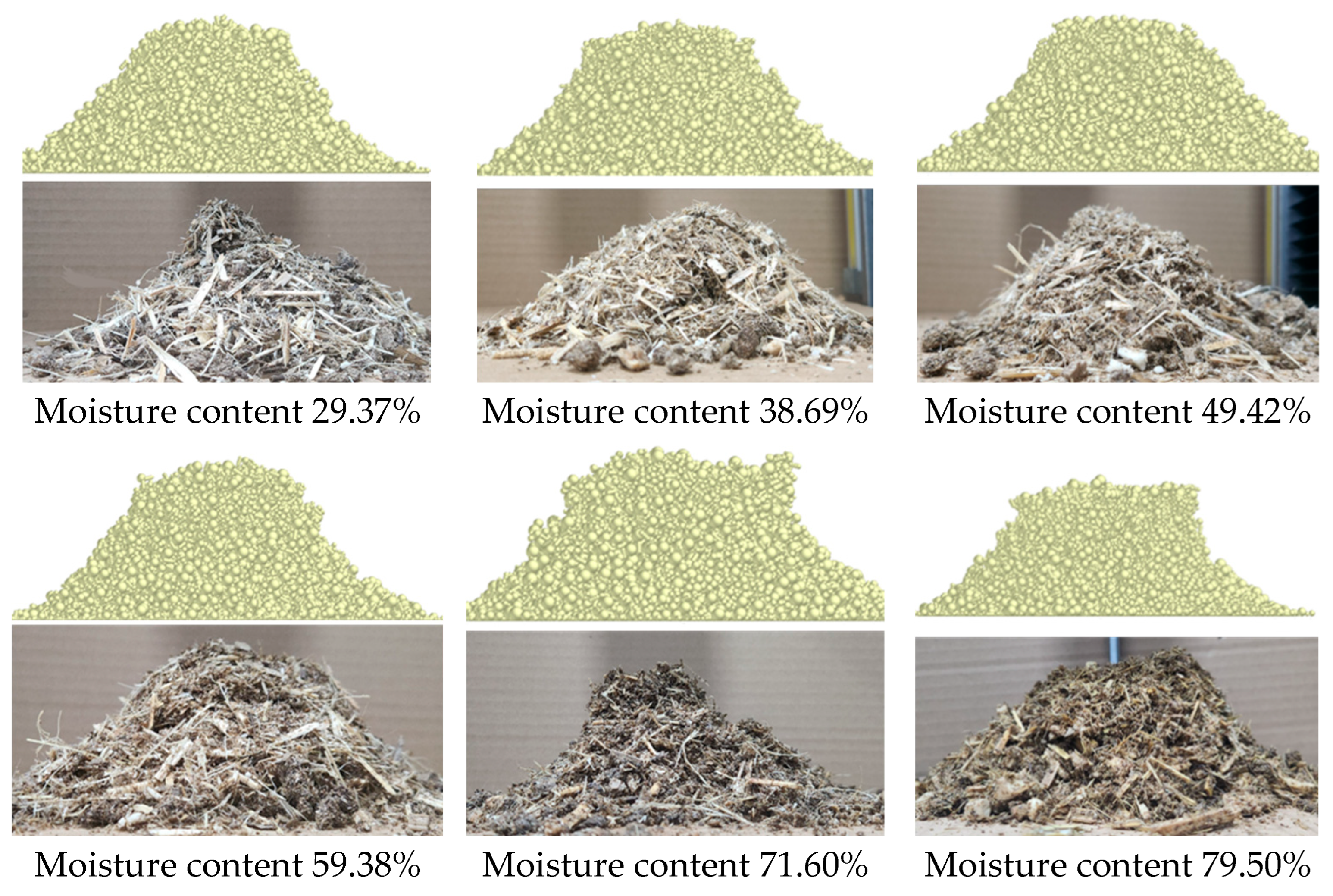
To evaluate the applicability of the AoR-DEM parameter model, the measured AoR values of six mixture groups (moisture content = 29–80%) were used as optimization targets. The corresponding optimal parameters and simulation results are listed in Table 11. Visual comparisons of pile shapes (Figure 14) indicated that the relative error remained below 10% across the tested moisture content range.
When compared with previous DEM calibration studies on organic fertilizer [18,20,35], the present model provided comparable accuracy under practical experimental conditions. Notably, the error tended to increase when the moisture content fell below 50%. A likely reason was that the initial ranges of physical test parameters used for calibration were determined primarily based on high-moisture materials representative of the early composting stage, which may reduce parameter transferability to low-moisture conditions. When the moisture content was low, interparticle cohesion diminished, and the mixture became less adhesive. Under such conditions, the JKR contact model introduced adhesive forces between particles and may have had limited capability to represent low-moisture materials. Despite this limitation, the JKR framework remains widely used in moist granular biomaterials.
To quantitatively characterize the prediction error of the model under low-moisture conditions (<50%), the relative errors of the simulated AoR at moisture contents of 29.37%, 38.69%, and 49.42% were statistically analyzed. The results showed an average relative error of 6.68%, with a gradually decreasing trend as moisture content increases (from 9.01% at 29.37% to 4.97% at 49.42%). This quantitative distribution of errors further confirmed that the model error was positively correlated with decreasing moisture content. The JKR-based cohesion term is most representative when moisture-induced adhesion (e.g., capillary bridging/adhesive effects) contributes significantly to bulk cohesion. At lower moisture levels, the mixture behavior becomes more friction-dominated, and the same JKR parameterization may yield larger AoR deviations. Therefore, the proposed moisture-to-parameter inference should be interpreted with an explicit applicability domain and may be extended in future work by incorporating alternative bonding/contact formulations for low-moisture regimes.

3.5.2. Coupled Moisture Content–DEM Parameter Prediction and Validation

By coupling the moisture content–AoR model (Equation (16)) with the AoR-DEM parameter response surface (Equation (19)), an integrated moisture content-based predictive model was established to directly estimate key DEM parameters from moisture content (Equation (20)).
0.0000158 X 3 + 0.027 X   2 + 1.69 X 2.6 = 41.83 + 1.72 X 8 + 1.08 X 9 + 0.87 X 10 1.07 X 8 X 10 3.35 X 8 2 1.34 X 9 2 2.33 X 10 2
Moisture alters interparticle interactions by promoting cohesive effects such as liquid bridging and adhesion-like attractions, which enhance pile stability and increase the AoR. In DEM implementation, these moisture-induced cohesive contributions are represented through effective JKR surface energy parameters (X9 and X10) calibrated against AoR, while rolling friction (X8) captures the mobility and frictional resistance at the base contact. As moisture content increases, both the adhesion force between particles and the surface energy of the contact interface increase (denoted as X9 and X10, respectively). Simultaneously, the thickening of the liquid film on the particle surface enhances the viscous resistance encountered when pig manure particles roll on the steel contact surface, leading to an increasing rolling friction coefficient (X8). The elevation in surface energy and rolling friction coefficient further amplifies the interparticle cohesion and motion resistance within the mixture, which macroscopically manifests as a rise in the AoR. We emphasize that the calibrated JKR surface energy terms are effective parameters that aggregate moisture-dependent cohesion mechanisms at the macroscopic calibration level, rather than direct measurements of intrinsic surface energy. Accordingly, based on Equations (16) and (19), a moisture content–DEM parameter model (Equation (20)) was derived. This equation quantitatively captures the intrinsic physical relationship among moisture content, interparticle interactions, and macroscopic flow behavior (AoR) of the corn stover–pig manure mixture.
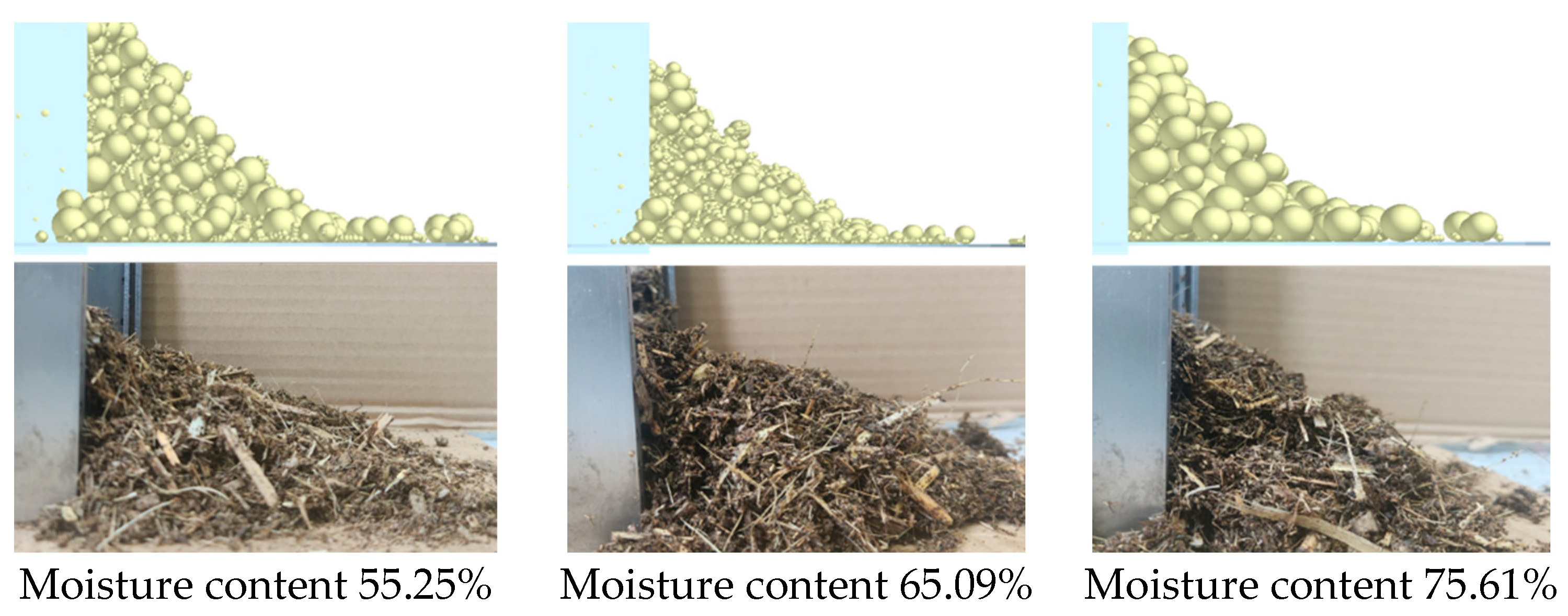
To validate the integrated model, three additional mixtures were prepared at moisture content values of 55.25%, 65.09%, and 75.61%. The moisture content values were input into the coupled model to obtain the corresponding optimal DEM parameters. AoR was then determined experimentally and numerically using the baffle-lifting method. The results (Table 12 and Figure 15) showed that the relative error between simulated and measured AoR at all validation points was below 5%, demonstrating that the coupled moisture content–DEM parameter model was stable and reliable for rapid parameter prediction under variable moisture conditions.

4. Conclusions

A rapid calibration workflow was developed to determine DEM parameters for corn straw–pig manure mixtures under variable moisture content by combining physical tests and DEM simulations. A predictive model was established to infer key DEM parameters from moisture content and was validated experimentally. The proposed framework maintained satisfactory accuracy (relative error < 10% for the AoR–parameter response surface and <5% for the integrated moisture-to-parameter model within 29–80% moisture content) while improving computational efficiency by reducing DOE-related DEM simulations by 83.3% (33 simulations instead of 198; i.e., 165 simulations saved) compared with independent calibration at each moisture level. The main conclusions are as follows:
An image-processing AoR method combining LOESS smoothing and least-squares fitting was proposed for irregular pile surfaces. LOESS smoothing enhanced the robustness against contour protrusions, and least-squares line fitting after LOESS smoothing improved AoR measurement accuracy for uneven and irregular piles.
Plackett–Burman screening followed by steepest-ascent tests identified three dominant factors affecting AoR over a moisture content of 29–80%: the rolling friction coefficient between pig manure and steel (X8), the JKR surface energy between pig manure and corn straw (X9), and the JKR surface energy between pig manure particles (X10). The refined ranges were X8 = 0.38–0.405, X9 = 0.03–0.05, and X10 = 0.045–0.085. A quadratic regression model relating AoR to these key DEM parameters was established using Box–Behnken response surface analysis.
A regression model between moisture content (29–80%) and AoR was developed from physical tests. This model was coupled with the AoR-DEM parameter response surface to develop a combined predictive model. Validation using the baffle-lifting method demonstrated that within the tested moisture content range, the relative error of the AoR predicted by the AoR–parameter response surface was less than 10%. Furthermore, the integrated moisture content–DEM parameter model exhibited a relative error below 5% in comparison with the physical experimental data. This framework can substantially reduce repeated DEM calibration efforts across moisture conditions once the moisture–AoR–parameter mapping is established for the target material system (within the tested moisture range and mixture ratio). Instead, it allows the rapid acquisition of key DEM parameters directly from moisture content, thus reducing the number of experiments. Validation experiments also confirmed that the model can provide rapid and reliable parameter inputs for the DEM simulation of composting materials under variable moisture content conditions.
This study provided a practical parameter-acquisition method for pig manure–corn straw mixtures. The calibrated parameters can be directly applied to numerical simulations of compost turning, fertilizer conveying, and spreading equipment, where material moisture content changes considerably during operation. The parameters can also support optimization of blade geometry, rotational speed, and power consumption in composting machinery simulations. However, larger errors were observed under low-moisture conditions. Future work will focus on improving calibration accuracy, including more detailed measurements of the physical properties and intrinsic parameters of corn straw and pig manure. A refined characterization of different straw components (e.g., pith, rind, and leaves) will be incorporated to achieve a more realistic material representation. Different contact models will also be tested to better characterize interactions between corn straw and pig manure.

Author Contributions

Conceptualization, L.K.; Methodology, L.K. and J.D.; Formal Analysis, L.K. and J.D.; Investigation, L.Y. and X.Y.; Resources, L.Y. and X.H.; Data Curation, L.K. and X.T.; Writing—Original Draft Preparation, L.K. and J.D.; Writing—Review and Editing, X.T. and H.Y.; Funding Acquisition, X.T. and H.Y. All authors have read and agreed to the published version of the manuscript.

Funding

This research was funded by the Talents Introduction Program of Xihua University (Z212011; ZX20250065).

Institutional Review Board Statement

Not applicable.

Data Availability Statement

The data presented in this study are available on request from the corresponding author.

Acknowledgments

We thank the constructive comments by anonymous reviewers, which improved the presentation of this paper.

Conflicts of Interest

The authors declare no conflicts of interest.

References

  1. Chen, L.; Chen, Y.; Li, Y.; Liu, Y.; Jiang, H.; Li, H.; Yuan, Y.; Chen, Y.; Zou, B. Improving the humification by additives during composting: A review. Waste Manag. 2023, 158, 93–106. [Google Scholar] [CrossRef]
  2. Kong, Y.; Zhang, J.; Zhang, X.; Gao, X.; Yin, J.; Wang, G.; Li, J.; Li, G.; Cui, Z.; Yuan, J. Applicability and limitation of compost maturity evaluation indicators: A review. Chem. Eng. J. 2024, 489, 151386. [Google Scholar] [CrossRef]
  3. Hanajima, D. Effects of slatted frame placed in compost pile on enhancing heat generation and organic matter degradation during high-moisture cow manure composting. Anim. Sci. J. 2024, 95, e13949. [Google Scholar] [CrossRef] [PubMed]
  4. Tian, L.; Li, H.; Zhang, X.; Liu, C. Discrete element method simulation of rice grain stacking characteristics. INMATEH-Agric. Eng. 2024, 74., 554–561. [Google Scholar] [CrossRef]
  5. Rathnayake, D.; Schmidt, H.P.; Leifeld, J.; Mayer, J.; Epper, C.A.; Bucheli, T.D.; Hagemann, N. Biochar from animal manure: A critical assessment on technical feasibility, economic viability, and ecological impact. GCB Bioenergy 2023, 15, 1078–1104. [Google Scholar] [CrossRef]
  6. Waqas, M.; Hashim, S.; Humphries, U.; Ahmad, S.; Noor, R.; Shoaib, M.; Naseem, A.; Hlaing, P.; Lin, H. Composting processes for agricultural waste management: A comprehensive review. Processes 2023, 11, 731. [Google Scholar] [CrossRef]
  7. Johansson, M.; Quist, J.; Evertsson, M.; Hulthén, E. Cone crusher performance evaluation using DEM simulations and laboratory experiments for model validation. Miner. Eng. 2017, 103, 93–101. [Google Scholar] [CrossRef]
  8. Mohajeri, M.; de Kluijver, W.; Helmons, R.; van Rhee, C.; Schott, D. A validated co-simulation of grab and moist iron ore cargo: Replicating the cohesive and stress-history dependent behaviour of bulk solids. Adv. Powder Technol. 2021, 32, 1157–1169. [Google Scholar] [CrossRef]
  9. Quist, J.; Evertsson, C. Cone crusher modelling and simulation using DEM. Miner. Eng. 2016, 85, 92–105. [Google Scholar] [CrossRef]
  10. Zeng, Z.; Ma, X.; Cao, X.; Li, Z.; Wang, X. Critical review of applications of discrete element method in agricultural engineering. Trans. Chin. Soc. Agric. Mach. 2021, 52, 1–20. [Google Scholar] [CrossRef]
  11. Liu, L.; Wang, X.; Zhang, X.; Cheng, X.; Wei, Z.; Zhou, H.; Zhao, K. The impact of ‘T’-shaped furrow opener of no-tillage seeder on straw and soil based on discrete element method. Comput. Electron. Agric. 2023, 213, 108278. [Google Scholar] [CrossRef]
  12. Chen, G.; Wang, Q.; Xu, D.; Li, H.; He, J.; Lu, C. Design and experimental research on the counter roll differential speed solid organic fertilizer crusher based on DEM. Comput. Electron. Agric. 2023, 207, 107748. [Google Scholar] [CrossRef]
  13. Li, J.; Zhang, J.; Wang, Y.; Zhang, H.; Shen, S.; Dong, W.; Abudu, S. Study on the Interaction Mechanism Between Sandy Soils and Soil Loosening Device in Xinjiang Cotton Fields Based on the Discrete Element Method. Agriculture 2025, 15, 2587. [Google Scholar] [CrossRef]
  14. Bai, H.; Liu, F.; Dong, W. DEM modelling methods and trait analysis of sunflower seed. Biosyst. Eng. 2025, 250, 39–48. [Google Scholar] [CrossRef]
  15. Zhao, H.; Huang, Y.; Liu, Z.; Liu, W.; Zheng, Z. Applications of discrete element method in the research of agricultural machinery: A review. Agriculture 2021, 11, 425. [Google Scholar] [CrossRef]
  16. Yang, L.; Li, J.; Lai, Q.; Zhao, L.; Li, J.; Zeng, R.; Zhang, Z. Discrete element contact model and parameter calibration for clayey soil particles in the southwest hill and mountain region. J. Terramech. 2024, 111, 73–87. [Google Scholar] [CrossRef]
  17. Wang, L.; Fan, S.; Cheng, H.; Meng, H.; Shen, Y.; Wang, J.; Zhou, H. Calibration of contact parameters for pig manure based on EDEM. Trans. CSAE 2020, 36, 95–102. [Google Scholar] [CrossRef]
  18. Liu, H.; Lu, Q.; Wang, J.; Zhou, W.; Wang, N. Rapid calibration method for discrete element simulation parameters of columnar granular organic fertilizer with variable moisture content. Powder Technol. 2024, 448, 120354. [Google Scholar] [CrossRef]
  19. Wang, J.; Ren, K.; Li, Z.; Zhang, L. An investigation on a comprehensive calibration technique to determine the discrete elemental characteristics of unrotted sheep dung at varying water concentrations. Agriculture 2024, 14, 1762. [Google Scholar] [CrossRef]
  20. Chen, G.; Wang, Q.; Li, H.; He, J.; Lu, C.; Sheng, S.; Zhang, X. Rapid acquisition method of discrete element parameters of granular manure and validation. Powder Technol. 2024, 431, 119071. [Google Scholar] [CrossRef]
  21. Ma, Y.; Qi, Y.; Wang, H.; Teng, D.; Chen, J.; Liu, D. Discrete element simulation parameter calibration and experiment of corn straw-cow manure mixture. Trans. Chin. Soc. Agric. Mach. 2024, 55, 441–450+504. [Google Scholar] [CrossRef]
  22. Jiang, D.; Chen, X.; Yan, L.; Gou, H.; Yang, J.; Li, Y. Parameter Calibration of Discrete Element Model for Cotton Rootstalk–Soil Mixture at Harvest Stage in Xinjiang Cotton Field. Agriculture 2023, 13, 1344. [Google Scholar] [CrossRef]
  23. Zhu, L.; Zhao, Y.; Chen, S.; Miao, X.; Fang, Z.; Yao, X.; Dong, C.; Hu, B. Alternating ventilation accelerates the mineralization and humification of food waste by optimizing the temperature-oxygen-moisture distribution in the static composting reactor. Bioresour. Technol. 2024, 393, 130050. [Google Scholar] [CrossRef]
  24. Klanfar, M.; Korman, T.; Domitrović, D.; Herceg, V. Testing the novel method for angle of repose measurement based on area-weighted average slope of a triangular mesh. Powder Technol. 2021, 387, 396–405. [Google Scholar] [CrossRef]
  25. Müller, D.; Fimbinger, E.; Brand, C. Algorithm for the determination of the angle of repose in bulk material analysis. Powder Technol. 2021, 383, 598–605. [Google Scholar] [CrossRef]
  26. Han, S.; Qi, J.; Kan, Z.; Li, Y.; Meng, H. Parameters calibration of discrete element for deep application of bulk manure in xinjiang orchard. Trans. Chin. Soc. Agric. Mach. 2021, 52, 101–108. [Google Scholar] [CrossRef]
  27. Luo, S.; Yuan, Q.; Shaban, G.; Yang, L. Parameters calibration of vermicomposting nursery substrate with discrete element method based on JKR contact model. Trans. Chin. Soc. Agric. Mach. 2018, 49, 343–350. [Google Scholar] [CrossRef]
  28. Yuan, Q.; Xu, L.; Xing, J.; Duan, Z.; Ma, S.; Yu, C.; Chen, C. Parameter calibration of discrete element model of organic fertilizer particles for mechanical fertilization. Trans. CSAE 2018, 34, 21–27. [Google Scholar] [CrossRef]
  29. Song, Z.; Li, H.; Yan, Y.; Tian, F.; Li, Y.; Li, F. Calibration method of contact characteristic parameters of soil in mulberry field based on unequal-diameter particles DEM theory. Trans. Chin. Soc. Agric. Mach. 2022, 53, 21–33. [Google Scholar] [CrossRef]
  30. GB/T 1041–2008; Plastics-Determination of Compressive Properties. Standards Press of China: Beijing, China, 2008.
  31. Tang, H.; Xu, C.; Zhao, J.; Wang, J. Stripping mechanism and loss characteristics of a stripping-prior-to-cutting header for rice harvesting based on CFD-DEM simulations and bench experiments. Biosyst. Eng. 2023, 229, 116–136. [Google Scholar] [CrossRef]
  32. Bai, J.; Xie, B.; Yan, J.; Zheng, Y.; Liu, N.; Zhang, Q. Moisture content characterization method of wet particles of brown rice based on discrete element simulation. Powder Technol. 2023, 428, 118775. [Google Scholar] [CrossRef]
  33. Yu, W.; Liu, R.; Yang, W. Parameter Calibration of Pig Manure with Discrete Element Method Based on JKR Contact Model. AgriEngineering 2020, 2, 367–377. [Google Scholar] [CrossRef]
  34. Wang, X. Design and Application of Spiral Aerobic Composting Reactor. Master’s Thesis, Northwest A&F University, Xianyang, China, 2023. [Google Scholar]
  35. Qiu, Y.; Guo, Z.; Jin, X.; Zhang, P.; Si, S.; Guo, F. Calibration and verification test of cinnamon soil simulation parameters based on discrete element method. Agriculture 2022, 12, 1082. [Google Scholar] [CrossRef]
  36. Wang, X.; Zhang, Q.; Huang, Y.; Ji, J. An efficient method for determining DEM parameters of a loose cohesive soil modelled using hysteretic spring and linear cohesion contact models. Biosyst. Eng. 2022, 215, 283–294. [Google Scholar] [CrossRef]
  37. Zhou, Y.; Wright, B.; Yang, R.; Xu, B.H.; Yu, A.B. Rolling friction in the dynamic simulation of sandpile formation. Phys. A Stat. Mech. Its Appl. 1999, 269, 536–553. [Google Scholar] [CrossRef]
Figure 1. Appearance of corn straw–pig manure mixtures at six different moisture content (wet basis).
Agriculture 16 00612 g001
Figure 2. Particle size distribution of corn straw and pig manure.
Agriculture 16 00612 g002
Figure 3. Physical tests for DEM parameter: (a) compression deformation test; (b) collision recovery coefficient test; (c) friction coefficient test.
Agriculture 16 00612 g003
Figure 4. Angel of repose (AoR) measurement setup.
Agriculture 16 00612 g004
Figure 5. Schematic of the Hertz–Mindlin with JKR contact model.
Agriculture 16 00612 g005
Figure 6. DEM models for AoR simulation: (a) particle representations (corn straw as clumped particle, pig manure as spherical particles); (b) simulated device for the cylinder-lifting and baffle-lifting tests.
Agriculture 16 00612 g006
Figure 7. Image-processing workflow for AoR extraction: (a) grayscale conversion and binarization; (b) edge detection and contour extraction; (c) LOESS smoothing of the contour; (d) least-square line fitting to compute AoR.
Agriculture 16 00612 g007
Figure 8. Comparison of different image processing: (a) original edge contour; (b) conventional extraction method; (c) LOESS smoothing followed by linear regression.
Agriculture 16 00612 g008
Figure 9. Material piles obtained in the cylinder-lifting test for corn straw–pig manure mixtures at different moisture contents.
Agriculture 16 00612 g009
Figure 10. Relationship between moisture content and AoR of the mixture: (a) cubic polynomial fit; (b) linear fit.
Agriculture 16 00612 g010
Figure 11. Pareto chart of standardized effects from the Plackett–Burman screening.
Agriculture 16 00612 g011
Figure 12. Residual diagnostics of the quadratic response-surface model: (a) normal probability plot of residuals; (b) residuals versus predicted AoR; (c) predicted versus measured AoR.
Agriculture 16 00612 g012
Figure 13. Interaction between X8 and X10 on AoR: (a) 3D surface; (b) contour plot; (c) interaction plot.
Agriculture 16 00612 g013
Figure 14. Comparison of pile shapes obtained from DEM simulations and cylinder-lifting tests at different moisture contents.
Agriculture 16 00612 g014
Figure 15. Piles formed in the baffle-lifting validation test at different moisture contents.
Agriculture 16 00612 g015
Table 1. Compression test data.
Test NumberMaximum Compressive Force P (N)Axial Dimension of the Compressed Sample (mm)Diameter of Compressed Sample (mm)
116.0973.262.5
213.1577.260.3
315.6064.259.0
415.9263.559.1
512.1472.257.0
Table 2. Intrinsic material properties used in the DEM simulations.
Test MaterialsPoisson’s RatioShear Modulus (MPa)Density (kg·m−3)
Corn straw0.35 *2.40 *88.75
Pig manure0.500.00741000
Steel0.30 *80,000 *7800 *
* Values taken from the literature [18,19,21].
Table 3. Measured ranges of recovery and friction coefficients.
MaterialParameterNumerical Value
Corn straw–steelRecovery coefficient0.358–0.477
Static friction coefficient0.406–0.674
Rolling friction coefficient0.371–0.421
Corn straw–corn strawRecovery coefficient0.302–0.396
Static friction coefficient0.486–0.698
Rolling friction coefficient0.255–0.294
Corn straw–pig manureRecovery coefficient0.378–0.407
Static friction coefficient0.617–0.833
Rolling friction coefficient0.348–0.389
Pig manure–steel plateRecovery coefficient0.297–0.366
Static friction coefficient0.610–0.726
Rolling friction coefficient0.355–0.429
Pig manure–pig manureRecovery coefficient0.185–0.250
Static friction coefficient0.554–0.726
Rolling friction coefficient0.358–0.386
Table 4. Factor levels used in the Plackett–Burman screening design.
ParameterUnitSymbolLevel
−101
Corn straw–pig manure
recovery coefficient
-X10.3850.3960.407
Corn straw–pig manure
static friction coefficient
-X20.6170.7250.833
Corn straw–pig manure
rolling friction coefficient
-X30.3380.3640.389
Pig manure–pig manure
recovery coefficient
-X40.1850.2180.250
Pig manure–pig manure
static friction coefficient
-X50.5540.6400.726
Pig manure–pig manure
rolling friction coefficient
-X60.3630.3760.389
Pig manure–steel plate
static friction coefficient
-X70.6100.6680.726
Pig manure–steel plate
rolling friction coefficient
-X80.3550.3920.429
Corn straw–pig manure
JKR surface energy
J·m−2X90.0100.040.070
Pig manure–pig manure
JKR surface energy
J·m−2X100.0100.0750.100
Table 5. Plackett–Burman design matrix and simulated AoR responses.
RunX1X2X3X4X5X6X7X8X9X10AoR (°)
111−1111−1−1−1140.72
2−111−1111−1−1−145.15
31−111−1111−1−144.52
4−11−111−1111−137.82
5−1−11−111−111144.64
6−1−1−11−111−11140.35
71−1−1−11−111−1144.23
811−1−1−11−111−138.63
9111−1−1−11−11147.21
10−1111−1−1−11−1140.01
111−1111−1−1−11−142.79
12−1−1−1−1−1−1−1−1−1−139.66
Table 6. ANOVA for Plackett–Burman screening results.
Test FactorSum of SquareContribution (%)p-ValueRanking
X10.01400.0140.467410
X20.55900.560.09039
X30.67690.6880.08226
X40.63940.6190.08458
X51.131.130.06364
X61.091.0860.06505
X70.66740.6670.08287
X82.602.600.04213
X99.079.070.02262
X1081.9083.260.00751
R20.998
Table 7. Steepest-ascent experiment design and relative errors between simulated and measured AoR.
RunX8X9 (J·m−2)X10 (J·m−2)AoR (°)Relative Error (%)
10.3550.010.0139.525.2
20.3670.020.02540.223.5
30.3800.030.04541.081.4
40.3920.040.06541.860.3
50.4050.050.08543.474.2
60.4290.070.1044.917.7
Table 8. Coded and actual level of factors used in Box–Behnken design.
LevelX8X9 (J·m−2)X10 (J·m−2)
−10.3800.030.045
00.3920.040.065
10.4000.050.080
Table 9. Box–Behnken design matrix and simulated AoR responses.
RunX8X9 (J·m−2)X10 (J·m−2)AoR (°)
111040.18
200041.82
301139.35
41−1036.87
500041.44
6−10136.32
700042.22
8−1−1035.45
910138.31
10−10−131.85
1101−139.34
1210−138.11
130−1138.12
140−1−135.84
15−11036.05
Table 10. ANOVA of optimization quadratic model.
SourceSum of SquareDfMean SquareF-Valuep-Value
Model107.50911.9429.750.0008 **
X823.80123.8059.290.0006 **
X99.3319.3323.240.0048 **
X106.0616.0615.080.0116 *
X8 X91.8411.844.570.0855
X8 X104.5614.5611.350.0199 *
X9 X101.2911.293.210.1333
X8241.49141.49103.330.0002 **
X926.6016.6016.440.0098 **
X10220.00120.0049.800.0009 **
Residual2.0150.4015
Lack of Fit1.7030.56783.730.2185
Pure Error0.304320.1521
Total109.5114
R2 = 0.9817; adjusted R2 = 0.9487. * p < 0.05; ** p < 0.01.
Table 11. Optimal DEM parameters and AoR comparison for mixtures at different moisture contents.
Moisture Content (%)X8X9 (J·m−2)X10 (J·m−2)Simulated AoR (°)Relative Error (%)
29.370.3800.030.04530.549.01
38.690.3800.030.04833.466.07
49.420.3860.030.04535.974.97
59.380.4000.030.07337.933.11
71.600.3910.0310.04737.601.18
79.500.3910.0380.06242.060.77
Table 12. Validation of the moisture content–parameter model using the baffle-lifting test.
Moisture Content (%)X8X9
(J·m−2)
X10
(J·m−2)
Measured AoR (°)Simulated AoR (°)Relative Error (%)
55.250.3820.0420.04934.6736.334.79
65.090.3840.0340.0536.3137.663.72
75.610.3890.0380.05140.1139.541.4
Disclaimer/Publisher’s Note: The statements, opinions and data contained in all publications are solely those of the individual author(s) and contributor(s) and not of MDPI and/or the editor(s). MDPI and/or the editor(s) disclaim responsibility for any injury to people or property resulting from any ideas, methods, instructions or products referred to in the content.