Biological Control of Insect Pests in Agroecosystems: Current Challenges, Innovative Strategies, and Future Directions


Abstract
1. Introduction
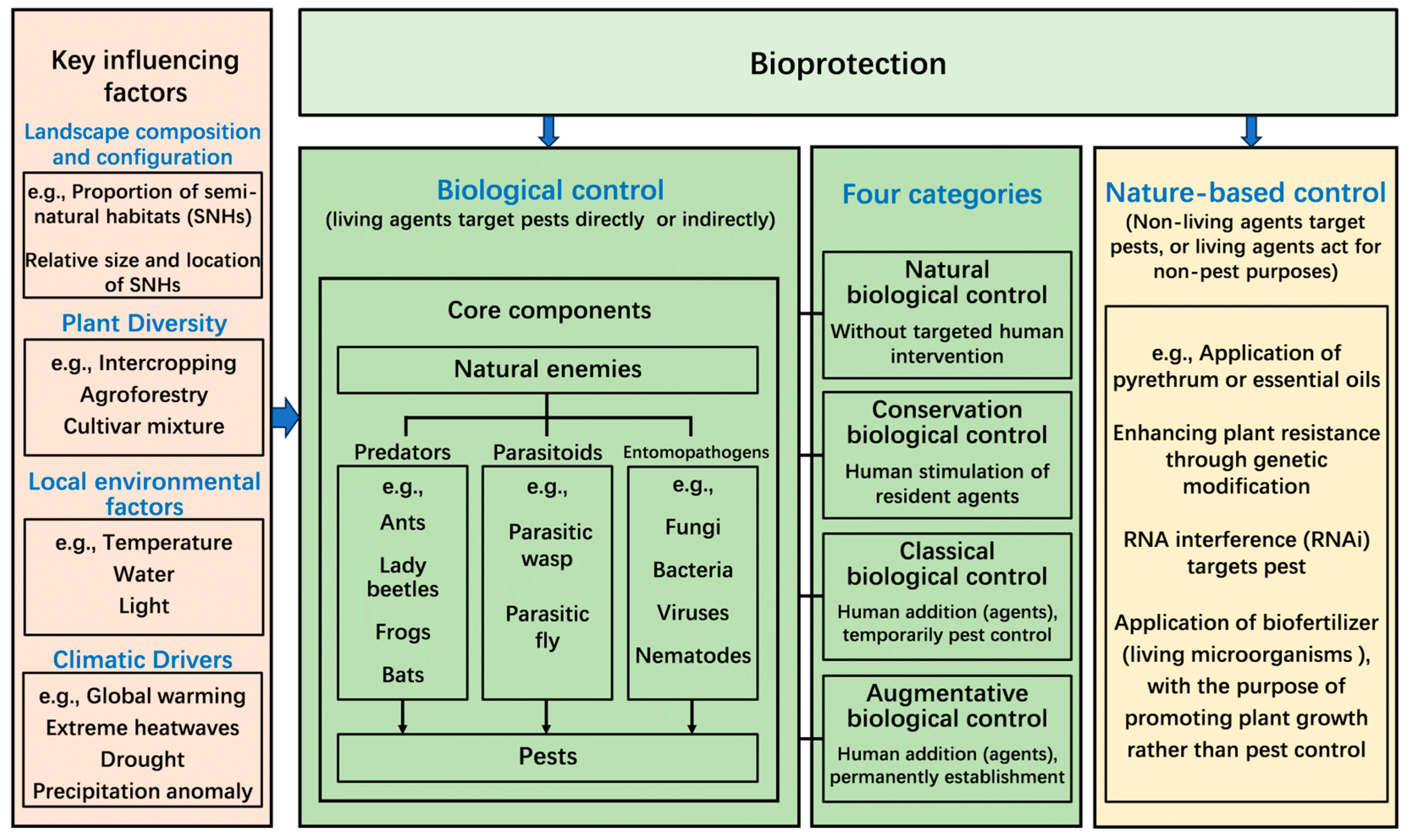
2. Conceptual Framework and Classification of Biological Control
3. Key Influencing Factors: Heterogeneity and Context Dependence
3.1. Landscape and Plant Diversity
3.2. Environmental and Climatic Drivers
4. Biocontrol Agents (Natural Enemies): Mechanisms and Applications
4.1. Predators
4.2. Parasitoids
4.3. Microbial Biocontrol Agents (MBCAs)
4.3.1. Fungi and Bacteria
4.3.2. Viruses and Nematodes
5. Pest-Specific Case Studies: Illustrating Biocontrol Across Systems
5.1. Fall Armyworm (Spodoptera frugiperda)
5.2. Asian Longhorned Beetle (Anoplophora glabripennis)
5.3. Rice Stem Borer (Chilo suppressalis)
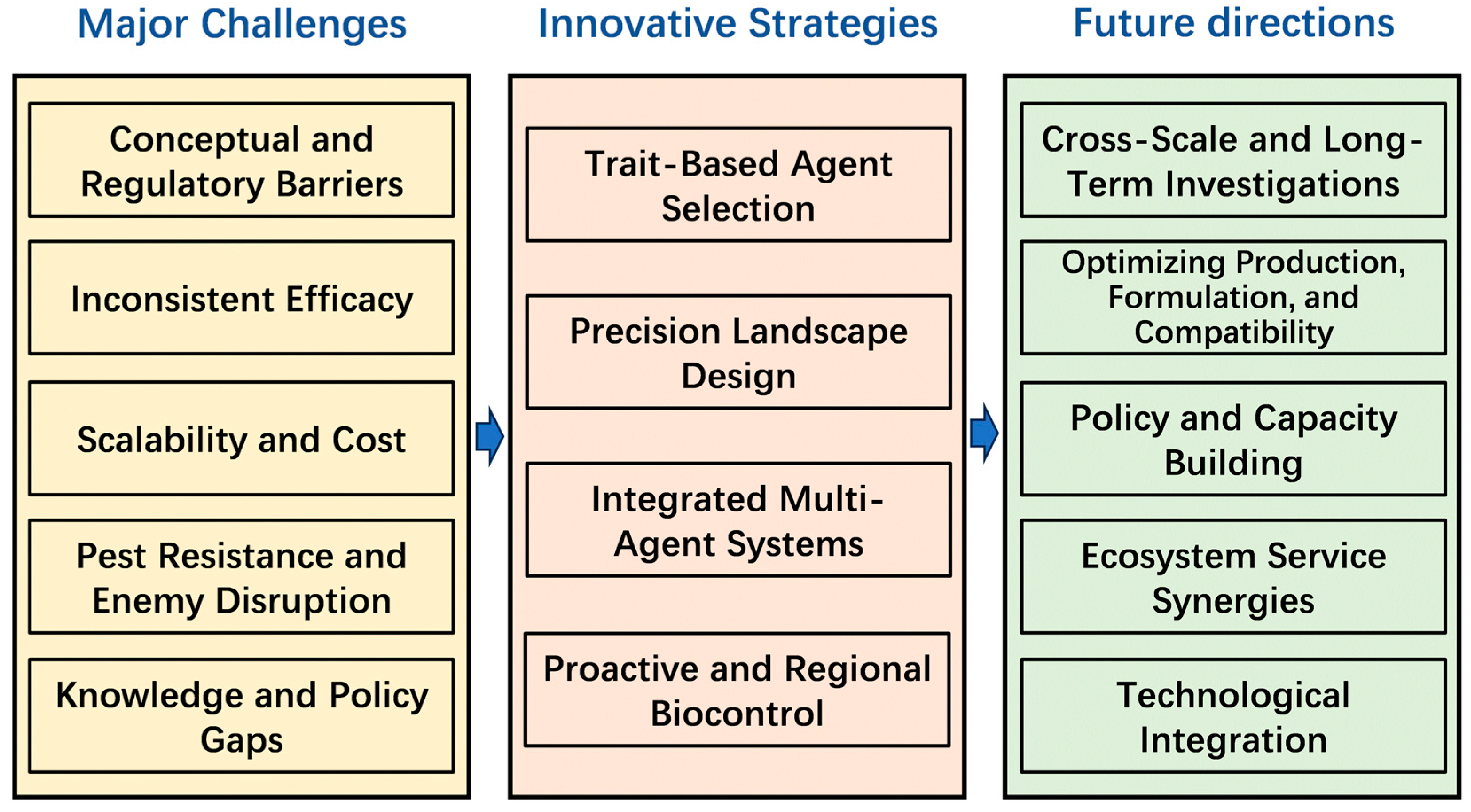
6. Critical Challenges in Biocontrol Implementation
6.1. Conceptual and Regulatory Barriers
6.2. Inconsistent Efficacy
6.3. Scalability and Cost
6.4. Pest Resistance and Enemy Disruption
6.5. Knowledge and Policy Gaps
7. Innovative Strategies
7.1. Trait-Based Agent Selection
7.2. Precision Landscape Design
7.3. Integrated Multi-Agent Systems
7.4. Proactive and Regional Biocontrol
8. Future Directions
8.1. Cross-Scale and Long-Term Investigations
8.2. Optimizing Production, Formulation, and Compatibility
8.3. Strengthening Policy and Capacity Building
8.4. Promoting Ecosystem Service Synergies
8.5. Harnessing Technological Integration
9. Conclusions
Author Contributions
Funding
Data Availability Statement
Acknowledgments
Conflicts of Interest
References
- Hoddle, M.S. A new paradigm: Proactive biological control of invasive insect pests. BioControl 2024, 69, 321–334. [Google Scholar]
- Ivezić, A.; Popović, T.; Trudić, B.; Krndija, J.; Barošević, T.; Sarajlić, A.; Stojačić, I.; Kuzmanović, B. Biological control agents in greenhouse tomato production (Solanum lycopersicum L.): Possibilities, challenges and policy insights for Western Balkan region. Horticulturae 2025, 11, 155. [Google Scholar] [CrossRef]
- Stenberg, J.A.; Sundh, I.; Becher, P.G.; Björkman, C.; Dubey, M.; Egan, P.A.; Friberg, H.; Gil, J.F.; Jensen, D.F.; Jonsson, M. When is it biological control? A framework of definitions, mechanisms, and classifications. J. Pest Sci. 2021, 94, 665–676. [Google Scholar] [CrossRef]
- Liu, T.-X.; Chen, X.-X. Biological control of aphids in China: Successes and prospects. Annu. Rev. Entomol. 2025, 70, 401–419. [Google Scholar]
- Grandgirard, J.; Hoddle, M.S.; Petit, J.N.; Roderick, G.K.; Davies, N. Engineering an invasion: Classical biological control of the glassy-winged sharpshooter, Homalodisca vitripennis, by the egg parasitoid Gonatocerus ashmeadi in Tahiti and Moorea, French Polynesia. Biol. Invasions 2008, 10, 135–148. [Google Scholar]
- Grandgirard, J.; Hoddle, M.S.; Petit, J.N.; Roderick, G.K.; Davies, N. Classical biological control of the glassy-winged sharpshooter, Homalodisca vitripennis, by the egg parasitoid Gonatocerus ashmeadi in the Society, Marquesas and Austral archipelagos of French Polynesia. Biol. Control 2009, 48, 155–163. [Google Scholar]
- Johnson, C.L.; Coyle, D.R.; Duan, J.J.; Lee, S.; Lee, S.; Wang, X.; Wang, X.; Oten, K.L. A review of non-microbial biological control strategies against the Asian longhorned beetle (Coleoptera: Cerambycidae). Environ. Entomol. 2025, 54, 679–690. [Google Scholar] [PubMed]
- Zhang, J.; You, S.; Niu, D.; Guaman, K.G.G.; Wang, A.; Saqib, H.S.A.; He, W.; Yu, Y.; Yang, G.; Pozsgai, G. Landscape composition mediates suppression of major pests by natural enemies in conventional cruciferous vegetables. Agric. Ecosyst. Environ. 2021, 316, 107455. [Google Scholar] [CrossRef]
- Ma, C.-S.; Wang, B.-X.; Wang, X.-J.; Lin, Q.-C.; Zhang, W.; Yang, X.-F.; van Baaren, J.; Bebber, D.P.; Eigenbrode, S.D.; Zalucki, M.P. Crop pest responses to global changes in climate and land management. Nat. Rev. Earth Environ. 2025, 6, 264–283. [Google Scholar] [CrossRef]
- Chaudhary, R.; Nawaz, A.; Khattak, Z.; Butt, M.A.; Fouillaud, M.; Dufossé, L.; Munir, M.; ul Haq, I.; Mukhtar, H. Microbial bio-control agents: A comprehensive analysis on sustainable pest management in agriculture. J. Agric. Food Res. 2024, 18, 101421. [Google Scholar] [CrossRef]
- Hill, G.M.; Kawahara, A.Y.; Daniels, J.C.; Bateman, C.C.; Scheffers, B.R. Climate change effects on animal ecology: Butterflies and moths as a case study. Biol. Rev. 2021, 96, 2113–2126. [Google Scholar] [CrossRef]
- Saabna, N.; Keasar, T. Parasitoids for biological control in dryland agroecosystems. Curr. Opin. Insect Sci. 2024, 64, 101226. [Google Scholar] [CrossRef]
- Winston, R.; Schwarzländer, M.; Hinz, H.L.; Day, M.D.; Cock, M.J.; Julien, M. Biological Control of Weeds: A World Catalogue of Agents and Their Target Weeds; Forest Health Technology Enterprise Team: Morgantown, WV, USA, 2014. [Google Scholar]
- Han, P.; Rodriguez-Saona, C.; Zalucki, M.P.; Liu, S.-S.; Desneux, N. A theoretical framework to improve the adoption of green Integrated Pest Management tactics. Commun. Biol. 2024, 7, 337. [Google Scholar] [CrossRef]
- Eilenberg, J.; Hajek, A.; Lomer, C. Suggestions for unifying the terminology in biological control. BioControl 2001, 46, 387–400. [Google Scholar] [CrossRef]
- Ouyang, F.; Su, W.; Zhang, Y.; Liu, X.; Su, J.; Zhang, Q.; Men, X.; Ju, Q.; Ge, F. Ecological control service of the predatory natural enemy and its maintaining mechanism in rotation-intercropping ecosystem via wheat-maize-cotton. Agric. Ecosyst. Environ. 2020, 301, 107024. [Google Scholar] [CrossRef]
- Wyckhuys, K.A.; Akutse, K.S.; Amalin, D.M.; Araj, S.-E.; Barrera, G.; Beltran, M.J.B.; Fekih, I.B.; Calatayud, P.-A.; Cicero, L.; Cokola, M.C. Global scientific progress and shortfalls in biological control of the fall armyworm Spodoptera frugiperda. Biol. Control 2024, 191, 105460. [Google Scholar] [CrossRef]
- Van Lenteren, J.; Bale, J.; Bigler, F.; Hokkanen, H.; Loomans, A. Assessing risks of releasing exotic biological control agents of arthropod pests. Annu. Rev. Entomol. 2006, 51, 609–634. [Google Scholar] [CrossRef]
- Lu, A.; Gonthier, D.J.; Sciligo, A.R.; Garcia, K.; Chiba, T.; Juarez, G.; Kremen, C. Changes in arthropod communities mediate the effects of landscape composition and farm management on pest control ecosystem services in organically managed strawberry crops. J. Appl. Ecol. 2022, 59, 585–597. [Google Scholar] [CrossRef]
- Tscharntke, T.; Karp, D.S.; Chaplin-Kramer, R.; Batáry, P.; DeClerck, F.; Gratton, C.; Hunt, L.; Ives, A.; Jonsson, M.; Larsen, A. When natural habitat fails to enhance biological pest control—Five hypotheses. Biol. Conserv. 2016, 204, 449–458. [Google Scholar] [CrossRef]
- Martin, E.A.; Seo, B.; Park, C.R.; Reineking, B.; Steffan-Dewenter, I. Scale-dependent effects of landscape composition and configuration on natural enemy diversity, crop herbivory, and yields. Ecol. Appl. 2016, 26, 448–462. [Google Scholar] [CrossRef]
- Gurr, G.M.; Wratten, S.D.; Landis, D.A.; You, M. Habitat management to suppress pest populations: Progress and prospects. Annu. Rev. Entomol. 2017, 62, 91–109. [Google Scholar] [CrossRef] [PubMed]
- Letourneau, D.K.; Armbrecht, I.; Rivera, B.S.; Lerma, J.M.; Carmona, E.J.; Daza, M.C.; Escobar, S.; Galindo, V.; Gutiérrez, C.; López, S.D. Does plant diversity benefit agroecosystems? A synthetic review. Ecol. Appl. 2011, 21, 9–21. [Google Scholar] [CrossRef] [PubMed]
- Zhang, R.; Liang, H.; Tian, C.; Zhang, G. Biological mechanism of controlling cotton aphid (Homoptera: Aphididae) by the marginal alfalfa zone surrounding cotton field. Chin. Sci. Bull. 2000, 45, 355–358. [Google Scholar] [CrossRef]
- Chevalier Mendes Lopes, T.; Hatt, S.; Xu, Q.; Chen, J.; Liu, Y.; Francis, F. Wheat (Triticum aestivum L.)-based intercropping systems for biological pest control: A review. Pest Manag. Sci. 2016, 72, 2193–2202. [Google Scholar] [CrossRef]
- Hatt, S.; Boeraeve, F.; Artru, S.; Dufrêne, M.; Francis, F. Spatial diversification of agroecosystems to enhance biological control and other regulating services: An agroecological perspective. Sci. Total Environ. 2018, 621, 600–611. [Google Scholar] [CrossRef]
- Shao, X.; Yang, M.; Zhang, H.; Wang, Z.; Zhang, Q.; Xu, K. How adjacent nonhost plants affect the ability of an insect herbivore to find a host. J. Pest Sci. 2025, 98, 1819–1828. [Google Scholar] [CrossRef]
- Blubaugh, C.K.; Huss, C.P.; Lindell, H.C.; Spann, G.L.; Basinger, N.T. Cover crops dismantle keystone ant/aphid mutualisms to enhance insect pest suppression and weed biocontrol. Agric. For. Entomol. 2025, 27, 294–303. [Google Scholar] [CrossRef]
- Wang, L.; Etebari, K.; Zhao, Z.; Walter, G.H.; Furlong, M.J. Differential temperature responses between Plutella xylostella and its specialist endo-larval parasitoid Diadegma semiclausum—Implications for biological control. Insect Sci. 2022, 29, 855–864. [Google Scholar] [CrossRef]
- Van Nouhuys, S.; Lei, G. Parasitoid-host metapopulation dynamics: The causes and consequences of phenological asynchrony. J. Anim. Ecol. 2004, 73, 526–535. [Google Scholar] [CrossRef]
- Singer, M.C.; Parmesan, C. Phenological asynchrony between herbivorous insects and their hosts: Signal of climate change or pre-existing adaptive strategy? Philos. Trans. R. Soc. B Biol. Sci. 2010, 365, 3161–3176. [Google Scholar] [CrossRef] [PubMed]
- Stireman, J.O., III; Dyer, L.A.; Janzen, D.; Singer, M.; Lill, J.; Marquis, R.; Ricklefs, R.; Gentry, G.; Hallwachs, W.; Coley, P. Climatic unpredictability and parasitism of caterpillars: Implications of global warming. Proc. Natl. Acad. Sci. USA 2005, 102, 17384–17387. [Google Scholar] [CrossRef] [PubMed]
- Sun, S.L.; Abudisilimu, N.; Yi, H.; Li, S.; Liu, T.X.; Jing, X. Understanding nutritive need in Harmonia axyridis larvae: Insights from nutritional geometry. Insect Sci. 2022, 29, 1433–1444. [Google Scholar] [CrossRef] [PubMed]
- Wolf, S.; Romeis, J.; Collatz, J. Utilization of plant-derived food sources from annual flower strips by the invasive harlequin ladybird Harmonia axyridis. Biol. Control 2018, 122, 118–126. [Google Scholar] [CrossRef]
- De Puysseleyr, V.; Höfte, M.; De Clercq, P. Ovipositing Orius laevigatus increase tomato resistance against Frankliniella occidentalis feeding by inducing the wound response. Arthropod-Plant Interact. 2011, 5, 71–80. [Google Scholar] [CrossRef]
- Shuman-Goodier, M.E.; Diaz, M.I.; Almazan, M.L.; Singleton, G.R.; Hadi, B.A.; Propper, C.R. Ecosystem hero and villain: Native frog consumes rice pests, while the invasive cane toad feasts on beneficial arthropods. Agric. Ecosyst. Environ. 2019, 279, 100–108. [Google Scholar] [CrossRef]
- Teng, Q.; Hu, X.-F.; Luo, F.; Cheng, C.; Ge, X.; Yang, M.; Liu, L. Influences of introducing frogs in the paddy fields on soil properties and rice growth. J. Soils Sediments 2016, 16, 51–61. [Google Scholar] [CrossRef]
- Lindell, C.; Eaton, R.A.; Howard, P.H.; Roels, S.M.; Shave, M. Enhancing agricultural landscapes to increase crop pest reduction by vertebrates. Agric. Ecosyst. Environ. 2018, 257, 1–11. [Google Scholar] [CrossRef]
- Lutinski, J.A.; Lutinski, C.J.; Ortiz, A.; Zembruski, F.S.; Ripke, M.O.; Garcia, F.R.M. Biological Control Using Ants: Current Status, Opportunities, and Limitations. Agronomy 2024, 14, 1558. [Google Scholar] [CrossRef]
- Perfecto, I.; Sediles, A. Vegetational diversity, ants (Hymenoptera: Formicidae), and herbivorous pests in a Neotropical agroecosystem. Environ. Entomol. 1992, 21, 61–67. [Google Scholar] [CrossRef]
- de Bobadilla, M.F.; Ramírez, N.M.; Calvo-Agudo, M.; Dicke, M.; Tena, A. Honeydew management to promote biological control. Curr. Opin. Insect Sci. 2024, 61, 101151. [Google Scholar] [CrossRef]
- Branco, S.; Mateus, E.P.; Richter Gomes da Silva, M.D.; Mendes, D.; Pereira, M.M.A.; Schuetz, S.; Paiva, M.R. Olfactory responses of Anaphes nitens (Hymenoptera, Mymaridae) to host and habitat cues. J. Appl. Entomol. 2021, 145, 675–687. [Google Scholar] [CrossRef]
- Hrcek, J.; Miller, S.E.; Whitfield, J.B.; Shima, H.; Novotny, V. Parasitism rate, parasitoid community composition and host specificity on exposed and semi-concealed caterpillars from a tropical rainforest. Oecologia 2013, 173, 521–532. [Google Scholar] [CrossRef] [PubMed]
- Žikić, V.; Fernández-Triana, J.L.; Trajković, A.; Lazarević, M. Advancing Sustainable Agriculture: Potential of Life Story Strategies of Solitary and Gregarious Microgastrinae Parasitoids (Hymenoptera: Braconidae) to Enhance Biological Control. Sustainability 2024, 16, 10004. [Google Scholar] [CrossRef]
- Chen, Z.; Luo, Y.; Wang, L.; Sun, D.; Wang, Y.; Zhou, J.; Luo, B.; Liu, H.; Yan, R.; Wang, L. Advancements in Life Tables Applied to Integrated Pest Management with an Emphasis on Two-Sex Life Tables. Insects 2025, 16, 261. [Google Scholar] [CrossRef] [PubMed]
- Panwar, N.; Szczepaniec, A. Endophytic entomopathogenic fungi as biological control agents of insect pests. Pest Manag. Sci. 2024, 80, 6033–6040. [Google Scholar] [CrossRef]
- Tabashnik, B.E.; Fabrick, J.A.; Carrière, Y. Global patterns of insect resistance to transgenic Bt crops: The first 25 years. J. Econ. Entomol. 2023, 116, 297–309. [Google Scholar] [CrossRef]
- Zhou, X.; Wu, Q.; Jia, H.; Wu, K. Searchlight trapping reveals seasonal cross-ocean migration of fall armyworm over the South China Sea. J. Integr. Agric 2021, 20, 673–684. [Google Scholar] [CrossRef]
- Song, Y.; Zhang, H.; Wu, K. Transboundary migration of Spodoptera frugiperda between China and the South-Southeast Asian region. J. Pest Sci. 2025, 98, 1159–1171. [Google Scholar] [CrossRef]
- Zhang, Z. Study on the feeding habit of Dendrocopos major in forest. For. Pest Dis. 1986, 4, 4–7. [Google Scholar]
- Zhu, Y. A forestry investigation on the natural control of Anoplophora nobilis Ganglbauer by woodpecker. J. Northwest For. Coll. 2002, 17, 72–74. [Google Scholar]
- Li, M.; Li, Y.; Lei, Q.; Yang, Z. Biocontrol of Asian longhorned beetle larva by releasing eggs of Dastarcus helophoroides (Coleoptera: Bothrideridae). Sci. Silvae Sin. 2009, 45, 78–82. [Google Scholar]
- Yao, W.; Yang, Z. Study on the biological control of Anoplophora glabripennis with a parasitoid, Scleroderma guani. J. Environ. Entomol. 2008, 30, 127–134, (In Chinese with English summary). [Google Scholar]
- Kenis, M.; Hurley, B.; Colombari, F.; Lawson, S.; Jiang-Hua, S.; Wilcken, C.F.; Weeks, R.; Sathyapala, S. Guide to the Classical Biological Control of Insect Pests in Planted and Natural Forests; FAO: Roma, Italy, 2019. [Google Scholar]
- Zhu, Y.; Chen, J.; Zou, Y.; Huang, X.; Jiang, T.; Wyckhuys, K.A.G.; van der Werf, W.; Xiao, H. Response of the rice stem borer Chilo suppressalis (Walker) and its parasitoid assemblage to landscape composition. Agric. Ecosyst. Environ. 2023, 343, 108259. [Google Scholar] [CrossRef]
- Wan, N.F.; Cavalieri, A.; Siemann, E.; Dainese, M.; Li, W.W.; Jiang, J.X. Spatial aggregation of herbivores and predators enhances tri-trophic cascades in paddy fields: Rice monoculture versus rice-fish co-culture. J. Appl. Ecol. 2022, 59, 2036–2045. [Google Scholar] [CrossRef]
- Seehausen, M.L.; Afonso, C.; Jactel, H.; Kenis, M. Classical biological control against insect pests in Europe, North Africa, and the Middle East: What influences its success? NeoBiota 2021, 65, 169–191. [Google Scholar] [CrossRef]
- Karp, D.S.; Chaplin-Kramer, R.; Meehan, T.D.; Martin, E.A.; DeClerck, F.; Grab, H.; Gratton, C.; Hunt, L.; Larsen, A.E.; Martínez-Salinas, A. Crop pests and predators exhibit inconsistent responses to surrounding landscape composition. Proc. Natl. Acad. Sci. USA 2018, 115, E7863–E7870. [Google Scholar] [CrossRef]
- Török, E.; Zieger, S.; Rosenthal, J.; Földesi, R.; Gallé, R.; Tscharntke, T.; Batáry, P. Organic farming supports lower pest infestation, but fewer natural enemies than flower strips. J. Appl. Ecol. 2021, 58, 2277–2286. [Google Scholar] [CrossRef]
- Burgio, G.; Dindo, M.L.; Pape, T.; Whitmore, D.; Sommaggio, D. Diptera as predators in biological control: Applications and future perspectives. Biocontrol 2025, 70, 1–17. [Google Scholar] [CrossRef]
- Calvo-Agudo, M.; González-Cabrera, J.; Picó, Y.; Calatayud-Vernich, P.; Urbaneja, A.; Dicke, M.; Tena, A. Neonicotinoids in excretion product of phloem-feeding insects kill beneficial insects. Proc. Natl. Acad. Sci. USA 2019, 116, 16817–16822. [Google Scholar] [CrossRef] [PubMed]
- Theenoor, R.; Ghosh, A.; Venkatesan, R. Harmonising control: Understanding the complex impact of pesticides on parasitoid wasps for enhanced pest management. Curr. Opin. Insect Sci. 2024, 65, 101236. [Google Scholar] [CrossRef] [PubMed]
- Chen, Z.; Li, X.; Xia, X. Socioeconomic status, ambidextrous learning, and farmers’ adoption of biological control technology: Evidence from 650 kiwifruit growers in China. Pest Manag. Sci. 2022, 78, 475–487. [Google Scholar] [CrossRef]
- Galli, M.; Feldmann, F.; Vogler, U.K.; Kogel, K.-H. Can biocontrol be the game-changer in integrated pest management? A review of definitions, methods and strategies. J. Plant Dis. Prot. 2024, 131, 265–291. [Google Scholar] [CrossRef]
- Barratt, B.; Moran, V.; Bigler, F.; Van Lenteren, J. The status of biological control and recommendations for improving uptake for the future. BioControl 2018, 63, 155–167. [Google Scholar] [CrossRef]
- Caron, V.; Yonow, T.; Paull, C.; Talamas, E.J.; Avila, G.A.; Hoelmer, K.A. Preempting the Arrival of the Brown Marmorated Stink Bug, Halyomorpha halys: Biological Control Options for Australia. Insects 2021, 12, 581. [Google Scholar] [CrossRef]
- Jaworski, C.C.; Xiao, D.; Xu, Q.; Ramirez-Romero, R.; Guo, X.; Wang, S.; Desneux, N. Varying the spatial arrangement of synthetic herbivore-induced plant volatiles and companion plants to improve conservation biological control. J. Appl. Ecol. 2019, 56, 1176–1188. [Google Scholar] [CrossRef]
- Yang, L.; Zeng, Y.; Xu, L.; Liu, B.; Zhang, Q.; Lu, Y. Change in ladybeetle abundance and biological control of wheat aphids over time in agricultural landscape. Agric. Ecosyst. Environ. 2018, 255, 102–110. [Google Scholar] [CrossRef]
- Shang, H.; He, D.; Li, B.; Chen, X.; Luo, K.; Li, G. Environmentally friendly and effective alternative approaches to pest management: Recent advances and challenges. Agronomy 2024, 14, 1807. [Google Scholar] [CrossRef]


Disclaimer/Publisher’s Note: The statements, opinions and data contained in all publications are solely those of the individual author(s) and contributor(s) and not of MDPI and/or the editor(s). MDPI and/or the editor(s) disclaim responsibility for any injury to people or property resulting from any ideas, methods, instructions or products referred to in the content. |
© 2026 by the authors. Licensee MDPI, Basel, Switzerland. This article is an open access article distributed under the terms and conditions of the Creative Commons Attribution (CC BY) license.
Share and Cite
Shao, X.; Zhang, Q.; Zhang, B.; Xie, Z.; Xu, K. Biological Control of Insect Pests in Agroecosystems: Current Challenges, Innovative Strategies, and Future Directions. Agriculture 2026, 16, 597. https://doi.org/10.3390/agriculture16050597
Shao X, Zhang Q, Zhang B, Xie Z, Xu K. Biological Control of Insect Pests in Agroecosystems: Current Challenges, Innovative Strategies, and Future Directions. Agriculture. 2026; 16(5):597. https://doi.org/10.3390/agriculture16050597
Chicago/Turabian StyleShao, Xinliang, Qin Zhang, Boyan Zhang, Zihao Xie, and Kedong Xu. 2026. "Biological Control of Insect Pests in Agroecosystems: Current Challenges, Innovative Strategies, and Future Directions" Agriculture 16, no. 5: 597. https://doi.org/10.3390/agriculture16050597
APA StyleShao, X., Zhang, Q., Zhang, B., Xie, Z., & Xu, K. (2026). Biological Control of Insect Pests in Agroecosystems: Current Challenges, Innovative Strategies, and Future Directions. Agriculture, 16(5), 597. https://doi.org/10.3390/agriculture16050597