Systematic Review

Logistics Practices to Reduce Food Loss in Sustainable Agri-Food Supply Chains: From Literature Review to Research Framework


1
School of Management, Guangzhou College of Commerce, Guangzhou 511363, China
2
Faculty of Economics and Management, Universiti Kebangsaan Malaysia, Bangi 43600, Malaysia
3
School of Modern Logistics, Guangzhou Polytechnic University, Guangzhou 511483, China
*
Author to whom correspondence should be addressed.
Agriculture 2026, 16(5), 587; https://doi.org/10.3390/agriculture16050587
Submission received: 7 February 2026 / Revised: 28 February 2026 / Accepted: 2 March 2026 / Published: 4 March 2026

Abstract

Agri-food supply chains (AFSCs) lose approximately 1.3 billion tons of food annually, posing a major challenge to environmental sustainability. Logistics deficiencies are widely recognized as key drivers of postharvest losses. However, most studies examine isolated practices, with limited attention to their interactive effects across AFSCs stages, or to the mechanism linking operation practices, theories, and empirical research framework. This study conducts a systematic literature review following the PRISMA guidelines. Using Web of Science and Scopus, 90 empirical studies published between 2001 and August 2025 were analyzed to examine how food loss occurs and is mitigated across AFSCs. The review defines the operational boundaries of AFSCs, identifies six categories of food loss drivers, and systematically maps corresponding mitigation strategies across logistics stages. Findings indicate that logistics practices alone are insufficient to achieve effective food loss reduction. The effectiveness of logistics practices depends on organizational capabilities such as digital technology for monitoring and forecasting, collaboration for coordinated decision-making, and institutional pressures that encourage sustainable operations. Drawing on Natural Resource-based View, Dynamic Capability View, and institutional theory, this study proposes an integrated research framework to guide future empirical studies. The framework also provides practical guidance for managers and policymakers seeking to advance food loss reduction and contribute to achieving SDG 12.3.

1. Introduction

The global food system faces a critical sustainability paradox. While agricultural production is projected to increase by 70% by 2050 to feed a population of 9.7 billion [1], restoring just 10% of human-induced degradation on existing croplands could generate sufficient output to feed an additional 154 million people annually [2]. This contrast suggests that the challenge is not solely one of expanding production capacity, but of improving system efficiency and resource stewardship. Nevertheless, approximately one-third of food produced for human consumption is lost or wasted along supply chains, representing 1.3 billion tons annually with an economic value exceeding $400 billion [1,3].
A substantial proportion of this loss occurs within agri-food supply chains (AFSCs), where 14% of production is lost between harvest and retail stages alone [1]. The environmental consequences are equally significant: food loss contributes approximately 8% of global greenhouse gas (GHG) emissions, accounts for 25% of freshwater use, and occupies nearly 30% of agricultural land [4,5]. In response, the United Nations Sustainable Development Goal (SDG) 12.3 calls for halving per capita global food waste at retail and consumer levels and reducing food losses along production and supply chains by 2030 [6]. These targets underline the centrality of AFSCs sustainability to global environmental and resource security.
Food loss arises from multiple causes throughout logistics operations, including warehousing, packaging, and transportation. Consequently, logistics has emerged as a critical yet underestimated intervention point [7]. In developing economies, 20–25% of perishable fruit losses stem directly from logistics deficiencies [8,9]. Inadequate cold chain infrastructure, storage underinvestment, suboptimal packaging, and inefficient transport routing have been identified as primary drivers for food loss [10,11,12]. For instance, grain storage alone contributes to 40% of postharvest losses in China [13], while similar structural constraints generate avoidable losses across many developing countries [14,15,16]. Crucially, logistics operations are not merely cost centers but potential solution spaces in which operational efficiency and environmental sustainability can be simultaneously advanced through green logistics [17,18]. Integrating temperature-controlled warehousing, sustainable packaging, and optimized transportation systems is therefore essential to minimizing both product loss and carbon emissions [19,20].
However, the effectiveness of logistics interventions is increasingly shaped by external and organizational conditions [21,22]. Supply chain collaboration through information sharing, joint decision-making, and coordinated planning enhances the ability of logistics operations to prevent food loss across stages [23,24,25]. Digital technology capabilities enable real-time monitoring of food conditions and demand forecasting. However, their absence or underutilization exacerbates food losses [9,19,26]. Meanwhile, institutional pressures, including government regulations, industry standards, and food safety certification, provide coercive and normative incentives that shape organizational responses [16,27]. These factors do not merely influence logistics efficiency. They constitute necessary conditions for translating operational investments into food loss reduction outcomes [28,29]. Despite growing attention to technological and environmental dimensions of food loss, limited research has systematically examined how logistics practices interact with organizational capabilities and institutional pressures to generate environmental performance.
Previous systematic reviews have approached food loss from fragmented perspectives. Sustainability-oriented reviews emphasize coordination mechanisms and environmental measurement frameworks, yet treat coordination metrics as output rather than embedded capability [30,31,32]. Technology-focused reviews conceptualize digital tools as standalone solutions, mapping Industry 4.0 applications or assessing circular treatment technologies [33,34]. However, they overlook the organizational capabilities required for effective implementation [33,34,35]. Operations management reviews document logistics and packaging strategies [12,36], while rarely embedding these practices within broader institutional or theoretical contexts [37].
More recent systematic reviews represent important progress but leave critical gaps. The authors of [7] developed a framework linking packaging functions, logistical efficiency, management practices, and redistribution policies in retail supply chains. However, its scope is largely confined to downstream stages and developed economies. Although [38] provided a comprehensive overview of food loss, logistics operational mechanisms and infrastructure coordination receive insufficient attention. The authors of [35] categorize FLW management technologies into linear and circular models, yet focus on end-of-pipeline treatments rather than upstream prevention through logistics optimization [9,39]. While these studies identified key categories of drivers and mitigation strategies, they often stop at descriptive classification without theorizing the causal mechanisms that connect them.
Accordingly, significant gaps remain in understanding how logistics operations contribute to food loss reduction within AFSCs. First, existing reviews frequently examine warehousing, packaging, and transportation in isolation, without explaining the interactive mechanisms linking operational practices to organizational capabilities and institutional environments [7,34,40]. Second, although various drivers and mitigation strategies have been identified, the causal pathways through which they jointly influence food loss reduction remain under-theorized [41,42,43,44]. Third, limited integration of organizational and institutional theories constrains the development of testable propositions [7,45]. Finally, few reviews provide an empirically operationalizable conceptual framework suitable for multi-level and international analysis [7,33]. To address these limitations, this study conducts a systematic literature review (SLR) to develop a theory-informed and empirically testable research framework explaining how green logistics practices translate into food loss reduction and environmental performance in AFSCs. The study is guided by the following research questions (RQs):
RQ1: What is the research profile of literature on food loss reduction in AFSCs?
RQ2: What are the drivers and mitigation strategies for food loss in AFSCs?
RQ3: How do green logistics practices, organizational capabilities, and institutional pressures jointly explain food loss reduction and environmental performance in AFSCs?
This study makes three contributions.
  • Theoretically, it integrates the natural resource-based view and institutional theory to explain sustainability transformation mechanisms in AFSCs.
  • Methodologically, it demonstrates how thematic synthesis is a rigorous approach for theory development in AFSCs research.
  • Practically, it provides contingent policy and managerial implications, thereby strengthening the international relevance of AFSCs sustainability research.
The review follows Systematic Reviews and Meta-Analyses (PRISMA) guidelines and covers empirical studies published between 2001 and 12 August 2025. The remainder of this paper proceeds as follows: Section 2 defines AFSCs boundaries and food loss concepts. Section 3 describes the review methodology. Section 4 presents the thematic synthesis. Section 5 develops the integrated conceptual framework and research propositions. Section 6 concludes with implications and future research directions.

2. Scope and Boundary of This Review

2.1. The Overview of AFSCs

Agri-foods are known as agricultural, fresh, or perishable foods. They include a wide range of products such as dairy, grains, vegetables, meat, fish, fruits, and flowers [46]. These products are generally categorized into two types: perishable and non-perishable agri-foods [47]. Perishable products maintain their natural properties with minimal processing. Non-perishable products, on the other hand, are raw materials with extra value to extend their shelf-life, such as canned goods and desserts [48]. This study focuses on perishable agri-foods.
The AFSCs is a complex process involving partners responsible for producing and distributing agricultural goods [49]. It integrates a network of all organizations and activities involved in the production, processing, distribution, and marketing of these goods from farm to table [50]. Traditionally, the concept of AFSCs has evolved from a focus on basic products and information flows [49,51]. The definition varies significantly from the stages to the dimensions of edibility, quality, and the nature of food use [52]. From a holistic perspective, AFSCs include the coordination of multiple stakeholders across different stages, such as cultivation, harvesting, processing and packaging, warehousing and storage, transportation and distribution [50,53].
Given this broad spectrum, this review narrows its scope to the intermediate logistics stages, such as warehousing and storage, packaging and processing, and transportation and distribution. These stages are identified as critical control points for mitigating food loss. This focus is justified by the significant volume of loss occurring in these phases due to their inherent challenges in preserving perishable agri-foods because of operational inefficiencies [16,54]. Consequently, stages such as primary production, retail, and consumption fall outside the boundary of this discussion.

2.2. Food Loss Definition in AFSCs

Food loss and food waste remain inconsistent in different kinds of studies, and the previous study does not discriminate between FLW, using these terms interchangeably [52]. Therefore, a consistent and precise definition is fundamental to this review. This study adopts the definition established by the FAO (2019), which distinguishes between the two concepts based on the stage of occurrence [1]. Food loss refers to the reduction in edible food mass occurring before the retail stage, and food waste means to discard at the retail and consumer stages. This distinction is reflected broadly in academics. Some scholars noted that food loss occurs in upstream stages, such as harvesting, storage, and transportation, whereas food waste is a downstream phenomenon closer to the consumer [13]. Others employed a narrower scope, restricting the term food loss to the primary production stage [55].
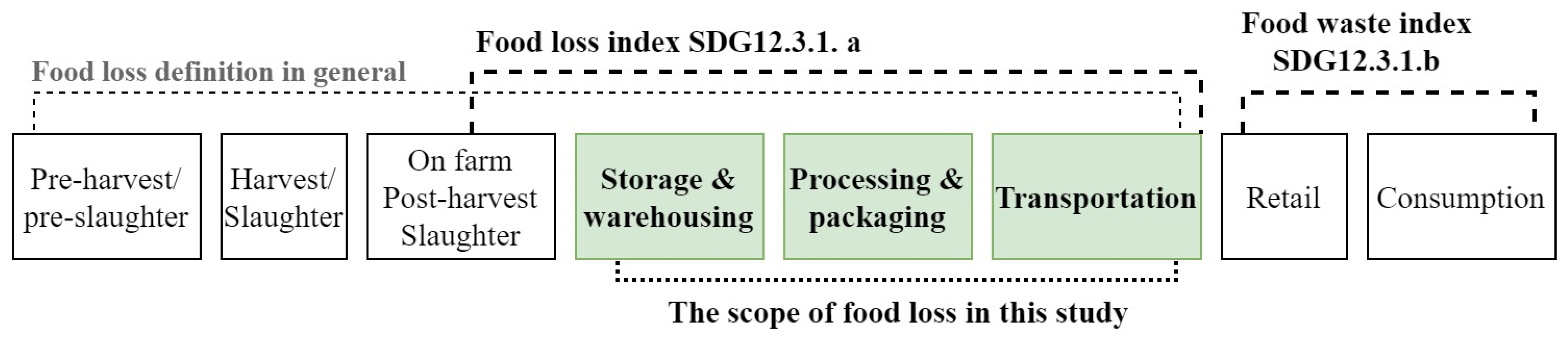
Guided by the FAO (2019) definition, the scope of this review is confined to avoidable food loss within the intermediate logistics stages of the AFSCs [1]. Accordingly, unavoidable losses, such as inedible food parts, bones, and peels are excluded as they are food waste occurring at retail and consumption stages [56]. Figure 1 presents the boundary of this study and the FLW stages across the AFSCs.

3. Review Methodology

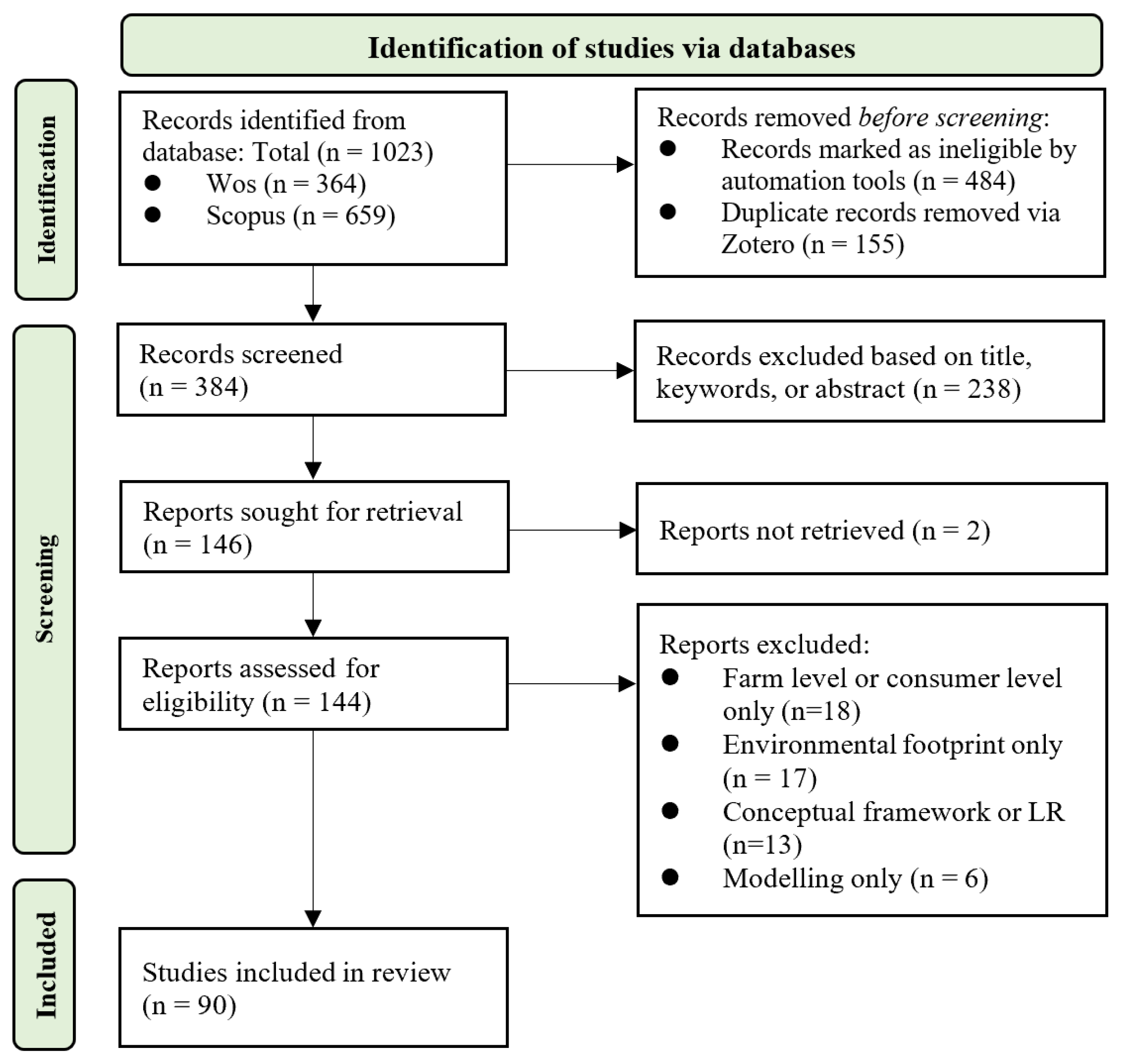
This study conducted an SLR to provide a structured and transparent synthesis of empirical evidence on the role of logistics activities in mitigating food loss within AFSCs [57]. SLR is a rigorous methodology that enables the identification, evaluation, and synthesis of existing research in a reproducible manner [58]. This review follows the PRISMA 2020 guidelines to ensure transparency and replicability throughout the identification, screening, eligibility, and inclusion stages [59]. The PRISMA 2020 Checklist is provided in Supplementary Materials. The overall objective was to systematically map existing studies, examine methodological characteristics, and identify research gaps related to logistics-based food loss mitigation within environmentally sustainable AFSCs contexts. Figure 2 shows the PRISMA 2020 flow diagram.

3.1. Search Strategy

The search strategy was designed to capture peer-reviewed studies addressing logistics activities within AFSCs and their contribution to food loss reduction, prevention, or management under sustainability considerations. The search was conducted on 12 August 2025 using two major academic databases: Web of Science (WoS Core Collection) and Scopus. These databases were selected due to their comprehensive coverage of high-quality journals across multiple disciplines [60], including agriculture, operations management, environmental science, and supply chain management [34,61].
Search strings were developed through iterative discussions among the authors. Boolean operators (“AND” and “OR”) were applied to ensure inclusiveness while maintaining conceptual precision. Truncation symbol (“*”) is used as a wildcard to capture multiple word endings. Table 1 presents the complete search strings.

3.2. Eligibility Criteria

To structure the screening process and establish clear boundaries, this review adopted the PICOS (Population, Intervention, Comparison, Outcome, Study type) framework [62]. Because this review aimed to descriptively synthesize empirical evidence rather than compare alternative interventions, the Comparison component was not applicable. In addition to the core PICOS components, time frame and access requirements were applied. The detailed eligibility criteria are summarized in Table 2.
The Population concerned the AFSCscontext. The Intervention required a focus on logistics activities such as transport, warehousing, or packaging. The Outcome needed to report food loss reduction or related environmental benefits. Only peer-reviewed journal articles published between January 2001 and 12 August 2025, with full-text access, were included. The starting year of 2001 was selected because research on sustainable supply chains and environmental management began gaining significant academic attention in the early 2000s.

3.3. Data Selection and Extraction

This data selection process followed the PRISMA 2020 guidelines [63]. The initial search retrieved 1023 records (WoS: n = 364; Scopus: n = 659). After automatic removal of non-article documents, non-English publications, and studies published before 2001, 539 records remained. These were exported to Zotero for duplicate removal, resulting in 384 unique records. Title and abstract screening were conducted independently by two reviewers (YuYu and Yun) using a standardized screening protocol based on the PICOS criteria. Discrepancies were resolved through discussion with a third reviewer (LJ) when necessary. This stage resulted in 146 articles eligible for full-text assessment. Two full texts could not be retrieved, leaving 144 articles for eligibility assessment. During full-text screening, studies were excluded for the following reasons:
(1) lack of direct relevance to logistics practices within the AFSCs, such as studies focusing exclusively on farm-level production or consumer behavior without logistics integration (n = 18); (2) purely theoretical or conceptual studies, including literature reviews without empirical data (n = 13); (3) environmental footprint assessments without managerial or case-based implications (n = 17); and (4) purely modelling studies lacking empirical grounding (n = 6). Following this refinement process, 90 empirical studies were retained for methodological quality appraisal and thematic synthesis.
Data extraction was conducted using a structured extraction form following PRISMA 2020 [63]. Extracted variables included: geographic focus, supply chain stage, methodological approach, type of logistics activities, RQ and RO, identified research gaps, and key findings. To enhance reliability, two reviewers (YuYu and Yun) independently extracted data from all included studies. Extracted records were cross-checked for consistency, and discrepancies were resolved through discussion. All data were managed using Microsoft Excel.

3.4. Methodological Quality Appraisal and Risk of Bias

Given the heterogeneity of research designs included in this review, methodological quality appraisal was conducted using the Mixed Methods Appraisal Tool (MMAT) 2018 version [64,65]. The MMAT allows for the concurrent appraisal of qualitative, quantitative, and mixed methods studies within a unified framework. All collected information was recorded in a Microsoft Excel file.
For qualitative, quantitative descriptive, quantitative non-randomized, and mixed methods studies, the original MMAT 2018 criteria were applied [64]. Empirically grounded modelling and environmental footprint studies (regression analysis, DEMATEL, LCA, and MFA) are not fully represented within MMAT classification. Therefore, five tailored appraisal questions were developed based on MMAT principles. These questions assessed: (1) the clarity of research objectives; (2) transparency of data sources and processing; (3) appropriateness of methodological design; (4) validity of analytical procedures; and (5) discussion of study limitations. Each study was evaluated using categorical ratings (“Yes” or “Can’t tell”), reflecting whether sufficient methodological information was reported to meet each criterion. Given the substantial volume of included studies (n = 90), the methodological appraisal was conducted by one reviewer (Yun) and subsequently discussed with the research team to ensure interpretive consistency and reduce subjective bias. The quality assessment did not serve as an exclusion criterion but informed the interpretation of findings and supported sensitivity considerations during thematic synthesis. Studies presenting methodological limitations are explicitly acknowledged in the discussion.

3.5. Research Profile

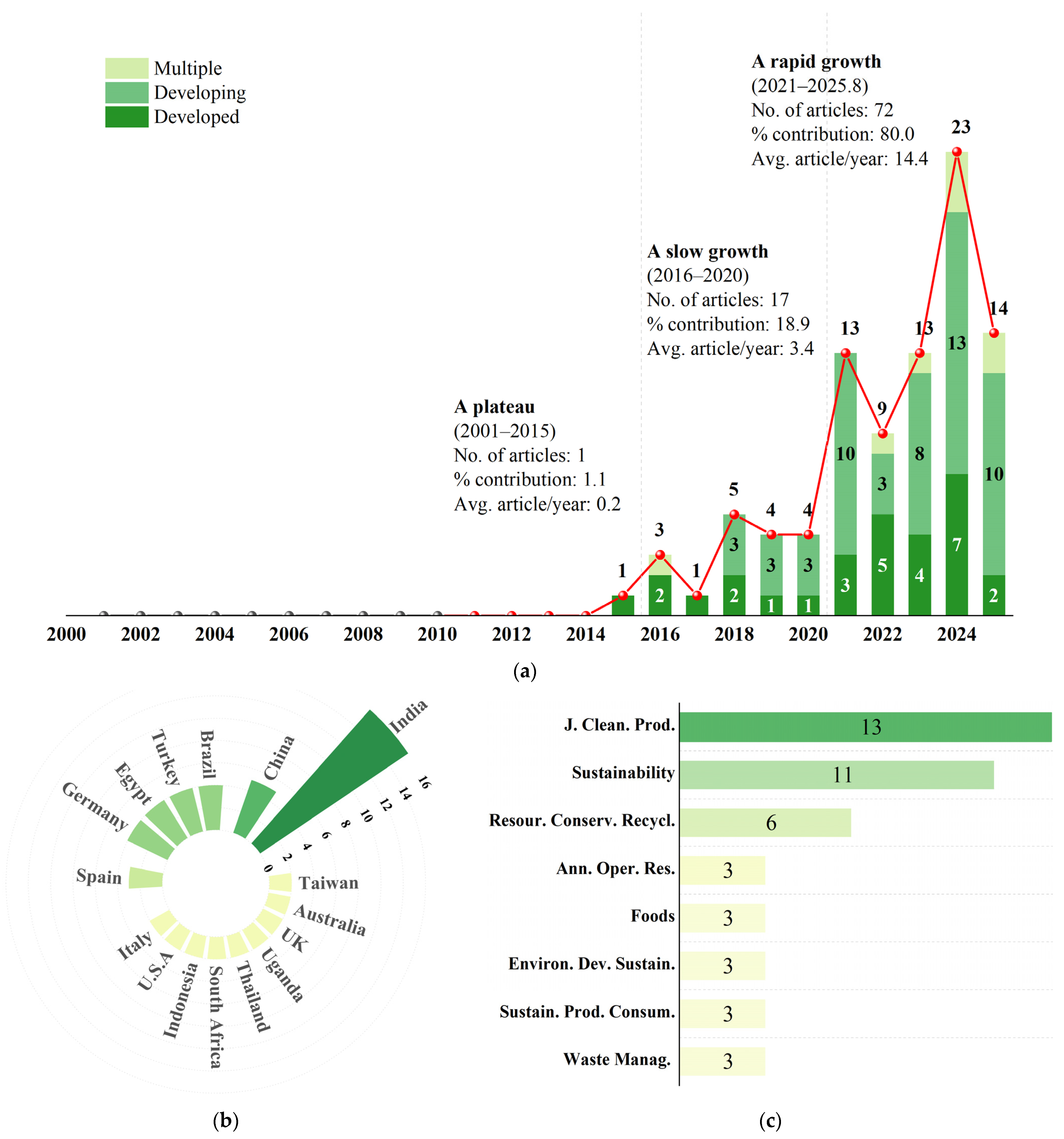
The research profile presents the publication trends, geographic distribution, journal, and methodological characteristics of the included studies. The final sample consisted of 90 empirical studies. A significant growth trend was observed after 2015, with rapid expansion from 2021 onwards, indicating increasing scholarly attention to logistics-driven food loss mitigation within sustainable AFSCs contexts (Figure 3a). The included studies were conducted across diverse geographic contexts, with notable contributions from India (n = 16), followed by China (n = 5). Brazil, Germany, Turkey and Egypt contributed 4 publications. Notably, research output from developing economies has increased significantly in recent years (Figure 3b).
The 90 studies were published across 47 academic journals, reflecting the interdisciplinary nature of the topic. The most active outlets include Journal of Cleaner Production, Sustainability, and Resources, Conservation and Recycling, indicating strong links to sustainability and operations research domains (Figure 3c).
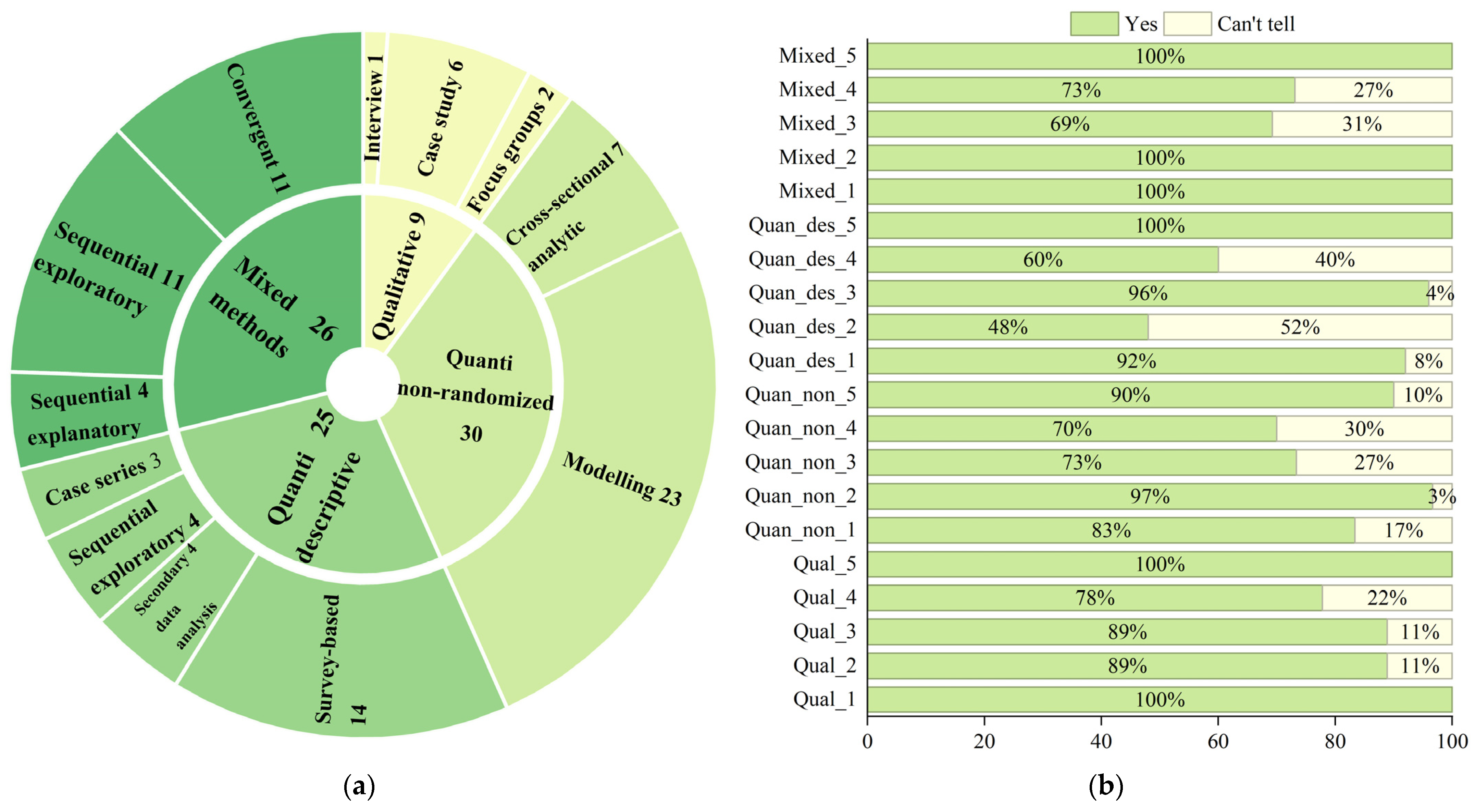
The reviewed literature demonstrates methodological diversity. Quantitative approaches include descriptive and non-randomized designs, accounting for the lion’s share of literature. Mixed methods also constitute a substantial proportion, while purely qualitative studies are less frequent (Figure 4a). This distribution suggests a strong empirical orientation in current research, which indicates a great deal of methodological integration across study designs. Details are provided in Table 3.
Figure 4b summarizes the methodological quality appraisal results across study categories. Overall, most criteria received predominantly “Yes” ratings, indicating generally satisfactory methodological rigor. The lower scores for Quan_des_2 and Quan_des_4 are mainly because many studies did not clearly report their sampling strategies or discuss potential nonresponse bias, making it difficult to assess those criteria. This reflects incomplete reporting rather than poor study design.

4. Thematic Synthesis

4.1. The Drivers of Food Loss

Food loss in the AFSCs arises from a combination of internal logistics deficiencies and broader systemic conditions. Rather than isolated technical failures, the synthesis indicates recurring deterioration mechanisms related to time–temperature control, handling practices, coordination gaps, and institutional misalignment.

4.1.1. Internal Logistics Drivers

(1)
Warehousing and storage
Storage-related losses are primarily associated with inadequate infrastructure and ineffective inventory management [22,24]. Temperature control failure emerged as the dominant deterioration mechanism for perishable products [56,81,108]. Insufficient cold storage capacity, unstable cold chain continuity, and inappropriate humidity management frequently led to nutritional degradation and reduced market value [13,127]. Managerial factors further exacerbated losses. Overstocking driven by inaccurate forecasting, weak stock rotation practices, and human error in expiry management were repeatedly identified [14,88,132]. Many facilities lacked systematic integration of temperature control, time management, and hygiene monitoring, resulting in preventable spoilage during storage [73,76,133].
(2)
Packaging
Food losses associated with packaging arise from deficiencies in design, material selection, and managerial control [134,135,136]. Poor ventilation, inadequate buffering, and inappropriate material properties increase susceptibility to mechanical damage and deterioration during handling and storage [76,126]. In some cases, edible products are discarded due to irregular shapes or packaging that fails to meet market standards, despite being safe for consumption [137], highlighting a trade-off between quality standards and loss prevention. Material choice further influences product integrity. Packaging with insufficient mechanical strength or thermal protection accelerates spoilage. For example, sacks and woven bags are widely used but often lack proper ventilation, leading to higher loss rates compared with vacuum packaging in perishable supply chains [13]. Managerial practices also shape packaging-related losses. Weak inspection procedures and poor hygiene control between processing and packaging increase contamination risks. Moreover, packaging intensity involves trade-offs: insufficient protection increases damage risk, while excessive packaging raises environmental burdens and costs [39,126].
Overall, deficiencies in design, materials, and management interact to amplify food losses, positioning packaging as a critical control point within the AFSCs.
(3)
Transportation and distribution
Transportation represents one of the most vulnerable stages in the AFSCs, where operational, technological, and infrastructural weaknesses contribute to food loss [138]. Inefficient route planning and long distances increase transit time and spoilage risk [139]. Temperature fluctuations, improper stacking, rough loading and unloading, and mixing incompatible products elevate physical damage and contamination risks [68,76,140]. Technological deficiencies further undermine cold chain integrity. Inadequate refrigeration systems and insufficient shock absorption lead to quality deterioration during transit [4,141]. Infrastructure and environmental conditions also matter. Traffic congestion, freight restrictions, poor road quality, and extreme weather disrupt delivery schedules and compromise product quality [142]. Long-distance transport under high temperatures accelerates microbial growth, increasing both quantitative and qualitative losses [93].
These challenges are particularly pronounced in regions with underdeveloped transport infrastructure and limited access to refrigerated vehicles, where long-distance traveling time stimulates spoilage risk [56]. Taken together, weaknesses in operation, transport technologies, and the broader infrastructure and environmental context make transportation a highly vulnerable stage. Without effective logistics management, perishable agricultural foods are highly susceptible to damage and deterioration.

4.1.2. External and Systematic Drivers

While internal logistics deficiencies directly contribute to food loss, many failures are shaped by systemic conditions beyond firm-level control. Sustainable loss reduction requires addressing inter-organizational coordination, digital capability gaps, and policy environments that influence operational effectiveness. These external factors do not directly cause deterioration but constrain the implementation and scaling of logistics practices. Therefore, understanding food loss in AFSCs requires examining collaboration, technology infrastructure, and institutional frameworks’ operational performance.
(1)
Collaboration and coordination gaps
Collaboration gaps across the AFSCs significantly contribute to food loss by reducing coordination efficiency [30]. First, limited information sharing weakens alignment among actors, leading to fragmented data systems and uncoordinated operations [143]. Second, decentralized decision-making in demand forecasting and delivery scheduling often results in resource underutilization, overstocking, and excessive handling, thereby increasing spoilage risk [132]. Last, weak partnerships characterized by low trust and conflicting interests discourage investment in shared logistics assets and collaborative practices [24].
When individual actors prioritize local optimization over system-wide performance, value stream disruptions and cumulative losses emerge [44,85]. Empirical evidence indicates that insufficient coordination and limited transparency hinder system-wide solutions and reinforce structural inefficiencies [143]. These findings highlight that collaboration is not merely relational but operationally critical for reducing food loss. Strengthening information exchange, joint planning, and trust-based partnerships is therefore essential to improving logistics effectiveness across AFSCs.
(2)
Digital technology limitation
Limited data availability and usability remain critical drivers of food loss. Effective digital support for loss prevention requires sufficient and interoperable data to trace products across multiple players along the AFSCs. However, many agri-food systems still suffer from data collection, where information is either incomplete or inaccessible to relevant stakeholders [115]. This lack of shared and real-time data weakens traceability, making it difficult to accurately identify key points for food loss, causing repeated transportation and reprocessing efforts [81]. Moreover, inadequate data quality constrains the effectiveness of analytics and decision-making systems. Specifically, delayed order updates and poor real-time visibility into inventory or shipment conditions lead to transportation schedules and warehouse handling processes that are out of sync, increasing the risk of spoilage [56]. Consequently, digital technologies fail to deliver their potential efficiency gains, leading to poor coordination and increased food loss. These limitations highlight that digital technology capability not only matters in technology adoption, but also in data integration and exchange across the AFSCs.
(3)
Policy factors
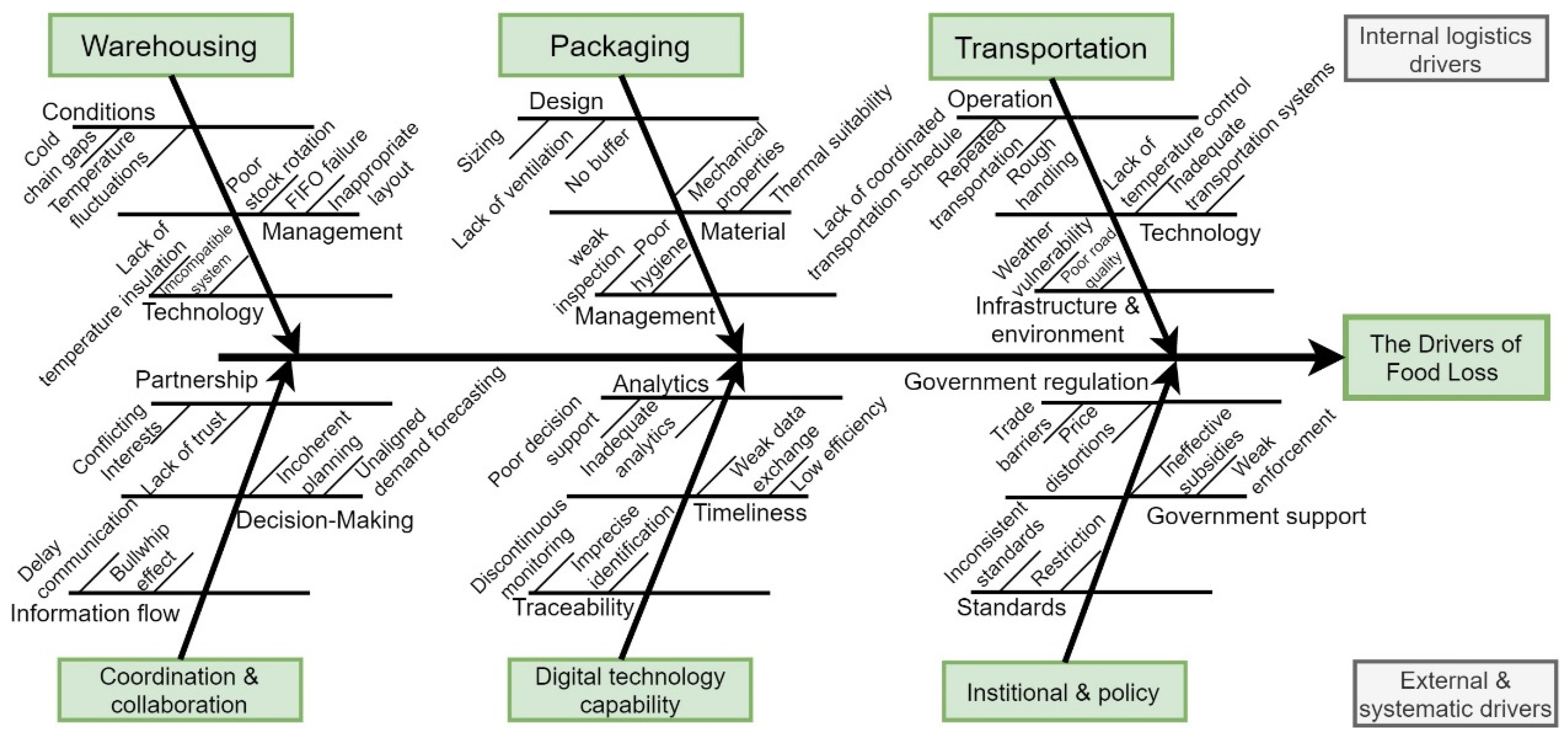
Policy environments shape logistics decisions and food loss outcomes. Stringent quality standards may lead to the rejection of edible but visually imperfect produce, generating avoidable losses [11,56]. At the same time, performance evaluation systems emphasizing compliance over flexibility can reduce operational adaptability. Subsidy structures also influence loss patterns. Ineffective or poorly targeted subsidies may encourage excessive purchasing or misaligned infrastructure investment, increasing spoilage risk [12]. For instance, support for cold storage construction without parallel investment in digitalization may create mismatches between physical and informational capacity. Broadly speaking, fragmented policy frameworks limit coordination and investment across the AFSCs [141]. Weak regulatory enforcement and inconsistent standards exacerbate systemic inefficiencies, reinforcing loss mechanisms at multiple levels [4]. Therefore, coherent regulatory design and performance-oriented incentives are essential to align logistics practices with food loss reduction objectives. Figure 5 presents a fishbone diagram categorizing the internal logistics drivers (warehousing, packaging, transportation) and external systematic drivers (coordination and collaboration, digital technology capability, institutional policy factors) of food loss in AFSCs.

4.2. Strategies and Practices to Conquer Food Loss

Based on the identified drivers, effective mitigation of food loss requires an approach that targets both operational practices and the systemic environment of the AFSCs. This section categorizes mitigation strategies into two interrelated tiers: internal logistics practices and external mechanisms. Both create the necessary conditions for these logistics practices to be implemented and sustained on a large scale. At its core, they form a holistic framework for loss reduction.

4.2.1. Internal Logistics Practices to Conquer Food Loss

Internal logistics practices address food loss drivers within firm-level operation. These practices reduce food loss by warehousing and storage, packaging, and transportation and distribution practices.
(1)
Warehousing and storage strategies
Warehousing practices mitigate food loss through storage infrastructure updates, inventory management optimization, and operational innovation. Firstly, upgrading storage infrastructure is fundamental. This includes adopting automation and robotics to enhance handling efficiency and reduce the time of storage for perishable agri-foods [114,138]. Another effective practice is temperature-controlled management [106,118]. Americold, a global leader in the food industry, has temperature-controlled warehousing that employs a natural gas fuel cell to produce cleaner energy in warehouses. It ensures stable cold chain operation while reducing energy disruptions, contributing to both environmental sustainability and food loss reduction [138]. Along similar lines, Chen et al. (2018) mentioned warehouses equipped with damp-proof floors, ventilators, and thermometers keep storage conditions appropriate and prevent grain deterioration [144]. More importantly, warehousing tracking systems or food loss monitoring systems that enable data sharing across multiple partners can increase efficiency and reduce loss [78].
Additionally, optimizing inventory management through decision rules first-expired-first-out (FEFO) or least-shelf-life-first-out (LSFU) are crucial. These criteria maintain the stock rotation of perishable agri-foods, minimizing fruits’ spoilage in warehouses [132]. Finally, operational innovation mitigates agri-foods loss by improving resource utilization. Shared warehouse arrangements make good use of the storage facility, ensuring AFSCs cooperation towards sustainable value chains and reducing food surplus [145]. Similarly, using condition-controlled collection centers for raw milk allows timely distribution to processing facilities or other organizations, minimizing quality degradation and losses during the storage stage [77].
(2)
Packaging strategies
The mitigation strategies in the Packaging stage focus on redesigning packaging functions, improving material performance, and enhancing packaging management and integration along the AFSCs. From a design and functional perspective, innovative packaging solutions outrank traditional ones to actively delay deterioration of agri-foods. Packaging contains a strip coated with a natural product that absorbs ethylene that can slow fruit ripening and reduce spoilage without additional costs to consumers [139]. Along this line, active packaging that uses natural antimicrobial compounds inhibits microbial growth and mitigates food spoilage [75]. These innovative designs diminish food loss in the packaging phase.
From the viewpoint of materials, sensible design can reduce plastic use while extending agri-food lifespan and satisfying customers [126]. In addition to this, packaging material choices should account for industrial scalability and waste management regulations, considering biodegradability and recyclability to avoid shifting environmental burdens downstream [134]. In terms of management and integration, frozen-food packaging uses technology in a modified atmosphere to increase the shelf life of the product. It multiplies its effective edibility by up to six times, consequently reducing food loss [70]. Likewise, automated packaging and labeling systems enhance product traceability and quality, ensuring packaging management and preventing seafood losses [81].
(3)
Transportation and distribution strategies
Transportation and distribution strategies emphasize operational management, technological integration, and systemic infrastructure development. At the operational level, improving delivery routes planning and optimizing transportation schedules can reduce transit time and spoilage risk for perishable agri-food products [112]. Furthermore, evidence suggests that using owned vehicles rather than relying on third-party logistics services enhances control and reliability in logistics execution, lowering postharvest losses [93]. Technologically, transport fleets integrate digital monitoring systems to improve visibility and risk management [129]. RFID and Internet of things (IoT) tracking systems provide real-time monitoring of distribution networks, vehicle locations, temperature and contamination levels, which is particularly beneficial in milk and other cold-chain-related AFSCs [146]. These advanced cold storage systems and temperature-controlled transport vehicles can help maintain freshness and hygiene, reducing quality degradation and food loss [81]. Likewise, emerging transportation innovations, including platform-enabled urban food delivery models and autonomous vehicle technologies, further improve delivery efficiency and time savings in urban food logistics contexts [138].
Finally, infrastructure and environmental investment are imperative to address food loss. Investments in cold transportation extend product preservation periods. Eco-friendly transport solutions enhance AFSCs efficiency and achieve sustainability outcomes [78]. Cold transportation contributes to preserving the product for long periods. Furthermore, empirical evidence indicates that different transportation modes result in different postharvest loss levels. Traders using their own transportation can reduce the food loss more effectively than those relying on third-party logistics services. The percentages of loss vary from 0.3% to 7.9% for self-owned and hired transportation. These findings suggest that cooperatives can support smallholders by providing subsidized cold transportation services, reducing food loss and improving AFSCs resilience [93].

4.2.2. External Practices to Conquer Food Loss

External practices address structural and systemic drivers that individual actors cannot resolve independently. These practices mitigate food loss by strengthening inter-organizational coordination, enhancing digital technology capabilities, and shaping regulatory and institutional environments across AFSCs.
(1)
Coordination and collaboration strategies
Collaborative strategies reduce food loss through partnership development, information integration, and joint decision-making. Trust-based partnerships enable coordinated investment and risk-sharing, particularly benefiting smallholders vulnerable to postharvest losses [44]. For example, deregulation in EU agricultural markets weakened cooperative cohesion and fragmented coordination, increasing spoilage risks [109]. In response, collective initiatives have developed standardized harvesting, storage, and marketing procedures, stabilizing quality control and reducing distress selling [44]. Multi-actor partnerships involving governments, agribusinesses, and NGOs have also co-invested in cold-chain infrastructure and regulatory pilots, shifting from isolated technical fixes to system-level coordination [115]. Information integration further enhances synchronization. Firms have developed artificial intelligence (AI) forecasting systems that integrate production, sales, and logistics data across partners, enabling early surplus detection and reducing overproduction-driven losses [19,23,143]. Real-time transparency in inventory, product quality, and transport conditions improves responsiveness to spoilage risks [113].
Such information exchange strengthens trust and facilitates joint decision-making [16]. Shared resource-allocation planning among producers, processors, and distributors has optimized storage and transport scheduling, minimizing bottlenecks that previously caused deterioration [78]. In circular economy initiatives, coordinated platforms determine redistribution channels and recovery strategies for surplus produce, embedding loss prevention within governance structures [29,113].
(2)
Digital Technology Capability
Digital technologies mitigate food loss through advanced analytics, real-time monitoring, and integrated platforms. Firstly, AI-driven analytics improve demand–supply synchronization. Predictive systems integrating multi-source data enable proactive planning and reduce overproduction losses [19]. Machine learning applications transform sensor data into shelf-life prediction and dynamic routing optimization, supporting predictive quality management. Blockchain-based traceability reduces information asymmetries across supply chains [16]. Secondly, IoT-enabled monitoring enhances timeliness and traceability. Continuous visibility of inventory and transport conditions allows early intervention before quality degradation [147]. Digital tools also support standardized FLW measurement and circular practices [113]. However, sensor deployment carries environmental costs, requiring balanced implementation strategies [20].
Thirdly, integrated digital platforms connect previously siloed systems and operationalize collaborative governance [77]. By enabling synchronized resource planning and surplus redistribution, these platforms transform individual digital tools into supply-chain-wide coordination infrastructure. Nevertheless, technological potential remains constrained by limited user capability [9]. Effective implementation requires phased investment, training integration, and co-design processes aligned with stakeholder capacity [19,115].
(3)
Regulation
Governments influence food loss reduction through regulatory enforcement, incentive design, and standardization. Regulatory frameworks reduce structural distortions that exacerbate loss. Simplifying import regulations for postharvest technologies while enforcing quality standards can improve equipment adoption and prevent substandard inputs [136]. Legally binding reduction targets, as implemented in Italy (2016), Japan (2019), and China (2021), provide institutional accountability for downstream waste reduction [36]. Multi-tier market surveillance systems further ensure compliance with cold chain and handling standards [9]. Incentive design is equally critical. Traditional subsidies focused solely on output expansion often fail to change loss-generating practices. Performance-oriented incentives linked to protected cultivation, mechanized harvesting, precision irrigation, and digital monitoring have demonstrated measurable reductions in food loss [42,148]. Public investment in cold-chain monitoring and traceability infrastructure enhances real-time quality control across AFSCs [147]. Linking financial support to loss-reduction performance transforms blanket subsidies into targeted technological upgrading mechanisms [126,147].
Standardization policies harmonize grading, storage, and logistics requirements, reducing rejection and deterioration caused by fragmented criteria [11,81]. Unified cold-chain and handling standards improve quality consistency in high-loss sectors. Mandatory certification tied to refrigeration and processing upgrades embeds loss prevention into compliance systems [81,128]. Spatial policies promoting localized processing and shorter transport routes further reduce exposure time and infrastructure bottlenecks [139,148]. Table A2 summarizes food loss drivers, mitigation strategies, and supporting evidence.

5. Discussion

5.1. Trends and Insights

The literature shows an exponential growth in research on food loss reduction, reflecting the increasing policy salience since the adoption of SDG 12.3 in 2015. Before 2015, studies were scarce (1.1%), largely treating food loss as an agricultural production issue rather than a supply chain management priority. The period 2016–2020 marked steady growth in response to sustainability mandates, while the surge from 2021 onward (80%) reflects post-pandemic supply chain resilience concerns [83], the EU Green Deal, and heightened climate urgency [123]. This temporal pattern indicates a transition from niche environmental accounting toward mainstream operations management research [36,77,143].
Geographically, early research was dominated by developed countries, with a focus on retail and consumer waste [68,88,125,143]. In contrast, more recent studies are led by developing economies such as India, China, and Brazil, where postharvest logistics and infrastructure deficits contribute significantly to food loss [23,70,92,96,112,149]. This shift highlights the growing recognition that effective interventions must address smallholder integration, informal market structures, and climate vulnerability [11,16,96,150]. Technological solutions from advanced economies alone are insufficient to tackle these challenges [69,71,109].
Methodologically, surveys, expert interviews, and multi-criteria decision analysis remain central for identifying and prioritizing operational and managerial drivers of food loss [24,78,115,149]. While these approaches provide valuable diagnostic insights, the review highlights a persistent mechanistic gap. Studies integrating survey-based theory testing with SEM are exceptionally rare, with only two identified [9,16]. Most research catalogs influencing factors without empirically examining how logistics practices interact or through what pathways interventions reduce food loss [82,118,127,136]. Addressing this gap requires future work to adopt integrated SEM frameworks that systematically link practices, underlying mechanisms, and outcomes, moving beyond describing what occurs toward understanding how and why interventions succeed.

5.2. Theoretical Interpretation

The thematic synthesis in Section 4 revealed a comprehensive overview of the drivers of food loss (Section 4.1) and the corresponding mitigation strategies (Section 4.2). They are organized through internal logistics practices and external systemic mechanisms. Although this synthesis effectively catalogues what factors contribute to food loss and what strategies exist to mitigate it, it does not yet explain why certain practices are more effective than others, or under what conditions they succeed. To move from descriptive aggregation towards explanatory understanding, this section interprets these empirical patterns through the lens of management theory. This theoretical interpretation serves as the analytical bridge between the empirical findings and the integrated conceptual framework developed in Section 5.3.

5.2.1. Empirical Patterns Emerging from Synthesis

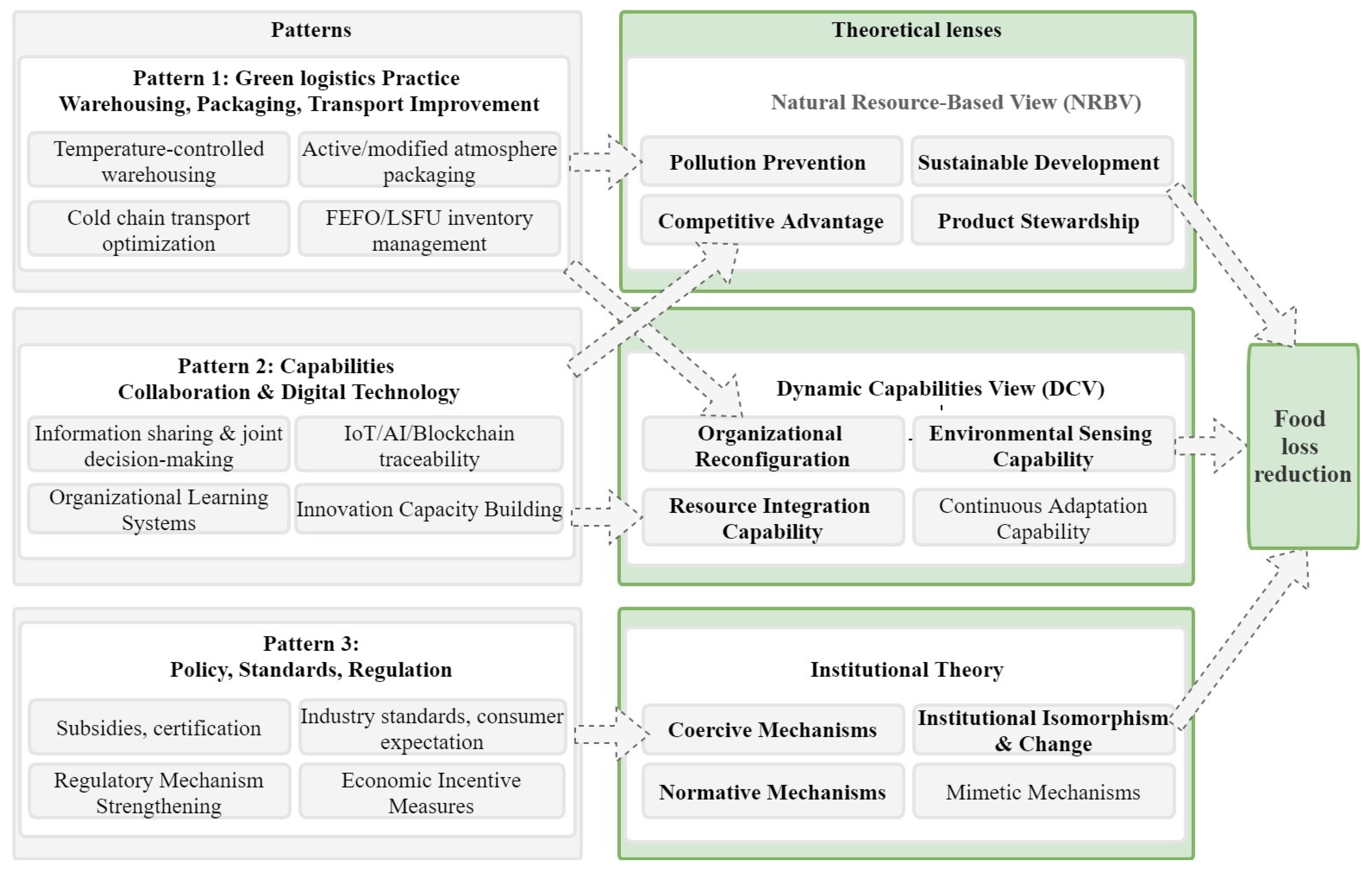
Pattern 1: Operational practices as performance drivers. Across 90 studies (Section 4.2.1), green warehousing, packaging, and transportation practices consistently demonstrated simultaneous reduction in food loss and environmental impact. Temperature-controlled storage employing natural gas fuel cells reduced energy disruptions while ensuring cold chain stability [68,102]. Active packaging with antimicrobial compounds extended shelf life [75,126,134]. Eco-friendly transport solutions achieved sustainability outcomes alongside operational efficiency [78,104]. This pattern suggests that environmental investments yield competitive advantages through operational efficiency rather than environmental costs.
Pattern 2: Capability-dependent effectiveness. Our synthesis identified a critical inconsistency: identical technologies yielded contrasting outcomes. IoT and big data implementation reduced food loss by 20–41% in contexts where data integration was present [27,127]. However, the effect was negligible in the absence of such integration. Collaboration reduced loss by 20% with governance coordination but failed without information sharing [23,29]. This divergence indicates that static technology adoption requires enabling capabilities, such as real-time monitoring, AI forecasting, and joint decision-making infrastructure, to convert potential into actual loss reduction.
Pattern 3: Institutional drivers shaping adoption decisions. External pressures such as government mandates [78,112], certification requirements [11,16], and industry standards [10,66,92] consistently appeared as antecedent, particularly in developing economies (India, China, Brazil: 24% of studies, 67% of institutional pressure mentions). Notably, Q Cold Chain certification amplified technology adoption effectiveness [11], while carbon pricing mandates achieved 27.1% emission reduction [84], suggesting that legitimacy-seeking behavior drives adoption where market incentives alone are insufficient.

5.2.2. Bridging Empirical Patterns to Theoretical Lenses

The performance pattern identified in Section 5.2.1 (simultaneous loss and emission reduction) closely aligns with the pollution-prevention logic of the natural resource-based view (NRBV), which posits that environmental investments enhance operational efficiency and competitive advantage [151,152]. In the context of AFSCs, green warehousing, green packaging, and green transportation constitute the foundation of pollution prevention. These operational practices reduce food loss by maintaining optimal storage conditions, protecting product quality in packaging, and minimizing transit time and damage during transportation.
The dynamic capability view (DCV) emphasizes the role of organizational capabilities in sensing and responding to environmental changes [153]. Digital technology capability enables firms to translate IoT monitoring, AI forecasting, and blockchain traceability into real-time sensing to avoid quality deterioration risks [115,128,154]. Collaboration and coordination capabilities facilitate efficient decision-making, information sharing, and collective resource planning among AFSCs [155], thereby reducing surplus risks and operational disruptions.
Institutional theory complements the NRBV and DCV by acknowledging that organizational practices are shaped by external pressures for legitimacy [156]. Coercive pressures originate from government regulations, such as legally binding food loss reduction targets, compelling firms to adopt standardized practices [157,158,159]. Meanwhile, normative pressures arise from professional standards, industry certifications, and shared expectations among AFSCs that legitimize and diffuse best practices for food loss reduction.
While each theoretical lens offers distinct insights, previous studies have applied these theories in isolation, focusing on operational efficiency, technological innovation, or policy compliance. Their integration is necessary to capture the multifaceted nature of food loss mitigation. The NRBV explains how operational practices reduce losses. That is, green logistics practices. The DCV explains when these practices are most effective through digital and collaborative enablement. Institutional theory explains why firms adopt these practices in response to external legitimacy pressure.
Alternative lenses were evaluated but found inadequate. Stakeholder theory explains collaboration motives [16,117] but lacks specificity on capability differentiation evident in our technology effectiveness findings. Transaction cost economics addresses outsourcing choices but cannot explain policy-driven practices [22,160]. Resource-dependence theory explains power asymmetries [17,161], but it cannot explain the dynamic capability co-development processes documented in our synthesis.
The synthesis does not merely suggest three parallel explanations. Rather, it reveals a hierarchical structure: institutional pressures shape firms’ motivation to adopt green logistics practices; dynamic capabilities determine the extent to which these practices are effectively implemented; and green logistics practices operationalize resource-based pollution prevention mechanisms that directly reduce food loss. The integration of the NRBV, DCV, and institutional theory therefore reflects the empirical sequencing observed in the literature rather than a post-hoc theoretical combination.

5.2.3. Theoretical Mapping and Integration

Pattern 1 (operational practices as performance drivers) aligns primarily with the NRBV. The simultaneous reduction of food loss and environmental impact reflects the pollution prevention logic that environmental investments enhance operational efficiency and competitive advantage. In the AFSCs context, green warehousing, packaging, and transportation operationalize pollution prevention by preserving product integrity and reducing spoilage and emissions [74,75,125,135,136]. However, the NRBV alone is insufficient. The effectiveness of these practices depends on firms’ ability to adapt to disruptions, monitor quality in real time, and coordinate across actors, highlighting the relevance of the DCV [153,162]. Thus, Pattern 1 reflects both resource-based pollution prevention (NRBV) and capability-enabled execution (DCV).
Pattern 2 (capability-dependent effectiveness) directly reflects the DCV. Divergent outcomes from identical technologies show that sensing, integration, and reconfiguration capabilities determine whether investments translate into performance gains. Real-time monitoring, AI forecasting, and collaborative decision-making convert technological potential into loss reduction [24,47,68,122]. At the same time, Pattern 2 reinforces the NRBV: environmental investments generate competitive advantage only when complementary capabilities are present. The NRBV explains the performance mechanism, whereas the DCV explains the capability conditions under which it functions [151,152,153].
Pattern 3 (institutional drivers shaping adoption decisions) aligns with Institutional Theory. Government mandates, certifications, and industry standards indicate that adoption is often legitimacy-driven rather than purely economic [27,28,39,54]. Coercive, normative, and mimetic pressures shape firms’ willingness to adopt green logistics practices and develop dynamic capabilities [5,16,67]. Institutional forces do not directly reduce food loss. Instead, they operate upstream by motivating adoption of NRBV-consistent practices and capability development [156] (Figure 6).

5.3. Towards a Conceptual Framework: Implementation in AFSCs

5.3.1. Proposed Conceptual Research Model

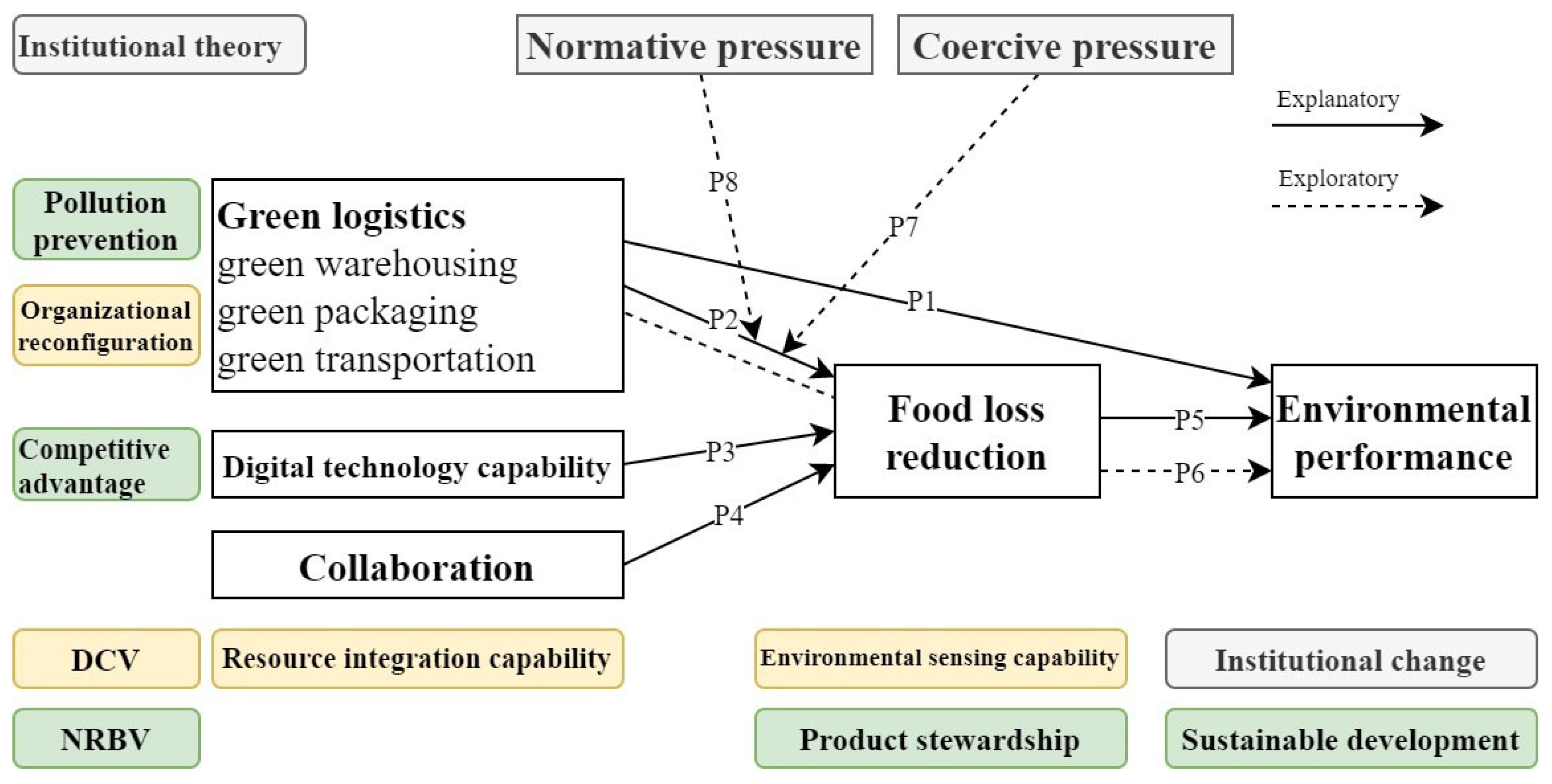
Building upon the empirical patterns identified in Section 5.2.1 and the theoretical interpretation in Section 5.2.2, this study proposes a conceptual framework that distinguishes between empirically supported explanatory propositions and theoretically grounded but exploratory propositions. This differentiation is intended to reflect the uneven strength of evidence identified in the systematic review.
Propositions 1 to 5 articulate five core relationships that are well supported across the 90 reviewed studies. Green logistics practices tend to be positively associated with environmental performance (P1) and food loss reduction (P2). Digital technology capability (P3) and collaboration (P4) are also likely to facilitate food loss reduction. In turn, food loss reduction is generally associated with environmental performance (P5). These propositions are classified as explanatory because multiple studies report convergent empirical findings across diverse AFSCs contexts [21,44,102].
Propositions 6 to 8 introduce three indirect and contingent relationships that remain comparatively underexamined. Proposition 6 conceptualizes food loss reduction as one potential mediating mechanism linking green logistics practices to environmental performance. While several studies imply such a mechanism, the mediating structure has rarely been explicitly tested [163,164]. Moreover, prior research also documents direct effects of green logistics on environmental outcomes, such as emission reduction through renewable energy adoption in transportation and resource efficiency through packaging optimization [74,104,118,136]. Accordingly, food loss prevention should be understood as one theoretically meaningful pathway among multiple possible mechanisms, rather than an exclusive transmission channel.
Propositions 7 and 8 incorporate institutional pressures as boundary conditions. Drawing from institutional theory [156], coercive and normative pressures are proposed to positively moderate the effectiveness of green logistics practices in achieving food loss reduction [16,39,103]. Although previous studies suggest that regulatory and normative pressures may strengthen these relationships, direct empirical evidence on such moderating effects remains limited [5,27,67,99]. These propositions, therefore, are exploratory and intended to guide future empirical testing.
By explicitly distinguishing between well-supported direct relationships and theoretically motivated but empirically underdeveloped indirect and moderating mechanisms, the proposed framework aims to provide a balanced synthesis of what the current evidence can substantiate and where further research is needed. In doing so, the model serves as a structured research agenda rather than a definitive causal map. Figure 7 shows the proposed framework and related theories.

5.3.2. Development of Research Propositions

  • Explanatory propositions
Empirical evidence consistently indicates that green warehousing, green packaging, and green transportation reduce agri-food deterioration and resource waste across AFSCs [17,165]. In green warehousing, Liao and Hsu (2025) employed multi-objective mixed-integer linear programming, adopting energy-saving storage strategies to reduce carbon emission by 27.1% [84]. Storage employing solar power or solar dryers also improve environmental performance [9,42,72]. Conversely, green warehousing negatively influenced economic performance in manufacturing industry [17], but this relationship has not yet been tested in AFSCs contexts. Green transport relates to environmentally friendly automobiles and the usage of renewable energy, which produces low emissions and reduces environmental impact [74,105,166]. More specifically, environmentally friendly transportation can lower greenhouse gas emissions and mitigate climate change [78]. Foods with proper packaging can reduce climate change, resource consumption, and air pollution by more than 94.1% compared with those without packaging [105,136]. Collectively, integrating transportation mode, storage condition, and recycling packaging can reduce 28.78% food loss and 28.21% GHG emission [107]. Galli et al. (2024) developed a green logistics framework to further examine the network design, storage management, transportation, reverse logistics can effectively decrease environmental impact [167]. These empirical findings consistently demonstrate that green logistics practices contribute to both food loss prevention and environmental improvement across diverse AFSCs contexts.
Proposition 1. 
The implementation of green logistics (green warehousing, green packaging, and green transportation) is associated with environmental performance.
A great number of previous studies show that green warehousing, green packaging, and green transportation have a positive impact on food loss reduction. Improving storage facilities can decrease vegetable losses and environmental burden [76,92]. Joint logistics practices can reduce losses by 28.78% [107], and in a specific banana’s supply chain, food loss decreased from 23.74% during the peak time of COVID-19 to 8.55% during the post-pandemic period [22]. Cold chain transportation can reduce food loss and improve the shelf life of agri-foods [11,66,94,128]. Optimizing packaging for agri-foods, such as using innovative food packaging and green materials, can curb food loss during their life cycle and improve environmental performance [74,126,135,136]. To sum up, investing in basic facilities, controlling temperature, and shortening the length of the supply chain can maintain loss in the range of 4% to 10%, avoiding 1.8 Gt GHG emissions annually [93,125].
Proposition 2. 
The implementation of green logistics (green warehousing, green packaging, and green transportation) is associated with food loss reduction.
Digital technology capability can reduce food loss through real-time monitoring, predictive analysis, and smart decision-making [71,128]. More specifically, traceability, forecasting, and monitoring capabilities are useful for food loss prevention [19,27]. IoT sensor adoption can avoid 20–41% of food loss and promote sustainability in AFSCs [20,83,137]. Artificial intelligence accurately forecasts demands and optimizes storage, achieving 14.8% to 40% food loss reduction [8,25]. Digital platforms have diffused widely among smallholder farmers [42]. Digital technology capability enables firms to obtain market information and optimize logistics decisions, and thereby reducing food loss and improving postharvest management [122]. For perishable agri-foods, modern digital storage requires energy input, while it can reduce food losses and improve food availability, significantly improving overall resource efficiently [27,102]. Digitalization bridges gaps and creates huge value in AFSCs [147]. Therefore, this study proposes the following hypothesis:
Proposition 3. 
Digital technology capability tends to have a positive influence on food loss prevention.
Collaboration involves sharing information, integrating sources, and coordinating processes in the AFSCs [23,43,78]. Arias Bustos & Moors (2018) provide case studies in two developing countries, demonstrating that effective partnership is the core pillar of innovative collaboration, contributing to food loss reduction [29]. Similarly, Sagi & Gokarn (2023) identified partnership in AFSCs as the key component in India to conquer food loss [16]. Furthermore, Perdana et al. (2023) demonstrated that AFSCs coordination through governance in Indonesia decreased food loss from 35% to 15% [109]. In the meantime, collaboration can save resources and achieve sustainable goals. Blockchain technology integrates with the food cold chain and the coordinative platform decreased GHG emissions to around 21.8–42.1% [128]. By developing collaborative relationships, supply chain partners can enhance their capacity to identify and mitigate food loss [24]. Kumar et al. (2025) used multi-objective mixed-integer linear programming to demonstrate that organizations working together can drive sustainable supplier selection and reduce carbon emissions [107]. Broadly speaking, Kazancoglu et al. (2024) developed a system dynamics model to estimate that high-level coordination and collaboration in AFSCs directly influence sustainability [82]. These collaborative practices supported the hypotheses below:
Proposition 4. 
Collaboration is likely to facilitate food loss reduction.
Food loss prevention positively influences environmental performance [11,89,107]. Jia et al. (2023) quantified that food loss generates a huge amount of air pollution, water wastage, and land use, demonstrating substantial environmental savings from loss reduction in a developing country [4]. Osei-Owusu et al. (2023) estimate that halving EU food loss by 2030 would save carbon oxygen, blue water, and cropland [5]. At the product level, extending pastry cream shelf life from 3 to 13 days reduces climate change impact by 75%, illustrating how loss prevention mitigates environmental burdens embedded in food production [75]. In conclusion, these findings establish that preventing food loss avoids resource inputs and emissions associated with producing, processing, and distributing wasted food [84,143]. Therefore, it generates direct environmental performance improvements [35,39,112].
Proposition 5. 
Food loss prevention is associated with improvements in environmental performance.
2.
Exploratory propositions
Several empirical studies suggest that green logistics practices may indirectly improve environmental performance through food loss reduction. In green warehousing, AI-driven warehousing management and supplier selection reduce GHG emission to protect the environment from degradation [19,104,107,125]. Although optimized packaging directly generates environmental loads, it can indirectly reduce the overall system impact by extending the shelf life and reducing transportation losses [110,136]. Moreover, the environmental benefits brought by the reduction in losses can fully offset or even exceed the carbon emission costs of the packaging itself [105,126]. Qin and Horvath (2022) found that food loss contributes much more to total emissions (19–61%) than packaging (11–31%) and transportation (14–46%) [74]. GPS tracking, blockchain platforms, and smart cold chain standardization during transportation achieve the dual goals of emission reduction and environmental improvement by reducing trans-shipment losses [22,81,128]. However, the existing evidence is fragmented and does not always explicitly test the mediating mechanism. Therefore, this proposition remains theoretically plausible but empirically underexamined.
Overall, the existing literature, starting from multi-dimensional green logistics practices such as warehousing, packaging, transportation, and digital technology, generally suggests a potential mediating role of food loss prevention between green logistics and environmental performance [11,74,115]. This mechanism requires further empirical validation across diverse contexts in both developed and developing countries [9,68,70]. Importantly, this mediating pathway does not preclude the possibility of direct effects of green logistics on environmental performance, which have been documented in prior studies. Rather, food loss reduction represents one theoretically meaningful mechanism among multiple potential pathways [163,164,168].
Proposition 6. 
Food loss prevention mediates the relationship between green logistics and environmental performance.
From an institutional theory perspective, coercive pressure increases compliance incentives and reduces organizational discretion, thereby potentially strengthening the implementation effectiveness of green logistics practices [156]. Coercive pressure amplifies the effectiveness of green logistics in preventing food loss. Kuaites and Thungwha (2025) demonstrated that Q Cold Chain certification significantly enhances the positive effect of standardization on digital technology adoption, which serves as a critical enabler for green logistics to reduce food loss [11]. Similarly, Kumar et al. (2023) identified that lacking government policy as the primary barrier to circular economy adoption [119]. Conversely, policy mandates, incentives, and regulatory enforcement act as institutional catalysts facilitating the translation of green logistics practices into food loss reduction [18,169]. At the international level, Osei-Owusu et al. (2023) advocate integrating farm-level food loss mitigation into the EU Farm-to-Fork policy framework, recommending that member states set mandatory voluntary targets of 50% reduction in FLW by 2030 [5]. Such top-down pressure is expected to amplify the loss prevention effects of cold chain optimization and other green logistics measures. Agnusdei et al. (2023) further validated that governmental incentives serve as the most fundamental driver of big data analytics adoption, strengthening the logistics digitization food loss reduction nexus through technology-enabled mechanisms [122]. These studies suggest that coercive pressure may condition or strengthen the effectiveness of green logistics practices.
Liao and Hsu (2025) provided direct evidence through carbon pricing sensitivity analysis [84]. When carbon taxes are mandatorily set at 150–225 NTD, the GHG achieves 27.1% emission reduction, proving that the intensity of environmental regulation determines the efficiency of translating food loss reduction into environmental performance. Cross-national comparisons by Osei-Owusu et al. (2023) further revealed that under the EU’s SDG 12.3 targets, systematic environmental benefits are gained, but these are difficult to replicate in regions lacking mandatory policy frameworks [5]. Additionally, Amador-Cervera et al. (2024) embedded institutional pressure into food loss prevention readiness assessment through the FOODRUS index’s 69 regulation, implying that mandatory disclosure requirements enhance environmental visibility and accountability of food loss reduction actions, boosting environmental performance outcomes [124].
Proposition 7. 
Coercive pressure moderates the relationship between green logistics and food loss reduction.
Normative pressure might strengthen the positive effect of green logistics on food loss prevention. Sagi and Gokarn (2023) empirically identified consumer attitude and top management commitment as two of five key determinants of food loss reduction in Indian AFSCs [16]. These stakeholder normative expectations constitute intrinsic drivers for firms’ green logistics investments [18]. Similarly, Wesana et al. (2018) found that although Ugandan dairy supply chain actors demonstrate limited familiarity with the nutrition-sensitive agriculture, their behavioral practices are already aligned with its conceptual content [21]. This industry-shared normative cognition, mediated by change commitment and efficacy, facilitates the positive effect of lean manufacturing and other green logistics practices on loss reduction. From an operational perspective, Trevisan et al. (2024) emphasized that digital technology adoption requires supply chain actor collaboration, with normative pressure supporting innovation through governance mechanisms that enable supply chain innovations to minimize food loss and mitigate negative social and environmental impacts [34]. Overcoming these obstacles requires internalization of industry norms and professional standards, thereby strengthening the green logistics and food loss reduction relationship.
Formentini et al. (2022) found that Barilla soft wheat bread case demonstrated that industry normative adoption of food loss reporting and accounting standards enables firms to identify food loss occurrence points across AFSCs [113]. Xu et al. (2024) uncovered the impact of institutional pressure on green integration and environmental performance [159]. These enabled effective waste reuse from a circular economic perspective. Standardized measurement and disclosure requirements enhance transparency and traceability in translating food loss reduction into environmental performance. Finally, Kumar et al. (2023) note that normative expectations indirectly improve environmental performance by overcoming circular economic adoption challenges, indicating normative pressure as a socialization mechanism that strengthens organizational motivation and capability to translate food loss reduction commitments into actual environmental improvements [119].
Proposition 8. 
Normative pressure moderates the relationship between green logistics and food loss reduction.

6. Conclusions

6.1. Summary

This SLR addressed the pressing need for sustainable transformation in AFSCs by examining how green logistics practices (green warehousing, packaging, and transportation) can reduce food loss and enhance environmental performance. Through a rigorous thematic synthesis of empirical studies, this study summarized the drivers and strategies of food loss in postharvest stages. Then, it identified two critical mechanisms: operational efficiency and institutional embedding. The analysis revealed that green logistics, environmental collaboration and digital technology capability amplify the translation of investments into tangible food loss reduction.
The theoretical contribution lies in putting forward a research framework combining operational practices (green logistics), organizational mechanisms (digital and collaborative capabilities), and institutional pressures (coercive and normative pressures). Unlike existing frameworks that treat these elements separately, our integrated model provides a theoretically grounded framework for examining how and under what conditions green logistics practices may translate into food loss reduction and improved environmental performance. This offers a novel, theoretically grounded template that moves the field from descriptive observation towards explanatory and testable empirical investigation.

6.2. Limitations

This review has several limitations that should be considered when interpreting the findings. Initially, the exclusive focus on English-language publications may introduce language bias, potentially excluding region-specific insights from non-English contexts where AFSCs sustainability challenges are acute. Additionally, although our search captured peer-reviewed literature up to August 2025, the rapid evolution of digital technologies and logistics practices in AFSCs means that emerging applications may not be fully represented. Third, our reliance on academic sources overlooks practitioner knowledge embedded in industry reports and policy documents, particularly regarding implementation barriers.
Most importantly, while the proposed conceptual framework synthesizes patterns observed across 90 heterogeneous studies, direct causal relationships cannot be established through a systematic literature review alone. Specifically, causal directions among collaboration, green logistics practices, and environmental outcomes remain to be empirically verified. Propositions 6 to 8, which relate to the mediating role of food loss reduction and the moderating effects of coercive and normative institutional pressures, are theoretically grounded but empirically underexamined. In addition, the mediation pathway through food loss reduction represents one potential mechanism among multiple plausible pathways. These limitations highlight that while the framework provides a structured synthesis of existing knowledge, its relationships should be interpreted cautiously and as indicative rather than definitive.
Methodologically, several limitations also apply. The MMAT was applied pragmatically to ensure transparency, but it may not fully capture nuances specific to modeling studies in AFSCs, such as technical assumptions, structural model choices, and validation procedures. Additionally, classifying studies using LCA involved interpretive judgment, particularly for studies containing both descriptive and modeling elements. While two independent reviewers cross-checked classifications and resolved discrepancies through discussion, some residual subjectivity cannot be entirely excluded. Finally, despite efforts to design a comprehensive search protocol, relevant studies may have been omitted due to database coverage limitations, publication bias, language restrictions, or the exclusion of grey literature.

6.3. Future Research

Building on these limitations, future research can strengthen and extend the proposed framework in several ways. Methodologically, future studies could enhance comprehensiveness by incorporating a broader range of databases, non-English literature, and practitioner or policy sources to reduce potential omissions and capture region-specific insights. Mixed methods approaches integrating SLR with grey literature analysis would also provide a richer understanding of implementation barriers and contextual contingencies.
Empirically, the framework invites quantitative validation of both well-supported and exploratory propositions. Propositions 6 to 8 warrant focused investigation to assess the role of food loss reduction and the moderating effects of coercive and normative institutional pressures. Techniques such as covariance-based structural equation modeling, partial least squares structural equation modeling, longitudinal designs, or system dynamics modeling could capture feedback loops and alternative pathways through which green logistics affect environmental performance. Comparative studies across developed and developing economies can assess whether configurations of green logistics require cultural or institutionally adaptive implementation. Furthermore, operationalizing constructs such as digital technology capability, collaboration, and institutional pressures will require validated measurement instruments specific to AFSCs contexts.
Collectively, these future research directions aim to refine the proposed conceptual framework, test its boundary conditions, and strengthen the empirical evidence base, ultimately supporting more robust and contextually informed recommendations for sustainable AFSCs practices. Future studies should address these limitations through targeted research designs. Methodologically, future research could enhance comprehensiveness by incorporating a wider range of academic databases and sources to reduce the risk of omission. Furthermore, future reviews may benefit from incorporating additional quality assessment frameworks tailored to modeling and simulation research to provide a more nuanced evaluation. These factors should be considered when interpreting the results of the review.

Supplementary Materials

The following supporting information can be downloaded at: https://www.mdpi.com/article/10.3390/agriculture16050587/s1.

Author Contributions

P.Y., Writing—original draft, Methodology, Formal analysis, Data curation, Conceptualization, Funding acquisition. R.A.H., Writing—review & editing, Supervision, Methodology. L.H.O., Writing—review & editing, Supervision, Methodology. J.L., Writing—review & editing, Funding acquisition. C.N., Writing—review & editing, Literature search, data coding. All authors have read and agreed to the published version of the manuscript.

Funding

This research was funded by Guangdong Provincial Department of Education, Youth Innovative Talent Program for General Universities and Colleges of Guangdong Province, grant number “2024WQNCX194”, awarded to Jing Liao; Guangdong Logistics and Supply Chain Association and Guangdong Universities Logistics Management and Engineering Education Steering Committee, grant number “2025LS005C”, awarded to Jing Liao; Guangzhou College of Commerce, University-Level Research, grant number “2025XJYB005”, awarded to Peiyun Yu.

Data Availability Statement

Data is available upon reasonable request.

Acknowledgments

During the preparation of this manuscript, the authors used Kimi K2.5 (Moonshot AI, 2025), DeepSeek–V3.1 (DeepSeek AI, 2025), ChatGPT–5.2 (OpenAI, 2025), and Grammarly (Grammarly, Inc., 2025) to assist with structure development and language editing. The authors have reviewed and edited the output and take full responsibility for the content of this publication.

Conflicts of Interest

The authors declare no conflicts of interest.

Abbreviations

The following abbreviations are used in this manuscript:
AFSCsAgri-food Supply Chains
AIArtificial Intelligence
ANOVAAnalysis of Variance
DCVDynamic Capability View
EFAExploratory Factor Analysis
FEFOFirst-expired-first-out
FLWFood Loss and Waste
GHG Global Greenhouse Gas
IoTInternet of Things
LCALife Cycle Assessment
LSFULeast-shelf-life-first-out
NRBVNature Resource-based View
MMATMixed Methods Appraisal Tool
MFAMaterial Flow Analysis
PICOSPopulation, Intervention, Comparison, Outcome, Study type
PRISMAPreferred Reporting Items for Systematic Reviews and Meta-Analyses
SDGSustainable Development Goal
SEMStructural Equation Modeling
SLRSystematic Literature Review

Appendix A

Table A1. Existing review articles of food loss within AFSCs.
NoAuthorsReview ArticlesMethodResearch GapsResearch Objective
1[7]87SLR(1) Limited focus on FLW due to inefficient packaging strategies; (2) Insufficient information on logistical inefficiencies causing FLW; (3) Scarce literature on how management practices affect perishable food chains.The study proposes that environmental sustainability in food supply chains is best achieved through management techniques involving logistical efficiency and good packaging strategies.
2[33]111SLRExisting research was fragmented and dispersed, focusing only on specific digital technologies applied to isolated food supply chain phases; this study provides the first unified, multi-technology perspective integrating 16 digital technologies across all food supply chain phases.This study establishes that effective FLW reduction requires integrated, multi-technology digital transformation across the entire food supply chain.
3[31]210SLR &
PRISMA
(1) Previous research explored various aspects of food loss or food waste but lacked collective review and classification of existing KPIs aligned with EU legislations and directives; (2) Need for hybrid approaches combining KPIs with other methodologies (LCA, MFA, digitalization) for comprehensive monitoring.This study identifies, categorizes, and is in line with KPIs with EU legislation across all food supply chain stages to enable effective food loss or food waste measurement and reduction.
4[34]48SLR &
PRISMA
The actual impact of FLW prevention/reduction through digital technologies on environmental, economic, and social sustainability is rarely measured quantitatively; specific indicators (CO2 emissions, donated meals, water/energy consumption) are missing; circular economy perspective remains underexplored.Develop a framework analyzing the state-of-the-art adoption of each Industry 4.0 technology across the AFSCs for FLW prevention/reduction.
5[38]530Integrative Literature ReviewFL and FW are measured together rather than separately; lack of standardized microdata collection; qualitative losses rarely captured; preharvest losses and potential food losses and waste neglected; limited understanding of feedback loops and cascading effects across value chains; interventions poorly understood.To assess existing knowledge about food loss in agrifood systems and identify priorities for research and policy to achieve SDG Target 12.3.
6[36]346Relevance-Driven Literature Review & interviewsOperations management research placed relatively little emphasis on FLW reduction compared with other food supply chain challenges. However, rising economic, ethical, and environmental pressures have positioned FLW as a central operational concern, driving increased scholarly attention.The relevance-driven approach bridges the theory-practice gap by ensuring future research directions align with stakeholder needs identified through interviews.
7[35]110SLRLack of quantitative research describing relationships between food wasted and food prices; Inconsistent definitions and measurement methods for FLW; Lack of harmonized criteria for compost maturity assessment at international level.Deep analysis of circular solutions to enhance food security and environmental sustainability through FLW reduction and recycling
8[12]49SLR &Interview &AHP(1) logistics-related food loss drivers have not been thoroughly studied; (2) the literature does not identify and classify food loss reasons and rank the drivers based on their influence on the amount of loss; (3) no consistency occurs between identified transportation-related drivers in the literature.This study identifies, classifies, and ranks logistics-related food loss drivers by their influence on food loss amount in Turkish food value supply chain.
Table A2. The summary of food loss drivers, strategies, practices, and mechanisms.
CategorySpecific DriversMitigation StrategiesKey Practices & Mechanisms
Warehousing & StorageConditions: Poor temperature control; Cold chain gaps; Inadequate facilitiesInfrastructure modernization, automated monitoring Inventory management optimizationAdoption of automated warehousing & robotics [114,138]; Temperature-controlled warehousing using natural gas fuel cells [138]; Damp-proof floors, ventilators, thermometers for grain storage [144]; Warehouse tracking/food loss monitoring systems [78]; Shared warehouse arrangements [145]; Condition-controlled collection centers for raw milk [77].
Management: Poor stock rotation; FIFO failure; Inappropriate layoutInventory management optimizationFEFO and LSFU rotation [132]; Real-time inventory monitoring & AI forecasting [19]; Automated demand forecasting systems [85]; Australian apple industry, flexible storage configuration reduces loss 7.7% [88].
Technology: Lack of temperature monitoring; Insufficient data systemsDigital Monitoring, Smart WarehousingRFID and IoT-embedded tracking systems [146]; Blockchain for warehouse traceability [115]; AI-powered predictive systems for demand-supply synchronization [19]; AI for storage management, food loss reduction [25].
PackagingDesign: Sizing issues; Lack of ventilation; No buffer capacityActive and Intelligent Packaging DesignEthylene-absorbing strips to delay ripening [139]; Active packaging with natural antimicrobial compounds [75]; Modified atmosphere packaging (MAP) extending shelf life [70]; Smart packaging with sensors for quality monitoring [81].
Material: properties; thermal suitabilitySustainable material selectionBiodegradable/recyclable materials [134]; Reduced plastic use while maintaining shelf life [126]; Monomaterial recyclable packaging [75].
Management: Weak inspection; Poor hygiene standardsIntegrated Packaging ManagementAutomated packaging and labeling systems [81]; Packaging standardization for traceability; Quality-based packaging protocols [126].
TransportationOperation: Rough handling; Repeated transportation; Lack of coordinated transportation scheduleOperational route optimizationRoute planning and schedule optimization [112]; Owned vehicles vs. 3PL (0.3% vs. 7.9% loss rates) [93]; Subsidized cold transportation for smallholders [93]; Multi-modal optimization.
Technology: Lack of temperature control; Inadequate transport systemsCold Chain Digital IntegrationRFID and IoT-embedded tracking for real-time monitoring [146]; Temperature-controlled transport vehicles [81]; Autonomous vehicles and platform-enabled urban delivery [138]; GPS tracking & automated sorting [81].
Infrastructure & Environment: Weather vulnerability; Poor road conditionsInfrastructure Investment, Eco-friendly SolutionsInvestments in cold transportation infrastructure [78]; Eco-friendly transport solutions [78]; Protected cultivation systems [148].
Coordination & CollaborationPartnership: Lack of trust; Conflicting interests; Bullwhip effectTrust-based partnerships, collective actionCooperative joint development of SOPs [44]; Multi-actor partnerships (government-agribusiness-NGO) [115]; Collective handholding initiatives for smallholders [44]; Farmer producer organizations (FPOs) [44].
Information Flow: Delayed communication; Demand uncertainty; Incoherent planningInformation flow, transparencyCo-developed AI-based forecasting systems [19]; Real-time data sharing on inventory, quality, transport conditions [113]; Blockchain for traceability reducing information asymmetry [16]; Shared resource-allocation planning [78].
Decision-Making: Unaligned demand forecasting; Poor decision supportJoint Decision-Making StructuresCoordinated production planning [109]; Joint determination of redistribution channels & secondary markets [29,113]; Shared resource-allocation planning [78]; Collective optimization of storage & transportation scheduling [44].
Digital Technology CapabilityAnalytics: Inadequate analytics; Poor decision support; Unaligned forecastingAI Predictive AnalyticsAI-powered predictive systems integrating multi-source data [19]; Machine learning for shelf-life prediction & dynamic routing Big Data Analytics for demand-supply synchronization [71].
Timeliness: Discontinuous monitoring; Weak data exchange; Low efficiencyReal-time Monitoring, IoTIoT-enabled continuous visibility [147]; Digital identity verification for rapid intervention; Blockchain and traceability systems [16,115]; RFID for quality monitoring [91].
Traceability: Imprecise identification; Weak data exchangeBlockchain Integrated PlatformsBlockchain for end-to-end traceability [25]; Integrated digital platforms connecting siloed systems [26]; Co-design processes aligning functionality with user capabilities [19].
Institutional & PolicyGovernment Regulation: Trade barriers; Price distortionsRegulatory simplification enforcementSimplified import regulations for postharvest technologies [119]; Legally binding FLW reduction targets (Italy 2016, Japan 2019, China 2021) [36]; Multi-tier market surveillance systems [9]; Mandatory quality standards [70].
Government Support: Ineffective subsidies; Weak enforcementPerformance-based Incentives & InvestmentTransformation of blanket subsidies to performance-oriented incentives [42,148]; Public investment in digital agriculture, IoT cold chains, blockchain traceability [126,147]; Financial support linked to FLW reduction practices [16]; Subsidized infrastructure & training [115].
Standards: Inconsistent grading criteria; Storage protocols; Logistics standardsStandardization and CertificationUnified national standards for cold chain operations [81]; Mandatory certification schemes tied to technological upgrading [81,112]; Harmonized handling procedures and retail labeling [10]; Spatial reorganization promoting localized processing [139,148].

References

  1. FAO. The State of Food and Agriculture; The State of Food and Agriculture (SOFA); FAO: Rome, Italy, 2019; ISBN 978-92-5-107205-9. [Google Scholar]
  2. FAO. The State of Food and Agriculture 2025. Addressing Land Degradation Across Landholding Scales; The State of Food and Agriculture (SOFA); FAO: Rome, Italy, 2025; ISBN 978-92-5-140142-2. [Google Scholar]
  3. Gustavsson, J.; Cederberg, C.; Sonesson, U.; Van Otterdijk, R.; Meybeck, A. Global Food Loss and Food Waste: Extent, Causes and Prevention; Food and Agriculture Organization of the United Nations: Rome, Italy, 2011. [Google Scholar]
  4. Jia, L.; Zhang, J.; Qiao, G. Scale and Environmental Impacts of Food Loss and Waste in China-A Material Flow Analysis. Int. J. Environ. Res. Public Health 2023, 20, 460. [Google Scholar] [CrossRef]
  5. Osei-Owusu, A.K.; Read, Q.D.; Thomsen, M. Potential Energy and Environmental Footprint Savings from Reducing Food Loss and Waste in Europe: A Scenario-Based Multiregional Input–Output Analysis. Environ. Sci. Technol. 2023, 57, 16296–16308. [Google Scholar] [CrossRef]
  6. United Nations. Transforming Our World: The 2030 Agenda for Sustainable Development; United Nations: New York, NY, USA, 2015.
  7. Olabode, O.; Kumar, N.; De, D. Food Loss and Waste Management in the Retail Food Supply Chain: Methods and Framework to Achieve Environmental Sustainability. J. Environ. Manag. 2025, 387, 125718. [Google Scholar] [CrossRef] [PubMed]
  8. Amani, M.A.; Aghamohammadi, N. A Novel Technology to Monitor Effects of Ethylene on the Food Products’ Supply Chain: A Deep Learning Approach. Int. J. Environ. Sci. Technol. 2024, 21, 5007–5018. [Google Scholar] [CrossRef]
  9. Ali, A.; Xia, C.; Ismaiel, M.; Ouattara, N.; Mahmood, I.; Anshiso, D. Analysis of Determinants to Mitigate Food Losses and Waste in the Developing Countries: Empirical Evidence from Egypt. Mitig. Adapt. Strateg. Glob. Change 2021, 26, 23. [Google Scholar] [CrossRef]
  10. Kapsdorferová, Z.; Zábojníková, V.; Čereš, M.; Švikruhová, P.; Fronc, K. Innovation Activities to Reduce Food Losses and Food Waste in the Slovak Republic. Environ. Res. Eng. Manag. 2023, 79, 57–66. [Google Scholar] [CrossRef]
  11. Kuaites, T.; Thungwha, S. Enabling Smart Cold Chain Logistics Through Standardization and Digital Transformation: A Structural Model for Reducing Food Loss in Thailand’s Agri-Food Sector. Sustainability 2025, 17, 6085. [Google Scholar] [CrossRef]
  12. Surucu-Balci, E.; Tuna, O. Investigating Logistics-Related Food Loss Drivers: A Study on Fresh Fruit and Vegetable Supply Chain. J. Clean. Prod. 2021, 318, 128561. [Google Scholar] [CrossRef]
  13. Li, C.; Bremer, P.; Harder, M.K.; Lee, M.S.; Parker, K.; Gaugler, E.C.; Mirosa, M. A Systematic Review of Food Loss and Waste in China: Quantity, Impacts and Mediators. J. Environ. Manag. 2022, 303, 114092. [Google Scholar] [CrossRef]
  14. Gathambiri, C.W.; Owino, W.O.; Imathiu, S.; Mbaka, J.N. Postharvest Losses of Bulb Onion (Allium cepa L.) in Selected Sub-Counties of Kenya. Afr. J. Food Agric. Nutr. Dev. 2021, 21, 17529–17544. [Google Scholar] [CrossRef]
  15. Rubagumya, I.; Komakech, A.J.; Menya, E.; Kizito, S.; Zziwa, A.; Kabenge, I. Postharvest Losses of Fruits and Vegetables Along Their Urban Supply Chain in Eastern Africa: A Case Study of Uganda Towards Sustainable Management. J. Biosyst. Eng. 2023, 48, 105–114. [Google Scholar] [CrossRef]
  16. Sagi, V.; Gokarn, S. Determinants of Reduction of Food Loss and Waste in Indian Agri-Food Supply Chains for Ensuring Food Security: A Multi-Stakeholder Perspective. Waste Manag. Res. J. Sustain. Circ. Econ. 2023, 41, 575–584. [Google Scholar] [CrossRef] [PubMed]
  17. Agyabeng-Mensah, Y.; Ahenkorah, E.; Afum, E.; Dacosta, E.; Tian, Z. Green Warehousing, Logistics Optimization, Social Values and Ethics and Economic Performance: The Role of Supply Chain Sustainability. Int. J. Logist. Manag. 2020, 31, 549–574. [Google Scholar] [CrossRef]
  18. Trivellas, P.; Malindretos, G.; Reklitis, P. Implications of Green Logistics Management on Sustainable Business and Supply Chain Performance: Evidence from a Survey in the Greek Agri-Food Sector. Sustainability 2020, 12, 10515. [Google Scholar] [CrossRef]
  19. Ciccullo, F.; Cagliano, R.; Bartezzaghi, G.; Perego, A. Implementing the Circular Economy Paradigm in the Agri-Food Supply Chain: The Role of Food Waste Prevention Technologies. Resour. Conserv. Recycl. 2021, 164, 105114. [Google Scholar] [CrossRef]
  20. Zhu, J.; Luo, Z.; Liu, Y.; Tong, H.; Yin, K. Environmental Perspectives for Food Loss Reduction via Smart Sensors: A Global Life Cycle Assessment. J. Clean. Prod. 2022, 374, 133852. [Google Scholar] [CrossRef]
  21. Wesana, J.; De Steur, H.; Dora, M.K.; Mutenyo, E.; Muyama, L.; Gellynck, X. Towards Nutrition Sensitive Agriculture. Actor Readiness to Reduce Food and Nutrient Losses or Wastes along the Dairy Value Chain in Uganda. J. Clean. Prod. 2018, 182, 46–56. [Google Scholar] [CrossRef]
  22. Das, T. Exploring the Drivers of Banana Postharvest Losses: A Case Study in Northeast India. World Food Policy 2025, 11, e70006. [Google Scholar] [CrossRef]
  23. Despoudi, S.; Papaioannou, G.; Saridakis, G.; Dani, S. Does Collaboration Pay in Agricultural Supply Chain? An Empirical Approach. Int. J. Prod. Res. 2018, 56, 4396–4417. [Google Scholar] [CrossRef]
  24. Haider, I.; Choubey, V.K. Identifying Fruit and Vegetable Losses and Waste Causing Factors in Supply Chain towards Achieving Sustainable Consumption and Production. Environ. Dev. Sustain. 2024, 27, 19553–19582. [Google Scholar] [CrossRef]
  25. Pandey, D.K.; Mishra, R. Towards Sustainable Agriculture: Harnessing AI for Global Food Security. Artif. Intell. Agric. 2024, 12, 72–84. [Google Scholar] [CrossRef]
  26. Bran, F.; Alexandru Bodislav, D.; Gombos, S.; Petrică Angheluță, S. Artificial Intelligence for Sustainable Agribusiness: Innovations and Challenges. Eur. J. Sustain. Dev. 2024, 13, 233. [Google Scholar] [CrossRef]
  27. Kazancoglu, Y.; Ozbiltekin Pala, M.; Sezer, M.D.; Luthra, S.; Kumar, A. Drivers of Implementing Big Data Analytics in Food Supply Chains for Transition to a Circular Economy and Sustainable Operations Management. J. Enterp. Inf. Manag. 2025, 38, 219–242. [Google Scholar] [CrossRef]
  28. Strand, A.V.; Mehta, S.; Myhre, M.S.; Ólafsdóttir, G.; Saviolidis, N.M. Can Higher Resource Utilization Be Achieved in Demersal Fish Supply Chains? Status and Challenges from Iceland and Norway. Resour. Environ. Sustain. 2024, 16, 100157. [Google Scholar] [CrossRef]
  29. Arias Bustos, C.; Moors, E.H.M. Reducing Post-Harvest Food Losses through Innovative Collaboration: Insights from the Colombian and Mexican Avocado Supply Chains. J. Clean. Prod. 2018, 199, 1020–1034. [Google Scholar] [CrossRef]
  30. Moreno-Miranda, C.; Dries, L. Integrating Coordination Mechanisms in the Sustainability Assessment of Agri-Food Chains: From a Structured Literature Review to a Comprehensive Framework. Ecol. Econ. 2022, 192, 107265. [Google Scholar] [CrossRef]
  31. Economou, F.; Chatziparaskeva, G.; Papamichael, I.; Loizia, P.; Voukkali, I.; Navarro-Pedreño, J.; Klontza, E.; Lekkas, D.F.; Naddeo, V.; Zorpas, A.A. The Concept of Food Waste and Food Loss Prevention and Measuring Tools. Waste Manag. Res. J. Sustain. Circ. Econ. 2024, 42, 651–669. [Google Scholar] [CrossRef]
  32. Wang, H.; Luo, N.; Liu, Y.; Gong, Y. Evaluating the Environmental Impact of Agri-Food Waste Reduction: A Bibliographic Analysis and Conceptual Framework. Environ. Impact Assess. Rev. 2024, 105, 107425. [Google Scholar] [CrossRef]
  33. An, H.; Galera-Zarco, C. Tackling Food Waste and Loss through Digitalization in the Food Supply Chain: A Systematic Review and Framework Development. Technol. Forecast. Soc. Change 2025, 217, 124175. [Google Scholar] [CrossRef]
  34. Trevisan, C.; Formentini, M. Digital Technologies for Food Loss and Waste Prevention and Reduction in Agri-Food Supply Chains: A Systematic Literature Review and Research Agenda. IEEE Trans. Eng. Manag. 2024, 71, 12326–12345. [Google Scholar] [CrossRef]
  35. Wang, Y.; Yuan, Z.; Tang, Y. Enhancing Food Security and Environmental Sustainability: A Critical Review of Food Loss and Waste Management. Resour. Environ. Sustain. 2021, 4, 100023. [Google Scholar] [CrossRef]
  36. Luo, N.; Olsen, T.; Liu, Y.; Zhang, A. Reducing Food Loss and Waste in Supply Chain Operations. Transp. Res. Part E Logist. Transp. Rev. 2022, 162, 102730. [Google Scholar] [CrossRef]
  37. Mangla, S.K.; Sharma, Y.K.; Patil, P.P.; Yadav, G.; Xu, J. Logistics and Distribution Challenges to Managing Operations for Corporate Sustainability: Study on Leading Indian Diary Organizations. J. Clean. Prod. 2019, 238, 117620. [Google Scholar] [CrossRef]
  38. Delgado, L.; Schuster, M.; Torero, M. Food Losses in Agrifood Systems: What We Know. Annu. Rev. Resour. Econ. 2023, 15, 41–62. [Google Scholar] [CrossRef]
  39. Ali, A.; Xia, C.; Ouattara, N.; Mahmood, I.; Faisal, M. Economic and Environmental Consequences’ of Postharvest Loss across Food Supply Chain in the Developing Countries. J. Clean. Prod. 2021, 323, 129146. [Google Scholar] [CrossRef]
  40. Benyam, A.; Soma, T.; Fraser, E. Digital Agricultural Technologies for Food Loss and Waste Prevention and Reduction: Global Trends, Adoption Opportunities and Barriers. J. Clean. Prod. 2021, 323, 129099. [Google Scholar] [CrossRef]
  41. Kc, K.; Haque, I.; Legwegoh, A.; Fraser, E. Strategies to Reduce Food Loss in the Global South. Sustainability 2016, 8, 595. [Google Scholar] [CrossRef]
  42. Kansanga, M.M.; Shanmugasundaram, L.; Ledermann, S.; Rain, D. Nature-Inspired Solutions for Food Loss Prevention: Exploring Smallholder Farmers’ Willingness to Adopt Solar-Powered Cold Storage. Front. Sustain. Food Syst. 2025, 9, 1525148. [Google Scholar] [CrossRef]
  43. Nasso, M.; Blasi, E.; Pezzoli, F.; Cicatiello, C. Investigating Co-Innovation Strategies to Prevent Food Loss in the Fruits and Vegetables Sector. J. Clean. Prod. 2024, 467, 142984. [Google Scholar] [CrossRef]
  44. Sengupta, S.; Choudhary, S.; Obayi, R.; Nayak, R. Reducing Food Loss through Sustainable Business Models and Agricultural Innovation Systems. Supply Chain Manag. Int. J. 2024, 29, 540–572. [Google Scholar] [CrossRef]
  45. Luo, N.; Olsen, T.L.; Liu, Y. A Conceptual Framework to Analyze Food Loss and Waste within Food Supply Chains: An Operations Management Perspective. Sustainability 2021, 13, 927. [Google Scholar] [CrossRef]
  46. Routroy, S.; Behera, A. Agriculture Supply Chain: A Systematic Review of Literature and Implications for Future Research. J. Agribus. Dev. Emerg. Econ. 2017, 7, 275–302. [Google Scholar] [CrossRef]
  47. Papaioannou, G.; Mohammed, A.-M.; Despoudi, S.; Saridakis, G.; Papadopoulos, T. The Role of Adverse Economic Environment and Human Capital on Collaboration within Agri-Food Supply Chains. Int. J. Inf. Manag. 2020, 52, 102077. [Google Scholar] [CrossRef]
  48. Kusumastuti, R.D.; Donk, D.P.V.; Teunter, R. Crop-Related Harvesting and Processing Planning: A Review. Int. J. Prod. Econ. 2016, 174, 76–92. [Google Scholar] [CrossRef]
  49. Bijman, J. Essays on Agricultural Co-Operatives; Governance Structure in Fruit and Vegetable Chains. Ph.D. Thesis, Erasmus University Rotterdam, Rotterdam, The Netherlands, 2002. [Google Scholar]
  50. Ahumada, O.; Villalobos, J.R. Application of Planning Models in the Agri-Food Supply Chain: A Review. Eur. J. Oper. Res. 2009, 196, 1–20. [Google Scholar] [CrossRef]
  51. Aramyan, L.; Ondersteijn, C.J.M.; Kooten, O.V.; Oude Lansink, A. Performance Indicators in Agri-Food Production Chains. In Quantifying the Agri-Food Supply Chain; Ondersteijn, C.J.M., Wijnands, J.H.M., Huirne, R.B.M., Kooten, O.V., Eds.; Springer: Dordrecht, The Netherlands, 2006; pp. 49–66. ISBN 978-1-4020-4692-6. [Google Scholar]
  52. Chauhan, C.; Dhir, A.; Akram, M.U.; Salo, J. Food Loss and Waste in Food Supply Chains. A Systematic Literature Review and Framework Development Approach. J. Clean. Prod. 2021, 295, 126438. [Google Scholar] [CrossRef]
  53. Tsolakis, N.K.; Keramydas, C.A.; Toka, A.K.; Aidonis, D.A.; Iakovou, E.T. Agrifood Supply Chain Management: A Comprehensive Hierarchical Decision-Making Framework and a Critical Taxonomy. Biosyst. Eng. 2014, 120, 47–64. [Google Scholar] [CrossRef]
  54. Abbas, H.; Zhao, L.; Gong, X.; Jiang, M.; Faiz, T. Environmental and Economic Influences of Postharvest Losses across the Fish-Food Products Supply Chain in the Developing Regions. Environ. Dev. Sustain. 2024, 26, 28335–28366. [Google Scholar] [CrossRef]
  55. Teigiserova, D.A.; Hamelin, L.; Thomsen, M. Towards Transparent Valorization of Food Surplus, Waste and Loss: Clarifying Definitions, Food Waste Hierarchy, and Role in the Circular Economy. Sci. Total Environ. 2020, 706, 136033. [Google Scholar] [CrossRef]
  56. Ishangulyyev, R.; Kim, S.; Lee, S.H. Understanding Food Loss and Waste—Why Are We Losing and Wasting Food? Foods 2019, 8, 297. [Google Scholar] [CrossRef]
  57. Xiao, Y.; Watson, M. Guidance on Conducting a Systematic Literature Review. J. Plan. Educ. Res. 2019, 39, 93–112. [Google Scholar] [CrossRef]
  58. Paul, J.; Khatri, P.; Kaur Duggal, H. Frameworks for Developing Impactful Systematic Literature Reviews and Theory Building: What, Why and How? J. Decis. Syst. 2024, 33, 537–550. [Google Scholar] [CrossRef]
  59. Tranfield, D.; Denyer, D.; Smart, P. Towards a Methodology for Developing Evidence-Informed Management Knowledge by Means of Systematic Review. Br. J. Manag. 2003, 14, 207–222. [Google Scholar] [CrossRef]
  60. Moraes, N.V.; Lermen, F.H.; Echeveste, M.E.S. A Systematic Literature Review on Food Waste/Loss Prevention and Minimization Methods. J. Environ. Manag. 2021, 286, 112268. [Google Scholar] [CrossRef]
  61. Abbate, S.; Centobelli, P.; Cerchione, R. The Digital and Sustainable Transition of the Agri-Food Sector. Technol. Forecast. Soc. Change 2023, 187, 122222. [Google Scholar] [CrossRef]
  62. Stewart, L.A.; Clarke, M.; Rovers, M.; Riley, R.D.; Simmonds, M.; Stewart, G.; Tierney, J.F. Preferred Reporting Items for a Systematic Review and Meta-Analysis of Individual Participant Data: The PRISMA-IPD Statement. JAMA 2015, 313, 1657. [Google Scholar] [CrossRef]
  63. Page, M.J.; McKenzie, J.E.; Bossuyt, P.M.; Boutron, I.; Hoffmann, T.C.; Mulrow, C.D.; Shamseer, L.; Tetzlaff, J.M.; Akl, E.A.; Brennan, S.E.; et al. The PRISMA 2020 Statement: An Updated Guideline for Reporting Systematic Reviews. BMJ 2021, 372, n71. [Google Scholar] [CrossRef]
  64. Hong, Q.N.; Pluye, P.; Fàbregues, S.; Bartlett, G.; Boardman, F.; Cargo, M.; Dagenais, P.; Gagnon, M.-P.; Griffiths, F.; Nicolau, B.; et al. Improving the Content Validity of the Mixed Methods Appraisal Tool: A Modified e-Delphi Study. J. Clin. Epidemiol. 2019, 111, 49–59.e1. [Google Scholar] [CrossRef] [PubMed]
  65. Hong, Q.N.; Fàbregues, S.; Bartlett, G.; Boardman, F.; Cargo, M.; Dagenais, P.; Gagnon, M.-P.; Griffiths, F.; Nicolau, B.; O’Cathain, A.; et al. The Mixed Methods Appraisal Tool (MMAT) Version 2018 for Information Professionals and Researchers. Educ. Inf. 2018, 34, 285–291. [Google Scholar] [CrossRef]
  66. Saengsathien, A.; Nontapa, D.; Jantep, W.; Namchimplee, K. The Cold Chain of Golden Apple Snail: A Case Study. Eng. Appl. Sci. Res. 2023, 50, 1–9. [Google Scholar] [CrossRef]
  67. Realpe, N.G.; Scalco, A.R.; Brancoli, P. Exploring Risk Factors of Food Loss and Waste: A Comprehensive Framework Using Root Cause Analysis Tools. Clean. Circ. Bioeconomy 2024, 9, 100108. [Google Scholar] [CrossRef]
  68. Habib, M.; Lyons, B.; Renando, C. Adoption Challenges of Environmental Monitoring Practices: Case Study of Temperature Data Loggers in Selected Australian Vegetable Supply Chains. Appl. Water Sci. 2024, 14, 260. [Google Scholar] [CrossRef]
  69. Chauhan, Y. Food Waste Management with Technological Platforms: Evidence from Indian Food Supply Chains. Sustainability 2020, 12, 8162. [Google Scholar] [CrossRef]
  70. Matzembacher, D.E.; Vieira, L.M.; De Barcellos, M.D. An Analysis of Multi-Stakeholder Initiatives to Reduce Food Loss and Waste in an Emerging Country—Brazil. Ind. Mark. Manag. 2021, 93, 591–604. [Google Scholar] [CrossRef]
  71. Ersoy, P.; Börühan, G.; Kumar Mangla, S.; Hormazabal, J.H.; Kazancoglu, Y.; Lafcı, Ç. Impact of Information Technology and Knowledge Sharing on Circular Food Supply Chains for Green Business Growth. Bus. Strategy Environ. 2022, 31, 1875–1904. [Google Scholar] [CrossRef]
  72. Yimenu, S.; Yefru, S.; Moges, D.; Seifu, B.; Shiferaw, D.; Woldeyohanes, S.; Tirfe, Z.; Dzankovic, A.; Müller, B. Postharvest Practices and Loss Determinants for Interventions among Smallholder Potato Farmers in Tiyo District, Arsi Zone, Ethiopia. Afr. J. Food Agric. Nutr. Dev. 2024, 24, 26202–26228. [Google Scholar] [CrossRef]
  73. Ali, A.; Tan, Y.; Yang, S.; Xia, C.; Long, W. Optimizing Farmers’ and Intermediaries’ Practices as Determinants of Food Waste Reduction Across the Supply Chain. Foods 2025, 14, 2351. [Google Scholar] [CrossRef]
  74. Qin, Y.; Horvath, A. What Contributes More to Life-Cycle Greenhouse Gas Emissions of Farm Produce: Production, Transportation, Packaging, or Food Loss? Resour. Conserv. Recycl. 2022, 176, 105945. [Google Scholar] [CrossRef]
  75. Settier-Ramirez, L.; Lopez-Carballo, G.; Hernandez-Munoz, P.; Tinitana-Bayas, R.; Gavara, R.; Sanjuan, N. Assessing the Environmental Consequences of Shelf Life Extension: Conventional versus Active Packaging for Pastry Cream. J. Clean. Prod. 2022, 333, 130159. [Google Scholar] [CrossRef]
  76. Dos Santos, S.F.; Cardoso, R.d.C.V.; Borges, Í.M.P.; e Almeida, A.C.; Andrade, E.S.; Ferreira, I.O.; do Carmo Ramos, L. Post-Harvest Losses of Fruits and Vegetables in Supply Centers in Salvador, Brazil: Analysis of Determinants, Volumes and Reduction Strategies. Waste Manag. 2020, 101, 161–170. [Google Scholar] [CrossRef]
  77. Kazancoglu, Y.; Ozkan-Ozen, Y.D.; Ozbiltekin, M. Minimizing Losses in Milk Supply Chain with Sustainability: An Example from an Emerging Economy. Resour. Conserv. Recycl. 2018, 139, 270–279. [Google Scholar] [CrossRef]
  78. Anand, S.; Barua, M.K.; Katiyar, R.; Meet, R.K. Minimizing Waste, Maximizing Sustainability: Analyzing Collaborative Practices Implementation Barriers in the Agri-Fresh Produce Industry. Sustain. Futures 2024, 8, 100398. [Google Scholar] [CrossRef]
  79. Kashyap, A.; Yadav, D.; Shukla, O.J.; Kumar, R. Unraveling Barriers to Food Loss and Waste in Perishable Food Supply Chain: A Way toward Sustainability. Environ. Dev. Sustain. 2024, 26, 26817–26837. [Google Scholar] [CrossRef]
  80. Shan, Z.; Yao, J. Resource Scheduling Optimization of Fresh Food Delivery Porters Considering Ambient Temperature Variations. Sustainability 2024, 16, 3624. [Google Scholar] [CrossRef]
  81. Türkten, H.; Yildirim, Ç.; Yüceer, S.E. Reducing Food Loss and Waste in the Fish Value Chain: A Study on Environmental Efficiency in Türkiye. Corp. Soc. Responsib. Environ. Manag. 2025, 32, 6224–6234. [Google Scholar] [CrossRef]
  82. Kazancoglu, Y.; Ekinci, E.; Mangla, S.K.; Sezer, M.D.; Choudhary, S.; Dora, M. Smart Closed-Loop Food Supply Chain in Circular Economy. IEEE Trans. Eng. Manag. 2024, 71, 12346–12363. [Google Scholar] [CrossRef]
  83. Hassini, E.; Ben-Daya, M.; Bahroun, Z. Modeling the Impact of IoT Technology on Food Supply Chain Operations. Ann. Oper. Res. 2025, 348, 1619–1648. [Google Scholar] [CrossRef]
  84. Liao, C.-H.; Hsu, H.-W. A Multi-Objective Supply Chain Model for Reducing Carbon Emissions and Food Losses in a Multi-Period Mixed Product Environment. Socioecon. Plann. Sci. 2025, 101, 102285. [Google Scholar] [CrossRef]
  85. Magalhães, V.S.M.; Ferreira, L.M.D.F.; Silva, C. Prioritising Food Loss and Waste Mitigation Strategies in the Fruit and Vegetable Supply Chain: A Multi-Criteria Approach. Sustain. Prod. Consum. 2022, 31, 569–581. [Google Scholar] [CrossRef]
  86. Li, Y.; Zhao, Y.; Fu, J.; Xu, L. Reducing Food Loss and Waste in a Two-Echelon Food Supply Chain: A Quantum Game Approach. J. Clean. Prod. 2021, 285, 125261. [Google Scholar] [CrossRef]
  87. Chen, S.-P.; Chen, C.-Y. Dynamic Markdown Decisions Based on a Quality Loss Function in On-Site Direct-Sale Supply Chains for Perishable Food. J. Oper. Res. Soc. 2021, 72, 822–836. [Google Scholar] [CrossRef]
  88. Paam, P.; Berretta, R.; Heydar, M.; García-Flores, R. The Impact of Inventory Management on Economic and Environmental Sustainability in the Apple Industry. Comput. Electron. Agric. 2019, 163, 104848. [Google Scholar] [CrossRef]
  89. Fabbri, S.; Olsen, S.I.; Owsianiak, M. Improving Environmental Performance of Post-Harvest Supply Chains of Fruits and Vegetables in Europe: Potential Contribution from Ultrasonic Humidification. J. Clean. Prod. 2018, 182, 16–26. [Google Scholar] [CrossRef]
  90. Heard, B.R.; Miller, S.A. Potential Changes in Greenhouse Gas Emissions from Refrigerated Supply Chain Introduction in a Developing Food System. Environ. Sci. Technol. 2019, 53, 251–260. [Google Scholar] [CrossRef] [PubMed]
  91. Haass, R.; Dittmer, P.; Veigt, M.; Lütjen, M. Reducing Food Losses and Carbon Emission by Using Autonomous Control—A Simulation Study of the Intelligent Container. Int. J. Prod. Econ. 2015, 164, 400–408. [Google Scholar] [CrossRef]
  92. Lu, S.; Cheng, G.; Li, T.; Xue, L.; Liu, X.; Huang, J.; Liu, G. Quantifying Supply Chain Food Loss in China with Primary Data: A Large-Scale, Field-Survey Based Analysis for Staple Food, Vegetables, and Fruits. Resour. Conserv. Recycl. 2022, 177, 106006. [Google Scholar] [CrossRef]
  93. Ali, A.; Tan, Y.; Medani, K.; Xia, C.; Abdullahi, N.M.; Mahmood, I.; Yang, S. Horticultural Postharvest Loss’ and Its Socio-Economic and Environmental Impacts. J. Environ. Manag. 2025, 373, 123458. [Google Scholar] [CrossRef]
  94. Abdulrahman, I.M.; Umar, U.A.; Oyedeji, A.N. Postharvest Losses of a Developing Nation’s Tomatoes Value Chain-Evidence from Actors’ Perspectives in Nigeria. J. Appl. Res. Ind. Eng. 2025, 12, 119–132. [Google Scholar] [CrossRef]
  95. Madhavarao Seshadri, N.; Singanallur Palanisamy, A.; Mohanavelu, T.; McDermott, O. Minimization of Losses in Postharvest of Fresh Produce Supply Chain. J. Agribus. Dev. Emerg. Econ. 2026, 16, 364–387. [Google Scholar] [CrossRef]
  96. Wang, R.; Liu, G.; Zhou, L.; Yang, Z.; Tang, Z.; Lu, S.; Zhao, M.; Sun, H.; Ma, C.; Cheng, G. Quantifying Food Loss along the Animal Products Supply Chain in China with Large-Scale Field-Survey Based Primary Data. Resour. Conserv. Recycl. 2023, 188, 106685. [Google Scholar] [CrossRef]
  97. Richter, B.; Bokelmann, W. Approaches of the German Food Industry for Addressing the Issue of Food Losses. Waste Manag. 2016, 48, 423–429. [Google Scholar] [CrossRef]
  98. Bechir, S.; Lachi, O.; Taouzinet, L.; Messaoudene, L.; Allam, A.; Madani, K.; Mohammed, K. Exploring the Environmental and Economic Impact of Fruits and Vegetable Loss Quantification in the Food Industry. Environ. Sci. Pollut. Res. 2024, 31, 5221–5241. [Google Scholar] [CrossRef]
  99. Albalate-Ramírez, A.; Rueda-Avellaneda, J.F.; López-Hernández, B.N.; Alcalá-Rodríguez, M.M.; García-Balandrán, E.E.; Evrard, D.; Rivas-García, P. Geographic Life Cycle Assessment of Food Loss and Waste Management in Mexico: The Reality of Distribution and Retail Centers. Sustain. Prod. Consum. 2024, 48, 289–300. [Google Scholar] [CrossRef]
  100. Pu, M.; Chen, X.; Zhong, Y. Overstocked Agricultural Produce and Emergency Supply System in the COVID-19 Pandemic: Responses from China. Foods 2021, 10, 3027. [Google Scholar] [CrossRef]
  101. Dou, Z.; Ferguson, J.D.; Galligan, D.T.; Kelly, A.M.; Finn, S.M.; Giegengack, R. Assessing U.S. Food Wastage and Opportunities for Reduction. Glob. Food Secur. 2016, 8, 19–26. [Google Scholar] [CrossRef]
  102. Gibson, M.F.; Rao, N.D.; Slade, R.B.; Pereira, J.P.; Rogelj, J. The Role of Energy in Mitigating Grain Storage Losses in India and the Impact for Nutrition. Resour. Conserv. Recycl. 2020, 163, 105100. [Google Scholar] [CrossRef]
  103. Anand, S.; Barua, M.K. Evaluating Intensity of Barriers to Implementing Collaborative Practices in the Agri-Fresh Produce Industry: A Graph Theoretic and Matrix Approach. J. Clean. Prod. 2023, 395, 136395. [Google Scholar] [CrossRef]
  104. Friedman-Heiman, A.; Miller, S.A. The Impact of Refrigeration on Food Losses and Associated Greenhouse Gas Emissions throughout the Supply Chain. Environ. Res. Lett. 2024, 19, 064038. [Google Scholar] [CrossRef]
  105. Sasaki, Y.; Orikasa, T.; Nakamura, N.; Hayashi, K.; Yasaka, Y.; Makino, N.; Shobatake, K.; Koide, S.; Shiina, T. Life Cycle Assessment of Peach Transportation Considering Trade-off between Food Loss and Environmental Impact. Int. J. Life Cycle Assess. 2021, 26, 822–837. [Google Scholar] [CrossRef]
  106. Blanckenberg, A.; Fawole, O.A.; Opara, U.L. Postharvest Losses in Quantity and Quality of Pear (Cv. Packham’s Triumph) along the Supply Chain and Associated Economic, Environmental and Resource Impacts. Sustainability 2022, 14, 603. [Google Scholar] [CrossRef]
  107. Kumar, A.; Mangla, S.K.; Kumar, P. A Decision Framework for Supplier Selection and Order Allocation for Environmentally-Sustainable Perishable Food Supply Chains. Ann. Oper. Res. 2025, 346, 1153–1185. [Google Scholar] [CrossRef]
  108. Blanckenberg, A.; Opara, U.L.; Fawole, O.A. Postharvest Losses in Quantity and Quality of Table Grape (Cv. Crimson Seedless) along the Supply Chain and Associated Economic, Environmental and Resource Impacts. Sustainability 2021, 13, 4450. [Google Scholar] [CrossRef]
  109. Perdana, T.; Kusnandar, K.; Perdana, H.H.; Hermiatin, F.R. Circular Supply Chain Governance for Sustainable Fresh Agricultural Products: Minimizing Food Loss and Utilizing Agricultural Waste. Sustain. Prod. Consum. 2023, 41, 391–403. [Google Scholar] [CrossRef]
  110. Willersinn, C.; Möbius, S.; Mouron, P.; Lansche, J.; Mack, G. Environmental Impacts of Food Losses along the Entire Swiss Potato Supply Chain—Current Situation and Reduction Potentials. J. Clean. Prod. 2017, 140, 860–870. [Google Scholar] [CrossRef]
  111. Broeze, J.; Guo, X.; Axmann, H. Trade-Off Analyses of Food Loss and Waste Reduction and Greenhouse Gas Emissions in Food Supply Chains. Sustainability 2023, 15, 8531. [Google Scholar] [CrossRef]
  112. Chaudhary, A.; Singh, R. Decoding Food Losses in Pulses Trade: Proposing Sustainable Solutions from an Indian Perspective. Int. J. Logist. Res. Appl. 2025, 28, 1861–1882. [Google Scholar] [CrossRef]
  113. Formentini, M.; Secondi, L.; Ruini, L.; Guidi, M.; Principato, L. Enablers and Barriers to Circular Supply Chain Management: A Decision-Support Tool in Soft Wheat Bread Production. J. Enterp. Inf. Manag. 2022, 35, 796–816. [Google Scholar] [CrossRef]
  114. Markosyan, D.; Grundmann, P.; Aleksanyan, V. Hierarchy and Cause–Effect Relationship of Barriers to Circular Business Models in Food Systems: A Fuzzy-DEMATEL Analysis in the Berlin-Brandenburg Area in Germany. Int. J. Sustain. Dev. World Ecol. 2024, 31, 1095–1109. [Google Scholar] [CrossRef]
  115. Kashyap, A.; Shukla, O.J.; Soni, G.; Ramtiyal, B. Blockchain-Driven Circular Economy Practices in Perishable Supply Chain for Mitigating Food Loss and Waste. J. Syst. Sci. Syst. Eng. 2025. advance online publication. [Google Scholar] [CrossRef]
  116. Alshabanat, Z.; Alkhorayef, A.; Ben Haddad, H.; Mezghani, I.; Gouider, A.; Tlili, A.; Allouche, M.A.; Gannouni, K.A. Quantifying Food Loss and Waste in Saudi Arabia. Sustainability 2021, 13, 9444. [Google Scholar] [CrossRef]
  117. Gokarn, S.; Choudhary, A. Modeling the Key Factors Influencing the Reduction of Food Loss and Waste in Fresh Produce Supply Chains. J. Environ. Manag. 2021, 294, 113063. [Google Scholar] [CrossRef]
  118. Thakur, M.; Cowan, E.; Widell, K.N.; Mozuraityte, R.; Slizyte, R. A Multidisciplinary Approach for Improving Resource Efficiency in the Indian Surimi Supply Chain. Appl. Sci. 2021, 11, 10984. [Google Scholar] [CrossRef]
  119. Kumar, M.; Raut, R.D.; Jagtap, S.; Choubey, V.K. Circular Economy Adoption Challenges in the Food Supply Chain for Sustainable Development. Bus. Strategy Environ. 2023, 32, 1334–1356. [Google Scholar] [CrossRef]
  120. Chairany, N.; Padhil, A.; Mail, A.; Rauf, N. Risk Analysis of Supply Chain Food Loss on Fishery Products Using Failure Mode Effect and Supply Chain Operation Reference Model. Ind. Eng. Manag. Syst. 2023, 22, 31–42. [Google Scholar] [CrossRef]
  121. Ludwig-Ohm, S.; Dirksmeyer, W.; Klockgether, K. Approaches to Reduce Food Losses in German Fruit and Vegetable Production. Sustainability 2019, 11, 6576. [Google Scholar] [CrossRef]
  122. Agnusdei, L.; Krstić, M.; Palmi, P.; Miglietta, P.P. Digitalization as Driver to Achieve Circularity in the Agroindustry: A SWOT-ANP-ADAM Approach. Sci. Total Environ. 2023, 882, 163441. [Google Scholar] [CrossRef]
  123. Domingo-Morcillo, E.; Escrig-Olmedo, E.; Rivera-Lirio, J.M.; Muñoz-Torres, M.J. Analyzing the Suitability of LCIA Methods to Foster the Most Beneficial Food Loss and Waste Prevention Action in Terms of Environmental Sustainability. Environ. Impact Assess. Rev. 2024, 107, 107575. [Google Scholar] [CrossRef]
  124. Amador-Cervera, M.; Angarita-Zapata, J.S.; de la Calle Vicente, A.; Alonso-Vicario, A. The FOODRUS Index: Assessing Suitability for Effective Food Loss and Waste Prevention Management under an Integral Perspective. Waste Manag. 2024, 179, 32–43. [Google Scholar] [CrossRef]
  125. Gage, E.; Wang, X.; Xu, B.; Foster, A.; Evans, J.; Terry, L.A.; Falagán, N. Reducing Food Loss and Waste Contributes to Energy, Economic and Environmental Sustainability. J. Clean. Prod. 2024, 451, 142068. [Google Scholar] [CrossRef]
  126. Campos Filho, L.E.; Fernandes Silva, V.H.A.; Vinci, V.; Yokota, M.H.; Rodrigues Dos Santos, E.; Bitencourt De Almeida, G.V.; Gatani, M.P.; De Alvarenga Freire, M.T.; Fiorelli, J. Innovative Food Packaging with Sensible Design to Reduce Losses and Waste. Sustainability 2025, 17, 4489. [Google Scholar] [CrossRef]
  127. Costa, T.P.D.; Gillespie, J.; Pelc, K.; Shenker, N.; Weaver, G.; Ramanathan, R.; Murphy, F. An Organisational-Life Cycle Assessment Approach for Internet of Things Technologies Implementation in a Human Milk Bank. Sustainability 2023, 15, 1137. [Google Scholar] [CrossRef]
  128. Jo, J.; Yi, S.; Lee, E. Including the Reefer Chain into Genuine Beef Cold Chain Architecture Based on Blockchain Technology. J. Clean. Prod. 2022, 363, 132646. [Google Scholar] [CrossRef]
  129. Bilska, B.; Kołożyn-Krajewska, D. Risk Management of Dairy Product Losses as a Tool to Improve the Environment and Food Rescue. Foods 2019, 8, 481. [Google Scholar] [CrossRef]
  130. Dora, M.; Wesana, J.; Gellynck, X.; Seth, N.; Dey, B.; De Steur, H. Importance of Sustainable Operations in Food Loss: Evidence from the Belgian Food Processing Industry. Ann. Oper. Res. 2020, 290, 47–72. [Google Scholar] [CrossRef]
  131. Muñoz-Torres, M.J.; Ferrero-Ferrero, I.; Gisbert-Navarro, J.V.; Rivera-Lirio, J.M. Environmental Assessment of Food Loss and Waste Prevention and Reduction Solutions: Navigating the Complexity of Integrating Stakeholders’ Decisions. Environ. Impact Assess. Rev. 2025, 112, 107788. [Google Scholar] [CrossRef]
  132. Dora, M.; Biswas, S.; Choudhary, S.; Nayak, R.; Irani, Z. A System-Wide Interdisciplinary Conceptual Framework for Food Loss and Waste Mitigation Strategies in the Supply Chain. Ind. Mark. Manag. 2021, 93, 492–508. [Google Scholar] [CrossRef]
  133. Facchini, F.; De Pascale, G.; Faccilongo, N. Pallet Picking Strategy in Food Collecting Center. Appl. Sci. 2018, 8, 1503. [Google Scholar] [CrossRef]
  134. Yun, B.; Bisquert, P.; Buche, P.; Croitoru, M.; Guillard, V.; Thomopoulos, R. Choice of Environment-Friendly Food Packagings through Argumentation Systems and Preferences. Ecol. Inform. 2018, 48, 24–36. [Google Scholar] [CrossRef]
  135. Goossens, Y.; Berrens, P.; Custers, K.; Van Hemelryck, S.; Kellens, K.; Geeraerd, A. How Origin, Packaging and Seasonality Determine the Environmental Impact of Apples, Magnified by Food Waste and Losses. Int. J. Life Cycle Assess. 2019, 24, 667–687. [Google Scholar] [CrossRef]
  136. Sasaki, Y.; Orikasa, T.; Shiina, T. Is Food Packaging Harmful to the Environment? A Discussion of the Direct and Indirect Influences of Food Packaging Systems. Food Sci. Technol. Res. 2025, 31, 91–98. [Google Scholar] [CrossRef]
  137. Kechagias, E.P.; Gayialis, S.P.; Panayiotou, N.; Papadopoulos, G.A. A Holistic Framework for Evaluating Food Loss and Waste Due to Marketing Standards across the Entire Food Supply Chain. Foods 2024, 13, 3273. [Google Scholar] [CrossRef]
  138. Wu, P.-J.; Huang, P.-C. Business Analytics for Systematically Investigating Sustainable Food Supply Chains. J. Clean. Prod. 2018, 203, 968–976. [Google Scholar] [CrossRef]
  139. Nicastro, R.; Carillo, P. Food Loss and Waste Prevention Strategies from Farm to Fork. Sustainability 2021, 13, 5443. [Google Scholar] [CrossRef]
  140. Barbosa, M.W. The Effects of International Orientation on the Dimensions of the Environmental Performance of Agri-Food Companies: A Chilean Perspective. Agribusiness 2025, 41, 992–1009. [Google Scholar] [CrossRef]
  141. Spang, E.S.; Moreno, L.C.; Pace, S.A.; Achmon, Y.; Donis-Gonzalez, I.; Gosliner, W.A.; Jablonski-Sheffield, M.P.; Momin, M.A.; Quested, T.E.; Winans, K.S. Food Loss and Waste: Measurement, Drivers, and Solutions. Annu. Rev. Environ. Resour. 2019, 44, 117–156. [Google Scholar] [CrossRef]
  142. Qin, X.; Godil, D.I.; Sarwat, S.; Yu, Z.; Khan, S.A.R.; Shujaat, S. Green Practices in Food Supply Chains: Evidence from Emerging Economies. Oper. Manag. Res. 2022, 15, 62–75. [Google Scholar] [CrossRef]
  143. Trevisan, C.; Formentini, M.; Pullman, M. Innovators and Transformers: Is Wasted Food Just Waste? Reconceptualising Food Loss and Waste in Operations and Supply Chain Management Research and Practice. Int. J. Phys. Distrib. Logist. Manag. 2025, 55, 361–375. [Google Scholar] [CrossRef]
  144. Chen, X.; Wu, L.; Shan, L.; Zang, Q. Main Factors Affecting Post-Harvest Grain Loss during the Sales Process: A Survey in Nine Provinces of China. Sustainability 2018, 10, 661. [Google Scholar] [CrossRef]
  145. Secondi, L.; Principato, L.; Formentini, M. Special Issue—Food Loss and Waste Management during COVID-19: Exploring the Major Challenges and Future Directions along the Food Supply Chain. Socioecon. Plan. Sci. 2022, 83, 101375. [Google Scholar] [CrossRef]
  146. Mangla, S.K.; Kazancoglu, Y.; Ekinci, E.; Liu, M.; Özbiltekin, M.; Sezer, M.D. Using System Dynamics to Analyze the Societal Impacts of Blockchain Technology in Milk Supply Chainsrefer. Transp. Res. Part E Logist. Transp. Rev. 2021, 149, 102289. [Google Scholar] [CrossRef]
  147. Yu, P.; Abdul Hamid, R.; Hakim Osman, L.; Liao, J. Bridging the Digital Gap: Empirical Insights into Agri-Food Supply Chain Transformation. Sustain. Futures 2025, 10, 100810. [Google Scholar] [CrossRef]
  148. De Castro Moura Duarte, A.L.; Picanço Rodrigues, V.; Bonome Message Costa, L. The Sustainability Challenges of Fresh Food Supply Chains: An Integrative Framework. Environ. Dev. Sustain. 2024, 27, 27505–27529. [Google Scholar] [CrossRef]
  149. Magalhães, V.S.M.; Ferreira, L.M.D.F.; César, A.D.S.; Bonfim, R.M.; Silva, C. Food Loss and Waste in the Brazilian Beef Supply Chain: An Empirical Analysis. Int. J. Logist. Manag. 2021, 32, 214–236. [Google Scholar] [CrossRef]
  150. Porter, S.D.; Reay, D.S.; Higgins, P.; Bomberg, E. A Half-Century of Production-Phase Greenhouse Gas Emissions from Food Loss & Waste in the Global Food Supply Chain. Sci. Total Environ. 2016, 571, 721–729. [Google Scholar] [CrossRef]
  151. Hart, S.L. A Natural-Resource-Based View of the Firm. Acad. Manag. Rev. 1995, 20, 986–1014. [Google Scholar] [CrossRef]
  152. Hart, S.L.; Dowell, G. A Natural-Resource-Based View of the Firm: Fifteen Years After. J. Manag. 2011, 37, 1464–1479. [Google Scholar] [CrossRef]
  153. Teece, D.J.; Pisano, G.; Shuen, A. Dynamic Capabilities and Strategic Management. Strateg. Manag. J. 1997, 18, 509–533. [Google Scholar] [CrossRef]
  154. Yadav, S.; Luthra, S.; Kumar, A.; Agrawal, R.; Frederico, G.F. Exploring the Relationship between Digitalization, Resilient Agri-Food Supply Chain Management Practices and Firm Performance. J. Enterp. Inf. Manag. 2023, 37, 511–543. [Google Scholar] [CrossRef]
  155. Yuan, S.; Pan, X. The Effects of Digital Technology Application and Supply Chain Management on Corporate Circular Economy: A Dynamic Capability View. J. Environ. Manag. 2023, 341, 118082. [Google Scholar] [CrossRef]
  156. DiMaggio, P.J.; Powell, W.W. The Iron Cage Revisited: Institutional Isomorphism and Collective Rationality in Organizational Fields. Am. Sociol. Rev. 1983, 48, 147. [Google Scholar] [CrossRef]
  157. Ahmed, W.; Najmi, A.; Arif, M.; Younus, M. Exploring Firm Performance by Institutional Pressures Driven Green Supply Chain Management Practices. Smart Sustain. Built Environ. 2019, 8, 415–437. [Google Scholar] [CrossRef]
  158. Bag, S.; Gupta, S.; Telukdarie, A. Importance of Innovation and Flexibility in Configuring Supply Network Sustainability. Benchmarking Int. J. 2018, 25, 3951–3985. [Google Scholar] [CrossRef]
  159. Xu, N.; Huo, B.; Ye, Y. The Impact of Supply Chain Pressure on Cross-Functional Green Integration and Environmental Performance: An Empirical Study from Chinese Firms. Oper. Manag. Res. 2024, 17, 612–634. [Google Scholar] [CrossRef]
  160. Kuiper, M.; Cui, H.D. Using Food Loss Reduction to Reach Food Security and Environmental Objectives—A Search for Promising Leverage Points. Food Policy 2021, 98, 101915. [Google Scholar] [CrossRef]
  161. Salancik, G.R.; Pfeffer, J. A Social Information Processing Approach to Job Attitudes and Task Design. Adm. Sci. Q. 1978, 23, 224–253. [Google Scholar] [CrossRef]
  162. Teece, D.J. Explicating Dynamic Capabilities: The Nature and Microfoundations of (Sustainable) Enterprise Performance. Strateg. Manag. J. 2007, 28, 1319–1350. [Google Scholar] [CrossRef]
  163. Graham, S.; Potter, A. Environmental Operations Management and Its Links with Proactivity and Performance: A Study of the UK Food Industry. Int. J. Prod. Econ. 2015, 170, 146–159. [Google Scholar] [CrossRef]
  164. Graham, S. Antecedents to Environmental Supply Chain Strategies: The Role of Internal Integration and Environmental Learning. Int. J. Prod. Econ. 2018, 197, 283–296. [Google Scholar] [CrossRef]
  165. Laguir, I.; Stekelorum, R.; El Baz, J. Going Green? Investigating the Relationships between Proactive Environmental Strategy, GSCM Practices and Performances of Third-Party Logistics Providers (TPLs). Prod. Plan. Control 2021, 32, 1049–1062. [Google Scholar] [CrossRef]
  166. Khan, S.A.R.; Yu, Z. Assessing the Eco-Environmental Performance: An PLS-SEM Approach with Practice-Based View. Int. J. Logist. Res. Appl. 2021, 24, 303–321. [Google Scholar] [CrossRef]
  167. Galli, F.; Cavicchi, A.; Brunori, G. Food Waste Reduction and Food Poverty Alleviation: A System Dynamics Conceptual Model. Agric. Hum. Values 2019, 36, 289–300. [Google Scholar] [CrossRef]
  168. Graham, S.; McAdam, R. The Effects of Pollution Prevention on Performance. Int. J. Oper. Prod. Manag. 2016, 36, 1333–1358. [Google Scholar] [CrossRef]
  169. Agyabeng-Mensah, Y.; Afum, E.; Acquah, I.S.K.; Dacosta, E.; Baah, C.; Ahenkorah, E. The Role of Green Logistics Management Practices, Supply Chain Traceability and Logistics Ecocentricity in Sustainability Performance. Int. J. Logist. Manag. 2021, 32, 538–566. [Google Scholar] [CrossRef]
Figure 1. The scope of this study.
Agriculture 16 00587 g001
Figure 2. PRISMA 2020 flow diagram.
Agriculture 16 00587 g002
Figure 3. The distribution of research across years (a), country (b), and journal (c).
Agriculture 16 00587 g003
Figure 4. Distribution of research methodology (a) and MMAT appraisal results (b).
Agriculture 16 00587 g004
Figure 5. Fishbone diagram of food loss drivers in agri-food supply chains.
Agriculture 16 00587 g005
Figure 6. Theoretical Mapping and Integration for Food Loss Research in AFSCs.
Agriculture 16 00587 g006
Figure 7. Proposed framework.
Agriculture 16 00587 g007
Table 1. Complete search strings.
DatabaseSearch String
WoS
(n = 364)
TS = (“transport*” OR “warehous*” OR “packag*” OR “supply chain” OR “logistics”) AND TS = (“food loss” OR “postharvest loss”) AND TS = (“reduction” OR “prevention” OR “mitigation” OR “management”) AND TS = (“green” OR “environment*” OR “sustainab*”)
Scopus
(n = 659)
TITLE-ABS-KEY (“transport*” OR “warehous*” OR “packag*” OR “supply chain” OR “logistics”) AND TITLE-ABS-KEY (“food loss” OR “postharvest loss”) AND TITLE-ABS-KEY (“reduction” OR “prevention” OR “mitigation” OR “management”) AND TITLE-ABS-KEY (“green” OR “environment*” OR “sustainab*”)
Table 2. PICOS eligibility criteria for study selection.
Criterion TypeInclusion CriteriaExclusion Criteria
Population/
Context
Studies focusing on agri-food supply chains, including food loss, warehousing, packaging, processing, transportation, etc.Studies not related to agri-food or agricultural products (e.g., manufacturing, automotive, electronics).
Intervention Research examining logistics activities (transportation, warehousing, packaging, supply chain management) in relation to food loss reduction, prevention, mitigation, or management.Studies lack logistics focus or addressing food loss (e.g., consumer behavior, farmers or food producers only, food safety without loss context).
ComparisonNot applicable (descriptive synthesis without comparative intervention design).
OutcomeStudies reporting food loss reduction outcomes (quantitative or qualitative), operational improvements, or environmental benefits.Studies without explicit linkage between logistics practices and food loss reduction.
Study typesPeer-reviewed journal articles employing qualitative, quantitative, or mixed methods.Conference papers, book chapters, theses, editorials, review articles, non-peer-reviewed sources.
Time FramePublications between January 2001 and 12 August 2025.Studies published before 2000.
AccessFull-text available.Abstract-only or inaccessible full-text.
Table 3. Main research methodology.
MMAT CategoriesTechniques No. of StudiesSources
QualitativeInterview1[19]
Case study6[29,66,67,68,69,70]
Focus groups2[44,71]
Quantitative non-randomized Cross-sectional analytic7[16,21,22,23,37,72,73]
Modelling23[5,8,20,39,41,74,75,76,77,78,79,80,81,82,83,84,85,86,87,88,89,90,91]
Quantitative
descriptive
Survey-based14[9,10,14,15,24,27,42,54,92,93,94,95,96,97]
Secondary data analysis4[98,99,100,101]
Simulation4[102,103,104,105]
Case series3[106,107,108]
Mixed methodsSequential explanatory4[109,110,111,112]
Sequential exploratory11[11,28,113,114,115,116,117,118,119,120,121]
Convergent11[43,122,123,124,125,126,127,128,129,130,131]
Disclaimer/Publisher’s Note: The statements, opinions and data contained in all publications are solely those of the individual author(s) and contributor(s) and not of MDPI and/or the editor(s). MDPI and/or the editor(s) disclaim responsibility for any injury to people or property resulting from any ideas, methods, instructions or products referred to in the content.