Article

Improvement or Disruption: How Do Agricultural Machinery Socialization Services Affect the Livelihood Resilience of Smallholder Farmers? Empirical Evidence from the Main Corn-Producing Areas of Northeast China

1
College of Economics and Management, Jilin Agricultural University, Changchun 130118, China
2
Department of Agribusiness and Value Chain Management, Debre Markos University, Debre Markos P.O. Box 269, Ethiopia
*
Author to whom correspondence should be addressed.
Agriculture 2026, 16(5), 558; https://doi.org/10.3390/agriculture16050558
Submission received: 3 February 2026 / Revised: 22 February 2026 / Accepted: 27 February 2026 / Published: 28 February 2026
(This article belongs to the Section Agricultural Economics, Policies and Rural Management)

Abstract

Enhancing the livelihood resilience of smallholder farmers has become a critical challenge in China’s contemporary agricultural development strategy. Agricultural machinery socialization services represent an important policy measure for facilitating smallholder farmers’ integration into modern agriculture and alleviating practical development constraints; however, as a substantial adjustment to farmer livelihood activities, such services may also disrupt smallholder farmers’ existing livelihood equilibria. Using survey data from smallholder farmers in the major corn-producing regions of Northeast China, this study examines the effects of agricultural machinery socialization services on smallholders’ livelihood resilience and explores the underlying mechanisms. The results show that both the breadth and depth of agricultural machinery socialization services significantly enhance smallholders’ livelihood resilience. These effects operate mainly through two pathways: an empowerment mechanism driven by farmland scale management and the professional division of labor in agriculture, and a capacity expansion mechanism driven by the extension and application of agricultural technologies and the development of social networks. Moreover, the influence of agricultural machinery socialization services on smallholders’ livelihood resilience is positively moderated by both internal perceived value and external policy incentives. Heterogeneity analysis further indicates that these services exert stronger effects on smallholder farmers’ buffering and learning capacities than on self-organizing capacity, with more pronounced impacts in plains areas than in hilly and mountainous regions. Accordingly, policy efforts should focus on the core needs of smallholder farmers by accelerating the development of a diversified, differentiated, and multi-tiered agricultural machinery socialization service system, expanding service coverage, improving service quality, and refining service mechanisms to promote sustained improvements in smallholders’ livelihood resilience.

1. Introduction

Amid external pressures such as frequent market volatility, recurrent climate change-induced extreme weather events, and the increasing incidence of natural disasters, farming households face an external environment characterized by high uncertainty, which substantially disrupts their livelihoods [1]. At the same time, internal constraints related to labor, capital, and technology continue to intensify, creating significant barriers to agricultural production and exacerbating livelihood vulnerability [2]. These combined pressures hinder farmers’ development capacity and the sustainability of income growth, particularly among smallholder farmers. Livelihood resilience, a core component of sustainable livelihoods, refers to the capacity of individuals or organizations to withstand, adapt to, and recover from stresses and shocks [3]. Smallholder farmers constitute the primary operators in China’s agricultural sector, yet they represent a vulnerable area in strengthening the overall resilience of farming households [4]. Over an extended period, smallholder farmers have been constrained by weak resource endowments, rigid factor limitations, and restricted access to information, leaving them ill-equipped to cope with multiple internal and external shocks and resulting in heightened livelihood vulnerability and insufficient endogenous development momentum [5]. Enhancing the livelihood resilience of smallholder farmers is therefore of vital importance not only for strengthening their risk-bearing capacity and ensuring sustainable livelihoods but also for advancing China’s strategic objectives of consolidating poverty alleviation achievements and promoting common prosperity in rural areas as part of its modernization drive.
To address the practical development constraints faced by smallholder farmers and to strengthen their endogenous development momentum, the state has implemented a series of policy measures to facilitate their integration into modern agriculture. As a key pathway for organically linking smallholder farmers with modern agricultural systems [6], agricultural socialization services play a vital role in alleviating factor constraints [7], promoting income growth [8], and improving farmers’ welfare [9]. In recent years, agricultural machinery socialization services have emerged as one of the fastest-growing sectors within the broader agricultural socialization service system [10]. The expansion of these services not only introduces a wide range of advanced technologies and production factors into agricultural processes but also enables smallholder farmers to participate in the agricultural division of labor through service outsourcing. This promotes the substitution of machinery for manual labor, thereby overcoming inherent resource endowment constraints and substantially influencing smallholders’ livelihood resilience [11]. However, as a major adjustment in farmers’ livelihood activities, agricultural machinery socialization services inevitably disrupt existing livelihood equilibria, reshaping agricultural management practices and production–living patterns, and transforming capital endowment structures, social networks, and factor input methods [12], thereby significantly disturbing smallholders’ livelihood resilience.
Existing studies on agricultural machinery socialization services have mainly focused on agricultural production and farmers’ income, examining their effects on agricultural economic resilience [13], technical efficiency in grain production [14], and income disparities among farmers [15]. The prevailing evidence suggests that such services enhance agricultural economic resilience and grain production efficiency while narrowing income gaps in rural areas. From the perspective of farmland conservation and resource utilization, other scholars have explored the impacts of agricultural machinery socialization services on farmland abandonment [16], fertilizer reduction [17], and black soil conservation [18], finding that these services help curb farmland abandonment, promote soil conservation, and reduce fertilizer use. At present, the state continues to advance an agricultural socialization service system oriented toward smallholder farmers to address their practical development challenges. As a key measure within this system, agricultural machinery socialization services are a vital scientific practice concerning farmers’ fundamental interests and livelihood welfare, inevitably bearing profound relevance to smallholders’ livelihood resilience [19]. Nevertheless, few studies have thoroughly investigated the impact and underlying mechanisms of agricultural machinery socialization services on smallholders’ livelihood resilience from this specific perspective. What effect do agricultural machinery socialization services have on the livelihood resilience of smallholder farmers? Do they contribute to enhancing livelihood resilience levels? How do agricultural machinery socialization services influence the livelihood resilience of smallholder farmers? What are the transmission mechanisms? From dual internal and external perspectives, what moderating effects occur in the process through which agricultural machinery socialization services influence smallholders’ livelihood resilience?
In summary, enhancing the livelihood resilience of smallholder farmers has become a key priority in China’s current agenda concerning agriculture, rural areas, and farmers. Available statistics indicate that, due to the combined effects of historical, industrial, demographic, and environmental factors, farmers in Northeast China continue to exhibit relatively low levels of livelihood resilience [20]. Against this backdrop, this study focuses on smallholder farmers in Northeast China, constructs a theoretical analytical framework to examine the effects of agricultural machinery socialization services on smallholders’ livelihood resilience, and empirically tests both their overall impacts and underlying mechanisms. This research aligns with contemporary policy objectives to promote the organic integration of smallholder farmers into modern agriculture and to advance common prosperity in rural areas, and it seeks to provide empirical evidence and policy-relevant insights for government decision-making related to smallholders’ livelihood resilience and the development of agricultural socialization services.

2. Theoretical Analysis

2.1. Direct Mechanisms of the Impact of Agricultural Machinery Socialization Services on Smallholders’ Livelihood Resilience

Agricultural machinery socialization services, as a vital component of smallholders’ livelihood activities, are closely connected to the resilience of their livelihoods. Currently, smallholder farmers’ agricultural production and management face dual influences from external environmental factors and internal constraints. On the one hand, alleviating the effects of external shocks, such as climate change and natural catastrophes, on smallholder farmers plays a crucial role in enhancing the resilience of their livelihoods [21]. On the other hand, mitigating internal restrictions, such as labor, capital, and technology in production and management, constitutes another key factor in improving smallholders’ livelihood resilience [22]. Based on this, this paper clarifies the direct impact mechanism of agricultural machinery socialization services on smallholders’ livelihood resilience from two perspectives: the risk shock mitigation effect and the factor constraint alleviation effect.
With respect to risk shock mitigation, agricultural machinery socialization service organizations possess a stronger capacity than individual farmers to respond to and absorb risks by leveraging their comparative advantages in technology, capital, and equipment [23]. When confronted with major shocks—such as pest and disease outbreaks, droughts, or floods—these organizations can rapidly access meteorological and technical information and implement timely control measures, thereby reducing smallholders’ exposure to multiple risks [24]. In addition, agricultural production is highly seasonal and time-sensitive, and missing critical farming windows can result in substantial yield losses. Through large-scale operations and precise scheduling, service organizations ensure the timely completion of key production stages, such as cultivation and harvesting. Regarding the alleviation of factor constraints, in the context of labor shortages, rising labor costs, limited financial capacity to purchase new machinery, and high technology adoption costs, service outsourcing enables smallholder farmers to transfer both labor-intensive tasks (e.g., plowing and harvesting) and technology-intensive processes (e.g., fertilization, pest control, and weed management) to mechanized and technologically advanced service providers [25]. By introducing large-scale machinery and modern agricultural technologies into the production process, these services facilitate the substitution of machinery for manual labor and promote the adoption of advanced technologies, thereby effectively alleviating constraints on smallholders’ agricultural production.

2.2. Transmission Mechanisms of the Impact of Agricultural Machinery Socialization Services on Smallholders’ Livelihood Resilience

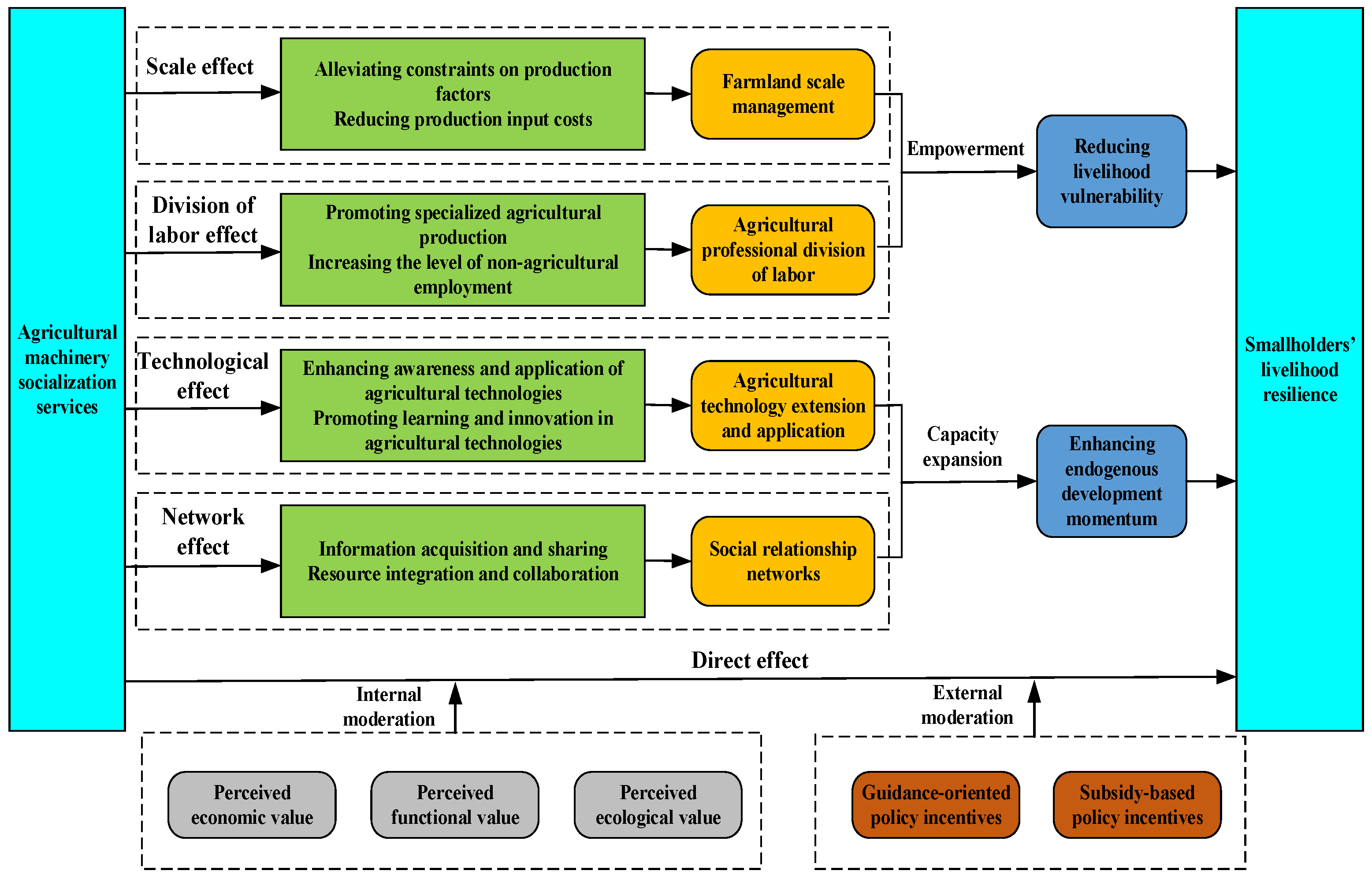
Livelihood resilience is the concrete manifestation of resilience in the context of livelihoods. It emphasizes both passive adaptive capacity—mitigating livelihood vulnerability and reflecting farmers’ buffering capabilities—and active resistance capacity—enhancing endogenous developmental momentum and reflecting farmers’ self-organization and learning capacities [26,27]. Thus, the transmission mechanism by which agricultural machinery socialization services influence smallholders’ livelihood resilience is mainly evident in two aspects: reducing vulnerability and enhancing endogenous momentum. On one hand, constraints such as weak capital endowments, low organizational capacity, and severe aging contribute to heightened livelihood vulnerabilities among smallholder farmers. Through scale effects and division-of-labor effects, agricultural machinery socialization services promote farmland scale management and agricultural professional division of labor, thereby reducing livelihood vulnerability among smallholder farmers. On the other hand, constraints such as information isolation, difficulties in technology adoption, and weak social capital hinder smallholders’ endogenous development momentum. Through technological and network effects, agricultural machinery socialization services enhance the extension and application of agricultural technologies and expand social networks, thereby strengthening endogenous development capacity among smallholder farmers. Based on this analysis, this paper clarifies the transmission mechanism through which agricultural machinery socialization services influence smallholders’ livelihood resilience across four dimensions: farmland scale management, agricultural professional division of labor, agricultural technology extension and application, and social relationship networks.
  • Scale effects. The influence of agricultural machinery socialization services on smallholders’ livelihood resilience through scale effects is primarily reflected in the alleviation of production factor constraints and the reduction in input costs. By reshaping smallholder farmers’ input structures and management practices, these services facilitate the expansion of farm operation scales [28]. However, constrained by limited resource endowments, smallholder farmers often find it difficult to overcome the production bottlenecks associated with scale enlargement [29]. On the one hand, service organizations leverage their comparative advantages in technology, capital, and machinery to effectively relax the factor constraints faced by smallholder farmers during scale expansion, thereby reducing livelihood vulnerability. On the other hand, in line with economies of scale theory, farmland scale is systematically associated with production costs [30]. Scale expansion enables smallholder farmers to achieve economies of scale, lower input costs, improve resource endowments, enhance resilience to various risks, and ultimately mitigate livelihood vulnerability.
  • Division of labor effects. Agricultural professional division of labor. The impact of agricultural machinery socialization services on smallholders’ livelihood resilience through division-of-labor effects manifests primarily in two aspects: promoting specialized agricultural production and enhancing non-agricultural employment levels. According to the theory of division of labor and specialization, a rational social division of labor generates clear advantages in specialization and economies of scale, with improvements in division efficiency depending on the effective exploitation of comparative advantages [31]. In essence, agricultural machinery socialization services constitute a socialized re-division of agricultural production, enabling an “optimized combination” of different comparative advantages and labor units [32]. Through specialized divisions of labor and services, smallholder farmers are encouraged to concentrate on production segments in which they hold comparative advantages while outsourcing non-advantageous segments to professional service organizations. This promotes specialized agricultural production, improves production efficiency, and reduces livelihood vulnerability. At the same time, by relieving smallholder farmers from heavy and labor-intensive tasks, these services free up surplus labor, thereby increasing non-agricultural employment opportunities, boosting non-agricultural income, and strengthening smallholders’ resilience to risk.
  • Technical effects. Agricultural technology extension and application. The impact of agricultural machinery socialization services on the livelihood resilience of smallholder farmers through technological effects is primarily manifested in two aspects: enhancing the level of awareness and application of agricultural technologies and promoting the learning and innovation of agricultural technologies. Based on the theory of induced technological change, the adoption and dissemination of technology depend not only on its economic viability but are also constrained by its accessibility. Constrained by the inherent disadvantages of smallholder farming, smallholder farmers commonly face issues such as insufficient knowledge and high adoption costs, which constitute significant bottlenecks in agricultural technology dissemination [33]. Agricultural machinery socialization services exert a “bridging effect” and “demonstration effect” [34]. Through service outsourcing, they transmit mechanized operations, pest and disease control techniques, and other technologies to smallholders’ production activities. This resolves the high-risk, high-cost, and high-barrier challenges faced by individual farmers, thereby enhancing their understanding and application of agricultural technologies [35]. The learning effects and technological spillovers generated by socialization services enhance smallholder farmers’ capacities for learning and innovation, thereby strengthening their endogenous motivation.
  • Network effects. Social relationship networks. The impact of agricultural machinery socialization services on the livelihood resilience of smallholder farmers through network effects is primarily manifested in two aspects: information acquisition and sharing, and resource integration and cooperation. Agricultural machinery socialization services are not merely a form of productive “outsourcing,” but also a process that embeds smallholder farmers within new social networks composed of service organizations, machinery operators, and other farmers. Through such services, smallholder farmers transition from village communities into more open market-based social networks, fostering the formation and strengthening of both “kinship networks” and “professional networks” [36]. The expansion and reinforcement of these social networks deepen social ties and mutual trust among smallholder farmers, broaden channels for information access and knowledge exchange, promote cooperation and resource sharing among stakeholders, enhance smallholder farmers’ self-organizing capacity and learning and innovation abilities, and ultimately strengthen their endogenous development momentum.

2.3. Moderating Mechanisms from Dual Internal and External Perspectives

The impact of agricultural machinery socialization services on the livelihood resilience of smallholder farmers involves numerous behavioral decisions made by farmers, which exert significant influence throughout the process. According to social cognitive theory, farmers’ behavioral choices are jointly shaped by internal and external factors [37]. Among the internal factors, farmers’ perceived value plays a critical role in guiding their decisions. At the same time, these choices are influenced by the external policy environment. Therefore, this study adopts a dual perspective, examining both internal and external dimensions to investigate the moderating effects of farmers’ perceived value and policy incentives.
From the perspective of perceived internal service value, such value reflects the trade-off between perceived benefits and perceived costs. When perceived benefits outweigh perceived costs, farmers are more likely to form positive behavioral attitudes, thereby facilitating service adoption [38]. In this study, perceived service value is conceptualized across three dimensions: economic, functional, and ecological. When smallholder farmers perceive that adopting services expands their benefits while reducing costs—thus generating economic gains; improves their quality of life—thus yielding functional benefits; or enhances soil quality and resource-use efficiency—thus producing ecological benefits, they are more inclined to proactively adopt agricultural machinery socialization services, thereby strengthening their effects on smallholders’ livelihood resilience. From the perspective of external policy incentives, guidance-oriented policy interventions further amplify the positive impacts of socialization services through policy promotion, technical training, and organizational participation. In particular, the moderating role of subsidy-based policy incentives is mainly reflected in the provision of direct financial and insurance support, which alleviates smallholder farmers’ service adoption costs across different stages, reduces adoption risks, and ultimately enhances the positive effect of agricultural machinery socialization services on livelihood resilience.
In summary, this analysis develops a theoretical framework to examine the impact of agricultural machinery socialization services on the livelihood resilience of smallholder farmers. See Figure 1 for details.

3. Materials and Methods

3.1. Study Area and Data Sources

The data used in this study were obtained from a field survey conducted by the research team between September and November 2025 in the main corn-producing areas of Northeast China, targeting maize-growing households in Heilongjiang and Jilin provinces. Specific details are as follows: First is survey area definition. These two provinces are located in the core production zone of the Northeast corn region, and their corn planting area and output have consistently ranked among the top two nationwide. They also lead the country in terms of agricultural mechanization levels and the development of socialization services. Therefore, selecting Jilin and Heilongjiang provinces within the Northeast corn-producing region as the study area holds significant representative value. Second is the definition of “smallholder farmers” as research subjects. As China does not yet have an official definition of “smallholder farmers,” this study draws on the Third National Agricultural Census, which classifies large-scale farming households as those cultivating 100 mu or more of open-field crops in single-cropping regions, or 50 mu or more in double-cropping regions. Northeast China is a typical single-cropping region characterized by vast land areas, sparse populations, and abundant land resources. Moreover, the concept of smallholder farmers is not determined solely by cultivated area but is also closely related to production methods and market access capacity [39]. Existing research indicates that households in Northeast China cultivating less than 100 mu predominantly rely on traditional family-based production and have relatively weak market access. Accordingly, this study defines smallholder farmers in Northeast China as micro-level agricultural entities managing 100 mu or less of cultivated land. It should be noted that the definition of smallholder farmers adopted in this study is highly context-specific and mainly reflects the agrarian structure and institutional background of Northeast China, which is characterized by single-cropping systems, abundant land resources, and a high level of agricultural mechanization. Accordingly, using 100 mu as the threshold for defining smallholder farmers may differ in other regions of China or in other countries where cropping systems, land-use patterns, and agrarian structures vary substantially. On this basis, the findings of this study are particularly representative for regions with similar agricultural structures, while their application to other contexts requires careful consideration of local conditions and offers important comparative reference value. Selection of survey regions and sample. First, based on the economic development level and landform characteristics of counties (cities), a combination of stratified and random sampling was employed to select six counties (cities) in Jilin Province and six in Heilongjiang Province as the survey regions. Second, within each selected county, two townships with varying levels of economic development were randomly chosen. Third, within each selected township, two administrative villages with different geographic locations were randomly selected. Finally, in each selected village, 10–15 maize-growing households were randomly chosen for one-on-one interviews. In total, 591 households were surveyed. After excluding invalid questionnaires, 579 valid responses were retained, yielding a response rate of 97.9%. Following the further exclusion of large-scale farmers cultivating more than 100 mu, a final sample of 532 smallholder farmers was used for analysis.

3.2. Variable Selection and Measurement

  • Dependent variable. Smallholders’ livelihood resilience primarily refers to the capacity of smallholder farmers to respond to diverse internal and external pressures and shocks, as well as their ability to recover from and adapt to adverse impacts. It encompasses both the short-term capacity to absorb and respond to shocks and the medium- to long-term capacity to achieve recovery and transformational development through resource reallocation and structural adjustment. Grounded in the capability concept, this study draws on Speranza’s analytical framework and related literature [40] and constructs a multidimensional measurement system based on three dimensions: buffering capacity, self-organizing capacity, and learning capacity. These dimensions respectively capture smallholder farmers’ abilities to be stable, restorative, and regenerative in the face of pressures and disturbances. Different from existing studies that primarily focus on depicting the level or state of livelihood resilience, this study conceptualizes livelihood resilience as a dynamic set of capabilities that can be influenced by external services and institutional arrangements, with a particular emphasis on its formation mechanisms and pathways for enhancement. The specific indicator system is presented in Table 1. Meanwhile, in the quantitative assessment, the entropy weight method is adopted to determine the weights of indicators across different dimensions in order to minimize the influence of subjective factors. The composite livelihood resilience index is constructed by standardizing the indicators and aggregating them through weighted summation. The entropy weight method objectively determines indicator weights based on the information entropy (i.e., distributional variation) of each indicator within the sample, thereby effectively reducing bias arising from subjective judgment and assigning greater weights to indicators with higher information content, and the calculation procedure is described as follows.
First, the data are standardized, and then the indicator proportion, pij, is calculated.
p i j = x i j j = 1 m x i j
In the equation, Xij’ denotes the standardized data. The information entropy of each indicator, ej, is then calculated.
e i = 1 ln m j = 1 m p i j × ln p i j
Subsequently, the redundancy of each information indicator, di, is calculated.
d i = 1 e i
Finally, the weights of each indicator, wj, are calculated.
w i = d i i = 1 n w i x i j
The overall level of smallholders’ livelihood resilience, denoted as yij, is thus calculated.
y i j = i = 1 n w i x i j
B.
Core explanatory variables. In this study, agricultural machinery socialization services are defined as mechanized operational services provided for conventional maize production, encompassing four key stages: land preparation, sowing, crop protection (including fertilization, weed control, and pest management), and harvesting. Among these, “socialization” primarily underscores the external and specialized nature of service providers. Specifically, relevant operations are delivered to farmers through market transactions by socialized entities—such as cooperatives, professional service organizations, agricultural enterprises, or individual farm machinery operators—rather than being undertaken by farmers using their own machinery. Although certain services may receive government policy support or subsidies in practice, their fundamental nature remains that of market-based service procurement. In Northeast China, agricultural production has largely achieved a high level of mechanization, with more than 90% of smallholder farmers completing production operations through the purchase of partial or full-process socialized services. Only a small proportion of smallholder farmers, constrained by terrain conditions or equipped with their own machinery, do not rely on such services. Thus, measuring solely by whether services are adopted is insufficient to reflect the extent to which smallholder farmers have embraced socialization services. Accordingly, this study employs two indicators—service breadth and service depth—to assess the degree of service utilization [41]. Service breadth reflects the horizontal scope of services adopted and is measured by the number of mechanized service stages utilized, while service depth captures the vertical intensity of service adoption. Given regional differences in service prices, using total service expenditure may introduce bias; therefore, service depth is measured as the ratio of per-mu expenditure on mechanized services to total agricultural input investment.
C.
Intermediary variables. Based on the preceding theoretical analysis, this study selects four intermediary variables. First is farmland scale management, measured by the net inflow of cultivated land area. Second is agricultural professional division of labor, measured using the entropy method across two dimensions: per capita household labor income and the proportion of non-agricultural income [42]. The former is calculated as the ratio of total household income to the number of laborers, while the latter refers to the share of non-agricultural income in the total household income. Third is agricultural technology application and agricultural technology extension, which are measured using the entropy method [43]. The former is assessed by whether drones are employed for fertilizer applications and pesticide spraying, while the latter is captured by whether drone technology is recommended to friends and relatives. Fourth, social relationship networks are measured using the entropy method across two dimensions: kinship networks and professional networks [44]. Kinship networks denote tightly knit ties formed through blood relations and geographic proximity, whereas professional networks refer to looser ties established through occupational, industry-related, or similar connections. Kinship networks are assessed using three items—“relatives or friends who offer advice when making important decisions,” “relatives or friends who help resolve difficulties when problems arise,” and “relatives or friends with whom one shares personal matters in daily life”—rated on a five-point Likert scale ranging from 1 (“strongly disagree”) to 5 (“strongly agree”). Professional networks are measured by the number of close friends formed through production, business operations, and commercial interactions.
D.
Moderating variables. First, service perceived value primarily refers to smallholder farmers’ perceptions of the economic, functional, and ecological value of agricultural machinery socialization services. Perceived economic value is measured by the extent to which smallholder farmers agree that agricultural machinery socialization services contribute to increased income and reduced costs. Perceived functional value is measured by the extent to which smallholder farmers agree that these services contribute to improved quality of life and enhanced living standards. Perceived ecological value is measured by the extent to which smallholder farmers agree that these services contribute to improved soil quality and the protection of the ecological environment. All items are assessed using a five-point Likert scale, ranging from 1 (“strongly disagree”) to 5 (“strongly agree”). Second, policy incentives are categorized into two dimensions: guidance-oriented policy incentives and subsidy-based policy incentives. Guidance-oriented policy incentives are measured by the intensity of government guidance, publicity, and technical training, while subsidy-based policy incentives are measured by the intensity of government agricultural subsidies and financial insurance support. All items are assessed using a five-point Likert scale, ranging from 1 (“very weak”) to 5 (“very strong”).
E.
Control variables. To account for additional factors that may influence smallholders’ livelihood resilience, this study incorporates a set of control variables across three dimensions. First, individual characteristics include gender, age, health status, marital status, and village position. Second, family characteristics encompass farmland titling, farmland quality, agricultural insurance, crop structure, natural disasters, and family maintenance burdens. Third, village characteristics include village topography, village transportation, village location, and village economic level. In addition, regional dummy variables are introduced to control for regional heterogeneity effects. Detailed variable definitions and descriptive statistical results are presented in Table 2.

3.3. Research Methodology

  • Baseline regression model. To examine the impact of agricultural machinery socialization services on smallholders’ livelihood resilience, this study constructs the following baseline regression model:
F L R i = β 0 + β 1 A M S i + β 2 C i + ε i
In this model, FLRi denotes the dependent variable, representing the level of smallholders’ livelihood resilience; AMSi is the core explanatory variable, indicating smallholder farmers’ adoption of agricultural machinery socialization services, measured along two dimensions, service breadth and service depth; Ci represents a set of control variables at the individual, household, village, and regional levels; β0 is the intercept term; β1 and β2 denote the coefficients to be estimated; and εi is the random error term.
B.
Intermediary effect model. Based on the theoretical analysis above, this study employs an intermediary effect model to examine the transmission mechanism through which agricultural machinery socialization services influence smallholders’ livelihood resilience. The model is specified as follows:
M i = α 0 + α 1 A M S i + α 2 C i + ε 1
F L R i = φ 0 + φ 1 A M S i + φ 2 M i + φ 3 C i + ε 2
In Equation (7), Mi denotes the intermediary variables, which in this study include farmland scale management, agricultural professional division of labor, agricultural technology extension and application, and social relationship networks; α0 and φ0 represent the intercept terms; α1, α2, φ1, φ2, and φ3 are the coefficients to be estimated; and ε1 and ε2 are the disturbance terms. Equation (7) examines the impact of agricultural machinery socialization services on the intermediary variables, while Equation (8) simultaneously estimates the effects of both agricultural machinery socialization services and the intermediary variables on smallholders’ livelihood resilience.
C.
Moderation effect model. This study further employs a moderation effect model to examine the moderating roles of smallholder farmers’ perceived value and external policy incentives in the relationship between agricultural machinery socialization services and smallholders’ livelihood resilience. The model is specified as follows:
F L R i = λ 0 + λ 1 A M S i + λ 2 S P V i + λ 3 A M S i × S P V i + λ 4 C i + ε 1
F L R i = δ 0 + δ 1 A M S i + δ 2 E P I i + δ 3 A M S i × E P I i + δ 4 C i + ε 2
In Equations (9) and (10), SPVi denotes perceived service value, and EPIi represents external policy incentives; AMSi × SPVi and AMSi × EPIi are the interaction terms between agricultural machinery socialization services and perceived service value, and between agricultural machinery socialization services and policy incentives, respectively. λ0 and δ0 are the intercept terms; λ1 through λ4 and δ1 through δ4 denote the coefficients to be estimated; and ε1 and ε2 are the disturbance terms. Equation (9) tests the moderating effect of internal perceived value, while Equation (10) examines the moderating effect of external policy incentives.

4. Results

4.1. Analysis of the Impact of Agricultural Machinery Socialization Services on Smallholders’ Livelihood Resilience

4.1.1. Baseline Regression Analysis

To avoid estimation bias caused by multicollinearity, this study employed the variance inflation factor (VIF) to test for collinearity among the variables. The results show that the VIF values for all explanatory variables range from 1.034 to 1.506, indicating no serious multicollinearity and confirming the appropriateness of the variable selection. Table 3 reports the baseline regression results. Regression models (1) and (3) indicate that, without the inclusion of any additional variables, both service breadth and service depth are significant at the 1% level. Regression models (2) and (4) further show that, after controlling for regional dummy variables and control variables, both service breadth and service depth remain significant at the 1% level. These findings demonstrate that agricultural machinery socialization services significantly enhance the livelihood resilience of smallholder farmers. This may be attributed to the fact that such services essentially deepen the division of labor and reallocate production resources by providing smallholder farmers with “shared modern means of production,” thereby overcoming persistent resource constraints and offering more efficient, stable, and sustainable production support, which ultimately strengthens livelihood resilience. This outcome is also consistent with the state’s policy objectives and practical efforts to establish an agricultural socialization service system oriented toward smallholder farmers and to promote their organic integration into modern agriculture.

4.1.2. Robustness Checks

To ensure the robustness of the empirical findings, several robustness checks were performed. The detailed results are presented in Table 4. First, the dependent variable was remeasured using the coefficient of variation method to address potential measurement bias in the livelihood resilience index. Second, the dependent variable was logarithmically transformed to reduce the influence of extreme values on the estimated relationships. Third, given that livelihood resilience is bounded between 0 and 1, the model was re-estimated using a Tobit specification. Fourth, a 1% tail trimming was applied to the relevant variables to further mitigate the impact of outliers. The results show that, across all four alternative specifications, both the breadth and depth of agricultural machinery socialization services remain significantly and positively associated with smallholders’ livelihood resilience at the 1% level, thereby confirming the robustness of the regression results.

4.1.3. Endogeneity Discussion

To address potential endogeneity arising from omitted variables or reverse causality, and following existing studies [45], this study uses the average number of agricultural machinery socialization service segments adopted by other farming households within the same village as an instrumental variable. Based on neighborhood effects, a household’s adoption of such services is influenced by the behavioral choices of surrounding households, whereas the service adoption decisions of other households do not directly affect the household’s livelihood resilience. Accordingly, the instrumental variable is correlated with the core explanatory variable but uncorrelated with the dependent variable, satisfying the relevance and exogeneity conditions. A two-stage least squares (2SLS) model is employed to test for endogeneity. The detailed results are presented in Table 5. The first-stage results indicate that the instrumental variable strongly explains the endogenous regressor, while the second-stage estimates show that both the breadth and depth of agricultural machinery socialization services remain statistically significant. Moreover, both the Cragg–Donald Wald F statistic and the Kleibergen–Paap Wald F statistic exceed the critical value of 16.38, indicating no weak instrument problem. The Kleibergen–Paap rk LM statistic rejects the null hypothesis at the 1% significance level, further supporting the validity of the instrumental variable. Overall, after correcting for potential endogeneity bias, agricultural machinery socialization services continue to have a significant positive effect on smallholders’ livelihood resilience.
Smallholders’ participation in agricultural machinery socialization services may be the result of sample self-selection, potentially leading to sample selection bias in the model estimation. To address this issue, this study employs the propensity score matching (PSM) approach. A binary treatment variable is constructed based on smallholders’ decisions to participate in agricultural machinery socialization services, and the sample is accordingly divided into a treatment group and a control group, based on which the average treatment effect on the treated (ATT) is estimated. Table 6 reports the PSM estimation results under three different matching methods. The results indicate that the estimated ATT is positive and statistically significant at the 1% level across all matching methods, suggesting that after correcting for potential self-selection bias, agricultural machinery socialization services continue to significantly enhance smallholders’ livelihood resilience. Moreover, the ATT estimates obtained from the three matching methods are relatively close in magnitude, indicating a high degree of consistency and confirming the robustness of the results.

4.2. Analysis of the Transmission Mechanisms of the Impact of Agricultural Machinery Socialization Services on Smallholders’ Livelihood Resilience

4.2.1. Transmission Mechanism Test

This paper first examines the empowerment mechanisms through which agricultural machinery socialization services impact smallholders’ livelihood resilience via scale effects and division of labor effects. The detailed results are presented in Table 7. Results from Regressions 1 and 3 indicate that service breadth significantly influences both farmland scale management and agricultural professional division of labor at the 1% significance level; results from Regressions 2 and 4 reveal that both farmland scale management and agricultural professional division of labor significantly affect smallholders’ livelihood resilience at the 1% significance level. Compared to Regressions 1 and 3, the regression coefficients for service breadth decreased from 0.075 and 0.026 to 0.012 and 0.008, respectively, indicating the presence of partial intermediary effects. Regressions 5 and 7 indicate that service depth significantly influences both farmland scale management and agricultural professional division of labor at the 1% significance level; results from Regressions 6 and 8 indicate that both farmland scale management and agricultural professional division of labor significantly affect smallholders’ resilience at the 1% significance level. Compared to Regressions 5 and 7, the regression coefficients for service depth decreased from 1.159 and 0.275 to 0.115 and 0.090, respectively, suggesting partial intermediary effects. These findings demonstrate that agricultural machinery socialization services enhance smallholders’ livelihood resilience by promoting both the scale of farmland management and the agricultural professional division of labor. In terms of the relative contribution of the mediating effects, agricultural professional division of labor exerts a stronger mediating effect than farmland-scale management. Essentially, agricultural socialization services represent a process of deepened division of labor and resource reallocation through which professional specialization substantially enhances smallholders’ livelihood resilience.
This study further explores the capacity-expansion mechanisms through which agricultural machinery socialization services affect smallholders’ livelihood resilience via technological and network effects. The detailed results are presented in Table 8. Regressions 1 and 3 indicate that service breadth significantly enhances both the extension and application of agricultural technologies and the development of social networks at the 1% and 5% significance levels, respectively. Regressions 2 and 4 show that agricultural technology extension and application, as well as social networks, significantly improve smallholders’ livelihood resilience at the 1% significance level. Compared with Regressions 1 and 3, the coefficients for service breadth decline from 0.072 and 0.009 to 0.012 and 0.011, respectively, indicating the presence of partial mediation effects. Regressions 5 and 7 further reveal that service depth has a significant positive effect on agricultural technology extension and application and on social networks at the 1% significance level, while Regressions 6 and 8 demonstrate that these factors significantly enhance smallholders’ livelihood resilience. Relative to Regressions 5 and 7, the coefficients for service depth decrease from 0.494 and 0.144 to 0.152 and 0.098, respectively, again suggesting partial mediation effects. Overall, these findings indicate that agricultural machinery socialization services strengthen smallholders’ livelihood resilience by facilitating the diffusion and application of agricultural technologies and by reinforcing social networks. From the perspective of the relative contribution of mediating effects, social relationship networks exert a stronger mediating effect than agricultural technology extension and application. Rural China is widely characterized as an “acquaintance-based society,” in which interpersonal networks and social capital embedded in traditional culture play a crucial role in shaping smallholders’ livelihood resilience. Moreover, compared with capacity-expansion mechanisms, empowerment mechanisms are currently more pronounced. At present, smallholder farmers face rigid constraints in capital endowments, making the empowering effects of agricultural socialization services more salient. However, as the agricultural socialization service system continues to mature and improve, the capacity-expansion effects of these services are expected to become increasingly evident.

4.2.2. Robustness Checks

To further verify the mediating effects of the relevant variables, nonparametric percentile bootstrap confidence interval tests were conducted using the SPSS PROCESS macro (v4.1). Mediation was determined based on whether the 95% confidence interval excluded the value zero. As shown in Table 9, for the pathway in which the breadth of agricultural machinery socialization services affects smallholders’ livelihood resilience, the confidence intervals for farmland scale management, agricultural professional division of labor, agricultural technology extension and application, and social relationship networks are [0.001, 0.008], [0.003, 0.014], [0.002, 0.007], and [0.001, 0.011], respectively. For the pathway in which service depth affects smallholders’ livelihood resilience, the corresponding confidence intervals are [0.029, 0.110], [0.025, 0.164], [0.008, 0.057], and [0.022, 0.154], respectively, none of which include zero. These results indicate that both the breadth and depth of agricultural machinery socialization services exert significant mediating effects on smallholders’ livelihood resilience. Specifically, agricultural machinery socialization services enhance smallholders’ livelihood resilience through two main mechanisms: an empowerment mechanism via farmland scale management and agricultural professional division of labor, and a capacity expansion mechanism via agricultural technology extension and application and social relationship networks.

4.3. Analysis of the Moderating Mechanisms from Dual Internal and External Perspectives

This study first examines the moderating role of perceived service value within farming households. The detailed results are presented in Table 10. The results from Regressions 1 and 4 indicate that the interaction terms between service breadth, service depth, and perceived economic value are significant at the 1% level. Similarly, regressions 2 and 5 show that the interaction terms between service breadth, service depth, and perceived functional value also pass the 1% significance test. In contrast, the results from Models 3 and 6 reveal that the interaction terms between service breadth, service depth, and perceived ecological value are not statistically significant. These findings suggest that perceived economic value and perceived functional value exert significant positive moderating effects on the relationship between agricultural machinery socialization services and smallholders’ livelihood resilience, whereas the moderating effect of perceived ecological value is not evident. This reflects smallholders’ short-term orientation in livelihood decision-making, as well as their tendency to prioritize economic and functional factors over environmental considerations in their value hierarchy. Although socialization services may bring certain ecological improvements, such benefits are long-term and indirect and are less immediate and visible compared to economic and functional gains. In contexts characterized by income uncertainty and strong risk-averse preferences, smallholders are more inclined to prioritize the stabilization of current income and improvements in production efficiency rather than delayed environmental returns. Therefore, the moderating effect of perceived ecological value is not significant.
This study further examines the moderating role of external policy incentives. The detailed results are presented in Table 11. The results from Regressions 1 and 3 indicate that the interaction terms between service breadth, service depth, and guidance-oriented policy incentives are significant at the 1% level. Similarly, regressions 2 and 4 show that the interaction terms between service breadth, service depth, and subsidy-based policy incentives also pass the 1% significance test. These findings suggest that both guidance-oriented and subsidy-based policy incentives exert significant positive moderating effects on the relationship between agricultural machinery socialization services and smallholders’ livelihood resilience. Guidance-oriented and subsidy-based policy incentives can lower the institutional and financial barriers for farmers to participate in agricultural machinery socialization services, share the uncertainty risks associated with production investment and technology adoption, enhance the marginal returns to service utilization, and thereby amplify the positive impact of such services on livelihood resilience.

4.4. Heterogeneity Analysis

4.4.1. Heterogeneity in Livelihood Resilience Across Different Dimensions

The influence of agricultural machinery socialization services on livelihood resilience across different dimensions may exhibit internal variations. Based on this, this paper verifies the heterogeneous effects on livelihood resilience across different dimensions. The detailed results are presented in Table 12. Results from Regressions 1, 2, and 3 indicate that the influence of service breadth on smallholder farmers’ buffering and learning capacities passed significance tests at the 1% level, whereas its effect on self-organizing capacities passed at the 5% level. Results from Regressions 4, 5, and 6 indicate that the influence of service depth on smallholder farmers’ buffering and learning capacities passed significance tests at the 1% level, whereas its effect on self-organizing capacities passed at the 5% level. These findings indicate that agricultural machinery socialization services primarily improve smallholder farmers’ buffering and learning capacities, with a relatively minor impact on self-organizing capacity. This may arise from the services’ primary focus on technical support and mechanized operations within agricultural production processes. Such services predominantly operate on a “demand response” basis, catering more to individual farmers’ production needs while having a relatively minor influence on their proactive organizational behaviors.

4.4.2. Heterogeneity Across Different Landform Types

Landform conditions exert a substantial influence on agricultural production and may shape the effectiveness of agricultural machinery socialization services. Accordingly, this study classifies smallholder farmers into plain and hilly/mountainous regions to examine heterogeneity across different landform types. The detailed results are presented in Table 13. The results from Regressions 1 and 2 show that the effect of service breadth on livelihood resilience is significant at the 1% level for smallholder farmers in plains and at the 5% level for those in hilly/mountainous areas. Likewise, regressions 3 and 4 show that the effect of service depth on livelihood resilience is significant at the 1% level for smallholder farmers in plains and at the 10% level for farmers in hilly or mountainous areas. These findings suggest that, regardless of whether service breadth or depth is considered, agricultural machinery socialization services exert a more pronounced positive impact on livelihood resilience in plain areas than in hilly and mountainous regions. The differences between plains and hilly or mountainous areas are not confined to topographical conditions per se but are manifested in multidimensional disparities in transportation networks, land contiguity, machinery accessibility, and the spatial density of service organizations. Influenced by these structural differences, agricultural machinery socialization services in plain areas exhibit significantly higher operational efficiency and broader coverage than in hilly and mountainous regions, thereby shaping their differential effects on smallholders’ livelihood resilience.

5. Discussion

Enhancing the livelihood resilience of smallholder farmers has become a central issue in China’s “agriculture, rural areas, and farmers” agenda, and agricultural machinery socialization services are closely related to smallholders’ livelihood resilience. Existing studies have primarily focused on the economic and resource-environmental effects of such services, examining their impacts on production efficiency [46] and income inequality [47] from the perspectives of agricultural production and farmers’ income, or exploring their roles in farmland conservation, including land-use intensification [48] and fertilizer reduction [49]. However, few studies place agricultural machinery socialization services and smallholders’ livelihood resilience within a unified analytical framework to systematically investigate their intrinsic linkages. This study extends the analytical perspective to the dimension of smallholders’ livelihood resilience, emphasizing that agricultural machinery socialization services represent not merely an input of production resources but also a profound process of livelihood adjustment. Compared with the existing literature, this paper makes three main marginal contributions: first, it moves beyond a narrow focus on economic or environmental effects by broadening the analytical lens to the field of livelihood resilience; second, it constructs a theoretical framework of “agricultural machinery socialization services–smallholders’ livelihood resilience,” offering a novel perspective for understanding the livelihood welfare effects of such services; and third, it focuses on smallholder farmers in Northeast China—a group characterized by relatively weak livelihood resilience—thereby providing empirical evidence to inform the improvement of agricultural socialized service policies targeting smallholders.
The research findings indicate, first, that the agricultural machinery socialization services significantly enhance the livelihood resilience of smallholder farmers, which is consistent with the prevailing view that agricultural socialization services constitute a primary vehicle for empowering smallholders [50]. However, this enhancement is not a simple or direct effect; rather, it is realized through a series of complex transmission and disturbance processes. Second, this study confirms that agricultural machinery socialization services influence smallholders’ livelihood resilience mainly through two mechanisms: “empowerment” and “capacity expansion.” Through the empowerment mechanism, such services promote the scaling and specialization of smallholders’ production, thereby strengthening their ability to respond to and buffer against risk shocks and factor constraints. Through the synergistic “technology–society” capacity expansion mechanism, these services improve smallholders’ capacity to access and utilize information technologies and social support, enhance endogenous development momentum, and facilitate livelihood recovery and transformation. Moreover, the impact of agricultural machinery socialization services on smallholders’ livelihoods extends beyond mere mechanical substitution for manual labor; instead, it promotes the comprehensive enhancement of multiple forms of livelihood capital. This finding is in accordance with the logic of the sustainable livelihoods framework, which emphasizes the interactive and synergistic nature of different capital endowments [51]. Third, significant moderating effects of internal perceived value and external policy incentives are identified, underscoring the importance of establishing a virtuous cycle of “service quality improvement → positive farmer perception → targeted policy support” in the promotion of socialization services [52]. Finally, the observed heterogeneity in effects reveals critical areas for policy attention: agricultural machinery socialization services exert stronger impacts on smallholders’ buffering and learning capacities than on their self-organizing capacity, indicating that current services primarily address the practical needs of individual farmers, while their role in fostering collective cooperation remains insufficient. At the same time, the significantly greater effects observed in plains regions than in hilly and mountainous areas reflect the fundamental constraints imposed by natural geography on mechanized service adoption and the realization of scale economies. This serves as a reminder that the “scale-oriented” model of agricultural machinery socialization services may widen resilience gaps among smallholder farmer groups across different regions within an uneven geographical landscape.
Although the empirical findings indicate that agricultural machinery socialization services significantly enhance smallholders’ livelihood resilience, as a structural adjustment to traditional production practices, such services may also generate disturbances alongside their improvement effects. Smallholders with limited resource endowments and extremely small operational scales may face relatively high per-unit service costs due to the inability to realize economies of scale, thereby limiting their gains. In addition, for households reliant on agricultural labor income, mechanization may reduce labor-derived earnings. Moreover, in contexts where service markets are underdeveloped, competition is limited, or information asymmetries are pronounced, higher prices or unstable service quality may erode potential benefits. Therefore, while the overall evidence points to an “improvement” effect, potential “disturbance” effects under specific conditions should not be overlooked.
This study also has several limitations, which point to important directions for future research. First, livelihood resilience is inherently dynamic in nature, involving farmers’ continuous adaptation, recovery, and structural adjustment in response to various shocks. However, the empirical analysis in this study is based on cross-sectional data, which to some extent limits our ability to fully capture the evolution of smallholders’ livelihood resilience and its long-term adjustment processes. Future research could draw on panel data or longitudinal surveys to more systematically examine the long-term effects of agricultural machinery socialization services on smallholders’ livelihood resilience and its dynamic changes over time. Second, the study area is primarily concentrated in the major maize-producing region of Northeast China (Heilongjiang and Jilin provinces), where agricultural mechanization levels are relatively high and farmland is comparatively consolidated, thus providing a certain degree of regional representativeness. However, the applicability of our findings to other crop systems, regions with lower levels of mechanization, or areas characterized by mountainous terrain and highly fragmented landholdings may be limited. Future research could expand the geographical scope to incorporate more diverse agricultural production contexts, thereby further testing the robustness and external validity of the conclusions.

6. Conclusions

Based on micro-survey data from smallholder farmers in the main corn-producing areas of Northeast China, this study systematically examines the impact of agricultural machinery socialization services on smallholders’ livelihood resilience and explores the underlying mechanisms. The results indicate that agricultural machinery socialization services significantly enhance smallholders’ livelihood resilience, with their internal logic characterized by a dual “empowerment–capacity expansion” mechanism. On the one hand, by promoting farmland-scale management and the professional division of labor in agriculture, these services generate an empowerment mechanism characterized by factor reallocation and organizational restructuring. On the other hand, by facilitating the extension and application of agricultural technologies and the expansion of social networks, they form a capacity-expansion mechanism centered on capability enhancement. Meanwhile, smallholders’ internal perceived value of services and external policy incentives exert significant positive moderating effects on these relationships. Heterogeneity analysis further reveals that agricultural machinery socialization services have a more pronounced effect on smallholders’ buffering and learning capacities and that their policy effects are more prominent in plain areas. Theoretically, this study moves beyond the predominant analytical focus on economic or resource effects in the existing literature by incorporating agricultural machinery socialization services into a multidimensional livelihood resilience framework. It constructs a theoretical analytical framework to elucidate how agricultural machinery socialization services influence smallholders’ livelihood resilience, thereby extending the theoretical boundaries of research on agricultural machinery socialization services. The study provides a new analytical perspective on how such services are embedded within smallholder livelihood systems and offers theoretical support for promoting the organic integration of smallholders into modern agriculture.
Based on the research findings, the following policy implications are proposed: First, establish a tiered and categorized service delivery system to expand both the breadth and depth of services. Build a comprehensive service system covering the entire agricultural value chain while enhancing the availability and flexibility of different service models—such as single-stage outsourcing or full-process management—to meet the diverse and heterogeneous needs of smallholder farmers. Second, optimize land tenure arrangements and promote the development of specialized service organizations. Reduce transaction costs for land transfers to promote large-scale farming operations and overcome the constraints that fragmented land imposes on mechanized production. Provide performance-based subsidies to cooperatives, service companies, and cross-regional service providers calculated according to operational area to enhance their specialization and professional capacity. Third, strengthen technology diffusion and social network development. Promote the integration of service organizations with grassroots agricultural extension systems and establish a “service organization + extension staff + demonstration farmer” linkage mechanism to facilitate the dissemination of knowledge and agricultural technologies. Fourth, enhance the perceived value of services and strengthen external policy incentives. Establish a unified platform for fee disclosure and service quality evaluation and shift the focus of subsidies from equipment purchases to operational service support, thereby increasing the likelihood of service adoption. Fifth, concentrate on key regions and implement differentiated strategies. In plains areas, advance the development of regional agricultural machinery service alliances to enhance service efficiency. In hilly and mountainous areas, prioritize the research, development, and promotion of small and lightweight machinery, and explore integrated models that combine mechanization with specialty crop production to align with local agricultural development needs.

Author Contributions

Conceptualization, H.C.; methodology, H.C. and G.W.; software, H.C.; validation, H.C. and G.W.; formal analysis, H.C. and G.W.; investigation, H.C. and X.K.; data curation, H.C.; writing—original draft preparation, H.C.; writing—review and editing, H.C. and M.A.; visualization, S.Z.; supervision, X.K. and S.Z.; funding acquisition, G.W. All authors have read and agreed to the published version of the manuscript.

Funding

This research was funded by the National Social Science Fund of China (Grant number [20BJY041]) and the Jilin Provincial Department of Education Science and Technology Research Project (Grant number [JJKH20250608BS]).

Institutional Review Board Statement

Ethical review and approval were waived for this study because the participants completely voluntarily participated in the survey. The survey was conducted anonymously, and all the participants were fully informed of the reasons for conducting the survey and the use of the relevant data. All information is anonymized, and the farmers’ data is stored using only numbers. The collected data is only used for academic research purposes, and personal information is absolutely confidential. According to Article 32 of the Administrative Measures for Ethical Review of Life Science and Medical Research Involving Humans in China, studies utilizing human data or biospecimens—which do not cause harm to individuals, involve sensitive personal information or commercial interests, or employ anonymized data—may be exempt from ethical review (https://www.gov.cn/zhengce/zhengceku/2023-02/28/content_5743658.htm, accessed on 10 September 2025). Our study did not require further ethics committee approval as it involved no animal or human clinical trials and posed no ethical risks. This research falls into the category of “not causing harm to the human body, not involving sensitive personal information or commercial interests”.

Informed Consent Statement

Informed consent was obtained from all subjects involved in the study.

Data Availability Statement

The datasets used and/or analyzed during the current study are. available from the corresponding authors upon reasonable request.

Acknowledgments

The authors would like to thank all contributors to this study.

Conflicts of Interest

The authors declare no conflicts of interest.

References

  1. Barrett, C.B.; Ghezzi-Kopel, K.; Hoddinott, J.; Homami, N.; Tennant, E.; Upton, J.; Wu, T. A scoping review of the development resilience literature: Theory, methods and evidence. World Dev. 2021, 146, 105612. [Google Scholar] [CrossRef] [Scilit]
  2. Zhang, Y.; Zhao, W. Social capital’s role in mitigating economic vulnerability: Understanding the impact of income disparities on farmers’ livelihoods. World Dev. 2024, 177, 106515. [Google Scholar] [CrossRef] [Scilit]
  3. Speranza, C.I.; Wiesmann, U.; Rist, S. An indicator framework for assessing livelihood resilience in the context of social–ecological dynamics. Glob. Environ. Change 2014, 28, 109–119. [Google Scholar] [CrossRef] [Scilit]
  4. Zhong, Z.; Jiang, W.; Li, Y. Bridging the gap between smallholders and modern agriculture: Full insight into China’s agricultural cooperatives. J. Rural Stud. 2023, 101, 103037. [Google Scholar] [CrossRef] [Scilit]
  5. Xu, X.; Wang, L.; Sun, M.; Fu, C.; Bai, Y.; Li, C.; Zhang, L. Climate change vulnerability assessment for smallholder farmers in China: An extended framework. J. Environ. Manag. 2020, 276, 111315. [Google Scholar] [CrossRef] [Scilit]
  6. Chen, T.; Rizwan, M.; Abbas, A. Exploring the role of agricultural services in production efficiency in Chinese agriculture: A case of the socialized agricultural service system. Land 2022, 11, 347. [Google Scholar] [CrossRef] [Scilit]
  7. Yang, Q.; Jia, J.; Liu, J.; Xu, Q. How do agricultural machinery purchase subsidies affect comprehensive grain production capacity? Evidence from the perspective of agricultural machinery socialized services. Manag. World 2023, 39, 106–123. [Google Scholar]
  8. Ren, H.; Xian, Z.; Chen, J.; Zhang, W.; Kang, X. Impact of agricultural production trusteeship on the urban-rural income gap and its mechanism. Financ. Res. Lett. 2025, 81, 107543. [Google Scholar] [CrossRef] [Scilit]
  9. Mi, Q.; Li, X.; Gao, J. How to improve the welfare of smallholders through agricultural production outsourcing: Evidence from cotton farmers in Xinjiang, Northwest China. J. Clean. Prod. 2020, 256, 120636. [Google Scholar] [CrossRef] [Scilit]
  10. Qiu, H.; Feng, M.; Chi, Y.; Luo, M. Agricultural machinery socialization service adoption, risks, and relative poverty of farmers. Agriculture 2023, 13, 1787. [Google Scholar] [CrossRef] [Scilit]
  11. Qiu, T.; Shi, X.; He, Q.; Luo, B. The paradox of developing agricultural mechanization services in China: Supporting or kicking out smallholder farmers? China Econ. Rev. 2021, 69, 101680. [Google Scholar] [CrossRef] [Scilit]
  12. Zou, B.; Mishra, A.K. Modernizing smallholder agriculture and achieving food security: An exploration in machinery services and labor reallocation in China. Appl. Econ. Perspect. Policy 2024, 46, 1662–1691. [Google Scholar] [CrossRef] [Scilit]
  13. Zhang, H.; Bai, X.; Zhao, M. How Socialized Services Affect Agricultural Economic Resilience—Empirical Evidence from China. Agriculture 2024, 14, 1773. [Google Scholar] [CrossRef] [Scilit]
  14. Cai, B.; Shi, F.; Meseretchanie, A.; Betelhemabraham, G.; Zeng, R. Agricultural socialized services empowering smallholder rice producers to achieve high technical efficiency: Empirical evidence from southern China. Front. Sustain. Food Syst. 2024, 8, 1329872. [Google Scholar] [CrossRef] [Scilit]
  15. Huan, M.; Li, Y.; Chi, L.; Zhan, S. The effects of agricultural socialized services on sustainable agricultural practice adoption among smallholder farmers in China. Agronomy 2022, 12, 2198. [Google Scholar] [CrossRef] [Scilit]
  16. Xue, P.; Han, X.; Wang, Y.; Wang, X. Can agricultural machinery harvesting services reduce cropland abandonment? Evidence from rural China. Agriculture 2022, 12, 901. [Google Scholar] [CrossRef] [Scilit]
  17. Ren, Z. Effects of risk perception and agricultural socialized services on farmers’ organic fertilizer application behavior: Evidence from Shandong Province, China. Front. Public Health 2023, 11, 1056678. [Google Scholar] [CrossRef] [Scilit]
  18. Wang, T.; Liu, L.; Huang, S. Study on the influence of policy guidance and Market-Driven factors on farmers’ behavior regarding black soil protection. Land 2024, 13, 1082. [Google Scholar] [CrossRef] [Scilit]
  19. Zhang, L.; Li, Y. Do agricultural socialized services improve farmers’ economic well-being? J. Jiangxi Univ. Financ. Econ. 2025, 1, 74–85. [Google Scholar]
  20. Fan, Y.; Cong, S. Do fiscal transfer payments drive or constrain farmers’ livelihood resilience? China Rural Econ. 2024, 1, 125–148. [Google Scholar]
  21. Lu, H.; Zheng, J.; Ou, H.; Liu, Y.; Li, X. Impact of natural disaster shocks on farm household poverty vulnerability—A threshold effect based on livelihood resilience. Front. Ecol. Evol. 2022, 10, 860745. [Google Scholar] [CrossRef] [Scilit]
  22. Ma, L.; Zhang, Y.; Li, T.; Zhao, S.; Yi, J. Livelihood capitals and livelihood resilience: Understanding the linkages in China’s government-led poverty alleviation resettlement. Habitat Int. 2024, 147, 103057. [Google Scholar] [CrossRef] [Scilit]
  23. Cheng, C.; Gao, Q.; Qiu, Y. Assessing the ability of agricultural socialized services to promote the protection of cultivated land among farmers. Land 2022, 11, 1338. [Google Scholar] [CrossRef] [Scilit]
  24. Fang, D.; Chen, J.; Wang, S.; Chen, B. Can agricultural mechanization enhance the climate resilience of food production? Evidence from China. Appl. Energy 2024, 373, 123928. [Google Scholar] [CrossRef] [Scilit]
  25. Zhang, X.; Yang, J.; Thomas, R. Mechanization outsourcing clusters and division of labor in Chinese agriculture. China Econ. Rev. 2017, 43, 184–195. [Google Scholar] [CrossRef] [Scilit]
  26. Yi, F. Digital skills, livelihood resilience and sustainable poverty reduction: Evidence from rural China. J. South China Agric. Univ. (Soc. Sci. Ed.) 2021, 20, 1–13. [Google Scholar]
  27. Liu, Q.; Lü, J. How does agricultural production outsourcing affect farmers’ livelihood resilience? Evidence from the perspective of roundabout production investment. World Agric. 2025, 12, 116–127. [Google Scholar]
  28. Qian, L.; Lu, H.; Gao, Q.; Lu, H. Household-owned farm machinery vs. outsourced machinery services: The impact of agricultural mechanization on the land leasing behavior of relatively large-scale farmers in China. Land Use Policy 2022, 115, 106008. [Google Scholar] [CrossRef] [Scilit]
  29. Liu, X.; Wang, X.; Xu, Z. The polarization and constraints of scale farming in China under the impact of rising wages. J. Asian Econ. 2023, 86, 101619. [Google Scholar] [CrossRef] [Scilit]
  30. Zhang, X.; Yu, X.; Tian, X.; Geng, X.; Zhou, Y. Farm size, inefficiency, and rice production cost in China. J. Product. Anal. 2019, 52, 57–68. [Google Scholar] [CrossRef] [Scilit]
  31. Costinot, A. On the origins of comparative advantage. J. Int. Econ. 2009, 77, 255–264. [Google Scholar] [CrossRef] [Scilit]
  32. Zang, L.; Wang, Y.; Ke, J.; Su, Y. What drives smallholders to utilize socialized agricultural services for farmland scale management? Insights from the perspective of collective action. Land 2022, 11, 930. [Google Scholar] [CrossRef] [Scilit]
  33. Kendall, H.; Clark, B.; Li, W.; Jin, S.; Jones, G.D.; Chen, J.; Frewer, L.J. Precision agriculture technology adoption: A qualitative study of small-scale commercial “family farms” located in the North China Plain. Precis. Agric. 2022, 23, 319–351. [Google Scholar] [CrossRef] [Scilit]
  34. Xu, B.; Baležentis, T.; Štreimikienė, D.; Shen, Z. Enhancing agricultural environmental performance: Exploring the interplay of agricultural productive services, resource allocation, and marketization factors. J. Clean. Prod. 2024, 439, 140843. [Google Scholar] [CrossRef] [Scilit]
  35. Qing, C.; Zhou, W.; Song, J.; Deng, X.; Xu, D. Impact of outsourced machinery services on farmers’ green production behavior: Evidence from Chinese rice farmers. J. Environ. Manag. 2023, 327, 116843. [Google Scholar] [CrossRef] [Scilit] [PubMed]
  36. Liao, Q.; Wang, X.; Yang, R. Complements or substitutes? The impact of social interactions and Internet use on farmers’ green production technology adoption behavior. J. Clean. Prod. 2025, 518, 145964. [Google Scholar] [CrossRef] [Scilit]
  37. Zou, Z.; Jin, J.; Yang, J.; Liu, D.; Zhang, X. How do farmers’ cognition and social networks affect the adoption behavior of straw-returning technology? Evidence from the black soil region of Northeast China. Technol. Forecast. Soc. Change 2025, 219, 124282. [Google Scholar] [CrossRef] [Scilit]
  38. Gao, R.; Liu, G.; Fan, Y.; Wang, X.; Ren, Z. The effect of perceived value on farmers’ livestock manure resource utilization behavior: Evidence from Shandong, China. Front. Psychol. 2023, 14, 1098587. [Google Scholar] [CrossRef] [Scilit]
  39. Ye, J.; Zhang, M. The debate between “smallholders” and “small peasants”: Productivity revitalization of “smallholders” and production-relations revitalization of “small peasants”. J. Nanjing Agric. Univ. (Soc. Sci. Ed.) 2019, 19, 163. [Google Scholar]
  40. Liu, W.; Li, J.; Ren, L.; Xu, J.; Li, C.; Li, S. Exploring livelihood resilience and its impact on livelihood strategy in rural China. Soc. Indic. Res. 2020, 150, 977–998. [Google Scholar] [CrossRef] [Scilit]
  41. Lu, Q.; Du, X.; Qiu, H. Adoption patterns and productivity impacts of agricultural mechanization services. Agric. Econ. 2022, 53, 826–845. [Google Scholar] [CrossRef] [Scilit]
  42. Yang, D.; Liu, Z. Does farmer economic organization and agricultural specialization improve rural income? Evidence from China. Econ. Model. 2012, 29, 990–993. [Google Scholar] [CrossRef] [Scilit]
  43. Yang, S.; Zhang, F. The impact of agricultural machinery socialization services on the scale of land operation: Evidence from rural China. Agriculture 2023, 13, 1594. [Google Scholar] [CrossRef] [Scilit]
  44. Sun, H.; Hartarska, V.; Zhang, L.; Nadolnyak, D. The influence of social capital on farm household’s borrowing behavior in Rural China. Sustainability 2018, 10, 4361. [Google Scholar] [CrossRef] [Scilit]
  45. Lu, H.; Zhou, Y.; Zhang, P.; Geng, X. The impact of agricultural socialized services on cropland abandonment: Empirical evidence from the China Family Panel Studies. China Land Sci. 2022, 36, 69–78. [Google Scholar]
  46. Xue, X.; Han, Y.; Gao, Y. The impact of agricultural machinery socialization services on technical efficiency in grain production: Evidence from wheat and maize farmers in four provinces. Rural Econ. 2024, 1, 10–19. [Google Scholar]
  47. Li, Y.; Su, B. Do agricultural machinery socialization services alleviate intra-rural income inequality? J. Huazhong Agric. Univ. (Soc. Sci. Ed.) 2024, 1, 111–121. [Google Scholar]
  48. Zhou, Y.; He, L.; Ke, X.; Zhang, E.; Zhu, J.; Lin, A. Impact of agricultural machinery purchase subsidies on the sustainable and intensive utilization of cultivated land: A perspective on agricultural machinery socialization services. J. Rural Stud. 2025, 119, 103798. [Google Scholar] [CrossRef] [Scilit]
  49. Li, Y.; Huan, M.; Jiao, X.; Chi, L.; Ma, J. The impact of labor migration on chemical fertilizer use of wheat smallholders in China-mediation analysis of socialized service. J. Clean. Prod. 2023, 394, 136366. [Google Scholar] [CrossRef] [Scilit]
  50. Yang, J.; Huang, Z.; Zhang, X.; Reardon, T. The rapid rise of cross-regional agricultural mechanization services in China. Am. J. Agric. Econ. 2013, 95, 1245–1251. [Google Scholar] [CrossRef] [Scilit]
  51. Natarajan, N.; Newsham, A.; Rigg, J.; Suhardiman, D. A sustainable livelihoods framework for the 21st century. World Dev. 2022, 155, 105898. [Google Scholar] [CrossRef] [Scilit]
  52. Fan, L.; Ge, Y.; Niu, H. Effects of agricultural extension system on promoting conservation agriculture in Shaanxi Plain, China. J. Clean. Prod. 2022, 380, 134896. [Google Scholar] [CrossRef] [Scilit]
Figure 1. Theoretical framework diagram.
Agriculture 16 00558 g001
Table 1. Evaluation indicator system for smallholders’ livelihood resilience.
DimensionIndicator LevelIndicator Description and Assignment CriteriaWeight
Total cultivated land areaTotal area of cultivated land owned by the household/mu0.024
Labor force ratioRatio of household members aged 16–60 to total household size0.038
Buffering capacityAnnual household incomeTotal annual household income/ten thousand yuan0.035
Credit availabilityWhether credit is available: yes = 1; no = 00.194
Total housing valueTotal market value of household housing assets/
ten thousand yuan
0.017
Value of durable goodsTotal value of major household durable assets/
ten thousand yuan
0.054
Expenditure on social giftsHousehold expenditure on social gifts and ceremonial expenses/ten thousand yuan0.012
Self-organizing capabilityTrust in neighbors and relativesLevel of trust in neighbors and relatives, measured on a five-point Likert scale0.009
Trust in public organizationsLevel of trust in village officials, measured on a five-point Likert scale0.032
Participation in collective activitiesFrequency of participation in village collective activities, measured on a five-point Likert scale0.082
Participation in collective economyParticipation in cooperatives, village collective industries, or e-commerce activities: yes = 1; no = 00.147
Satisfaction with interpersonal relationshipsLevel of satisfaction with interpersonal relationships, measured on a five-point Likert scale0.010
Satisfaction with public governanceLevel of satisfaction with village committee governance, measured on a five-point Likert scale0.030
Learning capacityUse of network functionsDifficulty in using 4G/5G mobile phone functions: 1 = little or no difficulty; 0 = difficulty, limited to calling only0.032
Information acquisition channelsNumber of channels used to obtain information on agricultural production and marketing/number0.011
Knowledge learning and sharingProactiveness in knowledge learning and sharing, measured on a five-point Likert scale0.013
Educational attainmentAverage years of education per household member/years0.016
Participation in skills trainingParticipation in agricultural production skills training: yes = 1; no = 00.137
Livelihood diversificationNumber of livelihood activity types undertaken by household members/number0.107
Table 2. Variable definitions and descriptive statistical analysis.
Variable TypeVariable NameVariable Definition and MeasurementMeanStandard Deviation
Dependent variableSmallholders’ livelihood resilienceComprehensive measurement of the smallholders’ livelihood resilience indicator system0.2230.240
Core explanatory variablesService breadthNumber of agricultural machinery socialization service stages adopted2.7031.303
Service depthRatio of per-mu agricultural machinery socialization service expenditure to total agricultural input0.2120.113
Intermediary variablesFarmland scale managementNet inflow of cultivated land area/mu22.46920.886
Agricultural professional division of laborCalculated using the entropy method0.4040.390
Agricultural technology extension and applicationCalculated using the entropy method0.3430.465
Social relationship networksCalculated using the entropy method0.3170.186
Moderating variablesPerceived economic value of servicesAdoption of agricultural machinery socialization services helps increase income and reduce costs, measured on a five-point Likert scale3.5660.717
Perceived functional value of servicesAdoption of agricultural machinery socialization services helps improve quality of life and living standards, measured on a five-point Likert scale3.0221.028
Perceived ecological value of servicesAdoption of agricultural machinery socialization services helps improve soil quality and protect the ecological environment, measured on a five-point Likert scale2.7990.978
Guidance-oriented policy incentivesIntensity of government guidance, publicity, and technical training, measured on a five-point Likert scale3.7930.691
Subsidy-based policy incentivesIntensity of government agricultural subsidies and insurance support, measured on a five-point Likert scale2.9210.745
Individual characteristicsGenderGender of head household: male = 1; female = 00.8380.368
AgeAge of household head/years56.648.082
Health statusHealth status: very unhealthy = 1; relatively unhealthy = 2; average = 3; relatively healthy = 4; very healthy = 53.4041.056
Marital statusMarital status: married = 1; unmarried or others = 00.9020.297
Village positionWhether the household head is a village cadre: yes = 1; no = 00.1770.382
Family characteristicsFarmland titlingWhether farmland property rights have been officially confirmed and certificates have been issued: yes = 1; no = 00.7650.424
Farmland qualityFarmland fertility: barren = 1; average = 2; fertile = 32.2270.575
Agricultural insuranceParticipation in agricultural insurance: yes = 1; no = 00.8340.372
Crop structureNumber of crop types operated/species1.2710.372
Natural disasterWhether the household has experienced natural disasters: yes = 1; no = 00.4190.494
Family maintenance burdenProportion of children under 16 and elderly over 65 in the household0.3580.173
Village characteristicsVillage topographyVillage topography: plain = 1; hilly = 2; mountainous = 31.5300.703
Village transportationDistance from village committee to township/kilometres7.4102.976
Village locationWhether the village is located in a suburban area: yes = 1; no = 00.2070.405
Village economic levelPer capita disposable income of the village/ten thousand yuan1.4310.275
Table 3. Baseline regression results.
VariableSmallholders’ Livelihood Resilience
(1)(2)(3)(4)
Service breadth0.060 *** (0.007)0.016 *** (0.004)
Service depth 0.779 *** (0.086)0.181 *** (0.053)
Gender 0.005 (0.015) 0.011 (0.015)
Age −0.006 *** (0.001) −0.006 *** (0.001)
Health status 0.035 *** (0.006) 0.032 *** (0.006)
Marital status −0.020 (0.019) −0.015 (0.019)
Village position 0.015 (0.014) 0.010 (0.014)
Farmland titling 0.002 (0.014) 0.004 (0.014)
Farmland quality 0.004 (0.010) 0.002 (0.010)
Agricultural insurance 0.027 * (0.016) 0.027 * (0.016)
Crop structure 0.025 ** (0.012) 0.026 ** (0.012)
Natural disaster −0.026 ** (0.011) −0.026 ** (0.011)
Family maintenance burden −0.023 (0.033) −0.020 (0.033)
Village topography −0.025 *** (0.009) −0.023 ** (0.009)
Village transportation 0.002 (0.002) 0.002 (0.002)
Village location 0.328 *** (0.015) 0.332 *** (0.015)
Village economic level 0.089 *** (0.022) 0.085 *** (0.022)
Regional variableuncontrolledControlled uncontrolledControlled
Cons0.060 *** (0.023)0.199 *** (0.074)0.058 *** (0.020)0.213 *** (0.074)
Obs532532532532
R20.1080.7390.1350.739
Prob > F0.0000.0000.0000.000
Note: ***, **, and * indicate significance at the 1%, 5%, and 10% levels, respectively. Standard errors are in parentheses and coefficients are reported outside the parentheses. The same applies hereinafter.
Table 4. Robustness check results of the baseline regression.
Variable Smallholders’ Livelihood Resilience
Replace the Dependent VariableLogarithmic Transformation of the VariableReplacement ModelWinsorizationReplace the Dependent VariableLogarithmic Transformation of the VariableReplacement ModelWinsorization
(1)(2)(3)(4)(5)(6)(7)(8)
Service breadth0.139 ***
(0.033)
0.071 ***
(0.018)
0.016 ***
(0.004)
0.016 ***
(0.004)
Service depth 1.697 ***
(0.394)
0.638 ***
(0.216)
0.181 ***
(0.052)
0.176 ***
(0.053)
Control variablesControlled Controlled Controlled Controlled Controlled Controlled Controlled Controlled
Regional variablesControlled Controlled Controlled Controlled Controlled Controlled Controlled Controlled
Obs532532532532532532532532
R20.7520.761 0.7400.7520.758 0.739
Prob > F0.0000.0000.0000.0000.0000.0000.0000.000
Note: *** indicate significance at the 1% levels.
Table 5. Estimation results of the two-stage least squares (2SLS) model.
VariablePhase OnePhase TwoPhase OnePhase Two
(1)(2)(3)(4)
Service breadth 0.011 * (0.006)
Service depth 0.207 * (0.113)
Instrumental variable0.667 *** (0.030) 0.036 *** (0.003)
Control variablesControlledControlledControlledControlled
Regional variablesControlledControlledControlledControlled
Kleibergen–Paap rk LM132.099 ***60.895 ***
Cragg-Donald Wald F451.632122.231
Kleibergen–Paap Wald F502.267107.791
10% maximal IV siz16.3816.38
Obs532532
Note: ***, * indicate significance at the 1%, 10% levels, respectively.
Table 6. Estimation results of the propensity score matching (PSM) model.
Matching MethodTreatment GroupControl GroupATTStandard Error
(1)(2)(3)(4)
Nearest neighbor matching0.2350.1130.080 ***0.018
Radius matching0.2350.1220.113 ***0.018
Kernel matching0.2350.1290.088 ***0.023
Note: *** indicate significance at the 1% levels.
Table 7. Test of the empowerment mechanism of scale management and professional division of labor.
VariableFarmland Scale ManagementLivelihood ResilienceAgricultural Professional Division of LaborLivelihood ResilienceFarmland Scale ManagementLivelihood ResilienceAgricultural Professional Division of LaborLivelihood Resilience
(1)(2)(3)(4)(5)(6)(7)(8)
Service breadth0.075 ***
(0.026)
0.012 ***
(0.004)
0.026 ***
(0.008)
0.008 **
(0.003)
Service depth 1.159 ***
(0.308)
0.115 **
(0.051)
0.275 ***
(0.101)
0.090 **
(0.041)
Farmland scale management 0.057 ***
(0.007)
0.057 ***
(0.007)
Agricultural professional division of labor 0.331 ***
(0.018)
0.332 ***
(0.018)
Control variablesControlledControlledControlledControlledControlledControlledControlledControlled
Regional variablesControlledControlledControlledControlledControlledControlledControlledControlled
Obs532532532532532532532532
R20.6120.7690.6440.8420.6160.7670.6430.842
Prob > F0.0000.0000.0000.0000.0000.0000.0000.000
Proportion of mediating effects26.753.736.550.4
Note: ***, ** indicate significance at the 1%, 5% levels, respectively.
Table 8. Test of the capacity-expansion mechanism of agricultural technology extension and social networks.
VariableAgricultural Technology Extension and ApplicationLivelihood ResilienceSocial Relationship NetworksLivelihood ResilienceAgricultural Technology Extension and ApplicationLivelihood ResilienceSocial Relationship NetworksLivelihood Resilience
(1)(2)(3)(4)(5)(6)(7)(8)
Service breadth0.072 ***
(0.015)
0.012 ***
(0.004)
0.009 **
(0.004)
0.011 ***
(0.004)
Service depth 0.494 ***
(0.179)
0.152 ***
(0.052)
0.144 ***
(0.049)
0.098 **
(0.045)
Agricultural technology extension and application 0.057 ***
(0.013)
0.059 ***
(0.013)
Social relationship networks 0.580 ***
(0.040)
0.580 ***
(0.040)
Control variablesControlledControlledControlledControlledControlledControlledControlledControlled
Regional variablesControlledControlledControlledControlledControlledControlledControlledControlled
Obs532532532532532532532532
R20.2320.7490.6240.8160.2080.7490.6260.814
Prob > F0.0000.0000.0000.0000.0000.0000.0000.000
Proportion of mediating effects25.632.616.146.1
Note: ***, ** indicate significance at the 1%, 5% levels, respectively.
Table 9. Robustness check results of the transmission mechanism.
PathIndirect Effects
CoefficientStandard Error95% Confidence Interval
Upper BoundLower Bound
Service breadth → Farmland scale management → Livelihood resilience0.0040.0020.0010.008
Service breadth → Agricultural professional division of labor → Livelihood resilience0.0080.0030.0030.014
Service breadth → Agricultural technology extension and application → Livelihood resilience0.0040.0010.0020.007
Service breadth → Social relationship networks → Livelihood resilience0.0050.0030.0010.011
Service depth → Farmland scale management → Livelihood resilience0.0670.0200.0290.110
Service depth → Agricultural professional division of labor → Livelihood resilience0.0910.0350.0250.164
Service depth → Agricultural technology extension and application → Livelihood resilience0.0290.0130.0080.057
Service depth → Social relationship networks → Livelihood resilience0.0820.0340.0220.154
Table 10. Analysis of the moderating mechanism of internal perceived value.
VariableSmallholders’ Livelihood Resilience
(1)(2)(3)(4)(5)(6)
Service breadth0.017 ***
(0.004)
0.011 ***
(0.004)
0.016 ***
(0.004)
Service depth 0.148 ***
(0.044)
0.137 ***
(0.045)
0.183 ***
(0.053)
Perceived economic value of services0.109 ***
(0.008)
0.106 ***
(0.008)
Perceived functional value of services 0.104 ***
(0.008)
0.107 ***
(0.008)
Perceived ecological value of services 0.008
(0.006)
0.010 *
(0.006)
Service breadth × Perceived economic value of services0.024 ***
(0.005)
Service breadth × Perceived functional value of services 0.019 ***
(0.004)
Service breadth × Perceived ecological value of services 0.006
(0.004)
Service depth × Perceived economic value of services 0.256 ***
(0.056)
Service depth × Perceived functional value of services 0.217 ***
(0.037)
Service depth × Perceived ecological value of services 0.007
(0.045)
Control variablesControlledControlledControlledControlledControlledControlled
Regional variablesControlledControlledControlledControlledControlledControlled
Obs532532532532532532
R20.8200.8170.7420.8190.8210.740
Prob > F0.0000.0000.0000.0000.0000.000
Note: ***, * indicate significance at the 1%, 10% levels, respectively.
Table 11. Analysis of the moderating mechanism of external policy incentives.
VariableSmallholders’ Livelihood Resilience
(1)(2)(3)(4)
Service breadth0.017 ***
(0.004)
0.016 ***
(0.004)
Service depth 0.160 ***
(0.047)
0.119 **
(0.047)
Guidance-oriented policy incentives0.120 ***
(0.011)
0.123 ***
(0.011)
Subsidy-based policy incentives 0.087 ***
(0.009)
0.091 ***
(0.009)
Service breadth × Guidance-oriented policy incentives0.032 ***
(0.006)
Service breadth × Subsidy-based policy incentives 0.030 ***
(0.005)
Service depth × Guidance-oriented policy incentives 0.331 ***
(0.058)
Service depth × Subsidy-based policy incentives 0.354 ***
(0.052)
Control variablesControlledControlledControlledControlled
Regional variablesControlledControlledControlledControlled
Obs532532532532
R20.8010.7940.8020.799
Prob > F0.0000.0000.0000.000
Note: ***, ** indicate significance at the 1%, 5% levels, respectively.
Table 12. Heterogeneity in livelihood resilience across different dimensions.
VariableBuffering CapacitySelf-Organizing CapabilityLearning
Capability
Buffering CapacitySelf-Organizing CapabilityLearning
Capability
(1)(2)(3)(4)(5)(6)
Service breadth0.018 ***
(0.006)
0.014 **
(0.006)
0.019 ***
(0.006)
Service depth 0.196 ***
(0.067)
0.160 **
(0.067)
0.233 ***
(0.067)
Control variablesControlledControlledControlledControlledControlledControlled
Regional variablesControlledControlledControlledControlledControlledControlled
Obs532532532532532532
R20.5960.6790.7060.5950.6780.706
Prob > F0.0000.0000.0000.0000.0000.000
Note: ***, ** indicate significance at the 1%, 5% levels, respectively.
Table 13. Heterogeneity across different landform types.
VariablePlainMountainous and Hilly TerrainPlainMountainous and Hilly Terrain
(1)(2)(3)(4)
Service breadth0.022 ***
(0.007)
0.008 **
(0.004)
Service depth 0.223 ***
(0.083)
0.085 *
(0.049)
Control variablesControlledControlledControlledControlled
Regional variablesControlledControlledControlledControlled
Obs315217315217
R20.7060.6890.7040.687
Prob > F0.0000.0000.0000.000
Note: ***, **, and * indicate significance at the 1%, 5%, and 10% levels, respectively.
Disclaimer/Publisher’s Note: The statements, opinions and data contained in all publications are solely those of the individual author(s) and contributor(s) and not of MDPI and/or the editor(s). MDPI and/or the editor(s) disclaim responsibility for any injury to people or property resulting from any ideas, methods, instructions or products referred to in the content.