1. Introduction
China is one of the world’s major producers of forest and fruit products. Walnut (
Juglans regia) is an important nut crop native to China and is widely cultivated in more than 20 provinces, including Yunnan, Xinjiang, and Sichuan [
1]. According to the
China Statistical Yearbook (2024), China’s walnut output reached 5.866 million tons in 2023, ranking first worldwide. Walnuts are recognized as one of the four major tree nuts globally [
2] and have attracted increasing attention because of their nutritional value [
3]. With continuous advances in agricultural mechanization, harvesting methods for forest and fruit crops are gradually shifting from manual operations to semi-mechanized and fully mechanized systems [
4]. Vibration harvesting has been widely applied to nut trees because it offers high harvesting efficiency and high fruit removal rates [
5,
6]. To further improve the efficiency of mechanized walnut harvesting and reduce labor costs [
7,
8], systematic investigations of forced-vibration responses are required. In particular, energy transfer characteristics under different vibration conditions must be clarified [
9,
10]. Such studies can provide a theoretical basis for optimizing vibration parameters and improving harvesting performance.
Mechanical vibration harvesting technology has been widely studied in fruit tree production due to its high efficiency and suitability for mechanized operations. Existing research on various fruit trees such as olive, citrus, apple, and cherry has primarily focused on the selection of excitation frequencies, acceleration response characteristics, and fruit detachment behavior under forced vibration. These studies consistently show that tree structural features significantly influence vibration transmission paths and dynamic response patterns. From a mechanical perspective, vibration energy harvesting can be regarded as an energy transfer process within the coupled tree-harvesting equipment system. Several studies have emphasized the effects of trunk stiffness, branch architecture, and boundary conditions on resonance behavior and vibration attenuation. These findings indicate that tree structure not only determines local acceleration responses but also affects the efficiency of vibration energy transfer from the excitation point to distal branches. Numerical and analytical methods have been widely used to investigate vibration response and energy dissipation during fruit-tree harvesting. Láng et al. [
11] developed an equivalent two-degree-of-freedom vibration model for cherry trees and proposed an energy-loss formulation. Their numerical results showed good agreement with experimental measurements. Horváth et al. [
12] established a functional relationship between energy dissipation and excitation frequency. However, the simplifying assumptions adopted in these models limited their applicability under practical harvesting conditions.
Compared with other fruit trees, research on vibration harvesting of walnut trees remains relatively limited. Existing studies have primarily been conducted on the vibration response characteristics under specific operational conditions or for individual tree morphologies, such as the effects of excitation frequency or the acceleration distribution along trunks and main branches. Due to regional differences in cultivation practices and growing environments, walnut trees exhibit significant variability in branching height, canopy architecture, trunk stiffness, and geometric regularity. This structural diversity distinguishes walnut trees from fruit species cultivated under more uniform systems, suggesting that their energy transfer behavior during vibration harvesting may differ. Experimental studies have examined energy transfer mechanisms from multiple perspectives. Sola-Guirado et al. [
13] measured acceleration responses at different heights of olive trees to evaluate height-dependent energy transmission. Liu et al. [
14] established a theoretical model for walnut vibration harvesting. The model revealed that the fruit motion trajectory is elliptical. The dropping positions are at both ends of the trajectory. They derived the detachment force as proportional to the square of vibration frequency and amplitude. Jin Wenting et al. [
15] analyzed energy transfer paths in walnut trees with different architectural characteristics. They reported that kinetic energy propagates from the trunk to branches in the form of energy waves and exhibits an evident time-delay effect. Cao et al. [
16] constructed a local branch–stalk–fruit vibration model. They identified inertial bending moment as the main driver of walnut detachment. The study found that under swinging and twisting modes, the separation ratio of inertial bending moment reached up to 96%. This was much higher than the inertial tension under bouncing mode (maximum 26.3%). Li Bin et al. [
17] conducted vibration harvesting experiments on litchi trees using a combined dynamic–static combing mechanism. They found that positioning the excitation point near fruit-bearing branches effectively reduced energy loss. Qu Wei et al. [
18] investigated the influence of branch–trunk angles in apricot trees and showed that smaller angles result in higher branch kinetic energy. Homayouni et al. [
19] further revealed acceleration transmission patterns in pistachio trees with different trunk diameters. Although walnut trees share certain similarities with other fruit trees in terms of resonant response mechanisms, the extrapolation of findings from other species is limited due to differences in tree structure and architectural heterogeneity. Furthermore, systematic comparative analyses of different walnut tree architectures remain scarce, and existing studies seldom incorporate tree morphology into a unified analytical framework for vibration energy transfer.
In summary, previous studies have investigated the forced-vibration responses and energy transfer characteristics of certain fruit trees. However, existing research on walnut trees has mainly focused on a single local region or a limited number of tree architectures. In practice, walnut trees cultivars exhibit substantial variations in architectural parameters, such as trunk height, branching position, crown width, and trunk diameter. the mechanisms by which tree architectural characteristics influence branch–trunk energy transfer remain unclear. There exists a notable research gap in the current literature, namely the lack of systematic quantitative comparison within the framework of “tree structure–energy transfer–harvest-induced risk.” Most previous studies have only examined isolated factors, such as trunk stiffness or branch vibration, in a fragmented manner, failing to clearly establish the relationship between tree morphological characteristics and the redistribution of vibration energy, as well as the potential risk of structural overload. Previous research on vibration energy harvesting can be divided into two categories. The first focuses on excitation kinematics. An example is the elliptical trajectory model, which describes the combined inertial force generated at the harvester interface. The second emphasizes local fruit–stalk interactions through simplified vibration models to determine detachment thresholds. However, limited attention has been paid to the system-level dynamic transmission from excitation input to local shedding response.
In this study, the walnut tree–harvester coupled system is taken as the research object. Based on vibration response experiments conducted on walnut trees with different architectures, the effects of structural parameters, including trunk stiffness and branching height, on energy transfer patterns and frequency-sensitive bands are analyzed. Furthermore, a mapping relationship between tree architectural parameters—such as trunk stiffness, branching height, and crown characteristics—and operating parameters, particularly excitation frequency, is established. Energy-based indices, including the energy transfer coefficient, energy attenuation rate, and trunk overload index (OLI), are introduced to quantitatively characterize energy distribution features of different tree architectures within the resonance band and to identify corresponding reasonable operating strategies. The results provide a theoretical basis for excitation frequency control and operating parameter optimization of vibration harvesters.
2. Dynamic Analysis of the Vibration Harvesting System
This study investigates the dynamic response of walnut trees subjected to mechanical vibration by establishing a coupled walnut tree–harvester model. To ensure analytical tractability, several simplifying assumptions are adopted.
- (1)
The trunk segment above the clamping point is modeled as a homogeneous, isotropic, linearly elastic conical beam. Under small-deformation conditions, the material behavior follows Hooke’s law. Within the operating frequency range of the harvester, trunk vibration is assumed to be dominated by the first bending mode, whereas higher-order modes are neglected.
- (2)
Structural damping of the walnut tree is represented by equivalent viscous damping. Rayleigh proportional damping is assumed so that modal orthogonality can be maintained.
- (3)
Vibration amplitudes are assumed to be small, and the governing equations are formulated within the linear regime. Air resistance and nonlinear effects associated with the soil–root system are neglected.
Under these assumptions, the proposed dynamic model is applicable to typical walnut vibration-harvesting conditions. These conditions include a clamping height of approximately 0.4–1.2 m, a trunk diameter of 10–30 cm, and an excitation frequency range of 5–25 Hz. The purpose of the model is to identify resonance bands and describe overall frequency-dependent response trends. It is not intended to predict acceleration amplitudes at every measurement point precisely [
20].
In this study, the trunk is simplified as an equivalent tapered beam. This simplification is based on its macroscopic geometric characteristics and vibrational behavior within the operating frequency range. Field measurements show that the diameter of the walnut trunk decreases approximately linearly above the clamping point, consistent with a tapered geometry. Compared to a uniform cylindrical beam, the tapered beam model more accurately captures the axial variation in bending stiffness while maintaining analytical simplicity. Although real trunks exhibit geometric irregularities, taper fluctuations, and material inhomogeneity, these factors primarily affect higher-order local vibration modes. Within the frequency range relevant to vibration harvesting (9–17 Hz), the dynamic response of the coupled system is dominated by the fundamental bending mode of the trunk. Under low-frequency forced vibration, an equivalent beam model using averaged geometric and material parameters can effectively predict the resonance band and overall response trends.
Therefore, the equivalent tapered beam model adopted in this study aims to identify the resonance characteristics and overall frequency response patterns of the system, rather than to predict local stresses or high-frequency responses. The effects of geometric irregularities and material heterogeneity are indirectly reflected through the experimentally identified natural frequencies and are further validated by the measured acceleration responses. It should be noted that this model is a simplified representation, primarily intended for resonance band identification and comparative analysis across different tree architectures; it is not suitable for detailed prediction of local responses.
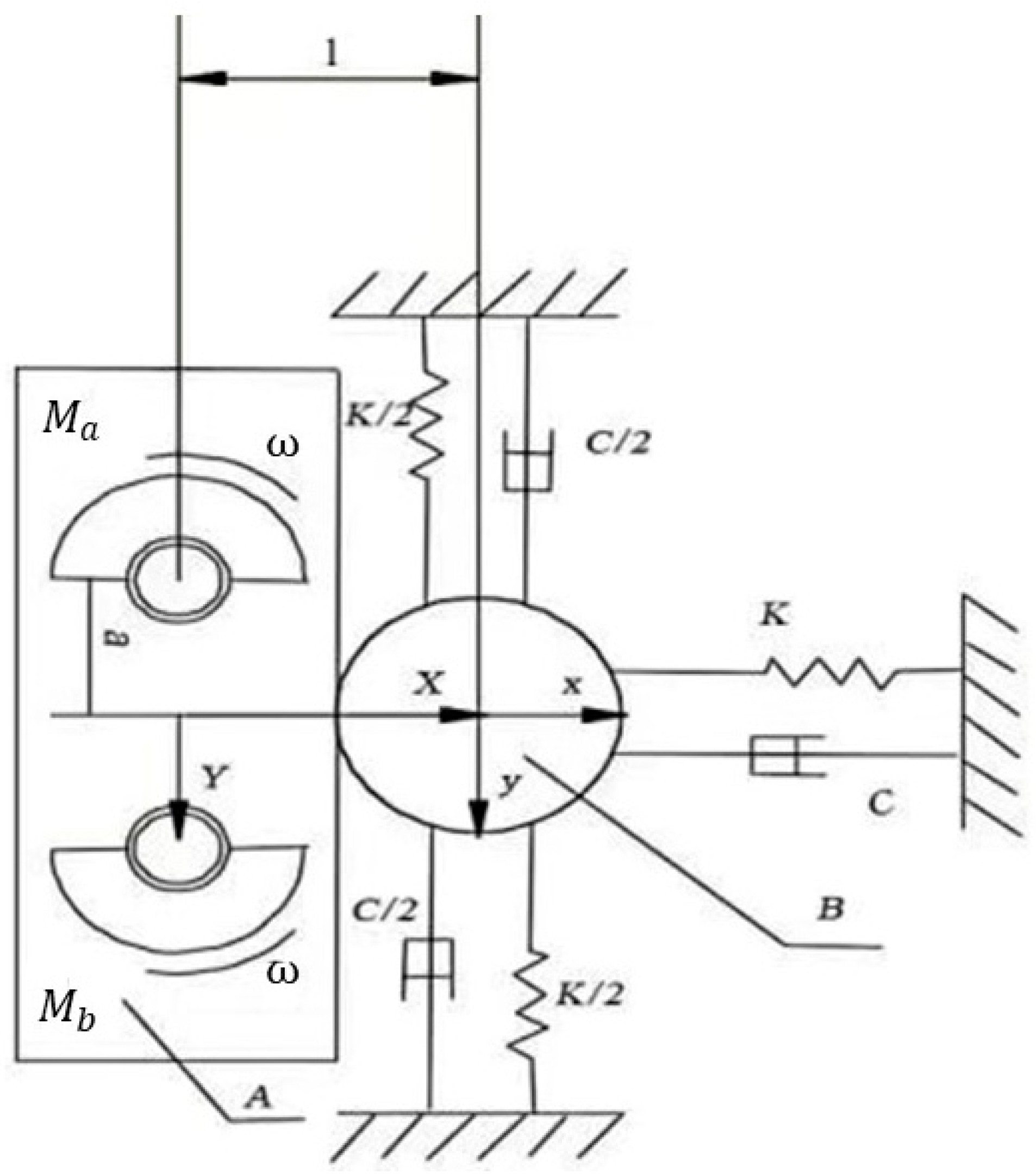
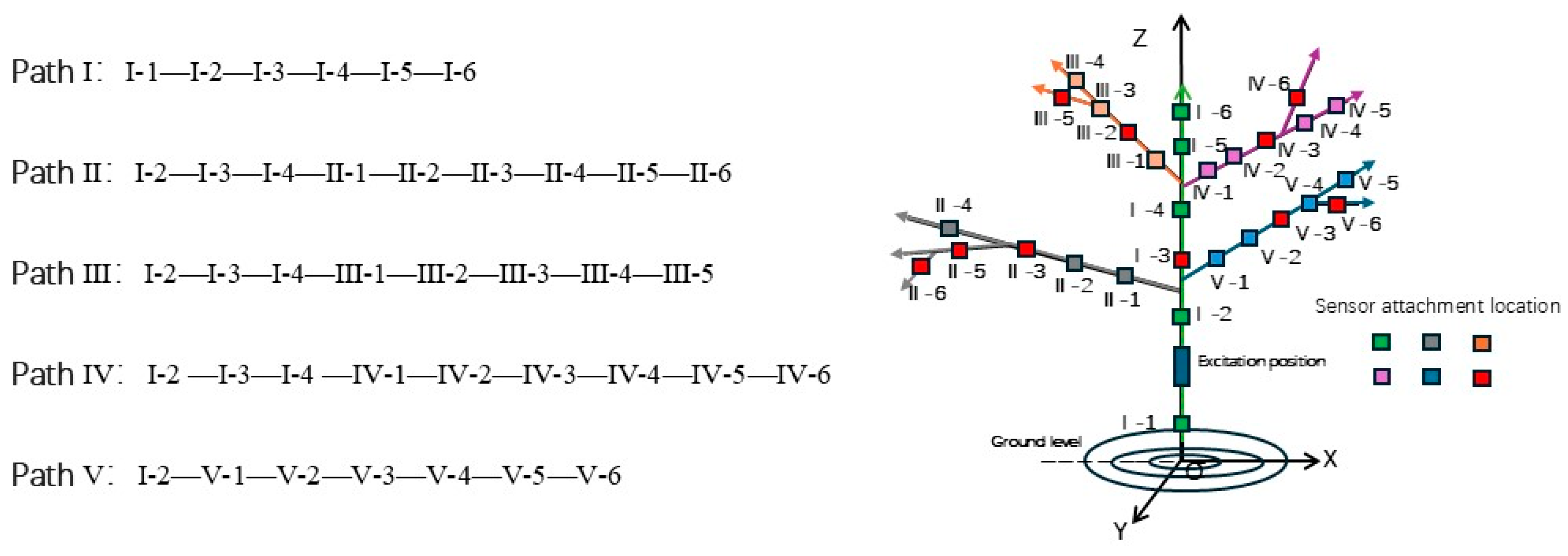
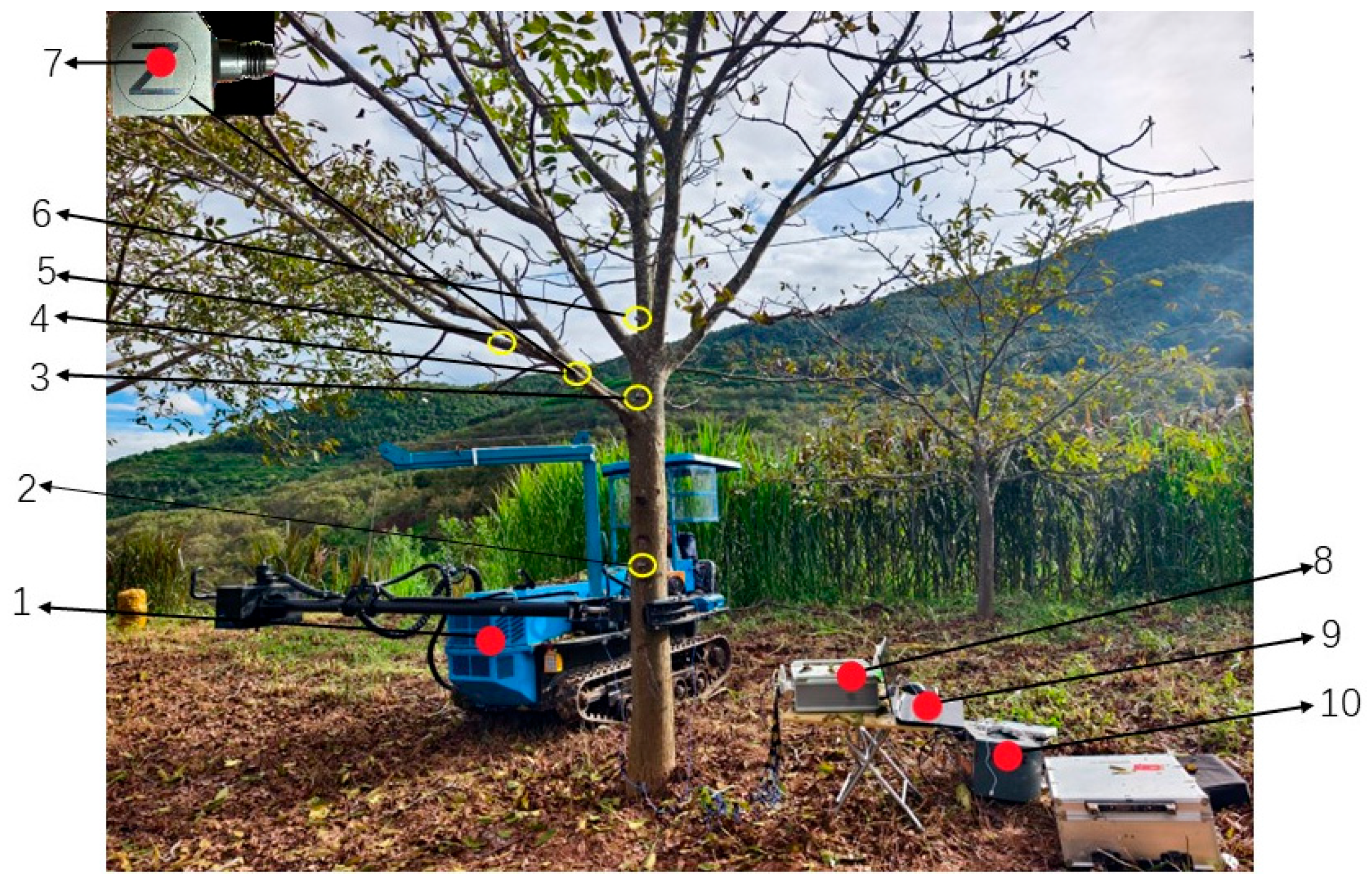
Based on the above assumptions, a walnut tree–harvester dynamic model is established, as shown in
Figure 1. The trunk is represented by a conical beam, and excitation is generated by a dual-eccentric-mass mechanism. The two eccentric masses are identical and symmetrically arranged. They rotate in opposite directions at a constant angular velocity with zero phase difference. System vibration response is characterized using the acceleration amplitude [
21].
According to the theory of damped vibration for three-dimensional beam structures, the forced-vibration equation of motion of the walnut tree system can be expressed as
where
,
, and
denote the mass matrix, damping matrix, and stiffness matrix of the walnut tree system, respectively;
,
, and
are the acceleration, velocity, and displacement vectors, respectively; and
is the external excitation force vector.
Using the modal superposition method, the displacement response is assumed as
x(
t) =
. Substituting this expression into Equation (1) and premultiplying by
yields the equation of motion in modal coordinates:
Here, is the modal matrix, and is the modal coordinate vector.
For a system satisfying Rayleigh proportional damping (
),
The modal vectors are orthogonal with respect to the mass and stiffness matrices. Equation (2) can be rewritten as
where
,
and
are the modal mass matrix, modal damping matrix, and modal stiffness matrix, respectively.
Equation (4) can thus be decoupled into a set of independent single-degree-of-freedom modal equations. Within the operating frequency band of the harvester, trunk vibration is dominated by one bending mode (typically the first), denoted as the (j)-th mode. Retaining only this dominant mode gives
where
is the modal mass of the j-th mode (kg);
is the corresponding modal damping (N·s/m);
is the modal stiffness (N/m); and
denotes the generalized force of the external excitation acting on the j-th mode (N).
The relationship between the actual displacement at the clamping point,
xc(
t), and the modal coordinate
qj(
t) is given by
where
φj(
sc) is the mode-shape value of the (j)-th mode at the clamping point.
By comparing Equation (5) with the standard single-degree-of-freedom equation, the tree at the clamping point can be equivalently represented as a single-degree-of-freedom system:
where
is the equivalent mass of the tree at the clamping point/kg;
is the equivalent damping at the clamping point/(N·s/m);
is the equivalent stiffness at the clamping point/(N/m); and
is the equivalent external force acting at the clamping point/N.
The harvester employs a dual-eccentric-mass vibration mechanism to generate harmonic excitation. Let the mass of each eccentric block be (
, the eccentric radius be (
), and the angular velocity be (
). Neglecting shaft bending and installation errors, the centrifugal inertial force in the principal vibration direction is given by
When two identical eccentric masses are symmetrically arranged and rotate in opposite directions at constant speed, the resultant force in the principal excitation direction (X direction) is twice that generated by a single eccentric mass.
Under ideal conditions, the force components in the vertical direction (Y axis) cancel each other, resulting in a net force of zero.
By incorporating the mass of the picking arm (
), the tree mass (
) and the eccentric mass into the system, the total system mass is obtained as
The eccentric masses generate unbalanced inertial forces and also act as moving masses of the mechanism. Their masses are therefore included in (M). Based on D’Alembert’s principle, the forced-vibration differential equation of the walnut tree–harvester system in the X direction is given by
where M is the equivalent total mass of the system/kg; C is the equivalent damping of the system/(N·s/m); K is the equivalent stiffness of the system/(N/m); and
is the displacement of the clamping point along the principal vibration direction/m.
During harvesting, the excitation frequency is approximately constant within a given setting, and the operating duration is relatively long. The start-up transient can therefore be neglected, and only the steady-state harmonic response is considered. The steady-state response is assumed to be
Using the complex method, let (
). Substituting this expression into Equation (13) yields
The displacement amplitude and phase are given by
To facilitate resonance analysis, the first-order natural angular frequency (
), damping ratio (
), and frequency ratio (
) are introduced:
Substituting Equation (18) into Equation (16) yields a dimensionless form of the displacement amplitude. Using (
) and normalizing by (
), the acceleration response amplification factor (
) is obtained.
Taking the second derivative of Equation (14) yields the acceleration response:
The acceleration response amplitude is given by
Substituting into Equation (16) gives the expression for the acceleration amplitude:
Equation (22) indicates that the acceleration amplitude at the clamping point is governed by two factor groups. The first group comprises excitation-device parameters, including eccentric mass (), eccentric radius (), and angular velocity (). These parameters jointly determine the magnitude of the harmonic excitation force applied to the trunk. The second group comprises the tree’s intrinsic dynamic properties, including equivalent mass (), equivalent stiffness (), and damping (). For a given walnut tree, (), (), and () are essentially fixed. Therefore, the acceleration amplitude pattern can be reduced to regulation of the frequency ratio () (the ratio of excitation frequency to natural frequency). When () approaches 1, the system enters resonance and the acceleration amplitude is markedly amplified. When () deviates from 1, the acceleration amplitude decreases substantially. The acceleration amplitude is strongly correlated with (). If the eccentric mechanism is fixed, i.e., () and () remain constant, adjusting () changes the excitation frequency (). This adjustment controls (), thereby controlling resonance amplification and the resulting acceleration response.
4. Experimental Results and Analysis
4.1. Variation in Branch Acceleration Response Under Forced Vibration of Walnut Trees
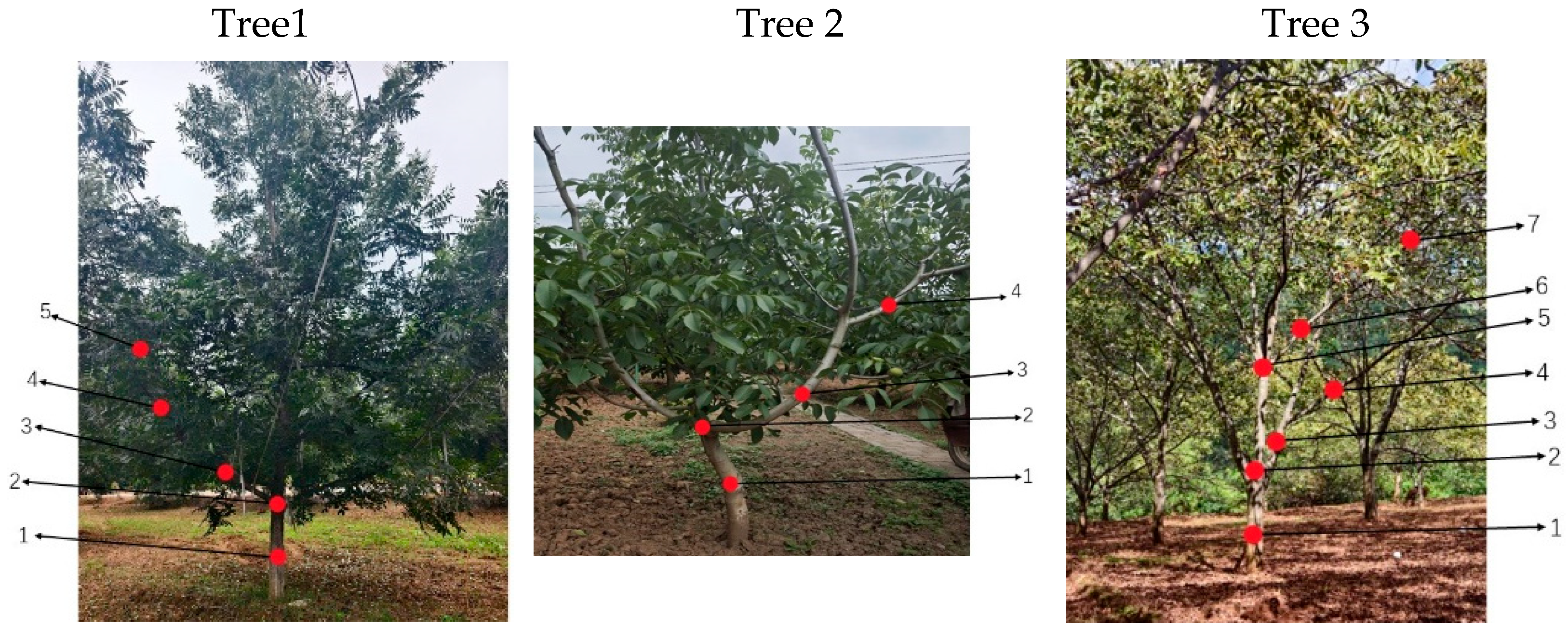
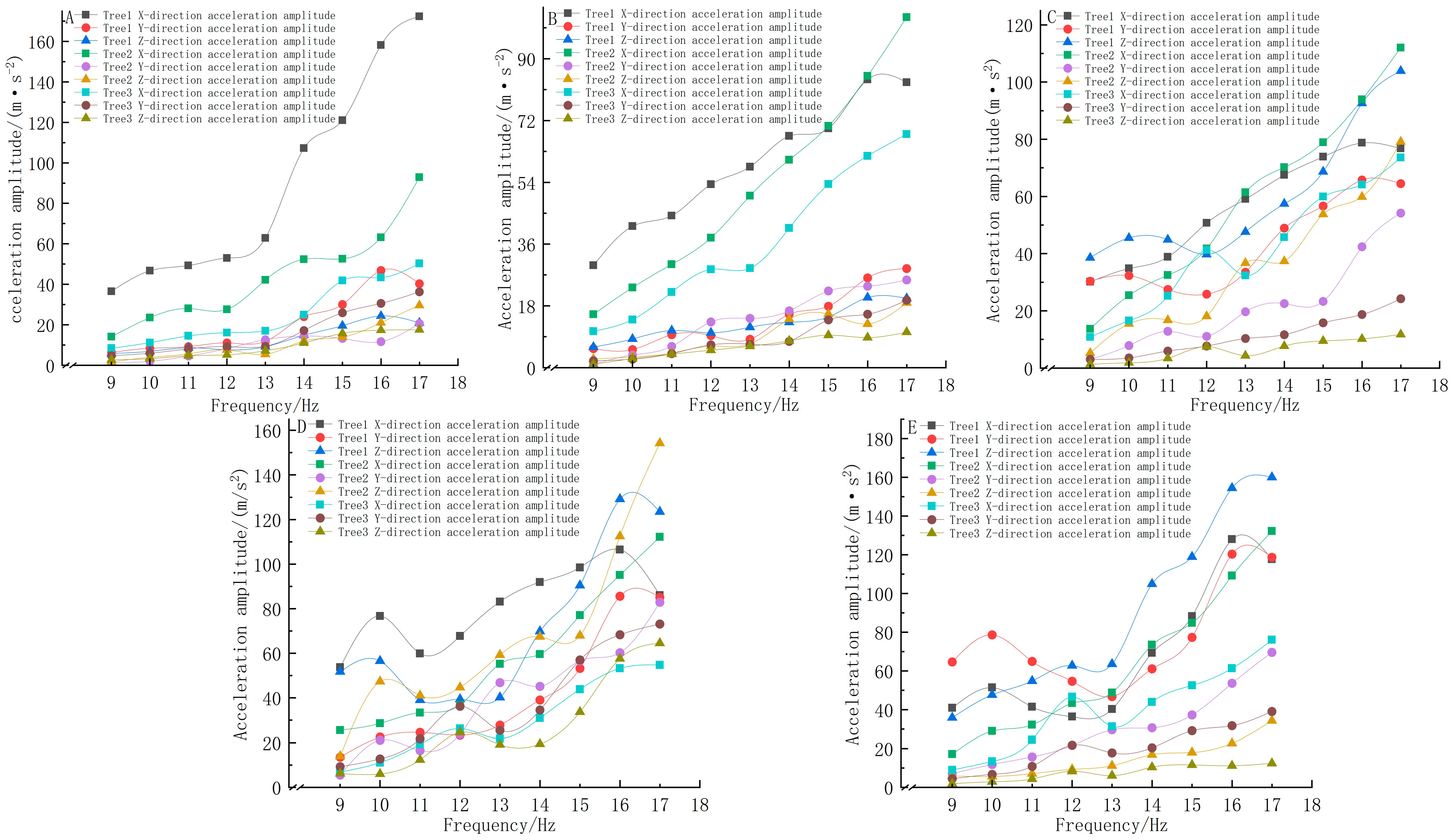
Figure 7 shows the acceleration response variations at all measurement points of the three trees under different excitation conditions (different frequencies).
As the excitation frequency increased from 9 to 17 Hz, the trunk acceleration in the X direction showed an overall increasing trend. It exhibited resonance peaks when the frequency ratio (r ≈ 1) was 16–17 Hz. In contrast, amplification of branches and lateral branches emerged earlier, at 13–15 Hz. Based on the frequency-dependent evolution of acceleration, the vibration process can be divided into three stages.
- (1)
Low-frequency band (9–11 Hz): Trunk motion was dominated by global swinging in the X direction, whereas Y- and Z-direction responses were weak. Tree 1 had a smaller trunk diameter and lower overall stiffness, resulting in slightly higher X-direction trunk acceleration than Trees 2 and 3 at the same frequency. Tree 3 exhibited the highest overall stiffness and the lowest trunk acceleration, indicating that high-stiffness trees are difficult to excite at low frequencies.
- (2)
Mid-frequency band (11–15 Hz): With increasing frequency, X-direction trunk acceleration increased approximately linearly. Z-direction responses of branches and lateral branches gradually intensified. The curved trunk of Tree 2 introduced geometric asymmetry, which enhanced coupling between the trunk and branching regions. As a result, Points 2 and 3 showed significantly higher Y- and Z-direction accelerations than those of Trees 1 and 3, and vibration evolved from single-axis swinging to multi-directional motion. Trees 1 and 3 remained dominated by X-direction responses at this stage, although inner branches were progressively activated.
- (3)
High-frequency band (15–17 Hz): All three trees entered the resonance amplification region at the proximal trunk (Point 1) in the X direction. Most measurement points reached peak acceleration at 16 Hz, but peak magnitudes differed markedly. The X-direction peak acceleration reached 172.3 m/s2 for Tree 1, 92.8 m/s2 for Tree 2, and 50.3 m/s2 for Tree 3. This indicates that Tree 1 was most sensitive to excitation frequency and exhibited the strongest amplification, whereas Tree 3 showed relatively weak amplification. From Point 1 to Point 5, X-direction acceleration generally decreased and then increased, whereas Z-direction acceleration increased progressively and reached its maximum at the outer branches (160.1 m/s2 for Tree 1, 154.2 m/s2 for Tree 2, and 64.5 m/s2 for Tree 3). For Trees 2 and 3, Z-direction acceleration at the outer branches exceeded the X-direction response, indicating that vibration gradually transformed from planar trunk swinging to bending vibration of outer branches during transmission.
The frequency-dependent amplification effect observed in this study can also be explained by the excitation kinematics described in the elliptical trajectory model. Under dual eccentric rotation, orthogonal acceleration components are generated simultaneously. As frequency increases, both components are amplified proportionally. This leads to an enhancement of the combined inertial loading. Therefore, the multi-point acceleration increments measured in this study align with the kinematic characteristics of elliptical excitation.
Overall, all three trees exhibited a common vibration pattern, evolving from low-frequency single-axis trunk swinging to mid-frequency enhancement of responses at multiple points, and finally to high-frequency three-dimensional multi-directional vibration. However, distinct differences were observed. Tree 1 tended toward trunk-concentrated vibration, Tree 2 toward cooperative amplification between the trunk and branching regions, and Tree 3 toward whole-canopy three-dimensional vibration.
According to the dynamic model, the X-direction acceleration amplitudes of the three trees can be obtained at excitation frequencies of 11, 15, and 17 Hz. Taking Tree 1 as an example, the predicted trunk X-direction acceleration amplitudes were 66.7, 128.4, and 193.2 m/s
2, respectively. The measured values were 49.2, 120.0, and 172.0 m/s
2, yielding relative errors of 35.5%, 7.0%, and 12.3%. As shown in
Table 1, the first-order natural frequencies of the three trees were 16.4, 15.6, and 16.6 Hz. When the excitation frequency was 16 Hz, the corresponding frequency ratios (
) were approximately 0.98, 1.03, and 0.96. At (
≈ 1), significant amplification of acceleration amplitude was observed, which agrees with the experimental results. This confirms the rationality of the harvester–walnut tree dynamic model. The remaining discrepancies reflect the influence of multi-directional vibration and geometric asymmetry in real tree structures. The proposed model mainly captures first-mode amplification in the primary excitation direction, and therefore, some deviation in amplitude prediction persists. Overall, for all three walnut trees, excitation frequencies of 16–17 Hz closely matched the first-order natural frequencies, with (r) approaching 1, resulting in pronounced acceleration peaks.
4.2. Kinetic Energy Transfer Under Forced Vibration of Walnut Trees
4.2.1. Kinetic Energy Transfer at Each Measurement Point Under Different Frequencies
Based on the acceleration-response analysis in
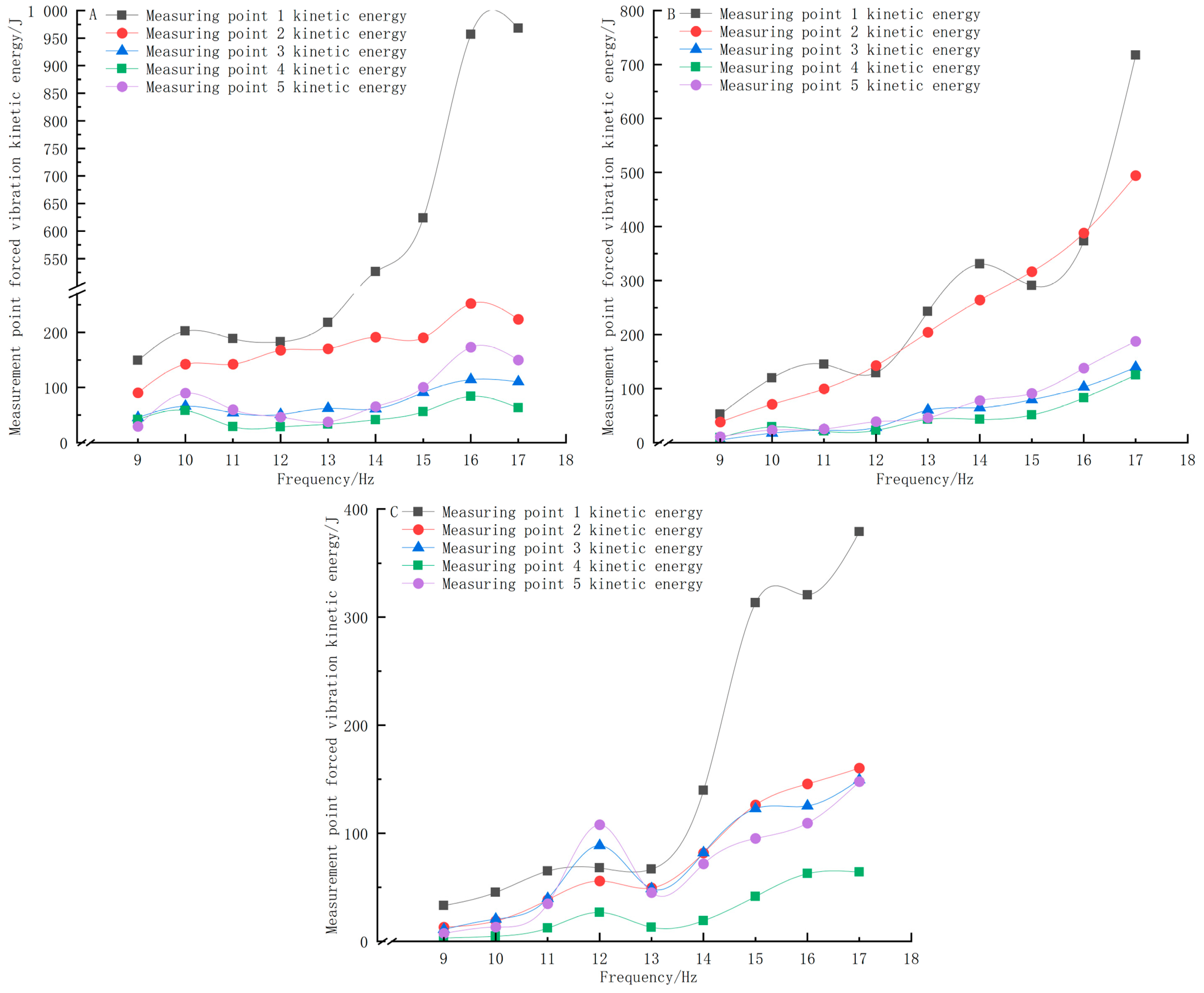
Section 3.1, the resultant velocity amplitudes from three directions at each measurement point were calculated and substituted into Equation (23) to obtain branch kinetic energy in the 9–17 Hz band. The energy transfer characteristics of different tree architectures were then analyzed, as shown in
Figure 8.
Overall, kinetic energy at all measurement points of the three walnut trees increased with excitation frequency, and a common energy-sensitive band was observed at 15–17 Hz. However, energy distribution patterns differed markedly among tree architectures.
Tree 1: Kinetic energy increased slowly from 9 to 13 Hz and rose rapidly from 14 to 17 Hz. At the proximal point (Point 1), kinetic energy increased from 148.9 J to 967.9 J, a 6.5-fold increase. At outer points, kinetic energy peaked at 16 Hz and slightly decreased at 17 Hz, exhibiting a “high-frequency amplification followed by post-peak attenuation” pattern. This indicates strong energy concentration near the clamping point and limited energy transfer toward the canopy periphery.
Tree 2: Kinetic energy increased monotonically over 9–17 Hz. At the proximal point, kinetic energy reached 717.3 J at 17 Hz. Outer points consistently exceeded 100 J, and kinetic energy amplification was more pronounced at branching and mid-branch locations. This pattern represents typical “whole-tree cooperative amplification.”
Tree 3: A local low-frequency peak occurred near 12 Hz, followed by slight attenuation at 13 Hz and a pronounced increase again from 15 to 17 Hz. Proximal kinetic energy increased from 67.9 J to 378.8 J, a 5.5-fold increase. This behavior reflects a “dual-sensitive-band” pattern, with coexistence of low-frequency local resonance and mid-to-high-frequency re-amplification. Compared with Tree 1, Tree 3 did not exhibit excessive trunk energy concentration. Compared with Tree 2, its overall energy level was slightly lower, but energy distribution was more balanced, making it suitable for sustained vibration in the mid-to-high-frequency range.
In summary, tree height, branching height, branch hierarchy, and canopy architecture significantly influence kinetic energy transfer patterns among different tree architectures. All three trees achieved high branch kinetic energy in the 15–17 Hz band, which is a key operating range for promoting energy transmission to the canopy and fruit detachment. However, Tree 1 tended toward trunk energy concentration, whereas Trees 2 and 3 were more favorable for energy diffusion to outer branches.
4.2.2. Acceleration Response Variations at Different Measurement Points at 16 Hz
As shown in
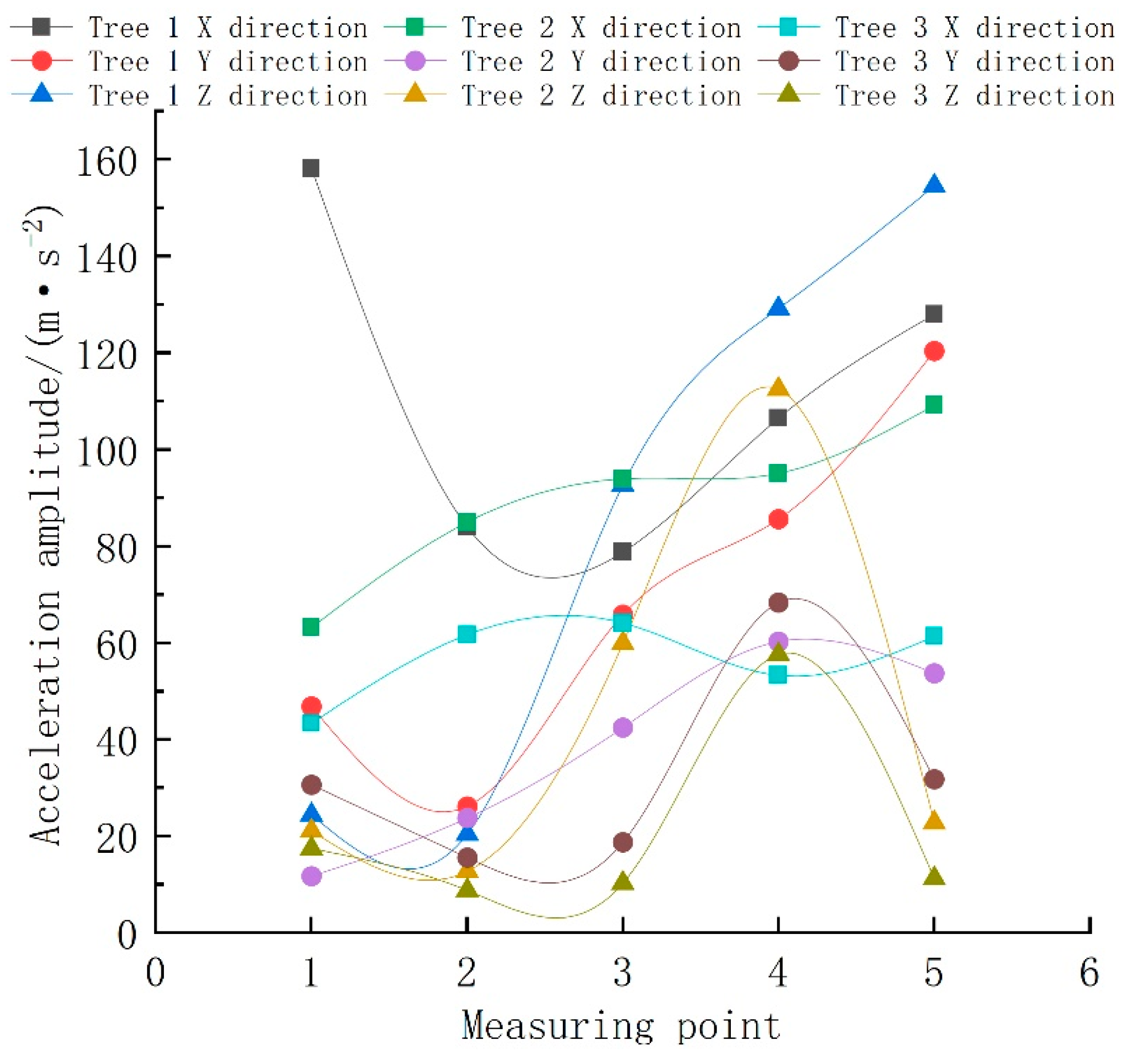
Section 3.1, acceleration responses of all tested walnut trees reached peak values at excitation frequencies of 16–17 Hz. To further analyze the response distribution at different measurement points under resonance conditions, an excitation frequency of 16 Hz was selected. Triaxial acceleration amplitudes at each measurement point were compared, and the results are presented in
Figure 9.
The results show that at Point 1 near the clamping position, acceleration was dominated by the X direction. The X-direction peak accelerations were 158.1 m/s2, 63.1 m/s2, and 43.3 m/s2 for Trees 1–3, respectively. This indicates stronger coupling amplification between the walnut tree and the harvester at the proximal trunk. From Point 1 outward to Point 5, X-direction acceleration of all three trees followed a “decrease–increase” pattern. Z-direction acceleration increased progressively and reached its peak at Point 4 or Point 5 (154.4 m/s2 for Tree 1, 112.4 m/s2 for Tree 2, and 57.5 m/s2 for Tree 3). For Trees 2 and 3, the Z-direction acceleration at the outer points clearly exceeded the X-direction response. Y-direction acceleration remained intermediate and increased smoothly from inner to outer points. These results indicate that during outward transmission of vibration energy along the trunk, the dominant motion gradually shifts from planar X-direction trunk swinging near the clamp to Z-direction bending vibration of outer branches. Furthermore, significant acceleration components and their spatial redistribution were observed in the X, Y, and Z directions. This indicates that the vibration response of the tree cannot be interpreted as pure linear motion. Instead, the dynamic response exhibits characteristics of coupled multi-directional excitation. This observation aligns with the kinematic mechanism described by the elliptical trajectory excitation model. In this model, orthogonal harmonic components jointly generate a combined inertial force and rotational resultant motion. Although this study did not directly measure the excitation trajectory, the measured triaxial acceleration responses provide system-level evidence. This confirms the presence of compound excitation effects during vibration energy harvesting.
4.2.3. Kinetic Energy Variation and Attenuation at Different Measurement Points at 16 Hz
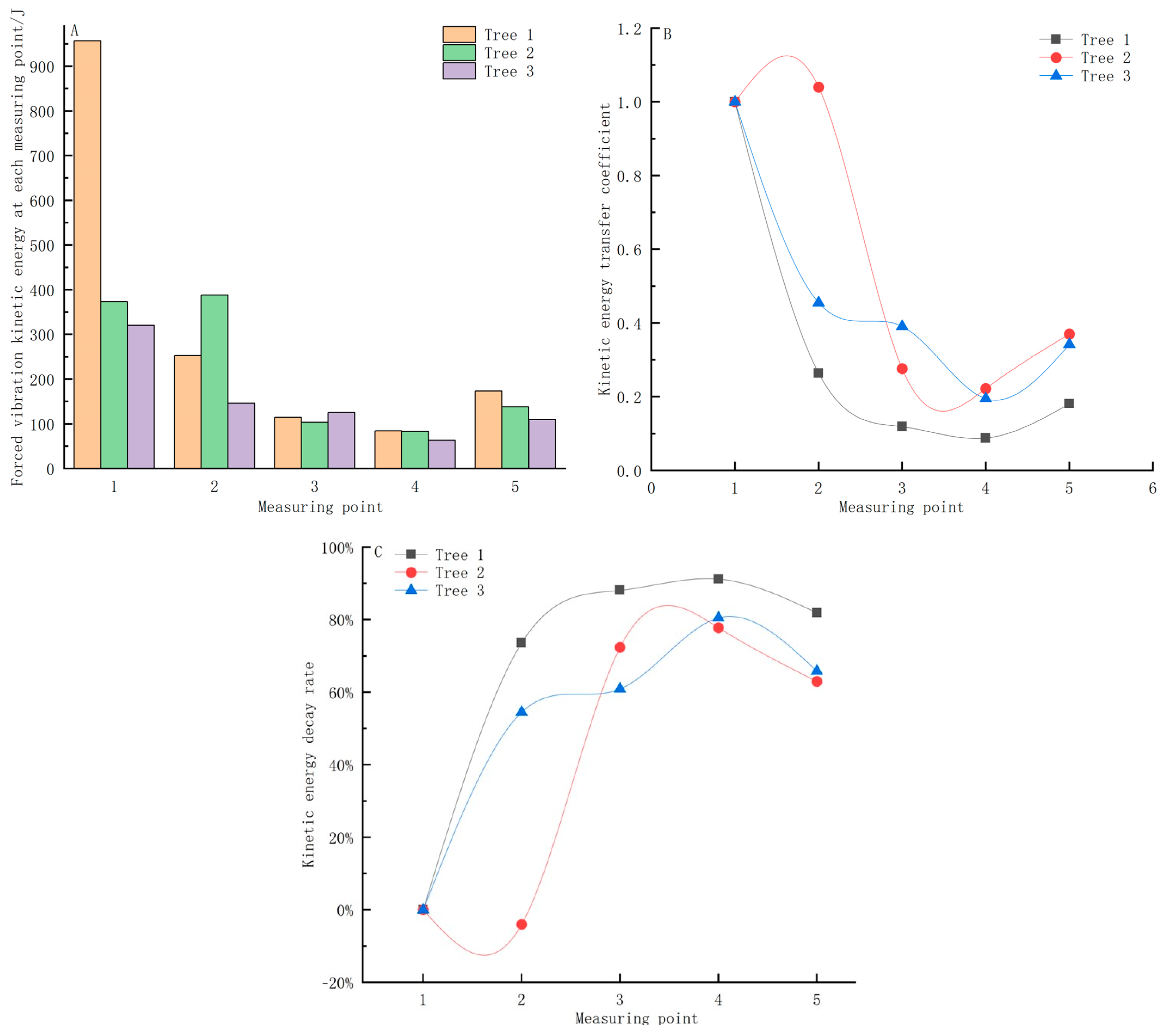
At 16 Hz, an effective frequency for promoting branch energy transmission and fruit detachment, the kinetic energy at each measurement point is shown in
Figure 10. Based on Equation (25), the trunk overload index (OLI) was calculated for the three walnut trees. The OLI values were 6.13 for Tree 1, 2.10 for Tree 2, and 2.89 for Tree 3.
For Tree 1, the kinetic energy at Point 2 was 252.4 J, with an attenuation rate of 73.6%. At Point 3, kinetic energy was 114.3 J, with an attenuation rate of 88.1%. At Point 4, kinetic energy was 84.1 J, with an attenuation rate of 91.2%. At Point 5, kinetic energy was 173.1 J, with an attenuation rate of 81.9%. These results indicate that kinetic energy at the proximal trunk was substantially higher than at the outer points. Tree 1, therefore, exhibits a “high energy concentration with rapid attenuation” pattern and is more prone to trunk energy overload. For Tree 2, kinetic energy at Point 2 was slightly higher than that at the trunk, with an energy transfer coefficient (T2 = 1.040) and an attenuation rate (η2 =−4.0%). This indicates energy amplification at the branching location. At the remaining outer points, transfer coefficients ranged from 0.222 to 0.370, and attenuation rates ranged from 63.0% to 77.8%. The OLI was low, indicating relatively balanced kinetic energy distribution between the trunk and mid-to-distal branches. For Tree 3, the overall kinetic energy level was lower. However, energy was distributed more uniformly along the path, which is more favorable for sustained energy transmission along branches.
From an energy-transfer perspective, vibration energy decays with increasing transmission distance because it must overcome inherent tree damping. For high energy-concentration tree architectures operating at 15–17 Hz, excitation duration and amplitude should be appropriately controlled to reduce trunk damage risk. In contrast, tree architectures with balanced kinetic energy distribution can sustain longer effective vibration at 16–17 Hz to improve fruit detachment efficiency. From a multi-scale perspective, excitation kinematics determine the characteristics of the input motion. The current measurements reveal how kinetic energy is redistributed and attenuated along the trunk–branch pathway before reaching the fruit attachment zone. Local vibration models describe fruit detachment as a function of inertial force exceeding the binding threshold of the stalk. However, the system-level analysis in this study indicates that the effective inertial load acting on the fruit depends not only on excitation intensity but also on the cumulative energy transmission efficiency within the entire tree structure. Therefore, fruit detachment during vibration harvesting should be regarded as the final stage of a layered dynamic process. This process spans three stages: excitation input, structural transmission, and local failure conditions.
4.3. Influence Mechanisms of Tree Architecture on Vibration Response
Combining the results of
Section 4.1 and
Section 4.2, all three tree architectures exhibited an evolution from low-frequency global swinging to high-frequency resonance amplification under 9–17 Hz sweep excitation, with a sensitive band forming at resonance (15–17 Hz). However, pronounced differences were observed among architectures in resonance amplification intensity, energy allocation location, and transmission attenuation, resulting in divergent trunk overload risks (OLI). Overall, Tree 1 showed more concentrated responses and kinetic energy near the proximal trunk, with faster outward attenuation. Tree 2 more readily exhibited energy redistribution at branching and mid-branch regions, inducing whole-tree cooperative vibration. Tree 3 displayed more uniform energy distribution and multi-sensitive (or dual-sensitive) response characteristics.
Differences among walnut tree architectures in acceleration amplification, energy transfer pathways, and trunk overload risk within the resonance band are fundamentally governed by structural parameters that regulate whole-tree equivalent stiffness distribution and energy partitioning. Considering trunk stiffness, branching height, canopy structure, and geometric irregularity, walnut tree vibration response patterns can be classified into three types: trunk high-energy-concentration type, whole-tree cooperative amplification type, and dual-sensitive-band type.
- (1)
Trunk stiffness determines resonance amplification intensity and overload risk
Trunk diameter and tree height jointly determine the equivalent stiffness at the clamping point. When stiffness is low, acceleration and kinetic energy are more likely to concentrate near the trunk at 16–17 Hz, increasing trunk overload risk. When stiffness is high, resonance amplification is constrained and proximal kinetic energy remains relatively low.
- (2)
Branching height and canopy architecture govern energy partitioning locations and transmission pathways
Branching height and canopy architecture determine where energy is partitioned from the trunk to the canopy and along which paths it propagates. Low branching height and small canopy size favor trunk energy concentration with rapid attenuation toward outer branches. Intermediate branching height and canopy extent promote energy re-amplification at branching or mid-branch regions, leading to whole-tree cooperative response. High branching height and multi-level branching facilitate multi-path energy diffusion and are more prone to frequency-sensitive responses in different bands, yielding dual-sensitive-band characteristics.
- (3)
Geometric irregularity enhances modal coupling and multi-directional response
Geometric asymmetry, such as trunk curvature, enhances coupling between the trunk and branching regions. It increases multi-directional vibration responses in the Y and Z directions and improves energy transmission through branching zones. This effect prevents excessive energy concentration at a single location and thereby reduces the tendency for local overload.
In summary, the corresponding relationship among the three tree structure characteristics-mechanism-indicator response is shown in
Table 4.
Based on the above analysis, a more comprehensive interpretative framework can be established for walnut vibration harvesting. This process can be explained through a layered dynamic model. First, the dual eccentric mechanism generates a compound excitation trajectory, which determines the initial inertial load characteristics. Second, vibration energy propagates along the trunk–branch–fruit pathway. During this transmission, it undergoes structural attenuation and energy redistribution—a process quantified in this study. Finally, the fruit detaches when the transmitted inertial force exceeds the detachment threshold described by the local vibration model. This integrated explanation combines excitation kinematics, system-level dynamic response, and local detachment mechanics. It provides a coherent understanding of the walnut vibration energy harvesting mechanism without overemphasizing the validation process.