1. Introduction
Since the launch of reform and opening-up, China’s agricultural development has long relied on an extensive production model characterized by high inputs of chemical fertilizers and pesticides [
1]. China’s fertilizer application rate has shown an overall upward trend since 2000, reaching 259.65 kg per hectare [
2]. Consequently, China launched the Zero Growth in Fertilizer Action (ZGFA) in 2015. This initiative established a binding target for total fertilizer use while granting local authorities flexibility in implementation and establishing a performance accountability mechanism [
3]. Since the implementation of the ZGFA, China’s agriculture has formally entered a phase of institutional transition toward “reduction-oriented green transformation,” with the total volume of agricultural inputs shifting from zero growth to negative growth [
4]. From a macro-statistical perspective, the fertilizer zero-growth initiative has achieved significant results. China’s fertilizer application rate peaked at 480.1 kg per hectare in 2016 and has since gradually declined to 394 kg per hectare in 2023. However, the reduction in macro-level data has not been synchronously translated into widespread, stable, and high-intensity adoption of agricultural green production technologies (AGPTs) at the household level [
5]. Extensive research reveals that under identical policy environments and market conditions, the adoption levels of green agricultural production technologies among different farming households exhibit significant divergence [
6,
7]: some farmers have adopted sustainable green production practices, while a significant proportion remain in a state of “low-level, intermittent, and token adoption”. This structural mismatch between macro-level reduction and micro-level inertia not only constitutes a core paradox in China’s agricultural green transition but also reflects the widespread issue of insufficient micro-level responses in developing countries’ green agricultural transformations.
Existing research primarily draws upon the rational agent hypothesis and prospect theory to explain the intensity of farmers’ adoption of green agricultural production technologies from a microeconomic rationality perspective. Emphasizing the influence of factors such as subsidy incentives [
8], cost–benefit analysis [
9], risk preferences [
10] and operational scale [
11], it is argued that farmers make adoption decisions after weighing economic returns against production risks [
12,
13]. However, in real-world scenarios, even when faced with identical policy incentives and production constraints, farmers’ adoption intensity still exhibits significant divergence. This indicates that economic rationality alone cannot fully explain the formation logic behind “same policies, different outcomes” [
14].
Social networks refer to the stable interactive structures formed by individuals through multiple social connections, including kinship ties, neighborhood interactions, organizational participation, and institutional embeddedness [
15]. In recent years, social networks have been employed to explain variations in the diffusion of green agricultural production technologies. Relevant studies indicate that these networks not only influence information access channels but also shape individuals’ cognitive frameworks regarding risk, norms, and behavioral consequences [
16]. For instance, research has examined how social networks influence the adoption of technologies such as conservation tillage [
17] and crop cultivation techniques [
18]. However, the diffusion of new technologies is not solely determined by social interactions among farmers; coordination between extension systems and policymakers at the administrative level also impacts the provision, demonstration, and implementation of technical information [
19]. Most existing empirical studies operationalize farmers’ social networks primarily as an exogenous information conduit or informal constraint [
20], and thus concentrate on estimating their marginal effects on adoption likelihood or adoption intensity [
21], rather than unpacking the internal structure of networks and the associated cognitive or behavioral mechanisms. Research on the mediating pathways through which social networks reshape farmers’ internal cognitive structures—thereby influencing their decision-making foundations such as risk assessment, value judgments, and expected returns—remains insufficient. This limitation hinders explanations for the highly divergent behaviors observed among farmers within the same social network environment, constituting the core theoretical space for further expansion and testing in this study.
Based on this, this study proposes the “cognitive embedding mechanism,” arguing that farmers are not directly altered by policies and economic incentives. Instead, they continuously receive information and experiences through their embedded social networks, thereby forming green knowledge access that subsequently influences the intensity of their adoption of green agricultural production technologies. Within this framework, variations in human capital endowments among different farming households determine differences in the efficiency of green knowledge access embedding. This, in turn, leads to significantly divergent levels of adoption of green agricultural production technologies under similar policy environments.
Focusing on the aforementioned mechanism, this paper examines survey data from farmers in Jiangsu Province to systematically test the following three core research questions: (1) Does social networking significantly influence the intensity of farmers’ adoption of green agricultural production technologies? (2) Does the initiation of farmers’ green knowledge access mediate the influence of social networks on the intensity of their adoption? (3) Does educational attainment moderate the effect of social networks on farmers’ adoption intensity through the cognitive embedding pathway?
The marginal contribution of this paper lies in the following: (1) Unlike studies focusing solely on “adoption or non-adoption,” this paper centers on adoption intensity, providing a more nuanced portrayal of the varying degrees of farmers’ green transition behaviors. (2) It proposes and validates the transmission mechanism of “social network–knowledge access–adoption intensity,” offering an in-depth analysis of how social networks influence adoption intensity. (3) It reveals the marginal effects of social networks under varying educational levels, providing evidence for targeted promotion and training policies tailored to different groups
1.1. Theoretical Analysis and Research Hypothesis
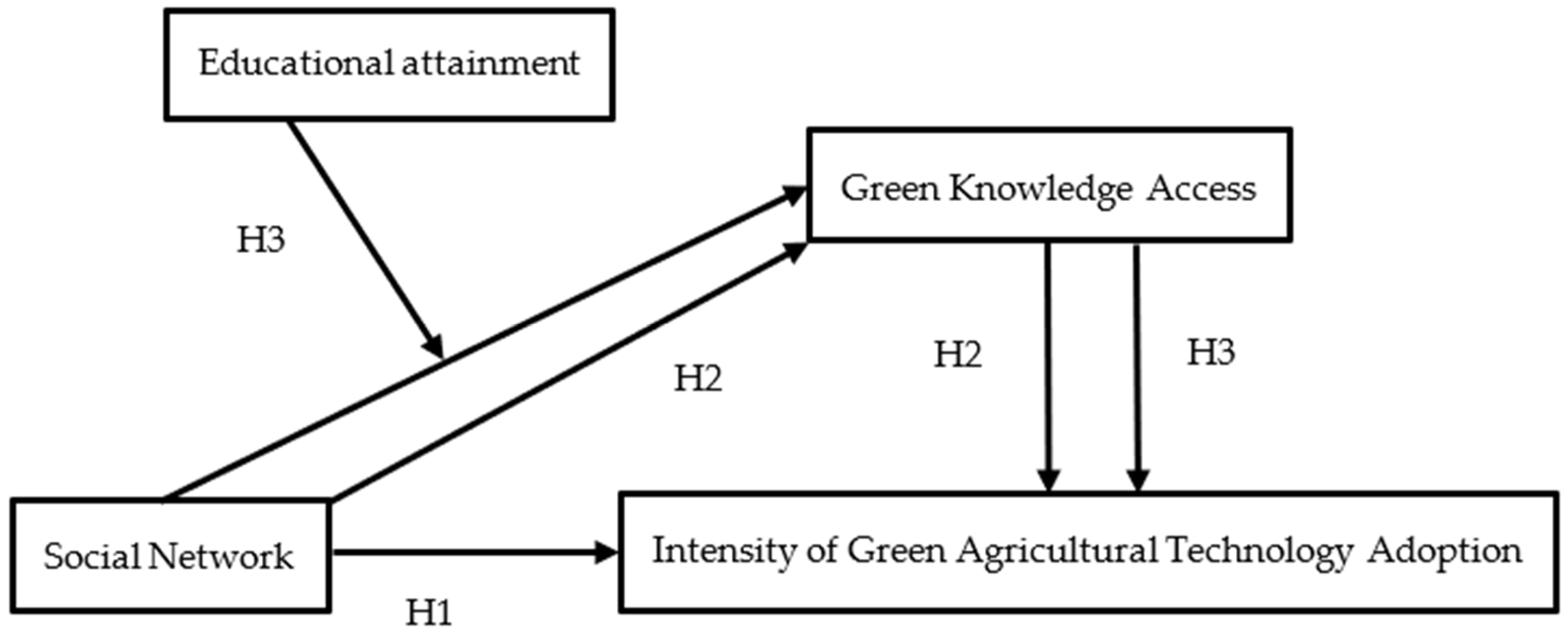
Farmers’ adoption of green agricultural production technologies is not only a function of economic incentives and resource endowments, but also embedded within their social interaction structures. Social networks serve as stable relational ties among farmers, reducing the costs of searching for technical information and mitigating income uncertainty through information dissemination and experience sharing. Simultaneously, they reinforce peer influence via demonstration effects and normative constraints, fostering an environment within communities where green production practices can be observed, imitated, and regulated. In this process, the influence of social networks on adoption intensity does not manifest as a direct driver of adoption. Instead, it enhances farmers’ access to knowledge about green technologies, thereby providing them with cognitive inputs for decision-making, which ultimately increases adoption intensity. At the same time, educational attainment reflects farmers’ human capital and information absorption capacity, potentially influencing the efficiency with which network information is understood, evaluated, and transformed into effective cognitive input. This, in turn, alters the transmission effect of the “social network–knowledge access–adoption intensity” chain.
1.1.1. The Impact of Social Networks on the Intensity of Adoption of Green Agricultural Production Technologies Among Farm Households
Green agricultural production technologies possess both public goods attributes for the environment and private benefits for producers; their adoption process faces significant challenges including high information asymmetry, uncertain returns, and substantial learning costs [
22,
23]. For farm households primarily engaged in family-based operations, relying solely on individual decision-making makes it difficult to comprehensively assess the potential risks and benefits of green agricultural production technologies; their adoption behavior is largely embedded within the social relationship networks in which they operate [
24,
25]. Granovetter’s 1973 “Embeddedness Theory” emphasizes that all economic activities are embedded within social networks, categorizing these networks into strong ties and weak ties based on the degree of embeddedness [
26,
27]. The size of social networks, the position within them, the quality of relationships, and the strength of trust are core components of social network structures that significantly influence the formation and transmission of information [
28]. Social networks reduce farmers’ information search and learning costs through information diffusion, experiential modeling, and normative constraints [
29], and alleviate their uncertainty and subjective risk perception regarding green agricultural production technologies. Social networks influence the intensity of farmers’ adoption of green production technologies through the following mechanisms: (1) Information dissemination mechanisms: Social networks serve as the most critical channel for farmers to access information [
30]. In areas with limited information flow, communication among neighbors, relatives, and cooperative members significantly compensates for deficiencies in formal information channels. Moreover, compared to information from unfamiliar sources, farmers are more inclined to trust information disseminated by familiar individuals, thereby increasing their willingness to adopt green production technologies. The existence of social networks is a key factor in preventing the “lemons market effect” caused by information asymmetry, thereby facilitating farmers’ adoption of green agricultural production technologies [
31]. (2) Demonstration and imitation mechanisms: When farmers observe neighboring households benefiting from adopting green agricultural production technologies, their perception of the associated risks diminishes, thereby increasing their willingness to adopt these practices [
32]. Therefore, neighborhood effects also exert a direct influence on the intensity of green production technology adoption among farming households. (3) Trust and Mutual Assistance Mechanism: Based on mutual trust, farmers can share agricultural resources, technical services, and labor among themselves. This will help reduce the investment risks associated with the initial adoption of green production technologies and enhance their capacity to bear technological risks [
33].
Based on this, we propose the following hypothesis H1: Social networks exert a significant positive influence on the intensity of adoption of green agricultural production technologies among farming households. Testing Method: In the baseline regression model, the adoption intensity serves as the dependent variable, with the social network composite index as the core explanatory variable. The analysis controls for individual characteristics, operational features, and land resource endowments.
1.1.2. The Influence of Social Networks on the Intensity of Adoption of Green Agricultural Production Technologies Among Farmers Through Green Knowledge Access
Green agricultural production technologies involve a certain degree of technical complexity and uncertain returns. Without the necessary foundational knowledge, farmers often struggle to accurately assess the potential benefits, risks, and feasibility of these technologies, thereby dampening their willingness to adopt them [
34]. Research has shown that whether an individual enters the cognitive track of a new technology is a crucial prerequisite for subsequently forming stable adoption strength [
35]. In rural social contexts, the formation of farmers’ cognition does not rely solely on individual learning but is deeply embedded within their social networks. Through ongoing interactions with family, friends, neighbors, and other members within the village, an initial understanding and cognitive readiness for green agricultural production technologies is formed—that is, green knowledge access [
36]. This knowledge access state not only reduces farmers’ perception of uncertainty regarding green agricultural production technologies but also provides the necessary cognitive foundation for them to further evaluate the potential economic and environmental benefits of these technologies. Under the influence of cognitive embedding mechanisms, social networks do not directly drive farmers to make adoption decisions [
37]. Instead, they first activate farmers’ cognitive engagement with green agricultural production technologies, enabling them to absorb technical information and practical experiences disseminated within the social network. This process gradually fosters positive expectations toward green agricultural production technologies, ultimately promoting their adoption [
38,
39]. Therefore, green knowledge access plays a crucial mediating role between social networks and the intensity of farmers’ adoption of green agricultural production technologies.
Based on the above analysis, we propose Hypothesis H2: Green knowledge access plays a positive mediating role in the process by which social networks influence the intensity of farmers’ adoption of green agricultural production technologies. Testing Method: Employing a mediating-effects testing framework, we estimate the paths from social networks to knowledge access and from knowledge access to adoption intensity, and use Bootstrap tests to assess the significance of indirect effects.
1.1.3. The Influence of Educational Attainment on the Transmission Chain of “Social Networks–Green Knowledge Access–Intensity of Adoption of Green Agricultural Production Technologies”
The accumulation of human capital is a crucial prerequisite for the development of modern agriculture [
40]. Educational attainment, as a key component of farmers’ human capital, influences how they understand, filter, and absorb information related to green agricultural production technologies within their social networks [
41,
42]. Most current research findings indicate that farmers’ cognitive abilities, innovativeness, and risk perception exhibit a positive linear relationship with their educational attainment [
43,
44]. That is, the higher the level of education, the stronger their cognitive abilities, innovativeness, and risk perception. However, this study found some differences, as analyzed below:
(1) Farmers in developing countries generally lack specialized knowledge education [
45], resulting in limited understanding of the principles behind green agricultural production technologies and the ability to assess potential benefits. Even within relatively dense social networks, they struggle to effectively absorb information disseminated through these networks [
46], thereby inhibiting the initiation of their green knowledge access processes. (2) For farmers with moderate educational attainment, they possess a certain level of information processing ability and are more susceptible to the influence of experiential modeling and normative cognition within social networks [
47]. Consequently, they exhibit higher green knowledge access efficiency, maximizing the promotional effect of social networks on green knowledge access. (3) Farmers with higher educational attainment typically possess stronger rational screening abilities. When confronted with demonstration information within social networks, they tend to make independent judgments based on rational cost–benefit analysis [
48], maintaining a cautious attitude toward external information. This approach weakens the activation effect of social networks on their green knowledge access. Therefore, within the framework of cognitive embedding mechanisms, social networks do not exert equal cognitive stimulation on all farmers. Their role in influencing the intensity of farmers’ adoption of green agricultural production technologies through green knowledge access depends on the educational stratification structure within which farmers are situated.
Based on the above analysis, we propose Hypothesis H3: Educational attainment plays a stratified heterogeneous moderating role in the transmission chain of “social networks—green knowledge access—adoption intensity of green agricultural production technologies.” Specifically, the indirect effect is significantly positive for farmers with medium educational attainment, while the indirect effects for farmers with low and high educational attainment are not significant. Testing Method: Group participants by years of education and compare differences in intermediary chains across different educational groups.
The theoretical analysis framework is shown in
Figure 1.
3. Results
3.1. Descriptive Statistics
To visually present sample characteristics and provide a foundation for subsequent quantitative analysis, this paper now presents descriptive statistics for the main variables, as detailed in
Table 2.
The dependent variable is the intensity of adoption of green agricultural production technologies by farmers, which is an ordinal categorical variable ranging from 0 to 3. Statistical results indicate that the mean adoption intensity is 0.357 with a standard deviation of 0.665, ranging from a minimum of 0 to a maximum of 3. This suggests a relatively low overall adoption level in the sample population, yet significant variation exists among different farmers. This provides a necessary foundation for subsequent selection of the Oprobit model to identify influencing factors.
The core explanatory variable, social networks, is calculated using the entropy method. The mean is 0.063, the standard deviation is 0.063, and the range of values is 0.013–0.371. This indicates significant dispersion in the social network levels among the sampled farmers, meaning that different farmers vary considerably in terms of information access channels, peer communication, and exposure to demonstration effects. This provides a realistic basis for examining the impact of social networks on the adoption of green technologies.
Regarding the mechanism variable, this paper uses the response to the questionnaire question “Have you received agricultural technology training?” to measure green knowledge access. The mean value of this variable is 0.412 with a standard deviation of 0.493, indicating that approximately 41.2% of farmers have received agricultural technical training. The mechanism variable exhibits sufficient variation within the sample.
The moderating variable is educational attainment, with its categorical variable divided into three educational groups based on the number of years of schooling completed by household members. The mean is 1.803 and the standard deviation is 0.769, indicating that the overall educational level of the sample population falls within the lower-middle range, with certain disparities existing between different educational tiers.
Regarding control variables: The proportion of males in the sample is 0.751. The average age was 62.227 years, indicating that the sample of farming households was predominantly older. The average health status score was 4.021, indicating a relatively high level of self-reported overall health. The participation rate in non-agricultural technical training is 0.193. The average number of laborers per household in agriculture is 1.591, indicating relatively limited labor input in the agricultural sector. Soil fertility (1 poor–3 good) averaged 2.363, indicating an overall moderately favorable level. The land rights confirmation and certificate issuance ratio stands at 0.909, indicating that the majority of farmers have completed the land rights confirmation process. The average distance to the nearest paved road (converted to “li” units, where 1 li ≈ 500 m) is 0.447, indicating that the overall accessibility of the sample area is relatively good. The proportion of land suitable for irrigation is 0.856, indicating that most plots meet irrigation requirements.
3.2. Multicollinearity Test
To examine whether severe multicollinearity exists among the explanatory variables, which could compromise the robustness and interpretability of parameter estimates, this study conducts variance inflation factor (VIF) tests on the primary explanatory variables and control variables within the established regression model framework. The results indicate that the VIF values for all variables are generally low, significantly below the commonly used empirical threshold of 10, suggesting that the model does not exhibit significant multicollinearity issues. Specifically, the maximum VIF in the sample was approximately 1.50, corresponding to the age variable; the VIF for the moderator variable education group was approximately 1.43; the VIF for the mechanism variable green knowledge access was approximately 1.20; and the VIF for the core explanatory variable social network was approximately 1.15. Meanwhile, the model’s average VIF was approximately 1.17. The results above indicate that the linear correlations among the explanatory variables are relatively low, and the interference caused by multicollinearity on the estimation results can be disregarded. Therefore, the subsequent benchmark regression, mechanism testing, and moderated mediation effect analysis stratified by education level exhibit good numerical stability and reliability. The results of the multicollinearity test are shown in
Table 3 below.
3.3. Baseline Regression
This paper employs an Ordered Probit model to conduct a baseline regression analysis of farmers’ adoption intensity of green agricultural production technologies, utilizing robust standard errors to mitigate potential effects of heteroskedasticity. The regression results indicate that the model as a whole passed the significance test. The coefficients of the core explanatory variables were statistically significant and consistent with theoretical expectations. It should be noted that the Pseudo R2 reported here differs in measurement scope from the OLS coefficient of determination. It cannot be used to directly judge the quality of the fit, and relatively low values are common in individual-level adoption behavior models. Therefore, this paper primarily relies on the overall significance and robustness of the model to assess its explanatory power and the reliability of its conclusions, no longer treating Pseudo R2 as the sole evaluation criterion. Since the coefficients of the Ordered Probit model reflect the influence on latent adoption propensity, the results indicate that: The higher the level of social networking, the stronger the potential adoption tendency among farmers, making them more likely to be at a higher level of adoption intensity. This aligns with the theoretical expectation that social networks promote the adoption of green technologies through information diffusion, demonstration effects, and experience sharing.
Regarding control variables, certain variables exert a significant influence on adoption intensity: Gender exerts a significant positive effect on adoption intensity, with a coefficient of 0.257 that is statistically significant at the 1% level. This may be attributed to males potentially holding advantages over females in information access, technical comprehension, or production capacity, thereby making them more receptive to adopting green agricultural production technologies. The coefficient for age is significantly negative at −0.014, significant at the 1% level. Older farmers may rely more heavily on their experience from past decades, fear change, and thus be reluctant to adopt new green agricultural production technologies. Additionally, both the number of employees and the scale of operations exerted a significant positive influence, each reaching statistical significance at the 1% level. The more family members engaged in agricultural labor, the broader the income sources become and the stronger the resilience against risks. Even in the event of failure, they can absorb the losses from initial investments. Should they succeed, it will yield excess income. Therefore, they are willing to experiment with green agricultural production technologies. The scale of agricultural operations positively influences the intensity of green production technology adoption among farmers. Larger operations can achieve economies of scale when adopting green production technologies, thereby reducing production costs and increasing profits. The distance to the nearest paved road exhibits a significant negative impact, with a coefficient of −0.131 that is statistically significant at the 5% level. As land plots become more distant from roads, the labor and material costs required to transport production equipment to the farmland increase, thereby inhibiting the intensity of farmers’ adoption of green agricultural production technologies to a certain extent. The benchmark regression results are shown in
Table 4 below.
Given that the regression coefficients of the Ordered Probit model reflect the influence on latent adoption propensity, it is difficult to directly interpret them as probability changes. This paper further calculates the average marginal effects of social networks on the probabilities of each adoption intensity level, with the results shown in
Table 5. Marginal effects analysis reveals that increased social network levels significantly alter the probability distribution of farmers’ adoption intensity levels, exhibiting an overall shift from lower to higher levels: When the social network composite index increases by one unit, the probability of a household remaining at the non-adoption intensity significantly decreases, with an average marginal effect of −0.617. At the same time, the probability of farmers adopting at higher levels increased significantly: the probability of low-level adoption rose by 0.406, medium-level adoption by 0.116, and high-level adoption by 0.094. We can assume that H1 is largely supported.
To enhance the reliability of the estimation conclusions, robustness tests are required; this paper will conduct robustness testing by replacing the model. A significant number of 0 values were observed in the adoption intensity of green agricultural production technologies, accounting for 62.55% of the total sample proportion. Meanwhile, all other strength grades were converted to 1, accounting for 37.45% of the total sample proportion. Thus, zero-inflation negative binomial regression can be employed for estimation, with results indicating that hypothesis H1 holds. Simultaneously, regression analysis using the Ordered Logit model was conducted, and the results indicate that hypothesis H1 remains valid. So, hypothesis H1 is fully validated: social networks exert a significant positive influence on the intensity of farmers’ adoption of green agricultural production technologies. The regression results are presented in
Table 4.
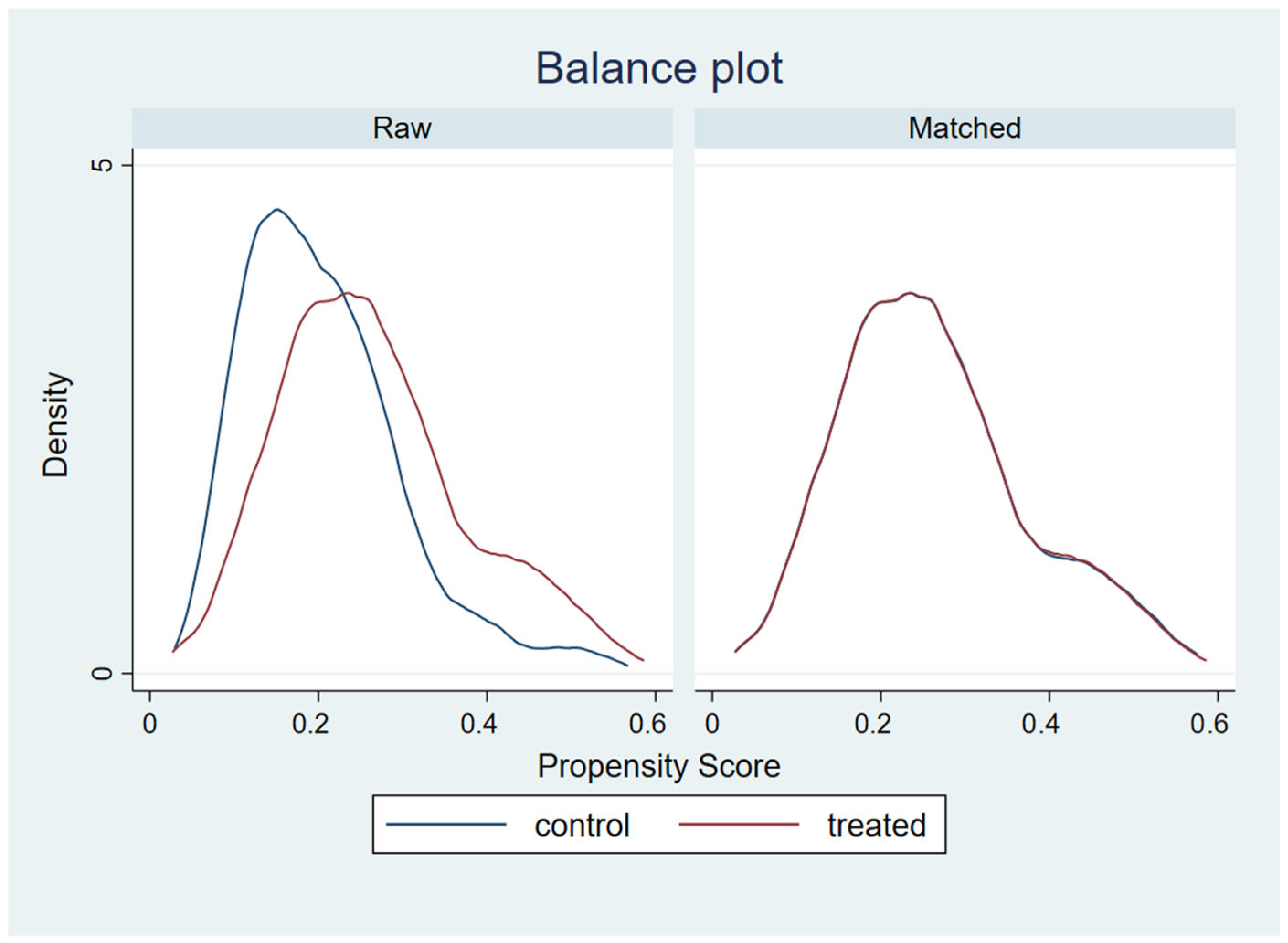
It should be noted that there may be risks of endogeneity between social networks and the intensity of technology adoption. On the one hand, the intensity of technology adoption itself may exert a reverse causality effect by expanding farmers’ social connections through demonstration effects or social recognition. On the other hand, unobserved factors such as village governance capacity, extension intensity, and individual capabilities may simultaneously influence both social networks and technology adoption intensity, leading to omitted variable bias. To mitigate the aforementioned issues, this paper further employs propensity score matching for verification. Based on existing research, this study defines households with a social network composite index above the mean as the treatment group (assigned a value of 1) and those below the mean as the control group (assigned a value of 0). The propensity score density plots reveal that the two sample groups exhibited differences in distribution prior to matching but demonstrated substantial overlap, satisfying the requirement for a common support domain. Following matching, the distributions of both groups became highly congruent, indicating a marked improvement in comparability. See
Figure 2 for the aforementioned content.
The detailed results of the estimated effects are presented in
Table 6. The adoption intensity of agricultural green production technologies was significantly higher in the high social network group than in the low social network group. Using 1:4 nearest neighbor matching yielded an ATT of 0.158 after matching; kernel matching and radius matching produced ATT values of 0.184 and 0.173, respectively, with consistent conclusions across different matching methods. Furthermore, the teffects psmatch results indicate an ATET of 0.168. The covariate balance test shows that the standardized differences in covariates significantly decreased post-matching, with the variance ratio approaching 1, indicating high matching quality. In summary, the propensity score matching tests support the robustness of the fundamental conclusion that social networks enhance farmers’ adoption intensity of agricultural green production technologies.
3.4. Results of Mediated Effect Model Test
To examine whether social networks influence the intensity of farmers’ adoption of green production technologies through green knowledge access, this study constructs a mediation effect model: First, we estimated the influence of social networks using green knowledge access as the dependent variable, designating this path as Path a. Second, in the Ordered Probit model with adoption intensity, both social networks and green knowledge access were incorporated as paths b and c’, respectively, while controlling for variables such as individual characteristics, production and operation features, and land attributes.
The regression results are shown in
Table 7: In the first stage, social networks exert a significant positive influence on green knowledge access, indicating that farmers with deeper social network embedment are more likely to access knowledge and training information related to green production through formal channels (path a is significant). In the second stage, after controlling for social networks and other variables, green knowledge access still exerted a significant positive effect on adoption intensity (path b was significant). The coefficient for green knowledge access was 0.756 and significant at the 1% level, indicating that farmers’ access to relevant knowledge inputs helps lower comprehension barriers and uncertainty, thereby enhancing adoption intensity. Meanwhile, the direct effect coefficient of social networks on adoption intensity remained positive after incorporating the mediating variable, though its significance decreased. This indicates that green knowledge access partially mediated the influence of social networks on adoption intensity. Social networks can directly promote increased adoption intensity among farmers, while also indirectly driving higher adoption rates by enhancing green knowledge access.
Finally, considering that the distribution of indirect effects often deviates from normality, this paper employs the Bootstrap resampling method to conduct robust tests on indirect effects. The results of the Bootstrap mediation effect test are shown in
Table 8.
The indirect effect of social networks on adoption intensity through green knowledge access is 0.672, with a 95% bias-corrected confidence interval of [0.220, 1.028]. Since the interval does not contain 0, this indirect effect is statistically significant. It is evident that social networks not only directly influence the intensity of farmers’ technology adoption but, more importantly, can further promote the adoption intensity of green agricultural production technologies by enhancing farmers’ baseline level of green knowledge access. This supports the existence of an intermediary mechanism. Hypothesis H2, “Green knowledge access plays a positive mediating role in the process by which social networks influence the intensity of farmers’ adoption of green agricultural production technologies,” is validated.
3.5. Analysis of the Moderating Effect of Educational Attainment on the Mediating-Effects Models
The results of mediation effect model testing indicate that social networks exert a significant indirect influence on farmers’ adoption intensity of green agricultural production technologies through green knowledge access. Building upon this foundation, this paper will further examine whether the mediating effect varies across different levels of education, specifically whether educational attainment exerts a stratified moderating influence on the chain of “social networks–knowledge access–adoption intensity.” Specifically, based on the results of the questionnaire survey regarding farmers’ years of education, participants were divided into three groups: low, medium, and high. Path a (social network–knowledge access) and path b (knowledge access–adoption intensity) were estimated for each group. Bootstrap methods were employed to calculate the indirect effects and their confidence intervals under each group’s conditions, while simultaneously testing for differences between groups.
The grouping results indicate that educational attainment primarily generates stratified differences through pathway a: Among the low-education and high-education groups, the influence of social networks on the mechanism variables was positive but not statistically significant. In contrast, within the medium-education group, the effect of social networks on mechanism variables was significantly positive, suggesting this cohort is more adept at transforming exemplary and normative information from social networks into cognitive inputs usable for decision-making. In contrast, the low-education group may be constrained by limited information comprehension and processing capabilities, making it harder to consistently internalize network information. Although the high-education group possesses stronger information processing abilities, their decision-making relies more heavily on independent cost–benefit assessments, reducing their dependence on network demonstrations. Consequently, the marginal promotional effect of social networks on their cognitive input diminishes. Overall, Path a exhibits the strongest structural characteristics among the medium-education groups, providing key evidence for H3.
Further analysis using the Ordered Probit model to estimate adoption intensity within each education group revealed that green knowledge access exerted a significant positive effect on adoption intensity (path b) across all groups. This indicates that once green cognition is successfully activated, its role in promoting the adoption of more intensive green production technologies exhibits cross-group consistency, while educational differences have a relatively limited impact on path b. Therefore, the source of the significant difference between the medium-education group and other education groups primarily stems from the educational stratification along path a, rather than from differences inherent to path b itself. The results of the grouped path regression are shown in
Table 9.
Based on the aforementioned path estimates, this study employs stratified Bootstrap sampling to obtain point estimates and 95% quantile confidence intervals for the conditional indirect effects a*b across educational groups. Bootstrap results further indicate that the conditional indirect effect is significant in the secondary education group, while the confidence intervals for the indirect effects in the low and high-education groups include zero. Intergroup comparisons reveal that the indirect effect is numerically larger in the secondary education group, though the difference from the high-education group is not statistically significant. Overall, educational attainment does not linearly enhance the role of social networks. Instead, it functions as a boundary condition for absorptive capacity, making the transmission pathway of “social networks–knowledge access–adoption intensity” most robust among the medium-education cohort. The Bootstrap results for the conditional mediating effects under the education grouping are shown in
Table 10.
Based on the above results, we can conclude that path b was significant and relatively stable across all groups, whereas path a exhibited the strongest heterogeneity among educational levels in the medium-education group, rendering the conditional indirect effect significant only in this group. Therefore, educational attainment exhibits stratified moderation in the mediating process of social network influence on adoption intensity, with the mediating effect being most pronounced and robust among the medium-education group. Hypothesis H3 is supported.
The above results indicate that educational attainment does not simply enhance the influence of social networks in a linear fashion. Instead, it optimizes the activation of green awareness through social networks among individuals with medium education by shaping their mechanisms for understanding, filtering, and internalizing network information. This results in the most pronounced conditional mediation pattern observed in the medium-education group.
4. Conclusions
Based on micro-level survey data from Jiangsu Province farmers, this study adopts a social network perspective to construct an analytical framework linking “social networks–green knowledge access–adoption intensity of green agricultural production technologies.” It empirically examines the impact of social networks on farmers’ adoption of green agricultural production technologies and its underlying mechanisms, while further investigating the stratified heterogeneity of educational attainment. The main conclusions are as follows:
First, social networks significantly promote the intensity of farmers’ adoption of green agricultural production technologies. Baseline regression and marginal effect results indicate that enhanced social networks reduce the probability of farmers remaining at low adoption levels while increasing their likelihood of advancing to higher adoption levels. This demonstrates that social networks play a crucial “information transmission and demonstration-driven” role in the diffusion of green technologies.
Second, green knowledge access plays a significant mediating role in the process by which social networks influence adoption intensity. Bootstrap tests reveal that the indirect effect of social networks on farmers’ adoption intensity through green knowledge access is significant. This indicates that social networks not only provide information and experience through external interactions but also activate farmers’ cognition and understanding of green production technologies, thereby driving an increase in their adoption intensity.
Third, educational attainment exhibits significant stratification and heterogeneity in the aforementioned mediating transmission mechanisms, with the mediating effect being most pronounced in the medium-education group. The results of the grouped regression analysis indicate that the “social network–green knowledge access” pathway (Path a) was significantly positive in the medium-education group, while it was not significant in the low and high-education groups. Simultaneously, the “green knowledge access–adoption intensity” pathway (Path b) was significantly positive across all three groups. Further stratified Bootstrap conditional indirect effect tests revealed that only the confidence interval for the indirect effect in the medium-education group did not include zero. This indicates that the mechanism whereby social networks promote adoption intensity through green knowledge access is more robust primarily within the medium-education cohort.
In summary, this study explains the origins of variations in farmers’ adoption intensity under identical policy and market conditions by examining the mechanism chain of “social networks–green knowledge access–green technology adoption intensity.” The findings indicate that social networks not only serve as information channels but also influence behavioral responses by activating farmers’ green knowledge access and value judgments, thereby driving the transition of green production technologies from “low-level, intermittent adoption” to “stable, high-intensity adoption.” Compared to existing studies that primarily identify direct effects of social networks, this paper further reveals the mediating role of cognitive mechanisms and the moderating differences in educational stratification. It provides a more explanatory analytical framework for understanding the micro-level behavioral logic behind “same policy, different outcomes” and offers micro-level evidence to support the precise design of rural green transition policies.
5. Discussion
5.1. Policy Implications
Based on the findings of this paper, enhancing the adoption intensity of green production technologies among farmers cannot rely solely on subsidies or administrative constraints. Instead, policy implementation should be achieved through the pathway of “networked diffusion–knowledge exposure–sustained adoption.”
(1) To local governments and agricultural authorities: It is recommended to shift the promotion of green technologies from a “one-time mobilization approach” to a “networked, routine diffusion mechanism.” Leveraging village social networks and demonstration households, one should establish a chain-based promotion model of “village-level demonstration–neighborhood diffusion–follow-up adoption.” By publicly showcasing cost–benefit analyses, operational essentials, and risk mitigation strategies, uncertainty can be reduced and replicability enhanced, thereby improving the sustainability and intensity of technology adoption.
(2) For grassroots agricultural technology extension systems and training institutions: “Green knowledge access” should be established as the core training objective, with a focus on designing actionable content and minimizing abstract, slogan-like promotion. Training should emphasize standardized procedures for critical processes, changes in labor and input requirements, risk management, and expected returns, thereby enhancing farmers’ ability to translate information into action.
(3) For village collectives, cooperatives, and new types of business entities: It is recommended to leverage organizational strengths by embedding the trial demonstration of green technologies, centralized procurement, unified pest control, and technical services into the daily operations of cooperatives/socialized service organizations. This approach reduces constraints on individual farmers regarding trial-and-error costs, equipment investment, and learning expenses. Furthermore, it enhances the probability of sustained adoption through peer effects and normative constraints within the organization.
(4) For farmer groups with significant educational disparities: Promotion strategies should be tailored to each group. For groups with lower educational attainment, one should employ a “face-to-face demonstration + simplified manual + on-site guidance” approach to enhance comprehension and practical applicability. For groups with intermediate education, we recommend leveraging their information absorption and dissemination capabilities to cultivate them as key node farmers, amplifying diffusion effects. For groups with higher education, one should utilize digital tools, data recording, and precision management solutions to improve their recognition of green technology’s comprehensive benefits and sustain their willingness to invest.
Through the aforementioned policy combination that targets different actors and operates at multiple levels, we can enhance the availability of information while improving the efficiency of green awareness activation. This approach promotes a shift among farmers from merely considering adoption to achieving greater intensity and stability in their adoption practices.
5.2. Research Gaps and Future Prospects
Although this paper has explained farmers’ adoption of green technologies from the perspectives of social networks and cognitive mechanisms, several limitations remain:
First, the measurement of social networks and green knowledge access may still be subject to proxy variable bias. Future research could introduce more granular network structure indicators and cognitive task items to construct a comprehensive index.
Second, due to data limitations, this study cannot directly observe cognitive processing intensity. Therefore, the variable of whether individuals have received agricultural technology training is used to describe green knowledge access, while educational attainment is used to describe knowledge absorption capacity and conversion efficiency. Future research may further refine the measurement of mechanisms by combining cognitive scales with training intensity data.
Third, the lower Pseudo R2 suggests that farmers’ adoption intensity may be influenced by unobserved heterogeneity, such as wealth and liquidity constraints, risk preferences, policy promotion intensity, and village-level institutional environments.
Fourth, this paper identifies mechanism relationships based on cross-sectional data. Although it controls for multidimensional characteristics and employs Bootstrap robustness tests, it remains difficult to completely rule out potential endogeneity. Future research could further strengthen causal identification by incorporating panel data or quasi-experimental methods.
Fifth, the sample originates from Jiangsu Province, and extrapolation to other regions requires caution. Future studies may be expanded to different areas to test the universality and variability of the conclusions.