3.1. Test Results
A Box–Behnken design (BBD) was implemented using Design-Expert v13.0 software, comprising 17 experimental runs. Analysis of variance (ANOVA) and multiple regression were used to develop fitted regression models for the response variables—screening mass () and separation rate ()—followed by a systematic evaluation of factor significance and interaction effects. To enhance the statistical reliability of the response surface analysis and minimize random disturbances, a standardized experimental protocol was applied in three aspects: feedstock pretreatment, feed control, and error management.
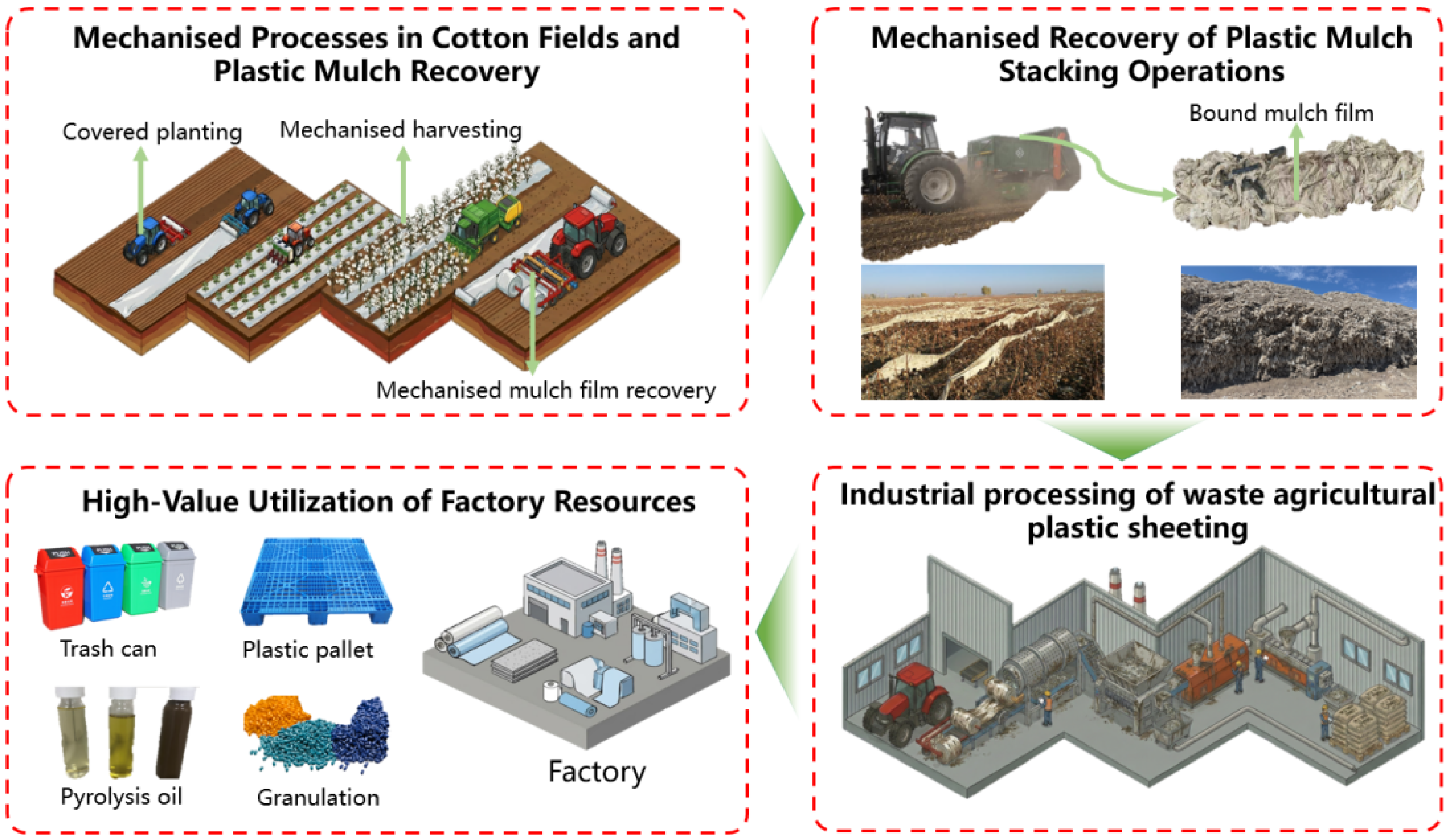
(1) Feedstock consistency. All test materials were collected from the same cotton-field plot in Shihezi, Xinjiang, using the same mechanized mulch-film recovery equipment (Model 4JMLQ210, Changzhou Hansen Machinery Co., Ltd., Changzhou, China). Prior to testing, the recovered film–impurity mixture (including soil clods, cotton stalk fragments, gravel, etc.) was thoroughly mixed and homogenized. This pretreatment minimized potential interference from feedstock compositional variability and ensured comparable initial impurity fractions across runs.
(2) Stratified control of feed mass (). A two-tier feed-mass control strategy was adopted: strict mass constancy at center points and response normalization at non-center design points. For the five center-point replicates (Runs 1, 5, 9, 12, and 13), the feed mass was maintained at 4.5 kg ( to eliminate input-load fluctuations, thereby allowing the observed variation to primarily reflect the system’s pure (random) error. In contrast, for non-center runs, variation in film length (, 100–300 mm) markedly altered the bulk density and entanglement morphology of the feedstock, resulting in run-to-run fluctuations in the actual feed mass (2.5–5.0 kg) under a fixed feed volume. To account for this effect, separation rate () was used as a key performance metric; by normalizing the discharged undersize mass passing through the screen apertures by the actual feed mass, the influence of feed-load differences was effectively mitigated, improving the robustness of the evaluation.
(3) Model prediction accuracy and experimental repeatability. The five center-point replicates provided an estimate of pure error (4 degrees of freedom) for the ANOVA, which served as the basis for the lack-of-fit test and for assessing overall system stability (instrumentation and operation). Moreover, the run order of all 17 trials was fully randomized in Design-Expert to mitigate time-dependent systematic bias due to evolving environmental and machine-state effects (e.g., thermal drift and mechanical wear). The experimental results are presented in
Table 9.
The experimental data in
Table 9 were analyzed using Design-Expert v13.0, and the following second-order (quadratic) regression models were obtained for the drum-screening responses: screening mass
and separation rate
:
3.2. Experimental Results and Analysis
Based on the Box–Behnken design (BBD), this study systematically examined the effects of film length (
), drum inclination angle (
), and drum rotational speed (
) on the screening mass (
) and separation rate (
) [
23]. ANOVA indicated that the quadratic response-surface models for both responses were highly significant (
), demonstrating excellent model fit and strong predictive capability. For
, the coefficients of determination were
, adjusted
, and predicted
; for
, they were
, adjusted
, and predicted
. Moreover, the lack-of-fit for both models was not significant, indicating that the models adequately captured the experimental data and supporting the reliability of subsequent parameter optimization. With respect to factor effects, the quadratic term of rotational speed (
) was the most influential contributor to
, exhibiting the highest statistical significance and the largest coefficient magnitude. This suggests a pronounced nonlinear effect of rotational speed on the discharge capacity of undersize impurities. In addition, the quadratic terms
and
, as well as the interaction terms
and
, were all significant, indicating that impurity removal is governed by strong coupling between “film length–rotational speed” and “inclination angle–rotational speed,” rather than by any single factor. In contrast, the dominant contributor to
was the quadratic term of inclination angle (
), which showed the greatest effect size and significance, while the linear term
also exhibited a strong negative main effect. Although the main effects of
and
were less pronounced than that of
, their interactions with other factors (
,
, and
) were all statistically significant, demonstrating that separation performance is jointly and synergistically influenced by multiple coupled factors (the results are summarized in
Table 10).
A comprehensive assessment of the effects of film length (), drum inclination angle (), and drum rotational speed () on screening mass () and separation rate () indicates that both responses are governed by significant multi-factor interactions and nonlinear (quadratic) effects. However, the dominant contributors differ between the two responses. For screening mass (), the response is primarily dominated by the quadratic term of drum rotational speed (), indicating a pronounced nonlinear dependence on rotational speed. In addition, the quadratic terms of film length and inclination angle, as well as their interaction terms with rotational speed, contribute appreciably, suggesting that rotational speed not only has a strong main effect but also regulates the undersize discharge through interactions with the other factors. In contrast, separation rate () is mainly governed by drum inclination angle, with both the quadratic () and linear () terms jointly shaping the response profile. Although the main effects of film length and rotational speed are comparatively weaker, their interaction effects with inclination angle and with each other remain influential, demonstrating that separation performance arises from coupled factor effects rather than a single-parameter control. Accordingly, improving should emphasize precise regulation of drum rotational speed, whereas enhancing should prioritize optimization of drum inclination angle. Ultimately, operating-parameter selection should account for the interaction effects among all three factors to achieve stable and overall improvements in screening (undersize discharge) and separation performance.
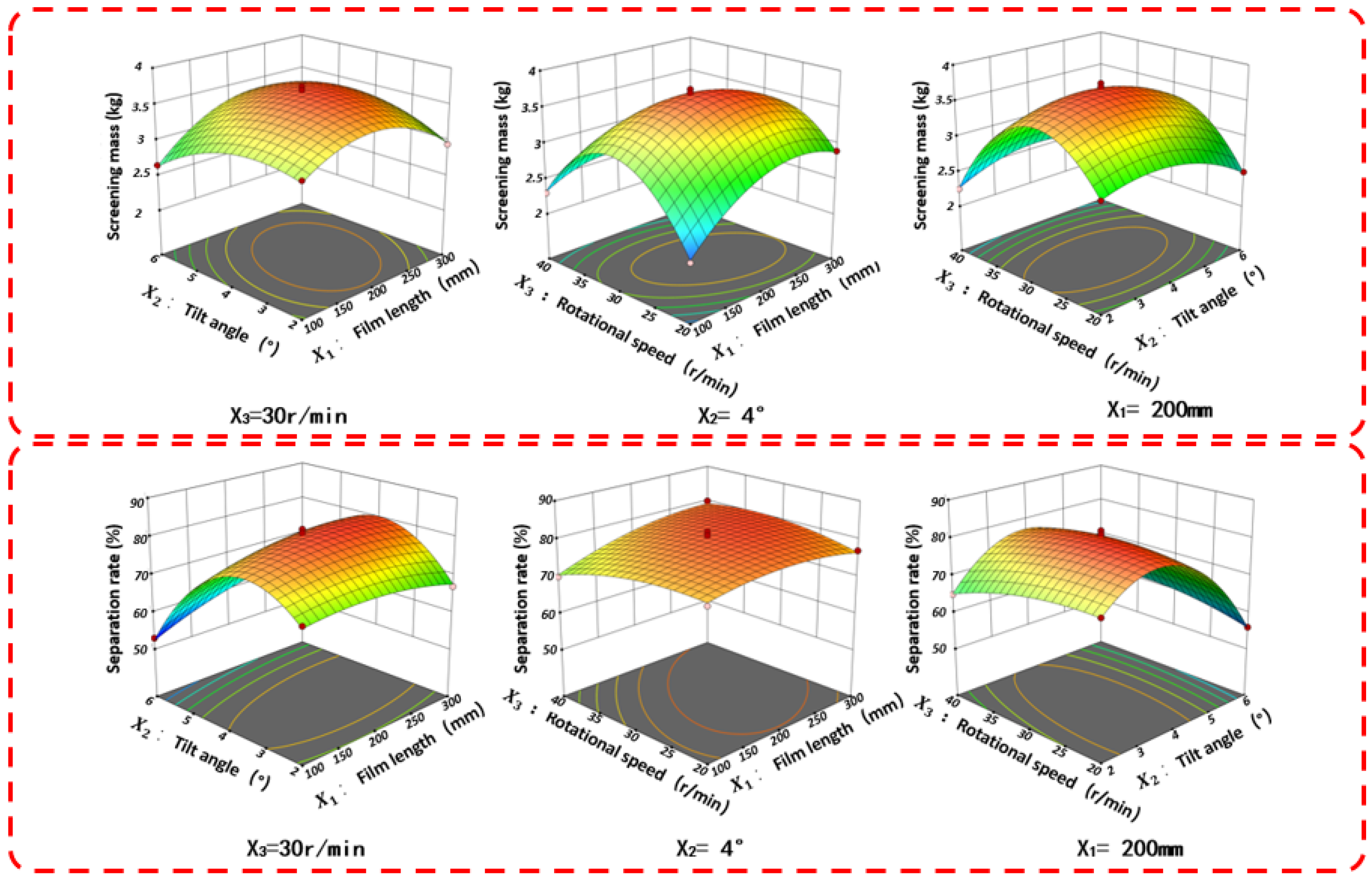
Figure 15 illustrates the interaction effects of film length (
), drum inclination angle (
), and drum rotational speed (
) on screening mass (
) and separation rate (
). The upper row shows the three-dimensional response surfaces for
, whereas the lower row presents those for
. Each plot depicts the combined effects of two factors (including their interaction) on the response while holding the third factor at its coded zero (center) level. As indicated by the upper response surfaces,
exhibits pronounced nonlinear dependence on the operating factors. When drum rotational speed is fixed at 30 rpm,
increases with film length and then approaches a plateau, with the highest values occurring at intermediate film lengths (approximately 200–250 mm). In contrast, increasing the inclination angle produces an overall decrease in
, suggesting that excessive inclination accelerates axial transport of the material bed and reduces the effective residence time available for collision-assisted liberation and discharge of undersize impurities. When inclination angle (
) is held constant, the
response with respect to rotational speed is the steepest and follows a concave-down quadratic (unimodal) trend. A distinct maximum occurs at approximately 25–35 rpm, indicating that rotational speed is the primary factor governing
(i.e., the discharge of undersize impurities). Moreover, at the center level of film length (
), the interaction between inclination angle and rotational speed yields a pronounced parabolic response surface, with
peaking at a moderate rotational speed (~30 rpm) and a relatively small inclination angle (3–4°). Overall,
is most strongly affected by the quadratic term of drum rotational speed, followed by film length, whereas the influence of inclination angle is comparatively weaker and more gradual.
The lower row presents the response surfaces for the separation rate (). The overall response trends are similar to those observed for screening mass (); however, exhibits distinct sensitivity to the operating factors. When rotational speed is held at 30 rpm, increases gradually with increasing film length, indicating a positive dependence. In contrast, decreases sharply as the inclination angle increases, suggesting that an excessively steep inclination accelerates axial transport and likely weakens material-bed stratification within the drum, thereby reducing the probability of fines passing through the apertures. When inclination angle is fixed at 4°, increases with rotational speed and film length and then shows a slight decline, consistent with a unimodal (quadratic) response. Notably, when rotational speed exceeds 35 rpm, the separation rate is markedly suppressed. This behavior can be attributed to centrifugal adhesion (pinning) at high speeds, where elevated centrifugal forces promote sticking of the material bed to the drum inner wall and hinder cascading and percolation of fine particles through the screen. At a fixed film length of 200 mm, a pronounced local maximum appears near the center of the response surface, indicating that peak separation performance is achieved within an optimal operating window—an inclination angle of 3.5–4.5° and a rotational speed of 28–33 rpm. Overall, is highly sensitive to inclination angle, whereas the interaction between rotational speed and film length plays a key role in maintaining stable separation performance.
A comprehensive interpretation of the response surface results indicates that both screening mass () and separation rate () exhibit pronounced nonlinear dependence on the experimental factors, with broadly similar response trends. Drum rotational speed () is the primary factor governing screening performance, showing a strong quadratic effect with a distinct optimum within 25–35 rpm. In contrast, separation performance is highly sensitive to the drum inclination angle (); excessive inclination accelerates axial transport of the material bed and reduces the effective residence time for cascading collisions, thereby causing a substantial decline in separation rate. When film length () is fixed at approximately 200 mm, the optimal operating windows for both responses largely overlap. Specifically, at a rotational speed of 28–33 rpm and an inclination angle of 3.5–4.5°, the drum screen simultaneously achieves high undersize discharge (impurity removal via screening) and stable material-bed stratification. Collectively, these results highlight an operating principle in which product quality is predominantly regulated by rotational speed, whereas separation efficiency is strongly influenced by inclination angle, thereby providing a sound basis for equipment design and operating-parameter selection for mulch-film recycling systems.
3.3. Bench-Scale Experimental Optimization Results
To further improve the overall performance of the drum separation system, multi-objective optimization was performed in Design-Expert based on the preceding RSM results [
24,
25]. Film length (
), drum inclination angle (
), and drum rotational speed (
) were selected as the independent factors, whereas screening mass (
) and separation rate (
) were defined as the response variables. The three factors were constrained within their respective experimental ranges (
: 100–300 mm;
: 2–6°;
: 20–40 rpm). Both responses were set to be maximized, and equal importance (weight = 3) was assigned to
and
.
Using the desirability function for multi-response optimization, the optimal operating conditions were identified as a film length () of 216.00 mm, a drum inclination angle () of 2.33°, and a drum rotational speed () of 25.00 rpm. Under these conditions, the model predicted a screening mass () of 3.467 kg and a separation rate () of 75.636%, with an overall desirability of 1.000. These results indicate that the identified parameter set provides the best trade-off between the two objectives within the design space. Specifically, it promotes effective impurity detachment and discharge through the screen apertures while maintaining efficient recovery of the mulch film as the oversize fraction, thereby representing an optimal operating parameter combination for the drum separation process.
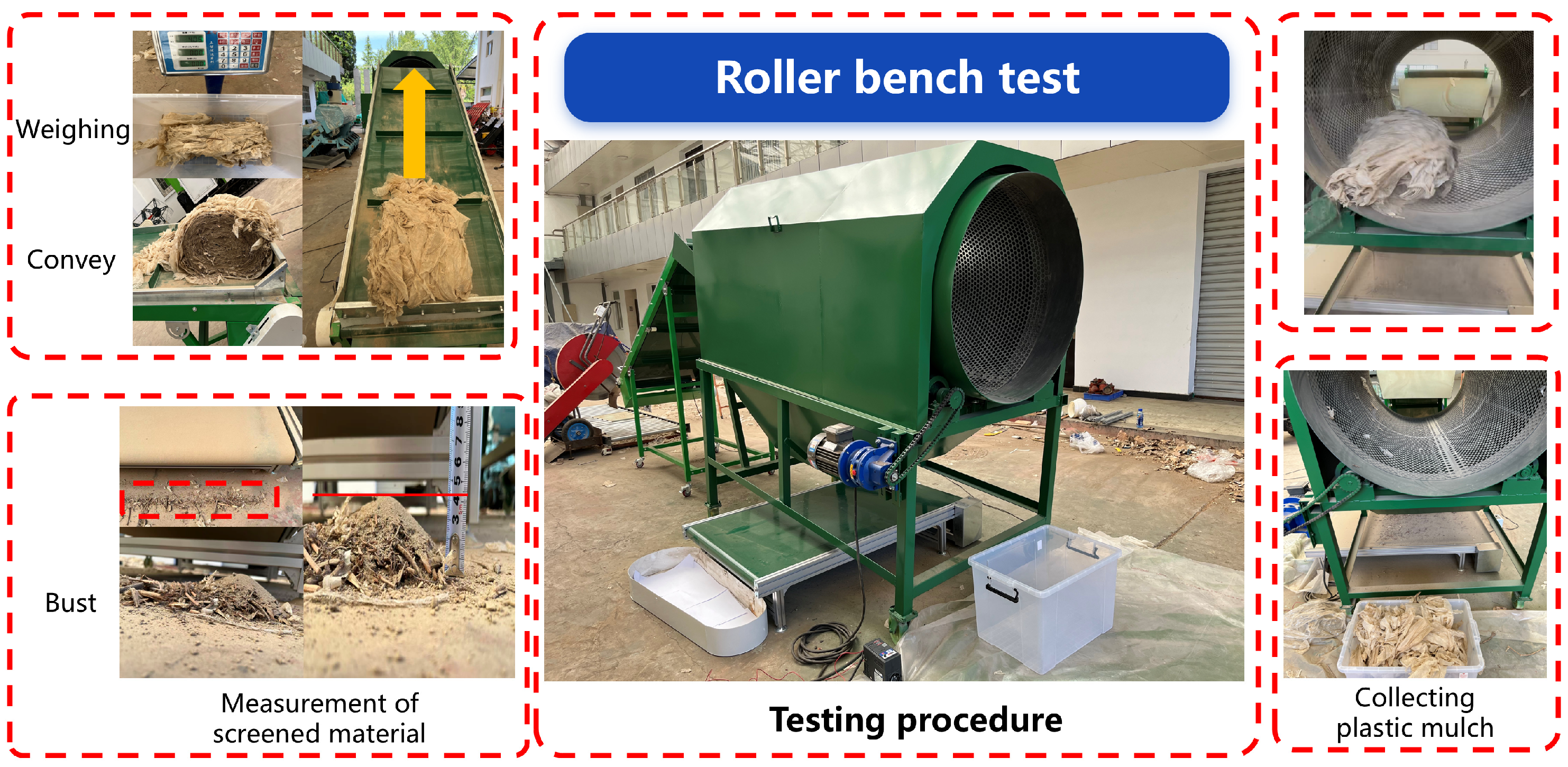
To validate the predictive accuracy of the optimization model, a bench-scale confirmation test of the drum separation apparatus was performed under the model-derived optimal conditions (
Figure 16). Because the predicted optima (216.00 mm, 2.33°, and 25.00 rpm) included non-integer setpoints that were impractical to implement via manual adjustment on the test bench, the settings were rounded to practical engineering setpoints: a film length of 220 mm, an inclination angle of 3°, and a rotational speed of 25 rpm. The measured screening mass (
) and separation rate (
) were 3.65 kg and 80.5%, respectively. Compared with the corresponding model predictions (
kg and
), the relative errors were 5.28% for
and 6.43% for
. Both errors were below 10%, indicating good agreement between experimental measurements and model predictions. These results confirm that the established quadratic regression model provides reliable predictions of drum-screening performance and adequately captures the coupled screening/separation dynamics within the drum. Moreover, satisfactory performance was maintained after minor engineering adjustment of the operating parameters, demonstrating the robustness and practical applicability of the proposed optimization scheme.
In summary, the optimized parameter combination—mulch-film length of approximately 220 mm, drum inclination angle of approximately 3°, and drum rotational speed of approximately 25 r/min—can substantially enhance the impurity-removal and separation performance of the drum-type separation unit for waste residual mulch film. This parameter set provides a sound theoretical basis and experimental reference for drum structural refinement and the selection of operating parameters, and is of significant importance for improving the cleaning efficiency of equipment used for the recycling and subsequent reutilization of waste residual mulch film.





 ,
,