Agricultural Productivity and Its Spatial Spillover Effects in China


Abstract
1. Introduction
Literature Review
2. Methodology and Design
2.1. Data, Variables, and Preprocessing
2.1.1. Data Sources and Sample
2.1.2. Variable Definition and Measurement
2.1.3. Data Preprocessing
Missing Data Handling and Imputation Methods
Data Standardization
2.2. Production Function Estimation and Endogeneity Treatment
2.2.1. Translog Production Function
2.2.2. Control Function Method Based on LP-ACF
2.3. Two-Step GMM Estimation and Model Diagnostics
2.3.1. Instrument Construction and Moment Conditions
2.3.2. Two-Step GMM Estimation Process
2.3.3. Model Diagnostic Tests
2.4. Three-Way Decomposition of TFP Growth
2.5. Spatial Econometric Model
2.5.1. Construction of Spatial Weight Matrix
2.5.2. Dynamic Spatial Panel Model
Economic Motivation
Econometric Solution
2.5.3. Bias Reduction and Robust Standard Errors
2.5.4. Decomposition of Spatial Effects (LeSage–Pace Method)
2.5.5. Cross-Sectional Dependence Test
2.5.6. Local Indicators of Spatial Association (LISA)
3. Empirical Results
3.1. Model Validity and Specification Tests
Cross-Sectional Dependence Diagnosis
3.2. National-Scale TFP Growth Dynamics and Decomposition
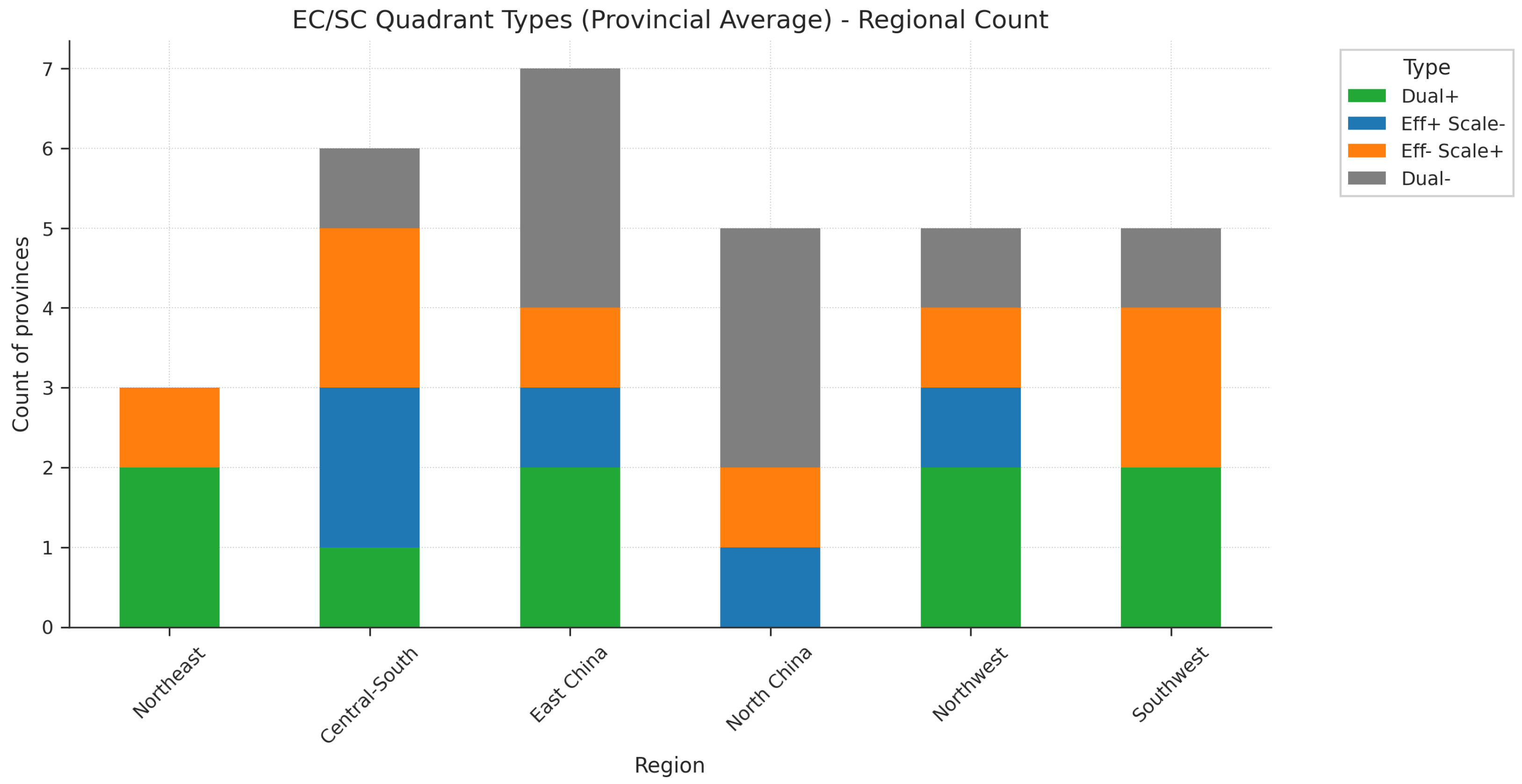
3.3. Inter-Provincial Differences and Structural Characteristics of Returns to Scale
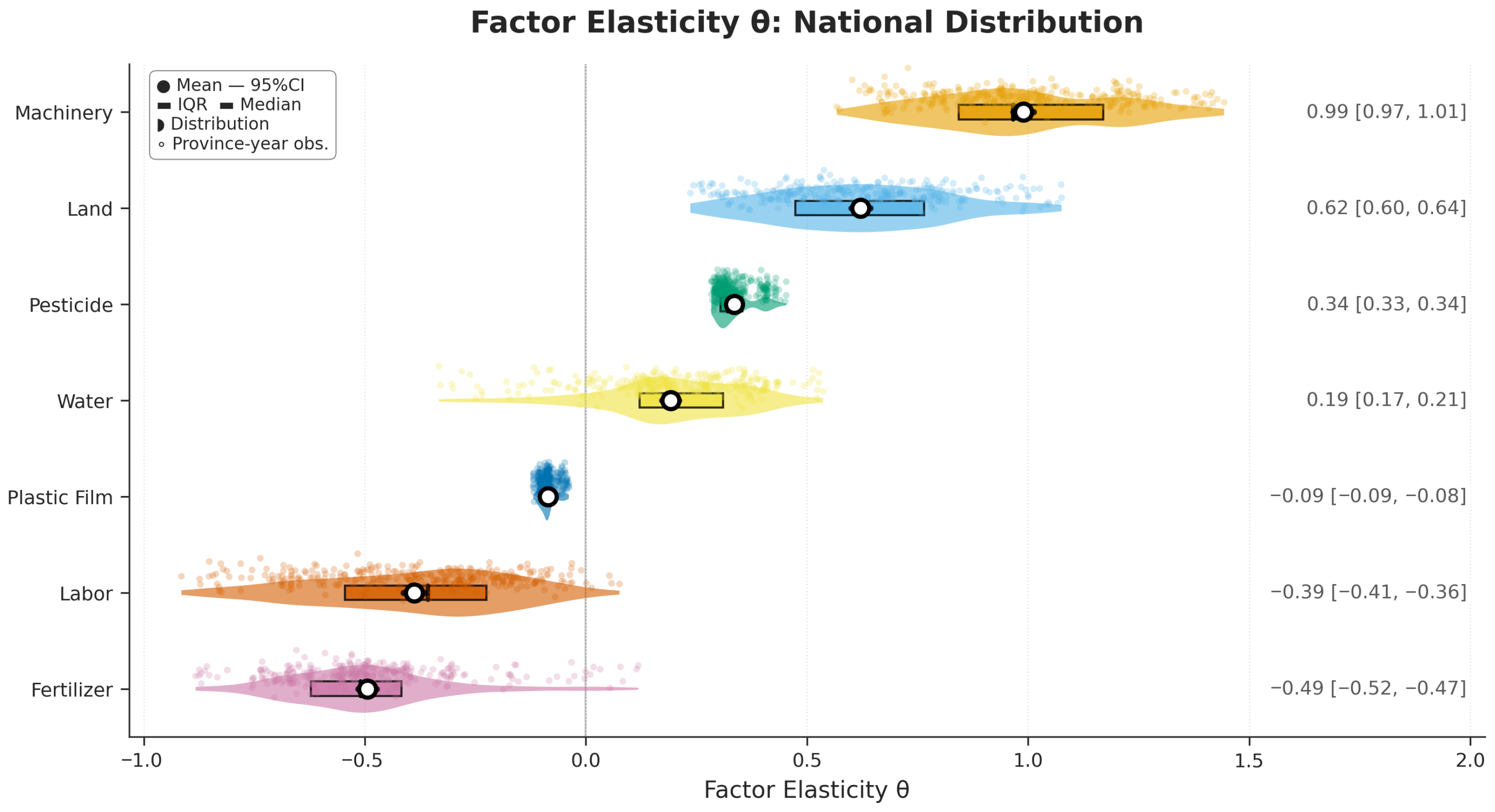
3.4. Structural Imbalance of Production Factor Elasticities
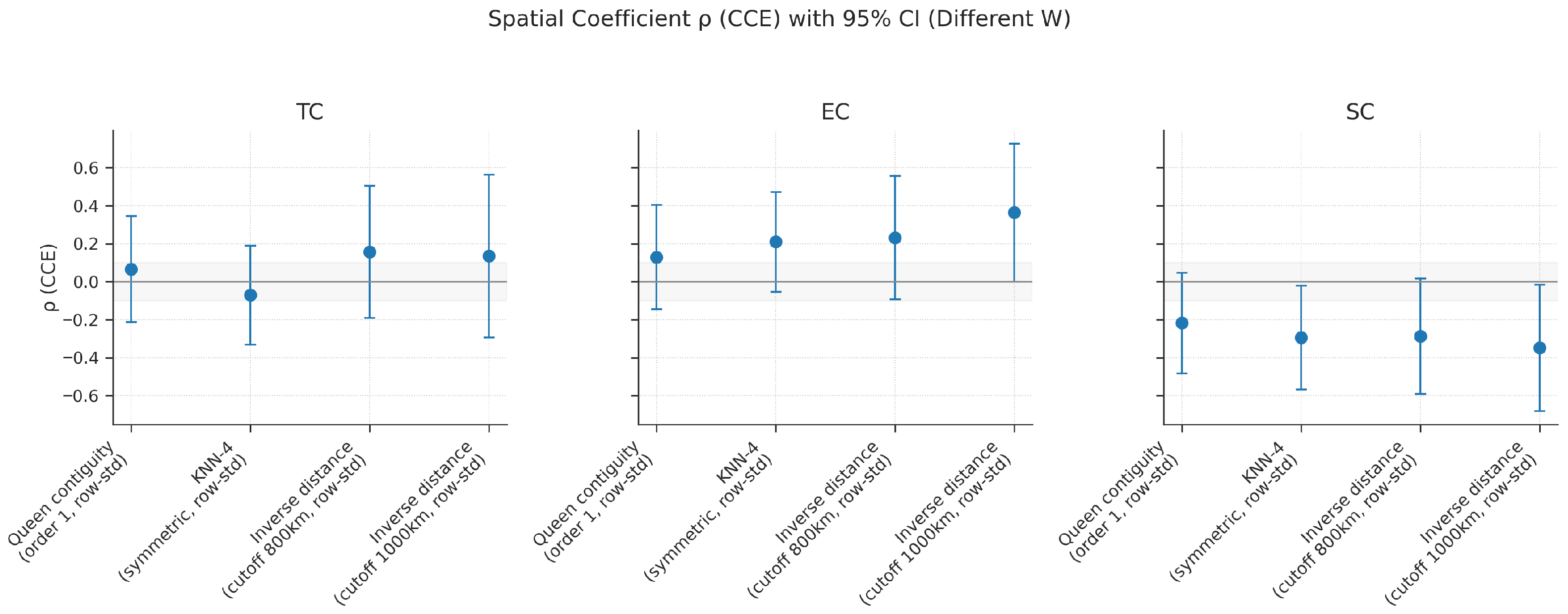
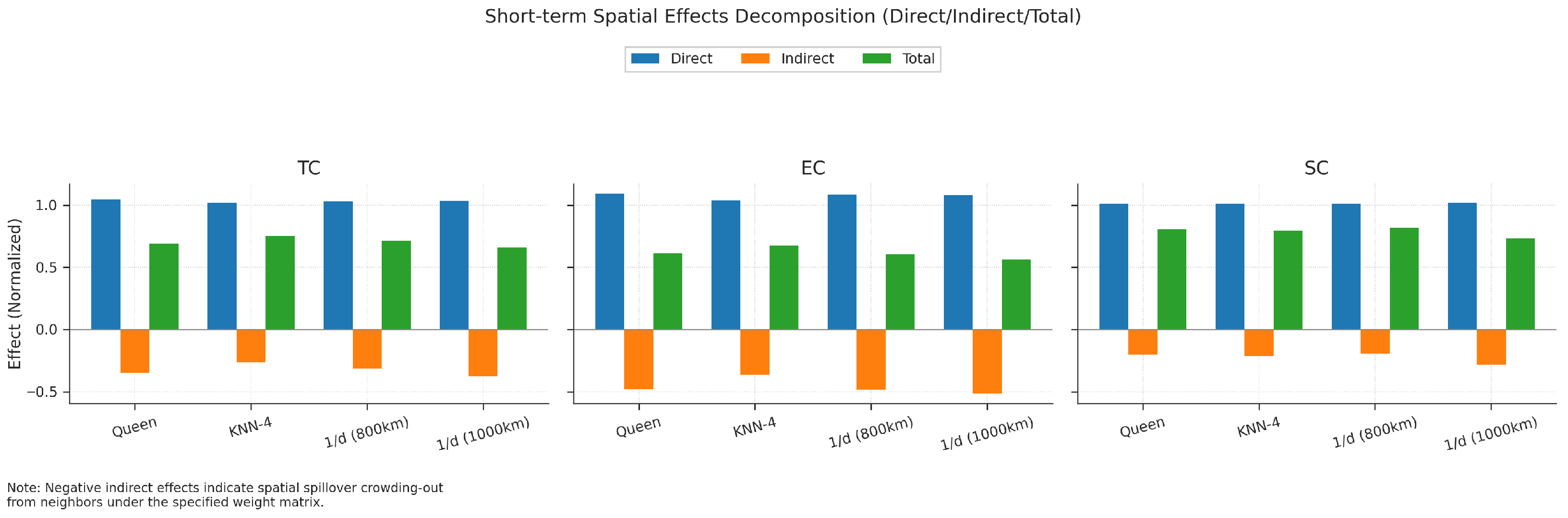
3.5. Spatial Dependence and Spillover Effects of TFP Growth
3.5.1. Spatial Model Residual Diagnostics
3.5.2. Moran’s I Spatial Autocorrelation Analysis
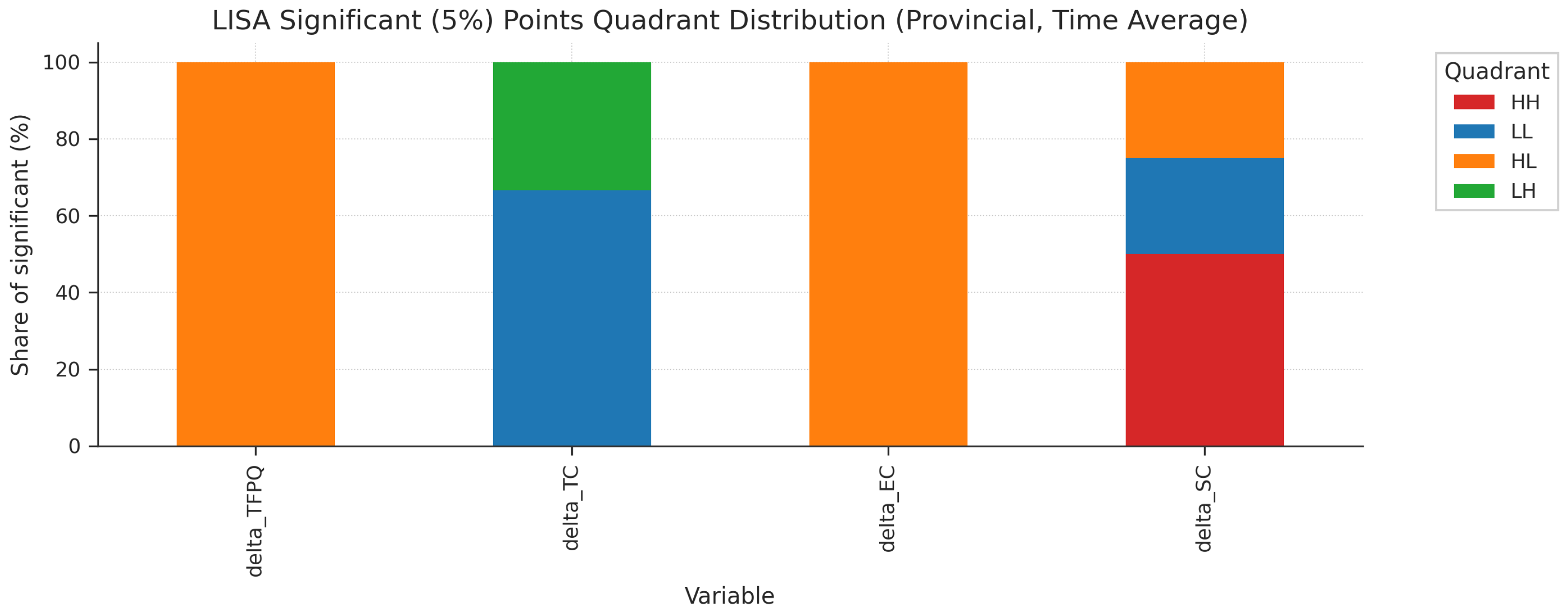
3.5.3. LISA Local Spatial Clustering Pattern Analysis
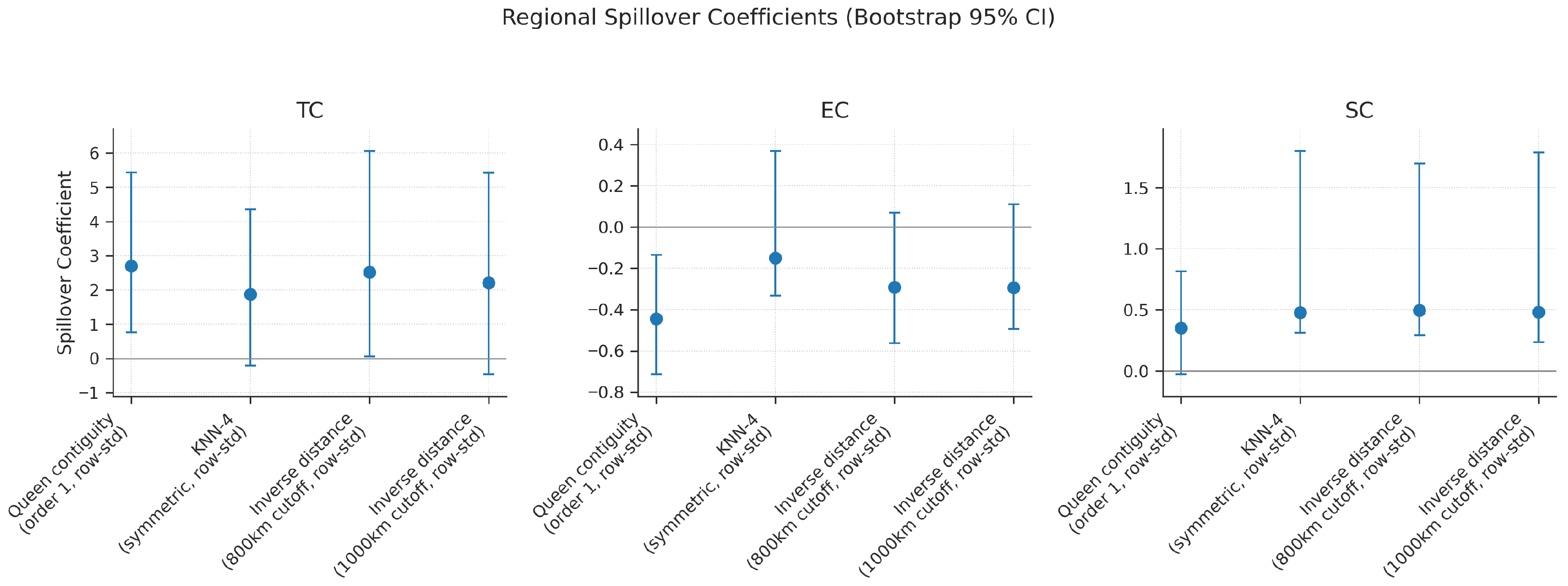
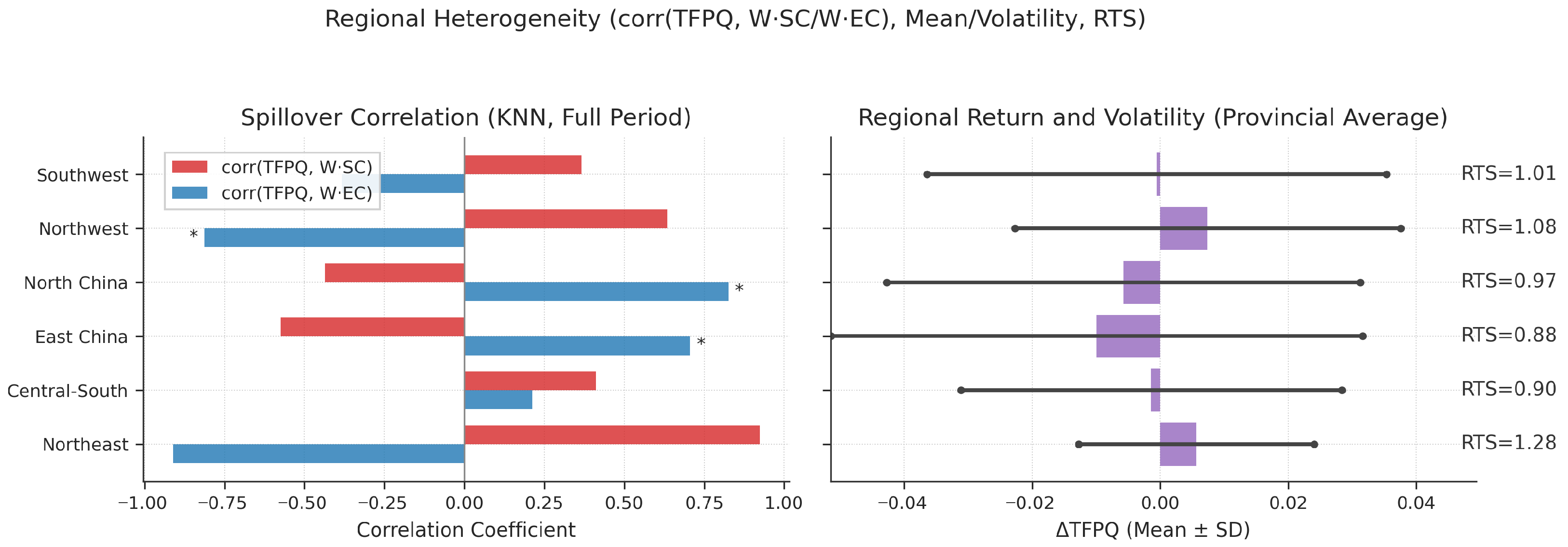
3.6. Regional Heterogeneity and Development Pattern Differentiation of Spatial Effects
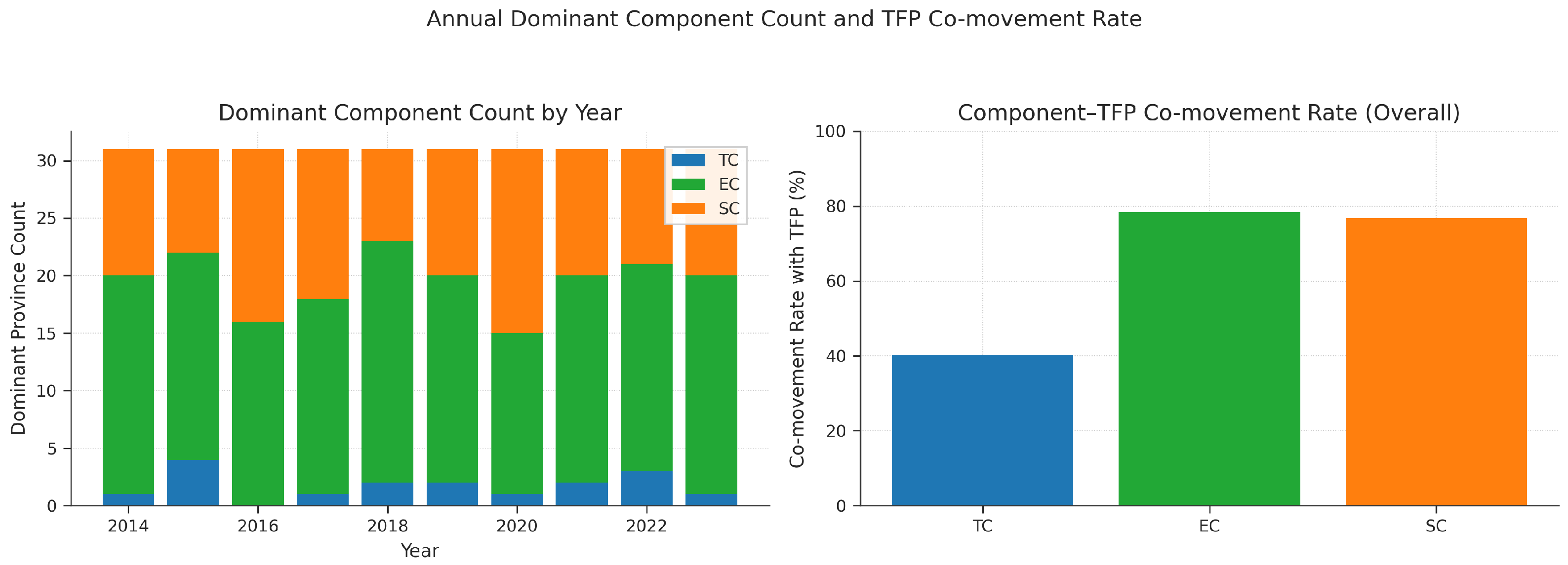
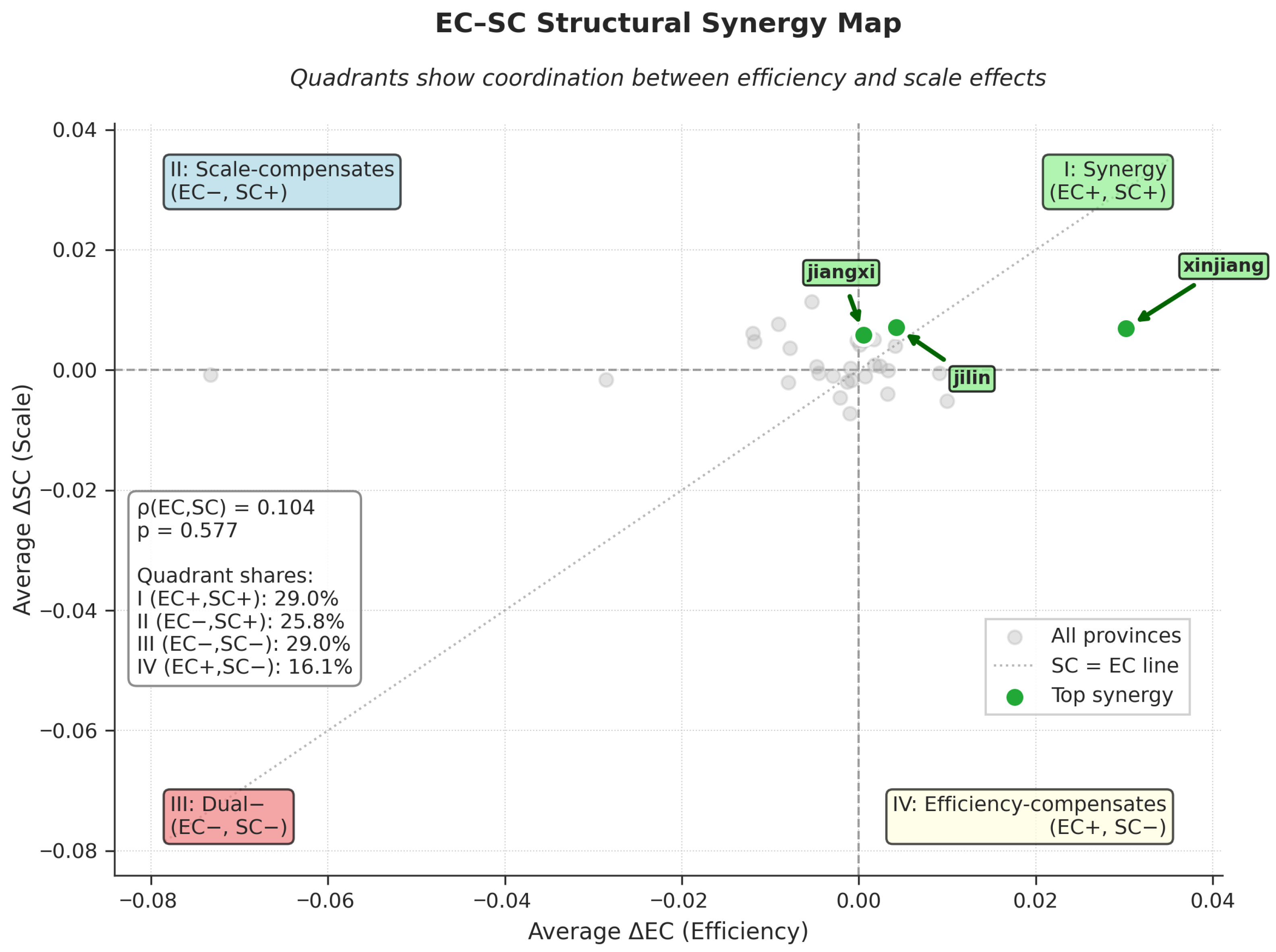
3.7. Dominance and Co-Movement of TFP Components
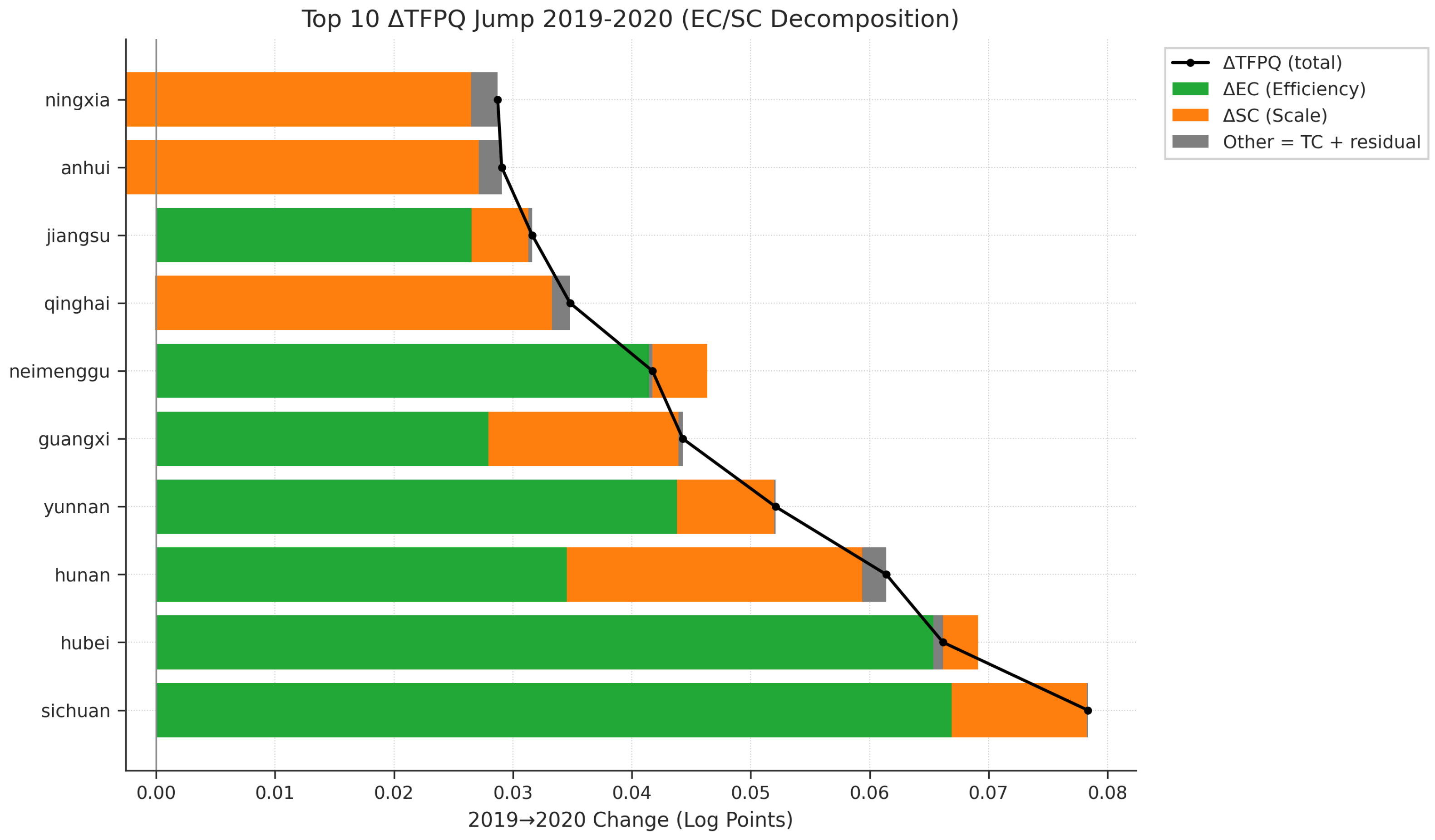
3.8. Shock Response and Resilience
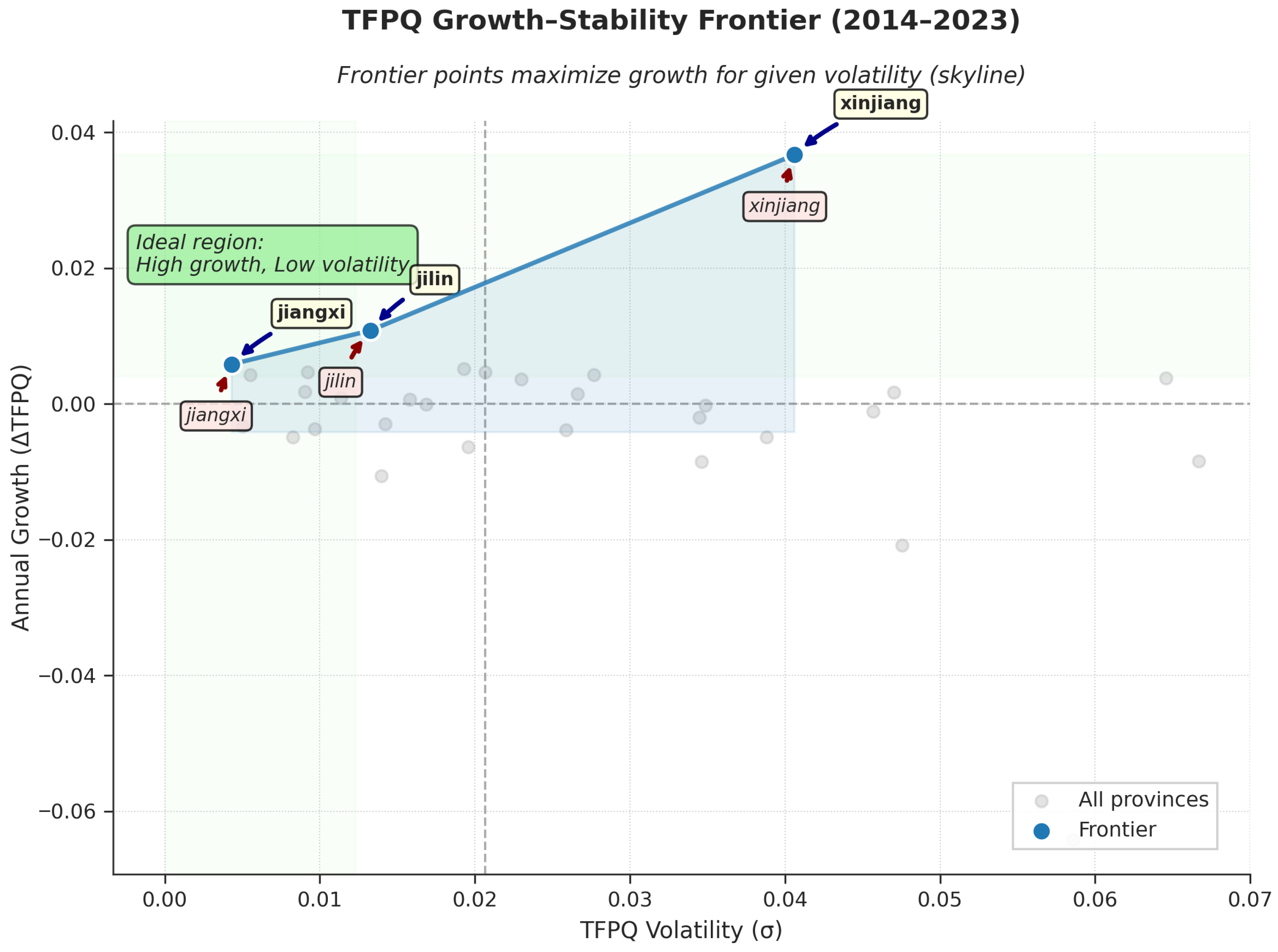
3.9. Pareto Frontier Analysis of Growth Models
4. Discussion
4.1. Model Validity Assessment
4.2. Marginal Contribution and Positioning
4.3. Relationship with Existing Research
4.4. Economic Interpretation of Factor Elasticities
4.5. Interpretation and Limitations of Results
5. Conclusions and Policy Implications
5.1. Conclusions
5.2. Policy Implications
5.3. Research Limitations and Future Directions
Author Contributions
Funding
Data Availability Statement
Acknowledgments
Conflicts of Interest
References
- FAO; IFAD; UNICEF; WFP; WHO. The State of Food Security and Nutrition in the World 2023; FAO: Rome, Italy, 2023. [Google Scholar] [CrossRef]
- Huang, J.; Yang, G. Understanding recent challenges and new food policy in China. Glob. Food Secur. 2017, 12, 119–126. [Google Scholar] [CrossRef]
- Fan, S.; Cho, E.E.; Meng, T.; Rue, C. How to prevent and cope with coincidence of risks to the global food system. Annu. Rev. Environ. Resour. 2021, 46, 601–623. [Google Scholar] [CrossRef]
- Schultz, T.W. Transforming Traditional Agriculture; Yale University Press: New Haven, CT, USA, 1964. [Google Scholar]
- Hayami, Y.; Ruttan, V.W. Agricultural Development: An International Perspective, 1st ed.; Johns Hopkins University Press: Baltimore, MD, USA, 1971. [Google Scholar]
- Krugman, P. The Myth of Asia’s Miracle. Foreign Aff. 1994, 73, 62–78. [Google Scholar] [CrossRef]
- Solow, R.M. Technical Change and the Aggregate Production Function. Rev. Econ. Stat. 1957, 39, 312–320. [Google Scholar] [CrossRef]
- Jorgenson, D.W.; Griliches, Z. The Explanation of Productivity Change. Rev. Econ. Stud. 1967, 34, 249–283. [Google Scholar] [CrossRef]
- Gollin, D.; Parente, S.; Rogerson, R. The Role of Agriculture in Development. Am. Econ. Rev. 2002, 92, 160–164. [Google Scholar] [CrossRef]
- Färe, R.; Grosskopf, S.; Norris, M.; Zhang, Z. Productivity Growth, Technical Progress, and Efficiency Change in Industrialized Countries. Am. Econ. Rev. 1994, 84, 66–83. [Google Scholar]
- Lin, J.Y. Rural Reforms and Agricultural Growth in China. Am. Econ. Rev. 1992, 82, 34–51. [Google Scholar]
- Carter, C.A.; Chen, J.; Chu, B. Agricultural productivity growth in China: Farm level versus aggregate measurement. China Econ. Rev. 2003, 14, 53–71. [Google Scholar] [CrossRef]
- Gong, B. Agricultural reforms and production in China: Changes in provincial production function and productivity in 1978–2015. J. Dev. Econ. 2018, 132, 18–31. [Google Scholar] [CrossRef]
- Coelli, T.J.; Rao, D.S.P.; O’Donnell, C.J.; Battese, G.E. An Introduction to Efficiency and Productivity Analysis, 2nd ed.; Springer: New York, NY, USA, 2005. [Google Scholar] [CrossRef]
- Olley, G.S.; Pakes, A. The Dynamics of Productivity in the Telecommunications Equipment Industry. Econometrica 1996, 64, 1263–1297. [Google Scholar] [CrossRef]
- Kumbhakar, S.C.; Lovell, C.K. Stochastic Frontier Analysis; Cambridge University Press: Cambridge, UK, 2000. [Google Scholar] [CrossRef]
- Gao, F. Evolution trend and internal mechanism of regional total factor productivity in Chinese agriculture: An empirical analysis based on provincial panel data. J. Quant. Tech. Econ. 2015, 32, 3–19, 53. (In Chinese) [Google Scholar] [CrossRef]
- Wang, Q.; Wang, H.; Chen, H. A study on Agricultural green TFP in China: 1992-2010. Econ. Rev. 2012, 5, 24–33. (In Chinese) [Google Scholar] [CrossRef]
- Anselin, L. Spatial Econometrics: Methods and Models; Kluwer Academic Publishers: Dordrecht, The Netherlands, 1988. [Google Scholar] [CrossRef]
- LeSage, J.P.; Pace, R.K. Introduction to Spatial Econometrics; CRC Press: Boca Raton, FL, USA, 2009. [Google Scholar] [CrossRef]
- Ackerberg, D.A.; Caves, K.; Frazer, G. Identification properties of recent production function estimators. Econometrica 2015, 83, 2411–2451. [Google Scholar] [CrossRef]
- Levinsohn, J.; Petrin, A. Estimating production functions using inputs to control for unobservables. Rev. Econ. Stud. 2003, 70, 317–341. [Google Scholar] [CrossRef]
- Charnes, A.; Cooper, W.W.; Rhodes, E. Measuring the Efficiency of Decision Making Units. Eur. J. Oper. Res. 1978, 2, 429–444. [Google Scholar] [CrossRef]
- Aigner, D.; Lovell, C.A.K.; Schmidt, P. Formulation and Estimation of Stochastic Frontier Production Function Models. J. Econom. 1977, 6, 21–37. [Google Scholar] [CrossRef]
- Battese, G.E.; Coelli, T.J. A Model for Technical Inefficiency Effects in a Stochastic Frontier Production Function for Panel Data. Empir. Econ. 1995, 20, 325–332. [Google Scholar] [CrossRef]
- Zhang, L. China’s agricultural total factor productivity growth: Introduction of allocative efficiency change—An empirical analysis based on stochastic frontier production function. Chin. Rural Econ. 2013, 3, 4–15. (In Chinese) [Google Scholar] [CrossRef]
- Restuccia, D.; Rogerson, R. Policy Distortions and Aggregate Productivity with Heterogeneous Establishments. Rev. Econ. Dyn. 2008, 11, 707–720. [Google Scholar] [CrossRef]
- Zhu, X.; Shi, Q.; Gai, Q. Misallocation and TFP in Rural China. Econ. Res. J. 2011, 5, 86–98. (In Chinese) [Google Scholar]
- Brandt, L.; Tombe, T.; Zhu, X. Factor Market Distortions across Time, Space and Sectors in China. Rev. Econ. Dyn. 2013, 16, 39–58. [Google Scholar] [CrossRef]
- Hsieh, C.T.; Klenow, P.J. Misallocation and Manufacturing TFP in China and India. Q. J. Econ. 2009, 124, 1403–1448. [Google Scholar] [CrossRef]
- Ge, P.; Wang, S.; Huang, X. Measurement of agricultural green total factor productivity in China. China Popul. Resour. Environ. 2018, 28, 66–74. (In Chinese) [Google Scholar]
- Färe, R.; Grosskopf, S.; Pasurka, C.A. Environmental Production Functions and Environmental Directional Distance Functions. Energy 2007, 32, 1055–1066. [Google Scholar] [CrossRef]
- Chung, Y.H.; Färe, R.; Grosskopf, S. Productivity and Undesirable Outputs: A Directional Distance Function Approach. J. Environ. Manag. 1997, 51, 229–240. [Google Scholar] [CrossRef]
- Yang, Q.; Wang, J.; Li, C.; Liu, X. Spatial Differentiation and Driving Factors of China’s Agricultural Green Total Factor Productivity. J. Quant. Tech. Econ. 2019, 36, 21–37. (In Chinese) [Google Scholar] [CrossRef]
- Wang, H.; Cui, H.; Zhao, Q. Effect of green technology innovation on green total factor productivity in China: Evidence from spatial durbin model analysis. J. Clean. Prod. 2021, 288, 125624. [Google Scholar] [CrossRef]
- Liu, Y.; Yang, Y.; Li, H.; Zhong, K. Digital economy development, industrial structure upgrading and green total factor productivity: Empirical evidence from China’s cities. Int. J. Environ. Res. Public Health 2022, 19, 2414. [Google Scholar] [CrossRef] [PubMed]
- Pu, M.; Zhong, Y. Rising Concerns over Agricultural Production as COVID-19 Spreads: Lessons from China. Glob. Food Secur. 2020, 26, 100409. [Google Scholar] [CrossRef]
- Anselin, L. Under the Hood: Issues in the Specification and Interpretation of Spatial Regression Models. Agric. Econ. 2002, 27, 247–267. [Google Scholar] [CrossRef]
- Christensen, L.R.; Jorgenson, D.W.; Lau, L.J. Transcendental logarithmic production frontiers. Rev. Econ. Stat. 1973, 55, 28–45. [Google Scholar] [CrossRef]
- Hansen, L.P. Large sample properties of generalized method of moments estimators. Econometrica 1982, 50, 1029–1054. [Google Scholar] [CrossRef]
- Windmeijer, F. A finite sample correction for the variance of linear efficient two-step GMM estimators. J. Econom. 2005, 126, 25–51. [Google Scholar] [CrossRef]
- Sanderson, E.; Windmeijer, F. A weak instrument F-test in linear IV models with multiple endogenous variables. J. Econom. 2016, 190, 212–221. [Google Scholar] [CrossRef] [PubMed]
- Kleibergen, F.; Paap, R. Generalized reduced rank tests using the singular value decomposition. J. Econom. 2006, 133, 97–126. [Google Scholar] [CrossRef]
- Holly, S.; Pesaran, M.H.; Yamagata, T. A spatio-temporal model of house prices in the USA. J. Econom. 2010, 158, 160–173. [Google Scholar] [CrossRef]
- Chudik, A.; Pesaran, M.H. Common correlated effects estimation of heterogeneous dynamic panel data models with weakly exogenous regressors. J. Econom. 2015, 188, 393–420. [Google Scholar] [CrossRef]
- Ditzen, J. Estimating Dynamic Common Correlated Effects in Stata. Stata J. 2018, 18, 585–617. [Google Scholar] [CrossRef]
- Elhorst, J.P. Spatial Econometrics: From Cross-Sectional Data to Spatial Panels; Springer: Heidelberg, Germany, 2014. [Google Scholar] [CrossRef]
- Pesaran, M.H. Estimation and inference in large heterogeneous panels with a multifactor error structure. Econometrica 2006, 74, 967–1012. [Google Scholar] [CrossRef]
- Driscoll, J.C.; Kraay, A.C. Consistent covariance matrix estimation with spatially dependent panel data. Rev. Econ. Stat. 1998, 80, 549–560. [Google Scholar] [CrossRef]
- Pesaran, M.H. Testing weak cross-sectional dependence in large panels. Econom. Rev. 2015, 34, 1089–1117. [Google Scholar] [CrossRef]
- Anselin, L. Local indicators of spatial association—LISA. Geogr. Anal. 1995, 27, 93–115. [Google Scholar] [CrossRef]
- Fang, S.; Huang, Z. Phased evolution and development trends of China’s agricultural mechanization in the 70 years since the founding of New China. Issues Agric. Econ. 2019, 10, 93–102. (In Chinese) [Google Scholar] [CrossRef]
- Wu, Y.; Xi, X.; Tang, X.; Luo, D.; Gu, B.; Lam, S.K.; Vitousek, P.M.; Chen, D. Policy distortions, farm size, and the overuse of agricultural chemicals in China. Proc. Natl. Acad. Sci. USA 2018, 115, 7010–7015. [Google Scholar] [CrossRef]
- Zhang, W.; Cao, G.; Li, X.; Zhang, H.; Wang, C.; Liu, Q.; Chen, X.; Cui, Z.; Shen, J.; Jiang, R.; et al. Closing yield gaps in China by empowering smallholder farmers. Nature 2016, 537, 671–674. [Google Scholar] [CrossRef]
- Zhang, X.; Yang, J.; Wang, S. China has reached the Lewis turning point. China Econ. Rev. 2011, 22, 542–554. [Google Scholar] [CrossRef]
- Cai, F. Approaching a neoclassical scenario: The labor market in China after the Lewis turning point. China Financ. Econ. Rev. 2013, 1, 1. [Google Scholar] [CrossRef]
- Chen, Y.; Miao, J.; Zhu, Z. Measuring green total factor productivity of China’s agricultural sector: A three-stage SBM-DEA model with non-point source pollution and CO2 emissions. J. Clean. Prod. 2021, 318, 128543. [Google Scholar] [CrossRef]
- Adamopoulos, T.; Restuccia, D. The Size Distribution of Farms and International Productivity Differences. Am. Econ. Rev. 2014, 104, 1667–1697. [Google Scholar] [CrossRef]
- Hayami, Y.; Ruttan, V.W. Agricultural Development: An International Perspective, 2nd ed.; Johns Hopkins University Press: Baltimore, MD, USA, 1985. [Google Scholar]
- Wang, X.; Yamauchi, F.; Otsuka, K.; Huang, J. Wage growth, landholding, and mechanization in Chinese agriculture. World Dev. 2016, 86, 30–45. [Google Scholar] [CrossRef] [PubMed]
- Sun, F.; Abler, D.; Yu, X. Crop allocation and increasing returns to fertilizer use in China. Land Econ. 2021, 97, 491–508. [Google Scholar] [CrossRef]
- Qiu, H.; Luan, H.; Li, J.; Wang, Y. The impact of risk aversion on farmers’ excessive fertilizer application behavior. Chin. Rural. Econ. 2014, 3, 85–96. (In Chinese) [Google Scholar]
- Cai, F.; Wang, M. A counterfactual analysis on unlimited surplus labour in rural China. China World Econ. 2008, 16, 51–65. [Google Scholar] [CrossRef]
- Kwan, F.; Wu, Y.; Zhuo, S. Surplus agricultural labour and China’s Lewis turning point. China Econ. Rev. 2018, 48, 244–257. [Google Scholar] [CrossRef]
- Meng, L.; Meng, L.; Yu, X. Machinery structure, machinery subsidies, and agricultural productivity: Evidence from China. Agric. Econ. 2024, 55, 223–246. [Google Scholar] [CrossRef]
- Biørn, E.; Skjerpen, T. Aggregation biases in production functions: A theoretical framework with applications to Norwegian establishment data. Res. Econ. 2004, 58, 31–57. [Google Scholar] [CrossRef]
- Liu, Y.; Hu, W.; Jetté-Nantel, S.; Tian, Z. The Influence of Labor Price Change on Agricultural Machinery Usage in Chinese Agriculture. Can. J. Agric. Econ. 2014, 62, 219–243. [Google Scholar] [CrossRef]
- Zheng, X.; Xu, Z. Resource endowment constraints, factor substitution, and induced technological change: The case of grain production mechanization in China. China Econ. Q. 2016, 16, 45–66. (In Chinese) [Google Scholar] [CrossRef]
- Wang, X.; Yamauchi, F.; Huang, J. Rising wages, mechanization, and the substitution between capital and labor: Evidence from small scale farm system in China. Agric. Econ. 2016, 47, 309–317. [Google Scholar] [CrossRef]
- Silverwood, S.; Lichter, K.; Kleiner, H.; Katsumoto, T. A unified strategy for addressing climate change, improving public health, and mitigating environmental degradation. Agric. Commun. 2025, 3, 100090. [Google Scholar] [CrossRef]



| Variable | Symbol | Unit | Source | Type |
|---|---|---|---|---|
| Output | Y | 10,000 tons | CSY 12-10 | — |
| Land | 1000 hectares | CSY 8-23/8-20 | Fixed | |
| Machinery | 10,000 kW | CSY 12-4 | Fixed | |
| Labor | L | 10,000 persons | NBS | Free |
| Fertilizer | 10,000 tons | CRSY 3-9/3-15 | Free | |
| Water | 100 million m3 | CSY 8-12/8-10 | Free | |
| Pesticide | tons | CRSY 3-13/3-11 | Free | |
| Plastic film | tons | CRSY 3-12/3-10 | Free | |
| Time trend | t | year − min(year) | Constructed | Control |
| Disaster shock | d | CSY Ch. 8 | Control |
| Test | Value |
|---|---|
| Model Specification | |
| Sample size n | 341 |
| Instruments | 40 |
| Parameters k | 35 |
| Moment conditions m | 45 |
| Instrument Strength | |
| Min SW F | 41.5 |
| Median SW F | 60.8 |
| Mean SW F | 59.1 |
| KP rk stat | 281.0 |
| Overidentification | |
| Hansen J | 8.29 |
| Degrees of freedom | 10 |
| p-value | 0.601 |
| Functional Form | |
| WR Statistic | 524.4 |
| Degrees of freedom | 25 |
| p-value | <0.001 |
| Component | Method | Weight Matrix | CD Stat. | p-Value | Sig. |
|---|---|---|---|---|---|
| DCCE Method Results | |||||
| TC | DCCE | Queen | −1.08 | 0.279 | No |
| TC | DCCE | KNN-4 | −0.83 | 0.405 | No |
| TC | DCCE | Distance 800 km | −0.34 | 0.734 | No |
| TC | DCCE | Distance 1000 km | −0.50 | 0.616 | No |
| EC | DCCE | Queen | −1.09 | 0.275 | No |
| EC | DCCE | KNN-4 | −0.54 | 0.586 | No |
| EC | DCCE | Distance 800 km | −0.04 | 0.969 | No |
| EC | DCCE | Distance 1000 km | −0.54 | 0.592 | No |
| SC | DCCE | Queen | −1.16 | 0.248 | No |
| SC | DCCE | KNN-4 | −1.10 | 0.270 | No |
| SC | DCCE | Distance 800 km | −0.58 | 0.561 | No |
| SC | DCCE | Distance 1000 km | −0.69 | 0.492 | No |
| CCE Method Results | |||||
| TC | CCE | Queen | −2.05 | 0.040 | Yes |
| TC | CCE | KNN-4 | −2.05 | 0.040 | Yes |
| TC | CCE | Distance 800 km | −2.04 | 0.041 | Yes |
| TC | CCE | Distance 1000 km | −2.05 | 0.041 | Yes |
| EC | CCE | Queen | 0.52 | 0.604 | No |
| EC | CCE | KNN-4 | 0.55 | 0.582 | No |
| EC | CCE | Distance 800 km | 0.49 | 0.621 | No |
| EC | CCE | Distance 1000 km | 0.39 | 0.696 | No |
| SC | CCE | Queen | 0.72 | 0.471 | No |
| SC | CCE | KNN-4 | 1.02 | 0.306 | No |
| SC | CCE | Distance 800 km | 0.50 | 0.618 | No |
| SC | CCE | Distance 1000 km | 0.88 | 0.379 | No |
| Component | HH (%) | LL (%) | HL (%) | LH (%) | Total Sig. |
|---|---|---|---|---|---|
| Technical Change (TC) | 19.4 | 58.1 | 12.9 | 9.6 | 72.0% |
| Technical Efficiency (EC) | 31.2 | 41.9 | 16.1 | 10.8 | 61.0% |
| Scale Efficiency (SC) | 44.8 | 37.9 | 10.3 | 6.9 | 69.0% |
| Average | 31.8 | 46.0 | 13.1 | 9.1 | 67.3% |
| High–High (HH) Clusters | Low–Low (LL) Clusters | ||||||
|---|---|---|---|---|---|---|---|
| Province | Comp. | LISA | p | Province | Comp. | LISA | p |
| Heilongjiang | SC | 2.83 | 0.003 | Hubei | TC | −2.67 | 0.004 |
| Jilin | SC | 2.45 | 0.007 | Hunan | TC | −2.34 | 0.009 |
| Inner Mongolia | SC | 2.12 | 0.017 | Jiangxi | TC | −2.18 | 0.015 |
| Xinjiang | SC | 1.98 | 0.024 | Anhui | TC | −2.05 | 0.020 |
| Liaoning | SC | 1.76 | 0.039 | Henan | TC | −1.89 | 0.029 |
Disclaimer/Publisher’s Note: The statements, opinions and data contained in all publications are solely those of the individual author(s) and contributor(s) and not of MDPI and/or the editor(s). MDPI and/or the editor(s) disclaim responsibility for any injury to people or property resulting from any ideas, methods, instructions or products referred to in the content. |
© 2026 by the authors. Licensee MDPI, Basel, Switzerland. This article is an open access article distributed under the terms and conditions of the Creative Commons Attribution (CC BY) license.
Share and Cite
Tang, J.-S.; Lu, H.; Gong, T.; Chen, J. Agricultural Productivity and Its Spatial Spillover Effects in China. Agriculture 2026, 16, 543. https://doi.org/10.3390/agriculture16050543
Tang J-S, Lu H, Gong T, Chen J. Agricultural Productivity and Its Spatial Spillover Effects in China. Agriculture. 2026; 16(5):543. https://doi.org/10.3390/agriculture16050543
Chicago/Turabian StyleTang, Juk-Sen, Hongwei Lu, Tianyi Gong, and Junhong Chen. 2026. "Agricultural Productivity and Its Spatial Spillover Effects in China" Agriculture 16, no. 5: 543. https://doi.org/10.3390/agriculture16050543
APA StyleTang, J.-S., Lu, H., Gong, T., & Chen, J. (2026). Agricultural Productivity and Its Spatial Spillover Effects in China. Agriculture, 16(5), 543. https://doi.org/10.3390/agriculture16050543