Article

Mating Modifies the Survival and Oviposition of Tetranychus merganser Boudreaux (Acari: Tetranychidae) Females on Five Host Plants

by
Ernesto Aldape-Rodríguez
1,
Julio César Chacón-Hernández
1,*,
Salvador Ordaz-Silva
2,*,
Yolanda del Rocío Moreno-Ramírez
1,
Imelda Virginia López-Sánchez
2,
Mario Rocandio-Rodríguez
1,
Agustín Hernández-Juárez
3 and
Sandra Grisell Mora-Ravelo
1
1
Faculty of Engineering and Sciences, Universidad Autónoma de Tamaulipas, Ciudad Victoria 87019, Tamaulipas, Mexico
2
Faculty of Business and Engineering San Quintín, Universidad Autónoma de Baja California, San Quintín 22930, Baja California, Mexico
3
Department of Parasitology, Universidad Autónoma Agraria Antonio Narro, Saltillo 25315, Coahuila, Mexico
*
Authors to whom correspondence should be addressed.
Agriculture 2026, 16(5), 507; https://doi.org/10.3390/agriculture16050507
Submission received: 30 January 2026 / Revised: 21 February 2026 / Accepted: 24 February 2026 / Published: 26 February 2026
(This article belongs to the Section Crop Protection, Diseases, Pests and Weeds)

Abstract

Tetranychus merganser Boudreaux (Acari: Tetranychidae) is a significant pest of papaya (Carica papaya L.) crops. The behavior of female spider mites is altered by interaction with males. However, the cost of this interaction between male and female T. merganser has not been studied. This study aimed to determine the effect of mating on the survival, longevity, and daily oviposition of female T. merganser on five plant species. By comparing virgin and mated females, we tested the hypothesis that mating with a male affects female behavior, leading to greater survival and daily oviposition in virgin females than in mated females. The survival over the entire adult lifespan of mated females was lower than that of virgin females. The mean number of eggs laid by mated females was also lower compared to virgin females. Additionally, mated females initiated oviposition earlier than virgin females, which may suggest male-induced stress or harassment.

1. Introduction

Tetranychus merganser Boudreaux (Acari: Tetranychidae) feeds on twenty-three species of plants from sixteen families [1], including wild chili pepper [Capsicum annuum L. var. glabriusculum (Dunal) Heiser y Pickersgill (Solanaceae)], papaya [Carica papaya L. (Caricaceae)], rose bushes [Rosa sp. L. (Rosaceae)], and barreta [Helietta parvifolia (Gray) Benth. (Rutaceae)]. Tetranychus merganser is one of the dominant mite pests of papaya cultivation [2]. In addition, the resistance of non-host plants to T. merganser such as maize [Zea mays L. (Poaceae)] [3] and tomato [Solanum lycopersicum L. (Solanaceae)] [4] has been evaluated, showing a reduced population growth rate of T. merganser. Damage caused by this mite to its host plants is initially observed as small white spots near leaf veins. As population density increases, these spots can merge, resulting in the whitening of the entire leaf [5]. The formation of large white spots on leaves may reduce photosynthetic activity and transpiration rate, ultimately impacting plant growth and fruit production [5]. As a result, this mite is primarily controlled using chemical pesticides. Yet, this approach faces significant challenges, as the mite’s rapid development and high fecundity [6] allow it to develop resistance to these compounds [7].
Several studies have reported the biological and demographic parameters of T. merganser across various host plants [5,6,8]. However, they did not emphasize male mortality and longevity. We included both male and female mites as subjects, with the aim of examining sex differences in mortality rates and longevity when feeding on five host plants. Furthermore, the effects of female mating status (virgin and mated) on daily fecundity and female survival were also studied. In mites like Tetranychus urticae Koch, a congener of T. merganser, the survival rate and fecundity of females are affected by their mating status (virgin or mated) [9,10,11]. Mating alters resource allocation in females. For example, virgin females delay the start of oviposition and spread their reproductive effort over time. This may increase their probability of finding a mate and having female progeny. In contrast, mated females oviposit immediately after mating because sperm have a limited lifespan [9,10,11]. They dedicate most resources to reproduction early in life, before their sperm supply is depleted. Starting to lay eggs earlier in life could be costly in terms of the number of eggs laid daily, since mated females may reallocate resources differently due to sperm transfer [9,10,11]. Based on these observations, we hypothesize that virgin females will show a longer reproductive lifespan and a higher oviposition rate than mated females. This difference may result from delayed oviposition and altered resource allocation. Fecundity, longevity, and survival are characteristic and important attributes of spider mites that vary among host plants [6]. Understanding the longevity of virgin and mated female and male T. merganser mites, and how they survive, is essential for developing effective control programs [11]. The results will help define the optimal time to control adult T. merganser populations and develop a more effective integrated pest management program for these mites.

2. Materials and Methods

2.1. Spider Mite Collection

Larvae, nymphs, and adults of T. merganser were collected from papaya (C. papaya) at Victoria City (23°44′38.4″ N and 99°9′57.599″ W, 329 m above sea level). These mites were placed on bean (Phaseolus vulgaris L. var. Michigan) plants to increase their population. Bean plants were grown in plastic pots (15 cm diameter × 10 cm height) with a growth medium of peat moss, irrigated once a week with HUMIMAX (Agrofersa, Saltillo, Coahuila, Mexico) (Humic substances derived from 12% leonardite, 2% soluble potassium, 0.5% amino acids, 3% manganese (Mn), 3% iron (Fe), 1% zinc (Zn), 0.5% boron (B), and 78% humectants, dispersants, and penetrants) at 2.5 mL per liter of water, and were grew under field conditions.

2.2. Host Plants

For this study, we used previously tested T. merganser host plants: C. papaya, P. vulgaris, H. parvifolia, C. annuum var. glabriusculum, and R. hybrida [6,12]. From all trials, we collected mature, symptom-free leaves from each species under field conditions. Leaves were transported in resealable plastic bags, kept in a cooler at 5 ± 2 °C with a frozen gel pack, to the Physiology Laboratory at the Engineering and Sciences Faculty of the Autonomous University of Tamaulipas. Transfer time varied with plant location and ranged from 5 to 30 min. In the laboratory, leaves were washed for 2 min with 1.5% sodium hypochlorite solution, then dried for 30 min on blotting paper at room temperature.

2.3. Mites Age Standardization

Ten adult females and ten adult males from the colony of T. merganser were randomly selected. The individuals (female and male) were transferred with a fine camel hair brush (size: 000) to leaves of each host plant and placed them on water-saturated cotton in a plastic box (23 × 16 × 3 cm), with the underside of the leaf facing up. The female and male were allowed to mate for 5 h. After this time, we removed the females and males and maintained all eggs on each leaf of each host plant. We changed the leaves every three days to guarantee their freshness, and the mites were transferred to them. When the female and male T. merganser reached the quiescent deutonymph, they were used to carry out the trial. Each plastic box could accommodate a cut papaya leaf, seven chili and barreta leaves, five rosebush and bean leaves.

2.4. Experimental Arena

In the trial of mated females, we used twenty-five female and twenty-five male T. merganser in the teliochrysalis stage, which were randomly selected from the mites’ age standardization. Each pair of mites (one male and one female) was placed on a leaf disc of each host plant using a fine camel-hair brush (size 000), resulting in 25 pairs per host plant. Moistened cotton (Pleated absorbent cotton, Protec, Degasa, Mexico) was placed in a 5 cm-diameter Petri dish, and a leaf disc was positioned on top with the upper surface facing upwards. As leaf squares aged and lost nutritional quality, new leaves were collected every 3 days, and the same cleaning procedure was applied, with females and males transferred to the new leaf disc. This approach allowed us to determine the survival time (lx) and mortality rate of both mated females and males of T. merganser, as well as the age-specific fertility rate (mx) and the number of eggs laid per female per day of the mated females.
In the virgin-female and virgin-male experiment, we used 25 individual female and 25 individual male T. merganser in teliochrysalis stage (as previously described), randomly selected from the colony stock. One individual, either female or male, was placed on a leaf disc from each host plant using a fine camel-hair brush, resulting in 25 females and 25 males per host plant. In total, 125 virgin females and 125 virgin males. Moistened cotton was placed in a 5 cm diameter Petri dish, and a leaf disc was placed on top, abaxial side up. As the leaf discs aged, they lost their nutritional value; new leaves were collected every 3 days, and the same cleaning procedure was followed, transferring the individual females and males to the new leaf disc. This approach allowed us to determine the survival time (lx) and mortality rate of both virgin females and virgin males of T. merganser, as well as the age-specific fertility rate (mx) and the number of eggs laid per virgin female per day on each host plant.
We monitored 25 pairs (1:1 female: male), 25 virgin females, and 25 virgin males of T. merganser. Each day, we recorded the number of survivors (lx), survival period (px), mortality frequency (dx), and additional life expectancy (ex) for both sexes on five host plant species. The variable x represents the mite’s age [13,14].

2.5. Data Analysis

The oviposition period and the daily number of eggs laid per female, for both virgin and mated females on each host plant, were analyzed using either Student’s t-test or the Wilcoxon test. Tests for normality and homogeneity of variance were conducted to determine the appropriate statistical test.
The Weibull distribution was used to determine the type of survival curve and to compare the survival of mated females and males and virgin females and males of T. merganser on bean, papaya, rose, chili pepper, and barreta leaf discs under laboratory conditions. The probability of an individual surviving to time (t) is given by [15].
S(t) = Exp(−[t/b]^c) for t ≥ 0,
where c and b represent the shape and scale parameters, respectively. The shape parameter (c) distinguishes among survival curve types. When c > 1, it corresponds to a Type I survival curve, indicating an increasing mortality rate with age. When c = 1, it corresponds to a Type II survival curve, indicating a constant mortality rate. When c < 1, it defines a Type III survival curve, characterized by a decreasing mortality rate with age [15,16]. The scale parameter (b) indicates on which host plant (bean, papaya, chili pepper, rosebush, or barreta) the population of T. merganser declines the most slowly, with higher values of b reflecting a slower rate of population decline. Based on parameters c and b, we estimated the mean longevity of females and males, both for virgins and for mated {mean = b × Γ[1 + (1/c)]} using the “gmma” function [16]. The pseudo-coefficient of determination (Pseudo-R2) was estimated as a measure of the goodness-of-fit of the Weibull model to the survival data using the “R2nls” function [17]. Parameters c and b, along with their 95% confidence intervals (95% CI), were obtained using the “nls” and “confit2” functions. If the 95% CIs for the estimated scale parameter overlap across T. merganser populations, this indicates no significant differences at the 5% level [18]. To compare the survival distributions of T. merganser among the five host plants, the log-rank test was applied [19].
The instantaneous mortality rate (μx) was calculated using the survival values per period (px):
μx = −ln(px),
or
μx = −(1/2)[ln(px−1) + ln(px)],
The non-zero estimated data from Equations (2) and (3) were used to estimate the parameters of the Gompertz model (μx = a × ebx). This model represents a mortality force that increases progressively with age, so that the logarithm of μx grows linearly with age.
ln(μx) = ln(a) + bx,
To estimate the parameters ln(a) and b of the linearized Gompertz mortality model (Equation (4)), the ordinary least squares method was used, where b is the Gompertz parameter (mortality rate) and ln(a) is the y-intercept. The time required for the mortality of mated females and males and virgin females and males to increase by twofold was calculated using the following equation:
DT = ln(2)/b,
We used the “lm” functions to estimate the parameters a and b, and the 95% confidence intervals (95% CI) of b and DT were estimated using the “confit” function. We used the Julious [18] criterion to determine significant differences between the parameters of each population; this establishes that, if the 95% CIs do not overlap, these parameters are considered to differ significantly at a 5% level. In addition, days gained per death avoided were estimated using the entropy parameter [13,14].
H = ∑dxex/e0,
where e0 is the life expectancy at birth, ∑dxex is the sum of products (ex)(dx) (additional life expectancy × mortality frequency). H represents the proportional increase in life expectancy at birth if all deaths are prevented as early as possible. Specifically, when H = 1, all adult mites die at the same age, resulting in a rectangular survivorship curve. Conversely, H = 0 indicates that all adult mites have an equal probability of dying at each age, resulting in an exponentially decreasing survivorship curve. Values of H greater than 1 or less than 0 correspond to convex or concave survivorship curves, respectively [14,20]. All analyses were conducted using R software version 4.5.1 [21].

3. Results

3.1. Females

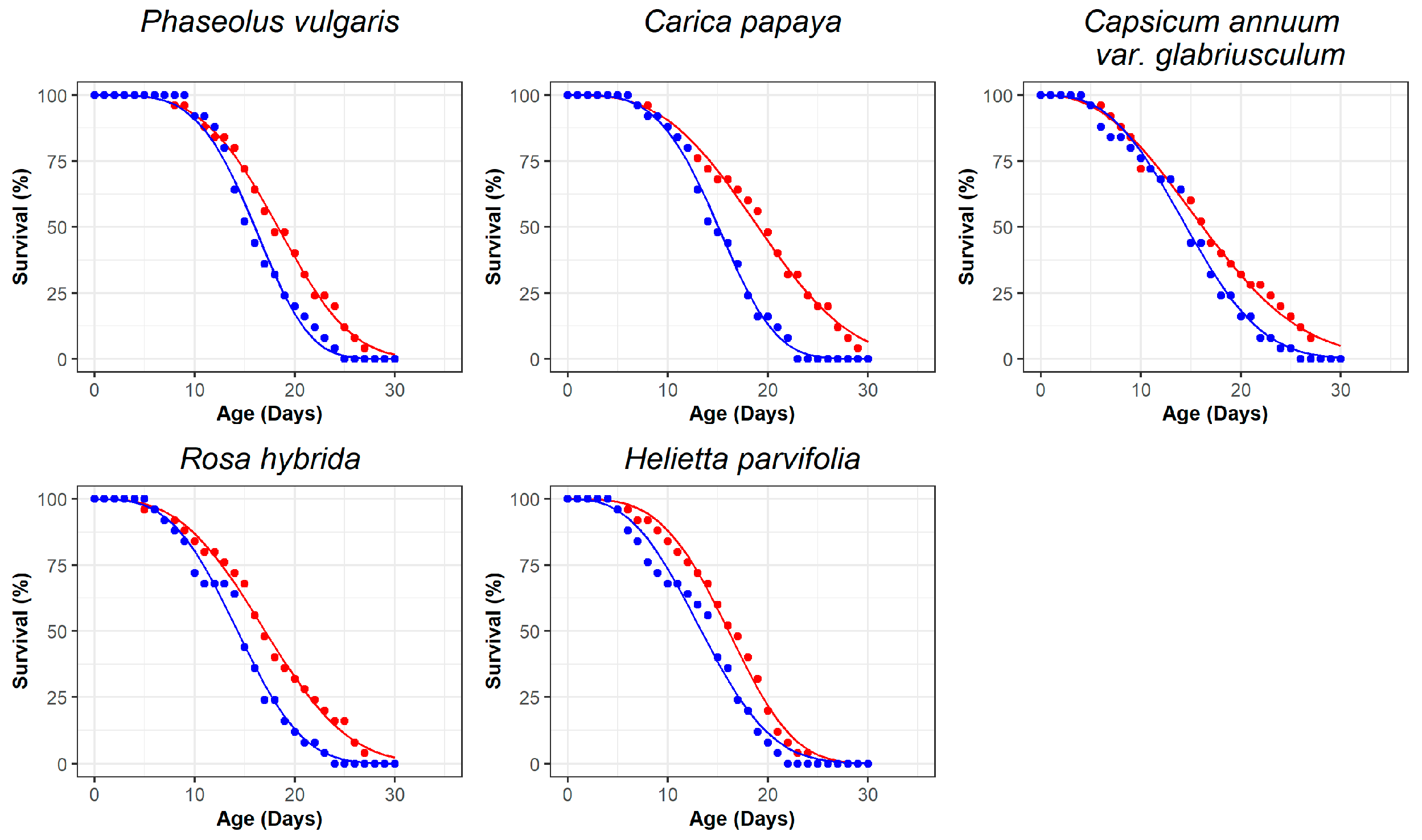
The survival time of mated female T. merganser did not differ significantly between host plants (Log-rank test, χ2 = 2.7458, df = 4, p = 0.6012; Figure 1). The survival curve showed that mortality of females was low during the first 9 days on bean, the first 6 days on papaya, and between the first 4 and 5 days on chili pepper, rosebush, and barreta. Female survival started declining rapidly after the 12th and 13th day on bean and papaya, respectively, while on barreta, chili pepper, and rosebush, after the 7th, 9th, and 10th day, respectively. This indicates that the females adapt better to the bean plant than to the other plants tested (Figure 1).
The survival curve showed that mortality of virgin adult females was low during the first 7 days in bean, the first 6 days in papaya, and the first 4 days in chili pepper, rosebush, and barreta. However, the Log Rank test did not reveal significant differences in survival time (χ2 = 5.7224, df = 4, p = 0.2208; Figure 1). Survival of virgin females began to decline rapidly after the 16th and 18th days in bean and papaya, respectively, while in barreta, chili pepper, and rosebush, it declined after the 14th, 13th, and 15th days, respectively. This indicates that virgin females adapt better to the papaya plant than to the other plants evaluated (Figure 1).
The Weibull model provided a good fit to the survival data for mated and virgin females, with Pseudo-R2 values ranging from 0.9860 to 0.9970. By the mated females, the shape parameter c was greater than 1 (c > 1) in all tested plants, classifying the survival curve of female T. merganser as Type I. This indicates that the risk of mated females’ death increases with age. The scale parameter b was influenced by the host plant. The T. merganser population declined more slowly on bean (b = 17.4624) than on papaya (b = 16.5764), rosebush (b = 16.0128), chili pepper (b = 16.5795), and barreta (b = 15.2197). Additionally, the 95% IC values for b overlap in papaya, chili pepper, and rosebush; other overlaps were observed in rosebush and barreta, but in bean, they do not overlap with any treatment (Table 1). This indicates that the mated female population decreases similarly when fed on papaya, chili pepper, and rosebush. The LT50 values predicted by the Weibull distribution (LT50-P) were similar to those obtained from the experimental data (LT50-E) (Table 1, Figure 1).
The survival curve for virgin females was Type I (c > 1) in all plants tested, indicating that the risk of virgin female death increases with age. Similar observations in mated females, host plants influenced parameter b in virgin females. Specifically, the survival trend of T. merganser virgin females in relation to the host plants was: C. papaya > P. vulgaris > R. hybrida = C. annuum var. glabriusculum > H. parvifolia. Notably, the 95% IC values for b overlap in chili pepper and rosebush, but in bean, papaya, and barreta, they do not overlap with any treatment (Table 1). This suggests that the virgin female population decreases similarly when fed on chili pepper and rosebush, and more slowly over barreta. Moreover, the LT50 values predicted by the Weibull distribution (LT50-P) were similar to those obtained from the experimental data (LT50-E) (Table 1, Figure 2). Importantly, in all host plants, the b value for virgin female populations was significantly higher compared to that obtained for the mated female population. Therefore, this indicates that the virgin female population declines more slowly than the mated female population (Table 1).

3.2. Males

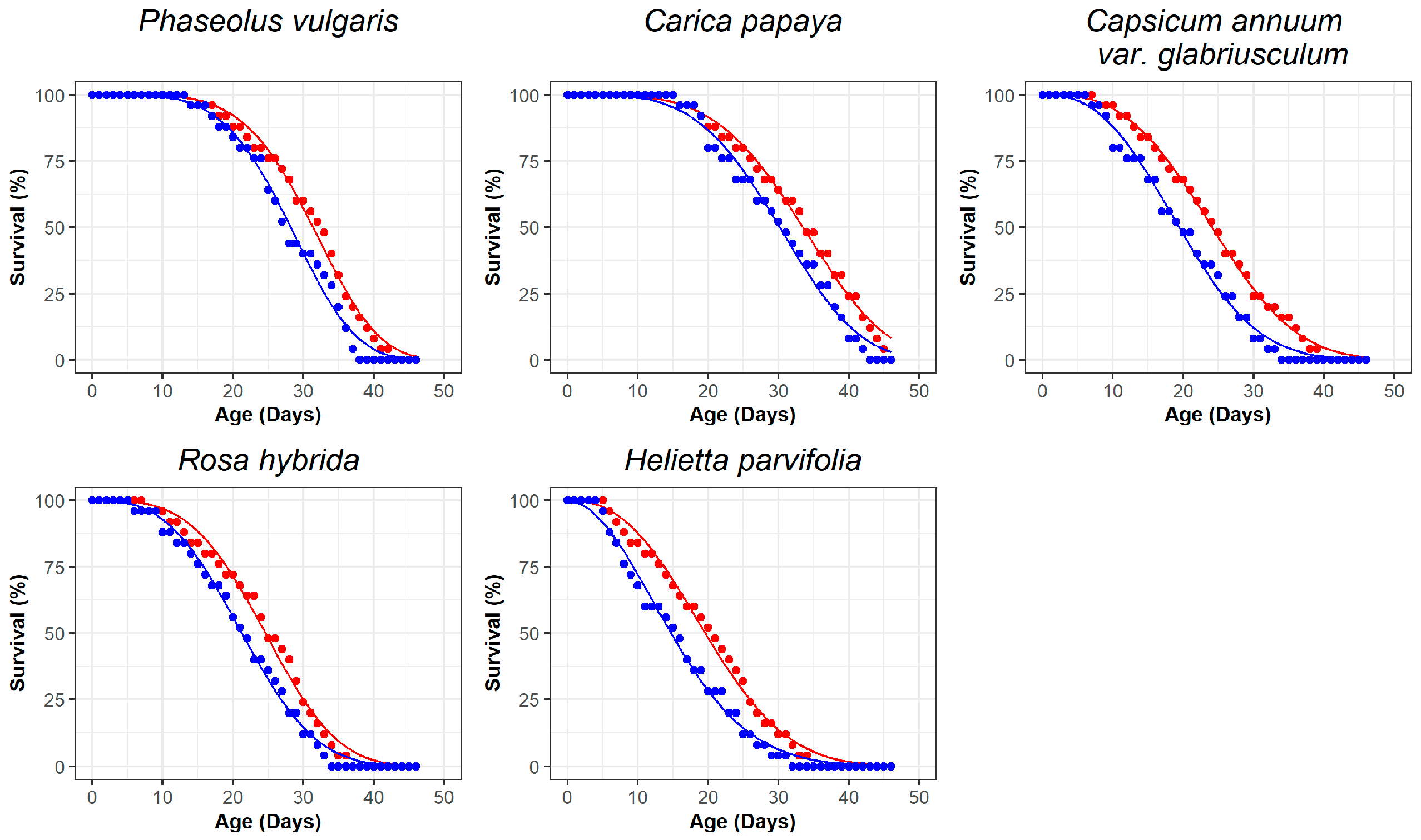
The survival time of mated male T. merganser differed significantly among host plants (Log-rank test, χ2 = 38.9259, df = 4, p < 0.0001; Figure 2). The survival curve showed that mortality in males was low during the first 16 days on papaya, the first 14 days on bean, and the first 7, 6 and 5 days on chili pepper, rosebush, and barreta, respectively. Male survival started declining rapidly after the 25th and 22nd day on papaya and bean; while on chili pepper, rosebush, and barreta, after the 10th and 8th day, respectively. This indicates that the males adapt better to the papaya plant than to the other plants tested. (Figure 2).
The survival curve showed that mortality of virgin adult males was low for the first 13 days in bean, 15 days in papaya, 7 days in chili pepper and rosebush, and 5 days in barreta. The Log Rank test revealed significant differences in survival time (χ2 = 32.6995, df = 4, p < 0.0001; Figure 2). Virgin male survival declined rapidly after day 25 in bean, day 27 in papaya, day 10 in barreta, day 16 in chili pepper, and day 18 in rosebush. This indicates that virgin males adapt better to papaya than to the other plants evaluated (Figure 2).
The Weibull model showed a good fit to the survival data, with Pseudo-R2 values ranging from 0.9904 to 0.9961. The shape parameter c was greater than 1 (c > 1) in all tested plants, classifying the survival curve of male T. merganser as Type I. This indicates that the risk of male death increases with age. The scale parameter b was influenced by the host plant. The T. merganser population decreased more slowly on papaya (b = 33.2251) and bean (b = 30.6392) than on rosebush (b = 24.0379), chili pepper (b = 22.4063), and barreta (b = 17.7671). This indicates that the male population decreases in the same way on papaya and bean, as well as on rosebush and chili pepper (Table 2). The LT50 values predicted by the Weibull distribution (LT50-P) were like those obtained from the experimental data (LT50-E) (Table 2, Figure 2).
The survival curve for virgin males was Type I (c > 1) in all plants tested, indicating that the risk of virgin male death increases with age. Similar observations in mated females, host plants influenced parameter b in virgin males. The survival trend of T. merganser virgin males in relation to the host plants was: C. papaya > P. vulgaris > R. hybrida = C. annuum var. glabriusculum > H. parvifolia. The 95% ICs values for b overlap in chili pepper and rosebush, but in bean, papaya, and barreta, they do not overlap with any treatment (Table 2). This suggests that the virgin male population decreases similarly when fed on chili pepper and rose, and more slowly over barreta. Moreover, the LT50 values predicted by the Weibull distribution (LT50-P) were similar to those obtained from the experimental data (LT50-E) (Table 2, Figure 2). Importantly, in all host plants, the b value for virgin male populations was significantly higher compared to that obtained for the mated male population. Therefore, this indicates that the virgin male population declines more slowly than the mated male population (Table 2).

3.3. Longevity

The mated female longevity ranged between 13.55 (H. parvifolia) and 15.87 (P. vulgaris) days, while that of virgins ranged between 15.87 (C. papaya) and 16.03 (H. parvifolia) days (Table 3). Regarding males, the longevity of mated individuals ranged from 15.75 (H. parvifolia) to 30.03 (C. papaya) days, and for virgins, from 20.16 (H. parvifolia) to 33.24 (C. papaya) days, indicating that longevity was influenced by both mating and host plants.

3.4. Mortality

The parameters a and b estimated using the linearized Gompertz model, along with the mortality rate doubling time (DT), are shown in Table 4. The coefficient of determination showed that all linear regressions fit the mortality data (Equations (2) and (3)). We were unable to compare the mortality rate and DT of T. merganser and the host plants because different equations were used to calculate μx (Equations (2) and (3)), and the number of data points used in the linear regressions differed. All linearized models fit the mortality data (p < 0.0001). The mortality rate of mated females was highest on papaya, followed by barreta, rose, bean, and chili pepper. These rates were higher than those of virgin females on all host plants except barreta. The mortality rate of mated males was highest on chili peppers and barreta, but lower on common beans and similar on papaya (Table 4). The mortality rate of mated and virgin females was higher than that of mated and virgin males on all tested plants, respectively, indicating that males and host plants influence the mortality of T. merganser females.
The doubling times (DT) of the mortality rate for mated females ranged from 3.7277 to 4.2025 days, and for mated males, from 6.2148 to 7.1106 days (Table 4). The DT was shorter in mated females than in virgin females on all plants tested, except barreta. In mated males, the DT was shorter on chili and barreta and longer on beans, while on papaya, the DTs were the same compared to virgin males. These results indicate that females are affected if they interact with the male, given that the DT is shorter than in virgin females.
The entropy (H) of T. merganser adult females, both mated and virgin, on bean was 0.2418 and 0.2651. On papaya, it was 0.2616 and 0.3029. On rosebush, it was 0.3022 and 0.3225. On barreta, it was 0.3309 and 0.2794. On chili pepper, it was 0.3419 and 0.3715. In mated and virgin males, the entropy on bean was 0.2125 and 0.2354. On papaya, it was 0.2551 and 0.2543. On rosebush, it was 0.2535 and 0.2802. On chili pepper, it was 0.3185 and 0.3324. On barreta, it was 0.3412 and 0.3164. A 1% change in the mortality curve of mated and virgin females results in a change of 24.18 and 26.51%, 26.16 and 30.29%, 30.22 and 32.25%, 33.09 and 27.94%, and 34.19 and 37.16% in their lifespan when fed on bean, papaya, rose, barreta, and chili pepper, respectively. This suggests that virgin females have a longer life expectancy than mated females. Similarly, a 1% change in the mortality curve in mated and virgin males results in a 21.25 and 23.54%, 25.51 and 25.43%, 25.35 and 28.02%, 31.85 and 33.24%, and 34.12 and 31.64% change in lifespan when fed bean, papaya, rose, barreta, and chili pepper, respectively. These results show that small changes in mortality have a substantial impact on lifespan across both sexes and reproductive stages. The data indicate that the survival curves of female and male T. merganser, both mated and virgin, were convex across the five host plants (H < 0.05).

3.5. Fecundity

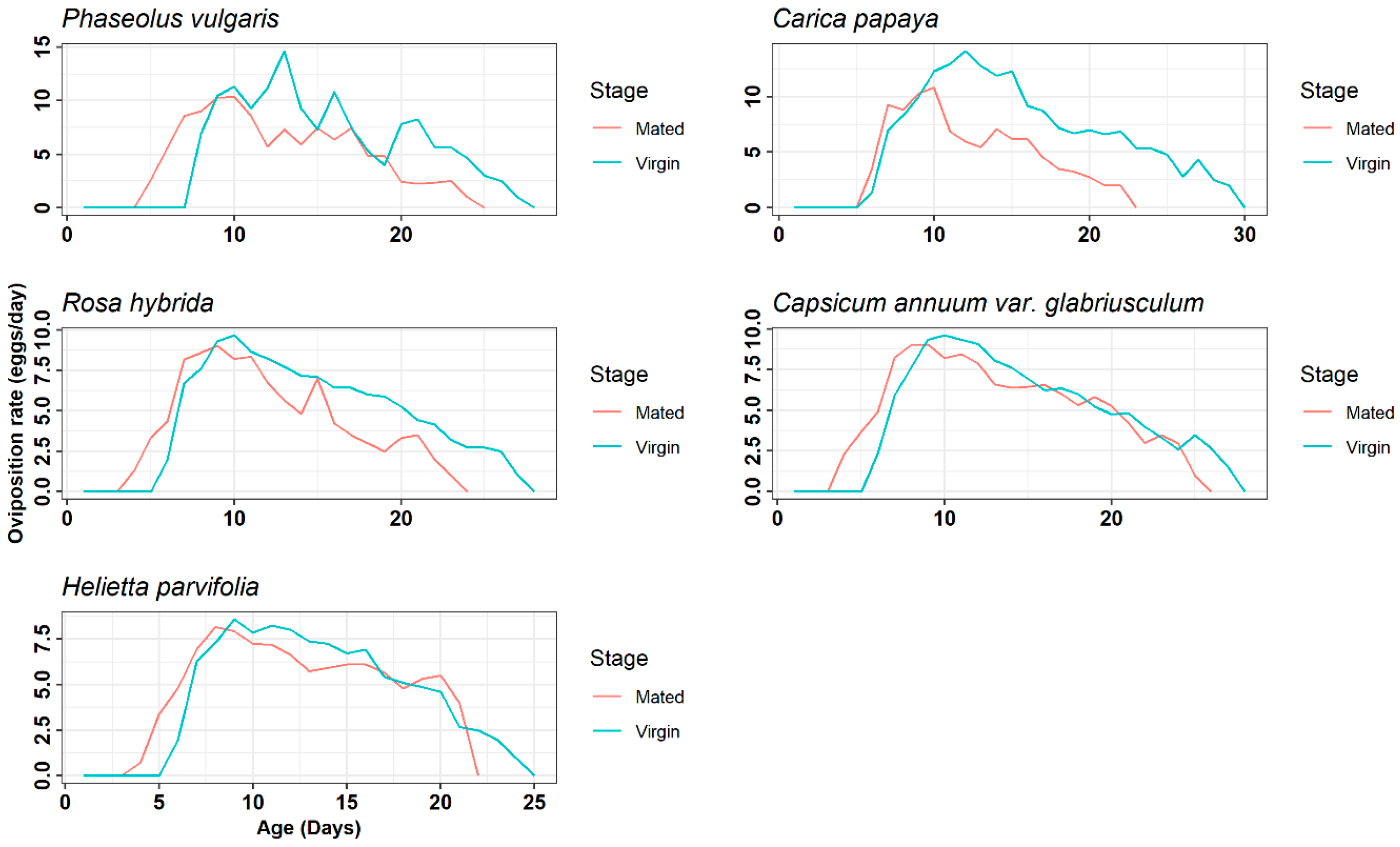
The age-specific fertility rate (mx) of T. merganser virgin and mated females on different host plants is shown in Figure 3. The values of mx fluctuated over time, decreasing along with the age of females. In all host plants, mated females began laying eggs before virgin females (Figure 3). Daily egg production from virgin females reached higher peaks than from mated females. However, the mean oviposition period of virgin females was not significantly different from that of mated females when fed on beans (mean ± SD: 11.0 ± 5.00 and 11.4 ± 4.02 days; Student’s t-test: t = 0.3117, df = 48, p = 0.7566), rosebush (mean ± SD: 11.6 ± 6.11 and 10.52 ± 49; Student’s t-test: t = −0.6899, df = 48, p = 0.4936), chili pepper (mean ± SD: 11.12 ± 6.81 and 11.04 ± 5.75; Student’s t-test: t = −0.0448; df = 48, p = 0.9644), and barreta (mean ± SD: 10.28 ± 5.05 and 9.40 ± 5.05; Student’s t-test: t = −0.6163, df = 48, p = 0.5406). In contrast, in papaya, the mean oviposition period of virgin females (12.92 ± 6.66 days) was significantly longer than that of mated females (9.48 ± 4.29 days) (t = −2.1713, df = 41.014, p = 0.03575).
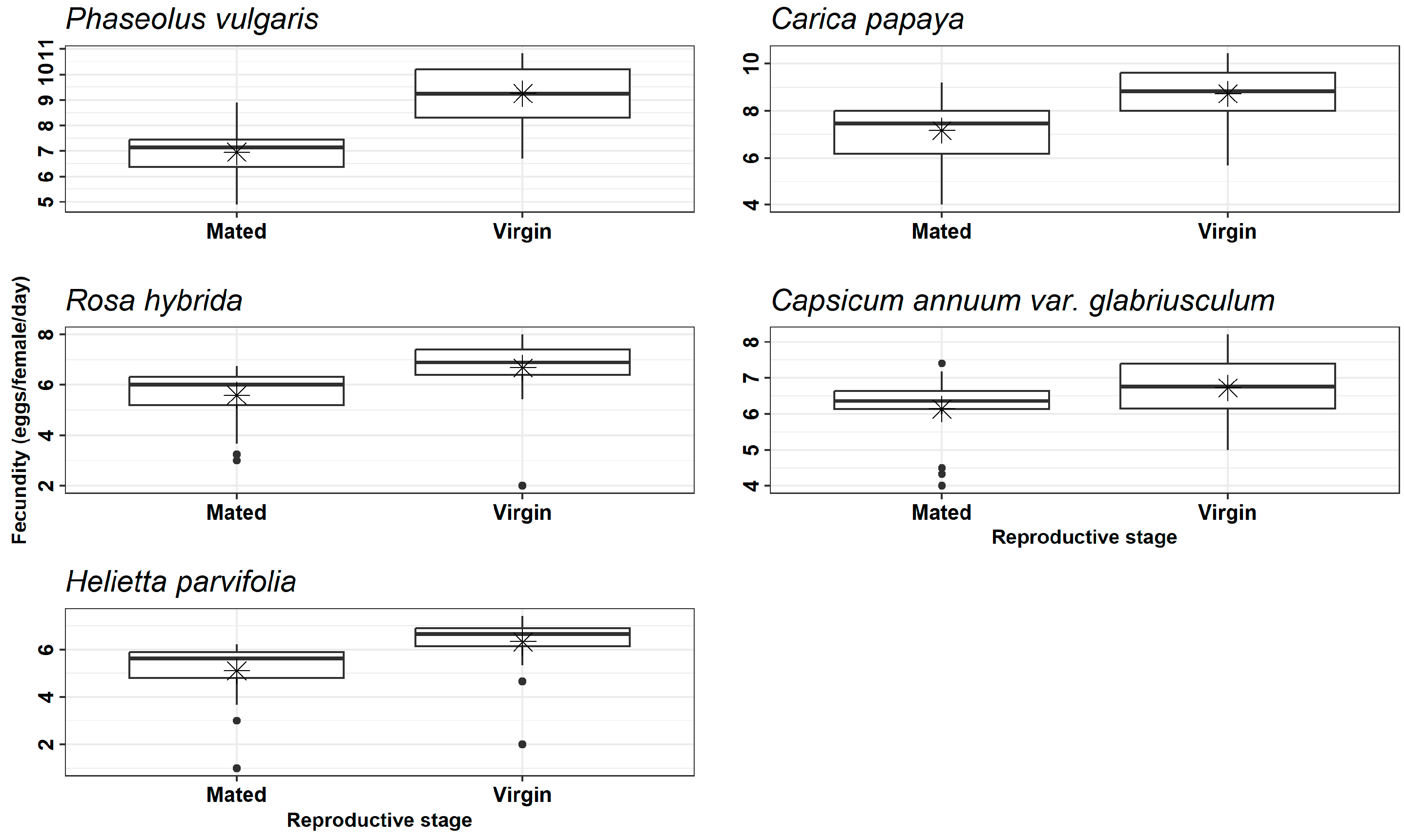
The number of eggs per female per day laid by T. merganser virgin and mated females on different host plants is shown in Figure 4. Virgin females laid significantly more eggs than mated females on bean (mean: 9.25 and 6.95, respectively; Student’s t-test: t = −7.7934; df = 48; p < 0.0001), papaya (mean: 8.73 and 7.16; Student’s t-test: t = −4.5505; df = 48; p < 0.0001), chili pepper (median: 6.76 and 6.36; Wilcoxon test: W = 206, p = 0.0396), rosebush (6.90 and 6.00; Wilcoxon test: W = 100, p < 0.0001), and barreta (median: 6.67 and 5.63, Wilcoxon test: W = 86, p < 0.0001).

4. Discussion

In this study, female T. merganser mites with different mating statuses were used to investigate the cost of male interaction in terms of survival and daily fecundity on five host plants. The results showed that, in both sexes, virgin individuals survived longer than those mated with conspecifics, indicating that the mating cost between females and males is high. Furthermore, the number of eggs laid per female was significantly lower in mated mites than in virgins. Previous studies have also reported specific responses according to the mite’s mating status [10,11]. They found that virgin T. urticae individuals had greater longevity than mated individuals, and that virgin females oviposited more than mated females, indicating that interacting with the opposite sex imposes costs that negatively affect fitness.
The time required for the mortality of females to double was shorter for mated females than for virgins on the five host plants, except for barreta. These findings suggest that mated T. merganser females experienced a more rapid rate of biological aging and a greater degree of senescent decline compared to virgin females. The mortality rate of mated females was higher than that of virgins (Table 4). Entropy analysis showed that a small change in mortality affects mated females’ lifespan more than that of virgin females. Mated females’ survival declines more rapidly than that of virgins. This may be due to several factors. One reason is that mated females make an effort to leave offspring and also tolerate sexual harassment by males; in both cases, they lose energy and nutrients. In contrast, virgins only make an effort to lay their eggs. The mating cost for both sexes of T. merganser was higher in females than in males. Mated females showed a lower survival rate than mated males (Figure 1 and Figure 2). Similar results were reported by Li and Zhang [11]. They reported that the survival rate of mated female T. urticae is lower than that of mated males. Furthermore, they documented that the survival rate of virgin males is higher than that of mated males. The main difference between females (mated and virgin) and males (mated and virgin) may lie in the allocation of resources between egg production and the sexual harassment that males exert on females. In this regard, Rabinovich et al. [22] noted a relationship between egg-laying effort and age-specific mortality rates, suggesting a density dependence. Li and Zhang [11] noted that sexual harassment suffered by females from males is responsible for the decreased life expectancy of females that participate in mating and that it costs them time and energy to avoid harmful behavioral interactions with males, which can reduce food and resource intake, as observed in T. urticae [11].
The scale parameter (b) indicated that populations of virgin females and males of T. merganser declined more slowly than those of mated mites on all five host plants (Table 1 and Table 2). This suggests that virgin females and males have greater longevity or a lower probability of dying at early ages than mated mites. This indicates that the longevity of mated females is affected by both egg production and interaction with males, whereas in virgin females it is affected only by oviposition effort. The values of the shape parameter for mated and virgin females overlapped when feeding on bean and rosebush discs, but their scale values were statistically different (Table 1). However, this finding does not guarantee that the longevities of mated and virgin females are similar, since average longevity is determined by both parameters [16], as observed in this study: statistically significant differences in longevity (Figure 1 and Figure 2; Table 1). The populations of mated and virgin females on the five host plant species presented the same type of curve (Type I) but showed different longevities; therefore, their life tables differ [16], which agrees with the findings reported by Segura-Martínez [6]. They reported significant differences in the life tables of T. merganser feeding on the same host species and under environmental conditions similar to those of this study.
On the other hand, the differences in longevity between females and males of T. merganser when mites fed on the leaf disc of host plants could be partly explained by both the nutritional demands of males and females and the differences in the phytochemical composition of the five plant species tested. Since the cost of reproduction differs between females and males, females invest energy and nutrients in mating and egg production, while males invest in sperm and seminal fluid production and time and energy in courtship [11]. This suggests that females have different nutritional requirements for reproduction and survival than males [23]. Li and Zhang [10,24,25] documented that dietary requirements differ between males and females due to reproductive and behavioral differences. That is, females, when producing eggs, require more proteins and lipids than males, while males need carbohydrates both for mate hunting and mating.
In conclusion, the mating status in T. merganser is more detrimental to mated females than to virgins, affecting oviposition, survival, and mortality on five plant species. This impact, observed on a small scale and varying conditions, can be more complex depending on resource availability and multiple mating by males [9]. Our results suggest that mating may alter female reproductive strategy due to possible male harassment. Further research is needed on inter- and intrasexual interactions in different environments. Additionally, whether the male causes the dispersal of T. merganser females to other plants to avoid the cost of sexual harassment and form a new colony needs to be assessed. Although further studies are needed, chemical or biological controls should be implemented before females harassed by males disperse to other host plants. Our findings may be useful for developing management and control strategies for T. merganser, since mating determines the sex of the offspring (diploid females or haploid males), affects their longevity and fecundity, and can lead to population explosions. Mated females produce both sexes, creating a sustainable and rapidly growing population, while unmated females produce only males.

Author Contributions

Conceptualization J.C.C.-H., E.A.-R. and S.O.-S.; methodology, J.C.C.-H., Y.d.R.M.-R. and M.R.-R.; software, J.C.C.-H., S.G.M.-R. and I.V.L.-S.; validation, J.C.C.-H., A.H.-J. and E.A.-R.; formal analysis, J.C.C.-H., M.R.-R., E.A.-R. and S.O.-S.; investigation, E.A.-R., Y.d.R.M.-R. and S.G.M.-R.; resources, J.C.C.-H., S.O.-S. and A.H.-J.; data curation, J.C.C.-H., I.V.L.-S. and S.O.-S.; writing—original draft preparation, J.C.C.-H., E.A.-R. and S.O.-S.; writing—review and editing, Y.d.R.M.-R., M.R.-R., S.G.M.-R. and I.V.L.-S.; visualization, J.C.C.-H., E.A.-R. and S.O.-S.; supervision, J.C.C.-H. and S.O.-S. All authors have read and agreed to the published version of the manuscript.

Funding

This research received no external funding.

Institutional Review Board Statement

Not applicable.

Data Availability Statement

The original contributions presented in this study are included in the article. Further inquiries can be directed to the corresponding authors.

Acknowledgments

The authors express their appreciation to the Faculty of Engineering and Sciences of the Autonomous University of Tamaulipas for their support and for providing the facilities for this research.

Conflicts of Interest

The authors declare no conflicts of interest.

References

  1. Migeon, A.; Dorkeld, F. Spider Mites Web: A Comprehensive Database for the Tetranychidae. 2025. Available online: https://www1.montpellier.inrae.fr/CBGP/spmweb (accessed on 21 January 2026).
  2. Alfaro-Valle, E.; Martínez-Hernández, A.; Otero-Colina, G.; Lara-Reyna, J. High susceptibility of Tetranychus merganser (Acari: Tetranychidae), an emergent pest of the tropical crop Carica papaya, towards Metarhizium anisopliae s.l. and Beauveria bassianas trains. PeerJ 2022, 10, e14064. [Google Scholar] [CrossRef] [PubMed]
  3. Rocandio-Rodríguez, M.; Torres-Castillo, J.A.; Juárez-Aragón, M.C.; Chacón-Hernández, J.C.; Moreno-Ramírez, Y.d.R.; Mora-Ravelo, S.G.; Delgado-Martínez, R.; Hernández-Juárez, A.; Heinz-Castro, R.T.Q.; Reyes-Zepeda, F. Evaluation of resistance of eleven maize races (Zea mays L.) to the red spider mite (Tetranychus merganser, Boudreaux). Plants 2022, 11, 1414. [Google Scholar] [CrossRef] [PubMed]
  4. Guerrero-Vázquez, I.C.; Chacón-Hernández, J.C.; Torres-Castillo, J.A.; Juárez-Aragón, M.C.; Rocandio-Rodríguez, M.; Segura-Martinez, M.T.d.J.; Hernández-Juarez, A.; Moreno-Ramírez, Y.R. Evaluation of the resistance of four tomato varieties to the possible attack of Tetranychus merganser. Southwest. Entomol. 2025, 50, 1533–1559. [Google Scholar] [CrossRef]
  5. Reyes-Pérez, N.; Villanueva-Jiménez, J.A.; de-la-Cruz-Vargas-Mendoza, M.; Cabrera-Mireles, H.; Otero-Colina, G. Parámetros poblacionales de Tetranychus merganser Boudreaux (Acari: Tetranychidae) en papayo (Carica papaya L.) a diferentes temperaturas. Agrociencia 2013, 47, 147–157. [Google Scholar]
  6. Segura-Martínez, M.T.d.J.; Ordaz-Silva, S.; Hernández-Juárez, A.; Heinz-Castro, R.T.Q.; Mora-Ravelo, S.G.; Chacón-Hernández, J.C. Life table parameters of Tetranychus merganser Boudreaux (Acari: Tetranychidae) on five host plants. Insects 2023, 14, 473. [Google Scholar] [CrossRef] [PubMed]
  7. Ullah, M.S.; Moriya, D.; Kongchuensin, M.; Konvipasruang, P.; Gotoh, T. Comparative toxicity of acaricides to Tetranychus merganser Boudreaux and Tetranychus kanzawai Kishida (Acari: Tetranychidae). Int. J. Acarol. 2011, 37, 535–543. [Google Scholar] [CrossRef]
  8. Ullah, M.S.; Moriya, D.; Badii, M.H.; Nachman, G.; Gotoh, T.A. Comparative study of development and demographic parameters of Tetranychus merganser and Tetranychus kanzawai (Acari: Tetranychidae) at different temperatures. Exp. Appl. Acarol. 2011, 54, 1–19. [Google Scholar] [CrossRef] [PubMed]
  9. Macke, E.; Magalhães, S.; Khanh, H.D.-T.; Frantz, A.; Facon, B.; Olivieri, S. Mating modifies female life history in a haplodiploid spider mite. Am. Nat. 2012, 179, 147–162. [Google Scholar] [CrossRef] [PubMed]
  10. Li, G.Y.; Zhang, Z.Q. Does size matter? Fecundity and longevity of spider mites (Tetranychus urticae) in relation to mating and food availability. Syst. Appl. Acarol. 2018, 23, 1796–1808. [Google Scholar] [CrossRef]
  11. Li, G.Y.; Zhang, Z.Q. The costs of social interaction on survival and reproduction of arrhenotokous spider mite Tetranychus urticae. Entomol. Gen. 2021, 41, 49–57. [Google Scholar] [CrossRef]
  12. Treviño-Barbosa, G.; Ordaz-Silva, S.; Gaona-García, G.; Hernández-Juárez, A.; Mora-Ravelo, S.G.; Chacón Hernández, J.C. The resistance of seven host plants to Tetranychus merganser Boudreaux (Acari: Tetranychidae). Insects 2022, 13, 167. [Google Scholar] [CrossRef] [PubMed]
  13. Carey, J.R. Applied Demography for Biologists: With Special Emphasis on Insects; Oxford University Press: New York, NY, USA, 1993; p. 206. [Google Scholar]
  14. Carey, J.R. Insect biodemography. Annu. Rev. Entomol. 2001, 46, 79–110. [Google Scholar] [CrossRef] [PubMed]
  15. Bouras, S.L.; Papadoulis, G.T. Influence of selected fruit tree pollen on life history of Euseius stipulatus (Acari: Phytoseiidae). Exp. Appl. Acarol. 2005, 36, 1–14. [Google Scholar] [CrossRef] [PubMed]
  16. Pinder, J.E.; Wiener, J.G.; Smith, M.H. The Weibull distribution: A new method of summarizing survivorship data. Ecology 1978, 59, 175–179. [Google Scholar] [CrossRef]
  17. Schabenberger, O.; Pierce, F.J. Contemporary Statistical Models for the Plant and Soil Sciences; CRC Press: Boca Raton, FL, USA, 2002; p. 760. [Google Scholar]
  18. Julious, S.A. Using confidence intervals around individual means to assess statistical significance between two means. Pharm. Stat. 2004, 3, 217–222. [Google Scholar] [CrossRef]
  19. Méndez, I.R.; Namihira, D.G.; Moreno, L.A.; Sosa, C. El Protocolo de Investigación; Editorial Trillas: Mexico City, Mexico, 1984; pp. 178–188. [Google Scholar]
  20. Vaupel, J.W. How change in age-specific mortality affects life expectancy. Popul. Stud. J. Demogr. 1986, 40, 147–157. [Google Scholar] [CrossRef] [PubMed]
  21. R Core Team. R: A Language and Environment for Statistical Computing; R Foundation for Statistical Computing: Vienna, Austria, 2025; Available online: https://www.R-project.org/ (accessed on 21 May 2025).
  22. Rabinovich, J.E.; Nieves, E.L.; Chaves, L.F. Age-specific mortality analysis of the dry forest kissing bug, Rhodnius neglectus. Entomol. Exp. Appl. 2010, 135, 252–262. [Google Scholar] [CrossRef]
  23. Wu, Q.; Yu, G.; Cheng, X.; Gao, Y.; Fan, X.; Yang, D.; Xie, M.; Wang, T.; Piper, M.D.W.; Yang, M. Sexual dimorphism in the nutritional requirement for adult lifespan in Drosophila melanogaster. Aging Cell 2020, 19, e13120. [Google Scholar] [CrossRef] [PubMed]
  24. Li, G.Y.; Zhang, Z.Q. The sex- and duration-dependent effects of intermittent fasting on lifespan and reproduction of spider mite Tetranychus urticae. Front. Zool. 2019, 16, 10. [Google Scholar] [CrossRef] [PubMed]
  25. Li, G.Y.; Zhang, Z.Q. Sex dimorphism of life-history traits and their response to environmental factors in spider mites. Exp. Appl. Acarol. 2021, 84, 497–527. [Google Scholar] [CrossRef] [PubMed]
Figure 1. Survival curves of Tetranychus merganser mated and virgin adult females on five host plants. Observed values (dots) for mated (blue) and virgin (red) females and estimated values using the Weibull distribution model (solid line).
Agriculture 16 00507 g001
Figure 2. Survival curves of Tetranychus merganser mated and virgin adult males on five host plants. Observed values (dots) for mated (blue) and virgin (red) males and estimated values using the Weibull distribution model (solid line).
Agriculture 16 00507 g002
Figure 3. Age-specific fecundity (mx) of Tetranychus merganser virgin and mated females on five host plants.
Agriculture 16 00507 g003
Figure 4. Box-plot comparing the oviposition (Means ± 95% percentile) of Tetranychus merganser mated and virgin females on five host plants. The asterisk represents the mean number of eggs laid per female per day. The median is the black line inside the box. The black dots outside the box represent outliers.
Agriculture 16 00507 g004
Table 1. Weibull function parameter values for survival curves of virgin and mated female Tetranychus merganser feeding on five host plants.
Host PlantMating StateParametersLT50-PLT50-ESeudo-R2
cCI 95%bCI 95%
Phaseolus vulgarisMated4.21433.7781–4.650517.4624 a B17.1365–17.78811716–170.9914
Virgin3.62523.4409–3.809420.2617 y A20.0498–20.473618–1918–190.9970
Carica papayaMated3.79103.5134–4.0686 16.5764 b B16.3356–16.81721615–160.9956
Virgin3.00912.8019–3.216221.4906 z A21.1418–21.83931920–210.9925
Capsicum annuum var. glabriusculumMated2.80682.5390–3.074516.5795 b B16.1744–16.984515–1615–160.9891
Virgin2.38202.2107–2.553318.8700 x A18.4755–19.264516–1717–180.9917
Rosa hybridaMated3.22372.8997–3.547516.0128 bc B15.6442–16.381315–1615–160.9905
Virgin3.00012.8182–3.181919.2532 x A18.9702–19.53621717–180.9951
Helietta parvifoliaMated2.81132.4799–3.142615.2197 c B14.7562–15.683214–1515–160.9860
Virgin3.59383.3316–3.855917.7957 w A17.5254–18.065816–1717–180.9951
Values of parameter b within the same column followed by the same lowercase letter (mated female, a–c; virgin female, w–z) are not significantly different between virgins and mated females per host plant (test based on the 95% CI of overlap, Julious [18]). The values of parameter b within the same column followed by the same capital letter do not show significant differences between mated and virgin females (test based on the 95% CI of overlap, Julious [18]).
Table 2. Weibull function parameter values for survival curves of Tetranychus merganser males feeding on five host plants.
Host PlantMated StatusParametersLT50-PLT50-EPseudo-R2
cCI 95%bCI 95%
Phaseolus vulgarisMated4.37544.0737–4.676930.6392 b B30.2716–31.006829–3028–290.9928
Virgin4.78594.5255–5.046133.8606 y A33.5657–34.155531–3233–340.995
Carica papayaMated3.80923.5528–4.065433.2251 a B32.7938–33.656331–3231–320.9904
Virgin4.03353.8172–4.249636.6517 z A36.2956–37.007733–3434–350.9931
Capsicum annuum var. glabriusculumMated2.55892.4000–2.717822.4063 d B22.0146–22.797920–2120–210.9934
Virgin2.93262.8280–3.037127.3099 x A27.0676–27.552224–2525–260.9975
Rosa hybridaMated2.9712.8235–3.118524.0379 c B23.7435–24.332322–2322–230.9961
Virgin3.48693.2609–3.712827.3157 x A26.9371–27.694224–2525–260.9935
Helietta parvifoliaMated1.94191.8280–2.055917.7671 e B17.3926–18.141615–1616–170.9935
Virgin2.47662.3402–2.613122.7271 w A22.3643–23.089919–2021–220.9944
Values of parameter b within the same column followed by the same lowercase letter (mated female, a–e; virgin female, w–z) are not significantly different between mated females per host plant (test based on the 95% CI of overlap, Julious [18]). The values of parameter b within the same column followed by the same capital letter do not show significant differences between mated and virgin females (test based on the 95% CI of overlap, Julious [18]).
Table 3. Mean longevity of female and male Tetranychus merganser feeding on five host plants with different mating statuses.
Host PlantMated StatusLongevity
FemaleMale
Phaseolus vulgarisMated15.8727.91
Virgin18.2631.01
Carica papayaMated14.9730.03
Virgin19.1933.24
Capsicum annuum var. glabriusculumMated14.7619.89
Virgin16.7224.36
Rosa hybridaMated14.3421.45
Virgin17.1924.57
Helietta parvifoliaMated13.5515.75
Virgin16.0320.16
Table 4. Values of the Gompertz function parameters for the mortality of female and male Tetranychus merganser on five host plants.
Host PlantSexMated StatusnParametersR2p ValueEquation
ln(a)±SEb±SEDoubling Time
Phaseolus vulgarisFemaleMated14−4.62690.48220.16730.03014.14220.72020.0001Equation (3)
Virgin16−4.51340.20050.14920.01124.64460.9264<0.0001Equation (2)
MaleMated17−5.06730.49230.11150.01846.21480.7098<0.0001Equation (2)
Virgin28−6.22630.28450.12550.00995.52360.8615<0.0001Equation (3)
Carica papayaFemaleMated16−4.85040.39680.18590.02783.72770.7614<0.0001Equation (3)
Virgin19−4.46600.20550.13160.01135.26770.8884<0.0001Equation (2)
MaleMated24−5.34500.38240.09750.01277.11060.7270<0.0001Equation (3)
Virgin17−5.13420.28920.09650.00897.18310.8857<0.0001Equation (2)
Capsicum annuum var. glabriusculumFemaleMated14−4.09310.32110.16480.02324.20450.8080<0.0001Equation (2)
Virgin19−3.61260.19950.08790.01177.88110.7671<0.0001Equation (2)
MaleMated26−4.40230.25370.09970.01226.95240.7351<0.0001Equation (3)
Virgin22−4.31750.19170.08870.00797.81120.8627<0.0001Equation (2)
Rosa hybridaFemaleMated14−4.15580.32890.17140.02334.04310.8174<0.0001Equation (2)
Virgin23−4.66700.21200.13900.01294.98610.8463<0.0001Equation (3)
MaleMated26−4.64930.21090.10490.01016.60820.8174<0.0001Equation (3)
Virgin28−5.25940.23150.11750.01015.8970.8392<0.0001Equation (3)
Helietta parvifoliaFemaleMated17−4.31610.34860.17300.02694.00620.7340<0.0001Equation (3)
Virgin20−5.01940.15250.19150.01043.61990.9497<0.0001Equation (3)
MaleMated17−3.57440.20540.10590.01286.54550.8206<0.0001Equation (2)
Virgin23−4.01290.16430.09100.00827.61550.8543<0.0001Equation (2)
n: number of data points used in the linear regressions. ln(a): the point of intersection with the y-axis (logarithmic initial mortality rate). b: mortality rate. R2: Coefficient of determination.
Disclaimer/Publisher’s Note: The statements, opinions and data contained in all publications are solely those of the individual author(s) and contributor(s) and not of MDPI and/or the editor(s). MDPI and/or the editor(s) disclaim responsibility for any injury to people or property resulting from any ideas, methods, instructions or products referred to in the content.