Article

Research on the Leveling Performance of an Electromechanical Omnidirectional Leveling System for Tracked Mobile Platforms in Hilly and Mountainous Areas


1
School of Automotive and Traffic Engineering, Jiangsu University, Zhenjiang 212013, China
2
Automotive Engineering Research Institute, Jiangsu University, Zhenjiang 212013, China
3
School of Agricultural Engineering, Jiangsu University, Zhenjiang 212013, China
*
Author to whom correspondence should be addressed.
Agriculture 2026, 16(4), 458; https://doi.org/10.3390/agriculture16040458
Submission received: 30 January 2026 / Revised: 12 February 2026 / Accepted: 13 February 2026 / Published: 15 February 2026

Abstract

In response to the problems of poor operating stability and easy tipping of small agricultural machinery under the complex terrain of hilly and mountainous areas, this study designed a tracked mobile platform suitable for hilly and mountainous areas and equipped with an omnidirectional leveling function. The omnidirectional leveling system adopted an innovative coordinated leveling scheme with four servo-electric cylinders of “dual lateral and dual longitudinal” structure. Integrated with dual-axis tilt sensors and a PLC control system, the system enabled decoupled leveling in both the lateral and longitudinal directions. Dynamic simulations of the platform’s leveling process under typical working conditions were performed using ADAMS. The simulation results verified the feasibility of the omnidirectional leveling system. Field tests on slopes in hilly and mountainous areas demonstrated that the omnidirectional leveling system achieves rapid leveling on steep slopes within 5–6 s. After leveling, the average fuselage inclination angle was stabilized within 2°, with a standard deviation of less than 3.4°. This study provided a reliable technical solution and design reference for agricultural machinery manufacturers, while offering users a safer and more efficient platform for operations in complex mountainous areas, significantly reducing the risk of overturning.

1. Introduction

In China’s hilly and mountainous areas, there is a substantial demand for small-scale agricultural machinery. These machines undertake more than 70% of core field operations, such as plowing, fertilizing, and harvesting [1]. The Chinese national standard “Self-propelled agricultural machinery-Evaluation indicators for stability-Part 1: Principles” [2] points out that the slopes in hilly and mountainous areas are steep, and the slope angles generally range from 5° to 25°. Agricultural machinery has a high risk of tipping over during operation. It is necessary to ensure that the tipping angles in both the lateral and longitudinal directions are not less than 25°, and the dynamic stability during slope operations needs to be guaranteed. However, the terrain in hilly and mountainous areas is complex and traditional small operating machines lack effective body leveling devices. During operation, the inclination angle of the machine fuselage usually exceeds 15°, which not only leads to a decline in operation accuracy but also increases the risk of machine overturning by 40%, seriously restricting the agricultural production efficiency and operation safety in hilly and mountainous areas [3,4]. Therefore, developing an omnidirectional intelligent leveling system suitable for small agricultural machinery to improve the attitude stability and operation accuracy of the machinery in a large-slope environment is of great significance for promoting the development of agricultural mechanization in hilly and mountainous areas towards refinement and safety [5,6].
The fuselage leveling device of agricultural machinery can effectively solve the problem of poor operation stability caused by factors such as uneven road surfaces and large terrain slopes [7]. The basic elements in the design of the leveling system for agricultural machinery bodies mainly include the leveling structure layout scheme, the leveling angle range, the leveling response speed, the leveling accuracy, and the structural stiffness of the leveling mechanism. These basic elements jointly affect the leveling performance of the leveling system. According to the operating conditions in hilly and mountainous areas, different types of agricultural machinery leveling systems have been successively proposed [8]. Gonzalez et al. [9] designed an electro-hydraulic leveling system based on hydraulic transmission, which can adjust the lateral attitude of the tractor within the range of 5–10°, improving the lateral stability of the fuselage. However, it cannot level the fuselage when the tractor is operating on a longitudinal slope. Sun et al. [10] designed a small chassis attitude adjustment device based on a parallelogram four-bar mechanism for mountain tracked tractors. This device can control the extension and retraction of the active rocker and the passive rocker through the hydraulic system to achieve a lateral leveling of about 15° for the chassis platform. However, limited by its leveling structure scheme, this leveling chassis cannot achieve longitudinal leveling and carry heavy loads. Denis et al. [11] designed a leveling system in the mode of “rollover risk assessment + hydraulic leveling”. The four-wheel independent hydraulic leveling mechanism can adjust the body’s inclination state in real time according to the observation data of the online adaptive observer. However, the overall size of the prototype was too large, making it unsuitable for operating in environments such as steep slopes with an angle of over 10° and narrow roads. Lü et al. [12] designed a controllable and adaptive tractor fuselage leveling mechanism. This mechanism adopted a support method that combines linear three-point support and planar positioning. The leveling accuracy of this mechanism can reach within 1° and it can achieve omnidirectional leveling of about 10–15°. Zhu et al. [13] designed a four-point leveling platform with fewer leveling parameters and capable of omnidirectional dynamic leveling for tea plantations in hilly and mountainous areas. This leveling system can achieve omnidirectional leveling of the terrain for tea picking operations in mountainous areas within 20°. The leveling system of the small orchard operation platform developed by Guo et al. [14] adopts an Inertial Measurement Unit (IMU) combined with PID and fuzzy control. Its average leveling time for an inclination angle within 10° was 3.6 s. After leveling, the platform’s attitude angle can be stably maintained within ±1.5°. However, it had the problems of relatively low structural stiffness and insufficient load-bearing capacity. Sun et al. [15] designed a hydraulic four-point adjustable lifting tracked chassis leveling mechanism for combine harvesters. The chassis attitude can be adjusted by controlling the telescoping of the hydraulic cylinders. Since the leveling mechanism was installed in the crawler structure, its lateral and longitudinal leveling angles were limited to the range of 5–8°, and the leveling response speed was slow. As a result, its leveling adaptability to the working environment with a slope angle of over 10° was insufficient. Peng et al. [16] designed a four-wheel-drive hilly tractor with a body hydraulic leveling mechanism. Both the front axle and the rear axle had the functions of power transmission and body leveling. Due to the limited swinging direction of the front and rear axles of the tractor, this leveling mechanism can only achieve lateral leveling of about 15°. Yang et al. [17] designed a tractor chassis with a coordinated control system for the body and implement postures. The leveling mechanism of this chassis can achieve the coordinated adjustment of the lateral postures of the body and mounted implements, meeting the requirements of contour operation on sloping land of 14–16° in hilly and mountainous areas. This requirement cannot be met during longitudinal slope operations. Jiang et al. [18] designed an omnidirectional leveling system for a tracked working machine with a “three-layer frame”. Lateral and longitudinal leveling is achieved through hydraulic cylinders and triangular hinge mechanisms. However, installing the engine on the working platform restricted its load-bearing space, increased the load on the hydraulic cylinder, and reduced the leveling response speed of the hydraulic system. Its average leveling response speed was between 6 and 7 s. Chen et al. [19] designed an adaptive leveling control system for crawler tractors in hilly and mountainous areas. The lateral leveling angle range of this leveling system was between 0° and 22°. Yu et al. [20] designed a high-position automatic leveling platform for orchards in hilly and mountainous areas. This platform was a reliable scissor-jack leveling mechanism. However, as the workbench unfolded to both sides, the relatively large friction resulted in poor synchronization of the unfolding on both sides, which limits the leveling accuracy of the leveling mechanism. Most of the existing research focuses on the single-axis or limited-angle leveling of small agricultural machinery, which cannot achieve omnidirectional leveling at a large angle of 15–25°. Moreover, the leveling response speed and leveling accuracy are insufficient under dynamic operating conditions. Therefore, it is necessary to develop an omnidirectional and high-precision leveling system that is suitable for the hilly and mountainous operation environment and has a leveling angle greater than 15° [21,22,23].
In response to the above problems, this study proposed a tracked mobile platform suitable for hilly and mountainous areas and equipped with an electromechanical omnidirectional leveling system. A dual-axis inclination sensor was integrated to construct an attitude perception module. A novel hierarchical “double lateral + double longitudinal” four-servo-electric cylinder collaborative leveling mechanism was designed, and an integrated design of the omnidirectional leveling servo control system was carried out. The kinematic model of the omnidirectional leveling mechanism was established for kinematic analysis. Then, a simulation model was established to verify the feasibility of the omnidirectional leveling system through simulation. The passability of the mobile platform and the leveling performance of the omnidirectional leveling system were verified through dynamic climbing tests on hilly and mountainous slopes with 15–25 degree angles.
Hilly and mountainous areas serve as critical production bases for grain, oil, fruits, and vegetables in China. The total sown area in these areas exceeds 56 million hectares, accounting for 34.20% of the national total. Specifically, these areas host 93.39% of the nation’s tea plantations and 62.28% of its orchards. Furthermore, they account for significant shares of the national planting areas for potatoes (78.58%), sugarcane (62.78%), rapeseed (57.53%), rice (39.60%), and vegetables (37.29%). In terms of yield, these regions contribute substantially to national outputs, including tubers (63%), sugar crops (91.03%), tobacco (82.19%), silkworm cocoons (87.05%), fruit (45.38%), and tea (89.47%). Consequently, enhancing agricultural mechanization in these terrains is of strategic significance for ensuring China’s diversified food security [24].

2. Materials and Methods

2.1. Overall Design of the Tracked Mobile Platform

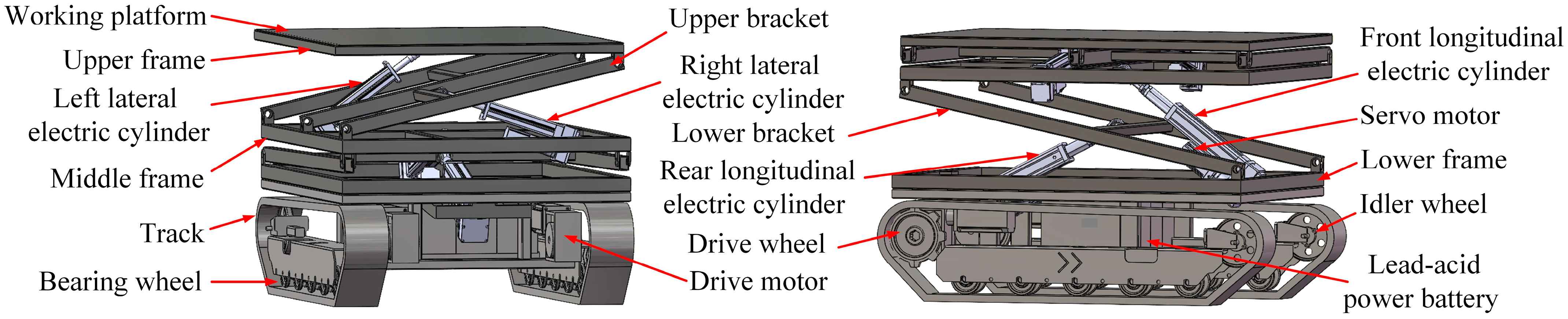
The terrain of hilly and mountainous areas is complex, variable and rugged. Agricultural machinery with strong climbing ability and a fuselage leveling system can show better adaptability for operations in hilly and mountainous areas [25]. For the application scenarios in hilly and mountainous areas, the overall structure of the tracked mobile platform designed in this paper is shown in Figure 1.
The tracked mobile platform is mainly composed of three parts. The first part is the upper working platform. The size of this platform is 1500 mm × 1200 mm, which can provide a mounting space for transport shelves, agricultural implements or detachable equipment. The second part of the tracked mobile platform is the middle electro-mechanical omnidirectional leveling system. In order to achieve decoupling of lateral and longitudinal leveling, reduce the complexity of omnidirectional leveling, and improve the bearing capacity of the working platform, the omnidirectional leveling system adopts the structural scheme of a layered arrangement of four servo-electric cylinders with “dual-lateral and dual-longitudinal” structure. The upper layer of the omnidirectional leveling system is composed of two left and right lateral electric cylinders and the upper layer bracket structure, which are hinged together. And the lower layer is composed of two front and rear longitudinal electric cylinders and the lower layer bracket structure, which are hinged together. Through the telescopic and rotational movements of the upper and lower electric cylinders, the brackets are pushed to rotate, enabling the adjustment of the fuselage attitude. Among them, the upper layer leveling mechanism can adjust the lateral attitude of the fuselage, and the lower layer leveling mechanism can adjust the longitudinal attitude of the fuselage. The omnidirectional leveling system designed in this study has a maximum lateral leveling angle of 20° and a maximum longitudinal leveling angle of 25°. The response time of the omnidirectional leveling system is less than or equal to 6 s. The longitudinal and lateral leveling angles of this system are 5–10° larger than those of the existing leveling mechanisms. It can achieve rapid omnidirectional leveling of the working platform at a large inclination angle. The third part of the tracked mobile platform is the lower tracked chassis, and the structure of the tracked chassis is shown in Figure 2.
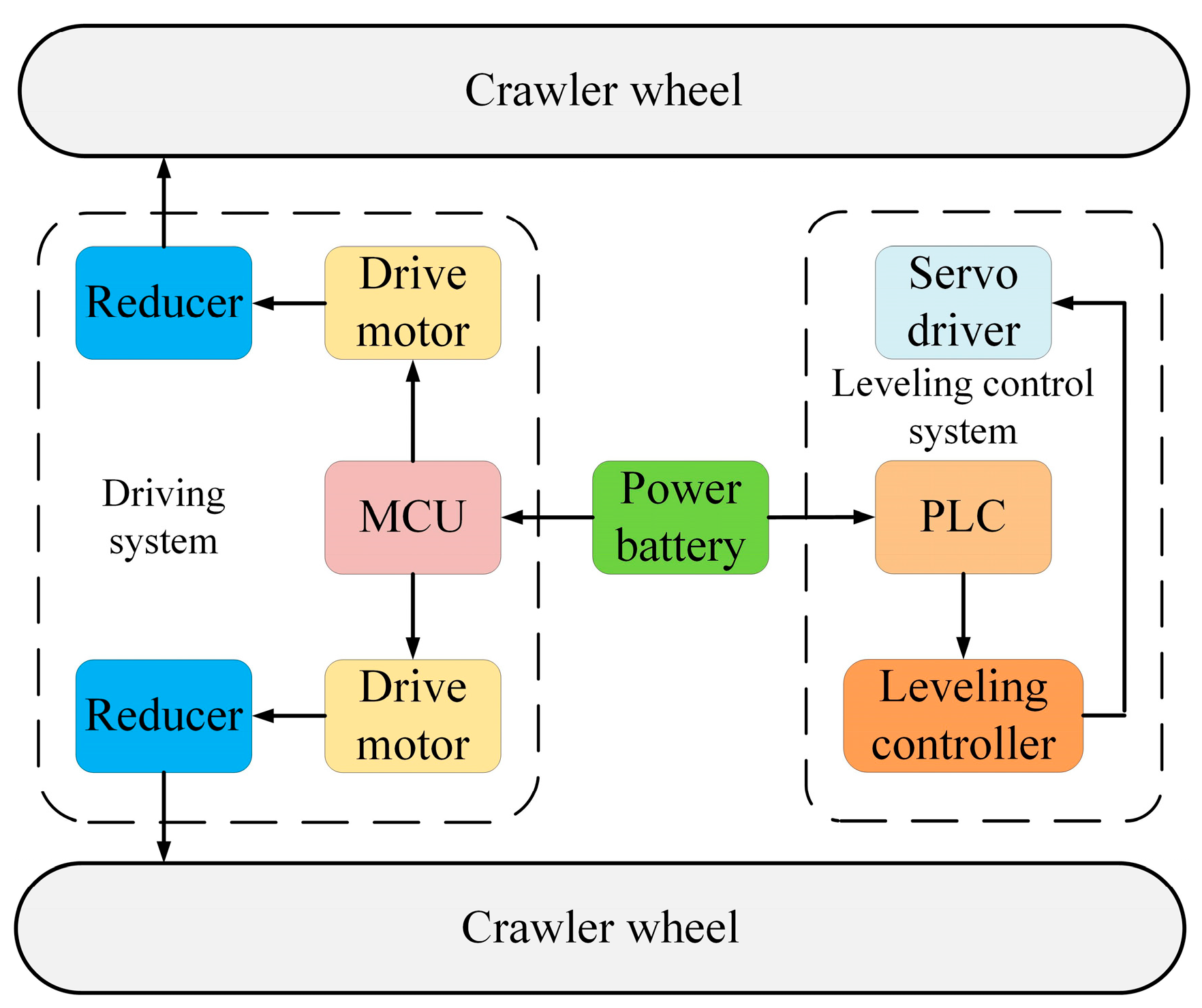
The tracked chassis is mainly composed of components such as crawlers, drive wheels, tension wheels, drive motors, reducers, lead-acid power batteries, MCUs, and PLC controllers. The MCU (Microcontroller Unit), also referred to as a single-chip microcomputer, represents a highly integrated embedded control chip. The PLC (Programmable Logic Controller) is an electronic apparatus extensively utilized in the field of industrial automation. It is specifically engineered to monitor and control mechanical, electrical, and electronic equipment within industrial processes. The drive motors drive the crawler transmission to provide driving power; the lead-acid power batteries provide electric power for the whole machine’s driving and leveling movements; the MCU is the controller of the drive system; and the PLC is the controller of the leveling system. The upper working platform of the crawler mobile platform is responsible for carrying and mounting working tools. The middle electromechanical omnidirectional leveling system is responsible for achieving large-angle omnidirectional leveling of the fuselage attitude to improve the stability of the fuselage. The lower crawler chassis is responsible for traveling and providing power for operations. The crawler driving mechanism of this mobile platform can enhance its passability in the complex terrain of hilly and mountainous areas and complete agricultural operation tasks.
The overall machine technical parameters are shown in Table 1.

2.2. Design of Electromechanical Omnidirectional Leveling System

2.2.1. Hardware System Design

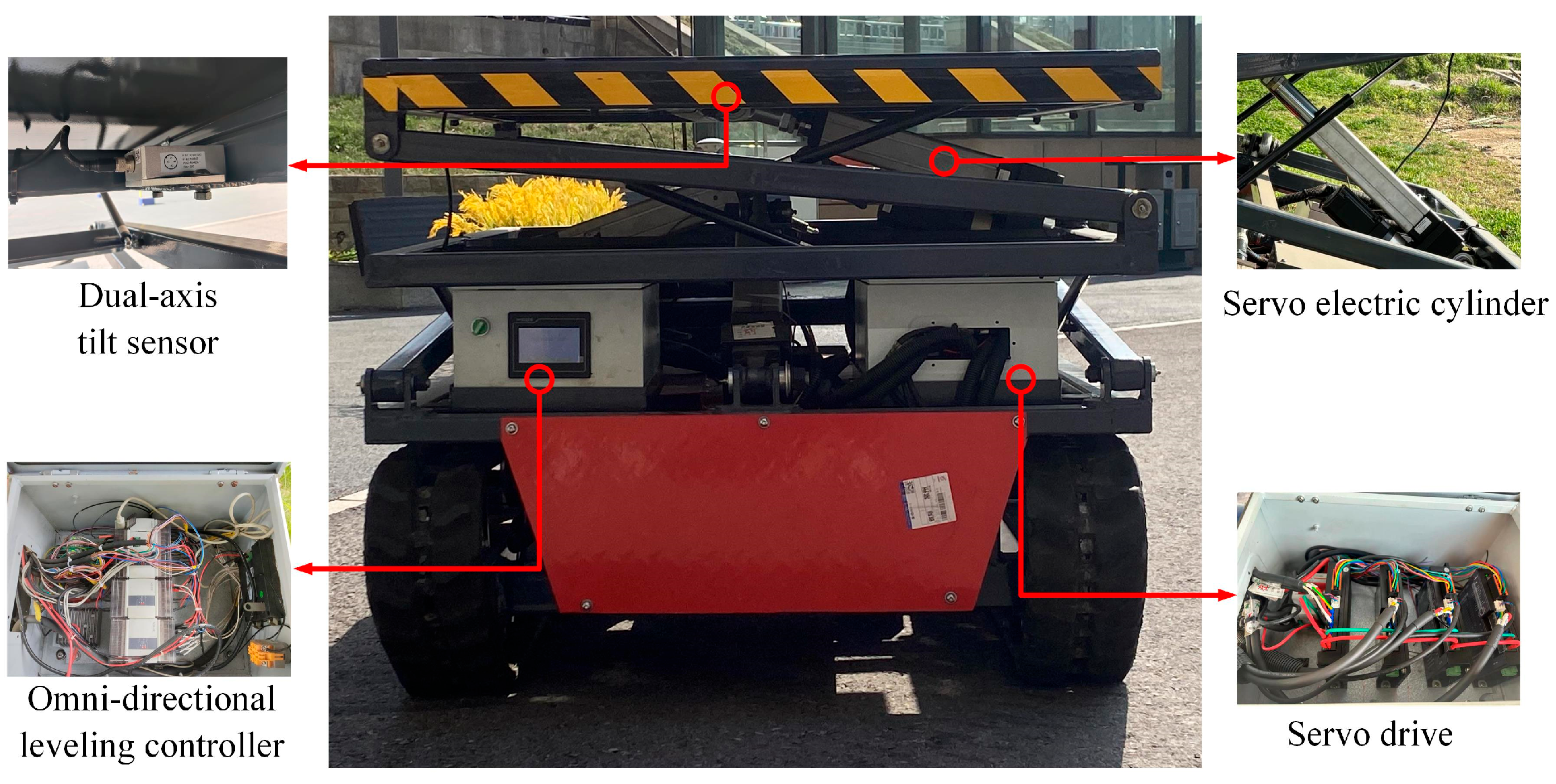
The main components of the electromechanical omnidirectional leveling system for the tracked mobile platform include an omnidirectional leveling controller, servo drivers, dual-axis tilt sensors, folding servo-electric cylinders, magnetic switches, DC servo motors, motor reducers, bracket structure, etc. The composition of the electromechanical omnidirectional leveling system is shown in Figure 3.
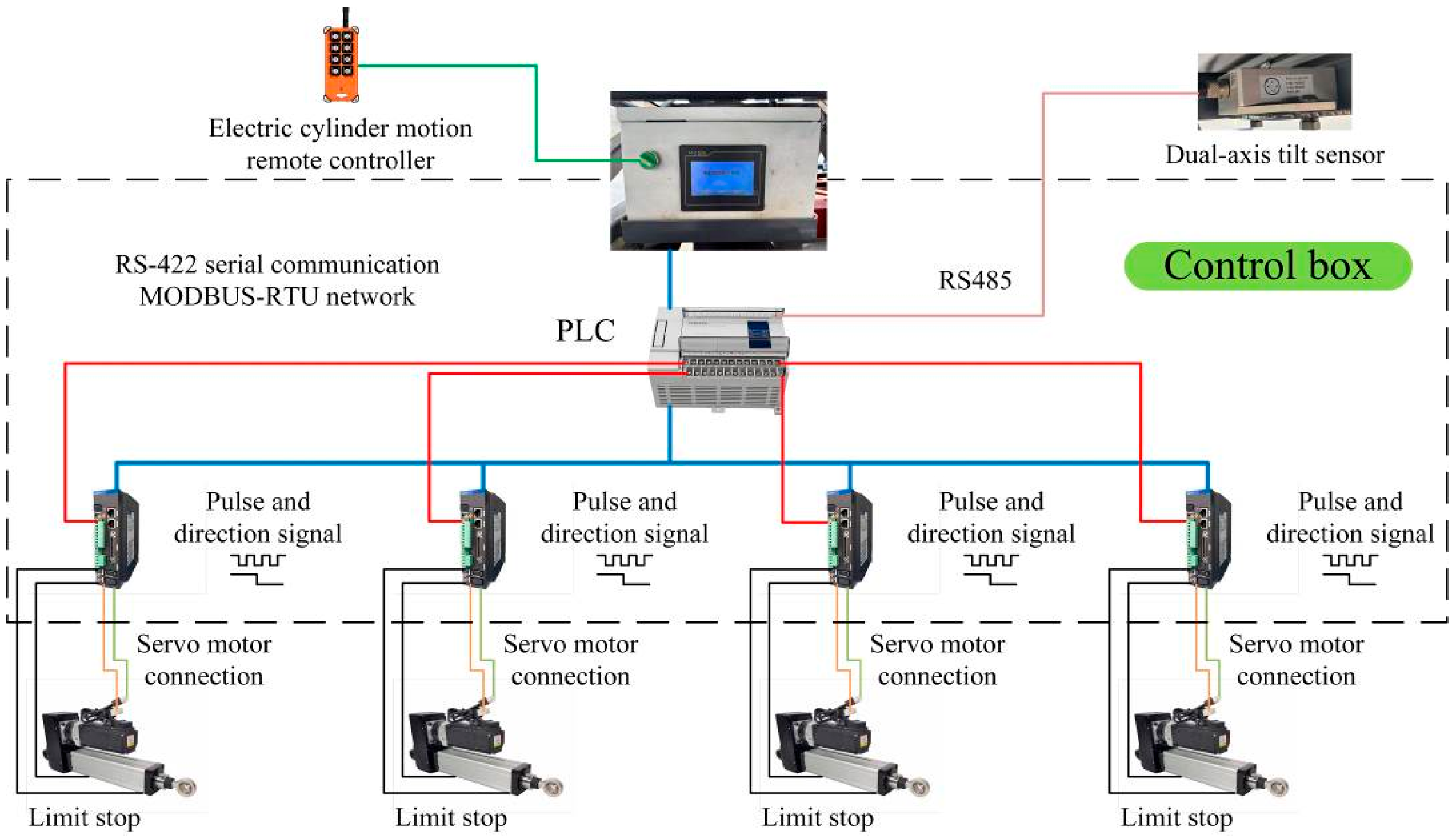
The principle of the electrical control system of the electromechanical omnidirectional leveling system is shown in Figure 4.
Among them, the omnidirectional leveling controller is used to process the fuselage inclination angle information and generate leveling control signals. Inside it, the Xinjie XDM-32T-C motion control-type PLC is used as the programmable main controller. The controller touch display screen and the electric cylinder motion remote controller can realize the switching between the manual leveling and automatic leveling control modes of the leveling system. The servo drivers are used to analyze the control signals of the leveling controller and control the speed and position of the DC servo motors. Their model is the DF3E series standard I/O-type servo driver, and the corresponding motor power is 750 W. Both the PLC and the servo drivers were purchased from Wuxi Xinje Electric Co., Ltd. in Wuxi, Jiangsu Province, China. The controller touch display screen, PLC controller, and servo drivers form a monitoring system through the serial communication network MODBUS-RTU protocol. The dual-axis tilt sensors are connected to the PLC controller via the RS485 communication interface and are used to collect real-time information on the lateral and longitudinal inclination angles of the fuselage and chassis. Their model is ZCT2XXKLCS-AH-XX-7XB, and the dynamic measurement accuracy is 0.05°. The dual-axis tilt sensors were purchased from Renke Measurement and Control Technology Co., Ltd. in Jinan, Shandong Province, China. The folding servo-electric cylinders serve as the leveling actuators and are used to perform leveling actions. Their model is KDJ80-T10-200-BR-PC-M5-P75. The magnetic switches are used to detect the stroke of the electric cylinder, protect the electric cylinder from over-travel extension or retraction, and play the role of limiting and protecting the electric cylinder. Their type is a standard two-wire DC magnetic switch. The DC servo motors provide power for the telescopic movement of the electric cylinders. Their model is 80M-02430C5-E, with a supply voltage of 48 V and a power of 750 W. The motor reducers serve to reduce the motor speed and increase the torque. Their model is a precision planetary reducer. The folding servo-electric cylinders, magnetic switches, DC servo motors and motor reducers were all purchased from Yuebot Transmission Technology Co., Ltd. in Suzhou, Jiangsu Province, China.
The reducers, synchronous belts, ball screws and other internal components of the motors are used to connect the DC servo motors with the electric cylinders, converting the motors’ rotation into the extension and retraction of the electric cylinders’ push rods [26].
To enhance the robustness of the attitude perception against vibration (generated by the track–ground interaction and the drive motors), a Moving Average Filter was implemented in the PLC. The filter utilizes a sliding window of 5 sampling periods to smooth the raw data from the dual-axis tilt sensors. This effectively suppresses high-frequency noise while preserving the low-frequency trend of terrain changes. Additionally, to mitigate the impact of the MODBUS-RTU communication delay, the control loop frequency was set to match the sensor’s update rate, preventing integral windup caused by data lag.

2.2.2. Leveling Control Strategy

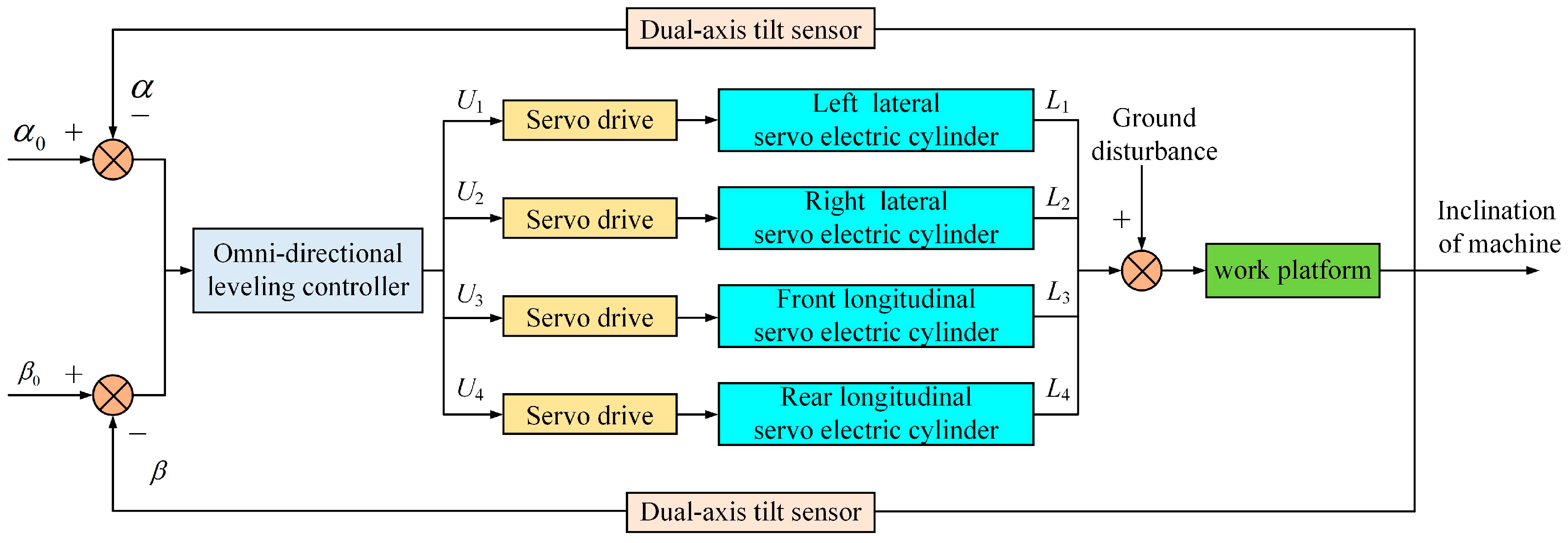
The control principle of the electromechanical omnidirectional leveling system for the tracked mobile platform is shown in Figure 5. In Figure 5, α 0 is the expected lateral inclination angle of the fuselage, °; β 0 is the expected longitudinal inclination angle of the fuselage, °; α is the actual lateral inclination angle of the fuselage, °; β is the actual longitudinal inclination angle of the fuselage, °; U1 is the control voltage of the left servo motor, V; U2 is the control voltage of the right servo motor, V; U3 is the control voltage of the front servo motor, V; U4 is the control voltage of the rear servo motor, V; L1 is the telescopic displacement of the left lateral electric cylinder, mm; L2 is the telescopic displacement of the right lateral electric cylinder, mm; L3 is the telescopic displacement of the front longitudinal electric cylinder, mm; L4 is the telescopic displacement of the rear longitudinal electric cylinder, mm.
The automatic leveling control strategy of the electromechanical omnidirectional leveling system is as follows: When the tracked mobile platform is moving on the ground with random slopes, the dual-axis tilt sensor fixed on the working platform collects the information of the lateral and longitudinal inclination angles of the fuselage in real time and transmits the inclination angle information to the leveling controller. The leveling controller processes the inclination angle information, calculates the inclination degree of the platform, and then determines whether it is necessary to level the platform, that is, whether the inclination angle is greater than the expected fuselage inclination angle trigger threshold. The threshold is generally set within ±1.5°. This value was determined based on field test observations. Since the natural unevenness of the hilly and mountainous areas surface induces high-frequency micro-tilts of approximately ±1.0°, setting a threshold below this value would result in actuator chattering (frequent, unnecessary start–stop motions). The ±1.5° threshold functions as a hysteresis dead zone, effectively filtering out minor terrain irregularities to protect the servo motors from overheating and extending the mechanical service life of the electric cylinders. If the leveling threshold is set too large, the electric cylinder will not perform the leveling action until the inclination angle of the fuselage is relatively large.
If the threshold is exceeded, the leveling controller calculates the required movement amounts L and θ of the electric cylinders and the servo motors respectively, and generates corresponding pulse voltage control signals U. The signals are transmitted to the pulse input port of the servo drivers through a circuit. The servo drivers analyze the pulse voltage signals and convert them into corresponding three-phase currents I, which are then delivered to the servo motors. This process enables control of the rotation direction and speed of the servo motor. Through the transmission of mechanisms such as synchronous belts and ball screws, the rotational movement θ of the motors is converted into the telescopic movement L of the electric cylinders. After that, the leveling controller rolls back and checks the real-time inclination angle data of the dual-axis tilt sensor again. The platform is ready to be leveled further. If the platform inclination angle is lower than the trigger threshold, the data of the dual-axis tilt sensor will no longer be acquired, and the leveling action will stop. If the platform inclination angle is greater than the trigger threshold, the leveling action will continue until the platform inclination angle is lower than the trigger threshold. The fuselage posture is adjusted through the coordinated movement of four electric cylinders, and finally, the omnidirectional leveling of the working platform is achieved.
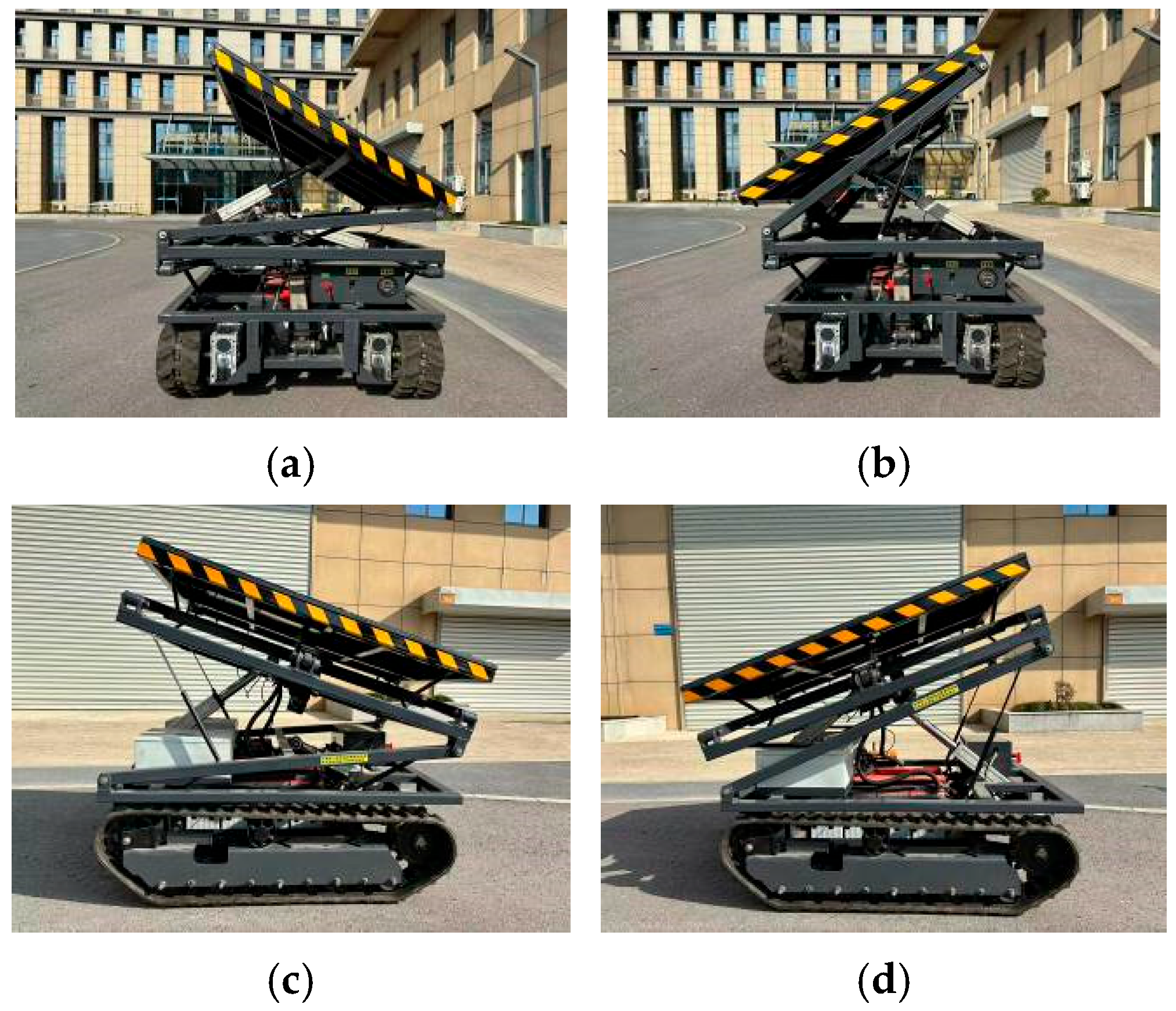
When the omnidirectional leveling system needs to perform an adjustment action in a certain direction, the leveling controller will generate a pulsed voltage control signal U, which is then transmitted to the DC servo motor after conversion. When the pulsed signal is positive, the servo motor rotates forward, driving the electric cylinder to perform an extension leveling action, and the vehicle frame rotates upward around the hinge point; when the pulsed signal is negative, the servo motor rotates in reverse, driving the electric cylinder to perform a contraction leveling action, and the vehicle frame rotates downward around the hinge point. During the adjustment of the fuselage inclination angle in a certain direction, the control signal only controls the expansion and contraction of the electric cylinder on one side of either the lateral leveling mechanism or the longitudinal leveling mechanism, while the electric cylinder on the other side moves passively. That is, for the adjustment of the fuselage’s lateral attitude, when the pulse voltage U1 is positive and U2 is 0, the left servo motor rotates forward and the right servo motor does not move. At this time, the left electric cylinder extends by L1, and the right electric cylinder has no movement. The left end of the fuselage rises, and the motion state of the leveling system is as shown in Figure 6a. When the pulse voltage U2 is positive and U1 is 0, the right servo motor rotates forward, while the left servo motor does not move. At this time, the right electric cylinder extends by L2, and the left electric cylinder moves following the mechanical structure. The right end of the fuselage rises, and the motion state of the leveling system is as shown in Figure 6b. Through the adjustment actions of the left and right electric cylinders, the actual lateral inclination angle α of the fuselage can be adjusted to the expected lateral inclination angle α 0 of the fuselage. Similarly, for the longitudinal leveling of the fuselage, the motion states of the leveling system are shown in Figure 6c,d. Through the adjustment actions of the front and rear electric cylinders, the actual longitudinal inclination angle β of the fuselage can be adjusted to the expected longitudinal inclination angle β 0 of the fuselage.
The electromechanical omnidirectional leveling system combines dual-axis tilt sensors with a PLC to form a closed-loop control system, enabling the tracked mobile platform to adaptively adjust its fuselage posture on different terrains.

2.2.3. Kinematics Model of the Omnidirectional Leveling Mechanism

The four electric cylinders of the leveling system are arranged in layers in the left, right, front and rear directions and move independently. Their respective lengths jointly determine the lifting and lateral and longitudinal postures of the fuselage. Therefore, in order to adjust the fuselage posture by adjusting the lengths of the electric cylinders, it is of great significance to establish a kinematic model between the fuselage inclination angle and the lengths of the electric cylinders.
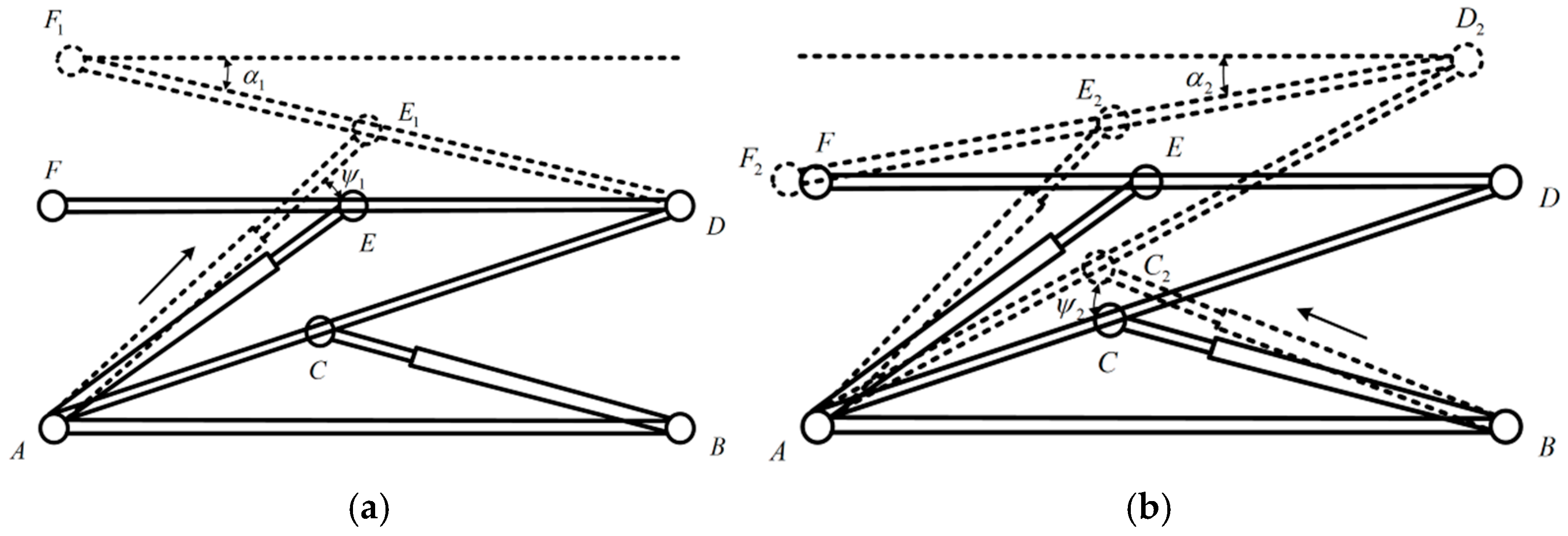
During the modeling process, the lateral and longitudinal leveling mechanisms of the electromechanical omnidirectional leveling system are simplified and regarded as a rigid system. The hinge clearances are ignored, while the electric cylinders and triangular hinge mechanisms are retained. The two-dimensional planar structure of the fuselage is in a “Z” shape. The overall layout structures of the lateral and longitudinal leveling mechanisms are the same; only the size parameters of each structure are different. Therefore, the kinematic model representation methods of the lateral and longitudinal leveling mechanisms are the same. To reduce the repetitive calculation process, only the kinematic model of the lateral leveling mechanism is calculated and explained.
The schematic diagram of the lateral leveling mechanism is shown in Figure 7. Figure 7a represents the leveling movement process at the left end of the fuselage and Figure 7b represents the leveling movement process at the right end of the fuselage. In Figure 7, A is the hinge point of the left lateral electric cylinder AE and the middle frame AB; B is the hinge point of the right lateral electric cylinder BC and the middle frame AB; C is the hinge point of the right lateral electric cylinder BC and the upper bracket AD; D is the hinge point of the upper frame DF and the upper bracket AD; E is the hinge point of the left lateral electric cylinder AE and the upper frame DF; F is the left end point of the upper frame DF; E1 is the position of the hinge point E after the left end of the fuselage is raised; F1 is the position of the end point F after the left end of the fuselage is raised; C2 is the position of the hinge point C after the right end of the fuselage is raised; D2 is the position of the hinge point D after the right end of the fuselage is raised; E2 is the position of the hinge point E after the right end of the fuselage is raised; and F2 is the position of the end point F after the right end of the fuselage is raised. α 1 is the angle between the platform after the left end of the fuselage is raised and the horizontal plane, °. ψ 1 is the rotation angle of the left lateral electric cylinder AE at the left end of the fuselage around the hinge point A after the left end of the fuselage is raised, °. α 2 is the angle between the platform after the right end of the fuselage is raised and the horizontal plane, °. ψ 2 is the rotation angle of the right lateral electric cylinder BC at the right end of the fuselage around the hinge point B after the right end of the fuselage is raised, °.
For the leveling mechanism at the left end of the fuselage, when the adjustment angle of the fuselage’s lateral inclination is α 1 , according to the cosine theorem, the length of the left lateral electric cylinder is
L A E 1 = L A D 2 + L D E 1 2 2 L A D L D E 1 cos ( A D E + α 1 )
where LAD is the width of the upper bracket, mm; LDE1 is the distance between hinge point D and hinge point E1, which is equal to the distance LDE between hinge point D and hinge point E, mm; and ∠ADE is the initial included angle between the upper frame and the upper bracket, °.
The dynamic equation of the adjustment angle of the fuselage lateral inclination angle α 1 and the telescopic displacement L1 of the left lateral electric cylinder is
L 1 = L A E 1 L A E
where LAE is the initial length of the left lateral electric cylinder, mm.
When the adjustment angle of the fuselage’s lateral inclination is α 1 , according to the sine theorem, the included angle between the left lateral electric cylinder and the upper bracket AD is
D A E 1 = arcsin L D E 1 / L A E 1 sin ( A D E + α 1 )
The dynamic equation of the adjustment angle of the fuselage lateral inclination angle α 1 and the rotation angle ψ 1 of the left lateral electric cylinder around the hinge point A is
ψ 1 = D A E 1 D A E
where ∠DAE is the initial included angle between the left lateral electric cylinder and the upper bracket AD, °.
For the leveling mechanism at the right end of the fuselage, when the lateral inclination angle of the fuselage is adjusted by α 2 , according to the cosine theorem, the length of the right lateral electric cylinder is
L B C 2 = L A B 2 + L A C 2 2 2 L A B L A C 2 cos ( B A C + α 2 )
where LAB is the width of the middle frame, mm; LAC2 is the distance between hinge point A and hinge point C2, which is equal to the distance LAC between hinge point A and hinge point C, mm; and ∠BAC is the initial angle between the upper bracket and the middle frame, °.
Then, the dynamic equation of the adjustment angle of the fuselage lateral inclination angle α 2 and the telescopic displacement L2 of the right lateral electric cylinder is
L 2 = L B C 2 L B C
where LBC is the initial length of the right lateral electric cylinder, mm.
When the adjustment angle of the fuselage’s lateral inclination is α 2 , according to the sine theorem, the included angle between the right lateral electric cylinder and the middle frame AB is
A B C 2 = arcsin L A C 2 / L B C 2 sin ( B A C + α 2 )
The dynamic equation of the adjustment angle of the fuselage lateral inclination angle α 2 and the rotation angle ψ 2 of the right lateral electric cylinder around the hinge point B is
ψ 2 = A B C 2 A B C
where ∠ABC is the initial included angle between the right lateral electric cylinder and the middle frame AB, °.
There is a one-to-one mathematical relationship between the inclination angles of each direction of the tracked mobile platform fuselage and the corresponding telescopic amounts of the electric cylinders. The telescopic amounts required for the electric cylinders to level the platform can be calculated based on the inclination angles of the platform, providing a mathematical basis for the design of the leveling control program of the control system.

2.3. ADAMS Motion Simulation

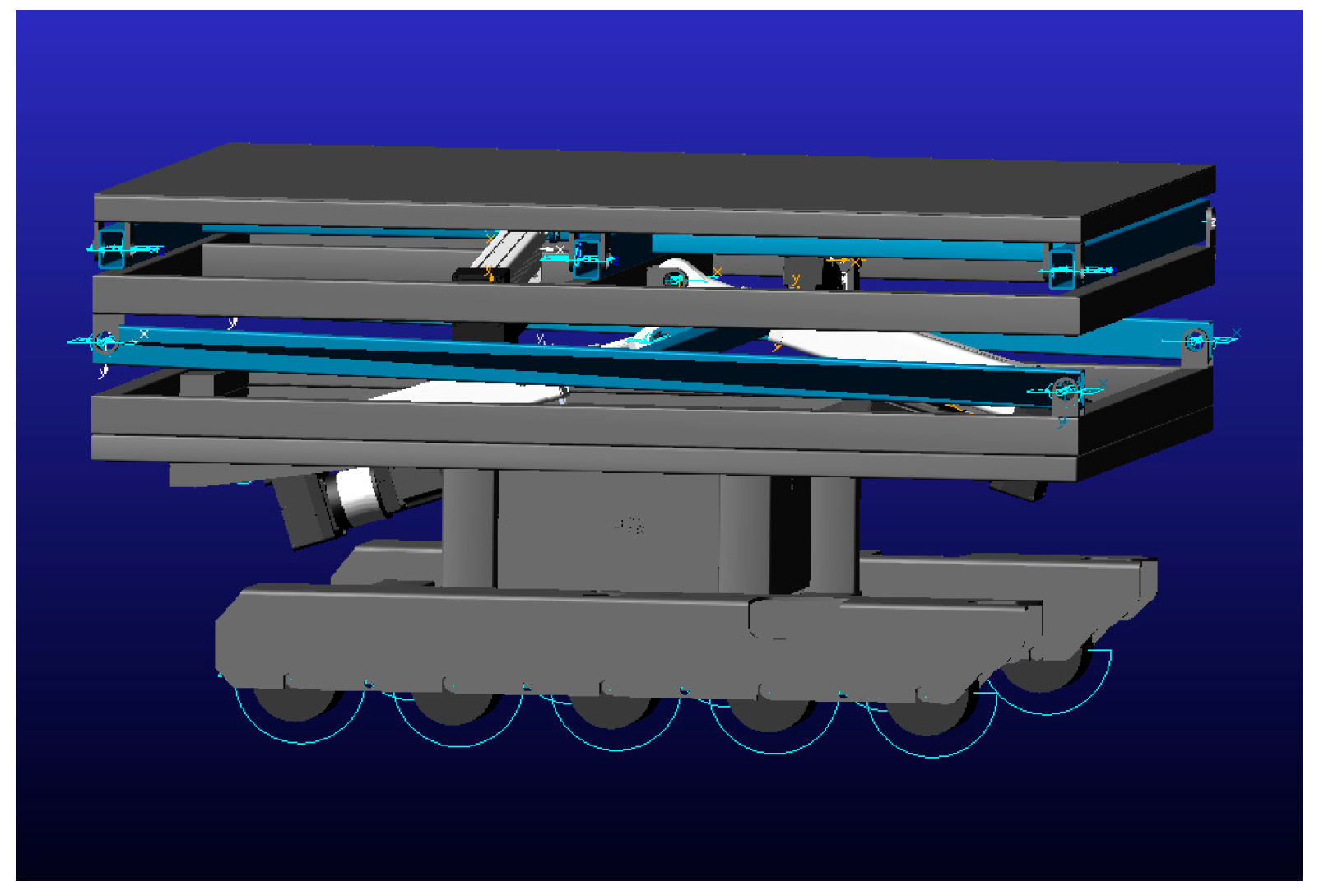
In order to verify the feasibility of the structural design of the omnidirectional leveling system, the Solidworks software (Version 2024, Dassault Systemes, Paris, France) was used to establish a virtual prototype model of the tracked mobile platform. Then, the three-dimensional model was imported into ADAMS (Version 2024, Mechanical Dynamics Inc., Calamba, Philippines) [27]. Since the modeling of the crawler running mechanism in ADAMS is relatively complex and the solution time of the motion equation is long during the multi-body dynamics simulation process, during the modeling process, the crawler running mechanism of the virtual prototype model was simplified, and the wheel running mechanism was used for substitution. The rationale for this simplification is that the simulation focuses on the kinematic response of the upper leveling mechanism to terrain changes rather than the terramechanics of the track–soil interaction. Replacing the tracks with wheels maintains the geometric relationship of the chassis pose without affecting the kinematic analysis of the leveling mechanism’s adjustment process. Parameters such as the running speed did not change, and this would not have an impact on the leveling motion of the omnidirectional leveling system [28]. After importing the model into ADAMS, constraints such as translational pairs, revolute pairs, and contact pairs were set according to the motion constraint relationships between various components of the prototype to ensure that the virtual prototype could simulate the actual leveling motion.
The established virtual prototype model is shown in Figure 8.
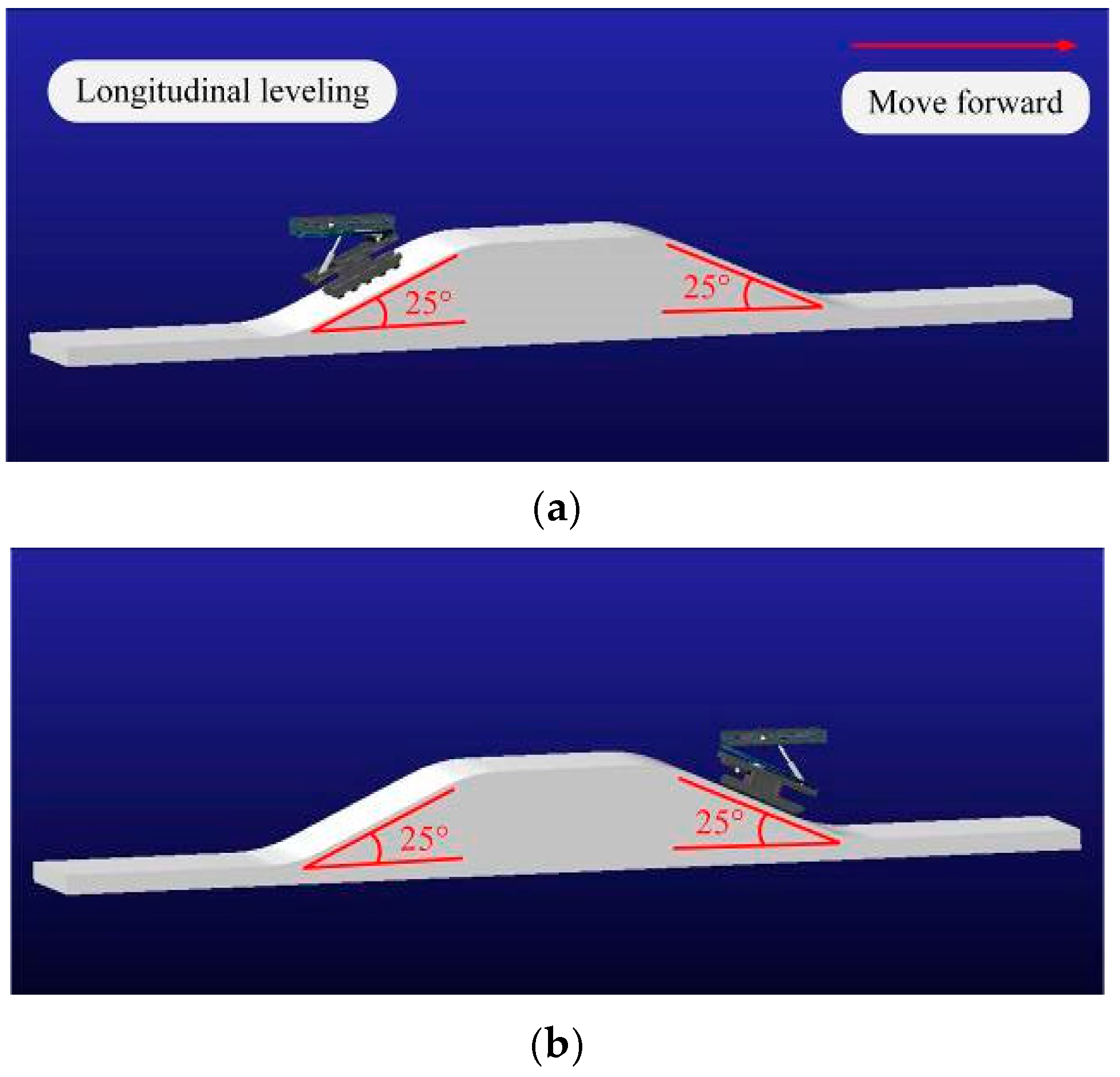
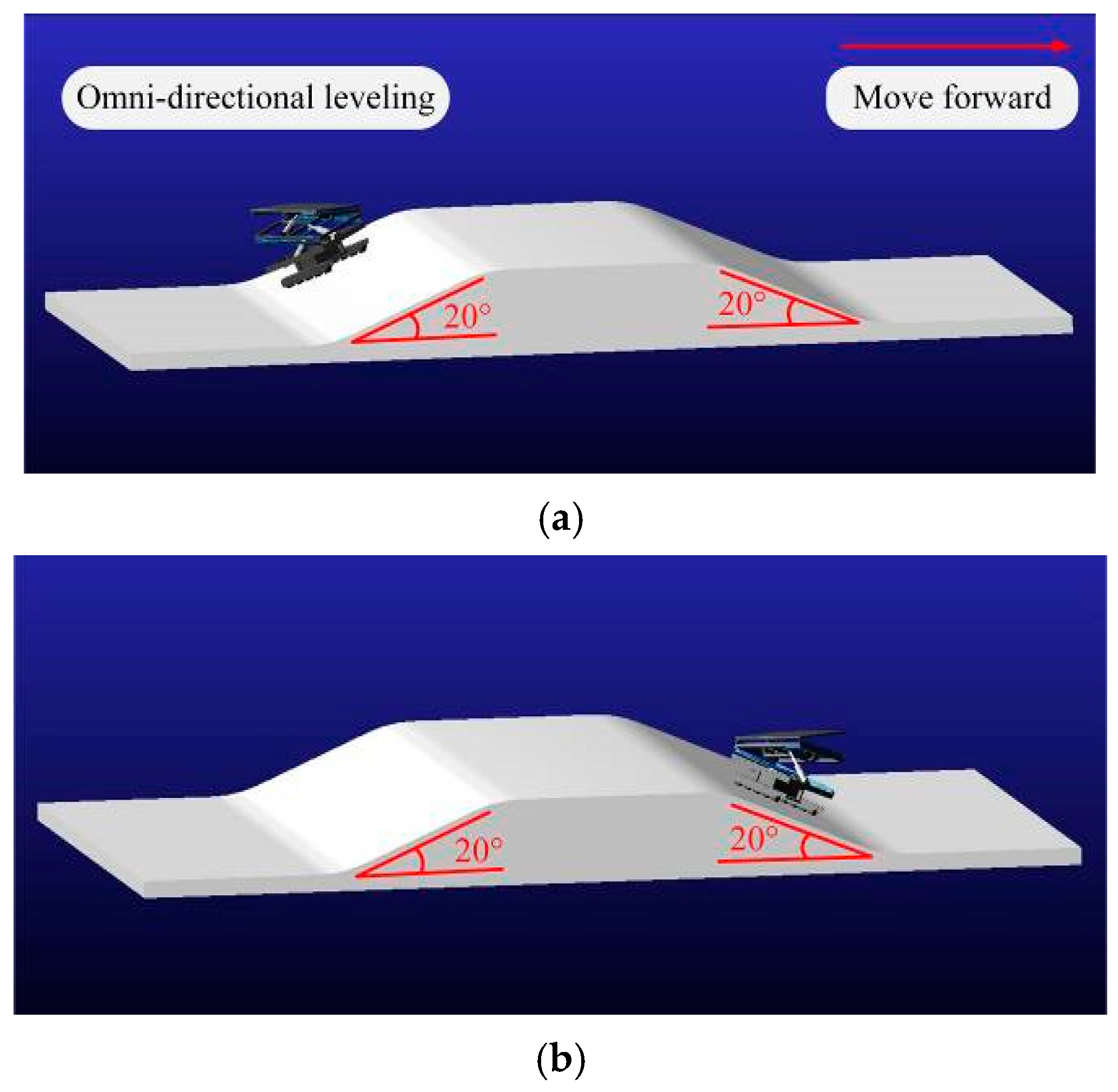
A longitudinal ramp and a lateral ramp model were established. The uphill and downhill inclination angles of the longitudinal ramp are both 25°. The uphill and downhill angles of the lateral ramp are both 20°. The driving function of the virtual prototype wheel was set as STEP (time, 0, 0 d * time, 2, 600 d * time) and passed through the ramp at a speed of approximately 2.4 km per hour. A STEP driving function was added to the translational pair between the electric cylinder push rod and the electric cylinder barrel. This can realize the longitudinal leveling dynamic simulation of the virtual prototype during the uphill and downhill processes. The simulation motion process is shown in Figure 9 and Figure 10.
During the simulation process, measurement functions for the chassis inclination angle, fuselage inclination angle, and the telescopic amounts of each electric cylinder are added. The design of the virtual prototype is evaluated based on the measurement results. The simulation data was collected in September 2025.

2.4. Experimental Design

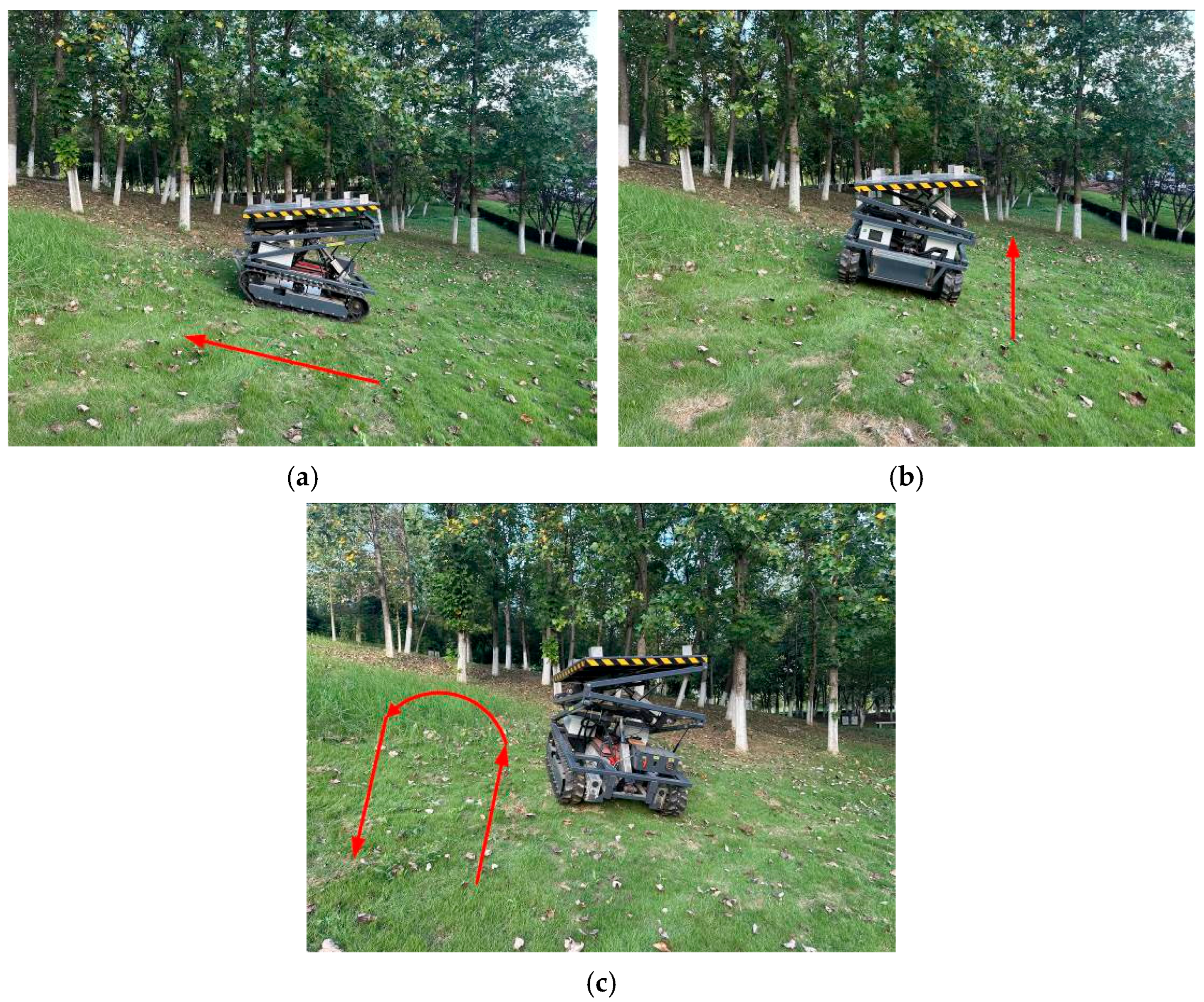
The actual environmental conditions in hilly and mountainous areas are more complex. The road surface is uneven and has irregular undulations, which pose higher requirements for the performance of the omnidirectional leveling system of the tracked mobile platform. In order to verify the stability of the tracked mobile platform when driving on hilly and mountainous roads and the working performance of the omnidirectional leveling system and the leveling control system, this study selected a representative undulating slope in a hilly and mountainous area for the experiment. The experiment was divided into three working conditions, namely, longitudinal straight uphill, lateral slope straight ahead, and slope steering (including straight driving and steering). The experimental site was located in a hilly area with natural loess soil conditions. During the test, the test personnel observed that the track travel trajectories were relatively shallow and no obvious subsidence occurred. And there was little soil adhesion to the crawler grousers. After observing the surrounding soil environment and touching the soil around, the test personnel found that the soil was light yellow in color, with a rough surface and a dry feel. So, the test personnel judged that the soil moisture content of the test site was relatively low. It was concluded that the ground surface of the test site was hard and dry. According to Wong [29], the coefficient of friction for tracked vehicles on this type of soil typically ranges from 0.7 to 0.8, with a friction coefficient suitable for tracked vehicle operations. The test path included a longitudinal slope ranging from 0° to 25° and a lateral slope ranging from 0° to 20°, representing the typical complex terrain found in hilly and mountainous agricultural environments. The experimental data were collected on 22 September 2025. The experimental scenarios are shown in Figure 11a–c. The red arrow lines in the figures represent the driving routes of the prototype.
During the test process, the prototype was operated to drive on the natural slope at a slow and stable speed. After starting, the automatic leveling function of the prototype was turned on, and the dual-axis tilt sensors installed on the fuselage and chassis were used to record the changes in the chassis inclination angle and the fuselage inclination angle. Three repeated tests were conducted for each working condition, and the clearest data was selected for analysis. By analyzing the test data, the climbing ability of the tracked mobile platform and the leveling performance of the electromechanical omnidirectional leveling system were verified. According to the method in reference [30], the average value γ ¯ and standard deviation S γ of the inclination angle are selected as the performance evaluation indicators for the dynamic leveling of the prototype. The calculation method of the 95% confidence interval of the experimental data is
C I = γ ¯ ± Z × S γ n
where n is the sample capacity. At a 95% confidence level, the Z value is 1.96.
The inclination angle of the fuselage is selected as the primary performance indicator for stability. For agricultural machinery operating at low speeds on slopes, the lateral and longitudinal inclination directly determines the shift of the center of mass (COM). By controlling the inclination angle to approach 0°, the projection of the COM is maintained effectively within the stability support polygon of the tracks, thereby preventing rollover. During the test, if the fuselage angle does not fluctuate sharply, it indicates that the chassis can travel stably on the slope without overturning. Therefore, in this leveling process, reducing the inclination angle can enhance the operating stability of the platform.

3. Results and Discussion

3.1. Simulation Analysis of Longitudinal Uphill and Downhill Dynamic Leveling

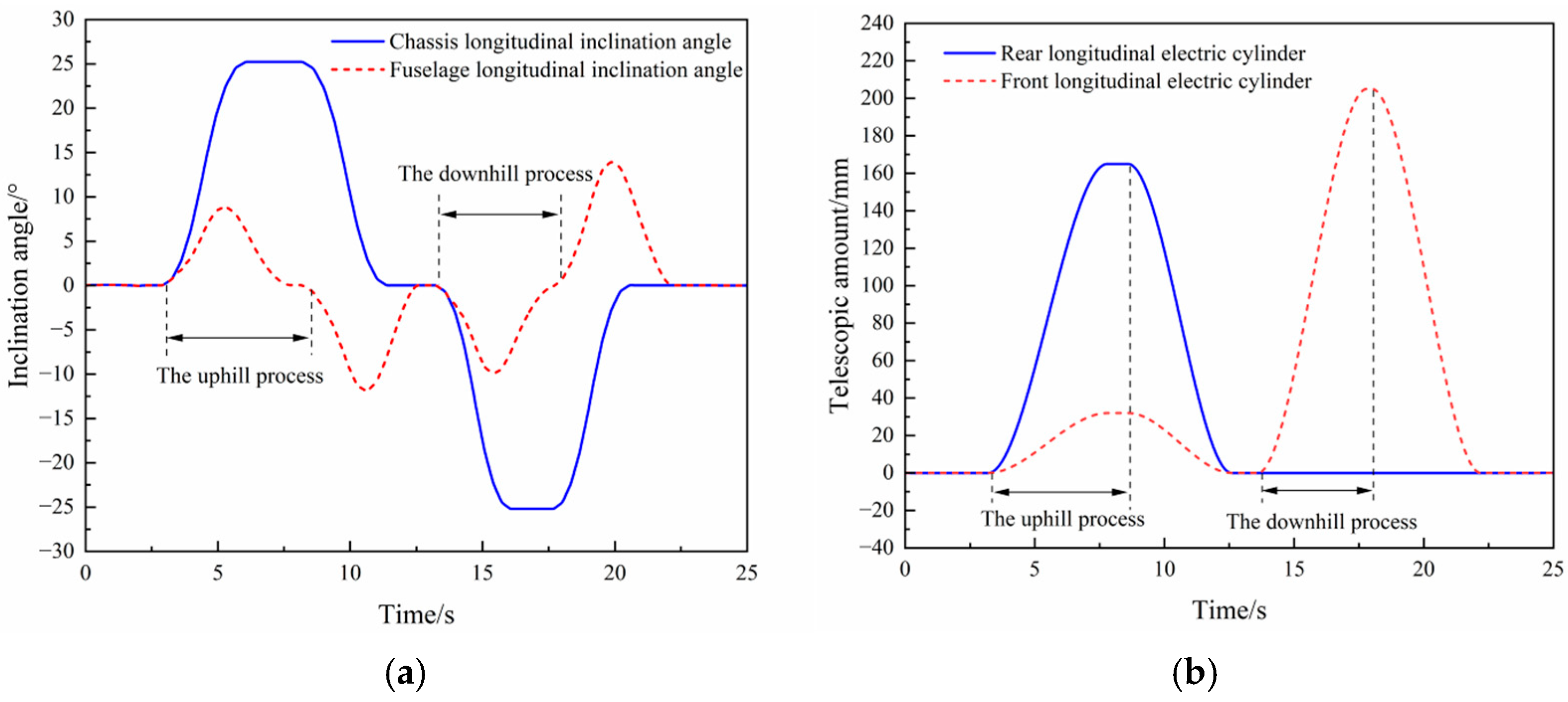
In the dynamic leveling simulation of the virtual prototype going uphill and downhill longitudinally, the longitudinal inclination angle changes of the fuselage and chassis are shown in Figure 12a, and the telescopic amount changes of the longitudinal electric cylinders are shown in Figure 12b.
The change curve of the longitudinal inclination angle of the chassis in Figure 12a reflects the change in the longitudinal inclination angle of the road ramp that the virtual prototype passes through.
From the change curve of the longitudinal inclination angle of the fuselage in Figure 12a and the change curve of the telescopic amount of the longitudinal electric cylinders in Figure 12b, it can be seen that during the uphill process of the prototype from 3.2 s to 7.8 s, the rear longitudinal electric cylinder extended by 165 mm, and the front longitudinal electric cylinder extended by 21 mm. At this time, the rear end of the fuselage rose, the longitudinal inclination angle of the fuselage relative to the horizontal plane was continuously reduced until it reached 0°, and the maximum longitudinal inclination angle of the fuselage was 8.87°. During the downhill process of the prototype from 13.6 s to 18.0 s, the rear longitudinal electric cylinder remained unchanged, and the front longitudinal electric cylinder extended by 205 mm. At this time, the front end of the fuselage rose, the longitudinal inclination angle of the fuselage was gradually adjusted to 0°, and the maximum longitudinal inclination angle of the fuselage was 9.82°.
According to the dynamic leveling simulation results of the virtual prototype when going uphill and downhill longitudinally, it can be seen that by adjusting the length of the longitudinal electric cylinders in the omnidirectional leveling system, the longitudinal attitude of the fuselage can be leveled, verifying the feasibility of the design of the longitudinal leveling mechanism.

3.2. Simulation Analysis of Omnidirectional Leveling on Oblique Uphill and Oblique Downhill

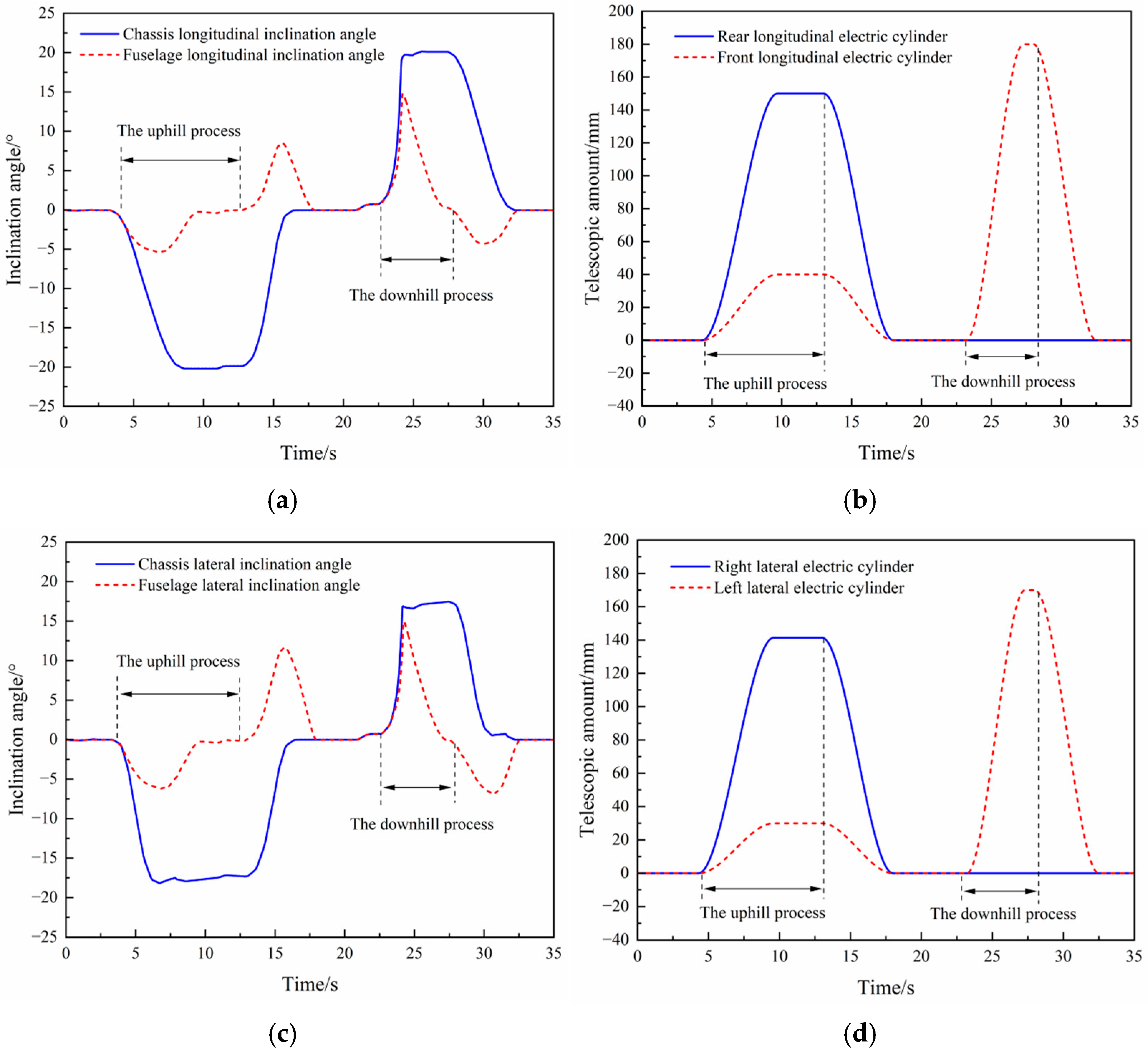
In the simulation of the omnidirectional leveling of the virtual prototype when moving obliquely uphill and downhill, the longitudinal inclination angle changes of the fuselage and the chassis are shown in Figure 13a, and the telescopic amount changes of the longitudinal electric cylinders are shown in Figure 13b. The lateral inclination angle changes of the fuselage and the chassis are shown in Figure 13c, and the telescopic amount changes of the lateral electric cylinders are shown in Figure 13d.
From the change curve of the longitudinal inclination angle of the chassis in Figure 13a and the change curve of the lateral inclination angle of the chassis in Figure 13c, it can be observed that they both reflect the change in the longitudinal and lateral inclination angle of the road ramp that the virtual prototype passes through.
From the change curve of the longitudinal inclination angle of the fuselage in Figure 13a and the change curve of the telescopic amount of the longitudinal electric cylinders in Figure 13b, it can be seen that during the prototype’s oblique uphill process, within 4.5–9.6 s, the rear longitudinal electric cylinder extended 150 mm, and the front longitudinal electric cylinder extended 40 mm. At this time, the rear end of the fuselage rose, the longitudinal inclination angle of the fuselage was adjusted to 0° and the maximum longitudinal inclination angle of the fuselage was 5.36°. During the prototype’s oblique downhill process from 23.0 to 27.4 s, the rear electric cylinder remained unchanged, and the front electric cylinder extended 180 mm. At this time, the front end of the fuselage rose, the longitudinal inclination angle of the fuselage was gradually adjusted to 0°, and the maximum longitudinal inclination angle of the fuselage was 14.43°.
From the change curve of the lateral inclination angle of the fuselage in Figure 13c and the change curve of the telescopic amount of the lateral electric cylinders in Figure 13d, it can be seen that during the prototype’s oblique uphill process, from 4.6 to 9.6 s, the right lateral electric cylinder extended 141 mm and the left lateral electric cylinder extended 30 mm. At this time, the right end of the fuselage rose, the lateral inclination angle of the fuselage relative to the horizontal plane was continuously reduced to 0°, and the maximum lateral inclination angle of the fuselage was 6.19°. During the oblique downhill process of the prototype from 23.1 to 27.2 s, the right lateral electric cylinder remained unchanged and the left lateral electric cylinder extended 170 mm. At this time, the left end of the fuselage rose, the lateral inclination angle of the fuselage was adjusted to 0°, and the maximum lateral inclination angle of the fuselage was 14.66°.
It can be seen from the simulation results that when the prototype passes through the ramp obliquely, it will have both lateral and longitudinal inclination angles simultaneously. The electromechanical omnidirectional leveling system designed in this paper can achieve the function of decoupled leveling in the lateral and longitudinal directions. The longitudinal electric cylinders are responsible for adjusting the longitudinal inclination angle of the fuselage, and the lateral electric cylinders are responsible for adjusting the lateral inclination angle of the fuselage. Through the coordinated operation of four electric cylinders, the omnidirectional leveling function of the fuselage can be realized. Moreover, the longitudinal leveling angle can reach 25°, and the lateral leveling angle can reach 20°. Thus, it can be seen that the mechanical design principle in this paper is feasible, that is, based on the adjustment method of controlling the length of each electric cylinder, the lateral and longitudinal inclination angles of the fuselage can be adjusted within a certain range.

3.3. Analysis of Test Results

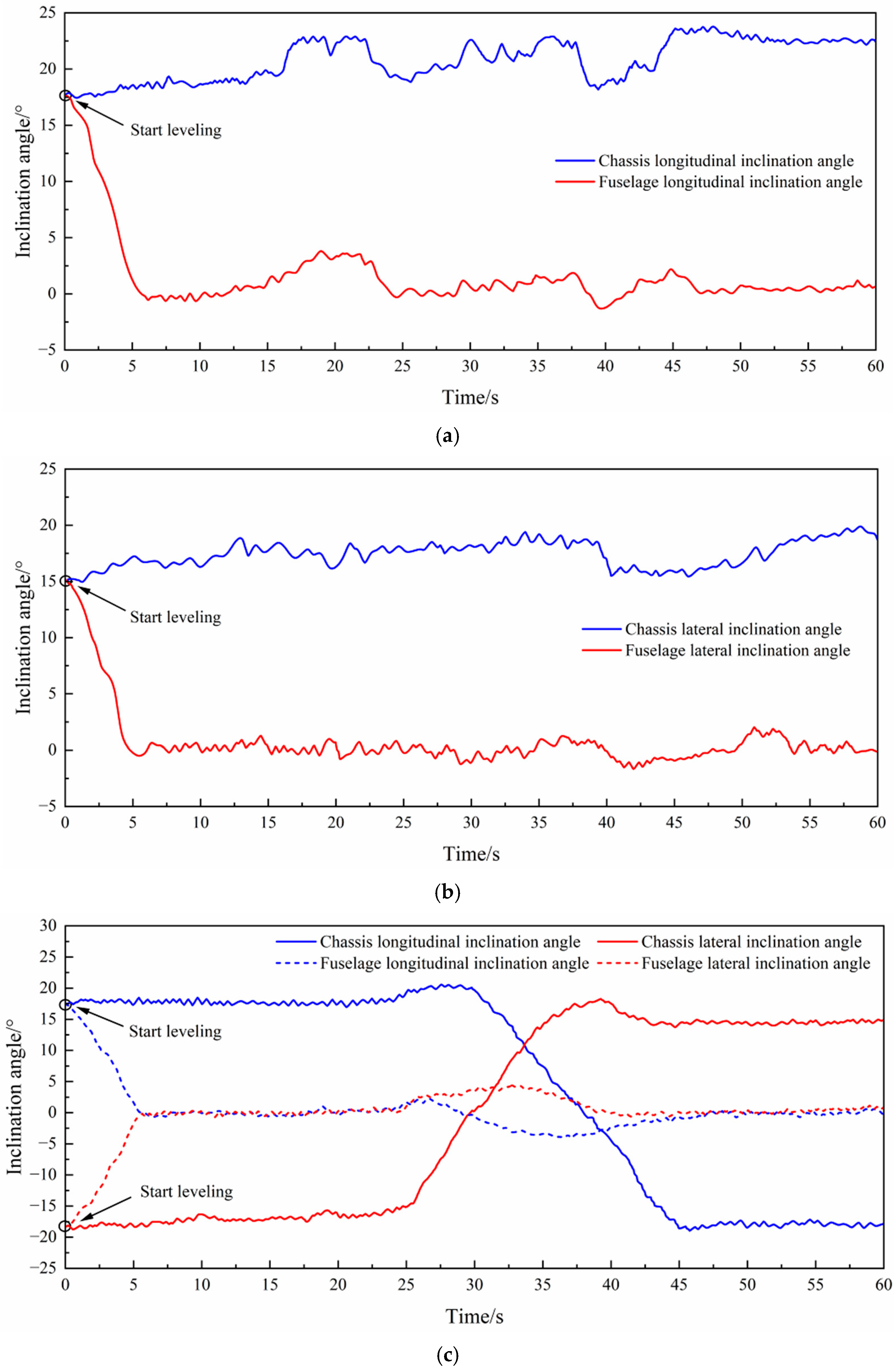
Under the road surface conditions of hilly and mountainous areas, in the longitudinal straight uphill test condition of the prototype, the prototype was placed at the bottom of the slope. The initial state was parallel to the longitudinal axis of the slope. The chassis was operated to move along a longitudinal straight line from the bottom of the slope to the top of the slope. Then, the automatic leveling function of the prototype was activated. The computer was used to visualize the longitudinal inclination angle data of the fuselage and the chassis recorded by the tilt sensors. The test results are shown in Figure 14a. In the lateral slope straight forward test condition of the prototype, the prototype was placed on the slope. The initial state was parallel to the lateral axis of the slope. The chassis was operated to move straight on the cross slope along a lateral straight line. Then, the automatic leveling function of the prototype was activated, and the lateral inclination angle data of the fuselage and the chassis were recorded. The test results are shown in Figure 14b. In the slope steering test condition of the prototype, the prototype was placed at the bottom of the slope. The initial state formed a certain angle with the longitudinal axis of the slope. According to the given driving route, the chassis was operated to move straight and turn. Then, the automatic leveling function of the prototype was activated. The lateral and longitudinal inclination angle data of the fuselage and the chassis were recorded. The test results are shown in Figure 14c.
According to the test data results, the average values γ ¯ and standard deviation values S γ of the inclination angles of the fuselage and chassis in each test condition and the 95% confidence interval of the experimental data are shown in Table 2.
From the test results in Figure 14a and Table 2, the maximum longitudinal inclination angle of the chassis reached 23.76°, the average value of the longitudinal inclination angle of the chassis was 20.82°, and the standard deviation was 1.83°, indicating that during the uphill process, the terrain slope changed significantly, and the slope inclination of hilly and mountainous areas was relatively large. After the automatic leveling was turned on, the longitudinal inclination angle of the fuselage rapidly decreased from 17.62° to around 0°, and then fluctuated within 0–4°. The leveling response time was approximately 5.6 s. No significant overshoot was observed (maximum overshoot < 2°). During the steady-state phase, the steady-state error was 1.71° (represented by the average value), and the standard deviation was 3.15°. This showed that the omnidirectional leveling system designed in this paper can achieve a leveling function of about 25° longitudinally. It can quickly reduce the change in the longitudinal inclination angle of the fuselage caused by the change in the slope angle and maintain the longitudinal fuselage in a horizontal state.
From the test results in Figure 14b, it can be seen that in the lateral slope straight forward working condition, the lateral inclination angle of the chassis fluctuated between 15° and 20°, reaching a maximum of 19.88°. After the automatic leveling was turned on, the lateral inclination angle of the fuselage decreased from 15.07° to around 0° with a leveling response time of 4.9 s, and then fluctuated between 0° and 3°. The adjustment process was smooth with negligible overshoot. After entering the stable state, the steady-state error of the system was maintained at 1.14° with a standard deviation of 2.58°. This showed that the omnidirectional leveling system can achieve a leveling function of about 20° laterally and maintain the lateral fuselage in a horizontal state.
From the test results in Figure 14c, it can be seen that during the slope steering condition, the longitudinal inclination angle of the chassis gradually changed from 17.29° to −18.11°. The lateral inclination angle of the chassis gradually changed from −18.22° to 14.76°. This indicated that during the ramp steering process of the prototype, the longitudinal and lateral inclination angles of the chassis change simultaneously, and the degree of change was obvious. After the automatic leveling was turned on, the longitudinal inclination angle of the fuselage decreased from 17.29° to around 0° with a response time of 5.2 s, and the lateral inclination angle of the fuselage decreased from 18.22° to around 0° with a response time of 5.7 s. During the steering process, the longitudinal and lateral inclinations of the fuselage showed relatively small fluctuations, but were adjusted back to around 0° again within a short period of time. Throughout the leveling process, the steady-state errors for the longitudinal and lateral directions were 1.74° and 1.81° respectively, with standard deviations of 3.08° and 3.39°. This indicated that the “dual lateral and dual longitudinal” four-servo-electric cylinders coordinated leveling scheme can achieve the omnidirectional leveling function with large angles in the lateral and longitudinal directions within a short period of time.
The key performance parameters of the leveling system are shown in Table 3.
It can be seen from the test results that the PLC leveling control system designed in this paper has a relatively high reaction sensitivity and a fast response speed. It can quickly process the inclination data transmitted by the tilt sensor, generate the control signals for each electric cylinder, and achieve the decoupling of lateral and longitudinal leveling. After leveling, the inclination angle of the fuselage fluctuates around 0°, which indicates that the omnidirectional leveling system has good dynamic leveling ability, and the driving stability and working quality of the chassis have been improved. This electromechanical omnidirectional leveling system scheme can provide certain theoretical references for the design of the attitude adjustment system of agricultural machinery in hilly and mountainous areas.

3.4. Discussions

(1)
Comparing the inclination angle data of the fuselage and chassis in Table 2, it was evident that while the average fuselage inclination was effectively controlled, its standard deviation was significantly larger than that of the chassis. This indicated the presence of vibration in the leveled fuselage. This phenomenon was attributed to three main factors: (1) sensor and control latency: the millisecond-level delays inherent in sensor sampling, PLC processing, and servo system response caused the leveling action to lag behind terrain variations during dynamic driving; (2) ground excitation: continuous random vibrations generated by uneven slopes were transmitted to the fuselage through the crawler chassis; and (3) mechanism rigidity: minute clearances at the articulation points of the leveling mechanism induced slight jittering during the frequent start–stop operations of the electric cylinders. Future research will focus on investigating methods to mitigate these vibrations.
(2)
Experimental results demonstrate that the proposed omnidirectional leveling system satisfies the stability requirements for agricultural machinery in hilly and mountainous regions. First, regarding leveling angle and leveling accuracy, under complex conditions with a lateral slope of approximately 20° and a longitudinal slope of approximately 25°, the average body tilt angles were maintained at 1.14° and 1.74°, respectively. These values remain within the ±2° safety threshold and had no sharp fluctuation. These data proved that after the fuselage was leveled, the tipping angle of the chassis exceeded 25°. Compared with the ±15° tilt angle of traditional machinery, this significantly reduced the risk of rollover. Second, in terms of dynamic stability, although the standard deviation of the tilt angle indicates mechanical vibrations caused by track–terrain interaction, the system effectively suppressed low-frequency terrain fluctuations. Third, regarding response speed, the leveling process was completed within 5–6 s. For a crawler platform operating at low speeds (approx. 2.5 km/h) in mountainous areas, this response rate is sufficient to compensate for slope variations before a hazardous shift in the center of gravity occurs. Consequently, these quantitative data confirm that the designed crawler platform fulfills the fundamental operational requirements for steep slopes ranging from 15° to 25°.
(3)
Compared with existing leveling systems, the novelty of the proposed system lies in its layered structural configuration of lateral and longitudinal electric cylinders. This design effectively decouples the lateral and longitudinal leveling adjustments: the upper layer independently regulates the lateral attitude, while the lower layer controls the longitudinal attitude. Consequently, this configuration not only reduces the complexity of the omnidirectional control system design but also effectively mitigates the coupling interference inherent in multi-degree-of-freedom leveling. Performance-wise, the system achieves a maximum lateral leveling angle of 20° and a longitudinal angle of 25°, demonstrating strong adaptability to hilly terrains with slopes ranging from 15° to 25°. Furthermore, servo-electric cylinders are employed as actuators. The designed PLC-based servo control system enables high-precision control over position, velocity, and force, thereby enhancing the accuracy of the leveling motion. The rapid response capability of the servo system facilitates immediate actuation, ensuring the overall stability of the platform.
(4)
To ensure the specificity of the research, it is necessary to define the intended application scenarios. The tracked mobile platform developed in this study is primarily targeted at transportation and crop protection tasks in hilly orchards and tea gardens with slopes up to 15°. In these scenarios, the platform carries heavy loads such as harvested goods or liquid pesticide boxes. The leveling system is critical not only for preventing vehicle rollover but also for minimizing liquid sloshing in boxes and preventing goods bruising caused by tilting. While the current study focuses on the leveling performance of the chassis under variable terrain and does not consider the combination with specific agricultural machinery, the dynamic coupling between specific implements and the platform remains a subject for future optimization. For example, it is necessary to install guardrails on the platform when transporting goods to form an enclosed loading space. When sprinkler irrigation operations are required, the sprinkler equipment and the pesticide water tank can be installed on the operation platform through detachable screws.
(5)
The leveling performance comparison between the tracked mobile platform designed in this paper and similar platforms studied in some references is shown in Table 4.

4. Conclusions

In this study, an electromechanical omnidirectional leveling tracked mobile platform was developed to address the instability and high rollover risk of agricultural machinery in complex hilly environments. Through kinematic modeling, multi-body dynamic simulation, and field experiments, the performance of the proposed system was validated. The specific scientific conclusions are as follows:
(1)
The kinematic analysis and simulations confirm that the proposed “dual-lateral and dual-longitudinal” structural layout with four servo-electric cylinders effectively achieves decoupled control of the fuselage attitude. This mechanism converts the complex spatial leveling problem into independent adjustments of electric cylinder lengths, providing a mathematical basis for the attitude control of agricultural platforms on steep slopes.
(2)
Field experiments under typical working conditions (longitudinal slopes up to 25° and lateral slopes up to 20°) demonstrated the system’s rapid response capability, achieving leveling within 5–6 s. The system successfully suppressed the fuselage inclination caused by terrain undulation. After leveling, the average inclination angle of the fuselage was maintained within a narrow range of 1.14° to 1.74°, significantly lower than the chassis inclination (14.63° to 20.82°), proving the effectiveness of the control strategy.
(3)
Quantitative analysis of the experimental data indicates that the electromechanical leveling system exhibits high stability. The standard deviation of the fuselage inclination angle was maintained below 3.4° across all test scenarios, compared to the raw terrain-induced variations. This indicates that the system effectively filters out low-frequency terrain disturbances, ensuring the platform meets the operational safety requirements for hilly and mountainous agriculture.
(4)
In future research work, field operation tests will be carried out in orchards and tea plantations to further explore the influence law of the platform’s working posture adjustment on the working performance of operating machines and optimize the control system algorithm and the filtering effect of the tilt sensor to improve the leveling robustness of the prototype under extreme slopes and dynamic loads.
(5)
This study contributes to the potential industrialization of the platform by providing a standardized electromechanical leveling module, which can be integrated into some small-scale agricultural machines to improve their marketability and operational safety for end-users.
The electromechanical omnidirectional leveling system proposed in this study offers a viable, low-maintenance solution for the mechanization of hilly agriculture. Compared to traditional hydraulic systems, the electric cylinder-based approach reduces energy consumption and maintenance complexity. This platform serves as a versatile foundational chassis that can provide significant potential for the deployment of autonomous agricultural machinery in complex, unstructured terrains.

Author Contributions

Conceptualization, Y.J. and R.W.; methodology, Y.J.; software, Z.S.; validation, W.L.; investigation, R.D.; resources, Y.J.; data curation, R.D.; writing—original draft preparation, R.W.; writing—review and editing, Y.J.; supervision, Z.S. All authors have read and agreed to the published version of the manuscript.

Funding

The research was financially supported by the Jiangsu Provincial Frontier Technology R&D Program (BF2025046), the National Natural Science Foundation of China (52472410; 52502526), the Natural Science Foundation of Jiangsu Province (BK20250841) and the Project of Faculty of Agricultural Equipment of Jiangsu University (NZXB20210101).

Institutional Review Board Statement

Not applicable.

Data Availability Statement

The original contributions presented in this study are included in the article. Further inquiries can be directed to the corresponding author.

Conflicts of Interest

The authors declare no conflicts of interest. The funders had no role in the design of the study; in the collection, analyses, or interpretation of data; in the writing of the manuscript; or in the decision to publish the results.

References

  1. Li, H.; Chen, L.; Zhang, Z. A study on the utilization rate and influencing factors of small agricultural machinery: Evidence from 10 hilly and mountainous provinces in China. Agriculture 2022, 13, 51. [Google Scholar] [CrossRef]
  2. GB/T 41603.1–2022; China Technical Committee on Standardization of Agricultural Machinery (SAC/TC 201). Self-Propelled Agricultural Machinery–Evaluation of Stability—Part 1: Principles. China Standards Press: Beijing, China, 2022.
  3. Wang, B.; Zhu, J.; Chai, X.; Liu, B.; Zhang, G.; Yao, W. Research status and development trend of key technology of agricultural machinery chassis in hilly and mountainous areas. Comput. Electron. Agric. 2024, 226, 109447. [Google Scholar] [CrossRef]
  4. Jiang, Y.; Wang, R.; Ding, R.; Sun, Z.; Jiang, Y.; Liu, W. Research review of agricultural machinery power chassis in hilly and mountainous areas. Agriculture 2025, 15, 1158. [Google Scholar] [CrossRef]
  5. Jiang, Y.; Sun, Z.; Wang, R.; Ding, R.; Ye, Q. Design and control of a new omnidirectional levelling system for hilly crawler work machines. Comput. Electron. Agric. 2024, 218, 108661. [Google Scholar] [CrossRef]
  6. Shang, H.; Li, X.; Zhang, C.; Xu, C.; Hou, Y.; Jia, M. Optimization design and experiment of automatic leveling system for orchard operating platform in hilly and mountainous areas. INMATEH Agric. Eng. 2024, 73, 364–374. [Google Scholar] [CrossRef]
  7. Hu, J.; Pan, J.; Dai, B.; Chai, X.; Sun, Y.; Xu, L. Development of an attitude adjustment crawler chassis for combine harvester experiment of adaptive leveling system. Agronomy 2022, 12, 717. [Google Scholar] [CrossRef]
  8. Irsel, G.; Altinbalik, M.T. Adaptation of tilt adjustment and tracking force auto mation system on a laser-controlled land leveling machine. Comput. Electron. Agric. 2018, 150, 374–386. [Google Scholar]
  9. Gonzalez, D.O.; Martin-Gorriz, B.; Berrocal, I.I.; Hernandez, B.M.; Garcia, F.C. Development of an automatically deployable roll over protective structure for agricultural tractors based on hydraulic power: Prototype and first tests. Comput. Electron. Agric. 2016, 124, 46–54. [Google Scholar] [CrossRef]
  10. Sun, J.; Meng, C.; Zhang, Y.; Chu, G.; Zhang, Y.; Yang, F.; Liu, Z. Design and physical model experiment of an attitude adjustment device for a crawler tractor in hilly and mountainous regions. Inf. Process. Agric. 2020, 7, 466–478. [Google Scholar] [CrossRef]
  11. Denis, D.; Thuilot, B.; Lenain, R. Online adaptive observer for rollover avoidance of reconfigurable agricultural vehicles. Comput. Electron. Agric. 2016, 126, 32–43. [Google Scholar] [CrossRef]
  12. Lü, X.R.; Liu, Z.; Lü, X.L.; Wang, X. Design and study on the levelling mechanism of the tractor body in hilly and mountainous areas. J. Eng. Des. Technol. 2022, 22, 679–689. [Google Scholar] [CrossRef]
  13. Zhu, H.; Jin, H.; Hou, Y.; Wang, S.; Chen, Y.; Zhang, S.; Shen, J. An omnidirectional dynamic levelling system with less tuning parameters for mountainous tea plantations. Biosyst. Eng. 2025, 251, 117–127. [Google Scholar] [CrossRef]
  14. Guo, J.; Lu, Z.; Cui, B.; Xie, Y. Design and test of adaptive leveling system for orchard operation platform. Sensors 2025, 25, 1319. [Google Scholar] [CrossRef]
  15. Sun, Y.; Xu, L.; Jing, B.; Chai, X.; Li, Y. Development of a four-point adjustable lifting crawler chassis and experiments in a combine harvester. Comput. Electron. Agric. 2020, 173, 105196. [Google Scholar] [CrossRef]
  16. Peng, H.; Ma, W.; Zhao, E.; Lu, X.; Feng, X. Design and physical model experiment of body leveling system for roller tractor in hilly and mountainous region. Trans. Chin. Soc. Agric. Eng. 2018, 34, 36–44. [Google Scholar]
  17. Yang, F.; Liu, H.; Sun, J.; Liu, Z.; Li, Y.; Chu, H. Design and experiment of attitude cooperative control system of mountain crawler tractor and farm tools. Trans. Chin. Soc. Agric. Mach. 2022, 53, 414–422. [Google Scholar]
  18. Jiang, Y.; Sun, Z.; Wang, R.; Xia, C.; Ye, Q.; Guo, Y. Design and performance test of the omnidirectional leveling system for crawler work machine in hilly areas. Trans. Chin. Soc. Agric. Eng. 2023, 39, 64–73. [Google Scholar]
  19. Chen, X.; Lü, X.L.; Wang, X.; Tu, X.; Lü, X.R. Design and study on the adaptive leveling control system of the crawler tractor in hilly and mountainous areas. INMATEH Agric. Eng. 2022, 66, 301–310. [Google Scholar] [CrossRef]
  20. Yu, Y.; Kang, F.; Zheng, Y.; Lü, H.; Wang, Y. Design and simulation of the automatic-leveling high-position platform in orchards. J. Beijing For. Univ. 2021, 43, 150–159. [Google Scholar]
  21. Latorre-Biel, J.I.; Arana, I.; Ballesteros, T.; Pintor, J.M.; Alfaro, J.R. Front end loader with automatic levelling for farm tractors. Biosyst. Eng. 2016, 148, 111–126. [Google Scholar] [CrossRef]
  22. Wang, Z.; Yang, J.; Liu, P.; Long, X.; Li, H.; Wei, W. Development of an agricultural vehicle levelling system based on rapid active levelling. Biosyst. Eng. 2019, 186, 337–348. [Google Scholar] [CrossRef]
  23. Peng, H.; Ma, W.; Wang, Z.; Yuan, Z. Leveling control of hillside tractor body based on fuzzy sliding mode variable structure. Appl. Sci. 2023, 13, 6066. [Google Scholar] [CrossRef]
  24. Hu, Z.; Zhang, M.; Luo, W.; Pang, Y.; Lang, F.; Li, Q. Advancing agricultural mechanization in China’s hilly and mountainous areas: Key strategies and technological focus. Trans. Chin. Soc. Agric. Eng. 2025, 41, 39–50. [Google Scholar]
  25. Yao, H.; Zhang, E.; Liu, Y.; Du, J.; Yin, X. Design and experiment of an automatic leveling system for tractor-mounted implements. Sensors 2025, 25, 3707. [Google Scholar] [CrossRef] [PubMed]
  26. Lei, Y.; Xia, Y.; Huo, Y. Influence of electric cylinder transmission characteristics on servo system. Mech. Ind. 2025, 26, 15. [Google Scholar] [CrossRef]
  27. Zhu, Y.; Kan, J. Prediction of the lateral stability of a forestry chassis with an articulated body and fitted with luffing wheel-legs. Biosyst. Eng. 2020, 224, 143–160. [Google Scholar] [CrossRef]
  28. Sun, S.; Wu, J.; Ren, C.; Tang, H.; Chen, J.; Ma, W.; Chu, J. Chassis trafficability simulation and experiment of a LY1352JP forest tracked vehicle. J. For. Res. 2021, 32, 1315–1325. [Google Scholar] [CrossRef]
  29. Wong, J. Theory of Ground Vehicles, 4th ed.; John Wiley & Sons: Hoboken, NJ, USA, 2008. [Google Scholar]
  30. Jin, C.; Yang, T.; Liu, G.; Wang, T.; Chen, M.; Liu, Z. Design and experiment of crawler combine omnidirectional levelling chassis. Trans. Chin. Soc. Agric. Mach. 2020, 51, 393–402. [Google Scholar]
Figure 1. Overall structure of the tracked mobile platform.
Agriculture 16 00458 g001
Figure 2. Tracked chassis architecture.
Agriculture 16 00458 g002
Figure 3. Composition of the electromechanical omnidirectional leveling system.
Agriculture 16 00458 g003
Figure 4. Electrical control principle of the electromechanical omnidirectional leveling system.
Agriculture 16 00458 g004
Figure 5. The control principle of the electromechanical omnidirectional leveling system.
Agriculture 16 00458 g005
Figure 6. The motion states of the omnidirectional leveling system. (a) The left end of the fuselage raises. (b) The right end of the fuselage raises. (c) The front end of the fuselage raises. (d) The rear end of the fuselage raises.
Agriculture 16 00458 g006
Figure 7. Schematic diagram of the lateral leveling mechanism. (a) Schematic diagram of leveling at the left end of the fuselage. (b) Schematic diagram of leveling at the right end of the fuselage.
Agriculture 16 00458 g007
Figure 8. Virtual prototype model.
Agriculture 16 00458 g008
Figure 9. Simulation of longitudinal uphill and downhill dynamic leveling. (a) Longitudinal uphill. (b) Longitudinal downhill.
Agriculture 16 00458 g009
Figure 10. Simulation of omnidirectional leveling for oblique uphill and oblique downhill. (a) Oblique uphill. (b) Oblique downhill.
Agriculture 16 00458 g010
Figure 11. Test scenarios in hilly and mountainous areas. (a) Longitudinal straight uphill. (b) Lateral slope straight forward. (c) Slope steering.
Agriculture 16 00458 g011
Figure 12. Simulation results of longitudinal uphill and downhill processes. (a) The longitudinal inclination angle changes of the fuselage and chassis. (b) The telescopic amount changes of the longitudinal electric cylinders.
Agriculture 16 00458 g012
Figure 13. Simulation results of omnidirectional leveling on oblique uphill and downhill processes. (a) The longitudinal inclination angle changes of the fuselage and chassis. (b) The telescopic amount changes of the longitudinal electric cylinders. (c) The lateral inclination changes of the fuselage and chassis. (d) The telescopic amount changes of the lateral electric cylinders.
Agriculture 16 00458 g013
Figure 14. Test results of different working conditions in hilly and mountainous areas. (a) The longitudinal inclination angle changes of the fuselage and chassis during the longitudinal straight uphill process. (b) The lateral inclination angle changes of the fuselage and chassis during lateral slope straight forward. (c) The lateral and longitudinal inclination angle changes of the fuselage and chassis during slope steering.
Agriculture 16 00458 g014
Table 1. Overall machine technical parameters.
ParametersValuesUnits
Overall machine mass800kg
Maximum carrying mass500kg
Maximum driving speed5km·h−1
Fuselage length1500mm
Fuselage width1200mm
Initial chassis height950mm
Ground clearance of chassis400mm
Initial height of lateral leveling layer250mm
Initial height of longitudinal leveling layer300mm
Maximum obstacle-crossing height150mm
Maximum climbing angle25°
Table 2. Parameters and results under different working conditions.
Working ConditionsObjectDirection γ ¯ (°) S γ (°)95%CI (°)
Longitudinal straight uphillChassisLongitudinal20.821.83[20.72, 20.92]
FuselageLongitudinal1.713.15[1.54, 1.88]
Lateral slope straight forwardChassisLateral17.461.14[17.40, 17.52]
FuselageLateral1.142.58[1.00, 1.28]
Slope steeringChassisLongitudinal15.964.79[15.70, 16.22]
FuselageLongitudinal1.743.08[1.57, 1.91]
ChassisLateral14.633.97[14.41, 14.85]
FuselageLateral1.813.39[1.62, 2.00]
Table 3. The key performance parameters of the leveling system.
Key Performance ParametersStandard/TargetMeasured PerformanceImprovement
Maximum leveling angle15°25° (longitudinal)/20° (lateral)+33–66%
Leveling time<10 s5–6 sFaster response
Post-leveling error<3°<2°High precision
Standard deviation-<3.4°High robustness
Table 4. The leveling performance comparison.
Prototype NameAdjustable Leveling DirectionMaximum Leveling AngleLeveling AccuracyLeveling Response TimeReferences
Tracked mobile platformOmnidirectional25° (longitudinal)
/20° (lateral)
<2°5–6 s-
Omnidirectional dynamic four-point levelling platformOmnidirectional20° (longitudinal)
/20° (lateral)
<2.2°<3 sZhu et al. [13]
Omnidirectional leveling system for crawler work machineOmnidirectional25° (longitudinal)
/20° (lateral)
<2.5°6–7 sJiang et al. [18]
Adaptive leveling control systemOmnidirectional22° (longitudinal)
/22° (lateral)
<1.0°<6 sChen et al. [19]
Disclaimer/Publisher’s Note: The statements, opinions and data contained in all publications are solely those of the individual author(s) and contributor(s) and not of MDPI and/or the editor(s). MDPI and/or the editor(s) disclaim responsibility for any injury to people or property resulting from any ideas, methods, instructions or products referred to in the content.