1. Introduction
Agricultural price intervention policies have long served as fundamental instruments through which governments stabilize farm incomes, correct market failures, and safeguard national food security [
1,
2,
3]. These policy measures, ranging from price supports and pledging schemes to export restrictions, aim to protect farmers from excessive market volatility while maintaining affordable food prices for consumers. Over several decades, such interventions have remained among the most influential mechanisms used to balance income equity, market efficiency, and long-term economic sustainability in the agricultural sector.
Since the 1980s, many advanced economies, particularly those within the European Union (EU) and the Organisation for Economic Co-operation and Development (OECD), have gradually transitioned from direct price interventions toward more market-oriented policy frameworks. This transition has been driven by concerns over fiscal pressures, trade distortions, and sustainability challenges [
4,
5]. Agricultural economists have extensively analyzed the welfare implications of these reforms, noting that price stabilization entails a trade-off between equity and efficiency [
6,
7,
8]. Within the EU’s Common Agricultural Policy (CAP) and related OECD approaches, export subsidies and market-price supports have largely been reduced or supplemented by decoupled income payments [
5,
9,
10,
11] and rural development programs [
12]. At the same time, Japan [
13], the United States [
14], and Canada [
15] have employed similar strategies involving income-support mechanisms. Together, these examples suggest a growing trend toward greater financial discipline, market efficiency, and competitiveness over the longer term [
16,
17,
18]. However, it remains the case that the use of price interventions in the developing world can lead to adverse consequences in terms of long-term welfare.
Price interventions remain important in numerous developing economies, with some administered as an ongoing strategy and others applied as and when necessary. The aims are typically to ensure the stability of domestic markets and to guarantee incomes for farmers. Latin America has recently seen a withdrawal of many direct intervention policies, although many countries still maintain certain forms of price support [
19]. For Brazil, Chile, and Paraguay, the level of market price support represents less than 50% of their respective producer support estimates [
20]. Price support strategies are also currently in place in Vietnam [
21], China [
22], and Indonesia [
23], and state purchases of certain commodities are carried out when global market conditions demand intervention to boost stability. It has been demonstrated empirically that while such measures can help to avoid threats to incomes over the short term, they can distort market signals when applied for longer periods, leading to overproduction and the potential for significant financial problems. Competitiveness is thus undermined along with the structural sustainability of a particular market [
24,
25]. However, several studies indicate a different pattern. These studies find that price-intervention policies, despite distorting market mechanisms, can stabilize domestic prices, enhance food security, and reduce social inequality [
26,
27].
Thailand has a long history of intervening on agricultural prices. Government involvement began in 1966 with the introduction of a rice procurement program and has continued for more than six decades [
28]. Over this period, major export-oriented crops, including rice, cassava, rubber, and longan, have been subject to several price-support measures [
29,
30]. Among these commodities, cassava has recently become a renewed focus of government intervention. For the crop year 2024/2025, cassava price-support policies were reinstated through a fresh-cassava-root purchasing program [
31]. Although these recurring interventions have improved short-term farm incomes [
32,
33], their long-term welfare implications remain insufficiently examined. Existing studies typically rely on qualitative assessments [
28,
34,
35] and lack empirical evidence concerning long-term economic welfare effects.
A rigorous assessment of such long-term impacts requires a methodological framework capable of capturing dynamic market adjustments. Previous studies have largely employed comparative-static econometric models to estimate single-period changes in producer and consumer surplus [
36]. While it is convenient to assess welfare effects in the near term using these models, it is not possible to fully explain the relationships between prices, supply, and demand across different time frames. Accordingly, the latest studies have shown a tendency to focus on dynamic econometric frameworks which make use of lagged adjustments and feedback [
37,
38,
39]. The use of such models addresses temporal concerns and provides greater empirical accuracy when assessing policy outcomes over multiple periods. Dynamic techniques such as those proposed here have also lent support to the creation of sustainability metrics that allow long-term efficiency and welfare outcomes to be evaluated when price intervention policies are implemented. The evidence and conceptual frameworks that might explain the extent to which sustainability-motivated interventions can measurably improve welfare are, however, still limited [
40].
The main objective of this study is to assess the long-term welfare and economic sustainability effects of price intervention policy in Thailand’s cassava market. To extend previous static analyses, our research comprises a quantitative analysis of the effects upon Thailand’s long-term economic welfare that result from the policy of implementing price interventions in the cassava market. We make use of a dynamic welfare analysis framework so that welfare-economic principles can be integrated with sustainability metrics, thereby enabling a comprehensive assessment of how intermittent interventions influence producers, buyers, and fiscal burdens. As a result, we are able to evaluate economic sustainability from the perspective of welfare, thus adding to our collective understanding of the effects of agricultural policy. Policymakers may be able to apply the findings from this study in formulating agricultural policies which target the Sustainable Development Goals, notably SDG 1 (No Poverty) through long-term income stabilization effects and SDG 8 (Decent Work and Economic Growth) through implications for market efficiency and fiscal sustainability. This study adds validation to the concept of using an integrated econometric framework to determine whether agricultural price-intervention policies can deliver economic sustainability.
3. Materials and Methods
In this section, the principal data sources are described along with an explanation of the econometric framework used in evaluating the effects of the Thai cassava price-intervention policy on welfare outcomes. This analysis employs a dynamic econometric approach that allows market changes in both the shorter and longer time frames to be taken into consideration.
3.1. Data Collection
This section begins with a description of the data sources and variable definitions used in the analysis, followed by an explanation of policy classification and the conceptual rationale for including specific variables in the dynamic simultaneous equation model (DSEM).
Table 2 summarizes all variables used in the DSEM employed in this study, which builds upon and extends the framework proposed by Wong [
74] to evaluate the effects of price intervention policies, including their definitions, measurement units, and data sources, which together form the empirical foundation for analyzing the long-run behavior of Thailand’s cassava market. Secondary time-series data for 1981–2024 were obtained from the Office of Agricultural Economics (OAE) [
44,
75], Department of Internal Trade (DIT) [
76], Bank of Thailand (BOT) [
77], Thai Tapioca Trade Association (TTTA) [
78], and the Secretariat of the Cabinet (SOC) [
48], representing reliable and consistent datasets that span more than four decades of structural market developments. All price variables were converted into constant 2023 values using the Consumer Price Index (CPI, 2023 = 100) from the Office of Trade Policy and Strategy (TPSO) [
79] to remove inflationary effects and ensure comparability in dynamic welfare computations.
The policy dummy variable was coded as
= 1 for years in which the fresh cassava pledging scheme was implemented and
= 0 otherwise, including years under the income-guarantee program. Additional variables, such as harvested area, export prices, competing commodity prices, and the exchange rate, were included to capture key supply-demand determinants and price-transmission channels identified in the agricultural economics literature [
74,
80,
81,
82,
83].
Under the income guarantee program, the government determines compensation ex post based on the difference between realized market prices and the reference price (guaranteed income level) set by the Department of Internal Trade [
48], while farmers continue to sell their output at current market prices. Therefore, the income guarantee program is categorized as a decoupled direct payment scheme.
Such income support is defined by the WTO’s Agreement on Agriculture as a budgetary transfer that does not constitute market price intervention because it is unrelated to current production decisions or administered prices [
84]. This categorization aligns with the OECD’s policy framework, which emphasizes the redistributive nature of decoupled payments through fiscal channels rather than direct price distortion and makes a clear distinction between them and market price support instruments [
85,
86]. Further empirical evidence indicates that decoupled payments do not directly affect market-clearing prices or price-transmission mechanisms, although they may exert small indirect effects on production [
87,
88].
In contrast, the price of the cassava pledging scheme is a direct price-intervention tool that modifies producer incentives and changes the effective supply curve. In order to preserve conceptual consistency in econometric identification, the income guarantee program is not included in the structural system since the goal of this study is to identify policy-induced distortions in price formation and dynamic welfare outcomes resulting from supply–demand interactions.
3.2. Data Analysis
The impacts of Thailand’s cassava price-intervention policy are assessed using a dynamic econometric framework that captures short-run and long-run adjustments in supply and demand within a partial-equilibrium context. Analysis of the fresh cassava root pledging scheme considers the policy to work by shifting supply, and thus affecting market behavior. The effects are then measured using a system of structural simultaneous equations, which produce parameter estimates capable of determining the welfare indicators of producer surplus, consumer surplus, and total surplus. These values can be derived from integrating the long-run demand and supply curves. EViews (Version 9; IHS Global Inc., Irvine, CA, USA) was used for all statistical analyses.
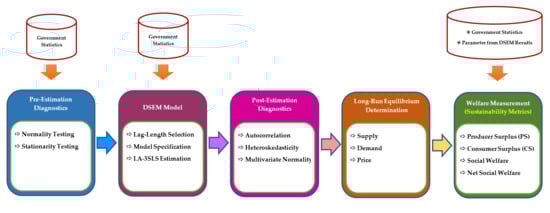
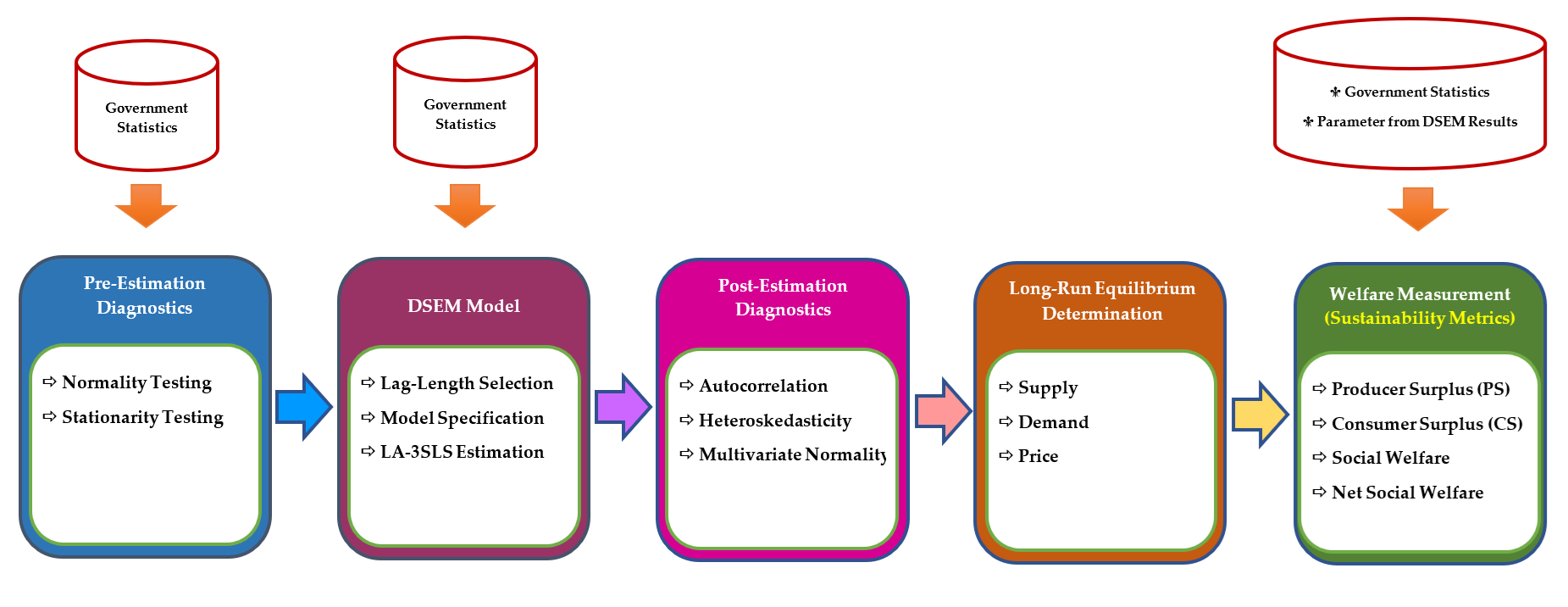
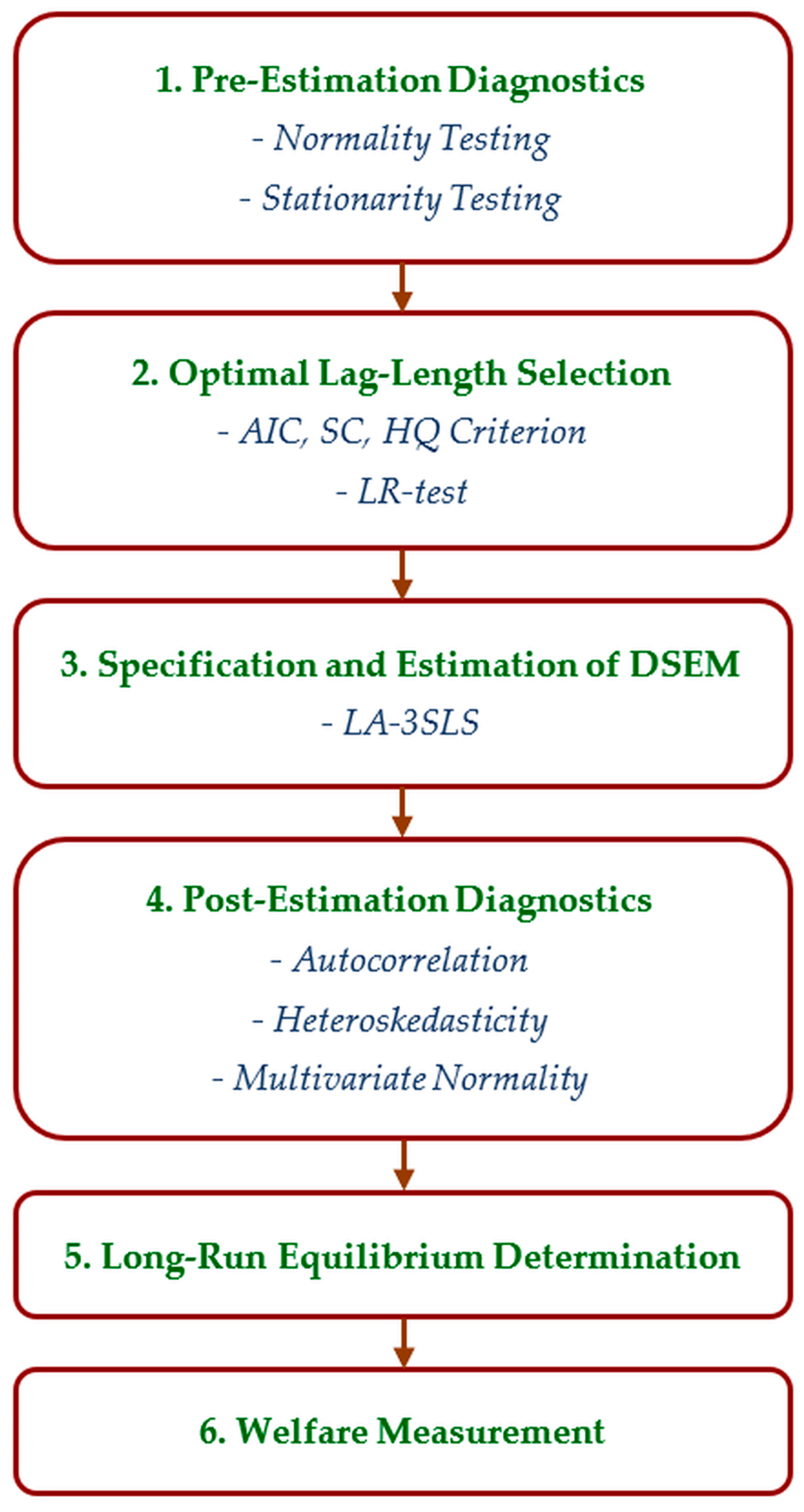
Our analysis has six steps: (i) pre-estimation diagnostics; (ii) optimal lag-length selection; (iii) Dynamic Simultaneous Equation Model (DSEM) specification and estimation; (iv) post-estimation diagnostics; (v) determination of the long-run equilibrium, and finally (vi) welfare measurement. A summary of the procedure can be seen in
Figure 1.
In the first of these steps, initial diagnostic checks are carried out, testing both normality and stationarity. The data were demonstrated to follow a normal distribution, and therefore the dataset could be considered suitable for inferential statistical analysis. Stationarity testing helps to avoid irrelevant findings which might occur due to non-stationary time-series processes.
In the next stage, the optimal lag structure is chosen, utilizing Akaike Information Criterion (AIC), Schwarz Criterion (SC), and Hannan–Quinn Criterion (HQ) along with likelihood ratio tests (LR-test). It is important to make use of accurate lag selection in the lag-augmentation process so that the structural model can retain its internal consistency through the estimation procedure.
Following identification of the lag structure, the DSEM can be specified and subsequently estimated. In this study, the equations in question encompass supply and demand, farm-gate price transmission, chip price and starch price formation, and market-clearing conditions. Endogeneity and cross-equation correlation are covered by the Lag-Augmented Three-Stage Least Squares (LA-3SLS) estimator, which also takes into consideration the existence of non-stationary variables while valid statistical inference can be maintained.
Prior to the construction of long-run equilibrium relationships, the adequacy of the model is verified via post-estimation diagnostic tests that examine serial correlation, heteroskedasticity, and the multivariate normality of the residual vector. It is important to carry out such checks to ensure the parameter estimates employed for long-run analysis are reliable. Should these assumptions be broken, the interpretation of market mechanisms may no longer be valid.
Once the diagnosis of the system is complete, long-run demand and supply interactions under steady-state conditions can be derived using the coefficients estimated from the DSEM, and equilibrium outcomes can then be calculated under both policy and non-policy circumstances using information about these relationships. The producer surplus, consumer surplus, and total surplus can be determined via the integration of inverse demand and inverse supply functions. When fiscal costs are also taken into consideration it is possible to present a thorough overview of net social welfare.
3.3. Pre-Estimation Diagnostics
The current research makes use of the Jarque-Bera statistic to evaluate the distributional properties of the stochastic variables. This approach is able to test for skewness and kurtosis deviations from the normal distribution. For analysis purposes, the null hypothesis holds that the series follows a normal distribution, with zero skewness while the kurtosis value is three. The alternative hypothesis holds that the series distribution is not normal, indicated by skewness and kurtosis values which are not zero and three, respectively. Performance of this diagnostic evaluation allows a data generation process which aligns with the distributional assumptions that are necessary in estimating the required simultaneous equations.
This study uses a dataset comprising time-series observations so the stationarity properties of the different variables must be determined prior to conducting the econometric estimation stage. It is common for time-series variables to demonstrate non-stationary characteristics which might lead to irrelevant regression outcomes and the problem of statistical inference. To prevent this issue, unit root testing was carried out for all variables, thus establishing the respective orders of integration.
To evaluate the stochastic qualities of the series, the Augmented Dickey-Fuller (ADF) test created by Dickey and Fuller [
89,
90] was employed. The ADF procedure evaluates three alternative specifications of the data-generating process in levels: a random walk without drift, a random walk with drift, and a random walk with drift and a deterministic trend. These specifications are expressed as follows:
The hypothesis structure is as follows:
, which indicates the presence of a unit root and therefore non-stationarity
, which indicates stationarity
Rejection of occurs when the test statistic exceeds the absolute value of the critical value at conventional significance levels. In this case, the variable is considered stationary. Failure to reject suggests that the series remains non-stationary. All ADF tests were conducted prior to model estimation to ensure that the subsequent dynamic and simultaneous-equation analyses yield valid and reliable inferences.
3.4. Determination of the Optimal Lag Length
Following the stationarity assessment in
Section 3.3, the next step involved identifying the optimal lag length
for the time-series variables to ensure that the dynamic structure of the data is appropriately represented before specifying the DSEM. The lag structure was determined using three widely recognized information criteria: Akaike’s Information Criterion (AIC), the Schwarz or Bayesian Information Criterion (SC or BIC), and the Hannan-Quinn Criterion (HQ). The use of these criteria allows a balance to be achieved between model fit and parsimony, since complexity is avoided where it is not required.
Lag selection can be made more robust by applying the Likelihood Ratio (LR) test, as suggested by Toda and Yamamoto [
72] and Hsiao and Wang [
71], whose guidance emphasizes the significance of ensuring the accuracy of lag determination when using dynamic econometric models. DSEM construction, which is described in
Section 3.5, makes use of the optimal lag length as determined by these criteria as the key input. The DSEM plays a vital role in long-run parameter estimation and the welfare analysis which follows.
3.5. The Dynamic Simultaneous Equation Model (DSEM)
A system comprising six structural dynamic equations is developed to represent the dynamic interactions which take place in the Thai cassava market. These equations encompass the changes attributable to supply and demand responses, price transmission mechanisms, and market clearing conditions [
74]. The Lag-Augmented Three-Stage Least Squares (LA-3SLS) estimator [
71] is used to estimate the DSEM. This estimator extends the conventional 3SLS method by incorporating additional lag terms to ensure valid statistical inference in dynamic simultaneous equation systems that may contain non-stationary or cointegrated variables. Through this approach, consistent and efficient estimation of the interdependent relationships among cassava market variables is achieved within a unified structural system.
Following the procedure of Hsiao and Wang [
71], and consistent with the lag-augmentation method introduced by Toda and Yamamoto [
72], each structural equation is augmented by additional lags up to the maximum integration order (
) beyond the optimal lag length
. Lag augmentation is applied to the endogenous variables up to (
), whereas exogenous variables are augmented only up to
, or in some cases not augmented, in order to avoid over-parameterization. The coefficients associated with these augmented lagged terms are constrained to zero. This restriction ensures that Wald-type test statistics follow their correct asymptotic distributions, preserving the long-run equilibrium properties of the structural system, and allowing standard chi-square-based hypothesis testing to remain valid without requiring prior cointegration testing. As a result, the simultaneous equation estimator remains efficient even under dynamic and potentially non-stationary conditions.
3.5.1. Supply Equation for Cassava Roots (Farm-Gate Level)
Cassava requires six to twelve months from planting to harvest, which prevents farmers from adjusting current output in response to contemporaneous price movements. Consequently, supply decisions depend on expected prices derived from past information. This feature justifies the use of a dynamic decision-making framework that captures intertemporal adjustments between expected and realized prices. The present study adopts the Cobweb theory originally proposed by Ezekiel [
91], consistent with the approaches of previous studies [
92,
93,
94], in which farmers are assumed to form naïve expectations by forecasting future prices based on the price observed in the preceding year.
Equation (4) operationalizes the Cobweb mechanism and represents both short-run and long-run supply responses. The lagged supply term reflects adaptive production adjustment, while captures expected price formation through partial adjustment. The variable is a policy dummy that identifies years during which the fresh cassava pledging scheme was implemented as a price-intervention policy. The vector of exogenous variables , defined later in the empirical section, includes harvested area, rainfall, fertilizer prices, labor, and a time trend that serves as a proxy for technological progress.
The additional lagged supply terms are included solely for lag augmentation. While the coefficients measure economic effects, the augmented-lag coefficients serve only statistical purposes within the LA-3SLS estimation and do not carry economic interpretation. This specification ensures valid asymptotic inference when endogenous variables exhibit mixed orders of integration.
3.5.2. Demand Equation for Cassava Roots (Farm-Gate Level)
Equation (5) models domestic demand responses to farm-gate price changes. The parameter measures the effect of the cassava root farm-gate price on demand and is expected to be negative. Lag-augmented terms for both demand and price variables extend from to , consistent with the lag-augmentation procedure.
3.5.3. Cassava Price Transmission Equation at the Farm-Gate Level
In Equation (6), is the farm-gate price of fresh cassava roots, is the wholesale cassava chip price, and is the wholesale cassava starch price. The coefficients and capture vertical price pass-through from the wholesale level to the farm-gate level, illustrating how price signals originating in downstream markets affect producers. This equation represents the dynamic pathways through which processing sector and export sector price movements transmit to farmers.
3.5.4. Wholesale Cassava Chips Price Equation
This equation specifies wholesale cassava chip prices () as a function of export prices, competing commodity prices, and the exchange rate. The export price of cassava chips () and wholesale corn price () capture substitution and competitiveness effects, while the exchange rate () links domestic prices to international markets. A depreciation of the Thai baht increases export competitiveness and tends to raise domestic wholesale prices.
3.5.5. Wholesale Cassava Starch Price Equation
Equation (8) models wholesale starch prices () as a function of its export prices () and the exchange rate (), indicating that changes in international starch prices transmit to domestic markets.
3.5.6. Market Equilibrium Identity
The market-clearing condition equates supply with demand, ensuring internal consistency within the structural system.
3.6. Post-Estimation Diagnostics
Following the estimation of the DSEM using the LA-3SLS procedure, a series of diagnostic checks is required to ensure that the estimated structural parameters satisfy the core econometric assumptions necessary for valid inference. These procedures form an essential component of the data analysis process before deriving the long-run supply and demand equations that support the subsequent welfare analysis. Diagnostic assessments focus on autocorrelation, heteroskedasticity, and the distributional attributes associated with the structural disturbance vector.
Initially, the Portmanteau Q-statistic of Hosking [
95] is used to investigate autocorrelation throughout the system. It is typical for DSEMs to include lagged dependent variables along with endogenous regressors, which result in serial dependence in the disturbance terms. This kind of dependence leads to distortion in standard errors, and the instrumental variable estimators may exhibit lowered asymptotic efficiency. Autocorrelation testing should therefore be performed at the onset of the study because subsequent procedures are rendered unreliable under conditions of serial dependence.
Following the assessment of autocorrelation, the Breusch-Pagan-Godfrey test [
96,
97] is used to determine heteroskedasticity. The process is able to identify the incidence of non-constant error variance arising in individual structural equations. It is crucial to manage heteroskedasticity during instrumental-variable and LA-3SLS estimation because the resulting estimators cannot be considered efficient if the variance-covariance matrix of the disturbances is not correctly specified.
The last stage of the diagnostic process demands assessment of the joint disturbance vector to test for normality. In line with Lütkepohl [
98], a multivariate normality test can be applied on the basis of the Cholesky orthogonalization of the estimated covariance matrix. This method accounts for the cross-equation covariance that characterizes simultaneous equation systems and provides a rigorous evaluation of the distributional regularity required for system-wide inference.
Taken together, these diagnostic procedures allow an assessment of whether the residual structure satisfies the assumptions required for valid LA-3SLS estimation. This assessment is essential for establishing the statistical reliability of the empirical results that follow and for ensuring that the estimated structural parameters can be used appropriately in the long-run analysis.
Multicollinearity is not considered a diagnostic concern in instrumental-variable simultaneous equation models because endogenous regressors are replaced by their instrumented fitted values, and estimation relies on cross-equation covariance rather than within-equation correlations. For this reason, conventional ordinary least squares diagnostics such as the variance inflation factor (VIF) are not applicable in this context [
99,
100].
3.7. Long-Run Equilibrium Determination
After estimating the DSEM using the LA-3SLS estimator, the next step is to derive the long-run structural supply and demand equations that characterize the steady-state equilibrium of Thailand’s cassava market. These long-run expressions form the analytical basis for computing producer surplus (PS), consumer surplus (CS), and total surplus (TS). The additional lagged variables included for lag augmentation are not assigned economic interpretation. They serve a technical role that ensures valid asymptotic inference, consistent with the recommendations of Toda and Yamamoto [
72] and Hsiao and Wang [
71].
The short-run structural equations for supply and demand are presented in Equations (10) and (11). In these expressions, the quantities supplied and demanded in period
depend on lagged output, expected price, and a set of exogenous variables. Harvested area (
) and the time trend (
) are grouped into the vector of exogenous supply shifters (
), while the policy dummy for price intervention (
) is separated from
to identify the policy-induced movement in the supply intercept. The short-run supply equation at the farm-gate level is written as follows:
where the vector of exogenous supply variables is defined as follows:
To obtain the long-run structural forms, the steady-state conditions are imposed:
Under these conditions, the long-run supply function becomes
The corresponding intercept, evaluated at
, is as follows
This result indicates that the price-intervention policy shifts the long-run supply curve vertically by
. For welfare computation, the long-run supply equation is expressed in inverse form because integration is performed with respect to quantity. The inverse long-run supply function is as follows:
The short-run structural demand equation is as follows:
Applying the steady-state conditions yields the long-run demand equation:
The inverse long-run demand function is as follows:
Market equilibrium is determined by equating the long-run supply and demand equations:
Solving for the long-run equilibrium price yields
Substituting this expression into the long-run demand equation gives the equilibrium quantity:
These expressions define the long-run market-clearing point under both policy and non-policy regimes. They also provide the computational foundation for welfare analysis. Producer surplus (PS) is obtained by integrating the inverse supply function over the interval . Consumer surplus (CS) is computed by integrating the inverse demand function over the same interval. Total surplus, defined as the sum of PS and CS, enables a consistent comparison of welfare outcomes between the intervention scenario with and the non-intervention scenario with .
3.8. Welfare Measurement
The welfare analysis in this study follows the classical Marshallian framework [
101], where consumer surplus (CS) and producer surplus (PS) are measured as the areas between the demand and supply schedules in price-quantity space. In this setting, the inverse demand function denotes the marginal willingness to pay (MWTP), and the inverse supply function represents the marginal cost (MC) or marginal willingness to accept (WTA) [
56,
102,
103]. Integrating these inverse functions with respect to quantity yields aggregate benefits and costs up to the long-run equilibrium quantity (
). This foundation supports the welfare assessment of Thailand’s cassava price-intervention policy. Kim [
104] further establishes that welfare measures based on inverse demand systems are valid when quantities, rather than prices, serve as the exogenous determinants of equilibrium, a condition characteristic of agricultural markets with slow production adjustments.
In Thailand’s cassava sector, farmers supply fresh roots as the primary output, while processors and industrial users generate a derived demand for cassava as an intermediate input [
105]. According to the conceptual framework adapted from Zhao, Mullen and Griffith [
106], price-intervention instruments, such as pledging programs and guaranteed minimum prices, raise producer incentives and shift the long-run supply curve outward, increasing total market quantity and lowering the long-run equilibrium price under market-clearing conditions. These adjustments create redistributive welfare effects between producers and buyers.
Producer surplus (PS) is defined using the inverse long-run supply function
:
Which can also be written as follows:
with
The welfare effect on producers is as follows:
Consumer surplus (CS) is computed from the inverse long-run demand function
:
Which can be expressed as follows:
where:
The change in consumer welfare is as follows:
Total surplus is as follows:
And the welfare effect of intervention is as follows:
A positive indicates a net gain, while a negative value implies a net loss. Although the empirical estimates correspond to an interior equilibrium, the analytical framework also accommodates corner-equilibrium cases.
The analysis introduces
GC, which is defined as the total budgetary outlays necessary for program implementation, to account for fiscal costs.
is determined as the average annual gross expenditure of the cassava pledging program over its eleven years of operation, based on budgetary allotments approved by the Cabinet. This measure is intended as a conservative upper-bound estimate of fiscal costs because it incorporates all program-related expenses without subtracting potential revenues. The specific budget components include interest compensation paid to the Bank for Agriculture and Agricultural Cooperatives (BAAC); the Department of Internal Trade’s (DIT) administrative and public relations budgets; and the Public Warehouse Organization’s (PWO) operational costs, which include payments to farmers for pledged fresh cassava roots, processing and transportation costs, storage costs, and other operational expenditures. However, commodity liquidation revenues are not included in the
GC calculation because the PWO’s data on these revenues is occasionally insufficient, making it impossible to consistently deduct them from total expenditures. This approach follows full-cost accounting practices when assessing agricultural policies [
86,
107,
108]. The measure of net welfare is as follows:
A positive value indicates that welfare gains exceed government costs, while a negative value indicates a net social loss. This approach is consistent with empirical evaluations of agricultural price-support programs that impose substantial administrative and operational burdens on the public sector [
108].
4. Results
This section reports the empirical results obtained from the Dynamic Simultaneous Equation Model (DSEM). The analysis is structured to follow the econometric procedures outlined in
Section 3, beginning with pre-estimation diagnostics, the selection of the optimal lag structure, and the estimation of the full dynamic system. The use of post-estimation tests subsequently serves to verify the adequacy of the model and guarantee structural parameter reliability. These validated estimates form the basis for deriving long-run equilibrium relationships and for computing welfare effects under both policy and non-policy settings. The results presented in
Section 4.1,
Section 4.2,
Section 4.3,
Section 4.4,
Section 4.5 and
Section 4.6 therefore provide a coherent empirical foundation for assessing the long-term economic implications of Thailand’s cassava price-intervention policy.
4.1. Normality Test Results
The test results of the distributional diagnostics in
Table 3 indicate that none of the variables reject the null hypothesis of normality at the 5% level. For example, the variable
reports a Jarque–Bera statistic of 4.2830 with a probability of 0.1175, while
and
yield probabilities of 0.6180 and 0.4119, respectively. Since all
p-values exceed 0.05, the dataset does not exhibit statistically significant deviations from normality. This conclusion is confirmed by the kurtosis measures. While
(2.5714) and
(2.6030) fall a little below the benchmark threshold of 3, they do not specifically imply heavy-tailed behavior.
Furthermore, the descriptive statistics lend weight to significant market variability elements. For instance, a number of price variables are characterized by broad ranges, such as
(8190–18,630 THB per ton) and
(6760–12,380). Such ranges are indicative of large fluctuations within the market conditions. In contrast, the close alignment between the mean and median of variables such as PFCR (mean 1904, median 1901) and
(mean 225, median 239) suggests limited skewness. Overall, the results indicate that despite economic volatility, the statistical properties of the dataset remain sufficiently stable to support standard econometric estimation without adjustments for heavy-tailed distributions. This pattern is consistent with Hameed et al. [
109], who document significant fluctuations in annual cocoa prices while reporting that the data are approximately normally distributed and thus suitable for conventional econometric estimation.
4.2. Stationarity Test Results
The Augmented Dickey-Fuller (ADF) results reported in
Table 4 provide clear evidence regarding the integration properties of the variables used in the empirical model. Several key price variables exhibit level stationarity. The cassava farmgate price (
) rejects the unit root null under both the intercept and the intercept plus trend specifications, with ADF statistics of −3.7882 and −4.5239 that are significant at the 1% level (
p-value < 0.01). The wholesale cassava starch price (
) is also stationary in levels, as indicated by ADF values of −4.0580 and −4.5709, both significant at the 1% level. By contrast, most quantity variables and several intermediate and export price series are non-stationary in levels, yet become stationary after first differencing. The supply of cassava roots (
) and the harvested area (
) do not reject the unit root null in levels. Both variables reject it strongly at first differences, with ADF statistics of −7.7721 and −7.6713 for
and −6.5125 and −6.4123 for
all with
p-values equal to 0.0000. The demand for cassava roots (
) displays an identical pattern and is therefore classified as
.
Similarly, the wholesale cassava chips price (
), the cassava chips export price (
), the cassava starch export price (
), and the corn wholesale price (
) all fail to reject the null hypothesis at levels but reject it decisively after first differencing. Their first-difference ADF statistics fall between −7.52 and −6.13, each statistically significant at the 1% level. The Thai baht per U.S. dollar exchange rate (
) also becomes stationary after differencing, with ADF values of −5.3317 and −5.3021 that confirm an integration order of
. The deterministic trend variable, which captures technical change (
), and the policy dummy variable (
) are not subjected to unit root testing because they are non-stochastic regressors, consistent with standard time-series econometric practice as described in Hamilton [
110].
Overall, the updated ADF results indicate a mixed order of integration across variables. The coexistence of and variables support the application of the LA-3SLS estimator in levels. This approach allows valid statistical inference without differencing the variables to address non-stationarity.
4.3. Optimal Lag-Length Results
The results of the lag-order selection are presented in
Table 5. To carry out the evaluation, the criteria used, including the Schwarz Criterion (SC), the Hannan-Quinn Criterion (HQ), and the Likelihood Ratio (LR) test, must be econometrically reliable. Since both SC and HQ penalize model complexity to a greater degree than AIC, Lag 1 is identified as the optimal specification. At Lag 1, the minimum values of SC (47.6409) and HQ (47.4252) provide evidence that the inclusion of one lag creates a parsimonious model which retains the ability to capture the underlying structure of the data. Lütkepohl [
98] reported a similar conclusion, confirming that SC and HQ typically deliver greater stability in the model selection outcomes when samples are small or moderate in size. The penalty terms are large enough to deter overfitting, which can occur with AIC in samples of this magnitude.
The selection of Lag 1 is supported by the LR statistic, since the value for LR of 80.8698 shows statistical significance at the 5% level when the Lag 1 model is compared to the lag-zero specification. It can be inferred that the addition of a single lag leads to a significant upgrade to the explanatory power of the model, but adding further lags has no statistically significant benefit.
Lag 1 can therefore be considered the most suitable lag length on the basis of evidence drawn from the SC, HQ, and LR tests when the DSEM is to be estimated. The model thus achieves a balance between parsimony and the ability to represent the dynamic relationships within the Thai cassava market. Since this optimal lag length is 1, the LA-3SLS estimation has a lag-augmentation procedure which serves to extend the endogenous variables as far as (). When , the outcome is a total of 2 lags.
4.4. Estimation Results of the DSEM
Table 6 shows the coefficient estimates from the Dynamic Simultaneous Equation Model (DSEM), revealing strong statistical significance. These coefficients show an excellent fit with the economic theory, and suggest that the LA-3SLS estimator is capable of adequately representing the dynamic structure of the Thai cassava market. The lagged supply variable in the supply equation is shown to be very significant (
= 0.536,
p < 0.01), which suggests that production levels tend to be quite persistent, as one might anticipate due to the seasonal pattern of production based on biological factors as explained in
Section 3. A strong positive influence is also exerted by the lagged farm-gate price, which has its basis in the expected price formation from the cobweb framework (
= 3213.247,
p < 0.01). The pledging scheme policy dummy generates a notable upward supply shift (
= 1.29 × 10
6,
p < 0.01), which provides clear evidence to cement its status as an instrument which shifts supply. The observed pattern is reinforced by structural factors, with the area harvested having a powerful influence upon supply (
= 4.589 × 10
6,
p < 0.01), while a positive effect is also exerted by the time trend (
= 69,604.44,
p < 0.05), suggesting that technological advances are increasingly influential as time passes. The adjusted R
2 value is 0.8694, which is indicative of strong explanatory power. The findings fit well with the analytical framework, which considers policy intervention to be an instrument that shifts the supply curve outward over the longer term.
The parameter estimates of the demand equation also align well with economic theory. A large negative influence on demand ( = −641.019, p < 0.01) is exerted by contemporaneous farm-gate prices, providing clear evidence of a demand relationship which slopes downward. The value for adjusted R2 is 0.8294, which shows that our dynamic demand model is able to accurately account for the derived-demand characteristics associated with the Thai cassava market.
The farm-gate price equation shows evidence of vertical price transmission, whereby wholesale cassava chip prices ( = 0.181, p < 0.01) and wholesale cassava starch prices ( = 0.074, p < 0.01) are significantly transmitted to the farm level. The value for adjusted R2 is 0.9013, confirming that international processing markets and the formation of farm-gate prices are closely linked, which would be anticipated when considering that the Thai cassava industry relies heavily upon export markets.
The effects of international markets are reflected in the wholesale chip price equation, with markets for competing commodities also proving highly influential. The export chip prices have a substantial effect on domestic wholesale prices ( = 21.920, p < 0.01), while the price of corn, a similar alternative, also contributes significantly ( = 0.212, p < 0.01), reflecting substitution in feed and starch manufacturing. The influence of the exchange rate was also significant ( = 182.551, p < 0.01), in line with expectations based upon the prominent role played by exports in the Thai economy. The value for the adjusted R2 was 0.8944, indicating robust relationships. The pattern for the price equation of wholesale starch was similar, as the key drivers are export starch prices ( = 32.405, p < 0.01) and the exchange rate ( = 447.825, p < 0.01), resulting in an adjusted R2 value of 0.7751.
When applied in each of the equations, the estimated coefficients are shown to be statistically significant, with notable explanatory power in line with the theoretical structural relationships which
Section 3.5 describes. These relationships are supported by empirical evidence that establishes the parameter foundation used to calculate the long-run equilibrium conditions and carry out the welfare analysis.
4.5. Diagnostic Test Results
The estimated structural parameters must be valid and the long-run and welfare analyses must be reliable. To accomplish these objectives, a number of diagnostic tests were carried out to assess whether the DSEM disturbance processes would be in line with the basic econometric assumptions, which are necessary for consistent statistical inference. The diagnosis concerned autocorrelation, heteroskedasticity, and multivariate normality, with findings discussed below.
4.5.1. Autocorrelation Test Results
Residual autocorrelation was evaluated via the Portmanteau test, performed with a maximum lag of 4, which is greater than the DSEM dynamic order under the LA-3SLS framework (). This follows the diagnostic requirement that the testing horizon must be greater than the model’s lag order to ensure adequate power for detecting remaining serial dependence. Using lag 4 thus provides a sufficiently rigorous window for verifying white-noise residual behavior.
The test examines whether the residual vector exhibits temporal dependence, with
denoting no autocorrelation. When the
p-value exceeds the significance level,
cannot be rejected. As shown in
Table 7, all
p-values for lags 1–4 (0.0526, 0.0681, 0.1263, and 0.2449) exceed the 1% threshold. Consequently, the null hypothesis cannot be rejected at any lag, indicating that the disturbance vector behaves as white noise. This confirms that the dynamic specification of the model adequately captures temporal dependence without leaving systematic autocorrelation in the residuals.
4.5.2. Heteroskedasticity Test Results
Table 8 reports the results of the Breusch-Pagan-Godfrey heteroskedasticity tests across all estimated equations. The null hypothesis (
) specifies that the residuals show homoskedasticity, meaning that no heteroskedasticity is present, whereas the alternative hypothesis (
) states that the residuals exhibit heteroskedasticity. In every equation, both the F-statistic and Chi-square statistics yield
p-values greater than 0.05, indicating that
cannot be rejected. Although Equations (4) and (5) show
p-values near the 10 percent level, they remain above the conventional 5 percent threshold. Therefore, there is no statistical evidence of heteroskedasticity in any equation of the dynamic system.
4.5.3. Multivariate Normality Test Results
The multivariate normality assessment provides consistent evidence that the disturbance vector of the DSEM follows a normal distribution. Under the null hypothesis (
: the residuals are multivariate normally distributed) and the alternative hypothesis (
: the residuals are not multivariate normally distributed), the skewness and kurtosis tests for all five residual components yield
p-values that exceed conventional significance levels.
Table 9 reports the component-wise and joint multivariate normality test results, including skewness, kurtosis, and Jarque–Bera statistics, providing a comprehensive diagnostic assessment of the distributional properties of the system residuals. The joint skewness statistic (
p = 0.5243) and the joint kurtosis statistic (
p = 0.9390) both fail to reject
. In addition, the Jarque-Bera test confirms this result, with a joint
p-value of 0.8602. Taken together, these outcomes indicate that the residuals do not exhibit systematic asymmetry or abnormal tail behavior, thereby confirming that the distributional assumptions required for LA-3SLS estimation are satisfied and supporting the reliability of the subsequent welfare and policy analysis.
4.6. Welfare Effects of Cassava Price-Intervention Policy
4.6.1. Average Welfare Effects in the Long Term
Based on the long-run structural relationships derived in
Section 3.6 and the welfare framework established in
Section 3.8, the welfare effects of Thailand’s cassava price-intervention policy were evaluated by comparing producer surplus (PS) and consumer surplus (CS) under two regimes: the non-intervention scenario (
= 0) and the intervention scenario (
= 1) during 1981–2024. The computation relies on the inverse long-run supply function (Equation (25)) and inverse long-run demand function (Equation (29)), while equilibrium prices and quantities for each regime are obtained from Equations (21) and (22).
To implement these calculations, the analysis requires the estimated structural parameters from the supply equation, and from the demand equation, together with the vector of exogenous supply shifters , defined as the steady-state mean of harvested area and the technological time trend. Using these components, the model derives the market-clearing outcomes ( and ) for both regimes, which are then substituted into the welfare integrals for PS (Equations (23)–(24)) and CS (Equations (27)–(28)).
Table 10 and
Table 11 provide the input parameters required for the welfare analysis.
Table 10 reports the LA-3SLS structural estimates that define the long-run supply and demand functions and their inverse forms used to compute producer and consumer surplus.
Table 11 lists the long-run exogenous supply variables and the policy dummy distinguishing intervention from non-intervention years. These inputs are used to derive the long-run equilibrium and populate the welfare equations, with the resulting welfare outcomes summarized in
Table 12.
Table 12 presents the welfare outcomes derived from the long-run equilibrium framework and the welfare measurement outlined in
Section 3.7 and
Section 3.8. These results are obtained by integrating the inverse long-run supply and demand functions (Equations (25) and (29)) to compute producer surplus (PS) and consumer surplus (CS). The two components are then combined to generate total surplus (TS), as defined in Equation (31).
Under the non-intervention scenario, producers receive 6602 million THB per year in long-run surplus, whereas consumers obtain 8760 million THB per year. When the price-intervention policy is applied, PS declines to 6135 million THB and CS rises to 9478 million THB per year. These adjustments correspond to = −467 million THB and million THB per year. The pattern reflects the redistribution implied by the outward shift of the long-run supply curve induced by the pledging scheme. These changes have a size and direction which match the welfare identities of Equations (26) and (30), in which there is a reduction in producer welfare due to distortion of the incentives for production. In contrast, there is an increase in consumer welfare attributable to the effects of policy-driven supply expansion, which serves to lower the market-clearing price over the longer term.
There is a small increase in total surplus from 15,362 million THB to 15,613 million THB per year, resulting in the value for = 251 million THB per year. The result of Equation (32) suggests that the outcome of the intervention is a small rise in gross economic welfare before considering fiscal costs.
Once the government’s budgetary outlays for administering the pledging scheme are incorporated through Equation (33), the net welfare effect becomes negative, as shown by:
This result highlights a key implication of the welfare-measurement framework: the policy provides only a negligible increase in total surplus, yet its substantial fiscal burden produces a net social welfare loss of about −4560.69 million THB per year.
4.6.2. The Dynamics of Long-Term Welfare Effects
The assessment of the long-term welfare effects of Thailand’s cassava price-intervention policy during 1981–2024 was conducted by substituting the estimated structural parameters reported in
Table 10, the year-specific values of the exogenous variables, and the policy dummy variables under alternative simulated scenarios into the long-run supply and demand equations evaluated at their steady-state conditions. For the simulations, the policy indicator was defined as
= 0 for years without government price intervention and
= 1 for years in which intervention was implemented.
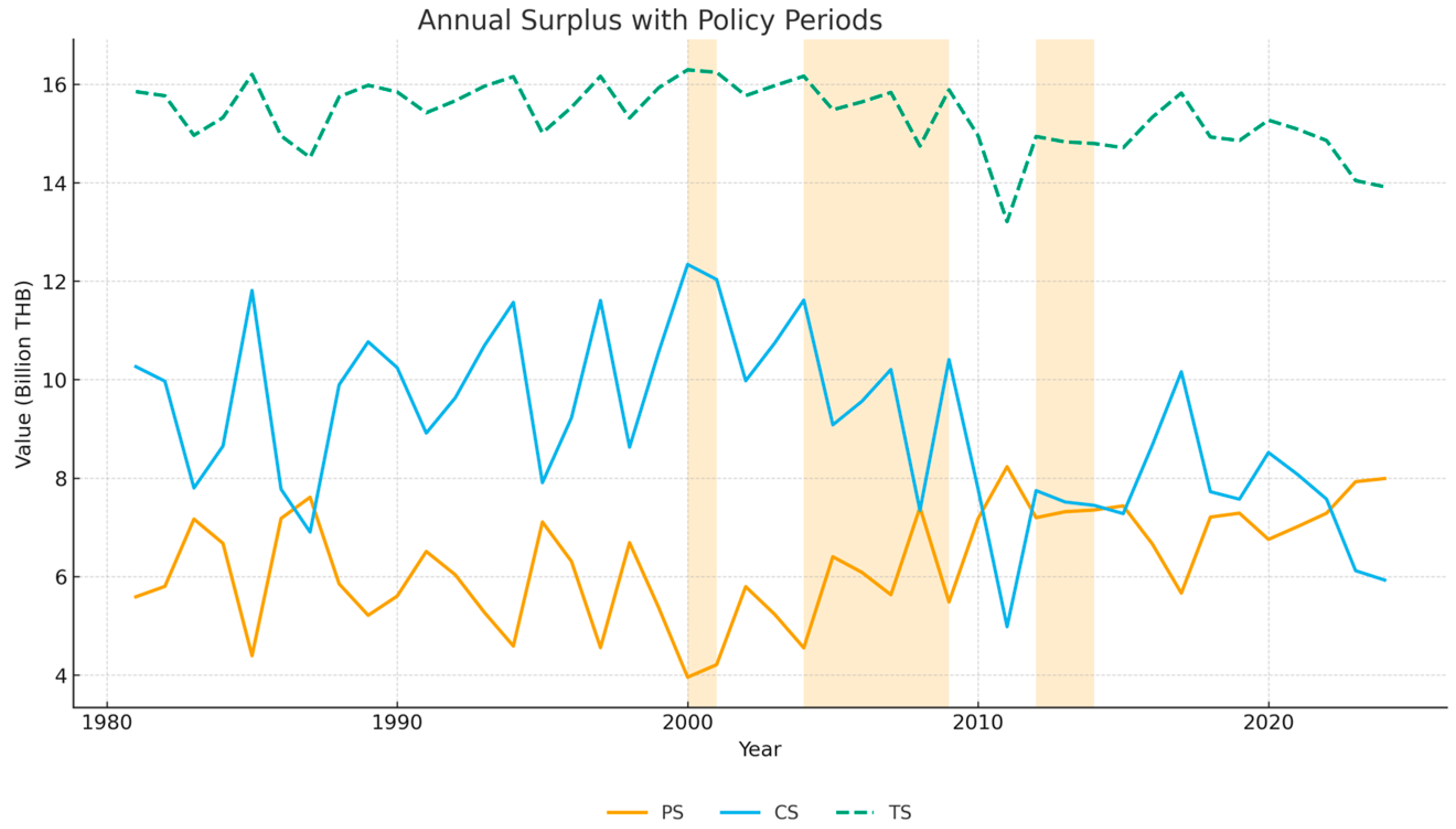
Figure 2 presents the dynamic evolution of producer surplus (PS), consumer surplus (CS), and total surplus (TS) in Thailand’s cassava market during 1981–2024, with shaded areas indicating years in which price-intervention policies were applied (
= 1). In the short term, the implementation of the fresh cassava pledging scheme produced an immediate rise in PS, together with a corresponding decline in CS. This outcome reflects the pro-producer character of the intervention. When the farm-gate price is held higher than the level at which the market clears, the policy serves to transfer wealth from the consumers to the producers. This redistribution takes place very quickly once the intervention is in place, from which it can be inferred that the cassava supply is highly responsive to government policy.
TS was relatively stable over the longer term, so the pattern observed indicates that the main effect of interventions was to redistribute welfare among market participants instead of making the market more efficient. At the conclusion of the intervention periods, PS showed a tendency to revert to its original levels prior to the intervention. This implies only transient gains for producers, with no sustainable improvement observed in productivity, competitiveness, or the structure of the market. Taken together, the dynamic behavior of the welfare components shows that Thailand’s cassava price-support policies provided short-term protection to producers while delivering limited long-term efficiency gains. The findings reinforce the conclusion that these interventions were transitional measures that redistributed surplus rather than enhancing overall economic performance in the cassava sector.
4.6.3. Welfare Simulation Under Policy and No-Policy Scenarios
The simulation of the long-term welfare effects of Thailand’s cassava price-intervention policy follows the same conceptual procedure as that in
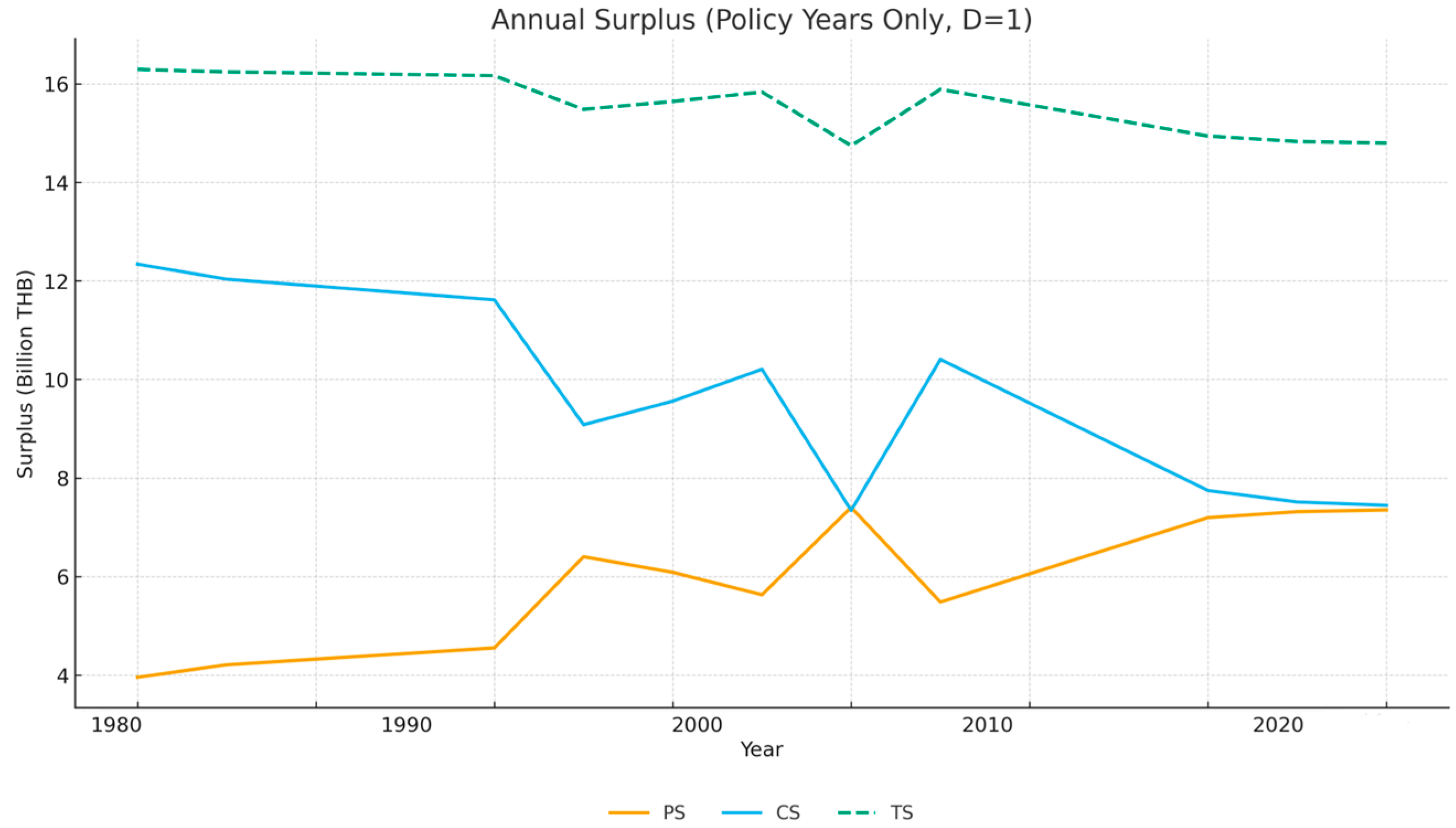
Section 4.6.2, although the scenarios differ in the specification of the policy dummy variable. Two scenarios are examined. Scenario 1 represents a situation in which government price intervention is assumed to occur continuously during 1981–2024, with the policy dummy set equal to
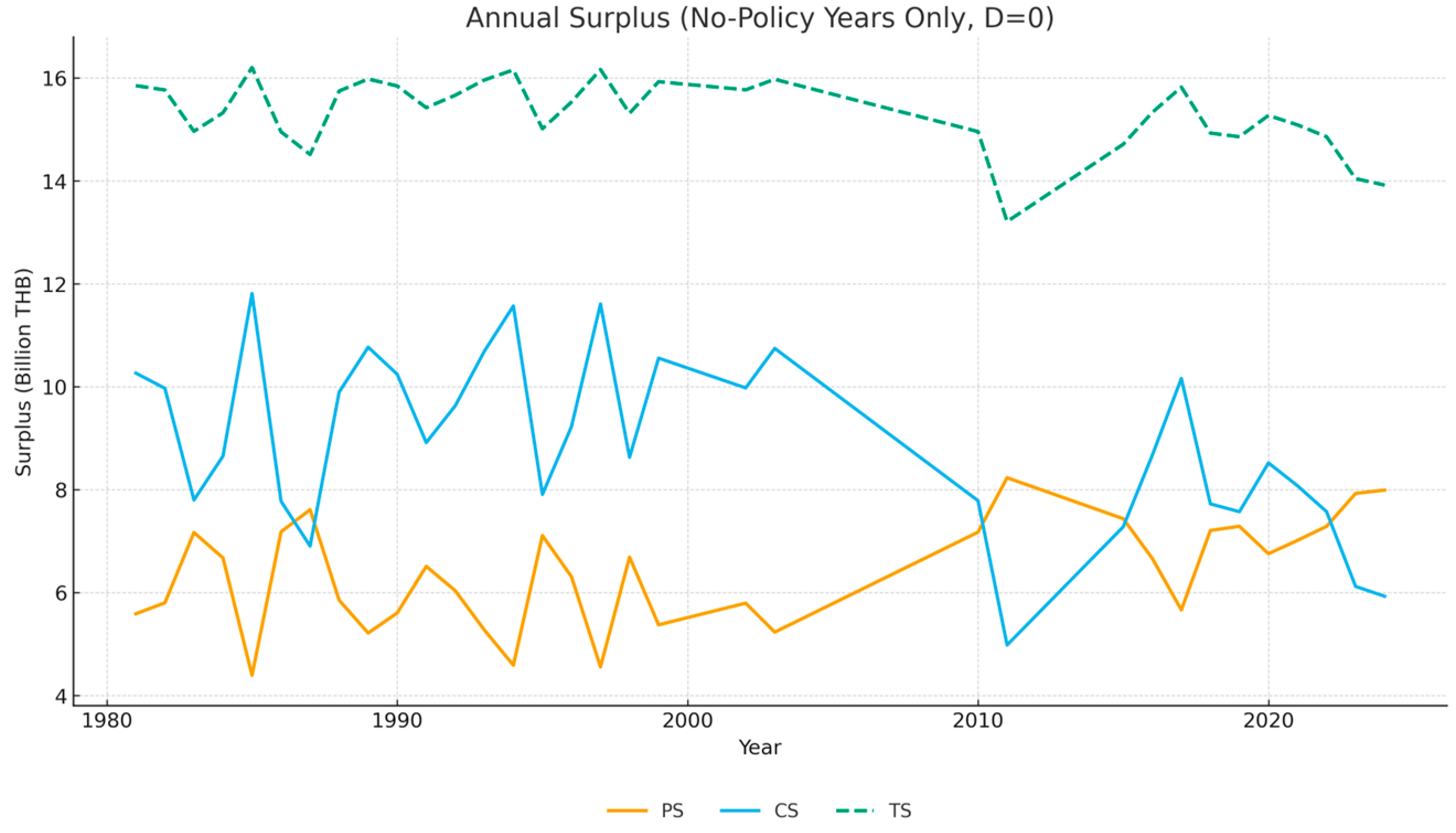
= 1 for all years. Conversely, Scenario 2 represents the counterfactual case in which no price intervention is applied at any time during 1981–2024, with the dummy variable fixed at
= 0 throughout the period.
Figure 3 presents the dynamic simulation of long-term welfare under the intervention scenario
= 1. The findings show clearly apparent differences in the development of welfare under the two market scenarios. When continuous government intervention is applied, there is a steady rise in producer surplus, with the opposite trend exhibited by consumer surplus. The pattern is plainly indicative of producer-oriented redistribution effects which result from the cassava-pledging programs. The short-term effect of the policy is to engineer the welfare transfer from consumers to producers as farm-gate prices are held higher than the level at which the market clears, thus providing farm income stability while minimizing price volatility.
However, in the non-intervention scenario shown in
Figure 4, the consumer and producer surpluses both fluctuate significantly due to the effects of supply and demand in the market. Over the longer term, the total surplus does not fluctuate greatly in either scenario, but tends to remain slightly lower under conditions of continuous intervention, which suggests that allocative efficiency is lost to a certain extent due to the distortion introduced by the policy. It would appear that farmers might be capable of increasing their producer surplus over time in the absence of state support, thus mitigating the financial burden faced by the government. When the cassava market is permitted to operate freely, it is able to reach an equilibrium which ensures allocative efficiency and welfare stability, which is sustainable to the benefit of the economy over the longer term.
These findings collectively show that while price-intervention policy provides temporary income support, its long-term welfare and sustainability effects are constrained, a point further discussed in the following section.
5. Discussion
The analysis of welfare in the long run suggests that efficiency and equity are on opposite sides of the balance when price interventions are imposed in the Thai cassava market. While the intervention program delivers income increases to farmers in the short term, the benefits fade rapidly when the intervention is withdrawn, leaving minimal impact on long-term total surplus. Examination of the incorporation of fiscal costs reveals that a negative net welfare effect is generated by the policy. The government delivers income support on a temporary basis while preparing the ground for ongoing efficiency losses. This pattern shows misalignment with the SDG 1 objective of eliminating poverty, since the emphasis should be placed on structural reductions in poverty over the long term instead of the short-term income transfers which occur in this scenario. There is also a failure to achieve the SDG 8 objective of decent work and economic growth, since the emphasis of this goal involves long-term productive capacity improvements. The findings appear to concur with the sustainability framework established by Pezzey and Toman [
60], in that the redistribution which results from distortionary price policies cannot be considered as sustainable welfare, since it has the effect of damaging efficiency or placing a financial penalty on future generations.
The dynamic findings add further weight to the evidence report by Anuchitworawong et al. [
32], whose work revealed that significant financial burdens resulted from the implementation of the cassava pledging scheme, leading to the accrual of economic rents by intermediaries, while only a minority of farmers actually derived benefits. Their findings in the comparative-static assessment confirmed that inefficiencies arise in the short term. In this respect, the present study is consistent with the existing literature in identifying welfare losses and market distortions associated with price-intervention policies, but it extends these insights by adopting a dynamic perspective. In this study, the dynamic framework indicates that small distortions tend to occur repeatedly over policy cycles and thus accumulate in the long run, feeding back into the market and affecting long-term behavior and market expectations. Since the total surplus fails to demonstrate any persistent rise in the long term, even though price interventions occur repeatedly, it is clear that the pledging program is not efficient, and furthermore reduces structural competitiveness in the market while persuading participants that ongoing state intervention is likely.
In general, our findings support the need to make adjustments in policy, ceasing the use of repeated price-support interventions and instead employing instruments which are fiscally suitable and more appropriate within the context of the market activity. Farmers can still receive protection from shocks through the use of income-stabilization tools, including price insurance or targeted compensatory transfers [
18,
33]. Such tools can be applied without the problem of generating artificial demand or encouraging downstream participants to extract rents. Simultaneously, measures which improve productivity, such as managing the soil and water [
111], introducing improved crop varieties [
112], or utilizing advances in post-harvest technological innovations [
113], may provide alternative pathways for boosting producer surplus in the longer term. The market infrastructure could be made stronger by the introduction of farmer registries, effective monitoring systems, and a program for quality certification, since these measures might remove the problem of information asymmetry and eliminate the governance risks which are typically associated with the interventions which have been implemented to date [
35].
Beyond the Thai context, while the empirical analysis is based on the cassava market, the underlying mechanisms identified, such as income stabilization effects, market distortions, and fiscal burdens, may also apply to other commodity markets with similar supply–demand dynamics and policy interventions.
6. Conclusions
This research investigated the effects on long-term economic sustainability of price interventions in the Thai cassava market with the assistance of a Dynamic Simultaneous Equation Model, which was estimated via the LA-3SLS procedure. When considering the average welfare effects in the long term, the results indicate that Thailand’s cassava price-intervention policy primarily operates through the redistribution of welfare among market participants rather than through the generation of substantial efficiency gains. In the long run, the policy is associated with a decline in producer surplus and a corresponding increase in consumer surplus, reflecting an outward shift of the supply curve that places downward pressure on the market-clearing price. Although total surplus increases marginally before fiscal costs are incorporated, this gross welfare gain remains modest. Once the government’s budgetary outlays required to implement the pledging scheme are taken into account, the resulting net welfare effect becomes negative. Taken together, these findings suggest that the policy imposes a relatively high fiscal cost compared with its limited aggregate welfare benefits, implying that long-term economic sustainability is constrained once fiscal costs are fully considered. In the specific context of Thailand’s cassava market, these outcomes reflect structural characteristics such as production cycles, export-oriented processing demand, and the institutional design of the pledging scheme.
Building on these average effects, the dynamic analysis of long-term welfare outcomes provides additional insight into how these redistributive patterns unfold over time. During periods of intervention, producer surplus rises rapidly, while consumer surplus declines, highlighting the short-term protective role of price support for farmers. However, these producer gains are temporary, as producer surplus tends to revert toward its pre-intervention levels once the policy is withdrawn. Over the longer horizon, total surplus remains broadly stable, showing no persistent upward trend, indicating that the intervention does not lead to meaningful improvements in overall market performance. This dynamic behavior reinforces the view that cassava price-support policies function mainly as short-term redistributive instruments, offering temporary income support to producers without generating lasting efficiency gains or structural transformation in the market.
These findings are further corroborated by the welfare simulations under policy and no-policy scenarios, which illustrate how alternative market regimes shape long-term welfare outcomes. Under a scenario of continuous government intervention, producer surplus increases steadily, while consumer surplus follows an opposing trend, reflecting the producer-oriented nature of price pledging schemes that stabilize farm incomes by maintaining prices above market-clearing levels. In contrast, under the no-intervention scenario, both producer and consumer surplus fluctuate more freely in response to market forces. While total surplus remains relatively stable across both scenarios, it tends to be slightly lower under continuous intervention, suggesting a modest loss of allocative efficiency. Overall, the simulations indicate that although price intervention can contribute to income stability for farmers, a more market-oriented environment may deliver more balanced welfare outcomes with a lower long-run fiscal burden. More broadly, these results suggest that price-based support instruments in agricultural markets tend to reallocate welfare across stakeholders rather than enhance long-term efficiency, particularly when fiscal costs are substantial.
Taken together, the average welfare results, dynamic analysis, and simulation outcomes point to a common structural mechanism operating in the long run. The structural relationships revealed by the dynamic system indicate that when price intervention is applied repeatedly, supply incentives are altered, leading to a sustained shift in the long-run supply curve. Market quantities may expand, but this expansion does not translate into proportional welfare gains. The results therefore demonstrate a clear trade-off between equity and efficiency embedded in price-support mechanisms, confirming that pledging schemes are limited in their ability to enhance long-run market competitiveness.
It can be argued from the results that the Thai cassava industry might be better advanced if direct price controls were replaced with instruments that stabilize farm incomes while preserving market efficiency. Possible alternatives include decoupled income support, counter-cyclical payments, and productivity-enhancing measures, which can improve resilience without distorting long-run price signals. Such policy approaches are more closely aligned with the objectives of SDG 1, through sustained poverty reduction, and SDG 8, through productivity growth and long-term economic sustainability.
Several limitations of this study should be acknowledged. The analysis focuses on the cassava pledging scheme as a direct price-intervention instrument, while other policy measures, such as income-guarantee programs, are not explicitly modeled in order to preserve conceptual consistency in identifying price distortions. In addition, the use of national-level annual data may mask regional heterogeneity in production conditions and policy implementation. Finally, fiscal costs are measured using gross budgetary outlays due to data constraints, which may overstate net welfare losses despite providing a conservative and transparent assessment.
Future studies could extend the current dynamic welfare framework by integrating environmental sustainability indicators, recognizing that sustainability rests on three interrelated pillars: economic, social, and environmental factors [
50]. Incorporating such indicators would enable a more comprehensive evaluation of long-term policy impacts beyond purely economic outcomes [
114,
115,
116]. In addition, hybrid policy options that combine price stabilization with risk management instruments or technological development measures merit further investigation, as they may offer welfare protection in the short term while fostering long-term economic resilience. Finally, the proposed dynamic framework could be applied to other agricultural products or extended to cross-country contexts to provide deeper comparative insights into the long-term effects of agricultural price-intervention policies.