Review

Mechanism and Application of Microbial Amendments in Saline–Alkali Soil Restoration: A Review

1
A Inner Mongolia Naiman Agroecosystem National Field Observation and Research Station, State Key Laboratory of Ecological Safety and Sustainable Development in Arid Lands, Northwest Institute of Eco-Environment and Resources, Chinese Academy of Sciences, Lanzhou 730000, China
2
University of Chinese Academy of Sciences, Beijing 100049, China
3
Urat Desert-Grassland Research Station, Northwest Institute of Eco-Environment and Resources, Chinese Academy of Sciences, Lanzhou 730000, China
4
Forestry and Grassland Monitoring Center of Urat Rear Banner, Bayannur 015500, China
*
Author to whom correspondence should be addressed.
Agriculture 2026, 16(4), 452; https://doi.org/10.3390/agriculture16040452
Submission received: 28 November 2025 / Revised: 27 January 2026 / Accepted: 30 January 2026 / Published: 14 February 2026
(This article belongs to the Special Issue Factors Affecting Soil Fertility and Improvement Measures)

Abstract

Saline–alkali soil salinization is a global ecological crisis affecting 932 million hectares of land worldwide, posing a severe threat to food security and ecological sustainability. Traditional improvement methods, such as chemical amendments and hydraulic engineering, are limited by high costs and environmental risks, whereas microbial amendments have emerged as eco-friendly and sustainable alternatives due to their ability to regulate soil microenvironments and enhance plant stress resistance. However, a comprehensive synthesis of their core mechanisms, global application progress, and regional adaptation characteristics is still lacking, hindering the standardization and promotion of related technologies. This review, conducted in accordance with PRISMA guidelines, systematically synthesizes 112 core studies (1990–2025) retrieved from Web of Science, Scopus, and CNKI databases, focusing on three core research objects: salt-tolerant microbial communities in saline–alkali soils (dominant taxa, functional genes, metabolic characteristics), development and optimization of microbial amendments (strain screening, composite formulation, carrier selection), and mechanisms and application effects of microbial remediation (soil–plant–microbe interactions, physicochemical improvement, crop growth promotion). Key findings include the following. (1) Dominant microbial taxa (e.g., Proteobacteria, Actinobacteria) exhibit region-specific adaptation strategies, with salt tolerance thresholds and functional characteristics varying by soil type (coastal vs. inland saline–alkali soils). (2) Composite microbial amendments, especially those combined with biochar or organic fertilizers, achieve synergistic effects in desalination, alkali reduction, and fertility improvement. (3) Core mechanisms involve organic acid-mediated pH regulation, EPS-driven ion adsorption, and plant hormone-induced stress tolerance. (4) Microbial remediation technologies have been successfully applied globally (e.g., China, Africa, Americas), resulting in average crop yield increases of 15–42% and soil salinity reductions of 30–50%. This review provides a standardized technical framework for the development and application of microbial amendments, offers theoretical support for region-specific remediation strategies, identifies key challenges (e.g., strain stability, cost control) and future research directions (e.g., gene-edited strains, smart monitoring integration), and thus facilitates the industrialization and large-scale promotion of microbial remediation technologies to address global saline–alkali soil issues.

1. Introduction

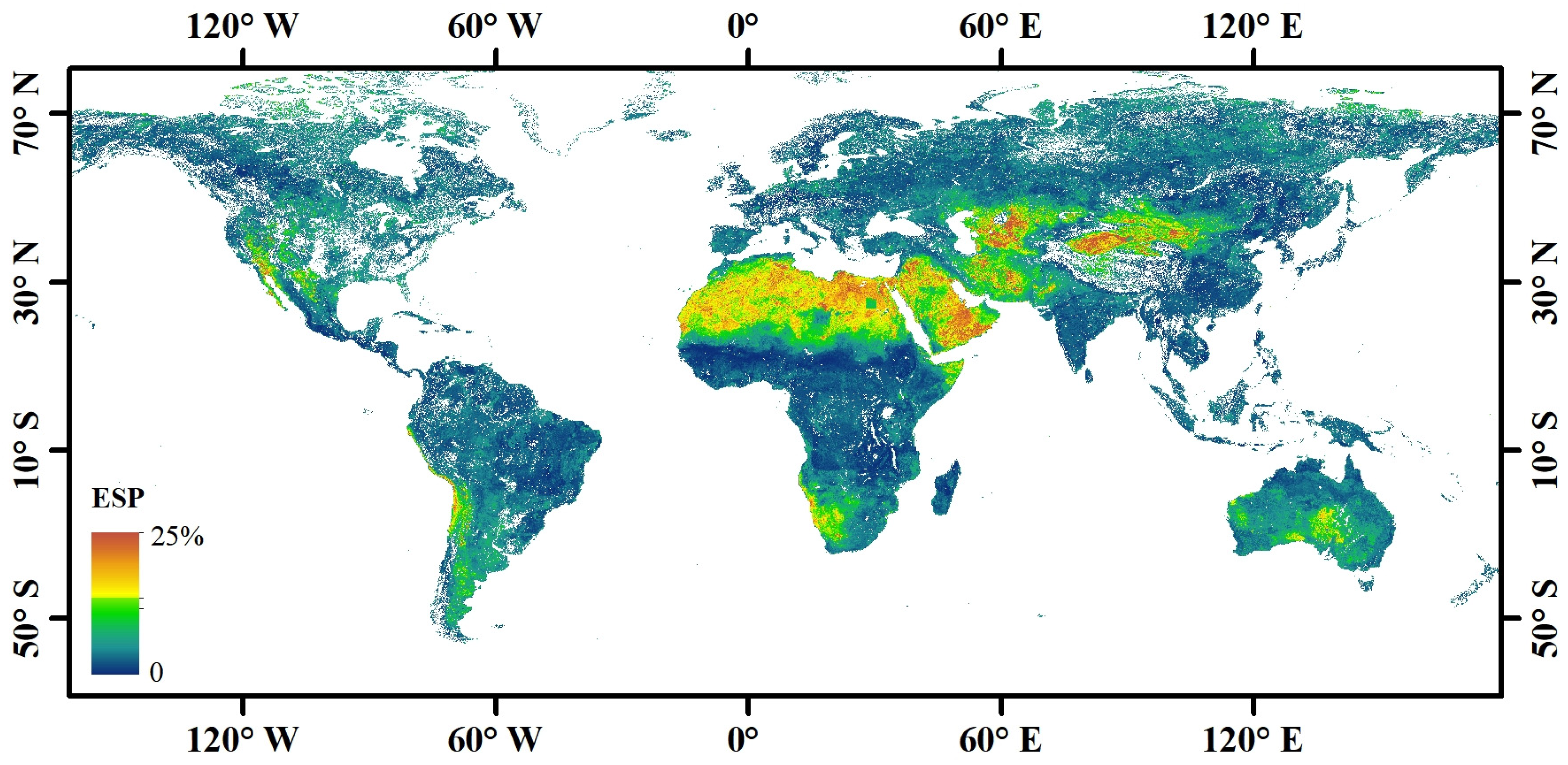
Saline–alkali soils cover approximately 932 million hectares globally, with arid/semi-arid regions and coastal areas being the most severely affected, posing a critical barrier to sustainable agriculture [1] (Figure 1). Their formation is driven by natural factors (e.g., high evaporation, poor drainage) and human activities (e.g., irrational irrigation, excessive fertilization) [2,3]. Traditional improvement methods (hydraulic engineering, chemical amendments) are limited by high costs and short-term efficacy [4], whereas microbial remediation—utilizing salt-tolerant microorganisms to regulate soil physicochemical properties and microecology—has emerged as an eco-friendly and sustainable alternative [5].

1.1. Formation Mechanisms and Ecological–Agricultural Impacts of Saline–Alkali Lands

The formation of saline–alkali lands is a global ecological challenge driven by the combined effects of natural factors and human activities, attracting extensive research attention worldwide. Naturally, the unique climatic characteristics of arid and semi-arid regions (e.g., sparse precipitation, intense evaporation) and geomorphological conditions (e.g., poorly drained low-lying terrain, high groundwater levels) are the primary drivers of salt accumulation [2]. This process is universally observed: in the Mediterranean Basin, arid climate and limited runoff lead to primary salinization in 30% of agricultural lands [1]; in the Great Plains of North America, capillary rise of saline groundwater has degraded 12 million hectares of farmland [5]; and globally, approximately 932 million hectares of land are salinized, with regional variations in dominant salt types—chloride-dominated coastal saline soils in Europe, Africa, and South America and soda-dominated inland saline–alkali soils in Central Asia and North America [1].
Human activities have exacerbated global salinization, with research highlighting consistent drivers across continents. Irrigation-induced secondary salinization affects 20% of irrigated lands worldwide, particularly in India’s Indo-Gangetic Plain, Pakistan’s Indus Basin, and China’s Hetao Plain [1,5]. Excessive fertilizer use disrupts soil colloid structure, a phenomenon reported in both European farmlands and Chinese agricultural regions [3,6]. International research collaborations (e.g., the Global Salinization Research Network) have confirmed that farmland expansion and vegetation destruction accelerate surface evaporation by 25–35% globally, a key factor in salt accumulation [2,7]. In China, 36.7 million hectares of saline–alkali land follow this global pattern: coastal areas suffer from seawater intrusion (sodium-chloride-dominated), while inland regions form sodium carbonate-rich alkaline soils due to mineral weathering [4], aligning with the global distribution characteristics of saline–alkali soil types. Globally, approximately 932 million hectares of land are facing salinization, with the alluvial plains and coastal regions in Asia, Africa, and South America being particularly prominent [1].
In Europe, salinization is widespread in Mediterranean coastal zones (Spain, Italy), the Danube Delta (Romania), and North Sea coastal areas (The Netherlands, Germany). For instance, intensive irrigation in Spain’s Ebro River Basin has led to 1.2 million hectares of secondary salinization, with soil electrical conductivity (EC) exceeding 4 dS m−1 [8]. In North America, the Colorado River Basin (USA) and Canadian Prairies suffer from salinization due to high-salinity irrigation, impacting over 2 million hectares of farmland [9]. Australia’s Murray-Darling Basin faces soil sodification (ESP > 15%) on 60% of affected land, causing a 30% reduction in crop yields [10].
Human activities have significantly accelerated the process of salinization. In agriculture, irrational irrigation practices, such as flood irrigation, directly raise the groundwater level, facilitating the migration of salts to the cultivated layer [11,12]. Real-world cases from regions such as Inner Mongolia and Ningxia demonstrate that the use of highly mineralized water for irrigation causes a rapid increase in salt content in the cultivated layer [13]. The excessive use of fertilizers also poses significant harm by disrupting the soil colloid structure, promoting the exchange of sodium ions for calcium and magnesium ions, ultimately forming loose, alkali soils [3]. Field observations in Western Jilin (a region in western Jilin Province, Northeast China, located between 121°38′–126°11′ E longitude and 43°59′–46°18′ N latitude, bordering the Inner Mongolia Autonomous Region to the west and the Songnen Plain to the east) show that farmland expansion and vegetation destruction have led to a more than 30% increase in surface evaporation, significantly accelerating the accumulation of salts at the surface [2].
The negative impacts of salinity stress on crop growth primarily manifest in three aspects: osmotic stress, which obstructs water uptake by the roots, leading to a water deficit in plants that is two to three times greater than under normal conditions [14]; ion toxicity, where sodium ions replace calcium and magnesium ions, damaging cell membrane functions, with potassium loss in tomato seedling leaves reaching 60% under 200 mmol L−1 NaCl conditions [15]; and nutrient imbalance, where an increase in pH (>8.5) leads to the formation of insoluble compounds of phosphorus, iron, and other elements, causing the effective phosphorus content in peanut planting areas to drop below 5 mg kg−1 [16]. These stresses collectively lead to physiological dysfunction in plants; for example, under 200 mmol L−1 NaCl stress, the malondialdehyde content in tomato seedlings increases by 120%, and the proline accumulation reaches 3.2 mg/g FW [15,17], including damage to the chloroplast structure that reduces photosynthetic efficiency by 40%, a sharp increase in malondialdehyde content indicating intensified oxidative damage, and abnormal accumulation of osmotic regulators, such as proline [17].
Salinization also severely damages soil structure. The dispersion effect of sodium ions causes soil particles to bind together, forming impermeable, hard soil clumps, with the porosity of saline–alkali soils in Ningxia dropping to below 25% [18,19]. This physical degradation interacts with chemical toxicity, creating a vicious cycle: compacted soils limit root development and reduced vegetation further exacerbates water evaporation, which in turn accelerates the upward movement of salts. Monitoring data from severe saline–alkali lands in Bayan Nur, Inner Mongolia, show that in unamended soils, the sunflower germination rate is less than 30%, and the biomass is only one-third of that in healthy soils [13]. Microbial community studies have found that high-salinity environments cause a sharp reduction in beneficial microorganisms, such as nitrogen-fixing bacteria (by 80%), while the proportion of pathogenic bacteria increases, significantly raising the risk of soil-borne diseases [20].

1.2. Microbial Remediation in Saline–Alkali Soils

The application of microbial amendments in saline–alkali soil remediation began in the mid-20th century. With advancements in molecular biology and microbial ecology, relevant technologies have gradually evolved into a systematic research framework. The School of Food and Light Industry at Nanjing Tech University isolated salt-tolerant microbial strains from saline–alkali lands in Xinjiang and developed a non-sterile fermentation technology, which significantly reduced production costs and promoted the large-scale application of microbial amendments in saline–alkali soil remediation [21]. These microorganisms secrete active substances, such as organic acids and extracellular polysaccharides (EPS): organic acids neutralize alkaline components in the soil to lower pH, while EPS adsorbs harmful ions like Na+ and binds to soil colloids to promote aggregate formation [14]. Through these combined actions, soluble salts are chemically converted into insoluble forms, laying a foundation for the large-scale remediation of saline–alkali soils [21].
For soda saline–alkali soils in the Northeast and North China Plains, the combined measures of flue gas desulfurization (FGD) gypsum application, deep tillage, and winter irrigation can reduce soil pH from 10 to below 8.5 within 3–5 years, increasing rice yield from less than 100 kg per mu to 500–600 kg per mu [5], thus providing a feasible technical solution for crop cultivation in high-salinity environments. While this physical–chemical combination achieves a faster initial improvement effect, it may cause soil compaction (with porosity reduced by 8–12% [18]) and nutrient leaching. In contrast, microbial amendments can simultaneously improve soil structure (increasing aggregate stability by 20–30% [22]) and enhance nutrient availability [23].
In recent years, significant breakthroughs have been made in the development of composite microbial amendments. In the arid regions of Northwest China, the drip irrigation + mulching model combined with subsurface drainage systems has achieved a desalination rate of 51–91%, but this system requires high initial investment in irrigation infrastructure (costing two to three times more than microbial amendments alone [24]). In comparison, the enzyme bacteria technology developed by the Weifang Daoben Institute of Microbial Technology offers advantages of low cost and easy operation, but its improvement effect in severely saline–alkali soils (salinity > 6‰) is limited (desalination rate < 40%), which is lower than that of chemical amendments, such as phosphogypsum (desalination rate up to 60% [25]). The combined application of compound biofertilizer with reduced chemical fertilizer (Treatment T3) can significantly decrease soil pH, total salt content, and alkalization degree, while avoiding environmental risks associated with excessive chemical fertilizer use (e.g., groundwater pollution and soil colloid destruction [3]). This fully demonstrates the complementary advantages of microbial amendments in ecological sustainability compared to traditional methods. In the eastern coastal areas, the integrated approach of engineering-based salt leaching + agronomic fertilization + forest–grass composite patterns has improved soil aggregate stability [5], further supporting the potential of microbial remediation technology in enhancing agricultural productivity in saline–alkali lands. Beyond China, remarkable progress has been made across continents.
In Africa, a 3-year field trial in the Western Cape region of South Africa (sodic soil, ESP = 28%) used a composite microbial agent containing Bacillus amyloliquefaciens and Pseudomonas fluorescens, reducing soil salinity by 38% and increasing maize yield by 32% [26]. In the Nile Delta of Egypt, Plant Growth-Promoting Rhizobacteria (PGPR) combined with compost amendment lowered soil pH from 8.9 to 7.6, with a 45% increase in wheat biomass compared to chemical fertilizer treatments [27].
In Argentina’s Pampas region, composite microbial amendments containing Azospirillum brasilense significantly improved soil structure in saline–sodic soils, with aggregate stability increasing by 27% [28].
In Europe, Italy’s Po Valley (pH 8.9, EC 4.8 dS m−1) achieved a 32% reduction in soil salinity and a 27% increase in wheat yield through composite microbial amendments (Pseudomonas fluorescens + Bacillus licheniformis) [29,30]. Greece’s coastal saline–alkali lands adopted PGPR agents combined with olive pomace biochar, reducing exchangeable Na+ by 40% and increasing soil organic matter by 35% [31].
In Oceania, Australia’s CSIRO developed a region-specific microbial agent for the Murray-Darling Basin, reducing soil salinity by 42% and stabilizing pH at 7.6, restoring degraded pasture lands with a 60% increase in biomass [32].
The mechanisms of microbial amendments have been deeply analyzed. Salt-tolerant microorganisms secrete active molecules, such as indole-3-acetic acid, cytokinins, and abscisic acid, which directly promote plant growth and alleviate salt stress [13]. In addition, microorganisms help plants adapt to saline–alkali environments by regulating ion balance, improving osmotic pressure, and promoting water and nutrient absorption [33]. Research from the Chinese Academy of Agricultural Sciences found that the synergistic effect of salt-tolerant microbial communities and biochar can significantly increase soil organic matter content and rice grain yield [34].
The application models of microbial remediation technologies show diverse characteristics. Microbial enhancement technologies combined with key techniques, such as seed coating and integrated water–fertilizer–bacteria systems, have established simplified productivity-enhancing systems in light to moderate saline–alkali soils in Shandong, Inner Mongolia, and Heilongjiang [35]. A research team from the Harbin Institute of Technology developed salt–alkali-tolerant rhizosphere-promoting bacteria that effectively enhanced crop root vitality, leading to increased yields [34]. Microbial pore-forming technology utilizes the metabolic activities of specific microbial communities in the soil to generate bioactive substances, improving soil physical structure and breaking up hard clods [19]. The solid fermentation technology of Trichoderma agents developed by Professor Shen Qirong (Distinguished Professor, College of Resources and Environmental Sciences, Nanjing Agricultural University; Director of the National Engineering Research Center for Organic-based Fertilizers) and his team reduced production costs by 40% compared to traditional liquid fermentation [34], with the final product price controlled at 12–15 yuan/kg, 30% lower than imported microbial fertilizers (CNY 20–25/kg) [36]. This cost advantage provides important support for the industrial application of microbial fertilizers, marking a significant leap from theoretical research to practical application. However, farmer adoption still faces multiple barriers: first, the short-term effect of microbial fertilizers is less obvious than chemical amendments (e.g., gypsum can reduce soil pH by 1 unit within 1 year, while microbial agents require 2–3 years for stable results [4]), making it difficult for farmers to perceive immediate benefits; second, technical cognition gaps exist—field surveys in Inner Mongolia and Ningxia show that only 28% of smallholder farmers understand the application methods and dosage of microbial amendments, and 65% of farmers worry about inconsistent effects under different soil conditions [37]; and third, there is a lack of localized promotion services, as microbial fertilizers require matching with regional soil types (e.g., coastal saline soils vs. inland soda saline soils), but less than 15% of counties in saline–alkali areas have specialized technical guidance teams [1].

2. Characteristics of Soil Microbial Communities in Saline–Alkali Lands

Saline–alkali soils select for unique microbial communities with specialized adaptation strategies, whose diversity and function are closely linked to soil salinity, pH, and organic matter content [38]. These communities drive key biogeochemical processes (nitrogen fixation, phosphorus mineralization, organic matter decomposition) that are critical for ecosystem stability and soil fertility [20]. High-throughput sequencing and functional gene analysis have revealed that dominant taxa (e.g., Proteobacteria, Actinobacteria) and their metabolic pathways are tailored to extreme saline–alkali stress [39], forming the basis for microbial-mediated soil improvement.
Research by the Gao cheng team indicates that in approximately 1 billion hectares of salinized soils worldwide, the environmental adaptation strategies of microbial communities provide important theoretical support for ecological restoration practices [7]. The introduction of specific functional microorganisms can effectively regulate the composition of microbial communities in saline–alkali soils. For example, the inoculation of nitrogen-fixing fishy algae not only significantly improves soil pH balance and sodium ion exchange capacity but also promotes organic matter accumulation and nitrogen transformation efficiency, creating favorable microenvironment conditions for vegetation reconstruction [20].

2.1. Distribution of Dominant Microbial Communities

The unique ecological environment of saline–alkali lands fosters microbial communities with remarkable salt tolerance, with Proteobacteria, Actinobacteria and Firmicutes being the dominant phyla that form the main components of these communities [38]. Table 1 systematically summarizes the taxonomic composition, geographical distribution, and ecological functional mechanisms of dominant microbial taxa in saline–alkali environments, integrating data from various research methods ranging from traditional isolation and culturing to molecular biology techniques. A study of the endophytic bacterial community in halophytic plants in southern Tunisia showed that core genera, such as Acinetobacter, Halomonas, and Pseudomonas, significantly enhanced the salt tolerance of host plants by regulating reactive oxygen species balance and synthesizing osmoprotectants like proline and trehalose [39]. Microbial community composition varies significantly across saline–alkali soils of different geographical regions. In northwest desert regions, Proteobacteria are dominant, with Actinobacteria, Bacteroidetes, and Acidobacteria also widely distributed [20]. In contrast, the rhizosphere of Suaeda salsa in the coastal saline–alkali lands around the Bohai Sea has a unique community structure dominated by Actinobacteria [40].
Beyond Asia, similar salt-tolerant microbial communities have been identified globally. In Spain’s Mediterranean saline soils, Halomonas and Pseudomonas dominate the rhizosphere of halophytes, such as Salsola oppositifolia, with organic acid secretion reaching 78.5 mg L−1 to neutralize soil alkalinity [8,52]. In the Danube Delta (Romania), Actinobacteria account for 28% of the microbial community, promoting phosphorus solubilization and reducing soil ESP by 18% [53]. In Australia’s sodic soils, Bacillus amyloliquefaciens strains isolated from Atriplex nummularia rhizospheres show 90% survival under 8% NaCl conditions, enhancing wheat root growth by 45% [32].
In extreme saline–alkali environments, archaea exhibit special adaptation mechanisms. Euryarchaeota and Crenarchaeota participate in anaerobic metabolism and ammonia oxidation in saline–alkali soils in the arid areas of Gansu [45]. Extreme halophilic archaea, such as Halomicrobium and Halobacterium, adapt to high-salinity environments through unique cell membrane lipid compositions and osmotic regulation systems [46]. As soil salinity increases from 0.1% to 5%, the diversity of archaea communities significantly increases, while bacterial communities show the opposite trend [7].
Microbial ecological functions in saline–alkali environments manifest in diverse metabolic strategies. Nitrogen-fixing bacteria, such as Sphingomonas, improve soil nitrogen status by converting atmospheric nitrogen into ammonia nitrogen, with an annual conversion capacity of 30 kg hm−2 in saline–alkali soils and a 15.3% increase in total soil nitrogen [16]. Research on saline–alkali soils in the Hexi Corridor shows that phosphorus-solubilizing bacteria dissolve insoluble phosphates by secreting organic acids, forming a unique nitrogen transformation pattern dominated by ammonifying bacteria and supported by nitrifying bacteria [20]. In fungal communities, Cladosporium constitutes 23.4–69.5% of the microbial population in mildly saline–alkali soils, and Fusarium can reach up to 69.4% in the surface layer of moderately saline–alkali soils, contributing to ecological restoration by promoting root development [47]. Notably, high-salinity environments severely disrupt the balance of microbial communities: beneficial microorganisms, such as nitrogen-fixing bacteria, decrease by 80%, while the proportion of pathogenic bacteria increases, significantly raising the risk of soil-borne diseases [20]. This microbial community degradation further exacerbates soil fertility decline and crop stress in saline–alkali environments.
Research on dominant microbial communities has benefited from the integration of traditional and modern technologies. Six salt-tolerant strains isolated from saline–alkali lands in the Shihezi reclamation area include Oceanobacillus manasiensis and Salinicoccus roseus [54]. The 16S rRNA high-throughput sequencing technology has more comprehensively revealed the microbial diversity in the Bohai Sea saline–alkali lands, identifying 41 phyla, 100 classes, and 282 orders [38], providing a new perspective on microbial niche differentiation. The data in Table 1 provide important reference points for understanding the adaptation strategies and ecological services of microorganisms in saline–alkali environments.

2.2. Microbial Functional Genes

The distribution of functional genes in microorganisms from saline–alkali soils is significantly correlated with environmental factors, and this relationship directly reflects the potential ecological functions of microbial communities. Modern molecular biology techniques, particularly high-throughput sequencing methods, provide powerful tools for uncovering the types, abundance, and spatial heterogeneity of functional genes. For example, 16S rRNA and nifH genes not only successfully reveal the distribution characteristics of nitrogen-fixing communities in ecosystems but also highlight significant differences in sequence diversity across different soil types [55]. These diversity differences reflect microbial adaptation strategies to salt–alkali stress and suggest their specific contributions to ecosystem functions.
The diversity of microbial functional genes directly influences their metabolic potential in saline–alkali environments. Studies have found that key functional genes involved in carbon cycling (such as chemoheterotrophy and aerobic chemoheterotrophy) and nitrogen cycling (such as nitrate reduction) are distributed in a characteristic pattern in saline–alkali soils [6]. This distribution pattern provides scientific evidence for understanding the mechanisms of microbial function in saline–alkali land remediation. It is noteworthy that the application of biochar significantly alters the structure and diversity of soil bacterial communities, which may influence soil ecological functions by regulating the expression of genes related to nitrogen and phosphorus cycling [56].
The development of microbial resources in extreme environments is another important direction in functional gene research. Long-term evolutionary pressure has led to the formation of unique adaptation mechanisms in saline–alkali microorganisms, and their genomes contain numerous genes encoding salt–alkali-tolerant proteases [20]. Systematic exploration and functional analysis of these genetic resources not only help elucidate microbial adaptation mechanisms in extreme environments but also provide new ideas for the development of bioremediation technologies for saline–alkali lands. Molecular ecological studies have shown that AMF and Ca2+ treatments significantly altered bacterial community composition, especially promoting the proliferation of Proteobacteria and Firmicutes. These changes are closely related to the regulation of the expression of specific functional genes [16].
Functional gene analysis technologies themselves are also continuously evolving. For example, bacterial DNA extraction using the Cetyltrimethylammonium Bromide (CTAB) method combined with specific PCR amplification conditions (25 μL of reaction mixture containing 10× buffer 2.5 μL, 2.5 mmol/L dNTP 2.0 μL, MgCl2 1.5 μL, etc.) and the use of universal primers 27F/1492R for 16S rRNA gene amplification have greatly improved the accuracy and sensitivity of detection [55]. These technological innovations provide more reliable methodological support for in-depth analysis of the functional gene composition and ecological significance of microorganisms in saline–alkali soils.

2.3. Microbial Metabolic Function

The advancement of modern microbiomics has greatly enhanced our understanding of the metabolic functions of microbial communities in saline–alkali soils. Integrative analyses of metagenomics and metabolomics show that microorganisms in saline–alkali environments possess unique carbon and nitrogen metabolic characteristics and secondary metabolite profiles, which are crucial for maintaining ecosystem functions and environmental adaptation. Soils from the rhizosphere of Suaeda salsa in saline lands showed significantly higher metabolic activity across 40 functional activities compared to bare soils [40]. Notably, 41 metabolic pathways, including glutathione metabolism, photosynthetic protein synthesis, cytochrome P450-mediated drug metabolism, isoprene metabolism, and halogenated hydrocarbon degradation, showed significant differences between the two sample groups [40]. These differential distributions reflect the regulatory role of plant–microbe interactions in soil ecosystem functions.
During the improvement of saline–alkali soils, microbial carbon metabolic functions exhibit a clear temporal variation pattern. With the increase in the duration of soil improvement, the carbon source utilization pattern of microorganisms undergoes a systematic shift: in the early stage of improvement (2 years), carboxylic acids, amino acids, phenols, and amines are the primary carbon sources, while after long-term improvement (10 years), there is a shift towards the preferential utilization of polymers and carbohydrates [57]. Additionally, rice farming systems show significant rhizosphere effects, with rice rhizosphere soils emphasizing amino acid metabolism, while non-rhizosphere areas are more inclined towards carboxylic acids, phenolic acids, and amine metabolism [58]. This spatial metabolic differentiation reflects microbial community adaptation to environmental gradients.
16S rRNA gene functional prediction analyses revealed the special metabolic potential of endophytic microbiomes in halophytic plants. Phylogenetic Investigation of Communities by Reconstruction of Unobserved States 2 (PICRUSt2) and FAPROTAX analyses confirmed that these microorganisms not only participate in core processes, such as amino acid metabolism, lipid metabolism, and energy metabolism, but also possess unique functions like nitrification, denitrification, carbon degradation, and hydrocarbon degradation [39]. COG database analysis found that AMF and Ca2+ treatments in saline–alkali soils significantly enriched functional genes related to cell growth, apoptosis, and movement during the seedling and pod-setting stages [16]. These metabolic regulations may be important physiological adaptation strategies for microorganisms to cope with salt stress.
Microbial metabolic activities improve the saline–alkali environment through various mechanisms. Building on the acid-secreting effect of functional strains in technical applications (Section 1.2), acid-producing bacteria secrete specific acidic metabolites (e.g., citric acid, oxalic acid) that not only neutralize alkaline substances but also activate insoluble phosphorus, iron, and other nutrients by lowering soil pH, improving their bioavailability [59]. Meanwhile, these metabolites participate in soil carbon cycling as intermediate substrates, forming a synergistic relationship with nutrient transformation processes [13]. At the same time, the complex regulatory networks formed by microbial metabolites play a key role in nutrient cycling and organic matter accumulation in saline–alkali lands. Integrative metagenomic and metabolomic analyses have revealed the carbon and nitrogen metabolic characteristics of microorganisms in saline–alkali soils and the ecological functions of their secondary metabolites at the molecular level [13]. These findings provide a theoretical basis for the development of microbial metabolism-based technologies for the improvement of saline–alkali soils.

2.4. Microbe–Environment Interactions

The distribution and function of microbial communities in saline–alkali soils are influenced by a combination of environmental factors, with pH, salinity, and organic matter content being the most critical ecological selection pressures. The soils from five sampling points exhibited typical alkaline characteristics (pH > 7), with electrical conductivity generally exceeding 2000 μS cm−1. In particular, sampling points S1, S3, and S5 reached extremely high salinity levels, creating extreme environmental conditions that promoted the formation of unique microbial community structures [39]. Redundancy analysis (RDA) showed a significant positive correlation between soil available phosphorus (AP) and phosphate-solubilizing bacteria, such as Terribacillus and Streptomyces, while high-salinity (EC) and high organic matter (OM) environments promoted the enrichment of halophilic genera, such as Halomonas and Stenotrophomonas, at the S5 sampling point [39]. Similar phenomena were observed in studies on saline–alkali soils in the Yellow River Basin, where Acidobacteria exhibited greater abundance in high-pH environments but a significant decrease in abundance in coastal low-pH sandy soils [6].
Fluctuations in soil pH have multidimensional impacts on microbial metabolic activities. Alkaline environments (pH 7.5–9.5) reduce the solubility and bioavailability of nutrients, thereby inhibiting microbial physiological functions [4]. In soils with different levels of salinity and alkalinity, catalase activity exhibited significant differences, with enzyme activity ranging from 3.52 to 4.56 mL g−1 in heavily saline–alkali soils, 3.08 to 4.61 mL g−1 in moderately saline–alkali soils, and 5.81 to 6.91 mL g−1 in lightly saline–alkali soils. This gradient variation is closely related to total potassium content in the soil, while pH, organic matter, and total nitrogen indirectly affect enzyme activity through regulation of total potassium [47]. Urease activity showed a decreasing trend across the three soil types, with values ranging from 0.04 to 0.52 mg g−1, 0.08 to 1.07 mg g−1, and 0.27 to 8.21 mg g−1, with changes primarily regulated by total nitrogen content [47].
Salt stress directly influences microbial survival strategies by altering cell osmotic pressure and membrane integrity. Variance partitioning analysis (VPA) showed that soil factors contributed 52.15% to archaeal community structure, significantly higher than other environmental factors (20.57%) [38]. Studies on coastal saline–alkali soils have shown that the distance from the coastline negatively correlated with the abundance of the Cryomorphaceae family and the Flavobacteria class, indicating that seawater inundation and temperature fluctuations may drive microbial community changes [41]. Among key parameters, such as EC, available potassium, alkaline nitrogen, and available phosphorus, EC explained the greatest variation in bacterial community structure (R2 = 0.8778), making it the most significant environmental selection factor [40].
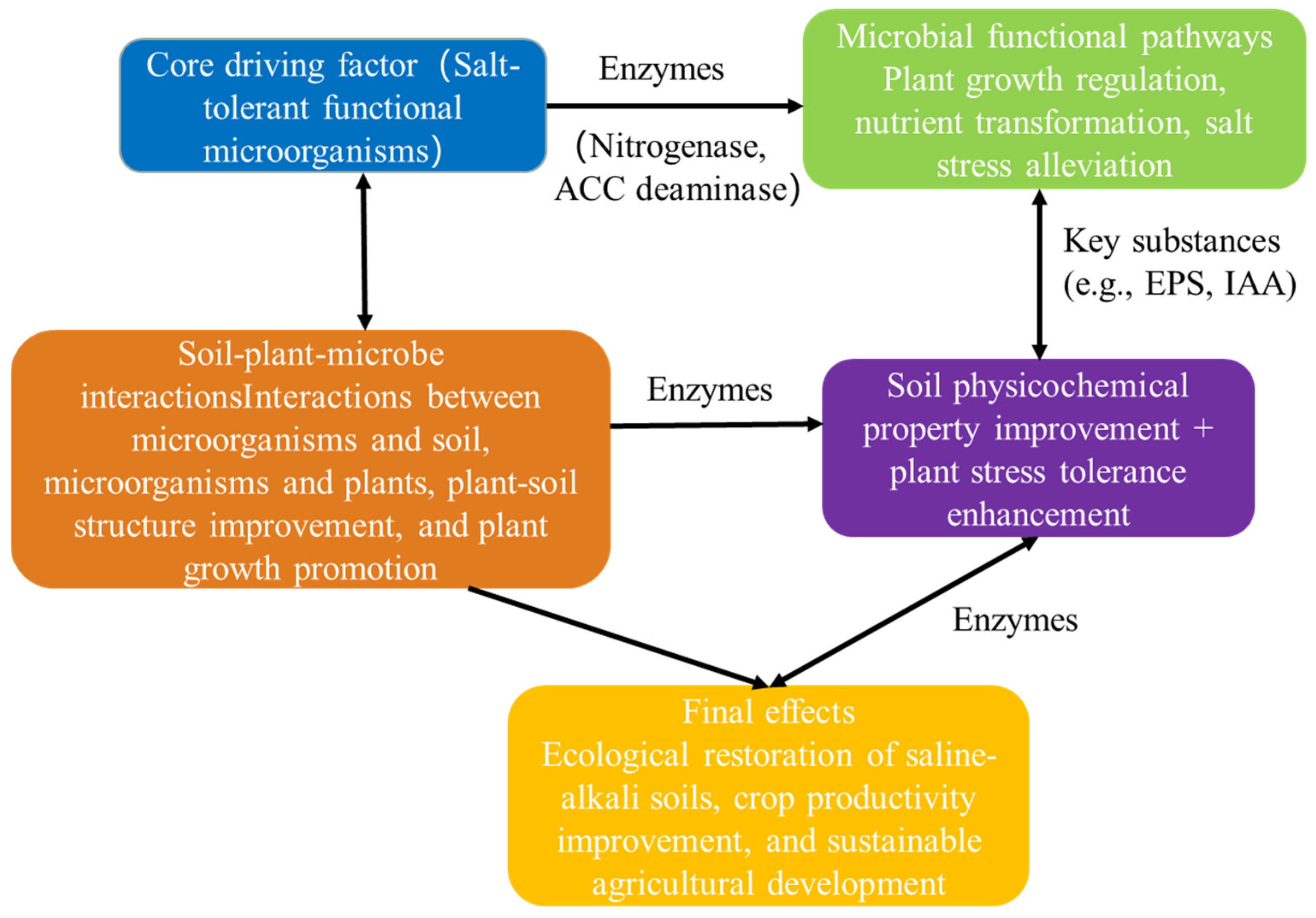
Organic matter content indirectly regulates microbial communities by altering soil structure and nutrient cycling. Studies on Xinjiang saline–alkali soils have found that organic matter content negatively correlates with archaea genera, such as Candidatus nitrososphaera and Nitrosopumilus, while showing an antagonistic relationship with sulfate ions and total salt content [45]. Biochar amendment experiments have shown that the addition of organic material significantly reduces soil pH and exchangeable sodium percentage (ESP) while improving moisture content and organic matter levels, thus promoting the growth of salt-tolerant plants, such as Miscanthus [56]. The application of microbial inoculants, through the decomposition of organic matter and the production of acidic metabolic products, lowered soil pH by 0.8 units, effectively mitigating salt–alkali stress [60] (Figure 2).

3. Screening and Construction of Microbial Inoculants

The efficacy of microbial remediation depends on the screening of salt-tolerant, functional strains and the rational construction of composite inoculants [61]. Targeted sampling from rhizosphere soils of halophytes or long-term improved saline–alkali lands has become a reliable strategy for isolating high-performance strains [15], as these environments select for microorganisms with stable traits, such as acid production, EPS secretion, and plant growth promotion [62]. The construction of composite inoculants further leverages functional complementarity between strains, overcoming the limitations of single-strain applications in complex saline–alkali environments [63].

3.1. Screening of Salt-Tolerant Strains

Research indicates that the development of efficient microbial inoculants relies on the precise screening of salt-tolerant microorganisms. Professor Li Fangjun’s team at China Agricultural University successfully isolated several strains with both salt tolerance and growth-promoting properties from saline–alkali soil samples collected from Xinjiang, Qinghai, and Hebei, including Bacillus alcalophilus Y10, Trichoderma longibrachiatum M6, and Pseudomonas HW22 [61]. Notably, the selective culture method using Hoch’s medium combined with Congo red as an indicator effectively selects acid-producing strains, such as the high-acid-producing strain Aspergillus niger SQ21 isolated from heavily saline–alkali soil [62].
In terms of strain identification, 16S rRNA PCR-RFLP combined with core gene sequence analysis has become the mainstream method. Recent studies have identified several symbiotic bacterial genera, including Sinorhizobium/Ensifer, Enterobacter, and Pantoea, from wild soybean root nodules [55]. With the widespread application of high-throughput sequencing, microbiome analysis of 32 saline–alkali soil samples revealed that Proteobacteria, Actinobacteria, Firmicutes, Bacteroidetes, and Cyanobacteria form dominant populations [38], providing an important reference for phylogenetic studies of strains.
The establishment of a comprehensive evaluation system is key to screening high-quality strains. A study found that 11 ACC deaminase-active strains isolated from the Medicago sativa rhizosphere exhibited significant growth-promoting characteristics [43]. Notably, Bacillus megaterium B25 and Bacillus amyloliquefaciens B43, both of which possess salt tolerance, exopolysaccharide production, and phosphorus and potassium solubilization capabilities, provide excellent resources for developing composite functional inoculants [63].
A scientifically sound sampling strategy directly affects the success of strain screening. Studies have shown that plant rhizosphere environments are important sources of high-quality strains, such as seven novel salt-tolerant bacteria isolated from Artemisia and Salicornia rhizospheres [15]. Depth sampling studies in the Jiuquan region revealed that the optimal treatment methods vary by soil layer: surface soil is suitable for grass ash covering, 15 cm soil layers should use biochar or corn straw return, 25 cm layers can adopt multiple treatments, and grass ash works best for 40 cm layers [64]. This stratified sampling method significantly improves the efficiency of functional strain acquisition.

3.2. Evaluation of Microbial Amendments’ Function

The construction of a functional evaluation system for microbial amendments requires a multi-dimensional and quantitative indicator framework to select high-quality strains. Strain YP exhibits excellent phosphate solubilization capacity, with inorganic and organic phosphorus solubilization rates reaching 516.8 mg L−1 and 292.2 mg L−1, respectively. This result establishes a reliable standard for the quantitative assessment of phosphate solubilization functionality [64]. Regarding plant hormone secretion, strains LE, BZ1~T, and YP can all secrete IAA, with strain LE producing the highest IAA concentration (20.92 µg mL−1) after 7 days of culture, significantly higher than BZ1~T (14.80 µg mL−1) and YP (9.79 µg mL−1) [64]. The evaluation system should also include salt tolerance tests, using a NaCl concentration gradient (0.5–2%) to screen for salt-tolerant strains and monitoring pH changes in the culture medium to assess acid production capacity [65].
Modern in vitro plant growth-promoting property evaluation has developed into a comprehensive multi-indicator system. Some strains exhibit unique mineral solubilization capabilities, such as SHA and SHB, which demonstrate outstanding potassium solubilization ability, while 3B and SHA perform excellently in zinc oxide solubilization [15]. The functional evaluation should also focus on ACC deaminase activity, with SHA showing the best performance in this regard, while strains 3A and 3B produce significant amounts of exopolysaccharides [15]. High-quality strains typically exhibit multiple enzyme activities, including protease, amylase, urease, and catalase. Quantitative measurements of these enzymatic activities are a key component of functional evaluation [15]. As shown in Table 2, various strains exhibit significant differences in phosphate solubilization, IAA production, salt tolerance, special functions, and other enzyme activities. These data provide valuable references for evaluating the potential of strains in agricultural applications.
Field validation is an indispensable part of functional evaluation. Field trials in Northeast China have confirmed that the application of specific microbial formulations can effectively regulate soil pH, significantly increase organic matter content, and improve crop yields by more than 15% [59]. The largest agricultural microbial germplasm bank in China has preserved 5297 strains of microorganisms from extreme environments, 86% of which can survive under 10% NaCl conditions, and 50% possess inorganic phosphorus decomposition capabilities, providing an important reference for salt tolerance and functional evaluation [21]. By integrating laboratory indicators with field performance, the development of a standardized functional evaluation system is of great significance for the development of efficient microbial amendments.

3.3. Compound Microbial Agent

The design and formulation of composite microbial amendments are crucial for improving saline–alkali soils. The key lies in optimizing the bacterial mixture based on the principle of functional complementarity. The complex ecological environment of saline–alkali soils often exceeds the capacity of a single microbial species to address, whereas a scientifically designed composite microbial community can exhibit synergistic effects, significantly improving the efficacy of soil remediation. In the experiments, the HS-CP-XXX composite microbial community, which includes over 60 types of microorganisms, such as phosphate and potassium-solubilizing bacteria and halophilic bacteria, not only promotes the formation of soil aggregate structure, enhancing aeration and drainage, but also effectively prevents the migration of salt during the evaporation process of soil moisture, a phenomenon known as “salt comes with water” [70]. This multi-component strategy overcomes the functional limitations of single microbial species and creates a more stable ecosystem through metabolic complementarity between different microbial groups.
The formulation of microbial strains must follow the basic principles of functional complementarity and metabolic synergy. Some studies have formulated composite microbial liquids using specific ratios of Bacillus subtilis, Pseudomonas, Flavobacterium, and Sphingomonas, with results showing that this precisely mixed bacterial solution significantly improves the soil microbial population structure and diversity [6]. A composite microbial agent design strategy based on functional complementarity not only optimizes the ratio of strains but also enhances their practical application in saline–alkali environments. For instance, treatment with Salix linearistipularis not only reduced soil electrical conductivity but also simultaneously increased the content of various soil nutrients [6], demonstrating the significant synergistic improvement effects of a well-designed bacterial combination.
Technological optimization is a key approach to enhancing the efficacy of composite microbial amendments. To address the issue of low activity and instability of microorganisms in environments with heavy metals and saline–alkali conditions, research teams have innovatively developed a multi-component composite material gel immobilization technology [21]. This technology not only improves microbial stability but also enhances their comprehensive effects in soil pollution remediation, fertility improvement, and plant growth promotion. The Island enzyme composite microbial community utilizes the ability of salt–alkali-resistant strains to survive and proliferate in harsh environments. Through metabolic actions, it lowers soil salinity, while the organic acids produced neutralize the alkaline substances in the soil. The extracellular polysaccharides (EPS) secreted by the microbes adsorb metal ions via hydroxyl, carboxyl, and other functional groups and form aggregates by binding with soil colloids through van der Waals forces, effectively improving soil compaction issues [11].
The formulation of composite microbial amendments must also consider regional environmental differences. In saline–alkali soils of the Hetao Plain, Proteobacteria dominate, while in coastal saline–alkali soils, Firmicutes may be the predominant group [20]. This regional variation demands that composite microbial amendments be designed with local conditions in mind. A novel saline–alkali soil improvement agent developed using microcapsule-controlled release technology combines calcium citrate, calcium nitrate, and humic acid to achieve dual regulation of calcium ion release and acid–base balance [25].

3.4. Selection of Microbial Carrier

The stability and release efficiency of microbial amendments in saline–alkali soil improvement largely depend on the characteristics of the carrier materials. Recent studies reveal that the physicochemical properties of carrier materials directly influence the survival and functional expression of microorganisms under stress conditions. Nanocarriers, with their surface effects and small size, can significantly enhance the adaptability of microorganisms under saline–alkali stress [59]. Among various carrier options, biochar has shown particular value due to its developed porous structure and rich surface functional groups. These features not only provide a favorable habitat for microorganisms but also effectively regulate the soil microenvironment. Experimental data indicate that using biochar as a carrier can increase microbial survival rates by over 30%, providing important support for saline–alkali soil improvement practices [5].
The resource utilization of agricultural waste has opened new pathways for the development of microbial carriers. Wheat bran, modified through solid-state fermentation, exhibits excellent microbial loading capacity, especially in maintaining microbial activity [62]. The synergistic use of vermiculite and trehalose has pioneered a new type of composite carrier technology. Studies show that this system can prepare high-efficiency remediation agents with microbial concentrations reaching 108 CFU g−1 (CFU: Colony-Forming Unit), providing technical support for large-scale production [45]. Such composite carriers not only effectively alleviate the damage caused by saline–alkali stress to microorganisms but also enable controlled release, significantly extending the effective period of the microbial agent.
Inorganic–organic hybrid carriers show unique application prospects. Research has shown that combining gypsum with earthworm manure can significantly reduce soil electrical conductivity, improve salt migration properties, and enhance soil quality [1]. When biochar is used as a carrier, its oxygen-rich functional groups can specifically bind with microbial cells, forming a stable bio-material interface. This interaction not only enhances the environmental tolerance of microorganisms but also promotes their effective colonization in the rhizosphere. Current innovative directions in carrier research include new delivery systems, such as microencapsulation technology, which enable the smart release of active components, greatly extending the duration of improvement effects.
In practical applications, the selection of carrier materials needs to be precisely matched with the characteristics of the target microorganisms and the soil environment. Soils with varying levels of salinity have distinct requirements for carrier performance, necessitating the establishment of optimization standards based on actual conditions [65]. An ideal carrier system should integrate good biological affinity, environmental stability, and controlled release characteristics. The latest research trends suggest that multi-component composite carriers can create synergistic effects, such as “1 + 1 > 2”. For example, biochar–nanomaterial composite systems can simultaneously address the dual needs of microbial protection and nutrient supply. Ongoing innovation in carrier technology is providing more efficient technical solutions for biological remediation of saline–alkali soils.

4. Mechanisms and Effects of Microbial Amendments

The improvement of saline–alkali soils through microbial amendments primarily occurs through their complex biological and chemical regulatory networks. Recent experimental data show that combining underground drainage systems with organic fertilizer treatment can reduce soil electrical conductivity by 14.5% to 17.3% and exchangeable sodium ion (Na+) content by 33.8% to 36.2%. This approach also promotes favorable evolution of the microbial community structure [71]. These microorganisms are capable of producing a variety of active substances, including organic acids and plant growth regulators, which directly participate in the regulation of soil physicochemical properties and influence plant physiological processes. Compared to traditional chemical amelioration methods, this biological improvement technology establishes a dynamic balance between microorganisms, plants, and the soil, achieving overall restoration of the saline–alkali soil ecosystem’s functionality [72]. Notably, in field trials, the application of specific microbial amendments resulted in a 12.37% increase in sunflower yield, along with a significant improvement in soil nutrient availability [24,73]. This result provides a practical and feasible solution for the agricultural development and utilization of saline–alkali soils.

4.1. Physiological and Biochemical Regulation

Microorganisms play a critical role in regulating plant salt tolerance, mainly through the secretion of various active substances. Arbuscular mycorrhizal fungi (AMF) exhibit significant physiological regulatory abilities. Their hyphal networks possess selective absorption functions, promoting the uptake of beneficial ions, such as potassium (K), magnesium (Mg), and calcium (Ca), while inhibiting the accumulation of harmful ions like sodium (Na) and chloride (Cl), thereby maintaining ionic balance within plants [50]. The extensive hyphal system formed by AMF not only enlarges the root absorption area but also significantly alters the rhizosphere microenvironment through the secretion of metabolic products, such as organic acids. Under saline–alkali conditions, tomato plants inoculated with AMF show enhanced antioxidant activity, with significant increases in key enzyme activities, including superoxide dismutase (SOD), peroxidase (POD), and catalase (CAT). This effectively reduces oxidative damage caused by reactive oxygen species (ROS) [56].
PGPR regulate salt tolerance through a complex hormonal network. Research has shown that PGPR strains isolated from the root rhizosphere of alfalfa possess the ability to synthesize indole-3-acetic acid (IAA) and express ACC deaminase activity. IAA promotes root growth, while ACC deaminase breaks down the ethylene precursor 1-aminocyclopropane-1-carboxylic acid, thereby inhibiting ethylene synthesis [43]. These bacteria can regulate the expression of multiple genes, including downregulating ethylene biosynthesis genes and upregulating IAA synthesis genes, forming a multi-layered signal transduction network. PGPR can also induce the accumulation of osmotic regulators, such as proline, helping plants maintain water balance at the cellular level [15].
Regarding osmotic regulation, salt-tolerant microorganisms exhibit multiple mechanisms of action. They secrete organic acids and polysaccharides that form complexes with soil salts while also stimulating plants to synthesize osmotic protection substances [17]. For example, the endophytic fungus Curvularia sp. significantly increases free proline levels in the host plant by regulating the expression of key enzymes involved in proline synthesis pathways [69,74]. These compatible solutes maintain cellular osmotic pressure without affecting enzyme activity. The extracellular polymers (EPS) secreted by microorganisms form protective barriers in the rhizosphere, physically reducing the rate of salt ion migration to the roots. PGPR-treated alfalfa plants exhibit typical osmotic regulation characteristics, with significantly increased soluble protein and free proline levels in the leaves, while oxidative stress markers, such as malondialdehyde and superoxide anion content, are markedly reduced [13].
The metabolic synergistic relationships established between microorganisms and plants form the essential foundation for salt tolerance. Some bacteria secrete siderophores that enhance plant iron absorption, while nitrogen-fixing bacteria alleviate the nitrogen limitation commonly found in saline–alkali soils [67,75]. Organic acids, such as oxalic acid and citric acid, produced by microbial metabolism can not only adjust soil pH but also serve as a carbon source for plants. Halophytes and their associated microorganisms form special metabolic complementary relationships, such as the rhizosphere microbes of Tamarix that can degrade organic compounds in root exudates while producing bioactive substances that promote plant growth [48]. This mutually beneficial metabolic network significantly enhances the adaptability of the plant–microbe system in saline–alkali environments.

4.2. Microbe–Plant Interactions

The interaction between plant roots and microorganisms plays a crucial role in plants’ adaptation to saline–alkali environments. Recent studies have shown that specific PGPR and arbuscular mycorrhizal fungi (AMF) establish mutualistic relationships with their host plants through a highly sophisticated molecular recognition system. For example, PGPR strains isolated from the roots of Artemisia and Salicornia exhibit excellent colonization characteristics in tomato seedlings involving specific binding between bacterial surface adhesion proteins and plant root epidermal cells [15]. The colonization of these microorganisms significantly improves plant growth under salt stress, and experimental data fully support this observation. Notably, AMF can form symbiotic relationships with most terrestrial plants, and this ubiquitous symbiosis plays an irreplaceable ecological function in saline–alkali environments [48].
In the process of salt–alkali adaptation, the signal transduction systems between plants and microorganisms play a key role. Research on alfalfa has shown that PGPR inoculation induces significant reprogramming of the plant hormone metabolic network: ethylene biosynthesis pathway genes are inhibited, while indole-3-acetic acid (IAA) biosynthesis genes are activated [43]. This shift in gene expression directly reshapes the plant’s hormonal balance, thereby enhancing its stress tolerance. Additionally, genes associated with oxidative stress defense, salt stress response, and ion transport also undergo systematic changes. Further studies have revealed that certain microorganisms produce N-acyl homoserine lactone (AHL)-based signal molecules, which serve as a chemical language for interspecies communication and precisely regulate the physiological activities of both symbiotic partners [59].
Microorganisms and plants exhibit a remarkable synergistic effect in maintaining ion homeostasis. The AMF–tomato symbiosis system can restructure the plant’s ion absorption patterns, promoting nitrogen uptake while effectively inhibiting Na+ accumulation [50]. This selective transport mechanism significantly improves the K+/Na+, Ca2+/Na+, and Mg2+/Na+ ratios in leaf and stem tissues, providing effective protection to photosynthetic organs. PGPR strains exert their effects through a dual mechanism by enhancing the expression of ion transport protein genes to promote the absorption of beneficial ion and activating the plant’s salt-excreting system to reduce harmful ion accumulation [46]. These findings offer new insights into the adaptive strategies of microbe–plant systems in saline–alkali environments.
Mycorrhizal structures provide unique physical advantages in plant salt–alkali resistance mechanisms. The symbiotic interface formed by mycorrhizal fungi and plant roots greatly expands the absorption surface area, significantly enhancing water and nutrient uptake efficiency [67]. Structural analysis has shown that certain microorganisms secrete growth regulators, such as auxins and gibberellins, which specifically promote root morphogenesis. This developmental regulation is particularly important in resource-limited saline–alkali environments [76]. Adaptive changes in root structure not only directly impact nutrient acquisition but also enhance the plant’s overall stress resistance by improving water availability.
At the metabolic level, plants and microorganisms establish a complex complementary relationship. Microorganisms activate insoluble phosphate and other nutrients, transforming them into plant-absorbable forms [51]. Simultaneously, microbial metabolic products can regulate plant cell membrane properties and enhance antioxidant defense systems. Under saline–alkali stress, this metabolic cooperation manifests in the synergistic accumulation of osmotic regulators, such as proline and soluble sugars, effectively maintaining cellular osmotic balance [17]. This multi-layered metabolic interaction network provides a solid biochemical foundation for the microbe–plant system’s adaptation to extreme environments.

4.3. Nutrient Cycling Promotion

Microorganisms in saline–alkali soil ecosystems drive the biogeochemical cycling of key elements, such as nitrogen, phosphorus, and potassium, through complex regulatory networks. Nitrogen-fixing bacteria show unique adaptability in extreme saline–alkali conditions, converting atmospheric nitrogen into ammonia nitrogen that plants can utilize. Experimental data indicate that soil inoculated with nitrogen-fixing Anabaena not only significantly reduced pH and exchangeable Na+ content but also simultaneously increased organic matter and nitrogen levels while stimulating the proliferation of microbial communities [20]. Phosphate-solubilizing bacteria (PSB) effectively dissolve insoluble phosphorus compounds in the soil through the secretion of organic acids and phosphatases. In Jiangsu’s coastal areas, the application of a composite microbial agent containing Bacillus subtilis and Bacillus megaterium increased soil-available phosphorus by 25% and potassium utilization by 18% [42]. The metabolic activity of these microorganisms, along with the exopolysaccharides they produce, works synergistically to form a positive feedback mechanism that improves soil physical structure.
The accumulation of organic matter mediated by microorganisms is a vital pathway for the improvement of saline–alkali soils. Organic materials, such as corn straw, when decomposed by microbes, enrich the soil carbon pool and maintain the dynamic balance of organic matter through microbial metabolism. Studies have shown that in the treatment group where corn straw was added, the formation of humus significantly promoted soil aggregation, increased porosity, and improved water infiltration, all of which favor salt leaching and salt return suppression [77]. Organic acids produced during organic matter decomposition serve multiple functions; they can neutralize soil alkalinity and activate the conversion of slow-release nutrients, especially phosphorus. In areas where organic fertilizers are applied, soil enzyme activities, such as urease and phosphatase, are significantly enhanced, confirming the crucial role of microorganisms in organic matter mineralization and nutrient release [78].
The synergistic action of multiple microbial strains greatly enhances nutrient cycling efficiency. A composite microbial agent consisting of Termitomyces IS7, which has multiple functions of phosphate solubilization, potassium release, and nitrogen fixation, and Bacillus megaterium HM-311, which can adsorb up to 90% of heavy metals, exhibits remarkable synergistic effects [21]. In treatments using moderate amounts of organic fertilizer to replace chemical fertilizers (MOF, moderate organic fertilizer substitution with 30–50% chemical fertilizer replaced by organic materials, such as decomposed manure or bio-organic fertilizer), the abundance of soil bacteria and fungal communities reached its peak, and this dynamic microbial community was directly associated with a 20.3% increase in crop yield [22]. The microbial pore-formation mechanism relies on the complementary functions of nitrogen-fixing, phosphate-solubilizing, and potassium-releasing bacteria, systematically enhancing soil fertility by differentially activating various nutrient elements [21].
Environmental factors significantly regulate nutrient transformation mediated by microorganisms. Conventional agricultural practices, such as the long-term use of chemical fertilizers and pesticides, can disrupt soil microecology and weaken the nutrient transformation functions of beneficial microbes [79]. Comparative studies have found that Pseudomonas strains can significantly enhance soybean’s silica–phosphorus utilization efficiency under salt stress, and their activity is closely related to soil pH and salt content [5]. Biochar amendments to coastal saline–alkali soils have been shown to increase nitrate and available phosphorus content, and this effect is directly associated with a positive response from the microbial community [56]. These results provide important evidence for optimizing microbial function through environmental regulation.

4.4. Soil Physical and Chemical Improvement

Microbial amendments improve the physical and chemical properties of saline–alkali soils through a variety of synergistic mechanisms. Sulfur-oxidizing bacteria (Thiobacillus thiooxidans) have shown significant effects in lowering soil pH. Experimental data indicate that a 50 mL inoculum of these bacteria when soil pH is 7.5–8.0 reduces pH by 0.8 units; when pH is 8.0–9.0, the reduction reaches 1.2 units, with a significant difference (p < 0.05) [66]. The organic acid-producing strain SQ21, when applied at a spore concentration of 3.18 × 10¹⁰ cfu under natural conditions, reduces soil pH by 2.24 units within 50 days [62]. The organic acids produced by these microorganisms, such as acetic acid and citric acid, effectively neutralize alkaline substances, while ammonia metabolites help regulate acidic environments, thus achieving bidirectional pH regulation. For example, the coastal saline–alkali soils of Weifang, Shandong, were selected as a case study due to their representative coastal chloride-type saline soils (dominated by NaCl, EC 4–8 dS m−1) and abundant practical data from long-term microbial remediation trials, which effectively verify the adaptability of microbial amendments in coastal saline–alkali environments [4,25]. The combination of “humic acid microbial agent + Zhengtai improvement agent “—which introduces organic matter to adsorb soluble salts—reduced soil electrical conductivity (EC) by 1.31 dS m−1 and increased organic matter content by 0.30% [25].”
Microbial activity optimizes soil structure mainly through the formation of aggregates and increased porosity. Exopolysaccharides (EPS), an important metabolic product secreted by microbes, combine with soil colloids to promote the transformation of micro-aggregates into larger aggregates. Studies have shown that the application of organic biofertilizers significantly increases the proportion of large aggregates (>0.25 mm) and enhances aggregate stability [22]. In addition, microorganisms use a “pore-forming” mechanism to break up hard soil blocks, creating numerous pores that improve soil aeration and water permeability, as well as promoting root development [19]. A field trial in the heavily saline–alkali soil of Korla, Xinjiang—characterized as arid inland sulfate-type saline–alkali soil (pH 8.95, salinity > 6.2‰, sulfate-dominated) showed that the application of microbial amendments significantly reduced soil bulk density, increased porosity, and showed a sustained trend of desalinization [80].
In terms of salt regulation, microbial amendments show unique advantages. PGPR agents use ion exchange to replace Na+ in the soil with beneficial ions like Ca2+ and Mg2+. An experiment in the Binhai saline–alkali soil of Tianjin showed that this treatment reduced exchangeable sodium ion content by 40% and soil salinity by 35% [42]. Combining underground drainage systems with organic fertilizer treatments led to a 14.5–17.3% reduction in electrical conductivity and a 33.8–36.2% decrease in exchangeable sodium ions [81]. The exopolymers produced by microorganisms have specific adsorption capacities for harmful ions like Cl and SO42−, while the activity of nitrogen-fixing and phosphate-solubilizing bacteria significantly increases concentrations of beneficial ions like Ca2+ and K+, thus promoting soil ion balance.
Microbial-driven organic matter accumulation forms a positive feedback cycle. In North China’s saline–alkali soils, continuous application of functional microorganisms for three years increased organic matter content by approximately 40% [37]. Experimental results from the UOF + PGPR treatment indicated that soil organic matter (SOM) increased by 218.99% and available potassium (AK) by 1036.20%. The elevated organic matter reduced EC by adsorbing Na+ and promoting salt leaching [60]. The humic acids produced during microbial decomposition of organic matter have a “younger” structural characteristic, making them more reactive and more easily incorporated into soil minerals to form stable organic–inorganic complexes [77]. Practical application in Jiangsu’s coastal areas showed that microbial fertilizers increased organic carbon (SOC) and total nitrogen (TN) by 25.5% and 15.3%, respectively [4]. As shown in Table 3, different microbial strains and improvement methods result in significant differences in key physical and chemical indicators of saline–alkali soils, including changes in pH, electrical conductivity, organic matter content, and sodium ion content. These data provide important support for assessing the practical effectiveness of microbial improvement technologies. This carbon–nitrogen synergistic enhancement model is of great value for the fertility reconstruction of saline–alkali soils.

4.5. Plant Growth Promotion

In saline–alkali environments, microbial amendments promote crop growth and development, improving both yield and quality through complex physiological and ecological mechanisms. Practices in Gannan County, Qiqihar City, Heilongjiang Province, demonstrated that salt-tolerant microbial amendments increased rice yield by 4.95% per hectare [17]. This result is closely related to the synergistic effects of microbial communities on plant root systems. For instance, AM (arbuscular mycorrhizal) fungi not only accelerated the growth rate and biomass accumulation of grass in saline–alkali soils but also improved the soil microenvironment, enhanced nutrient cycling, and activated plant defense systems, thus achieving multiple benefits [51]. An example from Ningxia Warm Spring Farm confirmed that after treatment with microbial amendments, the land was suitable for large-scale maize cultivation, achieving both increased yield and soil remediation through a synergistic effect [76].
From the perspective of crop physiology, the regulatory effects of microbial amendments are particularly notable. In the case of heavy-metal-polluted soils, the application of a three-component microbial agent increased maize plant height and dry matter accumulation by 23.6% and 73.3%, respectively [21]. Organ analysis of oilseed plants treated with MA (microbial agent) showed a significant increase in total nitrogen, phosphorus, potassium, and organic carbon content in leaves, roots, and tubers, with the final yield increase reaching 73.37% [82]. These physiological changes are closely related to the regulatory role of plant hormones produced by microorganisms, such as IAA (Indole-3-Acetic Acid) and NAA (Naphthalene Acetic Acid) secreted by the Island enzyme complex, which promote plant growth and enhance stress resistance through multiple pathways [11].
Crop yield response to microbial amendments is highly specific. A broad-spectrum nitrogen-fixing microbial agent developed by Zhang Youming’s team achieved a yield of 323.8 kg per mu (Chinese unit of land area) in two years of trials in Dong ying cotton fields, with an increase of 17.8%; meanwhile, the cotton fiber length increased by 0.3 cm, and the breaking strength improved by 0.5 cN/tex, meeting the national high-quality cotton standard [5]. In Xinjiang, applying salt-tolerant microbial amendments in cotton fields resulted in a yield of 386.22 kg per mu, a 38.81% increase compared to the control fields [80]. A maize experiment in heavily saline–alkali soil in Shuo zhou, Shanxi, showed a 42.4% increase in yield [25], while in coastal Jiangsu, applying a phosphorus-solubilizing and nitrogen-fixing microbial agent in blueberry orchards increased soluble solids and anthocyanin content in fruits by 15% and 20%, respectively [42].
The regulatory function of microbial amendments on agricultural product quality is also noteworthy. Studies have confirmed that composite microbial fertilizers can effectively reduce nitrate accumulation while increasing the content of reducing sugars and vitamin C [83]. Soybeans treated with organic amendments not only optimized the ratio of protein to fat but also significantly reduced impurity content and enhanced stress resistance [84]. Under saline–alkali conditions, a new type of active bio-organic fertilizer increased tomato plant height by 19.61%, stem and leaf biomass by 28.78%, and yield by 15.74% [44]. Even in conventional soils, this fertilizer improved tomato flavor quality, increasing the sugar–acid ratio by 14.32% [44].

5. Application Technology

Large-scale application technology for microbial amendments is a core breakthrough in the reclamation of saline–alkali lands. This technological system covers the entire process, from the industrial production of microbial amendments to their practical field application. Under the policy guidance of the National Saline–Alkali Land Comprehensive Utilization Technology Innovation Center, microbial enzyme technology has been integrated into the “Biological Breeding—Green Agricultural Inputs—Smart Planting” industrial ecosystem [85]. The research team has overcome challenges related to the stability and adaptability of microbial amendments in complex environments. The use of biochar as a carrier has significantly improved the microbial activity retention rate, enhancing it by more than 30% [24]. In the He tao region of Inner Mongolia, a collaborative improvement plan was developed based on the local characteristics of saline–alkali soils, combining salt-tolerant alfalfa with specific microbial communities. This strategy effectively promoted a 100% increase in forage biomass [86]. In Xinjiang, innovative coupling of brackish water irrigation with microbial remediation technology has improved the soil desalting efficiency by 15 percentage points [24]. The Ningxia Academy of Agricultural and Forestry Sciences has established field technical promotion stations, expanding the coverage of microbial improvement technology by 40%, providing a replicable practical case for regional saline–alkali land reclamation [37].

5.1. Optimized Microbial Fermentation Process

The production efficiency and cost-effectiveness of microbial amendments are highly dependent on the optimization of fermentation processes. The research team has developed a breakthrough non-sterile, high-density fermentation scale-up technology. This technology optimizes the fermentation medium formula by integrating an intelligent model that combines artificial neural networks and genetic algorithms [21]. This technology reduces raw material costs by 30% and energy consumption by 35%, not only avoiding the impact of high-temperature sterilization on microbial activity but also providing an economically efficient technical solution for large-scale production.
In terms of medium formula optimization, a dynamic feeding strategy has been developed based on metabolic flux analysis. Addressing the specific physiological needs of microorganisms from extreme environments in Xinjiang, the optimized medium significantly enhances the biomass accumulation and metabolite synthesis efficiency of functional strains by precisely regulating the ratios of carbon sources, nitrogen sources, and trace elements [21]. Experimental data show that the spore formation rate of Bacillus exceeds 90% with this formula, greatly improving the survival capacity of the microbial agent in the field. Precise control of dissolved oxygen and pH further promotes the synthesis of microbial secondary metabolites, which play a crucial role in saline–alkali soil improvement.
For fermentation parameter control, the team designed a real-time monitoring system based on online sensors, enabling precise regulation of key parameters, such as temperature, stirring speed, and aeration rate [21]. A gradient cooling strategy is adopted in the late fermentation stage, which not only ensures sufficient microbial growth but also facilitates the stable expression of functional proteins. Tailored cultivation schemes have been designed according to the physiological characteristics of different functional strains; for example, nitrogen-fixing bacteria are cultured under microaerophilic conditions, while phosphate-solubilizing bacteria use an intermittent oxygen supply mode, effectively unlocking the functional potential of various strains.
The bio-organic fertilizer preparation process involves mixing organic fertilizer with functional strain spore suspension at a ratio of 100:1, followed by 7-day aerobic fermentation at below 50 °C [36]. This low-temperature process maintains microbial activity while promoting the full degradation of organic matter. The final product contains 42.5% organic matter and 3.5% nitrogen, demonstrating excellent soil improvement performance [36]. By controlling the moisture content during fermentation at approximately 28.4%, the process not only meets the growth needs of microorganisms but also facilitates subsequent drying. This optimized fermentation process provides an efficient and economical production pathway for microbial amendments used in saline–alkali soil improvement.

5.2. Establishing the Microbial Compound

The formulation process of microbial amendments directly impacts their field application efficacy, with the core challenge lying in maintaining microbial activity and stability through the selection of carrier materials and the optimization of protectant formulations. Biochar exhibits unique advantages as a carrier for microbial inoculants: its porous structure not only provides a suitable growth environment for microorganisms but also significantly enhances their metabolic activity and stress resistance [1]. Experimental data show that the microbial agent using biochar as the carrier can still maintain an effective viable count of 8 × 10¹⁰ CFU per milliliter after 180 days of storage [21], far outperforming traditional carrier materials. Notably, the composite carrier system of gypsum and earthworm compost has demonstrated outstanding performance in recent Chinese studies, effectively regulating soil electrical conductivity, promoting salt leaching, and improving soil health [1].
The drying process plays a crucial role in microbial survival rate. The newly developed one-step enzymatic catalysis process significantly improves microbial survival during drying through the osmoprotective effect of trehalose [21]. Low-temperature spray drying technology is particularly suitable for preserving Bacillus spores, with a spore survival rate exceeding 90% when the temperature is controlled below 50 °C. In terms of formulation optimization, a composite protection system composed of carbohydrates, proteins, and polyols forms a protective matrix through synergistic effects, effectively preventing membrane damage caused by dehydration. Practice has shown that the combined use of microbial amendments and organic materials not only expands nutrient sources but also achieves a sustained-release effect in the soil [1].
Optimization of microbial agent storage conditions is essential for quality assurance. Experimental data indicate that the activity of functional microorganisms can be maintained for more than 12 months under refrigeration at 4 °C, while the shelf life under room temperature storage is shortened to less than 6 months. The adoption of vacuum or nitrogen-filled packaging technology can significantly reduce oxidative damage caused by oxygen and extend the product’s shelf life. Addressing the compatibility issue of different strains in the development of composite microbial amendments, microencapsulation technology effectively avoids inter-strain inhibition through physical isolation. A comprehensive quality control system should include core indicators, such as viable count determination (recommended standard ≥ 1 × 10⁹ CFU g−1), contaminating microorganism detection, and functional stability testing [21]. Establishing standardized detection methods and quality grading systems will provide solid technical support for the industrial production and market application of microbial amendments.

5.3. Quality Control System

The efficacy stability of microbial amendments in saline–alkali soil improvement is highly dependent on the establishment of a robust quality control system. This system should cover the entire lifecycle of microbial agent production, from strain screening to end-product testing, forming a standardized quality supervision chain. Viable count is the core parameter for evaluating agent effectiveness, and the combination of the plate counting method and quantitative real-time PCR (qPCR) technology enables accurate quantitative analysis of functional strains [87]. The high activity exhibited by dominant microbial groups (e.g., Actinobacteriota, Proteobacteria) isolated from the rhizospheric soil of Suaeda salsa in specific carriers provides a scientific basis for formulating viable count standards. Additionally, controlling miscellaneous bacterial contamination is equally crucial; the combined application of selective media and molecular detection technologies can effectively monitor contamination during production, ensuring the purity and safety of the microbial agent [59].
The shelf life evaluation of microbial amendments requires simulation experiments based on actual storage conditions using accelerated aging tests combined with viable count determination to predict product shelf life. For instance, microencapsulated agents can maintain activity for at least 6 months under room temperature, while the active period can be extended to 12 months under low-temperature storage [88]. Functional stability testing should cover core functional indicators, such as the salt–alkali tolerance and the growth-promoting capacity of strains, ensuring that they retain expected effects within the shelf life [87]. Meanwhile, high-throughput sequencing technology can be used to monitor dynamic changes in microbial community composition, and PICRUSt2 software can predict the abundance of metabolic pathways, further verifying the consistency between agent functions and design objectives [89].
Environmental adaptability evaluation is an important supplement to the quality system. By simulating saline–alkali soil environmental conditions and testing the survival rate and functional expression level of microbial amendments under different pH values and salt concentrations, their field application effects can be predicted. Studies have shown that environmental factors, such as soil salinity, alkali–hydrolyzable nitrogen, available phosphorus, and available potassium, significantly affect microbial community structure, which lays a theoretical foundation for the environmental adaptability testing of microbial amendments [90]. Metabolic function prediction indicates that the abundance of bacterial metabolic pathways (e.g., metabolism, photosynthesis) in the rhizospheric soil of Suaeda salsa is significantly higher than that in bare soil, providing scientific support for improving the functional evaluation standards of microbial amendments [40,91]. A comprehensive quality control system should integrate the above multi-dimensional evaluation methods, ensuring microbial amendments achieve optimal efficacy in saline–alkali soil improvement through standardized detection and dynamic monitoring [92].

5.4. Integration of Amendment Technology

The application of microbial amendments in saline–alkali soil improvement requires the development of systematic technical schemes based on soil characteristics and crop growth needs. Practice has shown that a layered application strategy can effectively regulate microbial communities in soils at different depths. For the topsoil layer, it is suitable to use 50-hole punched plastic film combined with organic manure and straw mulch; for the middle soil layer (approximately 25 cm), applying a mixture of compressed straw pellets and microbial amendments or a combination of reeds and microbial amendments yields good results; for the deep soil layer (around 40 cm), the combination of reeds and microbial amendments performs optimally [64]. This differentiated application method can maximize the synergistic effect of microbial communities.
Fertilization in saline–alkali soils must follow specific operational standards. It is recommended to prioritize compound microbial fertilizers and bio-organic fertilizers while strictly controlling the application amount of chemical fertilizers. Base fertilizers should mainly consist of bio-organic fertilizers with high organic matter content, and chemical fertilizers should avoid direct contact with seeds to prevent adverse effects on germination rates; topdressing should be supplemented in a timely manner and appropriately according to the actual growth status of crops [83].
Lands with different degrees of salinization require differentiated improvement schemes. In slightly saline–alkali soils, replacing 30% of chemical fertilizers with organic fertilizers can significantly promote maize growth, increase yield, and improve soil nutrient status [44]. Experimental data from Ningxia show that a fertilization mode of halving chemical fertilizer application combined with doubling sheep manure and bio-organic fertilizers can significantly enhance topsoil fertility and reduce pH value and salt content. This scheme increased the number of soil bacteria by 40.3 times and actinomycetes by 1.5 times, ultimately achieving a yield of 7000.5 kg·hm−2, with a yield increase rate of 22.81% [44]. These results confirm the key role of a reasonable ratio of organic to inorganic fertilizers.
The application effect of microbial amendments is affected by multiple factors. Studies on organic acid-producing strain SQ21 have shown that there is a positive correlation between application dosage and the degree of soil pH reduction, while the pH reduction range is relatively smaller when soil moisture is higher. Under sterilized conditions, SQ21 exhibits a stronger colonization advantage, leading to a more significant decrease in pH [62]. In the Dong ying saline–alkali soil project, the application of rhizosphere growth-promoting microbial amendments screened through gene editing technology increased cotton yield per mu to 323.8 kg, with a yield increase of 17.8% [25]. For severely saline–alkali soils in Shuozhou, Shanxi, a composite improvement scheme of “phosphogypsum + Zhengtai amendment + organic fertilizer” was adopted. Through the triple effects of ion exchange, acid–base regulation, and structural improvement, this scheme not only increased maize yield by 42.4% but also shortened the improvement cycle to 3 years, with the cost controlled within CNY 300 per mu [25].
Innovative applications of microbial technologies show diverse development trends. Salt-tolerant microbial amendments can directly improve the rhizosphere microenvironment and enhance crop stress resistance through spraying or drip irrigation [61]. The core of microbial pore-forming technology lies in adding specific microbial communities, organic matter, and soil conditioners, which can effectively break soil compaction and promote the formation of aggregate structures. Humic acid substances produced through organic matter decomposition have excellent cementing properties, which can enhance soil structure stability. At the same time, soil conditioners inhibit salt accumulation and optimize nutrient release conditions by regulating pH and ion balance. The systematic integration of these technologies constitutes a complete biological improvement system for saline–alkali soils.

6. Case Studies

Microbial improvement technology for saline–alkali soils has shown significant results in several typical regions across China, forming diverse technological models. Take Da’an in Jilin Province as an example. In this region, a “water-first, drought-later” planting model was developed to address the characteristics of soda–saline–alkali soils. This approach not only achieved the goal of high yield in the same year as the soil was restored but also maintained stable yields for several consecutive years [93]. In the case of coastal saline–alkali soil management, Dong ying in Shandong Province has established an effective coastal management system through the synergistic application of water conservancy engineering and microbial technology. Engineering measures, such as building embankments and controlling the groundwater level, played a key role in controlling the water table.
In the severe saline–alkali soil of Korla, Xinjiang (pH 8.95, salinity > 6.2‰), a 3-year field experiment by showed that the application of salt-tolerant composite microbial amendments significantly reduced soil bulk density by 18% and increased porosity by 22%. Cotton yield increased from 230.4 kg/mu to 386.22 kg/mu, a 38.81% increase compared to the control group [80]. A meta-analysis of 12 regional experiments in Baicheng, Jilin [25], showed that composite microbial amendments combined with corn straw return reduced soil ESP (exchangeable sodium percentage) from 32% to 15% within 3 years. A 45-acre field trial by Northeast Agricultural University achieved a rice yield of 520 kg/mu in abandoned saline–alkali land, which was 2.3 times that of the unamended control group [25,68]. These empirical data fully validate the applicability of microbial improvement technology to different types of saline–alkali soils and provide a solid practical basis for the promotion of this technology.

6.1. Coastal Saline–Alkali Land

The ecological challenges of improving saline–alkali land in coastal areas are unique, primarily due to the continuous salt input from seawater intrusion and tidal actions. The coastal saline–alkali lands in the Bohai Sea region exhibit typical characteristics of high salinity, high pH, and low organic matter, with chlorides being the dominant ion in the salt composition of the soil [4]. Due to frequent interactions between tidal actions and shallow groundwater, the accumulation of soil salts is accelerated, which also leads to soil hardening and surface crusting. The risk of seawater intrusion is exacerbated by the excessive extraction of groundwater, further contributing to secondary salinization. These complex dynamics of salt fluctuation pose significant challenges for traditional soil improvement methods, necessitating the development of more targeted solutions.
Microbial technology has demonstrated outstanding effects in improving coastal saline–alkali lands, especially in lowering soil salinity and regulating pH. A comprehensive technological approach combining “microbial communities + Zhengtai improvement agents + salt-tolerant plants” was adopted for a project in Tianjin’s coastal area, targeting soil with an initial pH of 9.2. After 18 months, the soil pH was successfully reduced to 8.0 [42]. A meta-analysis of 18 coastal saline–alkali soil improvement experiments in the Bohai Sea region showed that microbial amendments combined with subsurface drainage reduced soil EC by an average of 42% and increased crop yield by 31% across different sites [4]. The microbial community, through the secretion of extracellular polymers, adsorbs sodium ions, and, combined with subsurface drainage systems, reduces the overall salt content by 40%. The salt content decreases from 3.2‰ to 1.9‰ after 6 months and stabilizes below 2‰ for 3 consecutive years without rebound [42]. The vegetation restoration effect was particularly remarkable, with the planting of salt-tolerant plants, such as Salsola and Tamarix, increasing the vegetation coverage in the project area from less than 10% to over 90%. Soil organic matter content also increased by 0.6%, leading to the successful transformation of the heavily saline–alkali land into an urban greening demonstration zone. A similar technological approach in Weifang, Shandong, achieved significant results, as well, where a combination of “humic acid microbial amendments + Zhengtai improvement agents” reduced soil electrical conductivity by 1.31 ds m−1 and increased the yield of seven-year-old date trees by 25% [25].
Studies on microbial community structure in coastal saline–alkali soils have revealed significant characteristics of fungal diversity. High-throughput sequencing data show that the fungal community species richness is higher in these soil samples, possibly related to the ecological niche differentiation specific to coastal areas [38]. In the Wudi coastal saline–alkali land study, Nitrospira was identified as the dominant bacterial group, with its abundance significantly correlated with the total potassium content of the soil. Meanwhile, the fungal community was dominated by Cladosporium and Fusarium, and their distribution patterns were closely related to soil urease activity and total nitrogen content [47]. This unique microbial–environment factor interaction network provides scientific evidence for developing targeted microbial amendments.
Improvement practices for coastal saline–alkali land face dual limitations of scarce water resources and long desalinization periods. To address this, a “salt leaching enhancement + water and fertilizer retention layer” water-saving and salt-control technical system was developed, which increases the efficiency of salt leaching in the plow layer by 30–45% while achieving more than 15% water savings [94]. Combined with the “dual fertilizer” strategy, which involves a one-time input of external organic material and the return of green manure, the organic matter content in heavily saline–alkali lands can increase by 2–3 g·kg−1 per year. This allows saline–alkali wasteland to meet soil fertility standards for arable land within 1–2 years. This integrated technical solution not only significantly increases crop yields but also greatly reduces water and fertilizer input costs, providing an effective path for the sustainable utilization of coastal saline–alkali land.

6.2. Inland Saline–Alkali Land

The improvement of saline–alkali land in the northwest and northeast regions of China shows significant regional technical differences and ecological adaptation characteristics. The Songnen Plain, one of the main distribution areas of soda–saline soils in China, has 3 million hectares of saline–alkali land with typical alkalization features. The total dissolved salt content in the soil ranges from 0.5% to 1.1%, with the main components being Na2CO3 and NaHCO3. The pH value ranges from 7.7 to 9.8, and the exchangeable sodium percentage (ESP) is generally higher than 10–45% [95]. The physical properties of the soil include a relatively high bulk density (1.4–1.5 g cm−3), with surface permeability rates of only 1–2 mm/min, and the alkalized layer permeability is even lower at 0.1–0.2 mm/min [95]. Field trials in Haituo Town, Da’an City, Jilin Province, demonstrated that treating the soil with ground corn straw effectively enhanced soil nutrient availability and lowered the pH, significantly improving the soil’s physical and chemical properties [96].
Salt–alkali problems in the Xinjiang region exhibit different characteristics. The area of saline land in Xinjiang reaches 8.5 million hectares (defined as soils with total salt content >0.3% that restrict crop growth), about one-third of the total saline land in the country, with sulfate ions being the dominant salt component [50]. Composite microbial amendments developed by Xinjiang Tianwu Ecological Environmental Protection Co., Ltd. have shown excellent results in pilot applications in Shihezi and Aksu. This technology reduces soil salinity by 40% and stabilizes pH at around 7.8, with cotton yield increasing by 50% compared to the control group (p < 0.05) [22].
Microbial technology has demonstrated unique value in saline–alkali land improvement. The salt-tolerant microbial agent developed by Northeast Agricultural University and Shandong Agricultural University has shown practical results in rice, corn, and soybean cultivation in a 45-acre experimental field in Gannan County, Heilongjiang Province [68]. Similar technology has also been applied to winter wheat in Shandong, cotton in Xinjiang, and peppers in Jiangsu, all with excellent results, effectively improving agricultural productivity in saline–alkali lands [68]. Microorganisms help crops adapt to saline–alkali environments by forming a protective root membrane, and this “microbial agent-salt-tolerant crop” collaborative model has become the mainstream improvement method in northeast China [46].
There are significant differences in microbial communities between saline–alkali soils in different regions. The saline–alkali soils in western Jilin are rich in carbonate and bicarbonate ions and have high organic matter and total nitrogen content. In contrast, saline–alkali soils in Kashgar, Xinjiang, are dominated by sulfate ions, with high levels of total potassium and available potassium [97]. These differences directly affect the direction of microbial agent development: northeastern saline–alkali soils have higher bacterial diversity, which is related to organic matter content, while microbial communities in Xinjiang’s saline–alkali soils are more influenced by the EC value and total phosphorus content [97]. To address these characteristics, research teams have developed regional microbial formulations. For example, in the Inner Mongolia Hetao region, a combination of salt-tolerant alfalfa and composite microbial amendments successfully doubled the yield of the pasture [5].

6.3. Economic Evaluation

Microbial improvement technology has demonstrated significant economic value in the remediation of saline–alkali lands. Practical data from Dongying, Shandong, show that an investment of only CNY 100 per mu (≈CNY 1500/ha−1 or USD 207/acre−1) for microbial amendments can yield an increase in crop production worth over CNY 300 per mu (≈CNY 4500/ha−1 or USD 621/acre−1), with a return on investment ratio of 1:3 [5]. This high return rate fully proves the economic rationality of microbial technology, especially given its advantages of ease of operation and strong adaptability, which allow it to quickly adapt to various terrain and climatic conditions.
Cross-regional differentiated studies further enrich the economic benefit argument. After microbial remediation of a saline–alkali wasteland in Da’an, Jilin, high rice yields were achieved in the same year, with stable production maintained for nine years. In Inner Mongolia’s Bayan Nur, after improving heavy saline–alkali land, sunflower yields increased by 132.6%, with production maintained at medium to high levels for eight years using only natural precipitation [34]. In the demonstration project at the 225th Regiment of Hetian in Xinjiang, maize entered the tasseling stage 10 days earlier, with biomass increasing by 60%, and an income of CNY 300 per mu was achieved in the same year [34]. These cases collectively reveal the economic sustainability of microbial technology, surpassing chemical improvement methods.
From a cost perspective, microbial technology shows overwhelming advantages. In Weifang, Shandong, practice demonstrated that the combination of microbial amendments with straw return could lower soil pH from 8.8 to 7.8 while saving 40% of the improvement costs [42]. Long-term follow-up studies in Shihezi and Aksu, Xinjiang, revealed that after 3–5 years of using composite microbial amendments, soil fertility indicators, such as alkali–hydrolyzable nitrogen and available phosphorus, improved comprehensively, and crop survival rates rose to over 96% [42]. This self-reinforcing improvement mechanism effectively reduces the need for subsequent inputs.
Market forecast data paint an encouraging development outlook. By 2030, functional microbial technology is expected to cover 100 million hectares of saline–alkali land nationwide, significantly increasing crop yields [37]. The global market for saline–alkali land remediation is projected to exceed USD 15 billion, with the Asian market experiencing the most rapid growth [69]. The China–US joint project by Hebei Longma Baojia Fertilizer Co., Ltd. has verified the added-value potential of microbial products; in soil with 0.3% salinity, tomato yields increased by 15.74%, and celery grown in lightly saline soil saw a yield increase of 42.79% [44]. These data provide strong support for the industrial development of microbial technology.

6.4. Global Case Studies of Microbial Remediation in Saline–Alkali Soils

Beyond China, microbial amendments have achieved remarkable results in saline–alkali soil remediation across different continents, supporting the technology’s global adaptability.
In Europe, a 3-year field experiment in Italy’s Po Valley (pH 8.9, EC 4.8 ds m−1) showed that composite microbial amendments (Pseudomonas fluorescens + Bacillus licheniformis) reduced soil salinity by 32% and increased wheat yield by 27% [29]. The microbial community analysis revealed that the abundance of salt-tolerant bacteria (Halomonas, Marinobacter) increased by 2.1 times, consistent with the functional mechanism observed in Chinese saline–alkali soils but with regional differences in strain dominance [29]. In Greece’s coastal saline–alkali lands, PGPR agents combined with olive pomace biochar achieved a 40% reduction in exchangeable Na+ and a 35% increase in soil organic matter, providing a typical model for Mediterranean saline–alkali soil improvement [31] (Table 4).
In North America, the University of California conducted a 5-year trial in the Imperial Valley (salinity 6.5‰) using a microbial agent containing Rhizobium leguminosarum and Trichoderma harzianum. The results showed that soil ESP decreased from 22% to 10% and cotton yield increased by 31% compared to chemical amendment treatments [9,97]. In Canada’s Saskatchewan sodic soils, inoculation of salt-tolerant arbuscular mycorrhizal fungi (AMF) enhanced canola’s K+/Na+ ratio by 2.8 times and improved water use efficiency by 38% [98].
In Oceania, Australia’s Commonwealth Scientific and Industrial Research Organisation (CSIRO) developed a region-specific microbial agent for the Murray-Darling Basin. The agent, consisting of Bacillus subtilis, Azospirillum brasilense, and EPS-producing Streptomyces, reduced soil salinity by 42% and stabilized pH at 7.6, allowing for the restoration of degraded pasture lands with a biomass increase of 60% [32].

7. Problems and Prospects

Microbial improvement technology has made significant progress in the remediation of saline–alkali land, but its practical application still faces multiple challenges. The stability and persistence of microbial amendments in extreme saline–alkali environments remain insufficient, and the ecological effects of microbial communities lack long-term monitoring data to support them. Field trials conducted by the Ningxia Academy of Agricultural and Forestry Sciences found that the use of specific training models could effectively improve the technology’s promotion, providing practical insights for solving the issue of farmer acceptance.
The direction of technological development is becoming increasingly diversified. Regional adaptation of microbial strains has become a research hotspot. Experiments by the Xinjiang Academy of Saline–Alkali Science indicate that integrating micro-saline irrigation systems can significantly enhance soil improvement effects. The combination of intelligent equipment and precision application technologies will greatly improve remediation efficiency, while breakthroughs in molecular biology techniques open new avenues for the targeted modification of functional microorganisms. It is also noteworthy that establishing a sustainable industrialization and promotion model is crucial for achieving large-scale application of the technology.

7.1. Technical Obstacles

The primary challenge facing microbial amendments in saline–alkali land remediation is the stability and adaptability of the strains. Saline–alkali environments significantly inhibit microbial growth and activity, making the selection of efficient salt-tolerant strains a key scientific challenge [69]. When the soil salt content exceeds a threshold of 1.5%, the colonization efficiency of commercial microbial amendments often declines sharply, severely affecting the sustainability of the improvement effects; the colonization efficiency of commercial microbial agents drops from 65% (salt content < 1.5%) to 23% (salt content > 1.5%), and the functional period shortens from 120 days to 45 days [60]. In the development of composite microbial amendments, although the synergistic effect between Bacillus bacteria and Aspergillus/Penicillium fungi can improve soil fertility, the issue of microbial community competition leading to structural imbalances has not been effectively resolved in practical applications [60].
There is still considerable room for optimizing carrier technology and application methods. While biochar carriers can improve microbial survival rates by more than 30% [5], their high cost and instability in large-scale production processes limit their widespread use. Field data show that when the application rate of biochar exceeds a critical value, it can inhibit crop growth, necessitating the development of precise dose–response models [99]. Regarding application techniques, traditional irrigation methods tend to cause deep salt accumulation, while the subsurface drainage system, although more efficient, raises the technical threshold due to greater requirements for water resource management and intelligent monitoring [1].
The long-term effectiveness of microbial amendments remains to be studied in depth. Pot experiment results show a 218.99% increase in soil organic matter and a 1036.20% increase in available potassium [60], but these results are often difficult to replicate in the field. This is closely related to the dynamic changes in the surface charge characteristics of saline–alkali soils. Existing measurement techniques, such as ion adsorption and potentiometric titration, have significant limitations in terms of operational convenience and data reliability [100]. Additionally, microbial metabolism is influenced by multiple factors, such as soil texture, pH, and temperature, leading to the degradation of microbial agent efficacy under extreme environmental conditions [4].

7.2. Application Constraints

The practical application of microbial technology in saline–alkali soil remediation still faces significant challenges. The technical bottleneck is especially prominent, as most commercially available agricultural microbial amendments are developed for neutral or slightly acidic soils and exhibit clear colonization barriers in saline–alkali environments, resulting in suboptimal improvement effects [69]. Performance is even more restricted under extreme environmental conditions, such as high-salinity, waterlogging, or low-temperature environments, where the number of microbial communities drastically declines, directly affecting remediation outcomes [4]. This technical bottleneck involves multiple dimensions, including the limitations of strain screening, technical barriers in formulation development, and the adaptability of application methods, necessitating the development of specialized microbial formulations tailored to the characteristics of different saline–alkali soils. Notably, laboratory studies have shown that some microbial enzymes can maintain activity in conditions with 10–15% salinity and significantly improve the germination rates of mustard and wheat seeds by over 30% [67]. However, the transition from laboratory research to field applications still requires overcoming critical technological barriers.
Economic feasibility is another key factor restricting the promotion of the technology. The market competitiveness of microbial amendments is constrained by high costs, which are clearly inferior to traditional chemical fertilizers in terms of price. Although products such as biochar and EM microbial amendments show improvement potential, their cost-effectiveness still needs to be optimized [99]. The lack of a robust funding mechanism exacerbates this issue. Despite the presence of government subsidies, financial credit, and corporate investments as multiple financing channels, the actual scale of funding is still insufficient to support the widespread application of the technology [60]. Farmers’ concerns about return on investment directly influence the adoption rate of the technology, creating a vicious cycle between economic risk and uncertain technological outcomes.
An incomplete policy environment constitutes the third obstacle. The current quality supervision system for microbial amendments has significant gaps, particularly in the niche area of saline–alkali soil remediation, where there are no specific technical standards. The uncertainty of policies increases the difficulty of promoting the technology, making it urgent to establish a stable and continuous support framework. Existing incentive policies, such as special funds and tax exemptions, have limited coverage and fail to effectively stimulate innovation by market participants. Weaknesses in the intellectual property protection system, especially the lack of patent protection for strains and formulation formulas, further suppress innovation vitality.
Societal perception barriers are a deeper factor affecting the implementation of the technology. The public generally has insufficient knowledge of microbial technology, and concerns about its safety and effectiveness hinder acceptance. Grassroots agricultural technicians and farmers typically lack professional training, creating knowledge barriers for technology promotion [5]. Public opinion risks, particularly environmental safety concerns regarding genetically modified microorganisms, can also have negative impacts. Establishing a multi-layered technology demonstration system and a collaborative promotion network to enhance the awareness and participation of various stakeholders is an effective way to address this issue.

7.3. Prospects

Microbial amendment in the field of saline–alkali soil improvement is showing a trend of technological breakthroughs and interdisciplinary integration. In recent years, breakthroughs in gene editing technologies have provided revolutionary tools for microbial strain modification. A research team from Shandong University used Red/ET DNA recombination technology to direct the genetic modification of microbial genomes, which not only significantly enhanced the salt tolerance of strains but also increased their nitrogen fixation efficiency by about 40% under high-salinity conditions [5]. These gene-level breakthroughs point the way for future research, particularly in the functional analysis of key genes in the SOS signaling pathways of halophytes, which will provide crucial theoretical support for the development of next-generation, high-efficiency microbial amendments [69].
The systematic design of composite microbial formulations is becoming a research hotspot. Based on the principle of microbial functional synergy, researchers are exploring the cooperative effects of active microbial communities combined with new nanomaterials, organic amendments, and other components. Practical experiments have shown that adding specific nano-carbon materials can increase soil sodium ion adsorption efficiency by 2–3 times, significantly reducing the salt concentration in the plow layer [42]. It is noteworthy that different types of saline–alkali soils respond significantly differently to microbial formulations. In field trials in the Inner Mongolia Hetao region, a special alfalfa microbial agent developed for soda-type saline–alkali soils increased forage biomass by over 65% compared to traditional methods [5]. The technical roadmap developed by the Institute of Soil Science, Chinese Academy of Sciences, emphasizes overcoming the key technological bottlenecks in biological breeding and soil improvement during the 2023–2025 period, providing systematic solutions for regional governance [101].
To our knowledge, this review is the first to systematically evaluate 112 core literary sources (1990–2025) following PRISMA guidelines, integrating global research on salt-tolerant microbial communities, microbial amendment development, and remediation mechanisms across different saline–alkali soil types. The deep integration of smart monitoring technology with microbial improvement is changing traditional remediation methods. The use of new soil sensors enables dynamic monitoring of salinity, microbial activity, and nutrient content. The intelligent regulation system developed by Shanghai Jiao Tong University optimizes water and fertilizer parameters in real time, shortening the remediation cycle by 30% [5]. Advances in metagenomics are providing new perspectives on microbial research. High-throughput sequencing technologies based on functional gene targets are revealing the metabolic regulatory networks of microbial communities under saline–alkali stress [20]. Practical cases in Xinjiang have confirmed that using specific microbial amendments in conjunction with micro-saline water irrigation can increase soil desalination efficiency by 40–50%, providing a feasible solution for the remediation of saline–alkali soils in arid areas [5].
The precise development and application of functional organic fertilizers are accelerating. Research by Ningbo University revealed the nonlinear relationship between soil salinity gradients and microbial community structures in coastal saline–alkali environments, which has important implications for the targeted design of remediation agent formulations [49,102]. Currently, several research institutions are collaborating on regional adaptability studies. A joint project between the Beijing Academy of Agricultural and Forestry Sciences and China Agricultural University focuses on the characteristics of coastal saline–alkali soils, developing composite microbial amendments with dual functions of promoting growth and detoxifying. The project has achieved significant results in the Bohai Sea region [61]. Future research will place more emphasis on the crop-specific adaptation of PGPR agents, driving the translation of technological achievements through systematic field validation [60].

Author Contributions

Conceptualization, X.Z. and S.W.; investigation/literature search, X.Z., Z.W., R.M., M.Z. and S.Z.; writing—original draft preparation, X.Z.; writing—review and editing, S.W. All authors have read and agreed to the published version of the manuscript.

Funding

This review was funded by the Key Research and Development Project of Inner Mongolia (No. 2025YFHH0233).

Data Availability Statement

No new data were created or analyzed in this study. Data sharing is not applicable to this article.

Acknowledgments

We appreciate the assistance of all of the staff of the Urat Desert–Grassland Research Station of CAS for the preparation of this manuscript. During the preparation of this manuscript, the authors used ChatGPT 5.0 for the purposes of writing (e.g., optimizing grammar, refining sentence structure, correcting spelling, and improving punctuation). The authors have reviewed and edited the output and take full responsibility for the content of this publication.

Conflicts of Interest

The authors declare no conflicts of interest.

References

  1. Wang, G.; Ni, G.; Feng, G.; Burrill, H.M.; Li, J.; Zhang, J.; Zhang, F. Saline-Alkali Soil Reclamation and Utilization in China: Progress and Prospects. Front. Agric. Sci. Eng. 2024, 11, 216–228. [Google Scholar] [CrossRef]
  2. Liu, H.; Xu, J.; Wu, X. Present Situation and Tendency of Saline-Alkali Soil in West Jilin Province. J. Geogr. Sci. 2001, 11, 321–328. [Google Scholar] [CrossRef]
  3. Tarolli, P.; Luo, J.; Park, E.; Barcaccia, G.; Masin, R. Soil Salinization in Agriculture: Mitigation and Adaptation Strategies Combining Nature-Based Solutions and Bioengineering. iScience 2024, 27, 108830. [Google Scholar] [CrossRef]
  4. Liang, Y.; Shen, Y.; Wang, X.; Li, S.; Miao, Y.; Zhu, H. Harnessing Salt-Alkali-Tolerant Carbon-Fixing Bacteria to Enhance Carbon Sequestration in Saline-Alkaline Soils. CATENA 2026, 262, 109643. [Google Scholar] [CrossRef]
  5. Lei, S.; Jia, X.; Zhao, C.; Shao, M. A Review of Saline-Alkali Soil Improvements in China: Efforts and Their Impacts on Soil Properties. Agric. Water Manag. 2025, 317, 109617. [Google Scholar] [CrossRef]
  6. Song, J.; Guan, X.; Cui, H.; Liu, L.; Li, Y.; Li, Y.; Ma, S. The Impact of Salt-Tolerant Plants on Soil Nutrients and Microbial Communities in Soda Saline-Alkali Lands of the Songnen Plain. Front. Microbiol. 2025, 16, 1592834. [Google Scholar] [CrossRef]
  7. Zhu, H.; Kobilov, F.; Li, Q.; Wang, C.; Chen, P.; Yang, J.; Dong, Q.; Li, X.; Davranov, K.; Gulyamova, T.; et al. Contrasting Adaptations of Soil Prokaryotes and Arbuscular Mycorrhizal Fungi in Saline Wildland and Non-Saline Farmland. Fundam. Res. 2025, 9, 2667–3258. [Google Scholar] [CrossRef]
  8. Marien, L.; Crabit, A.; Dewandel, B.; Ladouche, B.; Fleury, P.; Follain, S.; Cavero, J.; Berteloot, V.; Colin, F. Salinity Spatial Patterns in Mediterranean Coastal Areas: The Legacy of Historical Water Infrastructures. Sci. Total Environ. 2023, 899, 165730. [Google Scholar] [CrossRef] [PubMed]
  9. Wang, J.; Ding, J.; Wang, Y.; Ge, X.; Lizaga, I.; Chen, X. Soil Salinization in Drylands: Measure, Monitor, and Manage. Ecol. Indic. 2025, 175, 113608. [Google Scholar] [CrossRef]
  10. Mallawaarachchi, T.; Auricht, C.; Loch, A.; Adamson, D.; Quiggin, J. Water Allocation in Australia’s Murray–Darling Basin: Managing Change under Heightened Uncertainty. Econ. Anal. Policy 2020, 66, 345–369. [Google Scholar] [CrossRef]
  11. Mechanism and Advantages of Compound Enzyme Microbial Technology in Saline-Alkali Soil Improvement; Weifang Daoben Institute of Microbial Technology, Ltd.: Weifang, China, 2024.
  12. Tan, D.; Lu, X.; Su, X. Effect of Enzymatic Agent on Soil Physicochemical Properties in Protected Saline-Alkali Land. Mod. Agric. Sci. Technol. 2023, 27, 150–152+159. [Google Scholar]
  13. Shu, Z.; Han, R.; Wang, Z.; Xing, J.; Wang, R.; Zhu, D. Research Progress on Halophilic Microorganisms Promoting Plant Growth and Metabolic Regulation in Saline-Alkali Soil. Jiangsu Agric. Sci. 2022, 50, 27–36. [Google Scholar] [CrossRef]
  14. Yuan, X.; Gao, H.; Li, L.; Zhou, Y.; Meng, H.; Wurigesigele. Research on the Effects of Microbial Inoculants on Yield and Quality of Crops in Saline-Alkali Soil. New Farmers 2024, 1, 87–89. [Google Scholar]
  15. Einizadeh, S.; Shokouhian, A.A.; Ghavidel, A.; Azarmi, R.; Kazemzadeh-Beneh, H. Novel PGPR Rhizobacteria from Artemisia and Salicornia Rhizospheres Alleviate the Undesirable Effects of Salinity Stress in Tomato Seedlings. Plant Stress 2025, 18, 101106. [Google Scholar] [CrossRef]
  16. Ci, D.; Tang, Z.; Ding, H.; Cui, L.; Zhang, G.; Li, S.; Dai, L.; Qin, F.; Zhang, Z.; Yang, J.; et al. The Synergy Effect of Arbuscular Mycorrhizal Fungi Symbiosis and Exogenous Calcium on Bacterial Community Composition and Growth Performance of Peanut (Arachis hypogaea L.) in Saline-Alkali Soil. J. Microbiol. 2021, 59, 51–63. [Google Scholar] [CrossRef] [PubMed]
  17. Xing, S.; Zou, R.; Li, S.; Zhu, J.; Chen, J.; Luo, Z. Application of Salt-Alkali Tolerant Rhizosphere Microorganisms in Ecological Restoration of Saline-Alkali Soil. World For. Res. 2024, 37, 30–36. [Google Scholar] [CrossRef]
  18. Liu, M.; Wang, C.; Liu, X.; Lu, Y.; Wang, Y. Saline-Alkali Soil Applied with Vermicompost and Humic Acid Fertilizer Improved Macroaggregate Microstructure to Enhance Salt Leaching and Inhibit Nitrogen Losses. Appl. Soil Ecol. 2020, 156, 103705. [Google Scholar] [CrossRef]
  19. Yu, L.; Wang, C.; Ma, H.; Yang, H. Spatial Distribution Characteristics of Soil Properties and Fertility Quality Evaluation of the Yellow River Floodplain in Yinchuan City. Soils 2024, 56, 202–213. [Google Scholar] [CrossRef]
  20. Yu, B.; Zhu, L.; Wei, W. Research and Prospect of Soil Microorganisms in Saline-Alkali Soil of China. Soil Crop 2019, 8, 60–69. Available online: http://sc.iga.ac.cn/article/doi/10.11689/j.issn.2095-2961.2019.01.007 (accessed on 29 January 2026).
  21. Jiang, L. Development and Application of Key Technologies for Mining Extremophilic Glycosidase Resources. Ph.D. Thesis, Nanjing Tech University, Nanjing, China, 2022. [Google Scholar]
  22. Wang, Y.; Zhao, W.; Sun, Z.; Liu, S.; Zheng, D.; Dong, X.; Zhao, H.; Li, J.; Liu, Z. Effects of Organic Fertilizer Substitution on Soil Properties and Yields of Wheat and Maize in Mild Saline-Alkali Soil in Northwest Shandong. Shandong Agric. Sci. 2023, 55, 93–99. [Google Scholar] [CrossRef]
  23. Li, F.; Wang, C.; Xiao, G.; Bi, J.; Wang, J. Effects of Bio-organic Fertilizer on Soil Physicochemical Properties and Microorganisms in Saline-alkali Soil of Ningxia. Ningxia J. Agric. For. Sci. Technol. 2021, 62, 18–22. [Google Scholar]
  24. Yang, X.; He, H.; Cheng, L.; Chang, X.; Li, S.; Yu, M.; Wang, B.; Li, J. Effects of organic materials application on crop growth and soil saline-alkali indicators in saline soil. Environ. Sci. 2025, 46, 1751–1761. [Google Scholar] [CrossRef]
  25. Huang, G.; Huang, L.; Liu, B.; Jiang, X.; Yang, C.; Liang, Y.; Cai, J. Evaluation of Soda Saline-Alkali Soil Improvement Effect Based on Meta-Analysis. Acta Pedol. Sin. 2025, 62, 388–399. [Google Scholar] [CrossRef]
  26. Samantaray, A.; Chattaraj, S.; Mitra, D.; Ganguly, A.; Kumar, R.; Gaur, A.; Mohapatra, P.K.; de Los Santos-Villalobos, S.; Rani, A.; Thatoi, H. Advances in microbial based bio-inoculum for amelioration of soil health and sustainable crop production. Curr. Res. Microb. Sci. 2024, 7, 100251. [Google Scholar] [CrossRef]
  27. He, Y.; Ning, Z.; Cui, Y.; Yue, X.; Huang, Y.; Zhu, C. Combination of Functional Complementary Salt-Tolerant PGPR and Organic Amendments Modulates the Soil Micro-Environment and Promotes Wheat Growth. Agriculture 2025, 15, 2558. [Google Scholar] [CrossRef]
  28. Silva, P.S.T.; Garcia, N.S.; Galindo, F.S.; Arf, O.; Nogueira, T.A.R.; Jani, A.D.; Cassiolato, A.M.R. Azospirillum brasilense Inoculation in a Maize–Urochloa–Rice Cropping System Promotes Soil Chemical and Biological Changes and Increases Productivity. Crops 2024, 4, 211–226. [Google Scholar] [CrossRef]
  29. SUWANU. State of Play Analyses for Po River Basin, Italy: Deliverable 1.1—Regional State of Play Analyses R; SUWANU EUROPE: Malaga, Spain, 2020. [Google Scholar]
  30. Xing, J.; Li, X.; Li, Z.; Wang, X.; Hou, N.; Li, D. Remediation of Soda-Saline-Alkali Soil through Soil Amendments: Microbially Mediated Carbon and Nitrogen Cycles and Remediation Mechanisms. Sci. Total Environ. 2024, 924, 171641. [Google Scholar] [CrossRef]
  31. Zhang, P.; Bing, X.; Jiao, L.; Xiao, H.; Li, B.; Sun, H. Amelioration Effects of Coastal Saline-Alkali Soil by Ball-Milled Red Phosphorus-Loaded Biochar. Chem. Eng. J. 2022, 431, 133904. [Google Scholar] [CrossRef]
  32. Stavi, I.; Thevs, N.; Priori, S. Soil Salinity and Sodicity in Drylands: A Review of Causes, Effects, Monitoring, and Restoration Measures. Front. Environ. Sci. 2021, 9, 712831. [Google Scholar] [CrossRef]
  33. Egamberdieva, D.; Wirth, S.; Bellingrath-Kimura, S.D.; Mishra, J.; Arora, N.K. Salt-Tolerant Plant Growth Promoting Rhizobacteria for Enhancing Crop Productivity of Saline Soils. Front. Microbiol. 2019, 10, 02791. [Google Scholar] [CrossRef]
  34. Tong, L.; Chen, L. Turning “Scab” into “Fertile Land”: China’s Plan Solves the Problem of Saline-Alkali Soil Governance. China Cooperative Times, 9 September 2025; p. A07. [Google Scholar] [CrossRef]
  35. Ma, A. New Methods for Increasing Wheat Yield in Saline-Alkali Soil: Microbial Enhancement Technology Shows Effectiveness. Science and Technology Daily, 30 May 2024. [Google Scholar]
  36. Ye, L.; Zhao, X.; Bao, E.; Li, J.; Zou, Z.; Cao, K. Bio-Organic Fertilizer with Reduced Rates of Chemical Fertilization Improves Soil Fertility and Enhances Tomato Yield and Quality. Sci. Rep. 2020, 10, 177. [Google Scholar] [CrossRef]
  37. Docin.com. 2025–2030 Field Experiment Effect Analysis of Microbial Fertilizers in China and Demand Forecast for Organic Agriculture and Soil Improvement. 2025. Available online: https://www.docin.com/touch_new/preview_new.do?id=4917619291 (accessed on 20 November 2025).
  38. Yu, B. Study on the Diversity of Soil Microbial Communities in Different Saline-Alkali Soil Ecosystems in China. Master’s Thesis, Jiangsu University, Zhenjiang, China, 2019. [Google Scholar]
  39. Hidri, R.; Metoui-Ben Mahmoud, O.; Zorrig, W.; Mahmoudi, H.; Smaoui, A.; Abdelly, C.; Azcon, R.; Debez, A. Plant Growth-Promoting Rhizobacteria Alleviate High Salinity Impact on the Halophyte Suaeda fruticosa by Modulating Antioxidant Defense and Soil Biological Activity. Front. Plant Sci. 2022, 13, 821475. [Google Scholar] [CrossRef]
  40. Sun, J.; Liu, Y.; Zuo, Y.; Han, M.; Zhaang, H.; Lyu, J. Bacterial Community Structure and Function in the Rhizosphere Soil of Suaeda salsa. Chin. J. Eco-Agric. 2020, 28, 1618–1629. [Google Scholar] [CrossRef]
  41. Liu, W.; Zhang, W.; Liu, G.; Zhang, Y.; Zhang, G. Microbial Diversity in the Saline-Alkali Soil of a Coastal Tamarix chinensis Woodland at Bohai Bay, China. J. Arid Land 2016, 8, 284–292. [Google Scholar] [CrossRef]
  42. Liang, P.; Guo, Q.; Cao, S.; Nan, L. Effects of Salinized Soil Amendments on Bacterial Community Diversity in the Rhizosphere Soil of Lawn. Soils 2023, 55, 140–146. [Google Scholar] [CrossRef]
  43. Khoso, M.A.; Wang, M.; Zhou, Z.; Huang, Y.; Li, S.; Zhang, Y.; Qian, G.; Ko, S.N.; Pang, Q.; Liu, C.; et al. Bacillus altitudinis AD13-4 Enhances Saline-Alkali Stress Tolerance of Alfalfa and Affects Composition of Rhizosphere Soil Microbial Community. Int. J. Mol. Sci. 2024, 25, 5785. [Google Scholar] [CrossRef]
  44. Xia, H.; Liu, H.; Gong, P.; Li, P.; Xu, Q.; Zhang, Q.; Yang, C.; Meng, Q. Applying Bio-Organic Fertilizer Improved Saline Alkaline Soil Properties and Cotton Yield in Xinjiang. Sci. Rep. 2025, 15, 13235. [Google Scholar] [CrossRef]
  45. Nan, L.; Guo, Q.; Cao, S. Archaeal Community Diversity in Different Types of Saline-Alkali Soil in Arid Regions of Northwest China. J. Biosci. Bioeng. 2020, 130, 382–389. [Google Scholar] [CrossRef]
  46. Chen, L. Study on the Role and Mechanism of Halophilic/Salt-Tolerant Microorganisms in the Improvement of Soda Saline-Alkali Soil. Doctoral Thesis, Jilin University, Changchun, China, 2020. [Google Scholar]
  47. Wu, C.; Yin, Y.; Yang, X.; Feng, L.; Tang, H.; Tao, J. A Markov-Based Model for Predicting the Development Trend of Soil Microbial Communities in Saline-Alkali Land in Wudi County. Concurr. Comput. Pract. Exp. 2018, 31, e4754. [Google Scholar] [CrossRef]
  48. Xun, F.; Xie, B.; Liu, S.; Guo, C. Effect of Plant Growth-Promoting Bacteria (PGPR) and Arbuscular Mycorrhizal Fungi (AMF) Inoculation on Oats in Saline-Alkali Soil Contaminated by Petroleum to Enhance Phytoremediation. Environ. Sci. Pollut. Res. Int. 2015, 22, 598–608. [Google Scholar] [CrossRef]
  49. Liu, J.; Liu, M.; Liang, Z. Improvement of Saline-Alkali Soil by Organic Fertilizer Application and Its Mechanism. Soil Crop 2024, 13, 340–347. [Google Scholar] [CrossRef]
  50. Kong, L.; Gong, X.; Zhang, X.; Zhang, W.; Sun, J.; Chen, B. Effects of Arbuscular Mycorrhizal Fungi on Photosynthesis, Ion Balance of Tomato Plants under Saline-Alkali Soil Condition. J. Plant Nutr. 2019, 43, 682–698. [Google Scholar] [CrossRef]
  51. Hou, Y. Mechanism of AM Fungi Promoting Forage Growth in Salinized Soil. Master’s Thesis, Inner Mongolia University, Hohhot, China, 2022. [Google Scholar] [CrossRef]
  52. Xavier, J.F.; da Costa, D.P.; da Silva Gonçalves, J.V.; Pinto, M.C.F.; Goulart, R.S.; Zonta, E.; da Silva Coelho, I. Different Halophytes Orchestrate Microbial Diversity in the Rhizosphere of Salinity-Impacted Soils. Appl. Soil Ecol. 2024, 202, 105588. [Google Scholar] [CrossRef]
  53. Mitra, D.; Mondal, R.; Khoshru, B.; Senapati, A.; Radha, T.K.; Mahakur, B.; Uniyal, N.; Myo, E.M.; Boutaj, H.; Sierra, B.E.; et al. Actinobacteria-enhanced plant growth, nutrient acquisition, and crop protection: Advances in soil, plant, and microbial multifactorial interactions. Pedosphere 2022, 32, 149–170. [Google Scholar] [CrossRef]
  54. Zhao, L.; Li, M.; Ran, M.; Lei, Y.; Sun, Y. Isolation and Identification of Halophilic (Salt-Tolerant) Bacteria in Saline-Alkali Soil of Shihezi Reclamation Area. J. Henan Agric. Sci. 2016, 45, 51–55. [Google Scholar] [CrossRef]
  55. Yang, Y.; Liu, L.; Singh, R.P.; Meng, C.; Ma, S.; Jing, C.; Li, Y.; Zhang, C. Nodule and Root Zone Microbiota of Salt-Tolerant Wild Soybean in Coastal Sand and Saline-Alkali Soil. Front. Microbiol. 2020, 11, 523142. [Google Scholar] [CrossRef]
  56. He, K.; He, G.; Wang, C.; Zhang, H.; Xu, Y.; Wang, S.; Kong, Y.; Zhou, G.; Hu, R. Biochar Amendment Ameliorates Soil Properties and Promotes Miscanthus Growth in a Coastal Saline-Alkali Soil. Appl. Soil Ecol. 2020, 155, 103674. [Google Scholar] [CrossRef]
  57. Ke, Y.; Li, F. Effects of Different Improvement Years on Soil Microflora and Diversity in Saline-Alkali Soil of Yinchuan Plain. J. Henan Agric. Sci. 2014, 43, 75–79. [Google Scholar] [CrossRef]
  58. Qu, Y.; Tang, J.; Li, Z.; Zhou, Z.; Wang, J.; Wang, S.; Cao, Y. Soil Enzyme Activity and Microbial Metabolic Function Diversity in Soda Saline–Alkali Rice Paddy Fields of Northeast China. Sustainability 2020, 12, 10095. [Google Scholar] [CrossRef]
  59. Li, D.; Qi, Z.; Guo, J.; Wang, T.; Li, X.; Hou, N. Study on the screening of high-efficiency salt and alkali-tolerant microbial agents and their roles and mechanisms in enhancing saline-alkaline soil remediation. J. Clean. Prod. 2025, 519, 145992. [Google Scholar] [CrossRef]
  60. Wang, G.; Zhang, L.; Zhang, S.; Li, B.; Li, J.; Wang, X.; Zhang, J.; Guan, C.; Ji, J. The combined use of a plant growth promoting Bacillus sp. strain and GABA promotes the growth of rice under salt stress by regulating antioxidant enzyme system, enhancing photosynthesis and improving soil enzyme activities. Microbiol. Res. 2023, 266, 127225. [Google Scholar] [CrossRef]
  61. Gao, M.; Han, X.; Yang, W.; Sun, H.; Zhang, L.; Xu, H. A strategy for improving saline-alkali soil properties and cotton stress tolerance using vitamin C industrial wastes: A “prebiotics-probiotics” interaction between organic acids and Bacillus endophyticus. Ind. Crops Prod. 2024, 220, 119187. [Google Scholar] [CrossRef]
  62. Gao, P.; Wang, J.; Huang, T.; Chen, X. Screening of Organic Acid-Producing Strains and Their Preliminary Study on Saline-Alkali Soil Improvement. Chin. Agric. Sci. Bull. 2018, 34, 72–78. [Google Scholar]
  63. Zhang, M.; Zhao, W.; Zhao, Y.; Wang, Q.; Zhang, L. Microbial Screening of Saline-Alkali Soil Remediation Inoculants. J. Agro-Environ. Sci. 2022, 41, 2622–2628. [Google Scholar]
  64. Shan, S. Effects of Saline-Alkali Soil Improvement Methods on Microbial Diversity and Screening of Functional Strains. Doctoral Thesis, Beijing Institute of Technology, Beijing, China, 2017. [Google Scholar] [CrossRef]
  65. Zhang, M. Effects of Different Improvement Measures on Salt Leaching of Saline-Alkali Soil and Growth of Tamarix chinensis. Master’s Thesis, Liaocheng University, Liaocheng, China, 2024. [Google Scholar] [CrossRef]
  66. Bao, S.; Wang, Q.; Bao, X.; Li, M.; Wang, Z. Biological Treatment of Saline-Alkali Soil by Sulfur-Oxidizing Bacteria. Bioengineered 2016, 7, 372–375. [Google Scholar] [CrossRef] [PubMed]
  67. Chu, S.; Xu, T.; Feng, Y.; Ma, X.; Shu, R.; Wang, R.; Wang, Y.; Jin, D.; Chi, Y.; Zhou, P.; et al. Synergistic alleviation effects of salt-tolerant plant growth-promoting rhizobacteria and hydrogen-rich water on salt stress in Pennisetum giganteum. Front. Plant Sci. 2025, 16, 1702577. [Google Scholar] [CrossRef]
  68. Liu, T.; Zou, A.; Yi, T.; Wang, X.; Wang, H.; Xie, X.; Wu, J.; Duan, R.; Ye, W. Screening of Salt-Alkali Tolerant Endophytic Bacteria from Juncao and Their Growth-Promoting Effect on Maize. Guangdong Agric. Sci. 2025, 52, 87–98. [Google Scholar] [CrossRef]
  69. Singh, V.K.; Singh, R.; Rajput, V.D.; Singh, V.K. Halophytes for the Sustainable Remediation of Heavy Metal-Contaminated Sites: Recent Developments and Future Perspectives. Chemosphere 2023, 313, 137524. [Google Scholar] [CrossRef]
  70. Xinhua News Agency. Compound Microbial Improvement Technology for Saline-Alkali Dryland Soil Yields Positive Results in Baicheng, Jilin. 2024. Available online: https://jl.ifeng.com/c/8djEaE4hAHd (accessed on 20 November 2025).
  71. Tan, P.; Wang, S.C.; Xie, J.; Jiang, H.; Han, L. Fertilization effects of subsurface pipe drainage combined with okra cultivation on the synergistic improvement of coastal saline soil. J. Henan Agric. Sci. 2023, 52, 99–109. [Google Scholar] [CrossRef]
  72. Zhou, J.Y.; Ning, Q.; Li, X.; Wang, J.; Zhang, Y.; Chen, Y.; Zhang, H. Effects of different organic materials application on salt reduction, fertility improvement, growth promotion and stress resistance of soybean in coastal saline soil. Soils 2025, 57, 612–620. [Google Scholar] [CrossRef]
  73. Huang, Y.; Zhang, E.; Yao, Y.; Chen, C.; Chang, T.; Jin, Q. Effects of Combined Application of Organic and Inorganic Fertilizers on Sunflower Yield, Quality and Saline-Alkali Soil Improvement Under Subsurface Pipe Drainage Condition. China Rural Water Hydropower 2024, 83–90. [Google Scholar] [CrossRef]
  74. Tawfike, A.F.; Abbott, G.; Young, L.; Edrada-Ebel, R. Metabolomic-Guided Isolation of Bioactive Natural Products from Curvularia sp., an Endophytic Fungus of Terminalia laxiflora. Planta Medica 2018, 84, 182–190. [Google Scholar] [CrossRef]
  75. Tan, T.; Tao, L.; Zhang, Y.; Beauregard, P.B.; Sun, X.; Miao, Y.; Zhang, N.; Xun, W.; Ran, W.; Jia, B.; et al. The Volatile Pentadecane from Bacillus Alleviates Plant Iron Deficiency Through Activating the Reduction-Based Fe Uptake System. Plant Biotechnol. J. 2025. early view. [Google Scholar] [CrossRef]
  76. Pang, N.; Zhang, X.; Liu, J.; Hu, Q.; Zhang, J. Application of Compound Microbial Inoculants in the Improvement of Soda Saline-Alkali Soil. J. Jilin Agric. Univ. 2024, 46, 290–296. [Google Scholar] [CrossRef]
  77. Chen, X.; Wu, J.; Opoku-Kwanowaa, Y. Effects of Returning Granular Corn Straw on Soil Humus Composition and Humic Acid Structure Characteristics in Saline-Alkali Soil. Sustainability 2020, 12, 1005. [Google Scholar] [CrossRef]
  78. Cui, Y.; Ning, Z.; Lu, M.; Qin, X.; Yue, X.; Chen, X.; Zhu, C.; Sun, H.; Huang, Y. Microbial Network-Driven Remediation of Saline-Alkali Soils by Salt-Tolerant Plants. Front. Microbiol. 2025, 16, 1565399. [Google Scholar] [CrossRef]
  79. Pang, N. Study on Compound Microbial Inoculants Promoting Rice to Improve Saline-Alkali Soil. Master’s Thesis, Jilin Agricultural University, Changchun, China, 2021. [Google Scholar] [CrossRef]
  80. Liang, Y.; Wang, Z.; Li, H.; Li, W.; Ma, Z.; Zhang, J.; Zheng, J. Effects of different improvement measures on the properties of saline-alkali soil and the growth of maize and sunflower in southern Xinjiang. J. Agric. Resour. Environ. 2024, 41, 1332–1341. [Google Scholar] [CrossRef]
  81. Zhang, E.; Chen, J.; Huang, Y.; Tian, Y.; Jing, Q.; Hou, M. Study on the Effects of Different Blind Pipe Spacings and Bio-organic Fertilizer Application on N2O Emissions in Saline-Alkali Soil. Water Sav. Irrig. 2025, 2, 15–20+27. [Google Scholar] [CrossRef]
  82. Wu, R.; Cao, H.; Gao, G.; Yu, M.; Ding, G.; Zhang, Y.; Zhao, P. Effects of Water and Salt Treatments on Soil Bacterial Community and Plant Physiological Characteristics of Cyperus esculentus Farmland in Horqin Sandy Land. Arid Zone Res. 2023, 40, 1938–1948. [Google Scholar] [CrossRef]
  83. Du, L.; Li, C.; Liu, X.; Zhang, W.; Liu, J.; Zhao, F.; Zhang, Y. Research on the Application of Microbial Inoculants in Agricultural Production. Cotton Sci. 2025, 47, 146–148. [Google Scholar]
  84. Liu, F. Effects of Organic Amendments on Soil Fertility and Soybean Yield in Saline-Alkali Soil Converted from Paddy to Dry Land. Master’s Thesis, Ningxia University, Yinchuan, China, 2024. [Google Scholar] [CrossRef]
  85. Guo, W.; Fan, G. Investigation of Salinity Accumulating and Its Movement Characters in Original Saline Wasteland. Trans. Chin. Soc. Agric. Eng. 2011, 27, 84–88. [Google Scholar] [CrossRef]
  86. Bai, X.; Wang, B.; Liu, Y.; Wang, T.; Zhang, B.; Liu, P.; Tian, F.; Zhao, H. Combined application of improved materials enhances aggregate stability, organic carbon content and maize yield of saline-alkali soil in He tao Irrigation District. J. Plant Nutr. Fertil. 2024, 30, 2082–2092. [Google Scholar]
  87. Zhou, L.; Liu, Y.; Niu, H.; Sun, H.; He, Y.; Zhang, X.; Zhang, Z.; Huang, Y. Isolation, identification of salt-tolerant plant growth-promoting bacteria and their improvement effects on secondary salinized soil in protected facilities. Microbiol. China 2024, 51, 3454–3467. [Google Scholar] [CrossRef]
  88. Xu, H.; Wei, P. Development of Bacillus subtilis probiotic preparation. Amino Acids Biot. Resour. 2008, 30, 56–58. [Google Scholar] [CrossRef]
  89. Zhao, J.; Ma, J.; Yang, Y.; Yu, H.; Zhang, S.; Chen, F. Response of Soil Microbial Community to Vegetation Reconstruction Modes in Mining Areas of the Loess Plateau, China. Front. Microbiol. 2021, 12, 714967. [Google Scholar] [CrossRef] [PubMed]
  90. Bai, X.; Wang, B.; Wu, J.; Zhang, E.; Liu, Y.; Zhang, Z.; Tian, F.; Zhao, H. Effects of Different Ameliorant Materials on Soil Bacterial Communities in Saline-Alkali Soils Based on High-Throughput Absolute Quantification. Chin. J. Soil Sci. 2024, 55, 1714–1723. [Google Scholar] [CrossRef]
  91. Jiang, H.; Okoye, C.O.; Chen, X.; Zhang, F.; Jiang, J. High-Throughput 16S rRNA Gene-Based Amplicon Sequencing Reveals the Functional Divergence of Halophilic Bacterial Communities in the Suaeda salsa Root Compartments on the Eastern Coast of China. Sci. Total Environ. 2024, 942, 173775. [Google Scholar] [CrossRef] [PubMed]
  92. Sun, R.; Zhang, F.; Zong, J.; Luo, C.; Li, K.; Wang, Y.; Chen, L. Research Progress on the Role of Microorganisms in Saline-Alkali Soil Amelioration. Guangdong Agric. Sci. 2025, 52, 14–30. [Google Scholar] [CrossRef]
  93. Baicheng Municipal Water Conservancy Bureau. [Media Focus on Baicheng] Compound Microbial Technology for Dryland Saline-Alkali Soil Improvement Achieves Results in Baicheng, Jilin. Available online: http://slj.jlbc.gov.cn/slxw/tpxw/202410/t20241014_1000558.html (accessed on 20 November 2025).
  94. Sun, B.; Zhu, A.; Yao, R.; Shen, R.; Zhang, J. Research Progress on Obstacle Reduction Technology and Yield Improvement Model of Fluvo-Aquic Soil, Red Soil and Saline-Alkali Soil. Acta Pedol. Sin. 2023, 60, 1231–1247. [Google Scholar]
  95. Wang, Z.; Li, Q.; Li, X.; Song, C.; Zhang, G. Sustainable Agriculture Development in Saline-Alkali Soil Area of Songnen Plain, Northeast China. Chin. Geogr. Sci. 2003, 13, 171–174. [Google Scholar] [CrossRef]
  96. Chen, X.; Opoku-Kwanowaa, Y.; Li, J.; Wu, J. Application of Organic Wastes to Primary Saline-alkali Soil in Northeast China: Effects on Soil Available Nutrients and Salt Ions. Commun. Soil Sci. Plant Anal. 2020, 51, 1238–1252. [Google Scholar] [CrossRef]
  97. Ávila Miramontes, J.A.; Padilla Zaldo, G.; Martínez Heredia, D.; Pérez Espinoza, J. Respuesta de algunos componentes del rendimiento del cultivo de garbanzo (Cicer arietinum L.) a la inoculación de Mesorhizobium ciceri, Trichoderma harzianum y Bacillus subtilis en la región agrícola de la Costa de Hermosillo. Biotecnia 2015, 17, 3–8. Available online: https://dialnet.unirioja.es/servlet/articulo?codigo=7930542 (accessed on 29 January 2026). [CrossRef]
  98. Cao, Z.; He, C.; Li, J.; Yang, K.; Zhang, Y.; Fan, X.; Qi, D.; Song, F.; Chang, W. Arbuscular mycorrhizal fungi enhance plant salt tolerance to salt stress using endogenous phytohormones. Arch. Microbiol. 2025, 207, 334. [Google Scholar] [CrossRef] [PubMed]
  99. Cui, Q.; Xia, J.; Yang, H.; Liu, J.; Shao, P. Biochar and Effective Microorganisms Promote Sesbania cannabina Growth and Soil Quality in the Coastal Saline-Alkali Soil of the Yellow River Delta, China. Sci. Total Environ. 2021, 756, 143801. [Google Scholar] [CrossRef] [PubMed]
  100. Chen, X.; Wu, J.; Opoku-Kwanowaa, Y. Effects of Organic Wastes on Soil Organic Carbon and Surface Charge Properties in Primary Saline-Alkali Soil. Sustainability 2019, 11, 7088. [Google Scholar] [CrossRef]
  101. Han, Z.; Leng, Y.; Xu, Z.; Tu, L.; Wang, C.; Li, S.; Wu, S.; Huang, Y.; Liu, S.; Wang, J.; et al. Location-Optimized Remediation Measures for Soil Multifunctionality and Carbon Sequestration of Saline-Alkali Land in China. J. Clean. Prod. 2025, 519, 146017. [Google Scholar] [CrossRef]
  102. Liu, Z.; Wang, P.; Li, J.; Luo, X.; Zhang, Y.; Huang, X.; Zhang, X.; Li, W.; Qin, Q. Comparative Metagenomic Analysis of Microbial Community Compositions and Functions in Cage Aquaculture and Its Nearby Non-Aquaculture Environments. Front. Microbiol. 2024, 15, 1398005. [Google Scholar] [CrossRef]
Figure 1. Global geographical distribution of saline–alkali soils. Source: https://doi.org/10.5281/zenodo.16430116 (accessed on 8 January 2026).
Agriculture 16 00452 g001
Figure 2. Conceptual diagram of microbial remediation mechanisms and soil–plant–microbe interactions in saline–alkali soils.
Agriculture 16 00452 g002
Table 1. Dominant microbial taxa in saline–alkali soils worldwide.
Microbial
Group
Representative
Taxa
Saline–Alkali
Soil Type
Geographic
Region
Core Functional
Traits
Literature
Sources
BacteriaProteobacteria
(Halomonas,
Pseudomonas)
Coastal chloridesaline soilBohai Sea (China), Western Cape
(South Africa)
Organic acid
secretion,
Na+ adsorption
[39,41,42]
Actinobacteria
(Streptomyces,
Micrococcus)
Inland soda saline–alkali soilSongnen Plain
(China), Great
Plains (USA)
Alkali reduction, EPS
synthesis
[6,40,43]
Firmicutes (Bacillus
amyloliquefaciens)
Arid saline soilXinjiang (China),
Sahara Fringe
(Africa)
Drought resistance,
nutrient activation
[20,38,44]
ArchaeaEuryarchaeota
(Halomicrobium)
Extreme
saline soil
Gansu (China),
Murray-Darling
Basin (Australia)
Osmotic regulation,
ammonia oxidation
[9,45,46]
FungiCladosporium,
Fusarium
Mild–moderate
saline–alkali soil
Wudi (China),
Nile Delta (Egypt)
Root growth
promotion, organic
matter decomposition
[47,48,49]
Symbiotic MicrobesAMF (Rhizophagus irregularis)Crop-growing
saline soil
Mediterranean
Europe,
Northeast China
Ion selective absorption, stress tolerance
enhancement
[10,50,51]
Table 2. Functional evaluation of salt-tolerant strains.
Strain
ID
Species/TaxaSalt
Tolerance
(NaCl %)
Core
Functions
Quantitative
Performance
Application Soil TypeAssociated
Vegetation/Plantation
Literature
Sources
SQ21Aspergillus
niger SQ21
10Organic acid
secretion
(citric/oxalic)
Reduces soil pH by
2.24 units in 50 days
Inland soda saline–alkali soil
(high pH 9.0–10.5, dominated by Na2CO3/NaHCO3, low organic
matter)
Maize, rice (grain crops in Northeast China’s Songnen Plain)[31,62,66]
AD13-4Bacillus
altitudinis
AD13-4
8IAA/ABA
secretion, ACC
deaminase
activity
Increases alfalfa salt
tolerance (250 mmol−1
NaCl)
Arid saline soil (low
precipitation, high evaporation,
EC 6–12 dS m−1,
sulfate-dominated)
Alfalfa (forage crop in
Xinjiang’s arid saline
regions)
[43,44,67]
HW22Pseudomonas
fluorescens
HW22
6Phosphate
solubilization,
Na+ adsorption
Available P increased
by 25%, Na+ adsorption 38 mg g−1
Coastal chloride saline soil
(seawater intrusion, high
Cl content, EC 4–8 dS m−1)
Cotton, wheat (cash/grain
crops in Shandong’s
Bohai coastal areas)
[15,42,61]
M6Trichoderma
longibrachiatum M6
7Cellulase
secretion,
root promotion
Root length increase
by 40% in maize
Mild saline–alkali soil (pH 7.5–8.5, total salt content 0.3–0.6%)Maize (food crop in
Hebei’s mild saline–alkali
farmlands)
[61,63,68]
IS7Termitomyces
sp. IS7
9Nitrogen fixation, heavy metal
adsorption
Fixes 32 mg N/g
biomass, Pb2+
adsorption 90%
Saline–alkali soil contaminated with heavy metals (total salt content 0.8–1.2%, Pb2+ concentration 50–100 mg kg−1)Miscanthus (energy crop in heavy-metal-polluted saline–alkali regions of Jiangsu)[21,32,69]
Table 3. Key indicators and improvement effects of microbial amendments in saline–alkali soil.
Improvement IndicatorImprovement Method/StrainEffect DataExperimental Location/ConditionsReference
pH ReductionSulfur-oxidizing bacteria (Thiobacillus thiooxidans)Best effect with 50 mL of inoculum, pH range 7.5–8.0-[66]
pH ReductionOrganic acid-producing strain SQ21pH reduced by 2.24 units within 50 daysNatural conditions, 3.18 × 10¹⁰ cfu spores[62]
Electrical Conductivity (EC) ReductionHumic acid microbial agent + Zhengtai improvement agentEC reduced by 1.31 ds m−1Coastal saline soil in Weifang, Shandong[25]
Organic Matter IncreaseHumic acid microbial agent + Zhengtai improvement agentOrganic matter increased by 0.30%Coastal saline soil in Weifang, Shandong[25]
Exchangeable Sodium (Na+) ReductionPGPR (Plant Growth-Promoting Rhizobacteria)40% reduction in exchangeable sodiumCoastal saline soil in Tianjin[42]
Soil Salinity ReductionPGPR35% reduction in soil salinityCoastal saline soil in Tianjin[42]
EC ReductionUnderground drainage + organic fertilizer treatmentEC reduced by 14.5–17.3%-[81]
Exchangeable Sodium (Na+) ReductionUnderground drainage + organic fertilizer treatmentExchangeable sodium reduced by 33.8–36.2%-[81]
Organic Matter IncreaseContinuous use of functional microorganisms for 3 yearsOrganic matter increased by ~40%North China saline–alkali soil[37]
Organic Matter IncreaseUOF + PGPR treatmentSOM (soil organic matter) increased by 218.99%-[60]
Available Potassium IncreaseUOF + PGPR treatmentAK (available potassium) increased by 1036.20%-[60]
Organic Carbon IncreaseMicrobial fertilizer applicationSOC (Soil Organic Carbon) increased by 25.5%Coastal areas of Jiangsu[4]
Total Nitrogen IncreaseMicrobial fertilizer applicationTN (total nitrogen) increased by 15.3%Coastal areas of Jiangsu[4]
Aggregate FormationBio-organic fertilizer application>0.25 mm large aggregate proportion significantly increased-[22]
Saline–Alkali Soil ImprovementMicrobial agent applicationSignificantly reduced bulk density, increased porositySevere saline–alkali soil in Korla, Xinjiang (pH 8.95)[80]
Table 4. Improvement effects of microbial amendments in saline–alkali soils.
Improvement
Measure
Soil TypeKey IndicatorsImprovement EffectApplication ScaleGeographic RegionLiterature Sources
Composite microbial agent (Bacillus + Halomonas)Coastal chloride saline soilEC, organic matter, crop yieldEC ↓ 38%, organic matter ↑ 0.6%, maize yield ↑ 32%1000+ haBohai Sea (China), Western Cape (South Africa)[10,22,42]
AMF + biochar carrierInland soda–saline–alkali soilpH, ESP, K+/Na+ ratiopH ↓ 1.3, ESP ↓ 40%, K+/Na+ ↑ 2.3 times500+ haSongnen Plain (China), Great Plains (USA)[50,51,56]
Humic acid microbial agent + organic fertilizerArid saline soilSalinity, available nutrients, enzyme activitySalinity ↓ 45%, available P ↑ 30%, urease activity ↑ 60%2000+ haXinjiang (China), Sahara Fringe (Africa)[23,44,60]
Microencapsulated PGPRMild saline–alkali soilCrop yield, soil aggregate stabilityWheat yield ↑ 42.4%, aggregates (>0.25 mm) ↑ 35%800+ haShandong (China), Nile Delta (Egypt)[9,25,80]
↑: Indicates “upregulation, increase, or promotion”; ↓: Indicates “downregulation, decrease, or inhibition”.
Disclaimer/Publisher’s Note: The statements, opinions and data contained in all publications are solely those of the individual author(s) and contributor(s) and not of MDPI and/or the editor(s). MDPI and/or the editor(s) disclaim responsibility for any injury to people or property resulting from any ideas, methods, instructions or products referred to in the content.