Article

Compartment-Specific Responses of Soil Bacteria and Metabolites to Biochar in Rhizosphere and Bulk Soils Under Continuous Cassava Cropping

1
Key Laboratory of Environment Change and Resources Use in Beibu Gulf, Ministry of Education, Nanning Normal University, Nanning 530001, China
2
Guangxi Geographical Indication Crops Research Center of Big Data Mining and Experimental Engineering Technology, Nanning Normal University, Nanning 530001, China
3
Guangxi Key Laboratory of Earth Surface Processes and Intelligent Simulation, Nanning Normal University, Nanning 530001, China
4
Guangxi Subtropical Crops Research Institute, Nanning 530001, China
*
Authors to whom correspondence should be addressed.
Agriculture 2026, 16(4), 418; https://doi.org/10.3390/agriculture16040418
Submission received: 17 December 2025 / Revised: 7 February 2026 / Accepted: 10 February 2026 / Published: 12 February 2026
(This article belongs to the Special Issue Factors Affecting Soil Fertility and Improvement Measures)

Abstract

Continuous monocropping of cassava (Manihot esculenta Crantz) often leads to soil degradation and yield decline, commonly referred to as continuous cropping obstacles (CCOs), which are closely linked to changes in soil physicochemical properties and microbial communities. Biochar has been widely used as a soil amendment to improve soil quality and microbial activity and is considered a potential strategy for alleviating CCOs. Understanding the effects of biochar on soil bacteria and metabolites under field conditions is essential, as it provides insights into its practical effectiveness in reducing CCOs and improving soil health in cassava cultivation systems. In this study, a field experiment was conducted in a continuous cassava system to investigate the effects of a single biochar application rate on soil bacterial diversity, community composition, and metabolite profiles in both rhizosphere and bulk soils. High-throughput 16S rRNA gene sequencing and UHPLC–MS/MS-based non-targeted metabolomics were employed to analyze soil bacterial and metabolic patterns. Biochar was associated with increased α-diversity in rhizosphere soil and distinct shifts in β-diversity. Biochar increased the relative abundance of Chloroflexi and Actinobacteriota in the bulk soil, while Cyanobacteria and Nitrospirota were more abundant in the rhizosphere. Network analysis revealed the compartment-specific differences after biochar application, with higher network complexity in the rhizosphere and lower complexity in the bulk soil relative to the control. Metabolomic profiling identified 402 metabolites in positive ion mode and 357 in negative ion mode. In the rhizosphere, biochar-treated soil exhibited higher relative abundances of alkaloids (e.g., trigonelline, berberine, vincristine) and flavonoids (e.g., catechin, naringin, rutin, and taxifolin), which are commonly linked to plant stress responses. In the bulk soil, biochar application resulted in lower levels of several anthropogenic organic compounds (e.g., monobutyl phthalate, terephthalic acid, and p–toluenesulfonic acid). These findings provide preliminary field evidence that biochar application can lead to compartment-specific changes in soil bacterial communities and metabolite profiles. Such changes are closely related to soil quality and nutrient cycling, pointing to a possible role of biochar in mitigating soil degradation under continuous cassava cultivation.

1. Introduction

Cassava (Manihot esculenta Crantz) is a key food and industrial crop in tropical and subtropical regions. It is valued for its drought tolerance and its ability to grow in low-fertility and degraded soils, making it important for food security and agro-industrial systems [1]. As a staple food, especially in areas with limited resources, cassava is often termed the “king of starch” [2]. Beyond its role as a major food crop, cassava is a key raw material used in the production of starch, ethanol, and sorbitol [3]. With the rising global demand for bioenergy and growing concerns about food security, the importance of cassava in both the food and energy sectors has become increasingly evident [4]. The cassava cultivation area in China has been steadily decreasing due to low planting efficiency [5]. It is mainly cultivated in the hilly regions of southern China, where effective irrigation systems are often lacking, and soil quality is generally poor [6]. As a result, continuous cassava cropping is commonly practiced in these regions [7].
Continuous cropping obstacles (CCOs) generally refer to the phenomenon in which the repeated cultivation of the same or closely related crops on the same land results in an increase in crop diseases and pests [8]. This, in turn, leads to reduced crop yields and quality, even when standard cultivation practices are followed [9]. Studies have shown that CCOs are linked to soil physicochemical changes (e.g., soil hardening, salinization, and reduced air permeability), which may cause nutrient imbalance, altered enzyme activity, disruption of microbial communities, and the accumulation of soil-borne pathogens [10,11]. Continuous cassava cultivation has led to a gradual deterioration of soil physicochemical properties and an imbalance in microbial community structures, which may negatively affect root development and reduce crop yield [12,13]. Despite increasing attention to CCOs, mechanisms and mitigation strategies specific to cassava remain poorly understood compared with other cropping systems.
One study suggested that intercropping cassava with soybean may alleviate CCOs by modulating soil metabolite profiles and microbial community structure, thereby reducing soil acidification, compaction, and nutrient depletion [14]. Additionally, compared with conventional tillage, Fenlong tillage has been reported to improve the soil environment for cassava growth, thereby fostering a more stable rhizosphere fungal community [7]. Higher abundance and diversity of soil bacteria are observed in continuous cassava cropping systems compared with crop rotation systems [15]. The differences between rhizosphere and bulk soils are often more evident due to root exudates and distinct microhabitats, highlighting the need for compartment-specific analyses in continuous cassava farming systems. The differences between soil compartments emphasize the importance of soil amendments that can effectively regulate soil properties and microbial processes under different soil conditions.
Biochar is a carbon–rich substance produced by pyrolyzing agricultural and forestry residues under oxygen–limited conditions [16]. It is generally weakly alkaline, with a large surface area and high adsorption capacity [17,18,19]. Previous studies have shown that biochar can improve soil properties, enhance nutrient availability, regulate soil microbial communities, and ultimately increase crop productivity [20,21,22]. In agricultural systems, biochar application has been shown to reduce nutrient leaching and significantly improve soil fertility, particularly when combined with chemical fertilizers [23]. Although many investigations have focused on the effects of biochar on soil properties across various cropping systems [24,25,26], limited attention has been paid to its role in cassava cultivation. Soil microbial composition and activity are strongly influenced by the surrounding microenvironment. Variations in root exudates among different crops result in distinct effects on soil microbial communities [27]. In addition, microbial characteristics often differ between the rhizosphere and bulk soil of the same crop [28].
Given the strong influence of root-derived inputs and local soil conditions on microbial communities, biochar may exert distinct effects on the rhizosphere and bulk soils. Nevertheless, such compartment-specific impacts on microbial community structure and metabolic functions in continuous cassava systems remain largely unexplored. In this study, we carried out a field experiment in a continuous cassava system to examine the effects of a single biochar application rate on soil bacterial community patterns and metabolite profiles. We hypothesized that (1) biochar application would alter soil bacterial diversity and community structure compared with the control; (2) biochar application would affect the network complexity of soil bacterial communities in both rhizosphere and bulk soils; and (3) biochar would induce compartment-specific changes in the metabolic profiles of rhizosphere and bulk soils. Bacterial diversity and community structure were compared between rhizosphere and bulk soils, and biochar–induced changes in metabolite profiles were further characterized. The results provide field-based evidence that may support future mechanistic studies and longer-term evaluations of biochar use in continuous cassava cultivation.

2. Materials and Methods

2.1. Experimental Design and Samples Collection

The experiment was carried out at the cassava experimental base of the Guangxi Subtropical Crops Research Institute (22°54′04.59″ N, 108°20′03.41″ E). This region has a humid subtropical monsoon climate, characterized by abundant solar radiation, high precipitation, and a frost–free environment with no recorded snowfall. The mean annual temperature is approximately 21.6 °C, with a mean annual precipitation of 1304.2 mm and a mean relative humidity of 79%. The experimental site has been continuously cultivated with cassava for more than ten years, and the dominant soil type is Haplic Acrisols [29]. The cassava variety used in this study was Nanzhi 199.
The biochar used in the experiment was purchased from Henan Lizhe Environmental Protection Technology Co., Ltd. (Zhengzhou, China). It was derived from corn straw by pyrolysis at 500 °C temperature under oxygen-limited conditions in a carbonization device. The main physicochemical properties of the biochar are shown in Table S1. The experiment was conducted using a single-factor randomized block design. Two treatments were established: a control without biochar application and a biochar-amended treatment applied at 3 t·hm−2, with three replicates per treatment. Cassava was planted at a spacing of 0.9 m × 1.0 m on 24 March 2023, and each plot covered an area of 21.6 m2. Biochar was applied once before planting and evenly incorporated into the topsoil (0–30 cm) by manual tilling. Approximately 90 days after planting, compound fertilizer (N:P2O5:K2O = 17:17:17) was applied at 412 kg·hm−2.
Soil samples from the rhizosphere and bulk soils were collected during the tuber expansion stage on 19 September 2023. For the rhizosphere soil, three cassava plants were randomly chosen from every plot. After carefully removing the surface soil, the entire root system, including the tubers, was excavated. After removing large clumps of soil, the tubers were placed into sterile collection bags. Soil adhering to the root surface was collected using a sterilized sieve. Bulk soil was sampled approximately 0.5 m away from the rhizosphere, using an S–shaped random sampling method at five points within each plot [12], with samples taken from a depth of 0–20 cm. Each treatment consisted of three independent plots. For each plot, rhizosphere and bulk soils were collected, and two independent samples were taken for each compartment, resulting in a total of 24 soil samples (2 samples × 6 plots × 2 compartments) for bacterial 16S amplicon sequencing and metabolomic profiling. The samples were mixed and then split into two portions using the quartering method. One portion was stored in a thermos box with ice packs and immediately transferred to a −80 °C freezer for high-throughput sequencing and metabolomics analysis. The other portion was air-dried at room temperature for subsequent physicochemical analysis. For soil physicochemical analyses, the two independent soil samples collected from each plot were mixed prior to measurement and treated as a single composite sample representing that plot. Soil physicochemical properties were analyzed at the plot level, resulting in three samples per treatment. The results of soil physicochemical analyses are presented in Table S2.

2.2. Methods for Determining Soil Physicochemical Properties

Soil physicochemical properties were evaluated following the methodological framework proposed by Bao [30]. After air–drying the soil samples at room temperature, visible roots, gravel, and other debris were removed. The samples were then ground and sieved according to the experimental requirements. To measure the soil pH, a pH meter was used with a soil-to-water ratio of 1:2.5. The content of soil organic matter (SOM) was measured using the K2Cr2O7 oxidation method with external heating. The Kjeldahl digestion method was employed to determine the total nitrogen (TN), and the total phosphorus (TP) content was measured using the molybdenum–antimony colorimetric approach. The alkali-hydrolyzable nitrogen (AN) content was analyzed using the alkaline hydrolysis diffusion method. The available phosphorus (AP) content was extracted with NaHCO3 and quantified by the molybdenum-antimony colorimetric method. The available potassium (AK) content was quantified using the ammonium acetate-flame photometry method. All measurements were carried out in triplicate.

2.3. DNA Extraction, Illumina NovaSeq Sequencing, and Data Analysis

Total genomic DNA was extracted from 24 soil samples collected across treatments and soil compartments for 16S amplicon sequencing, using the Magnetic Blood Genomic DNA Extraction Kit (Tiangen, Beijing, China), following the protocol provided by the manufacturer. DNA purity and integrity were assessed by agarose gel electrophoresis. The V4 region of the 16S rRNA gene from soil bacteria was amplified using PCR primers F515 (5′-GTGCCAGCMGCCGCGGTAA-3′) and R806 (5′-GGACTACHVGGGTWTCTAAT-3′). The TruSeq® DNA PCR-Free Sample Preparation Kit (Illumina, San Diego, CA, USA) was used for the construction of sequencing libraries, and sequencing was conducted on the Illumina NovaSeq 6000 platform (PE250) at Novogene Bioinformatics Technology Co., Ltd. (Beijing, China). The sequencing process included library quality validation, followed by sequencing to generate amplicon data.
Quality control was performed on the raw sequencing data, including the removal of barcode and primer sequences. RAW tags were generated by merging the reads from each sample using FLASH software (version 1.2.11, http://ccb.jhu.edu/software/FLASH/, accessed on 18 October 2023). These merged raw tags were filtered for quality using fastp software (version 0.23.1), resulting in high-quality clean tags [31]. The tag sequences were cross-referenced with the Silva database (https://www.arb-silva.de/, accessed on 18 October 2023) to identify and eliminate chimeric sequences, producing the final effective dataset [32]. 16S species annotation was performed using the Mothur classification algorithm with the Silva database. The bacterial community composition was analyzed at multiple taxonomic levels, including phylum, class, order, family, genus, and species. Alpha-diversity indices, such as Chao1, Shannon, Simpson, and Good’s coverage, were calculated using Qiime (version 1.9.1). Beta diversity was analyzed with Qiime (version 1.9.1) to assess community complexity and compare differences between groups.

2.4. Network Analysis

Network analysis was conducted using Gephi software (version 0.10.1), an open-source tool commonly used for the analysis and visualization of complex networks [33]. For each group, a correlation matrix was generated based on the relative abundances of soil bacterial genera. Nodes and edges in the network represented the correlated bacterial genera and their relationships, respectively. Edges were retained when the absolute values of the correlation coefficient (r) ≥ 0.6, and genera with a mean relative abundance < 0.005% were excluded along with their associated edges. To ensure non-negative data, absolute correlation values were used, as most network analysis tools assume non-negative edges [34]. Thus, the network was characterized as an undirected, weighted correlation network [35]. Gephi offers various metrics to assess network topology and nodes’ statistical properties, including modularity and eigenvector centrality [36]. Eigenvector centrality quantifies the influence of each node within the network based on its relative score and connections with other nodes [37].

2.5. UHPLC-MS/MS Analysis and Data Analysis

A total of 24 soil samples were collected across treatments and soil compartments for metabolomics sequencing analysis. The soil samples were homogenized with liquid nitrogen and extracted using 80% methanol. After centrifugation, the supernatant was diluted to 53% methanol and recentrifuged. The final supernatant was analyzed using LC–MS/MS. UHPLC–MS/MS analysis was performed using a Vanquish UHPLC system (Thermo Fisher Scientific, Waltham, MA, USA) connected to an Orbitrap Q ExactiveTM HF-X mass spectrometer at Novogene Co., Ltd. (Beijing, China). A 12 min linear gradient at a flow rate of 0.2 mL/min was applied to inject samples onto a Hypersil Gold column (100 × 2.1 mm, 1.9 μm). For positive polarity mode, eluent A consisted of 0.1% formic acid in water, and eluent B was methanol. Under negative polarity conditions, 5 mM ammonium acetate (pH 9.0) served as eluent A, and methanol was employed as eluent B. The UHPLC–MS/MS data were processed using Compound Discoverer 3.3 (Thermo Fisher Scientific, Waltham, MA, USA) for peak alignment, feature detection, and metabolite quantification.
Statistical analyses were performed using R (version R–3.4.3), Python (version 2.7.6), and CentOS operating system (version 6.6). For non–normally distributed datasets, normalization was performed using the following equation: sample raw quantitation value/(sum of sample metabolite quantitation values/sum of QC1 sample metabolite quantitation values), obtaining relative peak areas. Metabolites with a coefficient of variation (CV) exceeding 30% in QC samples were excluded from subsequent analyses. Compound identification and relative quantification were based on the Kyoto Encyclopedia of Genes and Genomes (KEGG, https://www.genome.jp/kegg/pathway.html, accessed on 15 October 2023) and the Human Metabolome Database (HMDB, https://hmdb.ca/, accessed on 15 October 2023).
Prior to principal component analysis (PCA), the raw metabolite intensity data were subjected to data preprocessing using the metaX platform [38], including missing value imputation, normalization, logarithmic transformation, and scaling. PCA was applied as an unsupervised, exploratory method to visualize overall variation patterns among metabolite profiles, rather than for variable selection or hypothesis testing. Partial least squares discriminant analysis (PLS–DA) was subsequently used as a supervised multivariate method to model differences between sample groups. Univariate analysis (t–test) was applied to assess the statistical significance (p–value). Metabolites were considered significantly altered when the variable importance in projection (VIP) exceeded 1, the p–value was below 0.05, and the fold change (FC) was ≥2 or ≤0.5. Volcano plots, combining log2(FC) and −log10(p–value), were created in R (version 3.4.3) using the ggplot2 package to visualize differential metabolites. The log2-transformed fold change was used to display both upregulated and downregulated metabolites symmetrically, while the −log10 transformation of p–values amplified smaller p–values, making statistical significance more apparent and helping to distinguish significantly different metabolites. Functional annotation and pathway mapping of these metabolites were performed using the KEGG database (https://www.genome.jp/kegg/pathway.html, accessed on 15 October 2023).

2.6. Correlation Analysis Between Dominant Bacterial Genera and Differential Metabolites

A chord diagram is used to visualize the correlation between data. Nodes are arranged radially along the circumference, with chords of varying widths reflecting the strength and direction of the relationships. In this study, a chord diagram was employed to illustrate the correlations between differential soil bacterial genera and metabolites, based on their correlation coefficients. Pearson correlation analysis was used to calculate the correlation coefficient between the relative abundance of differential soil bacterial genera and the levels of differential metabolites. The correlation network between soil bacterial genera and metabolites was constructed using the circlize package in R (version R–3.4.3).

2.7. Statistical Analysis

Differences in soil physicochemical parameters and bacterial community alpha diversity among the different groups were statistically analyzed by one-way analysis of variance (ANOVA) in SPSS software (version 26.0; SPSS Inc., Chicago, IL, USA). Post hoc comparisons were made using Duncan’s multiple range test. p–value < 0.05 was considered statistically significant, and data are expressed as the mean ± standard error.

3. Results

3.1. Response of Soil Microorganisms to Biochar Amendment in a Cassava Field

High-throughput 16S rRNA gene sequencing was used to investigate the impact of biochar on the soil bacterial community. Following quality control, the number of clean tags in the samples ranged from 64,934 to 119,095. After chimera removal, the number of valid tags used for analysis ranged from 38,889 to 78,949. The average length of valid tags varied between 253.7 and 254.2 base pairs. The number of operational taxonomic units (OTUs) per sample ranged from 2754 to 3668.

3.1.1. Effects of Biochar Application on the Diversity and Structure of Soil Bacteria Communities in a Cassava Field

Biochar application affected soil bacterial α-diversity and community composition in the cassava field. Five α-diversity indices (Observed species, Shannon, Simpson, Chao1, and Good’s coverage) were used to compare diversity among treatments and compartments. In the rhizosphere soil, biochar significantly increased Observed species, Shannon, and Simpson indices (Table S3). Except for Good’s coverage, the diversity indices differed among groups. Principal coordinate analysis (PCoA) shows separation in community composition among treatments and soil compartments (Figure S1).
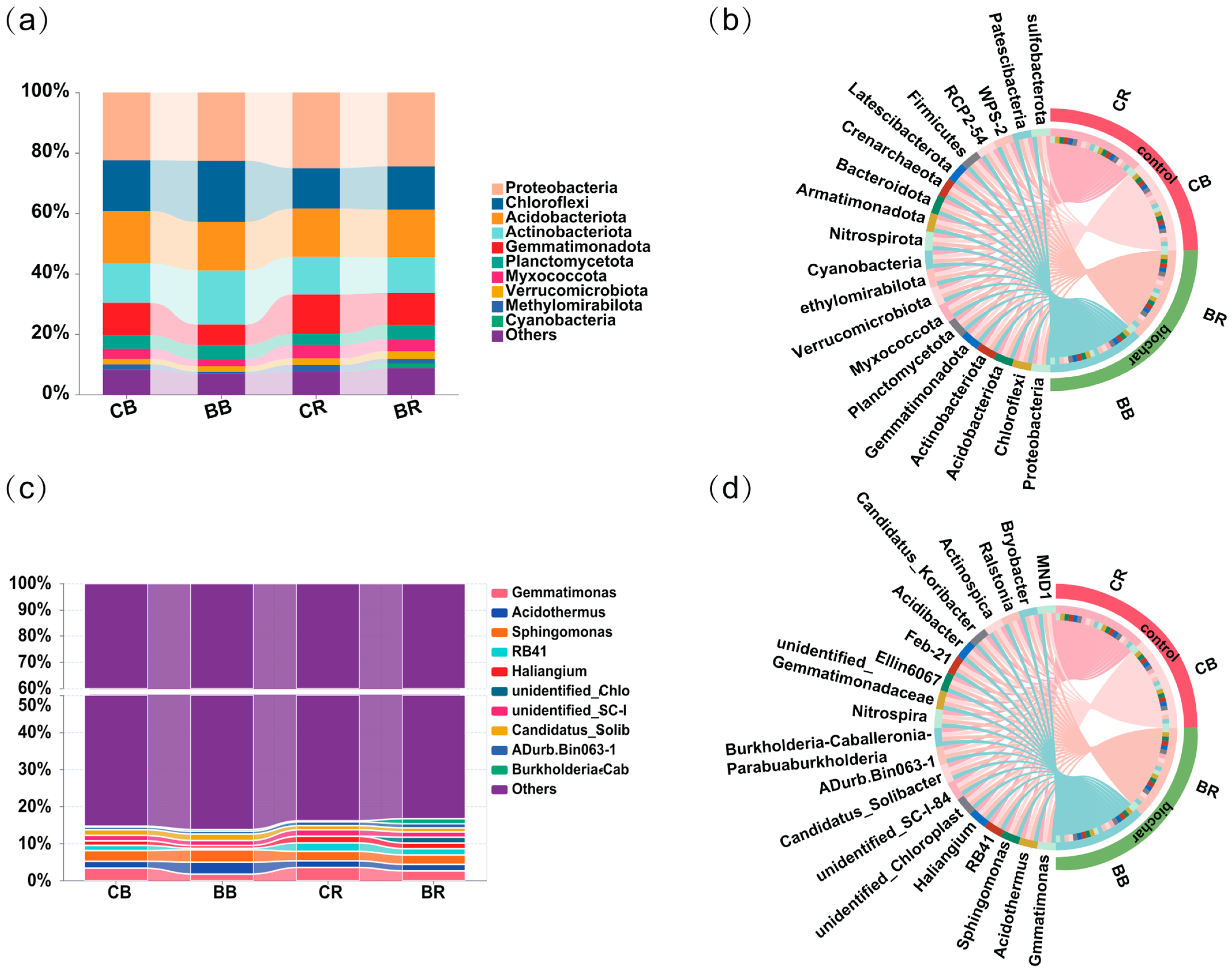
At the phylum level, bar plots (Figure 1a) and a chord diagram (Figure 1b) show shifts in dominant taxa following biochar application. Across all groups, the most abundant phyla (each >10% relative abundance) included Proteobacteria, Chloroflexi, Acidobacteriota, Actinobacteriota, and Gemmatimonadota, together accounting for >76% of the total community. At the genus level, biochar also altered the relative abundance of several key taxa (Figure 1c,d), with Gemmatimonas, Acidothermus, and Sphingomonas being among the most abundant genera detected.

3.1.2. Identification of Differentially Abundant Phyla in Soil Bacterial Communities of a Cassava Field Under Biochar Application Using T–Test Analysis

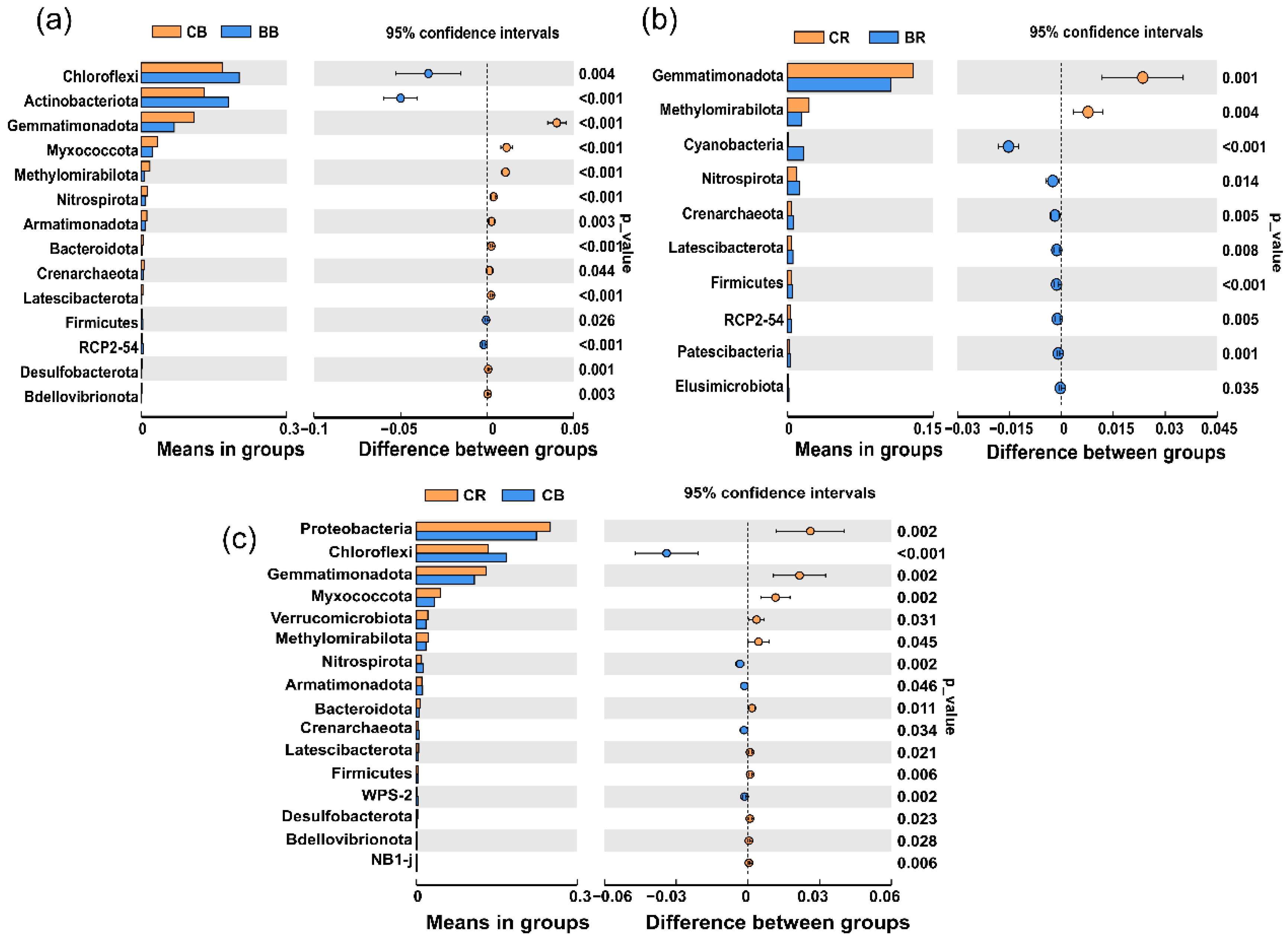
T–test comparisons revealed several phyla with different relative abundances between treatments (p < 0.05). In the bulk soil, Chloroflexi and Actinobacteriota were more abundant in BB than in CB, while Gemmatimonadota, Myxococcota, Methylomirabilota, and Nitrospirota were less abundant (Figure 2a). In the rhizosphere soil, Gemmatimonadota and Methylomirabilota decreased in BR relative to CR, while Cyanobacteria, Nitrospirota, Crenarchaeota, and Latescibacterota increased (Figure 2b). In addition, even without biochar, the rhizosphere and bulk soils communities differed (CR vs. CB; Figure 2c), with the rhizosphere enriched in Proteobacteria and Gemmatimonadota. Differentially abundant genera are shown in Figures S2–S4.

3.1.3. The Influence of Biochar Application on the Complexity of Bacterial Symbiosis Network

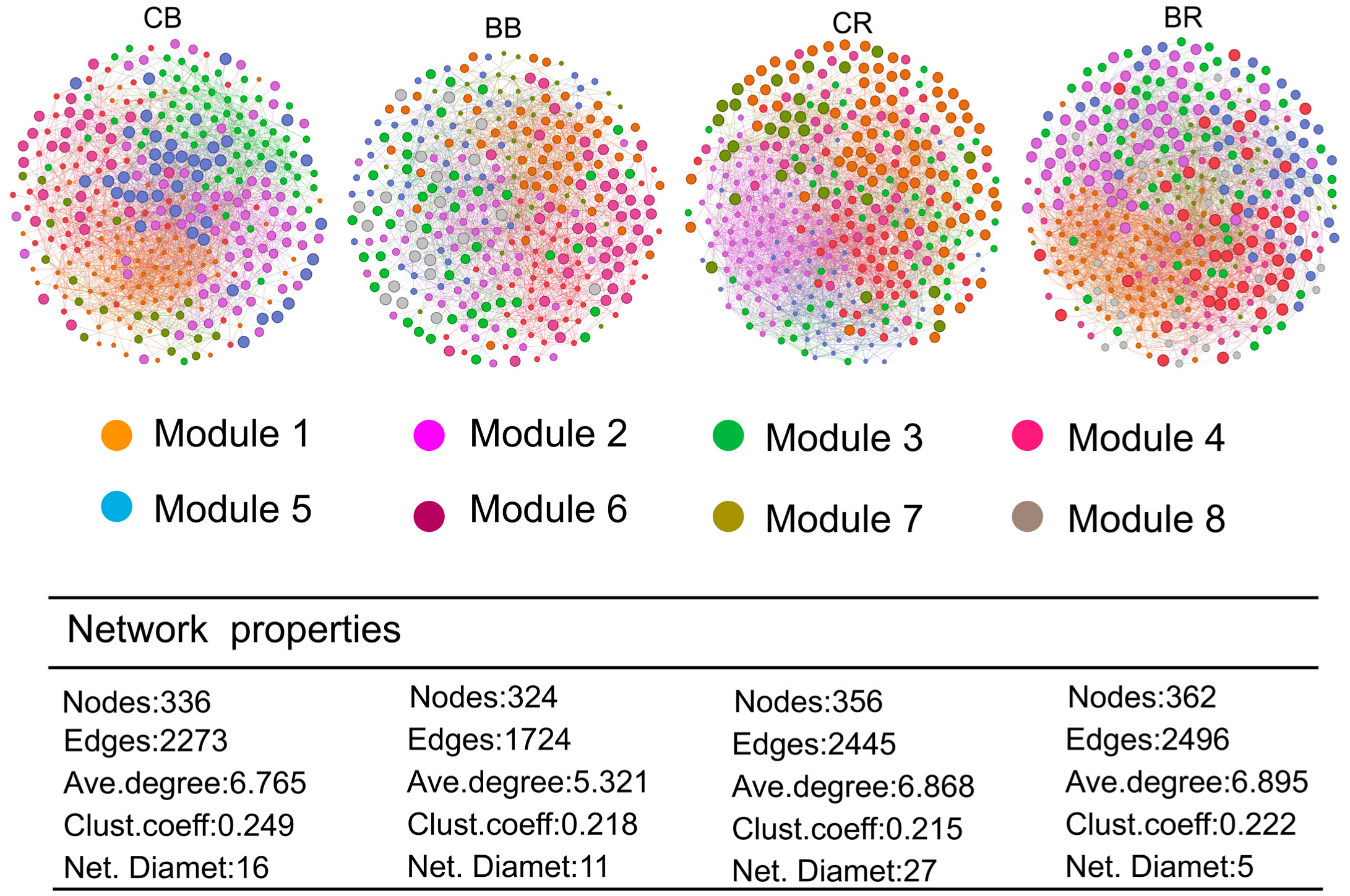
To explore how biochar may relate to bacterial co–occurrence patterns, we constructed correlation-based co–occurrence networks for each group (Figure 3). The networks varied across soil compartments. Comparisons of topological features (e.g., numbers of nodes, edges, and network diameter) indicated higher apparent network complexity in the rhizosphere soil under biochar treatment, while bulk–soil networks showed reduced complexity relative to the control. Consistently, clustering coefficients further indicated stronger network connectivity in the rhizosphere soil and weaker connectivity in the bulk soil after biochar application. These results highlight compartment-specific network responses in the cassava field.

3.2. Response of Soil Metabolism to Biochar Application

3.2.1. Metabolic Spectrum of Soil Samples

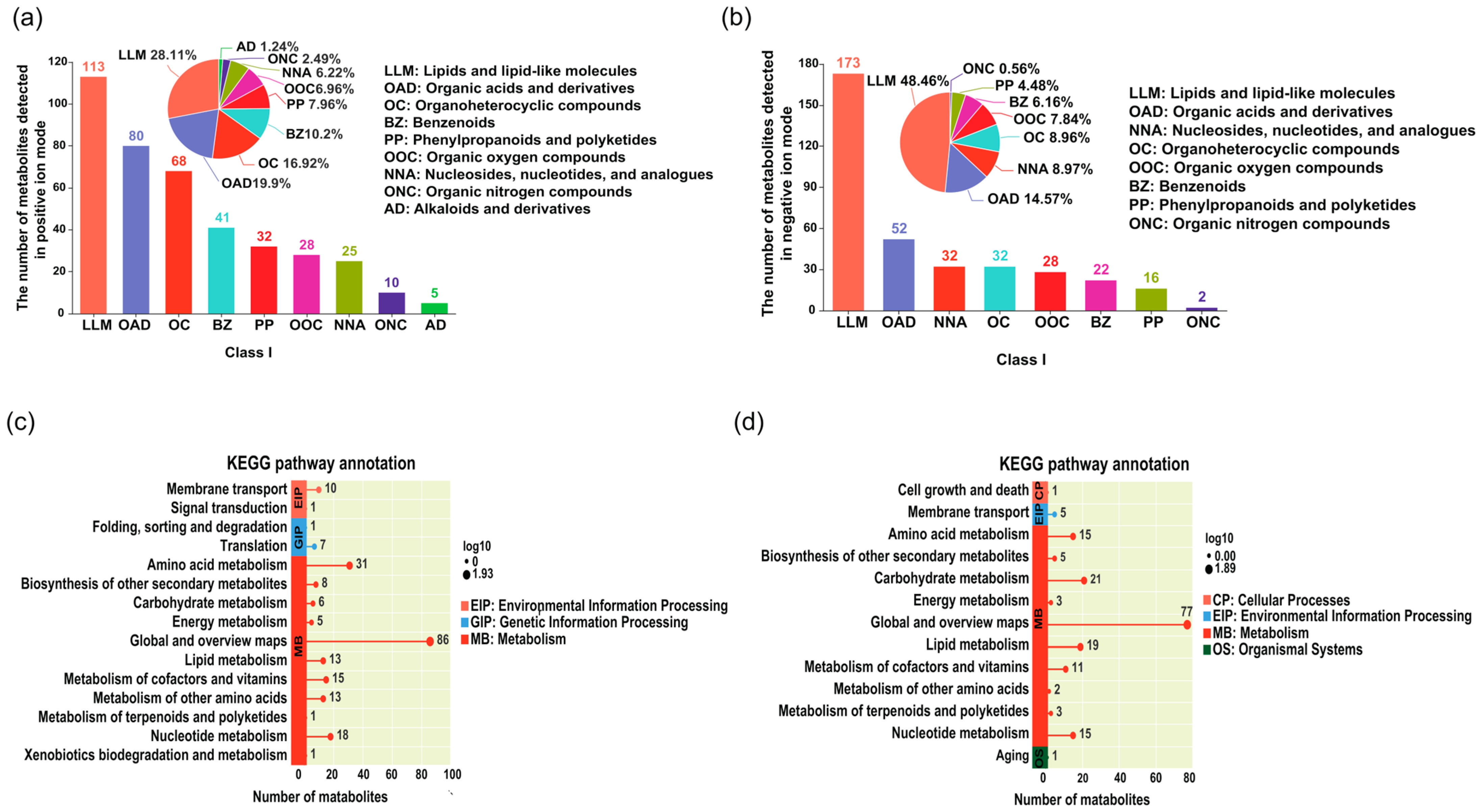
Non-targeted metabolomic analysis was used to identify 402 metabolites in positive ion mode and 357 in negative ion mode. Lipids and lipid–like molecules were the most abundant compounds, accounting for 28.11% and 48.46% of the total metabolites in the positive and negative ion modes, respectively (Figure 4a,b). Organic acids and their derivatives were the second most abundant, accounting for 19.9% and 14.57% of all metabolites in the positive and negative ion modes, respectively. Functional and classification annotations of the metabolites were conducted using the KEGG database, with most metabolites being mapped to the “metabolism” pathway. The “global and overview maps” pathway was the most annotated sub–pathway (Figure 4c,d), followed by “Amino acid metabolism” in positive ion mode and “Carbohydrate metabolism” in negative ion mode.

3.2.2. Analysis of the Impact of Biochar on Differential Metabolites and Metabolic Pathways in the Rhizosphere Soil of a Cassava Field

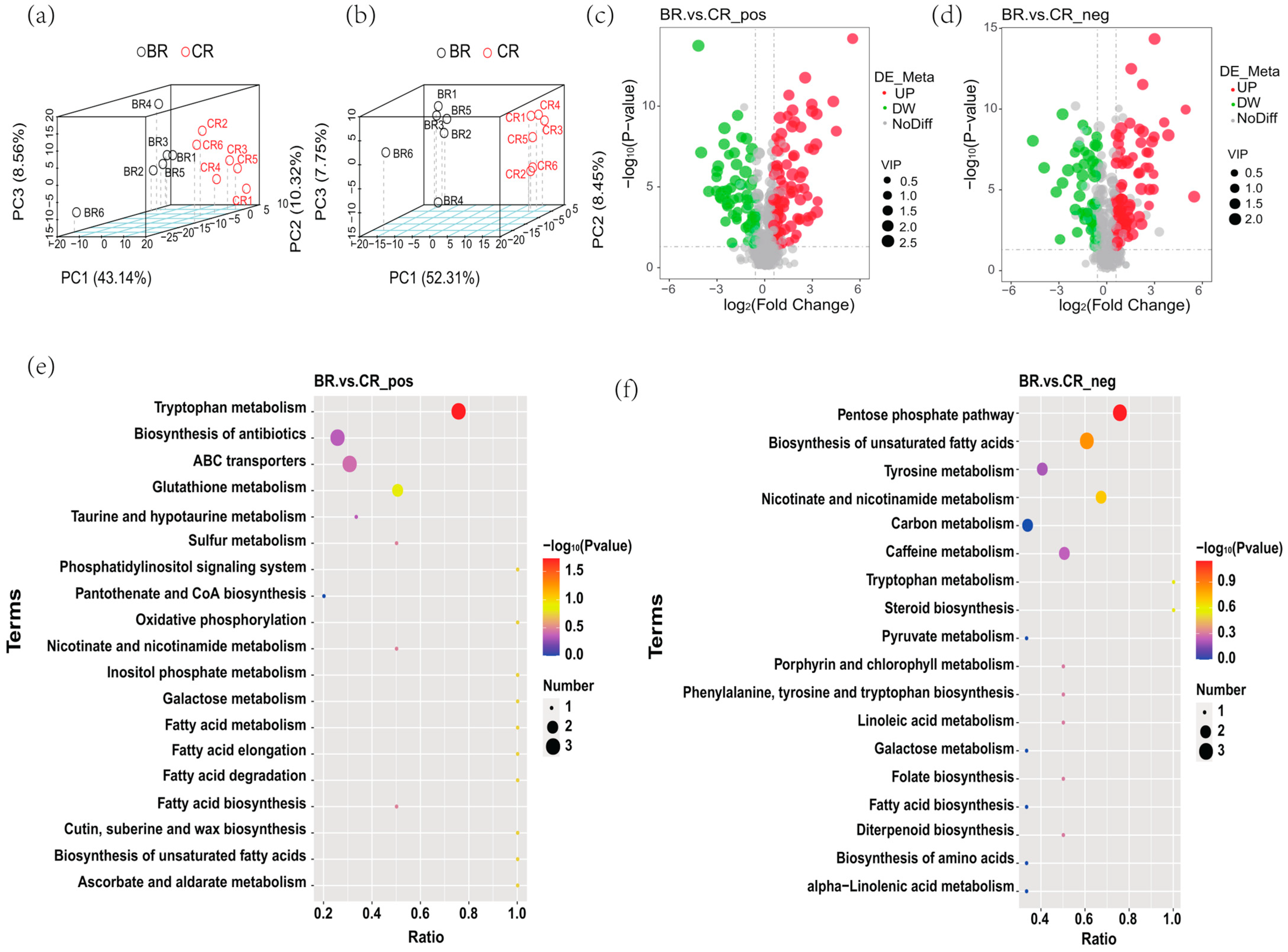
Multivariate analysis showed differences in the rhizosphere metabolite profiles between BR and CR. PCA indicated separation of BR and CR along the major components (Figure 5a,b), suggesting a shift in the rhizosphere metabolite composition following biochar application. Differential metabolites were further screened using volcano plots (Figure 5c,d). In the rhizosphere soil, 82 metabolites (positive ion mode) and 71 metabolites (negative ion mode) were upregulated in BR compared to CR, while 66 (positive) and 50 (negative) were downregulated (Table S4). The upregulated metabolites mainly included alkaloids and their derivatives, phenolic compounds, nucleosides, nucleotides and their analogs, organic oxidants, and phenylpropanoids and polyphenolic compounds. Several of these metabolites, such as trigonelline, berberine, vincristine, catechin, naringin, rutin, and taxifolin, are commonly linked to antioxidant and plant defense processes and showed higher relative abundances in BR than in CR (Table S5). Pathway enrichment analysis of differential metabolites indicated significant enrichment of “Tryptophan metabolism” in the rhizosphere soil after biochar application (Figure 5e,f).

3.2.3. Analysis of the Impact of Biochar on Differential Metabolites and Metabolic Pathways in the Bulk Soil of a Cassava Field

The metabolite profiles of bulk soil also differed between the BB and CB groups. PCA showed separation between BB and CB (Figure S5a,b), indicating a shift in the metabolite composition of bulk soil after biochar application. In positive ion mode, 78 metabolites were upregulated and 130 downregulated in BB compared to CB; in negative ion mode, 46 metabolites were upregulated and 70 downregulated (Table S4). Among the metabolites with lower relative abundances in BB, several were identified as anthropogenic organic compounds, including monobutyl phthalate, terephthalic acid, and p–toluenesulfonic acid (Table S5). Pathway enrichment analysis indicated significant enrichment of the “Taurine and hypotaurine metabolism” pathway among the differential metabolites in the bulk soil (Figure S5e,f).

3.3. The Relationship Between Soil Bacterial Communities and Metabolite Profiles

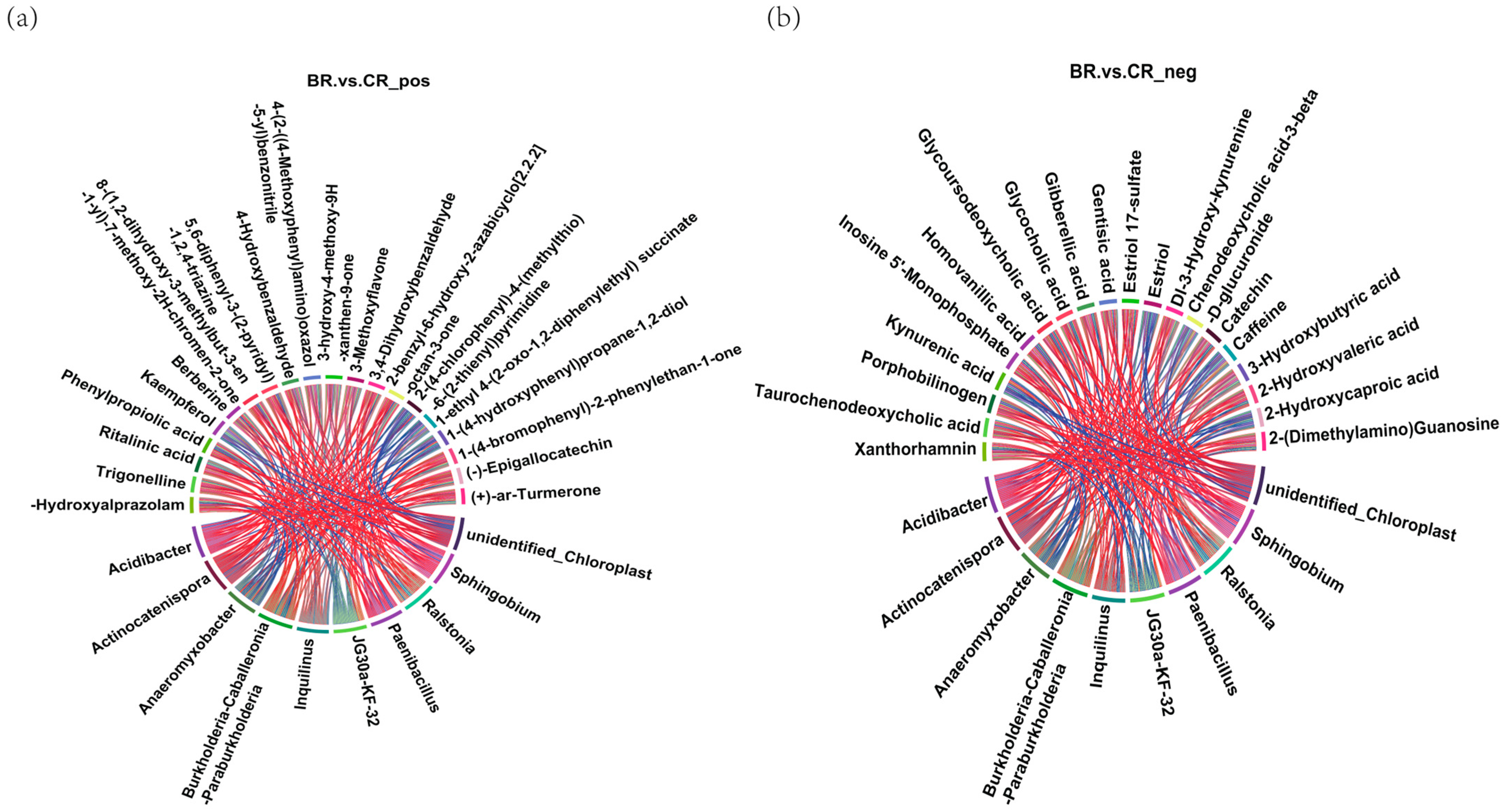
Soil microorganisms are closely linked to the production and turnover of many soil metabolites. To explore potential microbiome–metabolome linkages under biochar amendment, correlations between differential bacterial genera and metabolites were visualized using chord diagrams (Figure 6a,b and Figure S6a,b). The networks contained multiple significant associations, with positive correlations being more frequent than negative ones. Several genera were associated with multiple metabolites, and some metabolites were correlated with more than one genus. For example, in the rhizosphere soil, trigonelline was positively correlated with Actinocatenispora (r = 0.98), Acidibacter (r = 0.95), and Paenibacillus (r = 0.92). In the bulk soil, monobutyl phthalate showed negative correlations with genera including Acidothermus (r = −0.96), Actinospica (r = −0.97), Bryobacter (r = −0.94), and Catenulispora (r = −0.95). These co–variation patterns indicated coordinated shifts between bacterial taxa and metabolite features under biochar treatment.

4. Discussion

4.1. Biochar Application Altered Soil Bacterial Diversity and Community Structure in a Cassava Field

In the present field trial, biochar application increased bacterial α-diversity in the rhizosphere soil, with observed_species, Shannon, and Simpson indices significantly higher than those of the control, which is consistent with our hypothesis (Table S3). Ordination analysis further revealed separation in bacterial community composition among treatments and compartments (Figure S1), indicating that biochar was associated with changes in community structure. These changes occurred under continuous cassava cropping, a system in which deterioration of soil physicochemical properties and declines in microbial diversity are widely reported to compromise key soil ecological functions [13]. Biochar has therefore attracted increasing attention as a soil amendment due to its capacity to improve soil physicochemical conditions, promote microbial recovery, and enhance soil ecological functioning [39,40,41]. Similar responses have been reported in other cropping systems, where biochar inputs were linked to changes in microbial diversity and community composition [26,42]. These community shifts may be linked to changes in soil organic carbon and nutrient availability (e.g., AN and AP) observed in this study (Table S2). Owing to its porous structure and surface charge properties, biochar helped limit nutrient leaching and gaseous losses, which in turn promoted nitrogen retention and increased the availability of phosphorus in soils [43]. In line with this mechanism, field study has demonstrated that cotton stalk biochar significantly increased the available phosphorus in cotton–growing soils [24]. Additionally, pot experiments revealed that biochar application notably enhanced nutrient availability in soils subjected to long–term chrysanthemum continuous cropping, with a particular increase in available nitrogen under sludge-derived biochar treatment [26]. Similar improvements in soil N, P, and K availability have been observed with tobacco stem-derived biochar in a continuous cropping system of bletilla striata [44].
Biochar had distinct effects in different soil regions. In the cassava rhizosphere, root exudates, such as hydroxyacetone, acetic acid, and 2,4–ditert–butylphenol, create a unique environment compared to bulk soil [45,46]. In our study, Chloroflexi and Actinobacteriota were relatively enriched in bulk soil, whereas Cyanobacteria and Nitrospirota were more abundant in the rhizosphere soil under biochar application (Figure 2). Biochar has a large surface area and a porous structure, which increases soil porosity and surface area [18,19], providing more habitat for microorganisms. Actinobacteriota and Chloroflexi are likely to colonize and proliferate more easily in these newly formed microenvironments. Actinobacteria are capable of degrading complex organic matter [47]. When biochar is added to the soil, it gradually releases some organic substances over time, which may provide suitable metabolic substrates for actinobacteria and promote their proliferation. Cyanobacteria, capable of fixing atmospheric nitrogen and performing photosynthesis, enhanced nitrogen availability in soil [48]. Additionally, the increased abundance of Nitrospirota suggests that biochar may stimulate nitrification processes in the rhizosphere, potentially improving nitrogen availability for plant uptake [49]. These results show that biochar was related to the compartment-specific shifts in bacterial assemblages, potentially through changes in local microhabitats and resource availability that can influence ecological niches and microbial activity.
Consistent with our hypothesis, co–occurrence network analysis of soil bacterial communities showed that biochar was linked to changes in network topology in a soil-compartment-specific manner. In the rhizosphere soil, biochar treatment exhibited higher network connectivity and apparent complexity, whereas the network in bulk soil showed reduced connectivity and complexity relative to the control (Figure 3). Such changes are in line with reports that organic amendments can reorganize microbial co–occurrence patterns, although the direction of network responses varies across study systems [50,51]. For example, the combined application of biochar and green manure has been reported to increase fungal network complexity while decreasing bacterial network complexity [52]. Overall, the contrasting network responses likely depend on soil compartment and may be influenced by plant species, soil type, and microsite conditions.

4.2. Alterations of Soil Metabolic Profiles and Key Pathways Under Biochar Amendment

Consistent with our hypothesis, the effects of biochar on soil metabolites varied across soil compartments. Rhizosphere metabolites, primarily derived from microorganisms and plant roots, serve as reliable indicators of plant and microbial response to changes in soil management [53]. In this study, non-targeted metabolomics indicated that biochar application was associated with a clear shift in the metabolite profiles of cassava rhizosphere soil. Among the metabolites that increased in relative abundance after biochar amendment, many belonged to secondary metabolite classes, including alkaloids and flavonoids. These compound classes have been widely reported to participate in antioxidant processes and plant defense-related responses [25].
Specifically, several alkaloids (e.g., trigonelline, berberine, and vincristine) showed higher relative abundances in the rhizosphere soil under biochar treatment (Table S5). Trigonelline is known for its role in reactive oxygen species scavenging and stress–related responses in plants [54,55], whereas berberine and vincristine have been reported to exhibit antimicrobial activities in other contexts [56,57]. Likewise, biochar treatment increased the relative abundance of several flavonoids, including catechin, naringin, rutin, and taxifolin (Table S5). These compounds have been associated with antioxidant activity and stress responses, and may also influence plant–microbe interactions in the rhizosphere [58,59,60,61]. Taken together, a significant enrichment of metabolites commonly associated with plant defense and antioxidant functions was observed in the cassava rhizosphere following biochar application.
In bulk soil, where metabolites are largely derived from microbial metabolism and SOM turnover, biochar application was also associated with changes in metabolite composition. The number of downregulated features exceeded that of upregulated ones, indicating an overall shift in the bulk-soil metabolic profile. Notably, several anthropogenic organic compounds (e.g., monobutyl phthalate, terephthalic acid, and p-toluenesulfonic acid) showed lower detected levels in bulk soil after biochar application (Table S5). Terephthalic acid can originate from degradation of synthetic polymers and may pose ecological risks at elevated concentrations [62]. The observed decreases may be attributed to the known capacity of biochar to sorb or immobilize organic compounds due to its porous structure and surface functional groups, as reported in previous studies [63,64,65,66].

4.3. Connections Between Soil Bacterial Community Changes and Metabolic Responses to Biochar

Soil metabolite profiles are tightly coupled with microbial community composition, and their coordinated variation can reflect changes in nutrient turnover and other soil biochemical processes [62]. To explore potential microbiome–metabolome linkages under biochar amendment, we conducted correlation analyses between differential bacterial genera and differential metabolites. The results show the multiple significant associations between rhizosphere and bulk soils, indicating that shifts in bacterial taxa and metabolite features occurred in a coordinated manner.
Metabolites in the rhizosphere serve as both signals and nutrients, influencing the formation of the microbiome and playing an essential role in plant–microbe communication [67]. In the rhizosphere, trigonelline was positively correlated with Actinocatenispora (r = 0.98), Acidibacter (r = 0.95), and Paenibacillus (r = 0.92) (Figure 6), which suggests that trigonelline abundance and the relative abundance of certain taxa increased concurrently in the rhizosphere. However, whether trigonelline directly stimulates the growth of these taxa in the rhizosphere soil of cassava still needs to be explored in more detail through further research.
In the bulk soil, several anthropogenic organic compounds, such as monobutyl phthalate, showed negative correlations with genera including Acidothermus (r = −0.96), Actinospica (r = −0.97), Bryobacter (r = −0.94), and Catenulispora (r = −0.95) (Figure S6). These negative correlations suggest that anthropogenic organic pollutants may exert selective inhibitory effects on certain bacterial groups. Biochar amendment could alleviate this stress by sorbing these compounds and reducing their bioavailability [68], thereby facilitating the recovery or proliferation of these taxa. Such patterns may also imply a potential link between these bacteria and pollutant transformation, although this possibility requires further functional validation. Taken together, the 16S rRNA sequencing and metabolomic results indicate the compartment-specific associations between microbial communities and metabolite profiles following biochar amendment in a continuous cassava field. These field-based observations provide a foundation for future studies to determine how biochar-induced shifts in microbes and metabolites influence soil processes [25,69].

4.4. Implications for Cassava Continuous Cropping and Biochar Management

This field study showed that a single biochar application rate was associated with the compartment-specific shifts in bacterial communities and soil metabolite profiles under continuous cassava cultivation. In particular, biochar increased bacterial α-diversity in the rhizosphere soil. It also altered the community composition, co–occurrence network topology, and metabolite signatures. These findings demonstrate the practical value of biochar application in cassava cultivation. Increases in soil microbial diversity and changes in metabolite profiles indicate that biochar may contribute to improved soil health. Biochar also appears to enhance nutrient cycling and may help alleviate soil degradation caused by continuous cassava cropping. By creating a more favorable rhizosphere environment, biochar may support root development and improve cassava yield. Together, these effects suggest that biochar could serve as an effective tool for sustainable cassava production. In addition, its ability to reduce nutrient losses and improve soil fertility highlights its potential for optimizing input management. This may also reduce dependence on chemical fertilizers and support more environmentally friendly farming practices.
Despite these promising results, the present study is exploratory. Different biochar application rates may lead to distinct microbial and metabolic responses. Moreover, metabolomic analyses capture biological processes under specific environmental and temporal conditions. As a result, the dynamics of soil metabolites and their links to microbial community structure require further study. Biochar performance may also vary depending on the feedstock type, pyrolysis conditions, and soil properties. Future research should therefore focus on long–term field experiments. Such studies are needed to evaluate the sustained effects of biochar on soil health and cassava yield across multiple cropping cycles. Comparative assessments of biochar derived from different materials and production conditions will help clarify their soil-specific effects. When combined with integrated multi–omics approaches, including metagenomics, transcriptomics, and metabolomics, these efforts can provide deeper insight into interactions among biochar, soil microorganisms, and metabolic processes. This knowledge will support the development of optimized biochar management strategies for sustainable cassava production systems.

5. Conclusions

In this study, biochar treatment significantly increased the α diversity of bacteria in the rhizosphere soil and altered the structure of the bacterial community in a continuous cassava cropping system. At the phylum level, biochar caused compartment-specific responses. Biochar treatment increased the abundance of Chloroflexi and Actinobacteriota in the bulk soil, whereas Cyanobacteria and Nitrospirota were enriched in the rhizosphere soil. Network analysis revealed the compartment-specific differences after biochar application. Compared to the control, the rhizosphere network had higher complexity, while the bulk soil network showed lower complexity. By metabolomic analysis, 402 metabolites in positive ion mode were identified, and 357 metabolites in negative ion mode. In the rhizosphere soil, biochar treatment led to the higher relative abundances of several alkaloids (such as trigonelline, berberine, and vincristine) and flavonoids (such as catechin, naringin, rutin, and taxifolin), which are often associated with plant stress responses. In the bulk soil, the levels of several anthropogenic organic compounds (such as monobutyl phthalate, terephthalic acid, and p–toluenesulfonic acid) were lower in biochar-treated samples. Overall, these results indicate that biochar application can modify soil microbiome–metabolome patterns in the cassava field. The findings provide field-based evidence supporting the use of biochar in continuous cassava cropping systems.

Supplementary Materials

The following supporting information can be downloaded at https://www.mdpi.com/article/10.3390/agriculture16040418/s1, Figure S1: PCoA showing differences in microbial community composition among the differ ent groups; Figure S2: Differentially abundant genera in bacterial communities between CB and BB groups (p < 0.05); Figure S3: Differentially abundant genera in bacterial communities between CR and BR groups (p < 0.05); Figure S4: Differentially abundant genera in bacterial communities between CR and CB groups (p < 0.05); Figure S5: Effects of biochar on differential metabolites and metabolic pathways in the bulk soil of a cassava field; Figure S6: Chord diagrams showing the correlation networks between bacterial communities and metabolites detected in positive (a) and negative (b) ion modes in cassava bulk soil under biochar amendment; Table S1: The physicochemical characteristics of the corn stalk biochar used in this study; Table S2: The physicochemical properties under different groups (mean ± SE, n = 3); Table S3: Alpha diversity of bacterial communities under different groups (mean ± SE, n = 3); Table S4: Classification and numbers of up- and down-regulated metabolites detected in positive and negative ion modes; Table S5: Statistical identification of significantly differential metabolites.

Author Contributions

Conceptualization, Y.Z., Y.W. and J.Z.; methodology, Y.Z. and J.Z.; software, Y.Z.; validation, Y.Z.; formal analysis, Y.Z.; investigation, Y.Z., Y.H., X.D., S.Z. and N.H.; resources, X.Q.; data curation, X.Q.; writing—original draft preparation, Y.Z.; writing—review and editing, J.Z. and Y.W.; visualization, J.Z. and Y.W.; supervision, J.Z. and Y.W.; project administration, Y.Z.; funding acquisition, Y.Z., Y.W., X.Q. and N.H. All authors have read and agreed to the published version of the manuscript.

Funding

This work was supported by the Research Capacity Enhancement Program for Mid-Career and Young Faculty in Guangxi Universities (2025KY0445), the Guangxi natural science foundation youth science fund project (2022GXNSFBA035530), the Guangxi Natural Science Foundation (2023GXNSFAA026440), the Opening Foundation of Key Laboratory of Environment Change and Resources Use in Beibu Gulf, Ministry of Education, Nanning Normal University (NNNU-KLOP-X2006), and the Basic Scientific Research Fund of the Guangxi Academy of Agricultural Sciences, China (2026YT004).

Data Availability Statement

The raw data supporting the conclusions of this article will be made available by the authors upon request.

Conflicts of Interest

The authors declare that they have no conflicts of interest.

References

  1. Muiruri, S.K.; Ntui, V.O.; Tripathi, L.; Tripathi, J.N. Mechanisms and approaches towards enhanced drought tolerance in cassava (Manihot esculenta). Curr. Plant Biol. 2021, 28, 100227. [Google Scholar] [CrossRef]
  2. Ji, F.; Cao, T.; Liu, S.; Zhou, H. Cassava: Nutritional characteristics as energy feed and utilization in monogastric animal production. Chin. J. Anim. Nutr. 2021, 33, 622–636. (In Chinese) [Google Scholar]
  3. Borku, A.W.; Tora, T.T.; Masha, M. Cassava in focus: A comprehensive literature review, its production, processing landscape, and multi-dimensional benefits to society. Food Chem. Adv. 2025, 7, 100945. [Google Scholar] [CrossRef]
  4. Hasegawa, T.; Sands, R.D.; Brunelle, T.; Cui, Y.; Frank, S.; Fujimori, S.; Popp, A. Food security under high bioenergy demand toward long-term climate goals. Clim. Change 2020, 163, 1587–1601. [Google Scholar]
  5. Zhu, Y.; Wei, Y.; Qin, X. Cassava–maize rotation improves soil quality and microbial gene profiles compared to continuous cassava cropping. Agronomy 2025, 15, 1999. [Google Scholar] [CrossRef]
  6. Zhu, L.; Yi, H.; Su, H.; Guikema, S.; Liu, B. Impacts of climate change on cassava yield and lifecycle energy and greenhouse gas performance of cassava ethanol systems: An example from Guangxi Province, China. J. Environ. Manag. 2023, 34, 119162. [Google Scholar] [CrossRef]
  7. Li, L.; Shen, Z.; Qin, F.; Yang, W.; Zhou, J.; Yang, T.; Han, X.; Wang, Z.; Wei, M. Effects of tillage and N applications on the cassava rhizosphere fungal communities. Agronomy 2023, 13, 237. [Google Scholar] [CrossRef]
  8. Haq, M.Z.U.; Bai, Z.; Gu, G.; Liu, Y.; Yang, D.; Yang, H.; Yu, J.; Wu, Y. Continuous cropping obstacles in medicinal plants: Driven by soil microbial communities and root exudates. A review. Plant Sci. 2025, 359, 112686. [Google Scholar] [CrossRef]
  9. Zhao, Y.; Qin, X.; Tian, X.; Yang, T.; Deng, R.; Huang, J. Effects of continuous cropping of Pinellia ternata (Thunb.) Breit. on soil physicochemical properties, enzyme activities, microbial communities and functional genes. Chem. Biol. Technol. Agric. 2021, 8, 43. [Google Scholar] [CrossRef]
  10. Liao, J.; Xia, P. Continuous cropping obstacles of medicinal plants: Focus on the plant-soil-microbe interaction system in the rhizosphere. Sci. Hortic. 2024, 328, 112927. [Google Scholar]
  11. Gan, T.; Yuan, Z.; Gustave, W.; Luan, T.; He, L.; Jia, Z.; Zhao, X.; Wang, S.; Deng, Y.; Zhang, X.; et al. Challenges of continuous cropping in Rehmannia glutinosa: Mechanisms and mitigation measures. Soil Environ. Health 2025, 3, 100144. [Google Scholar]
  12. Huang, Y.; Peng, X.; Ou, G.; Peng, X.; Gan, L.; Huang, Y.; Yang, T.; Qin, F.; Shen, Z.; Wei, M. Effects of continuous cropping on fungal community structure succession in rhizosphere and non-rhizosphere soils of cassava. Guihaia 2024, 55, 1864–1877. (In Chinese) [Google Scholar]
  13. Peng, X.; Li, L.; Ou, G.; Huang, Y.; Peng, X.; Yang, T.; Gan, L.; Shen, Z.; Wei, M. Effects of continuous cropping of cassava on soil physicochemical properties and bacterial community succession. J. South. Agric. 2024, 55, 942–953. (In Chinese) [Google Scholar]
  14. Chen, H.; Ruan, L.; Cao, S.; He, W.; Yang, H.; Liang, Z.; Li, H.; Wei, W.; Huang, Z.; Lan, X. Cassava-soybean intercropping alleviates continuous cassava cropping obstacles by improving its rhizosphere microecology. Front. Microbiol. 2025, 16, 1531212. [Google Scholar]
  15. Liu, S.; Luo, X.; Wu, M.; Tang, Z.; Wang, C.; Zhang, J. Comparison of cassava yield and soil microbial characteristics under continuous cropping and rotation. Chin. J. Trop. Crops 2019, 40, 1468–1473. (In Chinese) [Google Scholar]
  16. Afshar, M.; Mofatteh, S. Biochar for a sustainable future: Environmentally friendly production and diverse applications. Results Eng. 2024, 23, 102433. [Google Scholar] [CrossRef]
  17. Fidel, R.B.; Laird, D.A.; Thompson, M.L.; Lawrinenko, M. Characterization and quantification of biochar alkalinity. Chemosphere 2017, 167, 367–373. [Google Scholar] [CrossRef] [PubMed]
  18. Leng, L.; Xiong, Q.; Yang, L.; Li, H.; Zhou, Y.; Zhang, W.; Jiang, S.; Li, H.; Huang, H. An overview on engineering the surface area and porosity of biochar. Sci. Total Environ. 2021, 763, 144204. [Google Scholar] [PubMed]
  19. Luo, D.; Wang, L.; Nan, H.; Cao, Y.; Wang, H.; Kumar, T.V.; Wang, C. Phosphorus adsorption by functionalized biochar: A review. Environ. Chem. Lett. 2023, 21, 497–524. [Google Scholar]
  20. Yan, B.; Zhang, Y.; Wang, Y.; Rong, X.; Peng, J.; Fei, J.; Luo, G. Biochar amendments combined with organic fertilizer improve maize productivity and mitigate nutrient loss by regulating the C-N-P stoichiometry of soil, microbiome, and enzymes. Chemosphere 2023, 324, 138293. [Google Scholar]
  21. Zou, Y.; An, Z.; Chen, X.; Zheng, X.; Zhang, B.; Zhang, S.; Chang, S.; Jia, J. Effects of co-applied biochar and plant growth-promoting bacteria on soil carbon mineralization and nutrient availability under two nitrogen addition rates. Ecotoxicol. Environ. Saf. 2023, 266, 115579. [Google Scholar]
  22. Hu, W.; Zhan, Y.; Rong, X.; Zhou, X.; Fei, J.; Peng, J.; Luo, G. Biochar and organic fertilizer applications enhance soil functional microbial abundance and agroecosystem multifunctionality. Biochar 2024, 6, 3. [Google Scholar] [CrossRef]
  23. Asadyar, L.; Xu, C.; Wallace, H.; Xu, Z.; Reverchon, F.; Bai, S. Soil-plant nitrogen isotope composition and nitrogen cycling after biochar applications. Environ. Sci. Pollut. Res. 2021, 28, 6684–6690. [Google Scholar]
  24. Dong, X.; Zhang, Z.; Wang, S.; Shen, Z.; Cheng, X.; Lv, X.; Pu, X. Soil properties, root morphology and physiological responses to cotton stalk biochar addition in two continuous cropping cotton field soils from Xinjiang, China. PeerJ 2022, 10, e12928. [Google Scholar] [CrossRef] [PubMed]
  25. Cui, X.; Yuan, J.; Yang, X.; Wei, C.; Bi, Y.; Sun, Q.; Meng, J.; Han, X. Biochar application alters soil metabolites and nitrogen cycle-related microorganisms in a soybean continuous cropping system. Sci. Total Environ. 2024, 917, 170522. [Google Scholar]
  26. Feng, Y.; Hu, X.; Guan, Y.; Chu, Z.; Du, X.; Xie, Y.; Yang, S.; Ye, S.; Zhang, L.; Ma, J.; et al. Regulatory effects of different biochar on soil properties and microbial community structure in chrysanthemum continuous cropping soil. Agronomy 2024, 14, 2034. [Google Scholar] [CrossRef]
  27. Gong, X.; Feng, Y.; Dang, K.; Jiang, Y.; Qi, H.; Feng, B. Linkages of microbial community structure and root exudates: Evidence from microbial nitrogen limitation in soils of crop families. Sci. Total Environ. 2023, 881, 163536. [Google Scholar]
  28. Zeng, J.; Xing, L.; Li, Y.; Wang, X.; Zhang, Q.; Liu, H.; Liu, Y.; Feng, Y.; Wang, X.; Ren, C.; et al. Divergent mechanisms of rhizosphere and non-rhizosphere soil organic carbon sequestration under precipitation variability: Evidence from microbial life-history strategies. Appl. Soil Ecol. 2025, 213, 106302. [Google Scholar]
  29. Spaargaren, O.C.; Deckers, J. The World Reference Base for Soil Resources. In Soils of Tropical Forest Ecosystems; Schulte, A., Ruhiyat, D., Eds.; Springer: Berlin/Heidelberg, Germany, 1998. [Google Scholar]
  30. Bao, S. Soil and Agricultural Chemistry Analysis, 3rd ed.; China Agriculture Press: Beijing, China, 2000. [Google Scholar]
  31. Bokulich, N.A.; Subramanian, S.; Faith, J.J.; Gevers, D.; Gordon, J.I.; Knight, R.; Mills, D.A.; Caporaso, J.G. Quality-filtering vastly improves diversity estimates from Illumina amplicon sequencing. Nat. Methods 2012, 10, 57–59. [Google Scholar] [CrossRef]
  32. Edgar, R.C.; Haas, B.J.; Clemente, J.C.; Quince, C.; Knight, R. UCHIME improves sensitivity and speed of chimera detection. Bioinformatics 2011, 27, 2194–2200. [Google Scholar] [CrossRef]
  33. Cherven, K. Mastering Gephi Visualization; Packet Publishing: Birmingham, UK, 2015. [Google Scholar]
  34. Newman, M.E.J. Networks: An Introduction; Oxford University Press: New York, NY, USA, 2010. [Google Scholar]
  35. Batushansky, A.; Toubiana, D.; Fait, A. Correlation-based network generation, visualization, and analysis as a powerful tool in biological studies: A case study in cancer cell metabolism. BioMed Res. Int. 2016, 2016, 8313272. [Google Scholar] [CrossRef]
  36. Bastian, M.; Heymann, S.; Jacomy, M. Gephi: An open source software for exploring and manipulating networks. Proc. Int. AAAI Conf. Web Soc. Media 2009, 3, 361–362, (In San Jose). [Google Scholar] [CrossRef]
  37. Raiesi, F.; Beheshti, A. Evaluating forest soil quality after deforestation and loss of ecosystem services using network analysis and factor analysis techniques. Catena 2022, 208, 105778. [Google Scholar] [CrossRef]
  38. Wen, B.; Mei, Z.; Zeng, C.; Liu, S. metaX: A flexible and comprehensive software for processing metabolomics data. BMC Bioinform. 2017, 18, 183. [Google Scholar] [CrossRef]
  39. Zhang, M.; Liu, Y.; Wei, Q.; Gou, J.; Liu, L.; Gu, X.; Wang, M. The co-application of PGPR and biochar enhances the production capacity of continuous cropping peppers in the karst yellow soil region of Southwest China. Horticulturae 2023, 9, 1104. [Google Scholar] [CrossRef]
  40. Gao, J.; Xu, W.; Xi, W.; Huang, R.; Zhao, Z.; Xie, H.; Zhang, F. Oats intercropping and biochar amendment modify soil nutrients and microbiota structure to enhance the quality of continuous cropping peppers. Hortscience 2024, 59, 1396–1406. [Google Scholar]
  41. Xu, W.; Li, H.; Ma, Q.; Dong, Q.; Gao, J.; Zhang, F.; Xie, H. Mitigating continuous cropping challenges in alkaline soils: The role of biochar in enhancing soil health, microbial dynamics, and pepper productivity. Ind. Crops Prod. 2025, 234, 121576. [Google Scholar] [PubMed]
  42. Yang, H.; Kerner, P.; Liang, X.; Struhs, E.; Mirkouei, A.; You, Y. Biochar amendment modulates root metabolome and rhizosphere microbiome of wheat. Biochar 2025, 7, 46. [Google Scholar] [CrossRef]
  43. Hossain, M.; Bahar, M.; Sarkar, B.; Donne, S.; Ok, Y.; Palansooriya, K.; Kirkham, M.; Chowdhury, S.; Bolan, N. Biochar and its importance on nutrient dynamics in soil and plant. Biochar 2020, 21, 379–420. [Google Scholar] [CrossRef]
  44. Zhao, L.; Guan, H.; Wang, R.; Wang, H.; Li, Z.; Li, W.; Xiang, P.; Xu, W. Effects of tobacco stem-derived biochar on soil properties and bacterial community structure under continuous cropping of Bletilla striata. J. Soil Sci. Plant Nutr. 2021, 21, 1318–1328. [Google Scholar] [CrossRef]
  45. Solomon, W.; Janda, T.; Molnár, Z. Unveiling the significance of rhizosphere: Implications for plant growth, stress response, and sustainable agriculture. Plant Physiol. Biochem. 2024, 206, 108290. [Google Scholar] [PubMed]
  46. Han, X.; Zhang, J.; Bei, L.; Huang, K.; Li, L.; Yang, T.; Wei, M. Identification and allelopathic effect of root exudates of tissue-culture cassava under continuous cropping. Southwest China J. Agric. Sci. 2023, 36, 1653–1661. (In Chinese) [Google Scholar]
  47. Javed, Z.; Tripathi, G.; Mishra, M.; Dashora, K. Actinomycetes-The microbial machinery for the organic-cycling, plant growth, and sustainable soil health. Biocatal. Agric. Biotechnol. 2021, 31, 101893. [Google Scholar]
  48. Nawaz, T.; Joshi, N.; Nelson, D.; Saud, S.; Abdelsalam, N.R.; Abdelhamid, M.M.A.; Jaremko, M.; Rahman, T.U. Harnessing the potential of nitrogen-fixing cyanobacteria: A rich bio-resource for sustainable soil fertility and enhanced crop productivity. Environ. Technol. Innov. 2024, 36, 103886. [Google Scholar]
  49. Jiang, Y.; Han, S.; Luo, X. Role of generalists, specialists and opportunists in Nitrospira community assembly in soil aggregates from nearby cropland and grassland areas in a campus. Appl. Soil Ecol. 2024, 198, 105377. [Google Scholar] [CrossRef]
  50. Ling, N.; Zhu, C.; Xue, C.; Chen, H.; Duan, Y.; Peng, C.; Guo, S.; Shen, Q. Insight into how organic amendments can shape the soil microbiome in long-term field experiments as revealed by network analysis. Soil Boil. Biochem. 2016, 99, 137–149. [Google Scholar]
  51. Xu, C.; Wang, J.; Wu, D.; Li, C.; Wang, L.; Ji, C.; Zhang, Y.; Ai, Y. Optimizing organic amendment applications to enhance carbon sequestration and economic benefits in an infertile sandy soil. J. Environ. Manag. 2022, 303, 114129. [Google Scholar] [CrossRef]
  52. Cheng, K.; Wang, X.; Fu, L.; Wang, W.; Liu, M.; Sun, B. Interaction between dissolved organic carbon and fungal network governs carbon mineralization in paddy soil under co-incorporation of green manure and biochar. Front. Microbiol. 2023, 14, 1233465. [Google Scholar] [CrossRef]
  53. Hartman, K.; van der Heijden, M.G.A.; Wittwer, R.A.; Banerjee, S.; Walser, J.C.; Schlaeppi, K. Cropping practices manipulate abundance patterns of root and soil microbiome members paving the way to smart farming. Microbiome 2018, 6, 14. [Google Scholar]
  54. Berglund, T.; Wallström, A.; Nguyen, T.V.; Laurell, C.; Ohlsson, A.B. Nicotinamide; antioxidative and DNA hypomethylation effects in plant cells. Plant Physiol. Biochem. 2017, 118, 551–560. [Google Scholar] [CrossRef] [PubMed]
  55. Abou-Sreea, A.I.B.; Kamal, M.; El Sowfy, D.M.; Rady, M.M.; Mohamed, G.F.; Al-Dhumri, S.A.; Al-Harbi, M.S.; Abdou, N.M. Small-sized nanophosphorus has a positive impact on the performance of fenugreek plants under soil-water deficit stress: A case study under field conditions. Biology 2022, 11, 115. [Google Scholar]
  56. Pavlova, J.A.; Tereshchenkov, A.G.; Sumbatyan, N.V. Conjugates of Chloramphenicol Amine and Berberine as Antimicrobial Agents. Antibiotics 2023, 12, 15. [Google Scholar] [CrossRef]
  57. Yang, X.; Wang, Y.; Li, L.; Tang, D.; Yan, Z.; Li, M.; Jiang, J.; Bi, D. Berberine and its nanoformulations and extracts: Potential strategies and future perspectives against multi-drug resistant bacterial infections. Front. Microbiol. 2025, 16, 1643409. [Google Scholar] [CrossRef] [PubMed]
  58. Yiu, J.; Tseng, M.; Liu, C. Exogenous catechin increases antioxidant enzyme activity and promotes flooding tolerance in tomato (Solanum lycopersicum L.). Plant Soil 2011, 344, 213–225. [Google Scholar] [CrossRef]
  59. Gorni, P.H.; de Lima, G.R.; Pereira, L.M.D.; Spera, K.D.; Lapaz, A.D.; Pacheco, A.C. Increasing plant performance, fruit production and nutritional value of tomato through foliar applied rutin. Sci. Hortic. 2022, 294, 110755. [Google Scholar] [CrossRef]
  60. Shen, C.; Ma, F.; Gao, S.; Zhou, J.; Huang, D.; Huang, R.; Li, H.; Tang, B. Concentration-dependent bioactivity profiles of hesperetin and naringenin: Insights into antibacterial, antioxidant, and anti-inflammatory effects. ACS Food Sci. Technol. 2025, 5, 492–501. [Google Scholar]
  61. Zhou, X.; Zhang, J.; Rahman, M.K.U.; Gao, D.; Wei, Z.; Wu, F.; Dini-Andreote, F. Interspecific plant interaction via root exudates structures the disease suppressiveness of rhizosphere microbiomes. Mol. Plant 2023, 16, 849–864. [Google Scholar] [CrossRef] [PubMed]
  62. Ma, J.; Cao, Y.; Fan, L.; Xie, Y.; Zhou, X.; Ren, Q.; Yang, X.; Gao, X.; Feng, Y. Degradation characteristics of polybutylene adipate terephthalic acid (PBAT) and its effect on soil physicochemical properties: A comparative study with several polyethylene (PE) mulch films. J. Hazard. Mater. 2023, 456, 131661. [Google Scholar] [CrossRef]
  63. Munir, R.; Muneer, A.; Sadia, B.; Younas, F.; Zahid, M.; Yaseen, M.; Noreen, S. Biochar imparted constructed wetlands (CWs) for enhanced biodegradation of organic and inorganic pollutants along with its limitation. Environ. Monit. Assess. 2024, 196, 425. [Google Scholar] [CrossRef]
  64. Xin, Z.; Tong, J.; Wang, J.; Ruan, C.; Lyu, J.; Shi, J. Research progress on activated persulfate by biochar: Soil and water environment remediation, mechanism exploration and simulation calculation. Chem. Eng. J. 2024, 493, 152718. [Google Scholar] [CrossRef]
  65. Meng, F.; Wang, Y.; Wei, Y. Advancements in biochar for soil remediation of heavy metals and/or organic pollutants. Materials 2025, 18, 1524. [Google Scholar] [CrossRef]
  66. Wang, L.; Dou, Z.; Ma, C.; Jia, X.; Wang, H.; Bao, W.; Qu, J.; Zhang, Y. Remediation of di(2-ethylhexyl) phthalate (DEHP) contaminated black soil by freeze-thaw aging biochar. J. Environ. Sci. 2024, 135, 681–692. [Google Scholar]
  67. Fan, X.; Ge, A.; Qi, S.; Guan, Y.; Wang, R.; Yu, N.; Wang, E. Root exudates and microbial metabolites: Signals and nutrients in plant-microbe interactions. Sci. China Life Sci. 2025, 681, 2290–2302. [Google Scholar] [CrossRef] [PubMed]
  68. Delannoy, M.; Yehya, S.; Techer, D.; Razafitianamaharavo, A.; Richard, A.; Caria, G.; Baroudi, M.; Montargès-Pelletier, E.; Rychen, G.; Feidt, C. Amendment of soil by biochars and activated carbons to reduce chlordecone bioavailability in piglets. Chemosphere 2018, 210, 486–494. [Google Scholar] [CrossRef] [PubMed]
  69. Cheng, H.; Yuan, M.; Tang, L.; Shen, Y.; Yu, Q.; Li, S. Integrated microbiology and metabolomics analysis reveal responses of soil microorganisms and metabolic functions to phosphorus fertilizer on semiarid farm. Sci. Total Environ. 2022, 817, 152878. [Google Scholar] [CrossRef] [PubMed]
Figure 1. Soil microbial community composition: (a) relative abundance of the top 10 soil bacterial phyla among different groups; (b) relationship of the top 20 phyla among different groups; (c) relative abundance of the top 10 soil bacterial genera among different groups; (d) relationship of the top 20 genera among different groups. CR: rhizosphere soil without biochar application; CB: bulk soil without biochar application; BR: rhizosphere soil with biochar application; BB: bulk soil with biochar application.
Agriculture 16 00418 g001
Figure 2. Differentially abundant phyla in soil bacterial communities of a cassava field under biochar application (p < 0.05): (a) soil bacterial community differences between CB and BB; (b) between CR and BR; (c) between CR and CB. Means in groups represent the mean relative abundance (%) of each bacterial phylum within the corresponding group. The dot plot displays the groups with higher proportions of bacterial phyla, and the colors are consistent with those used in the bar chart to represent the same groups. CR: rhizosphere soil without biochar application; CB: bulk soil without biochar application; BR: rhizosphere soil with biochar application; BB: bulk soil with biochar application.
Agriculture 16 00418 g002
Figure 3. Co-occurrence networks of soil bacterial communities. Networks were constructed at the genus level. Modules (Module 1–8) were identified through modularity analysis in Gephi software (version 0.10.1), representing clusters of nodes that are more strongly connected to each other than to nodes in other clusters. Different colors were used to represent different network modules. CB: bulk soil without biochar application; CR: rhizosphere soil without biochar application; BB: bulk soil with biochar application; BR: rhizosphere soil with biochar application.
Agriculture 16 00418 g003
Figure 4. Metabolic profile analysis of soil samples. (a,b) Number of metabolites detected in positive (a) and negative (b) ion modes; (c,d) KEGG pathway annotation of identified metabolites detected in positive (c) and negative (d) ion modes.
Agriculture 16 00418 g004
Figure 5. Effects of biochar on differential metabolites and metabolic pathways in the rhizosphere soil of a cassava field. (a,b) PCA of metabolite profiles detected in positive (a) and negative (b) ion modes between the BR and CR groups; (c,d) volcano plots showing differential metabolites detected in positive (c) and negative (d) ion modes between the BR and CR groups; (e,f) bubble plot of the top 20 KEGG pathways enriched by differential metabolites detected in positive (e) and negative (f) ion modes between the BR and CR groups. CR: rhizosphere soil without biochar application; BR: rhizosphere soil with biochar application.
Agriculture 16 00418 g005
Figure 6. Chord diagrams showing the correlation networks between bacterial communities and metabolites detected in positive (a) and negative (b) ion modes in the cassava rhizosphere soil under biochar amendment. In the chord diagram, the upper semicircle represents the differentially abundant metabolites (the top 20 are displayed), while the lower semicircle represents the differentially abundant bacterial genera in each comparison (the top 10 are shown). The width of each chord reflects the strength of the correlation. Chord colors indicate the direction of the correlation, with red representing positive correlations and blue representing negative correlations. CR: rhizosphere soil without biochar application; BR: rhizosphere soil with biochar application.
Agriculture 16 00418 g006
Disclaimer/Publisher’s Note: The statements, opinions and data contained in all publications are solely those of the individual author(s) and contributor(s) and not of MDPI and/or the editor(s). MDPI and/or the editor(s) disclaim responsibility for any injury to people or property resulting from any ideas, methods, instructions or products referred to in the content.