Bacillus Species in Agriculture: Functional Traits, Biocontrol Performance, and Regulatory Safety Assessment

 , , ,
, , ,
Abstract
1. Introduction
2. Taxonomy, Genomic Features and Ecological Niches of Bacillus spp.
3. Functional Traits Relevant for Agricultural Performance
3.1. Antagonistic Traits and Pathogen Suppression
3.2. Plant Growth Promotion and Nutrient Mobilisation
3.3. Abiotic Stress Resistance and Ecophysiological Effects
4. Biocontrol Performance of Bacillus spp. in Agricultural Systems
4.1. Consistent Patterns of Disease Suppression Across Crops and Regions
4.2. Fungal and Bacterial Pathogens: Shared and Divergent Control Patterns
4.3. Nematode Suppression as a Multi-Mechanism Interaction
4.4. Greenhouse Versus Field Performance
4.5. Environmental Drivers That Recurrently Limit Efficacy
5. Metabolites of Potential Concern and Safety Assessment
5.1. Toxicologically Relevant Metabolites
5.2. Risks Associated with Antimicrobial Resistance Genes
5.3. Ecological Safety
5.4. Toxicological Data, NOAEL, and ADI Considerations
6. Industrial Production, Formulation, and Application Challenges
6.1. Upstream Production and Scale-Up Constraints
6.2. Formulation Stability and Shelf-Life Limitations
6.3. Application-Stage Losses and Agronomic Compatibility
6.4. Regulatory Constraints on Process Flexibility
7. Regulatory Landscape for Bacillus spp. in the EU, US and Globally
7.1. European Union: Metabolite- and Genome-Centred Regulation
7.2. United States: Risk-Proportionate, Biology-Focused Assessment
7.3. OECD and Global Convergence Efforts
7.4. Persistent Divergences: Metabolites and Antimicrobial Resistance
7.5. Implications for Global Commercialisation
8. Knowledge Gaps and Future Perspectives
9. Conclusions
Author Contributions
Funding
Institutional Review Board Statement
Data Availability Statement
Acknowledgments
Conflicts of Interest
Abbreviations
| EU | European Union |
| US | United States |
| OECD | Organisation for Economic Co-operation and Development |
| AMR | Antimicrobial resistance |
| VOCs | Volatile organic compounds |
| OG | Operational group |
| NRPS | Nonribosomal peptide synthetase |
| PKS | Polyketide synthase |
| IAA | Indole-3-acetic acid |
| EFSA | European Food Safety Authority |
| EPA | Environmental Protection Agency |
| MAPA | Ministry of Agriculture (Brazil) |
| AI | Artificial intelligence |
| HBL | Haemolysin BL |
| NHE | Non-Haemolytic Enterotoxin |
| CytK | Cytotoxin-K |
| LOAEL | Lowest Observed Adverse Effect Level |
| ADIs | Acceptable daily intake |
References
- Li, J.; Wang, J.; Liu, H.; Macdonald, C.A.; Singh, B.K. Application of Microbial Inoculants Significantly Enhances Crop Productivity: A Meta-analysis of Studies from 2010 to 2020. J. Sustain. Agric. Environ. 2022, 1, 216–225. [Google Scholar] [CrossRef]
- Batista, B.D.; Singh, B.K. Realities and Hopes in the Application of Microbial Tools in Agriculture. Microb. Biotechnol. 2021, 14, 1258–1268. [Google Scholar] [CrossRef] [PubMed]
- Kumar, R.; Farda, B.; Mignini, A.; Djebaili, R.; Koolman, L.; Paul, A.; Mondal, S.; Joel, J.M.; Pandit, A.; Panneerselvam, P.; et al. Microbial Solutions in Agriculture: Enhancing Soil Health and Resilience through Bio-Inoculants and Bioremediation. Bacteria 2025, 4, 28. [Google Scholar] [CrossRef]
- Brás, T.; Seixas, J.; Carvalhais, N.; Jägermeyr, J. Severity of drought and heatwave crop losses tripled over the last five decades in Europe. Environ. Res. Lett. 2021, 16, 065012. [Google Scholar] [CrossRef]
- Ngegba, P.M.; Cui, G.; Khalid, M.Z.; Zhong, G. Use of Botanical Pesticides in Agriculture as an Alternative to Synthetic Pesticides. Agriculture 2022, 12, 600. [Google Scholar] [CrossRef]
- Barzman, M.; Bàrberi, P.; Birch, N.; Boonekamp, P.; Dachbrodt-Saaydeh, S.; Graf, B.; Hommel, B.; Jensen, J.; Kiss, J.; Kudsk, P.; et al. Eight principles of integrated pest management. Agron. Sustain. Dev. 2015, 35, 1199–1215. [Google Scholar] [CrossRef]
- Logan, N.A.; De Vos, P. Bacillus. In Bergey’s Manual of Systematics of Archaea and Bacteria; John Wiley & Sons, Inc.: Hoboken, NJ, USA, 2015; pp. 1–163. [Google Scholar] [CrossRef]
- Poveda, J.; González-Andrés, F. Bacillus as a Source of Phytohormones for Use in Agriculture. Appl. Microbiol. Biotechnol. 2021, 105, 8629–8645. [Google Scholar] [CrossRef]
- Dame, Z.T.; Rahman, M.; Islam, T. Bacilli as Sources of Agrobiotechnology: Recent Advances and Future Directions. Green Chem. Lett. Rev. 2021, 14, 246–271. [Google Scholar] [CrossRef]
- Nandana, M.S.; Anith, K.N. Endospore-Producing Endophytes: Structural Adaptations, Functional Roles, and Their Significance in Plant Growth and Stress Management. Int. J. Plant Soil Sci. 2025, 37, 298–312. [Google Scholar] [CrossRef]
- Prasad, B.; Sharma, D.; Kumar, P.; Dubey, R.C. Biocontrol Potential of Bacillus spp. for Resilient and Sustainable Agricultural Systems. Physiol. Mol. Plant Pathol. 2023, 128, 102173. [Google Scholar] [CrossRef]
- Pandin, C.; Coq, D.L.; Deschamps, J.; Védie, R.; Rousseau, T.; Aymerich, S.; Briandet, R. Complete Genome Sequence of Bacillus velezensis QST713: A Biocontrol Agent That Protects Agaricus Bisporus Crops against the Green Mould Disease. J. Biotechnol. 2018, 278, 10–19. [Google Scholar] [CrossRef]
- Rabbee, M.F.; Ali, M.d.S.; Choi, J.; Hwang, B.S.; Jeong, S.C.; Baek, K.-H. Bacillus velezensis: A Valuable Member of Bioactive Molecules within Plant Microbiomes. Molecules 2019, 24, 1046. [Google Scholar] [CrossRef]
- Soliman, S.A.; Khaleil, M.M.; Metwally, R.A. Evaluation of the Antifungal Activity of Bacillus amyloliquefaciens and B. velezensis and Characterization of the Bioactive Secondary Metabolites Produced against Plant Pathogenic Fungi. Biology 2022, 11, 1390. [Google Scholar] [CrossRef]
- Nimbeshaho, F.; Nihorimbere, G.; Arias, A.A.; Liénard, C.; Steels, S.; Nibasumba, A.; Nihorimbere, V.; Legrève, A.; Ongena, M. Unravelling the Secondary Metabolome and Biocontrol Potential of the Recently Described Species Bacillus Nakamurai. Microbiol. Res. 2024, 288, 127841. [Google Scholar] [CrossRef]
- Scholz, R.; Molohon, K.J.; Nachtigall, J.; Vater, J.; Markley, A.L.; Süssmuth, R.D.; Mitchell, D.A.; Borriss, R. Plantazolicin, a Novel Microcin B17/Streptolysin S-Like Natural Product from Bacillus amyloliquefaciens FZB42. J. Bacteriol. 2010, 193, 215–224. [Google Scholar] [CrossRef]
- Ryu, C.-M.; Farag, M.A.; Hu, C.-H.; Reddy, M.S.; Kloepper, J.W.; Pare, P.W. Bacterial Volatiles Induce Systemic Resistance in Arabidopsis. Plant Physiol. 2004, 134, 1017–1026. [Google Scholar] [CrossRef]
- Tahir, H.A.S.; Gu, Q.; Wu, H.; Niu, Y.; Huo, R.; Gao, X. Bacillus Volatiles Adversely Affect the Physiology and Ultra-Structure of Ralstonia Solanacearum and Induce Systemic Resistance in Tobacco against Bacterial Wilt. Sci. Rep. 2017, 7, 40481. [Google Scholar] [CrossRef]
- Mendoza, A.R.; Sikora, R.A. Biological Control of Radopholus Similis in Banana by Combined Application of the Mutualistic Endophyte Fusarium Oxysporum Strain 162, the Egg Pathogen Paecilomyces Lilacinus Strain 251 and the Antagonistic Bacteria Bacillus Firmus. BioControl 2008, 54, 263–272. [Google Scholar] [CrossRef]
- Castillo, J.D.; Lawrence, K.S.; Kloepper, J.W. Biocontrol of the Reniform Nematode by Bacillus Firmus GB-126 and Paecilomyces Lilacinus 251 on Cotton. Plant Dis. 2013, 97, 967–976. [Google Scholar] [CrossRef]
- Pandin, C.; Coq, D.L.; Canette, A.; Aymerich, S.; Briandet, R. Should the Biofilm Mode of Life Be Taken into Consideration for Microbial Biocontrol Agents? Microb. Biotechnol. 2017, 10, 719–734. [Google Scholar] [CrossRef]
- Al-Ali, A.; Deravel, J.; Krier, F.; Béchet, M.; Ongena, M.; Jacques, P. Biofilm Formation Is Determinant in Tomato Rhizosphere Colonization by Bacillus velezensis FZB42. Environ. Sci. Pollut. Res. 2017, 25, 29910–29920. [Google Scholar] [CrossRef] [PubMed]
- Ren, Y.; Zhou, X.; Dong, Y.; Zhang, J.; Wang, J.; Yang, M. Exogenous Gene Expression and Insect Resistance in Dual Bt Toxin Populus × Euramericana ‘Neva’ Transgenic Plants. Front. Plant Sci. 2021, 12, 660226. [Google Scholar] [CrossRef]
- Ibrahim, M.A.; Griko, N.; Junker, M.; Bulla, L.A. Bacillus Thuringiensis. Bioeng. Bugs 2010, 1, 31–50. [Google Scholar] [CrossRef] [PubMed]
- Patel, S.; Gupta, R.S. A Phylogenomic and Comparative Genomic Framework for Resolving the Polyphyly of the Genus Bacillus: Proposal for Six New Genera of Bacillus Species, Peribacillus gen. nov., Cytobacillus gen. nov., Mesobacillus gen. nov., Neobacillus gen. nov., Metabacillus gen. nov. and Alkalihalobacillus gen. nov. Int. J. Syst. Evol. Microbiol. 2020, 70, 406–438. [Google Scholar] [CrossRef]
- Fritze, D. Taxonomy of the GenusBacillusand Related Genera: The Aerobic Endospore-Forming Bacteria. Phytopathology 2004, 94, 1245–1248. [Google Scholar] [CrossRef]
- Baviera, J.M.B.; Bolognesi, C.; Chesson, A.; Cocconcelli, P.S.; Crebelli, R.; Gott, D.M.; Grob, K.; Lambré, C.; Lampi, E.; Mengelers, M.; et al. Taxonomic Identity of the Bacillus licheniformis Strains Used to Produce Food Enzymes Evaluated in Published EFSA Opinions. EFSA J. 2024, 22, e8770. [Google Scholar] [CrossRef]
- Caulier, S.; Nannan, C.; Gillis, A.; Licciardi, F.; Bragard, C.; Mahillon, J. Overview of the Antimicrobial Compounds Produced by Members of the Bacillus subtilis Group. Front. Microbiol. 2019, 10, 302. [Google Scholar] [CrossRef] [PubMed]
- Podnar, E.; Erega, A.; Danevčič, T.; Kovačec, E.; Lories, B.; Steenackers, H.; Mandic-Mulec, I. Nutrient Availability and Biofilm Polysaccharide Shape the Bacillaene-Dependent Antagonism of Bacillus subtilis against Salmonella Typhimurium. Microbiol. Spectr. 2022, 10, e0183622. [Google Scholar] [CrossRef]
- Xiao, X.; Wang, Q.; Ma, X.; Lang, D.; Guo, Z.; Zhang, X. Physiological Biochemistry-Combined Transcriptomic Analysis Reveals Mechanism of Bacillus Cereus G2 Improved Salt-Stress Tolerance of Glycyrrhiza Uralensis Fisch. Seedlings by Balancing Carbohydrate Metabolism. Front. Plant Sci. 2022, 12, 712363. [Google Scholar] [CrossRef]
- Panel, E.B.; Koutsoumanis, K.; Allende, A.; Alvarez-Ordonez, A.; Bolton, D.; Bover-Cid, S.; Chemaly, M.; De Cesare, A.; Hilbert, F.; Lindqvist, R.; et al. Updated List of QPS-Recommended Microorganisms for Safety Risk Assessments Carried out by EFSA; Zenodo (CERN European Organization for Nuclear Research): Geneve, Switzerland, 2023. [Google Scholar]
- EFSA BIOHAZ Panel (EFSA Panel on Biological Hazards). Statement on the Update of the List of QPS-recommended Biological Agents Intentionally Added to Food or Feed as Notified to EFSA. 2: Suitability of Taxonomic Units Notified to EFSA until March 2015. EFSA J. 2015, 13, 4138. [Google Scholar] [CrossRef][Green Version]
- European Food Safety Authority. Conclusion on the Peer Review of the Pesticide Risk Assessment of the Active Substance Bacillus Firmus I-1582. EFSA J. 2012, 10, 2868. [Google Scholar] [CrossRef]
- European Food Safety Authority. Conclusion on the Peer Review of the Pesticide Risk Assessment of the Active substance Bacillus pumilus QST 2808. EFSA J. 2013, 11, 3346. [Google Scholar] [CrossRef]
- García-López, M.; Meier-Kolthoff, J.P.; Tindall, B.J.; Gronow, S.; Woyke, T.; Kyrpides, N.C.; Hahnke, R.L.; Göker, M. Analysis of 1000 Type-Strain Genomes Improves Taxonomic Classification of Bacteroidetes. Front. Microbiol. 2019, 10, 2083. [Google Scholar] [CrossRef]
- Fan, B.; Blom, J.; Klenk, H.-P.; Borriss, R. Bacillus amyloliquefaciens, Bacillus velezensis, and Bacillus Siamensis Form an “Operational Group B. Amyloliquefaciens” within the B. Subtilis Species Complex. Front. Microbiol. 2017, 8, 22. [Google Scholar] [CrossRef]
- Iqbal, S.; Begum, F.; Rabaan, A.A.; Aljeldah, M.; Shammari, B.R.A.; Alawfi, A.; Alshengeti, A.; Sulaiman, T.; Khan, A. Classification and Multifaceted Potential of Secondary Metabolites Produced by Bacillus subtilis Group: A Comprehensive Review. Molecules 2023, 28, 927. [Google Scholar] [CrossRef]
- Khan, A.R.; Mustafa, A.; Hyder, S.; Valipour, M.; Rizvi, Z.F.; Gondal, A.S.; Yousuf, Z.; Iqbal, R.; Daraz, U. Bacillus spp. as Bioagents: Uses and Application for Sustainable Agriculture. Biology 2022, 11, 1763. [Google Scholar] [CrossRef]
- Ehling-Schulz, M.; Lereclus, D.; Koehler, T.M. The Bacillus Cereus Group: Bacillus Species with Pathogenic Potential. Microbiol. Spectr. 2019, 7, 10–1128. [Google Scholar] [CrossRef]
- Muras, A.; Romero, M.; Mayer, C.; Otero, A. Biotechnological Applications of Bacillus licheniformis. Crit. Rev. Biotechnol. 2021, 41, 609–627. [Google Scholar] [CrossRef]
- Chen, Y.-C.; Yu, Y.-H. Bacillus licheniformis–Fermented Products Improve Growth Performance and the Fecal Microbiota Community in Broilers. Poult. Sci. 2019, 99, 1432–1443. [Google Scholar] [CrossRef]
- Yusupova, Y.R.; Skripnikova, V.S.; Kivero, A.D.; Zakataeva, N.P. Expression and Purification of the 5′-Nucleotidase YitU from Bacillus Species: Its Enzymatic Properties and Possible Applications in Biotechnology. Appl. Microbiol. Biotechnol. 2020, 104, 2957–2972. [Google Scholar] [CrossRef]
- Saito, N. A Thermophilic Extracellular α-Amylase from Bacillus licheniformis. Arch. Biochem. Biophys. 1973, 155, 290–298. [Google Scholar] [CrossRef]
- Ulucay, O.; Gormez, A.; Ozic, C. Identification, Characterization and Hydrolase Producing Performance of Thermophilic Bacteria: Geothermal Hot Springs in the Eastern and Southeastern Anatolia Regions of Turkey. Antonie Van Leeuwenhoek 2022, 115, 253–270. [Google Scholar] [CrossRef]
- Zeng, Q.; Xie, J.; Li, Y.; Chen, X.; Gu, X.; Yang, P.; Hu, G.; Wang, Q. Organization, Evolution and Function of Fengycin Biosynthesis Gene Clusters in the Bacillus amyloliquefaciens Group. Phytopathol. Res. 2021, 3, 26. [Google Scholar] [CrossRef]
- Waongo, B.; Ndayishimiye, L.; Tapsoba, F.; Zongo, W.-S.A.; Li, J.; Savadogo, A. Prospection for Potential New Non-Ribosomal Peptide Gene Clusters in Bacillus Genus Isolated from Fermented Foods and Soil through Genome Mining. Front. Microbiol. 2025, 16, 1515483. [Google Scholar] [CrossRef]
- Fu, X.; Gong, L.; Liu, Y.; Lai, Q.; Li, G.; Shao, Z. Bacillus pumilus Group Comparative Genomics: Toward Pangenome Features, Diversity, and Marine Environmental Adaptation. Front. Microbiol. 2021, 12, 571212. [Google Scholar] [CrossRef]
- Freitas-Silva, J.; De Oliveira, B.F.R.; De Mello Vigoder, F.; Muricy, G.; Dobson, A.D.W.; Laport, M.S. Peeling the Layers Away: The Genomic Characterization of Bacillus pumilus 64-1, an Isolate with Antimicrobial Activity from the Marine Sponge Plakina Cyanorosea (Porifera, Homoscleromorpha). Front. Microbiol. 2021, 11, 592735. [Google Scholar] [CrossRef]
- Liu, Y.; Lai, Q.; Dong, C.; Sun, F.; Wang, L.; Li, G.; Shao, Z. Phylogenetic Diversity of the Bacillus pumilus Group and the Marine Ecotype Revealed by Multilocus Sequence Analysis. PLoS ONE 2013, 8, e80097. [Google Scholar] [CrossRef]
- National Cancer Institute. Bacillus pumilus. NCI Thesaurus. Code C122181, Bacillus pumilus. Definitions 2020. [Google Scholar] [CrossRef]
- Saravanakumar, D.; Thomas, A.; Banwarie, N. Antagonistic Potential of Lipopeptide Producing Bacillus amyloliquefaciens against Major Vegetable Pathogens. Eur. J. Plant Pathol. 2018, 154, 319–335. [Google Scholar] [CrossRef]
- Wulff, E.G.; Mguni, C.M.; Mansfeld-Giese, K.; Fels, J.; Lübeck, M.; Hockenhull, J. Biochemical and Molecular Characterization of Bacillus amyloliquefaciens, B. subtilis and B. pumilus Isolates with Distinct Antagonistic Potential against Xanthomonas campestris pv. campestris. Plant Pathol. 2002, 51, 574–584. [Google Scholar] [CrossRef]
- Dobrzyński, J.; Jakubowska, Z.; Kulkova, I.; Kowalczyk, P.; Kramkowski, K. Biocontrol of Fungal Phytopathogens by Bacillus pumilus. Front. Microbiol. 2023, 14, 1194606. [Google Scholar] [CrossRef]
- Rishad, K.S.; Rebello, S.; Shabanamol, P.S. Jisha Biocontrol Potential of Halotolerant Bacterial Chitinase from High Yielding Novel Bacillus pumilus MCB-7 Autochthonous to Mangrove Ecosystem. Pestic. Biochem. Physiol. 2016, 137, 36–41. [Google Scholar] [CrossRef]
- Chun, B.H.; Kim, K.H.; Jeong, S.E.; Jeon, C.O. Genomic and Metabolic Features of the Bacillus amyloliquefaciens Group– B. amyloliquefaciens, B. velezensis, and B. siamensis– Revealed by Pan-Genome Analysis. Food Microbiol. 2018, 77, 146–157. [Google Scholar] [CrossRef]
- Dunlap, C.A.; Kim, S.-J.; Kwon, S.-W.; Rooney, A.P. Bacillus velezensis Is Not a Later Heterotypic Synonym of Bacillus amyloliquefaciens; Bacillus methylotrophicus, Bacillus amyloliquefaciens subsp. Plantarum and ‘Bacillus Oryzicola’ Are Later Heterotypic Synonyms of Bacillus velezensis Based on Phylogenomics. Int. J. Syst. Evol. Microbiol. 2016, 66, 1212–1217. [Google Scholar] [CrossRef]
- Sousa, E.G.; Campos, G.M.; Viana, M.V.C.; Gomes, G.C.; Rodrigues, D.L.N.; Aburjaile, F.F.; Fonseca, B.B.; De Araújo, M.R.B.; Da Costa, M.M.; Guedon, E.; et al. The Research on the Identification, Taxonomy, and Comparative Genomics Analysis of Nine Bacillus velezensis Strains Significantly Contributes to Microbiology, Genetics, Bioinformatics, and Biotechnology. Front. Microbiol. 2025, 16, 1544934. [Google Scholar] [CrossRef]
- Dunlap, C.A.; Bowman, M.J.; Schisler, D.A. Genomic Analysis and Secondary Metabolite Production in Bacillus amyloliquefaciens AS 43.3: A Biocontrol Antagonist of Fusarium Head Blight. Biol. Control 2012, 64, 166–175. [Google Scholar] [CrossRef]
- Zheng, Y.; Liu, T.; Wang, Z.; Wang, X.; Wang, H.; Li, Y.; Zheng, W.; Wei, S.; Leng, Y.; Li, J.; et al. Whole-Genome Sequencing and Secondary Metabolite Exploration of the Novel Bacillus velezensis BN with Broad-Spectrum Antagonistic Activity against Fungal Plant Pathogens. Front. Microbiol. 2025, 15, 1498653. [Google Scholar] [CrossRef]
- Dhanalakshmi, V.; Rajendhran, J. Whole-Genome Sequencing and Characterization of Two Bacillus velezensis Strains from Termitarium and A Comprehensive Comparative Genomic Analysis of Biosynthetic Gene Clusters. Curr. Microbiol. 2024, 81, 449. [Google Scholar] [CrossRef]
- Kim, J.; Bashir, H.H.; Hwang, J.; Moon, G.-S. Mining Biosynthetic Gene Clusters of Bacillus subtilis MGE 2012 Using Whole Genome Sequencing. Processes 2025, 13, 1503. [Google Scholar] [CrossRef]
- Su, Z.; Chen, X.; Liu, X.; Guo, Q.; Li, S.; Lu, X.; Zhang, X.; Wang, P.; Dong, L.; Zhao, W.; et al. Genome Mining and UHPLC–QTOF–MS/MS to Identify the Potential Antimicrobial Compounds and Determine the Specificity of Biosynthetic Gene Clusters in Bacillus subtilis NCD-2. BMC Genom. 2020, 21, 767. [Google Scholar] [CrossRef]
- Zhan, C.; Wu, M.; Fang, H.; Liu, X.; Pan, J.; Fan, X.; Wang, M.; Matsumoto, H. Characterization of the Chemical Fungicides-Responsive and Bacterial Pathogen-Preventing Bacillus licheniformis in Rice Spikelet. Food Qual. Saf. 2023, 7, fyad005. [Google Scholar] [CrossRef]
- Zhan, Y.; Xu, H.; Tan, H.T.; Ho, Y.S.; Yang, D.; Chen, S.; Ow, D.S.-W.; Lv, X.; Wei, F.; Bi, X.; et al. Systematic Adaptation of Bacillus licheniformis to 2-Phenylethanol Stress. Appl. Environ. Microbiol. 2023, 89, e0156822. [Google Scholar] [CrossRef]
- Vasylieva, N.Y.; Kishynska, M.O.; Shtenikov, M.D. Analysis of biosynthetic gene clusters of Bacillus pumilus onu 554 in silico. Microbiol. Biotechnol. 2025, 1, 25–47. [Google Scholar] [CrossRef]
- Nicholson, W.L.; Munakata, N.; Horneck, G.; Melosh, H.J.; Setlow, P. Resistance of Bacillus Endospores to Extreme Terrestrial and Extraterrestrial Environments. Microbiol. Mol. Biol. Rev. 2000, 64, 548–572. [Google Scholar] [CrossRef]
- Fan, L.; Hou, F.; Muhammad, A.I.; Ismail, B.B.; Lv, R.; Ding, T.; Liu, D. Proteomic Responses of Spores of Bacillus subtilis to Thermosonication Involve Large-Scale Alterations in Metabolic Pathways. Ultrason. Sonochemistry 2020, 64, 104992. [Google Scholar] [CrossRef]
- Chowdhury, S.P.; Uhl, J.; Grosch, R.; Alquéres, S.; Pittroff, S.; Dietel, K.; Schmitt-Kopplin, P.; Borriss, R.; Hartmann, A. Cyclic Lipopeptides of Bacillus amyloliquefaciens Subsp. Plantarum Colonizing the Lettuce Rhizosphere Enhance Plant Defense Responses Toward the Bottom Rot Pathogen Rhizoctonia Solani. Mol. Plant-Microbe Interact. 2015, 28, 984–995. [Google Scholar] [CrossRef]
- Correa, O.S.; Montecchia, M.S.; Berti, M.F.; Ferrari, M.C.F.; Pucheu, N.L.; Kerber, N.L.; García, A.F. Bacillus amyloliquefaciens BNM122, a Potential Microbial Biocontrol Agent Applied on Soybean Seeds, Causes a Minor Impact on Rhizosphere and Soil Microbial Communities. Appl. Soil Ecol. 2008, 41, 185–194. [Google Scholar] [CrossRef]
- Da Silva Carvalho, K.; Crespo, M.M.; Araújo, A.P.; Da Silva, R.S.; De Melo-Santos, M.A.V.; De Oliveira, C.M.F.; Silva-Filha, M.H.N.L. Long-Term Exposure of Aedes Aegypti to Bacillus Thuringiensis Svar. Israelensis Did Not Involve Altered Susceptibility to This Microbial Larvicide or to Other Control Agents. Parasites Vectors 2018, 11, 673. [Google Scholar] [CrossRef]
- Wang, Y.; Zhang, J.; Yuan, Z.; Sun, L. Characterization of the Pathogenicity of aBacillus Cereusisolate from the Mariana Trench. Virulence 2022, 13, 1062–1075. [Google Scholar] [CrossRef]
- Nanjundan, J.; Ramasamy, R.; Uthandi, S.; Ponnusamy, M. Antimicrobial Activity and Spectroscopic Characterization of Surfactin Class of Lipopeptides from Bacillus amyloliquefaciens SR1. Microb. Pathog. 2019, 128, 374–380. [Google Scholar] [CrossRef]
- Hill, J.E.; Baiano, J.C.F.; Barnes, A.C. Isolation of a Novel Strain of Bacillus pumilus from Penaeid Shrimp That Is Inhibitory against Marine Pathogens. J. Fish Dis. 2009, 32, 1007–1016. [Google Scholar] [CrossRef]
- Brągoszewska, E.; Biedroń, I.; Kozielska, B.; Pastuszka, J.S. Microbiological Indoor Air Quality in an Office Building in Gliwice, Poland: Analysis of the Case Study. Air Qual. Atmos. Health 2018, 11, 729–740. [Google Scholar] [CrossRef]
- Rath, M.; Mitchell, T.R.; Gold, S.E. Volatiles Produced by Bacillus Mojavensis RRC101 Act as Plant Growth Modulators and Are Strongly Culture-Dependent. Microbiol. Res. 2018, 208, 76–84. [Google Scholar] [CrossRef]
- Xiang, N.; Lawrence, K.S.; Kloepper, J.W.; Donald, P.A.; McInroy, J.A.; Lawrence, G.W. Biological Control of Meloidogyne Incognita by Spore-Forming Plant Growth-Promoting Rhizobacteria on Cotton. Plant Dis. 2016, 101, 774–784. [Google Scholar] [CrossRef]
- Wang, S.-Y.; Herrera-Balandrano, D.D.; Wang, Y.-X.; Shi, X.-C.; Chen, X.; Jin, Y.; Liu, F.-Q.; Laborda, P. Biocontrol Ability of the Bacillus amyloliquefaciens Group, B. amyloliquefaciens, B. velezensis, B. nakamurai, and B. siamensis, for the Management of Fungal Postharvest Diseases: A Review. J. Agric. Food Chem. 2022, 70, 6591–6616. [Google Scholar] [CrossRef]
- Schnyder, A.; Eberl, L.; Agnoli, K. Investigating the Biocontrol Potential of the Natural Microbiota of the Apple Blossom. Microorganisms 2022, 10, 2480. [Google Scholar] [CrossRef] [PubMed]
- Xiong, J.; Zhou, Q.; Luo, H.; Xia, L.; Li, L.; Sun, M.; Yu, Z. Systemic Nematicidal Activity and Biocontrol Efficacy of Bacillus Firmus against the Root-Knot Nematode Meloidogyne Incognita. World J. Microbiol. Biotechnol. 2015, 31, 661–667. [Google Scholar] [CrossRef] [PubMed]
- Jurat-Fuentes, J.L.; Heckel, D.G.; Ferré, J. Mechanisms of Resistance to Insecticidal Proteins from Bacillus Thuringiensis. Annu. Rev. Entomol. 2021, 66, 121–140. [Google Scholar] [CrossRef] [PubMed]
- Fira, D.; Dimkić, I.; Berić, T.; Lozo, J.; Stanković, S. Biological control of plant pathogens by Bacillus species. J. Biotechnol. 2018, 285, 44–55. [Google Scholar] [CrossRef]
- Lopes, M.J.D.S.; Dias-Filho, M.B.; Gurgel, E.S.C. Successful Plant Growth-Promoting Microbes: Inoculation Methods and Abiotic Factors. Front. Sustain. Food Syst. 2021, 5, 606454. [Google Scholar] [CrossRef]
- Shahid, I.; Han, J.; Hanooq, S.; Malik, K.A.; Borchers, C.H.; Mehnaz, S. Profiling of Metabolites of Bacillus spp. and Their Application in Sustainable Plant Growth Promotion and Biocontrol. Front. Sustain. Food Syst. 2021, 5, 605195. [Google Scholar] [CrossRef]
- Kim, J.-A.; Song, J.-S.; Kim, P.I.; Kim, D.-H.; Kim, Y. Bacillus velezensis TSA32-1 as a Promising Agent for Biocontrol of Plant Pathogenic Fungi. J. Fungi 2022, 8, 1053. [Google Scholar] [CrossRef]
- Chen, L.; Heng, J.; Qin, S.; Bian, K. A Comprehensive Understanding of the Biocontrol Potential of Bacillus velezensis LM2303 against Fusarium Head Blight. PLoS ONE 2018, 13, e0198560. [Google Scholar] [CrossRef]
- Hammad, M.; Ali, H.; Hassan, N.; Tawab, A.; Salman, M.; Jawad, I.; De Jong, A.; Moreno, C.M.; Kuipers, O.P.; Feroz, Y.; et al. Food Safety and Biological Control; Genomic Insights and Antimicrobial Potential of Bacillus velezensis FB2 against Agricultural Fungal Pathogens. PLoS ONE 2023, 18, e0291975. [Google Scholar] [CrossRef]
- Woo, H.L.; Hazen, T.C.; Simmons, B.A.; DeAngelis, K.M. Enzyme Activities of Aerobic Lignocellulolytic Bacteria Isolated from Wet Tropical Forest Soils. Syst. Appl. Microbiol. 2013, 37, 60–67. [Google Scholar] [CrossRef]
- Harwood, C.R.; Mouillon, J.-M.; Pohl, S.; Arnau, J. Secondary Metabolite Production and the Safety of Industrially Important Members of the Bacillus subtilis Group. FEMS Microbiol. Rev. 2018, 42, 721–738. [Google Scholar] [CrossRef] [PubMed]
- Li, X.; Lv, Z.; Chen, J.; Nepovimova, E.; Long, M.; Wu, W.; Kuca, K. Bacillus amyloliquefaciens B10 Can Alleviate Liver Apoptosis and Oxidative Stress Induced by Aflatoxin B1. Food Chem. Toxicol. 2021, 151, 112124. [Google Scholar] [CrossRef] [PubMed]
- Tasaki, S.; Nakayama, M.; Shoji, W. Self-Organization of Bacterial Communities against Environmental pH Variation: Controlled Chemotactic Motility Arranges Cell Population Structures in Biofilms. PLoS ONE 2017, 12, e0173195. [Google Scholar] [CrossRef]
- Choudoir, M.; Rossabi, S.; Gebert, M.; Helmig, D.; Fierer, N. A Phylogenetic and Functional Perspective on Volatile Organic Compound Production byActinobacteria. mSystems 2019, 4, e00295-18. [Google Scholar] [CrossRef]
- Zhao, X.; Zhou, J.; Tian, R.; Liu, Y. Microbial volatile organic compounds: Antifungal mechanisms, applications, and challenges. Front. Microbiol. 2022, 13, 922450. [Google Scholar] [CrossRef] [PubMed]
- Ebadzadsahrai, G.; Keppler, E.a.H.; Soby, S.D.; Bean, H.D. Inhibition of Fungal Growth and Induction of a Novel Volatilome in Response to Chromobacterium Vaccinii Volatile Organic Compounds. Front. Microbiol. 2020, 11, 1035. [Google Scholar] [CrossRef] [PubMed]
- Ajijah, N.; Fiodor, A.; Pandey, A.K.; Rana, A.; Pranaw, K. Plant Growth-Promoting Bacteria (PGPB) with Biofilm-Forming Ability: A Multifaceted Agent for Sustainable Agriculture. Diversity 2023, 15, 112. [Google Scholar] [CrossRef]
- Cai, Y.; Tao, H.; Gaballa, A.; Pi, H.; Helmann, J.D. The Extracytoplasmic Sigma Factor σX Supports Biofilm Formation and Increases Biocontrol Efficacy in Bacillus velezensis 118. Sci. Rep. 2025, 15, 5315. [Google Scholar] [CrossRef] [PubMed]
- Zhang, Y.; Qi, J.; Wang, Y.; Wen, J.; Zhao, X.; Qi, G. Comparative Study of the Role of Surfactin-Triggered Signalling in Biofilm Formation among Different Bacillus Species. Microbiol. Res. 2021, 254, 126920. [Google Scholar] [CrossRef]
- Dong, F.; Ren, S.; Liu, J.; Bilal, M.; Li, B.; Chen, X.; Liu, X.; Zhong, H.; Zang, S.; Yuan, M.; et al. Transcriptome Investigation on the Multicellular Behavior of Bacillus velezensis Bs916 Anchoring Surfactin. J. Appl. Microbiol. 2022, 134, lxac016. [Google Scholar] [CrossRef]
- Chen, B.; Wen, J.; Zhao, X.; Ding, J.; Qi, G. Surfactin: A Quorum-Sensing Signal Molecule to Relieve CCR in Bacillus amyloliquefaciens. Front. Microbiol. 2020, 11, 631. [Google Scholar] [CrossRef]
- Le, H.; Tran, T.; Nguyen, S.; La, D.; Vu, N.; Le, M.H.; Nguyen, H. Genomic Insights into Salt-Tolerant, Exopolysaccharide-Producing Bacillus velezensis DTA1 Isolated from Coral Island Soil in Vietnam: Implications for Soil Remediation. One Ecosyst. 2025, 10, e158806. [Google Scholar] [CrossRef]
- Mahdi, I.; Allaoui, A.; Fahsi, N.; Biskri, L. Bacillus velezensis QA2 Potentially Induced Salt Stress Tolerance and Enhanced Phosphate Uptake in Quinoa Plants. Microorganisms 2022, 10, 1836. [Google Scholar] [CrossRef] [PubMed]
- Sun, W.; Shahrajabian, M.H. Biostimulant and Beyond: Bacillus spp., the Important Plant Growth-Promoting Rhizobacteria (PGPR)-Based Biostimulant for Sustainable Agriculture. Earth Syst. Environ. 2025, 9, 1465–1498. [Google Scholar] [CrossRef]
- Hashem, A.; Tabassum, B.; Abd_Allah, E.F. Bacillus subtilis: A Plant-Growth Promoting Rhizobacterium That Also Impacts Biotic Stress. Saudi J. Biol. Sci. 2019, 26, 1291–1297. [Google Scholar] [CrossRef]
- Wu, F.; Li, J.; Chen, Y.; Zhang, L.; Zhang, Y.; Wang, S.; Shi, X.; Li, L.; Liang, J. Effects of Phosphate Solubilizing Bacteria on the Growth, Photosynthesis, and Nutrient Uptake of Camellia Oleifera Abel. Forests 2019, 10, 348. [Google Scholar] [CrossRef]
- Bakki, M.; Banane, B.; Marhane, O.; Esmaeel, Q.; Hatimi, A.; Barka, E.A.; Azim, K.; Bouizgarne, B. Phosphate Solubilizing Pseudomonas and Bacillus Combined with Rock Phosphates Promoting Tomato Growth and Reducing Bacterial Canker Disease. Front. Microbiol. 2024, 15, 1289466. [Google Scholar] [CrossRef]
- De La Paz-Osorio, D.M.; De La Portilla-Lopez, N.; Vaca-Paulín, R.; La Fuente, J.L.-D.; Wong-Villarreal, A.; Della Mónica, I.F.; Del Águila-Juárez, P.; Mora-Herrera, M.E.; Yañez-Ocampo, G. Bacillus sp. Strain Fo03, a Phosphate Solubilizing Bacterial Strain, Promotes Potato Growth and Decrease Inorganic Fertilizer. Curr. Microbiol. 2025, 82, 228. [Google Scholar] [CrossRef]
- Muhammad, S.A.; Bello, Z.M.; Muhammad, S.; Aliero, A.A.; Adamou, R.; Ibrahim, A.D. Effect of Phosphate Solubilizing Bacillus on the Growth of Sorghum (Sorghum bicolor [L.] Moench). Niger. J. Basic Appl. Sci. 2025, 32, 58–66. [Google Scholar] [CrossRef]
- Timofeeva, A.M.; Galyamova, M.R.; Sedykh, S.E. Plant Growth-Promoting Soil Bacteria: Nitrogen Fixation, Phosphate Solubilization, Siderophore Production, and Other Biological Activities. Plants 2023, 12, 4074. [Google Scholar] [CrossRef]
- Rafanomezantsoa, P.; El-Hasan, A.; Voegele, R.T. Potential of Bacillus Halotolerans in Mitigating Biotic and Abiotic Stresses: A Comprehensive Review. Stresses 2025, 5, 24. [Google Scholar] [CrossRef]
- Etesami, H.; Jeong, B.R.; Glick, B.R. Biocontrol of Plant Diseases by Bacillus spp. Physiol. Mol. Plant Pathol. 2023, 126, 102048. [Google Scholar] [CrossRef]
- Vasantha-Srinivasan, P.; Park, K.B.; Kim, K.Y.; Jung, W.-J.; Han, Y.S. The Role of Bacillus Species in the Management of Plant-Parasitic Nematodes. Front. Microbiol. 2025, 15, 1510036. [Google Scholar] [CrossRef]
- Geng, C.; Nie, X.; Tang, Z.; Zhang, Y.; Lin, J.; Sun, M.; Peng, D. A Novel Serine Protease, Sep1, from Bacillus Firmus DS-1 Has Nematicidal Activity and Degrades Multiple Intestinal-Associated Nematode Proteins. Sci. Rep. 2016, 6, 25012. [Google Scholar] [CrossRef] [PubMed]
- Wu, K.; Fang, Z.; Guo, R.; Pan, B.; Shi, W.; Yuan, S.; Guan, H.; Gong, M.; Shen, B.; Shen, Q. Pectin Enhances Bio-Control Efficacy by Inducing Colonization and Secretion of Secondary Metabolites by Bacillus amyloliquefaciens SQY 162 in the Rhizosphere of Tobacco. PLoS ONE 2015, 10, e0127418. [Google Scholar] [CrossRef][Green Version]
- Zhang, N.; Wang, Z.; Shao, J.; Xu, Z.; Liu, Y.; Xun, W.; Miao, Y.; Shen, Q.; Zhang, R. Biocontrol Mechanisms of Bacillus: Improving the Efficiency of Green Agriculture. Microb. Biotechnol. 2023, 16, 2250–2263. [Google Scholar] [CrossRef] [PubMed]
- Medeot, D.B.; Fernandez, M.; Morales, G.M.; Jofré, E. Fengycins from Bacillus amyloliquefaciens MEP218 Exhibit Antibacterial Activity by Producing Alterations on the Cell Surface of the Pathogens Xanthomonas Axonopodis Pv. Vesicatoria and Pseudomonas Aeruginosa PA01. Front. Microbiol. 2020, 10, 3107. [Google Scholar] [CrossRef]
- Chen, X.H.; Scholz, R.; Borriss, M.; Junge, H.; Mögel, G.; Kunz, S.; Borriss, R. Difficidin and Bacilysin Produced by Plant-Associated Bacillus amyloliquefaciens Are Efficient in Controlling Fire Blight Disease. J. Biotechnol. 2008, 140, 38–44. [Google Scholar] [CrossRef]
- Yu, C.; Chen, H.; Zhu, L.; Song, Y.; Jiang, Q.; Zhang, Y.; Ali, Q.; Gu, Q.; Gao, X.; Borriss, R.; et al. Profiling of Antimicrobial Metabolites Synthesized by the Endophytic and Genetically Amenable Biocontrol Strain Bacillus velezensis DMW1. Microbiol. Spectr. 2023, 11, e0003823. [Google Scholar] [CrossRef]
- Sánchez-Hernández, E.; González-García, V.; Palacio-Bielsa, A.; Lorenzo-Vidal, B.; Buzón-Durán, L.; Martín-Gil, J.; Martín-Ramos, P. Antibacterial Activity of Ginkgo Biloba Extracts against Clavibacter Michiganensis subsp. Michiganensis, Pseudomonas Spp., and Xanthomonas Vesicatoria. Horticulturae 2023, 9, 461. [Google Scholar] [CrossRef]
- Asif, M.; Xie, X.; Zhao, Z. Regulation and Inhibition of Type III Secretion Systems in Plant Pathogenic Bacteria. Phytopathol. Res. 2025, 7, 28. [Google Scholar] [CrossRef]
- Sui, X.; Han, X.; Cao, J.; Li, Y.; Yuan, Y.; Gou, J.; Zheng, Y.; Meng, C.; Zhang, C. Biocontrol Potential of Bacillus velezensis EM-1 Associated with Suppressive Rhizosphere Soil Microbes against Tobacco Bacterial Wilt. Front. Microbiol. 2022, 13, 940156. [Google Scholar] [CrossRef]
- Dunlap, C.A.; Bowman, M.J.; Rooney, A.P. Iturinic Lipopeptide Diversity in the Bacillus subtilis Species Group—Important Antifungals for Plant Disease Biocontrol Applications. Front. Microbiol. 2019, 10, 1794. [Google Scholar] [CrossRef] [PubMed]
- Zhao, H.; Li, J.; Zhang, Y.; Lei, S.; Zhao, X.; Shao, D.; Jiang, C.; Shi, J.; Sun, H. Potential of Iturins as Functional Agents: Safe, Probiotic, and Cytotoxic to Cancer Cells. Food Funct. 2018, 9, 5580–5587. [Google Scholar] [CrossRef] [PubMed]
- Zweerink, M.M.; Edison, A. Difficidin and Oxydifficidin: Novel Broad Spectrum Antibacterial Antibiotics Produced by Bacillus subtilis. III. Mode of Action of Difficidin. J. Antibiot. 1987, 40, 1692–1697. [Google Scholar] [CrossRef]
- Wang, J.; Qiu, J.; Yang, X.; Yang, J.; Zhao, S.; Zhou, Q.; Chen, L. Identification of Lipopeptide Iturin A Produced by Bacillus amyloliquefaciens NCPSJ7 and Its Antifungal Activities against Fusarium oxysporum f. sp. Niveum. Foods 2022, 11, 2996. [Google Scholar] [CrossRef]
- Jelušić, A.; Popović, T.; Dimkić, I.; Mitrović, P.; Peeters, K.; Višnjevec, A.M.; Tavzes, Č.; Stanković, S.; Berić, T. Changes in the Winter Oilseed Rape Microbiome Affected by Xanthomonas campestris Pv. Campestris and Biocontrol Potential of the Indigenous Bacillus and Pseudomonas Isolates. Biol. Control 2021, 160, 104695. [Google Scholar] [CrossRef]
- Liu, K.; McInroy, J.A.; Hu, C.-H.; Kloepper, J.W. Mixtures of Plant-Growth-Promoting Rhizobacteria Enhance Biological Control of Multiple Plant Diseases and Plant-Growth Promotion in the Presence of Pathogens. Plant Dis. 2017, 102, 67–72. [Google Scholar] [CrossRef]
- Ghahremani, Z.; Escudero, N.; Beltrán-Anadón, D.; Saus, E.; Cunquero, M.; Andilla, J.; Loza-Alvarez, P.; Gabaldón, T.; Sorribas, F.J. Bacillus Firmus Strain I-1582, a Nematode Antagonist by Itself and Through the Plant. Front. Plant Sci. 2020, 11, 796. [Google Scholar] [CrossRef] [PubMed]
- Yang, R.; Liu, P.; Ye, W.; Chen, Y.; Wei, D.; Qiao, C.; Zhou, B.; Xiao, J. Biological Control of Root Rot of Strawberry by Bacillus amyloliquefaciens Strains CMS5 and CMR12. J. Fungi 2024, 10, 410. [Google Scholar] [CrossRef] [PubMed]
- Chan, S.Y.; Liu, S.Y.; Seng, Z.; Chua, S.L. Biofilm Matrix Disrupts Nematode Motility and Predatory Behavior. ISME J. 2020, 15, 260–269. [Google Scholar] [CrossRef]
- Ngalimat, M.S.; Yahaya, R.S.R.; Baharudin, M.M.A.-A.; Yaminudin, S.M.; Karim, M.; Ahmad, S.A.; Sabri, S. A Review on the Biotechnological Applications of the Operational Group Bacillus amyloliquefaciens. Microorganisms 2021, 9, 614. [Google Scholar] [CrossRef]
- Kumar, P.; Kamle, M.; Borah, R.; Mahato, D.K.; Sharma, B. Bacillus Thuringiensis as Microbial Biopesticide: Uses and Application for Sustainable Agriculture. Egypt. J. Biol. Pest Control 2021, 31, 95. [Google Scholar] [CrossRef]
- Liu, H.; Jiang, J.; An, M.; Li, B.; Xie, Y.; Xu, C.; Jiang, L.; Yan, F.; Wang, Z.; Wu, Y. Bacillus velezensis SYL-3 Suppresses Alternaria Alternata and Tobacco Mosaic Virus Infecting Nicotiana Tabacum by Regulating the Phyllosphere Microbial Community. Front. Microbiol. 2022, 13, 840318. [Google Scholar] [CrossRef]
- Garbeva, P.; Van Elsas, J.D.; Van Veen, J.A. Rhizosphere Microbial Community and Its Response to Plant Species and Soil History. Plant Soil 2007, 302, 19–32. [Google Scholar] [CrossRef]
- Mendis, H.C.; Thomas, V.P.; Schwientek, P.; Salamzade, R.; Chien, J.-T.; Waidyarathne, P.; Kloepper, J.; De La Fuente, L. Strain-Specific Quantification of Root Colonization by Plant Growth Promoting Rhizobacteria Bacillus Firmus I-1582 and Bacillus amyloliquefaciens QST713 in Non-Sterile Soil and Field Conditions. PLoS ONE 2018, 13, e0193119. [Google Scholar] [CrossRef] [PubMed]
- Vasconcelos, J.C.S.; Arantes, C.S.; Gomes, E.A.; De Oliveira-Paiva, C.A.; De Sousa, S.M.; Speranza, E.A.; Antunes, J.F.G.; De Paula Lana, U.G.; De Almeida Cançado, G.M. Bacillus-Based Inoculants Enhance Drought Resilience in Soybean: Agronomic Performance and Remote Sensing Analysis from Multi-Location Trials in Brazil. Front. Plant Sci. 2025, 16, 1630127. [Google Scholar] [CrossRef]
- Bonilla, N.; Gutiérrez-Barranquero, J.; Vicente, A.; Cazorla, F. Enhancing Soil Quality and Plant Health through Suppressive Organic Amendments. Diversity 2012, 4, 475–491. [Google Scholar] [CrossRef]
- Wu, J.; Zhu, J.; Zhang, D.; Cheng, H.; Hao, B.; Cao, A.; Yan, D.; Wang, Q.; Li, Y. Beneficial Effect on the Soil Microenvironment of Trichoderma Applied after Fumigation for Cucumber Production. PLoS ONE 2022, 17, e0266347. [Google Scholar] [CrossRef]
- Kumar, A.; Singh, S.; Mukherjee, A.; Rastogi, R.P.; Verma, J.P. Salt-Tolerant Plant Growth-Promoting Bacillus pumilus Strain JPVS11 to Enhance Plant Growth Attributes of Rice and Improve Soil Health under Salinity Stress. Microbiol. Res. 2020, 242, 126616. [Google Scholar] [CrossRef]
- Hu, Y.; Li, Y.; Yang, X.; Li, C.; Wang, L.; Feng, J.; Chen, S.; Li, X.; Yang, Y. Effects of Integrated Biocontrol on Bacterial Wilt and Rhizosphere Bacterial Community of Tobacco. Sci. Rep. 2021, 11, 2653. [Google Scholar] [CrossRef]
- Chen, K.; Tian, Z.; He, H.; Long, C.-A.; Jiang, F. Bacillus Species as Potential Biocontrol Agents against Citrus Diseases. Biol. Control 2020, 151, 104419. [Google Scholar] [CrossRef]
- Guillén-Navarro, K.; López-Gutiérrez, T.; García-Fajardo, V.; Gómez-Cornelio, S.; Zarza, E.; De La Rosa-García, S.; Chan-Bacab, M. Broad-Spectrum Antifungal, Biosurfactants and Bioemulsifier Activity of Bacillus subtilis Subsp. Spizizenii—A Potential Biocontrol and Bioremediation Agent in Agriculture. Plants 2023, 12, 1374. [Google Scholar] [CrossRef]
- Vasques, N.C.; Nogueira, M.A.; Hungria, M. Increasing Application of Multifunctional Bacillus for Biocontrol of Pests and Diseases and Plant Growth Promotion: Lessons from Brazil. Agronomy 2024, 14, 1654. [Google Scholar] [CrossRef]
- Villavicencio-Vásquez, M.; Espinoza-Lozano, F.; Espinoza-Lozano, L.; Coronel-León, J. Biological Control Agents: Mechanisms of Action, Selection, Formulation and Challenges in Agriculture. Front. Agron. 2025, 7, 1578915. [Google Scholar] [CrossRef]
- Wackett, L.P. Microbial Biocontrols in Agriculture. Microb. Biotechnol. 2020, 13, 814–815. [Google Scholar] [CrossRef]
- Crivelli, X.B.; Cundon, C.; Bonino, M.P.; Sanin, M.S.; Bentancor, A. The Complex and Changing Genus Bacillus: A Diverse Bacterial Powerhouse for Many Applications. Bacteria 2024, 3, 256–270. [Google Scholar] [CrossRef]
- Dietrich, R.; Jessberger, N.; Ehling-Schulz, M.; Märtlbauer, E.; Granum, P.E. The Food Poisoning Toxins of Bacillus Cereus. Toxins 2021, 13, 98. [Google Scholar] [CrossRef]
- Ramarao, N.; Tran, S.-L.; Marin, M.; Vidic, J. Advanced Methods for Detection of Bacillus Cereus and Its Pathogenic Factors. Sensors 2020, 20, 2667. [Google Scholar] [CrossRef]
- Brutscher, L.M.; Borgmeier, C.; Garvey, S.M.; Spears, J.L. Preclinical Safety Assessment of Bacillus subtilis BS50 for Probiotic and Food Applications. Microorganisms 2022, 10, 1038. [Google Scholar] [CrossRef]
- Jovanovic, J.; Ornelis, V.F.M.; Madder, A.; Rajkovic, A. Bacillus Cereus Food Intoxication and Toxicoinfection. Compr. Rev. Food Sci. Food Saf. 2021, 20, 3719–3761. [Google Scholar] [CrossRef]
- Kai, M. Diversity and Distribution of Volatile Secondary Metabolites Throughout Bacillus subtilis Isolates. Front. Microbiol. 2020, 11, 559. [Google Scholar] [CrossRef] [PubMed]
- Yaraguppi, D.A.; Bagewadi, Z.K.; Patil, N.R.; Mantri, N. Iturin: A Promising Cyclic Lipopeptide with Diverse Applications. Biomolecules 2023, 13, 1515. [Google Scholar] [CrossRef] [PubMed]
- Li, T.; Li, L.; Du, F.; Sun, L.; Shi, J.; Long, M.; Chen, Z. Activity and Mechanism of Action of Antifungal Peptides from Microorganisms: A Review. Molecules 2021, 26, 3438. [Google Scholar] [CrossRef] [PubMed]
- Wang, Z.; Li, Z.; Gao, C.; Jiang, Z.; Huang, S.; Li, X.; Yang, H. Bacillus subtilis as an Excellent Microbial Treatment Agent for Environmental Pollution: A Review. Biotechnol. J. 2025, 20, e70026. [Google Scholar] [CrossRef]
- Rabbee, M.F.; Hwang, B.-S.; Baek, K.-H. Bacillus velezensis: A Beneficial Biocontrol Agent or Facultative Phytopathogen for Sustainable Agriculture. Agronomy 2023, 13, 840. [Google Scholar] [CrossRef]
- Andrić, S.; Rigolet, A.; Arias, A.A.; Steels, S.; Hoff, G.; Balleux, G.; Ongena, L.; Höfte, M.; Meyer, T.; Ongena, M. Plant-Associated Bacillus Mobilizes Its Secondary Metabolites upon Perception of the Siderophore Pyochelin Produced by a Pseudomonas Competitor. ISME J. 2022, 17, 263–275. [Google Scholar] [CrossRef]
- Lagzian, A.; Riseh, R.S.; Sarikhan, S.; Ghorbani, A.; Khodaygan, P.; Borriss, R.; Guzzi, P.H.; Veltri, P. Genome Mining Conformance to Metabolite Profile of Bacillus Strains to Control Potato Pathogens. Sci. Rep. 2023, 13, 19095. [Google Scholar] [CrossRef] [PubMed]
- Andrić, S.; Meyer, T.; Rigolet, A.; Prigent-Combaret, C.; Höfte, M.; Balleux, G.; Steels, S.; Hoff, G.; De Mot, R.; McCann, A.; et al. Lipopeptide Interplay Mediates Molecular Interactions between Soil Bacilli and Pseudomonads. Microbiol. Spectr. 2021, 9, e0203821. [Google Scholar] [CrossRef] [PubMed]
- Collineau, L.; Boerlin, P.; Carson, C.A.; Chapman, B.; Fazil, A.; Hetman, B.; McEwen, S.A.; Parmley, E.J.; Reid-Smith, R.J.; Taboada, E.N.; et al. Integrating Whole-Genome Sequencing Data into Quantitative Risk Assessment of Foodborne Antimicrobial Resistance: A Review of Opportunities and Challenges. Front. Microbiol. 2019, 10, 1107. [Google Scholar] [CrossRef]
- Zeng, Y.; Feng, R.; Huang, C.; Liu, J.; Yang, F. Antibiotic Resistance Genes in Agricultural Soils: A Comprehensive Review of the Hidden Crisis and Exploring Control Strategies. Toxics 2025, 13, 239. [Google Scholar] [CrossRef]
- Van Laere, Y.; Fraiture, M.-A.; Gobbo, A.; De Keersmaecker, S.C.J.; Marchal, K.; Roosens, N.H.C.; Vanneste, K. Assessing the Authenticity and Purity of a Commercial Bacillus Thuringiensis Bioinsecticide through Whole Genome Sequencing and Metagenomics Approaches. Front. Microbiol. 2025, 16, 1532788. [Google Scholar] [CrossRef]
- Agersø, Y.; Stuer-Lauridsen, B.; Bjerre, K.; Jensen, M.G.; Johansen, E.; Bennedsen, M.; Brockmann, E.; Nielsen, B. Antimicrobial Susceptibility Testing and Tentative Epidemiological Cutoff Values for Five Bacillus Species Relevant for Use as Animal Feed Additives or for Plant Protection. Appl. Environ. Microbiol. 2018, 84, e01108-18. [Google Scholar] [CrossRef]
- Zhang, A.-N.; Gaston, J.M.; Dai, C.L.; Zhao, S.; Poyet, M.; Groussin, M.; Yin, X.; Li, L.-G.; Van Loosdrecht, M.C.M.; Topp, E.; et al. An Omics-Based Framework for Assessing the Health Risk of Antimicrobial Resistance Genes. Nat. Commun. 2021, 12, 4765. [Google Scholar] [CrossRef]
- Wash, P.; Batool, A.; Mulk, S.; Nazir, S.; Yasmin, H.; Mumtaz, S.; Alyemeni, M.N.; Kaushik, P.; Hassan, M.N. Prevalence of Antimicrobial Resistance and Respective Genes among Bacillus spp., a Versatile Bio-Fungicide. Int. J. Environ. Res. Public Health 2022, 19, 14997. [Google Scholar] [CrossRef]
- Asghar, M.U.; Zaidi, A.H.; Tariq, M.; Ain, N.U. Next Generation Antimicrobial Peptide Disinfectant Targeting Biocide and Vancomycin Resistant Staphylococcus Aureus through Integrated in Silico and in Vitro Validation. Sci. Rep. 2025, 15, 28108. [Google Scholar] [CrossRef]
- Kaze, M.; Brooks, L.; Sistrom, M. Antimicrobial Resistance in Bacillus-Based Biopesticide Products. Microbiology 2021, 167, 001074. [Google Scholar] [CrossRef]
- Berbers, B.; Saltykova, A.; Garcia-Graells, C.; Philipp, P.; Arella, F.; Marchal, K.; Winand, R.; Vanneste, K.; Roosens, N.H.C.; De Keersmaecker, S.C.J. Combining Short and Long Read Sequencing to Characterize Antimicrobial Resistance Genes on Plasmids Applied to an Unauthorized Genetically Modified Bacillus. Sci. Rep. 2020, 10, 4310. [Google Scholar] [CrossRef] [PubMed]
- Brar, S.K.; Verma, M.; Tyagi, R.D.; Valéro, J.R. Recent Advances in Downstream Processing and Formulations of Bacillus Thuringiensis Based Biopesticides. Process Biochem. 2005, 41, 323–342. [Google Scholar] [CrossRef]
- Álvarez, F.; Arena, M.; Auteri, D.; Leite, S.B.; Binaglia, M.; Castoldi, A.F.; Chiusolo, A.; Colagiorgi, A.; Colas, M.; Crivellente, F.; et al. Peer Review of the Pesticide Risk Assessment of the Active Substance Bacillus subtilis Strain RTI477. EFSA J. 2024, 22, e8989. [Google Scholar] [CrossRef]
- Arena, M.; Auteri, D.; Barmaz, S.; Brancato, A.; Brocca, D.; Bura, L.; Cabrera, L.C.; Chiusolo, A.; Marques, D.C.; Crivellente, F.; et al. Peer Review of the Pesticide Risk Assessment of the Active Substance Bacillus subtilis Strain IAB/BS03. EFSA J. 2018, 16, e05261. [Google Scholar] [CrossRef]
- Mahapatra, S.; Yadav, R.; Ramakrishna, W. Bacillus subtilis impact on Plant Growth, Soil Health and Environment: Dr. Jekyll and Mr. Hyde. J. Appl. Microbiol. 2022, 132, 3543–3562. [Google Scholar] [CrossRef] [PubMed]
- Zheng, T.; Huang, X.; Zhou, X.; Wu, J.; Kamran, M.A.; Yu, X.; Qian, J. Biochar and Bacillus subtilis Co-Drive Dryland Soil Microbial Community and Enzyme Responses. Front. Microbiol. 2025, 16, 1603488. [Google Scholar] [CrossRef]
- Li, Q.; Xing, Y.; Huang, B.; Chen, X.; Ji, L.; Fu, X.; Li, T.; Wang, J.; Chen, G.; Zhang, Q. Rhizospheric Mechanisms of Bacillus subtilis Bioaugmentation-Assisted Phytostabilization of Cadmium-Contaminated Soil. Sci. Total Environ. 2022, 825, 154136. [Google Scholar] [CrossRef]
- Veras, F.; Silveira, R.; Welke, J. Bacillus spp. as a strategy to control fungi and mycotoxins in food. Curr. Opin. Food Sci. 2023, 52, 101068. [Google Scholar] [CrossRef]
- Kim, S.-H.; Yehuala, G.A.; Bang, W.Y.; Yang, J.; Jung, Y.H.; Park, M.-K. Safety Evaluation of Bacillus subtilis IDCC1101, Newly Isolated from Cheonggukjang, for Industrial Applications. Microorganisms 2022, 10, 2494. [Google Scholar] [CrossRef]
- Santos, V.S.V.; Silveira, E.; Pereira, B.B. Ecotoxicological Assessment of Synthetic and Biogenic Surfactants Using Freshwater Cladoceran Species. Chemosphere 2019, 221, 519–525. [Google Scholar] [CrossRef]
- Qiao, J.; Yu, X.; Liang, X.; Liu, Y.; Borriss, R.; Liu, Y. Addition of Plant-Growth-Promoting Bacillus subtilis PTS-394 on Tomato Rhizosphere Has No Durable Impact on Composition of Root Microbiome. BMC Microbiol. 2017, 17, 131. [Google Scholar] [CrossRef]
- Betz, F.S.; Hammond, B.G.; Fuchs, R.L. Safety and Advantages of Bacillus Thuringiensis-Protected Plants to Control Insect Pests. Regul. Toxicol. Pharmacol. 2000, 32, 156–173. [Google Scholar] [CrossRef]
- Spears, J.L.; Kramer, R.; Nikiforov, A.I.; Rihner, M.O.; Lambert, E.A. Safety Assessment of Bacillus subtilis MB40 for Use in Foods and Dietary Supplements. Nutrients 2021, 13, 733. [Google Scholar] [CrossRef]
- Errington, J. Regulation of Endospore Formation in Bacillus subtilis. Nat. Rev. Microbiol. 2003, 1, 117–126. [Google Scholar] [CrossRef]
- Chen, Y.; Barat, B.; Ray, W.K.; Helm, R.F.; Melville, S.B.; Popham, D.L. Membrane Proteomes and Ion Transporters in Bacillus Anthracis and Bacillus subtilis Dormant and Germinating Spores. J. Bacteriol. 2019, 201, 10–1128. [Google Scholar] [CrossRef] [PubMed]
- Jørgensen, M.G.; Pettersen, J.S.; Kallipolitis, B.H. sRNA-Mediated Control in Bacteria: An Increasing Diversity of Regulatory Mechanisms. Biochim. Biophys. Acta (BBA)—Gene Regul. Mech. 2020, 1863, 194504. [Google Scholar] [CrossRef] [PubMed]
- Milton, M.E.; Draughn, G.L.; Bobay, B.G.; Stowe, S.D.; Olson, A.L.; Feldmann, E.A.; Thompson, R.J.; Myers, K.H.; Santoro, M.T.; Kearns, D.B.; et al. The Solution Structures and Interaction of SinR and SinI: Elucidating the Mechanism of Action of the Master Regulator Switch for Biofilm Formation in Bacillus subtilis. J. Mol. Biol. 2019, 432, 343–357. [Google Scholar] [CrossRef] [PubMed]
- Gu, H.-J.; Sun, Q.-L.; Luo, J.-C.; Zhang, J.; Sun, L. A First Study of the Virulence Potential of a Bacillus subtilis Isolate from Deep-Sea Hydrothermal Vent. Front. Cell. Infect. Microbiol. 2019, 9, 183. [Google Scholar] [CrossRef]
- Xu, Z.; Mandic-Mulec, I.; Zhang, H.; Liu, Y.; Sun, X.; Feng, H.; Xun, W.; Zhang, N.; Shen, Q.; Zhang, R. Antibiotic Bacillomycin D Affects Iron Acquisition and Biofilm Formation in Bacillus velezensis through a Btr-Mediated FeuABC-Dependent Pathway. Cell Rep. 2019, 29, 1192–1202.e5. [Google Scholar] [CrossRef] [PubMed]
- Xu, Z.; Zhang, H.; Sun, X.; Liu, Y.; Yan, W.; Xun, W.; Shen, Q.; Zhang, R. Bacillus velezensis Wall Teichoic Acids Are Required for Biofilm Formation and Root Colonization. Appl. Environ. Microbiol. 2018, 85, e02116-18. [Google Scholar] [CrossRef]
- Li, X.; Gao, X.; Zhang, S.; Jiang, Z.; Yang, H.; Liu, X.; Jiang, Q.; Zhang, X. Characterization of a Bacillus velezensis with Antibacterial Activity and Inhibitory Effect on Common Aquatic Pathogens. Aquaculture 2020, 523, 735165. [Google Scholar] [CrossRef]
- Duraisamy, K.; Yu, N.H.; Kim, S.H.; Baek, J.H.; Son, J.Y.; Choi, E.; Park, M.G.; Kim, J.; Choi, J.Y.; Sang, M.K.; et al. Development of a New Broad-Spectrum Microencapsulation-Based Spray Drying Formulation of Bacillus Thuringiensis Subsp. Kurstaki IMBL-B9 for the Control of Moths. Front. Microbiol. 2023, 14, 1273725. [Google Scholar] [CrossRef]
- Lopes, M.M.; Farinas, C.S.; Bueno, M.M.; García-Moreno, P.J.; Guadix, E.M. Microencapsulation of Bacillus subtilis by Spray-Drying Using Starch Hydrolysates with Different Dextrose Equivalent Values. Int. J. Biol. Macromol. 2025, 320, 146082. [Google Scholar] [CrossRef]
- Dutta, B.; Bandopadhyay, R. Biotechnological Potentials of Halophilic Microorganisms and Their Impact on Mankind. Beni-Suef Univ. J. Basic Appl. Sci. 2022, 11, 75. [Google Scholar] [CrossRef]
- Cabrera, L.C.; Pastor, P.M. The 2020 European Union Report on Pesticide Residues in Food. EFSA J. 2022, 20, e07215. [Google Scholar] [CrossRef] [PubMed]
- European Food Safety Authority. EFSA Statement on the Requirements for Whole Genome Sequence Analysis of Microorganisms Intentionally Used in the Food Chain. EFSA J. 2024, 22, e8912. [Google Scholar] [CrossRef]
- OECD. Guidance Document for the Assessment of the Equivalence of Technical Grade Active Ingredients for Identical Microbial Strains and Isolates; OECD: Paris, France, 2018. [Google Scholar]
- Bennekou, S.H.; Allende, A.; Bearth, A.; Casacuberta, J.; Castle, L.; Coja, T.; Crépet, A.; Halldorsson, T.I.; Hoogenboom, R.; Jokelainen, P.; et al. Guidance on the Characterisation of Microorganisms in Support of the Risk Assessment of Products Used in the Food Chain. EFSA J. 2025, 23, e9705. [Google Scholar] [CrossRef] [PubMed]
- European Commission. Guidance Document on Pesticide Analytical Methods for Risk Assessment and Post-Approval Control and Monitoring Purposes; European Commission: Brussels, Belgium, 2021.
- EFSA PLH Panel (EFSA Panel on Plant Health); Bragard, C.; Dehnen-Schmutz, K.; Di Serio, F.; Gonthier, P.; Jacques, M.-A.; Jaques Miret, J.A.; Justesen, A.F.; Magnusson, C.S.; Milonas, P.; et al. Pest Categorisation of Non-EU Tephritidae. EFSA J. 2020, 18, 5931. [Google Scholar] [CrossRef]
- Bragard, C.; Baptista, P.; Chatzivassiliou, E.; Di Serio, F.; Gonthier, P.; Miret, J.A.J.; Justesen, A.F.; MacLeod, A.; Magnusson, C.S.; Milonas, P.; et al. Standard Protocols for Plant Health Scientific Assessments. EFSA J. 2024, 22, e8891. [Google Scholar] [CrossRef] [PubMed]
- Bampidis, V.; Azimonti, G.; De Lourdes Bastos, M.; Christensen, H.; Dusemund, B.; Kouba, M.; Durjava, M.K.; López-Alonso, M.; Puente, S.L.; Marcon, F.; et al. Assessment of the Application for Renewal of Authorisation of GalliPro® (Bacillus subtilis DSM 17299) for Chickens for Fattening. EFSA J. 2019, 17, e05687. [Google Scholar] [CrossRef] [PubMed]
- Allende, A.; Alvarez-Ordóñez, A.; Bortolaia, V.; Bover-Cid, S.; De Cesare, A.; Dohmen, W.; Guillier, L.; Jacxsens, L.; Nauta, M.; Mughini-Gras, L.; et al. Update of the List of Qualified Presumption of Safety (QPS) Recommended Microbiological Agents Intentionally Added to Food or Feed as Notified to EFSA 22: Suitability of Taxonomic Units Notified to EFSA until March 2025. EFSA J. 2025, 23, e9510. [Google Scholar] [CrossRef] [PubMed]
- EFSA FEEDAP Panel (EFSA Panel on Additives and Products or Substances used in Animal Feed); Bampidis, V.; Azimonti, G.; Bastos, M.L.; Christensen, H.; Dusemund, B.; Kouba, M.; Kos Durjava, M.; López-Alonso, M.; López Puente, S.; et al. Scientific Opinion on the Safety and Efficacy of Cinergy® Life B3 HiCon (Bacillus amyloliquefaciens NRRL B-50508, B. amyloliquefaciens NRRL B-50509 and Bacillus subtilis NRRL B-50510) as a Feed Additive for Pigs for Fattening and Minor Porcine Species. EFSA J. 2019, 17, e05647. [Google Scholar] [CrossRef]
- European Food Safety Authority. Peer Review of the Pesticide Risk Assessment of the Active Substance Bacillus amyloliquefaciens Strain FZB24. EFSA J. 2016, 14, e04494. [Google Scholar] [CrossRef]
- Sanchis, V. From Microbial Sprays to Insect-Resistant Transgenic Plants: History of the biospesticide Bacillus thuringiensis. A Review. Agron. Sustain. Dev. 2010, 31, 217–231. [Google Scholar] [CrossRef]
- US Environmental Protection Agency. Final Risk Assessment of Bacillus subtilis; US Environmental Protection Agency: Washington, DC, USA, 1997.
- Biopesticides and Pollution Prevention Division. Interim Registration Review Decision for Bacillus pumilus; Biopesticides and Pollution Prevention Division: Washington, DC, USA, 2020.
- U.S. Environmental Protection Agency. Proposed Registration Decision for the New Active Ingredients Bacillus velezensis Strain RTI301 and Bacillus subtilis Strain RTI477; U.S. Environmental Protection Agency: Washington, DC, USA, 2019; pp. 2–10.
- U.S. Environmental Protection Agency (U.S. EPA). Risk Characterization Handbook; EPA/100/B-00/002; Science Policy Council: Washington, DC, USA, 2000. Available online: http://nepis.epa.gov/Exe/ZyPURL.cgi?Dockey=40000006.TXT (accessed on 5 January 2025).
- OECD. Working Document on the Risk Assessment of Secondary Metabolites of Microbial Biocontrol Agents; OECD: Paris, France, 2018. [Google Scholar]
- OECD; Islamic Development Bank. Global Perspectives on Triangular Co-Operation, 2nd ed.; OECD: Paris, France, 2025. [Google Scholar]
- OECD. Agricultural Policy Monitoring and Evaluation 2025; OECD: Paris, France, 2025. [Google Scholar]
- OECD; Food and Agriculture Organization of the United Nations. OECD-FAO Agricultural Outlook 2019–2028; OECD: Paris, France, 2019. [Google Scholar]
- Walsh, T.R. A One-Health Approach to Antimicrobial Resistance. Nat. Microbiol. 2018, 3, 854–855. [Google Scholar] [CrossRef]
- Mandrone, M.; Chiocchio, I.; Barbanti, L.; Tomasi, P.; Tacchini, M.; Poli, F. Metabolomic Study of Sorghum (Sorghum bicolor) to Interpret Plant Behavior under Variable Field Conditions in View of Smart Agriculture Applications. J. Agric. Food Chem. 2021, 69, 1132–1145. [Google Scholar] [CrossRef]
- Grifé-Ruiz, M.; Hierrezuelo-León, J.; De Vicente, A.; Pérez-García, A.; Romero, D. Diversification of Lipopeptide Analogues Drives Versatility in Biological Activities. J. Agric. Food Chem. 2025, 73, 1403–1416. [Google Scholar] [CrossRef]
- Da Silva, A.L., Jr.; Borges, Á.V.; Da Silva, H.A.O.; Leite, I.C.H.L.; Alves, K.S.; De Medeiros, L.S.; Abreu, L.M.D. Lipopeptide-Enriched Extracts of Bacillus velezensis B157 for Controlling Tomato Early Blight. Crop Prot. 2023, 172, 106317. [Google Scholar] [CrossRef]
- Velazquez-Meza, M.E.; Galarde-López, M.; Carrillo-Quiróz, B.; Alpuche-Aranda, C.M. Antimicrobial Resistance: One Health Approach. Vet. World 2022, 15, 743–749. [Google Scholar] [CrossRef]
- Sassi, A.; Basher, N.S.; Kirat, H.; Meradji, S.; Ibrahim, N.A.; Idres, T.; Touati, A. The Role of the Environment (Water, Air, Soil) in the Emergence and Dissemination of Antimicrobial Resistance: A One Health Perspective. Antibiotics 2025, 14, 764. [Google Scholar] [CrossRef]
- Boolchandani, M.; D’Souza, A.W.; Dantas, G. Sequencing-Based Methods and Resources to Study Antimicrobial Resistance. Nat. Rev. Genet. 2019, 20, 356–370. [Google Scholar] [CrossRef]
- Monteiro, H.I.G.; Silva, V.; De Sousa, T.; Calouro, R.; Saraiva, S.; Igrejas, G.; Poeta, P. Antimicrobial Resistance in European Companion Animals Practice: A One Health Approach. Animals 2025, 15, 1708. [Google Scholar] [CrossRef]
- Frederiks, C.; Wesseler, J.H. A Comparison of the EU and US Regulatory Frameworks for the Active Substance Registration of Microbial Biological Control Agents. Pest Manag. Sci. 2018, 75, 87–103. [Google Scholar] [CrossRef]
- Martínez-Balerdi, M.; Caballero, J.; Aguirre, E.; Caballero, P.; Beperet, I. Baculoviruses as Microbial Pesticides: Potential, Challenges, and Market Overview. Viruses 2025, 17, 917. [Google Scholar] [CrossRef] [PubMed]
- Barrero-Canosa, J.; Ebeling, J.; Kenny, E.F.; Marx-Stoelting, P.; Paege, N.; Feustel, S.; Leme, D.M. Human Health Risk Assessment for Microbial Pesticides in the EU: Challenges and Perspectives. Environ. Health 2025, 24, 43. [Google Scholar] [CrossRef] [PubMed]
- Wend, K.; Zorrilla, L.; Freimoser, F.M.; Gallet, A. Microbial Pesticides—Challenges and Future Perspectives for Testing and Safety Assessment with Respect to Human Health. Environ. Health 2024, 23, 49. [Google Scholar] [CrossRef] [PubMed]
- Lee, J.; Kim, S.; Jung, H.; Koo, B.-K.; Han, J.A.; Lee, H.-S. Exploiting Bacterial Genera as Biocontrol Agents: Mechanisms, Interactions and Applications in Sustainable Agriculture. J. Plant Biol. 2023, 66, 485–498. [Google Scholar] [CrossRef]
- Kim, Y.S.; Lee, Y.; Cheon, W.; Park, J.; Kwon, H.-T.; Balaraju, K.; Kim, J.; Yoon, Y.J.; Jeon, Y. Characterization of Bacillus velezensis AK-0 as a Biocontrol Agent against Apple Bitter Rot Caused by Colletotrichum Gloeosporioides. Sci. Rep. 2021, 11, 626. [Google Scholar] [CrossRef]
- Andrić, S.; Meyer, T.; Ongena, M. Bacillus Responses to Plant-Associated Fungal and Bacterial Communities. Front. Microbiol. 2020, 11, 1350. [Google Scholar] [CrossRef]
- Luo, L.; Zhao, C.; Wang, E.; Raza, A.; Yin, C. Bacillus amyloliquefaciens as an Excellent Agent for Biofertilizer and Biocontrol in Agriculture: An Overview for Its Mechanisms. Microbiol. Res. 2022, 259, 127016. [Google Scholar] [CrossRef] [PubMed]
- Potisap, C.; Lawongsa, P.; Duangsri, J.; Gontijo, J.B.; Wongratanacheewin, S.; Rodrigues, J.L.M.; Sermswan, R.W. The Soil Microorganism Bacillus amyloliquefaciens N3-8 Shows Potential as a Biocontrol Agent against the Pathogen Burkholderia Pseudomallei and Its Effect on Rice Plantation. Microbiol. Spectr. 2025, 13, e0296324. [Google Scholar] [CrossRef]
- Shi, H.; Lu, L.; Ye, J.; Shi, L. Effects of Two Bacillus velezensis Microbial Inoculants on the Growth and Rhizosphere Soil Environment of Prunus Davidiana. Int. J. Mol. Sci. 2022, 23, 13639. [Google Scholar] [CrossRef]
- Wei, L.; Zhao, D.; Guo, L.; Guo, J.; Zhu, J.; Pei, Y.; Guan, P.; Guo, Z.; Cui, H.; Gao, J.; et al. Interactive Effects between Soil Properties and Bacterial Communities in Tomato Rhizosphere under the Application of Microbial Agents. PeerJ 2025, 13, e19564. [Google Scholar] [CrossRef]
- Robas, M.; Probanza, A.; González, D.; Jiménez, P.A. Mercury and Antibiotic Resistance Co-Selection in Bacillus sp. Isolates from the Almadén Mining District. Int. J. Environ. Res. Public Health 2021, 18, 8304. [Google Scholar] [CrossRef]
- Sun, J.; Jin, L.; He, T.; Wei, Z.; Liu, X.; Zhu, L.; Li, X. Antibiotic Resistance Genes (ARGs) in Agricultural Soils from the Yangtze River Delta, China. Sci. Total Environ. 2020, 740, 140001. [Google Scholar] [CrossRef]
- Zhai, Z.; Cui, C.; Li, X.; Yan, J.; Sun, E.; Wang, C.; Guo, H.; Hao, Y. Prevalence, Antimicrobial Susceptibility, and Antibiotic Resistance Gene Transfer of Bacillus Strains Isolated from Pasteurized Milk. J. Dairy Sci. 2022, 106, 75–83. [Google Scholar] [CrossRef] [PubMed]
- Samaras, A.; Nikolaidis, M.; Antequera-Gómez, M.L.; Cámara-Almirón, J.; Romero, D.; Moschakis, T.; Amoutzias, G.D.; Karaoglanidis, G.S. Whole Genome Sequencing and Root Colonization Studies Reveal Novel Insights in the Biocontrol Potential and Growth Promotion by Bacillus subtilis MBI 600 on Cucumber. Front. Microbiol. 2021, 11, 600393. [Google Scholar] [CrossRef] [PubMed]
- Majed, R.; Noni, G.B.; Al-Masoudi, A.M. The Effect of Bacterial Inoculum and Different Levels of Tillage Depths on the Growth Characteristics of Wheat Plant and the Physical Properties of the Soil. IOP Conf. Ser. Earth Environ. Sci. 2023, 1262, 082041. [Google Scholar] [CrossRef]
- Othoum, G.; Bougouffa, S.; Razali, R.; Bokhari, A.; Alamoudi, S.; Antunes, A.; Gao, X.; Hoehndorf, R.; Arold, S.T.; Gojobori, T.; et al. In Silico Exploration of Red Sea Bacillus Genomes for Natural Product Biosynthetic Gene Clusters. BMC Genom. 2018, 19, 382. [Google Scholar] [CrossRef] [PubMed]
- Aleti, G.; Sessitsch, A.; Brader, G. Genome Mining: Prediction of Lipopeptides and Polyketides from Bacillus and Related Firmicutes. Comput. Struct. Biotechnol. J. 2015, 13, 192–203. [Google Scholar] [CrossRef] [PubMed]
- Delogu, F.; Kunath, B.J.; Evans, P.N.; Arntzen, M.Ø.; Hvidsten, T.R.; Pope, P.B. Integration of Absolute Multi-Omics Reveals Dynamic Protein-to-RNA Ratios and Metabolic Interplay within Mixed-Domain Microbiomes. Nat. Commun. 2020, 11, 4708. [Google Scholar] [CrossRef] [PubMed]
- Ilıkkan, Ö.K. Lactobacillomics as a New Notion in Lactic Acid Bacteria Research through Omics Integration. World J. Microbiol. Biotechnol. 2025, 41, 68. [Google Scholar] [CrossRef]
- Franzosa, E.A.; Hsu, T.; Sirota-Madi, A.; Shafquat, A.; Abu-Ali, G.; Morgan, X.C.; Huttenhower, C. Sequencing and beyond: Integrating Molecular “omics” for Microbial Community Profiling. Nat. Rev. Microbiol. 2015, 13, 360–372. [Google Scholar] [CrossRef]



| Representative Species | Agricultural Functions | Mode of Action | Applications | Key Traits | Regulatory Status |
|---|---|---|---|---|---|
| B. subtilis operational group | |||||
| B. subtilis | Biocontrol; plant growth promotion | Llipopeptide production, nutrient competition, and induced systemic resistance | Seed treatment, soil and foliar applications, biofungicides | Strong rhizosphere coloniser; stable endospore formation; well-characterised secondary metabolite biosynthesis | Multiple strains authorised 1 |
| B. atrophaeus | Biocontrol; soil health support | Antimicrobial metabolite production; competitive exclusion | Seed coatings, soil amendments | High environmental persistence; genetic stability; historically used as a non-pathogenic reference strain | Long history of safe use; evaluated at strain level 1 |
| B. vallismortis | Plant growth promotion; biocontrol | Lipopeptide production; rhizosphere colonisation | Biofertilisers, biocontrol formulations | Close phylogenetic relation to B. subtilis; efficient root colonisation; | Limited number of authorised 4 strains |
| B. mojavensis | Biocontrol (Fungi) | Production of antifungal lipopeptides; nutrient competition | Soil and seed treatments | Endophytic potential; strong antifungal activity; ecological adaptation to arid soils | Case-by-case evaluation 3 |
| B. pumilus operational group | |||||
| B. pumilus | Biocontrol; stress tolerance enhancement | Antimicrobial peptides; induction of plant defence responses | Seed treatment, foliar sprays | High tolerance to UV and oxidative stress; robust spore resistance | Some strains are authorised 3; others are subject to additional scrutiny |
| B. safensis | Plant growth promotion; stress mitigation | Plant hormone modulation; niche competition | Biofertilisers, inoculants | Extreme-environment adaptability; low virulence profile; limited metabolite diversity | Limited use 4; strain-specific assessment |
| B. cereus operational group | |||||
| B. thuringiensis | Insect pest control | Cry and Vip toxin production | Bioinsecticides, transgenic crops | Highly specific insecticidal proteins; plasmid-encoded toxin genes | Widely authorised 1 control applications |
| B. cereus | Limited biocontrol potential | Antimicrobial metabolites; competition | Rarely used due to safety concerns | Potential human toxin production; close relation to pathogenic strains | Generally excluded 1; strict strain-level assessment required |
| B. mycoides | Soil colonisation; minor biocontrol | Competitive exclusion; rhizosphere effects | Experimental soil applications | Distinctive filamentous colony morphology; strong soil persistence | Not generally authorised |
| B. licheniformis operational group | |||||
| B. licheniformis | Biocontrol; enzyme production; plant growth promotion | Antimicrobial metabolites; enzyme-mediated nutrient mobilisation | Biofertilisers, biopesticides | High extracellular enzyme secretion; heat-tolerant spores | Limited number of authorised 4 strains |
| B. paralicheniformis | Biocontrol; soil health | Like B. licheniformis; antimicrobial activity | Soil amendments | Genetically distinct but phenotypically like B. licheniformis | Limited number of authorised 4 strains |
| B. amyloliquefaciens operational group | |||||
| B. amyloliquefaciens | Biocontrol; plant growth promotion | Lipopeptide and polyketide production; ISR induction | Seed treatment, soil and foliar use | Rich secondary metabolite gene clusters; strong biofilm formation | Included on EFSA QPS list (with qualifications); PPP authorisation strain-specific |
| B. velezensis | Strong biocontrol activity; yield enhancement | Broad-spectrum secondary metabolites; biofilm formation | Commercial biopesticides | High genomic investment in antimicrobial biosynthesis; superior rhizosphere competence | Multiple strains authorized 1 for agricultural use |
| B. siamensis | Disease suppression; growth promotion | Antifungal metabolites; competition | Biofertilisers | Emerging taxon; metabolite profiles like B. velezensis | Under evaluation 2 in selected jurisdictions |
| B. nakamurai | Biocontrol (limited data) | Antimicrobial metabolites | Experimental applications | Recently described species; limited toxicological data | Limited regulatory status 4 |
| C. firmus operational group (formerly B. firmus) | |||||
| C. firmus | Nematode control; soil health | Nematicidal metabolites; rhizosphere competition | Soil treatments, nematicides | Alkaliphilic physiology; strong nematicidal activity; reclassified genus | Authorised 1 on a strain-specific basis |
| Aspect | European Union | United States | OECD Countries |
|---|---|---|---|
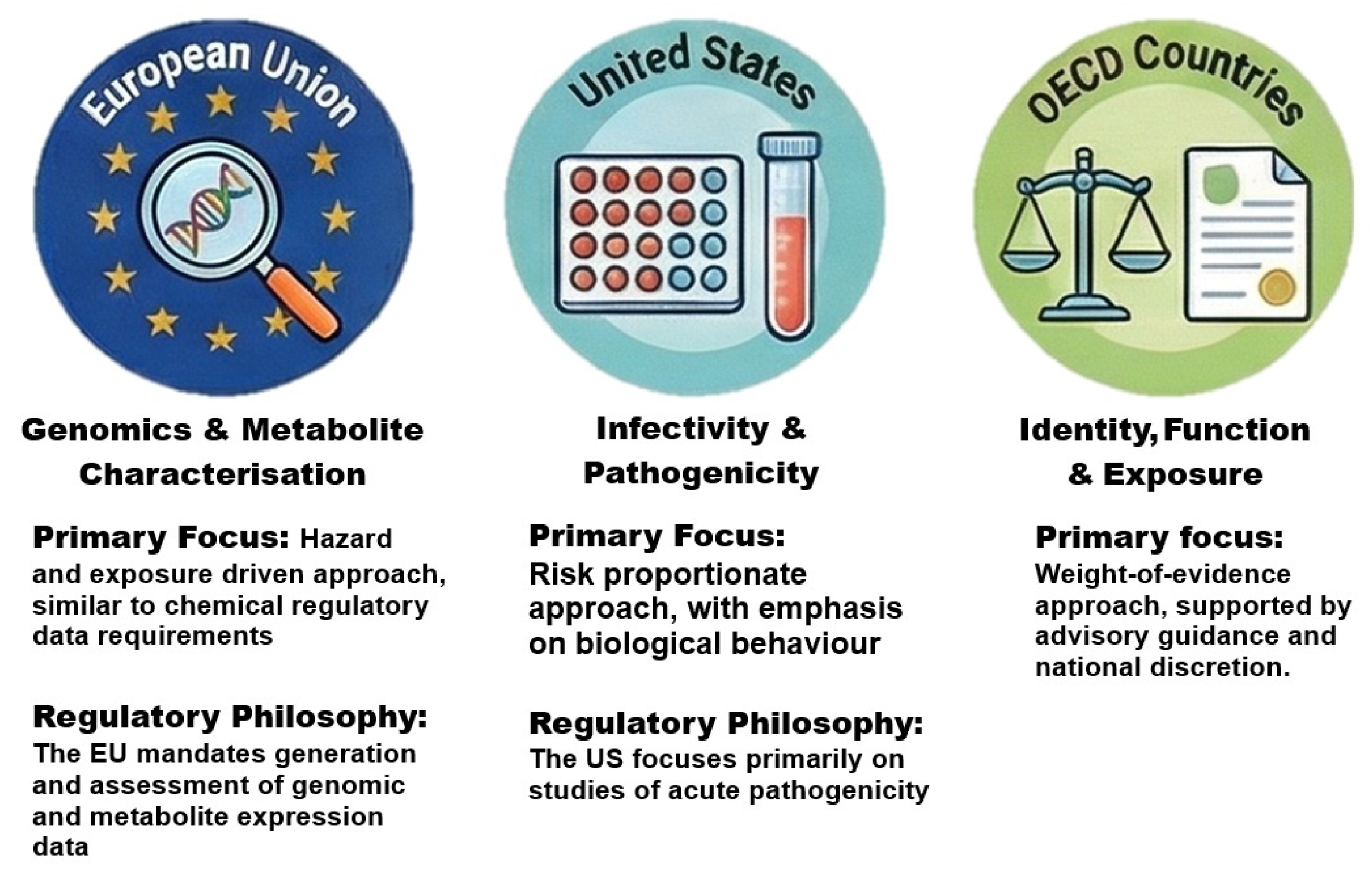
| Primary regulatory focus | Comprehensive strain identity, genomics and metabolite characterisation | Infectivity, pathogenicity and ecological behaviour | Weight-of-evidence integrating identity, function and exposure |
| Role of genomics | Mandatory strain-level genomic characterisation | Used mainly to support identity and safety | Recommended as supporting evidence |
| Metabolite assessment | Systematic evaluation under realistic agricultural conditions, including exposure and fate | Requested mainly when a specific hazard or genetic modification is suspected | Generally addressed in a flexible, case-by-case manner |
| AMR assessment | Screening and evaluation of mobility potential under a One Health perspective | Focus on relevance to pathogenicity or infectivity | Addressed within broader risk characterisation frameworks |
| Regulatory philosophy | Hazard and exposure driven, aligned with chemical-style data structures | Risk-proportionate and biology-focused | Advisory guidance with national discretion |
| Legal status of guidance | Binding regulatory framework | Binding national regulatory framework | Non-binding guidance |
Disclaimer/Publisher’s Note: The statements, opinions and data contained in all publications are solely those of the individual author(s) and contributor(s) and not of MDPI and/or the editor(s). MDPI and/or the editor(s) disclaim responsibility for any injury to people or property resulting from any ideas, methods, instructions or products referred to in the content. |
© 2026 by the authors. Licensee MDPI, Basel, Switzerland. This article is an open access article distributed under the terms and conditions of the Creative Commons Attribution (CC BY) license.
Share and Cite
Dėlkus, M.; Ivanauskas, A.; Žižytė-Eidetienė, M.; Lukša-Žebelovič, J.; Vepštaitė-Monstavičė, I.; Brokevičiūtė, S.; Šimkutė, N. Bacillus Species in Agriculture: Functional Traits, Biocontrol Performance, and Regulatory Safety Assessment. Agriculture 2026, 16, 413. https://doi.org/10.3390/agriculture16040413
Dėlkus M, Ivanauskas A, Žižytė-Eidetienė M, Lukša-Žebelovič J, Vepštaitė-Monstavičė I, Brokevičiūtė S, Šimkutė N. Bacillus Species in Agriculture: Functional Traits, Biocontrol Performance, and Regulatory Safety Assessment. Agriculture. 2026; 16(4):413. https://doi.org/10.3390/agriculture16040413
Chicago/Turabian StyleDėlkus, Martynas, Algirdas Ivanauskas, Marija Žižytė-Eidetienė, Juliana Lukša-Žebelovič, Iglė Vepštaitė-Monstavičė, Sonata Brokevičiūtė, and Neringa Šimkutė. 2026. "Bacillus Species in Agriculture: Functional Traits, Biocontrol Performance, and Regulatory Safety Assessment" Agriculture 16, no. 4: 413. https://doi.org/10.3390/agriculture16040413
APA StyleDėlkus, M., Ivanauskas, A., Žižytė-Eidetienė, M., Lukša-Žebelovič, J., Vepštaitė-Monstavičė, I., Brokevičiūtė, S., & Šimkutė, N. (2026). Bacillus Species in Agriculture: Functional Traits, Biocontrol Performance, and Regulatory Safety Assessment. Agriculture, 16(4), 413. https://doi.org/10.3390/agriculture16040413