Managing Business Models for Achieving Sustainable Transition in the Dairy Industry: A Multi-Case Analysis from Spain

Abstract
1. Introduction
2. Literature Review
2.1. Review of Sustainability Concerns in the Dairy Sector
2.2. Transforming Business Models for Sustainability: The Triple Bottom-Line Perspective
3. Materials and Methods
3.1. Empirical Design and Case Selection

| Central Lechera Asturiana (CLAS) | Industrias Lácteas Asturianas (ILAS) | Leche Gaza (LG) | Nestlé Dairy Brands (ND) | |
|---|---|---|---|---|
| Origin | CLAS was founded in 1967. It officially began operations in 1970 with milk from dairy farms in Asturias (North of Spain). It is the largest dairy cooperative of Spain. | ILAS is the main multinational in the dairy sector with entirely Spanish capital. It was founded in 1960 and consolidated its position as a Spanish leader in milk powder and butter, and as a specialist in infant formula, and the cheese. | LG is a Spanish dairy company operational since 1966. Originally founded as an Agrarian Syndicate, the company has grown to become a leading dairy producer in the region of Castilla y León (North-West Spain). | Nestlé has a strong presence in Spain where it began operations in 1905. Initially it has been dedicated to the production of infant formula and then to condensed milk. Both products were unique in their kind at the time. |
| Vision | Offer high-quality dairy products while preserving their full essence and flavor; ensure 100% collection of production from associate farmers and stable milk prices in Spain. | Be a global leader in dairy production, both for products and ingredients; offer products of the highest quality at the lowest cost; anticipate the preferences of customers. | Producing highest-quality milk; ensure quality with an integrated control system; provide financial stability and a fixed monthly income to farms. | Leading company with a wide range of products, not only dairy products; continuous innovation; strong brands; nutritional solutions for health. |
| Sustainable orientation | B-Corp Certification. CLAS is the first Spanish-owned dairy brand to obtain this certification, which identifies companies that generate a positive impact on society and the planet. | Build successful relationships with suppliers and customers based on trust and transparency; contribute to local social and economic development. | Be a leading company in the production of high-quality dairy products while meeting the expectations of customers; ensure the well-being of employees, farmers, and the local community. | Collaborate closely with farmers, suppliers, and partners to help create a more sustainable and resilient food supply that benefits all actors in the company supply chain; creation of shared value. |
3.2. Data Gathering and Data Analysis
4. Results
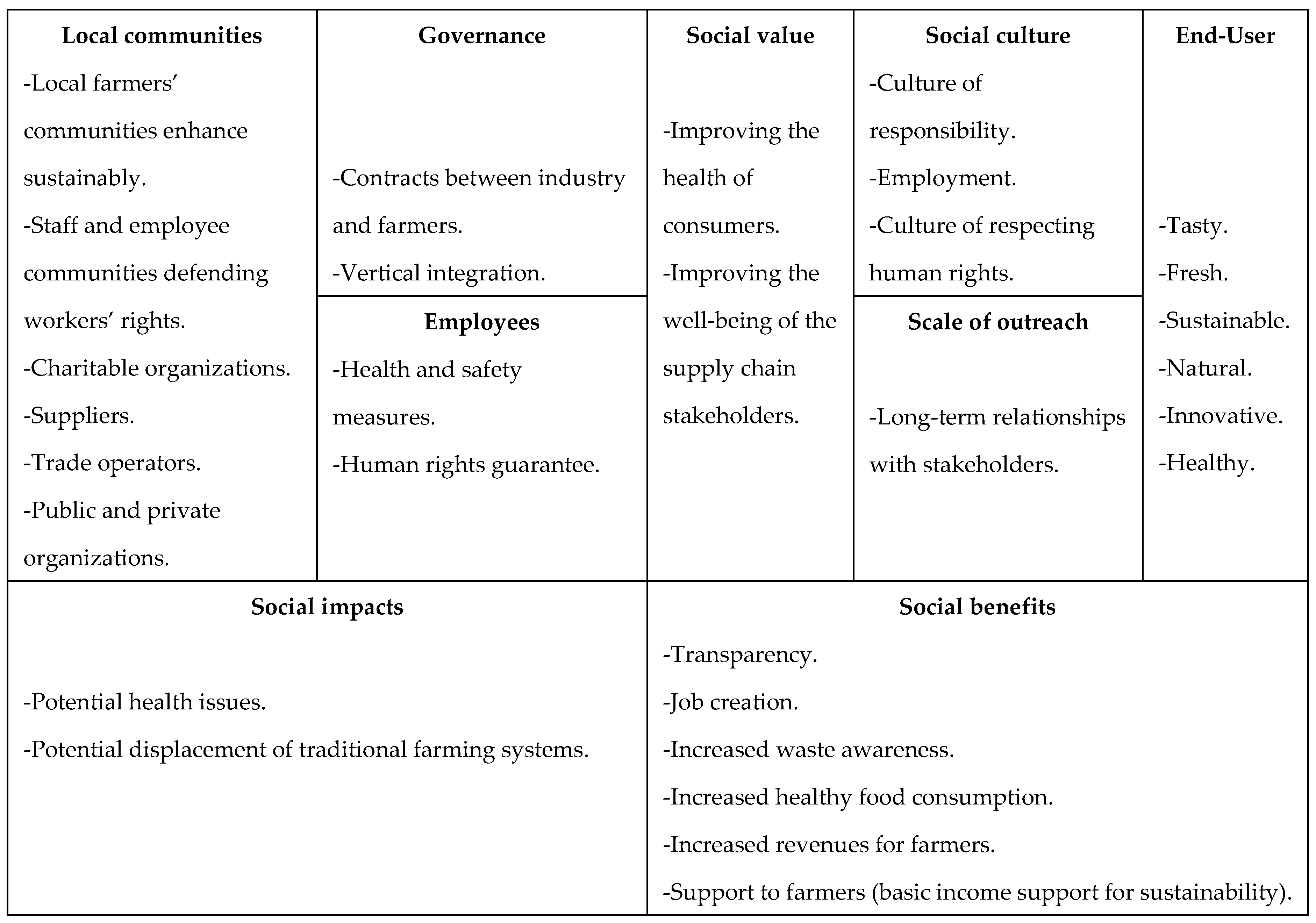
4.1. Triple-Layer Business Model of Dairy Industry and Its Contribution to Sustainable Transition
4.2. Operationalization of SBMs Through Sustainable Practices in Study Companies
4.2.1. Economic Sustainability
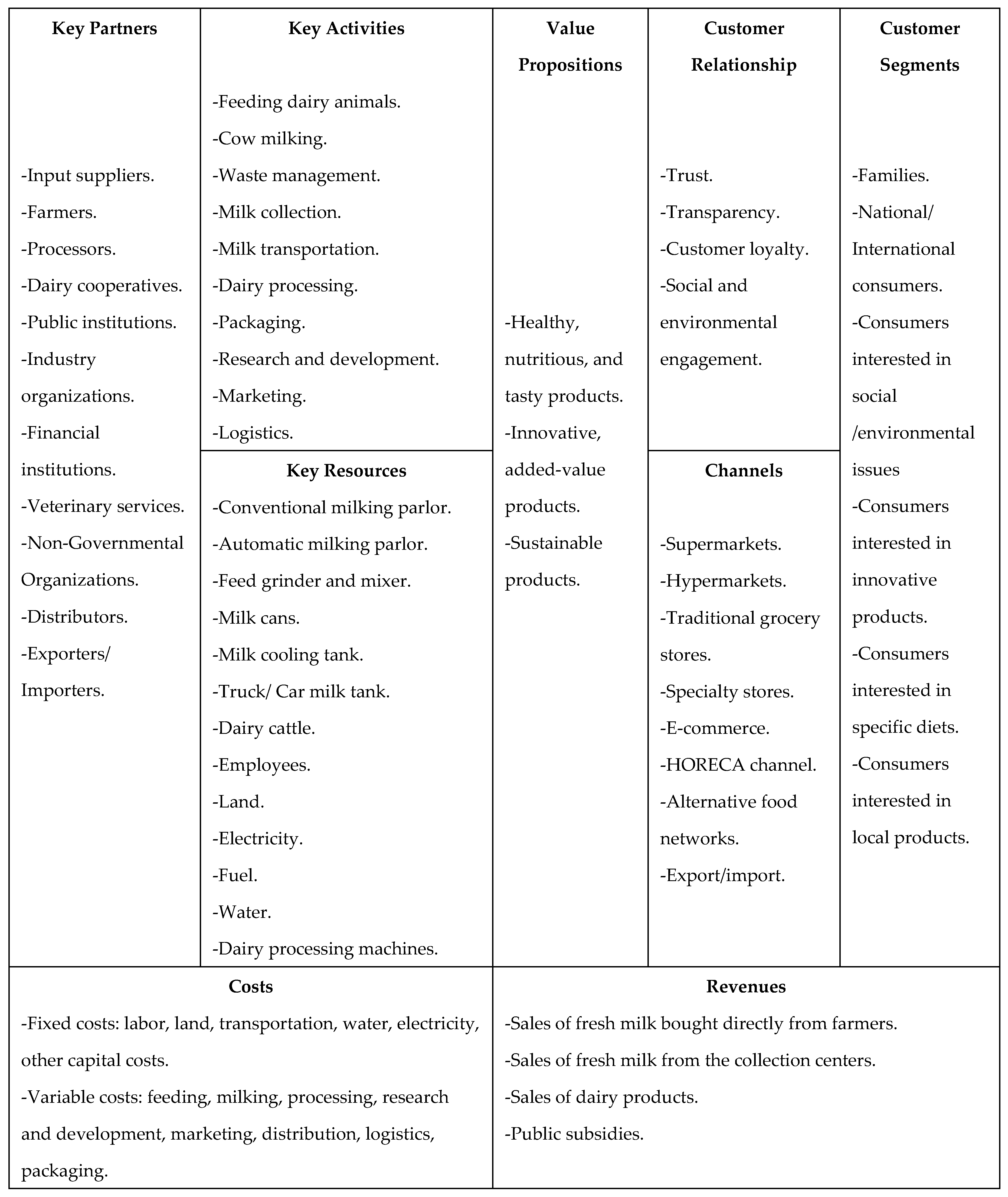
| Blocks | Central Lechera Asturiana (CLAS) | Industrias Lácteas Asturianas (ILAS) | Leche Gaza (LG) | Nestlé Dairy Brands (ND) |
|---|---|---|---|---|
| Key Partners | 7000 farming families; 958 livestock farm members; suppliers (S); retailers; exporters (E); (NGOs); institutions (I); veterinary services. | (S); farmers (F); (E); (I); wholesalers (W); retailers (R). | (F); (S); (W) and traders; (R); (I) | (F); (S); NGO (Red Cross); (I); distributors. |
| Key Activities | Collection of milk (CM); milk transportation (MT); dairy processing (DP); research and development (RD); waste management; marketing (M); management (MG); packaging (P); logistics (L). | (MT); (DP); (RD); (MG); (P); (L); (M). | (RD); (DP); (P); (MG); (M); (L). | (CM); (DP); (RD); (MG); (L); (M). |
| Key Resources | 44,358 cows; automatic milking; employees (E); transport vehicles (TV); electricity (EL); water (W); fuel (F); land (L); processing machines (PM); packaging (P). | 747(E); (TV)/milk tank cars; (EL); (W); (F); (L); (PM); (P). | 80 dairy farms; (E); (TV); (EL); (W); (F); (L); (PM); (P). | (E); (PM); (P); (W); (TV); brand reputation. |
| Value Proposition | 100% products with natural ingredients; products with no added sugars; lactose-free products (LF); products with natural functionality; healthy and balanced recipes. | Infant formula and baby food; products with designation of origin (DO); goats’ milk products; (LF); traditional products. | (LF); calcium-enriched milk; wide range of products (shakes, creams, mini bricks); sheep milk; products with (DO). | Natural and (LF); reduced fat products; vegan products; services (recipes, online store, nutrition education programs). |
| Customer Segments | Families (F); Consumers interested in specific diets, innovative products, healthy products, and sustainable products. | Infants; (F); full-range of consumer segments (high and low purchasing power); hospitality sector. | General consumers; small and medium-sized businesses; government agencies. | (F); health-conscious consumers; consumers who value convenience and portability; athletes. |
| Customer Relationship | Trust (TR); transparency (T); customer loyalty (CL); social and environmental engagement. | (TR); honesty; openness; (T); customer service; brand reputation. | Personalized service; timely delivery; regular communication with customers. | (CL); (T); ethical behavior; social responsibility. |
| Channels | Supermarkets (S); hypermarket (H); traditional stores (TS); e-commerce (EC); horeca (HR); export (E) | (HR); (S); (H); (EC); (E); (TS) | Gaza online store; (S); (H); (TS); (EC) | Nestlé online store; (EC); (S); (H); (HR); (E); (TS). |
| Cost streams | Fixed costs including labor costs, land costs, capital costs, and depreciation of a fixed costs (FC); variable costs including supplies, processing, research and development, marketing (VC); other operating costs (OC). | (FC); (VC); (OC). | (FC); (VC); (OC). | (FC); (VC); (OC). |
| Revenue streams | Net turnover (825 million euros); other operating revenues; subsidies (S). | Product sales (PS); export sales; (OS); (S). | (PS); (OS). | (PS); (OS). |
4.2.2. Environmental Sustainability
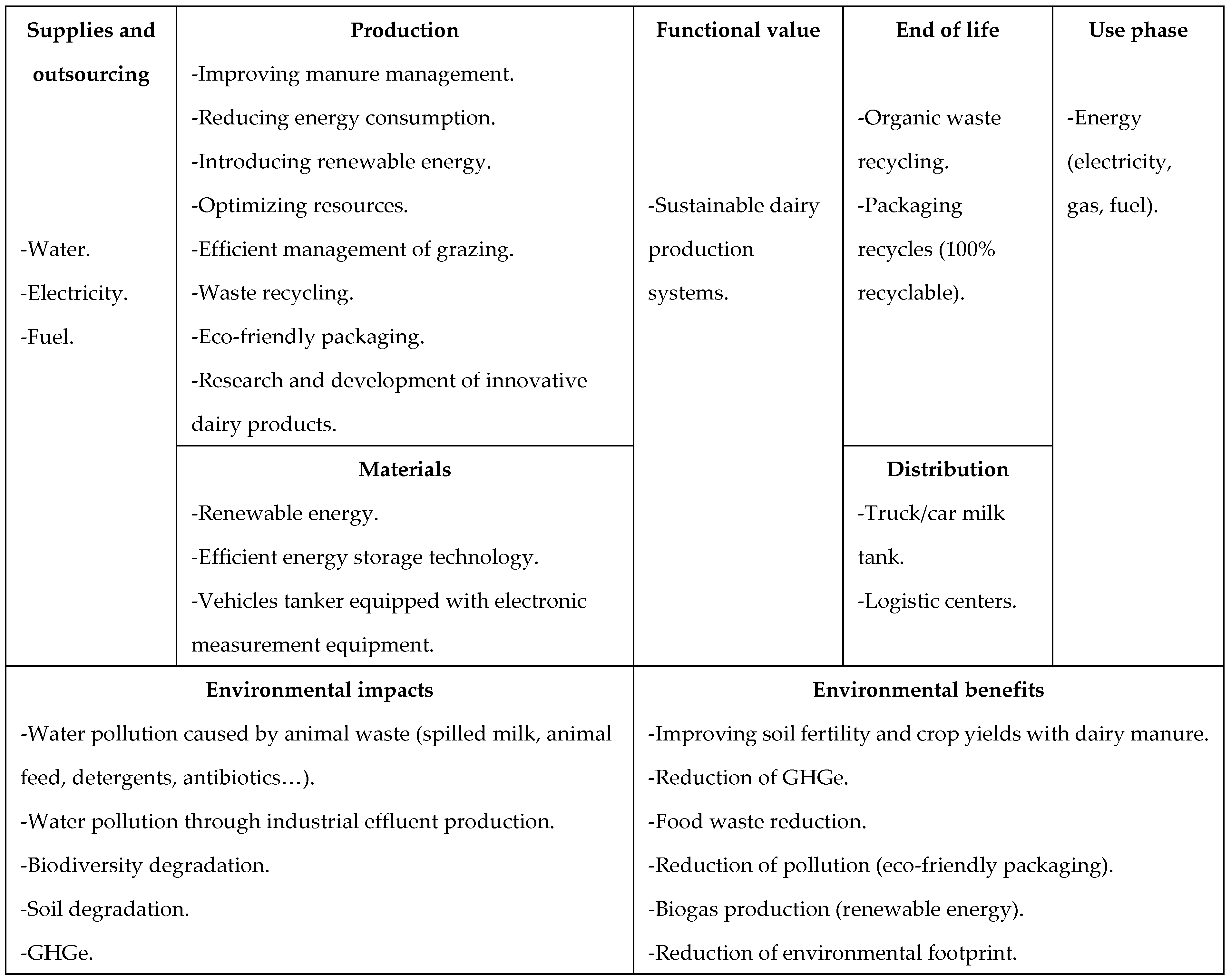
| Blocks | Central Lechera Asturiana (CLAS) | Industrias Lácteas Asturianas (ILAS) | Leche Gaza (LG) | Nestlé Dairy Brands (ND) |
|---|---|---|---|---|
| Supplies and outsourcing | Farmers (F); employees (E); water (W); energy (EG) | (F); (E); (W); (EG). | (F); (E); (W); (EG). | (F); (E); (W); (EG). |
| Production | Use of renewable energy (RE); calculation of carbon footprint; reduction of water consumption (WC); management of manure (production of biogas); study of soil health; energy savings; vehicle emissions testing. | Reduction of energy consumption (EC); (RE); (WC); waste reduction (WR); sustainable farming; waste recycling; use of sustainable packaging (SP) | Working with Kyoto Protocol regulations; (RE); (WC); (EC); (WR); work with sustainable suppliers; circular economy (CE); (SP); diversity of dairy production systems (DS) | (EC); (RE); (WC); (WR); (CE); (SP); (DS); support for organic milk production; sustainability academy. |
| Materials | Photovoltaic panels; 40 vehicles tanker with electronic equipment; Letter Q; GPS located on herds. | Digital technologies (DT). | (DT); sustainable packaging. | (DT); cleaner technologies; Nestlé Environmental Management System (NEMS); product Life Cycle Assessment. |
| Functional value | Sustainable dairy production systems (SDP). | (SDP). | (SDP). | (SDP). |
| Distribution | Truck (T); car milk tank (CM). | (T); (CM). | Camions; (CM). | Rail transportation; efficient routing and scheduling; collaborative logistics. |
| Use phase | Energy (electricity, gas, fuel) (E). | (E). | (E). | (E). |
| End of life | Organic waste recycling. | Packaging recycling (PR) (100% recyclable). | (PR). | (PR); product recycling. |
| Environme-ntal impacts | Water pollution. | CO2 emissions. | CO2 emissions. | GHGe; pollution. |
| Environmental benefits | Biodiversity and sustainable fertilization; zero carbon footprint. | Preservation of biodiversity; reduction of pollution (eco-friendly packaging, transforming waste into new resources). | Biodiversity preservation; reduction of pollution (eco-friendly packaging, transforming waste into new resources); CO2 footprint reduction. | Reduction of GHGe; biodiversity preservation; reduction of pollution. |
4.2.3. Social Sustainability
| Blocks | Central Lechera Asturiana (CLAS) | Industrias Lácteas Asturianas (ILAS) | Leche Gaza (LG) | Nestlé Dairy Brands (ND) |
|---|---|---|---|---|
| Local communities | Local farmers (LF); regional university; local organizations and foundations; regional research center. | (LF); regional public institutions (RI). | (LF); (RI); rural community. | (LF); local stakeholders; consumer organizations |
| Governance | Vertical integration (VI); transparent communication. | Working with supplier portal. | Traceability; (VI). | Transparency in decision-making; (VI); multinational scope and management. |
| Employees | Talent promotion; employee satisfaction and motivation.; co-participation in decision-making. | Interpersonal relations between suppliers, clients and employees; equal opportunities for employees (EO) | (EO) | (EO); human rights guarantee. |
| Social value | Agricultural services for partner farms; scholarships for children of partners/employees; awards for partners; communication services (magazine, website); support for farmers and stockbreeders; social networks for SOS Children’s Villages. | Income support for small farmers; youth and women employment; settlement of the population in rural areas; sponsoring cultural events; supporting local charities. | Dairy class for children and adults; income support for small farmers; support for fixing the population in rural areas; encourage women employment. | Income support for small farmers; youth and women employment; support for the maintenance of the population in rural areas; food donations and disaster relief efforts. |
| Social culture | Employment (E); culture of respecting human rights (HR); culture of responsibility (CR). | (HR); (E); (CR). | Culture of equality (CE); (E). | Health and wellness; diversity and inclusion; innovation; community involvement;(CE); (E). |
| Scale of outreach | Strengthen relationships with partners; deep and diversified relationships with employees. | Strengthen relationships with employees, partners, and customers (RPC). | (RPC); customer outreach via social media. | Strong, long-term relationships with all stakeholders |
| End-User | Tasty (T); fresh (F); sustainable (S); natural (N); innovative (I); healthy (H). | (T); (I); (H); (F); (S). | (T); (I); (H); (F); (S). | (T); (I); (H); (F); (S); (N). |
| Social impacts | Potential health concerns (e.g., high cholesterol levels, obesity) (HC). | (HC). | (HC). | (HC). |
| Social benefits | Job creation (JC); improvement of livelihoods; improvement of people’s health and quality of life (HL); transparency. | (JC); improvement of farmers’ well-being; improvement of food safety. | (JC); guaranteed fixed monthly income for hundreds of families; (HL). | (JC); economic development of local communities; (HL); community engagement. |
5. Discussion
6. Conclusions
Author Contributions
Funding
Institutional Review Board Statement
Data Availability Statement
Conflicts of Interest
References
- Damania, R.; Ebadi, E.; Mayr, K.; Russ, J.; Zaveri, E. Reboot Development: The Economics of a Livable Planet; World Bank: Washington, DC, USA, 2025; Available online: https://hdl.handle.net/10986/43522 (accessed on 10 September 2025).
- OECD. Making Better Policies for Food Systems; OECD Publishing: Paris, France, 2021. [Google Scholar] [CrossRef] [Scilit]
- Rockström, J.; Thilsted, S.; Willett, W.; Gordon, L.; Herrero, M.; Hicks, C.C.; Mason-D’CRoz, D.; Rao, N.; Springmann, M.; Wright, E.C.; et al. The EAT–Lancet Commission on healthy, sustainable, and just food systems. Lancet 2025, 406, 1625–1700. [Google Scholar] [CrossRef] [Scilit]
- CSIRO Futures. Reshaping Australian Food Systems—A Roadmap Towards a More Sustainable, Productive and Resilient Future for Australia’s Food, Its Environment and People. 2023. Available online: https://www.csiro.au/en/work-with-us/services/consultancy-strategic-advice-services/csiro-futures/agriculture-and-food/reshaping-australian-food-systems (accessed on 28 July 2025).
- Süß, A.; Höse, K.; Götze, U. Sustainability-Oriented Business Model Evaluation—A Literature Review. Sustainability 2021, 13, 10908. [Google Scholar] [CrossRef] [Scilit]
- Johnson, H. Sustainability Is a Value Creator for Business and Society. 2020. Available online: https://www.ericsson.com/en/blog/2020/3/sustainability-value-creator-business-society (accessed on 17 June 2025).
- Green Business Benchmark. The ROI of Sustainable Business: Benefits for All Stakeholders. 2024. Available online: https://www.greenbusinessbenchmark.com/archive/roi-of-sustainability (accessed on 4 November 2025).
- Hirsch, S.; Petersen, T.; Koppenberg, M.; Hartmann, M. CSR and firm profitability: Evidence from a meta-regression analysis. J. Econ. Surv. 2023, 37, 993–1032. [Google Scholar] [CrossRef] [Scilit]
- Joyce, A.; Paquin, R. The triple layered business model canvas: A tool to design more sustainable business models. J. Clean. Prod. 2016, 135, 1474–1486. [Google Scholar] [CrossRef] [Scilit]
- FAO. The Global Dairy Sector: Facts. 2016. Available online: https://openknowledge.fao.org/server/api/core/bitstreams/beee9189-d92d-4a0d-86af-a1e3328c33d1/content (accessed on 13 August 2025).
- European Commission. EU Agricultural Outlook for Markers, 2023–2035. 2023. Available online: https://agriculture.ec.europa.eu/system/files/2024-01/agricultural-outlook-2023-report_en_0.pdf (accessed on 10 September 2025).
- ProVeg. What Consumers Want: A Survey on European Consumer Attitudes Towards Plant-Based Foods, with a Focus on Flexitarians. 2021. Available online: https://smartproteinproject.eu/consumer-attitudes-plant-based-food-report/ (accessed on 22 May 2025).
- Danone. Estrategia de Descarbonización del Vacuno de Leche en España (Decarbonization Strategy for Dairy Cattle in Spain). 2023. Available online: https://www.danoneespana.es/content/dam/corp/local/esp/1_somos_danone/2_danone-en-espa%C3%B1a-productos-l%C3%A1cteos-y-de-origen-vegetal/informe-baca/Danone-informe_2023.pdf (accessed on 9 June 2025).
- Statista. Global Dairy Industry-Statistics & Facts. 2022. Available online: https://www.statista.com/topics/4649/dairy-industry/#topicOverview (accessed on 14 May 2025).
- European Dairy Association. Dairy Contribution to Social Sustainability. 2018. Available online: https://eda.euromilk.org/wp-content/uploads/2018/09/2017_01_30_EDA__Positive_dairy_factsheet_Social_facts_FINAL_D-FEP-17-122.pdf (accessed on 25 April 2025).
- Eurostat. Performance of the Agricultural Sector. 2025. Available online: https://ec.europa.eu/eurostat/statistics-explained/index.php?title=Performance_of_the_agricultural_sector#Value_of_agricultural_output (accessed on 14 October 2025).
- Mercasa. Alimentación en España (Food in Spain). 2021. Available online: https://www.mercasa.es/wp-content/uploads/2022/07/AEE_2021_web.pdf (accessed on 10 April 2025).
- Eurostat. Key Figures on the European Food Chain, 2024 Edition. Available online: https://ec.europa.eu/eurostat/web/products-key-figures/w/ks-01-24-000 (accessed on 12 July 2025).
- European Commission. EU Agricultural Outlook for Markets, Income and Environment 2022–2032. 2022. Available online: https://agriculture.ec.europa.eu/system/files/2023-04/agricultural-outlook-2022-report_en_0.pdf (accessed on 5 June 2025).
- OECD-FAO Agricultural Outlook 2022–2031. Available online: https://www.oecd.org/content/dam/oecd/en/publications/reports/2022/06/oecd-fao-agricultural-outlook-2022-2031_e00c413c/f1b0b29c-en.pdf (accessed on 19 June 2025).
- Naranjo, A.; Johnson, A.; Rossow, H.; Kebreab, E. Greenhouse gas, water, and land footprint per unit of production of the California dairy industry over 50 years. J. Dairy Sci. 2020, 103, 3760–3773. [Google Scholar] [CrossRef] [Scilit]
- Statista. Food: Greenhouse Gas Emissions Across the Supply Chain. 2023. Available online: https://ourworldindata.org/grapher/food-emissions-supply-chain (accessed on 17 April 2025).
- FAO. Pathways Towards Lower Emissions—A Global Assessment of the Greenhouse Gas Emissions and Mitigation Options from Livestock Agrifood Systems. 2023. Available online: https://openknowledge.fao.org/server/api/core/bitstreams/a06a30d3-6e9d-4e9c-b4b7-29a6cc307208/content (accessed on 22 May 2025).
- Ritchie, H. You Want to Reduce the Carbon Footprint of Your Food? Focus on What You Eat, Not Whether Your Food Is Local. 2020. Available online: https://archive.ourworldindata.org/20251125-173858/food-choice-vs-eating-local.html (accessed on 16 June 2025).
- FAO. Greenhouse Gas Emissions from the Dairy Sector. A Life Cycle Assessment. 2010. Available online: https://www.fao.org/4/k7930e/k7930e00.pdf (accessed on 24 September 2025).
- Bounds, A.; Hancock, A.; Varvitsioti, E. The farmers challenging the EU’s green agenda. Financial Times, 18 April 2023.
- UNEP Executive Director Statement on the Closing of COP28. 2023. Available online: https://www.unep.org/news-and-stories/statements/unep-executive-director-statement-closing-cop28 (accessed on 7 April 2025).
- Paçarada, R.; Hörtenhuber, S.; Hemme, T.; Wurzinger, M.; Zollitsch, W. Sustainability Assessment Tools for Dairy Supply Chains: A Typology. Sustainability 2024, 16, 4999. [Google Scholar] [CrossRef] [Scilit]
- Feil, A.A.; Schreiber, D.; Haetinger, C.; Haberkamp, A.M.; Kist, J.I.; Rempel, C.; Maehler, A.E.; Gomes, M.C.; da Silva, G.R. Sustainability in the dairy industry: A systematic literature review. Environ. Sci. Pollut. Res. 2020, 27, 33527–33542. [Google Scholar] [CrossRef] [Scilit] [PubMed]
- Luthra, S.; Govindan, K.; Kannan, D.; Mangla, S.K.; Garg, C.P. An integrated framework for sustainable supplier selection and evaluation in supply chains. J. Clean. Prod. 2017, 140, 1686–1698. [Google Scholar] [CrossRef] [Scilit]
- Bonfanti, A.; Mion, G.; Brunetti, F.; Vargas-Sánchez, A. The contribution of manufacturing companies to the achievement of sustainable development goals: An empirical analysis of the operationalization of sustainable business models. Bus. Strategy Environ. 2023, 32, 2490–2508. [Google Scholar] [CrossRef] [Scilit]
- Mili, S.; Loukil, T. Enhancing Sustainability with the Triple-Layered Business Model Canvas: Insights from the Fruit and Vegetable Industry in Spain. Sustainability 2023, 15, 6501. [Google Scholar] [CrossRef] [Scilit]
- Stubbs, W.; Cocklin, C. Conceptualizing a “sustainability business model”. Organ. Environ. 2008, 21, 103–127. [Google Scholar] [CrossRef] [Scilit]
- Schaltegger, S.; Lüdeke-Freund, F. Business Cases for Sustainability. In Encyclopedia of Corporate Social Responsibility; Idowu, S., Capaldi, N., Zu, L., Das Gupta, A., Eds.; Springer: Berlin/Heidelberg, Germany, 2013; pp. 245–252. [Google Scholar]
- Bocken, N.; Short, S.; Rana, P.; Evans, S. A value mapping tool for sustainable business modelling. Corp. Gov. 2013, 13, 482–497. [Google Scholar] [CrossRef] [Scilit]
- Bocken, N.; Short, S.; Rana, P.; Evans, S. A literature and practice review to develop Sustainable Business Model Archetypes. J. Clean. Prod. 2014, 65, 42–56. [Google Scholar] [CrossRef] [Scilit]
- Osterwalder, A.; Pigneur, Y. Business Model Generation: A Handbook for Visionaries, Game Changers, and Challengers; John Wiley & Sons: Hoboken, NJ, USA, 2010. [Google Scholar]
- Garcia, F.E.; Ferrari, A.M.; Cucchi, M. Sustainability Transition in Industry 4.0 and Smart Manufacturing with the Triple-Layered Business Model Canvas. Sustainability 2020, 12, 2364. [Google Scholar] [CrossRef] [Scilit]
- Sultan, M.A.; Furqon, C.; Wijaya, F. Triple Layer Business Model Canvas Design of Arabica Coffee Agroindustry Supply Chain in Bandung Regency. Interdiscip. J. Emerg. Soc. Sci. 2021, 1, 19–23. [Google Scholar] [CrossRef] [Scilit]
- Midgley, R.; Arya, S. The Triple Layered Business Model Canvas: A Tool for Sustainability. Int. J. Manag. Res. Soc. Sci. 2022, 9, 8–12. [Google Scholar] [CrossRef] [Scilit]
- Stewart, J. Multiple-case study methods in governance-related research. Public Manag. Rev. 2012, 14, 67–82. [Google Scholar] [CrossRef] [Scilit]
- Gustafsson, J. Single Case Studies vs. Multiple Case Studies: A Comparative Study; Academy of Business, Engineering and Science: Halmstad, Sweden, 2017. [Google Scholar]
- Dul, J.; Hak, T. Case Study Methodology in Business Research; Butterworth-Heinemann (Elsevier): Oxford, UK, 2008. [Google Scholar]
- De Massis, A.; Kotlar, J. The case study method in family business research: Guidelines for qualitative scholarship. J. Fam. Bus. Strategy 2014, 5, 15–29. [Google Scholar] [CrossRef] [Scilit]
- Mili, S.; Bouhaddane, M. Forecasting Global Developments and Challenges in Olive Oil Supply and Demand: A Delphi Survey from Spain. Agriculture 2021, 11, 191. [Google Scholar] [CrossRef] [Scilit]
- Ingenbleek, P.; Meulenberg, M.T.G. The Battle Between “Good” and “Better”: A Strategic Marketing Perspective on Codes of Conduct for Sustainable Agriculture. Agribusiness 2006, 22, 451–473. [Google Scholar] [CrossRef] [Scilit]
- Volmar, E.; Eisenhardt, K. Case Study Research: A State-of-the-Art Perspective. In Oxford Research Encyclopedia of Business and Management; Oxford University Press: Oxford, UK, 2020. [Google Scholar]
- Verma, S.; Wong, C.; Unsworth, K. When Do Supply Chain Employees Feel Responsible for Proactively Engaging in Greening Behaviours? Br. J. Manag. 2025, 37, e70023. [Google Scholar] [CrossRef] [Scilit]
- Carter, N.; Bryant-Lukosius, D.; DiCenso, A.; Blythe, J.; Neville, A.J. The Use of Triangulation in Qualitative Research. Oncol. Nurs. Forum 2014, 41, 545–547. [Google Scholar] [CrossRef] [Scilit]
- Donkoh, D.; Mensah, J. Application of triangulation in qualitative research. J. Appl. Biotechnol. Bioeng. 2023, 10, 6–9. [Google Scholar] [CrossRef] [Scilit]
- Yang, M.; Vladimirova, D.; Evans, S. Creating and Capturing Value Through Sustainability. Res.-Technol. Manag. 2017, 60, 30–39. [Google Scholar] [CrossRef] [Scilit]
- Geissdoerfer, M.; Bocken, N.; Hultink, E. Design thinking to enhance the sustainable business modelling process—A workshop based on a value mapping process. J. Clean. Prod. 2016, 135, 1218–1232. [Google Scholar] [CrossRef] [Scilit]
- Ribeiro, I.; Sobral, P.; Peças, P.; Henriques, E. A sustainable business model to fight food waste. J. Clean. Prod. 2018, 177, 262–275. [Google Scholar] [CrossRef] [Scilit]


Disclaimer/Publisher’s Note: The statements, opinions and data contained in all publications are solely those of the individual author(s) and contributor(s) and not of MDPI and/or the editor(s). MDPI and/or the editor(s) disclaim responsibility for any injury to people or property resulting from any ideas, methods, instructions or products referred to in the content. |
© 2026 by the authors. Licensee MDPI, Basel, Switzerland. This article is an open access article distributed under the terms and conditions of the Creative Commons Attribution (CC BY) license.
Share and Cite
Mili, S.; Chouk, S. Managing Business Models for Achieving Sustainable Transition in the Dairy Industry: A Multi-Case Analysis from Spain. Agriculture 2026, 16, 377. https://doi.org/10.3390/agriculture16030377
Mili S, Chouk S. Managing Business Models for Achieving Sustainable Transition in the Dairy Industry: A Multi-Case Analysis from Spain. Agriculture. 2026; 16(3):377. https://doi.org/10.3390/agriculture16030377
Chicago/Turabian StyleMili, Samir, and Siwar Chouk. 2026. "Managing Business Models for Achieving Sustainable Transition in the Dairy Industry: A Multi-Case Analysis from Spain" Agriculture 16, no. 3: 377. https://doi.org/10.3390/agriculture16030377
APA StyleMili, S., & Chouk, S. (2026). Managing Business Models for Achieving Sustainable Transition in the Dairy Industry: A Multi-Case Analysis from Spain. Agriculture, 16(3), 377. https://doi.org/10.3390/agriculture16030377