Next Article in Journal
Revisiting Environmental Sustainability in Ruminants: A Comprehensive Review
Previous Article in Journal
Assessing the Potential for Modifying Certain Eradication Measures for Xylella fastidiosa subsp. pauca in Olive Groves of Apulia (Italy)
Previous Article in Special Issue
The Role of New Quality Productivity in Enhancing Agricultural Product Supply Chain Resilience: A Predictive and Configurational Analysis
error_outline You can access the new MDPI.com website here. Explore and share your feedback with us.
 
 
Article

Origin Warehouses as Logistics or Supply Chain Centers: Comparative Analysis of Business Models in Sustainable Agri-Food Supply Chains

1
School of Traffic and Transportation, Beijing Jiaotong University, Beijing 100044, China
2
School of Systems Science, Beijing Jiaotong University, Beijing 100044, China
3
Hebei Key Laboratory of Future Urban Intelligent Traffic Management, Beijing Jiaotong University, Beijing 100044, China
4
School of Management, Huazhong University of Science and Technology, Wuhan 430074, China
*
Author to whom correspondence should be addressed.
Agriculture 2026, 16(2), 147; https://doi.org/10.3390/agriculture16020147
Submission received: 1 December 2025 / Revised: 28 December 2025 / Accepted: 4 January 2026 / Published: 7 January 2026
(This article belongs to the Special Issue Building Resilience Through Sustainable Agri-Food Supply Chains)

Abstract

Origin warehouses, positioned at the critical “first mile” of the agri-food supply chain, profoundly influence supply chain power structures and profit allocation, as well as supply chain stability and sustainable development. To explore the role of origin warehouses in the agri-food supply chain, this study develops a three-level game model comprising a “planter–origin warehouse operator–seller” framework. Notably, this study conceptualizes the dual-functional “origin warehouse” as observed in practice, proposing two theoretical modes: the Logistics Center (LC) and the Supply Chain Center (SCC). By treating quality level, service level, and selling price decisions as endogenous variables, this study further reveals the interconnected decision-making mechanisms under different operational modes. Overall, the LC mode performs better in quality-driven markets, generating higher system profits and greater social welfare, whereas the SCC mode is superior when consumers are more price-sensitive or place greater value on service. Based on these findings, this study provides decision-making guidance for origin warehouse operators aiming to select the optimal mode under varying market conditions and proposes targeted coordination strategies to promote the high-quality development and economic sustainability of the agri-food supply chain.

1. Introduction

The modern food system is shifting toward higher quality and greater sustainability, a trend that is particularly evident in the agri-food supply chain [1]. As household income rises and consumption upgrades, consumers no longer focus only on price when purchasing agri-foods. Instead, they pay increasing attention to freshness, quality, and service experience, which, in turn, places greater pressure on the responsiveness, coordination efficiency, and value creation capacity of agri-food supply chains [2,3]. In this context, some studies are beginning to explore ways to enhance efficiency and foster collaborative innovation in agri-food supply chains from a business model perspective. For example, Mili and Loukil argue that innovative business models can enable differentiated product, price, and service strategies, strengthening companies’ competitive advantages [4].
In contrast, agri-food circulation in many developing countries relies on traditional multi-stage wholesaling and long-distance transportation, leading to quantity losses and value dissipation along the chain [5,6]. Meanwhile, small and decentralized planters often face disadvantages in price negotiation, quality control, and information access, which prevents them from receiving returns corresponding to the quality of their products [7]. Simultaneously, sellers continue to raise upstream supply requirements [8], which substantially increases the difficulty of supply chain coordination.
Against this background, the origin warehouse has emerged as a key infrastructure element embedded in the first kilometer of the agri-food supply chain. The origin warehouse is a facility located near main production areas or origin trading centers equipped for functions such as sorting, storage, and processing to convert agri-foods into standardized commodities [9]. The business models based on origin warehouses reduce intermediate stages, lower losses and logistics costs, and improve product quality through localized preservation and standardization. Most existing studies still regard the origin warehouse as a regional Logistics Center that only performs storage, grading, and processing in the first kilometer. However, as practice evolves, some leading origin warehouse operators have begun to integrate information flow, logistics, and funds flow, actively participating in information sharing and supply–demand matching along the chain and forming benefit communities with the planter. However, as practice evolves, some leading origin warehouse operators have begun to integrate information flow, logistics, and funds flow, actively participating in information sharing and supply–demand matching along the chain, and forming benefit communities with the planter. Furthermore, their revenue model is gradually shifting from charging service fees to earning trading margins [10]. In this context, the functions of origin warehouses in purchasing, distribution, and selling have been enhanced, and their role extends beyond that of traditional Logistics Centers.
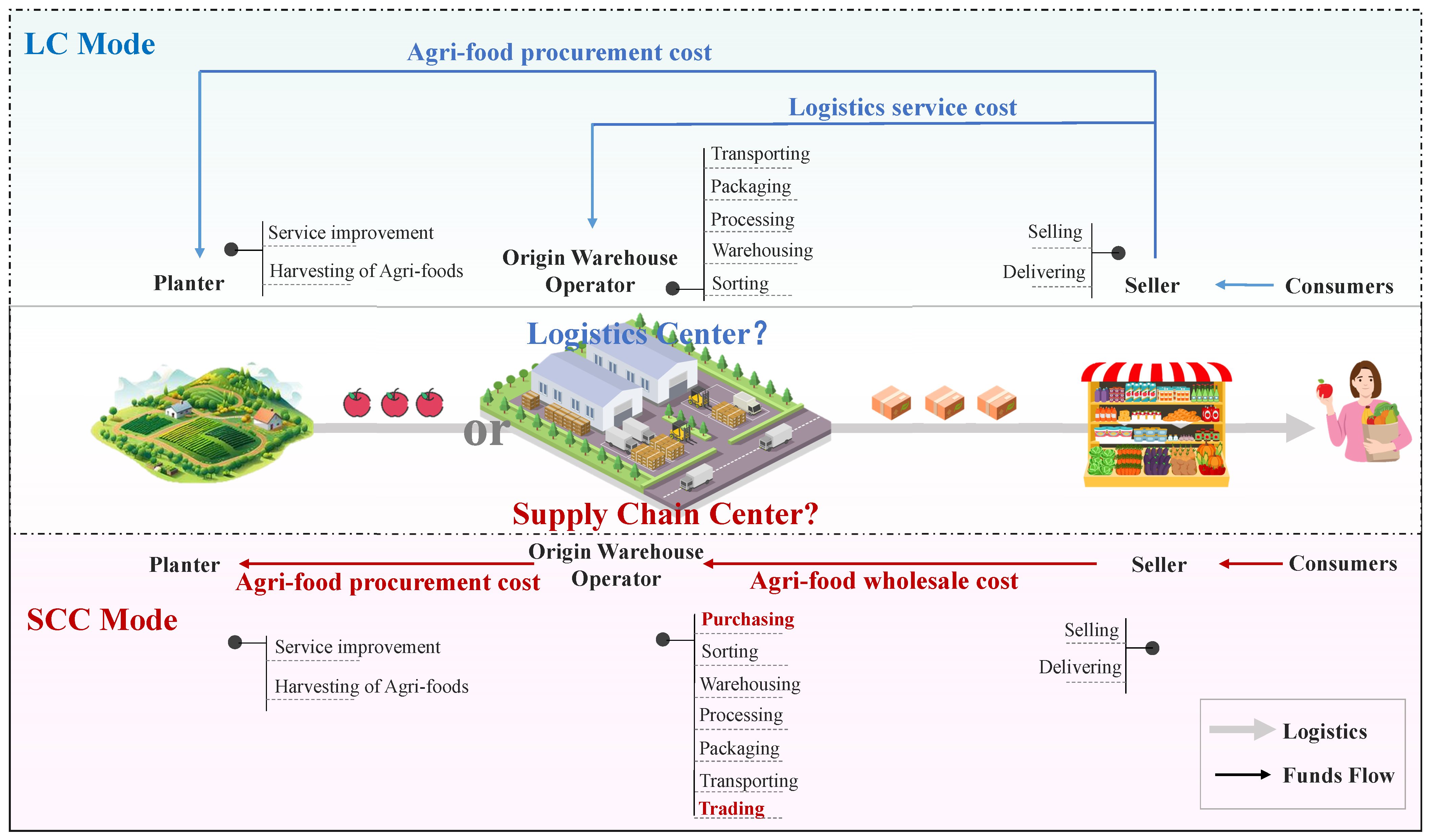
Despite these developments, no studies have systematically examined the institutional roles of origin warehouses in the agri-food supply chain. Thus, to fill this research gap, we consider two modes based on their distinct functional roles: the “Logistics Center (LC)” and the “Supply Chain Center (SCC)”. The LC mode emphasizes the direct connection between production and sales, while the SCC mode focuses on enhanced coordination across the supply chain. Under these different functional roles, the supply chain structure and the decisions of each participant differ significantly, as illustrated in Figure 1.
Despite the growing practical influence of origin warehouses, theoretical research remains limited and fragmented. First, most studies do not treat the origin warehouse operator as an independent decision-maker with its own strategic objective; it is often simplified as a cost center or a passive service provider, and its strategic initiative is largely ignored. This omission makes it difficult to explain at a mechanism level how a shift in the origin warehouse’s role from a Logistics Center to a Supply Chain Center reshapes its bargaining relationship with other participants. Furthermore, from a modeling perspective, quality enhancement at the planting stage, which fundamentally determines the value of agri-foods, has usually been treated as exogenous or has not been modeled jointly with service level and selling price as endogenous choices. This limits our ability to analyze how supply chain participants, under resource constraints, balance and interact across product quality improvement, service enhancement, and cost and price control in a unified framework.
On this basis, we address the following questions: What distinct institutional roles do origin warehouses fulfil when operating in the LC mode and the SCC mode, and how do these different roles affect the decisions of each participant? How do they influence overall supply chain profit and allocation? In practice, how should origin warehouse operators select the most suitable business models under varying market conditions to achieve sustainable development in the agri-food supply chain?
It is worth noting that, as an analysis of economic coordination and welfare in agri-food supply chains, this study examines “sustainability” with an explicit focus on its economic dimension and does not address environmental or social dimensions. Specifically, this study develops a three-level agri-food supply chain game model with a planter, an origin warehouse operator, and a seller. Within this framework, we treat quality level, service level, and price decisions as endogenous variables and examine two channel structures where the origin warehouse serves as an LC or an SCC, calculating and comparing the equilibrium solutions for decision variables. Furthermore, we conduct numerical experiments to examine how key parameters affect the profits of each participant and social welfare. By combining the analytical results with the numerical findings, we uncover the interaction mechanisms among the decision variables under different modes and provide managerial insights into the choice of origin warehouse mode in various market conditions.
This study makes three contributions: (1) It conceptualizes the dual-functional “origin warehouse” as observed in practice, proposing two theoretical modes: the Logistics Center (LC) and the Supply Chain Center (SCC). By modeling the origin warehouse operator as an independent decision-maker in a three-level supply chain game framework, it systematically characterizes and compares the power structures under the two modes and then reveals how the different modes reshape channel power and profit allocation, expanding theoretical perspectives on existing agri-food supply chain business models. (2) It adapts and extends ideas from earlier work on agri-food and general supply chains. It treats quality at the planting stage as an endogenous decision, and, by jointly modeling quality, service level, and price in the demand function, it provides a new framework for analyzing multi-agent, multidimensional decisions in the agri-food supply chain. (3) Through equilibrium comparison of and sensitivity experiments on the LC and SCC modes, this study derives managerial insights into how key parameters affect decisions, profits, and social welfare as well as offering guidance on mode selection under different market conditions.
The remainder of this study is organized as follows: Section 2 presents a literature review of related studies. Section 3 describes the problem, outlines assumptions, and establishes two supply chain game models centered on the Logistics Center (LC) and the Supply Chain Center (SCC), respectively. Then, Section 4 presents the equilibrium solutions of the two modes, analyzes the impact of key parameters, and compares decision variables between LC and SCC modes. Section 5 conducts numerical experiments to examine the sensitivity of each participant’s profit to the main parameters, and presents valuable management suggestions with practical relevance. Finally, Section 6 summarizes the main conclusions and outlines limitations and directions for future research.

2. Literature Review

This study primarily relates to three streams of literature: channel leadership in the agri-food supply chain, origin warehouses, and quality decisions for agri-foods.

2.1. Channel Leadership in the Agri-Food Supply Chain

Channel leadership is a key factor in determining decision equilibrium and profit allocation [11]. In the agricultural field, research on multi-agent supply chain coordination has expanded from the classic two-level structure [12,13] to more complex three-level structures, mainly focusing on two typical configurations: “Supplier–third-party logistics (3PL)–retailer” and “supplier–processor–retailer”. In the former, Cai et al. analyzed 3PL providers as supply chain leaders, considering the prices and purchasing quantity decisions, and demonstrated that the presence of the 3PL provider can significantly change the entire supply chain’s profits [14]. Yu et al. extended this research by comparing optimal prices and cold chain service levels under various scenarios, including supplier/3PL leadership [15], horizontal/vertical integration [16], and supplier/retailer outsourcing [17]. Their results showed how different channel leadership structures impact profits and social welfare. Wang et al. integrated dynamic preservation and contract coordination into a “supplier–3PL–retailer” three-level supply chain game, finding that delayed decision-making reduces preservation efforts and increases prices, ultimately lowering system profits. They showed that contracts based on cost-sharing and secondary transfer payment can achieve lower prices and higher overall profits [18]. Leylaparast et al. further developed a three-level game framework in which farmers act as the leader, while 3PL providers and retailers serve as followers; under this leadership structure, they further investigated horizontal interactions among the members [19]. Correspondingly, in the “supplier–processor–retailer” setting, Wang et al. considered a three-level agri-food supply chain with farmer cooperatives at the core, studying optimal pricing and profit allocation under both centralized and decentralized models, and designed a profit-sharing coordination contract [20]. Wu et al. linked joint preservation efforts between suppliers and processors with pricing, comparing four scenarios—decentralized, centralized, upstream coordination (S-M), and downstream coordination (M-R)—illustrating how different power structures systematically alter optimal prices, freshness levels, and profits [21].
The existing literature indicates that different power structures and leadership are critical to decision-making and profit distribution in agri-food supply chains. However, most studies in this field operate within a single structural framework and assume that the functional positioning of the leader is both single and static. Little attention has been paid to a broader question: Can the same supply chain participant adopt different functional roles? And how might such functional roles shape or determine the corresponding power structure? This theoretical gap provides the entry point for this paper, which aims to construct a unified framework from the dual perspectives of the Logistics Center and Supply Chain Center modes.

2.2. Origin Warehouse

As an emerging infrastructure, the origin warehouse is reshaping traditional channel leadership structures by integrating the “first mile” logistics and trading. Existing research has confirmed the functional value of origin warehouses as key infrastructure for pre-cooling, distribution, and loss reduction [22,23,24]. Gao et al. further proposed four key characteristics of origin warehouses: short-chain supply, intensive logistics, standardized grading, and value enhancement. They developed a bi-level programming model for supply chain enterprises and planters to make decisions on the origin warehouse location, capacity, and pricing problem. Theoretical and numerical results indicated that this model enhances regional agricultural product quality and planters’ profits [9]. Some studies, from a policy intervention perspective, have examined the impact of government subsidies on freshness levels, prices, and profits in a “farmer–origin warehouse” two-level fresh agri-food supply chain framework [25,26]. However, these studies primarily focus on construction or operation, neglecting the institutional impact of origin warehouses on the supply chain’s power structure and pricing mechanisms. Regarding the functional role of origin warehouses, most of the existing literature regards them merely as Logistics Centers with singular functions [22,23], emphasizing transportation and storage. Only a few studies consider their dual attributes of logistics services and agri-food trading, treating them as Supply Chain Centers [9].
Furthermore, in international agri-food supply chain research, several other key infrastructures exist, such as regional Logistics Service Providers (LSPs), Freight Villages (FVs), wholesale market hubs for agricultural products, distribution centers, and food hubs. These concepts differ significantly from origin warehouses in terms of positioning, core functions, network coverage, and operating entities. Table 1 provides a comparative overview of these major facilities.
These comparisons highlight the uniqueness of origin warehouses, which provide not only a logistics service but also trading functions. As critical infrastructure nodes in agri-food supply chains, the functional roles and business models of origin warehouses directly determine the decision-making behaviors and profit distribution among supply chain participants. More importantly, the functional roles of origin warehouses are not exogenously predetermined but rather intrinsically linked to governance structures and ownership. For instance, when an origin warehouse is operated by a third-party logistics (3PL) provider, its core objective is to maximize the utilization of logistics assets, leading to the adoption of a cost-oriented Logistics Center (LC) mode. Conversely, when an origin warehouse is owned by a supply chain enterprise, its goals shift toward ensuring agricultural product quality, enhancing value, and maintaining overall supply chain stability, which inevitably drives the adoption of a Supply Chain Center (SCC) mode. Examination of how origin warehouse business models are selected under different ownership structures and how these choices further influence decision-making behaviors and profit distribution patterns remains a significant research gap.

2.3. The Quality Decisions of Agri-Foods

Research on the agri-food supply chain has always focused on operational optimization within the circulation, concentrating on service levels and selling prices to characterize market demand. In terms of demand function formulation, the academic community predominantly employs two types of models: one approach, as demonstrated by Cai et al. [14] and Wu et al. [32], uses multiplicative functions to represent the interaction between service levels and selling prices; the other approach, like that of Yu et al. [15] and Song et al. [33], adopts linear additive functions. However, these models assume that agri-food quality is synonymous with freshness in the distribution and that logistics service levels entirely determine it. This assumption overlooks the inherent quality heterogeneity from the production, failing to include the initial quality determined by farming techniques, harvesting standards, and other production decisions as a core variable in the analysis framework. Indeed, substantial research has demonstrated the critical influence of quality, service, and price on the demand for agri-food. A systematic literature review by Yadav et al. indicates that quality, service level, and price are core metrics for evaluating the performance of agri-food supply chains [34]. Empirical research by Naazie further shows that the three dimensions—quality, service experience, and price—significantly affect consumer satisfaction and purchasing decisions regarding agri-food [35]. Within broader supply chain studies, some research jointly models price and quality as endogenous variables. For instance, Nagurney endogenizes multiple decisions such as product quality, pricing, product positioning, and outsourcing choices, revealing the complex interactions in supply chain equilibrium under multidimensional competition [36]. Meanwhile, studies by Hauck et al., Chen et al., and Yoo et al. incorporate demand functions related to price and quality to characterize consumer behavior, offering methodological insights for endogenous quality decision-making [37,38,39]. Furthermore, Xu et al. introduced quality and price factors into the linear market demand function for agri-foods, comparing optimal quality and price subsidy coefficients, as well as market demand under different channel leadership structures in a “producer–retailer” two-level supply chain. Their findings indicated that, compared to isolated decisions, jointly optimizing quality improvement and price subsidies more effectively enhances supply chain efficiency and market demand [40]. However, to date, few studies have simultaneously incorporated quality level, service level, and selling price into a market demand model for the agri-food supply chain for systematic analysis. This limitation prevents the analysis of marginal trade-offs or complementary relationships among these factors under resource constraints.

2.4. Research Gaps

As is evident from the literature, existing studies generally treat origin warehouses as functional logistics infrastructure, without considering them as independent decision-makers. This overlooks their pivotal role in reshaping the channel structure of agri-food supply chains. Moreover, most studies are based on a single supply chain structure, assuming that the functional role of the leader is static and singular and neglecting to explore how the flexible adjustment of the functional role by the same participant under different market environments affects power structures and decision-making behaviors. Therefore, the flexible selection of the functional role of origin warehouses represents an important area that urgently requires further research. Although some pioneering research has started to model quality level and prices jointly, no studies have simultaneously considered the effects of quality, service, and price decisions on market demand. Table 2 summarizes the main differences between this paper and the existing literature in terms of the characteristics of the research questions considered.
Therefore, to address these research gaps, this study incorporates the origin warehouse operator as an independent decision-maker within the game-theoretic framework. It constructs two types of three-level agri-food supply chain structures: an origin warehouse as a Logistics Center and an origin warehouse as a Supply Chain Center. Simultaneously, it compares the interaction between quality, service, and pricing decisions and their impact on profits. This approach provides decision support for understanding the development of the agri-food supply chain under the origin warehouse mode.

3. Materials and Methods

3.1. Problem Description

This study examines a three-level agri-food supply chain comprising a planter, an origin warehouse operator, and a seller. The origin warehouse operator, acting as the Stackelberg leader, first determines service levels and pricing. Those decisions influence both upstream and downstream participants, thereby improving the overall supply chain efficiency. The role of the origin warehouse within the supply chain significantly affects the purchasing price, selling price, quality level, service level, and the profit of each participant. Based on the core functions of the origin warehouse, we examine two sustainable business models based on origin warehouses.
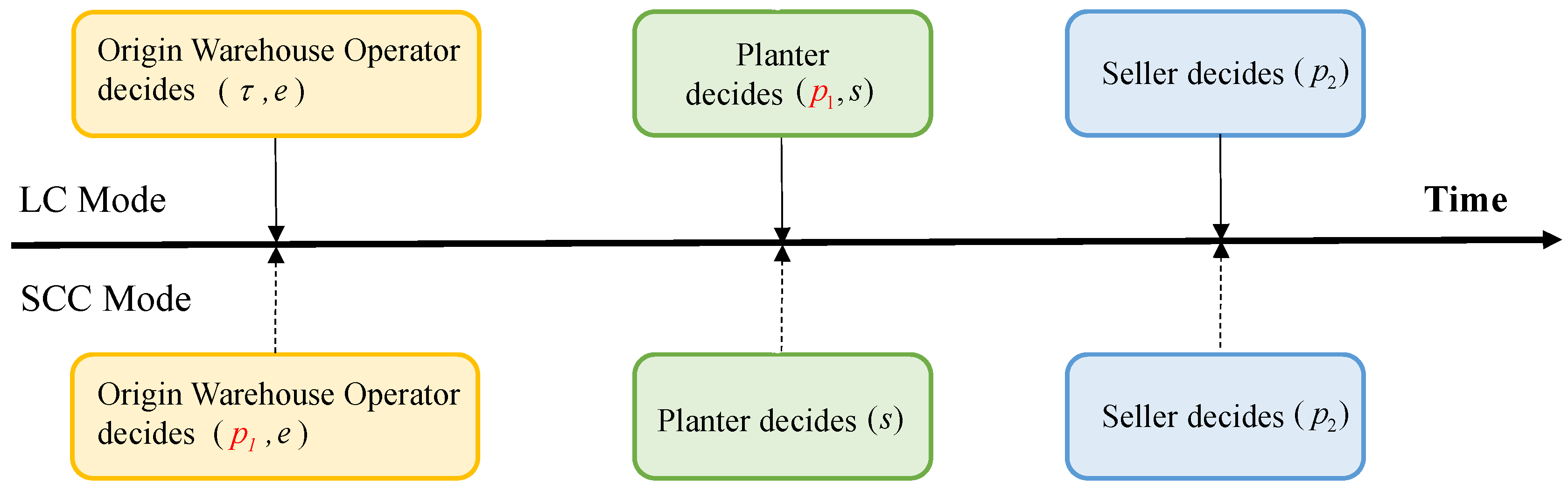
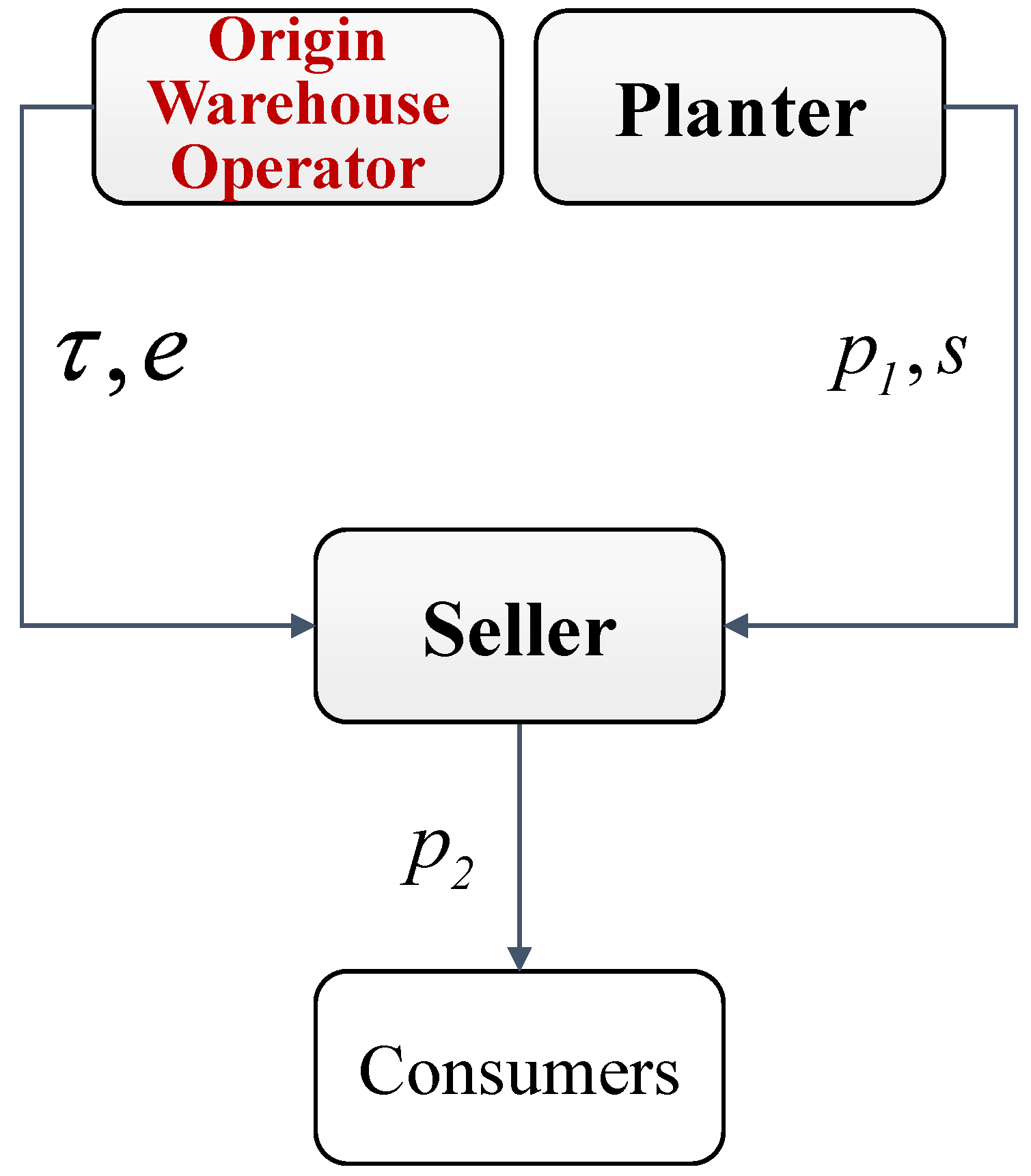
In the LC mode, the origin warehouse operator, as the leader, first announces the unit basic service price τ and the service level e. The planter, as a follower, then determines the purchasing price p 1 and the quality investment level s of agri-foods. Subsequently, the seller, observing these upstream decisions, sets the selling price p 2 . Market demand Q is then realized through consumers’ purchasing behavior, as illustrated in Figure 2.
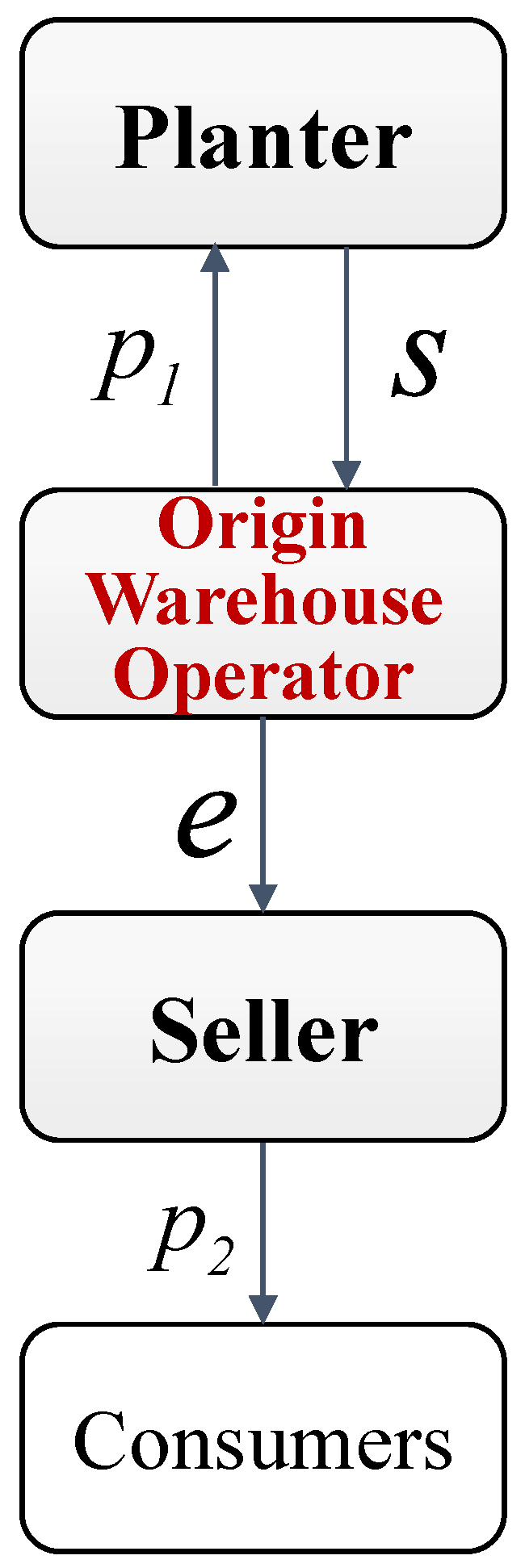
In the SCC mode, the origin warehouse operator, as the leader, first determines the purchasing price p 1 offered to planters and the service level e. It provides logistics services, including sorting, processing, and transportation, before supplying standardized agri-foods to the seller. As the first follower, the planter chooses the quality level s in response to the purchasing price. As the second follower, the seller sets the selling price p 2 , after which market demand is realized, as shown in Figure 2.

3.2. Model Assumptions

To facilitate modeling, we make the following assumptions:
Assumption 1.
Information is complete among the planter, origin warehouse operator, and seller. All participants are risk-neutral and rational agents, each aiming to maximize their own profit. This assumption allows the model to focus on the influence of supply chain power structures.
Assumption 2.
Only a single type of agri-food is considered.
Assumption 3.
The planter’s quality investment cost is assumed to be a quadratic function of the quality level, defined as C 1 ( s ) = μ s 2 / 2 . Similarly, the origin warehouse operator’s service cost is assumed to be a quadratic function of the service level, defined as C 2 ( e ) = v e 2 / 2 .
Assumption 4.
The market demand for agri-foods is jointly affected by the final selling price, the quality level, and the service level, expressed as Q = Q 0 + α s + β e λ p 2 . The quality level s reflects product attributes such as appearance, size, and sweetness, whereas the service level e reflects factors such as timeliness of delivery and loss during the logistics process.
Assumption 5.
The wholesale price p is exogenously determined by market supply–demand [41] and publicly known to all participants [42], reflecting their role as price takers in a competitive market where it serves as the common decision benchmark.

3.3. Model Formulating

3.3.1. Notations

For ease of reference, the main notation used in this paper is summarized in Table 3 below:

3.3.2. LC Mode

As an independent logistics service provider, the origin warehouse operator maximizes its profit by setting the service price τ and the service level e, without directly participating in the trading of agri-foods. The supply chain structure in the LC mode is shown in Figure 3.
In the LC mode, the profit functions of the origin warehouse operator, the planter, and the seller are given, respectively, by the following:
π C L C = ( τ c l ) ( Q 0 + α s + β e λ p 2 ) v e 2 2
π P L C = ( p 1 c p ) ( Q 0 + α s + β e λ p 2 ) μ s 2 2
π S L C = ( p 2 p 1 τ ) ( Q 0 + α s + β e λ p 2 )

3.3.3. SCC Mode

Under a given exogenous wholesale price p, the origin warehouse operator, as the Stackelberg leader, determines the purchasing price p 1 and the service level e to maximize its own profit. Here, p 1 directly influences the optimal decision s of the planter, while e affects market demand through the demand function and further influences the optimal responses of other participants. The supply chain structure in the SCC mode is shown in Figure 4.
In the SCC mode, the profit functions of the origin warehouse operator, the planter, and the seller are given, respectively, by the following:
π C S C C = ( p p 1 c l ) ( Q 0 + α s + β e λ p 2 ) v e 2 2
π P S C C = ( p 1 c p ) ( Q 0 + α s + β e λ p 2 ) μ s 2 2
π S S C C = ( p 2 p ) ( Q 0 + α s + β e λ p 2 )

4. Results

4.1. Equilibrium Solutions

Proposition 1.
In the LC mode, if conditions 4 λ μ > α 2 and δ = 2 v ( 4 λ μ α 2 ) β 2 μ > 0 are satisfied, the equilibrium solutions for the service price, service level, purchasing price, quality level, selling price, market demand, and the profits of each participant are given as follows:
τ L C * = v ( 4 λ μ α 2 ) F λ δ + c l
e L C * = β μ F δ
p 1 L C * = 2 μ v F δ + c p
s L C * = α v F δ
p 2 L C * = v ( 7 λ μ α 2 ) F λ δ + ( c l + c p )
Q L C * = λ μ v F δ
π C L C * = μ v F 2 2 δ
π P L C * = μ v 2 ( 4 λ μ α 2 ) F 2 2 δ 2
π S L C * = λ μ 2 v 2 F 2 δ 2
Here, F = Q 0 λ ( c p + c l ) is defined as the net potential market demand after cost coverage. It represents the theoretical market demand for the agri-food sector when supply chain participants make no additional investments, covering only the basic production and logistics costs. Therefore, F > 0 is a prerequisite for supply chain cooperation in the LC mode. Moreover, the denominator term δ = 2 v ( 4 λ μ α 2 ) β 2 μ > 0 , equivalent to λ > 1 / 8 ( 2 α 2 / μ + β 2 / v ) , is a critical condition for the existence of a feasible system equilibrium. It indicates that the price sensitivity coefficient λ must be larger than the weighted sum of the marginal contributions of quality and service investments. This implies that service and quality investments should not be excessively expanded; instead, they must achieve an effective match between market supply and demand to ensure supply chain stability.
Proposition 1 further implies that, under the LC mode:
(1)
As the net potential market demand F increases, all decision variables increase simultaneously. In particular, the service input e L C * and quality level s L C * exhibit a complementary relationship and jointly expand market demand Q L C * .
(2)
The equilibrium profits of all participants are positively related to F 2 , as shown by π C L C * F 2 / δ , π P L C * , π S L C * F 2 / δ 2 . This indicates that a larger F benefits all members of the supply chain, revealing an inherent alignment of benefits and a mechanism of risk sharing in the LC mode. In particular, when λ > α 2 / 2 μ , the profits satisfy π C L C * > π P L C * > π S L C * . The origin warehouse operator achieves the highest profit, followed by the planter, while the seller obtains the lowest profit. This is because the origin warehouse, as an infrastructure service provider, derives profit directly from the market scale. By contrast, the planter and the seller, under decentralized decision-making, are both affected by double marginalization, so their profit growth is relatively slower. The seller, positioned at the end of the value chain, is also the most significantly affected by price elasticity.
Proposition 2.
In the SCC mode, if condition ζ = 2 α 2 v β 2 μ > 0 is satisfied, the equilibrium solutions for the purchasing price, service level, quality level, selling price, market demand, and the profits of each participant are given as follows:
p 1 S C C * = p c l v ( α 2 H + 2 μ D ) ζ
e S C C * = β ( α 2 H + 2 μ D ) 2 ζ
s S C C * = α [ ( α 2 v β 2 μ ) H 2 μ v D ] 2 μ ζ
p 2 S C C * = α 2 v ( α 2 H + 2 μ D ) 4 λ μ ζ + p
Q S C C * = α 2 v ( α 2 H + 2 μ D ) 4 μ ζ
π C S C C * = v ( α 2 H + 2 μ D ) 2 8 μ ζ
π P S C C * = α 2 [ ( α 2 v β 2 μ ) H 2 μ v D ] [ ( β 2 μ + α 2 v ) H + 6 μ v D ] 8 μ ζ 2
π S S C C * = α 4 v 2 ( α 2 H + 2 μ D ) 2 16 λ μ 2 ζ 2
Here, H = p c l c p represents the base profit margin per unit of agri-food, and D = Q 0 λ p denotes the baseline market demand after price adjustment. These represent, respectively, the theoretical profit margin from production to wholesale and the baseline market demand under the given exogenous wholesale price p and without any strategic decisions by supply chain participants. Therefore, D > 0 and H > 0 are prerequisite conditions for supply chain cooperation. In addition, the denominator term ζ = 2 α 2 v β 2 μ > 0 is the key condition for the existence of equilibrium solutions. When the marginal contribution of service β 2 / v is more than twice the marginal contribution of quality α 2 / μ , the supply chain system tends to become unstable. This indicates that the dominant position of the origin warehouse is not absolute, and that improvements in its local efficiency may reduce the incentives of other participants to invest.
Proposition 2 further implies that, under the SCC mode,
(1)
Increases in the base profit margin H and the baseline market demand D encourage the origin warehouse operator to raise its service level e S C C * while lowering the purchasing price p 1 S C C * to maximize its own profit. This strategy slightly drives an increase in the selling price p 2 S C C * and market demand Q S C C * .
(2)
For quality level s S C C * , when the contribution of service input exceeds that of quality input ( α 2 v β 2 μ < 0 ), or if the supply chain profit growth is primarily driven by market demand ( H / D < 2 μ v / ( α 2 v β 2 μ ) ), the planter will stop investing in quality, that is, s S C C * = 0 .
(3)
The profits satisfy π C S C C * , π S S C C * ( α 2 H + 2 μ D ) 2 and when λ > α 2 / 2 μ , we have π C S C C * / π S S C C * = 2 λ μ ζ / α 4 v > 1 , which means that the origin warehouse operator’s profit exceeds that of the seller. The reason is that, as the leader, the origin warehouse operator actively determines the purchasing price and service level, thereby capturing a significant share of the added value in the supply chain. The planter, as a follower, has its profit strictly constrained by the specific values of the base profit margin H and the baseline market demand D. Specifically, when H is large and D is small, the planter has more substantial incentives to invest in quality, and its profit π P S C C * approaches that of the origin warehouse π C S C C * . In contrast, when H is small and D is large, quality investment is discouraged, leading to a further shift of profits toward the origin warehouse operator.

4.2. Comparative Statics of Key Parameters

Corollary 1.
The characteristics of the key variables in two modes are shown in Table 4:
Based on Corollary 1, the coordination mechanisms of the two modes are fundamentally different. Under the decentralized decision-making of the LC mode, quality and service inputs are synergistically reinforced, where any additional effort in them can enhance market demand, which in turn increases profits. When consumers pay more attention to quality ( α ) or service ( β ), not only do the service level and the quality level of agri-foods increase simultaneously ( e L C * , s L C * ), but higher-quality and better service also stimulate the market demand ( Q L C * ) and further raise the overall price level ( τ L C * , p 1 L C * , p 2 L C * ), thereby increasing the total profit of the supply chain. This incentive effect allows the LC mode to exhibit significant win–win characteristics in a stable market environment. However, this mechanism heavily relies on favorable market conditions. Once the system faces external pressures such as increased price sensitivity ( λ ) or cost pressures ( μ , v ), participants may tend to reduce investments ( e L C * , s L C * ) and act independently due to risk aversion, resulting in weaker systemic resilience against disruptions. Notably, when λ < α 2 / 2 μ , indicating low consumer price sensitivity, an increase in production cost ( c p ) causes the planter’s purchasing price to fall rather than rise ( p 1 L C * ), and an increase in logistics cost ( c l ) leads to a decrease in the origin warehouse operator’s service price ( τ L C * ). This occurs because the seller, to avoid a sharp decline in demand, lowers the selling price instead of raising it. While the upstream participants, unable to pass on the higher costs, can only absorb them internally, this pushes the whole supply chain into an “involution” dilemma. When consumers are more sensitive to price ( λ > α 2 / 2 μ ), the planter and the origin warehouse operator transfer costs by raising price ( p 1 L C * , τ L C * ), so that the seller’s profit is heavily squeezed. Eventually, when the seller can no longer absorb the cost pressure, it raises the selling price ( p 2 L C * ) to pass these costs on to consumers.
In contrast, decision-making in the SCC mode focuses on systematic trade-offs and centralized control. As the leader, the origin warehouse operator actively adjusts the purchasing price and the service level to maintain supply chain stability. When consumers pay more attention to quality ( α ), the origin warehouse operator, as the leader, is willing to raise the purchasing price ( p 1 S C C * ) to encourage the planter to increase quality level ( s S C C * ). However, to avoid excessive profit compression, the origin warehouse correspondingly reduces its service level ( e S C C * ). Conversely, when consumers pay more attention to service ( β ), the origin warehouse increases service level ( e S C C * ) and at the same time lowers the purchasing price ( p 1 S C C * ), which in turn discourages the planter’s quality input ( s S C C * ). Yet this centralized control mechanism, while helpful for coping with risk, is often trapped in the tension between service and quality and between individual optimality and global optimization. If the origin warehouse places excessive emphasis on its own profits, it may eventually damage the cooperative benefits of the entire supply chain. Similarly, as increases in price sensitivity ( λ ) and the cost coefficients of investments ( μ , v ) occur, service level and quality level exhibit a trade-off effect. Yet this centralized control mechanism, while helpful for coping with risk, is often trapped in the tension between service and quality and between individual optimality and global optimization. If the origin warehouse places excessive emphasis on its own profits, it may eventually damage the cooperative benefits of the entire supply chain.

4.3. Comparison Between Two Modes

In this section, based on Propositions 1 and 2, we compare the equilibrium solutions and profits of the origin warehouse operator, the planter, and the seller under different modes, further deriving some managerial insights. To quantify the inherent profit potential of the market, we introduce a key ratio parameter H / D , defined as the unit baseline profit margin, where H represents the base profit margin and D is the baseline market demand. This ratio comprehensively reflects the profit contribution per unit of agri-food under a given market scale.
Proposition 3.
Comparison of equilibrium solutions for service level under different modes:
  • Case 1:  When λ < α 2 / 2 μ , e L C * > e S C C * ;
  • Case 2:  When λ > α 2 / 2 μ , e L C * < e S C C * .
Proposition 3 reveals the comparison of service level between two modes under different market environments. Specifically, when consumers’ attention to prices is lower than the potential marginal returns from quality investment (Case 1, λ < α 2 / 2 μ ), they prioritize quality, leading the origin warehouse to provide a higher service level under the LC mode ( e L C * > e S C C * ). In this case, consumers are less price-sensitive and pay more attention to quality. In the decentralized LC mode, the planter increases the quality level to stimulate market demand. The expansion of demand significantly raises the marginal profit of the origin warehouse operator’s service investment, encouraging it to enhance service levels to capture profits. In contrast, in the SCC mode, to promote the planter’s quality investment, the origin warehouse operator raises the purchasing price and correspondingly reduces service investment to balance total costs, resulting in e L C * > e S C C * . When consumers’ price sensitivity exceeds the value that can be created through quality investment (Case 2, λ > α 2 / 2 μ ), the service level of the origin warehouse is higher under the SCC mode ( e L C * < e S C C * ). The origin warehouse operator in the SCC mode, with centralized decision-making power, actively maintains a higher service level to stabilize market demand. On the other hand, under the LC mode, due to the lack of a coordination mechanism, the origin warehouse operator, facing price pressure, significantly reduces service investment, leading to e L C * < e S C C * .
Proposition 4.
Comparison of equilibrium solutions for purchasing price and quality level under different modes:
Case 1:  When 2 α 2 v 3 β 2 μ < 0 , we always have p 1 L C * > p 1 S C C * and s L C * > s S C C * ;
Case 2:  When 2 α 2 v 3 β 2 μ > 0 , there exist critical values λ p 1 and t p 1 :
λ p 1 = ( α 2 v β 2 μ ) ( 2 α 2 v + β 2 μ ) 2 μ v ( 2 α 2 v 3 β 2 μ ) , t p 1 = 2 μ v ( δ + ζ ) ( α 2 v β 2 μ ) δ 2 λ μ v ζ .
The comparison results further depend on the following parameter conditions:
  • If  λ < λ p 1 , then p 1 L C * > p 1 S C C * and s L C * > s S C C * ;
  • If  λ > λ p 1 and H / D < t p 1 , then p 1 L C * > p 1 S C C * and s L C * > s S C C * ;
  • If  λ > λ p 1 and H / D > t p 1 , then p 1 L C * < p 1 S C C * and s L C * < s S C C * .
Proposition 4 compares the equilibrium purchasing price and quality level under the two modes in different market environments and notably, the comparison results for both purchasing price and quality level are completely consistent. Specifically, when the marginal contribution of service investment is more superior (Case 1, 2 α 2 v 3 β 2 μ < 0 ), the purchasing price and quality level are higher under the LC mode ( p 1 L C * > p 1 S C C * , s L C * > s S C C * ). In this case, under the LC mode, the planter independently sets pricing power and quality level without bearing the costs of improving service levels, which supports a higher purchasing price and a higher quality level. In contrast, under the SCC mode, the operator concentrates limited resources on service level with higher marginal return, leading to a lower purchasing price. When the marginal contribution of quality level is more favorable (Case 2, 2 α 2 v 3 β 2 μ > 0 ), the results become more complex and depend strictly on price sensitivity and the market’s inherent profit potential. With low price sensitivity ( λ < λ p 1 ) or in the mass market ( H / D < t p 1 ), the LC mode better guarantees the planter’s willingness to invest in purchasing price and quality ( p 1 L C * > p 1 S C C * , s L C * > s S C C * ). However, a key finding is that, when the market satisfies both high price sensitivity ( λ > λ p 1 ) and premium market ( H / D > t p 1 ) conditions, consumers are willing to pay a high premium for superior quality and service. In this case, the LC mode actually results in a lower purchasing price and quality level ( p 1 L C * < p 1 S C C * , s L C * < s S C C * ). This is because the planter must bear all the costs of high-quality investments, while the demand increase resulting from quality improvement is freely captured by the origin warehouse and seller. This cost borne by the planter and the benefit shared by others significantly weaken the planter’s incentive. In contrast, under the SCC mode, the origin warehouse operator decisively sets a higher purchasing price p 1 S C C * to directly incentivize the planter to increase quality investment s S C C * , thereby breaking the price competition.
Proposition 5.
Comparison of equilibrium solutions for selling price under different modes:
There exist critical values λ p 2 and t p 2 :
λ p 2 = β 2 μ ( α 2 v β 2 μ ) + 4 α 8 v 4 2 α 2 v β 6 μ 3 + β 8 μ 4 2 μ v ( 2 α 2 v β 2 μ ) ;
t p 2 = 2 α 2 μ v δ + 4 μ v ζ ( 7 λ μ α 2 ) α 4 v δ 4 λ μ v ζ ( 7 λ μ α 2 ) + 4 λ μ δ ζ .
  • Case 1:  When λ < λ p 2 , p 2 L C * > p 2 S C C * ;
  • Case 2:  When λ > λ p 2 and H / D < t p 2 , p 2 L C * > p 2 S C C * ;
  • Case 3:  When λ > λ p 2 and H / D > t p 2 , p 2 L C * < p 2 S C C * .
Proposition 5 compares the equilibrium selling price of agri-foods under the two modes. When consumers have low price sensitivity (Case 1), the SCC mode achieves a lower selling price ( p 2 L C * > p 2 S C C * ). This is because, under the SCC mode, the origin warehouse operator optimizes internally and effectively suppresses the price markup caused by double marginalization, thereby offering a more competitive price. When consumers become more price-sensitive, the advantage in selling price depends on the inherent profit potential. In the mass market (Case 2), the selling price in the SCC mode is always lower ( p 2 L C * > p 2 S C C * ). This is because, in the SC mode, the origin warehouse operator’s core goal is cost control. They choose to offer low-quality, low-service agri-foods (as seen in Propositions 3 and 4), which allows them to set a lower selling price and increase market demand. On the other hand, in the premium market (Case 3), the selling price is lower in the LC mode ( p 2 L C * < p 2 S C C * ). In this case, each participant under the LC mode is concerned that their high investment in quality or service may not be recognized, leading them to reduce investments to control costs. This results in a lower value added for the agri-food sector, and consequently, the seller cannot set a high price. However, under the SCC mode, the leader decisively abandons low-price competition and instead focuses on enhancing service level and quality level (as seen in Propositions 3 and 4). This creates a differentiated advantage, enabling the implementation of a premium pricing strategy.
Proposition 6.
Comparison of equilibrium solutions for market demand under different modes:
There exist critical values λ Q 1 , λ Q 2 , and t Q :
λ Q 1 = α 2 2 μ ; λ Q 2 = α 2 ( 2 α 2 v + β 2 μ ) 2 μ ( 2 α 2 v β 2 μ ) ; t Q = 2 μ ( α 2 δ 4 λ μ ζ ) 4 λ 2 μ 2 ζ α 4 δ
  • Case 1:  When λ < λ Q 1 , Q L C * > Q S C C * ;
  • Case 2:  When λ Q 1 < λ < λ Q 2 , Q L C * < Q S C C * ;
  • Case 3:  When λ > λ Q 2 and H / D < t Q , Q L C * < Q S C C * ;
  • Case 4:  When λ > λ Q 2 and H / D > t Q , Q L C * > Q S C C * .
Proposition 6 compares the market demand for agri-foods under two modes. When consumers’ attention to prices is lower than the potential marginal returns from quality investment (Case 1), they are likely to focus more on the quality of agri-foods or service. In this case, the market demand in the LC mode is higher than in the SCC mode ( Q L C * > Q S C C * ). This is because the decentralized decision-making mechanism of the LC mode fully stimulates innovation investments by all participants, providing high-quality, high-service products (as seen in Propositions 3 and 4), which attracts more market demand. In the market with moderate price sensitivity (Case 2), consumers are somewhat price-sensitive but still willing to pay a premium for added services or quality. In this case, the market demand is higher under the SCC mode ( Q L C * < Q S C C * ), which reflects the centralized coordination advantage of the SCC mode, where the origin warehouse operator effectively expands market demand by balancing service investment, quality investment, and price strategy.
In contract, in a market with high price sensitivity, the size of the market demand depends on the inherent profit potential of the agri-food sector. In the mass market (Case 3), the demand under the SCC mode is still higher than under the LC mode ( Q L C * < Q S C C * ). This occurs because in a market with high price sensitivity, the LC mode encounters a prisoner’s dilemma where each participant, fearing that they cannot recoup their costs, reduces investments, causing a sharp decline in product value and a substantial reduction in demand. In contrast, the SCC mode, with its centralized decision-making advantage, can achieve optimal cost control and attract consumers by offering a high service level (as seen in Proposition 3) and lower selling price (as seen in Proposition 5), thereby increasing demand. In the premium market (Case 4), the demand is higher in the LC mode ( Q L C * > Q S C C * ). This is because the seller in the LC mode sets a highly competitive low selling price (as seen in Proposition 5), thereby attracting larger market demand.
Proposition 7.
Comparison of equilibrium solutions for origin warehouse operator’s profit under different modes:
There exist critical values λ π 1 , λ π 2 , and t π C :
λ π 1 = α 2 2 μ ; λ π 2 = α 2 ( 2 α 2 v + β 2 μ ) 2 μ ( 2 α 2 v β 2 μ )
t π C = 2 μ ( α 2 δ 2 λ μ ζ ) 2 μ ( 2 λ μ α 2 ) δ ζ α 4 δ 4 λ 2 μ 2 ζ
  • Case 1:  When λ < λ π 1 , π C L C * > π C S C C * ;
  • Case 2:  When λ π 1 < λ < λ π 2 , π C L C * < π C S C C * ;
  • Case 3:  When λ > λ π 2 and H / D < t π C , π C L C * < π C S C C * ;
  • Case 4:  When λ > λ π 2 and H / D > t π C , π C L C * > π C S C C * .
Proposition 7 compares the equilibrium profit of the origin warehouse operator under the two modes of operation. Specifically, when consumers’ attention to prices is lower than the potential marginal returns from quality investment (Case 1), the profit of the origin warehouse operator is higher in the LC mode ( π C L C * > π C S C C * ). As analyzed earlier, in this case, market demand is higher in the LC mode, and the origin warehouse focuses on providing a high service level and setting a higher service price, which results in higher unit and overall profits compared to in the SCC mode. In a market with moderate price sensitivity (Case 2), the profit is significantly higher under the SCC mode ( π C L C * < π C S C C * ), which powerfully demonstrates the value of its role as supply chain leader. By setting an appropriate purchasing price p 1 S C C * and service level e S C C * , the origin warehouse operator can effectively stimulate demand and secure its profit by lowering the purchasing price, thus surpassing the profit in the LC mode. When consumers are highly price-sensitive, in the mass market (Case 3), the operator in the SCC mode can maintain its profit advantage ( π C L C * < π C S C C * ) through cost and scale control. In the premium market (Case 4), the profit of the operator under the LC mode is greater ( π C L C * > π C S C C * ), consistent with the changing trend of market demand (as seen in Proposition 6).
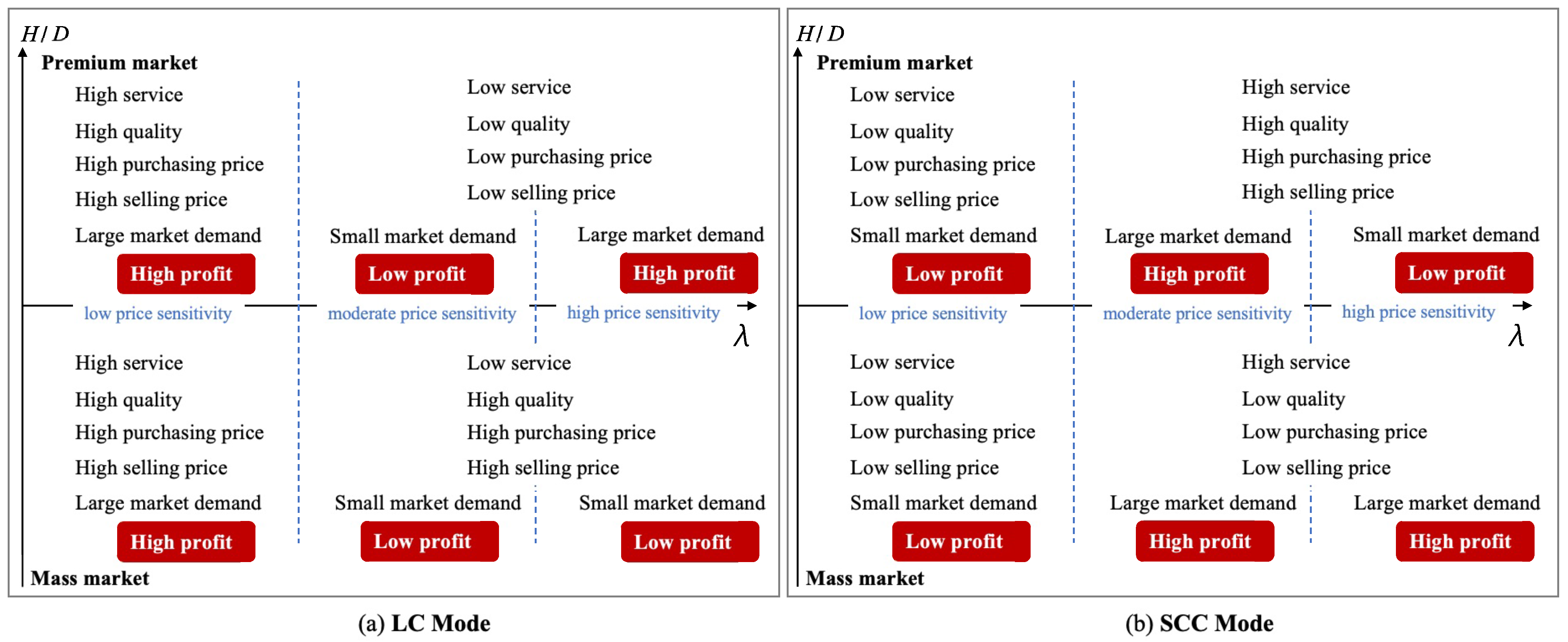
The detailed proofs for all propositions and corollary are consolidated in Appendix A for brevity and to maintain the flow of the main text. The above propositions are summarized in Figure 5. It should be noted that, as the relative magnitudes of each set of variables depend on comparisons across different thresholds in the model, only an approximate trend, rather than a definitive conclusion, can be provided. This is because the actual values of the thresholds and the resulting intervals rely on the specific numerical values assigned to key parameters in the model. This reminds us that when applying modes to a specific region, we must evaluate them in light of the actual parameters of the local market.

5. Discussion

5.1. Sensitivity Analysis

To illustrate the differences between the two modes under various conditions, we conduct a numerical analysis in this section. The parameters are based on field research and enterprise operational data from the citrus supply chain in Yunnan, China. The data were established through standardization and reasonable assumptions, while also referencing the relevant literature [15] to balance practical relevance and academic rigor. Assume the potential market demand for agri-foods is Q 0 = 150 , and the unit production cost and logistics cost are set as c p = 2 , c l = 2 . Additionally, the cost for quality improvement is μ = 3 , and the cost for service improvement is v = 10 . It is noteworthy that we compare the social welfare under different modes, where social welfare is given by W = C S + π C + π P + π S , and the consumer surplus is given by C S = Q 2 / 2 λ .

5.1.1. Impact of the Sensitivity Coefficient of Consumers on the Quality Level α

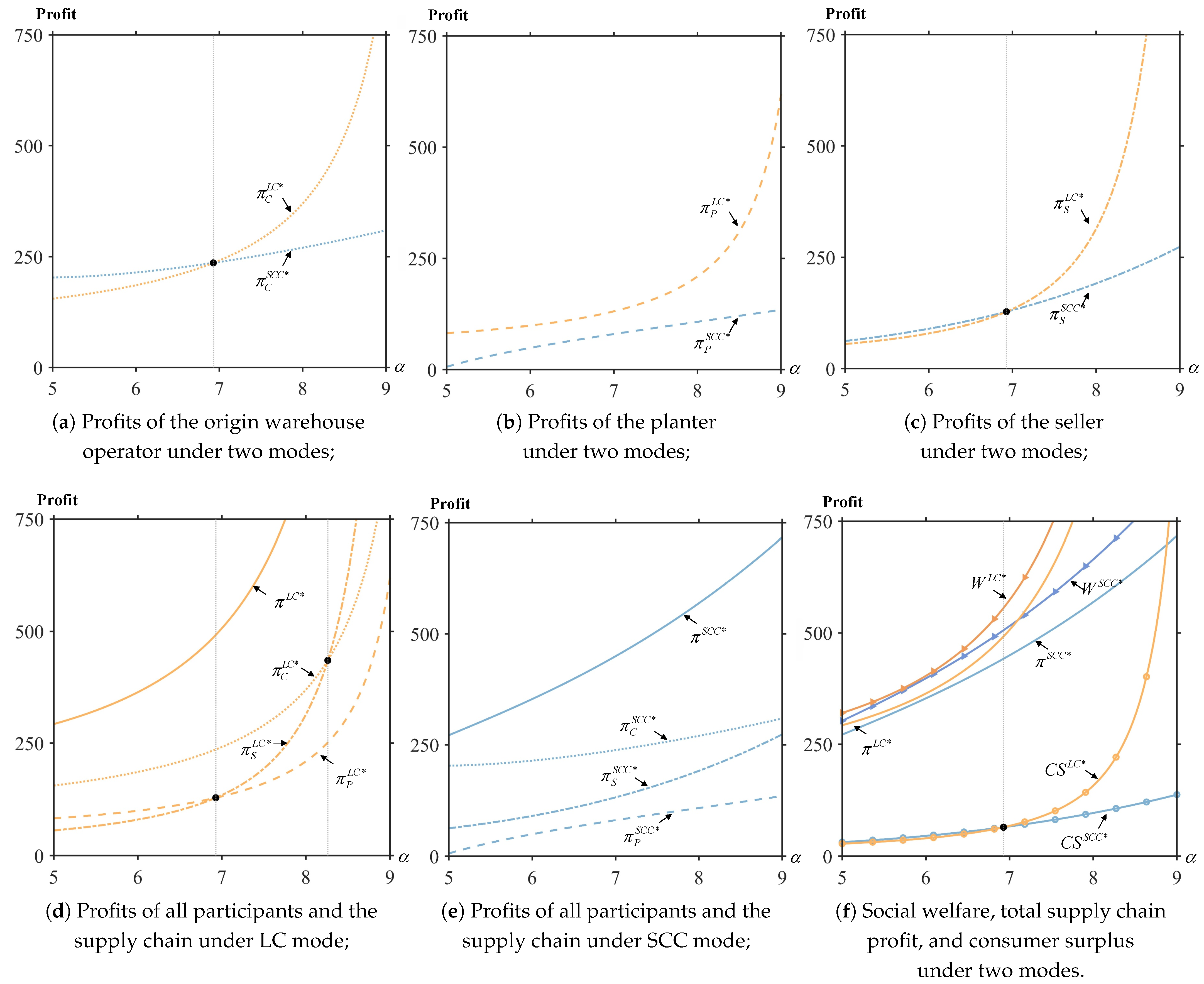
Figure 6 shows that, as consumers’ sensitivity to quality α increases, the profits of all participants, social welfare, and consumer surplus all increase gradually, but with significant differences in the growth trends. The curves under the LC mode are steeper and more concave, indicating faster growth, whereas the growth under the SCC mode is relatively smoother and approximately linear. This highlights the core distinction between the two modes: the decentralized LC mode elicits more direct responses and greater social welfare growth, while the centrally coordinated SCC mode prioritizes overall profit and system stability over individual profit. Figure 6a–c illustrate that once α exceeds a certain threshold, their profits of both the origin warehouse operator and the seller in the LC mode rapidly surpass those in the SCC mode and extend their advantage. In particular, the planter consistently prefers the LC mode across the entire range.
Regarding the profit allocation structure, Figure 6d shows that in the LC mode, the seller’s profit grows quickly, surpassing those of both the planter and origin warehouse operator, ultimately achieving absolute dominance, resulting in π S L C * > π C L C * > π P L C * . It reveals the profit allocation logic of the LC mode: despite the planter creating core quality and the origin warehouse providing essential services, the sellers, who have direct contact with consumers and control the selling pricing, are the primary beneficiaries of the consumers’ heightened sensitivity to quality improvements. In contrast, in the SCC mode, as shown in Figure 6e, the profit allocation exhibits a stable structure: π C S C C * > π S S C C * > π P S C C * . Figure 6f further illustrates how social welfare, consumer surplus, and total supply chain profit change with α under different modes. In the LC mode, both W L C * and π L C * remain consistently higher than in the SCC mode, with steeper curves. This indicates that as quality preferences increase, the LC mode better amplifies the quality premium and scale effects, achieving higher system profits.
Therefore, the origin warehouse operator should flexibly select the mode based on consumer sensitivity to quality. In the early stages, when quality preferences are still developing (when α is small), the SCC mode is recommended, as its system stability helps ensure quality standards and brand cultivation. When entering the market driven by quality preferences (when α is large), the LC mode can better leverage the terminal premium and demand responsiveness, leading to higher total supply chain and individual profits.

5.1.2. Impact of the Sensitivity Coefficient of Consumers to the Service Level β

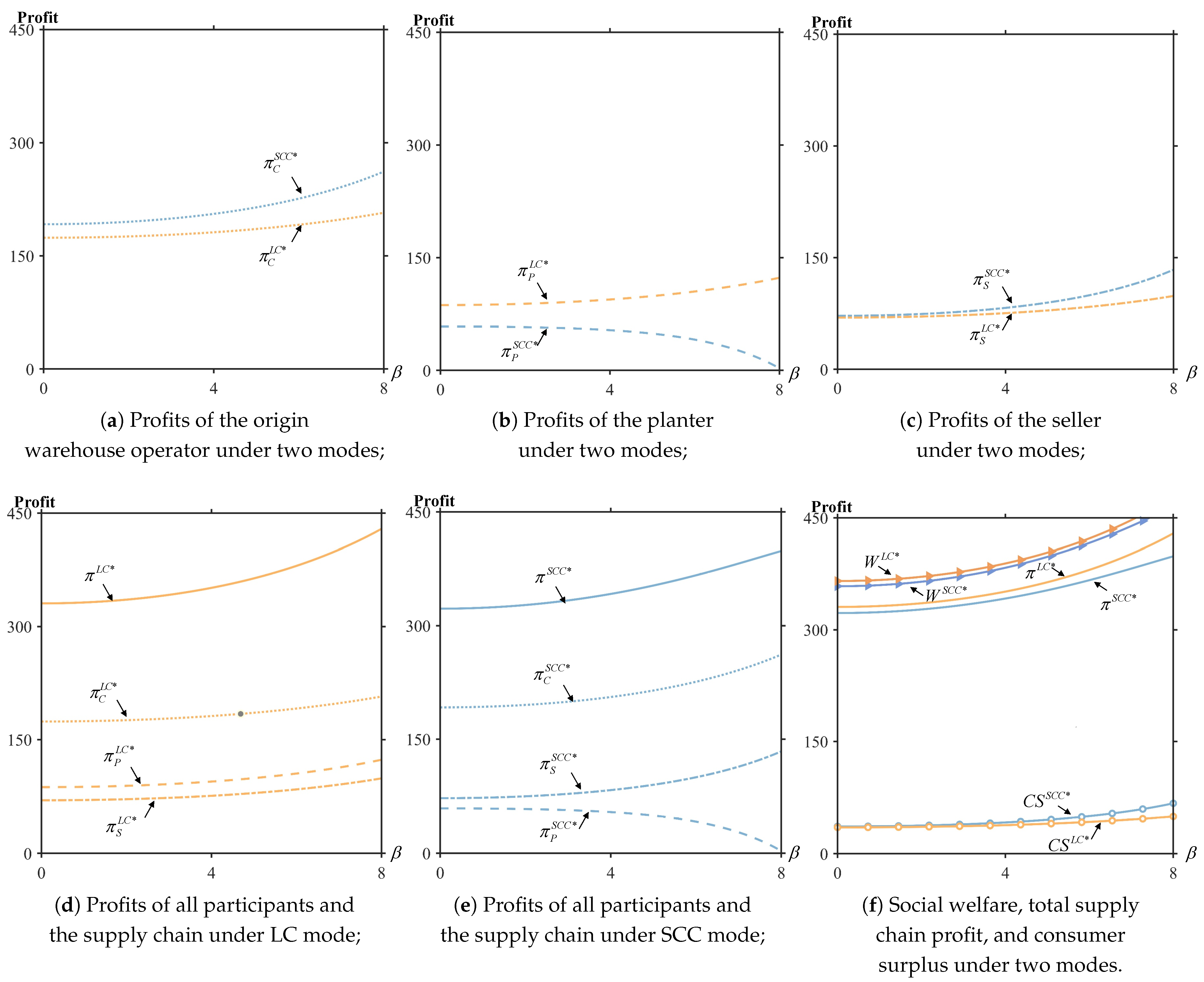
Figure 7 illustrates how the profits of all participants, social welfare, and consumer surplus change as consumer sensitivity to service β increases. All curves are smooth without intersections, but the growth patterns and profit allocation structures show significant differences. As shown in Figure 7a, with the increase in β , the profits of the origin warehouse operator in both modes follow an upward trend. However, the profit in the LC mode is consistently higher than that in the SCC mode, with the absolute gap between them continuing to expand. According to Figure 7b, the profit trend for planters is the opposite in the two modes. In the LC mode, the profit of planters slightly increases with β , while in the SCC mode, the profit decreases as β rises, dropping close to zero at high values of β .
Regarding the profit allocation structure, Figure 7d illustrates that in the LC mode, the total profit increases steadily with β , with the profit allocation following a stable structure: π C L C * > π P L C * > π S L C * . This indicates that, in the LC mode, increasing sensitivity to service level boosts all supply chain participants, particularly benefiting planters. When consumers place a high importance on service levels, origin warehouse operators raise their service standards, which in turn increases market demand. As the upstream of the supply chain, planters do not bear the cost of the increased service level, but they thoroughly enjoy the demand growth brought about by service improvement, which is known as the free-riding effect. Figure 7e shows the profit structure in the SCC mode differs from the LC mode— π C S C C * > π S S C C * > π P S C C * —and the distribution imbalance is gradually worsening. Furthermore, Figure 7f shows that the LC mode consistently outperforms the SCC mode in terms of social welfare and total supply chain profit, while the SCC mode maintains a lead in consumer surplus. This result suggests that when consumers place high importance on service level, the LC mode generates greater economic value, whereas the SCC mode is more beneficial for consumers.
Therefore, for the origin warehouse operator, the SCC mode should be prioritized to maximize its own profit. However, a critical risk of the SCC mode is that the planter’s profit decreases as β increases, which may reduce their willingness to cooperate and affect the long-term stability of the supply chain. To address this, when adopting the SC mode, the origin warehouse operator must design and implement profit-sharing mechanisms, such as offering a portion of the additional profits generated by service improvements to planters, to ensure the overall efficiency of the supply chain.

5.1.3. Impact of the Sensitivity Coefficient of Consumers on the Selling Price λ

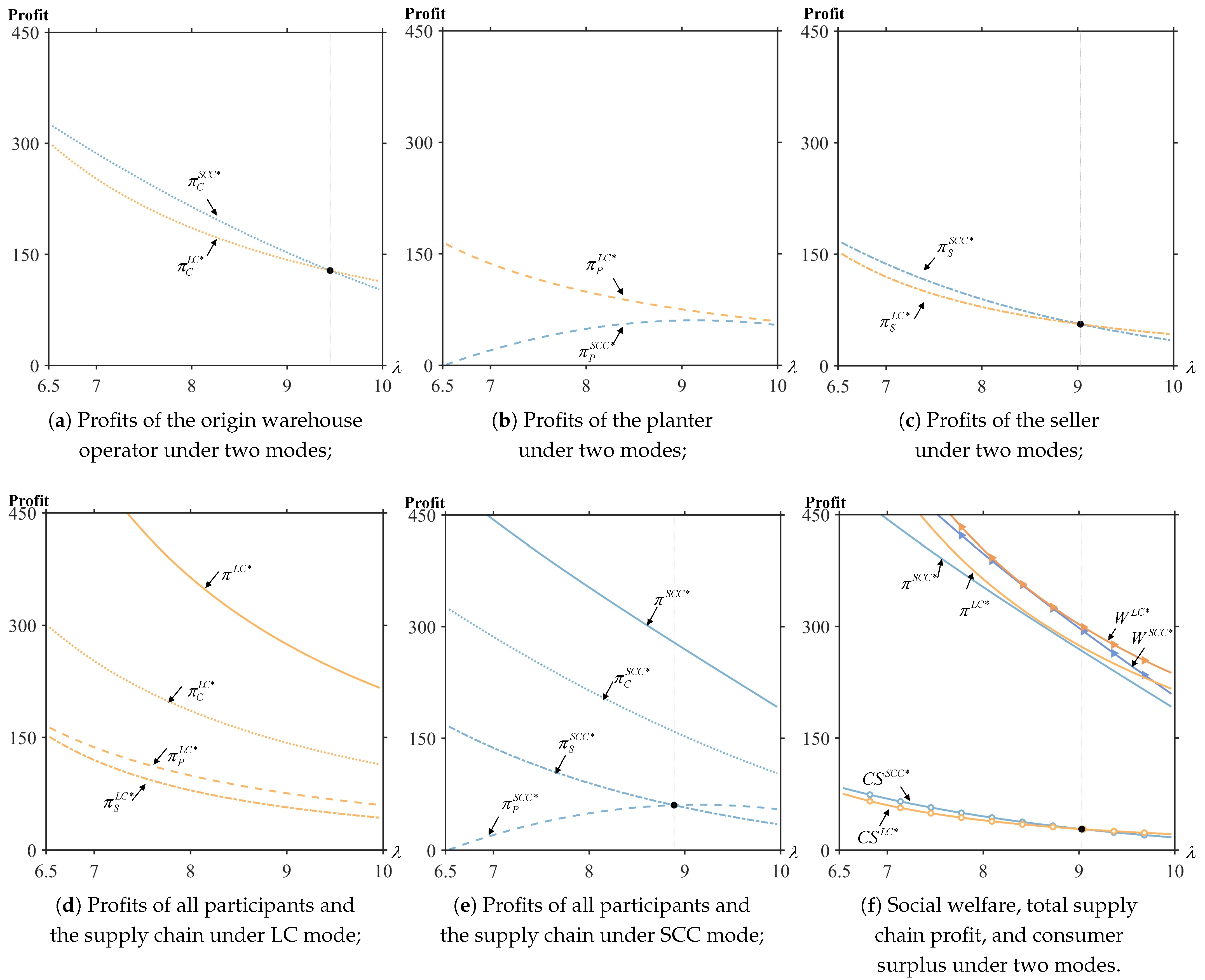
Figure 8 illustrates how the profits of all participants, social welfare, and consumer surplus change as consumer sensitivity to selling price λ increases. Figure 8a,c show that as λ increases, the profits of the origin warehouse operator and the seller decline in both modes. However, the relative advantages of the two modes are exhibited dynamically. When λ is small, the profit of the origin warehouse operator in the SCC mode is higher than in the LC mode; however, when λ exceeds a certain threshold, the LC mode demonstrates superior performance. Figure 8b indicates that the profits of the planter in the LC mode are always higher than in the SCC mode, but the trends are opposite. In the LC mode, the profit of planter decreases as λ increases, while in the SCC mode, it increases. This is a counterintuitive but crucial finding that further reveals the game-theoretic relationship in the SCC mode. Faced with external price competition pressure, the origin warehouse operator in the SCC mode may be forced to sacrifice part of its own profit (by increasing p 1 S C C * , as shown in Proposition 4) to incentivize the quality level. As a result, the planter benefits and achieves profit growth despite the adverse situation.
Regarding the profit allocation structure, Figure 8d that in the LC mode, the profits of all three participants and the total profit decline with increasing λ , following a stable structure: π C L C * > π P L C * > π S L C * . Figure 8e shows that in the SCC mode, when λ exceeds a certain threshold, the planter’s profit surpasses that of the seller, following a structure of π C S C C * > π P S C C * > π S S C C * . The planter’s profit surpassing that of the seller demonstrates that when the selling price becomes the dominant factor in consumer decision-making, the quality of the agri-foods becomes the core driver of market demand. Figure 8f further shows that as λ increases, the LC mode consistently outperforms the SCC mode in terms of social welfare and total supply chain profit. However, in terms of consumer surplus, only at higher values of λ does the LC mode create more value for consumers.
Therefore, the origin warehouse operator can choose the SCC mode in a market with moderate selling price sensitivity. However, when entering high price sensitivity markets, switching to the LC mode can lead to a win–win situation for both supply chain profits and consumer welfare. Regardless of the mode adopted, high price sensitivity will place the seller in the lowest-profit position, creating a risk of tension in channel relationships. Therefore, while pursuing profit maximization, the origin warehouse operator should proactively design incentive and compensation mechanisms for the seller to ensure its active participation.

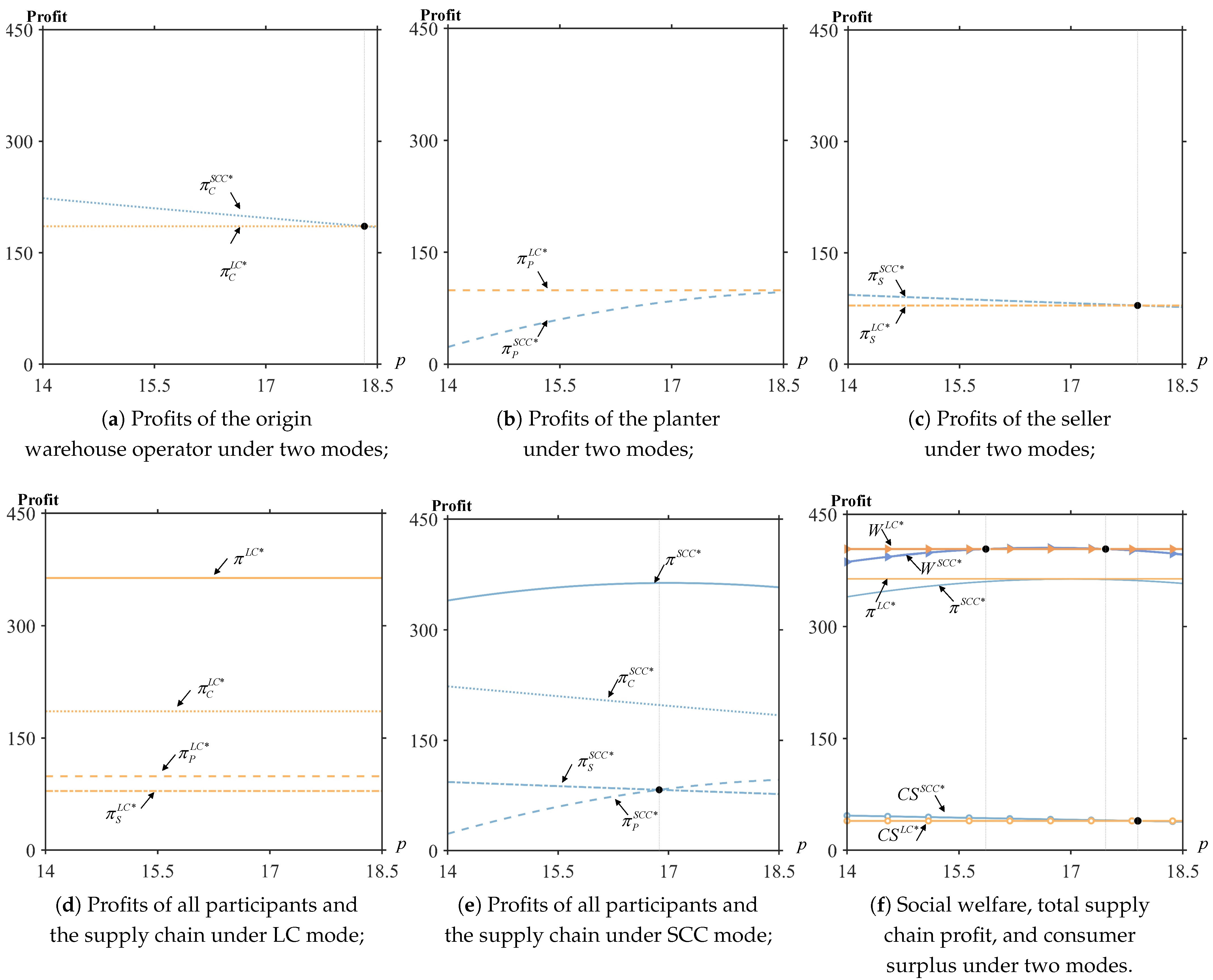
5.1.4. Impact of Wholesale Price per Unit of Agri-Food p

The wholesale price of agri-foods is determined exogenously by market supply and demand and only affects the relevant profits in the SCC mode, with all profits in the LC mode remaining unchanged. As p increases, the profits of the origin warehouse operator and the seller in the SCC mode both show a declining trend. Once p exceeds a certain threshold, the profits in the LC mode surpass those in the SCC mode (see Figure 9a,c). In contrast, the profit of the planter in the SCC mode continues to grow as p increases, gradually approaching the profit in the LC mode, as shown in Figure 9b. This seemingly contradictory phenomenon stems from the power structure and cooperative game in the SCC mode. When p rises, the origin warehouse operator, as a leader, offers discounts to the planter to ensure product quality and stabilize market demand, maintaining the overall competitiveness and long-term stability of the supply chain. This also leads to the counter cyclical growth of planter profits. Meanwhile, the increase directly raises the costs for sellers, leading to a decline in their profits, which, after a certain threshold, fall below the planter’s profit, resulting in the profit allocation structure of π C S C C * > π P S C C * > π S S C C * (see Figure 9e).
Therefore, the origin warehouse operator should flexibly adjust the mode based on changes p. In the low wholesale price range, the origin warehouse operator should prioritize the SCC mode to maximize its own profit through supply chain coordination. If the wholesale price continues to rise, the origin warehouse may consider gradually shifting to the LC mode, focusing on improving the service level. When it is extremely high, opting for the LC mode can achieve a win–win outcome for all participants.

5.2. Managerial Implications

The fundamental differences between the LC and SCC modes determine their applicability in dynamic market environments, leading to many conclusions and managerial insights.
(1) Mode selection must align with market conditions and stakeholder impact.
The mode selection by origin warehouse operators is a dynamic strategic decision driven by market conditions. For high-quality, sensitive, premium markets where consumers are willing to pay for quality and service, the operator should adopt the LC mode (as seen in Proposition 7). Under this mode, decentralized decision-making is more likely to motivate participants to invest in quality and service; however, planters may experience reduced bargaining power, and the profits generated by quality improvement are easily subject to free-riding by other participants, leading to profit dilution (as seen in Proposition 5). In contrast, for markets with high price sensitivity and cost sensitivity, such as mass markets, the operator should transition to the SCC mode, which is more conducive to maintaining low prices and high demand through centralized cost control and optimized logistics efficiency. Under this mode, planters gain access to stable sales channels, but their bargaining power tends to weaken, and profits are more susceptible to compression. Consumers benefit from more consistent pricing and standardized agri-foods, but they often have limited access to customized or high-value-added services (as seen in Propositions 4 and 5). It should be noted that, although the models discussed in this study are based on specific regional contexts, the power structures and decision-making mechanisms of the LC mode (decentralized efficiency optimization) and the SCC mode (centralized value integration) still offer general insights. When applied to different regions such as Europe and North America, it is essential to adapt them according to local institutional environments, market structures, and other key factors.
(2) Stakeholders should establish collaborative mechanisms to promote high-quality development in the agricultural supply chain.
This study reveals that both modes have inherent coordination dilemmas. The SCC mode excels in system efficiency and stability, but centralized control can lead to imbalances in benefit distribution. The LC mode can achieve a more balanced profit structure within certain parameter ranges, but, without unified coordination, it tends to suffer from double markups and redundant investments, which weakens overall efficiency and reduces the system’s resilience. Neither mode alone can achieve a balance of efficiency, fairness, and resilience; therefore, targeted mechanism compensation is needed to address the weaknesses in the chosen mode. Under the LC mode, a quality premium feedback mechanism should be established. For example, purchasing prices can be linked to third-party certified quality grades, or a transparent and traceable quality-based profit-sharing system can be introduced. This ensures that planters’ investments are transformed into sustainable returns. Under the SCC mode, profit-sharing and flexible adjustment clauses should be incorporated. For instance, a portion of logistics cost savings can be returned to producers based on quality level, or a shared development fund can be set up to support innovation in cultivation. This approach helps maintain system efficiency while enhancing fairness and engagement.
(3) The government should provide differentiated policies and subsidies based on the modes.
In terms of policy guidance, priority should be given to supporting the development of digital quality traceability platforms and standardized grading and certification systems that cover the entire supply chain, thereby providing the infrastructure for a high-quality, low-price market mechanism. Regarding government subsidies, targeted support should be implemented based on the specific mode: Under the LC mode, subsidies such as quality-based warehousing incentives or premium reward mechanisms can be provided to planters to encourage them to deliver high-quality produce into the coordinated system and share in the value of quality. Under the SCC mode, subsidies such as logistics efficiency support or standardized processing can be directed to origin warehouse operators to promote cost reduction through scale and standardization. Through this approach combining guidance and subsidies, different modes can be steered toward coordinated development that balances efficiency and fairness.

6. Conclusions

6.1. Main Conclusions

This study develops a three-level agri-food supply chain game model involving a planter, an origin warehouse operator, and a seller. It innovatively incorporates quality level, service level, and selling price as endogenous decision variables within the demand function and characterizes the channel power structure and decision-making mechanisms under two different origin warehouse modes: the Logistics Center (LC) and the Supply Chain Center (SCC). By solving the equilibrium solutions under these two modes, the study systematically compares key variables and profits. Additionally, numerical analysis is used to examine the sensitivity of key parameters, including consumer preferences and external wholesale prices. The findings provide a novel theoretical framework and decision-making basis for understanding and optimizing agri-food supply chain business models. The core theoretical contribution of this study is its revelation of the channel power structure and decision mechanisms corresponding to the two functional roles of the origin warehouse: the LC mode relies on a self-reinforcing collaborative mechanism where quality and service levels are spontaneously formed under decentralized decision-making, while the SCC mode operates under the leadership of the core enterprise, with systematic trade-offs and coordination of limited resources.

6.2. Limitations and Future Research

It should be noted that this study has several limitations: First, the model assumes complete information and risk neutrality, which may overestimate the certainty of decisions. For instance, if the origin warehouse operator is better informed about demand, they may be able to leverage this advantage to lower the purchasing price, which might allow them to capture more benefits during negotiations and thereby achieve a favorable shift in profit distribution. However, while these factors could systematically alter decision variables and profit distribution, the conclusions regarding the decision mechanisms under different modes still hold. Second, the model considers a single type of agri-food product, failing to distinguish between variations in characteristics such as perishability and quality across different products. It also neglects resource allocation decisions made by the planter or origin warehouse operator when handling multiple agricultural products simultaneously. Third, the study assumes a single participant per level, overlooking actor heterogeneity in aspects such as cultivation scale and optimization objectives, and does not incorporate competition or cooperation among multiple participants at the same level. Fourth, this research primarily adopts an economically focused sustainability perspective, without explicitly incorporating environmental or social sustainability factors such as carbon emission constraints, government subsidies, and so on.
Future research could extend this work by (1) incorporating heterogeneous risk preferences and information asymmetry; (2) considering and comparing multiple product types with varying attributes (e.g., perishability); (3) incorporating actor heterogeneity (e.g., varying cultivation scales and different objectives) and considering competition and cooperation among participants at the same level; and (4) incorporating environmental or social sustainability factors. Moreover, validating the model with case studies and field data would strengthen its theoretical foundation and offer more concrete guidance for agri-food supply chain sustainable development.

Author Contributions

Conceptualization, Y.G. and X.W.; methodology, Y.G. and L.J.; writing—original draft preparation, Y.G.; writing—review and editing, K.Y.; visualization, Y.Y.; supervision, X.W. and M.S.; funding acquisition, K.Y. All authors have read and agreed to the published version of the manuscript.

Funding

This research was funded by the Fundamental Research Funds for the Central Universities, grant number 2025JBZX016 and the National Natural Science Foundation of China, grant numbers 72242102 and 72431002.

Data Availability Statement

The original contributions presented in this study are included in the article. Further inquiries can be directed to the corresponding authors.

Acknowledgments

The financial support mentioned in the Funding part is gratefully acknowledged. We thank Cheng Cheng for his assistance in the preparation and review of the manuscript.

Conflicts of Interest

The authors declare no conflicts of interest.

Appendix A. Proofs

Proof of Proposition 1.
The profit of the seller in LC mode is given by Equation (3). The second-order derivative of π S L C with respect to p 2 is 2 π S L C / p 2 2 = 2 λ < 0 , which indicates that π S L C is a strictly concave function of p 2 . Therefore, when π S L C / p 2 = ( Q 0 + α s + β e λ p 2 ) λ ( p 2 p 1 τ ) = 0 , we find the optimal selling price p 2 L C * :
p 2 L C * = Q 0 + α s + β e + λ ( p 1 + τ ) 2 λ
Substituting p 2 L C * into Equation (2), we obtain the following:
π P L C = ( p 1 c p ) Q 0 + α s + β e λ ( p 1 + τ ) 2 μ s 2 2
The Hessian matrix of π P L C is H = λ α 2 α 2 μ . When α 2 < 4 λ μ , the Hessian matrix is negative definite, implying that π P L C is strictly concave in p 1 and s, and unique optimal solutions exist. Setting π P L C / p 1 = 0 and π P L C / s = 0 , we obtain the following:
p 1 L C * = Q 0 + α s + β e λ τ + λ c p 2 λ s L C * = α ( p 1 c p ) 2 μ
Substituting p 2 L C * , p 1 L C * and s L C * into Equation (1), we obtain the following:
π C L C = ( τ c l ) λ μ ( Q 0 + β e λ τ λ c p ) 4 λ μ α 2 v e 2 2
The Hessian matrix of π C L C is H = 2 λ 2 μ 4 λ μ α 2 λ μ β 4 λ μ α 2 λ μ β 4 λ μ α 2 v . When β 2 μ < 2 v ( 4 λ μ α 2 ) , the Hessian matrix is negative definite, implying that π C L C is strictly concave in τ and e, and unique optimal solutions exist. Setting π C L C / τ = 0 , π C L C / e = 0 , we obtain the following:
τ L C * = v ( 4 λ μ α 2 ) ( Q 0 λ ( c p + c l ) ) λ ( 2 v ( 4 λ μ α 2 ) β 2 μ ) + c l e L C * = β μ ( Q 0 λ ( c l + c p ) ) 2 v ( 4 λ μ α 2 ) β 2 μ
Finally, by simultaneously solving Equations (A1), (A3), and (A5), we obtain the equilibrium solutions τ L C * , e L C * , p 1 L C * , s L C * , and p 2 L C * . Substituting these into the expressions for market demand and participant profits yields the equilibrium solutions Q L C * , π C L C * , π P L C * , and π S L C * . □
Proof of Proposition 2.
The profit of the seller in SCC mode is given by Equation (6). The second-order derivative of π S S C C with respect to p 2 is 2 π S S C C / p 2 2 = 2 λ < 0 , which indicates that π S S C C is a strictly concave function of p 2 . Therefore, when π S S C C / p 2 = ( Q 0 + α s + β e λ p 2 ) λ ( p 2 p ) = 0 , we find the optimal selling price p 2 S C C * :
p 2 S C C * = Q 0 + α s + β e + λ p 2 λ
Substituting p 2 S C C * into Equation (5), we obtain the following:
π P S C C = ( p 1 c p ) Q 0 + α s + β e λ p 2 μ s 2 2
The second-order partial derivative of Equation (A7) with respect to s is 2 π P S C C / s 2 = μ < 0 , implying that π P S C C is strictly concave in s and a unique optimal solution exists. Setting π P S C C / s = 1 2 α ( p 1 c p ) μ s = 0 , we obtain the following:
s S C C * = α ( p 1 c p ) 2 μ
Substituting p 2 S C C * and s S C C * into Equation (4), we obtain the following:
π C S C C = ( p p 1 c l ) 2 μ Q 0 + α 2 ( p 1 c p ) + 2 β μ e 2 λ μ p 4 μ v e 2 2
The Hessian matrix of π C S C C is H = α 2 2 μ β 2 β 2 v . When β 2 μ < 2 α 2 v , the Hessian matrix is negative definite, implying that π C S C C is strictly concave in p 1 and e, and unique optimal solutions exist. Setting π C S C C / p 1 = 0 and π C S C C / e = 0 , we obtain the following:
p 1 S C C = α 2 ( p + c p c l ) 2 μ ( Q 0 + β e λ p ) 2 α 2 e S C C * = β 2 v ( p p 1 c l )
Finally, by simultaneously solving Equations (A6), (A8), and (A10), we obtain the equilibrium solutions p 1 S C C * , e S C C * , s S C C * , and p 2 S C C * . Substituting these into the expressions for market demand and participant profits yields the equilibrium solutions Q S C C * , π C S C C * , π P S C C * , and π S S C C * . □
Proof of Corollary 1.
Take the first-order derivatives of all decision variables in the LC mode with respect to the parameters α , β , λ , μ , v, c p , and c l .
(1)
Taking the first-order derivative of the parameter α , we obtain the following:
e L C * α = 4 α β μ v ( D + λ H ) δ 2 > 0 s L C * α = v ( D + λ H ) ( 2 v ( 4 λ μ + α 2 ) β 2 μ ) δ 2 > 0 p 1 L C * α = 8 α μ v 2 ( D + λ H ) δ 2 > 0 τ L C * α = 2 α β 2 μ v ( D + λ H ) λ δ 2 > 0 p 2 L C * α = 2 α μ v ( β 2 + 6 λ μ ) ( D + λ H ) λ δ 2 > 0 Q L C * α = 4 α λ μ v 2 ( D + λ H ) δ 2 > 0
(2)
Taking the first-order derivative of the parameter β , we obtain the following:
e L C * β = μ ( D + λ H ) ( 2 v ( 4 λ μ α 2 ) + β 2 μ ) δ 2 > 0 s L C * β = 2 α β μ v ( D + λ H ) δ 2 > 0 p 1 L C * β = 4 β μ 2 v ( D + λ H ) δ 2 > 0 τ L C * β = 2 β μ v ( 4 λ μ α 2 ) ( D + λ H ) λ δ 2 > 0 p 2 L C * β = 2 β μ v ( 7 λ μ α 2 ) ( D + λ H ) λ δ 2 > 0 Q L C * β = 2 β λ μ 2 v ( D + λ H ) δ 2 > 0
(3)
Taking the first-order derivative of the parameter λ , we obtain the following:
e L C * λ = β μ [ ( β 2 μ + 2 α 2 v ) ( c p + c l ) 8 μ v Q 0 ] δ 2 < 0 s L C * λ = α v [ ( β 2 μ + 2 α 2 v ) ( c p + c l ) 8 μ v Q 0 ] δ 2 < 0 p 1 L C * λ = 2 μ v ( 2 v α 2 + β 2 μ ) ( c p + c l ) 8 μ v Q 0 δ 2 < 0 τ L C * λ = v ( β 2 μ ( α 2 Q 0 4 λ 2 μ ( c p + c l ) ) + 2 Q 0 v ( 4 λ μ α 2 ) 2 ) λ 2 δ 2 < 0 p 2 L C * λ = v [ λ 2 μ ( 7 β 2 μ + 6 α 2 v ) ( c p + c l ) Q 0 ( 2 α 4 v + 56 λ 2 μ 2 v + α 2 μ ( β 2 16 λ μ ) ) ] λ 2 δ 2 < 0 Q L C * λ = μ v ( 2 α 2 v + β 2 μ ) ( Q 0 λ ( c p + c l ) ) δ 2 λ μ v ( c p + c l ) δ < 0
(4)
Taking the first-order derivative of the parameter μ , we obtain the following:
e L C * μ = 2 α 2 β v ( D + λ H ) δ 2 < 0 s L C * μ = α v ( 8 λ μ β 2 ) ( D + λ H ) δ 2 < 0 p 1 L C * μ = 4 α 2 v 2 ( D + λ H ) δ 2 < 0 τ L C * μ = α 2 β 2 v ( D + λ H ) λ δ 2 < 0 p 2 L C * μ = α 2 v ( β 2 + 6 λ μ ) ( D + λ H ) λ δ 2 < 0 Q L C * μ = 2 α 2 v 2 λ ( D + λ H ) δ 2 < 0
(5)
Taking the first-order derivative of the parameter v, we obtain the following:
e L C * v = 2 β μ ( 4 λ μ α 2 ) ( D + λ H ) δ 2 < 0 s L C * v = α β 2 μ ( D + λ H ) δ 2 < 0 p 1 L C * v = 2 β 2 μ 2 ( D + λ H ) δ 2 < 0 τ L C * v = β 2 ( 4 λ μ α 2 ) ( D + λ H ) λ δ 2 < 0 p 2 L C * v = β 2 μ ( 7 λ μ α 2 ) ( D + λ H ) λ δ 2 < 0 Q L C * v = β 2 μ 2 λ ( D + λ H ) δ 2 < 0
(6)
Taking the first-order derivative of the parameters c p and c l , we obtain the following:
e L C * c p = e L C * c l = β λ μ δ < 0 s L C * c p = s L C * c l = α λ v δ < 0 p 1 L C * c p = 6 λ μ v 2 α 2 v β 2 μ δ > 0 , ( λ > α 2 2 μ ) p 1 L C * c l = 2 λ μ v δ < 0 τ L C * c p = ( 4 λ μ α 2 ) v δ < 0 τ L C * c l = v ( 4 λ μ α 2 ) β 2 μ δ > 0 , ( λ > α 2 2 μ ) p 2 L C * c p = p 2 L C * c l = v ( λ μ α 2 ) β 2 μ 2 v ( 4 λ μ α 2 ) β 2 μ > 0 , ( λ > 2 α 2 μ ) Q L C * c p = Q L C * c l = λ 2 μ v δ < 0
Take the first-order derivatives of all decision variables in the SCC mode with respect to the parameters α , β , λ , μ , v, c p , and c l .
(7)
Taking the first-order derivative of the parameter α , we obtain the following:
e S C C * α = α β μ ( β 2 H + 4 v D ) ζ 2 < 0 s S C C * α = ( β 4 μ 2 + α 2 v ( 2 α 2 v β 2 μ ) ) H + 2 μ v ( 2 α 2 v + β 2 μ ) D 2 μ ζ 2 > 0 p 1 S C C * α = 2 α μ v ( β 2 H + 4 v D ) ζ 2 > 0 p 2 S C C * α = α v [ β 2 μ ( α 2 H μ D ) + α 4 v H ] λ μ ζ 2 > 0 Q S C C * α = α v [ β 2 μ ( α 2 H μ D ) + α 4 v H ] μ ζ 2 > 0
(8)
Taking the first-order derivative of the parameter β , we obtain the following:
e S C C * β = ( 2 α 2 v + β 2 μ ) ( α 2 H + 2 μ D ) 2 ζ 2 > 0 s S C C * β = α β v ( α 2 H + 2 μ D ) ζ 2 < 0 p 1 S C C * β = 2 β μ v ( α 2 H + 2 μ D ) ζ 2 < 0 p 2 S C C * β = α 2 β v ( α 2 H + 2 μ D ) 2 λ ζ 2 > 0 Q S C C * β = α 2 β v ( α 2 H + 2 μ D ) 2 ζ 2 > 0
(9)
Taking the first-order derivative of the parameter λ , we obtain the following:
e S C C * λ = β μ p ζ < 0 s S C C * λ = α v p ζ > 0 p 1 S C C * λ = 2 μ v p ζ > 0 p 2 S C C * λ = α 2 v ( α 2 H + 2 μ Q 0 ) 4 λ 2 μ ζ < 0 Q S C C * λ = α 2 v p 2 ζ < 0
(10)
Taking the first-order derivative of the parameter μ , we obtain the following:
e S C C * μ = α 2 β ( β 2 H + 4 v D ) 2 ζ 2 > 0 s S C C * μ = α ( β 4 μ 2 H + 2 α 2 v ( α 2 v β 2 μ ) H + 2 β 2 μ 2 v D ) 2 μ 2 ζ 2 < 0 p 1 S C C * μ = α 2 v ( β 2 H + 4 v D ) ζ 2 < 0 p 2 S C C * μ = α 2 v ( β 2 μ ( α 2 H + μ D ) α 4 v H ) 2 λ μ 2 ζ 2 < 0 Q S C C * μ = α 2 v ( β 2 μ ( α 2 H + μ D ) α 4 v H ) 2 μ 2 ζ 2 < 0
(11)
Taking the first-order derivative of the parameter v, we obtain the following:
e S C C * v = α 2 β ( α 2 H + 2 μ D ) ζ 2 < 0 s S C C * v = α β 2 ( α 2 H + 2 μ D ) 2 ζ 2 > 0 p 1 S C C * v = β 2 μ ( α 2 H + 2 μ D ) ζ 2 > 0 p 2 S C C * v = α 2 β 2 ( α 2 H + 2 μ D ) 4 λ ζ 2 < 0 Q S C C * v = α 2 β 2 ( α 2 H + 2 μ D ) 4 ζ 2 < 0
(12)
Taking the first-order derivative of the parameters c p and c l , we obtain the following:
e S C C * c p = e S C C * c l = α 2 β 2 ζ < 0 s S C C * c p = s S C C * c l = α ( β 2 μ α 2 v ) 2 μ ζ < 0 p 1 S C C * c p = α 2 v ζ > 0 , p 1 S C C * c l = β 2 μ α 2 v ζ < 0 p 2 S C C * c p = p 2 S C C * c l = α 4 v 4 λ μ ζ < 0 Q S C C * c p = Q S C C * c l = α 4 v 4 μ ζ < 0
Proof of Proposition 3.
Comparison of the equilibrium solutions for e L C * and e S C C * . Based on Propositions 1 and 2, it can be concluded that
Δ e = e S C C * e L C * = β [ α 2 H + 2 μ D 2 ζ μ ( D + λ H ) δ ] = β ( α 2 H + 2 μ D ) δ 2 μ ( D + λ H ) ζ 2 δ ζ = β 2 δ ζ [ ( α 2 δ 2 λ μ ζ ) H + 2 μ ( δ ζ ) D ]
where δ = 2 v ( 4 λ μ α 2 ) β 2 μ , ζ = 2 α 2 v β 2 μ , H = p c l c p , D = Q 0 λ p .
α 2 δ 2 λ μ ζ = α 2 ( 2 v ( 4 λ μ α 2 ) β 2 μ ) 2 λ μ ( 2 α 2 v β 2 μ ) = ( 2 α 2 v + β 2 μ ) ( 2 λ μ α 2 )
δ ζ = ( 2 v ( 4 λ μ α 2 ) β 2 μ ) ( 2 α 2 v β 2 μ ) = 4 v ( 2 λ μ α 2 )
Therefore, when λ < α 2 / 2 μ , we obtain α 2 δ 2 λ μ ζ < 0 and δ ζ < 0 . Further, we know Δ e < 0 , meaning e S C C * < e L C * ; conversely, when λ > α 2 / 2 μ , we have e S C C * > e L C * . □
Proof of Proposition 4.
Comparison of the equilibrium solutions for p 1 S C C * and p 1 L C * , s S C C * and s L C * .
Based on Propositions 1 and 2, it can be concluded that
Δ p 1 = p 1 S C C * p 1 L C * = α 2 v H 2 μ v D ζ 2 μ v ( D + λ H ) δ + H = 1 δ ζ [ ( ( α 2 v β 2 μ ) δ 2 λ μ v ζ ) H 2 μ v ( δ + ζ ) D ]
The sign of Δ p 1 is determined by the fraction K p 1 = ( ( α 2 v β 2 μ ) δ 2 λ μ v ζ ) H 2 μ v ( δ + ζ ) D . Let
N = ( α 2 v β 2 μ ) δ 2 λ μ v ζ , M = 2 μ v ( δ + ζ ) , t p 1 = M / N ,
and then K p 1 = N ( H t p 1 D ) . The sign of K p 1 depends on N and ( H t p 1 D ) . We first analyze the sign of N. Substituting δ and ζ , we simplify and obtain the following:
N = 4 α 2 λ μ v 2 6 β 2 λ μ 2 v 2 α 4 v 2 + α 2 β 2 μ v + β 4 μ 2 = 2 λ μ v ( 2 α 2 v 3 β 2 μ ) ( α 2 v β 2 μ ) ( 2 α 2 v + β 2 μ ) .
When 2 α 2 v 3 β 2 μ < 0 , N < 0 , then K p 1 < 0 , i.e., p 1 S C C * < p 1 L C * ;
When 2 α 2 v 3 β 2 μ > 0 , there exists a critical value λ p 1 = ( α 2 v β 2 μ ) ( 2 α 2 v + β 2 μ ) 2 μ v ( 2 α 2 v 3 β 2 μ ) , and we have the following:
If λ < λ p 1 , then K p 1 < 0 , i.e., p 1 S C C * < p 1 L C * ;
If λ > λ p 1 and H / D < t p 1 , then K p 1 < 0 , i.e., p 1 S C C * < p 1 L C * ;
If λ > λ p 1 and H / D > t p 1 , then K p 1 > 0 , i.e., p 1 S C C * > p 1 L C * ;
Similarly, from Equations (A3) and (A8), we have s * = α ( p 1 * c p ) 2 μ . Thus, the quality level s and the purchasing price p 1 are positively correlated. Therefore, the comparison between s S C C * and s L C * is fully consistent with that between p 1 S C C * and p 1 L C * . □
Proof of Proposition 5.
Comparison of the equilibrium solutions for p 2 S C C * and p 2 L C * .
Based on Propositions 1 and 2, it can be concluded that
Δ p 2 = p 2 S C C * p 2 L C * = α 2 v ( α 2 H + 2 μ D ) 4 λ μ ζ + p v ( 7 λ μ α 2 ) ( D + λ H ) λ δ ( c l + c p ) = 1 4 λ μ δ ζ [ ( α 4 v δ 4 λ μ v ζ ( 7 λ μ α 2 ) + 4 λ μ ζ δ ) H + ( 2 α 2 μ v δ 4 μ v ζ ( 7 λ μ α 2 ) ) D ]
Let N = α 4 v δ 4 λ μ v ζ ( 7 λ μ α 2 ) + 4 λ μ δ ζ , M = 2 α 2 μ v δ 4 μ v ζ ( 7 λ μ α 2 ) , and the sign of Δ p 2 is determined by the fraction K p 2 = N H + M D . Let t p 2 = M / N ; then K p 2 = N ( H t p 2 D ) . The sign of K p 2 depends on N and ( H t p 2 D ) . We first analyze the sign of N. Substituting δ and ζ , we simplify and obtain the following:
N = 4 μ 2 v ( 2 α 2 v β 2 μ ) λ 2 + 4 β 2 μ 2 ( β 2 μ α 2 v ) λ α 4 v ( 2 α 2 v + β 2 μ ) ,
which can be viewed as a quadratic function N ( λ ) = A λ 2 + B λ + C , where
A = 4 μ 2 v ( 2 α 2 v β 2 μ ) > 0 , B = 4 β 2 μ 2 ( β 2 μ α 2 v ) < 0 , C = α 4 v ( 2 α 2 v + β 2 μ ) < 0 .
The quadratic function N ( λ ) has a positive root,
λ p 2 = β 2 μ ( α 2 v β 2 μ ) + 4 α 8 v 4 2 α 2 v β 6 μ 3 + β 8 μ 4 2 μ v ( 2 α 2 v β 2 μ ) ,
such that when λ < λ p 2 , N ( λ ) < 0 , and when λ > λ p 2 , N ( λ ) > 0 .
Now, analyzing the sign of M further, we obtain the following:
M = 2 μ v [ 2 α 2 v ( α 2 10 λ μ ) + β 2 μ ( 14 λ μ v 3 α 2 ) ] .
Given that α 2 10 λ μ < 0 and 14 λ μ v 3 α 2 > 0 (guaranteed by α 2 < 4 λ μ ), and given β 2 μ ( 14 λ μ v 3 α 2 ) < α 2 v ( 14 λ μ v 3 α 2 ) (guaranteed by β 2 μ < α 2 v ), we have the following:
M < 2 α 2 v ( α 2 10 λ μ ) + α 2 v ( 14 λ μ v 3 α 2 ) = α 2 v ( α 2 6 λ μ ) < 0 .
In summary, we obtain the simplified conclusion that
(1)
If λ < λ p 2 , N < 0 and M < 0 , then K p 2 < 0 , i.e., p 2 S C C * < p 2 L C * ;
(2)
If λ > λ p 2 and H / D < t p 2 , N > 0 and M < 0 , then K p 2 < 0 , i.e., p 2 S C C * < p 2 L C * ;
(3)
If λ > λ p 2 and H / D > t p 2 , then K p 2 > 0 , i.e., p 2 S C C * > p 2 L C * .
Proof of Proposition 6.
Comparison of the equilibrium solutions for Q S C C * and Q L C * .
Based on Propositions 1 and 2, it can be concluded that
Δ = Q S C C * Q L C * = α 2 v ( α 2 H + 2 μ D ) 4 μ ζ λ μ v ( D + λ H ) δ = v 4 μ δ ζ [ ( α 4 δ 4 λ 2 μ 2 ζ ) H + 2 μ ( α 2 δ 4 λ μ ζ ) D ]
The sign of Δ Q depends on the fraction K Q = ( α 4 δ 4 λ 2 μ 2 ζ ) H + 2 μ ( α 2 δ 4 λ μ ζ ) D . Let
N = α 4 δ 4 λ 2 μ 2 ζ , M = 2 μ ( α 2 δ 4 λ μ ζ ) , t Q = M N ,
so that K Q = N H + M D , and then K Q = N ( H t Q D ) . The sign of K Q depends on N and ( H t Q D ) . We first analyze the sign of N. Substituting δ and ζ , we simplify and obtain the following:
N = α 4 δ 4 λ 2 μ 2 ζ = ( 2 λ μ α 2 ) [ 2 α 2 v ( 2 λ μ α 2 ) + β 2 μ ( 2 λ μ + α 2 ) ] .
It can be seen that N has two roots:
λ Q 1 = α 2 2 μ ; λ Q 2 = α 2 ( 2 α 2 v + β 2 μ ) 2 μ ( 2 α 2 v β 2 μ ) ;
When λ < λ Q 1 and λ > λ Q 2 , N < 0 ; and when λ Q 1 < λ < λ Q 2 , N > 0 .
Next, we determine the sign of M:
M = 2 μ ( α 2 δ 2 λ μ ζ ) = 2 μ ( 2 α 2 v + β 2 μ ) ( 2 λ μ α 2 ) .
When λ < λ Q 1 , M < 0 ; and when λ > λ Q 1 , M > 0 .
In summary, we obtain the simplified conclusion that
(1)
If λ < λ Q 1 , N < 0 and M < 0 , then K Q < 0 , i.e., Q S C C * < Q L C * ;
(2)
If λ Q 1 < λ < λ Q 2 , N > 0 and M > 0 , then K Q > 0 , i.e., Q S C C * > Q L C * ;
(3)
If λ > λ Q 2 , N < 0 , M > 0 . Furthermore:
When H / D < t Q , K Q > 0 , i.e., Q S C C * > Q L C * ;
When H / D > t Q , K Q < 0 , i.e., Q S C C * < Q L C * . □
Proof of Proposition 7.
Comparison of the equilibrium solutions for π C S C C * and π C L C * .
Based on Propositions 1 and 2, it can be concluded that
Δ π C = π C S C C * π C L C * = v ( α 2 ( p c l c p ) + 2 μ ( Q 0 λ p ) ) 2 8 μ ( 2 α 2 v β 2 μ ) μ v ( Q 0 λ ( c l + c p ) ) 2 2 ( 2 v ( 4 λ μ α 2 ) β 2 μ ) = v ( α 2 H + 2 μ D ) 2 8 μ ζ μ v ( D + λ H ) 2 2 δ = v 8 μ δ ζ [ δ ( α 2 H + 2 μ D ) 2 4 μ 2 ζ ( D + λ H ) 2 ] = v 8 μ δ ζ [ ( α 4 H 2 + 4 α 2 μ H D + 4 μ 2 D ) δ 4 μ 2 ζ ( D 2 + 2 λ H D + λ 2 H 2 ) ] = v 8 μ δ ζ [ ( α 4 δ 4 λ 2 μ 2 ζ ) H 2 + ( 4 α 2 μ δ 8 λ μ 2 ζ ) H D + ( 4 μ 2 δ 4 μ 2 ζ ) D 2 ] = v 8 μ δ ζ [ ( α 4 δ 4 λ 2 μ 2 ζ ) H 2 + 4 μ ( α 2 δ 2 λ μ ζ ) H D + 4 μ 2 ( δ ζ ) D 2 ]
Let the quadratic equation be A t 2 + B t + C = 0 , where t = H / D > 0 , and
A = α 4 δ 4 λ 2 μ 2 ζ , B = 4 μ ( α 2 δ 2 λ μ ζ ) , C = 4 μ 2 ( δ ζ ) ,
where
A ( λ ) = α 4 δ 4 λ 2 μ 2 ζ = ( 2 λ μ α 2 ) [ 2 α 2 v ( 2 λ μ α 2 ) + β 2 μ ( 2 λ μ + α 2 ) ] B = 4 μ ( α 2 δ 2 λ μ ζ ) = 4 μ ( 2 α 2 v + β 2 μ ) ( 2 λ μ α 2 ) ; C = 4 μ 2 ( δ ζ ) = 16 μ 2 v ( 2 λ μ α 2 ) ;
It is known that A ( λ ) has two roots:
λ π 1 = α 2 2 μ ; λ π 2 = α 2 ( 2 α 2 v + β 2 μ ) 2 μ ( 2 α 2 v β 2 μ ) ;
The discriminant of the quadratic equation is as follows:
B 2 4 A C = 16 μ 2 δ ζ ( α 2 2 λ μ ) 2 > 0 .
In summary, we obtain the simplified conclusion that
(1)
When λ < λ π 1 , A < 0 , B < 0 , and C < 0 . For t > 0 , Δ π C < 0 , i.e., π C S C C * < π C L C * ;
(2)
When λ π 1 < λ < λ π 2 , A > 0 , B > 0 , and C > 0 . Both roots are negative, so for t > 0 , then Δ π C > 0 , i.e., π C S C C * > π C L C * ;
(3)
When λ > λ π 2 , A < 0 , B > 0 , and C > 0 . There exists a positive real root:
t π C = 2 μ ( α 2 δ 2 λ μ ζ ) 2 μ ( 2 λ μ α 2 ) δ ζ α 4 δ 4 λ 2 μ 2 ζ .
If t < t π C , i.e., H / D < t π C , then Δ π C > 0 , meaning π C S C C * > π C L C * ;
If t > t π C , i.e., H / D > t π C , then Δ π C < 0 , meaning π C S C C * < π C L C * . □

References

  1. Wang, G.; Wang, Y.; Li, S.; Yi, Y.; Li, C.; Shin, C. Sustainability in Global Agri-Food Supply Chains: Insights from a Comprehensive Literature Review and the ABCDE Framework. Foods 2024, 13, 2914. [Google Scholar] [CrossRef]
  2. Xu, J.; Xiong, S.; Cui, T.; Zhang, D.; Li, Z. Incorporating Consumers’ Low-Carbon and Freshness Preferences in Dual-Channel Agri-Foods Supply Chains: An Analysis of Decision-Making Behavior. Agriculture 2023, 13, 1647. [Google Scholar] [CrossRef]
  3. Siddh, M.M.; Soni, G.; Jain, R.; Sharma, M.K.; Yadav, V. Agri-Fresh Food Supply Chain Quality (AFSCQ): A Literature Review. Ind. Manag. Data Syst. 2017, 117, 2015–2044. [Google Scholar] [CrossRef]
  4. Mili, S.; Loukil, T. Enhancing Sustainability with the Triple-Layered Business Model Canvas: Insights from the Fruit and Vegetable Industry in Spain. Sustainability 2023, 15, 6501. [Google Scholar] [CrossRef]
  5. FAO. Global Food Losses and Food Waste—Extent, Causes and Prevention; Food and Agriculture Organization of the United Nations: Rome, Italy, 2011; Available online: https://www.fao.org/4/mb060e/mb060e.pdf (accessed on 26 November 2025).
  6. Wu, J.; Haasis, H.-D. The Freight Village as a Pathway to Sustainable Agricultural Products Logistics in China. J. Clean. Prod. 2018, 196, 1227–1238. [Google Scholar] [CrossRef]
  7. Renkema-Singh, M.; Hilletofth, P. Investigating Capabilities of Intermediaries in Short Food Supply Chains: A Resource-Based View. Agric. Food Econ. 2025, 13, 79. [Google Scholar] [CrossRef]
  8. Nosratabadi, S.; Mosavi, A.; Lakner, Z. Food Supply Chain and Business Model Innovation. Foods 2020, 9, 132. [Google Scholar] [CrossRef]
  9. Gao, Y.W.; Wang, X.F.; Yang, K.; Ma, J.C.; Jiang, L.J.; Luo, Q. A Bi-Level Programming Model for Optimizing Location, Capacity, and Pricing Decisions of Origin Warehouses in an Agricultural Supply Chain. Appl. Math. Model. 2025, 145, 116145. [Google Scholar] [CrossRef]
  10. Martikainen, A.; Niemi, P.; Pekkanen, P. Developing a Service Offering for a Logistical Service Provider—Case of Local Food Supply Chain. Int. J. Prod. Econ. 2014, 157, 318–326. [Google Scholar] [CrossRef]
  11. Choi, S.C. Price Competition in a Channel Structure with a Common Retailer. Mark. Sci. 1991, 10, 271–296. [Google Scholar] [CrossRef]
  12. Chernonog, T. Inventory and Marketing Policy in a Supply Chain of a Perishable Product. Int. J. Prod. Econ. 2020, 219, 259–274. [Google Scholar] [CrossRef]
  13. Fan, T.J.; Zheng, Q.; Cai, L. Supply chain decisions for fresh products with competitive suppliers under different power structures. J. Manag. Sci. China 2022, 25, 23–38. [Google Scholar]
  14. Cai, X.; Chen, J.; Xiao, Y.; Xu, X.; Yu, G. Fresh-Product Supply Chain Management with Logistics Outsourcing. Omega 2013, 41, 752–765. [Google Scholar] [CrossRef]
  15. Yu, Y.; Xiao, T. Pricing and Cold-Chain Service Level Decisions in a Fresh Agri-Products Supply Chain with Logistics Outsourcing. Comput. Ind. Eng. 2017, 111, 56–66. [Google Scholar] [CrossRef]
  16. Yu, Y.; Xiao, T.; Feng, Z. Price and Cold-Chain Service Decisions versus Integration in a Fresh Agri-Product Supply Chain with Competing Retailers. Ann. Oper. Res. 2019, 287, 465–493. [Google Scholar] [CrossRef]
  17. Yu, Y.; Xiao, T. Analysis of Cold-Chain Service Outsourcing Modes in a Fresh Agri-Product Supply Chain. Transp. Res. E Logist. Transp. Rev. 2021, 148, 102264. [Google Scholar] [CrossRef]
  18. Wang, X.; Xiong, M.; Yang, F.; Shi, W. Decision-Making and Coordination of a Three-Tier Fresh Agricultural Product Supply Chain Considering Dynamic Freshness-Keeping Effort. Int. Trans. Oper. Res. 2024. early view. [Google Scholar] [CrossRef]
  19. Leylaparast, P.; Gholamian, M.R.; Noroozi, M. Integration of Pricing, Sustainability and 3PL Delivery Time according to Freshness Date in a Dual-Channel Fruit Supply Chain: A Game Theoretic Approach. J. Ind. Manag. Optim. 2024, 21, 504–523. [Google Scholar] [CrossRef]
  20. Wang, J.; Huo, Y.; Guo, X.; Xu, Y. The Pricing Strategy of the Agricultural Product Supply Chain with Farmer Cooperatives as the Core Enterprise. Agriculture 2022, 12, 732. [Google Scholar] [CrossRef]
  21. Wu, J.; Jia, W.; Ba, Y.; Liu, X.; Zhang, Y.; Li, J. Coordination Mechanism of the Three-Echelon Supply Chain of Fresh Agriproduct with Joint Efforts. Front. Sustain. Food Syst. 2023, 7, 1045770. [Google Scholar] [CrossRef]
  22. Liu, C. Analysis on supply chain model of up-country of agricultural products. China Logist. Purch. 2021, 12, 80. [Google Scholar]
  23. Xie, R.R. Discussion on the development of ‘the first kilometer’ of cold chain logistics for fresh agricultural products in China. Bus. Econ. Res. 2022, 2, 114–117. [Google Scholar]
  24. Perdana, T.; Tjahjono, B.; Kusnandar, K.; Sanjaya, S.; Wardhana, D.; Hermiatin, F.R. Fresh Agricultural Product Logistics Network Governance: Insights from Small-Holder Farms in a Developing Country. Int. J. Logist. Res. Appl. 2022, 26, 1761–1784. [Google Scholar] [CrossRef]
  25. Luo, L.P. A Study on the Decision Making of Fresh Agricultural Product Supply Chain Under the Origin Warehouse Model Considering Government Subsidies and Reciprocity Preference. Master’s Thesis, Jiangxi University of Finance and Economics, Nanchang, China, 2024. [Google Scholar]
  26. Ma, W.B.; Xiao, H.X.; Xiao, K.H. Research on the government subsidy strategy for the construction of agricultural products warehouse considering fresh-keeping level. J. Henan Univ. Technol. (Soc. Sci. Ed.) 2022, 38, 54–63. [Google Scholar] [CrossRef]
  27. Etemadnia, H.; Goetz, S.J.; Canning, P.; Tavallali, M.S. Optimal Wholesale Facilities Location within the Fruit and Vegetables Supply Chain with Bimodal Transportation Options: An LP-MIP Heuristic Approach. Eur. J. Oper. Res. 2015, 244, 648–661. [Google Scholar] [CrossRef]
  28. Bosona, T.G.; Gebresenbet, G. Cluster Building and Logistics Network Integration of Local Food Supply Chain. Biosyst. Eng. 2011, 108, 293–302. [Google Scholar] [CrossRef]
  29. de Keizer, M.; Haijema, R.; Bloemhof, J.M.; van der Vorst, J.G.A.J. Hybrid Optimization and Simulation to Design a Logistics Network for Distributing Perishable Products. Comput. Ind. Eng. 2015, 88, 26–38. [Google Scholar] [CrossRef]
  30. USDA. Regional Food Hub Resource Guide; United States Department of Agriculture: Washington, DC, USA, 2017. Available online: https://www.ams.usda.gov/sites/default/files/media/Regional%20Food%20Hub%20Resource%20Guide.pdf (accessed on 2 January 2026).
  31. Feenstra, G.; Hardesty, S. Values-Based Supply Chains as a Strategy for Supporting Small and Mid-Scale Producers in the United States. Agriculture 2016, 6, 39. [Google Scholar] [CrossRef]
  32. Wu, Q.; Mu, Y.; Feng, Y. Coordinating Contracts for Fresh Product Outsourcing Logistics Channels with Power Structures. Int. J. Prod. Econ. 2015, 160, 94–105. [Google Scholar] [CrossRef]
  33. Song, Z.; He, S.; Xu, G. Decision and Coordination of Fresh Produce Three-Layer E-Commerce Supply Chain: A New Framework. IEEE Access 2019, 7, 30465–30486. [Google Scholar] [CrossRef]
  34. Yadav, V.S.; Singh, A.R.; Gunasekaran, A.; Raut, R.D.; Narkhede, B.E. A Systematic Literature Review of the Agro-Food Supply Chain: Challenges, Network Design, and Performance Measurement Perspectives. Sustain. Prod. Consum. 2022, 29, 685–704. [Google Scholar] [CrossRef]
  35. Naazie, G.K.; Sawi, M.; Zaato, P.A.; Amaning, A.W.Z. Customer Satisfaction with Unprocessed Agricultural Products: An Empirical Analysis in Maryland County, Liberia. Discov. Agric. 2025, 3, 237. [Google Scholar] [CrossRef]
  36. Nagurney, A.; Li, D. A Supply Chain Network Game Theory Model with Product Differentiation, Outsourcing of Production and Distribution, and Quality and Price Competition. Ann. Oper. Res. 2014, 226, 479–503. [Google Scholar] [CrossRef]
  37. Hauck, Z.; Rabta, B.; Reiner, G. Joint Quality and Pricing Decisions in Lot Sizing Models with Defective Items. Int. J. Prod. Econ. 2021, 241, 108255. [Google Scholar] [CrossRef]
  38. Chen, J.; Liang, L.; Yao, D.-Q.; Sun, S. Price and Quality Decisions in Dual-Channel Supply Chains. Eur. J. Oper. Res. 2017, 259, 935–948. [Google Scholar] [CrossRef]
  39. Yoo, S.H.; Cheong, T. Quality Improvement Incentive Strategies in a Supply Chain. Transp. Res. E Logist. Transp. Rev. 2018, 114, 331–342. [Google Scholar] [CrossRef]
  40. Xu, J.; Cai, J.; Yao, G.; Dai, P. Strategy Optimization of Quality Improvement and Price Subsidy of Agri-Foods Supply Chain. Foods 2022, 11, 1761. [Google Scholar] [CrossRef]
  41. Mankiw, N.G. Principles of Economics, 10th ed.; Cengage Learning: Boston, MA, USA, 2024; ISBN 9781305585126. [Google Scholar]
  42. Varian, H.R. Intermediate Microeconomics: A Modern Approach, 9th ed.; W.W. Norton and Company: New York, NY, USA; London, UK, 2014; ISBN 978-0393689891. [Google Scholar]
Figure 1. Comparison between LC mode and SCC mode.
Agriculture 16 00147 g001
Figure 2. Decision sequence and variables of supply chain participants under different modes.
Agriculture 16 00147 g002
Figure 3. The supply chain structure in the LC mode.
Agriculture 16 00147 g003
Figure 4. The supply chain structure in the SCC mode.
Agriculture 16 00147 g004
Figure 5. Comparison of key variables between two modes.
Agriculture 16 00147 g005
Figure 6. Sensitivity analysis of α ( β = 5 , λ = 8 , p = 15 ).
Agriculture 16 00147 g006
Figure 7. Sensitivity analysis of β ( α = 6 , λ = 8 , p = 15 ).
Agriculture 16 00147 g007
Figure 8. Sensitivity analysis of λ ( α = 6 , β = 5 , p = 15 ).
Agriculture 16 00147 g008
Figure 9. Sensitivity analysis of p ( α = 6 , β = 5 , λ = 8 ).
Agriculture 16 00147 g009
Table 1. Comparison of key facilities in agri-food supply chain.
FacilitiesPositioningCore FunctionsNetwork CoverageOperating Entities
Logistics ServicesTrading
Logistics Center (LSPs [24], FVs [6])Provide professional third-party logistics services Regional or national logistics network3PL providers
Wholesale Market Hubs [27]Offer consolidation and distribution of agri-food Regional trading networkLocal governments, industry associations
Distribution Centers [28,29]Establish consumer-facing logistics hubs Regional distribution networkWholesalers, 3PL providers
Food Hub [7,30,31]Deliver centralized storage, processing, distribution, and marketing services for agri-foodHighly localized or regional supply chain networkFarmer cooperatives,
non-profit organizations,
local governments, or
private enterprises
Origin Warehouse [9]Focus on commercial
processing of agricultural
products at origin to
ensure quality assurance
and distribution
Responsible
solely for origin
consolidation,
collaborating
with destination
warehouses to build
a national network
3PL providers,
e-commerce platforms,
supply chain enterprises,
farmer cooperatives,
or governments
Table 2. Comparison of key components between this paper and the existing literature.
ReferencesSupply Chain StructureLeaderDecision Variables
QualityServicePrice
Yu et al. [16]Supplier–3PL–RetailerSupplier/3PL
Leylaparast et al. [19]Farmer–3PL–RetailersFarmer
Wang et al. [20]Farmer Cooperatives–Manufacturers–RetailersFarmer Cooperatives
Wu et al. [21]Supplier–Manufacturer–RetailerSupplier
Chen et al. [38]Manufacturer–RetailerManufacturer
Xu et al. [40]Producer–SellerProducer/Seller
This paperPlanter–Origin Warehouse Operator–SellerOrigin Warehouse Operator
Table 3. The description of the notations.
NotationsDescription
sQuality level
C 1 ( s ) Quality investment cost of the planter
p 1 Purchasing price per unit of agri-food
eService level
τ Service price per unit of agri-food
C 2 ( e ) Service investment cost of the origin warehouse operator
p 2 Selling price per unit of agri-foods
QActual market demand
pWholesale price per unit of agri-food (exogenously determined)
c p Production cost per unit of agri-food
c l Logistics cost per unit of agri-food
Q 0 Potential market demand
α Sensitivity coefficient of consumers to the quality level s
β Sensitivity coefficient of consumers to the service level e
λ Sensitivity coefficient of consumers to the selling price p 2
μ Cost coefficient for quality improvement by the planter
vCost coefficient for service improvement by the origin warehouse operator
π P , π C , π S Profits of the planter, origin warehouse operator, and seller, respectively
Table 4. Comparative statics of equilibrium values of key variables with respect to parameter changes.
α β λ μ v c p c l
e L C *
s L C *
p 1 L C * ( λ > α 2 / 2 μ )
τ L C * ( λ > α 2 / 2 μ )
p 2 L C * ( λ > 2 α 2 / μ ) ( λ > 2 α 2 / μ )
Q L C *
e S C C *
s S C C *
p 1 S C C *
p 2 S C C *
Q S C C *
“↑” indicates that the variable increases with the parameter; “↓” indicates a decrease.
Disclaimer/Publisher’s Note: The statements, opinions and data contained in all publications are solely those of the individual author(s) and contributor(s) and not of MDPI and/or the editor(s). MDPI and/or the editor(s) disclaim responsibility for any injury to people or property resulting from any ideas, methods, instructions or products referred to in the content.