Article

Genetic Diversity and Dissection of Agronomic Traits in Durum Wheat Grown Under Contrasting Environments in Algeria

by
Hassiba Bekaddour
1,
Nadjat Benkherbache
1,
Justyna Milc
2,*,
Giovanni Caccialupi
2,
Federica Caradonia
2,
Enrico Francia
2,
Anna Paola Minervini
3,
Chafika Djenadi
4,
Abdelkader Benbelkacem
4 and
Francesca Taranto
3
1
Genetic Resources and Biotechnology Laboratory, Department of Plants Production, Higher National School of Agronomy, El Harrach, Algiers 16004, Algeria
2
Department of Life Sciences, Centre BIOGEST-SITEIA, University of Modena and Reggio Emilia, Via Amendola 2, Pad. Besta, 42122 Reggio Emilia, Italy
3
Institute of Biosciences and Bioresources (CNR-IBBR), 70126 Bari, Italy
4
Plant Breeding and Biotechnology Division, National Agronomic Research Institute of Algeria, Algiers 16200, Algeria
*
Author to whom correspondence should be addressed.
Agriculture 2026, 16(3), 370; https://doi.org/10.3390/agriculture16030370
Submission received: 16 November 2025 / Revised: 21 January 2026 / Accepted: 30 January 2026 / Published: 4 February 2026

Abstract

Durum wheat productivity in Mediterranean regions faces growing challenges from drought and heat stress. Understanding the genetic architecture of diverse germplasm is therefore essential to support pre-breeding efforts and enhance stress adaptation. In this context, 125 durum wheat genotypes were evaluated for agro-morphological traits across two contrasting Algerian locations over two growing seasons. A subset of 94 genotypes, selected on the basis of phenotypic characterization, was genotyped using the Illumina 7K SNP array. Population structure analysis revealed two to four subgroups, with linkage disequilibrium decaying at 4.09 Mb. Genome-wide association analysis identified 27 distinct significant SNPs associated with eight traits, with most associations detected for spike length, thousand-kernel weight, and plant height. The marker TGWA25K-TG0010 on chromosome 4A showed pleiotropic effects on plant height and peduncle length and co-localized with the Dwarf8 and gibberellic-acid-insensitive genes. Additionally, wsnp_Ex_c2033_3814035 on chromosome 2A was associated with heading earliness and the number of fertile spikelets per spike, and wsnp_Ku_c51039_56457361 on chromosome 5A with plant height and peduncle length in a single site and season. Several other environment-specific associations were also identified. These results support future studies in which the identified markers may be deployed in breeding strategies aimed at improving yield stability and stress adaptability in durum wheat under Algerian conditions.

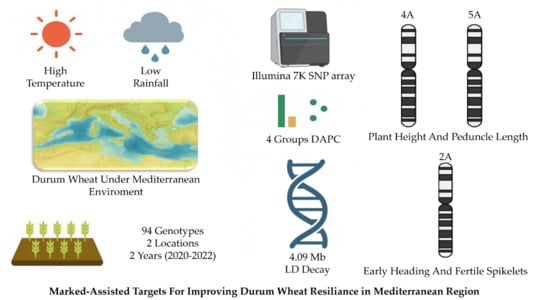
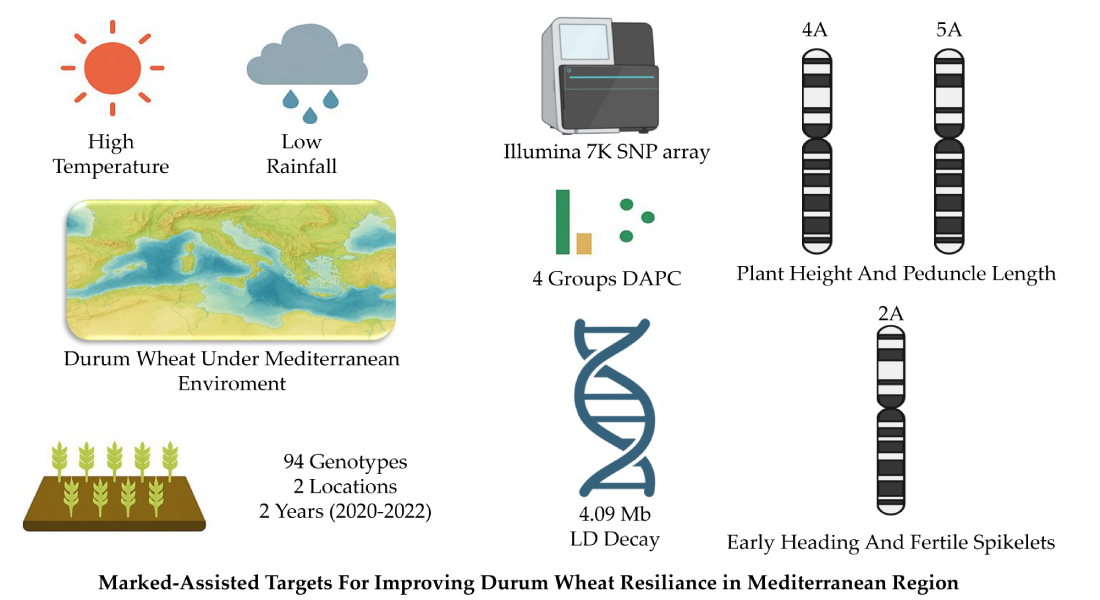
Graphical Abstract

1. Introduction

Durum wheat is a major crop in the Mediterranean region, mainly grown in rainfed conditions [1]. In Algeria, durum wheat is consumed in a variety of forms, including semolina and pasta. It is grown on 1.49 million hectares, producing 2.58 million tons with an average yield of 1.8 t/ha [2], and holds significant agricultural importance, as most crops are cultivated in semi-arid regions characterized by low and irregular precipitation. Despite its resilience to difficult conditions, durum wheat is endangered by climate change, particularly by drought stress [3]. Recent studies by Zaïm et al. [4] show that breeding efforts have been directed toward generating varieties with enhanced resilience, enabling them to avoid or tolerate such stresses. The exploitation of genetic diversity present in local germplasm collections, including landraces, traditional cultivars, and breeding lines [5] is a crucial step toward discovering alleles associated with key agronomic traits, including yield potential, stress resistance, and overall adaptability, which are essential for sustainable crop improvement [6,7], and improved nutritional content [8].
Agro-morphological characterization represents a fundamental first step in the exploration and identification of plant genetic resources, as it reveals observable variation in key agronomic traits [9]. This approach is also a valuable management tool for validating the identity of specific accessions [10] and provides a basis for crop improvement targeting desirable traits [11]. The main objective of this characterization is to identify predictive traits that can be used to optimize grain yield, a complex polygenic trait influenced by multiple factors [12]. In addition, the study of traits with high heritability allows the prediction of phenotypic performance, which is an indicator of breeding value and provides insight into the transmission of traits from parents to offspring [13]. Understanding the interrelationships among traits may further assist breeders in direct and indirect selection, particularly for traits that are difficult to measure or exhibit low heritability [14]. Phenotypic traits are highly affected by the environment; thus, conducting multi-environment and multi-year trials allows a more reliable evaluation of genotype × environment interactions and facilitates the selection of genotypes with stable and broad adaptation [15]. Molecular markers therefore offer a complementary and more reliable approach to assess genetic variation and understand complex traits [16].
The genotyping technique known as the “genotyping array” plays a key role in wheat genotyping. It allows researchers to examine different wheat varieties, detect genetic variants associated with important traits, and develop markers to incorporate into breeding strategies [17]. Building on this approach, advances in high-throughput SNP genotyping have considerably enhanced the assessment of genetic diversity and population structure among various wheat types and genetic backgrounds [18]. Given their high resolution, these platforms are particularly well suited for genome-wide association studies (GWAS) [19], enabling the identification of genomic loci involved in traits of agronomic interest [20]. GWAS relies on linkage disequilibrium (LD), which offers the possibility of accurately exploring the genetic basis of complex traits [21]. This knowledge facilitates the introgression of useful alleles from wild relatives or traditional germplasm into improved varieties through marker-assisted selection or genomic selection [20,22].
In recent years, numerous studies have successfully identified genomic regions and quantitative trait loci (QTLs) associated with several traits in wheat [23], such as grain yield [24,25], drought tolerance [26], and disease resistance [27,28]. Also, flowering time is mainly governed by several QTLs, including a major locus on chromosome 2B linked to copy number variation at Ppd-B1, which explains around 26% of the observed variation [29]. Plant height, another fundamental agronomic trait, has been associated with five QTLs on chromosomes 1A, 2B, 6B, 7A, and 7B in Ethiopian durum wheat accessions [30]. Spike fertility, which directly determines grain number, has been linked to 25 stable QTLs detected across two doubled haploid populations [31]. In terms of spike length and yield components, eight QTLs were identified on chromosomes 2B, 4A, 5A, 5B, 7A, and 7B, including a novel QTL on chromosome 2B under drought stress [30], while Mangini et al. [32] reported 39 QTLs for thousand-kernel weight, grain dimensions, and grain shape across environments. Physiological traits such as flag leaf chlorophyll content have been dissected; Yang et al. [33] identified 29 QTLs across multiple environments, including the stable Qchl.saw-5A.3 explaining up to 23.25% of variation under drought. Nevertheless, most agronomic traits in wheat are complex and polygenic, influenced by numerous genes and their interactions with environment [34]. Identifying QTLs that consistently express their effects under varying environmental conditions represents an essential step toward enhancing yield stability and broad adaptability [24]. Although GWAS is effective in identifying marker-trait associations for yield traits, studies across different regions highlight the strong impact of environmental factors and the significant role of genotype × environment interactions [35]. According to Eltaher et al. [36], the integration of environment-oriented breeding approaches with molecular marker-assisted selection can significantly enhance the efficiency of wheat genetic improvement. These studies highlight the importance of integrating phenotypic characterization, high-density genotyping, and GWAS to identify loci associated with key agronomic traits, thereby supporting breeding efforts aimed at stress adaptation and yield stability.
In this context, the objective of this study was to evaluate the genetic diversity and population structure of a panel of 94 durum wheat genotypes with diverse origins using the 7K Infinium SNP array. In addition, a genome-wide association study was then conducted to detect genomic regions linked to major agro-morphological traits across two contrasting locations and cropping seasons.

2. Materials and Methods

2.1. Plant Material

The initial plant material consisted of a germplasm collection of 125 durum wheat genotypes originating from diverse agro-ecological zones, and includes both landraces, old, and modern varieties. This germplasm collection was assembled and is maintained by the Plant Breeding and Biotechnology Division of the National Agronomic Research Institute of Algeria. The majority of genotypes (32%) originate from the seed banks of CIMMYT and ICARDA, while the most represented countries of collection are Mexico (22.4%) and Algeria (17.6%). Detailed information for code, name, and pedigree is provided in Table S1.

2.2. Description of Sites

All genotypes were tested under rainfed conditions at two contrasting agro ecological sites representative of Mediterranean cereal-growing environments in Algeria. The first site was the experimental station of the National Agronomic Research Institute of Algeria (36°68′ N, 3°11′ E, 18.5 m a.s.l.) in Algiers (Central zone) during the 2020–2021 and 2021–2022 cropping seasons. This site is located at lower altitude in the fertile Mitidja plain and belongs to a dry sub-humid climatic zone, with milder temperatures and moderate rainfall [37]. The second site was the El-Khroub experimental farm, located 14 km southeast of Constantine (36°28′ N, 6°67′ E, 640 m a.s.l.), where trials were conducted in 2018–2019 and 2020–2021. This site is characterized by a semi-arid bioclimatic zone, at higher altitude characterized by cooler temperatures, lower rainfall, and continental conditions with a wide thermal amplitude [38]. At both sites, soils are predominantly clay-textured, as determined according to the texture triangle of Hénin et al. [39].

2.3. Climatic Conditions

Climatic data were recorded from September to July for each growing season at both sites. In Algiers, total rainfall reached 474.2 mm in 2020–2021, slightly higher than the 461.4 mm recorded in 2021–2022. In the first season, peak precipitation occurred in December (146.5 mm), enhancing soil water storage and favoring good crop establishment, while in the second season, two peaks were recorded in November (180.2 mm) and March (121.6 mm), with the latter coinciding with the stem elongation–heading stage. In Constantine, rainfall was 467.6 mm in 2018–2019 and 326.4 mm in 2020–2021, representing a deficit of 142.2 mm. The highest monthly totals were observed in October (142 mm) and January (97.2 mm) for the first season, and in December (55 mm) for the second.
At both sites, the lowest temperatures were recorded from December to February, often with frost events in Constantine, followed by a steady increase from March, with relatively high temperatures in Constantine during May coinciding with the stem elongation and the heading. Over the two seasons, average monthly temperatures ranged from 6.75 °C to 33.65 °C in Algiers and from 0.95 °C to 35.75 °C in Constantine. The thermal amplitude was higher in Constantine (21.8 °C and 19.6 °C, respectively) compared with Algiers (13.9 °C and 15.7 °C, respectively). Detailed climatic data are presented in Figure S1.

2.4. Experimental Design and Phenotypic Data Measurements

The field experiment was carried out using an augmented randomized complete block design (ARCBD) with 4 blocks, each containing 30 test entries (genotypes) and 5 checks (C1: Waha; C2: Cirta; C3: Sigus; C4: Beni Mestina; and C5: Gta/dur), which were repeated twice in each block, for a total of 160 experimental plots. This design is suitable for evaluating numerous genotypes while allowing reliable adjustment through replicated checks. Each genotype was sown in 2 rows of 1-m length and 0.25 m apart. The sowing at both sites was carried out at the end of December, while harvesting took place between late June and early July. All recommended crop management practices were implemented to ensure a healthy crop stand.
Several phenotypic traits were measured, including days to 50% heading (DH, days), counted from the date of sowing to the stage when 50% of the spikes were halfway out from the flag leaf. At the heading stage, the distance from the base to the tip of the leaf was calculated using the formula for flag leaf area FLA = 0.606 (L × l), where L represents the total length of the leaf, l is the average width of the leaf, and 0.606 is the regression coefficient described by Spagnoletti Zeuli et al. [40]. The chlorophyll content (CC) was measured using an SPAD-502 chlorophyll meter, with readings taken at the midpoint of the fully expanded flag leaf. At maturity, plant height (PH, cm) was measured from the soil surface to the tip of the spike (excluding awns), peduncle length (PL, cm) as the internodal distance between the base of the flag leaf blade and the base of the spike, and spike length (SL, cm) as the distance from the base of the spike to its tip (excluding awns).
Grain yield-related components were determined including thousand-kernel weight (TKW, g), where samples of 1000 grains were counted using a grain counter and then weighed with a precision balance, and number of fertile spikelets per spike (NFSS), determined by counting the spikelets containing at least one grain per spike. A mean value for each genotype’s agro-morphological parameters was calculated based on the sampling of three plants from each plot.

2.5. DNA Extraction and Genotyping

Four seeds of each genotype were sown in alveolar trays under controlled greenhouse conditions at the molecular biology laboratory of the University of Modena and Reggio Emilia in Italy. Fresh leaf tissues were collected from 10- to 12-day-old seedlings for DNA extraction using modified CTAB method [41]. To reduce redundancy and ensure a representative panel capturing the overall phenotypic diversity, a principal component analysis (PCA) based on the measured traits was performed and used to guide genotype selection (Figure S2). A total of 93 genotypes were selected from the initial collection based on pedigree information and phenotypic similarity across morpho-agronomic traits. Additionally, the cultivar SVEVO was included as a reference, bringing the total number of genotypes to 94 (Table S2). The extracted DNA samples (50 ng/µL per sample), arranged in a 96-well plate format, were genotyped at TraitGenetics GmbH (Gaterslegen, Germany) using the optimized Illumina Infinium 7K wheat array. 7K array is a subset (6707) aimed at genomic selection studies of the 25K array developed by SGS Institut Fresenius TraitGenetics section (SGS IF TG). The physical position of each SNP was assigned based on the physical map of the Svevo durum wheat, available at https://www.interomics.eu/durum-wheat-genome.

2.6. Statistical Analysis of Phenotypic Data

Each site × year combination was considered as a distinct environment. For each environment, descriptive statistics (minimum, maximum, and mean) and separate analyses of variance (ANOVA) were carried out in R version 4.3.2 using the ‘augmentedRCBD’ package. The adjusted means for each environment were then used for the combined analysis following a simple linear model with checks, genotypes, environments, and blocks, and the genotype x environment interactions were treated as fixed effects, allowing direct comparison of genotype performance across environments. The model is described as follows: lm (formula = Trait ~ Genotypes + Checks + Block + Check × Genotype + Environment + Genotypes × Environment).
Broad-sense heritability (H2bs) was calculated for individual environments using the ANOVA results obtained with the augmentedRCBD package and for the combined environments using the formula: H2bs = σ 2 G σ 2 p = σ 2 G ( σ 2 G + σ 2 GE e + σ 2 e e r ) , according to Aquaah [42]; where σ2p is the phenotypic variance, σ2G is the genotypic variance, σ2GE is the genotype × environment interaction variance, σ2e is the residual error variance, e is the number of environments, and r is the number of replications. The variance components were estimated as follows:
σ2p = σ2G + σ2GE + σ2E, σ2G = (MSG − MSe)/r, σ2GE = (MSGE − MSe)/r, σ2 e = MSe
MSG is the mean square due to genotypes, MSGE is the mean square due to genotype × environment interaction, and MSe is the mean square of the residual error. Pearson correlation analysis was executed using the R package ‘metan’.

2.7. SNP Filtering, Linkage Disequilibrium, and Population Structure

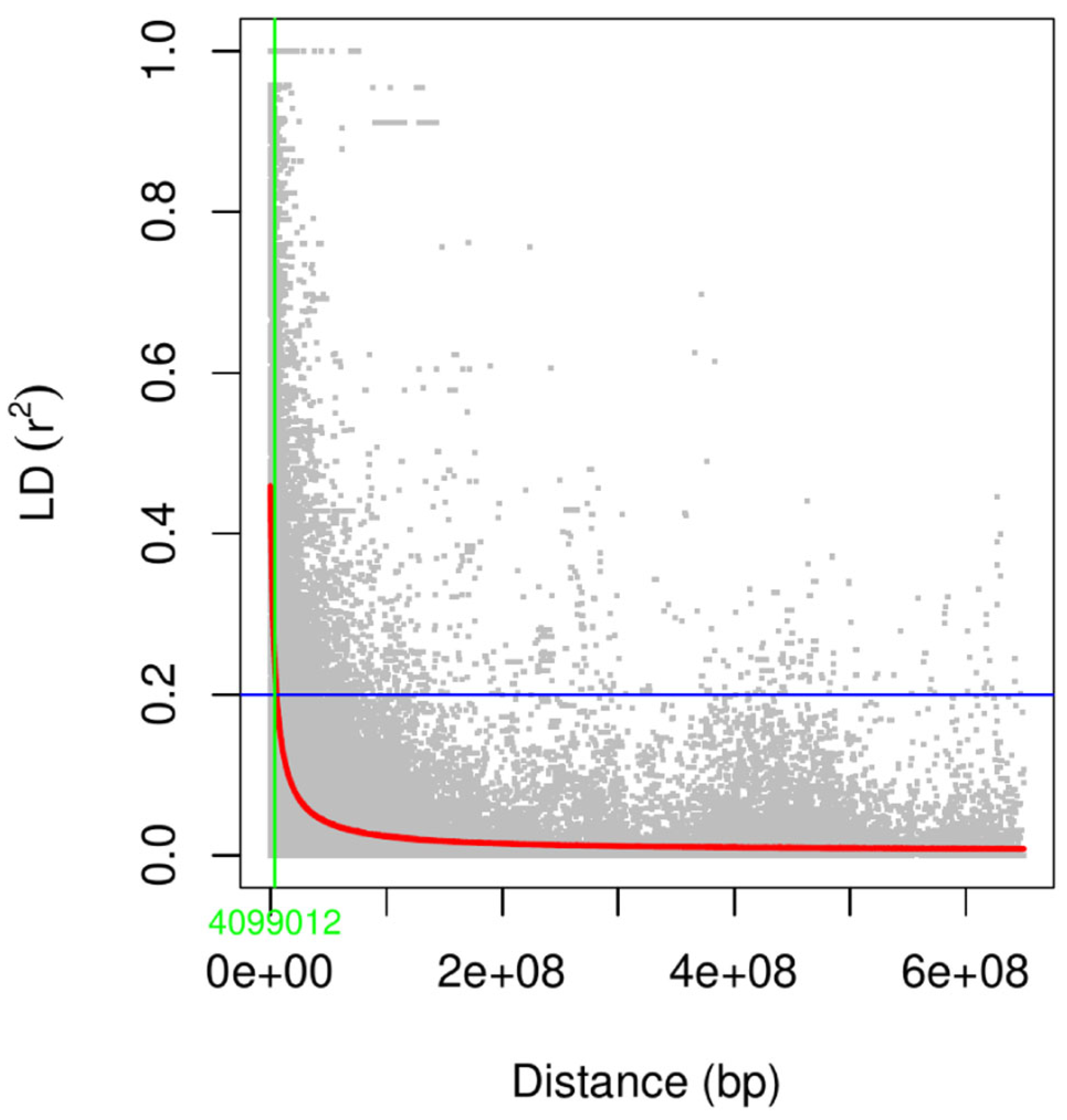
Genotypic data from the set of 7000 SNPs were filtered using TASSEL software (version 5.2.92, Institute for Genomic Diversity, Ithaca, NY, USA) to exclude markers with more than 10% missing data, a minor allele frequency (MAF) of less than 5%, a heterozygosity rate greater than 20%, and a call rate per site of 85%. Linkage disequilibrium (LD) between SNP marker pairs (r2) was estimated using TASSEL version 5.2.92. The linkage disequilibrium decay graph was produced using R software version 4.3.2 with the LOESS model [43]. A threshold of r2 = 0.2, commonly applied in cereal genomics studies, was used to determine the point at which linkage disequilibrium was considered to have decayed sufficiently [44].
Linkage disequilibrium (LD) pruning was performed with an r2 threshold of 0.5 to eliminate markers exhibiting strong linkage disequilibrium. This resulted in a dataset of 1433 SNPs, which were used only for the analysis of population structure.
The population structure was assessed using two complementary approaches. First, STRUCTURE software version 2.3.4, a model-based Bayesian approach, was run with 25,000 burn-in iterations and 25,000 Markov Chain Monte Carlo (MCMC) repetitions. The admixture model with correlated allele frequencies was applied to evaluate the number of clusters (K) ranging from 1 to 10, with five independent runs for each K value. The results were visualized using the online software STRUCTURE Selector (available at http://lmme.qdio.ac.cn/StructureSelector/, accessed on 6 May 2024), and the optimal number of subpopulations (K) was determined based on the delta K method described by Evanno et al. [45]. Second, discriminant analysis of principal components (DAPCs), a non-parametric multivariate method, was conducted using the R package ‘adegenet’ implemented in R version 4.3.2. In this case, the optimal K value was identified based on the lowest Bayesian Information Criterion (BIC).

2.8. Identification of Genomic Loci and Candidate Genes Associated with Traits

Genome-wide association analysis was conducted separately for each environment (site × year) and also combined across environments using the Multi-Locus Mixed Model (MLMM) implemented in the GAPIT package in R (version 4.3.2). This model was selected to mitigate the high level of genetic stratification observed in the diversity analysis. By incorporating principal component analysis (PCA) as a fixed effect and a kinship matrix as a random effect, the MLMM effectively accounts for both population structure and cryptic relatedness, thereby minimizing Type I errors (false positives) [46]. To minimize false-positive associations, a Bonferroni correction was applied at a significance level of α = 0.05. A significance threshold of −log10 (p) = 4.67 was used to identify markers significantly associated with the traits of interest shown in a Manhattan plot and QQ plot.
In order to define candidate genes, high confidence gene models in the confidence interval (CI) of the QTLs were extracted from Svevo version 1 annotation data, retrieved from GrainGenes cereal database (https://graingenes.org/GG3/, accessed on 1 April 2025).

2.9. Artificial Intelligence

During the preparation of this manuscript the authors used ChatGTP 5.1 for the purposes of generating a scheme for the Graphical Abstract that was then implemented with icons from BioRender (www.biorender.com). Grammar and spelling editing were also performed.

3. Results

3.1. Phenotypic Variability of Measured Traits

The combined analysis of variance for the eight studied traits indicated highly significant differences (p < 0.001) among genotypes, environments, and genotype × environment interactions (Table 1), highlighting the strong influence of environmental conditions and differential genotype responses across environments. Both checks and test genotypes also exhibited significant variation (p < 0.001) for most traits, with some exceptions such as chlorophyll content (CC) and flag leaf area (FLA) which were not significant for the genotype × check comparison.
Mean days to heading (DH) ranged from 95.66 days in Algiers during the 2021–2022 season to 124.84 days in Constantine in 2018–2019 (Table S3). Average plant height (PH) varied from 80.35 cm in the former to 94.68 cm in the latter during the 2020–2021 growing season. Across environments, the mean values of fertile spikelets per spike (NFSS), spike length (SL), and peduncle length (PL) were 18 fertile spikelets/spike, 7.03 cm, and 18.19 cm, respectively. Flag leaf area (FLA) ranged from 24.52 cm2 in Constantine in 2020–2021 to 30.58 cm2 in Algiers in 2021–2022. The highest CC was recorded in Constantine during 2020–2021 (55.12 SPAD units), whereas the maximum thousand kernel weight (TKW) was obtained in Algiers in 2021–2022 (49.71 g)
In Constantine, a decrease in PH, DH, TKW, and PL, was observed during the second year, while CC increased, possibly reflecting a stress response. In Algiers, the highest broad-sense heritability value was recorded for PH in 2020–2021 (H2bs = 0.99), whereas the lowest value was observed for CC in 2021–2022 (H2bs = 0.24) (Table S3).

3.2. Phenotypic Correlation Between Traits Analyzed

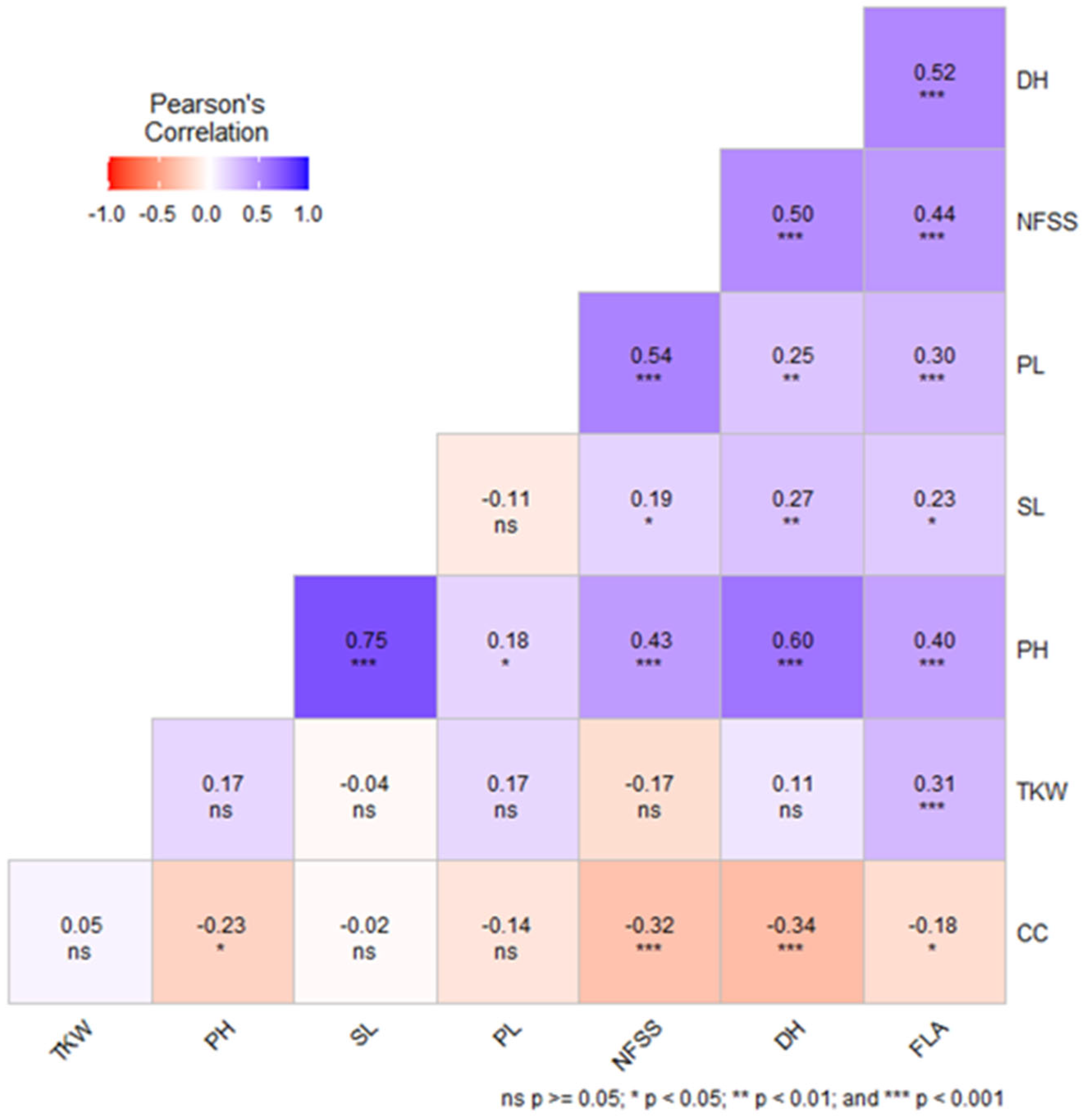
Correlation analysis among all parameters measured was carried out using Pearson’s correlation matrix (Figure 1). PH showed a significant positive correlation with PL (r = 0.18, * p < 0.05), SL (r = 0.75, *** p < 0.001), and FLA (r = 0.40, *** p < 0.001). DH was positively correlated with PH (r = 0.60, *** p < 0.001), FLA (r = 0.52, *** p < 0.001), and NFSS (r = 0.50, *** p < 0.001). NFSS also showed a significant positive correlation with SL (r = 0.19, * p < 0.05). FLA was positively associated with most traits, particularly with PH, PL, DH, and NFSS, but negatively correlated with chlorophyll content (CC) (r = −0.18, * p < 0.05). CC exhibited weak but negative correlations with almost all traits, except TKW, where the correlation was weakly positive (r = 0.05) but not significant. Finally, TKW showed a slight negative correlation with NFSS (r = −0.17) and DH (r = 0.11), both non-significant, possibly suggesting a weak compensatory effect among yield-related components.

3.3. Genotyping Distribution and Genomic Size of SNPs and Linkage Disequilibrium

After filtering the initial set of 7000 SNPs, a total of 2353 high-quality SNPs was retained and used for further analyses. Among these, 1058 SNPs (46%) were distributed on the A genome and 1295 SNPs (54%) on the B genome. The number of SNPs per chromosome ranged from 90 SNPs for chromosome 4A to 227 for chromosome 1B. In terms of genomic coverage, chromosome 3B showed the largest span of SNPs, covering approximately 835 Mbp, while chromosome 1A exhibited the smallest coverage, at around 584 Mbp (Table S4). This variation in genomic coverage was found to be proportional to the physical length of the chromosomes, consistent with results obtained by Maccaferri et al. [44]. Furthermore, the marker density aligned with the distribution patterns of the original 7K SNP set, specifically reflecting the lower abundance of SNPs on chromosome 4A and the higher concentration observed on chromosomes 1B and 3B.
The maximum observed linkage disequilibrium decay value was 0.4592, with the half-decay point (r2 = 0.2296) at an average physical distance of 4.09 Mb across both genomes A and B, using a threshold of r2 = 0.2. Accordingly, a ±4.09 Mb interval around each trait-associated SNP was considered as the confidence interval for the corresponding candidate genes (Figure 2).

3.4. Population Structure

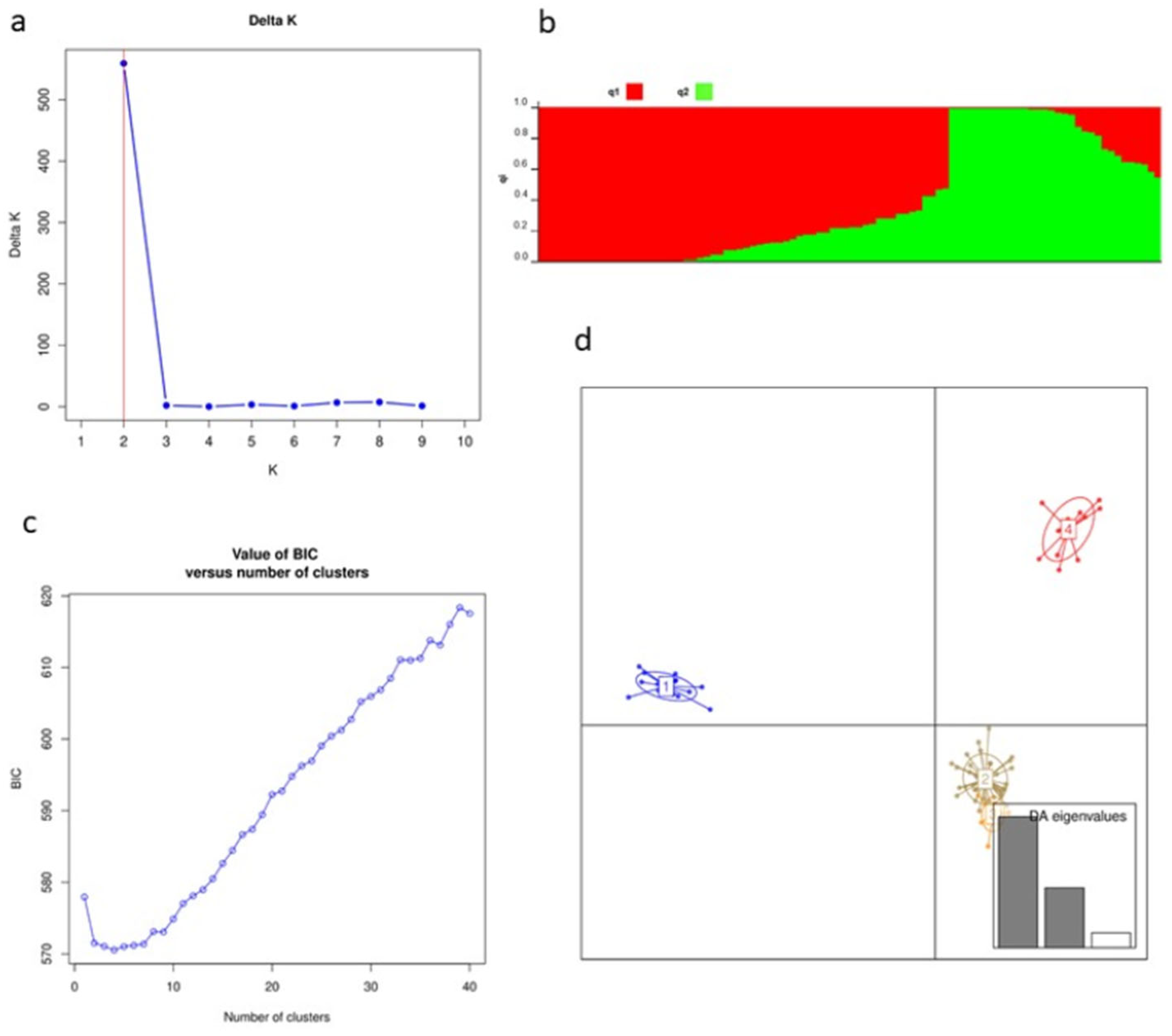
Population structure analysis using STRUCTURE version 2.3.4 indicated an optimal number of two clusters (K = 2), based on the highest ΔK value (Figure 3a), allowing the discrimination of two main populations, with genotypes assigned to a given population according to the Q probability (Q ≥ 0.6 indicating a pure line, Q < 0.6 indicating admixture) (Figure 3b, Table S5). The first population (q1), included 58 genotypes of durum wheat, distributed as follows: 10 from Algeria, 1 from Australia, 2 from France, 4 from Italy, 4 from Syria, 1 from Spain, 1 from the United States, 1 from Tunisia, 8 from CIMMYT, 12 from Mexico and 14 from ICARDA. The second population (q2) consisted of 28 genotypes, including 11 from Algeria, 1 from Cyprus, 1 from Iran, 2 from France, 4 from Italy, 3 from ICARDA, and one genotype from each of the following countries: Spain, Jordan, Tunisia, Mexico, the United States, and Syria (Table S5). Moreover, eight genotypes not assigned to either population 1 or 2, were identified as admixed.
The discriminant analysis of principal components (DAPC) method indicated that the optimal number of groups is four, based on the lowest value of the Bayesian information criterion (BIC) (Figure 3c). The scatter plot of the DAPC analysis revealed group sizes of 19, 48, 12, and 15 durum wheat genotypes, respectively, for groups 1, 2, 3, and 4 (Figure 3d, Table S5). The results of the DAPC analysis revealed an overlap between groups 2 and 3—consistent with the STRUCTURE method—which classified them in population 1; meanwhile a clear separation was observed between groups 1 and 4. Group 1 included nine accessions from Algeria, one from Spain, one from the USA., two from France, three from ICARDA, one from Italy, one from Tunisia, and one from Iran. Group 4 comprised three accessions from Italy, one from Jordan, two from Mexico, one from Syria, one from Cyprus, three from Algeria, one from Tunisia, two from ICARDA, and one from France.
Figure 3. Population structure of the durum wheat panel, the vertical line in red indicates the optimal K value, corresponding to the highest delta K, and the blue curve represents the variation of ΔK values for K ranging from 1 to 10. (a). Determination of the value of K based on the Evanno delta K. (b). Population grouping of genotypes according to STRUCTURE results; q1 (red), q2 (green). (c). Number of optimal groups based on the BIC values. (d). Scatter plot of the DAPC analysis showing the different populations.
Agriculture 16 00370 g003

3.5. Marker-Trait Association Study

Genome wide association analysis was performed using the set of 2353 filtered SNPs. The analysis identified a total of 27 distinct significant SNPs and 30 SNP—trait associations across eight measured traits (TKW, PH, PL, SL, NFSS, DH, CC, and FLA) (Table 2).
At the Algiers site, six traits (DH, TKW, PH, PL, SL, and NFSS) showed associations during the 2020–2021 season, whereas in 2021–2022, associations were observed for four traits (DH, PH, PL, and FLA) (Figure S3, Table 2). TKW exhibited the highest number of MTAs, identified in genomic regions 2A, 2B, 4B, 5B, and 7A. A pleiotropic effect was observed for the marker wsnp_Ex_c2033_3814035 on chromosome 2A, associated with DH and NFSS. Another pleiotropic marker TGWA25K-TG0010 on chromosome 4A was associated with PH and PL. The minor alleles of these markers were associated with reductions in the respective traits (Table 2).
At the Constantine site, three traits (PH, SL, and PL) were associated during the 2018–2019 season, while in 2020–2021, associations were observed for PH and PL (Figure S3, Table 2). SL exhibited the highest number of markers, detected in genomic regions 2B, 3A, 3B, and 6A. The marker wsnp_Ku_c51039_56457361 on chromosome 5A showed a pleiotropic effect on PH and PL.
Across all environments, the SNPs for DH, PH, and PL matched those detected at the Algiers site, including the marker TGWA25K-TG0010. Two additional SNPs were identified: one located on chromosome 5B, and another on chromosome 7A, associated with CC (Figure S3, Table 2). These markers explained a substantial proportion of the phenotypic variance.
Table 2. List of SNP markers significantly associated with individuals and across environments.
EnvironmentTraitsSNPsChrPos (bp)−log10 (p)EffectPVE (%)
Alg 20–21SLAX-1585543077B1264020428.66−0.7546.25
BS00068050_512A71715787.100.4917.05
NFSSBobWhite_c7454_4923B99772076.80−1.8130.54
wsnp_Ex_c2033_38140352A362934645.40−1.4828.52
DHBS00078506_512B2059795005.43−5.1755.90
wsnp_Ex_c2033_38140352A362934648.63−4.3325.14
TKWAX-1585556762A844934436.804.1421.37
AX-1585616282A6855436916.14−3.8714.92
AX-1585475152B10568129.774.8516.44
BS00108020_515B4327483235.844.819.50
TGWA25K-TG02697A5717003665.763.0111.32
AX-947079054B348524459.54−3.237.54
PHTGWA25K-TG00104A5750899039.64−14.5365.06
AX-1116568145A4658296185.948.9923.31
PLTGWA25K-TG00104A5750899035.25−4.370.87
Alg 21–22PHTGWA25K-TG00104A57508990311.4−17.8186.48
PLTGWA25K-TG00104A5750899038.49−5.0880.09
DHAX-1585236253A7203386965.37−12.0370.32
FLABS00070991_511A5786413845.97−5.6534.31
AX-1585239703A342132474.78−4.4728.75
Const 18–19PHTGWA25K-TG00104A57508990312.6−14.2474.19
AX-1116568145A4658296185.536.9415.60
PLTGWA25K-TG00104A5750899036.30−4.0273.52
SLAX-1585752502B20698553118.6−0.7224.39
Kukri_c4294_3712B6374073315.290.266.42
AX-1585380872B76928800511.7−0.344.66
AX-1585232553A6908011415.190.254.16
AX-1092763793B42338844713.50.375.71
Excalibur_c8197_3816A16755164130.4317.15
RFL_Contig2605_6726A8567253314.40.6633.36
Const 20–21PHwsnp_Ex_c1255_24115501A5814282534.738.0939.86
wsnp_Ku_c51039_564573615A4910361346.84−8.2341.99
PLwsnp_Ku_c51039_564573615A4910361344.84−3.2459.19
Across
environments
DHwsnp_Ex_c2033_38140352A362934645.05 −1.9714.94
AX-1585236253A7203386969.11 −8.6361.31
CCAX-951971087A879658026.17 3.0068.11
PHTGWA25K-TG00104A57508990312−14.5274.43
AX-1116568145A4658296185.26 7.1115.93
PLTGWA25K-TG00104A5750899037.93 −3.8879.48
SLExcalibur_c97201_2945B2344551694.780.6272.04
Pos—position; Chr—chromosome; PVE—phenotypic variance explained; DH—days to heading (days); PH—plant height (cm); FLA–flag leaf area (cm2); SL—spike length (cm); PL—peduncle length (cm); TKW—thousand kernels weight (g); NFSS—number of fertile spikelets per spike; CC—chlorophyll content. Localities: Alg = Algiers; Const = Constantine. ENV = Environment. Years18–19; 20–21; 21–22.

3.6. Functional Prediction and Annotation of Genes Located in Trait-Associated Loci

Consistent with reports in durum germplasm, LD decay in this study reached the background threshold (r2 < 0.2) at approximately 4 Mb [44,47]. This relatively slow decay is characteristic of the species’ self-pollinating nature and the intensive selection pressure applied during modern breeding programs, which has resulted in large conserved genomic blocks [48]. Similar decay distances have been documented in Mediterranean durum wheat collections, suggesting that the current marker density is enough to capture most of the functional variation across the A and B genomes. Following the approach suggested by Gaur et al. [49], we initially searched for candidate genes within a 1-Mbp window flanking the significant SNPs; notably, all identified candidates were located within a narrow 3-kb range of the associated markers, indicating high mapping precision. To account for the extended linkage disequilibrium in durum wheat, an initial ±4.09 Mb window was also considered for functional annotation. Genes located within these intervals were retrieved based on high-confidence annotations and analyzed according to their functional annotation and homology with known genes in model plants and related cereals. The identified genes encoded diverse functional proteins, including kinases and transcription regulators involved in signal transduction, resistance-related proteins such as NBS-LRR and germins, biosynthetic enzymes including transferases and hydrolases, and structural or transport-related proteins such as kinesins, actin-related proteins, and ribosomal components (Table S6).
Several genes were identified as potential candidates based on previous studies. The genes TRITD4Av1G194130.6 and TRITD4Av1G194130.1, both located on chromosome 4A and encoding the dwarf8 and Gibberellic-Acid Insensitive (GAI) proteins, respectively, were associated with PH and PL. The same locus was also reported by Taranto et al. [50] as encoding the Rht-A1 gene. The gene TRITD2Av1G253030.2, located on chromosome 2A and encoding a cytochrome P450-type protein, was associated with thousand-kernel weight, consistent with previous findings [51,52,53,54]. Another gene, TRITD2Av1G039600.2 on chromosome 2A, encodes a glucosyltransferase also associated with TKW [55]. The gene TRITD1Av1G227700.11 on chromosome 1A encodes a disease resistance protein (NBS-LRR class) was associated with FLA, in agreement with results reported by Bhatta et al. [56], while association of TRITD2Av1G019050.3 on chromosome 2A, which encodes a NETWORKED 2D G protein, was detected for days to heading, consistent with findings from a study on Foxtail millet by Li et al. [57].

4. Discussion

4.1. Phenotypic Variability and Relation Among Traits Data

This study revealed significant variability among genotypes for the evaluated traits, with performance differing across sites and cropping seasons. Beyond the main environmental effects, these differences were mainly explained by highly significant genotype × environment interactions, reflecting both the adaptive capacity of individual genotypes to specific climatic conditions and the genetic diversity of the material, which included landraces, old, and modern varieties.
According to Fellahi et al. [8], local landraces, although tall, late-maturing, and low-yielding, are still cultivated for their resilience to stress, high straw yield, and weed competitiveness, with plant height being advantageous under drought conditions. Similarly, Bapela et al. [5] reported that landraces remain underutilized in breeding programs due to limited characterization and the presence of undesirable alleles. Nevertheless, they might represent valuable sources of traits, such as drought tolerance.
The influence of site- specific climatic conditions on genotype responses was evident for DH, PH, PL, and TKW, which showed a mean reduction during the second cropping season at the Constantine site (Const 20–21). This season was marked by prolonged drought from January to July, leading to a shortened vegetative cycle, reduced plant height, and lower grain weight. In contrast, CC increased on average at Const 20–21 but decreased at Alg 20–21. Atar et al. [58], highlighted that seasonal variations in chlorophyll content differ among species because of their genetic characteristics and are strongly affected by environmental conditions, particularly those specific to each site. Similarly, Anjum et al. [59] reported that higher chlorophyll concentrations indicate a greater potential for dry matter accumulation under oxidative stress induced by water and heat constraints. The contrasting rainfall and temperature regimes between Algiers and Constantine strongly influenced the expression of agronomic traits. In Algiers, milder temperatures and higher, more evenly distributed rainfall—particularly during the autumn period—favored rapid and uniform crop establishment at early developmental stages. These conditions promoted faster vegetative growth and development, which were reflected in improved growth- and yield-related traits such as plant height, flag leaf area, and thousand-kernel weight. Moreover, the accelerated crop development likely enabled a partial strategy of escape from terminal drought during grain filling and maturity. In contrast, the lower and more variable rainfall, greater thermal amplitude, and occurrence of frost events in Constantine, especially during the early growing season, likely hindered timely crop establishment, constrained plant development, delayed phenology, and reduced biomass accumulation. Overall, these results indicate that differences in temperature and rainfall patterns strongly influenced genotype performance, particularly for phenological, morphological, and physiological traits.
To further interpret the phenotypic responses observed across environments, relationships among the studied traits were examined. A positive correlation was observed between DH and PH, indicating that tall cultivars showed delayed heading but produced more straw [60]. A positive correlation was also observed between PH and PL, which have been suggested as key criteria for selecting genotypes under drought stress, given their role in nutrient accumulation and translocation to the grain [61]. In addition, SL showed a positive relationship with NFSS, consistent with the findings of Jamal et al. [62], who reported that increased spike length, along with a greater number of grains and spikelets per spike, contributes substantially to yield enhancement.
In contrast CC, showed a negative association with the measured parameters. According to Mansouri et al. [63], who investigated part of the same genetic panel, the absence of correlation between CC and other agro-morphological traits may reflect the breeding history of these genotypes, as chlorophyll content was not used as a direct selection criterion.

4.2. Linkage Disequilibrium and Population Structure

In the present study, the average linkage disequilibrium decay distance (LD) was estimated to be 4.09 Mb. This finding is consistent with values reported in other studies [28,64]. All markers falling within an LD interval are assumed to represent the same quantitative trait locus (QTLs), and the genes located in this region are potentially involved in the regulation of the analyzed trait [28].
In this context, analyzing the genetic structure of durum wheat from diverse origins is essential for exploiting its diversity, identifying promising genotypes, and broadening the genetic base of modern varieties [65]. In this study, population structure analysis using the STRUCTURE software (version 2.3.4) identified two distinct populations. The first population mainly included cultivars originating from Algeria, CIMMYT, ICARDA, and Mexico, suggesting a shared genetic composition among these materials. The second population was largely composed of Algerian genotypes, most of which corresponded to landraces according to their passport data, along with a few accessions from other regions, reflecting a valuable source of allelic diversity Some cultivars with pedigrees involving traditional landraces were also included. Similar patterns of genetic admixture between local and improved germplasm have been reported in previous studies on durum wheat, including Kabbaj et al. [66].
Using the DAPC method four distinct groups were identified, consistent with findings by Degu et al. [67] in barley. Tehseen et al. [68] noted that DAPC and PCA analyses are generally considered more reliable than STRUCTURE, especially since the value K = 2 in some cases may not accurately reflect the true genetic structure. Groups 2 and 3 overlapped, corresponding to population 1 in STRUCTURE, whereas groups 1 and 4 were clearly separated, although grouped in population 2 by STRUCTURE. The eight genotypes classified as admixed by STRUCTURE were distributed across the DAPC groups, reflecting their mixed ancestry and genetic divergence.

4.3. Associations Mapping (GWAS) and Candidate Genes

Association mapping is a powerful approach for identifying genes associated with phenotypic traits. It complements QTL analysis by enabling the identification of shared genomic regions that involve multiple traits and major regulatory genes [69]. In this study, GWAS revealed multiple marker–trait associations across most chromosomes of the durum wheat genome, highlighting key loci controlling important agro-morphological traits. Accordingly, the SNPs identified in Algiers appeared to be associated with traits related to production and adaptation, whereas those detected in Constantine were linked to traits involved in adaptive mechanisms. These findings highlight the role of environment-specific conditions in determining locus expression. Candidate gene search strategies were guided by previously reported approaches [49,70], ensuring that only genes within a biologically meaningful distance from the SNP peak were considered. Although the limited size of our collection presents a potential risk for the identification of robust and significant MTAs, the SNPs associated with the target traits can be considered stable. This is evidenced by the fact that some of these associations have been previously identified and reported in the literature. This consistency supports the reliability and validity of our GWAS analysis, as previously demonstrated [71,72,73,74].
Starting with the phenological trait, days to heading, which reflects flowering time in wheat, is mainly regulated by genes controlling vernalization (Vrn genes), photoperiod sensitivity (Ppd genes), and earliness per se (Eps genes) [75]. In this study, three genomic regions associated with DH were detected on chromosomes 2A, 2B, and 3A, with similar associations previously reported on 2A [76] and 2B [77]. These loci therefore confirm previously reported genomic regions, whereas the association detected on chromosome 3A may represent a novel locus. The presence of the minor allele reduced the number of days to heading by 5, 3, and 12 days, respectively, suggesting a potential role in adaptation through flowering earliness. Three genes were identified for DH. On chromosome 2A, TRITD2Av1G019050, encoding the protein NETWORKED 2D G, matched the QTL qHD2-2 and corresponds to the gene Seita.2G44460 in foxtail millet, which was previously identified in a population of 313 RILs as a novel gene involved in response to photoperiod sensitivity [57]; its association with DH in wheat is reported here for the first time. On chromosome 2B, TRITD2Bv1G078470 encodes an Alpha/Beta fold. The Alpha/Beta fold hydrolase constitutes a core structural framework for various phytohormone and ligand receptors, including those participating in gibberellin, strigolactone, and karrikin signaling [78]. Given that gibberellins regulate critical developmental processes such as seed germination, stem elongation, floral initiation, and the timing of flowering [79], it is possible to hypothesize that TRITD2Bv1G078470 may influence heading earliness through GA-mediated flowering regulation, representing a novel association with DH in wheat. On chromosome 3A, TRITD3Av1G273510.4 encodes a signal recognition particle protein, previously defined as a protein for drought tolerance [80]. To our knowledge, this gene has not previously been linked to heading date in cereals, and thus this locus represents a potentially novel association with DH in wheat.
The NETWORKED 2D G protein—annotated for both days to heading (DH) and number of fertile spikelets per spike (NFSS)—showed in our study an association on chromosome 2A with DH and NFSS, suggesting a potential pleiotropic role of TRITD2Av1G019050 in regulating these traits. This is consistent with Campana [81], who identified this gene in expression analysis of spikelet fertility, using the functional network KnetMiner to reveal shared functions with genes involved in flowering, heading date, and grain number, indicating a common genetic basis likely due to pleiotropy. Pleiotropic markers such as TRITD2Av1G019050 are particularly valuable for breeding programs, as they enable the simultaneous selection of multiple favorable traits from a single locus, accelerating genetic improvement and enhancing crop performance and stability under challenging environmental conditions.
Plant height (PH) represents a fundamental component of wheat architecture and crop performance [82]. In our study, significant MTAs for PH were detected on chromosomes 1A, 4A, and 5A. The most prominent locus on chromosome 4A was significantly associated with both plant height and peduncle length, indicating a pleiotropic effect. This association was consistently detected across three individual environments and in the combined analysis, highlighting its stability and explaining the higher percentage of the phenotypic variance among all MTAs detected, representing a major effect locus and reducing plant height by approximately 14 cm, an effect advantageous for reducing lodging under high nitrogen fertilization [83] and improving adaptation to semi-arid environments by lowering evapotranspiration and facilitating assimilate translocation. Several detected loci overlapped with genomic regions previously reported for plant height, including Chr 1A [84], Chr 4A [50,85], and Chr 5A [76]. On chromosome 4A, the candidate genes TRITD4Av1G194130.6 and TRITD4Av1G194130.1, corresponding to the Dwarf8 and GAI genes, respectively, are orthologous to GAI in Arabidopsis and d8 in maize [86]. The proximity of this region to the well-known Rht-A1 locus, together with previous reports [50] linking a similar candidate gene to reduced height alleles Rht-A1. Rht genes, including Rht-B1, Rht-D1, and Rht-A1, were pivotal in the Green Revolution, as they confer semi-dwarf stature, reduce lodging, and improve harvest index [87] by reducing the response to gibberellin (gibberellin insensitive dwarfing genes) [84]. On chromosome 5A, two MTAs were identified: TRITD5Av1G170950.3 encoding a basic helix–loop–helix (bHLH) transcription factor for PH, known for roles in plant development and stress adaptation [88], and TRITD5Av1G180320.4 encoding a kinesin-like protein for both PH and PL. Kinesin, a molecular motor protein, is crucial for plant development, particularly in early growth stages, where it affects growth dynamics, yield, and quality [89]. Chen et al. [90] identified a total of 155 Kinesin TaKIN genes in wheat, carrying specific functional domains and hormone-responsive cis-elements (GA, Aux, SA, MeJa), their expression profiles across tissues and stages indicate a broad role in wheat growth and development. On chromosome 1A, TRITD1Av1G229310.2 encodes a Phosphatase 2 protein, previously identified for coleoptile length [91] and involved in phytohormone signaling, growth regulation, and stress responses [92]. Interestingly, Sesiz et al. [91] reported a strong linkage disequilibrium (LD, r2= 0.71) between QCol.su.4BS and QPh.su.4BS, loci associated with coleoptile length and plant height, respectively. The association detected here between TRITD1Av1G229310.2 and plant height therefore supports and extends these previous findings in durum wheat. This relationship highlights opportunities for breeding durum wheat with long coleoptiles and reduced plant height.
Grain size, a major determinant of TKW, is a crucial yield trait in durum wheat, with numerous QTLs identified and functional markers providing useful tools for marker-assisted selection [32,93]. In the present study, some of these loci were also detected, notably on Chr 4B, 7A, and 2B [94], on Chr 2A [51,95], and on Chr 5B [96]. The two MTAs identified on Chr 2A correspond to the genes TRITD2Av1G253030.2 and TRITD2Av1G039600.2, encoding cytochrome P450 and glucosyltransferase proteins, respectively. This finding is consistent with Sesiz [51], who reported MTAs QAS.su.2A1, implicated in area grain size and encoding a glucosyltransferase, and QTGW.su.2A2, encoding a cytochrome P450. Moreover, Ma et al. [97] demonstrated that a cytochrome P450 gene, TaCYP78A3, increases seed size and weight in wheat, suggesting that members of the P450 family may contribute to the phenotypic variation observed in our panel. In addition, the gene TRITD5Bv1G144190.1, encodes a protein kinase. According to Khan et al. [98], the kinase family is involved in regulating both grain number and size. Similarly, the gene TRITD4Bv1G014180.1 on Chr 4B encodes a serine/threonine protein kinase. As reported by Ur Rehman et al. [99], these proteins play an essential role in increasing TKW and grain number per spike. GWAS in bread wheat linked serine/threonine-protein kinases and protein kinase-like genes to TKW, confirming their role in yield regulation [100]. On chromosome 2B, TRITD2Bv1G000750.3 encodes for an AT-rich interactive domain-containing protein 2 (ARID). Family members of ARID play vital roles in the regulation of development and/or tissue-specific gene expression [101]. Gutiérrez et al. [102] identified MTR_8g022980, an ortholog in Vicia faba that encodes the same protein associated with the number of pods per plant, suggesting that this family may be involved in regulating factors related to productivity. This study represents the first report of a potential association between ARID domain-containing genes and yield component traits in durum wheat.
Flag leaves have morphological characteristics such as shape and area that contribute to wheat productivity, by affecting photosynthetic capacity and plant architecture [103]. In this study, flag leaf area (FLA) was found to be associated with chromosomes 1A and 3A [94]. Two genes were identified; TRITD1Av1G227800.1, located on chromosome 1A, encodes a leucine-rich repeat (LRR) family protein that is involved in various fundamental metabolic and signaling processes in plants, including growth, defense responses such as disease resistance signaling, and abiotic stress responses [104]. On chromosome 3A, TRITD3Av1G017430.2 encodes for an F-box family protein. Baute et al. [105] reported that the AtFBX92 gene, a member of the F-box protein family, suppresses leaf growth in Arabidopsis by regulating cell division during the early stages of leaf development.
Chlorophyll content (CC) of the flag leaf is an important key element for the photosynthesis trait for drought resistance in wheat under drought stress [33]. In this study, CC was associated with chromosome 7A, consistent with Huang et al. [106]. The identified MTA explained approximately 68% of the phenotypic variation, which is relatively high and represents a potentially novel association. This locus and corresponds to TRITD7Av1G041160.1, encoding strictosidine synthase (STR). STR is involved in the production of terpenoid indole alkaloids (TIAs) and β-carboline alkaloids (BCAs) [107]. These alkaloids belong to one of the most biologically active groups of natural metabolites, generally linked to plant defense responses and various ecological interactions [108]. Similarly, the SSL6 (strictosidine synthase-like) gene in Arabidopsis appears to be involved in the regulation of chlorophyll under stress conditions, likely through its contribution to defense signaling and oxidative balance [109]. Previous studies have reported more than 80 QTLs associated with chlorophyll content, distributed across all wheat chromosomes, and explaining variable proportions of phenotypic variation [110,111]. However, little consistency was observed among them, mainly due to differences in measurement methods, developmental stages considered, and genetic backgrounds used [33].
Spike length (SL) is a key trait influencing lodging resistance and yield, making its genetic understanding essential for wheat improvement [112]. In this study, seven genomic regions associated with SL were identified on chromosomes 2A, 2B, 3A, 3B, 5B, 6A, and 7B, consistent with previous findings on 2A, 3A, 7B, 5B [17], and 2B [76].
Within these regions, two genes, TRITD2Bv1G257970.2 and TRITD3Av1G259110.1, belong to the F-box family. According to Hong et al. [113], F-box genes participate in targeted protein degradation and are involved in flowering, seed development, leaf senescence, and hormone signaling, suggesting their possible influence on growth-related signaling pathways. Another gene, TRITD3Bv1G135990.1, corresponds to a zinc finger protein ZPR1. The zinc finger protein (ZFP) family is large and diverse, contributing to plant growth and development while also regulating stress responses under abiotic conditions [114]. TRITD2Bv1G078930.1 was annotated as a small ubiquitin-related modifier (SUMO), which modulates cellular protein activity and contributes to stress tolerance [115]. On chromosome 6A, TRITD6Av1G007220.1 corresponds to a kelch repeat-containing protein, a subclass of F-box proteins [116]. Similarly, Chen et al. [117] described an F-box protein with a Kelch repeat domain (OsFBK12) involved in regulating leaf senescence, seed size, and grain number in rice.
Another locus, TRITD6Av1G037000.1, was identified as a 26S proteasome non-ATPase regulatory subunit-like protein. Fatima et al. [118] reported in their study on seedling biomass and root traits under contrasting water regimes the presence of the gene TraesCS4B02G049700 on chromosome 4B, which encodes a non-ATPase regulatory subunit (subunit 8) of the 26S proteasome, highlighting its potential role in wheat growth and development under different water regimes.
On chromosome 5B, the identification of a highly effective SNP explaining over 72% of the phenotypic variation represents a major novel finding for durum wheat breeding, highlighting a potentially unexploited regulatory mechanism for yield component stability. This SNP is associated with the gene TRITD5Bv1G079720.1 (Xyloglucan 6-xylosyltransferase 1). Xyloglucan is one of the major hemicellulosic components of the primary cell wall in flowering plants [119]. Because it contributes to wall loosening during cell expansion, the genes involved in its biosynthesis are of particular interest [120]. In this context, Han et al. [121] demonstrated the important role of xyloglucan in primary cell wall remodeling during spike development in wheat.

5. Conclusions

In this study, a germplasm collection of 125 durum wheat genotypes was initially characterized for a set of morpho-agronomic traits related to the adaptation of the crop to semi-arid and sub-humid growing conditions. Subsequently, 94 of the most diverse accessions were genotyped using the Illumina Infinium 7K wheat array. GWAS identified 27 significant SNPs distributed across 13 chromosomes associated with key traits such as thousand-kernel weight, plant height, and days to heading under two contrasting Mediterranean sites. Candidate genes associated with these loci provide novel insights into the genetic architecture of these traits, offering potential targets for breeding programs in Algeria, where yield stability and adaptation to water-limited conditions are major priorities. Overall, the findings demonstrate the potential of marker-assisted selection to accelerate the development of improved durum wheat cultivars for Mediterranean environments.
Future studies would benefit from increasing both the population size and SNP density, along with extending evaluations across multiple environments and years. This would help capture greater genetic diversity and maximize the number of detected marker-trait associations. Such efforts would help us better understand the genetic basis of complex traits evaluated in variable environments and support the development of durum wheat cultivars better adapted to future changes in climate conditions.

Supplementary Materials

The following supporting information can be downloaded at: https://www.mdpi.com/article/10.3390/agriculture16030370/s1, Figure S1: Total rainfall and the mean temperature across all studied environments. Localities: Alg = Algiers; Const = Constantine. Years = 18–19; 20–21; 21–22; Figure S2: Principal Component Analysis (PCA) of the 125 durum wheat genotypes based on morpho-agronomic traits; Figure S3: Genome-wide association (GWA) results obtained using the Multi-Locus Mixed Model (MLMM) across all studied environments (a) Manhattan plots showing the genomic associations identified for each trait, location, and year. The X-axis represents the chromosomes, while the Y-axis shows the −log10 (p) values. A significance threshold of −log10 (p) = 4.67 was used to identify markers significantly associated with the traits. (b) Quantile–quantile (QQ) plots comparing the observed −log10 (p) values (Y-axis) with the expected distribution under the null hypothesis (X-axis, red line). Localities: Alg = Algiers; Const. = Constantine.; Traits: DH—days to heading (days); PH—plant height (cm); FLA—flag leaf area (cm2); SL—spike length (cm); PL—peduncle length (cm); TKW—thousand kernels weight (g); NFSS—number of fertile spikelets per spike; CC—chlorophyll content.; Table S1: List of 125 genotypes of durum wheat used for phenotyping; Table S2: List of 94 genotypes used for genotyping by 7K SNP Infinium array; Table S3: Descriptive analysis and heritability for the eight traits studied; Table S4: Distribution of SNPs and chromosome sizes across the 14 chromosomes of the durum wheat genome; Table S5: Genetic structure of the durum wheat panel based on STRUCTURE and DAPC analyses; Table S6: Putative genes and functional annotations associated with traits detected in the GWAS analysis.

Author Contributions

Conceptualization, E.F., J.M. and N.B.; methodology, E.F., J.M., F.C., G.C. and F.T.; software, F.T.; validation, F.T.; formal analysis, F.T., H.B. and A.P.M.; investigation, H.B.; resources, A.B., C.D., E.F. and J.M.; data curation, H.B. and F.T.; writing—original draft preparation, H.B.; writing—review and editing, H.B., F.T., E.F. and J.M.; visualization, H.B.; supervision, E.F. and J.M. All authors have read and agreed to the published version of the manuscript.

Funding

This research received no external funding.

Institutional Review Board Statement

Not applicable.

Data Availability Statement

The original contributions presented in this study are included in the article/Supplementary Material. Further inquiries can be directed to the corresponding author.

Acknowledgments

The authors gratefully acknowledge the support provided by the staff of the National Agronomic Research Institute of Algeria, the Department of Life Sciences at the University of Modena and Reggio Emilia. Special thanks are extended to Anna La Vecchia from the Institute of Biosciences and Bioresources (CNR-IBBR) for her valuable assistance and support during the analyses, which were essential for the successful completion of this work. The Authors acknowledge North SGS–Institut Fresenius TraitGenetics Section for Illumina 7K SNP Infinium array genotyping and allele calling during the preparation of this manuscript the authors used ChatGTP 5.1 for the purposes of generating a scheme for the Graphical Abstract that was then implemented with icons from BioRender (www.biorender.com). Grammar and spelling editing were also performed. The authors have reviewed and edited the output and take full responsibility for the content of this publication.

Conflicts of Interest

The authors declare no conflicts of interest.

References

  1. De Santis, M.A.; Soccio, M.; Laus, M.N.; Flagella, Z. Influence of Drought and Salt Stress on Durum Wheat Grain Quality and Composition: A Review. Plants 2021, 10, 2599. [Google Scholar] [CrossRef]
  2. Food and Agriculture Organization of the United Nations. 2021 FAOSTAT. Available online: https://www.fao.org/faostat/en/#data/QCL/visualize (accessed on 28 December 2021).
  3. De Vita, P.; Taranto, F. Durum Wheat (Triticum turgidum subsp. durum) Breeding to Meet the Challenge of Climate Change. In Advances in Plant Breeding Strategies: Cereals; Al-Khayri, J.M., Jain, S.M., Johnson, D.V., Eds.; Springer International Publishing: Cham, Switzerland, 2019; pp. 471–524. ISBN 978-3-030-23107-1. [Google Scholar]
  4. Zaïm, M.; Sanchez-Garcia, M.; Belkadi, B.; Filali-Maltouf, A.; Al Abdallat, A.; Kehel, Z.; Bassi, F.M. Genomic Regions of Durum Wheat Involved in Water Productivity. J. Exp. Bot. 2024, 75, 316–333. [Google Scholar] [CrossRef]
  5. Bapela, T.; Shimelis, H.; Tsilo, T.J.; Mathew, I. Genetic Improvement of Wheat for Drought Tolerance: Progress, Challenges and Opportunities. Plants 2022, 11, 1331. [Google Scholar] [CrossRef]
  6. Alemu, A.; Feyissa, T.; Tuberosa, R.; Maccaferri, M.; Sciara, G.; Letta, T.; Abeyo, B. Genome-Wide Association Mapping for Grain Shape and Color Traits in Ethiopian Durum Wheat (Triticum turgidum subsp. durum). Crop J. 2020, 8, 757–768. [Google Scholar] [CrossRef]
  7. Habash, D.Z.; Kehel, Z.; Nachit, M. Genomic Approaches for Designing Durum Wheat Ready for Climate Change with a Focus on Drought. J. Exp. Bot. 2009, 60, 2805–2815. [Google Scholar] [CrossRef] [PubMed]
  8. Fellahi, Z.E.A.; Boubellouta, T.; Hannachi, A.; Belguet, H.; Louahdi, N.; Benmahammed, A.; Utkina, A.O.; Rebouh, N.Y. Exploitation of the Genetic Variability of Diverse Metric Traits of Durum Wheat (Triticum turgidum L. subsp. durum Desf.) Cultivars for Local Adaptation to Semi-Arid Regions of Algeria. Plants 2024, 13, 934. [Google Scholar] [CrossRef] [PubMed]
  9. Marzario, S.; Logozzo, G.; David, J.; Zeuli, P.; Gioia, T. Molecular Genotyping (SSR) and Agronomic Phenotyping for Utilization of Durum Wheat (Triticum durum Desf.) Ex Situ Collection from Southern Italy: A Combined Approach Including Pedigreed Varieties. Genes 2018, 9, 465. [Google Scholar] [CrossRef] [PubMed]
  10. Aghaee, M.; Mohammadi, R.; Nabovati, S. Agro-morphological characterization of durum wheat accessions using pattern analysis. Aust. J. Crop Sci. 2010, 4, 505–514. [Google Scholar]
  11. Ambati, D.; Phuke, R.M.; Vani, V.; Sai Prasad, S.V.; Singh, J.B.; Patidar, C.P.; Dubey, V.G. Assessment of genetic diversity and development of core germplasm in durum wheat using agronomic and grain quality traits. Cereal Res. Commun. 2020, 48, 375–382. [Google Scholar] [CrossRef]
  12. Hannachi, A.; Fellahi, Z.E.A. Efficiency of index-based selection for potential yield in durum wheat [Triticum turgidum (L.) subsp. turgidum convar. durum (Desf.) Mackey] lines. Ital. J. Agron. 2023, 18, 2182. [Google Scholar] [CrossRef]
  13. Heidari, S.; Heidari, P.; Azizinezhad, R.; Etminan, A.; Khosroshahli, M. Assessment of genetic variability, heritability and genetic advance for agro-morphological and some in-vitro related traits in durum wheat. Bulg. J. Agric. Sci. 2020, 26, 120–127. [Google Scholar]
  14. Arya, V.K.; Singh, J.; Kumar, L.; Sharma, A.K.; Kumar, R.; Kumar, P.; Chand, P. Character association and path coefficient analysis in wheat (Triticum aestivum L.). Indian J. Agric. Res. 2017, 51, 245–251. [Google Scholar] [CrossRef]
  15. Boussakouran, A.; El Yamani, M.; Sakar, E.H.; Rharrabti, Y. Genetic Advance and Grain Yield Stability of Moroccan Durum Wheats Grown under Rainfed and Irrigated Conditions. Int. J. Agron. 2021, 2021, 1–13. [Google Scholar] [CrossRef]
  16. Fiore, M.C.; Mercati, F.; Spina, A.; Blangiforti, S.; Venora, G.; Dell’Acqua, M.; Lupini, A.; Preiti, G.; Monti, M.; Pè, M.E. High-Throughput Genotyping, Morphological and Quality Traits to Assess Genetic Diversity of Wheat Landraces from Sicily. Plants 2019, 8, 116. [Google Scholar] [CrossRef] [PubMed]
  17. Burridge, A.J.; Winfield, M.; Przewieslik-Allen, A.; Edwards, K.J.; Siddique, I.; Barral-Arca, R.; Barker, G.L. Development of a next generation SNP genotyping array for wheat. Plant Biotechnol. J. 2024, 22, 2235–2247. [Google Scholar] [CrossRef]
  18. Wang, S.; Wong, D.; Forrest, K.; Allen, A.; Chao, S.; Huang, B.E.; Maccaferri, M.; Salvi, S.; Milner, S.G.; Cattivelli, L.; et al. Characterization of Polyploid Wheat Genomic Diversity Using a High-density 90 000 Single Nucleotide Polymorphism Array. Plant Biotechnol. J. 2014, 12, 787–796. [Google Scholar] [CrossRef] [PubMed]
  19. Saini, D.K.; Chopra, Y.; Singh, J.; Sandhu, K.S.; Kumar, A.; Bazzer, S.; Srivastava, P. Comprehensive Evaluation of Mapping Complex Traits in Wheat Using Genome-Wide Association Studies. Mol. Breed. 2022, 42, 1. [Google Scholar] [CrossRef]
  20. Pascual, L.; Ruiz, M.; López-Fernández, M.; Pérez-Peña, H.; Benavente, E.; Vázquez, J.F.; Sansaloni, C.; Giraldo, P. Genomic Analysis of Spanish Wheat Landraces Reveals Their Variability and Potential for Breeding. BMC Genom. 2020, 21, 122. [Google Scholar] [CrossRef]
  21. Muhammad, A.; Hu, W.; Li, Z.; Li, J.; Xie, G.; Wang, J.; Wang, L. Appraising the Genetic Architecture of Kernel Traits in Hexaploid Wheat Using GWAS. Int. J. Mol. Sci. 2020, 21, 5649. [Google Scholar] [CrossRef] [PubMed]
  22. Akhtar, S.; Rao, E.; Uike, A.; Saatu, M. Plant Breeding Strategies: Traditional and Modern Approaches. In Genetic Revolution in Agriculture: Unleashing the Power of Plant Genetics; Elite Publishing House: New Delhi, India, 2023. [Google Scholar]
  23. Semagn, K.; Bjørnstad, Å.; Xu, Y. The Genetic Dissection of Quantitative Traits in Crops. Electron. J. Biotechnol. 2010, 13, 16–17. [Google Scholar] [CrossRef]
  24. Anuarbek, S.; Abugalieva, S.; Pecchioni, N.; Laidò, G.; Maccaferri, M.; Tuberosa, R.; Turuspekov, Y. Quantitative Trait Loci for Agronomic Traits in Tetraploid Wheat for Enhancing Grain Yield in Kazakhstan Environments. PLoS ONE 2020, 15, e0234863. [Google Scholar] [CrossRef] [PubMed]
  25. Rehman Arif, M.A.; Attaria, F.; Shokat, S.; Akram, S.; Waheed, M.Q.; Arif, A.; Börner, A. Mapping of QTLs Associated with Yield and Yield Related Traits in Durum Wheat (Triticum durum Desf.) Under Irrigated and Drought Conditions. Int. J. Mol. Sci. 2020, 21, 2372. [Google Scholar] [CrossRef]
  26. Nouraei, S.; Mia, M.S.; Liu, H.; Turner, N.C.; Yan, G. Transcriptome Analyses of near Isogenic Lines Reveal Putative Drought Tolerance Controlling Genes in Wheat. Front. Plant Sci. 2022, 13, 857829. [Google Scholar] [CrossRef]
  27. Aoun, M.; Rouse, M.N.; Kolmer, J.A.; Kumar, A.; Elias, E.M. Genome-Wide Association Studies Reveal All-Stage Rust Resistance Loci in Elite Durum Wheat Genotypes. Front. Plant Sci. 2021, 12, 640739. [Google Scholar] [CrossRef]
  28. Laribi, M.; Fredua-Agyeman, R.; Ben M’Barek, S.; Sansaloni, C.P.; Dreisigacker, S.; Gamba, F.M.; Abdedayem, W.; Nefzaoui, M.; Araar, C.; Hwang, S.-F. Genome-Wide Association Analysis of Tan Spot Disease Resistance in Durum Wheat Accessions from Tunisia. Front. Genet. 2023, 14, 1231027. [Google Scholar] [CrossRef]
  29. Würschum, T.; Rapp, M.; Miedaner, T.; Longin, C.F.H.; Leiser, W.L. Copy Number Variation of Ppd-B1 Is the Major Determinant of Heading Time in Durum Wheat. BMC Genet. 2019, 20, 1–8. [Google Scholar] [CrossRef]
  30. Negisho, K.; Shibru, S.; Matros, A.; Pillen, K.; Ordon, F.; Wehner, G. Genomic Dissection Reveals QTLs for Grain Biomass and Correlated Traits under Drought Stress in Ethiopian Durum Wheat (Triticum turgidum subsp. durum ). Plant Breed. 2022, 141, 338–354. [Google Scholar] [CrossRef]
  31. Pretini, N.; Vanzetti, L.S.; Terrile, I.I.; Donaire, G.; González, F.G. Mapping QTL for Spike Fertility and Related Traits in Two Doubled Haploid Wheat (Triticum aestivum L.) Populations. BMC Plant Biol. 2021, 21, 353. [Google Scholar] [CrossRef] [PubMed]
  32. Mangini, G.; Nigro, D.; Curci, P.L.; Simeone, R.; Blanco, A. Genome-Wide Association Study Identifies QTL and Candidate Genes for Grain Size and Weight in a Triticum turgidum Collection. Plant Genome 2025, 18, e20562. [Google Scholar] [CrossRef] [PubMed]
  33. Yang, B.; Wen, X.; Wen, H.; Feng, Y.; Zhao, J.; Wu, B.; Zheng, X.; Yang, C.; Yang, S.; Qiao, L. Identification of Genetic Loci Affecting Flag Leaf Chlorophyll in Wheat Grown under Different Water Regimes. Front. Genet. 2022, 13, 832898. [Google Scholar] [CrossRef]
  34. Pang, Y.; Liu, C.; Wang, D.; Amand, P.S.; Bernardo, A.; Li, W.; He, F.; Li, L.; Wang, L.; Yuan, X. High-Resolution Genome-Wide Association Study Identifies Genomic Regions and Candidate Genes for Important Agronomic Traits in Wheat. Mol. Plant 2020, 13, 1311–1327. [Google Scholar] [CrossRef]
  35. Maccaferri, M.; Sanguineti, M.C.; Demontis, A.; El-Ahmed, A.; Garcia del Moral, L.; Maalouf, F.; Nachit, M.; Nserallah, N.; Ouabbou, H.; Rhouma, S. Association Mapping in Durum Wheat Grown across a Broad Range of Water Regimes. J. Exp. Bot. 2011, 62, 409–438. [Google Scholar] [CrossRef]
  36. Eltaher, S.; Sallam, A.; Emara, H.A.; Nower, A.A.; Salem, K.F.; Börner, A.; Baenziger, P.S.; Mourad, A.M. Genome-Wide Association Mapping Revealed SNP Alleles Associated with Spike Traits in Wheat. Agronomy 2022, 12, 1469. [Google Scholar] [CrossRef]
  37. Belkhiri, F.E. Evaluation de La Performance de Dix-Huit Modèles d’estimation de l’évapotranspiration de Référence Dans Les Conditions Subhumides de La Mitidja. Rech. Agron. 2021, 19, 5–32. [Google Scholar]
  38. Baldy, C.; Konate, J.-M.; Olufayo, A.; Ruelle, P.; Fernandes, A. Résistance á La Sécheresse Du Sorgho-Grain En Climat Méditerranéen et Gestion Optimale d’une Quantité d’eau Limitée. Sci. Chang. Planétaires Sécheresse 1993, 4, 85–93. [Google Scholar]
  39. Hénin, S.; Gras, R.; Monnier, G. Le Profil Cultural, 2nd ed.; Masson: Paris, France, 1969. [Google Scholar]
  40. Spagnoletti Zeuli, P.L.; Qualset, C.O. Flag Leaf Variation and the Analysis of Diversity in Durum Wheat. Plant Breed. 1990, 105, 189–202. [Google Scholar] [CrossRef]
  41. Stein, N.; Herren, G.; Keller, B. A New DNA Extraction Method for High-throughput Marker Analysis in a Large-genome Species Such as Triticum aestivum. Plant Breed. 2001, 120, 354–356. [Google Scholar] [CrossRef]
  42. Acquaah, G. Principles of Plant Genetics and Breeding, 2nd ed.; John Wiley & Sons, Ltd.: Hoboken, NJ, USA, 2009; p. 740. [Google Scholar]
  43. Cleveland, W.S. Robust Locally Weighted Regression and Smoothing Scatterplots. J. Am. Stat. Assoc. 1979, 74, 829–836. [Google Scholar] [CrossRef]
  44. Maccaferri, M.; Harris, N.S.; Twardziok, S.O.; Pasam, R.K.; Gundlach, H.; Spannagl, M.; Cattivelli, L. Durum wheat genome highlights past domestication signatures and future improvement targets. Nat. Genet. 2019, 51, 885–895. [Google Scholar] [CrossRef]
  45. Evanno, G.; Regnaut, S.; Goudet, J. Detecting the Number of Clusters of Individuals Using the Software STRUCTURE: A Simulation Study. Mol. Ecol. 2005, 14, 2611–2620. [Google Scholar] [CrossRef]
  46. Segura, V.; Vilhjálmsson, B.J.; Platt, A.; Korte, A.; Seren, Ü.; Long, Q.; Nordborg, M. An Efficient Multi-Locus Mixed Model Approach for Genome-Wide Association Studies in Structured Populations. Nat. Genet. 2012, 44, 825–830. [Google Scholar] [CrossRef]
  47. Roncallo, P.F.; Larsen, A.O.; Achilli, A.L.; Pierre, C.S.; Gallo, C.A.; Dreisigacker, S.; Echenique, V. Linkage disequilibrium patterns, population structure and diversity analysis in a worldwide durum wheat collection including Argentinian genotypes. BMC Genom. 2021, 22, 233. [Google Scholar] [CrossRef]
  48. Bassi, F.M.; El Hassouni, K.; Alahamad, S.; Kabbaj, H.; Zaim, M.; Azouz, M.; Amri, A. The magic of crop wild relatives in durum wheat breeding. In Proceedings of the International Experts Workshop on Pre-Breeding Utilizing Crop Wild Relatives, Rabat, Morroco, 24–26 April 2019. [Google Scholar]
  49. Gaur, A.; Jindal, Y.; Singh, V.; Tiwari, R.; Juliana, P.; Kaushik, D.; Sheoran, S. GWAS elucidated grain yield genetics in Indian spring wheat under diverse water conditions. Theor. Appl. Genet. 2024, 137, 177. [Google Scholar] [CrossRef]
  50. Taranto, F.; Di Serio, E.; Miazzi, M.M.; Pavan, S.; Saia, S.; De Vita, P.; D’Agostino, N. Intra-and Inter-Population Genetic Diversity of “Russello” and “Timilia” Landraces from Sicily: A Proxy towards the Identification of Favorable Alleles in Durum Wheat. Agronomy 2022, 12, 1326. [Google Scholar] [CrossRef]
  51. Sesiz, U. Deciphering Genomic Regions and Putative Candidate Genes for Grain Size and Shape Traits in Durum Wheat through GWAS. Agriculture 2023, 13, 1882. [Google Scholar] [CrossRef]
  52. López-Fernández, M.; García-Abadillo, J.; Uauy, C.; Ruiz, M.; Giraldo, P.; Pascual, L. Genome Wide Association in Spanish Bread Wheat Landraces Identifies Six Key Genomic Regions That Constitute Potential Targets for Improving Grain Yield Related Traits. Theor. Appl. Genet. 2023, 136, 244. [Google Scholar] [CrossRef] [PubMed]
  53. Yang, Y.; Amo, A.; Wei, D.; Chai, Y.; Zheng, J.; Qiao, P.; Cui, C.; Lu, S.; Chen, L.; Hu, Y.-G. Large-Scale Integration of Meta-QTL and Genome-Wide Association Study Discovers the Genomic Regions and Candidate Genes for Yield and Yield-Related Traits in Bread Wheat. Theor. Appl. Genet. 2021, 134, 3083–3109. [Google Scholar] [CrossRef] [PubMed]
  54. Mangini, G.; Blanco, A.; Nigro, D.; Signorile, M.A.; Simeone, R. Candidate Genes and Quantitative Trait Loci for Grain Yield and Seed Size in Durum Wheat. Plants 2021, 10, 312. [Google Scholar] [CrossRef]
  55. Ma, J.; Liu, Y.; Zhang, P.; Chen, T.; Tian, T.; Wang, P.; Che, Z.; Shahinnia, F.; Yang, D. Identification of Quantitative Trait Loci (QTL) and Meta-QTL Analysis for Kernel Size-Related Traits in Wheat (Triticum aestivum L.). BMC Plant Biol. 2022, 22, 607. [Google Scholar] [CrossRef]
  56. Bhatta, M.; Morgounov, A.; Belamkar, V.; Baenziger, P.S. Genome-Wide Association Study Reveals Novel Genomic Regions for Grain Yield and Yield-Related Traits in Drought-Stressed Synthetic Hexaploid Wheat. Int. J. Mol. Sci. 2018, 19, 3011. [Google Scholar] [CrossRef]
  57. Li, F.; Niu, J.; Yu, X.; Kong, Q.; Wang, R.; Qin, L.; Chen, E.; Yang, Y.; Liu, Z.; Lang, L. Isolation and Identification of SiCOL5, Which Is Involved in Photoperiod Response, Based on the Quantitative Trait Locus Mapping of Setaria Italica. Front. Plant Sci. 2022, 13, 969604. [Google Scholar] [CrossRef]
  58. Atar, F.; Güney, D.; Bayraktar, A.; Yıldırım, N.; Turna, İ. Seasonal Change of Chlorophyll Content (Spad Value) in Some Tree and Shrub Species. Turk. J. For. Sci. 2020, 4, 245–256. [Google Scholar] [CrossRef]
  59. Anjum, S.A.; Xie, X.Y.; Wang, L.C.; Saleem, M.F.; Man, C.; Lei, W. Morphological, Physiological and Biochemical Responses of Plants to Drought Stress. Afr. J. Agric. Res. 2011, 6, 2026–2032. [Google Scholar]
  60. Haddad, L.; Bachir, A.; Yekhelef, N.; Benmahammed, A.; Bouzerour, H. Durum Wheat (Triticum turgidum subsp. durum) Improvement during the Past 67-Year in Algeria: Performance Assessment of a Set of Local Varieties under Rainfed Conditions of the Eastern High Plateaus. Jordan J. Biol. Sci. 2021, 14, 327–336. [Google Scholar] [CrossRef]
  61. Meriem, Z.; Youcef, K.; Laid, F.; Abd Esselem, Z.; Radia, B. Morphological and Agricultural Diversity of Durum Wheat Varieties Sown in a Semi-Arid Area. Adv. Environ. Biol. 2016, 10, 108–120. [Google Scholar]
  62. Jamal, I.H.; Bari, A.; Khan, S.; Zada, I. Genetic Variation for Yield and Yield Components in Rice. J. Agric. Biol. Sci. 2009, 4, 60–64. [Google Scholar]
  63. Mansouri, A.; Oudjehih, B.; Benbelkacem, A.; Fellahi, Z.E.A.; Bouzerzour, H. Variation and Relationships among Agronomic Traits in Durum Wheat [Triticum turgidum (L.) Thell. subsp. Turgidum Conv. durum (Desf.) MacKey] under South Mediterranean Growth Conditions: Stepwise and Path Analyses. Int. J. Agron. 2018, 2018, 8191749. [Google Scholar] [CrossRef]
  64. Hao, S.; Lou, H.; Wang, H.; Shi, J.; Liu, D.; Baogerile; Tao, J.; Miao, S.; Pei, Q.; Yu, L. Genome-Wide Association Study Reveals the Genetic Basis of Five Quality Traits in Chinese Wheat. Front. Plant Sci. 2022, 13, 835306. [Google Scholar] [CrossRef] [PubMed]
  65. Christov, N.K.; Tsonev, S.; Dragov, R.; Taneva, K.; Bozhanova, V.; Todorovska, E.G. Genetic Diversity and Population Structure of Modern Bulgarian and Foreign Durum Wheat Based on Microsatellite and Agronomic Data. Biotechnol. Biotechnol. Equip. 2022, 36, 637–652. [Google Scholar] [CrossRef]
  66. Kabbaj, H.; Sall, A.T.; Al-Abdallat, A.; Geleta, M.; Amri, A.; Filali-Maltouf, A.; Belkadi, B.; Ortiz, R.; Bassi, F.M. Genetic Diversity within a Global Panel of Durum Wheat (Triticum durum) Landraces and Modern Germplasm Reveals the History of Alleles Exchange. Front. Plant Sci. 2017, 8, 1277. [Google Scholar] [CrossRef]
  67. Degu, H.D.; Tehelku, T.F.; Kalousova, M.; Sato, K. Genetic Diversity and Population Structure of Barley Landraces from Southern Ethiopia’s Gumer District: Utilization for Breeding and Conservation. PLoS ONE 2023, 18, e0279737. [Google Scholar] [CrossRef]
  68. Tehseen, M.M.; Tonk, F.A.; Tosun, M.; Istipliler, D.; Amri, A.; Sansaloni, C.P.; Kurtulus, E.; Mubarik, M.S.; Nazari, K. Exploring the Genetic Diversity and Population Structure of Wheat Landrace Population Conserved at ICARDA Genebank. Front. Genet. 2022, 13, 900572. [Google Scholar] [CrossRef]
  69. Marcotuli, I.; Soriano, J.M.; Gadaleta, A. A Consensus Map for Quality Traits in Durum Wheat Based on Genome-Wide Association Studies and Detection of Ortho-Meta QTL across Cereal Species. Front. Genet. 2022, 13, 982418. [Google Scholar] [CrossRef] [PubMed]
  70. Gaur, A.; Jindal, Y.; Singh, V.; Tiwari, R.; Kumar, D.; Kaushik, D.; Sheoran, S. GWAS to identify novel QTNs for WSCs accumulation in wheat peduncle under different water regimes. Front. Plant Sci. 2022, 13, 825687. [Google Scholar] [CrossRef] [PubMed]
  71. Li, M.; Wu, X.; Wang, B.; Wu, X.; Wang, Y.; Wang, J.; Dong, J.; Wu, J.; Lu, Z.; Sun, Y. Genome-Wide Association Analysis Reveals the Optimal Genomic Regions for Pod Size in Bean. Front. Plant Sci. 2023, 14, 1138988. [Google Scholar] [CrossRef]
  72. Zatybekov, A.; Turuspekov, Y.; Doszhanova, B.; Didorenko, S.; Abugalieva, S. Effect of Population Size on Genome-Wide Association Study of Agronomic Traits in Soybean. Proc. Latv. Acad. Sci. Sect. B Nat. Exact Appl. Sci. 2020, 74, 244–251. [Google Scholar] [CrossRef]
  73. Soumya, P.R.; Burridge, A.J.; Singh, N.; Batra, R.; Pandey, R.; Kalia, S.; Rai, V.; Edwards, K.J. Population Structure and Genome-Wide Association Studies in Bread Wheat for Phosphorus Efficiency Traits Using 35 K Wheat Breeder’s Affymetrix Array. Sci. Rep. 2021, 11, 7601. [Google Scholar] [CrossRef]
  74. Mariette, S.; Wong Jun Tai, F.; Roch, G.; Barre, A.; Chague, A.; Decroocq, S.; Groppi, A.; Laizet, Y.; Lambert, P.; Tricon, D.; et al. Genome-wide Association Links Candidate Genes to Resistance to Plum Pox Virus in Apricot (Prunus armeniaca). New Phytol. 2016, 209, 773–784. [Google Scholar] [CrossRef]
  75. Wang, S.; Xu, S.; Chao, S.; Sun, Q.; Liu, S.; Xia, G. A Genome-Wide Association Study of Highly Heritable Agronomic Traits in Durum Wheat. Front. Plant Sci. 2019, 10, 919. [Google Scholar] [CrossRef]
  76. Mulugeta, B.; Tesfaye, K.; Ortiz, R.; Johansson, E.; Hailesilassie, T.; Hammenhag, C.; Hailu, F.; Geleta, M. Marker-Trait Association Analyses Revealed Major Novel QTLs for Grain Yield and Related Traits in Durum Wheat. Front. Plant Sci. 2023, 13, 1009244. [Google Scholar] [CrossRef]
  77. Taranto, F.; Esposito, S.; Fania, F.; Sica, R.; Marzario, S.; Logozzo, G.; Gioia, T.; De Vita, P. Breeding Effects on Durum Wheat Traits Detected Using GWAS and Haplotype Block Analysis. Front. Plant Sci. 2023, 14, 1206517. [Google Scholar] [CrossRef]
  78. Mindrebo, J.T.; Nartey, C.M.; Seto, Y.; Burkart, M.D.; Noel, J.P. Unveiling the Functional Diversity of the Alpha/Beta Hydrolase Superfamily in the Plant Kingdom. Curr. Opin. Struct. Biol. 2016, 41, 233–246, Erratum published in Curr. Opin. Struct. Biol. 2016, 41, 256–257. [Google Scholar] [CrossRef]
  79. Schwechheimer, C. Gibberellin Signaling in Plants–the Extended Version. Front. Plant Sci. 2012, 2, 107. [Google Scholar] [CrossRef]
  80. Navathe, S.; Pandey, A.K.; Sharma, S.; Chand, R.; Mishra, V.K.; Kumar, D.; Jaiswal, S.; Iquebal, M.A.; Govindan, V.; Joshi, A.K.; et al. New Genomic Regions Identified for Resistance to Spot Blotch and Terminal Heat Stress in an Interspecific Population of Triticum aestivum and T. spelta. Plants 2022, 11, 2987. [Google Scholar] [CrossRef]
  81. Campana, M. Characterization of an International Tetraploid Wheat Germplasm Including Landraces and Primitive Wheat towards Improved Resilience to Abiotic and Biotic Stresses and Quality. Ph.D. Thesis, Alma Mater Studiorum—University of Bologna, Bologna, Italy, 2023. [Google Scholar]
  82. Xie, X.; Zhang, Y.; Xu, L.; Xiong, H.; Xie, Y.; Zhao, L.; Gu, J.; Li, H.; Zhang, J.; Ding, Y.; et al. Mapping of Dwarfing Gene and Identification of Mutant Allele on Plant Height in Wheat. Mol. Breed. 2024, 44, 79. [Google Scholar] [CrossRef]
  83. Yang, T.; Zhang, W.; Cui, Y.; Wang, Y.; Qin, H.; Lv, X.; Xie, X.; Yang, F.; Ren, K.; Ni, J.; et al. Genome-Wide Association Studies for Wheat Height Under Different Nitrogen Conditions. Agriculture 2024, 14, 1998. [Google Scholar] [CrossRef]
  84. Zanke, C.D.; Ling, J.; Plieske, J.; Kollers, S.; Ebmeyer, E.; Korzun, V.; Argillier, O.; Stiewe, G.; Hinze, M.; Neumann, K. Whole Genome Association Mapping of Plant Height in Winter Wheat (Triticum aestivum L.). PLoS ONE 2014, 9, e113287. [Google Scholar] [CrossRef]
  85. Mengistu, D.K.; Kidane, Y.G.; Catellani, M.; Frascaroli, E.; Fadda, C.; Pè, M.E.; Dell’Acqua, M. High-Density Molecular Characterization and Association Mapping in Ethiopian Durum Wheat Landraces Reveals High Diversity and Potential for Wheat Breeding. Plant Biotechnol. J. 2016, 14, 1800–1812. [Google Scholar] [CrossRef] [PubMed]
  86. Nadolska-Orczyk, A.; Rajchel, I.K.; Orczyk, W.; Gasparis, S. Major Genes Determining Yield-Related Traits in Wheat and Barley. Theor. Appl. Genet. 2017, 130, 1081–1098. [Google Scholar] [CrossRef] [PubMed]
  87. Aleliūnas, A.; Gorash, A.; Armonienė, R.; Tamm, I.; Ingver, A.; Bleidere, M.; Fetere, V.; Kollist, H.; Mroz, T.; Lillemo, M.; et al. Genome-Wide Association Study Reveals 18 QTL for Major Agronomic Traits in a Nordic–Baltic Spring Wheat Germplasm. Front. Plant Sci. 2024, 15, 1393170. [Google Scholar] [CrossRef] [PubMed]
  88. Wang, L.; Xiang, L.; Hong, J.; Xie, Z.; Li, B. Genome-Wide Analysis of bHLH Transcription Factor Family Reveals Their Involvement in Biotic and Abiotic Stress Responses in Wheat (Triticum aestivum L.). 3 Biotech 2019, 9, 236. [Google Scholar] [CrossRef]
  89. Ye, Z.; Yuan, Z.; Xu, H.; Pan, L.; Chen, J.; Gatera, A.; Uzair, M.; Xu, D. Genome-Wide Identification and Expression Analysis of Kinesin Family in Barley (Hordeum vulgare). Genes 2022, 13, 2376. [Google Scholar] [CrossRef]
  90. Chen, Q.; Ren, Y.; Yan, Q.; Zheng, Z.; Zhang, G.; Ma, L.; Song, Q.; Niu, N. Genome-Wide Identification and Expression Analysis of the Kinesin Gene Superfamily Suggests Roles in Response to Abiotic Stress and Fertility of Wheat (Triticum aestivum L.). BMC Genom. 2024, 25, 1223. [Google Scholar] [CrossRef]
  91. Sesiz, U.; Alsaleh, A.; Bektas, H.; Topu, M.; Özkan, H. Genome-wide Association Analysis of Coleoptile Length and Interaction with Plant Height in Durum Wheat. Agron. J. 2024, 116, 1–17. [Google Scholar] [CrossRef]
  92. Yu, X.; Han, J.; Wang, E.; Xiao, J.; Hu, R.; Yang, G.; He, G. Genome-Wide Identification and Homoeologous Expression Analysis of PP2C Genes in Wheat (Triticum aestivum L.). Front. Genet. 2019, 10, 561. [Google Scholar] [CrossRef]
  93. Arriagada, O.; Marcotuli, I.; Gadaleta, A.; Schwember, A.R. Molecular Mapping and Genomics of Grain Yield in Durum Wheat: A Review. Int. J. Mol. Sci. 2020, 21, 7021. [Google Scholar] [CrossRef] [PubMed]
  94. Muhu-Din Ahmed, H.G.; Sajjad, M.; Zeng, Y.; Iqbal, M.; Habibullah Khan, S.; Ullah, A.; Nadeem Akhtar, M. Genome-Wide Association Mapping through 90K SNP Array for Quality and Yield Attributes in Bread Wheat against Water-Deficit Conditions. Agriculture 2020, 10, 392. [Google Scholar] [CrossRef]
  95. Mérida-García, R.; Bentley, A.R.; Gálvez, S.; Dorado, G.; Solís, I.; Ammar, K.; Hernandez, P. Mapping Agronomic and Quality Traits in Elite Durum Wheat Lines under Differing Water Regimes. Agronomy 2020, 10, 144. [Google Scholar] [CrossRef]
  96. Giancaspro, A.; Giove, S.L.; Zacheo, S.A.; Blanco, A.; Gadaleta, A. Genetic Variation for Protein Content and Yield-Related Traits in a Durum Population Derived From an Inter-Specific Cross Between Hexaploid and Tetraploid Wheat Cultivars. Front. Plant Sci. 2019, 10, 1509. [Google Scholar] [CrossRef]
  97. Ma, M.; Wang, Q.; Li, Z.; Cheng, H.; Li, Z.; Liu, X.; Song, W.; Appels, R.; Zhao, H. Expression of Ta CYP 78A3, a Gene Encoding Cytochrome P450 CYP 78A3 Protein in Wheat (Triticum aestivum L.), Affects Seed Size. Plant J. 2015, 83, 312–325. [Google Scholar] [CrossRef] [PubMed]
  98. Khan, H.; Krishnappa, G.; Kumar, S.; Mishra, C.N.; Krishna, H.; Devate, N.B.; Rathan, N.D.; Parkash, O.; Yadav, S.S.; Srivastava, P. Genome-Wide Association Study for Grain Yield and Component Traits in Bread Wheat (Triticum aestivum L.). Front. Genet. 2022, 13, 982589. [Google Scholar] [CrossRef]
  99. Ur Rehman, S.; Wang, J.; Chang, X.; Zhang, X.; Mao, X.; Jing, R. A Wheat Protein Kinase Gene TaSnRK2.9-5A Associated with Yield Contributing Traits. Theor. Appl. Genet. 2019, 132, 907–919. [Google Scholar] [CrossRef]
  100. Krishnappa, G.; Khan, H.; Krishna, H.; Devate, N.B.; Kumar, S.; Mishra, C.N.; Singh, G. Genome-wide association study for grain protein, thousand kernel weight, and normalized difference vegetation index in bread wheat (Triticum aestivum L.). Genes 2023, 14, 637. [Google Scholar] [CrossRef]
  101. Wilsker, D.; Patsialou, A.; Dallas, P.B.; Moran, E. ARID Proteins: A Diverse Family of DNA Binding Proteins Implicated in the Control of Cell Growth, Differentiation, and Development. Cell Growth Differ. 2002, 13, 95–106. [Google Scholar]
  102. Gutiérrez, N.; Pégard, M.; Balko, C.; Torres, A.M. Genome-Wide Association Analysis for Drought Tolerance and Associated Traits in Faba Bean (Vicia faba L.). Front. Plant Sci. 2023, 14, 1091875. [Google Scholar] [CrossRef]
  103. Yan, X.; Zhao, L.; Ren, Y.; Zhang, N.; Dong, Z.; Chen, F. Identification of Genetic Loci and a Candidate Gene Related to Flag Leaf Traits in Common Wheat by Genome-Wide Association Study and Linkage Mapping. Mol. Breed. 2020, 40, 58. [Google Scholar] [CrossRef]
  104. Zhiqi, H.; Tingyi, W.; Dongdong, C.; Lan, S.; Guangheng, Z.; Qian, Q.; Li, Z. Leucine-Rich Repeat Protein Family Regulates Stress Tolerance and Development in Plants. Rice Sci. 2025, 32, 32–43. [Google Scholar] [CrossRef]
  105. Baute, J.; Polyn, S.; De Block, J.; Blomme, J.; Van Lijsebettens, M.; Inzé, D. F-Box Protein FBX92 Affects Leaf Size in Arabidopsis Thaliana. Plant Cell Physiol. 2017, 58, 962–975. [Google Scholar] [CrossRef] [PubMed]
  106. Huang, S.; Sun, L.; Hu, X.; Wang, Y.; Zhang, Y.; Nevo, E.; Peng, J.; Sun, D. Associations of Canopy Leaf Traits with SNP Markers in Durum Wheat (Triticum turgidum L. durum (Desf.)). PLoS ONE 2018, 13, e0206226. [Google Scholar] [CrossRef] [PubMed]
  107. Ning, C.A.O.; Chang-Hong, W. Strictosidine Synthase, an Indispensable Enzyme Involved in the Biosynthesis of Terpenoid Indole and β-Carboline Alkaloids. Chin. J. Nat. Med. 2021, 19, 591–607. [Google Scholar] [CrossRef]
  108. Vera-Reyes, I.; Huerta-Heredia, A.A.; Ponce-Noyola, T.; Cerda-García-Rojas, C.M.; Trejo-Tapia, G.; Ramos-Valdivia, A.C. Monoterpenoid Indole Alkaloids and Phenols Are Required Antioxidants in Glutathione Depleted Uncaria Tomentosa Root Cultures. Front. Environ. Sci. 2015, 3, 27. [Google Scholar] [CrossRef]
  109. Sohani, M.M.; Alidoust, S.; Khodaparast, S.A. The Role of a Strictosidine Synthase-like Gene-6 in Arabidopsis Thaliana Defense against Alternaria Brassicicola. Iran. J. Plant Pathol. 2019, 54, 263–275. [Google Scholar]
  110. Gupta, P.K.; Balyan, H.S.; Gahlaut, V. QTL Analysis for Drought Tolerance in Wheat: Present Status and Future Possibilities. Agronomy 2017, 7, 5. [Google Scholar] [CrossRef]
  111. Gupta, P.K.; Balyan, H.S.; Sharma, S.; Kumar, R. Genetics of Yield, Abiotic Stress Tolerance and Biofortification in Wheat (Triticum aestivum L.). Theor. Appl. Genet. 2020, 133, 1569–1602. [Google Scholar] [CrossRef] [PubMed]
  112. Liu, H.; Shi, Z.; Ma, F.; Xu, Y.; Han, G.; Zhang, J.; Liu, D.; An, D. Identification and Validation of Plant Height, Spike Length and Spike Compactness Loci in Common Wheat (Triticum aestivum L.). BMC Plant Biol. 2022, 22, 568. [Google Scholar] [CrossRef]
  113. Hong, M.J.; Kim, J.-B.; Seo, Y.W.; Kim, D.Y. F-Box Genes in the Wheat Genome and Expression Profiling in Wheat at Different Developmental Stages. Genes 2020, 11, 1154. [Google Scholar] [CrossRef]
  114. Wu, Z.; Shen, S.; Wang, Y.; Tao, W.; Zhao, Z.; Hu, X.; Yu, P. Genome-Wide Identification and Expression Analysis of the Zinc Finger Protein Gene Subfamilies under Drought Stress in Triticum aestivum. Plants 2022, 11, 2511. [Google Scholar] [CrossRef]
  115. Ibrahim, E.I.; Attia, K.A.; Ghazy, A.I.; Itoh, K.; Almajhdi, F.N.; Al-Doss, A.A. Molecular Characterization and Functional Localization of a Novel SUMOylation Gene in Oryza Sativa. Biology 2022, 11, 53. [Google Scholar] [CrossRef] [PubMed]
  116. Kartseva, T.; Aleksandrov, V.; Alqudah, A.M.; Arif, M.A.R.; Kocheva, K.; Doneva, D.; Prokopova, K.; Börner, A.; Misheva, S. GWAS in a Collection of Bulgarian Old and Modern Bread Wheat Accessions Uncovers Novel Genomic Loci for Grain Protein Content and Thousand Kernel Weight. Plants 2024, 13, 1084. [Google Scholar] [CrossRef] [PubMed]
  117. Chen, Y.; Xu, Y.; Luo, W.; Li, W.; Chen, N.; Zhang, D.; Chong, K. The F-Box Protein OsFBK12 Targets OsSAMS1 for Degradation and Affects Pleiotropic Phenotypes, Including Leaf Senescence, in Rice. Plant Physiol. 2013, 163, 1673–1685. [Google Scholar] [CrossRef]
  118. Fatima, I.; Gao, Y.; Xu, X.; Jin, J.; Duan, S.; Zhen, W.; Xie, C.; Ma, J. Genome-Wide Association Mapping of Seedling Biomass and Root Traits Under Different Water Conditions in Wheat. Front. Genet. 2021, 12, 663557. [Google Scholar] [CrossRef] [PubMed]
  119. Culbertson, A.T.; Chou, Y.-H.; Smith, A.L.; Young, Z.T.; Tietze, A.A.; Cottaz, S.; Fauré, R.; Zabotina, O.A. Enzymatic Activity of Xyloglucan Xylosyltransferase 5. Plant Physiol. 2016, 171, 1893–1904. [Google Scholar] [CrossRef] [PubMed]
  120. Cavalier, D.M.; Lerouxel, O.; Neumetzler, L.; Yamauchi, K.; Reinecke, A.; Freshour, G.; Zabotina, O.A.; Hahn, M.G.; Burgert, I.; Pauly, M. Disrupting Two Arabidopsis Thaliana Xylosyltransferase Genes Results in Plants Deficient in Xyloglucan, a Major Primary Cell Wall Component. Plant Cell 2008, 20, 1519–1537. [Google Scholar] [CrossRef]
  121. Han, J.; Liu, Y.; Shen, Y.; Zhang, D.; Li, W. Transcriptome Dynamics during Spike Differentiation of Wheat Reveal Amazing Changes in Cell Wall Metabolic Regulators. Int. J. Mol. Sci. 2023, 24, 11666. [Google Scholar] [CrossRef] [PubMed]
Figure 1. Pearson’s correlation matrix among the measured traits across combined environments. DH—days to heading(days); PH—plant height (cm); FLA—flag leaf area (cm2); SL—spike length (cm); PL—peduncle length (cm); TKW—thousand kernels weight (g); NFSS—number of fertile spikelets per spike; CC—chlorophyll content (SPAD).
Agriculture 16 00370 g001
Figure 2. Scatter diagram showing the LD decay of the panel of durum wheat genotypes using a 2353 SNPs at an r2 value of 0.2. The red line shows the smoothed LD decay, the blue horizontal line represents the r2 threshold (0.2), and the vertical green line indicates the LD decay distance defined by the intersection of the red decay curve with the blue threshold line.
Agriculture 16 00370 g002
Table 1. Mean squares and significance levels for the traits studied in durum wheat genotypes using combined ANOVA analysis.
SourceEnvironmentsGenotype vs. CheckChecksGenotypesGenotypesEnvironment:GenotypesError
Tests
Df31411912437257
DH28,673.2 ***188.2 ***73.3 ***99.9 ***101 ***14.8 ***3.2
CC8032.1 ***9 ns16.6 **26.5 ***27 ***11.5 ***3.7
PH5544.8 ***2593.9 ***124.9 ***897.6 ***892.2 ***40.6 ***7
PL1213.62 ***224.67 ***24.14 ***57.50 ***59.02 ***9.67 ***1.36
SL50.052 ***14.369 ***5.483 ***2.069 ***2.282 ***0.354 ***0.133
NFSS56.647 ***31.027 ***33.918 ***11.948 ***12.896 ***2.989 ***0.854
TKW2894.61 ***25.66 **50.67 ***92.56 ***93.45 ***21.76 ***2.48
FLA1158.24 ***11.66 ns194.94 ***58.22 ***62.58 ***24.21 ***7.82
Df—degree of freedom; DH—days to heading(days); PH—plant height (cm); FLA—flag leaf area (cm2); SL—spike length (cm); PL—peduncle length (cm); TKW—thousand kernels weight (g); NFSS—number of fertile spikelets per spike; CC—chlorophyll content (SPAD). ns: not significant, ** p < 0.01, *** p < 0.001
Disclaimer/Publisher’s Note: The statements, opinions and data contained in all publications are solely those of the individual author(s) and contributor(s) and not of MDPI and/or the editor(s). MDPI and/or the editor(s) disclaim responsibility for any injury to people or property resulting from any ideas, methods, instructions or products referred to in the content.