Article

CCPP Method for Plant Protection Sprayers in Soybean–Maize Intercropping Systems Using Improved Reeds–Shepp Curve

1
College of Mechanical and Electrical Engineering, Hebei Agricultural University, Baoding 071000, China
2
Hebei Provincial Innovation Center for Intelligent Agricultural Equipment, Baoding 071000, China
3
School of Information and Artificial Intelligence, Hebei Finance University, Baoding 071000, China
*
Author to whom correspondence should be addressed.
Agriculture 2026, 16(3), 336; https://doi.org/10.3390/agriculture16030336
Submission received: 30 December 2025 / Revised: 22 January 2026 / Accepted: 26 January 2026 / Published: 29 January 2026
(This article belongs to the Section Artificial Intelligence and Digital Agriculture)

Abstract

To address the excessive headland space occupation and pronounced vehicle body roll caused by traditional U-shaped turning paths during plant protection sprayer operations in soybean–maize intercropping systems, particularly in fragmented and irregular plots, this study proposes a two-way operation scheme for unmanned sprayers. An improved Reeds–Shepp (RS) curve-based hybrid coverage path planning (CCPP) method is developed to optimize headland turning in non-perpendicular boundary scenarios and generate full-coverage paths for irregular fields. Simulation and field experiments conducted on four plots with an average area of 0.42 had demonstrated that, compared with the conventional U-shaped path, the proposed method reduces the average reserved headland width by 35.21% and shortens the non-operational path length by 21.76%. Under the same path-tracking controller, the turning heading deviation and roll amplitude are reduced by 21.38% and 31.73%, respectively. The results indicate that the improved RS-based path planning method can effectively reduce headland space occupation and enhance the stability and operational efficiency of plant protection sprayers.

1. Introduction

Soybean–maize strip intercropping has become an important practice in China to enhance grain and oil security and improve resource-use efficiency. By 2025, this intercropping mode has been promoted on more than 10 million mu of farmland nationwide (1 mu ≈ 0.0667 ha) [1]. However, due to complex terrain conditions and fragmented land management, intercropped fields generally exhibit characteristics of a small size (with an average area of 0.15–0.65 ha for the test plots in this study), scattered distribution, and irregular shapes. Additionally, the angle between field boundaries and crop rows ranges from 60° to 85° [2], posing multiple practical challenges to unmanned plant protection operations. Survey data indicate that to avoid crop crushing during turning, traditional U-shaped paths require the reservation of 3.22–4.67 m of headland space in non-perpendicular boundary scenarios, accounting for 24–28% of the total field area and resulting in the waste of valuable arable land resources. Meanwhile, small and medium-sized plant protection sprayers have a minimum turning radius of 2.4–3.0 m, which makes it difficult to adapt to the narrow headland environment of irregular fields. Even with the aforementioned reserved space, improper turning control may still lead to crop crushing damage in 3–5% of the headland area under scenarios with large angles between boundaries and crop rows (e.g., 66–79°). Furthermore, during the turning of traditional U-shaped paths, affected by the large spray boom span (typically 6–12 m), the vehicle body exhibits prominent yaw and insufficient stability, directly leading to a significant increase in path-tracking errors during turning (28–36% higher compared to straight-line operation scenarios), thereby restricting the realization of precision plant protection operations.
Path planning is a core technology that directly determines the operational efficiency and accuracy of unmanned agricultural machinery [3,4,5,6]. Extensive research has been conducted on agricultural path optimization, particularly in structured environments with regular field geometries. In regular fields with single-crop planting, notable progress has been achieved [7]. Bochtis et al. [8] formulated coverage path planning as a discrete optimization problem and proposed the B-patterns model to reduce non-operational travel. For orchard environments, Griepentrog et al. [9] further improved path planning by minimizing non-operational time and distance. Cariou et al. [10] incorporated kinematic and dynamic constraints and proposed a local planning method for complex environments, providing insights for agricultural operations under challenging terrain conditions.
Recent studies have also focused on headland turning strategies. Chen et al. (2023) [11] investigated headland turning path planning for unmanned combine harvesters and addressed the limitations of point-mass simplifications by developing a simplified geometric model that accounts for the header and tracked chassis. Based on this model, several commonly used headland turning patterns, including fishtail, bulb, semicircular, and U-shaped turns, were systematically evaluated. Hu et al. (2024) [12] addressed missed-coverage issues in boundary-enclosing regions for unmanned rice direct-seeding machines and proposed a multi-constraint planning method based on an improved Reeds–Shepp curve by transforming physical constraints into mathematical constraints. Field experiments in paddy fields with different geometries demonstrated improved coverage compared with conventional approaches. In China, Lu Bang et al. [13] developed an unmanned rapeseed sowing system based on cloud-edge high-precision maps and reduced missed operations during turning by adopting shuttle-shaped outer spiral paths. Chen Kai et al. [14] proposed a multi-constraint coverage path optimization strategy that balances operational efficiency and accuracy.
Despite these advances, several gaps remain. First, most existing studies focus on single-crop scenarios (e.g., rice or rapeseed) or regular field geometries, and thus do not sufficiently consider the spatial constraints in soybean–maize strip intercropping, such as alternating operation rows, vehicle size constraints, and non-cross-strip spraying requirements. Second, turning strategies for large-angle headlands in irregular plots are still underexplored, making conventional patterns difficult to adapt to complex intercropping boundary conditions. Third, the bidirectional operating capability of small sprayers—allowing spraying during both forward and reverse motion—has not been fully exploited, which limits maneuverability and results in inefficient headland space utilization.
To address these gaps, this study makes the following contributions: (1) a two-way operation scheme is proposed, and a headland turning model is established for scenarios where field boundaries are not perpendicular to the operation direction, considering the sprayer’s geometric dimensions; a V-shaped turning strategy suitable for bidirectional operation is further developed; (2) an optimization model targeting minimized reserved headland width is formulated, and an improved Reeds–Shepp-based algorithm is designed to optimize headland turning curves; a hybrid CCPP algorithm is then developed to generate full-coverage paths for irregular plots; and (3) simulations and field experiments are conducted on four typical irregular plots with an average area of 0.8 ha to validate the effectiveness of the proposed method. This study aims to provide technical support for precision spraying under strip intercropping systems and to improve the mechanization and autonomy of plant protection operations in irregular agricultural fields.

2. Materials and Methods

2.1. Constraint Analysis of Soybean–Maize Intercropping Plots

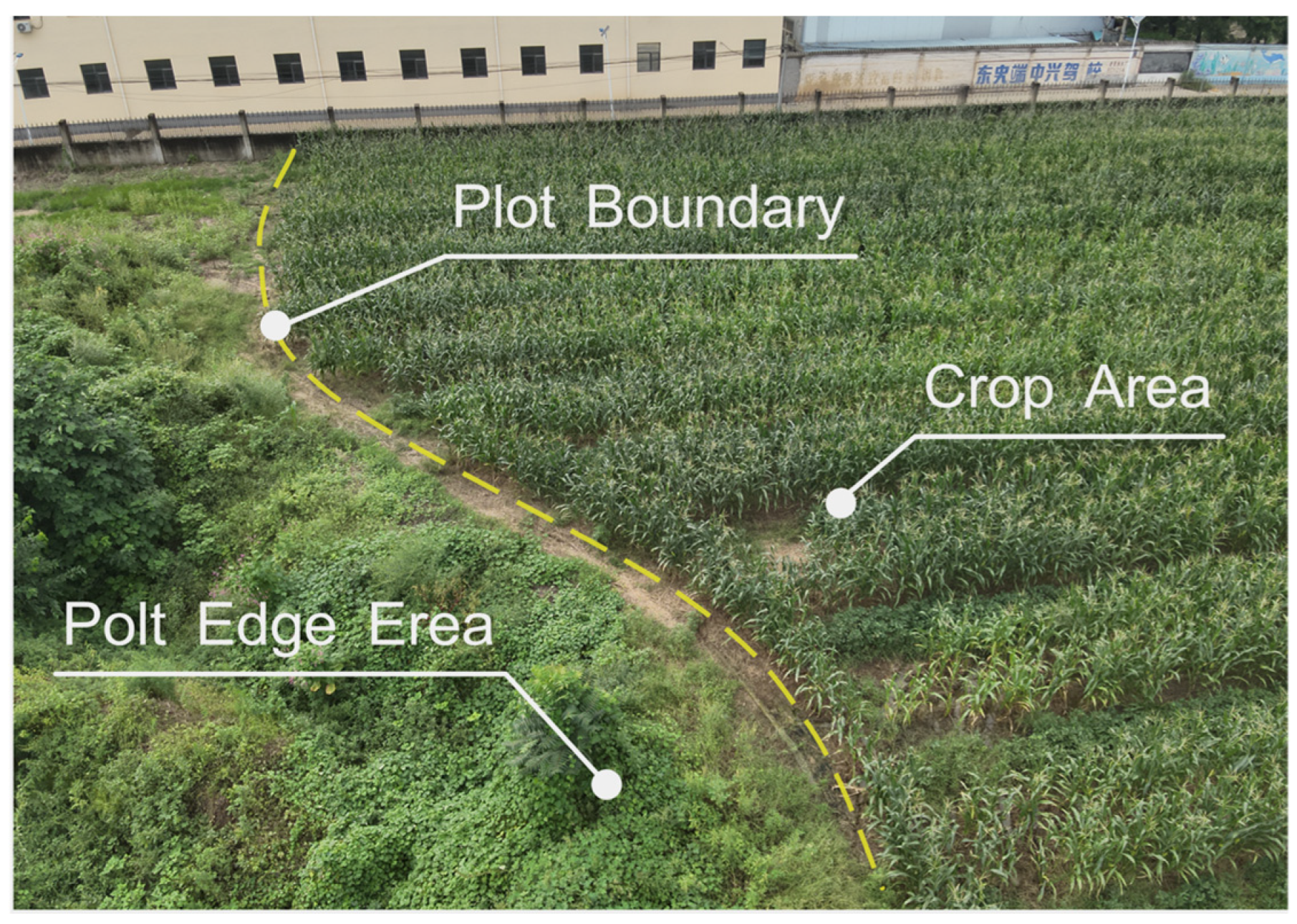
Soybean–maize strip intercropping fields are typically small and irregular polygons. Although crop rows are generally arranged in parallel, field geometry often results in non-perpendicular angles between the crop-row direction and the headland boundaries, as illustrated in Figure 1.
The sprayer trajectory consists of two components: the in-row operation path and the headland turning path. The headland area must be reserved during sowing, and its utilization directly affects the effective planting area and thus the crop yield. Therefore, selecting an appropriate turning strategy for specific boundary–row configurations is crucial for improving overall operational efficiency and reducing non-productive travel.
Notably, the spray boom of the sprayer is front-mounted relative to the chassis wheels, with a longitudinal offset between the boom and the tire contact points. If the sprayer is simplified as a point-mass (particle) model and this structural offset is neglected, the planned trajectory may lead to incomplete spray coverage after turning or unintended crop crushing by the tires, thereby causing economic losses.
In summary, under the intercropping scenario, the field turning of the sprayer must meet the following constraint requirements:
(1)
Mechanical safety: Avoid ridge contact during turning to prevent damage to the machine;
(2)
Crop protection: Minimize tire-induced rolling or scraping damage to maize and soybean plants;
(3)
Ensure accurate row alignment and match the end-of-turn pose (position and heading) to the starting pose of the next operation row to achieve seamless coverage.

2.2. Wheeled Differential Sprayer

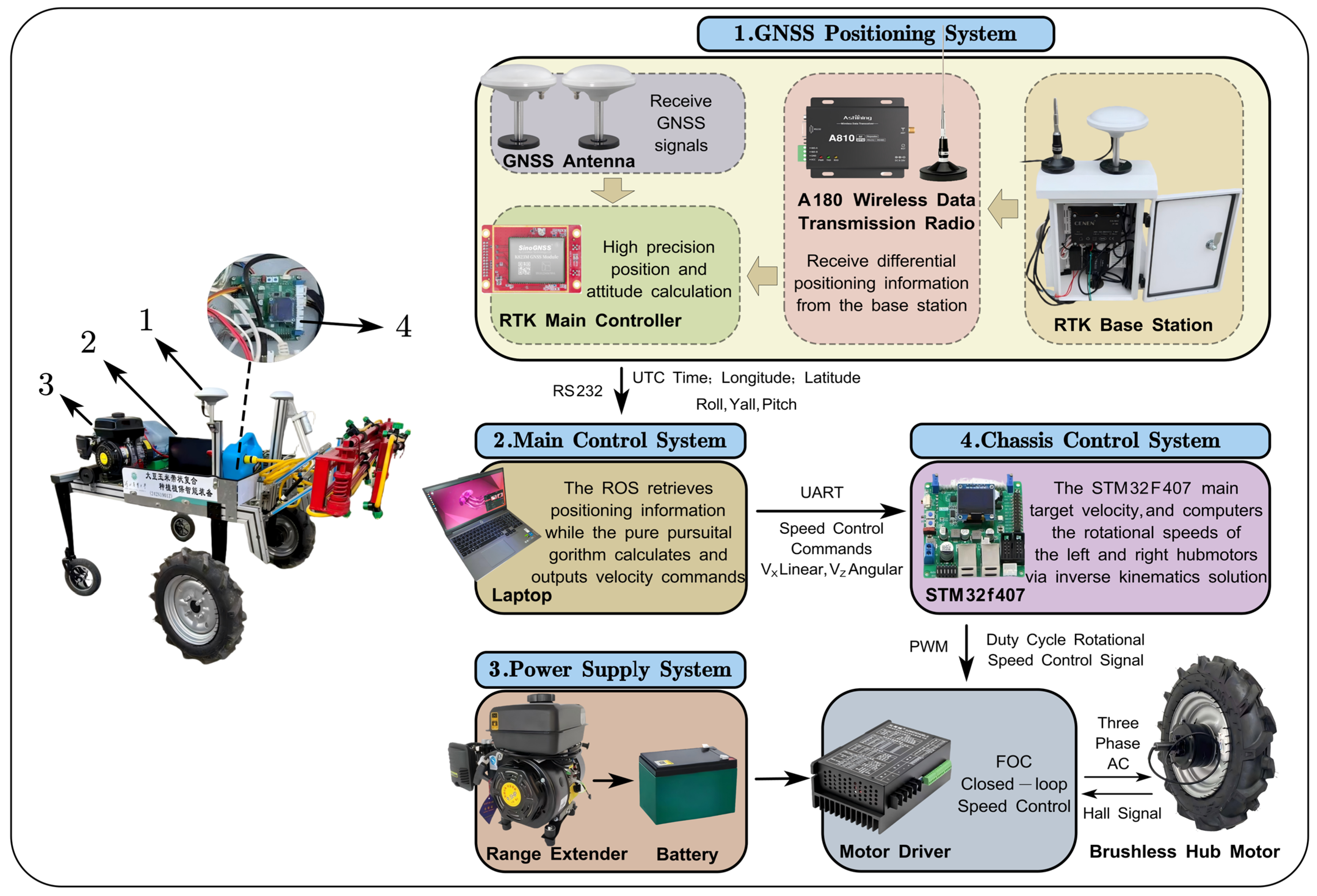
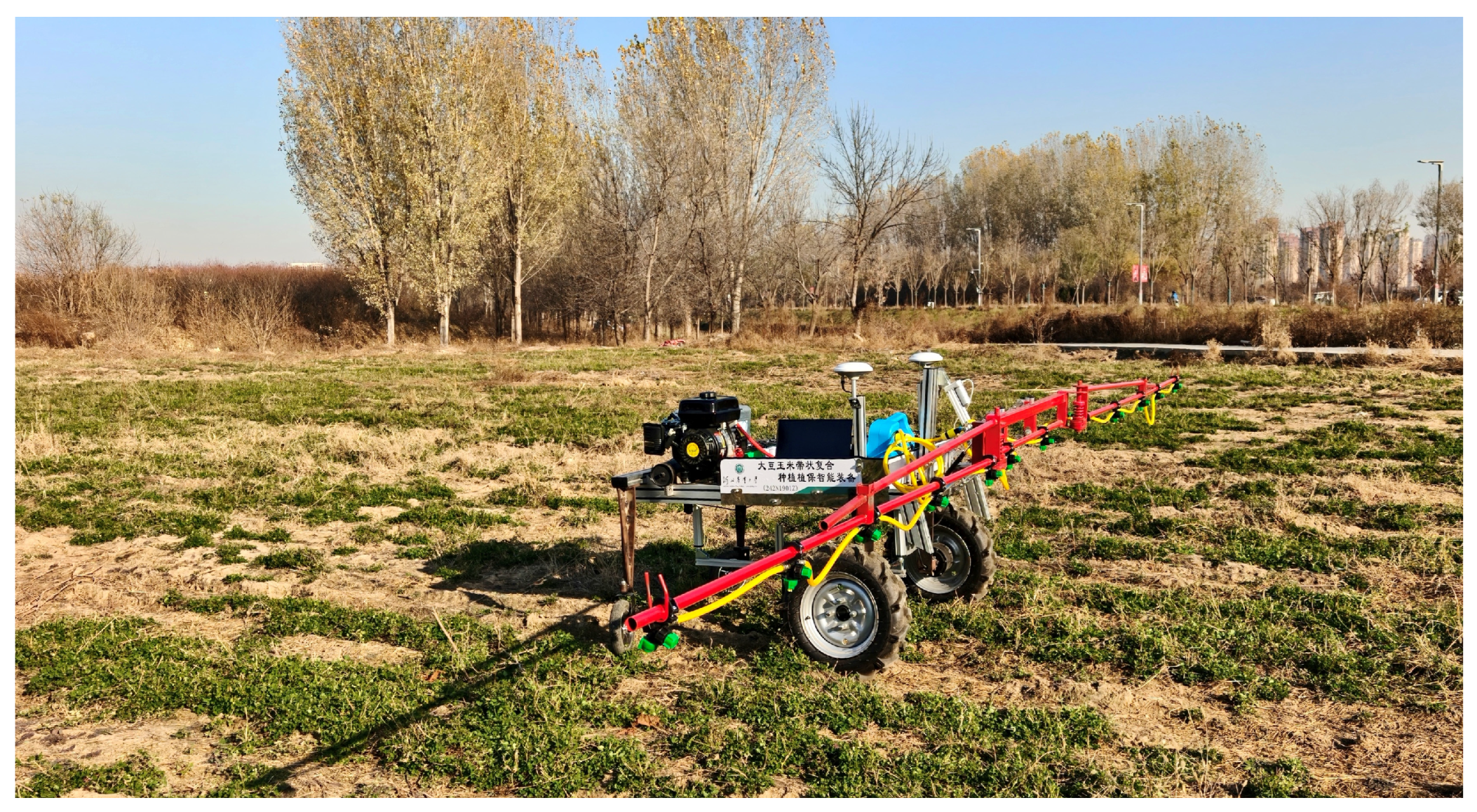
The experimental verification platform developed in this study is based on a wheeled differential chassis with a structural configuration of front dual drive wheels and rear dual caster wheels for auxiliary support, as illustrated in Figure 2. The unmanned sprayer control system comprises four integrated modules: a high-precision positioning system, a main control unit, a power supply system, and a chassis control system. The positioning system, consisting of GNSS antennas, an RTK controller, a wireless communication module, and a base station, provides real-time position and attitude information [15,16,17]. A laptop running the ROS framework functions as the main control unit, receiving positioning data and generating linear and angular velocity commands using the pure pursuit algorithm. Power is supplied by a hybrid energy system composed of a range extender and a battery. The chassis control system, based on an STM32F407 microcontroller (STMicroelectronics, Geneva, Switzerland), calculates target rotational speeds for the left and right wheels through inverse kinematics and regulates motor speeds via an FOC-based motor driver and brushless hub motors, with Hall sensors providing real-time speed feedback [18,19,20]. All modules are interconnected through dedicated communication links to ensure coordinated and reliable unmanned operation. The detailed technical parameters of the unmanned sprayer are listed in Table 1.
Although the sprayer is equipped with a differential chassis and theoretically supports zero-radius in-place turning, this turning mode presents significant drawbacks due to the large-span spray boom. First, a strong inertial swing may cause the boom ends to scrape crops or damage field boundaries. Second, dynamic stability is reduced, as asymmetric inertial loads can induce vehicle body tilt or vibration. Third, control precision deteriorates, since attitude disturbances can severely interfere with the automatic path-tracking performance. Therefore, to ensure operational safety and control accuracy, it is necessary to impose a minimum turning radius constraint on the sprayer.

2.3. Two-Way Driving Strategy

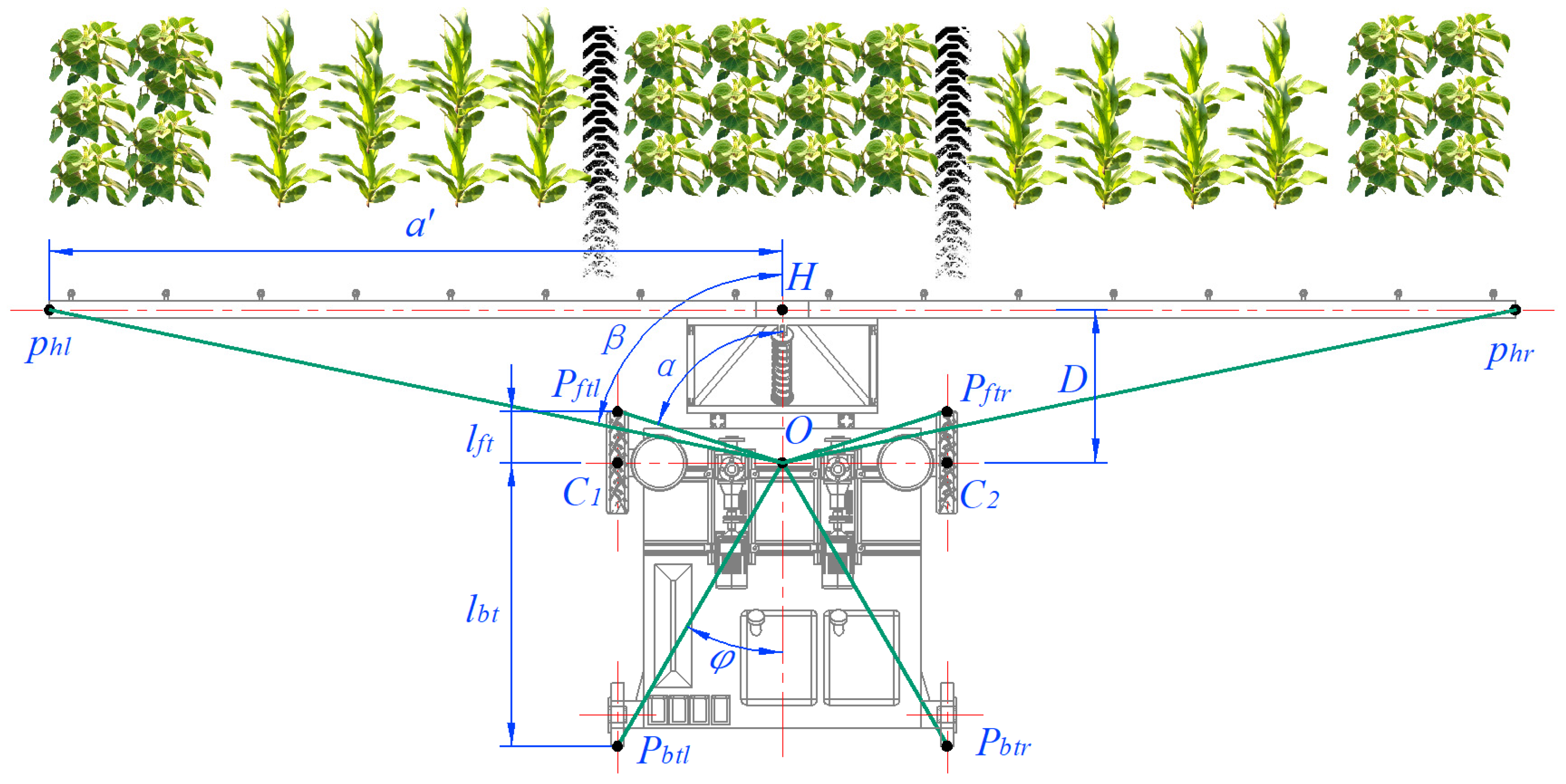
This study focuses on the “4 + 4” soybean–maize strip intercropping mode widely adopted in North China, in which the soybean strip width is 90 cm and the maize strip width is 165 cm. The high-clearance sprayer used in this study operates across eight rows of soybean, and both the track width and spray boom configuration are strictly designed to comply with agronomic requirements, as illustrated in Figure 3 [21]. Conventional plant protection operations typically adopt a one-way travel mode, requiring the vehicle to perform a 180° U-turn at the headland to maintain consistency between the vehicle heading and the operation direction.
Unlike sowing or harvesting machinery, plant protection sprayers do not rely on a fixed travel direction to accomplish pesticide application, making bidirectional operation feasible during headland line switching. In most commercial sprayers, the boom and nozzle arrangement is typically symmetric (e.g., uniform spacing and left–right symmetry). Consistent with this design practice, the sprayer used in this study is equipped with a symmetrically mounted boom, with uniformly spaced nozzles oriented vertically downward and without directional air assistance. Under the low operating speed adopted in the field trials, airflow disturbance around the boom is limited; therefore, forward and reverse spraying can be reasonably regarded as producing comparable application performance.
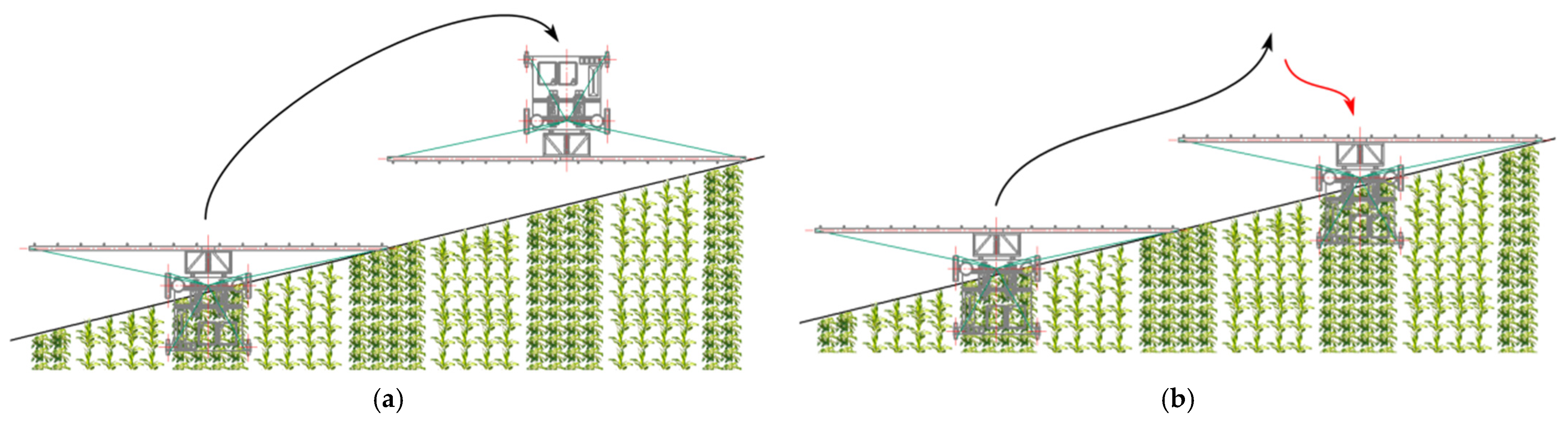
Based on these characteristics, a two-way operation scheme is proposed with two headland line-switching strategies: (1) entering the next pass via a conventional turning maneuver; and (2) a “Line Change Without U-Turn” maneuver, in which the vehicle maintains its heading and reverses directly into the adjacent row to enable continuous spraying (Figure 4, where black arrows indicate forward movement and red arrows indicate reverse movement).
The sprayer platform adopts a differential-drive chassis, in which the two front wheels are independently driven and steering is achieved by regulating the speed difference between the left and right drive wheels, while the two rear wheels are passive caster wheels providing support. This chassis architecture is widely adopted by small unmanned ground sprayers because it is compact, mechanically simple, and well suited to narrow headlands and irregular fields.
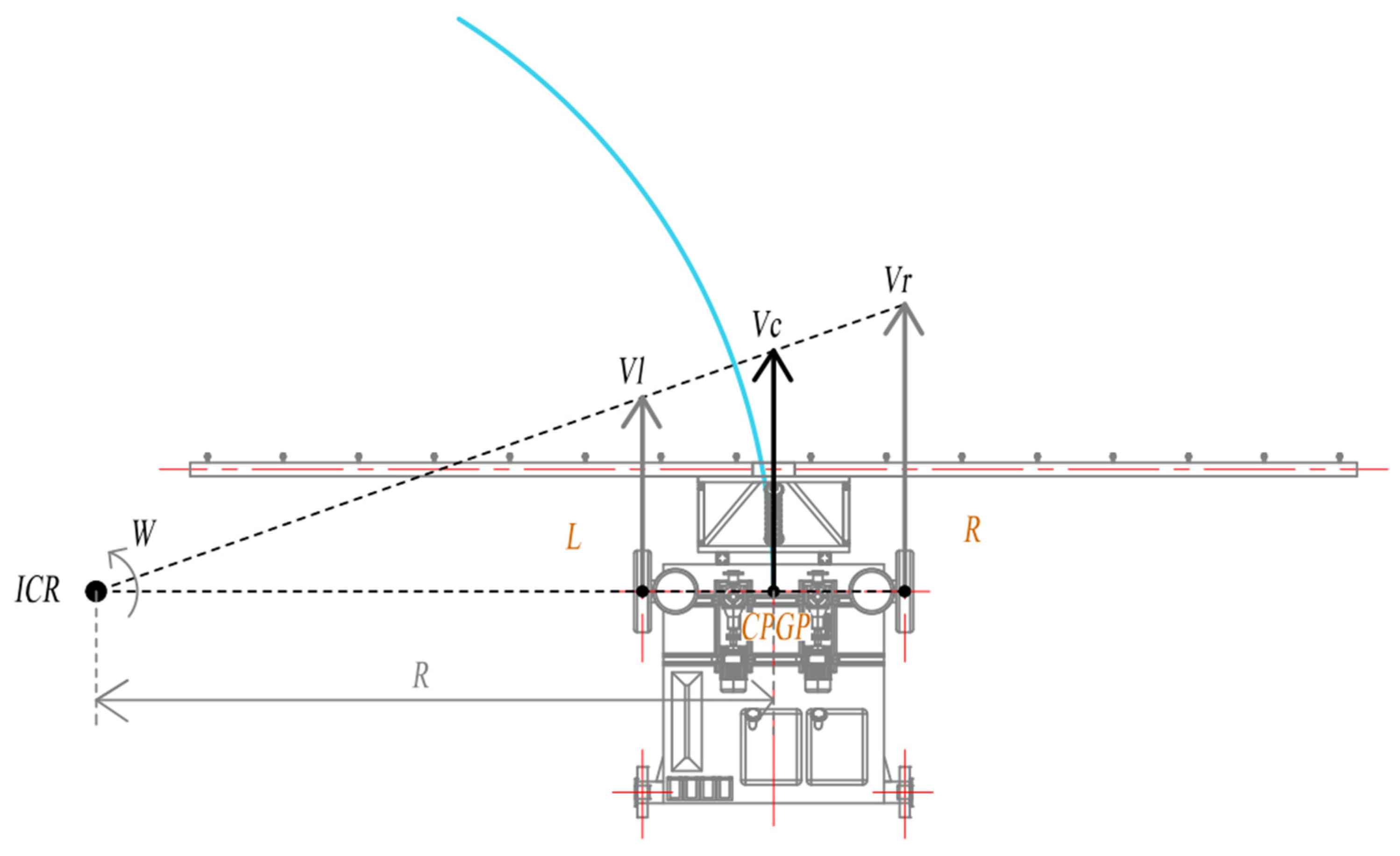
For a differential-drive vehicle, a key kinematic characteristic is that the instantaneous center of rotation (ICR) lies on the horizontal line connecting the two drive wheels (rather than being fixed at a single point). The midpoint of the two drive wheels, as a fixed and symmetric feature point on this line, maintains a constant relative position with the drive wheels regardless of changes in steering radius (caused by speed differences). This stability makes it an ideal reference for characterizing the vehicle’s planar motion and turning geometry, as it avoids the complexity introduced by the dynamic movement of the ICR itself (Figure 5).
As illustrated in Figure 3, P f t l and P f t l denote the left and right endpoints of the spray boom, respectively, while P b t l and P b t r represent the ground contact points of the rear wheels. The parameters L f t and L b t describe the lateral and longitudinal offsets of the boom endpoints and rear wheels relative to the CPGP, respectively, and D is the perpendicular distance from the spray boom to the crop row. These geometric parameters are used to construct a geometry-aware model for evaluating headland space occupation during turning.
Aiming at the operation requirements of “no cross-strip and full coverage” under non-perpendicular boundaries (angle θ), the pesticide application start-stop logic is as follows:
  • End of current row: The standard for completing pesticide application is that both endpoints Pftl and Pft of the spray boom are fully covered to the edge of the crop strip, ensuring no dead ends in the sprayed area.
  • Start of next row: After the completion of turning, when the center point O is aligned with the target path, the spray boom is vertical, and either endpoint touches the crop boundary, pesticide spraying is turned on immediately. This strategy ensures continuous operation while effectively preventing cross-strip pesticide application.

2.4. Headland Turning Path Planning

Unmanned plant protection sprayers operate under multiple constraints, including limited headland space, field environment (e.g., furrow structure), vehicle steering characteristics, minimum turning radius, and working width. Consequently, the operation path planning problem can be formulated as a constrained optimization problem, in which both the selection of feasible turning patterns and the sequencing of operation paths must be optimized to achieve efficient and feasible field coverage.
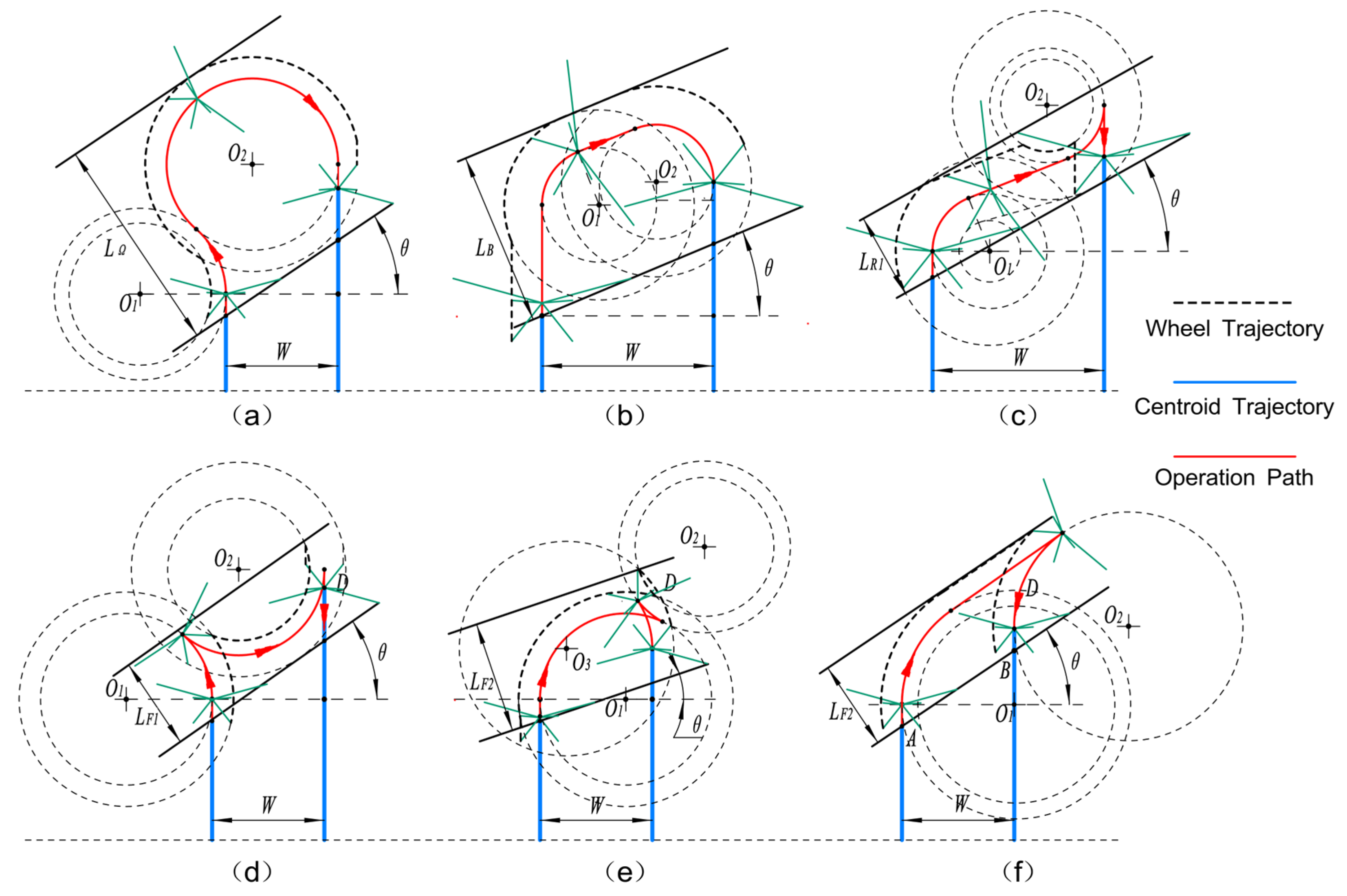
When the operation rows are not perpendicular to the field boundary, the headland turning process of the sprayer can be classified into six representative turning patterns, as illustrated in Figure 6.
The performance index for constrained path planning is the reserved headland width. When the unmanned plant protection machinery turns at the field headland, insufficient reserved width is likely to cause the machinery to deviate from the predetermined path and increase the risk of rolling plants. Therefore, during path planning, it is necessary to specify the reserved width threshold at the field end during turning. When the field boundary is not perpendicular to the operation path, the mathematical model of the reserved headland width is summarized as follows:
L B = a c o s 90 θ β R B c o s θ + l b t 2 + R B 2 + 2 R B l b t s i n φ , L Ω = D s i n θ + a c o s θ R Ω c o s θ + l b t 2 + R B 2 + 2 R Ω l b t s i n φ + 2 R Ω s i n a r c c o s 2 R Ω + W 2 + W c o t θ 2 4 R Ω a r c t a n W c o t θ 2 R Ω + W + 90 θ L F 1 = a c o s 90 θ β + R F 1 c o s θ + R F 1 c o s 90 θ + a r c t a n W c o t θ 2 R F 1 W + l b t s i n 90 θ ( θ < 77.5 ° )                         a c o s 90 θ β + R F 1 c o s θ + l b t 2 + R F 1 2 + 2 R l b t s i n φ   ( 77.5 ° θ 90 ° )                                                               L F 2 = a c o s 90 θ β R F 2 W 2 + W c o t θ 2 c o s ( a r c t a n R F 2 W W c o t θ + 90 θ ) + l f t 2 + R F 2 2 + 2 R F 2 l f t s i n α L H 1 = a c o s 90 θ β R H 1 c o s θ + 2 R H 1 2 w 4 2 w t a n θ + l b t 2 + R H 1 2 + 2 R H 1 l b t s i n φ L H 2 = a c o s 90 θ β + R H 2 c o s θ + 2 R H 2 1 t a n θ + l b t 2 + R H 2 2 + 2 R H 2 l b t s i n φ
where
  • L B is length of bow-shaped turning path (m),
  • L Ω is length of Ω-shaped turning path (m),
  • L F 1 and L F 2 are length of fishtail-shaped I turning paths I and II (m),
  • L V 1 and L V 2 are length of V-shaped turning paths I and II (m),
  • and D is horizontal distance from the center of the sprayer’s rear axle to the frontmost end of the spray boom (m).
Based on the derivation of the mathematical model for the reserved headland width (L) of the six turning curves, the applicability rules of the different curve types in complex plot scenarios can be clarified through parameterized calculation and multi-dimensional comparison.
When the boundary is perpendicular to the crop rows, the fishtail type requires stopping and changing direction twice, and the occupied headland width is larger than that of the arcuate and Ω-shaped types, so this is excluded from the selection. Therefore, only the non-perpendicular cases are analyzed.
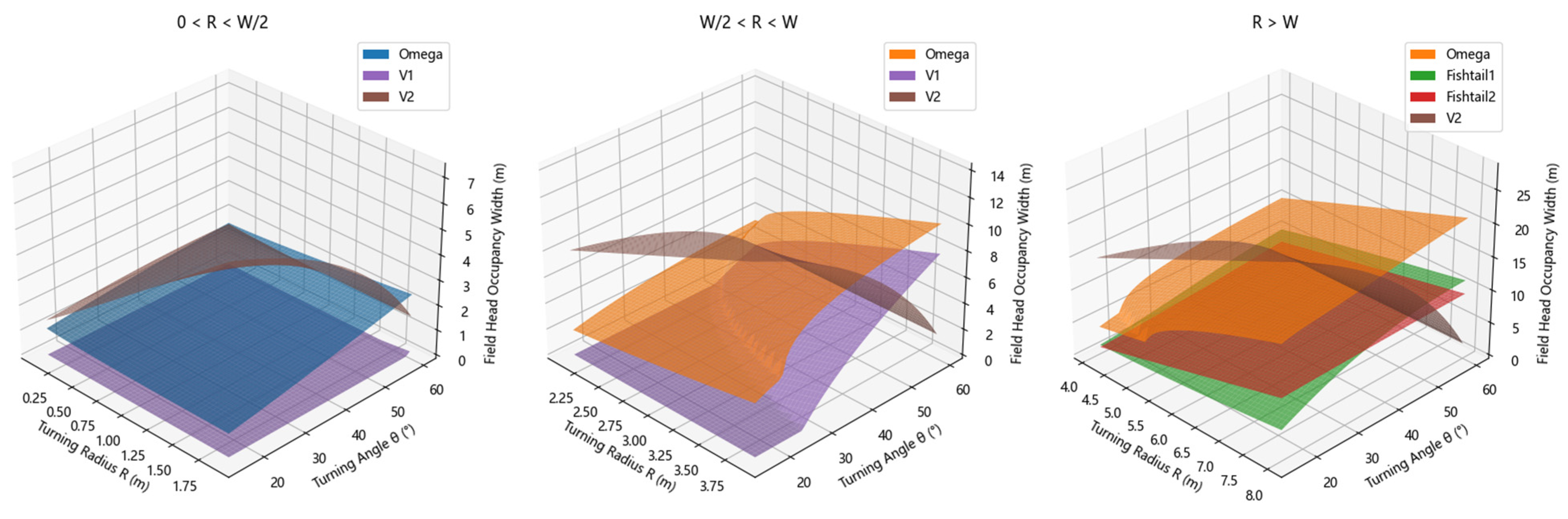
We input the actual dimensions of the vehicle body into the model formula, take the angle between the headland and the plot as well as the minimum turning radius as variables, and compare the path lengths (S) of different turning curves with the reserved headland width (L), as shown in Figure 7.
Research based on the coupling analysis of the angle θ between the crop rows and headland boundaries, the minimum turning radius (R) of the sprayer, and the working width (W) shows that to balance the headland space and operation efficiency, a differentiated strategy should be formulated according to the ratio of the turning radius to working width: when (0 < R < W/2), the V-shaped I turning has absolute advantages in both space and path; when (W/2 < R < W), the 38° angle should be taken as the boundary, and Ω-shaped (small angle) and V-shaped II (large angle) turnings should be adopted, respectively; when (R < W), the V-shaped II turning has higher comprehensive efficiency compared with the fishtail type. This strategy realizes adaptive planning for complex plot conditions and significantly improves the site adaptability of agricultural machinery operations.
Further quantitative analysis via the mathematical model reveals that: when the row change spacing is 4–8.5 m and the algorithm is adapted to models with a minimum turning radius of 2.2–5.7 m, the improved RS algorithm can reduce the headland turning space occupation to varying degrees. This row change spacing range can fully cover common compound planting patterns in China (combination of 2–4 rows of maize strips and 2–6 rows of soybean strips), endowing the algorithm with broad scenario adaptability. Notably, this spatial optimization effect is positively correlated with the angle between the field operation rows and the boundary—the larger the angle (especially the typical non-perpendicular scenarios of 60–85°), the more significant the headland space saving effect compared with the traditional pure U-shaped path, which fully reflects the algorithm’s adaptability advantage to the boundary characteristics of complex intercropping plots.

2.5. Path Optimization Based on Reeds-Shepp Curve

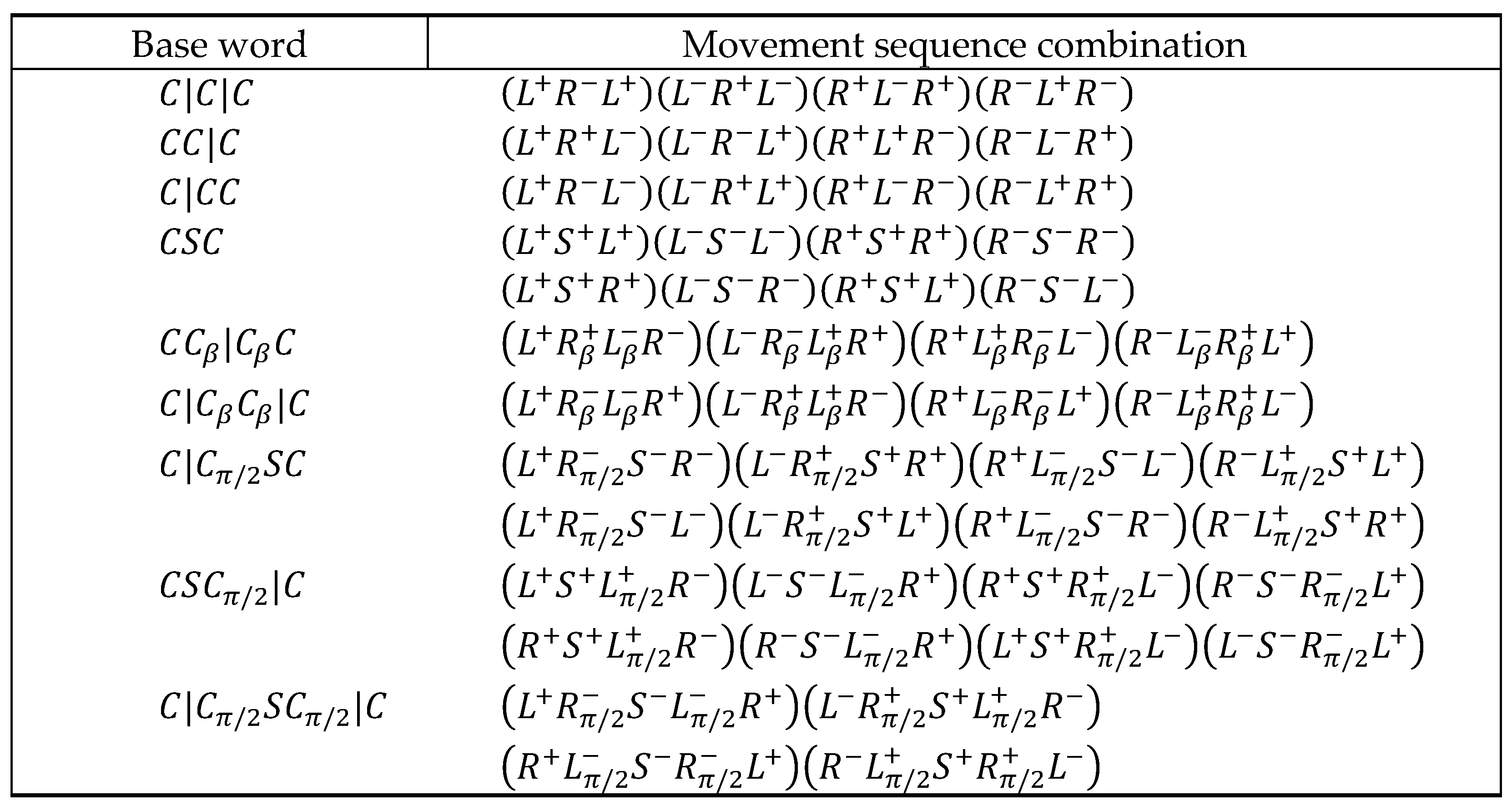
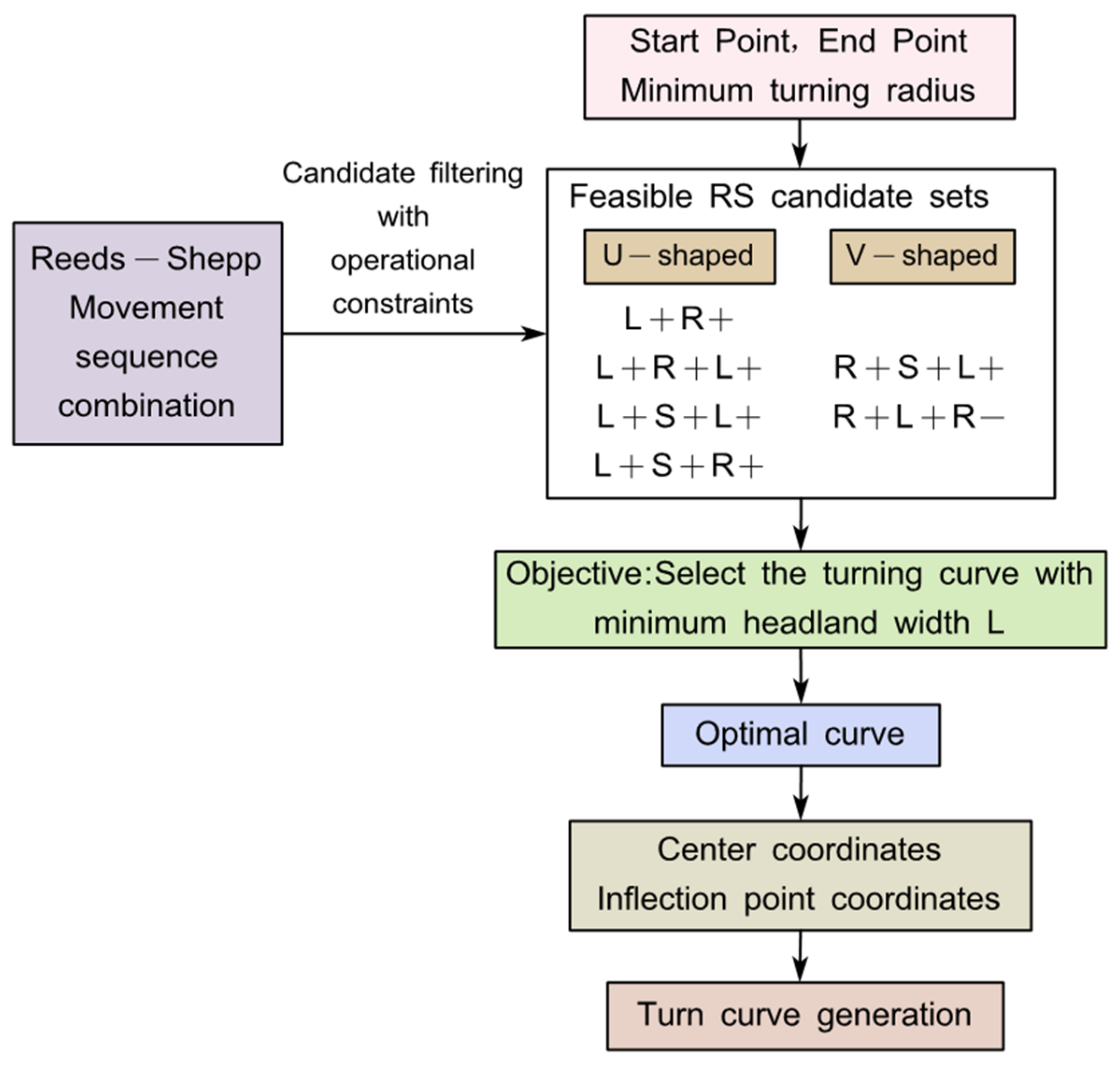
In soybean–maize strip intercropping, headland line switching must satisfy the “no band crossing and full coverage” requirement while reducing headland space occupation. Reeds–Shepp (RS) curves are suitable for this task because they model vehicle motion with bounded curvature and support both forward and reverse driving, which matches the bidirectional operability of sprayers. However, the classical RS formulation primarily aims at the shortest path and often produces turning trajectories with frequent direction changes and large curvature variations, which may be difficult to execute reliably in field operations. Therefore, this study adopts an RS-based candidate-screening strategy and selects turning curves according to a geometry-aware headland occupancy metric rather than pure path length [22], as summarized in Figure 8.
In irregular fields, the operating-row direction is often non-perpendicular to the field boundary, leading to a longitudinal skew offset between the start and target poses along the row direction. To accommodate such pose offsets, a compact set of RS turning templates is first constructed and grouped into two categories according to the heading relationship between successive passes:
(1)
U-shaped templates (heading reversed after switching):
( L + R + ) , ( L + R + L + ) , ( L + S + L + ) , ( L + S + R + ) ;
(2)
V-shaped templates (bidirectional line switching):
( R + S L + ) , ( R + L + R + ) .
By exploiting the time-reversal property and left–right symmetry of RS curves, additional mirrored candidates can be obtained through reflection and by swapping the start and goal poses, without repeating geometric derivations.
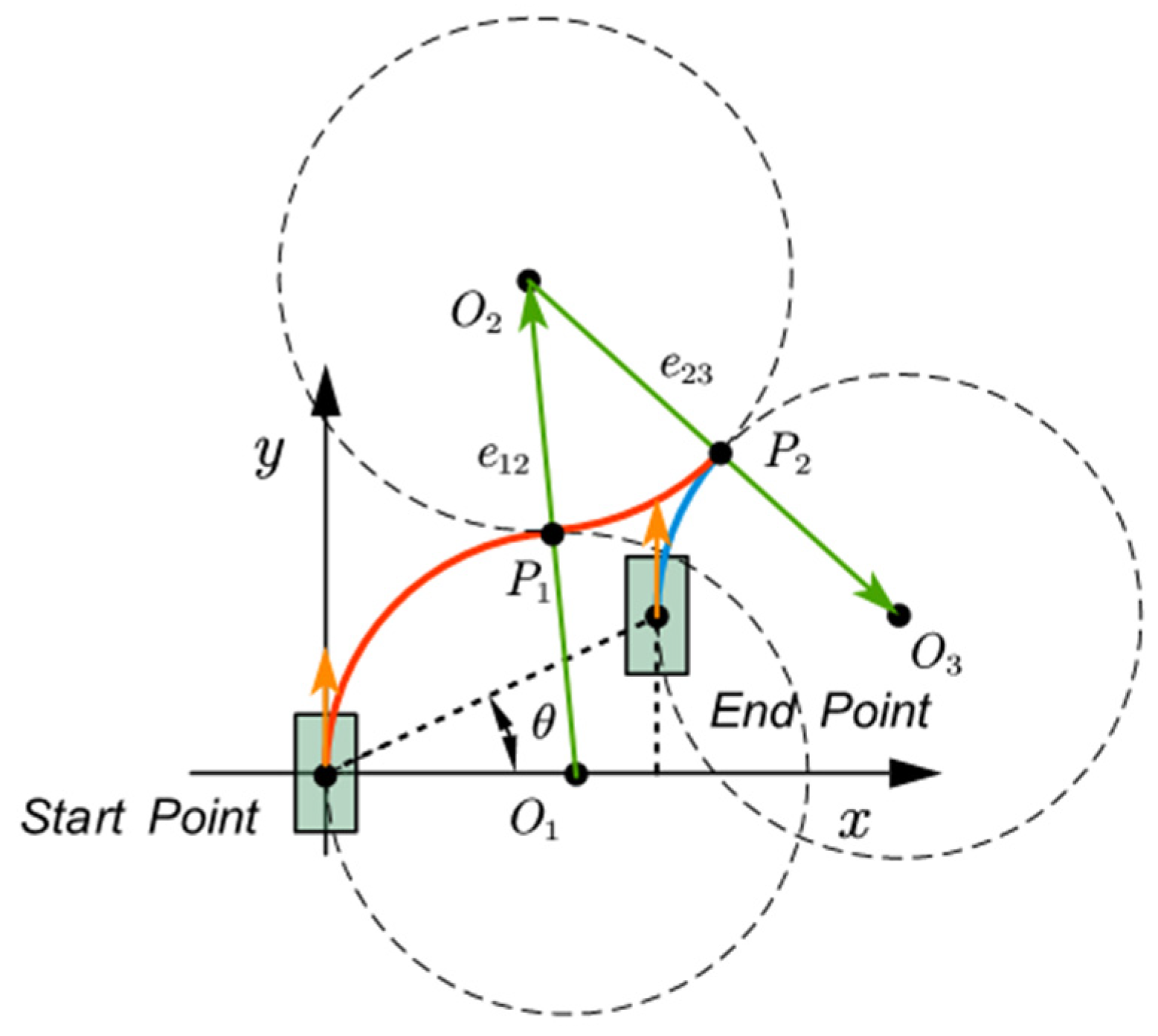
Inflection (tangency) points are key characteristic points that connect individual segments of a RS curve. Their coordinates are used for feasibility checking and provide geometric constraints for subsequent trajectory generation and path-tracking control. Taking the three-arc pattern ( R + L + R ) as an example, the start pose is defined as S x s , y s , θ , the target pose as E x e , y e , θ , and the minimum turning radius as R (Figure 9). The displacement vector from the start point to the end point is first defined as
P s P e = x e x s , y e y s T
and a unit normal vector perpendicular to the heading direction θ is introduced as
n = s i n θ , c o s θ T
The lateral offset (perpendicular distance) between the start and target poses is then given by
d = P s P e n
To ensure that the turning curve can be constructed by external tangency between adjacent circular arcs while satisfying the minimum turning-radius constraint, the feasibility condition d < 2 R must be satisfied. Accordingly, the inflection angle is obtained as
ϕ = a r c c o s d 2 R
The curvature centers of the three circular arcs can then be expressed as
O 1 = x s + R s i n θ y s R c o s θ , O 2 = x s R s i n θ y s + R c o s θ , O 3 = x e + R s i n θ y e R c o s θ
The coordinates of the tangency (inflection) points between adjacent arcs are given by
P 1 = O 1 + R c o s θ + ϕ s i n θ + ϕ , P 2 = O 3 + R c o s θ + π ϕ s i n θ + π ϕ
Thus, the inflection points can be obtained in the global coordinate frame and used for candidate evaluation and final turning-trajectory generation.
This flowchart illustrates the overall procedure of the proposed RS-based headland line-switching method. Given the start and target poses and the minimum turning radius, feasible RS movement sequence combinations are first generated and screened under practical operational constraints. According to the heading relationship between consecutive passes, the remaining candidates are classified into U-shaped (heading-reversed) and V-shaped (heading-preserved) turning modes. For each feasible candidate, the headland occupancy width is evaluated using a geometry-aware model that explicitly accounts for the sprayer footprint, rather than a point-mass approximation. The optimal turning curve is then selected by minimizing the headland occupancy width; after which the corresponding curvature centers and inflection points are computed to generate the final executable turning trajectory (Figure 10).
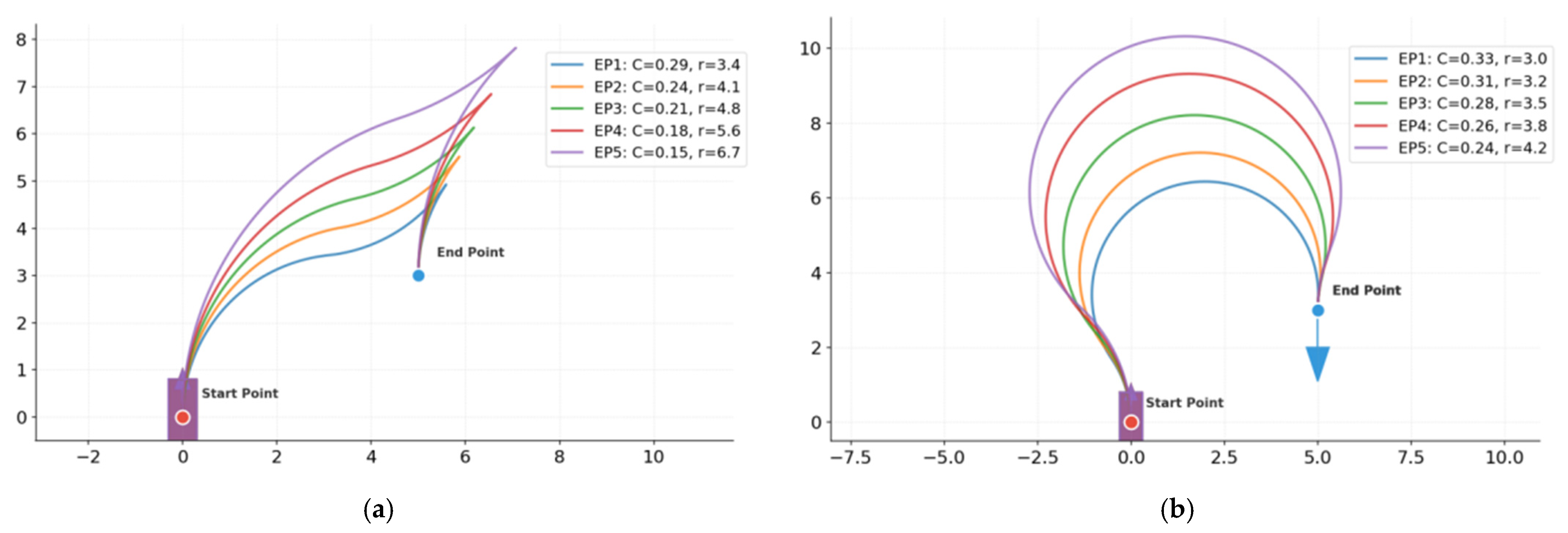
We input the poses of the start point and target point into the computer, set different curvatures, and verify the algorithm by calculating two types of path-turning curves, as shown in Figure 11.
Simulation curves show that the improved RS path planning algorithm, with pre-optimized turning paths, can effectively generate V-shaped and Ω-shaped turning paths that meet the operational requirements of unmanned sprayers with differential chassis. This provides key technical support for the subsequent full-coverage path planning algorithm.
Moreover, the algorithm features dynamic adaptive adjustment capabilities: it can adaptively adjust adjust the curvature distribution of the turning path, the length of the turning segment, and speed planning parameters according to the included angle between the field head (i.e., field boundary) and the working path, as well as thresholds such as the minimum turning radius determined based on boom stability. This ensures that the generated field turning curves are always adapted to the actual field environment and the operational capabilities of the equipment.

3. Results

3.1. Experiment on Path Planning Algorithms

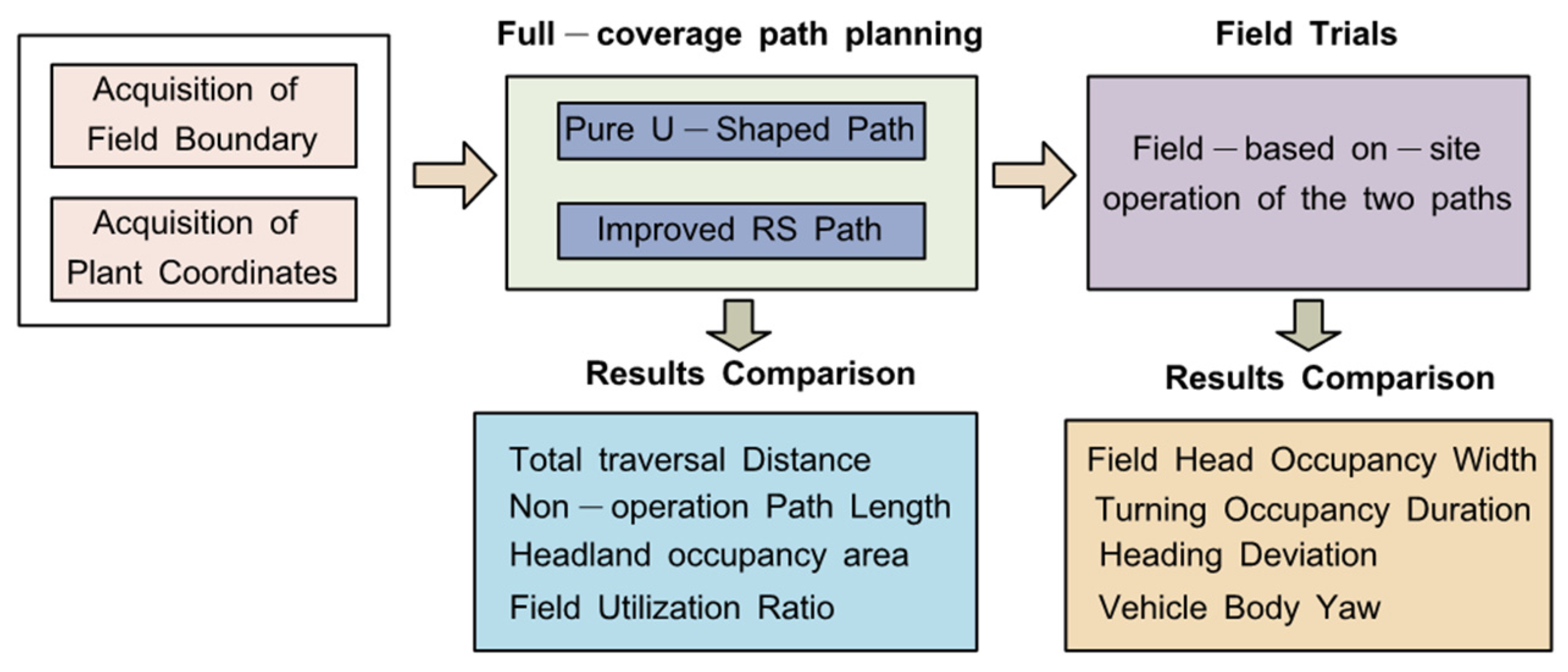
The experimental site was situated at the experimental farm in Baitapu Village, Xushui District, Baoding City. Four representative irregularly shaped plots were selected as test sites to validate the proposed algorithm. To systematically evaluate the adaptability and superiority of different path-planning strategies, full-area coverage path planning was implemented for each test plot. The overall experimental process is outlined as follows: first, field boundary coordinates and plant coordinates were acquired, and full-coverage paths were generated using the two path algorithms, respectively, followed by a comparison of simulation results; subsequently, on-site field operation of the two paths was conducted, operational data were collected, and a comparison of experimental results was performed to form a comprehensive verification system (Figure 12).
This study established an algorithm experimental framework based on the actual operating parameters and historical operational data of agricultural machinery. The simulation platform was deployed on the Windows 11 operating system, and all path planning algorithms were developed and implemented in C++ (v17).

3.1.1. Principle of the Coverage Path Planning Algorithm

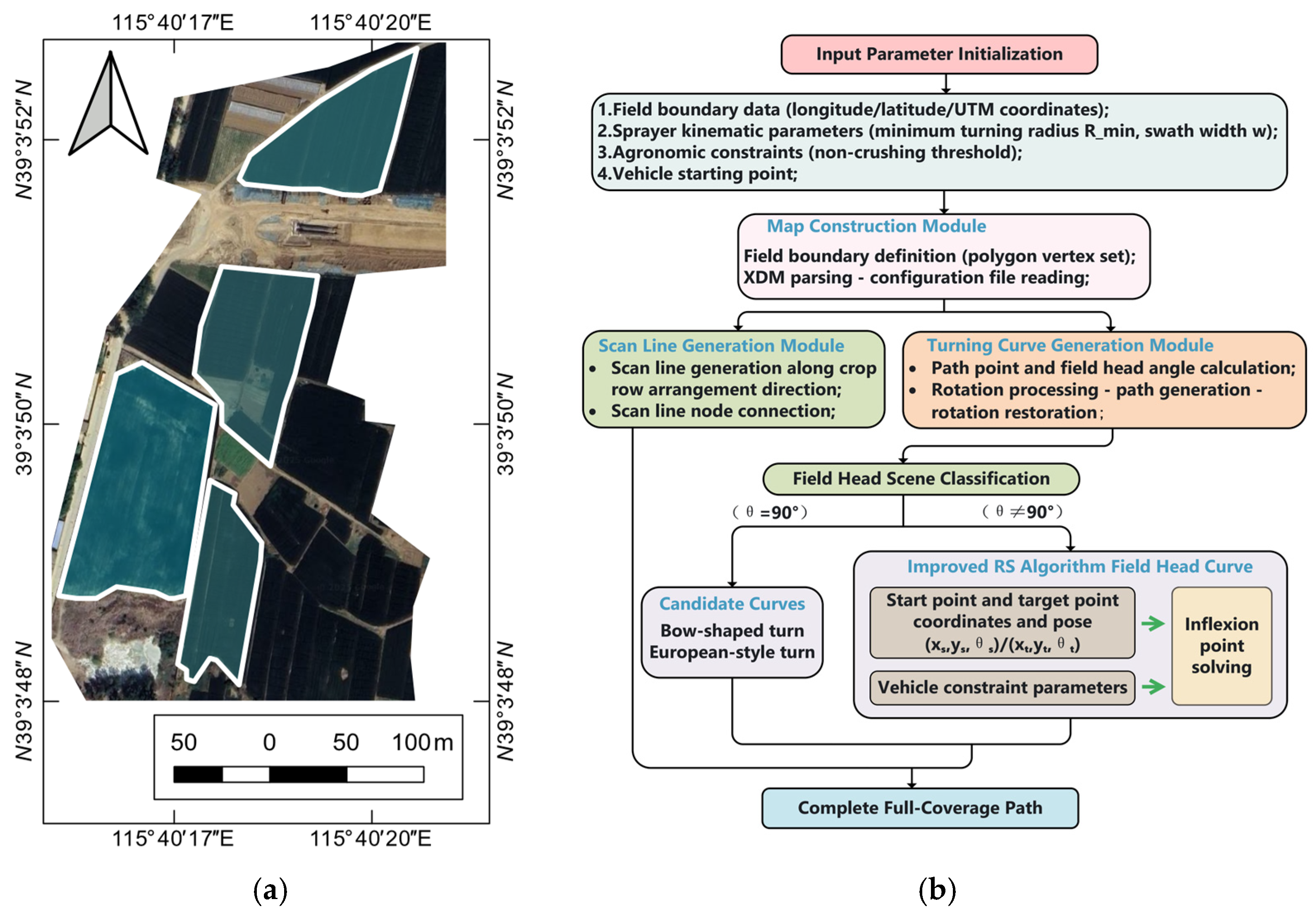
Using high-precision electronic surveying and mapping, the digital elevation model (DEM) data of the four corn–soybean intercropping plots in the farm were obtained. ArcGIS (v9.3) was used to perform terrain correction and noise-filtering preprocessing on the DEM data to extract the three-dimensional field boundaries [23,24,25]. Meanwhile, latitude and longitude coordinates of the corn and soybean rows were extracted from the seeding trajectories recorded by the navigation-assisted seeding system. A latitude/longitude-to-UTM coordinate transformation was implemented in MATLAB 2023b, and the UTM coordinates of the geometric center of each corn and soybean row were finally generated, i.e., (( x i , y i ), i = 1, 2, …, n), where (n) is the number of rows, along with other agronomic parameters [26,27] (Figure 13a).
The path-planning algorithm first initializes input parameters: field boundary (latitude/longitude or UTM coordinates), sprayer kinematic parameters (minimum turning radius, working width), agronomic constraints, and the vehicle’s starting point. A map-construction module defines the boundary as polygon vertices and load configurations, while a scanline-generation module produces the crop-row-aligned path skeleton and a turning-curve module computes headland corner angles for path processing (Figure 13b). Key algorithm parameters (turning radius, path tolerance) are shown in Table 2 [27,28,29].

3.1.2. Simulation Results and Analysis of the Algorithm

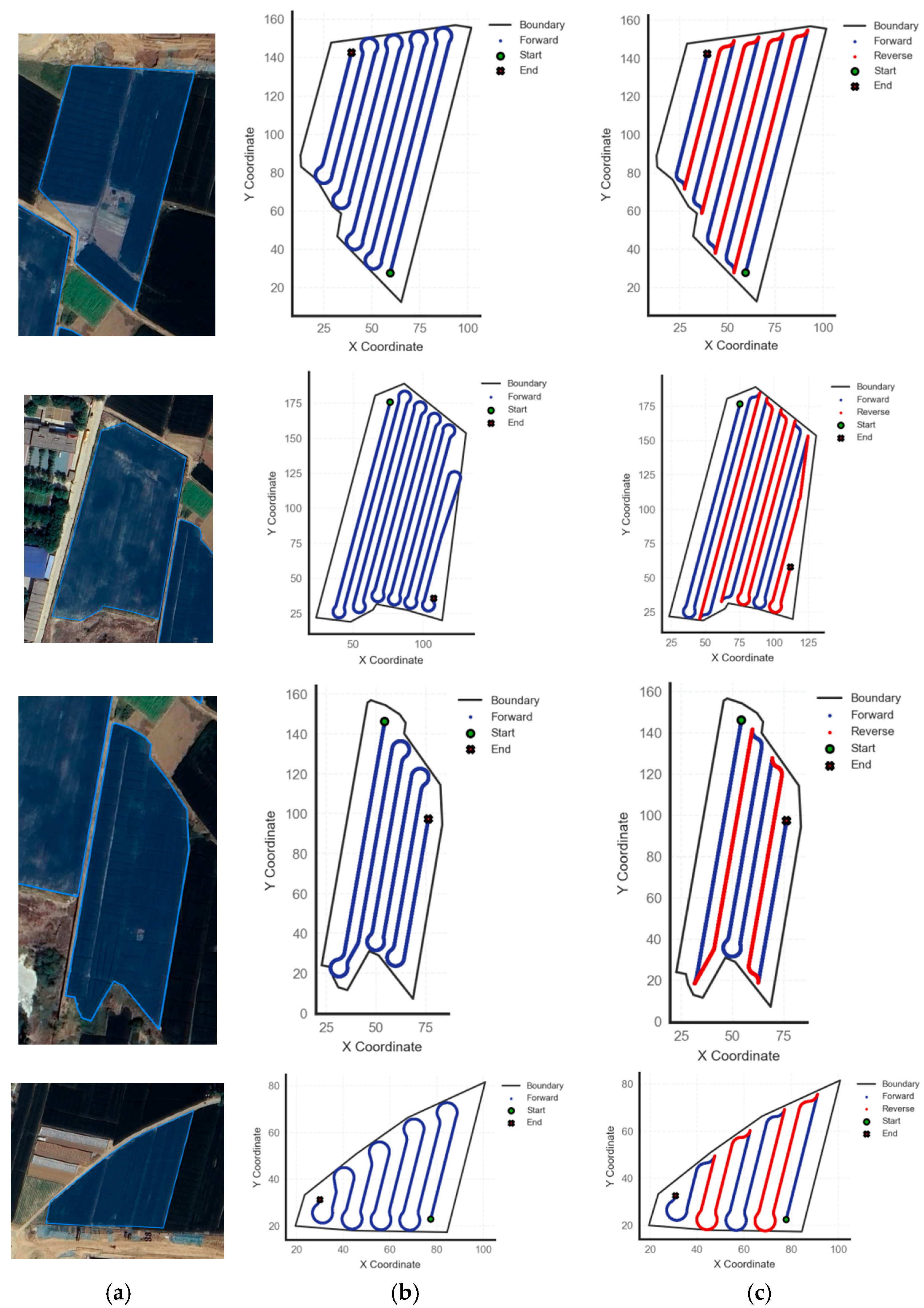
Two comparative schemes were tested: (1) the conventional U-turn back-and-forth path generated by the Dubins algorithm, which is a traditional, unoptimized basic solution and currently the only one used for the full coverage path of sprayers, and (2) the proposed RS-based hybrid bidirectional path. Comparative experiments quantitatively verified two technical advantages of the RS hybrid path: reduced headland space occupancy and shorter non-working travel distance (i.e., reduced deadheading). Simulations were conducted on four real-world fields with varying areas and shapes, using corn–soybean intercropping row spacing for working row settings and the figure’s green-marked point as the vehicle start (Figure 14).
The simulation results show that the paths generated by the RS hybrid path-planning algorithm can basically cover the entire field. In the figure, the blue path indicates the vehicle’s forward motion, while the red path indicates reversing; thus, the RS hybrid scheme forms a bidirectional operating path, whereas the turning mode of the pure U-turn scheme makes the overall path unidirectional.
The experiment involves four core indicators: actual field area, headland occupancy area, path length, and field utilization rate. The calculation methods adopted in this study are detailed as follows:
1.
The field boundary is simplified into a closed polygon based on GNSS-measured boundary points. Let the vertices of the polygon be P 1 x 1 , y 1 , P 2 x 2 , y 2 , P 3 x 3 , y 3 , (arranged in clockwise or counterclockwise order, with P n + 1 = P 1 to ensure closure). The actual field area is calculated using the shoelace formula, which is widely applied for polygon area computation in agricultural engineering:
S total = 1 2 i = 1 n x i y i + 1 x i + 1 y i
where ( x i , y i ) are the planar coordinates of the i -th boundary vertex (unit: m), and Stotal is the actual field area (unit: ha).
2.
The headland occupancy area refers to the non-operational area occupied by the unmanned sprayer during turning at the field head. It is derived by subtracting the effective operational coverage area from the actual field area:
S h e a d l a n d = S t o t a l L o p e r a t i o n a l × W s p r a y
where L o p e r a t i o n a l is the total length of the operational path (unit: m), and W s p r a y is the fixed spray width of the unmanned sprayer (unit: m, calibrated before the experiment).
3.
The path length is the sum of Euclidean distances between consecutive path points generated by the planning algorithm. Let the path points be Q 1 x 1 , y 1 , Q 2 x 2 , y 2 ,…, Q m x m , y m ; the total path length is calculated as:
L t o t a l = i = 1 m 1 x i + 1 x i 2 + y i + 1 y i 2
all length variables are in meters (m).
4.
The field utilization rate reflects the efficiency of effective operational coverage relative to the total field area, calculated as the ratio of the effective coverage area to the actual field area. The result is expressed as a percentage (%):
η = L operational × W spray S total × 100 %
a higher value of η indicates that the planned path covers more of the field area, with less waste of headland space.
Table 3 presents a comparison of the simulation results between the pure U-shaped path and the Improved RS path across four experimental fields. The specific data show that the Improved RS path demonstrates advantages in all metrics: the total traversal distance decreased on average from 992.65 m to 937.7 m; the non-operational headland path length was reduced on average from 165.28 m to 129.58 m; the headland occupancy area shrank on average from 535.5 m2 to 378.93 m2; meanwhile, the field utilization ratio improved on average from 86.5% to 90.35%. Particularly in the smallest field, Field 4 (0.157 ha), the utilization ratio increased most significantly from 82.0% to 87.5%. These results indicate that the Improved RS path, by optimizing turning and connection strategies, is markedly effective in reducing non-productive travel and utilizing headland space more compactly.
According to the performance improvement percentages calculated in Table 4, the Improved RS path achieved positive enhancements compared to the pure U-shaped path across all indicators. On average, the total traversal distance was reduced by 5.72%, the non-operational headland path length by 21.76%, and the headland occupancy area by 29.64%, while the field utilization ratio increased by 4.53%. The reductions in headland occupancy area and non-operational path length are particularly notable (both exceeding 21%), demonstrating that this path planning method can significantly improve the efficiency of headland space utilization and minimize idle travel. The modest reduction in total traversal distance further reflects its stable performance in optimizing the global path length. In summary, the Improved RS path shows substantial performance in enhancing operational compactness and resource utilization, making it especially suitable for field scenarios with limited headland space or where high operational efficiency is pursued.
The RS hybrid algorithm can autonomously select optimal turning curves according to field boundary geometry, resulting in a significant reduction in headland space occupation. It exhibits strong adaptability to irregular fields with diverse boundary shapes, making it particularly suitable for in-field operations on small plots with irregular boundaries.

3.2. Field Trial

3.2.1. Field Trial Design

The experiments were conducted on actual plots at the Xushui Experimental Farm. To ensure the reliability and repeatability of test results, each algorithm (the proposed improved RS path and the pure U-shaped path) was independently repeated 3 times per plot, resulting in a total of 4 plots × 2 algorithms × 3 repetitions = 24 field trials (Figure 15).
The trial sequence was randomized using a Latin square design: for each plot, the order of executing the two algorithms and their respective three repetitions was randomly assigned. This randomization effectively avoids systematic biases from factors such as soil condition changes (e.g., moisture evaporation, compaction from prior runs), ensuring the comparability of results between algorithms.
The sprayer followed the planned path under the navigation system at a stable operational state. To ensure a strictly fair comparison, both algorithms were implemented with completely identical core control parameters: the base linear speed of the agricultural machine was set to 4.2 km/h, the look-ahead distance of the pure pursuit algorithm was uniformly configured as 3.5 m, and the PID controller gains were set to proportional coefficient (Kp) = 1.2, integral coefficient (Ki) = 0.1, and differential coefficient (Kd) = 0.05 [30,31].
Once the vehicle arrived at the pre-defined working start point, it proceeded along the operational path; when reaching a path-switching node, the headland turning maneuver was initiated to access the subsequent operational path. This operational cycle was repeated until all planned working paths were fully traversed. During the entire operation process, the navigation system continuously logged the real-time trajectory of the vehicle, and further calculated the lateral tracking error, heading deviation angle, and vehicle body roll angle in real time. For each replicate test, adequate sampling points were acquired for all key performance metrics, and descriptive statistical analyses (mean ± standard deviation, 95% confidence interval, and coefficient of variation (CV)) were applied to the triplicate datasets, which quantitatively evaluated the variability of the experimental results.

3.2.2. Experimental Results and Analysis

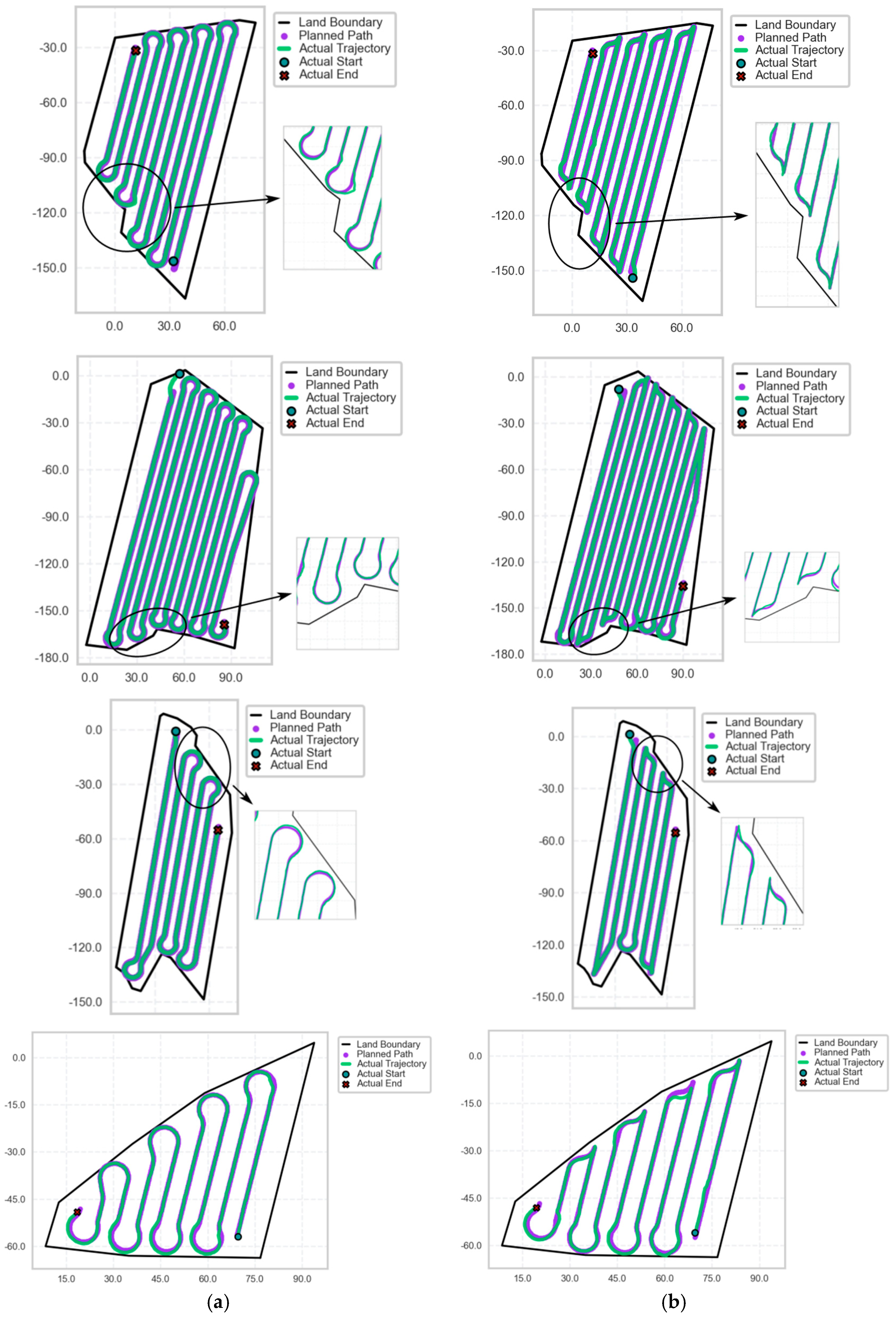
The comparison between the planned paths and the actual vehicle trajectories for the two algorithms is shown in Figure 16, where the purple line represents the planned trajectory and the cyan line represents the vehicle’s actual trajectory.
During the field experiment, key performance indicators of the unmanned sprayer operating in soybean–maize intercropping fields were statistically analyzed, with all data expressed as Mean ± Standard Deviation (Mean ± SD). The indicators included headland occupancy width, turning duration, heading deviation, and body roll angle. Additionally, the coefficient of variation (CV) was calculated to assess the stability of the test results, laying a reliable data foundation for comparing the performance of the improved RS hybrid path and the conventional pure U-shaped path (Table 5).
In terms of headland space utilization, the RS hybrid path significantly reduces the average headland occupancy width across all test plots. For example, in Plot 1, the occupied width decreases from 3.74 m to 2.38 m (a reduction of 38.9%), while similar reductions are observed in the remaining plots (Plot 2: 35.2%, Plot 3: 41.1%, Plot 4: 37.6%). The average reduction across all plots is 38.2% ± 2.1% (mean ± standard deviation, SD), with a low CV of 5.5%, indicating consistent space-saving effects across different irregular fields. Meanwhile, the turning occupancy duration is shortened by 32.5–35.7% (average 34.1% ± 1.3%). This indicates that the RS hybrid strategy effectively limits excessive headland maneuvering, reduces non-productive turning time, and improves overall operational efficiency in small and irregular fields—an advantage particularly critical for soybean–maize intercropping systems where field fragmentation is common.
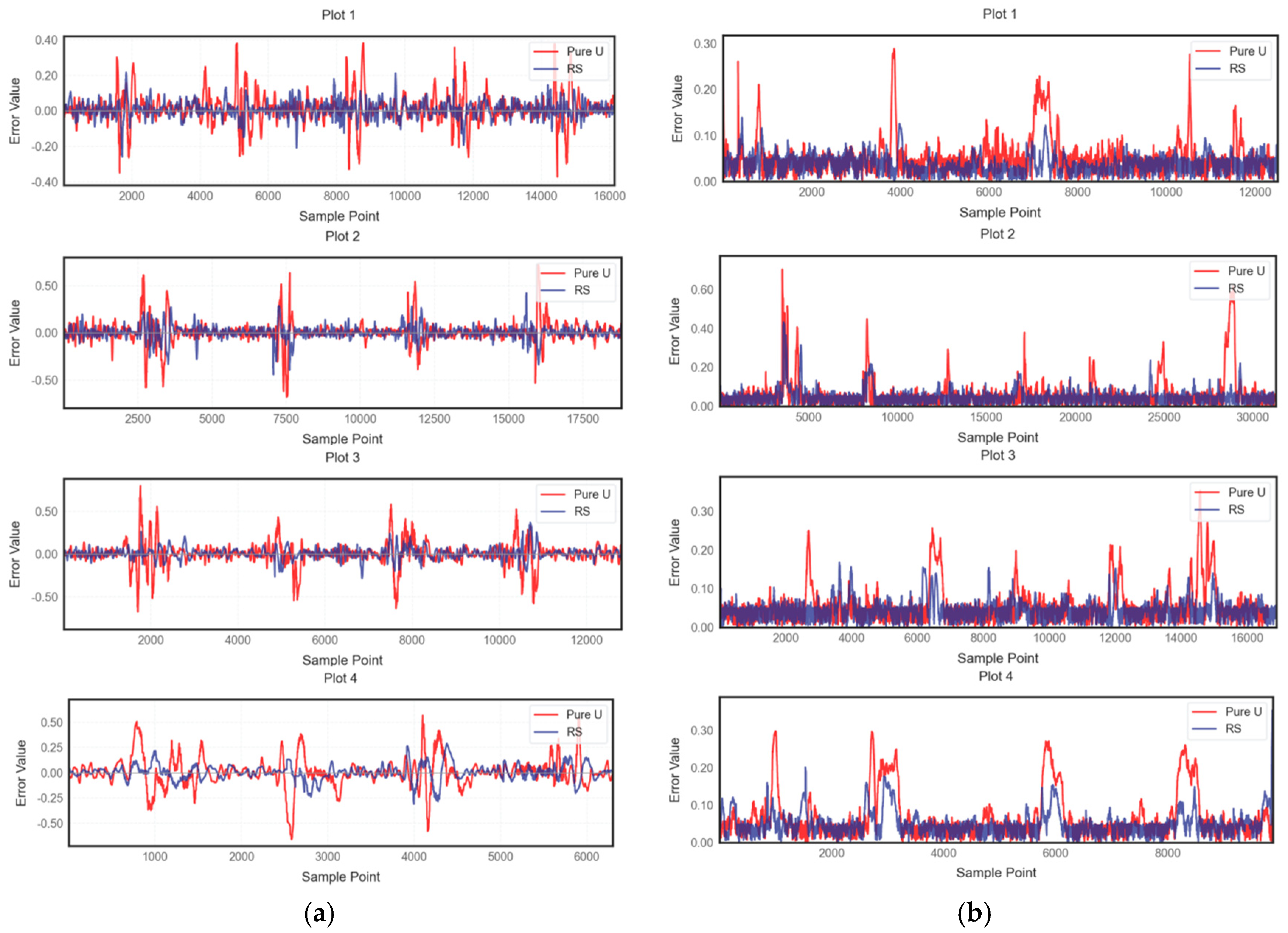
The real-time heading deviation and vehicle body yaw of the vehicle under the two algorithms are shown in Figure 17. Terrain unevenness may cause additional body roll and wheel slip during the experiment, leading to different deviations in the same turning curve within a single plot and introducing minor errors into the results. Such impacts can be reduced through multiple repeated experiments, ensuring the overall test data has good analyzability [32,33].
Regarding path-tracking performance, as shown in Table 6, the RS hybrid path consistently yields lower heading deviation during headland turning. After excluding redundant data from the straight-line and initial transition segments, the average heading deviation of the four plots during headland turning is reduced by 21.38% (from 0.268° ± 0.23° to 0.211° ± 0.17°). The coefficient of variation (CV) decreases synchronously (from 5.305% to 4.973%), further confirming the stability of the tracking performance. In terms of vehicle stability, measured by the IMU, when the improved RS path is applied in headland turning, the vehicle yaw is reduced by 30.73% (from 0.176 to 0.122) (Table 7). This improvement is attributed to the path’s alternating clockwise and counterclockwise turning strategy, as well as the shortened one-way turning duration, which effectively suppress inertial oscillations induced by the long spray boom. However, the Yaw CV of the vehicle has increased by 15.39%, yet it still remains within a reasonable range (coefficient of variation, CV < 8%), falling within an acceptable level. In summary, the improved RS path significantly improves the turning stability and control accuracy of field operations.
The field operation results presented demonstrate that the planned paths generated by the proposed algorithm are feasible for unmanned sprayer operations in soybean–maize intercropping fields. Compared with the conventional pure U-shaped path, the improved RS hybrid path shows consistent advantages in headland turning efficiency, tracking accuracy, and vehicle stability, confirming its suitability for practical field deployment under complex boundary conditions.

4. Discussion

Compared with Dubins curves that only support forward travel and can only generate two types of U-shaped paths (Omega-shaped and bow-shaped), as well as the traditional RS algorithm that takes the shortest path length as the sole optimization objective while ignoring headland space utilization efficiency, the improved RS algorithm proposed in this study is fully compatible with the bidirectional operation characteristics of plant protection sprayers. Existing full-coverage path planning methods for high-clearance unmanned sprayers (e.g., the improved particle swarm optimization algorithm proposed by Liu Guohai et al. [34]) are mostly based on the traditional U-turn mode. They generate operation rows through the parallel line offset of the straight line passing through the center point of irregular convex plots, and perform optimization on the direction angle of operation rows. Although certain results have been achieved in shortening traversal distance and reducing the number of turns, these methods are still limited to unidirectional operation and a single U-turn mode, lacking adaptability to the narrow headland space of corn–soybean intercropping plots. In contrast, the improved RS algorithm in this study not only expands the bidirectional operation mode, but also adds a V-turn strategy on the basis of the traditional U-turn mode. It designs the steering mode switching logic with the minimization of headland occupation width as the core decision-making objective, and can dynamically match the optimal steering strategy according to actual operating conditions such as field boundary angles and minimum turning radii. Ultimately, it achieves a significant reduction in headland turning space occupation, highlighting the technical advantages of the algorithm in the operation scenario of irregular intercropping plots.
Although the improved RS algorithm has achieved the expected results in spatial optimization and operational adaptability, this study still has two limitations to be improved. First, the current operation row switching strategy of the algorithm is limited to “jumping from the current operation row to the adjacent operation row”, failing to fully tap the global spatial optimization potential of multi-operation row span jumping, making it difficult to further reduce the non-operation path cost in complex irregular fields. Second, the operational accuracy of the algorithm is highly dependent on high-precision field boundary maps and crop row coordinate information recorded during the navigation sowing stage. However, in actual field scenarios, affected by factors such as sowing deviation, crop lodging, and natural erosion of field boundaries, the pre-stored coordinates are prone to deviate from the actual positions of crop rows, leading to a mismatch between the planned path and operational requirements, and further affecting the uniformity of spray coverage and operational stability [35].
To address the above limitations, subsequent research will carry out optimizations in two directions. On the one hand, a multi-objective optimal solution algorithm (such as weighted multi-objective genetic algorithm, NSGA-III, etc.) will be introduced to construct a global jump decision-making model of “current operation row—optimal target operation row”. By setting differentiated dynamic weights for core constraints such as headland space occupation, non-operation path length, and steering stability (flexibly adjusted according to the priority needs of actual operating scenarios), and integrating the optimal steering curve generation mechanism proposed in this paper, the collaborative optimization of operation row jump path and steering trajectory is realized, further reducing headland turning space occupation and improving the overall operational efficiency of complex irregular fields [36]. On the other hand, focus will be placed on LiDAR-based real-time perception of field features and dynamic compensation technology for coordinate deviations: during operation, LiDAR is used to continuously collect environmental point cloud data, and the real-time crop row centerlines and actual field boundary contours are accurately extracted by combining boundary-fitting algorithms [37]; real-time feature registration is completed based on the pre-stored high-precision map to calculate the translation and rotation deviation parameters between them; the deviation parameters are fed back to the geometric perception model of the improved RS algorithm in real time to dynamically correct core planning parameters such as operation width and field angle, realizing adaptive compensation of path planning. Thus, the strong dependence of the algorithm on pre-stored maps and sowing trajectories is weakened, and the operational robustness in complex and variable field environments is improved.


5. Conclusions

This study addresses the core challenges faced by unmanned sprayers operating in irregularly bounded fields under China’s soybean–maize strip intercropping system, such as low headland turning space utilization and excessive vehicle body roll during steering. A full-coverage path planning method based on the improved RS curve is proposed, and its effectiveness is verified through simulations and field experiments. The main conclusions are as follows:
(1)
Leveraging the differential-drive chassis characteristics and bidirectional spraying capability of small unmanned sprayers, a bidirectional operation scheme is constructed, extending the V-shaped headland turning path. To analyze the headland occupation width of various headland turning strategies (considering sprayer structural dimensions) in scenarios where the operation rows and boundaries of irregular fields are non-perpendicular, a geometry-aware mathematical model for reserved headland width under different turning modes is established with the minimum turning radius (R), working width (W), and field angle (θ) as core variables. Based on this model, the performance of different turning strategies is analyzed, and the effective reduction of headland space occupation is achieved through the optimal matching of multiple turning combinations.
(2)
The traditional RS algorithm is optimized and improved. After inputting the pose parameters of the start and end points of the path, the headland occupation width of various candidate turning curves is quantitatively calculated using the established mathematical model. The optimal scheme is selected, the coordinates of curve inflection points are solved, and finally, a smooth turning trajectory adapted to field operating conditions is generated.
(3)
To verify the algorithm’s effectiveness, full-coverage simulation tests are conducted on four typical irregular fields. The results show that compared with the traditional pure U-shaped path, the improved RS algorithm achieves varying degrees of reduction in headland turning space occupation across all four fields. Field experiments further verify the path-tracking performance of the improved RS algorithm, which not only effectively reduces the heading deviation of the turning path but also alleviates the vehicle body roll problem caused by the long spray boom span, significantly improving operational stability.
Author Contributions

Conceptualization and methodology, H.J. and C.N.; software, X.Q. and C.N.; validation, H.J. and X.Q.; investigation, L.Z. (Lixuan Zhao); resources, C.C.; data curation, C.N.; writing—original draft preparation, C.N.; writing—review and editing, C.N.; visualization, Y.S.; supervision, C.C.; project administration, H.J.; funding acquisition, N.L. and L.Z. (Lijie Zhang). All authors have read and agreed to the published version of the manuscript.

Funding

This research was funded by the Key Science and Technology Support Program of Hebei Province (Special Project for Modern Agricultural Science and Technology Innovation), grant number 242N1901Z; the specific project title is “Intelligent Plant Protection Equipment for Soybean-Corn Strip Intercropping”.

Institutional Review Board Statement

Not applicable.

Data Availability Statement

Dataset available on request from the authors.

Acknowledgments

The authors sincerely thank the editors and anonymous reviewers for their constructive and insightful comments on the manuscript.

Conflicts of Interest

The authors declare no conflicts of interest.

Abbreviations

CCPPComplete Coverage Path Planning
RSReeds–Shepp

References

  1. Zhong, Y.H.; Tang, S.; Jiang, J.Y.; Yang, X.L.; Du, T.S. Yield, Benefit and Key Factors of Soybean-Corn Strip Intercropping. Chin. J. Eco-Agric. (Chin. Engl. Ed.) 2025, 33, 1–15. [Google Scholar]
  2. Zhang, J.; Wang, R.N.; Wu, T.L. Soybean-Corn Strip Intercropping: Production Effectiveness, Influencing Factors and Challenges—An Analysis Based on Farmer Samples in the Huang-Huai-Hai Region. J. Arid Land Resour. Environ. 2024, 38, 96–105. [Google Scholar] [CrossRef]
  3. Song, J. An Improved Rapidly-Exploring Approach to Off-Road Path Planning by Leveraging Dynamic Velocity Constraints and Trajectory Smoothing. IET Intell. Transp. Syst. 2026, 20, e70148. [Google Scholar] [CrossRef]
  4. Catania, P.; Comparetti, A.; Febo, P.; Morello, G.; Orlando, S.; Roma, E.; Vallone, M. Positioning Accuracy Comparison of GNSS Receivers Used for Mapping and Guidance of Agricultural Machines. Agronomy 2020, 10, 924. [Google Scholar] [CrossRef]
  5. Höffmann, M.; Patel, S.; Büskens, C. Optimal Coverage Path Planning for Agricultural Vehicles with Curvature Constraints. Agriculture 2023, 13, 2112. [Google Scholar] [CrossRef]
  6. Utamima, A.; Reiners, T.; Ansaripoor, A.H. Evolutionary Neighborhood Discovery Algorithm for Agricultural Routing Planning in Multiple Fields. Ann. Oper. Res. 2022, 316, 955–977. [Google Scholar] [CrossRef]
  7. Tang, Y.; Zakaria, M.A.; Younas, M. Path Planning Trends for Autonomous Mobile Robot Navigation: A Review. Sensors 2025, 25, 1206. [Google Scholar] [CrossRef]
  8. Bochtis, D.; Sørensen, C.A.G. An Optimized Field Coverage Planning Approach for Navigation of Agricultural Robots in Fields Involving Obstacle Areas. In Agricultural Robotics: Current Challenges and Future Trends; InTech: Rijeka, Croatia, 2013. [Google Scholar]
  9. Bochtis, D.; Griepentrog, H.W.; Vougioukas, S.; Busato, P.; Blanes, C. Route Planning for Orchard Operations. Comput. Electron. Agric. 2015, 113, 51–60. [Google Scholar] [CrossRef]
  10. Cariou, C.; Gobor, Z.; Seiferth, B.; Lenain, R. Mobile Robot Trajectory Planning Under Kinematic and Dynamic Constraints for Partial and Full Field Coverage. J. Field Robot. 2017, 34, 1297–1312. [Google Scholar] [CrossRef]
  11. Chen, T.; Xu, L.; Ahn, H.S.; Lu, E.; Liu, Y.; Xu, R. Evaluation of Headland Turning Types of Adjacent Parallel Paths for Combine Harvesters. Biosyst. Eng. 2023, 233, 93–113. [Google Scholar] [CrossRef]
  12. Hu, L.; Hou, K.; He, J.; Man, Z.; Xie, J.; Wang, P.; Huang, Y. Multi-Constraint Improved RS Path Planning Method for Unmanned Rice Direct Seeding Machine. Comput. Electron. Agric. 2024, 224, 109236. [Google Scholar] [CrossRef]
  13. Bang, L.U.; Wanjing, D.O.; Youchun, D.I.; Yang, S.U.; Haopeng, L.I.; Chaoyu, Z.H. A Rapeseed Unmanned Seeding System Based on Cloud-Terminal High Precision Maps. Smart Agric. 2023, 5, 33–44. [Google Scholar] [CrossRef]
  14. Chen, K.; Xie, Y.S.; Li, Y.M.; Liu, C.L.; Mo, J.Q. Multi-Constraint Coverage Path Planning Method for Agricultural Machinery. J. Agric. Mech. 2022, 53, 17–26. [Google Scholar] [CrossRef]
  15. Huang, Y.; Fu, J.; Xu, S.; Han, T.; Liu, Y. Research on Integrated Navigation System of Agricultural Machinery Based on RTK-BDS/INS. Agriculture 2022, 12, 1169. [Google Scholar] [CrossRef]
  16. Marucci, A.; Colantoni, A.; Zambon, I.; Egidi, G. Precision Farming in Hilly Areas: The Use of Network RTK in GNSS Technology. Agriculture 2017, 7, 60. [Google Scholar] [CrossRef]
  17. Wang, D.J. Path Planning for Indoor Mobile Robots Based on Improved A* Algorithm. J. Tsinghua Univ. (Sci. Technol.) 2012, 52, 1085–1089. (In Chinese) [Google Scholar] [CrossRef]
  18. Liang, S.; Zhao, W.; Lin, N.; Huang, Y. Adaptive Fusion Positioning Based on Gaussian Mixture Model for GNSS-RTK and Stereo Camera in Arboretum Environments. Agronomy 2023, 13, 1982. [Google Scholar] [CrossRef]
  19. Pradhan, N.C.; Sahoo, P.K.; Kushwaha, D.K.; Bhalekar, D.G.; Mani, I.; Kumar, K.; Singh, A.K.; Kumar, M.; Makwana, Y.; V, S.K.; et al. ANN-PID Based Automatic Braking Control System for Small Agricultural Tractors. J. Field Robot. 2024, 41, 2805–2831. [Google Scholar] [CrossRef]
  20. Shi, S. Design and Research of Unmanned Driving Control System for Rice Transplanter. Master’s Thesis, Shandong Agricultural University, Tai’an, China, 2020. [Google Scholar] [CrossRef]
  21. Zhang, Z.; Guo, P.; Ma, H.; Chen, Y.; Chen, Y. Experimental Investigation of Dual-Path Inline Mixing System for Sprayers in Corn-Soybean Strip Intercropping Mode. Agriculture 2025, 15, 247. [Google Scholar] [CrossRef]
  22. Li, J. Research on Automatic Parking Path Planning and Motion Control. Master’s Thesis, Chang’an University, Xi’an, China, 2020. [Google Scholar] [CrossRef]
  23. Yang, T.; Du, X.; Zhang, B.; Wang, X.; Zhang, Z.; Wu, C. Coverage Path Planning Based on Region Segmentation and Path Orientation Optimization. Agriculture 2025, 15, 1479. [Google Scholar] [CrossRef]
  24. Khosravani Moghadam, E.; Vahdanjoo, M.; Jensen, A.L.; Sharifi, M.; Sørensen, C.A.G. An Arable Field for Benchmarking of Metaheuristic Algorithms for Capacitated Coverage Path Planning Problems. Agronomy 2020, 10, 1454. [Google Scholar] [CrossRef]
  25. Qin, C. Research on Agricultural Machinery Path Planning Method Based on Data Fusion. Master’s Thesis, Shandong University of Technology, Zibo, China, 2022. [Google Scholar] [CrossRef]
  26. Ma, Z.; Ma, S.; Zhao, J.; Wang, W.; Yu, H. Farm Plot Boundary Estimation and Testing Based on the Digital Filtering and Integral Clustering of Seeding Trajectories. Agriculture 2024, 14, 1238. [Google Scholar] [CrossRef]
  27. Shang, G.; Liu, G.; Han, J.; Peng, Z.; Peng, C. Research on Full Coverage Path Planning Algorithm for Horticultural Electric Tractor Operation. Agric. Mech. Res. 2022, 44, 35–40. [Google Scholar] [CrossRef]
  28. Shao, M. Research on Full Coverage Path Planning for Intelligent Agricultural Machinery Operation. Master’s Thesis, Anhui Agricultural University, Hefei, China, 2021. [Google Scholar] [CrossRef]
  29. Sun, C. Development of Automatic Driving and Management System for Rice Hole Direct Seeding Machine. Master’s Thesis, Shanghai Jiao Tong University, Shanghai, China, 2017. [Google Scholar]
  30. Ren, H.; Wu, J.; Lin, T.; Yao, Y.; Liu, C. Research on an Intelligent Agricultural Machinery Unmanned Driving System. Agriculture 2023, 13, 1907. [Google Scholar] [CrossRef]
  31. Seyyedhasani, H.; Dvorak, J.S. Reducing Field Work Time Using Fleet Routing Optimization. Biosyst. Eng. 2018, 169, 1–10. [Google Scholar] [CrossRef]
  32. Singh, S.; Vaishnav, R.; Gautam, S.; Banerjee, S. Agricultural Robotics: A Comprehensive Review of Applications, Challenges and Future Prospects. In Proceedings of the 2024 2nd International Conference on Artificial Intelligence and Machine Learning Applications (AIMLA), Theme: Healthcare and Internet of Things, Namakkal, India, 15–16 March 2024; IEEE: Piscataway, NJ, USA, 2024; pp. 1–8. [Google Scholar] [CrossRef]
  33. Pradhan, N.C.; Sahoo, P.K.; Kushwaha, D.K.; Makwana, Y.; Mani, I.; Kumar, M.; Aruna, T.N.; V, S.K. A Finite Element Modeling-Based Approach to Predict Vibrations Transmitted Through Different Body Segments of the Operator Within the Workspace of a Small Tractor. J. Field Robot. 2023, 40, 1543–1561. [Google Scholar] [CrossRef]
  34. Liu, G.-H.; Wan, Y.-L.; Shen, Y.; Liu, H.; He, S.-W.; Zhang, Y.-F. Full-Coverage Operation Path Planning for High-Clearance Unmanned Sprayers in Irregular Convex Fields Based on an Improved Particle Swarm Optimization Algorithm. J. South China Agric. Univ. 2025, 46, 390–398. [Google Scholar]
  35. Aruna, T.N.; Sahoo, P.K.; Kushwaha, D.K.; Pradhan, N.C.; Kumar, K.; V, S.K.; B S, M.; Gaddamwar, R.B.; Pandey, A.; Singh, A.K.; et al. Static and Dynamic Cutting Forces in Coriander Crop Harvesting: Engineering Insights for Harvester Optimization. Smart Agric. Technol. 2025, 10, 100772. [Google Scholar] [CrossRef]
  36. Ryerson, A.E.F.; Zhang, Q. Vehicle Path Planning for Complete Field Coverage Using Genetic Algorithms. In Proceedings of the International Commission of Agricultural Engineering; International Commission of Agricultural Engineering: Liege, Belgium, 2007. [Google Scholar] [CrossRef]
  37. Alharbi, M.; Karimi, H.A. A Global Path Planner for Safe Navigation of Autonomous Vehicles in Uncertain Environments. Sensors 2020, 20, 6103. [Google Scholar] [CrossRef]
Figure 1. Plot boundary image.
Agriculture 16 00336 g001
Figure 2. Control system of unmanned sprayer truck.
Agriculture 16 00336 g002
Figure 3. Structural dimension model of unmanned sprayer truck.
Agriculture 16 00336 g003
Figure 4. Turning modes of plant protection sprayers. (a) 180° turning mode; (b) line change without U-turn.
Agriculture 16 00336 g004
Figure 5. Kinematic model of unmanned sprayer truck.
Agriculture 16 00336 g005
Figure 6. Different turning path schemes for unmanned sprayers. (a) Ω-shaped turning; (b) bow-shaped turning; (c) V-shaped turning I; (d) fishtail-shaped turning I; (e) fishtail-shaped turning II; (f) V-shaped turning II.
Agriculture 16 00336 g006
Figure 7. Comparison of field head occupancy width among turning curves.
Agriculture 16 00336 g007
Figure 8. Basic types of Reeds–Shepp.
Agriculture 16 00336 g008
Figure 9. Geometric relationship between curve paths.
Agriculture 16 00336 g009
Figure 10. Workflow of improved RS headland line-switching turning-curve generation.
Agriculture 16 00336 g010
Figure 11. RS turn path planning. (a) RS V-shaped turn planning; (b) RS Ω-shaped turn planning.
Agriculture 16 00336 g011
Figure 12. Experimental Flow Chart.
Agriculture 16 00336 g012
Figure 13. (a) Farmland electronic map; (b) algorithm flow chart.
Agriculture 16 00336 g013
Figure 14. Algorithms comparison diagram. (a) Plot map; (b) pure U-shaped algorithm path; (c) improved Reeds–Shepp algorithm path.
Agriculture 16 00336 g014
Figure 15. Sprayer field experiment.
Agriculture 16 00336 g015
Figure 16. Comparison between Actual Traveled Path and Planned Path. (a) Pure U-shaped Algorithm Path; (b) Improved RS Algorithm Path.
Agriculture 16 00336 g016
Figure 17. Algorithms comparison diagram. (a) Actual traveled heading deviation; (b) actual traveled vehicle body yaw.
Agriculture 16 00336 g017
Table 1. Parameters of unmanned sprayer truck.
Body Parameter NamesActual Parameter Values
Wheelbase936 mm
Track Width × Overall Height953 mm × 1680 mm
Maximum Torque299.8 N·m
Maximum Power2433.2 W
Minimum Ground Clearance790 mm
Motor DriverAQMD6040BLS-E2 35A (Chengdu Aikong Electronic Technology Co., Ltd., Chengdu, China)
Table 2. Key parameters of the algorithm.
Parameter NamesParameter Values
Scan Line Width5.2
Boundary Indent Distance0.8
Minimum Scan Line Length6
Minimum Turning Radius2.4
Plane Grid Resolution0.02
Angle Grid Resolution0.015
Table 3. Algorithm simulation results.
Field CodePlot Area/haPure U-shaped PathImproved RS Path
Total Traversal Distance/mNon-Operation Path Length/mHeadland Occupancy Area/m2Field Utilization RatioTotal Traversal Distance/mNon-Operation Path Length/mHeadland Occupancy Area/m2Field Utilization Ratio
10.5131319.3162.5626.887.7%1238.3132.4453.791.2%
20.6501537.6218.4734.688.7%1462.1175.7529.391.9%
30.372688.2172.9497.586.6%649.3129.5336.289.9%
40.157427.5107.3283.182.0%401.181.7196.587.5%
Table 4. Summary of algorithm simulation comparison.
Field CodeTotal Traversal DistanceNon-Operation Path LengthHeadland Occupancy AreaField Utilization Ratio
1−6.14%−18.52%−27.62%3.99%
2−4.19%−19.55%−27.94%3.61%
3−5.56%−25.10%−32.42%3.81%
4−6.17%−23.86%−30.59%6.71%
Average value−5.72%−21.76%−29.64%4.53%
Table 5. Headland space utilization and turning efficiency of sprayers under different paths.
Field CodePure U-Shaped PathImproved Reeds-Shepp Path
Average Field Head Occupancy Width/mCVTurning Occupancy Duration/sCVAverage Field Head Occupancy Width/mCVTurning Occupancy Duration/sCV
13.746.83%429.65.32%2.385.56%273.45.13%
23.225.25%537.34.86%2.875.37%366.76.32%
34.536.62%215.85.67%2.435.81%153.96.76%
44.675.72%231.55.63%2.795.67%175.25.37%
Table 6. Heading and yaw deviation performance of sprayers under different paths.
Field CodePure U-Shaped PathImproved Reeds-Shepp Path
Average Heading Deviation (Mean ± SD, 95% CI)CVAverage Vehicle Body Yaw (Mean ± SD, 95% CI)CVAverage Heading Deviation (Mean ± SD, 95% CI)CVAverage Vehicle Body Yaw (Mean ± SD, 95% CI)CV
10.263 ± 0.0145.32%0.1835 ± 0.0116.01%0.206 ± 0.0104.85%0.1327 ± 0.0096.78%
20.247 ± 0.0124.86%0.1792 ± 0.0105.58%0.193 ± 0.0094.66%0.1218 ± 0.0086.57%
30.276 ± 0.0155.43%0.1649 ± 0.0095.46%0.215 ± 0.0115.12%0.1142 ± 0.0076.13%
40.285 ± 0.0165.61%0.1772 ± 0.0105.63%0.228 ± 0.0125.26%0.1195 ± 0.0086.69%
Table 7. Path planning performance improvement comparison.
Parameter NamesMagnitude Change
Average Field Head Occupancy Width (CV)−35.21% (−8.23%)
Turning Occupancy Duration (CV)−31.47% (+9.78%)
Average Heading Deviation (CV)−21.38% (−6.27)
Average Vehicle Body Yaw (CV)−30.73% (15.39%)
Disclaimer/Publisher’s Note: The statements, opinions and data contained in all publications are solely those of the individual author(s) and contributor(s) and not of MDPI and/or the editor(s). MDPI and/or the editor(s) disclaim responsibility for any injury to people or property resulting from any ideas, methods, instructions or products referred to in the content.