


Abstract
Climate change significantly challenges efforts to maintain and improve crop production worldwide. Diversified crop rotations have emerged as a promising way to adapt cropping systems and bolster food security under changing climate conditions; however, robust empirical evidence remains limited. This study evaluates the long-term performance of diversified crop rotations under future climate scenarios in the North China Plain via an 80-year scenario analysis (2020–2100) spanning three shared socioeconomic pathways (SSPs:126, 370, 585). The calibrated and validated SWAP (Soil–Water–Atmosphere–Plant)–WOFOST (WOrld FOod STudies) model simulated water consumption and yield. Sustainability indices were employed to assess the cereal yield stability and compensation effect to yield loss caused by climate change. The study compares the conventional winter wheat–summer maize rotation (WM) with two legume-based rotations: soybean–WM (S–WM) and peanut–WM (P–WM). The results indicate that, under all three climate scenarios, the two legume-based rotations reduced annual water consumption by 7–9%, maintained system economic equivalent yields with one crop less, and improved water productivity by up to 10%. Future climate change decreased cereal yields by 9–26% across all rotations compared to historical baselines. However, the two legume-based rotations showed a significant residual effect, increasing subsequent cereal yields by 9–14% over the conventional WM under all scenarios. Consequently, the legume-based rotations provided a 25–51% yield compensation. Additionally, these rotations improved the sustainable yield index and system resilience and reduced cereal yield variance under future climate scenarios compared to the more vulnerable WM. This study demonstrates that diversified crop rotations are a viable strategy to mitigate negative climate impacts. The study provides critical insights for policy-makers, supporting crop-rotation diversification as a core component of risk-reduction strategies to mitigate future climate change impacts.
1. Introduction
Crop production is under increasing threat from climate change and the demand to feed the growing global population [1,2]. Anthropogenic climate change, characterized by rising temperatures and more frequent extreme weather events, is expected to make increasing crop yield more challenging [3], posing significant risks to the food security goals outlined in the United Nations Sustainable Development Goals [4]. Crop diversification has emerged as a promising adaptive approach to mitigate climate risks [5,6].
Previous studies have documented the adverse impacts of climate change on crop production, with an increased risk of yield losses [7,8,9,10]. However, most of these studies focused on single crops using global crop or statistical models, often overlooking the effects of local cropping systems. For instance, consistent observations showed that a 1 °C temperature increase led to significant yield declines: up to 7.4% for maize, 6.0% for wheat, and approximately 3% for rice and soybean [8,9]. Increasing cropping frequency or the number of crops grown per year on a given area, along with high-yielding varieties and optimized inputs, remains essential for boosting total crop yields [11,12]. Diversified crop rotations have shown substantial “lag effects”, enhancing the yields of subsequent crops through improvements in soil health [13], microbial activity [14], soil structure and water retention [15], and nitrogen fixation from legume precursors [16]. Diversifying crop rotations by rotating shallow and deep roots improved the soil water use efficiency by 3–9% and increased the leaf area index and aboveground biomass of the succeeding wheat and maize crops, increasing total grain yields by 4–11% [17]. Legume-based rotations increased N input from leguminous biological nitrogen fixation (BNF) and N-abundant residues for the subsequent cereal crops [16]. This process is mediated by a symbiotic relationship with soil bacteria, such as Rhizobium, which convert atmospheric N2 into plant-available ammonia [18]. Legume crop residues typically had high net N mineralization and low net N immobilization due to their high nitrogen concentration and low C/N ration, resulting in a great release of plant available nitrogen for subsequent crops [19]. This “nitrogen facilitation” effect significantly enhances the nitrogen use efficiency (NUE) of the entire system, allowing for a substantial reduction in synthetic nitrogen fertilizer reliance. In addition, the inclusion of legumes in rotation mitigates environmental impacts such as nitrate leaching and N2O emissions, while promoting soil organic carbon sequestration and long-term soil health [20]. Systems-based approaches like crop-rotation diversification are essential for risk-reduction strategies to increase sustainability and yield resilience [5]. Evaluating the response of diversified crop rotations to future climate scenarios remains crucial for understanding whether crop diversification can effectively mitigate yield losses under climate stress.
Research shows that crop diversification can be a cost-effective strategy to enhance resilience in agricultural systems [21,22,23]. However, quantification of resilience and yield stability in diversified cropping systems is urgently needed. The sustainable yield index (SYI) [24] was developed to assess the sustainability of crop yields influenced by various agricultural practices, which has since been applied in long-term yield stability studies across diverse management practices [25,26,27,28]. Integrating ecological resilience (first defined by [29]) into yield assessments can offer insights into agro-ecosystem identity, adaptability, and performance under stress [30]. Crop production resilience was estimated in France using FAOSTAT data [31], while the resilience of diversified rotations was quantified to verify diversification as a strategy for enhancing system robustness [22]. Consequently, quantifying yield stability and resilience in diversified crop rotations is essential to evaluating the benefits of crop diversification over monoculture in the face of unpredictable climate challenges.
Historically, diversifying cropping systems is a proven strategy for achieving multiple environmental co-benefits, but it still lacks empirical evidence under future climate conditions. Thus, we conducted 80-year simulations of cereal crop rotations, with or without legumes, under three future climate scenarios in the North China Plain—a region which contributes 23% of China’s cereal production [32] and is one of the most intensively cultivated areas globally. Winter wheat (Triticum aestivum L.) and summer maize (Zea mays L.) double cropping (WM) occupies 70% of the region’s arable land area [33]. We hypothesized that diversified crop rotations would increase cereal yields and system resilience under future climate conditions. Therefore, this study aims to (1) explore the yield, water consumption, and water productivity of diversified crop rotations under three future climate scenarios, (2) assess subsequent cereal yield performance with or without a preceding legume crop, (3) evaluate the extent to which legume-based rotations can compensate for climate-related cereal yield losses, and (4) measure the sustainable yield index and resilience of diversified crop rotations under future climate scenarios. These findings aim to guide the development of more robust, sustainable cropping systems that balance food production and resource use in the North China Plain and other water-stressed agricultural regions.
2. Materials and Methods
2.1. Study Area
Data for this study were collected from the Luancheng Agro-ecosystem Station (37°50′ N, 114°40′ E, altitude 50 m) (Figure S1) in Luancheng County, Hebei Province, North China Plain. The site experiences a warm, temperate, semi-humid monsoon climate with average annual precipitation of 472 ± 161 mm (over the last 62 years), of which 60–70% falls from June to September. The annual mean air temperature is 14.4 °C, ranging from 9.3 °C to 19.5 °C, with a frost-free period of about 200 days. The soil classification in the study area, according to the IUSS Working Group WRB 2022, is Cambisols. The soil profile includes sandy loam in the top 0–40 cm, light loam from 40 to 160 cm, and sandy clay below 160 cm. The dominant cropping system is a winter wheat–summer maize double-cropping system. The site’s soil pH is 7.6 ± 0.2, with 11.5 ± 0.4 g kg−1 soil organic carbon (SOC), 1.06 ± 0.14 g kg−1 total N, 9.33 ± 3.1 mg kg−1 available P, 109.6 ± 24.1 mg kg−1 available K, and a bulk density of 1.49 ± 0.07 g cm−3, according to standard soil analysis methods.
2.2. Diversified Crop Rotations
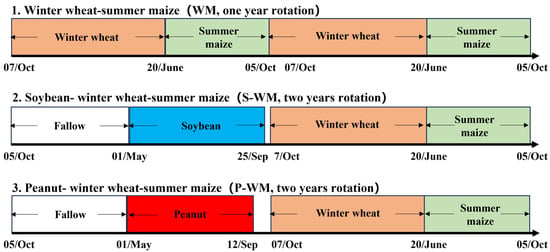
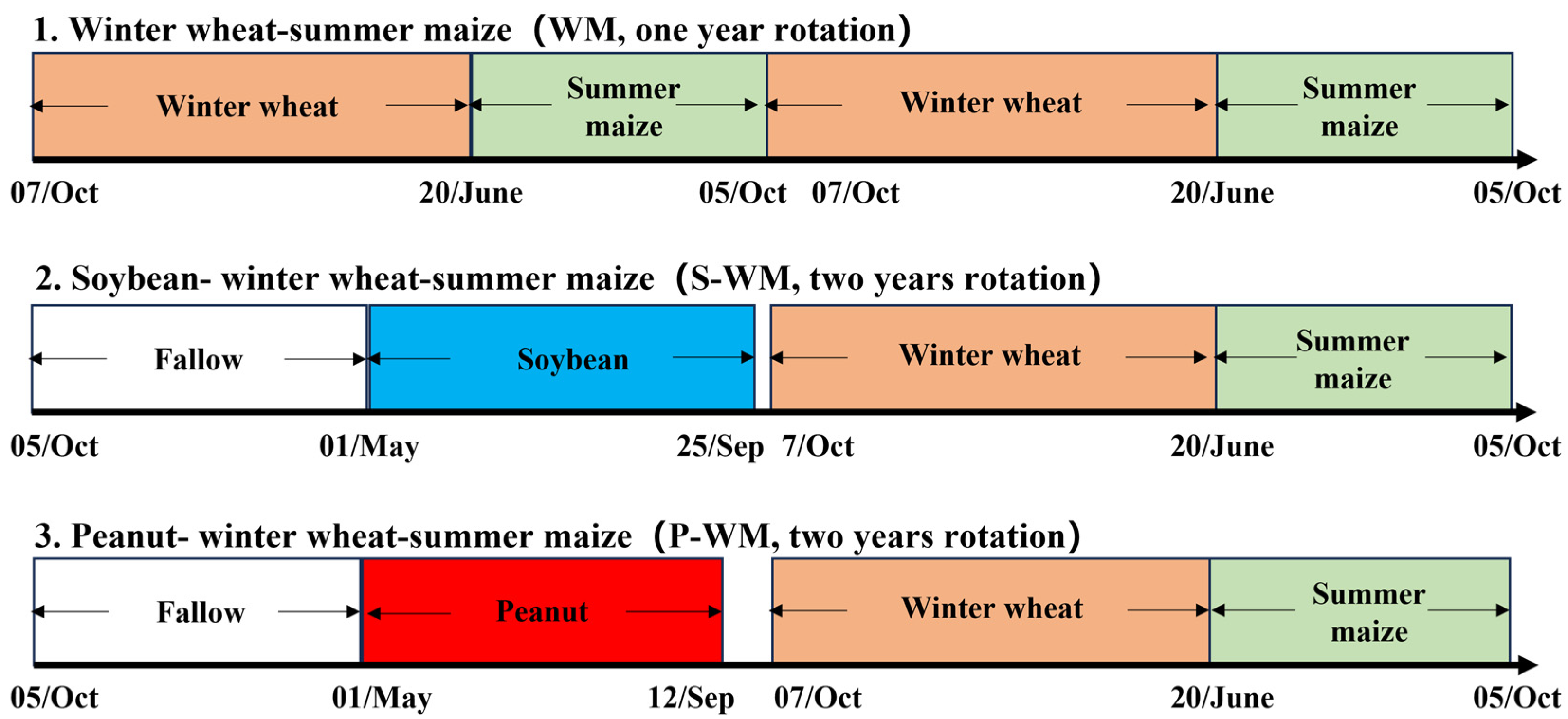
Three crop rotation treatments were implemented: two legume-based rotations (peanut (Arachis hypogaea L.)—winter wheat–summer maize (P–WM) and soybean (Glycine max L.)—winter wheat–summer maize (S–WM)) and a traditional winter wheat–summer maize double cropping (WM). Sowing and harvest dates for each crop rotation are shown in Figure 1. Irrigation was applied at critical crop growth stages according to local practices and adjusted based on precipitation at various future climate scenarios. Table S1 provides detailed crop variety, sowing and harvest, fertilizer, and irrigation information.
Figure 1.
Schematic diagram of crop rotations and sequences.
2.3. Swap-WOFOST Model Description
The Soil–Water–Atmosphere–Plant (SWAP) model (core framework: water/solute/heat transfer + vegetation growth), a one-dimensional model, simulates vertical water, solute, and heat transport in saturated and unsaturated soils with vegetation growth [34]. The WOrld FOod STudies (WOFOST) model (integrated function: crop growth response environment), with the integrated crop growth module [35], simulates crop growth in response to weather and soil moisture. Crop canopy interception is computed via the Von Hoyningen-Hüne and Braden formula, while potential evapotranspiration uses the Penman–Monteith equation. Crop growth simulation is performed by nesting the WOFOST model inside the SWAP model. Soil moisture movement is modeled using the Richards equation, incorporating root water extraction, macroporous flow, and water repellency [36]. Free drainage was used for the soil profile’s bottom boundary, as groundwater levels occur at 40 m below the surface [37]. The SWAP model has been widely used to evaluate the agricultural impacts of climatic or hydrological changes [36,37,38,39,40].
2.4. Crop and Soil Database for Model Calibration and Validation
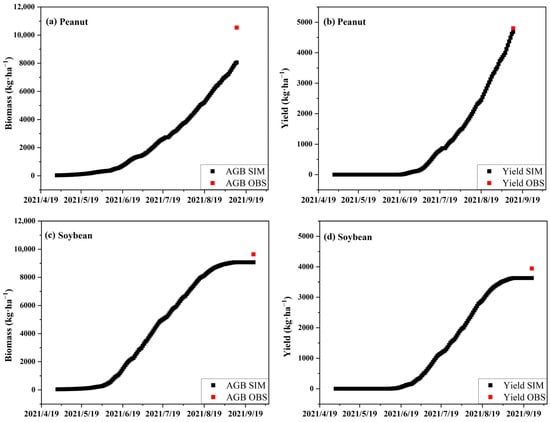
Calibration and validation parameters were obtained from a crop rotation field experiment conducted at the Luangcheng Agro-ecosystem Station. The measured data for soybean and peanut—specifically yields, aboveground biomass (AGB), and leaf area index (LAI) in 2023—were used to calibrate the model. The data on biomass and yield in 2021 was used for validation. Soybean was sown on 1 May and harvested on 25 September, while peanut was sown on 1 May and harvested on 12 September 2023. Crop LAI was measured at key growth stages using the SunSCAN Canopy Analysis System (Delta-T Devices Ltd., Cambridge, UK), with canopy cover calculated from the LAI using an empirical equation [41]. The AGB of 15 plants was oven-dried at 75 °C for 72 h. The measured data of LAI, AGB and yield for soybean and peanut was detailed in Table S2. Crops were harvested at maturity across the plot area, with the harvested grains air-dried to standard moisture content; this was 10% for peanuts (with shells) [42] and 13.5% for soybean (after removing pods) [43]. Additionally, our previous study has calibrated and validated the model for winter wheat and summer maize simulation at the same location [37]. The soil profile parameters calibrated for this experimental site are shown in Table S3. The model started by simulating the leguminous crops and then proceeded to simulate cereals in the sequence shown in Figure 1. A period of two years was used as a data analysis unit for each rotation; that is, 40 two-year rotation cycles performed during the period of 2020–2100. The model uses the soil water storage recorded at pre-crop harvest as the initial soil water input for the subsequent crop. Legumes with shallow root water-absorbing layer leave more residual soil water for the subsequent wheat. To assess the accuracy of simulation values for actual evapotranspiration (ETa) and crop yield, the determination coefficient (R2), root mean square error (RMSE), and mean absolute error (MAE) were used, as shown in the following equations:
where and are the observed and simulated values for the ith observation, and are the average observed and simulated values, and n represents the number of data pairs.
2.5. Data Collection
- (1)
- Cereal grain yield of winter wheat and summer maize
Baseline cereal yields were sourced from historical data (2010 to 2019) from the Luancheng experiment station under the similar irrigation schedules, with averages of 6725 ± 988 kg ha−1 for winter wheat [44,45] and 8837 ± 1264 kg ha−1 for summer maize [46].
- (2)
- Future meteorological data and climate scenarios
Future daily weather data (2020–2100), including precipitation, solar radiation, wind speed (2 m), air vapor pressure, average temperature, and maximum and minimum temperatures, were obtained from ISIMIP3b (Inter-Sectoral Impact Model Intercomparison Project) [47], using the CanESM5 dataset (Canadian Earth System Model version 5). This data enabled simulations under three shared socioeconomic pathways (SSPs) to compare crop rotation performances across different climate scenarios.
The SSPs provided by the bias-corrected CMIP6 (Coupled Model Intercomparison Project Phase 6) model represent a range of potential future greenhouse gas emissions and land use changes based on various assumptions regarding economic growth, climate mitigation strategies, and global governance [48]. The three SSPs include (1) SSP1-RCP2.6 (SSP126): a low-forcing sustainability-oriented pathway with a radiative forcing imbalance of +2.6 W m−2, (2) SSP3-RCP7.0 (SSP370): a medium-to-high forcing pathway with a radiative forcing imbalance of +7.0 W m−2, and (3) SSP585 (SSP5-RCP8.5): a high-end forcing pathway with a radiative forcing imbalance of +8.5 W m−2 [49,50]. The distribution of annual precipitation under each SSP scenario is illustrated in Figure S2.
2.6. Calculations
2.6.1. Crop Equivalent Yield and Water Productivity
In this study, among the diversified crop rotations, different kinds of crop species produce different crop products. Therefore, we introduce the crop equivalent yield (kg·ha−1) [51] to compare the yield output of different crop rotations. The of each individual crop was calculated using the winter wheat price in 2022 as the baseline. The crop prices were obtained from the “China Yearbook of Agricultural Price Survey” [52]. The equivalent yield for each crop rotation is the sum of all crops’ equivalent yield within a rotation cycle in two years. The equivalent yield of individual crop was calculated as follows:
where is the equivalent yield of the ith crop (kg·ha−1), is the crop yield of the ith crop (kg·ha−1), is the price of the ith crop (Yuan·kg−1) in 2022, and Pwheat is the price of winter wheat (Yuan·kg−1) in 2022.
Water productivity () (kg·m−3) [17] for each crop rotation was calculated as the equivalent yield for the entire rotation cycle (kg·ha−1) divided by the summed ETa over the growing season (mm) within the same rotation cycle in two years.
The ETa for an entire crop rotation system cycle includes the combined ETa of all crops and fallow season in that rotation over two cropping years. For example, the system ETa of P-WM includes the total ETa for the peanut, winter wheat, summer maize growing seasons, and the fallow period. The average annual ETa value for each crop rotation is the total system ETa divided by the years (n) in the rotation cycle (n = 1 for WM, n = 2 for two legume-based rotations).
2.6.2. Yield Resilience of Subsequent Cereal Crops
System resilience, defined as the ability of cereal yields to respond to climate variability across different rotations, was evaluated using three indicators: (1) coefficient of variance (CV), (2) sustainable yield index (SYI) [28], and (3) crop production resilience (Rc) [31].
The CV, SYI, and Rc in each crop rotation from 2020 to 2100 under three climate scenarios was calculated as
where is the mean cereal grain yield within a rotation cycle from 2020 to 2100 (t ha−1) and is the standard deviation of cereal grain yield within the same cycle (t ha−1). The is the maximum cereal yield in a rotation cycle from 2020 to 2100 (t ha−1).
2.7. Statistical Analysis
An analysis of variance (ANOVA) was conducted using SPSS Version 21 (IBM SPSS Inc., Chicago, IL, USA) to test for significant differences in , ETa, and across different crop rotations within a two-year cycle. A protected least significant difference (LSD) post hoc test was used to compare treatment means, with differences considered statistically significant at p < 0.05. Spearman correlation analysis was performed using R (version 4.1.0) to examine relationships between climate factors and crop yield. The correlation coefficient (r) was calculated to assess the strength and direction of these relationships, where –1 ≤ r ≤ 1. The significance of each correlation was evaluated with a two-tailed test at a significance level of 0.05.
3. Results
3.1. Swap-WOFOST Model Calibration and Validation
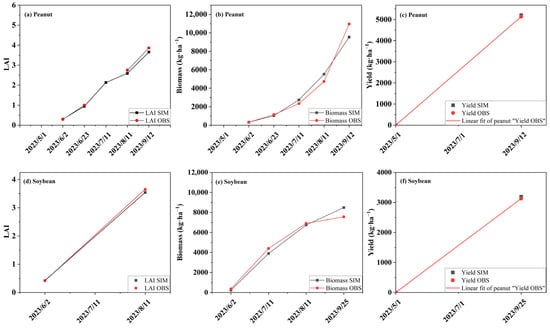
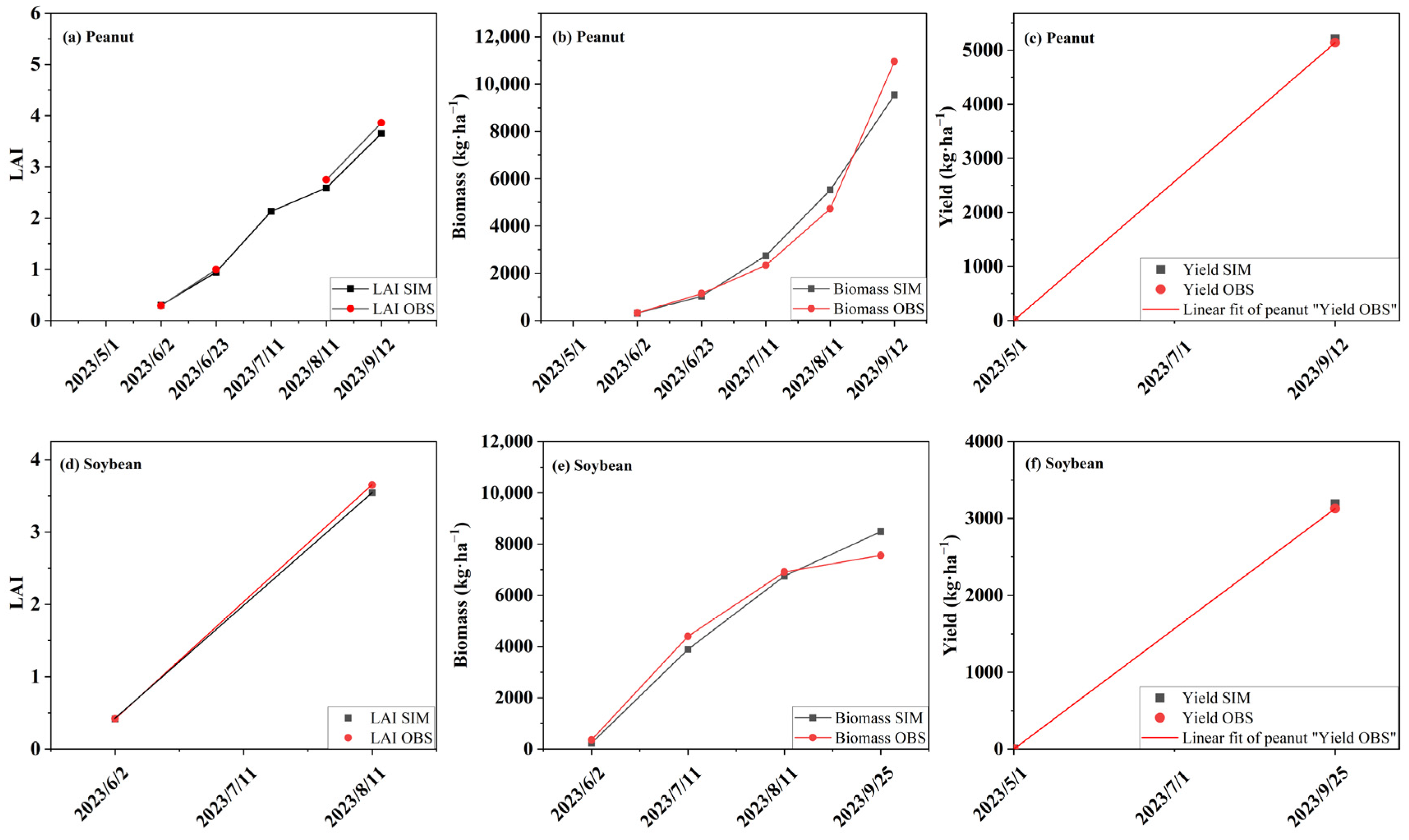
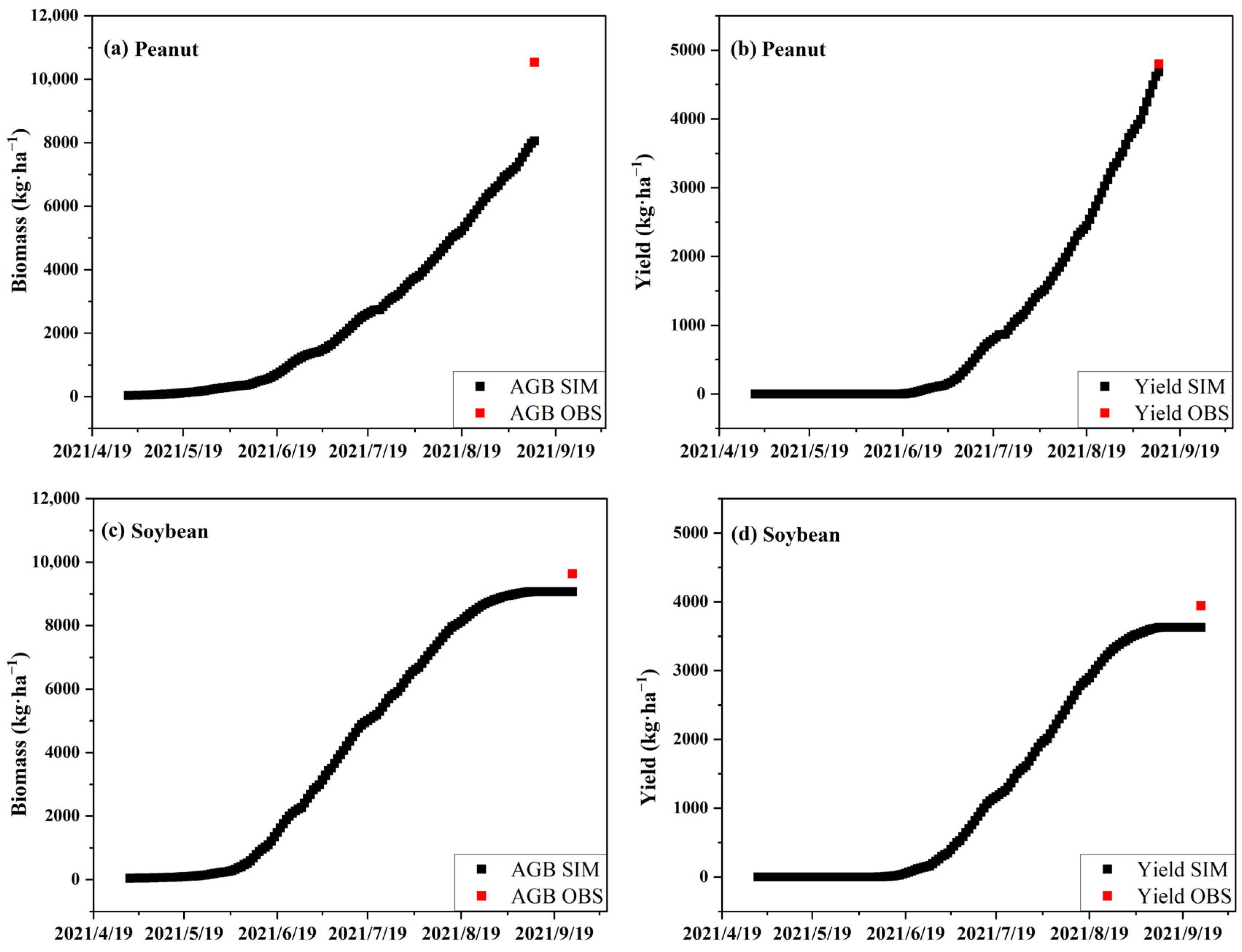
The model’s performance was evaluated by comparing simulated and observed LAI, AGB, and yield values for peanut (Figure 2a–c) and soybean (Figure 2d–f) during the calibration phase. Observed data for peanut and soybean indicators are provided in Table S2, and the corresponding numerical deviation analysis is detailed in Table S4. During the calibration period, the coefficients for peanut LAI included an R2 of 0.999, RMSE of 0.13, and MAE of 0.107, against an observed average of 1.975. For soybean, LAI values yielded an RMSE of 0.07 and MAE of 0.05, with an observed average of 2.035. For peanut AGB, the coefficients included an R2 of 0.973, RMSE of 750.2 kg ha−1, and MAE of 547.6 kg ha−1, with an average observed AGB of 3899 kg ha−1. Soybean AGB exhibited similar accuracy, with an R2 of 0.977, RMSE of 539.5 kg ha−1, and MAE of 429.2 kg ha−1, with the average observed AGB of 4805.3 kg ha−1. The yield simulation also closely aligned with observed values for peanut and soybean, with the observed yields of 5138.9 kg·ha−1 for peanut, and 3130.0 kg·ha−1 for soybean (Figure 2c,f). Similarly, the validation period confirmed accurate model simulations for AGB (Figure 3a,c) and yield (Figure 2b,d) of peanut and soybean when compared to observed values. These calibration and validation results showed that the SWAP model effectively simulates growth dynamics and yield formation for peanut and soybean at the experimental site. Additionally, prior validation of the model of crop growth and water flow for winter wheat and summer maize in the same region demonstrated a reliable fit across calibration and validation phases in our previous study [38]. The SWAP model was independently calibrated and validated for four crops, and the results demonstrated that it is applicable to all of them in this region.
Figure 2.
Calibrations of leaf area index (LAI), crop biomass, and yield for (a–c) peanut and (d–f) soybean. Red dots and lines indicate observed value (OBS) from the field experiment, and black squares and lines represent model simulated value (SIM).
Figure 3.
Validation outcomes for peanut (a) biomass and (b) yield and soybean (c) biomass and (d) yield. Red dots indicate observed values (OBS) from the field experiment and black squares represent the simulated value.
3.2. System Yield, Water Consumption, and Water Productivity of Different Crop Rotations
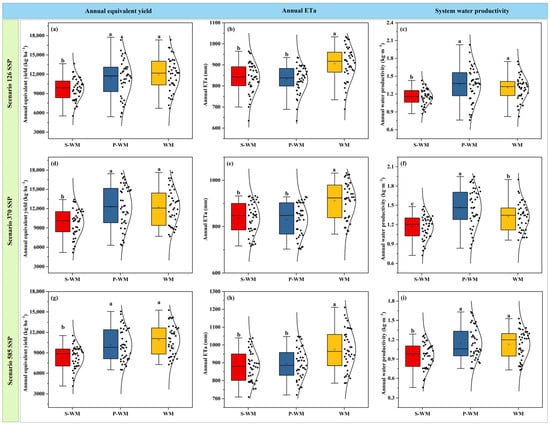
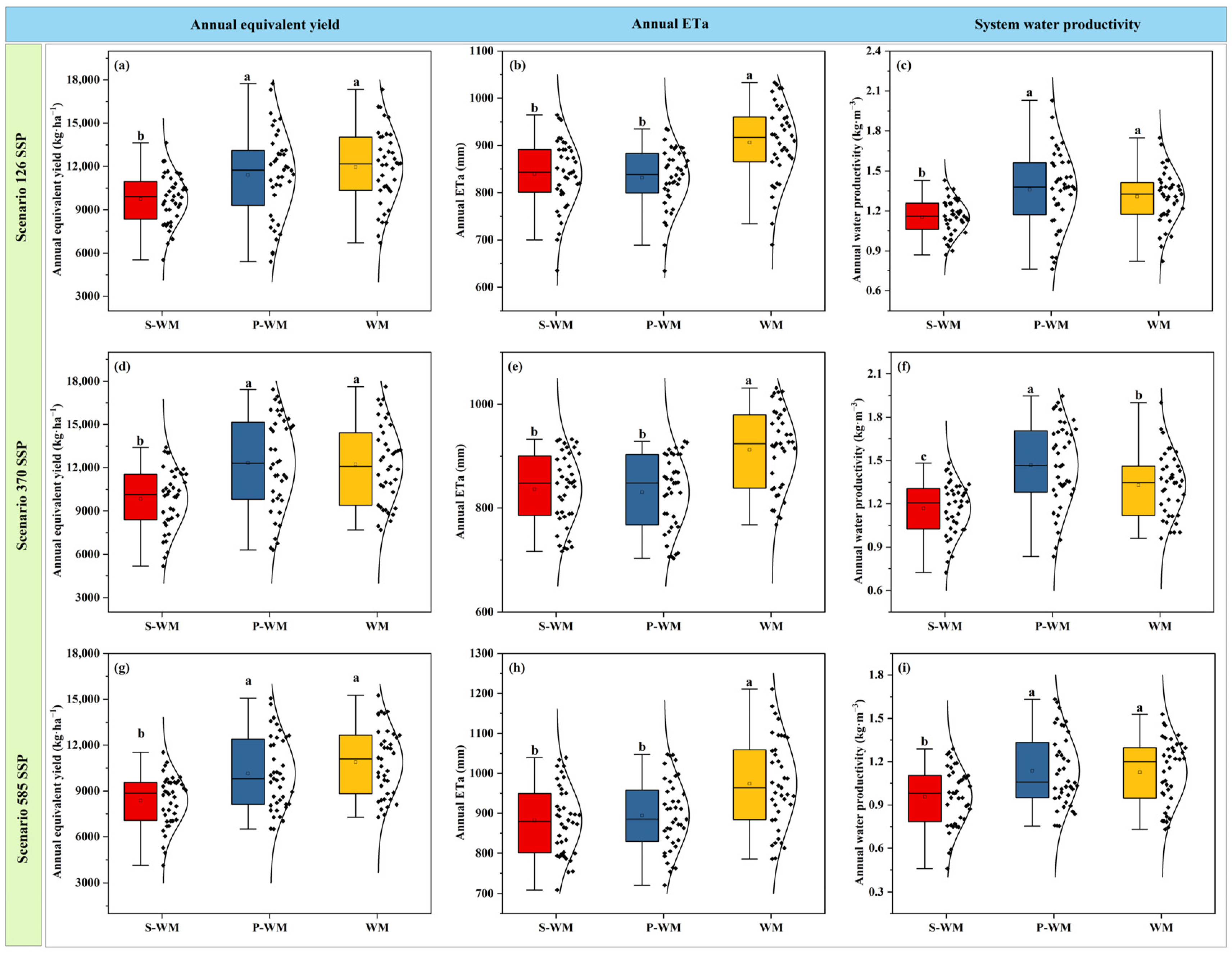
The annual system equivalent yield across three different crop rotations under three future SSP scenarios is illustrated in (Figure 4a,d,g). The P–WM achieved an average annual system equivalent yield of 22,600 kg ha−1, which was only 3% lower than that of the conventional WM treatment (p > 0.05). In the SSP370 scenario, P–WM yielded similarly to WM, with a 4–7% decrease in yield under SSP126 and SSP585. However, the S–WM exhibited lower average annual system equivalent yields than WM by 19–23% across all scenarios (p < 0.05). All rotations performed best under SSP370, followed by SSP126 (p > 0.05), with an 11–18% yield reduction under SSP585 compared to SSP370 (p < 0.05) due to more extreme weather events.
Figure 4.
Different crop rotations’ (a,d,g) annual system equivalent yield, (b,e,h) annual ETa, and (c,f,i) water productivity across three future climate scenarios. Different lowercase letters indicate significant differences among rotations at p < 0.05. S–WM: soy bean–winter wheat–summer maize rotation, P–WM: peanut–winter wheat–summer maize rotation, WM: winter wheat–summer maize double-cropping system.
The diversified crop rotations had lower annual average ETa than the conventional WM treatment (Figure 4b,e,h). Under all future SSP scenarios, S–WM and P–WM had ETa values ranging from 836.3 to 894.3 mm, 7–9% lower than the WM (p < 0.05). The annual average ETa of all rotations was also lower under SSP126 and SSP370, decreasing by 5–7% compared to SSP585 (p < 0.05).
The P–WM had the highest annual water productivity among the three treatments under all climate scenarios, showing 1–10% improvement (Figure 4e,f,i). Specifically, under SSP370, P–WM achieved an average water productivity of 1.47 kg m−3, which was 10% higher than WM (p < 0.05). The S–WM had lower water productivity (1.15–1.36 kg m−3), 12–15% lower than WM (p < 0.05). Across treatments, SSP126 and SSP370 achieved 16–29% higher water productivity than SSP585 (p < 0.05).
3.3. Cereal Grain Yield Loss and Compensation in Diversified Crop Rotations Under Future Climate Scenarios
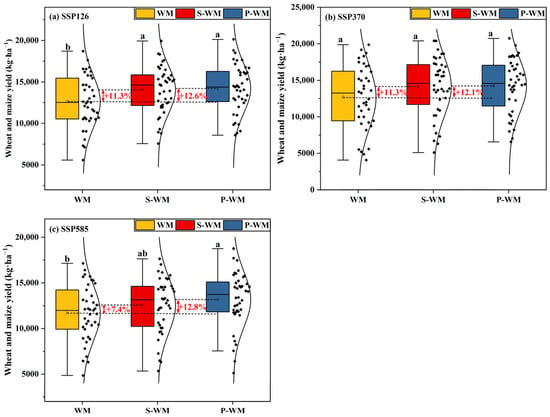
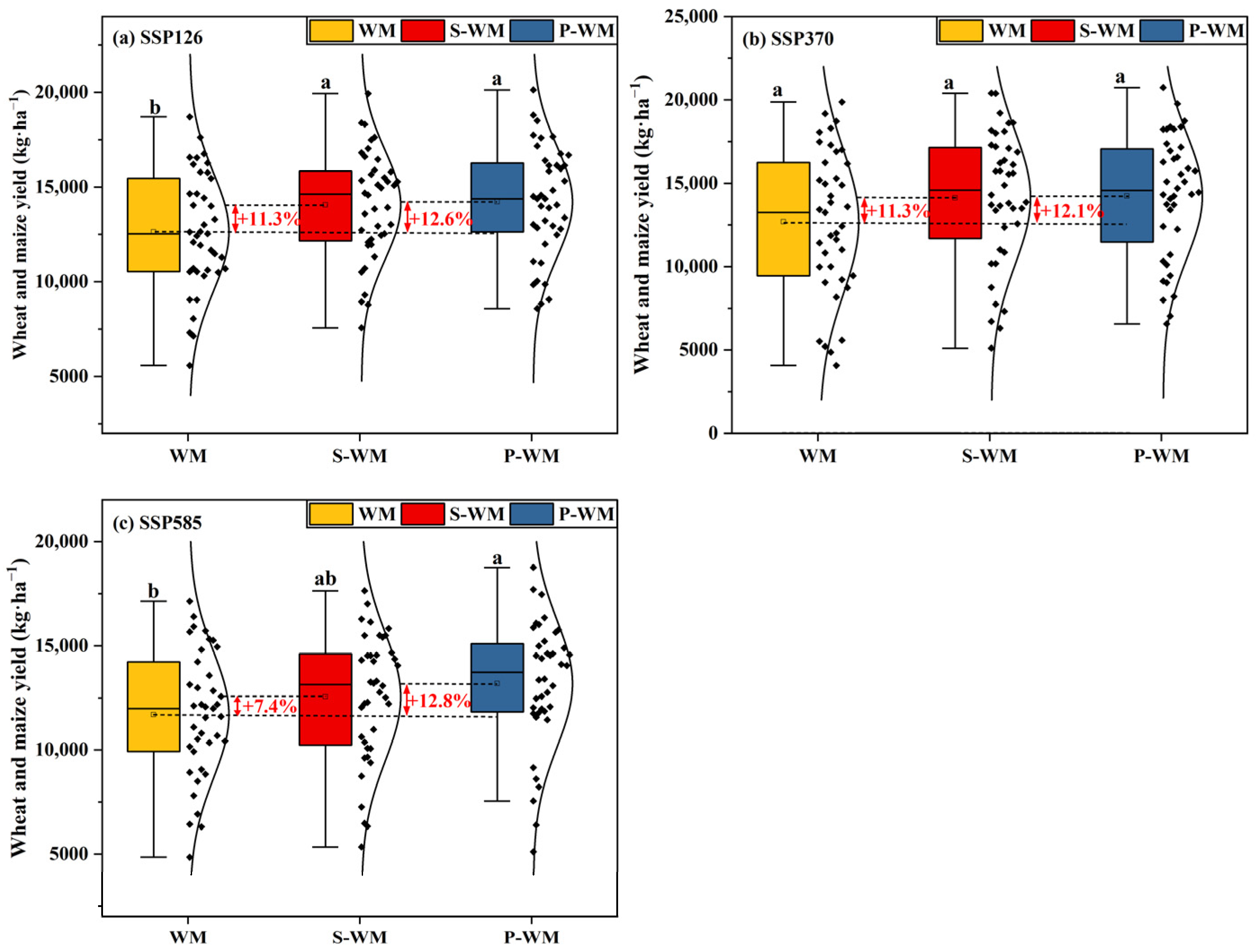
The average cereal yield for the WM across the SSP scenarios was 12,451 kg ha−1. The legume-based rotations (S–WM and P–WM) increased yields of the subsequent cereal crops (winter wheat and summer maize) by 7.4–12.8% compared to WM under all scenarios (Figure 5). The P–WM increased subsequent cereal yields by 12.1–12.8%, while the S–WM showed a 7.4–11.3% increase. Under SSP126, S–WM and P–WM significantly boosted cereal yield by 11.3–12.6% above WM (average yield: 12,625 kg ha−1, p < 0.05) (Figure 5a). Under SSP370, cereal yield increased by 11.3–12.1% in these rotations compared to WM (12,687 kg ha−1) (Figure 5b), while under SSP558, P–WMs showed a 12.8% increase over WM (11,688 kg ha−1) (p < 0.05) and S–WM showed a 7.4% increase (Figure 5c).
Figure 5.
Cereal grain yields of subsequent crops (winter wheat and summer maize) across three cropping systems under future climate scenarios. Different lowercase letters denote significant differences among rotations for each indicator at p < 0.05. S–WM: soybean–winter wheat–summer maize rotation; P–WM: peanut–winter wheat–summer maize rotation; WM: winter wheat–summer maize double-cropping system. The red percentages in each panel are the cereal yield increments for S–WM and P–WM compared to WM.
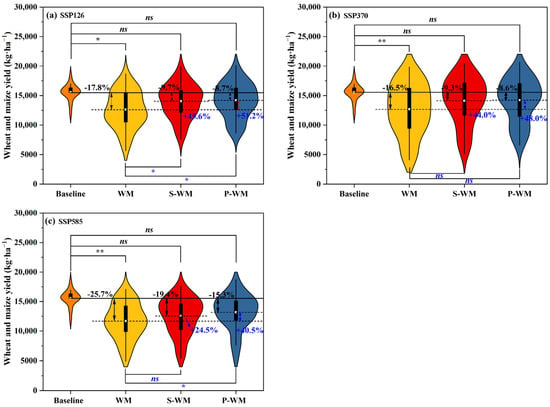
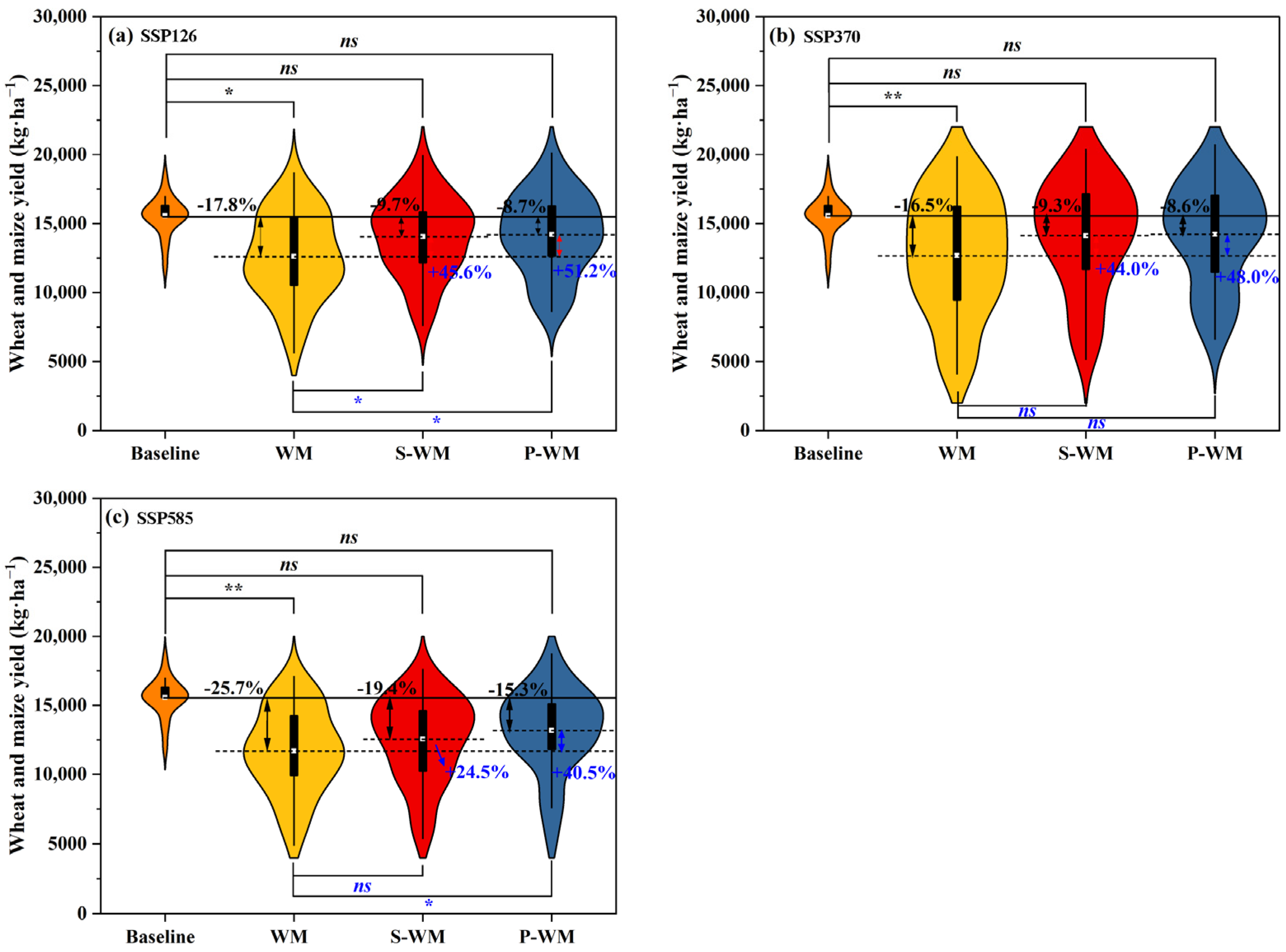
Using historical yield data (average 15,563 ± 1887 kg ha−1) as a baseline, all cropping systems showed reduced cereal yields under future climate scenarios, with declines ranging from 8.6 to 25.7%. However, legume-based rotations (S–WM and P–WM) mitigated this reduction, compensating for 24.5–51.2% of yield loss (Figure 6). The WM treatment exhibited the greatest loss at 16.5–25.7% below the baseline (p < 0.05). Under SSP585, all systems showed significant yield losses of 15.3–25.7% (p < 0.05). Under SSP126 and SSP370, S–WM and P–WM exhibited smaller yield declines of 8.6–9.7% (p > 0.05). Notably, under SSP126, these rotations compensated for 45.6–51.2% of the yield loss (p < 0.05) (Figure 6a), while under SSP370, S–WM and P–WM compensated for 44.0–48.0% (p > 0.05) (Figure 6b). Under SSP585, yield compensation reached 24.5% for S–WM and 40.5% for P–WM (p < 0.05) (Figure 6c).
Figure 6.
Cereal grain yield of subsequent crops (winter wheat and summer maize) in the historical baseline (average from 2010 to 2019) and three cropping systems under three future climate scenarios. S–WM: soybean–winter wheat–summer maize rotation, P–WM: peanut–winter wheat–summer maize rotation, WM: winter wheat–summer maize double-cropping system. Black percentages indicate cereal yield loss compared to the historical baseline, while blue percentages represent cereal yield compensation in legume-based rotations compared to the conventional WM treatment (e.g., for S–WM = (S–WM minus WM)/(baseline minus WM). An asterisk (*) denotes significant differences among different treatments at p < 0.05 (**: p < 0.01, ns: p > 0.05).
3.4. Stability Assessment of Cereal Grain Yield in Diversified Crop Rotations Under Three Future Climate Scenarios
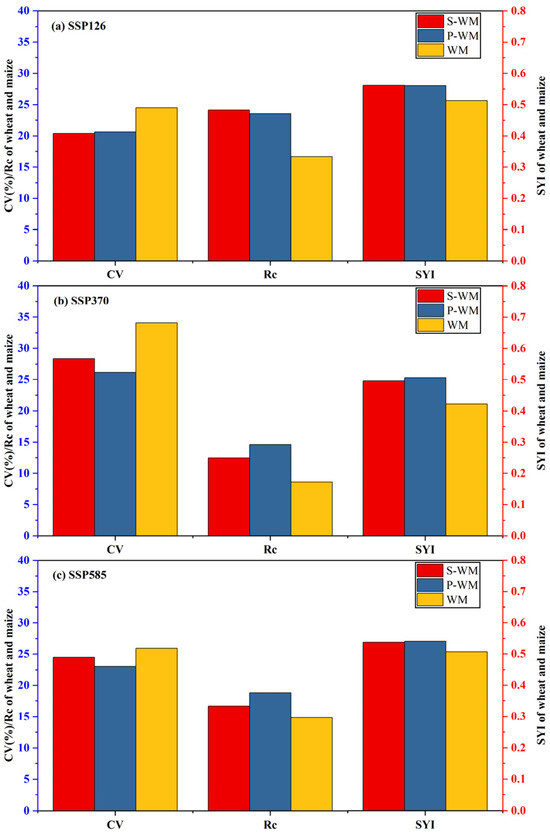
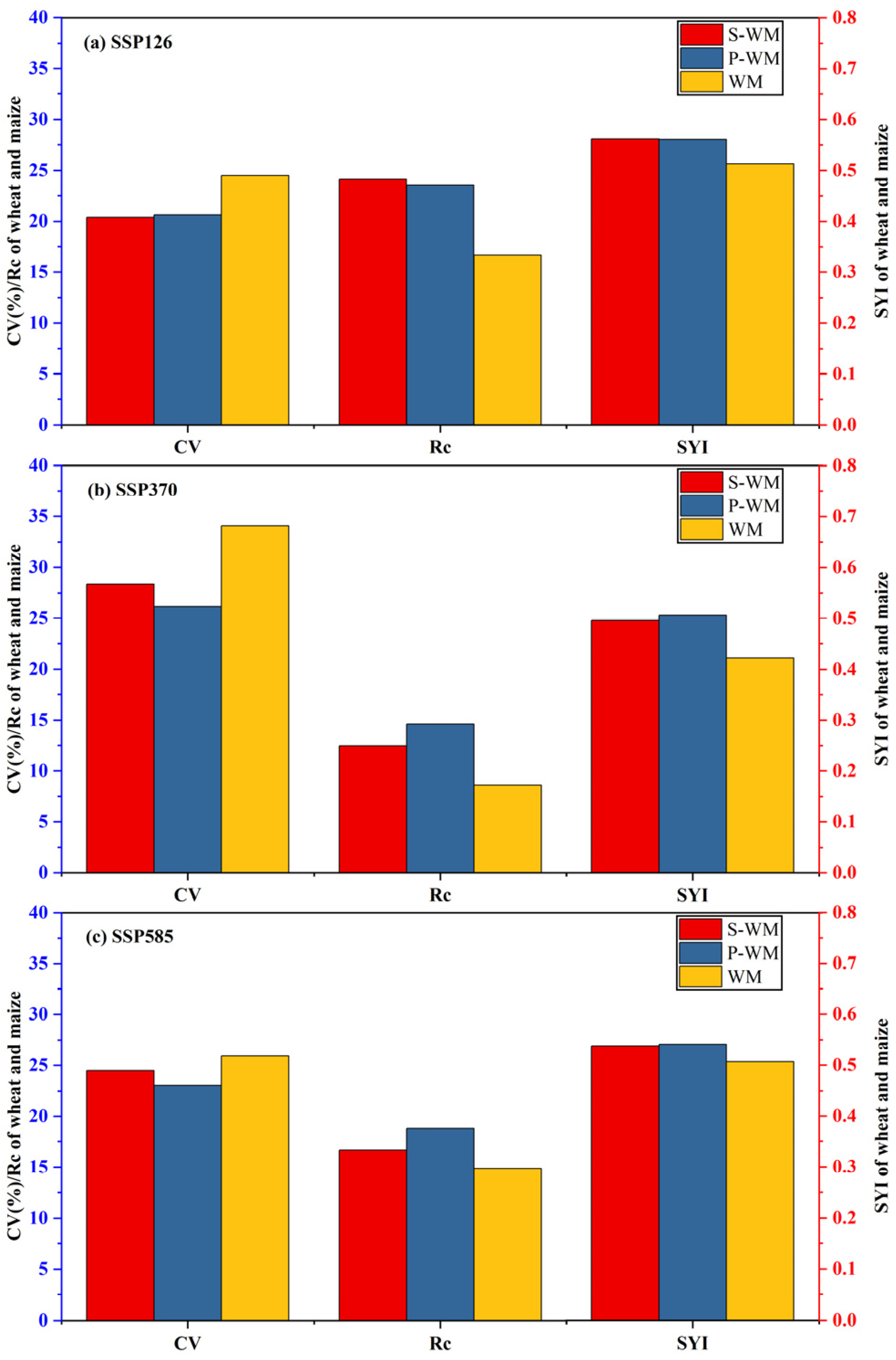
Yield stability for the subsequent crops (winter wheat and summer maize) was evaluated using three indicators: CV (negative), Rc (positive), and SYI (positive) (Figure 7a–c). These indicators demonstrated better performance in the two legume-based rotations than the conventional WM treatment and under the SSP126 and SSP370 scenarios compared to the SSP585 scenario. Across all three climate scenarios, the legume-based rotations consistently had lower CV values than the WM treatment, with reductions ranging from 5.7 to 23.2% (15.9–23.2% under SSP126 and SSP370 and 5.7–11.1% under SSP585), suggesting that diversified crop rotations with more species reduced year-to-year fluctuations in cereal grain yields for the succeeding winter wheat and summer maize. Moreover, both legume-based rotations increased Rc for succeeding cereal yield by 41.3–69.5% over WM treatment under the SSP126 and SSP370 scenarios, with increases ranging from 12.4 to 26.5% under SSP585. Similarly, SYI for the succeeding cereal crops was higher in legume-based rotations, by 9.2–9.4% under SSP126, 17.4–19.8% under SSP370, and 6.0–6.7% under SSP585.
Figure 7.
Cereal grain yield stability assessment, including coefficient of variance (CV, %), crop production resilience (Rc), and sustainable yield index (SYI) for the succeeding winter wheat and summer maize in three cropping systems under three climate scenarios. S–WM: soybean–winter wheat–summer maize rotation; P–WM: peanut–winter wheat–summer maize rotation; WM: winter wheat–summer maize double-cropping system.
3.5. Effects of Climate Factors on Crop Yield Across Different Cropping Systems Under Three Climate Scenarios
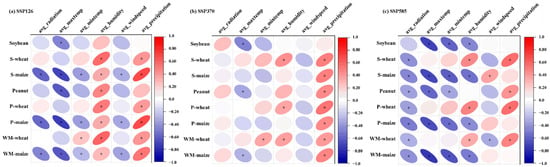
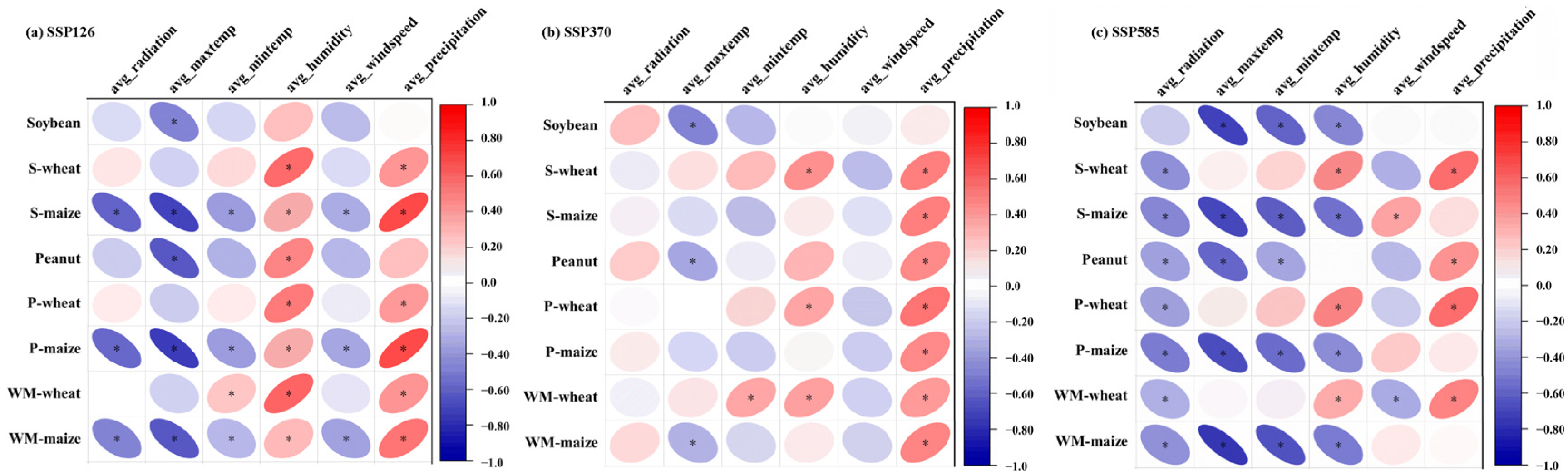
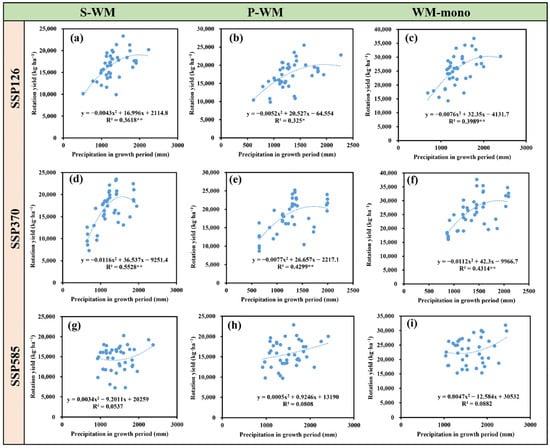
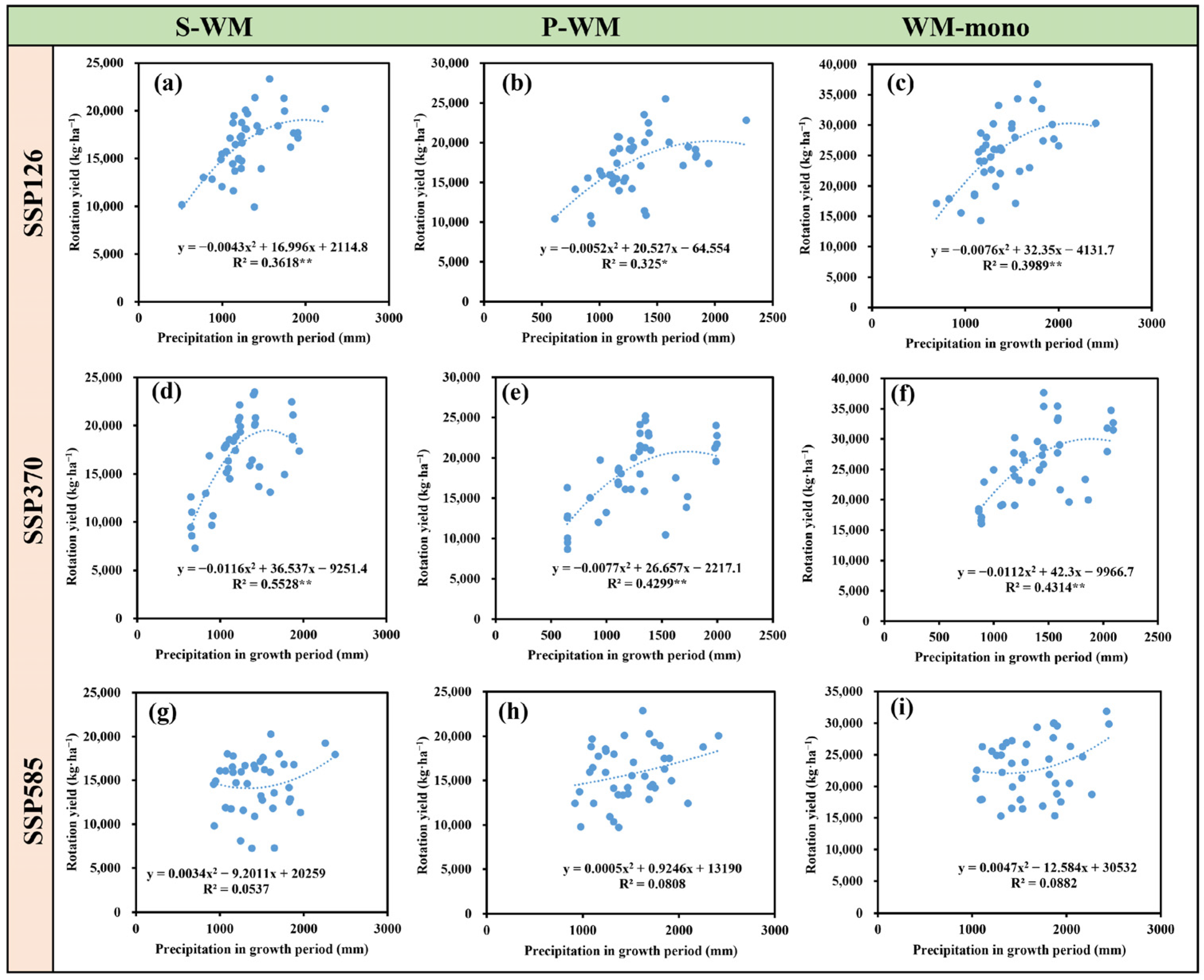
The impact of climate factors during the crop growth season on yield for each rotation was further analyzed using Spearman correlation (Figure 8). The results indicated a negative relationship between maximum temperature and crop yield under all three climate scenarios, particularly for summer maize and spring crops. Precipitation had a significant, positive effect on crop yield across all three scenarios, as did relative humidity, especially for winter wheat, with correlation coefficients ranging from 0.43 to 0.57 (Figure 8a–c). Further investigation of the relationship between rotation yield and precipitation during the growing season for each cropping system under the three climate scenarios is presented in Figure 9. Specially, under the SSP126 and SSP370 scenarios, with annual precipitation ranging from 726.1 to 743.2 mm, the quadratic function fitted well, indicating a clear parabolic relationship between precipitation and yield (Figure 9a–f). In contrast, under the SSP585 scenario, where annual precipitation was higher at 851.6 mm—exceeding the annual ETa of WM double cropping—no clear correlation was observed (Figure 9g–i).
Figure 8.
Spearman correlation analysis of climate factors during the crop growth season and crop yield under three climate scenarios. S-wheat denotes wheat yield in soybean–winter wheat–summer maize rotation, similar for S-maize; P-wheat denotes wheat yield in peanut–winter wheat–summer maize rotation, similar for P-maize; WM-wheat denotes wheat yield in a winter wheat–summer maize double-cropping system, similar for WM-maize. WM. An asterisk (*) denotes significant differences among different treatments at p < 0.05.
Figure 9.
Correlation analysis of precipitation during the crop growing season and rotation yield for three different rotations under three climate scenarios. (a–c) denotes the S–WM, P–WM and WM rotations in Scenario SSP226, (d–f) for SSP370, and (g–i) for SSP585, respectively. S–WM: soybean–winter wheat–summer maize rotation; P–WM: peanut–winter wheat–summer maize rotation; WM: winter wheat–summer maize double-cropping system. An asterisk (*) denotes significant differences among different treatments at p < 0.05 (**: p < 0.01).
4. Discussion
4.1. Impact of Diversified Crop Rotations on System Yield and Water Consumption Under Future Climate Scenarios
Under the three future climate scenarios, legume-based crop rotations, despite having one less crop per cycle, still maintain similar or non-significant yield reductions in system-equivalent yield compared to the conventional WM. This finding is consistent with previous studies based on historical field experiment results. For instance, rotated peanut or soybean with wheat and maize improved system-equivalent yield by up to 9% compared to the traditional WM in a six-year field study [13], indicating leguminous pre-crops fix nitrogen through rhizobia, enriching soil organic nitrogen pool and alleviating nutrient stress to promote biomass accumulation of the subsequent crops. Summer-seeded legume cover crops, such as hairy vetch, red clover, and crimson clover, following winter wheat harvest in southern Ontario, were a reliable nitrogen source for organic soybean winter wheat–maize systems between 2018 and 2022 [53]. A global meta-analysis (1980–2018) also demonstrated that legume-based rotations increased subsequent crop yields by 14% compared to systems without legumes [54], mainly due to the increased N input from leguminous N2-fixation and N-abundant residues. In addition, legumes require less soil moisture for root uptake than non-legumes and thus leave a higher amount of residual soil moisture for subsequent crops [37]. The findings of this study offer further evidence that legume-based rotations improve or maintain system yield despite having one less harvest in the context of future climate change.
For water consumption, the S–WM and P–WM significantly decreased the average annual ETa by 7–9% compared to WM (p < 0.05) under all three climate scenarios, consistent with historical data. Cash crops (e.g., peanut, soybean, sweet potato, cotton, or spring maize) introduced in the second year of the winter wheat–summer maize cycle decreased ETa by 10–28% across the 31 different crop rotations compared to conventional WM [33]. Reducing cropping density (from 2 to 1.5 harvests per year) decreased annual water requirements and irrigation demands by 14% and 33%, respectively, from 15 alternative crop rotations simulations during 1960 to 2020 [51]. A long-term field experiment (2003–2013) in the North China Plain also showed that the P–WM reduced average annual ETa by 16% and mitigated groundwater table decline by 45% [55]. Consequently, the P–WM improved system water productivity under all future climate scenarios. These findings align with historical data from [33,51,55], which further confirm that legume-based rotations can reduce annual water consumption without compromising system yield under future climate scenarios. The enhanced water productivity of legume-based rotations highlights their better adaptability to future climate conditions compared to monocropping systems.
4.2. Legume-Based Crop Rotations Enhance Subsequent Cereal Yields Under Future Climate Scenarios
The subsequent cereal grain yields (winter wheat and summer maize) increased by 7.4–12.8% in legume-based rotations compared to WM cultivation under three future climate scenarios. This result is consistent with the historical data. The benefits of diversified crop rotations were confirmed, particularly legume crops or legume cover crops, to increase subsequent cereal yields, based on a long-term no-till field experiment (2009–2017) in southern Brazil [56,57]. Crop rotational diversity, measured by crop species diversity and functional richness, enhanced grain yields in small grain cereals and maize across 32 long-term experiments (10–63 years) in Europe and North America, and this yield benefit increased over time [58]. Rotating multiple crop species led to consistently higher yields for both winter and spring cereals, with average increase of 860 kg ha−1 yr−1 for winter cereals and 390 kg ha−1 yr−1 for spring cereals compared to monoculture systems in seven long-term European experiments [59]. Similarly, in France, rotations involving grain legumes (pea and faba bean) yielded higher, especially during low-yield years (<5500 kg ha−1), but had relatively lower yields in high-yielding years (>6500 kg ha−1) compared to durum wheat in a non-legume system [60]. Furthermore, the DNDC model predicted that under future climate scenarios (2016–2100), maize yield would be higher in diversified crop rotations than in maize monoculture in Canada, accompanied by an increase in SOC content [61].
Rotation effects have been widely documented in previous studies. A meta-analysis synthesized 11,768 yield observations from 462 field experiments comparing legume-based and non-legume cropping systems, showing that legumes as pre-crops had the greatest rotation effect, resulting in a 20% yield increase for succeeding crops [62]. Legume-based rotations increased cereal yields by 26–31% from 2016 to 2022, primarily due to improved soil conditions before cereal crops were sown, through stimulated soil microbial activities and increased SOC [13]. Introducing chickpea into rice–wheat and maize–wheat rotations enhanced SOC by 6.5% and 13.4%, respectively [63]. Improved SOC has been linked to sustained crop production and increased drought resistance under climate change challenges [61,64]. Moreover, crop rotational diversity impacts soil physical and hydrological properties [15]. Legume-based rotations contribute nitrogen to succeeding cereal crops through nitrogen fixation in nodules left in the soil [16]. This process improves the yield of succeeding crops [65,66] and helps avoid nitrogen leaching [67], allowing for reduced nitrogen application for the succeeding crop [68].
Long-term diversified crop rotations in the central and northern Great Plains, USA, increased crop yields and reduced ETa compared to continuous monocropping by efficiently using soil water [69,70]. Diversified crop rotations with a mix of shallow- and deep-rooted crops improved soil water use efficiency by extracting moisture from different soil layers, allowing deep-rooted subsequent crops like winter wheat to access water from depths of up to 2 m [71,72,73,74]. In contrast, preceding crops such as peanut, soybean, sweet potato, and cotton primarily draw water from the top 0–120 cm of soil, especially from the upper 80 cm. Shallow-rooted crops (sweet potato, soybean, peanut, and millet), when used as the preceding crop, improved soil water storage in the 0–180 cm soil layer at the start of the succeeding wheat planting season by 3–9% compared to the conventional WM [17]. Therefore, the sequencing and vertical complementarity of soil moisture extraction in diversified rotations create favorable conditions for the sowing, germination, and growth of succeeding cereal crops, ultimately improving cereal yields [73,75].
4.3. Diversified Crop Rotations Offset Yield Losses Due to Climate Change by Increasing the Subsequent Cereal Yields
Climate change is expected to adversely affect crop yields worldwide [76,77,78]. Research has shown that without CO2 fertilization, effective adaptation, or genetic improvement, each 1 °C increase in global mean temperature could decrease global yields by 6.0% for wheat, 3.2% for rice, 7.4% for maize, and 3.1% for soybean [8]. Without adaptation measures, the RCP4.5 scenario projects average global yield losses of 6–21% across major crops [79]. In this study, compared to a baseline cereal yield of 15,556 kg ha−1, the conventional WM decreased total cereal grain yields by 16.5–25.7% due to the increased solar radiation and mean temperature under future climate scenarios. Elevated atmospheric humidity may also negatively affect field aeration for summer maize yield. In contrast, diversified crop rotations with legumes significantly mitigated these losses: the P–WM reduced the subsequent cereal yield losses by 9.3–19.4%, and the S–WM reduced losses to 8.6–15.3%. Thus, these legume-based rotations offset 24.5–51.2% of the subsequent cereal yield losses associated with WM under three future climate scenarios. A synthetic analysis analyzed 347 site-years of yield data from 11 experiments and found that rotation diversification increased maize yields during drought conditions, reducing yield losses by 14.0–89.9% [5]. This study highlights crop diversity as an effective strategy for reducing yield risks related to climate change-induced stressors. Enhanced resilience in diversified rotations may result from improved soil properties, such as greater soil water capture and storage [17] and an increase in beneficial soil microbes [14].
4.4. Diversified Crop Rotations Enhance System Yield Resilience Under Climate Change
This study assessed yield stability, sustainability, and resilience under climate change using the CV, SYI, and Rc. These metrics consistently reflected yield performance across three rotation treatments under three climate scenarios. Both legume-based rotations showed higher Rc and SYI values and lower CVs, indicating an improvement in the stability and resilience of cereal yields compared to conventional WM, which exhibited the greatest yield variability and vulnerability to extreme climate events. Similar outcomes were observed in Ontario over a 31-year rotation and tillage trial, where rotation diversity improved yield stability during abnormal weather, with a 7–22% yield increase for corn and soybean in hot, dry years due to corn–soybean rotations and reduced tillage [80]. Under all scenarios in our study, the S–WM and P–WMs exhibited higher yield sustainability than the conventional WM, primarily due to the positive effects of rotation on subsequent crops. The potential short-term yield reductions during the legume phase of the rotation may be compensated by cereal yields and lower input over the long term under future climate change. Diverse rotations increase resilience to abiotic stress [22] by enhancing soil water storage and crop water productivity [81], reducing soil moisture evaporation and canopy transpiration [82], improving soil health though increased soil enzyme activity [83], and enhancing crop diversity [84]. Overall, diversified crop rotations strengthen yield resilience by supporting complex, high-diversity cropping systems with improved soil quality under future climate scenarios, leading to higher sustainability indexes.
4.5. Effect of Climate Factors on Crop Yield Under Future Climate Scenarios
Future climate change is projected to adversely impact crop yields, mainly due to extreme or combined extreme weather events like heat and moisture stress [77]. In this study, radiation, minimum and maximum temperatures, and wind speed typically had negative effects on crop yield. Previous studies have reported global wheat production changes of −2.3% to +7.0% under a 1.5 °C warming scenario and −2.4% to +10.5% under a 2.0 °C scenario, relative to a 1980–2010 baseline [85]. Compound climate extremes, especially high temperatures coupled with drought, have decreased yields by up to 30% in areas including India, Ethiopia, USA, Europe, and Russia [77]. Heat stress during flowering alone contributed to 23% of total yield losses due to extreme temperatures between 1990 and 2012 [86]. The Spearman analysis in this study showed that precipitation and humidity positively affected most crop yields. A quadratic function between crop yield and precipitation indicated that yield initially increased with rising precipitation, reached an optimal threshold, and then declined with excessive rainfall, which can lead to waterlogging or flooding. Irrigation alleviated the negative impacts of rising temperatures [9]. However, excessive rainfall negatively affected maize growth, photosynthetic efficiency (–20%), chlorophyll content (–50%), nitrogen absorption (–56%), nitrogen distribution (–16%), nitrogen utilization efficiency (–30%), and grain yield (–45%) [87]. It suggests that future agriculture will face challenges from the increased unpredictability of water resources, requiring more robust adaptive management strategies.
This study did not account for future crop variety improvements and potential market price over the next 80 years, which could underestimate absolute equivalent yield values. However, this limitation does not affect the comparison between diversified crop rotations and WM. Future research should examine the individual and combined effects of soil quality, temperature, and CO2 level on crop production. Crop varieties, irrigation practices, and related management strategies will need adaptation to future climate conditions. In addition, the optimized cop sequences and combinations with tailored N applications should be considered in practical promotion and application. Expanding datasets to include more regional sites would improve assessments of crop diversification benefits under climate change.
4.6. Implications
The findings reveal that legume-based crop diversification can effectively reduce the subsequent cereal yield losses, decrease annual water consumption, and enhance resilience to future extreme weather conditions. This research fills an important gap by confirming the benefits of crop diversification on yield stability and ecosystem services in the context of future climate change. From a policy perspective, these results suggest that diversified rotations can serve as a foundation for developing sustainable cropping systems, optimizing cropping patterns, and ensuring food and water security in regions like North China Plain. Policies and investments are essential to support farmers in adopting this resilient practice. Expanding these approaches to other water-stressed agricultural areas may offer a globally applicable strategy for achieving sustainable food production under changing climate conditions.
5. Conclusions
Diversified crop rotations show strong potential to improve crop production and resilience under a changing climate, yet empirical evidence remains limited. This study systematically evaluated the performance of two legume-based rotations and a conventional wheat–maize rotation in the North China Plain using a calibrated SWAP-WOFOST model under three future climate scenarios (2020–2100). This study verified that diversified crop rotations reduced annual ETa, maintained comparable equivalent yields, and increased system water productivity compared to the WM. Additionally, legume-based rotations boosted succeeding cereal yields by 9–14% compared to WM across all climate scenarios. While future climate change is expected to decrease cereal yields by about 9–26%, the legume-based rotations showed significant advantages, compensating for these yield losses by 25–51%. System sustainability assessments further revealed that legume-based rotations provided greater yield stability and system resilience than the more vulnerable WM. This study addresses a key knowledge gap, demonstrating that diversified crop rotations can offer robust resilience and may be an effective strategy for coping with future climate change. Future research needs to quantify the long-term benefits of diverse crop rotations using multi-site experiments and evaluate the socioeconomic and policy dimensions of scaling up these systems in critical agricultural regions.
Supplementary Materials
The following supporting information can be downloaded at https://www.mdpi.com/article/10.3390/agriculture16030335/s1.
Author Contributions
X.Y., S.K. and T.D.; Crop information from field experiment design: X.Y. and T.N.; Conceptualization and methodology: X.Y.; Data collection, handling and analysis: B.W., J.v.D., X.Y. and C.R.; Writing—original draft: X.Y., T.N. and B.W.; Writing—review, editing, revision and language improvement: X.Y. and S.K. All authors have read and agreed to the published version of the manuscript.
Funding
The study was financed jointly by the National Natural Science Foundation of China (32071975 and 52239002).
Data Availability Statement
The raw data supporting the conclusions of this article will be made available by the authors on request.
Conflicts of Interest
The authors declare no conflicts of interest.
References
- Davis, K.F.; Rulli, M.C.; Seveso, A.; D’Odorico, P. Increased food production and reduced water use through optimized crop distribution. Nat. Geosci. 2017, 10, 919–924. [Google Scholar] [CrossRef] [Scilit]
- Molotoks, A.; Smith, P.; Dawson, T.P. Impacts of land use, population, and climate change on global food security. Food Energy Secur. 2021, 10, e261. [Google Scholar] [CrossRef] [Scilit]
- Diffenbaugh, N.S.; Singh, D.; Mankin, J.S.; Horton, E.D.; Swain, D.L.; Touma, D.; Charland, A.; Liu, Y.; Haugen, M.; Tsiang, M.; et al. Quantifying the influence of global warming on unprecedented extreme climate events. Proc. Natl. Acad. Sci. USA 2017, 114, 4881–4886. [Google Scholar] [CrossRef] [Scilit] [PubMed]
- Zhu, P.; Burney, J.; Chang, J.; Jin, Z.; Mueller, N.D.; Xin, Q.; Xu, J.; Yu, L.; Makowski, D.; Ciais, P. Warming reduces global agricultural production by decreasing cropping frequency and yields. Nat. Clim. Change 2022, 12, 1016–1023. [Google Scholar] [CrossRef] [Scilit]
- Bowles, T.; Mooshammer, M.; Socolar, Y.; Calderón, F.; Cavigelli, M.; Culman, S.; Deen, W.; Drury, C.; Gaudin, A.C.M.; Harkcom, W.; et al. Long-term evidence shows that crop-rotation diversification increases agricultural resilience to adverse growing conditions in North America. One Earth 2020, 2, 284–293. [Google Scholar] [CrossRef] [Scilit]
- Huang, J.; Jiang, J.; Wang, J.; Hou, L. Crop diversification in coping with extreme weather events in China. J. Integr. Agric. 2014, 13, 677–686. [Google Scholar] [CrossRef] [Scilit]
- Challinor, A.J.; Watson, J.; Lobell, D.B.; Howden, S.M.; Smith, D.R.; Chhetri, N. A meta-analysis of crop yield under climate change and adaptation. Nat. Clim. Change 2014, 4, 287–291. [Google Scholar] [CrossRef] [Scilit]
- Zhao, C.; Liu, B.; Piao, S.; Lobel, D.B.; Huang, Y.; Huang, M.; Yao, Y.; Bassu, S.; Ciais, P.; Durand, J.L.; et al. Temperature increase reduces global yields of major crops in four independent estimates. Proc. Natl. Acad. Sci. USA 2017, 114, 9326–9331. [Google Scholar] [CrossRef] [Scilit]
- Agnolucci, P.; Rapti, C.; Alexander, P.; Lipsis, V.D.; Holland, R.A.; Eigenbrod, F.; Ekins, P. Impacts of rising temperatures and farm management practices on global yields of 18 crops. Nat. Food. 2020, 1, 562–571. [Google Scholar] [CrossRef] [Scilit]
- Wang, X.; Zhao, C.; Müller, C.; Wang, C.; Ciais, P.; Janssens, I.; Peñuelas, J.; Asseng, S.; Li, T.; Elliott, J.; et al. Emergent constraint on crop yield response to warmer temperature from field experiments. Nat. Sustain. 2020, 3, 908–916. [Google Scholar] [CrossRef] [Scilit]
- Mueller, N.D.; Gerber, J.S.; Johnston, M.; Ray, D.K.; Ramankutty, N.; Foley, J.A. Closing yield gaps through nutrient and water management. Nature 2012, 490, 254–257. [Google Scholar] [CrossRef] [Scilit]
- Cassman, K.G.; Grassini, P. A global perspective on sustainable intensification research. Nat. Sustain. 2020, 3, 262–268. [Google Scholar] [CrossRef] [Scilit]
- Yang, X.; Xiong, J.; Du, T.; Ju, X.; Gan, Y.; Li, S.; Xia, L.; Shen, Y.; Pacenka, S.; Steenhuis, T.S.; et al. Diversifying crop rotation increases food production, reduces net greenhouse gas emissions and improves soil health. Nat. Commun. 2024, 15, 198. [Google Scholar] [CrossRef] [Scilit] [PubMed]
- Sun, Y.; Yang, X.; Elsgaard, L.; Du, T.; Siddique, K.H.M.; Kang, S.; Butterbach-Bahl, K. Diversified crop rotations improve soil microbial communities and functions in a six-year field experiment. J. Environ. Manag. 2024, 370, 122604. [Google Scholar] [CrossRef] [Scilit] [PubMed]
- Alhameid, A.; Singh, J.; Sekaran, U.; Ozlu, E.; Kumar, S.; Singh, S. Crop rotational diversity impacts soil physical and hydrological properties under long-term no-and conventional-till soils. Soil Res. 2019, 58, 84–94. [Google Scholar] [CrossRef] [Scilit]
- Barbieri, P.; Starck, T.; Voisin, A.-S.; Nesme, T. Biological nitrogen fixation of legumes crops under organic farming as driven by cropping management: A review. Agric. Syst. 2023, 205, 103579. [Google Scholar] [CrossRef] [Scilit]
- Wang, B.; Wang, G.; van Dam, J.; Yang, X.; Ritsema, C.; Siddique, K.H.; Du, T.; Kang, S. Diversified crop rotations improve crop water use and subsequent cereal crop yield through soil moisture compensation. Agric. Water Manag. 2024, 294, 108721. [Google Scholar] [CrossRef] [Scilit]
- Costa, M.P.; Chadwick, D.; Saget, S.; Rees, R.M.; Williams, M.; Styles, D. Representing crop rotations in life cycle assessment: A review of legume LCA studies. Int. J. Life Cycle Assess. 2020, 25, 1942–1956. [Google Scholar] [CrossRef] [Scilit]
- Geng, S.; Tan, J.; Li, L.; Miao, Y.; Wang, Y. Legumes can increase the yield of subsequent wheat with or without harvesting compared to Gramineae crops: A meta-analysis. Eur. J. Agron. 2023, 142, 126643. [Google Scholar] [CrossRef] [Scilit]
- Liu, W.-X.; Shi, Z.; He, H.-Y.; Lin, B.-J.; He, C.; Dang, Y.P.; Zhao, X.; Zhang, H.-L. Improving soil organic carbon sequestration through conservation tillage incorporating legume-based crop rotations. Soil Tillage Res. 2026, 255, 106792. [Google Scholar] [CrossRef] [Scilit]
- Lin, B.B. Resilience in agriculture through crop diversification: Adaptive management for environmental change. BioScience 2011, 61, 183–193. [Google Scholar] [CrossRef] [Scilit]
- Li, J.; Huang, L.; Zhang, J.; Coulter, J.A.; Li, L.; Gan, Y. Diversifying crop rotation improves system robustness. Agron. Sustain. Dev. 2019, 39, 38. [Google Scholar] [CrossRef] [Scilit]
- Liu, C.; Plaza-Bonilla, D.; Coulter, J.A.; Kutcher, H.R.; Beckie, H.J.; Wang, L.; Floc’H, J.-B.; Hamel, C.; Siddique, K.H.; Li, L.; et al. Diversifying crop rotations enhances agroecosystem services and resilience. Adv. Agron. 2022, 173, 299–335. [Google Scholar]
- Singh, R.P.; Das, S.K.; Bhaskara, R.U.M.; Narayana, R. Towards Sustainable Dryland Agricultural Practices; Hyderabad Central Research Institute for Dryland Agriculture: Hyderabad, India, 1990. [Google Scholar]
- Yadav, R.; Dwivedi, B.; Pandey, P. Rice-wheat cropping system: Assessment of sustainability under green manuring and chemical fertilizer inputs. Field Crop. Res. 2000, 65, 15–30. [Google Scholar] [CrossRef] [Scilit]
- Mi, W.; Sun, T.; Ma, Y.; Chen, C.; Ma, Q.; Wu, L.; Wu, Q.; Xu, Q. Higher yield sustainability and soil quality by manure amendment than straw returning under a single-rice cropping system. Field Crop. Res. 2023, 292, 108805. [Google Scholar] [CrossRef] [Scilit]
- Choudhary, M.; Panday, S.C.; Meena, V.S.; Singh, S.; Yadav, R.P.; Mahanta, D.; Mondal, T.; Mishra, P.K.; Bisht, J.K.; Pattanayak, A. Long-term effects of organic manure and inorganic fertilization on sustainability and chemical soil quality indicators of soybean-wheat cropping system in the Indian mid-Himalayas. Agric. Ecosyst. Environ. 2018, 257, 38–46. [Google Scholar] [CrossRef] [Scilit]
- Han, X.; Hu, C.; Chen, Y.; Qiao, Y.; Liu, D.; Fan, J.; Li, S.; Zhang, Z. Crop yield stability and sustainability in a rice-wheat cropping system based on 34-year field experiment. Eur. J. Agron. 2020, 113, 125965. [Google Scholar] [CrossRef] [Scilit]
- Holling, C.S. Resilience and stability of ecological systems. Annu. Rev. Ecol. Syst. 1973, 4, 1–23. [Google Scholar] [CrossRef] [Scilit]
- Peterson, C.A.; Eviner, V.T.; Gaudin, A.C. Ways forward for resilience research in agroecosystems. Agric. Syst. 2018, 162, 19–27. [Google Scholar] [CrossRef] [Scilit]
- Zampieri, M.; Weissteiner, C.J.; Grizzetti, B.; Toreti, A.; Berg, M.v.D.; Dentener, F. Estimating resilience of crop production systems: From theory to practice. Sci. Total. Environ. 2020, 735, 139378. [Google Scholar] [CrossRef] [Scilit]
- Yan, Z.; Zhang, X.; Rashid, M.A.; Li, H.; Jing, H.; Hochman, Z. Assessment of the sustainability of different cropping systems under three irrigation strategies in the North China Plain under climate change. Agric. Syst. 2020, 178, 102745. [Google Scholar] [CrossRef] [Scilit]
- Yang, X.; Steenhuis, T.S.; Davis, K.F.; van der Werf, W.; Ritsema, C.J.; Pacenka, S.; Zhang, F.; Siddique, K.H.M.; Du, T. Diversified crop rotations enhance groundwater and economic sustainability of food production. Food Energy Secur. 2021, 10, e311. [Google Scholar] [CrossRef] [Scilit]
- Kroes, J.G.; van Dam, J.C.; Groenendijk, P.; Hendriks, R.F.A.; Jacobs, C.M.J. SWAP Version 3; Alterra: Wageningen, The Netherlands, 2009. [Google Scholar]
- Van Ittersum, M.; Leffelaar, P.; van Keulen, H.; Kropff, M.; Bastiaans, L.; Goudriaan, J. On approaches and applications of the Wageningen crop models. Eur. J. Agron. 2003, 18, 201–234. [Google Scholar] [CrossRef] [Scilit]
- Van Dam, J.C.; Groenendijk, P.; Hendriks, R.F.; Kroes, J.G. Advances of modeling water flow in variably saturated soils with SWAP. Vadose Zone J. 2008, 7, 640–653. [Google Scholar] [CrossRef] [Scilit]
- Wang, B.; van Dam, J.; Yang, X.; Ritsema, C.; Du, T.; Kang, S. Reducing water productivity gap by optimizing irrigation regime for winter wheat-summer maize system in the North China Plain. Agric. Water Manag. 2023, 280, 108229. [Google Scholar] [CrossRef] [Scilit]
- Li, P.; Ren, L. Evaluating the effects of limited irrigation on crop water productivity and reducing deep groundwater exploitation in the North China Plain using an agro-hydrological model: I. Parameter sensitivity analysis, calibration and model validation. J. Hydrol. 2019, 574, 497–516. [Google Scholar] [CrossRef] [Scilit]
- Li, P.; Ren, L. Evaluating the saline water irrigation schemes using a distributed agro-hydrological model. J. Hydrol. 2021, 594, 125688. [Google Scholar] [CrossRef] [Scilit]
- Heinen, M.; Mulder, M.; van Dam, J.; Bartholomeus, R.; Lier, Q.d.J.v.; de Wit, J.; de Wit, A.; Broeke, M.H.-t. SWAP 50 years: Advances in modelling soil-water-atmosphere-plant interactions. Agric. Water Manag. 2024, 298, 108883. [Google Scholar] [CrossRef] [Scilit]
- Nielsen, D.C.; Miceli-Garcia, J.J.; Lyon, D.J. Canopy cover and leaf area index relationships for wheat, triticale, and corn. Agron. J. 2012, 104, 1569–1573. [Google Scholar] [CrossRef] [Scilit]
- Mondal, M.; Skalicky, M.; Garai, S.; Hossain, A.; Sarkar, S.; Banerjee, H.; Kundu, R.; Brestic, M.; Barutcular, C.; Erman, M.; et al. Supplementing nitrogen in combination with rhizobium inoculation and soil mulch in peanut (Arachis hypogaea L.) production system: Part II. Effect on phenology, growth, yield attributes, pod quality, profitability and nitrogen use efficiency. Agronomy 2020, 10, 1513. [Google Scholar] [CrossRef] [Scilit]
- Vitantonio-Mazzini, L.N.; Gómez, D.; Gambin, B.L.; Di Mauro, G.; Iglesias, R.; Costanzi, J.; Jobbágy, E.G.; Borrás, L. Sowing date, genotype choice, and water environment control soybean yields in central Argentina. Crop. Sci. 2021, 61, 715–728. [Google Scholar] [CrossRef] [Scilit]
- Zhang, X. Water use and water-saving irrigation in typical farmlands in the North China Plain. Chin. J. Eco-Agric. 2018, 26, 1454–1464. [Google Scholar]
- Li, L.; Li, H.; Liu, N.; Lu, Y.; Shao, L.; Chen, S.; Zhang, X. Water use characteristics and drought tolerant ability of different winter wheat cultivars assessed under whole growth circle and at seedling stage. Agric. Water Manag. 2024, 300, 108921. [Google Scholar] [CrossRef] [Scilit]
- Zhang, X.; Uwimpaye, F.; Yan, Z.; Shao, L.; Chen, S.; Sun, H.; Liu, X. Water productivity improvement in summer maize—A case study in the North China Plain from 1980 to 2019. Agric. Water Manag. 2021, 247, 106728. [Google Scholar] [CrossRef] [Scilit]
- Warszawski, L.; Frieler, K.; Huber, V.; Piontek, F.; Serdeczny, O.; Schewe, J. The inter-sectoral impact model intercomparison project (ISI–MIP): Project framework. Proc. Natl. Acad. Sci. USA 2014, 111, 3228–3232. [Google Scholar] [CrossRef] [Scilit]
- Cook, B.I.; Mankin, J.S.; Marvel, K.; Williams, A.P.; Smerdon, J.E.; Anchukaitis, K.J. Twenty-first century drought projections in the CMIP6 forcing scenarios. Earth’s Future 2020, 8, e2019EF001461. [Google Scholar] [CrossRef] [Scilit]
- Kriegler, E.; Edmonds, J.; Hallegatte, S.; Ebi, K.L.; Kram, T.; Riahi, K.; Winkler, H.; Van Vuuren, D.P. A new scenario framework for climate change research: The concept of shared climate policy assumptions. Clim. Change 2014, 122, 401–414. [Google Scholar] [CrossRef] [Scilit]
- Yun, X.; Tang, Q.; Li, J.; Lu, H.; Zhang, L.; Chen, D. Can reservoir regulation mitigate future climate change induced hydrological extremes in the Lancang-Mekong River Basin? Sci. Total. Environ. 2021, 785, 147322. [Google Scholar] [CrossRef] [Scilit]
- Wang, S.; Xiong, J.; Yang, B.; Yang, X.; Du, T.; Steenhuis, T.S.; Siddique, K.H.; Kang, S. Diversified crop rotations reduce groundwater use and enhance system resilience. Agric. Water Manag. 2023, 276, 108067. [Google Scholar] [CrossRef] [Scilit]
- National Bureau of Statistics of China. China Statistical Yearbook—2023; China Statistics Press: Beijing, China, 2023. [Google Scholar]
- Yang, X.; Drury, C.F.; Reynolds, W.D.; Reeb, M.-A.D. Legume cover crop as a primary nitrogen source in an organic crop rotation in Ontario, Canada: Impacts on corn, soybean and winter wheat yields. Org. Agric. 2024, 14, 19–31. [Google Scholar] [CrossRef] [Scilit]
- Zhao, J.; Yang, Y.; Zhang, K.; Jeong, J.; Zeng, Z.; Zang, H. Does crop rotation yield more in China? A meta-analysis. Field Crop. Res. 2020, 245, 107659. [Google Scholar] [CrossRef] [Scilit]
- Yang, X.; Chen, Y.; Pacenka, S.; Gao, W.; Ma, L.; Wang, G.; Yan, P.; Sui, P.; Steenhuis, T.S. Effect of diversified crop rotations on groundwater levels and crop water productivity in the North China Plain. J. Hydrol. 2015, 522, 428–438. [Google Scholar] [CrossRef] [Scilit]
- Garbelini, L.G.; Debiasi, H.; Junior, A.A.B.; Franchini, J.C.; Coelho, A.E.; Telles, T.S. Diversified crop rotations increase the yield and economic efficiency of grain production systems. Eur. J. Agron. 2022, 137, 126528. [Google Scholar] [CrossRef] [Scilit]
- Rodriguez, C.; Mårtensson, L.-M.D.; Jensen, E.S.; Carlsson, G. Combining crop diversification practices can benefit cereal production in temperate climates. Agron. Sustain. Dev. 2021, 41, 48. [Google Scholar] [CrossRef] [Scilit]
- Smith, M.E.; Vico, G.; Costa, A.; Bowles, T.; Gaudin, A.C.M.; Hallin, S.; Watson, C.A.; Alarcòn, R.; Berti, A.; Blecharczyk, A.; et al. Increasing crop rotational diversity can enhance cereal yields. Commun. Earth Environ. 2023, 4, 89. [Google Scholar] [CrossRef] [Scilit]
- Marini, L.; St-Martin, A.; Vico, G.; Baldoni, G.; Berti, A.; Blecharczyk, A.; Malecka-Jankowiak, I.; Morari, F.; Sawinska, Z.; Bommarco, R. Crop rotations sustain cereal yields under a changing climate. Environ. Res. Lett. 2020, 15, 124011. [Google Scholar] [CrossRef] [Scilit]
- Reckling, M.; Albertsson, J.; Vermue, A.; Carlsson, G.; Watson, C.A.; Justes, E.; Bergkvist, G.; Jensen, E.S.; Topp, C.F.E. Diversification improves the performance of cereals in European cropping systems. Agron. Sustain. Dev. 2022, 42, 118. [Google Scholar] [CrossRef] [Scilit]
- Jarecki, M.; Grant, B.; Smith, W.; Deen, B.; Drury, C.; VanderZaag, A.; Qian, B.; Yang, J.; Wagner-Riddle, C. Long-term trends in corn yields and soil carbon under diversified crop rotations. J. Environ. Qual. 2018, 47, 635–643. [Google Scholar] [CrossRef] [Scilit]
- Zhao, J.; Chen, J.; Beillouin, D.; Lambers, H.; Yang, Y.; Smith, P.; Zeng, Z.; Olesen, J.E.; Zang, H. Global systematic review with meta-analysis reveals yield advantage of legume-based rotations and its drivers. Nat. Commun. 2022, 13, 4926. [Google Scholar] [CrossRef] [Scilit]
- Ghosh, P.K.; Hazra, K.K.; Venkatesh, M.S.; Nath, C.P.; Singh, J.; Nadarajan, N. Increasing soil organic carbon through crop diversification in cereal–cereal rotations of indo-gangetic plain. Proc. Natl. Acad. Sci. USA 2019, 89, 429–440. [Google Scholar] [CrossRef] [Scilit]
- Renwick, L.L.R.; Deen, W.; Silva, L.; E Gilbert, M.; Maxwell, T.; Bowles, T.M.; Gaudin, A.C.M. Long-term crop rotation diversification enhances maize drought resistance through soil organic matter. Environ. Res. Lett. 2021, 16, 084067. [Google Scholar] [CrossRef] [Scilit]
- Kebede, E. Contribution, utilization, and improvement of legumes-driven biological nitrogen fixation in agricultural systems. Front. Sustain. Food Syst. 2021, 5, 767998. [Google Scholar] [CrossRef] [Scilit]
- De Notaris, C.; Enggrob, E.E.; Olesen, J.E.; Sørensen, P.; Rasmussen, J. Faba bean productivity, yield stability and N2-fixation in long-term organic and conventional crop rotations. Field Crop. Res. 2023, 295, 108894. [Google Scholar] [CrossRef] [Scilit]
- De Notaris, C.; Mortensen, E.Ø.; Sørensen, P.; Olesen, J.E.; Rasmussen, J. Cover crop mixtures including legumes can self-regulate to optimize N2 fixation while reducing nitrate leaching. Agric. Ecosyst. Environ. 2021, 309, 107287. [Google Scholar] [CrossRef] [Scilit]
- Preissel, S.; Reckling, M.; Schläfke, N.; Zander, P. Magnitude and farm-economic value of grain legume pre-crop benefits in Europe: A review. Field Crop. Res. 2015, 175, 64–79. [Google Scholar] [CrossRef] [Scilit]
- Schlegel, A.J.; Assefa, Y.; Haag, L.A.; Thompson, C.R.; Stone, L.R. Soil water and water use in long-term dryland crop rotations. Agron. J. 2019, 111, 2590–2599. [Google Scholar] [CrossRef] [Scilit]
- Sainju, U.M.; Lenssen, A.W.; Allen, B.L.; Jabro, J.D.; Stevens, W.B. Crop water and nitrogen productivity in response to long-term diversified crop rotations and management systems. Agric. Water Manag. 2021, 257, 107149. [Google Scholar] [CrossRef] [Scilit]
- Lenssen, A.W.; Sainju, U.M.; Jabro, J.D.; Iversen, W.M.; Allen, B.L.; Evans, R.G. Crop diversification, tillage, and management system influence spring wheat yield and water use. Agron. J. 2014, 106, 1445–1454. [Google Scholar] [CrossRef] [Scilit]
- Lenssen, A.W.; Sainju, U.M.; Allen, B.L.; Jabro, J.D.; Stevens, W.B. Dryland corn production and water use affected by tillage and crop management intensity. Agron. J. 2018, 110, 2439–2446. [Google Scholar] [CrossRef] [Scilit]
- Yang, X.-L.; Chen, Y.-Q.; Steenhuis, T.S.; Pacenka, S.; Gao, W.-S.; Ma, L.; Zhang, M.; Sui, P. Mitigating groundwater depletion in north China plain with cropping system that alternate deep and shallow rooted crops. Front. Plant Sci. 2017, 8, 980. [Google Scholar] [CrossRef] [Scilit]
- Thorup-Kristensen, K.; Halberg, N.; Nicolaisen, M.; Olesen, J.E.; Crews, T.E.; Hinsinger, P.; Kirkegaard, J.; Pierret, A.; Dresbøll, D.B. Digging deeper for agricultural resources, the value of deep rooting. Trends Plant Sci. 2020, 25, 406–417. [Google Scholar] [CrossRef] [Scilit]
- Cui, Z.; Yan, B.; Gao, Y.; Wu, B.; Wang, Y.; Xie, Y.; Xu, P.; Wang, H.; Wen, M.; Wang, Y.; et al. Crop yield and water use efficiency in response to long-term diversified crop rotations. Front. Plant Sci. 2022, 13, 1024898. [Google Scholar] [CrossRef] [Scilit]
- Tito, R.; Vasconcelos, H.L.; Feeley, K.J. Global climate change increases risk of crop yield losses and food insecurity in the tropical Andes. Glob. Chang. Biol. 2017, 24, E592–E602. [Google Scholar] [CrossRef] [Scilit]
- Lesk, C.; Anderson, W.; Rigden, A.; Coast, O.; Jägermeyr, J.; McDermid, S.; Davis, K.F.; Konar, M. Compound heat and moisture extreme impacts on global crop yields under climate change. Nat. Rev. Earth Environ. 2022, 3, 872–889. [Google Scholar] [CrossRef] [Scilit]
- Wakatsuki, H.; Ju, H.; Nelson, G.C.; Farrell, A.D.; Deryng, D.; Meza, F.; Hasegawa, T. Research trends and gaps in climate change impacts and adaptation potentials in major crops. Curr. Opin. Environ. Sustain. 2023, 60, 101249. [Google Scholar] [CrossRef] [Scilit]
- Abramoff, R.Z.; Ciais, P.; Zhu, P.; Hasegawa, T.; Wakatsuki, H.; Makowski, D. Adaptation strategies strongly reduce the future impacts of climate change on simulated crop yields. Earth’s Future 2023, 11, e2022EF003190. [Google Scholar] [CrossRef] [Scilit]
- Gaudin, A.C.M.; Tolhurst, T.N.; Ker, A.P.; Janovicek, K.; Tortora, C.; Martin, R.C.; Deen, W. Increasing crop diversity mitigates weather variations and improves yield stability. PLoS ONE 2015, 10, e0113261. [Google Scholar] [CrossRef] [Scilit]
- Wang, H.; Zhang, X.; Yu, X.; Hou, H.; Fang, Y.; Ma, Y.; Zhang, G. Maize-potato rotation maintains soil water balance and improves productivity. Agron. J. 2021, 113, 645–656. [Google Scholar] [CrossRef] [Scilit]
- Hatfield, J.L.; Dold, C. Water-use efficiency: Advances and challenges in a changing climate. Front. Plant Sci. 2019, 10, 103. [Google Scholar] [CrossRef] [Scilit]
- Daniel, M.; Grandy, A.; Tiemann, L.; Weintraub, M. Crop rotation complexity regulates the decomposition of high and low quality residues. Soil Biol. Biochem. 2014, 78, 243–254. [Google Scholar] [CrossRef] [Scilit]
- Degani, E.; Leigh, S.G.; Barber, H.M.; Jones, H.E.; Lukac, M.; Sutton, P.; Potts, S.G. Crop rotations in a climate change scenario: Short-term effects of crop diversity on resilience and ecosystem service provision under drought. Agric. Ecosyst. Environ. 2019, 285, 106625. [Google Scholar] [CrossRef] [Scilit]
- Liu, B.; Martre, P.; Ewert, F.; Porter, J.R.; Challinor, A.J.; Müller, C.; Ruane, A.C.; Waha, K.; Thorburn, P.J.; Aggarwal, P.K.; et al. Global wheat production with 1.5 and 2.0 °C above pre-industrial warming. Glob. Change Biol. 2019, 25, 1428–1444. [Google Scholar] [CrossRef] [Scilit]
- Luo, N.; Mueller, N.; Zhang, Y.; Feng, P.; Huang, S.; Liu, D.L.; Yu, Y.; Wang, X.; Wang, P.; Meng, Q. Short-term extreme heat at flowering amplifies the impacts of climate change on maize production. Environ. Res. Lett. 2023, 18, 084021. [Google Scholar] [CrossRef] [Scilit]
- Ma, R.; Cao, N.; Li, Y.; Hou, Y.; Wang, Y.; Zhang, Q.; Wang, T.; Cui, J.; Li, B.; Shi, W.; et al. Rational reduction of planting density and enhancement of NUE were effective methods to mitigate maize yield loss due to excessive rainfall. Eur. J. Agron. 2024, 160, 127326. [Google Scholar] [CrossRef] [Scilit]
Disclaimer/Publisher’s Note: The statements, opinions and data contained in all publications are solely those of the individual author(s) and contributor(s) and not of MDPI and/or the editor(s). MDPI and/or the editor(s) disclaim responsibility for any injury to people or property resulting from any ideas, methods, instructions or products referred to in the content. |
© 2026 by the authors. Licensee MDPI, Basel, Switzerland. This article is an open access article distributed under the terms and conditions of the Creative Commons Attribution (CC BY) license.