Article

Genetic and Morphological Anthocyanin Variability in Black Currant Berries: Application of Cryogenic Processing and Rapid HPLC-DAD Analysis

Institute of Horticulture, Graudu 1, LV-3701 Dobele, Latvia
*
Author to whom correspondence should be addressed.
Agriculture 2026, 16(3), 331; https://doi.org/10.3390/agriculture16030331
Submission received: 14 December 2025 / Revised: 14 January 2026 / Accepted: 26 January 2026 / Published: 28 January 2026
(This article belongs to the Section Agricultural Product Quality and Safety)

Abstract

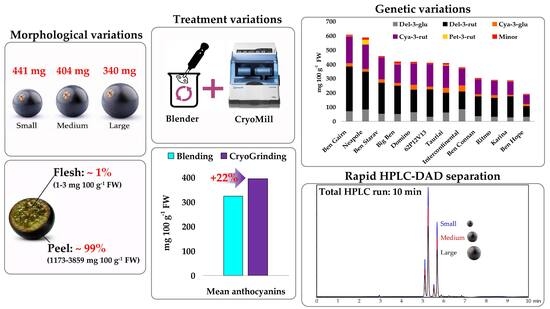
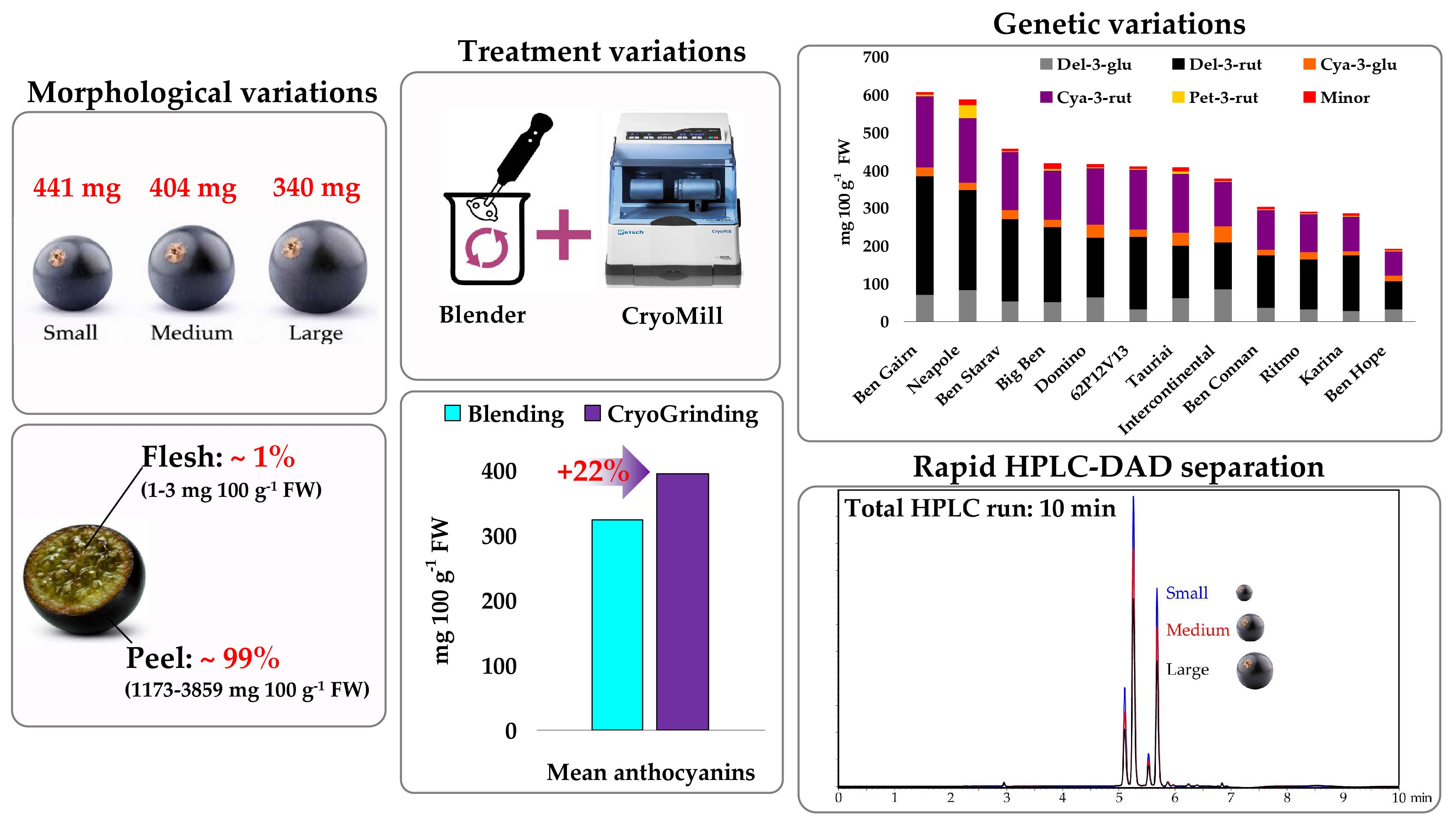
Black currants (Ribes nigrum L.) and their hybrid berries are distinguished by their exceptionally high content levels of anthocyanin and vitamin C, major phytochemicals with health-promoting properties. This study was designed to substantially reduce the HPLC runtime required for black currant anthocyanin analysis and clarify how key determinants, including morphological traits (berry size and peel proportion), genetic variation across 12 cultivars, and cryogenic milling, affect anthocyanin accumulation and quantification. A rapid HPLC protocol was developed that achieves the high-resolution separation of four major and eight minor anthocyanins in black currant within a 10 min run, enabling efficient, high-throughput analysis, very important in long-term breeding programs due to the large number of genotypes. Cryogenic grinding substantially enhanced the extraction yield and reproducibility relative to just blending. Using the improved extraction and analysis method, a set of anthocyanin content-related morphologic berry traits was systematically evaluated, providing information directly relevant to future phenotyping and breeding efforts. Smaller black currant berries generally have higher total anthocyanin content than larger berries, and these morphological attributes are tightly linked to the genotype. Although a higher peel proportion was related to higher anthocyanin content within genotype, there was no global trend, and anthocyanin contents were similar in different size berry peels.

Graphical Abstract

1. Introduction

Black currants (Ribes nigrum L.) belong to the berry crop of the Grossulariaceae family, typical of Central and Northern Europe. They provide a valuable amount of bioactive molecules with pronounced impacts on human physiology [1]. Recent production data indicate that currant cultivation and output have followed a consistently strong upward trajectory on a global scale. In 2022–2023, total currant production was estimated at 760 thousand tons, with production almost entirely confined to Europe. Within this region, Russia and Poland dominate the sector, accounting for the majority of global currant output [2]. Worldwide black currant cultivar development is actively pursued through roughly 15 specialized breeding centers across the globe, predominantly concentrated in Europe, with major programs operating in Denmark, Finland, Norway, Poland, Scotland, Sweden, Ukraine, and the Baltic region (Lithuania, Latvia, and Estonia). Current breeding focuses on disease/pest resistance, plant architecture, larger and firmer berries, higher yields, and mechanical harvest compatibility [3]. Plant breeding is a lengthy, resource-intensive process, and analysis of chemical traits can be particularly limited by laboratory capacity, underscoring the need for rapid, cost-effective analytical methods. An expanding body of research demonstrates that phytochemicals in black currant berries exert favorable effects on human health [4,5,6,7], and black currant production continues to face substantial challenges in terms of plant resistance, especially against pathogens, e.g., black currant gall mite (Cecidophyopsis ribis) [8]. Taken together, these factors provide a strong scientific and applied justification for sustaining and further intensifying research efforts focused on black currant.
In black currant, the anthocyanin profile consists primarily of delphinidin- and cyanidin-based derivatives. Four compounds—delphinidin 3-O-rutinoside (del 3-O-rut), delphinidin 3-O-glucoside (del 3-O-glu), cyanidin 3-O-rutinoside (cya 3-O-rut), and cyanidin 3-O-glucoside (cya 3-O-glu)—typically constitute 92–98% [9,10] of the total anthocyanin pool. Beyond these principal pigments, approximately ten to eleven additional, lower-abundance anthocyanins have been reported [1,11,12]. Nonetheless, these minor constituents are often excluded from standard quantitative determinations [10,13], which can lead to an underestimation of the true chemical diversity of black currant berries.
This compositional heterogeneity is reflected in the distinct phytochemical profiles of black currant cultivars of different genetic origin cultivated at the same site over multiple seasons [14]. However, berry phytochemistry is not shaped solely by genetic factors and biotic or abiotic stresses. Evidence from strawberry (Fragaria × ananassa) research indicates that berry size and mass are closely related to phytochemical composition, suggesting that morphological traits can interact with genotype and environment to influence the final metabolite profile. Nevertheless, size-dependent variation in anthocyanin accumulation is likely underpinned by a more complex genetic architecture than can be inferred from berry size alone. For instance, blueberry (Vaccinium corymbosum) growth exhibits pronounced heterogeneity, with individual berries differing in size and ripening dynamics even within the same flower cluster on a single plant—different pollen sources vs. self-pollination modulate seed development, fruit growth, and pigmentation. Ripening time correlates strongly with the number of seeds, whereas berry mass and anthocyanin content are more closely associated with total seed mass. These relationships highlight a tight coupling between seed development, berry growth, and anthocyanin accumulation, consistent with seed-mediated control of fruit maturation and color formation [15]. During olive (Olea europaea) fruit ripening, anthocyanin biosynthesis is tightly regulated at the transcriptional level and exhibits clear tissue specificity. Gene expression analyses revealed a coordinated upregulation of key structural genes of the phenylpropanoid and flavonoid pathways (phenylalanine ammonia lyase, chalcone synthase, chalcone isomerase, flavonoid 3-hydroxylase, and flavonoid 3′-hydroxylase) in both skin and pulp, with consistently higher expression in the skin. In contrast, anthocyanidin synthase displayed a distinct temporal expression pattern, reaching maximal transcript levels at the earliest ripening stages before declining sharply. This suggests that anthocyanidin synthase is primarily active at the onset of ripening, with subsequent increases in enzymatic activity driving the accumulation of its product, cyanidin, as ripening progresses [16]. In addition to normal metabolic processes related to fruit pollination and ripening, anthocyanin and other bioactive compound production are influenced by genetic predisposition, cultivation system, and environmental stressors. Their composition differs significantly between plant species [17], and total content is highly variable between cultivars [17,18]. Anthocyanins do not appear to be as linked to resistance to fungal infections as flavonoid glycosides or sugars [18]. However, different cultivation systems can significantly affect sugar, organic acid, and anthocyanin accumulation in berries [19]. Environmental stressors like heavy metal pollution, drought, and light stress tend to result in increased anthocyanin content, and only high temperature was associated with reduced content in a meta-analysis [20], but these findings do not account for the effect on berry yield or size. For instance, drought stress may induce increased anthocyanin content, but results in smaller berries, while berry yield is reduced [21]. To our knowledge, comparable studies on black currants are currently lacking, and pursuing this line of research may represent a valuable direction for future investigations.
Rapid and reliable anthocyanin profiling in extensive, genetically varied black currant collections continues to pose a substantial analytical challenge, largely because numerous experimental factors can affect anthocyanin recovery from plant tissues [22,23,24,25,26]. The lack of harmonized extraction protocols is likely a major contributor to the considerable range of variability in the reported anthocyanin concentrations among black currant cultivars across different studies [10,27,28,29,30]. Among the parameters that critically influence extraction efficiency, the degree of tissue disruption is particularly important. Evidence from chokeberry fruit demonstrates that cryogenic grinding enhances the accessible surface area for solvent interaction and thus enhances anthocyanin recovery [31]. Chromatographic run time is another key aspect of methodological efficiency. Notably, even some of the most recent studies on black currant anthocyanins still rely on relatively long RP-LC protocols, with up to 20 min by UPLC [32], 44 min by UHPLC [33], or even 50 min by HPLC run-times [13]. This highlights that chromatographic strategy and method design remain decisive for achieving true high-throughput analysis. Some investigations have shown that the total separation time for HPLC systems can be shortened to approximately 13 min [10,34] or even 11 min [35], whilst retaining chromatogram resolution. In high-intensity and large-scale breeding programs with hundreds to thousands of hybrids, saving 1–2 min per sample can reduce processing by several days, allowing for additional analyses and more comprehensive screening. These gains can be achieved using standard HPLC systems, nearing the capabilities of modern UPLC/UHPLC systems, which can separate anthocyanins in 7 min [36]. Table 1 presents the HPLC conditions for the separation of anthocyanins in black currants as reported by different scientific groups.
Collectively, these findings underscore the urgent need to disseminate and implement faster, more robust analytical workflows. Such improvements are essential to support the increasing analytical throughput required by the expanding scope and scale of modern black currant breeding programs.
This research was designed around four main goals: (i) to create and verify a fast, high-resolution RP-HPLC-DAD protocol able to separate major and minor anthocyanins in a brief run time; (ii) to thoroughly assess the effects of critical lab variables—particularly tissue homogenization strategies such as cryogenic grinding—on quantitative anthocyanin recovery; (iii) to comprehensively profile the anthocyanin composition of 12 black currant genotypes; and (iv) to investigate the effect of berry size (small, medium, and large) on anthocyanin accumulation. The originality of this work resides in its multi-dimensional analytical strategy, which integrates morphological, genetic, and methodological factors with rapid HPLC quantification of anthocyanins. This combination enables high-throughput phenotyping and yields novel insights into the biochemical diversity present within black currant germplasm. Ultimately, the robust analytical framework established here provides a valuable tool for accelerating breeding programs aimed at enhancing fruit quality and bioactive compound content.

2. Materials and Methods

2.1. Reagents

HPLC-grade methanol and formic acid, along with reagent-grade hydrochloric acid, were sourced from Sigma-Aldrich (Steinheim, Germany). Ethanol (96.2%, v/v) came from Kalsnavas Elevators (Jaunkalsnava, Latvia). Anthocyanin standards—del 3-O-glu, del 3-O-rut, cya 3-O-glu, and cya 3-O-rut (≥95% HPLC purity)—were acquired from Extrasynthése (Genay, France).

2.2. Plant Material

The experimental site at the Institute of Horticulture, Dobele, Latvia (GPS location: N: 56°36′39″ E: 23°17′50″), supplied 12 black currant (Ribes spp.) genotypes collected at peak ripeness in July 2025. The harvested berries from 3 to 5 bushes for every cultivar/genotype were pooled to obtain sufficient material (200–400 g) for size fractionation, since the 6–7-year-old bushes in the genetic collection produced low amounts. Berries from different bushes of the same genotype were combined to obtain a sufficient amount for splitting the berries by size, fraction, and test methodological conditions. This strategy does not reflect natural variability within genotype, but ensures the most adequate genotype-level representation within the limitations of the study. Immediately after harvest, the pooled berries were visually sorted into small, medium, and large size categories, weighed, and the diameter of 30 berries per fraction was measured. All berries were processed in their fresh state immediately after harvest. Detailed genotype names and additional sample information are provided in the Supplementary Materials.

2.3. Black Currant Berry Processing

Sample processing and extraction are based on our previous study [35], but the berry size categories were expanded (small, medium, and large) to test whether berry size is correlated with anthocyanin concentration. Additionally, the skin and the flesh were separated. By considering the skin-to-flesh proportion, we were able to assess how tissue composition contributed to whole-berry anthocyanin content. These complementary approaches were designed to disentangle key sources of variation and to refine our understanding of the biological and methodological determinants that shape anthocyanin quantification in black currant fruit.

2.3.1. Morphological Aspects

Initially, berries from each cultivar were sorted into three size categories based on fruit diameter. From each size class, ten berries were randomly selected, weighed individually, and their diameters recorded. The peel was then mechanically removed from the flesh with a laboratory spatula and meticulously cleaned to eliminate any residual flesh tissue. The separated peel and flesh fractions were weighed independently, rapidly frozen, and stored at −80 ± 2 °C until subsequent analysis (within 7–14 days). Peel proportion was calculated as follows: Peel proportion (%) = 100% × mpeel/mberry, where m is mass.

2.3.2. Disintegration Aspects

Blending
For every genotype and for each of the three berry-size fractions, 100 ± 5 g of fruit were weighed and homogenized using a handheld blender (Bosch, Gerlingen, Germany) to produce a uniform and representative sample. Immediately following homogenization, 0.50 ± 0.02 g portions were dispensed into 15 mL polypropylene tubes (five independent replicates per sample) and supplemented with extraction solvent consisting of 50% (v/v) ethanol acidified with 0.36 N HCl.
Cryogenic Grinding
The blended homogenate, obtained as described in Section 2.3.2, was thoroughly mixed, and 5.0 ± 0.5 g aliquots were dispensed into each of two 50 mL stainless steel grinding jars. The samples were cryogenically pre-treated by immersion in liquid nitrogen for 15 min, and subsequently pulverized (30 s at 30 Hz) via a MM 400 mixer mill from Retsch (Haan, Germany), resulting in ~5 μm powder. From the resulting cryogenic homogenate, 0.50 ± 0.02 g aliquots were collected for analysis for each genotype and berry size fraction (six independent replicates). The peel and flesh fractions were subjected to an analogous cryogenic grinding and sampling procedure (three replicates per fraction).

2.4. Anthocyanin Extraction

For extraction, all prepared samples were processed in the laboratory under artificial lighting, with windows covered to exclude natural UV light. Whole-berry homogenates (0.50 g in 15 mL tubes) and peel or flesh samples (0.10 g in 2 mL tubes) were each supplemented with 10 mL and 1.9 mL, respectively, of 50% (v/v) ethanol acidified with 0.36 N HCl. The tubes were then mixed at 2500 rpm for 1 min, using a vortex Reax top (Heidolph, Schwabach, Germany), to ensure thorough dispersion of the plant material in the extraction solvent. Ultrasound-assisted extraction was performed in a Sonorex RK 510 H ultrasonic device from Bandelin (Berlin, Germany); extracts were treated at 60 °C, 160 W, and 35 kHz over 15 min. A 1 min mix and centrifugation at 21 °C (11,000× g, 5 min) followed; supernatants were then syringe-filtered (0.2 μm nylon) into 2 mL vials prior to RP-HPLC-DAD runs.

2.5. Anthocyanins Separation via RP-HPLC-DAD

The present method is based on our earlier study involving different stationary phases [35]. The shortening of the chromatographic separation of anthocyanin to a 10 min method was optimized by modifying the gradient using the SPP Kinetex C18 column (250 × 4.6 mm, 5 μm) secured with a Synergi Fusion-RP guard (4 × 3 mm) (Phenomenex, Torrance, CA, USA). Optimal separation was achieved with mobile phases of 4% aqueous formic acid (A) and methanol (B), following this gradient: 15% B at 0.01 min, rising to 40% B by 3.0 min, 80% B from 4.0 to 5.0 min, then back to 15% B (6.0–10.0 min). Flow was set at 1.0 mL min−1, column at 50 °C, with a 10 min total run. The Shimadzu Nexera 40 Series (Kyoto, Japan)—including a CBM-40 controller, an LC-40D pump, a DGU-405 degasser, an SIL-40C autosampler, a CTO-40C oven, and an SPD-M40 DAD—handled the analyses. Anthocyanin standards dissolved in 0.1% HCl methanolic solution (v/v) served for calibration curves, with detection at 520 nm. Trace anthocyanins were estimated relative to the cya 3-O-glu standard curve. To identify the detected minor anthocyanins, unidentified peaks were repeatedly collected during 5–10 injections at the capillary outlet into glass flasks during analytical chromatographic runs. The combined fractions were concentrated under reduced pressure, reconstituted in 500 μL of methanol containing 0.1% HCl, and followed by high-resolution mass spectrometry (HRMS) analysis to identify compounds. All the samples were analyzed during five days and calculated based on the prepared single calibration curve for each anthocyanin.

2.6. Method Validation

Selectivity of the optimized method was confirmed by injecting 2 µL of methanol, containing 0.1% HCl (v/v) (blank solution), standards, and extracts obtained from 12 genotypes of black currant. Linearity was verified for concentrations 0.11–84.38 ng by injecting different volumes of standards mixture (0.2–10 µL). Reproducibility of retention times and precision (repeatability and reproducibility) of quantification for the four major anthocyanins were tested across the following three days using extracts from the cultivar ‘Ben Starav’. Samples were prepared in a single session and held at 4 °C in the fridge over the 3-day validation period. LOD was determined using a signal-to-noise (S/N) threshold of 3, with LOQ computed as LOQ = 3.3 × LOD. LabSolutions v.5.110 software (Shimadzu, Kyoto, Japan) calculated S/N ratios, verified by injecting four main anthocyanin standards at their respective calculated LOD levels.

2.7. LC-HRMS Secondary Metabolite Identification

Extracts underwent chromatographic fractionation on an UltiMate 3000 HPLC system (Dionex, Germering, Germany), with the column held at 35 °C, and the autosampler at 15 °C. Each 5 µL sample portion was injected onto a Kinetex C18 column-50 × 3 mm, 1.7 µm (Phenomenex, Torrance, CA, USA). Mobile phase A was 2% formic acid in water, and the mobile phase B was methanol. The flow rate was set to 0.3 mL min−1.
The gradient elution program was as follows: 10% B from 0 to 1 min; a linear increase to 95% B between 1 and 9.5 min; maintained at 95% B from 9.5 to 12 min; then increased to 100% B over 12–15 min; held at 100% B for 15–17 min; returned to 10% B at 17–17.1 min, and re-equilibrated at 10% B for 17.1–20 min.
Mass detection employed a Thermo Scientific Q-Exactive Orbitrap MS (Dreieich, Germany) with an ESI source in positive/negative modes. Full-scan mode (100–1500 m/z) ran at a 70,000 FWHM resolution (m/z 200); data-dependent MS/MS (ddMS2) at 17,500 FWHM used the automatic mass range and stepped NCE (10%, 25%, and 40%). External calibration (<5 ppm accuracy) involved caffeine, MRFA, Ultramark 1621, and n-butylamine prior to runs. Thermo Xcalibur (v. 4.1) controlled acquisition. Identification proceeded in Thermo TraceFinder™ (v. 4.1) by matching against mzCloud (https://www.mzcloud.org), MoNA (https://mona.fiehnlab.ucdavis.edu), PlaSMA (http://planmaxdb.riken.jp), and MassBank Europe (https://massbank.eu/MassBank/ (all websites accessed on 1 November 2025) spectral libraries.

2.8. Statistical Analysis

Statistical analysis of the effect of cryogenic pre-treatment vs. regular blending was performed using the whole dataset on berries. Afterwards, only the liquid nitrogen-treated berry subset data were used for analysis of differences between genotypes and determining the significance of peel to whole berry mass (peel proportion, %), since peel and flesh fractions were all treated with liquid nitrogen. This is to ensure data comparability between sections within the manuscript. Only cryogenically treated sample data were used for correlation analysis.
RStudio 4.4.1 (“Cucumberleaf Sunflower” Release (20de3565, 23 September 2025) for Windows) was used for data preparation and restructuring. R base and open source packages, readxl, dplyr, GGally, ggplot2, ggthemes, forcats, scales, ggExtra, ggforce, patchwork, and tidyr, were used for data structuring and analysis. Spearman’s rank correlation analysis was used for correlation analysis, and the results were expressed as the Spearman rank correlation coefficient (ρ). Linear regression analysis was performed on MS Excel; other statistical analyses were performed in RStudio interface using aforementioned packages: multivariate analysis of covariance (MANCOVA) with Tukey HSD test to identify statistically homogenous groups.

3. Results and Discussion

3.1. Separation Optimization and Validation

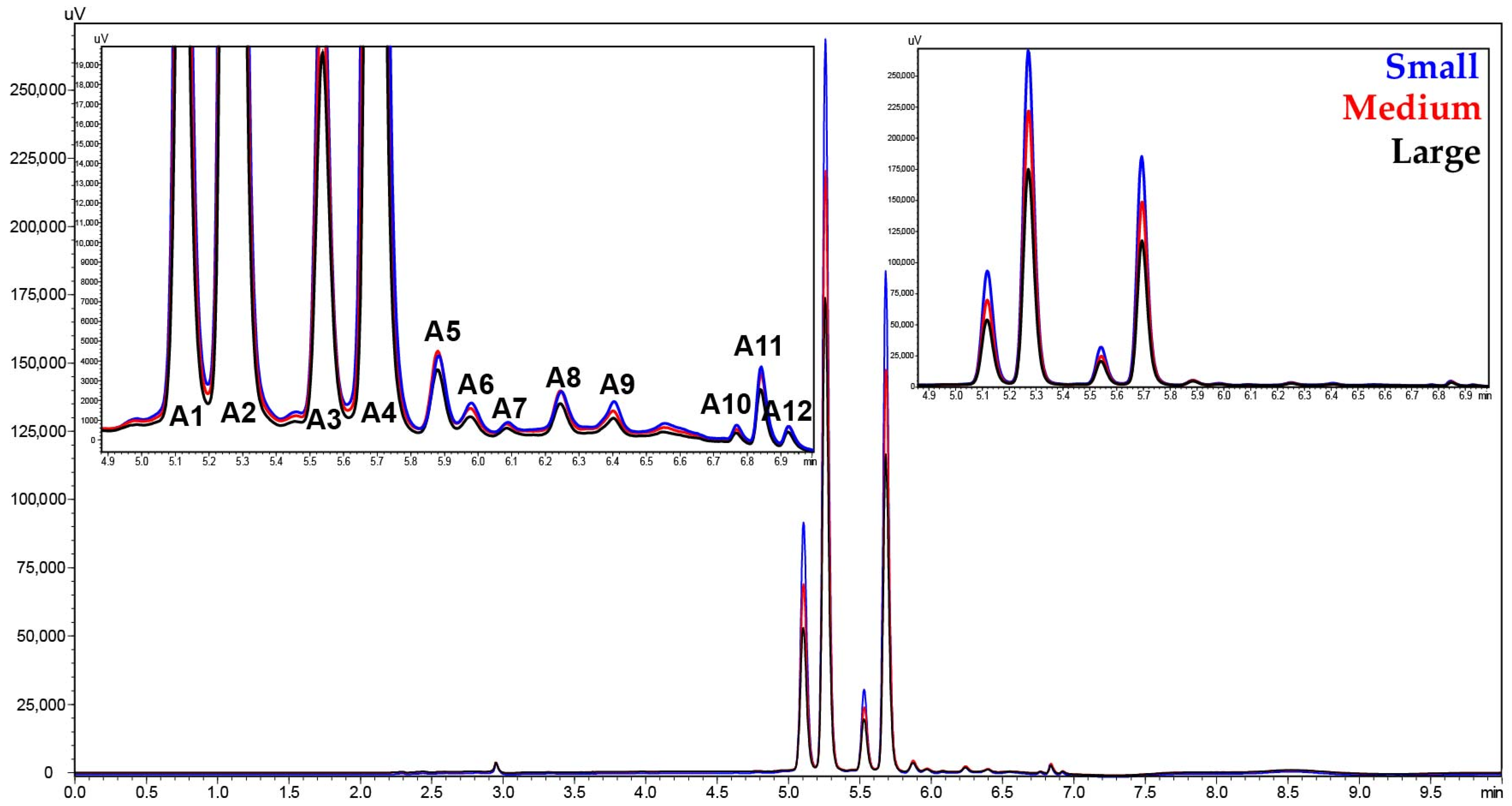
The chromatographic profile generated by the optimized RP-HPLC-DAD method at the wavelength of 520 nm for the separation of black currant anthocyanins is presented in Figure 1.
Using the optimized gradient, complete separation (Rs ≥ 1.5) of the four dominant anthocyanins—del 3-O-glu, del 3-O-rut, cya 3-O-glu, and cya 3-O-rut—was achieved within a 10 min chromatographic run. Notably, this represents an improvement of about three minutes [10,34], and one minute [35] compared with the shortest chromatographic method previously described for black currant anthocyanin analysis by HPLC systems. The new method for a standard HPLC system was only three minutes shorter than an anthocyanin separation method developed for a UHPLC system [36]. The two methods had similar LOD for the main anthocyanins. Beyond these major constituents, eight minor anthocyanins were also resolved. Acid concentration in the mobile phase was a key determinant of separation performance. Stepwise elevation of formic acid from 1% to 10% (v/v) in the aqueous phase led to markedly improved peak resolution, decreased retention times, and higher signal intensities, collectively enhancing chromatographic efficiency and effectively increasing the sensitivity of the method [37]. Table 2 compiles the analytical characteristics of the four major anthocyanins, including the linear regression equations of their calibration curves, coefficients of determination (R2), limits of detection and quantification (LOD and LOQ), linearity ranges, retention times (RT), chromatographic resolution (Rs), and standard errors. All four principal anthocyanins displayed comparable sensitivity, with LOD values between 0.098 and 0.142 ng and LOQ values between 0.322 and 0.467 ng. The optimized method yielded highly consistent retention times for each of the main anthocyanins, as evidenced by low %RSD values (0.11–0.14), indicative of good repeatability and reproducibility (Supplementary Materials). Method precision (repeatability and reproducibility) was excellent for all four main anthocyanins (%RSD 1–2) (Supplementary Materials). Compared with earlier HPLC methods [13,37], the protocol established here offers superior sensitivity, due to the short analysis time and narrow anthocyanin peaks. A further practical advantage is the relatively modest maximum system backpressure of 14.3 MPa, which facilitates routine application and extends column and instrument longevity.

3.2. Anthocyanin Identification via LC-HRMS

Beyond the four dominant anthocyanins that typically define the black currant pigment profile, eight additional minor anthocyanins were detected, two of which showed evidence of partial co-elution with neighboring peaks. Among these low-abundance compounds, five with the most prominent signals were structurally assigned by high-resolution mass spectrometry (HRMS) as pelargonidin 3-O-glucoside, pelargonidin 3-O-rutinoside, petunidin 3-O-rutinoside, cyanidin 3-O-(6″-coumaroyl)-glucoside, and delphinidin 3-O-(6″-coumaroyl)-glucoside (Figure 1, Supplementary Materials), matching previous reports in the literature [1,12]. The ability of the method to resolve and reliably detect both major and minor anthocyanins indicates that the optimized chromatographic conditions not only accelerate separation but also enhance the precision of minor pigment detection and characterization. Historically, as many as fifteen anthocyanins were reported in black currants in 2002 [12], a finding that was reaffirmed nearly two decades later [1], although those studies relied on substantially longer HPLC runs (25 and 45 min, respectively). Nevertheless, the majority of later investigations have centered primarily on the four principal anthocyanins and, at most, only one to five minor compounds [10,13]. Consequently, the composition of the minor anthocyanin fraction remains variably described. For example, different studies have reported delphinidin-based derivatives by Obón et al. [39]; peonidin 3-O-rutinoside (peo 3-O-rut) and malvidin 3-O-rutinoside by Frøytlog et al. [40]; petunidin 3-O-(6″-coumaroyl)-glucoside and peonidin 3-O-(6″-coumaroyl)-glucoside by Gavrilova et al. [41] and Chen et al. [37]; petunidin 3-O-rutinoside (pet 3-O-rut), peo 3-O-rut, delphinidin 3-O-(6″-coumaroyl)-glucoside (del 3-O-(6″), and cyanidin 3-O-(6″-coumaroyl)-glucoside (cya 3-O-(6″) by Nielsen et al. [34]; and other studies have identified peo 3-O-rut, pelargonidin 3-O-rutinoside (pel 3-O-rut), delphinidin 3-O-xyloside, del 3-O-(6″), and cya 3-O-(6″) in Gacnik et al. [42]. In our dataset, del 3-O-(6″) and cya 3-O-(6″) were consistently detected across all 12 examined genotypes. This suggests that the failure to detect them in previous research probably arises from method shortcomings, like inadequate sensitivity or unavailable reference compounds, overly short or non-optimized chromatographic gradients, or suboptimal mobile phase composition—rather than genuine biological absence.

3.3. Factors Affecting the Anthocyanin Content in Black Currant Berries

3.3.1. Berry Size (Small, Medium, Large)

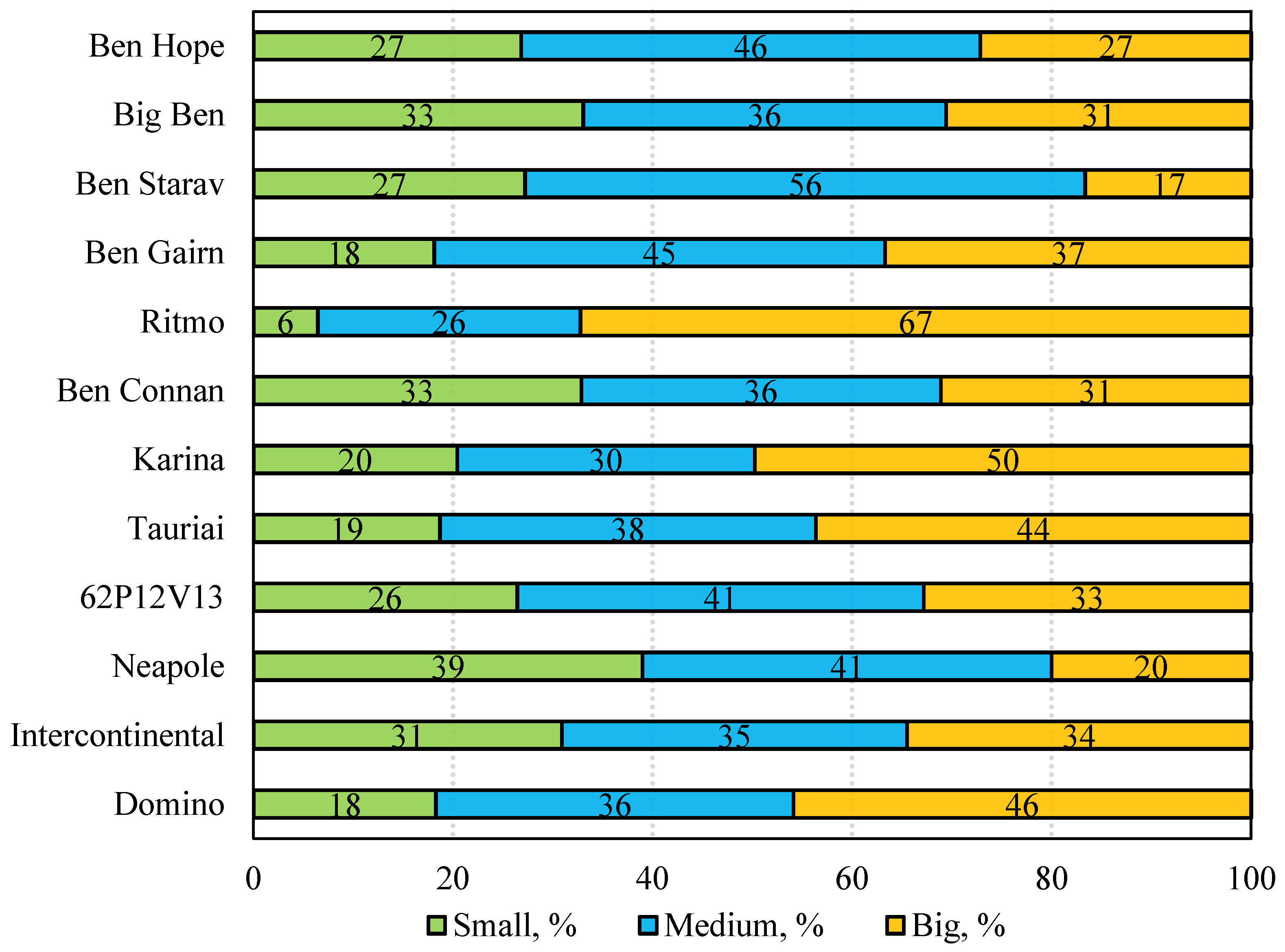
Among 12 cultivars analyzed, four had a higher proportion of large berries: ‘Ritmo’, with large berries comprising 67% of the total berry mass; ‘Karina’ and ‘Domino’, with 50% and 46%, respectively; and ‘Tauriai’, where the large berry fraction accounts for 44% of the total berry mass. In contrast, cultivars characterized by a marked dominance of medium-sized berries include ‘Ben Starav’ (56%), ‘Ben Hope’ (46%), ‘Ben Gairn’ (45%), and both ‘Neapole’ and ‘62P12V13’, each with a medium berry fraction of 41%. None of the genotypes analyzed displays a predominant fraction of small berries. Some genotypes exhibit a more uniform distribution of berry sizes, such as ‘Intercontinental’, ‘Ben Connan’, and ‘Big Ben’ (Figure 2).
The smallest average berry diameter was recorded for the ‘Neapole’, measuring 6.5 mm. For the ‘Ben Gairn’ and ‘Ben Starav’ cultivars, the average diameter of small berries is 7.5 mm. The largest berries are characteristic of ‘Ritmo’, with an average diameter of 15.8 mm, followed by ‘Big Ben’ at 14.7 mm and ‘62P12V13’ at 14.1 mm for large berries. The diameters of medium-sized berries range from 8.2 mm (‘Neapole’) to 12.1 mm (‘62P12V13’ and ‘Ritmo’) (Supplementary Materials).
Differences in anthocyanin content among different berry sizes are shown in Table 3, with all berries treated with liquid nitrogen after blending to ensure consistent tissue disruption and extraction efficiency. Smaller berries contained substantially higher anthocyanin concentrations compared to their medium and larger counterparts (Supplementary Materials). In the cryogenically treated subset, diameter was negatively associated with total anthocyanin content (ρ = −0.538, p < 0.001) in most of the analyzed genotypes (ρ between −0.87 and −0.99, p < 0.001), except for ‘Intercontinental’ (ρ = −0.44) and ‘Tauriai’(ρ = −0.4), in which the correlation was not statistically significant (p > 0.05). This finding in black currants is consistent with a similar study on strawberries, where berry size and weight were identified as significant factors influencing the phytochemical composition [14]. An analogous pattern has been reported in grape (Vitis vinifera L.) berries as well [43].
This inverse relationship was observed consistently across all four major anthocyanins—del 3-O-glu, del 3-O-rut, cya 3-O-glu, and cya 3-O-rut—though marked genetic diversity was evident among genotypes, with ‘Ben Gairn’ achieving peak anthocyanin levels (average 595 mg 100 g−1 FW), while ‘Ben Hope’ had minimal concentrations (average 186 mg 100 g−1 FW). Three cultivars deviated from this trend – ‘Intercontinental’, ‘Tauriai’, and ‘Ben Starav’—suggesting that certain genetic traits can override the usual relationship between berry size and anthocyanin content. ‘Neapole’, which had the smallest berries among all studied cultivars, contained a relatively high concentration of pet 3-O-rut. The content of pet 3-O-rut in small, medium, and large berries was 34, 36, and 34 mg 100 g−1 FW, respectively (Supplementary Materials). Previous observations indicate that enhanced nutrient availability during black currant fruit development markedly promotes overall yield and increases berry size, but results in reduced key phytochemical content, such as anthocyanins [44]. In line with our results, the magnitude and direction of these effects were not uniform across all genotypes, underscoring the complexity of the underlying physiological and genetic mechanisms and reinforcing the concordance between a previous report and the present study. The observed anthocyanin distribution and berry size trends in this study align closely with previously reported findings by Sønsteby et al. [44], confirming consistent cultivar-dependent variation patterns in black currant anthocyanin content. Most cultivars have decreased total anthocyanin content with increasing berry size—the proportion of peel tissue decreases, leading to lower whole berry anthocyanin concentrations, except for ‘Ben Hope’, in which there was no correlation between berry size and peel proportion (ρ = 0.089). However, notable exceptions occurred in ‘Intercontinental’, ‘Neapole’, ‘Karina’, ‘Ben Starav’, and ‘Big Ben’, where large berries maintained or exceeded anthocyanin levels found in smaller berries. This suggests that certain genotypes possess enhanced anthocyanin synthesis capacity that can compensate for dilution effects associated with increased berry volume. Combining berries from different bushes belonging to the same genotype improves the representativeness of the sample at the genotype-level, but not natural variability. Our earlier study of 123 genotypes—each represented by a single bush—showed a clear and robust tendency for smaller berries to have higher anthocyanin concentrations [35]. The present study is broadly consistent with this pattern. Nevertheless, a clear correlation between anthocyanin content and berry size within genotype (large < medium < small) was not systematically observed for every genotype. This may be a result of the pooling strategy, which did not reflect natural bush-to-bush variability and dilute size-dependent signals. Therefore, biological replication of separate bushes per genotype and separate analysis rather than pooling may be advisable in future studies to more rigorously resolve the relationship between berry size and anthocyanin content.
Peel proportion generally had a strong correlation with the total anthocyanin content of the berries (0.513 < ρ < 0.949), except for ‘Ben Hope’ and ‘Ben Starav’ (Supplementary Materials). Genotype, berry fraction, and pre-treatment all had a significant effect on anthocyanin content in the extracts (Table 4). Pet 3-O-rut content was the least affected by these factors. While there was significant interaction between variables, treatment × berry fraction had the least significant interaction, meaning similar improvements could be seen regardless of berry size.
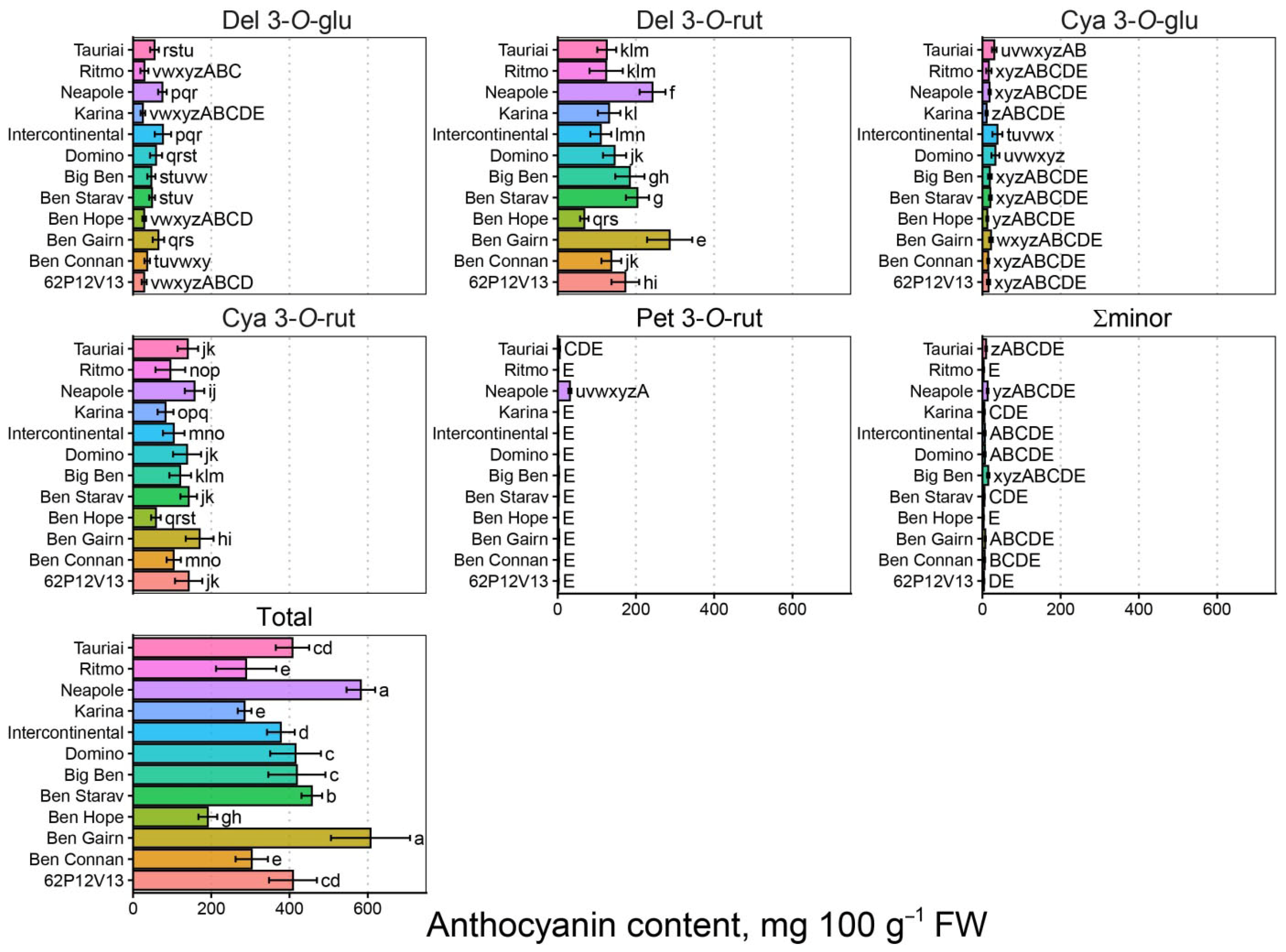
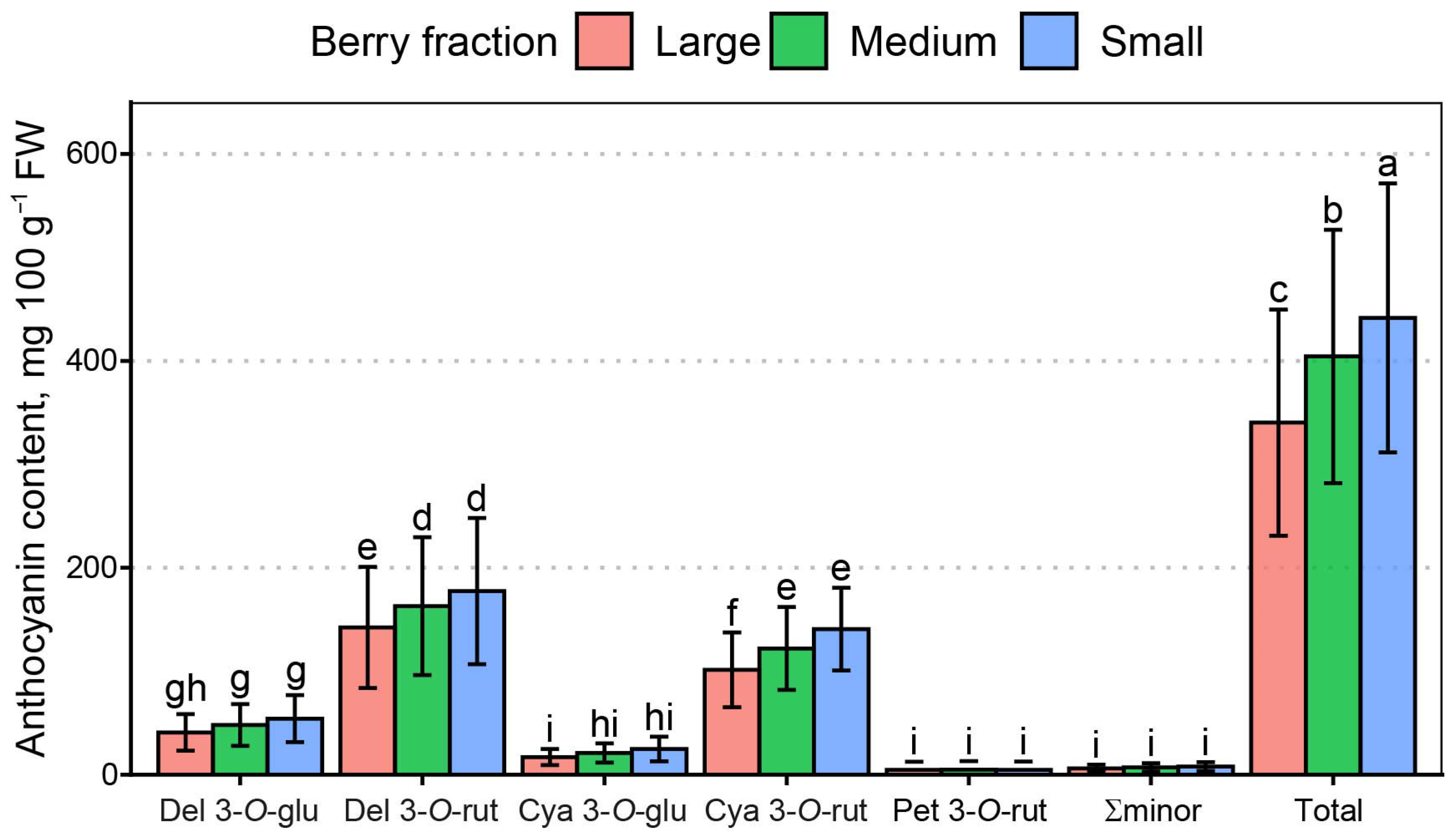
The genotype had a significant effect on the anthocyanin content (Figure 3, Supplementary Materials). All anthocyanin content correlated positively within genotype (Supplementary Materials—genotype corr). A notable outlier is the variety ‘Neapole’, which had a much higher pet 3-O-rut content. This may be a result of different ancestry in the variety—interspecific crossing is a very common practice in black currant breeding, and most cultivar ancestries include not only Ribes nigrum and its variety scandinavicum, sibiricum, and europaeum, but also other Ribes species: R.dikuscha, R. ussuriense, and R. grossularia, among others. The typical anthocyanin profile differs between species, and a more recent interspecific cross may alter it significantly. In addition to pet 3-O-rut, other minor anthocyanin sums were also slightly higher in ‘Neapole’ and ‘Big Ben’. Small berries had higher main anthocyanin content than large berries in the cryogenically processed subset, while minor anthocyanin content was not significantly different (Figure 4).
The following ranges of anthocyanin concentrations have previously been reported: 174–456 mg 100 g−1 FW in 37 cultivars [30], 276–670 mg 100 g−1 FW in 32 varieties [28], 83–199 mg 100 g−1 FW in 17 genotypes [29], 79–311 mg 100 g−1 FW in 15 cultivars [10], 143–176 mg 100 g−1 FW in 3 cultivars [45], and 116–288 mg 100 g−1 FW in 3 cultivars [9]. Overall, the anthocyanin concentrations measured in the black currant genotypes analyzed in this work cover the ranges previously reported for this species. Notably, the very low values reported in some earlier studies (i.e., below 100 mg 100 g−1 FW) were not detected in the present study. Reported lower values can be attributable to genetic background and/or environmental conditions, but also methodological limitations, e.g., lower extractability of anthocyanins. The number of genotypes included has varied substantially between studies, with the largest dataset encompassing 37 genotypes, and, taken together, published reports reveal a wide span of anthocyanin contents. This breadth of values highlights both the genuine biological variability among black currant germplasm and the influence of methodological differences on the reported anthocyanin levels. The optimization of fruit quality characteristics continues to be a demanding task, primarily due to complex genetic structures and regulatory pathways governing their production; yet, it remains a key focus for current and future breeding programs. The berry flavor, texture, and nutritional value are jointly shaped by genotype and environment, underscoring the need to account for their combined effects when designing and implementing fruit improvement strategies [46].

3.3.2. Berry Fragmentation (Blending vs. Cryogenic Grinding)

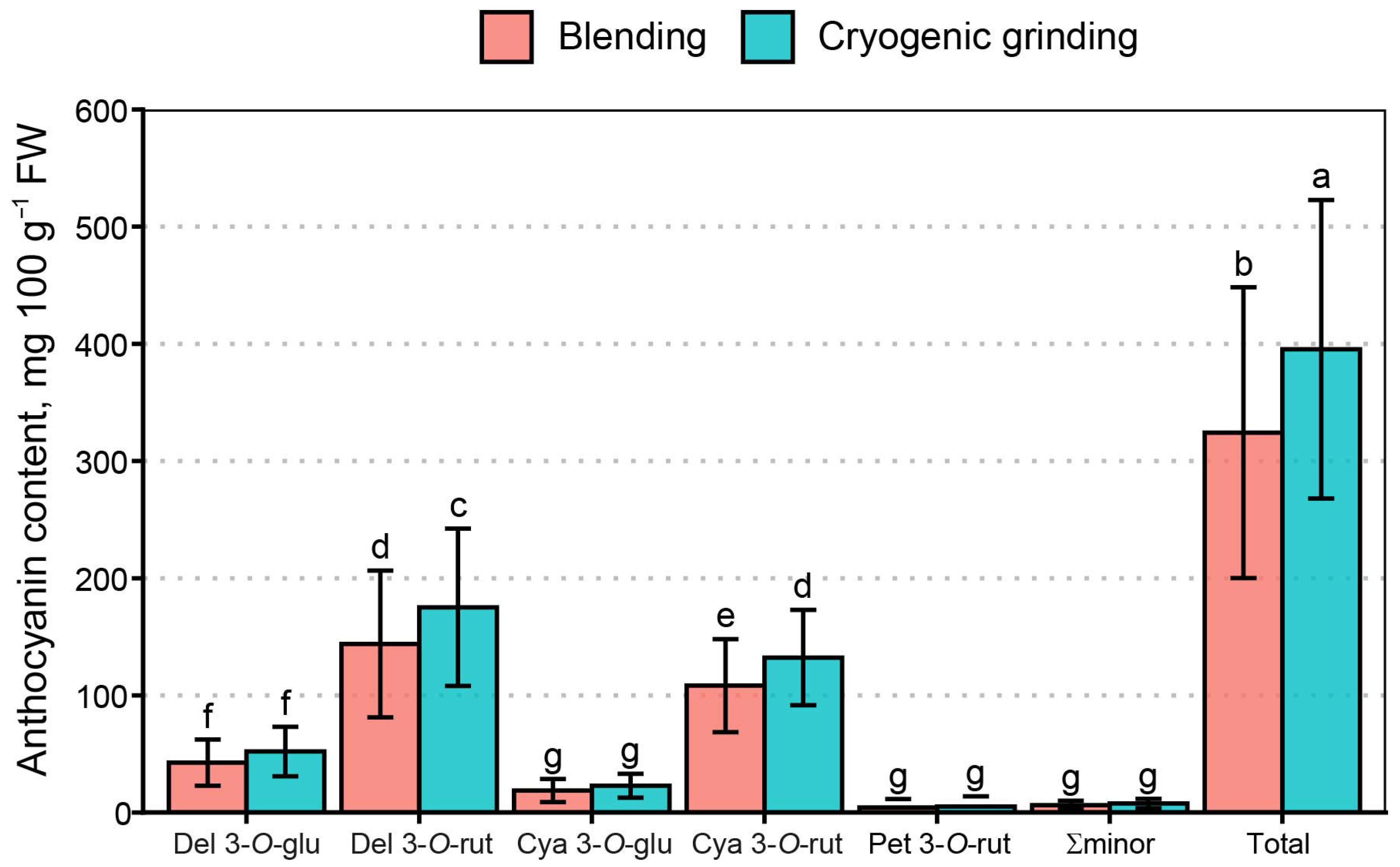
Type of homogenization—blending vs. cryogenic grinding—has a pronounced effect on anthocyanin yields. For each individual anthocyanin, cryogenic homogenization consistently results in higher and more reproducible yields across most cultivars compared to blending. Cryogenically processed sample anthocyanin contents were generally 17.3–31.1% higher than just blended ones (22.3% on average), except for ‘Ben Connan’, which had minimal improvement (1.9%). Considering ‘Ben Connan’ did not have any extreme attributes within this study, the deviation is difficult to explain. In some other genotypes, a single fraction may have very low improvement (small ‘Intercontinental’ and ‘Ritmo’ and large ‘Tauriai’ berries), and differed between berry size fractions in the whole dataset, with little consistency. There was no correlation between recovery improvement and berry fraction average diameter, mass, or peel proportion (ρ = 0.153, 0.265, and −0.068, respectively, p > 0.05).
Liquid nitrogen-based homogenization more effectively disrupted berry tissue, enhancing extraction efficiency, which was most apparent for the main anthocyanins and their total content, while effects on minor anthocyanins were negligible (Figure 5, Supplementary Materials). Under industrial conditions, freezing the raw material is common due to the short shelf life of soft berries. Flash-freezing is typically performed at −30 to −40 °C, while the boiling temperature of liquid nitrogen is significantly lower at −196 °C. Pre-freezing the samples at typical industrial freezing temperatures was not tested, but results are likely to differ between quick- or flash-frozen and cryogenically frozen material. Moreover, anthocyanin extractability may be affected by moisture losses during frozen storage or the formation of larger ice crystals and further disruption of the cell matrix, which was not tested in the present study. When black currant berries are subjected to cryogrinding, the resulting ultrafine powder exhibits almost complete disruption of cellular architecture. This loss of structural integrity dramatically increases the solvent-accessible surface area, thereby markedly enhancing the efficiency with which secondary metabolites—most notably anthocyanins—are extracted. The importance of particle size in this context is well documented; in purple wheat, for instance, anthocyanin extraction efficiency rises as particle size decreases [47], and similar benefits of cryogenic milling have been demonstrated for anthocyanin recovery from black chokeberry (Aronia melanocarpa) pomace [31]. These findings collectively underscore that rigorous mechanical comminution via cryogenic processing is a key prerequisite for achieving near-quantitative anthocyanin extraction from black currant berries.

3.3.3. Berry Peel vs. Flesh

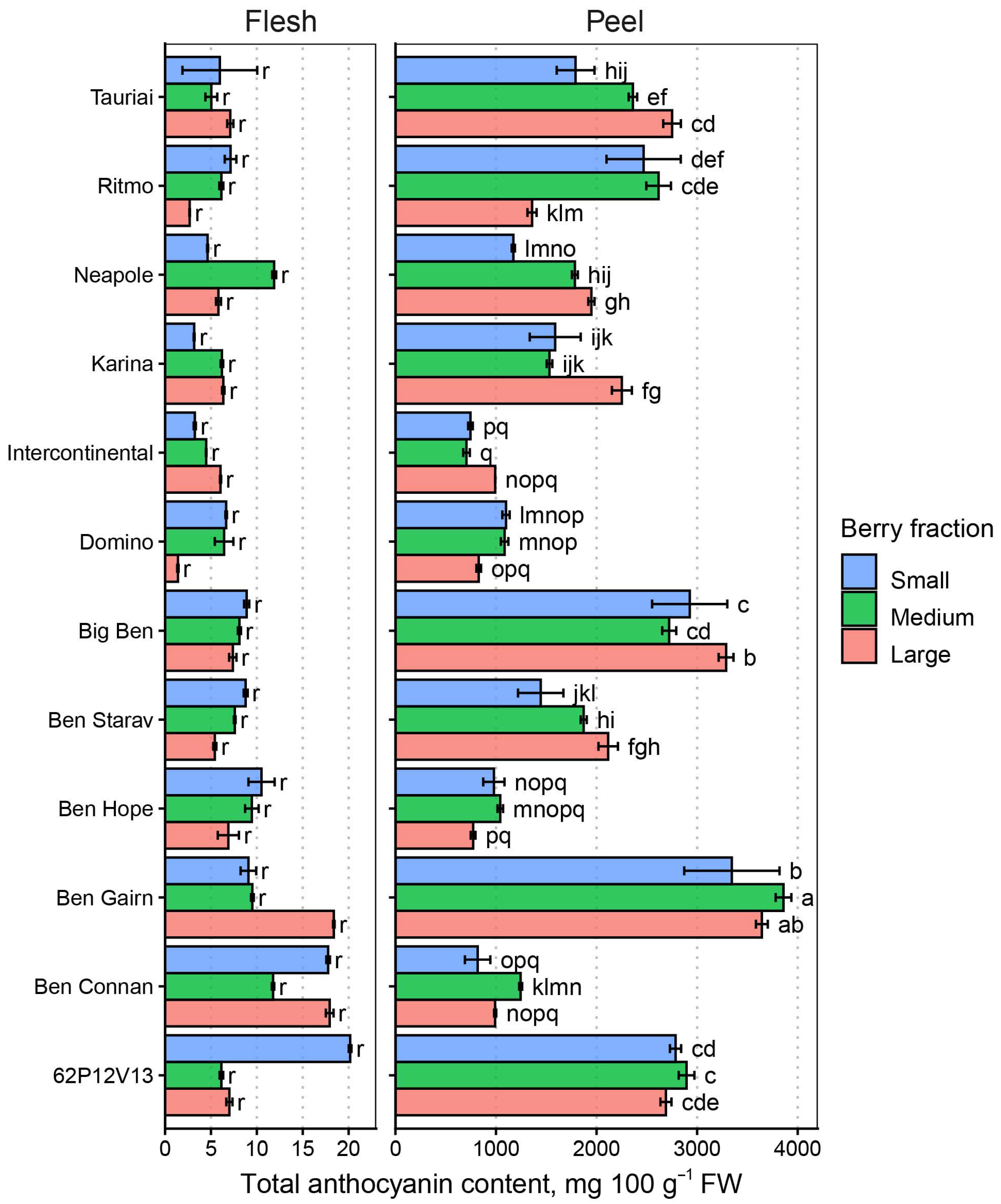
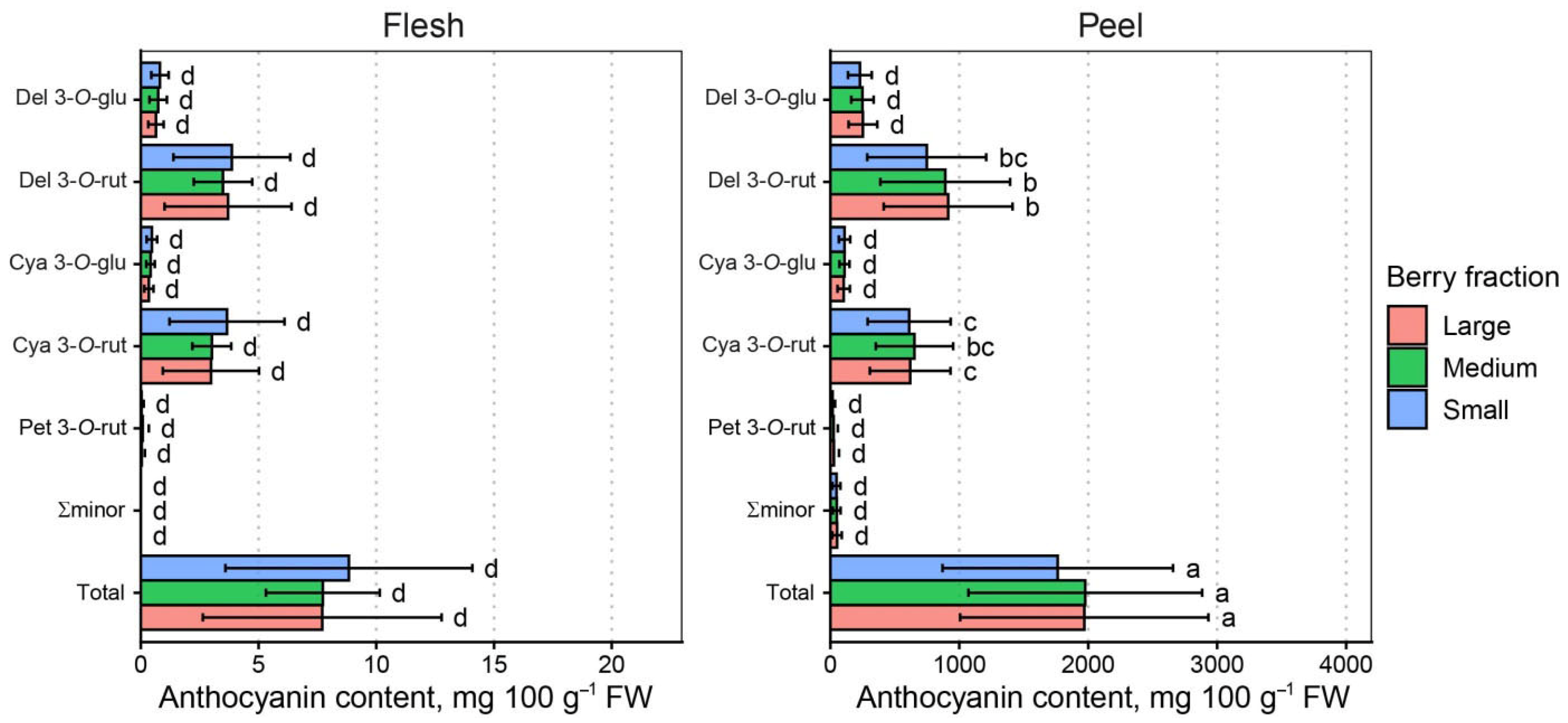
The anthocyanin composition of black currant berry peel demonstrates significant variation across cultivars and berry sizes, reflecting the complex interplay of genetic and morphological factors influencing bioactive compound distribution. As anticipated, flesh anthocyanin concentrations remained in the range of 1–3 mg 100 g−1 FW (Supplementary Materials), and were considered negligible, confirming the established knowledge that anthocyanins are predominantly localized in black currant peel tissues [48], although their profile in the tissues is similar. This distribution pattern underscores the critical need to optimize peel tissue disruption and extraction conditions to maximize anthocyanin recovery.
The four major anthocyanins—del 3-O-glu, del 3-O-rut, cya 3-O-glu, and cya 3-O-rut—represented the primary peel anthocyanins across all genotypes, except the cultivar ‘Neapole’, which also showed high concentrations of pet 3-O-rut (Supplementary Materials), similar to concentrations in whole berries. ‘Ben Gairn’ exhibited the highest total anthocyanin content (3345–3859 mg 100 g−1 FW), followed by ‘62P12V13’ (2690–2895 mg 100 g−1 FW) and ‘Neapole’ (1173–1949 mg 100 g−1 FW), demonstrating substantial genetic variation among cultivars.
Genotype and berry fraction were the most significant factors affecting anthocyanin content, as identified by MANCOVA, and there was significant interaction between them. Berry size was not a significant variable in several anthocyanin contents, for which fraction and berry size interaction was not significant, although genotype and berry size had a significant interaction for all anthocyanins (Table 5).
There were no statistically significant differences between the total anthocyanin content in different size berry flesh, while anthocyanin content in the peel could be higher, lower, or similar in the peel, depending on berry size (Figure 6). In 7 of 12 genotypes, total anthocyanins were more abundant in the peel of larger fruits, compared to small berries. Since the content is provided for fresh mass, it can be affected by moisture content, which is typically higher in larger, riper berries. There was one significant exception, ‘Ritmo’, which had much lower anthocyanin content in the peel of large berries. This may be the result of higher moisture content in the peel, but the parameter was not tested during the study. However, berry mass and diameter correlated strongly in ‘Ritmo’, as they did in all other investigated genotypes. Within the study, ‘Ritmo’ had the highest proportion of large berries (and had the largest berries), but the peel proportion saw little difference between berry size fractions. In other genotypes, such as ‘Tauriai’, ‘Neapole’, and ‘Ben Starav’, total anthocyanin content was somewhat proportional to berry size (lowest in small berry peels, highest in large berry peels). This may be explained by individual berry ripeness, which can be related to both size and anthocyanin content. In comparison, the anthocyanin content is negligible in the flesh, and was not statistically significantly different.
Although MANCOVA identified statistically significant differences between berry fractions, they are not as distinct after multiple group comparison (Figure 7, Supplementary Materials)—berry size generally has a negligible effect on the anthocyanin content in the flesh and peel. There were statistically significant differences between anthocyanin contents in different genotype peels, but, as mentioned before, black currant genotypes are usually interspecific crosses, which causes differences in their anthocyanin profiles. The negligible differences between individual anthocyanin contents in different berry sizes and fractions support anthocyanin content being related to berry ripeness and moisture content, since significant differences are only apparent within genotype.

4. Conclusions

This study presents the shortest reported (10 min) procedure for quantifying eight black currant anthocyanins using a standard HPLC-DAD system using relatively low maximum backpressure of 14.3 MPa. The method was rigorously validated and subsequently applied to 12 black currant genotypes, incorporating multiple berry morphological traits in the evaluation, which demonstrates its suitability for high-throughput phenotyping and large-scale breeding applications. This standardized approach minimizes methodological variability while enabling efficient analysis of morphology-driven chemical traits across genotypes. Overall, smaller black currant berries tend to contain higher levels of anthocyanins than larger berries, while the morphological characteristics are closely related to the specific genotype. Anthocyanins are concentrated in black currant peel, and a higher peel proportion is related to a higher anthocyanin content. However, peel anthocyanin contents were either similar between different size berries, or their contents were higher in larger berry peels. Cryogenic grinding markedly improves anthocyanin yield and recovery from black currant, which reduces variability. However, significant differences between the results of the two independent cryogenic millings indicate that substantially larger sample volumes are needed to minimize sampling error and improve reproducibility.
Incorporating biological replication in future studies, rather than relying on pooled genotype-level samples, will allow for a more rigorous and precise characterization of the relationship between berry size and anthocyanin concentration.

Supplementary Materials

The following supporting information can be downloaded at: https://www.mdpi.com/article/10.3390/agriculture16030331/s1.

Author Contributions

I.M. (Ieva Miķelsone): Resources, Formal analysis, Investigation, Writing—original draft, Writing—review and editing, Visualization; I.M. (Inga Mišina): Resources, Formal analysis; E.B.: Resources, Formal analysis; E.S.: Resources, Formal analysis, Data curation, Investigation; D.L.: Investigation, Writing—original draft, Writing—review and editing, Software, Visualization; G.S.: Resources, Formal analysis, Data curation; S.S.: Data curation, Supervision; P.G.: Conceptualization, Methodology, Validation, Investigation, Writing—original draft, Writing—review and editing, Visualization, Supervision. All authors have read and agreed to the published version of the manuscript.

Funding

This research was funded by the horticultural plant breeding program for the development of breeding material to promote the introduction of conventional, integrated, and organic growing technologies, 2025, No. 10.9.1-11/25/1191-e.

Institutional Review Board Statement

Not applicable.

Informed Consent Statement

Not applicable.

Data Availability Statement

The original contributions presented in this study are included in the article/Supplementary Materials. Further inquiries can be directed to the corresponding author.

Acknowledgments

Thanks go to the Latvian Ministry of Agriculture for project funding.

Conflicts of Interest

The authors declare no conflicts of interest.

Abbreviations

Cya 3-O-(6″), cyanidin 3-O-(6″-coumaroyl)-glucoside; Cya-3-O-glu, cyanidin 3-O-glucoside; Cya-3-O-rut, cyanidin 3-O-rutinoside; CV, coefficient of variation; Del 3-O-(6″), delphinidin 3-O-(6″-coumaroyl)-glucoside; Del-3-O-glu, delphinidin 3-O-glucoside; Del-3-O-rut, delphinidin 3-O-rutinoside; FW, fresh weight; HRMS, high-resolution mass spectrometry; LOD, limit of detection; LOQ, limit of quantification; Pel 3-O-rut, pelargonidin 3-O-rutinoside; Peo 3-O-rut, peonidin 3-O-rutinoside; Pet 3-O-rut, petunidin 3-O-rutinoside; S/N, signal-to-noise ratio; Rs, resolution; RSD, relative standard deviation; RT, retention time; SPP, superficially porous particles; UA6, 9, 10, unknown anthocyanin.

References

  1. Tian, Y.; Laaksonen, O.; Haikonen, H.; Vanag, A.; Ejaz, H.; Linderborg, K.; Karhu, S.; Yang, B. Compositional diversity among blackcurrant (Ribes nigrum) cultivars originating from European countries. J. Agric. Food Chem. 2019, 67, 5621–5633. [Google Scholar] [CrossRef] [PubMed]
  2. FAOSTAT. FAO Statistical Database. Available online: http://www.fao.org (accessed on 11 November 2025).
  3. Masny, A.; Pluta, S.; Seliga, Ł. Breeding value of selected blackcurrant (Ribes nigrum L.) genotypes for early-age fruit yield and its quality. Euphytica 2018, 214, 89. [Google Scholar] [CrossRef]
  4. Amini, A.M.; Zhou, R.; Austermann, K.; Králová, D.; Serra, G.; Ibrahim, I.S.; Corona, G.; Bergillos-Meca, T.; Aboufarrag, H.; Kroon, P.A. Acute effects of an anthocyanin-rich blackcurrant beverage on markers of cardiovascular disease risk in healthy adults: A randomized, double-blind, placebo-controlled, crossover trial. J. Nutr. 2025, 155, 2275–2289. [Google Scholar] [CrossRef]
  5. Castro-Acosta, M.L.; Smith, L.; Miller, R.J.; McCarthy, D.I.; Farrimond, J.A.; Hall, W.L. Drinks containing anthocyanin-rich blackcurrant extract decrease postprandial blood glucose, insulin and incretin concentrations. J. Nutr. Biochem. 2016, 38, 154–161. [Google Scholar] [CrossRef]
  6. Lomiwes, D.; Kanon, A.P.; Walker, E.G.; Ngametua, N.; Cooney, J.M.; Jensen, D.A.; Hedderley, D.; Lo, K. A blackcurrant powder supplement enriched with L-theanine and pine bark extract improves sleep quality in healthy older adults: Results from placebo controlled crossover study. J. Funct. Foods 2025, 127, 106768. [Google Scholar] [CrossRef]
  7. Ali Redha, A.; Anusha Siddiqui, S.; Zare, R.; Spadaccini, D.; Guazzotti, S.; Feng, X.; Bahmid, N.A.; Wu, Y.S.; Ozeer, F.Z.; Aluko, R.E. Blackcurrants: A nutrient-rich source for the development of functional foods for improved athletic performance. Food Rev. Int. 2024, 40, 135–157. [Google Scholar] [CrossRef]
  8. Moročko-Bičevska, I.; Stalažs, A.; Lācis, G.; Laugale, V.; Baļķe, I.; Zuļģe, N.; Strautiņa, S. Cecidophyopsis mites and blackcurrant reversion virus on Ribes hosts: Current scientific progress and knowledge gaps. Ann. Appl. Biol. 2022, 180, 26–43. [Google Scholar] [CrossRef]
  9. Nour, V.; Stampar, F.; Veberic, R.; Jakopic, J. Anthocyanins profile, total phenolics and antioxidant activity of black currant ethanolic extracts as influenced by genotype and ethanol concentration. Food Chem. 2013, 141, 961–966. [Google Scholar] [CrossRef]
  10. Šimerdová, B.; Bobríková, M.; Lhotská, I.; Kaplan, J.; Křenová, A.; Šatínský, D. Evaluation of anthocyanin profiles in various blackcurrant cultivars over a three-year period using a fast HPLC-DAD method. Foods 2021, 10, 1745. [Google Scholar] [CrossRef] [PubMed]
  11. Wu, X.; Gu, L.; Prior, R.L.; McKay, S. Characterization of anthocyanins and proanthocyanidins in some cultivars of Ribes, Aronia, and Sambucus and their antioxidant capacity. J. Agric. Food Chem. 2004, 52, 7846–7856. [Google Scholar] [CrossRef] [PubMed]
  12. Slimestad, R.; Solheim, H. Anthocyanins from black currants (Ribes nigrum L.). J. Agric. Food Chem. 2002, 50, 3228–3231. [Google Scholar] [CrossRef]
  13. Nawawi, N.I.M.; Khushairi, N.A.A.A.; Ijod, G.; Azman, E.M. Extraction of anthocyanins and other phenolics from dried blackcurrant (Ribes nigrum L.) pomace via ultrasonication. Sustain. Chem. Environ. 2025, 9, 100208. [Google Scholar] [CrossRef]
  14. Simkova, K.; Veberic, R.; Hudina, M.; Grohar, M.C.; Ivancic, T.; Smrke, T.; Pelacci, M.; Jakopic, J. Berry size and weight as factors influencing the chemical composition of strawberry fruit. J. Food Compos. Anal. 2023, 123, 105509. [Google Scholar] [CrossRef]
  15. Doi, K.; Inoue, R.; Iwasaki, N. Seed weight mediates effects of pollen on berry weight, ripening, and anthocyanin content in highbush blueberry. Sci. Hortic. 2021, 288, 110313. [Google Scholar] [CrossRef]
  16. Burin, T.; Grohar, M.C.; Jakopic, J.; Veberic, R.; Stajner, N.; Cesar, T.; Kunej, U.; Hudina, M. Changes in the anthocyanin pathway related to phenolic compounds and gene expression in skin and pulp of cv. ‘Istrska belica’ (Olea europaea L.) during ripening. J. Plant Physiol. 2024, 303, 154364. [Google Scholar] [CrossRef] [PubMed]
  17. Ponder, A.; Hallmann, E.; Kwolek, M.; Średnicka-Tober, D.; Kazimierczak, R. Genetic differentiation in anthocyanin content among berry fruits. Curr. Issues Mol. Biol. 2021, 43, 36–51. [Google Scholar] [CrossRef]
  18. Mikulic-Petkovsek, M.; Slatnar, A.; Schmitzer, V.; Stampar, F.; Veberic, R.; Koron, D. Chemical profile of black currant fruit modified by different degree of infection with black currant leaf spot. Sci. Hortic. 2013, 150, 399–409. [Google Scholar] [CrossRef]
  19. D’Evoli, L.; Tarozzi, A.; Hrelia, P.; Lucarini, M.; Cocchiola, M.; Gabrielli, P.; Franco, F.; Morroni, F.; Cantelli-Forti, G.; Lombardi-Boccia, G. Influence of cultivation system on bioactive molecules synthesis in strawberries: Spin-off on antioxidant and antiproliferative activity. J. Food Sci. 2010, 75, C94–C99. [Google Scholar] [CrossRef]
  20. Yan, W.; Li, J.; Lin, X.; Wang, L.; Yang, X.; Xia, X.; Zhang, Y.; Yang, S.; Li, H.; Deng, X. Changes in plant anthocyanin levels in response to abiotic stresses: A meta-analysis. Plant Biotechnol. Rep. 2022, 16, 497–508. [Google Scholar] [CrossRef]
  21. Rugienius, R.; Bendokas, V.; Siksnianas, T.; Stanys, V.; Sasnauskas, A.; Kazanaviciute, V. Characteristics of Fragaria vesca yield parameters and anthocyanin accumulation under water deficit stress. Plants 2021, 10, 557. [Google Scholar] [CrossRef]
  22. Milić, A.; Daničić, T.; Tepić Horecki, A.; Šumić, Z.; Teslić, N.; Bursać Kovačević, D.; Putnik, P.; Pavlić, B. Sustainable extractions for maximizing content of antioxidant phytochemicals from black and red currants. Foods 2022, 11, 325. [Google Scholar] [CrossRef]
  23. Rubinskiene, M.; Viskelis, P.; Jasutiene, I.; Viskeliene, R.; Bobinas, C. Impact of various factors on the composition and stability of black currant anthocyanins. Food Res. Int. 2005, 38, 867–871. [Google Scholar] [CrossRef]
  24. Cao, L.; Park, Y.; Lee, S.; Kim, D.-O. Extraction, identification, and health benefits of anthocyanins in blackcurrants (Ribes nigrum L.). Appl. Sci. 2021, 11, 1863. [Google Scholar] [CrossRef]
  25. Kruszewski, B.; Boselli, E. Blackcurrant pomace as a rich source of anthocyanins: Ultrasound-assisted extraction under different parameters. Appl. Sci. 2024, 14, 821. [Google Scholar] [CrossRef]
  26. Azman, E.M.; Nor, N.D.M.; Charalampopoulos, D.; Chatzifragkou, A. Effect of acidified water on phenolic profile and antioxidant activity of dried blackcurrant (Ribes nigrum L.) pomace extracts. LWT 2022, 154, 112733. [Google Scholar] [CrossRef]
  27. Khoo, G.M.; Clausen, M.R.; Pedersen, H.L.; Larsen, E. Bioactivity and chemical composition of blackcurrant (Ribes nigrum) cultivars with and without pesticide treatment. Food Chem. 2012, 132, 1214–1220. [Google Scholar] [CrossRef]
  28. Mattila, P.H.; Hellström, J.; Karhu, S.; Pihlava, J.-M.; Veteläinen, M. High variability in flavonoid contents and composition between different North-European currant (Ribes spp.) varieties. Food Chem. 2016, 204, 14–20. [Google Scholar] [CrossRef]
  29. Bordonaba, J.G.; Terry, L.A. Biochemical profiling and chemometric analysis of seventeen UK-grown black currant cultivars. J. Agric. Food Chem. 2008, 56, 7422–7430. [Google Scholar] [CrossRef]
  30. Kikas, A.; Rätsep, R.; Kaldmäe, H.; Aluvee, A.; Libek, A.-V. Comparison of polyphenols and anthocyanin content of different blackcurrant (Ribes nigrum L.) cultivars at the Polli Horticultural Research Centre in Estonia. Agron. Res. 2020, 18, 2715–2726. [Google Scholar]
  31. Repajić, M.; Zorić, M.; Magnabosca, I.; Pedisić, S.; Dragović-Uzelac, V.; Elez Garofulić, I. Bioactive power of black chokeberry pomace as affected by advanced extraction techniques and cryogrinding. Molecules 2025, 30, 3383. [Google Scholar] [CrossRef]
  32. Salleh, N.; Goh, K.K.; Sims, I.M.; Bell, T.J.; Huffman, L.M.; Weeks, M.; Matia-Merino, L. Characterization of anthocyanin-bound pectin-rich fraction extracted from New Zealand blackcurrant (Ribes nigrum) juice. ACS Food Sci. Technol. 2021, 1, 1130–1142. [Google Scholar] [CrossRef]
  33. Granato, D.; Fidelis, M.; Haapakoski, M.; dos Santos Lima, A.; Viil, J.; Hellström, J.; Rätsep, R.; Kaldmäe, H.; Bleive, U.; Azevedo, L. Enzyme-assisted extraction of anthocyanins and other phenolic compounds from blackcurrant (Ribes nigrum L.) press cake: From processing to bioactivities. Food Chem. 2022, 391, 133240. [Google Scholar] [CrossRef] [PubMed]
  34. Nielsen, I.L.F.; Haren, G.R.; Magnussen, E.L.; Dragsted, L.O.; Rasmussen, S.E. Quantification of anthocyanins in commercial black currant juices by simple high-performance liquid chromatography. Investigation of their pH stability and antioxidative potency. J. Agric. Food Chem. 2003, 51, 5861–5866. [Google Scholar] [CrossRef] [PubMed]
  35. Mišina, I.; Bondarenko, E.; Dukurs, K.; Miķelsone, I.; Sipeniece, E.; Lazdiņa, D.; Strautiņa, S.; Segliņa, D.; Perkons, I.; Górnaś, P. Anthocyanins in the berries of 123 Interspecific black currant crosses: A multi-analytical approach. Appl. Sci. 2026, 16, 114. [Google Scholar] [CrossRef]
  36. José Aliaño González, M.; Carrera, C.; Barbero, G.F.; Palma, M. A comparison study between ultrasound–assisted and enzyme–assisted extraction of anthocyanins from blackcurrant (Ribes nigrum L.). Food Chem. X 2022, 13, 100192. [Google Scholar] [CrossRef]
  37. Chen, X.; Parker, J.; Krueger, C.G.; Shanmuganayagam, D.; Reed, J.D. Validation of HPLC assay for the identification and quantification of anthocyanins in black currants. Anal. Methods 2014, 6, 8141–8147. [Google Scholar] [CrossRef]
  38. Bordonaba, J.G.; Crespo, P.; Terry, L.A. A new acetonitrile-free mobile phase for HPLC-DAD determination of individual anthocyanins in blackcurrant and strawberry fruits: A comparison and validation study. Food Chem. 2011, 129, 1265–1273. [Google Scholar] [CrossRef]
  39. Obón, J.M.; Díaz-García, M.C.; Castellar, M.R. Red fruit juice quality and authenticity control by HPLC. J. Food Compos. Anal. 2011, 24, 760–771. [Google Scholar] [CrossRef]
  40. Frøytlog, C.; Slimestad, R.; Andersen, Ø.M. Combination of chromatographic techniques for the preparative isolation of anthocyanins—Applied on blackcurrant (Ribes nigrum) fruits. J. Chromatogr. A 1998, 825, 89–95. [Google Scholar] [CrossRef]
  41. Gavrilova, V.; Kajdzanoska, M.; Gjamovski, V.; Stefova, M. Separation, characterization and quantification of phenolic compounds in blueberries and red and black currants by HPLC−DAD−ESI-MSn. J. Agric. Food Chem. 2011, 59, 4009–4018. [Google Scholar] [CrossRef]
  42. Gacnik, S.; Veberic, R.; Hudina, M.; Mikulic-Petkovsek, M. Changes in chemical composition of red and black currant fruits and leaves during berry ripening. Int. J. Fruit Sci. 2024, 24, 73–84. [Google Scholar] [CrossRef]
  43. Roby, G.; Harbertson, J.F.; Adams, D.A.; Matthews, M.A. Berry size and vine water deficits as factors in winegrape composition: Anthocyanins and tannins. Aust. J. Grape Wine Res. 2004, 10, 100–107. [Google Scholar] [CrossRef]
  44. Sønsteby, A.; Roos, U.M.; Heide, O.M. Influence of controlled nutrient feeding during floral initiation and berry development on shoot growth, flowering and berry yield and quality in black currant (Ribes nigrum L.). Sci. Hortic. 2017, 225, 638–645. [Google Scholar] [CrossRef]
  45. Rachtan-Janicka, J.; Ponder, A.; Hallmann, E. The effect of organic and conventional cultivations on antioxidants content in blackcurrant (Ribes nigrum L.) species. Appl. Sci. 2021, 11, 5113. [Google Scholar] [CrossRef]
  46. Pott, D.M.; Durán-Soria, S.; Allwood, J.W.; Pont, S.; Gordon, S.L.; Jennings, N.; Austin, C.; Stewart, D.; Brennan, R.M.; Masny, A. Dissecting the impact of environment, season and genotype on blackcurrant fruit quality traits. Food Chem. 2023, 402, 134360. [Google Scholar] [CrossRef]
  47. Jiang, Y.; Qi, Z.; Li, J.; Gao, J.; Xie, Y.; Henry, C.J.; Zhou, W. Role of superfine grinding in purple-whole-wheat flour. Part I: Impacts of size reduction on anthocyanin profile, physicochemical and antioxidant properties. LWT 2024, 197, 115940. [Google Scholar] [CrossRef]
  48. Pocevičienė, I.; Jūrienė, L.; Pukalskienė, M.; Baranauskienė, R.; Venskutonis, P.R. Supercritical CO2 separation of lipids from mechanically pre-fractionated black currant pomace: Chemical composition, bioactivities and application perspectives. Sep. Purif. Technol. 2025, 373, 133641. [Google Scholar] [CrossRef]
Figure 1. Chromatograms (520 nm) showing anthocyanin resolution from small, medium, and large berry fractions of black currant cv. ‘Ben Gairn’ extract, obtained under optimized conditions on a Kinetex C18 column. Peaks: A1, del 3-O-glu; A2, del 3-O-rut; A3, cya 3-O-glu; A4, cya 3-O-rut; A5, pet 3-O-rut; A6, UA6 (unknown anthocyanin); A7, pel 3-O-rut; A8, peo 3-O-rut; A9, UA9 (unknown anthocyanin); A10, UA10 (unknown anthocyanin); A11, del 3-O-(6″); and A12, cya 3-O-(6″).
Agriculture 16 00331 g001
Figure 2. Berry size ratio (% of total berry mass) for 12 black currant genotypes.
Agriculture 16 00331 g002
Figure 3. The anthocyanin content (mg 100 g−1 FW) across the analyzed 12 black currant genotypes in the cryogenically processed subset. Data are presented as mean value ± standard deviation (n = 18, 6 small, 6 medium, 6 large). Letters denote statistically homogenous groups according to the Tukey HSD test.
Agriculture 16 00331 g003
Figure 4. Anthocyanin content differences in berry fractions in the cryogenically processed subset. Data are presented as means ± standard deviation. Letters denote statistically homogenous groups.
Agriculture 16 00331 g004
Figure 5. Effect of disintegration method on anthocyanin content (mg 100 g−1 FW) in the extract. Data are presented as means ± standard deviation. Letters denote statistically homogenous groups (p < 0.05).
Agriculture 16 00331 g005
Figure 6. Statistically significant differences between anthocyanin content in the flesh and peel of different genotype black currants. Letters denote statistically homogenous groups (p < 0.05).
Agriculture 16 00331 g006
Figure 7. Statistical significance of differences between peel and flesh anthocyanin content across berry size categories. Values shown as mean ± SD; letters indicate statistically homogenous groups.
Agriculture 16 00331 g007
Table 1. Examples of HPLC separation methods for the anthocyanins detection in black currants found in the literature (2002–2026).
No. Ant.Column Type and TemperatureMobile Phases and FlowGradientRun TimeLOQ, mg L−1YearRef.
12SPP Kinetex C18 (250 × 4.6 mm, 5 μm), 50 °C4% FA in water (A) and methanol (B), 1.0 mL min−10–4 min, 15–40% B; 4–5 min, 40–80% B; 5–6 min, 80% B; 6–7 min, 80–15% B; 7–11 min, 15% B11 min0.8442026[35]
4FPP Purosphere STAR RP18 (250 × 4.6 mm, 5 µm), 35 °C2% FA in water (A) and methanol (B), 1.0 mL min−10–15 min, 15–35 % B; 15–30 min, 35–60% B; 30–40 min, 60–80% B45 min + ET210.02025[13]
8SPP Ascentis Express C18 (150 × 4.6 mm, 2.7 μm), 50 °C2% FA in water (A) and methanol (B), 0.8 mL min−10–4 min, 5–20% B; 4–8 min, 20–25% B; 8–10 min, 25–90% B, 10–10.15 min, 90% B; 10.15–10.3 min, 90–5% B, 10.3–13 min, 5% B13 minNP2021[10]
6FPP Zorbax SB C18 (150 × 4.6 mm, 5 μm), NP5% FA in water (A) and methanol (B), 1.0 mL min−10–5 min 5% B; 5–45 min, 5–50% B50 min + ET2.9682014[37]
9FPP Gemini C18 (150 × 4.6 mm, 3 μm), 25 °C1% FA with 5% acetonitrile in water (A) and 100% acetonitrile (B), 1.0 mL min−10–5 min, 3–9% B; 5–15 min, 9–16% B; 15–45 min, 16–50% B; 45–50 min, 50% B50 min + ETNP2013[9]
8FPP Zorbax Eclipse XDB-C18 (250 mm × 4.6 mm, 5 μm), 35 °C2% AA in water (A) and 2% TFA in methanol (B), 1.0 mL min−10–10 min, 2–20% B; 10–20 min, 20–25% B; 20–25 min, 25–35% B; 25–35 min, 35–75% B35 min + ET0.8232011[38]
8FPP Zorbax SB-C18, (150 × 4.6 mm, 5 μm), 40 °C10% FA in water (A) and acetonitrile (B), 1.0 mL min−10–0.5 min, 1% B; 0.5–1 min, 1–7% B; 1–4 min, 7% B; 4–9.5 min, 7–14% B; 9.5–10.5 min, 14–100% B; 10.5–13 min, 100% B13 min + ET 5 min0.0602003[34]
15FPP Hypersil ODS (125 × 3 mm, 3 μm), 20 °C0.05% TFA in water (A) and 0.05% TFA in acetonitrile (B), 0.4 mL min−10–10 min, 20–35% B; 10–18 min, 35–55% B, 18–20 min, 55% B; 20–22 min, 55–80% B; 22–24 min, 80–20% B25 minNP2002[12]
AA—acetic acid; ET—equilibration time; FA—formic acid; FPP—fully porous particle; LOQ—limit of quantification; No. Ant.—number of separated anthocyanins; NP—not provided; SPP—superficially porous particle; TFA—trifluoroacetic acid; Year—year of publishing.
Table 2. Retention time of separated four anthocyanins (del 3-O-glu, del 3-O-rut, cya 3-O-glu, and cya 3-O-rut), linearity, limit of detection (LOD), limits of quantification (LOQ), and resolution of the developed method employing the Kinetex C18 column.
Anthocyanins
Del 3-O-gluDel 3-O-rutCya 3-O-gluCya 3-O-rut
Linear range, ng0.11–57.210.14–68.210.16–81.730.17–84.38
Standard solutions [R2]0.99990.99990.99990.9999
Slope and y-intercept *y = 3187.83x − 176.81y = 2248.48x + 35.41y = 3262.64x + 175.97y = 2413.06x + 44.21
LOD, ng0.1090.1420.0980.126
LOQ, ng0.3590.4670.3220.415
Retention time, min5.12 ± 0.015.27 ± 0.015.54 ± 0.015.70 ± 0.01
Resolution1.793.231.89
* x—concentration (ng); y—peak area (mV).
Table 3. Average diameter, peel proportion, and four main and total anthocyanin content (mg 100 g−1 FW) of different berry sizes of 12 black currant genotype berries of different sizes obtained with applied cryogenic processing.
CultivarBerry SizeAverage Diameter, mmPeel Proportion, %Anthocyanins, mg 100 g−1 FW
Del 3-O-gluDel 3-O-rutCya 3-O-gluCya 3-O-rutTotal
DominoSmall8.64578 ± 2173 ± 646 ± 1180 ± 6487 ± 14
Medium11.53360 ± 8156 ± 2334 ± 4147 ± 21405 ± 58
Large13.22952 ± 1145 ± 227 ± 1123 ± 2354 ± 5
IntercontinentalSmall8.65592 ± 3114 ± 452 ± 2122 ± 5389 ± 14
Medium10.24990 ± 4132 ± 743 ± 2121 ± 6396 ± 20
Large11.43174 ± 9126 ± 1634 ± 5107 ± 16349 ± 46
NeapoleSmall6.57488 ± 4272 ± 923 ± 1186 ± 7612 ± 22
Medium8.22685 ± 3270 ± 922 ± 1175 ± 5595 ± 18
Large9.92076 ± 2250 ± 918 ± 1152 ± 6540 ± 19
62P12V13Small8.22036 ± 2214 ± 1421 ± 1195 ± 11474 ± 28
Medium12.01434 ± 2195 ± 1018 ± 1158 ± 9411 ± 22
Large14.11327 ± 3169 ± 1514 ± 2125 ± 12342 ± 32
TauriaiSmall7.82362 ± 4142 ± 533 ± 2160 ± 7413 ± 18
Medium11.61869 ± 4153 ± 1138 ± 2171 ± 9450 ± 28
Large13.81252 ± 3124 ± 531 ± 1138 ± 4360 ± 15
KarinaSmall8.61531 ± 1151 ± 214 ± 1104 ± 1307 ± 4
Medium10.91628 ± 1147 ± 212 ± 190 ± 2283 ± 4
Large13.61226 ± 1142 ± 210 ± 182 ± 1266 ± 5
Ben ConnanSmall7.83642 ± 1160 ± 317 ± 1122 ± 2349 ± 6
Medium10.12438 ± 1142 ± 315 ± 1105 ± 2309 ± 6
Large12.02429 ± 1114 ± 313 ± 189 ± 2252 ± 6
RitmoSmall9.51640 ± 1173 ± 324 ± 1138 ± 3380 ± 8
Medium12.11230 ± 1134 ± 517 ± 1101 ± 3287 ± 10
Large15.81123 ± 295 ± 1012 ± 166 ± 6200 ± 20
Ben GairnSmall7.51788 ± 4372 ± 629 ± 1223 ± 4725 ± 15
Medium9.81470 ± 1315 ± 624 ± 1187 ± 4607 ± 12
Large12.01355 ± 2254 ± 1519 ± 1150 ± 8488 ± 27
Ben StaravSmall7.62950 ± 2222 ± 321 ± 1160 ± 3459 ± 8
Medium10.62455 ± 4223 ± 2124 ± 2160 ± 14471 ± 42
Large11.71654 ± 1213 ± 322 ± 1144 ± 3441 ± 7
Big BenSmall8.71459 ± 1226 ± 525 ± 1153 ± 3483 ± 11
Medium11.21354 ± 6208 ± 2323 ± 2140 ± 13445 ± 47
Large14.7840 ± 1160 ± 415 ± 197 ± 2328 ± 7
Ben HopeSmall8.82134 ± 184 ± 216 ± 179 ± 2220 ± 5
Medium11.21732 ± 176 ± 214 ± 164 ± 1190 ± 4
Large12.52329 ± 166 ± 112 ± 152 ± 1164 ± 3
Results are presented as mean value ± standard deviation (n = 6).
Table 4. MANCOVA p-values for anthocyanin contents of the whole dataset, of differently disintegrated berries, as well as different genotypes, berry sizes, and variable interaction.
AnthocyaninTreatmentGenotypeBerry SizeTreatment ×
Genotype
Treatment ×
Berry Size
Genotype ×
Berry Size
Treatment ×
Genotype ×
Berry Size
Del 3-O-glu************0.016******
Del 3-O-rut************0.300******
Cya 3-O-glu************0.032******
Cya 3-O-rut************0.110******
Pet 3-O-rut******0.021***0.2700.0400.003
UA6************0.068***0.003
Pel 3-O-rut************0.002******
Peo 3-O-rut************0.004******
UA9*********0.0250.411******
UA10************0.101***0.004
Del 3-O-(6″)************0.173******
Cya 3-O-(6″)************0.074******
Σminor************0.020******
Total************0.135******
***, p-value is less than 0.001. Effect of variable was considered significant at p < 0.05. UA6, UA9, and UA10—unknown anthocyanins.
Table 5. MANCOVA p-values for flesh and peel anthocyanin content.
AnthocyaninGenotypeFractionBerry SizeGenotype × FractionGenotype × Berry SizeFraction × Berry SizeGenotype × Fraction × Berry Size
Del 3-O-glu*********************
Del 3-O-rut*********************
Cya 3-O-glu*********************
Cya 3-O-rut******0.006******0.005***
Pet 3-O-rut*********************
UA6******0.491******0.491***
Pel 3-O-rut******0.624******0.624***
Peo 3-O-rut*********************
UA9******0.027******0.027***
UA10*********************
Del 3-O-(6″)*********************
Cya 3-O-(6″)******0.042******0.042***
Σminor*********************
Total*********************
***, p-value is less than 0.001. Effect of variable was considered significant at p < 0.05.
Disclaimer/Publisher’s Note: The statements, opinions and data contained in all publications are solely those of the individual author(s) and contributor(s) and not of MDPI and/or the editor(s). MDPI and/or the editor(s) disclaim responsibility for any injury to people or property resulting from any ideas, methods, instructions or products referred to in the content.