Article

Remote Sensing-Based Attribution of Crop Water Requirements Dynamics in the Tailan River Irrigation District, 2000–2024

1
College of Hydraulic and Civil Engineering, Xinjiang Agricultural University, Urumqi 830052, China
2
Xinjiang Key Laboratory of Hydraulic Engineering Security and Water Disasters Prevention, Urumqi 830052, China
3
Key Laboratory of Agricultural Soil and Water Engineering in Arid and Semiarid Areas, Ministry of Education, Northwest A&F University, Yangling 712100, China
*
Author to whom correspondence should be addressed.
Agriculture 2026, 16(3), 332; https://doi.org/10.3390/agriculture16030332
Submission received: 4 January 2026 / Revised: 20 January 2026 / Accepted: 26 January 2026 / Published: 29 January 2026
(This article belongs to the Section Artificial Intelligence and Digital Agriculture)

Abstract

Assessment of crop water requirements (ETc) and their meteorological driving mechanisms are critical for irrigation management in arid inland river basins. Taking the Tailan River Irrigation District (Xinjiang, China) as a case study, temporal changes in cropping structure, crop-specific ETc, and irrigation-district–scale agricultural water demand, as well as the meteorological controls on ETc, were quantified for the period 2000–2024 using Google Earth Engine-based crop mapping, the CROPWAT model, and path analysis. The results demonstrated that the 2024 random forest classification model achieved high accuracy (overall accuracy = 0.902; Kappa = 0.876), and validation against statistical yearbook data confirmed the reliability of crop-area estimation. Cotton dominated the cropping structure (228.6–426.0 km2), while the orchard area expanded markedly from 206.5 km2 in 2000 to 393.2 km2 in 2024; wheat exhibited strong interannual variability, and maize occupied a relatively small area. Crop-specific ETc differed markedly among crop types, following the order orchard > cotton > maize > wheat, with orchards maintaining the highest water requirement across all growth stages. Total agricultural water demand, estimated by integrating crop-specific ETc with remotely sensed planting areas, increased from approximately 260 million m3 to over 500 million m3 after 2010, mainly due to orchard expansion and cotton cultivation. Path analysis indicated that interannual ETc variability exhibited a stronger statistical association with wind speed than with other meteorological variables. These results provide a quantitative basis for cropping-structure optimization and water-saving irrigation management under changing climatic conditions.

1. Introduction

Under climate change and increasing agricultural intensification [1], irrigated agriculture in arid and semi-arid regions has become one of the most water-consuming and climate-sensitive land-use systems. In inland river basins of arid Northwest China, where precipitation is scarce and evapotranspiration dominates the water balance [2,3], irrigation districts represent critical management units in which crop composition, cultivated area, and climatic variability jointly determine agricultural water demand [4,5]. Quantifying crop water requirements (ETc) and clarifying their climatic driving mechanisms are therefore critical for irrigation optimization and sustainable water-resource management [6].
Conventional crop monitoring and water-demand assessments rely mainly on field surveys, agricultural statistics [7], and in situ observations such as lysimeters and eddy-covariance measurements [8]. Although accurate at local scales, these approaches are difficult to upscale to heterogeneous irrigation districts where cropping patterns vary spatially and temporally. Spatially explicit information on crop distribution has therefore become a prerequisite for regional ETc estimation, motivating the increasing use of remote sensing in agricultural water studies [9]. However, single-sensor observations are constrained by inherent trade-offs between spatial and temporal resolution [10,11]. MODIS provides high temporal frequency but coarse spatial detail [12,13,14], whereas Landsat and Sentinel-2 offer finer spatial resolution but are limited by revisit cycles and cloud contamination [15,16]. These constraints directly affect the reliability of crop-area mapping, and consequently the accuracy of irrigation water-demand assessment.
To overcome such limitations, multi-sensor fusion and harmonized products have been developed to support consistent crop classification and phenological analysis at the regional scale [17,18]. Crop classification accuracy, however, directly influences ETc estimation by determining the area-weighted contribution of different crops to total irrigation demand, and thus depends on feature construction, algorithm selection, and data-processing efficiency [19]. Spectral bands, texture metrics, and vegetation indices such as NDVI and EVI are commonly used to characterize crop growth dynamics [20,21,22,23]. Among machine-learning methods, Random Forest has been widely applied due to its robustness and efficiency [24,25,26], while cloud-computing platforms such as Google Earth Engine enable efficient processing of long-term, multi-source satellite data for irrigation districts [27,28,29,30,31].
Crop water requirement (ETc) is a key indicator linking crop distribution to agricultural water use [32,33,34]. Existing ETc estimation approaches include empirical methods, physically based energy-balance models, and process-oriented crop models such as the FAO-56 Penman–Monteith framework and CROPWAT [35,36]. Despite these advances, two gaps remain at the irrigation-district scale. First, crop classification and ETc estimation are often conducted independently, limiting understanding of how spatiotemporal changes in cropping structure translate into variations in irrigation water demand. Second, although the influence of meteorological conditions on ETc is well recognized, quantitative attribution of interrelated climatic variables remains limited, particularly in terms of separating their contributions under a predefined causal structure [37]. Simple correlation analysis cannot address this problem.
Path analysis is a multivariate statistical method that partitions associations among variables into direct and indirect effects based on an a priori causal model [38]. When applied with clearly defined assumptions, it allows for quantitative evaluation of the relative contributions of correlated meteorological variables to ETc, without implying the discovery of causal mechanisms. This makes it suitable for irrigation-district–scale analyses where climatic variables are strongly interdependent.
Accordingly, this study was conducted in the Tailan River Irrigation District, Xinjiang, a typical inland arid irrigation system characterized by scarce precipitation and high evaporative demand. Based on the identified gaps, we propose the following testable hypotheses: (i) At the irrigation-district scale, spatiotemporal changes in crop planting structure affect total ETc primarily through area-weighted differences in crop-specific water requirements under given climatic conditions; (ii) The influences of meteorological variables (e.g., temperature, radiation, humidity, and wind speed) on ETc can be quantitatively partitioned into direct and indirect effects within a predefined causal framework using path analysis. Specifically, long—term Landsat and MODIS imagery were processed on the Google Earth Engine platform to derive crop—distribution dynamics. ETc was estimated using the CROPWAT model, and the predefined relationships among meteorological variables and ETc were evaluated using path analysis. The objectives are to characterize spatiotemporal crop—pattern dynamics, quantify crop-specific ETc variations, and assess the relative contributions of climatic drivers within an explicit analytical framework. This approach supports irrigation optimization and climate-adaptive water management in arid irrigation districts.

2. Materials and Methods

2.1. Overview of the Study Area

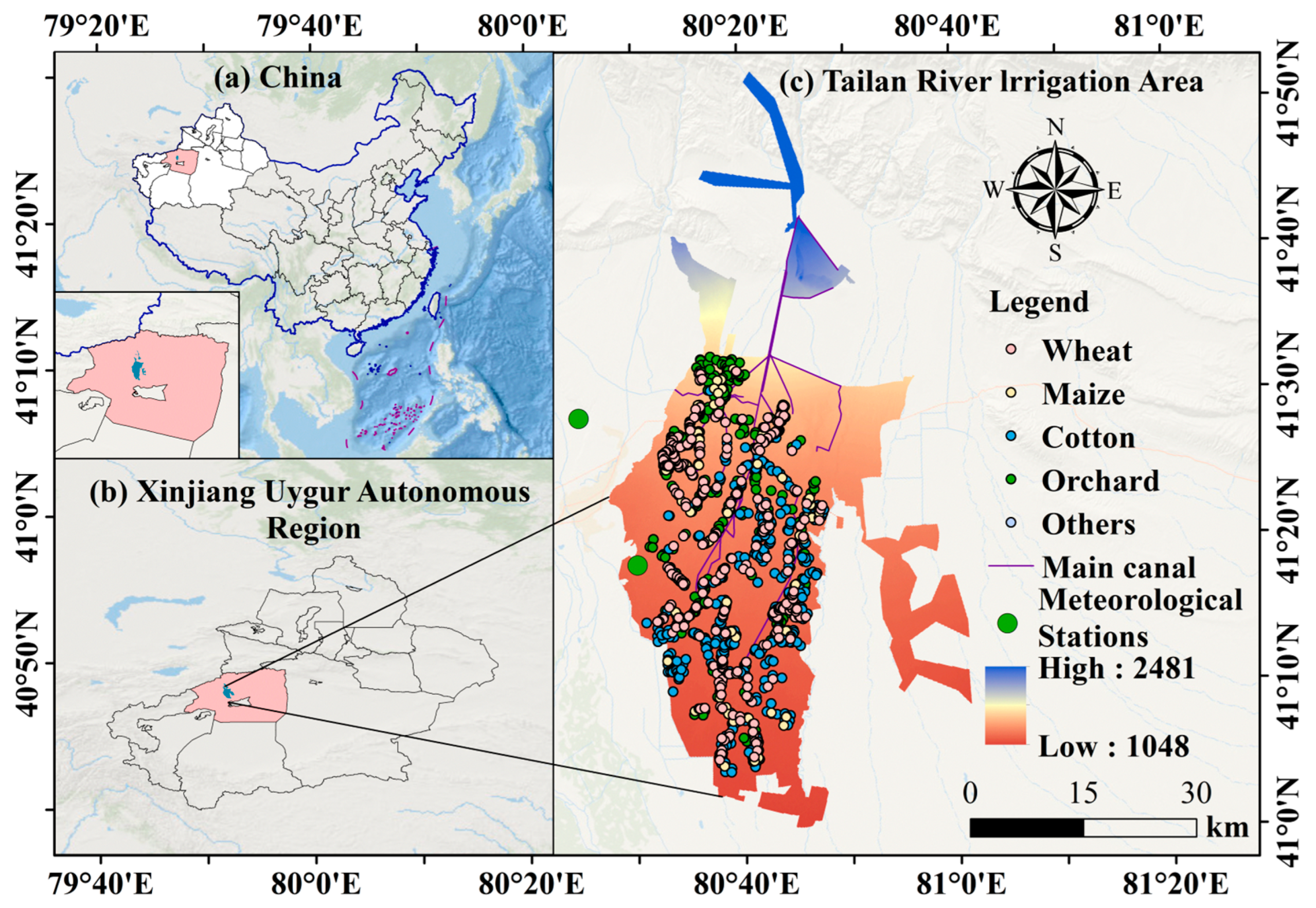
The Tailan River Irrigation District is located in Wensu County, Aksu Prefecture, Xinjiang, China (80°21′–81°10′ E, 40°42′–42°15′ N, Figure 1) [39]. The irrigation district comprises two townships and three towns (Yixilaimuqi Township, Guleawati Township, Jiamu Town, Gongqingtuan Town, and Kezile Town), with a total area of 5145.93 km2. The region has a temperate continental arid climate, with a mean annual temperature of 11.5 °C, mean annual precipitation of 73–110 mm, and potential evapotranspiration exceeding 1600 mm. Elevation ranges from 1050 m to 1300 m. Irrigation water is mainly supplied by the Tailan River originating from the southern slope of the Tianshan Mountains, supplemented by canal networks and reservoirs. The dominant crops include wheat, maize, cotton, and orchard crops, forming a mixed agricultural system typical of oasis irrigation regions in northwest China.

2.2. Data Sources and Preprocessing

2.2.1. Remote Sensing Image Data

This study used Landsat 5 TM, Landsat 7 ETM+, and Landsat 8 OLI/TIRS (https://earthexplorer.usgs.gov/) surface reflectance products from their respective operational periods between 2000 and 2024, complemented by MODIS (https://ladsweb.modaps.eosdis.nasa.gov/) MOD13Q1 NDVI (250 m, 16-day composite) to enhance temporal continuity. Specifically, Landsat 5 TM data were used for the period 2000–2011, Landsat 7 ETM+ for 2000–2024 (excluding scan-line corrector gaps after 2003 where applicable), and Landsat 8 OLI/TIRS for 2013–2024. In years with overlapping observations from multiple sensors, Landsat 8 OLI/TIRS was prioritized, followed by Landsat 7 ETM+ and Landsat 5 TM, to ensure radiometric consistency.
Landsat imagery was used for annual crop mapping due to its 30 m spatial detail, while MOD13Q1 was used only as a temporal reference to constrain and stabilize NDVI temporal profiles during periods affected by cloud contamination and Landsat 7 SLC failure. MODIS data were not directly used as classification inputs, nor were 250 m pixels resampled to 30 m for crop labeling. Their role was limited to guiding temporal smoothing and gap-filling of Landsat-derived NDVI curves, thereby minimizing mixed-pixel contamination in the classification stage. Although Landsat surface reflectance products are commonly referred to as 30 m data, it should be noted that thermal bands have coarser native resolutions (60–120 m depending on the sensor) and were not used in NDVI or crop classification features. All spectral features used for classification were derived from bands with 30 m spatial resolution. The satellite sensors and spectral band characteristics used in this study are summarized in Table 1.
All image processing was implemented in Google Earth Engine (GEE). Preprocessing included atmospheric correction (LEDAPS/LaSRC for Landsat SR), cloud and shadow masking (CFMask/QA-based masking), BRDF normalization, mosaicking, and annual compositing.

2.2.2. Meteorological Data

Meteorological variables used in this study include temperature (T), precipitation (Pre), relative humidity (RH), wind speed (V), and sunshine hours (S). All meteorological variables were obtained from the National Earth System Science Data Center (NESSDC), China (https://www.geodata.cn/) [40]. These datasets are provided as spatially continuous gridded products generated through the integration of station observations and interpolation algorithms, ensuring spatial completeness across the study region. For this study, gridded meteorological data covering the period 2000–2024 were extracted and spatially averaged over the Tailan River Irrigation District to derive area-representative climatic inputs for crop water requirement (ETc) estimation using the CROPWAT model.

2.2.3. Sample Data

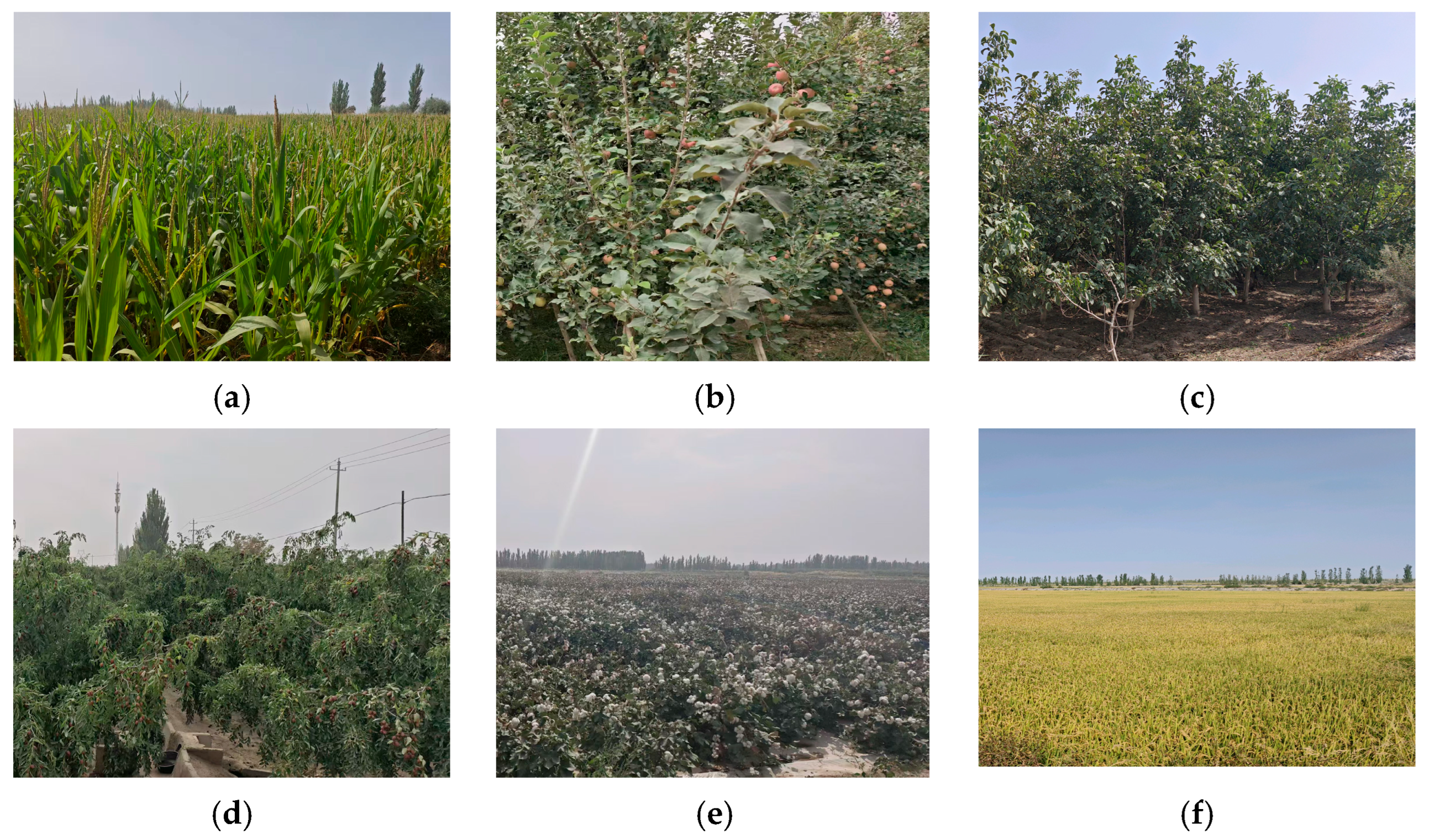
Crop sample points were interpreted from sub-meter historical imagery in Google Earth and supplemented by field surveys conducted in September 2024 and May 2025. A total of 1,350 samples were collected, including wheat (271), maize (103), cotton (363), orchard (388), and other land-cover types (225). Samples were randomly split into training (70%) and validation (30%) subsets. To reduce spatial autocorrelation and spectral redundancy, sample distribution was examined to minimize spatial clustering. Representative field photographs of the major crop types used for sample interpretation are shown in Figure 2.
Although field surveys were conducted in 2024–2025, the collected samples were used to establish stable spectral–phenological signatures of major crop types. These signatures were assumed to be temporally transferable and were applied consistently across annual classifications from 2000 to 2024, rather than representing year-specific crop distributions.

2.3. Model and Methods

2.3.1. NDVI Time-Series Reconstruction

NDVI is a widely used indicator for characterizing vegetation growth conditions and for extracting vegetation information from remote sensing data [41]. NDVI is calculated as:
N D V I = ρ N I R ρ R e d ρ N I R + ρ R e d
where ρ N I R denotes the reflectance in the near-infrared band; ρ R e d denotes the reflectance in the red band.
To reconstruct smooth NDVI temporal profiles and suppress residual noise after standard preprocessing, the time series was reconstructed using the Savitzky–Golay (S–G) filter [42,43]. The reconstructed NDVI temporal profiles have an effective temporal resolution of approximately 16–32 days, depending on Landsat observation availability, and cover the full crop growing season from April to October for each year. These profiles were generated independently for each year from 2000 to 2024. The S–G reconstruction is expressed as
Y j = i = m i = m C i × Y j + 1 N
where Y j + 1 and Y j represent the original and reconstructed data; Ci denotes the coefficient derived from S–G polynomial fitting, indicating the weight assigned to the i-th NDVI value in the filter; and m defines the half-width of the smoothing window, m = 3 and 2m + 1 = 7.

2.3.2. Classification and Validation

A Random Forest (RF) classifier with 300 trees [44] was trained using multi-temporal NDVI features and spectral reflectance bands (Red, NIR, SWIR1, and SWIR2). Multi-temporal NDVI metrics included mean, maximum, minimum, and key phenological-phase averages extracted from the reconstructed NDVI time series. Spectral features were derived from annual growing-season composites.
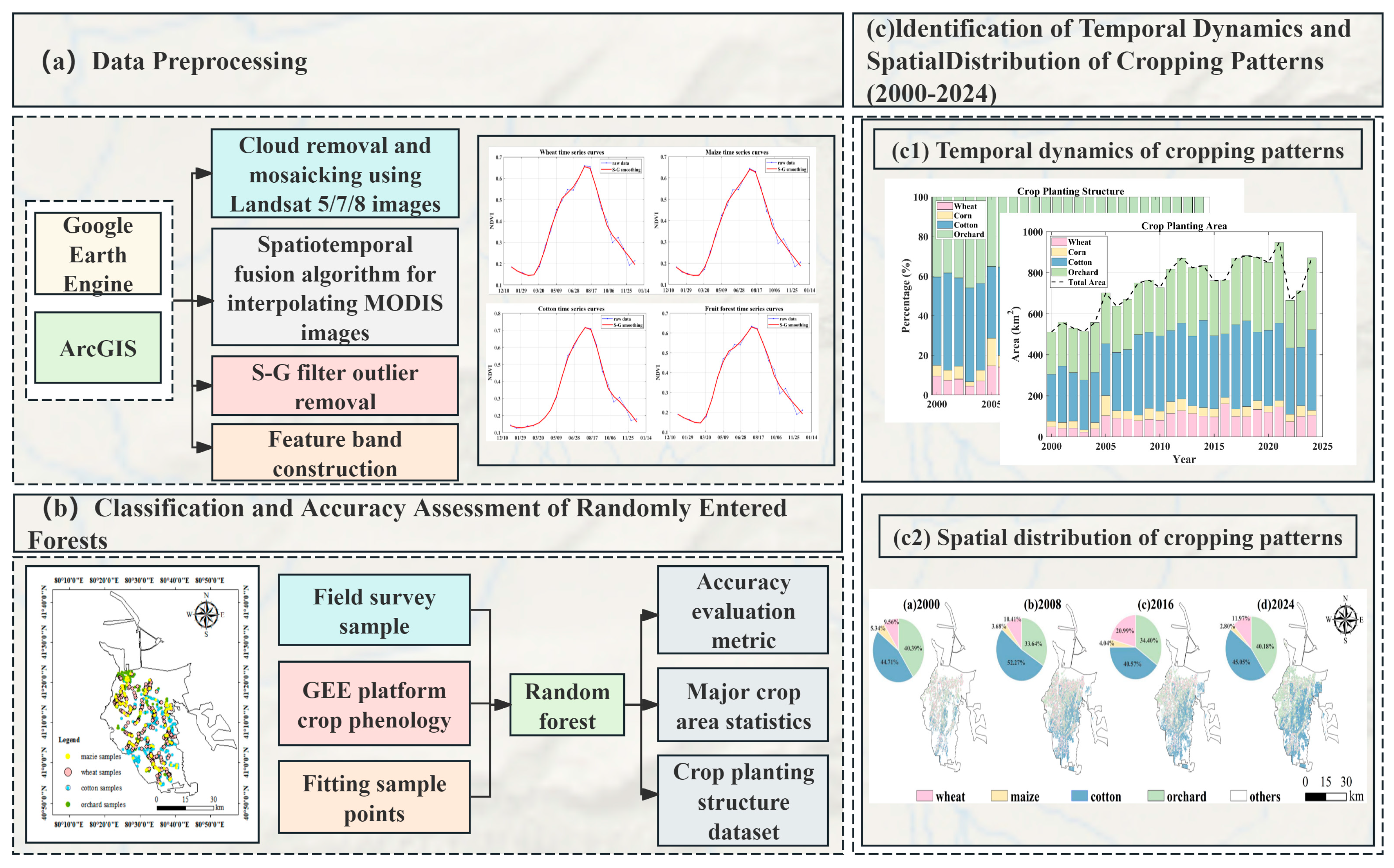
The classification was conducted annually from 2000 to 2024 within Google Earth Engine (GEE) to generate annual crop-type maps used to identify the crop planting structure. Accuracy was evaluated using producer accuracy (PA), user accuracy (UA), overall accuracy (OA), and the Kappa coefficient (Table 2). Confusion matrices were generated for each year, and temporal consistency was validated using statistical yearbook data (Figure 3).
Table 2. Formulas for accuracy assessment.
TypeFormula
Producer’s Accuracy (PA) P A = X i i X j × 100 % (3)
User’s Accuracy (UA) U A = X i i X i × 100 % (4)
Overall Accuracy (OA) O A = i = 1 k X i i N × 100 % (5)
Kappa Coefficient (K) K = N i = 1 k X i i i = 1 k X i X j N 2 i = 1 k X i X j (6)

2.3.3. Trend Analysis of Meteorological Elements

To analyze long-term trends in meteorological variables, the Mann–Kendall (MK) non-parametric trend test combined with Sen’s slope estimator (Sen+MK method) was applied [45,46]. This method does not require the data to follow a specific distribution and is robust to outliers, making it suitable for climatic time-series analysis.
Z = S 1 V a r ( S ) , S > 0 0 , S = 0 S + 1 V a r ( S ) , S < 0
S = i = 1 n 1 j = i + 1 n sgn ( x j x i )
s g n ( x j x i ) = + 1 , i f   x j x i > 0 , 0 , i f   x j x i = 0 , 1 , i f   x j x i < 0 .
V a r ( S ) = n ( n 1 ) ( 2 n + 5 ) p = 1 g t p ( t p 1 ) ( 2 t p + 5 ) 18
where Z is the standardized test statistic, S is the Mann–Kendall statistic, xi and xj represent meteorological observations in years i and j, and β denotes Sen’s slope. A positive β indicates an increasing trend, whereas a negative β indicates a decreasing trend.

2.3.4. Estimation of Crop Water Requirement (ETc)

Crop water requirement (ETc) was estimated using the CROPWAT 8.0 model based on the FAO-56 Penman–Monteith framework [47]:
E T c = K c × E T 0
E T 0 = 0.408 Δ ( R s G ) + γ 900 U 2 ( e s e a ) T + 273 Δ + γ ( 1 + 0.34 U 2 )
where ET0 is the reference evapotranspiration (mm d−1); Rn is the net radiation at the crop surface (MJ m−2 d−1); G is the soil heat flux (MJ m−2 d−1); T is the mean daily air temperature at 2 m height (°C); U2 is the wind speed at 2 m height (m s−1); es and ea are the saturation and actual vapor pressures (kPa); Δ is the slope of the saturation vapor pressure curve (kPa °C−1); and γ is the psychrometric constant (kPa °C−1).
Daily reference evapotranspiration (ET0) was calculated using station-based meteorological inputs. Crop coefficients (Kc) were adopted from FAO-56 and adjusted using regional agronomic studies in Xinjiang. Uniform soil parameters representative of the irrigation district were applied due to the lack of spatially distributed soil data. Crop growth-stage lengths and Kc values are listed in Table 3.

2.3.5. Path Analysis

The Path Analysis Method [50] was used to quantify the direct and indirect effects of meteorological factors on annual ETc. Path analysis was conducted in MATLAB (R2023b). All variables (temperature, precipitation, relative humidity, wind speed, sunshine duration, and annual ETc) were standardized prior to analysis. Standardized path coefficients were obtained using multiple linear regression, and direct/indirect effects were calculated from the regression coefficients and the correlation matrix. Model fit was evaluated using R2 and χ2/df.
y = b 0 + b 1 x 1 + b 2 x 2 + + b n x n
Equation (9) can be mathematically changed to the following positive equation of moments by substituting the actual observations into it and solving the system of equations using least squares.
1 γ x 1 x 2 γ x 1 x n γ x 2 x 1 1 γ x 2 x n γ x n x 1 γ x n x 2 1 P y x 1 P y x 2 P y x n = γ x 1 y γ x 2 y γ x n y
where γxixj (i, jn) represents the simple correlation coefficient between the n independent variables; γxiy (In) denotes the simple correlation coefficient between the n independent variables and the dependent variable; Pxny is the direct path coefficient; γxixj Pxny represents the indirect path coefficient.

3. Results

3.1. Spatiotemporal Dynamics of Crop Planting Structure in the Tailan River Irrigation District

3.1.1. Results of Crop Planting Structure Identification and Accuracy Assessment

As shown in Table 4, the confusion matrix and accuracy metrics for the 2024 training year indicate strong classification performance. The overall accuracy (OA) was 0.902, with a Kappa coefficient of 0.876, suggesting high agreement between classification results and reference samples. Producer’s accuracy (PA) ranged from 0.873 to 0.933, and user’s accuracy (UA) ranged from 0.867 to 0.928 across the five classes. Notably, UA values for orchards (0.867) and maize (0.894) were lower than those for wheat and cotton, indicating comparatively higher commission uncertainty for these categories.
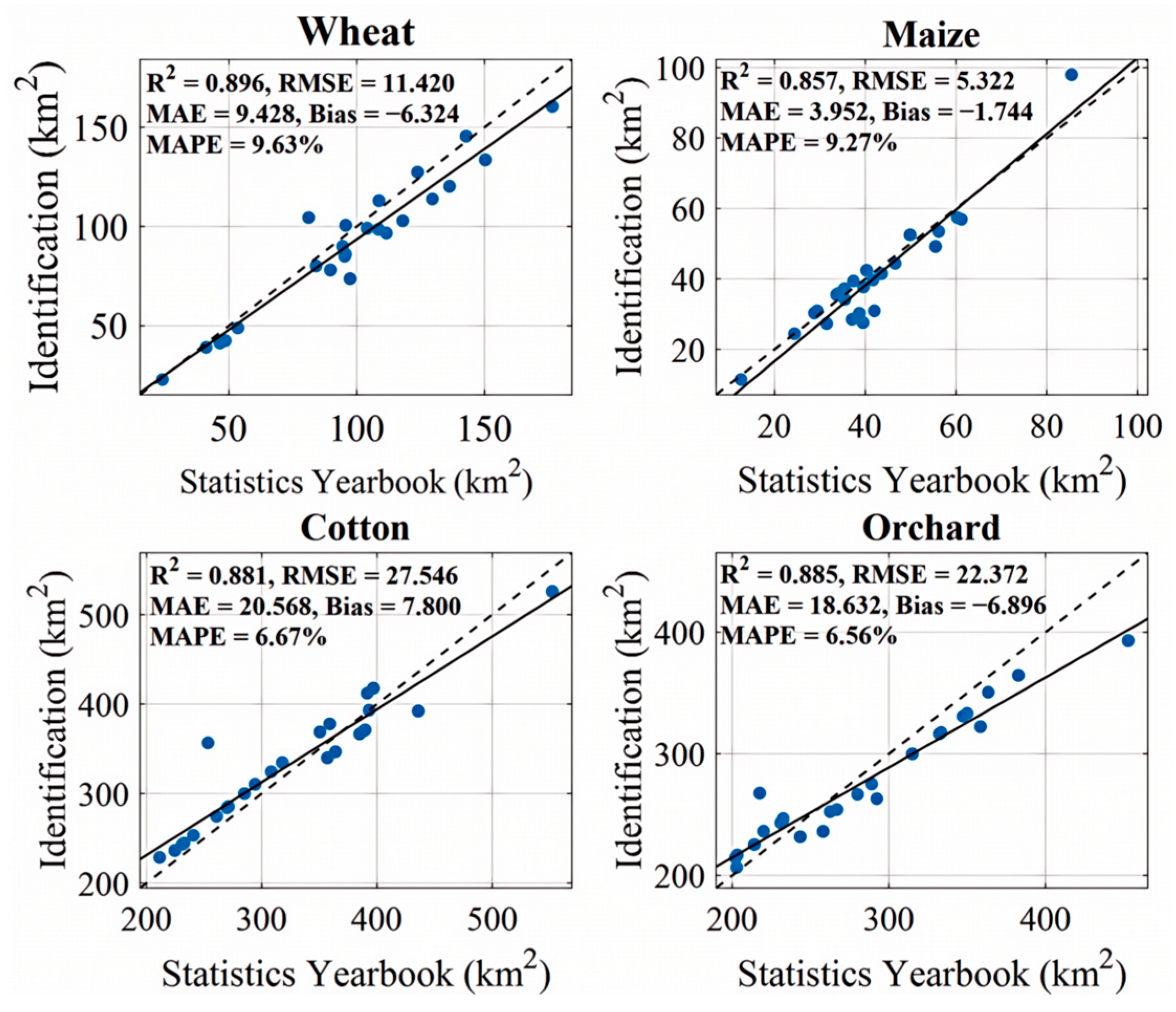
Regression-based validation indicates strong agreement between remotely extracted crop areas and statistical yearbook records across all major crops (Figure 4). Wheat exhibited high consistency (R2 = 0.896, RMSE = 11.420 km2) followed by maize (R2 = 0.857, RMSE = 5.322 km2). Cotton showed comparatively larger dispersion (R2 = 0.881, RMSE = 25.546 km2) while orchards maintained a high level of agreement (R2 = 0.885, RMSE = 23.727 km2). Mean absolute percentage errors (MAPE) for all crops were below 10% (Wheat: 9.63%, Maize: 9.27%, Cotton: 6.67%, Orchard: 6.56%), indicating stable area estimation performance at the irrigation-district scale.

3.1.2. Spatiotemporal Dynamics of Cropping Patterns

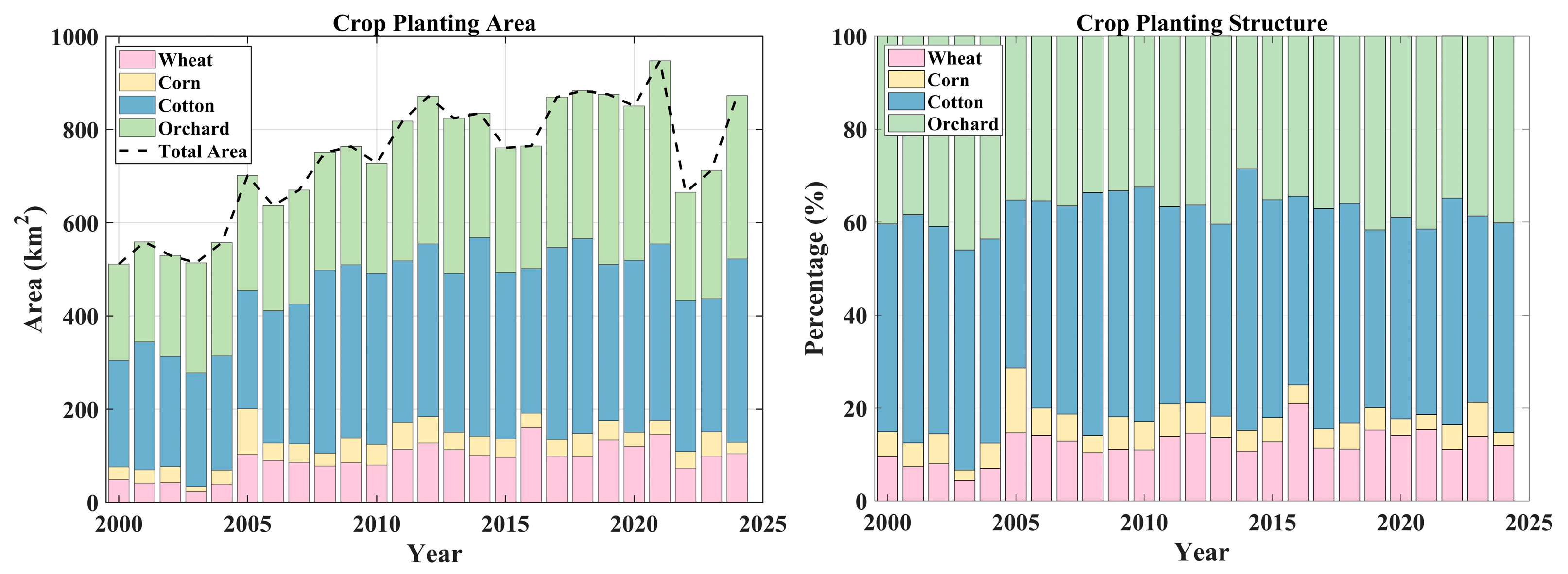
From 2000 to 2024, the cropping structure of the Tailan River Irrigation District exhibited clear long-term changes (Figure 5). Cotton remained the largest crop, ranging from 228.6 to 426.0 km2 and consistently accounting for more than 40% of the total planting area. Orchards expanded from 206.5 km2 in 2000 to 393.2 km2 in 2024. Wheat showed pronounced interannual variability, fluctuating between 22.9 and 160.5 km2, with higher values observed in 2005 and 2016. Maize occupied a relatively small area, generally remaining below 100 km2, with a maximum of 98.0 km2 in 2005.
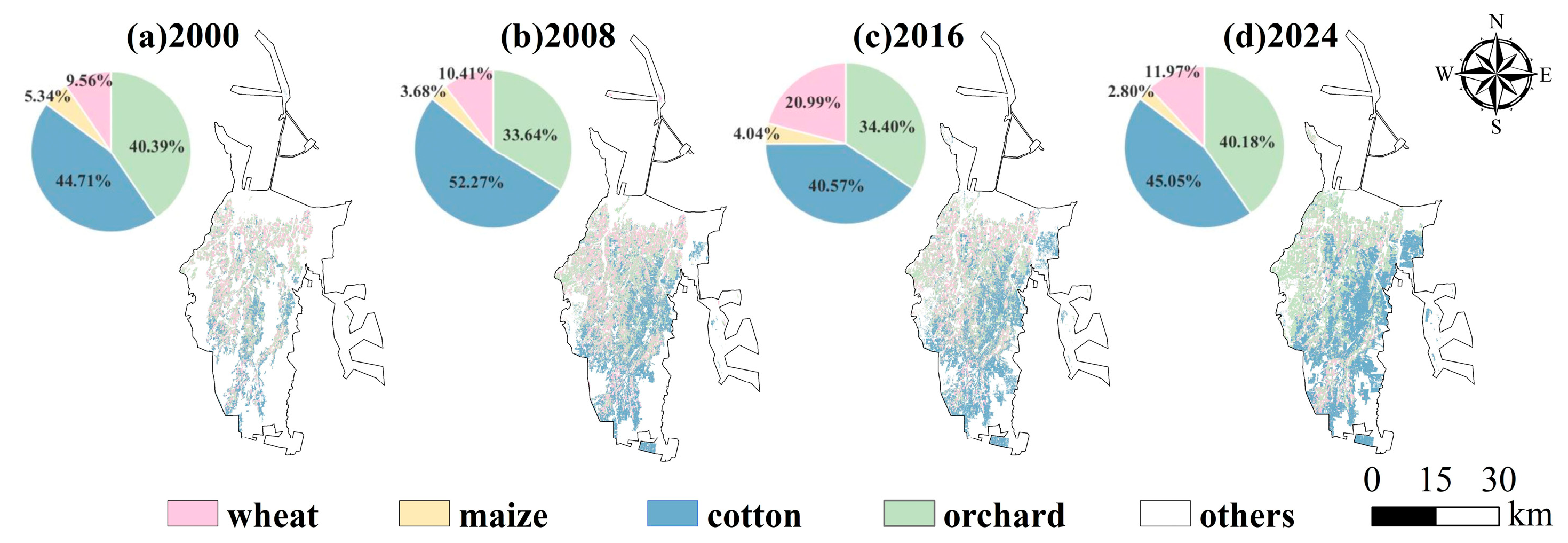
Spatially, crop distributions showed clear differentiation (Figure 6). Wheat and maize were mainly concentrated in the mid-to-upper reaches of the northern irrigation district. Cotton maintained a relatively stable core distribution in the central region and exhibited spatial expansion toward downstream areas over time. Orchards, initially concentrated in central areas with partial overlap with cotton, expanded outward and became the second-largest crop by 2024.

3.2. Characteristics of Climate Change in the Irrigation District

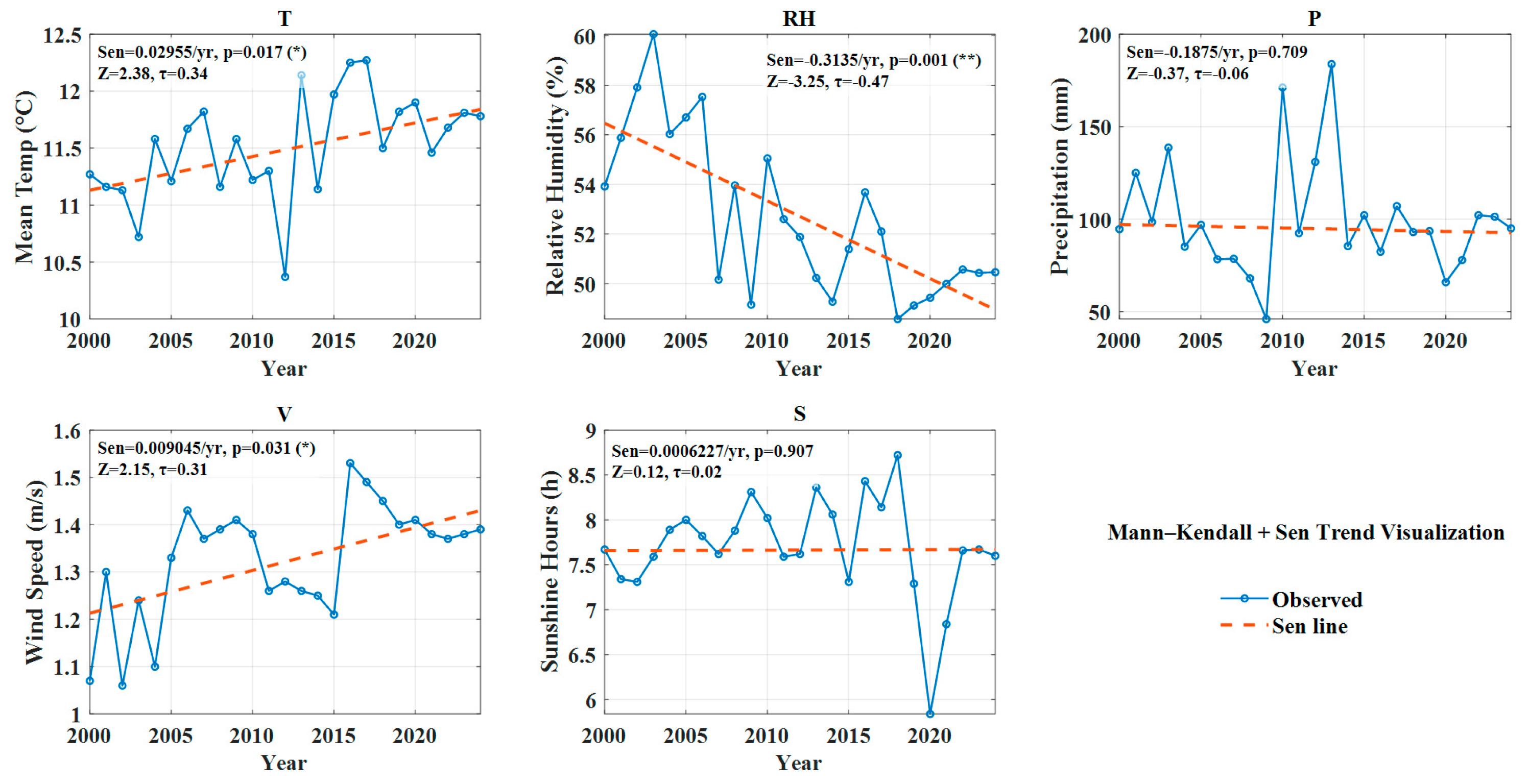
Meteorological variables are key inputs for estimating crop water requirements. Using observations from the Wensu County meteorological station, this study summarized interannual changes in temperature, precipitation, relative humidity, wind speed, and sunshine duration during 2000–2024 (Figure 7). The Mann–Kendall test combined with Sen’s slope estimator indicated a significant increasing trend in annual mean temperature (Sen = 0.0296 °C·yr−1, p = 0.017, Z = 2.38) and wind speed (Sen = 0.0090 m·s−1·yr−1, p = 0.031, Z = 2.15), and a significant decreasing trend in relative humidity (Sen = −0.3135%·yr−1, p = 0.001, Z = −3.25). Precipitation showed a non-significant decreasing tendency (Sen = −0.1875 mm·yr−1, p = 0.709), and sunshine duration showed no significant trend (Sen = 0.0006 h·yr−1, p = 0.907).

3.3. Dynamics of Crop Water Requirements

3.3.1. Variation Characteristics of the Average Crop Water Requirement per Unit Area over Multiple Years

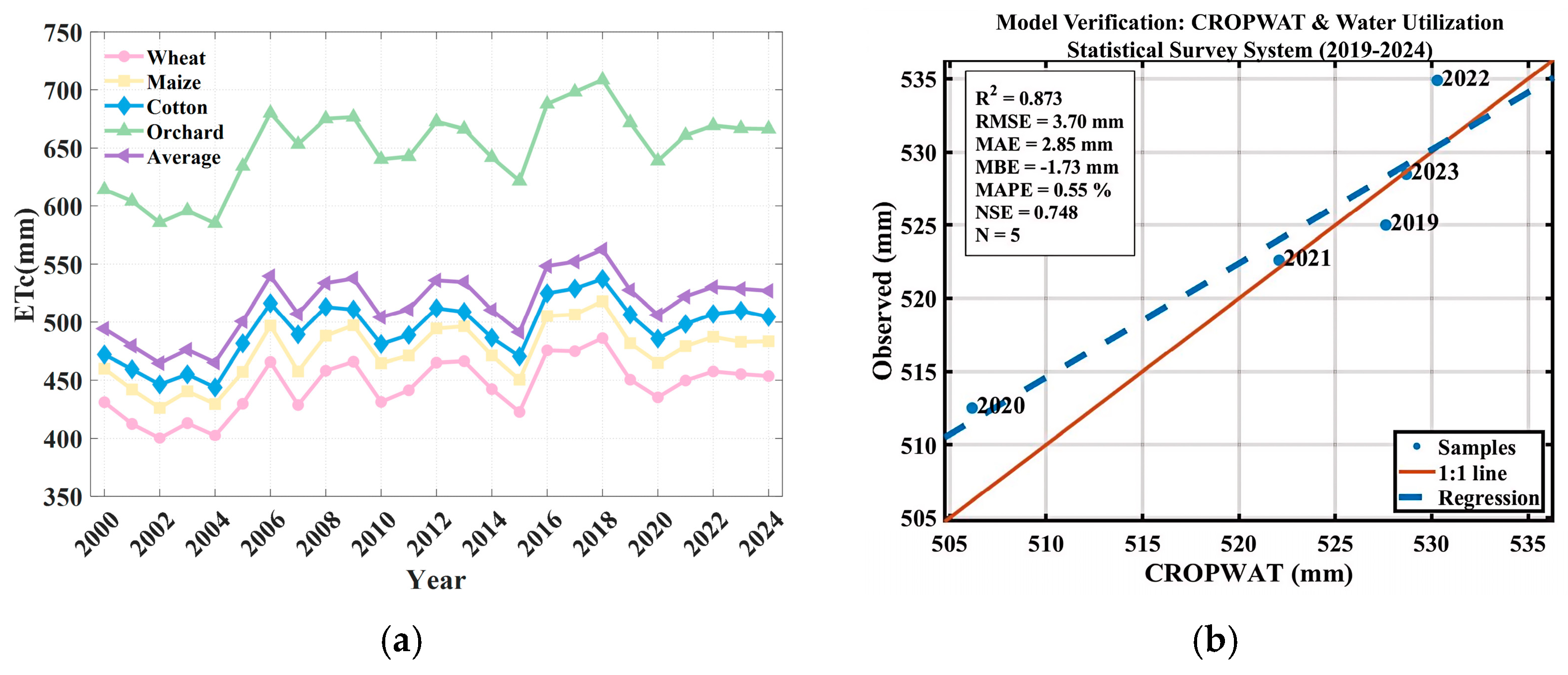
Unit-area crop water requirements (ETc) from 2000 to 2024 were estimated using the CROPWAT model based on crop coefficients (Kc) and reference evapotranspiration (ET0) (Figure 8a). Wheat exhibited unit-area water requirements ranging from 400.20 to 486.12 mm, while maize varied between 426.18 and 517.98 mm. Cotton showed a broader range, with values spanning 443.75 to 537.22 mm. Orchards consistently exhibited the highest water requirements, fluctuating between 584.98 and 708.57 mm. Across all crops and years, the mean unit-area water requirement was 515.63 mm, with orchards (650.34 mm) markedly exceeding those of cotton (493.51 mm), maize (474.09 mm), and wheat (444.59 mm).
Model estimates were compared with officially reported irrigation water-use statistics for 2019–2023 obtained from the Tailan River Irrigation District Water Use Statistical Survey System (Figure 8b). These data represent aggregated annual irrigation water-use records rather than plot-scale direct measurements. Validation results for 2019–2023 indicate a high level of consistency between CROPWAT estimates and field observations. The coefficient of determination (R2) reached 0.873, accompanied by low absolute errors (MAE = 2.85 mm; RMSE = 3.70 mm) and a MAPE of only 0.55%. Given the limited temporal coverage of available validation data (five years), this comparison is intended to provide a preliminary consistency check rather than a comprehensive long-term validation of model performance.

3.3.2. Multi-Year Average Crop Water Requirements at Different Growth Stages

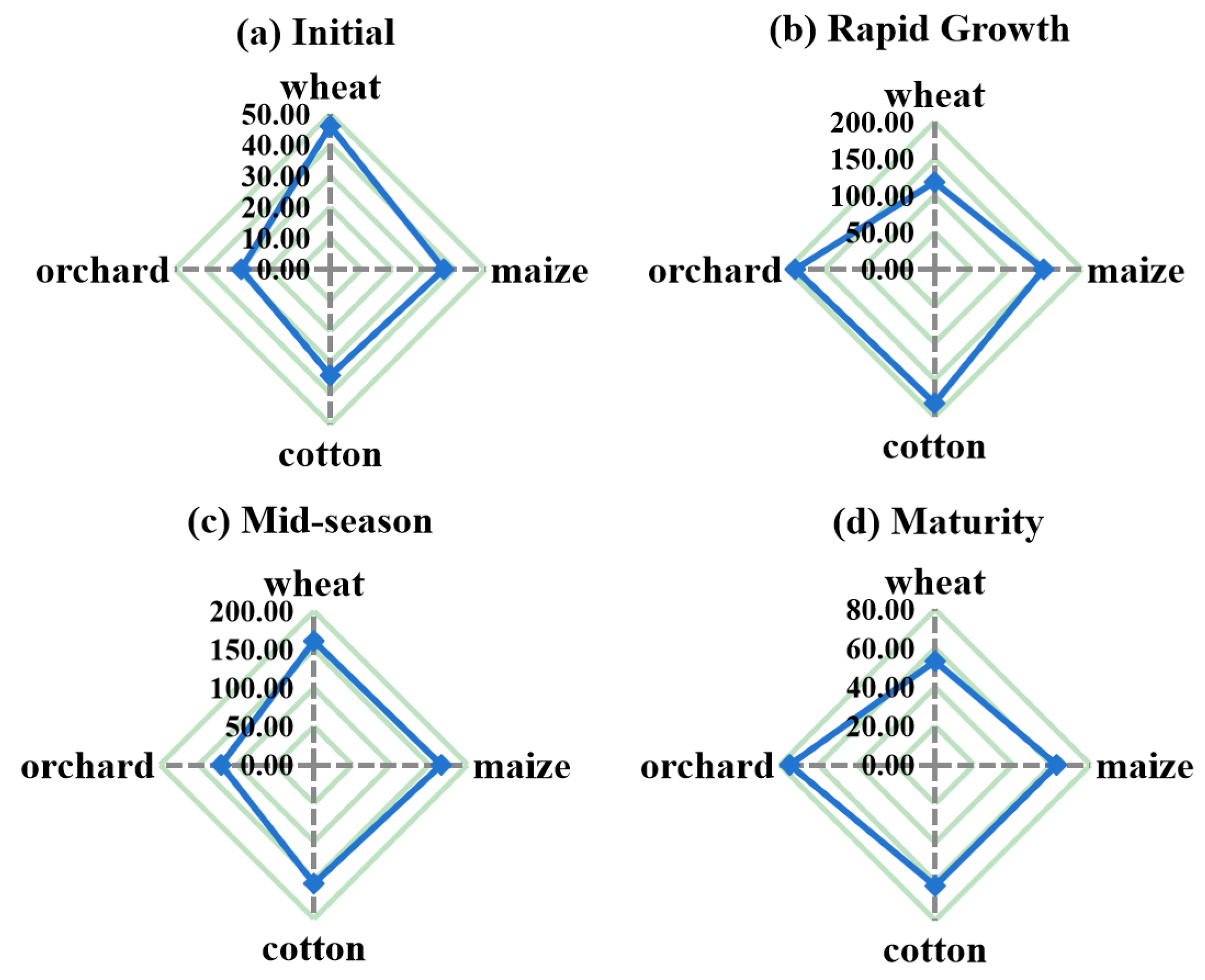
Crop water requirements at different growth stages were calculated according to the FAO—56 approach (ETc = Kc × ET0), using prescribed stage—specific Kc values and growth durations (Figure 9). Distinct crop-specific differences were observed across growth stages. Wheat reached its maximum water requirement during the mid-season stage (193.08 mm), whereas maize and cotton peaked during the rapid growth stage, with values of 171.75 mm and 209.14 mm, respectively. Orchards consistently exhibited the highest water demand across all stages, particularly during rapid growth (305.59 mm) and maturity (120.88 mm). During the maturity stage, water requirements for wheat, maize, and cotton converged to similar levels (64.03–72.57 mm), while orchards maintained substantially higher water demand.

3.3.3. Interannual Variation in Total Crop Water Requirements

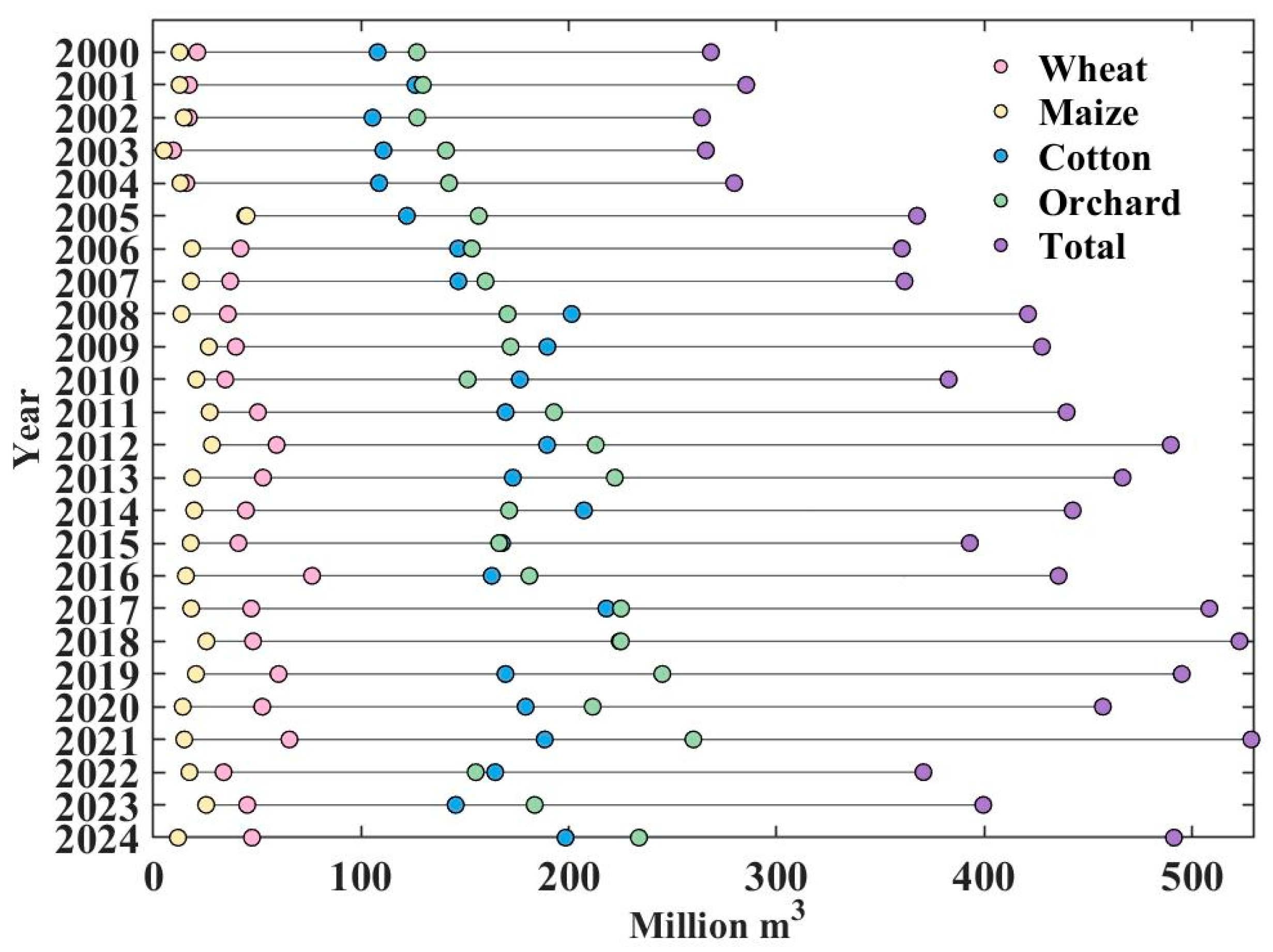
Total crop water requirements were derived by combining unit-area ETc estimates with crop planting areas (Figure 10). From 2000 to 2024, annual total water demand showed marked interannual variability, ranging from 264.01 million m3 to 528.49 million m3. Orchards and cotton consistently represented the dominant contributors to total demand, with orchard water requirements varying between 126.82 and 259.91 million m3 and cotton ranging from 105.45 to 224.45 million m3. In contrast, wheat and maize contributed relatively smaller shares, with annual water demands of 9.44–76.33 million m3 and 5.02–44.80 million m3, respectively. Variations in total water demand largely reflect changes in cropping structure and modeled ETc rather than independent hydrological observations.

3.4. Analysis of Meteorological Driving Paths

3.4.1. Correlation Between Crop Water Requirement and Meteorological Factors

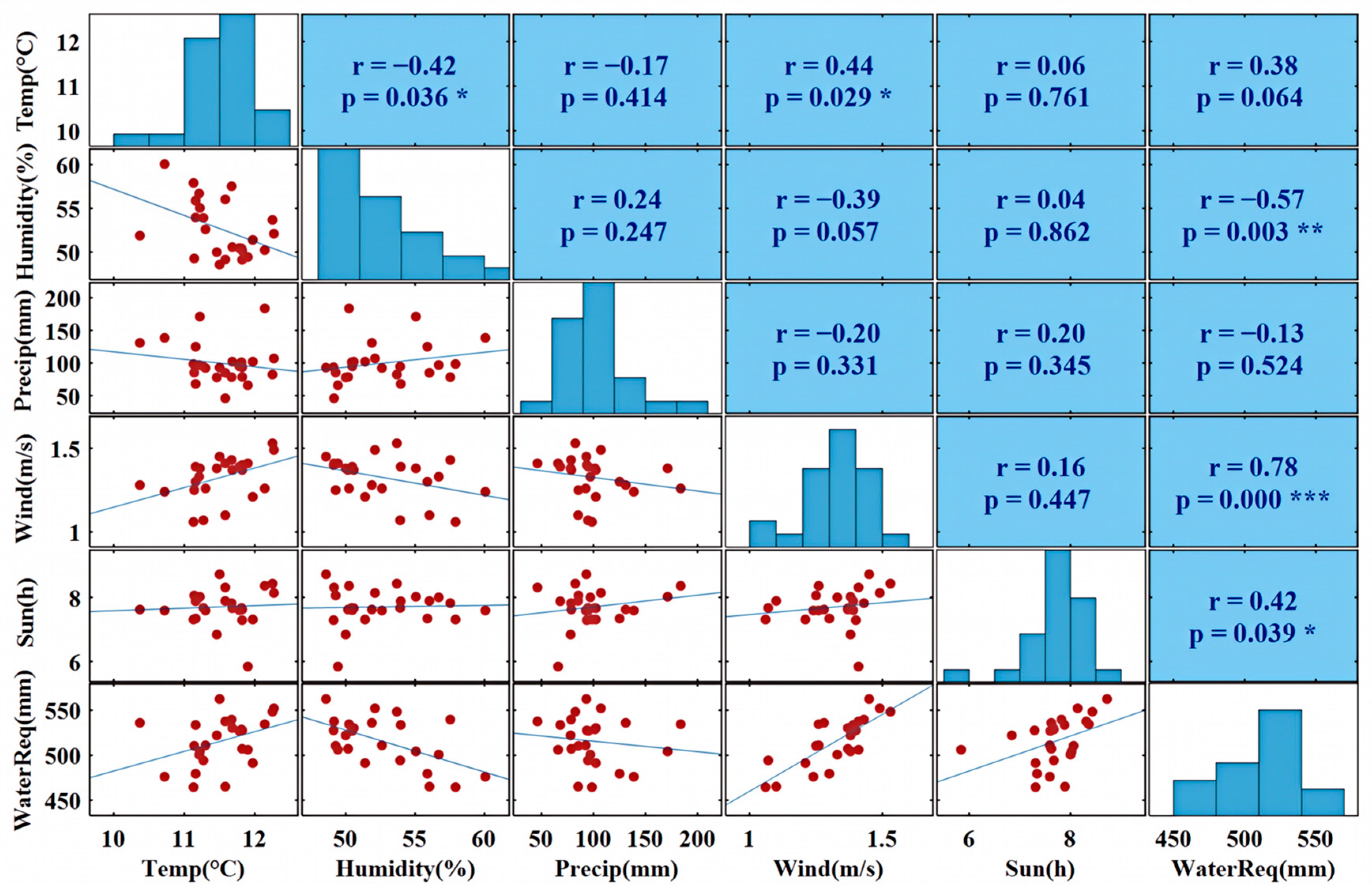
Correlation analysis was conducted to describe statistical associations between ETc and meteorological variables used in the ET0 calculation (Figure 11). It should be noted that these correlations partly reflect the mathematical structure of the FAO-56 Penman–Monteith equation rather than independent empirical relationships. Crop water requirement (ETc) was positively associated with temperature (r = 0.37, p = 0.067) and wind speed (r = 0.78, p < 0.001), and negatively associated with relative humidity (r = −0.57, p = 0.003). Correlations with precipitation (r = −0.14, p = 0.508) and sunshine duration (r = 0.41, p = 0.039) were weaker. Inter-correlations among meteorological variables were also observed, including temperature versus relative humidity (r = −0.42, p = 0.036) and temperature versus wind speed (r = 0.44, p = 0.029).

3.4.2. Path Analysis

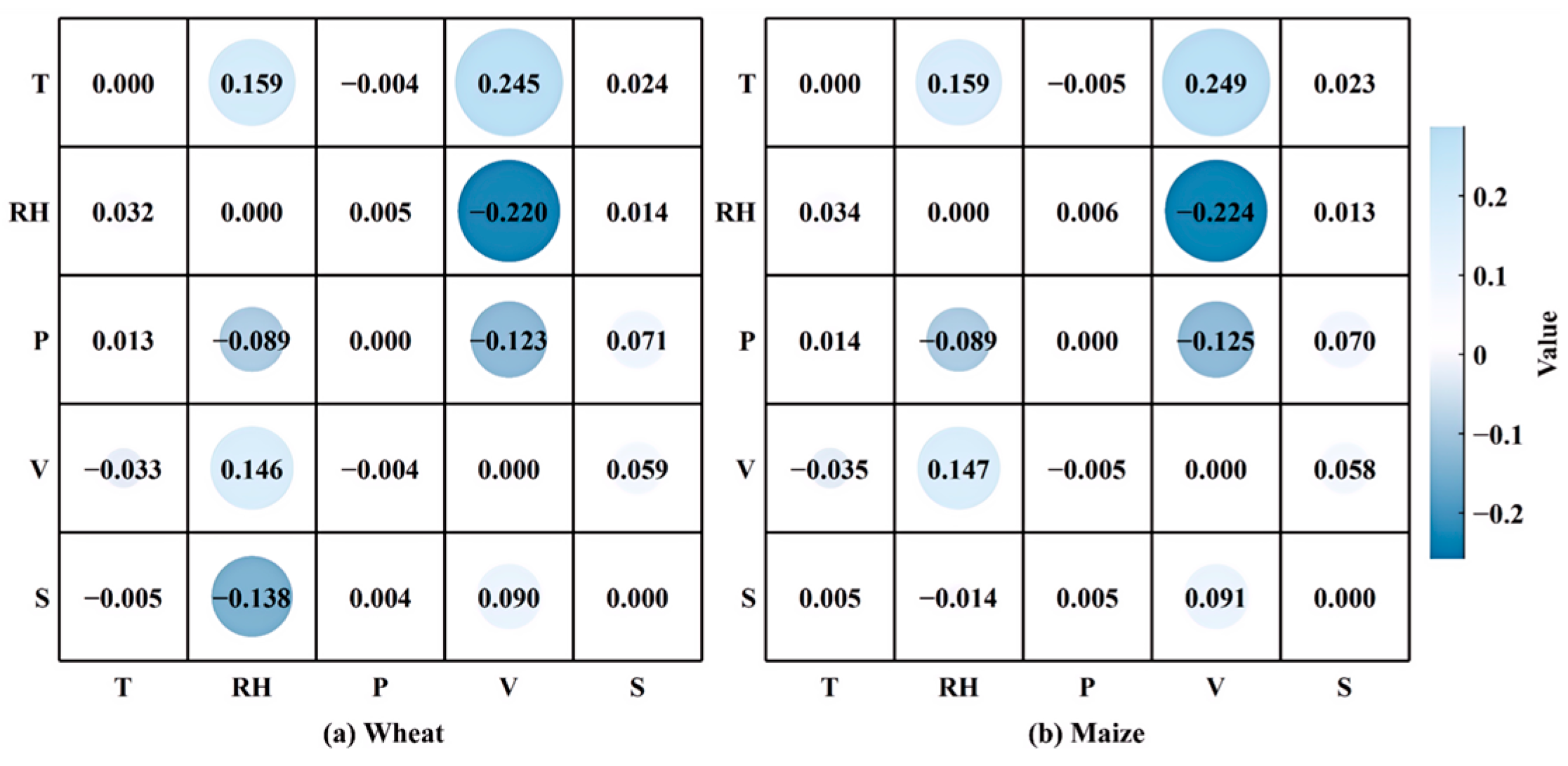
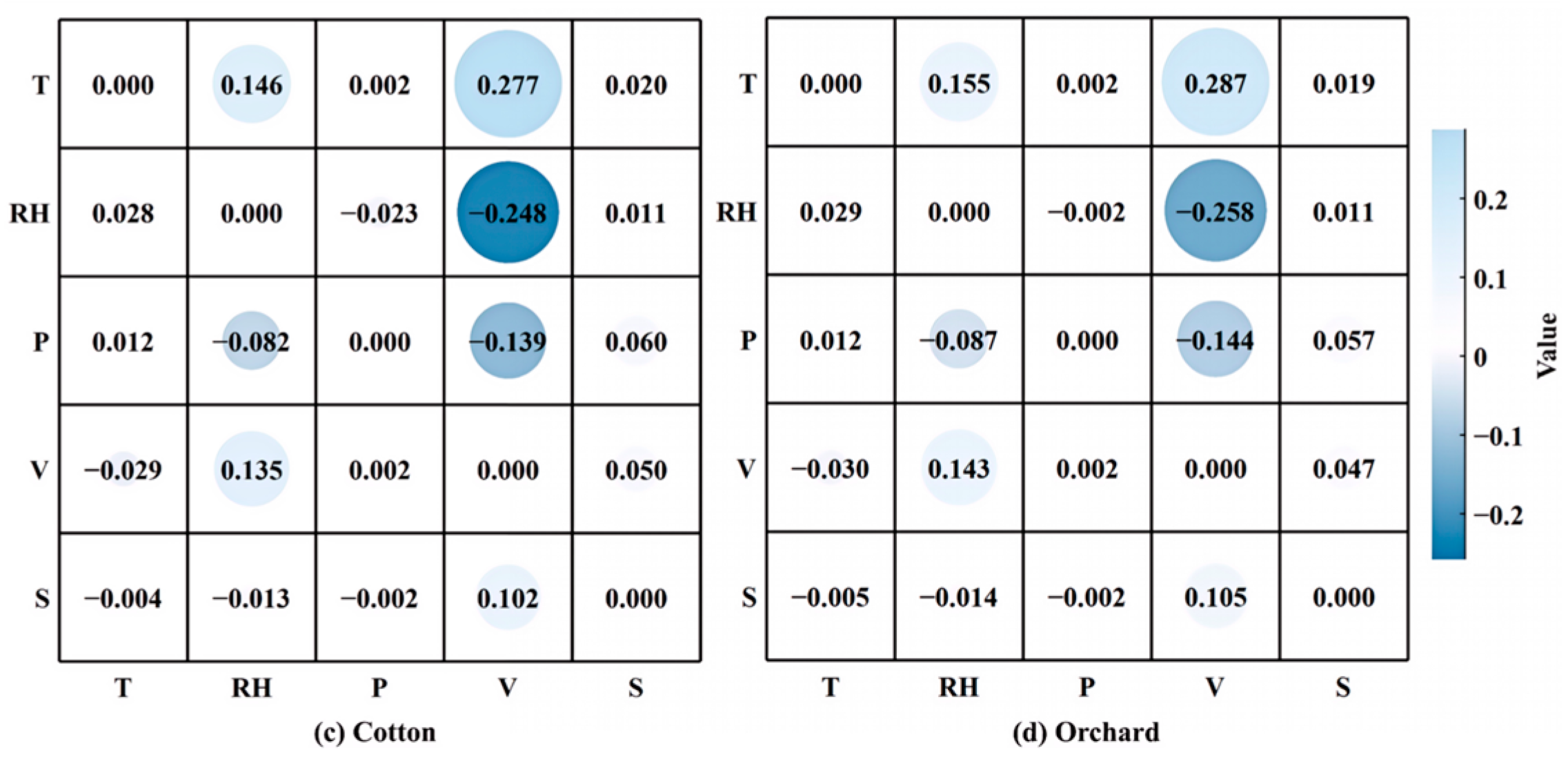
To further characterize the relative contributions of meteorological variables to modeled crop water requirement (ETc), a path analysis was applied to the major crops in the Tailan River Irrigation District (Figure 12 and Figure 13).
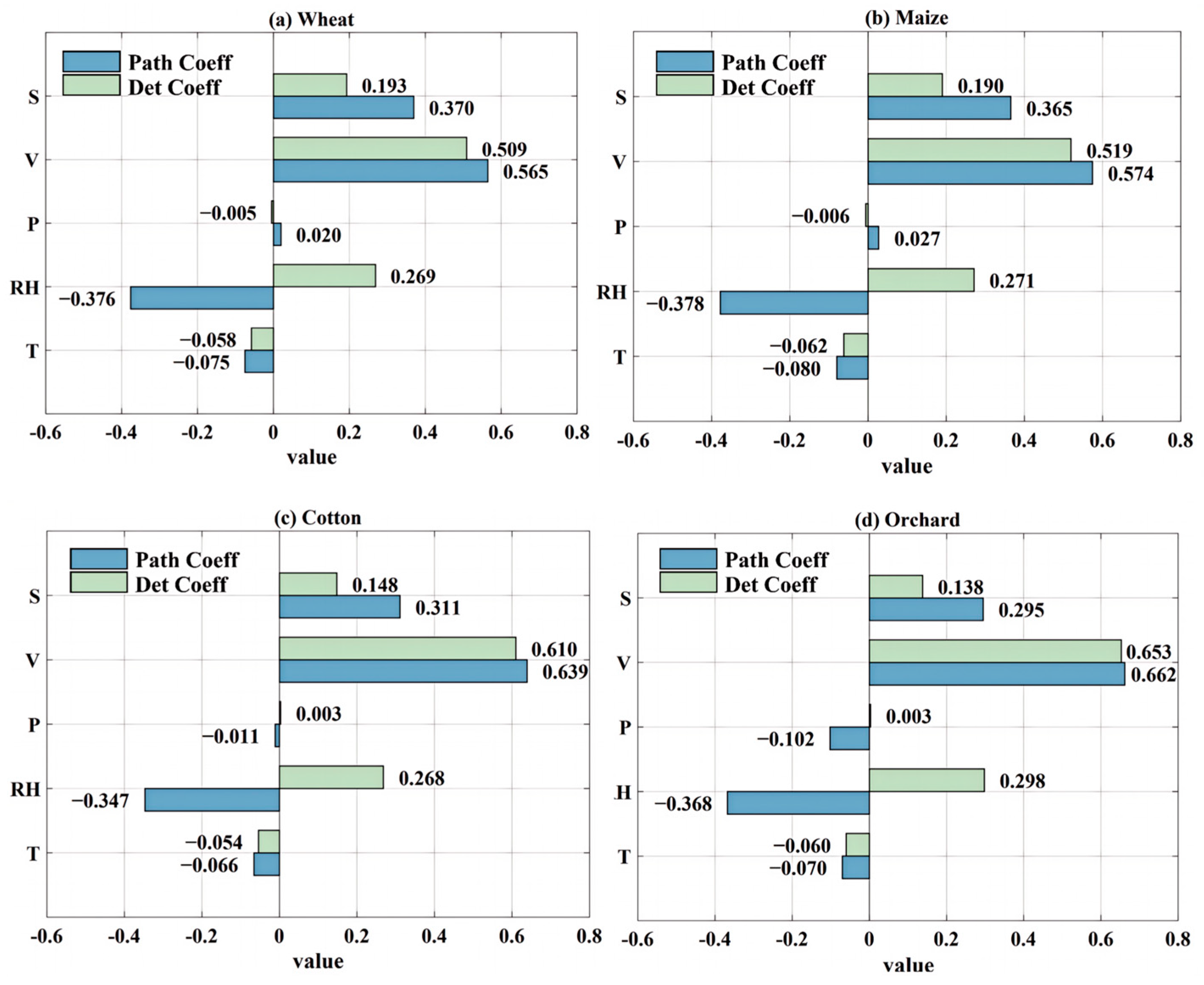
Wind speed (V) exhibited the largest positive direct path coefficients for ETc across all crops, with values of 0.565 for wheat, 0.574 for maize, 0.639 for cotton, and 0.662 for orchards. The corresponding decision coefficients (0.509–0.653) indicate that interannual variability in modeled ETc is statistically most sensitive to wind speed within the applied framework. Sunshine duration (S) showed a moderate positive direct association with ETc, declining from wheat (0.370) and maize (0.365) to cotton (0.311) and orchards (0.295). Relative humidity (RH) consistently exerted a negative direct effect on ETc (−0.347 to −0.378), while temperature (T) contributed only weak direct effects (−0.066 to −0.080).
Indirect pathways revealed consistent interaction patterns among meteorological variables across crops. Temperature showed positive indirect contributions to ETc, mainly mediated through RH (0.146–0.159) and sunshine duration (0.019–0.237), partially offsetting its weak negative direct effect. Relative humidity displayed compensatory indirect pathways—positive via wind speed (0.135–0.147) and negative via sunshine duration (−0.220 to −0.258)—resulting in a near-neutral net effect (|0.011–0.014|). Precipitation was characterized by a predominantly negative indirect influence mediated through sunshine duration (−0.123 to −0.144), exceeding its minimal direct contribution. Indirect effects of wind speed and sunshine duration themselves were comparatively small, indicating that their influence on ETc is primarily expressed through direct pathways.
Overall, the path analysis highlights wind speed as the meteorological variable with the strongest direct statistical association with modeled ETc across crops, followed by relative humidity and sunshine duration.

4. Discussion

4.1. The Essential Contributions and Scientific Issues of the Integration Method

The “Classification-Simulation-Analysis” framework developed in this study transcends the conventional integration of “crop mapping,” “water demand estimation,” and “statistical attribution” as mere sequential steps. Its core scientific challenge lies in effectively separating and quantifying the distinct contributions of planting structure changes and climate change to long-term agricultural water demand trends at the irrigation district scale. Previous studies either focused on single components (e.g., crop mapping alone [7,10] or evapotranspiration simulation [6,8]) or, despite multi-step analyses, failed to systematically examine their interactions and relative importance within a unified framework [13,20]. This framework ensures consistency in tracking water demand effects from land use changes through the use of a unified spatiotemporal basis (high-resolution annual crop maps based on Landsat-MODIS fusion data [51,52]). This “consistency” is critical: it means that interannual variations in ETc can be attributed not only to climate fluctuations but also clearly separated into “structural” water demand changes caused by crop type transitions (e.g., orchard expansion) through precise annual crop area weighting. Our analysis demonstrates that in the Taran River Irrigation District, the intensification of planting structures over the past two decades (particularly the expansion of water-intensive crops) has driven irrigation water demand increases comparable to or even more significantly than climate change. This finding surpasses traditional water demand modeling approaches based solely on climate data or static crop distribution.

4.2. Regional Specificity of Crop Water Demand Driven by Climate

This study conducted a climate-driven attribution analysis of crop evapotranspiration (ETc) to not only validate the inherent logic of the FAO-56 Penman-Monteith formula [53] but also to reveal the relative importance, pathways, and interactions of various climatic factors [54] affecting ETc in the Taran River Irrigation District under specific arid conditions. The findings indicate that wind speed is the primary direct climatic driver of interannual ETc variability [37,39,55]. This region-specific pattern has a physical basis: frequent strong winds in the study area significantly reduce aerodynamic resistance, thereby continuously promoting canopy evapotranspiration, particularly during the mid-growth season when energy is abundant. In contrast, precipitation, due to its scarcity and variability, exerts a weak direct limiting effect on ETc. Relative humidity, on the other hand, primarily exerts an indirect negative influence by modulating vapor pressure difference (VPD) [56,57,58]. Pathway analysis further demonstrates that factors such as temperature and sunshine duration interact through multiple direct and indirect pathways (e.g., by affecting VPD and net radiation), indicating that ETc changes result from complex feedback mechanisms among multiple correlated climatic factors. Therefore, this study emphasizes that key conclusions (e.g., the dominant role of wind speed) should be interpreted as statistical attribution results based on specific methodologies and data, revealing strong correlations rather than absolute causality. This understanding is crucial for prudent interpretation of results and subsequent management applications.

4.3. Irrigation Management Enlightenment Based on Research Findings

Management insights must be rigorously derived from and closely aligned with the aforementioned research findings, with clearly defined boundaries for their application. Building on the core empirical conclusion that “wind speed is a key climatic driver of ETc variability,” irrigation management can more effectively address wind impacts [59]. For instance, Irrigation management strategies must incorporate spatiotemporal variations in wind-induced evapotranspiration (ETc), particularly in regions or seasons characterized by elevated wind speeds [60]. Dynamic adjustment of irrigation schedules during such periods enables more precise water allocation, reducing both under- and over-irrigation risks. From a long-term adaptation perspective, the empirical link between crop structural shifts and rising agricultural water demand highlights the need to reassess land-use strategies. Specifically, the expansion of high water-consuming perennial crops (e.g., orchards) should be critically evaluated for sustainability under increasingly constrained water resources. Instead, adaptive measures—including the adoption of water-saving crop varieties, rotation systems with lower water footprints, and precision irrigation technologies—may serve as viable demand-side mitigation pathways. However, the operationalization of these strategies necessitates a context-specific evaluation framework, integrating local socio-economic dynamics, existing water infrastructure capacity, institutional constraints, and regional policy objectives. Without such integration, the effectiveness and equity of water management reforms may be undermined.

4.4. Limitations and Robustness of Results

We fully recognize the following uncertainties and demonstrate why they do not affect the core conclusions of this study regarding long-term trends and relative importance: (1) Crop classification uncertainty: Classification errors for orchards and corn primarily impact the absolute accuracy of their area measurements, but have limited influence on the temporal trends of crop area changes due to relatively stable errors over time. Therefore, the long-term upward trend in total water demand weighted by area remains robust. (2) Model parameter representativeness: Using representative soil parameters and standard crop coefficients for irrigation districts may lead to deviations in individual pixel ETc estimates. However, since this study focuses on total volume and trends at the irrigation district scale, spatial aggregation effects largely smooth out differences in local parameter sensitivity, making regional total water demand estimation and comparison reasonable. (3) Meteorological data representativeness: Single-station meteorological data has spatial limitations and may not fully capture microclimatic variations within irrigation districts. However, this mainly affects the spatial detail characterization of ETc, while having minimal impact on water demand time series integrated at the full irrigation district level and their statistical relationship patterns with climate factors, as dominant climate factors (e.g., wind speed) exhibit good spatial consistency within the region. Future research should focus on reducing these uncertainties, such as: improving crop classification and validation through multi-source remote sensing products and field observations; enhancing model accuracy by integrating spatially explicit soil attributes and irrigation management information; and utilizing regional climate reanalysis data or dense meteorological station networks to improve the representativeness of climate forcing fields. In addition, more complex attribution methods such as structural equation modeling can be used to further analyze the interaction between climate factors and changes in planting structure.

5. Conclusions

This study proposes and applies an “integrated framework of classification-simulation-analysis” to quantify the long-term dynamic effects of crop structure changes on irrigation water demand in the Taran River Irrigation District from 2000 to 2024, while identifying key meteorological drivers of crop water demand variations. Results demonstrate that intensified crop structure—particularly the sustained dominance of cotton cultivation alongside significant orchard expansion—has increased agricultural water resource pressure, which is further amplified by climate change. Attribution analysis critically reveals that wind speed serves as the primary climatic driver of water demand, while relative humidity exerts a counter-regulatory effect; temperature and precipitation mainly influence water demand through indirect pathways. These findings systematically elucidate the combined effects of crop structure changes and climate change on regional water demand, highlighting the methodological value of the proposed integrated framework in addressing water cycle challenges in complex human-nature coupled systems.
It should be noted that this study involves several uncertainties, including classification errors in orchard and maize categorization during crop mapping, representative soil parameters used in CROPWAT for irrigation districts, and the representativeness of station meteorological data. These factors may influence the absolute values of water demand estimates. However, the regional synthesis and area-weighted evaluation method adopted in this study provides a robust basis for interpreting long-term trends at the irrigation district scale. Consequently, the primary conclusion—planting structure changes and wind speed-dominated climatic impacts—has a reliable inferential foundation.
From a management perspective, wind speed’s dominant influence provides clear guidance for adaptive water conservation. For instance, during peak water demand periods, priority should be given to reinforcing windbreak forest systems, optimizing irrigation schedules, and enhancing irrigation efficiency. Under water resource constraints, prudent adjustments to planting structures—such as moderating orchard expansion, promoting water-saving crop varieties, or adopting agronomic practices—should be considered long-term. Future research should utilize irrigation records and independent evapotranspiration data to strengthen cross-validation, incorporate spatially explicit soil and management information, and explore methods like nonlinear or structural equation models to more accurately characterize the complex crop-climate-water feedback relationships. This will improve the framework’s transferability to other arid and semi-arid irrigation regions.

Author Contributions

F.G. (Fan Gao) conceived the study and acquired funding. Y.L. and F.G. (Fan Gao) performed the data analysis, manuscript writing, and graphics. B.H. assisted in the analysis and provided constructive discussions. Y.L., F.G. (Fei Gao), H.L., Q.Z. and F.H. were responsible for data acquisition, processing, and graphics. All authors have read and agreed to the published version of the manuscript.

Funding

This research was supported by the Major Science and Technology Project of Xinjiang Uygur Autonomous Region—Research and Demonstration Project on Ecological Agriculture Development Model and Efficient Utilization Technology of Water and Soil Resources in Modern Irrigation Area (Grant No. 2023A02002-1), and the Open Project of Xinjiang Key Laboratory of Hydraulic Engineering Security and Disaster Prevention (Grant No. ZDSYS-JS-2022-03).

Institutional Review Board Statement

Not applicable.

Data Availability Statement

A Data Availability Statement has been added to the manuscript. Publicly accessible data sources, including Google Earth Engine (Landsat and MODIS products) and the National Earth System Science Data Center, are clearly specified with accessible links. The availability of other supporting data is also explained.

Conflicts of Interest

The authors declare that the research was conducted in the absence of any commercial or financial relationships that could be construed as a potential conflict of interest.

References

  1. An, Y.; Li, Q.; Zhang, L. Managing agricultural water use in a changing climate in China. Sustain. Prod. Consum. 2022, 33, 978–990. [Google Scholar] [CrossRef]
  2. Liu, Z.; Huang, Y.; Liu, T.; Li, J.; Xing, W.; Akmalov, S.; Peng, J.; Xing, W.; Peng, J.; Pan, X.; et al. Water balance analysis based on a quantitative evapotranspiration inversion in the Nukus irrigation area, Lower Amu River Basin. Remote Sens. 2020, 12, 2317. [Google Scholar] [CrossRef]
  3. Chen, Y.N.; Li, Z.Q.; Xu, J.H.; Shen, Y.J.; Xing, X.X.; Xie, T.; Li, Z.; Yang, L.; Zhu, C.; Fang, G.; et al. Changes and protection suggestions in water resources and ecological environment in arid region of Northwest China. Bull. Chin. Acad. Sci. 2023, 38, 385–393. [Google Scholar]
  4. Zhang, Y.F.; Guo, Y.; Shen, Y.J.; Qi, Y.Q.; Luo, J.M. Impact of planting structure changes on agricultural water requirement in the North China Plain. Chin. J. Eco-Agric. 2020, 28, 8–16. [Google Scholar]
  5. Li, J.; Fei, L.; Li, S.; Xue, C.; Shi, Z.; Hinkelmann, R. Development of “water-suitable” agriculture based on a statistical analysis of factors affecting irrigation water demand. Sci. Total Environ. 2020, 744, 140986. [Google Scholar] [CrossRef]
  6. Zhang, J.; Deng, M.; Han, Y.; Huang, H.; Yang, T. Spatiotemporal variation of irrigation water requirements for grain crops under climate change in Northwest China. Environ. Sci. Pollut. Res. 2023, 30, 45711–45724. [Google Scholar] [CrossRef] [PubMed]
  7. Yue, X.J.; Song, Q.K.; Li, Z.Q.; Zheng, J.Y.; Xiao, J.Y.; Zeng, F.G. Research status and prospects of crop information monitoring technology in fields. J. South China Agric. Univ. 2023, 44, 43–56. [Google Scholar]
  8. Moorhead, J.E.; Marek, G.W.; Gowda, P.H.; Lin, X.; Colaizzi, P.D.; Evett, S.R.; Kutikoff, S. Evaluation of evapotranspiration from eddy covariance using large weighing lysimeters. Agronomy 2019, 9, 99. [Google Scholar] [CrossRef]
  9. Wang, T.; Sun, S.; Yin, Y.; Zhao, J.; Tang, Y.; Wang, Y.; Gao, F.; Luan, X. Status of crop water use efficiency evaluation methods: A review. Agric. For. Meteorol. 2024, 349, 109961. [Google Scholar] [CrossRef]
  10. Kussul, N.; Lemoine, G.; Gallego, F.J.; Skakun, S.V.; Lavreniuk, M.; Shelestov, A.Y. Parcel-based crop classification in Ukraine using Landsat-8 and Sentinel-1A data. IEEE J. Sel. Top. Appl. Earth Obs. Remote Sens. 2016, 9, 2500–2508. [Google Scholar] [CrossRef]
  11. Belgiu, M.; Csillik, O. Sentinel-2 cropland mapping using pixel-based and object-based time-weighted dynamic time warping analysis. Remote Sens. Environ. 2018, 204, 509–523. [Google Scholar] [CrossRef]
  12. D’Apice, C.; Kogut, P.I.; Manzo, R. A two-level variational algorithm in the Sobolev–Orlicz space to predict daily surface reflectance at LANDSAT high spatial resolution and MODIS temporal frequency. J. Comput. Appl. Math. 2023, 434, 115339. [Google Scholar] [CrossRef]
  13. Yang, J.; Wu, T.; Wang, S.; Zhao, X.; Xiong, H. Extraction of multiple cropping information at the sub-pixel scale based on phenology and MODIS NDVI time-series: A case study in Henan Province, China. Geocarto Int. 2022, 37, 15999–16019. [Google Scholar] [CrossRef]
  14. Feng, Y.; Guo, Y.; Chen, X.L.; Liu, M.Z.; Shen, Y.J. Classification of major crops using MODIS data in the Songhua River Basin. Chin. J. Eco-Agric. 2023, 31, 1602–1612. [Google Scholar]
  15. Xia, L.; Zhao, F.; Chen, J.; Yu, L.; Lu, M.; Yu, Q.; Liang, S.; Fan, L.; Sun, X.; Wu, S. A full-resolution deep learning network for paddy rice mapping using Landsat data. ISPRS J. Photogramm. Remote Sens. 2022, 194, 91–107. [Google Scholar] [CrossRef]
  16. Phiri, D.; Simwanda, M.; Salekin, S.; Nyirenda, V.R.; Murayama, Y.; Ranagalage, M. Sentinel-2 data for land cover/use mapping: A review. Remote Sens. 2020, 12, 2291. [Google Scholar] [CrossRef]
  17. Sun, L.; Gao, F.; Xie, D.; Anderson, M.; Chen, R.; Yang, Y.; Yang, Y.; Chen, Z. Reconstructing daily 30 m NDVI over complex agricultural landscapes using a crop reference curve approach. Remote Sens. Environ. 2021, 253, 112156. [Google Scholar] [CrossRef]
  18. Xiong, J.; Thenkabail, P.S.; Tilton, J.C.; Gumma, M.K.; Teluguntla, P.; Oliphant, A.; Congalton, R.G.; Yadav, K.; Gorelick, N. Nominal 30-m cropland extent map of continental Africa by integrating pixel-based and object-based algorithms using Sentinel-2 and Landsat-8 data on Google Earth Engine. Remote Sens. 2017, 9, 1065. [Google Scholar] [CrossRef]
  19. Wang, S.; Wang, C.; Zhang, C.; Xue, J.; Wang, P.; Wang, X.; Wang, W.; Zhang, X.; Li, W.; Huang, G.; et al. A classification-based spatiotemporal adaptive fusion model for the evaluation of remotely sensed evapotranspiration in heterogeneous irrigated agricultural areas. Remote Sens. Environ. 2022, 273, 112962. [Google Scholar] [CrossRef]
  20. Meng, L.; Liu, H.; Zhang, X.; Ren, C.; Ustin, S.; Qiu, Z.; Xu, M.; Guo, D. Assessment of the effectiveness of spatiotemporal fusion of multi-source satellite images for cotton yield estimation. Comput. Electron. Agric. 2019, 162, 44–52. [Google Scholar] [CrossRef]
  21. Bi, K.Y.; Niu, Z.; Huang, N.; Kang, J.; Pei, J. Identifying vegetation with a decision tree model based on an object-oriented method using multi-temporal Sentinel-2A images. Geogr. Geo-Inf. Sci. 2017, 33, 16–20. [Google Scholar]
  22. Zhang, X.W.; Chen, Y.S.; Meng, Q.; Wang, X. Extraction of crop phenological information based on time-series MODIS NDVI. Chin. Agric. Sci. Bull. 2018, 34, 158–164. [Google Scholar]
  23. Radočaj, D.; Šiljeg, A.; Marinović, R.; Jurišić, M. State of major vegetation indices in precision agriculture studies indexed in Web of Science: A review. Agriculture 2023, 13, 707. [Google Scholar] [CrossRef]
  24. Chirakkal, S.; Haldar, D.; Misra, A. A knowledge-based approach for discriminating multi-crop scenarios using multi-temporal polarimetric SAR parameters. Int. J. Remote Sens. 2019, 40, 4002–4018. [Google Scholar] [CrossRef]
  25. Deng, H.; Zhang, W.; Zheng, X.; Zhang, H. Crop classification combining object-oriented method and random forest model using UAV multispectral imagery. Agriculture 2024, 14, 548. [Google Scholar] [CrossRef]
  26. Wang, T. Improved random forest classification model combined with C5.0 algorithm for vegetation feature analysis in non-agricultural environments. Sci. Rep. 2024, 14, 10367. [Google Scholar] [CrossRef] [PubMed]
  27. Wang, X.N.; Tian, J.Y.; Li, X.J.; Wang, L.; Gong, H.L.; Chen, B.B.; Guo, J.H. Benefits of Google Earth Engine in remote sensing. Natl. Remote Sens. Bull. 2022, 26, 299–309. [Google Scholar] [CrossRef]
  28. Zhang, Z.; Hua, L.; Zheng, X.; Li, J. Extraction of cropping patterns in the Jianghan Plain based on GEE and Sentinel-NDVI time-series data. Trans. Chin. Soc. Agric. Eng. 2022, 38, 196–202. [Google Scholar]
  29. Sang, G.Q.; Tang, Z.G.; Deng, G.; Wang, J.W.; Li, J.; Mao, K.B. High-resolution paddy rice mapping using Sentinel data based on the GEE platform: A case study of Hunan Province. Acta Agron. Sin. 2022, 48, 2409–2420. [Google Scholar] [CrossRef]
  30. Zhang, D.; Ying, C.; Wu, L.; Meng, Z.; Wang, X.; Ma, Y. Using time-series Sentinel images for object-oriented crop extraction of planting structure in Google Earth Engine. Agronomy 2023, 13, 2350. [Google Scholar] [CrossRef]
  31. Meng, J.; He, R.; Lin, Z. Status and prospects of Google Earth Engine in agricultural management research. J. Geo-Inf. Sci. 2024, 26, 1002–1018. [Google Scholar]
  32. Soomro, S.; Solangi, G.S.; Siyal, A.A.; Golo, A.; Bhatti, N.B.; Soomro, A.G.; Memon, A.H.; Panhwar, S.; Keerio, H.A. Estimation of irrigation water requirement and irrigation scheduling for major crops using the CROPWAT model and climatic data. Water Pract. Technol. 2023, 18, 685–700. [Google Scholar] [CrossRef]
  33. Ewaid, S.H.; Abed, S.A.; Al-Ansari, N. Crop water requirements and irrigation schedules for some major crops in southern Iraq. Water 2019, 11, 756. [Google Scholar] [CrossRef]
  34. Pereira, L.S.; López-Urrea, R.; Ortega-Farias, S. Editorial to the Special Issue on “Contributions to Update the FAO56 Guidelines for Computing Crop Water Requirements”. Irrig. Sci. 2024, 42, 1013–1017. [Google Scholar] [CrossRef]
  35. Pinos, J. Estimation methods to define reference evapotranspiration: A comparative perspective. Water Pract. Technol. 2022, 17, 940–948. [Google Scholar] [CrossRef]
  36. Zhang, Y.; Wang, F.; Du, Z.; Dou, M.; Liang, Z.; Gao, Y.; Li, P. Spatio-temporal distribution characteristics and driving factors of main grain crop water productivity in the Yellow River Basin. Plants 2023, 12, 580. [Google Scholar] [CrossRef]
  37. Wu, M.H. Analysis of Crop Water Demand and Planting Optimization in Typical Irrigation Areas of the Yarkant River in Xinjiang. Master’s Thesis, North China Electric Power University, Beijing, China, 2023. [Google Scholar]
  38. Ren, X.L.; Li, H.L.; Zhang, Y.H.; Pu, X.; Zhang, L.L. Water requirement characteristics and influencing factors of main crops in the Sanjiang Plain from 2000 to 2015. Arid Land Geogr. 2019, 42, 854–866. [Google Scholar]
  39. Sun, D.Y.; Zhao, C.Y.; Peng, D.M.; Li, J.Y.; Yan, Y.Y.; Wei, H. Dynamics of water resources and land use in an oasis irrigation area in the Tailan River watershed. Bull. Soil Water Conserv. 2010, 30, 158–162. [Google Scholar]
  40. National Earth System Science Data Center (NESSDC). Meteorological Forcing Dataset of China (Temperature and Precipitation). Available online: https://www.geodata.cn/ (accessed on 1 June 2025).
  41. Li, W.; Tan, M.H. NDVI variation tendency under different slopes in the Taihang Mountains. Chin. J. Eco-Agric. 2017, 25, 509–519. [Google Scholar]
  42. Liu, X.; Ji, L.; Zhang, C.; Liu, Y. A method for reconstructing NDVI time-series based on envelope detection and the Savitzky–Golay filter. Int. J. Digit. Earth 2022, 15, 553–584. [Google Scholar] [CrossRef]
  43. Du, B.J.; Zhang, J.; Wang, Z.M.; Mao, D.H.; Zhang, M.; Wu, B.F. Crop mapping based on Sentinel-2A NDVI time series using object-oriented classification and decision tree model. J. Geo-Inf. Sci. 2019, 21, 740–751. [Google Scholar]
  44. Luo, C.; Qi, B.; Liu, H.; Guo, D.; Lu, L.; Fu, Q.; Shao, Y. Using time-series Sentinel-1 images for object-oriented crop classification in Google Earth Engine. Remote Sens. 2021, 13, 561. [Google Scholar] [CrossRef]
  45. Kendall, M.G. A new measure of rank correlation. Biometrika 1938, 30, 81–93. [Google Scholar] [CrossRef]
  46. Mann, H.B. Nonparametric tests against trend. Econometrica 1945, 13, 245–259. [Google Scholar] [CrossRef]
  47. He, X.G.; Maimaiti, S.; Xia, Z.Y.; Shi, J.Y.; He, X.N.; Sheng, Y.F.; Li, R.P. Spatio-temporal characteristics of water requirement of main crops in Xinjiang from 1960 to 2020. Acta Agron. Sin. 2023, 49, 3352–3363. [Google Scholar] [CrossRef]
  48. Zhang, L.; Zhang, N.; Ma, Y. Study on water use of walnut trees under drip irrigation. Mod. Agric. Sci. Technol. 2010, 21, 117–121. [Google Scholar]
  49. Wang, Z.Y.; Xie, X.W.; Liu, G.H.; Ma, X.P. Jujube drip irrigation water consumption and its crop coefficient in oases of arid areas. Xinjiang Agric. Sci. 2015, 52, 675–680. [Google Scholar]
  50. Fang, H.; Wu, N.; Adamowski, J.; Wu, M.; Cao, X. Crop water footprints and their driving mechanisms show regional differences. Sci. Total Environ. 2023, 904, 167549. [Google Scholar] [CrossRef]
  51. Phalke, A.R.; Özdoğan, M.; Thenkabail, P.S.; Erickson, T.; Gorelick, N.; Yadav, K.; Congalton, R.G. Mapping croplands of Europe, the Middle East, Russia, and Central Asia using Landsat, random forest, and Google Earth Engine. ISPRS J. Photogramm. Remote Sens. 2020, 167, 104–122. [Google Scholar] [CrossRef]
  52. Gumma, M.K.; Thenkabail, P.S.; Panjala, P.; Teluguntla, P.; Yamano, T.; Mohammed, I. Multiple agricultural cropland products of South Asia developed using Landsat-8 and MODIS data on Google Earth Engine. GIScience Remote Sens. 2022, 59, 1048–1077. [Google Scholar] [CrossRef]
  53. Gong, Z.; Gao, F.; Chang, X.; Hu, T.; Li, Y. A review of interactions between irrigation and evapotranspiration. Ecol. Indic. 2024, 169, 112870. [Google Scholar] [CrossRef]
  54. Habib-ur-Rahman, M.; Ahmad, A.; Raza, A.; Hasnain, M.U. Impact of climate change on agricultural production: Issues, challenges, and opportunities in Asia. Front. Plant Sci. 2022, 13, 925548. [Google Scholar] [CrossRef] [PubMed]
  55. Liu, W.; Zhang, B.; Wei, Z.; Wang, Y.; Tong, L.; Guo, J.; Han, C. Heterogeneity analysis of main driving factors affecting potential evapotranspiration changes across different climate regions. Sci. Total Environ. 2024, 912, 168991. [Google Scholar] [CrossRef] [PubMed]
  56. Fei, G.; Jin, X.; Bowen, J.; Zhang, L.; Jiang, D.; Zhao, W.; Zhang, J. Quantification of canopy conductance in an irrigated oasis and its application in evapotranspiration estimation. Adv. Earth Sci. 2020, 35, 523–533. [Google Scholar]
  57. Li, X.Y.; Yu, D.Y. Progress on evapotranspiration estimation methods and driving forces in arid and semiarid regions. Arid Zone Res. 2020, 37, 26–36. [Google Scholar]
  58. Fang, G.; Chen, Y.; Li, Z. Variation in agricultural water demand and its attribution in the arid Tarim River Basin. J. Agric. Sci. 2018, 156, 301–311. [Google Scholar] [CrossRef]
  59. Li, Y.W.; Liu, X.Y.; Xu, Z.W.; Peng, Y.H.; Xu, J.Z. Comparative analysis of different temporal up-scaling methods for evapotranspiration in water-saving irrigated paddy fields. Trans. Chin. Soc. Agric. Eng. 2021, 37, 90–99. [Google Scholar]
  60. Zhou, J.; Luo, Y.; Wang, J.; Dou, J.; Wang, L.; Shi, W.; Zhang, D.; Wei, W.; Zhu, G. Impacts of planting structure adjustment on water saving in the Shiyang River Basin of arid regions. Sci. Rep. 2024, 14, 30732. [Google Scholar] [CrossRef]
Figure 1. Location and basic characteristics of the Tailan River Irrigation Area, China. (a) Geographic location of the study area within China; (b) location of the Tailan River Irrigation Area in the Xinjiang Uygur Autonomous Region; (c) general spatial distribution of the irrigation area boundary, main canals, meteorological stations, elevation, and representative crop sample points. This figure illustrates the general and time-invariant spatial context of the Tailan River Irrigation District, including irrigation boundaries, major canals, elevation, meteorological station locations, and representative sample points.
Agriculture 16 00332 g001
Figure 2. Representative field photographs of major crop types in the Tailan River Irrigation Area. (a) Maize; (b) apple orchard; (c) walnut orchard; (d) jujube orchard; (e) cotton; and (f) wheat.
Agriculture 16 00332 g002
Figure 3. Workflow for crop-type mapping and crop planting structure identification. (a) data preprocessing, (b) classification and accuracy assessment, (c) Analysis of temporal dynamics and spatial distribution of cropping patterns, including (c1) temporal dynamics of cropping patterns and (c2) spatial distribution of cropping patterns.
Agriculture 16 00332 g003
Figure 4. Accuracy validation of major crop area extraction from 2000 to 2024.
Agriculture 16 00332 g004
Figure 5. Planted area and proportion of cropping structure.
Agriculture 16 00332 g005
Figure 6. Spatial distribution of crop planting patterns.
Agriculture 16 00332 g006
Figure 7. Characteristics of climate change in the irrigation district. * and ** denote statistical significance levels of the Mann–Kendall trend test, where * indicates significance at p < 0.05 and ** indicates significance at p < 0.01.
Agriculture 16 00332 g007
Figure 8. Variation characteristics of crop water requirements per unit area. (a) interannual variation of crop-specific ETc; (b) validation of CROPWAT-simulated ETc against statistical data.
Agriculture 16 00332 g008
Figure 9. Multi-Year average crop water requirements of major crops at different growth stages.
Agriculture 16 00332 g009
Figure 10. Interannual variation in total crop water requirements.
Agriculture 16 00332 g010
Figure 11. The impact trend of meteorological elements on crop water requirements. *, **, and *** indicate statistical significance levels of the correlation analysis, where * denotes p < 0.05, ** denotes p < 0.01, and *** denotes p < 0.001. (Temp: Temperature, °C; Humidity: Relative Humidity, %; Precip: Precipitation, mm; Vind: Wind Speed, m/s; S: Sunshine Duration, h; WaterRep: Crop Water Requirements, mm).
Agriculture 16 00332 g011
Figure 12. Direct effects of path coefficients of meteorological factors. (T: Temperature, °C; RH: Relative Humidity, %; P: Precipitation, mm; V: Wind Speed, m/s; S: Sunshine Duration, h).
Agriculture 16 00332 g012
Figure 13. Indirect effects of path coefficients of meteorological factors. (T: Temperature, °C; RH: Relative Humidity, %; P: Precipitation, mm; V: Wind Speed, m/s; S: Sunshine Duration, h).
Agriculture 16 00332 g013aAgriculture 16 00332 g013b
Table 1. Remote sensing image bands and their resolutions.
Satellite &
Sensor
Band NumberBand NameWavelength Range
(μm)
Spatial Resolution
(m)
Landsat 5 (TM)3Red0.63–0.6930
4NIR0.76–0.9030
5SWIR11.55–1.7530
7SWIR22.08–2.3530
6Thermal10.40–12.50120
Landsat 7
(ETM+)
3Red0.63–0.6930
4NIR0.77–0.9030
5SWIR11.55–1.7530
7SWIR22.09–2.3530
6Thermal10.40–12.5060
Landsat 8
(OLI/TIRS)
4Red0.64–0.6730
5NIR0.85–0.8830
6SWIR11.57–1.6530
7SWIR22.11–2.2930
10Thermal10.60–11.19100
Terra/Aqua
(MODIS)
1Visible Red0.620–0.670250
2Near Infrared0.841–0.876250
Note: NDVI = (NIR − Red)/(NIR + Red). SWIR/Thermal bands were documented to ensure spectral completeness.
Table 3. Crop coefficients (Kc).
Crop TypeCrop CoefficientsReferences
InitialMid-SeasonMaturity
Wheat0.301.150.40[37,47]
Maize0.301.200.35[37,47]
Cotton0.351.200.60[37,47]
Orchard0.861.450.81[48,49]
Table 4. Classification confusion matrix and accuracy metrics for major crops.
Crop TypeWheatMaizeCottonOrchardOtherPAUAOAKappa
Coefficient
Wheat24568570.9040.9060.9020.876
Maize4922140.8930.894
Cotton75338940.9310.928
Orchard3211362100.9330.867
Other1247112340.8730.913
Disclaimer/Publisher’s Note: The statements, opinions and data contained in all publications are solely those of the individual author(s) and contributor(s) and not of MDPI and/or the editor(s). MDPI and/or the editor(s) disclaim responsibility for any injury to people or property resulting from any ideas, methods, instructions or products referred to in the content.