Article

Full-Wave Optical Modeling of Leaf Internal Light Scattering for Early-Stage Fungal Disease Detection

Department of Electrical Engineering, Pohang University of Science and Technology, Pohang 37673, Republic of Korea
*
Author to whom correspondence should be addressed.
Agriculture 2026, 16(2), 286; https://doi.org/10.3390/agriculture16020286
Submission received: 19 December 2025 / Revised: 12 January 2026 / Accepted: 15 January 2026 / Published: 22 January 2026
(This article belongs to the Special Issue Exploring Sustainable Strategies That Control Fungal Plant Diseases)

Abstract

Modifications in leaf architecture disrupt optical properties and internal light-scattering dynamics. Accurate modeling of leaf-scale light scattering is therefore essential not only for understanding how disease affects the availability of light for chlorophyll absorption, but also for evaluating its potential as an early optical marker for plant disease detection prior to visible symptom development. Conventional ray-tracing and radiative-transfer models rely on high-frequency approximations and thus fail to capture diffraction and coherent multiple-scattering effects when internal leaf structures are comparable to optical wavelengths. To overcome these limitations, we present a GPU-accelerated finite-difference time-domain (FDTD) framework for full-wave simulation of light propagation within plant leaves, using anatomically realistic dicot and monocot leaf cross-section geometries. Microscopic images acquired from publicly available sources were segmented into distinct tissue regions and assigned wavelength-dependent complex refractive indices to construct realistic electromagnetic models. The proposed FDTD framework successfully reproduced characteristic reflectance and transmittance spectra of healthy leaves across the visible and near-infrared (NIR) ranges. Quantitative agreement between the FDTD-computed spectral reflectance and transmittance and those predicted by the reference PROSPECT leaf optical model was evaluated using Lin’s concordance correlation coefficient. Higher concordance was observed for dicot leaves ( C b = 0.90 ) than for monocot leaves ( C b = 0.79 ), indicating a stronger agreement for anatomically complex dicot structures. Furthermore, simulations mimicking an early-stage fungal infection in a dicot leaf—modeled by the geometric introduction of melanized hyphae penetrating the cuticle and upper epidermis—revealed a pronounced reduction in visible green reflectance and a strong suppression of the NIR reflectance plateau. These trends are consistent with experimental observations reported in previous studies. Overall, this proof-of-concept study represents the first full-wave FDTD-based optical modeling of internal light scattering in plant leaves. The proposed framework enables direct electromagnetic analysis of pre- and post-penetration light-scattering dynamics during early fungal infection and establishes a foundation for exploiting leaf-scale light scattering as a next-generation, pre-symptomatic diagnostic indicator for plant fungal diseases.

1. Introduction

1.1. General Introduction

Plant pathogens cause diseases that present serious challenges in optimal crop production [1,2]. Biotic stressors detrimentally impact food production [1], and fungal plant pathogens have been reported to be the predominant group of pathogens contributing to global crop yield loss [1,3,4,5]. A significant decrease in food crop production not only poses a threat in terms of crop yield and economic loss, but also decreases species diversity, increases mitigation costs for disease management, and has downstream effects on human welfare [6]. Hence, novel physics-based approaches capable of early and reliable disease detection are essential for mitigating the severe agricultural, ecological, and socio-economic impacts of fungal plant pathogens.
Plant leaves are the main surfaces of plant vegetation and have evolved to harvest the light required for effective photosynthesis to occur [7]. This photosynthetic organ contains chloroplasts, whose light exposure maximizes photosynthesis [8,9], and the heterogeneous micro-light environment within the leaf influences photosynthetic efficiency [10]. Plant leaves represent a particularly complex scattering environment. Light–tissue interactions are governed by cellular geometry, refractive-index discontinuities at air–tissue interfaces, and the spatial distribution of pigments and water [11]. As light penetrates the leaf, it undergoes repeated refraction at cell walls, scattering within intercellular air spaces, and absorption by chromophores [12]. These sequential processes reshape the internal light field as it propagates through the epidermis, the palisade mesophyll, and the spongy mesophyll, collectively determining the leaf’s reflectance, transmittance, and absorption spectra. Understanding leaf optical behavior ultimately requires the fundamental physics of light–matter interaction: when an electromagnetic (EM) wave (or light) encounters an inhomogeneous medium, defined both by geometric complexity and refractive-index variation, its propagation is modified through reflection, refraction, scattering, absorption, and diffraction [13,14,15].
Because optical signatures of leaves directly reflect their underlying microstructure and biochemical composition, hyperspectral imaging has emerged as an effective non-invasive tool for monitoring plant health and diagnosing physiological stress or early infection. Healthy leaves exhibit scattering dominated by refractive-index contrasts and well-organized cellular structures, whereas early infection induces microstructural changes—cell collapse, pigment degradation, and fungal melanin deposition [16,17]—that perturb scattering paths and modify local absorption. Accurate modeling of these processes clarifies how subtle anatomical disruptions generate measurable shifts across the visible (Vis) and near-infrared (NIR) spectrum, which are routinely captured by hyperspectral imaging systems.

1.2. Previous Approaches for Modeling Light Scattering Within Leaves

A wide range of studies have been devoted to modeling light reflectance and transmittance in plant leaves. The foundational work by Allen, Richardson, and Gausman [18,19,20,21,22] established the physical basis of leaf optics by quantifying effective optical constants and relating reflectance to leaf maturity, water content, and thickness. Kumar and Silva [23,24] later introduced geometric ray-tracing approaches to model internal reflections within leaf cross-sections under simplified optics. Tucker and collaborators [25,26,27] developed stochastic radiative models that treated leaf tissues as probabilistic scattering media, enabling canopy-scale reflectance estimation.
As the field progressed, statistical and Monte Carlo approaches were developed to capture more realistic tissue heterogeneity. Stochastic models [25,28], Raytran [29,30], and meshed Monte Carlo methods such as MMC-fpf [31] facilitated 3D photon-transport simulations, enabling the analysis of the bidirectional reflectance distribution function (BRDF), scattering phase functions, and complex mesophyll architectures.
Notably, the PROSPECT family of models [32,33,34,35,36,37,38,39] has been the most influential framework for leaf-optics modeling. These models treat a leaf as a multilayer effective medium linking biochemical constituents—pigments, water, proteins, and carbon-based compounds—to macroscopic reflectance and transmittance spectra. Over three decades, PROSPECT variants have expanded to incorporate pigment partitioning, structural variations, lifecycle dynamics, nitrogen absorption, and fluorescence corrections, making them the standard for remote sensing and biochemical inversion.
Beyond biochemical inversion, several studies underscored the importance of detailed anatomy in shaping internal light environments. Epidermal microlensing [40], anatomical radiative-transfer models [29], photon-transport simulations [41], and ray tracing of realistic leaf tissues [42] demonstrated the strong influence of cellular geometry on irradiance distribution and photosynthetic efficiency. Recent work further highlighted spectral filtering by layered mesophyll structures [43], the optical role of palisade geometry [44], and oblique-illumination enhancement [45]. Polarimetric modeling [46,47] and chlorophyll-fluorescence studies [48] extended these frameworks to vector and emission domains.
Recent advances in leaf and canopy optical modeling have primarily relied on radiative-transfer and ray-tracing frameworks, including functional–structural plant models [49,50,51,52], clumped-foliage radiative-transfer theories [53], and extended leaf optical property models such as PROSPECT-VISIR [54]. Large-scale platforms, including DART [55,56], GPU-accelerated ray-tracing approaches [57,58], and canopy fluorescence models [59,60], have further enabled realistic simulations at canopy and landscape scales. However, these approaches fundamentally rely on high-frequency or statistical approximations, in which the internal microstructure of leaves is homogenized and coherent EM phenomena are not explicitly resolved. As emphasized in recent reviews [61], this limitation becomes critical when characteristic anatomical features are comparable to optical wavelengths, thereby motivating the need for a full-wave EM treatment.

1.3. Fundamental Limitations of Existing Models and the Necessity of Full-Wave Modeling

Despite these advances, a common limitation remains: most previous models propagate photons using ray- or radiative-transfer (RT)-based assumptions. Such methods inherently rely on high-frequency approximation, which assumes that scattering structures are much larger than the wavelength and that light travels as independent rays undergoing reflection, refraction, and absorption. This assumption greatly reduces computational cost and has enabled decades of progress, but it prevents these models from capturing coherent EM phenomena such as interference, diffraction, near-field coupling, guided-mode formation, and resonant multiple scattering.
This limitation becomes critical because many internal components of real leaves—including cell walls (0.2–1 μ m), chloroplasts (3–6 μ m), intercellular air cavities (1–10 μ m), vascular boundaries, and fungal hyphae during early infection—have characteristic dimensions comparable to Vis–NIR wavelengths. In this wavelength-scale regime, coherent EM effects play a significant role in shaping internal irradiance patterns and, consequently, the measured reflectance and transmittance. It should be emphasized that the term “full-wave” does not refer to a specific wavelength band, but rather to a physical regime in which the characteristic dimensions of scattering structures are comparable to the wavelength of light. In such cases, simplified ray-based, diffusion, or effective-medium approximations break down, and EM phenomena such as scattering, diffraction, interference, and guided modes must be explicitly resolved by directly solving Maxwell’s equations. Accordingly, accurate modeling of light propagation in complex leaf tissues requires a full-wave EM treatment. In this work, the full-wave framework is applied to the Vis–NIR spectral range relevant to hyperspectral plant sensing; however, its validity is fundamentally determined by the relative size of internal scatterers rather than by the absolute wavelength itself. Full-wave optical modeling refers to numerical methods—such as finite-difference time-domain, finite element methods, or boundary integral formulations—that solve Maxwell’s equations without invoking high-frequency or ray-based approximations, thereby capturing interference, diffraction, guided modes, and resonant EM phenomena.
To illustrate this scale-dependent breakdown, consider the electrical length of a structure,
Electrical length = D λ ,
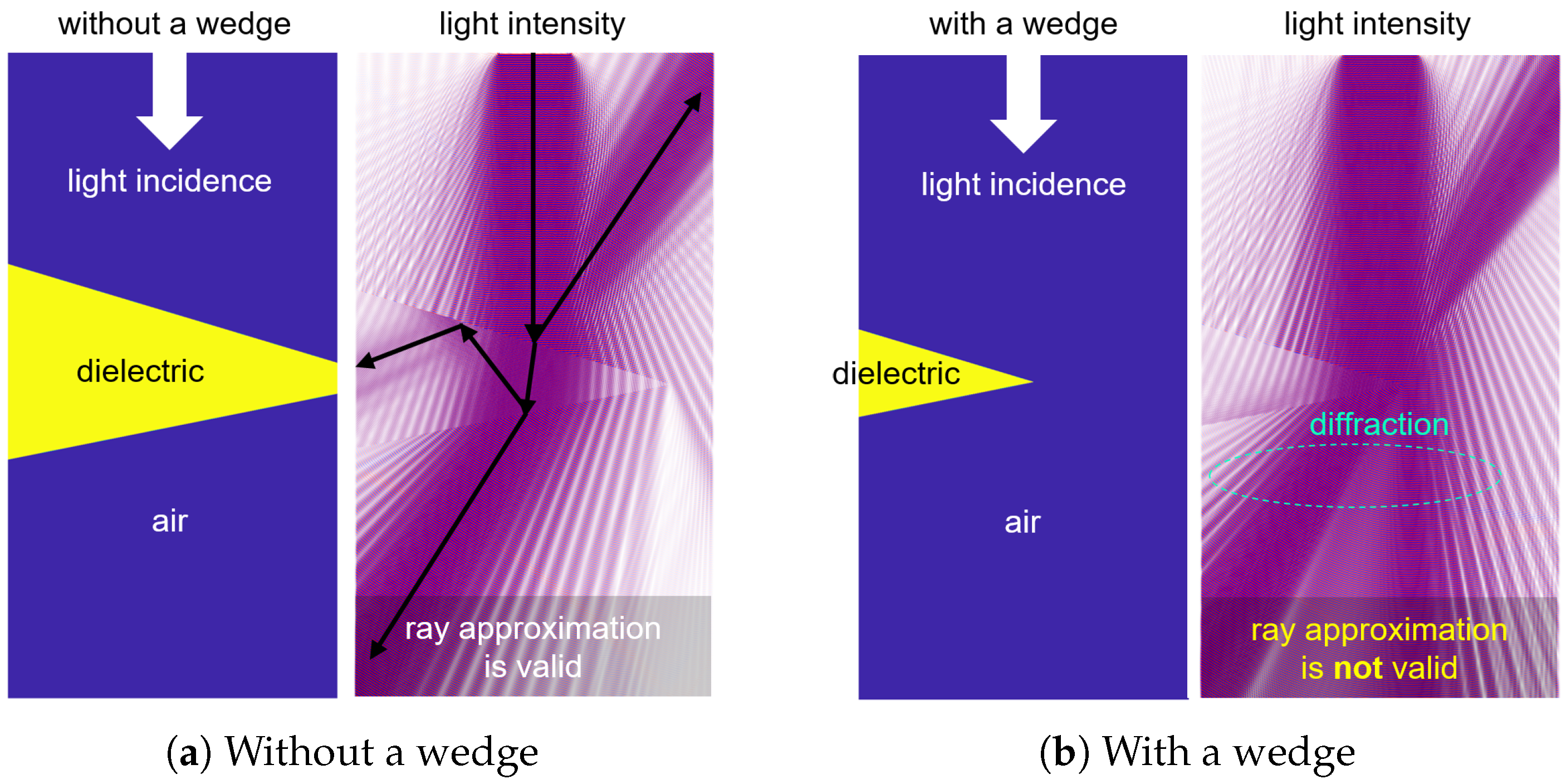
where D is the characteristic feature size. When D / λ 1 , scattering is weak and ray optics provides an accurate approximation. When D / λ 1 or when sharp discontinuities are present, diffraction and interference dominate and ray models fail, as illustrated in Figure 1. This situation closely mirrors the heterogeneous microstructures of plant leaves, motivating the use of full-wave numerical solvers such as finite-difference time-domain (FDTD).

1.4. Contributions of This Work

To address these limitations, this work introduces a physics-grounded, full-wave optical modeling framework based on the FDTD method. Cross-sectional microscope images were digitized and segmented into anatomically faithful tissues—including the cuticle, epidermis, palisade and spongy mesophyll, vascular bundles, and stomata—and wavelength-dependent complex refractive indices were assigned using reported optical constants of water, pigments, and cell wall materials. Because the electrical length of a leaf spans several hundred wavelengths across the Vis-NIR spectrum, full-wave modeling requires substantial computational resources. To make such simulations tractable, we implemented an in-house CUDA-based FDTD solver and performed all simulations on graphics processing units (GPUs), achieving speedups of several tens compared to CPU-based execution. GPU-accelerated simulations over 400–2500 nm were carried out for healthy monocot and dicot leaves. The resulting reflectance and transmittance spectra closely matched PROSPECT-PRO predictions while revealing interference-induced modulations that lie beyond the capabilities of ray-based or radiative-transfer models, thereby underscoring the necessity of a wave-level EM treatment. To the best of our knowledge, no prior study has reported a full-wave optical model of leaf light scattering using anatomically realistic microstructures. Finally, by modeling necrotrophic fungal infection through melanized hyphae penetrating the epidermis, we demonstrate that full-wave simulations can directly link microscale pathological alterations to macroscopic optical signatures, providing a physics-based foundation for hyperspectral detection of early-stage disease.

2. Materials and Methods

2.1. Problem Description

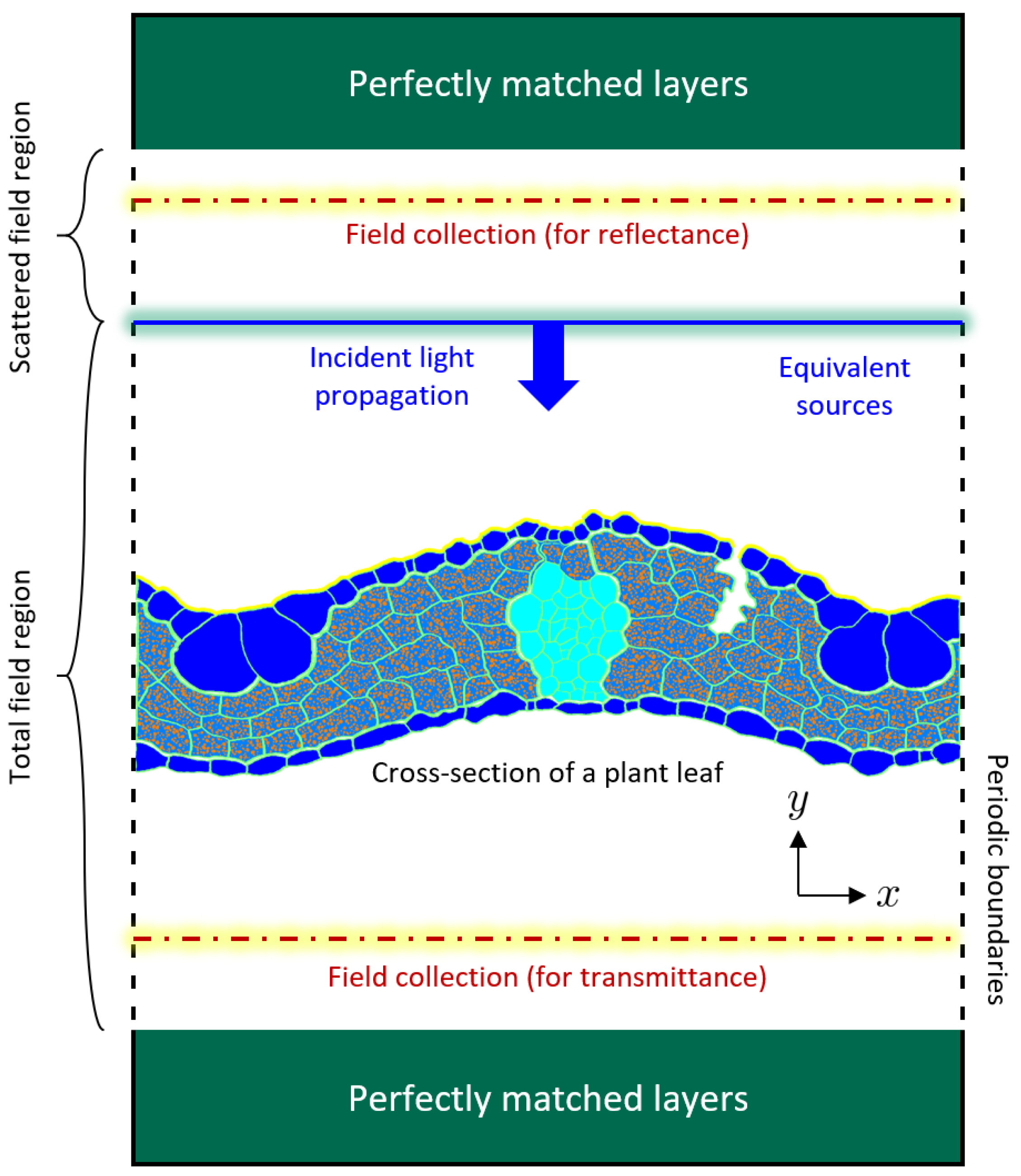
We develop a first-principles, full-wave optical modeling framework. The framework computes the spectral reflectance and transmittance of plant leaves using FDTD simulations. For computational efficiency and as a proof-of-concept demonstration, the inherently three-dimensional leaf structure is approximated by a two-dimensional anatomical cross-section, as illustrated in Figure 2. The internal anatomy of a leaf is embedded in the x y -plane, where x denotes the horizontal axis and y the vertical axis, and a monochromatic plane wave is incident along the y direction.
Because natural sunlight is broadband, thermal, and unpolarized, the incident field in the two-dimensional simulation is decomposed into two orthogonal components: P-polarization and S-polarization. Each polarization is simulated independently, and their results are later combined to represent the general case of unpolarized illumination.

2.2. Maxwell’s Curl Equations for S- and P-Polarized Illumination

Plant leaves contain various types of cells—such as chloroplasts, vacuoles, and cell walls—whose optical responses are frequency-dependent. These materials must therefore be modeled as dispersive media with complex refractive indices that vary with frequency. To incorporate such dispersion into FDTD simulations, one may employ the auxiliary differential equation formulation by introducing polarization-current terms [62,63,64]. The Lorentz–Drude–Sommerfeld model provides a physically rigorous description of dispersive behavior consistent with causality [65], enabling broadband reflectance and transmittance to be computed from a single simulation through post-processing.
For the present proof-of-concept demonstration, we adopt a simplified modeling strategy. The incident illumination is decomposed into two orthogonal linear polarizations (P- and S-polarized), and independent full-wave FDTD simulations are performed for each polarization. The polarization-resolved reflectance and transmittance spectra are explicitly computed and analyzed to examine polarization-dependent scattering behavior within the leaf microstructure. Because natural solar illumination is effectively unpolarized at the leaf scale, the optical response under realistic illumination conditions is obtained by averaging the P- and S-polarized results. Each wavelength is simulated independently using monochromatic excitation. Although this requires multiple FDTD simulations to construct a full spectrum, it significantly simplifies both the numerical formulation and the implementation. For a dispersive medium with complex refractive index
n ˜ ( ω ) = n ( ω ) + i κ ( ω ) ,
the corresponding relative permittivity and equivalent conductivity are
ϵ ˜ r ( ω ) = ϵ r ( ω ) + i ϵ r ( ω ) = n ˜ 2 ( ω ) = n 2 ( ω ) κ 2 ( ω ) + i 2 n ( ω ) κ ( ω ) ,
σ ( ω ) = ω ϵ 0 ϵ ˜ r ( ω ) = 2 ω ϵ 0 n ( ω ) κ ( ω ) ,
where ϵ 0 is the permittivity of free space.
Using these material parameters, the phasor-domain Maxwell curl equations become
× E ( r , ω ) = i ω μ 0 H ( r , ω ) M ( r , ω ) ,
× H ( r , ω ) = i ω ϵ r ( r , ω ) ϵ 0 + σ ( r , ω ) E ( r , ω ) + J ( r , ω ) ,
where M and J denote magnetic- and electric-current excitations, respectively. All leaf tissues are assumed to be nonmagnetic and isotropic, though spatially inhomogeneous.
Transforming these equations into the time domain yields
× E ω ( r , t ) = μ 0 H ω ( r , t ) t M ω ( r , t ) ,
× H ω ( r , t ) = ϵ r , ω ( r ) ϵ 0 E ω ( r , t ) t + σ ω ( r ) E ω ( r , t ) + J ω ( r , t ) ,
where ϵ r , ω ( r ) = ϵ r ( r , ω ) and σ ω ( r ) = σ ( r , ω ) are constant for a fixed excitation frequency. For brevity, we omit the subscript ω in the following.
Under these assumptions, the two-dimensional Maxwell curl equations for S- and P-polarized illumination can be written as follows. For the P-polarized case (or TEz), E = x ^ E x + y ^ E y and H = z ^ H z :
H z t = 1 μ 0 E y x E x y 1 μ 0 M z ,
E x t = 1 ϵ 0 ϵ r H z y σ ϵ 0 ϵ r E x 1 ϵ 0 ϵ r J x ,
E y t = 1 ϵ 0 ϵ r H z x σ ϵ 0 ϵ r E y 1 ϵ 0 ϵ r J y .
For the S-polarized case (or TMz), H = x ^ H x + y ^ H y and E = z ^ E z :
H x t = 1 μ 0 E z y 1 μ 0 M x ,
H y t = 1 μ 0 E z x 1 μ 0 M y ,
E z t = 1 ϵ 0 ϵ r H y x H x y σ ϵ 0 ϵ r E z 1 ϵ 0 ϵ r J z .

2.3. Two-Dimensional Finite-Difference Time-Domain Scheme

The FDTD method numerically solves Maxwell’s curl equations by discretizing the EM fields on a staggered Yee grid and advancing them in time using a leap-frog integration scheme [63,66]. More specifically, spatial and temporal derivatives are approximated using finite differences, allowing the electric- and magnetic-field components to be updated sequentially in time in response to the prescribed electric and magnetic current densities. Note also that the FDTD method updates all field quantities explicitly, i.e., in a matrix-free manner. Moreover, the staggered-grid field components can be easily mapped into one-dimensional arrays, and each time step involves only elementwise additions, subtractions, scalar multiplications, and Hadamard (elementwise) products. This structure makes the FDTD algorithm highly amenable to GPU acceleration.
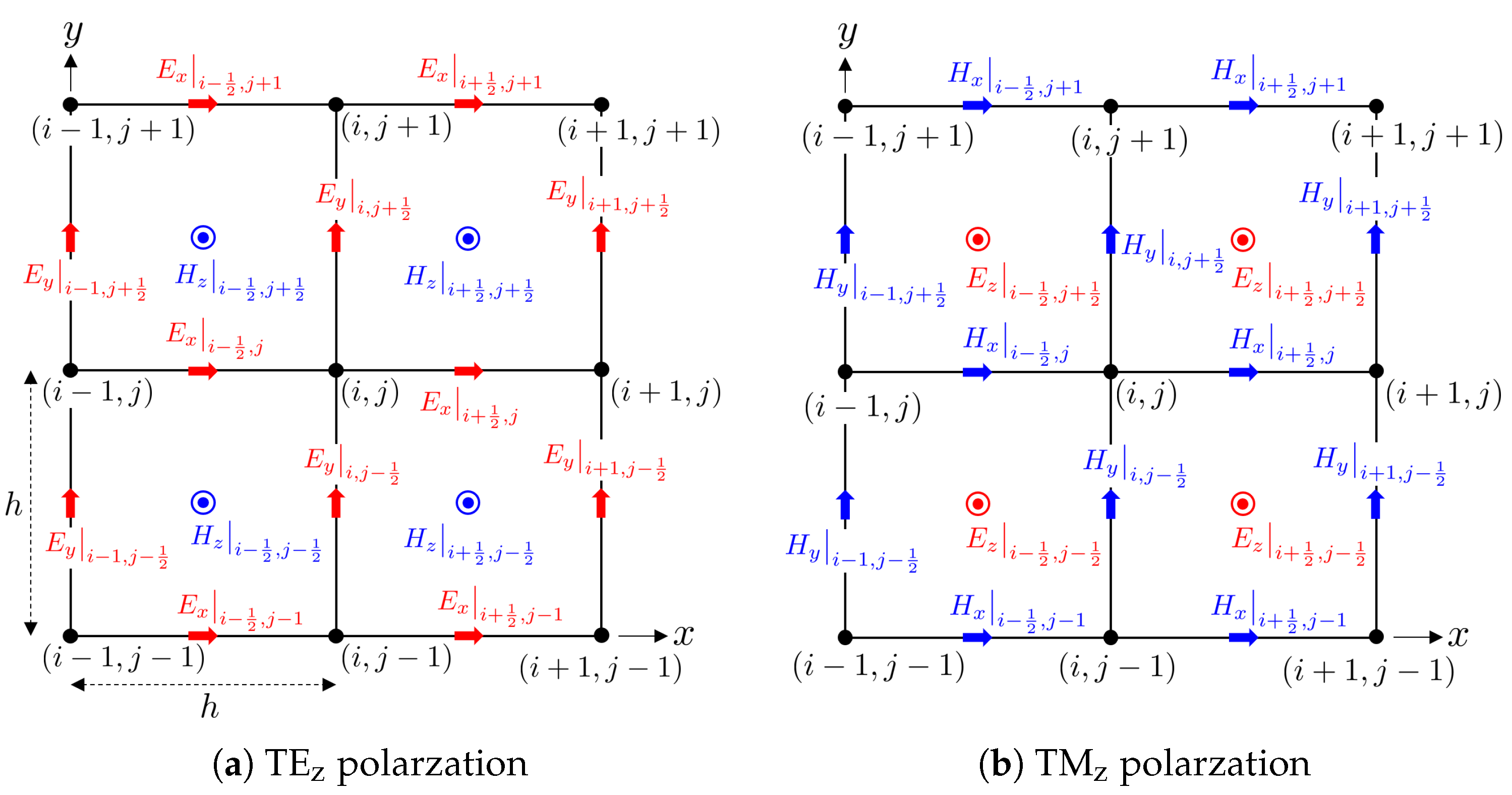
As depicted in Figure 3, the computational domain (or mesh) is discretized using Yee’s lattice, and the grid points are defined as
x i i h , y j j h , t n n Δ t ,
where h denotes the spatial grid spacing in both x and y directions, and Δ t represents the temporal step size. Subscripts and superscripts denote the spatial grid index and the time index, respectively, i.e.,
A | i , j n A ( x i , y j , t n ) .
For the TEz (or P) polarization, the discrete time-stepping relations are expressed as
H z | i + 1 2 , j + 1 2 n + 1 2 = H z | i + 1 2 , j + 1 2 n 1 2 Δ t μ 0 E y | i + 1 , j + 1 2 n E y | i , j + 1 2 n h E x | i + 1 2 , j + 1 n E x | i + 1 2 , j n h + M z | i + 1 2 , j + 1 2 n ,
E x | i + 1 2 , j n + 1 = C e | i + 1 2 , j E x | i + 1 2 , j n + C h | i + 1 2 , j H z | i + 1 2 , j + 1 2 n + 1 2 H z | i + 1 2 , j 1 2 n + 1 2 h J x | i + 1 2 , j n + 1 2 ,
E y | i , j + 1 2 n + 1 = C e | i , j + 1 2 E y | i , j + 1 2 n C h | i , j + 1 2 H z | i + 1 2 , j + 1 2 n + 1 2 H z | i 1 2 , j + 1 2 n + 1 2 h + J y | i , j + 1 2 n + 1 2 ,
where the conductivity-averaged coefficients for P-polarized fields are defined as
C e | i , j = 1 σ | i , j Δ t 2 ϵ 0 ϵ r | i , j 1 + σ | i , j Δ t 2 ϵ 0 ϵ r | i , j 1 , C h | i , j = 1 + σ | i , j Δ t 2 ϵ 0 ϵ r | i , j 1 .
These coefficients effectively average the conductivity term at times t n and t n + 1 , ensuring numerical stability and consistent energy decay in lossy media. For the TMz (or S) polarization, the discrete time-stepping relations are written as
E z | i + 1 2 , j + 1 2 n + 1 2 = C e | i + 1 2 , j + 1 2 E z | i + 1 2 , j + 1 2 n 1 2 + C h | i + 1 2 , j + 1 2 H y | i + 1 , j + 1 2 n H y | i , j + 1 2 n h H x | i + 1 2 , j n H x | i + 1 2 , j 1 n h J z | i + 1 2 , j + 1 2 n ,
H x | i + 1 2 , j n + 1 = H x | i + 1 2 , j n Δ t μ 0 E z | i + 1 2 , j + 1 2 n + 1 2 E z | i + 1 2 , j 1 2 n + 1 2 h + M x | i + 1 2 , j n + 1 2 ,
H y | i , j + 1 2 n + 1 = H y | i , j + 1 2 n + Δ t μ 0 E z | i + 1 2 , j + 1 2 n + 1 2 E z | i 1 2 , j + 1 2 n + 1 2 h M y | i , j + 1 2 n + 1 2 .
Again, the above scheme is matrix-free (or explicit) due to the use of the central-difference method, meaning that no matrix inversion is required. However, it is conditionally stable depending on the choice of the time step Δ t . The Courant–Friedrichs–Lewy (CFL) stability condition for the two-dimensional FDTD scheme [63,67] is given by
Δ t 1 c 1 h 2 + 1 h 2 ,
where c denotes the speed of light.
Figure 3. Schematic of the two-dimensional Yee grid illustrating the field component arrangement for (a) TEz and (b) TMz polarizations.
Agriculture 16 00286 g003

2.4. Boundary Conditions of Electromagnetic Fields

Since the electrical size of a plant leaf is large, the computational domain must be truncated while ensuring physically consistent boundary conditions. To emulate lateral periodicity of the leaf cross-section, periodic boundary conditions (PBCs) [63,68] are applied along the x direction.
For the TEz polarization, both E x and E y exist; however, the tangential electric field on the lateral boundary is E y . Thus, the periodicity condition is imposed as
E y ( x + L x , y , t ) = E y ( x , y , t )
where L x denotes the horizontal extent of the domain. In discretized form,
E y | N g , x , j + 1 2 n = E y | 0 , j + 1 2 n
for j = 0 , 1 , , N g , y 1 . Similarly, for the TMz polarization, the tangential magnetic field on the periodic boundary is H y , so
H y ( x + L x , y , t ) = H y ( x , y , t )
which becomes
H y | N g , x , j + 1 2 n = H y | 0 , j + 1 2 n
for j = 0 , 1 , , N g , y 1 .
Because of these constraints, the FDTD update equations at the left and right boundaries must wrap field values across the domain. For TEz, the quantity H z | 1 2 , j + 1 2 n + 1 2 is replaced by its periodic counterpart H z | N g , x 1 2 , j + 1 2 n + 1 2 , yielding the left-boundary update:
E y | 0 , j + 1 2 n + 1 = C e E y | 0 , j + 1 2 n C h [ H z | 1 2 , j + 1 2 n + 1 2 H z | N g , x 1 2 , j + 1 2 n + 1 2 h ] .
An analogous wrapping is applied at the right boundary. Since these two boundary update equations are identical up to index wrapping, they can be expressed compactly as
E y | lateral , j + 1 2 n + 1 = C e E y | lateral , j + 1 2 n C h H z | 1 2 , j + 1 2 n + 1 2 H z | N g , x 1 2 , j + 1 2 n + 1 2 h .
The same procedure applies to the TMz polarization:
H y | lateral , j + 1 2 n + 1 = H y | lateral , j + 1 2 n + Δ t μ 0 E z | 1 2 , j + 1 2 n + 1 2 E z | N g , x 1 2 , j + 1 2 n + 1 2 h .
All other update equations referencing boundary nodes follow the same principle of index wrapping.
At the top and bottom of the computational domain, perfectly matched layers (PMLs) [63,69,70,71,72] are employed to absorb outgoing waves and suppress spurious reflections. Various formulations exist for implementing PMLs, including the stretched-coordinate PML, the uniaxial PML, the diagonally anisotropic PML, and the convolutional PML. In this work, we adopt the split-field PML [69], which offers excellent absorption over a wide angular and frequency range while ensuring numerical stability and seamless integration into the standard FDTD update procedure.

2.5. Excitation of Incident Plane Wave at Normal Incidence

To inject a normally incident plane wave without introducing spurious reflections, we employ the total-field/scattered-field (TF/SF) formulation [63,73]. The domain is divided into a total-field (TF) region, where both the incident and scattered fields exist, and a surrounding scattered-field (SF) region, where only scattered fields propagate. The TF/SF interface acts as a fictitious boundary on which equivalent electric and magnetic current sources are enforced so that the TF region contains the prescribed incident wave while the SF region contains no incident fields.
For TEz polarization, the incident fields are
E inc TE ( x , y , t ) = x ^ cos ( ω t k y ) ,
H inc TE ( x , y , t ) = z ^ 1 η 0 cos ( ω t k y ) ,
where the wave propagates in the y direction. Let n ^ = y ^ be the outward normal from the TF region into the SF region. The equivalent electric and magnetic current sources imposed on the TF/SF boundary are
J eqv TE = n ^ × H inc TE ,
M eqv TE = n ^ × E inc TE .
These currents ensure that the incident field exists only within the TF region, thereby enabling accurate computation of reflection and transmission.
For TMz polarization, the incident plane wave is instead given by
E inc TM ( x , y , t ) = z ^ cos ( ω t k y ) ,
H inc TM ( x , y , t ) = x ^ 1 η 0 cos ( ω t k y ) ,
and substituting these fields into the same TF/SF equivalent-current expressions yields the corresponding TM-equivalent sources.

2.6. Reflectance and Transmittance Calculation

After the fields reach steady state, the reflected and transmitted signals are sampled along two horizontal lines located at y = y r and y = y t , respectively, over multiple time periods. For TEz polarization, applying the discrete Fourier transform (DFT) to the recorded time-domain fields yields
E ˜ ref ( x , ω ) = F { E x ( x , y r , t ) } ,
E ˜ trs ( x , ω ) = F { E x ( x , y t , t ) } .
Because the simulation enforces periodicity in the x direction, the spectral fields admit a Bloch expansion [74]:
E ˜ ref ( x , ω ) = m = E ref , m ( ω ) e i k x , m x ,
E ˜ trs ( x , ω ) = m = E trs , m ( ω ) e i k x , m x ,
where the transverse Bloch wavenumber is
k x , m = 2 π m L x .
A Bloch order m corresponds to a propagating mode only when its longitudinal wavenumber
k y , m = k 0 2 k x , m 2
is real. Let M max denote the largest integer such that k y , m remains real. Then, summing all propagating orders yields the reflectance and transmittance:
R ( ω ) = m = M max M max E ref , m ( ω ) 2 E inc , 0 ( ω ) 2 ,
T ( ω ) = m = M max M max E trs , m ( ω ) 2 E inc , 0 ( ω ) 2 .
Here, E inc , 0 ( ω ) is the spectral amplitude of the incident zeroth-order Bloch mode. The absorption spectrum is then obtained from energy conservation:
A ( ω ) = 1 R ( ω ) T ( ω ) .
For TMz polarization, the same procedure applies by replacing E x ( x , y r / t , t ) with E z ( x , y r / t , t ) in the above formulation.

2.7. Reconstruction of Internal Plant Cross-Section Structure

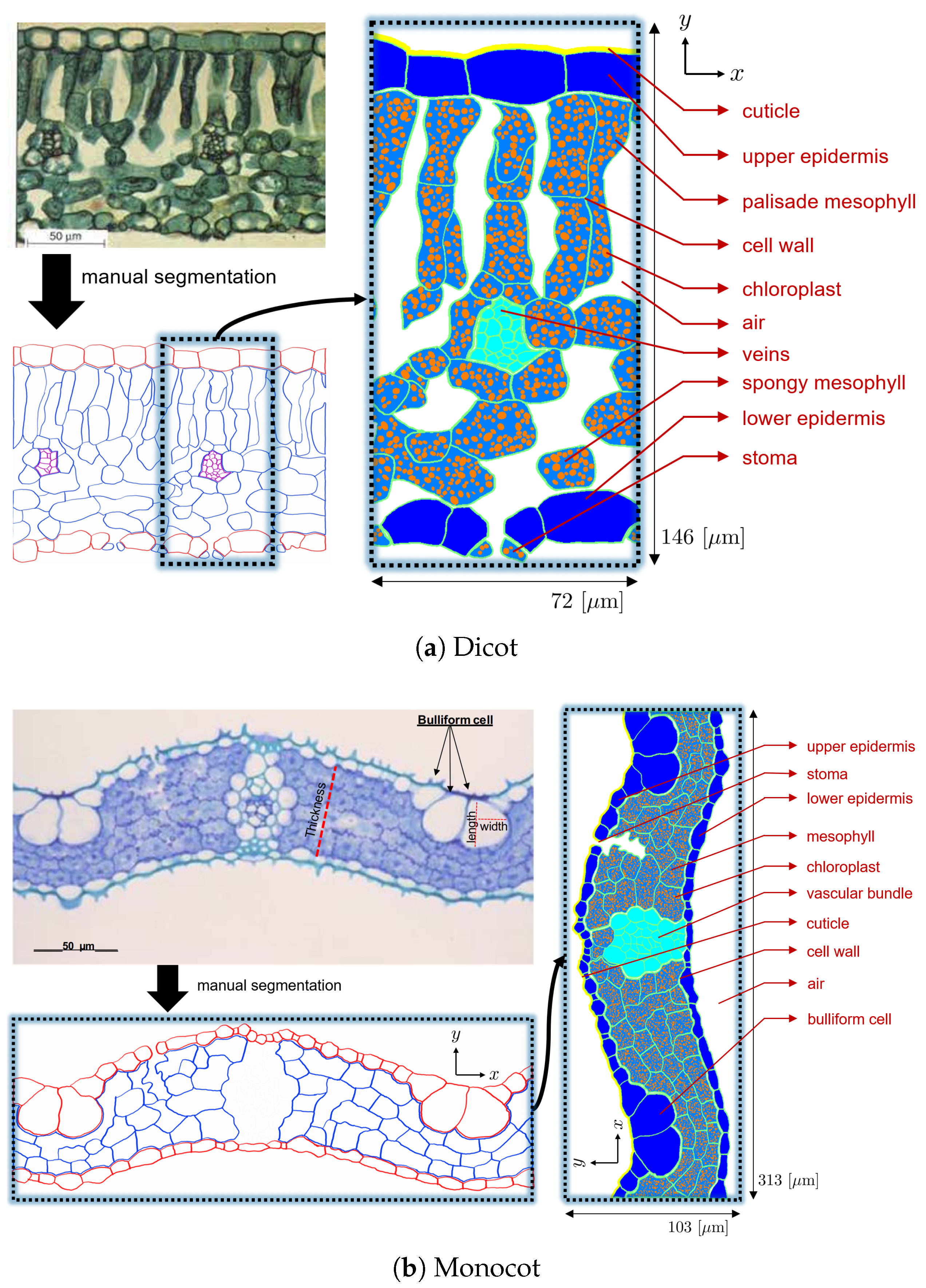
To accurately simulate light scattering within plant leaves, the internal microstructure must be represented with high anatomical fidelity. To this end, we reconstructed the leaf geometry by segmenting microscope cross-sectional images into their constituent anatomical regions. Representative cross-sectional images of dicot (a lilac or Syringa sp.) and monocot (a rice or Oryza sativa L.) leaves were obtained from [75,76], respectively. Using a SAMSUNG Galaxy Tab S7, a human rater manually delineated the boundaries of each anatomical layer with distinct colors. Following the manual annotation, digital image-processing techniques were applied to extract the boundary curves and convert them into closed polygonal regions suitable for numerical meshing and subsequent FDTD simulation.
During the manual annotation process, anatomical components such as the cuticle, cell wall, epidermal cells, palisade mesophyll, spongy mesophyll, vascular bundles, veins, bulliform cells, stroma, and lower epidermal cells were delineated. Due to the limited resolution of the microscope images, individual chloroplasts could not be identified or manually traced. To compensate for this limitation, chloroplasts were modeled as randomly inserted elliptical shapes of varying sizes within the mesophyll and stroma regions. The assumed chloroplast concentration was reflected in both the number and size distribution of the inserted ellipses.
Each chloroplast was represented as a rotated ellipse, corresponding to the projected cross-section of an oblate spheroid embedded within the mesophyll tissue. The major and minor axes are denoted by a and b, respectively, and the rotation angle by θ . To capture natural morphological variability, the parameters a, b, and θ were treated as random variables. The orientation angle θ followed a uniform distribution on [ 0 , 2 π ) . The major axis was sampled as
a mean = μ a + σ a ( 2 r 1 1 ) ,
where μ a = 0.8 μ m is the mean chloroplast radius, σ a = 0.2 μ m is the standard deviation, and r 1 U ( 0 , 1 ) is a uniformly distributed random number. The minor axis was then perturbed relative to a mean :
b mean = a mean 1 + ( r 2 0.5 ) ,
with r 2 U ( 0 , 1 ) . This stochastic parameterization introduces sample-to-sample geometric variability while maintaining statistical consistency in chloroplast size distributions. The chloroplast ellipses were randomly positioned within the mesophyll region, from the outer boundary to a depth l chl , using random centroids and samples of ( a , b , θ ) . For healthy dicot leaves, the chloroplast filling fraction was controlled such that the total chloroplast area A chl occupied approximately 20% of the total mesophyll area A mes . Pigment concentrations were set to C ab = 26,910 μ g cm 3 (≈ 30 mM ) for chlorophyll a + b and C car = 3221.4 μ g cm 3 (≈ 6 mM ) for carotenoids.
The overall procedure used to reconstruct the internal plant structure for both dicot and monocot samples is illustrated in Figure 4.

2.8. Optical Properties of Plant Tissues

The optical properties of materials are described by their complex refractive indices. When light propagates through media with different complex refractive indices, its reflection, transmission, and scattering characteristics vary significantly depending on both the refractive indices and the geometrical structure of the interfaces. Therefore, to accurately understand the light-scattering phenomena within the internal structure of a plant leaf, it is essential to model the complex refractive indices of each anatomical component correctly.
Complex refractive indices can be classified according to their physical characteristics [65], such as (1) dispersion: whether the refractive index varies with frequency; (2) isotropy: whether the refractive index is the same in all directions; (3) inhomogeneity: whether the refractive index varies spatially; and (4) linearity: whether the dielectric polarization varies linearly with the incident electric field. In this proof-of-concept study, to focus on the fundamental scattering mechanisms, all anatomical components of the leaf are assumed to be isotropic and linear.
In terms of optical behavior, plant tissues are primarily composed of water, pigments (chlorophylls and carotenoids), and structural cell wall materials [11,32,33,34,42,77,78,79,80,81,82,83,84]. Accordingly, we classify four representative materials with distinct complex refractive indices to define the optical properties of each anatomical region in the leaf: (1) cuticle, (2) cell wall, (3) pigments, and (4) water.
The cuticle is the outermost layer of the leaf surface, primarily composed of cutin and waxy hydrocarbons that serve as a protective barrier against water loss. Following [7,85,86,87], the refractive index of the cuticle is modeled as
n = 1.45 .
The cell wall surrounds each plant cell and provides mechanical strength and rigidity. In potato and soybean leaves, it mainly consists of cellulose microfibrils, hemicellulose, pectin, and water. Based on reported measurements [23,24,82,88,89,90], the refractive index of the cell wall is modeled as approximately
n = 1.52 .
The complex refractive index of water varies with wavelength. In this study, both the real and imaginary parts of the water refractive index, denoted as n wat ( λ ) and κ wat ( λ ) , were adopted from the PROSPECT-PRO dataset [35].
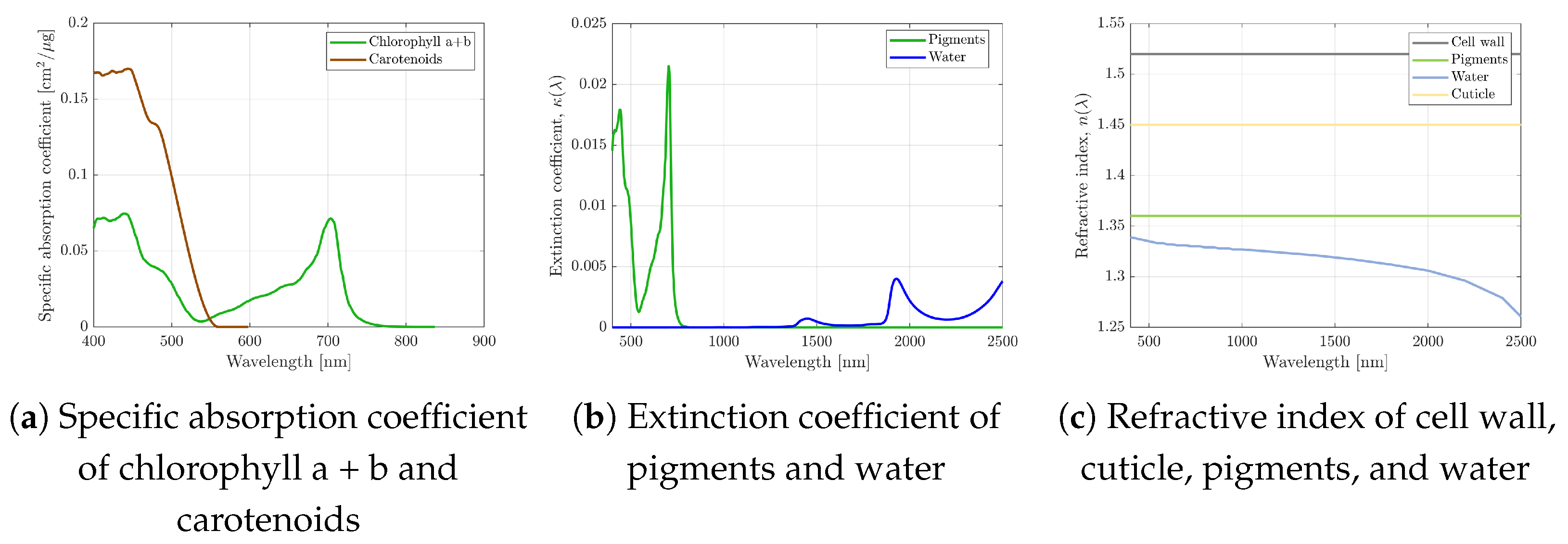
Pigments are color-bearing molecules distributed primarily in the mesophyll region and play a central role in photosynthesis. In healthy plant leaves, the dominant pigments are chlorophyll a, chlorophyll b, and carotenoids [35]. These pigments exhibit distinct absorption spectra in the visible range, which determine the characteristic absorptance, reflectance, and transmittance of plant leaves. To quantify their absorption, the specific absorption coefficient (SAC) [cm2 µg−1] is commonly employed by accounting for the pigment concentration within chloroplast regions. The SAC spectra of chlorophyll a + b and carotenoids are shown in Figure 5. The complex refractive indices of each pigment were modeled as [35,91,92]
n chl = 1.36 , κ chl _ ab ( λ ) = SAC chl _ ab ( λ ) C ab 0.01 λ 4 π ,
n car = 1.36 , κ car ( λ ) = SAC car ( λ ) C car 0.01 λ 4 π .
Finally, the overall complex refractive index of the pigment region was defined as
n pig ( λ ) = 1.36 , κ pig ( λ ) = κ chl _ ab ( λ ) + κ car ( λ ) + κ wat ( λ ) .
The resulting wavelength-dependent complex refractive indices of the cuticle, cell wall, pigment, and water layers are summarized in Figure 5.

2.9. Implementation with GPU Acceleration and Computing Resources

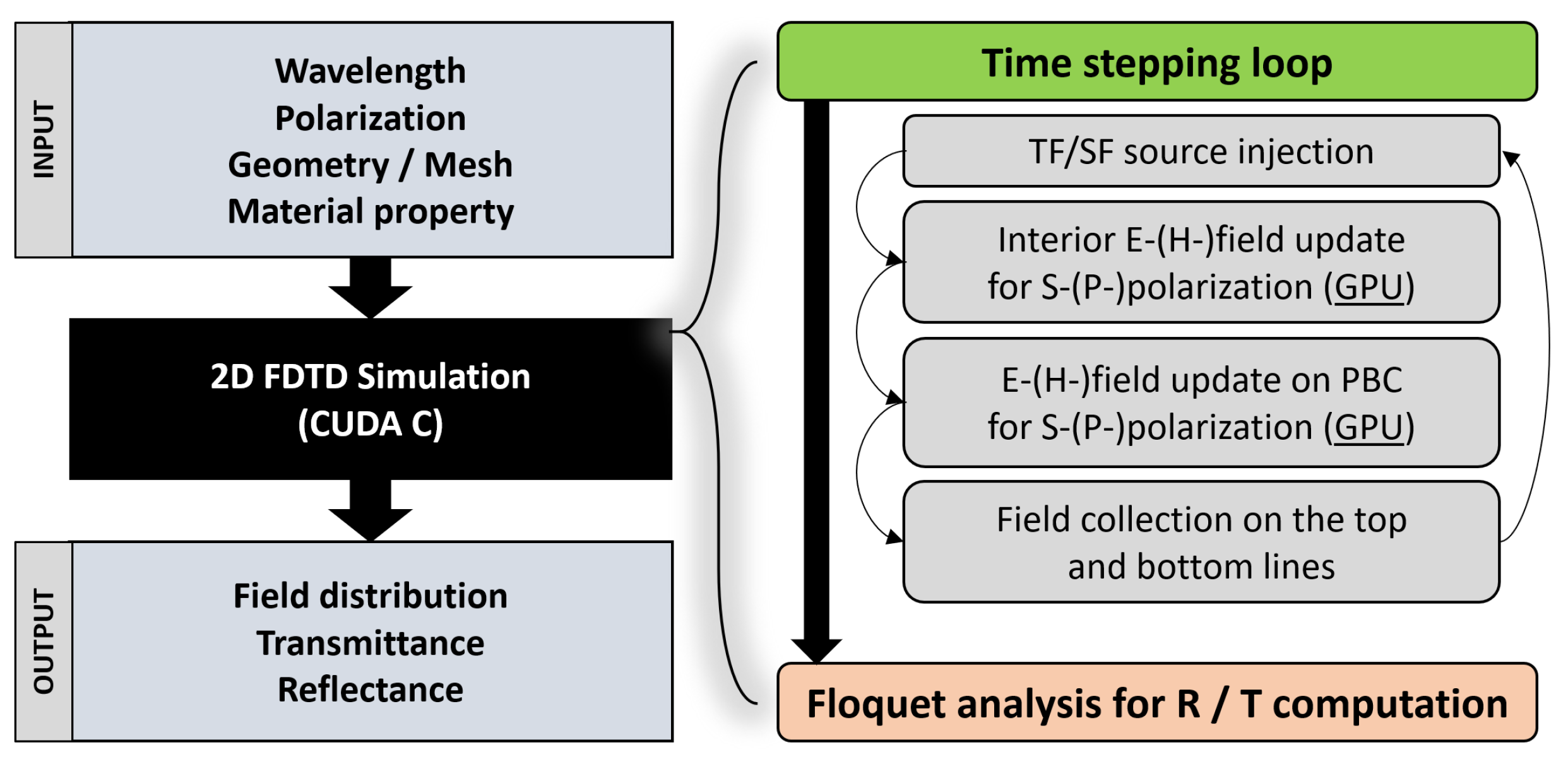
To enhance computational performance, we developed an in-house GPU-parallelized FDTD solver in CUDA C and executed it in a Linux environment (Ubuntu on Windows 11 WSL). A single GPU was used to perform high-throughput time-domain updates, as illustrated in Figure 6. The developed solver, termed FLARE-X (FDTD Leaf-light Analysis with Rapid Execution on GPU Acceleration), is optimized for efficient simulation of light-scattering phenomena within anatomically realistic planar leaf microstructures.
All simulations were conducted on a workstation equipped with dual Intel® Xeon® Gold 6430 processors (2.10 GHz, 32 cores each) and 1.0 TB of DDR5 system memory. GPU acceleration was provided by a single NVIDIA RTX A6000 Ada graphics card with 48 GB of VRAM. The operating environment was 64-bit Ubuntu running under Windows 11 WSL (Windows Subsystem for Linux). This configuration enabled large-scale FDTD simulations to be executed efficiently within practical runtimes.

3. Validation

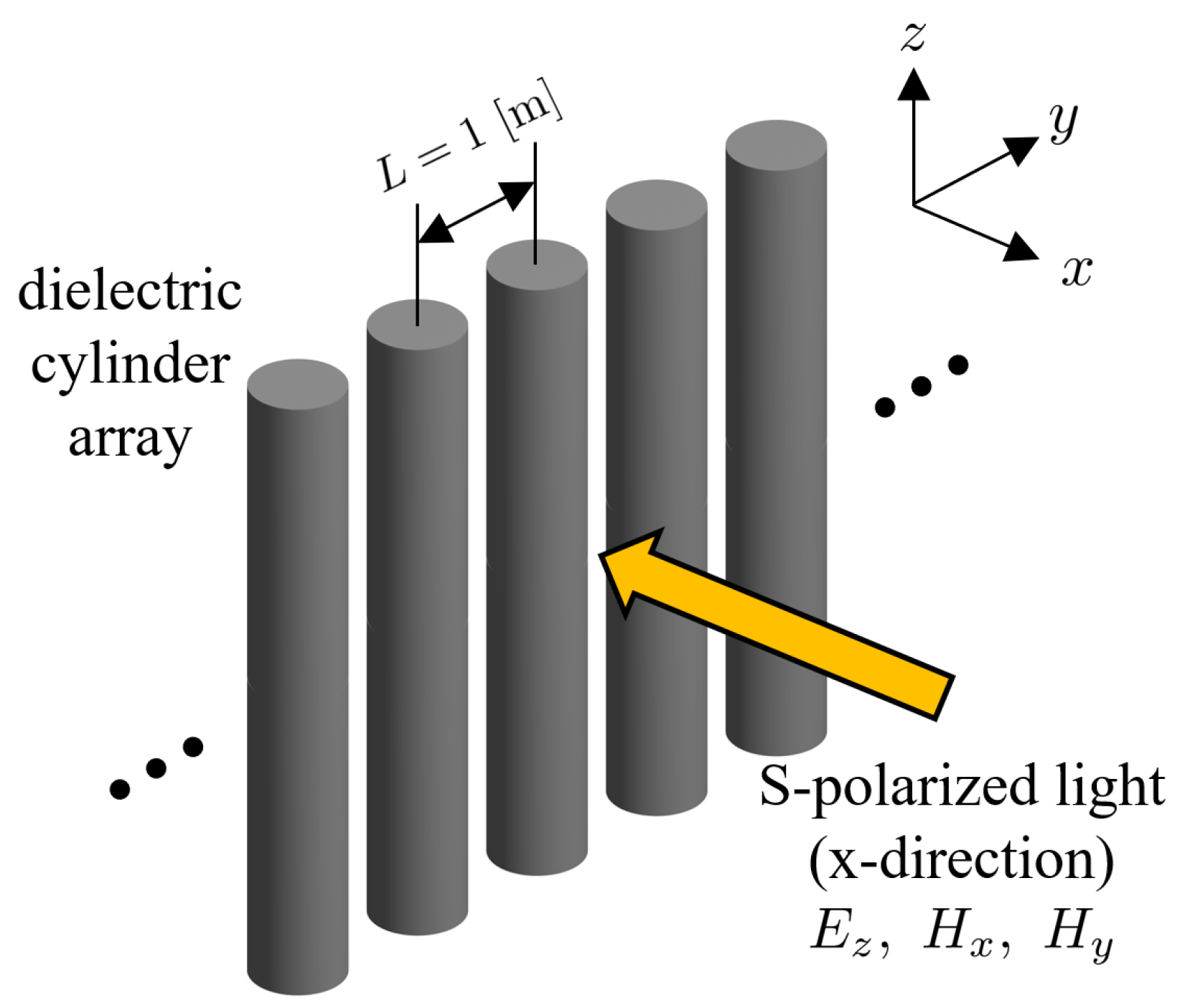
To validate the developed two-dimensional FDTD algorithm, we computed the reflectance and transmittance for an S-polarized plane wave incident on a periodic dielectric cylinder array, as illustrated in Figure 7.
The resulting spectra were compared against the theoretical predictions reported in [93].
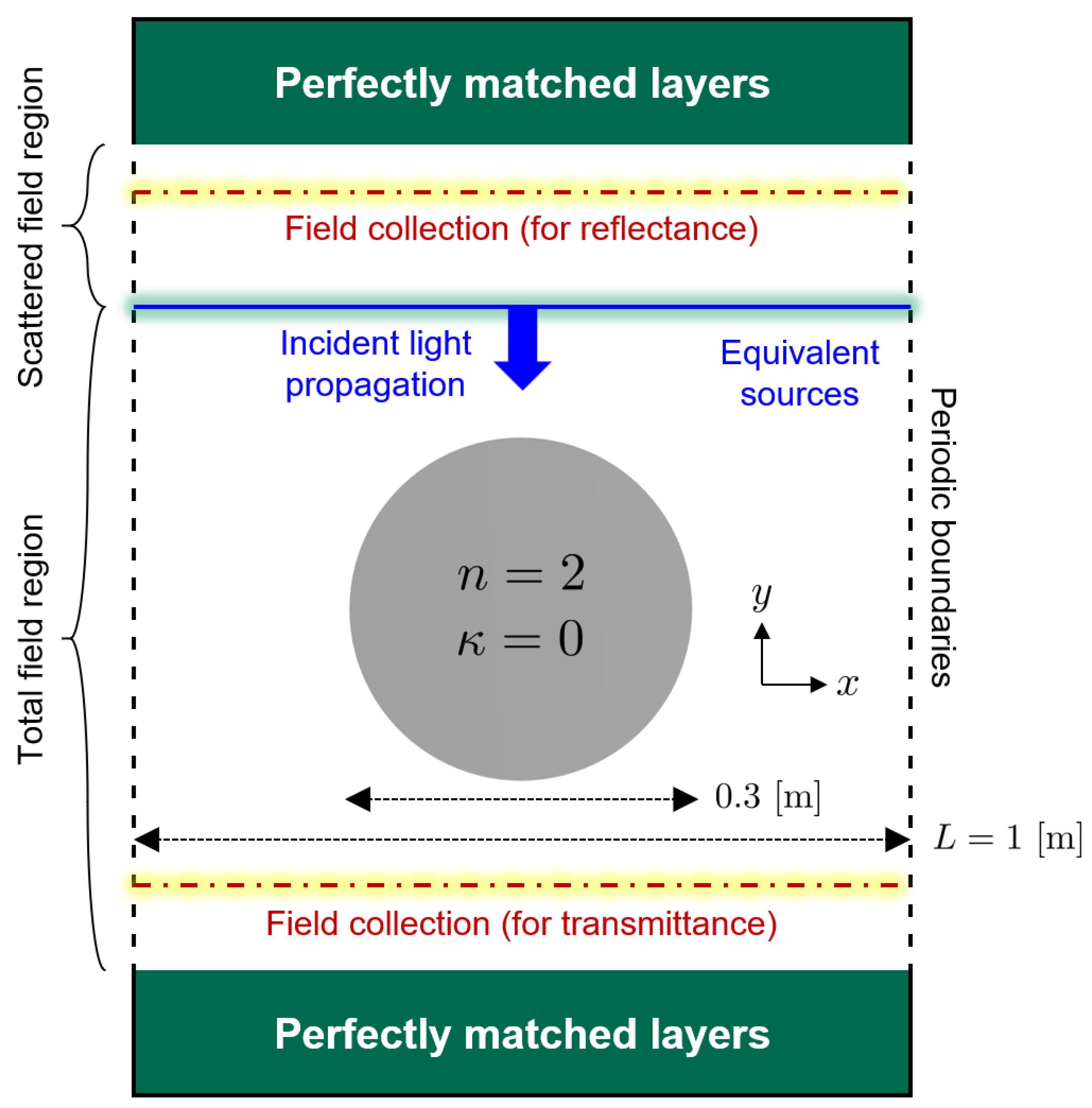
Because the dielectric array extends infinitely in the transverse direction, only a single unit cell was simulated by truncating one period of the array and modeling its cross-section in the x y -plane. The computational domain correspondingly represents this unit cell, with periodic boundary conditions applied along the y direction and PML boundaries applied along the x direction, as shown in Figure 8.
The array period was set to L = 1 m , the cylinder diameter to D = 0.3 m , and the refractive index of the dielectric cylinders to n = 2 . An S-polarized plane wave was normally incident onto the structure, and the wavelength was swept from 1 m to 2 m . The FDTD simulation parameters are summarized in Table 1.
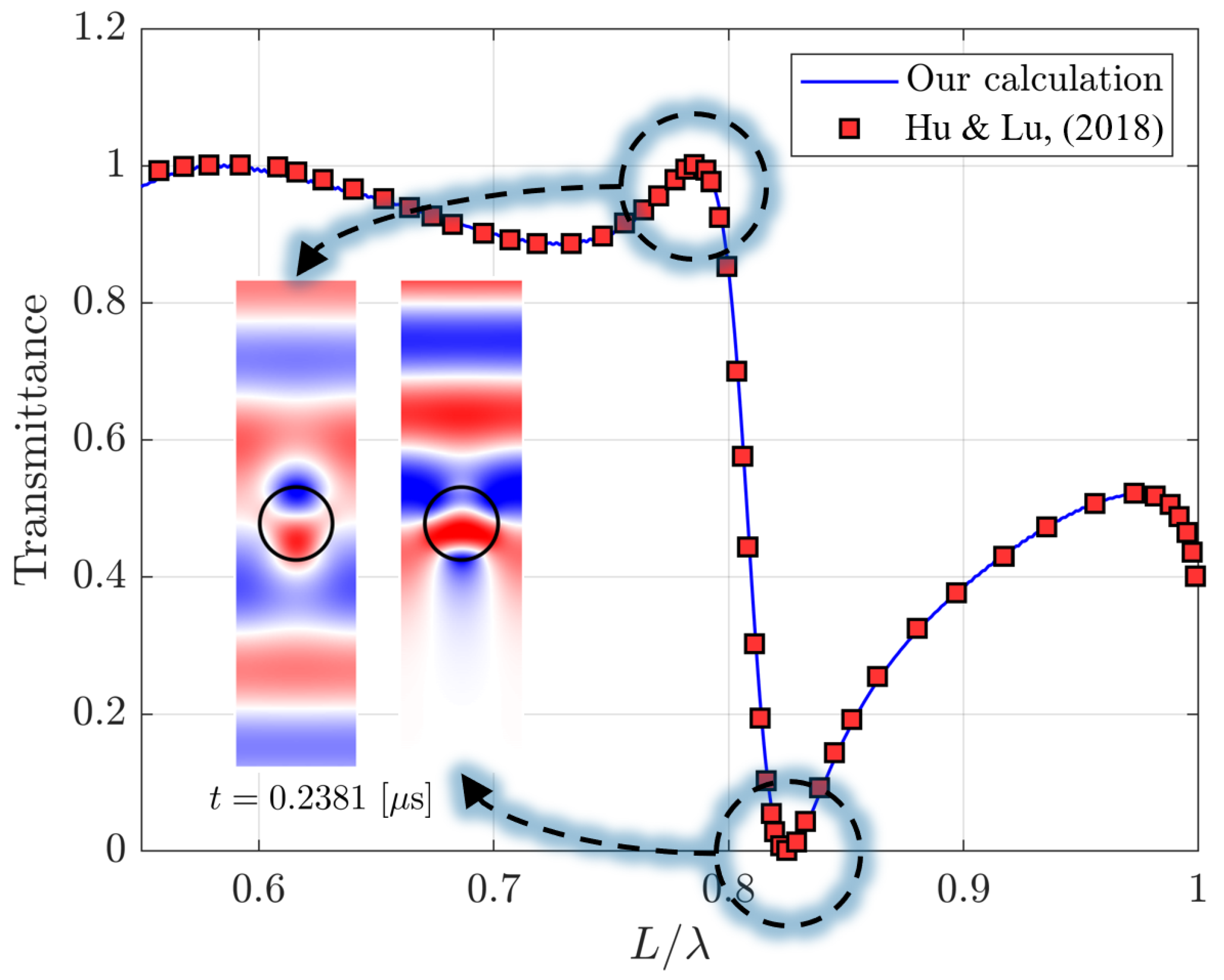
Figure 9 presents the transmittance as a function of the normalized electrical length L / λ . The FDTD results exhibit excellent agreement with the theoretical curve from [93], thereby confirming the accuracy and reliability of the developed 2D FDTD formulation.
In particular, when L / λ 0.82 , the transmittance sharply drops to nearly zero due to the excitation of resonant modes supported by the periodic structure. These resonances correspond to bound states in the continuum (BICs), in which incoming energy is trapped within the array and cannot propagate through [94]. For L / λ < 0.8 , these BIC modes are not excited, and most of the incoming wave transmits through the array with minimal attenuation. The inset field distributions in Figure 9 clearly demonstrate the contrasting behaviors of strong resonance trapping and efficient transmission.

4. Results

The objective of the present study is to establish a physics-based full-wave optical modeling framework that supports the systematic interpretation of early-stage disease signatures in hyperspectral plant leaf measurements. In practice, early-diseased leaves often exhibit only subtle spectral deviations from healthy conditions, while the measured signals are frequently affected by experimental noise, biological variability, and environmental fluctuations. As a result, distinguishing early infection stages based solely on measured spectra can be highly challenging without a physics-based reference. By constructing full-wave optical models from anatomically resolved leaf cross-sections, the proposed approach enables the formation of a physics-based reference library that links specific microstructural and compositional alterations to corresponding hyperspectral reflectance and transmittance responses. In future studies, cross-sectional microscopy of various healthy and early-diseased leaves can be used to generate a diverse set of full-wave simulation results. Experimental hyperspectral measurements can then be systematically compared against this modeling-based physical reference space to categorize the measured leaf state and infer the underlying structural condition or early disease stage.
In this section, we investigate two scenarios. All numerical simulations and datasets presented in this study were generated using in-house-developed FDTD codes in 2025. First, the spectral reflectance and transmittance of a healthy plant leaf are computed using the proposed FDTD-based framework and compared with those obtained from the PROSPECT-PRO model [35]. The results presented in this section correspond to healthy, fully developed plant leaves under standard laboratory illumination conditions, as commonly assumed in hyperspectral reflectance and transmittance measurements. The leaf geometries are derived from publicly available microscopy images of real dicot and monocot leaf cross-sections reported in the literature and therefore represent realistic internal anatomical structures rather than idealized synthetic models. Accordingly, the simulated optical responses are directly comparable to experimentally measured leaf reflectance and transmittance spectra.
By analyzing both dicot and monocot samples, we show that the Vis-NIR optical responses exhibit distinct characteristics depending on the internal anatomical structure of the leaf. Second, we examine a dicot leaf exhibiting early-stage fungal infection on its surface. The spectral reflectance and transmittance of the diseased region are evaluated using the same FDTD simulations and subsequently compared with those of the healthy leaf. The observed spectral changes are further discussed in connection with previously reported biophysical interpretations of pathogen-induced tissue alterations.
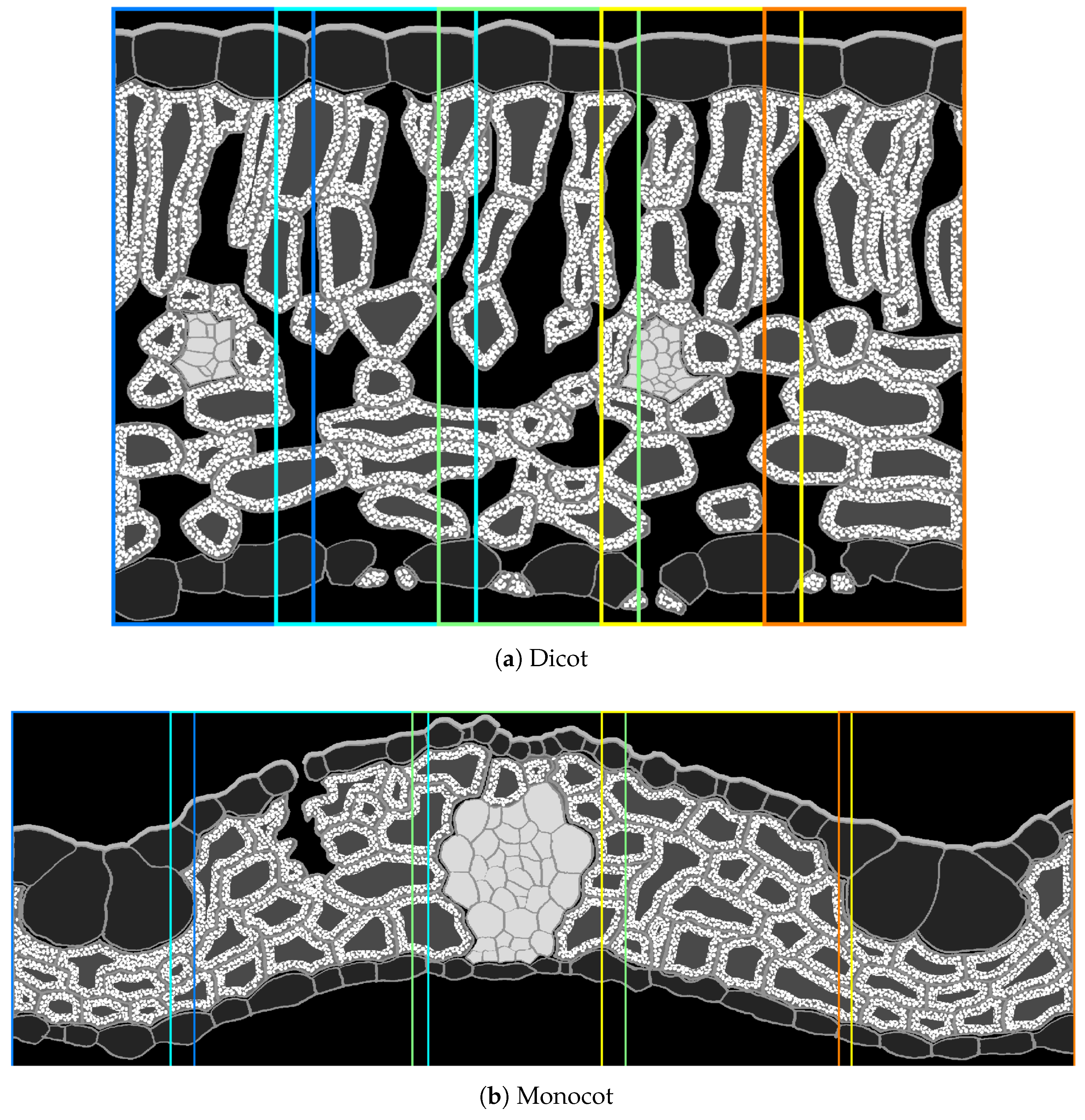
The physical dimensions of the plant leaf samples and the corresponding FDTD simulation parameters are summarized as follows: For the dicot sample, shown in Figure 10a, the leaf thickness was approximately 140 μ m and the width was 200 μ m . The wavelength range of interest spans 400– 2500 nm . Based on the shortest wavelength, the computational domain corresponds to an electrical size of approximately 350 × 500 . To ensure numerical stability and accuracy, the mesh size was chosen considering both the effective wavelength inside tissue and skin depth,
λ eff = λ 0 n , δ = λ 2 π κ ,
where δ is the skin depth. Using the minimum values over the operating band, a cell-per-wavelength (CPW) of approximately 11.2 was maintained:
λ min = λ 0 n cell wall 263.16 nm , h = λ min CPW 23.41 nm .
The time-step interval was then set by the CFL condition:
Δ t h c 2 = 0.0552 fs .
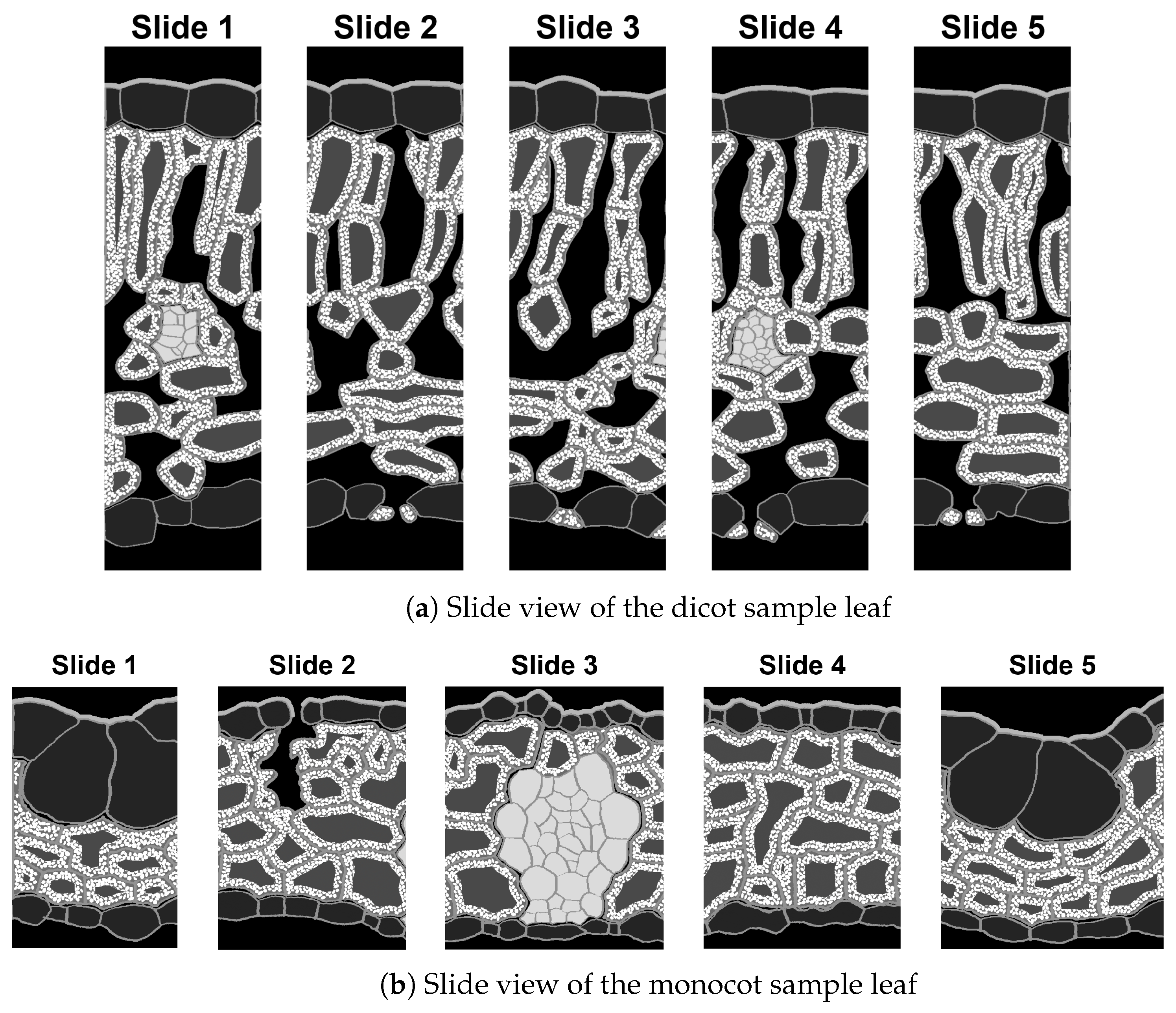
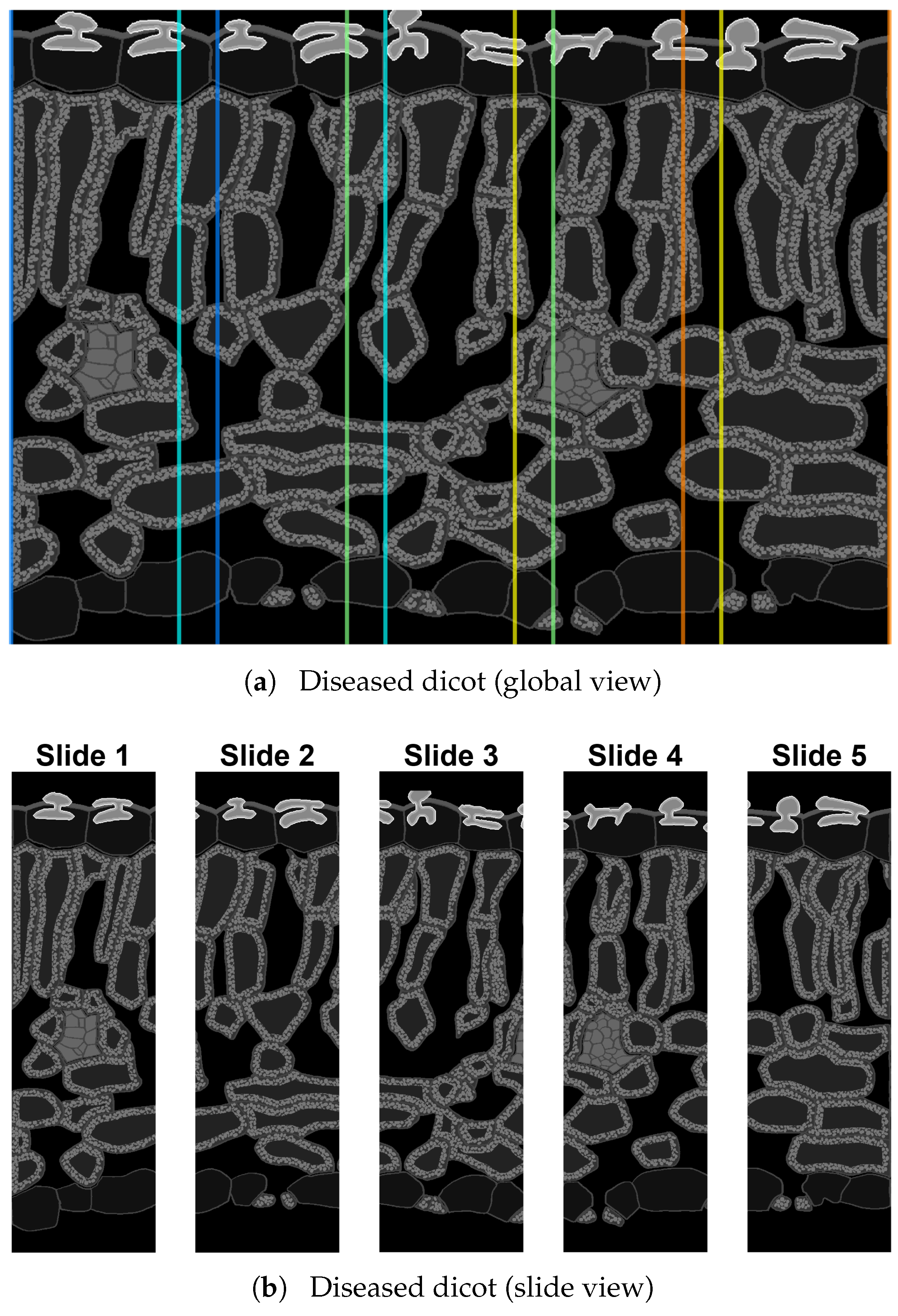
A total of N t = 55 , 000 time steps were executed, corresponding to a physical duration of approximately 3 ps . This is equivalent to about 2277 optical periods at λ = 400 nm and 364 periods at λ = 2500 nm , which is sufficient for the fields to reach steady state after all scattering processes. For the dicot sample, the resulting discretized grid contains approximately 8511 × 6689 cells (including PMLs), corresponding to about 5.7 × 10 7 unknowns. To mitigate this computational burden, the dicot leaf image was divided into five horizontal slices (Figure 11a). Independent FDTD simulations were carried out for each slice, and the overall reflectance and transmittance were obtained by averaging the slice-wise results.
A similar strategy was applied to the monocot leaf (Figure 10b). For this case, the simulation parameters were h = 23.15 nm and Δ t = h / ( c 2 ) 0.0546 fs , and the reconstructed grid comprised 13,538 × 4461 cells. Since the monocot leaf exhibits a slight global curvature, each slice was appropriately rotated to model normal incidence accurately. Independent simulations were again performed for the five slices (Figure 11b), and the final spectra were obtained by averaging the reflectance and transmittance over all sections.

4.1. Simulation Results for Healthy Dicot and Monocot Plant Leaves

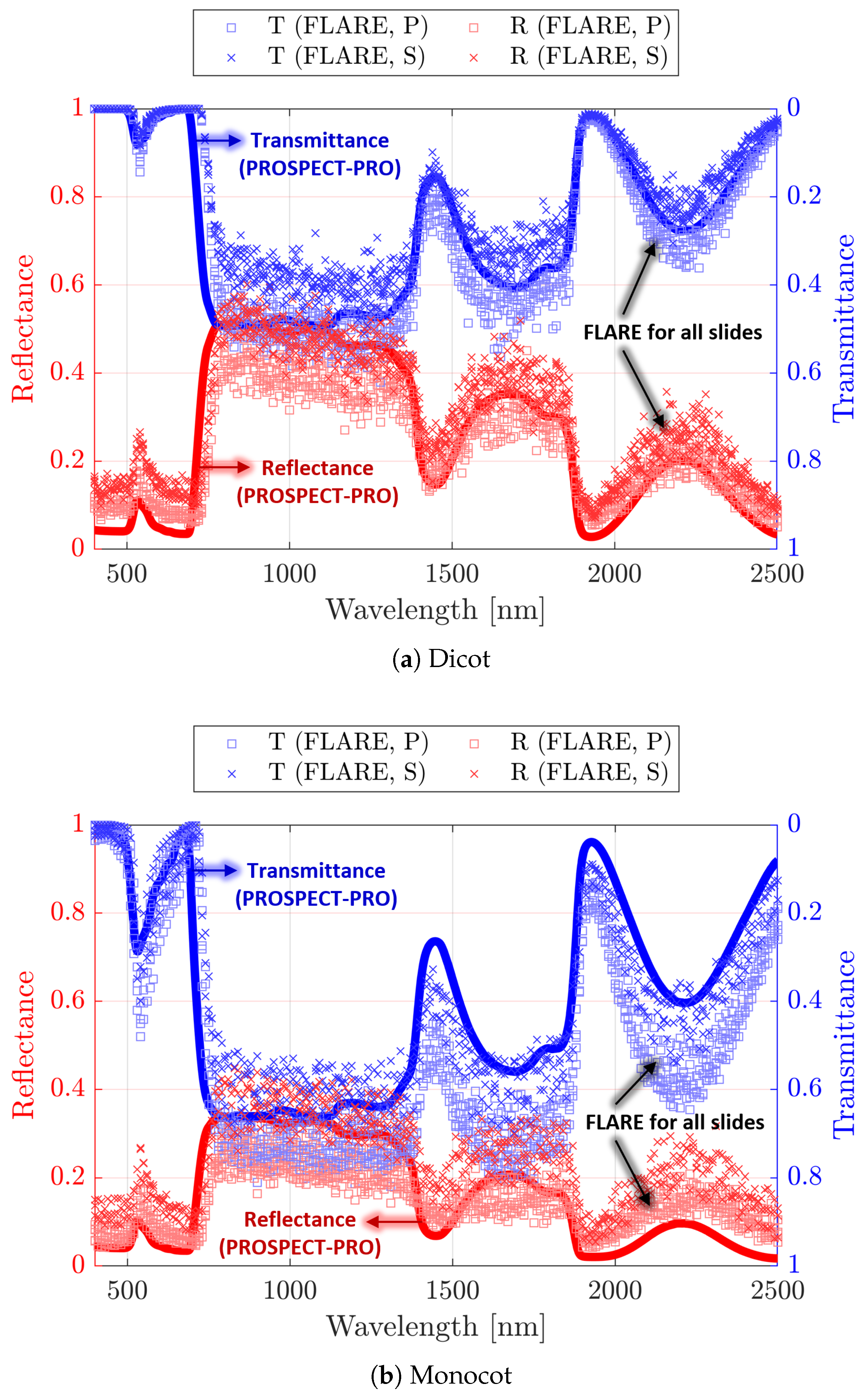
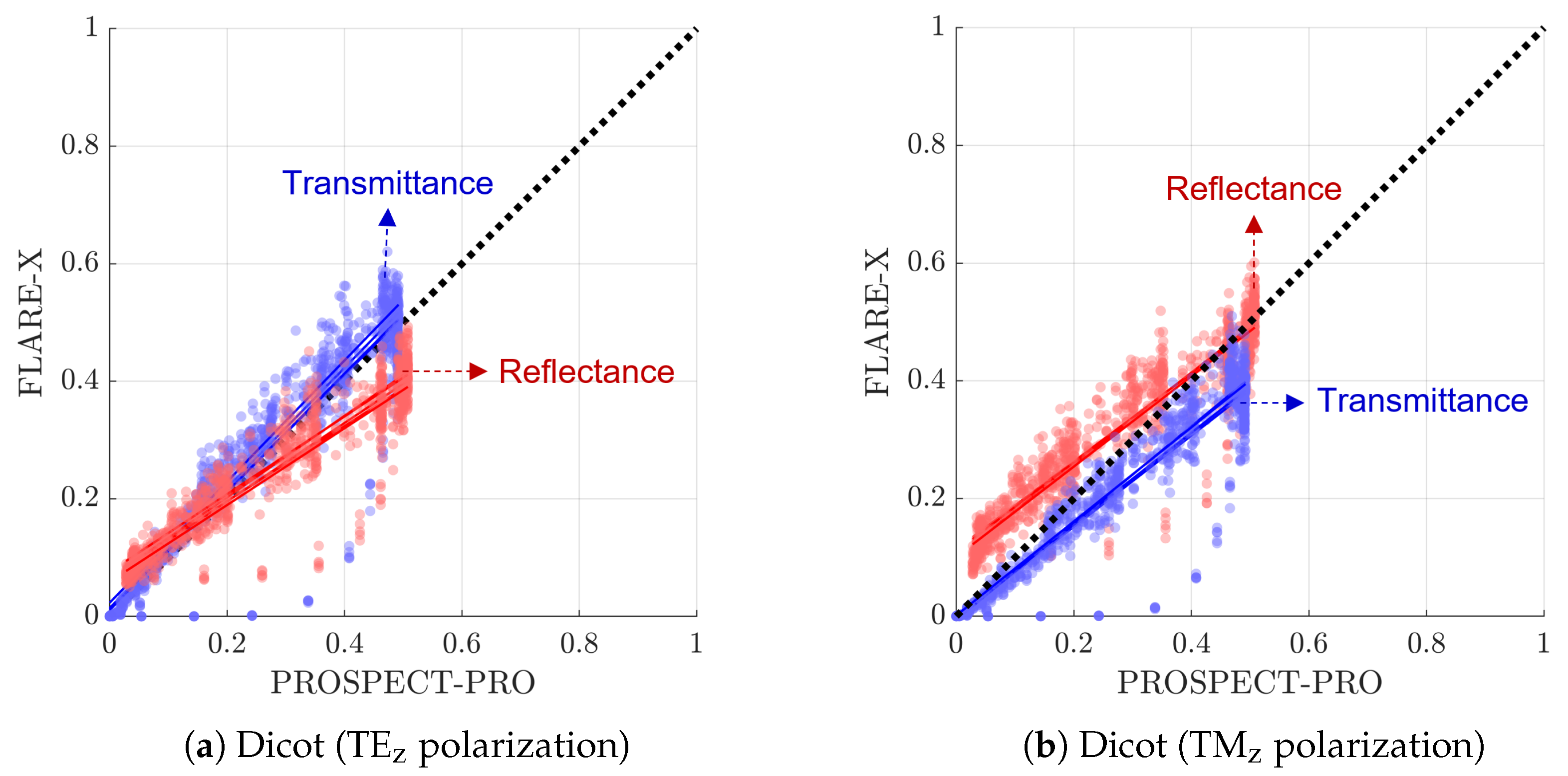
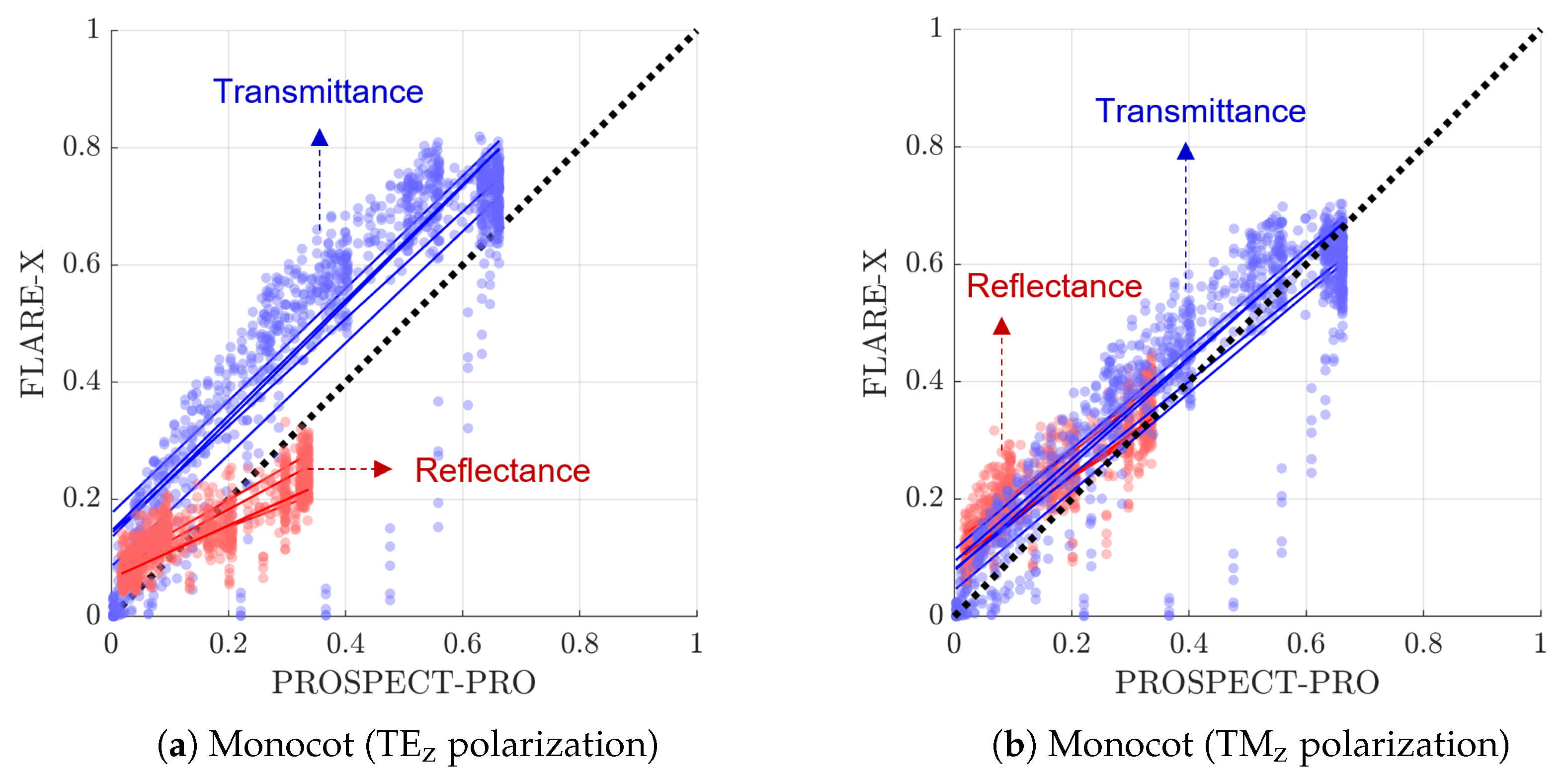
The FDTD-simulated spectral reflectance and transmittance of healthy dicot and monocot leaves are shown in Figure 12. Here, “healthy” refers to leaves without biotic stress or disease-induced structural modification, serving as baseline optical references for comparison with infected conditions. The results for each slide and both polarizations are plotted together with the PROSPECT-PRO model predictions for comparison.
Overall, the FDTD simulations exhibit excellent agreement with the PROSPECT-PRO predictions, successfully capturing the key optical responses arising from tissue microstructure, pigment content, and internal scattering. This demonstrates that the proposed microstructure-resolved FDTD framework accurately reproduces the wavelength-dependent optical behavior of healthy leaves. Table 2 summarizes the input parameters used for running the PROSPECT-PRO model. Here, C a b , C c a r , C w a t , and N s c a denote the concentrations of chlorophyll a + b, carotenoids, water content, and the scattering extent, respectively [35].
As shown in Figure 12, the spectral behavior of both dicot and monocot leaves is governed by the interplay between pigment absorption and internal tissue morphology. In the visible range (400–750 nm), red and blue wavelengths are strongly attenuated because chlorophylls absorb efficiently in these bands, whereas green light exhibits comparatively higher reflectance and transmittance due to weak pigment absorption. Monocot leaves transmit more green light than dicot leaves, primarily because they are thinner and contain a smaller total chloroplast volume. Internal structural morphology also plays a key role in shaping the scattering characteristics. Dicot leaves possess irregular, highly heterogeneous cellular arrangements, including a spongy mesophyll layer filled with numerous irregularly shaped air gaps. These structural features induce multiple random scattering events and frequent internal reflections—often near the critical angle—which increase the effective optical path length and enhance absorption. In contrast, monocot leaves exhibit more regular and vertically aligned mesophyll structures with few air gaps, causing light to propagate predominantly along near-normal directions with significantly fewer internal reflections. As a result, monocots generally show higher transmittance and lower reflectance than dicots. In the NIR region (750–1400 nm), the sum of reflectance and transmittance approaches unity for both leaf types, indicating minimal absorption. This aligns with the fact that pigment absorption becomes negligible beyond 750 nm; hence, spectral variations in this region are mainly governed by tissue geometry rather than biochemical composition. A comparison of the two leaf types reveals that dicots exhibit nearly balanced reflectance and transmittance (approximately 50% each), whereas monocots show transmittance around 65% and reflectance around 35%. Again, these differences arise from the more ordered internal architecture and smaller air cavities in monocots, which reduce random scattering and internal trapping of light. The PROSPECT-PRO results consistently reproduce these trends, further validating the FDTD predictions. Beyond 1400 nm, three prominent absorption dips appear near 1450 nm, 1900 nm, and 2500 nm, corresponding to well-known water absorption bands. Despite the presence of strong water absorption, monocot leaves still exhibit comparatively high overall transmittance owing to their reduced thickness and orderly tissue structure. Because plant cells—particularly the cytoplasm and vacuoles—contain substantial water, these spectral features are accurately reproduced in both the FDTD and PROSPECT-PRO simulations. However, the FDTD approach captures the scattering and absorption behavior directly from first principles, whereas PROSPECT-PRO cannot resolve these mechanisms explicitly and instead controls their net effect through the phenomenological scattering parameter N sca .
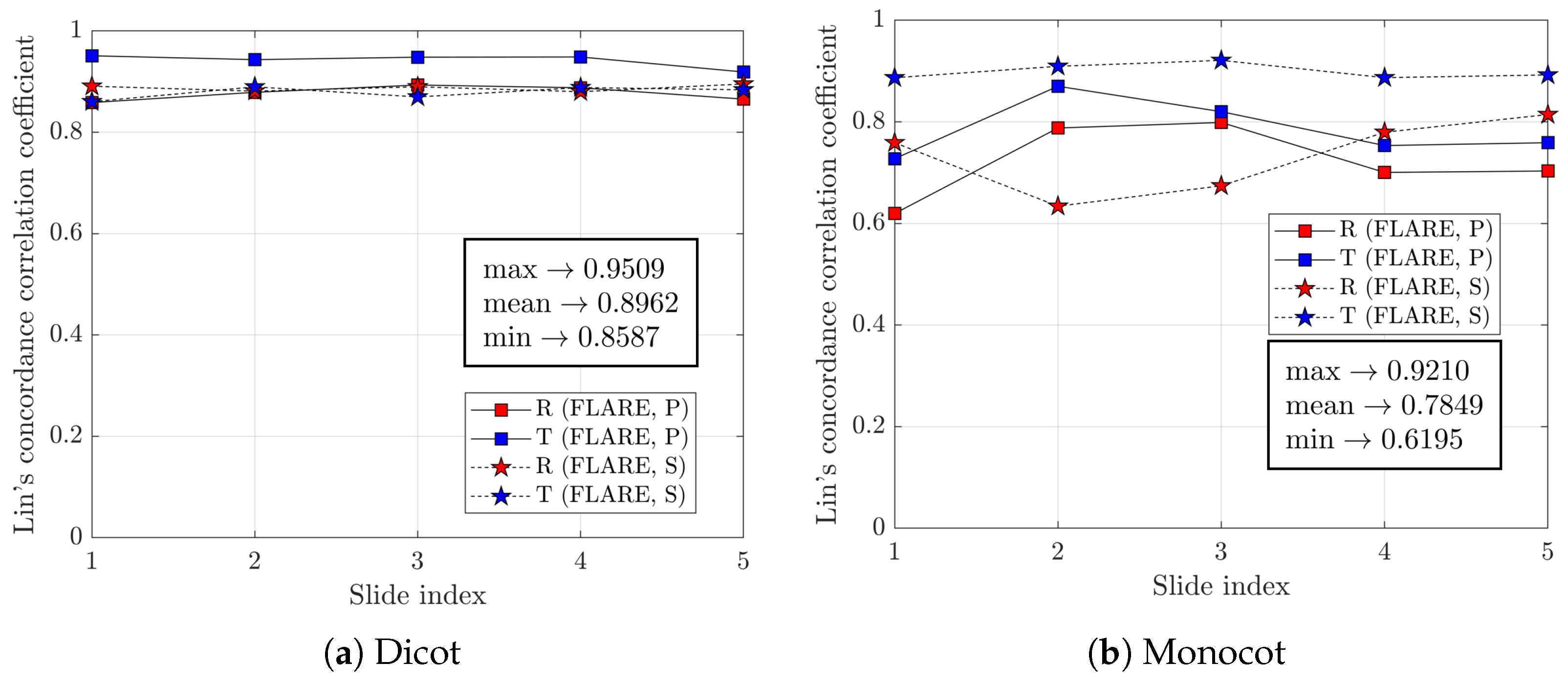
To quantitatively assess the agreement between the FDTD simulations and the PROSPECT-PRO model, regression analyses were performed for each slide and polarization, as shown in Figure 13, Figure 14 and Figure 15. For the dicot sample, all datasets exhibit strong linear correlations, confirming the validity and robustness of the proposed full-wave optical modeling framework. In the monocot case, slight deviations appear in the P-polarized reflectance, which may stem from the more anisotropic and directionally aligned internal structure of monocot tissues, resulting in polarization-dependent scattering behavior.
Lin’s concordance correlation coefficient (CCC) was computed for all slides and both polarizations. For the dicot samples, all CCC values exceeded 0.8587, with a maximum of 0.9509 and an average of 0.8962, indicating consistently strong agreement between the FDTD simulations and the PROSPECT-PRO predictions. For the monocot samples, the mean CCC was 0.7849, with maximum and minimum values of 0.9210 and 0.6195, respectively, reflecting slightly larger variability—likely stemming from the stronger structural anisotropy inherent in monocot tissues. The detailed Pearson correlation coefficients (r-values) and corresponding significance levels (p-values) are provided in Table 3 and Table 4.
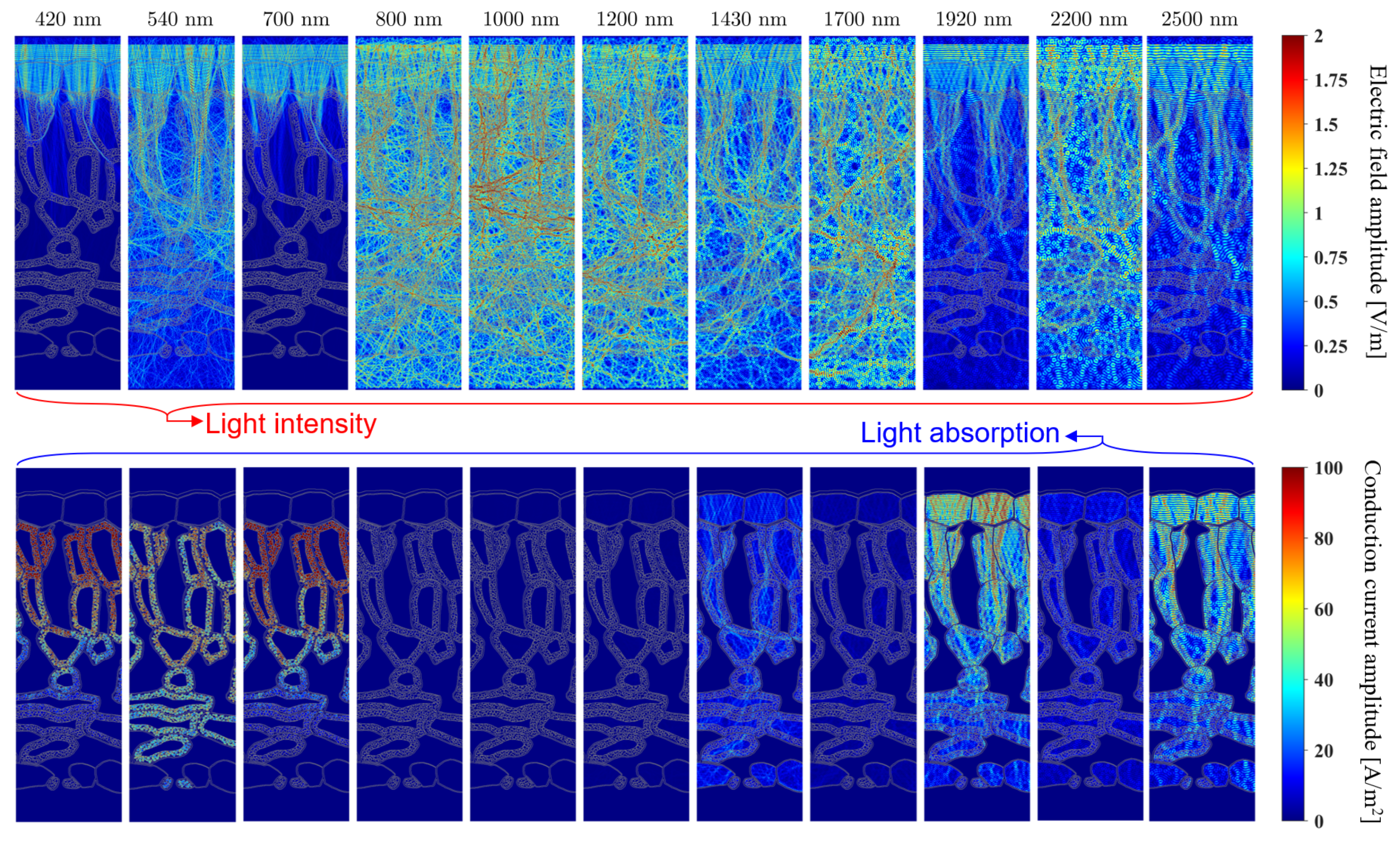
Finally, Figure 16 presents the electric-field amplitude | E ( r , t ) | and the conduction current density J c ( r , t ) = σ E ( r , t ) for the dicot leaf under P-polarized illumination at steady state ( t = 55 , 001 Δ t ). In the visible range, red and blue wavelengths are strongly absorbed by chloroplasts in the palisade mesophyll, as indicated by pronounced conduction current intensities. Green light, by contrast, exhibits much weaker J c , reflecting its relatively low pigment absorption and higher transmission through the tissue. Beyond approximately 800 nm, the field patterns become highly irregular while J c nearly vanishes, indicating negligible absorption in this region. Here, light–tissue interactions are dominated by multiple reflections and refractions at cellular boundaries. Due to the irregular geometry of dicot tissues—especially the large, uneven air gaps in the spongy mesophyll—scattering occurs in random directions and produces complex interference structures. Accordingly, the NIR reflectance and transmittance encode structural signatures of the internal cellular arrangement. At 1400 nm, 1920 nm, and 2500 nm, strong conduction current responses reappear within cytoplasmic regions, corresponding to the known water absorption bands. Figure 17 shows analogous field distributions for the monocot sample. While the wavelength-dependent trends are qualitatively consistent with those of the dicot leaf, the field patterns in monocot tissues are notably more directional and less diffuse. This arises from the highly ordered, vertically aligned mesophyll structure and significantly smaller air gaps, which reduce random scattering and minimize internally reflected paths. As a result, a larger fraction of light exits through the lower surface, yielding higher transmittance compared to dicot leaves.

4.2. Fungi-Infected Plant Leaf

Next, we investigate a scenario in which a necrotrophic fungal infection develops on the surface of a dicot leaf. Starting from the same dicot geometry used in the healthy-leaf analysis, an idealized fungal-hypha geometry was introduced to emulate early-stage infection. Although the exact species is not specified, the modeled morphology reflects common phytopathogens such as Magnaporthe oryzae, Colletotrichum orbiculare, and Alternaria alternata. These fungi typically form melanized appressoria capable of generating high turgor pressure and secreting cutinase and cellulase enzymes to breach the cuticle and upper epidermis. In particular, M. oryzae develops a heavily melanized wall layer (30–100 nm thick), with melanin having a complex refractive index of n = 1.7 1.9 and κ = 0.005 0.02 in the visible band. This high absorption reduces surface reflectance and alters local irradiance distributions. Accordingly, in the present simulation, the hyphae were modeled with a melanin-rich outer shell and a chitin–glucan inner wall, consistent with known melanized-fungal microstructure.
It should be emphasized that the modeled fungal infection does not correspond to a direct reconstruction from in-house microscopy of an infected leaf. Instead, it represents an idealized, proof-of-concept model designed to emulate early-stage necrotrophic penetration into the cuticle and upper epidermis prior to macroscopic lesion formation. The geometry and optical properties of the fungal structures are parameterized based on reported microstructural characteristics and melanin optical constants of common plant pathogens in the literature. Such early-stage conditions correspond to scenarios typically probed in hyperspectral reflectance and transmittance measurements of asymptomatic or weakly symptomatic leaves, which motivates the present physics-based simulation framework.
Plant-pathogenic fungi are broadly classified as biotrophic or necrotrophic. Biotrophic pathogens (e.g., Blumeria graminis, Puccinia spp.) extract nutrients through haustoria without killing host cells, often producing only subtle changes in optical response. Necrotrophic fungi (e.g., Alternaria alternata, Botrytis cinerea), on the other hand, directly penetrate and degrade host tissues, leading to pigment loss, cellular collapse, and melanin accumulation that increase visible-band absorption and suppress NIR scattering [95]. The present study focuses on this necrotrophic infection regime. Melanized hyphae were modeled penetrating the cuticle and epidermis, accompanied by localized structural degradation and enhanced absorption. This representation captures both the geometric disruption and the compositional changes associated with fungal invasion, thereby providing a first-principles optical model that links pathogen-induced microstructural alterations to measurable hyperspectral signatures indicative of early-stage necrotrophic disease.
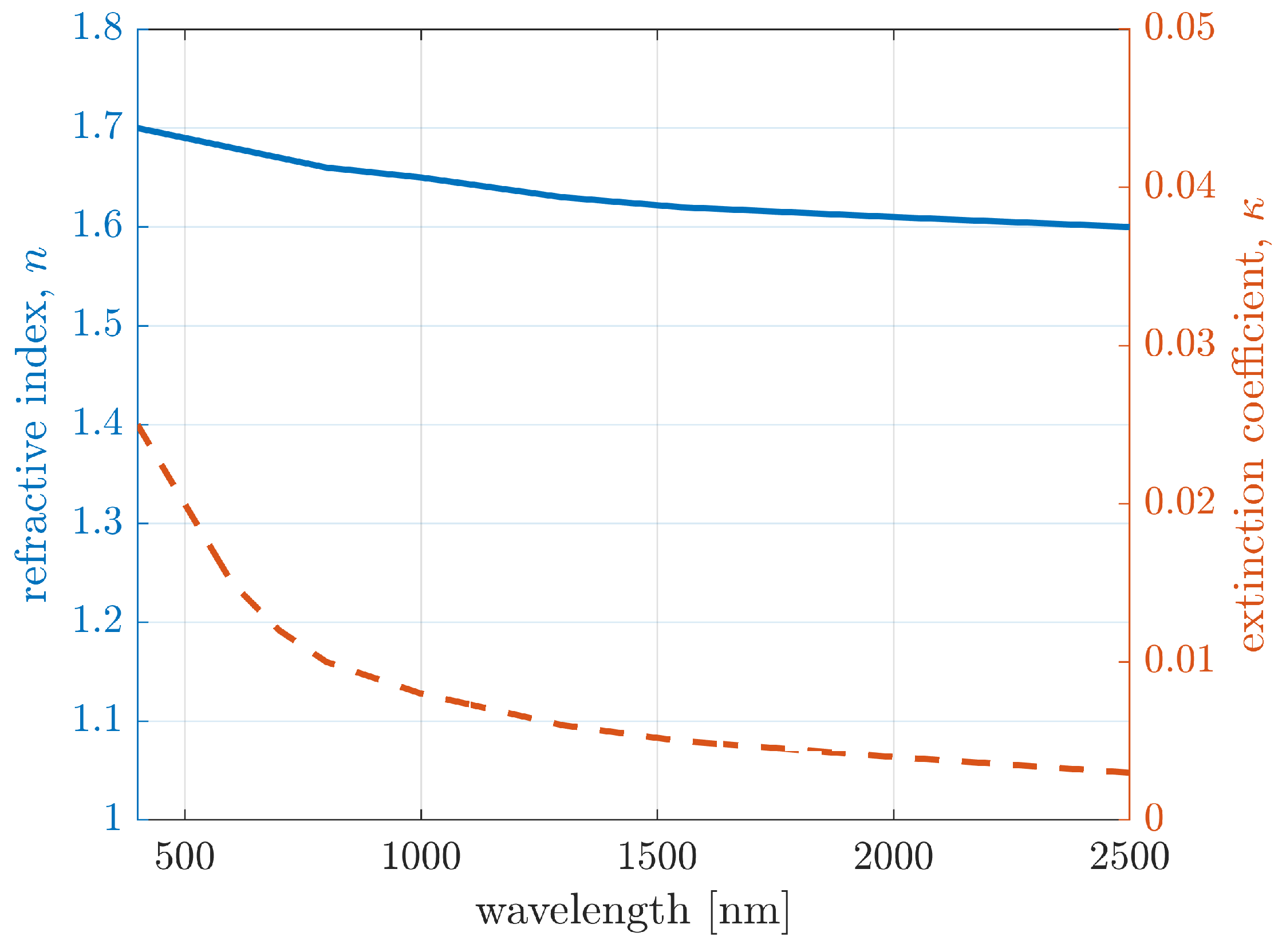
The geometric model of the fungal-infected dicot plant leaf at an early stage is illustrated in Figure 18. Since the goal of this study is a proof-of-concept simulation to observe the variation in spectral reflectance and transmittance depending on the presence of hyphae, the fungal structure was represented by an inner cytoplasmic region surrounded by two concentric wall layers. The inner sheath, in direct contact with the cytoplasm, was assumed to be composed of chitin, whereas the outer sheath was modeled as a composite layer of chitin and melanin. Chitin, being a primary component of the cell wall, was assigned the same refractive index ( n = 1.52 ) used previously for the cell wall modeling. The outer sheath composed of chitin and melanin was modeled to incorporate the strong absorption characteristics of melanin, as shown in Figure 19.
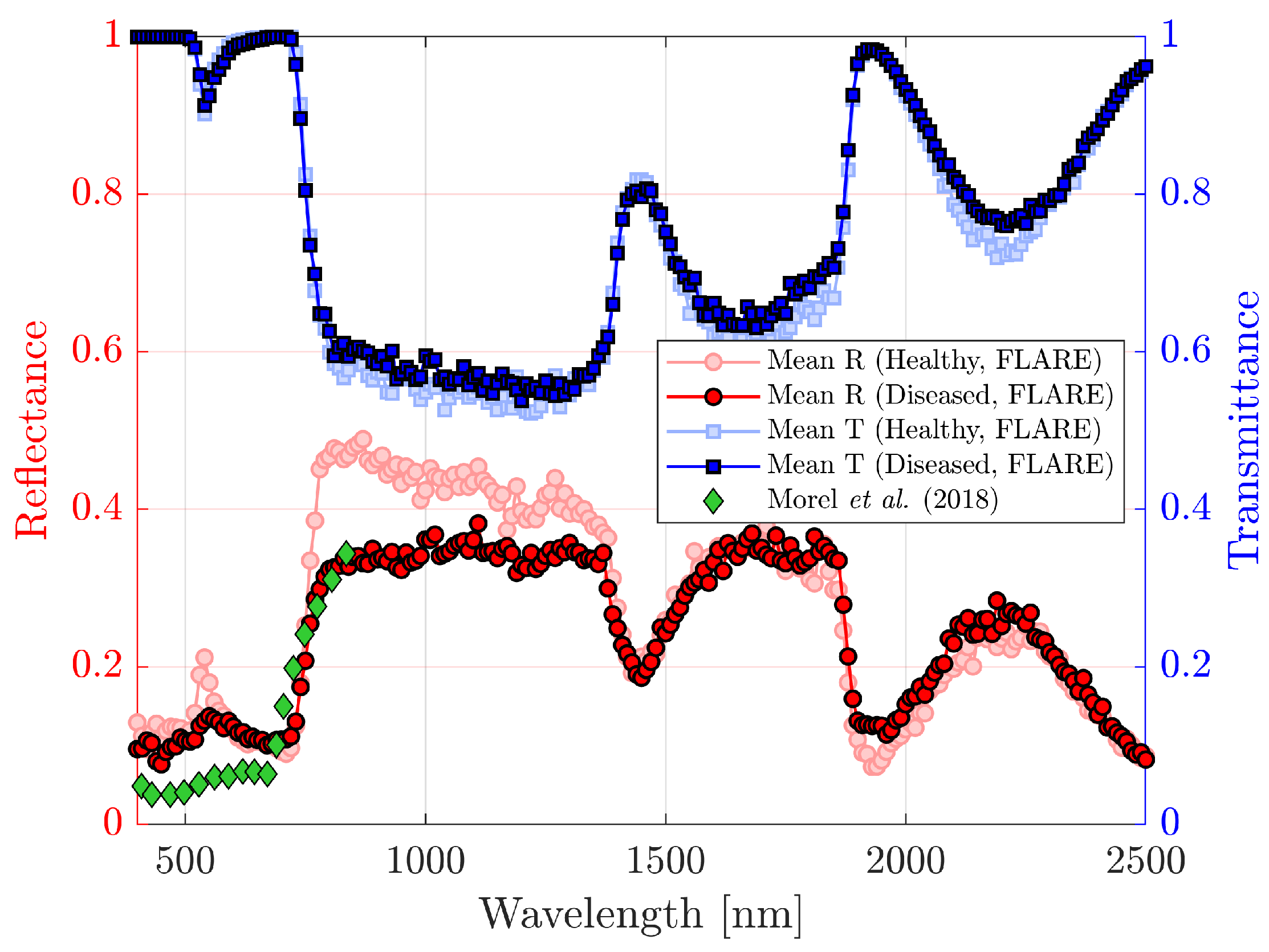
Figure 20 shows the comparison of the spectral reflectance and transmittance for healthy and diseased dicot sample plant leaf images. Again, we ran several FDTD simulations in terms of wavelength, polarization, and sections, respectively, and averaged them at each wavelength, denoted as mean reflectance and transmittance in the figure.
First, the transmittance of the plant leaf shows no significant difference between the healthy and diseased cases. However, a slight decrease is observed across the entire spectrum, which is attributed to the broadband absorption characteristics of melanin pigments. Second, a noticeable difference appears in the reflectance. In the visible wavelength region, the healthy leaf exhibits a high reflectance peak in the green-light region, whereas the diseased leaf shows a significantly reduced green reflectance peak. This reduction is also attributed to the melanin pigments, which absorb light across the entire visible spectrum regardless of wavelength. In addition, the abrupt increase in reflectance around 700 nm becomes much more gradual, and the reflectance in the NIR region (700–1400 nm) decreases markedly. This trend of reduced NIR reflectance is consistent with previous studies that reported similar behavior in diseased plant leaves. We compared our simulation results with experimental data in the Vis-NIR regions [96]. It can be observed that the overall trends described above are present in both cases, except that the experimental reflectance in the visible wavelengths is slightly lower than that obtained from the FDTD simulations. We expect that this discrepancy could be mitigated by adopting more realistic and advanced geometric and material modeling.
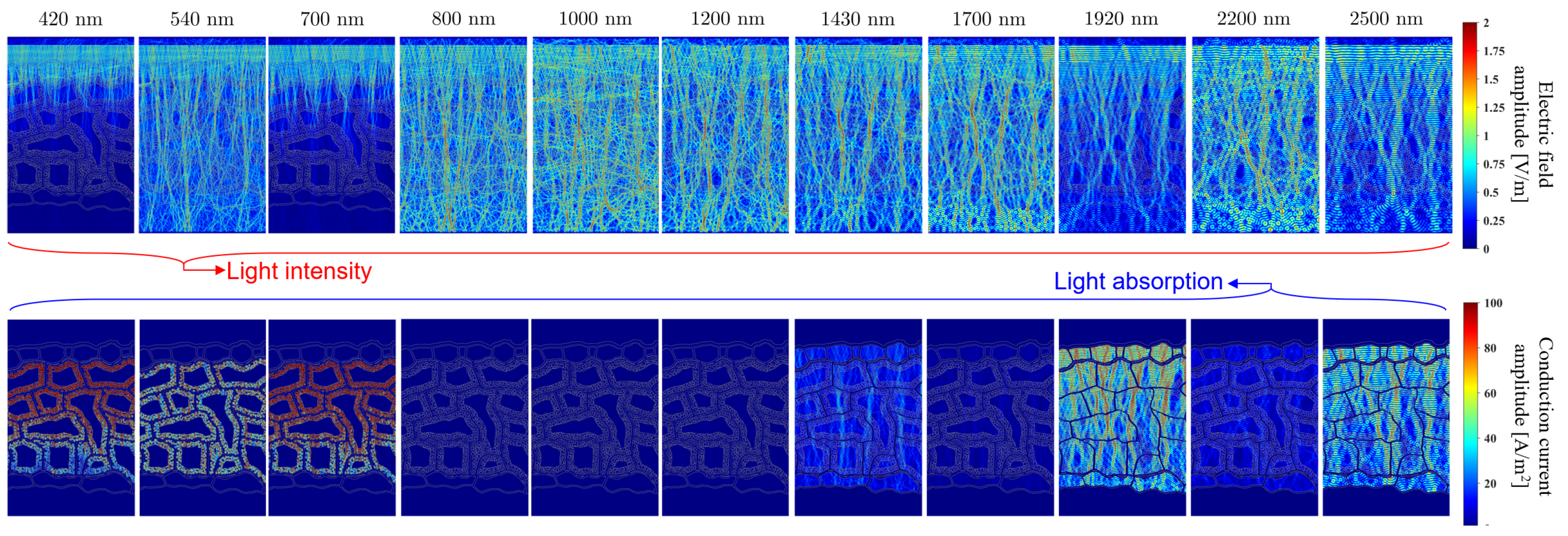
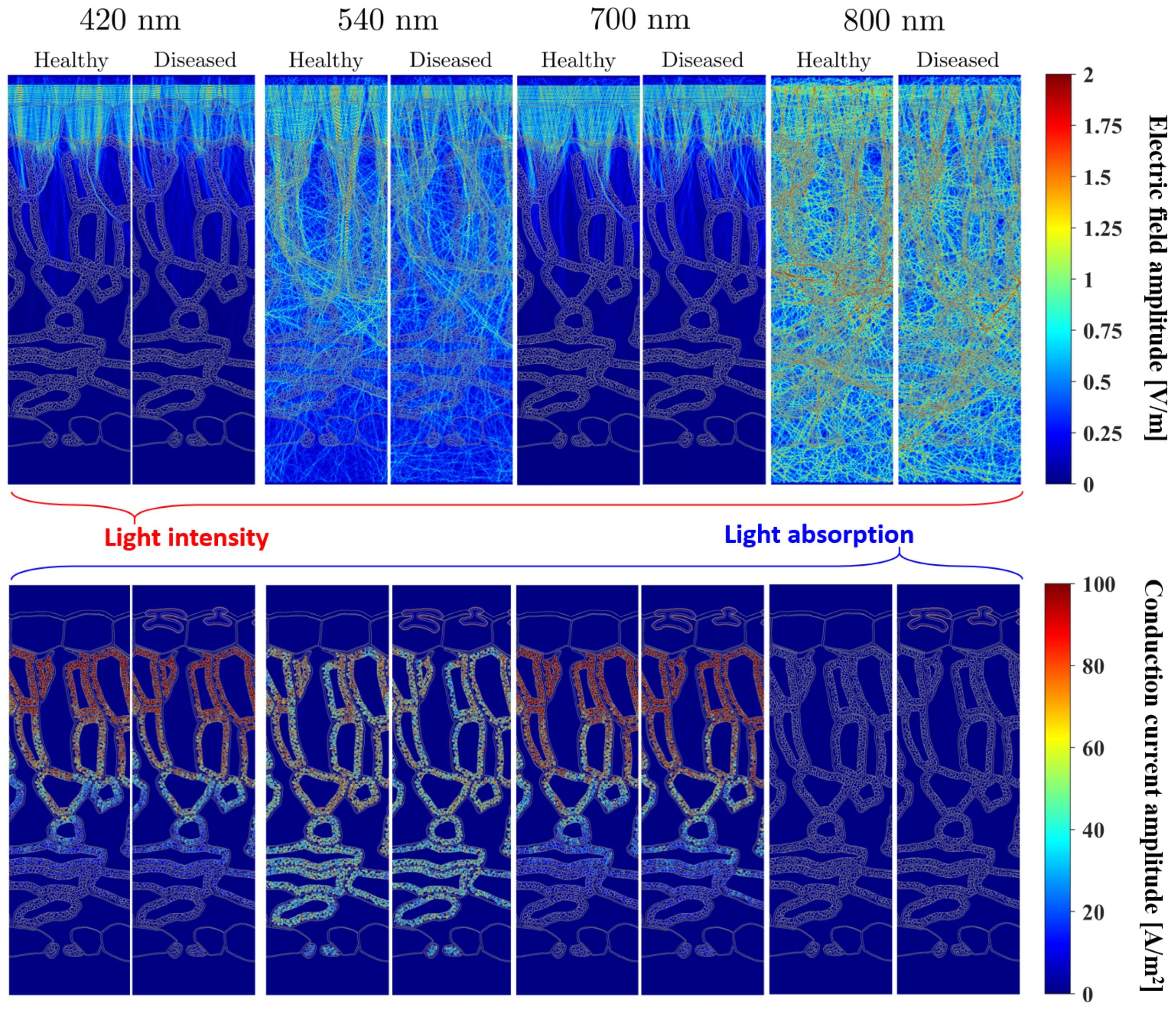
The physical origin of the reduced reflectance in diseased leaves can be understood by examining the field distributions. Figure 21 compares the electric-field intensity and conduction current maps at four representative wavelengths (420, 540, 700, and 800 nm) for healthy and diseased dicot samples. At 420 nm and 700 nm, the healthy leaf exhibits strong epidermal lensing, which concentrates light into the mesophyll and produces large conduction currents indicative of efficient pigment absorption. In contrast, the diseased leaf shows pronounced absorption within melanized hyphae penetrating the epidermis, reducing the energy delivered to the mesophyll and degrading the focusing effect. At 540 nm, the healthy sample shows weaker mesophyll absorption and stronger internal scattering. However, in the diseased case, the high refractive index and absorption of the hyphae increase surface reflectance and further suppress epidermal lensing, lowering the internal-field amplitude. A similar trend occurs at 800 nm: enhanced pre-entry reflection and attenuated focusing in the diseased leaf lead to reduced penetration depth compared with the healthy counterpart. Overall, the FDTD results clearly show that melanin-rich fungal structures disrupt epidermal lensing and introduce strong localized absorption, thereby altering internal-field distributions and reducing effective light delivery to deeper tissues. These full-wave simulations provide a physics-based interpretation of hyperspectral signatures associated with early-stage necrotrophic infection.

5. Conclusions and Future Works

This study introduced a full-wave optical modeling framework, based on the finite-difference time-domain (FDTD) method, for simulating light scattering and absorption in anatomically realistic plant leaves. By assigning wavelength-dependent complex refractive indices to digitally segmented tissue structures, the proposed approach accurately reproduced the characteristic visible-to-near-infrared reflectance and transmittance spectra of healthy monocot and dicot leaves, exhibiting excellent agreement with PROSPECT-PRO predictions. The use of CUDA-based GPU acceleration enabled large-scale simulations—exceeding tens of millions of grid cells—to be executed within practical runtimes, making full-wave modeling feasible for leaf-scale optical problems. Furthermore, by incorporating melanized hyphae and local structural deformation associated with early necrotrophic infection, the model successfully predicted measurable optical signatures arising from microscale pathological changes.
Future work will extend this framework to fully three-dimensional geometries, incorporate stochastic anatomical variability, integrate more advanced dispersive material models, and explore inverse-modeling approaches for quantitative leaf-physiology retrieval and early disease diagnostics using hyperspectral measurements. A deeper understanding of light dynamics within leaf tissues is expected to provide new physical insights into how microscale anatomical and biochemical changes manifest as measurable optical signatures. Such insights can support earlier and more reliable disease detection, improve the effectiveness and efficiency of risk mitigation and disease management strategies, and inform evidence-based policies for the optimized use of chemical inputs (e.g., fungicides, pesticides, and fertilizers) in plant disease control and surveillance of emerging plant pathogens.
Given the substantial computational cost of full-wave simulations, the proposed framework is primarily intended as a high-fidelity reference model rather than as a routine forward model for field-scale deployment. In particular, it is well suited for generating physics-grounded reference spectra and internal-field signatures that can support (i) reduced-order surrogate models and inversion schemes and (ii) training and validation datasets for learning-based retrieval of leaf condition from hyperspectral measurements. Regarding anatomical diversity, the present monocot and dicot samples serve as representative cross-sectional archetypes; however, quantitative spectra are expected to vary with inter-species and intra-species variability in tissue thickness, air-space fraction, mesophyll topology, and pigment and water content. Nevertheless, the core conclusions of this work are expected to generalize across crop types in the sense that wavelength-scale microstructures (e.g., cell walls, chloroplasts, air cavities, and early-stage fungal structures) systematically induce coherent scattering and absorption effects that are not captured by ray- or RT-based models. Building on the present framework, subsequent extensions will incorporate multiple species and stochastic anatomical perturbations to quantify sensitivity and establish a broader reference library for crop-specific interpretation.
Future research will extend this work in several directions:
  • Three-dimensional volumetric modeling will enable more accurate representation of stomatal chambers, vascular networks, and mesophyll topology.
  • Time-evolving simulations of disease progression may clarify how microstructural degradation produces spectral shifts over the infection cycle.
  • Integration with inversion or learning-based retrieval algorithms could allow estimation of mesophyll structure or infection severity directly from measured spectra.
  • Incorporating polarization and chlorophyll fluorescence will broaden applicability to BRDF polarimetry and solar-induced fluorescence studies.
  • Coupling leaf-scale FDTD with canopy-level radiative-transfer models may establish a multiscale pathway linking cellular anatomy to airborne or satellite hyperspectral observations.
Overall, the proposed full-wave framework provides a rigorous physics-based foundation for studying light–leaf interactions and offers new opportunities for hyperspectral plant disease detection and precision agriculture.

Author Contributions

Conceptualization, D.-Y.L.; methodology, D.-Y.L. and D.-Y.N.; validation, D.-Y.L. and D.-Y.N.; formal analysis, D.-Y.L. and D.-Y.N.; investigation, D.-Y.L. and D.-Y.N.; data curation, D.-Y.N.; writing—original draft preparation, D.-Y.L. and D.-Y.N.; writing—review and editing, D.-Y.L. and D.-Y.N.; visualization, D.-Y.L. and D.-Y.N.; supervision, D.-Y.N.; project administration, D.-Y.L.; funding acquisition, D.-Y.L. All authors have read and agreed to the published version of the manuscript.

Funding

This work was supported by the National Research Foundation of Korea (NRF)-Sejong Science Fellowship grant (NRF-RS-2024-00348502) funded by the Ministry of Science and ICT (Information and Communications Technology) of the Korean government.

Institutional Review Board Statement

Not applicable.

Informed Consent Statement

Not applicable.

Data Availability Statement

Data supporting the findings of this study are available from the corresponding author upon reasonable request.

Conflicts of Interest

The authors declare no conflicts of interest.

References

  1. Strange, R.N.; Scott, P.R. Plant Disease: A Threat to Global Food Security. Annu. Rev. Phytopathol. 2005, 43, 83–116. [Google Scholar] [CrossRef]
  2. Mengiste, T.; Liao, C.J. Contrasting Mechanisms of Defense Against Biotrophic and Necrotrophic Pathogens, 20 Years Later: What Has Changed? Annu. Rev. Phytopathol. 2025, 63, 279–308. [Google Scholar] [CrossRef]
  3. Oerke, E.C. Crop losses to pests. J. Agric. Sci. 2006, 144, 31–43. [Google Scholar] [CrossRef]
  4. Dean, R.; Van Kan, J.A.; Pretorius, Z.A.; Hammond-Kosack, K.E.; Di Pietro, A.; Spanu, P.D.; Rudd, J.J.; Dickman, M.; Kahmann, R.; Ellis, J.; et al. The Top 10 fungal pathogens in molecular plant pathology. Mol. Plant Pathol. 2012, 13, 414–430. [Google Scholar] [CrossRef] [PubMed]
  5. Savary, S.; Willocquet, L.; Pethybridge, S.J.; Esker, P.; McRoberts, N.; Nelson, A. The global burden of pathogens and pests on major food crops. Nat. Ecol. Evol. 2019, 3, 430–439. [Google Scholar] [CrossRef] [PubMed]
  6. Bebber, D.P.; Gurr, S.J. Crop-destroying fungal and oomycete pathogens challenge food security. Fungal Genet. Biol. 2015, 74, 62–64. [Google Scholar] [CrossRef]
  7. Vogelmann, T.; Gorton, H. Leaf: Light capture in the photosynthetic organ. In The Structural Basis of Biological Energy Generation; Springer: Dordrecht, The Netherlands, 2014; pp. 363–377. [Google Scholar]
  8. Gotoh, E.; Suetsugu, N.; Higa, T.; Matsushita, T.; Tsukaya, H.; Wada, M. Palisade cell shape affects the light-induced chloroplast movements and leaf photosynthesis. Sci. Rep. 2018, 8, 1472. [Google Scholar] [CrossRef]
  9. Terashima, I.; Hanba, Y.T.; Tholen, D.; Niinemets, Ü. Leaf Functional Anatomy in Relation to Photosynthesiss. Plant Physiol. 2011, 155, 108–116. [Google Scholar] [CrossRef]
  10. Karabourniotis, G.; Liakopoulos, G.; Bresta, P.; Nikolopoulos, D. The Optical Properties of Leaf Structural Elements and Their Contribution to Photosynthetic Performance and Photoprotection. Plants 2021, 10, 1455. [Google Scholar] [CrossRef]
  11. Vogelmann, T. Light within the plant. In Photomorphogenesis in Plants; Springer: Dordrecht, The Netherlands, 1994; pp. 491–535. [Google Scholar]
  12. Jacquemoud, S.; Ustin, S.L. Modeling Leaf Optical Properties. Photobiological Sciences Online. 2008. Available online: https://sites.bu.edu/cliveg/files/2023/10/leaf-optics-jacquemoud-ustin.pdf (accessed on 1 December 2025).
  13. Jackson, J.D. Classical Electrodynamics; John Wiley & Sons: Hoboken, NJ, USA, 2012. [Google Scholar]
  14. Chew, W.C. Waves and Fields in Inhomogenous Media; John Wiley & Sons: Hoboken, NJ, USA, 1999. [Google Scholar]
  15. Balanis, C.A. Advanced Engineering Electromagnetics; John Wiley & Sons: Hoboken, NJ, USA, 2012. [Google Scholar]
  16. Szechyńska-Hebda, M.; Hołownicki, R.; Doruchowski, G.; Sas, K.; Puławska, J.; Jarecka-Boncela, A.; Ptaszek, M.; Włodarek, A. Application of Hyperspectral Imaging for Early Detection of Pathogen-Induced Stress in Cabbage as Case Study. Agronomy 2025, 15, 1516. [Google Scholar] [CrossRef]
  17. Zarco-Tejada, P.J.; Camino, C.; Beck, P.; Calderon, R.; Hornero, A.; Hernández-Clemente, R.; Kattenborn, T.; Montes-Borrego, M.; Susca, L.; Morelli, M.; et al. Previsual symptoms of Xylella fastidiosa infection revealed in spectral plant-trait alteration. Nat. Plants 2018, 4, 432–439. [Google Scholar] [CrossRef] [PubMed]
  18. Allen, W.A.; Richardson, A.J. Interaction of light with a plant canopy. J. Opt. Soc. Am. 1968, 58, 1023–1028. [Google Scholar] [CrossRef]
  19. Allen, W.A.; Gausman, H.W.; Richardson, A.J.; Thomas, J.R. Interaction of Isotropic Light with a Compact Plant Leaf. J. Opt. Soc. Am. 1969, 59, 1376–1379. [Google Scholar] [CrossRef]
  20. Gausman, H.; Allen, W.; Cardenas, R.; Richardson, A. Relation of Light Reflectance to Histological and Physical Evaluations of Cotton Leaf Maturity. Appl. Opt. 1970, 9, 545–552. [Google Scholar] [CrossRef]
  21. Allen, W.A.; Gausman, H.W.; Richardson, A.J. Mean Effective Optical Constants of Cotton Leaves. J. Opt. Soc. Am. 1970, 60, 542–547. [Google Scholar] [CrossRef]
  22. Gausman, H.; Allen, W.; Escobar, D.; Rodriguez, R.; Cardenas, R. Age Effects of Cotton Leaves on Light Reflectance, Transmittance, and Absorptance and on Water Content and Thickness. Agron. J. 1971, 63, 465–469. [Google Scholar] [CrossRef]
  23. Kumar, R.; Silva, L. Reflectance Model of a Plant Leaf; Technical Report; Laboratory for Applications of Remote Sensing (LARS), Purdue University: West Lafayette, IN, USA, 1973. [Google Scholar]
  24. Kumar, R.; Silva, L. Light Ray Tracing Through a Leaf Cross Section. Appl. Opt. 1973, 12, 2950–2954. [Google Scholar] [CrossRef]
  25. Tucker, C.J.; Garratt, M.W. Leaf optical system modeled as a stochastic process. Appl. Opt. 1977, 16, 635–642. [Google Scholar] [CrossRef]
  26. Tucker, C.J. Spectral estimation of grass canopy variables. Remote Sens. Environ. 1977, 6, 11–26. [Google Scholar] [CrossRef]
  27. Tucker, C.J. Remote sensing of leaf water content in the near infrared. Remote Sens. Environ. 1980, 10, 23–32. [Google Scholar]
  28. Maier, S.; Lüdeker, W.; Günther, K. SLOP: A Revised Version of the Stochastic Model for Leaf Optical Properties. Remote Sens. Environ. 1999, 68, 273–280. [Google Scholar]
  29. Govaerts, Y.M.; Jacquemoud, S.; Verstraete, M.M.; Ustin, S. Three-dimensional radiation transfer modeling in a dicotyledon leaf. Appl. Opt. 1996, 35, 6585–6598. [Google Scholar] [CrossRef] [PubMed]
  30. Govaerts, Y.M.; Verstraete, M.M. Raytran: A Monte Carlo ray-tracing model to compute light scattering in three-dimensional heterogeneous media. IEEE Trans. Geosci. Remote Sens. 2002, 36, 493–505. [Google Scholar] [CrossRef]
  31. Watté, R.; Aernouts, B.; Beers, R.V.; Herremans, E.; Ho, Q.T.; Verboven, P.; Nicolaï, B.; Saeys, W. Modeling the propagation of light in realistic tissue structures with MMC-fpf: A meshed Monte Carlo method with free phase function. Opt. Express 2015, 23, 17467–17486. [Google Scholar] [CrossRef] [PubMed]
  32. Jacquemoud, S.; Ustin, S.; Verdebout, J.; Schmuck, G.; Andreoli, G.; Hosgood, B. Estimating leaf biochemistry using the PROSPECT leaf optical properties model. Remote Sens. Environ. 1996, 56, 194–202. [Google Scholar]
  33. Feret, J.B.; François, C.; Asner, G.P.; Gitelson, A.A.; Martin, R.E.; Bidel, L.P.R.; Ustin, S.L.; le Maire, G.; Jacquemoud, S. PROSPECT-4 and 5: Advances in the leaf optical properties model separating photosynthetic pigmentsl. Remote Sens. Environ. 2008, 112, 3030–3043. [Google Scholar]
  34. Féret, J.-B.; Gitelson, A.A.; Noble, S.D.; Jacquemoud, S. PROSPECT-D: Towards modeling leaf optical properties through a complete lifecycle. Remote Sens. Environ. 2017, 193, 204–215. [Google Scholar] [CrossRef]
  35. Féret, J.-B.; Berger, K.; de Boissieu, F.; Malenovský, Z. PROSPECT-PRO for estimating content of nitrogen-containing leaf proteins and other carbon-based constituents. Remote. Sens. Environ. 2021, 252, 112173. [Google Scholar] [CrossRef]
  36. Yu, F.; Xiang, S.; Bai, J.; Jin, Z.; Zhang, H.; Zhu, S.; Xu, T. PIOSL: An improved version of PROSPECT model for simulating leaf optical properties by considering leaf internal structural variations. Comput. Electron. Agric. 2023, 211, 108030. [Google Scholar] [CrossRef]
  37. Su, X.; He, J.; Li, W.; Pan, Y.; Li, D.; Xia, Y.; Cheng, T.; Zhu, Y.; Cao, W.; Tian, Y. Monitoring Rice Leaf Nitrogen Content Based on the Canopy Structure Effect Corrected With a Novel Model PROSPECT-P. IEEE Trans. Geosci. Remote Sens. 2024, 62, 4414317. [Google Scholar]
  38. Féret, J.; de Boissieu, F. Prospect: An R package to link leaf optical properties with their chemical and structural properties with the leaf model PROSPECT. J. Open Source Softw. 2024, 9, 6027. [Google Scholar] [CrossRef]
  39. Du, S.; Zhao, D.; Guan, L.; Qi, M.; Liu, X.; Liu, L. PROSPECT-DP: A coupled leaf optical properties model for improving leaf spectra simulation in the red-edge domain by excluding the ChlF effect. Int. J. Appl. Earth Obs. 2025, 141, 104651. [Google Scholar] [CrossRef]
  40. Bone, R.A.; Lee, D.W.; Norman, J. Epidermal cells functioning as lenses in leaves of tropical rain-forest shade plants. Appl. Opt. 1985, 24, 1408–1412. [Google Scholar] [CrossRef] [PubMed]
  41. Ustin, S.; Jacquemoud, S.; Govaerts, Y. Simulation of photon transport in a three-dimensional leaf: Implications for photosynthesis. Plant Cell Environ. 2001, 24, 1095–1103. [Google Scholar] [CrossRef]
  42. Xiao, Y.; Tholen, D.; Zhu, X.G. The influence of leaf anatomy on the internal light environment and photosynthetic electron transport rate: Exploration with a new leaf ray tracing model. J. Exp. Bot. 2016, 67, 6021–6035. [Google Scholar] [CrossRef]
  43. Xu, K.; Ye, H. Light scattering in stacked mesophyll cells results in similarity characteristic of solar spectral reflectance and transmittance of natural leavess. Sci. Rep. 2023, 13, 4694. [Google Scholar] [CrossRef]
  44. Borsuk, A.M.; Randall, J.M.; Richburg, J.; Montes, K.G.; Edwards, E.J.; Brodersen, C.R. Palisade cell geometry in relation to leaf optical and photosynthetic properties in Viburnum. Plant Physiol. 2025, 198, kiae659. [Google Scholar] [CrossRef]
  45. Nikolopoulos, D.; Bresta, P.; Daliani, V.; Haghiou, V.; Darra, N.; Liati, M.; Mavrogianni, E.; Papanastasiou, A.; Porfyraki, T.; Psaroudi, V.; et al. Leaf anatomy affects optical properties and enhances photosynthetic performance under oblique light. Plant Cell Environ. 2024, 47, 1471–1485. [Google Scholar] [CrossRef]
  46. Kallel, A. Leaf polarized BRDF simulation based on Monte Carlo 3-D vector RT modeling. J. Quant. Spectrosc. Radiat. Transf. 2018, 221, 202–224. [Google Scholar] [CrossRef]
  47. He, Q.; Zhan, J.; Liu, X.; Dong, C.; Tian, D.; Fu, Q. Multispectral polarimetric bidirectional reflectance research of plant canopy. Opt. Lasers Eng. 2025, 184, 108688. [Google Scholar]
  48. Pedrós, R.; Moya, I.; Goulas, Y.; Jacquemoud, S. Chlorophyll fluorescence emission spectrum inside a leaf. Photochem. Photobiol. Sci. 2008, 7, 498–502. [Google Scholar] [CrossRef]
  49. Sarlikioti, V.; de Visser, P.H.B.; Buck-Sorlin, G.H.; Marcelis, L.F.M. How plant architecture affects light absorption and photosynthesis in tomato: Towards an ideotype for plant architecture using a functional–structural plant model. Ann. Bot. 2011, 108, 1065–1073. [Google Scholar] [CrossRef] [PubMed]
  50. Vos, J.; Evers, J.B.; Buck-Sorlin, G.H.; Andrieu, B.; Chelle, M.; De Visser, P.H. Functional–structural plant modelling: A new versatile tool in crop science. J. Exp. Bot. 2010, 61, 2101–2115. [Google Scholar] [CrossRef] [PubMed]
  51. Buck-Sorlin, G.; de Visser, P.H.; Henke, M.; Sarlikioti, V.; van Der Heijden, G.W.; Marcelis, L.F.; Vos, J. Towards a functional–structural plant model of cut-rose: Simulation of light environment, light absorption, photosynthesis and interference with the plant structure. Ann. Bot. 2011, 108, 1121–1134. [Google Scholar] [CrossRef] [PubMed]
  52. Henke, M.; Buck-Sorlin, G.H. Using a Full Spectral Raytracer for Calculating Light Microclimate in Functional-Structural Plant Modelling. Comput. Inform. 2017, 36, 1492–1522. [Google Scholar] [CrossRef]
  53. Ni-Meister, W.; Yang, W.; Kiang, N.Y. A clumped-foliage canopy radiative transfer model for a global dynamic terrestrial ecosystem model. I: Theory. Agric. For. Meteorol. 2010, 150, 881–894. [Google Scholar] [CrossRef]
  54. Gerber, F.; Marion, R.; Olioso, A.; Jacquemoud, S.; Da Luz, B.R.; Fabre, S. Modeling directional–hemispherical reflectance and transmittance of fresh and dry leaves from 0.4 μm to 5.7 μm with the PROSPECT-VISIR model. Remote Sens. Environ. 2011, 115, 404–414. [Google Scholar] [CrossRef]
  55. Gastellu-Etchegorry, J.P.; Yin, T.; Lauret, N.; Cajgfinger, T.; Gregoire, T.; Grau, E.; Feret, J.B.; Lopes, M.; Guilleux, J.; Dedieu, G.; et al. Discrete Anisotropic Radiative Transfer (DART 5) for Modeling Airborne and Satellite Spectroradiometer and LIDAR Acquisitions of Natural and Urban Landscapes. Remote Sens. 2015, 7, 1667–1701. [Google Scholar] [CrossRef]
  56. Gastellu-Etchegorry, J.P.; Lauret, N.; Yin, T.; Landier, L.; Kallel, A.; Malenovskỳ, Z.; Al Bitar, A.; Aval, J.; Benhmida, S.; Qi, J.; et al. DART: Recent Advances in Remote Sensing Data Modeling with Atmosphere, Polarization, and Chlorophyll Fluorescence. IEEE J. Sel. Top. Appl. Earth Obs. Remote Sens. 2017, 10, 2640–2649. [Google Scholar] [CrossRef]
  57. Bailey, B.; Overby, M.; Willemsen, P.; Pardyjak, E.; Mahaffee, W.; Stoll, R. A scalable plant-resolving radiative transfer model based on optimized GPU ray tracing. Agric. For. Meteorol. 2014, 198, 192–208. [Google Scholar] [CrossRef]
  58. Bailey, B.N. A reverse ray-tracing method for modelling the net radiative flux in leaf-resolving plant canopy simulations. Ecol. Model. 2018, 368, 233–245. [Google Scholar] [CrossRef]
  59. Zhao, F.; Dai, X.; Verhoef, W.; Guo, Y.; van der Tol, C.; Li, Y.; Huang, Y. A Monte Carlo ray-tracing model to compute sun-induced chlorophyll fluorescence of three-dimensional canopy. Remote Sens. Environ. 2016, 187, 385–399. [Google Scholar] [CrossRef]
  60. Yuan, H.; Dickinson, R.E.; Dai, Y.; Shaikh, M.J.; Zhou, L.; Shangguan, W.; Ji, D. A 3D Canopy Radiative Transfer Model for Global Climate Modeling: Description, Validation, and Application. J. Clim. 2014, 27, 1168–1192. [Google Scholar] [CrossRef]
  61. Ustin, S.L.; Jacquemoud, S. How the optical properties of leaves modify the absorption and scattering of energy and enhance leaf functionality. In Remote Sensing of Plant Biodiversity; Springer International Publishing: Cham, Switzerland, 2020; pp. 349–384. [Google Scholar]
  62. Joseph, R.; Hagness, S.; Taflove, A. Direct time integration of Maxwell’s equations in linear dispersive media with absorption for scattering and propagation of femtosecond electromagnetic pulses. Opt. Lett. 1991, 16, 1412–1414. [Google Scholar] [CrossRef] [PubMed]
  63. Taflove, A. Advances in Computational Electrodynamics: The Finite-Difference Time-Domain Method; Artech House: Norwood, MA, USA, 1998. [Google Scholar]
  64. Alsunaidi, M.; Al-Jabr, A. A General ADE-FDTD Algorithm for the Simulation of Dispersive Structures. IEEE Photonics Technol. Lett. 2009, 21, 817–819. [Google Scholar] [CrossRef]
  65. Chew, W. Lectures on Electromagnetic Field Theory—A Comprehensive Overview; Purdue University: West Lafayette, IN, USA, 2020. [Google Scholar]
  66. Yee, K. Numerical solution of initial boundary value problems involving Maxwell’s equations in isotropic media. IEEE Trans. Antennas Propag. 1966, 14, 302–307. [Google Scholar]
  67. Courant, R.; Friedrichs, K.; Lewy, H. Über die partiellen Differenzengleichungen der mathematischen Physik. Math. Ann. 1928, 100, 32–74. [Google Scholar]
  68. Harms, P.; Mittra, R.; Ko, W. Implementation of the periodic boundary condition in the finite-difference time-domain algorithm for FSS structures. IEEE Trans. Antennas Propag. 1994, 42, 1317–1324. [Google Scholar]
  69. Berenger, J.-P. A perfectly matched layer for the absorption of electromagnetic waves. J. Comput. Phys. 1994, 114, 185–200. [Google Scholar] [CrossRef]
  70. Gedney, S.D. An anisotropic perfectly matched layer-absorbing medium for the truncation of FDTD lattices. IEEE Trans. Antennas Propag. 1996, 44, 1630–1639. [Google Scholar] [CrossRef]
  71. Chew, W.; Weedon, W. A 3D perfectly matched medium from modified maxwell’s equations with stretched coordinates. Microw. Opt. Technol. Lett. 1994, 7, 599–604. [Google Scholar]
  72. Teixeira, F.; Chew, W. Differential Forms, Metrics, and the Reflectionless Absorption of Electromagnetic Waves. J. Electromagn. Waves Appl. 1999, 13, 665–686. [Google Scholar] [CrossRef]
  73. Merewether, D.E.; Fisher, R.; Smith, F.W. On Implementing a Numeric Huygen’s Source Scheme in a Finite Difference Program to Illuminate Scattering Bodies. IEEE Trans. Nucl. Sci. 2007, 27, 1829–1833. [Google Scholar] [CrossRef]
  74. Xie, Y.; Zakharian, A.R.; Moloney, J.V.; Mansuripur, M. Transmission of light through periodic arrays of sub-wavelength slits in metallic hosts. Optics Express 2006, 14, 6400–6413. [Google Scholar] [CrossRef] [PubMed]
  75. Moffitt, K. Mrs. Moffitt’s Class: Leaf Structure and Function. 2013. Available online: https://moffittk.weebly.com/uploads/1/3/2/6/13265153/leafstructure201_procedures_scidiv_bcc_ctc_edu_rkr_biology201.pdf (accessed on 13 November 2025).
  76. da Rosa Dorneles, K.; Martins, A.C.; Fernando, J.A.; do Amarante, L.; de Avila, L.A.; Deuner, S.; Dallagnol, L.J. Increased atmospheric CO2 concentration causes modification of physiological, biochemical and histological characteristics that affects rice-Bipolaris oryzae interaction. Eur. J. Plant Pathol. 2020, 157, 29–38. [Google Scholar] [CrossRef]
  77. Jacquemoud, S.; Ustin, S.L. Leaf Optical Properties; Cambridge University Press: Cambridge, UK, 2019. [Google Scholar]
  78. Jacquemoud, S.; Baret, F. PROSPECT: A model of leaf optical properties spectra. Remote Sens. Environ. 1990, 34, 75–91. [Google Scholar] [CrossRef]
  79. Pfündel, E.E.; Agati, G.; Cerovic, Z. Optical Properties of Plant Surfaces. Biol. Plant Cuticle 2008, 3, 216–239. [Google Scholar]
  80. Vogelman, T.C.; Nishio, J.N.; Smith, W.K. Leaves and light capture: Light propagation and gradients of carbon fixation within leaves. Trends Plant Sci. 1996, 1, 65–70. [Google Scholar] [CrossRef]
  81. Gausman, H.; Allen, W. Optical Parameters of Leaves of 30 Plant Species. Plant Physiol. 1973, 52, 57–62. [Google Scholar] [CrossRef]
  82. Gausman, H.; Allen, W.; Escobar, D. Refractive Index of Plant Cell Walls. Appl. Opt. 1974, 13, 109–111. [Google Scholar] [CrossRef]
  83. Roth-Nebelsick, A.; Krause, M. The Plant Leaf: A Biomimetic Resource for Multifunctional and Economic Design. Biomimetics 2023, 8, 145. [Google Scholar] [CrossRef]
  84. Yang, J.; Chong, P.; Chen, G.; Xian, J.; Liu, Y.; Yue, Y. Shifting plant leaf anatomical strategic spectra of 286 plants in the eastern Qinghai-Tibet Plateau: Changing gears along 1050–3070 m. Ecol. Indic. 2023, 146, 109741. [Google Scholar] [CrossRef]
  85. Peters, R.D.; Noble, S.D. Characterization of leaf surface phenotypes based on light interaction. Plant Methods 2023, 19, 26. [Google Scholar] [CrossRef] [PubMed]
  86. Gould, K.S.; Lee, D.W. Physical and ultrastructural basis of blue leaf iridescence in four Malaysian understory plants. Am. J. Bot. 1996, 83, 45–50. [Google Scholar] [CrossRef]
  87. Chen, M.; Weng, F. Kramers-Kronig analysis of leaf refractive index with the PROSPECT leaf optical property model. J. Geophys. Res. 2012, 117, D18106. [Google Scholar] [CrossRef]
  88. Green, P.B. Structural Characteristics of Developing Nitella Internodal Cell Walls. J. Cell Biol. 1958, 4, 505–516. [Google Scholar] [CrossRef]
  89. Woolley, J.T. Reflectance and Transmittance of Light by Leaves. Plant Physiol. 1971, 47, 656–662. [Google Scholar] [CrossRef]
  90. Nicoletti, S.; Adams, A. Optical Transmittance of a Rice Leaf via Ray Tracing. J. Ark. Acad. Sci. 2000, 54, 81–87. [Google Scholar]
  91. Krekov, G.M.; Krekova, M.M.; Lisenko, A.A.; Sukhanov, A.Y. Radiative characteristics of plant leaf. Atmos. Ocean. Opt. 2009, 22, 241–256. [Google Scholar] [CrossRef]
  92. Datt, B. Remote Sensing of Chlorophyll a, Chlorophyll b, Chlorophyll a+b, and Total Carotenoid Content in Eucalyptus Leaves. Remote Sens. Environ. 1998, 66, 111–121. [Google Scholar]
  93. Hu, Z.; Lu, Y.Y. Resonances and bound states in the continuum on periodic arrays of slightly noncircular cylinders. J. Phys. B 2018, 51, 035402. [Google Scholar] [CrossRef]
  94. Friedrich, H.; Wintgen, D. Interfering resonances and bound states in the continuum. Phys. Rev. A 1985, 32, 3231–3242. [Google Scholar] [CrossRef]
  95. Mahlein, A.K. Plant Disease Detection by Imaging Sensors–Parallels and Specific Demands for Precision Agriculture and Plant Phenotyping. Plant Dis. 2016, 100, 241–251. [Google Scholar]
  96. Morel, J.; Jay, S.; Féret, J.B.; Bakache, A.; Bendoula, R.; Carreel, F.; Gorretta, N. Exploring the potential of PROCOSINE and close-range hyperspectral imaging to study the effects of fungal diseases on leaf physiology. Sci. Rep. 2018, 8, 15933. [Google Scholar] [CrossRef]
Figure 1. Comparison of light scattering patterns (a) without and (b) with a wedge. The wedge introduces strong diffraction and interference effects that cannot be described by ray-based approximations.
Agriculture 16 00286 g001
Figure 2. Schematic of the FDTD simulation domain showing the cross-section of a plant leaf, total-field/scattered-field (TF/SF) regions, equivalent plane-wave excitation, field collection lines for reflectance and transmittance calculations, and boundary conditions (periodic boundaries along x and perfectly matched layers along y).
Agriculture 16 00286 g002
Figure 4. Procedure for reconstructing the internal geometry from microscope images of (a) dicot and (b) monocot leaf samples.
Agriculture 16 00286 g004
Figure 5. Modeling of the optical properties of the principal constituents of plant leaf tissues: (a) specific absorption coefficients of chlorophyll a + b and carotenoids; (b) extinction coefficients of pigments (including concentration effects) and water; and (c) refractive indices of the cell wall, cuticle, pigments, and water.
Agriculture 16 00286 g005
Figure 6. Program flowchart of the in-house GPU-accelerated 2D FDTD solver (FLARE-X), illustrating the overall simulation workflow from input specification to field updates, field collection, and Floquet-based reflectance and transmittance computation.
Agriculture 16 00286 g006
Figure 7. Schematic of a periodic dielectric cylinder array.
Agriculture 16 00286 g007
Figure 8. FDTD simulation setup for the periodic dielectric array under normal incidence of an S-polarized wave.
Agriculture 16 00286 g008
Figure 9. Comparison of FDTD-computed spectral transmittance with the theoretical results of [93]. The left insets show snapshots of the electric-field ( E z ) distribution at t = 0.2381 μ s for L / λ 0.82 and L / λ 0.79 .
Agriculture 16 00286 g009
Figure 10. Two-dimensional FDTD Yee grids for the cross-sections of (a) dicot and (b) monocot plant leaves, where different colors indicate segmented tissue regions derived from real microscopy images.
Agriculture 16 00286 g010
Figure 11. Division of the full leaf cross-section into five horizontal segments for independent FDTD simulations. (a) Dicot; (b) monocot.
Agriculture 16 00286 g011
Figure 12. Spectral reflectance and transmittance of (a) dicot and (b) monocot plant leaves obtained from FDTD simulations for each slide and polarization, compared with the PROSPECT-PRO model.
Agriculture 16 00286 g012
Figure 13. Regression between FDTD and PROSPECT-PRO results for the dicot leaf: (a) TEz (S-polarized) and (b) TMz (P-polarized) illumination. Blue and red symbols denote transmittance and reflectance, respectively. The dashed line indicates one-to-one agreement.
Agriculture 16 00286 g013
Figure 14. Regression analysis between the full-wave FDTD and PROSPECT-PRO results for the monocot leaf. (a) Results obtained under TEz-polarized illumination, and (b) results obtained under TMz-polarized illumination. Blue and red markers denote transmittance and reflectance, respectively. The dashed diagonal line indicates perfect agreement between the two models.
Agriculture 16 00286 g014
Figure 15. Lin’s concordance correlation coefficient (CCC) analysis between the FDTD and PROSPECT-PRO results. (a) CCC values for the dicot leaf and (b) CCC values for the monocot leaf. For each slide, CCC values are shown separately for reflectance (R) and transmittance (T), under both P- and S-polarized illumination. The reported maximum, mean, and minimum CCC values quantify the overall agreement across different anatomical slides and polarization states.
Agriculture 16 00286 g015
Figure 16. Wavelength-dependent full-wave field distributions in the dicot leaf (slide 2 in Figure 11a). The top row shows the spatial distributions of the electric-field amplitude | E | inside the leaf tissue at selected wavelengths (420–2500 nm), illustrating wavelength-dependent light penetration and internal scattering patterns. The bottom row shows the corresponding conduction current density amplitude | J | , which directly reflects optical absorption induced by material losses associated with pigments, water, and cell wall constituents.
Agriculture 16 00286 g016
Figure 17. Wavelength-dependent full-wave field distributions in the monocot leaf (slide 4 in Figure 11b). The top row shows the spatial distributions of the electric-field amplitude | E | inside the leaf tissue at selected wavelengths (420–2500 nm), highlighting wavelength-dependent light penetration and internal scattering behavior. The bottom row shows the corresponding conduction current density amplitude | J | , which represents optical absorption arising from material losses associated with pigments, water content, and cell wall constituents.
Agriculture 16 00286 g017
Figure 18. Two-dimensional FDTD Yee grid for the cross-section of a dicot plant leaf with fungal mycelium, where differently colored regions indicate segmented tissues and fungal structures slightly penetrating the cuticle and epidermal layers on the upper surface of the leaf. (a) Diseased dicot (global view); (b) Diseased dicot (slide view).
Agriculture 16 00286 g018
Figure 19. Optical properties of the outer sheath of the fungal hyphae.
Agriculture 16 00286 g019
Figure 20. Spectral reflectance and transmittance obtained from the FDTD simulation (averaged in terms of slides and polarizations and compared with measurement data by [96]).
Agriculture 16 00286 g020
Figure 21. Comparison of electric-field amplitude and conduction current density distributions in the healthy and diseased dicot leaves (slide 2) at different wavelengths.
Agriculture 16 00286 g021
Table 1. FDTD simulation parameters for the dielectric array.
Grid points in x ( N g , x )101
Spatial step h0.01 m
Grid points in y ( N g , y )897
Time step Δ t 23.57 ps
Table 2. PROSPECT-PRO input parameters for dicot and monocot samples.
ParameterDicotMonocot
C a b 79.5442.22
C c a r 11.235.04
C w a t 0.00150.0015
N s c a 1.650.85
Table 3. Pearson correlation coefficients (r-values) and significance (p-values) for reflectance and transmittance in dicot leaves (slides S1–S5).
SlideReflectanceTransmittance
r -Value p -Value r -Value p -Value
S1 (P)0.9326 1.7 × 10 94 0.9540 2.1 × 10 111
S1 (S)0.9434 3.7 × 10 102 0.9476 1.2 × 10 105
S2 (P)0.9434 3.4 × 10 102 0.9515 5.8 × 10 109
S2 (S)0.9502 8.5 × 10 108 0.9498 1.8 × 10 107
S3 (P)0.9396 2.6 × 10 99 0.9511 1.2 × 10 108
S3 (S)0.9423 2.6 × 10 101 0.9474 1.9 × 10 105
S4 (P)0.9493 5.0 × 10 107 0.9522 1.1 × 10 109
S4 (S)0.9420 4.3 × 10 101 0.9457 4.9 × 10 104
S5 (P)0.9438 1.6 × 10 102 0.9365 3.9 × 10 97
S5 (S)0.9454 9.5 × 10 104 0.9439 1.4 × 10 102
Table 4. Pearson correlation coefficients (r-values) and significance (p-values) for reflectance and transmittance in monocot leaves (slides S1–S5).
SlideReflectanceTransmittance
r -Value p -Value r -Value p -Value
S1 (P)0.8632 5.5 × 10 64 0.9103 5.1 × 10 82
S1 (S)0.9126 3.5 × 10 83 0.9208 1.8 × 10 87
S2 (P)0.8706 2.4 × 10 66 0.9092 1.6 × 10 81
S2 (S)0.8798 1.8 × 10 69 0.9162 5.4 × 10 85
S3 (P)0.9199 6.1 × 10 87 0.9199 6.3 × 10 87
S3 (S)0.9222 3.3 × 10 88 0.9319 4.6 × 10 94
S4 (P)0.8894 5.3 × 10 73 0.8827 1.6 × 10 70
S4 (S)0.9184 3.9 × 10 86 0.8997 3.4 × 10 77
S5 (P)0.9064 3.5 × 10 80 0.9024 2.1 × 10 78
S5 (S)0.9346 7.7 × 10 96 0.9101 6.5 × 10 82
Disclaimer/Publisher’s Note: The statements, opinions and data contained in all publications are solely those of the individual author(s) and contributor(s) and not of MDPI and/or the editor(s). MDPI and/or the editor(s) disclaim responsibility for any injury to people or property resulting from any ideas, methods, instructions or products referred to in the content.