Article

Soil Properties and Aging Processes Regulate Cr(VI) Toxicity to Caenorhabditis elegans

1
College of Land and Environment, National Engineering Research Center for Efficient Utilization of Soil and Fertilizer Resources, Key Laboratory of Arable Land Conservation in Northeast China, Ministry of Agriculture and Rural Affairs, Shenyang Agricultural University, Shenyang 110866, China
2
State Key Laboratory of Environmental Criteria and Risk Assessment, Chinese Research Academy of Environmental Sciences, Beijing 100012, China
3
School of Geography, Earth and Environmental Sciences, University of Birmingham, Edgbaston, Birmingham B15 2TT, UK
4
Institute of Bio- and Geosciences, Agrosphere (IBG-3), Forschungszentrum Jülich GmbH, Wilhelm-Johnen-Straße, 52428 Jülich, Germany
5
Centre for Environmental Research and Justice, University of Birmingham, Edgbaston, Birmingham B15 2TT, UK
*
Authors to whom correspondence should be addressed.
Agriculture 2026, 16(2), 275; https://doi.org/10.3390/agriculture16020275
Submission received: 22 December 2025 / Revised: 18 January 2026 / Accepted: 19 January 2026 / Published: 21 January 2026
(This article belongs to the Section Agricultural Soils)

Abstract

Chromium (Cr) is a highly toxic heavy metal, yet its effects on soil invertebrates—particularly Caenorhabditis elegans (C. elegans)—remain insufficiently understood, especially regarding how soil properties and Cr speciation change regulate its bioavailability and toxicity. In this study, the toxicity of Cr(VI) to the growth, fertility, and reproduction of C. elegans was assessed in six representative agricultural soils following 7, 60, and 120 days of spiked soil aging, following ISO 10872 guidelines. Substantial differences in toxicity were observed among soils after 7 days of aging, with toxicity ranking from low to high as black soil < yellowish-red soil < red soil < yellow–brown soil < fluvo-aquic soil < purple soil. After 60 days of aging, Cr(VI) toxicity decreased markedly, with EC50 values for growth, fertility, and reproduction increasing by 1.04–2.32, 1.04–2.34, and 1.40–2.20 times, respectively. Organic matter (OM) and amorphous aluminum oxides (AlAO) were identified as the principal soil properties that were significantly correlated with Cr(VI) toxicity and were useful for explaining and estimating toxicity thresholds within the range of soils examined in this study. In addition, the magnitude of the aging effect showed significant positive correlations with both amorphous aluminum oxides (AlAO) and total aluminum (Altotal), suggesting that Al-bearing minerals may contribute to the time-dependent immobilization of Cr(VI) under the experimental conditions of this study. These findings expand the ecotoxicological database for chromium, improve the prediction of toxicity thresholds under diverse soil conditions, and provide a scientific basis for refining soil environmental quality standards and developing targeted management strategies for Cr-contaminated agricultural soils.

1. Introduction

Chromium (Cr), a Group I carcinogen, has emerged as a critical environmental pollutant due to extensive anthropogenic activities such as leather tanning, metallurgy, electroplating, and pigment production [1]. These industrial processes have led to widespread Cr enrichment in soils, posing persistent ecological and human health risks through trophic transfer [2]. In soils, Cr primarily occurs as trivalent Cr(III) and hexavalent Cr(VI), with Cr(VI) being the more toxic, soluble, and mobile form [3,4]. Although several countries have established environmental standards for Cr [5], these are typically based on total soil concentrations and rarely account for the variability in soil properties or ecological responses of soil organisms. As a result, current soil quality guidelines may not accurately represent site-specific bioavailability or toxicity, emphasizing the need for ecotoxicological data to support risk assessment and standard development.
The bioavailability and toxicity of Cr in soils are largely governed by its chemical speciation and interactions with soil constituents. However, most existing standards rely on total Cr rather than the bioavailable fractions that directly affect biota. Moreover, the influence of soil physicochemical properties—such as pH, organic matter (OM), cation exchange capacity (CEC), clay content, and Fe/Al oxides—on Cr(VI) adsorption, reduction, and transformation remains poorly quantified [6,7,8]. This limitation leads to large uncertainties in ecological risk assessment, particularly in nematode-based bioassays where the mechanistic links between soil characteristics and Cr toxicity have not been systematically explored.
Temporal aspects of Cr interactions with soil leading to speciation changes and interactions with soil particles, often referred to as aging, are another key factor affecting Cr bioavailability and its ecological effects. Over time, Cr can become immobilized through adsorption onto soil colloids and OM, and Cr(VI) may gradually reduce to the less toxic Cr(III) form [9]. Consequently, short-term toxicity tests often overestimate ecological risk compared to field conditions [10]. Evaluating multiple aging durations is therefore important for disentangling rapid adsorption processes from slower transformations such as mineral association and redox-driven speciation changes. This time-resolved approach allows for a more realistic assessment of Cr(VI) toxicity under varying soil conditions.
Previous studies have demonstrated that aging can substantially reduce the toxicity of metals such as Cd, Sb, and As to soil invertebrates, including earthworms, collembolans, and nematodes (Bursaphelenchus xylophilus), primarily through adsorption to soil minerals, complexation with organic matter, and gradual transformation into less bioavailable forms [11,12,13]. However, despite the growing body of aging-related research, studies specifically addressing chromium aging effects on soil invertebrates remain scarce, particularly for Cr(VI). Moreover, most existing investigations have focused on a limited number of test organisms, while the application of Caenorhabditis elegans (C. elegans) as a model species in aging studies of Cr-contaminated soils has received little attention. C. elegans offers several advantages, including high sensitivity to metal stress, short life cycle, and well-established endpoints related to growth and reproduction, making it a powerful model for detecting subtle, time-dependent changes in metal toxicity [14,15]. To fill this knowledge gap, the present study systematically evaluated the effects of Cr(VI) on the growth, fertility, and reproduction of C. elegans in six agricultural soils differing in key physicochemical characteristics, with a temporal component included by aging the Cr-spiked soil for different periods of time prior to exposing the nematodes. This study aims to (1) determine soil-specific toxicity thresholds of Cr(VI) for C. elegans; (2) quantify relationships between soil properties and Cr(VI) toxicity and develop predictive models; and (3) assess the influence of long-term aging on Cr(VI) bioavailability and toxicity. The outcomes will improve understanding of Cr–soil–organism interactions, enrich the Cr ecotoxicity database, and provide a scientific basis for refining soil environmental quality standards and risk management strategies.

2. Materials and Methods

2.1. Soils and Characterization

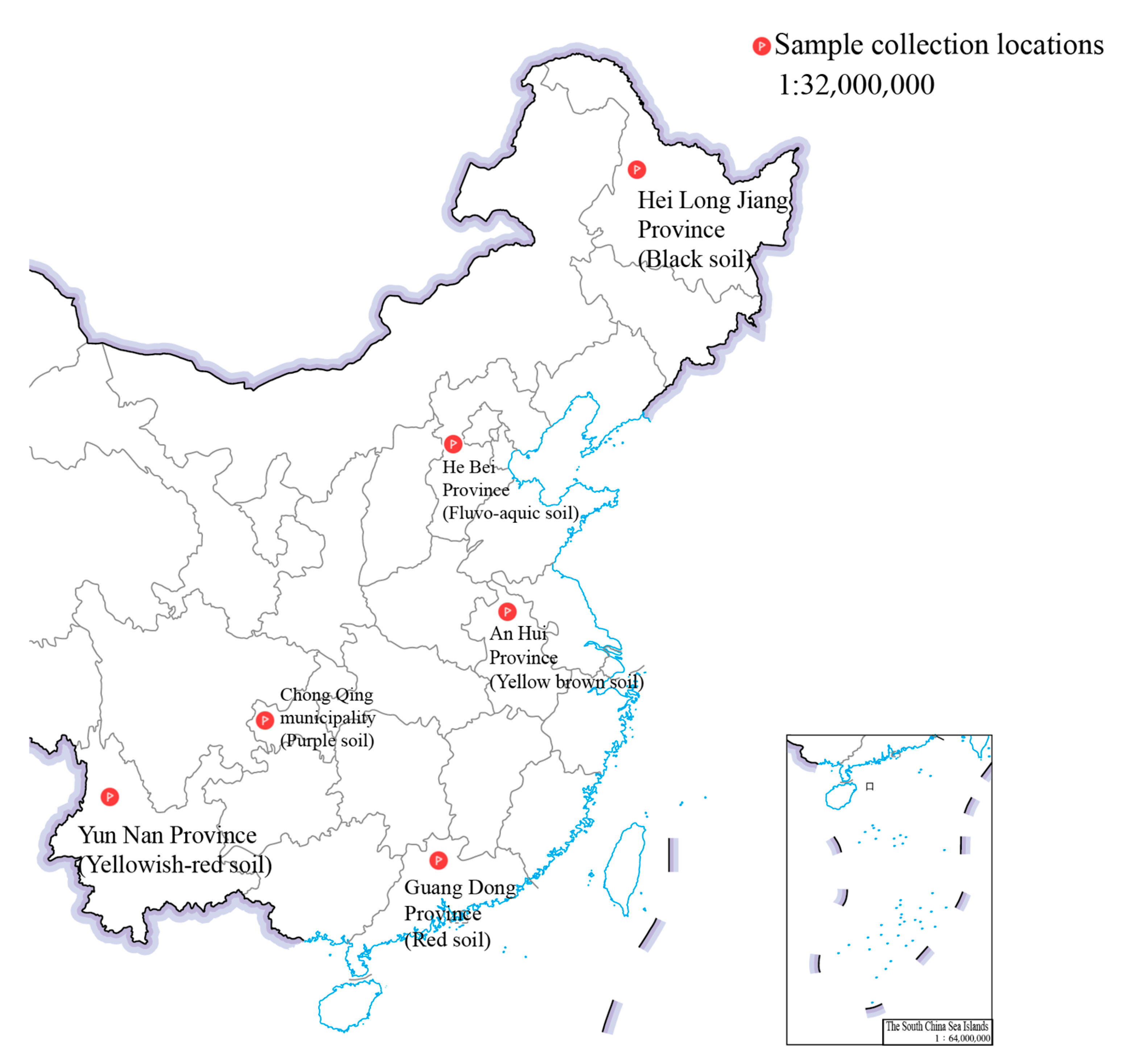
In 2023, soil samples with contrasting physicochemical properties were collected (at 0–20 cm depth) from six representative agricultural sites in five provinces and one municipality in China (Figure 1). The sampling sites and corresponding soil textural classes were: Heilongjiang Province (silty clay loam), Hebei Province (silt loam), Anhui Province (silt), Yunnan Province (loam), Guangdong Province (silty clay loam), and Chongqing Municipality (loam). According to the Chinese soil taxonomy, these soils are classified as black soil, fluvo-aquic soil, yellow–brown soil, yellowish-red soil, red soil, and purple soil, respectively [16]. Collected soils were air-dried at 25 °C, homogenized, passed through a 2-mm nylon sieve and stored in sealed polyethylene bags at 20 °C until further use.
Soil physicochemical properties were analyzed following standardized methods. Soil pH and electrical conductivity (EC) were measured in a 1:5 (w/v) soil-to-water suspension [17,18]. Organic matter (OM) content was determined using the potassium dichromate oxidation method [17], and cation exchange capacity (CEC) was analyzed using the EDTA-ammonium acetate method [19]. Particle size distribution was analyzed using the pipette method [20]. Amorphous Fe, Al, and Mn oxides (FeAO, AlAO, MnAO) were extracted using acidified ammonium oxalate and quantified colourimetrically [21]. Free Fe, Al, and Mn oxides (FeFO, AlFO, MnFO) were extracted by the sodium dithionite-citrate-bicarbonate (DCB) method and determined by o-phenanthroline colorimetry [22]. Total Fe (Fetotal), Al (Altotal), and Mn (Mntotal) contents were determined using inductively coupled plasma optical emission spectrometry (ICP-OES, IRIS Advantage, Thermo Electron Co., Waltham, MA, USA) after microwave-assisted digestion (HF + HClO4 + HNO3, 3:1:1 v/v/v) at 180 °C for 45 min [8]. Total Cr was determined using graphite furnace atomic absorption spectrometry [23]. The physicochemical properties of the tested soils are summarized in Table 1.

2.2. Chemicals and Test Organisms

Potassium dichromate (K2Cr2O7, 99.8%) was obtained from Shanghai Macklin Biochemical Technology Co., Ltd., Shanghai, China. The nematode C. elegans (wild-type strain N2) and its bacterial food source, Escherichia coli OP50 (E. coli OP50), were purchased from Fujian Shangyuan Biotechnology Co., Ltd., Fuzhou, China.
Nematodes were maintained on nematode growth medium (NGM) agar plates (Fujian Shangyuan Biotechnology Co., Ltd., Fuzhou, China), seeded with a lawn of E. coli OP50, following ISO 10872 [24], and incubated at 20 °C. The bacterial suspension was prepared by culturing E. coli OP50 in Luria–Bertani (LB) medium at 37 °C and 160 rpm for 17 h. To obtain a synchronized population, nematodes were cultured for four days and then rinsed from the NGM plates with M9 buffer. The suspension was filtered through a 5 μm nylon mesh to collect only L1 stage juveniles (252.2 ± 8.3 μm) [24].

2.3. Soil Spiking and Aging

Chromium(VI)-spiked soils were prepared by spraying aqueous K2Cr2O7 solutions onto soils to achieve target final total Cr concentrations of background, 100, 150, 200, 250, 300, and 400 mg·kg−1 (dry weight). The soils already contained background total Cr (52–70 mg·kg−1; Table 1), and the amount of Cr(VI) added to each soil was calculated as the difference between the target concentration and the background Cr content. The maximum concentration is selected to fall between the soil pollution risk screening value and the risk control value defined in the Chinese Soil Environmental Quality Standard for Agricultural Land (GB 15618–2018) [25]. Control soils received the same volume of deionized water. The treated soils were adjusted to 70% of their water holding capacity (WHC) with deionized water, homogenized thoroughly, and incubated uncovered at 25 °C for 120 days to simulate natural aging. Soil moisture was maintained by weighing samples every two days and replenishing with deionized water as necessary. Subsamples were collected after 7, 60, and 120 days of aging for toxicity testing. Aging-related changes were characterized by measuring Cr(VI) and available chromium concentrations at different aging times.

2.4. Chemical Analysis of Cr in Soil

The concentration of available Cr in ammonium bicarbonate-diethylene triamine penta acetic acid (AB-DTPA) extracts was determined by inductively coupled plasma-mass spectrometry (ICP-MS, Agilent 7500 Agilent Technologies, Inc., Santa Clara, CA, USA). Briefly, 10.00 g of soil sample and 20 mL of extraction solution (0.005 M DTPA +1 M Ammonium bicarbonate adjusted to pH 7.6 with NH4OH) were mixed and shaken at 200 rpm for 2 h. The suspension was then filtered through a 0.45 μm membrane, and the filtrate was diluted with 1% HNO3 prior to ICP-MS analysis [26,27].
The Cr(VI) content in soil samples was determined by alkaline extraction-followed by inductively coupled plasma-optical emission spectrometry (ICP-OES, IRIS Advantage, Thermo Electron Co., Waltham, MA, USA). Briefly, 2.50 g of soil sample was mixed with 25 mL of alkaline extraction solution (0.283 M sodium carbonate + 0.5 M sodium hydroxide + 0.5 M potassium hydrogen phosphate + 0.5 M potassium dihydrogen phosphate) and 400 mg of magnesium chloride, stirred at 25 °C for 5 min, and then heated to 90−95 °C with continuous stirring for 60 min. After extraction, the suspension was centrifuged at 2000 r·min−1 for 2 min, filtered through a 0.45 μm membrane, and the pH of the filtrate was adjusted to 7.0 ± 0.5 with concentrated nitric acid prior to ICP-OES analysis [28].

2.5. Toxicity Assays

Toxicity tests were performed in accordance with ISO 10872 [24]. For each treatment, 1 g of air-dried soil (aged for 7, 60, or 120 days) was placed in a 12-well plate, with three replicates per treatment. A 0.2 mL suspension of E. coli OP50 (centrifuged at 1000× g for 5 min and resuspended in M9 buffer) was added to each well as a food source. Soil moisture was adjusted to 80% WHC with M9 buffer, and the mixture was homogenized. Ten synchronized L1 stage juvenile C. elegans were transferred into each well using a capillary pipette (0.1 mm ID, Sigma-Aldrich (Shanghai) Trading Co., Ltd., Shanghai, China). The plates were sealed with parafilm and incubated in the dark at 20 °C for 96 h. After exposure, 1 mL of 0.3 g·L−1 Rose Bengal solution was added for nematode staining, and samples were heat-killed at 80 °C. Nematodes were recovered using colloidal silica (Ludox-TM50, Sigma-Aldrich(Shanghai)Trading Co., Ltd., Shanghai, China) centrifugation and observed under a microscope (SMART, Chongqing Optec Instrument Co., Ltd., Chongqing, China).
The growth, fertility and reproduction were calculated as follows:
G = L M L 1
where G is the increment of nematode growth (µm), L M is the nematode’s body length at the end of the toxicity test (µm), L 1 is the initial nematode’s body length (µm).
F = N F N R × 100 %
where F is the fertility rate of nematodes (%), N F is the number of gravid nematode individuals recovered (the number of eggs in the nematode ≥ 1), N R is the number of nematode individuals introduced into the experiment.
R = N T N R N R
where R is the reproduction of nematodes, N T is the number of nematode individuals recovered, N R is the number of nematode individuals introduced into the experiment.

2.6. Statistical Analysis

EC50 and their corresponding 95% confidence intervals for measured total Cr effect on nematodes’ growth, fertility, and reproduction were estimated by fitting the data to a logistic-sigmoidal model using SigmaPlot 13.5:
y = a 1 + ( x x 0 ) b
where y is biological response (growth in μm, fertility in %, or reproduction determined as number of offspring per nematode); x is the total Cr concentration (mg·kg−1); a is the control response; x 0 is the EC50 value; and b is the slope parameter.
The aging factor (AF) was calculated as the ratio of the EC50 at a given aging time to that at 7 days:
A F =   E C 50 ,   t E C 50 ,   7 d
Pearson correlation and redundancy analysis (RDA) were performed using SPSS 20.0 and Canoco 5.0, respectively, to explore relationships between soil properties, toxicity endpoints, and aging factors. Variables with a variance inflation factor (VIF) > 10 were excluded to minimize multicollinearity [29]. Linear regression models were established to predict Cr(VI) toxicity thresholds based on key soil parameters. Significant differences among treatments were analyzed via one-way ANOVA followed by Duncan’s multiple range test (p < 0.05). Figures and tables were produced using OriginPro 2018 and Microsoft Excel 2021.

3. Results and Discussion

3.1. Toxicity of Cr(VI) to Nematodes in Contaminated Soils

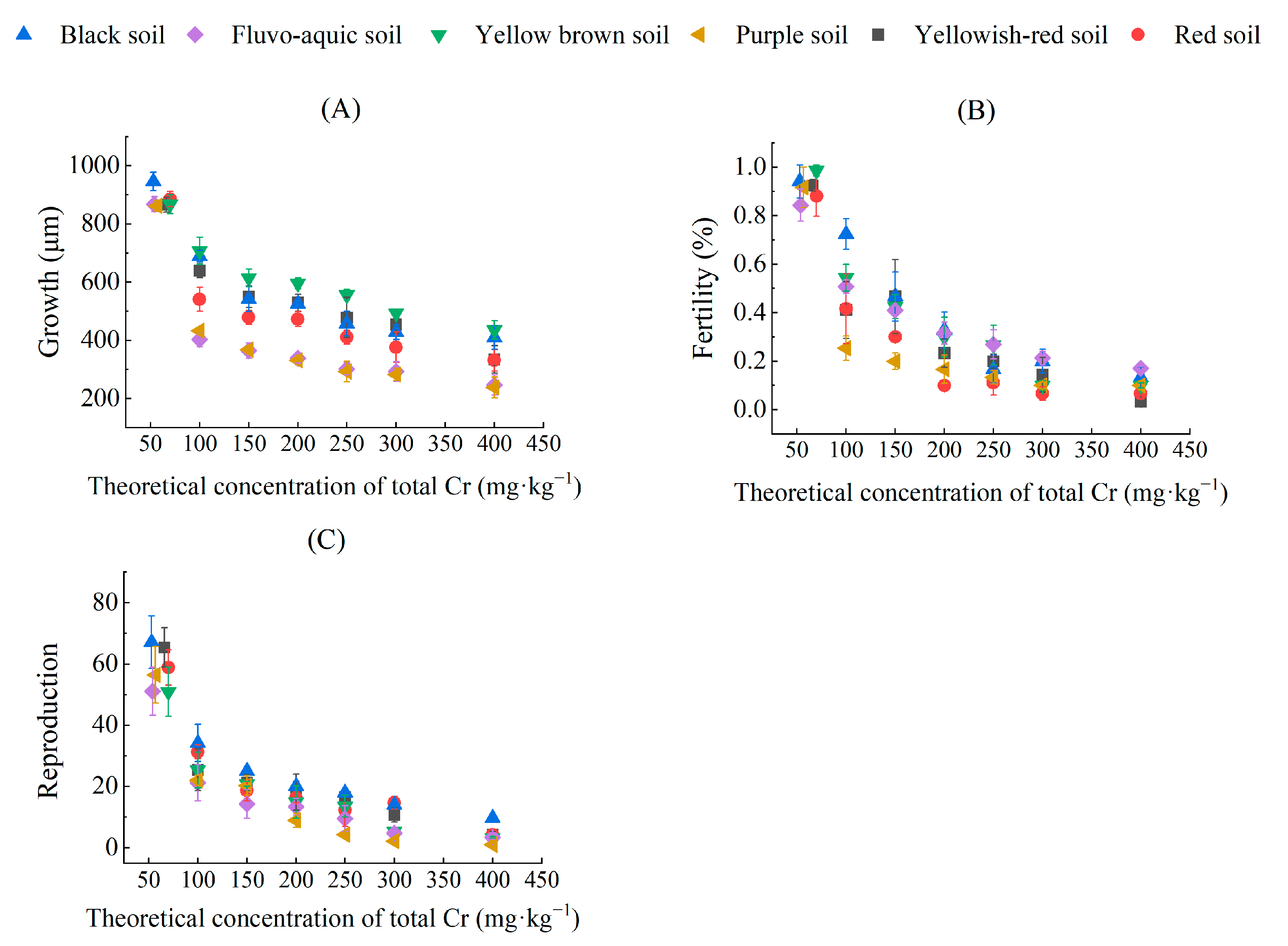
The validity of the 96 h cultivation test was verified in accordance with ISO 10872. All control groups (without Cr(VI) contamination) satisfied the requisite validity criteria. Exposure to Cr(VI)-contaminated soils after 7 days of aging caused significant inhibitory effects on the growth, fertility, and reproduction of C. elegans (Figure 2). Overall, all three biological endpoints declined with increasing Cr(VI) concentrations, but the extent of inhibition varied substantially among soils, indicating a strong influence of soil properties on Cr toxicity. Among the six tested soils, C. elegans exhibited the highest sensitivity in the purple soil and the lowest in the black soil. At a Cr concentration of 100 mg·kg−1, nematodes growth was already significantly inhibited (p < 0.05) in all soils compared with the control, with body length reductions ranging from 27.2% in the black soil to 49.7% in the purple soil. At 400 mg·kg−1, growth inhibition in the purple soil reached 78.0% relative to the control, and no offspring were produced, while nematodes in the black soil still maintained 43.4% of growth compared to the control (Figure 2A–C). Similar patterns were observed for fertility and reproduction endpoints: fertility dropped sharply to 27.6% of that in the control group in the purple soil at 100 mg·kg−1 and to just 3.5% of the control group in the yellowish-red soil at 400 mg·kg−1, whereas reproduction was completely suppressed in the purple soil but remained relatively active in soils with lower bioavailable Cr (Figure 2B,C).
After 60 days of aging, exposure to Cr(VI)-contaminated soils continued to exert significant inhibitory effects on the growth, fertility, and reproduction of C. elegans, as illustrated by the detailed dose-response patterns across all soil types in Figure S1. At a total Cr concentration of 100 mg·kg−1, nematode growth was reduced by 18.0% in black soil and by up to 41.3% in purple soil compared with the control. At 400 mg·kg−1, growth inhibition in purple soil reached 56.7%, indicating pronounced toxicity persistence even after aging (Figure S1A). Fertility declined to 43.6% of the control level in purple soil at 100 mg·kg−1 and to 11.4% in red soil at 400 mg·kg−1 (Figure S1B). Reproduction output showed an even stronger response, with offspring production in purple soil dropping to only 2.6% of the control at the highest exposure level, compared with 14.8% in yellowish-red soil and 27.3% in black soil (Figure S1C).
After 120 days of soil aging, an overall reduction in Cr(VI) toxicity toward C. elegans was observed across all soil types, with detailed dose–response patterns and non-monotonic responses for growth, fertility, and reproduction illustrated in Figure S2. However, the dose-response relationships became more complex, showing non-monotonic patterns for certain endpoints in specific soils and endpoints. A slight stimulation of nematode growth occurred at intermediate Cr(VI) concentrations, with growth significantly exceeding control levels to reach 107% of control levels in purple soil (at 250 mg·kg−1; Figure S2A). Similarly, nematode reproduction showed transient increases in several soils, with the proportion of gravid nematodes rising to 104–124% of the control in yellowish-red soil, black soil, and fluvo-aquic soil at 250 mg·kg−1 (Figure S2C). However, these non-monotonic responses were not consistently observed across all soils or endpoints. In contrast, at the highest exposure level (400 mg·kg−1), growth inhibition ranged from 14.4% in yellowish-red soil to 47.9% in fluvo-aquic soil. The proportion of gravid nematodes varied widely, from as low as 10.4% in yellow–brown soil to as high as 65.9% in black soil (Figure S2B), highlighting strong soil-specific differences in Cr bioavailability and toxicity persistence. At 400 mg·kg−1, reproductive inhibition ranged from 6.5% in purple soil to 68.4% in black soil relative to the untreated control.

3.2. Variations in Available Cr and Cr(VI) Fraction Among Different Soil Types

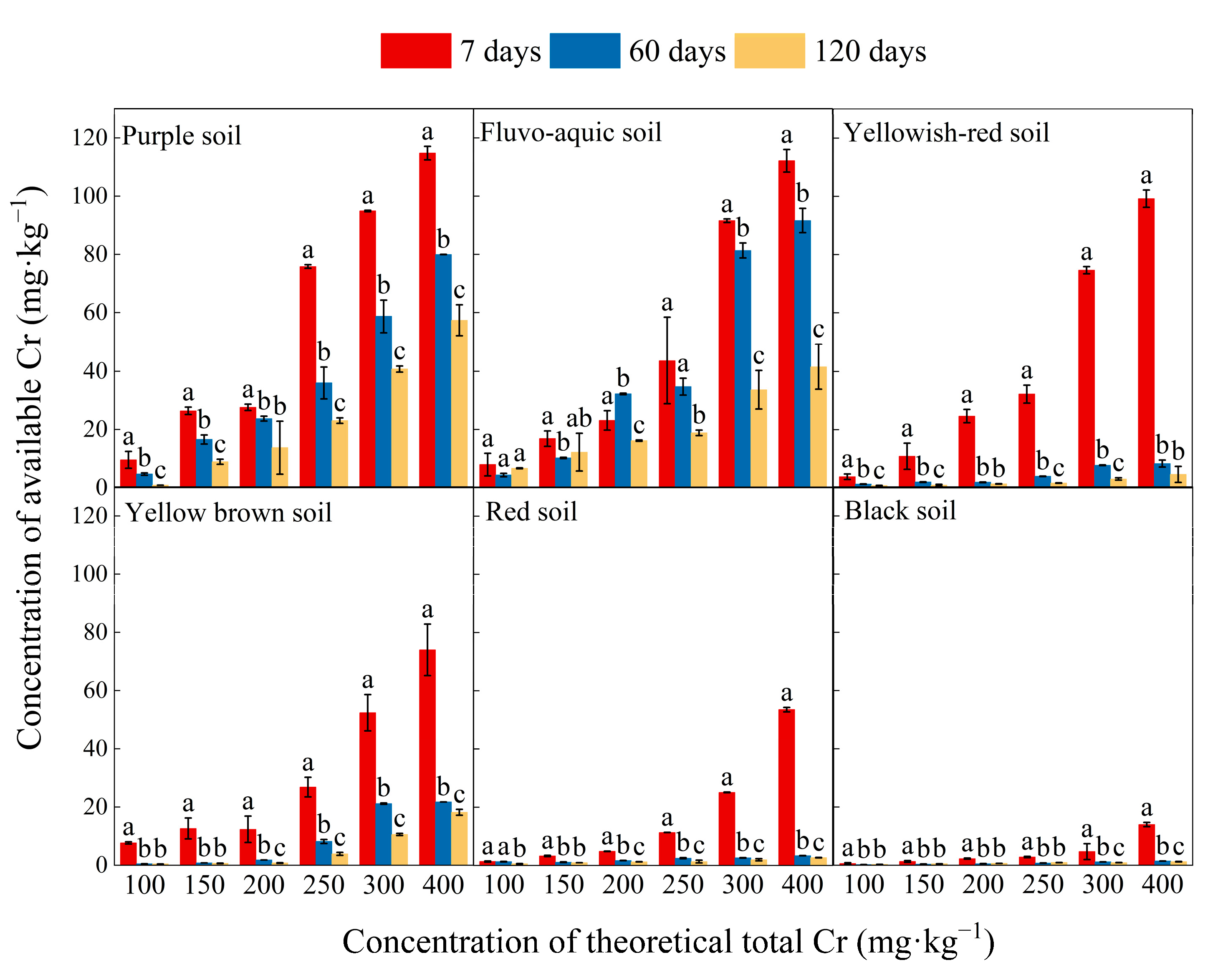
To elucidate the mechanisms governing the observed soil-dependent variations in Cr(VI) toxicity, the concentrations of available Cr, Cr(VI) and total Cr under varying contamination levels and aging periods were measured, and the proportion of Cr(VI) to total Cr was calculated (Figure 3 and Figure 4). Overall, both indicators showed a pronounced decline with increasing aging time, indicating that long-term geochemical transformation processes substantially reduced Cr(VI) mobility and bioavailability. At 7 days, the available Cr content increased almost linearly with total Cr concentration in all soils, reaching the highest levels in purple soil, fluvo-aquic soil, and yellowish-red soil (up to >99 mg·kg−1 at 400 mg·kg−1 total Cr) (Figure 3). In contrast, red, yellow–brown, and especially black soil exhibited much lower available fractions (<20 mg·kg−1), highlighting the strong influence of soil composition. After 60 days, available Cr concentrations dropped sharply, particularly in the yellowish-red soil and red soil, where decreases of 91.5–93.7% were observed compared with day 7. By 120 days, available Cr was further reduced to trace levels (<5 mg·kg−1) in most soils (yellowish-red soil, red soil, black soil), reflecting the progressive immobilization and reduction during aging.
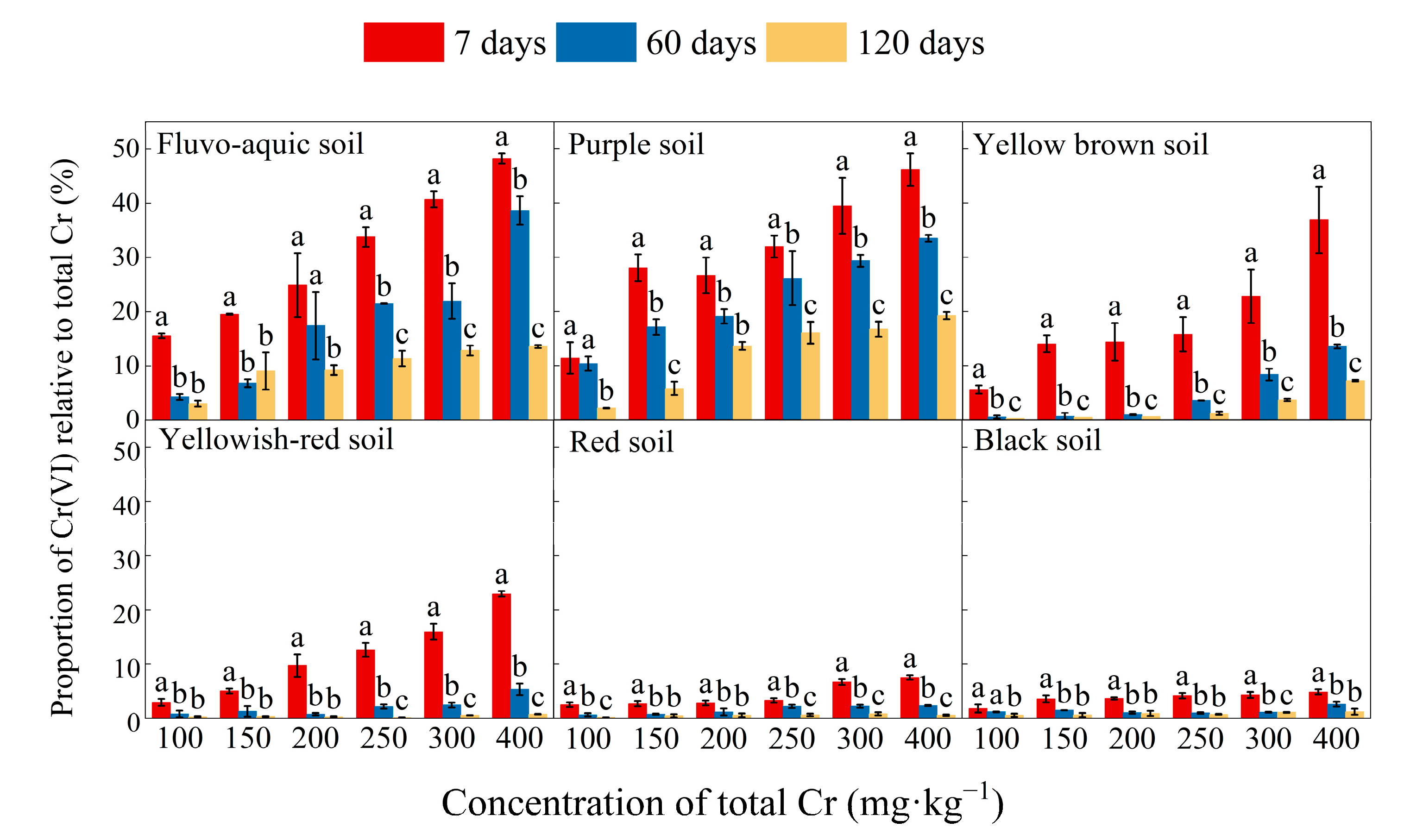
The percentage of Cr(VI) relative to total Cr exhibited similar temporal patterns (Figure 4). At the highest contamination level (400 mg·kg−1 total Cr) after 7 days, the Cr(VI) fraction reached 4.86% of total Cr in the black soil, 7.5% in the red soil, 22.9% in the yellowish-red soil, 36.9% in the yellow–brown soil, 46.2% in the purple soil and 48.2% in the fluvo-aquic soil. After 60 days, the Cr(VI) proportion decreased by 19.8% in the fluvo-aquic soil, 27.5% in purple soil, 46.7% in black soil, 63.3% in yellow–brown soil, 69.0% in red soil and 76.7% in yellowish-red soil compared with that at day 7 at the highest contamination level, suggesting that Cr(VI) was progressively reduced over time. By 120 days, the proportion of Cr(VI) declined to below 10% of total Cr in most soils at all contamination levels, except for purple and fluvo-aquic soil, where a relatively higher Cr(VI) fraction (exceeding 10%) persisted at 400 mg·kg−1. These results demonstrate that the persistence of Cr(VI) strongly depends on soil physicochemical properties.
These consistent patterns confirm that bioavailable and oxidized Cr pools are the principal drivers of Cr(VI) toxicity to C. elegans. Soils exhibiting higher concentrations of available Cr and larger Cr(VI) fractions generally caused stronger inhibitory effects on the growth, fertility, and reproduction of C. elegans. In particular, the purple soil and fluvo-aquic soil, which contained the highest proportions of bioavailable Cr and Cr(VI), also showed the greatest reductions in nematode body length and reproductive output. Conversely, black soil, characterized by the lowest available Cr and Cr(VI) contents, exerted the weakest toxic responses. Cr(VI) can be directly internalized by nematodes, thereby impairing physiological function and reducing energy allocation for growth and reproduction [30].

3.3. Soil-Specific Toxicity Thresholds (EC50 Values) and Endpoint Sensitivity

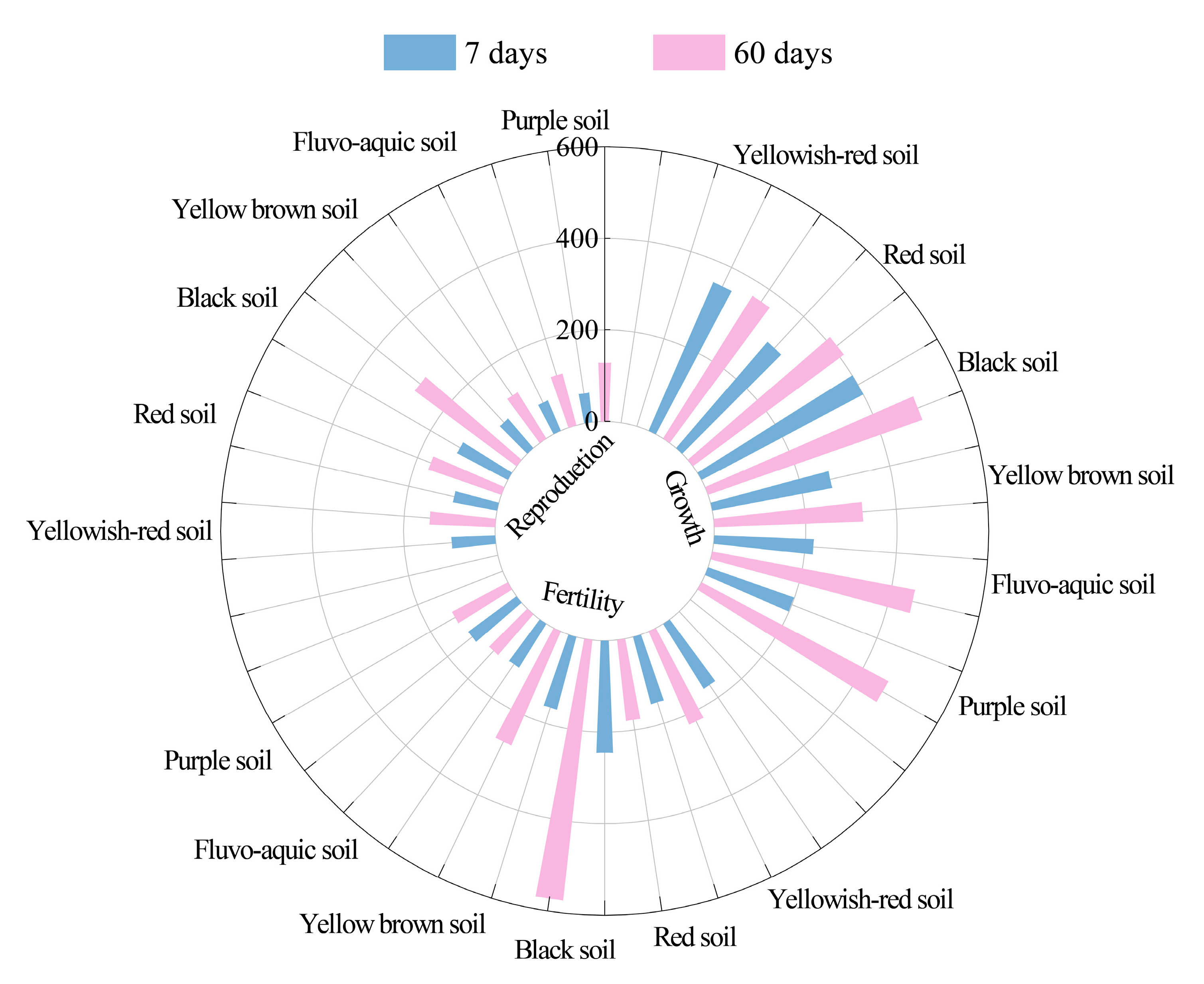
The toxicity thresholds (EC50) of Cr(VI) to C. elegans were determined for six agricultural soils based on total Cr concentrations (Figure 5). The corresponding numerical EC50 values are provided in Table S1 in the Supplementary Materials. After 7 days of aging, median effective concentrations for growth, fertility and reproduction (EC50G, EC50F, and EC50R) ranged from 199–400, 113–245, and 65–126 mg·kg−1, respectively, indicating 1.8–2.2-fold variations among soils. Among the tested soils, the black soil exhibited the highest EC50 values (lowest toxicity), whereas the purple soil consistently showed the lowest EC50 values (highest toxicity). Overall, Cr(VI) toxicity followed the order: black soil < yellowish-red soil < red soil < yellow–brown soil < fluvo-aquic soil < purple soil, indicating that soil physicochemical properties strongly influence the toxic response of nematodes.
Comparison among the three endpoints demonstrated a consistent sensitivity ranking of reproduction > fertility > growth across six test soils. Reproduction was the most sensitive endpoint, with EC50 values averaging 2–3 times lower than those for growth. This pattern aligns with previous observations for metal toxicity in C. elegans [31], suggesting that reproductive processes are the most vulnerable to Cr-induced stress. Reproduction integrates both somatic and germline effects; thus, inhibition can arise from direct impacts on gamete formation and embryogenesis, as well as from indirect effects mediated through reduced body size and fertility. Fertility, reflecting the proportion of gravid adults, was moderately sensitive, while growth exhibited the highest tolerance [32].
After 60 days of soil aging, EC50 values for all endpoints increased markedly (Figure 5), demonstrating a clear reduction in Cr(VI) toxicity over time. For instance, EC50G rose from 199–400 mg·kg−1 at 7 days to 326–496 mg·kg−1 at 60 days, while the EC50F and EC50R exhibited similar upward trends. This increase in EC50 indicates a substantial decline in the bioavailable fraction of Cr(VI) with time spent in soil (aging), suggesting that soil aging promotes the reduction and immobilization of Cr(VI), thereby mitigating its toxic effects.
The pronounced inter-soil variation in EC50 values corresponds well with differences in available Cr and Cr(VI) proportions. For instance, the purple soil, characterized by the highest available Cr concentration (80.0 mg·kg−1) and Cr(VI) fraction (33.5%), yielded the lowest EC50 values across all endpoints. In contrast, the black soil, with the lowest available Cr (1.5 mg·kg−1) and Cr(VI) proportion (2.6%), showed the highest EC50 values. This strong association indicates that Cr(VI) bioavailability, rather than total Cr content, is the primary determinant of nematode toxicity.

3.4. Relationship Between Soil Properties and Toxicity Thresholds of Nematodes

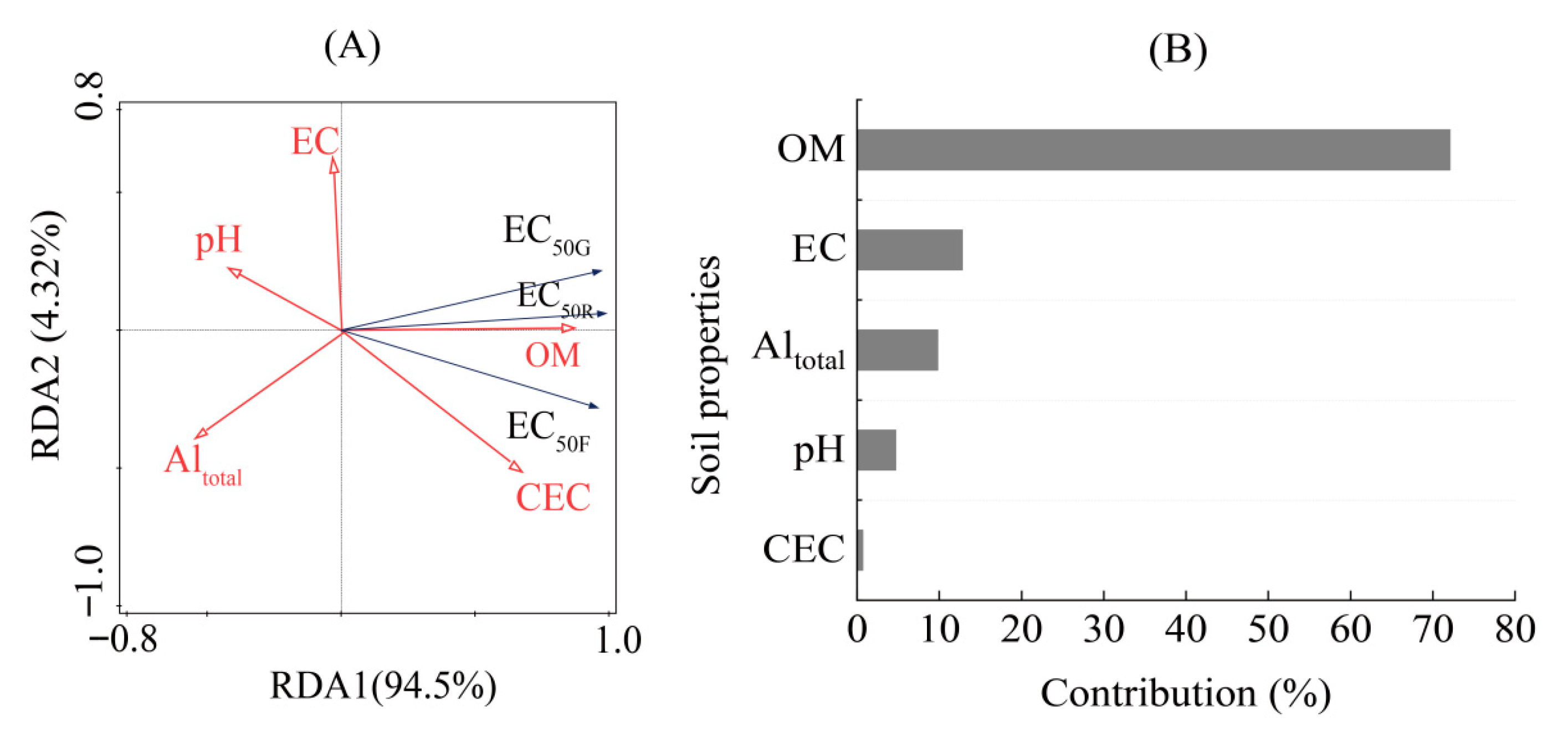
To clarify which soil properties drive the observed variability in Cr(VI) toxicity among soils, redundancy analysis combined with contribution analysis was conducted to determine the key factors associated with the EC50 values measured after 7 days of Cr aging in soils (Figure 6). Redundancy analysis revealed that soil physicochemical properties exerted strong and differentiated influences on Cr(VI) toxicity across the six soils. The first RDA axis (RDA1) explained 94.65% of the total variation in EC50 values, while RDA2 accounted for an additional 4.32%, indicating that nearly all variation in Cr toxicity could be attributed to the measured soil properties (Figure 6A). Contribution analysis further quantified the relative importance of each soil factor (Figure 6B). OM emerged as the dominant contributor, explaining 72.1% of the variation in toxicity thresholds, far exceeding other variables. EC and Altotal contributed 12.8% and 9.8%, respectively, while pH (4.7%) and CEC (0.7%) played minor roles.
Pearson correlation analysis (Table 2) revealed that among all measured soil properties, OM and AlAO were significantly and positively correlated with the Cr(VI) toxicity thresholds (EC50 values) for C. elegans (p < 0.05), while no significant correlations were observed for other variables. OM content showed strong positive correlations with EC50G, EC50F and EC50R (r = 0.821, 0.820, and 0.906, respectively), indicating that higher OM markedly reduced the apparent toxicity of Cr(VI) in soil. This mitigating effect is likely due to multiple mechanisms: (i) OM contains abundant electron-donating functional groups (e.g., hydroxyl, phenolic, and carboxyl) that can chemically reduce Cr(VI) to the less toxic Cr(III) [33,34]; (ii) complexation of Cr(III) with OM further decreases its solubility and bioavailability [35]; and (iii) OM enhances microbial activity, promoting enzymatic reduction of Cr(VI) through redox-active metabolites [36,37]. Similarly, AlAO exhibited significant positive correlations with EC50F and EC50R (r = 0.905 and 0.854, respectively), confirming its important role in attenuating Cr(VI) toxicity. Amorphous aluminum oxides possess high surface area and abundant hydroxyl groups, providing positively charged adsorption sites that strongly bind Cr(VI) anions [38,39]. This sorption process effectively immobilizes Cr(VI), decreases its mobility, and reduces its bioavailability to nematodes.
Based on these significant relationships, linear regression models were developed to predict Cr(VI) EC50 values using key soil properties (Table 3). OM alone explained 57.7% and 75.0% of the variation in EC50G and EC50R, respectively, while AlAO accounted for 72.3% of the variation in EC50F. These regression models provide exploratory estimates of Cr(VI) toxicity thresholds within the studied soils, highlighting the dominant soil properties associated with variations in chromium bioavailability and toxicity.
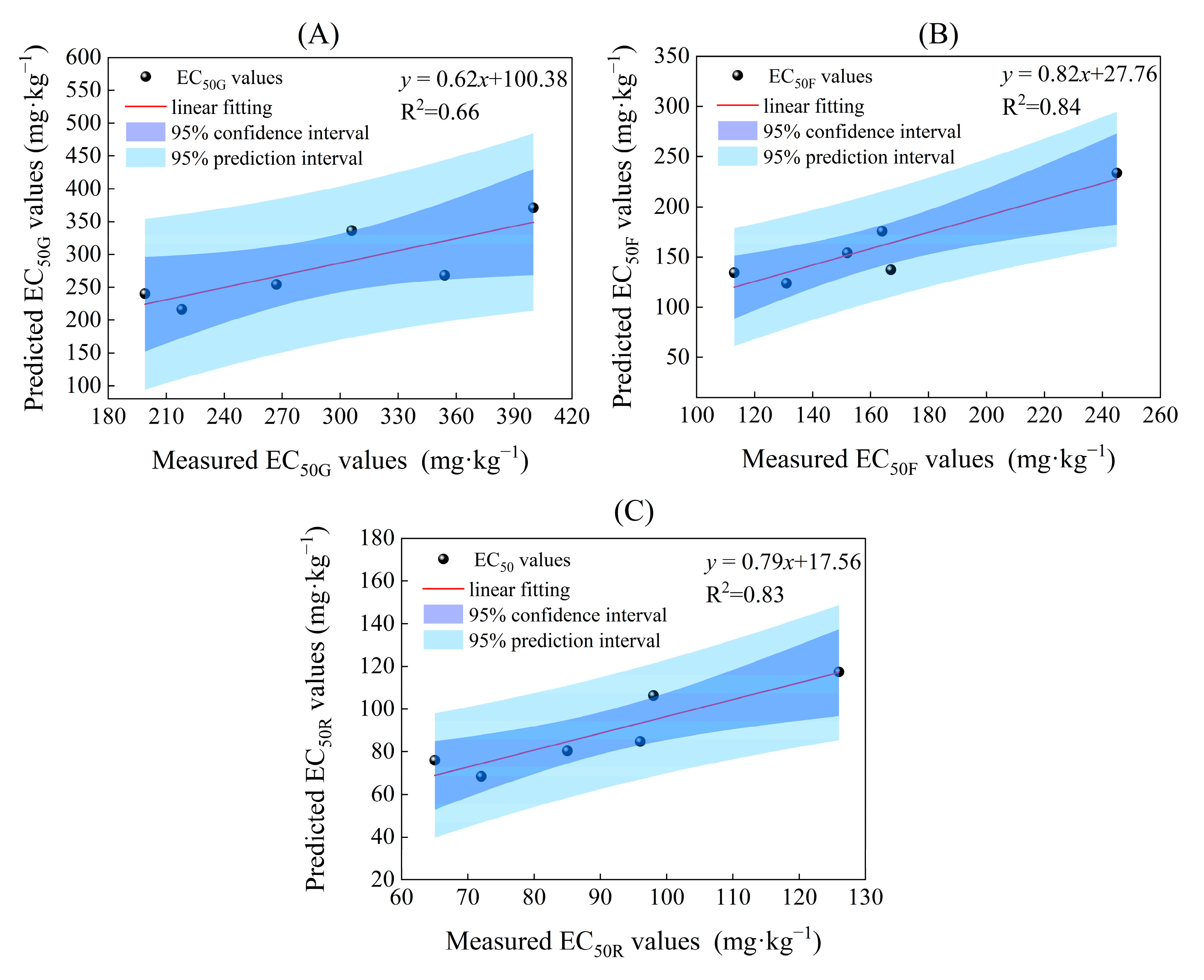
The agreement between measured and predicted EC50 values was further evaluated using linear regression with 95% confidence and prediction intervals (Figure 7), providing an internal assessment of model performance within the studied soils. As shown in Figure 7, the predicted EC50 values for growth, fertility, and reproduction generally exhibited a positive linear relationship with the measured EC50 values across the six soils. Most observed data points fell within the 95% prediction intervals, indicating reasonable internal consistency of the regression models within the studied soil set. The relatively wider prediction intervals reflect the limited number of soils included (n = 6) and associated uncertainty, particularly for growth endpoints. Overall, these results support the use of the regression models for exploratory assessment of soil-related trends in Cr(VI) toxicity, while highlighting the need for further validation using larger and independent soil datasets.

3.5. Effects of Soil Aging on Cr(VI) Toxicity

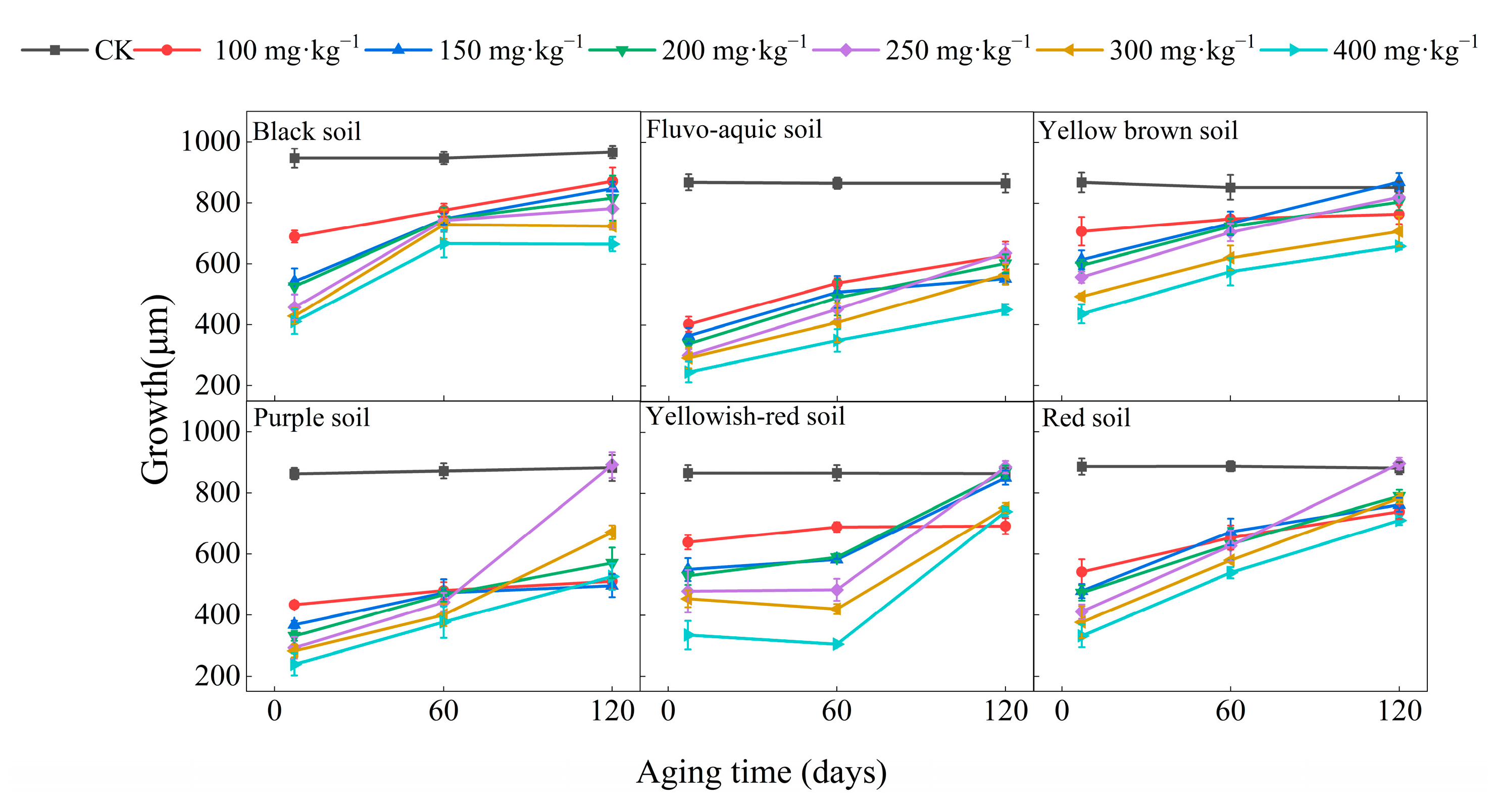
To illustrate the temporal effects of soil aging, the growth responses of C. elegans in soils aged for 7, 60, and 120 days are shown in Figure 8, while the corresponding changes in fertility and reproduction across aging periods and soil types are presented in Figures S3 and S4. A clear decline in Cr(VI) toxicity was observed over time. From 7 to 60 days, all three biological endpoints improved across soil types, indicating that Cr(VI) became progressively less toxic with increasing residence time. At a low Cr concentration (100 mg·kg−1), both growth and fertility inhibition were reduced relative to the 7-day treatments, with decreases of 8.7–16.6% and 2.0–35.4%, respectively. At the higher concentration (400 mg·kg−1), the reductions were 13.1–14.3% for growth inhibition and 0.3–31.2% for fertility inhibition across soil types (Figure 8 and Figure S3). Reproduction showed similar alleviation. For example, in purple soil where nematodes experienced the strongest reproduction inhibition at 400 mg·kg−1, the amount of reproduction increased by 33.3% after 60 days of aging compared with the 7-day results (Figure S4).
After 120 days of aging, nematode growth, fertility, and reproduction were further increased in nearly all soils, in some cases surpassing control values. For example, nematode reproduction significantly increased by 22.0% at 250 mg·kg−1 in fluvo-aquic soil (Figure S4). Such hormetic-like responses have been reported for soil invertebrates exposed to low or declining levels of chromium, where mild stress may trigger compensatory or overcompensatory physiological responses before inhibitory effects dominate at higher doses [40]. Importantly, these responses should be interpreted as stress adaptation rather than beneficial effects, and are often dependent on the specific biological endpoint, exposure duration, and environmental context. The observed reduction in Cr(VI) toxicity with aging can be attributed to multiple concurrent processes. Prolonged soil residence promotes the reduction of Cr(VI) to the less bioavailable Cr(III) form and facilitates its stabilization via adsorption or incorporation into mineral matrices [41]. Furthermore, aging increases the role of OM and amorphous oxides (particularly Al and Fe), which provide abundant reactive surfaces for Cr complexation, thus lowering its soluble and toxic fractions [42,43]. In addition to these abiotic mechanisms, indirect biological processes may also contribute to the observed reduction in Cr(VI) toxicity during soil aging. Organic matter not only serves as a chemical reductant and complexing agent for chromium, but also plays a central role in regulating soil microbial activity. Enhanced microbial abundance and activity in OM-rich soils can promote Cr(VI) reduction through enzymatic pathways or via the production of redox-active metabolites, such as organic acids and reduced sulfur compounds. These biologically mediated processes may operate in concert with abiotic adsorption and reduction on mineral surfaces, thereby accelerating the transformation of Cr(VI) to less bioavailable Cr(III) forms [44,45].
Furthermore, mineral phases such as amorphous aluminum and iron oxides can provide reactive surfaces that facilitate both abiotic Cr(VI) adsorption and serve as microhabitats for microorganisms, potentially enhancing coupled biotic–abiotic transformation processes. Although microbial activity was not directly quantified in this study, the strong associations observed between soil properties (e.g., organic matter and amorphous oxides), Cr speciation, and toxicity attenuation suggest that interactions between geochemical and biological processes likely play an important role in governing Cr(VI) aging behavior in soils [46].

3.6. Relationship Between Soil Properties and Aging-Related Reduction in Cr(VI) Toxicity

To quantitatively evaluate the impact of soil aging on Cr(VI) toxicity, aging factors for growth (AFG), fertility (AFF), and reproduction (AFR) were calculated as the ratios of EC50 values at 60 days to those at 7 days (Table 4). AF values varied substantially among the six soils, with maximum differences of 2.23–, 2.25–, and 1.57–fold for growth, fertility, and reproduction, respectively. This variation indicates that the aging effect was strongly soil-specific, reflecting the influence of soil physicochemical characteristics on the extent of Cr(VI) detoxification over time.
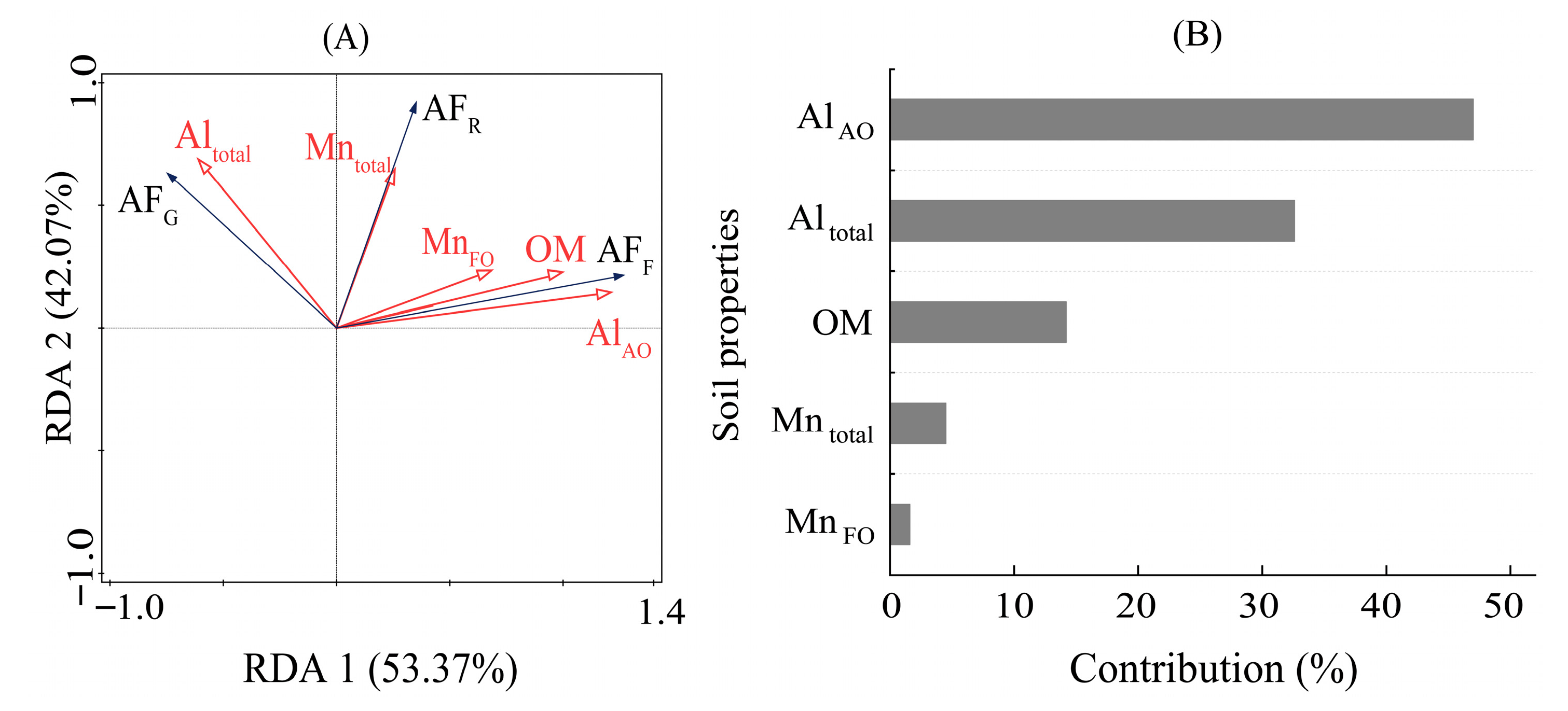
Multivariate analysis further revealed that the first two RDA axes collectively explained 95.4% of the total variance in AF values (Figure 9A), demonstrating that soil properties largely controlled the magnitude of aging effects. The contribution analysis further quantified the relative influence of each soil variable (Figure 9B). Amorphous aluminum oxide (AlAO) emerged as the single most influential factor, explaining 47% of the variation in aging effects. Total aluminum (Altotal) contributed an additional 33%, while organic matter (OM) accounted for 14%. Manganese-bearing phases, including Mntotal and MnFO, provided smaller contributions (5% and 2%, respectively).
Analysis of aging factors revealed clear and endpoint-specific associations with soil physicochemical properties (Table 5). An extremely significant positive relationship was observed between AFG and total aluminum content (r = 0.958, p < 0.01), suggesting that aluminum-bearing minerals contribute to long-term Cr stabilization through surface complexation or incorporation into aluminosilicate structures, thereby reducing Cr mobility and bioavailability [47].
For fertility, AFF was most strongly associated with amorphous aluminum oxides (r = 0.958, p < 0.01) and also showed significant positive correlations with amorphous manganese oxides (r = 0.822, p < 0.05) and free manganese oxides (r = 0.855, p < 0.05). Amorphous Al oxides possess abundant reactive hydroxyl functional groups that provide high-affinity binding sites for Cr(VI), promoting its gradual immobilization [39]. This reduction in dissolved Cr(VI) directly decreases its accessibility to nematodes, thereby increasing the aging factor for fertility. Manganese oxides similarly contribute to Cr(VI) attenuation through their strong sorptive affinity for chromate species. Although Mn oxides can participate in redox reactions with chromium, their overall environmental function often leads to substantial Cr(VI) removal from soil solution via adsorption. The mechanism of retention varies with pH: inner-sphere complexes dominate under acidic conditions through bonding to protonated surface sites (≡SOH2+), whereas outer-sphere electrostatic complexes prevail in more alkaline soils [48]. Reproduction responses displayed a distinct pattern. The aging factor for reproduction (AFR) was significantly and positively correlated with CEC (r = 0.887, p < 0.05), indicating that soils with higher exchange capacities can retain more Cr species on negatively charged surfaces, thereby limiting their accessibility to nematodes and mitigating chronic reproductive toxicity [49,50].
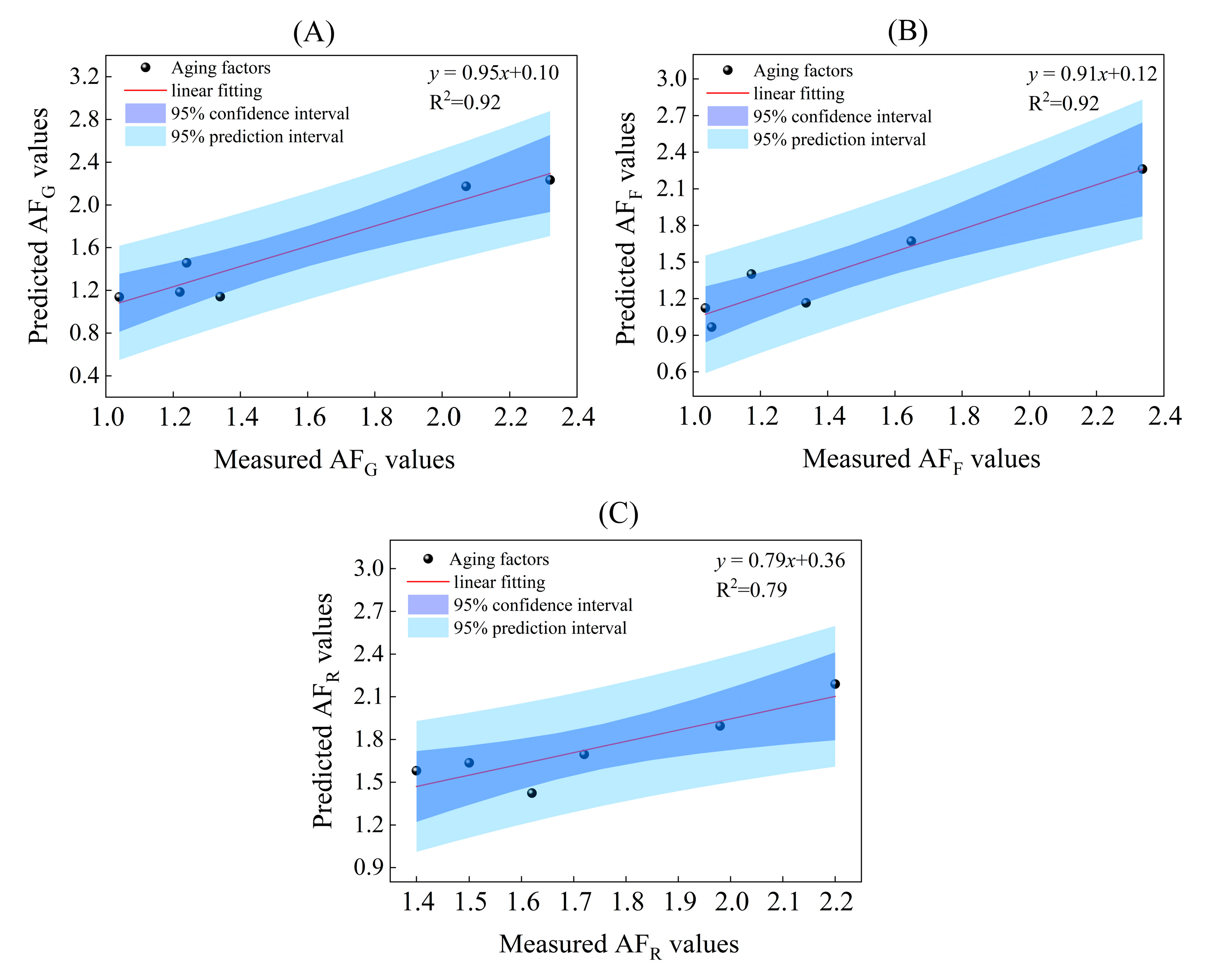
Consistent with these relationships, linear regression models (Table 6) showed that total aluminum explained 89.0% of the variance in AFG, amorphous aluminum oxides accounted for 89.6% of the variance in AFF, and CEC explained 73.3% of the variance in AFR. The performance of the aging-factor regression models was further evaluated by comparing measured and model-predicted aging factors with associated 95% confidence and prediction intervals (Figure 10). Predicted values generally followed the observed trends and fell within the prediction intervals, indicating reasonable internal consistency of the models within the studied soil set. It should be noted that these regression analyses are based on a limited number of soils (n = 6) and are therefore intended for exploratory interpretation rather than validated prediction. The models primarily serve to identify soil properties associated with the magnitude of aging-related changes in Cr(VI) toxicity. Further evaluation using a larger and independent set of soils would be required before these relationships could be applied for quantitative prediction or risk assessment purposes.

4. Conclusions

These results demonstrated that Cr(VI) exerts significant inhibitory effects on the growth, fertility, and reproduction of C. elegans, and that the magnitude of toxicity varies markedly among soils due to differences in Cr bioavailability and soil physicochemical properties. Purple soil, with the highest available Cr and Cr(VI) fraction, showed the strongest toxicity, while black soil exhibited minimal effects due to its low bioavailable Cr levels. Organic matter and amorphous aluminum oxides were significantly associated with toxicity thresholds, indicating that these soil properties shape the degree to which Cr(VI) remains bioavailable to soil organisms. The aging process further modulated Cr(VI) toxicity, with prolonged soil residence time (60–120 days) consistently reducing biological inhibition and increasing EC50 values across all soils. Total aluminum, amorphous aluminum oxides, and cation exchange capacity were identified as the dominant factors that control the magnitude of aging effects, with sorption and reduction to Cr(III) being the main mechanisms of reduced Cr toxicity.
Overall, these findings highlight the necessity of incorporating soil-specific geochemical characteristics, chromium speciation, and aging behavior into ecological risk assessments. The results provide a scientific foundation for refining soil environmental quality standards by incorporating Cr bioavailability and soil-specific properties and guiding targeted management strategies for Cr-contaminated agricultural soils.

Supplementary Materials

The following supporting information can be downloaded at https://www.mdpi.com/article/10.3390/agriculture16020275/s1. EC50 values for the growth, fertility, and reproduction of C. elegans in Cr(VI)-treated soils after 7 and 60 days of aging are provided in Table S1. The growth, fertility and reproduction of C. elegans after 96 h exposure to Cr(VI)-contaminated soils aged for 60 days and 120 days are provided in Figures S1 and S2. Fertility and reproduction of C. elegans after 96 h exposure to Cr(VI)-contaminated soils aged for 7, 60, and 120 days are provided in Figures S3 and S4.

Author Contributions

Conceptualization, L.Z. and X.D.; methodology, X.A.; formal analysis, X.A.; investigation, X.A., C.M., M.B., F.G. and L.Z.; writing—original draft, X.A.; visualization and writing—original draft preparation, X.A.; writing—review and editing, X.D., I.L. and R.B.; data curation, X.A.; supervision, X.D.; funding acquisition, I.L. and X.D. All authors have read and agreed to the published version of the manuscript.

Funding

This research was funded by the National Natural Science Foundation of China (No. 41301530). I.L. acknowledges funding from the Horizon 2020 project SCENARIOS (Grant Agreement No. 101037509). X.D. acknowledges the support of the China Scholarship Council program (202408210317).

Data Availability Statement

The original contributions presented in this study are included in the article/Supplementary Materials. Further inquiries can be directed to the corresponding authors.

Conflicts of Interest

The authors declare no conflicts of interest.

References

  1. Xu, T.; Nan, F.; Jiang, X.F.; Tang, Y.L.; Zhang, W.H.; Shi, B. Progress in research on sources and characteristics of chromium pollution in soils and groundwater of tannery sites. Acta Pedol. Sin. 2020, 57, 1341–1352. [Google Scholar] [CrossRef]
  2. Angon, P.B.; Islam, M.S.; Kc, S.; Das, A.; Anjum, N.; Poudel, A.; Suchi, S.A. Sources, effects and present perspectives of heavy metals contamination: Soil, plants and human food chain. Heliyon 2024, 10, e28357. [Google Scholar] [CrossRef] [Scilit] [PubMed]
  3. Peng, Y.M.; Yang, Y.; Hou, S.X.; Cheng, P.F.; Song, X.X.; Yang, Z.S.; Xu, L.T. The bioavailability of exogenous Cr(VI) in soils and its toxic effect on wheat. Ecol. Environ. Sci. 2020, 29, 369–377. [Google Scholar] [CrossRef]
  4. Wakeel, A.; Xu, M. Chromium Morpho-Phytotoxicity. Plants 2020, 9, 564. [Google Scholar] [CrossRef] [Scilit]
  5. Chokor, A. Impact assessment of some toxic phenols and heavy metals in farmlands’ soils of Obio-Akpor LGA, Rivers State, Nigeria. J. Mater. Environ. Sci. 2023, 14, 1517–1528. [Google Scholar]
  6. Guo, K.X.; Li, T.Y.; Song, F.Y.; Fu, X.W.; Zhang, Q.; Ji, L. Review on heavy metal bioavailability and bioaccessibility in soil-crop system. China Environ. Sci. 2023, 43, 4164–4174. [Google Scholar] [CrossRef]
  7. Liang, J.; Yang, Z.X.; Tang, L.; Zeng, G.M.; Yu, M.; Li, X.D.; Wu, H.P.; Qian, Y.Y.; Li, X.M.; Luo, Y. Changes in heavy metal mobility and availability from contaminated wetland soil remediated with combined biochar-compost. Chemosphere 2017, 181, 281–288. [Google Scholar] [CrossRef] [Scilit]
  8. Lin, X.L.; Sun, Z.J.; Zhao, L.; Ma, J.; Li, X.; He, F.; Hou, H. Toxicity of exogenous hexavalent chromium to soil-dwelling springtail Folsomia candida in relation to soil properties and aging time. Chemosphere 2019, 224, 734–742. [Google Scholar] [CrossRef] [Scilit]
  9. Mou, Z.T.; Zhang, Y.Y.; Ma, Y.B.; Li, S.W.; Li, H.L.; Han, X.M. Aging kinetics and main controlling factors of Cr(VI) Iin typical farmland soils in China. J. Agro-Environ. Sci. 2021, 40, 62–73. [Google Scholar] [CrossRef]
  10. Chen, L.H.; Liu, Z.T.; Li, Z.; Zhang, R.; Wang, W.H. Effects of Cr (VI) on the reproduction and antioxidant enzyme activities of Eisenia fetida with aged soils. Environ. Chem. 2013, 32, 2364–2369. [Google Scholar] [CrossRef]
  11. Lin, X.L.; Sun, Z.J.; Ma, J.; Hou, H.; Zhao, L. Effects of soil properties and long aging time on the toxicity of exogenous antimony to soil-dwelling springtail Folsomia candida. Chemosphere 2020, 241, 125100. [Google Scholar] [CrossRef] [Scilit] [PubMed]
  12. Su, S.S. The Effect of Several Heavy Metals on the Toxicity of Bursaphelenchus xylophilus. Master’s Thesis, Hebei Normal University, Shijiazhuang, China, 2011. [Google Scholar]
  13. Xu, J.H.; Wang, M.; Zhang, R.; Wu, L.L. Toxicity of cadmium pollution in soil to organisms: A review. Asian J. Ecotoxicol. 2020, 15, 82–91. [Google Scholar] [CrossRef]
  14. Collins, J.J.; Evason, K.; Kornfeld, K. Pharmacology of delayed aging and extended lifespan of Caenorhabditis elegans. Exp. Gerontol. 2006, 41, 1032–1039. [Google Scholar] [CrossRef] [Scilit] [PubMed]
  15. Geng, W.J.; Zhang, X.; Guo, X.Y.; Qi, J.; Zhu, J. Effect of nematode on the evaluation of water and soil environmentquality in coal mining area. J. South China (Nat. Sci.) 2022, 43, 79–88. [Google Scholar] [CrossRef]
  16. Gong, Z.T.; Chen, H.Z.; Wang, H.L. Distribution of higher categories in Chinese soil taxonomy. Geogr. Sci. 1996, 16, 289–297. [Google Scholar] [CrossRef] [Scilit]
  17. Bao, S.D. Analysis of soil cation exchange capacity. In Soil Agrochemical Analysis, 3rd ed.; Bao, S., Ed.; China Agriculture Press: Beijing, China, 2000; Volume 6, pp. 106–108. [Google Scholar]
  18. Li, Q.; Wen, H.C.; Hu, C.R. Difference between international and domestic methods in determining soil pH. Soils 2007, 39, 488–491. [Google Scholar] [CrossRef]
  19. Wang, Z.; Guo, Q.E.; Cao, S.Y.; Zhan, Z.B. Optimization for ethylenediamine tetraacetic acid-ammonium acetate salt exchange method for the determination of cation exchange amount. Chem. Anal. Meterage 2024, 33, 87–92. [Google Scholar]
  20. Ma, Z.H.; Tang, H.Z.; Li, W.H.; Wang, R.H. Comparative study on the determination method of soil mechanical composition between pipette method and hydrometer method. Chin. J. Inorg. Anal. Chem. 2023, 13, 645–651. [Google Scholar] [CrossRef]
  21. Fan, J.X.; Wang, Y.J.; Cui, X.D.; Zhou, D.M. Sorption isotherms and kinetics of Sb(V) on several Chinese soils with different physicochemical properties. J. Soils Sediments 2012, 13, 344–353. [Google Scholar] [CrossRef] [Scilit]
  22. Silva, A.C.; Souza, S.d.; Fabris, J.D.; Barbosa, M.S.; Barral, U.M.; Costa, R.V. Chemical-Mineralogical Characterization of Magnetic Materials from Magnetic Soils of the Southern Espinhaço Mountain Chain and of the Upper Jequitinhonha Valley, State of Minas Gerais, Brazil. Rev. Bras. Cienc. Solo 2017, 41, e0160274. [Google Scholar] [CrossRef] [Scilit]
  23. Deng, J. Determination of total chromium in soil by graphite rlectrothermal digestion-flame atomic absorption spectrometry. Shanxi Chem. Ind. 2023, 43, 38–39+59. [Google Scholar] [CrossRef]
  24. Höss, S.; Ahlf, W.; Bergtold, M.; Bluebaum-Gronau, E.; Brinke, M.; Donnevert, G.; Menzel, R.; Möhlenkamp, C.; Ratte, H.-T.; Traunspurger, W.; et al. Interlaboratory comparison of a standardized toxicity test using the nematode Caenorhabditis elegans (ISO 10872). Environ. Toxicol. Chem. 2012, 31, 1525–1535. [Google Scholar] [CrossRef] [Scilit]
  25. Yuan, G.J.; Lu, S.H.; Mei, X.X.; Pang, R.L. Extended understanding of soil pollution risk management standards for agricultural lands and the status of evaluation standards. Chin. Agric. Sci. Bull. 2020, 36, 84–89. [Google Scholar] [CrossRef]
  26. Molina, M.; Ortega, R.; Escudey, M. Evaluation of the AB-DTPA multiextractant in Chilean soils of different origin with special regard to available phosphorus. Arch. Agron. Soil Sci. 2011, 58, 789–803. [Google Scholar] [CrossRef] [Scilit]
  27. Tang, A.L. Comparative study of two methods on extraction of As, V and Cr in soil. Environ. Monit. Forewarn 2019, 11, 21–25+31. [Google Scholar] [CrossRef]
  28. Zhu, S.; Shen, Y.T.; Chen, J.R.; Zhang, B.; Pan, M.; Yang, Z.; Zhu, Y. Determination of high-content hexavalent chromium in chromium slag field soils by alkaline extraction-inductively coupled plasma-optical emission spectrometry. Rock Miner. Anal. 2025; in press. [CrossRef]
  29. Lv, H.H.; Ji, C.C.; Ding, J.L.; Yu, L.; Cai, H.M. High Levels of Zinc Affect Nitrogen and Phosphorus Transformation in Rice Rhizosphere Soil by Modifying Microbial Communities. Plants 2022, 11, 2271. [Google Scholar] [CrossRef] [Scilit]
  30. Vielee, S.T.; Chen, P.; Deza-Ponzio, R.; Meaza, I.; Sammi, S.R.; Aschner, M.; Wise, J.P. Hexavalent chromium neurotoxicity in Caenorhabditis elegans targeted GABAergic, cholinergic, and dopaminergic neurons, and contributed to an aged phenotype. NeuroToxicology 2025, 111, 103325. [Google Scholar] [CrossRef] [Scilit]
  31. Song, Z.J.; Dang, X.L.; Zhao, L.; Hou, H.; Guo, Z.L.; Lynch, I.; Nadezhda, T.; Zhang, P. Influence of soil properties and aging on exogenous antimony toxicity to Caenorhabditis elegans in agricultural soil. Environ. Sci. Pollut. Res. 2024, 31, 12499–12510. [Google Scholar] [CrossRef] [Scilit]
  32. Schertzinger, G.; Zimmermann, S.; Grabner, D.; Sures, B. Assessment of sublethal endpoints after chronic exposure of the nematode Caenorhabditis elegans to palladium, platinum and rhodium. Environ. Pollut. 2017, 230, 31–39. [Google Scholar] [CrossRef] [Scilit]
  33. Li, H.; Wang, J.H.; Zhao, B.Y.; Gao, M.S.; Shi, W.J.; Zhou, H.J.; Xie, Z.L.; Zhou, B.; Lü, C.W.; He, J. The role of major functional groups: Multi-evidence from the binding experiments of heavy metals on natural fulvic acids extracted from lake sediments. Ecotoxicol. Environ. Saf. 2018, 162, 514–520. [Google Scholar] [CrossRef] [Scilit] [PubMed]
  34. Shi, Y.Y.; Shan, R.; Lu, L.L.; Yuan, H.R.; Jiang, H.; Zhang, Y.Y.; Chen, Y. High-efficiency removal of Cr(VI) by modified biochar derived from glue residue. J. Clean. Prod. 2020, 254, 119935. [Google Scholar] [CrossRef] [Scilit]
  35. Xu, Z.R.; Cai, M.L.; Chen, S.H.; Huang, X.Y.; Zhao, F.J.; Wang, P. High-Affinity Sulfate Transporter Sultr1;2 Is a Major Transporter for Cr(VI) Uptake in Plants. Environ. Sci. Technol. 2021, 55, 1576–1584. [Google Scholar] [CrossRef] [Scilit] [PubMed]
  36. Banks, M.K.; Schwab, A.P.; Henderson, C. Leaching and reduction of chromium in soil as affected by soil organic content and plants. Chemosphere 2005, 62, 255–264. [Google Scholar] [CrossRef] [Scilit]
  37. Choppala, G.; Burton, E.D. Chromium(III) substitution inhibits the Fe(II)-accelerated transformation of schwertmannite. PLoS ONE 2018, 13, e0208355. [Google Scholar] [CrossRef] [Scilit]
  38. Álvarez-Ayuso, E.; García-Sánchez, A.; Querol, X. Adsorption of Cr(VI) from synthetic solutions and electroplating wastewaters on amorphous aluminium oxide. J. Hazard. Mater. 2007, 142, 191–198. [Google Scholar] [CrossRef] [Scilit]
  39. Ma, H.; Wang, X.D.; Li, J.P.; Ma, Y.B. Influences of soil physicochemical properties on phytotoxicity of chromium(VI) in freshly spiked soils. Asian J. Ecotoxicol. 2021, 16, 224–232. [Google Scholar] [CrossRef]
  40. Sun, X.Y.; Qin, L.Y.; Wang, L.F.; Zhao, S.W.; Yu, L.; Wang, M.; Chen, S.B. Aging factor and its prediction models of chromium ecotoxicity in soils with various properties. Sci. Total Environ. 2022, 847, 157622. [Google Scholar] [CrossRef] [Scilit]
  41. Singh, V.; Singh, N.; Rai, S.N.; Kumar, A.; Singh, A.K.; Singh, M.P.; Sahoo, A.; Shekhar, S.; Vamanu, E.; Mishra, V. Heavy Metal Contamination in the Aquatic Ecosystem: Toxicity and Its Remediation Using Eco-Friendly Approaches. Toxics 2023, 11, 147. [Google Scholar] [CrossRef] [Scilit]
  42. Gustafsson, J.P.; Persson, I.; Oromieh, A.G.; van Schaik, J.W.J.; Sjöstedt, C.; Kleja, D.B. Chromium(III) complexation to natural organic matter: Mechanisms and modeling. Environ. Sci. Technol. 2014, 48, 1753–1761. [Google Scholar] [CrossRef] [Scilit]
  43. Xu, J.; Dai, Y.C.; Shi, Y.F.; Zhao, S.; Tian, H.X.; Zhu, K.C.; Jia, H.Z. Mechanism of Cr(VI) reduction by humin: Role of environmentally persistent free radicals and reactive oxygen species. Sci. Total Environ. 2020, 725, 138413. [Google Scholar] [CrossRef] [Scilit]
  44. Chen, J.R.; Shen, Y.T.; Liu, F. Research progress on influencing factors and mechanisms of chromium valence state transformation in soil. Rock Miner. Anal. 2025, 44, 35–50. [Google Scholar] [CrossRef]
  45. Miller, C. Chromium Oxidation-Reduction Chemistry Controlled by Iron and Manganese (hydr)oxide Surfaces and Soils Column Leaching and Spectroscopic Studies. Master‘s Thesis, University of Maryland, College Park, MD, USA, 2014. [Google Scholar]
  46. Uppal, H.; Kayal, N.; Chawla, S.; Tripathy, S.S.; Gupta, S.; Singh, R.; Sharma, B.; Singh, N. Surface modified alumina compact: A potential material for decontamination of trivalent and hexavalent chromium and growth inhibitor of microbes from water. Adv. Mater. Lett. 2017, 8, 592–599. [Google Scholar] [CrossRef] [Scilit]
  47. Veselská, V.; Fajgar, R.; Číhalová, S.; Bolanz, R.M.; Göttlicher, J.; Steininger, R.; Siddique, J.A.; Komárek, M. Chromate adsorption on selected soil minerals: Surface complexation modeling coupled with spectroscopic investigation. J. Hazard. Mater. 2016, 318, 433–442. [Google Scholar] [CrossRef] [Scilit] [PubMed]
  48. Islam, M.A.; Angove, M.J.; Morton, D.W.; Pramanik, B.K.; Awual, M.R. A mechanistic approach of chromium (VI) adsorption onto manganese oxides and boehmite. J. Environ. Chem. Eng. 2020, 8, 103515. [Google Scholar] [CrossRef] [Scilit]
  49. Geng, J.; Zhao, L.; Wang, W.J.; Hou, H.; Zhang, Q.Y.; Zhang, P.; Irshad, S.; Bol, R.; Dang, X.L. Influence of soil properties and residence time on the toxicity of exogenous arsenic to soil-dwelling Caenorhabditis elegans. J. Soils Sediments 2025, 25, 897–911. [Google Scholar] [CrossRef] [Scilit]
  50. Sarkar, B.; Naidu, R.; Megharaj, M. Simultaneous Adsorption of Tri- and Hexavalent Chromium by Organoclay Mixtures. Water Air Soil Pollut. 2013, 224, 1704. [Google Scholar] [CrossRef] [Scilit]
Figure 1. Geographic distribution of the six sampled agricultural soils. Blue lines indicate the coastline (for geographic reference).
Agriculture 16 00275 g001
Figure 2. Growth (A), fertility (B) and reproduction (C) of C. elegans after 96 h exposure to Cr(VI)-contaminated soils aged for 7 days. Data are presented as mean ± SE (n = 3). Data for soils aged for 60 and 120 days are provided in the supporting information (Figures S1 and S2).
Agriculture 16 00275 g002
Figure 3. Concentration of available Cr in six soil types across different Cr(VI) contamination levels and aging periods (7, 60, and 120 days). Data are presented as mean ± SE (n = 3). Different lowercase letters indicate significant differences among aging periods (p < 0.05).
Agriculture 16 00275 g003
Figure 4. Proportion of Cr(VI) relative to total Cr in six soil types across different Cr(VI) contamination levels and aging periods (7, 60, and 120 days). Data are presented as mean ± SE (n = 3). Different lowercase letters indicate significant differences among aging periods (p < 0.05).
Agriculture 16 00275 g004
Figure 5. EC50 values for growth, fertility and reproduction of C. elegans in Cr(VI)-treated soils after 7 and 60 days of aging. Radial axes represent EC50 values.
Agriculture 16 00275 g005
Figure 6. Redundancy analysis and relative contributions of soil properties to Cr(VI) toxicity thresholds (EC50G, EC50F, and EC50R) in C. elegans after 7-day aging across all soils. (A) RDA biplot showing relationships between soil properties and EC50 values. (B) Relative contributions of individual soil properties to the variation in EC50. OM: organic matter; EC: electrical conductivity; Altotal: total aluminum content; CEC: cation exchange capacity.
Agriculture 16 00275 g006
Figure 7. Relationship between measured and model-predicted EC50 values for growth (A), fertility (B), and reproduction (C) of C. elegans. Shaded areas represent the 95% confidence intervals and 95% prediction intervals derived from regression models fitted using data from six soils. Predicted EC50 values for soil aged for 7 days were calculated using the equations: Lg (EC50G) = 0.005OM + 2.294, Lg (EC50F) = 0.203AlAO + 1.982, Lg (EC50R) = 0.005OM + 1.796.
Agriculture 16 00275 g007
Figure 8. Growth of C. elegans after 96 h exposure to Cr(VI)-contaminated soils aged for 7, 60, and 120 days. Data are presented as mean ± SE (n = 3), and correspond to those shown in Figure 2, Figures S1 and S2.
Agriculture 16 00275 g008
Figure 9. Relationships between soil properties and aging effects on Cr(VI) toxicity in C. elegans. (A) RDA ordination showing correlations between soil variables and aging factors (AF). (B) Relative contributions of key soil properties to aging-induced changes in toxicity. AlAO: amorphous aluminum oxides; Altotal: total aluminum content; OM: organic matter; Mntotal: total manganese content; MnFO: free manganese oxides.
Agriculture 16 00275 g009
Figure 10. Relationship between measured and model-predicted aging factors for growth (A), fertility (B), and reproduction (C) of C. elegans. Shaded areas represent the 95% confidence intervals and 95% prediction intervals, derived from regression models fitted using data from six soils. Predicted aging factors were calculated using the equations: AFG = 0.063Altotal + 0.362, AFF = 0.963AlAO + 0.415, AFR = 0.032CEC + 1.123.
Agriculture 16 00275 g010
Table 1. The properties of the tested soils from 5 districts and 1 municipality in China.
ItemsHeilongjiang
Black Soil
Hebei
Fluvo-Aquic Soil
Anhui
Yellow–Brown Soil
Chongqing
Purple Soil
Yunnan
Yellowish-Red Soil
Guangdong
Red Soil
pH5.788.215.296.406.934.91
OM (g·kg−1)54.717.9021.8817.0026.5246.10
CEC (cmol·kg−1)33.419.5014.4124.2516.1318.00
EC (ms·cm)0.090.130.060.110.160.32
Cr (mg·kg−1)52.7854.4669.7957.1566.3169.92
Fetotal (g·kg−1)28.9627.6333.3833.4531.3732.92
FeAO (g·kg−1)4.351.251.982.955.997.87
FeFO (g·kg−1)7.425.9723.939.0915.1820.52
Mntotal (g·kg−1)0.620.490.420.450.200.16
MnAO (g·kg−1)0.590.330.440.270.190.12
MnFO (g·kg−1)0.520.180.430.170.090.03
Altotal (g·kg−1)17.3828.7713.0529.7312.3212.37
AlAO (g·kg−1)1.920.731.300.570.781.03
AlFO (g·kg−1)1.670.562.860.401.031.37
Clay (%)32.8014.3514.217.9424.7439.94
Silt (%)53.0858.8380.0248.8236.245.08
Sand (%)14.1226.835.7833.2439.0614.98
Table 2. Correlation coefficients between soil properties and EC50 values for growth, fertility, and reproduction of C. elegans after 7 days of aging in soils.
Properties of SoilsEC50GEC50FEC50R
OM (g·kg−1)0.821 *0.820 *0.906 *
AlAO (g·kg−1)0.7220.905 *0.854 *
Note: EC50G, EC50F, and EC50R represent the median effective concentrations for nematode growth, fertility, and reproduction, respectively. Significance levels: p < 0.05 indicates a significant correlation (*).
Table 3. Multiple linear regression models relating key soil properties to Cr(VI) toxicity threshold (EC50, 7-day aging) for the growth, fertility, and reproduction in C. elegans.
Regression EquationAdjusted-r2p
Lg (EC50G) = 0.005OM + 2.2940.5770.049
Lg (EC50F) = 0.203AlAO + 1.9820.7230.02
Lg (EC50R) = 0.005OM + 1.7960.7500.016
Note: Adjusted-r2 = determination coefficient.
Table 4. Aging factors in Cr(VI) contaminated soils aged for 60 days.
SoilAFGAFFAFR
Black soil1.242.342.20
Fluvo-aquic soil2.071.041.62
Yellow–brown soil1.221.651.40
Purple soil2.321.051.98
Yellowish-red soil1.041.331.50
Red soil1.341.171.72
Note: AFG, AFF, and AFR represent the aging factors for nematode growth, fertility, and reproduction, respectively.
Table 5. Pearson correlation coefficients between soil physicochemical properties and aging factors for growth (AFG), fertility (AFF), and reproduction (AFR) in C. elegans exposed to Cr(VI) over 60 days.
Properties of SoilsAFGAFFAFR
CEC (cmol·kg−1)−0.0980.6810.887 *
MnAO (g·kg−1)−0.1070.822 *0.407
MnFO (g·kg−1)−0.2240.855 *0.322
Altotal (g·kg−1)0.958 **−0.4030.356
AlAO (g·kg−1)−0.5750.958 **0.406
Note: CEC: cation exchange capacity; MnAO: Amorphous Mn oxides; MnFO: Free Mn oxides; Altotal: total Al content; AlAO: Amorphous Al oxides. Significance levels: p < 0.05 indicates a significant correlation (*), and p < 0.01 indicates a highly significant correlation (**).
Table 6. Regression models relating key soil properties to aging factors (AF) of Cr(VI)-contaminated soils and resulting toxicity to C. elegans.
Regression EquationAd-r2p
AFG = 0.063Altotal + 0.3620.8900.003
AFF = 0.963AlAO + 0.4150.8960.003
AFR = 0.032CEC +1.1230.7330.018
Disclaimer/Publisher’s Note: The statements, opinions and data contained in all publications are solely those of the individual author(s) and contributor(s) and not of MDPI and/or the editor(s). MDPI and/or the editor(s) disclaim responsibility for any injury to people or property resulting from any ideas, methods, instructions or products referred to in the content.