Article

Response Surface Methodology for Wear Optimization of Irrigation Centrifugal Pumps in High-Sediment Water Conditions of Southern Xinjiang: Design and Experimental Validation


1
College of Hydraulic and Architectural Engineering, Tarim University, Alar 843300, China
2
Key Laboratory of Comprehensive Utilization of Saline-Alkali Land, Xinjiang Production and Construction Corps, Tarim University, Alar 843300, China
3
College of Mechanical and Electrical Engineering, Central South University, Changsha 410083, China
*
Author to whom correspondence should be addressed.
These authors contributed equally to this work.
Agriculture 2026, 16(2), 177; https://doi.org/10.3390/agriculture16020177
Submission received: 8 December 2025 / Revised: 4 January 2026 / Accepted: 7 January 2026 / Published: 9 January 2026
(This article belongs to the Section Agricultural Technology)

Abstract

This study investigates the wear characteristics and optimization of a centrifugal pump (Q = 25 m3/h, H = 50 m, n = 2900 r/min) applied in sediment-laden waters of Southern Xinjiang irrigation systems. A numerical framework integrating the Realizable k ε turbulence model, Discrete Phase Model (DPM), and Oka erosion model was established to analyze wear patterns under varying parameters (particle size, density, and mass flow rate). Results indicate that the average erosion rate peaks at 0.92 kg/s mass flow rate. Subsequently, a Response Surface Methodology (RSM)-based optimization was implemented: (1) Plackett–Burman (PB) screening identified the inlet placement angle (A), inlet diameter (C), and outlet width (E) as dominant factors; (2) Full factorial design (FFD) revealed significant interactions (e.g., A × C, C × E); (3) Box–Behnken Design (BBD) generated quadratic regression models for head, efficiency, shaft power, and wear rate (R2 > 0.94). Optimization reduced the average erosion rate by 31.35% (from 1.550 × 10⁻⁴ to 1.064 × 10⁻⁴ kg·m−2·s−1). Experimental validation confirmed the numerical model’s accuracy in predicting wear localization (e.g., impeller outlet). This work provides a robust methodology for enhancing the wear resistance of centrifugal pumps for agricultural irrigation in water with high fine sediment concentration environments.

1. Introduction

As power equipment, pumps are widely utilized in fields such as hydropower generation, agricultural power infrastructure, and marine engineering. Their performance (e.g., flow rate, head, and efficiency), reliability, and wear resistance directly influence the stability and long-term operation of energy systems and hydraulic systems [1,2]. Centrifugal pumps operating in sediment-laden irrigation systems suffer severe erosion, compromising efficiency and lifespan. Field studies [3,4,5] confirm that fine sand (0.05~0.5 mm) dominates wear in agricultural pumps, with impeller outlets and volute tongues as critical zones. Numerical frameworks combining Eulerian–Lagrangian models with Oka erosion theory [6,7,8,9,10,11] accurately predict wear patterns, validated by high-speed imaging [12,13,14]. Key parametric analyses reveal that 1~2 mm particles maximize erosion at 15~30° impact angles [15,16,17], while concentrations >5% accelerate wear via secondary flows [18,19,20]. Moreover, sediment not only exacerbates wear but also significantly influences cavitation characteristics; studies have shown that in sediment-laden water, both the cavitation value and cavitation range are significantly higher than in clear water, with sediment concentration being the primary influencing factor [21]. Material hardening coatings [22,23,24] reduce wear by 40~60%, yet structural optimization remains underdeveloped for high-sediment environments.
Response Surface Methodology (RSM) enables systematic hydraulic optimization. Plackett–Burman designs efficiently screen dominant factors: blade outlet width [25] and inlet diameter [26] govern efficiency, while wrap angle [27] controls head. Full factorial designs quantify interactions; blade number and volute geometry [28,29] jointly affect cavitation, with center points detecting curvature [30]. Box–Behnken [31,32] and Central Composite Design [33,34] have been employed to establish quadratic models for vibration reduction [35] and the efficiency-head trade-off [36]. Multi-objective genetic algorithms [37,38] can derive Pareto fronts, while the integration of CFD and RSM [39,40,41] has led to a 25–38% reduction in cavitation erosion. However, these and other related studies have primarily focused on hydraulic performance, largely neglecting the mitigation of sediment-induced wear. Nevertheless, systematic optimization approaches, such as meta-heuristic algorithms, have demonstrated their effectiveness in parameter inversion within related fields [42,43].
Critical research gaps persist in wear-specific optimization. Turbulence models (Realizable k ε and SST k ω ) resolve particle–fluid interactions [44,45,46] but ignore irregular particle shapes [47,48]. Eulerian–Lagrangian tracking [49,50,51] overlooks inter-particle collisions in dense flows [52,53]. The Oka model outperforms generic erosion theories [19,54,55] yet lacks material-hardening adaptations [56,57]. Field validations [58,59,60] confirm wear localization but offer no geometric solutions. Crucially, RSM has not been applied to establish anti-wear design rules for sediment environments, as noted in [61,62]. Furthermore, there are also studies on the structural optimization and energy conversion of multiphase flow pumps [63,64].
As critical infrastructure in systems such as hydropower generation and agricultural irrigation, pump stations play an indispensable role, with various pumps installed therein being irreplaceable [65]. This study focuses on optimizing the wear resistance of irrigation pumps in the Nanjiang irrigation district under sand-laden water conditions. To address existing research gaps, a comprehensive CFD-RSM framework is employed to enhance the wear resistance of these pumps. A validated Oka-DPM is adopted to quantify the effects of sediment parameters, while a multi-stage RSM (PB-FFD-BBD) is implemented to identify optimal geometric configurations. Experimental validation is subsequently conducted to verify the achieved wear reduction. Specifically, the PB-FFD-BBD method adopted in this study adheres to a data-driven principle: first, a parameter interval is preset, and Full Factorial Design (FFD) experiments are conducted; after confirming significant curvature through statistical testing, Box–Behnken Design (BBD) modeling is then carried out within this interval. This process replaces subjective preset center points with data derived from FFD experiments, thereby ensuring the accuracy and reliability of the subsequent BBD model. Compared to the traditional PB-BBD approach, this method overcomes the blindness in selecting design centers, and in comparison to optimization methods such as genetic algorithms, it significantly reduces computational costs while maintaining optimization effectiveness. This study aims to develop a replicable methodology for optimizing wear reduction in centrifugal pumps operating long-term in sand-laden water environments, with the goal of extending service life in abrasive fluid systems.

2. Modeling and Numerical Computation Methods

2.1. Model Construction

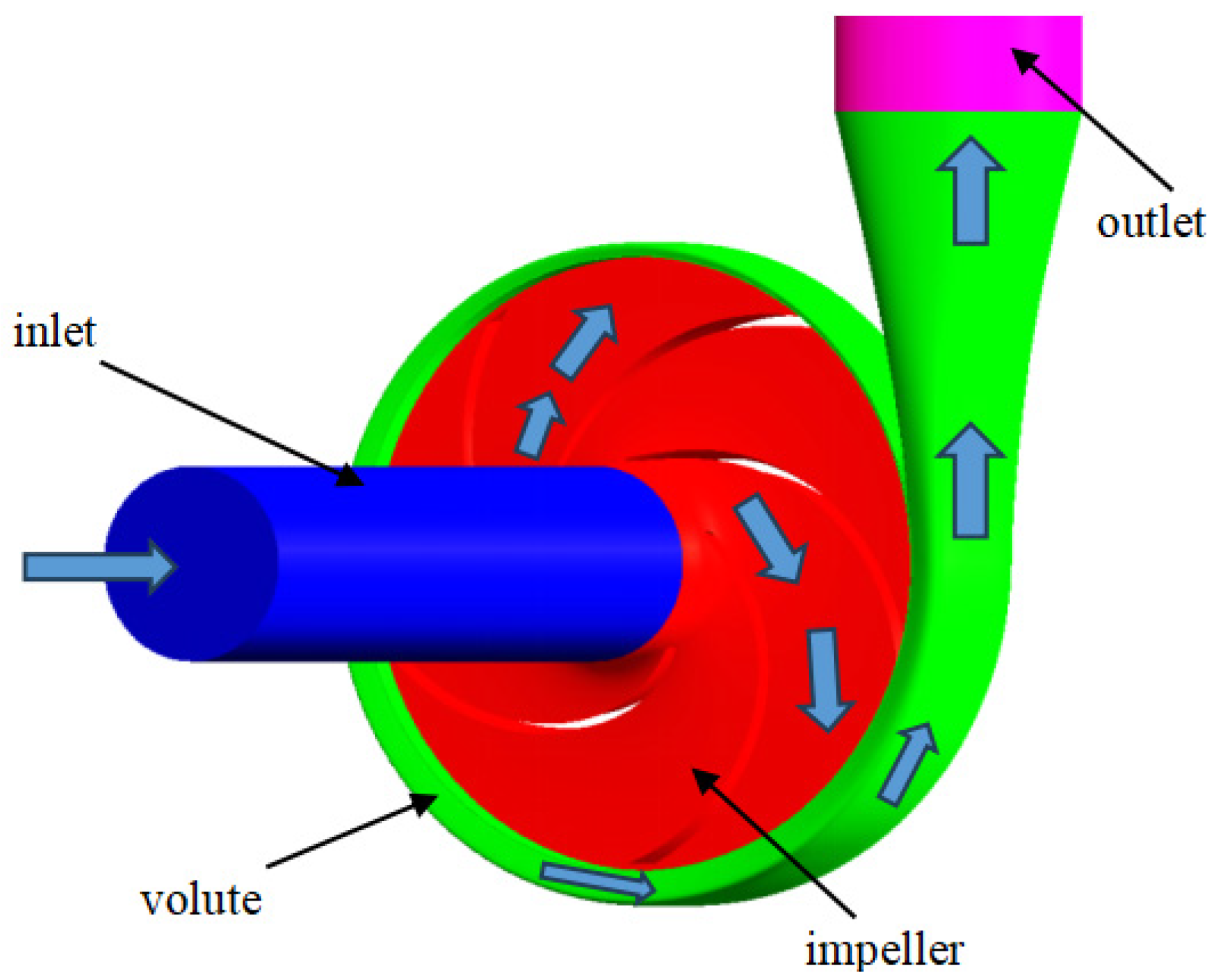
A PGW 65-200-7.5 G (The pump is manufactured by Puxuante Pump Industry Co., Ltd., Taizhou, China) centrifugal pump is utilized in the irrigation areas of Southern Xinjiang as the research object, with a flow rate Q = 25 m3/h, head(H) = 50 m, and a rated speed (n) = 2900 r/min. The parameters of the centrifugal pump impeller are shown in Table 1.
The computational fluid domain of this centrifugal pump primarily consists of an inlet extension, impeller, volute, and outlet extension. The 3D model is shown in Figure 1.

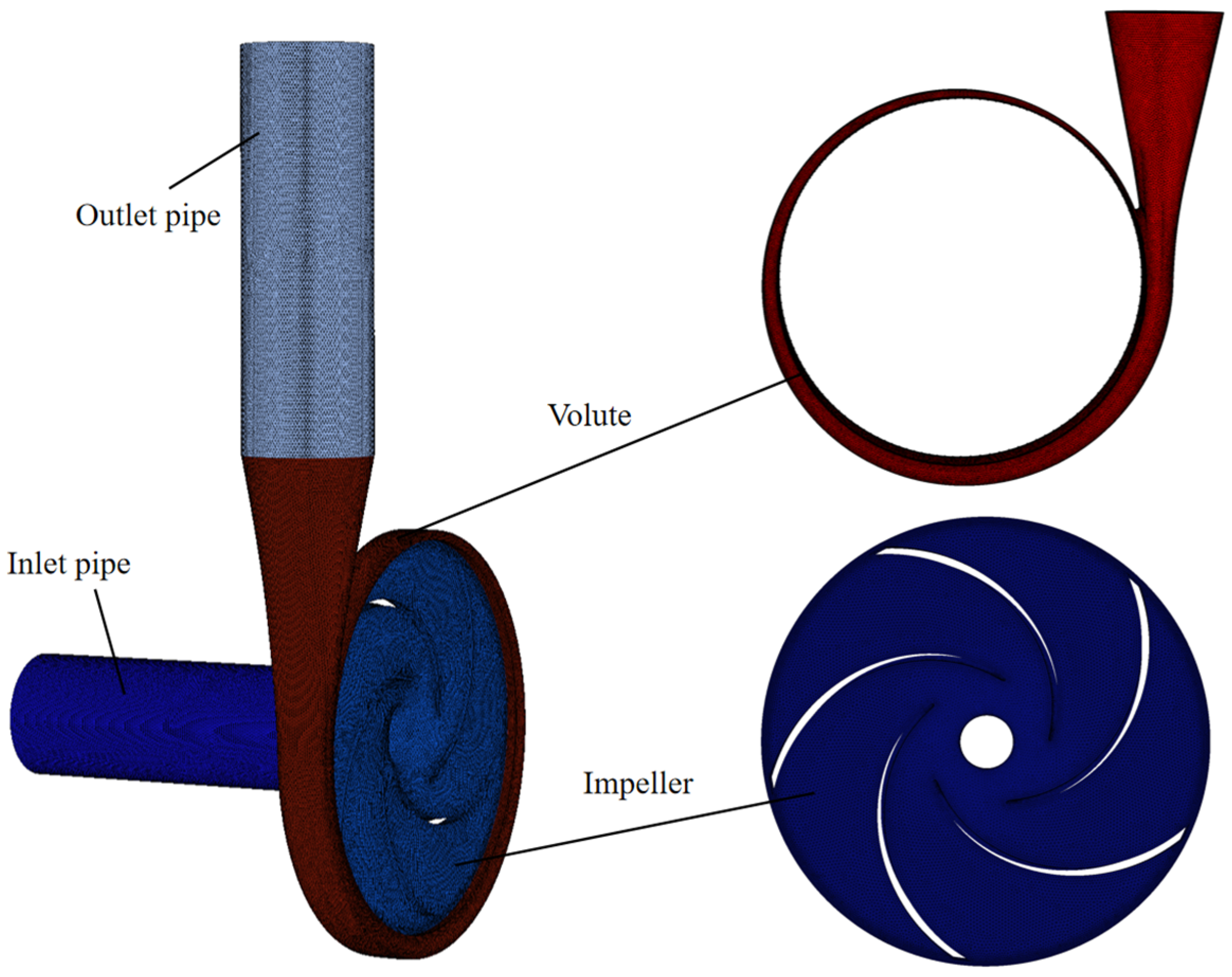
2.2. Grid Generation

The centrifugal pump model was meshed using tetrahedral elements in ANSYS (2024R1). Local refinement was applied to the volute tongue region, where flow complexity is significant, in order to enhance computational accuracy. In Fluent software, a minimum orthogonal quality of 0.15 satisfies the acceptable criteria. The grid quality inspection results show that the minimum orthogonal quality stands at 0.26, the maximum at 0.99, and the average grid quality achieves 0.75. This demonstrates that the generated grid is of high quality and can meet the accuracy requirements for subsequent numerical simulations. The resulting grid is presented in Figure 2.

2.3. Grid Independence Verification and y+ Evaluation

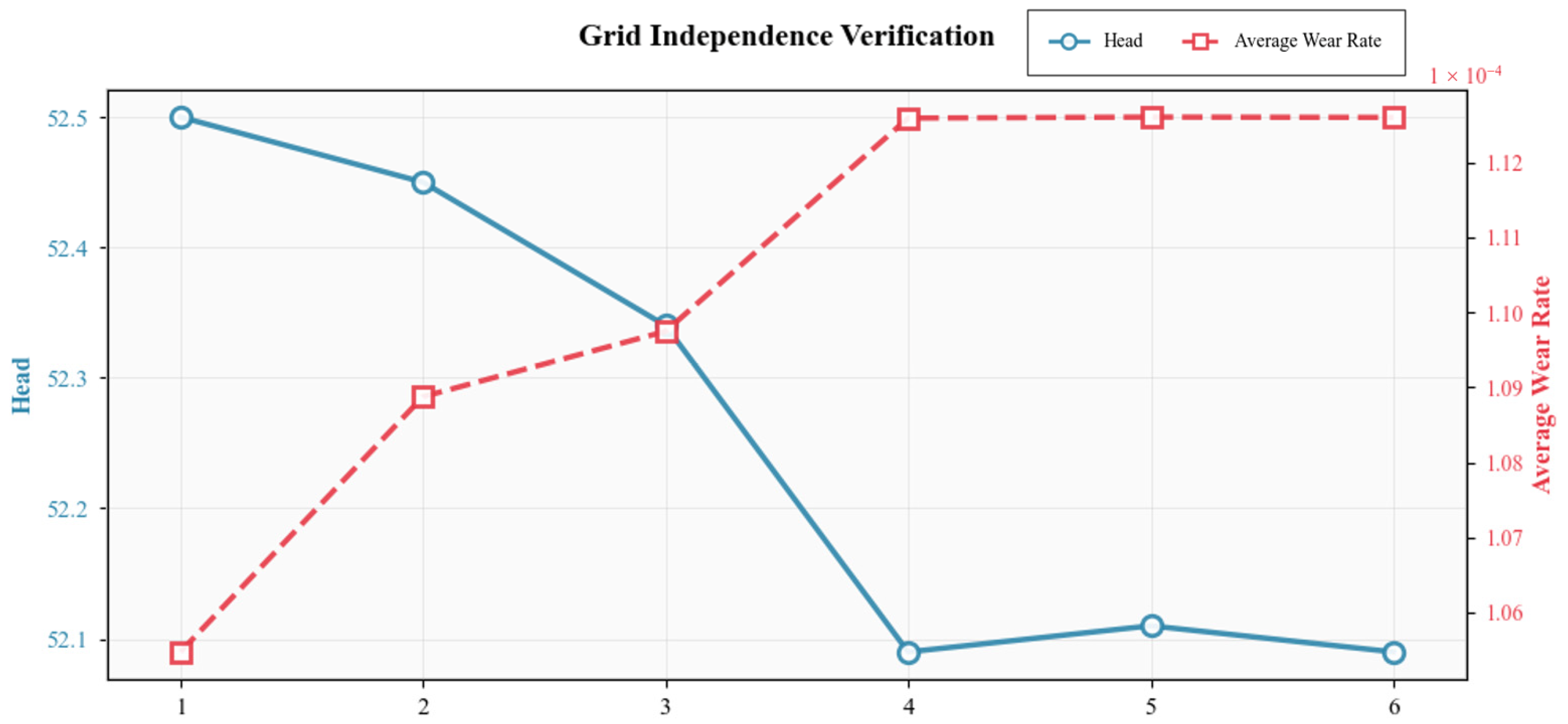
To determine the optimal grid scheme, six distinct grid configurations with varying cell counts (Table 2) were evaluated. By calculating the pump head under rated operating conditions and the average wear rate of the impeller, and analyzing the fluctuations of both the pump head and the average impeller wear rate with variations in mesh number, the optimal mesh configuration was ultimately determined.
Figure 3 simultaneously plots the pump head and the average wear rate of the impeller as a function of the grid number.
As observed in Figure 3, when the number of grids increased from Schemes 1–4, the pump head gradually decreased, while the average wear rate progressively rose. When the number of grids exceeded that of Scheme 4, both the head and average wear rate stabilized. To balance computational accuracy and efficiency, Grid Scheme 4 (grid count: 1.887 × 10⁶) was ultimately selected for subsequent numerical simulations.
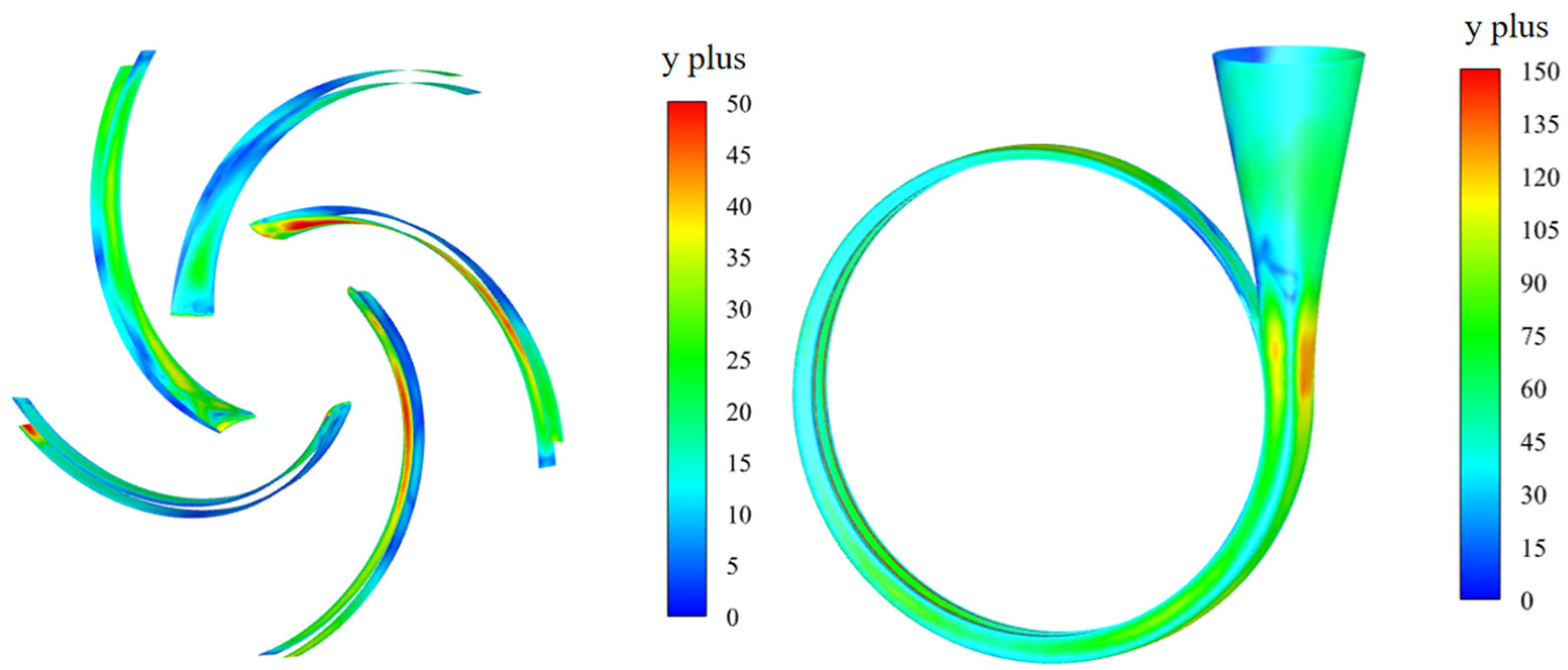
To accurately capture the distribution characteristics of velocity gradients and strong shear effects in the flow field near the walls of key flow passage components such as the centrifugal pump impeller and volute, six layers of prismatic boundary layer grids were specifically arranged in the wall regions of these components. A refined control scheme was adopted for the grids: the grid growth rate was set to 1.2, the transition ratio was set to 0.27, and the dimensionless wall distance y+ was strictly controlled within the reasonable range of 30–300, ensuring high compatibility with the selected turbulence model and wall functions. The y+ values on the walls of the blade and volute components are shown in Figure 4.

2.4. Numerical Computation Methods

Throughout the study, the Realizable k-ε model was employed for turbulence modeling, steady-state simulation was conducted, the Discrete Phase Model (DPM) for particle tracking, and the Oka erosion model for wear prediction. The primary objective of this study is to enhance the wear resistance of the impeller by optimizing its geometric configuration. Therefore, the following simplifications were applied to the DPM discrete phase model used in this work: particles are assumed to be spherical, while their rotation, inter-particle collisions, and breakup upon impact with walls are neglected.

2.4.1. Turbulence Model

Compared to the standard k-ε model, the Realizable k-ε model demonstrates superior performance in simulating typical complex flow scenarios such as rotating flows, flow separation, and complex secondary flows. Its key advantage lies in the more accurate capture of rotational flow dynamics and detailed separation flow characteristics. The internal flow field of centrifugal pumps represents a typical rotating flow problem, exhibiting significant rotational effects and flow separation phenomena. Therefore, adopting the Realizable k-ε model enables more accurate simulation of the fluid flow process within centrifugal pumps, providing more reliable computational results for flow field analysis. The governing equations for k, turbulent dissipation rate ε, and turbulent viscosity vt are given in Equations (1), (2) and (3), respectively.
( ρ k ) t + ρ u j k x j = x j v + v t σ k k x j + G k ρ ε
ρ ε t + ( ρ ε u j ) x j = x j v + v t σ ε + ε x j + ρ C 1 S ε ρ C 2 ε 2 k + v ε
v t = ρ C μ k 2 ε
where v is the kinematic viscosity; ρ is the fluid density; uj is the velocity component; xj is the spatial coordinate component; σk is the Prandtl number for turbulent kinetic energy k; σε is the Prandtl number for turbulent dissipation rate ε; Gk is the turbulent kinetic energy generation term produced by the mean velocity gradient; C1 and C2 are model constants; and S is the mean strain rate tensor.

2.4.2. Particle Motion Model

The DPM within an Eulerian–Lagrangian framework was implemented. In this approach, the fluid phase is solved as a continuous medium in the Eulerian reference frame, while solid particles are tracked as a discrete phase in the Lagrangian framework. The governing equations are presented as follows:
d v p d t = 18 μ ρ p d 2 p C d Re 24 ( v f v p ) + g ( ρ p ρ f ) ρ p
where vf represents the liquid phase velocity (m/s); vp represents the particle velocity (m/s); ρp represents the particle density (kg/m3); ρf represents the liquid phase density (kg/m3); dp represents the particle diameter (m); g represents the gravitational acceleration (m/s2); Cd is the drag coefficient; Re is the relative Reynolds number; and μ is the dynamic viscosity of the continuous phase (Pa·s).

2.4.3. Wear Model

The Oka erosion model was selected to predict wear, accounting for both the inherent flow characteristics within the centrifugal pump and the trajectories of solid particles. The governing equations are presented as follows:
E = E 90 V V r e f k 2 d d r e f k 3 f α
f α = sin α n 1 1 + H v 1 sin α n 2
where E90 represents the reference erosion rate at an impact angle of 90°; V is the particle impact velocity; Vref is the reference velocity; d and dref are the particle size and reference particle size, respectively; k2 and k3 are the velocity exponent and particle size exponent, respectively; f(α) is the impact angle function, where α is the wall impact angle in radians; Hv is the Vickers hardness of the wall material in GPa; and n1 and n2 are constants for the angle function. Among these, the reference particle size dref and reference flow velocity vref are normalization reference parameters in the model. They are used to non-dimensionalize the particle size and flow velocity effects, respectively, ensuring the model’s applicability across different operating conditions, as shown in Table 3.

3. Experiment Verification and Wear Patterns

3.1. Boundary Conditions

Boundary conditions were defined with a velocity inlet at the centrifugal pump’s intake and a pressure outlet at the discharge. The tests were conducted under rated operating conditions with a flow rate of Q = 25 m3/h and a rotational speed of n = 2900 r/min. Flow rate and velocity at the inlet were mutually converted based on the cross-sectional area. All wetted surfaces employed no-slip walls, with near-wall flow resolved via non-equilibrium wall functions. Wall roughness was modeled using the standard wall roughness approach. The roughness constant is set to 0.5. Particles are injected into the Discrete Phase Model (DPM) from the inlet surface and tracked under steady-state conditions. The residual is set to 10−4, and convergence is considered achieved when the rate of change in the average wear rate of the impeller between adjacent iterations is less than 0.1%. The inlet/outlet boundaries were set as escape for particles, while other hydraulic surfaces were designated as reflect. To ensure numerical stability and physical validity, solid particles were initialized with identical hydrodynamic conditions to the fluid. The particle density was specified as 2650 kg/m3. The coupled algorithm was implemented for pressure-velocity coupling, with spatial discretization utilizing the second-order upwind scheme. Data transfer between the inlet extension–impeller, impeller–volute, and volute–outlet extension domains was achieved through shared topology.
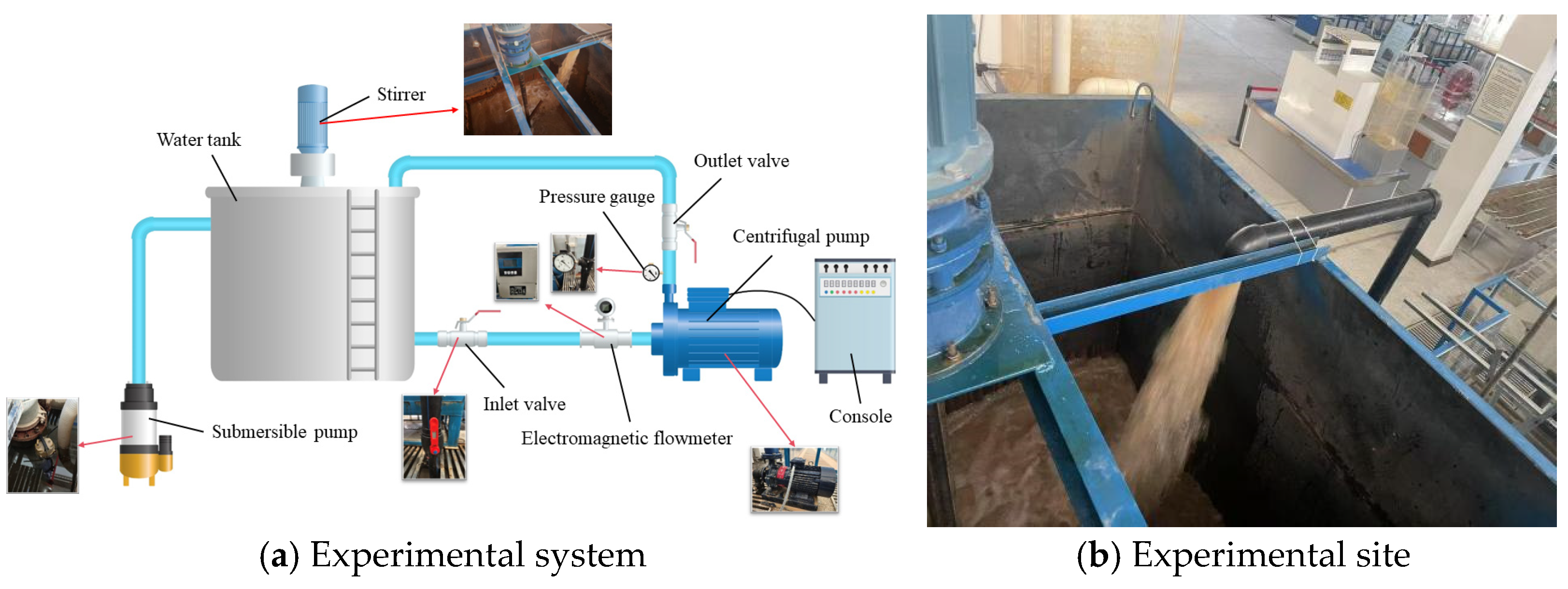
To validate the applicability of the numerical approach adopted in this study—including turbulence modeling, particle motion modeling, and erosion modeling—for analyzing wear characteristics of centrifugal pumps in southern Xinjiang irrigation systems, experiments on head and efficiency under different flow rates in clear water conditions, as well as qualitative wear tests, were conducted.

3.2. Experimental System and Process

The experimental system comprises a centrifugal pump, submersible pump, water tank, stirrer, inlet valve, outlet valve, electromagnetic flowmeter, console, and pressure gauge, as illustrated in Figure 5. The measurement range and accuracy of the primary instruments are as follows:
Inlet pressure sensor: measurement range (0–0.6 MPa), accuracy ±0.5%.
Outlet pressure sensor: measurement range (0–0.6 MPa), accuracy ±0.5%.
Electromagnetic flowmeter: measurement range (0.1–80 m3/h), accuracy ±2%.
Torque sensor: measurement range (0–50 N·m), accuracy ±0.5%.
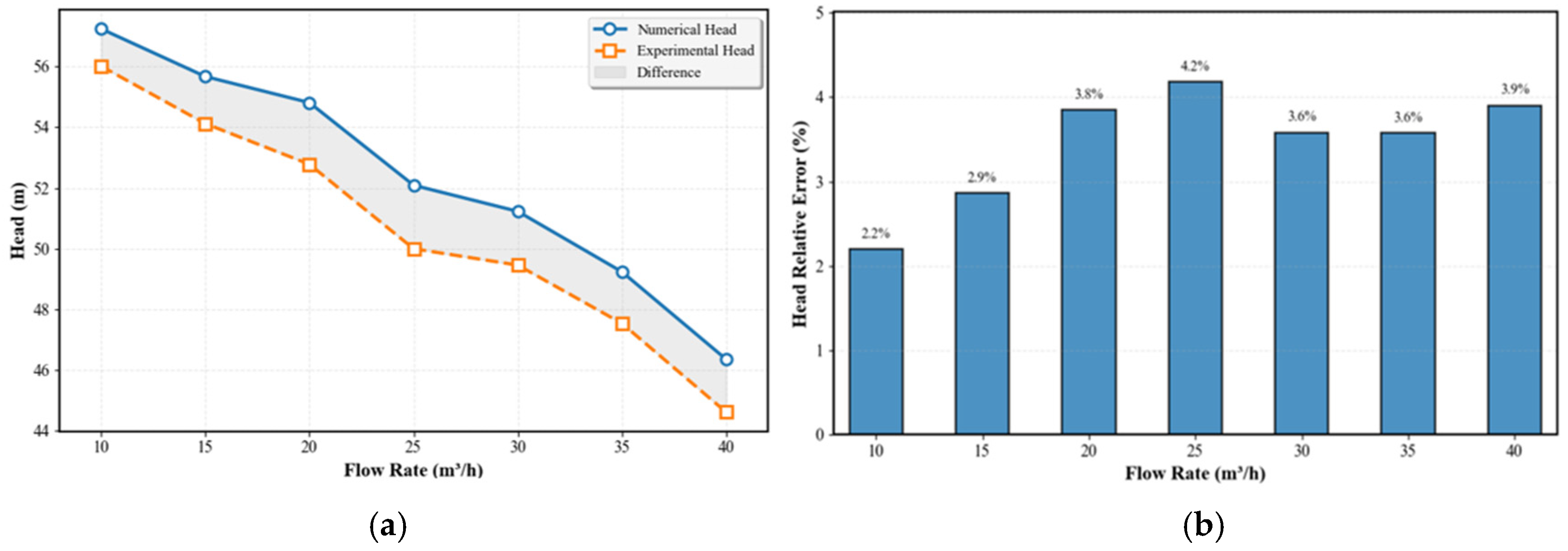
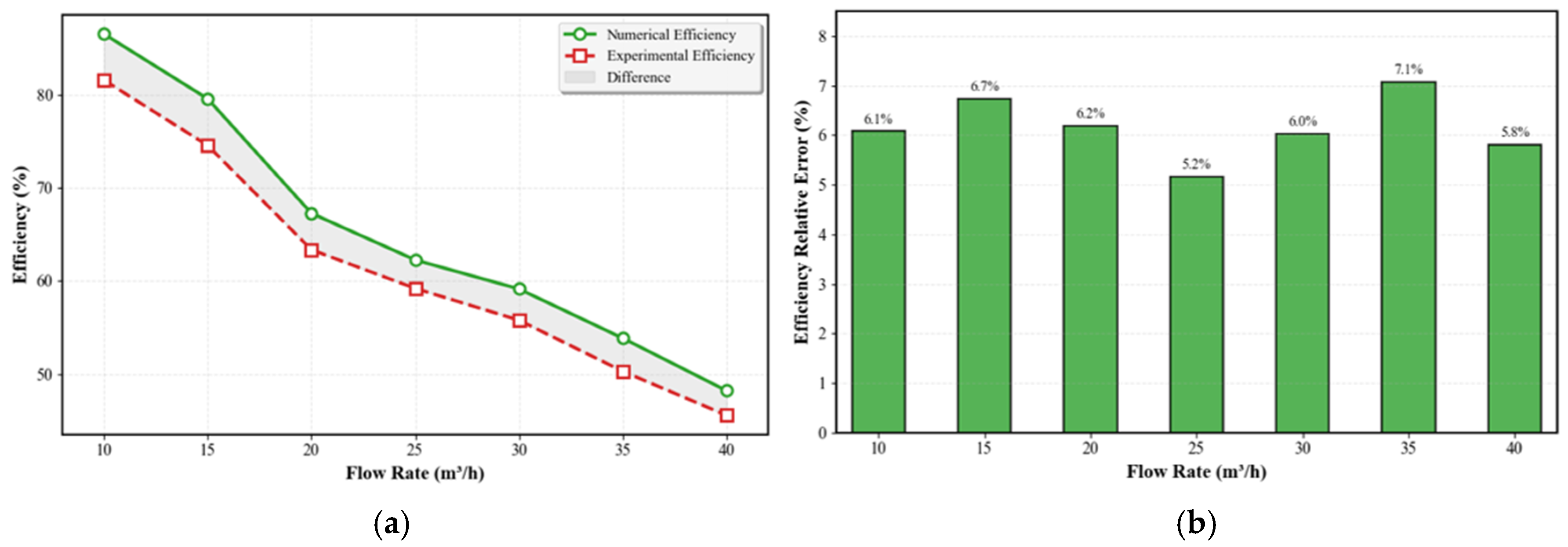
To investigate the influence of flow rate on the performance of the centrifugal pump, seven distinct flow rate conditions were selected for both experimental testing and numerical simulation.
As can be seen from Figure 6a and Figure 7a, the numerical simulations show the same increasing or decreasing trends in head and efficiency as the experimental results. Further quantitative analysis through Figure 6b and Figure 7b reveals that the maximum relative errors between the numerical and experimental values of head and efficiency are within reasonable limits, fully meeting acceptable standards for engineering applications. This adequately validates the reasonableness and reliability of the numerical simulation method and model simplification scheme adopted in this study.
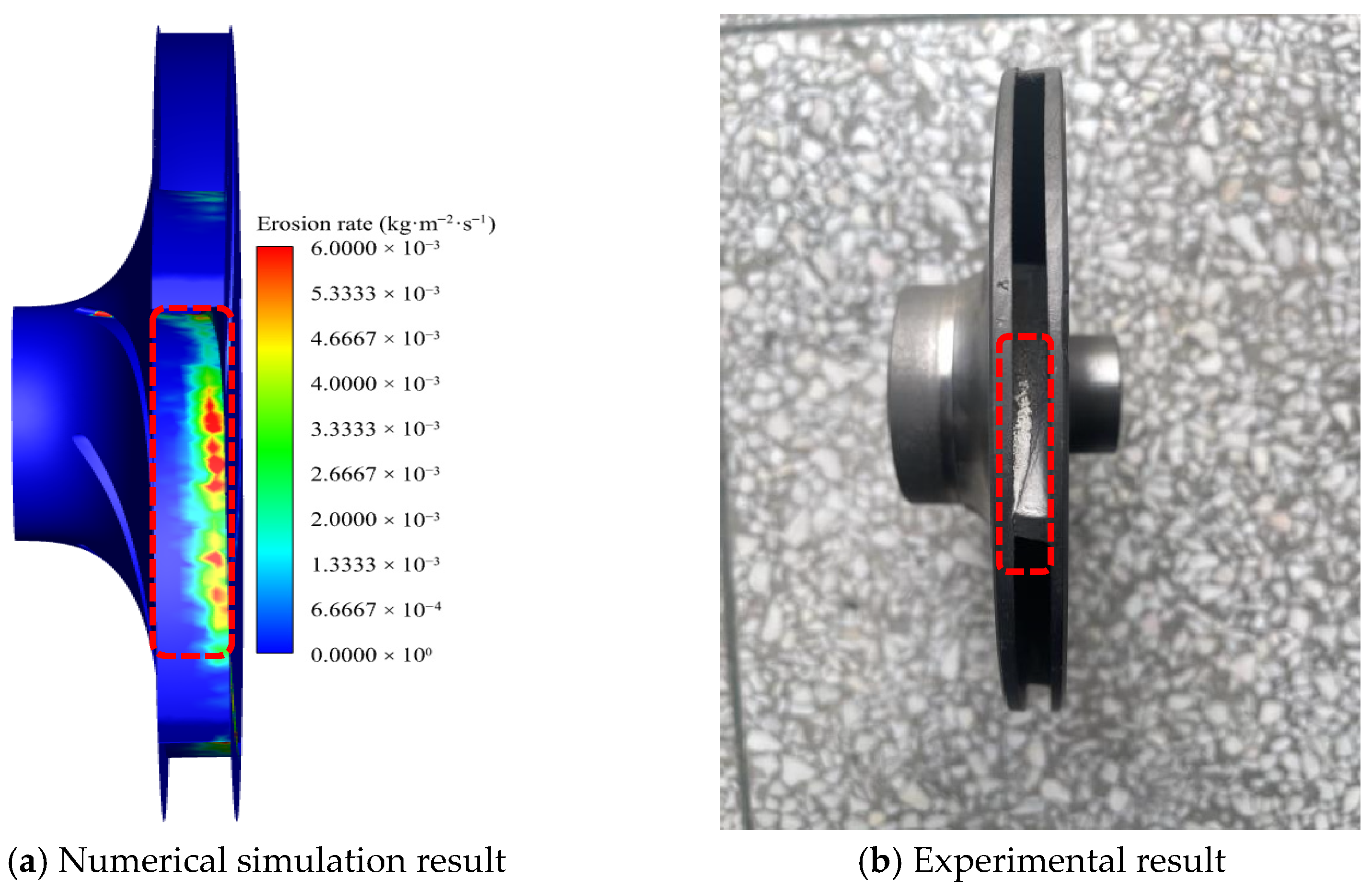
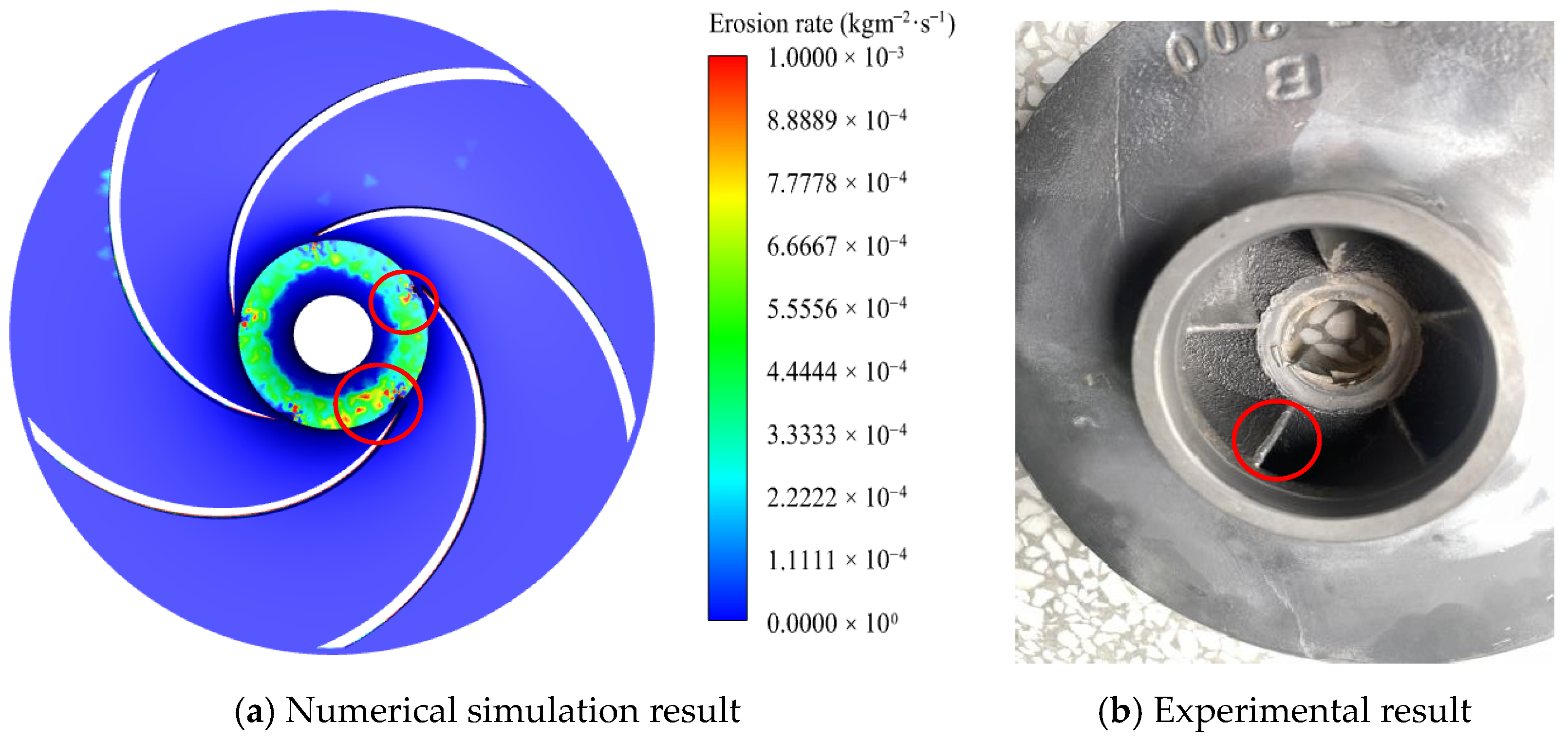
In subsequent experiments, we further conducted a qualitative analysis of its wear through experimental methods. During testing, centrifugal pumps were subjected to a 10 h wear test using sediment particles with a 1 mm diameter at 0.92 kg/s mass flow rate. Post-test examination focused on wear patterns at the pump inlet and impeller outlet regions.

3.3. Comparison of Results

The wear characteristics of the centrifugal pump were analyzed using the previously described numerical methodology, with results compared against experimental findings. Comparative data for the pump inlet and impeller outlet regions are presented in Figure 8 and Figure 9.
As evidenced in the preceding two figures, the numerical simulations exhibited remarkable spatial correspondence with experimental wear patterns. This validates the methodological robustness and physical fidelity of the adopted numerical approach, demonstrating its effectiveness for analyzing wear characteristics of centrifugal pumps in Southern Xinjiang irrigation systems and supporting optimization of hydraulic surfaces.

3.4. Analysis of Wear Characteristics of Prototype Pumps

To thoroughly investigate the influence of different parameters (particle size, density, and mass flow rate) on the wear characteristics of the centrifugal pump impeller, a one-variable-at-a-time approach was employed. This analysis incorporated six distinct particle size groups, four density variations, and four mass flow rate levels, as detailed in Table 4.
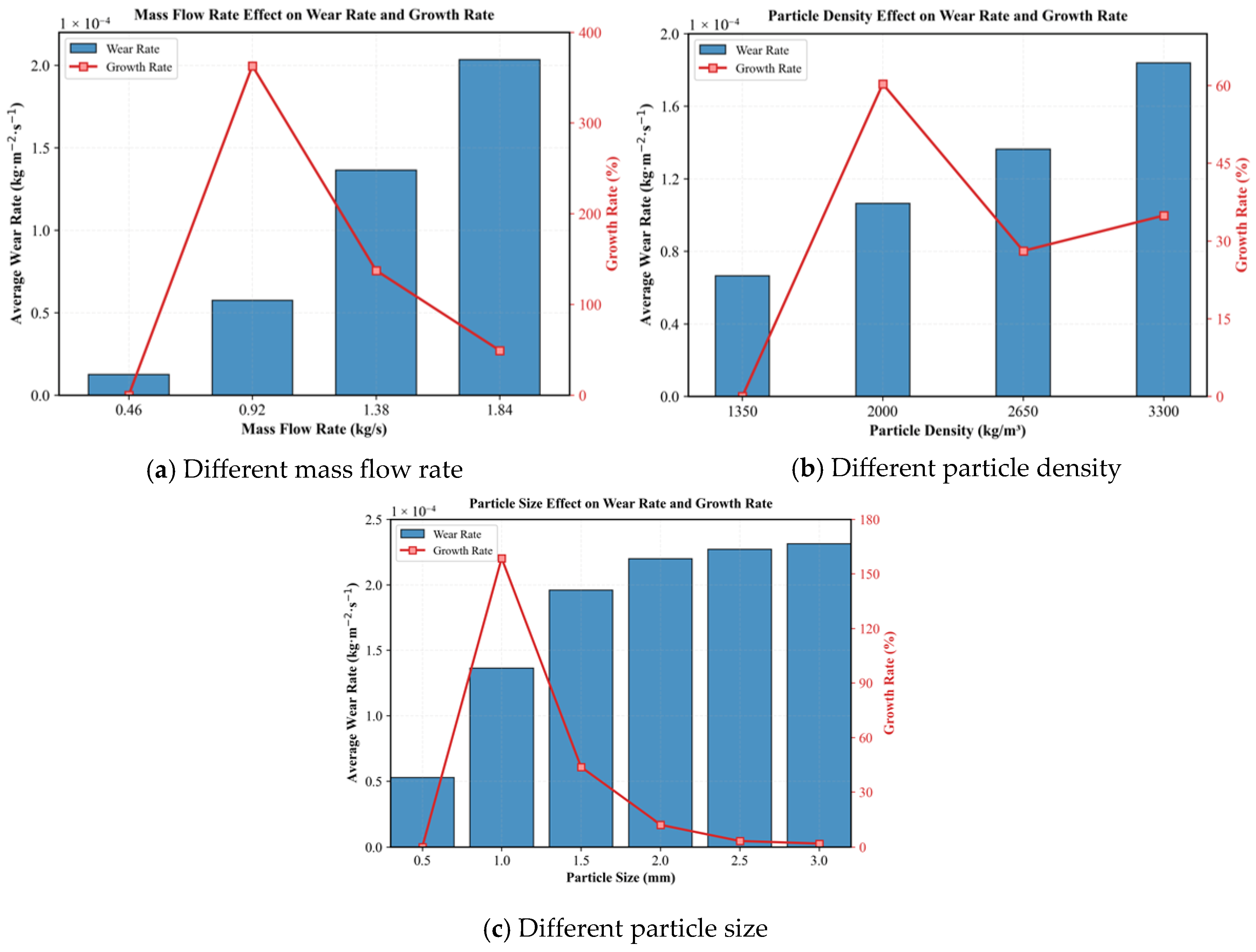
The relationship between varying sediment parameters and the average erosion rate on the impeller surface is demonstrated in Figure 10.
As indicated in Figure 10, the average erosion rate on the impeller surface increased with the growth of each independent variable, yet exhibited distinct variation patterns in its growth rate. Analysis of Figure 10a revealed that increasing the mass flow rate initially induced a sharp rise followed by a rapid decline in the erosion growth rate, peaking at 0.92 kg/s mass flow rate phenomenon potentially attributed to significant strong secondary flows or separation vortices develop within the impeller flow passage, transporting more particles toward the wall regions, where both the frequency and intensity of impacts increase simultaneously. For density variations (Figure 10b), the growth rate first increased rapidly, then decreased, and subsequently experienced a minor rebound; the initial increase may correlate with enhanced particle deposition due to elevated density, while subsequent trends likely resulted from density-driven amplification of particle impact energy, thereby altering the dominant wear mechanism. Regarding particle size (Figure 10c), the growth rate surged rapidly to a maximum at 1 mm before declining steeply and stabilizing, providing critical insights for predicting wear risks and optimizing impeller design in centrifugal pumps operating with specific particle sizes.

4. Experimental Design Based on RSM

4.1. Plackett–Burman Screening Design

The impeller serves as the core component for energy transfer and flow guidance in centrifugal pumps. Its structure directly determines the pump’s flow field characteristics, performance characteristics, and operational stability. Therefore, subsequent structural optimization efforts are focused on the design of the impeller. Eight key geometric parameters of the impeller were systematically analyzed: inlet placement angle, exit placement angle, inlet diameter, hub diameter, outlet width, number of blades, wrap angle, and outlet diameter. A Plackett–Burman (PB) screening design was conducted to identify significant factors influencing the response variables among these eight parameters. The value levels of these key impeller parameters are specified in Table 5.
From an engineering practice perspective, efficiency and wear rate are generally negatively correlated, making it challenging to simultaneously achieve the dual optimization objectives of reducing wear rate and improving efficiency. Therefore, the wear resistance optimization work in this study is conducted under the core precondition of ensuring system efficiency stability. Based on this principle, efficiency is selected as the key metric for the PB screening experiments to identify the significant factors influencing the optimization objectives. In this study, the PB experimental design was executed using Minitab 22 software. Relevant data were obtained through numerical simulations, and computational analysis ultimately identified the three most influential factors on the impeller wear response variables. The PB experimental design matrix and computational outcomes are presented in Table 6.
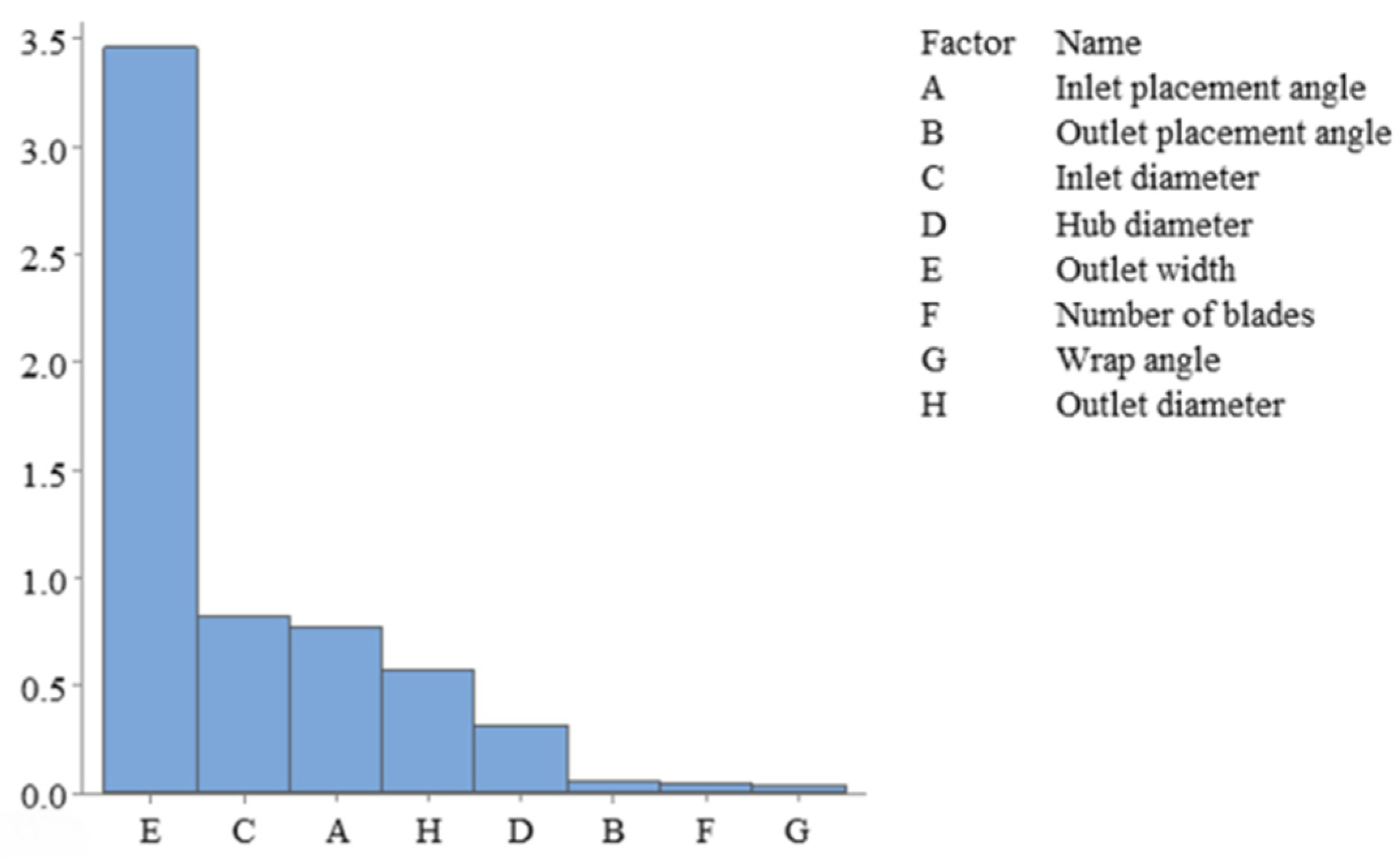
Analysis of the computational results in Table 6 yielded a standardized Pareto chart of effects for efficiency, presented in Figure 11. As revealed by Figure 11, the most influential factors were outlet width (E), inlet diameter (C), and inlet placement angle (A). Consequently, these three parameters-outlet width, inlet diameter, and inlet blade angle-were selected for subsequent impeller optimization design to mitigate wear on the impeller surface.

4.2. Full Factorial Design

Key performance parameters of centrifugal pumps (e.g., erosion rate, head, efficiency, and shaft power) are influenced not only by individual factors but also by interactions among multiple parameters. Given that models constructed via full factorial design (FFD) inadequately characterize such complex nonlinear relationships, this study proposes a two-phase optimization strategy: First, FFD identifies critical inflection intervals of key parameters; subsequently, a higher-order RSM is built within these intervals to locate the optimal parameter combination. This approach significantly enhances experimental efficiency when dealing with limited factors by avoiding unnecessary resource allocation in non-critical regions. The “PB-FFD-BBD” method enhances optimization accuracy by utilizing FFD to capture interaction effects between different structural parameters, whereas the PB-BBD method lacks this FFD component and consequently demonstrates lower precision due to insufficient modeling of parameter interactions. For this section, a two-level FFD was applied to three factors-outlet width (E), inlet diameter (C), and inlet placement angle (A)-with high/low levels specified in Table 7.
A three-factor two-level full factorial design was constructed using Minitab 22 software, and numerical simulations were performed. This experimental design comprised eight corner-point conditions. To mitigate the influence of stochastic variations and outliers while ensuring result reliability and robustness, two fully randomized replicate experiments were conducted at each corner point. Additionally, three center points were incorporated to detect significant curvature effects in the derived model. In total, 19 experimental runs were executed. The factorial design matrix and computational results are provided in Table 8.
Model validity was assessed via analysis of variance (ANOVA). The constructed model required at least one significant main or interaction effect to be deemed adequate. Significant curvature terms indicated optimal parameter combinations within the design space without necessitating steepest ascent experiments. Non-significant lack-of-fit (p > 0.05) confirmed model reliability. Terms with p < 0.05 were considered statistically significant, with lower p-values indicating stronger effects on response variables. ANOVA results for the full factorial design are presented in Table 9, while the regression model for average erosion rate is provided in Table 10.
Analysis of Table 8 and Table 9 demonstrated that all main and interaction effects exhibited p-values < 0.001, confirming model validity. The significant curvature term (p < 0.05) indicated the existence of stationary points within the design space. Non-significant lack-of-fit (p > 0.05) verified model adequacy, though the detected curvature rendered the first-order regression model from the full factorial design insufficient for multi-parameter optimization. Nevertheless, this experiment established the optimal parametric domain, enabling rigorous implementation of a higher-order RSM in subsequent stages.

4.3. Response Surface Experiment

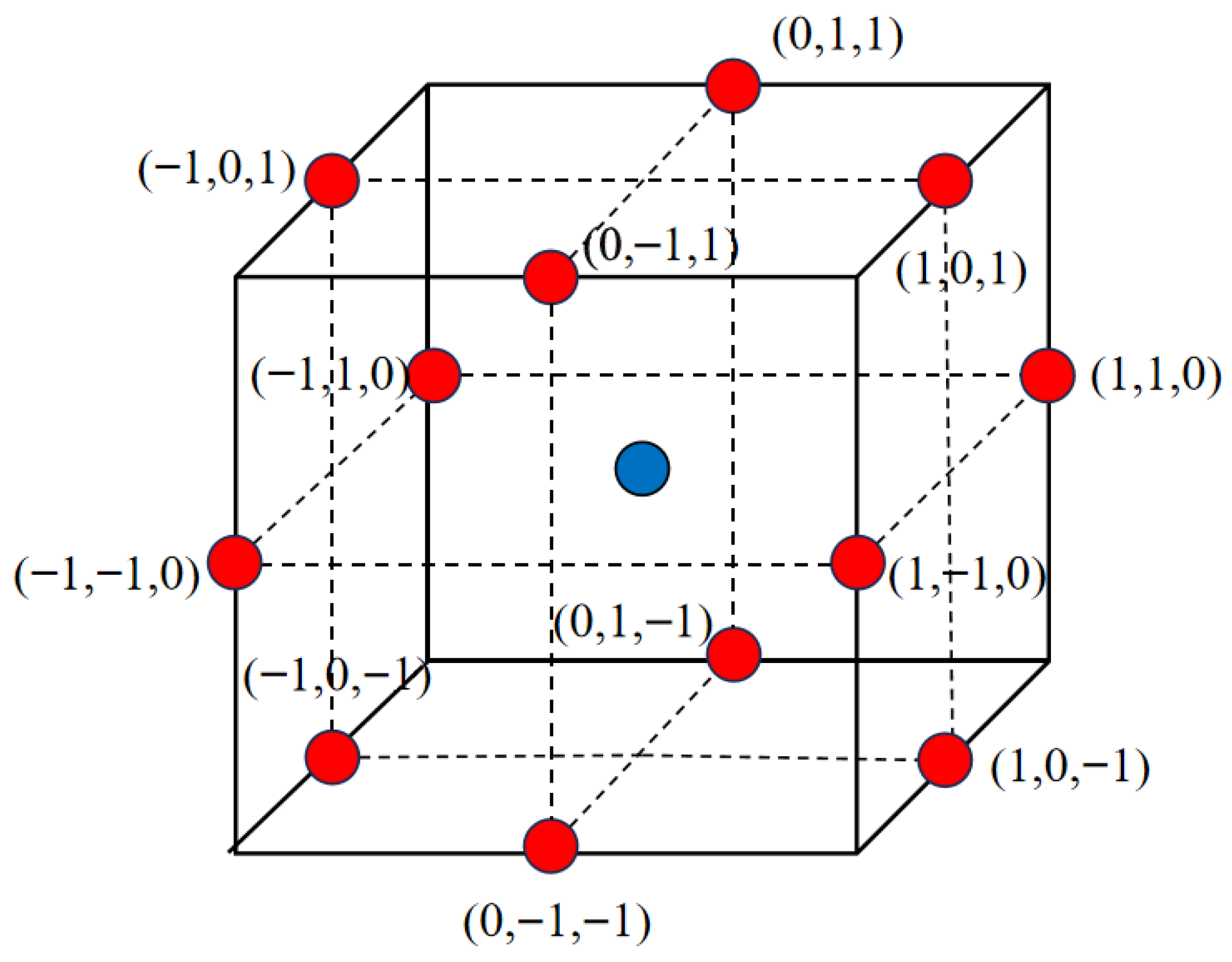
Design-Expert 13 software was utilized to implement a Box–Behnken Design (BBD) for the three key factors within their predefined ranges. Seventeen experimental runs were executed, comprising five center points and twelve cube points. The spatial configuration of experimental points is illustrated in Figure 12, with factor level coding consistent with Table 7.
Numerical simulations for the BBD experimental matrix were performed using ANSYS Fluent (2024R1). The BBD matrix and corresponding computational results are presented in Table 11.

4.4. Fitted Regression Equation and Significance Testing

A second-order response surface model was employed to analyze the nonlinear effects of multiple factors on the response variables. The generalized second-order polynomial model takes the following form:
y = β 0 + i = 1 k β i x i + i = 1 k β i i x i 2 + i < j β i j x i x j + ε
where y denotes the response variable, xi and xj represent coded independent variables, β0 is the constant term, βi signifies linear effect coefficients, βii indicates quadratic effect coefficients, βij corresponds to interaction effect coefficients, and ɛ designates random error.
The experimental data sets were substituted into Equation (7) to fit regression equations for the response variables, establishing relationships between independent variables x and responses y. The established fitting regression equations for head, shaft power, efficiency, and average erosion rate are presented in dimensionless coded form, as shown in Equations (8)–(11).
(1)
Regression equation for head:
H = 53.66 + 0.0488 × A + 0.4575 × C + 7.08 × E 0.2675 × A C + 0.99 × A E + 0.0125 × C E 0.233 × A 2 0.2105 × C 2 1.10 × E 2
(2)
Regression equation for shaft power:
P = 5.78 + 0.0593 × A + 0.0564 × C + 1.03 × E 0.0425 × A C + 0.0685 × A E + 0.0263 × C E + 0.0012 × A 2 0.021 × C 2 0.204 × E 2
(3)
Regression equation for efficiency:
η = 63.09 0.6462 × A 0.0575 × C 3.30 × E + 0.1525 × A C + 0.615 × A E 0.2325 × C E 0.3390 × A 2 + 0.0385 × C 2 + 1.57 × E 2
(4)
Regression equation for average erosion rate:
R c = 0.0001 0.000020403 × A + 0.000003034 × C 0.00001314 × E + 0.000005847 × AE 0.00000769 × CE 0.000007591 × C 2 + 0.00001039 × E 2
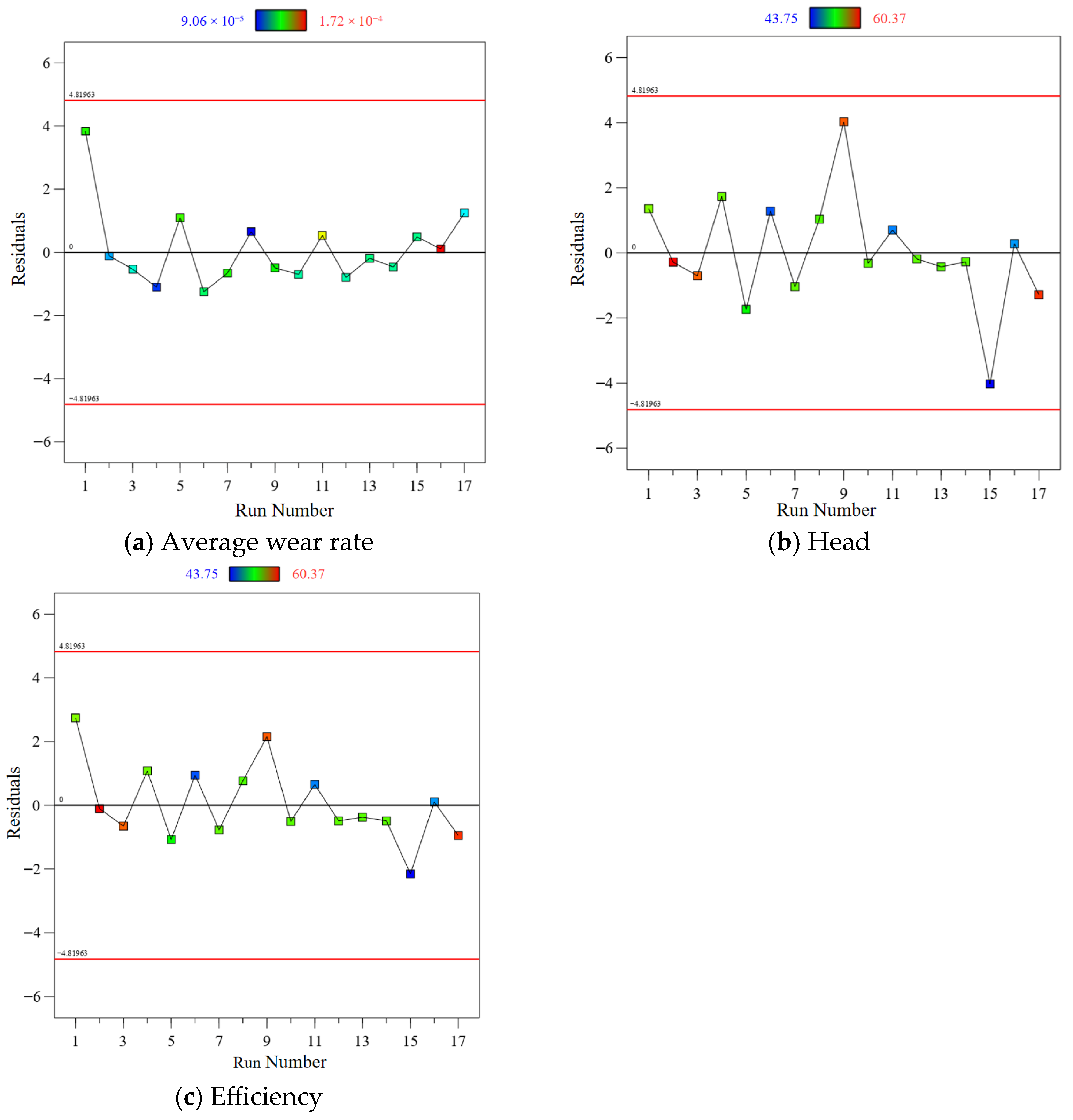
Residual plots were employed to validate the regression equation. As shown in Figure 13, the samples are distributed on both sides of the x-axis with significant randomness, indicating that the response function is acceptable. However, reliance on residual examination alone is insufficient for assessing the goodness-of-fit of the response surface model and may fail to detect all potential issues. Therefore, the R-criterion was supplemented to comprehensively evaluate the model’s performance and applicability.
The R criterion comprises R 2 , adjusted R a d j 2 , and predicted R p r e d 2 . R 2 is typically used to evaluate the degree of deviation around the model mean; R 2 closer to 1 indicates a better goodness of fit of the model. However, as the number of parameters in the model increases, R 2 will also increase with the addition of parameters, even if the influence of some parameters is minimal. Hence, the adjusted R a d j 2 is introduced. R a d j 2 is posed as a supplementary measure, and its formula is as follows:
R 2 = 1 S S E S S T ( 0 R 2 1 )
R a d j 2 = 1 S S E / d E S S T / d T = 1 d T d E ( 1 R 2 )
dT represents the total degrees of freedom for the model. When both R 2 and adjusted R a d j 2 exceed 0.9 and their difference is minimal, it indicates an excellent model fit. When both R 2 and adjusted R a d j 2 are below 0.9, it suggests removing parameters with low sensitivity to the model response to improve model performance.
Predicted R p r e d 2 is used to assess the predictive performance of the response surface model for unknown samples, evaluating this by quantifying the model’s prediction error on new samples. The formula for predicted R p r e d 2 is as follows:
R p r e d 2 = 1 P R E S S S S T
R p r e d 2 represents the sum of squared prediction residuals, used to measure the model’s goodness of fit within the sample design space. When the difference between R p r e d 2 and R a d j 2 is less than 0.2, it indicates that the model has good predictive capability for new samples.
Table 12 lists the numerical values of R 2 , R a d j 2 , and R p r e d 2 to evaluate the accuracy of the response surface.
As can be seen from Table 12, the values of both R 2 and R a d j 2 are greater than 0.9, and the difference between R a d j 2 and R p r e d 2 is less than 0.2. These results indicate that the response surface model exhibits high fitting accuracy and possesses good predictive capability. Therefore, this model will be employed for the subsequent optimization work.

5. Results and Discussion

5.1. Main Effect Analysis of Variables

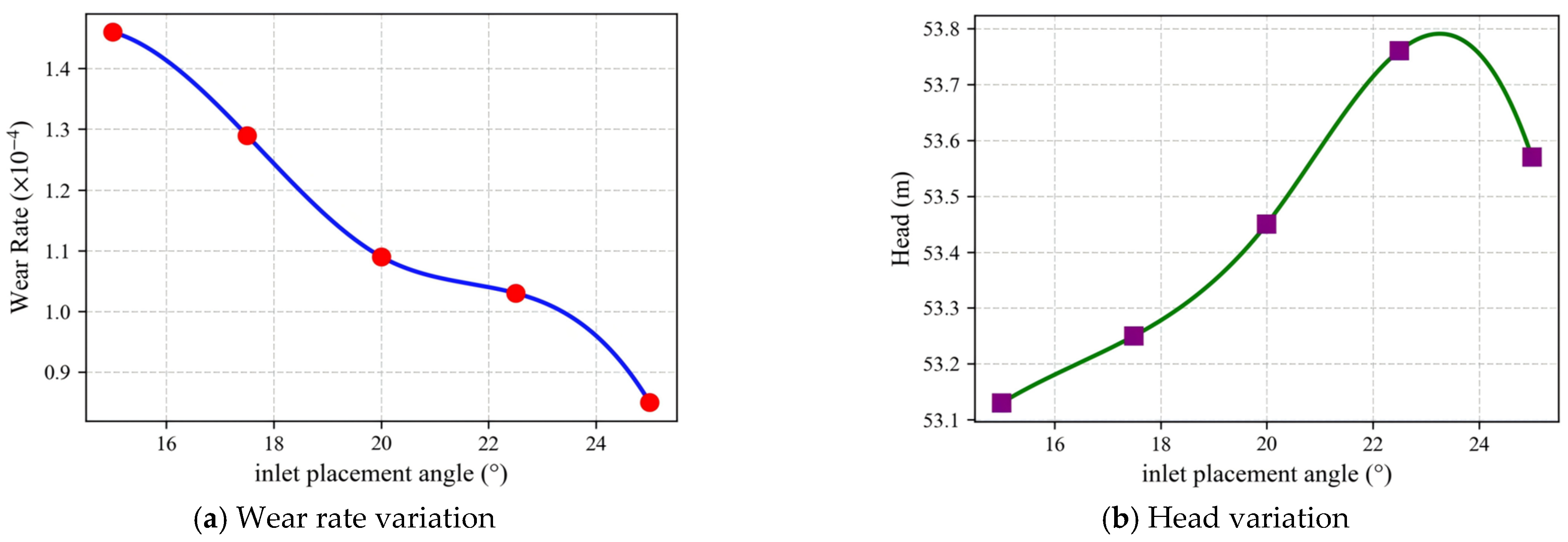
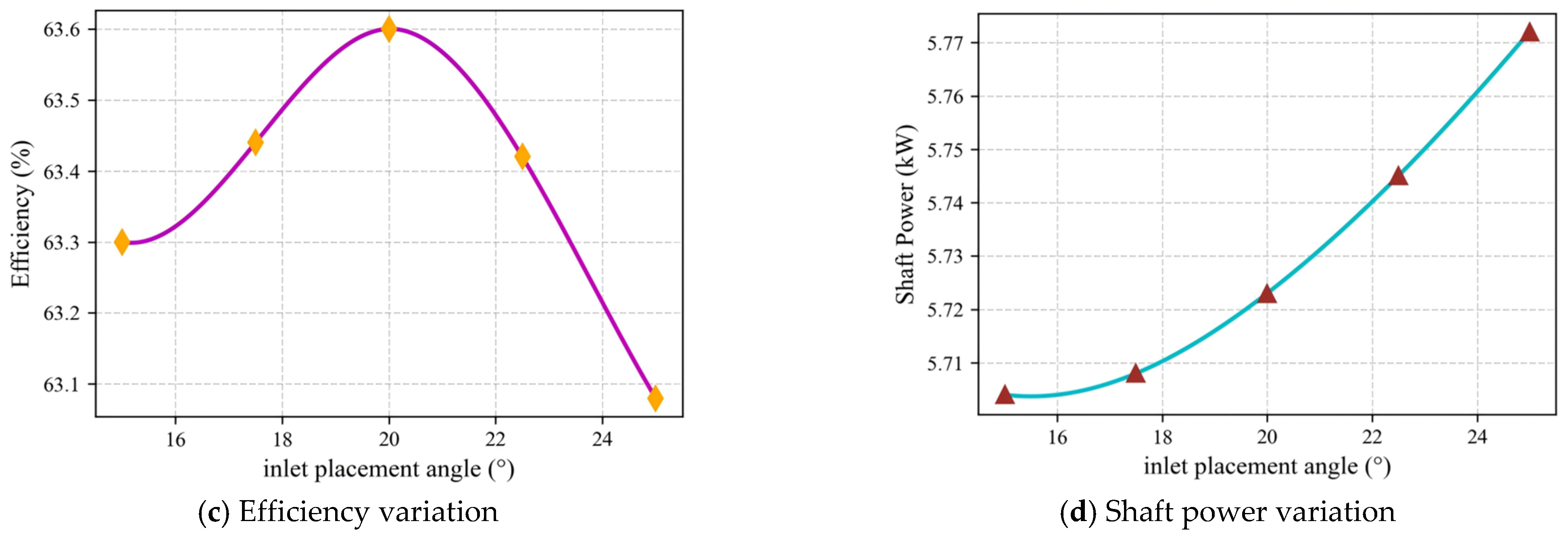
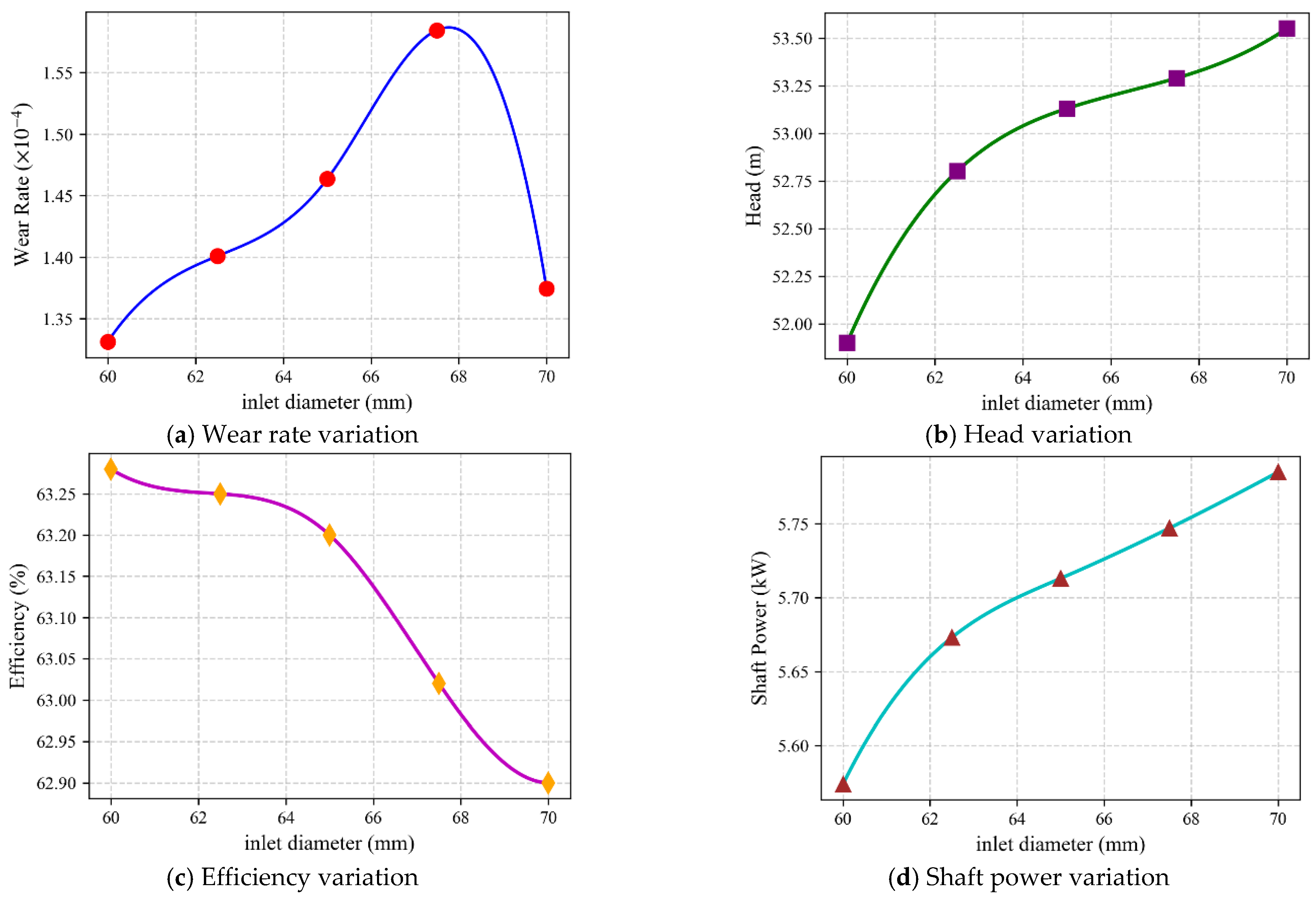
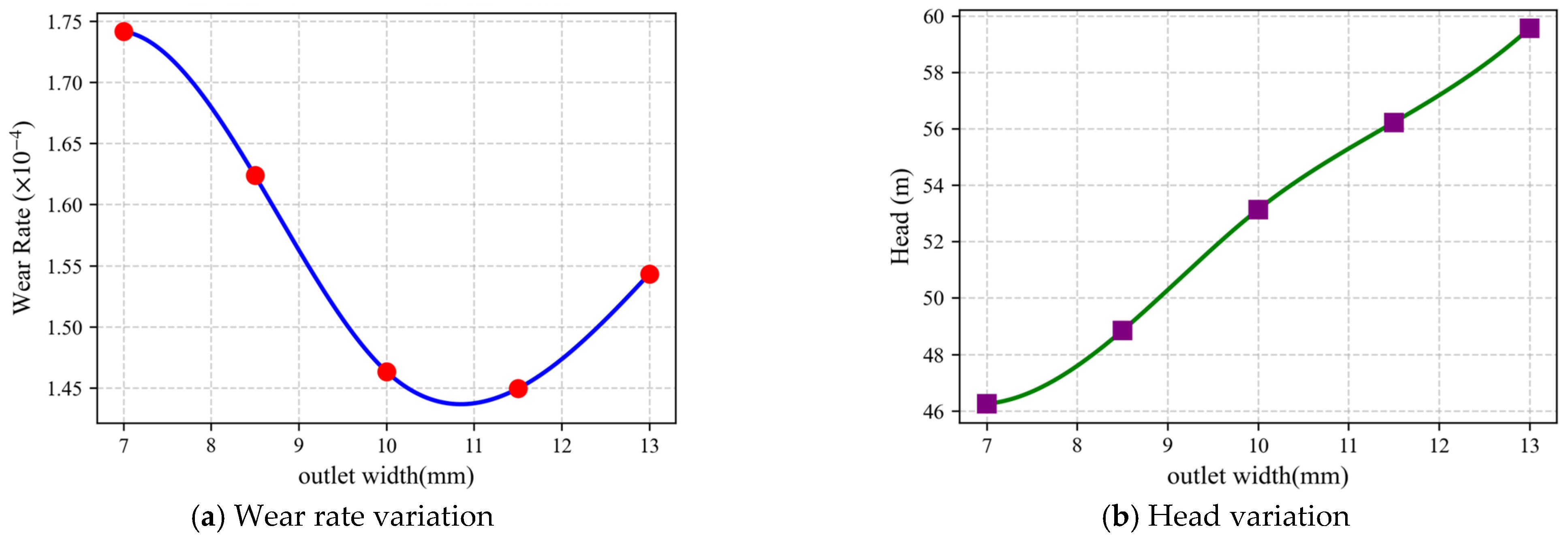
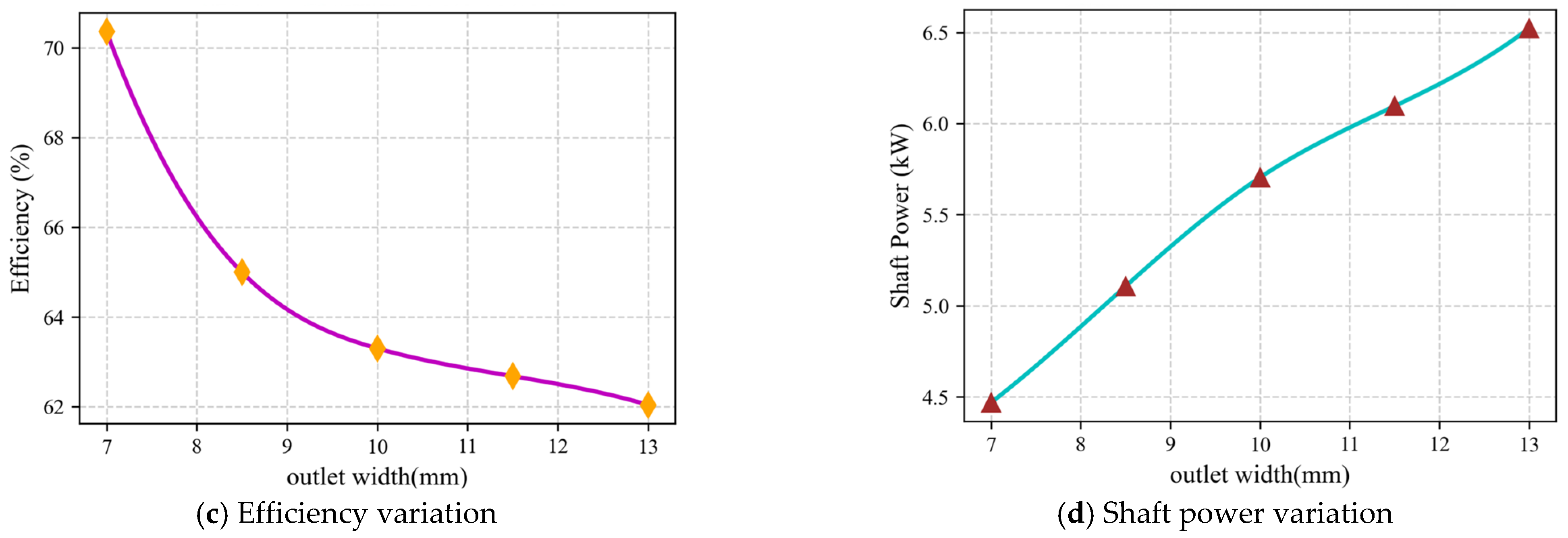
Figure 14, Figure 15 and Figure 16 illustrate the variation trends of centrifugal pump performance versus inlet placement angle, inlet diameter, and outlet width, respectively.
As indicated in Figure 14, Figure 15 and Figure 16, the average erosion rate decreased with the increasing inlet placement angle, which initially increased and then decreased with the inlet diameter, and, conversely, decreased initially and then increased with outlet width. The head increased initially, then decreased with inlet placement angle; meanwhile, it increased with both inlet diameter and outlet width. Efficiency increased initially, then decreased with inlet placement angle, but also decreased with inlet diameter and outlet width. Shaft power consistently increased with all three parameters: inlet placement angle, inlet diameter, and outlet width. These results demonstrated that variations in centrifugal pump performance parameters were significantly influenced by complex interactions among multiple factors.

5.2. Analysis of Interaction Effects Between Variables

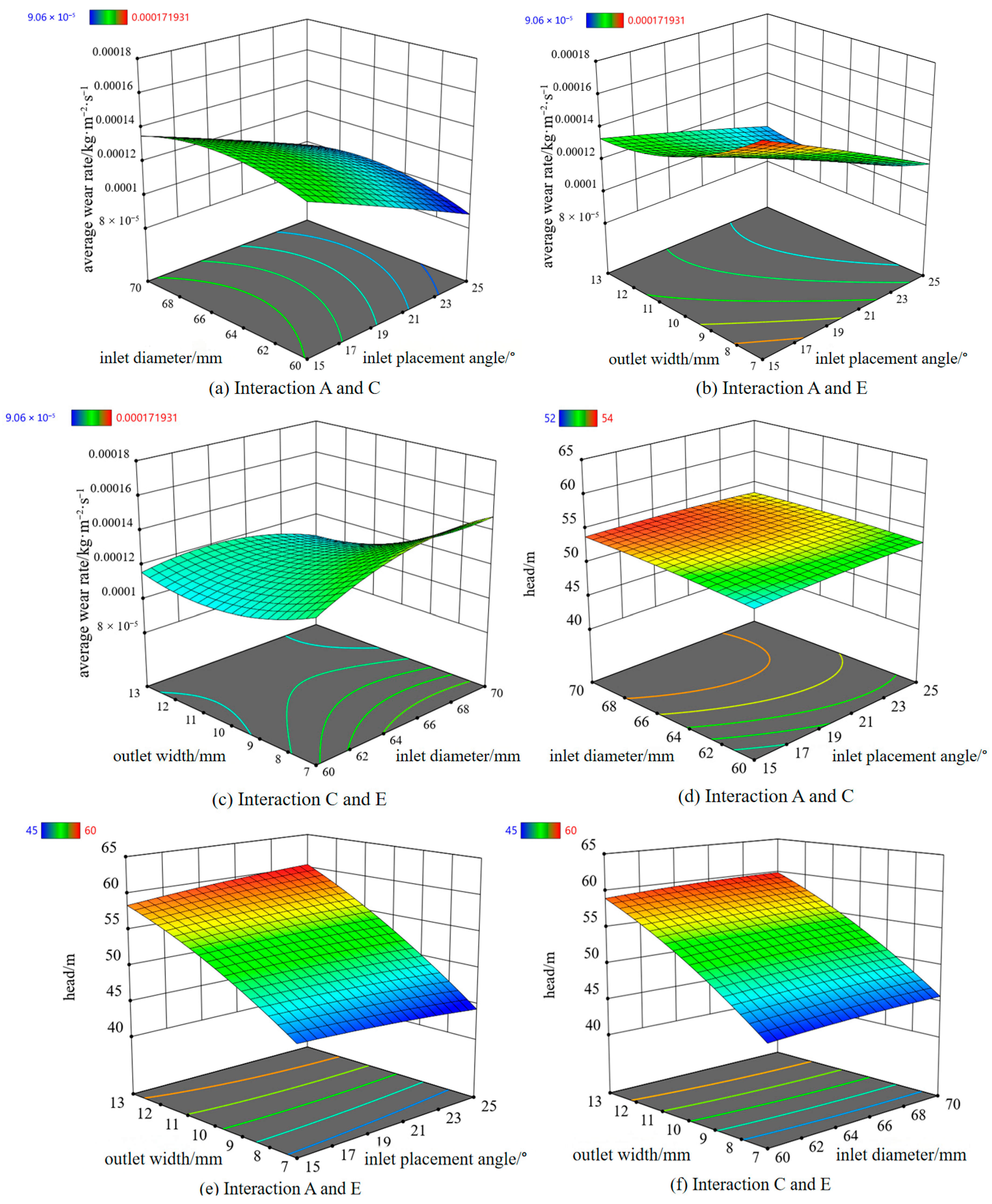
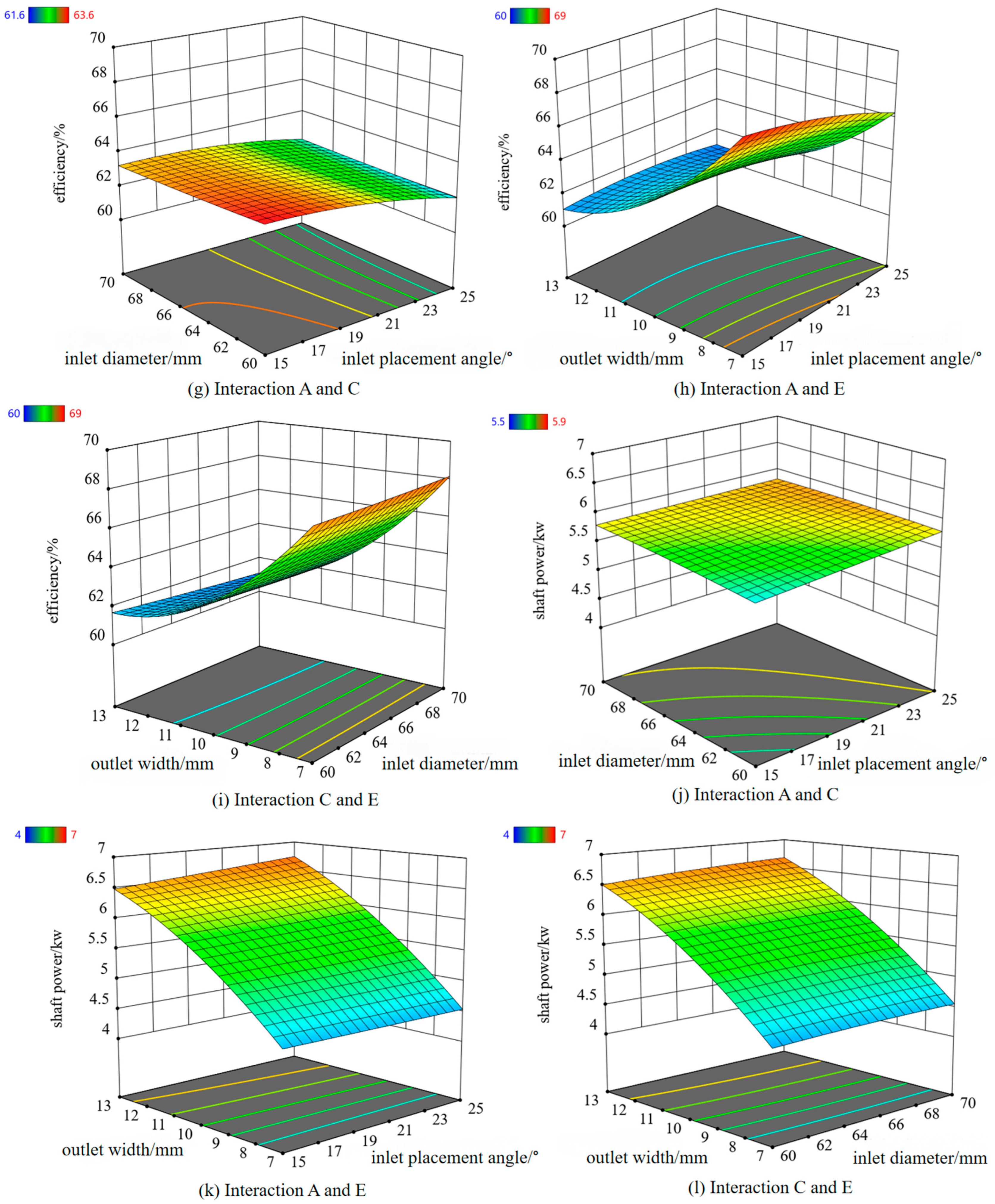
Interaction effects among the three significant variables ((A): inlet placement angle, (C): inlet diameter, (E): outlet width) are presented in Figure 17a through Figure 17l.
As depicted in Figure 17a–c, the response surfaces for control variables versus average impeller erosion rate demonstrated that reduced wear was achieved by the following: (1) larger inlet placement angles coupled with smaller inlet diameters, (2) larger inlet placement angles combined with larger outlet widths, and (3) larger outlet widths paired with larger inlet diameters. Figure 17d–f illustrated head response surfaces, revealing head enhancement through: (1) larger inlet diameters with smaller inlet placement angles, (2) larger inlet placement angles with larger outlet widths, and (3) larger inlet diameters with larger outlet widths. The efficiency response surfaces (Figure 17g–i) indicated efficiency improvement via (1) smaller inlet diameters with smaller inlet placement angles, (2) smaller outlet widths with smaller inlet placement angles, and (3) smaller outlet widths with larger inlet diameters. Finally, shaft power response surfaces (Figure 17j–l) showed power increase through (1) larger inlet diameters with larger inlet placement angles, (2) larger outlet widths with larger inlet placement angles, and (3) larger outlet widths with larger inlet diameters.

5.3. Comparison of Pump Performance Before and After Optimization

The optimal parameter combination for the impeller was predicted using Design-Expert 13 software. A comparison of design parameters between the prototype and optimized pumps is provided in Table 13, with all other parameters unchanged from the prototype.
The performance comparison of the centrifugal pump before and after optimization is shown in Table 14.
According to Table 14, the optimized pump exhibited reductions of 0.59 m in head, 0.37% in hydraulic efficiency, and 0.03 kW in shaft power-all within acceptable tolerance limits. Crucially, the erosion rate decreased significantly by approximately 31.35% compared to the prototype, achieving the objective of enhancing wear resistance through impeller structural optimization.
The loss in head and efficiency is acceptable within actual irrigation systems. In engineering, the allowable deviation for centrifugal pump efficiency is typically 3–5%, and the allowable head deviation falls within a similar range. In field practice, irrigation systems generally possess a certain degree of operational flexibility, allowing such minor performance variations to be easily compensated for through minor adjustments to operational parameters. Most importantly, the approximately 31.35% reduction in wear rate will significantly extend the pump’s service life in sediment-laden water flow, decrease maintenance downtime and component replacement costs, thereby substantially enhancing the equipment’s economic viability and operational reliability from a lifecycle perspective. This optimization has effectively achieved the primary goal of improving wear resistance while maintaining essentially stable performance.
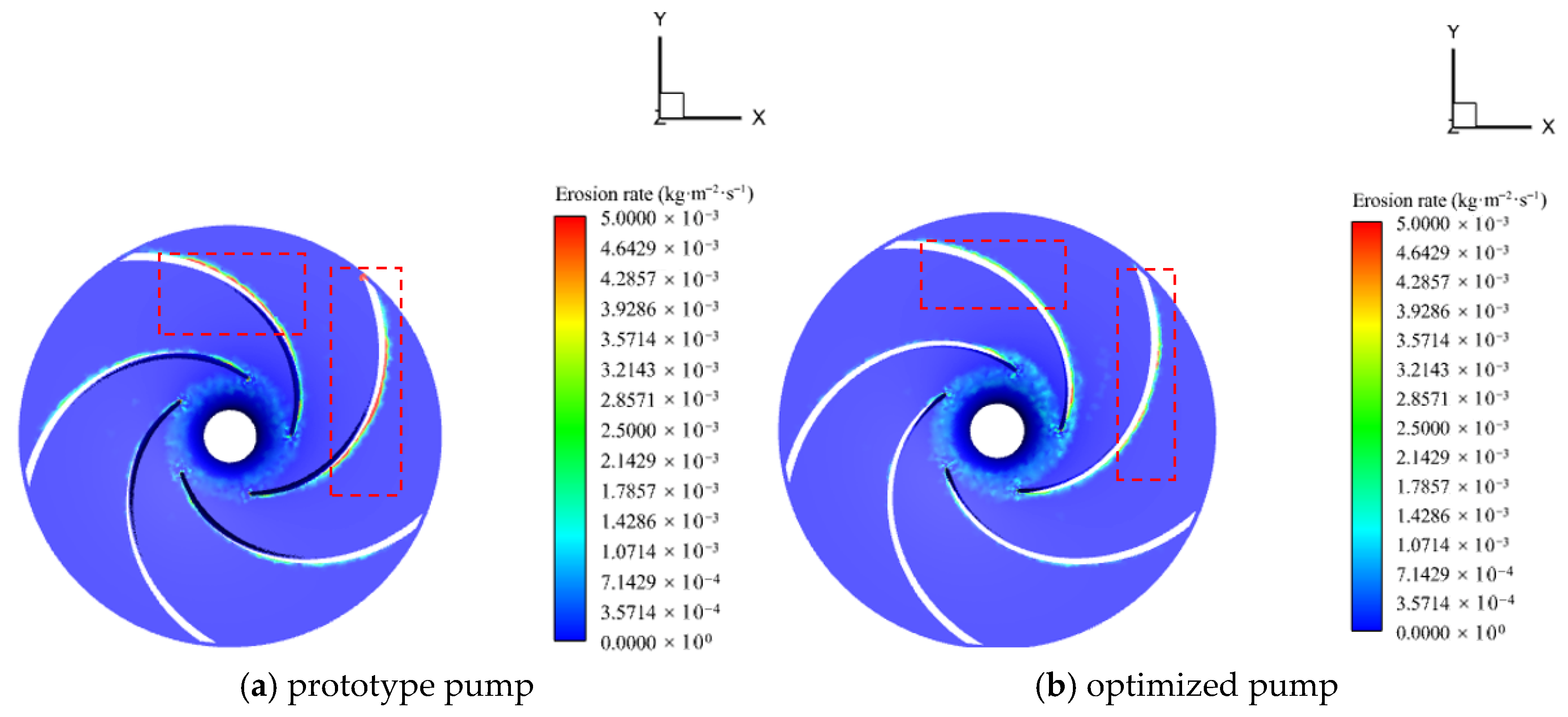
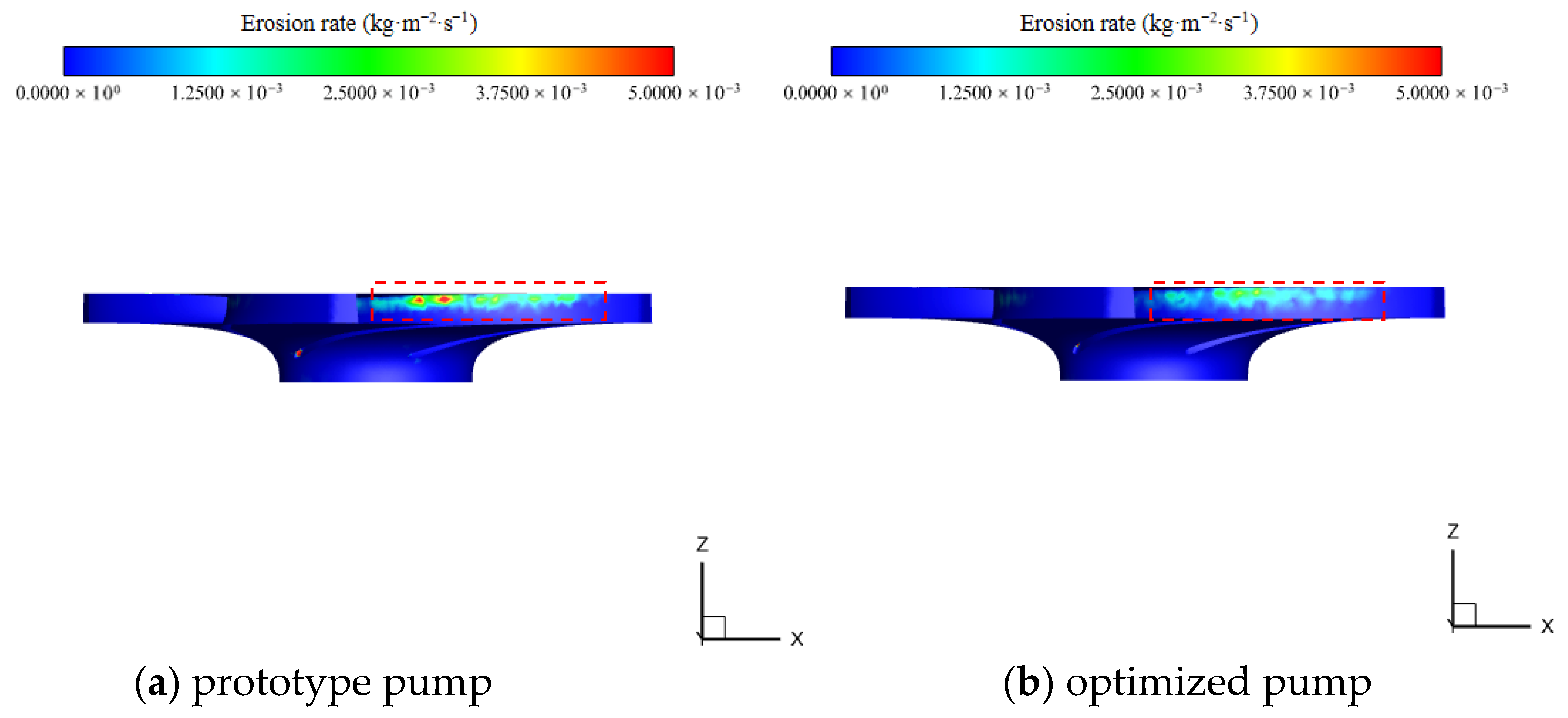
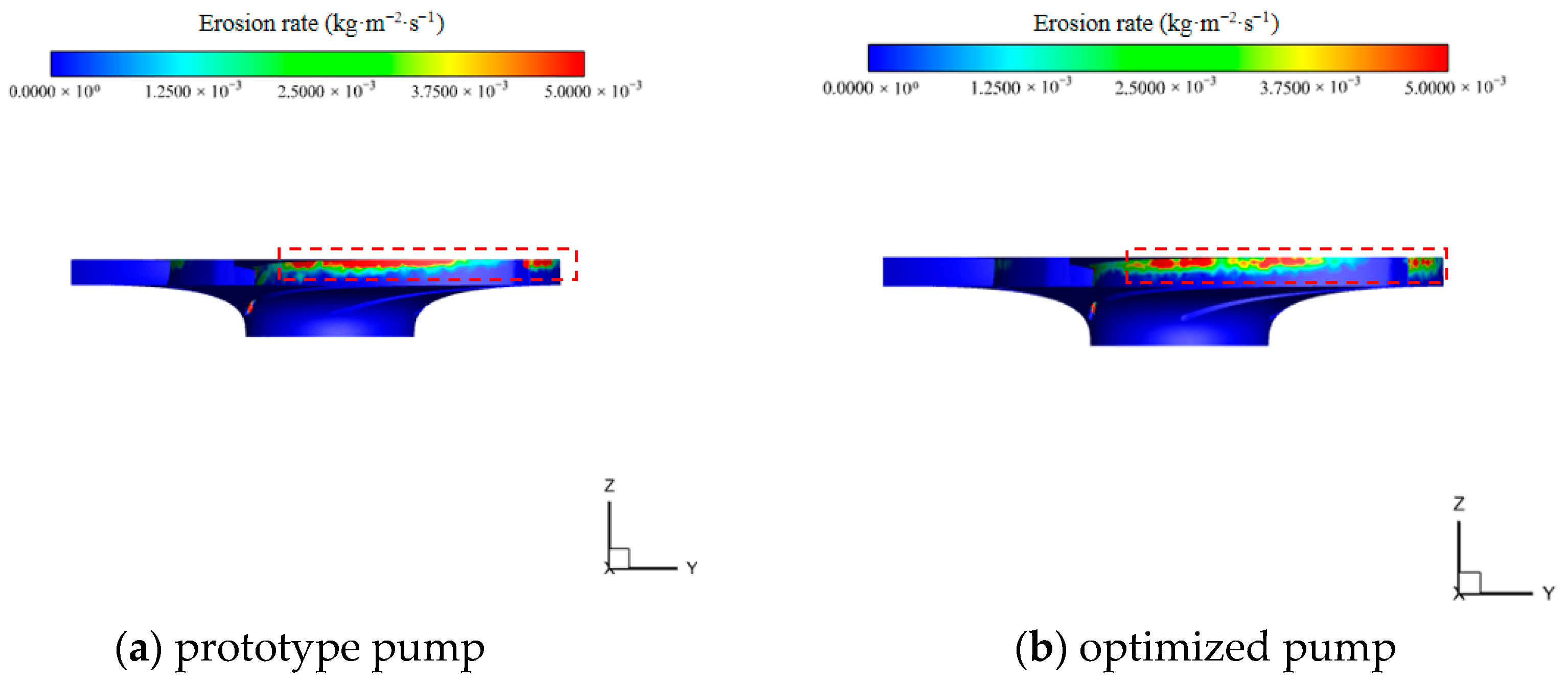
Figure 18, Figure 19 and Figure 20 compare the wear conditions at the same location under identical operating conditions for the original pump and the optimized pump, as shown below.
A comparison of the wear rate nephograms in Figure 18, Figure 19 and Figure 20 leads to the following conclusion: at corresponding identical locations, the proportion of severe wear areas in the optimized pump is significantly lower than that in the original pump. This confirms the effectiveness of the optimization scheme in reducing wear.
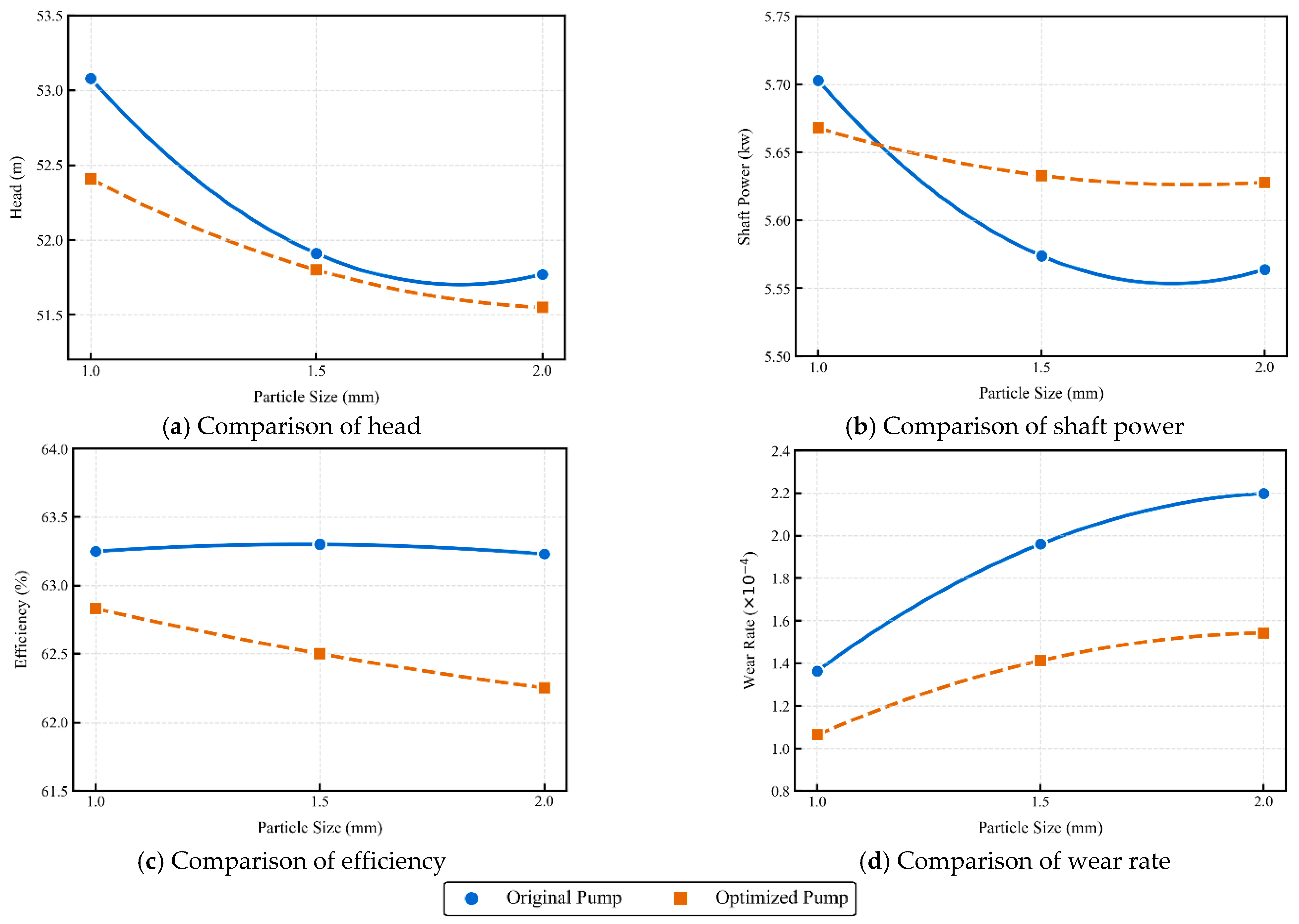
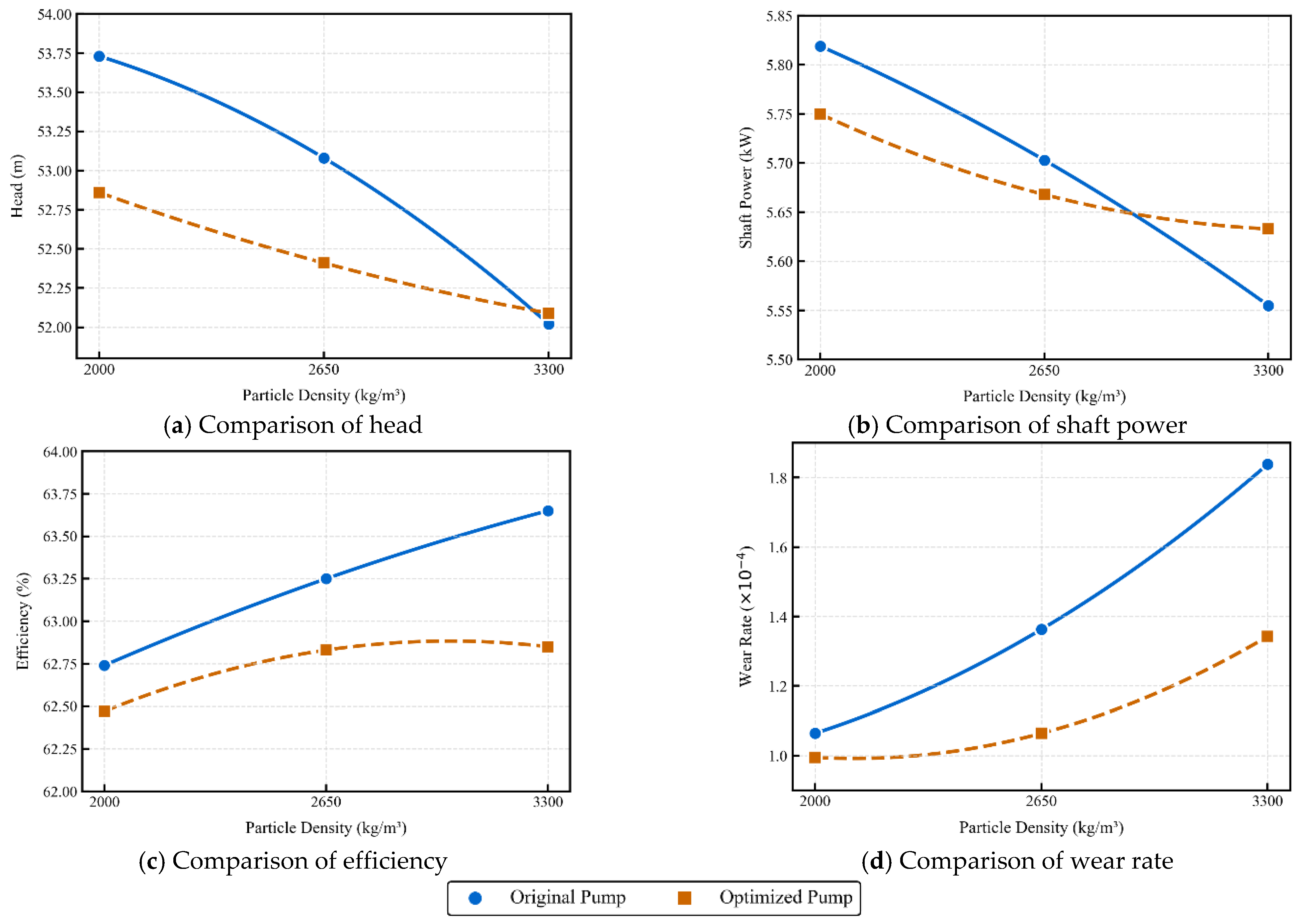
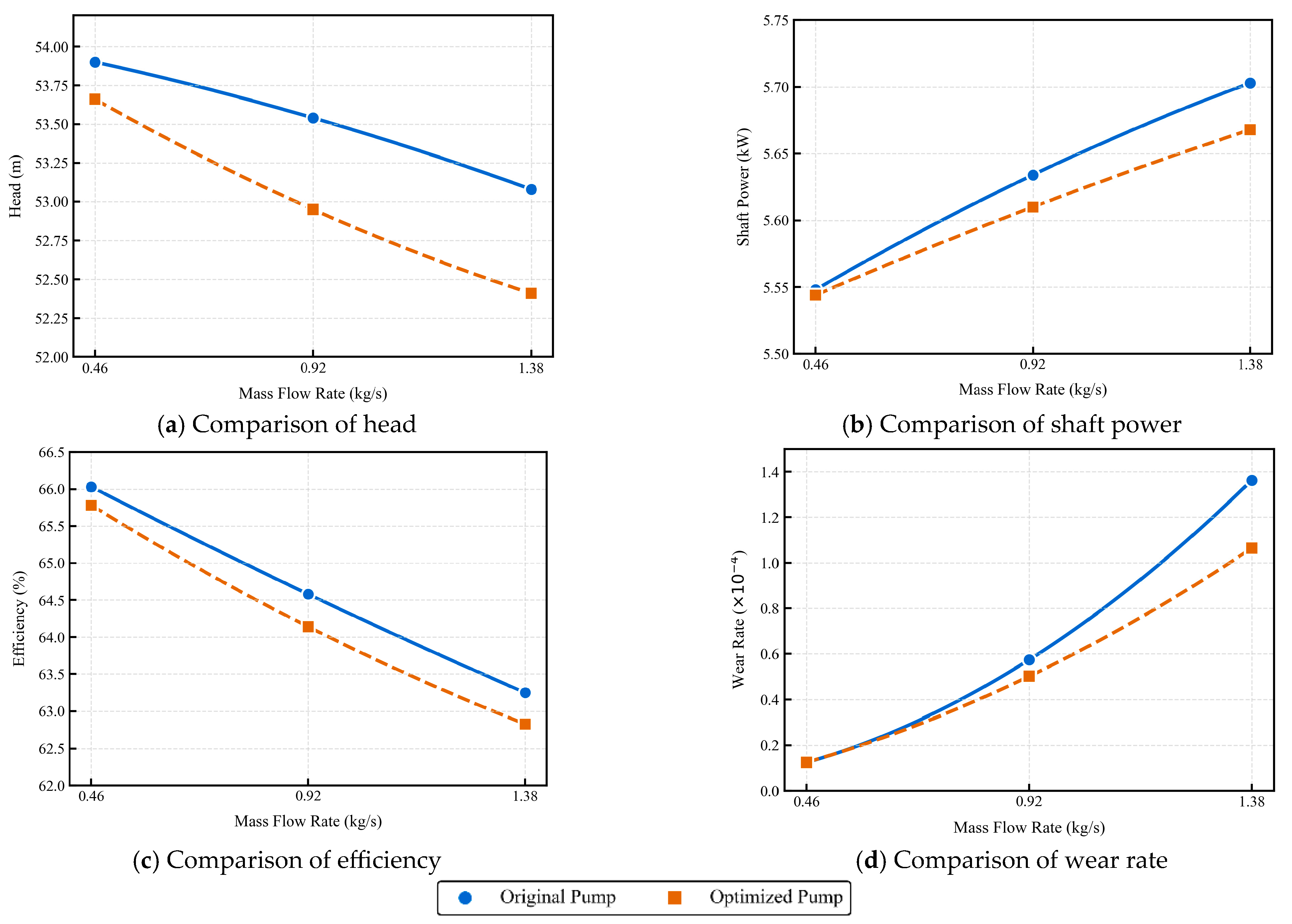
Figure 21, Figure 22 and Figure 23 present comparison curves of centrifugal pump performance before and after optimization under varying particle sizes, particle densities, and mass flow rate.
As indicated in the preceding Figures, the head of the optimized pump remained marginally lower than the prototype across increasing particle sizes, while its shaft power demonstrated greater stability, and the erosion rate was significantly reduced. When particle density increased, the prototype exhibited substantial declines in head and shaft power; although efficiency improved with density, erosion rate rose sharply. In contrast, the optimized pump showed smaller performance variations in response to density changes, maintaining more stable efficiency and erosion characteristics. Under rising mass flow rate, both configurations experienced head and efficiency reductions alongside increased shaft power and erosion. Comparative analysis revealed superior wear resistance and performance stability in the optimized pump.

6. Conclusions

(1) This study established a reliable numerical model for sediment-induced wear in centrifugal pumps, which has been validated to show high agreement with experimental results. The research reveals the influence patterns of key sediment parameters and, through comparison with previous studies, clarifies the academic value and engineering significance of these findings: the wear rate exhibits nonlinear growth with increasing particle density (1350~3300 kg/m3), consistent with the direct influence mechanism of particle inertia on impact energy. This aligns with fundamental fluid dynamics theories and conclusions from most wear studies, while further providing a clear growth trend within this density range. The wear intensity reaches its maximum at a particle size of 1 mm, which corresponds to the widely recognized phenomenon of the most critical particle size in wear research. Compared to previous studies that primarily noted this phenomenon on a macroscopic level, this paper specifies the exact critical particle size for centrifugal pumps as a typical hydraulic machinery, thereby offering precise guidance for engineering protection.
(2) Through systematic optimization using Response Surface Methodology (RSM), three key geometric parameters—the inlet placement angle (A), inlet diameter (C), and outlet width (E)—were identified as critically influencing both wear and performance. The optimized parameter combination achieved a significant reduction in wear rate by 31.35%. These findings demonstrate that multi-objective collaborative optimization can effectively enhance the wear resistance of centrifugal pumps while maintaining their hydraulic performance. This provides a practical engineering reference for the design and modification of pumps operating in high-sediment environments.
(3) Parametric effect analysis demonstrated that higher inlet placement angles reduced wear but increased shaft power; intermediate inlet diameters minimized wear-rate growth; narrower outlet widths improved efficiency but elevated wear at low sediment densities. Increasing the inlet placement angle while reducing the inlet diameter maximizes the wear resistance of the equipment, whereas simultaneously enlarging the outlet width and the inlet diameter effectively enhances its head performance. This optimized combination provides guidance for relevant engineering design and performance balancing. Under varying sediment conditions, the optimized pump maintained superior stability in head, efficiency, and wear rate compared to the prototype.
(4) The methodology provides a replicable workflow for wear-resistant hydraulic design: CFD-DPM erosion analysis identifies critical wear zones; RSM-based multi-stage screening and optimization derive anti-wear geometric rules; experimental validation ensures field applicability. For Southern Xinjiang’s high-sediment irrigation environments, this approach extends pump service life while retaining hydraulic performance within acceptable thresholds.
Limitations and future work include the following: the DPM assumes spherical particles, neglecting irregular sediment shapes common in field conditions; the Oka model does not account for material hardening effects during prolonged erosion; interactions between cavitation and sediment wear were not investigated. Future studies should incorporate non-spherical particle tracking, evaluate hardened coatings via coupled fluid–structure erosion models, and explore multi-objective optimization balancing wear resistance with cavitation performance under transient operations.

Author Contributions

H.C.: Writing—original draft, Validation, Software, Methodology, Investigation, Formal analysis, Data curation, Conceptualization. Z.S.: Validation, Investigation, Writing—original draft and editing. S.H.: Writing-review and editing, Validation, Software, Resources, Funding acquisition, Project administration, Methodology, Investigation, Supervision. X.H.: Methodology, Conceptualization, Resources. All authors have read and agreed to the published version of the manuscript.

Funding

This research was supported by the Project of Tianchi Talented Young Doctor (525303003), President’s Fund of Tarim University (TDZKBS202563), Ministry of Education of China Industry-University-Research Innovation Fund (2024MZ004), Tarim University’s First-Class Undergraduate Program Construction Project in Smart Water Conservancy (425222457) and Talent Introduction Program of XPCC for Southern Xinjiang (525303005).

Institutional Review Board Statement

Not applicable.

Informed Consent Statement

Not applicable.

Data Availability Statement

The data presented in this study are available upon request from the corresponding author.

Acknowledgments

We gratefully acknowledge the “Project of Tianchi Talented Young Doctor”, “President’s Fund of Tarim University”, “Ministry of Education of China Industry-University-Research Innovation Fund”, “Tarim University’s First-Class Undergraduate Program Construction Project in Smart Water Conservancy”, and “Talent Introduction Program of XPCC for Southern Xinjiang” for financial support.

Conflicts of Interest

The authors declare no conflicts of interest.

References

  1. Zhu, C.B.; Zhou, Y.J.; Bian, Z.F.; Xu, Y.N.; Chen, J.C.; Chen, Z. Study on the division and calculation of reservoir capacity in tunnel underground reservoirs for pumped storage power stations in abandoned mines (PSPSAM). Int. J. Electr. Power Energy Syst. 2025, 171, 110983. [Google Scholar] [CrossRef]
  2. Feng, C.; Li, C.S.; Chang, L.; Ding, T.; Mai, Z.J. Advantage analysis of variable-speed pumped storage units in renewable energy power grid: Mechanism of avoiding S-shaped region. Int. J. Electr. Power Energy Syst. 2020, 120, 105976. [Google Scholar] [CrossRef]
  3. Kang, C.; Cao, Q.; Teng, S.; Liu, H.X.; Ding, K.J. Wear characteristics of a centrifugal pump transporting solid-liquid mixture: An experimental and numerical study. Ain Shams Eng. J. 2024, 15, 102277. [Google Scholar] [CrossRef]
  4. Wang, Y.P.; Li, W.Q.; He, T.L.; Liu, H.; Han, C.F.; Zhu, Z.C. Experimental study on the influence of particle diameter, mass concentration, and impeller material on the wear performance of solid-liquid two-phase centrifugal pump blade. Front. Energy Res. 2022, 10, 893385. [Google Scholar] [CrossRef]
  5. Shen, Z.; Li, R.; Han, W.; Quan, H.; Guo, R. Erosion wear on impeller of double-suction centrifugal pump due to sediment flow. J. Appl. Fluid Mech. 2020, 13, 1131–1142. [Google Scholar] [CrossRef]
  6. Wang, Y.; Wang, X.; Chen, J.; Li, G.X.; Liu, H.L.; Xiong, W. An experimental insight into dynamic characteristics and wear of centrifugal pump handling multi-size particulate slurry. Eng. Fail. Anal. 2022, 138, 106303. [Google Scholar] [CrossRef]
  7. Tang, C.; Yang, Y.C.; Liu, P.Z.; Kim, Y.J. Prediction of abrasive and impact wear due to multi-shaped particles in a centrifugal pump via CFD-DEM coupling method. Energies 2021, 14, 2391. [Google Scholar] [CrossRef]
  8. Zhang, W.Q.; Yang, S.; Wu, D.Z.A.; Mou, J.G. Effect of particle mass concentration on erosion characteristics of self-priming pump. Proc. Inst. Mech. Eng. Part C J. Mech. Eng. Sci. 2021, 235, 6782–6797. [Google Scholar] [CrossRef]
  9. Tarodiya, R.; Gandhi, B.K. Numerical simulation of a centrifugal slurry pump handling solid-liquid mixture: Effect of solids on flow field and performance. Adv. Powder Technol. 2019, 30, 2225–2239. [Google Scholar] [CrossRef]
  10. Oka, Y.I.; Okamura, K.; Yoshida, T. Practical estimation of erosion damage caused by solid particle impact: Part 1: Effects of impact parameters on a predictive equation. Wear 2005, 259, 95–101. [Google Scholar] [CrossRef]
  11. Oka, Y.I.; Yoshida, T. Practical estimation of erosion damage caused by solid particle impact: Part 2: Mechanical properties of materials directly associated with erosion damage. Wear 2005, 259, 102–109. [Google Scholar] [CrossRef]
  12. Shi, X.W.; Ding, W.J.; Xu, C.J.; Xie, F.W.; Tian, Z.Z. Numerical investigation of particle effect on wear characteristic of centrifugal slurry pump based on CFD-DEM coupling. Eng. Comput. 2023, 40, 2386–2408. [Google Scholar] [CrossRef]
  13. Shi, B.C.; Zhou, K.L.; Pan, J.P.; Zhang, X.K.; Ying, R.M.; Wu, L.J.; Zhang, Y.D. PIV test of the flow field of a centrifugal pump with four types of impeller blades. J. Mech. 2021, 37, 192–204. [Google Scholar] [CrossRef]
  14. Gu, Y.Q.; Liu, N.J.; Mou, J.G.; Zhou, P.J.; Qian, H.; Dai, D.S. Study on solid–liquid two-phase flow characteristics of centrifugal pump impeller with non-smooth surface. Adv. Mech. Eng. 2019, 11, 1687814019848269. [Google Scholar] [CrossRef]
  15. Shi, X.W.; Ding, W.J.; Xu, C.J.; Xie, F.W.; Tian, Z.Z. Numerical investigation of inlet section structure effect on wear characteristic of particle condition in centrifugal slurry pump by CFD-DEM coupling. Part. Sci. Technol. 2023, 41, 834–843. [Google Scholar] [CrossRef]
  16. Tarodiya, R.; Gandhi, B.K. Effect of particle size distribution on performance and particle kinetics in a centrifugal slurry pump handling multi-size particulate slurry. Adv. Powder Technol. 2020, 31, 4751–4767. [Google Scholar] [CrossRef]
  17. Duan, A.Q.; Lin, Z.; Chen, D.S.; Li, Y. A review on the hydraulic performance and erosion wear characteristic of the centrifugal slurry pump. Particuology 2024, 95, 370–392. [Google Scholar] [CrossRef]
  18. Teng, S.; Kang, C.; Li, M.H.; Qiao, Y.J.; Ding, K.J. Blockage of the deep-sea mining pump transporting large particles with different sphericity. China Ocean Eng. 2023, 37, 343–352. [Google Scholar] [CrossRef]
  19. Xiao, Y.X.; Guo, B.; Ahn, S.H.; Luo, Y.Y.; Wang, Z.W.; Shi, G.T.; Li, Y.H. Slurry flow and erosion prediction in a centrifugal pump after long-term operation. Energies 2019, 12, 1523. [Google Scholar] [CrossRef]
  20. Pu, W.; Ji, L.L.; Li, W.; Shi, W.D.; Tian, F.; Xiao, C.; Yang, Y.; Agarwal, R. Blade wear intensity of a centrifugal pump based on an improved four-way coupling method. Phys. Fluids 2025, 37, 043323. [Google Scholar] [CrossRef]
  21. Lin, P.; Hu, D.; Lu, J.M.; Wang, S. CFD numerical simulation of sand-contained cavitation characteristics of axial-flow pump. Adv. Mech. Eng. 2021, 13, 16878140211032785. [Google Scholar] [CrossRef]
  22. Chen, M.D.; Tan, L. Solid-liquid multiphase flow and erosion in the energy storage pump using modified drag model and erosion model. J. Energy Storage 2023, 73, 108859. [Google Scholar] [CrossRef]
  23. Jiang, Z.Q.; Zeng, X.D.; Li, Y. Study on the relationship between wear and flow characteristics of a centrifugal pump at different mass concentrations. Processes 2021, 9, 988. [Google Scholar] [CrossRef]
  24. Dong, W.; Li, S.C.; He, F.; Fan, X.G.; Li, P.X. Effect of variable conditions on transient flow in a solid–liquid two-phase centrifugal pump. Phys. Fluids 2024, 36, 073340. [Google Scholar] [CrossRef]
  25. Qiu, N.; Li, M.; Wu, J.; Zhu, H.; Xu, P. Numerical Investigation of Vortex Generator on Controlling Flow Field of Centrifugal Pump Based on Response Surface Method. J. Appl. Fluid Mech. 2024, 17, 1774–1791. [Google Scholar] [CrossRef]
  26. Yuksel, O. Modelling of a cargo oil pump turbine system to find the optimum pump operation capacities through the design of experiments approaches. Ships Offshore Struct. 2025, 20, 384–396. [Google Scholar] [CrossRef]
  27. Li, H.; Yu, Z.F.; Hua, R.N.; Li, C.Q.; Guo, C.; Liu, H.L.; Dong, L. Optimization Research on the Space-V-Type Biomimetic Surface Grooves of a Marine Centrifugal Pump. Water 2023, 15, 4031. [Google Scholar] [CrossRef]
  28. Alawadhi, K.; Alzuwayer, B.; Mohammad, T.A.; Buhemdi, M.H. Design and optimization of a centrifugal pump for slurry transport using the response surface method. Machines 2021, 9, 60. [Google Scholar] [CrossRef]
  29. Liu, X.W.; Li, H.C.; Shi, X.X.; Fu, J.F. Application of biharmonic equation in impeller profile optimization design of an aero-centrifugal pump. Eng. Comput. 2019, 36, 1764–1795. [Google Scholar] [CrossRef]
  30. Zhou, J.B.; He, D.J.; Zhang, R.; Zhao, W.D. Research on the performance of a centrifugal aviation fuel pump based on response surface methodology. Processes 2023, 11, 3055. [Google Scholar] [CrossRef]
  31. Wang, W.J.; Sun, J.; Liu, J.; Zhao, J.T.; Pei, J.; Wang, J.B. Introducing non-hierarchical RSM and MIGA for performance prediction and optimization of a centrifugal pump under the nominal condition. Processes 2022, 10, 1529. [Google Scholar] [CrossRef]
  32. Shim, H.S.; Afzal, A.; Kim, K.Y.; Jeong, H.S. Three-objective optimization of a centrifugal pump with double volute to minimize radial thrust at off-design conditions. Proc. Inst. Mech. Eng. Part A J. Power Energy 2016, 230, 598–615. [Google Scholar] [CrossRef]
  33. Wang, C.; Yao, Y.L.; Yang, Y.; Chen, X.H.; Wang, H.; Ge, J.; Cao, W.D.; Zhang, Q.Q. Automatic optimization of centrifugal pump for energy conservation and efficiency enhancement based on response surface methodology and computational fluid dynamics. Eng. Appl. Comput. Fluid Mech. 2023, 17, 2227686. [Google Scholar] [CrossRef]
  34. Cao, W.D.; Wang, H.; Yang, X.Y.; Leng, X.Y. Optimization of guide vane centrifugal pumps based on response surface methodology and study of internal flow characteristics. J. Mar. Sci. Eng. 2023, 11, 1917. [Google Scholar] [CrossRef]
  35. Singh, K.; Singh, A.; Singh, D.K. Modelling and Optimization of Fluid Frictional Torque in a Single Stage Centrifugal Pump with a Vaned Diffuser Based on RSM, ANN and Desirability Function. J. Appl. Fluid Mech. 2025, 18, 728–741. [Google Scholar] [CrossRef]
  36. Nataraj, M.; Singh, R.R. Analyzing pump impeller for performance evaluation using RSM and CFD. Desalination Water Treat. 2014, 52, 6822–6831. [Google Scholar] [CrossRef]
  37. Pei, J.; Wang, W.J.; Yuan, S.Q. Multi-point optimization on meridional shape of a centrifugal pump impeller for performance improvement. J. Mech. Sci. Technol. 2016, 30, 4949–4960. [Google Scholar] [CrossRef]
  38. Xu, Z.F.; Kong, F.; Zhang, K.; Zhu, H.; Wang, J.Q.; Qiu, N. Optimization of the impeller for hydraulic performance improvement of a high-speed magnetic drive pump. Adv. Mech. Eng. 2022, 14, 16878132221104576. [Google Scholar] [CrossRef]
  39. Si, Q.R.; Xu, H.; Deng, F.J.; Xia, X.; Ma, W.S.; Guo, Y.S.; Wang, P. Study on performance improvement of low specific speed multistage pumps by applying full channel hydraulic optimization. J. Energy Storage 2024, 99, 113238. [Google Scholar] [CrossRef]
  40. Zhang, W.W.; Zhu, B.S.; Zi, D.; Ma, Z.; Wang, F.J. Transportability improvement of a gas-liquid rotodynamic pump using the two-step multi-objective optimization strategy. Front. Energy Res. 2022, 10, 900182. [Google Scholar] [CrossRef]
  41. Kim, S.; Kim, Y.I.; Kim, J.H.; Choi, Y.S. Three-objective optimization of a mixed-flow pump impeller for improved suction performance and efficiency. Adv. Mech. Eng. 2019, 11, 1687814019898969. [Google Scholar] [CrossRef]
  42. Maroufi, H.; Mehdinejadiani, B. A comparative study on using metaheuristic algorithms for simultaneously estimating parameters of space fractional advection-dispersion equation. J. Hydrol. 2021, 602, 126757. [Google Scholar] [CrossRef]
  43. Mehdinejadiani, B. A novel inverse model insensitive to initial guesses for estimating parameters of continuous time random walk-truncated power law model. J. Hydrol. 2025, 658, 133206. [Google Scholar] [CrossRef]
  44. Liu, Z.Z.; Li, G.J. Numerical simulation of centrifugal pump impeller erosion caused by particles in lead-bismuth alloy. Int. J. Mod. Phys. B 2023, 37, 2350225. [Google Scholar] [CrossRef]
  45. Wang, H.Y.; Tan, Z.; Kuang, S.B.; Yu, A.B. Numerical modeling and analysis of particle-fluid flow and wall erosion in centrifugal slurry pumps under different solid concentrations. Powder Technol. 2022, 410, 117861. [Google Scholar] [CrossRef]
  46. Xie, Y.S.; Jiang, J.R.; Islam, M.A. Applications of elastomers in slurry transport. Wear 2021, 477, 203773. [Google Scholar] [CrossRef]
  47. Sharma, S.; Gandhi, B.K. Experimental investigation on rotating domain wear of hydrodynamic machine due to particulate flow. Powder Technol. 2022, 410, 117884. [Google Scholar] [CrossRef]
  48. Su, X.H.; Tang, Z.J.; Li, Y.; Zhu, Z.C.; Mianowicz, K.; Balaz, P. Research of particle motion in a two-stage slurry transport pump for deep-ocean mining by the CFD-DEM method. Energies 2020, 13, 6711. [Google Scholar] [CrossRef]
  49. Li, Z.Q.; Wei, X.T.; Yi, Z.Y.; Ma, Z.; Yu, Y.L.; Wang, W.Y. Numerical analysis of gas-liquid-solid erosion characteristics of the oil and gas multiphase pump. Eng. Fail. Anal. 2024, 157, 107889. [Google Scholar] [CrossRef]
  50. Peng, G.J.; Chen, Q.; Bai, L.; Hu, Z.Q.; Zhou, L.; Huang, X. Wear mechanism investigation in a centrifugal slurry pump impeller by numerical simulation and experiments. Eng. Fail. Anal. 2021, 128, 105637. [Google Scholar] [CrossRef]
  51. Tarodiya, R.; Gandhi, B.K. Experimental investigation of centrifugal slurry pump casing wear handling solid-liquid mixtures. Wear 2019, 434, 202972. [Google Scholar] [CrossRef]
  52. Jiang, L.; Bai, L.; Xue, P.; Peng, G.J.; Zhou, L. Two-way coupling simulation of solid-liquid two-phase flow and wear experiments in a slurry pump. J. Mar. Sci. Eng. 2022, 10, 57. [Google Scholar] [CrossRef]
  53. Tan, L.W.; Wang, W.R.; Shi, W.D.; Yang, Y.; Bao, L.L.; Wang, C.L.; Wang, T.; Li, H. A study on the internal vortex structure within a single-blade pump via numerical methods and particle image velocimetry experiments. Phys. Fluids 2024, 36, 115130. [Google Scholar] [CrossRef]
  54. Li, Y.; Zhang, H.Y.; Lin, Z.; Zhang, G.; Zhu, Z.C. Analysis of particle motion and wear characteristics for mixed particle sizes in centrifugal pumps. J. Mech. Sci. Technol. 2023, 37, 4705–4716. [Google Scholar] [CrossRef]
  55. Singh, J.; Mohapatra, S.K.; Kumar, S. Performance analysis of pump materials employed in bottom ash slurry erosion conditions. J. Tribol. 2021, 30, 73–89. [Google Scholar]
  56. Wang, Y.; Wang, X.L.; Chen, J.; Li, G.X.; Liu, H.L.; Xiong, W. Numerical simulation of the influence of mixed sand on erosion characteristics of centrifugal pump. Eng. Comput. 2022, 39, 2053–2080. [Google Scholar] [CrossRef]
  57. Peng, G.J.; Huang, X.; Zhou, L.; Zhou, G.X.; Zhou, H. Solid-liquid two-phase flow and wear analysis in a large-scale centrifugal slurry pump. Eng. Fail. Anal. 2020, 114, 104602. [Google Scholar] [CrossRef]
  58. Wang, H.Y.; Tan, Z.; Kuang, S.B.; Yu, A.B. Systematic investigation of centrifugal slurry pump under different operating condition by DDPM method. Powder Technol. 2023, 430, 119024. [Google Scholar] [CrossRef]
  59. Tao, Y.; Bai, Y.M.; Wu, Y.C. Influence of blade thickness on solid–liquid two-phase flow and impeller wear in a ceramic centrifugal slurry pump. Processes 2021, 9, 1259. [Google Scholar] [CrossRef]
  60. Guo, X.; Shi, G.T.; Xiao, Y.X.; Ye, X.Y. A study of the relationship between sand movement and flow field distribution and wear causes in a multiphase pump. J. Mar. Sci. Eng. 2024, 12, 1203. [Google Scholar] [CrossRef]
  61. Hong, S.J.; Hu, X.Z. Optimization of impeller of deep-sea mining pump for erosive wear reduction based on response surface methodology. Mar. Georesources Geotechnol. 2023, 41, 295–311. [Google Scholar] [CrossRef]
  62. Peng, G.J.; Hong, S.M.; Chang, H.; Zhang, Z.R.; Fan, F.Y. Optimization design of multistage pump impeller based on response surface methodology. J. Theor. Appl. Mech. 2021, 59, 595–609. [Google Scholar] [CrossRef]
  63. He, C.P.; Han, W.; Li, R.N.; Dong, Y.F.; Zhang, Y.K. Multi-objective optimization and performance analysis of the splitter blades in a multiphase pump. Int. J. Fluid Eng. 2025, 2, 013501. [Google Scholar] [CrossRef]
  64. Li, X.J.; Cao, Z.T.; Wei, Z.C.; Ren, Q.L. Theoretical model of energy conversion and loss prediction for multi-stage centrifugal pump as turbine. Energy Convers. Manag. 2025, 325, 119379. [Google Scholar] [CrossRef]
  65. Sarasua, J.I.; Martinez-Lucas, G.; Lafoz, M. Analysis of alternative frequency control schemes for increasing renewable energy penetration in El Hierro Island power system. Int. J. Electr. Power Energy Syst. 2019, 113, 807–823. [Google Scholar] [CrossRef]
Figure 1. Three-dimensional model.
Agriculture 16 00177 g001
Figure 2. Computational domain grid.
Agriculture 16 00177 g002
Figure 3. Grid independence verification.
Agriculture 16 00177 g003
Figure 4. Distribution of y+ values near the walls of the blade and volute.
Agriculture 16 00177 g004
Figure 5. Experiment System and Site Photos.
Agriculture 16 00177 g005
Figure 6. Head–flow rate result comparison. (a) Comparison of experimental and numerical simulation results for head. (b) Relative error of head.
Agriculture 16 00177 g006
Figure 7. Efficiency–flow rate result comparison. (a) Comparison of experimental and numerical simulation results for efficiency. (b) Relative error of efficiency.
Agriculture 16 00177 g007
Figure 8. Impeller outlet region.
Agriculture 16 00177 g008
Figure 9. Pump inlet region.
Agriculture 16 00177 g009
Figure 10. Relationship between varying sediment parameters and the average erosion rate.
Agriculture 16 00177 g010
Figure 11. Standardized effect of efficiency: Pareto.
Agriculture 16 00177 g011
Figure 12. Three-dimensional spatial configuration of the three-factor BBD.
Agriculture 16 00177 g012
Figure 13. Residual plots were constructed in run order.
Agriculture 16 00177 g013
Figure 14. Variation laws of centrifugal pump performance parameters with inlet placement angle.
Agriculture 16 00177 g014aAgriculture 16 00177 g014b
Figure 15. Variation laws of centrifugal pump performance parameters with inlet diameter.
Agriculture 16 00177 g015
Figure 16. Variation laws of centrifugal pump performance parameters with outlet width.
Agriculture 16 00177 g016aAgriculture 16 00177 g016b
Figure 17. Interaction effects among the three significant variables.
Agriculture 16 00177 g017aAgriculture 16 00177 g017b
Figure 18. Comparison of wear conditions in the X-Y axis directions.
Agriculture 16 00177 g018
Figure 19. Comparison of wear conditions in the X-Z axis directions.
Agriculture 16 00177 g019
Figure 20. Comparison of wear conditions in the Y-Z axis directions.
Agriculture 16 00177 g020
Figure 21. Performance comparison under varying particle sizes.
Agriculture 16 00177 g021
Figure 22. Performance comparison under varying particle density.
Agriculture 16 00177 g022
Figure 23. Performance comparison under varying mass flow rate.
Agriculture 16 00177 g023
Table 1. Geometric parameters of model pump impeller.
ParameterValue
ImpellerInlet diameter/mm65
Hub diameter/mm25
Outlet width/mm10
Number of blades/pcs5
Outlet diameter/mm200
Wrap angle/(°)120
Inlet placement angle/(°)15
Outlet placement angle/(°)25
Table 2. Grid scheme.
Grid SchemeNumber of GridsH (m)Average Wear Rate
(kg·m−2·s−1)
1860,05452.501.0547 × 10−4
21,204,14752.451.0887 × 10−4
31,543,86752.341.0974 × 10−4
41,887,08152.091.1259 × 10−4
52,405,39452.111.126 × 10−4
63,038,05452.091.1261 × 10−4
Table 3. Table of key parameters for the Oka erosion model.
H v ( GPa ) n 1 n 2 d r e f ( mm ) V r e f ( m / s )
1.80.81.30.326104
Table 4. Sediment parameters.
No.ParameterUnitValue
1particle sizemm0.5, 1, 1.5, 2, 2.5, 3
2particle densitykg/m31350, 2000, 2650, 3300
3mass flow ratekg/s0.46, 0.92, 1.38, 1.84
Table 5. Control variables for key parameters of the impeller.
VariableParametersLow LevelHigh Level
X1Inlet diameter D1/mm6070
X2Outlet diameter D2/mm196204
X3Hub diameter D3/mm2030
X4Outlet width b/mm713
X5Number of blades/pcs46
X6 Wrap   angle   α /(°)110130
X7 Inlet   placement   angle   β 1 /(°)1525
X8 Outlet   placement   angle   β 2 /(°)2030
Table 6. PB experimental design and calculation results.
No.Inlet Placement Angle (°)Outlet Placement Angle (°)Inlet Diameter
(mm)
Hub Diameter
(mm)
Outlet Width
(mm)
Number of BladesWrap Angle
(°)
Outlet Diameter
(mm)
H (m) η (%)
11530702013411019654.2564.85
2153060207613020452.7875.14
31520703013413020457.9663.29
42530702013611020462.9373.24
5153070307613019648.7676.93
6252070207413020444.8176.32
7152060207411019642.1380.71
82520602013613019657.3967.62
9252070307611019648.6378.29
101520603013611020461.9863.47
112530603013413019653.7664.65
12253060307411020446.3577.48
Table 7. Parameter range values.
Coding ProficiencyFactor
ACE
−115607
0206510
1257013
Table 8. Factorial design matrix and computational results.
No.Inlet Placement Angle (°)Inlet Diameter
(mm)
Outlet Width
(mm)
Average Wear Rate
(kg·m−2·s−1)
1156071.374 × 10−4
2256079.76 × 10−5
3157071.733 × 10−4
4257071.168 × 10−4
51560131.288 × 10−4
62560139.63 × 10−5
71570131.448 × 10−4
82570138.33 × 10−5
9156071.388 × 10−4
10256079.97 × 10−5
11157071.815 × 10−4
12257071.293 × 10−4
131560131.340 × 10−4
142560139.95 × 10−5
151570131.470 × 10−4
162570138.14 × 10−5
172065101.370 × 10−4
182065101.345 × 10−4
192065101.365 × 10−4
Table 9. ANOVA table for average erosion rate.
TypeDegree of FreedomAdj SSAdj MSValue of FValue of p
Model71.3566 × 10−81.938 × 10−9107.44<0.001
Linear31.1669 × 10−83.890 × 10−9215.64<0.001
A19.1030 × 10−99.103 × 10−9504.67<0.001
C19.8000 × 10−109.800 × 10−1054.32<0.001
E11.5860 × 10−91.586 × 10−987.92<0.001
Factor interaction31.5540 × 10−95.180 × 10−1028.72<0.001
A × C15.0600 × 10−105.060 × 10−1028.03<0.001
A × E13.0000 × 10−123.000 × 10−120.150.706
C × E11.0460 × 10−91.046 × 10−957.99<0.001
Bend13.4300 × 10−103.430 × 10−1019.030.001
Error111.9800 × 10−101.800 × 10⁻¹¹
Lack-of-fit15.7000 × 10−115.700 × 10−114.080.071
Pure error101.4100 × 10−101.400 × 10⁻¹¹
Total181.3765 × 10−8
Table 10. Regression model for average erosion rate.
SR-SqR-Sq (Adjustment)R-Sq (Prediction)
4.2 × 10−698.56%97.64%95.47%
Table 11. BBD matrix and corresponding calculation results.
ModelOutlet Width (mm)Inlet Diameter (mm)Inlet Placement Angle (°)H (m)P (kW)η (%)Average Wear Rate
(kg·m−2·s−1)
120651054.215.73364.261.34 × 10−4
225651343.754.52165.781.04 × 10−4
320601352.075.59163.291.14 × 10−4
425701053.325.81562.319.51 × 10−5
515601058.786.49961.461.36 × 10−4
62060745.114.49968.141.23 × 10−4
715701053.825.84462.591.33 × 10−4
825601053.515.79362.779.06 × 105
915651353.575.79962.781.32 × 10−4
1020651046.254.56068.921.18 × 10−4
112070745.884.55868.401.5 × 10−4
1220651059.606.66360.791.18 × 10−4
1320651060.376.73160.951.21 × 10−4
1420651053.645.79062.961.19 × 10−4
152565758.916.49661.631.21 × 10−4
161565753.465.78062.851.72 × 10−4
1720701353.535.79462.781.1 × 10−4
Table 12. Metrics for assessing response surface accuracy.
Average Wear Rate (kg·m−2·s−1)H (m)H (%)P (kW)
R 2 0.95910.99610.97090.9995
R a d j 2 0.90650.99100.93350.9990
R p r e d 2 0.78040.95080.76860.9976
Table 13. Comparison of design parameters between the prototype and optimized pumps.
ModelInlet Placement Angle (°)Inlet Diameter (mm)Outlet Width (mm)
Prototype pump156510
Optimized pump21609.9
Table 14. Comparison of pump performance.
ModelAverage Wear Rate(kg·m−2·s−1)H (m)η (%)P (kW)
Prototype pump1.550 × 10−453.0063.215.698
Optimized pump1.064 × 10−452.4162.845.668
Variation−4.86 × 10⁻⁵−0.59−0.37−0.03
Disclaimer/Publisher’s Note: The statements, opinions and data contained in all publications are solely those of the individual author(s) and contributor(s) and not of MDPI and/or the editor(s). MDPI and/or the editor(s) disclaim responsibility for any injury to people or property resulting from any ideas, methods, instructions or products referred to in the content.