Review

Fresh-Cut Potatoes: Current Challenges and Emerging Strategies for Quality Preservation and Shelf-Life Extension


1
Department of Agronomy, Food, Natural Resources, Animals, and Environment (DAFNAE), University of Padova, Viale dell’Università, 16, 35020 Legnaro, Italy
2
Department of Microbiology and Biotechnology, University of Food Technologies, 26 Maritza Blvd., 4002 Plovdiv, Bulgaria
*
Author to whom correspondence should be addressed.
Agriculture 2026, 16(18), 1952; https://doi.org/10.3390/agriculture16181952
Submission received: 7 August 2026 / Revised: 5 September 2026 / Accepted: 9 September 2026 / Published: 11 September 2026

Abstract

Fresh-cut potatoes are among the most widely consumed minimally processed vegetables owing to their convenience, versatility, and suitability as ready-to-cook products. However, the peeling and cutting operations required during processing inevitably disrupt tissue integrity, triggering a cascade of physiological, biochemical, and microbiological responses that accelerate product deterioration during storage. Increased respiration, oxidative stress, enzymatic browning, moisture loss, texture degradation, metabolic reprogramming, nutrient depletion, and microbial proliferation collectively reduce sensory quality, consumer acceptance, and shelf life. This review comprehensively examines the biological mechanisms underlying these deterioration processes, with particular emphasis on wound-induced physiological responses, phenylpropanoid metabolism, enzymatic browning, cell wall remodelling, metabolic reprogramming, and microbial spoilage. It also critically discusses conventional and emerging preservation strategies, including refrigeration, packaging systems, edible coatings, natural preservatives, and non-thermal technologies, highlighting their mechanisms of action, advantages, limitations, and industrial applicability. Finally, this review identifies key knowledge gaps and future research priorities, emphasizing the need for integrated hurdle approaches that combine sustainable preservation technologies to enhance product quality, safety, shelf life, and resource use efficiency while meeting both consumer and industrial demands.

1. Introduction

The increasing demand for healthy, fresh, and convenient foods has driven the remarkable growth of the minimally processed fruit and vegetable sector over recent decades [1,2,3]. The International Fresh-cut Produce Association (IFPA) defines fresh-cut fruit and vegetable products as “any fruit or vegetable or combination thereof that has been physically altered from its original form but remains in a fresh state” [4]. These products are ready-to-eat or ready-to-cook plant-based foods obtained through minimal processing operations designed to preserve the fresh-like characteristics of the raw material while improving convenience and usability. Fresh-cut fruit and vegetable products remain fresh without additional treatment, such as blanching, freezing, canning, cooking, or adding syrup [2,3,5]. Beyond household consumption, where consumer demand is increasingly driven by the search for foods that combine freshness, convenience, and potential health benefits, fresh-cut fruit and vegetable products are widely utilized by food service operators and processing industries [2,6,7]. Among the various fresh-cut vegetables available on the market, potato (Solanum tuberosum L.) represents one of the most economically important and widely consumed commodities worldwide and is recognized as the world’s fourth most important food crop, with around 5000 varieties cultivated globally [8,9,10]. According to the latest FAOSTAT statistics, global potato production exceeded 380 million tonnes in 2024, harvested from more than 16 million hectares worldwide. China and India are the leading producers, accounting for approximately 95 and 57 million tonnes, respectively, followed by Ukraine, the Russian Federation, and the United States. Asia alone contributes more than half of global potato production, while Europe represents the second largest producing region, underlining the crucial role of potato cultivation in global food security and the agri-food sector [11].
Potatoes are not only an important source of carbohydrates but also provide dietary fibre, vitamins, minerals, and several bioactive compounds, including phenolics, carotenoids, polyamines, tocopherols, and glycoalkaloids [12]. Fresh-cut potatoes (FCPs) have gained increasing popularity among consumers, food service operators, and the food industry owing to their convenience, reduced preparation time, and versatility in a wide range of culinary applications [13]. The growing demand for ready-to-cook potato products has stimulated the expansion of the FCP sector, increasing the need for effective preservation strategies capable of maintaining quality throughout storage and distribution. Unlike most fresh-cut vegetables, particularly leafy salads, which are commonly consumed raw, FCPs require cooking prior to consumption because potato tubers are rich in starch, the major component of their dry matter [13,14]. In raw potatoes, starch exists primarily in the form of ungelatinized granules that are characterized by limited digestibility. Upon thermal processing, starch undergoes gelatinization, a structural transformation that significantly enhances both its digestibility and overall palatability [13,15]. During frying and baking, reducing sugars and amino acids participate in Maillard reactions that contribute to desirable sensory attributes but may also promote acrylamide formation, a potentially carcinogenic process contaminant. Consequently, processing and storage conditions that modify potato composition can influence both the quality and safety of FCPs during subsequent cooking [16,17,18].
Potato tubers are particularly susceptible to quality deterioration following minimal processing, as peeling and cutting disrupt cellular integrity and remove natural protective barriers. Tissue injury activates a cascade of physiological, biochemical, and microbiological responses that accelerate enzymatic browning, moisture and nutrient losses, texture modifications, and flavour alterations [8,9,13,19]. Among these deterioration phenomena, enzymatic browning is generally regarded as the most critical quality defect, as it rapidly impairs visual appearance and consumer acceptance. Furthermore, temperature fluctuations during storage and distribution may intensify these changes, further compromising product quality. Consequently, the commercial shelf life of FCPs is generally limited to 5–7 days under refrigerated conditions (4–5 °C) [13]. To preserve product quality and extend shelf life, different preservation approaches have been investigated, including conventional refrigeration, packaging and chemical treatments, as well as natural preservatives and emerging non-thermal technologies [10,19,20,21].
Although several reviews have addressed specific aspects of FCP preservation, including enzymatic browning, microbial safety, edible coatings, and non-thermal technologies, these topics have generally been discussed separately or within broader reviews of fresh-cut fruits and vegetables. The distinctive contribution of the present review is to integrate the biological mechanisms underlying FCP deterioration with the technological strategies available for their control, providing a direct link between wound-induced physiological and metabolic responses and preservation mechanisms. This integrated perspective also enables the identification of current knowledge gaps and future research priorities for extending shelf life, reducing food losses, and improving the sustainability and resource use efficiency of FCP production.

2. Literature Search Strategy

This narrative review was based on a structured literature search aimed at identifying relevant studies on quality deterioration and preservation strategies for FCPs. The literature search was conducted between May and August 2026, primarily using Google Scholar and Scopus. Search terms included “fresh-cut potato”, “minimally processed potato”, “enzymatic browning”, “wound response”, “wound healing”, “microbial spoilage”, “refrigeration”, “cold chain”, “modified atmosphere packaging”, “vacuum packaging”, “edible coatings”, “antibrowning agents”, “natural preservatives”, “chlorine”, “ozone”, “electrolyzed water”, “UV-C”, “pulsed light”, “cold plasma”, “ultrasound”, “pulsed electric fields”, and “hurdle technology”, used individually or in combination. Additional publications were identified from the reference lists of relevant articles and reviews. No strict publication year restriction was applied, although priority was given to recent studies, particularly those published within the last five years; earlier publications were retained when relevant to established mechanisms or preservation principles. Priority was given to studies specifically addressing FCPs, while studies on intact potato tubers were included when providing relevant mechanistic information. When FCP-specific evidence was limited, particularly for emerging technologies, selected studies on other fresh-cut fruits and vegetables were considered to describe technological principles and identify research gaps. Relevant reviews, regulatory documents, and authoritative institutional sources were also considered where appropriate.

3. Processing of Fresh-Cut Potatoes

3.1. Factors Affecting the Suitability of Potatoes for Fresh-Cut Processing

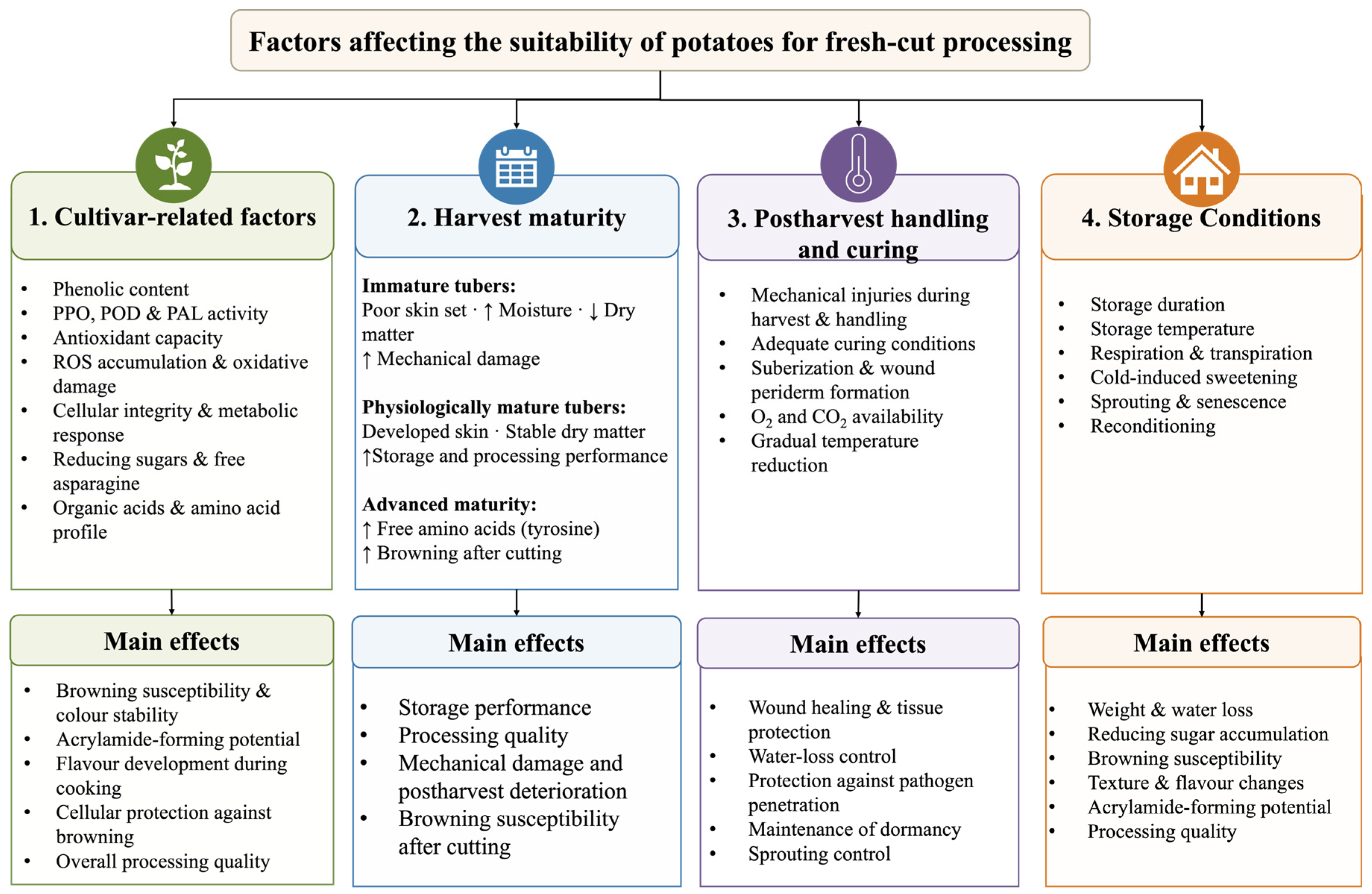
The quality, processing performance, and shelf life of FCPs are strongly influenced by the characteristics of the raw material. Cultivar, maturity stage, dry matter content, sugar composition, and tissue structure can all affect the physiological and biochemical responses triggered by cutting, ultimately influencing browning development, texture retention, microbial stability, and cooking quality [13]. The main pre- and postharvest factors affecting the suitability of potato tubers for fresh-cut processing are summarized in Figure 1.

3.1.1. Cultivar-Related Factors

Among the different factors affecting the suitability of potatoes for fresh-cut processing, cultivar-related differences have received considerable attention, as potato varieties exhibit distinct chemical, structural, and metabolic traits that influence their processing performance and quality. Browning susceptibility, in particular, has been associated with differences in phenolic content, the activity of oxidative enzymes such as polyphenol oxidase (PPO), peroxidase (POD), and phenylalanine ammonia-lyase (PAL), and endogenous antioxidant capacity [20,22]. Cabezas-Serrano et al. (2009) identified cv. Marabel and Agata as the most suitable cultivars among those evaluated, showing the lowest colour changes during storage, whereas cv. Almera exhibited greater browning despite its higher antioxidant activity, likely due to its elevated phenolic content and PPO activity [22]. Similarly, Cornacchia et al. (2011) reported the highest colour stability and visual quality for cv. Safrane, whereas cv. Spunta was the most susceptible to browning [23].
Recent studies have further shown that cultivar-dependent browning involves complex physiological and metabolic mechanisms. Wang et al. (2023) found that the browning-resistant cv. Minshu exhibited lower activities of browning-related enzymes, reduced oxidative damage, and greater preservation of cellular integrity than the susceptible cv. Huangjin [24]. Likewise, integrated transcriptomic and metabolomic analyses by Qiao et al. (2022) showed that the browning-sensitive cv. Yunshu 505 was characterized by higher PPO and POD expression, enhanced respiratory metabolism, increased reactive oxygen species (ROS) accumulation, and alterations in lipid and amino acid metabolism. In contrast, the resistant cv. Kexin 13 showed greater accumulation of metabolites involved in stress signalling and antioxidant defence, supporting enhanced cellular protection against browning [25]. Besides browning resistance, cultivar selection influences processing quality, flavour development, and food safety. Ingallina et al. (2020) reported significant cultivar-dependent differences in sugars, organic acids, amino acids, and phenolic compounds among 20 Italian potato cultivars. cv. Jelly showed elevated monosaccharide concentrations, which are undesirable for fried products because of their association with acrylamide formation, whereas cv. Roseval and Rubra Spes contained higher citric acid levels, associated with reduced enzymatic browning. Moreover, several cultivars showed higher concentrations of amino acids involved in the generation of desirable flavour compounds during cooking [26]. Consistently, Zhang et al. (2025) identified cv. Youjin885 as the most suitable among five cultivars evaluated for FCP chip production because of its lower acrylamide-forming potential, associated with lower concentrations of reducing sugars and free asparagine. These compounds were positively correlated with acrylamide formation, whereas several other amino acids showed negative correlations [18].

3.1.2. Harvest Maturity

Harvest maturity represents another key determinant of potato suitability for fresh-cut processing, as the developmental stage at harvest affects tuber structural characteristics, composition, and subsequent storage and processing performance. Depending on the intended end use, tubers may be harvested at different developmental stages. Potatoes intended for long-term storage and industrial processing are generally harvested at or near physiological maturity, when haulm senescence is complete, skin set is fully developed, and dry matter accumulation has stabilized. These characteristics improve storage performance and processing quality. Conversely, immature tubers (“young potatoes”) possess a poorly developed periderm, higher moisture content, lower dry matter, and greater susceptibility to mechanical damage and postharvest deterioration, making them more suitable for fresh consumption, where their thin skin, tender texture, and distinctive sensory attributes are highly appreciated [13,27,28]. Although physiological maturity is generally desirable for storage and processing, it does not necessarily confer greater resistance to enzymatic browning after cutting. Meng et al. (2021) reported that tubers harvested at more advanced maturity stages exhibited greater browning susceptibility than those harvested earlier. Interestingly, this response was not associated with higher PPO activity or reduced antioxidant capacity, as mature tubers showed lower PPO activity and greater antioxidant potential. Instead, the authors attributed the enhanced browning primarily to the accumulation of free amino acids, particularly tyrosine, which provides an important substrate for PPO-mediated oxidation [29].

3.1.3. Postharvest Handling and Curing

In addition to cultivar-related characteristics and harvest time, postharvest handling and storage conditions play a crucial role in determining the quality and processing suitability of potato tubers destined for fresh-cut applications [13]. Since potatoes are commonly stored for prolonged periods before processing, postharvest management represents a critical determinant of raw material quality. After harvest, tubers generally undergo a curing period, also referred to as wound healing or maturation, aimed at repairing mechanical injuries incurred during harvesting and handling [30]. During this stage, damaged tissues undergo suberization and wound periderm formation, resulting in the development of a cork-like protective barrier that reduces water loss and limits the penetration of pathogenic microorganisms. Curing is typically performed at 12–18 °C and 90–95% relative humidity for 10–14 days, while adequate oxygen availability and low CO2 concentrations are required to promote tissue repair [31]. Following curing, storage temperature is gradually reduced (approximately 0.5 °C Day−1) to minimize physiological stress, maintain dormancy, and prevent premature sprouting [32].

3.1.4. Storage Conditions and Quality Changes

Depending on the intended use, potatoes may be stored for up to 10 months under controlled environmental conditions [33]. Throughout storage, tubers remain metabolically active and continue to undergo respiration, transpiration, and dormancy-related processes, which progressively influence their physicochemical composition and storage stability. Tubers progressively lose fresh weight through respiration and transpiration, with water loss accounting for most of the storage-related weight reduction [31]. In addition, starch reserves may be converted into reducing sugars, particularly under low-temperature storage conditions (4–6 °C), a phenomenon known as cold-induced sweetening. Sugar accumulation is undesirable because it promotes excessive browning, negatively affects texture and flavour, and increases acrylamide formation during subsequent frying or baking [17]. Reconditioning treatments can partially reverse cold-induced sweetening by promoting the conversion of reducing sugars back into starch, thereby restoring processing quality. This process has been noted to lower the sugar levels by over half in tubers [34]. Conversely, prolonged storage at relatively high temperatures (8–12 °C) may accelerate sprouting, shrinkage, and senescence-related deterioration [35]. Potatoes destined for processing are typically stored at 6–10 °C, a temperature range that helps limit reducing sugar accumulation and preserve the physicochemical properties required for high-quality processed products [13].

3.2. Industrial Processing of Fresh-Cut Potatoes

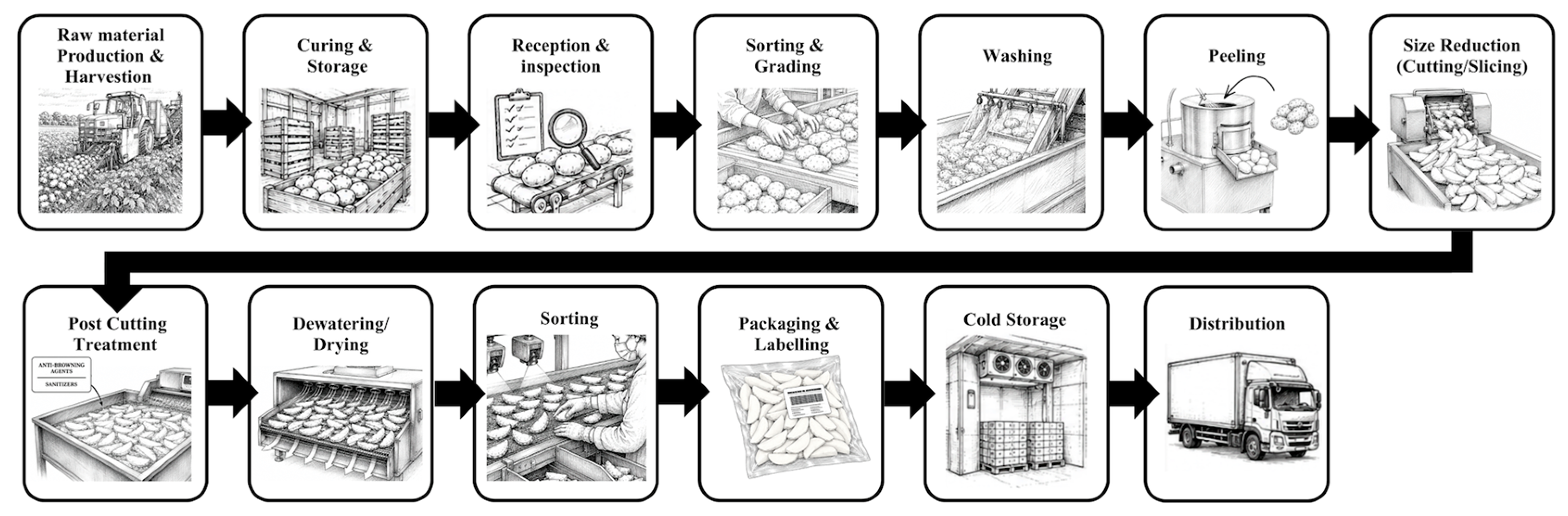
The production of FCPs generally follows the processing chain adopted for most fresh-cut fruits and vegetables, involving operations such as raw material selection, washing, peeling, cutting, sanitization, packaging, and refrigerated storage [2,6,36,37]. However, owing to the specific physiological and compositional characteristics of potato tubers, particular attention must be paid to the control of enzymatic browning, texture changes, microbial growth, and quality attributes associated with subsequent cooking [13,14,19]. The main stages involved in FCP production are summarized in Figure 2.

3.2.1. Raw Material Preparation and Cutting

Following harvesting and postharvest storage, potato tubers are received, inspected, sorted, and graded to remove damaged, diseased, sprouted, or otherwise unsuitable units. Since the quality of the final product is highly dependent on the characteristics of the raw material, only tubers meeting predefined quality standards are selected for processing [36,38]. Potatoes are subsequently washed to remove adhering soil and foreign materials before undergoing peeling operations. After peeling, tubers are cut into the desired shape and size, including slices, cubes, wedges, strips, or fries. Peeling and cutting represent the most critical operations in FCPs because they disrupt cellular integrity and remove the natural protective barriers of the tuber [39]. Tissue injury triggers wound-induced physiological responses, increases respiration rates, and promotes the interaction between oxidative enzymes and their substrates, resulting in enzymatic browning and accelerated quality deterioration [6,36,40,41,42]. Furthermore, damaged tissues become more susceptible to moisture loss and microbial contamination. The severity of these effects may also be influenced by cutting conditions, including blade sharpness, which affects tissue damage, electrolyte leakage, and overall visual quality [43]. Besides blade sharpness, the cutting style itself markedly influences the quality of FCP. Cutting geometries with a larger exposed surface area (e.g., slices) induce greater wound stress, accelerating respiration, enzymatic browning, moisture loss, and overall quality deterioration compared with strips or cubes [14].

3.2.2. Post-Cutting Treatments and Dewatering

Following cutting, potato tissues release cellular exudates containing starch, soluble sugars, amino acids, phenolic compounds, and other nutrients. These exudates provide a favourable substrate for microbial proliferation and other undesirable biochemical reactions. Consequently, post-cutting washing and antibrowning treatments are commonly applied to remove surface residues, reduce microbial contamination, and preserve product quality [19,44]. Traditionally, post-cutting treatments have relied on washing solutions containing chemical antibrowning agents to inhibit enzymatic browning, reduce microbial contamination, and preserve product quality. Although these treatments are generally effective, concerns regarding the potential health risks of some chemical additives, together with increasing consumer demand for natural preservation strategies, have stimulated the search for safer and more sustainable alternatives [20,45,46]. In the conventional potato industry, blanching is widely employed as a pre-treatment before freezing, frying, drying, or dehydration [47]. Besides reducing the microbial load and inactivating browning-related enzymes, blanching promotes starch gelatinization, improves texture, reduces oil uptake during frying, and enhances the overall stability of processed potato products. However, thermal blanching is unsuitable for fresh-cut fruit and vegetables, intended to retain their fresh-like characteristics [48]. Recent research has therefore focused on natural antibrowning agents, particularly plant extracts rich in polyphenols, flavonoids, organic acids, and other bioactive compounds, as well as innovative non-thermal technologies. Current preservation strategies increasingly combine natural compounds with emerging physical technologies to achieve synergistic effects, reducing the use of conventional additives while maintaining the sensory, nutritional, and microbiological quality of FCPs. Following post-cutting treatments, excess surface moisture is removed through dewatering operations, typically based on centrifugal or forced-air systems, to reduce free surface water, limit microbial proliferation, and improve packaging efficiency [48,49].

3.2.3. Sorting, Packaging, and Refrigerated Distribution

Following dewatering, potatoes are sorted to remove foreign materials and damaged, defective, diseased, or deteriorated tubers. This step may be performed manually by trained operators or through automated optical grading systems based on machine vision, RGB imaging, laser sensors, Near-Infrared (NIR) spectroscopy, and multispectral or hyperspectral imaging [50,51]. The products are then packaged and labelled. Packaging plays a fundamental role in maintaining product quality by reducing moisture loss, limiting microbial contamination, and slowing physiological and biochemical deterioration during storage. Modified atmosphere packaging (MAP) and vacuum packaging (VP) remain the most widely adopted commercial approaches, although recent research has increasingly focused on combining these methods with active packaging technologies and edible coatings to further extend shelf life and preserve quality [13,52,53]. The packaged products are subsequently stored under refrigerated conditions and distributed through the supply chain while maintaining an uninterrupted cold chain.

4. Quality Deterioration of Fresh-Cut Potatoes

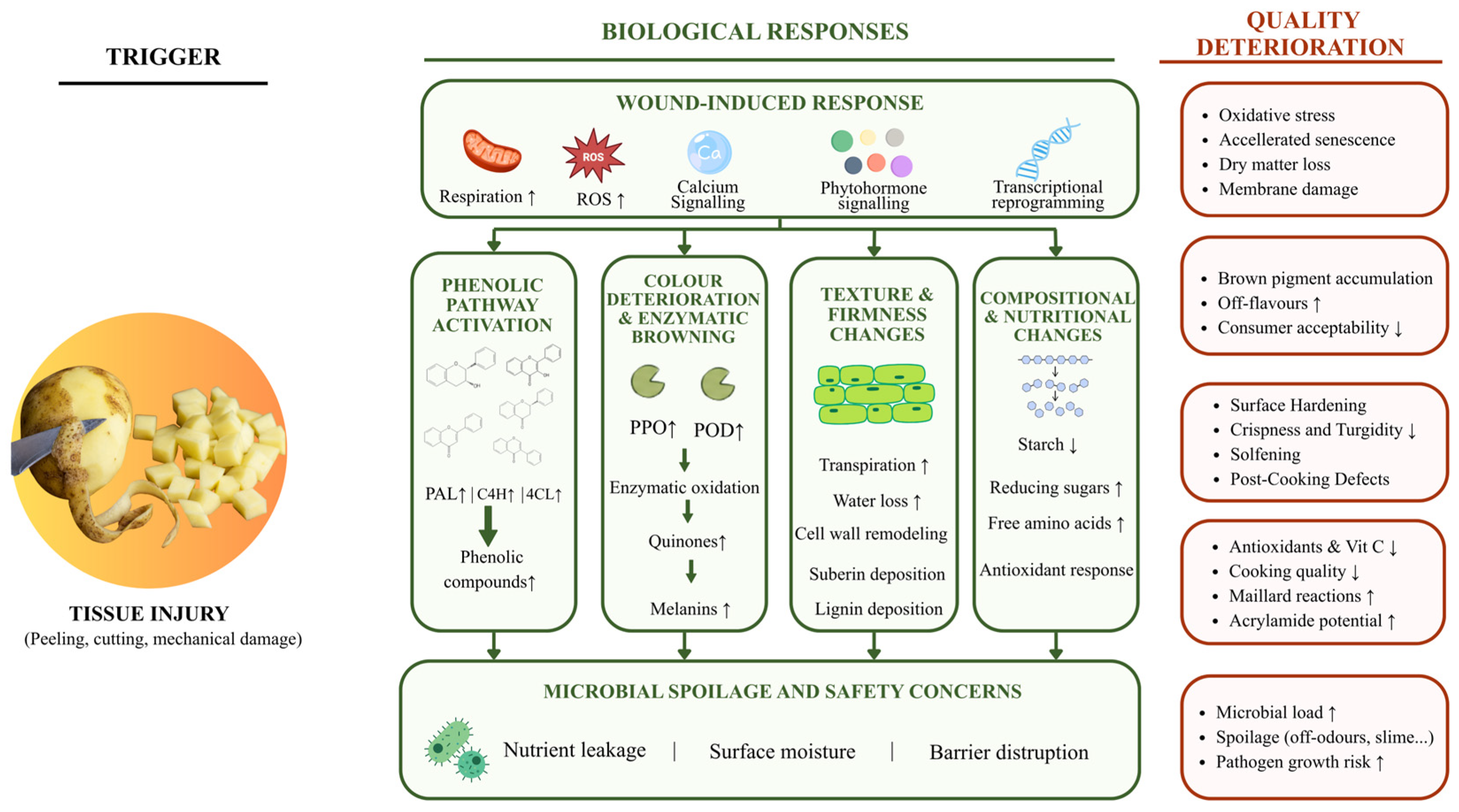
Mechanical injury caused by peeling and cutting immediately disrupts cellular compartmentalization and activates the wound response, which represents one of the earliest physiological events following minimal processing. In intact potato tubers, cellular membranes and natural protective tissues limit water loss, oxygen diffusion, microbial invasion, and the interaction between enzymes and their substrates. Once tissues are cut, this organization is disrupted, exposing internal cells to the external environment and initiating a complex network of physiological, biochemical, and molecular responses aimed at limiting tissue damage and restoring cellular homeostasis. Although these responses are part of the natural defence system of the tuber, they also accelerate quality deterioration in FCPs [13,20,54,55]. The main physiological and metabolic events triggered by tissue injury and their impact on quality deterioration are schematically summarized in Figure 3 and discussed in the following sections.

4.1. Wound-Induced Physiological and Metabolic Responses

Following tissue injury, FCP tissues rapidly undergo a coordinated physiological response aimed at minimizing damage, restoring tissue integrity, and preventing pathogen invasion. This response is initiated by a network of early signalling events, including respiratory burst, ROS production, calcium signalling, and phytohormone-mediated regulation, which collectively trigger extensive transcriptional and metabolic reprogramming to support wound healing while also initiating the quality deterioration processes associated with FCPs [13,54,55,56,57]. One of the earliest physiological responses to tissue injury is a rapid increase in cellular respiration, reflecting the elevated metabolic demand required to sustain defence responses and tissue repair. This respiratory burst is accompanied by the rapid accumulation of ROS, primarily hydrogen peroxide (H2O2) and superoxide anion (O2•−), which function as key signalling molecules regulating wound-induced responses [58,59]. At controlled concentrations, ROS activate metabolic pathways involved in tissue repair and the formation of protective barriers at the wound site. However, excessive ROS accumulation disrupts cellular redox homeostasis, promoting membrane lipid peroxidation, loss of membrane integrity, enzymatic browning, and accelerated tissue senescence [13,24,58]. Mechanical injury also induces the opening of plasma membrane and intracellular Ca2+ channels, resulting in a transient increase in cytosolic Ca2+ concentration, one of the earliest signalling events following wounding. This Ca2+ signal is perceived by calcium-binding proteins, including calmodulins (CaMs), calcium-dependent protein kinases (CDPKs), and calcineurin B-like proteins (CBLs), which initiate downstream signalling cascades through protein phosphorylation and transcriptional regulation [60]. Together with ROS, calcium signalling integrates with wound-induced phytohormone pathways, predominantly those mediated by jasmonic acid, ethylene, and abscisic acid, to activate transcription factors that coordinate extensive transcriptional reprogramming. Consequently, tissue injury induces the differential expression of genes involved in phytohormone signalling, antioxidant defence, secondary metabolism, phenylpropanoid biosynthesis, and cell wall remodelling, thereby establishing the molecular basis for the metabolic and structural changes responsible for the subsequent quality deterioration of FCPs [13,57,60,61].

4.2. Colour Deterioration and Enzymatic Browning

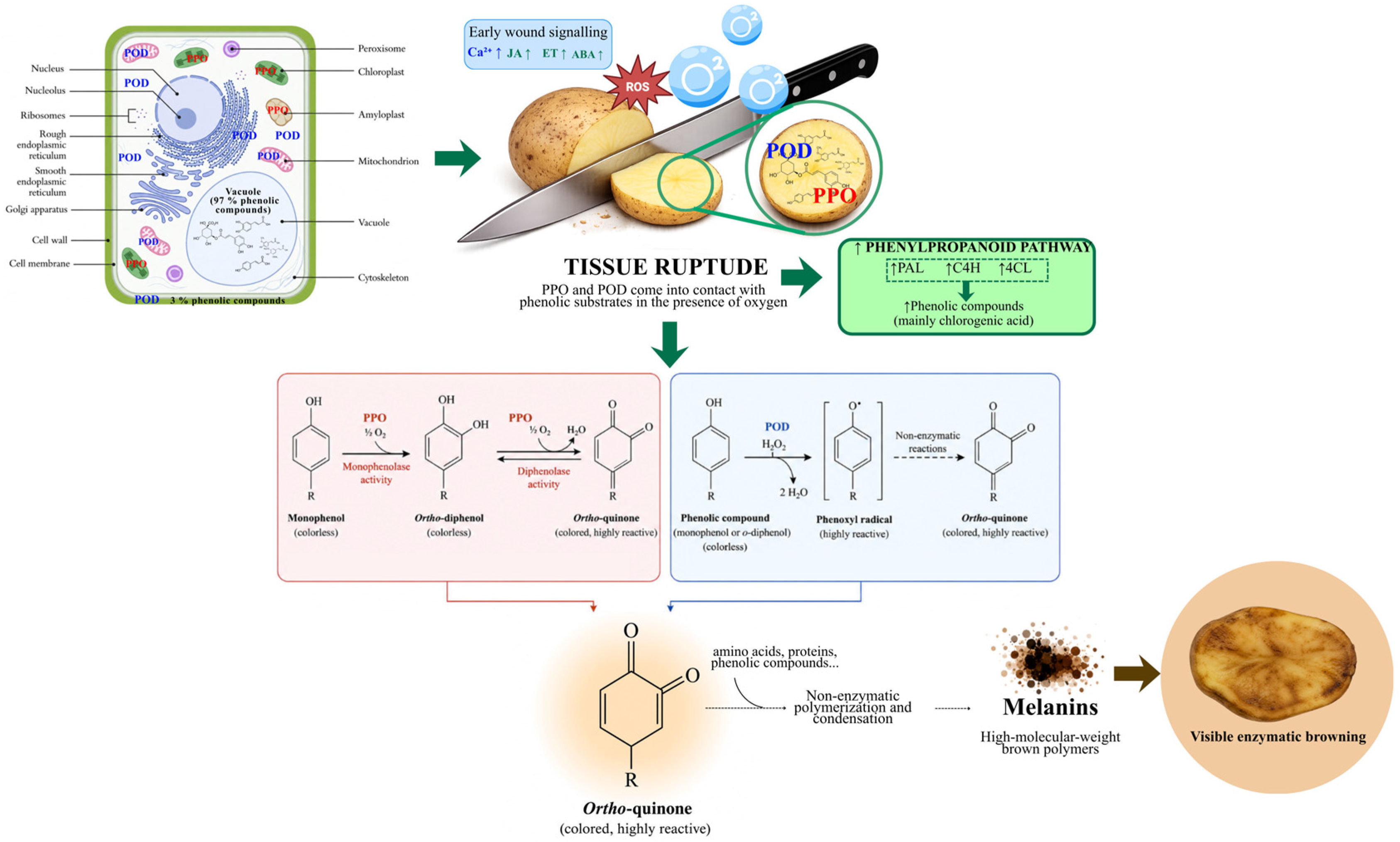
Following the early signalling events described in the previous section, activation of the phenylpropanoid pathway represents one of the earliest metabolic responses to tissue injury, promoting the biosynthesis of phenolic compounds involved in antioxidant defence, antimicrobial protection, cell wall reinforcement, and wound healing, while simultaneously generating substrates for enzymatic browning. The pathway is initiated by phenylalanine ammonia-lyase (PAL), the first and rate-limiting enzyme, which converts L-phenylalanine into trans-cinnamic acid. Subsequent reactions catalyzed by cinnamate-4-hydroxylase (C4H) and 4-coumarate-CoA ligase (4CL) generate p-coumaroyl-CoA, a central precursor of chlorogenic acid, flavonoids, lignin monomers, and other phenylpropanoid-derived compounds. Consistently, mechanical wounding rapidly upregulates PAL, C4H, 4CL, and other genes involved in phenylpropanoid biosynthesis and fatty acid metabolism, reflecting the coordinated metabolic response underlying wound healing and suberin formation [57,62]. Phenolic compounds are unevenly distributed throughout potato tubers, with the highest concentrations in the peel, followed by the outer and inner flesh [13]. Among them, chlorogenic acid is the predominant phenolic acid, accounting for up to 90% of the total phenolic content, whereas caffeic, p-coumaric, ferulic, and sinapic acids occur at considerably lower levels [63].
Under normal physiological conditions, enzymatic browning is prevented by cellular compartmentalization, with phenolic compounds mainly stored in the vacuole and oxidative enzymes localized in separate cellular compartments [20,42,45]. Mechanical injury disrupts this organization, allowing PPO and POD to interact with their phenolic substrates in the presence of oxygen, thereby initiating enzymatic browning [13,57,64,65].
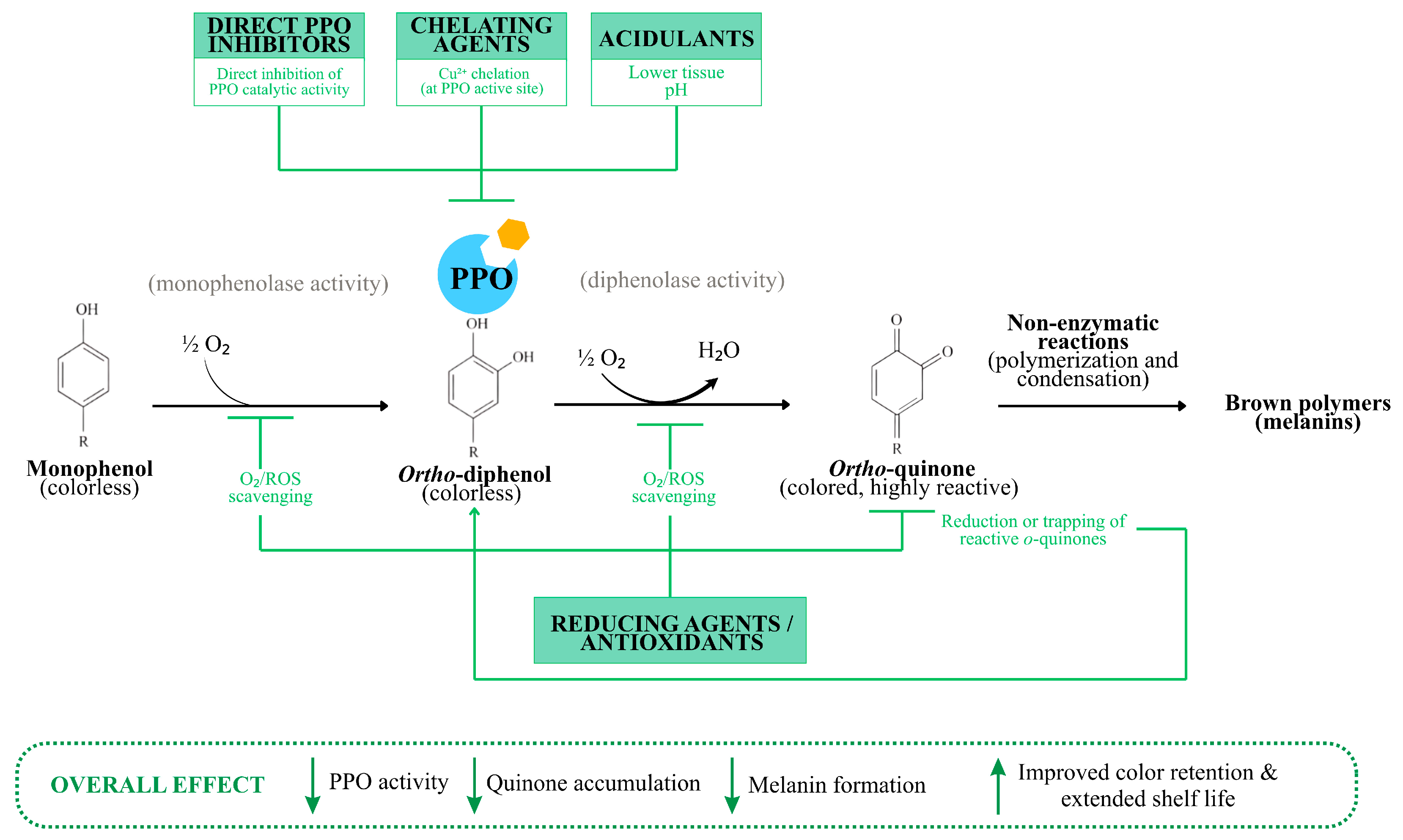
PPO exhibits both monophenolase (EC 1.14.18.1) and diphenolase (EC 1.10.3.1) activities; in potato tubers, however, diphenolase activity is particularly relevant because chlorogenic acid, the predominant phenolic compound, is already an o-diphenolic substrate [66,67]. The resulting o-quinones may either be reduced back to their corresponding diphenols by reducing agents such as sulphites or ascorbic acid (AA), or undergo non-enzymatic reactions with phenolic compounds, amino acids, and proteins, ultimately forming high-molecular-weight brown pigments collectively known as melanins [66,68].
The overall mechanism underlying wound-induced enzymatic browning in FCPs is summarized in Figure 4.
Overall, tissue injury simultaneously enhances phenylpropanoid biosynthesis and PPO- and POD-mediated oxidation. Phenolic compounds accumulating as part of the wound response can therefore become substrates for quinone and melanin formation, ultimately contributing to visible browning and associated sensory deterioration. This interplay between wound-induced phenolic metabolism and oxidative reactions helps explain why effective antibrowning strategies should preserve antioxidant capacity while limiting excessive PPO- and POD-mediated oxidation rather than completely suppressing wound-induced defence metabolism [57,69,70].

4.3. Texture and Firmness Changes Associated with Wound Healing

Mechanical injury disrupts the structural integrity of potato tissues, exposing internal cells to dehydration, oxidative stress, and microbial invasion [13,71]. In response, potato tubers activate a wound-healing programme aimed at restoring tissue integrity through the formation of a wound periderm, a specialized protective tissue that progressively replaces the damaged epidermis and re-establishes barrier function during postharvest storage [72,73]. This response involves extensive cell wall remodelling together with the activation of pathways associated with suberin and lignin deposition [74]. Suberization represents a major structural component of wound healing. Suberin forms a lipid-phenolic barrier composed of interconnected polyphenolic and polyaliphatic domains that strengthens the wounded tissue while reducing permeability to water and microorganisms [62,75,76]. Its deposition occurs progressively, with the formation of the polyphenolic domain followed by the accumulation of fatty acid-derived components that complete the wound periderm [62,72,77]. Lignification develops in parallel and further reinforces the cell wall, increasing tissue rigidity and limiting permeability [73,75,78].
Numerous postharvest studies have demonstrated that chemical and physical elicitors, including β-aminobutyric acid, sorbitol, UV-C irradiation and melatonin, enhance the activities of key enzymes involved in phenylpropanoid metabolism and lignin biosynthesis, including PAL, C4H, 4CL and cinnamyl alcohol dehydrogenase (CAD). This metabolic activation promotes the accumulation of phenolic acids and monolignol precursors, accelerates suberin polyphenolic and lignin deposition, and ultimately reduces water loss and pathogen susceptibility during storage [79,80,81,82]. Overall, these structural responses contribute to preserving tissue integrity and limiting firmness loss during storage.

4.4. Compositional and Nutritional Changes

Tissue injury induces substantial metabolic adjustments that progressively affect the composition and quality of FCPs during storage. One of the earliest responses is a marked increase in respiration rate. Ellis et al. (2019) reported that FCP tissues exhibited respiration rates approximately 3.5-fold higher than intact tubers after 48 h of storage at 4 °C, with the difference increasing to nearly 14-fold after 9 days [83]. This increased metabolic activity accelerates carbon reserve depletion and contributes to tissue senescence and quality loss during storage [19]. To sustain the increased energy demand, starch reserves are progressively mobilized into soluble sugars, mainly glucose, fructose, and sucrose, which serve as respiratory substrates and contribute to osmotic regulation [84]. Excessive starch degradation and reducing sugar accumulation can negatively affect the technological quality of potatoes intended for frying by promoting Maillard reactions and acrylamide formation [13,18,84]. Tissue injury also alters nitrogen metabolism through the accumulation and redistribution of free amino acids. Phenylalanine provides a precursor for phenylpropanoid biosynthesis, whereas increased asparagine concentrations may further enhance the potential for acrylamide formation during subsequent thermal processing [13,64,85,86,87]. Wound-induced metabolic activity is also associated with changes in antioxidant metabolism. Potato tissues activate enzymatic antioxidants, including superoxide dismutase (SOD), catalase (CAT), and ascorbate peroxidase (APX), together with non-enzymatic antioxidants such as AA, glutathione (GSH), phenolic compounds, and carotenoids to maintain redox homeostasis [58,88]. Alterations in these antioxidant systems may therefore contribute to changes in the nutritional and oxidative quality of FCPs during storage [13].

4.5. Microbial Spoilage and Safety Concerns

FCPs are highly susceptible to microbial spoilage because peeling and cutting remove the natural protective periderm and expose nutrient-rich internal tissues to the surrounding environment. Increased respiration and cellular leakage create favourable conditions for microbial colonization and proliferation. Consequently, the microbiological quality of FCPs depends not only on the initial microbial load of the raw material but also on contamination occurring during peeling, cutting, washing, handling, and packaging operations [44,89,90]. The spoilage microbiota of FCPs is typically dominated by psychrotrophic bacteria that can grow under refrigerated conditions. Among these, Pseudomonas spp. is frequently reported as the predominant spoilage microorganisms, causing slime formation, off-odours, and tissue degradation. Other bacteria, including, Enterobacter spp., lactic acid bacteria, and, under certain conditions, yeasts and moulds, may also contribute to quality deterioration through soft rot, discolouration, fermentation, and the development of undesirable sensory attributes. The composition of the microbial community is dynamic and changes throughout storage, being strongly influenced by storage temperature, packaging atmosphere, and the physiological status of the plant tissue [91,92,93,94,95]. Although FCPs are generally intended to be cooked before consumption, food safety remains an important consideration throughout processing and storage. While adequate cooking effectively inactivates most vegetative foodborne pathogens, contamination during processing and temperature abuse before cooking may promote the survival and proliferation of pathogenic microorganisms, thereby increasing the risk of cross-contamination during handling and food preparation [44,89,96].

5. Strategies for Quality Preservation and Shelf-Life Extension of Fresh-Cut Potatoes

5.1. Physical Preservation Technologies

5.1.1. Refrigeration and Cold Chain Management

Refrigeration is the primary preservation strategy for minimally processed fruits and vegetables and remains the most widely adopted strategy for maintaining quality across processing, storage, distribution, retail, and domestic handling. By lowering product temperature, refrigeration slows down physiological, biochemical, and microbiological processes responsible for postharvest deterioration, thereby extending shelf life while preserving fresh-like quality attributes [96,97,98]. In FCPs, refrigeration is particularly important because peeling and cutting trigger a wound response associated with increased respiration, oxidative stress, enzymatic browning, moisture loss, and greater susceptibility to microbial contamination. Consequently, an uninterrupted cold chain from processing to consumption is considered indispensable for maximizing product quality and shelf life [10,37]. Effective cold chain management requires consistent temperature control throughout all post-processing stages, including refrigerated storage, transportation, retail display, and domestic handling. Particular attention should be paid to minimizing temperature fluctuations during distribution, as temporary temperature abuse can accelerate microbial proliferation and quality deterioration in fresh-cut produce. Continuous monitoring using data loggers can support cold chain verification and facilitate the identification of critical points and deviations along the distribution chain [99,100,101]. Accordingly, FCPs are generally stored at 0–5 °C under high relative humidity (95–100%), conditions that effectively limit respiration, enzymatic browning, moisture loss, and microbial growth while preserving tissue firmness and overall product quality [13,102]. The effectiveness of refrigeration is primarily governed by the temperature dependence of biological reactions. Most physiological, biochemical, and microbiological processes involved in postharvest deterioration follow temperature-dependent kinetics that can be described by the Arrhenius equation, whereby reaction rates decrease exponentially as temperature declines. Consequently, lowering storage temperature markedly reduces respiration, enzymatic activity, oxidative metabolism, and microbial proliferation, thereby slowing the cascade of wound-induced responses initiated by minimal processing. Nevertheless, refrigeration does not completely arrest tissue metabolism, and FCPs continue to undergo physiological and biochemical changes throughout storage, although at considerably reduced rates [13,103]. Zhao et al. demonstrated that quality deterioration in FCPs can be effectively described through kinetic modelling. Weight loss followed zero-order kinetics, whereas PPO activity was better fitted by a first-order model. In both cases, the temperature dependence of the reaction rate constants was described by the Arrhenius equation, while microbial growth was modelled using the modified Gompertz and Belehradek equations. Among the evaluated indicators, the PPO-based model showed the highest accuracy for predicting shelf life under refrigerated storage (0–10 °C) [100]. Erturk and Picha reported that storing fresh-cut sweet potatoes at 2 °C, instead of 8 °C, reduced weight loss by approximately 50%, slowed starch degradation, and limited O2 depletion, CO2 accumulation, and ethanol production [104]. Overall, refrigeration remains the most effective and economically feasible preservation strategy for FCPs. However, because it cannot completely prevent wound-induced physiological and biochemical deterioration, it is commonly combined with complementary preservation technologies to further extend shelf life and maintain product quality [13,44].

5.1.2. Packaging-Based Technologies

Packaging is a fundamental component of food preservation systems, acting as both a physical barrier and a means of controlling the microenvironment surrounding the product. By regulating gas exchange and moisture transfer, it contributes significantly to maintaining food quality and extending shelf life [105,106]. For fresh and minimally processed products, packaging is particularly important because these commodities remain metabolically active after processing and continue to undergo respiration, transpiration, and biochemical changes throughout storage [3,13,49,52]. The atmosphere established within the package is determined by the dynamic equilibrium between the respiratory activity of the product and the gas transmission properties of the packaging material. Consequently, oxygen is continuously consumed, whereas carbon dioxide and water vapour are released, resulting in progressive modifications of the internal package atmosphere. The composition ultimately reached depends on several factors, including the respiration rate of the product, storage temperature, package geometry, fill weight, and the permeability of the packaging film to O2, CO2, and water vapour [107,108,109]. Several packaging technologies have been developed to preserve the quality of fresh-cut produce. These systems differ in the way they regulate the package microenvironment and may be broadly classified into modified atmosphere packaging (passive or active), vacuum packaging (VP), active packaging, and intelligent (or smart) packaging systems. In addition, recent research has focused on the development of more sustainable packaging materials to reduce the environmental impact associated with conventional plastic packaging [107,110,111,112,113].
Among these, MAP is the most widely adopted approach and can be implemented either as passive or active MAP depending on how the desired gaseous composition is established. Passive MAP depends on the dynamic equilibrium between product respiration and packaging permeability to establish the internal atmosphere, whereas active MAP achieves the target gas composition immediately after packaging through gas flushing. The latter offers more precise atmospheric control but involves higher equipment and operational costs [114]. Several gas compositions have been investigated for FCPs, with low-oxygen and moderate-carbon dioxide atmospheres generally providing the best compromise between delaying physiological deterioration and avoiding anaerobic metabolism. For example, atmospheres containing 3–4% O2 and 2–12% CO2 have been shown to preserve colour and texture during refrigerated storage, whereas higher CO2 concentrations (30% CO2/70% N2) effectively reduced spoilage microorganisms and off-flavour development compared with VP [13,94,115]. More recently, innovative MAP systems incorporating hydrogen gas have also demonstrated promising effects by enhancing antioxidant capacity and delaying starch degradation and enzymatic browning [116]. Furthermore, MAP is increasingly combined with complementary preservation technologies, such as Pulsed Electric Fields (PEFs) or osmotic dehydration (OD), to improve quality retention and microbiological stability during refrigerated storage [115]. The effectiveness of MAP is closely dependent on refrigerated storage, as the antimicrobial activity of carbon dioxide increases with decreasing temperature owing to its higher solubility in the aqueous phase of the products. Dissolved CO2 forms carbonic acid (H2CO3), lowering tissue surface pH and enhancing the inhibition of aerobic spoilage microorganisms [117]. The high solubility of CO2 may also result in a reduction in the package headspace volume due to gas dissolution into the product, leading to partial package collapse. For this reason, nitrogen is frequently included in gas mixtures as an inert filler gas to maintain package volume while displacing oxygen without affecting product quality [118].
VP is one of the simplest packaging technologies used for FCPs and is based on the removal of air from the package before sealing, thereby creating a low-oxygen environment without introducing a predefined gas mixture. Unlike MAP, VP does not actively regulate gas composition but rather relies on oxygen depletion to reduce oxidative reactions, respiration, and the growth of aerobic spoilage microorganisms. In addition, the reduced oxygen availability helps preserve moisture and texture while delaying quality deterioration, making VP an attractive low-cost preservation strategy for minimally processed products. However, the anaerobic conditions created inside the package may also favour the growth of facultative or obligate anaerobic microorganisms and promote fermentative metabolism, leading to ethanol accumulation, off-flavour development, and reduced sensory quality if storage temperature is not adequately controlled [19,119,120]. This limitation was experimentally confirmed by Li et al., who demonstrated that prolonged vacuum storage progressively shifted the bacterial community toward anaerobic and facultative anaerobic genera, resulting in ethanol accumulation, organic acid production, flavour deterioration, and the appearance of spoilage markers after extended refrigerated storage [91]. Beltrán et al. reported that VP preserved the visual quality of FCP strips more effectively than passive MAP. When combined with ozone-based sanitizing treatments, VP-maintained texture and aroma while extending shelf life up to 14 days under refrigerated storage [93]. Similarly, Hunjek et al. observed that vacuum-packaged FCPs exhibited better overall quality and sensory characteristics than samples stored under active MAP (10% CO2/3% O2), highlighting that packaging performance also depends on cultivar, storage duration, and the use of antibrowning agents [33]. Xu et al. further demonstrated that VP combined with AA effectively reduced browning, maintained firmness, suppressed respiration and ethylene production, and preserved flavour by limiting the formation of lipid-derived volatile compounds associated with rancid off-flavours [9,121]. These findings have been supported by transcriptomic evidence showing that VP-AA treatment transcriptionally activates GSH-mediated antioxidant pathways, suppresses PPO and POD activities, reduces water migration, and contributes to texture preservation during refrigerated storage [121]. Accordingly, recent reviews suggest that VP should preferably be integrated with complementary preservation strategies, including natural antioxidants, edible coatings, or emerging non-thermal technologies, to maximize overall quality retention and shelf-life extension [10].
Another packaging approach that has received increasing attention also for the preservation of FCPs is active packaging. According to Commission Regulation (EC) No 450/2009, active packaging materials and articles are designed to deliberately incorporate components that release or absorb substances into or from the packaged food or its surrounding environment in order to extend shelf life or maintain and improve food quality [122]. Accordingly, unlike conventional packaging systems, active packaging intentionally modifies the conditions within the package rather than acting solely as a passive barrier. These systems actively regulate the package microenvironment through oxygen scavengers, carbon dioxide emitters, moisture absorbers, antioxidant releasers, or antimicrobial agents, thereby reducing oxidative reactions, microbial growth, and other deterioration processes responsible for quality loss during storage [123]. For example, An et al. developed pullulan-based edible coatings enriched with polysaccharides and proteins extracted from Auricularia auricula by-products. The incorporation of these bioactive compounds significantly improved the antioxidant and antimicrobial properties of the coating, resulting in reduced enzymatic browning, lower weight loss, inhibition of microbial growth, and better maintenance of total soluble solids during eight days of refrigerated storage of FCPs [124]. Another emerging packaging technology is intelligent (or smart) packaging, which differs from active packaging in that it does not directly modify the package microenvironment but instead monitors the condition of the packaged food or its surrounding environment [122]. Intelligent packaging integrates sensing and communication technologies capable of providing real-time information on product freshness, package integrity, storage history, and potential spoilage, thereby supporting quality management and traceability throughout the food supply chain [123]. Common examples include time–temperature indicators (TTIs), gas indicators, freshness indicators, radio-frequency identification (RFID) systems, and biosensors that detect physicochemical or microbiological changes associated with food deterioration [125,126]. Although the application of intelligent packaging to FCPs remains limited, these technologies have considerable potential to improve cold-chain monitoring, shelf-life prediction, and quality control, particularly when integrated with MAP or active packaging systems [123,127].

5.1.3. Edible Coatings

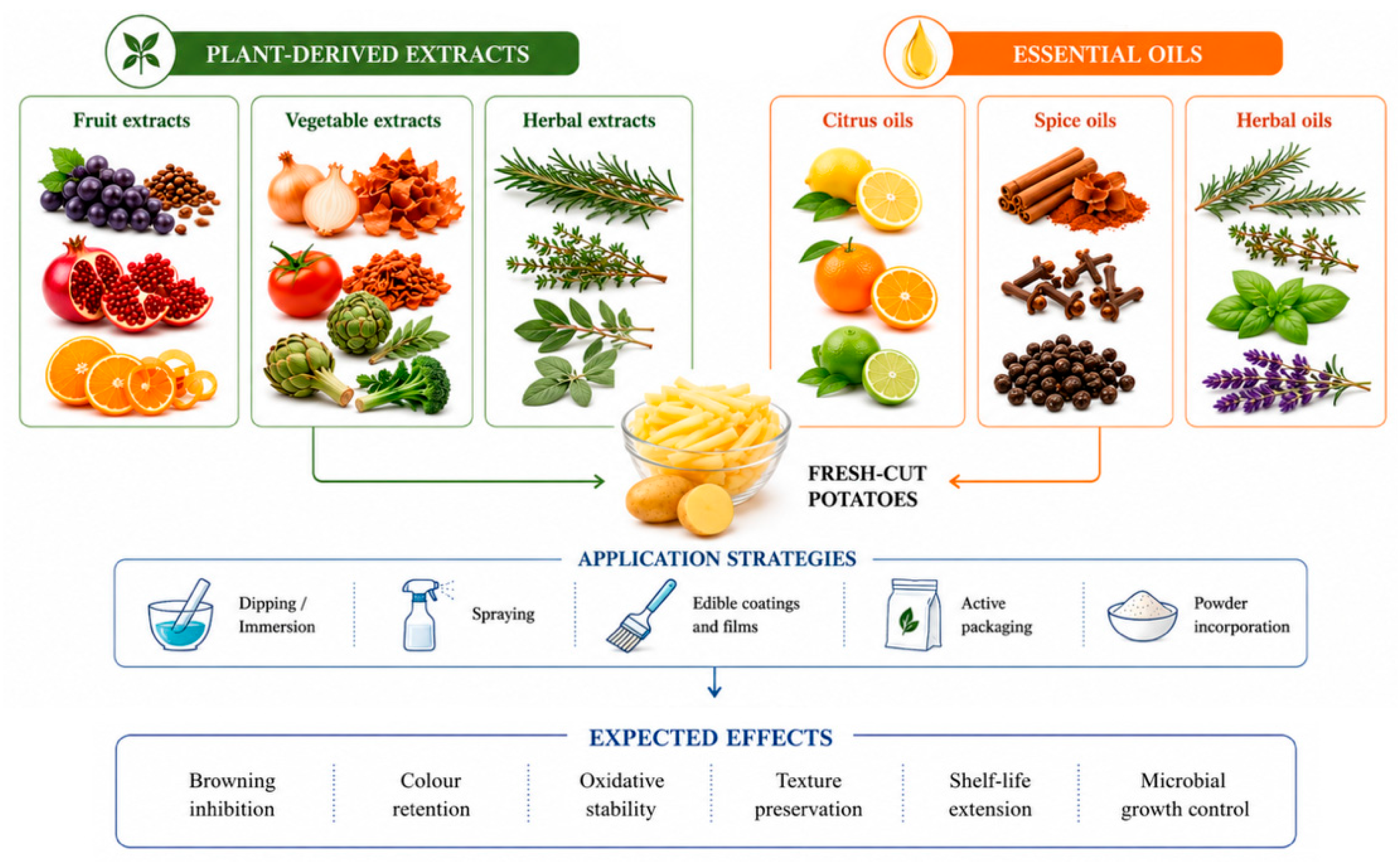
Edible coatings represent a surface-applied preservation strategy that differs from conventional packaging because the protective material is applied directly onto the food surface rather than surrounding the product. Unlike edible films, which are preformed sheets subsequently wrapped around the food, edible coatings are applied by dipping, spraying, or brushing, allowing for intimate contact with the tissue [19]. They consist of thin, edible layers of food-grade materials that form a semi-permeable barrier between the product and the surrounding environment. By regulating the transfer of gases, moisture, solutes, and volatile compounds, edible coatings can reduce respiration, moisture loss, oxidative reactions, and microbial deterioration, thereby contributing to the preservation of fresh-like quality attributes [128,129,130]. Within the framework of this review, edible coatings are included among physical preservation technologies because their primary protective function relies on the formation of a surface barrier that regulates mass transfer [131,132,133]. However, coating matrices may also incorporate bioactive compounds of different origins, including plant extracts, essential oils, antioxidants, and antimicrobial agents, which provide additional active preservation functions [134,135]. Accordingly, when such compounds are incorporated into a coating matrix, they are discussed within the edible coating section rather than as standalone preservation treatments. According to the main film-forming material, edible coatings are commonly classified as polysaccharide-, protein-, lipid-, or composite-based systems, each exhibiting different mechanical and barrier properties [136,137,138]. Additional components, including plasticizers, emulsifiers, crosslinking agents, and functional bioactive compounds, may be incorporated to tailor coating performance [19]. Polysaccharide coatings generally provide effective gas barriers but limited resistance to water vapour, protein-based coatings offer good mechanical and gas barrier properties, whereas lipid-based systems are particularly effective in limiting moisture transfer. Composite coatings combine different materials to balance these properties [136,137,138]. The incorporation of active ingredients can further provide antioxidant, antibrowning, or antimicrobial functionality, resulting in multifunctional coating systems [136,137,138,139,140,141,142].
Polysaccharide-Based Coatings
Polysaccharide-based coatings have been extensively investigated for FCPs because of their gas barrier properties and ability to limit respiration, moisture loss, enzymatic browning, and microbial deterioration. Opuntia dillenii polysaccharide coatings, for example, reduced browning, respiration, weight loss, and microbial growth during refrigerated storage, with the 1% formulation providing the best overall performance [143]. Similarly, an optimized guar gum coating containing crude algae ethanolic extract and turmeric essential oil preserved multiple quality attributes for up to 7 days at ambient temperature, combining the barrier properties of the coating matrix with the antioxidant and antimicrobial activity of the incorporated compounds [144]. Alginate- and chitosan-based systems further illustrate the potential of incorporating active compounds into polysaccharide matrices. An alginate coating enriched with thyme essential oil improved colour and firmness retention and inhibited spoilage microorganisms and Listeria monocytogenes, with the lowest essential oil concentration tested (0.05%) providing the best overall performance [145]. Similarly, a chitosan coating containing 0.2% cinnamon essential oil delayed enzymatic browning, maintained firmness, and reduced microbial growth and weight loss during refrigerated storage, whereas increasing the essential oil concentration to 0.4–0.6% adversely affected product quality, likely because of phytotoxic effects [146]. Coating architecture may also influence preservation efficacy. A multilayer chitosan/sodium alginate coating applied to fresh-cut purple-fleshed sweet potatoes outperformed the corresponding single-layer coatings, resulting in lower colour changes and weight loss, improved firmness retention, better preservation of anthocyanins and phenolic compounds, and reduced bacterial and fungal proliferation during 16 days of refrigerated storage [147]. The improved performance of the multilayer system was attributed to the complementary oxygen and moisture barrier properties of alginate and the intrinsic antimicrobial activity of chitosan [147]. Collectively, these findings indicate that polysaccharide coatings provide a versatile platform for fresh-cut produce preservation. However, their effectiveness depends not only on the coating matrix, but also on the type and concentration of incorporated active compounds and on the coating architecture.
Protein-Based Coatings
Among protein-based edible coatings, whey protein has attracted interest because of its film-forming ability and gas barrier properties. Marquez et al. developed a whey protein–pectin coating crosslinked by transglutaminase that markedly reduced weight loss and microbial growth while preserving phenolic content, hardness, and chewiness in FCPs during refrigerated storage. The improved performance was attributed to the denser polymeric network generated by enzymatic crosslinking, which enhanced the water vapour and gas barrier properties of the coating [148]. Although protein-based coatings have been less extensively investigated than polysaccharide systems, their film-forming properties and compatibility with other biopolymers make them promising components of multifunctional composite coatings [149].
Lipid-Based Coatings
Compared with polysaccharide- and protein-based systems, lipid-based edible coatings have received limited attention for FCPs. Lipid materials such as beeswax, carnauba wax, fatty acids, and monoglycerides are highly effective in reducing water vapour permeability; however, their limited gas permeability and relatively weak mechanical properties may excessively restrict gas exchange, potentially promoting anaerobic metabolism in highly respiring fresh-cut tissues. Consequently, lipid materials are more commonly incorporated into composite coatings than applied alone [19,150,151].

5.1.4. Non-Thermal Physical Processing Technologies

In recent years, several non-thermal physical processing technologies have been investigated as alternative or complementary treatments for FCP, including ultraviolet-C (UV-C) radiation, pulsed light (PL), cold plasma (CP), ultrasound (US), electron beam irradiation, and PEFs. Although refrigeration is also a non-thermal physical preservation method, it is discussed separately in this review as the conventional baseline strategy for maintaining FCP quality throughout storage and distribution. The present subsection specifically focuses on non-thermal physical processing treatments applied to the product to induce microbial inactivation, enzyme inhibition, modifications in tissue metabolism, or stimulation of plant defence responses [13]. Compared with conventional thermal treatments, these technologies aim to improve microbial safety and extend product stability while minimizing heat-induced changes in texture, colour, flavour, nutritional value, and other fresh-like quality attributes [13,20]. Although several of these technologies are still at the pilot or experimental stage, they have shown considerable potential for reducing enzymatic browning, limiting microbial growth, and preserving the physicochemical and sensory quality of FCP. Nevertheless, their effectiveness is strongly dependent on treatment conditions and product characteristics, and improvements in quality attributes do not necessarily translate into extended product shelf life.
Consequently, increasing attention has been devoted to their integration with complementary preservation strategies, such as refrigeration, MAP, and edible coatings, to exploit synergistic effects and enhance overall product stability [10,13,19,20]. However, the level of evidence specifically available for FCPs varies considerably among these technologies. For some emerging approaches, current knowledge is still partly derived from studies on other fresh-cut fruits and vegetables; therefore, these findings should be regarded as indications of technological potential rather than direct validation for FCP preservation, highlighting the need for further product-specific optimization and validation under relevant storage and processing conditions. A comparative overview of the main mechanisms, preservation effects, advantages, limitations, and current evidence regarding the application of these technologies to FCPs is provided in Table 1.
Table 1. Comparative overview of non-thermal physical processing technologies investigated for fresh-cut potato preservation.
TechnologyMechanism of ActionPrimary EffectsMain AdvantagesMain LimitationsCurrent Evidence/Application in FCPReferences
UV-CDNA photodamage in microorganisms; induction of plant defence responses and modulation of browning-related enzymesMicrobial inactivation; delayed enzymatic browning;
preservation of colour and sensory quality
Short treatment time; no chemical residues; potential integration into existing processing linesLimited penetration and surface action; efficacy affected by geometry and dose; excessive exposure may cause tissue damage/discolouration; possible increase in acrylamide precursors; regulatory and scale-up constraintsDirect FCP evidence available. Particularly effective when combined with sodium ascorbate, VP and refrigeration; less effective than Sodium Acid Sulphate (SAS) for browning control in one comparative study. Combination with High Hydrostatic Pressure (HHP) improved microbial stability but increased reducing sugars and acrylamide formation after frying[152,153,154]
Pulsed light (PL)High-intensity broad-spectrum light; photochemical, photothermal and photophysical mechanismsMicrobial and enzymatic inactivationVery short treatment; high energy delivery with limited overall heat transferLimited penetration; shadowing; efficacy affected by product geometry and optical properties; excessive fluence may cause localized heating and tissue damage; lack of standardized protocolsLimited direct evidence for FCP. Promising results have mainly been obtained in other fresh-cut horticultural products; FCP-specific optimization and validation are still required[155,156,157,158,159]
Cold plasma (CP)Reactive oxygen and nitrogen species, charged particles and UV photonsMicrobial decontamination; PPO/POD inactivation; delayed enzymatic browningNear-ambient temperature; no chemical residues; potential in-package applicationStrongly treatment-dependent; excessive exposure may induce oxidative tissue damage; mainly surface-dependent actionPotato studies show substantial inhibition of browning-related enzymes and delayed surface browning with relatively limited effects on tissue integrity; evidence remains limited compared with UV-C[160,161,162,163]
Ultrasound (US)Acoustic cavitation generating localized pressure, shear forces and reactive radicalsEnzyme modulation/inactivation; enhanced mass transfer; browning control; potential microbial effectsSimple application; low energy requirements; no chemical residues; suitable for combination with antibrowning agentsStrong dependence on frequency, power and exposure time; excessive cavitation may cause tissue disruption and firmness lossDirect FCP studies indicate that moderate treatment can control PPO activity while maintaining quality; combinations with natural antibrowning compounds showed greater effectiveness than US alone[164,165,166]
Pulsed electric fields (PEF)Reversible or irreversible electroporation of cell membranesEnhanced mass transfer; modification of tissue structure; reduced reducing sugars; potential browning control when combined with other treatmentsMinimal temperature increase; useful as pretreatment; potential integration with OD and MAPHigh capital costs; application-specific optimization required; limited effectiveness against some enzymes and bacterial spores; excessive permeabilization may affect tissue propertiesEvidence is stronger for processing improvement and hurdle applications than for standalone FCP preservation. PEF has shown promising results as a pretreatment combined with OD and MAP, contributing to mass transfer enhancement and quality retention during refrigerated storage.[115,167]
Abbreviations: CP, cold plasma; DNA, deoxyribonucleic acid; FCP, fresh-cut potato; HHP, high hydrostatic pressure; MAP, modified atmosphere packaging; OD, osmotic dehydration; PEF, pulsed electric field; PL, pulsed light; PPO, polyphenol oxidase; POD, peroxidase; SAS, sodium acid sulphate; US, ultrasound; UV-C, ultraviolet-C; VP, vacuum packaging.
UV-C Radiation
UV-C radiation is one of the most extensively investigated non-thermal technologies for the preservation of fresh-cut fruits and vegetables. UV-C light, typically emitted at wavelengths between 200 and 280 nm (with maximum germicidal activity around 254 nm), inactivates microorganisms primarily through the formation of DNA photoproducts that inhibit DNA replication and cell division [13,168]. In plant tissues, low UV-C doses may also induce hormetic responses, stimulate antioxidant defence systems, and reduce the activity of enzymes involved in enzymatic browning [10,13,20,168,169]. However, its limited penetration restricts UV-C primarily to surface decontamination, making its effectiveness dependent on product characteristics and applied dose [168,170,171,172]. Excessive exposure may induce tissue damage, surface discolouration, or accelerated senescence [172,173,174]. Of particular relevance to potato products intended for frying, UV-C treatment may increase acrylamide formation by altering carbohydrate metabolism and increasing the availability of acrylamide precursors [19,175,176]. Moreover, industrial implementation remains constrained by process validation, investment requirements, and potential regulatory considerations under the European Novel Food Regulation (EU) 2015/2283 [13,177,178]. Studies on FCPs confirm the potential of UV-C, although its effectiveness strongly depends on treatment conditions and complementary preservation strategies. UV-C combined with sodium ascorbate, VP, and refrigeration improved microbial stability, delayed browning, and maintained sensory quality, extending product acceptability during refrigerated storage [152]. However, UV-C was less effective than Sodium Acid Sulphate (SAS) in controlling enzymatic browning and PPO activity, while its combination with SAS provided no additional benefit [153]. Combining UV-C with High Hydrostatic Pressure (HHP) further improved microbiological stability but promoted reducing sugar accumulation and subsequent acrylamide formation after frying [154]. Overall, these findings highlight the need to optimize UV-C treatments by balancing microbial stabilization with technological quality and the intended end use of FCPs.
Pulsed Light (PL)
PL is an emerging non-thermal technology based on short, high-intensity pulses of broad-spectrum light (200–1100 nm), including UV, visible, and near-infrared wavelengths. Compared with continuous UV-C irradiation, PL delivers high energy over very short exposure times, promoting microbial and enzymatic inactivation through photochemical, photothermal, and photophysical mechanisms while minimizing overall heat transfer to the product [179,180]. However, its limited penetration restricts its effectiveness primarily to exposed surfaces, making treatment efficacy dependent on product geometry, optical properties, and processing conditions. Excessive fluence may also cause localized heating, tissue damage, and discolouration, while the lack of standardized protocols and industrial-scale validation remains an important limitation [179,180,181].
Although direct evidence for FCPs remains scarce, successful applications in other fresh-cut horticultural products, including apples, melons, lettuce, tomatoes, and mushrooms, support the potential of PL as a preservation strategy [156,158,182,183,184]. Nevertheless, FCP-specific studies are required to establish optimal treatment conditions and determine whether improvements in individual quality and safety parameters translate into meaningful shelf-life extension.
Cold Plasma (CP)
CP is an emerging non-thermal technology that combines microbial decontamination with minimal thermal damage. Plasma is a partially ionized gas containing electrons, ions, UV photons, and reactive oxygen and nitrogen species (ROS/RNS), which can inactivate microorganisms and reduce the activity of browning-related enzymes. CP operates at near-ambient temperature, leaves no chemical residues, and may also be applied in-package, thereby reducing the risk of post-processing contamination. However, its effectiveness strongly depends on treatment conditions, while excessive exposure may induce oxidative damage to plant tissues [10,19,163,185]. Studies on potato tissues support the potential of CP for controlling enzymatic browning. Plasma-processed air markedly reduced PPO and POD activities and prevented browning while largely preserving tissue integrity [186]. Similarly, microwave CP partially inactivated PPO and delayed surface browning in potato slices, with treatment efficacy increasing with the exposed surface area [160]. Overall, these findings indicate that CP is a promising strategy for browning control, although the limited evidence currently available and its surface-dependent efficacy require further investigation under FCP storage conditions.
Ultrasound (US)
US is a non-thermal preservation technology increasingly investigated for fresh-cut fruits and vegetables. High-power US (generally 20–100 kHz) generates acoustic cavitation, producing localized pressure, shear forces, and reactive radicals that can inactivate microorganisms, modify enzyme activity, enhance mass transfer, and reduce enzymatic browning with minimal thermal damage [10,166]. However, its effectiveness strongly depends on treatment conditions and food matrix characteristics. Excessive sonication may induce tissue disruption and firmness loss, whereas moderate treatments generally provide a better balance between enzyme inactivation and quality preservation. Consequently, US has also been investigated in combination with natural antibrowning agents to exploit synergistic preservation effects [165,166]. Studies on FCPs confirm the importance of treatment intensity and combined preservation approaches. Moderate US treatment reduced PPO activity while maintaining colour and firmness, whereas prolonged sonication caused cell damage due to excessive cavitation [166]. Combining US with Sonchus oleraceus L. extract or L-cysteine provided greater browning control than US alone, reducing browning-related enzyme activity and oxidative processes while preserving antioxidant compounds [164,165]. Overall, these findings suggest that moderate US treatments, particularly when combined with antibrowning agents, may provide a better balance between browning control and preservation of tissue integrity.
Pulsed Electric Fields (PEFs)
A PEF is a non-thermal technology based on the application of short high-voltage electric pulses to food placed between two electrodes, inducing reversible or irreversible electroporation of cell membranes with minimal temperature increases. Treatment effectiveness depends on electric field strength, pulse characteristics, energy input, temperature, and the electrical properties of the food matrix [19,187]. In plant tissues, electroporation enhances mass transfer, supporting applications in extraction, Osmotic Dehydration (OD), drying, and frying processes [19,188]. However, industrial implementation remains constrained by high capital costs, application-specific optimization, and limited effectiveness against certain enzymes and bacterial spores [187].
In potato tissues, PEF-induced membrane permeabilization has been associated with enhanced mass transfer, reduced reducing sugar content, modifications in tissue texture, and lower oil uptake during subsequent frying [167,189]. Beyond these processing applications, PEFs combined with OD and MAP improved mass transfer and contributed to browning control, texture retention, and microbiological stability during refrigerated storage [115]. Overall, current evidence suggests that PEF is particularly promising as a pretreatment or component of hurdle preservation strategies rather than as a standalone preservation technology for FCPs, although application-specific optimization remains necessary.

5.2. Chemical Preservation Technologies

5.2.1. Chlorine-Based Sanitizers

Chlorine-based sanitizers remain the most widely used chemical disinfectants in the fresh-cut produce industry owing to their broad antimicrobial spectrum, rapid action, ease of application, and relatively low cost. Their primary role is to reduce the microbial load on fresh produce and, more importantly, to prevent cross-contamination during washing operations rather than to completely eliminate microorganisms already attached to plant tissues. The antimicrobial activity of chlorine is mainly attributed to the oxidative action of hypochlorous acid (HOCl), which damages microbial cell membranes, proteins, and nucleic acids. Among chlorine-based sanitizers, sodium hypochlorite (NaOCl) is by far the most commonly used, generally at concentrations ranging from 50 to 200 mg L−1 of free chlorine, while calcium hypochlorite (Ca(OCl)2) is mainly employed as a more stable source of available chlorine for preparing sanitizing solutions. Chlorine dioxide (ClO2), applied either in aqueous or gaseous form, has emerged as an alternative disinfectant because of its stronger oxidizing capacity, effectiveness over a wider pH range (approximately pH 3–8), and reduced formation of chlorinated by-products compared with conventional hypochlorite solutions [10,13,190]. Despite their widespread industrial use, chlorine-based sanitizers present several important limitations that have prompted increasing interest in alternative technologies. Under commercial processing conditions, their antimicrobial efficacy is generally limited to approximately 1–2 log reductions and is strongly influenced by contact time, pH, temperature, and, above all, the presence of organic matter released from damaged plant tissues. Organic compounds rapidly consume free chlorine, reducing the concentration of hypochlorous acid available for microbial inactivation and consequently decreasing sanitizing efficiency. As a result, maintaining an effective residual free chlorine concentration throughout industrial washing operations represents a major technical challenge, particularly in recirculated wash water with high organic loads [190,191,192]. Another major concern is the formation of disinfection by-products (DBPs) generated when free chlorine reacts with organic matter released from cut tissues. Besides the well-known trihalomethanes (THMs), chlorination may also produce haloacetic acids (HAAs), chloramines, chlorate and other DBPs. Some of these compounds, particularly certain THMs, have been classified by the International Agency for Research on Cancer (IARC) as possibly carcinogenic to humans, whereas others have raised toxicological concerns because of their cytotoxic, genotoxic, mutagenic, or endocrine-disrupting properties [192,193,194,195]. Consequently, minimizing chlorine dosage while maintaining adequate microbiological safety has become a major objective for the fresh-cut industry [192,193]. Partially due to the possible generation of DBPs, the use of chlorine in fresh-cut produce washing is not permitted in several European countries such as Germany, Switzerland, the Netherlands, Denmark, and Belgium [192]. Furthermore, increasing concerns regarding chlorate residues generated during the use of chlorine-based disinfectants have also led to regulatory actions. In the European Union, maximum residue levels (MRLs) for chlorate have been established under Commission Regulation (EU) 2020/749 following European Food Safety Authority (EFSA)’s risk assessment, which identified chlorate exposure as a potential concern for vulnerable population groups. Accordingly, an MRL of 0.05 mg kg−1 has been established for potatoes, reflecting the need to minimize chlorate formation while maintaining adequate hygienic practices [196]. Although studies specifically addressing FCPs are relatively limited, chlorine-based sanitizers remain the industrial standard for washing operations owing to their low cost and ease of application. Nevertheless, because they exert little direct effect on enzymatic browning or texture preservation, they are generally combined with acidulants, calcium salts, or other preservation technologies within hurdle strategies to simultaneously address microbial contamination and quality deterioration [10].

5.2.2. Ozone

Ozone (O3) is an environmentally friendly sanitizing agent widely investigated as an alternative to chlorine for fresh-cut produce because of its strong oxidizing capacity and broad antimicrobial spectrum. Ozone inactivates microorganisms through the oxidation of cell membranes, proteins, enzymes, and nucleic acids, while rapidly decomposing into oxygen without leaving persistent chemical residues. Its practical application nevertheless remains subject to the regulatory requirements applicable to the specific food processing context. Depending on the application, ozone can be used as aqueous ozone during washing or as gaseous ozone during refrigerated storage [197,198]. The effectiveness of ozone, however, is highly dependent on treatment conditions, including ozone concentration, exposure time, temperature, relative humidity, pH, organic load, and the characteristics of the commodity surface. In particular, organic matter released from cut tissues rapidly consumes ozone, reducing its antimicrobial efficacy, while rough or porous surfaces may protect microorganisms from oxidation. Furthermore, excessive ozone exposure may promote oxidative stress, tissue damage, colour loss, softening, off-flavour development, and degradation of quality-related compounds. Consequently, ozone is generally considered more effective when applied at optimized doses or combined with complementary preservation strategies [197,198,199]. Studies on FCPs have shown promising but sometimes inconsistent results. Beltrán et al. reported that aqueous ozone, particularly when combined with peroxyacetic acid, effectively delayed browning, maintained sensory quality, and reduced microbial populations during refrigerated storage, whereas ozone alone showed only limited antimicrobial efficacy. These findings suggest that ozone performs best as part of a hurdle preservation strategy rather than as a stand-alone treatment [93]. Similarly, Calder et al. evaluated a 2 ppm aqueous ozone wash before different acidulant treatments and found that ozone significantly improved colour retention, as indicated by higher L* values and lower a* values, but did not significantly affect PPO activity or aerobic plate counts. The greatest reductions in browning and microbial growth were achieved with SAS and the commercial NatureSeal® (ReduSal, Mantrose-Haeuser Co., Inc., Westport, CT, USA) treatment, irrespective of ozone application. These results indicate that ozone alone is insufficient to control enzymatic browning and microbial spoilage in FCPs, whereas its combination with suitable acidulants substantially improves product quality and shelf life [200].

5.2.3. Electrolyzed Water (EW)

EW is an emerging green sanitation technology produced by the electrolysis of dilute salt solutions, generating oxidizing and reducing species with different physicochemical properties and biological activities. Compared with conventional chlorine-based disinfectants, EW offers several advantages, including on-site generation, rapid antimicrobial activity, minimal environmental impact, and limited chemical residues after use, attracting increasing interest as an alternative sanitizer for fresh-cut fruit and vegetables [201,202]. Its antimicrobial efficacy mainly depends on available chlorine concentration, pH, and oxidation–reduction potential (ORP), which determine the abundance of reactive chlorine species. Among these, hypochlorous acid (HOCl) is considered the principal antimicrobial agent because it readily penetrates microbial cell membranes and causes oxidative damage to essential cellular components [202,203,204]. Several forms of EW have been developed according to the electrolysis system employed. Acidic electrolyzed water (AEW) is characterized by low pH (approximately 2–3), high ORP (>950 mV), and high HOCl concentrations, resulting in strong antimicrobial activity [202,205,206]. Alkaline electrolyzed water (AlEW), produced at the cathode, exhibits an alkaline pH (11–13), negative ORP, and reducing properties, providing effective cleaning rather than strong antimicrobial activity [202,207,208]. More recently, slightly acidic electrolyzed water (SAEW; pH 5.0–6.5) has emerged as a promising formulation for fresh produce because HOCl predominates within this pH range, providing high antimicrobial efficacy while reducing chlorine volatilization, equipment corrosion, and the formation of undesirable chlorinated by-products compared with strongly AEW [206,209,210]. Besides microbial decontamination, EW may contribute to reducing enzymatic browning, preserving bioactive compounds, and removing pesticide residues, although its effectiveness depends strongly on treatment conditions and food matrix characteristics [202]. The application of EW to FCPs has been investigated in a limited number of studies. Izumi reported reductions in microbial populations of approximately 0.6–2.6 log Colony-Forming Units (CFU) g−1 following treatment with electrolyzed neutral water, without significant effects on tissue pH, surface colour, or overall appearance [211]. More recently, Li et al. investigated the sequential application of SAEW and AlEW and found that the combined treatment better maintained colour, delayed the respiratory peak, decreased weight loss by approximately 33%, improved firmness retention by approximately 18%, reduced microbial counts by about 1 log CFU g−1, and improved sensory quality during 21 days of refrigerated storage. These effects were attributed to the complementary antimicrobial action of SAEW and the cleaning and antioxidant effects of AlEW [212]. In addition, Liu et al. demonstrated that AEW was more effective than tap water, sodium hypochlorite, or AlEW in removing pesticide residues from FCPs, while its combination with US further enhanced pesticide degradation [213].

5.2.4. Firming Agents

Firming agents are widely used in fresh-cut fruits and vegetables to counteract tissue softening caused by peeling, cutting, and storage. Their beneficial effect is mainly attributed to calcium ions, which diffuse through the apoplast and interact with de-esterified pectins in the middle lamella, forming calcium pectate crosslinks according to the “egg-box” model. These crosslinks reinforce the cell wall, strengthen intercellular adhesion, reduce cell separation, and consequently maintain tissue firmness. In addition, calcium contributes to plasma membrane stabilization, reducing membrane degradation and preserving cell turgor during storage. These mechanisms also limit the accessibility of cell wall-degrading enzymes and microbial hydrolases, thereby contributing to improved tissue integrity [214,215]. Among calcium salts, calcium chloride (CaCl2) is the most widely used firming agent because of its high effectiveness, low cost, and ease of application. In addition to preserving texture, calcium chloride has been reported to reduce physiological disorders and improve resistance to postharvest deterioration, making it a common component of fresh-cut produce processing lines [10,215]. Zhao et al. demonstrated that CaCl2 enhances pectin gelation within potato cell walls, reinforcing tissue structure and leading to improved crispness and reduced oil uptake during frying. Nevertheless, these positive effects were concentration-dependent, since excessive CaCl2 levels increased tissue permeability and adversely affected texture and overall product quality [216]. However, excessive concentrations may also impart undesirable bitter or salty off-flavours due to residual calcium chloride remaining on the product surface, limiting consumer acceptance [214,217]. Calcium lactate has therefore been proposed as an alternative calcium source capable of providing comparable tissue strengthening while minimizing the bitterness associated with calcium chloride. Studies on fresh-cut cantaloupe and fresh-cut mango demonstrated that both calcium chloride and calcium lactate effectively delayed tissue softening during refrigerated storage, although calcium chloride generally provided slightly greater firmness retention, whereas calcium lactate showed superior sensory acceptability because it did not impart undesirable flavours [214,217,218]. Beyond texture preservation, calcium treatments have also been shown to stabilize cell membranes, reduce oxidative damage, slow respiration, preserve organic acids and soluble sugars, and limit microbial growth during storage, thereby contributing to an overall improvement in postharvest quality [218]. In FCPs, calcium salts are generally applied as part of combined preservation strategies rather than as stand-alone treatments. CaCl2 is frequently combined with antibrowning agents such as citric acid or AA to simultaneously maintain texture and limit enzymatic browning. For example, Irfan et al. treated FCPs with 3% CaCl2, 2% citric acid, and 0.3% potassium metabisulfite, reporting good firmness retention and acceptable physicochemical quality throughout refrigerated storage [217]. Although calcium phosphate, calcium gluconate, and other calcium salts have also been investigated as firming agents for fresh-cut produce, their application in FCPs remains limited compared with calcium chloride and calcium lactate, which continue to represent the reference firming agents for commercial potato processing [10].

5.2.5. Antibrowning Agents

Chemical antibrowning agents represent one of the most widely adopted strategies for controlling enzymatic browning in fresh-cut produce. As described in Section 4.2, browning development depends on multiple factors, including PPO activity, substrate availability, membrane integrity, oxygen accessibility, and the reactions occurring after phenolic oxidation. Consequently, effective control can be achieved by targeting different stages of the browning process rather than PPO activity alone [66,219,220]. According to their predominant mechanism of action, chemical antibrowning agents can be broadly classified as antioxidants/reducing agents, acidulants, copper-chelating agents, direct PPO inhibitors, and compounds exhibiting multiple inhibitory mechanisms. These agents may act through quinone reduction, oxygen scavenging, copper chelation, pH reduction, or direct interference with PPO activity. Because individual compounds generally target only specific steps of the browning cascade, combinations of antibrowning agents are frequently employed to exploit complementary or synergistic mechanisms and achieve more effective colour preservation than single treatments [69,219]. The principal mechanisms of action of antibrowning agents are summarized in Figure 5.
Reducing Agents and Antioxidants
Reducing agents and antioxidants are among the most extensively investigated antibrowning compounds because they interfere with oxidative reactions occurring downstream of PPO catalysis. Depending on their chemical properties, they may reduce reactive o-quinones back to their corresponding o-diphenols, scavenge oxygen and ROS, or trap quinones through the formation of stable colourless adducts. Their effectiveness is often transient because reducing compounds are progressively consumed during oxidation, which frequently favours their combination with complementary antibrowning strategies [39,221].
Sulphites, particularly sulphur dioxide (SO2) and sodium metabisulfite (SMBS), have historically been among the most effective antibrowning agents used in fresh-cut produce. Their activity relies on quinone reduction, formation of stable colourless sulfonate adducts, and partial inhibition of PPO activity [20,222,223]. Despite their high efficacy, sulfite use has markedly declined because of toxicological, sensory, and regulatory concerns. Sulphites may trigger hypersensitivity reactions, particularly in asthmatic individuals [224]. Accordingly, sulphur dioxide and sulphites are included among the substances or products causing allergies or intolerances under Regulation (EU) No 1169/2011 and must be declared when present at concentrations above 10 mg kg−1 or 10 mg L−1, expressed as SO2 [225]. EFSA also concluded that the available toxicological database was insufficient to establish an acceptable daily intake and identified potential concerns for high consumers [222]. At high concentrations, sulphites may additionally cause sulphur-like odours and off-flavours and promote thiamine degradation [93,223,226,227]. Ren et al. evaluated 0.1–0.5% SMBS in FCPs and found that 0.3% effectively delayed browning, reduced PPO, POD, and PAL activities, and preserved texture and sensory quality during refrigerated storage, whereas increasing the concentration to 0.5% provided only marginal additional benefits [227].
AA is widely used as an antibrowning agent owing to its high reducing capacity, low cost, and Generally Recognized as Safe (GRAS) status. It rapidly reduces reactive o-quinones and contributes to maintaining a reducing cellular environment, but its protective effect is temporary because it is progressively oxidized to dehydroascorbic acid during storage. Consequently, AA is frequently combined with acidulants, calcium salts, or other antibrowning agents to prolong its activity [39,228]. Studies on potato cultivars further indicate that higher endogenous AA concentrations and a greater AA/Dehydroascorbic Acid (DHA) ratio are associated with lower browning susceptibility, while exogenous AA treatments can delay colour deterioration in a concentration-dependent manner by supporting cellular redox balance [228].
L-Cysteine acts predominantly through quinone trapping, reacting with o-quinones to form stable, colourless cysteinyl-quinone adducts. Partial inhibition of PPO, and in some plant tissues of POD, has also been reported, although excessive concentrations may cause sulphur-like off-flavours [39,221,229,230,231]. In FCPs, Li et al. compared AA, L-cysteine, H2S, and Nitric Oxide (NO) and found that only AA and L-cysteine effectively reduced browning, with L-cysteine providing a more sustained protective effect during storage without adversely affecting respiration rate, weight loss, or tissue decay [39]. Cerit et al. similarly reported that 1.0–2.0% L-cysteine was the most effective among L-cysteine, N-acetyl-L-cysteine (NAC), GSH, and SMBS, completely inhibiting PPO activity after 48 h and significantly reducing surface browning [221]. A further study showed that combining L-cysteine with ultrasound produced stronger inhibition than either treatment alone, highlighting its potential within hurdle approaches. GSH, a naturally occurring tripeptide, also limits browning through its sulfhydryl group, which can react with o-quinones, while contributing to cellular redox homeostasis through the ascorbate-glutathione cycle [69,232]. However, its effectiveness in FCPs appears lower than that of L-cysteine and NAC. Cerit et al. attributed this lower efficacy to the rapid depletion of its reducing capacity, suggesting limited potential for GSH as a stand-alone antibrowning treatment [221].
Acidulants
Acidulants are widely used antibrowning agents because they suppress enzymatic browning primarily by lowering tissue pH below the optimum range for PPO activity [37,69]. PPO generally exhibits maximum catalytic activity at near-neutral pH (approximately 6–7), whereas activity progressively declines under acidic conditions, with strong acidification potentially causing irreversible inactivation partly through dissociation of copper ions from the enzyme active site [233]. For potato PPO, reported optimum pH values are consistent across studies, ranging from approximately 6.5 to 7.5 [234,235,236]. Accordingly, immersion of FCPs in acidic solutions can effectively delay browning by reducing PPO activity. Among the acidulants investigated for FCP, citric acid is the most extensively studied, although malic, lactic, acetic, phosphoric, and tartaric acids have also been evaluated, either alone or in combination with other antibrowning agents [69,200,237]. In addition to acidification, citric acid can chelate Cu2+ ions at the PPO active site, providing a complementary inhibitory mechanism [233,238,239,240]. This dual action may explain its greater antibrowning efficacy compared with mineral acids adjusted to the same pH. Nevertheless, acidulants alone generally provide limited long-term protection, supporting their combination with reducing agents, calcium salts, or other complementary treatments [44,69,241]. Studies on FCPs support both the effectiveness and the multiple effects of citric acid. Rocculi et al. reported a concentration-dependent improvement in colour retention following treatment with 0.5–2.0% citric acid but also observed increased tissue metabolic activity and reduced concentrations of reducing sugars, indicating physiological effects beyond PPO inhibition [237]. Similarly, Tsouvaltzis and Brecht showed that 1–2% citric acid provided greater colour retention than sulfuric acid treatments adjusted to comparable pH values, confirming that its antibrowning activity cannot be attributed solely to acidification [242]. Finally, Li et al. reported effective browning control during 15 days of refrigerated storage using citric acid combined with AA, L-cysteine, and ultrasonication, supporting the potential of citric acid within multi-target antibrowning strategies [243].
Chelating Agents
Chelating agents inhibit enzymatic browning by binding the Cu2+ ions located at the catalytic centre of PPO, a type-3 copper metalloenzyme, thereby interfering with its catalytic activity and reducing quinone formation [66,69,233,244]. As discussed in the previous section, citric acid combines tissue acidification with Cu2+ chelation, which contributes to its greater antibrowning efficacy compared with mineral acids adjusted to the same pH. Ethylenediaminetetraacetic acid (EDTA) is a highly effective synthetic metal chelator with strong affinity for Cu2+ ions. However, its application in foods is restricted, as calcium disodium EDTA (E385) is authorized only for specific food categories and at defined maximum levels under European food additive legislation [245,246]. The mineral-binding properties of EDTA have also raised concerns regarding potential interactions with nutritionally relevant minerals [247]. Together with increasing consumer preference for clean-label products, these limitations restrict its practical use in FCPs, where EDTA is more commonly employed as a reference PPO inhibitor than as a stand-alone antibrowning treatment [248]. Diethylenetriamine pentaacetic acid (DTPA) has also been evaluated as a chelating antibrowning agent for FCP. Cacace et al. reported that a 1% DTPA treatment delayed surface discolouration and reduced microbial growth in potato strips stored under MAP; however, it was less effective than a combination of erythorbic and citric acids in maintaining colour and sensory quality. These findings indicate that copper chelation alone may provide only partial protection and support the greater effectiveness of treatments combining complementary antibrowning mechanisms [95]. Moreover, the practical application of DTPA in foods is limited because it is not authorized as a food additive in the European Union [245].
Direct PPO Inhibitors
Direct PPO inhibitors suppress enzymatic browning through interaction with the enzyme itself. Depending on their molecular structure, inhibition may involve competition with phenolic substrates, interaction with the catalytic copper centre, conformational changes affecting enzyme activity, or, less commonly, irreversible inactivation [69,249,250]. Competitive inhibition occurs when an inhibitor competes with phenolic substrates for access to the PPO active site, thereby limiting substrate oxidation [69,251,252]. Among the compounds investigated for the control of enzymatic browning, 4-hexylresorcinol (4-HR) is a potent direct PPO inhibitor. Mechanistic studies have shown that 4-HR acts as a reversible mixed-type inhibitor of PPO, while its combination with AA provides an additive antibrowning effect [253]. In potato cubes, Reyes-Moreno et al. demonstrated that treatments combining 4-HR and AA effectively prevented enzymatic browning, supporting the potential of combining direct PPO inhibition with antioxidant-based approaches [254]. Direct interaction with the catalytic copper centre represents another inhibitory mechanism. Kojic acid is a representative example, as it coordinates the catalytic Cu2+ ions and thereby interferes with PPO activity [249,255]. In FCP, Fang et al. showed that kojic acid treatment reduced browning and PPO activity during 12 days of refrigerated storage, while also affecting PAL activity and maintaining antioxidant capacity [255]. Chen et al. similarly reported substantial browning inhibition together with preservation of lightness, texture, and water retention. Moreover, combination with lauroyl arginine ethyl ester hydrochloride enhanced microbial control, illustrating the potential of integrating direct PPO inhibition with complementary antimicrobial strategies [249]. Some compounds may additionally inhibit PPO by inducing conformational changes that alter active-site architecture or substrate accessibility [256,257]. However, evidence for this mechanism is largely derived from purified PPO systems and therefore cannot necessarily be extrapolated to FCP. Hesperetin, for example, has been shown to modify PPO conformation in purified enzyme models [257], whereas chlorogenic acid was reported to act as a reversible mixed-type inhibitor associated with conformational changes in PPO. Importantly, the latter effects were also accompanied by reduced PPO activity and enzymatic browning in FCPs during refrigerated storage [258]. Further studies using potato-specific systems are therefore needed to establish the practical relevance of conformational inhibition for FCP preservation.
A less common mechanism of direct PPO inhibition is mechanism-based, or suicide, inhibition, which results in irreversible enzyme inactivation. In this process, the inhibitor initially behaves as a substrate analogue and is recognized and processed by PPO. During catalysis, however, it is converted into a reactive intermediate that subsequently interacts with the enzyme active site, leading to its irreversible inactivation. Unlike reversible inhibition, enzyme activity cannot be restored by dissociation of the inhibitor and therefore requires de novo enzyme synthesis [259,260,261]. This mechanism should be distinguished from other forms of irreversible PPO inhibition, such as those associated with sulphites, which may chemically modify the enzyme or react with o-quinones but are not converted by PPO into a reactive inhibitory intermediate. Although mechanism-based inhibition has been described for tyrosinase in biochemical systems, it has not been convincingly demonstrated for antibrowning agents currently applied to FCPs, where reversible inhibitory mechanisms appear to predominate [262,263,264].

5.3. Plant-Derived Natural Preservatives

Growing consumer demand for clean-label foods, increasing concerns regarding the safety and acceptability of synthetic preservatives, and the growing interest in sustainable food systems have stimulated considerable research into natural preservation strategies [265,266]. In recent years, particular attention has been devoted to extracts obtained from fruits, vegetables, and herbs, particularly those recovered from agro-industrial by-products. These residues represent abundant and inexpensive sources of bioactive compounds, offering a sustainable approach to both waste valorization and the development of natural preservatives. The recovery of high-value phytochemicals from agro-food processing residues not only contributes to reducing the environmental impact of food waste but also provides functional ingredients capable of extending the shelf life and preserving the quality of minimally processed products [267,268,269,270]. The preservative potential of plant-derived extracts is primarily attributed to their complex phytochemical composition. Unlike purified compounds, plant extracts contain a wide range of bioactive constituents, including phenolic acids, flavonoids, tannins, anthocyanins, betalains, carotenoids, and other secondary metabolites that may act individually or synergistically [271,272,273,274,275,276]. These phytochemicals can delay quality deterioration through multiple complementary mechanisms, such as direct or indirect inhibition of PPO, scavenging of ROS, protection of cell membrane integrity, inhibition of microbial growth, and preservation of endogenous antioxidant systems. Consequently, plant-derived extracts frequently provide broader protection than single-component preservatives, simultaneously contributing to colour retention, texture preservation, and improved oxidative stability during storage [46,276,277,278]. Plant-derived extracts and essential oils can be applied in different forms, including aqueous extracts or plant juices, powders, dipping or spraying treatments, incorporation into edible coatings or films, and active packaging systems [46].
The following sections present representative examples of plant-derived extracts and essential oils investigated as natural preservation strategies for FCPs, as summarized in Figure 6.
Table 2 summarizes representative studies on the application of plant-derived extracts and essential oils as natural preservation strategies for FCPs, including their source, preparation, application strategy, and main preservation outcomes.
Overall, the studies summarized in Table 2 indicate that plant-derived extracts and essential oils represent promising natural alternatives for preserving the quality of FCPs through multiple complementary mechanisms [279,280,281]. Most plant extracts primarily delayed enzymatic browning by inhibiting PPO activity, preserving colour, and enhancing the antioxidant status of potato tissues, whereas essential oils generally provided the additional benefit of antimicrobial activity, thereby targeting a broader range of deterioration processes than plant extracts [146,281,282,283]. However, the efficacy of essential oils was highly dependent on their concentration and formulation, as excessive doses could negatively affect colour or sensory acceptability despite improving microbial control [145,284]. Consequently, combining plant-derived preservatives with suitable application strategies, such as edible coatings, vacuum impregnation, or packaging systems, appears to be the most promising approach to simultaneously control enzymatic browning, microbial spoilage, and quality deterioration in FCPs.
Table 2. Plant-derived extracts and essential oils investigated as natural preservation strategies for FCPs.
SourceMajor Bioactive CompoundsPreparation/Extraction MethodApplication StrategyMain Preservation OutcomesRef
Plant-derived extracts
Hawthorn leavesPhenolic compounds, flavonoids, proanthocyanidinsWater extractDipping
(5 min)
Delayed browning; maintained higher L*; reduced PPO, POD and PAL activities; enhanced antioxidant defence during refrigerated storage.[279]
PurslanePolyphenols and alkaloidsAqueous extractDipping
(5 min)
Delayed browning; reduced PPO, POD and PAL activities; preserved membrane integrity and colour during storage.[280]
Broccoli leaves processing waterGlucosinolates, phenolic compounds, organic acids, anthocyanins, sulphur compoundsBroccoli cooking water (85 °C, 15 min), filteredSprayingReduced browning and PPO activity; synergistic antibrowning effect with AA.[285]
Onion (bulbs and Borettana wastes)Phenolic compounds and organosulfur compoundsOnion juices and distillatesSprayingReduced browning and PPO activity; onion juices more effective in vivo, distillates more effective in vitro.[286]
Unripe grapesOrganic acids and phenolic compounds (particularly EGCG)Juice obtained by centrifugationSprayingReduced browning and PPO activity; stronger PPO inhibition than AA; effective in vivo antibrowning activity.[287]
Green teaCatechins (EGCG, EGC, ECG), gallic acid, myricetinOptimized aqueous extract (55 °C, 7 min)Dipping
(7 min)
Delayed browning; maintained higher L*; stabilized pH and soluble solids; extended shelf-life to 14 d.[283]
Seabuckthorn leavesPhenolic compounds, flavonoidsWater extractDipping
(2 min)
Delayed browning; reduced PPO, POD and PAL activities; enhanced antioxidant capacity and colour retention.[188]
Essential oils
Cinnamon essential oilCinnamaldehyde, cinnamyl esters, eugenol, vanillinChitosan coating + cinnamon essential oil (0.2–0.6%)Edible coating
(2 min dipping)
The 0.2% coating inhibited browning, maintained firmness and reduced weight loss and microbial growth during refrigerated storage.[146]
Thyme essential oilThymolAlginate coating + TEO (0.05–0.65%)Edible coating
(2 min dipping)
Best performance at 0.05% TEO: preserved colour (↑L, ↓BI); maintained firmness and sensory quality; reduced microbial growth and Listeria monocytogenes; higher concentrations impaired quality[145]
Rosemary essential oil1,8-Cineole, α-pinene, borneol, verbenone, camphorPeanut oil + 0.5% rosemary essential oilDipping + VPImproved texture retention, reduced growth of mesophilic bacteria and Enterobacteriaceae, preserved AA, total polyphenols and antioxidant activity, and maintained acceptable sensory quality during 11 d at 4 °C.[288]
Zataria multiflora and tarragonThymol, carvacrol, p-cymene (Zataria); estragole (p-allylanisole) (tarragon)Zedo gum coating + 1% essential oilEdible coating (5 min dipping)Reduced browning and weight loss; maintained texture and sensory quality; reduced microbial growth and extended refrigerated shelf life.[282]
OnionDipropyl disulphide, dipropyl trisulphideOnion essential oil (0.5–5 mg mL−1)DippingReduced browning and PPO activity; inhibited microbial growth; maintained sensory acceptability during refrigerated storage.[281]
Abbreviations: AA, ascorbic acid; BI, browning index; ECG, epicatechin gallate; EGC, epigallocatechin; EGCG, epigallocatechin gallate; EO, essential oil; PAL, phenylalanine ammonia-lyase; POD, peroxidase; PPO, polyphenol oxidase; VP, vacuum packaging.

5.4. Emerging Technologies and Future Trends

Future preservation strategies for FCPs are expected to increasingly rely on hurdle technology, in which multiple preservation factors are combined to achieve synergistic effects while minimizing the intensity of each individual treatment. Integrating natural antibrowning agents, edible coatings, MAP, and complementary physical technologies, including US, PEFs, CP, and the emerging application of ohmic heating, may simultaneously improve microbial safety, delay enzymatic browning, and preserve sensory and nutritional quality [13,19,103,289,290]. Nanoencapsulation represents another promising strategy to improve the performance of plant-derived preservatives. Encapsulating essential oils or phenolic-rich extracts in nanoemulsions, nanoliposomes, or biopolymeric nanoparticles can enhance their stability, protect bioactive compounds from degradation, enable controlled release, and reduce undesirable sensory effects associated with high concentrations of essential oils. These delivery systems may therefore increase the effectiveness of natural preservatives while maintaining consumer acceptability [289,291,292]. The integration of active preservation systems with smart packaging is also gaining increasing attention. Intelligent packaging equipped with freshness indicators, gas sensors, or biosensors may allow for real-time monitoring of product quality throughout storage and distribution. When combined with active packaging systems capable of releasing antimicrobial or antioxidant compounds, these technologies could support more efficient shelf-life management while reducing food waste across the supply chain [293,294,295]. AI and machine learning are emerging as valuable tools for predicting the shelf life of perishable foods by integrating physicochemical, microbiological, environmental, and imaging data. Although their application to FCPs remains limited, AI-assisted predictive models could support dynamic shelf-life estimation, optimize storage conditions, and facilitate data-driven quality management in industrial processing. Future research should focus on integrating these digital tools with smart packaging and advanced preservation technologies to develop more sustainable and efficient preservation systems [296,297,298].

6. Conclusions

FCPs represent one of the most commercially important minimally processed vegetables, but their shelf life remains severely limited by the physiological and biochemical responses triggered by peeling and cutting. Tissue injury induces a cascade of events, including enhanced respiration, oxidative stress, enzymatic browning, moisture loss, metabolic reprogramming, texture deterioration, and microbial proliferation, all of which progressively reduce product quality and consumer acceptance. A thorough understanding of these mechanisms is therefore essential for the development of effective preservation strategies. Over the past few decades, considerable progress has been achieved in preserving FCPs through optimization of conventional technologies, including refrigeration, MAP, and edible coatings, together with the development of chemical and natural antibrowning agents. More recently, emerging non-thermal technologies, such as UV irradiation, US, CP, and PEF, have demonstrated promising potential for reducing quality deterioration while preserving the fresh-like characteristics of the product. At the same time, increasing consumer demand for clean-label foods has stimulated growing interest in plant-derived extracts, essential oils, and other naturally occurring bioactive compounds as sustainable alternatives to conventional chemical preservatives. Despite these advances, no single preservation technology is capable of simultaneously controlling all the deterioration processes affecting FCPs. Future research should therefore increasingly focus on integrated preservation strategies based on hurdle technology, combining conventional preservation methods with natural preservatives, innovative physical technologies, and advanced packaging systems to maximize synergistic effects while minimizing quality losses. Further efforts should also address process optimization, industrial scalability, economic feasibility, regulatory aspects, and consumer acceptance to facilitate the commercial implementation of these emerging approaches. Overall, the future of FCP preservation is expected to move toward sustainable, clean-label, and data-driven preservation systems integrating natural bioactive compounds, advanced processing technologies, intelligent packaging, and real-time quality monitoring. Such multidisciplinary approaches will contribute not only to extending shelf life and ensuring product safety but also to reducing food losses and supporting the development of more sustainable fresh-cut supply chains.

Author Contributions

Conceptualization, E.C. and A.L.; methodology, E.C.; validation, E.C., D.M. and A.L.; formal analysis, E.C.; investigation, E.C.; resources, A.L.; data curation, E.C.; writing—original draft preparation, E.C.; writing—review and editing, E.C., A.L. and D.M.; visualization, E.C.; supervision, A.L. and D.M.; project administration, A.L. All authors have read and agreed to the published version of the manuscript.

Funding

This research was supported by the University of Padova: 2026DAFNAE1DOR-00031.

Data Availability Statement

No new data were created or analyzed in this study.

Acknowledgments

The authors gratefully acknowledge financial support from the Smart PhD 2024 scholarship, co-funded by Fondazione Cassa di Risparmio di Padova e Rovigo, Intesa Sanpaolo S.p.A., UniSMART, and Ghisetti 1870 S.r.l. During the preparation of this manuscript, the authors used ChatGPT (GPT-5.6; OpenAI) to assist with linguistic refinement and to improve clarity and readability, as well as with the generation of selected graphical elements used in the figures. The final figures were assembled and edited by the authors using Canva, BioRender, and Microsoft PowerPoint. The authors have reviewed and edited the outputs and take full responsibility for the content of this publication.

Conflicts of Interest

The authors declare no conflicts of interest.

Abbreviations

The following abbreviations are used in this manuscript:
4CL4-Coumarate-CoA Ligase
4-HR4-Hexylresorcinol
AAAscorbic Acid
AEWAcidic Electrolyzed Water
AIArtificial Intelligence
AlEWAlkaline Electrolyzed Water
APXAscorbate Peroxidase
BIBrowning Index
C4HCinnamate 4-Hydroxylase
CADCinnamyl Alcohol Dehydrogenase
CaMsCalmodulins
CATCatalase
CBLCalcineurin B-Like Protein
CBLsCalcineurin B-Like Proteins
CDPKsCalcium-Dependent Protein Kinases
CFUColony-Forming Units
CPCold Plasma
DBPsDisinfection By-Products
DHADehydroascorbic Acid
DNADeoxyribonucleic Acid
DTPADiethylenetriamine Pentaacetic Acid
ECGEpicatechin Gallate
EDTAEthylenediaminetetraacetic Acid
EFSAEuropean Food Safety Authority
EGCEpigallocatechin
EGCGEpigallocatechin Gallate
EWElectrolyzed Water
FAOSTATFood and Agriculture Organization Corporate Statistical Database
FCPFresh-Cut Potato
GRASGenerally Recognized as Safe
GSHGlutathione
HAAsHaloacetic Acids
HHPHigh Hydrostatic Pressure
HOClHypochlorous Acid
IARCInternational Agency for Research on Cancer
IFPAInternational Fresh-cut Produce Association
MAPModified Atmosphere Packaging
MRLsMaximum Residue Levels
NACN-Acetyl-L-Cysteine
NIRNear-Infrared Spectroscopy
NONitric Oxide
ODOsmotic Dehydration
ORPOxidation–Reduction Potential
PALPhenylalanine Ammonia-Lyase
PEFPulsed Electric Fields
PLPulsed Light
PODPeroxidase
PPOPolyphenol Oxidase
RFIDRadio-Frequency Identification
RNSReactive Nitrogen Species
ROSReactive Oxygen Species
SAEWSlightly Acidic Electrolyzed Water
SASSodium Acid Sulphate
SMBSSodium Metabisulfite
SODSuperoxide Dismutase
TEOThyme essential oil
THMsTrihalomethanes
TTIsTime–Temperature Indicators
USUltrasound
UVUltraviolet
UV-CUltraviolet-C
VPVacuum Packaging

References

  1. Tsakiri-Mantzorou, Z.; Drosou, C.; Mari, A.; Stramarkou, M.; Laina, K.T.; Krokida, M. Edible Coating with Encapsulated Antimicrobial and Antibrowning Agents via the Emerging Electrospinning Process and the Conventional Spray Drying: Effect on Quality and Shelf Life of Fresh-Cut Potatoes. Potato Res. 2024, 68, 587–619. [Google Scholar] [CrossRef] [Scilit]
  2. Yousuf, B.; Deshi, V.; Ozturk, B.; Siddiqui, M.W. Fresh-Cut Fruits and Vegetables: Quality Issues and Safety Concerns. In Fresh-Cut Fruits and Vegetables: Technologies and Mechanisms for Safety Control; Academic Press: Cambridge, MA, USA, 2020; pp. 1–15. [Google Scholar] [CrossRef] [Scilit]
  3. Iturralde-García, R.D.; Cinco-Moroyoqui, F.J.; Martínez-Cruz, O.; Ruiz-Cruz, S.; Wong-Corral, F.J.; Borboa-Flores, J.; Cornejo-Ramírez, Y.I.; Bernal-Mercado, A.T.; Del-Toro-Sánchez, C.L. Emerging Technologies for Prolonging Fresh-Cut Fruits’ Quality and Safety during Storage. Horticulturae 2022, 8, 731. [Google Scholar] [CrossRef] [Scilit]
  4. Gorny, J.R. (Ed.) Food Safety Guidelines for the Fresh-Cut Produce Industry, 4th ed.; International Fresh-Cut Produce Association: Alexandria, VA, USA, 2001; p. 218. [Google Scholar]
  5. Tunny, S.S.; Amanah, H.Z.; Faqeerzada, M.A.; Wakholi, C.; Kim, M.S.; Baek, I.; Cho, B.K. Multispectral Wavebands Selection for the Detection of Potential Foreign Materials in Fresh-Cut Vegetables. Sensors 2022, 22, 1775. [Google Scholar] [CrossRef] [Scilit] [PubMed]
  6. Ali, A.; Trafialek, J.; Manzoor, M.F. Recent Advances in Fresh-Cut Vegetables. In Sustainable and Innovative Vegetable Production in times of Climate Change: Concepts of Olericulture; Springer: Berlin/Heidelberg, Germany, 2025; pp. 501–520. [Google Scholar] [CrossRef] [Scilit]
  7. Chen, D.; Zhang, Y.; Zhao, J.; Liu, L.; Zhao, L. Research Progress on Physical Preservation Technology of Fresh-Cut Fruits and Vegetables. Horticulturae 2024, 10, 1098. [Google Scholar] [CrossRef] [Scilit]
  8. Zhou, F.; Jiang, A.; Feng, K.; Gu, S.; Xu, D.; Hu, W. Effect of Methyl Jasmonate on Wound Healing and Resistance in Fresh-Cut Potato Cubes. Postharvest Biol. Technol. 2019, 157, 110958. [Google Scholar] [CrossRef] [Scilit]
  9. Xu, D.; Chen, C.; Zhou, F.; Liu, C.; Tian, M.; Zeng, X.; Jiang, A. Vacuum Packaging and Ascorbic Acid Synergistically Maintain the Quality and Flavor of Fresh-Cut Potatoes. LWT 2022, 162, 113356. [Google Scholar] [CrossRef] [Scilit]
  10. Rashid, M.H.; Khan, M.R.; Roobab, U.; Rajoka, M.S.R.; Inam-ur-Raheem, M.; Anwar, R.; Ahmed, W.; Jahan, M.; Ijaz, M.R.A.; Asghar, M.M.; et al. Enhancing the Shelf Stability of Fresh-Cut Potatoes via Chemical and Nonthermal Treatments. J. Food Process. Preserv. 2021, 45, e15582. [Google Scholar] [CrossRef] [Scilit]
  11. Food and Agriculture Organization of the United Nations (FAO). FAOSTAT Statistical Database. Available online: https://www.fao.org/faostat/ (accessed on 21 June 2026).
  12. Furrer, A.N.; Chegeni, M.; Ferruzzi, M.G. Impact of Potato Processing on Nutrients, Phytochemicals, and Human Health. Crit. Rev. Food Sci. Nutr. 2018, 58, 146–168. [Google Scholar] [CrossRef] [Scilit] [PubMed]
  13. Levaj, B.; Pelaić, Z.; Galić, K.; Kurek, M.; Ščetar, M.; Poljak, M.; Dite Hunjek, D.; Pedisić, S.; Balbino, S.; Čošić, Z.; et al. Maintaining the Quality and Safety of Fresh-Cut Potatoes (Solanum tuberosum): Overview of Recent Findings and Approaches. Agronomy 2023, 13, 2002. [Google Scholar] [CrossRef] [Scilit]
  14. Hu, W.; Guan, Y.; Ji, Y.; Yang, X. Effect of Cutting Styles on Quality, Antioxidant Activity, Membrane Lipid Peroxidation, and Browning in Fresh-Cut Potatoes. Food Biosci. 2021, 44, 101435. [Google Scholar] [CrossRef] [Scilit]
  15. Kim, M.K.; Park, J.; Kim, D.M. Resistant Starch and Type 2 Diabetes Mellitus: Clinical Perspective. J. Diabetes Investig. 2024, 15, 395–401. [Google Scholar] [CrossRef] [Scilit] [PubMed]
  16. Afsari, K.; Kobarfard, F.; Yazdanpanah, H.; Docea, A.O.; Tsitsimpikou, C.; Eslamizad, S.; Tsatsakis, A. Classical and New Approaches to Health Risk Assessment of Acrylamide Through the Consumption of Potato Chips. Food Sci. Nutr. 2025, 13, e71137. [Google Scholar] [CrossRef] [Scilit] [PubMed]
  17. Nahid, M.; Bhuiyan, M.N.I. Mitigating Acrylamide Formation in Processed Potato Products: A Comprehensive Review of Strategies, Prevention, Mitigation, and Regulatory Challenges. Food Chem. Adv. 2025, 8, 101106. [Google Scholar] [CrossRef] [Scilit]
  18. Zhang, Z.; Wei, F.; Xing, T.; Li, X.; Yan, H.; Yuan, Y. Effects of Potato Cultivars and Processing Methods on Acrylamide Formation in Fresh-Cut Potato Chips. Food Chem. 2025, 494, 146182. [Google Scholar] [CrossRef] [Scilit] [PubMed]
  19. Drosou, C.; Sklirakis, I.; Polyzou, E.; Yakoumis, I.; Boukouvalas, C.J.; Krokida, M. Processing Fresh-Cut Potatoes Using Non-Thermal Technologies and Edible Coatings. Appl. Sci. 2024, 14, 11039. [Google Scholar] [CrossRef] [Scilit]
  20. Tsikrika, K.; Tzima, K.; Rai, D.K. Recent Advances in Anti-Browning Methods in Minimally Processed Potatoes—A Review. J. Food Process. Preserv. 2022, 46, e16298. [Google Scholar] [CrossRef] [Scilit]
  21. Martins, F.C.O.L.; Sentanin, M.A.; De Souza, D. Analytical Methods in Food Additives Determination: Compounds with Functional Applications. Food Chem. 2019, 272, 732–750. [Google Scholar] [CrossRef] [Scilit] [PubMed]
  22. Cabezas-Serrano, A.B.; Amodio, M.L.; Cornacchia, R.; Rinaldi, R.; Colelli, G. Suitability of Five Different Potato Cultivars (Solanum tuberosum L.) to Be Processed as Fresh-Cut Products. Postharvest Biol. Technol. 2009, 53, 138–144. [Google Scholar] [CrossRef] [Scilit]
  23. Cornacchia, R.; Cabezas-Serrano, A.B.; Amodio, M.L.; Colelli, G. Suitability of 4 Potato Cultivars (Solanum tuberosum L.) to Be Processed as Fresh-Cut Product. Early Cultivars. Am. J. Potato Res. 2011, 88, 403–412. [Google Scholar] [CrossRef] [Scilit]
  24. Wang, T.; Yan, T.; Shi, J.; Sun, Y.; Wang, Q.; Li, Q. The Stability of Cell Structure and Antioxidant Enzymes Are Essential for Fresh-Cut Potato Browning. Food Res. Int. 2023, 164, 112449. [Google Scholar] [CrossRef] [Scilit] [PubMed]
  25. Qiao, L.; Gao, M.; Wang, Y.; Tian, X.; Lu, L.; Liu, X. Integrated Transcriptomic and Metabolomic Analysis of Cultivar Differences Provides Insights into the Browning Mechanism of Fresh-Cut Potato Tubers. Postharvest Biol. Technol. 2022, 188, 111905. [Google Scholar] [CrossRef] [Scilit]
  26. Ingallina, C.; Spano, M.; Sobolev, A.P.; Esposito, C.; Santarcangelo, C.; Baldi, A.; Daglia, M.; Mannina, L. Characterization of Local Products for Their Industrial Use: The Case of Italian Potato Cultivars Analyzed by Untargeted and Targeted Methodologies. Foods 2020, 9, 1216. [Google Scholar] [CrossRef] [Scilit] [PubMed]
  27. Heltoft, P.; Wold, A.B.; Molteberg, E.L. Maturity Indicators for Prediction of Potato (Solanum tuberosum L.) Quality during Storage. Postharvest Biol. Technol. 2017, 129, 97–106. [Google Scholar] [CrossRef] [Scilit]
  28. Waxman, A.M. Effects of Harvest Date and Storage Duration on End-Product Quality of Three Processing Potato Varieties. Ph.D. Dissertation, University of Idaho, Moscow, ID, USA, 2017. [Google Scholar]
  29. Meng, Z.; Dong, T.; Malik, A.U.; Zhang, S.; Wang, Q. Harvest Maturity Affects the Browning of Fresh-Cut Potatoes by Influencing Contents of Amino Acids. Postharvest Biol. Technol. 2021, 173, 111404. [Google Scholar] [CrossRef] [Scilit]
  30. Kim, H.O.; Lee, S.K. Effects of Curing and Storage Conditions on Processing Quality In Potatoes. Acta Hortic. 1993, 343, 73–76. [Google Scholar] [CrossRef] [Scilit]
  31. Czerko, Z.; Zarzyńska, K.; Boguszewska-Mańkowska, D. Postharvest Physiology and Storage of Potato. In Potato Production Worldwide; Academic Press: Cambridge, MA, USA, 2023; pp. 261–272. [Google Scholar] [CrossRef] [Scilit]
  32. Vreugdenhil, D. The Canon of Potato Science: 39. Dormancy. Potato Res. 2008, 50, 371–373. [Google Scholar] [CrossRef] [Scilit]
  33. Dite Hunjek, D.; Pranjić, T.; Repajić, M.; Levaj, B. Fresh-Cut Potato Quality and Sensory: Effect of Cultivar, Age, Processing, and Cooking during Storage. J. Food Sci. 2020, 85, 2296–2309. [Google Scholar] [CrossRef] [Scilit] [PubMed]
  34. Gikundi, E.N.; Buzera, A.; Orina, I.; Sila, D. Impact of the Temperature Reconditioning of Cold-Stored Potatoes on the Color of Potato Chips and French Fries. Foods 2024, 13, 652. [Google Scholar] [CrossRef] [Scilit] [PubMed]
  35. Amjad, A.; Mouhaddach, A.; Latifi, H.; Mehboob, R.; Kausar, T.; Bouhrim, M.; Mothana, R.A.; Noman, O.M.; Siddique, F.; Bilal, M.; et al. Impact of Reconditioning Treatment at Different Temperatures on Potato Cultivars Stored Under Cold Conditions. Potato Res. 2025, 68, 3357–3375. [Google Scholar] [CrossRef] [Scilit]
  36. Sucheta, A.; Singla, G.; Chaturvedi, K.; Sandhu, P.P. Status and Recent Trends in Fresh-Cut Fruits and Vegetables. In Fresh-Cut Fruits and Vegetables: Technologies and Mechanisms for Safety Control; Academic Press: Cambridge, MA, USA, 2020; pp. 17–49. [Google Scholar] [CrossRef] [Scilit]
  37. Rocculi, P.; Romani, S.; Gomez, F.; Rosa, M.D. Effect of Minimal Processing on Physiology and Quality of Fresh-Cut Potatoes, a Review. Food 2009, 3, 18–30. [Google Scholar]
  38. Ansah, F.A.; Amodio, M.L.; Colelli, G. Quality of Fresh-Cut Products as Affected by Harvest and Postharvest Operations. J. Sci. Food Agric. 2018, 98, 3614–3626. [Google Scholar] [CrossRef] [Scilit] [PubMed]
  39. Li, G.; Wang, X.; Zhu, H.; Li, G.; Du, J.; Song, X. Erihemu Use of Different Food Additives to Control Browning in Fresh-Cut Potatoes. Food Sci. Nutr. 2023, 11, 7967–7973. [Google Scholar] [CrossRef] [Scilit] [PubMed]
  40. Faisal, M.; Arshad, N.; Wang, H.; Li, C.; Ma, J.; Kong, X.; Luo, H.; Yu, L. Recent Advances in Technologies for Preserving Fresh-Cut Fruits and Vegetables. Foods 2025, 14, 2769. [Google Scholar] [CrossRef] [Scilit] [PubMed]
  41. Moradinezhad, F.; Adiba, A.; Ranjbar, A.; Dorostkar, M. Edible Coatings to Prolong the Shelf Life and Improve the Quality of Subtropical Fresh/Fresh-Cut Fruits: A Review. Horticulturae 2025, 11, 577. [Google Scholar] [CrossRef] [Scilit]
  42. Tinello, F.; Lante, A. Recent Advances in Controlling Polyphenol Oxidase Activity of Fruit and Vegetable Products. Innov. Food Sci. Emerg. Technol. 2018, 50, 73–83. [Google Scholar] [CrossRef] [Scilit]
  43. Li, X.; Long, Q.; Gao, F.; Han, C.; Jin, P.; Zheng, Y. Effect of Cutting Styles on Quality and Antioxidant Activity in Fresh-Cut Pitaya Fruit. Postharvest Biol. Technol. 2017, 124, 1–7. [Google Scholar] [CrossRef] [Scilit]
  44. Rico, D.; Martín-Diana, A.B.; Barat, J.M.; Barry-Ryan, C. Extending and Measuring the Quality of Fresh-Cut Fruit and Vegetables: A Review. Trends Food Sci. Technol. 2007, 18, 373–386. [Google Scholar] [CrossRef] [Scilit]
  45. Al-Abbasy, O.Y.; Mahdi, N.M.; Younus, S.A.; Ahmad, O.A.S.; Al-Azzawi, A.G.S. Potato Enzymatic Browning, Mitigation and Prevention: Current Overview of Approaches and Findings. J. Food Sci. Technol. Iran 2025, 22, 1–15. [Google Scholar] [CrossRef]
  46. Zhang, X.; Meng, W.; Chen, Y.; Peng, Y. Browning Inhibition of Plant Extracts on Fresh-Cut Fruits and Vegetables—A Review. J. Food Process. Preserv. 2022, 46, e16532. [Google Scholar] [CrossRef] [Scilit]
  47. Saini, R.; Kaur, S.; Aggarwal, P.; Dhiman, A. The Influence of Conventional and Novel Blanching Methods on Potato Granules, Phytochemicals, and Thermal Properties of Colored Varieties. Front. Nutr. 2023, 10, 1178797. [Google Scholar] [CrossRef] [Scilit] [PubMed]
  48. Mowafy, S.; Liu, Y. Novel and Conventional Steam Blanching Impacts on Potato Starch Digestibility and Physicochemical Properties. Food Bioprocess Technol. 2024, 17, 5066–5082. [Google Scholar] [CrossRef] [Scilit]
  49. Saroj, R.; Kushwaha, R.; Kaur, D. Minimal Processing of Fruits and Vegetables. In Fruits and Vegetables Technologies: Postharvest Processing and Packaging; Springer: Berlin/Heidelberg, Germany, 2025; pp. 209–234. [Google Scholar] [CrossRef] [Scilit]
  50. Tang, T.; Zhang, M.; Mujumdar, A.S. Intelligent Detection for Fresh-Cut Fruit and Vegetable Processing: Imaging Technology. Compr. Rev. Food Sci. Food Saf. 2022, 21, 5171–5198. [Google Scholar] [CrossRef] [Scilit] [PubMed]
  51. Li, X.; Xing, W.; Ma, J.; He, W.; Cao, Y.; Li, A.; Xu, Y.; Ming, W. A Critical Review on Machine Vision in Potato Production: From Cultivation to Storage. J. Food Process Eng. 2025, 48, e70142. [Google Scholar] [CrossRef] [Scilit]
  52. Zdulski, J.A.; Rutkowski, K.P.; Konopacka, D. Strategies to Extend the Shelf Life of Fresh and Minimally Processed Fruit and Vegetables with Edible Coatings and Modified Atmosphere Packaging. Appl. Sci. 2024, 14, 11074. [Google Scholar] [CrossRef] [Scilit]
  53. Nasrin, T.A.A.; Yasmin, L.; Arfin, M.S.; Rahman, M.A.; Molla, M.M.; Sabuz, A.A.; Afroz, M. Preservation of Postharvest Quality of Fresh Cut Cauliflower through Simple and Easy Packaging Techniques. Appl. Food Res. 2022, 2, 100125. [Google Scholar] [CrossRef] [Scilit]
  54. Zhao, Y.; Xu, C.; Shi, W.; Huang, T.; Yuan, S.; Yue, X.; Xu, X.; Feng, B.; Zuo, J.; Wang, Q. Effect of Oxalic Acid on the Postharvest Physiology and Enzymatic Browning of Fresh-Cut Potato Slices during Storage. Sci. Hortic. 2025, 350, 114306. [Google Scholar] [CrossRef] [Scilit]
  55. Zhou, F.; Xu, D.; Liu, C.; Chen, C.; Tian, M.; Jiang, A. Ascorbic Acid Treatment Inhibits Wound Healing of Fresh-Cut Potato Strips by Controlling Phenylpropanoid Metabolism. Postharvest Biol. Technol. 2021, 181, 111644. [Google Scholar] [CrossRef] [Scilit]
  56. van Dieren, A. Calcium Signaling in Arabidopsis and Potato: From Ca2+ Transient to Ca2+ (in)Dependent Protein Regulation. Ph.D. Dissertation, Rheinische Friedrich-Wilhelms-Universität Bonn, Bonn, Germany, 2025. [Google Scholar]
  57. Wang, L.; Wang, W.; Shan, J.; Li, C.; Suo, H.; Liu, J.; An, K.; Li, X.; Xiong, X. A Genome-Wide View of the Transcriptome Dynamics of Fresh-Cut Potato Tubers. Genes 2023, 14, 181. [Google Scholar] [CrossRef] [Scilit] [PubMed]
  58. Zhou, F.; Xu, D.; Xiong, S.; Chen, C.; Liu, C.; Jiang, A. Inhibition of Wound Healing in Fresh-Cut Potatoes by Ascorbic Acid Is Associated with Control of the Levels of Reactive Oxygen Species and the AsA-GSH Cycle. Sci. Hortic. 2024, 323, 112472. [Google Scholar] [CrossRef] [Scilit]
  59. Han, C.; Wang, W.; Suo, B.; Zhang, J.; Ma, Q.; Sun, J. Sodium Nitroprusside Affects Energy Metabolism, Gamma-Aminobutyric Acid Branching, and CircRNA Regulation of Fresh-Cut Purple Potatoes. Postharvest Biol. Technol. 2025, 227, 113599. [Google Scholar] [CrossRef] [Scilit]
  60. Aldon, D.; Mbengue, M.; Mazars, C.; Galaud, J.P. Calcium Signalling in Plant Biotic Interactions. Int. J. Mol. Sci. 2018, 19, 665. [Google Scholar] [CrossRef] [Scilit] [PubMed]
  61. Wang, J.; Liu, H.; Fu, M.; Chen, Y.; Yan, Y.; Li, D.; Chen, Q. Ethylene Inhibits Potato Tuber Sprouting during Storage by Regulating Stress Resistance and Development. Sci. Hortic. 2026, 357, 114646. [Google Scholar] [CrossRef] [Scilit]
  62. Hu, Q.; Chen, J.; Dong, Y.; Xiang, Y.; Luo, Z.; Yang, K.; Li, L. Abscisic Acid Promotes Lignin and Suberin Formation for Potato Wound Healing. Food Chem. 2026, 514, 149120. [Google Scholar] [CrossRef] [Scilit] [PubMed]
  63. Cebulak, T.; Krochmal-Marczak, B.; Stryjecka, M.; Krzysztofik, B.; Sawicka, B.; Danilčenko, H.; Jarienè, E. Phenolic Acid Content and Antioxidant Properties of Edible Potato (Solanum tuberosum L.) with Various Tuber Flesh Colours. Foods 2022, 12, 100. [Google Scholar] [CrossRef] [Scilit] [PubMed]
  64. Wan, X.; Wang, X.; Chen, M.; Cui, L.; Xiao, Q. Exploring the Metabolic Characteristics of Fresh-Cut Sweet Potatoes at Different Storage Times Based on Untargeted Metabolomics. Food Chem. X 2026, 37, 104066. [Google Scholar] [CrossRef] [Scilit] [PubMed]
  65. Lin, Z.; Yao, R.; Pang, X.; Liang, H.; Li, Y.; Wu, X.; Yan, X.; Yuan, S.; Xu, X.; Jiang, A.; et al. ClO2 Fumigation of Yam Tubers Prior to Storage Inhibits Enzymatic Browning in Fresh-Cut Yams: Impact of ClO2 on Phenylpropanoid Metabolism and Membrane Integrity. Food Chem. 2026, 501, 147567. [Google Scholar] [CrossRef] [Scilit] [PubMed]
  66. Tilley, A.; McHenry, M.P.; McHenry, J.A.; Solah, V.; Bayliss, K. Enzymatic Browning: The Role of Substrates in Polyphenol Oxidase Mediated Browning. Curr. Res. Food Sci. 2023, 7, 100623. [Google Scholar] [CrossRef] [Scilit] [PubMed]
  67. Zhang, S. Recent Advances of Polyphenol Oxidases in Plants. Molecules 2023, 28, 2158. [Google Scholar] [CrossRef] [Scilit] [PubMed]
  68. Guan, Y.; Lu, S.; Sun, Y.; Zheng, X.; Wang, R.; Lu, X.; Pang, L.; Cheng, J.; Wang, L. Tea Polyphenols Inhibit the Occurrence of Enzymatic Browning in Fresh-Cut Potatoes by Regulating Phenylpropanoid and ROS Metabolism. Plants 2024, 13, 125. [Google Scholar] [CrossRef] [Scilit] [PubMed]
  69. Moon, K.M.; Kwon, E.-B.; Lee, B.; Kim, C.Y. Recent Trends in Controlling the Enzymatic Browning of Fruit and Vegetable Products. Molecules 2020, 25, 2754. [Google Scholar] [CrossRef] [Scilit] [PubMed]
  70. Salazar-Montoya, O.; Idárraga-Arcila, V.; Torres-Martínez, P.; Duarte-Correa, Y. Evaluation of Different Anti-Browning Treatments on the Quality of Four Colombian Potato Varieties. Horticulturae 2024, 10, 1265. [Google Scholar] [CrossRef] [Scilit]
  71. Raffo, A.; Paoletti, F. Fresh-Cut Vegetables Processing: Environmental Sustainability and Food Safety Issues in a Comprehensive Perspective. Front. Sustain. Food Syst. 2022, 5, 681459. [Google Scholar] [CrossRef] [Scilit]
  72. Sinka, J.L. Metabolic and Ultrastructural Analysis of Suberization in a Wound-Healing Potato Tuber. Ph.D. Thesis, The University of Western Ontario, London, ON, Canada, 2025. [Google Scholar]
  73. Han, Y.; Yang, R.; Wang, Q.; Wang, B.; Prusky, D. Sodium Silicate Promotes Wound Healing by Inducing the Deposition of Suberin Polyphenolic and Lignin in Potato Tubers. Front. Plant Sci. 2022, 13, 942022. [Google Scholar] [CrossRef] [Scilit] [PubMed]
  74. Zhang, G.; Zhai, N.; Zhu, M.; Zheng, K.; Sang, Y.; Li, X.; Xu, L. Cell Wall Remodeling during Plant Regeneration. J. Integr. Plant Biol. 2025, 67, 1060–1076. [Google Scholar] [CrossRef] [Scilit] [PubMed]
  75. Vishwanath, S.J.; Delude, C.; Domergue, F.; Rowland, O. Suberin: Biosynthesis, Regulation, and Polymer Assembly of a Protective Extracellular Barrier. Plant Cell Rep. 2014, 34, 573–586. [Google Scholar] [CrossRef] [Scilit] [PubMed]
  76. Ju, Y.S.; Choi, J.; Suh, M.C. Suberin Polyester Barrier in Plants: Biosynthesis and Its Regulation. J. Plant Biol. 2025, 68, 173–191. [Google Scholar] [CrossRef] [Scilit]
  77. Sinka, J.L.; Queralta-Castillo, I.; Yeung, L.S.; Molina, I.; Dhaubhadel, S.; Bernards, M.A. Altered Metabolism in Knockdown Lines of Two HXXXD/BAHD Acyltransferases During Wound Healing in Potato Tubers. Plants 2024, 13, 2995. [Google Scholar] [CrossRef] [Scilit] [PubMed]
  78. Bernards, M.A.; Summerhurst, D.K.; Razem, F.A. Oxidases, Peroxidases and Hydrogen Peroxide: The Suberin Connection. Phytochem. Rev. 2004, 3, 113–126. [Google Scholar] [CrossRef] [Scilit]
  79. Zhu, Y.; Zong, Y.; Liang, W.; Sabina, A.; Chai, X.; Li, Y.; Bi, Y.; Dov, P. β-Aminobutyric Acid Treatment Accelerates the Deposition of Suberin Polyphenolic and Lignin at Wound Sites of Potato Tubers during Healing. Postharvest Biol. Technol. 2021, 179, 111566. [Google Scholar] [CrossRef] [Scilit]
  80. Zhu, Y.; Zong, Y.; Liang, W.; Kong, R.; Gong, D.; Han, Y.; Li, Y.; Bi, Y.; Prusky, D. Sorbitol Immersion Accelerates the Deposition of Suberin Polyphenolic and Lignin at Wounds of Potato Tubers by Activating Phenylpropanoid Metabolism. Sci. Hortic. 2022, 297, 110971. [Google Scholar] [CrossRef] [Scilit]
  81. Zhang, X.; Yang, R.; Zheng, X.; Wang, Q.; Silvy, E.M.; Li, Y.; Han, Y.; Bi, Y.; Prusky, D. UV-C Irradiation Accelerated the Deposition of Suberin and Lignin at Wounds by Activating Phenylpropanoid Metabolism in Potato Tubers. Sci. Hortic. 2023, 309, 111634. [Google Scholar] [CrossRef] [Scilit]
  82. Wang, Q.; Han, Y.; Yang, R.; Zhang, X.; Zhu, Y.; Oyom, W.; Li, Y.; Prusky, D.; Bi, Y. Melatonin Facilitates the Deposition of Suberin Polyphenolic and Lignin at Wounds of Potato Tubers by Mediating Nitric Oxide and Reactive Oxygen Species. Postharvest Biol. Technol. 2023, 198, 112270. [Google Scholar] [CrossRef] [Scilit]
  83. Ellis, G.D.; Knowles, L.O.; Knowles, N.R. Respiratory and Low-Temperature Sweetening Responses of Fresh-Cut Potato (Solanum tuberosum L.) Tubers to Low Oxygen. Postharvest Biol. Technol. 2019, 156, 110937. [Google Scholar] [CrossRef] [Scilit]
  84. Xiong, S.; Zhou, F.; Li, W.; Jiang, A. Effects of Ascorbic Acid Treatment on Starch Metabolism during Wound Healing in Fresh-Cut Potatoes. Carbohydr. Polym. 2025, 352, 123169. [Google Scholar] [CrossRef] [Scilit] [PubMed]
  85. Woolfson, K.N.; Zhurov, V.; Wu, T.; Kaberi, K.M.; Wu, S.; Bernards, M.A. Transcriptomic Analysis of Wound-Healing in Solanum tuberosum (Potato) Tubers: Evidence for a Stepwise Induction of Suberin-Associated Genes. Phytochemistry 2023, 206, 113529. [Google Scholar] [CrossRef] [Scilit] [PubMed]
  86. Tajner-Czopek, A.; Kita, A.; Rytel, E. Characteristics of French Fries and Potato Chips in Aspect of Acrylamide Content—Methods of Reducing the Toxic Compound Content in Ready Potato Snacks. Appl. Sci. 2021, 11, 3943. [Google Scholar] [CrossRef] [Scilit]
  87. Stadler, R.H.; Blank, I.; Varga, N.; Robert, F.; Hau, J.; Guy, P.A.; Robert, M.C.; Riediker, S. Acrylamide from Maillard Reaction Products. Nature 2002, 419, 449–450. [Google Scholar] [CrossRef] [Scilit] [PubMed]
  88. Ma, R.; Zhou, F.; Xiong, S.; Guo, S.; Jiang, A. Sodium Alginate-Ascorbic Acid Treatment Improves Storage Quality of Fresh-Cut Potatoes. J. Food Meas. Charact. 2024, 19, 252–263. [Google Scholar] [CrossRef] [Scilit]
  89. Francis, G.A.; Thomas, C.; O’Beirne, D. The Microbiological Safety of Minimally Processed Vegetables. Int. J. Food Sci. Technol. 1999, 34, 1–22. [Google Scholar] [CrossRef] [Scilit]
  90. Olaimat, A.N.; Holley, R.A. Factors Influencing the Microbial Safety of Fresh Produce: A Review. Food Microbiol. 2012, 32, 1–19. [Google Scholar] [CrossRef] [Scilit] [PubMed]
  91. Li, Z.; Zhao, W.; Ma, Y.; Liang, H.; Wang, D.; Zhao, X. Shifts in the Bacterial Community Related to Quality Properties of Vacuum-Packaged Peeled Potatoes during Storage. Foods 2022, 11, 1147. [Google Scholar] [CrossRef] [Scilit] [PubMed]
  92. Gunes, G.; Splittstoesser, D.F.; Lee, C.Y. Microbial Quality of Fresh Potatoes: Effect of Minimal Processing. J. Food Prot. 1997, 60, 863–866. [Google Scholar] [CrossRef] [Scilit] [PubMed]
  93. Beltrán, D.; Selma, M.V.; Tudela, J.A.; Gil, M.I. Effect of Different Sanitizers on Microbial and Sensory Quality of Fresh-Cut Potato Strips Stored under Modified Atmosphere or Vacuum Packaging. Postharvest Biol. Technol. 2005, 37, 37–46. [Google Scholar] [CrossRef] [Scilit]
  94. Jiang, Q.; Zhao, W.; Zhao, S.; Wang, P.; Wang, Y.; Zhao, Y.; Zhao, X.; Wang, D. Comparison between Vacuum and Modified-Atmosphere Packaging on Dynamic Analysis of Flavor Properties and Microbial Communities in Fresh-Cut Potatoes (Solanum tuberosum L.). Food Packag. Shelf Life 2023, 39, 101149. [Google Scholar] [CrossRef] [Scilit]
  95. Cacace, J.E.; Delaquis, P.J.; Mazza, G. Effect of Chemical Inhibitors and Storage Temperature on the Quality of Fresh-Cut Potatoes. J. Food Qual. 2002, 25, 181–195. [Google Scholar] [CrossRef] [Scilit]
  96. Guidance for Industry: Guide to Minimize Microbial Food Safety Hazards of Fresh-Cut Fruits and Vegetables. FDA. Available online: https://www.fda.gov/regulatory-information/search-fda-guidance-documents/guidance-industry-guide-minimize-microbial-food-safety-hazards-fresh-cut-fruits-and-vegetables (accessed on 15 July 2026).
  97. Manzocco, L.; Alongi, M.; Lagazio, C.; Sillani, S.; Nicoli, M.C. Effect of Temperature in Domestic Refrigerators on Fresh-Cut Iceberg Salad Quality and Waste. Food Res. Int. 2017, 102, 129–135. [Google Scholar] [CrossRef] [Scilit] [PubMed]
  98. Mansur, A.R.; Oh, D.H. Combined Effects of Thermosonication and Slightly Acidic Electrolyzed Water on the Microbial Quality and Shelf Life Extension of Fresh-Cut Kale during Refrigeration Storage. Food Microbiol. 2015, 51, 154–162. [Google Scholar] [CrossRef] [Scilit] [PubMed]
  99. Rediers, H.; Claes, M.; Peeters, L.; Willems, K.A. Evaluation of the Cold Chain of Fresh-Cut Endive from Farmer to Plate. Postharvest Biol. Technol. 2009, 51, 257–262. [Google Scholar] [CrossRef] [Scilit]
  100. Zhao, S.; Han, X.; Liu, B.; Wang, S.; Guan, W.; Wu, Z.; Theodorakis, P.E. Shelf-Life Prediction Model of Fresh-Cut Potato at Different Storage Temperatures. J. Food Eng. 2022, 317, 110867. [Google Scholar] [CrossRef] [Scilit]
  101. Zhou, B.; Luo, Y.; Huang, L.; Fonseca, J.M.; Yan, H.; Huang, J. Determining Effects of Temperature Abuse Timing on Shelf Life of RTE Baby Spinach through Microbial Growth Models and Its Association with Sensory Quality. Food Control 2022, 133, 108639. [Google Scholar] [CrossRef] [Scilit]
  102. Tudela, J.A.; Gil, M.I. Tubers: Fresh-Cut Potatoes. In Controlled and Modified Atmospheres for Fresh and Fresh-Cut Produce; Academic Press: Cambridge, MA, USA, 2020; pp. 625–628. [Google Scholar] [CrossRef] [Scilit]
  103. Giannakourou, M.C.; Tsironi, T.N. Application of Processing and Packaging Hurdles for Fresh-Cut Fruits and Vegetables Preservation. Foods 2021, 10, 830. [Google Scholar] [CrossRef] [Scilit] [PubMed]
  104. Erturk, E.; Picha, D.H. Effect of Temperature and Packaging Film on Nutritional Quality of Fresh-Cut Sweet Potatoes. J. Food Qual. 2007, 30, 450–465. [Google Scholar] [CrossRef] [Scilit]
  105. Marsh, K.; Bugusu, B. Food Packaging—Roles, Materials, and Environmental Issues. J. Food Sci. 2007, 72, R39–R55. [Google Scholar] [CrossRef] [Scilit] [PubMed]
  106. Wilson, M.D.; Stanley, R.A.; Eyles, A.; Ross, T. Innovative Processes and Technologies for Modified Atmosphere Packaging of Fresh and Fresh-Cut Fruits and Vegetables. Crit. Rev. Food Sci. Nutr. 2019, 59, 411–422. [Google Scholar] [CrossRef] [Scilit] [PubMed]
  107. Belay, Z.A.; Caleb, O.J.; Opara, U.L. Modelling Approaches for Designing and Evaluating the Performance of Modified Atmosphere Packaging (MAP) Systems for Fresh Produce: A Review. Food Packag. Shelf Life 2016, 10, 1–15. [Google Scholar] [CrossRef] [Scilit]
  108. Caleb, O.J.; Mahajan, P.V.; Al-Said, F.A.J.; Opara, U.L. Modified Atmosphere Packaging Technology of Fresh and Fresh-Cut Produce and the Microbial Consequences—A Review. Food Bioprocess Technol. 2013, 6, 303–329. [Google Scholar] [CrossRef] [Scilit] [PubMed]
  109. Mahajan, P.V.; Lee, D.S. Modified Atmosphere and Moisture Condensation in Packaged Fresh Produce: Scientific Efforts and Commercial Success. Postharvest Biol. Technol. 2023, 198, 112235. [Google Scholar] [CrossRef] [Scilit]
  110. Rodriguez, O.T.; Valero, M.F.; Gómez-Tejedor, J.A.; Diaz, L. Performance of Biodegradable Active Packaging in the Preservation of Fresh-Cut Fruits: A Systematic Review. Polymers 2024, 16, 3518. [Google Scholar] [CrossRef] [Scilit] [PubMed]
  111. Habiba, U.; Bajpai, A.; Shafi, Z.; Pandey, V.K.; Singh, R. Advancing Sustainability through Modified Atmosphere Packaging (MAP) for Fresh Food Preservation: A Critical Review. J. Stored Prod. Res. 2025, 112, 102657. [Google Scholar] [CrossRef] [Scilit]
  112. Kumar, N.; Devgan, K.; Kumar, A.; Kaur, P.; Mahajan, P. Active and Passive Modified Atmosphere Packaging: Recent Advances. In Nonthermal Food Engineering Operations; John Wiley & Sons: Hoboken, NJ, USA, 2024; pp. 225–259. [Google Scholar] [CrossRef] [Scilit]
  113. Kadirvel, V.; Palanisamy, Y.; Ganesan, N.D. Active Packaging System—An Overview of Recent Advances for Enhanced Food Quality and Safety. Packag. Technol. Sci. 2025, 38, 145–162. [Google Scholar] [CrossRef] [Scilit]
  114. Rodriguez-Aguilera, R.; Oliveira, J.C. Review of Design Engineering Methods and Applications of Active and Modified Atmosphere Packaging Systems. Food Eng. Rev. 2009, 1, 66–83. [Google Scholar] [CrossRef] [Scilit]
  115. Dermesonlouoglou, E.; Seretis, G.; Katsouli, M.; Katsimichas, A.; Taoukis, P.; Giannakourou, M. Effect of Pulsed Electric Fields and Osmotic Dehydration on the Quality of Modified-Atmosphere-Packaged Fresh-Cut and Fried Potatoes. Foods 2025, 14, 420. [Google Scholar] [CrossRef] [Scilit] [PubMed]
  116. Jin, S.; Zhu, G.; Shan, H.; Zhou, X.; Cao, F.; Wang, Z.; Shen, W. H2-MAP Improves Fresh Potato Slice Preservation by Keeping Starch Content and Regulating Antioxidant Capacity. Food Packag. Shelf Life 2025, 50, 101547. [Google Scholar] [CrossRef] [Scilit]
  117. Vermeulen, A.; Ragaert, P.; Rajkovic, A.; Samapundo, S.; Lopez-Galvez, F.; Devlieghere, F. New Research on Modified-Atmosphere Packaging and Pathogen Behaviour. Adv. Microb. Food Saf. 2013, 1, 340–354. [Google Scholar] [CrossRef] [Scilit]
  118. Soltani, M.; Alimardani, R.; Mobli, H.; Mohtasebi, S.S. Modified Atmosphere Packaging: A Progressive Technology for Shelf-Life Extension of Fruits and Vegetables. J. Appl. Packag. Res. 2015, 7, 2. [Google Scholar]
  119. Wanakamol, W.; Kongwong, P.; Chuamuangphan, C.; Bundhurat, D.; Boonyakiat, D.; Poonlarp, P. Hurdle Approach for Control of Enzymatic Browning and Extension of Shelf Life of Fresh-Cut Leafy Vegetables Using Vacuum Precooling and Modified Atmosphere Packaging: Commercial Application. Horticulturae 2022, 8, 745. [Google Scholar] [CrossRef] [Scilit]
  120. Lee, H.H.; Hong, S.I.; Kim, D. Microbiological and Visual Quality of Fresh-Cut Cabbage as Affected by Packaging Treatments. Food Sci. Biotechnol. 2011, 20, 229–235. [Google Scholar] [CrossRef] [Scilit]
  121. Fang, R.; Wei, X.; Qu, Q.; Rao, P.; Liu, S. Combined Vacuum and Ascorbic Acid Treatment Enhances Texture and Antioxidant Capacity in Fresh-Cut Potatoes: Transcriptomic Elucidation of Glutathione Metabolism Mechanisms. Foods 2026, 15, 35. [Google Scholar] [CrossRef] [Scilit] [PubMed]
  122. European Commission EU Guidance to the Commission Regulation (EC) No 450/2009 of 29 May 2009 on Active and Intelligent and Articles Intended to Come into the Contact with Food. Available online: https://eur-lex.europa.eu/eli/reg/2009/450/oj/eng (accessed on 24 July 2026).
  123. Iversen, L.J.L.; Rovina, K.; Vonnie, J.M.; Matanjun, P.; Erna, K.H.; ‘Aqilah, N.M.N.; Felicia, W.X.L.; Funk, A.A. The Emergence of Edible and Food-Application Coatings for Food Packaging: A Review. Molecules 2022, 27, 5604. [Google Scholar] [CrossRef] [Scilit] [PubMed]
  124. An, Z.; Yuan, M.; Xu, X.; Huang, Z.; Zhu, L.; Cai, Z.; Shen, Y. Active Pullulan-Based Coatings Incorporated with Auricularia Auricular Extracts for Preserving Potato Fresh-Cuts. Food Sci. Biotechnol. 2023, 33, 1147–1161. [Google Scholar] [CrossRef] [Scilit] [PubMed]
  125. Drago, E.; Campardelli, R.; Pettinato, M.; Perego, P. Innovations in Smart Packaging Concepts for Food: An Extensive Review. Foods 2020, 9, 1628. [Google Scholar] [CrossRef] [Scilit] [PubMed]
  126. He, X.; Pu, Y.; Chen, L.; Jiang, H.; Xu, Y.; Cao, J.; Jiang, W. A Comprehensive Review of Intelligent Packaging for Fruits and Vegetables: Target Responders, Classification, Applications, and Future Challenges. Compr. Rev. Food Sci. Food Saf. 2023, 22, 842–881. [Google Scholar] [CrossRef] [Scilit] [PubMed]
  127. Ma, Y.; Yang, W.; Xia, Y.; Xue, W.; Wu, H.; Li, Z.; Zhang, F.; Qiu, B.; Fu, C. Properties and Applications of Intelligent Packaging Indicators for Food Spoilage. Membranes 2022, 12, 477. [Google Scholar] [CrossRef] [Scilit] [PubMed]
  128. Pirozzi, A.; Ferrari, G.; Donsì, F. The Use of Nanocellulose in Edible Coatings for the Preservation of Perishable Fruits and Vegetables. Coatings 2021, 11, 990. [Google Scholar] [CrossRef] [Scilit]
  129. Miteluț, A.C.; Popa, E.E.; Drăghici, M.C.; Popescu, P.A.; Popa, V.I.; Bujor, O.C.; Ion, V.A.; Popa, M.E. Latest Developments in Edible Coatings on Minimally Processed Fruits and Vegetables: A Review. Foods 2021, 10, 2821. [Google Scholar] [CrossRef] [Scilit] [PubMed]
  130. Ma, M.; Liu, Y.; Zhang, S.; Yuan, Y. Edible Coating for Fresh-Cut Fruit and Vegetable Preservation: Biomaterials, Functional Ingredients, and Joint Non-Thermal Technology. Foods 2024, 13, 3937. [Google Scholar] [CrossRef] [Scilit] [PubMed]
  131. Rossi-Márquez, G.; Dávalos-Saucedo, C.A.; Pierro, P.D. Innovations, Trends, and Future Directions in Edible Films and Coatings. Coatings 2026, 16, 163. [Google Scholar] [CrossRef] [Scilit]
  132. Garcia, F.; Davidov-Pardo, G. Recent Advances in the Use of Edible Coatings for Preservation of Avocados: A Review. J. Food Sci. 2021, 86, 6–15. [Google Scholar] [CrossRef] [Scilit] [PubMed]
  133. Iñiguez-moreno, M.; Ragazzo-sánchez, J.A.; Calderón-santoyo, M. An Extensive Review of Natural Polymers Used as Coatings for Postharvest Shelf-Life Extension: Trends and Challenges. Polymers 2021, 13, 3271. [Google Scholar] [CrossRef] [Scilit] [PubMed]
  134. Rojas-Graü, M.A.; Soliva-Fortuny, R.; Martín-Belloso, O. Edible Coatings to Incorporate Active Ingredients to Fresh-Cut Fruits: A Review. Trends Food Sci. Technol. 2009, 20, 438–447. [Google Scholar] [CrossRef] [Scilit]
  135. Quirós-Sauceda, A.E.; Ayala-Zavala, J.F.; Olivas, G.I.; González-Aguilar, G.A. Edible Coatings as Encapsulating Matrices for Bioactive Compounds: A Review. J. Food Sci. Technol. 2014, 51, 1674–1685. [Google Scholar] [CrossRef] [Scilit] [PubMed]
  136. Yaashikaa, P.R.; Kamalesh, R.; Senthil Kumar, P.; Saravanan, A.; Vijayasri, K.; Rangasamy, G. Recent Advances in Edible Coatings and Their Application in Food Packaging. Food Res. Int. 2023, 173, 113366. [Google Scholar] [CrossRef] [Scilit] [PubMed]
  137. Jurić, M.; Maslov Bandić, L.; Carullo, D.; Jurić, S. Technological Advancements in Edible Coatings: Emerging Trends and Applications in Sustainable Food Preservation. Food Biosci. 2024, 58, 103835. [Google Scholar] [CrossRef] [Scilit]
  138. Karnwal, A.; Kumar, G.; Singh, R.; Selvaraj, M.; Malik, T.; Al Tawaha, A.R.M. Natural Biopolymers in Edible Coatings: Applications in Food Preservation. Food Chem. X 2025, 25, 102171. [Google Scholar] [CrossRef] [Scilit] [PubMed]
  139. Patil, V.; Shams, R.; Dash, K.K. Techno-Functional Characteristics, and Potential Applications of Edible Coatings: A Comprehensive Review. J. Agric. Food Res. 2023, 14, 100886. [Google Scholar] [CrossRef] [Scilit]
  140. Blancas-Benitez, F.J.; Montaño-Leyva, B.; Aguirre-Güitrón, L.; Moreno-Hernández, C.L.; Fonseca-Cantabrana, Á.; Romero-Islas, L.d.C.; González-Estrada, R.R. Impact of Edible Coatings on Quality of Fruits: A Review. Food Control 2022, 139, 109063. [Google Scholar] [CrossRef] [Scilit]
  141. Olunusi, S.O.; Ramli, N.H.; Fatmawati, A.; Ismail, A.F.; Okwuwa, C.C. Revolutionizing Tropical Fruits Preservation: Emerging Edible Coating Technologies. Int. J. Biol. Macromol. 2024, 264, 130682. [Google Scholar] [CrossRef] [Scilit] [PubMed]
  142. Gidado, M.J.; Gunny, A.A.N.; Gopinath, S.C.B.; Devi, M.; Jayavalli, R.; Ilyas, R.A. Challenges in Selecting Edible Coating Materials for Fruit Postharvest Preservation and Recent Advances in Edible Coating Techniques: A Review. J. Food Sci. Technol. 2025, 62, 612–622. [Google Scholar] [CrossRef] [Scilit] [PubMed]
  143. Wu, S. Extending Shelf-Life of Fresh-Cut Potato with Cactus Opuntia dillenii Polysaccharide-Based Edible Coatings. Int. J. Biol. Macromol. 2019, 130, 640–644. [Google Scholar] [CrossRef] [Scilit] [PubMed]
  144. Mondal, K.; Goswami, M.; Goud, V.V.; Katiyar, V. Optimization of Guar Gum-Based Anti-Browning Coating for Prolonging the Shelf Life of Cut Potatoes. Int. J. Biol. Macromol. 2024, 269, 132051. [Google Scholar] [CrossRef] [Scilit] [PubMed]
  145. Sarengaowa; Feng, K.; Li, Y.; Long, Y.; Hu, W. Effect of Alginate-Based Edible Coating Containing Thyme Essential Oil on Quality and Microbial Safety of Fresh-Cut Potatoes. Horticulturae 2023, 9, 543. [Google Scholar] [CrossRef] [Scilit]
  146. Sarengaowa; Wang, L.; Liu, Y.; Yang, C.; Feng, K.; Hu, W. Screening of Essential Oils and Effect of a Chitosan-Based Edible Coating Containing Cinnamon Oil on the Quality and Microbial Safety of Fresh-Cut Potatoes. Coatings 2022, 12, 1492. [Google Scholar] [CrossRef] [Scilit]
  147. Chit, C.-S.; Olawuyi, I.F.; Park, J.J.; Lee, W.Y. Effect of Composite Chitosan/Sodium Alginate Gel Coatings on the Quality of Fresh-Cut Purple-Flesh Sweet Potato. Gels 2022, 8, 747. [Google Scholar] [CrossRef] [Scilit] [PubMed]
  148. Rossi Marquez, G.; Di Pierro, P.; Mariniello, L.; Esposito, M.; Giosafatto, C.V.L.; Porta, R. Fresh-Cut Fruit and Vegetable Coatings by Transglutaminase-Crosslinked Whey Protein/Pectin Edible Films. LWT 2017, 75, 124–130. [Google Scholar] [CrossRef] [Scilit]
  149. Kumar, L.; Ramakanth, D.; Akhila, K.; Gaikwad, K.K. Edible Films and Coatings for Food Packaging Applications: A Review. Environ. Chem. Lett. 2021, 20, 875–900. [Google Scholar] [CrossRef] [Scilit]
  150. Devi, L.S.; Jaiswal, A.K.; Jaiswal, S. Lipid Incorporated Biopolymer Based Edible Films and Coatings in Food Packaging: A Review. Curr. Res. Food Sci. 2024, 8, 100720. [Google Scholar] [CrossRef] [Scilit] [PubMed]
  151. Iñiguez-Moreno, M. A Review of Edible Coatings for Fruits and Vegetables: Biopolymeric Bases, Application Strategies, Regulatory Challenges, and Future Research Gaps. Int. J. Biol. Macromol. 2026, 335, 149260. [Google Scholar] [CrossRef] [Scilit] [PubMed]
  152. Pelaić, Z.; Čošić, Z.; Repajić, M.; Pedisić, S.; Zorić, Z.; Ščetar, M.; Galić, K.; Levaj, B. Effect of UV-C Irradiation on the Shelf Life of Fresh-Cut Potato and Its Sensory Properties after Cooking. Food Technol. Biotechnol. 2022, 60, 166–177. [Google Scholar] [CrossRef] [Scilit] [PubMed]
  153. Xie, Y.; Lin, Q.; Guan, W.; Cheng, S.; Wang, Z.; Sun, C. Comparison of Sodium Acid Sulfate and UV-C Treatment on Browning and Storage Quality of Fresh-Cut Potatoes. J. Food Qual. 2017, 2017, 5980964. [Google Scholar] [CrossRef] [Scilit]
  154. Pelaić, Z.; Čošić, Z.; Repajić, M.; Dujmić, F.; Balbino, S.; Levaj, B. Effect of UV-C Irradiation and High Hydrostatic Pressure on Microbiological, Chemical, Physical and Sensory Properties of Fresh-Cut Potatoes. Processes 2023, 11, 961. [Google Scholar] [CrossRef] [Scilit]
  155. Moreíra, M.R.; Tomadoni, B.; Martín-Belloso, O.; Fortuny, R.S. Preservation of Fresh-Cut Apple Quality Attributes by Pulsed Light in Combination with Gellan Gum-Based Prebiotic Edible Coatings. LWT 2015, 64, 1130–1137. [Google Scholar] [CrossRef] [Scilit]
  156. Avalos Llano, K.R.; Marsellés-Fontanet, A.R.; Martín-Belloso, O.; Soliva-Fortuny, R. Impact of Pulsed Light Treatments on Antioxidant Characteristics and Quality Attributes of Fresh-Cut Apples. Innov. Food Sci. Emerg. Technol. 2016, 33, 206–215. [Google Scholar] [CrossRef] [Scilit]
  157. Koh, P.C.; Noranizan, M.A.; Karim, R.; Nur Hanani, Z.A. Microbiological Stability and Quality of Pulsed Light Treated Cantaloupe (Cucumis melo L. reticulatus cv. Glamour) Based on Cut Type and Light Fluence. J. Food Sci. Technol. 2016, 53, 1798–1810. [Google Scholar] [CrossRef] [Scilit] [PubMed]
  158. Jaiswal, M.; Srivastava, B. Evaluating the Impact of Pulsed Light Treatment on Microbial and Enzyme Inactivation and Quality Attributes in Fresh-Cut Watermelon. J. Food Process Eng. 2024, 47, e14626. [Google Scholar] [CrossRef] [Scilit]
  159. Ignat, A.; Manzocco, L.; Maifreni, M.; Bartolomeoli, I.; Nicoli, M.C. Surface Decontamination of Fresh-Cut Apple by Pulsed Light: Effects on Structure, Colour and Sensory Properties. Postharvest Biol. Technol. 2014, 91, 122–127. [Google Scholar] [CrossRef] [Scilit]
  160. Kang, J.H.; Roh, S.H.; Min, S.C. Inactivation of Potato Polyphenol Oxidase Using Microwave Cold Plasma Treatment. J. Food Sci. 2019, 84, 1122–1128. [Google Scholar] [CrossRef] [Scilit] [PubMed]
  161. Punia Bangar, S.; Trif, M.; Ozogul, F.; Kumar, M.; Chaudhary, V.; Vukic, M.; Tomar, M.; Changan, S. Recent Developments in Cold Plasma-Based Enzyme Activity (Browning, Cell Wall Degradation, and Antioxidant) in Fruits and Vegetables. Compr. Rev. Food Sci. Food Saf. 2022, 21, 1958–1978. [Google Scholar] [CrossRef] [Scilit] [PubMed]
  162. Sudheesh, C.; Sunooj, K.V. Cold Plasma Processing of Fresh-Cut Fruits and Vegetables. In Fresh-Cut Fruits and Vegetables: Technologies and Mechanisms for Safety Control; Academic Press: Cambridge, MA, USA, 2020; pp. 339–356. [Google Scholar] [CrossRef] [Scilit]
  163. Asghar, A.; Rashid, M.H.; Ahmed, W.; Roobab, U.; Inam-ur-Raheem, M.; Shahid, A.; Kafeel, S.; Akram, M.S.; Anwar, R.; Aadil, R.M. An In-Depth Review of Novel Cold Plasma Technology for Fresh-Cut Produce. J. Food Process. Preserv. 2022, 46, e16560. [Google Scholar] [CrossRef] [Scilit]
  164. Qiao, L.; Gao, M.; Zheng, J.; Zhang, J.; Lu, L.; Liu, X. Novel Browning Alleviation Technology for Fresh-Cut Products: Preservation Effect of the Combination of Sonchus oleraceus L. Extract and Ultrasound in Fresh-Cut Potatoes. Food Chem. 2021, 348, 129132. [Google Scholar] [CrossRef] [Scilit] [PubMed]
  165. Li, G.; Duan, P.; Wang, M.; Zhang, C.; Lv, H.; Zhu, H.; Song, X.; Zhang, S. Erihemu Untargeted Metabolomics Reveals the Mechanism of Ultrasound Combined with L-Cysteine Treatment Inhibiting the Browning of Fresh-Cut Potatoes. Postharvest Biol. Technol. 2024, 216, 113088. [Google Scholar] [CrossRef] [Scilit]
  166. Amaral, R.D.A.; Benedetti, B.C.; Pujola, M.; Achaerandio, I.; Bachelli, M.L.B. Effect of Ultrasound on Quality of Fresh-Cut Potatoes During Refrigerated Storage. Food Eng. Rev. 2014, 7, 176–184. [Google Scholar] [CrossRef] [Scilit]
  167. Katsouli, M.; Dermesonlouoglou, E.; Dimopoulos, G.; Karafantalou, E.; Giannakourou, M.; Taoukis, P. Shelf-Life Enhancement Applying Pulsed Electric Field and High-Pressure Treatments Prior to Osmotic Dehydration of Fresh-Cut Potatoes. Foods 2024, 13, 171. [Google Scholar] [CrossRef] [Scilit] [PubMed]
  168. Yemmireddy, V.; Adhikari, A.; Moreira, J. Effect of Ultraviolet Light Treatment on Microbiological Safety and Quality of Fresh Produce: An Overview. Front. Nutr. 2022, 9, 871243. [Google Scholar] [CrossRef] [Scilit] [PubMed]
  169. Kibar, H.; Kibar, B. Comparison of Ultraviolet A, B and C Treatments in Preserving the Quality and Nutritional Integrity of Fresh-Cut Spinach. Foods 2025, 14, 1374. [Google Scholar] [CrossRef] [Scilit] [PubMed]
  170. Górny, R.L.; Gołofit-Szymczak, M.; Pawlak, A.; Ławniczek-Wałczyk, A.; Cyprowski, M.; Stobnicka, A.; Płocińska, M.; Kowalska, J. Effectiveness of UV-C Radiation in Inactivation of Microorganisms on Materials with Different Surface Structures. Ann. Agric. Environ. Med. 2024, 31, 287–293. [Google Scholar] [CrossRef] [Scilit] [PubMed]
  171. Tchonkouang, R.D.; Lima, A.R.; Quintino, A.C.; Cristofoli, N.L.; Vieira, M.C. UV-C Light: A Promising Preservation Technology for Vegetable-Based Nonsolid Food Products. Foods 2023, 12, 3227. [Google Scholar] [CrossRef] [Scilit] [PubMed]
  172. Rauniyar, K.; Choudhary, R. Mitigating Microbial Contamination in Fresh Fruits and Vegetables Using Ultraviolet C Irradiation: A Review. Food Saf. Health 2026, 4, 272–279. [Google Scholar] [CrossRef] [Scilit]
  173. Sonntag, F.; Liu, H.; Neugart, S. Nutritional and Physiological Effects of Postharvest UV Radiation on Vegetables: A Review. J. Agric. Food Chem. 2023, 71, 9951–9972. [Google Scholar] [CrossRef] [Scilit] [PubMed]
  174. Perera, W.P.T.D.; Navaratne, S.B.; Wickramasinghe, I. Review on Effect of Postharvest Illumination by Fluorescent and Ultraviolet Light Waves on the Quality of Vegetables. J. Food Process Eng. 2022, 45, e13960. [Google Scholar] [CrossRef] [Scilit]
  175. Sobol, Z.; Jakubowski, T.; Surma, M. Effect of Potato Tuber Exposure to UV-C Radiation and Semi-Product Soaking in Water on Acrylamide Content in French Fries Dry Matter. Sustainability 2020, 12, 3426. [Google Scholar] [CrossRef] [Scilit]
  176. Pelaić, Z.; Čošić, Z.; Pedisić, S.; Repajić, M.; Zorić, Z.; Levaj, B. Effect of UV-C Irradiation, Storage and Subsequent Cooking on Chemical Constituents of Fresh-Cut Potatoes. Foods 2021, 10, 1698. [Google Scholar] [CrossRef] [Scilit] [PubMed]
  177. Koutchma, T. Status of International Regulations for Ultraviolet Treatment of Foods. IUVA News 2018, 20, 14–16. [Google Scholar]
  178. Regulation—2015/2283—EN—EUR-Lex. Available online: https://eur-lex.europa.eu/eli/reg/2015/2283/oj/eng (accessed on 26 July 2026).
  179. Mandal, R.; Mohammadi, X.; Wiktor, A.; Singh, A.; Singh, A.P. Applications of Pulsed Light Decontamination Technology in Food Processing: An Overview. Appl. Sci. 2020, 10, 3606. [Google Scholar] [CrossRef] [Scilit]
  180. Jaiswal, M.; Nungleppam, M.; Kumar, M.; Srivastava, B. Pulsed Light Technology for Fresh-Cut Produce: A Review on Mechanism and Inactivation Kinetics of Microbes and Enzymes. J. Food Process Eng. 2024, 47, e14738. [Google Scholar] [CrossRef] [Scilit]
  181. Rowan, N.J. Pulsed Light as an Emerging Technology to Cause Disruption for Food and Adjacent Industries—Quo Vadis? Trends Food Sci. Technol. 2019, 88, 316–332. [Google Scholar] [CrossRef] [Scilit]
  182. Valdivia-Nájar, C.G.; Martín-Belloso, O.; Soliva-Fortuny, R. Impact of Pulsed Light Treatments and Storage Time on the Texture Quality of Fresh-Cut Tomatoes. Innov. Food Sci. Emerg. Technol. 2018, 45, 29–35. [Google Scholar] [CrossRef] [Scilit]
  183. Oms-Oliu, G.; Aguiló-Aguayo, I.; Martín-Belloso, O.; Soliva-Fortuny, R. Effects of Pulsed Light Treatments on Quality and Antioxidant Properties of Fresh-Cut Mushrooms (Agaricus bisporus). Postharvest Biol. Technol. 2010, 56, 216–222. [Google Scholar] [CrossRef] [Scilit]
  184. Tao, T.; Ding, C.; Han, N.; Cui, Y.; Liu, X.; Zhang, C. Evaluation of Pulsed Light for Inactivation of Foodborne Pathogens on Fresh-Cut Lettuce: Effects on Quality Attributes during Storage. Food Packag. Shelf Life 2019, 21, 100358. [Google Scholar] [CrossRef] [Scilit]
  185. Tappi, S.; Lapcik, L.; De Aguiar, A.C.; Pinheiro, S.; Molina-Hernández, J.B.; Li, Y.; Huang, X.; Yang, Y.; Mulati, A.; Hong, J.; et al. The Effects of Cold-Plasma Technology on the Quality Properties of Fresh-Cut Produce: A Review. Foods 2025, 14, 149. [Google Scholar] [CrossRef] [Scilit] [PubMed]
  186. Bußler, S.; Ehlbeck, J.; Schlüter, O.K. Pre-Drying Treatment of Plant Related Tissues Using Plasma Processed Air: Impact on Enzyme Activity and Quality Attributes of Cut Apple and Potato. Innov. Food Sci. Emerg. Technol. 2017, 40, 78–86. [Google Scholar] [CrossRef] [Scilit]
  187. Arshad, R.N.; Abdul-Malek, Z.; Munir, A.; Buntat, Z.; Ahmad, M.H.; Jusoh, Y.M.M.; Bekhit, A.E.D.; Roobab, U.; Manzoor, M.F.; Aadil, R.M. Electrical Systems for Pulsed Electric Field Applications in the Food Industry: An Engineering Perspective. Trends Food Sci. Technol. 2020, 104, 1–13. [Google Scholar] [CrossRef] [Scilit]
  188. Zhang, Z.; Peng, Y.; Meng, W.; Pei, L.; Zhang, X. Browning Inhibition of Seabuckthorn Leaf Extract on Fresh-Cut Potato Sticks during Cold Storage. Food Chem. 2022, 389, 133076. [Google Scholar] [CrossRef] [Scilit] [PubMed]
  189. Janositz, A.; Noack, A.K.; Knorr, D. Pulsed Electric Fields and Their Impact on the Diffusion Characteristics of Potato Slices. LWT 2011, 44, 1939–1945. [Google Scholar] [CrossRef] [Scilit]
  190. Malka, S.K.; Park, M.H. Fresh Produce Safety and Quality: Chlorine Dioxide’s Role. Front. Plant Sci. 2022, 12, 775629. [Google Scholar] [CrossRef] [Scilit] [PubMed]
  191. Goodburn, C.; Wallace, C.A. The Microbiological Efficacy of Decontamination Methodologies for Fresh Produce: A Review. Food Control 2013, 32, 418–427. [Google Scholar] [CrossRef] [Scilit]
  192. Gil, M.I.; Gómez-López, V.M.; Hung, Y.C.; Allende, A. Potential of Electrolyzed Water as an Alternative Disinfectant Agent in the Fresh-Cut Industry. Food Bioprocess Technol. 2015, 8, 1336–1348. [Google Scholar] [CrossRef] [Scilit]
  193. Fattahi-Zaim, S.; Abedi, A.S.; Heshmati, A.; Nezamoleslami, L.; Ghasemzadeh-Mohammadi, V. Assessing the Toxic Potency of Absorbed Trihalomethanes in Leafy Vegetables: The Effects of Different Chlorine Pretreatment. J. Environ. Health Sci. Eng. 2025, 23, 11. [Google Scholar] [CrossRef] [Scilit] [PubMed]
  194. Richardson, S.D.; Plewa, M.J.; Wagner, E.D.; Schoeny, R.; DeMarini, D.M. Occurrence, Genotoxicity, and Carcinogenicity of Regulated and Emerging Disinfection by-Products in Drinking Water: A Review and Roadmap for Research. Mutat. Res./Rev. Mutat. Res. 2007, 636, 178–242. [Google Scholar] [CrossRef] [Scilit] [PubMed]
  195. International Agency for Research on Cancer (IARC) List of Classifications—IARC Monographs on the Identification of Carcinogenic Hazards to Humans. Available online: https://monographs.iarc.who.int/list-of-classifications/ (accessed on 27 July 2026).
  196. European Commission Regulation—2020/749—EN—EUR-Lex. Available online: https://eur-lex.europa.eu/eli/reg/2020/749/oj/eng (accessed on 27 July 2026).
  197. Glowacz, M.; Colgan, R.; Rees, D. The Use of Ozone to Extend the Shelf-Life and Maintain Quality of Fresh Produce. J. Sci. Food Agric. 2015, 95, 662–671. [Google Scholar] [CrossRef] [Scilit] [PubMed]
  198. Botondi, R.; Barone, M.; Grasso, C. A Review into the Effectiveness of Ozone Technology for Improving the Safety and Preserving the Quality of Fresh-Cut Fruits and Vegetables. Foods 2021, 10, 748. [Google Scholar] [CrossRef] [Scilit] [PubMed]
  199. Barthwal, R.; Negi, A.; Kathuria, D.; Singh, N. Ozonation: Post-Harvest Processing of Different Fruits and Vegetables Enhancing and Preserving the Quality. Food Chem. 2025, 463, 141489. [Google Scholar] [CrossRef] [Scilit] [PubMed]
  200. Calder, B.L.; Skonberg, D.I.; Davis-Dentici, K.; Hughes, B.H.; Bolton, J.C. The Effectiveness of Ozone and Acidulant Treatments in Extending the Refrigerated Shelf Life of Fresh-Cut Potatoes. J. Food Sci. 2011, 76, S492–S498. [Google Scholar] [CrossRef] [Scilit] [PubMed]
  201. Rebezov, M.; Saeed, K.; Khaliq, A.; Rahman, S.J.U.; Sameed, N.; Semenova, A.; Khayrullin, M.; Dydykin, A.; Abramov, Y.; Thiruvengadam, M.; et al. Application of Electrolyzed Water in the Food Industry: A Review. Appl. Sci. 2022, 12, 6639. [Google Scholar] [CrossRef] [Scilit]
  202. Nyamende, N.E.; Belay, Z.A.; Caleb, O.J. Recent Advances in Electrolyzed Water Treatments: Mechanisms of Action and Its Effect on Browning, Bioactive Compounds, and Disinfection of Fresh-Cut Fruit and Vegetables–A Review. Food Chem. Adv. 2023, 3, 100569. [Google Scholar] [CrossRef] [Scilit]
  203. Sharma, M.K.; Khan, I.; Chueh, Y.-L.; Joan, M.; Ferrer, C.; Kenneth, R.; Lim, L.; Dillon, R.; Cue, A.; Aniyyah, N.; et al. Electrolysis Study Effect on Electrolyzed Water as Disinfectant and Sanitizer. J. Phys. Conf. Ser. 2022, 2266, 012004. [Google Scholar] [CrossRef] [Scilit]
  204. Luevanos-Aguilera, A. Antimicrobial Efficacy of Electrolyzed Waters and Chlorine-Based Disinfectants: The Role of PH, Free Chlorine, and Oxidation-Reduction Potential Over Time. Microb. Drug Resist. 2025, 31, 80–86. [Google Scholar] [CrossRef] [Scilit] [PubMed]
  205. Ahmed, S.; Akther, S.; Alam, S.M.S.; Ahiduzzaman, M.; Islam, M.N.; Azam, M.S. Individual and Combined Effects of Electrolyzed Water and Ultrasound Treatment on Microbial Decontamination and Shelf Life Extension of Fruits and Vegetables: A Review of Potential Mechanisms. J. Food Process. Preserv. 2022, 46, e16765. [Google Scholar] [CrossRef] [Scilit]
  206. Issa-Zacharia, A. Application of Slightly Acidic Electrolyzed Water as a Potential Sanitizer in the Food Industry. J. Food Qual. 2024, 2024, 5559753. [Google Scholar] [CrossRef] [Scilit]
  207. Nyamende, N.E.; Belay, Z.A.; Keyser, Z.; Oyenihi, A.B.; Caleb, O.J. Impacts of Alkaline-Electrolyzed Water Treatment on Physicochemical, Phytochemical, Antioxidant Properties and Natural Microbial Load on ‘Granny Smith’ Apples during Storage. Int. J. Food Sci. Technol. 2021, 57, 447–456. [Google Scholar] [CrossRef] [Scilit]
  208. Nyamende, N.E.; Belay, Z.A.; Caleb, O.J. Curative Efficacy of Slightly Acidic and Alkaline Electrolyzed Water against Botrytis Cinerea and Penicillium Expansum on Whole “Granny Smith” Apples. Acta Hortic. 2025, 1, 355–362. [Google Scholar] [CrossRef] [Scilit]
  209. Gao, Q.; Yang, Z.; Bi, B.; He, J. Effects of Slightly Acidic Electrolyzed Water on the Quality of Fresh-Cut Apple. Foods 2022, 12, 39. [Google Scholar] [CrossRef] [Scilit] [PubMed]
  210. Akther, S.; Islam, M.R.; Alam, M.; Alam, M.J.; Ahmed, S. Impact of Slightly Acidic Electrolyzed Water in Combination with Ultrasound and Mild Heat on Safety and Quality of Fresh Cut Cauliflower. Postharvest Biol. Technol. 2023, 197, 112189. [Google Scholar] [CrossRef] [Scilit]
  211. Izumi, H. Electrolyzed Water as a Disinfectant for Fresh-Cut Vegetables. J. Food Sci. 1999, 64, 536–539. [Google Scholar] [CrossRef] [Scilit]
  212. Li, C.; Li, M.; Zhou, K.; Jiang, Y.; Zhang, Y.; Yi, J. Effect of Combined Treatment with Slightly Acidic and Alkaline Electrolyzed Water on the Preservation of Fresh-Cut Potatoes. Food Sci. 2026, 47, 311–320. [Google Scholar] [CrossRef]
  213. Liu, Y.; Liu, Z.; Wang, J.; Liu, Y.; Huang, Y.; Zhu, X.; Cheng, M.; Cao, J.; Liu, G.; Wan, Y.; et al. Effects of Electrolyzed Water-Ultrasound Treatment on Pesticide Removal in Fresh-Cut Potatoes with Different Cutting Methods. J. Food Process Eng. 2023, 46, e14423. [Google Scholar] [CrossRef] [Scilit]
  214. Ngamchuachit, P.; Sivertsen, H.K.; Mitcham, E.J.; Barrett, D.M. Effectiveness of Calcium Chloride and Calcium Lactate on Maintenance of Textural and Sensory Qualities of Fresh-Cut Mangos. J. Food Sci. 2014, 79, C786–C794. [Google Scholar] [CrossRef] [Scilit] [PubMed]
  215. Luna-Guzmán, I.; Barrett, D.M. Comparison of Calcium Chloride and Calcium Lactate Effectiveness in Maintaining Shelf Stability and Quality of Fresh-Cut Cantaloupes. Postharvest Biol. Technol. 2000, 19, 61–72. [Google Scholar] [CrossRef] [Scilit]
  216. Zhao, S.; Wang, S.; Lu, Q.; Liu, Y. Effect of Calcium Chloride Blanching Combined with Acetic Acid Soaking Pretreatment on Oil Absorption of Fried Potato Chips. Food Chem. 2024, 460, 140661. [Google Scholar] [CrossRef] [Scilit] [PubMed]
  217. Irfan, M.; Inam-Ur-Raheem, M.; Aadil, R.M.; Nadeem, R.; Shabbir, U.; Javed, A. Impact of Different Cut Types on the Quality of Fresh-Cut Potatoes during Storage. Braz. J. Food Technol. 2020, 23, e2019005. [Google Scholar] [CrossRef] [Scilit]
  218. You, W.; Zhang, J.; Ru, X.; Xu, F.; Wu, Z.; Jin, P.; Zheng, Y.; Cao, S. Calcium Chloride Inhibits Water-Soaking Disorder of Fresh-Cut Cantaloupe through Regulating Sugar, Organic Acid, and Anaerobic Respiration Metabolisms. Postharvest Biol. Technol. 2026, 234, 114125. [Google Scholar] [CrossRef] [Scilit]
  219. Sui, X.; Meng, Z.; Dong, T.; Fan, X.; Wang, Q. Enzymatic Browning and Polyphenol Oxidase Control Strategies. Curr. Opin. Biotechnol. 2023, 81, 102921. [Google Scholar] [CrossRef] [Scilit] [PubMed]
  220. Liang, Y.; Luo, K.; Wang, B.; Huang, B.; Fei, P.; Zhang, G. Inhibition of Polyphenol Oxidase for Preventing Browning in Edible Mushrooms: A Review. J. Food Sci. 2024, 89, 6796–6817. [Google Scholar] [CrossRef] [Scilit] [PubMed]
  221. Cerit, İ.; Pfaff, A.; Ercal, N.; Demirkol, O. Postharvest Application of Thiol Compounds Affects Surface Browning and Antioxidant Activity of Fresh-Cut Potatoes. J. Food Biochem. 2020, 44, e13378. [Google Scholar] [CrossRef] [Scilit] [PubMed]
  222. Younes, M.; Aquilina, G.; Castle, L.; Engel, K.H.; Fowler, P.J.; Frutos Fernandez, M.J.; Fürst, P.; Gundert-Remy, U.; Gürtler, R.; Husøy, T.; et al. Follow-up of the Re-Evaluation of Sulfur Dioxide (E 220), Sodium Sulfite (E 221), Sodium Bisulfite (E 222), Sodium Metabisulfite (E 223), Potassium Metabisulfite (E 224), Calcium Sulfite (E 226), Calcium Bisulfite (E 227) and Potassium Bisulfite (E 228). EFSA J. 2022, 20, e07594. [Google Scholar] [CrossRef] [Scilit] [PubMed]
  223. Aguilar, F.; Crebelli, R.; Di Domenico, A.; Dusemund, B.; Frutos, M.J.; Galtier, P.; Gott, D.; Gundert-Remy, U.; Lambré, C.; Leblanc, J.-C.; et al. Scientific Opinion on the Re-Evaluation of Sulfur Dioxide (E 220), Sodium Sulfite (E 221), Sodium Bisulfite (E 222), Sodium Metabisulfite (E 223), Potassium Metabisulfite (E 224), Calcium Sulfite (E 226), Calcium Bisulfite (E 227) and Potassium Bisulfite (E 228) as Food Additives. EFSA J. 2016, 14, 4438. [Google Scholar] [CrossRef] [Scilit]
  224. Witkowski, M.; Grajeta, H.; Gomułka, K. Hypersensitivity Reactions to Food Additives—Preservatives, Antioxidants, Flavor Enhancers. Int. J. Environ. Res. Public Health 2022, 19, 11493. [Google Scholar] [CrossRef] [Scilit] [PubMed]
  225. European Parliament; Council of the European Union. Regulation (EU) No 1169/2011 of 25 October 2011 on the Provision of Food Information to Consumers. Off. J. Eur. Union 2011, L304, 18–63. [Google Scholar]
  226. Nordlee, J.A.; Martin, L.B.; Taylor, S.L. Residual Sulfite Levels in Retail and Food Service Potato Products. J. Food Compos. Anal. 1991, 4, 58–67. [Google Scholar] [CrossRef] [Scilit]
  227. Ren, Z.; Zhou, L.; Zhao, L.; Yang, T.; Li, B.; Guo, X.; Wang, X.; Xiao, L. Effect of Sodium Metabisulfite on Physicochemical Indexes and 16S RRNA-Based Microbial Communities of Fresh-Cut Potatoes During Chilled Storage. Foods 2026, 15, 2426. [Google Scholar] [CrossRef] [Scilit] [PubMed]
  228. Tang, Y.; Luo, J.; Luo, F.; Hu, X.; Hu, J.; Li, W.; Fu, F.; Gao, J. Endogenous Ascorbic Acid Prevents Fresh-Cut Potato from Browning. Int. J. Food Sci. Technol. 2023, 58, 5885–5895. [Google Scholar] [CrossRef] [Scilit]
  229. Fan, X. Chemical Inhibition of Polyphenol Oxidase and Cut Surface Browning of Fresh-Cut Apples. Crit. Rev. Food Sci. Nutr. 2023, 63, 8737–8751. [Google Scholar] [CrossRef] [Scilit] [PubMed]
  230. Nogales-Delgado, S. Polyphenoloxidase (PPO): Effect, Current Determination and Inhibition Treatments in Fresh-Cut Produce. Appl. Sci. 2021, 11, 7813. [Google Scholar] [CrossRef] [Scilit]
  231. Zhang, X.; Liu, J.; Su, L.; Zhang, S.; Shi, J.; Wang, Q.; Peng, Y. Pre-Cut L-Cysteine Treatment Inhibited the Browning of Fresh-Cut Apples by Regulating Enzyme Activities and Amino Acid Levels. Postharvest Biol. Technol. 2023, 205, 112528. [Google Scholar] [CrossRef] [Scilit]
  232. Li, B.; Fu, Y.; Xi, H.; Liu, S.; Zhao, W.; Li, P.; Fan, W.; Wang, D.; Sun, S. Untargeted Metabolomics Using UHPLC-HRMS Reveals Metabolic Changes of Fresh-Cut Potato during Browning Process. Molecules 2023, 28, 3375. [Google Scholar] [CrossRef] [Scilit] [PubMed]
  233. Zou, H.; Xiao, Q.; Li, G.; Wei, X.; Tian, X.; Zhu, L.; Ma, F.; Li, M. Revisiting the Advancements in Plant Polyphenol Oxidases Research. Sci. Hortic. 2025, 341, 113960. [Google Scholar] [CrossRef] [Scilit]
  234. Cho, Y.K.; Ahn, H.K. Purification and Characterization of Polyphenol Oxidase from Potato: I. Purification and Properties. J. Food Biochem. 1999, 23, 577–592. [Google Scholar] [CrossRef] [Scilit]
  235. Liu, H.; Pan, M.; Lu, Y.; Wang, M.; Huang, S.; Li, J.; Luo, K.; Luo, L.; Yao, M.; Hu, D.; et al. Purification and Comparison of Soluble and Membrane-Bound Polyphenol Oxidase from Potato (Solanum tuberosum) Tubers. Protein Expr. Purif. 2023, 202, 106195. [Google Scholar] [CrossRef] [Scilit] [PubMed]
  236. Santos, M.N.d.S.; Lima, P.C.C.; de ARAUJO, F.F.; de ARAÚJO, N.O.; Finger, F.L. Activity of Polyphenoloxidase and Peroxidase in Non-Dormant Potato Tubers Treated with Sprout Suppressors. Food Sci. Technol. 2020, 40, 222–227. [Google Scholar] [CrossRef] [Scilit]
  237. Rocculi, P.; Galindo, F.G.; Mendoza, F.; Wadsö, L.; Romani, S.; Rosa, M.D.; Sjöholm, I. Effects of the Application of Anti-Browning Substances on the Metabolic Activity and Sugar Composition of Fresh-Cut Potatoes. Postharvest Biol. Technol. 2007, 43, 151–157. [Google Scholar] [CrossRef] [Scilit]
  238. Zhou, L.; Liao, T.; Liu, W.; Zou, L.; Liu, C.; Terefe, N.S. Inhibitory Effects of Organic Acids on Polyphenol Oxidase: From Model Systems to Food Systems. Crit. Rev. Food Sci. Nutr. 2020, 60, 3594–3621. [Google Scholar] [CrossRef] [Scilit] [PubMed]
  239. Feng, S.; Li, J.; Guo, R.; Cheng, L.; Sa, G.; Yuan, J.; Yang, H.; Liu, J.; Yu, B. Cu2+ Modulates Enzymatic Browning in Potato Tubers Through Amino Acid and Organic Acid Metabolism. Foods 2025, 14, 3816. [Google Scholar] [CrossRef] [Scilit] [PubMed]
  240. Derardja, A.E.; Pretzler, M.; Barkat, M.; Rompel, A. Extraction, Purification, and Characterization of Olive (Olea europaea L., Cv. Chemlal) Polyphenol Oxidase. J. Agric. Food Chem. 2024, 72, 3099–3112. [Google Scholar] [CrossRef] [Scilit] [PubMed]
  241. Oms-Oliu, G.; Rojas-Graü, M.A.; González, L.A.; Varela, P.; Soliva-Fortuny, R.; Hernando, M.I.H.; Munuera, I.P.; Fiszman, S.; Martín-Belloso, O. Recent Approaches Using Chemical Treatments to Preserve Quality of Fresh-Cut Fruit: A Review. Postharvest Biol. Technol. 2010, 57, 139–148. [Google Scholar] [CrossRef] [Scilit]
  242. Tsouvaltzis, P.; Brecht, J.K. Inhibition of Enzymatic Browning of Fresh-Cut Potato by Immersion in Citric Acid Is Not Solely Due to PH Reduction of the Solution. J. Food Process. Preserv. 2017, 41, e12829. [Google Scholar] [CrossRef] [Scilit]
  243. Li, L.; Bai, J.; Wu, M.; Zhao, M.; Wang, R.; Guo, M.; Liu, H.; Liu, T. Studies on Browning Inhibition Technology and Mechanisms of Fresh-Cut Potato. J. Food Process. Preserv. 2017, 41, e13263. [Google Scholar] [CrossRef] [Scilit]
  244. Sultan, M.Z.; Farouk, K.A.; Elbagoury, M.M.; Yahia, E.M. Trends in Biochemical, Anatomical Mechanisms and Molecular Aspects in Enzymatic Browning of Apples: A Review. Eur. Food Res. Technol. 2025, 251, 3305–3326. [Google Scholar] [CrossRef] [Scilit]
  245. European Parliament; Council of the European Union. Regulation (EC) No 1333/2008 of 16 December 2008 on Food Additives. Off. J. Eur. Union 2008, L354, 16–33. [Google Scholar]
  246. European Commission Regulation—1129/2011—EN—EUR-Lex. Available online: https://eur-lex.europa.eu/eli/reg/2011/1129/oj (accessed on 29 July 2026).
  247. EFSA Panel on Food Additives and Nutrient Sources Added to Food (ANS); Younes, M.; Aggett, P.; Aguilar, F.; Crebelli, R.; Dusemund, B.; Filipič, M.; Frutos, M.J.; Galtier, P.; Gundert-Remy, U.; et al. Scientific Opinion on the Evaluation of Authorised Ferric Sodium EDTA as an Ingredient in the Context of Regulation (EC) 258/97 on Novel Foods and Regulation (EU) 609/2013 on Food Intended for Infants and Young Children, Food for Special Medical Purposes and Total Diet Replacement for Weight Control. EFSA J. 2018, 16, e05369. [Google Scholar] [CrossRef] [Scilit] [PubMed]
  248. Li, L.; Wu, M.; Zhao, M.; Guo, M.; Liu, H. Enzymatic Properties on Browning of Fresh-Cut Potato. IOP Conf. Ser. Mater. Sci. Eng. 2018, 397, 012116. [Google Scholar] [CrossRef] [Scilit]
  249. Chen, G.; Wang, Y.; Li, Y.; Zhang, J.; Huo, Y.; Ge, W.; Yang, H. A Combined Approach of Lauroyl Arginine Ethyl Ester Hydrochloride and Kojic Acid in Mitigating Fresh-Cut Potato Deterioration. Food Chem. 2024, 450, 139392. [Google Scholar] [CrossRef] [Scilit] [PubMed]
  250. Rezapour Niri, D.; Sayahi, M.H.; Behrouz, S.; Moazzam, A.; Rasekh, F.; Tanideh, N.; Irajie, C.; Seif Nezhad, M.; Larijani, B.; Iraji, A.; et al. Design, Synthesis, in Vitro, and in Silico Evaluations of Kojic Acid Derivatives Linked to Amino Pyridine Moiety as Potent Tyrosinase Inhibitors. Heliyon 2023, 9, e22009. [Google Scholar] [CrossRef] [Scilit] [PubMed]
  251. Liao, T.; Zhou, L.; Liu, J.; Zou, L.; Dai, T.; Liu, W. Inhibitory Mechanism of Salicylic Acid on Polyphenol Oxidase: A Cooperation between Acidification and Binding Effects. Food Chem. 2021, 348, 129100. [Google Scholar] [CrossRef] [Scilit] [PubMed]
  252. Wu, C.; Goldsmith, M.R.; Pawlak, J.; Feng, P.; Smith, S.; Navarro, S.; Perez-Jones, A. Differences in Efficacy, Resistance Mechanism and Target Protein Interaction between Two PPO Inhibitors in Palmer Amaranth (Amaranthus palmeri). Weed Sci. 2020, 68, 105–115. [Google Scholar] [CrossRef] [Scilit]
  253. Arias, E.; González, J.; Peiró, J.M.; Oria, R.; Lopez-Buesa, P. Browning Prevention by Ascorbic Acid and 4-Hexylresorcinol: Different Mechanisms of Action on Polyphenol Oxidase in the Presence and in the Absence of Substrates. J. Food Sci. 2007, 72, C464–C470. [Google Scholar] [CrossRef] [Scilit] [PubMed]
  254. Reyes-Moreno, C.; Parra-Inzunza, M.A.; Miln-Carrillo, J.; Zazueta-Niebla, J.A. A Response Surface Methodology Approach to Optimise Pretreatments to Prevent Enzymatic Browning in Potato (Solanum tuberosum L.) Cubes. J. Sci. Food Agric. 2002, 82, 69–79. [Google Scholar] [CrossRef] [Scilit]
  255. Fang, Z.; Meng-ru, W.; Yu, J.; Na, C.; Dong-sheng, W. Erihemu Effect of Vacuum Impregnation with Kojic Acid Addition on Browning and the Related Physiological Metabolism of Fresh-Cut Potato during Cold Storage. Storage Process 2021, 21, 12–18. [Google Scholar] [CrossRef]
  256. Liu, M.; Zheng, S.; Tang, Y.; Han, W.; Li, W.; Li, T. Specific Substrate Activity of Lotus Root Polyphenol Oxidase: Insights from Gaussian-Accelerated Molecular Dynamics and Markov State Models. Int. J. Mol. Sci. 2024, 25, 10074. [Google Scholar] [CrossRef] [Scilit] [PubMed]
  257. Hong, X.; Luo, X.; Wang, L.; Gong, D.; Zhang, G. New Insights into the Inhibition of Hesperetin on Polyphenol Oxidase: Inhibitory Kinetics, Binding Characteristics, Conformational Change and Computational Simulation. Foods 2023, 12, 905. [Google Scholar] [CrossRef] [Scilit] [PubMed]
  258. Cheng, D.; Wang, G.; Tang, J.; Yao, C.; Li, P.; Song, Q.; Wang, C. Inhibitory Effect of Chlorogenic Acid on Polyphenol Oxidase and Browning of Fresh-Cut Potatoes. Postharvest Biol. Technol. 2020, 168, 111282. [Google Scholar] [CrossRef] [Scilit]
  259. Walsh, C. Suicide Substrates: Mechanism-Based Enzyme Inactivators. Tetrahedron 1982, 38, 871–909. [Google Scholar] [CrossRef] [Scilit]
  260. McDonald, A.G.; Tipton, K.F. Enzymes: Irreversible Inhibition. In Encyclopedia of Life Sciences; John Wiley & Sons: Hoboken, NJ, USA, 2020; pp. 1–17. [Google Scholar] [CrossRef] [Scilit]
  261. Chang, T.S. An Updated Review of Tyrosinase Inhibitors. Int. J. Mol. Sci. 2009, 10, 2440–2475. [Google Scholar] [CrossRef] [Scilit] [PubMed]
  262. Mendes, E.; Perry, M.D.J.; Francisco, A.P. Design and Discovery of Mushroom Tyrosinase Inhibitors and Their Therapeutic Applications. Expert Opin. Drug Discov. 2014, 9, 533–554. [Google Scholar] [CrossRef] [Scilit] [PubMed]
  263. Muñoz-Muñoz, J.L.; García-Molina, F.; García-Ruiz, P.A.; Molina-Alarcón, M.; Tudela, J.; García-Cánovas, F.; Rodríguez-López, J.N. Phenolic Substrates and Suicide Inactivation of Tyrosinase: Kinetics and Mechanism. Biochem. J. 2008, 416, 431–440. [Google Scholar] [CrossRef] [Scilit] [PubMed]
  264. Land, E.J.; Ramsden, C.A.; Riley, P.A. The Mechanism of Suicide-Inactivation of Tyrosinase: A Substrate Structure Investigation. Tohoku J. Exp. Med. 2007, 212, 341–348. [Google Scholar] [CrossRef] [Scilit] [PubMed]
  265. Chauhan, K.; Rao, A. Clean-Label Alternatives for Food Preservation: An Emerging Trend. Heliyon 2024, 10, e35815. [Google Scholar] [CrossRef] [Scilit] [PubMed]
  266. Lisboa, H.M.; Pasquali, M.B.; dos Anjos, A.I.; Sarinho, A.M.; de Melo, E.D.; Andrade, R.; Batista, L.; Lima, J.; Diniz, Y.; Barros, A. Innovative and Sustainable Food Preservation Techniques: Enhancing Food Quality, Safety, and Environmental Sustainability. Sustainability 2024, 16, 8223. [Google Scholar] [CrossRef] [Scilit]
  267. Lemoni, Z.; Evangeliou, K.; Lymperopoulou, T.; Mamma, D. Incorporation of Edible Plant Extracts as Natural Food Preservatives: Green Extraction Methods, Antibacterial Mechanisms and Applications. Foods 2025, 14, 4000. [Google Scholar] [CrossRef] [Scilit] [PubMed]
  268. Hassani, N.E.A.E.; Baraket, A.; Alem, C. Recent Advances in Natural Food Preservatives: A Sustainable Solution for Food Safety and Shelf Life Extension. J. Food Meas. Charact. 2025, 19, 293–315. [Google Scholar] [CrossRef] [Scilit]
  269. Oulahal, N.; Degraeve, P. Phenolic-Rich Plant Extracts With Antimicrobial Activity: An Alternative to Food Preservatives and Biocides? Front Microbiol. 2022, 12, 753518. [Google Scholar] [CrossRef] [Scilit] [PubMed]
  270. Silva, P. Food Industry By-Products as Natural Preservatives: Supporting Adolescent Food Literacy and Critical Food Choices. Nutrients 2026, 18, 1859. [Google Scholar] [CrossRef] [Scilit] [PubMed]
  271. Nieto, G.; Martínez-Zamora, L.; Peñalver, R.; Marín-Iniesta, F.; Taboada-Rodríguez, A.; López-Gómez, A.; Martínez-Hernández, G.B. Applications of Plant Bioactive Compounds as Replacers of Synthetic Additives in the Food Industry. Foods 2023, 13, 47. [Google Scholar] [CrossRef] [Scilit] [PubMed]
  272. Samtiya, M.; Aluko, R.E.; Dhewa, T.; Moreno-Rojas, J.M. Potential Health Benefits of Plant Food-Derived Bioactive Components: An Overview. Foods 2021, 10, 839. [Google Scholar] [CrossRef] [Scilit] [PubMed]
  273. El-Saadony, M.T.; Saad, A.M.; Mohammed, D.M.; Alkafaas, S.S.; Abd El-Mageed, T.A.; Fahmy, M.A.; Ezzat Ahmed, A.; Algopishi, U.B.; Abu-Elsaoud, A.M.; Mosa, W.F.A.; et al. Plant Bioactive Compounds: Extraction, Biological Activities, Immunological, Nutritional Aspects, Food Application, and Human Health Benefits—A Comprehensive Review. Front. Nutr. 2025, 12, 1659743. [Google Scholar] [CrossRef] [Scilit] [PubMed]
  274. Zang, E.; Jiang, L.; Cui, H.; Li, X.; Yan, Y.; Liu, Q.; Chen, Z.; Li, M. Only Plant-Based Food Additives: An Overview on Application, Safety, and Key Challenges in the Food Industry. Food Rev. Int. 2023, 39, 5132–5163. [Google Scholar] [CrossRef] [Scilit]
  275. Gutiérrez-Del-río, I.; López-Ibáñez, S.; Magadán-Corpas, P.; Fernández-Calleja, L.; Pérez-Valero, Á.; Tuñón-Granda, M.; Miguélez, E.M.; Villar, C.J.; Lombó, F. Terpenoids and Polyphenols as Natural Antioxidant Agents in Food Preservation. Antioxidants 2021, 10, 1264. [Google Scholar] [CrossRef] [Scilit] [PubMed]
  276. Ebrahimi, P.; Canazza, E.; De Iseppi, A.; Mihaylova, D.; Lante, A. Collard Green Extracts as Potential Inhibitors of Enzymatic Browning. J. Food Biochem. 2025, 2025, 8133111. [Google Scholar] [CrossRef] [Scilit]
  277. Pandey, V.K.; Tripathi, A.; Srivastava, S.; Dar, A.H.; Singh, R.; Farooqui, A.; Pandey, S. Exploiting the Bioactive Properties of Essential Oils and Their Potential Applications in Food Industry. Food Sci. Biotechnol. 2023, 32, 885–902. [Google Scholar] [CrossRef] [Scilit] [PubMed]
  278. Nguyen, H.N.; Dao, V.H.; Minh, T.; Nguyen, T.; Van, T.; Pham, A. Postharvest Preservation of Fruits and Vegetables by Natural Based Edible Coatings—A Review. Vietnam J. Biotechnol. 2025, 23, 429–448. [Google Scholar] [CrossRef] [Scilit]
  279. Qiao, L.; Wang, H.; Shao, J.; Lu, L.; Tian, J.; Liu, X. A Novel Mitigator of Enzymatic Browning—Hawthorn Leaf Extract and Its Application in the Preservation of Fresh-Cut Potatoes. Food Qual. Saf. 2021, 5, fyab015. [Google Scholar] [CrossRef] [Scilit]
  280. Liu, X.; Yang, Q.; Lu, Y.; Li, Y.; Li, T.; Zhou, B.; Qiao, L. Effect of Purslane (Portulaca Oleracea L.) Extract on Anti-Browning of Fresh-Cut Potato Slices during Storage. Food Chem. 2019, 283, 445–453. [Google Scholar] [CrossRef] [Scilit] [PubMed]
  281. Vazquez-Armenta, F.J.; Ayala-Zavala, J.F.; Olivas, G.I.; Molina-Corral, F.J.; Silva-Espinoza, B.A. Antibrowning and Antimicrobial Effects of Onion Essential Oil to Preserve the Quality of Cut Potatoes. Acta Aliment. 2014, 43, 640–649. [Google Scholar] [CrossRef] [Scilit]
  282. Khajeh, N.; Mohammadi Nafchi, A.; Nouri, L. Antioxidant and Antimicrobial Activities of Tarragon and Zataria Multiflora Boiss Essential Oils and Their Applications as Active Agents to Improve the Shelf Life of Freshly Cut Potato Strips. Food Sci. Nutr. 2024, 12, 3282–3294. [Google Scholar] [CrossRef] [Scilit] [PubMed]
  283. Bobo, G.; Arroqui, C.; Virseda, P. Natural Plant Extracts as Inhibitors of Potato Polyphenol Oxidase: The Green Tea Case Study. LWT 2022, 153, 112467. [Google Scholar] [CrossRef] [Scilit]
  284. Levaj, B.; Dobrinčić, A.; Čošić, Z.; Repajić, M. Fresh-Cut Potatoes Treated with Fennel Essential Oil during Storage at 8 °C. Glas. Zast. Bilja 2022, 45, 128–136. [Google Scholar] [CrossRef] [Scilit]
  285. Zocca, F.; Lomolino, G.; Lante, A. Antibrowning Potential of Brassicacaea Processing Water. Bioresour. Technol. 2010, 101, 3791–3795. [Google Scholar] [CrossRef] [Scilit] [PubMed]
  286. Tinello, F.; Mihaylova, D.; Lante, A. Valorization of Onion Extracts as Anti-Browning Agents. Food Sci. Appl. Biotechnol. 2020, 3, 16–21. [Google Scholar] [CrossRef] [Scilit]
  287. Tinello, F.; Lante, A. Evaluation of Antibrowning and Antioxidant Activities in Unripe Grapes Recovered during Bunch Thinning. Aust. J. Grape Wine Res. 2017, 23, 33–41. [Google Scholar] [CrossRef] [Scilit]
  288. Rizzo, V.; Amoroso, L.; Licciardello, F.; Mazzaglia, A.; Muratore, G.; Restuccia, C.; Lombardo, S.; Pandino, G.; Strano, M.G.; Mauromicale, G. The Effect of Sous Vide Packaging with Rosemary Essential Oil on Storage Quality of Fresh-Cut Potato. LWT 2018, 94, 111–118. [Google Scholar] [CrossRef] [Scilit]
  289. Ghidelli, C.; Pérez-Gago, M.B. Recent Advances in Modified Atmosphere Packaging and Edible Coatings to Maintain Quality of Fresh-Cut Fruits and Vegetables. Crit. Rev. Food Sci. Nutr. 2018, 58, 662–679. [Google Scholar] [CrossRef] [Scilit] [PubMed]
  290. Mari, A.; Andriotis, P.; Drosou, C.; Laina, K.T.; Panagiotou, N.; Krokida, M. Enhancing Shelf-Life Stability of Refrigerated Potatoes through Osmotic Dehydration and Ohmic Heating Optimization: A Strategy to Mitigate Enzymatic Browning. Potato Res. 2024, 68, 2085–2123. [Google Scholar] [CrossRef] [Scilit]
  291. Esmaeili, F.; Mehrabi, M.; Babapour, H.; Hassani, B.; Abedinia, A. Active Coating Based on Carboxymethyl Cellulose and Flaxseed Mucilage, Containing Burdock Extract, for Fresh-Cut and Fried Potatoes. LWT 2024, 192, 115726. [Google Scholar] [CrossRef] [Scilit]
  292. de Carvalho, A.P.A.; Conte-Junior, C.A. Nanoencapsulation Application to Prolong Postharvest Shelf Life. Curr. Opin. Biotechnol. 2022, 78, 102825. [Google Scholar] [CrossRef] [Scilit] [PubMed]
  293. Mari, A.; Drosou, C.; Laina, K.T.; Vasileiou, C.; Krokida, M. Innovative Preservation of Fresh-Cut Potatoes: Synergistic Effects of Antimicrobial Edible Coatings, Ohmic Heating–Osmotic Dehydration, and MAP on Quality and Shelf Life. Coatings 2025, 15, 726. [Google Scholar] [CrossRef] [Scilit]
  294. Nethra, J.; Deepa, S.; Adeyeye, S.A.O. Nanotechnology in Food Packaging: Enhancing Safety and Shelf-Life Through Intelligent and Antimicrobial Systems. J. Food Process Eng. 2026, 49, e70647. [Google Scholar] [CrossRef] [Scilit]
  295. Sharma, V.; Kumar, S.; Dhiman, A.; Kumar, V.; Verma, P.; Ummat, V. Emerging Interoperable Technologies and Digitalisation Opportunities for Quality Management and Smart Monitoring of Fresh-Cut Fruits and Vegetables. Food Rev. Int. 2026, 42, 6019–6055. [Google Scholar] [CrossRef] [Scilit]
  296. Sagar, N.A.; Rani, N. Recent Trends and Innovations in Smart and AI-Based Food Packaging: A Review. Front. Food Sci. Technol. 2026, 5, 1665055. [Google Scholar] [CrossRef] [Scilit]
  297. Liu, Z.; Li, M.; Li, G.; Yin, X.; Jiang, Y.; Yi, J. Strategies for Fresh-Cut Apple Preservation: Recent Advances and Future Prospects. Compr. Rev. Food Sci. Food Saf. 2025, 24, e70300. [Google Scholar] [CrossRef] [Scilit] [PubMed]
  298. Zhang, Y.; Yu, Q.; Liu, J.; Zhao, Y.; Chen, X.; Ai, N.; Yang, M.; Lyu, F.; Xu, D.; Liu, G. Artificial Intelligence in Fruit and Vegetable Preservation: Innovations and Applications of Intelligent Technology. Food Res. Int. 2026, 242, 120081. [Google Scholar] [CrossRef] [Scilit] [PubMed]
Figure 1. A schematic overview of the main preharvest and postharvest factors affecting the suitability of potato tubers for fresh-cut processing and their major implications for product quality and processing performance. ↑ and ↓ indicate an increase and a decrease, respectively.
Agriculture 16 01952 g001
Figure 2. A schematic flowchart of general minimal processing for FCP production. Arrows indicate the sequence of the processing steps. The graphical illustrations were generated using Artificial Intelligence (AI)-assisted tools and subsequently assembled into the final figure by the authors.
Agriculture 16 01952 g002
Figure 3. A schematic representation of the major biological responses induced by tissue injury in FCPs and their effects on product quality and shelf life. ↑ and ↓ indicate an increase and a decrease, respectively. The potato illustration was generated using AI-assisted tools and subsequently incorporated into the figure by the authors.
Agriculture 16 01952 g003
Figure 4. The mechanism of enzymatic browning in fresh-cut potatoes. The potato illustrations were generated using AI-assisted tools and subsequently incorporated into the figure by the authors.
Agriculture 16 01952 g004
Figure 5. Main mechanisms involved in inhibition of enzymatic browning. ↑ and ↓ indicate an increase and a decrease, respectively.
Agriculture 16 01952 g005
Figure 6. The conceptual framework summarizing representative plant-derived extracts and essential oils, their potential application strategies, and their expected effects on FCPs. The graphical elements were generated using AI-assisted tools and subsequently assembled into the final figure by the authors.
Agriculture 16 01952 g006
Disclaimer/Publisher’s Note: The statements, opinions and data contained in all publications are solely those of the individual author(s) and contributor(s) and not of MDPI and/or the editor(s). MDPI and/or the editor(s) disclaim responsibility for any injury to people or property resulting from any ideas, methods, instructions or products referred to in the content.