Fresh-Cut Potatoes: Current Challenges and Emerging Strategies for Quality Preservation and Shelf-Life Extension




Abstract
1. Introduction
2. Literature Search Strategy
3. Processing of Fresh-Cut Potatoes
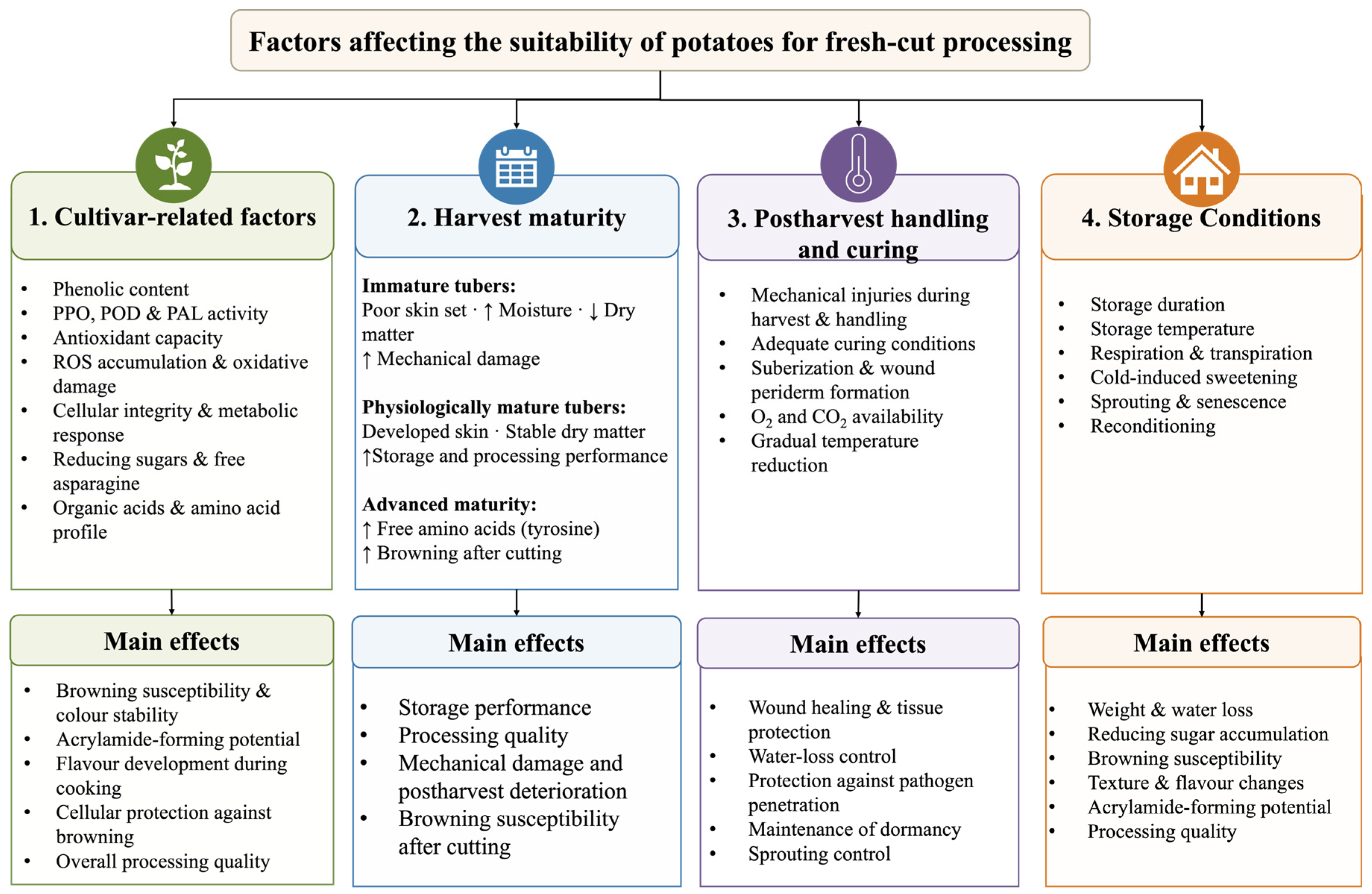
3.1. Factors Affecting the Suitability of Potatoes for Fresh-Cut Processing
3.1.1. Cultivar-Related Factors
3.1.2. Harvest Maturity
3.1.3. Postharvest Handling and Curing
3.1.4. Storage Conditions and Quality Changes
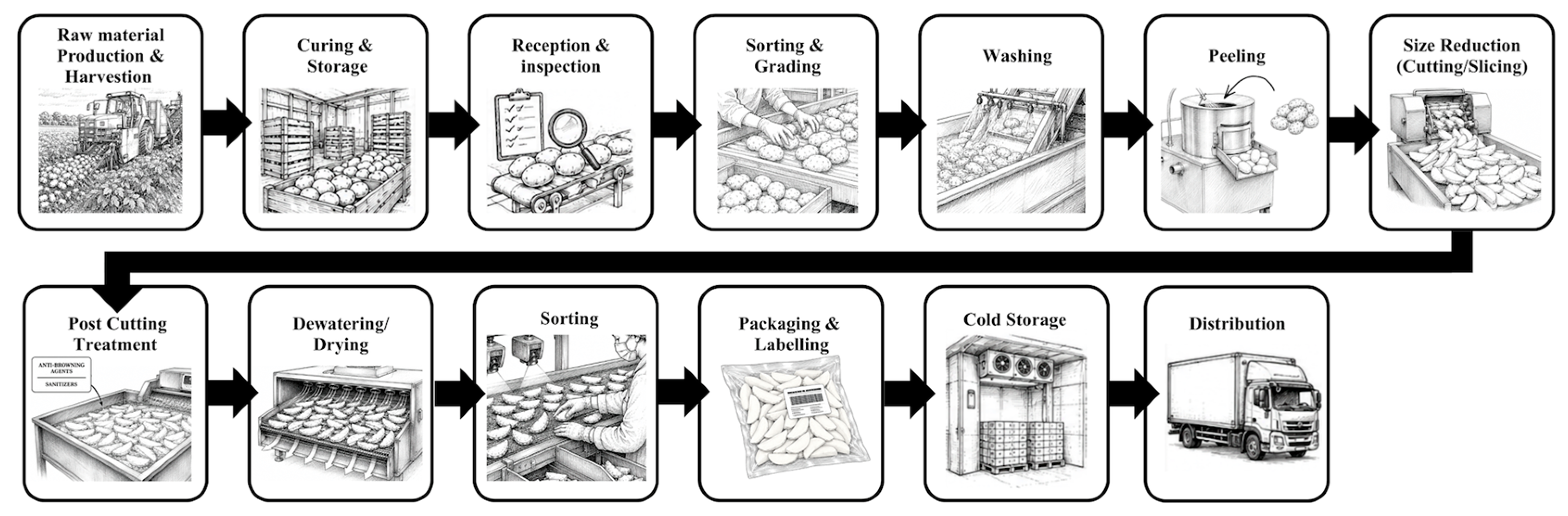
3.2. Industrial Processing of Fresh-Cut Potatoes
3.2.1. Raw Material Preparation and Cutting
3.2.2. Post-Cutting Treatments and Dewatering
3.2.3. Sorting, Packaging, and Refrigerated Distribution
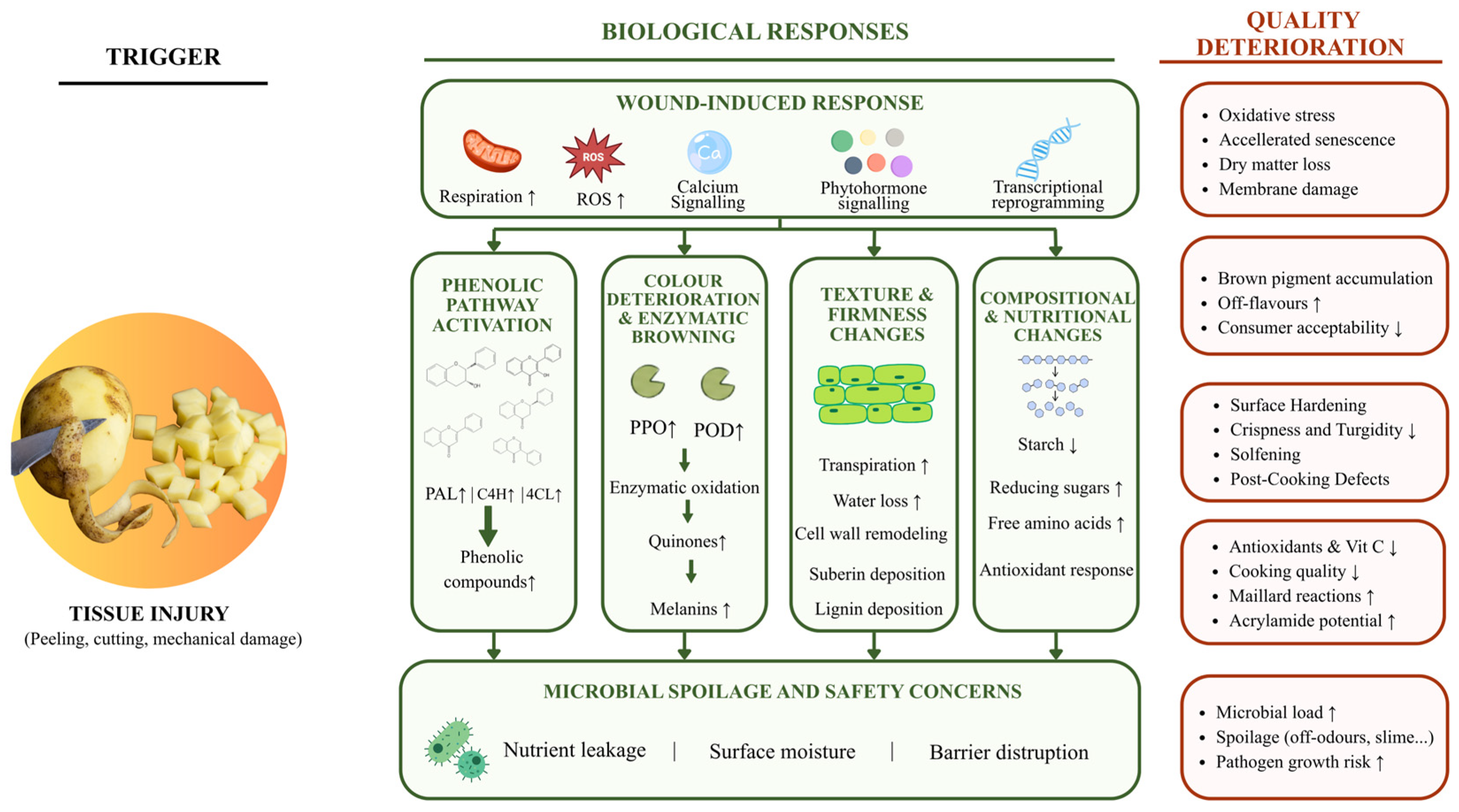
4. Quality Deterioration of Fresh-Cut Potatoes
4.1. Wound-Induced Physiological and Metabolic Responses
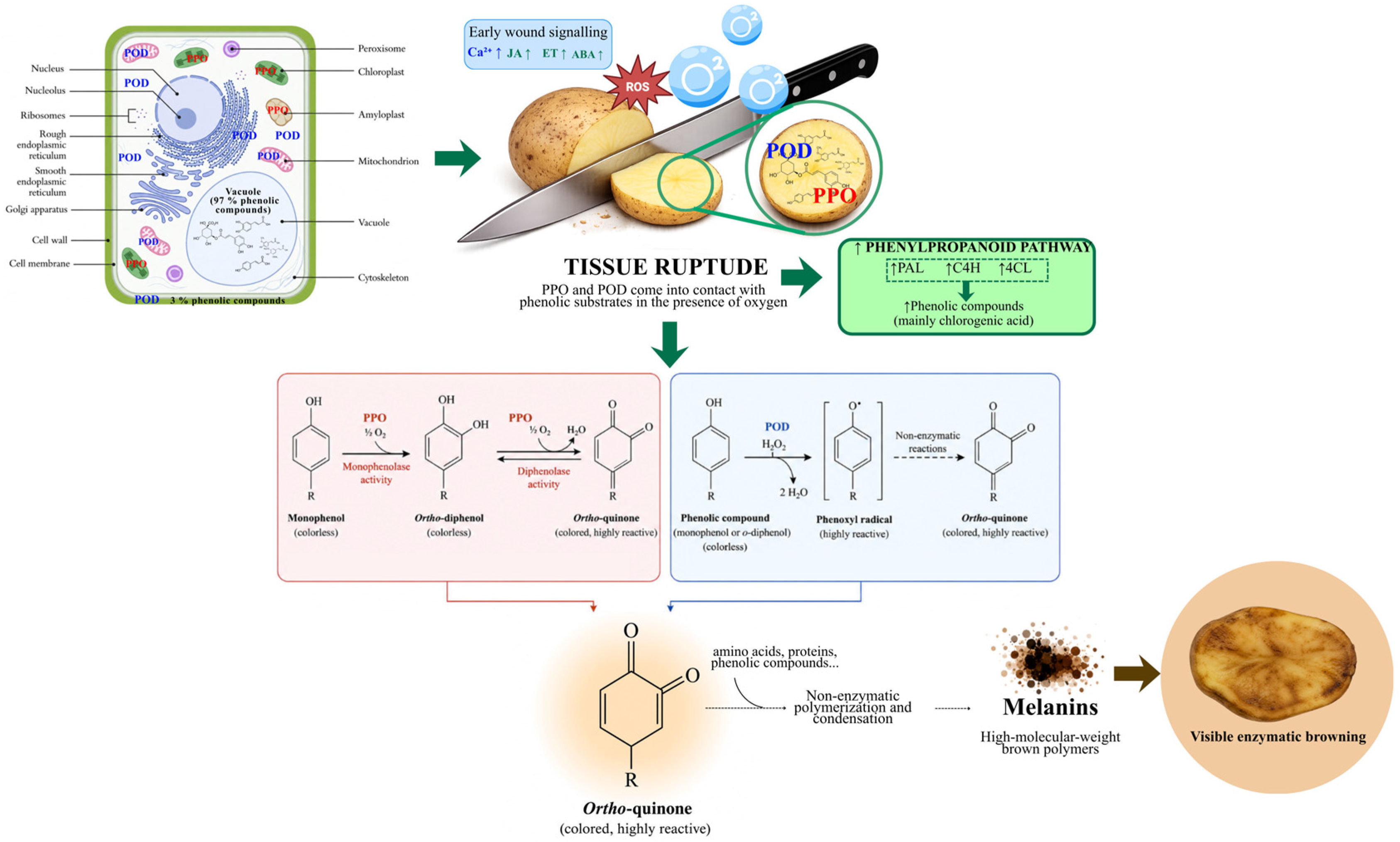
4.2. Colour Deterioration and Enzymatic Browning
4.3. Texture and Firmness Changes Associated with Wound Healing
4.4. Compositional and Nutritional Changes
4.5. Microbial Spoilage and Safety Concerns
5. Strategies for Quality Preservation and Shelf-Life Extension of Fresh-Cut Potatoes
5.1. Physical Preservation Technologies
5.1.1. Refrigeration and Cold Chain Management
5.1.2. Packaging-Based Technologies
5.1.3. Edible Coatings
Polysaccharide-Based Coatings
Protein-Based Coatings
Lipid-Based Coatings
5.1.4. Non-Thermal Physical Processing Technologies

| Technology | Mechanism of Action | Primary Effects | Main Advantages | Main Limitations | Current Evidence/Application in FCP | References |
|---|---|---|---|---|---|---|
| UV-C | DNA photodamage in microorganisms; induction of plant defence responses and modulation of browning-related enzymes | Microbial inactivation; delayed enzymatic browning; preservation of colour and sensory quality | Short treatment time; no chemical residues; potential integration into existing processing lines | Limited penetration and surface action; efficacy affected by geometry and dose; excessive exposure may cause tissue damage/discolouration; possible increase in acrylamide precursors; regulatory and scale-up constraints | Direct FCP evidence available. Particularly effective when combined with sodium ascorbate, VP and refrigeration; less effective than Sodium Acid Sulphate (SAS) for browning control in one comparative study. Combination with High Hydrostatic Pressure (HHP) improved microbial stability but increased reducing sugars and acrylamide formation after frying | [152,153,154] |
| Pulsed light (PL) | High-intensity broad-spectrum light; photochemical, photothermal and photophysical mechanisms | Microbial and enzymatic inactivation | Very short treatment; high energy delivery with limited overall heat transfer | Limited penetration; shadowing; efficacy affected by product geometry and optical properties; excessive fluence may cause localized heating and tissue damage; lack of standardized protocols | Limited direct evidence for FCP. Promising results have mainly been obtained in other fresh-cut horticultural products; FCP-specific optimization and validation are still required | [155,156,157,158,159] |
| Cold plasma (CP) | Reactive oxygen and nitrogen species, charged particles and UV photons | Microbial decontamination; PPO/POD inactivation; delayed enzymatic browning | Near-ambient temperature; no chemical residues; potential in-package application | Strongly treatment-dependent; excessive exposure may induce oxidative tissue damage; mainly surface-dependent action | Potato studies show substantial inhibition of browning-related enzymes and delayed surface browning with relatively limited effects on tissue integrity; evidence remains limited compared with UV-C | [160,161,162,163] |
| Ultrasound (US) | Acoustic cavitation generating localized pressure, shear forces and reactive radicals | Enzyme modulation/inactivation; enhanced mass transfer; browning control; potential microbial effects | Simple application; low energy requirements; no chemical residues; suitable for combination with antibrowning agents | Strong dependence on frequency, power and exposure time; excessive cavitation may cause tissue disruption and firmness loss | Direct FCP studies indicate that moderate treatment can control PPO activity while maintaining quality; combinations with natural antibrowning compounds showed greater effectiveness than US alone | [164,165,166] |
| Pulsed electric fields (PEF) | Reversible or irreversible electroporation of cell membranes | Enhanced mass transfer; modification of tissue structure; reduced reducing sugars; potential browning control when combined with other treatments | Minimal temperature increase; useful as pretreatment; potential integration with OD and MAP | High capital costs; application-specific optimization required; limited effectiveness against some enzymes and bacterial spores; excessive permeabilization may affect tissue properties | Evidence is stronger for processing improvement and hurdle applications than for standalone FCP preservation. PEF has shown promising results as a pretreatment combined with OD and MAP, contributing to mass transfer enhancement and quality retention during refrigerated storage. | [115,167] |
UV-C Radiation
Pulsed Light (PL)
Cold Plasma (CP)
Ultrasound (US)
Pulsed Electric Fields (PEFs)
5.2. Chemical Preservation Technologies
5.2.1. Chlorine-Based Sanitizers
5.2.2. Ozone
5.2.3. Electrolyzed Water (EW)
5.2.4. Firming Agents
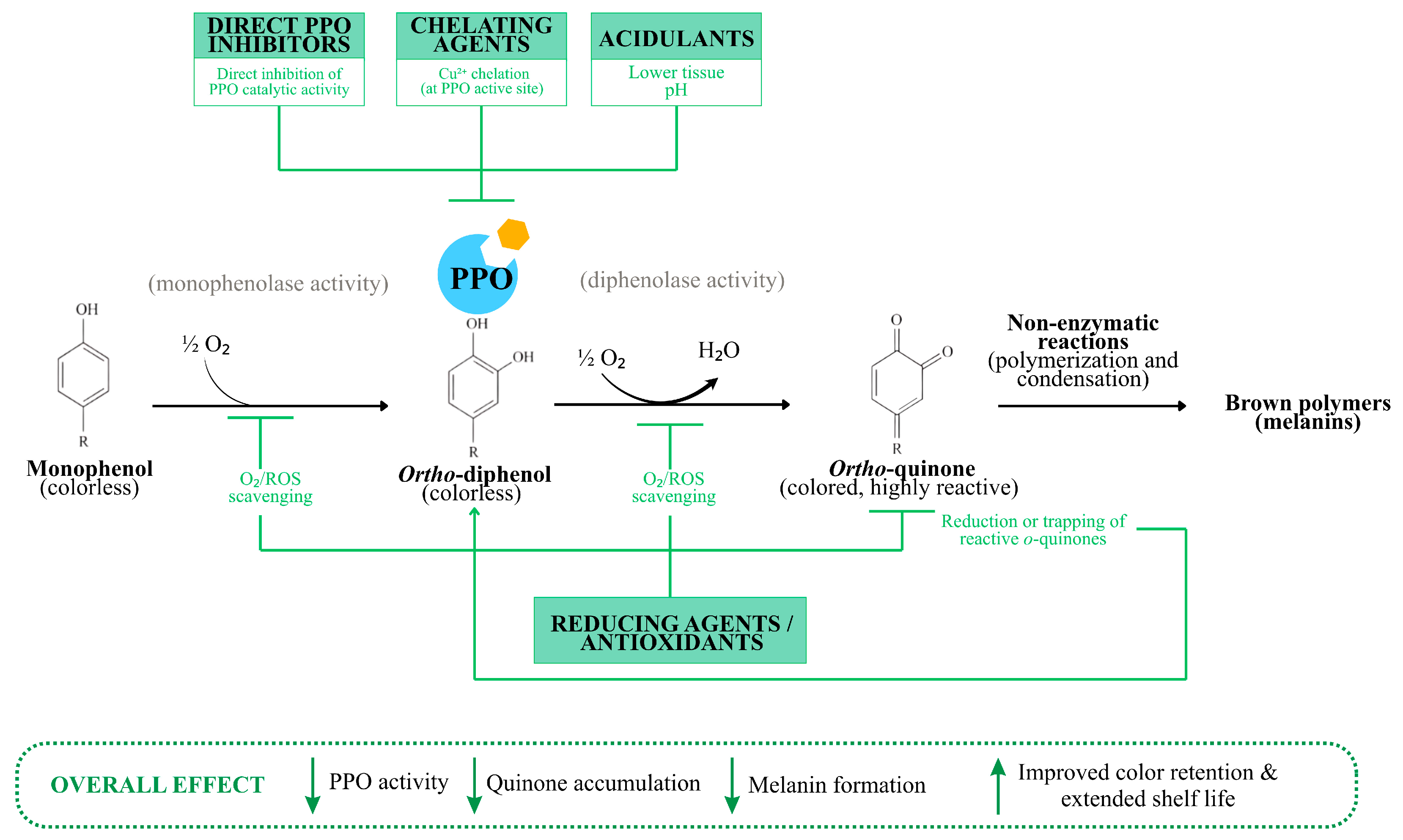
5.2.5. Antibrowning Agents
Reducing Agents and Antioxidants
Acidulants
Chelating Agents
Direct PPO Inhibitors
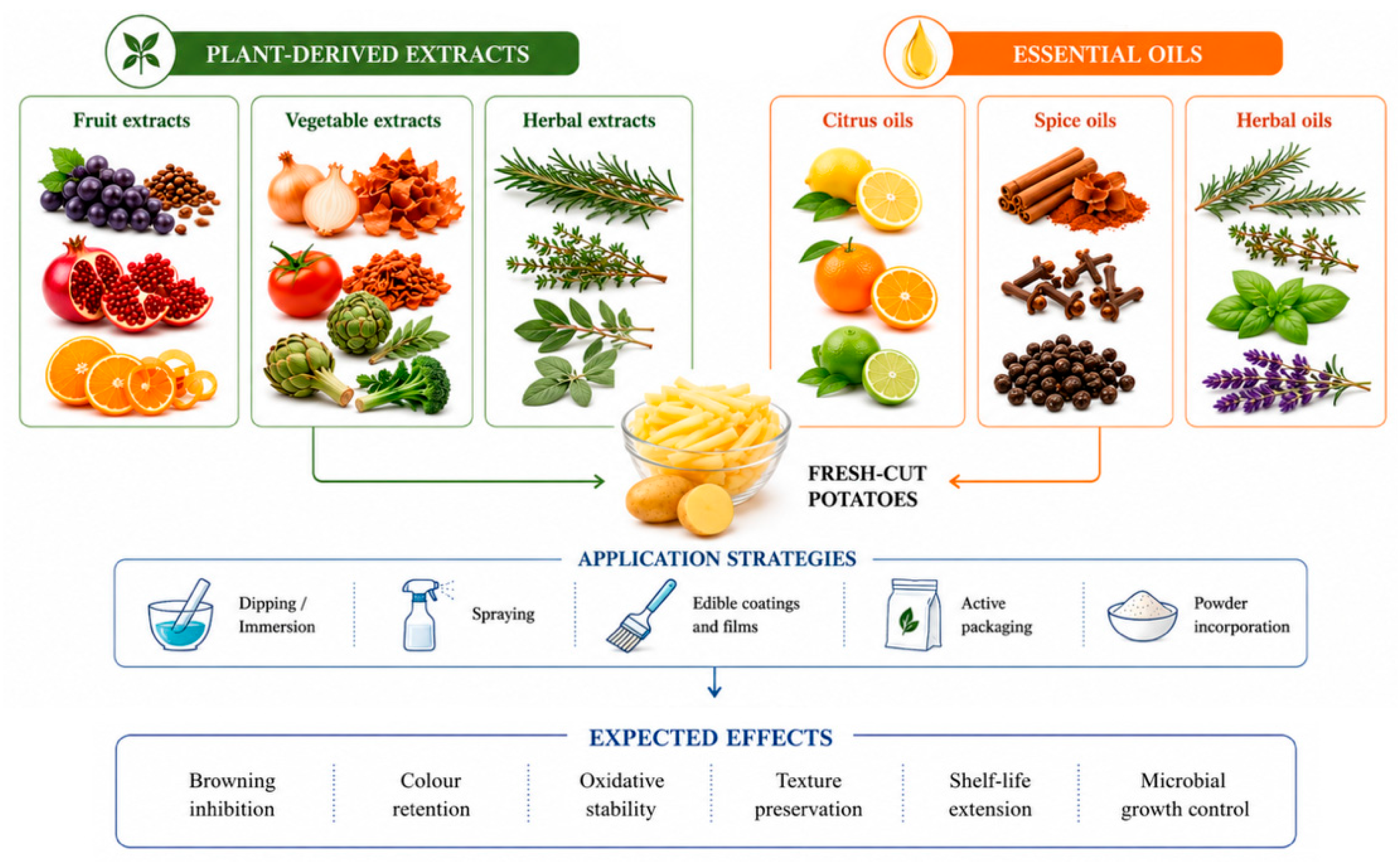
5.3. Plant-Derived Natural Preservatives
| Source | Major Bioactive Compounds | Preparation/Extraction Method | Application Strategy | Main Preservation Outcomes | Ref |
|---|---|---|---|---|---|
| Plant-derived extracts | |||||
| Hawthorn leaves | Phenolic compounds, flavonoids, proanthocyanidins | Water extract | Dipping (5 min) | Delayed browning; maintained higher L*; reduced PPO, POD and PAL activities; enhanced antioxidant defence during refrigerated storage. | [279] |
| Purslane | Polyphenols and alkaloids | Aqueous extract | Dipping (5 min) | Delayed browning; reduced PPO, POD and PAL activities; preserved membrane integrity and colour during storage. | [280] |
| Broccoli leaves processing water | Glucosinolates, phenolic compounds, organic acids, anthocyanins, sulphur compounds | Broccoli cooking water (85 °C, 15 min), filtered | Spraying | Reduced browning and PPO activity; synergistic antibrowning effect with AA. | [285] |
| Onion (bulbs and Borettana wastes) | Phenolic compounds and organosulfur compounds | Onion juices and distillates | Spraying | Reduced browning and PPO activity; onion juices more effective in vivo, distillates more effective in vitro. | [286] |
| Unripe grapes | Organic acids and phenolic compounds (particularly EGCG) | Juice obtained by centrifugation | Spraying | Reduced browning and PPO activity; stronger PPO inhibition than AA; effective in vivo antibrowning activity. | [287] |
| Green tea | Catechins (EGCG, EGC, ECG), gallic acid, myricetin | Optimized aqueous extract (55 °C, 7 min) | Dipping (7 min) | Delayed browning; maintained higher L*; stabilized pH and soluble solids; extended shelf-life to 14 d. | [283] |
| Seabuckthorn leaves | Phenolic compounds, flavonoids | Water extract | Dipping (2 min) | Delayed browning; reduced PPO, POD and PAL activities; enhanced antioxidant capacity and colour retention. | [188] |
| Essential oils | |||||
| Cinnamon essential oil | Cinnamaldehyde, cinnamyl esters, eugenol, vanillin | Chitosan coating + cinnamon essential oil (0.2–0.6%) | Edible coating (2 min dipping) | The 0.2% coating inhibited browning, maintained firmness and reduced weight loss and microbial growth during refrigerated storage. | [146] |
| Thyme essential oil | Thymol | Alginate coating + TEO (0.05–0.65%) | Edible coating (2 min dipping) | Best performance at 0.05% TEO: preserved colour (↑L, ↓BI); maintained firmness and sensory quality; reduced microbial growth and Listeria monocytogenes; higher concentrations impaired quality | [145] |
| Rosemary essential oil | 1,8-Cineole, α-pinene, borneol, verbenone, camphor | Peanut oil + 0.5% rosemary essential oil | Dipping + VP | Improved texture retention, reduced growth of mesophilic bacteria and Enterobacteriaceae, preserved AA, total polyphenols and antioxidant activity, and maintained acceptable sensory quality during 11 d at 4 °C. | [288] |
| Zataria multiflora and tarragon | Thymol, carvacrol, p-cymene (Zataria); estragole (p-allylanisole) (tarragon) | Zedo gum coating + 1% essential oil | Edible coating (5 min dipping) | Reduced browning and weight loss; maintained texture and sensory quality; reduced microbial growth and extended refrigerated shelf life. | [282] |
| Onion | Dipropyl disulphide, dipropyl trisulphide | Onion essential oil (0.5–5 mg mL−1) | Dipping | Reduced browning and PPO activity; inhibited microbial growth; maintained sensory acceptability during refrigerated storage. | [281] |
5.4. Emerging Technologies and Future Trends
6. Conclusions
Author Contributions
Funding
Data Availability Statement
Acknowledgments
Conflicts of Interest
Abbreviations
| 4CL | 4-Coumarate-CoA Ligase |
| 4-HR | 4-Hexylresorcinol |
| AA | Ascorbic Acid |
| AEW | Acidic Electrolyzed Water |
| AI | Artificial Intelligence |
| AlEW | Alkaline Electrolyzed Water |
| APX | Ascorbate Peroxidase |
| BI | Browning Index |
| C4H | Cinnamate 4-Hydroxylase |
| CAD | Cinnamyl Alcohol Dehydrogenase |
| CaMs | Calmodulins |
| CAT | Catalase |
| CBL | Calcineurin B-Like Protein |
| CBLs | Calcineurin B-Like Proteins |
| CDPKs | Calcium-Dependent Protein Kinases |
| CFU | Colony-Forming Units |
| CP | Cold Plasma |
| DBPs | Disinfection By-Products |
| DHA | Dehydroascorbic Acid |
| DNA | Deoxyribonucleic Acid |
| DTPA | Diethylenetriamine Pentaacetic Acid |
| ECG | Epicatechin Gallate |
| EDTA | Ethylenediaminetetraacetic Acid |
| EFSA | European Food Safety Authority |
| EGC | Epigallocatechin |
| EGCG | Epigallocatechin Gallate |
| EW | Electrolyzed Water |
| FAOSTAT | Food and Agriculture Organization Corporate Statistical Database |
| FCP | Fresh-Cut Potato |
| GRAS | Generally Recognized as Safe |
| GSH | Glutathione |
| HAAs | Haloacetic Acids |
| HHP | High Hydrostatic Pressure |
| HOCl | Hypochlorous Acid |
| IARC | International Agency for Research on Cancer |
| IFPA | International Fresh-cut Produce Association |
| MAP | Modified Atmosphere Packaging |
| MRLs | Maximum Residue Levels |
| NAC | N-Acetyl-L-Cysteine |
| NIR | Near-Infrared Spectroscopy |
| NO | Nitric Oxide |
| OD | Osmotic Dehydration |
| ORP | Oxidation–Reduction Potential |
| PAL | Phenylalanine Ammonia-Lyase |
| PEF | Pulsed Electric Fields |
| PL | Pulsed Light |
| POD | Peroxidase |
| PPO | Polyphenol Oxidase |
| RFID | Radio-Frequency Identification |
| RNS | Reactive Nitrogen Species |
| ROS | Reactive Oxygen Species |
| SAEW | Slightly Acidic Electrolyzed Water |
| SAS | Sodium Acid Sulphate |
| SMBS | Sodium Metabisulfite |
| SOD | Superoxide Dismutase |
| TEO | Thyme essential oil |
| THMs | Trihalomethanes |
| TTIs | Time–Temperature Indicators |
| US | Ultrasound |
| UV | Ultraviolet |
| UV-C | Ultraviolet-C |
| VP | Vacuum Packaging |
References
- Tsakiri-Mantzorou, Z.; Drosou, C.; Mari, A.; Stramarkou, M.; Laina, K.T.; Krokida, M. Edible Coating with Encapsulated Antimicrobial and Antibrowning Agents via the Emerging Electrospinning Process and the Conventional Spray Drying: Effect on Quality and Shelf Life of Fresh-Cut Potatoes. Potato Res. 2024, 68, 587–619. [Google Scholar] [CrossRef] [Scilit]
- Yousuf, B.; Deshi, V.; Ozturk, B.; Siddiqui, M.W. Fresh-Cut Fruits and Vegetables: Quality Issues and Safety Concerns. In Fresh-Cut Fruits and Vegetables: Technologies and Mechanisms for Safety Control; Academic Press: Cambridge, MA, USA, 2020; pp. 1–15. [Google Scholar] [CrossRef] [Scilit]
- Iturralde-García, R.D.; Cinco-Moroyoqui, F.J.; Martínez-Cruz, O.; Ruiz-Cruz, S.; Wong-Corral, F.J.; Borboa-Flores, J.; Cornejo-Ramírez, Y.I.; Bernal-Mercado, A.T.; Del-Toro-Sánchez, C.L. Emerging Technologies for Prolonging Fresh-Cut Fruits’ Quality and Safety during Storage. Horticulturae 2022, 8, 731. [Google Scholar] [CrossRef] [Scilit]
- Gorny, J.R. (Ed.) Food Safety Guidelines for the Fresh-Cut Produce Industry, 4th ed.; International Fresh-Cut Produce Association: Alexandria, VA, USA, 2001; p. 218. [Google Scholar]
- Tunny, S.S.; Amanah, H.Z.; Faqeerzada, M.A.; Wakholi, C.; Kim, M.S.; Baek, I.; Cho, B.K. Multispectral Wavebands Selection for the Detection of Potential Foreign Materials in Fresh-Cut Vegetables. Sensors 2022, 22, 1775. [Google Scholar] [CrossRef] [Scilit] [PubMed]
- Ali, A.; Trafialek, J.; Manzoor, M.F. Recent Advances in Fresh-Cut Vegetables. In Sustainable and Innovative Vegetable Production in times of Climate Change: Concepts of Olericulture; Springer: Berlin/Heidelberg, Germany, 2025; pp. 501–520. [Google Scholar] [CrossRef] [Scilit]
- Chen, D.; Zhang, Y.; Zhao, J.; Liu, L.; Zhao, L. Research Progress on Physical Preservation Technology of Fresh-Cut Fruits and Vegetables. Horticulturae 2024, 10, 1098. [Google Scholar] [CrossRef] [Scilit]
- Zhou, F.; Jiang, A.; Feng, K.; Gu, S.; Xu, D.; Hu, W. Effect of Methyl Jasmonate on Wound Healing and Resistance in Fresh-Cut Potato Cubes. Postharvest Biol. Technol. 2019, 157, 110958. [Google Scholar] [CrossRef] [Scilit]
- Xu, D.; Chen, C.; Zhou, F.; Liu, C.; Tian, M.; Zeng, X.; Jiang, A. Vacuum Packaging and Ascorbic Acid Synergistically Maintain the Quality and Flavor of Fresh-Cut Potatoes. LWT 2022, 162, 113356. [Google Scholar] [CrossRef] [Scilit]
- Rashid, M.H.; Khan, M.R.; Roobab, U.; Rajoka, M.S.R.; Inam-ur-Raheem, M.; Anwar, R.; Ahmed, W.; Jahan, M.; Ijaz, M.R.A.; Asghar, M.M.; et al. Enhancing the Shelf Stability of Fresh-Cut Potatoes via Chemical and Nonthermal Treatments. J. Food Process. Preserv. 2021, 45, e15582. [Google Scholar] [CrossRef] [Scilit]
- Food and Agriculture Organization of the United Nations (FAO). FAOSTAT Statistical Database. Available online: https://www.fao.org/faostat/ (accessed on 21 June 2026).
- Furrer, A.N.; Chegeni, M.; Ferruzzi, M.G. Impact of Potato Processing on Nutrients, Phytochemicals, and Human Health. Crit. Rev. Food Sci. Nutr. 2018, 58, 146–168. [Google Scholar] [CrossRef] [Scilit] [PubMed]
- Levaj, B.; Pelaić, Z.; Galić, K.; Kurek, M.; Ščetar, M.; Poljak, M.; Dite Hunjek, D.; Pedisić, S.; Balbino, S.; Čošić, Z.; et al. Maintaining the Quality and Safety of Fresh-Cut Potatoes (Solanum tuberosum): Overview of Recent Findings and Approaches. Agronomy 2023, 13, 2002. [Google Scholar] [CrossRef] [Scilit]
- Hu, W.; Guan, Y.; Ji, Y.; Yang, X. Effect of Cutting Styles on Quality, Antioxidant Activity, Membrane Lipid Peroxidation, and Browning in Fresh-Cut Potatoes. Food Biosci. 2021, 44, 101435. [Google Scholar] [CrossRef] [Scilit]
- Kim, M.K.; Park, J.; Kim, D.M. Resistant Starch and Type 2 Diabetes Mellitus: Clinical Perspective. J. Diabetes Investig. 2024, 15, 395–401. [Google Scholar] [CrossRef] [Scilit] [PubMed]
- Afsari, K.; Kobarfard, F.; Yazdanpanah, H.; Docea, A.O.; Tsitsimpikou, C.; Eslamizad, S.; Tsatsakis, A. Classical and New Approaches to Health Risk Assessment of Acrylamide Through the Consumption of Potato Chips. Food Sci. Nutr. 2025, 13, e71137. [Google Scholar] [CrossRef] [Scilit] [PubMed]
- Nahid, M.; Bhuiyan, M.N.I. Mitigating Acrylamide Formation in Processed Potato Products: A Comprehensive Review of Strategies, Prevention, Mitigation, and Regulatory Challenges. Food Chem. Adv. 2025, 8, 101106. [Google Scholar] [CrossRef] [Scilit]
- Zhang, Z.; Wei, F.; Xing, T.; Li, X.; Yan, H.; Yuan, Y. Effects of Potato Cultivars and Processing Methods on Acrylamide Formation in Fresh-Cut Potato Chips. Food Chem. 2025, 494, 146182. [Google Scholar] [CrossRef] [Scilit] [PubMed]
- Drosou, C.; Sklirakis, I.; Polyzou, E.; Yakoumis, I.; Boukouvalas, C.J.; Krokida, M. Processing Fresh-Cut Potatoes Using Non-Thermal Technologies and Edible Coatings. Appl. Sci. 2024, 14, 11039. [Google Scholar] [CrossRef] [Scilit]
- Tsikrika, K.; Tzima, K.; Rai, D.K. Recent Advances in Anti-Browning Methods in Minimally Processed Potatoes—A Review. J. Food Process. Preserv. 2022, 46, e16298. [Google Scholar] [CrossRef] [Scilit]
- Martins, F.C.O.L.; Sentanin, M.A.; De Souza, D. Analytical Methods in Food Additives Determination: Compounds with Functional Applications. Food Chem. 2019, 272, 732–750. [Google Scholar] [CrossRef] [Scilit] [PubMed]
- Cabezas-Serrano, A.B.; Amodio, M.L.; Cornacchia, R.; Rinaldi, R.; Colelli, G. Suitability of Five Different Potato Cultivars (Solanum tuberosum L.) to Be Processed as Fresh-Cut Products. Postharvest Biol. Technol. 2009, 53, 138–144. [Google Scholar] [CrossRef] [Scilit]
- Cornacchia, R.; Cabezas-Serrano, A.B.; Amodio, M.L.; Colelli, G. Suitability of 4 Potato Cultivars (Solanum tuberosum L.) to Be Processed as Fresh-Cut Product. Early Cultivars. Am. J. Potato Res. 2011, 88, 403–412. [Google Scholar] [CrossRef] [Scilit]
- Wang, T.; Yan, T.; Shi, J.; Sun, Y.; Wang, Q.; Li, Q. The Stability of Cell Structure and Antioxidant Enzymes Are Essential for Fresh-Cut Potato Browning. Food Res. Int. 2023, 164, 112449. [Google Scholar] [CrossRef] [Scilit] [PubMed]
- Qiao, L.; Gao, M.; Wang, Y.; Tian, X.; Lu, L.; Liu, X. Integrated Transcriptomic and Metabolomic Analysis of Cultivar Differences Provides Insights into the Browning Mechanism of Fresh-Cut Potato Tubers. Postharvest Biol. Technol. 2022, 188, 111905. [Google Scholar] [CrossRef] [Scilit]
- Ingallina, C.; Spano, M.; Sobolev, A.P.; Esposito, C.; Santarcangelo, C.; Baldi, A.; Daglia, M.; Mannina, L. Characterization of Local Products for Their Industrial Use: The Case of Italian Potato Cultivars Analyzed by Untargeted and Targeted Methodologies. Foods 2020, 9, 1216. [Google Scholar] [CrossRef] [Scilit] [PubMed]
- Heltoft, P.; Wold, A.B.; Molteberg, E.L. Maturity Indicators for Prediction of Potato (Solanum tuberosum L.) Quality during Storage. Postharvest Biol. Technol. 2017, 129, 97–106. [Google Scholar] [CrossRef] [Scilit]
- Waxman, A.M. Effects of Harvest Date and Storage Duration on End-Product Quality of Three Processing Potato Varieties. Ph.D. Dissertation, University of Idaho, Moscow, ID, USA, 2017. [Google Scholar]
- Meng, Z.; Dong, T.; Malik, A.U.; Zhang, S.; Wang, Q. Harvest Maturity Affects the Browning of Fresh-Cut Potatoes by Influencing Contents of Amino Acids. Postharvest Biol. Technol. 2021, 173, 111404. [Google Scholar] [CrossRef] [Scilit]
- Kim, H.O.; Lee, S.K. Effects of Curing and Storage Conditions on Processing Quality In Potatoes. Acta Hortic. 1993, 343, 73–76. [Google Scholar] [CrossRef] [Scilit]
- Czerko, Z.; Zarzyńska, K.; Boguszewska-Mańkowska, D. Postharvest Physiology and Storage of Potato. In Potato Production Worldwide; Academic Press: Cambridge, MA, USA, 2023; pp. 261–272. [Google Scholar] [CrossRef] [Scilit]
- Vreugdenhil, D. The Canon of Potato Science: 39. Dormancy. Potato Res. 2008, 50, 371–373. [Google Scholar] [CrossRef] [Scilit]
- Dite Hunjek, D.; Pranjić, T.; Repajić, M.; Levaj, B. Fresh-Cut Potato Quality and Sensory: Effect of Cultivar, Age, Processing, and Cooking during Storage. J. Food Sci. 2020, 85, 2296–2309. [Google Scholar] [CrossRef] [Scilit] [PubMed]
- Gikundi, E.N.; Buzera, A.; Orina, I.; Sila, D. Impact of the Temperature Reconditioning of Cold-Stored Potatoes on the Color of Potato Chips and French Fries. Foods 2024, 13, 652. [Google Scholar] [CrossRef] [Scilit] [PubMed]
- Amjad, A.; Mouhaddach, A.; Latifi, H.; Mehboob, R.; Kausar, T.; Bouhrim, M.; Mothana, R.A.; Noman, O.M.; Siddique, F.; Bilal, M.; et al. Impact of Reconditioning Treatment at Different Temperatures on Potato Cultivars Stored Under Cold Conditions. Potato Res. 2025, 68, 3357–3375. [Google Scholar] [CrossRef] [Scilit]
- Sucheta, A.; Singla, G.; Chaturvedi, K.; Sandhu, P.P. Status and Recent Trends in Fresh-Cut Fruits and Vegetables. In Fresh-Cut Fruits and Vegetables: Technologies and Mechanisms for Safety Control; Academic Press: Cambridge, MA, USA, 2020; pp. 17–49. [Google Scholar] [CrossRef] [Scilit]
- Rocculi, P.; Romani, S.; Gomez, F.; Rosa, M.D. Effect of Minimal Processing on Physiology and Quality of Fresh-Cut Potatoes, a Review. Food 2009, 3, 18–30. [Google Scholar]
- Ansah, F.A.; Amodio, M.L.; Colelli, G. Quality of Fresh-Cut Products as Affected by Harvest and Postharvest Operations. J. Sci. Food Agric. 2018, 98, 3614–3626. [Google Scholar] [CrossRef] [Scilit] [PubMed]
- Li, G.; Wang, X.; Zhu, H.; Li, G.; Du, J.; Song, X. Erihemu Use of Different Food Additives to Control Browning in Fresh-Cut Potatoes. Food Sci. Nutr. 2023, 11, 7967–7973. [Google Scholar] [CrossRef] [Scilit] [PubMed]
- Faisal, M.; Arshad, N.; Wang, H.; Li, C.; Ma, J.; Kong, X.; Luo, H.; Yu, L. Recent Advances in Technologies for Preserving Fresh-Cut Fruits and Vegetables. Foods 2025, 14, 2769. [Google Scholar] [CrossRef] [Scilit] [PubMed]
- Moradinezhad, F.; Adiba, A.; Ranjbar, A.; Dorostkar, M. Edible Coatings to Prolong the Shelf Life and Improve the Quality of Subtropical Fresh/Fresh-Cut Fruits: A Review. Horticulturae 2025, 11, 577. [Google Scholar] [CrossRef] [Scilit]
- Tinello, F.; Lante, A. Recent Advances in Controlling Polyphenol Oxidase Activity of Fruit and Vegetable Products. Innov. Food Sci. Emerg. Technol. 2018, 50, 73–83. [Google Scholar] [CrossRef] [Scilit]
- Li, X.; Long, Q.; Gao, F.; Han, C.; Jin, P.; Zheng, Y. Effect of Cutting Styles on Quality and Antioxidant Activity in Fresh-Cut Pitaya Fruit. Postharvest Biol. Technol. 2017, 124, 1–7. [Google Scholar] [CrossRef] [Scilit]
- Rico, D.; Martín-Diana, A.B.; Barat, J.M.; Barry-Ryan, C. Extending and Measuring the Quality of Fresh-Cut Fruit and Vegetables: A Review. Trends Food Sci. Technol. 2007, 18, 373–386. [Google Scholar] [CrossRef] [Scilit]
- Al-Abbasy, O.Y.; Mahdi, N.M.; Younus, S.A.; Ahmad, O.A.S.; Al-Azzawi, A.G.S. Potato Enzymatic Browning, Mitigation and Prevention: Current Overview of Approaches and Findings. J. Food Sci. Technol. Iran 2025, 22, 1–15. [Google Scholar] [CrossRef]
- Zhang, X.; Meng, W.; Chen, Y.; Peng, Y. Browning Inhibition of Plant Extracts on Fresh-Cut Fruits and Vegetables—A Review. J. Food Process. Preserv. 2022, 46, e16532. [Google Scholar] [CrossRef] [Scilit]
- Saini, R.; Kaur, S.; Aggarwal, P.; Dhiman, A. The Influence of Conventional and Novel Blanching Methods on Potato Granules, Phytochemicals, and Thermal Properties of Colored Varieties. Front. Nutr. 2023, 10, 1178797. [Google Scholar] [CrossRef] [Scilit] [PubMed]
- Mowafy, S.; Liu, Y. Novel and Conventional Steam Blanching Impacts on Potato Starch Digestibility and Physicochemical Properties. Food Bioprocess Technol. 2024, 17, 5066–5082. [Google Scholar] [CrossRef] [Scilit]
- Saroj, R.; Kushwaha, R.; Kaur, D. Minimal Processing of Fruits and Vegetables. In Fruits and Vegetables Technologies: Postharvest Processing and Packaging; Springer: Berlin/Heidelberg, Germany, 2025; pp. 209–234. [Google Scholar] [CrossRef] [Scilit]
- Tang, T.; Zhang, M.; Mujumdar, A.S. Intelligent Detection for Fresh-Cut Fruit and Vegetable Processing: Imaging Technology. Compr. Rev. Food Sci. Food Saf. 2022, 21, 5171–5198. [Google Scholar] [CrossRef] [Scilit] [PubMed]
- Li, X.; Xing, W.; Ma, J.; He, W.; Cao, Y.; Li, A.; Xu, Y.; Ming, W. A Critical Review on Machine Vision in Potato Production: From Cultivation to Storage. J. Food Process Eng. 2025, 48, e70142. [Google Scholar] [CrossRef] [Scilit]
- Zdulski, J.A.; Rutkowski, K.P.; Konopacka, D. Strategies to Extend the Shelf Life of Fresh and Minimally Processed Fruit and Vegetables with Edible Coatings and Modified Atmosphere Packaging. Appl. Sci. 2024, 14, 11074. [Google Scholar] [CrossRef] [Scilit]
- Nasrin, T.A.A.; Yasmin, L.; Arfin, M.S.; Rahman, M.A.; Molla, M.M.; Sabuz, A.A.; Afroz, M. Preservation of Postharvest Quality of Fresh Cut Cauliflower through Simple and Easy Packaging Techniques. Appl. Food Res. 2022, 2, 100125. [Google Scholar] [CrossRef] [Scilit]
- Zhao, Y.; Xu, C.; Shi, W.; Huang, T.; Yuan, S.; Yue, X.; Xu, X.; Feng, B.; Zuo, J.; Wang, Q. Effect of Oxalic Acid on the Postharvest Physiology and Enzymatic Browning of Fresh-Cut Potato Slices during Storage. Sci. Hortic. 2025, 350, 114306. [Google Scholar] [CrossRef] [Scilit]
- Zhou, F.; Xu, D.; Liu, C.; Chen, C.; Tian, M.; Jiang, A. Ascorbic Acid Treatment Inhibits Wound Healing of Fresh-Cut Potato Strips by Controlling Phenylpropanoid Metabolism. Postharvest Biol. Technol. 2021, 181, 111644. [Google Scholar] [CrossRef] [Scilit]
- van Dieren, A. Calcium Signaling in Arabidopsis and Potato: From Ca2+ Transient to Ca2+ (in)Dependent Protein Regulation. Ph.D. Dissertation, Rheinische Friedrich-Wilhelms-Universität Bonn, Bonn, Germany, 2025. [Google Scholar]
- Wang, L.; Wang, W.; Shan, J.; Li, C.; Suo, H.; Liu, J.; An, K.; Li, X.; Xiong, X. A Genome-Wide View of the Transcriptome Dynamics of Fresh-Cut Potato Tubers. Genes 2023, 14, 181. [Google Scholar] [CrossRef] [Scilit] [PubMed]
- Zhou, F.; Xu, D.; Xiong, S.; Chen, C.; Liu, C.; Jiang, A. Inhibition of Wound Healing in Fresh-Cut Potatoes by Ascorbic Acid Is Associated with Control of the Levels of Reactive Oxygen Species and the AsA-GSH Cycle. Sci. Hortic. 2024, 323, 112472. [Google Scholar] [CrossRef] [Scilit]
- Han, C.; Wang, W.; Suo, B.; Zhang, J.; Ma, Q.; Sun, J. Sodium Nitroprusside Affects Energy Metabolism, Gamma-Aminobutyric Acid Branching, and CircRNA Regulation of Fresh-Cut Purple Potatoes. Postharvest Biol. Technol. 2025, 227, 113599. [Google Scholar] [CrossRef] [Scilit]
- Aldon, D.; Mbengue, M.; Mazars, C.; Galaud, J.P. Calcium Signalling in Plant Biotic Interactions. Int. J. Mol. Sci. 2018, 19, 665. [Google Scholar] [CrossRef] [Scilit] [PubMed]
- Wang, J.; Liu, H.; Fu, M.; Chen, Y.; Yan, Y.; Li, D.; Chen, Q. Ethylene Inhibits Potato Tuber Sprouting during Storage by Regulating Stress Resistance and Development. Sci. Hortic. 2026, 357, 114646. [Google Scholar] [CrossRef] [Scilit]
- Hu, Q.; Chen, J.; Dong, Y.; Xiang, Y.; Luo, Z.; Yang, K.; Li, L. Abscisic Acid Promotes Lignin and Suberin Formation for Potato Wound Healing. Food Chem. 2026, 514, 149120. [Google Scholar] [CrossRef] [Scilit] [PubMed]
- Cebulak, T.; Krochmal-Marczak, B.; Stryjecka, M.; Krzysztofik, B.; Sawicka, B.; Danilčenko, H.; Jarienè, E. Phenolic Acid Content and Antioxidant Properties of Edible Potato (Solanum tuberosum L.) with Various Tuber Flesh Colours. Foods 2022, 12, 100. [Google Scholar] [CrossRef] [Scilit] [PubMed]
- Wan, X.; Wang, X.; Chen, M.; Cui, L.; Xiao, Q. Exploring the Metabolic Characteristics of Fresh-Cut Sweet Potatoes at Different Storage Times Based on Untargeted Metabolomics. Food Chem. X 2026, 37, 104066. [Google Scholar] [CrossRef] [Scilit] [PubMed]
- Lin, Z.; Yao, R.; Pang, X.; Liang, H.; Li, Y.; Wu, X.; Yan, X.; Yuan, S.; Xu, X.; Jiang, A.; et al. ClO2 Fumigation of Yam Tubers Prior to Storage Inhibits Enzymatic Browning in Fresh-Cut Yams: Impact of ClO2 on Phenylpropanoid Metabolism and Membrane Integrity. Food Chem. 2026, 501, 147567. [Google Scholar] [CrossRef] [Scilit] [PubMed]
- Tilley, A.; McHenry, M.P.; McHenry, J.A.; Solah, V.; Bayliss, K. Enzymatic Browning: The Role of Substrates in Polyphenol Oxidase Mediated Browning. Curr. Res. Food Sci. 2023, 7, 100623. [Google Scholar] [CrossRef] [Scilit] [PubMed]
- Zhang, S. Recent Advances of Polyphenol Oxidases in Plants. Molecules 2023, 28, 2158. [Google Scholar] [CrossRef] [Scilit] [PubMed]
- Guan, Y.; Lu, S.; Sun, Y.; Zheng, X.; Wang, R.; Lu, X.; Pang, L.; Cheng, J.; Wang, L. Tea Polyphenols Inhibit the Occurrence of Enzymatic Browning in Fresh-Cut Potatoes by Regulating Phenylpropanoid and ROS Metabolism. Plants 2024, 13, 125. [Google Scholar] [CrossRef] [Scilit] [PubMed]
- Moon, K.M.; Kwon, E.-B.; Lee, B.; Kim, C.Y. Recent Trends in Controlling the Enzymatic Browning of Fruit and Vegetable Products. Molecules 2020, 25, 2754. [Google Scholar] [CrossRef] [Scilit] [PubMed]
- Salazar-Montoya, O.; Idárraga-Arcila, V.; Torres-Martínez, P.; Duarte-Correa, Y. Evaluation of Different Anti-Browning Treatments on the Quality of Four Colombian Potato Varieties. Horticulturae 2024, 10, 1265. [Google Scholar] [CrossRef] [Scilit]
- Raffo, A.; Paoletti, F. Fresh-Cut Vegetables Processing: Environmental Sustainability and Food Safety Issues in a Comprehensive Perspective. Front. Sustain. Food Syst. 2022, 5, 681459. [Google Scholar] [CrossRef] [Scilit]
- Sinka, J.L. Metabolic and Ultrastructural Analysis of Suberization in a Wound-Healing Potato Tuber. Ph.D. Thesis, The University of Western Ontario, London, ON, Canada, 2025. [Google Scholar]
- Han, Y.; Yang, R.; Wang, Q.; Wang, B.; Prusky, D. Sodium Silicate Promotes Wound Healing by Inducing the Deposition of Suberin Polyphenolic and Lignin in Potato Tubers. Front. Plant Sci. 2022, 13, 942022. [Google Scholar] [CrossRef] [Scilit] [PubMed]
- Zhang, G.; Zhai, N.; Zhu, M.; Zheng, K.; Sang, Y.; Li, X.; Xu, L. Cell Wall Remodeling during Plant Regeneration. J. Integr. Plant Biol. 2025, 67, 1060–1076. [Google Scholar] [CrossRef] [Scilit] [PubMed]
- Vishwanath, S.J.; Delude, C.; Domergue, F.; Rowland, O. Suberin: Biosynthesis, Regulation, and Polymer Assembly of a Protective Extracellular Barrier. Plant Cell Rep. 2014, 34, 573–586. [Google Scholar] [CrossRef] [Scilit] [PubMed]
- Ju, Y.S.; Choi, J.; Suh, M.C. Suberin Polyester Barrier in Plants: Biosynthesis and Its Regulation. J. Plant Biol. 2025, 68, 173–191. [Google Scholar] [CrossRef] [Scilit]
- Sinka, J.L.; Queralta-Castillo, I.; Yeung, L.S.; Molina, I.; Dhaubhadel, S.; Bernards, M.A. Altered Metabolism in Knockdown Lines of Two HXXXD/BAHD Acyltransferases During Wound Healing in Potato Tubers. Plants 2024, 13, 2995. [Google Scholar] [CrossRef] [Scilit] [PubMed]
- Bernards, M.A.; Summerhurst, D.K.; Razem, F.A. Oxidases, Peroxidases and Hydrogen Peroxide: The Suberin Connection. Phytochem. Rev. 2004, 3, 113–126. [Google Scholar] [CrossRef] [Scilit]
- Zhu, Y.; Zong, Y.; Liang, W.; Sabina, A.; Chai, X.; Li, Y.; Bi, Y.; Dov, P. β-Aminobutyric Acid Treatment Accelerates the Deposition of Suberin Polyphenolic and Lignin at Wound Sites of Potato Tubers during Healing. Postharvest Biol. Technol. 2021, 179, 111566. [Google Scholar] [CrossRef] [Scilit]
- Zhu, Y.; Zong, Y.; Liang, W.; Kong, R.; Gong, D.; Han, Y.; Li, Y.; Bi, Y.; Prusky, D. Sorbitol Immersion Accelerates the Deposition of Suberin Polyphenolic and Lignin at Wounds of Potato Tubers by Activating Phenylpropanoid Metabolism. Sci. Hortic. 2022, 297, 110971. [Google Scholar] [CrossRef] [Scilit]
- Zhang, X.; Yang, R.; Zheng, X.; Wang, Q.; Silvy, E.M.; Li, Y.; Han, Y.; Bi, Y.; Prusky, D. UV-C Irradiation Accelerated the Deposition of Suberin and Lignin at Wounds by Activating Phenylpropanoid Metabolism in Potato Tubers. Sci. Hortic. 2023, 309, 111634. [Google Scholar] [CrossRef] [Scilit]
- Wang, Q.; Han, Y.; Yang, R.; Zhang, X.; Zhu, Y.; Oyom, W.; Li, Y.; Prusky, D.; Bi, Y. Melatonin Facilitates the Deposition of Suberin Polyphenolic and Lignin at Wounds of Potato Tubers by Mediating Nitric Oxide and Reactive Oxygen Species. Postharvest Biol. Technol. 2023, 198, 112270. [Google Scholar] [CrossRef] [Scilit]
- Ellis, G.D.; Knowles, L.O.; Knowles, N.R. Respiratory and Low-Temperature Sweetening Responses of Fresh-Cut Potato (Solanum tuberosum L.) Tubers to Low Oxygen. Postharvest Biol. Technol. 2019, 156, 110937. [Google Scholar] [CrossRef] [Scilit]
- Xiong, S.; Zhou, F.; Li, W.; Jiang, A. Effects of Ascorbic Acid Treatment on Starch Metabolism during Wound Healing in Fresh-Cut Potatoes. Carbohydr. Polym. 2025, 352, 123169. [Google Scholar] [CrossRef] [Scilit] [PubMed]
- Woolfson, K.N.; Zhurov, V.; Wu, T.; Kaberi, K.M.; Wu, S.; Bernards, M.A. Transcriptomic Analysis of Wound-Healing in Solanum tuberosum (Potato) Tubers: Evidence for a Stepwise Induction of Suberin-Associated Genes. Phytochemistry 2023, 206, 113529. [Google Scholar] [CrossRef] [Scilit] [PubMed]
- Tajner-Czopek, A.; Kita, A.; Rytel, E. Characteristics of French Fries and Potato Chips in Aspect of Acrylamide Content—Methods of Reducing the Toxic Compound Content in Ready Potato Snacks. Appl. Sci. 2021, 11, 3943. [Google Scholar] [CrossRef] [Scilit]
- Stadler, R.H.; Blank, I.; Varga, N.; Robert, F.; Hau, J.; Guy, P.A.; Robert, M.C.; Riediker, S. Acrylamide from Maillard Reaction Products. Nature 2002, 419, 449–450. [Google Scholar] [CrossRef] [Scilit] [PubMed]
- Ma, R.; Zhou, F.; Xiong, S.; Guo, S.; Jiang, A. Sodium Alginate-Ascorbic Acid Treatment Improves Storage Quality of Fresh-Cut Potatoes. J. Food Meas. Charact. 2024, 19, 252–263. [Google Scholar] [CrossRef] [Scilit]
- Francis, G.A.; Thomas, C.; O’Beirne, D. The Microbiological Safety of Minimally Processed Vegetables. Int. J. Food Sci. Technol. 1999, 34, 1–22. [Google Scholar] [CrossRef] [Scilit]
- Olaimat, A.N.; Holley, R.A. Factors Influencing the Microbial Safety of Fresh Produce: A Review. Food Microbiol. 2012, 32, 1–19. [Google Scholar] [CrossRef] [Scilit] [PubMed]
- Li, Z.; Zhao, W.; Ma, Y.; Liang, H.; Wang, D.; Zhao, X. Shifts in the Bacterial Community Related to Quality Properties of Vacuum-Packaged Peeled Potatoes during Storage. Foods 2022, 11, 1147. [Google Scholar] [CrossRef] [Scilit] [PubMed]
- Gunes, G.; Splittstoesser, D.F.; Lee, C.Y. Microbial Quality of Fresh Potatoes: Effect of Minimal Processing. J. Food Prot. 1997, 60, 863–866. [Google Scholar] [CrossRef] [Scilit] [PubMed]
- Beltrán, D.; Selma, M.V.; Tudela, J.A.; Gil, M.I. Effect of Different Sanitizers on Microbial and Sensory Quality of Fresh-Cut Potato Strips Stored under Modified Atmosphere or Vacuum Packaging. Postharvest Biol. Technol. 2005, 37, 37–46. [Google Scholar] [CrossRef] [Scilit]
- Jiang, Q.; Zhao, W.; Zhao, S.; Wang, P.; Wang, Y.; Zhao, Y.; Zhao, X.; Wang, D. Comparison between Vacuum and Modified-Atmosphere Packaging on Dynamic Analysis of Flavor Properties and Microbial Communities in Fresh-Cut Potatoes (Solanum tuberosum L.). Food Packag. Shelf Life 2023, 39, 101149. [Google Scholar] [CrossRef] [Scilit]
- Cacace, J.E.; Delaquis, P.J.; Mazza, G. Effect of Chemical Inhibitors and Storage Temperature on the Quality of Fresh-Cut Potatoes. J. Food Qual. 2002, 25, 181–195. [Google Scholar] [CrossRef] [Scilit]
- Guidance for Industry: Guide to Minimize Microbial Food Safety Hazards of Fresh-Cut Fruits and Vegetables. FDA. Available online: https://www.fda.gov/regulatory-information/search-fda-guidance-documents/guidance-industry-guide-minimize-microbial-food-safety-hazards-fresh-cut-fruits-and-vegetables (accessed on 15 July 2026).
- Manzocco, L.; Alongi, M.; Lagazio, C.; Sillani, S.; Nicoli, M.C. Effect of Temperature in Domestic Refrigerators on Fresh-Cut Iceberg Salad Quality and Waste. Food Res. Int. 2017, 102, 129–135. [Google Scholar] [CrossRef] [Scilit] [PubMed]
- Mansur, A.R.; Oh, D.H. Combined Effects of Thermosonication and Slightly Acidic Electrolyzed Water on the Microbial Quality and Shelf Life Extension of Fresh-Cut Kale during Refrigeration Storage. Food Microbiol. 2015, 51, 154–162. [Google Scholar] [CrossRef] [Scilit] [PubMed]
- Rediers, H.; Claes, M.; Peeters, L.; Willems, K.A. Evaluation of the Cold Chain of Fresh-Cut Endive from Farmer to Plate. Postharvest Biol. Technol. 2009, 51, 257–262. [Google Scholar] [CrossRef] [Scilit]
- Zhao, S.; Han, X.; Liu, B.; Wang, S.; Guan, W.; Wu, Z.; Theodorakis, P.E. Shelf-Life Prediction Model of Fresh-Cut Potato at Different Storage Temperatures. J. Food Eng. 2022, 317, 110867. [Google Scholar] [CrossRef] [Scilit]
- Zhou, B.; Luo, Y.; Huang, L.; Fonseca, J.M.; Yan, H.; Huang, J. Determining Effects of Temperature Abuse Timing on Shelf Life of RTE Baby Spinach through Microbial Growth Models and Its Association with Sensory Quality. Food Control 2022, 133, 108639. [Google Scholar] [CrossRef] [Scilit]
- Tudela, J.A.; Gil, M.I. Tubers: Fresh-Cut Potatoes. In Controlled and Modified Atmospheres for Fresh and Fresh-Cut Produce; Academic Press: Cambridge, MA, USA, 2020; pp. 625–628. [Google Scholar] [CrossRef] [Scilit]
- Giannakourou, M.C.; Tsironi, T.N. Application of Processing and Packaging Hurdles for Fresh-Cut Fruits and Vegetables Preservation. Foods 2021, 10, 830. [Google Scholar] [CrossRef] [Scilit] [PubMed]
- Erturk, E.; Picha, D.H. Effect of Temperature and Packaging Film on Nutritional Quality of Fresh-Cut Sweet Potatoes. J. Food Qual. 2007, 30, 450–465. [Google Scholar] [CrossRef] [Scilit]
- Marsh, K.; Bugusu, B. Food Packaging—Roles, Materials, and Environmental Issues. J. Food Sci. 2007, 72, R39–R55. [Google Scholar] [CrossRef] [Scilit] [PubMed]
- Wilson, M.D.; Stanley, R.A.; Eyles, A.; Ross, T. Innovative Processes and Technologies for Modified Atmosphere Packaging of Fresh and Fresh-Cut Fruits and Vegetables. Crit. Rev. Food Sci. Nutr. 2019, 59, 411–422. [Google Scholar] [CrossRef] [Scilit] [PubMed]
- Belay, Z.A.; Caleb, O.J.; Opara, U.L. Modelling Approaches for Designing and Evaluating the Performance of Modified Atmosphere Packaging (MAP) Systems for Fresh Produce: A Review. Food Packag. Shelf Life 2016, 10, 1–15. [Google Scholar] [CrossRef] [Scilit]
- Caleb, O.J.; Mahajan, P.V.; Al-Said, F.A.J.; Opara, U.L. Modified Atmosphere Packaging Technology of Fresh and Fresh-Cut Produce and the Microbial Consequences—A Review. Food Bioprocess Technol. 2013, 6, 303–329. [Google Scholar] [CrossRef] [Scilit] [PubMed]
- Mahajan, P.V.; Lee, D.S. Modified Atmosphere and Moisture Condensation in Packaged Fresh Produce: Scientific Efforts and Commercial Success. Postharvest Biol. Technol. 2023, 198, 112235. [Google Scholar] [CrossRef] [Scilit]
- Rodriguez, O.T.; Valero, M.F.; Gómez-Tejedor, J.A.; Diaz, L. Performance of Biodegradable Active Packaging in the Preservation of Fresh-Cut Fruits: A Systematic Review. Polymers 2024, 16, 3518. [Google Scholar] [CrossRef] [Scilit] [PubMed]
- Habiba, U.; Bajpai, A.; Shafi, Z.; Pandey, V.K.; Singh, R. Advancing Sustainability through Modified Atmosphere Packaging (MAP) for Fresh Food Preservation: A Critical Review. J. Stored Prod. Res. 2025, 112, 102657. [Google Scholar] [CrossRef] [Scilit]
- Kumar, N.; Devgan, K.; Kumar, A.; Kaur, P.; Mahajan, P. Active and Passive Modified Atmosphere Packaging: Recent Advances. In Nonthermal Food Engineering Operations; John Wiley & Sons: Hoboken, NJ, USA, 2024; pp. 225–259. [Google Scholar] [CrossRef] [Scilit]
- Kadirvel, V.; Palanisamy, Y.; Ganesan, N.D. Active Packaging System—An Overview of Recent Advances for Enhanced Food Quality and Safety. Packag. Technol. Sci. 2025, 38, 145–162. [Google Scholar] [CrossRef] [Scilit]
- Rodriguez-Aguilera, R.; Oliveira, J.C. Review of Design Engineering Methods and Applications of Active and Modified Atmosphere Packaging Systems. Food Eng. Rev. 2009, 1, 66–83. [Google Scholar] [CrossRef] [Scilit]
- Dermesonlouoglou, E.; Seretis, G.; Katsouli, M.; Katsimichas, A.; Taoukis, P.; Giannakourou, M. Effect of Pulsed Electric Fields and Osmotic Dehydration on the Quality of Modified-Atmosphere-Packaged Fresh-Cut and Fried Potatoes. Foods 2025, 14, 420. [Google Scholar] [CrossRef] [Scilit] [PubMed]
- Jin, S.; Zhu, G.; Shan, H.; Zhou, X.; Cao, F.; Wang, Z.; Shen, W. H2-MAP Improves Fresh Potato Slice Preservation by Keeping Starch Content and Regulating Antioxidant Capacity. Food Packag. Shelf Life 2025, 50, 101547. [Google Scholar] [CrossRef] [Scilit]
- Vermeulen, A.; Ragaert, P.; Rajkovic, A.; Samapundo, S.; Lopez-Galvez, F.; Devlieghere, F. New Research on Modified-Atmosphere Packaging and Pathogen Behaviour. Adv. Microb. Food Saf. 2013, 1, 340–354. [Google Scholar] [CrossRef] [Scilit]
- Soltani, M.; Alimardani, R.; Mobli, H.; Mohtasebi, S.S. Modified Atmosphere Packaging: A Progressive Technology for Shelf-Life Extension of Fruits and Vegetables. J. Appl. Packag. Res. 2015, 7, 2. [Google Scholar]
- Wanakamol, W.; Kongwong, P.; Chuamuangphan, C.; Bundhurat, D.; Boonyakiat, D.; Poonlarp, P. Hurdle Approach for Control of Enzymatic Browning and Extension of Shelf Life of Fresh-Cut Leafy Vegetables Using Vacuum Precooling and Modified Atmosphere Packaging: Commercial Application. Horticulturae 2022, 8, 745. [Google Scholar] [CrossRef] [Scilit]
- Lee, H.H.; Hong, S.I.; Kim, D. Microbiological and Visual Quality of Fresh-Cut Cabbage as Affected by Packaging Treatments. Food Sci. Biotechnol. 2011, 20, 229–235. [Google Scholar] [CrossRef] [Scilit]
- Fang, R.; Wei, X.; Qu, Q.; Rao, P.; Liu, S. Combined Vacuum and Ascorbic Acid Treatment Enhances Texture and Antioxidant Capacity in Fresh-Cut Potatoes: Transcriptomic Elucidation of Glutathione Metabolism Mechanisms. Foods 2026, 15, 35. [Google Scholar] [CrossRef] [Scilit] [PubMed]
- European Commission EU Guidance to the Commission Regulation (EC) No 450/2009 of 29 May 2009 on Active and Intelligent and Articles Intended to Come into the Contact with Food. Available online: https://eur-lex.europa.eu/eli/reg/2009/450/oj/eng (accessed on 24 July 2026).
- Iversen, L.J.L.; Rovina, K.; Vonnie, J.M.; Matanjun, P.; Erna, K.H.; ‘Aqilah, N.M.N.; Felicia, W.X.L.; Funk, A.A. The Emergence of Edible and Food-Application Coatings for Food Packaging: A Review. Molecules 2022, 27, 5604. [Google Scholar] [CrossRef] [Scilit] [PubMed]
- An, Z.; Yuan, M.; Xu, X.; Huang, Z.; Zhu, L.; Cai, Z.; Shen, Y. Active Pullulan-Based Coatings Incorporated with Auricularia Auricular Extracts for Preserving Potato Fresh-Cuts. Food Sci. Biotechnol. 2023, 33, 1147–1161. [Google Scholar] [CrossRef] [Scilit] [PubMed]
- Drago, E.; Campardelli, R.; Pettinato, M.; Perego, P. Innovations in Smart Packaging Concepts for Food: An Extensive Review. Foods 2020, 9, 1628. [Google Scholar] [CrossRef] [Scilit] [PubMed]
- He, X.; Pu, Y.; Chen, L.; Jiang, H.; Xu, Y.; Cao, J.; Jiang, W. A Comprehensive Review of Intelligent Packaging for Fruits and Vegetables: Target Responders, Classification, Applications, and Future Challenges. Compr. Rev. Food Sci. Food Saf. 2023, 22, 842–881. [Google Scholar] [CrossRef] [Scilit] [PubMed]
- Ma, Y.; Yang, W.; Xia, Y.; Xue, W.; Wu, H.; Li, Z.; Zhang, F.; Qiu, B.; Fu, C. Properties and Applications of Intelligent Packaging Indicators for Food Spoilage. Membranes 2022, 12, 477. [Google Scholar] [CrossRef] [Scilit] [PubMed]
- Pirozzi, A.; Ferrari, G.; Donsì, F. The Use of Nanocellulose in Edible Coatings for the Preservation of Perishable Fruits and Vegetables. Coatings 2021, 11, 990. [Google Scholar] [CrossRef] [Scilit]
- Miteluț, A.C.; Popa, E.E.; Drăghici, M.C.; Popescu, P.A.; Popa, V.I.; Bujor, O.C.; Ion, V.A.; Popa, M.E. Latest Developments in Edible Coatings on Minimally Processed Fruits and Vegetables: A Review. Foods 2021, 10, 2821. [Google Scholar] [CrossRef] [Scilit] [PubMed]
- Ma, M.; Liu, Y.; Zhang, S.; Yuan, Y. Edible Coating for Fresh-Cut Fruit and Vegetable Preservation: Biomaterials, Functional Ingredients, and Joint Non-Thermal Technology. Foods 2024, 13, 3937. [Google Scholar] [CrossRef] [Scilit] [PubMed]
- Rossi-Márquez, G.; Dávalos-Saucedo, C.A.; Pierro, P.D. Innovations, Trends, and Future Directions in Edible Films and Coatings. Coatings 2026, 16, 163. [Google Scholar] [CrossRef] [Scilit]
- Garcia, F.; Davidov-Pardo, G. Recent Advances in the Use of Edible Coatings for Preservation of Avocados: A Review. J. Food Sci. 2021, 86, 6–15. [Google Scholar] [CrossRef] [Scilit] [PubMed]
- Iñiguez-moreno, M.; Ragazzo-sánchez, J.A.; Calderón-santoyo, M. An Extensive Review of Natural Polymers Used as Coatings for Postharvest Shelf-Life Extension: Trends and Challenges. Polymers 2021, 13, 3271. [Google Scholar] [CrossRef] [Scilit] [PubMed]
- Rojas-Graü, M.A.; Soliva-Fortuny, R.; Martín-Belloso, O. Edible Coatings to Incorporate Active Ingredients to Fresh-Cut Fruits: A Review. Trends Food Sci. Technol. 2009, 20, 438–447. [Google Scholar] [CrossRef] [Scilit]
- Quirós-Sauceda, A.E.; Ayala-Zavala, J.F.; Olivas, G.I.; González-Aguilar, G.A. Edible Coatings as Encapsulating Matrices for Bioactive Compounds: A Review. J. Food Sci. Technol. 2014, 51, 1674–1685. [Google Scholar] [CrossRef] [Scilit] [PubMed]
- Yaashikaa, P.R.; Kamalesh, R.; Senthil Kumar, P.; Saravanan, A.; Vijayasri, K.; Rangasamy, G. Recent Advances in Edible Coatings and Their Application in Food Packaging. Food Res. Int. 2023, 173, 113366. [Google Scholar] [CrossRef] [Scilit] [PubMed]
- Jurić, M.; Maslov Bandić, L.; Carullo, D.; Jurić, S. Technological Advancements in Edible Coatings: Emerging Trends and Applications in Sustainable Food Preservation. Food Biosci. 2024, 58, 103835. [Google Scholar] [CrossRef] [Scilit]
- Karnwal, A.; Kumar, G.; Singh, R.; Selvaraj, M.; Malik, T.; Al Tawaha, A.R.M. Natural Biopolymers in Edible Coatings: Applications in Food Preservation. Food Chem. X 2025, 25, 102171. [Google Scholar] [CrossRef] [Scilit] [PubMed]
- Patil, V.; Shams, R.; Dash, K.K. Techno-Functional Characteristics, and Potential Applications of Edible Coatings: A Comprehensive Review. J. Agric. Food Res. 2023, 14, 100886. [Google Scholar] [CrossRef] [Scilit]
- Blancas-Benitez, F.J.; Montaño-Leyva, B.; Aguirre-Güitrón, L.; Moreno-Hernández, C.L.; Fonseca-Cantabrana, Á.; Romero-Islas, L.d.C.; González-Estrada, R.R. Impact of Edible Coatings on Quality of Fruits: A Review. Food Control 2022, 139, 109063. [Google Scholar] [CrossRef] [Scilit]
- Olunusi, S.O.; Ramli, N.H.; Fatmawati, A.; Ismail, A.F.; Okwuwa, C.C. Revolutionizing Tropical Fruits Preservation: Emerging Edible Coating Technologies. Int. J. Biol. Macromol. 2024, 264, 130682. [Google Scholar] [CrossRef] [Scilit] [PubMed]
- Gidado, M.J.; Gunny, A.A.N.; Gopinath, S.C.B.; Devi, M.; Jayavalli, R.; Ilyas, R.A. Challenges in Selecting Edible Coating Materials for Fruit Postharvest Preservation and Recent Advances in Edible Coating Techniques: A Review. J. Food Sci. Technol. 2025, 62, 612–622. [Google Scholar] [CrossRef] [Scilit] [PubMed]
- Wu, S. Extending Shelf-Life of Fresh-Cut Potato with Cactus Opuntia dillenii Polysaccharide-Based Edible Coatings. Int. J. Biol. Macromol. 2019, 130, 640–644. [Google Scholar] [CrossRef] [Scilit] [PubMed]
- Mondal, K.; Goswami, M.; Goud, V.V.; Katiyar, V. Optimization of Guar Gum-Based Anti-Browning Coating for Prolonging the Shelf Life of Cut Potatoes. Int. J. Biol. Macromol. 2024, 269, 132051. [Google Scholar] [CrossRef] [Scilit] [PubMed]
- Sarengaowa; Feng, K.; Li, Y.; Long, Y.; Hu, W. Effect of Alginate-Based Edible Coating Containing Thyme Essential Oil on Quality and Microbial Safety of Fresh-Cut Potatoes. Horticulturae 2023, 9, 543. [Google Scholar] [CrossRef] [Scilit]
- Sarengaowa; Wang, L.; Liu, Y.; Yang, C.; Feng, K.; Hu, W. Screening of Essential Oils and Effect of a Chitosan-Based Edible Coating Containing Cinnamon Oil on the Quality and Microbial Safety of Fresh-Cut Potatoes. Coatings 2022, 12, 1492. [Google Scholar] [CrossRef] [Scilit]
- Chit, C.-S.; Olawuyi, I.F.; Park, J.J.; Lee, W.Y. Effect of Composite Chitosan/Sodium Alginate Gel Coatings on the Quality of Fresh-Cut Purple-Flesh Sweet Potato. Gels 2022, 8, 747. [Google Scholar] [CrossRef] [Scilit] [PubMed]
- Rossi Marquez, G.; Di Pierro, P.; Mariniello, L.; Esposito, M.; Giosafatto, C.V.L.; Porta, R. Fresh-Cut Fruit and Vegetable Coatings by Transglutaminase-Crosslinked Whey Protein/Pectin Edible Films. LWT 2017, 75, 124–130. [Google Scholar] [CrossRef] [Scilit]
- Kumar, L.; Ramakanth, D.; Akhila, K.; Gaikwad, K.K. Edible Films and Coatings for Food Packaging Applications: A Review. Environ. Chem. Lett. 2021, 20, 875–900. [Google Scholar] [CrossRef] [Scilit]
- Devi, L.S.; Jaiswal, A.K.; Jaiswal, S. Lipid Incorporated Biopolymer Based Edible Films and Coatings in Food Packaging: A Review. Curr. Res. Food Sci. 2024, 8, 100720. [Google Scholar] [CrossRef] [Scilit] [PubMed]
- Iñiguez-Moreno, M. A Review of Edible Coatings for Fruits and Vegetables: Biopolymeric Bases, Application Strategies, Regulatory Challenges, and Future Research Gaps. Int. J. Biol. Macromol. 2026, 335, 149260. [Google Scholar] [CrossRef] [Scilit] [PubMed]
- Pelaić, Z.; Čošić, Z.; Repajić, M.; Pedisić, S.; Zorić, Z.; Ščetar, M.; Galić, K.; Levaj, B. Effect of UV-C Irradiation on the Shelf Life of Fresh-Cut Potato and Its Sensory Properties after Cooking. Food Technol. Biotechnol. 2022, 60, 166–177. [Google Scholar] [CrossRef] [Scilit] [PubMed]
- Xie, Y.; Lin, Q.; Guan, W.; Cheng, S.; Wang, Z.; Sun, C. Comparison of Sodium Acid Sulfate and UV-C Treatment on Browning and Storage Quality of Fresh-Cut Potatoes. J. Food Qual. 2017, 2017, 5980964. [Google Scholar] [CrossRef] [Scilit]
- Pelaić, Z.; Čošić, Z.; Repajić, M.; Dujmić, F.; Balbino, S.; Levaj, B. Effect of UV-C Irradiation and High Hydrostatic Pressure on Microbiological, Chemical, Physical and Sensory Properties of Fresh-Cut Potatoes. Processes 2023, 11, 961. [Google Scholar] [CrossRef] [Scilit]
- Moreíra, M.R.; Tomadoni, B.; Martín-Belloso, O.; Fortuny, R.S. Preservation of Fresh-Cut Apple Quality Attributes by Pulsed Light in Combination with Gellan Gum-Based Prebiotic Edible Coatings. LWT 2015, 64, 1130–1137. [Google Scholar] [CrossRef] [Scilit]
- Avalos Llano, K.R.; Marsellés-Fontanet, A.R.; Martín-Belloso, O.; Soliva-Fortuny, R. Impact of Pulsed Light Treatments on Antioxidant Characteristics and Quality Attributes of Fresh-Cut Apples. Innov. Food Sci. Emerg. Technol. 2016, 33, 206–215. [Google Scholar] [CrossRef] [Scilit]
- Koh, P.C.; Noranizan, M.A.; Karim, R.; Nur Hanani, Z.A. Microbiological Stability and Quality of Pulsed Light Treated Cantaloupe (Cucumis melo L. reticulatus cv. Glamour) Based on Cut Type and Light Fluence. J. Food Sci. Technol. 2016, 53, 1798–1810. [Google Scholar] [CrossRef] [Scilit] [PubMed]
- Jaiswal, M.; Srivastava, B. Evaluating the Impact of Pulsed Light Treatment on Microbial and Enzyme Inactivation and Quality Attributes in Fresh-Cut Watermelon. J. Food Process Eng. 2024, 47, e14626. [Google Scholar] [CrossRef] [Scilit]
- Ignat, A.; Manzocco, L.; Maifreni, M.; Bartolomeoli, I.; Nicoli, M.C. Surface Decontamination of Fresh-Cut Apple by Pulsed Light: Effects on Structure, Colour and Sensory Properties. Postharvest Biol. Technol. 2014, 91, 122–127. [Google Scholar] [CrossRef] [Scilit]
- Kang, J.H.; Roh, S.H.; Min, S.C. Inactivation of Potato Polyphenol Oxidase Using Microwave Cold Plasma Treatment. J. Food Sci. 2019, 84, 1122–1128. [Google Scholar] [CrossRef] [Scilit] [PubMed]
- Punia Bangar, S.; Trif, M.; Ozogul, F.; Kumar, M.; Chaudhary, V.; Vukic, M.; Tomar, M.; Changan, S. Recent Developments in Cold Plasma-Based Enzyme Activity (Browning, Cell Wall Degradation, and Antioxidant) in Fruits and Vegetables. Compr. Rev. Food Sci. Food Saf. 2022, 21, 1958–1978. [Google Scholar] [CrossRef] [Scilit] [PubMed]
- Sudheesh, C.; Sunooj, K.V. Cold Plasma Processing of Fresh-Cut Fruits and Vegetables. In Fresh-Cut Fruits and Vegetables: Technologies and Mechanisms for Safety Control; Academic Press: Cambridge, MA, USA, 2020; pp. 339–356. [Google Scholar] [CrossRef] [Scilit]
- Asghar, A.; Rashid, M.H.; Ahmed, W.; Roobab, U.; Inam-ur-Raheem, M.; Shahid, A.; Kafeel, S.; Akram, M.S.; Anwar, R.; Aadil, R.M. An In-Depth Review of Novel Cold Plasma Technology for Fresh-Cut Produce. J. Food Process. Preserv. 2022, 46, e16560. [Google Scholar] [CrossRef] [Scilit]
- Qiao, L.; Gao, M.; Zheng, J.; Zhang, J.; Lu, L.; Liu, X. Novel Browning Alleviation Technology for Fresh-Cut Products: Preservation Effect of the Combination of Sonchus oleraceus L. Extract and Ultrasound in Fresh-Cut Potatoes. Food Chem. 2021, 348, 129132. [Google Scholar] [CrossRef] [Scilit] [PubMed]
- Li, G.; Duan, P.; Wang, M.; Zhang, C.; Lv, H.; Zhu, H.; Song, X.; Zhang, S. Erihemu Untargeted Metabolomics Reveals the Mechanism of Ultrasound Combined with L-Cysteine Treatment Inhibiting the Browning of Fresh-Cut Potatoes. Postharvest Biol. Technol. 2024, 216, 113088. [Google Scholar] [CrossRef] [Scilit]
- Amaral, R.D.A.; Benedetti, B.C.; Pujola, M.; Achaerandio, I.; Bachelli, M.L.B. Effect of Ultrasound on Quality of Fresh-Cut Potatoes During Refrigerated Storage. Food Eng. Rev. 2014, 7, 176–184. [Google Scholar] [CrossRef] [Scilit]
- Katsouli, M.; Dermesonlouoglou, E.; Dimopoulos, G.; Karafantalou, E.; Giannakourou, M.; Taoukis, P. Shelf-Life Enhancement Applying Pulsed Electric Field and High-Pressure Treatments Prior to Osmotic Dehydration of Fresh-Cut Potatoes. Foods 2024, 13, 171. [Google Scholar] [CrossRef] [Scilit] [PubMed]
- Yemmireddy, V.; Adhikari, A.; Moreira, J. Effect of Ultraviolet Light Treatment on Microbiological Safety and Quality of Fresh Produce: An Overview. Front. Nutr. 2022, 9, 871243. [Google Scholar] [CrossRef] [Scilit] [PubMed]
- Kibar, H.; Kibar, B. Comparison of Ultraviolet A, B and C Treatments in Preserving the Quality and Nutritional Integrity of Fresh-Cut Spinach. Foods 2025, 14, 1374. [Google Scholar] [CrossRef] [Scilit] [PubMed]
- Górny, R.L.; Gołofit-Szymczak, M.; Pawlak, A.; Ławniczek-Wałczyk, A.; Cyprowski, M.; Stobnicka, A.; Płocińska, M.; Kowalska, J. Effectiveness of UV-C Radiation in Inactivation of Microorganisms on Materials with Different Surface Structures. Ann. Agric. Environ. Med. 2024, 31, 287–293. [Google Scholar] [CrossRef] [Scilit] [PubMed]
- Tchonkouang, R.D.; Lima, A.R.; Quintino, A.C.; Cristofoli, N.L.; Vieira, M.C. UV-C Light: A Promising Preservation Technology for Vegetable-Based Nonsolid Food Products. Foods 2023, 12, 3227. [Google Scholar] [CrossRef] [Scilit] [PubMed]
- Rauniyar, K.; Choudhary, R. Mitigating Microbial Contamination in Fresh Fruits and Vegetables Using Ultraviolet C Irradiation: A Review. Food Saf. Health 2026, 4, 272–279. [Google Scholar] [CrossRef] [Scilit]
- Sonntag, F.; Liu, H.; Neugart, S. Nutritional and Physiological Effects of Postharvest UV Radiation on Vegetables: A Review. J. Agric. Food Chem. 2023, 71, 9951–9972. [Google Scholar] [CrossRef] [Scilit] [PubMed]
- Perera, W.P.T.D.; Navaratne, S.B.; Wickramasinghe, I. Review on Effect of Postharvest Illumination by Fluorescent and Ultraviolet Light Waves on the Quality of Vegetables. J. Food Process Eng. 2022, 45, e13960. [Google Scholar] [CrossRef] [Scilit]
- Sobol, Z.; Jakubowski, T.; Surma, M. Effect of Potato Tuber Exposure to UV-C Radiation and Semi-Product Soaking in Water on Acrylamide Content in French Fries Dry Matter. Sustainability 2020, 12, 3426. [Google Scholar] [CrossRef] [Scilit]
- Pelaić, Z.; Čošić, Z.; Pedisić, S.; Repajić, M.; Zorić, Z.; Levaj, B. Effect of UV-C Irradiation, Storage and Subsequent Cooking on Chemical Constituents of Fresh-Cut Potatoes. Foods 2021, 10, 1698. [Google Scholar] [CrossRef] [Scilit] [PubMed]
- Koutchma, T. Status of International Regulations for Ultraviolet Treatment of Foods. IUVA News 2018, 20, 14–16. [Google Scholar]
- Regulation—2015/2283—EN—EUR-Lex. Available online: https://eur-lex.europa.eu/eli/reg/2015/2283/oj/eng (accessed on 26 July 2026).
- Mandal, R.; Mohammadi, X.; Wiktor, A.; Singh, A.; Singh, A.P. Applications of Pulsed Light Decontamination Technology in Food Processing: An Overview. Appl. Sci. 2020, 10, 3606. [Google Scholar] [CrossRef] [Scilit]
- Jaiswal, M.; Nungleppam, M.; Kumar, M.; Srivastava, B. Pulsed Light Technology for Fresh-Cut Produce: A Review on Mechanism and Inactivation Kinetics of Microbes and Enzymes. J. Food Process Eng. 2024, 47, e14738. [Google Scholar] [CrossRef] [Scilit]
- Rowan, N.J. Pulsed Light as an Emerging Technology to Cause Disruption for Food and Adjacent Industries—Quo Vadis? Trends Food Sci. Technol. 2019, 88, 316–332. [Google Scholar] [CrossRef] [Scilit]
- Valdivia-Nájar, C.G.; Martín-Belloso, O.; Soliva-Fortuny, R. Impact of Pulsed Light Treatments and Storage Time on the Texture Quality of Fresh-Cut Tomatoes. Innov. Food Sci. Emerg. Technol. 2018, 45, 29–35. [Google Scholar] [CrossRef] [Scilit]
- Oms-Oliu, G.; Aguiló-Aguayo, I.; Martín-Belloso, O.; Soliva-Fortuny, R. Effects of Pulsed Light Treatments on Quality and Antioxidant Properties of Fresh-Cut Mushrooms (Agaricus bisporus). Postharvest Biol. Technol. 2010, 56, 216–222. [Google Scholar] [CrossRef] [Scilit]
- Tao, T.; Ding, C.; Han, N.; Cui, Y.; Liu, X.; Zhang, C. Evaluation of Pulsed Light for Inactivation of Foodborne Pathogens on Fresh-Cut Lettuce: Effects on Quality Attributes during Storage. Food Packag. Shelf Life 2019, 21, 100358. [Google Scholar] [CrossRef] [Scilit]
- Tappi, S.; Lapcik, L.; De Aguiar, A.C.; Pinheiro, S.; Molina-Hernández, J.B.; Li, Y.; Huang, X.; Yang, Y.; Mulati, A.; Hong, J.; et al. The Effects of Cold-Plasma Technology on the Quality Properties of Fresh-Cut Produce: A Review. Foods 2025, 14, 149. [Google Scholar] [CrossRef] [Scilit] [PubMed]
- Bußler, S.; Ehlbeck, J.; Schlüter, O.K. Pre-Drying Treatment of Plant Related Tissues Using Plasma Processed Air: Impact on Enzyme Activity and Quality Attributes of Cut Apple and Potato. Innov. Food Sci. Emerg. Technol. 2017, 40, 78–86. [Google Scholar] [CrossRef] [Scilit]
- Arshad, R.N.; Abdul-Malek, Z.; Munir, A.; Buntat, Z.; Ahmad, M.H.; Jusoh, Y.M.M.; Bekhit, A.E.D.; Roobab, U.; Manzoor, M.F.; Aadil, R.M. Electrical Systems for Pulsed Electric Field Applications in the Food Industry: An Engineering Perspective. Trends Food Sci. Technol. 2020, 104, 1–13. [Google Scholar] [CrossRef] [Scilit]
- Zhang, Z.; Peng, Y.; Meng, W.; Pei, L.; Zhang, X. Browning Inhibition of Seabuckthorn Leaf Extract on Fresh-Cut Potato Sticks during Cold Storage. Food Chem. 2022, 389, 133076. [Google Scholar] [CrossRef] [Scilit] [PubMed]
- Janositz, A.; Noack, A.K.; Knorr, D. Pulsed Electric Fields and Their Impact on the Diffusion Characteristics of Potato Slices. LWT 2011, 44, 1939–1945. [Google Scholar] [CrossRef] [Scilit]
- Malka, S.K.; Park, M.H. Fresh Produce Safety and Quality: Chlorine Dioxide’s Role. Front. Plant Sci. 2022, 12, 775629. [Google Scholar] [CrossRef] [Scilit] [PubMed]
- Goodburn, C.; Wallace, C.A. The Microbiological Efficacy of Decontamination Methodologies for Fresh Produce: A Review. Food Control 2013, 32, 418–427. [Google Scholar] [CrossRef] [Scilit]
- Gil, M.I.; Gómez-López, V.M.; Hung, Y.C.; Allende, A. Potential of Electrolyzed Water as an Alternative Disinfectant Agent in the Fresh-Cut Industry. Food Bioprocess Technol. 2015, 8, 1336–1348. [Google Scholar] [CrossRef] [Scilit]
- Fattahi-Zaim, S.; Abedi, A.S.; Heshmati, A.; Nezamoleslami, L.; Ghasemzadeh-Mohammadi, V. Assessing the Toxic Potency of Absorbed Trihalomethanes in Leafy Vegetables: The Effects of Different Chlorine Pretreatment. J. Environ. Health Sci. Eng. 2025, 23, 11. [Google Scholar] [CrossRef] [Scilit] [PubMed]
- Richardson, S.D.; Plewa, M.J.; Wagner, E.D.; Schoeny, R.; DeMarini, D.M. Occurrence, Genotoxicity, and Carcinogenicity of Regulated and Emerging Disinfection by-Products in Drinking Water: A Review and Roadmap for Research. Mutat. Res./Rev. Mutat. Res. 2007, 636, 178–242. [Google Scholar] [CrossRef] [Scilit] [PubMed]
- International Agency for Research on Cancer (IARC) List of Classifications—IARC Monographs on the Identification of Carcinogenic Hazards to Humans. Available online: https://monographs.iarc.who.int/list-of-classifications/ (accessed on 27 July 2026).
- European Commission Regulation—2020/749—EN—EUR-Lex. Available online: https://eur-lex.europa.eu/eli/reg/2020/749/oj/eng (accessed on 27 July 2026).
- Glowacz, M.; Colgan, R.; Rees, D. The Use of Ozone to Extend the Shelf-Life and Maintain Quality of Fresh Produce. J. Sci. Food Agric. 2015, 95, 662–671. [Google Scholar] [CrossRef] [Scilit] [PubMed]
- Botondi, R.; Barone, M.; Grasso, C. A Review into the Effectiveness of Ozone Technology for Improving the Safety and Preserving the Quality of Fresh-Cut Fruits and Vegetables. Foods 2021, 10, 748. [Google Scholar] [CrossRef] [Scilit] [PubMed]
- Barthwal, R.; Negi, A.; Kathuria, D.; Singh, N. Ozonation: Post-Harvest Processing of Different Fruits and Vegetables Enhancing and Preserving the Quality. Food Chem. 2025, 463, 141489. [Google Scholar] [CrossRef] [Scilit] [PubMed]
- Calder, B.L.; Skonberg, D.I.; Davis-Dentici, K.; Hughes, B.H.; Bolton, J.C. The Effectiveness of Ozone and Acidulant Treatments in Extending the Refrigerated Shelf Life of Fresh-Cut Potatoes. J. Food Sci. 2011, 76, S492–S498. [Google Scholar] [CrossRef] [Scilit] [PubMed]
- Rebezov, M.; Saeed, K.; Khaliq, A.; Rahman, S.J.U.; Sameed, N.; Semenova, A.; Khayrullin, M.; Dydykin, A.; Abramov, Y.; Thiruvengadam, M.; et al. Application of Electrolyzed Water in the Food Industry: A Review. Appl. Sci. 2022, 12, 6639. [Google Scholar] [CrossRef] [Scilit]
- Nyamende, N.E.; Belay, Z.A.; Caleb, O.J. Recent Advances in Electrolyzed Water Treatments: Mechanisms of Action and Its Effect on Browning, Bioactive Compounds, and Disinfection of Fresh-Cut Fruit and Vegetables–A Review. Food Chem. Adv. 2023, 3, 100569. [Google Scholar] [CrossRef] [Scilit]
- Sharma, M.K.; Khan, I.; Chueh, Y.-L.; Joan, M.; Ferrer, C.; Kenneth, R.; Lim, L.; Dillon, R.; Cue, A.; Aniyyah, N.; et al. Electrolysis Study Effect on Electrolyzed Water as Disinfectant and Sanitizer. J. Phys. Conf. Ser. 2022, 2266, 012004. [Google Scholar] [CrossRef] [Scilit]
- Luevanos-Aguilera, A. Antimicrobial Efficacy of Electrolyzed Waters and Chlorine-Based Disinfectants: The Role of PH, Free Chlorine, and Oxidation-Reduction Potential Over Time. Microb. Drug Resist. 2025, 31, 80–86. [Google Scholar] [CrossRef] [Scilit] [PubMed]
- Ahmed, S.; Akther, S.; Alam, S.M.S.; Ahiduzzaman, M.; Islam, M.N.; Azam, M.S. Individual and Combined Effects of Electrolyzed Water and Ultrasound Treatment on Microbial Decontamination and Shelf Life Extension of Fruits and Vegetables: A Review of Potential Mechanisms. J. Food Process. Preserv. 2022, 46, e16765. [Google Scholar] [CrossRef] [Scilit]
- Issa-Zacharia, A. Application of Slightly Acidic Electrolyzed Water as a Potential Sanitizer in the Food Industry. J. Food Qual. 2024, 2024, 5559753. [Google Scholar] [CrossRef] [Scilit]
- Nyamende, N.E.; Belay, Z.A.; Keyser, Z.; Oyenihi, A.B.; Caleb, O.J. Impacts of Alkaline-Electrolyzed Water Treatment on Physicochemical, Phytochemical, Antioxidant Properties and Natural Microbial Load on ‘Granny Smith’ Apples during Storage. Int. J. Food Sci. Technol. 2021, 57, 447–456. [Google Scholar] [CrossRef] [Scilit]
- Nyamende, N.E.; Belay, Z.A.; Caleb, O.J. Curative Efficacy of Slightly Acidic and Alkaline Electrolyzed Water against Botrytis Cinerea and Penicillium Expansum on Whole “Granny Smith” Apples. Acta Hortic. 2025, 1, 355–362. [Google Scholar] [CrossRef] [Scilit]
- Gao, Q.; Yang, Z.; Bi, B.; He, J. Effects of Slightly Acidic Electrolyzed Water on the Quality of Fresh-Cut Apple. Foods 2022, 12, 39. [Google Scholar] [CrossRef] [Scilit] [PubMed]
- Akther, S.; Islam, M.R.; Alam, M.; Alam, M.J.; Ahmed, S. Impact of Slightly Acidic Electrolyzed Water in Combination with Ultrasound and Mild Heat on Safety and Quality of Fresh Cut Cauliflower. Postharvest Biol. Technol. 2023, 197, 112189. [Google Scholar] [CrossRef] [Scilit]
- Izumi, H. Electrolyzed Water as a Disinfectant for Fresh-Cut Vegetables. J. Food Sci. 1999, 64, 536–539. [Google Scholar] [CrossRef] [Scilit]
- Li, C.; Li, M.; Zhou, K.; Jiang, Y.; Zhang, Y.; Yi, J. Effect of Combined Treatment with Slightly Acidic and Alkaline Electrolyzed Water on the Preservation of Fresh-Cut Potatoes. Food Sci. 2026, 47, 311–320. [Google Scholar] [CrossRef]
- Liu, Y.; Liu, Z.; Wang, J.; Liu, Y.; Huang, Y.; Zhu, X.; Cheng, M.; Cao, J.; Liu, G.; Wan, Y.; et al. Effects of Electrolyzed Water-Ultrasound Treatment on Pesticide Removal in Fresh-Cut Potatoes with Different Cutting Methods. J. Food Process Eng. 2023, 46, e14423. [Google Scholar] [CrossRef] [Scilit]
- Ngamchuachit, P.; Sivertsen, H.K.; Mitcham, E.J.; Barrett, D.M. Effectiveness of Calcium Chloride and Calcium Lactate on Maintenance of Textural and Sensory Qualities of Fresh-Cut Mangos. J. Food Sci. 2014, 79, C786–C794. [Google Scholar] [CrossRef] [Scilit] [PubMed]
- Luna-Guzmán, I.; Barrett, D.M. Comparison of Calcium Chloride and Calcium Lactate Effectiveness in Maintaining Shelf Stability and Quality of Fresh-Cut Cantaloupes. Postharvest Biol. Technol. 2000, 19, 61–72. [Google Scholar] [CrossRef] [Scilit]
- Zhao, S.; Wang, S.; Lu, Q.; Liu, Y. Effect of Calcium Chloride Blanching Combined with Acetic Acid Soaking Pretreatment on Oil Absorption of Fried Potato Chips. Food Chem. 2024, 460, 140661. [Google Scholar] [CrossRef] [Scilit] [PubMed]
- Irfan, M.; Inam-Ur-Raheem, M.; Aadil, R.M.; Nadeem, R.; Shabbir, U.; Javed, A. Impact of Different Cut Types on the Quality of Fresh-Cut Potatoes during Storage. Braz. J. Food Technol. 2020, 23, e2019005. [Google Scholar] [CrossRef] [Scilit]
- You, W.; Zhang, J.; Ru, X.; Xu, F.; Wu, Z.; Jin, P.; Zheng, Y.; Cao, S. Calcium Chloride Inhibits Water-Soaking Disorder of Fresh-Cut Cantaloupe through Regulating Sugar, Organic Acid, and Anaerobic Respiration Metabolisms. Postharvest Biol. Technol. 2026, 234, 114125. [Google Scholar] [CrossRef] [Scilit]
- Sui, X.; Meng, Z.; Dong, T.; Fan, X.; Wang, Q. Enzymatic Browning and Polyphenol Oxidase Control Strategies. Curr. Opin. Biotechnol. 2023, 81, 102921. [Google Scholar] [CrossRef] [Scilit] [PubMed]
- Liang, Y.; Luo, K.; Wang, B.; Huang, B.; Fei, P.; Zhang, G. Inhibition of Polyphenol Oxidase for Preventing Browning in Edible Mushrooms: A Review. J. Food Sci. 2024, 89, 6796–6817. [Google Scholar] [CrossRef] [Scilit] [PubMed]
- Cerit, İ.; Pfaff, A.; Ercal, N.; Demirkol, O. Postharvest Application of Thiol Compounds Affects Surface Browning and Antioxidant Activity of Fresh-Cut Potatoes. J. Food Biochem. 2020, 44, e13378. [Google Scholar] [CrossRef] [Scilit] [PubMed]
- Younes, M.; Aquilina, G.; Castle, L.; Engel, K.H.; Fowler, P.J.; Frutos Fernandez, M.J.; Fürst, P.; Gundert-Remy, U.; Gürtler, R.; Husøy, T.; et al. Follow-up of the Re-Evaluation of Sulfur Dioxide (E 220), Sodium Sulfite (E 221), Sodium Bisulfite (E 222), Sodium Metabisulfite (E 223), Potassium Metabisulfite (E 224), Calcium Sulfite (E 226), Calcium Bisulfite (E 227) and Potassium Bisulfite (E 228). EFSA J. 2022, 20, e07594. [Google Scholar] [CrossRef] [Scilit] [PubMed]
- Aguilar, F.; Crebelli, R.; Di Domenico, A.; Dusemund, B.; Frutos, M.J.; Galtier, P.; Gott, D.; Gundert-Remy, U.; Lambré, C.; Leblanc, J.-C.; et al. Scientific Opinion on the Re-Evaluation of Sulfur Dioxide (E 220), Sodium Sulfite (E 221), Sodium Bisulfite (E 222), Sodium Metabisulfite (E 223), Potassium Metabisulfite (E 224), Calcium Sulfite (E 226), Calcium Bisulfite (E 227) and Potassium Bisulfite (E 228) as Food Additives. EFSA J. 2016, 14, 4438. [Google Scholar] [CrossRef] [Scilit]
- Witkowski, M.; Grajeta, H.; Gomułka, K. Hypersensitivity Reactions to Food Additives—Preservatives, Antioxidants, Flavor Enhancers. Int. J. Environ. Res. Public Health 2022, 19, 11493. [Google Scholar] [CrossRef] [Scilit] [PubMed]
- European Parliament; Council of the European Union. Regulation (EU) No 1169/2011 of 25 October 2011 on the Provision of Food Information to Consumers. Off. J. Eur. Union 2011, L304, 18–63. [Google Scholar]
- Nordlee, J.A.; Martin, L.B.; Taylor, S.L. Residual Sulfite Levels in Retail and Food Service Potato Products. J. Food Compos. Anal. 1991, 4, 58–67. [Google Scholar] [CrossRef] [Scilit]
- Ren, Z.; Zhou, L.; Zhao, L.; Yang, T.; Li, B.; Guo, X.; Wang, X.; Xiao, L. Effect of Sodium Metabisulfite on Physicochemical Indexes and 16S RRNA-Based Microbial Communities of Fresh-Cut Potatoes During Chilled Storage. Foods 2026, 15, 2426. [Google Scholar] [CrossRef] [Scilit] [PubMed]
- Tang, Y.; Luo, J.; Luo, F.; Hu, X.; Hu, J.; Li, W.; Fu, F.; Gao, J. Endogenous Ascorbic Acid Prevents Fresh-Cut Potato from Browning. Int. J. Food Sci. Technol. 2023, 58, 5885–5895. [Google Scholar] [CrossRef] [Scilit]
- Fan, X. Chemical Inhibition of Polyphenol Oxidase and Cut Surface Browning of Fresh-Cut Apples. Crit. Rev. Food Sci. Nutr. 2023, 63, 8737–8751. [Google Scholar] [CrossRef] [Scilit] [PubMed]
- Nogales-Delgado, S. Polyphenoloxidase (PPO): Effect, Current Determination and Inhibition Treatments in Fresh-Cut Produce. Appl. Sci. 2021, 11, 7813. [Google Scholar] [CrossRef] [Scilit]
- Zhang, X.; Liu, J.; Su, L.; Zhang, S.; Shi, J.; Wang, Q.; Peng, Y. Pre-Cut L-Cysteine Treatment Inhibited the Browning of Fresh-Cut Apples by Regulating Enzyme Activities and Amino Acid Levels. Postharvest Biol. Technol. 2023, 205, 112528. [Google Scholar] [CrossRef] [Scilit]
- Li, B.; Fu, Y.; Xi, H.; Liu, S.; Zhao, W.; Li, P.; Fan, W.; Wang, D.; Sun, S. Untargeted Metabolomics Using UHPLC-HRMS Reveals Metabolic Changes of Fresh-Cut Potato during Browning Process. Molecules 2023, 28, 3375. [Google Scholar] [CrossRef] [Scilit] [PubMed]
- Zou, H.; Xiao, Q.; Li, G.; Wei, X.; Tian, X.; Zhu, L.; Ma, F.; Li, M. Revisiting the Advancements in Plant Polyphenol Oxidases Research. Sci. Hortic. 2025, 341, 113960. [Google Scholar] [CrossRef] [Scilit]
- Cho, Y.K.; Ahn, H.K. Purification and Characterization of Polyphenol Oxidase from Potato: I. Purification and Properties. J. Food Biochem. 1999, 23, 577–592. [Google Scholar] [CrossRef] [Scilit]
- Liu, H.; Pan, M.; Lu, Y.; Wang, M.; Huang, S.; Li, J.; Luo, K.; Luo, L.; Yao, M.; Hu, D.; et al. Purification and Comparison of Soluble and Membrane-Bound Polyphenol Oxidase from Potato (Solanum tuberosum) Tubers. Protein Expr. Purif. 2023, 202, 106195. [Google Scholar] [CrossRef] [Scilit] [PubMed]
- Santos, M.N.d.S.; Lima, P.C.C.; de ARAUJO, F.F.; de ARAÚJO, N.O.; Finger, F.L. Activity of Polyphenoloxidase and Peroxidase in Non-Dormant Potato Tubers Treated with Sprout Suppressors. Food Sci. Technol. 2020, 40, 222–227. [Google Scholar] [CrossRef] [Scilit]
- Rocculi, P.; Galindo, F.G.; Mendoza, F.; Wadsö, L.; Romani, S.; Rosa, M.D.; Sjöholm, I. Effects of the Application of Anti-Browning Substances on the Metabolic Activity and Sugar Composition of Fresh-Cut Potatoes. Postharvest Biol. Technol. 2007, 43, 151–157. [Google Scholar] [CrossRef] [Scilit]
- Zhou, L.; Liao, T.; Liu, W.; Zou, L.; Liu, C.; Terefe, N.S. Inhibitory Effects of Organic Acids on Polyphenol Oxidase: From Model Systems to Food Systems. Crit. Rev. Food Sci. Nutr. 2020, 60, 3594–3621. [Google Scholar] [CrossRef] [Scilit] [PubMed]
- Feng, S.; Li, J.; Guo, R.; Cheng, L.; Sa, G.; Yuan, J.; Yang, H.; Liu, J.; Yu, B. Cu2+ Modulates Enzymatic Browning in Potato Tubers Through Amino Acid and Organic Acid Metabolism. Foods 2025, 14, 3816. [Google Scholar] [CrossRef] [Scilit] [PubMed]
- Derardja, A.E.; Pretzler, M.; Barkat, M.; Rompel, A. Extraction, Purification, and Characterization of Olive (Olea europaea L., Cv. Chemlal) Polyphenol Oxidase. J. Agric. Food Chem. 2024, 72, 3099–3112. [Google Scholar] [CrossRef] [Scilit] [PubMed]
- Oms-Oliu, G.; Rojas-Graü, M.A.; González, L.A.; Varela, P.; Soliva-Fortuny, R.; Hernando, M.I.H.; Munuera, I.P.; Fiszman, S.; Martín-Belloso, O. Recent Approaches Using Chemical Treatments to Preserve Quality of Fresh-Cut Fruit: A Review. Postharvest Biol. Technol. 2010, 57, 139–148. [Google Scholar] [CrossRef] [Scilit]
- Tsouvaltzis, P.; Brecht, J.K. Inhibition of Enzymatic Browning of Fresh-Cut Potato by Immersion in Citric Acid Is Not Solely Due to PH Reduction of the Solution. J. Food Process. Preserv. 2017, 41, e12829. [Google Scholar] [CrossRef] [Scilit]
- Li, L.; Bai, J.; Wu, M.; Zhao, M.; Wang, R.; Guo, M.; Liu, H.; Liu, T. Studies on Browning Inhibition Technology and Mechanisms of Fresh-Cut Potato. J. Food Process. Preserv. 2017, 41, e13263. [Google Scholar] [CrossRef] [Scilit]
- Sultan, M.Z.; Farouk, K.A.; Elbagoury, M.M.; Yahia, E.M. Trends in Biochemical, Anatomical Mechanisms and Molecular Aspects in Enzymatic Browning of Apples: A Review. Eur. Food Res. Technol. 2025, 251, 3305–3326. [Google Scholar] [CrossRef] [Scilit]
- European Parliament; Council of the European Union. Regulation (EC) No 1333/2008 of 16 December 2008 on Food Additives. Off. J. Eur. Union 2008, L354, 16–33. [Google Scholar]
- European Commission Regulation—1129/2011—EN—EUR-Lex. Available online: https://eur-lex.europa.eu/eli/reg/2011/1129/oj (accessed on 29 July 2026).
- EFSA Panel on Food Additives and Nutrient Sources Added to Food (ANS); Younes, M.; Aggett, P.; Aguilar, F.; Crebelli, R.; Dusemund, B.; Filipič, M.; Frutos, M.J.; Galtier, P.; Gundert-Remy, U.; et al. Scientific Opinion on the Evaluation of Authorised Ferric Sodium EDTA as an Ingredient in the Context of Regulation (EC) 258/97 on Novel Foods and Regulation (EU) 609/2013 on Food Intended for Infants and Young Children, Food for Special Medical Purposes and Total Diet Replacement for Weight Control. EFSA J. 2018, 16, e05369. [Google Scholar] [CrossRef] [Scilit] [PubMed]
- Li, L.; Wu, M.; Zhao, M.; Guo, M.; Liu, H. Enzymatic Properties on Browning of Fresh-Cut Potato. IOP Conf. Ser. Mater. Sci. Eng. 2018, 397, 012116. [Google Scholar] [CrossRef] [Scilit]
- Chen, G.; Wang, Y.; Li, Y.; Zhang, J.; Huo, Y.; Ge, W.; Yang, H. A Combined Approach of Lauroyl Arginine Ethyl Ester Hydrochloride and Kojic Acid in Mitigating Fresh-Cut Potato Deterioration. Food Chem. 2024, 450, 139392. [Google Scholar] [CrossRef] [Scilit] [PubMed]
- Rezapour Niri, D.; Sayahi, M.H.; Behrouz, S.; Moazzam, A.; Rasekh, F.; Tanideh, N.; Irajie, C.; Seif Nezhad, M.; Larijani, B.; Iraji, A.; et al. Design, Synthesis, in Vitro, and in Silico Evaluations of Kojic Acid Derivatives Linked to Amino Pyridine Moiety as Potent Tyrosinase Inhibitors. Heliyon 2023, 9, e22009. [Google Scholar] [CrossRef] [Scilit] [PubMed]
- Liao, T.; Zhou, L.; Liu, J.; Zou, L.; Dai, T.; Liu, W. Inhibitory Mechanism of Salicylic Acid on Polyphenol Oxidase: A Cooperation between Acidification and Binding Effects. Food Chem. 2021, 348, 129100. [Google Scholar] [CrossRef] [Scilit] [PubMed]
- Wu, C.; Goldsmith, M.R.; Pawlak, J.; Feng, P.; Smith, S.; Navarro, S.; Perez-Jones, A. Differences in Efficacy, Resistance Mechanism and Target Protein Interaction between Two PPO Inhibitors in Palmer Amaranth (Amaranthus palmeri). Weed Sci. 2020, 68, 105–115. [Google Scholar] [CrossRef] [Scilit]
- Arias, E.; González, J.; Peiró, J.M.; Oria, R.; Lopez-Buesa, P. Browning Prevention by Ascorbic Acid and 4-Hexylresorcinol: Different Mechanisms of Action on Polyphenol Oxidase in the Presence and in the Absence of Substrates. J. Food Sci. 2007, 72, C464–C470. [Google Scholar] [CrossRef] [Scilit] [PubMed]
- Reyes-Moreno, C.; Parra-Inzunza, M.A.; Miln-Carrillo, J.; Zazueta-Niebla, J.A. A Response Surface Methodology Approach to Optimise Pretreatments to Prevent Enzymatic Browning in Potato (Solanum tuberosum L.) Cubes. J. Sci. Food Agric. 2002, 82, 69–79. [Google Scholar] [CrossRef] [Scilit]
- Fang, Z.; Meng-ru, W.; Yu, J.; Na, C.; Dong-sheng, W. Erihemu Effect of Vacuum Impregnation with Kojic Acid Addition on Browning and the Related Physiological Metabolism of Fresh-Cut Potato during Cold Storage. Storage Process 2021, 21, 12–18. [Google Scholar] [CrossRef]
- Liu, M.; Zheng, S.; Tang, Y.; Han, W.; Li, W.; Li, T. Specific Substrate Activity of Lotus Root Polyphenol Oxidase: Insights from Gaussian-Accelerated Molecular Dynamics and Markov State Models. Int. J. Mol. Sci. 2024, 25, 10074. [Google Scholar] [CrossRef] [Scilit] [PubMed]
- Hong, X.; Luo, X.; Wang, L.; Gong, D.; Zhang, G. New Insights into the Inhibition of Hesperetin on Polyphenol Oxidase: Inhibitory Kinetics, Binding Characteristics, Conformational Change and Computational Simulation. Foods 2023, 12, 905. [Google Scholar] [CrossRef] [Scilit] [PubMed]
- Cheng, D.; Wang, G.; Tang, J.; Yao, C.; Li, P.; Song, Q.; Wang, C. Inhibitory Effect of Chlorogenic Acid on Polyphenol Oxidase and Browning of Fresh-Cut Potatoes. Postharvest Biol. Technol. 2020, 168, 111282. [Google Scholar] [CrossRef] [Scilit]
- Walsh, C. Suicide Substrates: Mechanism-Based Enzyme Inactivators. Tetrahedron 1982, 38, 871–909. [Google Scholar] [CrossRef] [Scilit]
- McDonald, A.G.; Tipton, K.F. Enzymes: Irreversible Inhibition. In Encyclopedia of Life Sciences; John Wiley & Sons: Hoboken, NJ, USA, 2020; pp. 1–17. [Google Scholar] [CrossRef] [Scilit]
- Chang, T.S. An Updated Review of Tyrosinase Inhibitors. Int. J. Mol. Sci. 2009, 10, 2440–2475. [Google Scholar] [CrossRef] [Scilit] [PubMed]
- Mendes, E.; Perry, M.D.J.; Francisco, A.P. Design and Discovery of Mushroom Tyrosinase Inhibitors and Their Therapeutic Applications. Expert Opin. Drug Discov. 2014, 9, 533–554. [Google Scholar] [CrossRef] [Scilit] [PubMed]
- Muñoz-Muñoz, J.L.; García-Molina, F.; García-Ruiz, P.A.; Molina-Alarcón, M.; Tudela, J.; García-Cánovas, F.; Rodríguez-López, J.N. Phenolic Substrates and Suicide Inactivation of Tyrosinase: Kinetics and Mechanism. Biochem. J. 2008, 416, 431–440. [Google Scholar] [CrossRef] [Scilit] [PubMed]
- Land, E.J.; Ramsden, C.A.; Riley, P.A. The Mechanism of Suicide-Inactivation of Tyrosinase: A Substrate Structure Investigation. Tohoku J. Exp. Med. 2007, 212, 341–348. [Google Scholar] [CrossRef] [Scilit] [PubMed]
- Chauhan, K.; Rao, A. Clean-Label Alternatives for Food Preservation: An Emerging Trend. Heliyon 2024, 10, e35815. [Google Scholar] [CrossRef] [Scilit] [PubMed]
- Lisboa, H.M.; Pasquali, M.B.; dos Anjos, A.I.; Sarinho, A.M.; de Melo, E.D.; Andrade, R.; Batista, L.; Lima, J.; Diniz, Y.; Barros, A. Innovative and Sustainable Food Preservation Techniques: Enhancing Food Quality, Safety, and Environmental Sustainability. Sustainability 2024, 16, 8223. [Google Scholar] [CrossRef] [Scilit]
- Lemoni, Z.; Evangeliou, K.; Lymperopoulou, T.; Mamma, D. Incorporation of Edible Plant Extracts as Natural Food Preservatives: Green Extraction Methods, Antibacterial Mechanisms and Applications. Foods 2025, 14, 4000. [Google Scholar] [CrossRef] [Scilit] [PubMed]
- Hassani, N.E.A.E.; Baraket, A.; Alem, C. Recent Advances in Natural Food Preservatives: A Sustainable Solution for Food Safety and Shelf Life Extension. J. Food Meas. Charact. 2025, 19, 293–315. [Google Scholar] [CrossRef] [Scilit]
- Oulahal, N.; Degraeve, P. Phenolic-Rich Plant Extracts With Antimicrobial Activity: An Alternative to Food Preservatives and Biocides? Front Microbiol. 2022, 12, 753518. [Google Scholar] [CrossRef] [Scilit] [PubMed]
- Silva, P. Food Industry By-Products as Natural Preservatives: Supporting Adolescent Food Literacy and Critical Food Choices. Nutrients 2026, 18, 1859. [Google Scholar] [CrossRef] [Scilit] [PubMed]
- Nieto, G.; Martínez-Zamora, L.; Peñalver, R.; Marín-Iniesta, F.; Taboada-Rodríguez, A.; López-Gómez, A.; Martínez-Hernández, G.B. Applications of Plant Bioactive Compounds as Replacers of Synthetic Additives in the Food Industry. Foods 2023, 13, 47. [Google Scholar] [CrossRef] [Scilit] [PubMed]
- Samtiya, M.; Aluko, R.E.; Dhewa, T.; Moreno-Rojas, J.M. Potential Health Benefits of Plant Food-Derived Bioactive Components: An Overview. Foods 2021, 10, 839. [Google Scholar] [CrossRef] [Scilit] [PubMed]
- El-Saadony, M.T.; Saad, A.M.; Mohammed, D.M.; Alkafaas, S.S.; Abd El-Mageed, T.A.; Fahmy, M.A.; Ezzat Ahmed, A.; Algopishi, U.B.; Abu-Elsaoud, A.M.; Mosa, W.F.A.; et al. Plant Bioactive Compounds: Extraction, Biological Activities, Immunological, Nutritional Aspects, Food Application, and Human Health Benefits—A Comprehensive Review. Front. Nutr. 2025, 12, 1659743. [Google Scholar] [CrossRef] [Scilit] [PubMed]
- Zang, E.; Jiang, L.; Cui, H.; Li, X.; Yan, Y.; Liu, Q.; Chen, Z.; Li, M. Only Plant-Based Food Additives: An Overview on Application, Safety, and Key Challenges in the Food Industry. Food Rev. Int. 2023, 39, 5132–5163. [Google Scholar] [CrossRef] [Scilit]
- Gutiérrez-Del-río, I.; López-Ibáñez, S.; Magadán-Corpas, P.; Fernández-Calleja, L.; Pérez-Valero, Á.; Tuñón-Granda, M.; Miguélez, E.M.; Villar, C.J.; Lombó, F. Terpenoids and Polyphenols as Natural Antioxidant Agents in Food Preservation. Antioxidants 2021, 10, 1264. [Google Scholar] [CrossRef] [Scilit] [PubMed]
- Ebrahimi, P.; Canazza, E.; De Iseppi, A.; Mihaylova, D.; Lante, A. Collard Green Extracts as Potential Inhibitors of Enzymatic Browning. J. Food Biochem. 2025, 2025, 8133111. [Google Scholar] [CrossRef] [Scilit]
- Pandey, V.K.; Tripathi, A.; Srivastava, S.; Dar, A.H.; Singh, R.; Farooqui, A.; Pandey, S. Exploiting the Bioactive Properties of Essential Oils and Their Potential Applications in Food Industry. Food Sci. Biotechnol. 2023, 32, 885–902. [Google Scholar] [CrossRef] [Scilit] [PubMed]
- Nguyen, H.N.; Dao, V.H.; Minh, T.; Nguyen, T.; Van, T.; Pham, A. Postharvest Preservation of Fruits and Vegetables by Natural Based Edible Coatings—A Review. Vietnam J. Biotechnol. 2025, 23, 429–448. [Google Scholar] [CrossRef] [Scilit]
- Qiao, L.; Wang, H.; Shao, J.; Lu, L.; Tian, J.; Liu, X. A Novel Mitigator of Enzymatic Browning—Hawthorn Leaf Extract and Its Application in the Preservation of Fresh-Cut Potatoes. Food Qual. Saf. 2021, 5, fyab015. [Google Scholar] [CrossRef] [Scilit]
- Liu, X.; Yang, Q.; Lu, Y.; Li, Y.; Li, T.; Zhou, B.; Qiao, L. Effect of Purslane (Portulaca Oleracea L.) Extract on Anti-Browning of Fresh-Cut Potato Slices during Storage. Food Chem. 2019, 283, 445–453. [Google Scholar] [CrossRef] [Scilit] [PubMed]
- Vazquez-Armenta, F.J.; Ayala-Zavala, J.F.; Olivas, G.I.; Molina-Corral, F.J.; Silva-Espinoza, B.A. Antibrowning and Antimicrobial Effects of Onion Essential Oil to Preserve the Quality of Cut Potatoes. Acta Aliment. 2014, 43, 640–649. [Google Scholar] [CrossRef] [Scilit]
- Khajeh, N.; Mohammadi Nafchi, A.; Nouri, L. Antioxidant and Antimicrobial Activities of Tarragon and Zataria Multiflora Boiss Essential Oils and Their Applications as Active Agents to Improve the Shelf Life of Freshly Cut Potato Strips. Food Sci. Nutr. 2024, 12, 3282–3294. [Google Scholar] [CrossRef] [Scilit] [PubMed]
- Bobo, G.; Arroqui, C.; Virseda, P. Natural Plant Extracts as Inhibitors of Potato Polyphenol Oxidase: The Green Tea Case Study. LWT 2022, 153, 112467. [Google Scholar] [CrossRef] [Scilit]
- Levaj, B.; Dobrinčić, A.; Čošić, Z.; Repajić, M. Fresh-Cut Potatoes Treated with Fennel Essential Oil during Storage at 8 °C. Glas. Zast. Bilja 2022, 45, 128–136. [Google Scholar] [CrossRef] [Scilit]
- Zocca, F.; Lomolino, G.; Lante, A. Antibrowning Potential of Brassicacaea Processing Water. Bioresour. Technol. 2010, 101, 3791–3795. [Google Scholar] [CrossRef] [Scilit] [PubMed]
- Tinello, F.; Mihaylova, D.; Lante, A. Valorization of Onion Extracts as Anti-Browning Agents. Food Sci. Appl. Biotechnol. 2020, 3, 16–21. [Google Scholar] [CrossRef] [Scilit]
- Tinello, F.; Lante, A. Evaluation of Antibrowning and Antioxidant Activities in Unripe Grapes Recovered during Bunch Thinning. Aust. J. Grape Wine Res. 2017, 23, 33–41. [Google Scholar] [CrossRef] [Scilit]
- Rizzo, V.; Amoroso, L.; Licciardello, F.; Mazzaglia, A.; Muratore, G.; Restuccia, C.; Lombardo, S.; Pandino, G.; Strano, M.G.; Mauromicale, G. The Effect of Sous Vide Packaging with Rosemary Essential Oil on Storage Quality of Fresh-Cut Potato. LWT 2018, 94, 111–118. [Google Scholar] [CrossRef] [Scilit]
- Ghidelli, C.; Pérez-Gago, M.B. Recent Advances in Modified Atmosphere Packaging and Edible Coatings to Maintain Quality of Fresh-Cut Fruits and Vegetables. Crit. Rev. Food Sci. Nutr. 2018, 58, 662–679. [Google Scholar] [CrossRef] [Scilit] [PubMed]
- Mari, A.; Andriotis, P.; Drosou, C.; Laina, K.T.; Panagiotou, N.; Krokida, M. Enhancing Shelf-Life Stability of Refrigerated Potatoes through Osmotic Dehydration and Ohmic Heating Optimization: A Strategy to Mitigate Enzymatic Browning. Potato Res. 2024, 68, 2085–2123. [Google Scholar] [CrossRef] [Scilit]
- Esmaeili, F.; Mehrabi, M.; Babapour, H.; Hassani, B.; Abedinia, A. Active Coating Based on Carboxymethyl Cellulose and Flaxseed Mucilage, Containing Burdock Extract, for Fresh-Cut and Fried Potatoes. LWT 2024, 192, 115726. [Google Scholar] [CrossRef] [Scilit]
- de Carvalho, A.P.A.; Conte-Junior, C.A. Nanoencapsulation Application to Prolong Postharvest Shelf Life. Curr. Opin. Biotechnol. 2022, 78, 102825. [Google Scholar] [CrossRef] [Scilit] [PubMed]
- Mari, A.; Drosou, C.; Laina, K.T.; Vasileiou, C.; Krokida, M. Innovative Preservation of Fresh-Cut Potatoes: Synergistic Effects of Antimicrobial Edible Coatings, Ohmic Heating–Osmotic Dehydration, and MAP on Quality and Shelf Life. Coatings 2025, 15, 726. [Google Scholar] [CrossRef] [Scilit]
- Nethra, J.; Deepa, S.; Adeyeye, S.A.O. Nanotechnology in Food Packaging: Enhancing Safety and Shelf-Life Through Intelligent and Antimicrobial Systems. J. Food Process Eng. 2026, 49, e70647. [Google Scholar] [CrossRef] [Scilit]
- Sharma, V.; Kumar, S.; Dhiman, A.; Kumar, V.; Verma, P.; Ummat, V. Emerging Interoperable Technologies and Digitalisation Opportunities for Quality Management and Smart Monitoring of Fresh-Cut Fruits and Vegetables. Food Rev. Int. 2026, 42, 6019–6055. [Google Scholar] [CrossRef] [Scilit]
- Sagar, N.A.; Rani, N. Recent Trends and Innovations in Smart and AI-Based Food Packaging: A Review. Front. Food Sci. Technol. 2026, 5, 1665055. [Google Scholar] [CrossRef] [Scilit]
- Liu, Z.; Li, M.; Li, G.; Yin, X.; Jiang, Y.; Yi, J. Strategies for Fresh-Cut Apple Preservation: Recent Advances and Future Prospects. Compr. Rev. Food Sci. Food Saf. 2025, 24, e70300. [Google Scholar] [CrossRef] [Scilit] [PubMed]
- Zhang, Y.; Yu, Q.; Liu, J.; Zhao, Y.; Chen, X.; Ai, N.; Yang, M.; Lyu, F.; Xu, D.; Liu, G. Artificial Intelligence in Fruit and Vegetable Preservation: Innovations and Applications of Intelligent Technology. Food Res. Int. 2026, 242, 120081. [Google Scholar] [CrossRef] [Scilit] [PubMed]


Disclaimer/Publisher’s Note: The statements, opinions and data contained in all publications are solely those of the individual author(s) and contributor(s) and not of MDPI and/or the editor(s). MDPI and/or the editor(s) disclaim responsibility for any injury to people or property resulting from any ideas, methods, instructions or products referred to in the content. |
© 2026 by the authors. Licensee MDPI, Basel, Switzerland. This article is an open access article distributed under the terms and conditions of the Creative Commons Attribution (CC BY) license.
Share and Cite
Canazza, E.; Mihaylova, D.; Lante, A. Fresh-Cut Potatoes: Current Challenges and Emerging Strategies for Quality Preservation and Shelf-Life Extension. Agriculture 2026, 16, 1952. https://doi.org/10.3390/agriculture16181952
Canazza E, Mihaylova D, Lante A. Fresh-Cut Potatoes: Current Challenges and Emerging Strategies for Quality Preservation and Shelf-Life Extension. Agriculture. 2026; 16(18):1952. https://doi.org/10.3390/agriculture16181952
Chicago/Turabian StyleCanazza, Elisa, Dasha Mihaylova, and Anna Lante. 2026. "Fresh-Cut Potatoes: Current Challenges and Emerging Strategies for Quality Preservation and Shelf-Life Extension" Agriculture 16, no. 18: 1952. https://doi.org/10.3390/agriculture16181952
APA StyleCanazza, E., Mihaylova, D., & Lante, A. (2026). Fresh-Cut Potatoes: Current Challenges and Emerging Strategies for Quality Preservation and Shelf-Life Extension. Agriculture, 16(18), 1952. https://doi.org/10.3390/agriculture16181952