Plant-Parasitic Nematodes Associated with Potato Production and Current Management Trends: A Systematic Review (2016–2025)
 ,
,
Abstract
1. Introduction
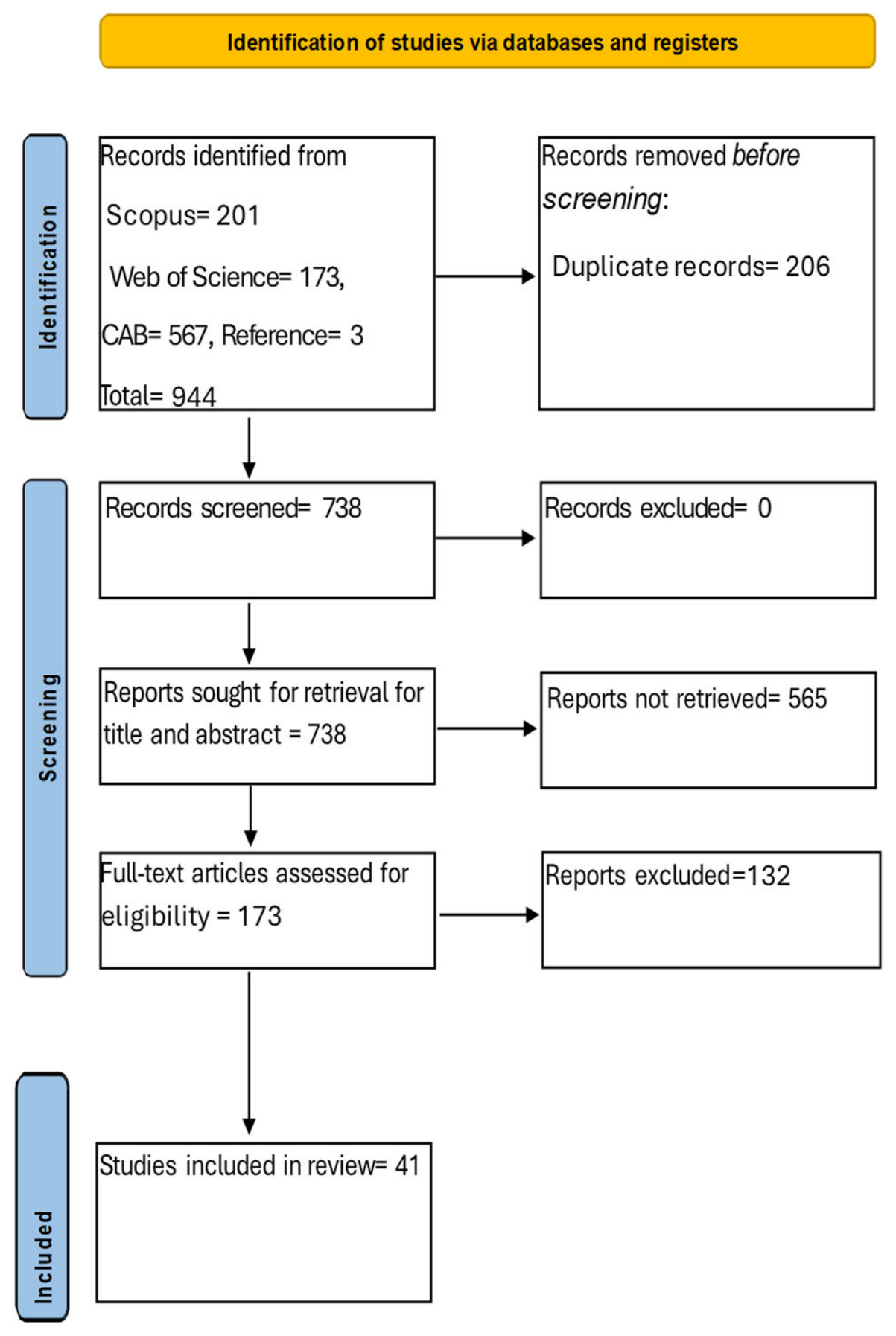
2. Materials and Methods
2.1. Data Sources and Literature Search Strategies
2.2. Selection Criteria
Exclusion and Inclusion Criteria
2.3. Data Collection and Management
2.4. Risk of Bias Assessment
2.5. Data Extraction and Data Synthesis
3. Results
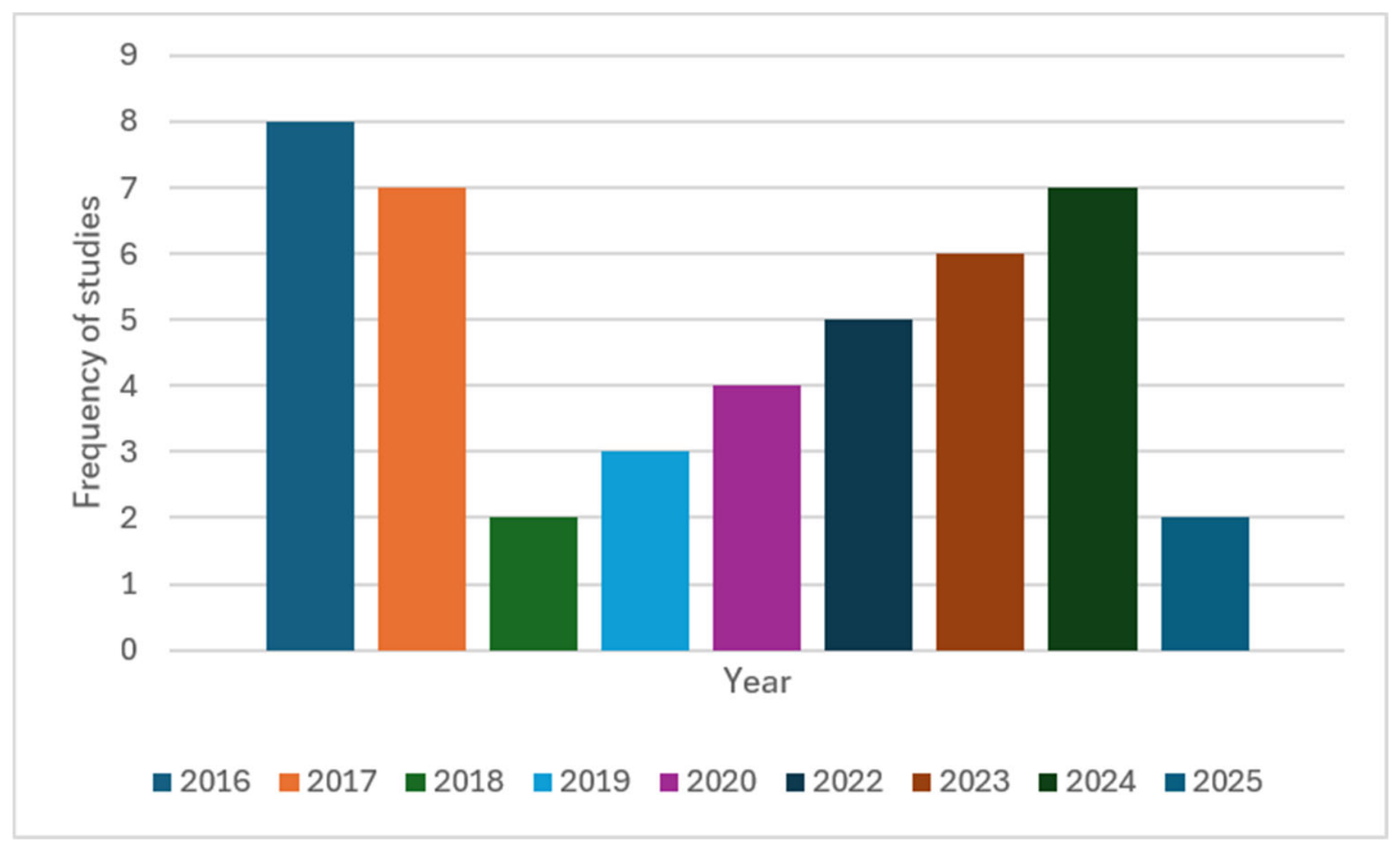
3.1. Global Publication Trends
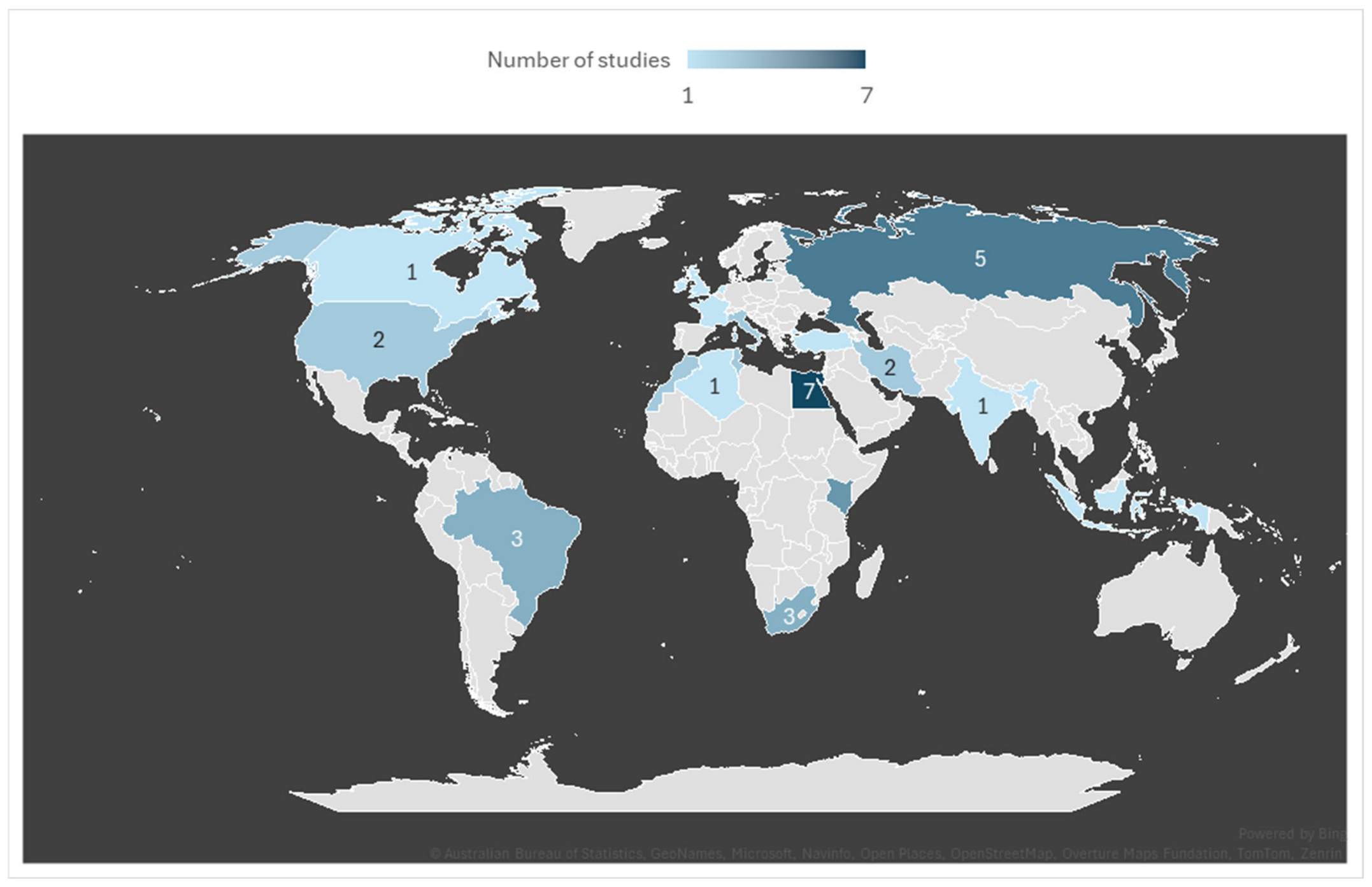
3.2. Geographic Distribution of Included Studies
3.3. Study Quality Based on CCAT Total Scores
4. Discussion
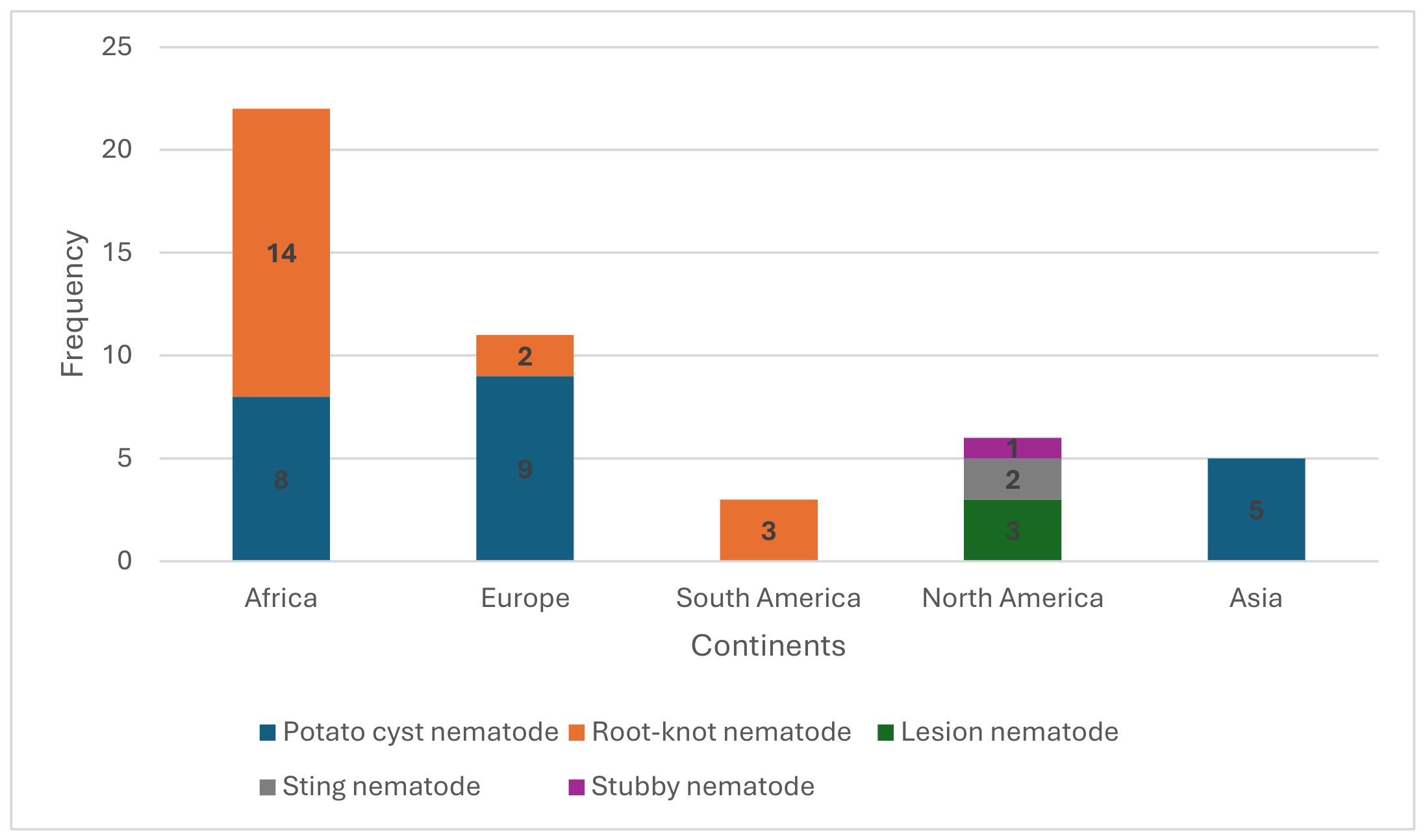
4.1. Nematode Species and Their Symptoms
4.2. Nematode Management and Control Strategies
4.2.1. Biocontrol Agents
4.2.2. Biofumigation
4.2.3. Abiotic Resistance Inducers and Intercropping
4.2.4. Resistant Varieties
4.2.5. Organic Amendments and Brassicaceae Rotations
4.2.6. Nematicides
4.2.7. Cover Crops
4.3. Comparison of Biological and Chemical Control
5. Limitations of the Study, Research Gaps and Recommendations
6. Conclusions
Supplementary Materials
Author Contributions
Funding
Institutional Review Board Statement
Data Availability Statement
Acknowledgments
Conflicts of Interest
References
- Mdoda, L.; Obi, A.; Tamako, N.; Naidoo, D.; Baloyi, R. Resource Use Efficiency of Potato Production among Smallholder Irrigated Farmers in the Eastern Cape Province of South Africa. Sustainability 2023, 15, 14457. [Google Scholar] [CrossRef]
- Sultana, S.; Hossain, M.M.; Haque, M.N. Estimating the potato farming efficiency: A comparative study between stochastic frontier analysis and data envelopment analysis. PLoS ONE 2023, 18, e0284391. [Google Scholar] [CrossRef] [PubMed]
- van der Waals, J.E.; Krüger, K. Emerging potato pathogens affecting food security in southern Africa: Recent research. S. Afr. J. Sci. 2020, 116, 30–36. [Google Scholar] [CrossRef] [PubMed]
- Acharya, G.; Shrestha, R.K. Potato crop: A main source of income for farmers in Nepal. Res. J. Padmakanya Mult. Campus 2023, 2, 11–20. [Google Scholar] [CrossRef]
- Burgos, G.; Zum Felde, T.; Andre, C.; Kubow, S. The potato and its contribution to the human diet and health. In The Potato Crop; Campos, H., Ortiz, O., Eds.; Springer: Cham, Switzerland, 2020; pp. 37–74. [Google Scholar] [CrossRef]
- Linnemann, A.J.; Wiskerke, P.C.S. On processing potato. 4. Survey of the nutritional value. Potato Res. 2022, 66, 429–468. [Google Scholar] [CrossRef]
- Devaux, A.; Goffart, J.P.; Kromann, P.; Andrade-Piedra, J.; Polar, V.; Hareau, G. The Potato of the Future: Opportunities and Challenges in Sustainable Agri-food Systems. Potato Res. 2021, 64, 681–720. [Google Scholar] [CrossRef] [PubMed]
- Aleuy, O.A.; Kutz, S. Adaptations, life-history traits and ecological mechanisms of parasites to survive extremes and environmental unpredictability in the face of climate change. Int. J. Parasitol. Parasites Wildl. 2020, 12, 308–317. [Google Scholar] [CrossRef] [PubMed]
- Tileubayeva, Z.; Avdeenko, A.; Avdeenko, S.; Stroiteleva, N.; Kondrashev, S. Plant-parasitic nematodes affecting vegetable crops in greenhouses. Saudi J. Biol. Sci. 2021, 28, 5428–5433. [Google Scholar] [CrossRef] [PubMed]
- Treonis, A.M.; Unangst, S.K.; Kepler, R.M.; Buyer, J.S.; Cavigelli, M.A.; Mirsky, S.B.; Maul, J.E. Characterization of soil nematode communities in three cropping systems through morphological and DNA metabarcoding approaches. Sci. Rep. 2018, 8, 2004. [Google Scholar] [CrossRef] [PubMed]
- Tiwari, J.K.; Bairwa, A.; Bhatia, N.; Zinta, R.; Kaushal, N.; Kumar, V.; Sharma, A.K.; Sharma, S.; Choudhary, B.; Buckseth, T. Resistance evaluation for native potato accessions against late blight disease and potato cyst nematodes by molecular markers and phenotypic screening in India. Life 2022, 13, 33. [Google Scholar] [CrossRef] [PubMed]
- Abd-Elgawad, M.M. Optimizing safe approaches to manage plant-parasitic nematodes. Plants 2021, 10, 1911. [Google Scholar] [CrossRef] [PubMed]
- Khan, M.R. Plant nematodes, an underestimated constraint in the global food production. In Nematode Diseases of Crops and Their Sustainable Management; Academic Press: London, UK, 2023; pp. 3–26. [Google Scholar] [CrossRef]
- Phani, V.; Khan, M.R.; Dutta, T.K. Plant-parasitic nematodes as a potential threat to protected agriculture: Current status and management options. Crop Prot. 2021, 144, 105573. [Google Scholar] [CrossRef]
- Makhubu, F.N.; Khosa, M.C.; McGaw, L.J. South African plants with nematicidal activity against root-knot nematodes: A review. S. Afr. J. Bot. 2021, 139, 183–191. [Google Scholar] [CrossRef]
- Orlando, V.; Grove, I.G.; Edwards, S.G.; Prior, T.; Roberts, D.; Neilson, R.; Back, M. Root-lesion nematodes of potato: Current status of diagnostics, pathogenicity and management. Plant Pathol. 2020, 69, 405–417. [Google Scholar] [CrossRef]
- Lima, F.S.O.; Mattos, V.S.; Silva, E.S.; Carvalho, M.A.S.; Teixeira, R.A.; Silva, J.C.; Correa, V.R. Nematodes Affecting Potato and Sustainable Practices for Their Management. In Potato—From Incas to All Over the World; InTech: Rijeka, Croatia, 2018. [Google Scholar] [CrossRef]
- Dutta, T.K.; Khan, M.R.; Phani, V. Plant-parasitic nematode management via biofumigation using brassica and non-brassica plants: Current status and future prospects. Curr. Plant Biol. 2019, 17, 17–32. [Google Scholar] [CrossRef]
- Rambauli, M.; Antwi, A.M.; Mudau, F.N. National and provincial officials’ knowledge on phytosanitary matters for food security in South Africa. S. Afr. J. Agric. Ext. 2019, 47, 151–163. [Google Scholar] [CrossRef]
- Moher, D.; Shamseer, L.; Clarke, M.; Ghersi, D.; Liberati, A.; Petticrew, M.; Shekelle, P.; Stewart, L.A. Preferred reporting items for systematic review and meta-analysis protocols (PRISMA-P) 2015 statement. Syst. Rev. 2015, 4, 1. [Google Scholar] [CrossRef] [PubMed]
- Kamau, D.W.; Waceke, W.; Cortada, L.; Mwaura, O.; Pirzada, T.; Sit, T.L.; Davis, E.; Guenther, D.; Mathew, R.; Pal, L.; et al. Efficacy of banana fibre paper for the management of the root-knot nematode, Meloidogyne incognita, on potato (Solanum tuberosum) in Kenya. Nematology 2024, 27, 25–36. [Google Scholar] [CrossRef]
- Ghareeb, R.Y.; Jaremko, M.; Abdelsalam, N.R.; Abdelhamid, M.M.A.; EL-Argawy, E.; Ghozlan, M.H. Biocontrol potential of endophytic fungi against phytopathogenic nematodes on potato (Solanum tuberosum L.). Sci. Rep. 2024, 14, 15547. [Google Scholar] [CrossRef] [PubMed]
- Ngala, B.; Dewaegeneire, P.; Robilliard, E.; Mariette, N.; Manceau, F.; Denis, M.C.; Porte, C.; Neveux, M.S.; Le Roux, A.C.; Fournet, S.; et al. Lure and starve: Host root exudates to suppress field populations of cyst nematodes. Appl. Soil Ecol. 2024, 201, 105490. [Google Scholar] [CrossRef]
- Youssef, M.M.A.; El-Nagdi, W.M.A.; El-Khair, H.A.; Elkelany, U.S.; Abd-Elgawad, M.M.M.; Dawood, M.G. Is Use of Two Trichoderma Species Sole or Combined with a Plant Extract Effective for the Biocontrol Meloidogyne incognita on Potato and Soil Microorganisms Diversity? Pak. J. Nematol. 2023, 41, 153–164. [Google Scholar] [CrossRef]
- Hajjaji, A.; Rached, B.; Ait M’Hand, R.A.J.A.A.; Rhallabi, N.; Mellouki, F. Effect of the Pseudomonas aeruginosa on potato cyst nematode Globodera pallida. J. Microbiol. Biotechnol. Food Sci. 2023, 13, e5847. [Google Scholar] [CrossRef]
- Bell, C.A.; Magkourilou, E.; Barker, H.; Barker, A.; Urwin, P.E.; Field, K.J. Arbuscular mycorrhizal fungal-induced tolerance is determined by fungal identity and pathogen density. Plants People Planet 2023, 5, 241–253. [Google Scholar] [CrossRef]
- Osman, H.A.I.; Ameen, H.H.; Hammam, M.M.A.; El-Sayed, G.M.; Elkelany, U.S.; Abd-Elgawad, M.M.M. Antagonistic potential of an Egyptian entomopathogenic nematode, compost and two native endophytic bacteria isolates against the root-knot nematode (Meloidogyne incognita) infecting potato under field conditions. Egypt. J. Biol. Pest Control 2022, 32, 137. [Google Scholar] [CrossRef]
- Asyiah, I.N.; Tristaningtyas, D.H.; Prihatin, J.; Winarso, S.; Widjayanthi, L.; Nugroho, D.; Firmansyah, K.; Pradana, A.P. The Efficacy of Cost-Effective Bionematicide Against Potato Cyst Nematode Globodera rostochiensis. Pak. J. Phytopathol. 2022, 34, 173–185. [Google Scholar] [CrossRef]
- Pulavarty, A.; Singh, A.; Smyth, D.; Mehta, J.P.; Horgan, K.; Kakouli-Duarte, T. Sustainable management of the potato cyst nematode, Globodera rostochiensis, with two microbial fermentation products. Front. Plant Sci. 2022, 13, 987059. [Google Scholar] [CrossRef] [PubMed]
- Chen, D.; Zebarth, B.J.; Goyer, C.; Comeau, L.P.; Nahar, K.; Dixon, T. Effect of Biofumigation on Population Densities of Pratylenchus spp. and Verticillium spp. and Potato Yield in Eastern Canada. Am. J. Potato Res. 2022, 99, 229–242. [Google Scholar] [CrossRef] [PubMed]
- Abbasi, K.; Wick, R.; Zafari, D. Chitinase activity of biocontrol fungi cultured from the golden potato cyst nematode, Globodera rostochiensis. Pak. J. Nematol. 2020, 38, 93–101. [Google Scholar] [CrossRef]
- Hajji, L.; Hlaoua, W.; Regaieg, H.; Horrigue-Raouani, N. Biocontrol Potential of Verticillium leptobactrum and Purpureocillium lilacinum Against Meloidogyne javanica and Globodera pallida on Potato (Solanum tuberosum). Am. J. Potato Res. 2017, 94, 178–183. [Google Scholar] [CrossRef]
- Nagachandrabose, S. Combined application of Pseudomonas fluorescens and Purpureocillium lilacinum liquid formulations to manage Globodera spp. on potato. J. Crop Prot. 2017, 6, 529–537. [Google Scholar]
- Contina, J.B.; Dandurand, L.M.; Knudsen, G.R. Use of GFP-tagged Trichoderma harzianum as a tool to study the biological control of the potato cyst nematode Globodera pallida. Appl. Soil Ecol. 2017, 115, 31–37. [Google Scholar] [CrossRef]
- Dandurand, L.M.; Morra, M.J.; Zasada, I.A.; Phillips, W.S.; Popova, I.; Harder, C. Control of Globodera spp. using Brassica juncea seed meal and seed meal extract. J. Nematol. 2017, 49, 437–445. [Google Scholar] [CrossRef] [PubMed]
- Aboul-Eid, H.Z.; Noweer, E.M.A.; Mona, E.A.S. Efficacy of some biocontrol compounds on root-knot nematode, Meloidogyne incognita, infesting potato under field conditions. Egypt. J. Biol. Pest Control 2016, 26, 217. [Google Scholar]
- Ebrahimi, N.; Viaene, N.; Aerts, J.; Debode, J.; Moens, M. Agricultural waste amendments improve inundation treatment of soil contaminated with potato cyst nematodes, Globodera rostochiensis and G. pallida. Eur. J. Plant Pathol. 2016, 145, 755–775. [Google Scholar] [CrossRef]
- Sellitto, V.M.; Curto, G.; Dallavalle, E.; Ciancio, A.; Colagiero, M.; Pietrantonio, L.; Bireescu, G.; Stoleru, V.; Storari, M. Effect of Pochonia chlamydosporia-based formulates on the regulation of root-knot nematodes and plant growth response. Front. Life Sci. 2016, 9, 177–181. [Google Scholar] [CrossRef]
- Sukhanova, A.A.; Boyandin, A.N.; Ertiletskaya, N.L.; Churakov, A.A. Obtaining and study of biodegradable granules loaded with oxamyl as eco-friendly preparation for Globodera rostochiensis control. J. Plant Dis. Prot. 2024, 131, 2017–2027. [Google Scholar] [CrossRef]
- Grabau, Z.J.; Liu, C.; Navia Gine, P.A. Belonolaimus longicaudatus management using metam potassium and fluensulfone in potato. J. Nematol. 2023, 55, 20230028. [Google Scholar] [CrossRef] [PubMed]
- Saleh, A.; Altas, A.; Evlice, E.; Özer, G.; Imren, M.; Dababat, A.A. The efficacy of fosthiazate, fluopyram, and Paecilomyces lilacinus against field populations of Globodera rostochiensis. Nematropica 2022, 52, 1. [Google Scholar]
- Sasanelli, N.; Toderas, I.; Veronico, P.; Iurcu-Straistaru, E.; Rusu, S.; Melillo, M.T.; Caboni, P. Abamectin Efficacy on the Potato Cyst Nematode Globodera pallida. Plants 2019, 9, 12. [Google Scholar] [CrossRef] [PubMed]
- Grabau, Z.J.; Noling, J.W.; Navia Gine, P.A. Fluensulfone and 1,3-dichloroprene for plant-parasitic nematode management in potato production. J. Nematol. 2019, 51, 1–12. [Google Scholar] [CrossRef] [PubMed]
- Hajji-Hedfi, L.; Hloua, W.; Gamaoun, W.; Chihani, N.; Regaieg, H.; Horrigue-Raouani, N. Management of potato cyst nematode (Globodera rostochiensis) with oxamyl. J. New Sci. Agric. Biotechnol. 2017, 1, 2591–2596. [Google Scholar]
- Hamida, A.O.; Hoda, A.A.; Mohamed, M.M.; Sonaa, H.E.; Salwa, S.G. Control of Meloidogyne incognita on potato plants and its associated weeds with some bioactive agents and chemicals under field conditions. Egypt. J. Biol. Pest Control 2016, 26, 503–508. [Google Scholar]
- Norshie, P.M.; Grove, I.G.; Back, M.A. Field evaluation of the nematicide fluensulfone for control of the potato cyst nematode Globodera pallida. Pest Manag. Sci. 2016, 72, 2001–2007. [Google Scholar] [CrossRef] [PubMed]
- Anedo, E.O.; Beesigamukama, D.; Mochoge, B.; Korir, N.K.; Haukeland, S.; Cheseto, X.; Nyongesa, M.; Pwaipwai, P.; Subramanian, S.; Tenkouano, A.; et al. Unpacking the benefits of black soldier fly frass fertilizer towards nematode suppression and potato production. Front. Plant Sci. 2025, 16, 1509643. [Google Scholar] [CrossRef] [PubMed]
- Anedo, E.O.; Beesigamukama, D.; Mochoge, B.; Korir, N.K.; Haukeland, S.; Cheseto, X.; Subramanian, S.; Kelemu, S.; Tanga, C.M. Evolving dynamics of insect frass fertilizer for sustainable nematode management and potato production. Front. Plant Sci. 2024, 15, 1343038. [Google Scholar] [CrossRef] [PubMed]
- Cole, E.; Pu, J.; Chung, H.; Quintanilla, M. Impacts of manures and manure-based composts on root lesion nematodes and Verticillium dahliae in Michigan potatoes. Phytopathology 2020, 110, 1226–1234. [Google Scholar] [CrossRef] [PubMed]
- Chitambo, O.; Haukeland, S.; Fiaboe, K.K.M.; Grundler, F.M.W. African nightshade and African spinach decrease root-knot nematode and potato cyst nematode soil infestation in Kenya. Plant Dis. 2019, 103, 1621–1630. [Google Scholar] [CrossRef] [PubMed]
- Daneel, M.; Engelbrecht, E.; Fourie, H.; Ahuja, P. The host status of Brassicaceae to Meloidogyne and their effects as cover and biofumigant crops on root-knot nematode populations associated with potato and tomato under South African field conditions. Crop Prot. 2018, 110, 198–206. [Google Scholar] [CrossRef]
- Dandurand, L.M.; Knudsen, G.R. Effect of the trap crop Solanum sisymbriifolium and two biocontrol fungi on reproduction of the potato cyst nematode, Globodera pallida. Ann. Appl. Biol. 2016, 169, 180–189. [Google Scholar] [CrossRef]
- Ramatsitsi, M.N.; Nxumalo, S.; Ramachela, K.; Khosa, M.C. Host response of five potato cultivars to Meloidogyne nematodes. J. Plant Dis. Prot. 2024, 131, 891–898. [Google Scholar] [CrossRef]
- Pinheiro, J.B.; da Silva, G.O.; Pinto, T.J.B.; Cunha, D.F.; Rafael, F.S.; Santos, L.A.; Florentino, M.D.L.C.; Ragassi, C.F.; de Carvalho, A.D.F.; Pereira, A.S. Reaction of potato genotypes to the root-knot nematode Meloidogyne spp. in a naturally infested field. Hortic. Bras. 2024, 42, e2535. [Google Scholar] [CrossRef]
- Teklu, M.G.; Schomaker, C.H.; Been, T.H.; Molendijk, L.P.G. Tuber Yield, Quality and Infestation Levels of Potato Genotypes Resistant to the Root-Knot Nematode, Meloidogyne Chitwoodi. Potato Res. 2022, 66, 105–135. [Google Scholar] [CrossRef]
- Djebroune, A.; Mokabli, A.; Hammache, M.; Chakali, G. Effects of potato cyst nematodes on three potato varieties in Algeria. Pak. J. Zool. 2020, 52, 1341–1346. [Google Scholar] [CrossRef]
- Getu, T.; Mohammed, W.; Seid, A.; Mekete, T.; Kassa, B. Reaction of selected potato cultivars to Meloidogyne incognita and Ralstonia solanacearum under greenhouse conditions. Arch. Phytopathol. Plant Prot. 2021, 54, 1456–1470. [Google Scholar] [CrossRef]
- Fatemy, S.; Ghasemi, H. Comparison of development of Globodera rostochiensis in four potato cultivars. Pak. J. Nematol. 2018, 36, 151–161. [Google Scholar] [CrossRef]
- Pofu, K.M.; Mashela, P.W. Host-status of selected South African commercial potato cultivars to Meloidogyne incognita and Meloidogyne javanica. Res. Crops 2017, 18, 270–273. [Google Scholar] [CrossRef]
- El-Sherif, A.; Abdel-Hady, A.; Gad, S.; Hefny, M. Host Suitability of Four Potato Cultivars to Meloidogyne incognita Infection Under Greenhouse Conditions. Egypt. J. Agronematol. 2017, 16, 30–38. [Google Scholar] [CrossRef]
- Schafer, J.T.; Gomes, C.B.; Pereira, A.S.; Cruz, F.F.; Barros, D.R. Resistance of potato genotypes to Meloidogyne javanica. Rev. Caatinga 2017, 30, 536–540. [Google Scholar] [CrossRef]
- Dutta, T.K.; Phani, V. The pervasive impact of global climate change on plant–nematode interaction continuum. Front. Plant Sci. 2023, 14, 1143889. [Google Scholar] [CrossRef] [PubMed]
- Mburu, H.; Cortada, L.; Haukeland, S.; Ronno, W.; Nyongesa, M.; Kinyua, Z.; Bargul, J.L.; Coyne, D. Potato cyst nematodes: A new threat to potato production in East Africa. Front. Plant Sci. 2020, 11, 670. [Google Scholar] [CrossRef] [PubMed]
- Kaczmarek, A.; Mackenzie, K.; Kettle, H.; Blok, V. Influence of soil temperature on Globodera rostochiensis and Globodera pallida. Phytopathol. Mediterr. 2014, 53, 396–405. [Google Scholar] [CrossRef]
- Aliste, M.; Ros, C.; Garrido, I.; Martínez, C.M.; Esteban, A.F.; Hernández, M.Á.; Contreras, F.; Flores, P.; Hellín, P.; Fenoll, J. Dual benefits of rotation crops: Root nematode suppression and pesticide remediation through biosolarization. Environ. Chem. Ecotoxicol. 2026, 8, 770–779. [Google Scholar] [CrossRef]
- Otieno, H. Prevalence of potato cyst (Globodera spp.) nematode and potato root-knot (Meloidogyne spp.) nematode in Kenya and potential management strategies: A review. Arch. Agric. Environ. Sci. 2023, 8, 250–258. [Google Scholar] [CrossRef]
- Rusinque, L.; Camacho, M.J.; Serra, C.; Nóbrega, F.; Inácio, M.L. Root-knot nematode assessment: Species identification, distribution, and new host records in Portugal. Front. Plant Sci. 2023, 14, 1230968. [Google Scholar] [CrossRef] [PubMed]
- Gartner, U.; Hein, I.; Brown, L.H.; Chen, X.; Mantelin, S.; Sharma, S.K.; Dandurand, L.M.; Kuhl, J.C.; Jones, J.T.; Bryan, G.J.; et al. Resisting potato cyst nematodes with resistance. Front. Plant Sci. 2021, 12, 661194. [Google Scholar] [CrossRef] [PubMed]
- Rahman, M.U.; Zhong, X.; Uzair, M.; Fan, B. Application of fungi as biological control strategies for nematode management in horticultural crops. Phytopathol. Res. 2024, 6, 38. [Google Scholar] [CrossRef]
- Abd-Elgawad, M.M.; Askary, T.H. Fungal and bacterial nematicides in integrated nematode management strategies. Egypt. J. Biol. Pest Control 2018, 28, 74. [Google Scholar] [CrossRef]
- Rahman, M.U.; Chen, P.; Zhang, X.; Fan, B. Predacious strategies of nematophagous fungi as bio-control agents. Agronomy 2023, 13, 2685. [Google Scholar] [CrossRef]
- Regaieg, H.; Ciancio, A.; Raouani, N.H.; Grasso, G.; Rosso, L. Effects of culture filtrates from the nematophagous fungus Verticillium leptobactrum on viability of the root-knot nematode Meloidogyne incognita. World J. Microbiol. Biotechnol. 2010, 26, 2285–2289. [Google Scholar] [CrossRef]
- Waisen, P.; Cheng, Z.; Sipes, B.S.; Wang, K.H. Biofumigation effects of brassicaceous cover crops on soil health in cucurbit agroecosystems in Hawaii, USA. Pedosphere 2022, 32, 521–531. [Google Scholar] [CrossRef]
- Youssef, M.M.A. Biofumigation as a promising tool for managing plant parasitic nematodes: A review. Sci. Agric. 2015, 10, 115–118. [Google Scholar] [CrossRef]
- Lurkiv, L.; Eckstein, B.; Lorenzetti, E.; Stangarlin, J.R. Biotic and abiotic resistance inducers for controlling white rust in rocket (Eruca sativa). Arq. Inst. Biol. 2020, 87, e0202019. [Google Scholar] [CrossRef]
- Mohan, S.; Kiran Kumar, K.; Sutar, V.; Saha, S.; Rowe, J.; Davies, K.G. Plant root-exudates recruit hyperparasitic bacteria of phytonematodes by altered cuticle aging: Implications for biological control strategies. Front. Plant Sci. 2020, 11, 763. [Google Scholar] [CrossRef]
- Dong, L.; Li, X.; Huang, L.; Gao, Y.; Zhong, L.; Zheng, Y.; Zuo, Y. Lauric acid in crown daisy root exudate potently regulates root-knot nematode chemotaxis and disrupts Mi-flp-18 expression to block infection. J. Exp. Bot. 2014, 65, 131–141. [Google Scholar] [CrossRef] [PubMed]
- Giannakou, I.O.; Karpouzas, D.G.; Anastasiades, I.; Tsiropoulos, N.G.; Georgiadou, A. Factors affecting the efficacy of non-fumigant nematicides for controlling root-knot nematodes. Pest Manag. Sci. 2005, 61, 961–972. [Google Scholar] [CrossRef] [PubMed]
- Afzal, A.; Mukhtar, T. Revolutionizing nematode management to achieve global food security goals: An overview. Heliyon 2024, 10, e25325. [Google Scholar] [CrossRef] [PubMed]
- Cucu, M.A.; Choudhary, R.; Trkulja, V.; Garg, S.; Matić, S. Utilizing environmentally friendly techniques for the sustainable control of plant pathogens: A review. Agronomy 2025, 15, 1551. [Google Scholar] [CrossRef]
- Mukhtar, T.; Hussain, M.A.; Kayani, M.Z.; Aslam, M.N. Evaluation of resistance to root-knot nematode (Meloidogyne incognita) in okra cultivars. Crop Prot. 2014, 56, 25–30. [Google Scholar] [CrossRef]
- LaMondia, J.A.; Brodie, B.B. Effects of initial nematode density on population dynamics of Globodera rostochiensis on resistant and susceptible potatoes. J. Nematol. 1986, 18, 159–164. [Google Scholar] [PubMed]
- Montarry, J.; Mimee, B.; Danchin, E.G.J.; Koutsovoulos, G.D.; Ste-Croix, D.T.; Grenier, E. Recent advances in population genomics of plant-parasitic nematodes. Phytopathology 2021, 111, 40–48. [Google Scholar] [CrossRef] [PubMed]
- Han, S.; Schliemann, W.; Liu, S. Resistance of plants to parasitic nematodes and its application in breeding. Front. Plant Sci. 2024, 15, 1439535. [Google Scholar] [CrossRef] [PubMed]
- Reps, N.I.F.A.; Draper, M.A. W3186: Variability, Adaptation, and Management of Nematodes Impacting Crop Production and Trade. National Information Management and Support System (NIMSS), USDA NIFA. Available online: https://nimss.org/projects/view/mrp/outline/10536 (accessed on 26 March 2026).
- Hu, C.; Qi, Y. Effect of compost and chemical fertilizer on soil nematode community in a Chinese maize field. Eur. J. Soil Biol. 2010, 46, 230–236. [Google Scholar] [CrossRef]
- Ebrahimi, N.; Viaene, N.; Vandecasteele, B.; D’Hose, T.; Debode, J.; Cremelie, P.; De Tender, C.A.; Moens, M. Traditional and new soil amendments reduce survival and reproduction of potato cyst nematodes, except for biochar. Appl. Soil Ecol. 2016, 107, 191–204. [Google Scholar] [CrossRef]
- Rosskopf, E.; Di Gioia, F.; Hong, J.C.; Pisani, C.; Kokalis-Burelle, N. Organic amendments for pathogen and nematode control. Annu. Rev. Phytopathol. 2020, 58, 277–311. [Google Scholar] [CrossRef] [PubMed]
- Fourie, H.; Ahuja, P.; Lammers, J.; Daneel, M. Brassicaceae-based management strategies as an alternative to combat nematode pests: A synopsis. Crop Prot. 2016, 80, 21–41. [Google Scholar] [CrossRef]
- Kruger, D.H.M.; Fourie, J.C.; Malan, A.P. Control potential of Brassicaceae cover crops as green manure and their host status for Meloidogyne javanica and Criconemoides xenoplax. S. Afr. J. Enol. Vitic. 2015, 36, 165–174. [Google Scholar] [CrossRef]
- Knoetze, R.; Addison, M.; De Waele, D. Host status of cover crops for root-lesion nematodes (Pratylenchus spp.) associated with apple orchards in South Africa. J. Plant Dis. Prot. 2023, 130, 105–113. [Google Scholar] [CrossRef]
- Fourie, L.W. Investigating the Use of Marigolds (Tagetes spp.) and Brassicaceous Cover Crops as a Tool for the Management of Lesion Nematodes (Pratylenchus spp.). In Apple Orchards; Stellenbosch University: Stellenbosch, South Africa, 2024. [Google Scholar]
- Brennan, R.J.B.; Glaze-Corcoran, S.; Wick, R.; Hashemi, M. Biofumigation: An alternative strategy for the control of plant parasitic nematodes. J. Integr. Agric. 2020, 19, 1680–1690. [Google Scholar] [CrossRef]
- Richards, A.; Estaki, M.; Úrbez-Torres, J.R.; Bowen, P.; Lowery, T.; Hart, M. Cover crop diversity as a tool to mitigate vine decline and reduce pathogens in vineyard soils. Diversity 2020, 12, 128. [Google Scholar] [CrossRef]
- Watson, T.T.; Hamm, C.S.; Gregorie, J.C. Evaluation of fumigant and non-fumigant nematicides for management of Rotylenchulus reniformis on sweetpotato. J. Nematol. 2023, 55, 20230061. [Google Scholar] [CrossRef] [PubMed]
- Coyne, D.L.; Cortada, L.; Dalzell, J.J.; Claudius-Cole, A.O.; Haukeland, S.; Luambano, N.; Talwana, H. Plant-parasitic nematodes and food security in Sub-Saharan Africa. Annu. Rev. Phytopathol. 2018, 56, 381–403. [Google Scholar] [CrossRef] [PubMed]
- Karuri, H. Root and soil health management approaches for control of plant-parasitic nematodes in sub-Saharan Africa. Crop Prot. 2022, 152, 105841. [Google Scholar] [CrossRef]
- Abd-Elgawad, M.M. Upgrading strategies for managing nematode pests on profitable crops. Plants 2024, 13, 1558. [Google Scholar] [CrossRef] [PubMed]
- Page, M.J.; McKenzie, J.E.; Bossuyt, P.M.; Boutron, I.; Hoffmann, T.C.; Mulrow, C.D.; Shamseer, L.; Tetzlaff, J.M.; Akl, E.A.; Brennan, S.E.; et al. PRISMA 2020 statement: An updated guideline for reporting systematic reviews. BMJ 2021, 372, n71. [Google Scholar] [CrossRef] [PubMed]



| Criterion | Inclusion Criteria | Exclusion Criteria |
|---|---|---|
| Language | Articles published in English | Articles that are not published in English |
| Timeline | Articles published between 2016 up to the current year. | Articles published before 2016 |
| Article type | All research published in peer-reviewed journals. Articles | All non-peer-reviewed journals. Conference papers, editorial material, book chapters |
| Nematode types | Research that focuses on plant-parasitic nematodes | Research that does not focus on plant-parasitic nematodes |
| Study design | Field trials, Greenhouse experiments | Soil surveys and interviews |
| Intervention | Studies examining management strategies for nematode infestations in potatoes. | Studies not examining management strategies for nematode infestations in potatoes. |
| Metric | Value |
|---|---|
| Number of included studies (CCAT assessed) | 41 |
| CCAT total score range (out of 40) | 23–35 |
| CCAT percentage range (%) | 58–88 |
| Mean CCAT percentage (%) | 79 |
| Studies classified as high quality (≥75%) | 30 |
| Studies classified as moderate quality 50–74% | 11 |
| Studies classified as low quality (<50%) | 0 |
| Management Strategies | Publication Year | Region | Objectives | Nematode Species | Findings | CCAT Score (%) | Reference |
|---|---|---|---|---|---|---|---|
| Biological control | 2025 | Africa, Kenya | To evaluate the efficacy of a lignocellulose fibre matrix (banana paper) either impregnated with a chemical or drenched with a biologically based nematicide for the management of root-knot nematodes on potatoes, in Kenya. | Meloidogyne incognita | Banana fibre “Wrap & Plant” sheets loaded with abamectin or drenched with T. asperellum provided targeted delivery to the rhizosphere and significantly reduced RKN reproduction factor and soil Pf while improving potato growth and tuber yield compared with untreated farmer practice; performance was comparable to or better than soil drench with abamectin or Trichoderma alone, showing the matrix can enhance efficacy and persistence of both a chemical nematicide and a fungal antagonist. | 33 (83) | [21] |
| 2024 | Africa, Egypt | To evaluate the efficacy of Aspergillus flavus, an entophyte fungus isolated from Trigonella foenum-graecum seeds, against Meloidogyne incognita. | Meloidogyne incognita | 100% A. flavus filtrate caused 97.7% J2 mortality, 95.3% J2 reduction in soil, and 90% gall reduction; 41.7% shoot length increase; defense enzymes upregulated. | 35 (88) | [22] | |
| 2024 | Europe, France | Examined the effect of exogenous soil application of crude root exudates from host plants on the population densities of two cyst nematode species, G. pallida and H. carotae, under field conditions in two different periods, autumn and spring seasons. | Globodera pallida | G. pallida: 72–83% hatch (autumn); H. carotae: 54% hatch (spring after repeated application); no effect in spring for G. pallida due to low soil moisture | 35 (88) | [23] | |
| 2023 | Africa, Egypt | Investigated the effects of Trichoderma viride (Tv) and T. virens (Tvr) as antifungal agents individually or combined with pomegranate peel aqueous extract (PP) on. M. incognita infesting potato cv. Spunta. | Meloidogyne incognita | Tv and Tvr (solo) reduced J2s by 83.7% and 78.7%; increased tuber weight by 176.4% and 290.2%, respectively; combined treatments (e.g., Tv + PP) had antagonistic effects and lower efficacy; PP alone also effective (52.2% J2 reduction) | 33 (83) | [24] | |
| 2023 | Africa, Morocco | To evaluate the potential effect of P. aeruginosa on the population density of G. pallida., especially on eggs, juveniles (J2) and cysts in vitro and the efficacy in vivo to control the nematode on the susceptible potato variety ‘Desiree’. | Globodera pallida | In vitro: 42% egg and 56–58% J2 reduction at 108 CFU/mL; In vivo: 33.3% RNC, 650 g increase in tuber weight, 19.2 cm increase in plant height | 30 (75) | [25] | |
| 2023 | Europe, UK | To determine the impact of a commercial AMF inoculant on the native Arbuscular Mycorrhizal Fungi (AMF) community | Globodera pallida | AMF improved tolerance at low PCN densities (≤15 eggs/g); Arbuscular Mycorrhizal Fungi increased PCN fitness (cyst and egg production); tolerance was lost at high PCN densities; Arbuscular Mycorrhizal Fungi inoculation improved tuber size but not total yield | 35 (88) | [26] | |
| 2022 | Africa, Egypt | To assess the efficacy of compost singly or in combination with the Egyptian entomopathogenic nematode (EPN), Heterorhabditis bacteriophora, and the two bacterial isolates (Bacilluscereus Nem 212 and Nem 213) against M. incognita, infecting potato plants under field conditions. | Meloidogyne incognita | Compost + Bacilluscereus Nem 213 (T7) showed 79.4% J2 reduction, 21.2% yield increase; T5 (Nem 212) had 77.3% root-stage reduction, 206.8% yield increase; compost alone = 66.4% J2 reduction | 29 (73) | [27] | |
| 2022 | Asia, Indonesia | To evaluate the bionematicide and its effectiveness in controlling Globodera rostochiensis. | Globodera rostochiensis | The bionematicide also reduced the number of cysts and the number of female nematodes in the field. The most effective and recommended bionematicide concentration was 4% for every 100 mL in each plant. | 35 (88) | [28] | |
| 2022 | Europe, Ireland | To evaluate the efficacy of two microbial fermentation products (MFPs) from Alltech—MFP5075, a proprietary blend containing bacterial fermentation media and a copper component, and MFP3048, a microbial-based product, against the potato cyst nematode Globodera rostochiensis. | Globodera rostochiensis | In plant infestation studies, treatment with MFP3048 and MFP5075 caused 90.6 and 84.9 percent reduction in PCN infestation, respectively, in terms of cysts developed on roots compared to the untreated control. | 35 (88) | [29] | |
| 2022 | North America, Canada | To evaluate the effect of biofumigation on the population density of Pratylenchus spp. and Verticillium spp., Potato Early Dying (PED) severity and potato tuber yield under rain-fed potato production in Eastern Canada. | Pratylenchus spp. | Biofumigation significantly reduced RLN (by 25–55%) but not Verticilliumdahliae; fumigation suppressed both, but the effect on Verticilliumdahliae was short-lived; biofumigation improved yield in Trial A but not in Trial B (due to drought). | 34 (85) | [30] | |
| 2020 | Asia, Iran | To screen the chitinolytic ability of fungi isolated from Globodera rostochiensis and to evaluate their biocontrol potential. | Globodera rostochiensis | Among 154 fungal isolates from PCN eggs, 10 with highest chitinase activity were selected; species such as Beauveria bassiana, Lecanicillium muscarium, Paecilomyces sp. and Trichoderma atroviride showed the greatest chitinase activities; L. muscarium gave the highest parasitism of eggs/J2 in vitro, while T. atroviride and B. bassiana produced the highest root dry weight and tuber yield and reduced cyst numbers in greenhouse experiments, and chitinase activity correlated well with biocontrol potential. | 30 (75) | [31] | |
| 2017 | Africa, Tunisia | To evaluate the biocontrol potential of indigenous strains of Verticillium. leptobactrum and a commercial formulation of Purpureocillium lilacinum against single and concomitant infestations of Meloidogyne javanica and Globodera pallida and to assess their impact on potato crops. | Meloidogyne javanica and Globodera pallida | The incorporation of each fungus alone into the soil significantly increased the growth parameters. The results also revealed that the application of Purpureocillium lilacinum and Verticillium leptobactrum significantly decreased the development of potato cyst-nematode in roots by 76% and 83% and in the soil by 61% and 66% respectively. | 28 (70) | [32] | |
| 2017 | Asia, India | To find out the effect of combined use of liquid suspensions of P. fluoresecens and P. lilacinum to manage PCN in the field conditions. | Globodera rostochiensis and Globodera pallida | Seed treatment with P. fluorescens plus soil drench with P. lilacinum reduced cysts in soil by about 75–76%, females in roots by ~80%, and eggs in soil by ~84%, and increased plant height, tuber number and yield compared to untreated and single-agent treatments and carbofuran. | 28 (70) | [33] | |
| 2017 | Europe, Russia | This study was focused on elucidating the processes involved in the biocontrol of G. pallida using Trichodermaharzianum ThzID1-M3. | Globodera pallida | Trichoderma harzianum ThzID1-M3 significantly reduced Globodera pallida infection and reproduction in potato roots, lowering infection rates by up to 84% and reproduction by 60%, while also colonizing cysts, juveniles, and the potato rhizosphere | 35 (88) | [34] | |
| 2017 | Europe, Russia | Quantify the activity of Brassica. juncea seed meal and formulated seed meal extracts on G. pallida and G. ellingtonae hatch and reproduction in laboratory and field experiments. | Globodera pallida and Globodera ellingtonae | Reproduction of G. pallida on potato after exposure to Brassica juncea seed meal at a rate of 2.2 t/ha was also significantly reduced. | 34 (85) | [35] | |
| 2016 | Africa, Egypt | To evaluate several biological agents against meloidogyne incognita infecting potato and soil borne fungi associated with the nematode infestion. | Meloidogyne incognita | Using biological agents achieved a high activity against the root-knot nematode and gave an high increase in the yield. | 23 (58) | [36] | |
| 2016 | Europe, Belgium | To evaluate if amendments of the aforementioned waste products could accelerate the negative effects of inundation on survival of PCN in waste soil. | Globodera rostochiensis and Globodera pallida | Inundation combined with organic amendments significantly reduced nematode survival. Amendments with potato peels and leek reduced viability by up to 99.9% after 4 weeks compared to 72% reduction in non-amended inundated soil after 8 weeks. Organic amendments also reduced hatching and infectivity of juveniles. Higher concentrations of short-chain fatty acids and lower oxygen levels contributed to nematode suppression. | 33 (83) | [37] | |
| 2016 | Europe, Italy | To test effectiveness of Pochar against RKNs attacking potato and the P. chlamydosporia growth effects on non-parasitized tomato plants, to evaluate the best conditions for its open-field applications | Meloidogyne incognita | The use of Pochar in open-field conditions for RKNs control on potato appeared effective in controlling RKN. | 25 (63) | [38] | |
| Chemical control | 2024 | Europe, Russia | Biodegradable polycaprolactone and montmorillonite (PCL/MMT) granules loaded with oxamyl with prolonged release and their nematicidal effect against Globodera rostochiensis on potato variety “Krasnoyarskiy ranniy”. | Globodera rostochiensis | Showed satisfactory results. 2.5 times fewer cysts were found on the roots of the plants treated with PCL/MMT granules with oxamyl than in the positive control, but significantly more than in the group treated with the commercial pesticide. | 34 (85) | [39] |
| 2023 | North America, USA | To evaluate the efficacy of Metam potassium and a mixture of Metam potassium and fluensulfone on (1) management of plant-parasitic nematodes (2) yield response. | Belonolaimus longicaudatus | Fumigation with 1,3-dichloroprene continues to be the most consistently effective option for managing sting nematode in potato production. | 34 (85) | [40] | |
| 2022 | Asia, Turkey | To compare the efficacy of fosthiazate (900 g/L), fluopyram (400 g/L), and Paecilomyces lilacinus strain PL1 (108 cfu/mL) against field populations of Globodera rostochiensis on potato under field conditions in naturally infested fields in İzmir Province, Turkey. | Globodera rostochiensis | The study tested fosthiazate, fluopyram, and Paecilomyces lilacinus PL1 against field populations of Globodera rostochiensis on potato. All three treatments significantly reduced nematode densities and increased yield, with fosthiazate and fluopyram outperforming the biological agent and providing about 31–34% yield gains over the untreated control. | 32 (80) | [41] | |
| 2019 | Europe, Italy | To test the nematicidal efficacy of an abamectin formulation (Vertimec®EC) on the PCN G. pallida in vitro and to determine the effective dose for its control in a glasshouse experiment as a preliminary approach to field application. | Globodera pallida | The doses of 18 and 36 g/mL significantly reduced the number of eggs, juveniles, cyst/g soil and reproduction rate in comparison to both the untreated control and the fosthiazate treatment. Soil applications of abamectin provided significant Globodera pallida control with LD50 and LD99.9 of 14.4 and 131.3 g/mL, | 34 (85) | [42] | |
| 2019 | North America, USA | To evaluate the efficacy of fluensulfone at various rates and the fumigant 1,3-dichloroprene management of plant-parasitic nematodes | Belonolaimus longicaudatus, Pratylenchus sp., Paratrichodorus spp. | Fluensulfone and 1,3-dichloroprene reduced sting nematode by 52–100%; improved yields 33–66% (except high rates in 2017); no effect on stubby-root; lesion nematode control inconsistent | 34 (85) | [43] | |
| 2017 | Africa, Tunisia | Evaluated the control potential of new chemical products based on oxamyl, carbamate nematicide, against potato cyst nematodes (PCN) and its effect on potato growth and yield. | Globodera rostochiensis | Oxamyl and ethoprophos significantly reduced nematode populations in soil and roots compared with untreated plots. Oxamyl improved potato growth parameters and showed no detectable phytotoxicity or harmful residue in tubers and soil. The study concluded that oxamyl could effectively control potato cyst nematodes in potato production. | 24 (60) | [44] | |
| 2016 | Africa, Egypt | to evaluate the efficacy of different agents in controlling the root knot nematode, Meloidogyne incognita infecting potato plants cv. Spunta and associated weeds and their effects on potato production. | Meloidogyne incognita | All treatments significantly lowered M. incognita J2 in soil, root galls and egg masses compared with the untreated control, and increased yield; oxamyl alone gave the highest reductions (≈50–63%), Metribuzin alone also strongly reduced J2 and galls while controlling weeds, and combinations such as Metribuzin + C. coronarium or + oxamyl gave strong nematode and weed suppression with high tuber yields; ascorbic acid alone reduced nematode parameters and markedly increased yield, and C. coronarium intercrop alone had mild nematode effects but improved yield. | 30 (75) | [45] | |
| 2016 | Europe, England | To evaluate fluensulfone for efficacy in the control of G. pallida in UK potato production. | Globodera pallida | Fluensulfone (4.05 kg AI/ha) reduced root infection and population development moderately; more effective when combined with resistant cultivar Santé; oxamyl had superior efficacy | 34 (85) | [46] | |
| Cultural control | 2025 | Africa, Kenya | Assessed comparatively, the nematicidal and fertilizer potentials of the black soldier fly frass fertilizer (BSFFF), commercial nematicide, inorganic fertilizer, and commercial organic fertilizer for potato production under open field conditions. | PCN | Results revealed that all fertilizer treatments significantly increased potato growth, number of tubers (34–61%), and tuber yield (20–72%) relative to the control. Over 26% higher tuber yield was achieved using BSFFF + 5% chitin compared to NPK + nematicide treatment. Soil amendment with BSFFF + 5% chitin caused 5–35% higher soil- 1 reduction in the number of cysts per 200 g compared to NPK + nematicide and SAFI treatments. | 35 (88) | [47] |
| 2024 | Africa, Kenya | Explored the potential of chitin-fortified black soldier fly-composted organic fertilizer (BSFCOF) as a multipurpose organic fertilizer amendment for enhancing potato yield and suppressing potato cyst nematodes | PCN | For effective management of PCN and enhancement of potato yield, it is recommended that BSFCOF is combined with 5% BSF pupal exuviae chitin. | 35 (88) | [48] | |
| 2020 | North America, USA | The Volatile Fatty Acids content of these different compost and manure products to determine if Volatile Fatty Acid Content are a plausible mechanism for nematode reduction. | Pratylenchus penetrans | Poultry manure and layer ash blend showed the greatest nematode reduction in lab and field; high-rate poultry manure significantly reduced P. penetrans and improved yield; no treatments reduced Verticillium. dahliae infection significantly. | 34 (85) | [49] | |
| 2019 | Africa, Kenya | (I) To determine if Solanum spp. and Amaranthus spp. are hosts for RKN and PCN, (II) to determine the potential of Solanum spp. and Amaranthus spp. to manage RKN and PCN. | RKN and PCN | When cropping susceptible crops, after three seasons of successive cultivation of these African indigenous vegetables (AIV), the galling index and number of developing PCN females measured on susceptible crops decreased by more than 75%. Wilting and RKN-PCN coinfection incidences also decreased significantly. | 34 (85) | [50] | |
| 2018 | Africa, South Africa | To investigate the potential of Brassicaceae crops in reducing Meloidogyne spp. populations densities under field conditions. | Meloidogyne incognita and Meloidogyne javanica | Brassicaceae cultivars evaluated showed potential as an alternative management strategy against root-knot nematodes. | 34 (85) | [51] | |
| 2016 | North America, USA | To determine the effect of the nematode trap crop S. sisymbriifolium, alone or in combination with the biocontrol agents Trichoderma harzianum or Plectosphaerella cucumerina, on population decline of G. pallida. | Globodera pallida | A prior crop of S. sisymbriifolium reduced G. pallida Pf/Pi by about 99 in a subsequent potato crop compared with potato-after-potato or potato-after-fallow; no cysts were produced on S. sisymbriifolium or barley, confirming they are non-hosts, but only S. sisymbriifolium markedly reduced populations in the next potato; T. harzianum and P. cucumerina reduced progeny and Pf/Pi mainly in potato-after-potato cycles, with effects depending on cropping sequence. | 33 (83) | [52] | |
| Resistant genotypes | 2024 | Africa, South Africa | To screen for the response of five selected commercial potato cultivars to the aggressive and widespread M. enterolobii and M. javanica. | Meloidogyne enterolobii and Meloidogyne javanica | Further, cultivars ‘Buffelspoort 1’ and ‘Hertha’ showed the highest susceptibility, whilst cultivar ‘Mnandi’ show the least susceptibility. Results suggested that all five commercial potato cultivars were susceptible to M. enterolobii and M. javanica. | 35 (88) | [53] |
| 2024 | South America, Brazil | To evaluate the reaction of potato clones and cultivars to a population mixture of Meloidogyne incognita and M. ethiopica in a naturally infested field. | Meloidogyne incognita and Meloidogyne ethiopica | The clones C2743-09-09, CH41, F119-12-01, F129-12-08, F63-10-13A, F65-13-06, F88-11-01 and OD38-06, and the cultivars Markies, Agata and Asterix were the least susceptible genotypes to field mix of the root-knot nematodes M. incognita and M. ethiopica. But combining a lower degree of susceptibility and good tuber productivity, clones MB54-02, F53-11-05, F63-10-13A, F65-13-06, OD38-06 stood out. The commercial cultivars Atlantic and Epagri Catucha presented greater multiplication of nematodes in the field than the other evaluated cultivars. | 33 (83) | [54] | |
| 2023 | Europe-Netherlands | Evaluate the performance of nine potato genotypes (including known resistant lines) in terms of tuber yield, quality, and susceptibility to Meloidogyne chitwoodi under controlled greenhouse conditions. | Meloidogyne chitwoodi | Resistant genotypes showed high tolerance (m = 1), low tuber infestation (0.002 J2/g soil), and >91% clean tubers. Cv. Desiree showed high susceptibility (m < 0.8), TKI > 20, and 0.35 J2/g soil infestation. Tuber quality and yield correlated with pot size. | 31 (78) | [55] | |
| 2020 | Africa, Algeria | To gather information on the infestation dynamics of these nematodes on three potato varieties under natural conditions to better control their populations by practical actions and limit their damage within their distribution range in Algeria. | Globodera rostochiensis and Globodera pallida | Findings proved that the growth of resistant potato varieties, unlike sensitive ones, in the infested areas could present an effective management strategy against these pests. | 23 (58) | [56] | |
| 2020 | Africa Ethiopia | To evaluate the reaction of 13 potato cultivars to co-infestation of Meloidogyne incognita (MI) and Ralstonia solanacearum (RS) under greenhouse conditions. | Meloidogyne incognita | “Gudenie” and “Belete” showed “resistant” to MI in RS inoculation prior to MI. These cultivars could be recommended to be used in integrated disease management. Most cultivars showed “resistant” to RS in RS inoculation alone. “Bubu” produced the highest mean values of marketable tuber number per plant with most tested treatments. | 30 (75) | [57] | |
| 2018 | Asia, Iran | To investigate the development of different juvenile stages of G. rostochiensis in one susceptible cv. (Marfona) and the resistant (to Ro1) cvs; Agria, Satina and Banba under glasshouse conditions. | Globodera rostochiensis | Juvenile penetration, development and female formation were greatly reduced and delayed in resistant cvs Agria, Satina and Banba compared with susceptible Marfona; only 23, 10 and 4% of inoculated J2 entered roots of Satina, Agria and Banba vs. 44% in Marfona, hatching from root diffusates was also lower in resistant cvs, confirming effectiveness of H1-based resistance in limiting reproduction. | 29 (73) | [58] | |
| 2017 | Africa, South Africa | To determine the host status of high yielding commercial potato cultivars in South Africa to M. incognita and M. javanica populations. | Meloidogyne incognita and Meloidogyne javanica | In greenhouse trials over two seasons, reproductive potential (eggs + J2 per g root) of both nematodes was >1 on all tested cultivars (Sifra, Lanorma, Innovator, Uptodate, FL2108.2006.1), indicating all are excellent hosts; RP values were particularly high for M. javanica on Innovator and Sifra and for M. incognita on Lanorma, confirming high susceptibility and the need for active nematode management when these cultivars are grown. | 23 (58) | [59] | |
| 2017 | Africa, Egypt | To evaluate suitability of four potato cultivars, i.e., Cara, Draga, Spunta and Solana against M. incognita infection at 20 ± 3 °C. | Meloidogyne incognita | All four cultivars (Cara, Draga, Spunta, Solana) were susceptible (galls and egg masses on all); Cara and Draga were classified as moderately resistant/tolerant (R < 1, RGI = 2), while Spunta (RG ≈ 1.98, RGI 4) and Solana (RG ≈ 1.3, RGI 2) were highly susceptible, with Spunta showing the largest growth reductions. | 28 (70) | [60] | |
| 2017 | South America-Brazil | To evaluate the resistance of different potato cultivars and clones to M. javanica and estimate the nematode damage to the tubers, under greenhouse conditions. | Meloidogyne javanica | All genotypes were susceptible (FR > 1.00) to M. javanica. However, there were different levels of susceptibility among the cultivars tested. | 23 (58) | [61] |
Disclaimer/Publisher’s Note: The statements, opinions and data contained in all publications are solely those of the individual author(s) and contributor(s) and not of MDPI and/or the editor(s). MDPI and/or the editor(s) disclaim responsibility for any injury to people or property resulting from any ideas, methods, instructions or products referred to in the content. |
© 2026 by the authors. Licensee MDPI, Basel, Switzerland. This article is an open access article distributed under the terms and conditions of the Creative Commons Attribution (CC BY) license.
Share and Cite
Zozo, S.; Miya, S.; Mutengwa, C.S.; Zulu, S.; Ntidi, N.K. Plant-Parasitic Nematodes Associated with Potato Production and Current Management Trends: A Systematic Review (2016–2025). Agriculture 2026, 16, 1428. https://doi.org/10.3390/agriculture16131428
Zozo S, Miya S, Mutengwa CS, Zulu S, Ntidi NK. Plant-Parasitic Nematodes Associated with Potato Production and Current Management Trends: A Systematic Review (2016–2025). Agriculture. 2026; 16(13):1428. https://doi.org/10.3390/agriculture16131428
Chicago/Turabian StyleZozo, Sibulele, Silindile Miya, Charles Shelton Mutengwa, Sinethemba Zulu, and Nancy Keikantsemang Ntidi. 2026. "Plant-Parasitic Nematodes Associated with Potato Production and Current Management Trends: A Systematic Review (2016–2025)" Agriculture 16, no. 13: 1428. https://doi.org/10.3390/agriculture16131428
APA StyleZozo, S., Miya, S., Mutengwa, C. S., Zulu, S., & Ntidi, N. K. (2026). Plant-Parasitic Nematodes Associated with Potato Production and Current Management Trends: A Systematic Review (2016–2025). Agriculture, 16(13), 1428. https://doi.org/10.3390/agriculture16131428