1. Introduction
Basil (
Ocimum basilicum L.) is an important culinary, medicinal, and aromatic herb crop, and its growth characteristics, phenolic compounds, antioxidant activity, and mineral composition are important quality-related traits [
1,
2,
3,
4]. Because basil is commonly cultivated in controlled or pot-based systems, root-zone conditions, nutrient availability, and microbial environments can directly influence plant growth and quality. Therefore, sustainable amendment strategies that can support plant growth while modifying soil chemical and biological conditions are of increasing interest in basil cultivation.
Compost tea is a liquid organic amendment produced by extracting soluble compounds and microbial components from compost into water. Previous studies have shown that compost tea can supply soluble organic compounds, nutrients, and microorganisms, and may influence plant growth, plant health, and soil microbial activity [
5,
6,
7]. However, the effects of compost tea can vary depending on compost source, extraction method, aeration, dilution ratio, application volume, and application timing [
5,
6,
7,
8]. Thus, although compost tea has been studied as a liquid organic amendment, its effects remain highly dependent on preparation, dilution, and application conditions. Therefore, these conditions should be clearly reported to improve reproducibility and support the interpretation of crop responses under defined basil pot cultivation conditions.
Biochar is a carbon-rich soil amendment that can modify soil physicochemical properties, including pH, organic matter status, nutrient retention, cation exchange processes, and microbial habitats [
9,
10,
11,
12]. In basil, previous studies have reported that biochar application can affect growth, root morphological traits, physiological and biochemical properties, mineral composition, and soil enzymatic activities [
13,
14]. However, the responses to biochar can differ depending on biochar type, application rate, growth medium, and crop species. In addition, because biochar can alter nutrient availability and microbial habitats, its effects may differ when it is applied together with liquid organic amendments such as compost tea.
The combined application of compost tea and biochar may provide complementary effects by supplying soluble organic and microbial components through compost tea and modifying root-zone chemical and microbial conditions through biochar. Previous studies have suggested that the combined use of compost tea and biochar can affect plant growth, plant stress or damage responses, and soil microbial properties, including microbial functional diversity [
15]. In addition, biochar can alter bacterial community composition by modifying soil pH, organic matter status, nutrient availability, and microbial habitats [
10,
11,
12], while compost tea may influence plant- or soil-associated microbial communities through soluble organic compounds, nutrients, and microbial components [
5,
6,
7,
16]. However, most previous studies have focused on selected plant growth, physiological, biochemical, soil enzyme, or broad microbial functional responses, rather than on integrated taxonomic analysis of soil bacterial communities in basil cultivation. To our knowledge, limited information is available on how compost tea alone and combined compost tea and biochar application are associated with simultaneous changes in basil growth-related traits, plant tissue ion composition, post-treatment soil chemical properties, and 16S rRNA gene-based bacterial community structure in a soil-based basil pot system.
Based on these considerations, we hypothesized that compost tea alone would have limited but detectable effects on basil growth and soil chemical properties by supplying soluble organic compounds, nutrients, and microbial components, whereas the combined compost tea and biochar treatment would produce more distinct responses by additionally modifying root-zone conditions, including soil pH, nutrient retention, and microbial habitats. Specifically, we expected that this combined treatment would selectively alter basil growth-related traits and plant tissue ion composition, modify post-treatment soil chemical properties, and be associated with treatment-related shifts in soil bacterial community composition compared with the control and compost tea alone treatments.
Therefore, this study evaluated the effects of compost tea applied alone and in combination with biochar on basil growth-related traits, antioxidant-related traits, plant ion composition, soil chemical properties, and soil bacterial community structure under pot cultivation conditions. The objective was to clarify how compost tea alone and combined compost tea and biochar application are associated with plant responses, soil nutrient status, and bacterial community composition in basil cultivation.
2. Materials and Methods
2.1. Compost Tea Preparation and Application
Compost tea was defined as a water-soluble extract obtained from mature compost, and its composition can vary depending on compost source, extraction method, additives, extraction duration, and application volume [
5,
6]. In this study, mature livestock manure compost was not directly dispersed in water but was extracted using a breathable mesh bag. Mature livestock manure compost was used at a compost-to-water ratio of 1:50 (
w/
v), and the compost was placed in a breathable extraction bag and immersed in water. Extraction was performed at 25 °C for 24 h without forced aeration, allowing sufficient contact between the compost and water. Dissolved oxygen was not measured at the end of the extraction process. This method was used to extract water-soluble compost-derived components while minimizing the direct incorporation of solid compost particles into the extract.
After extraction, the extraction bag was removed, and the resulting liquid extract was used as compost tea. The chemical and microbiological characteristics of the prepared compost tea, including pH, EC, soluble nutrient concentrations, microbial abundance, and microbial community composition, were not directly measured in this study. Therefore, the interpretation of compost tea effects was based on the defined preparation and application conditions, including the compost source, compost-to-water ratio, extraction temperature, extraction duration, absence of forced aeration, application volume, and application frequency. When necessary, additional filtration was performed to remove large particles or suspended materials. In the CT, the prepared compost tea was applied daily at 150 mL per pot. In the BC treatment, commercial potting soil and biochar were mixed at a ratio of 70:30 (v/v), and the same compost tea was applied daily at 150 mL per pot, as in the CT. The control treatment (C) received neither compost tea nor biochar; instead, 150 mL of water was applied daily to each pot to maintain the same water application volume as in the CT and BC treatments.
Liquid organic amendments such as compost tea can show variable crop responses depending on preparation conditions, application volume, and application frequency [
5,
7]. In addition, the concentration and dilution conditions of livestock-manure-derived liquid organic amendments can affect plant responses and biological safety [
8]. Therefore, the compost tea preparation ratio, application volume, and application schedule were clearly defined in this study to allow comparisons among treatments. The daily application volume of 150 mL per pot was selected as a practical application volume for the pot size used in this experiment (14.5 × 14.5 × 16 cm) to ensure uniform application of the liquid amendment across pots while avoiding excessive drainage or waterlogging. This volume was not intended to represent an optimized compost tea dosage, and the same application volume and frequency were maintained for all compost tea-applied treatments throughout the cultivation period.
2.2. Biochar Production and Characterization
Biochar is a carbon-based material produced through the thermochemical conversion of biomass under oxygen-limited conditions and can be used as a soil amendment [
17,
18]. The biochar used in this study was produced and supplied by Seokgye Agricultural Co., Ltd. (Gongju, Republic of Korea). The feedstock was the solid fraction recovered from swine slurry through primary and secondary solid–liquid separation at livestock farms. The recovered solid fraction underwent aerobic fermentation and curing to produce stabilized compost. After curing, foreign materials were removed, and particle size and moisture content were adjusted before the material was introduced into the biochar production system.
Biochar was produced through pyrolysis or carbonization under oxygen-limited conditions. The feedstock was introduced into the biochar production reactor and carbonized at an internal temperature above 500 °C. After carbonization, the solid residue was sufficiently cooled inside the reactor and recovered. The biochar was stored under sealed conditions to minimize oxidation in air. Before experimental use, the biochar was homogenized, ground, and sieved when necessary, and the final biochar was stored in airtight containers.
The main physicochemical properties of the swine slurry solid fraction-derived biochar were as follows: total nitrogen, 1.07 ± 0.27%; total phosphate, 3.56 ± 1.20%; total potash, 1.56 ± 0.45%; organic matter, 39.81 ± 7.87%; organic matter-to-nitrogen ratio, 37.43 ± 3.37; moisture content, 25.32 ± 1.68%; and salinity, 1.05 ± 0.54%. These values are presented as the mean ± standard deviation of three samples (n = 3). Additional physicochemical parameters, including Ca, Mg, cation exchange capacity, and the H/Corg molar ratio, were not determined in this study. Therefore, the interpretation of biochar effects was based on the available characterization data and the defined biochar application conditions. The full characterization data are provided in
Supplementary Table S1.
2.3. Experimental Design and Cultivation Conditions
This study was conducted in a smart-farm glasshouse at Sangji University from 11 September to 9 December 2025, for a total experimental period of 89 days. Sweet basil (Ocimum basilicum L. cv. Sweet basil) was used as the test crop. Basil seeds were purchased from Asia Seed Co., Ltd. (Seoul, Republic of Korea) and sown on 11 September 2025, in 72-cell seedling trays (3.8 × 3.8 × 4.5 cm). Uniform seedlings were selected and transplanted into pots (14.5 × 14.5 × 16 cm) on 25 September 2025, approximately two weeks after sowing. Plants were harvested on 9 December 2025, corresponding to 75 days after transplanting. The mean glasshouse temperature and relative humidity during the cultivation period were approximately 15.7 °C and 65%, respectively. Commercial horticultural potting soil (HANULBIO Co., Ltd., Gwangmyeong, Republic of Korea) was used as the basic growth substrate.
The experiment consisted of three treatments: control (C), compost tea treatment (CT), and combined compost tea and biochar treatment (BC). Each treatment included five replicate pots, with one basil plant grown in each pot, resulting in a total of 15 pots. Growth-related traits were measured using five replicate pots per treatment (n = 5). At harvest, final fresh weight was determined using three replicate pots per treatment (n = 3). For statistical analysis, each individual pot was considered an experimental unit. The C treatment consisted of 100% commercial potting soil. The CT consisted of commercial potting soil with compost tea application. The BC treatment consisted of 70% commercial potting soil and 30% biochar (v/v), with the same compost tea application as in the CT. The biochar mixing rate was expressed on a volumetric basis because the substrate was prepared by volume replacement under pot cultivation conditions. A field-equivalent application rate in kg ha−1 was not calculated because the experiment was conducted in pots rather than in a defined field soil layer, and no field incorporation depth was applicable. In addition, a weight-based mixing ratio was not determined because the potting soil and biochar were mixed according to volume rather than dry weight. Therefore, the BC treatment should be interpreted as a 30% (v/v) biochar-amended pot substrate under the present experimental conditions. All substrates were stabilized for one week under glasshouse conditions at 25 °C before transplanting.
This treatment structure was designed to compare compost tea application alone with the combined application of compost tea and biochar, reflecting a practical amendment strategy in which a liquid organic amendment and a soil amendment may be applied together to modify soil nutrient status and microbial conditions. Therefore, the BC treatment was intended to evaluate the response associated with adding biochar under compost tea application, rather than to assess the independent effect of biochar alone.
The 30% (
v/
v) biochar mixing ratio was selected based on a preliminary pot experiment conducted before the main experiment. Red leaf lettuce (
Lactuca sativa L.) was used in the preliminary test as a fast-growing leafy crop to rapidly screen the suitability of different biochar mixing ratios under pot conditions. This preliminary test was not intended to evaluate crop-specific responses of basil or to replace validation in the target crop. Rather, it was used only to select a practical biochar mixing ratio for the subsequent basil experiment. In the preliminary test, red leaf lettuce was grown in three substrate compositions: 100% commercial potting soil, 70% commercial potting soil + 30% biochar, and 50% commercial potting soil + 50% biochar (
Supplementary Figure S1). The biochar-amended treatments tended to improve leaf area and leaf size, and the 30% biochar treatment showed a relatively more stable growth response than the 50% biochar treatment. Based on this result, biochar was mixed with commercial potting soil at 30% (
v/
v) in the main experiment. The results of this preliminary pot experiment are presented in
Supplementary Figure S1 and were used only to select an appropriate biochar mixing ratio for the main basil experiment.
During cultivation, irrigation and fertilization were managed by supplying the same commercial chlorella extract-based nutrient solution, Sinbi (GBMSNC Co., Ltd., Wonju, Republic of Korea), to all pots four times daily for 20 min per application. According to the product information, Sinbi contained total nitrogen (0.09%), water-soluble phosphate (0.001%), water-soluble potassium (0.02%), water-soluble sulfur (0.01%), and water-soluble boron (0.001%). The supplied nutrient solution was adjusted to pH 6.5 and EC 1.5 dS m−1 throughout the cultivation period. Apart from the treatment-specific compost tea application, no additional fertilizer was supplied, and the same irrigation and nutrient management conditions were applied to all treatments.
2.4. Growth Measurements
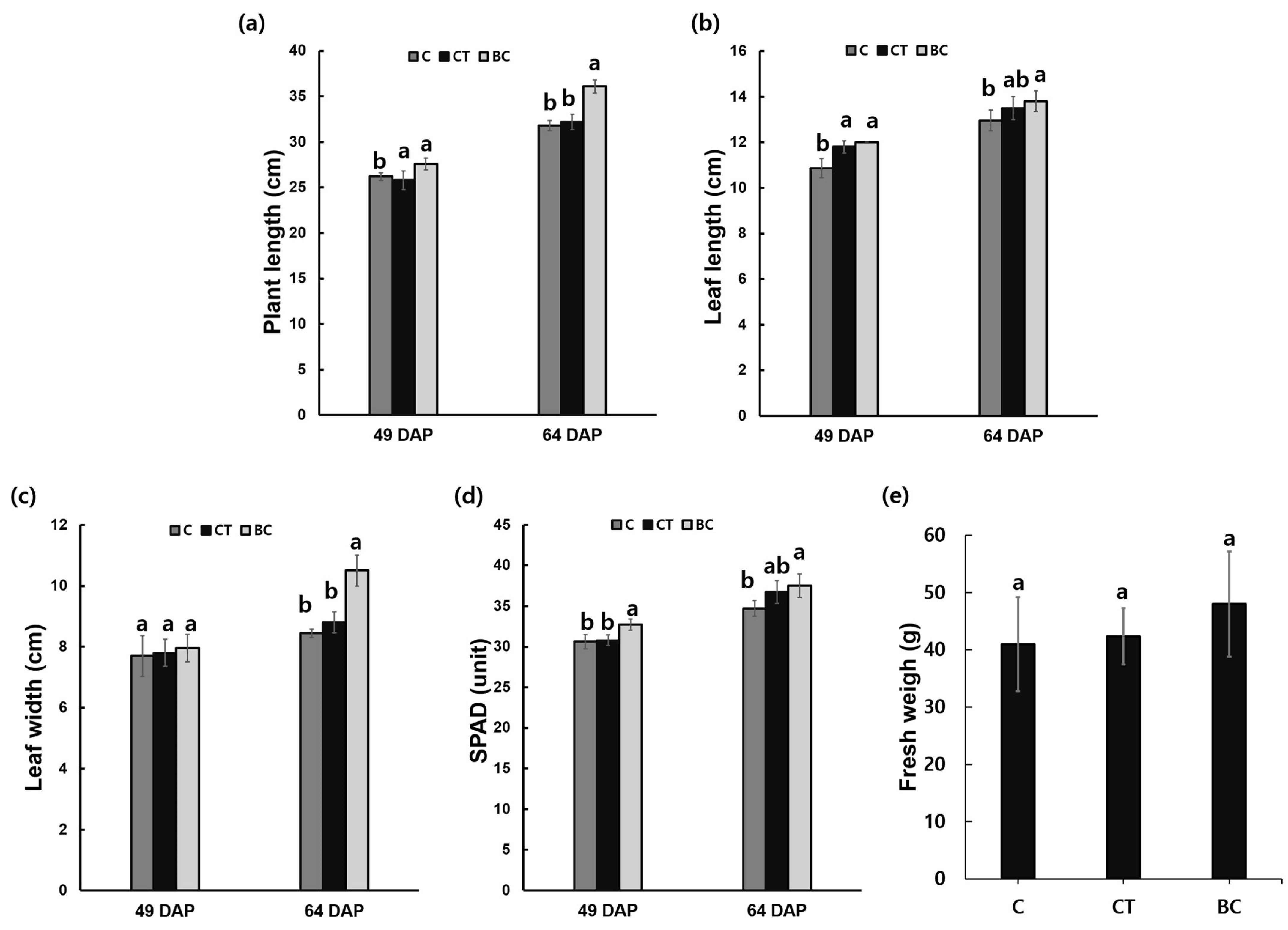
To compare basil growth responses among treatments, plant height, leaf length, leaf width, SPAD value, and fresh weight were measured. Plant height, leaf length, leaf width, and SPAD value were measured with five replicates per treatment. Plant height was measured vertically from the soil surface to the uppermost point of the plant. Leaf length was measured using a representative leaf from each plant, and leaf width was measured at the widest point of the same leaf. SPAD value was measured using a SPAD-502 chlorophyll meter (Minolta Camera Co., Osaka, Japan) [
19].
Plant height, leaf length, leaf width, and SPAD value were measured at 49 and 64 days after planting (DAP). Fresh weight was determined at the final harvest using fresh aboveground biomass from each treatment, with three replicates per treatment.
2.5. Preparation of Basil Tissue Extracts
A portion of the harvested basil samples was dried at 60 °C for 24 h and ground into powder using a mortar and pestle. The powdered samples were stored frozen until analysis. Because methanol-based extraction has been widely used to evaluate phenolic compounds and antioxidant activity in basil [
4], 0.5 g of dried basil powder from each treatment was extracted with 25 mL of 99% methanol. The mixture was extracted using a shaking incubator (ED-SI300R, HYSC, Seoul, Republic of Korea) at 58 °C for 24 h. The extract was then centrifuged at 1300 rpm for 15 min using a refrigerated centrifuge (1580R, LABOGENE; GYROZEN Co., Ltd., Gimpo, Republic of Korea), and the supernatant was collected for antioxidant activity assays and plant ion analysis.
2.6. Antioxidant Activity Analysis
Antioxidant activity was evaluated using previously reported spectrophotometric methods, with minor modifications according to sample characteristics [
20,
21,
22,
23,
24,
25,
26]. Total phenolic content was determined using the Folin–Ciocalteu colorimetric method, and gallic acid was used to prepare the standard curve [
25]. Total flavonoid content was measured using the AlCl
3 complexation-based colorimetric method, with quercetin used as the standard compound [
26].
DPPH radical scavenging activity was measured based on the method of Brand-Williams et al. [
20], and ABTS radical scavenging activity was determined according to the method of Re et al. [
24]. Nitrite scavenging activity was measured based on the method of Gray and Dugan [
21], and reducing power was evaluated according to the method of Oyaizu [
23] by measuring absorbance at 700 nm. Standard curve linearity was confirmed before quantification, and all antioxidant activity analyses were performed in triplicate for each treatment.
2.7. pH and Ion Analysis of Basil Tissue Extracts
The pH and inorganic ion concentrations of basil tissue extracts were measured using a multi-ion analyzer (Imacimus, NT Sensors, Tarragona, Spain). The analyzed ions were NO3−, NH4+, K+, Ca2+, Cl−, Na+, and Mg2+. Before analysis, the pH electrode and ion-selective electrodes were calibrated with standard solutions according to the manufacturer’s instructions. All samples were measured under identical conditions, and the electrodes were rinsed with deionized water after each measurement. The results are presented as the mean ± standard deviation for each treatment.
2.8. Soil Chemical Analysis
After harvest, soil samples were collected from each treatment and analyzed for chemical properties. The initial substrate chemical properties were presented as reference values for comparison with post-treatment soil properties and were not included in the statistical analysis. Soil pH, EC, organic matter, NH4+-N, NO3−-N, exchangeable K, exchangeable Ca, exchangeable Mg, and exchangeable Na were analyzed by Vito Analysis Center Co., Ltd. (Ansan, Republic of Korea) according to standard soil analytical procedures.
For soil pH and EC measurements, 5 g of air-dried soil was mixed with 25 mL of distilled water at a soil-to-water ratio of 1:5 (w/v). The suspension was mixed for 30 min using a rocking shaker (FinePCR CR100 Rocker, FINEPCR Co., Ltd., Gunpo, Republic of Korea), and soil pH and EC were measured using a multi-parameter analyzer (edge HI2020, Hanna Instruments, Woonsocket, RI, USA). The analyzer was calibrated with standard buffer solutions at pH 4 and 7 for pH measurement and with a 1413 μS cm−1 standard solution for EC measurement.
Organic matter content was determined using the Tyurin method [
27]. Briefly, 0.3 g of air-dried soil was mixed with 0.4 N potassium dichromate–sulfuric acid solution and heated at 200 °C for 5 min. Distilled water was then added to adjust the total volume to approximately 150 mL. After adding 85% phosphoric acid and diphenylamine indicator, the mixture was titrated with 0.2 M ferrous ammonium sulfate solution.
Available phosphorus was determined using the Lancaster method [
28]. Briefly, 5 g of air-dried soil was mixed with 20 mL of extraction solution and shaken at 180 rpm for 10 min, followed by filtration through Whatman No. 2 filter paper. A 3 mL aliquot of filtrate or standard solution was mixed with 6 mL of color reagent and 0.4 mL of 1-amino-2-naphthol-4-sulfonic acid. After reaction at 30 °C for 30 min, absorbance was measured at 720 nm.
Exchangeable cations were extracted by shaking 5 g of air-dried soil with 50 mL of 1 M NH4OAc extraction solution for 30 min, followed by filtration. Calibration curves were prepared using standard solutions, and K, Ca, Mg, and Na concentrations were determined by inductively coupled plasma spectrometry. NH4+-N and NO3−-N were analyzed by Vito Analysis Center Co., Ltd. together with the other soil chemical properties.
2.9. 16S rRNA Gene Sequencing and ASV Analysis
For soil bacterial community analysis, total community DNA was extracted from soil samples from each treatment. Soil samples were homogenized before DNA extraction, and microbial cells attached to soil particles were disrupted using a bead-beating-based lysis approach. PCR inhibitors were then removed, and DNA was recovered through silica-based purification. The concentration and purity of the extracted DNA were checked before full-length 16S rRNA gene sequencing using a PacBio long-read platform.
The full-length V1–V9 region of the bacterial 16S rRNA gene was amplified, and sample-specific barcodes were incorporated to enable multiplex sequencing. Amplicons were purified to remove primer dimers and short fragments, quantified, and pooled at equimolar concentrations. PacBio-compatible amplicon libraries were then prepared, and high-accuracy reads were generated using PacBio circular consensus sequencing [
29].
Microbial community analysis was performed using a mothur v1.48.0-based workflow optimized for PacBio HiFi 16S rRNA amplicon reads [
30]. Raw HiFi FASTQ files were quality-filtered using fastp with a minimum Phred quality threshold of 20 [
31]. After quality filtering, reads were converted to FASTA format, and group and name mapping files compatible with mothur were generated.
In mothur, sequence count generation, dereplication, alignment, screening, filtering, preclustering, and chimera removal were performed [
30]. Sequence alignment was conducted using a SILVA-based reference database [
32], and chimeric sequences were removed using VSEARCH [
33]. Taxonomic classification was performed using the naïve Bayesian classifier approach implemented in mothur [
34]. Non-target lineages, including chloroplasts, mitochondria, unknown taxa, Archaea, and Eukaryota, were removed. Final sequence, count, taxonomy, and shared community matrices were generated for downstream ecological analyses.
2.10. Statistical and Microbial Community Analyses
Growth, antioxidant activity, plant ion composition, and soil chemical property data are presented as the mean ± standard deviation for each treatment. Statistical analyses were performed using R software (version 4.4.2; R Foundation for Statistical Computing, Vienna, Austria). Treatment effects were evaluated by one-way analysis of variance (ANOVA), followed by Tukey’s honestly significant difference (HSD) test. Statistical significance was determined at p < 0.05.
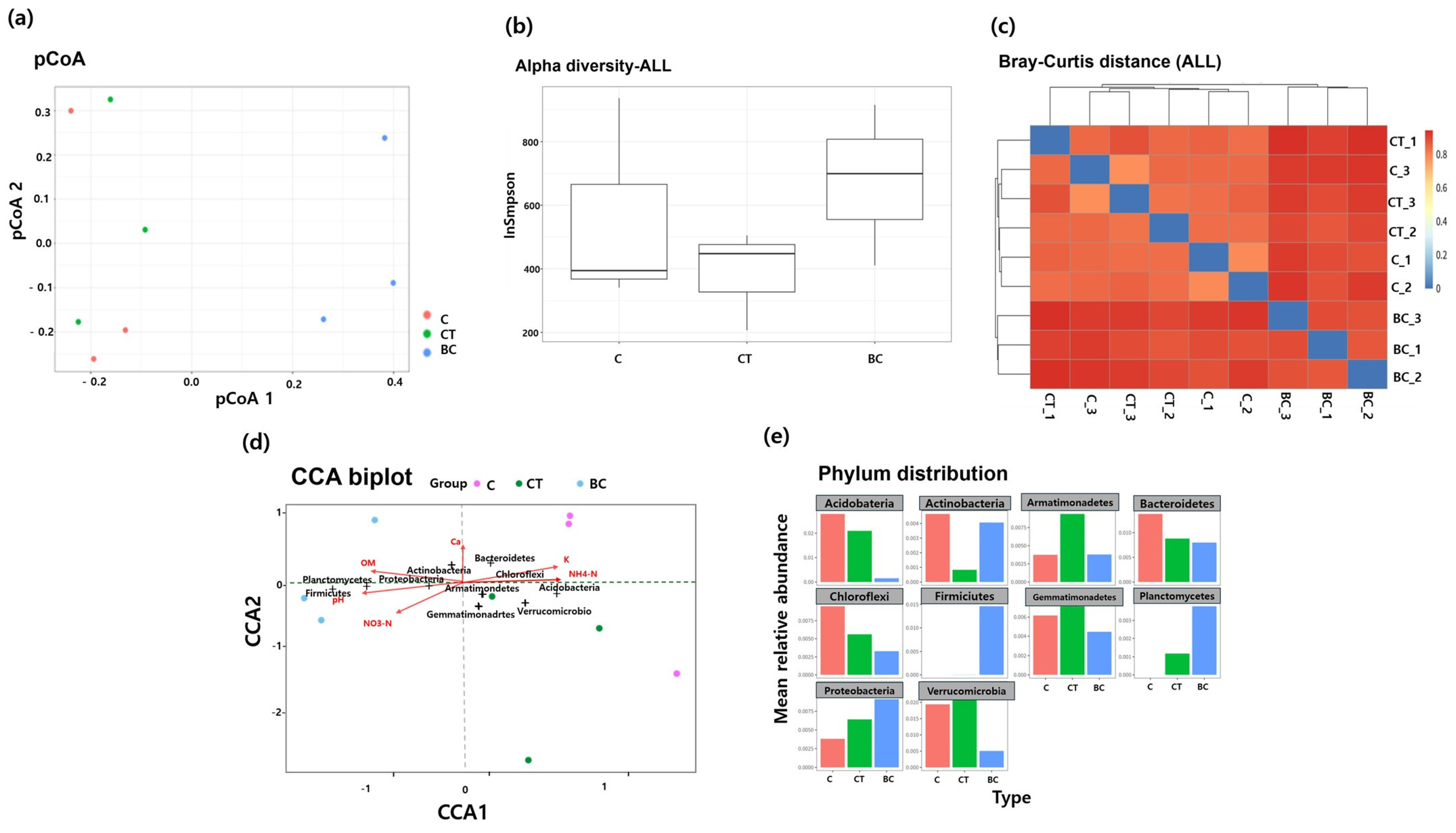
Alpha diversity of soil bacterial communities was evaluated using the Inverse Simpson index. Beta diversity was analyzed based on Bray–Curtis distance, and principal coordinate analysis (PCoA) was used to visualize differences in bacterial community composition among treatments. Bray–Curtis dissimilarity heatmaps and hierarchical clustering were used to examine similarities among treatments and replicate samples. PCoA, Bray–Curtis dissimilarity clustering, CCA, Mantel tests, and related community analyses were used as exploratory approaches to visualize treatment-associated patterns in soil bacterial community structure and to examine their relationships with soil chemical properties.
Relationships between soil chemical properties and bacterial community composition were analyzed in R using the vegan (version 2.6-10) and phyloseq (version 1.50.0) packages [
35,
36]. Mantel tests were used to evaluate correlations between bacterial community and environmental variable distance matrices, with 999 permutations [
37]. Canonical correspondence analysis (CCA) was performed to visualize multivariate relationships between soil chemical variables and bacterial community composition [
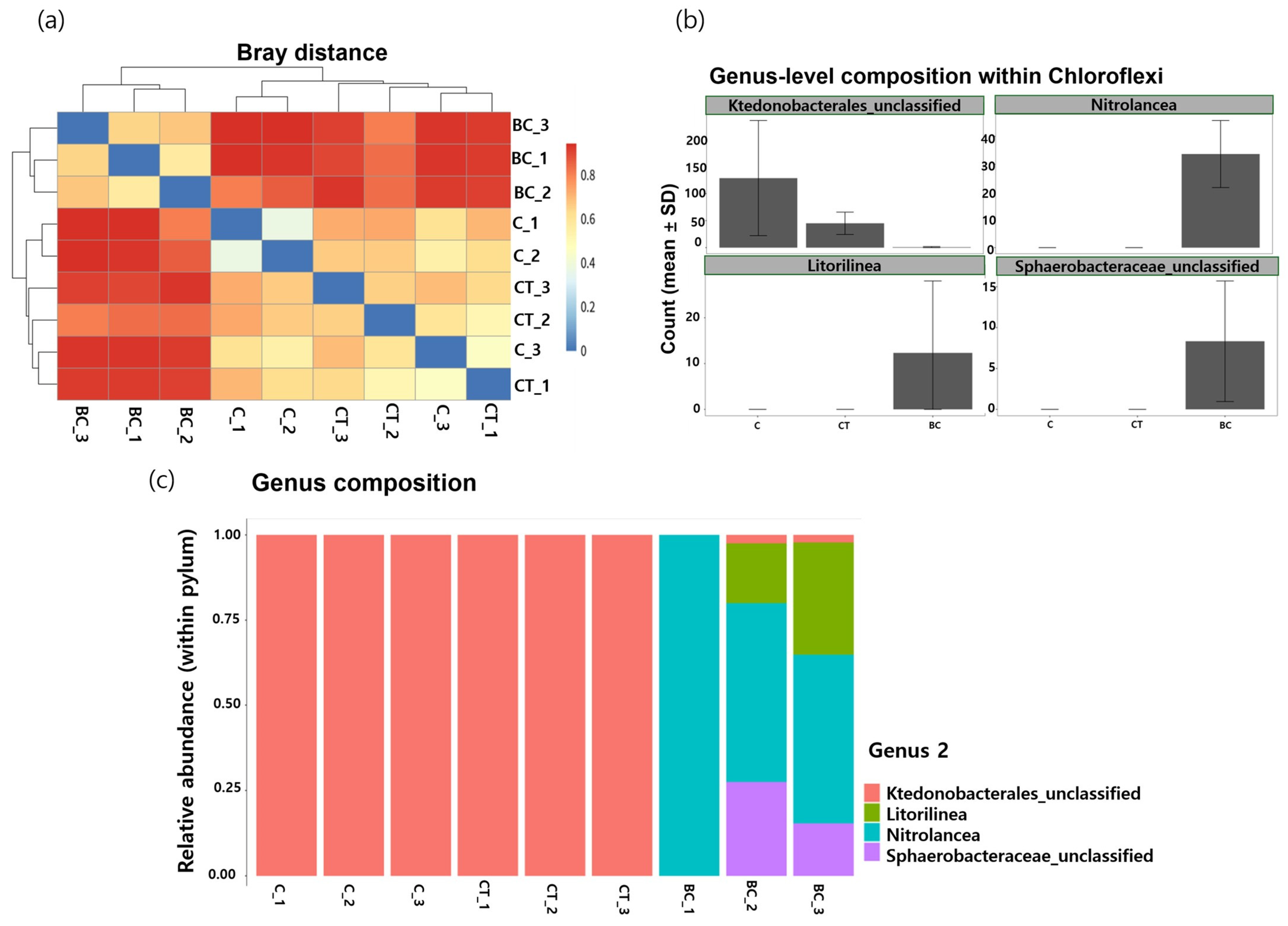
38]. Bacterial phyla associated with soil chemical properties were compared based on relative abundance, and the genus-level composition within the phylum Chloroflexi was analyzed separately. Visualizations were generated using the ggplot2 (version 3.5.1) and ggrepel (version 0.9.6) packages [
39,
40].
4. Discussion
The Introduction identified a lack of integrated information on how compost tea alone and combined compost tea and biochar application are associated with simultaneous changes in basil growth-related traits, plant tissue ion composition, post-treatment soil chemical properties, and 16S rRNA gene-based bacterial community structure under soil-based pot cultivation conditions. Compost tea can supply soluble organic compounds, nutrients, and microbial components [
5,
6,
7], whereas biochar can modify soil pH, organic matter status, nutrient retention, cation exchange processes, and microbial habitats [
10,
11,
12]. The present findings directly address this gap by showing that compost tea alone produced relatively limited responses, whereas the combined compost tea and biochar treatment was associated with more distinct changes in selected vegetative growth traits, plant ion composition, soil nutrient status, and bacterial community structure. Specifically, the combined treatment increased plant height, leaf width, and SPAD value at specific growth stages, altered plant tissue ion composition by increasing K
+ and decreasing Ca
2+, Cl
−, and NO
3− concentrations, modified soil chemical properties including pH, organic matter, inorganic nitrogen forms, and exchangeable cations, and was associated with treatment-related shifts in soil bacterial community composition. Therefore, the results provide an integrated assessment of plant, soil chemical, and bacterial community responses to compost tea alone and combined compost tea and biochar application in basil pot cultivation, while also indicating that these responses should be interpreted within the limitations of the present experimental design.
Recent studies also support the relevance of compost tea in basil cultivation and plant-associated microbial systems. Compost tea application has been reported to contribute to the recovery of basil performance under autotoxicity stress in closed hydroponic cultivation systems [
41]. In addition, compost tea combined with reduced fungicide treatments has been shown to modulate grapevine bacteriome and metabolomic profiles in relation to downy mildew suppression [
16]. These studies suggest that compost tea may influence crop responses not only through nutrient-related effects but also through changes in plant- or soil-associated microbial communities. In the present study, however, compost tea alone produced limited responses, indicating that its effect may depend strongly on application conditions and interaction with the growth substrate.
A limitation of the present study is that the chemical and microbiological characteristics of the prepared compost tea were not directly measured. Because compost tea composition can vary depending on compost source, extraction method, aeration, dilution ratio, extraction duration, application volume, and application frequency, the absence of compost tea characterization limits the reproducibility and mechanistic interpretation of compost tea-related responses. Therefore, the response of the CT should be interpreted with caution. Future studies should directly measure compost tea properties, including pH, EC, soluble nutrient concentrations, microbial abundance, and microbial community composition, to better link compost tea characteristics with plant, soil, and microbial responses.
The plant growth results showed that the BC treatment had clearer effects on selected vegetative growth-related traits than CT alone. Plant height, leaf width, and SPAD value increased at specific growth stages under the BC treatment, whereas final fresh weight was not significantly affected. This suggests that the combined compost tea and biochar treatment may have improved certain vegetative growth traits and chlorophyll-related status, but these changes were not sufficient to increase final biomass under the present pot cultivation conditions. One possible explanation is that the combined treatment may have modified root-zone chemical conditions and nutrient retention, thereby supporting stage-specific vegetative growth, whereas biomass accumulation may have been limited by other factors such as pot volume, cultivation period, nutrient balance, or treatment intensity.
The changes in plant ion composition indicate that the BC treatment was associated with selective alteration in nutrient uptake patterns. The increase in K
+ concentration under the BC treatment may be consistent with previously reported roles of biochar as a porous, carbon-rich amendment that can modify root-zone pH, provide exchange sites for cationic nutrients, improve nutrient retention, and influence adsorption and desorption processes in the growth substrate [
10,
11,
12]. Similarly, the decreases in Ca
2+, Cl
−, and NO
3− concentrations may reflect possible changes in nutrient availability, ion competition, or nutrient retention processes in the root-zone environment. However, these mechanisms were not directly tested in the present study using sorption measurements, rhizosphere chemical analysis, or nutrient transformation rate measurements. Therefore, the observed ion responses should be interpreted as treatment-associated changes in plant ion composition rather than as direct evidence that specific biochar-mediated mechanisms controlled nutrient uptake.
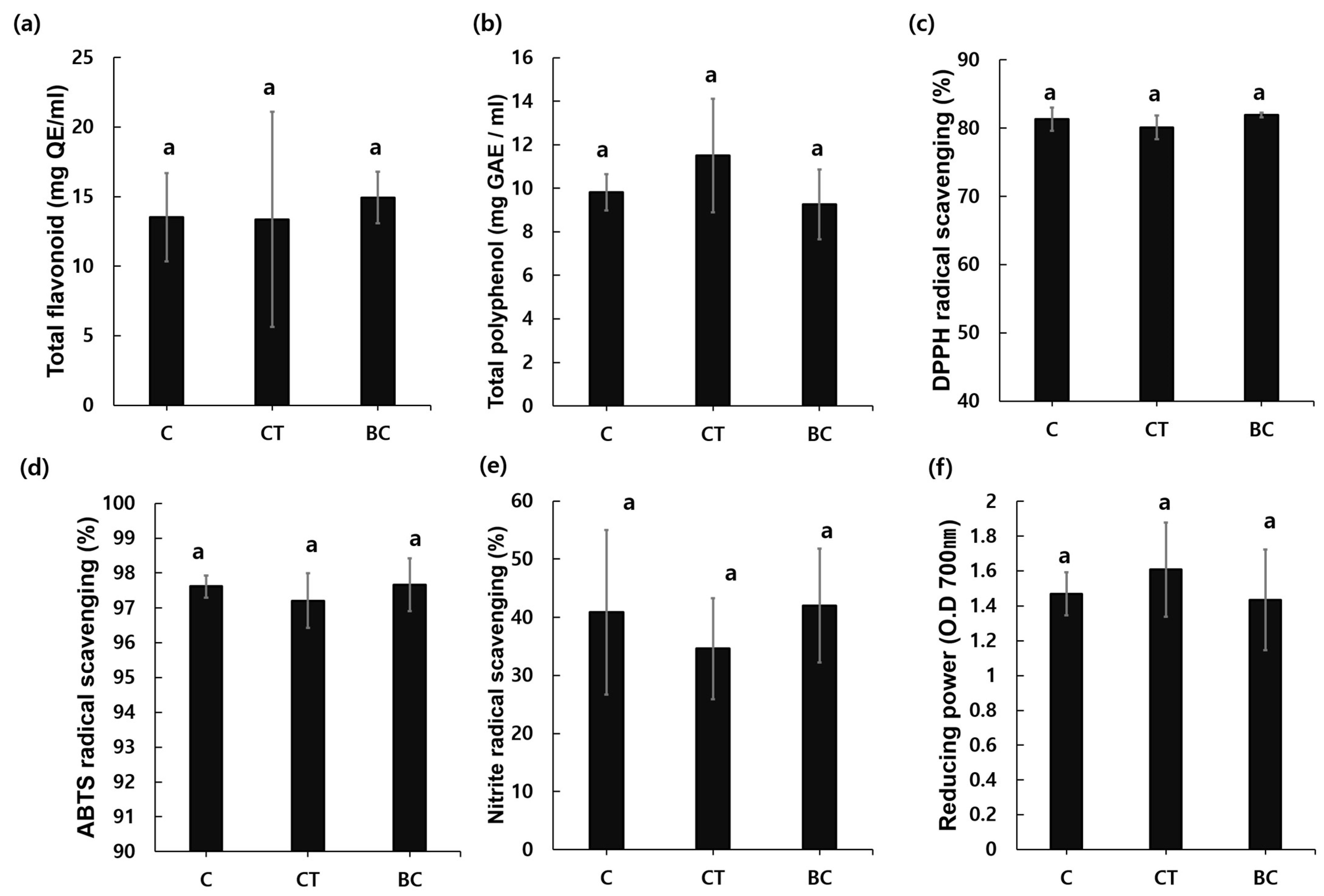
Antioxidant-related traits did not differ significantly among treatments, and these results were retained as supplementary data. The phenolic composition and antioxidant activity of basil can vary depending on nutrient status, especially nitrogen availability, as well as cultivation environment and treatment conditions [
2,
4]. The effects of biochar on biochemical traits in basil may also vary depending on biochar type, application rate, and growing medium [
13,
14]. Therefore, the absence of significant antioxidant responses in the present study does not contradict the observed changes in selected growth-related traits and plant ion composition. Rather, it indicates that, under the present experimental conditions, treatment effects were more clearly expressed in growth-related and ion-related traits than in antioxidant-related quality traits.
The soil chemical results provide a mechanistic basis for interpreting the plant responses. The BC treatment increased soil pH, organic matter, NO
3−-N, and exchangeable Mg, while decreasing NH
4+-N and exchangeable Na. The increase in soil pH is consistent with the liming potential of many biochars, which can reduce soil acidity and modify nutrient availability [
9,
10,
12]. The increase in organic matter may be associated with the carbon-rich nature of biochar, whereas the increase in NO
3−-N and decrease in NH
4+-N indicate that the inorganic nitrogen status of the soil differed after treatment application. However, because nitrification rate, nitrogen transformation genes, and direct nitrogen transformation processes were not measured in this study, these nitrogen-related changes should be interpreted as differences in inorganic nitrogen status after harvest rather than as direct evidence of enhanced nitrification. Similarly, the decrease in exchangeable Na may be related to changes in cation exchange and nutrient retention capacity, but further studies are needed to clarify the underlying ion exchange mechanisms.
Soil bacterial community analysis indicated that treatment-induced changes in soil chemical properties were associated with shifts in bacterial community structure. Soil pH is widely recognized as a major factor shaping soil bacterial community composition and diversity [
42], and pH-sensitive taxa such as Acidobacteria can respond strongly to changes in soil acidity [
43]. Biochar can also influence bacterial diversity and taxonomic composition by altering soil pH, organic matter status, nutrient availability, and microbial habitats [
10,
11]. In the present study, CT and BC treatments were associated with changes in bacterial community structure, and the genus-level composition within Chloroflexi differed under the BC treatment. These patterns may be linked to the altered soil chemical environment, particularly changes in pH, organic matter, inorganic nitrogen forms, and exchangeable cations. Nevertheless, because this study was based on 16S rRNA amplicon sequencing, functional changes such as enhanced carbon degradation, nitrification, or nitrogen cycling cannot be inferred solely from taxonomic shifts. Future studies should validate these interpretations using direct functional approaches, such as functional gene analysis, metagenomic sequencing, soil enzyme assays, and measurements of nitrogen transformation rates.
5. Conclusions
This study evaluated the effects of compost tea applied alone and in combination with biochar on basil growth-related traits, plant ion composition, soil chemical properties, and soil bacterial community structure under pot cultivation conditions. The combined compost tea and biochar treatment showed more distinct responses than compost tea alone, particularly in selected growth-related traits, including plant height, leaf width, and SPAD value, at specific growth stages. However, final fresh weight did not differ significantly among treatments, suggesting that these growth responses were associated with selective changes in specific growth-related traits rather than an overall increase in biomass accumulation.
The combined compost tea and biochar treatment was also associated with selective changes in plant ion composition, including increased K+ concentration and decreased Ca2+, Cl−, and NO3− concentrations in basil tissue extracts. In soil, the combined treatment was associated with increased pH, organic matter, NO3−-N, and exchangeable Mg, and decreased NH4+-N and exchangeable Na. These changes were accompanied by shifts in soil bacterial community structure and genus-level composition within Chloroflexi, suggesting that basil responses under the combined treatment were related to changes in soil chemical properties and bacterial communities.
Overall, under the present pot cultivation conditions, the combined compost tea and biochar treatment was associated with selective changes in basil growth-related traits, plant ion composition, soil nutrient status, and bacterial community structure. However, because a biochar-only treatment was not included, the independent effect of biochar could not be separated from the combined response associated with compost tea and biochar application. In addition, baseline fertilization was not optimized in the present pot experiment, and the chemical and microbiological characteristics of the prepared compost tea were not directly measured. Therefore, these findings should be interpreted as treatment-associated responses under the specific experimental conditions used here, rather than as definitive evidence of a broadly applicable integrated amendment strategy. Future studies should include biochar-only treatments, optimized baseline fertilization, different biochar application rates, and direct characterization of compost tea properties to clarify the individual and combined effects of these amendments.




 ,
,