Article

The Effects of Trichoderma asperellum and Its Chitin on Water-Stable Aggregates in Black Soil

College of Resources and Environmental in Jilin Province, Jilin Agricultural University, Changchun 130118, China
*
Author to whom correspondence should be addressed.
Agriculture 2026, 16(12), 1319; https://doi.org/10.3390/agriculture16121319 (registering DOI)
Submission received: 1 May 2026 / Revised: 5 June 2026 / Accepted: 11 June 2026 / Published: 15 June 2026

Abstract

Long-term intensive farming has degraded the structural stability of black soil in Northeast China. This study evaluated the effects of fermentation-derived materials and fungal-derived chitin on water-stable aggregates and microbial functional potential in this soil. Four treatments were established: sterile water control (CK), uninoculated fermentation broth substrate (W), live Trichoderma asperellum fermentation broth (P), and cell-free fermentation filtrate (F). Aggregate stability was monitored during a 60-day incubation, and metagenomic sequencing was performed on the most responsive 0.5–0.25 mm dry-sieved fraction. An exogenous chitin addition experiment was also conducted to evaluate the potential contribution of fungal cell-wall-derived chitin to aggregate stabilisation. The W, P, and F treatments increased the proportion of water-stable aggregates >0.25 mm, mean weight diameter, and geometric mean diameter, while decreasing fractal dimension. Among the treatments, the uninoculated fermentation broth substrate showed the strongest effect, particularly in the 0.5–0.25 mm dry-sieved fraction. Metagenomic analysis showed that the uninoculated fermentation broth substrate altered microbial community composition, changed the relative abundances of taxa such as Sphingomonas sediminicola, Priestia megaterium, and Trichoderma asperellum, and increased the relative abundance of carbohydrate-active enzyme-related genes, including those encoding glycosyltransferases, carbohydrate esterases, and glycoside hydrolases. Chitin addition also improved aggregate stability and altered microbial community structure. These findings suggest that the uninoculated fermentation broth substrate and fungal-derived chitin improved black soil aggregate stability, potentially through shifts in microbial community composition and carbohydrate-related functional potential. This study provides a scientific basis for using fermentation-derived materials to improve the structure of degraded black soil.

1. Introduction

The Northeast Black Soil Region is one of the world’s major black soil regions and one of China’s most important commercial grain production bases. It plays a crucial role in ensuring national food security and maintaining regional agroecological functions [1,2]. Recent studies have shown that this region is experiencing intensified soil erosion, thinning of the black soil layer, decreased soil organic carbon, structural degradation, and declining fertility. The average erosion rate is approximately 2.22 mm yr−1, and topsoil loss on some sloping farmland can reach 0.3–1.0 cm yr−1 [3,4]. These degradation processes reduce the capacity of soil to accumulate organic matter and retain nutrients. They also weaken soil structural stability, erosion resistance, and long-term grain production potential [2,5,6].
Soil aggregates form the physical basis of soil fertility and constitute the fundamental units of soil structure. They provide habitats for microorganisms, facilitate the transfer of matter and energy [7,8], and regulate soil aeration, water retention, and nutrient cycling [9]. The abundance, particle-size distribution, and stability of soil aggregates are key indicators of soil structural quality. These properties reflect soil resistance to erosion, water infiltration and retention capacity, pore structure, and organic carbon sequestration potential [10,11,12]. Soil aggregate formation results from the combined effects of physical, chemical, and biological processes, with microorganisms acting as key biological drivers. Short-lived microbial binding agents, such as polysaccharides and proteins, can bind soil particles and, together with plant roots and fungal hyphae, contribute to the formation of larger aggregates [13]. Soil aggregate stability is regulated by multiple binding agents, including organic carbon, iron/aluminium oxides, carbonates, multivalent cations such as Ca2+, clay minerals, and organic–mineral complexes. Differences in the distribution of these binding components among aggregate size fractions contribute to variations in aggregate stability [14,15,16,17,18,19]. Therefore, aggregate stability influences pore structure, aeration, permeability, water and nutrient retention, and microbial habitat quality, thereby affecting soil fertility and crop growth [20].
In recent years, fungal fermentation products and their derived organic components have attracted increasing attention for their potential roles in improving soil structure. Unlike inorganic amendments, fungal fermentation broths may contain live spores or hyphal fragments, extracellular enzymes, soluble polysaccharides, organic acids, proteinaceous compounds, and secondary metabolites. These components may influence soil aggregation by facilitating fungal colonisation and contributing to the formation of organic colloidal substances [21,22]. Previous studies have shown that Trichoderma species exhibit strong rhizosphere adaptability and biostimulatory effects, enabling them to regulate plant–microbe interactions and improve the soil microenvironment [21]. Fungal treatments containing Trichoderma asperellum have been reported to increase the proportion of water-stable aggregates >0.25 mm, mean weight diameter (MWD), and geometric mean diameter (GMD), suggesting that live fungi or composite fermentation broths may improve aggregate stability through hyphal networks, microbial activity, and root-associated effects [23]. In addition to live fermentation broths, fermentation substrates and fungal culture residues, such as fungal bran, can enter soil as exogenous organic carbon sources and microbial-utilisable substrates. These materials may alter soil organic carbon composition, reduce bulk density, increase enzyme activity, and modify bacterial and fungal community structures, thereby contributing to the formation of water-stable aggregates >0.25 mm and improving soil structural stability [24,25,26,27]. For example, mushroom residue application has been shown to increase soil MWD and improve soil fertility and microbial function, suggesting that lignocellulose, polysaccharides, and microbial residues in fungal culture substrates may contribute to soil particle aggregation [25,26,27]. Although inactivated or cell-free fermentation broths no longer contain viable fungal propagules, they may retain extracellular enzymes, soluble metabolites, microbial cell debris, and extracellular polymers. Previous studies have shown that heat-inactivated Trichoderma fermentation supernatants can exert biological effects as metabolite solutions without viable cells. Fungal residue-derived carbon and microbial extracellular products have also been closely associated with water-stable aggregate formation, physical protection of organic matter, and slower aggregate turnover [28,29,30].
Soil aggregation is closely associated with tillage history, fungal activity, microbial community composition, and biological binding agents. For example, long-term tillage has been reported to alter water-stable aggregates and microbial communities in black soil [31]. Fungal hyphae, extracellular polysaccharides, and microbial populations also contribute to aggregate formation and stabilisation [32,33]. The roles of fungi and related biotic factors in regulating soil aggregate stability have also been summarised [34]. However, most previous work has focused on tillage effects, fungal hyphal networks, or general biological binding agents. The relative effects of fermentation broth substrate, live fungal fermentation broth, and cell-free fermentation filtrate on aggregate stability in black soil remain insufficiently understood. Moreover, chitin, a major component of fungal cell walls, represents an important source of organic carbon in soil [35]. However, whether fungal cell-wall residues, particularly chitin derived from dead fungal hyphae, continue to contribute to water-stable aggregate formation after fungal biomass degradation remains unclear.
In this study, black soil from Northeast China was used to compare the effects of fermentation broth substrate, live Trichoderma asperellum fermentation broth, and cell-free fermentation filtrate on the composition and stability of water-stable aggregates. Metagenomic analysis of a selected aggregate fraction was combined with an exogenous chitin addition experiment to evaluate microbial community responses and carbohydrate-active enzyme-related functional potential. We hypothesised that fermentation-derived materials would alter microbial community structure and the abundance profiles of CAZyme-related genes. In addition, because chitin is a major component of fungal cell walls, fungal hyphae-derived chitin was used to examine whether residues from dead fungal biomass could contribute to aggregate stabilisation. This study aimed to clarify the effects of fermentation-derived treatments on aggregate stability in black soil and to provide a scientific basis for improving the structure of degraded black soil.

2. Materials and Methods

2.1. Soil Sampling

Soil samples were collected from the long-term experimental site of Jilin Agricultural University in Changchun, Jilin Province, China (43°48′43.50″ N, 125°23′38.50″ E). The site is characterised by a temperate, semi-humid continental climate. The soil is classified as Black Soil within the semi-humid, semi-leached soil subclass and corresponds to Argiudolls in the US soil classification system. The soil texture is sandy loam, consisting of 62% sand, 25% silt, and 13% clay. Maize has been grown continuously at this site since 1984, and no-till farming has been practised since 2018. After the maize harvest in October 2024, all maize residues were removed from the field, and soil samples were collected from the 0–20 cm layer using a five-point sampling method. During sampling, soil disturbance was minimised to preserve structural integrity.
The initial soil had an SOM content of 21.32 ± 1.24 g kg−1, pH of 5.78 ± 0.11, AP of 53.92 ± 2.18 mg kg−1, AK of 146.29 ± 4.38 mg kg−1, TN of 0.52 ± 0.08 g kg−1, and MC of 14.02 ± 0.26% (means ± SE, n = 3). Soil organic matter (SOM) was determined using the potassium dichromate oxidation–spectrophotometric method. Soil pH was measured in a 1:2.5 soil-to-0.01 mol L−1 CaCl2 suspension. Available phosphorus (AP) was extracted with NaHCO3 and determined using the molybdenum antimony colourimetric method with a UV-1800 spectrophotometer (Agilent, Santa Clara, CA, USA). Available potassium (AK) was determined by flame atomic absorption spectrophotometry. Total nitrogen (TN) was determined using the Kjeldahl method. Soil moisture content (MC) was determined by oven drying.

2.2. Preparation of Fermentation Broth

Trichoderma asperellum strain 576 was used in this study. The strain was originally obtained from the Engineering Research Center of Edible and Medicinal Fungi, Ministry of Education, Jilin Agricultural University. The strain was previously identified and characterised by Ma et al. (2023) based on morphological characteristics and phylogenetic analysis of TEF1-α and RPB2 gene sequences [36]. The GenBank accession numbers of T. asperellum 576 are OR548047 for TEF1-α and OR548088 for RPB2. The basal fermentation medium contained sucrose (30 g L−1), NaNO3 (2 g L−1), K2HPO4 (1 g L−1), KCl (0.5 g L−1), MgSO4 (0.5 g L−1), and FeSO4 (0.01 g L−1). The initial pH was adjusted to 7.0 before sterilisation. The uninoculated sterile medium was used as the fermentation broth substrate (W). To prepare the live T. asperellum fermentation broth (P), the strain was inoculated into the sterile basal medium and incubated at 25 °C and 180 rpm for 7 days under liquid fermentation conditions. During liquid fermentation, the fungus grew mainly as dispersed mycelia and small mycelial pellets. After 7 days of incubation, the mycelial dry weight in 100 mL of fermentation broth was approximately 0.52 g. The cell-free fermentation filtrate (F) was prepared by passing the live T. asperellum fermentation broth through a 0.22 μm membrane. Thus, F was expected to contain soluble metabolites but no fungal mycelia or spores. The absence of viable T. asperellum propagules was verified by plating the filtrate on potato dextrose agar (PDA) medium.

2.3. Extraction of Chitin

Chitin was extracted according to the method described by Di Mario et al. [37], with minor modifications. The strain was inoculated into sterile liquid medium and incubated at 25 °C with shaking at 170 r min−1 for 5 days. The mycelium was collected by filtering the fermentation broth through sterile gauze. The collected mycelium was thoroughly washed with distilled water and freeze-dried for subsequent use. Three grams of freeze-dried mycelium were added to 100 mL of 1 N NaOH solution. The mixture was stirred overnight at 40 °C to remove proteins and obtain the alkali-insoluble fraction. After treatment, the suspension was centrifuged at 5000 r min−1 for 30 min at room temperature, and the precipitate was collected. This NaOH deproteinisation step was repeated three times to remove residual proteins. The alkali-treated, deproteinised precipitate was resuspended in distilled water and stirred overnight at 95 °C. The suspension was then centrifuged at 5000 r min−1 for 20 min at room temperature, and the solid precipitate was retained. The retained precipitate was treated with 50–100 mL of 5% acetic acid (CH3COOH) in a water bath at 90 °C for 3 h. After the reaction, the suspension was centrifuged at 5000 r min−1. The solid precipitate obtained after centrifugation was considered the chitin fraction, whereas the supernatant contained acid-soluble chitosan components. Finally, the resulting chitin precipitate was washed three times with distilled water and freeze-dried to obtain purified chitin.

2.4. Experimental Design

A controlled indoor incubation experiment was conducted with four treatments: sterile water control (CK), fermentation broth substrate (W), live Trichoderma asperellum fermentation broth (P), and cell-free T. asperellum fermentation filtrate (F). For each treatment, the corresponding liquid amendment was added dropwise to pre-weighed soil at a rate of 100 mL kg−1 dry soil and thoroughly mixed with a sterile spatula to ensure uniform distribution. The treated soil was then transferred into plastic incubation pots, each containing 3 kg of soil. For CK, an equal volume of sterile distilled water was added. Each treatment included three biological replicates. Soil moisture was adjusted to approximately 14% using autoclaved sterile distilled water and maintained using the constant-weight method. During incubation, pots were weighed every 7 days, and sterile distilled water was added to compensate for water loss. The pots were incubated at 25 °C. On days 10, 20, 30, 40, 50, and 60, 50 g of soil was collected from each pot using a sterile trowel for water-stable aggregate analysis. The aggregates were separated into >2 mm, 2–1 mm, 1–0.5 mm, 0.5–0.25 mm, and <0.25 mm fractions. For wet-sieving analysis, the soil aggregate samples were transferred into a 1000 mL sedimentation bottle. Distilled water was slowly added along the inner wall of the bottle to gradually wet the soil to saturation, and the samples were soaked for 10 min. The bottle was then slowly filled with water and sealed with a rubber stopper. After standing for several minutes, the sealed bottle was inverted to allow the saturated aggregates to settle onto the sieve set. The bottle was then placed upside down in the aggregate analyser. The analyser was operated at an oscillation amplitude of 3 cm and a frequency of 30 cycles min−1 for 10 min. After wet sieving, the sieve set was removed, and the soil material retained on each sieve was gently rinsed into aluminium boxes with clean water. The samples were oven-dried at 105 °C to constant weight and then weighed. The proportion of water-stable aggregates in each fraction was calculated from the oven-dried mass retained after wet sieving and the initial dry mass of the corresponding sample.
In addition, 50 g of soil was collected at each sampling time and dry-sieved into >2 mm, 2–1 mm, 1–0.5 mm, and 0.5–0.25 mm fractions. These four dry-sieved fractions were then wet-sieved to determine the proportion of water-stable aggregates >0.25 mm in each fraction. Based on the aggregate response results, the 0.5–0.25 mm dry-sieved fraction showed the strongest response to the fermentation broth substrate and was therefore selected for metagenomic sequencing. On day 40 of incubation, soil samples were collected from the CK and W treatments. After dry sieving, the 0.5–0.25 mm fraction (B) was obtained and further separated by wet sieving into two fractions: >0.25 mm (D, water-stable macroaggregates) and <0.25 mm (X, microaggregates). These fractions were used for subsequent metagenomic sequencing. The metagenomic sample groups were defined as follows: CKBD, the >0.25 mm water-stable macroaggregate fraction derived from the 0.5–0.25 mm dry-sieved fraction under CK; CKBX, the <0.25 mm microaggregate fraction derived from the same dry-sieved fraction under CK; WBD, the >0.25 mm water-stable macroaggregate fraction derived from the 0.5–0.25 mm dry-sieved fraction under W; and WBX, the <0.25 mm microaggregate fraction derived from the same dry-sieved fraction under W. Three biological replicates were included for each sample group.
For the chitin addition experiment, chitin was applied to the soil at a rate of 4 g kg−1 dry soil as treatment J, and soil moisture was maintained as described above. The soil samples were incubated at 25 °C. On days 10, 20, 30, 40, 50, and 60, 50 g of soil was collected using a sterile trowel for water-stable aggregate analysis. The aggregates were separated into >2 mm, 2–1 mm, 1–0.5 mm, 0.5–0.25 mm, and <0.25 mm fractions. Because the proportion of water-stable aggregates >0.25 mm reached its maximum after 40 days of incubation, samples collected at this time point were selected for metagenomic sequencing. The metagenomic sample groups were defined as follows: CKD, the >0.25 mm water-stable aggregate fraction under CK; CKX, the <0.25 mm aggregate fraction under CK; JD, the >0.25 mm water-stable aggregate fraction under treatment J; and JX, the <0.25 mm aggregate fraction under treatment J. Three biological replicates were included for each sample group.

2.5. Soil DNA Extraction and Illumina Sequencing

Genomic DNA was extracted from soil aggregate samples using the CTAB method. DNA quality and concentration were assessed using an Agilent 5400 system (Agilent Technologies, Santa Clara, CA, USA). Sequencing libraries were constructed using the NEBNext® Ultra™ DNA Library Prep Kit (NEB, Ipswich, MA, USA, Catalog: E7370L) for Illumina, and qualified libraries were sequenced on the Illumina NovaSeq (Illumina, SanDiego, CA, USA) platform using a paired-end 150 bp strategy. Raw reads were quality-filtered using KneadData 0.12.0. Adapter sequences, low-quality reads, and reads shorter than 50 bp were removed using Trimmomatic 0.39 with the following parameters: ILLUMINACLIP:adapters_path:2:30:10, SLIDINGWINDOW:4:20, and MINLEN:50. Potential host-derived reads were removed using Bowtie2 with the very-sensitive parameter, and the quality of the clean reads was evaluated using FastQC. Clean reads were assembled into contigs using MEGAHIT. Open reading frames were predicted using Prodigal in metagenomic mode (-p meta). Predicted genes were clustered using CD-HIT with the parameters -G 1 and -c 0.95 to construct a non-redundant gene catalogue. Gene relative abundance was quantified using Salmon with the parameters validateMappings and meta. The non-redundant genes were translated into protein sequences using EMBOSS transeq for subsequent taxonomic and functional annotation. Taxonomic annotation was performed by aligning the non-redundant protein sequences against the NCBI NR database using DIAMOND with the parameters evalue 1 × 10⁻⁵ max-target-seqs 50, and id 70. Taxonomic assignment was then performed using BASTA. Microbial community composition was also estimated using Kraken2 and Bracken. For functional annotation, protein sequences were aligned against the CAZy database using DIAMOND with the parameters -e 0.00001, id 80, and top 3. The relative abundances of genes assigned to the same CAZy family were summed based on TPM values to calculate the relative abundance of each CAZy gene family.

2.6. Data and Statistical Analysis

Soil aggregate stability was assessed using the mass proportion of each size fraction (Wi), mean weight diameter (MWD, mm), geometric mean diameter (GMD, mm), the proportion of water-stable aggregates >0.25 mm (R0.25, %), and fractal dimension (D). These parameters were calculated using the following formulae:
W i = M i M
where Wi is the mass proportion of the i-th aggregate size fraction, Mi is the mass of aggregates in the i-th size fraction (g), and M is the total mass of aggregates (g).
M W D = i = 1 n W i · X i
where MWD is the mean weight diameter, Xi is the mean diameter of the i-th aggregate size fraction (mm), n is the number of aggregate size fractions, and i is the aggregate size fraction index.
G M D = e x p ( W i · ln d i ) W i
where GMD is the geometric mean diameter, ln is the natural logarithm, and di is the mean diameter of the i-th aggregate size fraction.
R 0.25 = 1 M < 0.25 M T × 100 %
where R0.25 is the proportion of water-stable aggregates >0.25 mm (%), M<0.25 is the mass of aggregates in the <0.25 mm fraction (g), and MT is the total mass of soil before sieving (g).
D = 3 l g M r < x i ¯ / M T l g x i ¯ / x m a x
where D is the fractal dimension, M(r < x i ¯ ) is the cumulative mass of aggregates with diameters smaller than the mean diameter of the i-th aggregate size class, x i ¯ is the mean diameter of the i-th aggregate size class (mm), MT is the total mass of all aggregates (g), and xmax is the mean diameter of the largest aggregate size class (mm).
Statistical analyses were performed using SPSS Statistics 26.0 and R 4.4.3, and data visualisation was conducted using Origin 2024. Data are presented as means ± standard errors (SE). Before parametric tests, data were assessed for normality and homogeneity of variance. For aggregate stability indices, treatment effects were analysed separately at each sampling time because destructive sampling was performed for wet-sieving analysis. Differences among treatments at the same incubation time were tested using one-way analysis of variance (ANOVA), followed by the least significant difference (LSD) test when ANOVA indicated significant differences. Differences among incubation times within the same treatment were also evaluated separately. Repeated-measures and mixed-effects models were not applied because samples were destructively collected at each sampling time. For comparisons between two groups, an independent-samples t-test was used. Differences were considered statistically significant at p < 0.05. Microbial α-diversity indices, including the Shannon, Simpson, Pielou, and Chao1 indices, were calculated using the vegan package in R 4.4.3. The Shannon and Simpson indices were used to characterise microbial diversity, the Pielou index to assess community evenness, and the Chao1 index to estimate species richness. Principal coordinate analysis (PCoA) was performed based on Bray–Curtis dissimilarity matrices. Differences in microbial community structure among treatments were tested using permutational multivariate analysis of variance (PERMANOVA) with 999 permutations. Differences in metagenomic functional profiles were analysed using STAMP 2.1.3, and p-values from multiple comparisons were corrected using the Hochberg method.

3. Results

3.1. Characteristics of the Dynamic Changes in the Composition and Stability Parameters of Water-Stable Aggregates

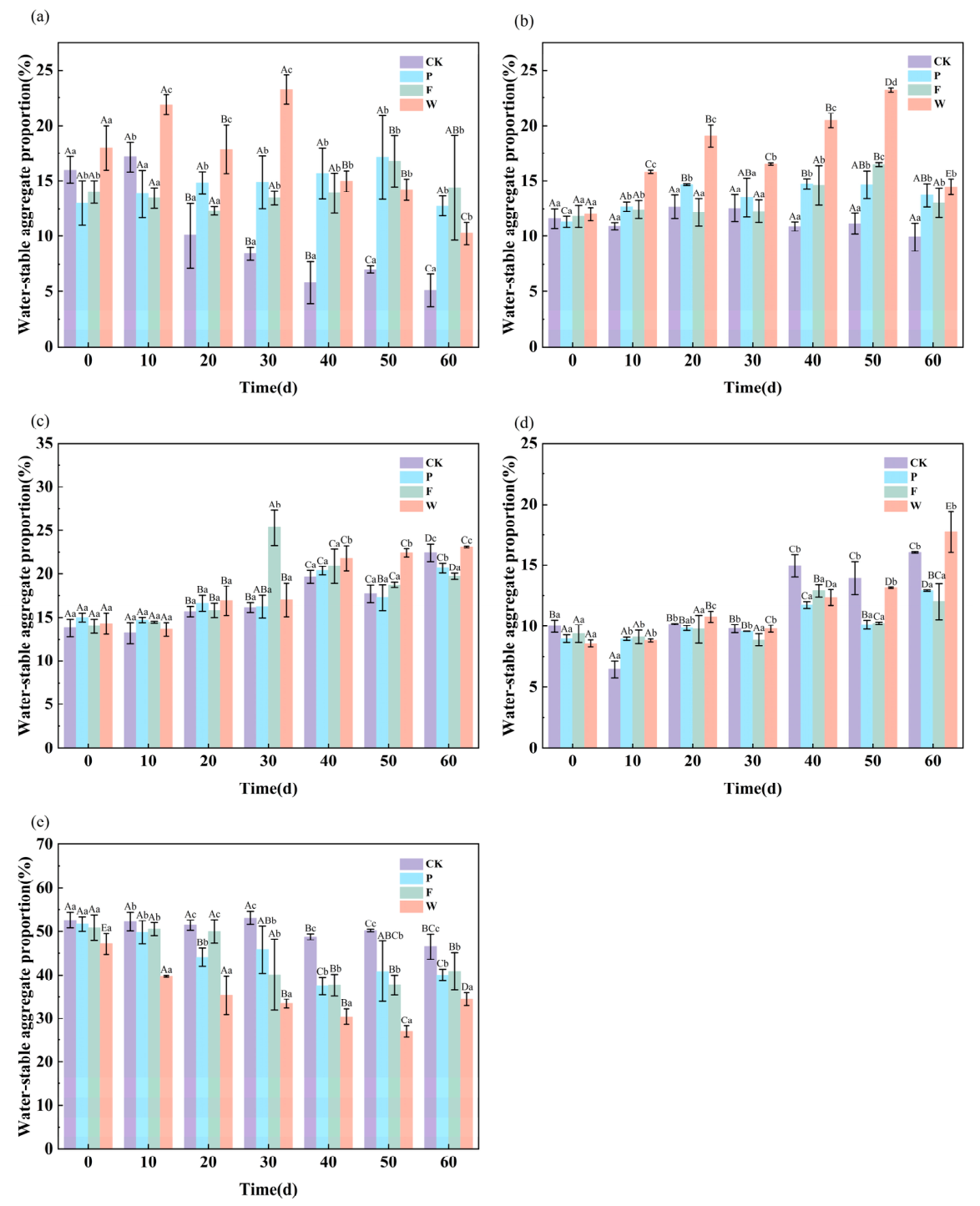
During the 60-day incubation, the addition of exogenous amendments significantly altered the particle-size distribution of water-stable aggregates in black soil (Figure 1). The control treatment (CK) showed a clear decline in the proportion of water-stable aggregates >2 mm over time, indicating progressive structural degradation. In contrast, the P, F, and W treatments were associated with a shift from microaggregates towards larger aggregate fractions. Compared with CK, the W, P, and F treatments significantly reduced the proportion of microaggregates <0.25 mm, with W showing the lowest value. The W treatment had the most pronounced effect on water-stable aggregate particle-size distribution, particularly by increasing the proportion of larger aggregate fractions. Compared with CK, the P and F treatments also significantly increased the proportions of aggregate fractions >0.25 mm (p < 0.05); however, these increases were smaller than those observed under W throughout the incubation.
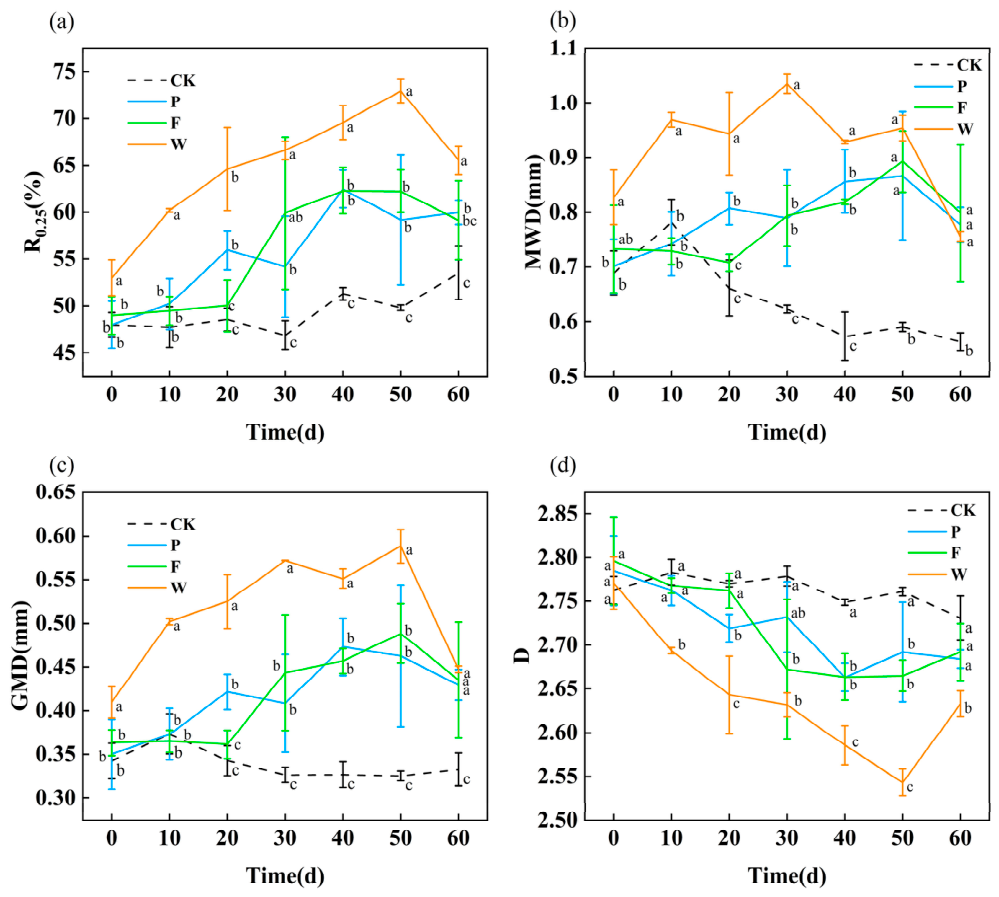
The effects of the different treatments on water-stable aggregate stability indices during the 60-day incubation are shown in Figure 2. The R0.25, MWD, and GMD values in the W, P, and F treatments were significantly higher than those in CK, indicating that fermentation-derived materials and culture medium components were associated with improved aggregate stability under the present incubation conditions. Overall, the effect on aggregate stability followed the order W > F > P > CK, although F and P were generally comparable. Among all treatments, W had the strongest effect on aggregate stability. Under W, R0.25 reached a maximum of 72.96 ± 1.29% on day 50, while MWD and GMD were also higher than those under P and F at the corresponding time points. The D value under W continued to decrease, suggesting a more favourable particle-size distribution and a more compact aggregate arrangement.

3.2. Dynamic Changes in Large Water-Stable Aggregates Within Each Dry-Sieved Particle-Size Fraction

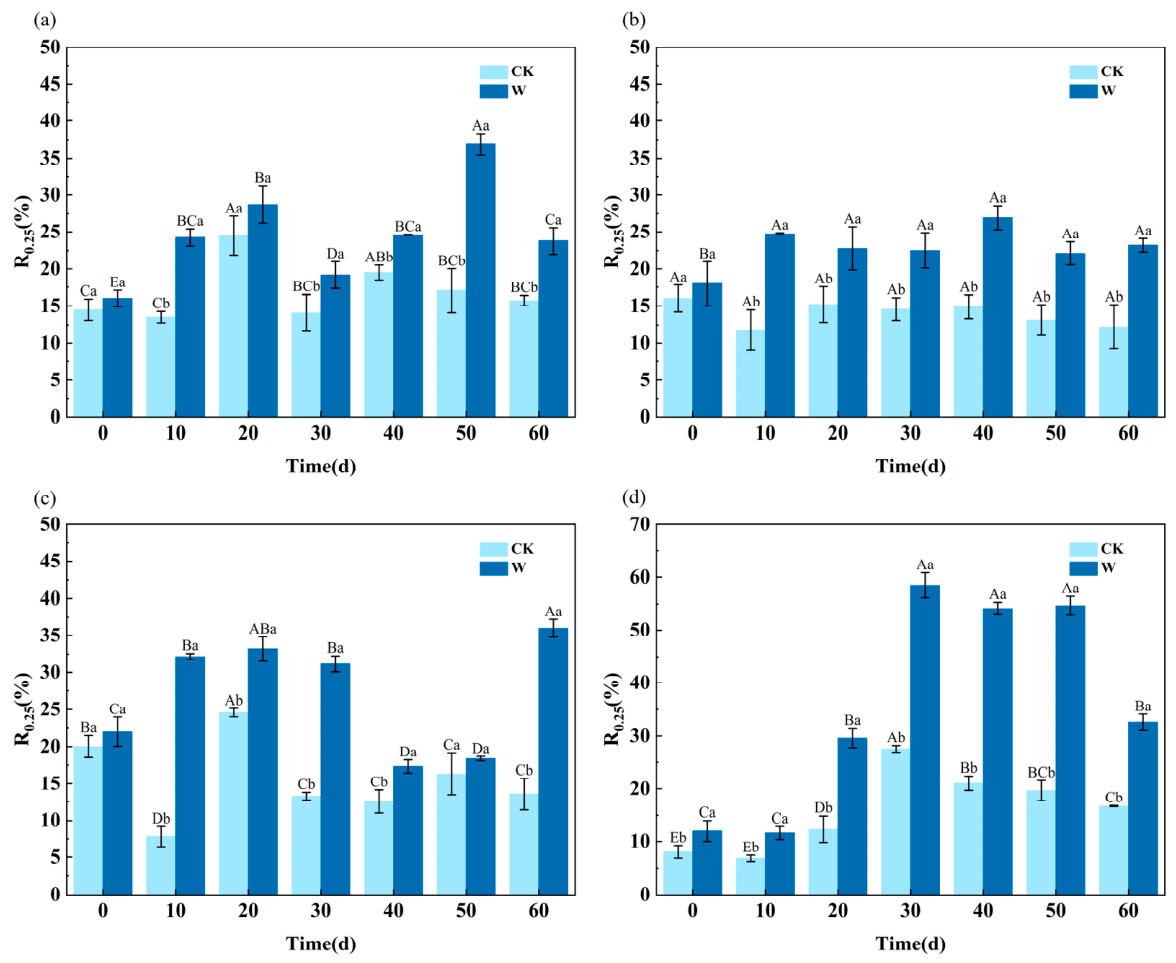
The results described above indicate that, during the 60-day incubation, the fermentation broth substrate had the strongest effect on the proportion of water-stable aggregates >0.25 mm. Therefore, dynamic changes in this proportion across different dry-sieved fractions were compared between CK and W. The response to the fermentation broth substrate differed among dry-sieved fractions (Figure 3). Compared with CK, W significantly increased the proportion of water-stable aggregates >0.25 mm in the >2 mm, 2–1 mm, 1–0.5 mm, and 0.5–0.25 mm dry-sieved fractions (p < 0.05). Among all tested size fractions, the 0.5–0.25 mm dry-sieved fraction showed the most pronounced response to the fermentation broth substrate, with an average proportion approximately 2.26-fold higher than that in CK throughout the incubation. During days 30–50, this proportion in the 0.5–0.25 mm dry-sieved fraction under W remained between 54.16 ± 1.15% and 58.48 ± 2.34% (Figure 3d). These values were approximately 2.12-, 2.57-, and 2.78-fold higher than those in CK on days 30, 40, and 50, respectively, further indicating that this fraction was the most responsive to the fermentation broth substrate. Accordingly, the >0.25 mm water-stable aggregate fraction and the <0.25 mm microaggregate fraction derived from the 0.5–0.25 mm dry-sieved fraction were selected for subsequent metagenomic sequencing.

3.3. Differences in Soil Microbial Diversity Indices and Community Structure in the 0.5–0.25 mm Particle Size Fraction

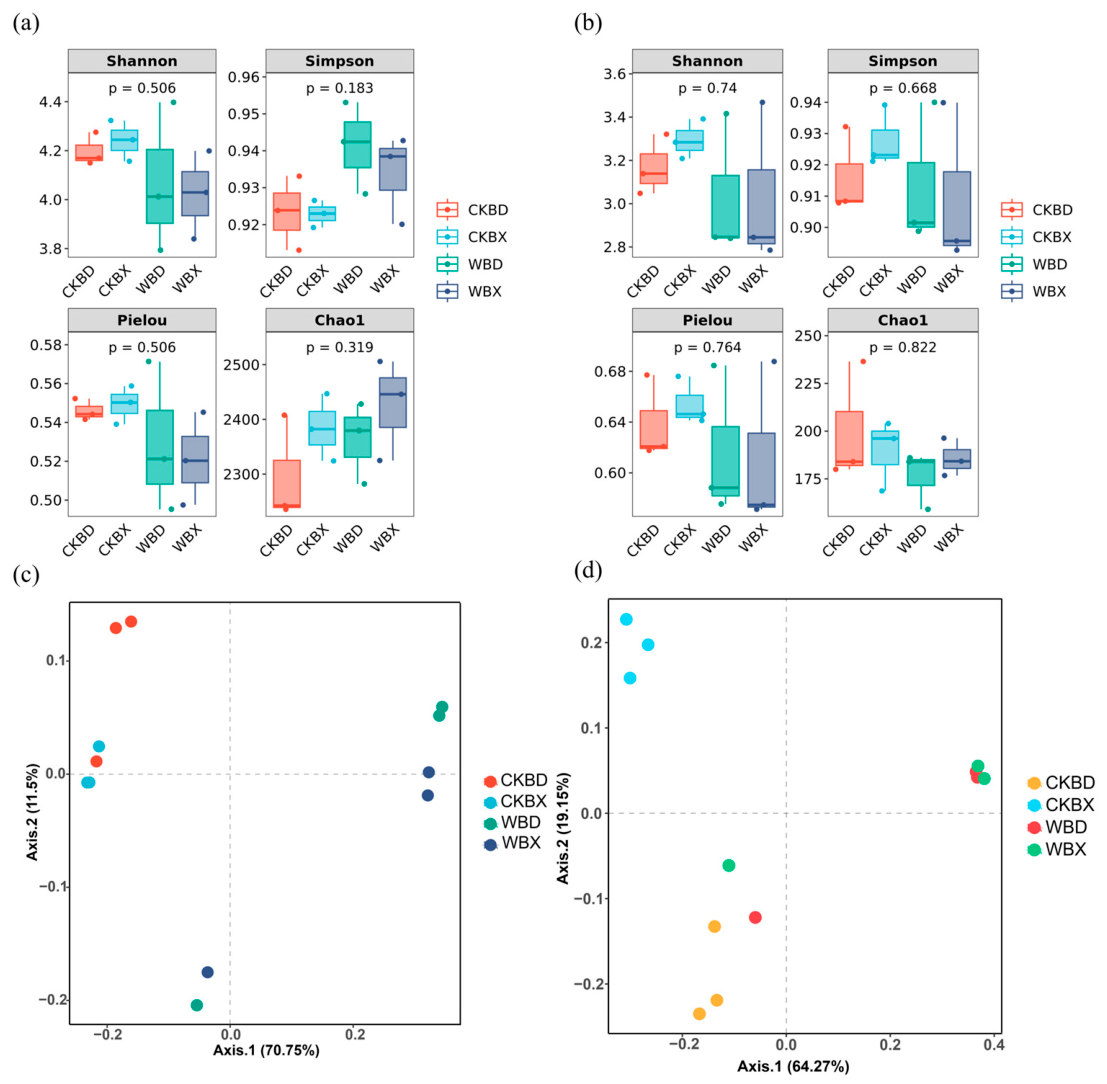
Analysis of bacterial and fungal α-diversity in the four sample groups—CKBD, CKBX, WBD, and WBX—revealed no significant differences in the Shannon, Simpson, Pielou, or Chao1 indices among groups (Figure 4a,b; p > 0.05). This indicates that bacterial and fungal richness, evenness, and diversity did not differ significantly among the sampled fractions. In contrast, principal coordinate analysis (PCoA) indicated significant differences in bacterial and fungal community structure between CK and W in the 0.5–0.25 mm dry-sieved fraction (Figure 4c,d; p < 0.05). The control and fermentation broth substrate treatments were separated along the first principal coordinate axis. In addition, CKBD and CKBX were separated along the second principal coordinate axis, suggesting differences in community structure between the >0.25 mm and <0.25 mm fractions obtained by wet sieving.
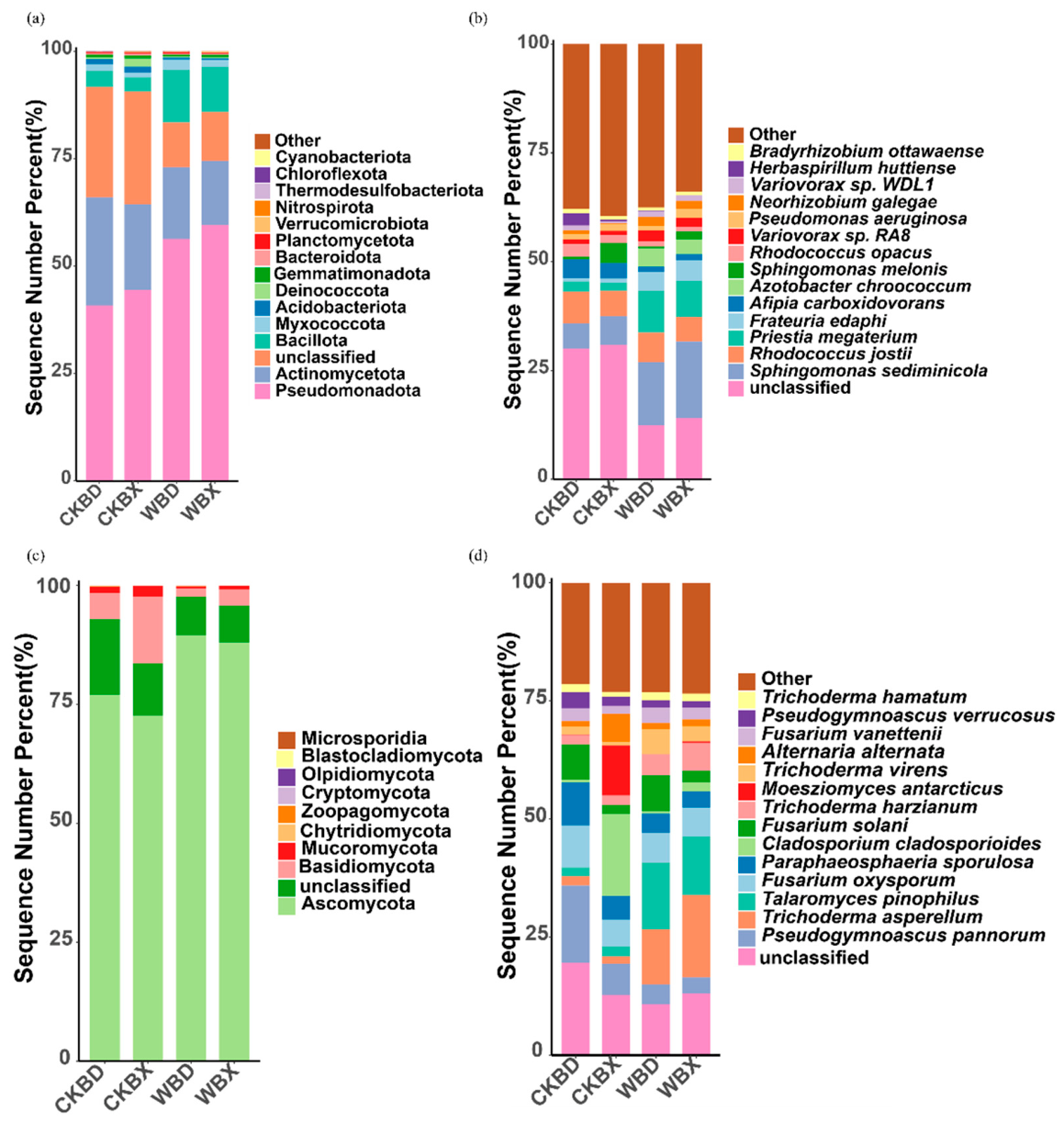
At the phylum level, the dominant bacterial groups were Pseudomonadota, Actinomycetota, Bacillota, Myxococcota, and Acidobacteriota (Figure 5a), while the dominant fungal groups were Ascomycota, Basidiomycota, Mucoromycota, and Chytridiomycota (Figure 5c). Compared with CKBD, the relative abundances of Pseudomonadota and Bacillota in WBD increased by 15.52% and 8.43%, respectively, whereas those of Actinomycetota and Acidobacteriota decreased by 8.44% and 0.74%, respectively. For fungi, the relative abundance of Ascomycota increased by 12.54%, whereas the relative abundances of Basidiomycota and Mucoromycota decreased by 3.75% and 0.84%, respectively.
At the species level, the dominant bacterial taxa were Sphingomonas sediminicola, Rhodococcus jostii, Priestia megaterium, Afipia carboxidovorans, Rhodococcus opacus, Herbaspirillum huttiense, Frateuria edaphi, Pseudomonas aeruginosa, Bradyrhizobium ottawaense, and Neorhizobium galegae (Figure 5b). The dominant fungal taxa were Pseudogymnoascus pannorum, Paraphaeosphaeria sporulosa, Fusarium solani, Pseudogymnoascus verrucosus, Cladosporium cladosporioides, Moesziomyces antarcticus, Alternaria alternata, Talaromyces pinophilus, Trichoderma asperellum, Trichoderma harzianum, and Trichoderma virens (Figure 5d).
Compared with CKBD, WBD showed increases of 8.51%, 7.30%, 3.56%, and 1.17% in the relative abundances of Sphingomonas sediminicola, Priestia megaterium, Frateuria edaphi, and Neorhizobium galegae, respectively. In contrast, the relative abundances of Afipia carboxidovorans, Herbaspirillum huttiense, Rhodococcus opacus, and Rhodococcus jostii decreased by 3.08%, 2.69%, 1.71%, and 0.41%, respectively. For fungi, the relative abundances of Talaromyces pinophilus, Trichoderma asperellum, Trichoderma virens, and Trichoderma harzianum increased by 12.80%, 10.06%, 3.74%, and 2.52%, respectively, whereas those of Pseudogymnoascus pannorum, Paraphaeosphaeria sporulosa, and Pseudogymnoascus verrucosus decreased by 12.33%, 5.25%, and 1.90%, respectively.

3.4. Comparative Analysis of Carbohydrate Enzyme-Related Genes

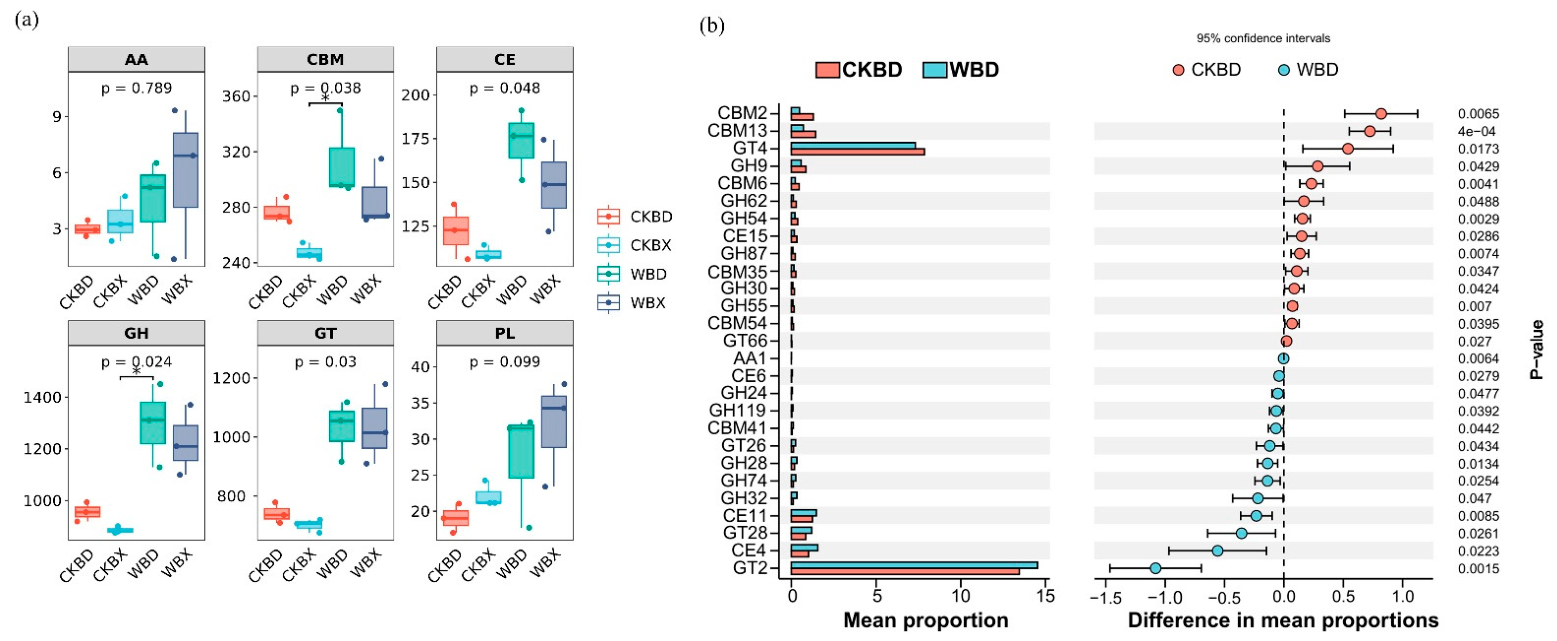
In the 0.5–0.25 mm dry-sieved fraction, the relative abundances of CAZyme-related gene classes differed between CK and W. These classes included auxiliary activities (AA), carbohydrate-binding modules (CBM), carbohydrate esterases (CE), glycoside hydrolases (GH), glycosyltransferases (GT), and polysaccharide lyases (PL). As shown in Figure 6a, W mainly increased the relative abundances of CBM-, CE-, GH-, and GT-related genes in this fraction (p < 0.05), whereas changes in AA- and PL-related genes were not significant. Compared with CKBD, the CAZyme gene families with higher relative abundance in WBD mainly included GT2, GT26, GT28, CE4, CE6, CE11, GH24, GH28, GH32, GH74, GH119, CBM41, and AA1 (Figure 6b). These results suggest that W was associated with increased functional potential for polysaccharide metabolism and chitin modification, particularly through the higher relative abundance of CE4 family genes. Because chitin is a major structural component of fungal hyphae, these results suggest that chitin-related processes may be involved in water-stable aggregate stabilisation.

3.5. Effects of Chitin Addition on Water-Stable Aggregates

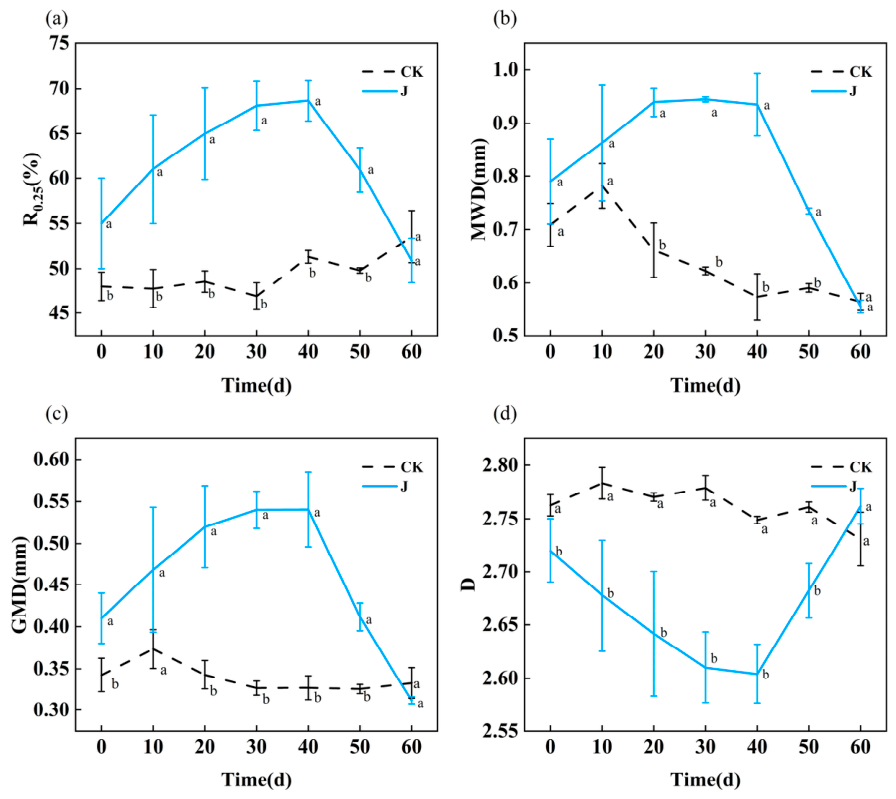
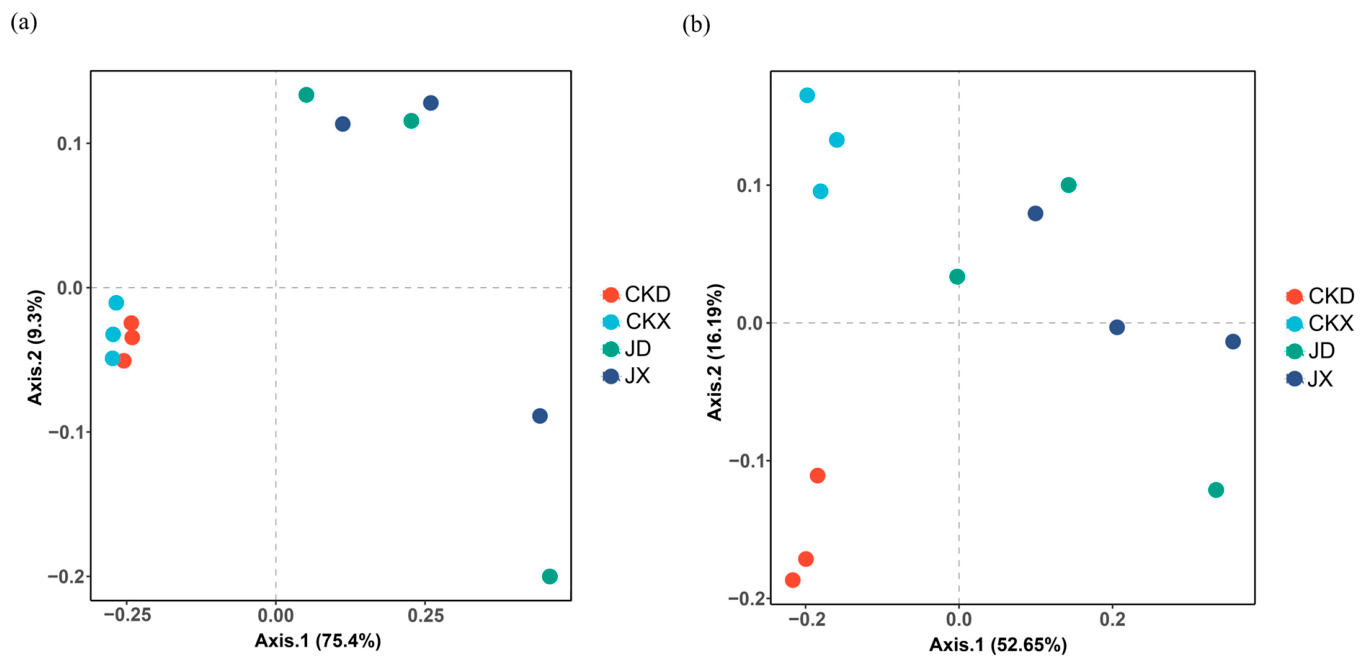
Chitin was applied to the soil to evaluate whether fungal cell-wall-derived chitin could influence the formation of water-stable aggregates >0.25 mm. The effects of chitin addition on soil aggregate stability indices are shown in Figure 7. Under chitin addition, R0.25 remained at 68.08% and 68.64% on days 30 and 40, respectively, before decreasing to 60.91 ± 2.73% and 50.89 ± 2.25% on days 50 and 60, respectively (Figure 7a). MWD and GMD showed a clear increase followed by a decrease during incubation. Both indices reached their highest values on day 30, at 0.94 ± 0.002 mm and 0.54 ± 0.022 mm, respectively. By day 60, MWD and GMD had decreased to 0.55 ± 0.012 mm and 0.31 ± 0.004 mm, respectively, which were lower than the corresponding values in CK at the same time point (0.56 ± 0.016 mm and 0.33 ± 0.018 mm; Figure 7b,c). The D value first decreased and then increased over time, reaching its lowest values on days 30 and 40 (2.61 ± 0.033 and 2.60 ± 0.027, respectively; Figure 7d). This pattern suggests that aggregate structural conditions were most favourable at these time points. By day 60, the D value under treatment J had increased to 2.76 ± 0.016. These results indicate that chitin addition increased the formation of water-stable aggregates >0.25 mm, although this effect was time-limited. PCoA showed that JD and JX were clearly separated from CKD and CKX, although some within-group dispersion was observed. This indicates that chitin addition was associated with significant differences in bacterial community structure (p < 0.05; Figure 8a). Chitin addition was also associated with significant differences in fungal community structure (p < 0.05; Figure 8b).
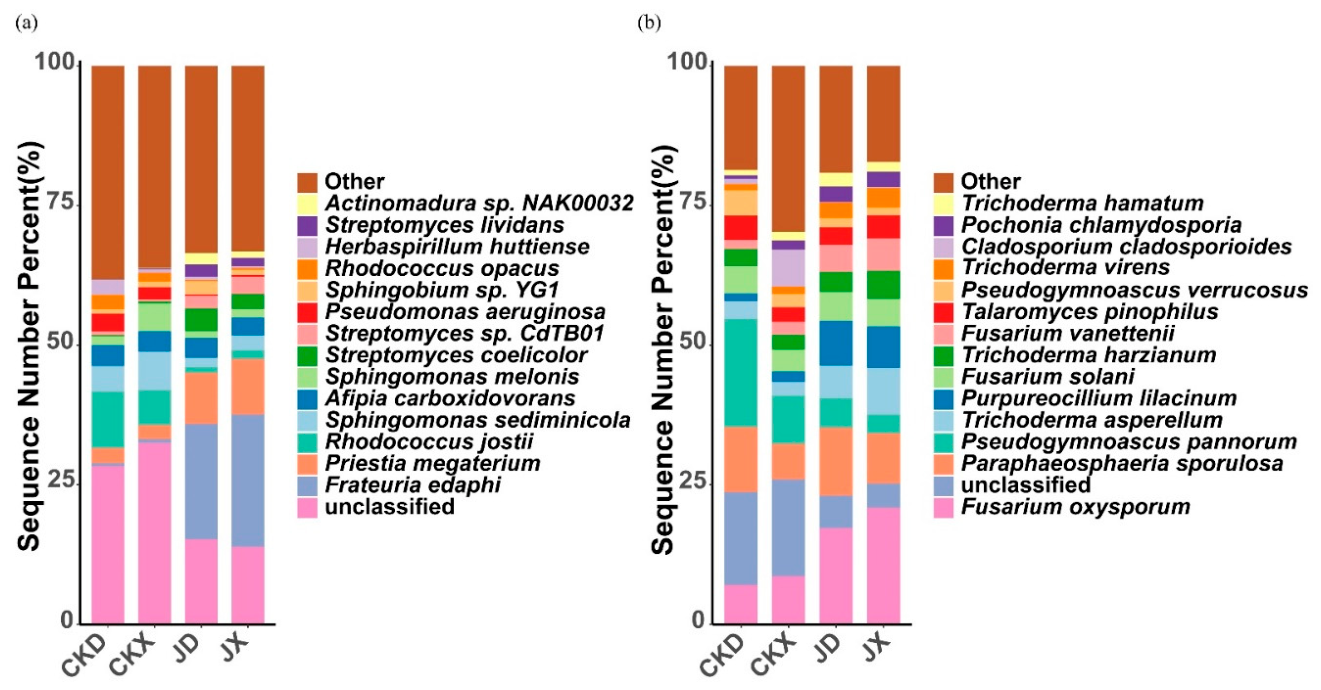
The species-level composition of soil microbial communities following chitin addition is shown in Figure 9. Compared with CKD, JD showed increases of 20.19%, 6.47%, 3.82%, 1.53%, and 2.15% in the relative abundances of the bacterial taxa Frateuria edaphi, Priestia megaterium, Streptomyces coelicolor, Sphingobium sp. YG1, and Streptomyces lividans, respectively. In contrast, the relative abundances of Rhodococcus jostii, Pseudomonas aeruginosa, Herbaspirillum huttiense, and Rhodococcus opacus decreased by 9.11%, 2.89%, 2.18%, and 2.29%, respectively. For fungi, the relative abundances of Fusarium oxysporum, Purpureocillium lilacinum, Trichoderma asperellum, Fusarium vanettenii, Trichoderma virens, and Pochonia chlamydosporia increased by 10.17%, 6.72%, 2.57%, 3.24%, 1.71%, and 2.11%, respectively, whereas those of Pseudogymnoascus pannorum, Pseudogymnoascus verrucosus, and Pseudogymnoascus destructans decreased by 14.05%, 2.93%, and 1.82%, respectively.

4. Discussion

4.1. Effects of Fermentation Broth Substrate on Aggregate Stability During Incubation

In this study, the W, P, and F treatments increased the proportion of water-stable aggregates >0.25 mm, MWD, and GMD in black soil, while decreasing fractal dimension (D). These results suggest that fermentation-derived materials may facilitate the transition from microaggregates towards larger and more stable aggregate fractions. This finding is consistent with previous studies showing that organic amendments can improve aggregate stability by increasing microbial-available carbon, extracellular polymers, and organic binding substances [38,39,40,41]. Among the treatments, W showed the strongest effect during the early to middle incubation period, with R0.25 reaching its maximum on day 50. This result indicates that, under the present incubation conditions, the fermentation broth substrate had a greater effect on aggregate stability than the live Trichoderma asperellum fermentation broth and cell-free fermentation filtrate treatments. Because W was an uninoculated sterile fermentation medium, its stronger effect should be interpreted primarily in relation to medium-derived carbon sources, nutrients, and substrate components rather than being directly attributed to T. asperellum itself. Luo et al. (2024) reported that soil extracellular polymeric substance (EPS) formation is jointly regulated by carbon sources, nutrient supply, and pH, and that EPS can act as an important biological binder between mineral particles and organic matter [38]. Peng et al. (2025) also found that microbial inoculation treatments can improve soil aggregate stability by increasing the abundance of genes associated with extracellular polysaccharides and lipopolysaccharides [42].
Notably, under W, R0.25 and some aggregate stability indices declined by day 60, suggesting that the effect of the fermentation broth substrate on aggregate stability was phase-dependent. This indicates that the positive effect of W was not sustained throughout the entire incubation period. This pattern may be related to the turnover of transient organic binding agents, such as microbial extracellular polymeric substances [38,43,44]. In contrast, although P showed a weaker overall effect than W within 60 days, live Trichoderma may require time for adaptation, colonisation, and hyphal development before exerting measurable effects on soil aggregation. Angulo et al. (2024) reported that aggregate formation under fungal amendments is closely related to fungal biomass, hyphal connectivity, and soil moisture conditions [45]. De Goede et al. (2025) also emphasised that fungus-mediated aggregation processes typically involve gradual hyphal network formation and particle entrapment [46]. Whether live T. asperellum fermentation broth produces a more persistent effect than the substrate treatment remains to be tested in longer-term incubation and field experiments. In addition, because soil moisture was adjusted every 7 days rather than continuously monitored, slight moisture fluctuations may have occurred between watering events. These fluctuations may have influenced fungal growth, microbial activity, and aggregate stability. Future studies should use more frequent moisture monitoring or automatic moisture control to minimise this potential source of variation.

4.2. The 0.5–0.25 mm Fraction Represents a Sensitive Interface Linking Aggregate Structural Responses and Microbial Functional Potential

Among the different dry-sieved fractions, W was associated with the greatest increase in the proportion of water-stable aggregates >0.25 mm in the 0.5–0.25 mm fraction. The average value was approximately 2.26-fold higher than that in CK throughout the incubation and remained high between days 30 and 50. This suggests that this fraction may represent a sensitive interface for the transition from microaggregates to water-stable macroaggregates in the present incubation system. It should be noted that sequencing was performed only on the 0.5–0.25 mm fraction, which was selected post hoc based on its strong response to W. Therefore, the observed microbial community composition and functional potential are specific to this fraction and may not represent those of larger or smaller aggregate size fractions. Aggregate formation is not simply a process of particle-size enlargement. Rather, it is a dynamic process involving the continuous assembly and disassembly of organic residues, mineral particles, microbial cells, hyphae, and extracellular polymers [46,47,48,49]. Previous studies have shown that macroaggregates are generally more sensitive to fresh organic matter inputs, fungal hyphae, and microbial activity, whereas microaggregate stability is more strongly controlled by mineral binding and persistent organic matter [46,47,50]. Therefore, the strong response observed in the 0.5–0.25 mm fraction suggests that medium-derived substrate components in W may have facilitated interactions among small particles, organic binding agents, and the indigenous microbial community, thereby contributing to the development of aggregate structures with higher water stability.
Metagenomic results indicated that the W treatment did not significantly affect bacterial or fungal α-diversity, but it was associated with significant changes in community structure. These findings suggest that the fermentation broth substrate may influence aggregate stability by shifting dominant taxa and microbial functional potential [42,51,52]. The W treatment increased the relative abundances of Pseudomonadota, Bacillota, and Ascomycota, as well as specific taxa including Sphingomonas sediminicola, Priestia megaterium, Azotobacter chroococcum, and Trichoderma asperellum. This observation is broadly consistent with previous studies showing that microorganisms such as Bacillus, Pseudomonas, Sphingomonas, and Trichoderma are involved in EPS secretion, biofilm formation, organic carbon utilisation, and mycelial aggregation [42,45,52,53,54,55]. Liu et al. (2024) reported that the stability of different aggregate size fractions was differentially associated with bacterial, archaeal, and fungal taxa, and that Ascomycota was closely linked to macroaggregate formation [47]. Fan et al. (2022) also reported that chitin addition could increase the relative abundances of functionally relevant microbial taxa, including Sphingomonas, Streptomyces, and Bacillus [56]. Collectively, the pronounced structural and microbial community responses observed in the 0.5–0.25 mm fraction are consistent with previous reports. This suggests that this fraction may serve not only as an interface for aggregate structural changes but also as a spatial unit in which microbial communities undergo active restructuring and exhibit functional potential.

4.3. CAZyme-Related Functional Potential and Chitin Addition Suggest Possible Links Between Substrate-Derived Carbon, Polysaccharide Metabolism, and Aggregate Stabilisation

The W treatment significantly increased the relative abundances of CAZyme-related genes, particularly those belonging to the GT, CE, GH, and CBM families. In the CAZy database, GT, GH, CE, and CBM families are associated with glycosidic bond synthesis, glycosidic bond hydrolysis, ester modification, and carbohydrate binding, respectively. Higher relative abundances of these gene families may indicate greater microbial functional potential for the synthesis and transformation of complex polysaccharides [57]. Among these families, the higher relative abundances of GT2, GT26, and GT28 suggest increased functional potential for microbial polysaccharide synthesis. Previous studies have shown that GT2-type glycosyltransferases can participate in the synthesis of bacterial β-glucan extracellular polysaccharides, which act as biological binding agents associated with soil particle aggregation and water-stable aggregate formation [42,58,59]. In addition, the higher relative abundances of CE4, CE6, and CE11 genes suggest increased functional potential for polysaccharide deacetylation and structural modification. The CE4 family typically includes chitin deacetylases and chitooligosaccharide deacetylases, which may be involved in the conversion and utilisation of chitin derived from fungal cell walls [60,61]. These results suggest that W may have altered carbohydrate-related functional potential mainly through the supply of medium-derived carbon and nutrients and the subsequent response of the indigenous microbial community. Because W did not contain inoculated T. asperellum, the observed changes in fungal taxa under W should be interpreted as shifts in the indigenous soil fungal community rather than as direct effects of the introduced strain.
The chitin addition experiment further supported this interpretation. Chitin addition significantly increased R0.25 on days 30–40, while MWD and GMD reached their maximum values on day 30. These results indicate that chitin addition was associated with increased formation of water-stable aggregates >0.25 mm during the middle stage of incubation. These findings are consistent with previous studies showing that chitin or chitin-enriched organic amendments can alter microbial communities, stimulate carbon transformation, and improve soil structure [56,62,63,64]. However, R0.25, MWD, and GMD declined after 50–60 days under chitin addition, suggesting that the effect of chitin was also time-limited. Chitin may serve both as a structural polysaccharide and as a source of organic carbon and nitrogen for microorganisms. During the early to middle stages of incubation, chitin may favour microbial groups involved in chitin degradation and polysaccharide transformation, thereby contributing to the formation of binding substances. In the later stage, aggregate stability may decline because of substrate depletion, microbial degradation, and turnover of binding substances [56,62,64]. In summary, the fermentation broth substrate was associated with increased relative abundances of CAZyme-related genes and shifts in microbial community composition, which may have contributed to aggregate stabilisation in the 0.5–0.25 mm fraction. However, under short-term incubation conditions, this effect may depend on substrate availability and follow a dynamic pattern, with enhancement during the early to middle stages followed by a decline in the later stage.

5. Conclusions

The results showed that live Trichoderma asperellum fermentation broth, fermentation broth substrate, and cell-free fermentation filtrate improved water-stable aggregate stability in black soil during the 60-day incubation. Among the treatments, the uninoculated fermentation broth substrate showed the strongest effect, particularly in the 0.5–0.25 mm dry-sieved fraction. Metagenomic analysis indicated that the uninoculated fermentation broth substrate altered microbial community composition, increased the relative abundances of taxa such as Bacillus and Sphingomonas, and increased the relative abundances of CAZyme-related genes, including those associated with glycosyltransferases, carbohydrate esterases, and glycoside hydrolases. These results suggest that improved aggregate stability may be associated with shifts in microbial community composition and carbohydrate-related functional potential. The chitin addition experiment further showed that chitin improved aggregate stability and altered microbial community structure, supporting the possible involvement of chitin-related processes in aggregate stabilisation. Nevertheless, this study has several limitations. Extracellular polymeric substances, chitin transformation products, fungal biomass, enzyme activities, and gene expression were not directly measured; therefore, the proposed microbial processes should be interpreted as functional potential rather than directly verified mechanisms. Future studies should combine metatranscriptomics, enzyme assays, EPS quantification, fungal biomass measurements, and field experiments to further test these findings.

Author Contributions

Conceptualization, B.W., X.Z., B.Z., S.D. and J.C., methodology, B.W. and X.Z., software, B.W. and B.Z., formal analysis, B.W. and K.W., investigation, K.W. and S.D., data curation, K.W., writing—original draft preparation, B.W. and X.Z., writing—review and editing, B.W., X.Z. and J.C., funding acquisition, J.C. All authors have read and agreed to the published version of the manuscript.

Funding

This work was supported by the National Key R&D Program of China (2023YFD1500302) and the Department of Education of Jilin Province (JJKH20241786HT).

Data Availability Statement

Dataset available on request from the authors.

Conflicts of Interest

The authors declare no conflicts of interest.

References

  1. Li, R.; Hu, W.; Jia, Z.; Liu, H.; Zhang, C.; Huang, B.; Yang, S.; Zhao, Y.; Zhao, Y.; Shukla, M.K.; et al. Soil degradation: A global threat to sustainable use of black soils. Pedosphere 2025, 35, 264–279. [Google Scholar] [CrossRef]
  2. Wang, W.; Deng, X.; Yue, H. Black soil conservation will boost China’s grain supply and reduce agricultural greenhouse gas emissions in the future. Environ. Impact Assess. Rev. 2024, 106, 107482. [Google Scholar] [CrossRef]
  3. Wang, H.; Yang, S.; Wang, Y.; Gu, Z.; Xiong, S.; Huang, X.; Sun, M.; Zhang, S.; Guo, L.; Cui, J.; et al. Rates and causes of black soil erosion in Northeast China. Catena 2022, 214, 106250. [Google Scholar] [CrossRef]
  4. Sui, J.; Dai, Y. Analysis of conservation practices for black soil based on organic matter and nitrogen contents in the black soil region of Northeast China. Sci. Rep. 2025, 15, 23989. [Google Scholar] [CrossRef]
  5. Ruan, W.; Liu, H.; Sui, Y.; Wang, C.; Luo, C.; Meng, X.; Dong, C. Quantitative prediction of black soil horizon thickness at the watershed scale in Northeast China’s black soil region. Soil Tillage Res. 2026, 256, 106886. [Google Scholar] [CrossRef]
  6. Zhou, W.; Qiao, G.; Xu, S.; Cao, Y.; Cao, M.; Tang, H.; Huang, Y. Land degradation neutrality assessment in China’s black soil region: Integrating multi-source LULC data and innovative quantitative indicators. Ecol. Indic. 2025, 181, 114448. [Google Scholar] [CrossRef]
  7. Liu, X.J.A.; Pold, G.; Domeignoz-Horta, L.A.; Geyer, K.M.; Caris, H.; Nicolson, H.; Kemner, K.M.; Frey, S.D.; Melillo, J.M.; DeAngelis, K.M. Soil aggregate-mediated microbial responses to long-term warming. Soil Biol. Biochem. 2021, 152, 108055. [Google Scholar] [CrossRef]
  8. Sun, X.; Zhang, C.; Liu, K.; Xu, M.; Cai, A. Long-term manure application enhances carbon use efficiency in soil aggregates by regulating microbial communities in cropland. Soil Biol. Biochem. 2025, 210, 109945. [Google Scholar] [CrossRef]
  9. Lehmann, A.; Zheng, W.; Rillig, M.C. Soil biota contributions to soil aggregation. Nat. Ecol. Evol. 2017, 1, 1828–1835. [Google Scholar] [CrossRef]
  10. Rieke, E.L.; Bagnall, D.K.; Morgan, C.L.S.; Flynn, K.D.; Howe, J.A.; Greub, K.L.H.; Mac Bean, G.; Cappellazzi, S.B.; Cope, M.; Liptzin, D.; et al. Evaluation of aggregate stability methods for soil health. Geoderma 2022, 428, 116156. [Google Scholar] [CrossRef]
  11. Hamza, A.; Karčauskienė, D.; Mockevičienė, I.; Repšienė, R.; Tahir, M.A.; Manzoor, M.Z.; Kousar, S.; Lodhi, S.S.; Rasool, N.; Ullah, I. Soil aggregate dynamics and stability: Natural and anthropogenic drivers. Agriculture 2025, 15, 2500. [Google Scholar] [CrossRef]
  12. Kan, H.; Xu, H.; Zhang, G.; Chen, C.; Pang, Z.; Fan, X.; Wu, J. Stoichiometric characteristics drive the soil aggregate stability after 5 years of vegetation restoration in China. Front. Ecol. Evol. 2023, 11, 1280303. [Google Scholar] [CrossRef]
  13. Rillig, M.C.; Muller, L.A.H.; Lehmann, A. Soil aggregates as massively concurrent evolutionary incubators. ISME J. 2017, 11, 1943–1948. [Google Scholar] [CrossRef]
  14. Pessoa, T.N.; Bovi, R.C.; Nunes, M.R.; Cooper, M.; Uteau, D.; Peth, S.; Libardi, P.L. Clay mineral composition drives soil structure behavior and the associated physical properties in Brazilian Oxisols. Geoderma Reg. 2024, 38, e00837. [Google Scholar] [CrossRef]
  15. Ren, L.; Yang, H.; Li, J.; Zhang, N.; Han, Y.; Zou, H.; Zhang, Y. Organic fertilizer enhances soil aggregate stability by altering greenhouse soil content of iron oxide and organic carbon. J. Integr. Agric. 2025, 24, 306–321. [Google Scholar] [CrossRef]
  16. Gu, W.; Wang, Y.; Sun, Y.; Liu, Z.; Wang, W.; Wu, D.; Zhang, Y.; Sun, W.; Wang, X.; Feng, Z.; et al. Assessing the formation and stability of paddy soil aggregate driven by organic carbon and Fe/Al oxides in rice straw cyclic utilization strategies: Insight from a six-year field trial. Sci. Total Environ. 2024, 951, 175607. [Google Scholar] [CrossRef]
  17. Xie, J.; Gao, J.; Cao, H.; Li, J.; Wang, X.; Zhang, J.; Meng, H.; Hong, J.; Li, T.; Xu, M. Calcium carbonate promotes the formation and stability of soil macroaggregates in mining areas of China. J. Integr. Agric. 2024, 23, 1034–1047. [Google Scholar] [CrossRef]
  18. Shabtai, I.A.; Wilhelm, R.C.; Schweizer, S.A.; Höschen, C.; Buckley, D.H.; Lehmann, J. Calcium promotes persistent soil organic matter by altering microbial transformation of plant litter. Nat. Commun. 2023, 14, 6609. [Google Scholar] [CrossRef]
  19. Sun, Z.; Liu, Z.; Han, J.; Wang, H.; Zhang, H.; Yan, J. Long-term effects of soft rock amendment on changes of soil aggregate cementing agents of sandy soil by SEM-EDS. Front. Environ. Sci. 2023, 11, 1207781. [Google Scholar] [CrossRef]
  20. Totsche, K.U.; Amelung, W.; Gerzabek, M.H.; Guggenberger, G.; Klumpp, E.; Knief, C.; Lehndorff, E.; Mikutta, R.; Peth, S.; Prechtel, A.; et al. Microaggregates in soils. J. Plant Nutr. Soil Sci. 2018, 181, 104–136. [Google Scholar] [CrossRef]
  21. Woo, S.L.; Hermosa, R.; Lorito, M.; Monte, E. Trichoderma: A multipurpose, plant-beneficial microorganism for eco-sustainable agriculture. Nat. Rev. Microbiol. 2023, 21, 312–326. [Google Scholar] [CrossRef]
  22. Zhou, J.; Liang, J.; Zhang, X.; Wang, F.; Qu, Z.; Gao, T.; Yao, Y.; Luo, Y. Trichoderma brevicompactum 6311: Prevention and control of phytophthora capsici and its growth-promoting effect. J. Fungi 2025, 11, 105. [Google Scholar] [CrossRef]
  23. Yu, W.; Wei, X.; Zeng, Q.; Lin, X.; Zhou, X.; Xu, H. Effects of chaetomium globosum and Trichoderma asperellum on root configuration and growth of cucumber seedlings. Sci. Rep. 2025, 15, 26674. [Google Scholar] [CrossRef] [PubMed]
  24. Yang, G.; Ma, Y.; Ma, X.; Wang, X.; Lu, C.; Xu, W.; Luo, J.; Guo, D. Changes in soil organic carbon components and microbial community following spent mushroom substrate application. Front. Microbiol. 2024, 15, 1351921. [Google Scholar] [CrossRef] [PubMed]
  25. Ma, X.; Han, F.; Yang, G.; Wu, J.; Ma, Y. Enhanced soil ecosystem multifunctionality and microbial community shifts following spent mushroom substrate application in vineyards. Appl. Soil Ecol. 2025, 213, 106230. [Google Scholar] [CrossRef]
  26. Cao, H.; Yang, Y.; Gao, Y.; Liu, J.; Ma, S.; Duan, A. Organic amendments combined with moderate nitrogen rate significantly enhance soil fertility and crop productivity. J. Agric. Food Res. 2025, 23, 102211. [Google Scholar] [CrossRef]
  27. Tang, S.; Fan, T.; Jin, L.; Lei, P.; Shao, C.; Wu, S.; Yang, Y.; He, Y.; Ren, R.; Xu, J.; et al. Soil microbial diversity and functional capacity associated with the production of edible mushroom Stropharia rugosoannulata in croplands. PeerJ 2022, 10, e14130. [Google Scholar] [CrossRef]
  28. Wang, P.; Wang, L.; Liu, K.; Liang, B.; Gong, H.; Chen, L.; Dong, H. Application of difenoconazole and Trichoderma broth combination for synergistic control of corn leaf blight and stalk rot in straw-returned fields in Liaoning province, China. Appl. Sci. 2025, 15, 7834. [Google Scholar] [CrossRef]
  29. Whalen, E.D.; Grandy, A.S.; Geyer, K.M.; Morrison, E.W.; Frey, S.D. Microbial trait multifunctionality drives soil organic matter formation potential. Nat. Commun. 2024, 15, 10209. [Google Scholar] [CrossRef]
  30. Liu, L.; Gunina, A.; Zhang, F.; Cui, Z.; Tian, J. Fungal necromass increases soil aggregation and organic matter chemical stability under improved cropland management and natural restoration. Sci. Total Environ. 2023, 858, 159953. [Google Scholar] [CrossRef]
  31. Hong, Y.; Zhao, D.; Zhang, F.; Shen, G.; Yuan, Y.; Gao, Y.; Yan, L.; Wei, D.; Wang, W. Soil water-stable aggregates and microbial community under long-term tillage in black soil of Northern China. Ecotoxicology 2021, 30, 1754–1768. [Google Scholar] [PubMed]
  32. Caesar-TonThat, T.C.; Espeland, E.; Caesar, A.J.; Sainju, U.M.; Lartey, R.T.; Gaskin, J.F. Effects of agaricus lilaceps fairy rings on soil aggregation and microbial community structure in relation to growth stimulation of western wheatgrass (Pascopyrum smithii) in eastern Montana Rangeland. Microb. Ecol. 2013, 66, 120–131. [Google Scholar] [CrossRef]
  33. Fan, X.; Pan, H.; Ping, Y.; Jin, G.; Song, F. The underlying mechanism of soil aggregate stability by fungi and related multiple factor: A review. Eurasian Soil Sci. 2022, 55, 242–250. [Google Scholar]
  34. Tang, J.; Mo, Y.; Zhang, J.; Zhang, R. Influence of biological aggregating agents associated with microbial population on soil aggregate stability. Appl. Soil Ecol. 2011, 47, 153–159. [Google Scholar] [CrossRef]
  35. Pellitier, P.T.; Zak, D.R. Ectomycorrhizal fungal decay traits along a soil nitrogen gradient. New Phytol. 2021, 232, 2152–2164. [Google Scholar] [CrossRef]
  36. Ma, Y.; Li, Y.; Yang, S.; Li, Y.; Zhu, Z. Biocontrol potential of Trichoderma asperellum strain 576 against Exserohilum 894 turcicum in Zea mays. J. Fungi 2023, 9, 936. [Google Scholar] [CrossRef]
  37. Di Mario, F.; Rapanà, P.; Tomati, U.; Galli, E. Chitin and chitosan from Basidiomycetes. Int. J. Biol. Macromol. 2008, 43, 8–12. [Google Scholar] [CrossRef]
  38. Luo, Y.; Lopez, J.B.G.; van Veelen, H.P.J.; Kok, D.D.; Postma, R.; Thijssen, D.; Sechi, V.; ter Heijne, A.; Bezemer, T.M.; Buisman, C.J. Effects of different soil organic amendments (OAs) on extracellular polymeric substances (EPS). Eur. J. Soil Biol. 2024, 121, 103624. [Google Scholar] [CrossRef]
  39. Du, M.; Minasny, B.; Rabbi, S.M. Carbon to nitrogen stoichiometry of organic amendments influences the improvement of aggregate stability of a cropping vertisol. Soil Use Manag. 2024, 40, e13087. [Google Scholar] [CrossRef]
  40. Tao, W.; Wu, Q.; Zhang, J.; Chang, T.; Liu, X. Effects of applying organic amendments on soil aggregate structure and tomato yield in facility agriculture. Plants 2024, 13, 3064. [Google Scholar] [CrossRef] [PubMed]
  41. Sun, J.; Lu, X.; Chen, G.; Luo, N.; Zhang, Q.; Li, X. Biochar promotes soil aggregate stability and associated organic carbon sequestration and regulates microbial community structures in Mollisols from northeast China. Soil 2023, 9, 261–275. [Google Scholar] [CrossRef]
  42. Peng, Y.; Zhang, H.; Lv, Z.; Zhang, J.; Li, G. Microbial inoculation improves soil aggregation by enhancing exopolysaccharides and lipopolysaccharides-related gene abundance in saline soil. Appl. Soil Ecol. 2025, 214, 106388. [Google Scholar] [CrossRef]
  43. Zhang, M.; Wu, Y.; Qu, C.; Huang, Q.; Cai, P. Microbial extracellular polymeric substances (EPS) in soil: From interfacial behaviour to ecological multifunctionality. Geo-Bio Interfaces 2024, 1, e4. [Google Scholar] [CrossRef]
  44. Shi, K.; Zheng, Q.; Wang, B.; Noll, L.; Zhang, S.; Hu, Y.; Ruan, H.; Wanek, W. Continental-scale drivers of soil microbial extracellular polymeric substances. Nat. Commun. 2026, 17, 3334. [Google Scholar] [CrossRef] [PubMed]
  45. Angulo, V.; Bleichrodt, R.J.; Dijksterhuis, J.; Erktan, A.; Hefting, M.M.; Kraak, B.; Kowalchuk, G.A. Enhancement of soil aggregation and physical properties through fungal amendments under varying moisture conditions. Environ. Microbiol. 2024, 26, e16627. [Google Scholar] [CrossRef]
  46. de Goede, S.P.; Hannula, S.E.; Jansen, B.; Morriën, E. Fungal-mediated soil aggregation as a mechanism for carbon stabilization. ISME J. 2025, 19, wraf074. [Google Scholar] [CrossRef]
  47. Liu, S.; Lin, Z.; Duan, X.; Deng, Y. Effects of soil microorganisms on aggregate stability during vegetation recovery in degraded granitic red soil areas. Appl. Soil Ecol. 2024, 204, 105734. [Google Scholar] [CrossRef]
  48. Yuan, X.; Ban, G.; Luo, Y.; Wang, J.; Peng, D.; Liang, R.; He, T.; Wang, Z. Biochar effects on aggregation and carbon-nitrogen retention in different-sized aggregates of clay and loam soils: A meta-analysis. Soil Tillage Res. 2025, 247, 106365. [Google Scholar] [CrossRef]
  49. Wu, J.; Zhou, B.; Li, Z.; Liu, C.; Li, Y.; Wang, Y.; Zhao, N.; Wang, Z.; Chai, Y.; Scopa, A. Biochar promoted soil organic carbon accumulation and aggregate stability by increasing the content of organic complex metal oxides in paddy soil. Soil Tillage Res. 2025, 254, 106713. [Google Scholar] [CrossRef]
  50. Liu, Y.; Zhang, M.; Xiong, H.; Li, Y.; Zhang, Y.; Huang, X.; Yang, Y.; Zhu, H.; Jiang, T. Influence of long-term fertilization on soil aggregates stability and organic carbon occurrence characteristics in karst yellow soil of Southwest China. Front. Plant Sci. 2023, 14, 1126150. [Google Scholar] [CrossRef]
  51. Li, Y.; Wang, M.; Fan, M.; Li, X.; Jiang, L.; Hao, Z.; Yu, J.; Yang, Y.; Zuo, W.; Shan, Y. Organic amendments promoted soil agglomeration mainly via alleviating abiotic constraints and stabilizing and functionalizing microbiomes in coastal salt-affected lands. Agronomy 2024, 14, 2864. [Google Scholar] [CrossRef]
  52. Bi, Y.; Zhou, B.; Ren, P.; Yao, S.; Chen, X.; Yang, X.; Yu, P.; Duan, M. The mechanism of Bacillus subtilis to guarantee the safe utilization of brackish water by improving soil physical properties and cotton production. Agric. Water Manag. 2025, 319, 109793. [Google Scholar] [CrossRef]
  53. Asghar, W.; Craven, K.D.; Kataoka, R.; Mahmood, A.; Asghar, N.; Raza, T.; Iftikhar, F. The application of Trichoderma spp., an old but new useful fungus, in sustainable soil health intensification: A comprehensive strategy for addressing challenges. Plant Stress 2024, 12, 100455. [Google Scholar] [CrossRef]
  54. Santoyo, G.; Orozco-Mosqueda, M.D.C.; Afridi, M.S.; Mitra, D.; Valencia-Cantero, E.; Macías-Rodríguez, L. Trichoderma and Bacillus multifunctional allies for plant growth and health in saline soils: Recent advances and future challenges. Front. Microbiol. 2024, 15, 1423980. [Google Scholar] [CrossRef]
  55. Akter, S.; Kamruzzaman, M.; Sarder, M.P.; Amin, M.S.; Joardar, J.C.; Islam, M.S.; Nasrin, S.; Islam, M.U.; Islam, F.; Rabbi, S. Mycorrhizal fungi increase plant nutrient uptake, aggregate stability and microbial biomass in the clay soil. Symbiosis 2024, 93, 163–176. [Google Scholar] [CrossRef]
  56. Fan, Y.; Liu, J.; Liu, Z.; Hu, X.; Yu, Z.; Li, Y.; Chen, X.; Li, L.; Jin, J.; Wang, G. Chitin amendments eliminate the negative impacts of continuous cropping obstacles on soil properties and microbial assemblage. Front. Plant Sci. 2022, 13, 1067618. [Google Scholar] [CrossRef]
  57. Drula, E.; Garron, M.L.; Dogan, S.; Lombard, V.; Henrissat, B.; Terrapon, N. The carbohydrate-active enzyme database: Functions and literature. Nucleic Acids Res. 2022, 50, D571–D577. [Google Scholar] [CrossRef]
  58. Lampugnani, E.R.; Ford, K.; Ho, Y.Y.; van de Meene, A.; Lahnstein, J.; Tan, H.T.; Burton, R.A.; Fincher, G.B.; Shafee, T.; Bacic, A.; et al. Glycosyl transferase GT2 genes mediate the biosynthesis of an unusual (1, 3, 1, 4)-β-glucan exopolysaccharide in the bacterium Sarcina ventriculi. Mol. Microbiol. 2024, 121, 1245–1261. [Google Scholar] [CrossRef]
  59. Zhang, H.; Wang, K.; Liu, X.; Yao, L.; Chen, Z.; Han, H. Exopolysaccharide-producing bacteria regulate soil aggregates and bacterial communities to inhibit the uptake of cadmium and lead by lettuce. Microorganisms 2024, 12, 2112. [Google Scholar] [CrossRef]
  60. Liang, B.; Song, W.; Xing, R.; Liu, S.; Yu, H.; Li, P. The source, activity influencing factors and biological activities for future development of chitin deacetylase. Carbohydr. Polym. 2023, 321, 121335. [Google Scholar] [CrossRef] [PubMed]
  61. Mapuranga, J.; Chang, J.; Li, H.; Zhang, Y.; Li, R.; Song, L.; Zhang, N.; Yang, W. The molecular structure, biological roles, and inhibition of plant pathogenic fungal chitin deacetylases. Front. Plant Sci. 2024, 14, 1335646. [Google Scholar] [CrossRef] [PubMed]
  62. Zhang, H.; Degré, A.; De Clerck, C.; Li, S.; Lian, J.; Peng, Y.; Sun, T.; Luo, L.; Yue, Y.; Li, G. Changes in bacterial community structure and carbon metabolism in sandy soil under the long-term application of chitin-rich organic material and attapulgite. Appl. Soil Ecol. 2024, 194, 105161. [Google Scholar] [CrossRef]
  63. Zhang, H.; Peng, Y.; De Clerck, C.; Li, G.; Zhang, J.; Degré, A. Enhancing soil organic carbon sequestration at different depths: The role of chitin-rich organic amendment in salt-affected soils. Environ. Technol. Innov. 2025, 43, 104395. [Google Scholar] [CrossRef]
  64. Hernández Muiz, P.; Borrero, C.; Avilés, M.; Fernández Bayo, J.D. Perspectives on microbial community changes produced by Hermitia illucens frass and their impact on soil suppression against Fusarium oxysporum f. sp. lactucae. Pest Manag. Sci. 2025, 81, 6832–6842. [Google Scholar] [CrossRef] [PubMed]
Figure 1. Dynamic changes in the particle-size distribution of water-stable aggregates during incubation. Note: Panels show the proportions of water-stable aggregate fractions after wet sieving: (a) >2 mm, (b) 2–1 mm, (c) 1–0.5 mm, (d) 0.5–0.25 mm, and (e) <0.25 mm. Different uppercase letters indicate significant differences among incubation times within the same treatment, whereas different lowercase letters indicate significant differences among treatments at the same incubation time (p < 0.05). Values are presented as means ± standard errors (SE; n = 3).
Agriculture 16 01319 g001
Figure 2. Stability indices of water-stable aggregates during incubation. Note: Panels show water-stable aggregate stability indices: (a) proportion of water-stable aggregates >0.25 mm (R0.25, %), (b) mean weight diameter (MWD, mm), (c) geometric mean diameter (GMD, mm), and (d) fractal dimension (D). Different lowercase letters indicate significant differences among treatments at the same incubation time (p < 0.05). Values are presented as means ± standard errors (SE; n = 3).
Agriculture 16 01319 g002
Figure 3. Proportion of water-stable aggregates >0.25 mm in different dry-sieved fractions. Note: Panels show the proportion of water-stable aggregates >0.25 mm in different dry-sieved fractions: (a) >2 mm, (b) 2–1 mm, (c) 1–0.5 mm, and (d) 0.5–0.25 mm. Different uppercase letters indicate significant differences among incubation times within the same treatment and dry-sieved fraction, whereas different lowercase letters indicate significant differences between CK and W at the same incubation time and within the same dry-sieved fraction (p < 0.05). Values are presented as means ± standard errors (SE; n = 3).
Agriculture 16 01319 g003
Figure 4. Microbial diversity and community structure in the 0.5–0.25 mm dry-sieved fraction under CK and W treatments. Note: Panels show (a) bacterial α-diversity indices, (b) fungal α-diversity indices, (c) bacterial community β-diversity based on PCoA, and (d) fungal community β-diversity based on PCoA.
Agriculture 16 01319 g004
Figure 5. Composition of soil bacterial and fungal communities at the phylum and species levels under CK and W treatments. Note: Panels show community composition at different taxonomic levels: (a) bacterial composition at the phylum level, (b) bacterial composition at the species level, (c) fungal composition at the phylum level, and (d) fungal composition at the species level.
Agriculture 16 01319 g005
Figure 6. Relative abundance of CAZyme-related genes under fermentation broth substrate treatment. Note: Panels show (a) the relative abundance of CAZyme-related gene classes, including AA, CBM, CE, GH, GT, and PL, and (b) differentially abundant CAZyme gene families. * p < 0.05, ** p < 0.01, *** p < 0.001.
Agriculture 16 01319 g006
Figure 7. Soil aggregate stability indices following chitin addition. Note: Panels show soil aggregate stability indices following chitin addition: (a) proportion of water-stable aggregates >0.25 mm (R0.25, %), (b) mean weight diameter (MWD, mm), (c) geometric mean diameter (GMD, mm), and (d) fractal dimension (D). Different lowercase letters indicate significant differences among treatments at the same incubation time (p < 0.05). Values are presented as means ± standard errors (SE; n = 3).
Agriculture 16 01319 g007
Figure 8. β-Diversity of microbial communities following chitin addition. Note: Panels show PCoA of microbial β-diversity following chitin addition: (a) bacterial communities and (b) fungal communities.
Agriculture 16 01319 g008
Figure 9. Species level distribution characteristics of soil microbial communities under chitin treatment. Note: (a) Bacterial species level classification, (b) Fungal species level classification.
Agriculture 16 01319 g009
Disclaimer/Publisher’s Note: The statements, opinions and data contained in all publications are solely those of the individual author(s) and contributor(s) and not of MDPI and/or the editor(s). MDPI and/or the editor(s) disclaim responsibility for any injury to people or property resulting from any ideas, methods, instructions or products referred to in the content.