Valorization of Tung Cake Waste into a Multifunctional Bio-Based Protective Formulation for Rubberwood Mold Control and Postharvest Fruit Preservation


Abstract
1. Introduction
2. Materials and Methods
2.1. Experimental Procedure
2.2. Test Materials
2.3. Experimental Methods
2.3.1. Preparation of Tung Cake Extract, Ethanol Mixture, and Fermentation Broth
- (1)
- Disinfection and Sterilization: First, rinse and disinfect laboratory tools such as petri dishes, extractors, and forceps, then sterilize them in a vertical autoclave sterilized at 121 °C for 20 min;
- (2)
- Strain activation and seed culture preparation: The Bacillus licheniformis (10037) strain was aseptically inoculated onto a fresh beef extract peptone agar slant in a test tube under a laminar flow hood. The slant culture was incubated at 28 °C for 48 h in an HWS-series constant-temperature and humidity incubator to obtain the activated strain. Subsequently, a loopful of cells from the activated slant culture was aseptically transferred into beef extract peptone liquid seed medium and incubated at 30 °C for 24 h in a shaking incubator to obtain the seed culture;
- (3)
- Fermentation medium preparation: Place 5 g of tung cake powder, 0.1 g of glucose, 0.5 g of sodium chloride, and 100 mL of distilled water into a 250 mL conical flask; sterilize at 121 °C for 20 min, then cool;
- (4)
- Tung cake fermentation: Inoculate Bacillus licheniformis into the seed culture medium and incubate on a shaking incubator at 30 °C for 24 h; subsequently, inoculate each bacterial strain into the fermentation medium at a 2% inoculation rate for fermentation at 30 °C for 48 h;
- (5)
- Collection of tung cake fermentation broth: After fermentation, the culture was centrifuged at 4000 rpm for 20 min to remove precipitated bacterial cells and unfermented tung cake residues. The supernatant was collected and filtered through a 0.45 μm microporous membrane to remove remaining suspended particles and larger microbial cells. The resulting filtrate was used as the filtered tung cake fermentation broth. The fermentation broth was not heat-sterilized after fermentation to avoid possible thermal alteration of fermentation-derived constituents.
2.3.2. Preparation of Rubberwood Specimens
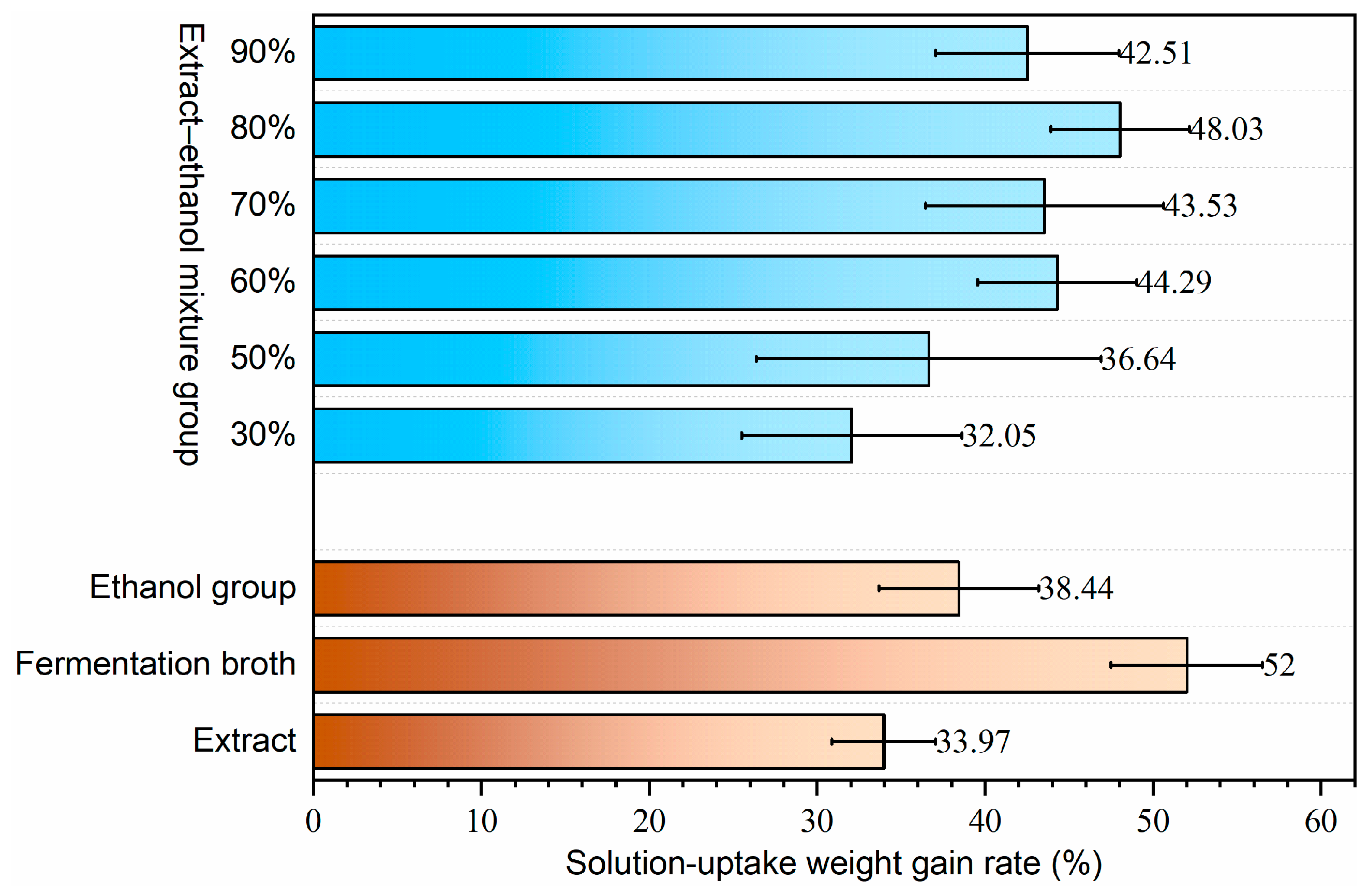
2.3.3. Determination of Solution Uptake
2.3.4. Mold-Resistance Testing
- (1)
- Preparation of Culture Media: First, rinse and disinfect experimental tools such as petri dishes, pipettes, and forceps. Place these, along with the prepared potato-glucose agar medium, in a vertical autoclave and sterilize at 121 °C for 20 min. After cooling to a safe temperature in a laminar flow hood, pour 15–20 mL of the potato dextrose agar (PDA) medium into each sterilized Petri dish (9 cm diameter) to prepare solid agar plates (i.e., PDA plates), and set aside;
- (2)
- Inoculation and Cultivation of Test Strains: On a laminar flow hood, use a loop and forceps to inoculate Aspergillus niger into the exact center of the PDA medium to facilitate fungal expansion and proliferation. Wrap the bottom of the petri dish with plastic wrap, then place it in a constant temperature and humidity incubator at 28 ± 2 °C and 85% relative humidity. Observe fungal growth and colony distribution. Incubate for one week until colonies mature, then use them for the anti-mold testing of rubberwood samples;
- (3)
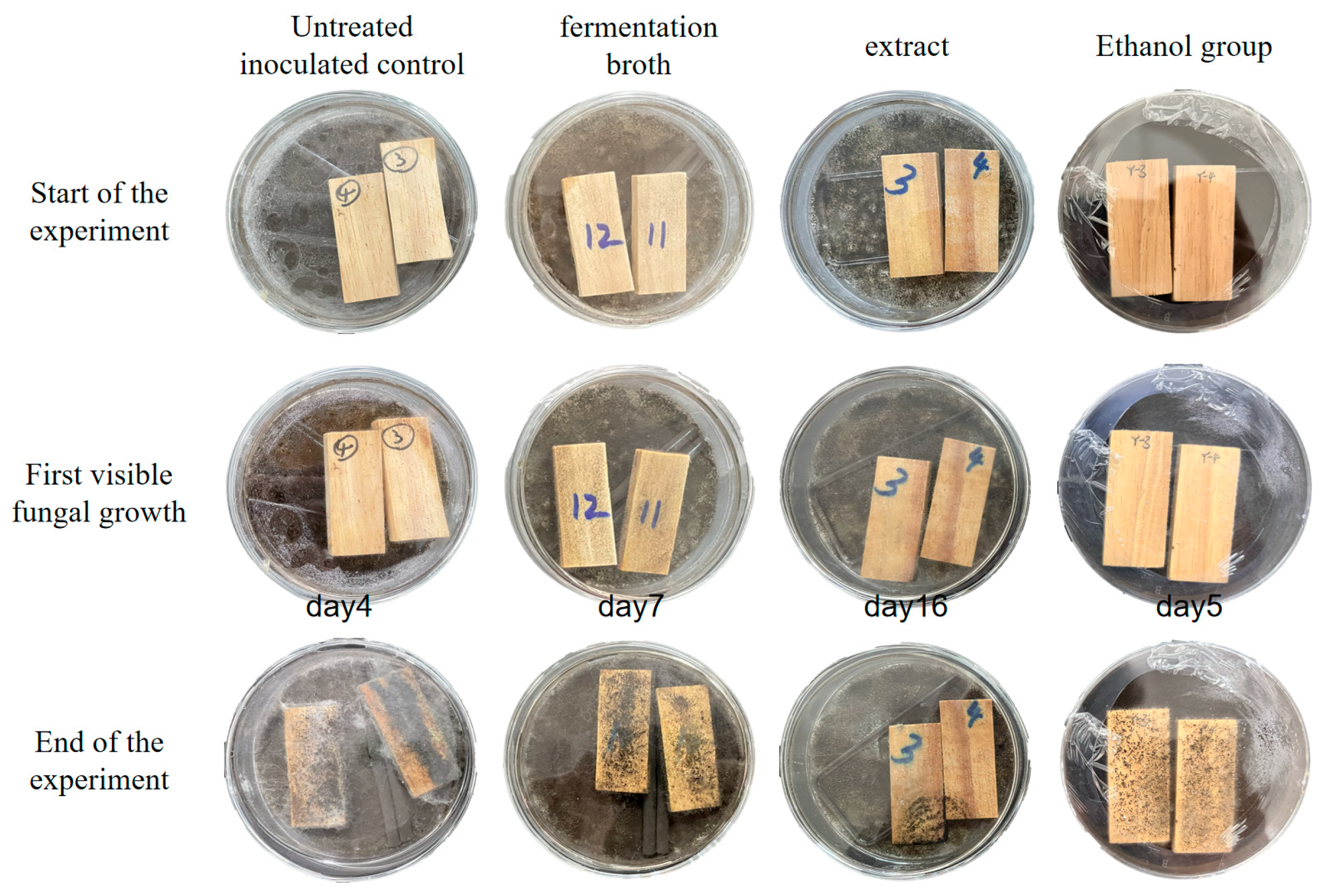
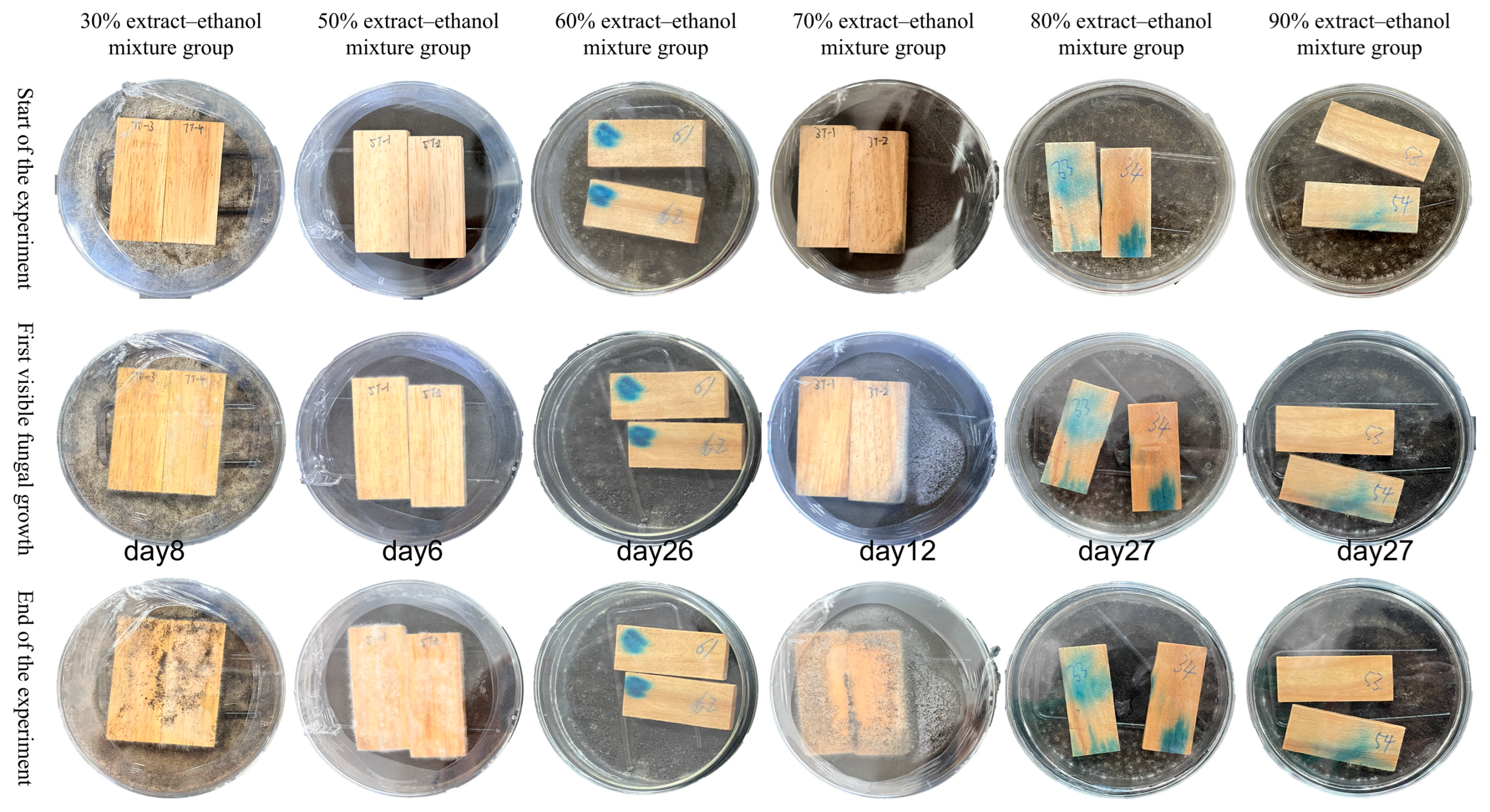
- Mold Resistance Testing of Samples: All rubberwood specimens in the treatment groups were impregnated with the corresponding tung cake-derived formulations before exposure to Aspergillus niger. Prior to testing, wrap samples from the same group in multiple layers of gauze and sterilize them in a vertical autoclave at 121 °C for 20 min. Allow them to cool on a laminar flow hood. On the PDA medium pre-colonized by A. niger mycelium, first place two sterilized glass rods (5 mm in diameter) arranged in parallel. Then, the rubberwood specimens treated with tung cake-derived formulations and the untreated inoculated control specimens were horizontally placed on the glass rods, with two specimens in each Petri dish. After completion, return the Petri dishes to the incubator at 28 ± 2 °C and 85% relative humidity. Observe and record fungal growth daily for 4 weeks;
- (4)
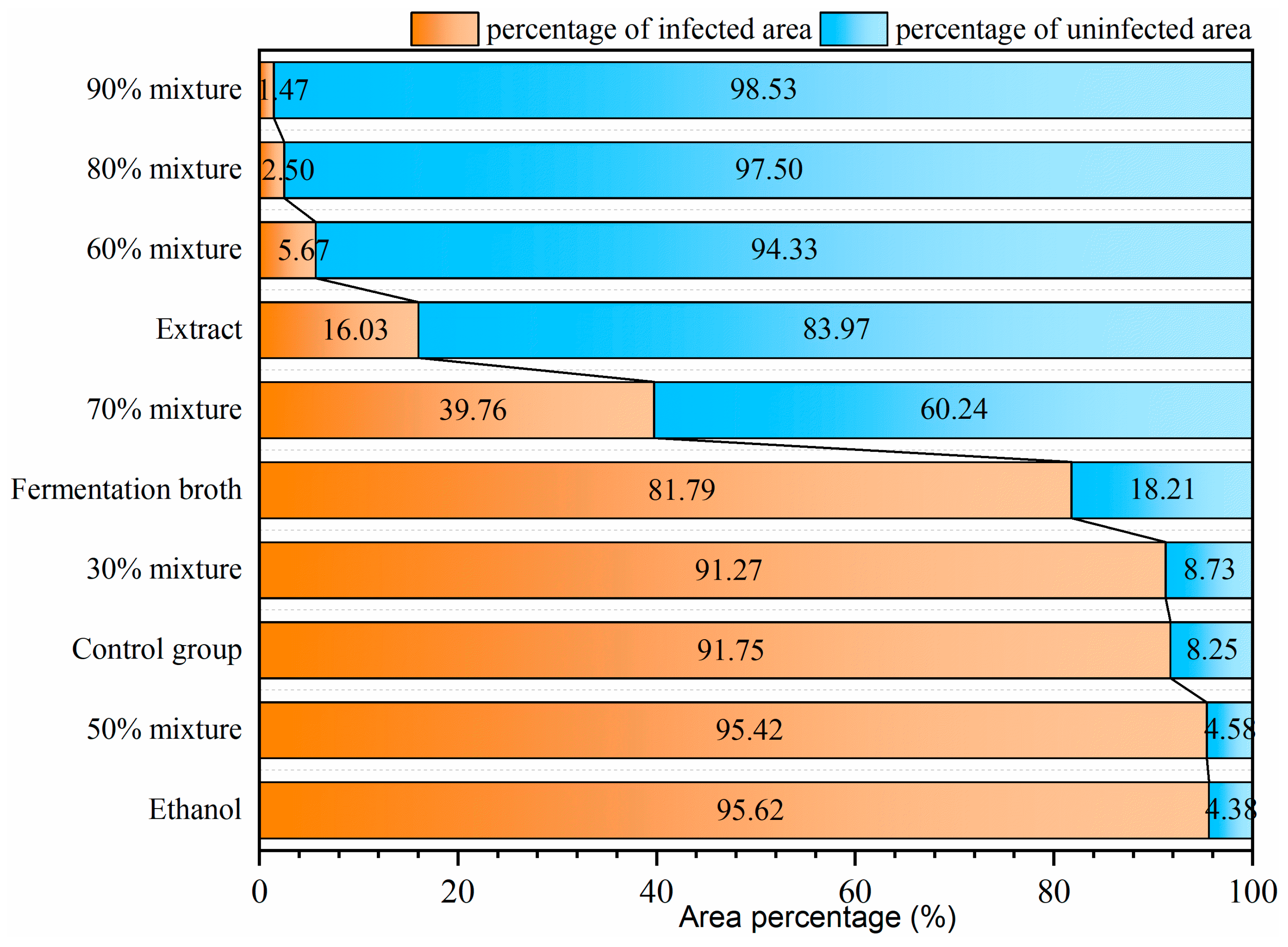
- Processing and Analysis of Fungal Infection Area on Samples: After the mold resistance test is completed, ImageJ software (version 1.54g, National Institutes of Health, Bethesda, MD, USA) is used to process the fungal infection area on the samples. First, the infected area and total area of the sample in the photographed images are marked to form a closed region;
2.3.5. Test for Resistance to Swelling
2.3.6. Fourier Transform Infrared Spectroscopy (FTIR)
2.3.7. X-Ray Diffraction (XRD)
2.3.8. Scanning Electron Microscopy (SEM)
2.3.9. Preparation of Samples for Fruit Preservation Experiments
2.3.10. Weight Loss Rate
2.3.11. Rot Rate
2.3.12. Color
2.3.13. Data Analysis
3. Results
3.1. Analysis of Solution Uptake
3.2. Analysis of Antifungal Performance
3.3. Moisture Stabilization and Barrier-Related Protection of Treated Rubberwood
3.4. FTIR Analysis
3.5. XRD Analysis
3.6. SEM Analysis
3.7. Weight Loss Rate of Fruits and Vegetables
3.8. Decay Rate Evaluation
3.9. Color Retention of Stored Fruit
4. Conclusions
Author Contributions
Funding
Data Availability Statement
Acknowledgments
Conflicts of Interest
References
- Mki, E.; Hennig, C.; Thrn, D.; Lange, N.; Schildhauer, T.; Schipfer, F. Defining Bioenergy System Services to Accelerate the Integration of Bioenergy into a Low-Carbon Economy. Biofuels Bioprod. Biorefining 2024, 18, 793–803. [Google Scholar] [CrossRef]
- Zhou, Y.; Wang, J.; Wang, S.; Xi, F.; Bing, L.; Yin, Y.; Hu, Q.; Zhang, L. Assessment of Biomass Resources for Energy Use Potential in China. Chin. J. Ecol. 2024, 43, 2702–2713. [Google Scholar] [CrossRef]
- Jin, S.; Xie, S.; Li, S.; Wang, J.; Zhang, A.; Xiao, Z. Research Progress of the Properties, Preparation, and Application of Cellulose Nanocrystal. Biomass Chem. Eng. 2024, 58, 60–72. [Google Scholar] [CrossRef]
- Gao, L.; Zhao, X.; Zhou, Q.; Li, H. Current Status of High Value-Added Industrial Applications of Straw. J. Anhui Agric. Sci. 2024, 52, 1–6. [Google Scholar]
- Papoutsis, K.; Shams, Z.; Yazdani, M.; Muneer, F.; Rahmatov, M.; Shariatipour, N.; Villanueva-Gutierrez, E.E.; Sahoo, M. Natural Preservation Strategies: The Potential of Bioactive Compounds from Fruit and Vegetable Waste to Reduce Postharvest Losses. Food Chem. X 2025, 30, 102917. [Google Scholar] [CrossRef]
- Liu, L.; Zhou, Z.; Yang, C.; Liu, Y.; Qiu, J. Efficacy and Mechanism of Plant-Derived Active Components against Wood Rot Fungi. Yunnan Chem. Technol. 2024, 51, 1–5. [Google Scholar]
- Purnawan, E.I.; Jemi, R.; Kasim, H.; Uthan, L.A.; Regalino, J.; Hamidi, A. Vegetation Diversity of Hevea Brasiliensis Agroforest System in Tumbang Mantuhe Village, Gunung Mas Regency, Central Kalimantan, Indonesia. IOP Conf. Ser. Earth Environ. Sci. 2021, 886, 012013. [Google Scholar] [CrossRef]
- Liu, S.; Zhou, G.; Fang, S. Climatic Suitability Regionalization of Rubber Plantation in China. Sci. Agric. Sin. 2015, 48, 2335–2345. [Google Scholar] [CrossRef]
- Chen, Y.-H. Inhibition Efficiency of Wood Vinegar on Grey Mould of Table Grapes. Food Biosci. 2020, 38, 100755. [Google Scholar] [CrossRef]
- Li, K. Synthesis of Triazine Based Wood Modifierand Their Modification to Rubber Wood. Master’s Thesis, North University of China, Taiyuan, China, 2020. [Google Scholar]
- Qin, S.; Li, M.; Li, X.; Li, J.; Lin, W.; Xie, G. Effects of Treatment Temperature on the Physical and Mechanical Rroperties of Thermal Modified Rubber Wood. Chin. J. Trop. Crops 2011, 32, 533–539. [Google Scholar]
- He, J. Effects of Hydrophobic Formula, Flame Retardant Formula, and Treatment Process on Properties of Rubberwood. Master’s Thesis, North University of China, Taiyuan, China, 2021. [Google Scholar]
- Wang, G. Study of the Modification Treatment against Mould Infection and Stain of Rubberwood. Master’s Thesis, Nanjing Forestry University, Nanjing, China, 2012. [Google Scholar]
- Zhang, F.; Wang, Y.; Yao, X.; Zhong, S.; Fei, X. Antagonistic Effects of Camellia Seed and Seed Cake on Aspergillus flavus. J. Anhui Agric. Sci. 2016, 44, 108–111. [Google Scholar] [CrossRef]
- Wang, Y.; Fei, X.; Lu, K.; Yao, X.; Guo, S.; Wang, K. Inhibitory effect of Aspergillus flavus and component analysis of methanol extraction from camellia seed cake. Trans. Chin. Soc. Agric. Eng. 2019, 35, 322–329. [Google Scholar] [CrossRef]
- Wang, Y.; Yang, L.; Fei, X.; Yao, X.; Gao, D.; Guo, S. Antifungal Effect of Camellia Seed Cake Extract on Aspergillus Flavus. J. Food Prot. 2019, 82, 463–469. [Google Scholar] [CrossRef] [PubMed]
- Wang, C.; Liu, S.; Yi, Y.; Li, C.; Xiao, Z.; Liu, R. Advance in the Effect of Active Ingredients of Oil-Tea Camellia Seed Cake and Meal on the Preservation of Fruits and Vegetables. China Oils Fats 2021, 46, 121–126. [Google Scholar] [CrossRef]
- Xiao, X.; Hu, S.; Zhou, J. Study on cherry tomatoes preservation by use of defatted cake of oil-tea camellia extract. Sci. Technol. Food Ind. 2011, 32, 141–143. [Google Scholar] [CrossRef]
- Ye, X.; Wu, Q.; Xie, G. Effect of Preharvest Spraying Extract from Camellia oleifera Cake on the Disease Resistance of Postharvest Pitaya Fruit. Chin. J. Trop. Crops 2023, 44, 2093–2101. [Google Scholar] [CrossRef]
- Chen, P.; Chen, X.; Sun, W.; Zhu, H. Study on Antibacterial Activity of Polyphenol from Camellia Oleifera Cake Against Pathogenic Bacteria of Red Grape. Mod. Food 2022, 28, 195–199. [Google Scholar] [CrossRef]
- Xie, G.; Yang, F.; Zhang, J.; Wang, Y.; Ma, L. A Fruit and Vegetable Fungicide Containing an Extract of Oil-Containing Tea Cake and Its Applications. CN107467077A, 16 August 2017. [Google Scholar]
- GB/T 18261-2013; Test Method for Anti-Mildew Agents in Controlling Wood Mould and Stain Fungi. Standards Press of China: Beijing, China, 2013.
- GB/T 1934.2-2009; Method for Determination of the Swelling of Wood. Standards Press of China: Beijing, China, 2009.
- GB/T 1932-2009; Method for Determination of the Shrinkage of Wood. Standards Press of China: Beijing, China, 2009.
- Nara, S.; Komiya, T. Studies on the Relationship Between Water-satured State and Crystallinity by the Diffraction Method for Moistened Potato Starch. Starch Stärke 1983, 35, 407–410. [Google Scholar] [CrossRef]
- Xue, R. Refining and Application of Wood Vinegar Based on Eucommia Branches Pyrolysis. Master’s Thesis, Northwest A&F University, Xianyang, China, 2024. [Google Scholar]
- Tahir, H.E.; Xiaobo, Z.; Jiyong, S.; Mahunu, G.K.; Zhai, X.; Mariod, A.A. Quality and Postharvest-Shelf Life of Cold-Stored Strawberry Fruit as Affected by Gum Arabic (Acacia Senegal) Edible Coating. J. Food Biochem. 2018, 42, e12527. [Google Scholar] [CrossRef]
- Qin, Z.; Zhang, Y.; Liu, M.; Li, C. Research Progress on Efect of Impregnation Treatment on Dimensional Stability of Wood. China For. Prod. Ind. 2021, 58, 22–25. [Google Scholar] [CrossRef]
- Li, Y.; Lu, P.; Yun, H. Improvement of Rubber Wood in Moisture Absorption/Anti-mildew and Anti-corrosion Function. Packag. Eng. 2023, 44, 32–38. [Google Scholar] [CrossRef]
- Pandey, K.K. A Study of Chemical Structure of Soft and Hardwood and Wood Polymers by FTIR Spectroscopy. J. Appl. Polym. Sci. 1999, 71, 1969–1975. [Google Scholar] [CrossRef]
- Li, J. Wood Spectroscopy; China Science Publishing & Media Ltd.: Beijing, China, 2003. [Google Scholar]
- Báder, M.; Németh, R.; Sandak, J.; Sandak, A. FTIR Analysis of Chemical Changes in Wood Induced by Steaming and Longitudinal Compression. Cellulose 2020, 27, 6811–6829. [Google Scholar] [CrossRef]
- Chen, H.; Ferrari, C.; Angiuli, M.; Yao, J.; Raspi, C.; Bramanti, E. Qualitative and Quantitative Analysis of Wood Samples by Fourier Transform Infrared Spectroscopy and Multivariate Analysis. Carbohydr. Polym. 2010, 82, 772–778. [Google Scholar] [CrossRef]
- Deraman, M.; Zakaria, S.; Husin, M.; Aziz, A.A.; Sahri, M.H. X-Ray Diffraction Studies on Fiber of Oil Palm Empty Fruit Bunch and Rubberwood for Medium-Density Fiberboard. J. Mater. Sci. Lett. 1999, 18, 249–253. [Google Scholar] [CrossRef]
- Zheng, D.; Li, M.; Zhang, X.; Yue, J. Preparation of Cellulose Nanofibrils from Rubber Wood. Packag. Eng. 2019, 40, 100–107. [Google Scholar] [CrossRef]
- French, A.D. Idealized Powder Diffraction Patterns for Cellulose Polymorphs. Cellulose 2014, 21, 885–896. [Google Scholar] [CrossRef]
- Hamdan, M.H. Characterization of Non-Treated & Chemically Treated Sawdust (Oil Palm Trunk & Rubber Wood). PLoS ONE 2015, 7, 324–325. [Google Scholar] [CrossRef]
- You, Z.; Sun, H.; Wu, Y.; He, Z.; Han, Y.; Zeng, S.; Chen, T. Enhancing Rubberwood Properties via Sodium Silicate Modification: A Study on Mechanical and Thermal Stability. BioResources 2025, 20, 6033–6053. [Google Scholar] [CrossRef]
- Zafeiropoulos, N.E.; Baillie, C.A.; Hodgkinson, J.M. Engineering and Characterisation of the Interface in Flax Fibre/Polypropylene Composite Materials. Part II. The Effect of Surface Treatments on the Interface. Compos. Part A Appl. Sci. Manuf. 2002, 33, 1185–1190. [Google Scholar] [CrossRef]
- Xie, Y.; Fu, Q.; Wang, Q.; Wang, H. Wood Chemical Modification: The State of the Art of Technologies and Commercialization. Sci. Silvae Sin. 2012, 48, 154–163. [Google Scholar] [CrossRef]
- Li, Q.; Wang, X.; Lin, J. Spectroscopic Analysis of the Decay Resistance of Wood Treated with Extracts from the Xylem of Cinnamomum Camphora with XRD and FTIR Approaches. Spectrosc. Spectr. Anal. 2014, 34, 823–826. [Google Scholar] [CrossRef]
- Liu, R.; Zeng, Z.; Li, Q. Study on Color Difference and Decay Resistance Performance of Four Kinds of Preservative Treated Rubberwood and Its Carbonized Wood. China For. Prod. Ind. 2023, 60, 7–11. [Google Scholar] [CrossRef]
- Li, J.; Yang, D.; Su, W. Study on Effect of Larix olgensis var. changpaiensis Extractives on Wood Preservation. Chem. Ind. For. Prod. 2007, 27, 49–52. [Google Scholar] [CrossRef]
- Yves, K.G.; Chen, T.; Aladejana, J.T.; Wu, Z.; Xie, Y. Preparation, Test, and Analysis of a Novel Aluminosilicate-Based Antimildew Agent Applied on the Microporous Structure of Wood. ACS Omega 2020, 5, 8784–8793. [Google Scholar] [CrossRef]
- Miele, N.A.; Volpe, S.; Torrieri, E.; Cavella, S. Improving Physical Properties of Sodium Caseinate Based Coating with the Optimal Formulation: Effect on Strawberries’ Respiration and Transpiration Rates. J. Food Eng. 2022, 331, 111123. [Google Scholar] [CrossRef]
- Huang, H.; Ji, Y.; Liu, Y.; Huang, J. Study on water loss control of postharvest “Sweetspring” tangelo fruits. J. Fruit Sci. 2021, 38, 403–410. [Google Scholar] [CrossRef]
- Waskale, H.S.; Bhong, M.G. Experimental CIE L*a*b* D50 Colour and Moisture Analysis of Fruits and Vegetables Stored in Different Conditions. J. Emerg. Technol. Innov. Res. 2017, 4, 518–519. [Google Scholar]
- Shi, X.; Chen, Y.; Fu, Y.; Luo, J. Application of color difference meter in the quality inspection of food. Sci. Technol. Food Ind. 2009, 30, 373–375. [Google Scholar] [CrossRef]
- Wang, T.; Luo, M.; Tao, R.; Chen, L.; Li, J.; Huang, S. Study on Peel Color and Physico-Chemical Qualities of Three Citrus Fruits During Post-Harvest Storage. J. Imaging Sci. Technol. 2024, 68, 020402. [Google Scholar] [CrossRef]
- Zhu, D.; Wu, X.F.; Zhang, Q.M.; Meng, X.J.; Li, J.R. Rapid Analysis of Table Grape Maturity Based on Color Difference. AMM 2013, 448–453, 1133–1137. [Google Scholar] [CrossRef]



| Grade | Infected Surface Area of Specimen |
|---|---|
| 0 | Surface free of hyphae and mold spots |
| 1 | Infected area < 1/4 |
| 2 | Infected area 1/4–1/2 |
| 3 | Infected area 1/2–3/4 |
| 4 | Infected area > 3/4 |
| Treatment Group | Average Infection Value D | Control Efficacy E (%) |
|---|---|---|
| Control group | 4.00 | -- |
| Ethanol group | 4.00 | 0.00 |
| Extract group | 1.25 | 68.75 |
| Fermentation broth group | 3.83 | 4.17 |
| 30% mixture group | 4.00 | 0.00 |
| 50% mixture group | 4.00 | 0.00 |
| 60% mixture group | 1.00 | 75.00 |
| 70% mixture group | 2.50 | 37.50 |
| 80% mixture group | 1.00 | 75.00 |
| 90% mixture group | 1.00 | 75.00 |
| Sample | Treatment Solution | Day 0 | Day 2 | Day 4 | Day 6 | Day 8 | Day 10 |
|---|---|---|---|---|---|---|---|
| Oranges | Control group | 0.00 | 0.00 | 33.33 | 66.67 | 100.00 | 100.00 |
| Tung cake in 80% ethanol | 0.00 | 0.00 | 0.00 | 0.00 | 0.00 | 0.00 | |
| Tung cake extract | 0.00 | 0.00 | 0.00 | 0.00 | 0.00 | 0.00 | |
| Fermentation broth | 0.00 | 0.00 | 0.00 | 0.00 | 0.00 | 0.00 | |
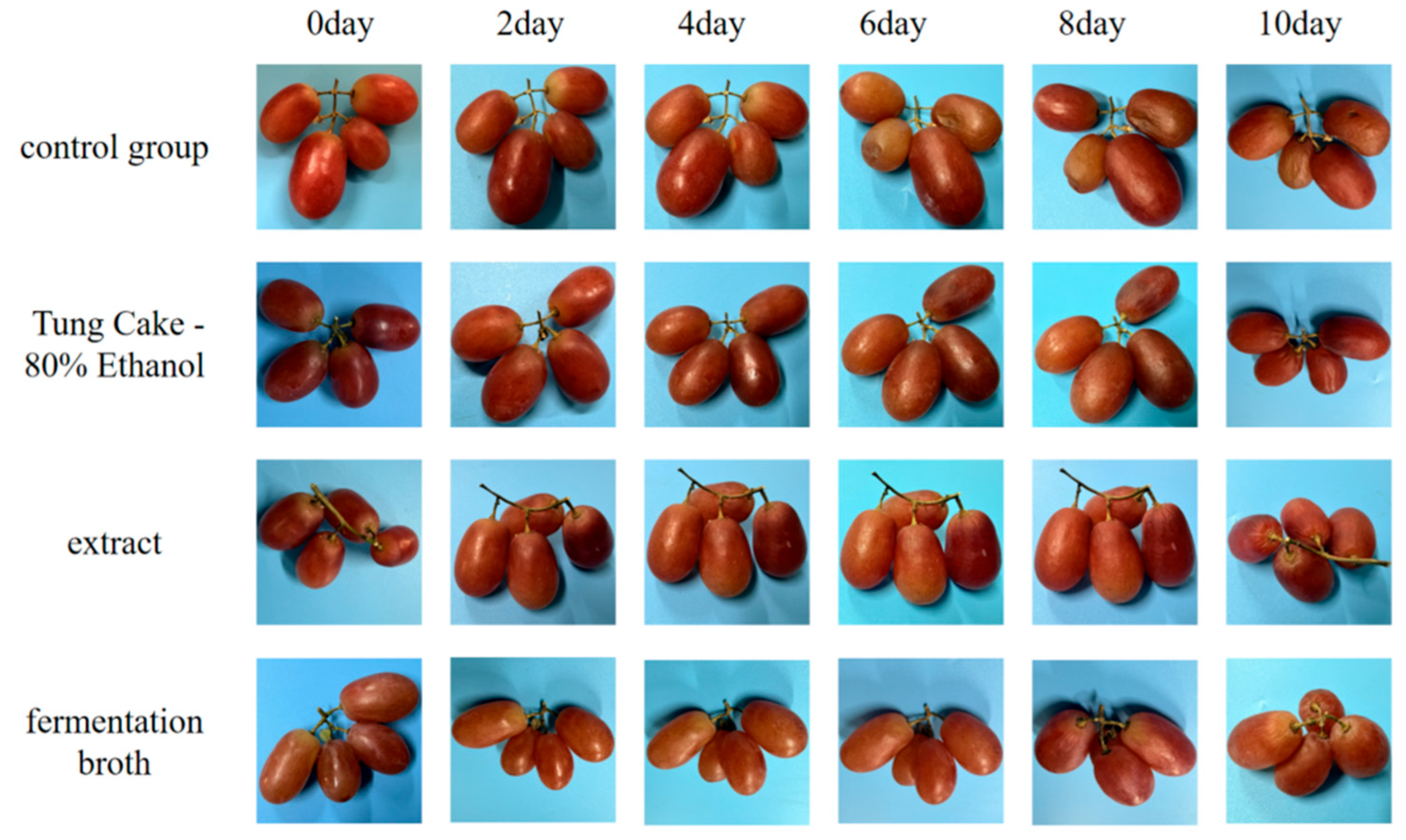
| grapes | Control group | 0.00 | 0.00 | 25.00 | 50.00 | 75.00 | 75.00 |
| Tung cake in 80% ethanol | 0.00 | 0.00 | 0.00 | 0.00 | 0.00 | 0.00 | |
| Tung cake extract | 0.00 | 0.00 | 0.00 | 0.00 | 0.00 | 0.00 | |
| Fermentation broth | 0.00 | 0.00 | 0.00 | 0.00 | 0.00 | 0.00 |
| Sample | Treatment Solution | Day 0 | Day 2 | Day 4 | Day 6 | Day 8 | Day 10 |
|---|---|---|---|---|---|---|---|
| Oranges | Control group | 51.22 | 51.17 | 49.95 | 44.74 | 41.31 | 39.54 |
| Tung cake in 80% ethanol | 52.43 | 52.65 | 52.21 | 52.43 | 52.82 | 52.33 | |
| Tung cake extract | 50.48 | 51.84 | 51.31 | 51.81 | 50.35 | 51.98 | |
| Fermentation broth | 49.61 | 48.05 | 49.23 | 48.68 | 49.05 | 49.98 | |
| grapes | Control group | 28.89 | 27.33 | 24.49 | 27.57 | 26.65 | 24.46 |
| Tung cake in 80% ethanol | 26.34 | 26.22 | 25.85 | 25.83 | 28.23 | 26.09 | |
| Tung cake extract | 26.55 | 26.94 | 27.88 | 26.74 | 27.13 | 26.74 | |
| Fermentation broth | 25.91 | 25.67 | 26.49 | 25.23 | 26.05 | 25.58 |
| Sample | Treatment Solution | Day 0 | Day 2 | Day 4 | Day 6 | Day 8 | Day 10 |
|---|---|---|---|---|---|---|---|
| Oranges | Control group | 29.66 | 29.84 | 25.81 | 27.41 | 24.66 | 23.49 |
| Tung cake in 80% ethanol | 29.01 | 29.90 | 31.18 | 32.76 | 32.20 | 35.84 | |
| Tung cake extract | 27.55 | 26.98 | 29.66 | 35.93 | 35.11 | 35.40 | |
| Fermentation broth | 31.66 | 35.76 | 35.35 | 38.43 | 37.88 | 34.55 | |
| grapes | Control group | 11.61 | 13.11 | 10.58 | 9.34 | 9.14 | 8.72 |
| Tung cake in 80% ethanol | 13.90 | 12.44 | 12.59 | 12.85 | 12.15 | 13.41 | |
| Tung cake extract | 10.71 | 10.72 | 11.04 | 12.11 | 12.08 | 12.56 | |
| Fermentation broth | 10.41 | 10.91 | 10.99 | 10.51 | 10.74 | 10.65 |
| Sample | Treatment Solution | Day 0 | Day 2 | Day 4 | Day 6 | Day 8 | Day 10 |
|---|---|---|---|---|---|---|---|
| Oranges | Control group | 49.16 | 50.21 | 50.10 | 42.78 | 37.86 | 37.32 |
| Tung cake in 80% ethanol | 50.47 | 50.55 | 50.79 | 54.11 | 54.39 | 55.18 | |
| Tung cake extract | 45.90 | 47.55 | 49.29 | 49.91 | 50.32 | 50.54 | |
| Fermentation broth | 49.49 | 47.98 | 49.43 | 50.58 | 52.56 | 54.49 | |
| grapes | Control group | 10.51 | 11.00 | 10.48 | 10.20 | 11.81 | 10.08 |
| Tung cake in 80% ethanol | 13.35 | 12.08 | 11.14 | 11.12 | 10.21 | 12.46 | |
| Tung cake extract | 10.09 | 10.44 | 11.41 | 11.08 | 11.43 | 11.92 | |
| Fermentation broth | 10.17 | 9.20 | 9.81 | 10.39 | 11.41 | 10.97 |
Disclaimer/Publisher’s Note: The statements, opinions and data contained in all publications are solely those of the individual author(s) and contributor(s) and not of MDPI and/or the editor(s). MDPI and/or the editor(s) disclaim responsibility for any injury to people or property resulting from any ideas, methods, instructions or products referred to in the content. |
© 2026 by the authors. Licensee MDPI, Basel, Switzerland. This article is an open access article distributed under the terms and conditions of the Creative Commons Attribution (CC BY) license.
Share and Cite
Wei, J.; Qiu, J.; Wan, H.; Kim, Y.S.; Gao, J. Valorization of Tung Cake Waste into a Multifunctional Bio-Based Protective Formulation for Rubberwood Mold Control and Postharvest Fruit Preservation. Agriculture 2026, 16, 1318. https://doi.org/10.3390/agriculture16121318
Wei J, Qiu J, Wan H, Kim YS, Gao J. Valorization of Tung Cake Waste into a Multifunctional Bio-Based Protective Formulation for Rubberwood Mold Control and Postharvest Fruit Preservation. Agriculture. 2026; 16(12):1318. https://doi.org/10.3390/agriculture16121318
Chicago/Turabian StyleWei, Jialin, Jian Qiu, Hui Wan, Yoon Soo Kim, and Jingran Gao. 2026. "Valorization of Tung Cake Waste into a Multifunctional Bio-Based Protective Formulation for Rubberwood Mold Control and Postharvest Fruit Preservation" Agriculture 16, no. 12: 1318. https://doi.org/10.3390/agriculture16121318
APA StyleWei, J., Qiu, J., Wan, H., Kim, Y. S., & Gao, J. (2026). Valorization of Tung Cake Waste into a Multifunctional Bio-Based Protective Formulation for Rubberwood Mold Control and Postharvest Fruit Preservation. Agriculture, 16(12), 1318. https://doi.org/10.3390/agriculture16121318