Article

Wine Competitiveness as a Main Permanent Land Use Production: A Comparison Between Countries of the Southern EU Region


by
Bozhidar Ivanov
1,
Daniela Dimitrova
2,* and
Vladimir Dimitrov
2
1
Institute of Agricultural Economics, Agricultural Academy, 1113 Sofia, Bulgaria
2
Institute of Viticulture and Enology, Agricultural Academy, 5800 Pleven, Bulgaria
*
Author to whom correspondence should be addressed.
Agriculture 2026, 16(12), 1317; https://doi.org/10.3390/agriculture16121317 (registering DOI)
Submission received: 27 April 2026 / Revised: 3 June 2026 / Accepted: 12 June 2026 / Published: 15 June 2026
(This article belongs to the Section Agricultural Economics, Policies and Rural Management)

Abstract

Viticulture and wine production uses approximately 30% of the land occupied with permanent crops in the EU. In countries in the southern part of the EU, this share is even higher, reaching up to about 80% in France and 55% in Romania. In recent years, the development of grape and wine production has been under pressure from climate and market changes. Competitiveness and value creation capacity are among the key factors in the sustainability of national production and the viability of wine regions. This study examines wine production competitiveness in the countries of the southern EU region within the European Single Market, comparing Bulgaria with leading producers—France, Italy, and Spain—and neighboring Romania. A set of production and trade indicators was applied, and the overall assessment was derived through a composite competitiveness index that simultaneously captures market performance and value creation potential. The results indicate a high level of competitiveness in the three leading European wine-producing countries, albeit with differences in the realization of their value creation potential. Bulgaria and Romania exhibit relatively low levels of competitive positioning, which could be improved through investments in technology and innovation, the implementation of collective marketing strategies, and the development of a national sectoral brand.

1. Introduction

The development of the global viticulture and wine sector in recent years has been shaped by the pressures of climate change and structural transformations in international trade, driven by emerging market trends—namely a shift in consumer preferences toward white, sparkling, low-alcohol, and non-alcoholic wines [1,2,3,4]. According to data from the International Organisation of Vine and Wine [5], global vineyard areas have been steadily shrinking since 2003, reaching 7.1 million hectares in 2024 (−0.6% compared to 2023). This contraction is most pronounced in vineyards dedicated to wine grape production. While the downward trend in cultivated surface area is clearly evident, wine production has exhibited year-to-year fluctuations in vinified volumes, with a more significant decline observed after 2020. The decrease in global wine production is particularly notable in 2023 (237 million hl) and 2024 (225.8 million hl), compared to 276.9 million hl in 2000. This trend is driven, on the one hand, by extreme climatic events (early frosts, heavy rainfall, and prolonged droughts) and, on the other, by weakening consumption in certain regions [5,6].
Globally, Europe is the largest producer, consumer and exporter of wine, as the traditions in vine-growing and winemaking in most European countries, including Bulgaria, date back to antiquity [7]. A significant share of the global vineyard area is concentrated in the European Union (EU), amounting to 3.2 million hectares (45.1% of the total global vineyard area). This concentration is primarily observed in the three leading grape- and wine-producing countries—Spain (930 thousand ha, or 13.1% of the global vineyard area), France (783 thousand ha, or 11.0%), and Italy (728 thousand ha, or 10.3%). The viticulture and wine sector in the EU has important economic and social significance, supported by the fact that there are 2.2 million vineyard holdings [8,9]. Vineyards play a key role in maintaining the viability of rural areas in EU Member States with a developed viticulture and wine sector. Data for the 2015–2019 period show that in regions where vineyard areas are expanding, the rate of population decline is significantly lower (−0.4%) compared to regions where vineyard areas are shrinking (−2.6%) [10]. This can be partly explained by the higher profitability of viticultural holdings compared to the average level for farms in the EU [10]. In 2020, farm net value added (FNVA) per annual work unit in specialized viticultural holdings exceeded the average level for all farms; however, this was driven by the stronger performance of a group of Member States (France, Italy, Portugal, Slovenia, and Romania), while in other countries, the profitability remained below the average for all agricultural holdings [7]. Given its importance for rural economies and its key role in the global wine market, the European wine sector is strongly supported and regulated through the mechanisms of the Common Agricultural Policy [11]. As grape cultivation and wine grape production represent the initial stage of the wine production supply chain, policy support in the sector has traditionally focused on improving production profitability by reducing production costs and increasing the value added of wine, including through the promotion of farmers’ participation in quality schemes [12]. With the implementation of the reformed Common Agricultural Policy, effective from 1 January 2023, which places greater emphasis on environmental and social sustainability as well as on production modernization based on digitalization, wine sector policies have undergone specific adjustments aimed at enhancing competitive strategies and facilitating the positioning of product innovations [11]. It should be noted that the European wine industry is largely dominated by a few major Member States—France, Spain, and Italy—whose competitive strategies are primarily oriented toward quality improvement through investments in new technologies as well as the gradual abandonment of vineyard areas planted with grape varieties that do not meet quality-related technological requirements [13]. In this context, policy mechanisms tend to be more readily applicable to large producers and exporters, which are better positioned to develop and promote recognizable brands [13]. By contrast, in countries where a significant share of agricultural holdings operate with limited financial resources, strong competitive pressures often lead to the withdrawal from production activities and, consequently, to a reduction in vineyard areas.
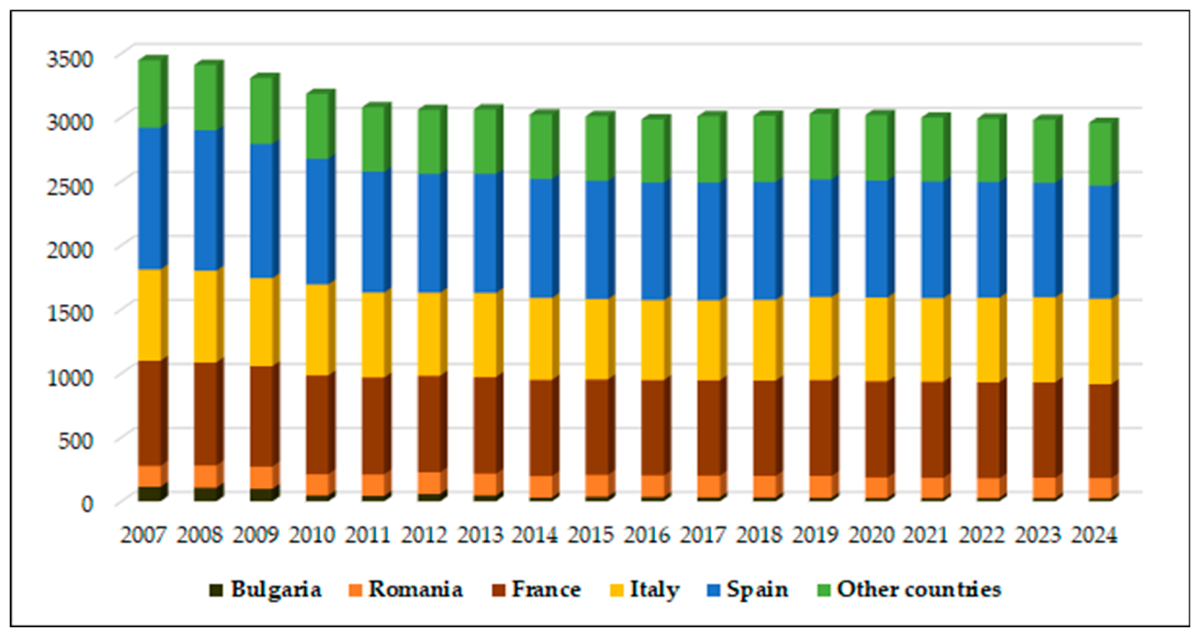
The dynamics of harvested vineyard areas in the three leading European wine-producing countries, as well as in Bulgaria and Romania—both of which joined the EU in 2007—indicate a declining trend over the 2007–2024 period (Figure 1). The negative trend is most pronounced in Bulgaria, where the average harvested vineyard area decreased by 55.7%, from 64.7 thousand hectares in the 2007–2015 period to 28.6 thousand hectares in 2016–2024. By contrast, the rate of decline in the other EU Member States included in the analysis is considerably more moderate. In Romania, the harvested area of vineyards for wine grape production declined more gradually, from 168.4 thousand hectares in the first period to 161.8 thousand hectares in the second (−3.9%).
A comparison of the leading wine-producing countries indicates that the reduction in harvested vineyard areas is most pronounced in Spain—the country with the largest vineyard area for wine grape production (−7.9%). In contrast, the decrease in Italy and France is more moderate, at 4.0% and 3.3%, respectively, across the two periods analyzed.
Regression trend analysis additionally confirmed statistically significant downward trends in harvested vineyard areas in all studied countries during 2007–2024, although with different intensity levels. The strongest contraction was observed in Bulgaria (β = −4.45, p < 0.001) and Spain (β = −10.20, p < 0.001), while France (β = −3.26, p < 0.001) and Italy (β = −2.96, p < 0.05) demonstrated comparatively more moderate but still statistically significant declines. In Romania, the reduction in vineyard area was also statistically significant, although less pronounced (β = −0.79, p < 0.01). These results suggest that vineyard contraction represents a broader structural trend within the European wine sector, although its implications for production dynamics and competitiveness may differ substantially among countries.
According to Ohana-Levi and Netzer [15], land use in viticulture is influenced not only by the demand for grapes but also by the “complex interplay of agronomic potential, environmental constraints, and socio-economic factors”, which should also be taken into account. The reform of the Common Organisation of the Market in Wine in 2008 also contributed to the reduction of vineyard areas through grubbing-up measures aimed at improving market orientation toward quality wine and enhancing the competitiveness of European wines [9]. Given the complex nature of the wine value chain—encompassing viticulture, winemaking, and commercialization (including wine tourism)—the creation of high value-added products, their successful market positioning, and overall market performance are essential for the economic viability of all stages, particularly viticulture [10,13,16,17]. In this context, the level of competitiveness in a highly competitive market such as the wine market is a key indicator of the sustainable use of agricultural land for vineyards and the viability of wine regions. Evidence from spatial analyses of vineyard abandonment in the Beaujolais region (France) suggests that one of the main drivers is strong competition from wines produced in South America, Australia, South Africa, and Spain, with growers being more likely to abandon vineyard plots considered to be of lower quality [18]. Moreover, strong market positioning, such as that based on the use of protected designations of origin, can act as a mitigating factor against adverse processes in vineyard regions [19].
Due to the specifics of a highly competitive environment and the export-oriented nature of wine production, sectoral competitiveness is typically assessed from the perspective of international trade performance, with market dynamics and foreign trade outcomes having a direct impact on structural developments within the sector [3,20,21,22,23]. According to Galati et al. [24], the Balassa index is widely used to assess the competitiveness and comparative advantages of individual sectors in international markets. However, because it relies solely on export data, it offers a limited perspective and does not fully capture overall competitiveness. For this reason, specifically in the assessment of wine sector competitiveness, researchers have increasingly adopted more comprehensive approaches, combining modified versions of the index with statistical and econometric models [3,13,20,21,22,25,26].
Despite the extensive body of research on wine competitiveness, existing studies primarily focus on comparative assessments of the competitive positions of European countries in the global wine market. Comparatively limited attention has been paid to competitive dynamics among EU Member States within the European Single Market and the extent to which differences in production orientation and value-added creation are associated with competitiveness levels. This issue is particularly relevant in the context of the current market and environmental challenges affecting the European wine sector. Of particular interest is the comparison between the leading wine-producing countries—France, Italy, and Spain—and the newer EU Member States, Bulgaria and Romania. The topic is especially important for Bulgaria, a country with established traditions in wine production and exports [3,21,22] but with pronounced negative structural trends in the development of the sector [27,28].
Accordingly, the study addresses the following research questions:
Research Question 1: What differences exist in the competitiveness levels of wine production in Bulgaria compared to the leading European and global wine producers—France, Italy, and Spain—as well as neighboring Romania within the European Single Market?
Research Question 2: What long-term competitiveness trends can be identified among the compared wine-producing countries?
The aim of the present study is to assess the competitiveness of wine production in the countries of the Southern EU region within the European Single Market by examining its dynamics over the period 2007–2024, comparing Bulgaria with the leading producers—France, Italy, and Spain—and neighboring Romania. This focus is justified by the orientation of trade flows in the wine sector, as 76.5% of Bulgaria’s wine export volume in 2024 was directed toward EU Member States, while European wines accounted for 84.4% of total imports into the country [29].
The present study seeks to address the research gap by aggregating a large volume of production and trade data into a single quantitative indicator—a composite competitiveness index. The proposed analytical framework not only provides information on whether the countries included in the analysis have maintained and expanded their market shares in the international wine trade but also offers an indication of the extent to which competitive potential and value-added creation are reflected in market performance. In addition, the mechanism for synthesizing complex information embedded in the proposed indicator complements and extends existing research approaches for assessing competitiveness in the wine sector and may also be applied in future studies, including the development of prospective scenarios, due to its dynamic character.

2. Materials and Methods

2.1. Conceptual Framework

The specific and multi-layered nature of competitiveness, as an economic category, determines the complexity of its evaluation mechanism [30,31,32,33]. According to Wijnands et al. [34], competitiveness is a broad and multifaceted concept for which no universally accepted definition or measurement approach exists; consequently, studies often adopt their own definitions and select specific methods for its assessment. Numerous conceptual models have been developed to evaluate wine sector competitiveness at different levels—firm, regional, and sectoral. Greco et al. [35] define the competitiveness of the wine business sector as a multidimensional “phenomenon” and, for the purposes of their analysis, employ a composite indicator structured around three pillars—structural, entrepreneurial, and qualitative—comparing competitiveness levels across regions. The methodological framework adopted in their study is closely aligned with Michael Porter’s concept [36], particularly with regard to factor endowments and industry structure. In many cases, studies on the wine sector rely on definitions according to which competitiveness reflects a country’s export performance over time [37]. The ability to maintain and expand market share in both domestic and international markets represents a widely applied conceptual framework, typically operationalized through indicators such as export market share, net export index, Relative Trade Advantage (RTA), and the Revealed Comparative Advantage (RCA) index [20,21,22,26,37]. More recently, the scientific literature has increasingly emphasized that assessing market performance alone is insufficient for capturing competitiveness and competitive potential. Instead, attention has shifted toward the adaptive capacity of the sector in response to rapidly evolving environmental and market conditions [38,39,40]. In such cases, analytical approaches are based on the combined application of key production and trade indicators within the wine sector.
Wine production is a structurally complex industry, which necessitates a more holistic approach to measuring competitiveness, incorporating dynamically oriented indicators within the methodological framework [39]. Given that competitiveness is a relative concept, the analysis of wine production should consider two main dimensions [41]:
  • “The competitiveness of wines originating from different national systems but competing within the same market”; and
  • “The competitiveness of the wine business (production and distribution) across competing countries operating within a given market or market segment”.
This concept, applied in the report of the European Commission, although originally intended to compare the competitive positions of European wines with those from third countries, outlines a general framework for comparison that is applicable to any specific market or market segment.
When analyzing wine competitiveness, it is essential to consider several sector-specific characteristics. Wine is a highly differentiated and heterogeneous product, owing to the wide diversity of grape varieties, vineyard management practices, winemaking technologies, soil conditions, wine types, and quality attributes. This diversity results in a deeply segmented market structure [3,37]. The wine sector is also one of the high value-added subsectors within agriculture and the agri-food industry, where value creation is determined by the interaction between quality, sustainability, and territorial identity [37].
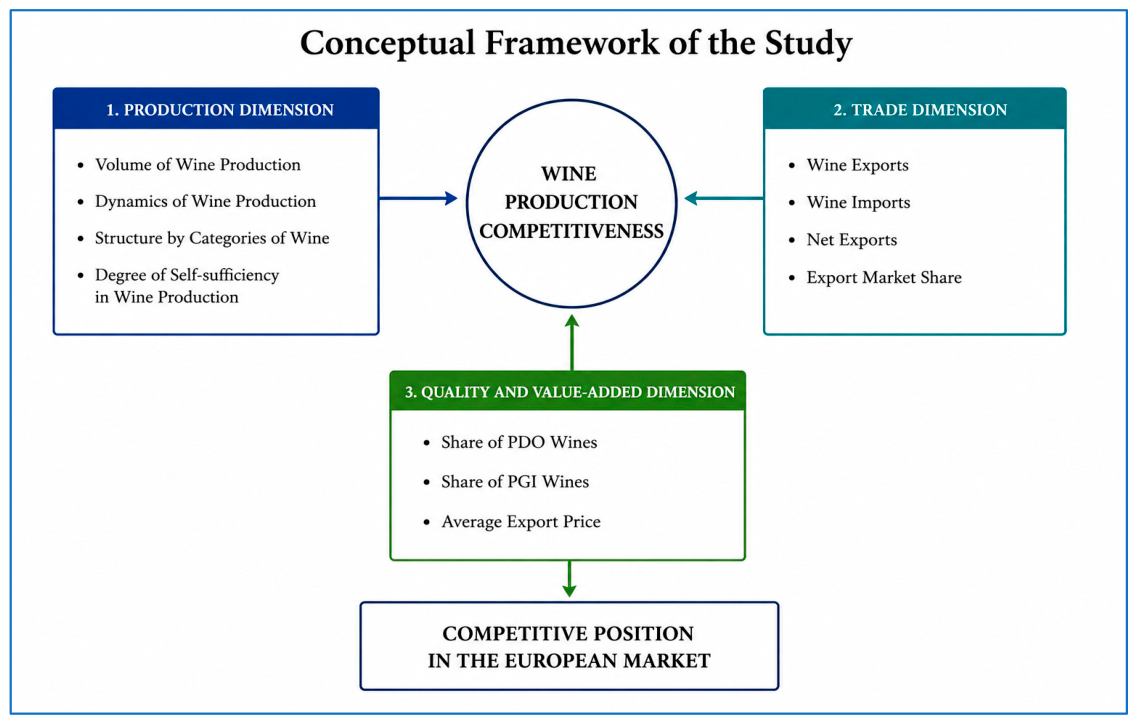
In light of the above, the methodological approach of the present study is based on a comprehensive assessment of competitiveness, integrating both production and trade indicators. An attempt is made to capture these two pillars—production and trade—through a composite competitiveness index that provides a quantitative representation of their combined effects. In addition, the analysis includes indicators related to the dynamics of wine production volumes, the structure of production by wine type, the degree of self-sufficiency in wine production, export market share, and average export price. The study covers the period from 2007 to 2024. The competitiveness of Bulgarian wine production is examined within the European Single Market and in comparison with the competitive positions of the leading wine-producing Member States—Italy, France, and Spain—as well as neighboring Romania.
The conceptual framework of the study is presented in Figure 2.

2.2. Indicators for Assessing the Competitiveness of Wine Production

The study’s methodological framework is based on the application of a composite index measuring the competitiveness of sectoral production [42]. According to Ivanov and Stoychev [43], the basis of the composite index is the understanding that competitiveness, in a static aspect, expresses the opportunity of a specific agricultural production “to preserve and expand its market share on the domestic and international market, and to maintain and increase the value added of its production on a national and global scale”. The indicator allows for the quantitative presentation of competitiveness, outlining trends over time [44]. Based on two main components—production and value—the competitiveness index allows the comparison of economies of different sizes, normalized by per capita estimations [43]. Wine production per capita and wine consumption per capita were calculated using the total population of the respective countries. A similar approach is adopted by Anderson et al. [45], who conduct a comparative analysis of global wine production over a long-term period from 1860 to 2016, based on both total production volumes and per capita wine production. The estimation of market competitiveness, based on these two equally comprised components—production and value—is implemented through the following steps [42,44]:
  • Calculation of the Production Component.
The indicator reflects the relative share of country’s wine production in both domestic and EU consumption. In addition, it provides information on the extent to which domestic production is able to meet national consumption and generate a surplus available for export. In this context, the production component reflects the degree to which the potential of key factor resources—such as land, vineyards, farm structure, and the supply chain—is realized, as these elements play a decisive role in the sector’s market performance. In the present study, market potential is therefore considered not only as a function of demand but also of production capacity and exportable surplus. The mechanism for calculating the index is as follows:
P I C w p = W P c t r W C c t r + W C E U + W E c t r ,
where
WPctr—country wine production per capita (liters);
WCctr—country wine consumption per capita (liters);
WCEU—EU wine consumption per capita (liters);
WEnctr—the country’s net wine exports per capita (liters).
When calculating consumption at the EU level, domestic consumption is excluded in order to avoid double counting. The net exports, defined as the difference between export and import volumes, are applied only in cases where a country is a net exporter of wine.
WEnctr = WEctrWIctr
where
WEctr—country wine export per capita;
WIctr—country wine import per capita.
  • Calculation of the Value Component.
The value component of the composite index of competitiveness (VICwpc) reflects the relative share of the gross value of wine production in a given country compared to the total gross value of wine production in the European Union, while also capturing its changes over time. It is calculated using the following formula:
V I C w p = W V c t r W V c t r + W V E U
where
WVctr—gross value of local wine production per capita;
WVEU—gross value of EU wine production per capita
The gross value (WVctr and WVEU) is calculated by estimating wine production per capita at the average export price. Wine quality is one of the key determinants of sectoral competitiveness. The average export price, also referred to as the average unit value, is widely used as a proxy for wine quality and enables comparisons between the export strategies of competing countries in the European market [3,38]. The calculation mechanism excludes the domestic production of the country from the total of the European Union, thereby allowing the assessment of the average export price of the remaining EU Member States and enabling benchmarking of the competitive positions of individual countries in terms of product quality relative to the EU average over the study period. Calculated in this way, the value indicator provides an abstract representation of the extent to which a country’s competitive potential is realized within the European Single Market.
The use of average export price is associated with certain limitations. In addition to product quality characteristics, export price may also reflect differences in product mix, destination markets, branding and marketing strategies, packaging formats, distribution structures, logistics costs, and exchange-rate fluctuations, which should be taken into account when interpreting the results.
  • Calculation of the Composite Index of Competitiveness.
In calculating the composite index of wine production competitiveness (ICwp), the two components—the production component (PICwp) and the value component (VICwp)—are assumed to have equal importance and weight. The following formula is used:
I C w p = P I C w p + V I C w p 2
To assess the robustness of the proposed composite index of competitiveness, alternative weighting scenarios between the production and value components (60/40 and 40/60) were additionally tested (Appendix C, Table A5). The results indicate only limited variations in the competitiveness levels and no substantial changes in the overall comparative positioning of the analyzed countries, which supports the applicability of the equal weighting approach and suggests a relatively stable relationship between the two dimensions within the proposed analytical framework.
The values of the three indices might vary within the range from 0 to 1, theoretically with a value of 0 indicating the absence of local production and a value of 1 indicating that the country’s production is the only one in the world [42,44]. The obtained results are interpreted according to the scale proposed by Ivanov [42]: up to 0.2—the production is not competitive; 0.21 to 0.44—low competitiveness; 0.45–0.55—an average level of competitiveness, showing equal positions of production and prices relative to the EU levels; 0.56–0.79—high competitiveness; and over 0.8—excellent competitiveness, where the country possesses unique positions in the supply of the relevant product. The interpretation thresholds are based on the normalized structure of the index and the benchmark function of the 0.5 value, which corresponds to competitiveness equivalent to the average EU level, excluding the analyzed country. Accordingly, the ranges are defined based on their distance from this reference point, allowing the identification of low, average, high, and excellent levels of competitiveness.

2.3. Exploratory Regression Analysis

To provide additional empirical support for the relationship between production structure and wine competitiveness, an exploratory multiple linear regression analysis was conducted using the overall index of competitiveness as the dependent variable and the shares of Protected Designations of Origin (PDO) and Protected Geographic Indications (PGI) wines as the explanatory variables.
I C w p = β 0   + β 1 P D O s h a r e + β 2 P G I s h a r e + ε
where ICwp is the composite index of wine production competitiveness, PDO share and PGI share represent the shares of PDO and PGI wines in total wine production, βo is the intercept, β1 and β2 are the regression coefficients, and ε is the error term.
Prior to the estimation, a correlation analysis between PDO and PGI shares was conducted in order to assess potential multicollinearity between the explanatory variables. The correlation coefficient was close to zero (r = 0.008), indicating the absence of a strong linear relationship and allowing both variables to be included simultaneously in the regression model.

2.4. Complementary Indicators

In addition to the composite index of competitiveness, the indicators of self-sufficiency in wine production and export market share are also employed. The use of these two indicators aims to complement the analysis of the production and value components, respectively, in the comparison between countries.

2.4.1. Self-Sufficiency Ratio

For the purposes of this study, the methodological approach developed by Clapp [46] is adapted.
SS   ( % ) = W P W P + I m E x p × 100
where
WP—country wine production per capita (liters);
Im—country wine import per capita (liters);
Exp—country wine export per capita (liters).
The denominator of the equation characterizes the level of consumption in a given country. According to Clapp [46], most net food-exporting countries exhibit a self-sufficiency index above 120%, indicating that they are able to meet domestic demand while generating a surplus for export. Wine is not a basic necessity and is characterized by income-elastic demand. Consequently, higher levels of the self-sufficiency index are associated with greater export capacity, as the level of domestic production often determines a country’s ability to supply international markets [17].

2.4.2. Export Market Share

The realization of competitive advantages in international markets is of key importance for the development of wine grapes and wine production in a country. The export market share (EMS) is one of the most commonly used trade indicators for measuring competitiveness, as it is relatively straightforward to calculate [30]. The indicator is also widely applied in analyses of wine sector competitiveness, often in combination with other indicators [20,41]. In the present study, EMS represents the share of a country’s wine exports relative to the total exports of EU Member States directed toward the European Single Market (intra-EU exports). The indicator is calculated in both volume and value terms.

2.5. Data Collection

The data used for the analysis are obtained from official sources. Information on wine production volumes and structure by year and by country is sourced from the European Commission’s Agri-food Data Portal (Agri-food Markets/Wine/Wine Production) [47]. Population data by country, as of 1 January of the respective year, are obtained from Eurostat [48]. Data on the volume and value of wine imports and exports (CN 2204), both within the European Union (intra-EU) and with third countries (extra-EU), are also retrieved from the Eurostat database [49].

3. Results

3.1. Dynamics and Structure of Wine Production

Wine production in the European Union is dominated by the three leading Member States, which are also the largest producers globally—Italy, France, and Spain (Table 1). Average production levels for the 2007–2015 period indicate that France was the leading producer, with 45.5 million hectoliters (hl), followed by Italy (43.9 million hl) and Spain (36.2 million hl). Over the subsequent nine-year period, production dynamics show only modest changes. Italy emerges as the leading producer based on average production for 2016–2024 (43.3 million hl), surpassing France (42.8 million hl), while Spain maintains its third position with 35.6 million hl.
In 2024, Bulgaria ranks tenth among wine-producing countries in the European Union, lagging behind Romania, which occupies the sixth position. From a dynamic perspective, wine production declines in all five countries under consideration, with the most pronounced decrease observed in Bulgaria (−33.8%), based on the comparison between average production levels for 2016–2024 and 2007–2015. A substantial decline is also recorded in Romania (−12.2%). In contrast, the three leading producers exhibit significantly lower rates of decline, highlighting structural and technological gaps in production systems in the so-called “new Member States”. These differences suggest a more limited capacity to adapt to adverse climatic conditions and market disturbances. Among the major wine-producing countries in the EU, France records the largest decrease in production volumes between the two periods (−5.8%), while the decline in Italy and Spain is almost identical, at 1.5%.
To address the statistical relevance of the observed production dynamics, a simple linear trend regression was applied for each country. The results confirm that Bulgaria is the only country in the sample with a clearly statistically significant downward trend in wine production during 2007–2024 (Table 2). The estimated coefficient for Bulgaria is negative and significant (β = −51.49, p < 0.001), indicating an average annual decrease of approximately 51.5 thousand hl.
For Romania, the regression results also indicate a negative trend, but its statistical significance is weaker (β = −87.37, p = 0.072). This suggests only moderate evidence of a declining production tendency. In contrast, France, Italy, and Spain show negative coefficients, but these trends are not statistically significant (p > 0.05). Therefore, their production dynamics appear to reflect annual harvest variability rather than a persistent structural decline. Overall, the trend analysis confirms that the contraction of wine production in Bulgaria is not merely a random fluctuation but reflects a statistically significant long-term decline.
Fluctuations in wine production in the three leading countries have become particularly pronounced in recent years, largely due to the impact of adverse climatic factors. Spain recorded a significant decline in wine production in 2023 and 2024, mainly as a result of prolonged drought and extreme temperatures during the vine growing season, with water stress emerging as a major challenge for wine grape producers in the country [5,6]. Drought has also affected certain regions of Italy and France; however, adverse impacts are additionally associated with heavy rainfall, which creates favorable conditions for the spread of fungal diseases, as well as with flooding and hail events [5,6]. Climate change has also negatively affected grape harvests in Bulgaria, where prolonged drought and uneven precipitation during the growing season represent the main challenges [50]. These effects are more pronounced in the southern regions of the country, where the majority of vineyard areas are concentrated, particularly impacting vineyards lacking irrigation infrastructure [50].
From a long-term perspective, fluctuations in annual wine production are most pronounced in Bulgaria (Table 3), indicating a lag in technological development and in the implementation of risk management mechanisms in wine grape production compared to the three leading European wine-producing countries. Although variations in wine production are primarily driven by changes in the quantity and quality of the grape harvests, market disturbances and shifts in consumer preferences also play a role [51]. More substantial fluctuations over the eighteen-year study period are also observed in Romania, with the coefficient of variation—calculated as the ratio of the standard deviation to the mean production level—reaching 24.3%. According to Popescu [52], wine production in Romania is mainly influenced by climate-related factors, including low temperatures during vine flowering, high summer temperatures, and rainfall in the period preceding the harvest, all of which contribute to lower average grape yields. Despite the relatively low variability in annual production volumes in the three leading wine-producing countries, it should be noted that Spain faces more significant challenges, primarily associated with climate warming.
The levels of the self-sufficiency ratio indicate the high export capacity of the three countries—Spain, Italy, and France (Appendix A, Table A1). The indicator reaches its highest values in Spain (ranging between 160.7% and 345.5%), which can be explained by its relatively lower domestic consumption compared to the other two countries. The Spanish wine sector is predominantly export-oriented, with total wine exports (intra-EU and extra-EU) accounting for between 50% and 73% of production over the 2020–2024 period. Italy ranks second in terms of the self-sufficiency ratio (ranging from 145.1% to 221.0%), with the share of exported wine volumes over the past five years varying between 43% and 55% of total production. Within the European Union, the Italian market is the second-largest in terms of volume after France [6]. Higher levels of domestic consumption in France result in comparatively lower self-sufficiency ratios, ranging between 116.7% and 133.0%. Annually, France exports between 27% and 42% of its wine production.
At the beginning of the period, Bulgaria exhibits high self-sufficiency ratios, ranging between 159.6% and 208.9% during 2007–2012, with the country exporting between 42% and 62% of its production to international markets. As wine production declines, export volumes also decrease. By 2023 and 2024, Bulgaria becomes a net importer, with self-sufficiency levels falling below 100%, reaching 97.2% and 91.7%, respectively. It is important to note that the relationship between production and exports is not always linear or unidirectional, as it may be influenced by various economic, social, and political factors, as well as by specific market conditions and trade relationships [17].
The level of self-sufficiency in wine production in Romania ranges between 83.6% and 99.7%, highlighting the country’s position as a net importer.
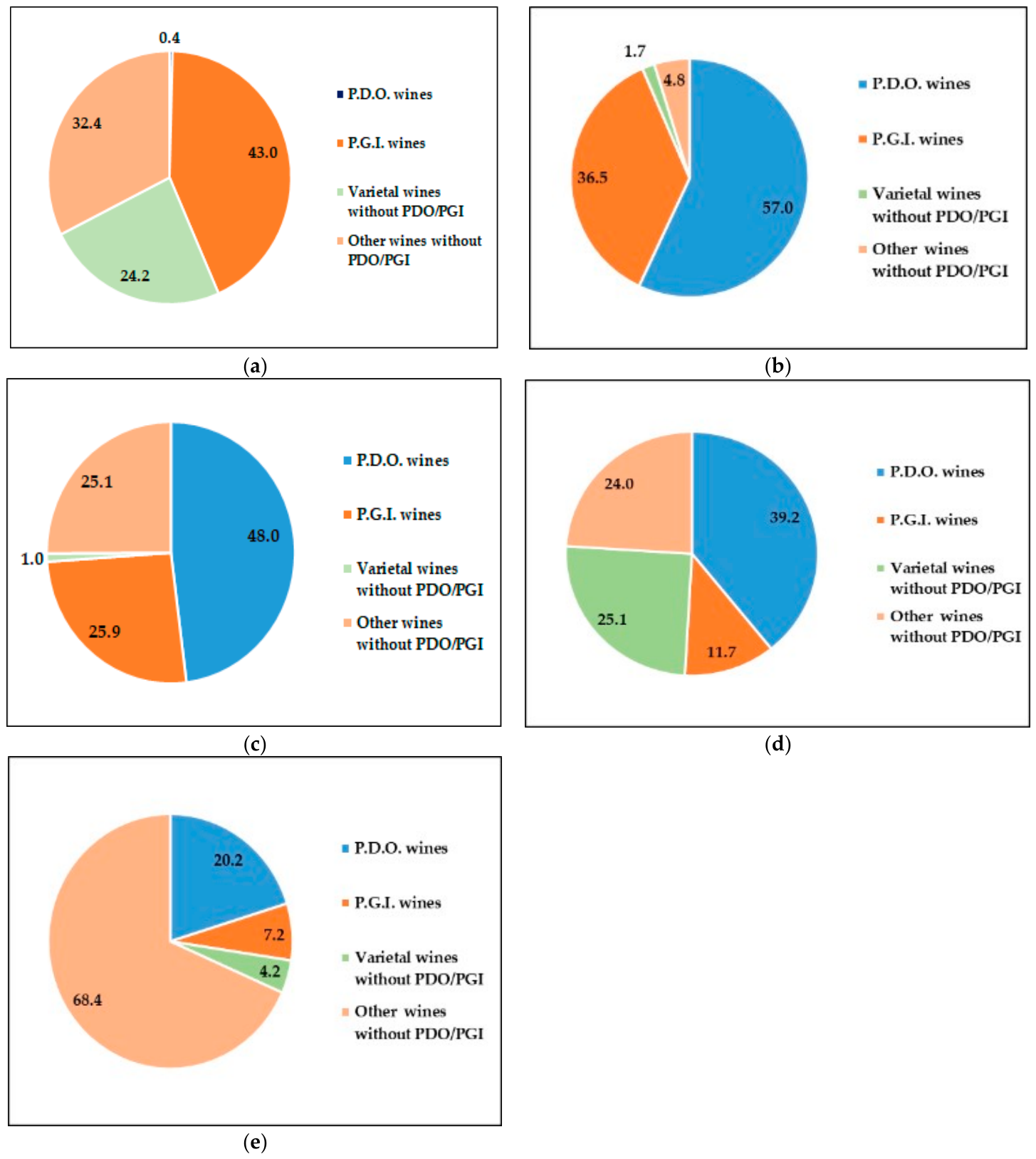
The structure of wine production by wine category reflects differences in market orientation and strategic positioning across countries (Figure 3).
Geographical indications—Protected Designation of Origin (PDO) and Protected Geographical Indication (PGI)—constitute a key element of the European Union’s wine policy. Wine branding based on geographical indications is grounded in the concept of product identity and the strength of the link between the unique characteristics of the product and its origin, which enhances consumer trust and enables improved market positioning and higher price premiums [38,53]. Wines with geographical indications account for the largest share of total production in France (93.5%), of which PDO wines represent 57.0% and PGI wines 36.5%. The Italian wine sector also relies heavily on value added derived from the traditional image of its wine regions, with PDO wines accounting for the largest share of production (48.0%), followed by PGI wines (25.9%). A distinctive feature of both countries is the negligible share of varietal wines—1.7% in France and 1.0% in Italy—indicating that product differentiation is primarily based on associating quality with origin (country, region, terroir). Spain adopts a different approach, where wines with geographical indications account for 50.9% of total production, while varietal wines represent 25.1%. The relatively large share of other wines without PDO/PGI additionally suggests a broader market segmentation and a more diverse set of market penetration strategies.
Among the five countries under comparison, Bulgaria is the only one in which PDO wine production accounts for a negligible share of total output—0.4%. By contrast, the share of PGI wines is the highest, reaching 43.0%. These differences can largely be explained by the regulatory framework governing PDO wines in the country, which was introduced in 2005 and currently requires revision in accordance with the changing socio-economic and production conditions in the regions [54]. In addition, the more simplified administrative procedures encourage most producers to focus on PGI wine production, which adversely affects the development of smaller wine regions. A distinctive feature of Bulgaria’s production structure is the substantial share of varietal wines (24.2% of total production) and other wines without geographical indications (32.4%). In this respect, a comparison can be made with Romania, where the latter category dominates production (68.4%), suggesting an orientation toward lower-priced market segments. At the same time, PDO wines account for 20.2% of total production in Romania, while PGI wines represent 7.2%, indicating efforts to access higher-value market segments.

3.2. Export Orientation and Share in Intra-EU Wine Exports

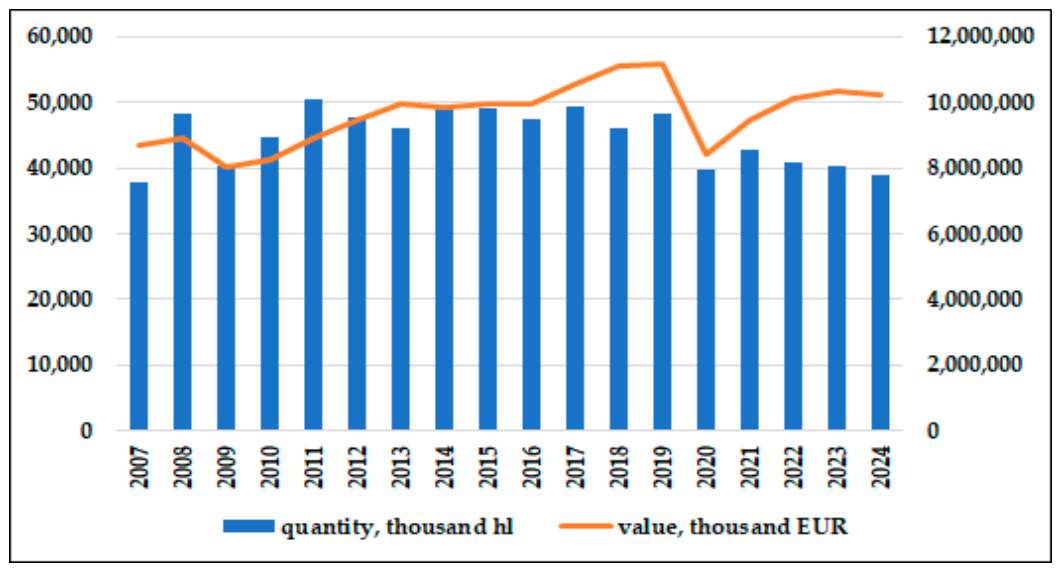
Market performance in international trade represents another key element in assessing the competitive positions of wine-producing countries. The European Union is the global leader in wine exports [9]. According to data from the International Organisation of Vine and Wine [5], in 2024 the three leading exporting countries—Italy, Spain, and France—exported a total of 54.6 million hectoliters (hl), accounting for 54.7% of global export volumes. In value terms, these countries generated 63.4% of total global wine export revenues in the same year. The majority of EU wine exports are realized within the internal market. The dynamics of intra-EU trade show relative stability in export volumes over the 2011–2019 period, with annual levels ranging between 46.1 and 50.5 million hl (Figure 4). After 2020, however, significant changes occur. The market environment in 2020, marked by the negative effects of the COVID-19 pandemic and disruptions in global supply chains, leads to a sharp decline in export volumes to 39.8 million hl. Despite a recovery in 2021, continued market instability—driven by geopolitical conflicts such as the war in Ukraine, the increasing impact of climate change on grape harvests, and evolving consumer demand—results in a gradual decline in export volumes over the following three years, from 40.8 million hl in 2022 to 39.0 million hl in 2024. In contrast to the downward trend in export volumes, the value of exports increases over the last three years, reaching EUR 10.3 billion. Despite this growth, the value of intra-EU exports remains below the peak levels recorded in 2018 and 2019. At the same time, the average export price rises from 2.42 EUR/L in 2018 to 2.62 EUR/L in 2024. This upward trend in unit export value reflects a combination of two factors: increasing production costs and the growing trend toward premiumization in the wine market [5].
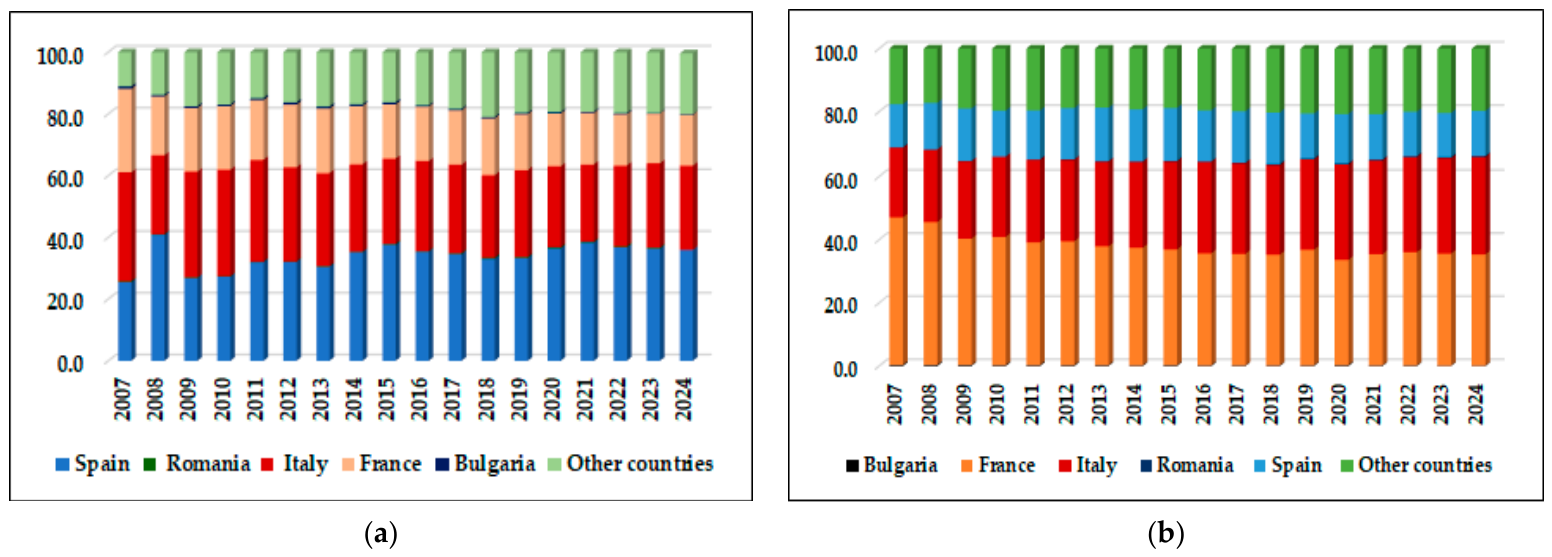
The level and dynamics of the market positions of individual countries in intra-EU exports represent an important indicator in a highly competitive market environment. Spain holds the largest market share in terms of export volume, increasing from 25.5% in 2007 to 38.3% in 2021 (Figure 5a). Over the past three years, Spanish exports have maintained relatively stable market positions within total intra-EU trade, ranging between 36.0% and 36.7%. Italy ranks second in terms of market share in export volumes, although its position has gradually declined—from 35.3% in 2007 to 27.2% in 2024.
French export volumes account for around or slightly above 20% of total intra-EU exports in the early years of the study period, with this share gradually declining to 16.5%. Bulgaria holds a very small share in intra-EU export volumes. Over the period 2007–2018, the country maintains a relatively stable market share, ranging between 0.5% and 0.7%, but after 2019 its participation in exports to the Single Market gradually decreases to 0.2%. In contrast to Bulgaria, Romania increases its export market share. Until 2017, it accounts for approximately 0.2% of total intra-EU export volumes, after which it gradually rises to 0.4% in 2024.
In value terms, French wines hold the leading position in intra-EU trade, with an export market share of 35.2% in 2024 (Figure 5b). From a dynamic perspective, however, France’s market position shows a gradual decline, as its share in total export value ranges between 40.1% and 46.8% in the early years of the study period. By contrast, the market share of Italian wines expands from 22.1% in 2007 to 30.9% in 2024. Spain, which holds the largest share in export volumes, ranks third in value terms, with 13.8% in 2024. The comparison indicates a slight contraction in Spain’s market position compared to the period 2009–2018, when its share in the value of intra-EU exports ranges between 14.0% and 16.2%. Similar to Spain, Bulgaria’s exports to the European Single Market are characterized by a higher market share in volume than in value. The value of Bulgarian wine exports accounts for only 0.1% of total intra-EU export value in the last two years, while for most of the study period it ranges between 0.2% and 0.3%. A comparison with Romania reveals the opposite pattern. Although the country is a net importer of wine, its export market share in value terms increases from around 0.1% during 2007–2014 to between 0.2% and 0.3% after 2017. The comparison between volume- and value-based indicators clearly distinguishes France and Italy as strong competitors in higher price segments, while Spain relies primarily on large export volumes in lower price categories. Bulgaria is losing market share in both export volume and export value on the European market, indicating competitiveness problems related to the competitiveness of Bulgarian wines.

3.3. Comparative Assessment of Competitiveness Levels and Dynamics

3.3.1. Production Component of the Composite Index of Wine Competitiveness

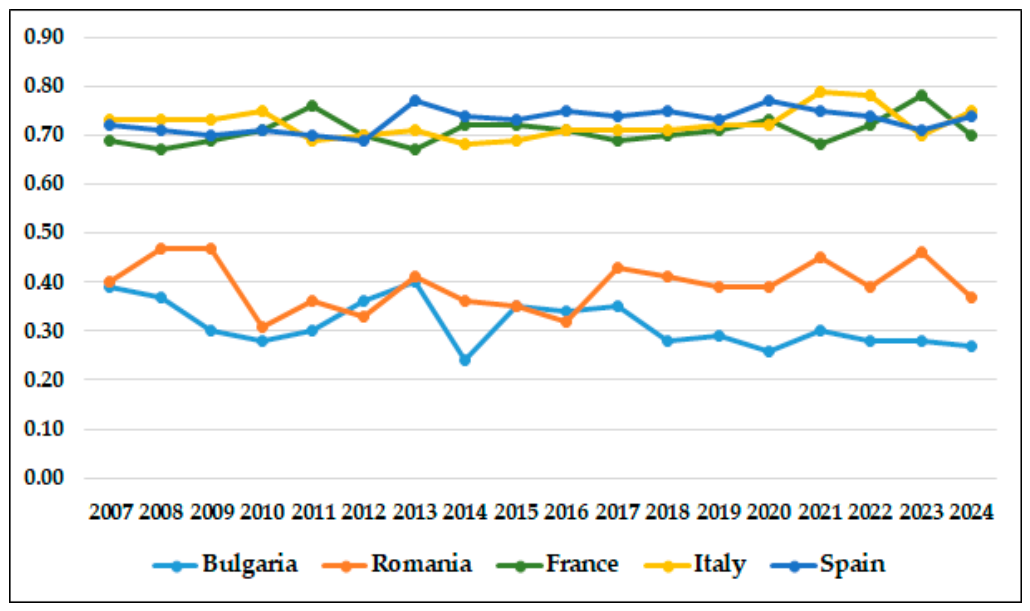
According to the adopted methodology, indicator values ranging from 0.56 to 0.79 are interpreted as reflecting a high degree of competitiveness. The results show that all three leading wine-producing countries exhibit a high level of production competitiveness, supported by a relatively high share of production per capita in total consumption per capita, as well as a strong capacity to expand exports. For all three countries, the values of the production component are situated in the upper range of the indicator scale, specifically between 0.68 and 0.79 for Italy, between 0.67 and 0.78 for France, and between 0.69 and 0.77 for Spain. The graphical representation of the indicator dynamics shows that all three leading producers maintain stable market performance at both domestic and international levels, as reflected in the relatively narrow range of variation in the production component (Figure 6). At the same time, the persistence of indicator values within the range of 0.70 to 0.79 over the 2018–2024 period suggests that none of the three countries holds a distinctly superior position in wine production that would elevate the indicator to an excellent level. These results may also be interpreted in terms of the need to improve the utilization of production potential, particularly in the context of strong competition both within the European market and from so-called “New World” wine-producing countries, which exerts significant pressure on the sector.
The values of the indicator for Bulgaria range between 0.27 and 0.39, indicating a relatively low share of wine production in total consumption and, consequently, a low level of competitiveness. The country’s market position weakens over time, with the production component declining from 0.39 at the beginning of the period to 0.27 in 2024. These developments are primarily driven by the decreasing volume of wine production, which reflects a combination of factors related to the efficiency of wine grape production at the farm level, the adaptive capacity of farms to manage environmental and market risks, and the degree of integration along the supply chain.
A similar pattern is observed in Romania, where the production component remains between 0.31 and 0.40 for most of the study period, indicating a low level of competitiveness. Notably, in 2008 and 2009 the indicator reaches 0.47, suggesting market positions close to the EU average. This is followed by a deterioration in market performance during the 2010–2016 period, as reflected in the downward trend of the production component shown in Figure 6. After 2017, despite year-to-year fluctuations, Romania improves its market position, with the indicator rising again to levels close to the EU average—0.45 in 2021 and 0.46 in 2023. These results suggest a gradual expansion of production capacity and efforts to position the country more effectively in export markets over the long term. The substantial gap between the production component levels observed in Bulgaria and Romania and those recorded for France, Spain, and Italy highlights the need for more targeted investment aimed at improving technological development, productivity, and efficiency at the farm level, in order to narrow the gap with leading producers.
Detailed data on wine production per capita in the European Union, excluding the domestic production of each of the countries under consideration (Table A2), highlight the more significant contribution of the leading producers. The dynamics indicate a decline in wine production per capita, which can be primarily explained by the overall contraction of wine production in the EU—from an average of 165.1 million hectoliters (hl) in the 2007–2009 period to 146.3 million hl in 2022–2024 (excluding grape must). Since the PICwp indicator is calculated on a per capita basis, demographic dynamics may partially influence its value. However, in the case of Bulgaria, the observed decline in the indicator is primarily associated with the substantial reduction in wine production rather than with population growth, as the country experienced a simultaneous decline in population during the analyzed period. At the EU level, although moderate population growth may have contributed to slight downward pressure on per capita levels, the production dynamics remained the dominant factor affecting the indicator trends.
An important component of the calculation procedure is the net export volume, covering both intra-EU and extra-EU trade. The data presented in Table A3 summarize the results of international wine trade for the five countries under comparison. The dynamics indicate a decline in export volumes from France, with the trend becoming more pronounced after 2021. By contrast, Italy increases its export volumes after 2009 and maintains relatively stable levels over the past four years, ranging between 21.0 and 21.8 million hl. Spain, the world’s second-largest wine exporter after Italy, records a slight decrease in export volumes over the 2021–2024 period, from 23.2 million hl to 19.9 million hl. Net export volumes are highest in Spain, primarily due to its significantly lower import levels compared to France and Italy, where domestic consumption remains substantial. Bulgaria, on the other hand, has experienced a sharp decline in wine exports in recent years, resulting in negative net export values in 2023 and 2024. In contrast, Romania remains a net importer throughout the entire study period; however, it gradually increases its export volumes after 2017, indicating a long-term orientation toward positioning itself among wine-exporting countries.

3.3.2. Value Component of the Composite Index of Wine Competitiveness

The average export price is a key indicator reflecting the capacity to generate value added based on wine quality. As this price constitutes one of the components used to calculate the gross value of production, Table 4 presents the average price levels for individual countries, as well as for the EU, excluding each of the countries under consideration in turn, in accordance with the adopted methodology. The data on the volume and value of intra-EU exports, on the basis of which the average price is calculated, are provided in Appendix B, Table A4.
France maintains the highest export prices, indicating that French wines are positioned in the upper price segments. Although export volumes to the European market decline from 10.2 million hl in 2007 to 6.4 million hl in 2024, the average export price increases from EUR 3.99 per liter to EUR 5.61 per liter. The majority of wine exports consist of bottled wines, accounting for 62.7% of export volumes and 55.5% of export value in 2024, according to Eurostat data. Sparkling wines, typically positioned in the premium segment, represent 14.4% of export volumes to the European Single Market but contribute 38.3% of total export value. A comparison with the average export price of other EU countries, excluding France, confirms the country’s leading position in terms of product quality.
Italy is the second country characterized by relatively high average export prices. Its product mix is similar to that of France, with bottled wines dominating the export structure, accounting for 49.3% of export volumes and 64.4% of export value. Sparkling wines also represent an important segment, comprising 19.0% of export volumes and 26.4% of export value in 2024. A distinctive feature of both countries is the declining share of bulk wines in the overall export structure, which indicates successful strategic positioning based on quality-driven branding. Within the scope, Italy and France comprise a high degree of adaptability to market trends, particularly the growing demand for sparkling wines. However, a strong focus on the premium segment may also expose these countries to potential risks associated with future shifts in consumer preferences [2].
Spain’s approach to product positioning differs from that of France and Italy, as the majority of its export volume consists of bulk wine (65.6% of total exports in 2024). This product category, however, accounts for only 31.1% of export value, while 46.6% of revenues are generated from bottled wines. These data confirm the findings of Pinilla et al. [55], who attribute the relatively low unit export value—compared to the two leading EU wine-exporting countries—to the predominance of bulk wine, which is traded at significantly lower prices. According to the cited study, even exports of high-quality Spanish bottled wines (including PDO, PGI, and varietal wines) are concentrated in relatively lower-price market segments.
While in the early years of the study period the unit export prices of wine from Bulgaria and Romania are very similar, after 2011 Bulgarian exports to the European Single Market are characterized by lower average export prices compared to Romanian exports. Traditionally, Bulgaria relies predominantly on bottled wine exports, which account for 81.7% of total export volume in 2007. After 2016, however, the volume of bottled wine exports to the EU market steadily declines, with this product group representing 45.9% of total exports in 2024, while generating 57.6% of export value. Bulgarian bottled wines are exported at significantly lower prices compared to those of France and Italy—EUR 2.03 per liter versus EUR 4.96 and EUR 3.88 per liter, respectively, in 2024. These differences are largely attributable to product positioning across wine categories, as Bulgarian wines are predominantly marketed in lower-value segments and more price-sensitive markets. A substantial share of export volumes consists of Bag-in-Box® (BiB) wines (42.2%) and bulk wines (11.7%), with average prices of 1.42 EUR/L and 0.53 EUR/L, respectively, which contribute to the lower average unit export value.
In contrast to Bulgaria, Romania has gradually increased the volume of bottled wine exports to the EU market in recent years. Comparative analysis shows that their share in total export volumes rises from 39.7% in 2007 to 75.2% in 2024, while in value terms it increases from 58.3% to 87.4%. Over the same period, both the absolute and relative volumes of bulk wine exports decline, with their share decreasing from 59.6% to 23.5% in volume terms and from 40.6% to 10.4% in value terms. Romania improves its market position in wine exports, as the growth in average export prices of bottled wines is accompanied by an increase in exported volumes, whereas in Bulgaria the dynamics are more uneven.
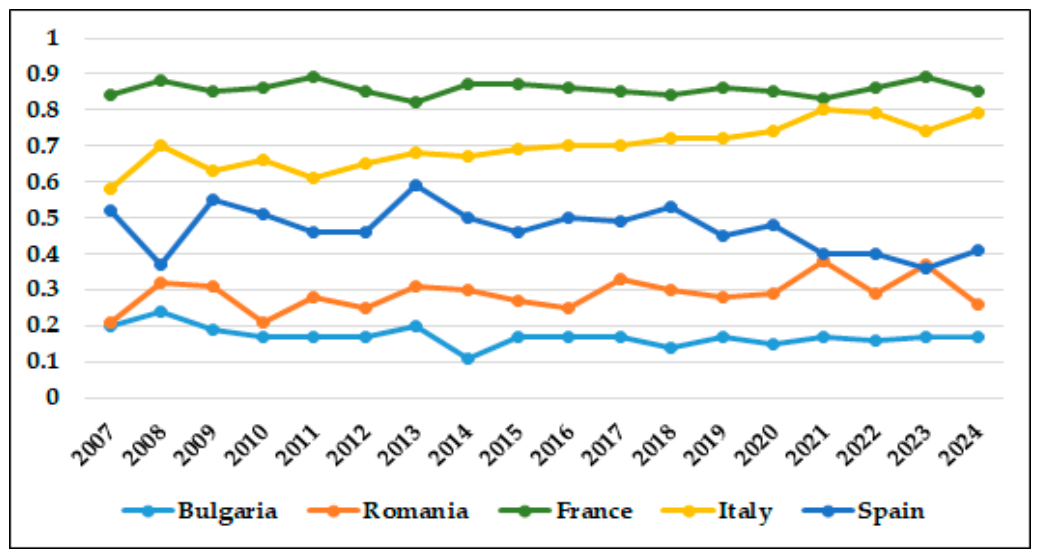
The levels of the value component of the composite index of competitiveness, which measure the relative share of the gross value of domestic production in the total gross value of EU production, confirm the competitive advantages of France. The indicator remains stable throughout the study period, ranging between 0.82 and 0.89, which reflects an excellent level of competitiveness and indicates that the country holds a unique position in wine supply (Figure 7). Territorial identity shapes the uniqueness of French wines. France ranks second in terms of the number of registered PDO appellations, while PDO wines account for the largest relative share in the structure of total wine production compared to the other countries included in the comparative analysis (Figure 3b).
Italy demonstrates a high level of competitiveness in value terms, with the indicator increasing gradually from 0.58 in 2007 to 0.77 in 2024. In 2021, the index level approaches that of French wines, indicating a temporary convergence in competitive positioning.
For most of the study period, Spain maintains its competitiveness in value terms at levels close to the EU average, with the indicator ranging between 0.45 and 0.55. In the last four years, however, the country’s competitive position in export value weakens, as the value component declines to 0.36–0.41, indicating a low level of competitiveness.
Romania also maintains low levels of competitiveness in wine production in value terms, with VICwp values ranging between 0.21 and 0.38. The dynamics of the indicator suggest efforts to improve market positioning within the European market; however, these positions remain unstable, given the observed year-to-year fluctuations.
The indicator levels for Bulgaria demonstrate low and declining competitiveness in the value dimension of wine production. Since 2015, the indicator remains relatively stable, ranging between 0.14 and 0.17, indicating that the country is unable to compete with leading EU exporters in terms of quality and value added. There is a clear need to address this structural weakness and to enhance the adaptability of wineries to market requirements, as the importance of value creation in the wine sector continues to grow, driven by consumer preferences for higher-quality wines [56].

3.3.3. Composite Index of Wine Competitiveness

According to the levels of the composite competitiveness index, France, Italy, and Spain demonstrate a high level of competitiveness in wine production within the European market. The balance between market performance and value creation capacity is most favorable in the French wine sector, as reflected in the ICwp values, which consistently remain in the upper range of the indicator scale—between 0.74 and 0.79 throughout the study period (Table 5). In certain years, the index even reaches an excellent level of competitiveness—0.82 in 2011, 0.80 in 2015, and 0.83 in 2023—indicating the presence of unique products and their strong positioning in high-priced market segments.
Italy is progressively strengthening its competitive position, moving closer to that of France. In the initial years of the period (2007–2015), the levels of the composite index remain predominantly within the range of 0.65 to 0.69, with the exception of 2008 and 2010.
After 2016, the indicator shows a gradual upward trend, becoming more pronounced during the 2020–2024 period. This development is primarily driven by the enhanced realization of competitive potential, particularly in terms of product quality and improved capacity for value creation.
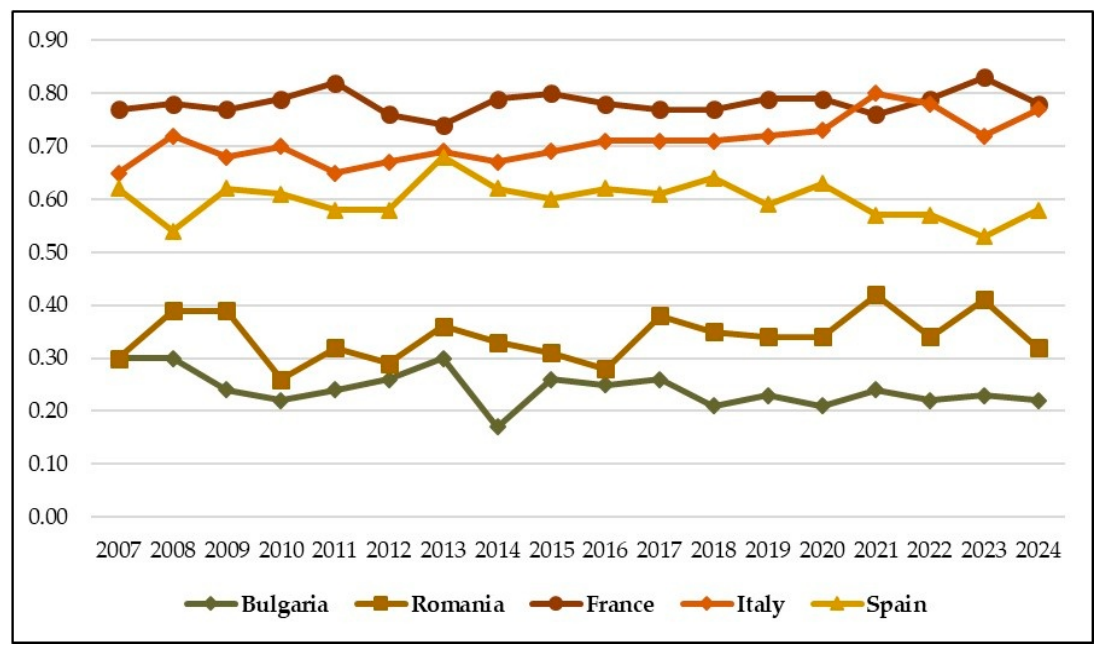
In contrast to France and Italy, Spain’s levels of the composite index of competitiveness are situated in the lower range of the indicator scale, between 0.57 and 0.65, with low levels of competitiveness recorded in 2008 (0.54) and 2023 (0.53). From a dynamic perspective, Spanish wine production shows a weakening of its competitive position on the European market, a trend that becomes more pronounced after 2020, when index values decline to 0.57 and 0.58 (Figure 8). The country maintains a high level of competitiveness in terms of market share, supported by its capacity to meet domestic consumption and sustain export volumes. However, in terms of value creation, there remains untapped potential, which has not been fully utilized within the scope of the study.
The level of competitiveness of Romanian wine production is assessed as low, with composite index values ranging between 0.26 and 0.41. The country demonstrates relatively stronger market performance in terms of production and export volumes, as reflected in the higher levels of the production component, compared to its capacity to generate value added. From a dynamic perspective, ICwp values increase after 2017, fluctuating between 0.32 and 0.42, which indicates a certain improvement in market positioning (Figure 8). According to Constantin et al. [39], although Romania is among the European countries with a significant vineyard area, it has not effectively transformed its factor resources into competitive market advantages, due to infrastructural constraints and suboptimal integration along the value chain.
The competitiveness of Bulgarian wine production is also assessed as low and unsatisfactory, with indicator values lower than those observed for Romania, ranging between 0.21 and 0.30. Only in 2014 is a value of 0.17 recorded, indicating a non-competitive level of production. This can be attributed to an exceptionally poor harvest and deficient quality during that year, driven by adverse climatic conditions, which negatively affect both the production and value components of the composite index. The overall trend shows a downward trajectory in indicator values, declining from 0.30 in 2007 to 0.22 in 2024. This negative development is largely associated with the limited capacity to generate value added in exports to the EU market, likely stemming from weaknesses in logistics, branding, and effective market positioning. This conclusion is supported by the significantly lower levels of the value component of the indicator, although technological modernization and productivity improvements also remain major challenges.
The descriptive statistics indicate that the external shocks associated with the COVID-19 pandemic and the war in Ukraine did not affect all countries equally and did not fundamentally alter the long-term competitiveness positions of the studied wine sectors (Table 6). Bulgaria maintains the lowest average competitiveness levels in both periods, declining from 0.25 in 2007–2019 to 0.22 in 2020–2024, which suggests that the weaker competitive position of the country cannot be explained solely by the short-term external shocks. France preserves the highest and comparatively most stable competitiveness levels, with only a slight increase in the average index value from 0.78 to 0.79 and very low coefficient of variation in both periods (2.5–3.2%). Italy demonstrated an improvement in competitiveness during the post-crisis period, as the mean index increased from 0.69 to 0.76, although accompanied by moderately higher variability. Spain showed a slight decline in the average competitiveness index after 2020 (from 0.61 to 0.58), while Romania improved its average competitiveness level from 0.33 to 0.37. Overall, the relatively moderate changes in mean competitiveness levels and variability indicators suggest that the observed differences between countries are predominantly structural rather than purely reactive to short-term external shocks.

3.3.4. Relationship Between Origin-Based Wine Production and Competitiveness

An exploratory regression analysis was conducted to examine the relationship between origin-based wine production and competitiveness. The analysis focused on the association between the shares of the PDO and PGI wines in the production structure and overall competitiveness levels.
The results of the multiple linear regression analysis revealed a strong positive relationship between the production structure of geographically differentiated wines and the overall competitiveness index (Table 7). The model demonstrated very high explanatory power (R2 = 0.910, Adjusted R2 = 0.907) (Table 8). The overall regression model was statistically significant (F = 387.64, p < 0.001).
The share of PDO wines showed a particularly strong and statistically significant positive association with competitiveness (β1 = 0.0101, p < 0.001). The share of PGI wines also demonstrated a positive and statistically significant relationship with competitiveness (β2 = 0.0014, p = 0.016), although the estimated coefficient was substantially lower than that of PDO wines. These results indicate that competitiveness in the European wine sector is associated not only with production performance but also with product differentiation and territorial identity.

4. Discussion

The results regarding the level of competitiveness reveal substantial differences both among the three leading wine-producing and exporting countries in the EU market and between them and the “newly acceded” Member States—Romania and Bulgaria. The highly competitive environment and the heterogeneous nature of the product underscore the importance of securing competitive advantages in relation to the key determinants of wine competitiveness on international markets, namely product mix, branding, pricing strategies, and trade capacity [2]. Achieving growth in the wine industry requires improvements in competitiveness across all stages and dimensions of the supply chain [16]. In the context of market segmentation, it is important to emphasize that in retail markets for quality wines, factors such as reputation, tradition, and other intangible assets play a crucial role [13]. This implies that even producers from smaller countries with limited marketing budgets can differentiate their products from competitors—provided they invest in technology and quality—and sustain their market presence by targeting higher priced segments [13].
According to some authors, the market success of wine producers, even at the regional level, is more closely associated with differentiation strategies than with cost leadership [23,57]. The results of multiple linear regression analysis demonstrate a positive relationship between PDO- and PGI-oriented wine production and overall competitiveness levels. These findings indicate that product differentiation, territorial identity and value-added creation represent important dimensions of competitiveness within the European wine sector. Wine consumption in the EU is declining in volume but increasing in value, while the relatively small premium and super-premium segments remain largely unaffected [9]. Mid-range wines, regardless of PDO and PGI designations, continue to face strong competitive pressure, particularly in the red wine segment [9]. According to Pinilla et al. [55], drawing specifically on the Spanish case, heterogeneity is a key characteristic of PDO wines, as they differ significantly in terms of quality, value, and price. These findings raise the issue of appellation governance, which requires cooperation among all stakeholders at the regional or micro-regional levels.
Product differentiation through branding based on geographical indications fosters consumer trust in the specific characteristics of wines produced in a given region, leading to improved product positioning and the ability to command higher prices [38]. The application of geographical indications is governed by a strict regulatory framework at the EU level; however, its implementation and economic significance vary across individual Member States [58]. The effective use of PDO and PGI schemes requires close integration and coordination among actors across all stages of the value chain—from grape production, through winemaking, to marketing, logistics, and trade. This stems from the requirement that raw materials originate from the designated production area, thereby ensuring the uniqueness of quality linked to the specific characteristics of the terroir. Protected Designation of Origin (PDO) is the most widely applied geographical indication in the EU wine sector. In many wine regions across the EU, viticulture and winemaking under PDO schemes represent key socio-economic activities [59].
A review of the EU geographical indication register—eAmbrosia—shows that, as of March 2026, a total of 1200 PDO wines are registered across 21 EU Member States [60]. The largest number of PDO wine regions is recorded in Italy (411), followed by France (366) and Spain (106) (Figure 9a).
In Bulgaria, 52 PDO wine regions are registered; however, the extremely low volume of annual production suggests that the implementation of the geographical indication mechanism does not adequately correspond to production conditions and therefore fails to deliver the expected results. According to Murdzheva [54], another important reason is the “lack of established preconditions facilitating the integration of regional appellations into the marketing structure of enterprises, such as the existence of producer groups or producer networks within the region”. Bulgarian producers more frequently rely on PGI registration within the two main regions—Danube Plain and Thracian Lowland. The broader territorial scope of PGI facilitates linkages between grape growers and wine producers, particularly in the context of insufficient integration along the value chain. Across the EU, a total of 436 PGI wine regions are registered, with the highest numbers in Greece (114), followed by Italy (112), France (74), and Spain (42) (Figure 9b). In Romania, 13 PGI regions and 41 PDO regions are registered. The application of geographical indications in the wine sector contributes to the development of territorially embedded and sustainable production systems, with value added extending beyond the economic dimension to include physical (distinct vineyard landscapes), strategic (rural development), and social (enhanced sense of identity and belonging among producers and local communities) aspects [61]. However, according to Tscholl et al. [53], the regionalization of wine production based on geographical indications may increase vulnerability to adverse climate impacts, due to regulatory constraints on permitted grape varieties. The authors emphasize the need to reconsider the geographical indication system by promoting innovative solutions with the potential to mitigate the negative effects of climate change.
Varietal wines represent a more straightforward approach to branding and market positioning, requiring relatively lower additional costs. This strategy is particularly suitable for countries where integration across the value chain remains weak at the regional level. Such is the case in Bulgaria, where product differentiation based on varietal diversity is a widely applied approach, especially among small and medium-sized wineries. In his study, del Rey [62] highlights the long-term growth in demand for varietal wines within the EU market, noting that they are often preferred over PDO wines in Europe. The potential for expansion in this market segment remains significant and requires a more in-depth analysis of factor conditions, including the varietal structure of vineyards, winery capacity, the strength of linkages between grape growers and wine producers, and the adoption of innovative solutions related to the development of new and attractive wine products. A large segment of price-sensitive consumers is also evident in the EU wine market, with preferences extending beyond competitive pricing toward new product categories, such as fresher wines, low-alcohol and alcohol-free wines, and bag-in-box formats [9]. These evolving market trends exert pressure on wine producers while simultaneously creating opportunities for product innovation, the development of new market niches, and the exploration of emerging segments. The extent to which wine producers will capitalize on these opportunities to stabilize and expand their market positions will depend on their readiness to respond to changing consumer preferences, the adaptive capacity of enterprises in the wine industry, and the establishment of a more flexible regulatory and institutional framework [62].
Figure 9. Number of registered geographical indications for wines in the EU by country: (a) Protected Designation of Origin (PDO); (b) Protected Geographical Indication (PGI). Source: [60]. Note: the maps were developed using “IMAGE interactive map generator” [63].
Agriculture 16 01317 g009
Promoting value creation in winemaking—through the development of innovative and high-quality products—supports the maintenance and expansion of positions in international trade over the long term, stimulates economic growth, and fosters cultural exchange [56]. At the same time, it may facilitate the adoption of environmental responsibilities and the implementation of sustainable practices [56]. Given that value added in the wine sector is increasingly shifting toward the service component—particularly through product marketing, branding, terroir, and/or country-of-origin positioning—effective marketing management has become essential, not only as a driver of development but also as a tool for survival [17]. In this context, an important direction for future research is the examination of the competitive positions of wine-producing countries across specific market niches and segments, differentiated by wine category and wine color. Further research focusing on higher-value segments and more complex markets in high-income countries with stronger purchasing power would provide a solid basis for the development of appropriate competitiveness strategies, grounded in value added and supported by well-targeted sectoral and trade policies [3].
For countries such as Bulgaria and Romania, which face strong competition from global leaders in wine production, it is essential that marketing strategies are designed and implemented at a collective level—either entrepreneurial and/or territorial [17]. The creation and development of a sectoral brand for the national wine industry represents an important intangible resource, driven internally by the sector, and is increasingly adopted by a number of countries as an approach to promoting exports in a highly competitive international market [23].

5. Conclusions

Within the European market, the global leaders in wine production and trade—France, Italy, and Spain—demonstrate a high level of competitiveness. However, significant differences exist in their product and export strategies. In terms of production structure, wines with PDO and PGI designations dominate in France and Italy, whereas in Spain a substantial share is made up of varietal wines and other wines without geographical indications. On the intra-EU market, French and Italian wines are positioned in higher price segments, with sparkling wines making a significant contribution to the value of exports. Both countries maintain and strengthen their competitive positions based on their capacity to generate value added and their ability to adapt production to changing consumer demand. According to the composite index of wine production competitiveness, Spain is positioned at the lower end of the range defining high competitiveness. The country relies on large export volumes in the competitive landscape but trades its wines at lower prices compared to France and Italy, which may increase its vulnerability in the context of structural market changes.
Bulgaria and Romania exhibit low levels of competitiveness on the European market, although Romanian wines show an improvement in market performance. The low and declining competitiveness of Bulgarian wine production is primarily driven by limitations related to value creation. A more thorough assessment of the country’s competitive advantages and their effective utilization could enhance the performance of the Bulgarian wine sector in international markets. The mechanism of PDO wines for applying Protected Designation of Origin (PDO) as a tool for value creation based on territorial identity should be reconsidered. This is closely related to the need for a more comprehensive assessment of regional development in the wine sector and the strengthening of network-based stakeholder cooperation. Bulgarian wine production may benefit from a diverse portfolio of varietal wines; therefore, efforts should be directed toward their promotion and strategic market positioning.
Improving Bulgaria’s export position on the European market requires the development and implementation of marketing strategies at both industry and territorial levels. The creation of a national sectoral brand, as a key driver of value added in international markets, represents a potential mechanism for strengthening and ensuring the sustainable development of the sector. Such an approach would also contribute to maintaining viticulture and supporting the viability of wine-growing regions in the country.
Despite the comprehensive analytical framework applied in the present study, several limitations should be acknowledged. The proposed composite index of competitiveness relies partially on proxy indicators, particularly the use of average export price as an indirect measure of quality and value-added creation, which may also reflect differences in product mix, destination markets, branding strategies, logistics costs, and distribution structures. Furthermore, certain qualitative dimensions of competitiveness, such as brand image, institutional governance, and territorial reputation, are difficult to quantify and therefore remain only partially operationalized within the proposed framework. However, the sensitivity analysis confirmed the stability of the competitiveness rankings, the weighting structure of the composite index and the proposed competitiveness thresholds remain methodological assumptions. Consequently, the results should be interpreted as indicative measures of relative competitiveness and comparative performance. In addition, competitiveness in the wine sector is a multidimensional concept that cannot be fully captured by a single composite indicator, and the identified regression relationships should be viewed as statistical associations rather than definitive causal effects. Given the heterogeneity of wine products and the diversity of market segments, individual countries may demonstrate strong competitive positions in specific market niches that are not fully reflected in the proposed analytical framework. Finally, the comparative analysis focuses on selected European wine-producing countries and does not fully capture the heterogeneity of the entire EU wine sector. Future research could extend the analytical framework through the inclusion of additional qualitative indicators and a broader comparative assessment of regional and national wine production systems within the European Union.

Author Contributions

Conceptualization, B.I. and D.D.; methodology, B.I. and D.D.; software, D.D. and V.D.; validation, B.I., D.D. and V.D.; formal analysis, D.D.; investigation, D.D. and V.D.; resources, D.D. and V.D.; data curation, D.D. and V.D.; writing—original draft preparation, B.I., D.D. and V.D.; writing—review and editing, B.I. and D.D.; visualization, D.D. and V.D.; supervision, B.I. All authors have read and agreed to the published version of the manuscript.

Funding

This publication is elaborated in accordance with the implementation of the work program under the project “Stochastic analysis of the prospects and effects of the Green Deal in Bulgarian agriculture—GREENBASE”, financed by the Bulgarian National Science Fund (BNSF), “Fundamental Scientific Research-2022” competition. Contract No. KП-06-H66/3—13 December 2022.

Institutional Review Board Statement

Not applicable.

Data Availability Statement

The original contributions presented in this study are included in the article. Further inquiries can be directed to the corresponding author. The primary data are publicly available from the following sources: European Commission—Agri-food Data Portal, Eurostat, and EU geographical indication register (eAmbrosia).

Conflicts of Interest

The authors declare no conflicts of interest.

Appendix A

Elements of Production Component of Composite Index of Wine Competitiveness

Table A1. Per capita wine production, per capita wine consumption and self-sufficiency degree in wine production (%).
YearBulgariaFranceItalySpainRomania
WP *WC **SS ***, %WPWCSS, %WPWCSS, %WPWCSS, %WPWCSS, %
200723.411.2208.971.856.0128.281.953.6152.882.150.1163.925.026.195.8
200821.211.1191.066.654.4122.483.057.2145.178.626.7294.432.934.096.8
200916.210.1160.471.961.6116.783.753.9155.376.845.8167.732.832.999.7
201013.27.9167.171.458.6121.883.149.1169.274.937.7198.716.216.896.4
201114.38.2174.478.665.9119.363.228.6221.069.621.8319.320.424.483.6
201217.410.9159.663.448.6130.564.934.3189.264.922.9283.417.219.488.7
201323.717.9132.463.248.2131.174.945.8163.595.859.6160.725.827.195.2
201410.35.4190.771.258.8121.163.033.6187.582.134.8235.919.120.294.6
201518.314.5126.272.061.2117.665.736.9178.080.229.5271.918.820.790.8
201616.913.8122.568.458.3117.370.839.3180.285.238.3222.516.718.689.8
201715.312.2125.455.143.4127.060.328.0215.469.120.0345.522.023.792.8
201814.812.4119.474.062.6118.278.249.0159.695.954.6175.626.427.396.7
201912.310.2120.662.951.5122.167.134.1196.871.626.3272.220.120.996.2
202010.99.0121.167.956.3120.670.638.9181.586.044.8191.920.621.994.1
202112.211.2108.954.841.2133.084.852.6161.274.526.9277.025.027.092.6
202211.511.0104.565.153.1122.684.451.4164.275.331.5239.120.422.491.1
202310.510.897.270.459.8117.764.631.7203.858.917.1344.424.726.991.8
20249.910.891.752.741.2127.974.642.2176.863.824.9256.216.518.489.7
Source: own calculations based on official data [47,48,49]. Note: * WP—Per capita wine production (liters); ** WC—Per capita wine consumption (liters); *** SS—Self-sufficiency degree, %.
Table A2. EU per capita wine production and consumption without domestic production and consumption (liters).
YearEU Not Including
Bulgaria
EU Not Including
France
EU Not Including
Italy
EU Not Including
Spain
EU Not Including
Romania
WPWCWPWCWPWCWPWCWPWC
200738.137.032.131.831.130.732.832.638.537.2
200837.836.732.532.130.430.232.732.637.736.5
200938.137.331.831.930.530.833.133.237.937.1
201035.934.429.428.728.127.830.930.536.534.8
201134.532.626.525.529.628.930.029.534.832.8
201233.531.628.027.328.327.629.528.734.032.0
201336.935.632.131.930.730.629.829.137.335.8
201434.733.127.927.229.829.428.728.135.033.3
201535.233.428.427.730.029.629.629.135.633.8
201635.333.529.228.529.529.029.228.635.934.0
201730.327.825.624.425.324.325.524.330.427.9
201839.537.632.932.233.032.732.431.639.637.7
201932.530.126.825.526.826.027.626.432.730.3
202035.530.929.325.729.727.029.125.335.831.0
202134.528.730.525.726.422.629.424.634.628.5
202235.730.130.125.427.924.330.726.036.130.2
202332.126.824.920.426.928.328.624.232.126.6
202430.725.626.422.123.725.326.322.131.025.7
Source: own calculations based on official data [47,48,49].
Table A3. Results of the international wine trade (Intra-EU + Extra-EU), thousand liters.
YearBulgariaFranceItalySpainRomania
ExportImportNet
Export
ExportImportNet
Export
ExportImportNet
Export
ExportImportNet
Export
ExportImportNet
Export
2007110,51016,58593,9251,528,457527,9961,000,4611,826,967172,1941,654,7731,439,32236961,435,62614,84037,977−23,137
200884,430698477,4461,354,770571,590783,1801,733,416208,6221,524,7942,437,43066,7952,370,63513,30336,888−23,585
200951,947549446,4531,244,764578,708666,0561,918,440143,1361,775,3041,471,09339,4651,431,62810,89513,009−2114
201047,938832939,6091,412,191584,985827,2062,181,046152,8212,028,2251,778,09145,6681,732,423982222,306−12,484
201151,815692044,8951,510,832684,148826,6842,305,865231,8952,073,9702,278,84348,8192,230,02410,33690,521−80,185
201254,538698147,5571,565,323598,953966,3702,104,875265,6411,839,2342,095,212128,9891,966,22310,25254,231−43,979
201348,760641342,3471,522,009536,132985,8772,011,222253,5281,757,6941,849,790160,0301,689,76010,48336,486−26,003
201449,780484344,9371,477,579660,090817,4892,030,033255,5441,774,4892,255,02751,1112,203,91610,21233,445−23,233
201535,932881627,1161,454,561736,427718,1342,005,015270,8821,734,1332,419,82269,6042,350,21813,72250,340−36,618
201629,780723122,5491,449,082779,660669,4222,059,442167,7161,891,7262,257,12977,7522,179,37712,18249,461−37,279
201730,056868221,3741,552,702773,535779,1672,136,611198,4561,938,1552,343,75260,6932,283,05914,42547,622−33,197
201825,272848816,7841,464,852701,575763,2771,940,485191,5131,748,9722,023,48597,5951,925,89017,76634,365−16,599
201923,456887614,5801,488,946727,237761,7092,117,208138,4211,978,7872,179,07057,3822,121,68818,48934,314−15,825
202022,748966713,0811,413,869633,581780,2882,040,852154,1521,886,7002,050,32096,5061,953,81418,20742,427−24,220
202121,27514,40568701,514,569593,934920,6352,179,297274,5521,904,7452,326,19671,5322,254,66417,28155,174−37,893
202216,84712,97938681,441,091620,198820,8932,141,638189,5571,952,0812,139,76759,0392,080,72817,90755,365−37,458
202311,95713,723−17661,320,087593,428726,6592,095,232150,2671,944,9652,065,80955,3812,010,42817,07959,669−42,590
2024868614,781−60951,325,193541,164784,0292,123,356213,1011,910,2551,988,64396,0861,892,55720,22655,639−35,413
Source: own calculations based on data from Eurostat [49].

Appendix B

Elements of Value Component of Composite Index of Wine Competitiveness

Table A4. Quantity and value of intra-EU export and average export price by country during 2007–2024 period.
YearBulgariaFranceItalySpainRomania
Quantity,
1000
liters
Value,
1000 EUR
Export Price, EUR/LQuantity,
1000 L
Value,
1000 EUR
Export Price,
EUR/L
Quantity,
1000 L
Value
1000 EUR
Export Price,
EUR/L
Quantity,
1000
liters
Value,
1000
EUR
Export Price, EUR/LQuantity,
1000 L
Value,
1000 EUR
Export Price
EUR/L
200731,18029,7550.951,021,8134,082,6733.991,336,1551,926,6731.44966,0121,145,5241.1910,91210,4990.96
200826,63027,9311.05920,0794,051,4064.401,232,0922,045,7621.661,969,2701,270,5490.65973198791.02
200923,82225,3741.07830,3013,213,1233.871,381,5131,965,6261.421,080,0751,285,4251.19883791231.03
201022,62023,1681.02927,0923,355,7823.621,545,8352,092,6691.351,223,1271,158,7730.95705976811.09
201130,91226,6060.86979,5493,467,6203.541,663,4272,336,2611.401,612,9351,332,4940.83798193841.18
201235,55128,1340.79970,5853,709,5293.821,455,9222,444,8641.681,529,0841,481,6020.97783410,0781.29
201333,59728,0010.83964,9883,744,3253.881,386,5332,669,2921.931,404,3311,628,0571.16811911,2911.39
201427,00522,4160.83935,0363,673,4633.931,394,2272,687,4851.931,737,8721,576,1870.91739011,7161.59
201530,41524,9910.82864,1763,656,1334.231,359,6752,779,6772.041,850,0561,611,7480.8710,68815,1531.42
201624,09620,9670.87836,8053,542,1994.231,388,7192,892,6342.081,681,3701,555,0430.93953514,0961.48
201724,20221,3820.88867,3423,734,4734.311,414,5093,037,3142.151,708,4031,662,9400.9712,16017,6991.46
201821,62521,9431.01849,2033,908,0484.601,232,1643,168,4102.571,525,8541,761,3341.1515,79724,8681.57
201918,70922,5881.21877,7144,093,7394.661,362,4813,199,2602.351,615,3711,531,3780.9516,21224,1221.49
202017,59821,5551.22681,5172,815,5994.131,043,5312,543,1002.441,454,9191,278,6000.8814,48122,1651.53
202116,52621,5281.30716,5783,331,7244.651,070,4342,808,0952.621,642,5431,306,3780.8012,32023,1171.88
202212,88919,0251.48681,5043,646,6475.351,065,8433,062,7032.871,498,6311,373,7510.9213,38224,4291.83
2023887414,6601.65648,4493,671,0625.661,100,5873,131,3092.851,467,0231,394,4560.9513,16625,6571.95
2024662310,7131.62642,7703,603,5505.611,062,7893,159,6872.971,402,4411,406,4291.0015,97828,1721.76
Source: own calculations based on data from Eurostat [49].

Appendix C

Sensitivity Analysis of the Composite Competitiveness Index

Table A5. Sensitivity analysis of the composite competitiveness index under alternative weighting scenarios of the production and value components.
YearBulgariaFranceItalySpainRomania
60/4050/5040/6060/4050/5040/6060/4050/5040/6060/4050/5040/6060/4050/5040/60
20070.310.300.280.750.770.780.670.650.640.640.620.600.320.300.29
20080.320.300.290.760.780.800.720.720.710.570.540.500.410.390.38
20090.260.240.230.760.770.790.690.680.670.640.620.610.400.390.37
20100.230.220.210.770.790.800.710.700.690.630.610.590.270.260.25
20110.250.240.220.810.820.830.650.650.640.610.580.560.330.320.31
20120.280.260.240.760.780.790.680.670.670.600.580.560.300.290.28
20130.320.300.280.730.740.760.700.690.690.700.680.660.370.360.35
20140.190.170.160.780.790.810.680.670.670.650.620.600.330.330.32
20150.280.260.250.780.800.810.690.690.690.630.600.570.320.310.30
20160.270.250.230.770.780.800.710.710.710.650.620.600.290.280.28
20170.280.260.240.750.770.790.710.710.710.640.610.590.390.380.37
20180.220.210.190.760.770.780.710.710.710.660.640.620.370.350.34
20190.240.230.210.770.790.800.720.720.720.620.590.560.350.340.33
20200.220.210.190.770.790.800.730.730.740.660.630.600.350.340.33
20210.250.240.220.740.760.770.790.800.800.610.570.540.420.420.41
20220.230.220.210.780.790.800.780.780.780.610.570.540.350.340.33
20230.240.230.220.820.830.840.710.720.720.570.530.500.420.410.41
20240.230.220.210.760.780.790.760.770.770.610.580.540.330.320.31

References

  1. Bousquet, J. Marketing Challenges and Trends Influencing Wine Producers and Consumers. J. Bus. Manag. Stud. 2023, 5, 155–160. [Google Scholar] [CrossRef]
  2. del Rey, R.; Mueller Loose, S. State of the International Wine Markets in 2024: Stability in Global Wine Trade Amid Declining Consumption and Production. Wine Econ. Policy 2025, 14, 119–132. [Google Scholar] [CrossRef]
  3. Henke, R.; Carbone, A. EU Wine Exporters Competing in Changing International Markets. World 2025, 6, 77. [Google Scholar] [CrossRef]
  4. Tria, E.; Di Cosola, F.; Bozzo, F.; Casieri, A.; Zeka, E.; Petrontino, A. Sustainability and Quality in Wine Pricing: Insights from the Primitivo E-Commerce Market. Sustainability 2025, 17, 8094. [Google Scholar] [CrossRef]
  5. International Organisation of Vine and Wine (OIV). State of the World Vine and Wine Sector in 2024. p. 20. Available online: https://www.oiv.int/sites/default/files/2025-04/OIV-State_of_the_World_Vine-and-Wine-Sector-in-2024.pdf (accessed on 23 March 2026).
  6. International Organisation of Vine and Wine (OIV). State of the World Vine and Wine Sector in 2023; p. 20. Available online: https://www.oiv.int/sites/default/files/2024-04/OIV_STATE_OF_THE_WORLD_VINE_AND_WINE_SECTOR_IN_2023.pdf (accessed on 23 March 2026).
  7. Šajn, N. The EU Wine Sector. EPRS. European Parliamentary Research Service, EU. 2023. Available online: https://www.europarl.europa.eu/RegData/etudes/BRIE/2023/751399/EPRS_BRI(2023)751399_EN.pdf (accessed on 12 February 2026).
  8. Eurostat. Vineyards in the EU-Statistics. Statistics Explained. 2022. Available online: https://ec.europa.eu/eurostat/statistics-explained/SEPDF/cache/58459.pdf (accessed on 4 February 2026).
  9. EU Wine Market Observatory. Prospects of the EU Wine Sector. 2024. Available online: https://agriculture.ec.europa.eu/document/download/83588b14-0c75-43a4-b8ab-c5718bee6b01_en (accessed on 15 February 2026).
  10. Comité Européen des Entreprises Vins (CEEV). Economic, Social and Environmental Importance of the Wine Sector in the EU. Report March 2024. Executive Summary. Available online: https://www.ceev.eu/medias/5983/March-2024-Report-PwC-Economic-social-and-environmental-importance-of-the-wine-sector-in-the-EU-compressed.pdf (accessed on 4 April 2026).
  11. Pomarici, E.; Sardone, R. Is a new EU wine policy coming? The unexpected role of regulatory measures. Wine Econ. Policy 2022, 11, 75–82. [Google Scholar] [CrossRef]
  12. Pappalardo, G.; Scienza, A.; Vindigni, G.; D’Amico, M. Profitability of wine grape growing in the EU member states. J. Wine Res. 2013, 24, 59–76. [Google Scholar] [CrossRef]
  13. Katunar, J.; Vretenar, N.; Kaštelan Mrak, M. Competitiveness of the Wine Sector in EU Countries. In Interdisciplinary Management Research XVI; Josip Juraj Strossmayer University of Osijek, Faculty of Economics, Croatian Academy of Sciences and Arts: Opatija, Croatia, 2020; pp. 1619–1634. Available online: https://urn.nsk.hr/urn:nbn:hr:192:320231 (accessed on 12 April 2026).
  14. Eurostat. Eurostat Statistical Database 2026. Crop Production in Standard Humidity. Available online: https://ec.europa.eu/eurostat/databrowser/view/apro_cpsh1__custom_20433746/default/table (accessed on 13 February 2026).
  15. Ohana-Levi, N.; Netzer, Y. Long-Term Global Trends in Vineyard Coverage and Fresh Grape Production. Agriculture 2025, 15, 1976. [Google Scholar] [CrossRef]
  16. Mota, J.; Costa, R.; Moreira, A.; Serrão, S.; Costa, C. Competitiveness framework to support regional-level decision making in the wine industry: A systematic literature review. Wine Econ. Policy 2021, 10, 29–40. [Google Scholar] [CrossRef]
  17. Festa, G.; Vrontis, D. From Wine Production/Consumption to Wine Exports/Imports: An Exploratory Analysis of the Competitive Structure of the Wine Industry. In Agribusiness Innovation and Contextual Evolution; Palgrave Intersections of Business and the Sciences, in association with Gnosis Mediterranean Institute for Management Science; Galati, A., Fiore, M., Thrassou, A., Vrontis, D., Eds.; Palgrave Macmillan: Cham, Switzerland, 2024; Volume I, pp. 183–201. [Google Scholar] [CrossRef]
  18. Cossart, E.; Pic, J.; Le Guen, Y.; Fressard, M. Spatial Patterns of Vineyard Abandonment and Related Land Use Transitions in Beaujolais (France): A Multiscale Approach. Sustainability 2020, 12, 4695. [Google Scholar] [CrossRef]
  19. Calafat-Marzala, C.; Piñeiro, V.; Roig-Tierno, N.; Sánchez-García, M. Demographic challenges and agricultural abandonment: Solutions for semi-arid winegrowing regions. J. Rural Stud. 2023, 104, 103159. [Google Scholar] [CrossRef]
  20. Crescimanno, M.; Galati, A. Competitiveness of Italian wines in the international market. Bulg. J. Agric. Sci. 2014, 20, 12–22. [Google Scholar]
  21. Balogh, J.; Ferto, I. Drivers of Export Competitiveness in Wine Sector, International Conference of Agricultural Economists, Milan, Italy, 9–14 August 2015; International Association of Agricultural Economists: Milan, Italy, 2015; p. 15. Available online: https://ageconsearch.umn.edu/record/211197/?v=pdf (accessed on 7 April 2026).
  22. Balogh, J.M.; Jámbor, A. The global competitiveness of European wine producers. Br. Food J. 2017, 119, 2076–2088. [Google Scholar] [CrossRef]
  23. Micu, D.M.; Arghiroiu, G.A.; Micu, S.; Beciu, S. Competitive advantage in the world of wine—An analysis of differentiation strategies developed by sectoral brands in the global market. Foods 2025, 14, 1858. [Google Scholar] [CrossRef] [PubMed]
  24. Galati, A.; Tinervia, S.; Crescimanno, M.; Spezia, F. Changes in the international wine market competitiveness. Int. J. Glob. Small Bus. 2017, 9, 277–293. [Google Scholar] [CrossRef]
  25. Castillo, J.S.; Garcia, M.C. Analysis of international competitive positioning of quality wine from Spain. Cienc. Investig. Agrar. 2013, 40, 491–501. Available online: https://ijanr.cl/index.php/ijanr (accessed on 11 June 2026). [CrossRef]
  26. Borisov, P.; Radev, T.; Dimitrova, D. Comparative advantages of EU member states in trade with wine. Bulg. J. Agric. Econ. Manag. 2014, 59, 71–76. [Google Scholar]
  27. Dimitrova, D.; Dimitrov, V. Regional aspects of viticulture and wine production development in Bulgaria. J. Mt. Agric. Balk. 2017, 20, 162–186. [Google Scholar]
  28. Toteva, D. Competitiveness of the Vine and Wine Sector in Bulgaria. J. Mt. Agric. Balk. 2023, 26, 555–566. [Google Scholar]
  29. Ministry of Agriculture and Food (MAF). Agricultural Report 2025. Available online: https://www.mzh.government.bg/media/filer_public/2025/12/08/ad_2025.pdf (accessed on 10 April 2026).
  30. Latruffe, L. Competitiveness, Productivity and Efficiency in the Agricultural and Agri-Food Sectors; OECD Food, Agriculture and Fisheries Papers, No. 30; OECD Publishing: Paris, France, 2010; p. 62. [Google Scholar] [CrossRef]
  31. Ladaru, G.-R.; Beciu, S.; Vlad, I.M.; Padure, M.-C. Aspects regarding wine production and wine sector competitiveness in Romania. Sci. Pap. Ser. Manag. Econ. Eng. Agric. Rural Dev. 2014, 14, 131–134. Available online: https://managementjournal.usamv.ro/pdf/vol_14/art20.pdf (accessed on 11 June 2026).
  32. Nowak, A.; Kasztelan, A. Economic competitiveness vs. green competitiveness of agriculture in the European Union countries. Oecon. Copernic. 2022, 13, 379–405. [Google Scholar] [CrossRef]
  33. Garcia-Aguero, A.-I.; Teran-Yepez, E.; Batlles-delaFuente, A.; Belmonte-Urena, L.J.; Camacho-Ferre, F. Intellectual and cognitive structures of the agricultural competitiveness research under climate change and structural transformation. Oecon. Copernic. 2023, 14, 1175–1209. [Google Scholar] [CrossRef]
  34. Wijnands, J.; van Berkum, S.; Verhoog, D. Measuring Competitiveness of Agro-Food Industries: The Swiss Case; OECD Food, Agriculture and Fisheries Papers, No. 88; OECD Publishing: Paris, France, 2015; p. 52. Available online: https://www.oecd.org/en/publications/measuring-competitiveness-of-agro-food-industries_5jrvvkrhtmwg-en.html (accessed on 12 March 2026).
  35. Greco, M.; Mazziotta, M.; Pareto, A. Measuring the Competitiveness of EU Wine Business Sector: A Composite Index Approach. In Proceedings of the PROCEEDINGS ICAS VII Seventh International Conference on Agricultural Statistics I Rome, Rome, Italy, 24–26 October 2016; pp. 17–21. [Google Scholar] [CrossRef]
  36. Porter, M.E. The Competitive Advantage of Nations. Harv. Bus. Rev. 1990, 68, 73–93. [Google Scholar]
  37. Guevara, W.; Morales, C. Performance of the Chilean wine industry through trade indicators in the period 2001–2016. Bulg. J. Agric. Sci. 2018, 24, 341–351. [Google Scholar]
  38. Dudić, B.; Mittelman, A.; Gubíniová, K.; Pajtinková Bartáková, G.; Kader, S.; Zejak, D.; Spalević, V. Wine industry and wine markets: Dynamics, challenges, and implications of globalization. AGROFOR. Int. J. 2024, 9, 27–39. Available online: https://agrofor.ues.rs.ba/data/20240305-03_Dudic_et_al.pdf (accessed on 22 February 2026).
  39. Constantin, M.; Chiripuci, B.; Deaconu, E.M.; Ignat, R.; Trică, C.L.; Drăcea, R.M. Revealing Subtle Competitiveness Nuances in the EU Wine Value Chain by Expanding the Applicability of Elasticities. Amfiteatru Econ. 2025, 27, 313–328. [Google Scholar] [CrossRef]
  40. Dobre Gudei, S.C.; Tancelov, L.; Bucea-Manea-Tonis, R.; Manolache, D.; Ionescu, N. Sustainable Competitiveness and Applicative Comparative Analysis of Wine Production Through the Lens of Triple Bottom Line, Robotics, and Industry 5.0 Strategies. Sustainability 2025, 17, 3767. [Google Scholar] [CrossRef]
  41. European Commission; Directorate-General for Agriculture and Rural Development and COGEA. Study on the Competitiveness of European Wines—Final Report; Publication Office of the European Union: Rome, Italy, 2014; p. 146. Available online: https://data.europa.eu/doi/10.2762/56910 (accessed on 18 March 2026).
  42. Ivanov, B.; Ivanov, B. Methods for studying competitiveness. In Development, Competitiveness and Priorities of Bulgarian Agriculture; Institute of Agricultural Economy: Sofia, Bulgaria, 2021; pp. 21–27. Available online: https://www.iae-bg.com/wp-content/uploads/2022/04/Monograph_Agriculture-and-Competitivness_Bg.pdf (accessed on 10 February 2026).
  43. Ivanov, B.; Stoychev, V. Index of competitiveness in dairy cattle sector. In Proceedings of Conference: Agricultural Development and Commodity Market Projections, Agricultural Academy; Avangard Prima: Sofia, Bulgaria, 2017; pp. 151–161. [Google Scholar]
  44. Stoychev, V.; Ivanov, B. Comparison of competitiveness between Bulgaria, EU, USA and New Zealand dairy sectors. In Proceedings of the 2021 International Scientific Conference ‘Economic Sciences for Agribusiness and Rural Economy’ No 5, Warsaw, Poland, 24 May 2021; pp. 70–75. [Google Scholar] [CrossRef]
  45. Anderson, K.; Nelgen, S.; Pinilla, V. Global Wine Markets, 1860 to 2016: A Statistical Compendium; University of Adelaide Press Adelaide: Adelaide, Australia, 2017; p. 549. Available online: https://economics.adelaide.edu.au/wine-economics/ua/media/30/global-wine-markets-ebook-1117.pdf (accessed on 2 April 2026).
  46. Clapp, J. Food Self-Sufficiency and International Trade: A False Dichotomy? FAO: Rome, Italy, 2015; p. 10. Available online: https://openknowledge.fao.org/items/278ad4b1-6855-4f93-a15d-33f64d13d90c (accessed on 14 March 2026).
  47. European Commission. Agri-Food Data Portal (Agri-Food Markets/Wine/Wine Production). Available online: https://agridata.ec.europa.eu/extensions/DashboardWine/Wine_Production.html (accessed on 17 February 2026).
  48. Eurostat. Eurostat Statistical Database 2025. Available online: https://ec.europa.eu/eurostat/databrowser/view/demo_pjan__custom_19215193/default/table (accessed on 5 December 2025).
  49. Eurostat. Eurostat Statistical Database 2026. EU Trade Since 1988 by HS-2-4-6 and CN8. Available online: https://ec.europa.eu/eurostat/databrowser/view/ds-045409__custom_20139973/default/table (accessed on 24 February 2026).
  50. Executive Agency of Vine and Wine (EAVW). Report on the Activities of the Executive Agency for Vine and Wine for 2024. pp. 7–8. Available online: https://eavw.com (accessed on 10 April 2026).
  51. Dimitrova, D.; Dimitrov, V. Market challenges facing the development of the Bulgarian viticulture and wine sector. J. Mt. Agric. Balk. 2025, 28, 534–563. [Google Scholar]
  52. Popescu, A. Changes and trends in wine production and consumption in the world and Romania during the period 2007–2018. Sci. Pap. Ser. Manag. Econ. Eng. Agric. Rural Dev. 2019, 19, 345–362. Available online: https://managementjournal.usamv.ro/pdf/vol.19_2/Art45.pdf (accessed on 11 June 2026).
  53. Tscholl, S.; Candiago, S.; Marsoner, T.; Fraga, H.; Giupponi, C.; Vigl, L.E. Climate resilience of European wine regions. Nat. Commun. 2024, 15, 6254. [Google Scholar] [CrossRef]
  54. Murdzheva, I. Wine Regions in Bulgaria: The Eternal Dilemma—Part Three. 2021. Available online: https://divino.bg/Vinenite-rayoni-v-Balgariya--Vechnata-dilema---Treta-chast (accessed on 24 April 2026).
  55. Pinilla, V.; Abella, S.; Ferrer, J.; Serrano, R. Dynamics and Strategies of Spanish Wine Exports in a Globalised Market. Symphonya. Emerg. Issues Manag. 2025, 2, 44–56. [Google Scholar] [CrossRef]
  56. Sánchez-García, E.; Martínez-Falcó, J.; Marco-Lajara, B.; Georgantzis, N. Value creation in the wine industry—A bibliometric analysis. Eur. Food Res. Technol. 2024, 250, 1135–1148. [Google Scholar] [CrossRef]
  57. Bandieri, L.; Castellini, A. The competitiveness of Romagna wineries. An exploratory analysis of the impact of different strategic approaches on business performance. Wine Econ. Policy 2023, 12, 15–30. [Google Scholar] [CrossRef]
  58. Reinhardt, T.; Ambrogio, Y. Geographical Indications and Sustainable Viticulture: Empirical and Theoretical Perspectives. Sustainability 2023, 15, 16318. [Google Scholar] [CrossRef]
  59. Candiago, S.; Tscholl, S.; Bassani, L.; Fraga, H.; Vigl, L.E. A geospatial inventory of regulatory information for wine protected designations of origin in Europe. Sci. Data 2022, 9, 394. [Google Scholar] [CrossRef]
  60. EU Geographical Indication Register (eAmbrosia). Available online: https://ec.europa.eu/agriculture/eambrosia/geographical-indications-register/ (accessed on 12 March 2026).
  61. Martínez-Arnáiz, M.; Baraja-Rodríguez, E.; Herrero-Luque, D. Multifunctional Territorialized Agri-Food Systems, Geographical Quality Marks and Agricultural Landscapes: The Case of Vineyards. Land 2022, 11, 457. [Google Scholar] [CrossRef]
  62. del Rey, R. Trends and challenges in International Wine Trade. The need for new strategies for companies and regions. In IVES Conference Series; OIV: Dijon, France, 2024; p. 10. [Google Scholar] [CrossRef]
  63. IMAGE Interactive Map Generator. Available online: https://gisco-services.ec.europa.eu/image/ (accessed on 27 March 2026).
Figure 1. Vineyards for wine grape production in the EU: main countries, 1000 ha. Source. Eurostat [14].
Agriculture 16 01317 g001
Figure 2. Conceptual framework of the study. Source: Authors’ elaboration.
Agriculture 16 01317 g002
Figure 3. Structure of wine production according to wine classification (average for the period 2020–2024): (a) Bulgaria; (b) France; (c) Italy; (d) Spain; (e) Romania. Source: own calculation based on official data [47].
Agriculture 16 01317 g003
Figure 4. Dynamics of intra-EU export in quantity and value during the period 2007–2024. Source: Eurostat [49].
Agriculture 16 01317 g004
Figure 5. Export market share in intra-EU export by countries: (%) (a) export market share in volume; (b) export market share in value. Source: own calculations based on Eurostat data [49].
Agriculture 16 01317 g005
Figure 6. Dynamics of production component of composite index of competitiveness during 2007–2024 period. Source: own calculations based on official data [47,49].
Agriculture 16 01317 g006
Figure 7. Dynamics of value component of composite index of competitiveness during 2007–2024 period. Source: own calculations based on official data [47,49].
Agriculture 16 01317 g007
Figure 8. Dynamics of the composite index of competitiveness during the 2007–2024 period. Source. own calculations based on official data [47,48,49].
Agriculture 16 01317 g008
Table 1. Wine production by country during 2007–2024 (×1000 hl).
YearBulgariaFranceItalySpainRomania
2007179645,67247,91936,7805289
2008161742,65348,97035,9136786
2009123246,26849,76535,4906703
201099346,16949,57534,8463287
2011105051,08837,87432,4594125
2012127241,36538,98530,3913451
2013172441,49245,17444,7505170
201474747,09538,02438,2113806
2015131047,85739,61437,2183742
Av. 2007–2015130545,51843,98936,2294707
2016120845,56242,58939,5513301
2017108036,78336,20332,1534317
2018104149,57146,88244,7285165
201985742,29940,16033,5713897
202075645,78542,07840,7163984
202184137,13250,23235,3044797
202274744,35649,84335,7813889
202367648,09238,13928,3264705
202463536,16343,96531,0333148
Av. 2016–202487142,86043,34335,6854134
Av. 2016–24/Av. 2007–2015, %66.894.298.598.587.8
Source: European Commission’s Agri-food Data Portal and own calculations [47].
Table 2. Results of the linear trend regression analysis of wine production by country (2007–2024).
CountryTrend Coefficientp-ValueInterpretation
Bulgaria−51.40<0.001Significant decline
France−245.980.221No significant trend
Italy−174.750.455No significant trend
Spain−125.970.554No significant trend
Romania−87.370.072Moderately significant decline
Table 3. Values of the coefficient of variation for annual wine production over the 2007–2024 period.
BulgariaFranceItalySpainRomania
CV (%) *32.79.811.412.524.3
* Coefficient of variation, Source: Own calculation with MS Excel version 2016 based on official data [47].
Table 4. Average export price in intra-EU exports by country during the 2007–2024 period.
YearExport Price of Bulgarian Wines (EUR/L)Export Price of EU Wines Not Including
Bulgaria (EUR/L)
Export Price of French Wines (EUR/L)Export Price of EU Wines Not Including France (EUR/L)Export Price of Italian Wines (EUR/L)Export Price of EU Wines Not Including
Italy (EUR/L)
Export Price of Spanish Wines (EUR/L)Export Price of EU Wines Not Including Spain
(EUR/L)
Export Price of Romanian Wines
(EUR/L)
Export Price of EU Wines Not Including
Romania
(EUR/L)
20070.952.323.991.681.442.781.192.690.962.31
20081.051.864.401.251.661.920.652.691.021.86
20091.072.003.871.501.422.291.192.281.031.99
20101.021.853.621.381.352.100.952.181.091.84
20110.861.773.541.341.401.950.832.211.181.77
20120.791.993.821.511.682.110.972.451.291.98
20130.832.173.881.701.932.261.162.601.392.16
20140.832.003.931.551.932.030.912.601.591.20
20150.822.034.231.562.042.020.872.721.422.03
20160.872.104.231.642.082.100.932.741.482.10
20170.882.154.311.682.152.140.972.761.462.14
20181.012.424.601.922.572.361.153.041.572.42
20191.212.314.661.782.352.290.952.981.492.31
20201.222.124.131.702.442.000.882.821.532.12
20211.302.214.651.712.622.070.803.081.882.21
20221.482.495.351.922.872.360.923.411.832.49
20231.652.575.661.972.852.460.953.491.952.57
20241.622.625.612.032.972.491.003.531.762.62
Source: own calculations based on Eurostat data [49].
Table 5. Production component, value component and overall index of wine competitiveness during the 2007–2024 period.
YearBulgariaFranceItalySpainRomania
PICwp *VICwp **ICwp ***PICwpVICwpICwpPICwpVICwpICwpPICwpVICwpICwpPICwpVICwpICwp
20070.390.200.300.690.840.770.730.580.650.720.520.620.400.210.30
20080.370.240.300.670.880.780.730.700.720.710.370.540.470.320.39
20090.300.190.240.690.850.770.730.630.680.700.550.620.470.310.39
20100.280.170.220.710.860.790.750.660.700.710.510.610.310.210.26
20110.300.170.240.760.890.820.690.610.650.700.460.580.360.280.32
20120.360.170.260.700.850.780.700.650.670.690.460.580.330.250.29
20130.400.200.300.670.820.740.710.680.690.770.590.680.410.310.36
20140.240.110.170.720.870.790.680.670.670.740.500.620.360.300.33
20150.350.170.260.720.870.800.690.690.690.730.460.600.350.270.31
20160.340.170.250.710.860.780.710.700.710.750.500.620.320.250.28
20170.350.170.260.690.850.770.710.700.710.740.490.610.430.330.38
20180.280.140.210.700.840.770.710.720.710.750.530.640.410.300.35
20190.290.170.230.710.860.790.720.720.720.730.450.590.390.280.34
20200.260.150.210.730.850.790.720.740.730.770.480.630.390.290.34
20210.300.170.240.680.830.760.790.800.800.750.400.570.450.380.42
20220.280.160.220.720.860.790.780.790.780.740.400.570.390.290.34
20230.280.170.230.780.890.830.700.740.720.710.360.530.460.370.41
20240.270.170.220.700.850.780.750.790.770.740.410.580.370.260.32
Source: Own calculations based on data from Eurostat and the European Commission, Directorate-General for Agriculture and Rural Development, Wine production [47,48,49]. Note: * PICwp—production component of composite index of wine competitiveness; ** VICwp—value component of composite index of wine competitiveness; *** ICwp—composite index of wine competitiveness.
Table 6. Descriptive statistics of the competitiveness index levels in the pre-crisis (2007–2019) and post-crisis (2020–2024) period.
Country2007–20192020–2024
MeanMinMaxSDCV (%)MeanMinMaxSDCV (%)
Bulgaria0.250.170.30.037915.20.220.210.240.01145.1
France0.780.740.820.01982.50.790.760.830.02553.2
Italy0.690.650.720.00683.50.760.720.800.03394.5
Spain0.610.540.680.00935.50.580.530.630.03586.2
Romania0.330.260.390.042312.80.370.320.420.045612.5
Table 7. Results of the multiple linear regression analysis.
VariableCoefficientStandard Errort-Statisticp-Value
Intercept0.1890.0199.75<0.001
PDO share0.01010.0003627.75<0.001
PGI share0.00140.000572.460.016
Table 8. Model statistics.
IndicatorValue
Observations80
R20.910
Adjusted R20.907
F-statistic387.64
Significance F<0.001
Disclaimer/Publisher’s Note: The statements, opinions and data contained in all publications are solely those of the individual author(s) and contributor(s) and not of MDPI and/or the editor(s). MDPI and/or the editor(s) disclaim responsibility for any injury to people or property resulting from any ideas, methods, instructions or products referred to in the content.