Article

A Multi-Indicator Assessment of Soil Erodibility in Fine-Textured Soils Under Different Land Uses

1
Faculty of Agriculture, University of Belgrade, 11080 Belgrade, Serbia
2
“VINČA” Institute of Nuclear Sciences–National Institute of the Republic of Serbia, University of Belgrade, 11351 Belgrade, Serbia
3
The Ministry of Agriculture, Forestry and Water Management, Directorate for Agricultural Land, 11000 Belgrade, Serbia
4
Department of Geography, Faculty of Sciences and Mathematics, University of Niš, 18106 Niš, Serbia
*
Author to whom correspondence should be addressed.
Agriculture 2026, 16(12), 1316; https://doi.org/10.3390/agriculture16121316 (registering DOI)
Submission received: 3 April 2026 / Revised: 19 May 2026 / Accepted: 10 June 2026 / Published: 15 June 2026
(This article belongs to the Section Agricultural Soils)

Abstract

Land-use changes and unsustainable agricultural practices can alter soil properties, thereby increasing soil erodibility and the risk of land degradation. This study assessed the impact of converting forest to grassland and cropland on soil erodibility in the Kolubara watershed (western Serbia) using soil samples collected at two depths (0–15 and 15–30 cm). Soil erodibility was determined using the following indicators: clay ratio (CR), soil structure stability index (SSI), mean weight diameter (MWD), soil organic carbon cementing agent index (SCAI), saturated hydraulic conductivity (Ks), the K-factor, and a comprehensive soil erodibility index (CSEI) calculated by a weighted summation method. Most soil indicators differed significantly among land uses. Forest soils exhibited the highest MWD (2.94 mm), Ks (1119.15 mm h−1), and SSI (5.86), whereas the lowest values were recorded in cropland soils (1.64 mm, 29.68 mm h−1, and 3.07, respectively). In contrast, cropland soils showed the highest CR (0.005) and K-factor (0.038 t ha h ha−1 MJ−1 mm−1), while the lowest values occurred in forest soils (0.003 and 0.032 t ha h ha−1 MJ−1 mm−1). The significantly higher CSEI in cropland (0.75) compared with forest soils (0.62) corresponded to reduced soil structural stability and lower organic matter–related indicators. Grassland soils generally showed intermediate values for most indicators. Soil depth significantly influenced only SSI and Ks. Differences in soil erodibility among land uses are closely related to soil physical and chemical properties, particularly soil organic carbon and soil structure-related properties (total porosity and bulk density). These findings emphasize the substantial impact of land-use change on soil erodibility and highlight the need to implement effective soil conservation practices to improve soil stability and mitigate erosion.

1. Introduction

Land-use change is a global trend, with native forests and grasslands increasingly converted to agricultural land over recent decades to meet the growing demand for grain, fiber, and livestock products. Changes in land cover and land use, together with unsustainable agricultural practices, can alter both chemical and physical properties of the soil [1,2]. These shifts degrade soil quality, which in turn adversely affects agricultural productivity and broader environmental health, including water resources and biodiversity [3,4,5]. Soil characteristics, particularly organic matter content [6], soil texture [7], and soil structure [8,9], affect soil erodibility and, consequently, influence erosion processes. Removal of native vegetation and poorly managed agricultural areas may result in soil compaction, altered hydraulic and hydrologic properties [10,11], and increased erosion [12], leading to soil degradation. In general, soil physicochemical and rheological properties are highly affected by changes in land use within watersheds following the conversion of forestland to agricultural land without appropriate measures to conserve soil organic matter (SOM) [13].
According to Gajić et al. [8], converting grassland and forest ecosystems to agricultural land, particularly without erosion control measures, leads to a decline in water-stable macroaggregates and a consequent deterioration of soil structure. Changing land use also accelerates surface runoff and soil erosion by water or wind [14] and loss of soil organic matter [15]. Previous studies have indicated that loss of SOM is generally associated with a decline in wet aggregate stability and soil total porosity, as well as an increase in soil strength indices such as bulk density [16,17]. It is widely accepted that conventional tillage can induce soil degradation and high soil erosion rates [18] by reducing SOM, increasing soil sealing, and disrupting soil structure. Other studies have confirmed that land use and land cover change significantly affect soil erosion intensity (e.g., [19,20]).
Soil erodibility is governed by the interaction of climatic, topographic, vegetation, and soil-related factors, particularly soil texture, structure, and water movement [21,22,23]. Vegetation cover may further enhance soil resistance to erosion by increasing particle cohesion through root exudates, reinforcing the soil matrix via root systems, and contributing organic matter through litter decomposition [24,25]. Soil erodibility is commonly used to characterize soil’s sensitivity to water erosion [26,27,28]. Panagos et al. [19] reported that soil erosion is one of the eight threats identified in the Soil Thematic Strategy, the main policy instrument dedicated to soil protection in the European Union. Additionally, assessment of soil erodibility is necessary to predict soil loss and understand soil erosion processes and mechanisms [29]. Because of this, estimating soil erosion has always been a primary concern for soil conservation workers and ecologists [30].
Assessment of soil erodibility can be carried out either by directly measuring soil loss under controlled field conditions, which is time-consuming, labor-intensive, and costly, or by using soil erodibility indicators derived from standard soil analytical data. Soil erodibility indicators are less expensive alternatives that enable rapid data collection, require minimal specialized equipment, and have been shown to be more effective than more complex methods in reflecting the erosion process [31]. They are therefore well suited to mapping soil erodibility as part of land use planning [32]. Among these, the most commonly used is the K-factor [33].
Soil erodibility, commonly referred to as the K-factor in the Universal Soil Loss Equation (USLE), is an important indicator for quantitatively assessing soil water erosion susceptibility and is an essential parameter for predicting soil erosion [26]. The soil erodibility K-factor can be measured directly using a unit plot in the field [34], but this approach is constrained by operational complexity and practical limitations. Therefore, it is often estimated using approaches such as the nomograph method [34], the Erosion Productivity Impact Calculator (EPIC) model [35], and a formula based solely on the geometric mean diameter (GMD), proposed by Shirazi and Boersma [36]. Most of these methods estimate K-factors using organic matter content, soil texture information, soil structure, and soil penetration resistance [28].
In addition to the K-factor, other indicators used to assess soil erodibility include clay ratio (CR) [14,30,37], weight diameter of water-stable macroaggregates (MWD) [14,28,29], saturated hydraulic conductivity (Ks) [28,29], soil structure stability index (SSI) [14,28,30], and soil organic content cementation agent index (SCAI) [14,38]. Other indicators of soil erodibility and soil properties related to soil erodibility have been identified [14,28,29,39]. All the soil erodibility indicators mentioned above are strongly influenced by soil characteristics [28].
The CR estimates the amount of binding agent clay, which tightly binds soil particles and makes it difficult for external forces to detach them when more clay particles are present [30]. Some studies have reported that the CR is similar to the K-factor in predicting soil erosion [40,41]. According to Olaniya et al. [30], the CR is inversely related to soil erodibility.
Aggregate stability has increasingly been regarded as a key indicator of susceptibility to water erosion [42]. The MWD is commonly used to assess soil aggregate stability and erodibility [43,44,45], as it reflects the resistance of macroaggregates to disintegration during wetting [29], with higher values indicating lower erosion susceptibility [46].
The SSI indicates the risk of soil structure degradation [14]. Previous studies have shown that this risk is higher in tilled soil than in forestland [47,48].
The SCAI indicates the influence of soil organic matter quality on the stability of soil macroaggregates [14]. Furthermore, Ks reflects soil infiltration properties [29] and is closely related to soil water movement and storage [47], thereby directly influencing soil erodibility.
Each of these indicators considers only a specific aspect of soil erodibility. Although composite indices such as the comprehensive soil erodibility index (CSEI) have been developed to integrate multiple soil properties [14,29,38,49], their use remains limited. Consequently, the combined behavior of structural, hydraulic, and organic matter-related properties under long-term land-use change, as well as the role of shared land-use history, remains poorly understood.
The effects of land-use change on soil structure and aggregation, and consequently on soil erosion resistance, are highly dependent on soil type, climate, management practices, and their duration [50,51,52]. However, existing research has focused mainly on arid [14], semiarid [29], and monsoon climates [27,28], with limited evidence from temperate regions, particularly under long-term land-use conditions.
Against this background, this study aims to address existing knowledge gaps by (1) assessing soil erodibility in fine-textured soils under different land-use types using multiple indicators, and analyze the consistency and sensitivity of these indicators in relation to land use, (2) evaluating the integration of these indicators within a comprehensive soil erodibility index (CSEI) to examine land-use differences based on the combined response of multiple soil properties controlling erosion, and (3) identifying key soil properties controlling erodibility under long-term land-use conditions in a temperate region. We hypothesized that long-term agricultural management alters near-surface physical and chemical properties and increases soil erodibility. This study contributes to a deeper understanding of the consequences of deforestation on soil degradation and provides theoretical support for predicting soil erosion under deforestation. The results will provide a theoretical basis for implementing appropriate land use policies and supporting soil erosion prevention in the temperate climate region of western Serbia and neighboring countries.

2. Materials and Methods

2.1. Study Area and Site Selection

The study was conducted in the Kolubara River watershed on smallholder farms in western Serbia. The Kolubara River watershed, located in western Serbia, extends south of the Sava River and southwest of Belgrade, covering an area of 3638.5 km2. During the Neogene period, the basin formed a bay of the Pannonian–Pontian Sea/Lake, which influenced its geological and geomorphological characteristics. The terrain is slightly inclined from southwest to northeast. The central part of the watershed is characterized by a hilly landscape with relatively level basin surfaces. The Kolubara River, characterized by low flow velocity and a low channel gradient, forms broad meanders throughout the basin. The geological composition is dominated by sands, sandy clays, sandy limestones, and conglomerates. Along the river course, terrace deposits of sands and gravels, as well as proluvial, deluvial, and alluvial sediments, are present. The study region, according to the Köppen classification, has a temperate continental climate (Cfb) characterized by warm summers and cold winters. According to long-term climatic data (1992–2020), the region’s annual mean rainfall and temperature were 726 mm and 11.5 °C, respectively. According to the USDA system [53], most of the soil in this watershed has a silty loam or loam texture, which is easily eroded by overland flow. The soil was slightly acidic, with a pH of 6.1–6.5.
To examine the influence of land use types on soil erodibility, a detailed field survey was conducted in August 2024. Currently, the dominant land use types are natural forests, grasslands, croplands, and residential areas. Soil samples were collected from six locations with different land use types (natural forest (control), natural grassland, and cropland). The different land use types were located approximately 100 m apart. According to the plot owners’ statements, the grassland fields and arable land were also once natural forest, but land use and management changed about 100 years ago.
The natural forest consists of English oak and common ash (As. Querceto-raxinetum serbicum, Rud.). The grassland is dominated by black medick (Medicago lupulina) and sweet peas (Lathyrus sp.). According to available land-use information, the grassland has been used primarily for haymaking over the past century, with no evidence of recent tillage. The cultivated areas, for food crop cultivation, are in a winter wheat-maize rotation (Triticum aestivum L.—Zea mays L.) and are mainly cultivated with the conventional plow to a depth of 25–30 cm (Ap horizon) and with disks as a means of secondary tillage, mineral fertilization, and chemical weed control. Local farmers burn or remove crop residues after harvest, either for bedding or animal feed. Traditional agricultural practices without conservation measures have caused severe soil water erosion, river siltation, flash floods, and landslides across the River Kolubara watershed in the Northwestern Region of Serbia.

2.2. Soil Sampling and Soil Analysis

At each sampling site, disturbed samples (~2.5 kg) and soil cores (100 cm3) were taken from a depth of 0–15 cm, and 15–30 cm after the wheat harvest from fields with different land uses. Five soil cores were collected from each investigated depth. A total of 36 disturbed soil samples were collected from six sites across three land-use types and two soil depths, and 180 soil cores were collected, with five cores per site, land-use, and depth combination.
In the laboratory, each disturbed soil sample was divided into two parts. One part (~2 kg) was used to determine the dry-stable aggregate distribution by dry sieving and the water-stable aggregate distribution by sieving in water, using the Savinov methods [53]. The MWD [54] and GMD [55] were determined. A sub-sample of approximately 0.5 kg, after air-drying in the laboratory, crushing the clods, and passing through a 2 mm sieve, was used to determine particle size distribution by the sieving and pipette method [56]. Soil organic carbon (SOC) content was determined by the wet digestion method of Walkley and Black [56]. Soil cores collected with steel rings of 100 cm3 volume were used to determine bulk density (BD) by the oven-drying method [56] and saturated hydraulic conductivity (Ks) by the falling head permeability test using a laboratory permeability meter [57]. Soil total porosity (TP) was calculated using particle density and bulk density values.

2.3. Determination of Soil Erodibility Indicators

Six widely used soil erodibility indicators (CR, SSI, MWD, SCAI, Ks, and K-factor) were determined either by laboratory measurements or calculated from measured soil properties, as follows.
(1) The CR is calculated as [37]
C R = S a n d + S i l t / C l a y
where Sand, Silt, and Clay represent the content of sand (2.00–0.05 mm), silt (0.05–0.002 mm), and clay (<0.002 mm) fractions (wt. %) in the soil, respectively.
(2) To quantify the risk of structural degradation in soils, Pieri [58] proposed the SSI:
S S I = 1.724 × S O C S i l t + C l a y × 100
where SOC is the soil organic carbon content (%).
It relates to the soil’s structural stability, which contributes to resistance to erosion. If the SSI value is less than 5%, the soil loses its structure and becomes highly susceptible to erosion. Soil is considered moderately susceptible to erosion if the value is between 5% and 7%. An SSI value greater than 9% indicates that the soil is stable and offers greater resistance to erosion [58].
(3) After wet-sieving, the MWD (mm) of soil water-stable macroaggregates was calculated as follows [59]:
M W D = i = 1 n x i   w i
where xi is the mean diameter between two adjacent sieves (mm), and wi is the percent proportion of ith-sized aggregates (%). High MWD values indicate greater water stability of soil aggregates and lower susceptibility to soil degradation and water erosion [8].
(4) The SCAI is defined by Equation (4):
S C A I = M W D / S O C
where MWD and SOC represent the mean weight diameter of water-stable soil aggregates (mm) and soil organic carbon content (%), respectively. The SCAI was considered an indicator of the quality of the SOC cementing agent for soil aggregate stability [60].
(5) The Ks had significant effects on overland flow and was therefore closely related to soil erosion [27]. Based on the laboratory results for measuring Ks using the falling head permeameter method, the Ks (mm min−1) was calculated using Darcy’s equation [61]:
K s = a L A t × l n h 1 h 2
where a is the cross-section of the standpipe (mm2), L is the height of the soil core (mm), A is the cross-sectional area of the soil core (mm2), t is the time required for the head drop (h), h1 is the initial height of water (mm), and h2 is the final height of water (mm).
(6) The K-factor is calculated as follows [62]:
K = 7.594   0.0034 + 0.0405   e x p 0.5 l g G M D + 1.659 / 0.7101 2
where soil erodibility K-factor is in t ha h ha−1 MJ−1 mm−1, and GMD is the geometric mean diameter of soil water-stable aggregates in mm. This approach to estimating the K-factor was selected because it relies on directly measured GMD, which provides a quantitative, objective indicator of soil aggregate stability and structural condition.
Because the six previously named indicators alone do not fully reflect soil erodibility, a CSEI was established to assess the variation in soil erodibility between different land uses in the area. The CSEI was calculated using a weighted summation method as follows [29]:
C S E I = i = 1 n K i C i
where Ki is the weight of soil erodibility indicator i, Ci is the indicator score, and i is the number of indicators (in this study, six).
The weights of soil erodibility indicators were determined by principal components analysis. Each soil erodibility indicator accounted for a certain amount (%) of the variation in the total dataset. The weight value of a given soil erodibility indicator was the ratio of the soil erodibility indicator’s communality to the sum of the communalities for all six soil erodibility indicators (Table 1).
The scores of soil erodibility indicators describe the degree of soil erodibility, which were calculated by the ‘S’ or reverse ‘S’ membership functions related to the indicators as follows, respectively:
u x = 1                                       x   b x a b a         a   < x   < b 0                                       x   a
u   x = 1                                           x b x a b a           a < x < b 0                                         x a
where u(x) is the membership function, x is the value of the soil erodibility indicator; a and b represent the lower and upper critical values for the ‘S’ model membership function, while a and b represent the upper and lower critical values for the reverse ‘S’ model membership function, respectively. In this study, the scores of CR and K-factor were estimated by the ‘S’ curve scoring function, while the scores of MWD, SCAI, SSI, and Ks were calculated by the reverse ‘S’ curve scoring function (Table 2). The values of soil erodibility indicators in cropland and forestland were used as the upper or lower critical values. A sensitivity analysis that recalculated CSEI using equal weights for all six indicators showed generally comparable patterns to the original PCA-weighted CSEI values (Spearman ρ = 0.788), indicating that the interpretation of soil erodibility trends was not substantially affected by the applied weighting scheme.

2.4. Statistical Analysis

Basic descriptive statistics included measures of central tendency and variability, and data normality was tested. Because the data did not meet normality assumptions, a log transformation was applied prior to further statistical analyses. Multivariate analysis of variance (MANOVA) was conducted to evaluate the effects of land use type, soil depth, and their interaction on soil particle size fractions (sand, silt, and clay). Subsequently, univariate two-way analyses of variance (ANOVA) were performed for each soil fraction separately to identify which variables contributed to the observed multivariate effects. Land use type and soil depth were treated as fixed factors. The effects of land use (forest, grassland, and cropland) and soil depth (0–15 cm and 15–30 cm) on soil erodibility indicators were assessed using univariate two-way ANOVA. When the interaction between land use and soil depth was not significant, the main effects were interpreted, and differences among land-use types were assessed using Tukey’s Honest Significant Difference (HSD) test. When a significant land use × depth interaction was identified, one-way ANOVA with the combined factor (land use × depth) followed by Tukey’s HSD test was applied. Statistical significance was set at p < 0.05. Relationships between soil erodibility indicators and soil properties were analyzed using Pearson’s correlation. Since BD and TP were determined from 180 undisturbed soil cores, the values were averaged across five cores at each soil depth to yield 36 representative observations, ensuring consistent sample sizes across all variables included in the analysis. All statistical analyses were performed using R (version 4.3.1) [63].

3. Results and Discussion

3.1. Soil Characteristics Under Different Land Use

Soil erodibility is strongly influenced by soil physical and chemical characteristics. Therefore, these characteristics were assessed in the topsoil layer.

3.1.1. Particle Size Distribution

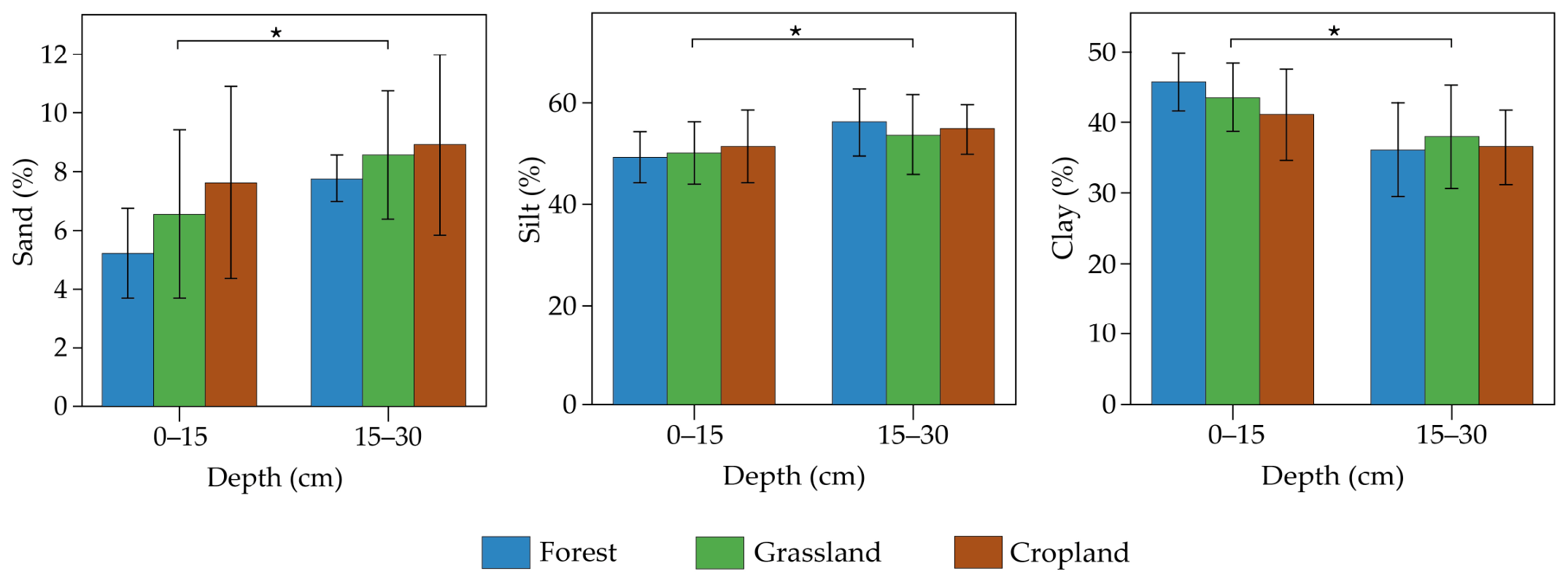
Soil texture is an important intrinsic property that affects soil erodibility [28]. The effects of different land use types and soil depths on soil texture components (clay, silt, and sand) are shown in Figure 1. No significant differences were found among land use types or for the interaction between land use and soil depth (p > 0.05), whereas significant differences were observed between soil depths (p < 0.05). The results showed that soil under natural forests had the lowest average sand content and the highest average clay content. While the lowest average (0–30 cm) sand content (5.2%) was found in the forest soil, the long-term arable soils had the highest average sand content of 9.5%. The highest average silt content was measured in grassland soils (55.2%), whereas forest soils showed the lowest (48.2%). Soils with 40–60% silt content are highly susceptible to water erosion [64]. In addition, Olaniya et al. [30] reported that the silt fraction of soil was significantly correlated with erodibility.
When examining the effects of different land use types on the variability of clay content among granulometric fractions, soils under forest had the highest clay content at 46.5%, while soils under grassland had the lowest clay content at 36.8% for a soil depth of 0–30 cm; although these differences were not statistically significant. The texture of soil samples from the study area was classified as silty clay loam or silty clay (according to the USDA soil classification), indicating that the study area had nearly homogeneous textural characteristics.
Forest soils exhibited lower, although not statistically significant, clay content in the subsurface layer (15–30 cm) compared to grassland and cropland. This pattern may be related to differences in land use and surface cover. Arable soils are often exposed to high-intensity rainfall, which can promote the downward leaching of clay particles (lessivage). In contrast, forest lands are characterized by continuous vegetation cover and higher biomass throughout the year, which protects the soil surface from direct rainfall impact and reduces erosion [65].

3.1.2. Soil Organic Carbon

The SOC content was significantly reduced (p < 0.05) by land-use change from natural forests to agricultural areas (Table 3). The decrease in SOC content from forest to other land uses was greatest in the 0–15 cm layer, ranging from 54.6% (forest vs. grassland) to 63.6% (forest vs. cropland). In the subsurface soil layers (15–30 cm), this decrease remained notable with 6.8% (forest vs. grassland) and 12% (forest vs. cropland). The low SOC content in cropland may be due to continuous cultivation, removal or burning of crop residues, increased oxidation of soil organic matter from tillage, and accelerated water erosion. Other authors [4,27] also reported that SOC content varied significantly across different land use types and soil depths.
The conversion of natural forest and grassland ecosystems to agricultural ecosystems reduced soil organic matter content, thereby weakening aggregate stabilization and increasing soil erodibility [8,12]. A reduction in the SOC content in cropland below the lower limit of the critical threshold (23 g kg−1) proposed by Greenland [66] can lead to a loss of structure in fine-textured soils due to tillage.

3.1.3. Bulk Density

Soil BD is closely related to soil erodibility by affecting overland flow dynamics and soil’s infiltration capacity [28]. The results of this study showed that in the surface layer (0–15 cm), forest soils exhibited significantly lower (p < 0.05) BD values than grassland and cropland soils (Table 3). BD values generally increased with soil depth, with the highest values observed in the 15–30 cm layer of grassland and cropland soils. The pronounced increase in BD with depth under forest and grassland was accompanied by declines in SOC and total porosity in the subsurface layers. In contrast, cropland soils did not show significant depth-related differences in BD, possibly because repeated tillage homogenized the upper soil profile and reduced the natural vertical stratification of soil properties. Lower BD in forest soils indicates a better soil pore structure, which can enhance soil water infiltration and reduce surface runoff formation, thereby decreasing soil erodibility [67]. Furthermore, the loss of SOC following forest conversion to cultivated land likely contributed to the generally higher BD values observed in cropland soils (Table 3).
Higher BD values in cropland than in adjacent forest soils at 0–15 cm and 15–30 cm indicate compaction, changes in porosity, and altered soil structure due to the use of heavy agricultural machinery during seedbed preparation. Remarkably, the permanent grassland treatment yielded a higher mean BD value (1.46 Mg m−3) than adjacent cropland across the 0–30 cm soil layer. This approximately 6% higher BD in natural grassland relative to cropland could be attributed to the long-term absence of tillage, as well as to possible machinery traffic and repeated trampling during hay production, both of which may contribute to soil compaction. Similar variations in BD among land-use types and soil depths have also been reported in previous studies [4,11,27].

3.1.4. Total Porosity

In the surface soil layer, conversion of natural forest to grassland and cropland resulted in a statistically significant decline in TP over the >100-year period (Table 3). The forest had the highest TP values in the study area. The natural grassland soils showed a much lower TP value (0. 47 m3 m−3) compared to the natural forest soils (0.62 m3 m−3) in the surface layer (0–15 cm). Conversion of natural forest to grassland and cropland had similar statistical effects (p < 0.05) on TP in their subsurface layers (Table 3). On average, deforestation decreased total porosity by about 24% and 18% in the 0–15 cm layer compared with grassland and cropland soils, respectively. The relative reduction in total porosity was about 16% and 12% in the 15–30 cm layer for grassland and cropland soils, respectively (Table 3). The higher TP value and lower BD value of forest soil compared to the other two land uses may be partly due to organic matter incorporation and greater biological activity. According to Vallany et al. [68], total porosity varied significantly across land-use types. Previous studies have shown that grassland has a higher TP than cropland [4,13]. Our results are consistent with other field studies [11,13], which show that converting natural ecosystems to cropland results in physical disturbance and loss of soil structure, increasing bulk density and decreasing total porosity (Table 1).
Taken together, the above results indicate that soils under forest (natural vegetation) exhibited more favorable physical and chemical characteristics than those under grassland or arable land. Agricultural practices, including intensive tillage and insufficient return of organic residues, along with direct exposure of soil to rainfall, may contribute to soil structure degradation and increased susceptibility to erosion in the study area.

3.2. Soil Erodibility Indicators

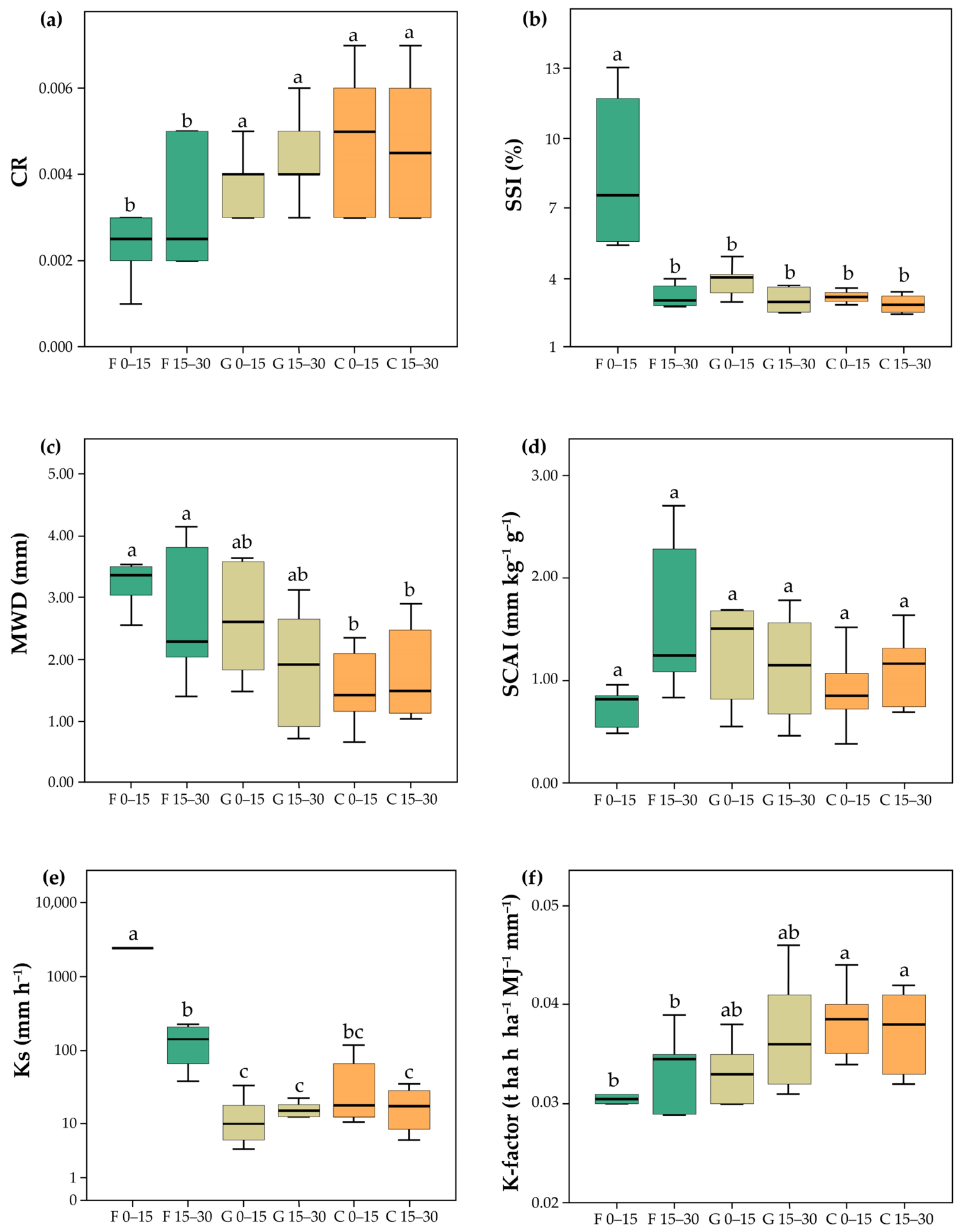
Soil erodibility indicators (i.e., CR, SSI, MWD, SCAI, Ks, and K-factor) across land use types (F, forest; G, grassland; and C, cropland) and soil depths (0–15 cm and 15–30 cm) are presented in Figure 2.

3.2.1. Clay Ratio

Figure 2a shows the variation in soil CR under different land use types and soil layers. The clay ratio values in forest, grassland, and cropland ranged within very narrow intervals (0.002–0.005). Overall, the soil CR of forest land is significantly lower than that of grassland and cropland (p < 0.05) at both soil layers, while no significant difference is found for soil CR between grassland and cropland at the 0.05 level. Further analysis of Figure 2a shows that land use types do not significantly alter the trend in soil CR with depth. Specifically, the CR values of forest land increase slightly with soil depth, whereas those of grassland and cropland do not.
In contrast to our study, Li et al. [14] reported that the CR of certain zonal soil types (yellow soil) was not significantly affected by different land use types (20–60 years) in the subtropical monsoon climate of Sichuan Province, China. According to them, one reason was that these soils had not been excessively tilled. A similar study by Olaniya et al. [30] also reported higher average CR values for tropical soils in natural forest (2.74) than in agricultural land (2.39), jhum (2.10), and wasteland (1.97) in India. These differences among studies could result from soil texture, land use management, and the duration of land use. Although higher CR values indicate greater soil susceptibility to erosion, in this study, CR values for different land uses did not provide a clear understanding of their relationship to erosion susceptibility.

3.2.2. Soil Structural Stability Index

The risk of structural degradation, assessed by the SSI, was ≤ 5% in both grassland and cropland layers and in the forest subsurface layer (Figure 2b), indicating structurally degraded soils [58]. The only exception is the forest surface layer (0–15 cm), where the SSI value exceeded 8%, indicating a low risk of structural degradation and higher resistance to erosion, and which was significantly different (p < 0.05) from those in the forest subsoil layer (15–30 cm) and both the grassland and cropland soil layers. The effects of different land use types and soil depths on the soil structural stability index showed that natural forest had the highest average SSI values (8.48% at 0–15 cm and 3.24% at 15–30 cm). In contrast, cropland had the lowest average soil structural stability index value (3.22%) in the surface layer (0–15 cm), while grassland had the lowest SSI value (3.07%) at 15–30 cm. This result is similar to that of Li et al. [14].
The SSI was calculated from the measured SOC content and soil texture. As noted above, soil texture was similar across all three land use types; therefore, significant variation in SSI in the surface layer was mainly due to changes in SOC content. The low soil structural stability index values (≤5%) observed in cropland indicate the need for management strategies that prioritize both the preservation of existing organic stocks and the active replenishment of soil organic matter, while minimizing mechanical degradation.

3.2.3. Mean Weight Diameter

The MWD of soil water-stable aggregates is crucial for assessing aggregate stability. The data on the effects of land use on MWD of water-stable soil aggregates are shown in Figure 2c. MWD was significantly greater in the forest than in the adjacent cultivated soils at both depths. Moreover, no statistically significant differences were found between forest and grassland, or between grassland and cropland (Figure 2c). The similar aggregate stability observed between grassland and cropland may reflect legacy effects of past land-use history and management rather than current land use alone. The investigated sites may have undergone transitional phases following deforestation, including periods of cultivation, abandonment, or secondary vegetation succession. Such disturbances can produce lasting alterations in soil structure and aggregation, thereby reducing the differentiation of soil physical properties among current land-use types.
In forest and grassland, MWD decreased sharply from 0 to 15 cm to 15–30 cm, whereas in cropland it increased slightly (Figure 2c). Long-term (for more than 100 years) cultivation resulted in decreases in MWD of 52.79% and 18.63% for the 0–15 cm layer, and 33.83% and 29.70% for the 15–30 cm layer, compared with forest and grassland soils, respectively. Therefore, according to this erodibility indicator, forest and grassland were less erodible than cropland in this study. Thus, long-term tillage may destabilize soil structure by reducing soil aggregation, thereby increasing the risk of soil water erosion in cropland areas.
The reduction in MWD could be attributed to the lower organic carbon content of cultivated soils and their weaker aggregation compared with the other two land use types. Li et al. [14] also observed significantly higher MWD of water-stable aggregates in the 0–10 cm and 10–20 cm soil layers of some loamy soils in woodland and grassland compared to cropland in the arid valley region of Southwest China. Wang et al. [69] reported that higher soil MWD was associated with increased aggregation, resulting in a more stable soil structure with greater resistance to erosion. A stable surface soil structure is important for promoting rapid water infiltration, controlling soil water erosion, and reducing the runoff of soil contaminants to nearby surface waters [70].

3.2.4. Soil Organic Carbon Cementing Agent Index

As shown in Figure 2d, SCAI values varied among land-use types; however, the differences were not statistically significant at the 0.05 level. The average SCAI value in the topsoil layer (0–15 cm) was the highest in the grassland and the lowest in the forest. Compared with the topsoil layer in the forest and cropland, the sub-surface layer (15–30 cm) showed an increase in SCAI values of 3.17–14.01% and 1.67–8.68%, respectively. At a depth of 15–30 cm, the forest had a higher average SCAI value than the other two land use types, but these differences were not statistically significant (p > 0.05). This may partly be due to the considerably higher average MWD in the sub-surface layer of the forest compared to the other two land use types. The absence of significant differences in SCAI among forest, grassland, and cropland soils also reflects the high degree of variability within each land-use type. Although forest soils exhibited higher mean SOC and MWD values, the wide range of observations (e.g., SOC ranging from low to very high values within the same land use) resulted in overlapping distributions among groups. Similar patterns have been reported in the literature, where land use alone is not always a strong predictor of soil structural properties. Instead, management practices such as tillage intensity, residue return, and vegetation cover often exert more direct control over aggregation dynamics [71,72] and soil erodibility. The recent study by Li et al. [14] showed that SCAI values for forest and grassland are significantly higher than for cropland (p < 0.05), while in the 0–10 cm and 10–20 cm soil layers, there are no significant differences in SCAI among the five different land use types studied at the 0.05 level. Dong et al. [73] also reported that the SCAI of cultivated land is higher than that of grassland and forestland in Calcic Cambisols on the Loess Plateau, China.

3.2.5. Saturated Hydraulic Conductivity

The Ks quantifies soil infiltration capacity and is closely related to soil water movement and storage [28] and, therefore, to soil erosion. The results of this study show that Ks changes significantly when a natural forest is converted to grassland and cropland (Figure 2e). The highest average Ks was found under forest, in sharp contrast to grassland and cropland (2100 mm h−1 vs. 13 and 41 mm h−1, respectively) in the surface layer (0–15 cm). In the forest, Ks decreased significantly with increasing soil depth, whereas no significant differences were observed between the 0–15 cm and 15–30 cm layers in grassland or cropland. This suggests that vertical soil water movement and infiltration are reduced following conversion from natural forest to grassland and cropland, potentially increasing soil erosion susceptibility. Compared to the forest, Ks under grassland and cropland showed less pronounced changes between soil layers, indicating partial homogenization of soil physical properties within the 0–30 cm layer, consistent with observations for SOC, BD, TP, and other soil properties. The higher average Ks value (0–30 cm) in forest soil may be partly linked to a lower BD, due to the combined effects of TP and soil organic matter content. The change in Ks is affected by soil porosity [28] and is therefore directly related to changes in bulk density. The differences in Ks between grassland and cropland are notable. Ks was 3.0 and 1.6 times higher in cropland than in adjacent natural grassland at depths of 0–15 cm and 15–30 cm, respectively, but these differences were not statistically significant. The lower average Ks value of grassland soils compared to cropland soils may result from a long-term undisturbed soil matrix and from machine traffic during haymaking. The fibrous root system of grass can either decrease Ks by clogging pores during root growth [74] or increase Ks through root channels that form after root death and decomposition, as well as through indirect effects that improve soil structure [75].
Similar to our results, Hebb et al. [76] reported slightly higher Ks values in annual cropland compared to native grassland, but these differences were not statistically significant. Other researchers also found higher Ks values in forestlands than in agricultural lands [11,27], corroborating the results obtained in our study.

3.2.6. Erodibility K-Factor

The K-factor reflects the stability of the soil’s physical structure, which is closely related to soil aggregate stability [77]. In this study, the K-factor varied across land use types, with significant differences between forest and cropland (Figure 2f). No significant differences in the K-factor were found at two soil depths across the investigated land use types. The mean K-factors for the investigated sites were 0.031, 0.033, and 0.038 (t ha h ha−1 MJ−1 mm−1) in the 0–15 cm layer, and 0.034, 0.037, and 0.037 (t ha h ha−1 MJ−1 mm−1) in the 15–30 cm layer for forest, grassland, and cultivated areas, respectively. In summary, the soil erodibility of cultivated soil was 22.58% higher than that of forest soil and 15.15% higher than that of grassland soil in the 0–15 cm layer, indicating the vulnerability of agricultural land to water erosion. Furthermore, in the 15–30 cm layer, K-factor values in grassland and cultivated soils were 8.82% higher than those in forest soils. However, there was no significant statistical difference in K-factor values between forest and grassland, or between grassland and cultivated soils, in either soil layer. Our results are supported by previous studies. For example, Wang et al. [27] reported that the K-factor of grassland and woodland was significantly lower than that of cropland, although no difference was detected between grassland and woodland in the near-surface layer (0–5 cm) of loessial loam soil. In contrast to our results, Li et al. [14] found no significant differences (p > 0.05) in K-factor values among the five land use types (woodland, cropland, orchard land, abandoned land, and grassland) across the soil layers of 0–10 cm, 10–20 cm, and 20–30 cm. However, they reported that the K-factor of the surface soil layer (0–10 cm) in grassland differs considerably from that of the 20–30 cm soil layer (p < 0.05). Liu et al. [78] analyze changes in soil aggregate stability and the K-factor (determined by the EPIC model) under land-use change in a small karst catchment in Southwest China. They reported that the K-factor did not differ significantly among the three land use types (cropland, abandoned cropland, and native vegetation land) because the EPIC model does not account for soil permeability.

3.2.7. Comprehensive Soil Erodibility Index

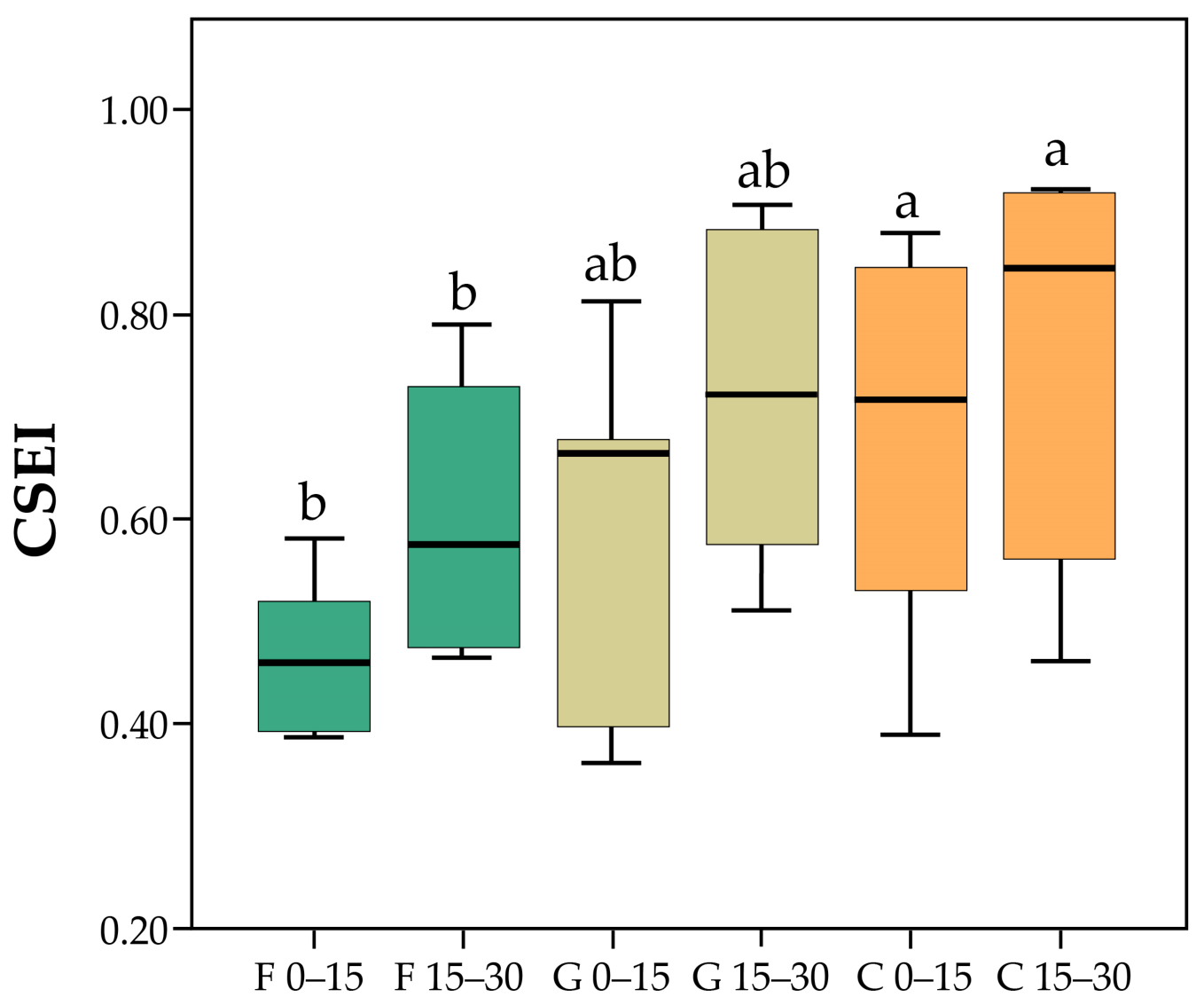
The CSEI is used to comprehensively evaluate soil erosion resistance, with higher values indicating lower erosion resistance [14]. According to Wang et al. [27], CSEI captures variability in soil erodibility more effectively than the six individual indicators mentioned above. The variation in CSEI across land use types and soil layers analyzed in this study is shown in Figure 3. While individual indicators showed varying and sometimes inconsistent responses to land use, CSEI integrated their complementary responses and provided a clearer, more consistent separation among land use types, capturing the overall gradient of soil degradation (forest < grassland < cropland). The CSEI of the forest was significantly lower than that of cropland. Furthermore, no significant differences in CSEI were detected between the 0–15 cm and 15–30 cm across the investigated land use types. Some individual indicators (e.g., Ks and SSI) showed notable depth-related differences (Figure 2), though these were not consistent across all indicators. By integrating multiple metrics, CSEI reduced the influence of individual variability and indicated that soil depth had a comparatively smaller effect on overall erodibility than land use.
In this study, differences in CSEI across land-use types were partly explained by significant differences in SOC content and BD, which are closely related to soil aggregate stability, TP, and Ks. Therefore, in grassland and cropland, the increase in CSEI was attributed to decreases in SOC content and increases in BD. The increase in CSEI associated with land use change indicates that deforestation can significantly affect soil erodibility in the study area. Firstly, SOC content strongly influences the formation of macroaggregates, soil aggregation, increases the water stability of soil aggregates, and enhances the soil’s ability to resist erosion [8,79]. The formation of water-stable aggregates and stable soil structure from clay and silt combined with organic matter reduces soil erodibility [80]. Secondly, lower BD indicates better soil pore structure, which is a fundamental determinant of water infiltration, flow, and storage, and is intricately linked to soil stability and erodibility [11,81].
Wang et al. [27] also observed significantly higher CSEI values in cropland compared to grassland and woodland on loessial loam soil in China. Our results differ somewhat from the study by Li et al. [14], which found no significant difference in CSEI among the five land use types (woodland, cropland, orchard land, abandoned land, and grassland) (p > 0.05). This difference was likely due to variations in soil type, climate, tillage practices, vegetation, plant species, and land-use duration. It is important to note that CSEI values may vary significantly depending on the soil erodibility indicators chosen.

3.3. Relationships Between Soil Erodibility Indicators and Soil Properties

Table 4 presents the Pearson correlation coefficients between the studied soil erodibility indicators (CR, SSI, MWD, SCAI, Ks, K-factor, and CSEI) and soil properties. Except for SCAI, SOC, BD, and TP show a highly significant correlation between SOC, BD, TP, and the soil erodibility indicators (CR, K-factor, MWD, Ks, SSI, and CSEI) (p < 0.01). Silt and clay content also show significant correlation with MWD, K-factor, and CSEI. Some observed correlations may partly reflect the mathematical structure of the derived indices.
In the current study, CR was significantly positively correlated with BD (p < 0.01), whereas it was significantly negatively correlated with SOC and TP (p < 0.01). Li et al. [14] also observed a significantly positive correlation between CR and BD. However, contrary to our study, they found no significant relationship between CR and SOC content.
MWD and SSI were statistically significantly (p < 0.01) positively correlated with clay content, SOC, and TP. For SSI, these relationships should be interpreted with caution because SOC and fine particles are incorporated into the index calculation. In contrast, the observed correlations among MWD, SOC, clay content, and TP suggest that greater organic matter content and improved pore space are associated with enhanced aggregate stability. The results of this study are similar to those of some previous studies [14,29,51]. Furthermore, the work of Okolo et al. [51] and Li et al. [82] showed that SOC content is positively correlated with soil SSI, although this relationship is attributable to the SSI’s formulation. Contrary to this study, Li et al. [14] demonstrated a significant positive relationship between MWD and soil silt content.
In contrast to other indicators, SCAI showed no significant correlations with soil properties (Table 4). This can be explained by its definition as the ratio between aggregate stability (MWD) and SOC. In the present study, MWD and SOC were positively correlated (r = 0.540, p < 0.01), indicating that increases in SOC were associated with improved aggregate stability. As a result, their ratio remained relatively stable across samples, leading to reduced variability of SCAI. Moreover, since MWD already reflects SOC’s contribution to aggregate formation and stability, normalizing it by SOC may reduce the index’s sensitivity and obscure differences among land-use types. This effect may be further enhanced in fine-textured soils, where SOC and aggregate stability are more closely linked due to the stabilizing role of fine particles. Consequently, SCAI appears less responsive to land-use-induced changes than other indicators. The work of Li et al. [14] showed a statistically significant positive correlation (p < 0.01) between SCAI and BD, and a statistically significant negative correlation (p < 0.01) with soil organic matter. Furthermore, as in our study, they did not find a significant correlation between SCAI and soil texture.
As shown in Table 4, Ks was significantly positively correlated with SOC and TP (p < 0.01), and significantly negatively correlated with sand content (p < 0.05) and BD (p < 0.01). This result is in agreement with the findings of previous studies [27,28,29].
In the present study, the K-factor was significantly negatively correlated with SOC and TP (p < 0.01) and positively correlated with clay and silt content and BD (p < 0.01). These relationships highlight the importance of SOC and BD in soil aggregate stability and soil erodibility. Therefore, higher SOC content and lower BD were associated with higher MWD values of water-stable aggregates and lower K-factor values. The positive correlation between K-factor and BD was likely due to increased soil permeability as BD decreased, thereby reducing soil erodibility. These results are supported by other studies [14,24,27,29,62], which found that erodibility was closely related to SOC content and BD.
According to Liu et al. [78], in soils with SOC content greater than 2% (SOC-rich soils), the K-factor was significantly correlated with silt content (positively) and clay content (negatively). However, they reported that no correlation between the K-factor and soil particle distribution was observed in soils with SOC content less than 2% (SOC-poor soils). Their results indicate that the estimation of the K-factor in SOC-rich soils mainly depends on soil particle distribution, whereas in SOC-poor soils it depends primarily on SOC content. In this study, the average SOC content across all soil profiles was less than 2%, except for the forest surface layer (0–15 cm), suggesting that SOC plays a key role in soil erodibility and thus affects soil degradation. The correlations in our study support the general understanding of soil erodibility in relation to soil organic carbon content, soil texture, and soil permeability.
Compared to individual indicators, CSEI showed more consistent and integrative relationships with soil physical and chemical properties (Table 4). The pairwise correlations indicated a strong positive association with silt, clay, and BD, and a significant negative relationship with SOC and TP. These findings are consistent with previous studies reporting positive correlations of CSEI with BD and negative correlations with SOC [14,27,28,29,83] and TP [83]. The positive correlations of CSEI with silt and clay observed in this study are consistent with recent findings [83] but contrast with earlier reports of negative correlations with these fractions [28], suggesting that the role of fine particles in controlling soil erodibility may be context-dependent and influenced by soil structure and management conditions. While clay is generally associated with enhanced aggregate stability, its protective role depends on sufficient organic matter and a well-developed soil structure. Under conditions of reduced SOC and increased BD, as observed in cropland soils, clay may contribute to increased erodibility through structural degradation, particularly when not effectively stabilized by organic matter. The strong positive correlation between silt content and CSEI further suggests the influence of selective erosion and aggregate breakdown, as silt-sized particles are particularly susceptible to detachment and transport. This is consistent with erosion processes dominated by aggregate breakdown and the preferential transport of fine particles. These results suggest that, in the fine-textured soils studied, soil structure and organic matter content exert a stronger control on erodibility than texture alone. The relative importance of individual indicators within the CSEI appears to be site-specific and reflects the dominant controls on erodibility in a given area. Consequently, different relationships between CSEI and soil properties may emerge under varying soil, climatic, and management conditions. This highlights the importance of a multi-indicator approach, which enables a more robust and context-sensitive assessment by integrating complementary information from different erodibility-related properties. Overall, these findings emphasize that soil erodibility arises from the interplay among texture, organic matter, and soil structure, underscoring the limitations of single-parameter approaches and the need for integrated, process-based assessments.

4. Conclusions

The findings indicate that long-term land-use change significantly influences soil erodibility in fine-textured soils. Most individual indicators (CR, SSI, MWD, Ks, and K-factor), as well as the integrated CSEI, revealed significant differences between forest and cropland, with forest soils exhibiting greater structural stability and lower erodibility. However, no single index consistently captured all aspects of soil erodibility related to soil structure, texture, and hydraulic properties. By contrast, the CSEI integrates these complementary signals into a single metric, providing a more comprehensive and balanced assessment that clearly reflects differences driven by land use. In Western Serbia, differences in soil erodibility among land-use types were primarily attributed to variations in topsoil SOC, which were closely linked to soil structure-related parameters. Conversion of native forest ecosystems to agricultural land, in the absence of practices that maintain organic matter and structural stability, increases susceptibility to water erosion. Therefore, appropriate soil conservation measures are needed to preserve forest ecosystems and restore degraded lands in the studied region of Serbia. These findings can support farmers and policymakers in adopting effective land-use practices that enhance the retention and accumulation of soil organic matter, enhance soil resilience, and reduce soil water erosion.

Author Contributions

Conceptualization, B.G., S.D. and I.S.; methodology, B.G., S.D. and I.S.; software, B.G., K.G. and S.D.; validation, B.G., S.D. and I.S.; investigation, B.G., S.D., I.S., K.G. and R.D.; resources, B.G., S.D., I.S. and R.D.; writing—original draft preparation, B.G. and S.D.; writing—review and editing, B.G., S.D., I.S. and R.D.; visualization, B.G. and S.D.; supervision, B.G., S.D., I.S. and R.D.; project administration, S.D.; funding acquisition, B.G., S.D., I.S. and R.D. All authors have read and agreed to the published version of the manuscript.

Funding

This research was funded by the Science Fund of the Republic of Serbia (Grant No. 7047), Development of erosion prediction tool for sustainable soil management—Predict-Er. This research was also supported by the Ministry of Science, Technological Development, and Innovation of the Republic of Serbia (Contracts Nos. 451-03-34/2026-03/200116, 451-03-33/2026-03/200017, and 451-03-34/2026-03/200124).

Data Availability Statement

Data are available from the corresponding author upon reasonable request.

Acknowledgments

The authors would like to thank the farmers for their help in field testing the soil on their plots.

Conflicts of Interest

The authors declare no conflicts of interest.

References

  1. Gajić, B. Physical Properties and Organic Matter of Fluvisols Under Forest, Grassland, and 100 Years of Conventional Tillage. Geoderma 2013, 200–201, 114–119. [Google Scholar] [CrossRef]
  2. Yu, M.; Zhang, L.; Xu, X.; Feger, K.-H.; Wang, Y.; Liu, W.; Schwärzel, K. Impact of Land-use Changes on Soil Hydraulic Properties of Calcaric Regosol on the Loess Plateau, NW China. J. Plant Nutr. Soil Sci. 2015, 178, 486–498. [Google Scholar] [CrossRef]
  3. FAO. The State of the World’s Land and Water Resources for Food and Agricultue. Managing Systems at Risk; FAO: London, UK, 2011; Available online: https://www.taylorfrancis.com/books/mono/10.4324/9780203142837/state-world-land-water-resources-food-agriculture-food-agriculture-organization-united-nations (accessed on 1 March 2026).
  4. Borrelli, P.; Robinson, D.A.; Fleischer, L.R.; Lugato, E.; Ballabio, C.; Alewell, C.; Mesuburger, K.; Modugno, S.; Schütt, B.; Ferro, V.; et al. Assessment of the Global Impact of 21st Century Land Use Change on Soil Erosion. Nat. Commun. 2017, 8, 2013. [Google Scholar] [CrossRef]
  5. Ebabu, K.; Tsunekawa, A.; Haregeweyn, N.; Adgo, E.; Meshesha, D.T.; Aklog, D.; Masunaga, T.; Tsubo, M.; Sultan, D.; Fenta, A.A.; et al. Effects of Land Use and Sustainable Land Management Practices on Runoff and Soil Loss in the Upper Blue Nile basin Ethiopia. Sci. Total Environ. 2019, 648, 1462–1475. [Google Scholar] [CrossRef] [PubMed]
  6. Li, H.R.; Liu, G.; Gu, J.; Chen, H.; Shi, H.Q.; Abd-Elbasit, M.A.M.; Hu, F.N. Response of Soil Aggregate Disintegration to the Different Content of Organic Carbon and Its Fractions During Splash Erosion. Hydrol. Process. 2021, 35, e14060. [Google Scholar] [CrossRef]
  7. Palmeri, V.; Pampalone, V.; Di Stefano, C.; Nicosia, A.; Ferro, V. Experiments For Testing Soil Texture Effects on Flow Resistance in Mobile Bed Rills. Catena 2018, 171, 176–184. [Google Scholar] [CrossRef]
  8. Gajić, B.; Đurović, N.; Dugalić, G. Composition and Stability of Soil Aggregates in Fluvisols Under Forest, Meadows, and 100 Years of Convetional Tillage. J. Plant Nutr. Soil Sci. 2010, 173, 502–509. [Google Scholar] [CrossRef]
  9. Xiao, H.; Liu, G.; Zhang, Q.; Zheng, F.L.; Zhang, X.C.; Liu, P.L.; Zhang, J.Q.; Hu, F.N.; Abd-Elbasit, M.A.M. Quantifying Contributions of Slaking and Mechanical Breakdown of Soil Aggregates to Splash Erosion for Different Soils From the Loess Plateau of China. Soil Tillage Res. 2018, 178, 155–158. [Google Scholar] [CrossRef]
  10. Meena, R.S.; Lal, R.; Yadav, G.S. Long-term Impacts of Topsoil Depth and Amendments on Soil Physical and Hydrological Properties of an Alfisol in Central Ohio, USA. Geoderma 2020, 363, 114164. [Google Scholar] [CrossRef]
  11. Gajić, K.; Kresović, B.; Tolimir, M.; Životić, L.J.; Lipovac, A.; Gajić, B. Hydraulic Properties of Fine-Textured Soils in Lowland Ecosystems of Western Serbia Vary Depending on Land Use. Geoderma Reg. 2023, 32, e00603. [Google Scholar] [CrossRef]
  12. Gajić, B.; Tapanarova, A.; Tomić, Z.; Kresović, B.; Vujović, D.; Pejić, B. Land Use Effects on Aggregation and Erodibility of Luvisols on Undulating Slopes. Aust. J. Crop Sci. 2013, 7, 1198–1204. [Google Scholar]
  13. Tolimir, M.; Kresović, B.; Životić, L.J.; Dragović, S.; Dragović, R.; Sredojević, Z.; Gajić, B. The Conversion of Forestland Into Agricultural Land Without Appropriate Measures to Conserve SOM Leads to the Degradation of Physical and Rheological Soil Properties. Sci. Rep. 2020, 10, 13668. [Google Scholar] [CrossRef] [PubMed]
  14. Li, J.; Liu, S.; Yang, D.; Suo, F.; Yu, Y.; Wang, Z.; Liao, Q. The Impact of Land Use Types on the Soil Erosion Resistance in the Arid Valley Region of Southwest China. Agriculture 2025, 15, 386. [Google Scholar] [CrossRef]
  15. Safadoust, A.; Doaei, N.; Mahboub, A.A. Longterm Cultivation and Landscape Position Effects on Aggregate Size and Organic Carbon Fractionation on Surface Soil Properties in Semi-arid Region of Iran. Arid Land Res. Manag. 2016, 30, 345–361. [Google Scholar] [CrossRef]
  16. Dormaar, J.F. Organic Matter Characteristics of Undisturbed and Cultivated Chernozemic and Slonetzic A Horizons. Can. J. Soil Sci. 1979, 59, 349–356. [Google Scholar] [CrossRef]
  17. Skidmore, E.L.; Layton, J.B.; Armbrust, B.V.; Hooker, M.L. Soil Physical Properties as Influenced by Cropping and Residue Management. Soil Sci. Soc. Am. J. 1986, 50, 415–416. [Google Scholar] [CrossRef]
  18. Chalise, D.; Kumar, L.; Sharma, R.; Kristiansen, P. Assessing the Impacts of Tillage and Mulch on Soil Erosion and Corn Yield. Agronomy 2020, 10, 63. [Google Scholar] [CrossRef]
  19. Panagos, P.; Ballabio, C.; Poesen, J.; Lugato, E.; Scarpa, S.; Montanarella, L.; Borrell, P. Soil Erosion Indicator For Supporting Agricultural, Environmental and Climate Policies in the European Union. Remote Sens. 2020, 12, 1365. [Google Scholar] [CrossRef]
  20. Melese, T.; Senamaw, A.; Belay, T.; Bayable, G. The Spatiotemporal Dynamics of Land Use Land Cover Change, and Its Impact on Soil Erosion in Tagaw Watershed, Blue Nile Basin, Ethiopia. Glob. Chall. 2021, 5, 2000109. [Google Scholar] [CrossRef]
  21. Zhang, G.H. Several Ideas Related to Soil Erosion Research. J. Soil. Water Conserv. 2020, 34, 21–30. [Google Scholar]
  22. Patzold, S.; Mertens, F.M.; Bornemann, L.; Koleczek, B.; Franke, J.; Feilhauer, H.; Welp, G. Soil Heterogeneity at the Field Scale: A Challenge for Precision Crop Protection. Precis. Agric. 2008, 9, 367–390. [Google Scholar] [CrossRef]
  23. Gülser, C.; Ekberli, I.; Candemir, F. Spatial Variability of Soil Physical Properties in A Cultivated Field. Eurasian J. Soil. Sci. 2016, 5, 192. [Google Scholar] [CrossRef]
  24. Sun, L.; Zhang, G.H.; Luan, L.L.; Liu, F. Temporal Variation in Soil Resistance to Flowing Water Erosion for Soil Incorporated with Plant Litters in the Loess Plateau of China. Catena 2016, 145, 239–245. [Google Scholar] [CrossRef]
  25. Wang, B.; Zhang, G.H. Quantifying the Binding and Bonding Effects of Plant Roots on Soil Detachment by Overland Flow in 10 Typical Grasslands on the Loess Plateau. Soil Sci. Soc. Am. J. 2017, 81, 1567–1576. [Google Scholar] [CrossRef]
  26. Zhang, K.L.; Shu, A.P.; Xu, X.L.; Yang, Q.K.; Yu, B. Soil Erodibility and Its Estimation for Agricultural Soils in China. J. Arid. Environ. 2008, 72, 1002–1011. [Google Scholar] [CrossRef]
  27. Wang, H.; Zhang, G.H.; Li, N.N.; Zhang, B.J.; Yang, H.Y. Variation in Soil Erodibility Under Five Typical Land Uses in a Small Watershed on the Loess Plateau, China. Catena 2019, 174, 24–35. [Google Scholar] [CrossRef]
  28. Wang, H.; Wang, J.; Zhang, G.H. Impact of Landscape Positions on Soil Erodibility Indices in Typical Vegetation-Restored Slope-Gully Systems on the Loess Plateau of China. Catena 2021, 201, 105235. [Google Scholar] [CrossRef]
  29. Wang, H.; Zhang, G.-h.; Li, N.-n.; Zhang, B.-j.; Yang, H.-y. Soil Erodibility Influenced by Natural Restoration Time of Abandoned Farmland on the Loess Plateau of China. Geoderma 2018, 325, 18–27. [Google Scholar] [CrossRef]
  30. Olaniya, M.; Bora, P.K.; Das, S.; Chanu, P.H. Soil Erodibility Indices Under Different Land Uses in Ri-Bhoi District of Meghalaya (India). Sci. Rep. 2020, 10, 14986. [Google Scholar] [CrossRef]
  31. Bryan, R.B. Consideration on Soil Erodibility Indices and Sheetwash. Catena 1976, 3, 99–111. [Google Scholar] [CrossRef]
  32. Bryan, R.B. The Development, Use and Efficiency of Indices of Soil Erodibility. Geoderma 1968, 2, 5–26. [Google Scholar] [CrossRef]
  33. Wang, B.; Zheng, F.; Römkens, M.J.M.; Darboux, F. Soil Erodibility for Water Erosion: A Perspective and Chinese Experiences. Geomorphology 2013, 187, 1–10. [Google Scholar] [CrossRef]
  34. Wischmeier, W.H.; Smith, D.D. Predicting Rainfall Erosion Losses: A Guide to Conservation Planning. In Agriculture Handbook No. 537; USDA: Washington, DC, USA, 1978. [Google Scholar]
  35. Williams, J.R.; Jones, C.A.; Dyke, P.T. A Modeling Approach to Determining the Relationship Between Erosion and Soil Productivity [EPIC, Erosion-productivity Impact Calculator, Mathematical Models]. Trans. ASAE 1984, 27, 129–144. [Google Scholar] [CrossRef]
  36. Shirazi, M.A.; Boersma, L. A Unifying Quantitative Analysis of Soil Texture. Soil Sci. Soc. Am. J. 1984, 48, 142–147. [Google Scholar] [CrossRef]
  37. Bouyoucos, G.J. The Clay Ratio as a Criterion of Susceptibility of Soils to Erosion. J. Am. Soc. Agron. 1935, 27, 738–741. [Google Scholar] [CrossRef]
  38. Liu, Y.; Liu, G.; Gu, J.; Shi, H.; Li, H.; Han, Y.; Liu, D.; Xia, X.; Guo, Z. Soil Erodibility and Hillslope Erosion Processes Affected by Vegetation Restoration Duration. Soil Tillage Res. 2025, 245, 106305. [Google Scholar] [CrossRef]
  39. Igwe, C.A.; Akamigbo, F.O.R.; Mbagwu, J.S.C. The Use of some Soil Aggregate Indices to Assess Potential Soil Loss in Soils of South-eastern Nigeria. Int. Agrophysics 1995, 9, 95–100. [Google Scholar]
  40. Mbagwu, J.S.C.; Bazzoffi, P. Soil Characteristics Related to Resistance of Breakdown of Dry Soil Aggregates by Water-Drops. Soil Tillage Res. 1998, 45, 133–145. [Google Scholar] [CrossRef]
  41. Igwe, C.A. Changes in Water-Dispersible Clay and Erosion of Stony Slope Soil under Tillage in Nigeria. Pol. J. Soil Sci. 2002, 35, 31–36. [Google Scholar]
  42. Nsabimana, G.; Bao, Y.; He, X.; Nambajimana, J.; Yang, L.; Li, J.; Uwiringiyimana, E.; Nsengumuremyi, P.; Ntacyabukura, T. Soil aggregate stability response to hydraulic conditions in water level fluctuation zone of the three gorges reservoir, china. Catena 2021, 204, 105387. [Google Scholar] [CrossRef]
  43. Wang, J.; Yang, W.; Yu, B.; Li, Z.; Cai, C.; Ma, R. Estimating the Influence of Related Soil Properties on Macro- and Micro-Aggregate Stability in Ultisols of South-Central China. Catena 2016, 137, 545–553. [Google Scholar] [CrossRef]
  44. Xiao, L.; Yao, K.; Li, P.; Liu, Y.; Chang, E.; Zhang, Y.; Zhu, T. Increased Soil Aggregate Stability Is Strongly Correlated with Root and Soil Properties Along A Gradient of Secondary Succession on the Loess Plateau. Ecol. Eng. 2020, 143, 105671. [Google Scholar] [CrossRef]
  45. Xia, R.; Shi, D.; Ni, S.; Wang, R.; Zhang, J.; Song, G. Effects of Soil Erosion and Soil Amendment on Soil Aggregate Stability in the Cultivated-Layer of Sloping Farmland in Three Gorges Reservoir Area. Soil Tillage Res. 2022, 223, 105447. [Google Scholar] [CrossRef]
  46. Zhu, G.Y.; Deng, L.; Shangguan, Z.P. Effects of Soil Aggregate Stability on Soil N Following Land Use Changes Under Erodible Environment. Agric. Ecosyst. Environ. 2018, 262, 18–28. [Google Scholar] [CrossRef]
  47. Chen, S.; Zhang, G.; Zhu, P.; Wang, C.; Wan, Y. Impact of Land Use Type on Soil Erodibility in a Small Watershed of Rolling Hill Northeast China. Soil Tillage Res. 2023, 227, 105597. [Google Scholar] [CrossRef]
  48. Xie, Y.; Lin, H.; Ye, Y.; Ren, X. Changes in Soil Erosion in Cropland in Northeastern China Over the Past 300 Years. Catena 2019, 176, 410–418. [Google Scholar] [CrossRef]
  49. Guo, M.M.; Chen, Z.X.; Wang, W.L.; Wang, T.C.; Wang, W.X.; Cui, Z.Q. Revegetation Induced Change in Soil Erodibility as Influenced by Slope Situation on the Loess Plateau. Sci. Total Environ. 2021, 772, 145540. [Google Scholar] [CrossRef]
  50. Teferi, E.; Bewket, W.; Simane, B. Effects of Land Use and Land Cover on Selected Soil Quality Indicators in the Head Water Area of the Blue Nile Basin of Ethiopia. Environ. Monit. Assess. 2016, 188, 83. [Google Scholar] [CrossRef]
  51. Okolo, C.C.; Gebresamuel, G.; Zenebe, A.; Haile, M.; Eze, P.N. Accumulation of Organic Carbon in Various Soil Aggregate Sizes under Different Land Use Systems in a Semi-Arid Environment. Agric. Ecosyst. Environ. 2020, 297, 106924. [Google Scholar] [CrossRef]
  52. Blanco-Canqui, H.; Mikha, M.M.; Benjamin, J.G.; Stone, L.R.; Schlegel, A.J.; Lyon, D.J.; Vigil, M.F.; Stahlman, P.W. Regional Study of No-Till Impacts on Near-Surface Aggregate Properties That Influence Soil Erodibility. Soil Sci. Soc. Am. J. 2009, 73, 1361–1368. [Google Scholar] [CrossRef]
  53. Shein, Y.V.; Arhangel’skaya, T.A.; Goncharov, V.M.; Guber, A.K.; Pochatkova, T.N.; Sidorova, M.A.; Smagin, A.V.; Umarova, A.B. Field and Laboratory Methods of Physical Properties and Soil Status Investigations; University of Moscow: Moscow, Russia, 2001; pp. 15–22. (In Russian) [Google Scholar]
  54. van Bavel, C.H.M.V. Mean Weight-Diameter of Soil Aggregates as a Statistical Index of Aggregation. Soil Sci. Soc. Am. J. 1949, 14, 20–23. [Google Scholar] [CrossRef]
  55. Mazurak, A.P. Effect of Gaseous Phase on Water-Stable Synthetic Aggregate. Soil Sci. 1950, 69, 135–148. [Google Scholar] [CrossRef]
  56. van Reeuwijk, L.P. Procedures for Soil Analysis, 5th ed.; International Soil Reference and Information Center (ISRIC): Wageningen, The Netherlands, 1995. [Google Scholar]
  57. Wray, W.K. Measuring Engineering Properties of Soil; Prentice-Hall, Inc.: Englewood Cliffs, NJ, USA, 1986; p. 276. [Google Scholar]
  58. Pieri, C.J.M.G. Fertility of Soils: A Future for Farming in the West African Savannah; Springer: Berlin, Germany, 1992; p. 348. [Google Scholar]
  59. Hillel, D. Introduction to Environmental Soil Physics; Elsevier: Amsterdam, The Netherlands, 2004; p. 494. [Google Scholar]
  60. Jiang, Y.; Zheng, F.; Wen, L.; Shen, O.H. Effects of Sheet and Rill Erosion on Soil Aggregates and Organic Carbon Losses for a Mollisol Hillslope Under Rainfall Simulation. J. Soils Sediments 2019, 19, 467–477. [Google Scholar] [CrossRef]
  61. Obalum, S.E.; Uteau-Puschmann, D.; Peth, S. Reduced Tillage and Compost Effects on Soil Aggregate Stability of a Silt-Loam Luvisol Using Different Aggregate Stability Tests. Soil Tillage Res. 2019, 189, 217–228. [Google Scholar] [CrossRef]
  62. Cao, S.; Zhou, Y.; Zhou, Y.; Zhou, X.; Zhou, W. Soil Organic Carbon and Soil Aggregate Stability Associated With Aggregate Fractions in a Chronosequence of Citrus Orchards Plantations. J. Environ. Manag. 2021, 293, 112847. [Google Scholar] [CrossRef] [PubMed]
  63. R Core Team. R A Language and Environment for Statistical Computing; R Foundation for Statistical Computing. Vienna, Austria, 2023. Available online: https://www.scirp.org/reference/referencespapers?referenceid=3582659 (accessed on 1 March 2026).
  64. Morgan, R.P.C. Soil Erosion and Conservation, 2nd ed.; Longman Group: London, UK, 1995; p. 208. [Google Scholar]
  65. İlay, R.; Kavidar, Y. Impact of Land Cover Types on Soil Aggregate Stability and Erodibility. Environ. Monit. Assess. 2018, 190, 525. [Google Scholar] [CrossRef]
  66. Greenland, D.J. Soil Management and Soil Degradation. J. Soil Sci. 1981, 32, 301–322. [Google Scholar] [CrossRef]
  67. Wang, B.; Zhang, G.H.; Shi, Y.Y.; Zhang, X.C.; Ren, Z.P.; Zhu, L.J. Effect of Natural Restoration Time of Abandoned Farmland on Soil Detachment by Overland Flow in the Loess Plateau of China. Earth Surf. Process. Landf. 2013, 38, 1725–1734. [Google Scholar] [CrossRef]
  68. Valani, G.P.; Martíni, A.F.; Pezzopane, J.R.M.; Bernardi, A.C.C.; Cooper, M. Soil Physical Quality in the Topsoil of Integrated and Non-Integrated Grazing Systems in a Brazilian Ferralsol. Soil Tillage Res. 2022, 220, 105357. [Google Scholar] [CrossRef]
  69. Wang, S.Q.; Li, T.X.; Zheng, Z.C. Effect of Tea Plantation Age on the Distribution of Soil Organic Carbon and Nutrient Within Micro-Aggregates in the Hilly Region of Western Sichuan, China. Ecol. Eng. 2016, 90, 113–119. [Google Scholar] [CrossRef]
  70. Franzluebbers, A.J. Water Infiltration and Soil Structure Related to Organic Matter and Its Stratification With Depth. Soil Tillage Res. 2002, 66, 197–205. [Google Scholar] [CrossRef]
  71. Lal, R. Soil Carbon Sequestration Impacts on Global Climate Change and Food Security. Science 2004, 304, 1623–1627. [Google Scholar] [CrossRef] [PubMed]
  72. Six, J.; Bossuyt, H.; Degryze, S.; Denef, K. A History of Research on the Link Between (Micro)Aggregates, Soil Biota, and Soil Organic Matter Dynamics. Soil Tillage Res. 2004, 79, 7–31. [Google Scholar] [CrossRef]
  73. Dong, L.; Li, J.; Zhang, Y.; Bing, M.; Liu, Y.; Wu, J.; Hai, X.; Li, A.; Wang, K.; Wu, P.; et al. Effects of Vegetation Restoration Types on Soil Nutrients and Soil Erodibility Regulated by Slope Positions on the Loess Plateau. J. Environ. Manag. 2022, 302, 113985. [Google Scholar] [CrossRef] [PubMed]
  74. Lu, J.R.; Zhang, Q.; Werner, A.D.; Li, Y.L.; Jiang, S.Y.; Ta, Z.Q. Root-Induced Changes of Soil Hydraulic Properties–A Review. J. Hydrol. 2020, 589, 125203. [Google Scholar] [CrossRef]
  75. Saxton, K.E.; Rawls, W.J. Soil Water Characteristic Estimates by Texture and Organic Matter for Hydrologic Solutions. Soil Sci. Soc. Am. J. 2006, 70, 1569–1578. [Google Scholar] [CrossRef]
  76. Hebb, C.; Schoderbek, D.; Hernandez-Ramirez, G.; Hewins, D.; Carlyle, C.N.; Bork, E. Soil Physical Quality Varies Among Contrasting Land Uses in Northern Prairie Regions. Agric. Ecosyst. Environ. 2017, 240, 14–23. [Google Scholar] [CrossRef]
  77. Barthès, B.; Roose, E. Aggregates Stability as an Indicator of Soil Susceptibility to Runoff and Erosion; Validation at Several Levels. Catena 2002, 47, 133–149. [Google Scholar] [CrossRef]
  78. Liu, M.; Han, G. Assessing Soil Degradation Under Land-Use Change: Insight From Soil Erosion and Soil Aggregate Stability in a Small Karst Catchment in Southwest China. PeerJ 2020, 8, e8908. [Google Scholar] [CrossRef]
  79. Dou, Y.; Yang, Y.; An, A.; Zhu, Z. Effects of Different Vegetation Restoration Measures on Soil Aggregate Stability and Erodibility on the Loess Plateau, China. Catena 2020, 185, 104294. [Google Scholar] [CrossRef]
  80. Zhou, W.X.; Han, G.L.; Liu, M.; Li, X.Q. Effects of Soil pH and Texture on Soil Carbon and Nitrogen in Soil Profiles Under Different Land Uses in Mun River Basin, Northeast Thailand. PeerJ. 2019, 7, e7880. [Google Scholar] [CrossRef]
  81. Li, H.; Liu, G.; Dan, C.; Zhou, Z.; Liu, Y.; Liu, C.; Shen, E.; Zhang, Q.; Xia, X.; Liu, D.; et al. Effects of Soil Porosity on Water Stability of Aggregates. Soil Tillage Res. 2025, 254, 106741. [Google Scholar] [CrossRef]
  82. Li, M.; Wang, K.; Ma, X.; Fan, M.; Song, Y. Effects of Land Change on Soil Aggregate Stability and Erodibility in the Karst Region of Southwest China. Agronomy 2024, 14, 1534. [Google Scholar] [CrossRef]
  83. Wang, P.; Niu, X.; Xiao, H.; Tao, G.; Song, Z. Quantitative Evaluation of Soil Anti-Erodibility in the Fluctuation Zones of Rooted Soil in a Large Reservoir, Southwest of China. PLoS ONE 2026, 21, e0336637. [Google Scholar] [CrossRef] [PubMed]
Figure 1. Particle size distribution (n = 36) of soils across different land uses and soil depths. Error bars represent 95% confidence intervals (CIs). An asterisk (*) indicates a significant difference between soil depths (p < 0.05).
Agriculture 16 01316 g001
Figure 2. Soil erodibility indicators across land use types (F, forest; G, grassland; and C, cropland) and soil depths (0–15 cm and 15–30 cm): (a) CR, (b) SSI, (c) MWD, (d) SCAI, (e) Ks, and (f) K-factor. The y-axis for Ks is shown on a logarithmic scale for visualization. Boxes represent the interquartile range, the horizontal line inside each box indicates the median, and whiskers represent the minimum and maximum values. Different lowercase letters indicate significant differences according to Tukey’s HSD test (p < 0.05). For CR, MWD, and K-factor, letters indicate differences among land-use types, whereas for SSI and Ks, letters indicate differences among land-use type × soil depth combinations.
Agriculture 16 01316 g002
Figure 3. Comprehensive soil erodibility index (CSEI) across land use types (F, forest; G, grassland; C, cropland) and soil depths (0–15 cm and 15–30 cm). Boxes represent the interquartile range, the horizontal line inside the box indicates the median, and whiskers show the minimum and maximum values. Different lowercase letters indicate significant differences among land-use types according to Tukey’s HSD test (p < 0.05).
Agriculture 16 01316 g003
Table 1. Communalities and weights for various soil erodibility indicators.
ItemCRSSIMWDSCAIKsK-Factor
Communalities0.4780.8650.9670.9560.8420.934
Weights0.09480.17160.19180.18960.16700.1852
Table 2. The critical values for various soil erodibility indicators in the ‘S’ and reverse ‘S’ membership functions.
ItemsSReverse S
CRKMWDKsSCAISSI
a0.0010.0294.152498.402.70113.025
b0.0070.0460.673.920.3882.480
Note. The abbreviations in Table 2 have the same meanings as those in Table 1.
Table 3. Mean ± standard deviation of soil organic carbon content and selected physical soil properties across land-use types and soil depths. Different lowercase letters within the same column indicate significant differences among land-use type × soil depth combinations according to Tukey’s HSD test (p < 0.05).
Land UseDepth (cm)SOC (g kg−1)BD (kg m−3)TP (m3 m−3)GMD (mm)
Forest0–1546.5 ± 17.2 a998 ± 73.0 c0.62 ± 0.03 a2.43 ± 0.28 a
15–3017.5 ± 2.14 b1310 ± 50.6 b0.51 ± 0.02 c2.10 ± 0.78 ab
Grassland0–1521.1 ± 3.68 b1400 ± 68.0 b0.47 ± 0.03 b2.06 ± 0.54 ab
15–3016.3 ± 2.84 bc1520 ± 46.2 a0.43 ± 0.02 d1.63 ± 0.50 ab
Cropland0–1516.92 ± 1.94 cd1300 ± 46.9 a0.51 ± 0.02 cd1.42 ± 0.27 b
15–3015.4 ± 2.59 d1450 ± 28.3 a0.45 ± 0.01 d1.55 ± 0.46 b
Note. The GMD of soil aggregates was determined and used to calculate the K-factor. Therefore, GMD values are presented solely as descriptive statistics.
Table 4. Pearson correlation coefficient between physical and chemical soil properties and soil erodibility indicators (0–30 cm depth; n = 36).
ItemsCRSSIMWDSCAIKsK-factorCSEI
SOC−0.549 **0.787 **0.540 **−0.1490.726 **−0.562 **−0.680 **
Sand0.374 *−0.441 **−0.3030.082−0.332 *0.2890.163
Silt0.1420.398 *−0.483 **−0.159−0.0500.517 **0.701 **
Clay−0.2450.545 **0.615 **0.1650.1480.641 **0.745 **
BD0.518 **−0.861 **−0.500 **0.252−0.787 **0.517 **0.661 **
TP−0.523 **0.848 **0.524 **−0.2170.751 **−0.540 **−0.685 **
* Significant at p < 0.05. ** Significant at p < 0.01.
Disclaimer/Publisher’s Note: The statements, opinions and data contained in all publications are solely those of the individual author(s) and contributor(s) and not of MDPI and/or the editor(s). MDPI and/or the editor(s) disclaim responsibility for any injury to people or property resulting from any ideas, methods, instructions or products referred to in the content.