Assessing the Effect of Intensive Rice Monoculture on Land Degradation Under the SDG 15.3.1 Framework


Abstract
1. Introduction
2. Materials and Methods
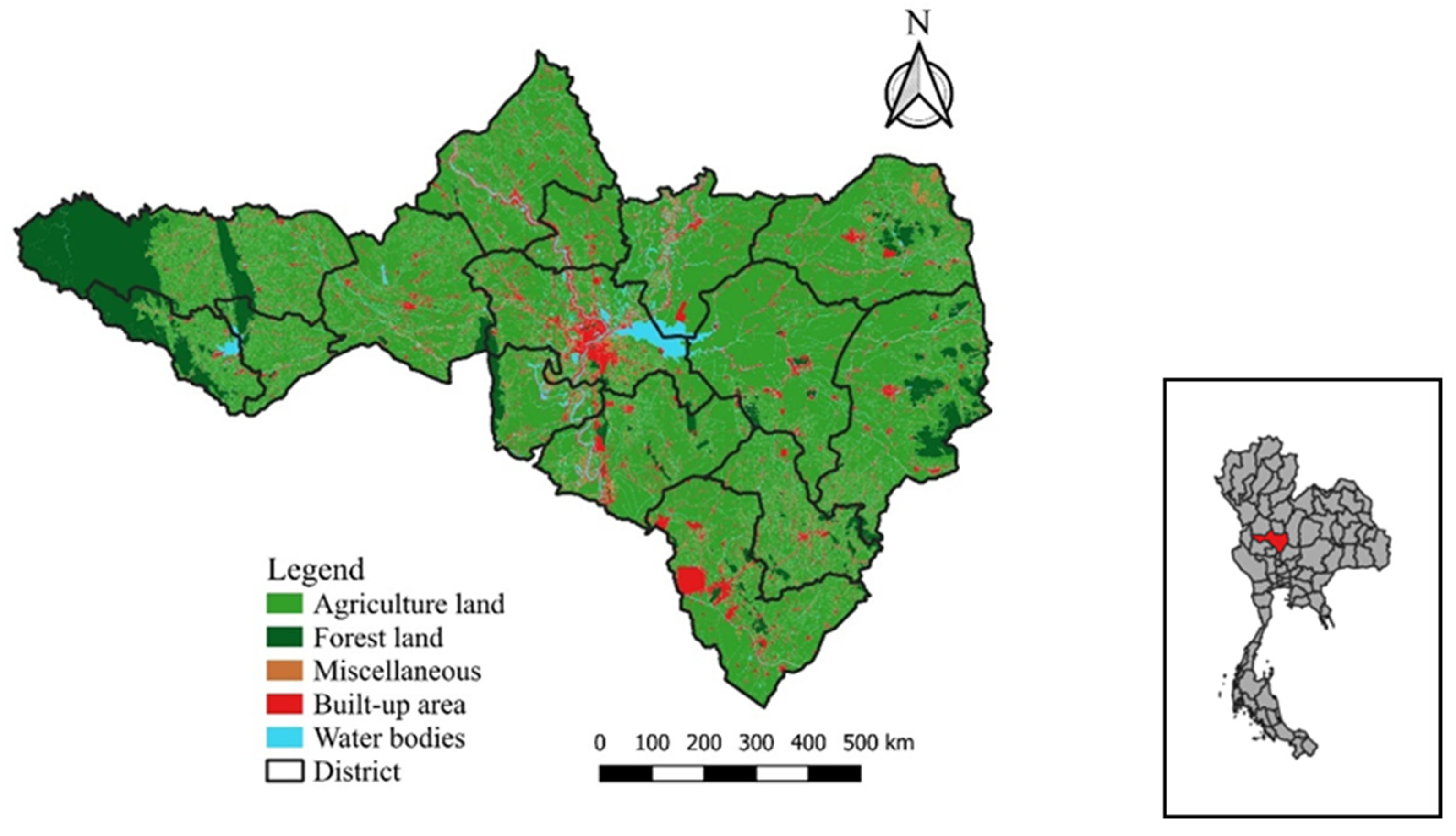
2.1. Study Area
2.2. Data Sources
2.3. Qualitative Field Observation via Semi-Structured Interview
2.4. Land Degradation Assessment
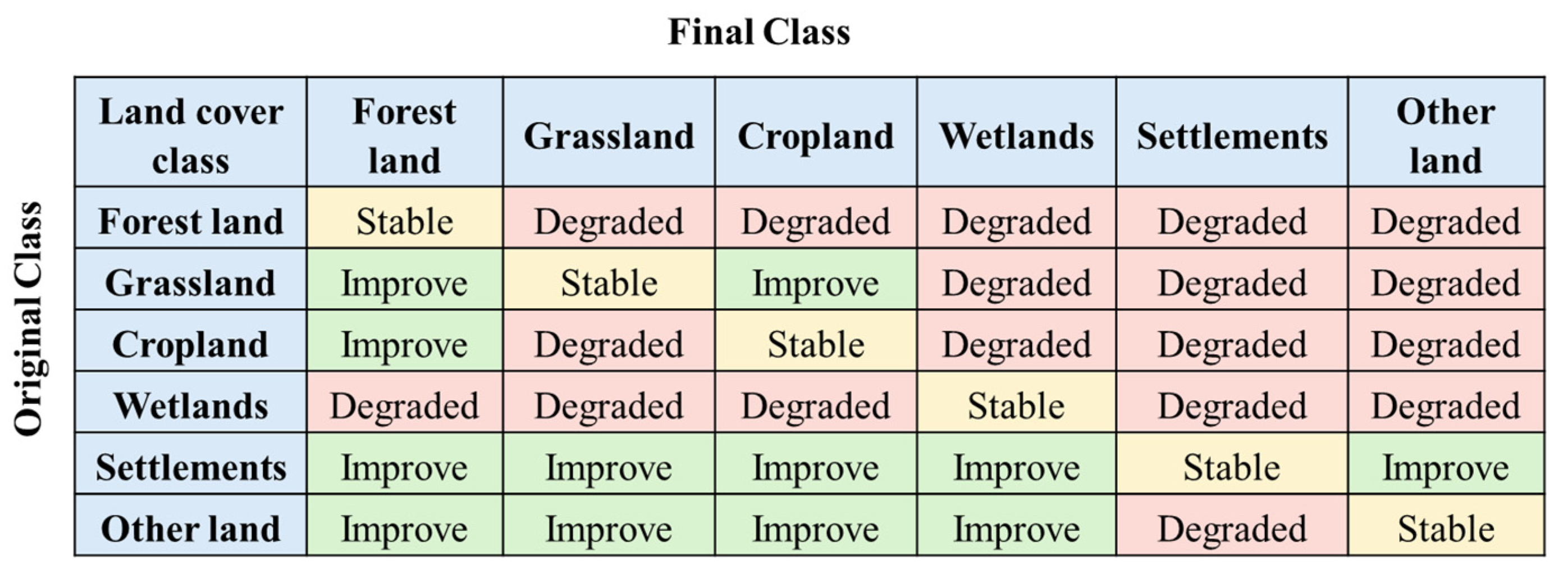
2.4.1. Land-Use and Land-Cover (LULC) Degradation Assessment
2.4.2. Soil Organic Carbon (SOC) Stock Degradation Assessment
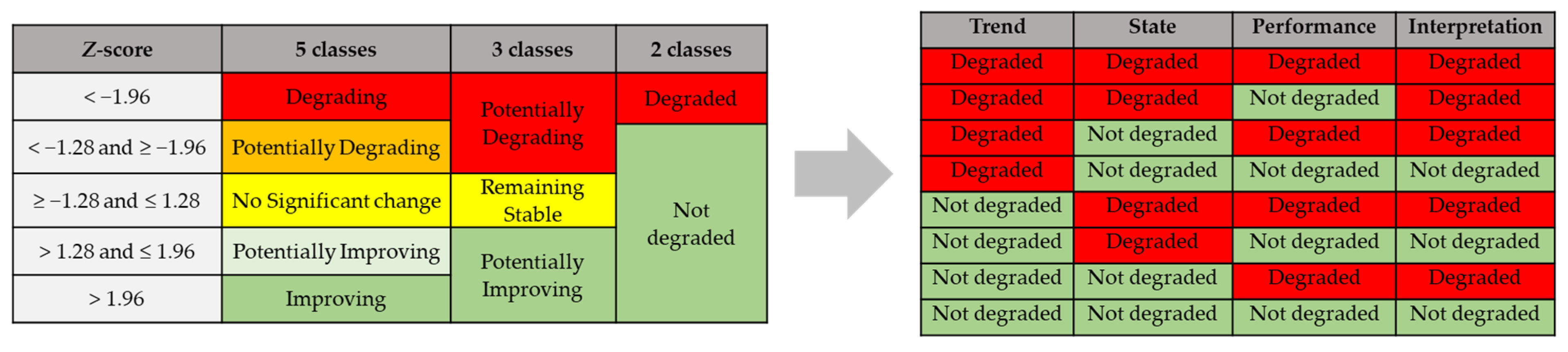
2.4.3. Land Productivity Degradation Assessment
3. Results and Discussion
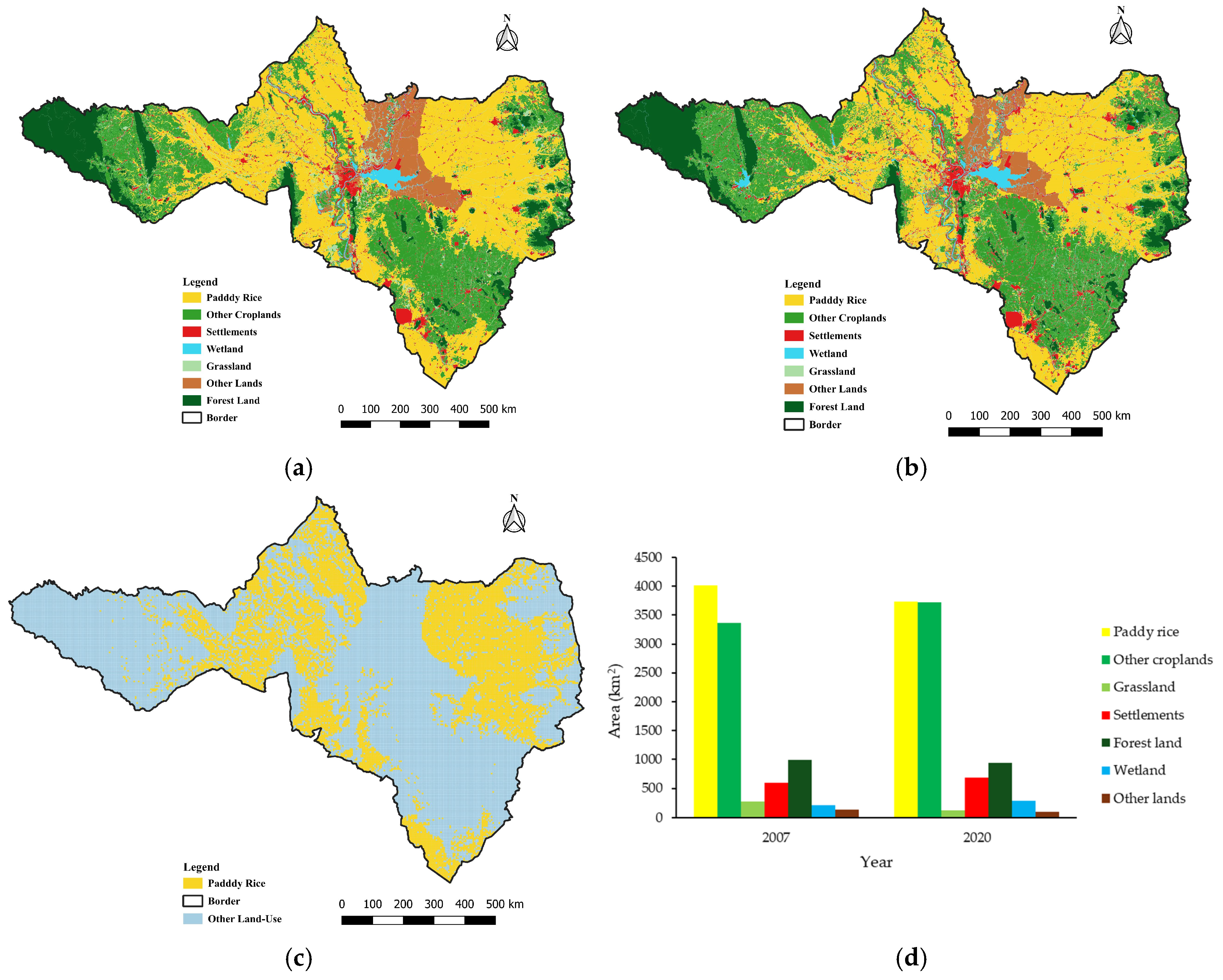
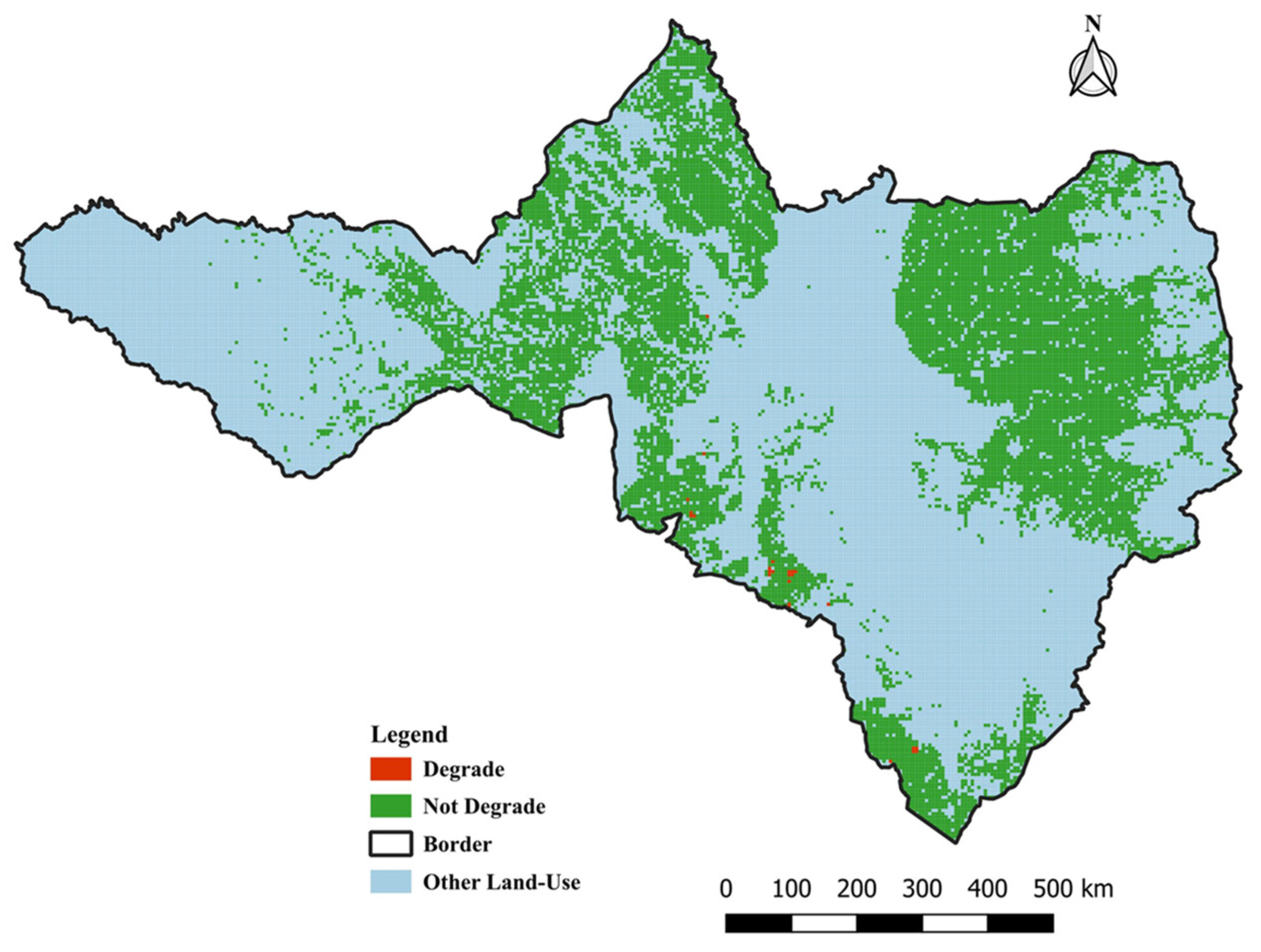
3.1. Land-Use and Land-Cover (LULC) Change Degradation Assessment
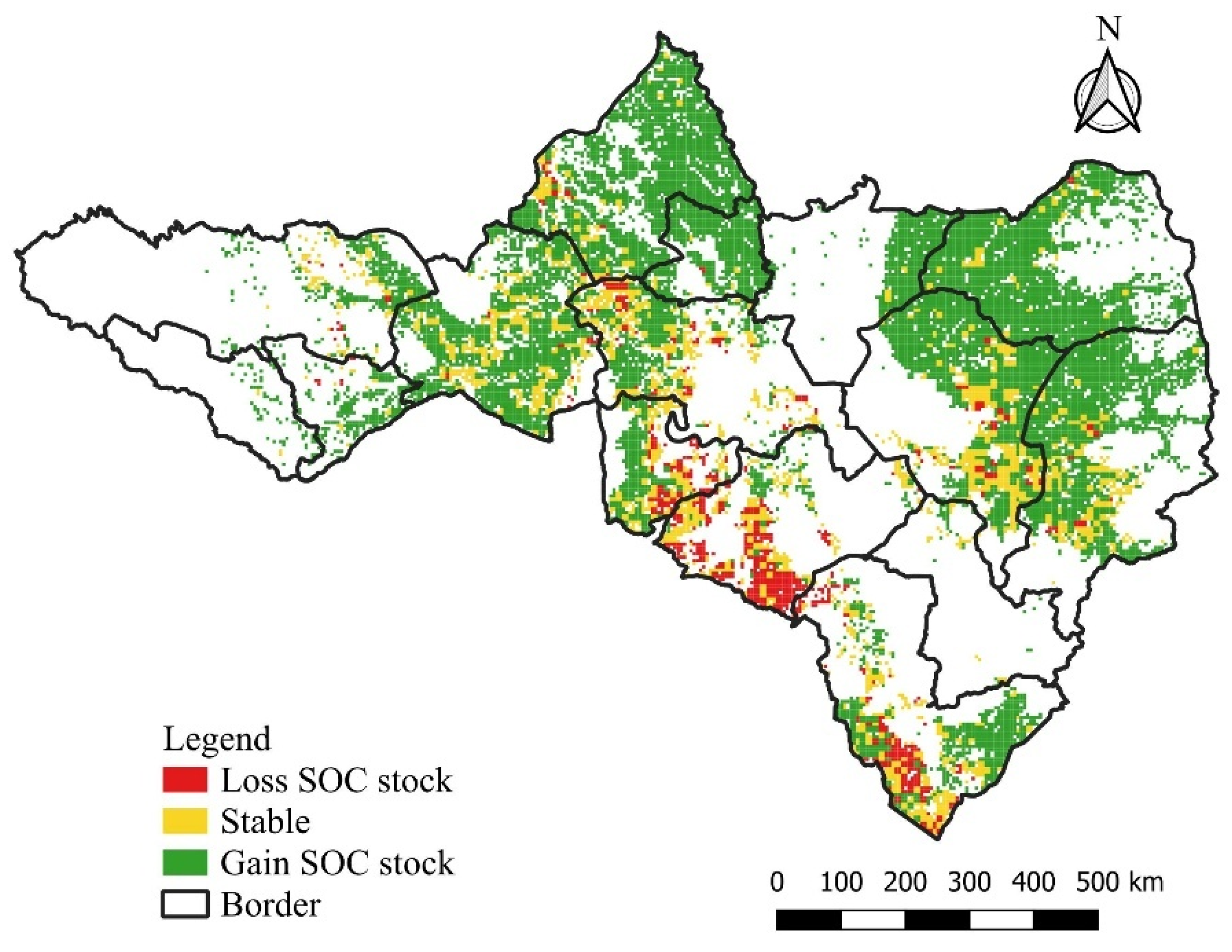
3.2. Soil Organic Carbon (SOC) Stock Changes: Degradation Assessment
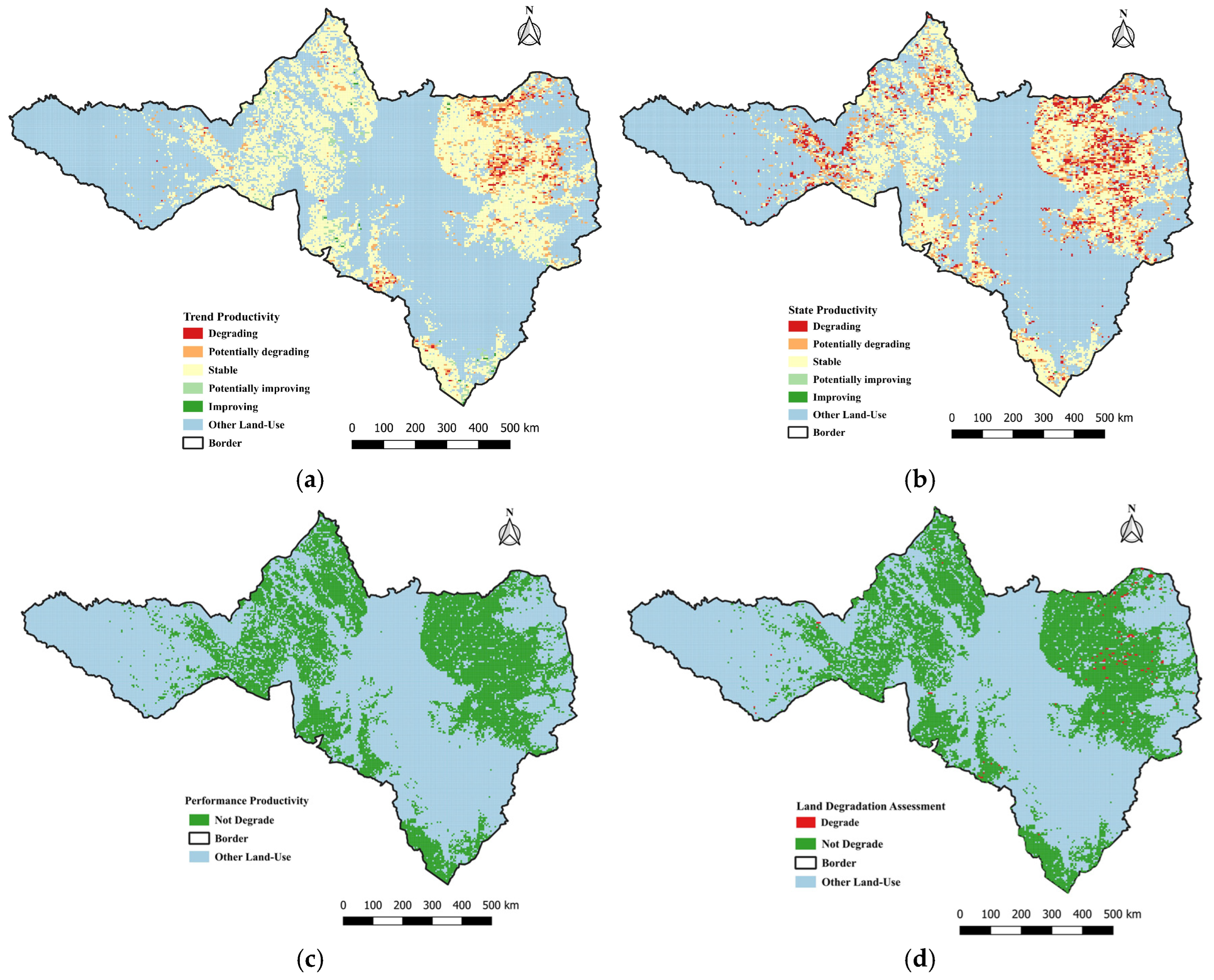
3.3. Land Productivity Sub-Indicator Degradation Assessment
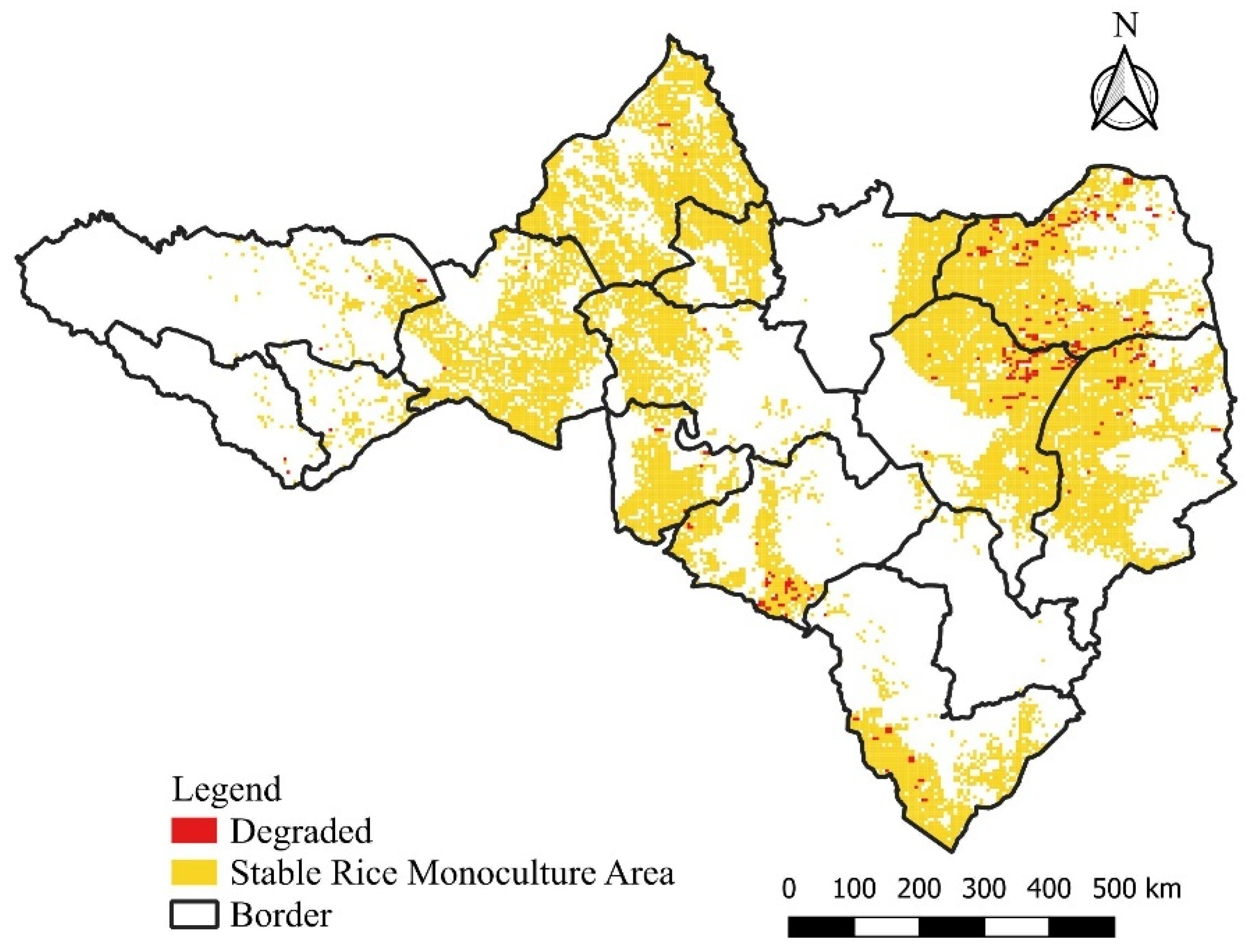
3.4. Rice Monoculture Land Degradation Assessment and Spatiotemporal Analysis of Rice Yield
4. Conclusions
Author Contributions
Funding
Institutional Review Board Statement
Data Availability Statement
Acknowledgments
Conflicts of Interest
Abbreviations
| LULC | Land Use and Land Cover |
| SOC | Soil Organic Carbon |
| UNCCD | United Nations Convention to Combat Desertification |
| SDG | Sustainable Development Goal |
| GAP | Good Agricultural Practices |
| LDD | Land Development Department |
| GIS | Geographic Information System |
| NPP | Net Primary Production |
| FPAR | Fraction of Photosynthetically Active Radiation |
| CASA | Carnegie–Ames–Stanford Approach |
References
- Ewunetu, A.; Kerbsh, A. Analysis land degradation using GIS in the upper tekeze basin. Sci. Afr. 2025, 29, e02912. [Google Scholar]
- Sharma, G.K.; Jinger, D.; Rashmi, I.; Kumar, K.; Natrajan, N.K.; Jena, R.K.; Kumar, R.; Kumar, S.; Kumari, K.; Kaushal, R.; et al. Degraded land: Assessment, impact restoration, and challenges. J. Environ. Manag. 2026, 398, 128471. [Google Scholar] [CrossRef]
- Mekuria, W.; Girma, R. Assessment of land degradation neutrality to guide Sustainable Land Management practices in Ethiopia. Environ. Chall. 2025, 19, 101137. [Google Scholar] [CrossRef]
- Dang, H.; Lü, Y.; Wang, X.; Sun, G.; Fu, B. Land degradation neutrality in mountainous region: Dynamics, driving factors, and management implications. Appl. Geogr. 2025, 181, 103691. [Google Scholar] [CrossRef]
- Fu, S.; Lei, J.; You, Y.; Zhou, N. Assessment of land degradation in the conventional lake Chad basin between 2001 and 2020 based on SDG 15.3.1. Environ. Sustain. Indic. 2025, 28, 101002. [Google Scholar] [CrossRef]
- Radha, A.V.; Garg, K.K.; Anantha, K.H.; Kumar, S.; Shukla, A.; Singh, R.; Das, B.S.; Jat, M.L. Restoration potential of degraded landscapes for strengthening rural livelihoods. Clean. Food Syst. 2026, 3, 100031. [Google Scholar] [CrossRef]
- Yu, Z.; Deng, X. Assessment of land degradation in the North China Plain driven by food security goals. Ecol. Eng. 2022, 183, 106766. [Google Scholar] [CrossRef]
- Sims, N.C.; Newnham, G.J.; England, J.R.; Guerschman, J.; Cox, S.J.D.; Roxburgh, S.H.; Viscarra Rossel, R.A.; Fritz, S.; Wheeler, I. Good Practice Guidance. SDG Indicator 15.3.1, Proportion of Land That Is Degraded Over Total Land Area; Version 2.0.; United Nations Convention to Combat Desertification: Bonn, Germany, 2021; pp. 19–71. [Google Scholar]
- Sims, N.C.; Barger, N.N.; Metternicht, G.I.; England, J.R. A land degradation interpretation matrix for reporting on UN SDG indicator 15.3.1 and land degradation neutrality. Environ. Sci. Policy 2020, 114, 1–6. [Google Scholar] [CrossRef]
- Peng, K.; Jiang, W.; Wang, X.; Hou, P.; Wu, Z.; Cui, T. Evaluation of future wetland changes under optimal scenarios and land degradation neutrality analysis in the Guangdong-Hong Kong-Macao Greater Bay Area. Sci. Total Environ. 2023, 879, 163111. [Google Scholar] [CrossRef]
- Thomas, A.; Bentley, L.; Feeney, C.; Lofts, S.; Robb, C.; Rowe, E.; Thomson, A.; Warren-Thomas, E.; Emmett, B. Land degradation neutrality: Testing the indicator in a temperature agriculture landscape. J. Environ. Manag. 2023, 346, 118884. [Google Scholar] [CrossRef]
- Bhattacharjee, S.; Basavareddy; Rajput, V.D.; Majumder, D.; Panja, A.; Kashyap, S.; Kumar, R. Assessing land degradation and drought vulnerability in the Trans-Gangetic Plains using Google Earth Engine and remote sensing for SDG 15.3.1 monitoring. Env. Monit. Assess. 2025, 197, 920. [Google Scholar] [CrossRef]
- Okpara, U.T.; Stringer, L.C.; Akhtar-Schuster, M.; Metternicht, G.I.; Dallimer, M.; Requier-Desjardins, M. A social-ecological systems approach is necessary to achieve land degradation neutrality. Environ. Sci. Policy 2018, 89, 59–66. [Google Scholar] [CrossRef]
- Bandumula, N. Rice Production in Asia: Key to Global Food Security. Proc. Natl. Acad. Sci. India Sect. B Biol. Sci. 2018, 88, 1323–1328. [Google Scholar] [CrossRef]
- Thailand Industry Outlook 2026–2028: Rice Industry. Available online: https://www.krungsri.com/getmedia/d7da7033-9bbd-445a-93c4-62735fa35571/IO_Rice_260121_EN_EX.pdf?ext=.pdf (accessed on 27 April 2026).
- Rice Sector at a Glance. Available online: https://www.ers.usda.gov/topics/crops/rice/rice-sector-at-a-glance/#:~:text=Globally%2C%20the%20top%20rice%2Dproducing,is%20China%2C%20followed%20by%20India.&text=1%20ton%20%3D%202%2C204.62%20pounds.,Production%2C%20Supply%20and%20Distribution%20database (accessed on 10 October 2023).
- Jacoby, R.; Peukert, M.; Succurro, A.; Koprivova, A.; Kopriva, S. The Role of Soil Microorganisms in Plant Mineral Nutrition—Current Knowledge and Future Directions. Front. Plant Sci. 2017, 8, 1617. [Google Scholar] [CrossRef] [PubMed]
- FAO. The Future of Food and Agriculture: Trends and Challenges; Food and Agriculture Organization: Rome, Italy, 2017. [Google Scholar]
- Suebpongsang, P.; Ekasingh, B.; Cramb, R. Commercialisation of Rice Farming in Northeast Thailand. In White Gold: The Commercialisation of Rice Farming in the Lower Mekong Basin; Cramb, R., Ed.; Springer Nature: Singapore, 2020; pp. 39–68. [Google Scholar]
- Shang, B.; Tian, T.; Mo, Y.; Zhang, H.; Zhang, K.; Agathokleous, E.; Ji, Y.; Feng, Z. Combined application of organic and inorganic fertilizers sustained rice yields and N accumulation and decreased soil-canopy system NH3 emission. Agric. Ecosyst. Environ. 2025, 377, 109260. [Google Scholar] [CrossRef]
- Commodity-Based Agricultural Economic Information 2024. Available online: https://oae.go.th/uploads/files/2025/05/06/13e8089a3f69ea96.pdf (accessed on 26 January 2025).
- Key Information of Nakhon Sawan Province 2025 [in Thai], Nakhon Sawan. Available online: https://www.nakhonsawan.go.th/joomla/attachments/article/8425/%E0%B8%82%E0%B9%89%E0%B8%AD%E0%B8%A1%E0%B8%B9%E0%B8%A5%E0%B8%99%E0%B8%84%E0%B8%A3%E0%B8%AA%E0%B8%A7%E0%B8%A3%E0%B8%A3%E0%B8%84%E0%B9%8C2568%E0%B8%89050368%E0%B8%88%E0%B8%B1%E0%B8%94.pdf (accessed on 10 January 2025).
- Agriculture Statistics of Thailand 2024. Available online: https://oae.go.th/uploads/files/2025/04/30/fd747711b82231d4.pdf (accessed on 26 January 2025).
- Land-Use Information. Available online: https://tswc.ldd.go.th/DownloadGIS/Index_Lu.html (accessed on 15 September 2021).
- OpenLandMap Annual Soil Organic Carbon. Available online: https://stac.openlandmap.org/log.oc_iso.10694/collection.json?.language=en (accessed on 5 January 2026).
- Long-Term Soil Bulk Density for Fine Earth. Available online: https://stac.openlandmap.org/bulkdens.fineearth_usda.4a1h/collection.json?.language=en (accessed on 5 January 2026).
- OpenGeoHub Foundation. Licensed under Creative Commons Attribution-ShareAlike 4.0 International; OpenGeoHub Foundation: Doorwerth, The Netherlands, 2026. [Google Scholar]
- MODIS/Terra Net Primary Production Gap-Filled Yearly L4 Global 500m SIN Grid V061 [Data Set]. Available online: https://www.earthdata.nasa.gov/data/catalog/lpcloud-mod17a3hgf-061 (accessed on 26 February 2026).
- Mann, H.B. Nonparametric tests against trend. Econometrica 1945, 13, 245–259. [Google Scholar] [CrossRef]
- Kendall, M.; Gibbons, J.D. Rank Correlation Methods, 5th ed.; Edward Arnold: London, UK, 1990. [Google Scholar]
- Fu, S.; Zhou, Y.; Lei, J.; Zhou, N. Changes in the spatiotemporal of net primary productivity in the conventional Lake Chad Basin between 2001 and 2020 based on CASA model. Atmosphere 2023, 14, 232. [Google Scholar] [CrossRef]
- Ghosh, A.; Rambaud, P.; Finegold, Y.; Jonckheere, I.; Martin-Ortega, P.; Jalal, R.; Adebayo, A.D.; Alvarez, A.; Borretti, M.; Caela, J.; et al. Monitoring sustainable development goal indicators 15.3.1 on land degradation using SEPAL: Examples, challenges and prospects. Land 2024, 13, 1027. [Google Scholar] [CrossRef]
- Liu, Y.; Ge, T.; Groenigen, K.J.; Yang, Y.; Wang, P.; Cheng, K.; Zhu, Z.; Wang, J.; Li, Y.; Guggenberger, G.; et al. Rice paddy soils are a quantitatively important carbon store according to a global synthesis. Commun. Earth Environ. 2021, 2, 154. [Google Scholar] [CrossRef]
- Sharma, R.P.; Kumar, N.; Karthikeyan, R.; Naitam, R.K.; Obi Reddy, G.P.; Ramamurthy, V.; Yadav, B.; Malav, L.C.; Jangir, A.; Nogiya, M.; et al. Impact of long-term rice-rice monocropping on soil properties and organic carbon stocks in the NSLC command area: A case study from Talangana, India. J. Indian Soc. Soil Sci. 2025, 73, 82–92. [Google Scholar] [CrossRef]
- Huailuek, N.; Silalertruksa, T.; Gheewala, S.H. Changes in Paddy Rice Net Primary Production (NPP) in Thailand (2007–2018): Nakhon Sawan Case Study. In Proceedings of the 8th International Conference on Sustainable Energy and Environment (SEE 2022), Bangkok, Thailand, 7–9 November 2022. [Google Scholar]
- Naser, H.M.; Nagata, O.; Sultana, S.; Hatano, R. Carbon sequestration and contribution of CO2, CH4 and N2O fluxes to global warming potential from paddy-fallow fields on mineral soil beneath peat in Central Hokkaido, Japan. Agriculture 2020, 10, 6. [Google Scholar] [CrossRef]
- Dai, Z.; Zhou, F.; Zhang, P.; Nie, M.; Sun, K.; Xing, B.; Wang, Z. Long-term flooding mitigates the linkage between paddy soil organic carbon sink and climate factors. ACS Earth Space Chem. 2024, 8, 1495–1504. [Google Scholar] [CrossRef]
- Feng, S.; Zhao, W.; Yan, J.; Xia, F.; Pereira, P. Land degradation neutrality assessment and factors influencing it in China’s arid and semiarid regions. Sci. Total Environ. 2024, 925, 171735. [Google Scholar] [CrossRef] [PubMed]



| Sub-Indicators | Data | Resolution | Period | Description |
|---|---|---|---|---|
| LULC | Land-use information (polygon) a | - | 2007–2020 | Provides land-use type in Nakhon Sawan. |
| SOC stock change | Annual soil organic carbon (OpenLandMap) b | 1 km | 2007–2018 | Provides annual soil organic carbon (g kg−1) at 30 cm soil depth. |
| Soil bulk density (OpenLandMap) c | 250 m | 2007–2018 | Provides average soil bulk density ( kg m−3) at 30 cm soil depth | |
| Land productivity | Net Primary Production (NPP) d | 500 m | 2007–2022 | The MOD17A3HGF provides information about annual NPP. |
| LULC 2007 | LULC 2020 (Transition Categories) | |||||
|---|---|---|---|---|---|---|
| Paddy Rice | Other Croplands | Grassland | Settlements | Wetland | Other Lands | |
| Paddy rice | 3304.25 km2 | 509.75 km2 | 6.25 km2 | 53 km2 | 30.25 km2 | 71.75 km2 |
| 83.12% | 12.82% | 0.16% | 1.33% | 0.76% | 1.80% | |
| District | The Proportional Area of SOC Stock Changes | ||
|---|---|---|---|
| Decrease ( | Stable ( | Increase ( | |
| Banphot Phisai | 1.4% | 7.9% | 90.7% |
| Nongbua | 0.2% | 4.8% | 95% |
| Chum Saeng | 0% | 3.8% | 96.2% |
| Kao Liew | 0.6% | 2.8% | 96.7% |
| Mae Wong | 3.8% | 20.5% | 75.7% |
| Lat Yao | 0.7% | 23.3% | 76% |
| Mueang Nakhon Sawan | 9.3% | 37.3% | 53.4% |
| Tha Ta Ko | 3.4% | 25.2% | 71.4% |
| Phai Sali | 1.3% | 16% | 82.7% |
| Chum Ta Bong | 2.4% | 3.9% | 93.7% |
| Krok Phra | 21% | 34.5% | 44.5% |
| Phayuha Khiri | 48.1% | 37.1% | 14.9% |
| Tak Fa | 0% | 33.3% | 66.7% |
| Ta Khli | 22.2% | 31.5% | 46.3% |
| District | The Proportional Area of Trend Productivity Status | ||||
|---|---|---|---|---|---|
| Degrading | Potentially Degrading | Stable | Potentially Improving | Improving | |
| Banphot Phisai | 0.4% | 5.3% | 91.2% | 2.8% | 0.3% |
| Nongbua | 8.2% | 29% | 62.7% | 0.1% | 0% |
| Chum Saeng | 0% | 9.4% | 87.1% | 2.4% | 1.1% |
| Kao Liew | 0% | 1.2% | 91.1% | 7.5% | 0.2% |
| Mae Wong | 2.8% | 14.8% | 82.1% | 0.3% | 0% |
| Lat Yao | 0.1% | 4.1% | 92.1% | 3.6% | 0% |
| Mueang Nakhon Sawan | 0% | 1.8% | 93.6% | 4.6% | 0% |
| Tha Ta Ko | 4.1% | 15.8% | 79% | 1.1% | 0% |
| Phai Sali | 2.9% | 14.1% | 81.9% | 1.1% | 0.1% |
| Chum Ta Bong | 0.8% | 9.9% | 89.3% | 0% | 0% |
| Krok Phra | 0.5% | 0.7% | 90.6% | 7.2% | 0.9% |
| Phayuha Khiri | 3.8% | 15.2% | 78.2% | 2.4% | 0.5% |
| Tak Fa | 0% | 14.3% | 85.7% | 0% | 0% |
| Ta Khli | 1.5% | 6.4% | 82.2% | 8.2% | 1.7% |
| District | The Proportional Area of State Productivity Status | ||||
|---|---|---|---|---|---|
| Degrading | Potentially Degrading | Stable | Potentially Improving | Improving | |
| Banphot Phisai | 9.6% | 16% | 74.3% | 0.1% | 0% |
| Nongbua | 23.9% | 24.1% | 52% | 0% | 0% |
| Chum Saeng | 18% | 23.4% | 58.6% | 0% | 0% |
| Kao Liew | 2.3% | 6.4% | 91.3% | 0% | 0% |
| Mae Wong | 23.3% | 34.4% | 42.3% | 0% | 0% |
| Lat Yao | 13.2% | 23.8% | 62.7% | 0.3% | 0% |
| Mueang Nakhon Sawan | 2.7% | 12.1% | 84.9% | 0.3% | 0% |
| Tha Ta Ko | 14.6% | 26.8% | 58.5% | 0.1% | 0% |
| Phai Sali | 15.8% | 21.3% | 62.8% | 0.1% | 0% |
| Chum Ta Bong | 25.2% | 24.4% | 50.4% | 0% | 0% |
| Krok Phra | 4.3% | 15% | 80.5% | 0.2% | 0% |
| Phayuha Khiri | 11.8% | 24.4% | 63.8% | 0% | 0% |
| Tak Fa | 24.2% | 33.3% | 42.4% | 0% | 0% |
| Ta Khli | 5.1% | 12.7% | 81.3% | 0.6% | 0.3% |
| Months | NDVI | FPAR | Water Factors | Solar Radiation (MJ) | Sunshine Duration (Hours) | Temperature (°C) | Effective Rainfall (mm) | Precipitation (Days) | NPP (gC m−2) |
|---|---|---|---|---|---|---|---|---|---|
| Average Values (unit/month) | |||||||||
| 2007 | 0.52 | 0.49 | 0.98 | 553 | 217 | 28.4 | 64 | 11 | 69.3 |
| 2012 | 0.53 | 0.50 | 0.99 | 535 | 198 | 29.1 | 62 | 11 | 67.4 |
| 2018 | 0.54 | 0.49 | 0.99 | 545 | 205 | 28.2 | 49 | 9 | 68.8 |
| Monthly Values | |||||||||
| January | 0.43–0.50 | 0.46–0.50 | 0.98–0.99 | 425–475 | 193–262 | 25.3–26.7 | 0–18 | 2–5 | 51.1–54.0 |
| February | 0.40–0.48 | 0.47–0.50 | 0.91–1.00 | 458–520 | 221–275 | 26.4–28.7 | 0–26 | 1–4 | 56.0–58.6 |
| March | 0.36–0.45 | 0.46–0.48 | 0.96–0.99 | 574–600 | 174–267 | 29.8–30.6 | 0–15 | 1–5 | 66.0–73.4 |
| April | 0.40–0.46 | 0.47–0.48 | 0.97–0.98 | 537–651 | 221–268 | 29.9–31.7 | 40–78 | 5–11 | 64.8–79.4 |
| May | 0.46–0.56 | 0.48–0.51 | 0.99–1.00 | 565–667 | 180–202 | 29.4–30.1 | 98–141 | 16–22 | 74.3–84.6 |
| June | 0.55–0.58 | 0.50–0.51 | 0.99–1.00 | 541–605 | 143–200 | 28.1–29.4 | 72–99 | 13–23 | 70.6–88.4 |
| July | 0.48–0.57 | 0.50–0.51 | 0.99–1.00 | 502–535 | 118–184 | 28.1–28.7 | 83–132 | 16–20 | 65.1–78.3 |
| August | 0.52–0.60 | 0.49–0.51 | 0.99–1.00 | 488–549 | 138–169 | 28.1–28.6 | 51–149 | 17–22 | 62.8–70.5 |
| September | 0.56–0.63 | 0.49–0.54 | 0.99–1.00 | 470–546 | 141–203 | 27.7–28.5 | 44–159 | 11–20 | 58.5–75.0 |
| October | 0.63–0.68 | 0.53–0.54 | 0.98–1.00 | 507–573 | 185–203 | 28.1–29.1 | 17–129 | 5–17 | 71.0–79.0 |
| November | 0.56–0.63 | 0.48–0.51 | 0.97–1.00 | 452–496 | 195–267 | 27.3–29.1 | 0–45 | 3–6 | 58.3–60.1 |
| December | 0.47–0.56 | 0.47–0.49 | 0.96–0.99 | 507–617 | 226–287 | 26.9–29.1 | 0–13 | 0–6 | 59.0–76.7 |
| District | System | Rice Yield (kg ha−1) | Slope (Trend) | p-Value | |||
|---|---|---|---|---|---|---|---|
| Mean | Max | Min | CV (%) | ||||
| Banphot Phisai | Major | 3319 | 3994 | 2500 | 14.18 | −18.79 | 0.5385 |
| Second | 4513 | 5231 | 3750 | 9.84 | −26.07 | 0.3615 | |
| Nongbua | Major | 3195 | 3913 | 2581 | 13 | −46 | 0.0712 |
| Second | 4436 | 5163 | 3831 | 9.33 | −42.39 | 0.0988 | |
| Chum Saeng | Major | 3334 | 3906 | 2581 | 13.23 | −45.27 | 0.0979 |
| Second | 4632 | 5269 | 3831 | 9.72 | −52.23 | 0.057 | |
| Kao Liew | Major | 3142 | 3863 | 2525 | 12.52 | −6 | 0.8153 |
| Second | 4461 | 5113 | 3775 | 9.19 | +3.42 | 0.8986 | |
| Mae Wong | Major | 3083 | 3963 | 2575 | 14.42 | −33.15 | 0.2417 |
| Second | 4428 | 5213 | 3756 | 10.39 | −2.12 | 0.9438 | |
| Lat Yao | Major | 3148 | 4025 | 2556 | 14.54 | +32.88 | 0.2602 |
| Second | 4442 | 5275 | 3825 | 10.48 | +43.55 | 0.1353 | |
| Mueang Nakhon Sawan | Major | 3169 | 4056 | 2500 | 17.58 | −8.35 | 0.8187 |
| Second | 4387 | 5250 | 3750 | 12.14 | −14.6 | 0.6742 | |
| Tha Ta Ko | Major | 3274 | 3925 | 2588 | 15.83 | −9.4 | 0.7814 |
| Second | 4559 | 5194 | 3838 | 11.39 | −33.33 | 0.3172 | |
| Mae Poen | Major | 3224 | 3725 | 2594 | 10.05 | +13.42 | 0.5235 |
| Second | 4586 | 5163 | 3888 | 8.38 | −34.31 | 0.1559 | |
| Phai Sali | Major | 3289 | 3950 | 2588 | 12.87 | −34.78 | 0.1942 |
| Second | 4485 | 5200 | 3813 | 9.23 | −26.32 | 0.3218 | |
| Chum Ta Bong | Major | 3372 | 3925 | 2569 | 13.15 | +2.68 | 0.9264 |
| Second | 4675 | 5200 | 3819 | 9.62 | +0.80 | 0.9782 | |
| Krok Phra | Major | 3225 | 4006 | 2569 | 15.63 | −50.27 | 0.1089 |
| Second | 4333 | 5225 | 3819 | 9.87 | −28.86 | 0.2918 | |
| Phayuha Khiri | Major | 3347 | 3888 | 2550 | 13.74 | −3.35 | 0.9114 |
| Second | 4491 | 5138 | 3800 | 9.11 | +26.25 | 0.3173 | |
| Tak Fa | Major | 3243 | 4044 | 2506 | 15.65 | −47.9 | 0.1315 |
| Second | 4548 | 5294 | 3756 | 11.41 | −50.18 | 0.121 | |
| Ta Khli | Major | 3274 | 3850 | 2594 | 11.14 | −4.84 | 0.839 |
| Second | 4551 | 5100 | 3925 | 7.3 | −11.18 | 0.6049 | |
Disclaimer/Publisher’s Note: The statements, opinions and data contained in all publications are solely those of the individual author(s) and contributor(s) and not of MDPI and/or the editor(s). MDPI and/or the editor(s) disclaim responsibility for any injury to people or property resulting from any ideas, methods, instructions or products referred to in the content. |
© 2026 by the authors. Licensee MDPI, Basel, Switzerland. This article is an open access article distributed under the terms and conditions of the Creative Commons Attribution (CC BY) license.
Share and Cite
Huailuek, N.; Silalertruksa, T.; Gheewala, S.H. Assessing the Effect of Intensive Rice Monoculture on Land Degradation Under the SDG 15.3.1 Framework. Agriculture 2026, 16, 1301. https://doi.org/10.3390/agriculture16121301
Huailuek N, Silalertruksa T, Gheewala SH. Assessing the Effect of Intensive Rice Monoculture on Land Degradation Under the SDG 15.3.1 Framework. Agriculture. 2026; 16(12):1301. https://doi.org/10.3390/agriculture16121301
Chicago/Turabian StyleHuailuek, Nattaya, Thapat Silalertruksa, and Shabbir H. Gheewala. 2026. "Assessing the Effect of Intensive Rice Monoculture on Land Degradation Under the SDG 15.3.1 Framework" Agriculture 16, no. 12: 1301. https://doi.org/10.3390/agriculture16121301
APA StyleHuailuek, N., Silalertruksa, T., & Gheewala, S. H. (2026). Assessing the Effect of Intensive Rice Monoculture on Land Degradation Under the SDG 15.3.1 Framework. Agriculture, 16(12), 1301. https://doi.org/10.3390/agriculture16121301