Article

Effects of Drought Stress, Apera spica-venti (L.) Beauv. Competition, and Biostimulants on Morphological and Nutritional Traits of Winter Wheat—Part 1


Institute of Agroecology and Plant Production, Wrocław University of Environmental and Life Sciences, Grunwaldzki Sq. 24A, 53-363 Wrocław, Poland
*
Author to whom correspondence should be addressed.
Agriculture 2026, 16(12), 1283; https://doi.org/10.3390/agriculture16121283
Submission received: 9 May 2026 / Revised: 4 June 2026 / Accepted: 5 June 2026 / Published: 10 June 2026
(This article belongs to the Section Crop Production)

Abstract

Agroecosystems are perpetually subjected to environmental factors. Driven by a shifting global climate, soil moisture deficits represent an increasingly frequent threat to crop productivity. In farming, however, these abiotic stressors seldom occur in isolation, as fields are invariably compounded by biotic weed pressure. Consequently, investigating plant responses to such combinatorial, multi-faceted stress is paramount to evaluating the realistic efficacy of modern agrotechnical interventions. A 2-year, three-factor pot experiment was conducted at the Research and Education Station in Swojczyce, belonging to the Wrocław University of Environmental and Life Sciences. The aim of the study was to examine the response of winter wheat (Triticum aestivum L., cv. Agil) to drought stress during the period when cereal plants were at the 51–65 BBCH developmental stages. Additionally, in some pots with winter wheat, Apera spica-venti (L.) Beauv. was sown as a weed to evaluate the effects of biotic stress. To observe the mitigation of stressors, three different types of biostimulants were used—a silicon-based preparation and two seaweed-based preparations derived from Ecklonia maxima (Osbeck) Papenfuss and Ascophyllum nodosum (L.) Le Jolis, respectively, representing structural, morphological, and biochemical defense strategies. Drought stress significantly and negatively affected the length of the wheat main stem, lateral tillers, and lateral spikes, as well as the weight of the main wheat spike. The simultaneous occurrence of drought stress and A. spica-venti competition resulted in the greatest cumulative reduction in main spike weight. Furthermore, drought stress was associated with an increase in nitrogen/protein content and potassium content in wheat straw. The presence of A. spica-venti significantly reduced both the weight of the main wheat spike and the number of non-productive tillers. The limited effectiveness of biostimulants may be associated with the severity and timing of stress exposure during reproductive development.

1. Introduction

Dynamic weather conditions and associated abiotic stresses during the growing season can differentially affect crop growth and development [1,2,3,4,5]. Plants can avoid or tolerate such stress [6,7,8,9], depending on the intensity and duration of the stress factor. Prolonged exposure to abiotic stress during sensitive growth stages inhibits plant growth and development and consequently reduces yield [5,10,11,12,13,14,15,16].
Stress factors disrupt physiological and metabolic processes, reducing crop yield and yield components, such as spike number, grains per spike, and thousand-grain weight [3].
The decline in cereal crop yields depends on the timing of the stress; consequently, drought stress can have varying effects on the further development of the plant.
Drought stress at emergence impairs initial crop growth and yield [17,18], while drought during tillering and jointing significantly reduces tiller and spike counts, grains per spike, and thousand-grain weight [19,20]. According to Svobodová [21], water deficit during stem elongation leads to the withering of established tillers, while drought during floret formation reduces floret development and grain number. When water stress begins at stem elongation, plants compensate by producing productive tillers later in development. This prior deficit does not lower the thousand-grain weight; however, grain protein content increases due to reduced pot yield. During flowering, drought decreases total grain weight per plant [22]. Additionally, Samarah [23] showed that drought stress during grain filling shortens the filling duration and reduces yield by decreasing the number of tillers, spikes, and grains per plant, as well as individual grain weight.
According to the literature, the effects of environmental stress are associated with the formation and accumulation of reactive oxygen species (ROS) [12,24], which can react with cellular components and cause molecular modifications [12]. Reactive oxygen species are generated by factors such as intense light, high temperature, cold, frost, drought, heavy metals, and pathogens [6,25]. However, plants have the ability to adapt to stress and minimize its effects. This ability ensures proper metabolic processes, enabling plants to yield successfully. To increase plant resistance to adverse weather conditions, agricultural producers are increasingly using biostimulants, which function to enhance tolerance by strengthening cell walls [26,27].
Currently, a wide range of biostimulant products is available on the market, differing in composition and mode of application. Notwithstanding this diversity, their common principle of action is to enhance plant resilience by activating natural defense mechanisms [28,29]. Often, their effects become apparent only upon the occurrence of stress [27].
This study aimed to investigate the response of winter wheat to drought stress. In addition, another factor that could increase stress in plants is the weed Apera spica-venti (L.) Beauv., which was also sown in pots with winter wheat. To mitigate these stress factors, three biostimulants were applied to compare their efficacy: silicon (Si), Ecklonia maxima (Osbeck) Papenfuss, and Ascophyllum nodosum (L.) Le Jolis.
The selection of the three specific biostimulants—silicon (Si), E. maxima, and A. nodosum—was based on their distinct and complementary modes of action, representing structural, morphological, and biochemical defense strategies.
The choice of A. spica-venti as a weed was dictated by its dominant economic importance in the weed community of cereal crops in Central Europe. This species is characterized by exceptional ecological plasticity, which makes it an extremely aggressive competitor under conditions of limited water availability.
While the individual effects of drought or weed competition are well-documented, investigating their concurrent impact combined with the application of biostimulants represents a novel approach.

2. Materials and Methods

A three-factor pot experiment was conducted at the Research and Education Station in Swojczyce, belonging to the Wrocław University of Environmental and Life Sciences. The experiment was conducted in 2020–2021 and 2021–2022 using the independent series method with four replications.

2.1. Winter Wheat

The experimental plant material consisted of winter wheat (Triticum aestivum L., cv. Agil). Wheat was sown on 13 October 2020 and 11 October 2021 in pots with a 10 kg capacity. According to the experimental design, the pots were divided into two treatments: a pure wheat treatment with 12 plants per pot, and a mixed treatment where 12 Apera spica-venti (L.) Beauv., plants were added to the 12 wheat plants.
During the winter period, the pots were embedded in the soil.

2.2. Water Stress

Water stress was induced by reducing soil moisture from 65% to 30% of the capillary water capacity.
Induction of Water Stress (65% → 30% CWC): Before starting the experiment, the maximum capillary water-holding capacity (CWC) of the soil was determined using the laboratory column method. The control plants were maintained at 65% CWC. For the drought-stressed group, irrigation was completely withheld, allowing the soil to dry down naturally through evapotranspiration. This transition from 65% to 30% CWC was achieved gradually over a period of 5 days. The day the soil moisture hit 30% CWC was marked as Day 0 of the stress period. The total duration of the maintained 30% CWC stress was 9 days.
Method for Maintaining 30% CWC: To counteract daily water loss from transpiration and evaporation, a daily gravimetric (weighing) approach was utilized:
Target Weight Calculation: For each pot, a target weight corresponding to 30% CWC was calculated beforehand based on the known weight of the empty pot, the dry mass of the soil, and the water mass at 100% CWC.
Daily Replenishment: Every day, each pot was weighed on a laboratory scale. The weight deficit (Target Weight − Current Weight) was calculated, and that exact amount of water was replenished, distributing it evenly across the soil surface. This kept the soil moisture strictly at 30% ± 2% CWC throughout the entire stress period. Cereal plants were at developmental stages 51–65 on the BBCH scale.
Water stress was applied to better demonstrate the effect of the biostimulants (Table 1).

2.3. Biostimulant Application

The preparations were applied to cereal plants as a spray, in accordance with the manufacturer’s recommendations, and selected biopreparations with active substances: SiO2 (200 g·L−1, 16.5% (w/w)—OPTYSIL®/Intermag, Olkusz, Poland—Silicon dioxide (CAS: 7631-86-9), Ethylenediaminetetraacetic acid iron (II) disodium salt (CAS: 19529-38-5), Ethylenediaminetetraacetic acid iron (III) sodium salt (CAS: 15708-41-5), N-(2-hydroxyethyl) ethylenediaminetriacetic acid iron (III) sodium salt (CAS: 51181-50-1), D-mannitol (CAS: 69-65-8), Iron (II) sulfate (CAS: 7782-63-0)), Ecklonia maxima (Osbeck) Papenfuss—Kelpak SL/Kelp Products Ltd., Cape Town, South Africa—100% Liquid seaweed concentrate; 11.0 mg/L of auxin and 0.031 mg/L of cytokinin, pH: 4.4–4.6; Specific Gravity: 1.02–1.05), and Ascophyllum nodosum (L.) Le Jolis—Phytoamin®/Lebosol®, Dünger GmbH, Elmstein, Germany—Cold-pressed brown seaweed liquid (A. nodosum): 0.16% N (2 g/L total nitrogen), 1.45% K2O (15 g/L potassium oxide), 0.23% S (sulfur), Coformulants: 4.5% organic matter, <0.5% preservative (1,2-Benzisothiazol-3(2H)-one), Parameters: pH 9, density 1.0 kg/L.). The plants were treated with the given preparations in the spray chamber located at the Research and Education Station at the recommended development stages (Table 2).

2.4. Soil

The soil used for the experiment was brown alluvial soil, characteristic of the fertile wheat complex. Samples were taken with an Egner stick according to PN-R-04031:1997 [30] from 0 to 20 cm depth. Subsamples were mixed to contain one composite sample for the determination of pH by using pH/Jonometr CPI-502 (Elmetron, Zabrze, Poland) (pH determination by potentiometry, precision ±0.002 pH), total Kjeldahl N [31,32] using Büchi K-355 Distillation Unit (Büchi, Flawil, Switzerland) (Recovery rate ≥ 99.5%, Reproducibility (RSD) ≤ 1%, Detection limit ≥ 0.1 mg nitrogen).
Total P and K using the Egner–Riehm method [33,34,35], for P using Thermo Helios Aquamate 9423 AQA2000E (Thermo Electron Corporation, Altrincham, UK) and K Flame Photometers (BWB Technologies (Newbury, Berkshire, UK) (Specificity/K = ≤1% to each other when equal in concentration at <100 ppm), limit of detection (LOD K—0.02 ppm) and limit of quantification (LOQ K—0.05 ppm). Assimilable magnesium content was determined by the titanium yellow spectrophotometric method (Schachtschabel method) using Thermo Helios Aquamate 9423 AQA 2000E (Thermo Electron Corporation, Altrincham, UK) in accordance with Polish standards (PN-R-04020:1994/Az1:2004, 1994) [36]. In turn, the organic carbon (OC) was determined using a commercial Behr C50 IRF carbon analyzer (Labor–Technik GmbH, Dusseldorf, Germany) and the humus (organic matter) content in the samples was calculated using the conversion factor 1.724 [37] (Table 3).
Phosphorus and potassium (P and K) fertilization was applied in autumn, at the time of experiment establishment. In spring, nitrogen (N) was applied at the tillering stage (BBCH 24) at a rate of 70 kg·ha−1, followed by a second nitrogen application of 50 kg·ha−1 at the flag leaf sheath swelling stage (BBCH 40).

2.5. Chemical Analysis of Plant Material

Chemical analyses were performed on the winter wheat straw. Total nitrogen in the wheat straw was determined via the Kjeldahl method [33] using a Büchi Distillation Unit K-355 (Büchi, Flawil, Switzerland). The analytical parameters for this equipment included a recovery rate of ≥99.5%, reproducibility (RSD) of ≤1%, and a detection limit of 0.1 mg of nitrogen. Total potassium was determined via flame photometry using a BWB XP flame photometer (BWB Technologies, Newbury, Berkshire, UK). The instrument parameters included a specificity of <1% (when equal in concentration at <100 ppm), a limit of detection (LOD) of 0.02 ppm, and a limit of quantification (LOQ) of 0.05 ppm. Total phosphorus was determined via the colorimetric method using a SPEKOL 11 spectrophotometer (VEB Carl Zeiss JENA, Jena, Germany).

2.6. Statistical Analysis

The data were analyzed using Statistica 14.1 software (StatSoft Polska sp. z o.o., Kraków, Poland). The effects of the three experimental factors: water stress (WS; two levels: 65% and 30% CWC), weed infestation (WI; two levels: absent, A. spica-venti present), and biostimulant application (B; four levels: untreated control, Optysil®, Kelpak SL, Phytoamin®), and all possible two-way and three-way interactions were evaluated by three-way analysis of variance (ANOVA) using a mixed model. The complete ANOVA results, including F-statistics and probability values for all main effects and interactions, are presented in Table 4 (morphological traits). Differences between means were determined using Tukey’s Honest Significant Difference (HSD) post hoc test at p ≤ 0.05. Pearson’s correlation coefficients (r) among the analyzed biometric and chemical traits were calculated and visualized as a heatmap in R (version 4.5.3) using the corrplot package, with statistical significance set at p ≤ 0.05.

3. Results

3.1. Morphological Traits of Winter Wheat

The results of three-way ANOVA for all morphological traits are presented in Table 4. Significant main effects and interactions are discussed in detail in the following subsections.

3.1.1. Main Stem Length

Water stress and weed infestation both significantly affected the length of the main stem of winter wheat, whereas biostimulant application had no significant effect (Table 4 and Table 5). Mean stem length was slightly but significantly lower under water-deficit conditions (48.4 cm) than under optimal soil moisture (49.8 cm; F = 10.62, p = 0.002). Plants grown in the presence of Apera spica-venti (L.) P.Beauv. also showed significantly shorter stems (48.2 cm) compared with weed-free plants (50.0 cm; F = 17.45, p < 0.001). Despite these statistically significant differences, the absolute reductions were small—1.4 cm and 1.8 cm for water stress and weed infestation, respectively—suggesting limited agronomic impact at the heading–flowering stage, by which stem elongation is already complete. None of the two- or three-way interactions among the tested factors produced significant effects on this trait.

3.1.2. Lateral Tiller Length

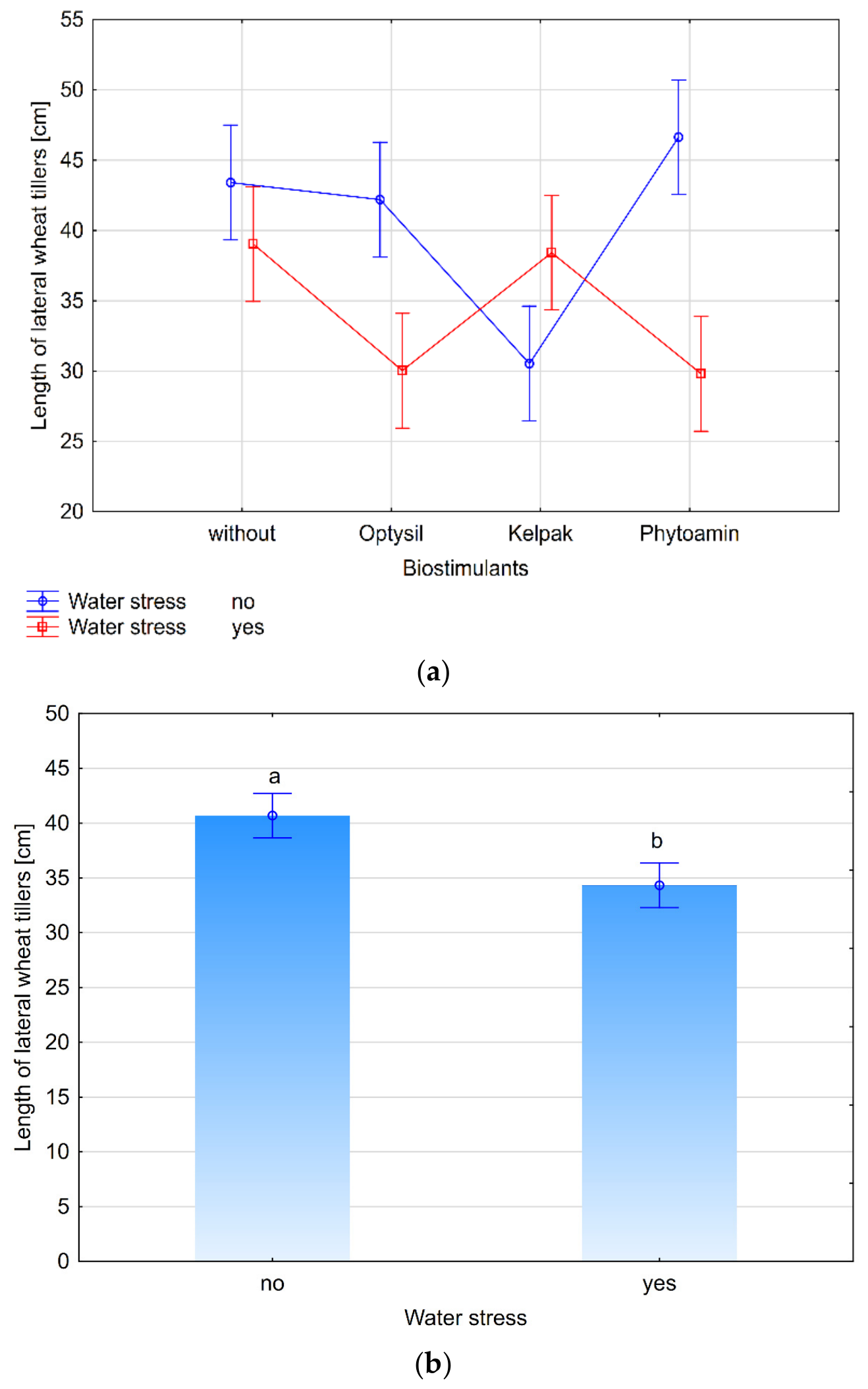
Drought stress significantly reduced the length of lateral wheat tillers (F = 4.872, p = 0.030), with mean values of 34.3 cm under water deficit compared with 40.7 cm under optimal soil moisture—a reduction of 15.7% (Table 4 and Figure 1a). Neither weed infestation nor biostimulant application, considered as main factors, produced significant effects on this trait. However, a significant interaction between water stress and biostimulant treatment was detected (F = 3.507, p = 0.018; Figure 1b). Under optimal soil moisture conditions, Kelpak SL-treated plants showed markedly shorter tillers (30.5 cm) than plants treated with Phytoamin® (46.7 cm), Optysil® (42.2 cm), or the untreated control (43.4 cm), suggesting that under well-watered conditions, this seaweed-based preparation may have interfered with vegetative elongation. Under water-deficit conditions, no such differentiation among biostimulant treatments was observed. No other two- or three-way interactions were statistically significant.

3.1.3. Main Spike Length

None of the three main factors—water stress, weed infestation, and biostimulant application—significantly affected the length of the main wheat spike (Table 4 and Table 6). Mean spike length ranged from 8.3 to 8.5 cm across all treatments, indicating that this trait was largely insensitive to the applied stressors at the heading–flowering stage. However, a significant three-way interaction among water stress, weed infestation, and biostimulant application was detected (F = 2.70, p = 0.050; Table 4). The longest spikes were recorded in weed-free plants grown under optimal soil moisture without biostimulant treatment (8.8 cm), whereas the shortest were observed in plants subjected simultaneously to drought stress, A. spica-venti competition, and Kelpak SL application (8.2 cm). Despite reaching statistical significance, the absolute difference between the extreme values was only 0.6 cm, which is unlikely to carry agronomic relevance.

3.1.4. Lateral Spike Length

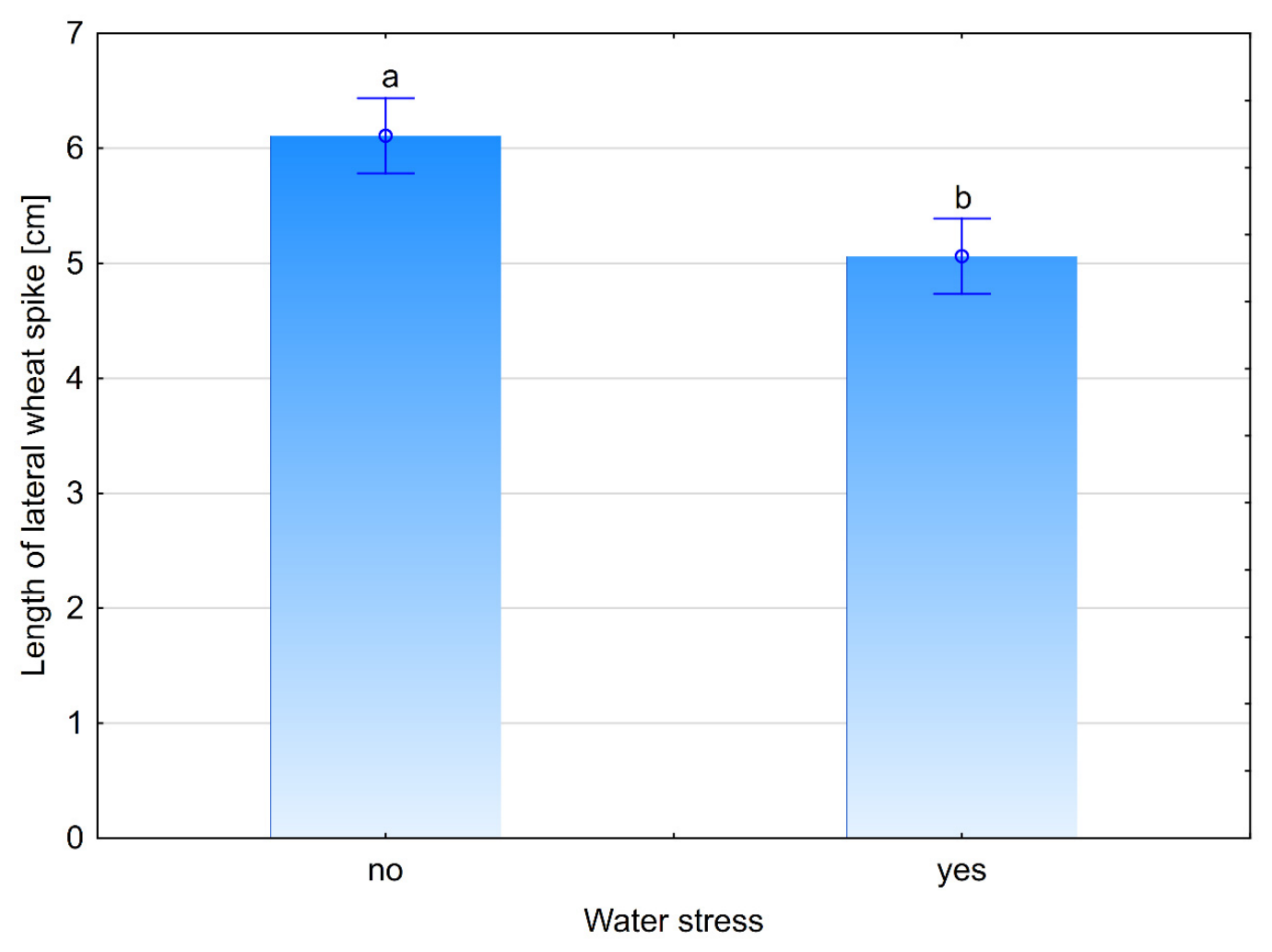
Drought stress significantly reduced the length of lateral wheat spikes (F = 5.109, p = 0.026), with mean values of 5.1 cm under water-deficit conditions compared with 6.1 cm under optimal soil moisture—a reduction of 16.4% (Table 4 and Figure 2). Neither weed infestation nor biostimulant application produced significant effects on this trait as main factors, and none of the two- or three-way interactions among the tested factors reached statistical significance. The parallel reductions observed for both lateral tiller length (15.7%) and lateral spike length (16.4%) under drought stress suggest that water deficit at the heading–flowering stage affected the development of secondary shoots consistently across their entire length.

3.1.5. Main Spike Weight

Drought stress and weed infestation both significantly reduced the weight of the main wheat spike (F = 310.26, p < 0.001 and F = 213.81, p < 0.001, respectively), whereas biostimulant application had no significant effect (Table 4 and Table 7). Spikes from plants grown under optimal soil moisture were on average 26.4% heavier than those from water-stressed plants (2.3 g vs. 1.7 g), and plants grown without weed competition produced spikes 22.5% heavier than those grown in the presence of A. spica-venti (2.2 g vs. 1.7 g).
A significant interaction between water stress and weed infestation was detected (F = 22.96, p < 0.001). The greatest reduction in spike weight—42.2% relative to the unstressed, weed-free control (2.8 g)—was recorded when both stress factors occurred simultaneously (1.6 g), indicating an additive negative effect of drought and weed competition. In the absence of A. spica-venti, drought stress alone reduced spike weight by 29.4%, while weed competition under optimal moisture reduced it by 26.0%.
A significant three-way interaction among all factors was also detected (F = 5.81, p = 0.001). However, no consistent pattern of biostimulant response was observed under any combination of abiotic and biotic stress, confirming that none of the tested preparations effectively mitigated the negative effects of the applied stressors on this trait.

3.1.6. Number of Non-Productive Tillers

Weed infestation significantly reduced the number of non-productive tillers per wheat plant (F = 11.438, p = 0.001; Table 4 and Table 8). Plants grown in the presence of A. spica-venti produced on average 1.2 non-productive tillers per plant, compared with 1.4 in weed-free treatments. Water stress had no significant effect on this trait (F = 0.765, p = 0.384), and neither did biostimulant application as a main factor (F = 1.519, p = 0.214). None of the two- or three-way interactions among the tested factors reached statistical significance, indicating that the suppressive effect of A. spica-venti on non-productive tiller formation was consistent across all levels of water stress and biostimulant treatment.
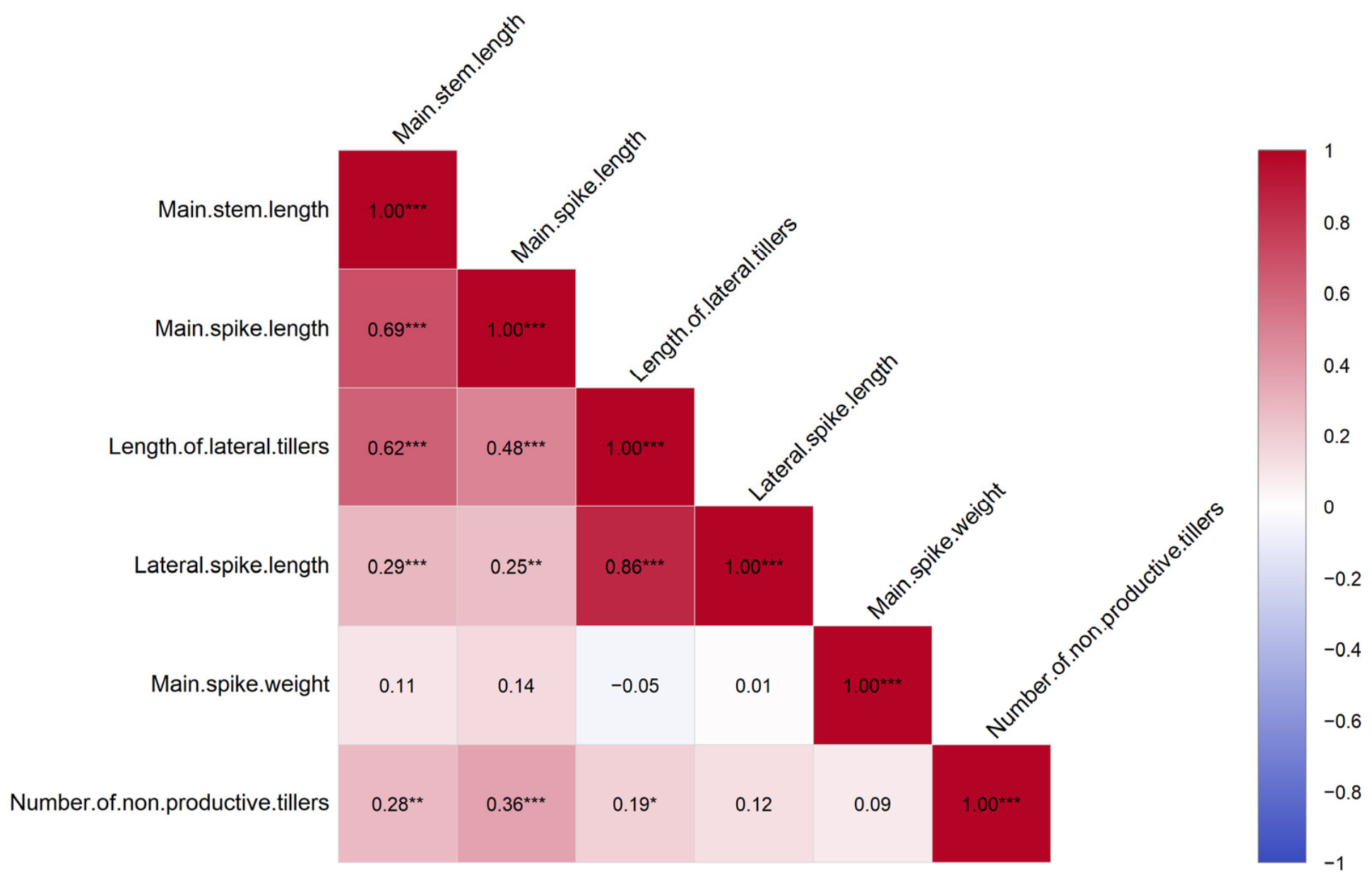
Pearson’s correlation analysis revealed several significant positive relationships among the analyzed morphological traits of winter wheat (Figure 3).
The strongest positive correlation was observed between the length of lateral tillers and lateral spike length (r = 0.86, p < 0.001). Main stem length was positively correlated with main spike length (r = 0.69, p < 0.001) and with the length of lateral tillers (r = 0.62, p < 0.001). In addition, main spike length was positively correlated with the length of lateral tillers (r = 0.48, p < 0.001).
Weaker but still significant positive correlations were found between lateral spike length and main stem length (r = 0.29, p < 0.001), as well as between lateral spike length and main spike length (r = 0.25, p < 0.01). The number of non-productive tillers showed weak positive correlations with main stem length (r = 0.28, p < 0.01), main spike length (r = 0.36, p < 0.001), and the length of lateral tillers (r = 0.19, p < 0.05).
In contrast, main spike weight was not significantly correlated with any of the remaining traits, as the correlation coefficients were weak and ranged from −0.05 to 0.14.
The dry matter content in winter wheat straw showed minor differences between the studied variants (Table A1 in Appendix A). These values remained at a similar level, regardless of soil moisture conditions. Under water-deficit conditions, the results were comparable to those recorded under optimal water conditions, and the observed fluctuations were minor. Similarly, the presence of A. spica-venti did not result in any visible changes in the dry matter content of the straw compared with variants free of this weed species.
The use of biostimulants did not lead to any significant modification of the analyzed parameter. The values obtained were consistent in all experimental variants and similar to those recorded in the control sample. Furthermore, the interaction of the tested factors did not cause any noticeable differences in the dry matter content of winter wheat straw.
The nitrogen content in winter wheat straw varied depending on soil moisture conditions (Table A1 in Appendix A). Under drought stress conditions, the nitrogen content in the straw was 0.15 percentage points higher than that in plants grown under optimal soil moisture conditions.
The presence of A. spica-venti did not cause any significant changes in the nitrogen content of winter wheat straw. The use of biostimulants was also not related to any noticeable differences in the analyzed trait, and the values obtained were comparable between the individual variants. Analysis of the combination of the studied factors indicates clear differences in the nitrogen content of winter wheat straw under the combined influence of water stress and biotic stress. Variants subjected to both water deficit and the presence of A. spica-venti were characterized by higher nitrogen content in the straw compared to those grown under optimal soil moisture conditions. The dominant factor modifying the nitrogen content in straw was water stress, whereas the presence of weeds was secondary and did not lead to a clear intensification of the observed effect. In other combinations of the studied factors, differences in nitrogen content in straw were insignificant and did not show a clear, orderly direction of change.
The protein content in winter wheat straw varied among the studied experimental variants, with changes in this trait observed depending on soil moisture conditions and the presence of A. spica-venti (Table A1 in Appendix A). Under drought stress conditions, the protein content in straw was 0.83 percentage points higher than in plants grown in optimal soil moisture conditions.
The presence of A. spica-venti was related to a decrease in the protein content of winter wheat straw. Compared with weed-free treatments, the value of the analyzed trait was lower by 0.85 percentage points.
The use of biostimulants resulted in only slight variations in the protein content of winter wheat straw, and the differences observed between the individual variants did not exceed 0.17 percentage points.
The interaction between water stress and the use of biostimulants was observed. Under non-drought stress conditions, the differences among the biostimulation variants were minor, whereas under water stress conditions, the use of biostimulants was associated with a slightly higher protein content in the straw than the control variant, although this response was not uniform for all preparations.
The phosphorus content in winter wheat straw showed little variation depending on soil moisture conditions (Table A1 in Appendix A). Under drought stress conditions, the average phosphorus content was only approximately 0.01 percentage points lower than that in plants grown under optimal soil moisture conditions.
The presence of A. spica-venti was associated with a reduction in phosphorus content in winter wheat straw. Compared with weed-free treatments, the analyzed trait was lower by an average of 0.04 percentage points.
The use of biostimulants caused only slight variations in the phosphorus content of winter wheat straw. The highest values of the analyzed trait were determined after the application of Optysil®, but the differences between the individual biostimulation variants were limited and did not exceed 0.02 percentage points.
An analysis of the interaction between factors indicates the presence of interactive relationships between water stress and the presence of A. spica-venti. Under optimal soil moisture conditions, the presence of weeds caused a more noticeable reduction in phosphorus content in straw than under drought stress conditions.
The interaction between water stress and biostimulants, as well as these preparations with the presence of A. spica-venti, was ambiguous and did not show a consistent trend of change. In addition, the combination of all three factors did not reveal a clear effect on the phosphorus content in winter wheat straw.
Under drought stress conditions, an increase in potassium content in the straw was observed to be 0.11 percentage points compared with plants grown under optimal soil moisture conditions (Table A1 in Appendix A).
The application of biostimulants resulted in a noticeable variation in the potassium content of winter wheat straw. The highest values of the analyzed trait were recorded under control conditions, while the lowest potassium accumulation was observed in plants treated with Phytoamin®, with a difference of 0.16 percentage points between these variants.
The interaction of these factors indicates that water stress affects potassium content in straw, and this effect is modified by the presence of A. spica-venti. Under optimal soil moisture conditions, the presence of weeds led to a more pronounced decrease in potassium content (by 0.15 percentage points) than under drought conditions (decrease by 0.10 percentage points). During water-deficit conditions, the use of Kelpak SL promoted the highest accumulation of potassium in straw, whereas in the absence of drought, the application of biostimulants resulted in a decrease in the content of the analyzed element in relation to the control conditions.

4. Discussion

4.1. Effects of Drought Stress on Morphological Traits of Winter Wheat

Water stress is one of the most important abiotic factors that inhibit plant growth and yield [11,34,38]. The timing of stress occurrence is crucial for the plant’s response [39,40]. Stress during the vegetative phase may limit the development of leaves and the root system, whereas during the generative phase, it may directly reduce the yield and quality of the seeds produced [39,40]. Depending on the developmental stage and the timing of water deficit, cereals may respond differently, resulting in either mild or pronounced morphological and physiological changes or, in some cases, no visible response. Stress has the most negative impact on yield during the generative phases of plants [41], namely, during stem elongation (BBCH 30–39), heading (BBCH 50–59), flowering (BBCH 60–69), and grain filling (BBCH 70–89). According to reports [42,43,44], the period from the flowering date to 5 d after the flowering date is the most critical period for reproductive development, including fertilization, and vulnerability to drought stress in wheat. In this study, the stress treatment encompassed two stages: heading and flowering (BBCH 51–65).
The most common visible biometric responses to drought stress include vegetative growth inhibition and the shortening of the main stem or spike [45]. As indicated by Liu et al. [46], these traits are strongly correlated with crop yield. Such a significant decrease in plant height is typically attributed to protoplasm dehydration, which ultimately suppresses cell division, cell expansion, and causes a loss of turgor [47]. Under our experimental conditions, the applied water stress had a significant effect on the length of the main wheat stem. This is consistent with the findings of Mirbahar et al. [45], who demonstrated a significant impact of drought on this trait while analyzing 25 wheat cultivars. The authors conducted their experiment during similar developmental stages, during T2 (post-flowering drought) and T3 (pre-flowering drought).
No significant effect of drought stress on the length of the main spike was observed in this study. Similar results were obtained by Pour-Aboughadareh et al. [48], who demonstrated that drought stress had no effect on this trait. The authors noted that the range of variability for spike length (cm) was limited and varied between 6.08 and 9.45 cm (average 6.94 cm) and between 6.03 and 8.00 cm (average 6.93 cm) under control and drought conditions, respectively.
This lack of a significant reduction can be further explained through the findings of Blum et al. [49], who demonstrated that growth under stress is sustained by the potential growth rate and plant size of the genotype when stress is mild, and by plant tolerance (even at the expense of potential growth rate and size) when stress is more severe.
However, this contrasts with the findings of Mirbahar et al. [45], who demonstrated a significant effect of the stress factor under study on this trait. As the authors showed, increasing drought stress resulted in a progressive reduction in the length of the main spike. However, our study showed a significant impact of abiotic stress on the length of the lateral spike. Reports do not provide information on the impact of drought on the length of the lateral spike. They most often refer to the number of grains in the lateral spike or grain weight. As indicated by Berki et al. [50], the productivity of lateral spikes in winter barley shows high plasticity and becomes crucial under combined drought stress. In their study, drought was applied twice: first at first-node appearance and again at the booting stage after a recovery period.
The analysis of the results obtained in our experiment showed a significant impact of drought stress on the weight of the main spikes, which decreased by an average of 26.4%. A decrease in the value of the tested trait was also reported by Farkas and Varga [51]. The authors showed that drought stress occurring during the BBCH 51 stage caused a 9% reduction in the weight of the main spikes. Furthermore, Farkas and Varga [51] observed a varied response of the main spike mass depending on the timing of the drought stress. The application of water stress during the stem elongation phase (BBCH 31) led to a decrease in the weight of the main spikes, ranging from 12% to 35%, depending on the cultivar. The authors also noted a significant decrease in the weight of lateral spikes, ranging from 17% to 22%, across the tested cultivars.
In the present study, drought did not significantly affect the number of non-productive tillers. In the literature, this trait is often considered a potential source of assimilates for productive tillers under drought conditions; however, the observations of Fioreze et al. [52] did not support this hypothesis. Furthermore, it has been shown that the presence of non-productive tillers is disadvantageous under water-stress conditions, as they intensify intra-plant competition for water, light, and nutrients. During drought, unproductive tillers constitute a burden on the plant and do not contribute to the yield components of the main tiller, particularly in strongly tillering cultivars. It has been demonstrated that, in water-deficient conditions, these tillers, although they do not produce a yield, continue to consume water through transpiration, which is directly correlated with a higher leaf area index (LAI). As Duggan et al. [53] reported, stem number (both fertile and sterile) is determined primarily by genotype and nitrogen fertilization level. They concluded that genetic restriction of tillering (e.g., via the tin gene) is crucial because the plant lacks a mechanism to rapidly reduce tiller number in response to water stress. The absence of significant correlations between main spike weight and the remaining morphological traits (r = −0.05 to 0.14) can be explained by the fundamentally different developmental timing and physiological regulation of these two groups of traits. Vegetative elongation traits, main stem length, lateral tiller length, and spike length, are primarily determined during the stem elongation phase (BBCH 30–39), prior to anthesis, through processes governed by water availability and growth regulators [43]. In contrast, spike weight is a post-anthesis trait driven by the number of grains set per spike and their individual capacity to accumulate dry matter, collectively referred to as sink strength [54]. Since drought stress in the present experiment was imposed after stem elongation was complete (BBCH 51–65), the vegetative length traits were largely unaffected, while spike weight was strongly reduced through impaired floret fertility and disrupted grain filling. This temporal decoupling of pre-anthesis elongation and post-anthesis sink-filling processes provides a physiological basis for the observed lack of correlation. Furthermore, as the experiment involved a single genotype (cv. Agil), the variation in morphological traits was driven by environmental treatments rather than genetic polymorphism; as Liu et al. [45] demonstrated, correlations between elongation traits and yield components are primarily expressed at the genotypic level and may be substantially weakened when a single cultivar is subjected to contrasting environmental conditions.

4.2. The Effect of Apera Spica-Venti (L.) P.Beauv. on the Biometric Traits of Winter Wheat

The results indicated that the presence of Apera Spica-Venti (L.) P.Beauv. had no significant effect on main stem length in winter wheat; however, a decreasing trend was observed. Similar results were reported by Kukowski [55], who found that winter wheat developed shorter main stems under mixed sowing conditions (wheat and A. spica-venti grown in the same pot). The author also observed no significant differences in plant height under varying levels of water stress.
In the case of the main spike, the presence of A. spica-venti did not significantly affect its length. These results contrast with the findings of Kukowski [55], who reported a reduction in this trait. In addition, Kukowski [55] analyzed the traits of wheat and A. spica-venti under different soil moisture conditions. Differences in the length of the main spike were demonstrated for mixed sowing across all tested treatments (except for soil moisture at 20–80% WHC). However, the available literature provides no information on the reaction of lateral spikes to the presence of this weed. The presence of A. spica-venti led to a significant decrease in the number of non-productive tillers in winter wheat. This finding aligns with the literature [56]. Knežević et al. [56] state that the number of non-productive tillers is highly dependent on both genetic characteristics and environmental factors. Among the environmental variables, they highlight crop density, nutrient availability, ecoclimatic conditions, and the complex interaction of all these factors.
It is highly probable that the plant density was the primary driver reducing the number of non-productive tillers in this study. A similar relationship was previously documented by Elhani et al. [57]. In our pot experiment, the co-cultivation of winter wheat and A. spica-venti resulted in a very high plant density, which triggered intense interspecific competition and consequently suppressed the development of redundant vegetative structures.

4.3. The Impact of Drought Stress on the NPK Content in Wheat Straw

Drought is one of the most important abiotic factors affecting plants. Reports indicate that water deficit causes disturbances in the uptake of nutrients from the soil [58]. As shown by Raza et al. [58], drought stress has a significant impact on the uptake of nutrients (N, P, K, Ca, and Na) by plants. Under drought stress conditions, the concentrations of N, K, and Na increase. The highest N content (27%) was observed in plants subjected to drought stress during grain filling. Similar observations regarding N and K content in wheat straw were also noted in our research, where an increased nitrogen content was recorded in the straw of the tested crop. As Alam [59] demonstrated, the observed increase in N is due to the accumulation of free amino acids that are not synthesized into proteins. Under drought stress, nitrate reductase (the enzyme responsible for the assimilation of nitrate into amino acids) is adversely affected [60].
In the present study, the phosphorus (P) content in wheat straw under drought conditions showed a slight upward trend. This result differs from the typical responses described in the literature, which often point to the limited availability of this element in dry soil. According to He and Dijkstra [61], water deficit usually leads to a decrease in phosphorus concentration in plant tissues due to reduced diffusion. The lack of reduction in the concentration of this element observed in this experiment can be explained by the so-called concentration effect. It is likely that drought stress reduced plant biomass accumulation to a greater extent than phosphorus uptake itself, resulting in a relative increase in its share of dry matter.
The increase in potassium content in the straw observed under drought conditions is consistent with the results of Kumari et al. [62]. Water stress disrupts mineral metabolism, affecting the uptake, availability, and final concentration of nutrients in the straw biomass. Furthermore, as reported by Kumari et al. [62], vegetative tissues like straw exhibit the most significant variations in nutrient accumulation under moisture stress. Higher potassium accumulation in the straw stimulates root growth, facilitating water uptake from the soil [63].

4.4. The Effect of Apera spica-venti on the NPK Content in Winter Wheat Straw

Our observations showed that the presence of A. spica-venti had no significant effect on the nitrogen content of winter wheat straw. This result contrasts with the observations of Kukowski [55], who reported a decrease in the content of this nutrient. This discrepancy may result from differences in weed competitive pressure. In our study, weed density was 300 plants m−2, whereas Kukowski [55] analyzed a density of 500 plants m−2. However, consistent results were obtained for phosphorus, with both experiments showing a slight decrease in its concentration in the presence of the weed.
Kukowski [55] observed an increase in the content of potassium in straw at a planting density of 500 plants per square meter. Furthermore, the author demonstrated that the dynamics of these changes depend strictly on the intensity of weed infestation. With extreme planting density (1.500 plants/m2), the author noted an increase in nitrogen and phosphorus content, whereas potassium content decreased compared to the level of 500 plants/m2. Notably, even under conditions of heavy weed infestation, the potassium content in wheat straw remained higher than in the weed-free treatments.

4.5. The Effect of Biostimulants on the Biometric Traits of Winter Wheat Under Drought Stress Conditions

Our results showed that biostimulant application had no significant effect on main stem length in winter wheat under drought conditions.
According to reports, silicon stabilizes the growth of the main stem of cereals and improves its mechanical strength [64,65,66,67]. Furthermore, as demonstrated by Gong and Chen [65], silicon application can improve plant water status under drought, thereby contributing to the alleviation of photosynthetic damage.
However, published findings on the impact of this element remain highly variable [66,68,69], which may be due to the varied response of plants to the different forms of Si used [67]. This effect is also highly dependent on the environment and the method of Si application [67,69]. For example, Sarto et al. [66] demonstrated that the application of calcium silicate did not affect plant height, the number of spikes per pot, shoot dry matter, grain yield, and harvest index of wheat.
Similarly, Walsh et al. [70] reported that Si had no effect on straw length; however, their research was conducted without drought stress. The authors attributed this lack of response to the form and dose of the fertilizer used. The application of silicon involved the use of three Si fertilization rates (140, 280, and 560 kg Si ha−1) corresponding respectively to 25%, 50%, and 100% of the manufacturer-recommended rates and two application times: at planting and at tillering. Furthermore, they indicated that Si fertilization may be advantageous for wheat cultivars with longer stems that are susceptible to lodging.
This is contrary to the findings of Jiang et al. [68], who demonstrated a significant effect of Si on plant height and center-of-gravity height. Jiang et al. [68] also reported a significant correlation in a two-year experiment, demonstrating that the Si3 treatment significantly reduced the length of the second internodes and increased the length of the fifth internodes.
Furthermore, as demonstrated by Raza et al. [69], even at the seed treatment stage, it is possible to affect some biometric traits of plants, including the length of the main stem. The authors found that priming wheat seeds mitigated the negative impacts of drought stress. Seed priming with Si-NPs (0, 300, 600, and 900 mg/L) markedly improved plant height. Plant height was reduced by 38.25% in the drought treatment at the tillering stage (DTS), 9.07% in the drought treatment at the flowering stage (DFS), and 6.77% in the drought treatment at the grain filling stage (DGFS) compared with the control. When compared with the control (0 mg/L NPs), applications of 300, 600, and 900 mg/L of Si-NPs mitigated the negative effects of drought and increased plant height by 2.5%, 3.2%, and 6.9%, respectively. The results showed that seed priming with 900 mg/L Si-NPs was the most effective, whereas the 0 mg/L Si-NPs treatment resulted in the shortest plant heights [69].
The lack of a significant effect of Si on the main stem length may be attributed to the fact that, under the drought conditions applied, the positive influence of this element on stem development was offset by the severity of water deficit, resulting in no net change in this trait.

4.6. The Effect of Biostimulants on the Nitrogen/Protein Content in Winter Wheat Straw

The nitrogen/protein content of wheat straw is one of the key parameters determining its utility [71], particularly in terms of its use as animal feed, for energy production, or as a resource in agriculture [72,73]. Under typical growing conditions (without abiotic or biotic stresses), the nitrogen and protein content in straw remains substantially lower than that in grain [74]; however, it is significantly affected by factors such as wheat variety [75], soil nitrogen availability, weather conditions, and agronomic practices, including fertilization intensity [72,76].
Our observations revealed variation in the nitrogen and protein content of wheat straw. Plants treated with silicon at the recommended application time showed the lowest values of this trait, which contrasts with the results reported by Abo Basha et al. [77]. The authors showed that even the lowest dose of Si led to an increase in the N content of wheat straw, explaining this by “the role of silicon in increasing the rate of absorption of nutrients and thus increasing its concentration in crops”. The literature also emphasizes that the application of Si positively affects all plant aspects and that Si improves plant performance overall in situations with low, optimal and high nitrogen supplies. It should be noted that the experiment conducted by those authors also analyzed the effect of varying doses of nitrogen fertilizer, which may have significantly influenced the plants’ response to silicon application and may partly explain the divergence from our own results, where NPK fertilization was not a factor in the experiment.
The application of Ascophyllum nodosum (L.) Le Jolis and Ecklonia maxima (Osbeck) Papenfuss extracts did not significantly affect the nitrogen or protein content in wheat straw, and the recorded values were similar to those in untreated plants. However, the highest protein concentration was observed following the application of a preparation containing A. nodosum. This aligns with the results reported by Sen et al. [78], who did not observe an increase in the N content of straw despite the application of varying doses of A. nodosum extract. Under those conditions, the nitrogen content ranged from 0.36% to 0.39%.
In our study, under controlled conditions (65% soil moisture and the absence of A. spica-venti), the phosphorus (P) content in straw ranged from 0.19 to 0.25, regardless of the biostimulant applied. The values obtained are relatively high, which may be due to the high content of this element in the soil.
According to reports, phosphorus content can range from 0.03 to 0.26%, depending on fertilization practices, cultivation methods, and the initial soil phosphorus levels [75,79,80,81,82].

5. Conclusions

This study highlights that severe drought stress (30% capillary capacity) during the critical heading–flowering stage acts as a primary limiting factor for winter wheat development, severely reducing key biometric traits. Specifically, drought reduced the length of lateral tillers by 15.7%, lateral spikes by 16.4%, and main spike weight by 26.4%, while increasing the nitrogen/protein and potassium content in the wheat straw. This negative impact was further exacerbated by competition from A. spica-venti (L.) P.Beauv., which independently reduced both main spike weight and the number of non-productive tillers. The simultaneous occurrence of drought and weed competition led to the greatest cumulative reduction in main spike weight (42.2%).
Under these extreme and precisely timed stress conditions, the tested biostimulants proved insufficient to mitigate the damage. The severity of the drought likely limited their effectiveness. While these controlled laboratory experiments successfully reveal the baseline thresholds of combined biotic and abiotic stress, they do not fully capture complex field dynamics. Consequently, to bridge this gap and clarify biostimulant efficacy under realistic, dynamic agricultural conditions, future field-scale trials integrating both physiological and yield-based assessments are required.

Author Contributions

Conceptualization, A.L.; methodology, A.L.; software, A.L. and P.K.; validation, A.L.; formal analysis, A.L. and P.K.; investigation, A.L.; resources, A.L.; data curation, A.L.; writing—original draft preparation, A.L.; writing—review and editing, A.L. and P.K.; visualization, A.L. and P.K.; supervision, A.L.; project administration, A.L.; funding acquisition, A.L. All authors have read and agreed to the published version of the manuscript.

Funding

This work was supported by the Wrocław University of Environmental and Life Sciences (Poland) as part of the Ph.D. research program Innovative Scientist No. N060/0009/20. The APC was financed by Wrocław University of Environmental and Life Sciences.

Institutional Review Board Statement

Not applicable.

Data Availability Statement

The raw data underlying the conclusions presented in this article will be made available by the authors on request.

Conflicts of Interest

The authors declare no conflicts of interest.

Appendix A

Table A1. Chemical traits of winter wheat straw: dry matter (DM), nitrogen (N), protein, phosphorus (P), and potassium (K) content.
Water StressWeed InfestationBiostimulantDry Matter (%)N (%)Protein (%)P (%)K (%)
NoAbsentWithout91.30.432.450.251.77
Optysil®91.40.402.250.221.80
Kelpak SL90.90.452.580.191.66
Phytoamin®91.40.472.650.191.42
PresentWithout91.90.432.450.162.02
Optysil®91.90.502.860.171.82
Kelpak SL91.90.392.250.191.69
Phytoamin®91.60.452.550.141.69
YesAbsentWithout91.00.583.280.211.86
Optysil®91.50.593.350.241.86
Kelpak SL91.20.603.400.192.02
Phytoamin®91.10.623.520.221.81
PresentWithout92.20.543.060.171.74
Optysil®91.50.613.460.211.79
Kelpak SL91.60.583.320.201.81
Phytoamin®91.70.573.220.171.82
Main effects
Water stress
No91.540.442.500.191.73
Yes91.480.593.330.201.84
Weed infestation
Absent 91.220.522.940.211.78
Present 91.790.512.900.181.80
Biostimulant
Without91.600.502.810.201.85
Optysil®91.580.522.980.211.82
Kelpak SL91.400.502.890.191.80
Phytoamin®91.450.532.980.181.68

References

  1. Signorelli, S. Plant Responses to Stress and Environmental Stimulus. Agronomy 2022, 12, 2250. [Google Scholar] [CrossRef]
  2. Sienkiewicz-Cholewa, U. Response of Spring Wheat Grown in Drought Stress to Foliar and Soil Silicon Application. Prog. Plant Prot. 2021, 61, 207–213. [Google Scholar] [CrossRef]
  3. Pramanik, S.K.; Sikder, S.; Hasan, M.A. Wheat Physiology and Yield as Affected by Water Deficit Stress. Agriculturists 2021, 19, 21–33. [Google Scholar]
  4. El-Forgany, M.; Makus, D.J. Effect of Water Stress on Seed Yield and Quality of the Sweet Corn Inbred ‘Luther Hill’. J. Am. Soc. Hortic. Sci. 1979, 104, 102–104. [Google Scholar] [CrossRef]
  5. Hasanuzzaman, M.; Hossain, M.A.; DaSilva, J.A.T.; Fujita, M. Plant Response and Tolerance to Abiotic Oxidative Stress: Antioxidant Defenses Are Key Factors. In Crop Stress and Its Management: Perspectives and Strategies; Bandi, V., Shanker, A.K., Shanker, C., Mandapaka, M., Eds.; Springer: Berlin/Heidelberg, Germany, 2012; pp. 261–316. [Google Scholar]
  6. Kacperska, A. Odporność roślin na stresowe abiotyczne czynniki środowiska i metody jej oceny. Postęp. Nauk Rol. 1991, 38, 1–2. [Google Scholar]
  7. Płażek, A. Reakcje roślin na czynniki stresowe. Zesz. Probl. Postęp. Nauk Rol. 2004, 496, 73–83. [Google Scholar]
  8. Hussain, S.; Hussain, S.; Qadir, T.; Khaliq, A.; Ashraf, U.; Parveen, A.; Saqib, M.; Rafiq, M. Drought Stress in Plants: An Overview on Implications, Tolerance Mechanisms and Agronomic Mitigation Strategies. Plant Sci. Today 2019, 6, 389–402. [Google Scholar] [CrossRef]
  9. Martignago, D.; Rico-Medina, A.; Blasco-Escámez, D.; Fontanet-Manzaneque, J.B.; Caño-Delgado, A.I. Drought Resistance by Engineering Plant Tissue-Specific Responses. Front. Plant Sci. 2020, 10, 1676. [Google Scholar] [CrossRef]
  10. Starck, Z. Reakcje roślin na abiotyczne stresy środowiskowe—Aklimatyzacja i adaptacja. Łąkarstwo Polsce 2005, 8, 173–184. [Google Scholar]
  11. Wach, D.; Skowron, P. An Overview of Plant Responses to the Drought Stress at Morphological, Physiological and Bio-Chemical Levels. Pol. J. Agron. 2022, 50, 25–34. [Google Scholar]
  12. Benito-Verdugo, P.; Martínez-Fernández, J.; González-Zamora, Á.; Almendra-Martín, L.; Gaona, J.; Herrero-Jiménez, C.M. Impact of Agricultural Drought on Barley and Wheat Yield: A Comparative Case Study of Spain and Germany. Agriculture 2023, 13, 2111. [Google Scholar] [CrossRef]
  13. Singh, S.; Prasad, S.; Yadav, V.; Kumar, A.; Jaiswal, B.; Kumar, A.; Khan, N.A.; Dwivedi, D.K. Effect of Drought Stress on Yield and Yield Components of Rice (Oryza sativa L.) Genotypes. Int. J. Curr. Microbiol. Appl. Sci. 2018, 7, 2752–2759. [Google Scholar]
  14. Łabędzki, L.; Bąk, B. Impact of Meteorological Drought on Crop Water Deficit and Crop Yield Reduction in Polish Agriculture. J. Water Land Dev. 2017, 34, 181–190. [Google Scholar] [CrossRef]
  15. Smolik, B. Reakcja wybranych odmian żyta ozimego na stres wywołany różnymi czynnikami abiotycznymi (Reaction of Selected Winter Rye Varieties to Stress Induced by Different Abiotic Factors). Folia Pomer. Univ. Technol. Stetin. Agric. Aliment. Pisc. Zootech. 2012, 293, 119–128. [Google Scholar]
  16. Farooq, M.; Wahid, A.; Kobayashi, N.; Fujita, D.; Basra, S.M.A. Plant Drought Stress: Effects, Mechanisms and Management. Agron. Sustain. Dev. 2009, 29, 185–212. [Google Scholar] [CrossRef]
  17. Demir, A.O.; Goksoy, A.T.; Buyukcangaz, H.; Turan, Z.M.; Koksal, E.S. Deficit Irrigation of Sunflower (Helianthus annuus L.) in a Sub-Humid Climate. Irrig. Sci. 2006, 24, 279–289. [Google Scholar] [CrossRef]
  18. Asaduzzaman, M.; Huqe, M.A.S.; Uddin, M.N.; Hossain, M.A.; Haque, M.S. Seed Priming Improves Germination and Early Seedling Growth in Wheat under Control and Drought Conditions. J. Bangladesh Agric. Univ. 2021, 19, 184–191. [Google Scholar] [CrossRef]
  19. Sarwar, M.; Saleem, M.F.; Ullah, N.; Khan, M.J.; Maqsood, H.; Ahmad, H.; Tanveer, A.; Shahid, M. Silver Nanoparticles Protect Tillering in Drought-Stressed Wheat by Improving Leaf Water Relations and Physiological Functioning. Funct. Plant Biol. 2023, 50, 901–914. [Google Scholar] [CrossRef]
  20. Abid, M.; Ali, S.; Qi, L.K.; Zahoor, R.; Tian, Z.W.; Jiang, D.; Dai, T.B. Physiological and Biochemical Changes during Drought and Recovery Periods at Tillering and Jointing Stages in Wheat (Triticum aestivum L.). Sci. Rep. 2018, 8, 4615. [Google Scholar] [CrossRef]
  21. Svobodová, P.; Míša, P. Effect of Drought Stress on the Formation of Yield Elements in Spring Barley and the Potential of Stress Expression Reduction by Foliar Application of Fertilizers and Growth Stimulator. Plant Soil Environ. 2004, 50, 439–446. [Google Scholar] [CrossRef]
  22. Lakhneko, O.; Stasik, O.; Škultéty, L.; Kiriziy, D.; Sokolovska-Sergiienko, O.; Kovalenko, M.; Danchenko, M. Transient Drought during Flowering Modifies the Grain Proteome of Bread Winter Wheat. Front. Plant Sci. 2023, 14, 1181834. [Google Scholar] [CrossRef]
  23. Samarah, N.H. Effects of Drought Stress on Growth and Yield of Barley. Agron. Sustain. Dev. 2005, 25, 145–149. [Google Scholar] [CrossRef]
  24. Hasanuzzaman, M.; Bhuyan, M.H.M.B.; Parvin, K.; Bhuiyan, T.F.; Anee, T.I.; Nahar, K.; Hossen, M.S.; Zulfiqar, F.; Alam, M.M.; Fujita, M. Regulation of ROS Metabolism in Plants under Environmental Stress: A Review of Recent Experimental Evidence. Int. J. Mol. Sci. 2020, 21, 8695. [Google Scholar] [CrossRef]
  25. Gill, S.S.; Tuteja, N. Reactive Oxygen Species and Antioxidant Machinery in Abiotic Stress Tolerance in Crop Plants. Plant Physiol. Biochem. 2010, 48, 909–930. [Google Scholar] [CrossRef] [PubMed]
  26. Malerba, M.; Cerana, R. Chitosan Effects on Plant Systems. Int. J. Mol. Sci. 2016, 17, 996. [Google Scholar] [CrossRef]
  27. Ali, A.H.; Said, E.M.; Abdelgawad, Z.A. The Role of Seaweed Extract on Improvement Drought Tolerance of Wheat Revealed by Osmoprotectants and DNA (cpDNA) Markers. Braz. J. Bot. 2022, 45, 857–867. [Google Scholar] [CrossRef]
  28. Sible, C.N.; Seebauer, J.R.; Below, F.E. Plant Biostimulants: A Categorical Review, Their Implications for Row Crop Production, and Relation to Soil Health Indicators. Agronomy 2021, 11, 1297. [Google Scholar] [CrossRef]
  29. Jardin, P. Plant Biostimulants: Definition, Concept, Main Categories and Regulation. Sci. Hortic. 2015, 196, 3–14. [Google Scholar] [CrossRef]
  30. Polski Komitet Normalizacyjny. Soil Chemical and Agricultural Analysis—Sampling; Polski Komitet Normalizacyjny: Warsaw, Poland, 1997. [Google Scholar]
  31. Carter, M.R.; Gregorich, E.G. Soil Sampling and Methods of Analysis; CRC press: Boca Raton, FL, USA, 2007. [Google Scholar]
  32. Sáez-Plaza, P.; Michałowski, T.; Navas, M.J.; Asuero, A.G.; Wybraniec, S. An Overview of the Kjeldahl Method of Nitrogen Determination. Part I. Early History, Chemistry of the Procedure, and Titrimetric Finish. Crit. Rev. Anal. Chem. 2013, 43, 178–223. [Google Scholar] [CrossRef]
  33. Karczewska, A.; Kabała, C. Methodology of Laboratory Analyzes of Soils and Plants; University of Life Sciences: Wroclaw, Poland, 1997. [Google Scholar]
  34. Zaib, M.; Farooq, U.; Adnan, M.; Abbas, Z.; Haider, K.; Khan, N.; Abbas, R.; Nasir, A.S.; Sidra; Muhay-Ul-Din, M.F.; et al. Optimization of Water Stress in Crop Plants, Implications for Sustainable Agriculture: Current and Future Prospects. J. Environ. Agric. Sci. 2023, 25, 37–50. [Google Scholar]
  35. Egner, H.; Riehm, H.; Domingo, W.R. Chemische Extraktionsmethoden zur Phosphor und Kaliumbestimmung, und Untersuchungen über die Chemische Bodenanalyse als Grundlage für die Beurteilung des Nahrstoffzustandes der Böden. K. Lantbrukshögskolans Ann. 1960, 26, 199–215. [Google Scholar]
  36. Polski Komitet Normalizacji. Analiza Chemiczno-Rolnicza Gleby. Oznaczanie Zawartości Przyswajalnego Magnezu; Polski Komitet Normalizacji: Warsaw, Poland, 2004. [Google Scholar]
  37. Pribyl, D.W. A Critical Review of the Conventional SOC to SOM Conversion Factor. Geoderma 2010, 156, 75–83. [Google Scholar] [CrossRef]
  38. Olszewska, M. Wpływ stresu wodnego na intensywność fotosyntezy, zawartość chlorofilu i plonowanie Lolium perenne. Łąkarstwo Polsce 2002, 5, 163–171. [Google Scholar]
  39. Verbraeken, L.; Wuyts, N.; Mertens, S.; Cannoot, B.; Maleux, K.; Demuynck, K.; Block, J.; Merchie, J.; Dhondt, S. Drought Affects the Rate and Duration of Organ Growth but Not Inter-Organ Growth Coordination. Plant Physiol. 2021, 186, 1336–1353. [Google Scholar] [CrossRef]
  40. Farooq, M.; Hussain, M.; Wahid, A.; Siddique, K.H.M. Drought Stress in Plants: An Overview. In Plant Responses to Drought Stress; Aroca, R., Ed.; Springer: Berlin/Heidelberg, Germany, 2012; pp. 1–33. [Google Scholar]
  41. Senapati, N.; Stratonovitch, P.; Paul, M.J.; Semenov, M.A. Drought Tolerance during Reproductive Development Is Important for Increasing Wheat Yield Potential under Climate Change in Europe. J. Exp. Bot. 2019, 70, 2549–2560. [Google Scholar] [CrossRef]
  42. Dolferus, R.; Ji, X.; Richards, R.A. Abiotic Stress and Control of Grain Number in Cereals. Plant Sci. 2011, 181, 331–341. [Google Scholar] [CrossRef] [PubMed]
  43. Wise, K.; Johnson, B.; Mansfield, C.; Krupke, C. Managing Wheat by Growth Stage; Purdue Extension: West Lafayette, IN, USA, 2011. [Google Scholar]
  44. Barber, H.M.; Carney, J.; Alghabari, F.; Gooding, M.J. Decimal Growth Stages for Precision Wheat Production in Changing Environments? Ann. Appl. Biol. 2015, 166, 355–371. [Google Scholar] [CrossRef]
  45. Mirbahar, A.A.; Markhand, G.S.; Mahar, A.R.; Abro, S.A.; Kanhar, N.A. Effect of Water Stress on Yield and Yield Components of Wheat (Triticum aestivum L.) Varieties. Pak. J. Bot. 2009, 41, 1303–1310. [Google Scholar]
  46. Liu, H.; Shi, Z.; Ma, F. Identification and Validation of Plant Height, Spike Length and Spike Compactness Loci in Common Wheat (Triticum aestivum L.). BMC Plant Biol. 2022, 22, 568. [Google Scholar] [CrossRef]
  47. Šafář, J.; Šimková, H.; Kubaláková, M.; Číhalíková, J.; Suchánková, P.; Bartoš, J.; Doležel, J. Development of Chromosome-Specific BAC Resources for Genomics of Bread Wheat. Cytogenet. Genome Res. 2010, 129, 211–223. [Google Scholar] [CrossRef]
  48. Pour-Aboughadareh, A.; Mohammadi, R.; Etminan, A.; Shooshtari, L.; Maleki-Tabrizi, N.; Poczai, P. Effects of Drought Stress on Some Agronomic and Morpho-Physiological Traits in Durum Wheat Genotypes. Sustainability 2020, 12, 5610. [Google Scholar] [CrossRef]
  49. Blum, A.; Sullivan, C.Y.; Nguyen, H.T. The Effect of Plant Size on Wheat Response to Agents of Drought Stress. II. Water Deficit, Heat and ABA. Aust. J. Plant Physiol. 1997, 24, 43–48. [Google Scholar] [CrossRef]
  50. Berki, Z.; Kiss, T.; Bányai, J.; Cseh, A.; Balla, K.; Karsai, I. Effect of Drought Stress during Critical Developmental Stages on Morphological and Grain Yield-Related Traits in Winter Barley (Hordeum vulgare L.). PLoS ONE 2025, 20, 0329391. [Google Scholar] [CrossRef]
  51. Farkas, Z.; Varga, B. Responses of Winter Wheat (Triticum aestivum L.) Varieties to Drought Stress and Elevated CO2 Levels: A Comparative Analysis of Growth, Spike Characteristics, and Grain Yield. Cereal Res. Commun. 2025, 53, 2583–2603. [Google Scholar] [CrossRef]
  52. Fioreze, S.L.; Michelon, L.H.; Turek, T.L.; Drun, R.P.; Dalorsaleta, J.C.S. Role of Nonproductive Tillers as Transient Sinks of Assimilates in Wheat. Bragantia 2020, 79, 180–191. [Google Scholar] [CrossRef]
  53. Duggan, B.L.; Richards, R.A.; Herwaarden, A.F.; Fettell, N.A. Agronomic Evaluation of a Tiller Inhibition Gene (Tin) in Wheat. I. Effect on Yield, Yield Components, and Grain Protein. Aust. J. Agric. Res. 2005, 56, 169–178. [Google Scholar] [CrossRef]
  54. Slafer, G.A.; Elía, M.; Savin, R.; García, G.A.; Terrile, I.I.; Ferrante, A.; Miralles, D.J.; González, F.G. A “wiring Diagram” for Sink Strength Traits Impacting Wheat Yield Potential. J. Exp. Bot. 2023, 74, 40–55. [Google Scholar] [CrossRef]
  55. Kukowski, T. Investigations on the ecology and control of loose silky-bent (Apera spica-venti (L.) P.B.). In Winter Wheat; Prace Opolskiego Towarzystwa Przyjaciół Nauk; Warszawa, Ed.; PWN: Sydney, Australia, 1978. [Google Scholar]
  56. Knežević, D.; Urošević, D.; Menkovska, M.; Matković Stojšin, M.; Laze, A.; Mićanović, D.; Kondić, D.; Zecevic, V. Variability of Non-Productive Tillering in Winter Wheat (Triticum aestivum L.). In Proceedings of the 12th JEEP International Scientific Agribusiness Conference MAK 2025 “Climate Changes and Ecological Sustainability in Agriculture and Food Production in Serbia, the Region and Southeastern Europe”, Kopaonik, Serbia, 30 January–2 February 2025. [Google Scholar]
  57. Elhani, S.; Martos, V.; Rharrabti, Y.; Royo, C.; Del Moral, L.G. Contribution of Main Stem and Tillers to Durum Wheat (Triticum turgidum L. Var. Durum) Grain Yield and Its Components Grown in Mediterranean Environments. Field Crops Res. 2007, 103, 25–35. [Google Scholar] [CrossRef]
  58. Raza, M.A.S.; Saleem, M.F.; Shah, G.M.; Jamil, M.; Khan, I.H. Potassium applied under drought improves physiological and nutrient uptake performances of wheat (Triticum aestivum L.). J. Soil Sci. Plant Nutr. 2013, 13, 175–185. [Google Scholar]
  59. Alam, S.M. Nutrient Uptake by Plants under Stress Conditions. In Handbook of Plant and Crop Stress; Pessarakli, M., Ed.; Marcel Dekker: New York, NY, USA, 1994; pp. 227–246. [Google Scholar]
  60. Sinha, S.K.; Nicholas, D.J.D. Nitrate Reductase. In The Physiology and Biochemistry of Drought Resistance in Plants; Paleg, L., Aspinall, D., Eds.; Academic Press: Sydney, Australia, 1981; pp. 145–169. [Google Scholar]
  61. He, M.; Dijkstra, F.A. Drought Effect on Plant Nitrogen and Phosphorus: A Meta-Analysis. New Phytol. 2014, 204, 924–931. [Google Scholar] [CrossRef]
  62. Kumari, A.; Sairam, R.K.; Singh, S.K. Nutrient Content in Grain and Straw of Different Wheat Genotypes as Affected by Moisture Stress. Int. J. Curr. Microbiol. Appl. Sci. 2019, 8, 1977–1988. [Google Scholar] [CrossRef]
  63. Saxena, N.P. The Role of Potassium in Drought Tolerance. Potash Rev. 1985, 5, 1–15. [Google Scholar]
  64. Epstein, E. Silicon. Annu. Rev. Plant Physiol. Plant Mol. Biol. 1999, 50, 641–664. [Google Scholar] [CrossRef]
  65. Gong, H.; Chen, K. The Regulatory Role of Silicon on Water Relations, Photosynthetic Gas Exchange, and Carboxylation Activities of Wheat Leaves under Field Drought Conditions. Acta Physiol. Plant 2012, 34, 1589–1594. [Google Scholar] [CrossRef]
  66. Sarto, M.V.I.M.; Carmo Lana, M.; Rampim, L.; Rosset, J.S.E.; Wobeto, J.R.; Ecco, M.; Costa, P.F. Effect of Silicate on Nutrition and Yield of Wheat. Afr. J. Agric. Res. 2014, 9, 956–962. [Google Scholar] [CrossRef]
  67. Kaya, C. Effect of Silicon on Growth and Mineral Nutrition of Wheat. J. Plant Nutr. 2006, 29, 829–840. [Google Scholar] [CrossRef]
  68. Jiang, H.; Jiang, Z.; Zhang, H.; Li, Y.; Li, W.; Gao, K.; Ma, X.; Wang, G.; Wei, X.; Wu, Z. Silicon Nutrition Improves Lodging Resistance of Rice under Dry Cultivation. Plants 2025, 14, 361. [Google Scholar] [CrossRef] [PubMed]
  69. Raza, M.A.S.; Zulfiqar, B.; Iqbal, R. Morpho-Physiological and Biochemical Response of Wheat to Various Treatments of Silicon Nanoparticles under Drought Stress Conditions. Sci. Rep. 2023, 13, 2700. [Google Scholar] [CrossRef] [PubMed]
  70. Walsh, O.S.; Shafian, S.; McClintick-Chess, J.R.; Belmont, K.M.; Blanscet, S.M. Potential of Silicon Amendment for Improved Wheat Production. Plants 2018, 7, 26. [Google Scholar] [CrossRef] [PubMed]
  71. Singh, G.P.; Oosting, S.J. Nutritive Value of Straw. In Feeding of Ruminants on Fibrous Crop Residues; Singh, K., Schiere, J.B., Eds.; The Indian Council of Agricultural Research (ICAR): New Delhi, India, 1993; pp. 141–147. [Google Scholar]
  72. Correia, L.; Hoover, R.; Carrijo, D.R. Winter Wheat Straw and Grain Production in Response to Trinexapac-Ethyl and Nitrogen Fertilizer. Crop Forage Turfgrass Manag. 2025, 11, 70029. [Google Scholar] [CrossRef]
  73. Shah, A.M.; Zhang, H.; Shahid, M.; Ghazal, H.; Shah, A.R.; Niaz, M.; Naz, T.; Ghimire, K.; Goswami, N.; Shi, W. The Vital Roles of Agricultural Crop Residues and Agro-Industrial by-Products to Support Sustainable Livestock Productivity in Subtropical Regions. Animals 2025, 15, 1184. [Google Scholar] [CrossRef]
  74. Juhász, E.K.; Kremper, R.; Tállai, M.; Béni, Á.; Novák, T.; Balla Kovács, A. Evaluation of the Effects of Drought Stress and Nitrogen–Sulfur Fertilization on Productivity and Yield Parameters of Spring Wheat. Stresses 2024, 4, 850–859. [Google Scholar] [CrossRef]
  75. Anjum, M.I.; Ghazanfar, S.; Begum, I. Nutritional Composition of Wheat Grains and Straw Influenced by Differences in Vari-Eties Grown under Uniform Agronomic Practices. Int. J. Vet. Sci. 2014, 3, 100–104. [Google Scholar]
  76. Sewhag, M.; Shweta; Kumar, P.; Sharma, M.K.; Neelam; Devi, U. Nutrient Studies of Wheat as Influenced by Different Ni-Trogen Management Practices. Int. J. Curr. Microbiol. Appl. Sci. 2020, 9, 161–167. [Google Scholar] [CrossRef]
  77. Abo Basha, D.M.; El Sayed, S.; Badr, E.A. Evaluation of Mineral Fertilizer with Silicon (Si) Foliar Application on Growth, Yield Production and Nutrient Status of Wheat under Sandy Soil Conditions. Egypt. J. Chem. 2024, 67, 229–239. [Google Scholar] [CrossRef]
  78. Sen, A.; Srivastava, V.K.; Singh, R.K.; Singh, A.P.; Raha, P.; Ghosh, A.K.; De, N.; Rakshit, A.; Meena, R.N.; Kumar, A.; et al. Soil and Plant Responses to the Application of Ascophyllum Nodosum Extract to No-till Wheat (Triticum aestivum L.). Commun. Soil Sci. Plant Anal. 2015, 46, 123–136. [Google Scholar] [CrossRef]
  79. Gajek, F. Wpływ nawożenia na wysokość i jakość plonów roślin uprawnych. Zesz. Probl. Postęp. Nauk Rol. 1973, 145, 167–199. [Google Scholar]
  80. Azad, M.A.K.; Ahmed, T.; El-Jaoual Eaton, T.; Hossain, M.M.; Haque, M.K.; Soren, E.B. Yield of Wheat (Triticum aestivum L.) and Nutrient Uptake in Grain and Straw as Influenced by Macro. Nat. Sci. 2021, 13, 381–391. [Google Scholar]
  81. Nagar, N.; Kumar, V.; Pal, D. Yield, Nutrient Contents and Their Uptake by Wheat (Triticum aestivum L.) in Relation to FYM and Potassium Fertilization. J. Rural Agric. Res. 2020, 20, 88–91. [Google Scholar]
  82. Tabassum, R.; Sarita; Javaid, I.; Kumar, B.; Sharma, N.; Sikarwar, S.; Harishankar. Effect of Integrated Nutrient Management Practices on Nutrient Content, Nutrient Uptake and Productivity of Wheat Crop. Int. J. Res. Agron. 2024, 7, 22–28. [Google Scholar] [CrossRef]
Figure 1. Length of lateral wheat tillers [cm]: (a) effect of water stress (main effect); (b) interaction between water stress and biostimulant application. Bars/points represent least squares means ± SE. Different letters (a, b) indicate significant differences (Tukey’s HSD, p ≤ 0.05). The interaction was significant (F3,96 = 3.51, p = 0.018). No stress—65% CWC; Stress—30% CWC. CWC—capillary water capacity.
Agriculture 16 01283 g001
Figure 2. Length of lateral wheat spikes [cm] under two water stress regimes. Bars represent least squares means ± SE. Different letters (a, b) indicate significant differences (Tukey’s HSD, p ≤ 0.05). No stress—65% CWC; Stress—30% CWC. CWC—capillary water capacity.
Agriculture 16 01283 g002
Figure 3. Pearson correlation heatmap of the analyzed morphological traits of winter wheat. Asterisks indicate significant correlations (* p < 0.05, ** p < 0.01, *** p < 0.001).
Agriculture 16 01283 g003
Table 1. Scheme of the experiment.
Plants Capillary Water CapacityTreatment
wheat65%Control/Si/Ecklonia maxima/Ascophyllum nodosum
30%Control/Si/Ecklonia maxima/Ascophyllum nodosum
wheat + A. spica-venti65%Control/Si/Ecklonia maxima/Ascophyllum nodosum
30%Control/Si/Ecklonia maxima/Ascophyllum nodosum
Table 2. Growth phases and biostimulant dosages.
Recommended
Developmental Stage
Treatment PhaseRecommended DoseNumber of
Treatments
Autumn
Optysil®3–6 leaf stage (BBCH 13–16)4-leaf stage
(BBCH 14)
0.5 L·ha−11
Kelpak SLfrom 4 leaf stage (BBCH 14)4-leaf stage
(BBCH 14)
2 L·ha −11
Phytoamin®from 4 leaf stage (BBCH 14)4-leaf stage
(BBCH 14)
3 L·ha −11
Spring
Optysil®tillering stage (BBCH 24)tillering stage (BBCH 24)0.5 L·ha−11
Optysil®beginning of stem elongation (BBCH 30–39) -stem elongation (BBCH 34–35)0.5 L·ha−11
Optysil®from heading to the early milk stage (BBCH 51–73)
optional timing
-0.5 L·ha−11
Note. - The treatment was not performed on the optional date.
Table 3. Chemical compositions of the soil.
pHNPKMgC
[g/kg][mg/kg][mg/kg][%]
6.91.03120.36225182.82.15
Table 4. Results of three-way ANOVA (mixed model) for morphological traits of winter wheat.
Source of VariationdfF/pLength of Main Stem of WheatLength of Lateral Wheat TillersLength of Main Wheat SpikeLength of Lateral Wheat SpikeWeight of Main Wheat SpikeNumber of Non-Productive Tillers
Water stress (WS)1F10.624.8720.285.109310.260.765
p0.002 **0.030 *0.595 ns0.026 *<0.001 *0.384 ns
Weed infestation (WI)1F17.451.4653.090.180213.8111.438
p<0.001 *0.229 ns0.082 ns0.673 ns<0.001 *0.001 **
Biostimulant (B)3F0.531.0191.841.2281.391.519
p0.664 ns0.388 ns0.146 ns0.304 ns0.250 ns0.214 ns
WS × WI1F0.281.1580.090.91622.960.171
p0.600 ns0.285 ns0.761 ns0.341 ns<0.001 *0.680 ns
WS × B3F1.243.5071.361.9561.171.362
p0.301 ns0.018 *0.261 ns0.126 ns0.326 ns0.259 ns
WI × B3F0.030.1760.460.1630.260.875
p0.992 ns0.913 ns0.711 ns0.921 ns0.853 ns0.457 ns
WS × WI × B3F1.070.2202.700.3365.810.353
p0.366 ns0.882 ns0.050 *0.799 ns0.001 **0.787 ns
Note. WS—water stress; WI—weed infestation (presence of A. spica-venti); B—biostimulant treatment; df—degrees of freedom; F—F-statistic; p—probability value. Significance codes: ns—not significant (p > 0.05); * p < 0.05; ** p < 0.01.
Table 5. Length of main stem of wheat [cm].
Weed InfestationNo Stress (65% CWC)Stress (30% CWC)Mean
Weed absent50.849.250.0 a
A. spica-venti48.947.748.2 b
Mean49.8 a48.4 b
Note. Means followed by the same letter are not significantly different according to Tukey’s HSD test at p ≤ 0.05. Significant effects of water stress (WS) and weed infestation (WI) were detected (p ≤ 0.05). No significant effect of biostimulant application or any interaction was detected.
Table 6. Length of main wheat spike [cm].
Water Stress—Weed InfestationWithoutOptysil®Kelpak SLPhytoamin®Mean
No stress, 65% CWC—Absent8.8 a8.5 ab8.3 ab8.4 ab8.5
No stress, 65% CWC—A. spica-venti8.3 ab8.3 ab8.4 ab8.5 ab8.4
Stress, 30% CWC—Absent8.3 ab8.5 ab8.4 ab8.6 ab8.5
Stress, 30% CWC—A. spica-venti8.4 ab8.4 ab8.2 b8.4 ab8.4
Note. Means followed by the same letter are not significantly different according to Tukey’s HSD test at p ≤ 0.05. No significant main effects were detected for water stress, weed infestation, or biostimulant application. A significant three-factor interaction (WS × WI × B) was detected (p ≤ 0.05).
Table 7. Weight of main wheat spike [g].
Water StressWeed InfestationBiostimulantsMean
WithoutOptysil®Kelpak SLPhytoamin®Mean
No,
65% CWC
Absent2.8 a2.5 a2.6 a2.6 a2.6 a2.3 a
A. spica-venti1.9 bc2.0 b1.8 bcd2.0 b1.9 b
Mean2.4 a2.3 a2.2 a2.3 a
Yes,
30% CWC
Absent1.7 de1.9 bc1.8 bc1.9 bc1.8 b1.7 b
A. spica-venti1.6 de1.5 e1.5 de1.5 de1.5 c
Mean1.6 b1.7 b1.7 b1.7 b
MeanAbsent2.2 a2.2 a2.2 a2.3 a2.2 a
A. spica-venti1.8 b2.2 b1.6 b1.8 b1.7 b
Note. Means followed by the same letter are not significantly different according to Tukey’s HSD test at p ≤ 0.05; values without letters indicate no significant differences. Significant effects of water stress (WS), weed infestation (WI), and biostimulant application (B) were detected (p ≤ 0.05).
Table 8. Number of non-productive tillers per wheat plant [no.].
Weed InfestationWithout Optysil®Kelpak SLPhytoamin®Mean
Absent1.41.51.31.41.4 a
A. spica-venti1.11.21.21.31.2 b
Mean1.2 b1.3 a1.2 ab1.3 ab
Note. Means followed by the same letter are not significantly different according to Tukey’s HSD test at p ≤ 0.05. Water stress had no significant effect as a main factor. A significant effect of weed infestation (WI) and biostimulant application (B) was detected (p ≤ 0.05).
Disclaimer/Publisher’s Note: The statements, opinions and data contained in all publications are solely those of the individual author(s) and contributor(s) and not of MDPI and/or the editor(s). MDPI and/or the editor(s) disclaim responsibility for any injury to people or property resulting from any ideas, methods, instructions or products referred to in the content.