1. Introduction
Biological nitrogen fixation (BNF) is a natural process in soybean (
Glycine max L. Merr.), in which the plant meets its nitrogen (N) needs for growth through a symbiotic relationship with
Brayrhizobium spp. [
1]. A major benefit is reduced dependence on synthetic N fertilizers, thereby supporting the sustainability of soybean production and lowering input costs [
2,
3]. Recent studies have further demonstrated that the contribution of BNF to soybean N nutrition is strongly influenced by environmental conditions, soil fertility, and crop management practices, highlighting the need for robust field-based screening approaches [
4]. Therefore, identifying soybean genotypes with superior BNF-associated performance has become an important objective in breeding and improvement programs. However, reliable evaluation of BNF under field conditions remains difficult because nitrogen-related traits are influenced by environmental variation, soil N availability, and genotype-specific responses to fertilizer inputs [
4,
5]. As a result, developing practical, repeatable, and cost-effective phenotyping protocols for field-based screening remains a major challenge for soybean improvement programs.
BNF phenotyping under field conditions is difficult because it often relies on direct methods for measuring N-related traits, such as acetylene reduction assays, ureide quantification, and isotope-ratio mass spectrometry [
6,
7]. Although these methods provide valuable information on the physiological processes underlying BNF, they are laborious, costly, and often impractical for screening large germplasm populations. Consequently, many soybean improvement programs depend on indirect agronomic and physiological indicators of N status under contrasting N environments [
8,
9]. Nevertheless, these approaches usually evaluate absolute trait performance under low-N inputs, which may not adequately distinguish accessions that sustain performance under N limitation from those that are more responsive to N inputs [
8,
9]. Therefore, there is a need for practical, field-based phenotyping approaches that can normalize genotype performance across contrasting N environments while maintaining sufficient throughput for large germplasm populations.
Chlorophyll content measured by a SPAD meter is a rapid, non-destructive indicator of canopy N status [
10]. Although SPAD scores are strongly associated with leaf chlorophyll concentration and N status, they vary across developmental stages and environmental conditions, making the optimal sampling period for evaluating BNF-associated performance difficult to define [
11,
12]. To complement canopy-based assessments, it is also important to consider traits that reflect the downstream consequences of N acquisition and utilization. In soybean, 1000-seed weight represents a yield component associated with assimilate accumulation, whereas seed protein concentration reflects N assimilation and allocation to harvested tissues [
5,
13]. Previous studies have also demonstrated strong relationships among canopy N status, seed protein accumulation, and seasonal changes in N fixation in soybean [
14]. Together, SPAD, seed weight, and seed protein concentration provide complementary information on canopy N status, agronomic performance, and seed N partitioning. Although these traits are potentially relevant to BNF-associated performance, they are rarely integrated into a single field-based phenotyping protocol [
8,
15].
An important limitation of many field-based phenotyping approaches is the difficulty of separating BNF-associated performance from general responsiveness to N inputs [
8,
15]. Comparisons of trait performance under non-N-applied (N−) and N-applied (N+) conditions are commonly used to evaluate N-related responses; however, absolute trait values may not fully account for genotypic differences in responsiveness to fertilizer inputs [
16]. In addition, the lack of simple, standardized approaches that integrate multiple physiological and agronomic indicators can limit the applicability and repeatability of BNF-associated phenotyping in soybean improvement programs [
8,
15].
In a retention-based approach, trait performance under N− conditions is expressed relative to that under N+ conditions, a normalization process that facilitates comparisons among genotypes while decreasing the influence of differential responsiveness to fertilizer inputs [
17]. Furthermore, integrating multiple N-related traits into a single index may improve the identification of accessions exhibiting stable BNF-associated performance across contrasting N environments [
18].
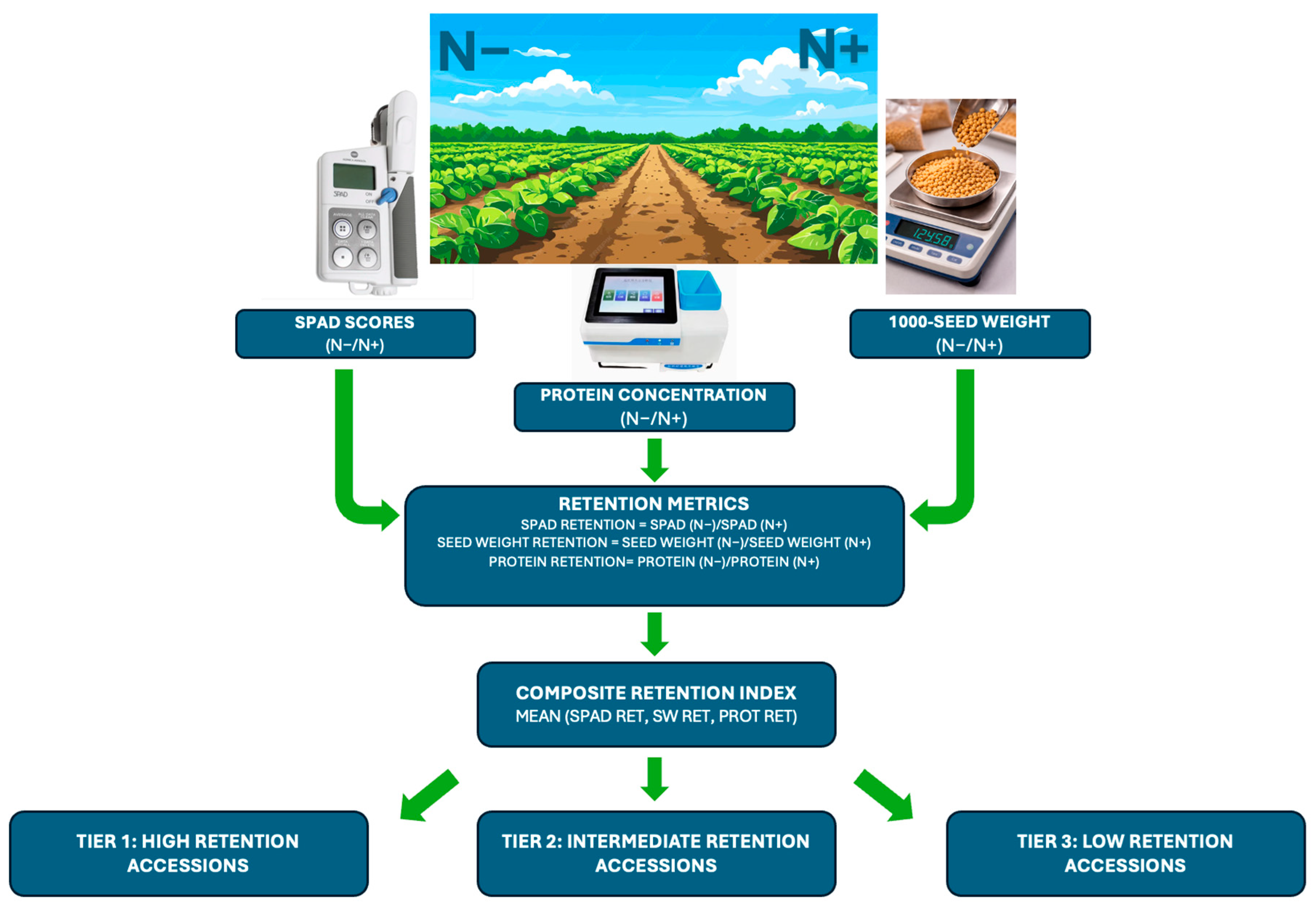
We hypothesized that soybean accessions capable of maintaining canopy chlorophyll status, 1000-seed weight, and seed protein concentration under N− conditions relative to N+ conditions would show superior BNF-associated performance and could be identified using a retention-based composite index. Therefore, the objectives of this study were to: (1) develop a retention-based phenotyping protocol using mean SPAD retention across developmental stages, 1000-seed-weight retention, and protein concentration retention to construct a Composite Retention Index (CRI); and (2) classify soybean accessions according to their multi-trait retention performance under contrasting N environments. Overall, the proposed protocol provides a practical, rapid, and economical approach for identifying soybean accessions with superior BNF-associated performance in genetic improvement programs.
2. Materials and Methods
2.1. Plant Material and Experimental Site
In total, 194 soybean accessions representing maturity groups (MG) III–VII were included in this study. The panel originated from 12 countries, including 135 accessions from China, 17 from Japan, 16 from South Korea, 15 from the United States, three from Taiwan, two from India, and one accession each from Uganda, Georgia, Morocco, Nepal, South Africa, and Vietnam. Accessions were selected based on Germplasm Resources Information Network (GRIN) data for their yield potential, agronomic characteristics, and geographic origin. Seeds were provided by the USDA Soybean Germplasm Collection and increased during the summer of 2023 at the Agricultural Research Center, Southern Illinois University, Carbondale, IL, USA (37.7° N, 89.2° W). Field experiments were conducted during the 2024 and 2025 growing seasons (June–October) at the same location. The experimental site, representative of southern Illinois row-crop production systems, consists of silt loam soils derived from loess over residuum and managed under a conventional corn-soybean rotation. Since the study was conducted under field conditions, environmental variation between years was expected and was evaluated through statistical analyses that included year effects.
2.2. Experimental Design and Growth Conditions
The experiment was a randomized complete block design with two N treatments (N− and N+) and two blocks per treatment. Each accession was planted in two-row plots 4.57 m long with 0.76 m row spacing. Seeds were sown at a density of 37 seeds m−2 at a planting depth of approximately 2.5 cm. No N fertilizer was applied in the N− treatment, whereas 70.61 kg N ha−1 was applied as urea immediately after planting in the N+ treatment. Soybean plots were established after corn under a no-tillage system and were managed according to the standard agronomic practices for soybean production in the region, including pre- and post-emergence weed control. No irrigation was applied during any growing season, and no significant pest or disease pressure was observed during the experimental periods.
2.3. Trait Measurements and Data Collection
Leaf chlorophyll content was measured using a SPAD meter (Minolta SPAD-502; Konica Minolta, Tokyo, Japan). Measurements were collected from the first trifoliate (V1) to full seed (R6) developmental stages. SPAD scores were recorded twice weekly, yielding 30 time points (T1–T30) per growing season. Data were collected between 0800 and 1000 h under clear weather conditions to minimize variation due to diurnal fluctuations in leaf water status and ambient light. At each time point, data were collected from three fully expanded upper-canopy leaves from each of three randomly selected plants per plot. As leaf expansion and senescence occurred throughout the growing season, the same leaves were not repeatedly measured across sampling dates. SPAD scores were averaged across leaves and plants to generate a plot-level mean for each accession, treatment, time point, and year. At physiological maturity (R8), plots were harvested, and seeds were cleaned and dried. Seed weight was determined as 1000-seed weight (g) using a precision balance. Seed protein concentration (%) was determined for both N treatments by the Illinois Crop Improvement Association (Champaign, IL, USA) using standard seed compositional analysis procedures.
2.4. Retention-Based Index and Tier Classification
Trait performance under N− conditions was normalized relative to performance under N+ conditions using retention values calculated as:
Retention values were calculated for mean SPAD, 1000-seed weight, and seed protein concentration for each accession-year combination. Mean SPAD retention was calculated as:
where
represents the seasonal mean SPAD value averaged across all sampling time points (T1–T30).
A composite index was calculated as:
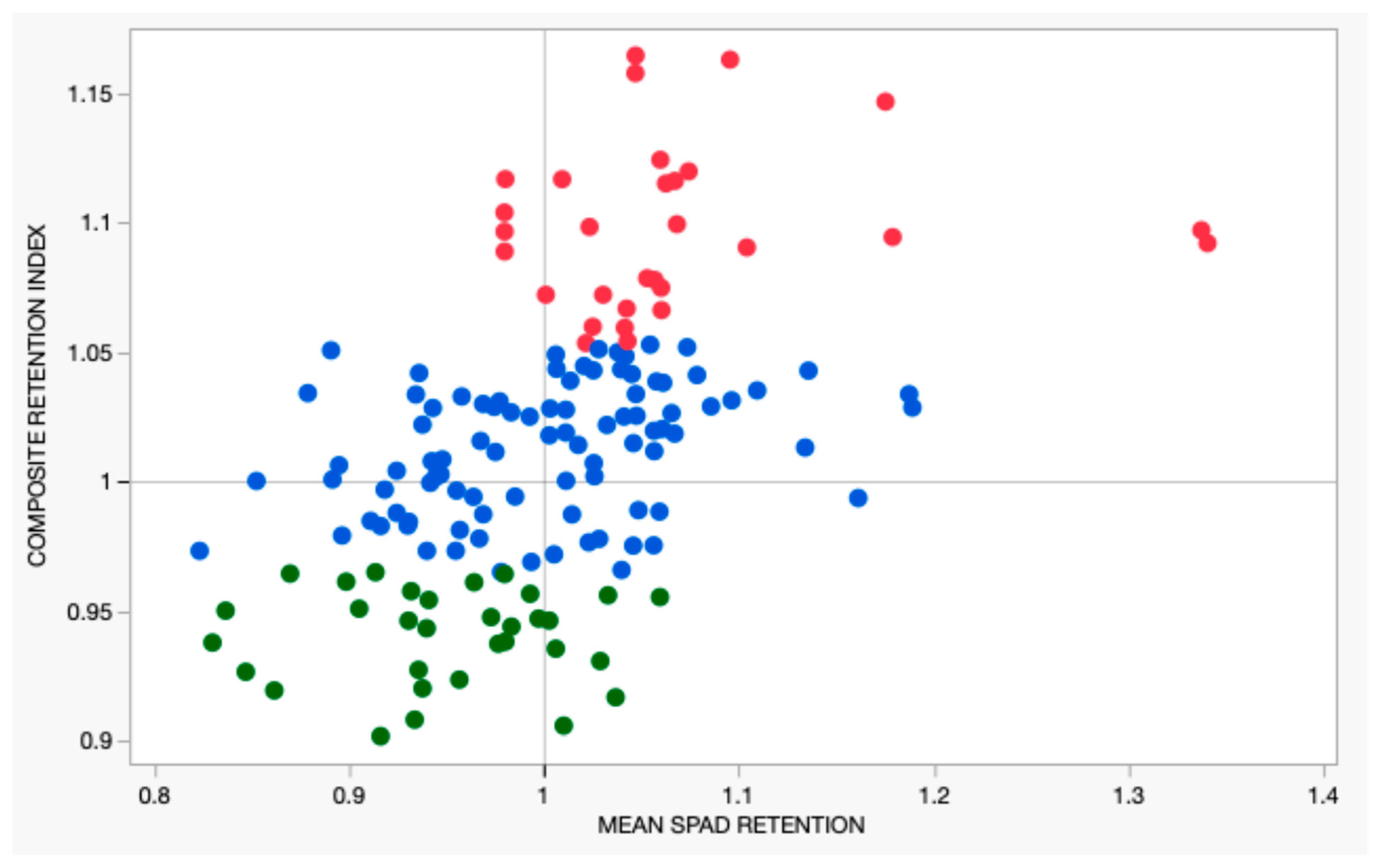
The retention ratio was selected because it quantifies performance under N limitation relative to N sufficiency, thereby reducing the influence of absolute productivity differences among accessions and facilitating comparisons across contrasting N environments. The arithmetic mean was used because all three retention variables were expressed on the same scale and were intended to contribute equally to the composite index. Accessions were subsequently classified into three groups based on their combined distribution of mean SPAD retention and composite index values. Accessions with mean SPAD retention > 1.0 and composite index > 1.0 were designated Tier 1. Accessions with mean SPAD retention < 1.0 and composite index < 1.0 were designated Tier 3. Remaining accessions were designated Tier 2.
2.5. Statistical Analysis
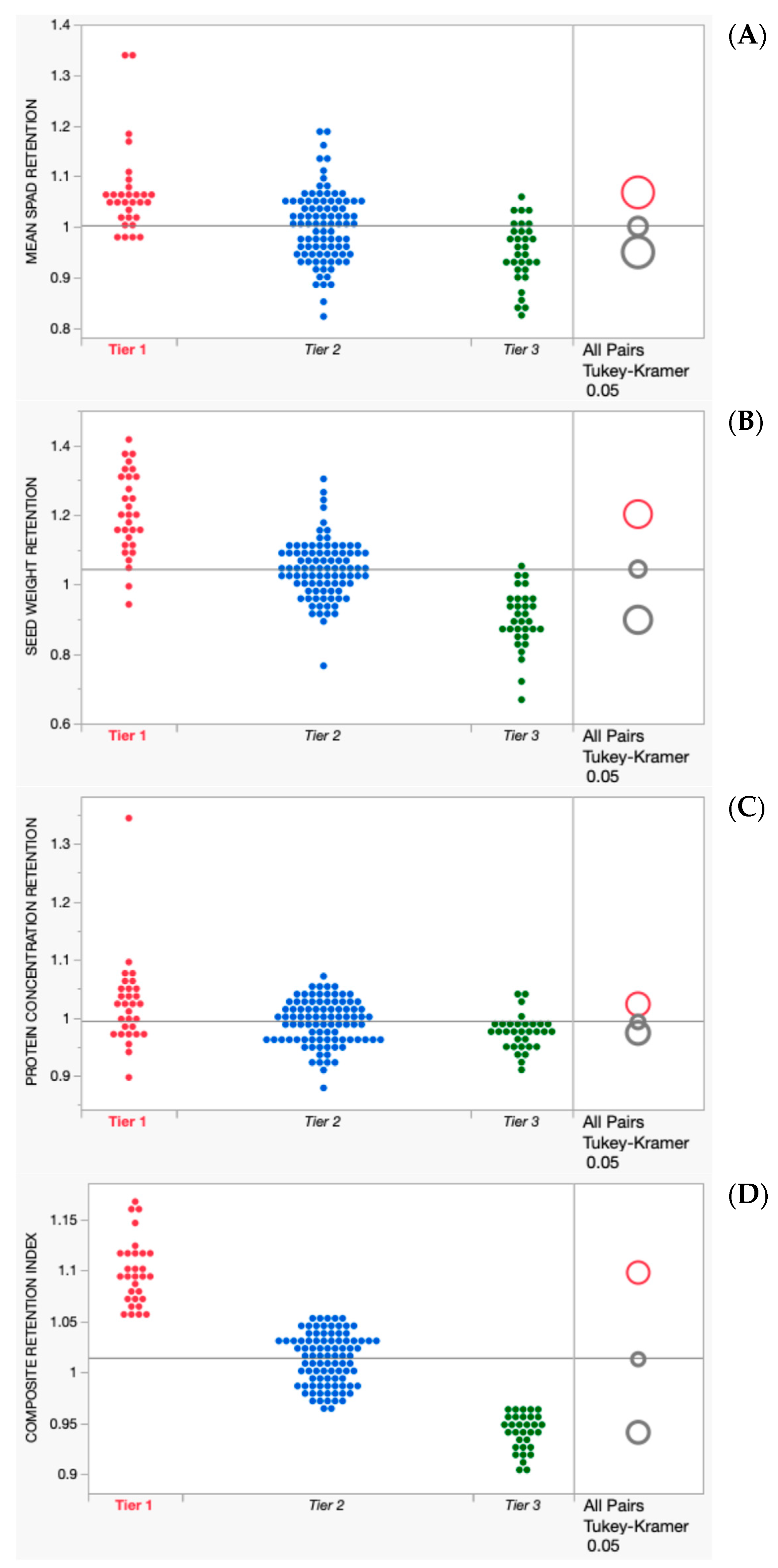
Prior to pooled analyses, mixed-model analyses were carried out to evaluate the effects of year, N treatment, and their interaction on the measured traits. Following assessment of year effects, data from 2024 and 2025 were pooled for correlation evaluations, accession classification, and comparisons among classification groups. Pearson correlation coefficients and their associated p-values were calculated to evaluate temporal associations between canopy N status (SPAD) and 1000-seed weight. Multi-trait retention performance across accessions was visualized using CRI and mean SPAD retention (T1–T30). Differences among Tier 1, Tier 2, and Tier 3 classification groups were evaluated using one-way analysis of variance followed by Tukey–Kramer honestly significant difference tests at p < 0.05. All statistical analyses were performed using JMP 19.0 (SAS Institute Inc., Cary, NC, USA).
4. Discussion
Phenotyping protocols for BNF in soybean are important for genetic improvement programs; however, field-based identification of accessions with superior BNF-associated performance remains challenging because N-related traits are strongly affected by environmental conditions and by genotypic responsiveness to fertilizer inputs [
4,
5]. The retention-based protocol proposed in this study was developed to address these challenges by normalizing trait performance under N− conditions to that under N+ conditions. This approach allows comparisons among accessions based on their ability to maintain canopy chlorophyll status, seed weight, and protein concentration under N limitation and thus reduces the influence of differential responsiveness to mineral N inputs [
5,
16].
An important feature of the proposed protocol is the use of retention values expressed as the ratio of trait performance under N− relative to N+ conditions. This normalization approach was selected because it expresses performance under N− relative to the performance of each accession under N+ and thus reduces the influence of differences in absolute productivity among accessions. In contrast, absolute differences between N treatments may remain strongly affected by baseline trait values and may not adequately reflect relative performance under N−. By expressing traits as retention ratios, accessions can be compared on a common scale regardless of their overall productivity potential.
Our approach was to integrate N status, seed-weight retention, and seed N allocation into a composite index. SPAD scores have been widely used to monitor leaf chlorophyll content under field conditions because they provide a rapid, economical, and non-destructive indicator of canopy N status [
19,
20]. In the present study, SPAD retention was calculated across developmental stages to assess the ability of accessions to maintain canopy chlorophyll status under N− relative to N+ conditions [
10,
19]. In addition, 1000-seed weight retention and protein retention were included to extend the assessment beyond canopy measurements and to incorporate agronomic performance and seed N allocation [
21,
22,
23].
The final step of the proposed protocol was the development of CRI, integrating three N-related retention traits to classify accessions into high-, intermediate-, and low-retention tiers [
17,
18]. Statistically significant differences were observed among the three tiers in SPAD retention, 1000-seed weight retention, protein retention, and CRI values, revealing that the classification approach effectively differentiated accessions by their retention performance under contrasting N environments. These findings suggest that integrating multiple retention traits into a single index provides a practical approach for evaluating N-related performance under field conditions.
The proposed protocol provides a straightforward, rapid, and cost-effective method for identifying soybean accessions with superior retention performance under contrasting N conditions, integrating physiological and agronomic indicators into a single index. Data collection relied on commonly used tools and measurements that can be implemented in genetic improvement programs without requiring specialized equipment or complex laboratory procedures. Consequently, the protocol may serve as a practical field-based screening approach for evaluating large soybean germplasm populations.
The present study, however, has several limitations. Environmental conditions, soil N availability, and genotype-by-environment interactions may influence trait expression and retention across locations and growing seasons [
4,
5,
15]. In addition, CRI can be considered a field-based indicator of BNF-associated performance rather than a direct measurement of N fixation. Therefore, multi-environment evaluations will be necessary to assess the robustness of the protocol across diverse production environments and to explore the integration of additional physiological indicators of N acquisition and utilization. In summary, the present study demonstrates that retention-based normalization combined with multi-trait integration provides a practical and promising approach for phenotyping BNF-associated performance under field conditions.