Effects of Drought Stress, Apera spica-venti (L.) Beauv. Competition, and Biostimulants on Morphological and Nutritional Traits of Winter Wheat—Part 1


Abstract
1. Introduction
2. Materials and Methods
2.1. Winter Wheat
2.2. Water Stress
2.3. Biostimulant Application
2.4. Soil
2.5. Chemical Analysis of Plant Material
2.6. Statistical Analysis
3. Results
3.1. Morphological Traits of Winter Wheat
3.1.1. Main Stem Length
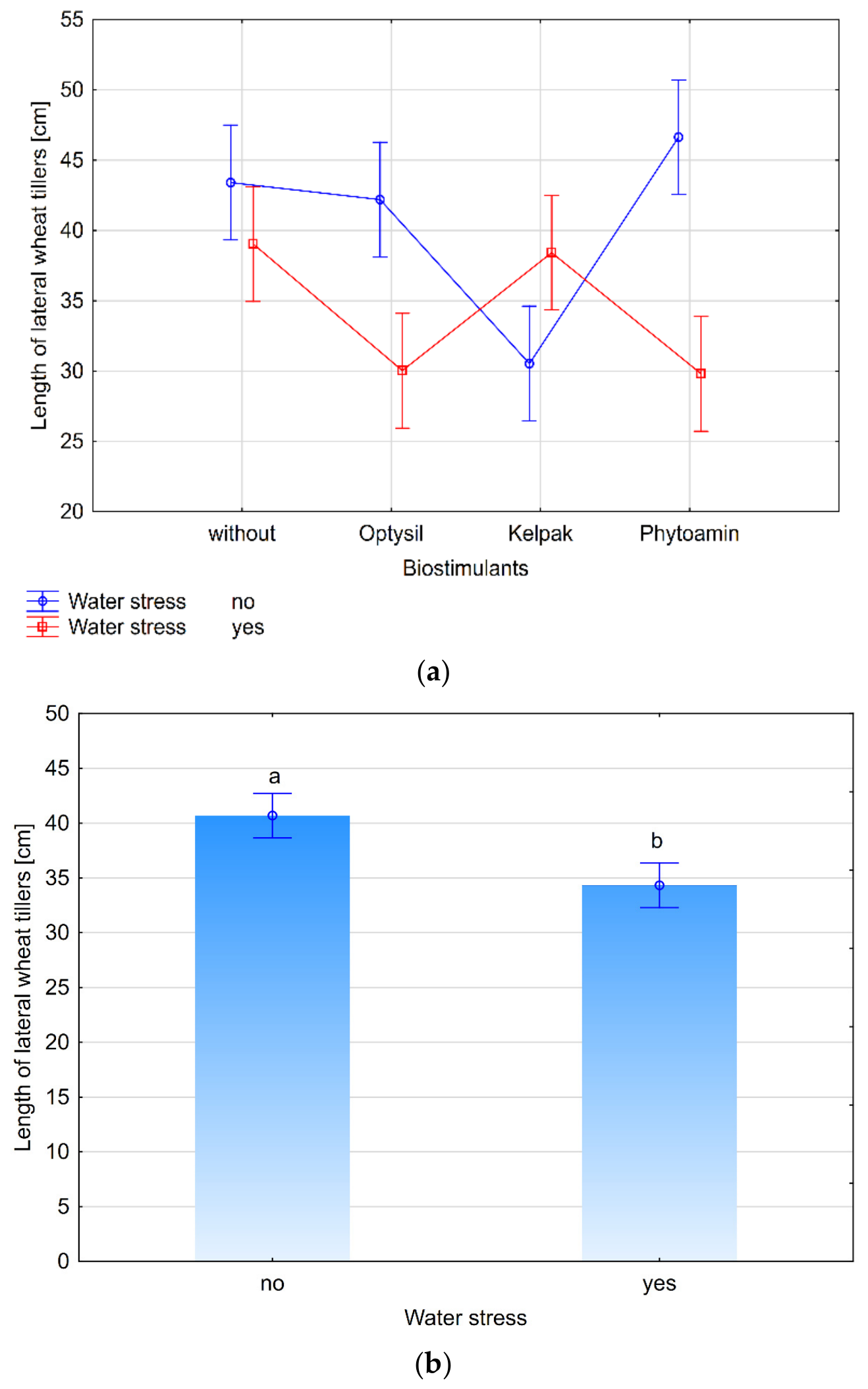
3.1.2. Lateral Tiller Length
3.1.3. Main Spike Length
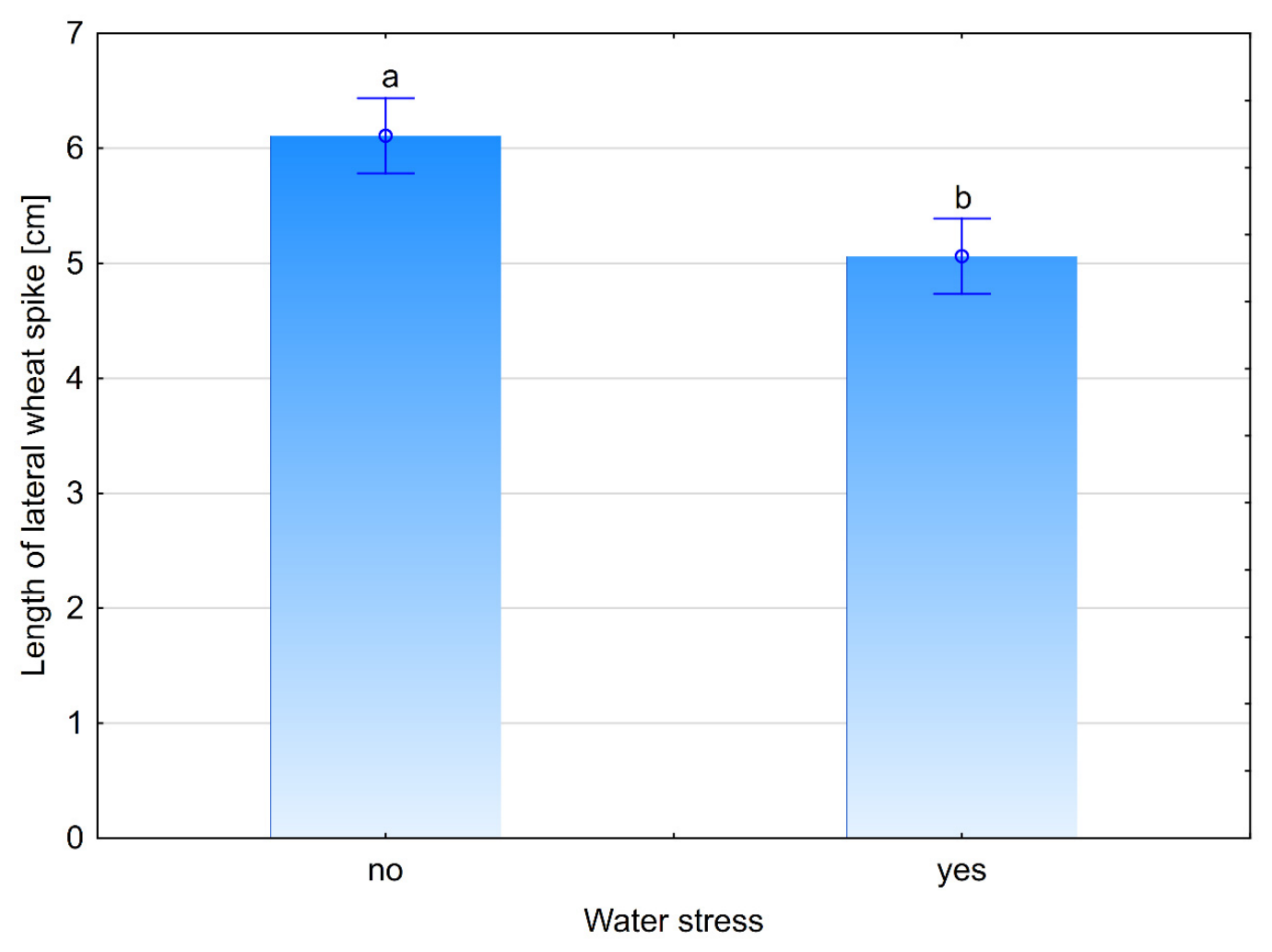
3.1.4. Lateral Spike Length
3.1.5. Main Spike Weight
3.1.6. Number of Non-Productive Tillers
4. Discussion
4.1. Effects of Drought Stress on Morphological Traits of Winter Wheat
4.2. The Effect of Apera Spica-Venti (L.) P.Beauv. on the Biometric Traits of Winter Wheat
4.3. The Impact of Drought Stress on the NPK Content in Wheat Straw
4.4. The Effect of Apera spica-venti on the NPK Content in Winter Wheat Straw
4.5. The Effect of Biostimulants on the Biometric Traits of Winter Wheat Under Drought Stress Conditions
4.6. The Effect of Biostimulants on the Nitrogen/Protein Content in Winter Wheat Straw
5. Conclusions
Author Contributions
Funding
Institutional Review Board Statement
Data Availability Statement
Conflicts of Interest
Appendix A

| Water Stress | Weed Infestation | Biostimulant | Dry Matter (%) | N (%) | Protein (%) | P (%) | K (%) |
|---|---|---|---|---|---|---|---|
| No | Absent | Without | 91.3 | 0.43 | 2.45 | 0.25 | 1.77 |
| Optysil® | 91.4 | 0.40 | 2.25 | 0.22 | 1.80 | ||
| Kelpak SL | 90.9 | 0.45 | 2.58 | 0.19 | 1.66 | ||
| Phytoamin® | 91.4 | 0.47 | 2.65 | 0.19 | 1.42 | ||
| Present | Without | 91.9 | 0.43 | 2.45 | 0.16 | 2.02 | |
| Optysil® | 91.9 | 0.50 | 2.86 | 0.17 | 1.82 | ||
| Kelpak SL | 91.9 | 0.39 | 2.25 | 0.19 | 1.69 | ||
| Phytoamin® | 91.6 | 0.45 | 2.55 | 0.14 | 1.69 | ||
| Yes | Absent | Without | 91.0 | 0.58 | 3.28 | 0.21 | 1.86 |
| Optysil® | 91.5 | 0.59 | 3.35 | 0.24 | 1.86 | ||
| Kelpak SL | 91.2 | 0.60 | 3.40 | 0.19 | 2.02 | ||
| Phytoamin® | 91.1 | 0.62 | 3.52 | 0.22 | 1.81 | ||
| Present | Without | 92.2 | 0.54 | 3.06 | 0.17 | 1.74 | |
| Optysil® | 91.5 | 0.61 | 3.46 | 0.21 | 1.79 | ||
| Kelpak SL | 91.6 | 0.58 | 3.32 | 0.20 | 1.81 | ||
| Phytoamin® | 91.7 | 0.57 | 3.22 | 0.17 | 1.82 | ||
| Main effects | |||||||
| Water stress | |||||||
| No | 91.54 | 0.44 | 2.50 | 0.19 | 1.73 | ||
| Yes | 91.48 | 0.59 | 3.33 | 0.20 | 1.84 | ||
| Weed infestation | |||||||
| Absent | 91.22 | 0.52 | 2.94 | 0.21 | 1.78 | ||
| Present | 91.79 | 0.51 | 2.90 | 0.18 | 1.80 | ||
| Biostimulant | |||||||
| Without | 91.60 | 0.50 | 2.81 | 0.20 | 1.85 | ||
| Optysil® | 91.58 | 0.52 | 2.98 | 0.21 | 1.82 | ||
| Kelpak SL | 91.40 | 0.50 | 2.89 | 0.19 | 1.80 | ||
| Phytoamin® | 91.45 | 0.53 | 2.98 | 0.18 | 1.68 | ||
References
- Signorelli, S. Plant Responses to Stress and Environmental Stimulus. Agronomy 2022, 12, 2250. [Google Scholar] [CrossRef]
- Sienkiewicz-Cholewa, U. Response of Spring Wheat Grown in Drought Stress to Foliar and Soil Silicon Application. Prog. Plant Prot. 2021, 61, 207–213. [Google Scholar] [CrossRef]
- Pramanik, S.K.; Sikder, S.; Hasan, M.A. Wheat Physiology and Yield as Affected by Water Deficit Stress. Agriculturists 2021, 19, 21–33. [Google Scholar]
- El-Forgany, M.; Makus, D.J. Effect of Water Stress on Seed Yield and Quality of the Sweet Corn Inbred ‘Luther Hill’. J. Am. Soc. Hortic. Sci. 1979, 104, 102–104. [Google Scholar] [CrossRef]
- Hasanuzzaman, M.; Hossain, M.A.; DaSilva, J.A.T.; Fujita, M. Plant Response and Tolerance to Abiotic Oxidative Stress: Antioxidant Defenses Are Key Factors. In Crop Stress and Its Management: Perspectives and Strategies; Bandi, V., Shanker, A.K., Shanker, C., Mandapaka, M., Eds.; Springer: Berlin/Heidelberg, Germany, 2012; pp. 261–316. [Google Scholar]
- Kacperska, A. Odporność roślin na stresowe abiotyczne czynniki środowiska i metody jej oceny. Postęp. Nauk Rol. 1991, 38, 1–2. [Google Scholar]
- Płażek, A. Reakcje roślin na czynniki stresowe. Zesz. Probl. Postęp. Nauk Rol. 2004, 496, 73–83. [Google Scholar]
- Hussain, S.; Hussain, S.; Qadir, T.; Khaliq, A.; Ashraf, U.; Parveen, A.; Saqib, M.; Rafiq, M. Drought Stress in Plants: An Overview on Implications, Tolerance Mechanisms and Agronomic Mitigation Strategies. Plant Sci. Today 2019, 6, 389–402. [Google Scholar] [CrossRef]
- Martignago, D.; Rico-Medina, A.; Blasco-Escámez, D.; Fontanet-Manzaneque, J.B.; Caño-Delgado, A.I. Drought Resistance by Engineering Plant Tissue-Specific Responses. Front. Plant Sci. 2020, 10, 1676. [Google Scholar] [CrossRef]
- Starck, Z. Reakcje roślin na abiotyczne stresy środowiskowe—Aklimatyzacja i adaptacja. Łąkarstwo Polsce 2005, 8, 173–184. [Google Scholar]
- Wach, D.; Skowron, P. An Overview of Plant Responses to the Drought Stress at Morphological, Physiological and Bio-Chemical Levels. Pol. J. Agron. 2022, 50, 25–34. [Google Scholar]
- Benito-Verdugo, P.; Martínez-Fernández, J.; González-Zamora, Á.; Almendra-Martín, L.; Gaona, J.; Herrero-Jiménez, C.M. Impact of Agricultural Drought on Barley and Wheat Yield: A Comparative Case Study of Spain and Germany. Agriculture 2023, 13, 2111. [Google Scholar] [CrossRef]
- Singh, S.; Prasad, S.; Yadav, V.; Kumar, A.; Jaiswal, B.; Kumar, A.; Khan, N.A.; Dwivedi, D.K. Effect of Drought Stress on Yield and Yield Components of Rice (Oryza sativa L.) Genotypes. Int. J. Curr. Microbiol. Appl. Sci. 2018, 7, 2752–2759. [Google Scholar]
- Łabędzki, L.; Bąk, B. Impact of Meteorological Drought on Crop Water Deficit and Crop Yield Reduction in Polish Agriculture. J. Water Land Dev. 2017, 34, 181–190. [Google Scholar] [CrossRef]
- Smolik, B. Reakcja wybranych odmian żyta ozimego na stres wywołany różnymi czynnikami abiotycznymi (Reaction of Selected Winter Rye Varieties to Stress Induced by Different Abiotic Factors). Folia Pomer. Univ. Technol. Stetin. Agric. Aliment. Pisc. Zootech. 2012, 293, 119–128. [Google Scholar]
- Farooq, M.; Wahid, A.; Kobayashi, N.; Fujita, D.; Basra, S.M.A. Plant Drought Stress: Effects, Mechanisms and Management. Agron. Sustain. Dev. 2009, 29, 185–212. [Google Scholar] [CrossRef]
- Demir, A.O.; Goksoy, A.T.; Buyukcangaz, H.; Turan, Z.M.; Koksal, E.S. Deficit Irrigation of Sunflower (Helianthus annuus L.) in a Sub-Humid Climate. Irrig. Sci. 2006, 24, 279–289. [Google Scholar] [CrossRef]
- Asaduzzaman, M.; Huqe, M.A.S.; Uddin, M.N.; Hossain, M.A.; Haque, M.S. Seed Priming Improves Germination and Early Seedling Growth in Wheat under Control and Drought Conditions. J. Bangladesh Agric. Univ. 2021, 19, 184–191. [Google Scholar] [CrossRef]
- Sarwar, M.; Saleem, M.F.; Ullah, N.; Khan, M.J.; Maqsood, H.; Ahmad, H.; Tanveer, A.; Shahid, M. Silver Nanoparticles Protect Tillering in Drought-Stressed Wheat by Improving Leaf Water Relations and Physiological Functioning. Funct. Plant Biol. 2023, 50, 901–914. [Google Scholar] [CrossRef]
- Abid, M.; Ali, S.; Qi, L.K.; Zahoor, R.; Tian, Z.W.; Jiang, D.; Dai, T.B. Physiological and Biochemical Changes during Drought and Recovery Periods at Tillering and Jointing Stages in Wheat (Triticum aestivum L.). Sci. Rep. 2018, 8, 4615. [Google Scholar] [CrossRef]
- Svobodová, P.; Míša, P. Effect of Drought Stress on the Formation of Yield Elements in Spring Barley and the Potential of Stress Expression Reduction by Foliar Application of Fertilizers and Growth Stimulator. Plant Soil Environ. 2004, 50, 439–446. [Google Scholar] [CrossRef]
- Lakhneko, O.; Stasik, O.; Škultéty, L.; Kiriziy, D.; Sokolovska-Sergiienko, O.; Kovalenko, M.; Danchenko, M. Transient Drought during Flowering Modifies the Grain Proteome of Bread Winter Wheat. Front. Plant Sci. 2023, 14, 1181834. [Google Scholar] [CrossRef]
- Samarah, N.H. Effects of Drought Stress on Growth and Yield of Barley. Agron. Sustain. Dev. 2005, 25, 145–149. [Google Scholar] [CrossRef]
- Hasanuzzaman, M.; Bhuyan, M.H.M.B.; Parvin, K.; Bhuiyan, T.F.; Anee, T.I.; Nahar, K.; Hossen, M.S.; Zulfiqar, F.; Alam, M.M.; Fujita, M. Regulation of ROS Metabolism in Plants under Environmental Stress: A Review of Recent Experimental Evidence. Int. J. Mol. Sci. 2020, 21, 8695. [Google Scholar] [CrossRef]
- Gill, S.S.; Tuteja, N. Reactive Oxygen Species and Antioxidant Machinery in Abiotic Stress Tolerance in Crop Plants. Plant Physiol. Biochem. 2010, 48, 909–930. [Google Scholar] [CrossRef] [PubMed]
- Malerba, M.; Cerana, R. Chitosan Effects on Plant Systems. Int. J. Mol. Sci. 2016, 17, 996. [Google Scholar] [CrossRef]
- Ali, A.H.; Said, E.M.; Abdelgawad, Z.A. The Role of Seaweed Extract on Improvement Drought Tolerance of Wheat Revealed by Osmoprotectants and DNA (cpDNA) Markers. Braz. J. Bot. 2022, 45, 857–867. [Google Scholar] [CrossRef]
- Sible, C.N.; Seebauer, J.R.; Below, F.E. Plant Biostimulants: A Categorical Review, Their Implications for Row Crop Production, and Relation to Soil Health Indicators. Agronomy 2021, 11, 1297. [Google Scholar] [CrossRef]
- Jardin, P. Plant Biostimulants: Definition, Concept, Main Categories and Regulation. Sci. Hortic. 2015, 196, 3–14. [Google Scholar] [CrossRef]
- Polski Komitet Normalizacyjny. Soil Chemical and Agricultural Analysis—Sampling; Polski Komitet Normalizacyjny: Warsaw, Poland, 1997. [Google Scholar]
- Carter, M.R.; Gregorich, E.G. Soil Sampling and Methods of Analysis; CRC press: Boca Raton, FL, USA, 2007. [Google Scholar]
- Sáez-Plaza, P.; Michałowski, T.; Navas, M.J.; Asuero, A.G.; Wybraniec, S. An Overview of the Kjeldahl Method of Nitrogen Determination. Part I. Early History, Chemistry of the Procedure, and Titrimetric Finish. Crit. Rev. Anal. Chem. 2013, 43, 178–223. [Google Scholar] [CrossRef]
- Karczewska, A.; Kabała, C. Methodology of Laboratory Analyzes of Soils and Plants; University of Life Sciences: Wroclaw, Poland, 1997. [Google Scholar]
- Zaib, M.; Farooq, U.; Adnan, M.; Abbas, Z.; Haider, K.; Khan, N.; Abbas, R.; Nasir, A.S.; Sidra; Muhay-Ul-Din, M.F.; et al. Optimization of Water Stress in Crop Plants, Implications for Sustainable Agriculture: Current and Future Prospects. J. Environ. Agric. Sci. 2023, 25, 37–50. [Google Scholar]
- Egner, H.; Riehm, H.; Domingo, W.R. Chemische Extraktionsmethoden zur Phosphor und Kaliumbestimmung, und Untersuchungen über die Chemische Bodenanalyse als Grundlage für die Beurteilung des Nahrstoffzustandes der Böden. K. Lantbrukshögskolans Ann. 1960, 26, 199–215. [Google Scholar]
- Polski Komitet Normalizacji. Analiza Chemiczno-Rolnicza Gleby. Oznaczanie Zawartości Przyswajalnego Magnezu; Polski Komitet Normalizacji: Warsaw, Poland, 2004. [Google Scholar]
- Pribyl, D.W. A Critical Review of the Conventional SOC to SOM Conversion Factor. Geoderma 2010, 156, 75–83. [Google Scholar] [CrossRef]
- Olszewska, M. Wpływ stresu wodnego na intensywność fotosyntezy, zawartość chlorofilu i plonowanie Lolium perenne. Łąkarstwo Polsce 2002, 5, 163–171. [Google Scholar]
- Verbraeken, L.; Wuyts, N.; Mertens, S.; Cannoot, B.; Maleux, K.; Demuynck, K.; Block, J.; Merchie, J.; Dhondt, S. Drought Affects the Rate and Duration of Organ Growth but Not Inter-Organ Growth Coordination. Plant Physiol. 2021, 186, 1336–1353. [Google Scholar] [CrossRef]
- Farooq, M.; Hussain, M.; Wahid, A.; Siddique, K.H.M. Drought Stress in Plants: An Overview. In Plant Responses to Drought Stress; Aroca, R., Ed.; Springer: Berlin/Heidelberg, Germany, 2012; pp. 1–33. [Google Scholar]
- Senapati, N.; Stratonovitch, P.; Paul, M.J.; Semenov, M.A. Drought Tolerance during Reproductive Development Is Important for Increasing Wheat Yield Potential under Climate Change in Europe. J. Exp. Bot. 2019, 70, 2549–2560. [Google Scholar] [CrossRef]
- Dolferus, R.; Ji, X.; Richards, R.A. Abiotic Stress and Control of Grain Number in Cereals. Plant Sci. 2011, 181, 331–341. [Google Scholar] [CrossRef] [PubMed]
- Wise, K.; Johnson, B.; Mansfield, C.; Krupke, C. Managing Wheat by Growth Stage; Purdue Extension: West Lafayette, IN, USA, 2011. [Google Scholar]
- Barber, H.M.; Carney, J.; Alghabari, F.; Gooding, M.J. Decimal Growth Stages for Precision Wheat Production in Changing Environments? Ann. Appl. Biol. 2015, 166, 355–371. [Google Scholar] [CrossRef]
- Mirbahar, A.A.; Markhand, G.S.; Mahar, A.R.; Abro, S.A.; Kanhar, N.A. Effect of Water Stress on Yield and Yield Components of Wheat (Triticum aestivum L.) Varieties. Pak. J. Bot. 2009, 41, 1303–1310. [Google Scholar]
- Liu, H.; Shi, Z.; Ma, F. Identification and Validation of Plant Height, Spike Length and Spike Compactness Loci in Common Wheat (Triticum aestivum L.). BMC Plant Biol. 2022, 22, 568. [Google Scholar] [CrossRef]
- Šafář, J.; Šimková, H.; Kubaláková, M.; Číhalíková, J.; Suchánková, P.; Bartoš, J.; Doležel, J. Development of Chromosome-Specific BAC Resources for Genomics of Bread Wheat. Cytogenet. Genome Res. 2010, 129, 211–223. [Google Scholar] [CrossRef]
- Pour-Aboughadareh, A.; Mohammadi, R.; Etminan, A.; Shooshtari, L.; Maleki-Tabrizi, N.; Poczai, P. Effects of Drought Stress on Some Agronomic and Morpho-Physiological Traits in Durum Wheat Genotypes. Sustainability 2020, 12, 5610. [Google Scholar] [CrossRef]
- Blum, A.; Sullivan, C.Y.; Nguyen, H.T. The Effect of Plant Size on Wheat Response to Agents of Drought Stress. II. Water Deficit, Heat and ABA. Aust. J. Plant Physiol. 1997, 24, 43–48. [Google Scholar] [CrossRef]
- Berki, Z.; Kiss, T.; Bányai, J.; Cseh, A.; Balla, K.; Karsai, I. Effect of Drought Stress during Critical Developmental Stages on Morphological and Grain Yield-Related Traits in Winter Barley (Hordeum vulgare L.). PLoS ONE 2025, 20, 0329391. [Google Scholar] [CrossRef]
- Farkas, Z.; Varga, B. Responses of Winter Wheat (Triticum aestivum L.) Varieties to Drought Stress and Elevated CO2 Levels: A Comparative Analysis of Growth, Spike Characteristics, and Grain Yield. Cereal Res. Commun. 2025, 53, 2583–2603. [Google Scholar] [CrossRef]
- Fioreze, S.L.; Michelon, L.H.; Turek, T.L.; Drun, R.P.; Dalorsaleta, J.C.S. Role of Nonproductive Tillers as Transient Sinks of Assimilates in Wheat. Bragantia 2020, 79, 180–191. [Google Scholar] [CrossRef]
- Duggan, B.L.; Richards, R.A.; Herwaarden, A.F.; Fettell, N.A. Agronomic Evaluation of a Tiller Inhibition Gene (Tin) in Wheat. I. Effect on Yield, Yield Components, and Grain Protein. Aust. J. Agric. Res. 2005, 56, 169–178. [Google Scholar] [CrossRef]
- Slafer, G.A.; Elía, M.; Savin, R.; García, G.A.; Terrile, I.I.; Ferrante, A.; Miralles, D.J.; González, F.G. A “wiring Diagram” for Sink Strength Traits Impacting Wheat Yield Potential. J. Exp. Bot. 2023, 74, 40–55. [Google Scholar] [CrossRef]
- Kukowski, T. Investigations on the ecology and control of loose silky-bent (Apera spica-venti (L.) P.B.). In Winter Wheat; Prace Opolskiego Towarzystwa Przyjaciół Nauk; Warszawa, Ed.; PWN: Sydney, Australia, 1978. [Google Scholar]
- Knežević, D.; Urošević, D.; Menkovska, M.; Matković Stojšin, M.; Laze, A.; Mićanović, D.; Kondić, D.; Zecevic, V. Variability of Non-Productive Tillering in Winter Wheat (Triticum aestivum L.). In Proceedings of the 12th JEEP International Scientific Agribusiness Conference MAK 2025 “Climate Changes and Ecological Sustainability in Agriculture and Food Production in Serbia, the Region and Southeastern Europe”, Kopaonik, Serbia, 30 January–2 February 2025. [Google Scholar]
- Elhani, S.; Martos, V.; Rharrabti, Y.; Royo, C.; Del Moral, L.G. Contribution of Main Stem and Tillers to Durum Wheat (Triticum turgidum L. Var. Durum) Grain Yield and Its Components Grown in Mediterranean Environments. Field Crops Res. 2007, 103, 25–35. [Google Scholar] [CrossRef]
- Raza, M.A.S.; Saleem, M.F.; Shah, G.M.; Jamil, M.; Khan, I.H. Potassium applied under drought improves physiological and nutrient uptake performances of wheat (Triticum aestivum L.). J. Soil Sci. Plant Nutr. 2013, 13, 175–185. [Google Scholar]
- Alam, S.M. Nutrient Uptake by Plants under Stress Conditions. In Handbook of Plant and Crop Stress; Pessarakli, M., Ed.; Marcel Dekker: New York, NY, USA, 1994; pp. 227–246. [Google Scholar]
- Sinha, S.K.; Nicholas, D.J.D. Nitrate Reductase. In The Physiology and Biochemistry of Drought Resistance in Plants; Paleg, L., Aspinall, D., Eds.; Academic Press: Sydney, Australia, 1981; pp. 145–169. [Google Scholar]
- He, M.; Dijkstra, F.A. Drought Effect on Plant Nitrogen and Phosphorus: A Meta-Analysis. New Phytol. 2014, 204, 924–931. [Google Scholar] [CrossRef]
- Kumari, A.; Sairam, R.K.; Singh, S.K. Nutrient Content in Grain and Straw of Different Wheat Genotypes as Affected by Moisture Stress. Int. J. Curr. Microbiol. Appl. Sci. 2019, 8, 1977–1988. [Google Scholar] [CrossRef]
- Saxena, N.P. The Role of Potassium in Drought Tolerance. Potash Rev. 1985, 5, 1–15. [Google Scholar]
- Epstein, E. Silicon. Annu. Rev. Plant Physiol. Plant Mol. Biol. 1999, 50, 641–664. [Google Scholar] [CrossRef]
- Gong, H.; Chen, K. The Regulatory Role of Silicon on Water Relations, Photosynthetic Gas Exchange, and Carboxylation Activities of Wheat Leaves under Field Drought Conditions. Acta Physiol. Plant 2012, 34, 1589–1594. [Google Scholar] [CrossRef]
- Sarto, M.V.I.M.; Carmo Lana, M.; Rampim, L.; Rosset, J.S.E.; Wobeto, J.R.; Ecco, M.; Costa, P.F. Effect of Silicate on Nutrition and Yield of Wheat. Afr. J. Agric. Res. 2014, 9, 956–962. [Google Scholar] [CrossRef]
- Kaya, C. Effect of Silicon on Growth and Mineral Nutrition of Wheat. J. Plant Nutr. 2006, 29, 829–840. [Google Scholar] [CrossRef]
- Jiang, H.; Jiang, Z.; Zhang, H.; Li, Y.; Li, W.; Gao, K.; Ma, X.; Wang, G.; Wei, X.; Wu, Z. Silicon Nutrition Improves Lodging Resistance of Rice under Dry Cultivation. Plants 2025, 14, 361. [Google Scholar] [CrossRef] [PubMed]
- Raza, M.A.S.; Zulfiqar, B.; Iqbal, R. Morpho-Physiological and Biochemical Response of Wheat to Various Treatments of Silicon Nanoparticles under Drought Stress Conditions. Sci. Rep. 2023, 13, 2700. [Google Scholar] [CrossRef] [PubMed]
- Walsh, O.S.; Shafian, S.; McClintick-Chess, J.R.; Belmont, K.M.; Blanscet, S.M. Potential of Silicon Amendment for Improved Wheat Production. Plants 2018, 7, 26. [Google Scholar] [CrossRef] [PubMed]
- Singh, G.P.; Oosting, S.J. Nutritive Value of Straw. In Feeding of Ruminants on Fibrous Crop Residues; Singh, K., Schiere, J.B., Eds.; The Indian Council of Agricultural Research (ICAR): New Delhi, India, 1993; pp. 141–147. [Google Scholar]
- Correia, L.; Hoover, R.; Carrijo, D.R. Winter Wheat Straw and Grain Production in Response to Trinexapac-Ethyl and Nitrogen Fertilizer. Crop Forage Turfgrass Manag. 2025, 11, 70029. [Google Scholar] [CrossRef]
- Shah, A.M.; Zhang, H.; Shahid, M.; Ghazal, H.; Shah, A.R.; Niaz, M.; Naz, T.; Ghimire, K.; Goswami, N.; Shi, W. The Vital Roles of Agricultural Crop Residues and Agro-Industrial by-Products to Support Sustainable Livestock Productivity in Subtropical Regions. Animals 2025, 15, 1184. [Google Scholar] [CrossRef]
- Juhász, E.K.; Kremper, R.; Tállai, M.; Béni, Á.; Novák, T.; Balla Kovács, A. Evaluation of the Effects of Drought Stress and Nitrogen–Sulfur Fertilization on Productivity and Yield Parameters of Spring Wheat. Stresses 2024, 4, 850–859. [Google Scholar] [CrossRef]
- Anjum, M.I.; Ghazanfar, S.; Begum, I. Nutritional Composition of Wheat Grains and Straw Influenced by Differences in Vari-Eties Grown under Uniform Agronomic Practices. Int. J. Vet. Sci. 2014, 3, 100–104. [Google Scholar]
- Sewhag, M.; Shweta; Kumar, P.; Sharma, M.K.; Neelam; Devi, U. Nutrient Studies of Wheat as Influenced by Different Ni-Trogen Management Practices. Int. J. Curr. Microbiol. Appl. Sci. 2020, 9, 161–167. [Google Scholar] [CrossRef]
- Abo Basha, D.M.; El Sayed, S.; Badr, E.A. Evaluation of Mineral Fertilizer with Silicon (Si) Foliar Application on Growth, Yield Production and Nutrient Status of Wheat under Sandy Soil Conditions. Egypt. J. Chem. 2024, 67, 229–239. [Google Scholar] [CrossRef]
- Sen, A.; Srivastava, V.K.; Singh, R.K.; Singh, A.P.; Raha, P.; Ghosh, A.K.; De, N.; Rakshit, A.; Meena, R.N.; Kumar, A.; et al. Soil and Plant Responses to the Application of Ascophyllum Nodosum Extract to No-till Wheat (Triticum aestivum L.). Commun. Soil Sci. Plant Anal. 2015, 46, 123–136. [Google Scholar] [CrossRef]
- Gajek, F. Wpływ nawożenia na wysokość i jakość plonów roślin uprawnych. Zesz. Probl. Postęp. Nauk Rol. 1973, 145, 167–199. [Google Scholar]
- Azad, M.A.K.; Ahmed, T.; El-Jaoual Eaton, T.; Hossain, M.M.; Haque, M.K.; Soren, E.B. Yield of Wheat (Triticum aestivum L.) and Nutrient Uptake in Grain and Straw as Influenced by Macro. Nat. Sci. 2021, 13, 381–391. [Google Scholar]
- Nagar, N.; Kumar, V.; Pal, D. Yield, Nutrient Contents and Their Uptake by Wheat (Triticum aestivum L.) in Relation to FYM and Potassium Fertilization. J. Rural Agric. Res. 2020, 20, 88–91. [Google Scholar]
- Tabassum, R.; Sarita; Javaid, I.; Kumar, B.; Sharma, N.; Sikarwar, S.; Harishankar. Effect of Integrated Nutrient Management Practices on Nutrient Content, Nutrient Uptake and Productivity of Wheat Crop. Int. J. Res. Agron. 2024, 7, 22–28. [Google Scholar] [CrossRef]


| Plants | Capillary Water Capacity | Treatment |
|---|---|---|
| wheat | 65% | Control/Si/Ecklonia maxima/Ascophyllum nodosum |
| 30% | Control/Si/Ecklonia maxima/Ascophyllum nodosum | |
| wheat + A. spica-venti | 65% | Control/Si/Ecklonia maxima/Ascophyllum nodosum |
| 30% | Control/Si/Ecklonia maxima/Ascophyllum nodosum |
| Recommended Developmental Stage | Treatment Phase | Recommended Dose | Number of Treatments | |
|---|---|---|---|---|
| Autumn | ||||
| Optysil® | 3–6 leaf stage (BBCH 13–16) | 4-leaf stage (BBCH 14) | 0.5 L·ha−1 | 1 |
| Kelpak SL | from 4 leaf stage (BBCH 14) | 4-leaf stage (BBCH 14) | 2 L·ha −1 | 1 |
| Phytoamin® | from 4 leaf stage (BBCH 14) | 4-leaf stage (BBCH 14) | 3 L·ha −1 | 1 |
| Spring | ||||
| Optysil® | tillering stage (BBCH 24) | tillering stage (BBCH 24) | 0.5 L·ha−1 | 1 |
| Optysil® | beginning of stem elongation (BBCH 30–39) - | stem elongation (BBCH 34–35) | 0.5 L·ha−1 | 1 |
| Optysil® | from heading to the early milk stage (BBCH 51–73) optional timing | - | 0.5 L·ha−1 | 1 |
| pH | N | P | K | Mg | C |
|---|---|---|---|---|---|
| [g/kg] | [mg/kg] | [mg/kg] | [%] | ||
| 6.9 | 1.03 | 120.36 | 225 | 182.8 | 2.15 |
| Source of Variation | df | F/p | Length of Main Stem of Wheat | Length of Lateral Wheat Tillers | Length of Main Wheat Spike | Length of Lateral Wheat Spike | Weight of Main Wheat Spike | Number of Non-Productive Tillers |
|---|---|---|---|---|---|---|---|---|
| Water stress (WS) | 1 | F | 10.62 | 4.872 | 0.28 | 5.109 | 310.26 | 0.765 |
| p | 0.002 ** | 0.030 * | 0.595 ns | 0.026 * | <0.001 * | 0.384 ns | ||
| Weed infestation (WI) | 1 | F | 17.45 | 1.465 | 3.09 | 0.180 | 213.81 | 11.438 |
| p | <0.001 * | 0.229 ns | 0.082 ns | 0.673 ns | <0.001 * | 0.001 ** | ||
| Biostimulant (B) | 3 | F | 0.53 | 1.019 | 1.84 | 1.228 | 1.39 | 1.519 |
| p | 0.664 ns | 0.388 ns | 0.146 ns | 0.304 ns | 0.250 ns | 0.214 ns | ||
| WS × WI | 1 | F | 0.28 | 1.158 | 0.09 | 0.916 | 22.96 | 0.171 |
| p | 0.600 ns | 0.285 ns | 0.761 ns | 0.341 ns | <0.001 * | 0.680 ns | ||
| WS × B | 3 | F | 1.24 | 3.507 | 1.36 | 1.956 | 1.17 | 1.362 |
| p | 0.301 ns | 0.018 * | 0.261 ns | 0.126 ns | 0.326 ns | 0.259 ns | ||
| WI × B | 3 | F | 0.03 | 0.176 | 0.46 | 0.163 | 0.26 | 0.875 |
| p | 0.992 ns | 0.913 ns | 0.711 ns | 0.921 ns | 0.853 ns | 0.457 ns | ||
| WS × WI × B | 3 | F | 1.07 | 0.220 | 2.70 | 0.336 | 5.81 | 0.353 |
| p | 0.366 ns | 0.882 ns | 0.050 * | 0.799 ns | 0.001 ** | 0.787 ns |
| Weed Infestation | No Stress (65% CWC) | Stress (30% CWC) | Mean |
|---|---|---|---|
| Weed absent | 50.8 | 49.2 | 50.0 a |
| A. spica-venti | 48.9 | 47.7 | 48.2 b |
| Mean | 49.8 a | 48.4 b | – |
| Water Stress—Weed Infestation | Without | Optysil® | Kelpak SL | Phytoamin® | Mean |
|---|---|---|---|---|---|
| No stress, 65% CWC—Absent | 8.8 a | 8.5 ab | 8.3 ab | 8.4 ab | 8.5 |
| No stress, 65% CWC—A. spica-venti | 8.3 ab | 8.3 ab | 8.4 ab | 8.5 ab | 8.4 |
| Stress, 30% CWC—Absent | 8.3 ab | 8.5 ab | 8.4 ab | 8.6 ab | 8.5 |
| Stress, 30% CWC—A. spica-venti | 8.4 ab | 8.4 ab | 8.2 b | 8.4 ab | 8.4 |
| Water Stress | Weed Infestation | Biostimulants | Mean | ||||
|---|---|---|---|---|---|---|---|
| Without | Optysil® | Kelpak SL | Phytoamin® | Mean | |||
| No, 65% CWC | Absent | 2.8 a | 2.5 a | 2.6 a | 2.6 a | 2.6 a | 2.3 a |
| A. spica-venti | 1.9 bc | 2.0 b | 1.8 bcd | 2.0 b | 1.9 b | ||
| Mean | 2.4 a | 2.3 a | 2.2 a | 2.3 a | – | ||
| Yes, 30% CWC | Absent | 1.7 de | 1.9 bc | 1.8 bc | 1.9 bc | 1.8 b | 1.7 b |
| A. spica-venti | 1.6 de | 1.5 e | 1.5 de | 1.5 de | 1.5 c | ||
| Mean | 1.6 b | 1.7 b | 1.7 b | 1.7 b | – | ||
| Mean | Absent | 2.2 a | 2.2 a | 2.2 a | 2.3 a | 2.2 a | – |
| A. spica-venti | 1.8 b | 2.2 b | 1.6 b | 1.8 b | 1.7 b | ||
| Weed Infestation | Without | Optysil® | Kelpak SL | Phytoamin® | Mean |
|---|---|---|---|---|---|
| Absent | 1.4 | 1.5 | 1.3 | 1.4 | 1.4 a |
| A. spica-venti | 1.1 | 1.2 | 1.2 | 1.3 | 1.2 b |
| Mean | 1.2 b | 1.3 a | 1.2 ab | 1.3 ab | – |
Disclaimer/Publisher’s Note: The statements, opinions and data contained in all publications are solely those of the individual author(s) and contributor(s) and not of MDPI and/or the editor(s). MDPI and/or the editor(s) disclaim responsibility for any injury to people or property resulting from any ideas, methods, instructions or products referred to in the content. |
© 2026 by the authors. Licensee MDPI, Basel, Switzerland. This article is an open access article distributed under the terms and conditions of the Creative Commons Attribution (CC BY) license.
Share and Cite
Lejman, A.; Kuc, P. Effects of Drought Stress, Apera spica-venti (L.) Beauv. Competition, and Biostimulants on Morphological and Nutritional Traits of Winter Wheat—Part 1. Agriculture 2026, 16, 1283. https://doi.org/10.3390/agriculture16121283
Lejman A, Kuc P. Effects of Drought Stress, Apera spica-venti (L.) Beauv. Competition, and Biostimulants on Morphological and Nutritional Traits of Winter Wheat—Part 1. Agriculture. 2026; 16(12):1283. https://doi.org/10.3390/agriculture16121283
Chicago/Turabian StyleLejman, Agnieszka, and Piotr Kuc. 2026. "Effects of Drought Stress, Apera spica-venti (L.) Beauv. Competition, and Biostimulants on Morphological and Nutritional Traits of Winter Wheat—Part 1" Agriculture 16, no. 12: 1283. https://doi.org/10.3390/agriculture16121283
APA StyleLejman, A., & Kuc, P. (2026). Effects of Drought Stress, Apera spica-venti (L.) Beauv. Competition, and Biostimulants on Morphological and Nutritional Traits of Winter Wheat—Part 1. Agriculture, 16(12), 1283. https://doi.org/10.3390/agriculture16121283