1. Introduction
Water scarcity is one of the main constraints on grapevine cultivation, and this limitation is expected to intensify under current climate change scenarios. In
Vitis vinifera, seasonal water requirements for wine production commonly range from 300 to 700 mm [
1], often exceeding the natural water availability of agroecological regions where viticulture is economically important, particularly in Mediterranean-type climates. This situation is especially relevant in Chile, where the high evaporative demand of the main viticultural areas makes irrigation necessary in most vineyards. One of the few exceptions is the cultivar Listán Prieto (syn. País in Chile, Criolla Chica in Argentina, Negra Criolla in Peru, and internationally recognized as Mission or Criolla), a traditional grapevine that has been cultivated for nearly five centuries under rainfed conditions, particularly in the Maule and Biobío valleys. This cultivar is included within the special denomination of origin “Secano Interior,” together with Cinsault (Decreto N°56, MINAGRI), and has recently experienced renewed interest due to the cultural and patrimonial value of its wines [
2].
Despite this historical adaptation to rainfed systems, cv. País remains particularly vulnerable to extreme climatic events, such as the megadrought that has affected central Chile during the last decade [
3]. In this context, reduced precipitation, altered rainfall patterns, and increasing temperatures negatively affect vine productivity, fruit quality, and, in severe cases, plant survival. Consequently, adaptive strategies are urgently needed to sustain viticultural systems under increasing water limitation. Although the expansion of irrigated areas may appear to be an obvious solution, it is not always feasible from an economic, social, or environmental perspective. Therefore, the use of plant material with enhanced drought resistance, either through cultivars or rootstocks, has emerged as a highly relevant adaptive strategy [
4]. However, the adoption of new cultivars is often constrained by economic and cultural factors, as well as by regulatory restrictions associated with denominations of origin. Under these circumstances, the exploration of intra-cultivar variability offers a promising alternative that may improve drought adaptation while preserving varietal identity.
Intra-cultivar variability refers to stable and recognizable phenotypic and genetic differences among clones or populations belonging to the same cultivar. These differences may result from long-term selection under contrasting agroecological conditions or from spontaneous mutations that have proven viable and adaptive. A well-known example is Tempranillo in Spain, for which more than 50 commercial clones are available as a result of its historical cultivation across a broad geographic range [
5]. In this regard, previous studies have shown substantial intra-cultivar variation in traits relevant to drought response. In Tempranillo, for instance, significant differences among clones have been reported for physiological variables associated with water use and drought performance [
6], while mesophyll conductance, respiration rate, and photosynthetic capacity have been identified as major determinants of clonal differences in water-use efficiency [
7]. These findings suggest that intra-cultivar diversity may provide valuable adaptive resources for viticulture under climate change.
For cv. País, however, the available information remains very limited. Although this cultivar is generally considered resistant to water deficit, only a few studies have evaluated the effects of drought on its productivity and fruit quality [
8], and virtually none have addressed the physiological mechanisms underlying this apparent resistance. To our knowledge, no study has specifically examined intra-cultivar variability in traits associated with drought-response strategy in cv. País. This knowledge gap is particularly relevant because drought adaptation in grapevine is a complex trait that integrates water use, gas exchange, growth, and yield responses across multiple organizational scales [
9].
A widely used framework for describing drought responses in grapevine has been the distinction between iso- and anisohydric behavior, referring to genotypes that show stronger or weaker regulation of plant water status through stomatal control, respectively [
10,
11]. More recently, this distinction has been refined through definitions based on daily water potential homeostasis or stomatal closure thresholds [
12,
13]. Nevertheless, the biological mechanisms underlying these water-relation strategies extend beyond stomatal regulation alone and remain incompletely understood, as they depend on both the conceptual framework adopted and the environmental conditions under which plants are evaluated [
14]. Moreover, despite the large number of studies published on grapevine drought responses during the last two decades, it remains unclear whether a more isohydric or anisohydric behavior confers greater adaptive value under water deficit [
9]. This uncertainty supports the need to focus on measurable physiological traits that provide a more robust basis for comparing genotypes and predicting their performance under specific environmental scenarios. This is particularly relevant when considering broader definitions of drought adaptation, in which dehydration avoidance and dehydration tolerance do not depend solely on a more stomatal behavior, but rather on the integrated functioning of plant hydraulics and plant–soil–atmosphere interactions [
15]. In this context, hydraulic and water-use traits have been proposed as useful descriptors of drought-response strategy.
According to Gambetta et al. [
9] and Simonneau et al. [
16], key traits include lower maximum transpiration rates at both leaf and whole-plant levels, associated with maximum stomatal conductance and leaf area, respectively; strong stomatal regulation in response to declining plant or soil water status; and other integrative variables related to plant water use. Furthermore, an anisohydric-to-isohydric transition has been reported as drought stress increases [
13], supporting the view that a more conservative water-use strategy may be advantageous for drought resistance under specific environmental conditions. This set of traits implies a conservative water-use strategy, allowing grapevines to delay the onset of severe water stress and cope more effectively with prolonged drought periods, which are typical of Mediterranean environments such as central Chile, where cv. País has been traditionally cultivated.
Taken together, these antecedents indicate that assessing intra-cultivar variability may represent a key strategy for improving the resilience of traditional viticultural systems under climate change, particularly in patrimonial cultivars such as País. At the same time, the complexity of drought-response traits and their strong interaction with environmental conditions demand robust experimental approaches capable of detecting subtle but meaningful physiological differences among genotypes. Based on the above, we hypothesized that plant material originating from more arid zones would exhibit greater resistance to water deficit, reflected in improved plant water status, lower maximum stomatal conductance, and more efficient stomatal regulation than plant material from less arid areas. Accordingly, the objective of this study was to characterize intra-cultivar variation in the drought-response strategy of
Vitis vinifera L. cv. País from contrasting geographic origins by quantifying: (i) the relationships among substrate water availability, stem water potential, and stomatal conductance; (ii) the stomatal-conductance thresholds associated with water deficit, defined as the stem water potential at which stomatal conductance declined by 12%, 50%, and 88% from its maximum value (Pg12, Pg50, and Pg88, respectively); and (iii) the recovery of plant water status and stomatal conductance after rewatering, using Cabernet Franc as a comparative reference, as this cultivar has been reported to exhibit high stomatal tolerance to water deficit [
17], i.e., delayed stomatal closure under water deficit.
2. Materials and Methods
2.1. Study Site and Plant Material
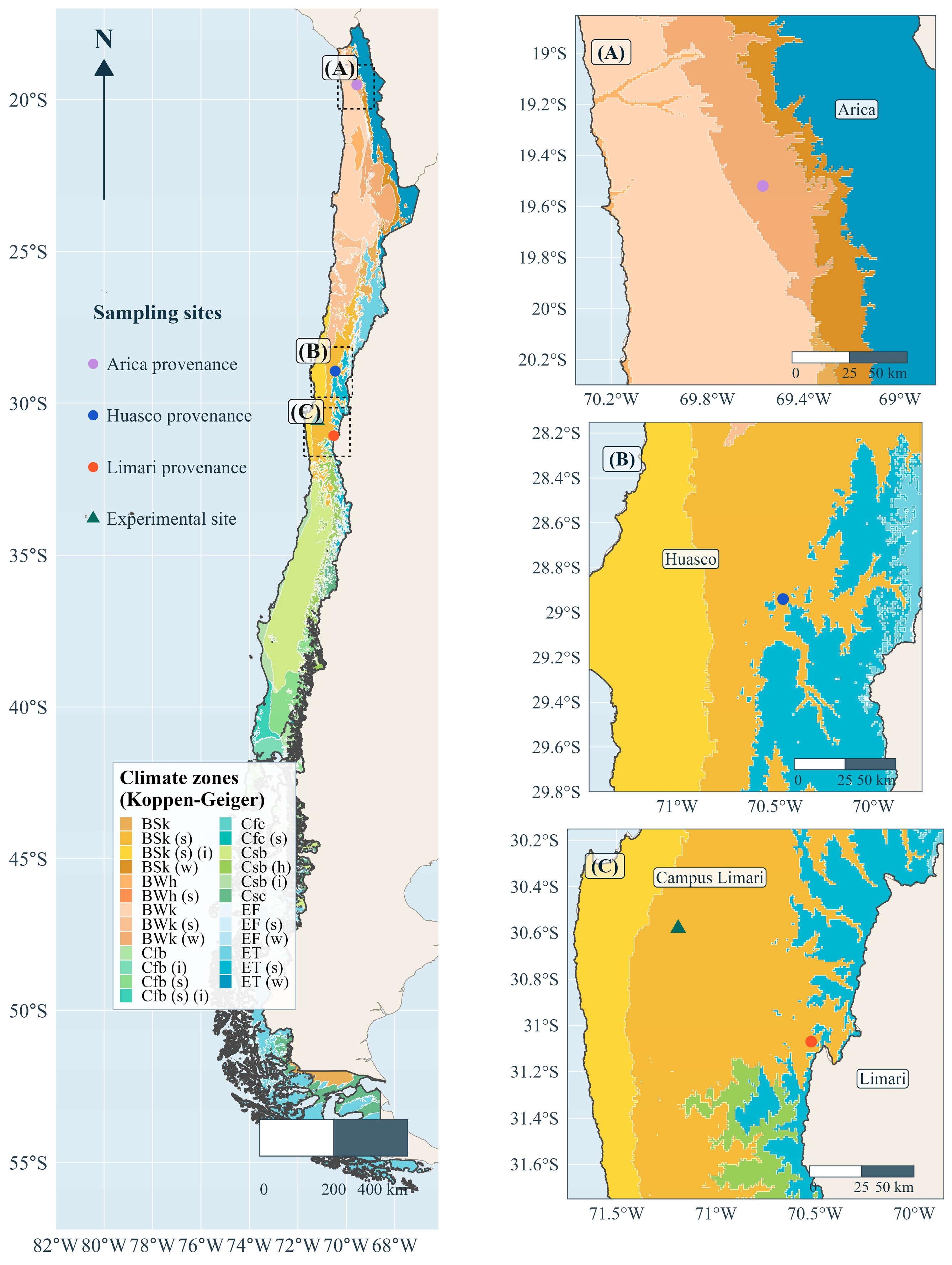
The study was conducted at the Limarí Campus of the University of La Serena (30°35′01″ S, 71°11′40″ W), in the Coquimbo Region of Chile. According to the Köppen–Geiger climate classification, the area has a semi-arid climate with winter rainfall (BSk), characterized by high solar radiation and marked thermal seasonality [
18]. Within the Limarí basin, specifically in the Cordillera Media Elqui–Limarí climatic unit, the CIREN Observatory reports an average maximum temperature of 23.5 °C in January and an average minimum temperature of −5 °C in June, reflecting the strong winter thermal variability typical of the Norte Chico region of Chile (CIREN, 2024). In this basin, the influence of the Pacific Ocean and the Coastal Range moderates daily thermal amplitude and contributes to relatively stable winter conditions, whereas relative humidity is partly influenced by the proximity of the Limarí River (Dirección Meteorológica de Chile, 2025).
The experiment lasted five weeks and was conducted using two-year-old own-rooted
Vitis vinifera L. cv. País plants from three geographic origins: Arica, Huasco, and Limarí (
Figure 1). The Arica provenance site is classified as a cold desert climate with summer rainfall and hyper-arid conditions, whereas Huasco and Limarí correspond to a semi-arid climate with winter rainfall, with aridity categories of arid and semi-arid, respectively [
18,
19]. The plant material was provided by INIA Intihuasi, which has established a collection of cv. País provenances through field surveys of vineyards in northern Chile in collaboration with local growers and regional INIA centers. To ensure varietal identity, the plant material was genetically characterized by the research group using single nucleotide polymorphism (SNP) markers and genotyped through the Gen_SNP_1274 platform [
20]. The experiment included Cabernet Franc (CF) as a control cultivar for comparison with cv. País because this cultivar has been reported to exhibit high stomatal tolerance to water deficit [
17]. Cabernet Franc plants were provided by the Instituto de Investigaciones Agropecuarias, Intihuasi Experimental Station, Chile.
During the winter of 2025, ten plants per provenance and ten Cabernet Franc plants were selected and subjected to preventive sulfur and potassium soap applications. Plants were then transplanted into 11 L pots containing a homogeneous substrate composed of a 1:1 mixture of peat and agricultural soil collected from the study site. A 5 cm layer of perlite was placed at the bottom of each pot to improve drainage.
Table 1 shows the pot weight recorded after irrigation, considered as the maximum pot weight, and the difference between maximum and minimum pot weight under the water-deficit treatment, which was used as a proxy for the available water content during the dry-down period. Pot weight data and their trajectory over time are shown in
Figure S4. At transplanting, plants were pruned to three buds, fertilized with 10 g plant
−1 of granular NovaTec
® Classic 12-8-16(+3+TE) (COMPO EXPERT, Münster, Westphalia), and maintained under irrigation as needed until September 29, when the water deficit treatments were initiated. At the beginning of the experiment, each shoot of the plants (three shoots per plant) had between five and seven expanded leaves, corresponding to BBCH stages 15–17.
2.2. Experimental Design
Two fixed factors were evaluated in a factorial arrangement: (i) plant material, with four levels consisting of three Vitis vinifera L. cv. País provenances (Arica, Huasco, and Limarí) and Cabernet Franc as a reference cultivar; and (ii) irrigation, with two levels: well-watered (WW) and water deficit (WD). Treatments were arranged in a completely randomized design. Five replicates were established per treatment combination, resulting in a total of 40 experimental units (4 × 2 × 5). Each experimental unit consisted of a single plant grown individually in an 11 L pot containing a homogeneous substrate.
Pots assigned to the well-watered treatment were irrigated to saturation, defined as visible drainage, every two days. In contrast, pots assigned to the water-deficit treatment received no irrigation throughout the experimental drought period (4 weeks).
2.3. Measured Variables
Leaf Area
To characterize plant size and evaluate its potential influence on initial water consumption rates during the experimental period, leaf area (LA, m
2) was estimated at the beginning of the experiment and during the following three consecutive weeks using a non-destructive allometric model based on projected plant area. For model calibration, actual leaf area (cm
2) was measured, and lateral photographs of each plant were taken simultaneously (
Figures S1–S3). Images were subsequently analyzed with ImageJ (Version 1.54t) to quantify green projected area. Both variables were related through linear regression, yielding a model that allowed leaf area to be estimated from photographs.
2.4. Relative Pot Water Content
Before the onset of the water-deficit treatment, all pots were irrigated to saturation, allowed to drain until no further water flow was observed, and then weighed to determine maximum pot weight (M_max; g). This value was considered equivalent to pot capacity, that is, maximum water availability (
Table S1). During the experiment, pot weight (M) was recorded manually every 2-3 days using a balance with a nominal capacity of 20 kg and a precision of 0.02% (equivalent to 4 g). Relative pot water content (RPWC) was then estimated as
.
2.5. Stem Water Potential, Stomatal Conductance and Sensitivity of Stomatal Conductance to Water Deficit
Stem water potential (Ψ, MPa) was measured weekly from the onset of the water-deficit treatment onward, around solar noon (13:30 h local time), on one fully expanded leaf per plant using a Scholander-type pressure chamber (Pump-up Chamber, PMS Instruments, SE Geary St, Albany, OR, USA). Leaves were enclosed in aluminized plastic bags for 1 h before measurement [
21].
At the same frequency and within the same time window, stomatal conductance (mmol m−2 s−1) was measured using a steady-state porometer (SC-1 Leaf Porometer, METER, NE Hopkins Ct. Pullman, WA, USA) on two fully expanded, radiation-exposed leaves per plant.
To infer stomatal conductance behavior stem water potential corresponding to 12% (Pg12), 50% (Pg50), and 88% (Pg88) reductions in maximum stomatal conductance were derived analytically from the fitted parameters for each cv. País provenance and CF. Standard errors and confidence intervals for these derived thresholds were obtained using the delta method applied to the covariance matrix of the nonlinear parameters. Pairwise differences among provenance-specific threshold estimates were then evaluated using approximate Wald tests, and Holm-adjusted p-values were used to identify statistically supported differences among provenances.
2.6. Short-Term Recovery Capacity
During the fifth week of the experiment, irrigation was restored in plants assigned to the water-deficit treatment. These plants were irrigated on two consecutive days until pot weight reached between 93 and 97% of maximum pot weight. On the third day, stem water potential and stomatal conductance were measured as described above.
2.7. Environmental Conditions
Meteorological characterization of the study site was based on records from the Escuela Agrícola Ovalle agrometeorological station (30.58° S, 71.18° W; 314 m a.s.l.), part of the Agroclima Network, located approximately 1 km in a straight line from the experimental site.
2.8. Data Analysis
All analyses were performed in R Statistical Software (v4.4.3) [
22]. Repeated-measures responses were analyzed using linear mixed-effects models fitted with the lmerTest package v3.2-1 [
23], which extends lme4 to provide inferential testing for mixed models [
24]. Plant material and irrigation treatment were the between-plant experimental factors. Sampling week was included as a within-plant repeated-measures term to describe temporal trajectories during the dry-down period, not as an independently randomized experimental factor. Experimental unit was included as a random intercept. For each response variable, four candidate residual structures were fitted and compared using the Akaike information criterion (AIC): a random-intercept model with homogeneous residual variance and no temporal autocorrelation; a random-intercept model with first-order autoregressive residual correlation within experimental unit [AR(1)]; a random-intercept model with heterogeneous residual variance modeled with varIdent [
25]; and a model combining heterogeneous residual variance with AR(1). Because the fixed-effects structure was held constant within each response, the candidate with the lowest AIC was selected for marginal F-tests. Residual normality was evaluated with the Shapiro–Wilk test, and variance homogeneity was screened with Levene’s test implemented in car [
26]. Post hoc inference was based on estimated marginal means obtained with emmeans [
27]. Compact letter displays were generated using multcomp [
28]. Pairwise comparisons were performed with Tukey adjustment at α = 0.05 whenever the contrast family was compatible with Tukey control; otherwise, Sidak correction was applied through emmeans.
Regression analyses were conducted separately for each cv. País provenance and CF. Nonlinear models (power [Equation (1)], logistic [Equation (2)] and Weibull [Equation (3)]) were fitted using minpack.lm [
29], and the best model was selected according to the Akaike information criterion (AIC). Confidence bands for nonlinear fits were derived from the variance–covariance matrix of the estimated nonlinear parameters using a first-order delta-method approximation. Graphs were produced with ggplot2 [
30], and data manipulation was performed using dplyr and tidyr [
31].
The series comparison presented in the regression figures corresponds to an extra sum-of-squares F-test. Under this framework, the reduced model consisted of a single common curve fitted across all plant materials, whereas the full model consisted of plant material-specific curves. A significant overall series comparison indicated that plant material-specific curves explained significantly more residual variation than a shared curve, implying that at least one plant material differed in the form or position of its fitted response. Plant material differences were identified using Holm-adjusted p-values at α = 0.05. In addition, plant material-specific nonlinear parameter estimates were compared pairwise within each relationship and model family using approximate Wald tests with Holm adjustment.
4. Discussion
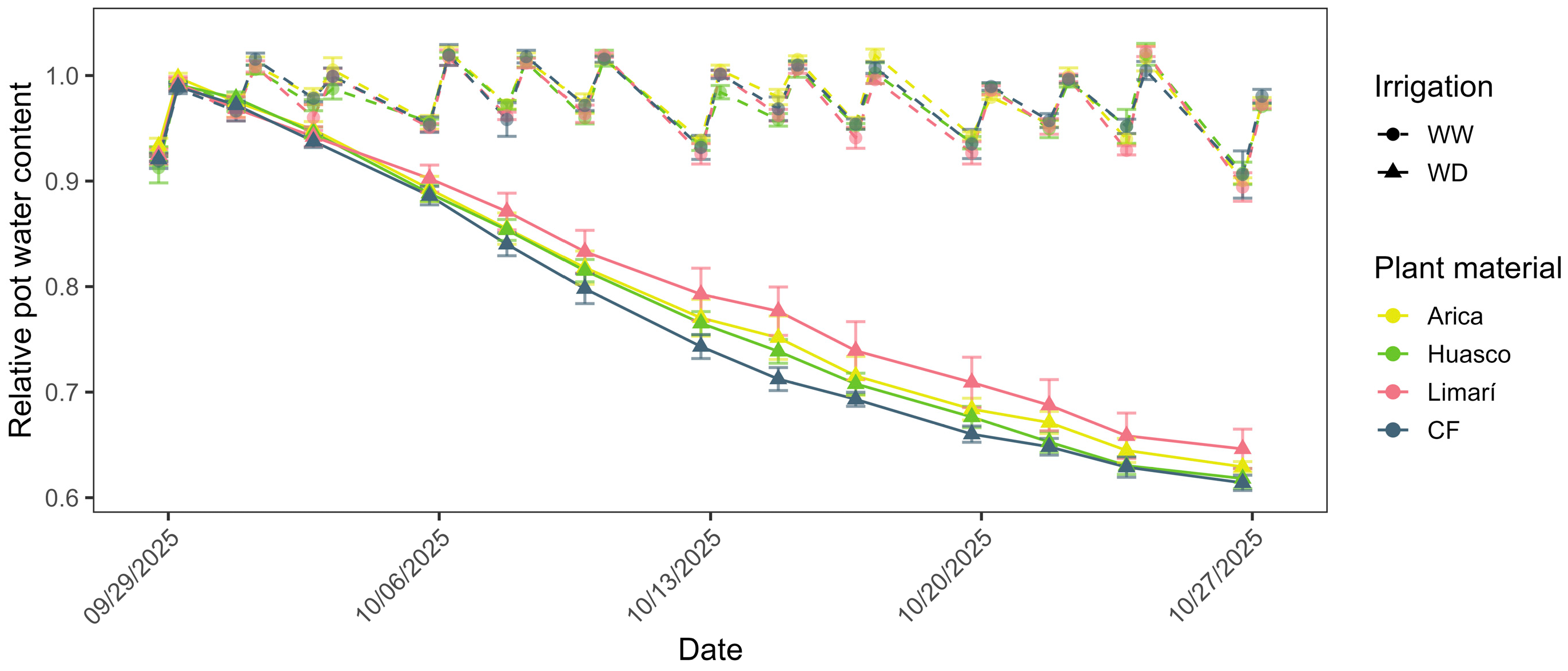
The progressive decrease in relative pot water content from values close to 1.0 at the onset of the treatment to approximately 0.61–0.65 at the end of the experiment (four weeks) indicates that water deficit was imposed gradually and consistently across plant materials. This is relevant because the physiological differences detected among materials were expressed along a shared dehydration trajectory (
Figure 2) rather than under abrupt desiccation. In grapevine, stem water potential usually operates within a broad interval of approximately −0.3 to −2.0 MPa, while regulated deficit irrigation commonly targets values around −1.2 to −1.4 MPa; more severe drought effects become increasingly likely below about −1.6 MPa, when stomatal restriction intensifies and hydraulic risk increases [
9]. In the present study, water-deficit plants reached −1.60 to −1.93 MPa before rewatering, indicating that the final phase of the assay extended beyond moderate stress and approached the severe range for grapevine.
Against this background, cv. País showed comparatively conservative stomatal behavior [
10,
14], i.e., a more isohydric pattern, relative to Cabernet Franc, which has been reported as a highly anisohydric cultivar [
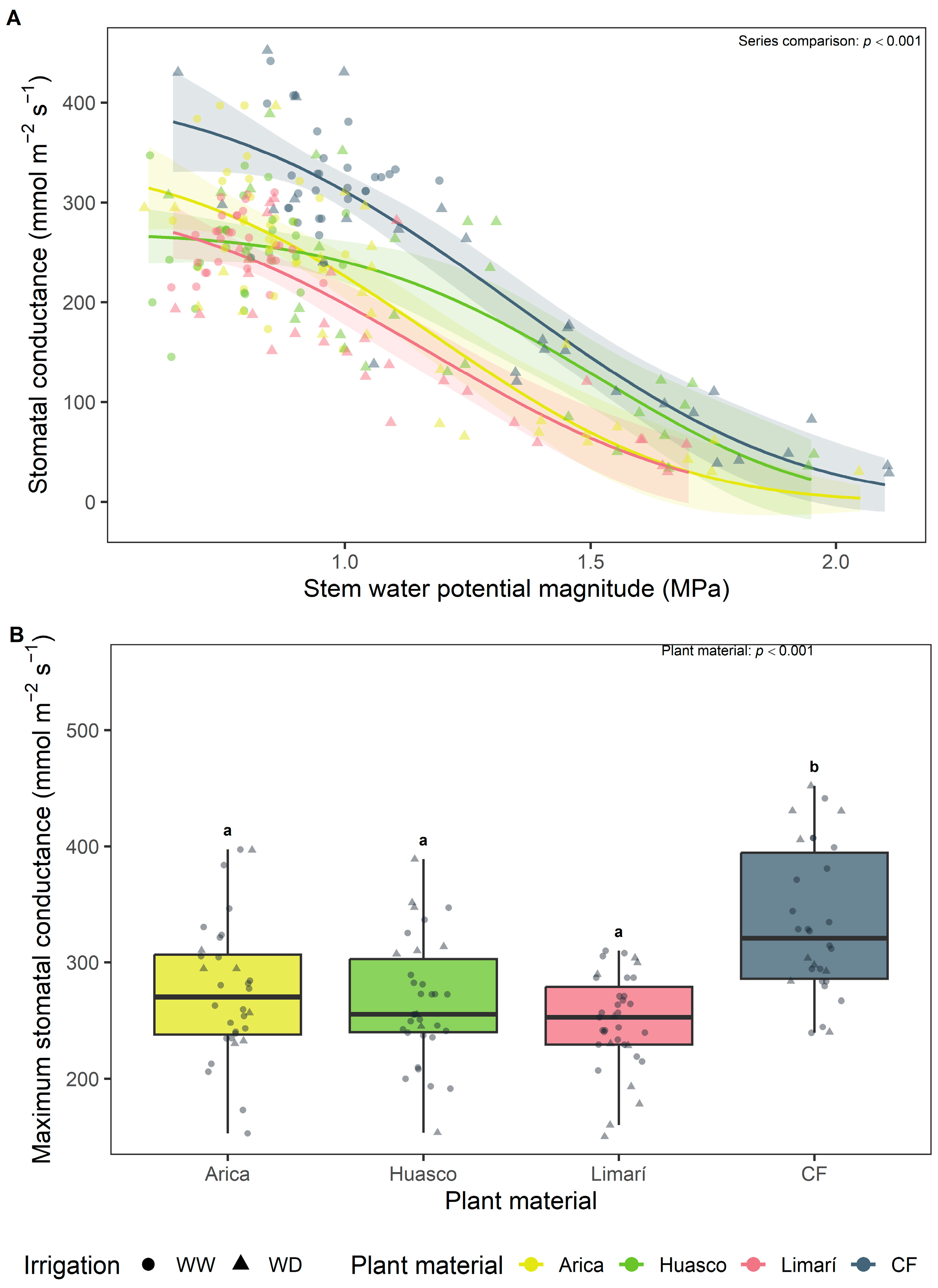
17]. Cabernet Franc maintained the highest stomatal conductance across the dehydration gradient and the highest maximum stomatal conductance (gs) under mild stress, with a marginal mean of 333.9 mmol m
−2 s
−1 at Ψstem ≥ −1 MPa and a peak of 390.1 mmol m
−2 s
−1 at week 1. By contrast, the País provenances showed lower maximum values, ranging from 249.0 mmol m
−2 s
−1 in Limarí to 275.4 mmol m
−2 s
−1 in Arica. These values are consistent with the upper field range reported for Grenache clones by Buesa et al. [
32], who found gs values between 79 and 285 mmol m
−2 s
−1, and with the broader pot-based range reported by Buesa et al. [
33], where gs ranged from 12 to 590 mmol m
−2 s
−1. Thus, the present experiment falls within the physiological domain described for grapevine drought studies, but the lower maximum stomatal conductance of País relative to Cabernet Franc supports the interpretation of a more conservative water-use phenotype. Considering the higher maximum stomatal conductance observed in CF (
Figure 4B), this pattern is consistent with lower water use in País, as reflected by its slower decline in relative pot water content (
Figure 2) compared with CF, despite the fact that leaf area did not differ significantly between them (
Figure S2).
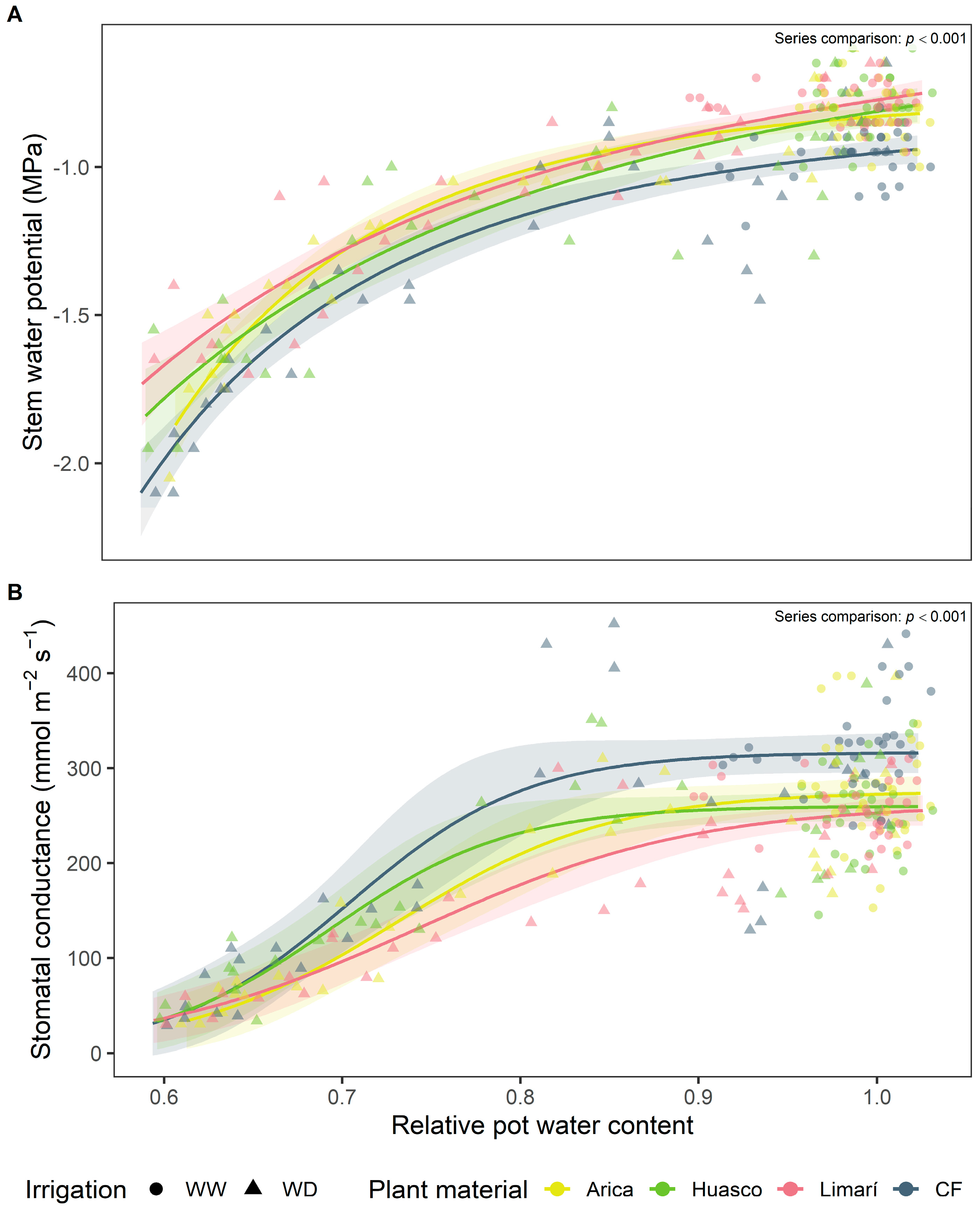
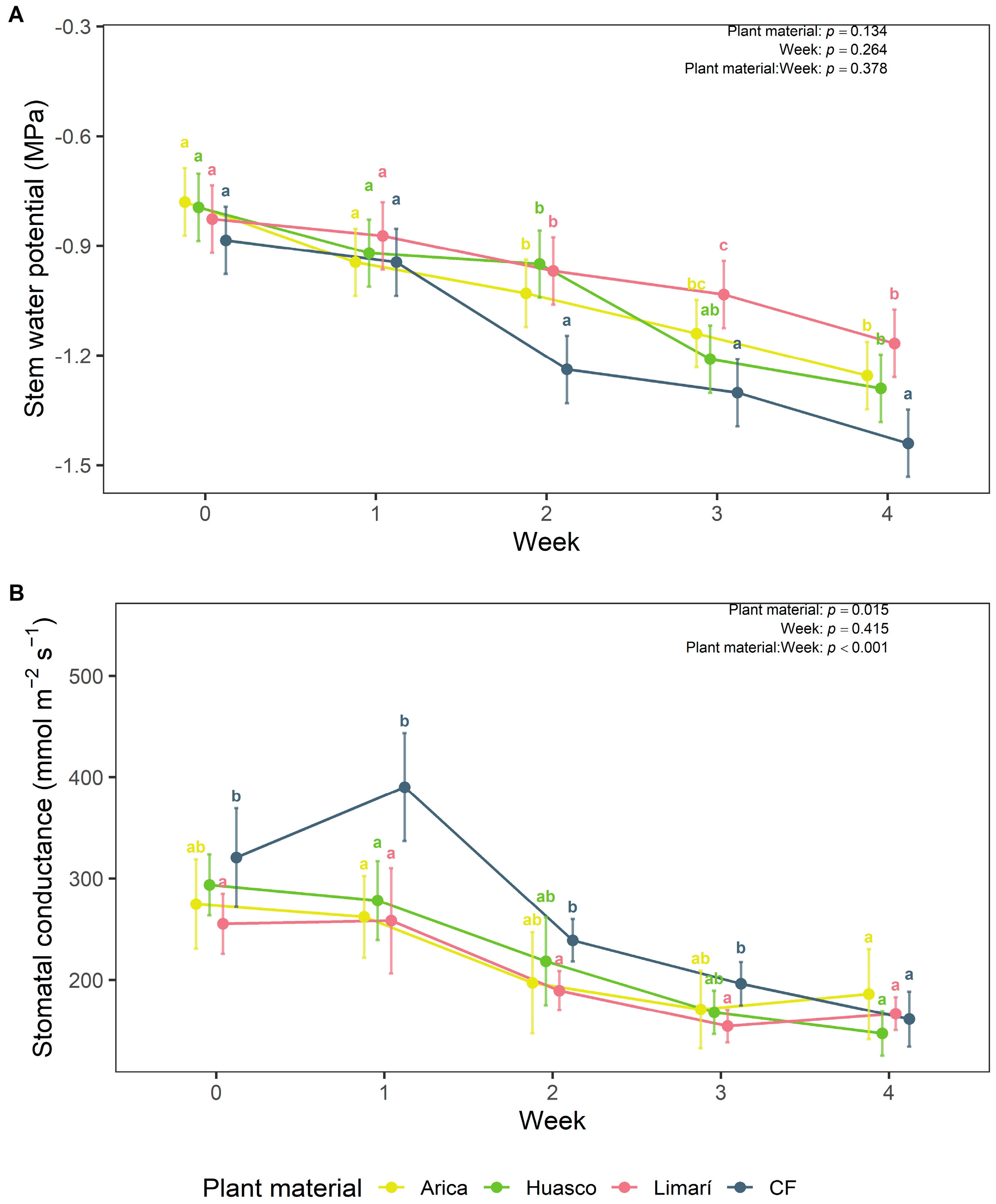
Stem water potential declined progressively in all plant materials (
Figure 6A), but this decline was strongest in Cabernet Franc, which reached the lowest marginal mean at week 4 (−1.44 MPa). At the same time, stomatal conductance (
Figure 6B) in Cabernet Franc remained comparatively high during the initial phase of the experiment and only converged with the remaining plant materials under stronger stress. This suggests that Cabernet Franc maintained higher transpirational activity during early substrate drying, whereas cv. País reduced stomatal opening sooner. Physiologically, this agrees with the framework proposed by Gambetta et al. [
9], who noted that grapevines often reduce gs strongly within the same water-potential range used in deficit irrigation management, and that non-stomatal limitations become increasingly important when gs falls below about 50 mmol m
−2 s
−1. In the present study, the most stressed plants reached 38.9–62.4 mmol m
−2 s
−1 before rewatering, indicating that at least part of the response occurred near the transition between strong stomatal limitation and more severe physiological restriction.
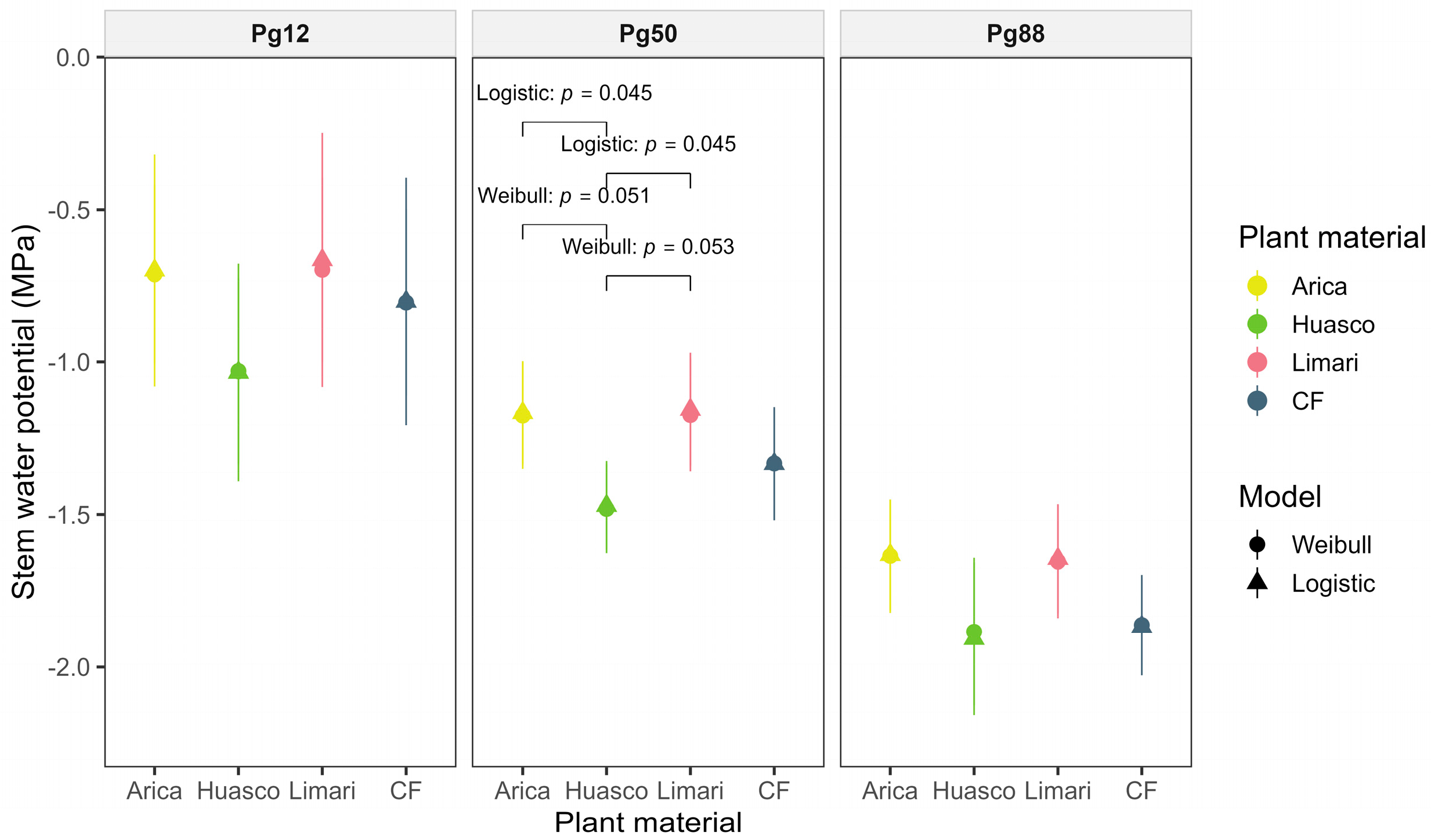
The original hypothesis, however, was only partially supported, because the aridity gradient of origin did not translate into a simple ranking of drought resistance. Differences among País provenances and CF in Pg50 were weakly supported and model-dependent (
Figure 5), where Huasco reached 50% stomatal reduction at approximately −1.47 to −1.48 MPa, suggesting a more anisohydric behavior compared with the other provenances. Conversely, Arica and Limarí reached the same level of closure at markedly less negative stem water potentials, approximately −1.16 to −1.18 MPa; Cabernet Franc was intermediate, near −1.33 MPa. Therefore, Huasco tolerated an additional decline of approximately 0.30 MPa relative to Arica and Limarí before reaching midpoint stomatal closure, placing it close to the lower boundary of the deficit range described by Gambetta et al. [
9] as agronomically relevant for grapevine water restriction. At the same time, Pg12 and Pg88 largely overlapped among plant materials, suggesting that the central portion of the stomatal response curve was more informative than its early or near-terminal sections. This suggests that midpoint thresholds are often more robust than extreme closure thresholds, where asymptotic behavior increases uncertainty [
9].
The cv. País provenance pattern also deserves a more nuanced interpretation because Huasco and Limarí showed earlier and steeper declines in the gs–Ψstem relationship (
Figure 4A), yet Huasco displayed the most negative Pg50. This apparent contrast indicates that provenance effects were expressed through several dimensions of the response curve, including maximum conductance, curve steepness, and the water-potential position of midpoint closure, rather than through a single descriptor. In practice, Huasco did not necessarily maintain the highest conductance across the entire drought trajectory, but it did maintain 50% of its maximum conductance to more negative stem water potentials than the other País provenances. This distinction is important because it avoids reducing drought behavior to a simple categorical label [
14]. As emphasized by Gambetta et al. [
9], grapevine drought response is better interpreted through measurable traits and fitted response functions than through overly simplified classifications. Under this framework, País can be described here as a cultivar with an overall conservative stomatal strategy relative to Cabernet Franc, but also as one that contains meaningful provenance-dependent variation in how stomatal decline is deployed during progressive drying.
The existence of intra-cultivar variation in cv. País is consistent with previous grapevine studies. Buesa et al. [
33] showed that under pot conditions nine Grenache genotypes covered a Ψstem range from −0.25 to −1.60 MPa and a gs range from 12 to 590 mmol m
−2 s
−1, with genotype-specific differences in both water relations and stomatal control. In field-grown Grenache, Buesa et al. [
32] likewise found differences among clones in seasonal Ψstem and gs, and reported ranges of −0.89 to −0.47 MPa in Ψstem and 79 to 285 mol m
−2 s
−1 in gs depending on season and genotype. Escalona et al. [
34] further summarized that intracultivar variability in WUEi reached about 30% in Grenache under field conditions and remained detectable under pot conditions. Taken together, these studies indicate that the magnitude of physiological differentiation observed among cv. País provenances is fully plausible within an intra-cultivar framework and should not be interpreted as mere experimental noise. Instead, the present study extends this evidence to a patrimonial cultivar for which mechanistic analyses of drought-response strategy have been largely lacking. Nevertheless, it should be acknowledged that the trial was based on a relatively small, although adequate, number of replicates (
n = 5), and that evaluations were conducted over a single growing season.
The present results are also consistent with earlier evidence from Chilean grapevine resources. Bavestrello-Riquelme et al. [
35], working with naturalized grapevine genotypes from arid and semi-arid northern Chile, identified both anisohydric and near-isohydric response patterns and found that drought tolerance varied substantially among genotypes under controlled stress. Although that study involved different plant material and a distinct experimental system, it supports the broader idea that northern Chilean grapevine resources harbor substantial physiological diversity in water-stress responses. By contrast, Pagay et al. [
36] found that dry-grown Cabernet Sauvignon vines differing in rooting depth maintained similar midday stem water potentials, around −0.89 and −0.81 MPa, while gs averaged 74 ± 9 and 104 ± 8 mmol m
−2 s
−1. Compared with those values, the stressed plants in the present study reached more negative stem water potentials and similarly low or lower minimum gs, showing that the imposed drought was sufficiently intense to reveal provenance-dependent regulatory differences within País.
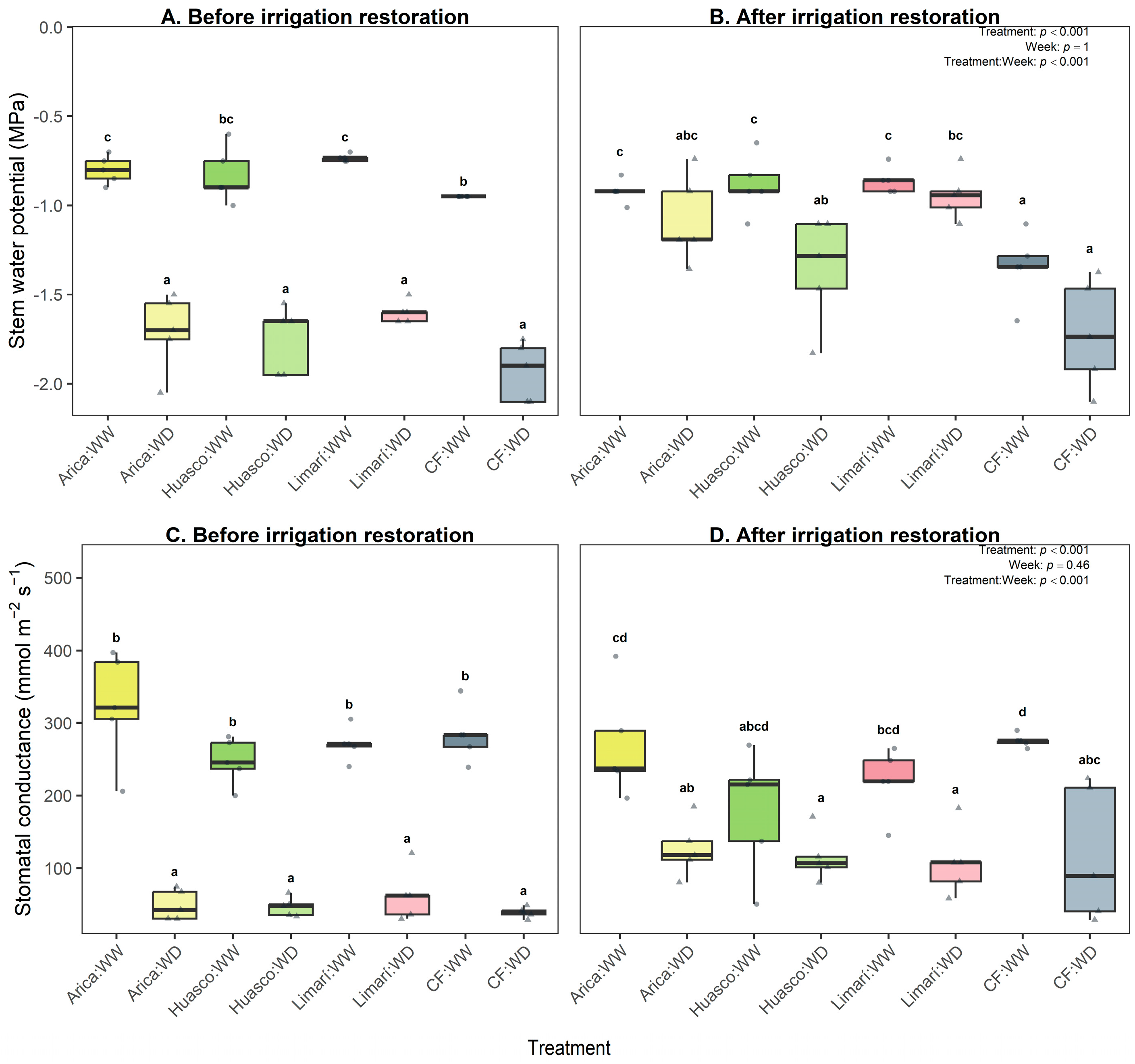
Before irrigation restoration (
Figure 7), water-deficit plants showed Ψstem values between −1.60 and −1.93 MPa and gs between 38.9 and 62.4 mmol m
−2 s
−1. After rewatering, stem water potential recovered markedly, especially in Limarí and Arica, which approached −0.81 and −0.89 MPa, respectively, whereas Cabernet Franc remained more negative at −1.24 MPa. Stomatal conductance also increased strongly after rewatering, reaching 187.7–201.4 mmol m
−2 s
−1 in previously stressed plants, but it generally remained below the highest well-watered values. This partial decoupling between hydraulic recovery and stomatal reopening is physiologically plausible and suggests that water status recovered faster than gas-exchange regulation. The recovered Ψstem values of Arica and Limarí are particularly notable because they are very close to the midday Ψs reported by [
36] for functioning dry-grown Cabernet Sauvignon vines. These results suggest better short-term recovery performance in the more isohydric País provenances [
16]. Nevertheless, medium- and long-term recovery capacity remains uncertain, because recovery was assessed only three days after irrigation was restored.
From an agronomic perspective, these findings are relevant because cv. País has long been associated with rainfed systems and patrimonial viticulture, yet it has been much less studied physiologically than modern commercial cultivars. Díaz et al. [
8], working on Negra Criolla, did not report stem water potential or stomatal conductance, but they did show that irrigation regime altered bunch mass and must composition, demonstrating that the País/Negra Criolla lineage is agronomically responsive to water supply. The present study therefore provides a physiological basis for future selection within cv. País, while preserving its varietal identity and patrimonial value. However, the current results should be interpreted as a first mechanistic screening rather than as definitive evidence of field performance. Even so, they provide a basis for future clone-selection efforts aimed at offering alternative plant material to growers across different environmental contexts, particularly under water-limited conditions. The next step should be to expand the number of provenances evaluated and to test whether the provenance differences identified here translate into differences in long-term productivity, water-use efficiency, and fruit quality under rainfed and deficit-irrigated vineyard conditions.



 ,
,