Review

Research Progress on the Application of Carbon-Based Nanomaterials in Agriculture and Their Dual Effects


1
School of Biological Engineering, Huainan Normal University, Huainan 232038, China
2
Key Laboratory of Bioresource and Environmental Biotechnology of Anhui Higher Education Institutes, Huainan Normal University, Huainan 232038, China
*
Author to whom correspondence should be addressed.
Agriculture 2026, 16(12), 1280; https://doi.org/10.3390/agriculture16121280 (registering DOI)
Submission received: 10 April 2026 / Revised: 29 May 2026 / Accepted: 6 June 2026 / Published: 9 June 2026
(This article belongs to the Special Issue Harnessing Nanotechnology for Improved Crop Growth and Protection)

Abstract

As a significant branch of nanotechnology, carbon-based nanomaterials (CNMs) have garnered extensive attention for their broad application potential in agriculture, attributed to their unique structural and physicochemical properties. They are considered one of the important tools for promoting sustainable agricultural development. Among them, carbon nanotubes (CNTs), owing to their excellent mechanical properties, electrical characteristics, and high specific surface area, have recently attracted considerable interest in plant growth regulation and the development of agricultural inputs. This article systematically reviews the research progress of CNMs, especially CNTs, in agriculture. Firstly, it outlines the structural characteristics and physicochemical properties of different types of CNMs. Subsequently, from a plant physiological perspective, it focuses on analyzing their mechanisms of action in nutrient uptake, photosynthesis regulation, and antioxidant defense. Based on this, it summarizes the application progress of CNMs in plant growth promotion, nano-pesticide and fertilizer delivery, and precision agriculture sensing. Furthermore, this article emphasizes the dose-dependent biphasic effect (hormesis) of CNMs on plants: at relatively low, system-specific doses, they can promote growth and enhance stress resistance, whereas at higher or supra-optimal doses, they may induce oxidative stress, cellular damage, and photosynthesis inhibition. However, significant variations in responses exist depending on the material type, physicochemical properties, and plant species, and a unified understanding of the underlying mechanisms has not yet been established. Finally, this article discusses green synthesis strategies for CNMs and their potential ecological risks and points out that future research should focus on key issues such as precise dose regulation, long-term environmental behavior, and multi-scale mechanism analysis. This review aims to provide a systematic reference for understanding CNM–plant interactions and their safe application in agriculture.

1. Introduction

Since the 21st century, persistent global population growth, escalating climate change, and the degradation of arable land resources have posed severe challenges to agricultural production systems. The Food and Agriculture Organization (FAO) of the United Nations projects that global food production must increase by approximately 60% by 2050 to meet the demands of population growth [1,2]. Yet this target is being pursued against a backdrop of diminishing resource availability: arable land per capita has declined by nearly 50% since the 1960s, and the overuse of synthetic inputs has driven widespread soil degradation, water eutrophication, biodiversity loss, and pesticide residue accumulation [3,4]. The tension between productivity imperatives and environmental sustainability is not merely a policy challenge—it is a fundamental scientific problem that demands novel technological frameworks.
Nanotechnology has emerged as one such framework, offering a conceptually distinct approach to agricultural inputs. Nanomaterials (NMs), with their dimensions in the 1–100 nm range, exhibit quantum confinement effects, exceptionally high surface-area-to-volume ratios, and tunable surface reactivity that distinguish them from their bulk counterparts [5,6,7]. These properties underpin their proposed advantages in catalysis, targeted delivery, and real-time sensing. The resulting field of “nano-enabled agriculture” has attracted substantial research investment, yet it is important to acknowledge at the outset that the translation from laboratory promise to field-scale application remains incomplete, and the evidence base is characterized by significant heterogeneity and unresolved contradictions [8,9,10,11]. Cross-study comparisons are frequently confounded by differences in material synthesis routes, characterization standards, exposure conditions, and plant species—an inconsistency problem that this review treats not as a peripheral concern but as a central scientific challenge.
Among the numerous nanomaterials under investigation, CNMs occupy a prominent position owing to their structural diversity, tunable physicochemical properties, and relatively well-characterized synthesis pathways [12,13]. The CNM family encompasses fullerenes (C60), carbon dots (CDs), carbon nanotubes (CNTs), and graphene and its derivatives (e.g., graphene oxide, GO), each with distinct geometries and surface chemistries that produce markedly different biological responses [14,15]. CNTs, first reported by Iijima in 1991, have been particularly intensively studied due to their unique one-dimensional hollow structure, high aspect ratio, and exceptional electrical and thermal conductivity [16,17]. However, it is worth noting that even within the CNT category, single-walled (SWCNTs) and multi-walled (MWCNTs) variants, as well as functionalized versus pristine forms, can elicit qualitatively different plant responses—a distinction that is not always adequately controlled in the literature.
The reported effects of CNMs on plants span a remarkably wide spectrum. At low or optimized concentrations, which are highly dependent on CNM type, particle size, surface chemistry, plant species, and exposure route, CNMs have been shown to penetrate plant cell walls, activate aquaporins, accelerate seed germination, promote root development, and enhance nutrient uptake, with consequent improvements in crop yield and quality [18,19,20]. They also function as nanocarriers for targeted and slow-release delivery of pesticides and fertilizers, potentially reducing agrochemical losses and environmental contamination [21,22,23]. CNM-based nanosensors capable of real-time monitoring of soil nutrients, moisture, and plant stress signals (e.g., H2O2) represent an additional dimension of agricultural utility [24,25]. Taken together, these applications suggest a potentially transformative role for CNMs in sustainable agriculture.
However, the same physicochemical properties that confer these advantages also raise legitimate safety concerns. As CNM production and deployment increase, their release into soil–plant systems becomes inevitable, and the resulting interactions are complex and dose-dependent [26,27]. A growing body of evidence demonstrates that CNMs exhibit a characteristic “biphasic effect” or “hormesis”: stimulation at low concentrations and inhibition—or outright toxicity—at higher doses [28,29,30]. Critically, the concentration threshold separating these two regimes varies substantially depending on CNM type, surface functionalization, plant species, and environmental context, and no consensus threshold has been established. At suprathreshold concentrations, CNMs can trigger oxidative stress, membrane damage, chloroplast disruption, hormonal imbalance, and genotoxic effects, including DNA methylation changes [31,32,33]. These findings carry direct implications for the design of safe application protocols and regulatory frameworks.
What makes this dual-effect phenomenon particularly challenging to interpret is the inconsistency of findings across the literature. Some studies report robust growth promotion even at relatively high concentrations, while others document phytotoxicity at doses well within the range considered “low” in other investigations. This inconsistency reflects genuine biological complexity and methodological heterogeneity that the field has not yet resolved. A rigorous review must therefore move beyond cataloging reported effects and engage critically with the sources of this variability, the mechanistic hypotheses that have been proposed to explain it, and the knowledge gaps that most urgently require attention. To ensure a transparent and non-arbitrary synthesis, the literature included in this review was selected based on relevance, methodological clarity, and representativeness. We prioritized peer-reviewed studies and reviews on CNMs in plant, crop, soil–plant, and agricultural systems, especially those reporting CNM type, particle size or morphology, surface chemistry or functionalization, concentration or dose, exposure route, plant species, and biological endpoints. Foundational and highly cited studies were included when they established key concepts, whereas recent studies were selected to reflect emerging topics such as nano delivery, nanosensing, multi-omics toxicity analysis, and green synthesis. Because field-scale and long-term evidence remains limited, representative studies in these areas were included cautiously, with their limitations explicitly discussed.
This review aims to address these challenges by providing a critically integrated synthesis of recent research on CNMs in agriculture, with particular emphasis on CNTs. It systematically examines the classification and properties of CNMs, their mechanisms of action on plant physiological and biochemical processes, and their applications in growth promotion, pest and disease control, nano-fertilizer delivery, and precision sensing. Crucially, it devotes substantial attention to the dual effects of CNMs, the mechanistic basis of their dose-dependent toxicity, the key variables that modulate plant responses, and the inconsistencies that complicate cross-study interpretation. Finally, it evaluates green synthesis strategies and ecotoxicological risks and identifies priority directions for future research. The overarching aim is to provide a theoretically grounded and critically reflective reference that supports both scientific progress and the responsible application of CNMs in sustainable agriculture.

2. Classification and Properties of CNMs

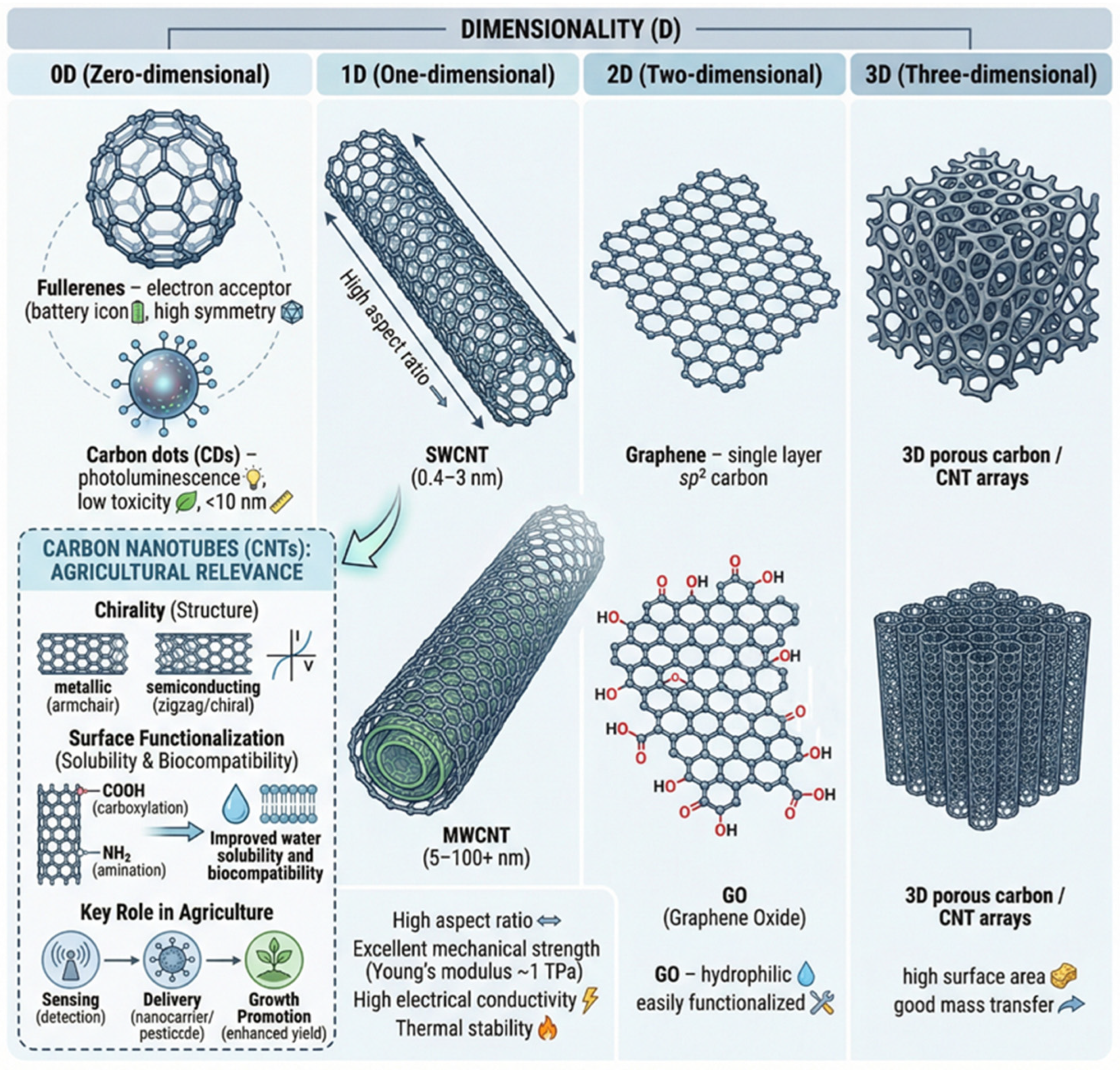
CNMs are a class of materials with carbon atoms as the primary framework, possessing at least one dimension in the nanoscale range (1–100 nm) [23]. The unique sp2 and sp3 hybridization capabilities of carbon atoms enable the formation of various allotropes, leading to nanomaterials with vastly different structures and diverse properties. Based on their dimensionality, CNMs can be mainly classified into the following categories (Figure 1):
Zero-dimensional (0D) CNMs: All dimensions are within the nanoscale. Typical representatives are Fullerenes and CDs. Fullerenes, particularly C60, are closed cage-like structures formed by 60 carbon atoms bonded via sp2 hybridization, characterized by high symmetry and unique electron acceptor properties [34]. CDs are a class of quasi-spherical fluorescent carbon nanoparticles, typically smaller than 10 nm, often composed of amorphous carbon or graphene quantum dots, exhibiting excellent photoluminescence, low toxicity, and good biocompatibility [35,36].
One-dimensional (1D) CNMs: These possess two dimensions at the nanoscale and one dimension at the macroscale. CNTs are the most typical representatives. CNTs can be considered as coaxial cylindrical structures formed by rolling up single or multiple layers of graphene sheets [37]. Depending on the number of graphene layers, CNTs are classified into Single-Walled CNTs (SWCNTs) and Multi-Walled CNTs (MWCNTs). SWCNTs typically have diameters of 0.4–3 nm, while MWCNTs can reach diameters of 5–100 nm or more [38]. CNTs are highly valued for their extremely high aspect ratio, excellent mechanical strength (Young’s modulus up to 1 TPa), outstanding electrical conductivity, and thermal stability [39].
Two-dimensional (2D) CNMs: Only one dimension is at the nanoscale (thickness), while the other two dimensions can be at the micrometer or even macroscale. Graphene is a prominent representative of 2D CNMs, consisting of a single layer of carbon atoms densely packed in a sp2-bonded hexagonal honeycomb planar structure, serving as the fundamental building block for other dimensional carbon materials [40]. GO is an important derivative of graphene, introduced with numerous oxygen-containing functional groups (e.g., hydroxyl, carboxyl, epoxy groups) onto the graphene sheets through chemical oxidation, imparting excellent hydrophilicity and ease of functionalization [41].
Three-dimensional (3D) CNMs: These are complex macroscopic structures assembled from low-dimensional carbon nanostructures, such as three-dimensional porous carbon and carbon nanotube arrays, typically characterized by high specific surface area and good mass transfer properties [42].
Among the aforementioned CNMs, CNTs play a particularly crucial role in agricultural applications due to their unique structure and properties. The structural and performance differences in CNTs depend mainly on their chirality and number of layers. Chirality determines the electrical conductivity of CNTs, which can be metallic or semiconducting, laying the foundation for their application in electronic sensing [43]. The high specific surface area and hydrophobicity of CNTs facilitate the adsorption of organic molecules, but they also tend to agglomerate in water, affecting their dispersibility and bioavailability. Therefore, surface functionalization of CNTs (e.g., carboxylation, amination) to improve their water solubility and biocompatibility is a key step for their application in agriculture [44,45].
To move beyond a purely descriptive classification, the major physicochemical features of representative CNMs and their relevance to bioavailability, biological performance, and potential toxicity in agricultural systems are summarized in Table 1.

3. Mechanisms of Action of Carbon Nanomaterials in Plant Physiology

The interaction of CNMs with plant physiological processes operates across multiple scales—from molecular-level gene expression and ion transport to cellular membrane dynamics and organ-level growth responses—yet the mechanistic pathways connecting CNM physicochemical properties to specific biological outcomes remain incompletely characterized. While physical penetration of seed coats, activation of aquaporin-mediated water transport, modulation of reactive oxygen species (ROS) signaling, and transcriptional reprogramming have each been documented in specific experimental systems, the causal chains linking CNM surface chemistry to defined regulatory networks are poorly resolved, and findings from hydroponic or in vitro systems cannot be straightforwardly extrapolated to soil-grown crops. A rigorous understanding of these mechanisms—including their species-specificity, dose-dependence, and sensitivity to environmental context—is therefore prerequisite not only for evaluating the potential agronomic benefits of CNMs, but equally for identifying the conditions under which these same mechanisms become drivers of phytotoxicity.

3.1. Mechanisms of Nutrient Uptake Promotion

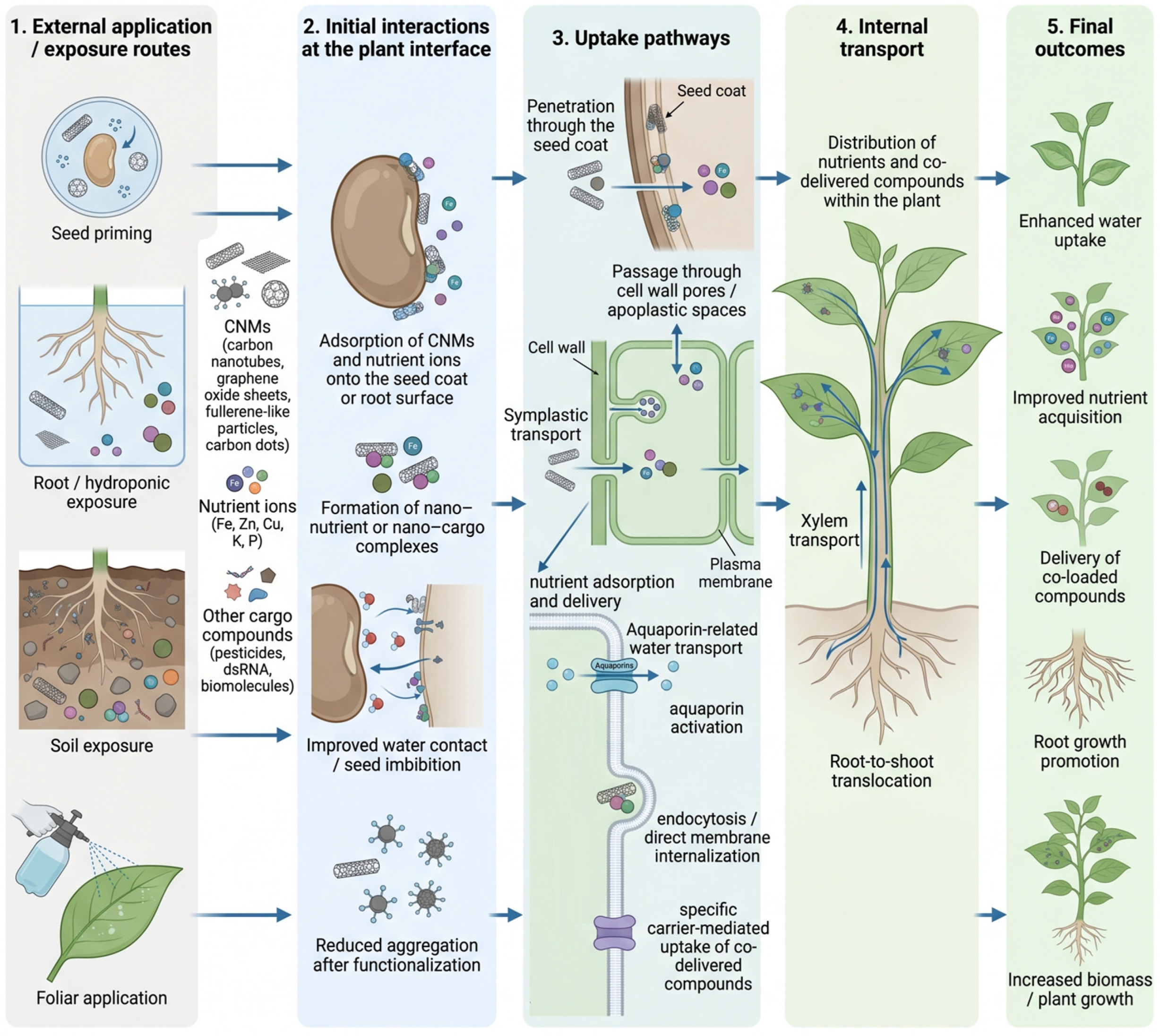
CNMs can promote the uptake of water and mineral nutrients by plants through various means. Firstly, the nanoscale size of CNMs allows them to penetrate the seed coat or cell wall, potentially creating new pores in the cell wall physically or activating aquaporins, thereby significantly enhancing seed imbibition and water transport efficiency [46,47]. For instance, Joshi et al. found that 90 µg/mL MWCNTs could penetrate oat seed coats and enhance seed germination rate and photosynthetic activity by 15% [48].
Secondly, CNMs can serve as carriers for nutrient elements, improving their availability and utilization efficiency. GO, due to its surface rich in negatively charged oxygen-containing functional groups, can combine with trace element cations (e.g., Fe3+, Cu2+, Zn2+) through electrostatic adsorption, forming nano-nutrient complexes and enabling slow release and targeted transport of nutrients [49]. Studies have shown that negatively charged MWCNTs can adsorb and slowly release trace elements such as copper (Cu) and zinc (Zn), promoting plant uptake and transport of these micronutrients [50,51]. Research on CDs also indicates they can promote the absorption of macro- and micronutrients like iron (Fe), magnesium (Mg), and potassium (K), and regulate biomass accumulation through photosynthesis [52]. Hu et al. found that CDs significantly increased the content of elements such as Fe, Ca, Mg, and K in Chinese kale (Brassica campestris L.), ultimately promoting plant growth [53]. Furthermore, functionalized fullerenols have been shown to enhance the uptake of phosphorus (P) and potassium (K) in wheat under salt stress by regulating ion transport while reducing the accumulation of harmful sodium ions (Na+) [54,55]. The proposed pathways by which CNMs facilitate the uptake of water, nutrients, and co-delivered compounds are schematically illustrated in Figure 2.
Collectively, current evidence provides relatively strong support for the role of CNMs in facilitating seed water uptake and nutrient availability, particularly in seed germination, hydroponic, and controlled growth systems. However, whether aquaporin activation is a primary causal mechanism or a secondary physiological response remains less certain, and its relevance under soil-based agricultural conditions requires further validation.

3.2. Regulation of Photosynthesis

Photosynthesis is the core driver of plant growth. CNMs can influence photosynthetic efficiency through direct or indirect means. Firstly, CNMs can enter chloroplasts or act as light converters to enhance light energy utilization efficiency through their unique optical properties. For example, CDs can absorb ultraviolet light and emit blue light that can be efficiently absorbed by chlorophyll, thereby expanding the effective spectral range for photosynthesis and enhancing light capture and utilization [56]. Li et al.’s research reported that CDs with photoluminescent properties can significantly enhance the photosynthetic efficiency of plant leaves [57].
Secondly, CNMs can improve physiological indicators related to photosynthesis. Numerous studies have shown that treatment with CNMs can significantly increase leaf chlorophyll content, net photosynthetic rate, stomatal conductance, and electron transport efficiency of photosystem II (PSII) [58,59]. For instance, CDs derived from Salvia miltiorrhiza were found to increase chlorophyll content, net photosynthetic rate, and PSII quantum efficiency in lettuce under high-temperature stress [60]. Wang et al. also reported that nitrogen-doped CDs could enhance PSII activity in maize, thereby improving its photosynthetic efficiency [61]. This regulatory effect may stem from CNMs’ influence on stomatal movement; they can promote stomatal opening, increasing CO2 supply, while also enhancing light energy conversion efficiency by affecting components of the photosynthetic electron transport chain [62].
Overall, photosynthetic enhancement by CDs and some other CNMs is supported by changes in chlorophyll content, PSII efficiency, gas-exchange parameters, and biomass accumulation. Nevertheless, the relative contribution of direct light conversion, chloroplast interaction, improved nutrition, and stress mitigation remains difficult to separate, especially under realistic field conditions.

3.3. Enhancement of Antioxidant Defense and Stress Tolerance

When plants face adverse conditions (e.g., drought, salinity, high temperature, heavy metals), they accumulate excessive ROS, leading to oxidative stress and cellular damage. CNMs can scavenge excess ROS by mimicking antioxidant enzymes (nanozymes) or activating the plant’s own antioxidant defense system, thereby enhancing plant stress tolerance [63,64]. For example, fullerenols, known as efficient nano-antioxidants due to their potent free radical scavenging ability, can effectively alleviate oxidative damage in sugar beet and rapeseed under drought stress [65,66]. Shafiq et al. also found that fullerenol could enhance salt tolerance in wheat by increasing the activity of H2O2-scavenging enzymes [55,67]. CDs have also shown radical-scavenging capacity in chemical assays, such as 2,2-diphenyl-1-picrylhydrazyl (DPPH) and hydroxyl radical assays. In plant systems, CDs may additionally upregulate antioxidant enzymes such as superoxide dismutase (SOD), peroxidase (POD), and catalase (CAT), thereby reducing malondialdehyde (MDA) content and alleviating membrane lipid peroxidation damage [52,60,62]. This enhancement of antioxidant capacity enables plants to better cope with oxidative stress induced by heavy metals, salinity, and temperature extremes [68,69]. Thus, antioxidant defense activation is one of the better-supported physiological responses to CNM exposure, especially under abiotic stress. However, many studies cannot clearly distinguish direct ROS scavenging by CNMs from indirect stimulation of endogenous antioxidant pathways, and this distinction should be addressed by time-resolved and mechanism-oriented experiments.

4. Diversified Applications of CNMs in Agriculture

Owing to their positive regulatory effects on plant physiology, the application scope of CNMs in agriculture is increasingly broad, covering the entire process from seed germination and crop growth to pest control and post-harvest preservation. CNMs are generally applied to crops as dispersed suspensions or functional formulations rather than as dry powders. Pre-application preparation usually involves purification, dispersion in water or nutrient solution, concentration adjustment, and selection of an appropriate exposure route, such as seed priming, root or hydroponic exposure, soil amendment, foliar spraying, or carrier-based delivery. For hydrophobic CNTs and graphene-based materials, ultrasonication, stirring, or surface functionalization is often used to reduce aggregation and improve water dispersibility, suspension stability, and plant availability. Therefore, key parameters such as concentration, particle size or hydrodynamic diameter, pH, surface coating or dispersant, and exposure medium should be reported to improve reproducibility and cross-study comparison [23,70]. Representative agricultural applications of specific CNMs, including concentration range, particle size, plant species, application method, exposure condition, and observed effects, are summarized in Table 2.

4.1. Plant Growth Promoters

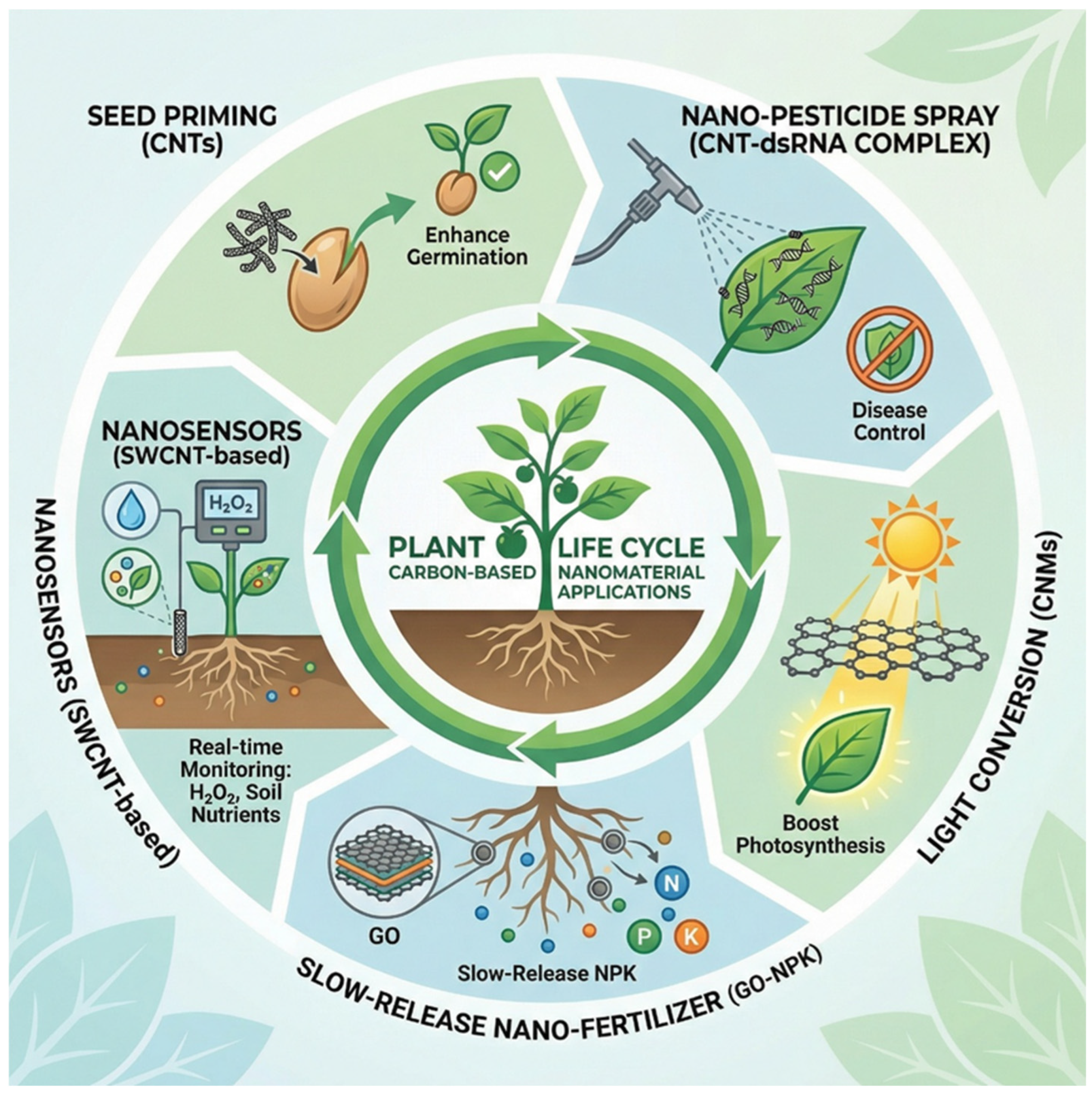
CNMs can act as efficient plant growth regulators, promoting plant growth through seed priming or direct application to soil/foliage. Research indicates that low concentrations of CNTs (especially MWCNTs) can significantly enhance seed germination rates, root length, and seedling biomass in various crops, including tomato, rice, soybean, oat, and wheat [18,48,79]. For example, MWCNT treatment significantly increased root and stem length in rice seedlings [80]. In one reported field trial, tomato plants treated with MWCNTs produced twice as many flowers and fruits as untreated controls [73]. Graphene nanosheets have also been shown to promote the growth of pepper and eggplant, increasing fruit yield [81]. Bitter melon treated with fullerenol not only increased biomass by 54% but also boosted fruit yield by 128%, alongside significant increases in medicinal components such as cucurbitacin B and lycopene [82]. Additionally, CDs have also been reported to promote the growth and yield of peas, rice, and rapeseed [83,84].

4.2. Nano-Pesticides and Plant Protection

CNMs exhibit significant potential in plant disease and pest management. They can act directly as antimicrobial/antifungal agents against pathogens or serve as efficient carriers for targeted delivery of pesticides, reducing pesticide application rates and environmental pollution. Studies have shown that SWCNTs, MWCNTs, GO, and fullerenes possess significant inhibitory effects against plant pathogenic fungi (e.g., Fusarium graminearum, F. poae) and bacteria (e.g., Ralstonia solanacearum, Xanthomonas oryzae) [85,86]. Their antimicrobial mechanisms primarily involve physical piercing of cell membranes via sharp edges, induction of oxidative stress, and interference with pathogen water and nutrient uptake [21]. Functionalized MWCNTs can also be used as carrier scaffolds for pesticide nanoformulations. For example, MWCNT–fungicide complexes, in which the MWCNTs serve as the nanoscale carrier and the fungicide acts as the active antimicrobial component, have been reported to show stronger inhibition of Alternaria alternata than the fungicide alone [22]. More importantly, CNTs can serve as nanocarriers for double-stranded RNA (dsRNA), enabling spray-induced gene silencing (SIGS) technology to interfere with specific target genes, providing crops with sustained antiviral or antifungal protection [87,88]. For instance, chitosan-functionalized CNT–dsRNA nanoformulations, in which CNTs provide the nanoscale carrier framework, chitosan improves dispersion and nucleic-acid binding, and dsRNA acts as the gene-silencing cargo, can improve dsRNA delivery and enhance rice resistance to stem borers [89]. Furthermore, GO–silver nanoparticle (GO–AgNP) nanocomposites, in which GO sheets act as the supporting matrix and AgNPs serve as the antimicrobial active phase, exhibit higher antifungal efficacy against Fusarium graminearum than AgNPs or GO alone [90].

4.3. Nano-Fertilizers and Slow-Release Systems

Traditional fertilizers suffer from extremely low utilization efficiency due to leaching and volatilization, leading not only to resource waste but also to severe environmental pollution. CNMs can act as “nanocarriers” for nutrients, constructing slow- or controlled-release fertilizer systems to enhance fertilizer use efficiency. GO, with its enormous specific surface area and abundant oxygen-containing functional groups, can effectively adsorb and load nitrogen, phosphorus, potassium, and micronutrients, forming slow-release fertilizers that extend the nutrient release period [49,91]. For example, GO film-coated KNO3 fertilizer systems use GO as a thin coating matrix around KNO3 cores, thereby slowing the release of potassium and nitrogen [92]. Carbon nanofibers have also been used as carriers for copper (Cu), which is taken up by roots and slowly released, improving Cu transport to shoots and significantly enhancing crop growth and protein content [50]. Additionally, porous carbon nanomaterials prepared from biomass waste (e.g., biogas plant residues), owing to their favorable pore structure and surface chemistry, show promise as potential slow-release fertilizer carriers [93].

4.4. Sensing and Precision Agriculture

Real-time, non-destructive, high-throughput monitoring of plant and soil health is central to precision agriculture. CNMs, particularly CNTs, are ideal materials for constructing highly sensitive nanosensors due to their excellent electrochemical properties and ease of functionalization [94,95]. For example, near-infrared fluorescence sensors based on SWCNTs can monitor real-time H2O2 signaling waves in plants induced by injury, pathogen infection, or stress, enabling non-destructive, dynamic monitoring of early plant stress [25,96]. By functionalizing SWCNTs to specifically recognize pathogen-secreted proteins (e.g., SDE1 protein of citrus Huanglongbing pathogen), highly sensitive and specific biosensors can be developed for early disease diagnosis [97]. Furthermore, CNT sensors are used for detecting pesticide residues. For instance, fluorescence sensors based on CNTs and gold nanoparticles can rapidly detect organophosphorus pesticide residues like malathion in fruits and vegetables [98]. Biomass-derived CNTs or graphene quantum dots can also be used for rapid, highly sensitive electrochemical detection of pesticides such as methyl parathion [99,100]. The development of these sensor technologies provides powerful technical support for achieving crop nutrition diagnosis, early disease warning, and environmental monitoring.
The major agricultural applications of CNMs across plant growth, crop protection, nutrient delivery, and sensing are summarized in Figure 3. As illustrated in Figure 3, different CNM families exhibit functional specialization: CNTs are predominantly used in sensing and dsRNA delivery, CDs in photosynthesis enhancement, and GO in slow-release fertilizer systems. However, their practical implementation at the field scale remains constrained by several technical, economic, environmental, and regulatory limitations.

4.5. Limitations to Large-Scale Implementation

Despite their promising performance in controlled experiments, the large-scale agricultural implementation of CNMs remains limited by formulation stability, economic feasibility, environmental safety, and regulatory uncertainty. Many CNMs, particularly CNTs and graphene-based materials, tend to aggregate in aqueous solutions or complex soil matrices, which reduces their dispersibility, bioavailability, and delivery efficiency. Although surface functionalization can improve stability and biocompatibility, reproducible performance under field conditions remains difficult because CNM behavior is strongly affected by soil pH, ionic strength, organic matter, microorganisms, and coexisting agrochemicals [44,75]. In addition, the cost–benefit balance of CNM-based agricultural inputs has not been clearly established. For practical adoption, improvements in yield, nutrient-use efficiency, pesticide reduction, or stress tolerance must be sufficient to offset the costs of material synthesis, purification, functionalization, formulation, and application.
Environmental and regulatory concerns also constrain field-scale deployment. CNMs released into agricultural systems may persist, migrate, interact with soil microorganisms, or accumulate in plant tissues, whereas their long-term effects on soil fertility, food safety, and non-target organisms remain insufficiently understood [27,101]. Residual metal catalysts or synthesis impurities in some CNT preparations further complicate risk assessment. Therefore, CNM-based agricultural products should be evaluated not only by short-term plant-growth responses, but also by environmental fate, chronic toxicity, food-chain transfer, and life-cycle performance [101]. Before widespread agricultural use, standardized characterization, field validation, clear safety thresholds, and appropriate regulatory frameworks will be essential.

5. Dual Effects and Toxicity Issues

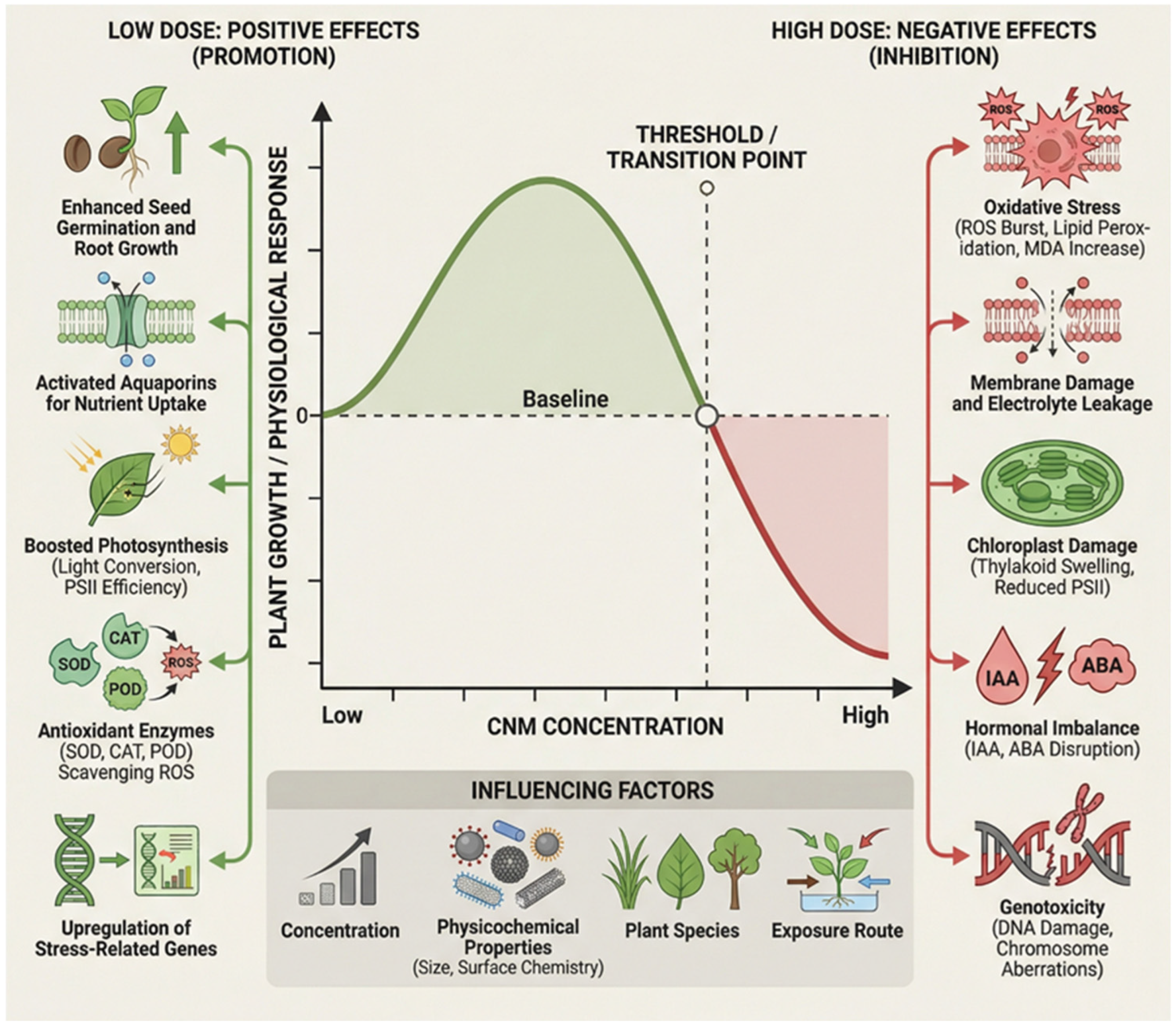
Although CNMs demonstrate numerous benefits in agricultural applications, their impact on plants is not always positive. Numerous studies indicate that the effects of CNMs on plants exhibit a significant “biphasic effect,” namely hormesis—stimulation at relatively low, system-specific doses and inhibition at higher or supra-optimal doses [28,29,72]. Representative examples in Table 2 show that beneficial and inhibitory ranges may differ by orders of magnitude, from mg·L−1-level hydroponic exposures to mg·kg−1-level soil exposures. Yet this framing, while conceptually useful, risks oversimplifying a phenomenon that is far more variable and context-dependent than a universal dose–response curve implies. Reported effective concentration thresholds differ by orders of magnitude across studies and species, and the factors that determine where the inflection point falls—CNM type, surface charge, aggregation state, exposure route, plant developmental stage, and environmental matrix—interact in ways that current evidence cannot fully predict. Moreover, the majority of hormesis data derives from controlled hydroponic or in vitro systems, and whether these dose–response relationships hold under realistic soil-based agricultural conditions remains largely untested. A critical rather than merely descriptive engagement with this dual-effect phenomenon is therefore essential: the goal is not simply to acknowledge that CNMs can both help and harm, but to identify the mechanistic and contextual determinants of the stimulation-to-inhibition transition with sufficient precision to inform safe application guidelines.

5.1. Positive Effects

CNMs at low or optimized concentrations can effectively trigger plant defense and growth mechanisms, exhibiting various positive effects. Firstly, in promoting seed germination and seedling growth, CNMs can physically penetrate the seed coat, activate aquaporins, and significantly enhance seed water uptake, thereby accelerating germination and boosting early seedling vigor [48,79]. Secondly, CNMs can significantly enhance plant nutrient uptake and transport; they can act as efficient nanocarriers, promoting the dissolution of mineral elements in soil and, through interaction with root surfaces, efficiently transport them into plants, thereby improving nutrient use efficiency [49,50,53]. At the photosynthetic level, CNMs can leverage their unique optical functions, for example, acting as light converters to transform ultraviolet light into usable blue light for plants, or enhancing chloroplast function, thereby improving light energy utilization and carbon assimilation, ultimately promoting photosynthetic product accumulation [57,60,61]. Concurrently, CNMs can activate the plant’s antioxidant defense system; they can function as nanozymes or signaling molecules, inducing the activities of a series of antioxidant enzymes such as SOD, CAT, and POD, effectively scavenging excess ROS and alleviating oxidative stress induced by adverse conditions [55,66,67]. At the molecular level, CNMs have been shown to modulate plant gene expression in ways that can support growth at low concentrations, including upregulation of aquaporin genes (e.g., NtPIP1), cell division markers (e.g., CycB), and cell-wall extension genes (e.g., NtLRX1) in tobacco cells exposed to MWCNTs [102]. However, this picture is considerably more complex than a simple activation of beneficial gene programs: transcriptomic profiling has revealed that surface chemistry is a primary determinant of gene regulatory outcomes, with certain functionalized CNTs (e.g., polyethylenimine (PEI)-coated SWCNTs) inducing broad stress, immunity, and senescence programs rather than growth-promoting responses, while the same concentration of more chemically inert CNTs elicits only minor transcriptional changes. Species-specific differences further complicate generalization. As summarized in Table 2, similar classes of CNTs or MWCNTs may produce growth-promoting effects in some plant systems but inhibitory or stress-related responses in others, depending on surface chemistry, concentration, particle size, and exposure route. These inconsistencies underscore that the gene regulatory and physiological effects of CNMs are not uniformly beneficial and cannot be predicted from CNM type alone.

5.2. Negative Effects

When CNM concentrations move beyond the beneficial range of a given CNM–plant system, the biological response may shift from promotion to inhibition. As summarized in Table 2, the concentration range associated with beneficial or inhibitory effects varies markedly with CNM type, particle size, plant species, and exposure route. Understanding the nature and determinants of this shift is essential for establishing safe application windows and for interpreting the contradictory outcomes that pervade the literature.
The most consistently reported negative effect of high-concentration CNM exposure is inhibition of seed germination and root elongation. Excessive CNM deposition can physically obstruct pores in root cell walls, interfere with normal water and nutrient uptake pathways, and reduce root length and overall biomass [103,104]. However, this inhibitory effect is not universal: the same MWCNT concentrations that suppress germination in one species may be stimulatory in another. Studies have reported that tomato seedlings exhibit sensitivity to SWCNTs at concentrations that elicit growth promotion in onion and cucumber [71]. This species-specificity is a critical and underappreciated source of variability in the literature, and its mechanistic basis—whether rooted in differences in cell wall composition, aquaporin expression, or ROS buffering capacity—remains to be systematically elucidated.
Beyond physical obstruction, excessive CNM accumulation induces oxidative stress through a well-characterized cascade: CNMs generate or catalyze the production of ROS, which overwhelm the plant’s antioxidant defenses and attack membrane lipids, triggering peroxidation, elevating malondialdehyde (MDA) content, disrupting membrane integrity, and causing electrolyte leakage [32,33,105]. In severe cases, this cascade culminates in cell death. What is less clearly resolved is the relative contribution of different ROS and the extent to which the antioxidant response itself—initially protective—can become maladaptive at sustained high exposures. Across reported studies, antioxidant enzyme activities, including SOD, POD, and CAT, often change after CNM exposure, but the direction and magnitude of these responses are highly dependent on concentration, exposure duration, CNM type, and plant species. Therefore, enzyme induction should not be interpreted automatically as evidence of protection because it may also reflect oxidative stress or cellular injury.
Photosynthetic impairment represents another well-documented but mechanistically complex negative effect. High CNM concentrations have been shown to decrease chlorophyll content, impair PSII activity, and alter chloroplast ultrastructure—including thylakoid swelling and abnormal starch granule accumulation—thereby suppressing overall photosynthetic efficiency [77,78]. Notably, graphene and its derivatives appear to be particularly potent in this regard: multi-omics analyses have revealed that graphene derivatives induce oxidative damage, downregulate endocytosis and transmembrane transport proteins, and reprogram carbohydrate and amino acid metabolism in ways consistent with photosynthetic decline and metabolic stress. These molecular-level findings provide a mechanistic context for the physiological observations, but they also highlight the fact that different CNM types—even within the carbon-based family—can operate through distinct toxicity pathways, a distinction that is frequently obscured in aggregate analyses.
Hormonal disruption constitutes a further dimension of CNM toxicity that has received comparatively limited systematic attention. High CNM concentrations can interfere with the synthesis and signal transduction of key phytohormones, including auxin (IAA) and abscisic acid (ABA), thereby disrupting normal developmental programs [106,107]. The mechanistic linkage between CNM exposure, ROS accumulation, and hormonal perturbation remains poorly characterized, representing a significant gap in current understanding.
Perhaps the most concerning—and least understood—negative effect is genotoxicity. Certain CNMs, particularly MWCNTs, have been shown to enter the plant cell nucleus, inducing DNA strand breaks, chromosomal aberrations, and altered DNA methylation patterns [76,108]. These epigenetic changes are of particular concern because they may be heritable: C70 fullerenes have been detected in second-generation seedlings, raising the possibility of multigenerational transmission of CNM-induced epigenetic alterations. The long-term implications of such changes for plant health, genetic stability, and food safety are currently unknown, and this represents one of the most urgent knowledge gaps in the field.
A critical synthesis of the negative effects literature reveals several recurring inconsistencies. First, the dose thresholds for toxicity vary by orders of magnitude across studies—from tens of mg·L−1 in some hydroponic systems to thousands of mg·kg−1 in soil-based experiments—making direct comparisons hazardous without careful attention to exposure medium and bioavailability. Second, the majority of phytotoxicity studies have been conducted under controlled laboratory conditions, often using hydroponic or agar-based systems that may not accurately reflect CNM behavior in natural soil environments, where aggregation, adsorption to organic matter, and microbial transformation can substantially alter bioavailability. Third, short-term exposure assays may underestimate chronic toxicity, while single-endpoint measurements fail to capture the systemic nature of CNM effects. These methodological limitations counsel caution in extrapolating laboratory results to field applications.

5.3. Toxicity Mechanisms and Influencing Factors

The phytotoxicity of CNMs is not attributable to a single mechanism but emerges from the interplay of multiple physicochemical and biological processes, the relative contributions of which vary with CNM type, concentration, and plant system. A mechanistically nuanced understanding of this complexity is essential for moving beyond descriptive toxicology toward predictive risk assessment.
At the molecular level, ROS-mediated oxidative stress is the most consistently implicated toxicity pathway. When the rate of ROS generation—whether through CNM surface reactivity, disruption of mitochondrial electron transport, or inhibition of antioxidant enzymes—exceeds the plant’s scavenging capacity, a cascade of oxidative damage ensues, targeting proteins, lipids, and DNA [109]. However, it is important to distinguish between the initial ROS burst, which may function as a signaling event at low doses and activate adaptive responses, and the sustained ROS accumulation at high doses that overwhelms these responses and drives cellular damage. This distinction is mechanistically critical but is rarely captured in studies that measure ROS or antioxidant enzyme activity at a single time point. The temporal dynamics of the oxidative stress response—including the kinetics of enzyme induction, the rate of ROS clearance, and the point at which adaptive capacity is exceeded—represent a significant knowledge gap.
Physical interactions between CNMs and cellular membranes constitute a second, mechanistically distinct toxicity pathway. The sharp edges of CNTs and graphene sheets can physically pierce or disrupt cell wall and membrane structures, causing permeability changes and electrolyte leakage that are independent of ROS generation [21,110]. This physical membrane disruption may explain some of the toxicity observed even with relatively low concentrations of highly dispersed, surface-functionalized CNMs, where chemical reactivity is reduced but physical interactions with membranes are preserved. The relative importance of physical versus chemical toxicity mechanisms likely varies with CNM geometry and surface chemistry, but this question has not been systematically addressed across CNM types.
Beyond these two primary mechanisms, emerging multi-omics evidence points to additional pathways that are less well characterized but potentially important. CNM exposure—particularly by graphene derivatives—can downregulate endocytosis and transmembrane transport proteins, alter carbohydrate and amino acid metabolism, and reprogram stress-response gene networks in ways that extend well beyond simple oxidative damage. These findings suggest that CNMs can function as modulators of broader cellular signaling networks, with consequences for nutrient assimilation, energy metabolism, and developmental programming that are not captured by conventional toxicity endpoints. The integration of transcriptomic, proteomic, and metabolomic approaches across multiple CNM types and plant species is therefore a priority for mechanistic research.
The expression of CNM toxicity is profoundly modulated by a set of interconnected factors, the interactions among which are not yet fully understood. Concentration remains the most critical determinant, but the relationship between applied concentration and biological effect is not simply monotonic: the hormesis curve implies that the same material can be beneficial at one concentration and harmful at another, and the position of the inflection point varies with CNM type, surface chemistry, and plant species [72]. This concentration-dependence is further complicated by the fact that applied concentration is not equivalent to bioavailable concentration, particularly in soil systems where CNM aggregation, adsorption to organic matter, and microbial transformation can substantially reduce the fraction available for plant uptake.
Physicochemical properties—including size, shape, surface chemistry, aggregation state, and purity—exert profound effects on CNM–plant interactions that are often underappreciated in studies that treat CNMs as homogeneous materials. CNTs with smaller diameters or better dispersion, such as well-dispersed SWCNTs relative to larger aggregated MWCNTs, may penetrate cell-wall barriers more readily, potentially enhancing both beneficial and toxic effects, while surface functionalization—particularly carboxylation and amination—generally reduces toxicity by improving dispersibility and reducing surface reactivity [44,75,111]. Crucially, the purity of CNM preparations is rarely rigorously controlled: residual metal catalysts (e.g., Ni, Co) used in CNT synthesis can themselves be phytotoxic, and their contribution to observed toxicity is frequently confounded with the effects of the carbon material itself—a systematic methodological problem that may account for some contradictions between studies using CNMs from different sources.
Plant species and developmental stage introduce a further layer of complexity that is well-documented but poorly mechanistically explained. The sensitivity of different species to CNMs varies substantially: tomatoes are sensitive to SWCNTs at concentrations that stimulate onion and cucumber growth, while seedlings are generally more vulnerable than mature plants [71]. These differences likely reflect variation in cell wall composition, root architecture, aquaporin expression patterns, and endogenous antioxidant capacity, but the specific molecular determinants of species-specific sensitivity have not been systematically characterized. This gap is particularly consequential for risk assessment, as it means that safety conclusions drawn from studies on one crop species cannot be straightforwardly generalized to others.
Exposure route and environmental conditions constitute the final, and arguably most practically important, category of modulating factors. Different application methods—root exposure, foliar spray, or seed priming—produce fundamentally different CNM uptake kinetics, tissue distribution patterns, and biological responses, yet these routes are rarely compared within the same experimental system [112]. Environmental factors, including soil pH, organic matter content, ionic strength, and microbial community composition, profoundly influence CNM aggregation state, surface chemistry, and bioavailability. CNTs have been shown to alter agrosystem multifunctionality—including soil microbial community structure and nutrient cycling processes—at concentrations that may not directly affect plant growth, suggesting that indirect ecological effects mediated through the soil microbiome may be as important as direct phytotoxic effects. These ecosystem-level interactions are largely absent from current risk assessments, which tend to focus on direct plant-CNM interactions under controlled conditions.
In summary, the toxicity of CNMs in agricultural systems is a multifactorial phenomenon that cannot be adequately characterized by any single mechanism or experimental approach. As summarized in Figure 4, the transition from beneficial to toxic responses is not governed by a universal concentration threshold, but depends on CNM concentration, physicochemical properties, plant species, and exposure route. Progress in this area requires not only the expansion of mechanistic studies to include multi-omics and systems-level approaches, but also greater methodological standardization—particularly with respect to CNM characterization, exposure conditions, and the choice of toxicity endpoints—to enable the cross-study comparisons that are currently impeded by the heterogeneity of the literature.

6. Sustainable Development and Green Synthesis

The dual-effect profile of CNMs—beneficial at low doses, potentially harmful at higher concentrations or with prolonged exposure—raises a fundamental question that has not been adequately addressed in the literature: can CNMs be deployed at an agronomic scale in a manner that reliably captures their benefits while avoiding their risks? Answering this question requires not only a rigorous assessment of ecological and health risks, but also a critical evaluation of whether green synthesis strategies can meaningfully reduce the environmental footprint of CNM production. Neither of these questions has a definitive answer at present, and intellectual honesty demands that this uncertainty be explicitly acknowledged.

6.1. Environmental and Health Risks

The environmental risk profile of CNMs in agricultural systems is shaped by a complex interplay of release dynamics, environmental fate, and ecotoxicological effects that are only partially characterized. CNMs released during production, application, or disposal can migrate through soil profiles, interact with soil organic matter and mineral surfaces, and undergo transformation processes—including oxidation, aggregation, and microbial modification—that alter their bioavailability and toxicity in ways that are difficult to predict from laboratory studies [27,113,114]. The behavior of CNMs in heterogeneous, dynamic soil environments differs substantially from their behavior in the controlled aqueous or agar-based systems used in most toxicology studies, and this gap between experimental conditions and field reality is a persistent limitation of current risk assessments.
Effects on non-target soil organisms represent a particularly undercharacterized dimension of CNM environmental risk. While direct phytotoxicity has been extensively studied, the impacts of CNMs on soil microbial communities, earthworms, nematodes, and aquatic organisms—which collectively underpin soil fertility and ecosystem functioning—have received comparatively little attention. Recent evidence suggests that CNTs can alter agrosystem multifunctionality, including microbial community composition and nutrient cycling processes, at concentrations within the range of agronomic application rates, suggesting that indirect ecological effects may be as consequential as direct plant toxicity. Similarly, the potential for CNMs to accumulate in edible plant tissues and enter the human food chain represents a health risk that has not been adequately quantified, particularly for nanoforms that are resistant to metabolic degradation.
A further concern that is frequently underemphasized is the contribution of residual synthesis impurities to observed toxicity. Many CNT preparations contain residual metal catalysts (e.g., Ni, Co, Fe) that are themselves toxic, and the failure to rigorously control for and characterize these impurities in ecotoxicological studies means that attributing observed effects specifically to the carbon nanomaterial rather than to its contaminants remains problematic [101]. This has substantive implications for risk assessment because the toxicity of a purified, well-characterized CNM preparation may differ substantially from that of the crude material used in most agricultural studies. Comprehensive life cycle assessment (LCA) and ecotoxicological risk assessment frameworks that account for the full spectrum of CNM forms and impurities—not only the idealized pure materials studied in laboratory settings—are therefore a prerequisite for responsible commercialization.

6.2. Green Synthesis Pathways

Green synthesis strategies—utilizing renewable biomass resources as carbon precursors—have emerged as a promising approach to reducing the environmental footprint of CNM production, and the diversity of plant-derived materials that have been successfully employed is notable [70,115]. Plant-derived biomass (e.g., leaves, fruits, peels, seeds), rich in cellulose, hemicellulose, lignin, polysaccharides, and various secondary metabolites, serves as an ideal precursor for preparing CNMs [116,117]. For example, fluorescent CNTs can be synthesized using plant extracts such as banana peels, green tea, chili peppers, and ginger via hydrothermal carbonization, microwave-assisted, or pyrolysis methods [36,118]. These plant-derived CNTs not only exhibit good water solubility, photostability, and low toxicity but also possess naturally occurring surface functional groups, offering advantages in bioimaging and sensing applications [119]. Sonkar et al. prepared water-soluble carbon nano-onions via pyrolysis of wood wool and demonstrated their effectiveness in promoting the growth of gramineous plants [120]. Utilizing biomass waste (e.g., wheat straw, biogas residue) to prepare porous carbon materials not only addresses waste disposal issues but also yields high-performance carbon materials suitable for supercapacitors and slow-release fertilizer carriers [93,121].
However, green synthesis should not be equated with intrinsically reproducible or risk-free production. A major challenge is batch-to-batch variability in the physicochemical properties of biomass-derived CNMs. The composition of plant biomass varies with species, tissue type, growth condition, harvest season, and pretreatment method, which can affect the resulting particle size distribution, surface functional groups, zeta potential, fluorescence properties, aggregation behavior, and structural uniformity of CNMs [70,116]. Because these properties strongly influence dispersibility, bioavailability, plant uptake, and biological responses, inconsistent material properties may lead to inconsistent agronomic or toxicological outcomes. Therefore, the “green” label should not be taken as synonymous with “safe”, since biomass-derived CNMs may still exhibit dose-dependent toxicity and require systematic environmental and ecotoxicological evaluation.
Scalability represents another unresolved challenge. Laboratory-scale hydrothermal, microwave-assisted, or pyrolysis methods are often conducted under highly controlled conditions, whereas scale-up may alter heat transfer, reaction uniformity, precursor carbonization, and purification efficiency. These changes can broaden particle-size distributions, modify surface chemistry, or introduce impurities, thereby reducing reproducibility across batches [116,122]. Although biomass-derived synthesis can reduce the use of expensive reagents, toxic reductants, and harsh reaction conditions, its real sustainability advantage should be evaluated by rigorous life-cycle assessment that accounts for biomass sourcing, energy input, processing, purification, and waste management. Future studies should therefore report not only the biomass source and synthesis route, but also standardized quality-control parameters, including precursor composition, reaction temperature and time, product yield, purification method, particle size distribution, surface chemistry, zeta potential, aggregation state, and residual impurities. Establishing such batch-level characterization standards will be essential before green-synthesized CNMs can be reliably compared across studies or translated into agricultural products.

7. Future Perspectives

The preceding sections have highlighted both the considerable promise of CNMs in agricultural applications and the significant scientific uncertainties that must be resolved before this promise can be responsibly realized at scale. The following research priorities are identified as the specific areas where the current evidence base is most deficient and where targeted investment is most likely to yield scientifically and practically consequential advances.
A. Resolving the Mechanistic Basis of Dose-Dependent Dual Effects: The hormetic dose–response of CNMs—stimulation at low doses, inhibition at high doses—is well-documented phenomenologically, but its mechanistic underpinnings remain insufficiently characterized. The critical need is not for more studies that document the existence of biphasic effects, but for mechanistic studies that identify the molecular switch points governing the transition from stimulation to inhibition. This requires integration of omics technologies (e.g., transcriptomics, proteomics, metabolomics) with time-resolved exposure experiments across multiple CNM types, concentrations, and plant species. Specifically, identifying the “critical threshold” at which ROS signaling transitions from adaptive to damaging, and how this threshold is modulated by CNM physicochemical properties and plant genotype, would provide a mechanistic foundation for safe-use guidelines that are currently lacking.
B. Standardization of CNM Characterization and Experimental Protocols: One of the most significant impediments to scientific progress in this field is the lack of standardized characterization and reporting protocols for CNMs used in biological studies. The current literature is characterized by substantial heterogeneity in CNM purity, size distribution, surface chemistry, aggregation state, and dosing units, making cross-study comparisons hazardous and meta-analyses unreliable. Establishing community standards for CNM characterization—including mandatory reporting of size distribution, surface area, functional group density, metal impurity content, and aggregation state in biological media—is a prerequisite for building a coherent and cumulative evidence base. Equally important is the standardization of exposure conditions, including the use of realistic soil-based systems alongside hydroponic controls, and the adoption of a common set of biological endpoints that capture both acute and chronic effects.
C. Long-Term Environmental Fate and Multigenerational Risk Assessment: The vast majority of existing studies have been conducted under controlled laboratory conditions over short time scales, providing limited information about the long-term environmental fate of CNMs in natural soil–plant systems. Field-scale, longitudinal studies are urgently needed to characterize CNM persistence, aging, transformation, and translocation to edible organs under realistic agronomic conditions. Of particular concern is the potential for multigenerational transmission of CNM-induced epigenetic changes: the detection of C70 fullerenes in second-generation seedlings raises the possibility that CNM exposure could have heritable consequences for plant genetic stability and crop quality that would not be detected in single-generation studies. Comprehensive risk assessment frameworks must therefore incorporate multigenerational exposure data, ecosystem-level effects on soil microbial communities and nutrient cycling, and food chain transfer assessments—none of which are currently available at the scale required for regulatory decision-making.
D. Multifunctionalization and Smart Delivery Systems: The most transformative near-term opportunity for CNMs in agriculture lies not in their use as individual agents but in the development of integrated, multifunctional nanosystems that combine growth promotion, targeted delivery, stress alleviation, and real-time sensing in a single platform. Future research should focus on developing “smart nano-enabled agricultural inputs” that integrate growth promotion, pest and disease control, stress alleviation, and sensing capabilities; for example, developing stimuli-responsive nanocarriers that release active ingredients in response to specific environmental signals (e.g., pH, enzymes, moisture) for on-demand, precise delivery. The realization of such systems requires advances in CNM surface functionalization chemistry, biocompatibility engineering, and in situ sensing integration that are at the frontier of current materials science.
E. Scalable Production, Cost-Effectiveness, and Regulatory Frameworks: The path from laboratory demonstration to commercial agricultural application requires progress on dimensions that are often neglected in research publications: scalable synthesis, cost-effectiveness, and regulatory compliance. Although green synthesis offers possibilities for low-cost CNM production, a gap remains between laboratory-scale synthesis and commercial large-scale production. Future development of scalable, stable, and economically feasible synthesis processes is needed. Concurrently, detailed cost–benefit analyses should be conducted to evaluate the economic advantages of CNMs in enhancing crop yields and reducing traditional agrochemical inputs, demonstrating their superiority over conventional technologies. As nano-enabled agricultural products increase, establishing and improving relevant regulations and standards systems is urgent. This includes standardizing definitions, characterization, safety evaluation, labeling, and traceability systems for CNMs. Simultaneously, strengthening science communication to enhance public scientific understanding of nano-enabled agricultural technologies and alleviate unnecessary concerns is crucial for promoting social acceptance and market application.
In conclusion, CNMs, particularly CNTs, offer genuine and substantial opportunities to contribute to the goals of sustainable agriculture, but realizing this potential responsibly requires a more critical, mechanistically rigorous, and methodologically disciplined research agenda than what has characterized much of the field to date. The inconsistencies and knowledge gaps identified in this review are not obstacles to be minimized but scientific problems to be solved—and their resolution will ultimately determine whether CNMs can transition from laboratory curiosity to transformative agricultural technology.

Author Contributions

Conceptualization, G.M.; writing—original draft preparation, H.L. and G.M.; writing—review and editing, H.L. All authors have read and agreed to the published version of the manuscript.

Funding

This work was funded by the Scientific Research Project of the Education of Anhui Province, grant number 2025AHGXZK31157, and the Horizontal Research Fund Project of Huainan Normal University, grant number 2025HX413.

Institutional Review Board Statement

Not applicable.

Informed Consent Statement

Not applicable.

Data Availability Statement

No new data were created or analyzed in this study.

Acknowledgments

During the preparation of this manuscript, the authors used DeepSeek v3.2 for the purposes of translation, ChatGPT v5.5 by OpenAI for the purposes of language polishing, and Nano Banana Pro for the purposes of illustration generation. The authors have reviewed and edited the output and take full responsibility for the content of this publication.

Conflicts of Interest

The authors declare no conflicts of interest.

References

  1. Tester, M.; Langridge, P. Breeding technologies to increase crop production in a changing world. Science 2010, 327, 818–822. [Google Scholar] [CrossRef] [PubMed]
  2. McMenomy, T.; Mulligan, F.; Sadiddin, A.; Skøt, J.; Vaz, S. World Food and Agriculture—Statistical Yearbook 2022; Food and Agriculture Organization of the United Nations: Rome, Italy, 2022. [Google Scholar]
  3. Lowry, G.V.; Avellan, A.; Gilbertson, L. Opportunities and challenges for nanotechnology in the agri-tech revolution. Nat. Nanotechnol. 2019, 14, 517–522. [Google Scholar] [CrossRef] [PubMed]
  4. Rani, L.; Thapa, K.; Kanojia, N.; Sharma, N.; Singh, S.; Grewal, A.S.; Srivastav, A.L.; Kaushal, J. An extensive review on the consequences of chemical pesticides on human health and environment. J. Clean. Prod. 2021, 283, 124657. [Google Scholar] [CrossRef]
  5. Husen, A.; Siddiqi, K.S. Carbon and fullerene nanomaterials in plant system. J. Nanobiotechnol. 2014, 12, 16. [Google Scholar] [CrossRef]
  6. Zaytseva, O.; Neumann, G. Carbon nanomaterials: Production, impact on plant development, agricultural and environ-mental applications. Chem. Biol. Technol. Agric. 2016, 3, 17. [Google Scholar] [CrossRef]
  7. Sharma, P.; Pandey, V.; Sharma, M.M.M.; Patra, A.; Singh, B.; Mehta, S.; Husen, A. A Review on Biosensors and Nanosen-sors Application in Agroecosystems. Nanoscale Res. Lett. 2021, 16, 136. [Google Scholar] [CrossRef]
  8. Duhan, J.S.; Kumar, R.; Kumar, N.; Kaur, P.; Nehra, K.; Duhan, S. Nanotechnology: The new perspective in precision agriculture. Biotechnol. Rep. 2017, 15, 11–23. [Google Scholar] [CrossRef]
  9. Singh, S.; Husen, A. Role of nanomaterials in the mitigation of abiotic stress in plants. In Nanomaterials and Plant Potential; Husen, A., Iqbal, M., Eds.; Springer: Cham, Switzerland, 2019; pp. 441–471. [Google Scholar]
  10. Kumar, A.; Choudhary, A.; Kaur, H.; Guha, S.; Mehta, S.; Husen, A. Potential applications of engineered nanoparticles in plant disease management: A critical update. Chemosphere 2022, 295, 133798. [Google Scholar] [CrossRef]
  11. Usman, M.; Farooq, M.; Wakeel, A.; Nawaz, A.; Cheema, S.A.; Rehman, H.U.; Ashraf, I.; Sanaullah, M. Nanotechnology in agriculture: Current status, challenges and future opportunities. Sci. Total Environ. 2020, 721, 137778. [Google Scholar] [CrossRef]
  12. Quílez-Bermejo, J.; Morallón, E.; Cazorla-Amorós, D.; Celzard, A.; Fierro, V. Progress and Perspectives in the Electrochemical Synthesis of Carbon Nanomaterials. Carbon 2025, 237, 120151. [Google Scholar] [CrossRef]
  13. Nasir, S.; Hussein, M.Z.; Zainal, Z.; Yusof, N.A. Carbon-based nanomaterials/allotropes: A glimpse of their synthesis, properties and some applications. Materials 2018, 11, 295. [Google Scholar] [CrossRef]
  14. Chaachouay, N.; Zidane, L. Role of carbon nanotubes for herbicide detection and remediation. In Carbon-Based Nanomaterials: Synthesis, Agricultural, Biomedical, and Environmental Interventions; Bachheti, A., Bachheti, R.K., Husen, A., Eds.; Springer: Singapore, 2024; pp. 145–158. [Google Scholar]
  15. Sharma, M.M.M.; Kapoor, D.; Sharma, P.; Husen, A. Role of Carbon Nanomaterials in the Prevention of Plant Disease. In Carbon-Based Nanomaterials: Synthesis, Agricultural, Biomedical, and Environmental Interventions; Bachheti, A., Bachheti, R.K., Husen, A., Eds.; Springer: Singapore, 2024; pp. 105–121. [Google Scholar]
  16. Iijima, S. Helical microtubules of graphitic carbon. Nature 1991, 354, 56–58. [Google Scholar] [CrossRef]
  17. Safdar, M.; Kim, W.; Park, S.; Gwon, Y.; Kim, Y.-O.; Kim, J. Engineering plants with carbon nanotubes: A sustainable agriculture approach. J. Nanobiotechnol. 2022, 20, 275. [Google Scholar] [CrossRef]
  18. Lahiani, M.H.; Dervishi, E.; Chen, J.; Nima, Z.; Gaume, A.; Biris, A.S.; Khodakovskaya, M.V. Impact of carbon nanotube exposure to seeds of valuable crops. ACS Appl. Mater. Interfaces 2013, 5, 7965–7973. [Google Scholar] [CrossRef] [PubMed]
  19. Tiwari, D.K.; Dasgupta-Schubert, N.; Villaseñor Cendejas, L.M.; Villegas, J.; Carreto Montoya, L.; Borjas García, S.E. Interfacing carbon nanotubes (CNT) with plants: Enhancement of growth, water and ionic nutrient uptake in maize (Zea mays) and implications for nanoagriculture. Appl. Nanosci. 2013, 4, 577–591. [Google Scholar] [CrossRef]
  20. Verma, S.K.; Das, A.K.; Gantait, S.; Kumar, V.; Gurel, E. Applications of carbon nanomaterials in the plant system: A perspective view on the pros and cons. Sci. Total Environ. 2019, 667, 485–499. [Google Scholar] [CrossRef] [PubMed]
  21. Wang, X.; Liu, X.; Chen, J.; Han, H.; Yuan, Z. Evaluation and mechanism of antifungal effects of carbon nanomaterials in controlling plant fungal pathogen. Carbon 2014, 68, 798–806. [Google Scholar] [CrossRef]
  22. Sarlak, N.; Taherifar, A.; Salehi, F. Synthesis of nanopesticides by encapsulating pesticide nanoparticles using function-alized carbon nanotubes and application of new nanocomposite for plant disease treatment. J. Agric. Food Chem. 2014, 62, 4833–4838. [Google Scholar] [CrossRef]
  23. Zhu, L.; Chen, L.; Gu, J.; Ma, H.; Wu, H. Carbon-based nanomaterials for sustainable agriculture: Their application as light converters, nanosensors, and delivery tools. Plants 2022, 11, 511. [Google Scholar] [CrossRef] [PubMed]
  24. Giraldo, J.P.; Wu, H.; Newkirk, G.M.; Kruss, S. Nanobiotechnology approaches for engineering smart plant sensors. Nat. Nanotechnol. 2019, 14, 541–553. [Google Scholar] [CrossRef]
  25. Lew, T.T.S.; Koman, V.B.; Silmore, K.S.; Seo, J.S.; Gordiichuk, P.; Kwak, S.-Y.; Park, M.; Ang, M.C.-Y.; Khong, D.T.; Lee, M.A.; et al. Real-time detection of wound-induced H2O2 signalling waves in plants with optical nanosensors. Nat. Plants 2020, 6, 404–415. [Google Scholar] [CrossRef]
  26. Mukherjee, A.; Majumdar, S.; Servin, A.D.; Pagano, L.; Dhankher, O.P.; White, J.C. Carbon nanomaterials in agriculture: A critical review. Front. Plant Sci. 2016, 7, 172. [Google Scholar] [CrossRef]
  27. Peng, Z.; Liu, X.; Zhang, W.; Zeng, Z.; Liu, Z.; Zhang, C.; Liu, Y.; Shao, B.; Liang, Q.; Tang, W.; et al. Advances in the application, toxicity and degradation of carbon nanomaterials in environment: A review. Environ. Int. 2020, 134, 105298. [Google Scholar] [CrossRef]
  28. Wu, Q.; Fan, C.; Wang, H.; Han, Y.; Tai, F.; Wu, J.; Li, H.; He, R. Biphasic impacts of graphite-derived engineering carbon-based nanomaterials on plant performance: Effectiveness vs. nanotoxicity. Adv. Agrochem. 2023, 2, 113–126. [Google Scholar] [CrossRef]
  29. Chapman, P.M. Defining hormesis: Comments on calabtese and baldwin (2002). Hum. Exp. Toxicol. 2002, 21, 91–101. [Google Scholar] [CrossRef] [PubMed]
  30. Agathokleous, E.; Kitao, M.; Calabrese, E.J. Hormesis: Highly generalizable and beyond laboratory. Trends Plant Sci. 2020, 25, 1076–1086. [Google Scholar] [CrossRef] [PubMed]
  31. Begum, P.; Fugetsu, B. Phytotoxicity of multi-walled carbon nanotubes on red spinach (Amaranthus tricolor L.) and the role of ascorbic acid as an antioxidant. J. Hazard. Mater. 2012, 243, 212–222. [Google Scholar] [CrossRef]
  32. Tan, X.; Lin, C.; Fugetsu, B. Studies on toxicity of multi-walled carbon nanotubes on suspension rice cells. Carbon 2009, 47, 3479–3487. [Google Scholar] [CrossRef]
  33. Hatami, M. Toxicity assessment of multi-walled carbon nanotubes on Cucurbita pepo L. under well-watered and water-stressed conditions. Ecotoxicol. Environ. Saf. 2017, 142, 274–283. [Google Scholar] [CrossRef]
  34. Kroto, H.W.; Heath, J.R.; O’Brien, S.C.; Curl, R.F.; Smalley, R.E. C60: Buckminsterfullerene. Nature 1985, 318, 162–163. [Google Scholar] [CrossRef]
  35. Chaudhary, M.; Singh, P.; Singh, G.P.; Rathi, B. Structural features of carbon dots and their agricultural potential. ACS Omega 2024, 9, 4166–4185. [Google Scholar] [CrossRef]
  36. Zhang, M.; Wang, H.; Song, Y.; Huang, H.; Shao, M.; Liu, Y.; Li, H.; Kang, Z. Pristine carbon dots boost the growth of chlorella vulgaris by enhancing photosynthesis. ACS Appl. Bio Mater. 2018, 1, 894–902. [Google Scholar] [CrossRef]
  37. Eatemadi, A.; Daraee, H.; Karimkhanloo, H.; Kouhi, M.; Zarghami, N.; Akbarzadeh, A.; Abasi, M.; Hanifehpour, Y.; Joo, S.W. Carbon nanotubes: Properties, synthesis, purification, and medical applications. Nanoscale Res. Lett. 2014, 9, 393. [Google Scholar] [CrossRef]
  38. Hayat, T.; Ullah, S.; Khan, M.I.; Alsaedi, A. On framing potential features of SWCNTs and MWCNTs in mixed convective flow. Results Phys. 2018, 8, 357–364. [Google Scholar] [CrossRef]
  39. Xia, Z.H.; Guduru, P.R.; Curtin, W.A. Enhancing mechanical properties of multiwall carbon nanotubes via sp3 interwall bridging. Phys. Rev. Lett. 2007, 98, 245501. [Google Scholar] [CrossRef]
  40. Geim, A.K.; Novoselov, K.S. The rise of graphene. Nat. Mater. 2007, 6, 183–191. [Google Scholar] [CrossRef] [PubMed]
  41. Dreyer, D.R.; Park, S.; Bielawski, C.W.; Ruoff, R.S. The chemistry of graphene oxide. Chem. Soc. Rev. 2010, 39, 228–240. [Google Scholar] [CrossRef]
  42. Sheoran, K.; Kaur, H.; Siwal, S.S.; Saini, A.K.; Vo, D.-V.N.; Thakur, V.K. Recent advances of carbon-based nanomaterials (CBNMs) for wastewater treatment: Synthesis and application. Chemosphere 2022, 299, 134364. [Google Scholar] [CrossRef] [PubMed]
  43. He, M.; Zhang, S.; Zhang, J. Horizontal single-walled carbon nanotube arrays: Controlled synthesis, characterizations, and applications. Chem. Rev. 2020, 120, 12592–12684. [Google Scholar] [CrossRef] [PubMed]
  44. Villagarcia, H.; Dervishi, E.; de Silva, K.; Biris, A.S.; Khodakovskaya, M.V. Surface chemistry of carbon nanotubes impacts the growth and expression of water channel protein in tomato plants. Small 2012, 8, 2328–2334. [Google Scholar] [CrossRef]
  45. Wang, X.; Zhou, Z.; Chen, F. Surface modification of carbon nanotubes with an enhanced antifungal activity for the control of plant fungal pathogen. Materials 2017, 10, 1375. [Google Scholar] [CrossRef]
  46. Mondal, A.; Basu, R.; Das, S.; Nandy, P. Beneficial role of carbon nanotubes on mustard plant growth: An agricultural prospect. J. Nanopart. Res. 2011, 13, 4519–4528. [Google Scholar] [CrossRef]
  47. Khodakovskaya, M.V.; de Silva, K.; Biris, A.S.; Dervishi, E.; Vilagarcia, H. Carbon nanotubes induce growth enhancement of tobacco cells. ACS Nano 2012, 6, 2128–2135. [Google Scholar] [CrossRef] [PubMed]
  48. Joshi, A.; Kaur, S.; Singh, P.; Dharamvir, K.; Nayyar, H.; Verma, G. Tracking multi-walled carbon nanotubes inside oat (Avena sativa L.) plants and assessing their effect on growth, yield, and mammalian (human) cell viability. Appl. Nanosci. 2018, 8, 1399–1414. [Google Scholar] [CrossRef]
  49. Kabiri, S.; Degryse, F.; Tran, D.N.H.; Silva, R.C.; McLaughlin, M.J.; Losic, D. Graphene oxide: A new carrier for slow release of plant micronutrients. ACS Appl. Mater. Interfaces 2017, 9, 43325–43335. [Google Scholar] [CrossRef]
  50. Ashfaq, M.; Verma, N.; Khan, S. Carbon nanofibers as a micronutrient carrier in plants: Efficient translocation and con-trolled release of Cu nanoparticles. Environ. Sci.-Nano 2017, 4, 138–148. [Google Scholar] [CrossRef]
  51. Zaytseva, O.; Wang, Z.; Neumann, G. Phytotoxicity of carbon nanotubes in soybean as determined by interactions with micronutrients. J. Nanopart. Res. 2017, 19, 29. [Google Scholar] [CrossRef]
  52. Hu, J.; Jia, W.; Wu, X.; Zhang, H.; Wang, Y.; Liu, J.; Yang, Y.; Tao, S.; Wang, X. Carbon dots can strongly promote photo-synthesis in lettuce (Lactuca sativa L.). Environ. Sci.-Nano 2022, 9, 1530–1540. [Google Scholar] [CrossRef]
  53. Hu, J.; Jia, W.; Yu, X.; Yan, C.; White, J.C.; Liu, J.; Shen, G.; Tao, S.; Wang, X. Carbon dots improve the nutritional quality of coriander (Coriandrum sativum L.) by promoting photosynthesis and nutrient uptake. Environ. Sci.-Nano 2022, 9, 1651–1661. [Google Scholar] [CrossRef]
  54. Bityutskii, N.P.; Yakkonen, K.L.; Lukina, K.A.; Semenov, K.N.; Panova, G.G. Fullerenol can ameliorate iron deficiency in cucumber grow hydroponically. J. Plant Growth Regul. 2021, 40, 1017–1031. [Google Scholar] [CrossRef]
  55. Shafiq, F.; Iqbal, M.; Ali, M.; Ashraf, M.A. Seed pre-treatment with polyhydroxy fullerene nanoparticles confer salt tol-erance in wheat through upregulation of H2O2 neutralizing enzymes and phosphorus uptake. J. Soil Sci. Plant Nut. 2019, 19, 734–742. [Google Scholar] [CrossRef]
  56. Li, Y.; Pan, X.; Xu, X.; Wu, Y.; Zhuang, J.; Zhang, X.; Zhang, H.; Lei, B.; Hu, C.; Liu, Y. Carbon dots as light converter for plant photosynthesis: Augmenting light coverage and quantum yield effect. J. Hazard. Mater. 2021, 410, 124534. [Google Scholar] [CrossRef]
  57. Li, H.; Huang, J.; Liu, Y.; Lu, F.; Zhong, J.; Wang, Y.; Li, S.; Lifshitz, Y.; Lee, S.T.; Kang, Z.J. Enhanced RuBisCO activity and promoted dicotyledons growth with degradable carbon dots. Nano Res. 2019, 12, 1585–1593. [Google Scholar] [CrossRef]
  58. Zhang, H.; Yue, M.; Zheng, X.; Xie, C.; Zhou, H.; Li, L. Physiological effects of single- and multi-walled carbon nanotubes on rice seedlings. IEEE Trans. Nanobiosci. 2017, 16, 563–570. [Google Scholar] [CrossRef]
  59. Kou, E.; Yao, Y.; Yang, X.; Song, S.; Li, W.; Kang, Y.; Qu, S.; Dong, R.; Pan, X.; Li, D.; et al. Regulation mechanisms of carbon dots in the development of lettuce and tomato. ACS Sustain. Chem. Eng. 2021, 9, 944–953. [Google Scholar] [CrossRef]
  60. Wang, H.; Kang, Y.; Li, H.; Huang, S.; Li, W.; Zheng, M.; Huang, R.; Lei, B.; Yang, X. Salvia miltiorrhiza derived carbon dots and their heat stress tolerance of italian lettuce by promoting growth and enhancing antioxidant enzyme activity. ACS Omega 2021, 6, 32262–32269. [Google Scholar] [CrossRef]
  61. Wang, C.; Yang, H.; Chen, F.; Yue, L.; Wang, Z.; Xing, B. Nitrogen-doped carbon dots increased light conversion and electron supply to improve the corn photosystem and yield. Environ. Sci. Technol. 2021, 55, 12317–12325. [Google Scholar] [CrossRef]
  62. Li, Y.; Li, W.; Yang, X.; Kang, Y.; Zhang, H.; Liu, Y.; Lei, B. Salvia miltiorrhiza-derived carbon dots as scavengers of reactive oxygen species for reducing oxidative damage of plants. ACS Appl. Nano Mater. 2021, 4, 113–120. [Google Scholar] [CrossRef]
  63. Liu, Y.; Xiao, Z.; Chen, F.; Yue, L.; Zou, H.; Lyu, J.; Wang, Z. Metallic oxide nanomaterials act as antioxidant nanozymes in higher plants: Trends, meta-analysis, and prospect. Sci. Total Environ. 2021, 780, 146578. [Google Scholar] [CrossRef]
  64. Zhao, L.; Bai, T.; Wei, H.; Gardea-Torresdey, J.L.; Keller, A.; White, J.C. Nanobiotechnology-based strategies for en-hanced crop stress resilience. Nat. Food 2022, 3, 829–836. [Google Scholar] [CrossRef]
  65. Borišev, M.; Borišev, I.; Župunski, M.; Arsenov, D.; Pajević, S.; Ćurčić, Z.; Vasin, J.; Djordjevic, A. Drought impact is alle-viated in sugar beets (Beta vulgaris L.) by foliar application of fullerenol nanoparticles. PLoS ONE 2016, 11, 0166248. [Google Scholar] [CrossRef]
  66. Xiong, J.; Li, J.; Wang, H.; Zhang, C.; Naeem, M.S. Fullerol improves seed germination, biomass accumulation, photosynthesis and antioxidant system in Brassica napus L. under water stress. Plant Physiol. Biochem. 2018, 129, 130–140. [Google Scholar] [CrossRef]
  67. Shafiq, F.; Iqbal, M.; Ashraf, M.A.; Ali, M. Foliar applied fullerol differentially improves salt tolerance in wheat through ion compartmentalization, osmotic adjustments and regulation of enzymatic antioxidants. Physiol. Mol. Biol. Plants 2020, 26, 475–487. [Google Scholar] [CrossRef]
  68. Chen, Q.; Cao, X.; Nie, X.; Li, Y.; Liang, T.; Ci, L. Alleviation role of functional carbon nanodots for tomato growth and soil environment under drought stress. J. Hazard. Mater. 2022, 423, 127260. [Google Scholar] [CrossRef]
  69. Ye, Y.; Landa, E.N.; Cantu, J.M.; Hernandez-Viezcas, J.A.; Nair, A.N.; Lee, W.Y.; Sreenivasan, S.T.; Gardea-Torresdey, J.L. A double-edged effect of manganese-doped graphene quantum dots on salt-stressed Capsicum annuum L. Sci. Total Environ. 2022, 844, 157160. [Google Scholar] [CrossRef]
  70. Verma, S.K.; Das, A.K.; Gantait, S.; Panwar, Y.; Kumar, V.; Brestic, M. Green synthesis of carbon-based nanomaterials and their applications in various sectors: A topical review. Carbon Lett. 2022, 32, 365–393. [Google Scholar] [CrossRef]
  71. Haghighi, M.; Teixeira da Silva, J.A. The effect of carbon nanotubes on the seed germination and seedling growth of four vegetable species. J. Crop Sci. Biotechnol. 2014, 17, 201–208. [Google Scholar] [CrossRef]
  72. Yuan, H.; Hu, S.; Huang, P.; Song, H.; Wang, K.; Ruan, J.; He, R.; Cui, D. Single walled carbon nanotubes exhibit dualphase regulation to exposed arabidopsis mesophyll cells. Nanoscale Res. Lett. 2011, 6, 44. [Google Scholar] [CrossRef]
  73. Khodakovskaya, M.V.; Kim, B.S.; Kim, J.N.; Alimohammadi, M.; Dervishi, E.; Mustafa, T.; Cernigla, C.E. Carbon nanotubes as plant growth regulators: Effects on tomato growth, reproductive system, and soil microbial community. Small 2013, 9, 115–123. [Google Scholar] [CrossRef]
  74. Nair, R.; Mohamed, M.S.; Gao, W.; Maekawa, T.; Yoshida, Y.; Ajayan, P.M.; Kumar, D.S. Effect of carbon nanomaterials on the germination and growth of rice plants. J. Nanosci. Nanotechnol. 2012, 12, 2212–2220. [Google Scholar] [CrossRef]
  75. Lin, C.; Fugetsu, B.; Su, Y.; Watari, F. Studies on toxicity of multi-walled carbon nanotubes on Arabidopsis T87 suspension cells. J. Hazard. Mater. 2009, 170, 578–583. [Google Scholar] [CrossRef]
  76. Ghosh, M.; Bhadra, S.; Adegoke, A.; Bandyopadhyay, M.; Mukherjee, A. MWCNT uptake in Allium cepa root cells in-duces cytotoxic and genotoxic responses and results in DNA hyper-methylation. Mutat. Res./Fundam. Mol. Mech. Mutagen. 2015, 774, 49–58. [Google Scholar]
  77. Zhang, P.; Zhang, R.; Fang, X.; Song, T.; Cai, X.; Liu, H.; Du, S. Toxic effects of graphene on the growth and nutritional levels of wheat (Triticum aestivum L.): Short- and long-term exposure studies. J. Hazard. Mater. 2016, 317, 543–551. [Google Scholar] [CrossRef]
  78. Fugetsu, B.; Begum, P. Graphene phytotoxicity in the seedling stage of cabbage, tomato, red spinach, and lettuce. In Carbon Nanotubes—From Research to Applications; Bianco, S., Ed.; IntechOpen Access Company: Rijeka, Croatia, 2011; Chapter 10; pp. 157–178. [Google Scholar]
  79. Joshi, A.; Kaur, S.; Dharamvir, K.; Nayyar, H.; Verma, G. Multi-walled carbon nanotubes applied through seed-priming influence early germination, root hair, growth and yield of bread wheat (Triticum aestivum L.). J. Sci. Food Agric. 2018, 98, 3148–3160. [Google Scholar] [CrossRef]
  80. Joshi, A.; Sharma, L.; Kaur, S.; Dharamvir, K.; Nayyar, H.; Verma, G. Plant nanobionic effect of multi-walled carbon nanotubes on growth, anatomy, yield and grain composition of rice. BioNanoScience 2020, 10, 430–445. [Google Scholar] [CrossRef]
  81. Younes, N.A.; Dawood, M.F.A.; Wardany, A.A. Biosafety assessment of graphene nanosheets on leaf ultrastructure, physiological and yield traits of Capsicum annuum L. and Solanum melongena L. Chemosphere 2019, 228, 318–327. [Google Scholar] [CrossRef]
  82. Kole, C.; Phullara Kole, K.M.R.; Choudhary, P.; Podila, R.; Ke, P.C.; Rao, A.M.; Marcus, R.K. Nanobiotechnology can boost crop production and quality: First evidence from increased plant biomass, fruit yield and phytomedicine content in bitter melon (Momordica charantia). BMC Biotechnol. 2013, 13, 37. [Google Scholar] [CrossRef]
  83. Wang, H.; Zhang, M.; Song, Y.; Li, H.; Huang, H.; Shao, M.; Liu, Y.; Kang, Z. Carbon dots promote the growth and photosynthesis of mung bean sprouts. Carbon 2018, 136, 94–102. [Google Scholar] [CrossRef]
  84. Xu, X.; Li, W.; Hu, C.; Lei, B.; Zhang, X.; Li, Y.; Zhan, Q.; Liu, Y.; Zhuang, J. Promoting the growth of mung bean plants through uptake and light conversion of NaYF4:Yb, Er@CDs nanocomposites. ACS Sustain. Chem. Eng. 2020, 8, 9751–9762. [Google Scholar] [CrossRef]
  85. Wang, X.; Liu, X.; Han, H. Evaluation of antibacterial effects of carbon nanomaterials against copper-resistant Ralstonia solanacearum. Colloid. Surface. B 2013, 103, 136–142. [Google Scholar] [CrossRef]
  86. Chen, J.; Wang, X.; Han, H. A new function of graphene oxide emerges: Inactivating phytopathogenic bacterium Xan-thomonas oryzae pv. Oryzae. J. Nanopart. Res. 2013, 15, 1658. [Google Scholar] [CrossRef]
  87. Demirer, G.S.; Zhang, H.; Goh, N.S.; Pinals, R.L.; Chang, R.; Landry, M.P. Carbon nanocarriers deliver siRNA to intact plant cells for efficient gene knockdown. Sci. Adv. 2020, 6, eaaz0495. [Google Scholar] [CrossRef]
  88. Schwartz, S.H.; Hendrix, B.; Hoffer, P.; Sanders, R.A.; Zheng, W. Carbon dots for efficient small interfering rna delivery and gene silencing in plants. Plant Physiol. 2020, 184, 647–657. [Google Scholar] [CrossRef]
  89. Xing, Y.; Jiang, H.; Cai, L. Engineered nanotransporters for efficient RNAi delivery in plant protection applications. J. Integr. Plant Biol. 2025, 67, 1223–1245. [Google Scholar] [CrossRef] [PubMed]
  90. Chen, J.; Sun, L.; Cheng, Y.; Lu, Z.; Shao, K.; Li, T.; Hu, C.; Han, H. Graphene oxide-silver nanocomposite: Novel agricul-tural antifungal agent against fusarium graminearum for crop disease prevention. ACS Appl. Mater. Interfaces 2016, 8, 24057–24070. [Google Scholar] [CrossRef]
  91. Zhang, M.; Gao, B.; Chen, J.; Li, Y.; Creamer, A.E.; Chen, H. Slow-release fertilizer encapsulated by graphene oxide films. Chem. Eng. J. 2014, 255, 107–113. [Google Scholar] [CrossRef]
  92. Andelkovic, I.B.; Kabiri, S.; Tavakkoli, E.; Kirby, J.K.; McLaughlin, M.J.; Losic, D. Graphene oxide-Fe(III) composite con-taining phosphate—A novel slow release fertilizer for improved agriculture management. J. Clean. Prod. 2018, 185, 97–104. [Google Scholar] [CrossRef]
  93. Pathak, M.; Moravkova, Z.; Tatrari, G.; Bhatt, D.; Wadhwa, P.; Dhali, S.; Sahoo, N.G. Bulk scale synthesis of high-performance carbon nanomaterial from biogas plant residual waste: Tuned porosity and composition for advanced supercapacitor applications. Diam. Relat. Mater. 2024, 149, 111542. [Google Scholar] [CrossRef]
  94. Pandey, A.; Gurbuz, Y.; Ozguz, V.; Niazi, J.H.; Qureshi, A. Graphene-interfaced electrical biosensor for label-free and sensitive detection of foodborne pathogenic E. coli O157:H7. Biosens. Bioelectron. 2017, 91, 225–231. [Google Scholar] [CrossRef]
  95. Lang, T.; Xiao, M.; Cen, W. Graphene-Based Metamaterial Sensor for Pesticide Trace Detection. Biosensors 2023, 13, 560. [Google Scholar] [CrossRef]
  96. Wu, H.; Nissler, R.; Morris, V.; Herrmann, N.; Hu, P.; Jeon, S.J.; Kruss, S.; Giraldo, J.P. Monitoring plant health with near-infrared fluorescent H2O2 nanosensors. Nano Lett. 2020, 20, 2432–2442. [Google Scholar] [CrossRef] [PubMed]
  97. Tran, T.T.; Clark, K.; Ma, W.; Mulchandani, A. Detection of a secreted protein biomarker for citrus Huanglongbing using a single-walled carbon nanotubes-based chemiresistive biosensor. Biosens. Bioelectron. 2020, 147, 111766. [Google Scholar] [CrossRef]
  98. Liang, N.; Hu, X.; Li, W.; Mwakosya, A.W.; Guo, Z.; Xu, Y.; Huang, X.; Li, Z.; Zhang, X.; Zou, X.; et al. Fluorescence and colorimetric dual-mode sensor for visual detection of malathion in cabbage based on carbon quantum dots and gold nano-particles. Food Chem. 2021, 343, 128494. [Google Scholar] [CrossRef]
  99. Zhao, H.; Liu, B.; Li, Y.; Li, B.; Ma, H.; Komarneni, S. One-pot green hydrothermal synthesis of bio-derived nitro-gen-doped carbon sheets embedded with zirconia nanoparticles for electrochemical sensing of methyl parathion. Ceram. Int. 2020, 46, 19713–19722. [Google Scholar] [CrossRef]
  100. Li, F.; Liu, R.; Dubovyk, V.; Ran, Q.; Zhao, H.; Komarneni, S. Rapid determination of methyl parathion in vegetables us-ing electrochemical sensor fabricated from biomass-derived and β-cyclodextrin functionalized porous carbon spheres. Food Chem. 2022, 384, 132643. [Google Scholar] [CrossRef]
  101. Iavicoli, I.; Leso, V.; Beezhold, D.H.; Shvedova, A.A. Nanotechnology in agriculture: Opportunities, toxicological implications, and occupational risks. Toxicol. Appl. Pharmacol. 2017, 329, 96–111. [Google Scholar] [CrossRef] [PubMed]
  102. Wagay, J.A.; Singh, S.; Raffi, M.; Rahman, Q.I.; Husen, A. Effect of Carbon-Based Nanomaterials on Rhizosphere and Plant Functioning. In Nanomaterials and Plant Potential; Husen, A., Iqbal, M., Eds.; Springer International Publishing: Cham, Switzerland, 2019; pp. 553–575. [Google Scholar]
  103. Lin, D.; Xing, B. Phytotoxicity of nanoparticles: Inhibition of seed germination and root growth. Environ. Pollut. 2007, 150, 243–250. [Google Scholar] [CrossRef]
  104. Stampoulis, D.; Sinha, S.K.; White, J.C. Assay-Dependent Phytotoxicity of Nanoparticles to Plants. Environ. Sci. Technol. 2009, 43, 9473–9479. [Google Scholar] [CrossRef]
  105. Chen, M.; Zhou, S.; Zhu, Y.; Sun, Y.; Zeng, G.; Yang, C.; Xu, P.; Yan, M.; Liu, Z.; Zhang, W. Toxicity of carbon nano-materials to plants, animals and microbes: Recent progress from 2015-present. Chemosphere 2018, 206, 255–264. [Google Scholar] [CrossRef]
  106. Hao, Y.; Ma, C.; Zhang, Z.; Song, Y.; Cao, W.; Guo, J.; Zhou, G.; Rui, Y.; Liu, L.; Xing, B. Carbon nanomaterials alter plant physiology and soil bacterial community composition in a rice-soil-bacterial ecosystem. Environ. Pollut. 2018, 232, 123–136. [Google Scholar] [CrossRef]
  107. Cheng, F.; Liu, Y.F.; Lu, G.Y.; Zhang, X.K.; Xie, L.L.; Yuan, C.F.; Xu, B.B. Graphene oxide modulates root growth of Bras-sica napus L. and regulates ABA and IAA concentration. J. Plant Physiol. 2016, 193, 57–63. [Google Scholar] [CrossRef]
  108. Ghosh, M.; Chakraborty, A.; Bandyopadhyay, M.; Mukherjee, A. Multi-walled carbon nanotubes (MWCNT): Induction of DNA damage in plant and mammalian cells. J. Hazard. Mater. 2011, 197, 327–336. [Google Scholar] [CrossRef]
  109. Tripathi, D.K.; Shweta; Singh, S.; Singh, S.; Pandey, R.; Singh, V.P.; Sharma, N.C.; Prasad, S.M.; Dubey, N.K.; Chauhan, D.K. An overview on manufactured nanoparticles in plants: Uptake, translocation, accumulation and phytotoxicity. Plant Physiol. Biochem. 2017, 110, 2–12. [Google Scholar] [CrossRef] [PubMed]
  110. Chen, J.; Peng, H.; Wang, X.; Shao, F.; Yuan, Z.; Han, H. Graphene oxide exhibits broad-spectrum antimicrobial activity against bacterial phytopathogens and fungal conidia by intertwining and membrane perturbation. Nanoscale 2014, 6, 1879–1889. [Google Scholar] [CrossRef]
  111. Cañas, J.E.; Long, M.; Nations, S.; Vadan, R.; Dai, L.; Luo, M.; Ambikapathi, R.; Lee, E.H.; Olszyk, D. Effects of functionalized and non-functionalized single-walled carbon nanotubes on root elongation of select crop species. Environ. Toxicol. Chem. 2008, 27, 1922–1931. [Google Scholar] [CrossRef] [PubMed]
  112. Ge, Y.; Priester, J.H.; Mortimer, M.; Chang, C.H.; Ji, Z.; Schimel, J.P.; Holden, P.A. Long-term effects of multiwalled carbon nanotubes and graphene on microbial communities in dry soil. Environ. Sci. Technol. 2016, 50, 3965–3974. [Google Scholar] [CrossRef]
  113. Du, J.; Hu, X.; Zhou, Q. Graphene oxide regulates the bacterial community and exhibits property changes in soil. RSC Adv. 2015, 5, 27009–27017. [Google Scholar] [CrossRef]
  114. Tong, Z.; Bischoff, M.; Nies, L.F.; Carroll, N.J.; Applegate, B.; Turco, R.F. Influence of fullerene (C60) on soil bacterial communities: Aqueous aggregate size and solvent co-introduction effects. Sci. Rep. 2016, 6, 28069. [Google Scholar] [CrossRef] [PubMed]
  115. Sharon, M.; Sharon, M. Carbon Nanomaterials and their Synthesis from Plant-Derived Precursors. Synth. React. Inorg. Met.-Org. Nano-Met. Chem. 2006, 36, 265–279. [Google Scholar] [CrossRef]
  116. Wang, Z.; Shen, D.; Wu, C.; Gu, S. State-of-the-art on the production and application of carbon nanomaterials from biomass. Green Chem. 2018, 20, 5031–5057. [Google Scholar] [CrossRef]
  117. Agnol, L.D.; Neves, R.M.; Maraschin, M.; Moura, S.; Ornaghi, H.L.; Dias, F.T.G.; Bianchi, O. Green synthesis of Spirulina-based carbon dots for stimulating agricultural plant growth. Sustain. Mater. Techno. 2021, 30, e00347. [Google Scholar] [CrossRef]
  118. Sohrabi, Y.; Sharifi Kalyani, F.; Heydari, M.; Yazdani, M.; Omer, K.M.; Yousefi, A.R. Plant-based nano-fertilizer prepared from Paulownia tomentosa: Fabrication, characterization, and application on Ocimum basilicum. Chem. Bio. Technol. Agric. 2022, 9, 82. [Google Scholar] [CrossRef]
  119. Zhang, Q.; Zhang, X.; Bao, L.; Wu, Y.; Jiang, L.; Zheng, Y.; Wang, Y.; Chen, Y. The application of green-synthesis-derived carbon quantum dots to bioimaging and the analysis of mercury(II). J. Anal. Methods Chem. 2019, 2019, 8183134. [Google Scholar] [CrossRef] [PubMed]
  120. Sonkar, S.K.; Roy, M.; Babar, D.G.; Sarkar, S. Water soluble carbon nano-onions from wood wool as growth promoters for gram plants. Nanoscale 2012, 4, 7670–7675. [Google Scholar] [CrossRef] [PubMed]
  121. Khan, H.A.; Naqvi, S.R.; Mehran, M.T.; Khoja, A.H.; Khan Niazi, M.B.; Juchelkova, D.; Atabani, A. A performance evaluation study of nano-biochar as a potential slow-release nano-fertilizer from wheat straw residue for sustainable agriculture. Chemosphere 2021, 285, 131382. [Google Scholar] [CrossRef] [PubMed]
  122. Khovavko, A.; Strativnov, E.; Nebesnyi, A.; Filonenko, D.; Sviatenko, O.; Piatova, A.; Barabash, M. Design of Modern Equipment for Synthesis of Carbon Nanomaterials. In Carbon Nanostructured Materials: Synthesis, Characterization, and Industrial Applications; Springer: Cham, Switzerland, 2024; Chapter 2; pp. 69–96. [Google Scholar]
Figure 1. Classification and physicochemical properties of CNMs. Schematic illustration of the classification of CNMs according to their dimensionality, including zero-dimensional (0D; fullerenes and CDs), one-dimensional (1D; CNTs), two-dimensional (2D; graphene and graphene oxide, GO), and three-dimensional (3D; porous carbon structures and CNT arrays). The key structural features and functional properties of representative CNMs are highlighted. CNTs are further categorized into single-walled CNTs (SWCNTs) and multi-walled CNTs (MWCNTs), characterized by high aspect ratio, exceptional mechanical strength, electrical conductivity, and thermal stability. Surface functionalization (e.g., carboxylation and amination) is widely used to improve water solubility and biocompatibility. Their major roles in agricultural systems, including sensing, delivery, and growth promotion, are also summarized.
Agriculture 16 01280 g001
Figure 2. Proposed mechanisms by which CNMs promote the uptake of water, nutrients, and co-delivered compounds in plant systems. CNMs may enhance plant uptake processes through several interacting pathways. After seed priming, root exposure, soil application, or foliar treatment, CNMs can adsorb nutrients or other compounds and form functional nano-complexes. At the seed or root interface, they may facilitate seed imbibition, improve water availability, and increase contact with nutrient ions. Proposed uptake-related pathways include penetration through the seed coat or cell wall, apoplastic or symplastic movement, and possible membrane-associated internalization. In some systems, CNMs may also promote water transport through aquaporin-related processes and enhance the delivery of co-loaded compounds. These processes can ultimately improve water uptake, nutrient acquisition, root growth, and plant development.
Agriculture 16 01280 g002
Figure 3. Applications of CNMs throughout the plant life cycle. Overview of the multifunctional roles of CNMs in different stages of the plant life cycle. CNMs contribute to seed priming (enhanced germination), nano-enabled pesticide delivery (e.g., CNT–dsRNA complexes for disease control), and nanosensing (SWCNT-based sensors for real-time monitoring of hydrogen peroxide, H2O2, and soil nutrients). Additionally, CNMs facilitate slow-release nano-fertilizers (e.g., graphene oxide-based GO–NPK systems), improve photosynthetic efficiency via enhanced light conversion, and promote overall plant growth and productivity. These integrated applications highlight the potential of CNMs in precision agriculture and sustainable crop management. In the figure, “NPK” refers to nitrogen (N), phosphorus (P), and potassium (K).
Agriculture 16 01280 g003
Figure 4. Dose-dependent dual effects (hormesis) of CNMs on plant systems. Conceptual model illustrating the dose-dependent biphasic (hormetic) effects of CNMs on plant growth and physiological responses. At low concentrations, CNMs promote plant development by enhancing seed germination, activating aquaporins for nutrient uptake, improving photosynthetic efficiency (e.g., PSII), stimulating antioxidant defense systems (e.g., SOD, CAT, POD), and upregulating stress-responsive genes. In contrast, high concentrations induce negative effects, including oxidative stress (ROS burst and lipid peroxidation), membrane damage, chloroplast dysfunction, hormonal imbalance (e.g., indole-3-acetic acid, IAA; abscisic acid, ABA), and genotoxicity. The transition between beneficial and toxic effects depends on multiple factors, including CNM concentration, physicochemical properties (e.g., size and surface chemistry), plant species, and exposure pathways.
Agriculture 16 01280 g004
Table 1. Physicochemical features and biological relevance of representative CNMs in agriculture.
Carbon Compound TypeSizeChiralityFunctionalizationBiological Performance
/Toxicity
Bioavailability
Single-walled carbon nanotubes (SWCNTs)0.4–3 nm diameter; 1D tubular structureDetermines metallic or semiconducting properties–COOH, –NH2, PEI coatingLow dose: promotes germination and root growth; high dose: oxidative stress and genotoxicityPoor dispersibility when pristine; improved by functionalization
Multi-walled carbon nanotubes (MWCNTs)5–100 nm diameter; multi-layer tubular structureUsually less important than in SWCNTs–COOH, –NH2, chitosan coating, acid treatmentLow dose: improves water uptake, root growth, and yield; high dose: cytotoxicity, membrane damage, and epigenetic effectsEasily aggregates; functionalization improves dispersion and plant uptake
Graphene/graphene oxide (GO)2D sheet-like structure; graphene thickness ~0.3 nmNot applicableGO contains –OH, –COOH, and epoxy groupsLow dose: nutrient carrier, antimicrobial activity, slow release; high dose: root and photosynthesis inhibitionGO is more dispersible than pristine graphene
Fullerenes/fullerenols0D cage-like structure; C60 ~0.7 nm, C70 ~0.8 nmNot applicableFullerenols contain multiple –OH groupsLow dose: antioxidant and stress-protective effects; high dose: possible persistence and transgenerational risksPristine fullerenes have low solubility; fullerenols show higher bioavailability
Carbon dots (CDs)0D quasi-spherical particles; usually <10 nmNot applicable–NH2, –COOH, N-doping, surface passivationPromote photosynthesis, nutrient uptake, antioxidant defense, and sensing; generally low toxicityHigh water solubility, good dispersibility, and efficient plant uptake
Table 2. Representative applications and dose-dependent effects of specific CNMs in plant systems.
Carbon Compound TypeConc. RangeParticle SizePlant Species/SystemApplication MethodExposure ConditionObserved EffectsRef.
Pristine SWCNTs10–40 mg·L−11–2 nm diameterTomato (Solanum lycopersicum)Hydroponic root exposure10 daysGrowth promotion at 10 mg·L−1; inhibition at 40 mg·L−1 [71]
PEI-coated SWCNTs5–50 mg·L−1~1 nm diameterArabidopsis thaliana mesophyll cellsFoliar/direct cell exposureShort-termDose-dependent gene regulation; stress, immunity, and senescence programs at higher concentrations[72]
Pristine MWCNTs50–200 mg·L−110–30 nm diameterTomato (S. lycopersicum)Seed priming; hydroponic; field trialGermination, seedling growth, and field growthEnhanced germination, water uptake, aquaporin gene activation; twofold increase in flowers and fruits in field trials[73]
Pristine MWCNTs20–100 mg·kg−1 soil10–20 nm diameterRice (Oryza sativa)Seed primingSeedling stageIncreased root and stem length[74]
Pristine MWCNTs100–500 mg·L−1~20 nm diameterArabidopsis thaliana T87 suspension cellsAqueous exposure7 daysCytotoxicity and growth inhibition[75]
Pristine MWCNTs500–2000 mg·kg−1 soilNot specifiedOnion (Allium cepa) root cellsSoil exposure7 daysDNA hypermethylation, cytotoxicity, and genotoxicity [76]
Graphene oxide (GO), oxidized, few-layer500–2000 mg·kg−1 soilFew-layer sheetsWheat (Triticum aestivum)Soil exposure30–60 daysGrowth inhibition and reduced nutritional levels[77]
Pristine graphene nanosheets100–500 mg·L−1Single-layer sheetsCabbage, tomato, red spinach, lettuceHydroponic exposureSeedling stagePhytotoxicity across four species[78]
Polyhydroxylated fullerenol C60(OH)x0.1–1 mg·L−1~1 nm diameterWheat (T. aestivum)Seed pretreatment; foliar applicationGermination and salt stressEnhanced salt tolerance, H2O2-scavenging enzyme activity, and P/K uptake [67]
Polyhydroxylated fullerenol C60(OH)x0.01–10 mg·L−1~1 nm diameterRapeseed (Brassica napus)Hydroponic; foliar applicationWater stressImproved germination, biomass, photosynthesis, and antioxidant activity[66]
N-doped carbon dots10–100 mg·L−1<10 nm diameterMaize (Zea mays)Foliar sprayVegetative stageEnhanced PSII activity and photosynthetic efficiency[61]
Salvia miltiorrhiza-derived carbon dots5–50 mg·L−1<10 nm diameterLettuce (Lactuca sativa)Foliar; hydroponic exposureHigh-temperature stressIncreased chlorophyll content, net photosynthetic rate, and PSII quantum efficiency[60]
Disclaimer/Publisher’s Note: The statements, opinions and data contained in all publications are solely those of the individual author(s) and contributor(s) and not of MDPI and/or the editor(s). MDPI and/or the editor(s) disclaim responsibility for any injury to people or property resulting from any ideas, methods, instructions or products referred to in the content.