Article

Early-Season Rice Varieties with Low Amylose Content Can Achieve Low Chalkiness and Comparable Yield to High-Amylose Ones in the Middle and Lower Reaches of the Yangtze River

Key Laboratory of Crop Physiology, Ecology and Genetic Breeding, Ministry of Education, School of Agricultural Sciences, Jiangxi Agricultural University, Nanchang 330045, China
*
Authors to whom correspondence should be addressed.
These authors contributed equally to this work.
Agriculture 2026, 16(12), 1255; https://doi.org/10.3390/agriculture16121255 (registering DOI)
Submission received: 1 May 2026 / Revised: 2 June 2026 / Accepted: 4 June 2026 / Published: 6 June 2026
(This article belongs to the Section Crop Production)

Abstract

Early-season rice in the middle and lower reaches of the Yangtze River is vital for China’s food security, but the planting area has sharply decreased in recent years due to its poor appearance and taste quality, as well as low returns. Therefore, we collected and analyzed 334 early-season rice varieties released in the region from 2000 to 2022. To verify whether low-amylose content (L-Am) varieties can reduce chalkiness without compromising yield, two field experiments were conducted: a two-year consecutive experiment (2021–2022) using six representative varieties (low amylose, L-Am: 14.5–16.8%; medium-high amylose, MH-Am: 23.8–25.9%), and a one-year validation experiment (2024) utilizing 32 widely cultivated varieties. The results indicated that the amylose content (AC) of the 334 varieties showed a normal distribution, with varieties containing 18–20% AC being the most prevalent (23.6%), which resulted in L-Am varieties collectively accounting for 46.4%; additionally, AC was significantly positively correlated with chalky kernel rate (CKR) and chalkiness degree (CKD), and negatively correlated with panicles per m2 and length–width ratio (LWR), but showed no correlation with yield. Similarly, L-Am and MH-Am varieties achieved comparable yields through compensatory adjustments in field experiments: L-Am varieties had 12.8–13.9% more panicles per m2 but 3.6–7.3% lower 1000-grain weight. Moreover, L-Am varieties exhibited superior grain quality, with 70.8–73.5% and 54.0–62.1% lower CKR and CKD, respectively. Physiological analyses revealed that L-Am varieties exhibited a smaller maximum grain-filling rate (GFRmax) and amylose accumulation rate (GAmRmax), mean grain-filling rate (GFRmean) and amylose accumulation rate (GAmRmean), longer active grain-filling/amylose accumulation periods (D), and higher activities of soluble starch synthase (SSS) during grain-filling stages. These results demonstrate that early-season rice varieties with low AC tend to exhibit significantly lower chalkiness. Physiologically, this superior appearance quality is strongly associated with maintained yield through compensatory yield components and distinct starch synthesis kinetics, offering a practical strategy for enhancing both quality and productivity in early-season rice.

1. Introduction

As a foundational global cereal, rice provides the primary caloric intake for over three-fifths of the Chinese demographic [1,2]. Faced with the contradiction of continuous increase in food demand and reduction in cultivated land area in China, a double-season rice cropping system has been intensively developed in the middle and lower reaches of the Yangtze River, which mainly includes Jiangxi, Hunan, Hubei, Zhejiang, and Anhui Provinces [3,4]. Hence, early-season rice cropping is an effective method to improve the multiple-cropping index for food production and an important source for national grain reserves as well as industrial raw materials (i.e., rice noodles) in China [3,5]. Among these provinces, Jiangxi and Hunan have the largest planting area and yields of early-season rice, which account for 23.1–26.5% and 22.5–26.7% of the national early-season rice planting area and yield, respectively, in recent decades (data from the National Bureau of Statistics). However, the planting area of early-season rice has sharply decreased 13.0–19.5% in the Hunan-Jiangxi region in recent years, which is mainly due to a reduced rural labor supply and rising labor cost, as well as poor grain quality (i.e., higher chalky grain rate and chalkiness degree, as well as low palatability), thus subsequently resulting in lower economic benefits to farmers [3,6].
Chalkiness refers to the white opaque areas in rice endosperm caused by loose packing of starch granules, uneven distribution of protein bodies, and abnormal cellular structures [7], which is a core indicator for evaluating rice appearance, processing and eating qualities [8]. Chalkiness formation in rice grains is strongly influenced by genetic factors, climatic conditions, and cultivation practices [9]. Grain amylose content (AC) is a key parameter determining rice eating and cooking quality, as it is influenced by both genetic factors and environmental conditions [10]. Based on milled dry weight, global germplasm is conventionally stratified into five distinct AC tiers: waxy (≤2%), very low (2–10%), low (10–20%), intermediate (20–25%), and high (>25%) [11]. The differences in global preferences for rice palatability are largely attributable to variations in AC. Commonly, cooked rice grains with relatively high AC are less sticky, less glossy, more separate, and have a hard texture after cooling, as well as poor palatability [12,13]. In China, therefore, the demand for high-quality rice is increasing with the improvement in people’s living standards in recent decades, which resulted in the AC of indica and japonica rice decreasing from approximately 24% to about 17% and from around 19% to 16% or lower, respectively [14]. Nowadays, the dominant high-quality indica rice varieties in China almost exclusively exhibit low or intermediate AC, ranging from 13.2% to 20.6%, with a mean of 17.6% [15].
Generally, high-temperature stress at the grain-filling stage reduces the grain AC of rice by suppressing granule-bound starch synthase (GBSS) activity—the key enzyme for amylose biosynthesis [16,17,18]. On the other hand, some studies reported that high-temperature during the grain-filling period decreases grain AC in L-Am varieties while increasing it in MH-Am varieties [19,20]. These inconsistent results contrast with the well-documented increase in chalkiness and/or chalky grain percentage, induced by high-temperature stress in rice. Overall, despite no clear relationship observed among AC, chalkiness degree (CKD), and chalky kernel rate (CKR), these traits have shown a significant declining trend in newly released rice varieties across China and other major rice-producing countries over recent decades [21,22]. Interestingly, our previous study found that while CKR and AC remained stable, CKD exhibited adverse changes across the early indica rice varieties released from 2000 to 2020 in the middle and lower reaches of the Yangtze River [6]. In this region, although AC in early indica rice varieties (except for glutinous rice) varies widely (10–28%), MH-Am varieties dominate in early rice production, owing to their suitability as raw materials for rice noodle production. Moreover, early indica rice varieties demonstrate significantly positive correlations among AC, CKD, and CKR [6], suggesting the potential to reduce CKD and CKR for early-season rice by breeding rice varieties with lower AC [9].
Nevertheless, it remains unclear how CKD and CKR vary with AC in early-season rice varieties released over the past two decades, as well as in those currently under widespread cultivation. Furthermore, the agronomic and physiological characteristics underlying grain yield and quality formation in early-season L-Am and MH-Am varieties are poorly understood. To systematically address these gaps and avoid fragmented conclusions, we employed a progressive “discovery-mechanism-validation” research framework. Therefore, the specific objectives of this study were to: (i) establish the baseline phenotypic correlations between AC, chalkiness traits, and yield components across a historical population of 334 varieties released from 2000 to 2022; (ii) characterize the micro-level physiological profiles—specifically grain-filling dynamics and starch metabolism—associated with these correlations by utilizing six representative varieties with contrasting AC profiles (Experiment I, 2021–2022); and (iii) further validate the stability and contemporary relevance of these findings across a broader genetic background using 32 widely cultivated modern varieties under uniform field conditions (Experiment II, 2024). We hypothesized that early-season rice genotypes with lower AC have a strong tendency to develop lower chalkiness, a characteristic closely coinciding with distinct starch synthesis kinetics, offering a practical pathway to enhance grain quality without yield penalties.

2. Materials and Methods

2.1. Experimental Design

The experimental design followed a structured progression from population-level discovery to mechanistic analysis, and finally to field validation. First, a comprehensive dataset of 334 early indica rice varieties (Table S1) released by the state certification and four provinces (Jiangxi, Hunan, Hubei, and Zhejiang) located in the middle and lower reaches of the Yangtze River from 2000 to 2022. These varieties were collected from the Chinese Rice Variety Database (National Rice Data Center, http://www.ricedata.cn/variety/, accessed on 15 March 2021) excluding sterile lines, glutinous, and japonica rice varieties, as well as those with incomplete key data records. The yield-related traits (panicles per m2, spikelets per panicle, grain-setting rate, 1000-grain weight, and yield) and quality-related traits (AC, head milled rice rate (HR), the ratio of length to width (LWR), CKD, and CKR) were extracted from those varieties and to analyze the correlation between AC and yield- and quality-related traits. Furthermore, to address potential spatial and temporal heterogeneity within the 334-variety database (2000–2022), a spatially stratified Pearson correlation analysis was conducted. The database was subdivided by breeding origin (Zhejiang, Jiangxi, Hunan, Hubei, and state-level) to verify the environmental stability of the trait associations.
To uncover the physiological drivers behind the correlations observed in the 334-variety historical database, a two-year (2021–2022) consecutive field experiment (namely experiment I) was conducted with 6 representative early-season rice varieties differing in AC at the Jiangxi Shanggao Rice Science and Technology Backyard (115°09′ E, 28°23′ N; altitude: 38 m) located in Zengjia Village, Sixi Town, Shanggao County, Jiangxi Province. To prevent confounding effects from different planting densities, the two groups were structurally balanced in terms of hybrid and inbred varietal composition (a 1:2 ratio in both groups). According to standard classifications [11], the varieties with medium and high AC (spanning the defined intermediate and high thresholds, ranging from 23.8% to 25.9%, namely MH-Am varieties) consisted of two inbred varieties, Zhongjiazao 17 (ZJZ17) and Jiangzao 361 (JZ361), and one hybrid variety, Zhuliangyou 171 (ZLY171). The varieties with low AC (strictly falling within the low category, ranging from 14.5% to 16.8%, namely L-Am varieties) similarly consisted of two inbred varieties, Xiangzaoxian 45 (XZX45) and Zhongjiazao 29 (ZJZ29), and one hybrid variety, Qiliangyou 2012 (QLY2012). The six representative varieties were selected because they are historically widely planted in the region and possess similar maturity durations to minimize phenological confounding effects, while representing distinct AC categories (Table S2).
Finally, a crucial question remained regarding whether the physiological mechanisms and quality–yield trade-offs observed in the six representative models are robust across diverse genetic backgrounds in current agricultural production. Therefore, an independent validation experiment (Experiment II) was conducted in the early season of 2024 at the aforementioned experimental site. A validation panel of 32 widely cultivated early-season rice varieties (Table S3) from the middle and lower reaches of the Yangtze River was selected. To ensure agronomic homogeneity and minimize phenological confounding effects, all selected genotypes belonged to a uniform maturity group with growth durations strictly constrained between 105 and 115 days. Structurally, this panel comprised 22 hybrid and 10 inbred rice varieties, effectively mirroring the genetic composition of contemporary commercial cultivation. The field trial was arranged in a randomized complete block design with three independent biological replicates; each 20 m2 plot was equipped with standardized protective border rows to mitigate edge effects and soil spatial heterogeneity. Ultimately, this step was designed to explicitly bridge the in-depth mechanistic findings from Experiment I with broad-scale, contemporary field applicability.
Two field experiments were conducted during the early growing season from March to July. The soil of the experiments was a clay with the following properties in the upper 20 cm: pH 5.34; organic matter content, 35.1 g kg−1; total nitrogen, 1.54 g kg−1; available phosphorus, 15.4 mg kg−1; and available potassium 66.3 mg kg−1. The field experiments were arranged in a randomized complete block design with three replicates and a plot size of 30 m2. Pre-germinated seeds were sown in seedbeds on March 21 and seedings were manually transplanted on April 18 in three years. The hill spacing was 25 cm × 12 cm, with 3 seedlings per hill for hybrid rice and 5 seedlings per hill for inbred rice. Nitrogen (150 kg N ha−1) fertilizer was applied in three splits: 50% as basal fertilizer (1 day before transplanting), 30% at tillering fertilizer (7 days after transplanting), and 20% at panicle initiation. Potassium (120 kg K2O ha−1) was split equally between the basal and panicle fertilizer applications. Phosphorus (75 kg P2O5 ha−1) was applied as basal fertilizer. Weeds, insects, and diseases were intensively controlled by chemicals to avoid yield loss.
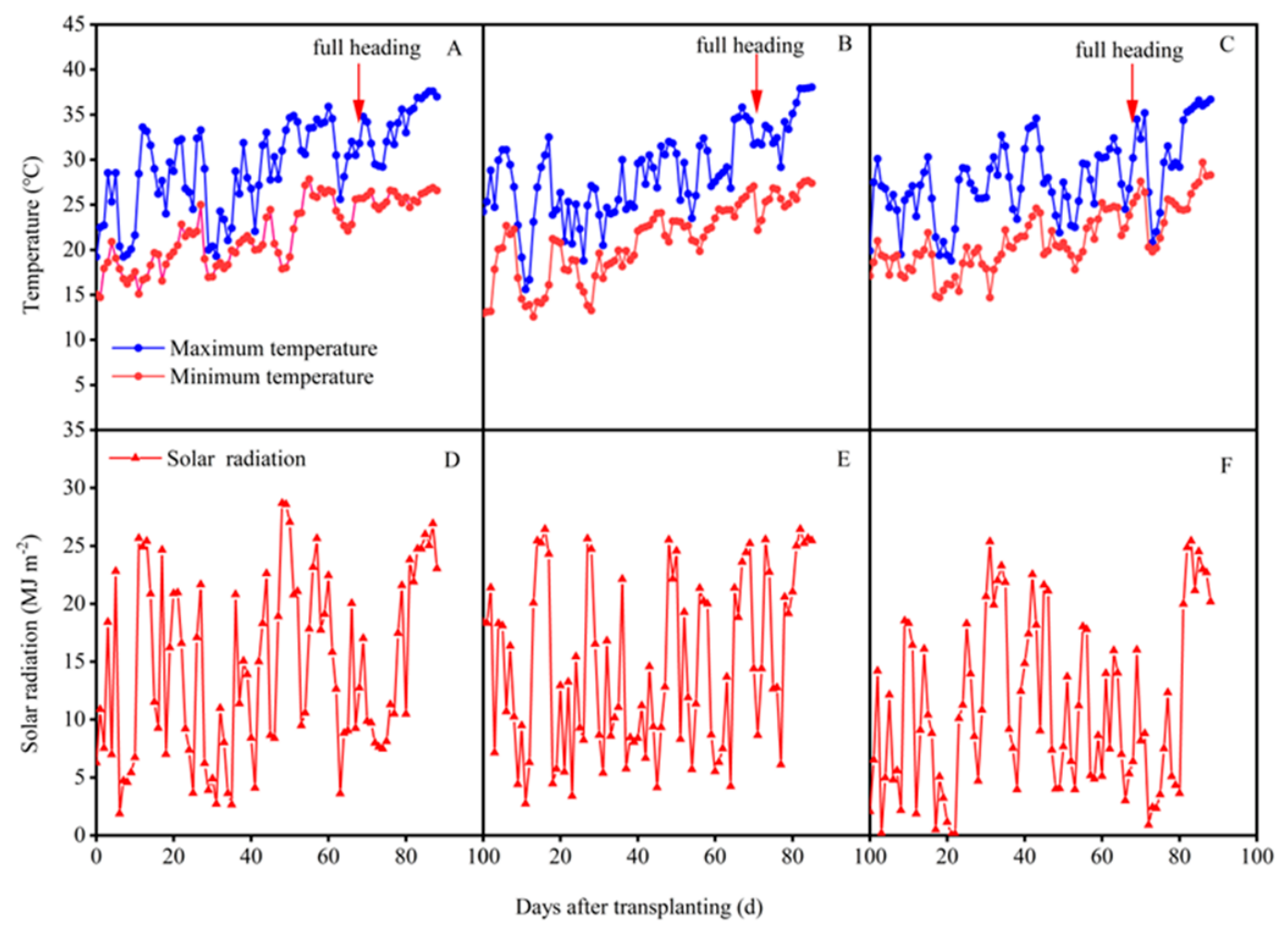
Weather data including daily mean temperature and solar radiation were collected from an on-site automatic weather station (Vantage Pro 2, Davis instruments Corp., Hayward, CA, USA) installed close to the field site, as shown in Figure 1. Averaged daily mean temperatures were 23.40 °C, 22.25 °C, and 22.88 °C from transplanting to heading, and 28.65 °C, 29.18 °C, and 27.36 °C from heading to maturity in 2021, 2022, and 2024, respectively. Average daily solar radiation was 13.73 MJ m−2, 13.35 MJ m−2, and 10.71 MJ m−2 from transplanting to heading, and 15.52 MJ m−2, 18.11 MJ m−2, and 11.23 MJ m−2 from heading to maturity in 2021, 2022, and 2024, respectively.

2.2. Sampling and Measurements

2.2.1. Dry Matter Accumulation and Leaf Area Index (LAI)

Nine hills of rice plants were sampled from each plot at mid-tilling (MT), panicle initiation (PI), heading (HD), and physiological maturity (PM). The plant samples at MT and PI were separated into leaves and stems (including sheath). At heading, plant samples were separated into leaves, stems (including sheaths) and panicles. Plants sampled at PM were separated into straw and panicles. Three representative hills of rice plants were selected, and all leaves from these hills were collected. Leaf area was measured at MT, PI, and HD using a LI-3000C leaf area meter (LI-COR, Biosciences, Lincoln, NE, USA). Subsequently, the leaves were measured after being oven-dried at 70 °C to a constant weight. Total leaf area was determined based on the specific leaf weight method. LAI was calculated as the total leaf area of the sampled hills, divided by the ground area occupied by those hills. Dry weights of leaves, stems, and panicles were measured after oven-dried at 70 °C to a constant weight.

2.2.2. Canopy Light Interception and Radiation Use Efficiency (RUE)

Photosynthetically active radiation dynamics within the crop canopy were monitored under cloudless conditions (between 11:00 and 13:00 h) using a SunScan Canopy Analysis System (Delta-T Devices Ltd., Cambridge, UK). These non-destructive assessments were aligned with critical phenological stages: MT, PI, HD, HD15 (15 days after heading), and PM. To ensure robust spatial representation, sensor probes were systematically positioned both parallel and orthogonal to the planting rows, with triplicate readings recorded per plot. Canopy light interception (LI%) was quantified by calculating the relative difference between the unshaded ambient incident light (recorded above the canopy) and the transmitted light penetrating to the soil surface. To estimate the total intercepted radiation across any specific developmental interval, a standard linear interpolation approach was employed. Specifically, the mean interception coefficient for a given phase—derived by averaging the LI values assessed at its onset and conclusion—was multiplied by the cumulative incident solar radiation received during that precise timeframe. By systematically integrating these phase-specific values, we determined the aggregate intercepted radiation for both the pre-heading (transplanting TD to HD) and post-heading (HD to PM) developmental windows. Ultimately, the overall radiation use efficiency (RUE) from TD to PM was derived by dividing the final aboveground dry biomass by the cumulative radiation intercepted across the entire growing season.

2.2.3. Grain Yield and Its Components

Panicles of nine hills were counted to calculate panicle per m2 and then threshed manually. Filled spikelets were separated from unfilled spikelets by submerging them in tap water. Dry weights of straw (including rachis), filled and unfilled spikelets were measured after oven-dried at 70 °C to a constant weight. Three subsamples of 30 g filled spikelets and all unfilled spikelets were taken to count the number of spikelets per panicle. Grain-setting rate was calculated as 100 × number of filled spikelets/total number of spikelets. Total biomass at PM was the summation of dry weights of straw, rachis, filled and unfilled spikelets. The harvest index was calculated as the ratio of filled spikelets weight to total biomass. In addition, grain yield was determined from a 5 m2 area in each plot and adjusted to the standard moisture content of 13.5%.

2.2.4. Grain Quality

The grains were threshed and naturally dried and then stored for 3 months for grain quality measurement. Post-harvest milling characteristics and physical appearance parameters—encompassing head rice rate (HR), grain length-width ratio (LWR), chalky kernel rate (CKR), and chalkiness degree (CKD)—were systematically evaluated following established phenotypic profiling protocols [8]. Concurrently, the apparent amylose content (AC) of the milled grains was quantified utilizing a standard iodine-based spectrophotometric assay, as detailed by Bao et al. [12].

2.2.5. Grain-Filling and Amylose Accumulation Dynamics

A total of 120 main-stem panicles that grew uniformly and emerged at the same time were tagged in each plot in 2022. Starting from the HD, ten marked panicles were sampled randomly at 0 d, 3 d, 6 d, 9 d, 12 d, 18 d, 24 d, and 30 d after heading (PM). The grains of each panicle were threshed manually, counted, and then dried at 70 °C to constant weight. Then, the dried grains were ground into powder to measure the AC according to the iodine colorimetric method. Logistic equation was fitted to the grain-filling and amylose accumulation dynamics to obtain the following characteristic parametersaccording to Liu et al. [18]: initial grain-filling rate (GFR0), initial amylose accumulation rate (GAmR0), maximum grain-filling rate (GFRmax), maximum amylose accumulation rate (GAmRmax), mean grain-filling rate (GFRmean), mean amylose accumulation rate (GAmRmean), time of reaching the maximum grain-filling/amylose accumulation rate (Tmax), and active grain-filling/amylose accumulation period (D). Goodness-of-fit for the models was assessed using R2 metrics to ensure parameter reliability.

2.2.6. Enzyme Activities in Starch Synthesis

Meanwhile, the grains from the middle primary branches (the upper 4th to 5th primary branches) of the marked three panicles of L-Am varieties (ZJZ29 and QLY2012) and HM-Am varieties (ZJZ17 and ZLY171) were sampled at 6, 12, 18, and 24 days after heading in each plot. After treatment with liquid nitrogen, the samples were stored in a −70 °C freezer. The following enzymes were measured using kits produced by Suzhou Mengxi Biotechnology Co., Ltd. in Suzhou, China: ADP-glucose pyrophosphorylase (ADPG-PPase), soluble starch synthase (SSS), starch branching enzyme (SBE), granule-bound starch synthase (GBSS) [23]. Enzyme activities were normalized per gram of fresh weight, utilizing standard commercial kits. Triplicate biological replicates were analyzed for each sample, and blanks were utilized for baseline calibration according to the manufacturer’s protocol.

2.3. Statistical Analysis

Data statistical analyses were conducted using Statistix 8.0 (Analytical Software, Tallahassee, FL, USA). To examine the field traits, a general linear model was employed for two-way analyses of variance (ANOVA). In this model, both year and variety were treated as fixed effects to evaluate their main effects and interactive effects (year × variety) on rice yield, leaf area index, dry matter accumulation, harvest index, radiation use efficiency, and grain quality traits. Conversely, for the physiological parameters evaluated within a specific subset, a one-way ANOVA was utilized to investigate the effects of different variety types on grain-filling dynamics, amylose accumulation dynamics, and the activities of starch synthesis-related enzymes. Multiple comparisons among treatments were performed using the least significant difference test at a significance level of p < 0.05. Pearson correlation analysis was also performed to ascertain the relationships between yield components and quality parameters. Crucially, pooled means across the study years are reported in the results only when the year × variety interaction was not statistically significant. All graphical representations were generated using Origin 2021 (OriginLab Corp., Northampton, MA, USA).

3. Results

3.1. Distribution of AC in Early-Season Rice Varieties Released from 2000 to 2022 and Its Correlation with Yield- and Quality-Related Traits

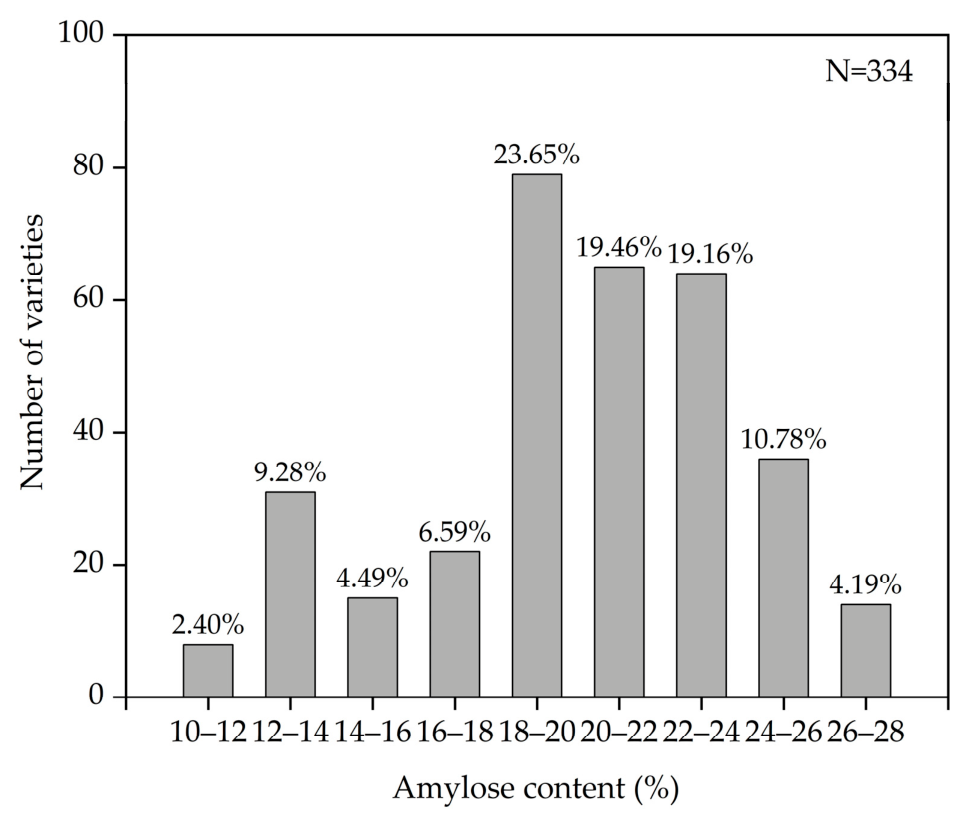
The 334 early-season rice varieties showed a normal distribution in AC, ranging from 10.2% to 27.7%. Based on AC, these varieties were grouped into three categories: low (10–20%), medium (20–25%), and high (>25%), comprising 46.4%, 44.3%, and 9.3% of the total varieties, respectively (Figure 2). A significantly decreasing trend was observed in panicles per m2, while the 1000-grain weight showed an opposite trend in the three categories of early-season rice varieties with increasing AC. The compensatory relationship between panicles per m2 and 1000-grain weight, coupled with the stability in spikelets per panicle and grain-setting rate, resulted in no yield difference between the three categories (Table 1). Moreover, although the HR showed no significant difference across the three categories, the LWR decreased, while the CKR and CKD increased with rising AC (Table 2).
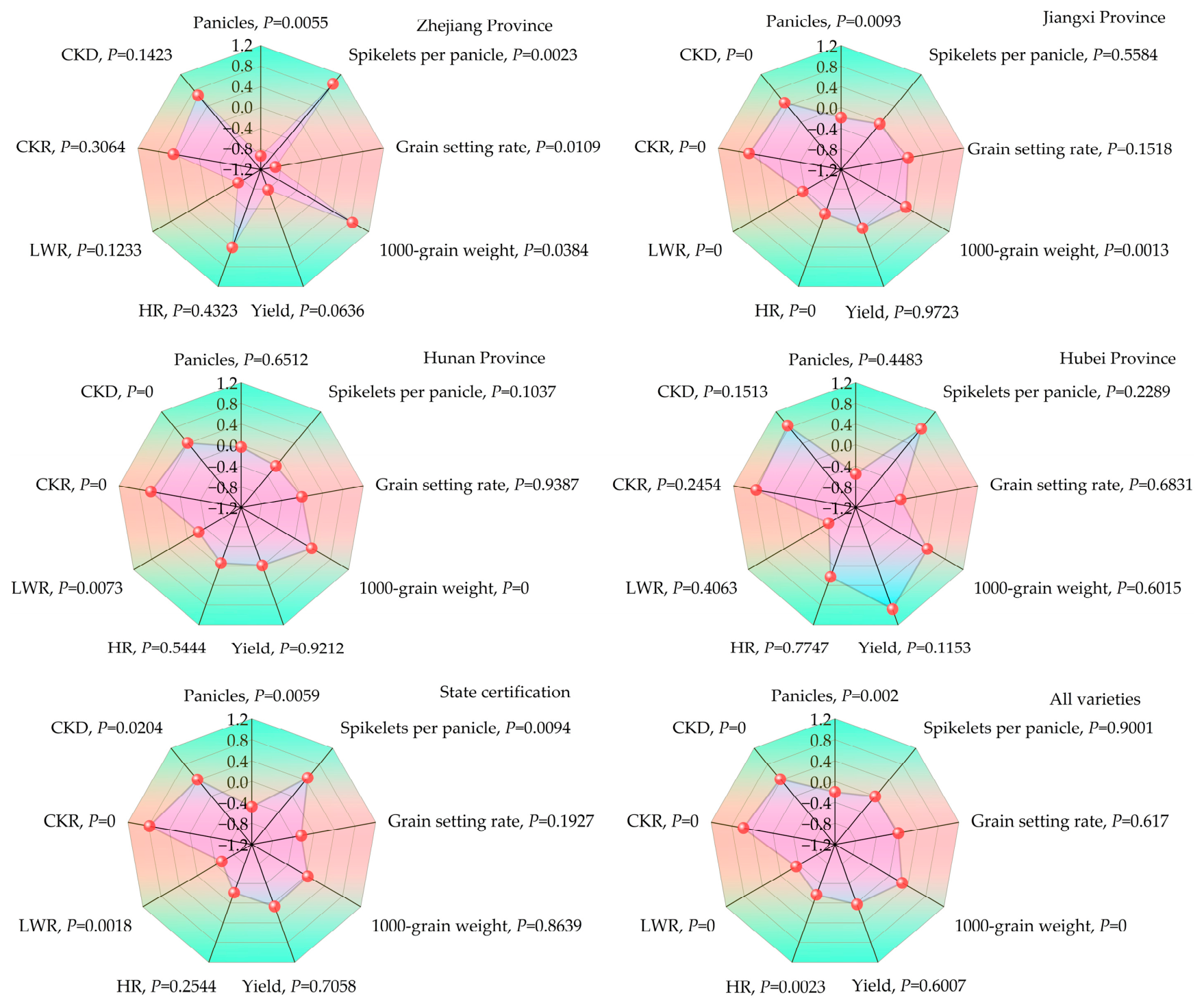
To evaluate the environmental stability of the trait associations, a spatially stratified Pearson correlation analysis was conducted across different breeding origins and the overall 2000–2022 dataset (Figure 3). Crucially, AC exhibited no significant correlation with grain yield (p > 0.05) uniformly across all geographical strata (Zhejiang, Jiangxi, Hunan, Hubei, and state-level) and the overall 22-year timeframe. For appearance quality, AC consistently maintained significant positive correlations with CKR and CKD, and a significant negative correlation with LWR in the overall dataset, as well as within major early-season rice producing provinces (Jiangxi and Hunan) and state-level varieties. Regarding yield components, AC generally displayed a significant positive correlation with 1000-grain weight and a negative correlation with panicles per m2 in the overall analysis and key regions, whereas its relationships with spikelets per panicle, grain-setting rate, and HR exhibited greater regional variability.

3.2. Grain Yield and Yield Components of Early-Season Rice Varieties with Contrasting AC

Except for the main effect of year on spikelets per panicle and grain-setting rate, year, variety, and their interaction significantly or highly significantly influenced the grain yield and yield components of early-season rice varieties with contrasting AC. Regarding yield, no significant difference was observed in the average yield between L-Am and MH-Am varieties in 2021 and 2022 (Table 3). XZX45 and ZJZ29, belonging to L-Am variety, showed the highest number of panicles per m2 and the lowest 1000-grain weight among the six representative varieties, which led to L-Am varieties with 12.8–13.9% more panicles per m2 and 3.6–7.3% lower 1000-grain weight than MH-Am varieties. In addition, XZX45 had the fewest spikelets per panicle across the L-Am and MH-Am varieties. Although there was no difference in grain-setting rate between L-Am and MH-Am varieties in 2021, the mentioned parameter was significantly higher (by 4.7%) in L-Am than in MH-Am varieties in 2022.
In addition, in the two years, no significant differences were observed between the two types in LAI (except at the panicle differentiation stage in 2022) and dry matter accumulation (DMA) at most growth stages, or in harvest index (HI) and radiation use efficiency (RUE) (Tables S4 and S5). Overall, L-Am varieties showed no significant difference in yield compared to MH-Am varieties in both years.

3.3. Processing and Appearance Quality

The effects of year and variety on HR, LWR, CKR, CKD, and AC of early-season rice varieties with different amylose contents were significant or highly significant. The interaction effect of year and variety on HR, LWR and CKR was significant or highly significant, but showed no significant effect on CKD or AC (Table 4). Compared with MH-Am varieties, the LWR of L-Am varieties was significantly increased by 38.1–42.9% in 2021 and 2022, while the CKR, CKD and AC were significantly decreased by 70.8–73.5%, 60.0–70.2% and 28.2–32.4%, respectively.

3.4. Correlations of AC with Yield, Yield Components, and Rice Quality

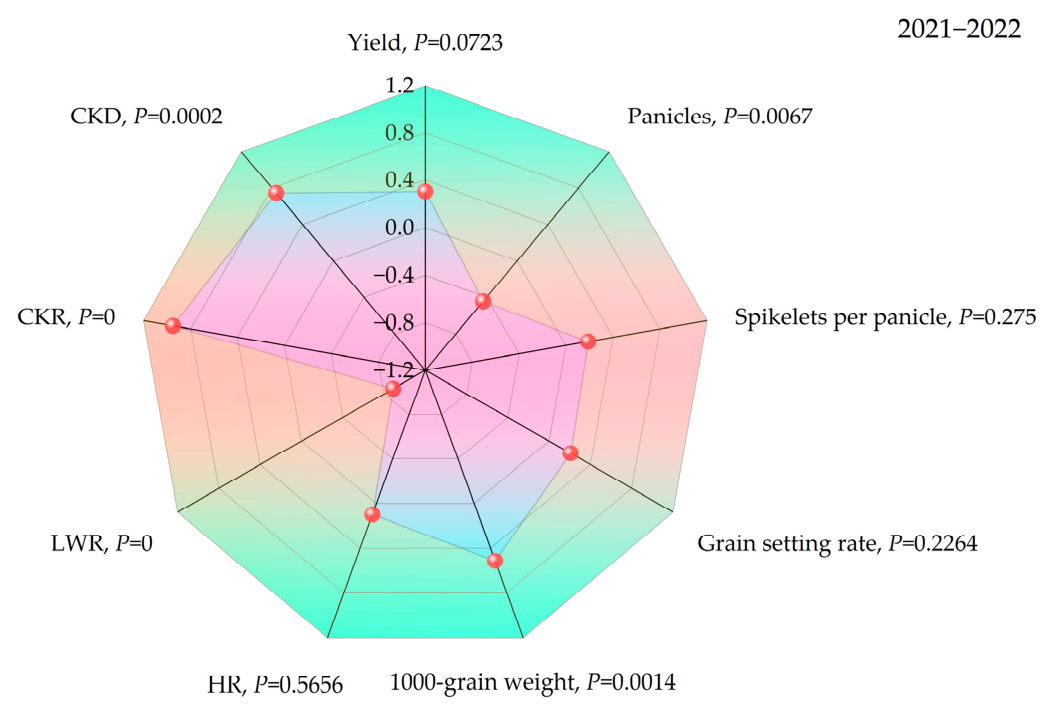
In experiment I, the correlation analysis showed that AC had significant positive correlations with 1000-grain weight, CKR, and CKD, but significant negative correlations with panicles per m2 and LWR. No significant correlations between varieties and yield, spikelets per panicle, grain-setting rate, and HR was observed (Figure 4).
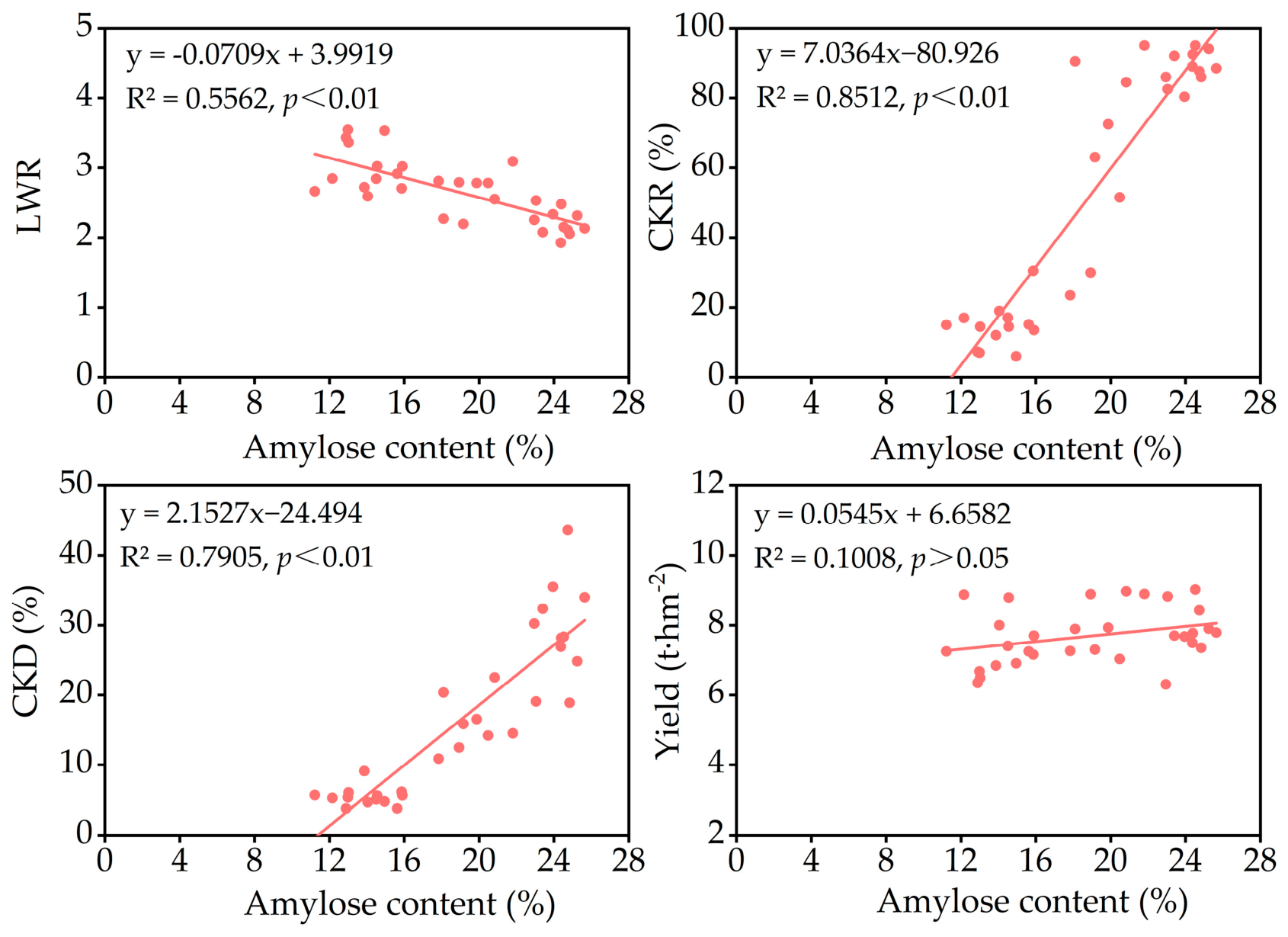
In order to further verify the correlation between AC and the yield and quality of early-season rice varieties with different AC, we conducted experiment II, with 32 early-season rice varieties, which were widely cultivated in the middle and lower reaches of the Yangtze River (Table S3). Consistently, significant positive correlations between AC and CKR and CKD, as well as a negative correlation between AC and LWR were found among those varieties (Figure 5). In addition, no significant correlation was found between AC and yield.

3.5. Grain-Filling and Amylose Accumulation Characteristics, and Starch Synthesis-Related Enzyme Activities

The logistic equation was used to fit the dynamics of grain filling and amylose accumulation in whole panicles of early-season rice varieties with contrasting AC, and all fitted curves yielded R2 values exceeding 0.95, indicating a strong model fit (Table 5 and Table 6). Compared with L-Am varieties, the GFRmax and GFRmean of MH-Am varieties were significantly higher (by 22.6% and 21.6%, respectively). Similarly, the MH-Am varieties showed significantly higher GAmRmax (83.4%) and GAmRmean (64.1%) than the L-Am varieties. However, there were no significant differences in GFR0, Tmax, and D in terms of grain-filling between MH-Am and L-Am varieties. In contrast, significantly higher GAmR0 and longer Tmax and D in terms of grain amylose accumulation were observed in L-Am varieties than MH-Am varieties.
To further reveal the physiological mechanisms underlying the differences in grain filling and amylose accumulation among early-season rice varieties with contrasting AC, the present study further analyzed the changes in the activities of starch synthesis-related enzymes in grains (Table 7). Significant differences in the activities of starch synthesis-related enzymes were observed among early-season rice varieties at different stages. During the grain-filling stages, the activities of ADPG-PPase (DAH6 to DAH12) and SBE (DAH12 to DAH24) were significantly higher in MH-Am type than in L-Am type, whereas the activities of SSS (DAH6 to DAH24) and GBSS (DAH6) were significantly higher in L-Am type.

4. Discussion

This study demonstrates that the L-Am genotype confers a stable reduction in grain chalkiness, with no associated yield penalty. Crucially, this conclusion is not drawn solely from the physiological analysis of six varieties. Rather, it is the result of a cohesive validation loop: the foundational trends were discovered in 334 historical varieties, the underlying starch synthesis and grain-filling mechanisms were precisely decoded using six representative extremes, and the robustness of these traits was conclusively validated in current field environments utilizing 32 widely cultivated modern varieties. These findings provide a clear breeding strategy to enhance appearance quality while maintaining yield, thereby overcoming a key constraint which is vital for the sustainability of early-season rice production in the region.

4.1. Prevalence of High-Amylose Varieties: A Consequence of Historical Breeding Objectives, Market Demand, and Farmer Practices

The dominance of medium- to high-amylose (MH-Am) varieties among the released early-season rice varieties over the past two decades is not a random occurrence but a result of intertwined historical, economic, and agronomic factors. From a breeder’s perspective, the primary historical objective for early-season rice was to maximize yield potential and ensure production stability within the tight schedule of double-cropping systems [3]. High-amylose varieties often exhibit larger grain weight (as confirmed by this study), making them a traditional priority in breeding improvement. Another reason may be due to their superior seed vigor and faster seedling emergence rate under the low-temperature stress of early spring, which has led to their preferential retention during the breeding process [24,25]. In contrast, under the previous breeding objectives, which mainly focused on yield, low-amylose materials characterized by slower germination and growth were more likely to be eliminated. Furthermore, from an industrial and market demand standpoint, early-season rice has been predominantly used as a raw material for processing into rice noodles and other products that require high amylose content for firm texture and low stickiness [5]. This created a sustained market pull for MH-Am varieties. Recent processing studies further corroborate that an amylose content ranging from 22% to 28%, along with specific gel consistency profiles, is technically imperative to construct the robust starch gel network required for high-quality fresh wet rice noodles with minimal cooking loss and high chewiness [26,27]. Consequently, while L-Am varieties hold immense potential for meeting the rising consumer demand for superior table rice, the stringent physicochemical requirements of the rice noodle processing industry dictate that MH-Am varieties will retain a crucial, segmented market dominance.
From the grower’s perspective, despite the lower market price for grain with high chalkiness, farmers have continued cultivating popular MH-Am varieties due to their well-documented yield potential, reliable seed availability, and familiar management practices. Although MH Am varieties offer no major yield advantage and consumer preference is shifting toward high quality, low amylose rice, the planting area of L Am varieties in early-season rice remains stagnant, driven by the factors mentioned above. Furthermore, it is important to recognize that the observed correlations between AC, chalkiness, and yield components across the 334 varieties released over two decades may be subject to confounding effects. Breeding priorities for early-season rice in China have undergone substantial historical shifts, evolving from a primary focus on maximizing yield to a coordinated emphasis on both yield and quality traits such as appearance and palatability [21,28]. As a result, traits including reduced chalkiness and lower AC have often been co-selected in modern breeding programs. The trait associations identified in this long-term dataset may therefore partially reflect these parallel selection pressures, historical trends, and resulting population stratification, rather than solely indicating direct pleiotropic effects or tight genetic linkages. While these population-level correlations offer valuable agronomic insights, they warrant cautious interpretation. To directly address the inherent environmental noise in large-scale historical datasets, our spatially stratified analysis effectively validated these trait associations. By confirming that the AC–chalkiness correlation and the AC-yield independence persist across distinct macro-environments (major producing provinces) throughout the entire two-decade breeding period (2000–2022), we isolated intrinsic genotypic main effects from spatiotemporal fluctuations [29,30]. This environmental resilience provides a highly reliable phenotypic foundation for early-season rice breeding. Consequently, this reinforces the necessity of our subsequent physiological investigations-using carefully selected representative genotypes-to dissect the precise mechanistic basis of chalkiness reduction.

4.2. Mechanisms Underlying Yield Stability

In this study, there was no difference in yield between varieties with contrasting AC, which can be attributed to the coordinated compensation of yield components and the stability of key agronomic and physiological traits. Our results showed that L-Am varieties had 12.8–13.9% more panicles per m2 and a 3.6–7.3% lower 1000-grain weight than MH-Am varieties in two years, resulting in no difference in yield, which agrees with previous report (Table 3) [31]. Physiologically, this specific yield compensation strategy reflects a crucial source-sink adaptation. As demonstrated by our grain-filling dynamics (Table 5), L-Am varieties exhibit a significantly lower maximum grain-filling rate (GFRmax) and a prolonged active filling period. This inherently slower filling kinetic restricts their single-grain sink capacity, inevitably leading to a lower 1000-grain weight. To optimize overall canopy carbon allocation and maintain total yield parity, these varieties dynamically compensate by sustaining higher tiller survival rates during the vegetative stage, thereby generating a significantly higher panicle density. Previous studies indicated that hybrid and inbred rice employ distinct yield compensation strategies under varying planting densities; specifically, higher seedling numbers per hill in inbreds typically increase panicles per m2, whereas hybrids rely more on spikelets per panicle and grain weight at lower planting densities [32,33]. In our study, however, the L-Am and MH-Am groups comprised an identical ratio of hybrid to inbred varieties (1:2), effectively normalizing the differential seedling densities across the two groups. Consequently, the observed variations in panicles per m2 and 1000-grain weight between L-Am and MH-Am varieties were not confounded by varietal composition or seedling density, but rather reflect the intrinsic genotypic differences and compensatory mechanisms of the selected varieties. Interestingly, the reduced panicle number in MH-Am varieties (JZ361 and ZJZ17) may be partly attributed to climate change. Specifically, intensified warming during the tillering stage of early-season rice could diminish their inherent advantages of higher seed vigor and faster seedling emergence under cool conditions [34,35].
Previous research has shown that light interception improves canopy architecture and enhances photosynthesis in rice, with greater intercepted radiation leading to increased dry matter production and accumulation [36,37]. In the present study, however, no significant differences were observed between L-Am varieties and MH-Am varieties in LAI, DMA, HI, and RUE (Tables S4 and S5). As indicated by previous studies, these findings show that yield stability in rice is achieved by sustaining a coordinated relationship between source (photosynthetic capacity) and sink (yield components) [38,39]. Consequently, the yield similarity between L-Am and MH-Am varieties reflects a compensatory coordination of yield components, underpinned by a conserved physiological regime of biomass accumulation and allocation.

4.3. Physiological Characteristics Associated with Low Chalkiness

The superior grain appearance of L-Am varieties fundamentally stems from a highly coordinated “slow and steady” grain-filling strategy rather than an isolated physiological trait. Compared to medium-high amylose (MH-Am) genotypes, these low-amylose models inherently decelerate their filling dynamics. They exhibit significantly reduced maximum and mean grain-filling rates (GFRmax and GFRmean), coupled with a delayed peak filling time (Tmax) and an extended active filling duration (D). This extended spatiotemporal window is critical; it mitigates the rapid, chaotic deposition of starch polymers that typically generates the structurally loose, opaque endosperm regions macroscopically recognized as chalkiness. By stretching the active filling phase, L-Am varieties provide sufficient time for the highly orderly assembly of starch granules [38,40].
This delayed macroscopic kinetic behavior is tightly orchestrated by a specialized profile of starch synthesis enzymes. Throughout the critical filling window, L-Am varieties maintain elevated SSS activity while distinctly downregulating ADPG-PPase and SBE [41,42]. According to our logistic growth modeling, this specific enzymatic suppression mathematically underpins the observed 22.6% drop in GFRmax. Rather than merely stunting grain development, sustained SSS expression synergizes with the prolonged filling duration to optimize amylopectin chain elongation and crystallization. A notable nuance of this framework is the transiently high GBSS activity observed early in L-Am grain development (DAH 6) (Table 7). While seemingly contradictory to the ultimate low amylose content of L-Am varieties, this early GBSS spike likely facilitates essential initial starch nucleation. Its subsequent precipitous decline during the peak dry matter accumulation stage strictly caps total amylose synthesis, allowing continuous SSS-driven amylopectin crystallization to dominate the structure of the maturing endosperm.
The biophysical consequence of this enzymatic coordination theoretically translates into a denser, highly packed endosperm matrix. Although direct endosperm structural observations (e.g., scanning electron microscopy) were not included in the current analytical framework to visually confirm the physical granule packing, parallel preliminary evaluations by our group align with this structural hypothesis (unpublished data). Crucially, it is essential to rigorously recognize the methodological limitations of the current physiological models. Because this study utilized commercial varieties with diverse genetic backgrounds rather than near-isogenic lines (NILs) and did not involve the experimental manipulation of AC, Wx allele profiling, or downstream transcriptomic quantifications, the kinetic and enzymatic differences described herein represent correlative associations rather than absolute causal mechanisms. Consequently, the reduced chalkiness is most accurately interpreted as an integrated physio-biochemical characteristic strongly associated with the L-Am phenotype, rather than a direct consequence of isolated Waxy-locus causality. Nevertheless, by anchoring the robust phenotypic correlations from our broader germplasm panels to these specific functional traits, we demonstrate that a low AC phenotype reliably functions as a comprehensive indicator for breeding early-season rice with superior appearance quality.

4.4. Limitations and Future Perspectives

While this study establishes a robust agronomic and biochemical framework for L-Am varieties (14.5–16.8% AC), several methodological and biological dimensions require further exploration. Primarily, our current quality assessment focused on appearance and processing traits; comprehensive evaluations of cooking, eating, and nutritional profiles remain necessary to guarantee market competitiveness and end-user benefits. This is particularly relevant given the recent, albeit unsustainable, producer trend of adapting short-duration late-season varieties for early-season planting—a practice that artificially extends the vegetative phase by 5–7 days, thereby shortening the available window for the subsequent crop and ultimately impairing the annual productivity of the double-cropping system. Furthermore, the distinct enzymatic profiles and macroscopic filling kinetics characterized herein represent ultimate phenotypic manifestations [9,10]. The precise transcriptomic regulation governing these differences—such as allelic variations within the Wx, SSIIa, or SBEIIb clusters—remains unresolved [11,14]. Future research must integrate multi-omics approaches and CRISPR/Cas9-mediated functional validation to anchor these field-level agronomic traits to their molecular origins [25]. Concurrently, transitioning from conventional 2D appearance evaluations to high-throughput, non-destructive 3D phenotyping pipelines, such as deep learning-based image analysis and micro-CT scanning [43,44], will be crucial to accurately capturing the spatial complexity of chalkiness formation.
Beyond intrinsic biological mechanisms, the widespread applicability of these L-Am genotypes is inherently constrained by agrometeorological factors and environmental covariance. Grain chalkiness is notoriously hypersensitive to transient thermal stress during the grain-filling phase [38,39]. We hypothesize that the extended active filling period (D) observed in L-Am varieties may act as a physiological “temporal buffer,” effectively diluting the structural damage inflicted by short-term acute heat shocks. However, validating this theory is currently limited by the absence of localized microclimate data. Future trials must deploy high-resolution canopy sensors alongside strictly controlled heat-stress assays to dynamically link canopy micro-environments with endosperm development. Moreover, although our study spanned multiple years with distinct solar and thermal regimes (Figure 1), our statistical framework did not employ advanced stability models such as AMMI or GGE biplots. Consequently, the precise magnitude of Genotype × Environment (G×E) interactions on the absolute thermal stability of the L-Am trait is not yet fully resolved. Prior to large-scale commercial deployment, it is imperative to conduct extensive multi-location field trials across diverse agro-climatic zones. These trials should be coupled with sophisticated stability modeling and the development of tailored supportive cultivation protocols—including optimized sowing windows and precision nutrient management—to maximize both yield potential and ecological resilience in double-cropping systems.

5. Conclusions

Synthesizing our multi-level evaluations, we propose that a targeted low amylose content (AC: 14.5–16.8%) serves as a highly reliable, integrated physio-biochemical indicator for superior grain appearance in early-season rice. Adopting this threshold effectively resolves the longstanding quality-yield trade-off. Agronomically, crop productivity is preserved via robust source-sink compensations, as enhanced panicle density offsets reductions in individual grain weight. Physiologically, this phenotypic synergy is closely associated with a “slow and steady” filling dynamic and a coordinated enzymatic profile, characteristics that theoretically mitigate the rapid, chaotic starch deposition responsible for chalkiness. Pending extensive multi-environment validations to confirm absolute thermal stability, prioritizing this specific AC range provides a pragmatic breeding blueprint to simultaneously enhance the structural quality and economic sustainability of double-season rice systems.

Supplementary Materials

The following supporting information can be downloaded at: https://www.mdpi.com/article/10.3390/agriculture16121255/s1, Table S1: Yield and yield components of 334 early indica rice varieties released by the state certification and four provinces (Jiangxi, Hunan, Hubei, and Zhejiang) located in the middle and lower reaches of the Yangtze River from 2000 to 2022; Table S2: Basic information of six representative early-season rice varieties; Table S3: Yield and rice quality of 32 early indica rice varieties widely cultivated in the middle and lower reaches of the Yangtze River in 2024; Table S4: Leaf area index, dry matter accumulation and harvest index of early-season rice varieties with contrasting amylose content; Table S5: Incident radiation, intercepted radiation, intercepted percentage and radiation use efficiency of early-season rice cultivars with contrasting amylose content..

Author Contributions

Conceptualization, X.X. and Y.Z.; investigation, J.W. (Jiale Wu), J.W. (Jingjing Wu), R.Q., and W.Q.; data curation, J.W. (Jiale Wu) and J.W. (Jingjing Wu); writing—original draft preparation, J.W. (Jiale Wu); writing—review and editing, X.X., L.G., G.H., and X.T.; funding acquisition, X.X. and Y.Z. All authors have read and agreed to the published version of the manuscript.

Funding

This study was supported by the Earmarked Fund for Jiangxi Agricultural Research System (Grant No. JXARS-04) and Jiangxi Provincial Natural Science Foundation (Grant No. 20252BAC240069).

Institutional Review Board Statement

Not applicable.

Informed Consent Statement

Not applicable.

Data Availability Statement

The data reported in this study is contained within the article.

Conflicts of Interest

The authors declare no conflicts of interest.

References

  1. Bandumula, N. Rice production in Asia: Key to global food security. Proc. Natl. Acad. Sci. India Sect. B Biol. Sci. 2018, 88, 1323–1328. [Google Scholar] [CrossRef]
  2. Tang, L.; Risalat, H.; Cao, R.; Hu, Q.; Pan, X.; Hu, Y.; Zhang, G. Food security in China: A brief view of rice production in recent 20 years. Foods 2022, 11, 3324. [Google Scholar] [CrossRef]
  3. Huang, M.; Chen, J.; Cao, F. Estimating the expected planting area of double- and single-season rice in the Hunan-Jiangxi region of China by 2030. Sci. Rep. 2022, 12, 6207. [Google Scholar] [CrossRef]
  4. Jin, T.; Zhong, T. Changing rice cropping patterns and their impact on food security in southern China. Food Secur. 2022, 14, 907–917. [Google Scholar] [CrossRef]
  5. Huang, M.; Xiao, Z.; Chen, J.; Cao, F. Yield and quality of brown rice noodles processed from early-season rice grains. Sci. Rep. 2021, 11, 18668. [Google Scholar] [CrossRef] [PubMed]
  6. Huang, G.; Guo, L.; Zeng, Y.; Huang, S.; Zeng, Y.; Xie, X. Changes in the grain yield and quality of early indica rice from 2000 to 2020 in southern China. Agronomy 2024, 14, 295. [Google Scholar] [CrossRef]
  7. Chen, H.; Wang, T.; Deng, F.; Yang, F.; Zhong, X.; Li, Q.; Ren, W. Changes in chemical composition and starch structure in rice noodle cultivar influence Rapid Visco analysis and texture analysis profiles under shading. Food Chem. X 2022, 14, 100360. [Google Scholar] [CrossRef]
  8. Zhou, H.; Peng, Y.; He, Y. Rice appearance quality. In Rice; AACC International Press: Saint Paul, MN, USA, 2019; pp. 371–383. [Google Scholar]
  9. Zhou, L.; Liang, S.; Ponce, K.; Marundon, S.; Ye, G.; Zhao, X. Factors affecting head rice yield and chalkiness in indica rice. Field Crops Res. 2015, 172, 1–10. [Google Scholar] [CrossRef]
  10. Pang, Y.; Ali, J.; Wang, X.; Franje, N.J.; Revilleza, J.E.; Xu, J.; Li, Z. Relationship of rice grain amylose, gelatinization temperature and pasting properties for breeding better eating and cooking quality of rice varieties. PLoS ONE 2016, 11, e0168483. [Google Scholar] [CrossRef]
  11. Kumar, I.; Khush, G.S.; Juliano, B.O. Genetic analysis of waxy locus in rice (Oryza sativa L.). Theor. Appl. Genet. 1987, 73, 481–488. [Google Scholar] [CrossRef]
  12. Bao, J.; Shen, S.; Sun, M.; Corke, H. Analysis of genotypic diversity in the starch physicochemical properties of nonwaxy rice: Apparent amylose content, pasting viscosity and gel texture. Starch/Stärke 2006, 58, 259–267. [Google Scholar] [CrossRef]
  13. Zhou, R.; Hu, Q.; Meng, X.; Zhang, Y.; Shuai, X.; Gu, Y.; Li, Y.; Chen, M.; Wang, B.; Cao, Y. Effects of high temperature on grain quality and enzyme activity in heat-sensitive versus heat-tolerant rice cultivars. J. Sci. Food Agric. 2024, 104, 9729–9741. [Google Scholar] [CrossRef]
  14. Zhou, L.; Zhang, C.; Zhang, Y.; Wang, C.; Liu, Q. Genetic manipulation of endosperm amylose for designing superior quality rice to meet the demands in the 21st century. J. Cereal Sci. 2022, 105, 103481. [Google Scholar] [CrossRef]
  15. Li, X.; Zhang, M.; Xiao, Z.; Liu, L.; Cao, F.; Chen, J.; Huang, M. Relationships between texture properties of cooked rice with grain amylose and protein content in high eating quality indica rice. Cereal Chem. 2024, 101, 577–582. [Google Scholar] [CrossRef]
  16. Ahmed, N.; Tetlow, I.J.; Nawaz, S.; Iqbal, A.; Mubin, M.; Rehman, M.S.N.U.; Butt, A.; Lightfoot, D.A.; Maekawa, M. Effect of high temperature on grain filling period, yield, amylose content and activity of starch biosynthesis enzymes in endosperm of basmati rice. J. Sci. Food Agric. 2014, 95, 2237–2243. [Google Scholar] [CrossRef] [PubMed]
  17. Xu, Y.; Chu, C.; Yao, S. The impact of high-temperature stress on rice: Challenges and solutions. Crop J. 2021, 9, 963–976. [Google Scholar] [CrossRef]
  18. Liu, X.; Han, S.; Makowski, D.; Wang, X.; Fu, Z.; Ciais, P. Response of rice quality to climate warming: A meta-analysis. Field Crops Res. 2025, 331, 109995. [Google Scholar] [CrossRef]
  19. Zhong, L.; Cheng, F.; Wen, X.; Sun, Z.; Zhang, G.P. Deterioration of eating and cooking quality caused by high temperature during grain filling in early-season indica rice cultivars. J. Agron. Crop Sci. 2005, 191, 218–225. [Google Scholar] [CrossRef]
  20. Zhang, H.; Huang, M.; Wei, Y.; Chen, J.; Shan, S.; Cao, F.; Chen, G.; Zou, Y. Amylose content and starch granule size in rice grains are affected by growing season. Phyton-Int. J. Exp. Bot. 2019, 88, 403–412. [Google Scholar] [CrossRef]
  21. Lu, Y.; Tang, Y.; Zhang, J.; Liu, S.; Liang, X.; Li, M.; Li, R. Variations and trends in rice quality across different types of approved varieties in China, 1978–2022. Agronomy 2024, 14, 1234. [Google Scholar] [CrossRef]
  22. Alam, M.; Lou, G.; Abbas, W.; Osti, R.; Ahmad, A.; Bista, S.; Ahiakpa, J.K.; He, Y. Improving rice grain quality through ecotype breeding for enhancing food and nutritional security in Asia-Pacific region. Rice 2024, 17, 47. [Google Scholar] [CrossRef]
  23. Fan, X.; Li, Y.; Lu, Y.; Zhang, C.; Li, E.; Li, Q.; Tao, K.; Yu, W.; Wang, J.; Chen, Z.; et al. The interaction between amylose and amylopectin synthesis in rice endosperm grown at high temperature. Food Chem. 2019, 301, 125258. [Google Scholar] [CrossRef]
  24. Huang, M.; Jiang, P.; Shan, S.; Gao, W.; GuoHui, M.; Zou, Y.; Uphoff, N.; Yuan, L. Higher yields of hybrid rice do not depend on nitrogen fertilization under moderate to high soil fertility conditions. Rice 2017, 10, 43. [Google Scholar] [CrossRef] [PubMed]
  25. Chen, X.; Ren, Y.; Dong, H.; Jiang, X.; Zheng, X.; Duan, E.; Teng, X.; Wang, Y.; Gu, C.; Chen, R.; et al. Natural variation in OsTPS8 confers differential regulation of chalkiness and seed vigor in indica and japonica rice. Nat. Genet. 2025, 58, 206–217. [Google Scholar] [CrossRef]
  26. Huang, H.; Li, Y.; Zeng, J.; Cao, Y.; Zhang, T.; Chen, G.; Wang, Y. Comparative quality evaluation of physicochemical and amylose content profiling in rice noodles from diverse rice hybrids in China. Agriculture 2023, 13, 140. [Google Scholar] [CrossRef]
  27. Zainab, S.; Zhou, X.; Zhang, Y.; Tanweer, S.; Mehmood, T. Suitability of early indica rice for the preparation of rice noodles by its starch properties analysis. Food Chem. X 2024, 24, 101921. [Google Scholar] [CrossRef]
  28. Feng, X.; Zhao, Y.; Nie, W.; Zhang, Q.; Liu, Z.; Jiang, Y.; Chen, K.; Yu, N.; Luan, X.; Li, W.; et al. Historical trends analysis of main agronomic traits in South China inbred indica rice varieties since dwarf breeding. Agronomy 2023, 138, 2159. [Google Scholar] [CrossRef]
  29. Gauch, H.G.; Piepho, H.P.; Annicchiarico, P. Statistical analysis of yield trials by AMMI and GGE: Further considerations. Crop Sci. 2008, 48, 866–889. [Google Scholar] [CrossRef]
  30. Malosetti, M.; Ribaut, J.M.; van Eeuwijk, F.A. The statistical analysis of multi-environment data: Modeling genotype-by-environment interaction and its genetic basis. Front. Physiol. 2013, 4, 44. [Google Scholar] [CrossRef]
  31. Hu, Y.; Cong, S.; Zhang, H. Comparison of the grain quality and starch physicochemical properties between japonica rice cultivars with different contents of amylose, as affected by nitrogen fertilization. Agriculture 2021, 11, 616. [Google Scholar] [CrossRef]
  32. Huang, M.; Shan, S.; Zhou, X.; Chen, J.; Cao, F.; Jiang, L.; Zou, Y. Agronomic performance of late-season rice in South China. Plant Prod. Sci. 2017, 21, 32–38. [Google Scholar] [CrossRef]
  33. Lü, J.; Wang, D.; Liu, K.; Chu, G.; Huang, L.; Tian, X.; Zhang, Y. Inbred varieties outperformed hybrid rice varieties under dense planting with reducing nitrogen. Sci. Rep. 2020, 10, 8769. [Google Scholar] [CrossRef]
  34. Huang, M.; Zhang, W.; Jiang, L.; Zou, Y. Impact of temperature changes on early-rice productivity in a subtropical environment of China. Field Crops Res. 2013, 146, 10–15. [Google Scholar] [CrossRef]
  35. He, A.; Li, J.; Long, J.; Ai, Z.; Zhang, P.; Guo, X. Spatial and temporal variations of climate resources during the growing season of early-season rice in Hunan province. Agriculture 2024, 14, 1514. [Google Scholar] [CrossRef]
  36. Gu, J.; Yin, X.; Stomph, T.J.; Struik, P.C. Can exploiting natural genetic variation in leaf photosynthesis contribute to increasing rice productivity? A simulation analysis. Plant Cell Environ. 2014, 37, 22–34. [Google Scholar] [CrossRef]
  37. Gu, J.; Chen, Y.; Zhang, H.; Li, Z.; Zhou, Q.; Yu, C.; Kong, X.; Liu, L.; Wang, Z.; Yang, J. Canopy light and nitrogen distributions are related to grain yield and nitrogen use efficiency in rice. Field Crops Res. 2017, 206, 74–85. [Google Scholar] [CrossRef]
  38. Shi, W.; Yin, X.; Struik, P.C.; Solis, C.; Xie, F.; Schmidt, R.C.; Huang, M.; Zou, Y.; Ye, C.; Jagadish, S.V.K. High day- and night-time temperatures affect grain growth dynamics in contrasting rice genotypes. J. Exp. Bot. 2017, 68, 5233–5245. [Google Scholar] [CrossRef]
  39. Song, Y.; Wang, C.; Linderholm, H.W.; Fu, Y.; Cai, W.; Xu, J.; Zhuang, L.; Wu, M.; Shi, Y.; Wang, G.; et al. The negative impact of increasing temperatures on rice yields in southern China. Sci. Total Environ. 2022, 820, 153262. [Google Scholar] [CrossRef]
  40. Jagadish, S.V.K.; Murty, M.V.R.; Quick, W.P. Rice responses to rising temperatures-challenges, perspectives and future directions. Plant Cell Environ. 2015, 38, 1686–1698. [Google Scholar] [CrossRef]
  41. Lu, T.; Li, G.; Ma, J.; Huang, H.; Fu, W.; Chen, T.; Wang, W.; Zeng, Y.; Chen, M.; Fu, G.; et al. ATP utilization efficiency plays a key role in determining rice quality under high-temperature conditions. Plant Physiol. Biochem. 2025, 221, 109582. [Google Scholar] [CrossRef] [PubMed]
  42. Yang, J.; Zhang, Y.; Zhang, F.; Duan, L.; Zou, L.; Wang, S.; Li, Y.; Tian, J.; Liu, D.; Zhang, Q.; et al. Effects of high temperature during the grain-filling stage on the photosynthetic performance, yield, and quality of early rice. Chin. J. Eco-Agric. 2025, 33, 80–94. (In Chinese) [Google Scholar]
  43. Wang, C.; Caragea, D.; Narayana, N.K.; Hein, N.T.; Bheemanahalli, R.; Somayanda, I.M.; Jagadish, S.V.K. Deep learning based high-throughput phenotyping of chalkiness in rice exposed to high night temperature. Plant Methods 2022, 18, 9. [Google Scholar] [CrossRef] [PubMed]
  44. Cai, Z.; Deng, Y.; Zhu, X.; Li, B.; Xu, C.; Li, D. High-throughput 3D rice chalkiness detection based on Micro-CT and VSE-UNet. Agronomy 2025, 15, 450. [Google Scholar] [CrossRef]
Figure 1. Daily maximum temperature, minimum temperature, and solar radiation in 2021 (A,D), 2022 (B,E), and 2024 (C,F).
Agriculture 16 01255 g001
Figure 2. Distribution of amylose content in early-season rice varieties in the middle and lower reaches of the Yangtze River from 2000 to 2022.
Agriculture 16 01255 g002
Figure 3. Correlation of amylose content with yield, yield components, and rice quality of early-season rice varieties released by the provinces of Zhejiang, Jiangxi, Hunan, and Hubei, and by the State Certification Committee in the middle and lower reaches of the Yangtze River from 2000 to 2022. CKD, CKR, LWR, and HR represent chalkiness degree, chalky kernel rate, length–width ratio, and head rice rate, respectively.
Agriculture 16 01255 g003
Figure 4. Correlation of amylose content with yield, yield components, and grain quality of early-season rice varieties in 2021 and 2022. CKD, CKR, LWR, and HR represent chalkiness degree, chalky kernel rate, length–width ratio, and head rice rate, respectively.
Agriculture 16 01255 g004
Figure 5. The relationships between amylose content and LWR, CKR, CKD, and yield of early-season rice varieties in 2024. CKD, CKR, and LWR represent chalkiness degree, chalky kernel rate, and length–width ratio, respectively.
Agriculture 16 01255 g005
Table 1. Yield and yield components of three categories of early-season rice varieties released from 2000 to 2022 in the middle and lower reaches of Yangtze.
AC
(%)
Panicles
m−2
Spikelets per PanicleGrain-Setting Rate
(%)
1000-Grain Weight
(g)
Yield
(t·hm−2)
10–20 (n = 155)337.41 a113.52 a81.90 a26.03 c7.42 a
20–25 (n = 148)332.86 ab113.93 a82.46 a26.50 b7.48 a
25–28 (n = 31)323.66 b116.67 a81.93 a27.11 a7.55 a
Different lowercase letters in the same column indicate a significant difference of 0.05 between different treatments.
Table 2. Rice quality of three categories of early-season rice varieties released from 2000 to 2022 in the middle and lower reaches of Yangtze.
AC (%)HR (%)LWRCKR (%)CKD (%)
10–20 (n = 155)52.58 a2.98 a53.71 b10.01 b
20–25 (n = 148)53.12 a2.82 b74.39 a16.08 a
25–28 (n = 31)50.24 a2.64 c83.44 a17.54 a
HR, LWR, CKR, CKD, and AC represent head rice rate, length–width ratio, chalky kernel rate, chalkiness degree, and amylose content, respectively. Different lowercase letters in the same column indicate a significant difference of 0.05 between different treatments.
Table 3. Yield and its components of early-season rice varieties with contrasting amylose content.
Year/TypeVarietiesPanicle
m−2
Spikelets per PanicleGrain-Setting Rate
(%)
1000-Grain Weight
(g)
Yield
(t·hm−2)
2021
MH-AmJZ361323.73 d115.27 b80.43 bc24.64 a7.64 b
ZJZ17341.23 c126.90 a77.23 c24.04 b8.59 a
ZLY171334.47 c125.03 a81.77 b23.43 c8.52 a
Mean333.14 B122.40 A79.81 A24.04 A8.25 A
L-AmXZX45402.43 b93.03 d85.90 a23.59 c8.34 a
ZJZ29415.83 a110.70 c72.60 d21.18 d7.77 b
QLY2012309.07 e126.17 a82.07 b24.76 a8.58 a
Mean375.78 A109.97 A80.19 A23.18 B8.23 A
2022
MH-AmJZ361327.16 d113.58 d82.62 b24.15 b8.13 d
ZJZ17343.21 cd117.92 cd79.52 c24.94 a9.15 b
ZLY171348.15 c124.32 b85.56 a23.49 c10.00 a
Mean339.51 B118.61 A82.56 A24.19 A9.10 A
L-AmXZX45440.74 a94.25 e81.13 bc22.18 d8.14 d
ZJZ29375.31 b123.14 bc80.74 bc20.63 e8.51 cd
QLY2012344.44 cd132.01 a74.71 d24.49 b8.96 bc
Mean386.83 A116.47 A78.86 B22.43 B8.54 A
Analysis of VarianceYear*nsns****
Varieties**********
Year × Varieties**********
MH-Am and L-Am represent medium-high amylose content (23.8–25.9%) and low amylose content (14.5–16.8%) varieties, respectively. Different lowercase letters in the same column indicate a significant difference (of 0.05) between different treatments for the same year and variety, while different uppercase letters indicate a significant difference (of 0.05) between different categories of amylose content, and mean represents the average values of varieties with medium-high and low amylose content. * and ** represent significant differences at the p < 0.05 and p < 0.01 levels, respectively; ns means no significance.
Table 4. Rice quality of early-season rice varieties with contrasting amylose content.
Year/TypeVarietiesHR
(%)
LWRCKR
(%)
CKD
(%)
AC
(%)
2021
MH-AmJZ36156.33 a1.85 f94.78 a21.45 c23.80 ab
ZJZ1755.41 a2.10 e96.95 a30.32 a26.12 a
ZLY17151.34 c2.27 d89.22 b26.44 b23.69 b
Mean54.36 A2.07 B93.65 A26.07 A24.53 A
L-AmXZX4548.89 d2.91 b30.47 c11.47 d18.96 c
ZJZ2955.82 a3.08 a23.26 d9.70 e16.14 d
QLY201252.25 b2.71 c28.24 c9.77 e17.71 cd
Mean52.32 A2.90 A27.32 B10.42 B17.60 B
2022
MH-AmJZ36157.12 a1.88 e94.19 a21.19 b25.72 b
ZJZ1756.15 a2.10 d96.16 a29.05 c27.60 a
ZLY17151.98 b2.31 c88.96 b25.04 a25.37 b
Mean55.09 A2.09 B93.10 A25.10 A26.23 A
L-AmXZX4556.38 a3.04 a26.88 c9.98 d18.59 c
ZJZ2955.54 a3.04 a24.08 c5.71 e17.26 d
QLY201255.03 ab2.82 b23.15 c6.76 e17.32 d
Mean55.65 A2.97 A24.70 B7.48 B17.72 B
Analysis of VarianceYear*********
Varieties**********
Year × Varieties*****nsns
MH-Am and L-Am represent medium-high amylose content (23.8–25.9%) and low amylose content (14.5–16.8%) varieties, respectively. Different lowercase letters in the same column indicate a significant difference of 0.05 between different treatments for the same year and variety, while different uppercase letters indicate a significant difference (of 0.05) between different categories of amylose content, and mean represents the average values of varieties with medium-high and low amylose content. * and ** represent significant differences at the p < 0.05 and p < 0.01 levels, respectively; ns means no significance.
Table 5. Grain-filling parameters of early-season rice varieties with contrasting amylose content.
TypeVarietiesR2GFR0
(mg·Grain−1·d−1)
GFRmax
(mg·Grain−1·d−1)
GFRmean
(mg·Grain−1·d−1)
Tmax
(d)
D
(d)
MH-AmJZ3611.000.42 b1.12 a0.66 a10.04 d24.14 d
ZJZ171.000.45 a1.12 a0.68 a10.10 d24.82 d
ZLY1711.000.36 c0.84 b0.51 c12.01 b30.19 b
Mean1.000.41 A1.03 A0.62 A10.72 A26.38 A
L-AmXZX450.990.30 d0.82 b0.48 d13.31 a31.47 a
ZJZ290.990.40 b0.83 b0.52 bc10.22 d27.25 c
QLY20121.000.41 b0.86 b0.53 b11.18 c29.71 b
Mean0.990.37 A0.84 B0.51 B11.57 A29.48 A
MH-Am and L-Am represent medium-high amylose content (23.8–25.9%) and low amylose content (14.5–16.8%) varieties, respectively. R2, GFR0, GFRmax, GFRmean, Tmax, and D represent the coefficient of determination, initial grain-filling rate, maximum grain-filling rate, mean grain-filling rate, time of reaching the maximum grain-filling rate, and active grain-filling period, respectively. Different lowercase letters in the same column indicate a significant difference of 0.05 between different treatments, while different uppercase letters indicate a significant difference of 0.05 between different categories of amylose content, and mean represents the average values of varieties with high and low amylose content.
Table 6. Grain amylose accumulation parameters of early-season rice varieties with contrasting amylose content.
TypeVarietiesR2GAmR0
(mg·Grain−1·d−1)
GAmRmax
(mg·Grain−1·d−1)
GAmRmean
(mg·Grain−1·d−1)
Tmax
(d)
D
(d)
MH-AmJZ3611.000.0085 e0.2453 b0.1052 b12.54 d20.48 e
ZJZ171.000.0101 d0.2890 a0.1241 a12.38 d20.22 e
ZLY1711.000.0112 c0.1799 c0.0824 c13.42 bc23.15 d
Mean1.000.0099 B0.2380 A0.1039 A12.78 B21.28 B
L-AmXZX450.990.0099 d0.1430 d0.0664 d15.59 a27.20 a
ZJZ290.990.0148 b0.1138 f0.0572 e13.65 b25.82 b
QLY20120.990.0163 a0.1327 e0.0662 d13.26 c24.87 c
Mean0.990.0137 A0.1298 B0.0633 B14.17 A25.96 A
MH-Am and L-Am represent medium-high amylose content (23.8–25.9%) and low amylose content (14.5–16.8%) varieties, respectively. R2, GAmR0, GAmRmax, GAmRmean, Tmax, and D represent the coefficient of determination, initial amylose accumulation rate, maximum amylose accumulation rate, mean amylose accumulation rate, time to reach the maximum amylose accumulation rate, and active amylose accumulation period, respectively. Different lowercase letters in the same column indicate a significant difference (of 0.05) between different treatments, while different uppercase letters indicate a significant difference (of 0.05) between different categories of amylose content, and mean represents the average values of varieties with high and low amylose content.
Table 7. Changes in enzyme activities related to starch synthesis in the middle grain of early-season rice varieties with contrasting amylose content.
StagesTypeVarietiesADPG-PPase
(nmol·min−1·g−1 FW)
SBE
(U·g−1 FW)
SSS
(nmol·min−1·g−1 FW)
GBSS
(nmol·min−1·g−1 FW)
DAH6MH-AmZJZ173254.04 a415.82 c257.52 b97.88 c
ZLY1712928.93 b536.68 a204.65 c60.70 d
Mean3091.48 A476.25 A231.09 B79.29 B
L-AmZJZ292553.81 c351.89 d283.46 b115.56 b
QLY20122537.98 c438.80 b360.44 a147.45 a
Mean2545.89 B395.35 A321.95 A131.51 A
DAH12MH-AmZJZ173591.10 a539.12 a120.35 c24.06 c
ZLY1713388.77 b452.02 b78.86 d55.39 a
Mean3489.93 A495.57 A99.60 B39.72 A
L-AmZJZ292771.11 c326.07 c149.02 b26.29 c
QLY20123501.74 ab445.78 b177.96 a39.76 b
Mean3136.43 B385.92 B163.49 A33.02 A
DAH18MH-AmZJZ173266.52 a331.52 a127.31 c27.81 b
ZLY1713586.93 a268.48 b107.17 d42.49 a
Mean3426.73 A300.00 A117.24 B35.15 A
L-AmZJZ293314.78 a252.41 b172.59 b29.22 b
QLY20123209.75 a260.90 b194.15 a42.24 a
Mean3262.27 A256.66 B183.37 A35.73 A
DAH24MH-AmZJZ172749.18 b168.87 b83.74 b15.36 d
ZLY1713159.76 a194.23 a96.77 ab42.71 b
Mean2954.47 A181.55 A90.25 B29.04 A
L-AmZJZ292458.90 c146.76 c115.77 a33.52 c
QLY20123119.28 a119.90 d108.88 a48.98 a
Mean2789.09 A133.33 B112.32 A41.25 A
DAH-6, DAH-12, DAH-18, and DAH-24 represent 6, 12, 18, and 24 days after heading, respectively. MH-Am and L-Am represent medium-high amylose content (23.8–25.9%) and low amylose content (14.5–16.8%) varieties, respectively. ADPG-PPase, SBE, SSS, and GBSS represent ADP-glucose pyrophosphorylase, starch branching enzyme, soluble starch synthase, and granule-bound starch synthase, respectively. Enzyme activities were normalized per gram of fresh weight (FW), utilizing standard commercial kits. Different lowercase letters in the same column indicate a significant difference (of 0.05) between different treatments, while different uppercase letters indicate a significant difference (of 0.05) between different categories of amylose content, and mean represents the average values of varieties with high and low amylose content.
Disclaimer/Publisher’s Note: The statements, opinions and data contained in all publications are solely those of the individual author(s) and contributor(s) and not of MDPI and/or the editor(s). MDPI and/or the editor(s) disclaim responsibility for any injury to people or property resulting from any ideas, methods, instructions or products referred to in the content.