Cultivar-Dependent Associational Effects in Wheat Cultivar Mixtures Influence Alate Aphid Captures and the Presence of Virus Vectors
 , , ,
, , ,  ,
,
Abstract
1. Introduction
2. Materials and Methods
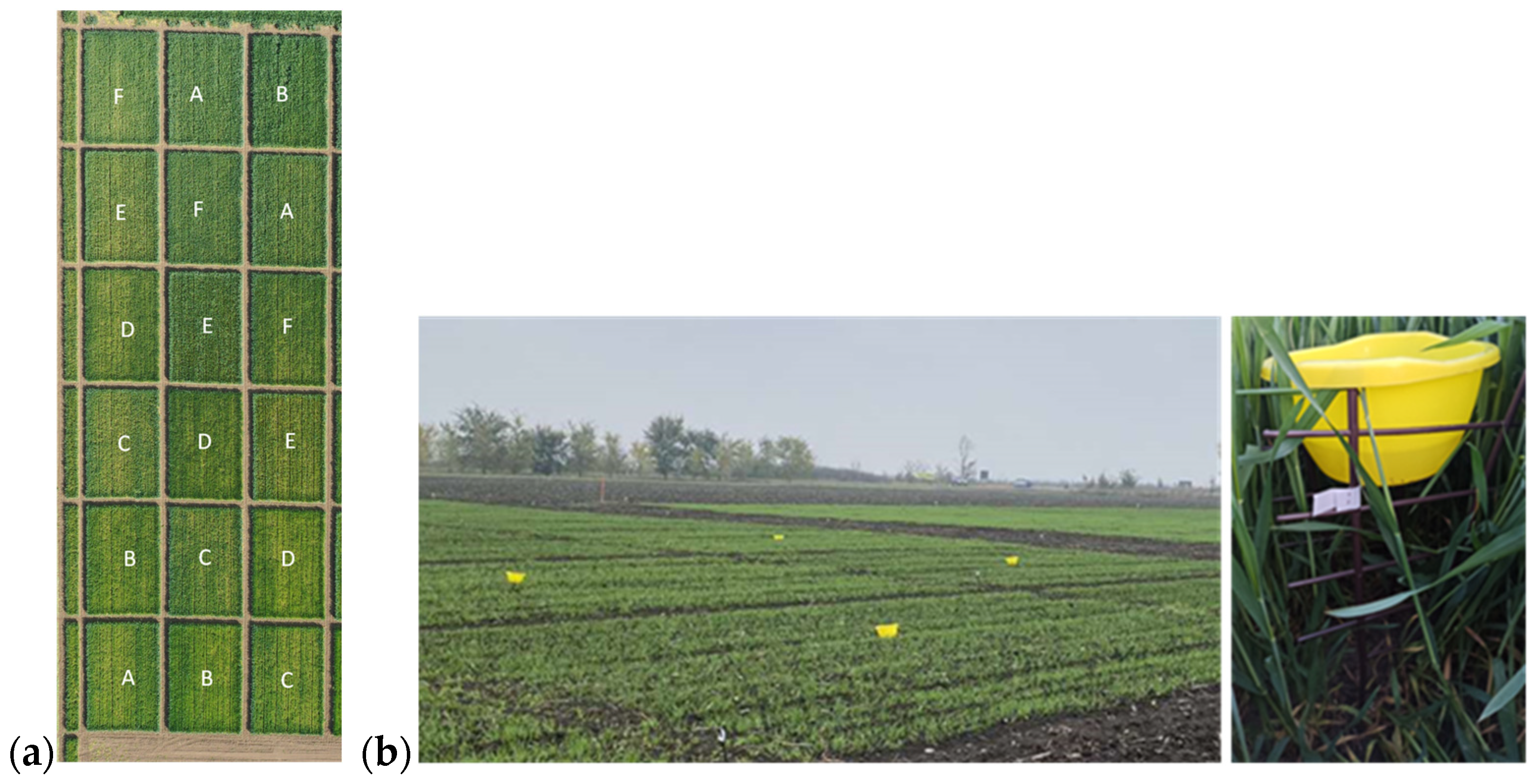
2.1. Field Experiment
2.2. Laboratory Analysis
2.3. Statistical Analysis
3. Results
3.1. Alate Aphid Presence by Treatment and Season
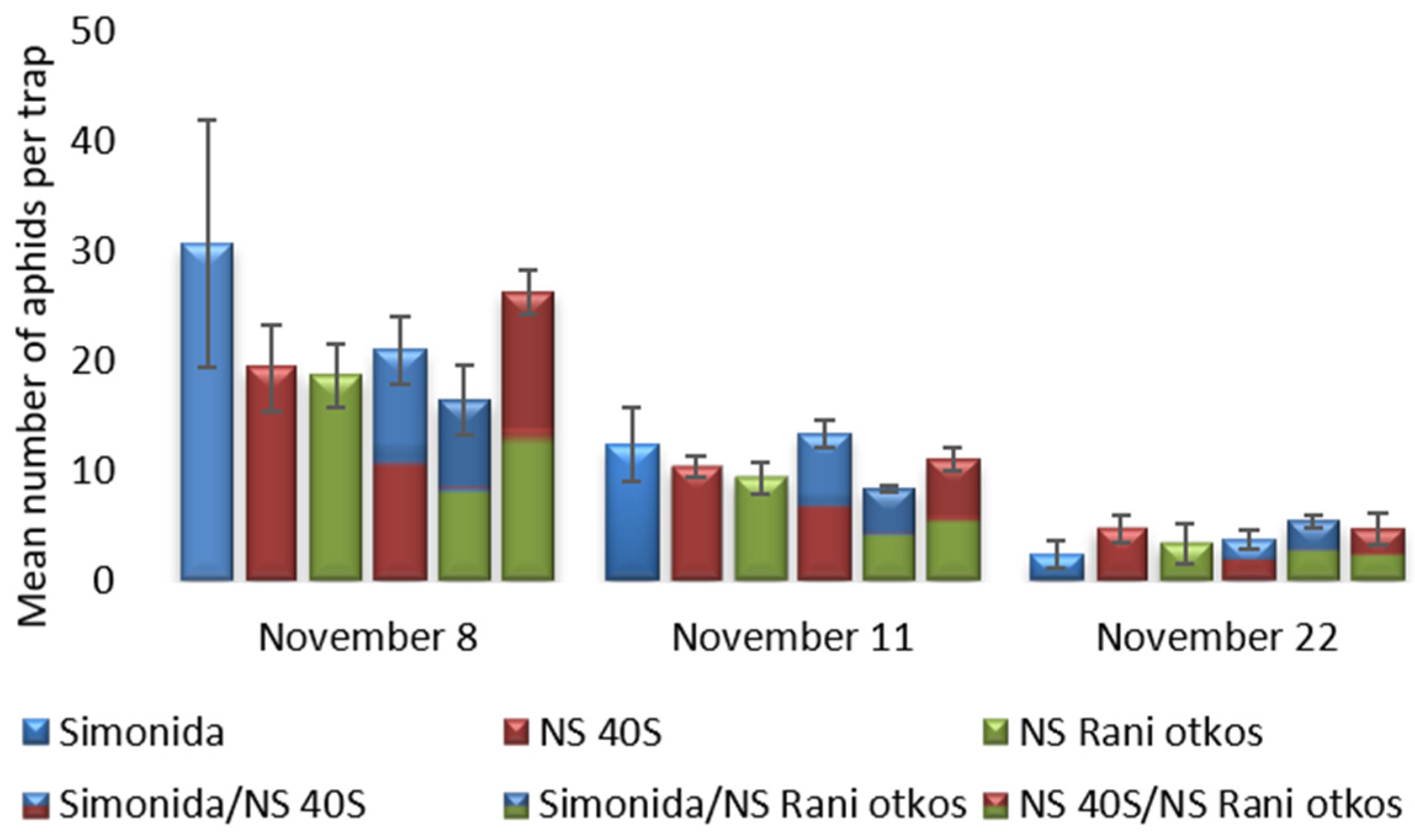
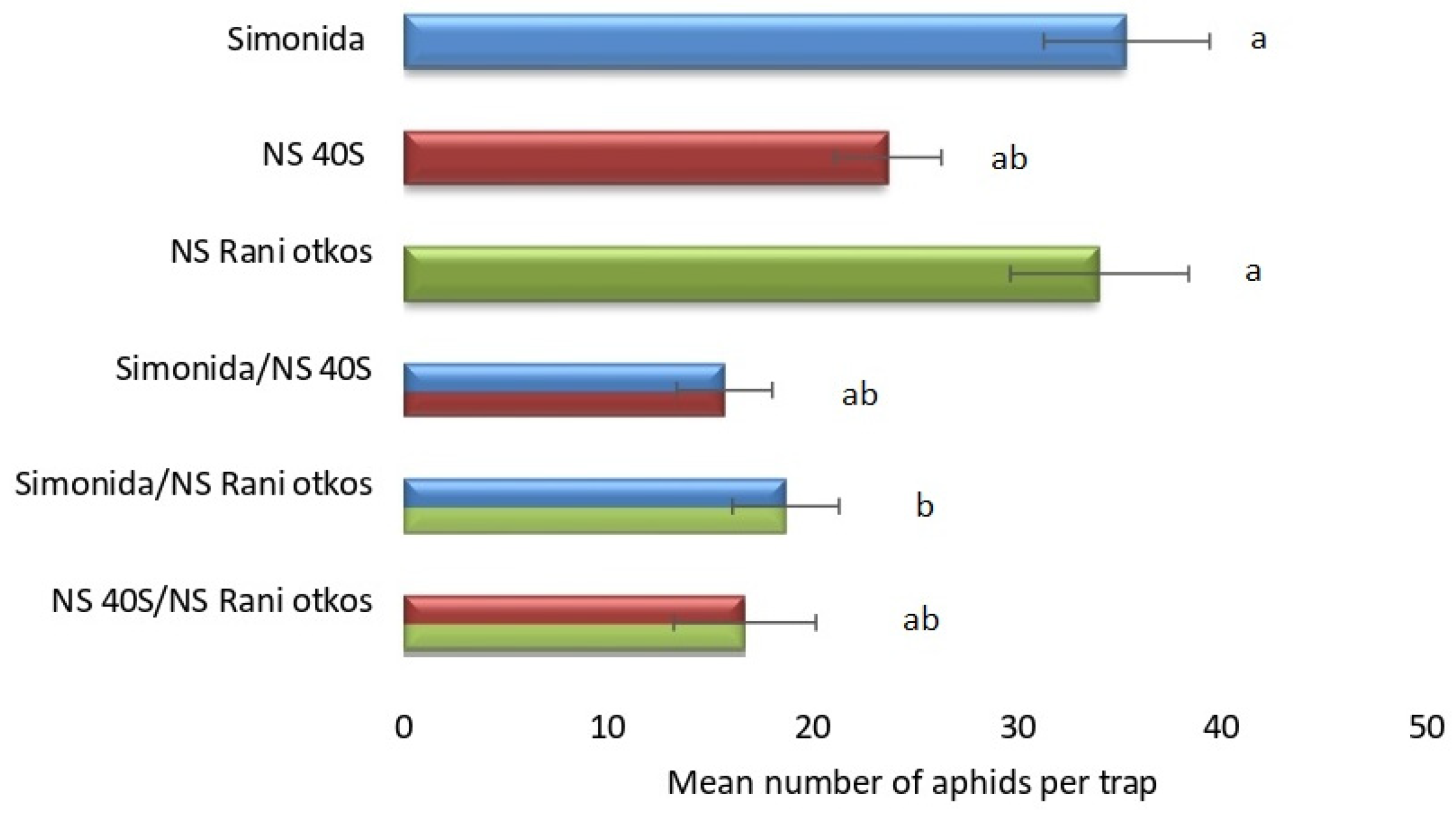
3.1.1. The Effect of Cultivar Mixture on the Presence of Alate Aphids During the Autumn/Winter Period
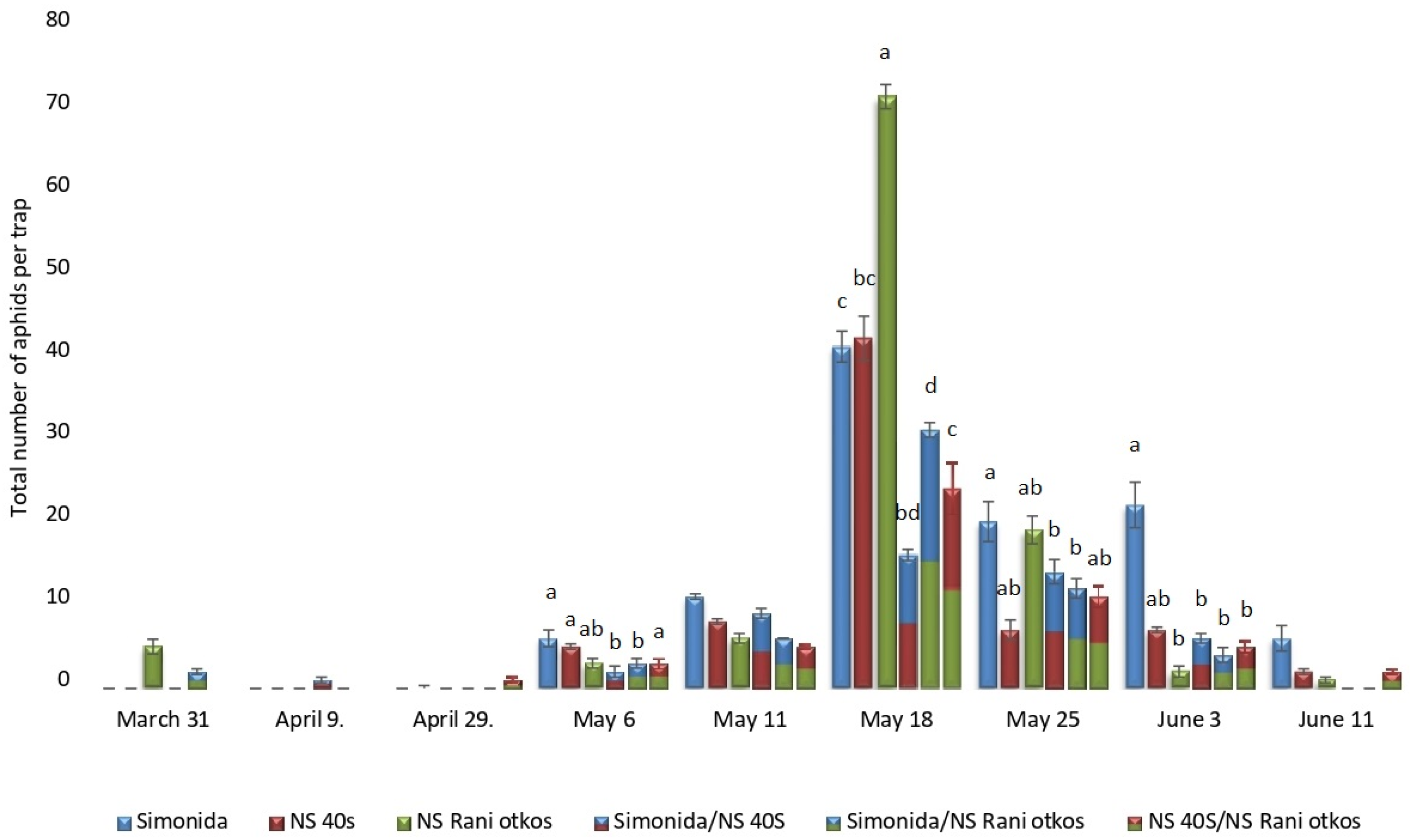
3.1.2. The Effect of Cultivar Mixture on the Presence of Alate Aphids During the Spring/Summer Period
3.2. Vector Presence by Treatment and Season
3.2.1. The Effect of Cultivar Mixture on the Presence of Vectors During the Autumn/Winter Period
3.2.2. The Effect of Cultivar Mixture on the Presence of Vectors During the Spring/Summer Period
4. Discussion
5. Conclusions
Author Contributions
Funding
Data Availability Statement
Conflicts of Interest
References
- Dedryver, C.A.; Le Ralec, A.; Fabre, F. The conflicting relationships between aphids and men: A review of aphid damage and control strategies. Comptes Rendus Biol. 2010, 333, 539–553. [Google Scholar] [CrossRef]
- Favret, C.; Aphid Taxon Community (Eds.) Blackman & Eastop’s Aphids on the World’s Plants, Version 1.0. 2026. Available online: https://aphidsonworldsplants.info/ (accessed on 27 February 2026).
- Bockus, W.W.; Bowden, R.L.; Hunger, R.M.; Morrill, W.L.; Murray, T.D.; Smiley, R.W. Compendium of Wheat Diseases and Pests, 3rd ed.; The American Phytopathological Society: St. Paul, MN, USA, 2010. [Google Scholar] [CrossRef]
- Lapierre, H.; Signoret, P.A. (Eds.) Viruses and Virus Diseases of Poaceae (Gramineae); INRA: Paris, France, 2004. [Google Scholar]
- Ordon, F.; Habekuss, A.; Kastirr, U.; Rabenstein, F.; Kühne, T. Virus resistance in cereals: Sources of resistance, genetics and breeding. J. Phytopathol. 2009, 157, 535–545. [Google Scholar] [CrossRef]
- Trębicki, P.; Nancarrow, N.; Cole, E.; Bosque-Pérez, N.A.; Constable, F.E.; Freeman, A.J.; Rodoni, B.; Yen, A.L.; Luck, J.E.; Fitzgerald, G.J. Virus disease in wheat predicted to increase with a changing climate. Glob. Change Biol. 2015, 21, 3511–3529. [Google Scholar] [CrossRef]
- Hu, X.S.; Liu, X.F.; Thieme, T.; Zhang, G.S.; Liu, T.X.; Zhao, H.Y. Testing the fecundity advantage hypothesis with Sitobion avenae, Rhopalosiphum padi and Schizaphis graminum feeding on ten wheat accessions. Sci. Rep. 2015, 5, 18549. [Google Scholar] [CrossRef] [PubMed]
- Borg, A.N.; Vuts, J.; Caulfield, J.C.; Birkett, M.A. Metabolite-based resistance in wheat varieties to aphid virus vectors: Progress and future opportunities. Pest Manag. Sci. 2025, 81, 7276–7287. [Google Scholar] [CrossRef]
- Powell, G.; Tosh, C.R.; Hardie, J. Host plant selection by aphids: Behavioural, evolutionary, and applied perspectives. Annu. Rev. Entomol. 2006, 51, 309–330. [Google Scholar] [CrossRef]
- Döring, T.F.; Chittka, L. Visual ecology of aphids—A critical review on the role of colours in host finding. Arthropod-Plant Interact. 2007, 1, 3–16. [Google Scholar] [CrossRef]
- Pickett, J.A.; Wadhams, L.J.; Woodcock, C.M.; Hardie, J. The chemical ecology of aphids. Annu. Rev. Entomol. 1992, 37, 67–90. [Google Scholar] [CrossRef]
- Webster, B. The role of olfaction in aphid host location. Physiol. Entomol. 2012, 37, 10–18. [Google Scholar] [CrossRef]
- Callaway, R.M.; Walker, L.R. Competition and facilitation: A synthetic approach to interactions in plant communities. Ecology 1997, 78, 1958–1965. [Google Scholar] [CrossRef]
- Ninkovic, V.; Marković, D.; Dahlin, I. Decoding neighbour volatiles in preparation for future competition and implications for tritrophic interactions. Perspect. Plant Ecol. Evol. Syst. 2016, 23, 11–17. [Google Scholar] [CrossRef]
- Ninković, V.; Olsson, U.; Pettersson, J. Mixing barley cultivars affects aphid host plant acceptance in field experiments. Entomol. Exp. Appl. 2002, 102, 177–182. [Google Scholar] [CrossRef]
- Bruce, T.J.A.; Wadhams, L.J.; Woodcock, C.M. Insect host location: A volatile situation. Trends Plant Sci. 2005, 10, 269–274. [Google Scholar] [CrossRef]
- Liu, J.; Yan, Y.; Ali, A.; Wang, N.; Zhao, Z.; Yu, M. Effects of wheat-maize intercropping on population dynamics of wheat aphids and their natural enemies. Sustainability 2017, 9, 1390. [Google Scholar] [CrossRef]
- Markovic, D.; Seimandi-Corda, G.; Harizanova, V.; Stoeva, A.; Himanen, S.; Saussure, S.; Radonjic, A.; Đuric, G.; Lalićević, I.; Kheam, S.; et al. Volatile-mediated plant interactions: An innovative approach to cultivar mixture selection for enhanced pest resilience. Front. Plant Sci. 2025, 16, 1550678. [Google Scholar] [CrossRef]
- Sarker, P.K.; Rahman, M.M.; Das, B.C. Effect of intercropping with mustard with onion and garlic on aphid population and yield. J. Bio-Sci. 2007, 15, 35–40. [Google Scholar] [CrossRef]
- Tooker, J.F.; Frank, S.D. Genotypically diverse cultivar mixtures for insect pest management and increased crop yields. J. Appl. Ecol. 2012, 49, 974–985. [Google Scholar] [CrossRef]
- Koricheva, J.; Hayes, D. The relative importance of plant intraspecific diversity in structuring arthropod communities: A metaanalysis. Funct. Ecol. 2018, 32, 1704–1717. [Google Scholar] [CrossRef]
- Wan, N.-F.; Zheng, X.-R.; Fu, L.-W.; Kiær, L.P.; Zhang, Z.; Chaplin-Kramer, R.; Dainese, M.; Tan, J.; Qiu, S.-Y.; Hu, Y.-Q.; et al. Global synthesis of effects of plant species diversity on trophic groups and interactions. Nat. Plants 2020, 6, 503–510. [Google Scholar] [CrossRef]
- Duan, X.; Pan, S.; Fan, M.; Chu, B.; Ma, Z.; Gao, F.; Zhao, Z. Cultivar mixture enhances crop yield by decreasing aphids. Agronomy 2022, 12, 335. [Google Scholar] [CrossRef]
- Parry, H.R. Cereal aphid movement: General principles and simulation modelling. Mov. Ecol. 2013, 1, 14. [Google Scholar] [CrossRef]
- Qureshi, J.A.; Jyoti, J.L.; Michaud, J.P. Differential colonization of wheat cultivars by two biotypes of Russian wheat aphid (Homoptera: Aphididae). Insect Sci. 2005, 12, 341–349. [Google Scholar] [CrossRef]
- Simon, A.L.; Caulfield, J.C.; Hammond-Kosack, K.E.; Field, L.M.; Aradóttir, G.I. Identifying aphid resistance in the ancestral wheat Triticum monococcum under field conditions. Sci. Rep. 2021, 11, 13495. [Google Scholar] [CrossRef]
- Taylor, L.R. A Handbook for Aphid Identification; Rothamsted Experimental Station: Harpenden, UK, 1984. [Google Scholar]
- Jacky, F.; Bouchery, Y. Atlas des Formes Ailées des Espèces Courantes de Pucerons; INRA: Paris, France, 1988; 48p. [Google Scholar]
- Remaudière, G.; Seco Fernandez, M.V. Claves para Ayudar al Reconocimiento de Alados de Pulgones Atrapados en la Región Mediterránea (Hom. Aphidoidea); Universidad de León: León, Spain, 1990. [Google Scholar]
- StatSoft, Inc. STATISTICA, Version 10; StatSoft, Inc.: Tulsa, OK, USA, 2011.
- Tous-Fandos, A.; Gallinger, J.; Enting, A.; Chamorro-Lorenzo, L.; Sans Serra, F.X.; Ninkovic, V. Alterations in the odor profile of plants in cultivar mixtures affect aphid host-location behavior. Front. Plant Sci. 2023, 14, 1186425. [Google Scholar] [CrossRef] [PubMed]
- Kheam, S.; Markovic, D.; Rubene, D.; Ith, S.; Ninkovic, V. Volatile interactions between specific undamaged barley cultivars affect aphid feeding behavior and performance. J. Pest Sci. 2023, 96, 1049–1059. [Google Scholar] [CrossRef]
- Xie, H.-C.; Chen, J.-L.; Cheng, D.-F.; Zhou, H.-B.; Sun, J.-R.; Liu, Y.; Francis, F. Impact of wheat–mung bean intercropping on English grain aphid (Hemiptera: Aphididae) populations and its natural enemy. J. Econ. Entomol. 2012, 105, 854–859. [Google Scholar] [CrossRef]
- Ninkovic, V.; Dahlin, I.; Vučetić, A.; Petrović-Obradović, O.; Glinwood, R. Volatile exchange between undamaged plants—A new mechanism affecting insect orientation in intercropping. PLoS ONE 2013, 8, e69431. [Google Scholar] [CrossRef] [PubMed]
- Klueken, A.M.; Poehling, H.M.; Hau, B. Attractiveness and host suitability of winter wheat cultivars for cereal aphids (Homoptera: Aphididae). J. Plant Dis. Prot. 2008, 115, 114–121. [Google Scholar] [CrossRef]
- Schröder, M.L.; Glinwood, R.; Ignell, R.; Krüger, K. Landing preference and reproduction of Rhopalosiphum padi (Hemiptera: Aphididae) in the laboratory on three maize, potato, and wheat cultivars. J. Insect Sci. 2015, 15, 63. [Google Scholar] [CrossRef]
- Vučetić, A.; Vukov, T.; Jovičić, I.; Petrović-Obradović, O. Monitoring of aphid flight activities in seed potato crops in Serbia. ZooKeys 2013, 319, 333–346. [Google Scholar] [CrossRef]
- Markovic, D.; Colzi, I.; Taiti, C.; Ray, S.; Scalone, R.; Ali, J.G.; Mancuso, S.; Ninkovic, V. Airborne signals synchronize the defenses of neighboring plants in response to touch. J. Exp. Bot. 2019, 70, 691–700. [Google Scholar] [CrossRef]
- McKirdy, S.J.; Jones, R.A.C.; Nutter, F.W., Jr. Quantification of yield losses caused by Barley yellow dwarf virus in wheat and oats. Plant Dis. 2002, 86, 769–773. [Google Scholar] [CrossRef]
- Nancarrow, N.; Aftab, M.; Hollaway, G.; Rodoni, B.; Trębicki, P. Yield losses caused by Barley Yellow Dwarf Virus-PAV infection in wheat and barley: A three-year field study in South-Eastern Australia. Microorganisms 2021, 9, 645. [Google Scholar] [CrossRef]
- Aradottir, G.I.; Crespo-Herrera, L. Host plant resistance in wheat to barley yellow dwarf viruses and their aphid vectors: A review. Curr. Opin. Insect Sci. 2021, 45, 59–68. [Google Scholar] [CrossRef] [PubMed]
- Leybourne, D.J. How does vector diversity influence the transmission efficiency of yellow dwarf virus? Perspectives from a review. Plant Pathol. 2024, 73, 1042–1059. [Google Scholar] [CrossRef]
- Mc Namara, L.M.; Lacey, S.; Kildea, S.; Schughart, M.; Walsh, L.; Doyle, D.; Gaffney, M.T. Barley yellow dwarf virus in winter barley: Control in light of resistance issues and loss of neonicotinoid insecticides. Ann. Appl. Biol. 2025, 186, 132–142. [Google Scholar] [CrossRef]
- Kennedy, T.F.; Connery, J. Control of barley yellow dwarf virus in minimum-till and conventional-till autumn-sown cereals by insecticide seed and foliar spray treatments. J. Agric. Sci. 2012, 150, 249–262. [Google Scholar] [CrossRef]
- Fabre, F.; Dedryver, C.A.; Leterrier, J.-L.; Plantegenest, M. Aphid abundance on cereals in autumn predicts yield losses caused by barley yellow dwarf virus. Phytopathology 2003, 93, 1217–1222. [Google Scholar] [CrossRef] [PubMed]
- Kennedy, T.F.; McDonald, J.G.; Connery, J.; Purvis, G. A comparison of the occurrence of aphids and barley yellow dwarf virus in minimum-till and conventional-till autumn-sown cereals. J. Agric. Sci. 2010, 148, 407–419. [Google Scholar] [CrossRef]
- Tomanović, Ž.; Kavallieratos, N.G.; Stary, P.; Petrović-Obradović, O.; Athanassiou, C.G.; Stanisavljević, L. Cereal aphids (Hemiptera: Aphidoidea) in Serbia: Seasonal dynamics and natural enemies. Eur. J. Entomol. 2008, 105, 495–501. [Google Scholar] [CrossRef]
- Hand, S.C.; Wratten, S.D. Production of sexual morphs by the monoecious cereal aphid Sitobion avenae. Entomol. Exp. Appl. 1985, 38, 239–247. [Google Scholar] [CrossRef]
- Mc Namara, L.M.; Gauthier, K.; Walsh, L.; Thébaud, G.; Gaffney, M.; Jacquot, E. Management of yellow dwarf disease in Europe in a post-neonicotinoid agriculture. Pest Manag. Sci. 2020, 76, 2276–2285. [Google Scholar] [CrossRef]
- Jarecki, W. Response of winter wheat to delayed sowing and varied nitrogen fertilization. Agriculture 2024, 14, 121. [Google Scholar] [CrossRef]
- Shah, F.; Coulter, J.A.; Ye, C.; Wu, W. Yield penalty due to delayed sowing of winter wheat and the mitigatory role of increased seeding rate. Eur. J. Agron. 2020, 119, 126120. [Google Scholar] [CrossRef]
- Shoffner, A.V.; Tooker, J.F. The potential of genotypically diverse cultivar mixtures to moderate aphid populations in wheat (Triticum aestivum L.). Arthropod-Plant Interact. 2013, 7, 33–43. [Google Scholar] [CrossRef]
- Fletcher, A.L.; Ogden, G.; Sharma, D. Mixing it up—Wheat cultivar mixtures can increase yield and buffer the risk of flowering too early or too late. Eur. J. Agron. 2019, 103, 90–97. [Google Scholar] [CrossRef]
- Vestergaard, N.F.; Jørgensen, L.N. Variety mixtures of winter wheat: A general status and national case study. J. Plant Dis. Prot. 2024, 131, 1127–1136. [Google Scholar] [CrossRef]



| Aphid Taxa | No. Autumn | No. Spring | Aphid Taxa | No. Autumn | No. Spring |
|---|---|---|---|---|---|
| Acyrthosiphon pisum | 0 | 44 | Metopolophium dirhodum | 3 | 1 |
| Anoecia spp. | 6 | 0 | Myzus cerasi | 0 | 1 |
| Aphis craccivora | 22 | 44 | Myzus persicae | 113 | 31 |
| Aphis fabae | 7 | 42 | Myzus sp. | 1 | 0 |
| Aphis gossypii | 41 | 29 | Phyllaphis fagi | 4 | 0 |
| Aphis sambuci | 0 | 13 | Phorodon humuli | 1 | 0 |
| Aphis spp. | 53 | 66 | Panaphis juglandis | 1 | 0 |
| Aphis spiraecola | 16 | 0 | Pemphigus spp. | 13 | 0 |
| Aphis spiraecola/pomi | 0 | 19 | Rhopalosiphum maidis | 15 | 0 |
| Aulacorthum solani | 1 | 13 | Rhopalosiphum padi | 35 | 7 |
| Brachycaudus cardui | 9 | 5 | Rhopalomyzus poae | 3 | 0 |
| Brachycaudus helichrysi | 8 | 6 | Schizaphis graminum | 1 | 0 |
| Brachycaudus spp. | 2 | 0 | Lipaphis erysimi | 1 | 0 |
| Cavariella aegopodii | 0 | 1 | Macrosiphum euphorbiae | 0 | 1 |
| Cavariella sp. | 1 | 0 | Sitobion avenae | 43 | 16 |
| Cinara costata | 2 | 0 | Tetraneura sp. | 1 | 0 |
| Dysaphis plantaginea | 3 | 0 | Therioaphis trifolii | 0 | 1 |
| Dysaphis spp. | 4 | 0 | Uroleucon spp. | 0 | 2 |
| Eriosoma spp. | 9 | 0 | Wahlgreniella ossiannilsson | 1 | 0 |
| Hyadaphis spp. | 2 | 0 | Myzocallidinae | 1 | 0 |
| Hyperomyzus lactucae | 3 | 4 | Aphididae | 4 | 78 |
| Sum | 430 | 424 |
| Virus Vectors | Autumn | Spring |
Proportion of
Species |
|---|---|---|---|
| Metopolophium dirhodum | 3 | 1 | 1.60% |
| Myzus persicae | 113 | 31 | 57.60% |
| Rhopalosiphum maidis | 15 | 0 | 6.00% |
| Rhopalosiphum padi | 35 | 7 | 14.80% |
| Rhopalomyzus poae | 3 | 0 | 1.20% |
| Schizaphis graminum | 1 | 0 | 0.40% |
| Sitobion avenae | 43 | 16 | 18.40% |
| Total | 192 | 55 | 100% |
| 247 | |||
| All Vector Species | ||
|---|---|---|
| Cultivar | Number of Individuals | Percentage Abundance |
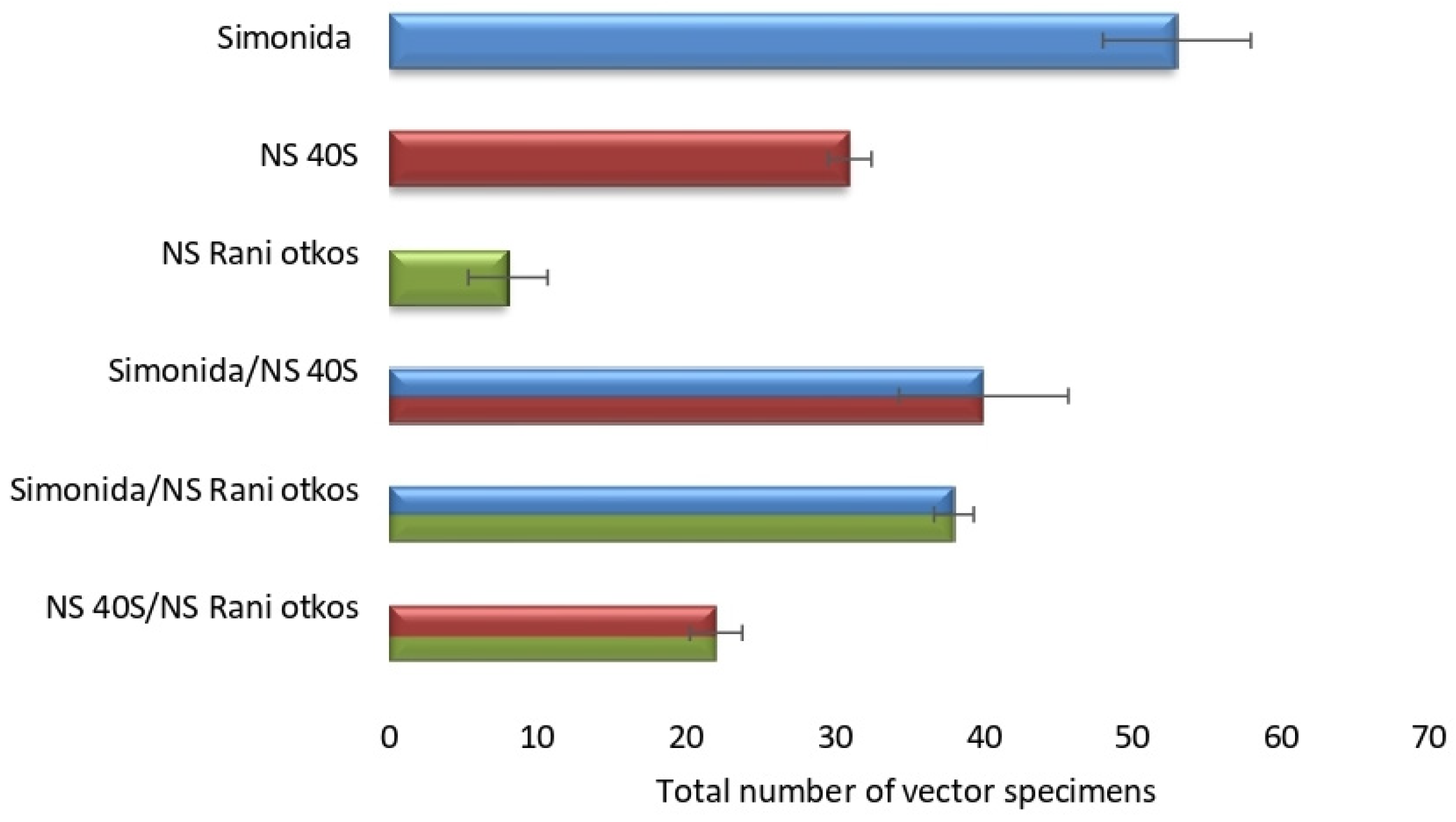
| Simonida | 53 | 27.60% |
| NS 40S | 31 | 16.15% |
| NS Rani otkos | 8 | 4.17% |
| Simonida/NS 40S | 40 | 20.83% |
| Simonida/NS Rani otkos | 38 | 19.79% |
| NS 40S/NS Rani otkos | 22 | 11.46% |
Disclaimer/Publisher’s Note: The statements, opinions and data contained in all publications are solely those of the individual author(s) and contributor(s) and not of MDPI and/or the editor(s). MDPI and/or the editor(s) disclaim responsibility for any injury to people or property resulting from any ideas, methods, instructions or products referred to in the content. |
© 2026 by the authors. Licensee MDPI, Basel, Switzerland. This article is an open access article distributed under the terms and conditions of the Creative Commons Attribution (CC BY) license.
Share and Cite
Lalićević, I.; Janković Šoja, S.; Bačić, J.; Ninkovic, V.; Petrović-Obradović, O.; Radonjić, A. Cultivar-Dependent Associational Effects in Wheat Cultivar Mixtures Influence Alate Aphid Captures and the Presence of Virus Vectors. Agriculture 2026, 16, 1256. https://doi.org/10.3390/agriculture16121256
Lalićević I, Janković Šoja S, Bačić J, Ninkovic V, Petrović-Obradović O, Radonjić A. Cultivar-Dependent Associational Effects in Wheat Cultivar Mixtures Influence Alate Aphid Captures and the Presence of Virus Vectors. Agriculture. 2026; 16(12):1256. https://doi.org/10.3390/agriculture16121256
Chicago/Turabian StyleLalićević, Ivana, Svjetlana Janković Šoja, Jasmina Bačić, Velemir Ninkovic, Olivera Petrović-Obradović, and Andja Radonjić. 2026. "Cultivar-Dependent Associational Effects in Wheat Cultivar Mixtures Influence Alate Aphid Captures and the Presence of Virus Vectors" Agriculture 16, no. 12: 1256. https://doi.org/10.3390/agriculture16121256
APA StyleLalićević, I., Janković Šoja, S., Bačić, J., Ninkovic, V., Petrović-Obradović, O., & Radonjić, A. (2026). Cultivar-Dependent Associational Effects in Wheat Cultivar Mixtures Influence Alate Aphid Captures and the Presence of Virus Vectors. Agriculture, 16(12), 1256. https://doi.org/10.3390/agriculture16121256