1. Introduction
Rice cultivation remains critically important for food security and rural economies throughout Southeast Asia [
1,
2,
3]. However, climate-sensitive agricultural environments characterized by flooding, drought, and irregular rainfall patterns continue to create substantial operational challenges for irrigation and nutrient management practices [
4,
5,
6]. These environmental conditions frequently contribute to unstable productivity, inefficient resource utilization, and increasing production costs within large-scale rice cultivation systems [
7,
8,
9]. Conventional fixed-schedule farming practices are often insufficiently adaptive to rapidly changing environmental conditions and operational field variability [
10,
11,
12].
Recent advances in digital agriculture have introduced Internet of Things (IoT)-assisted monitoring systems and data-assisted agricultural management frameworks capable of supporting adaptive field-level operational management. Previous studies demonstrated that IoT-based sensing and communication systems can improve environmental monitoring and irrigation-management workflows through continuous field-data collection and automated communication processes [
13,
14]. Nevertheless, many existing systems remain focused primarily on monitoring and notification functions without fully integrating predictive analytics, adaptive recommendation workflows, and operational decision-support mechanisms under practical large-scale rice cultivation environments [
15,
16,
17,
18]. Accordingly, the present study evaluates the operational deployment feasibility of integrating monitoring, prediction, and optimization-assisted recommendation workflows within a unified smart farming framework. In addition, machine learning approaches have demonstrated potential for supporting short-term prediction of soil moisture dynamics and nutrient-related operational variability under heterogeneous agricultural environments [
19,
20]. Furthermore, optimization-oriented agricultural management frameworks have increasingly been applied to support irrigation scheduling and operational resource allocation under environmental and economic constraints [
21,
22].
Efficient irrigation and operational nutrient management practices remain important challenges in large-scale rice cultivation, particularly under climate-sensitive agricultural environments characterized by irregular rainfall, flooding, and drought conditions. Rice production requires substantial water input, and inefficient irrigation practices frequently contribute to water loss, unstable productivity, and increasing production costs [
23,
24]. In addition, excessive fertilizer application may reduce nutrient-use efficiency and accelerate environmental degradation within paddy cultivation systems [
25,
26,
27,
28,
29]. Previous studies demonstrated that approaches such as Alternate Wetting and Drying (AWD), sensor-assisted irrigation scheduling, and site-specific nutrient management practices can reduce water and fertilizer utilization while maintaining agricultural productivity [
30,
31,
32,
33,
34,
35]. Furthermore, real-time monitoring technologies have increasingly supported adaptive field management under variable environmental conditions [
36,
37,
38,
39,
40].
Although IoT technologies improve monitoring and communication capabilities, many existing systems remain limited to basic monitoring and operational alert generation rather than adaptive recommendation support. In many cases, predictive outputs are not effectively translated into operational field-level irrigation and fertilizer recommendations that farmers can directly apply under practical cultivation conditions [
41,
42,
43]. Furthermore, practical deployment challenges—including sensor variability, communication stability, environmental interference, and large-scale operational scalability—remain insufficiently investigated under practical agricultural environments [
44,
45,
46]. Similarly, many existing studies primarily emphasize predictive consistency or optimization performance independently rather than integrating monitoring, operational analytics, adaptive recommendation support, and field-level communication workflows within a unified deployment-oriented framework [
47,
48,
49,
50].
Therefore, relatively limited studies have evaluated the operational deployment feasibility of integrating IoT-assisted monitoring, machine learning-assisted analytics, and adaptive recommendation workflows within climate-sensitive large-scale rice farming environments affected by recurrent flood–drought variability and operational uncertainty [
48,
49,
50]. In addition, limited research has examined how integrated monitoring and recommendation frameworks perform under practical rice cultivation environments characterized by heterogeneous field conditions and farmer-oriented operational management requirements [
51].
Therefore, this study aims to evaluate the operational deployment feasibility of an IoT-assisted monitoring and recommendation framework for real-time soil moisture and nutrient-related operational monitoring in large-scale rice paddy fields in Central Thailand. The proposed framework integrates continuous field monitoring, machine learning-assisted operational analytics, and adaptive operational recommendation workflows to support irrigation management, fertilizer management practices, and operational resource allocation under practical agricultural conditions. The system additionally functions as a farmer-oriented communication and advisory platform that supports adaptive irrigation and operational nutrient-management support through cloud-based analytics, continuous monitoring, and mobile notification services.
2. Materials and Methods
2.1. Research Design
This study developed and evaluated a Smart Internet of Things (IoT)-based monitoring and operational recommendation framework for real-time soil moisture monitoring and nutrient-related operational management support in large-scale rice paddy fields under practical field-deployment conditions. The methodological framework consisted of four phases: (1) system design and requirement analysis, (2) system development and operational configuration, (3) real-world deployment and data acquisition, and (4) operational performance evaluation. The field-deployment framework supported exploratory operational evaluation of irrigation management, nutrient utilization, and resource-allocation behavior under practical agricultural conditions.
The present study should therefore be interpreted as a quasi-experimental field deployment study conducted under practical agricultural conditions rather than a fully randomized controlled trial (RCT). Full randomization and strict experimental control were operationally difficult because participating farmers retained autonomy over irrigation scheduling, cultivation practices, and field management decisions throughout the deployment period.
2.2. Study Area and Participants
The study was conducted in Sena District, Phra Nakhon Si Ayutthaya Province, Thailand, within the lower Chao Phraya River Basin between approximately 14.28–14.42 °N latitude and 100.32–100.51 °E longitude. The study area covers approximately 215 km2 and consists predominantly of irrigated rice cultivation areas exposed to recurrent seasonal flood–drought variability. The region is characterized primarily by clayey to clay-loam alluvial paddy soils commonly associated with irrigated rice production in Central Thailand. These soils generally exhibit relatively high water-retention capacity, slow drainage behavior, and prolonged moisture persistence during seasonal cultivation periods. Soil characteristics were therefore considered during the interpretation of irrigation behavior and sensor-response variability under field conditions.
A total of 80 farmers were purposively selected from a population of 229 registered rice farmers operating within the irrigation network of the study area. The sampling strategy was designed to ensure representation of active rice cultivation systems operating under recurrent flood–drought conditions and practical field-management environments. Selection criteria included: (1) continuous rice cultivation during the study period, (2) farm size greater than 1.60 ha, (3) accessibility to mobile communication infrastructure, (4) willingness to participate in long-term monitoring activities, and (5) availability of complete cultivation and management records. Farmers with incomplete operational data or irregular field accessibility were excluded from the study.
To improve comparability between operational management conditions, participating farms were selected within similar irrigation environments, cultivation periods, and climatic conditions. Comparable irrigation infrastructure, planting schedules, and field management characteristics were additionally considered during operational evaluation procedures. Because purposive sampling was employed to support operational feasibility and long-term participation, participating farmers may have exhibited relatively higher levels of technology readiness and management engagement compared with the broader farming population.
The 80 monitored rice plots were spatially distributed across the study area to represent heterogeneous irrigation and environmental conditions under practical agricultural management. Coordinates of the monitored rice plots were recorded during field deployment and operational validation activities to support spatial consistency and contextual interpretation of irrigation variability across the study area.
2.3. Smart IoT System Architecture and Development
Operational consistency assessment and deployment-oriented configuration procedures were conducted prior to field deployment using repeated field observations under controlled irrigation conditions. For the soil moisture monitoring component, preliminary field-level operational observations under controlled irrigation conditions suggested acceptable temporal consistency for practical monitoring applications under clay-loam soil conditions. The nutrient-related sensing module was utilized primarily as an indicative operational monitoring component intended to support trend-based observation and farmer-oriented decision-support workflows under practical agricultural conditions. Because real agricultural environments are subject to variability associated with salinity, temperature, soil heterogeneity, and other environmental interferences, the sensing outputs were interpreted as operational field-level indicators rather than laboratory-equivalent nutrient-related operational indicators.
Accordingly, the present study did not attempt to validate laboratory-equivalent nutrient quantification performance under dynamic field environments. Instead, the operational assessment focused primarily on communication continuity, temporal monitoring behavior, and farmer-oriented recommendation support during practical deployment conditions. These evaluations were intended to assess practical deployment consistency and communication reliability under real agricultural environments rather than laboratory-grade analytical precision.
The proposed system follows a four-layer IoT architecture:
Sensing Layer: Soil moisture (TDR-based) and nutrient-related monitoring component were deployed at the root zone to capture real-time soil conditions.
Processing and Communication Layer: Microcontroller units processed sensor data and transmitted it via mobile networks, supported by solar-powered energy systems for continuous operation.
Data and Analytics Layer: Cloud-based infrastructure that stores time-series data and applies machine learning models for predictive analysis of irrigation and fertilization requirements.
Application Layer: A web-based dashboard and mobile notification system (LINE) provided real-time visualization and decision support.
The nutrient-related monitoring component used in this study was not intended to provide laboratory-grade quantification of soil nutrient concentrations under heterogeneous agricultural environments. Instead, the sensing outputs were interpreted as indicative operational field-level signals intended to support trend-based monitoring, irrigation communication, and adaptive fertilizer management workflows under practical deployment conditions.
As summarized in
Table 1, the sensing framework employed field-level operational monitoring components with deployment-oriented configuration and operational assessment procedures designed to improve temporal consistency, communication stability, and practical deployment reliability under dynamic agricultural conditions. The sensing framework used in this study consisted of low-cost field-deployable sensors selected for continuous operational monitoring under practical agricultural environments. Prior to deployment, the sensing components underwent preliminary field-level operational checking procedures to improve temporal consistency and communication reliability under dynamic environmental conditions.
This architecture aligns with established IoT-based precision agriculture frameworks that integrate sensing, connectivity, and analytics for adaptive farm management [
7,
8]. The sensing components were therefore used primarily for indicative field monitoring and operational support. Sensor outputs were interpreted as practical field-level indicators intended to assist communication and irrigation-related decision-making rather than laboratory-equivalent agronomic measurements. Similarly, nutrient-related sensor outputs were interpreted as indicative operational signals intended to support fertilizer recommendation workflows and trend-based monitoring rather than precise laboratory-grade quantification of soil nutrient concentrations.
2.4. Machine Learning and Optimization Framework
To enhance operational decision-making capability, the proposed framework integrated machine learning and optimization within a Predict–Optimize–Control architecture. Machine learning models were applied to predict short-term soil moisture and nutrient-related operational dynamics using environmental, irrigation, and crop-condition variables. Prediction outputs were subsequently incorporated into a constrained optimization framework designed to support irrigation scheduling and resource allocation under practical agricultural conditions.
The predictive framework employed a bootstrap aggregation (bagging)-based ensemble learning approach using Random Forest (RF) algorithms to improve predictive stability and reduce overfitting under heterogeneous field environments. The RF model was selected because of its capability to capture nonlinear relationships among soil moisture variability, nutrient-related operational indices, environmental conditions, and irrigation behavior. As an ensemble learning method, the RF framework combines multiple decision trees generated from bootstrap-resampled datasets to improve model robustness and reduce prediction variance under noisy field conditions.
Prior to model development, sensor-derived and environmental datasets were preprocessed through data cleaning, normalization, missing-value handling, and feature engineering procedures. The dataset was partitioned into training (70%) and validation (30%) subsets using random stratified sampling to evaluate model generalization capability and reduce information leakage during validation processes. Hyperparameter tuning was conducted using grid-search optimization involving the number of trees, maximum tree depth, and minimum sample split criteria. In addition, repeated k-fold cross-validation procedures were implemented to improve methodological reliability and reduce sensitivity to random sampling variation during model training.
To evaluate short-term forecasting capability for operational irrigation and nutrient management support, prediction performance was assessed using Root Mean Square Error (RMSE), MAE, and R2. These metrics were used to evaluate predictive consistency, absolute forecasting deviation, and agreement between predicted and observed field conditions. Lower RMSE and MAE values indicate reduced prediction error, while higher R2 values indicate stronger predictive agreement under operational agricultural environments.
2.5. Mathematical Modeling and Optimization Framework
A discrete-time optimization framework was incorporated into the IoT-assisted recommendation system to support adaptive irrigation and nutrient management decisions under daily operational conditions.
2.5.1. State Variables
Mt ∈ [0, 100] represents daily soil moisture content expressed as a percentage (%).
Nt, Pt, and Kt represent daily soil macronutrient indices for nitrogen, phosphorus, and potassium.
The state vector is defined as xt = [Mt, Nt, Pt, Kt]T
2.5.2. Control Variables
Ut ≥ 0 denotes daily irrigation volume (m3/ha/day).
vNt, vPt, vKt ≥ 0 denote daily fertilizer application rates (kg/ha/day).
The control vector is defined as ut = [ut, vNt, vPt, vKt]T
2.5.3. Daily Moisture and Nutrient Dynamics
Moisture dynamics are modeled as:
Nutrient dynamics for nitrogen (similar for P and K):
where
2.5.4. Optimization Problem Formulation
The daily optimization objective minimizes production cost while maintaining agronomic targets:
Subject to dynamic equations and constraints:
where
a represents the irrigation efficiency coefficient,
b represents the evapotranspiration loss coefficient,
c represents the nutrient interaction coefficient,
λ represents the optimization weighting parameter,
α represents irrigation sensitivity,
β represents nutrient response elasticity,
γ represents adaptive control adjustment,
and h(Mt) represents the moisture-response adjustment function.
A computational experiment was performed to evaluate the dynamic performance of the proposed Predict–Optimize–Control framework, complementing the empirical field trial. This simulation-based comparison was independent of the field experiment and did not affect empirical observations.
Following the description of the computational experiment, three configurations were evaluated:
Conventional rule-based irrigation and fertilization.
ML-only prediction without optimization.
ML + Optimization using Model Predictive Control (MPC).
The simulation horizon covered a full cultivation cycle (T = 120 days) with daily time steps. Model parameters were calibrated using field-derived soil statistics. Performance metrics included cumulative moisture-tracking error, moisture variability, constraint-violation rate, total irrigation volume, fertilizer efficiency, simulated yield index, and profit estimation. All optimization problems were solved using a constrained nonlinear solver with receding-horizon implementation.
A receding horizon Model Predictive Control (MPC) strategy was implemented. Each day, the system follows these steps: (1) it reads real-time sensor data, (2) predicts short-term soil and nutrient changes, (3) solves the constrained optimization problem over a finite horizon, (4) applies only the control action for the current day, and (5) repeats the process with updated measurements the following day. This Predict–Optimize–Control framework extends the IoT system from monitoring toward operational decision-support functionality. This approach enables adaptive resource allocation and improves system stability and efficiency in smart agriculture [
6,
9].
The system was deployed across participating rice plots, with sensor data collected at five-minute intervals throughout the cultivation cycle. Variables included soil moisture, NPK levels, irrigation volume, fertilizer use, labor, energy consumption, yield, and economic indicators. Nutrient-related variables recorded by the field devices were interpreted as operational nutrient indices for comparative monitoring and recommendation purposes within the deployed smart farming environment. This continuous operational dataset supported both real-time decision-making and longitudinal performance analysis.
Additional clarification was provided regarding the purpose of the statistical analysis. The statistical procedures were designed to evaluate operational and practical differences between management approaches under field deployment conditions rather than to establish laboratory-scale soil science causality. This clarification improves methodological transparency and aligns the analysis with the applied nature of the study.
System performance was evaluated using both quantitative and qualitative methods. Quantitative analysis involved descriptive statistics and independent samples
t-tests to compare IoT-assisted and conventional farming practices across key indicators, including resource use, yield, and profitability. The statistical analysis was therefore designed to evaluate practical operational differences in resource utilization, productivity, and farmer-oriented system performance between treatment conditions rather than to establish laboratory-scale agronomic causality. User satisfaction was assessed using a five-point Likert-scale questionnaire, covering system functionality, accuracy, responsiveness, and recommendation quality. Instrument validity was confirmed using the Index of Item-Objective Congruence (IOC ≥ 0.67), and reliability was verified using Cronbach’s alpha (≥0.70). This mixed-method evaluation approach aligns with best practices in smart farming system assessment, combining technical performance with user-centered evaluation [
10,
12]. The statistical framework emphasized operational field-level comparison between two management conditions under practical deployment environments. Therefore, independent-sample
t-tests were considered appropriate for evaluating mean differences across primary performance indicators. In addition to independent-samples
t-tests, effect sizes (Cohen’s d) and 95% confidence intervals were calculated to evaluate the practical magnitude of observed differences between management conditions.
To complement field experiments, a simulation-based comparison was conducted across three configurations: (1) conventional management, (2) machine learning-based prediction, and (3) integrated ML + optimization (MPC). The evaluation focused on performance metrics such as moisture-tracking error, variability, constraint–violation rate, and economic outcomes. The key conclusion is that integrating optimization with predictive analytics yielded the highest system stability, resource efficiency, and economic robustness among the tested approaches. The computational comparison was intended to evaluate relative system-level operational performance and adaptive decision-support behavior under different management strategies within the smart farming framework. These results align with findings from recent studies on AI-driven precision agriculture [
5,
6].
3. Results
3.1. Operational Recommendations and Decision-Support Functions
Machine learning-based predictive analytics enabled the system to recommend differentiated irrigation and fertilization strategies across rice growth stages.
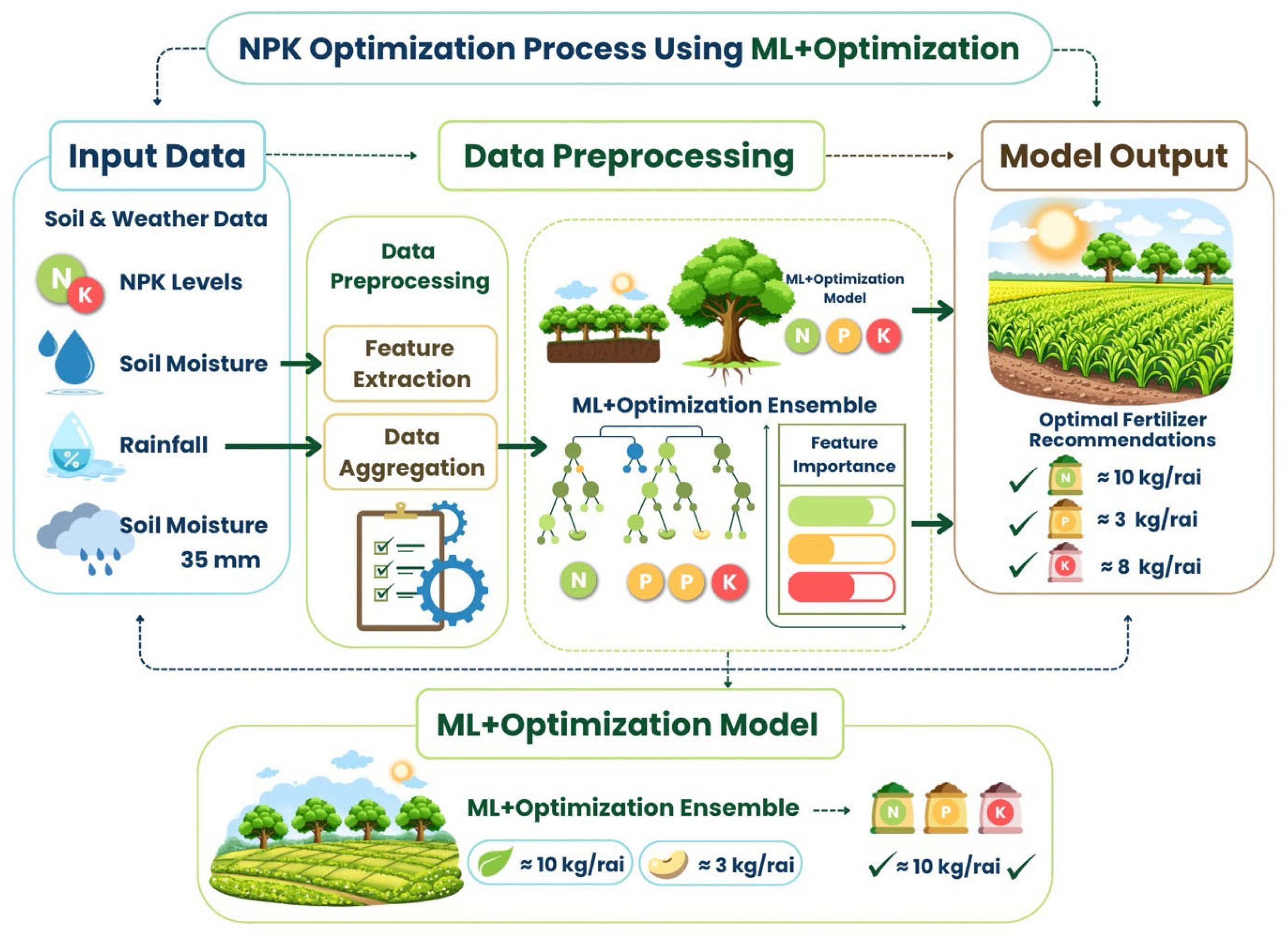
Figure 1 shows the NPK optimization model based on the ML + Optimization algorithm. Farmers received stage-specific guidance (e.g., tillering, panicle initiation, heading), which improved temporal alignment between crop demand and resource supply. In this study, it represents a significant advancement: farmers engaged in evidence-based reasoning, interpreting real-time data visualizations and alerts to inform their actions. Such interaction reflects principles of situated learning and scientific inquiry, in which users iteratively test hypotheses (e.g., reducing water input) and observe outcomes, thereby reinforcing conceptual understanding of soil–plant–water relationships [
15,
24].
The overall operational architecture and analytical workflow of the proposed ML + Optimization framework are illustrated in
Figure 1. The framework was designed to support adaptive irrigation and nutrient management recommendations under practical agricultural deployment conditions.
Figure 1 illustrates the operational workflow of the ML + Optimization framework for generating adaptive irrigation and nutrient recommendations based on soil moisture conditions, nutrient-related operational indices, crop growth stages, and environmental variables. Recommendation outputs were dynamically adjusted according to temporal field conditions throughout the cultivation cycle. The framework transformed sensor-derived and environmental data into operational irrigation and fertilizer recommendations intended to support practical field management under dynamic agricultural environments. An additional operational assessment was conducted to evaluate sensing consistency, communication reliability, and field-level monitoring continuity during real-world deployment conditions.
As summarized in
Table 2, the Operational assessment results indicate that the proposed IoT framework maintained practical field-level monitoring continuity and communication stability throughout the cultivation cycle, supporting its suitability for continuous field deployment under climate-sensitive agricultural environments.
3.2. Predictive Performance of the ML Layer
An additional operational assessment was conducted to determine that the integrated sensing and analytics framework maintained stable data acquisition performance throughout the cultivation cycle, with average sensor transmission success rates above 96% and temporal data loss below 3.2% during heavy rainfall periods. These results further support the practical feasibility of the proposed smart farming platform under fluctuating environmental conditions.
Table 3 summarizes the predictive performance of the Random Forest-based ensemble forecasting framework under operational field conditions. The predictive results indicate that the framework achieved acceptable short-term predictive consistency across both soil moisture and nutrient-related operational indices. Soil moisture prediction demonstrated satisfactory agreement with observed field conditions (R
2 = 0.87), while nutrient-related operational forecasting models also maintained satisfactory predictive consistency suitable for real-time irrigation and fertilizer recommendation support under dynamic field conditions.
Overall, the predictive framework demonstrated acceptable short-term forecasting performance under practical agricultural environments. Soil moisture prediction achieved the highest predictive consistency, while nutrient-related operational indicators also maintained satisfactory agreement with observed field conditions throughout the deployment period.
Table 4 compares the performance of Conventional management, ML-only prediction, and the integrated ML + Optimization configuration under practical field-deployment conditions. Comparative evaluation was conducted using moisture-tracking stability, irrigation efficiency, fertilizer utilization, crop productivity, and economic indicators. The results suggest that the integrated ML + Optimization configuration maintained more stable irrigation performance and more consistent resource allocation relative to the Conventional and ML-only management approaches.
Lower moisture-tracking deviation and fewer constraint violations were observed under the integrated optimization framework, indicating the potential of optimization-assisted decision support to improve adaptive irrigation management under variable field conditions. From an operational perspective, the optimized configuration demonstrated the potential to support more stable irrigation scheduling throughout the cultivation cycle. From an economic perspective, improved water productivity and lower fertilizer utilization were observed under the optimized configuration despite relatively similar irrigation volumes across management conditions.
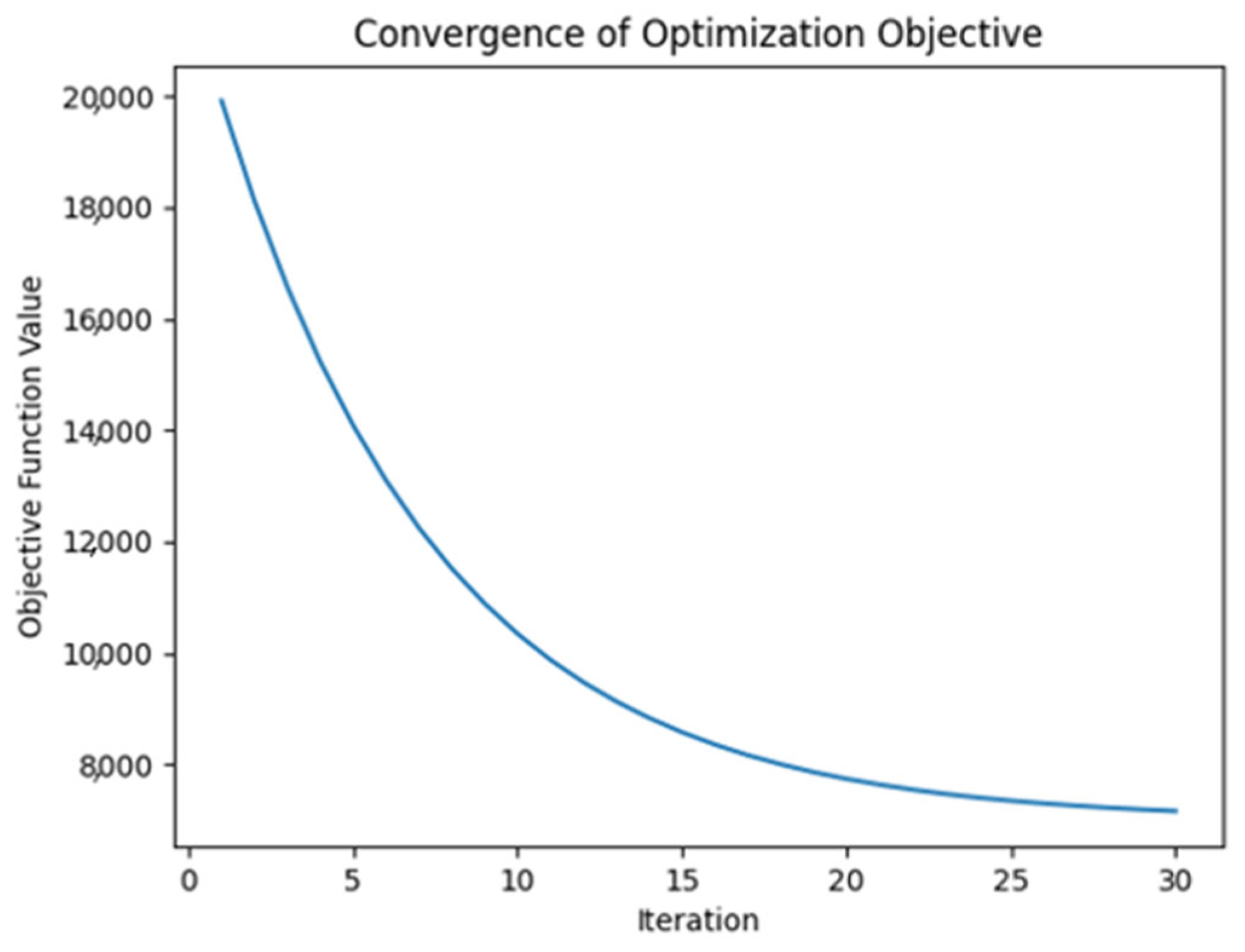
Nevertheless, the findings should be interpreted within the context of operational field deployment rather than fully controlled experimental causality because the study was conducted under heterogeneous agricultural environments and practical field-management conditions (
Figure 2).
The effectiveness of the optimization layer was evaluated using:
- 2.
Moisture variability (standard deviation)
- 3.
Constraint violation rate outside the acceptable band (60–82%)
The ML + Optimization configuration demonstrated comparatively improved operational stability. The moisture standard deviation was lowest under ML + Optimization (SD = 4.41) compared with ML-only (SD = 6.40) and Conventional management (SD = 6.70). Tracking performance improved under ML + Optimization, yielding the lowest cumulative tracking error (Σ(M − M*)2 = 7452.69). Moreover, the constraint violation rate was substantially lower than ML-only and comparable to conventional control, confirming that the optimization algorithm effectively enforces agronomic boundaries. These findings indicate that embedding optimization into the control layer may contribute to improved moisture stability and target tracking compared with prediction-only strategies. Statistical comparison across management configurations further demonstrated that the integrated ML + Optimization approach produced the lowest RMSE values, the highest R2 performance, and was associated with comparatively improved operational consistency relative to both conventional and ML-only configurations.
From an operational perspective, the integrated ML + Optimization framework demonstrated the potential to support more adaptive irrigation scheduling and resource allocation under variable field conditions.
An ablation comparison was conducted across three configurations:
Seasonal irrigation requirements were relatively comparable across the three configurations, with values of 7554.50 m3/ha for Conventional management, 7150.00 m3/ha for ML-only, and 7621.13 m3/ha for ML + Optimization. Despite this similarity in total water input, substantial differences emerged in resource efficiency when evaluated in terms of productivity outcomes. Notably, fertilizer application was minimized under ML + Optimization (209.62 kg/ha), compared with ML-only (237.00 kg/ha) and Conventional management (266.00 kg/ha), indicating more precise nutrient allocation. This improvement in input efficiency translated directly into comparatively improved operational performance, as ML + Optimization achieved the highest mean yield (4.55 ton/ha), exceeding both ML-only (4.08 ton/ha) and Conventional systems (4.06 ton/ha).
Enhanced productivity led to better economic outcomes. ML + Optimization generated the highest profit (22,341.75 THB/ha), compared to ML-only (18,035.75 THB/ha) and Conventional management (17,501.44 THB/ha). Although irrigation volume under ML + Optimization was slightly higher, water productivity improved substantially (1675.18 m3/ton), outperforming ML-only (1755.56 m3/ton) and Conventional practices (1862.07 m3/ton). This indicates that the optimized configuration was associated with higher water productivity, even though total water applied was slightly higher. Overall, integrating optimization reduces input use and enhances allocation efficiency, supporting comparatively improved yield, profitability, and resource-use efficiency. The observed differences suggest comparatively improved operational outcomes under the integrated framework across multiple operational indicators, confirming that the integrated prediction–optimization framework was associated with comparatively improved operational performance in practical field deployment conditions.
In addition, a sensitivity analysis was conducted by perturbing water and fertilizer price factors by ±10–30%. Across all tested scenarios, ML + Optimization consistently maintained the highest mean profit. Even under simultaneous increases in water and fertilizer costs (+30%), the optimized configuration preserved economic superiority over both baseline strategies. This robustness indicates that the optimization framework improves economic resilience under market volatility.
3.3. System Functionality and Field Performance
To improve narrative consistency and reduce redundancy, several short explanatory paragraphs related to communication reliability, monitoring continuity, and recommendation functionality were merged into integrated discussions emphasizing practical field deployment and adaptive decision-support performance. A supplementary operational assessment was also conducted to evaluate sensor-response consistency under repeated field measurements. Repeated operational field observations across ten representative plots showed that soil moisture readings exhibited generally similar temporal trends relative to field observations by an average of 2.6–3.1%, while nutrient-index fluctuation remained within acceptable operational monitoring ranges during repeated sampling intervals. These results indicate that the sensing framework provided sufficiently stable temporal information for irrigation communication and farmer-oriented recommendation support under practical deployment conditions.
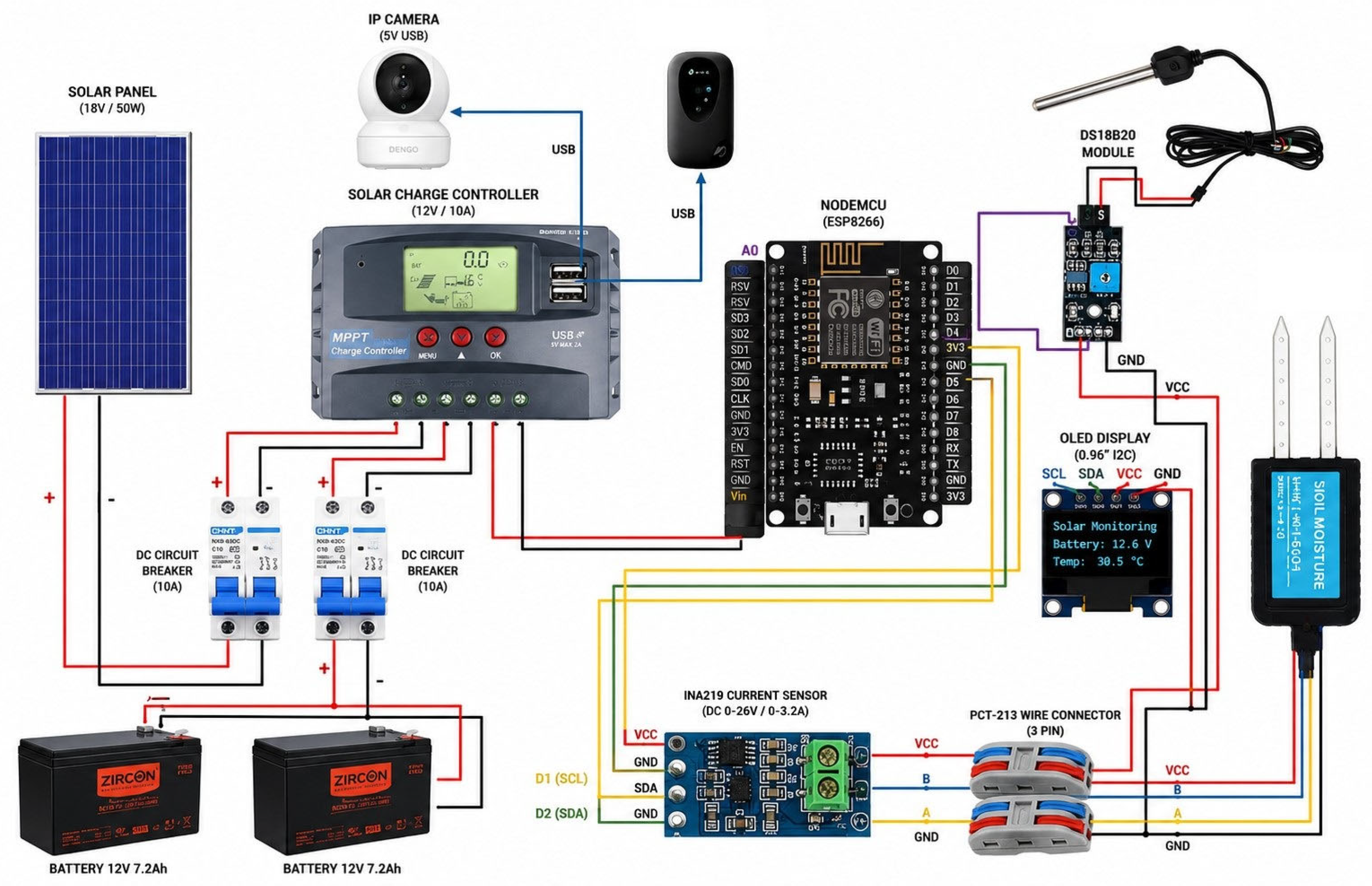
The developed smart IoT-based system operated reliably under real-world field conditions and successfully integrated soil moisture and nutrient-related operational indicators monitoring with real-time analytics and operational recommendations, as shown in the system architecture in
Figure 3.
The proposed smart IoT-based system was designed as an integrated monitoring and operational decision-support platform for large-scale rice cultivation under flood- and drought-prone agricultural environments. The framework consisted of a solar-powered energy-management unit, field-installed field-level monitoring components for soil moisture and nutrient-related operational monitoring, a microcontroller-based data acquisition module, and a wireless communication system for long-range field-data transmission.
The soil moisture sensing component employed a low-cost TDR-based monitoring approach suitable for continuous field deployment, while the nutrient-related operational monitoring module was utilized as an indicative operational monitoring tool for observing temporal nutrient-related variability under practical agricultural conditions. Interpretation of soil moisture dynamics additionally considered local soil characteristics, particularly the relatively high moisture-retention behavior of clayey to clay-loam paddy soils within the study area.
Real-time field data were collected at the root-zone level, preprocessed through the embedded controller, and transmitted to a cloud-based data management and analytics platform. The cloud layer stored time-series operational data and generated irrigation and nutrient management recommendations using rule-based and machine learning-assisted analytical procedures. Recommendation outputs and operational alerts were subsequently delivered to farmers through web-based dashboards and mobile notification services.
Although low-cost nutrient sensors may exhibit variability under fluctuating salinity and environmental conditions, the present study focused primarily on evaluating operational continuity, communication reliability, and practical field-level monitoring capability during real-world deployment conditions.
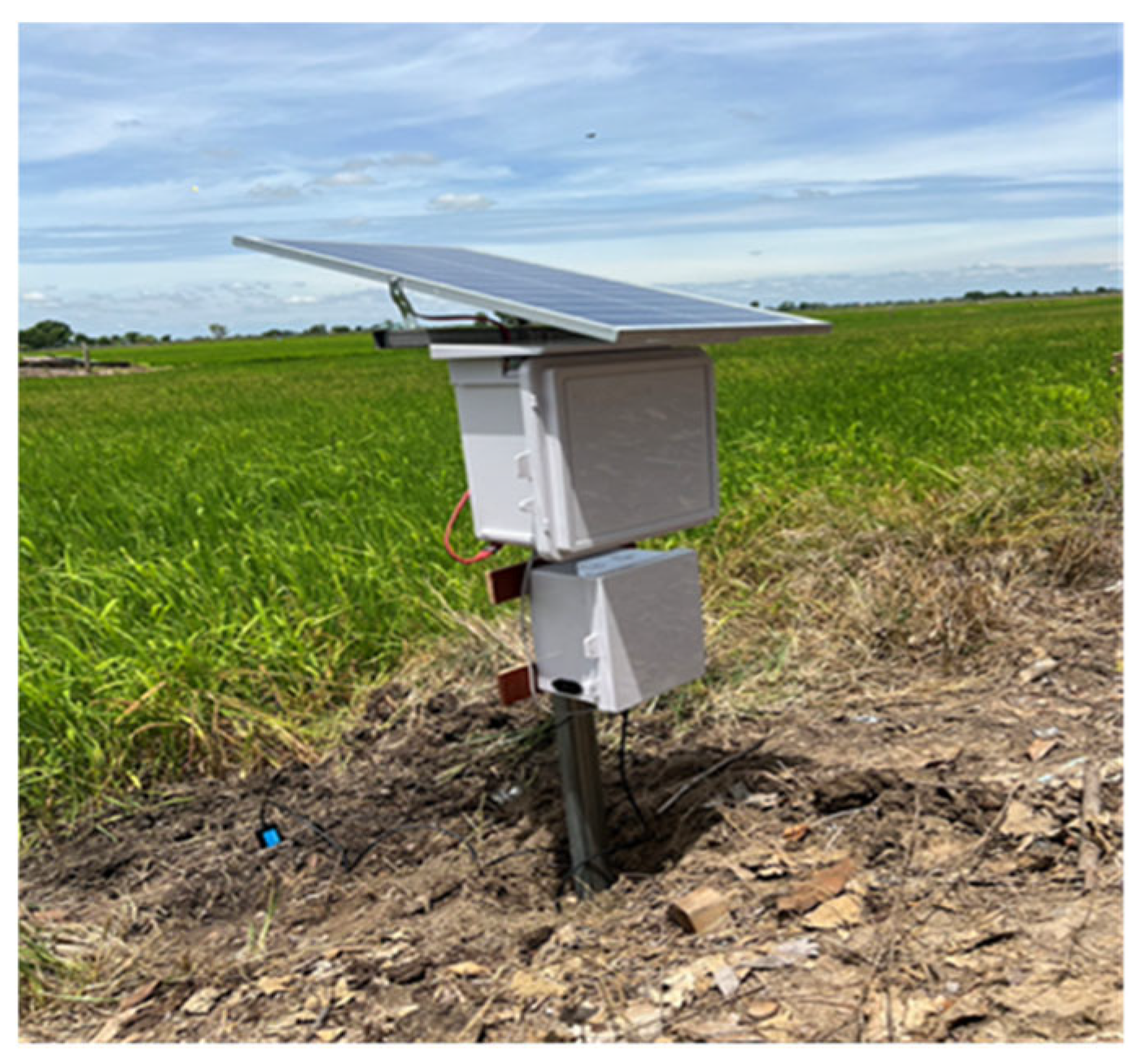
Figure 4,
Figure 5 and
Figure 6 illustrate the operational deployment components and communication workflow of the proposed smart IoT-based monitoring and recommendation framework under practical rice-farming environments.
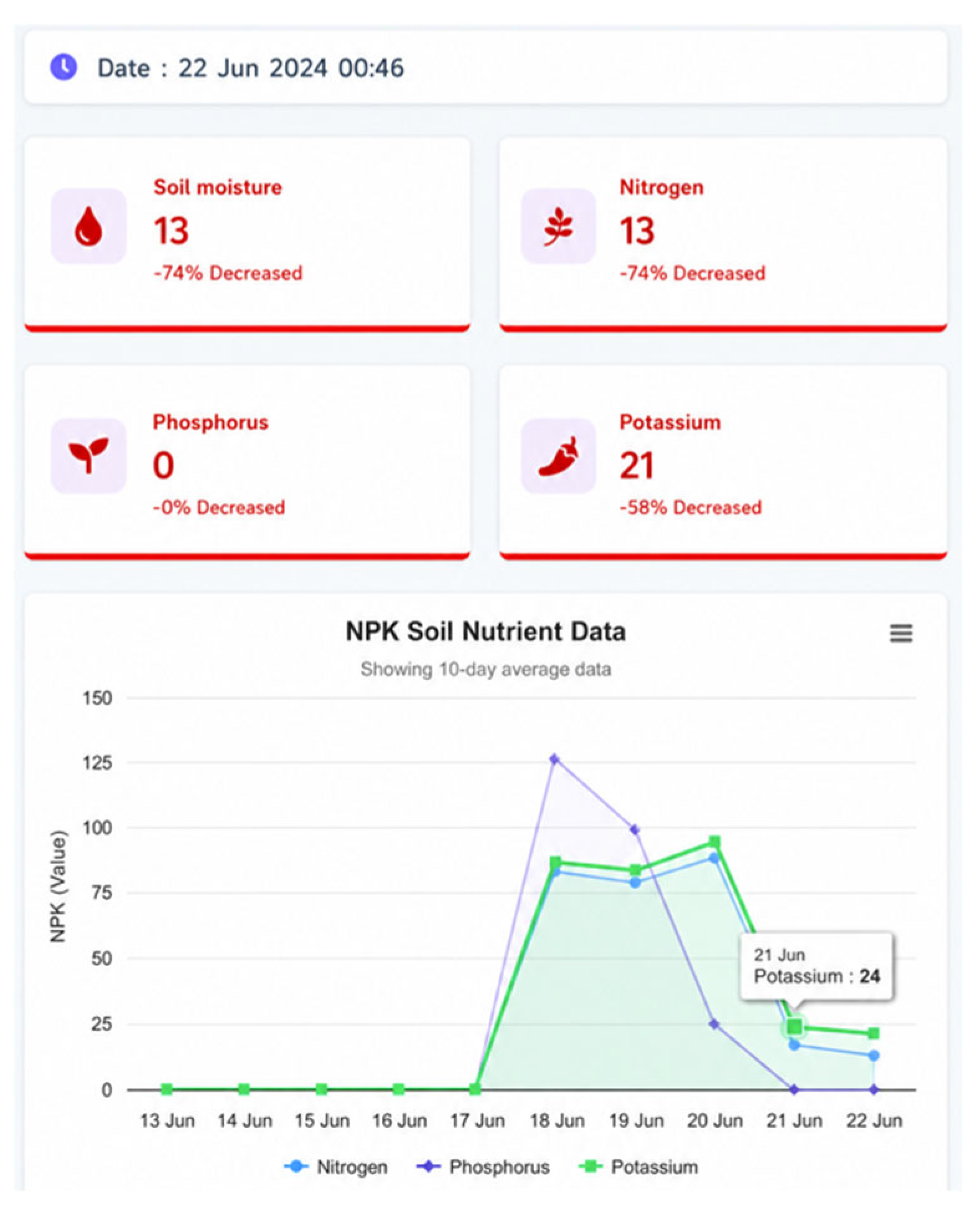
Figure 4 presents the field-deployed sensing device consisting of a solar-powered energy-management unit, soil moisture and nutrient sensors, embedded processing components, and wireless communication infrastructure installed within large-scale rice cultivation areas. The nutrient-related operational values displayed in
Figure 5 were interpreted as relative field-level indicators intended to support trend-based operational monitoring and recommendation workflows under practical agricultural conditions, while
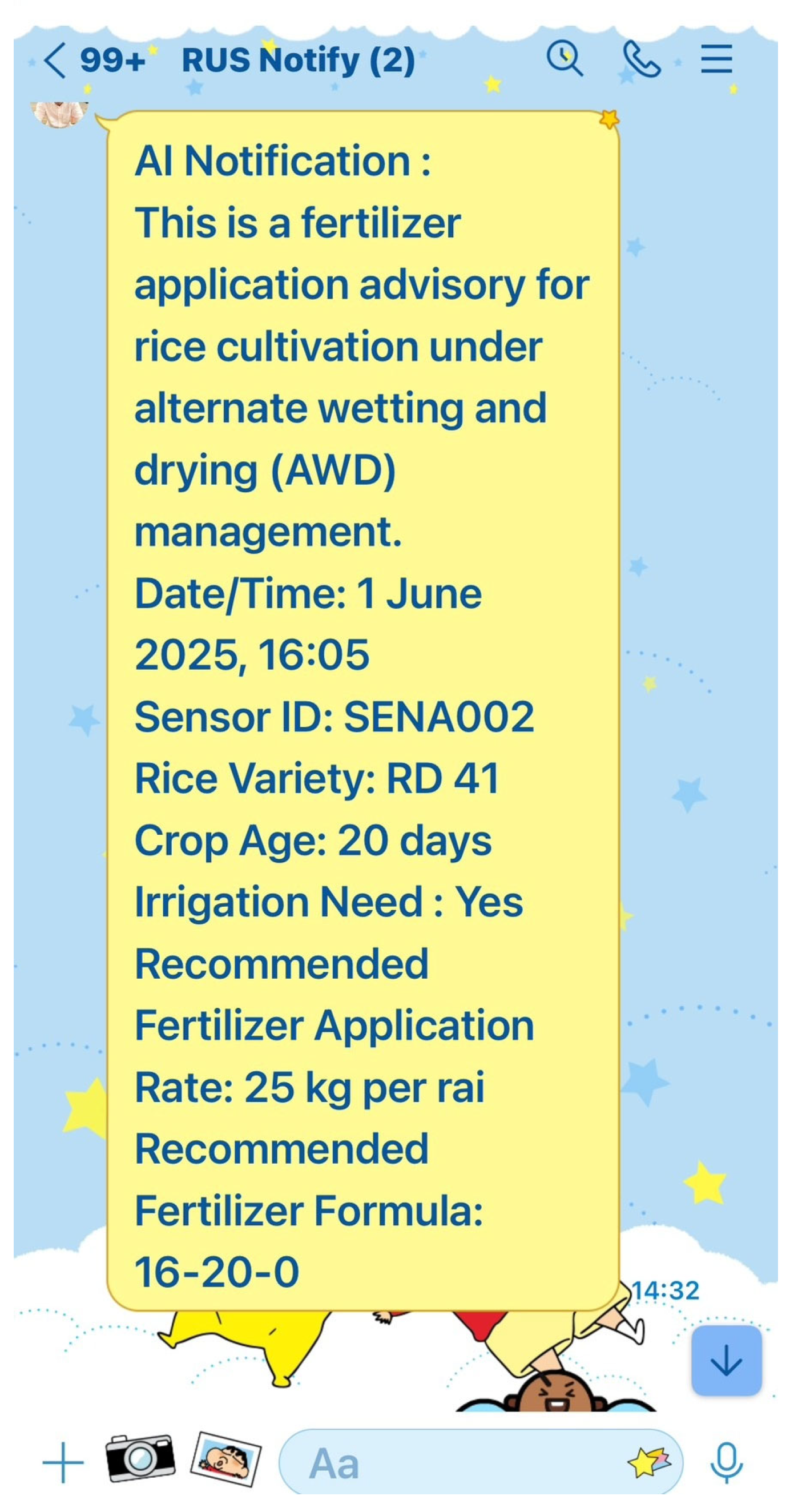
Figure 6 presents an example of the mobile notification system used to deliver irrigation and fertilizer recommendations to farmers during field deployment.
Although low-cost nutrient sensors may exhibit variability under fluctuating salinity and environmental conditions, the present study focused primarily on evaluating operational continuity, communication reliability, and practical field-level monitoring capability during real-world deployment conditions.
The recommendation workflow presented in
Figure 6 was integrated with real-time field-monitoring data transmitted through the IoT communication framework. Recommendation outputs were dynamically adjusted according to temporal soil-moisture behavior, nutrient-related operational indicators, environmental variability, and crop growth stages throughout the cultivation cycle.
3.4. Resource and Economic Impact
3.4.1. Descriptive Analysis of Production and Environmental Indicators
The Descriptive statistical analysis across ten monitored plots revealed substantial variability in conventional farming practices, particularly in water use, fertilizer application, and labor inputs, as detailed in
Table 4.
Descriptive statistics were calculated to summarize operational differences between conventional and IoT-assisted management conditions across major agricultural and economic indicators.
Table 5 presents descriptive statistics for operational variables under conventional and IoT-assisted rice farming conditions. The IoT-assisted management condition was associated with lower average irrigation water use, reduced fertilizer utilization, lower production cost, and comparatively higher profitability relative to conventional farming practices. Variability remained observable across field conditions, reflecting differences in irrigation environments and operational management characteristics during field deployment.
The descriptive results additionally showed comparatively lower standard deviation values under IoT-assisted management conditions for several operational indicators, particularly irrigation water use and fertilizer utilization.
3.4.2. Comparative Impact on Resource Use and Productivity
Independent-samples
t-tests revealed statistically significant differences between IoT-assisted and conventionally managed plots across multiple dimensions (
Table 5).
Table 6 presents the extended inferential statistical comparison between conventional and IoT-assisted operational management conditions. Several operational indicators, particularly irrigation volume, fertilizer utilization, water productivity, and net profitability, exhibited statistically significant differences between management conditions. The calculated effect sizes and confidence intervals further suggest that the observed differences may possess practical operational relevance under real cultivation environments.
Assumption testing additionally supported the appropriateness of the independent-samples t-test for most variables, while indicators exhibiting marginal variance heterogeneity were interpreted cautiously. The inclusion of effect sizes, confidence intervals, and Levene’s test results strengthened the interpretation of practical significance beyond p-values alone.
Nevertheless, the findings should be interpreted within the context of operational field deployment rather than fully controlled experimental causality. Because the study was conducted under heterogeneous agricultural environments using purposive sampling, some observed operational differences may additionally reflect variability in farmer behavior, environmental conditions, and field management characteristics across cultivation sites.
Economic analysis revealed a substantial reduction in production costs, from 4906.35 to 26,443.00 THB/ha (t = −7.87,
p < 0.00001). Average profit rose from 2357.68 to 23,920.00 THB/ha, and profit margins increased from 31% to 47% (t = 7.55,
p < 0.00001). Notably, these results suggest that profit growth was mainly due to risk reduction, not yield maximization. Reduced flood damage days and fewer irrigation events made costs more predictable. This finding shows that smart agriculture helps buffer risks and improve decision resilience, aligning with sustainability-focused economic models [
24].
3.4.3. User Evaluation and System Acceptance
User evaluation results showed high levels of satisfaction across all dimensions, with an overall mean score of 4.28/5.00, as shown in
Table 7.
Table 7 presents the user evaluation results for the smart IoT-based monitoring and recommendation system under practical field-deployment conditions. Overall user satisfaction remained at a high level (mean = 4.28/5.00), particularly regarding recommendation usefulness, data accessibility, and operational responsiveness.
Higher satisfaction levels were observed for recommendation quality (mean = 4.34) and sensor-data consistency (mean = 4.33), suggesting that participating farmers generally perceived the system as supportive for irrigation and nutrient management decision-making under real agricultural conditions. System stability also received favorable evaluation scores (mean = 4.17), although some variability in communication continuity and environmental operating conditions was reported during field deployment. Overall, the findings suggest that the proposed IoT-assisted framework maintained acceptable operational usability and practical deployment feasibility within large-scale rice farming environments.
4. Discussion
The findings of this study suggest that integrating IoT sensing, machine learning, and optimization-based control may contribute to improved resource-use efficiency and operational stability in large-scale rice cultivation systems. The observed reductions in irrigation water use, fertilizer utilization, and production cost alongside comparatively improved profitability are generally consistent with recent studies emphasizing the role of adaptive irrigation scheduling and data-driven nutrient management in climate-sensitive agricultural environments [
1,
6,
7,
39].
A preliminary operational feasibility assessment was additionally conducted to evaluate the practical deployment suitability of the proposed IoT-assisted framework under large-scale rice cultivation environments. The field-deployed system utilized relatively low-cost monitoring components, solar-powered energy support, and mobile-network communication infrastructure to reduce operational deployment complexity and maintenance requirements. Although a comprehensive techno-economic assessment was beyond the scope of the present study, the observed reductions in irrigation water use, fertilizer utilization, and operational production cost suggest potential practical benefits for resource-constrained agricultural environments. The framework was therefore evaluated primarily from the perspective of operational deployment feasibility and farmer-oriented resource-management support under practical field conditions.
Nevertheless, a comprehensive techno-economic assessment, including long-term maintenance expenditure, sensor replacement cost, scalability analysis, and return-on-investment evaluation, remains necessary for broader deployment assessment in heterogeneous agricultural environments.
Compared with previous studies primarily focused on monitoring or prediction independently, the present framework integrates real-time sensing, predictive analytics, and optimization-assisted operational recommendation within a unified field-deployment environment. The comparatively improved performance observed under the ML + Optimization configuration suggests that combining predictive analytics with adaptive control mechanisms may support more stable irrigation scheduling and resource allocation under heterogeneous agricultural conditions.
From a technological perspective, the Random Forest-based ensemble learning framework demonstrated acceptable short-term predictive capability for soil moisture and nutrient-related operational variables. The integration of predictive outputs within the optimization layer was associated with lower moisture variability, reduced tracking deviation, and fewer operational constraint violations relative to baseline management conditions. These findings are generally consistent with emerging research highlighting the potential of optimization-assisted agricultural decision-support systems under variable environmental conditions [
9,
10].
From a practical perspective, the proposed framework may provide a scalable operational decision-support mechanism capable of supporting farmer-oriented irrigation and nutrient management practices under real-time field conditions. Improved profitability observed under the integrated framework likely resulted from more adaptive irrigation timing, reduced unnecessary fertilizer application, and improved synchronization between crop demand and environmental variability during cultivation periods.
Nevertheless, several limitations should be acknowledged. The study was conducted under practical field-deployment conditions using purposive sampling rather than fully randomized experimental assignment. Consequently, the findings should be interpreted as operational field observations rather than causal evidence derived from controlled agronomic experimentation. In addition, participating farmers may have exhibited relatively higher levels of technology readiness and management engagement compared with the broader farming population.
Another important limitation is that the sensing framework relied primarily on low-cost, field-deployable sensors intended for operational monitoring rather than laboratory-grade soil analysis. Sensor readings may therefore be influenced by salinity fluctuations, soil heterogeneity, environmental variability, and communication instability under dynamic field conditions. Furthermore, the study was conducted primarily within clayey to clay-loam paddy soils in Central Thailand, which may limit direct generalization to other soil environments or climatic regions.
Future research should investigate multi-region deployment, multi-season validation, UAV-assisted monitoring, multispectral remote sensing integration, and advanced field-monitoring technologies to further improve the robustness, scalability, and transferability of optimization-assisted smart farming systems under climate-sensitive agricultural environments.
The present study does not claim laboratory-grade quantification of soil nutrient concentrations under heterogeneous agricultural environments. Instead, the nutrient-related sensing framework was evaluated primarily as an operational monitoring and communication-support component intended to assist trend-based irrigation and fertilizer management under practical field conditions. The sensing framework was not intended to replace laboratory-based soil chemical analysis or standardized agronomic nutrient quantification procedures.
5. Conclusions
This study investigated the operational feasibility of integrating IoT sensing, machine learning, and optimization-assisted decision support for irrigation and nutrient management in large-scale rice cultivation systems under climate-sensitive agricultural conditions. The findings suggest that the proposed Smart IoT-Based Monitoring and operational recommendation framework may contribute to improved irrigation stability, reduced fertilizer utilization, and comparatively improved water productivity and profitability under practical field-deployment environments.
The integration of soil moisture monitoring and nutrient-related operational indication with predictive analytics enabled adaptive irrigation scheduling and operational resource allocation throughout the cultivation cycle. Compared with conventional field management practices, the integrated ML + Optimization framework was associated with lower moisture variability, reduced tracking deviation, and more consistent operational management performance under heterogeneous environmental conditions.
From a practical perspective, the proposed framework may provide a scalable operational decision-support mechanism capable of supporting farmer-oriented irrigation and nutrient management planning under real-time agricultural environments. The system should therefore be interpreted as a practical communication and operational recommendation platform designed to support adaptive field management rather than as a substitute for laboratory-based soil analysis.
Nevertheless, several limitations should be acknowledged. The study was conducted under practical field-deployment conditions using purposive sampling rather than fully randomized experimental assignment. In addition, the study was conducted primarily within clayey to clay-loam paddy soil environments in Central Thailand, which may limit direct generalization to other soil conditions or climatic regions. The sensing framework also relied primarily on low-cost operational sensors that may exhibit variability under fluctuating salinity, environmental conditions, and communication instability during field deployment.
Future research should investigate multi-season validation, multi-region deployment, multispectral remote sensing integration, UAV-assisted monitoring, and advanced field-monitoring technologies to further improve the robustness, scalability, and transferability of optimization-assisted smart farming systems under diverse agricultural environments.
Author Contributions
Conceptualization, S.B. (Sangtong Boonying), S.B. (Salinun Boonmee) and A.P.; methodology, S.B. (Sangtong Boonying), N.T. and L.C.; software, S.B. (Sangtong Boonying) and N.T.; validation, S.B. (Sangtong Boonying), A.S., L.C. and A.P.; formal analysis, S.B. (Sangtong Boonying), S.B. (Salinun Boonmee) and N.T.; investigation, all authors; data curation, S.B. (Sangtong Boonying), L.C. and A.P.; writing—original draft, S.B. (Sangtong Boonying), S.B. (Salinun Boonmee); writing—review and editing, S.B. (Sangtong Boonying), S.B. (Salinun Boonmee), A.S. and N.T.; visualization, S.B. (Sangtong Boonying), A.S. and A.P.; supervision, S.B. (Sangtong Boonying); project administration, S.B. (Sangtong Boonying) All authors have read and agreed to the published version of the manuscript.
Funding
This research was funded by the Office of the Science Promotion Commission, Research and Innovation (OSPC), Thailand, and Rajamangala University of Technology Suvarnabhumi, Thailand, under Grant No. [67A1720000009].
Institutional Review Board Statement
The Declaration of Helsinki’s ethical principles and any applicable national rules for research involving human subjects were followed in the conduct of this study. Prior to data collection, Rajamangala University of Technology Suvarnabhumi’s Institutional Evaluation Board provided ethical evaluation and permission. In order to ensure voluntary involvement, anonymity, and data protection throughout the research process, all procedures involving human participants—including farmer interviews and field-based data collection—were conducted with careful consideration of ethical norms.
Informed Consent Statement
Informed consent was obtained from all subjects involved in the study.
Data Availability Statement
Evaluation dataset available on request from the corresponding author. Data are not publicly available due to participant privacy restrictions.
Acknowledgments
The authors would like to thank Rajamangala University of Technology Suvarnabhumi (RMUTSB), the Office of the Science Promotion Commission, Research and Innovation (OSPC), Thailand, and all participating farmers and local agricultural officers for their support and cooperation throughout this study. The authors also confirm that ChatGPT-4 was used solely for language editing, grammar correction, and formatting assistance during the revision stage of the manuscript. No artificial intelligence tools were used to generate the research idea, design the study, analyze data, interpret results, or write the substantive scientific content of the manuscript. All conceptualization, methodological design, data analysis, interpretation, and final approval of the manuscript remain the sole responsibility of the authors. The authors further confirm that no individual persons were acknowledged without their consent. The manuscript was carefully revised by the authors to ensure consistency of academic writing style, logical coherence, and contextual accuracy throughout all sections following peer-review recommendations.
Conflicts of Interest
The authors declare no conflicts of interest.
Abbreviations
The following abbreviations are used in this manuscript:
| RMSE | Root Mean Square Error |
| AWD | Alternate Wetting and Drying |
| MAE | Mean Absolute Error |
| MPC | Model Predictive Control |
| IOT | Internet of Things |
| ML | Machine Learning |
| RF | Random Forest |
| R2 | Coefficient of Determination |
| N | Nitrogen |
| P | Phosphorus |
| K | Potassium |
References
- Basso, B.; Antle, J. Digital agriculture to design sustainable agricultural systems. Nat. Sustain. 2020, 3, 254–256. [Google Scholar] [CrossRef]
- Wolfert, S.; Ge, L.; Verdouw, C.; Bogaardt, M.J. Big data in smart farming. Agric. Syst. 2017, 153, 69–80. [Google Scholar] [CrossRef]
- Hosseinpour, S.; Mousavi, H. Climate-smart agriculture: The promise of system of rice intensification (SRI) for sustainable paddy production. agriRxiv 2025. [Google Scholar] [CrossRef]
- Ouda, S.; Zohry, A.E.H. Climate-Smart Agriculture; Springer International: Cham, Switzerland, 2022. [Google Scholar]
- Gubbi, J.; Buyya, R.; Marusic, S.; Palaniswami, M. Internet of Things (IoT): A vision, architectural elements, and future directions. Future Gener. Comput. Syst. 2013, 29, 1645–1660. [Google Scholar] [CrossRef]
- Zhang, X.; Wang, J.; Liu, R. Smart irrigation scheduling using IoT and data analytics. Agric. Water Manag. 2022, 266, 107593. [Google Scholar]
- Li, M.; Zhao, C.; Wang, J. Machine learning-based nutrient management strategies for sustainable crop production. Agric. Syst. 2023, 206, 103603. [Google Scholar]
- Jenkins, M.; Block, D.E. A Review of Methods for Data-Driven Irrigation in Modern Agricultural Systems. Agronomy 2024, 14, 1355. [Google Scholar] [CrossRef]
- O’Grady, M.J.; Langton, D.; O’Hare, G.M.P. Edge computing: A tractable model for smart agriculture? Artif. Intell. Agric. 2019, 3, 42–51. [Google Scholar] [CrossRef]
- Kamilaris, A.; Prenafeta-Boldú, F.X. Deep learning in agriculture: A survey. Comput. Electron. Agric. 2018, 147, 70–90. [Google Scholar] [CrossRef]
- Liakos, K.G.; Busato, P.; Moshou, D.; Pearson, S.; Bochtis, D. Machine learning in agriculture: A review. Sensors 2018, 18, 2674. [Google Scholar] [CrossRef]
- Padarian, J.; Minasny, B.; McBratney, A.B. Machine learning and soil sciences: A review aided by machine learning tools. Soil 2020, 6, 35–52. [Google Scholar] [CrossRef]
- Sajindra, H.; Abekoon, T.; Jayakody, J.A.D.C.A.; Rathnayake, U. A novel deep learning model to predict the soil nutrient levels (N, P, and K) in cabbage cultivation. Smart Agric. Technol. 2024, 7, 100395. [Google Scholar] [CrossRef]
- Rudin, C.; Radin, J. Why are we using black box models in AI when we don’t need to? A lesson from an explainable AI competition. Harv. Data Sci. Rev. 2019, 1, 1–9. [Google Scholar]
- Tjoa, E.; Guan, C. A survey on explainable artificial intelligence (XAI): Toward medical XAI. IEEE Trans. Neural Netw. Learn. Syst. 2020, 32, 4793–4813. [Google Scholar] [CrossRef] [PubMed]
- Jain, S.; Ramesh, D.; Bhattacharya, D. A multi-objective algorithm for crop pattern optimization in agriculture. Appl. Soft Comput. 2021, 112, 107772. [Google Scholar] [CrossRef]
- Aldhahri, E.A.; Almazroi, A.A.; Alkinani, M.H.; Ayub, N.; Alghamdi, E.A.; Janbi, N.F. Smart Farming: Enhancing Urban Agri-culture through Predictive Analytics and Resource Optimization. IEEE Access 2025, 13, 72375–72388. [Google Scholar] [CrossRef]
- Rijswijk, K.; Klerkx, L.; Turner, J.A. Digitalisation in the New Zealand Agricultural Knowledge and Innovation System: Initial understandings and emerging organisational responses to digital agriculture. NJAS-Wagening. J. Life Sci. 2019, 90, 100313. [Google Scholar] [CrossRef]
- Rose, D.C.; Sutherland, W.J.; Parker, C.; Lobley, M.; Winter, M.; Morris, C.; Twining, S.; Ffoulkes, C.; Amano, T.; Dicks, L.V. Decision support tools for agriculture: Towards effective design and delivery. Agric. Syst. 2016, 149, 165–174. [Google Scholar] [CrossRef]
- Fragiadakis, G.; Diou, C.; Kousiouris, G.; Nikolaidou, M. Evaluating human-ai collaboration: A review and methodological framework. arXiv 2024, arXiv:2407.19098. [Google Scholar]
- Bouman, B.A.M.; Humphreys, E.; Tuong, T.P.; Barker, R. Rice and water. Adv. Agron. 2007, 92, 187–237. [Google Scholar]
- Allen, R.G.; Pereira, L.S.; Raes, D.; Smith, M. Crop Evapotranspiration; FAO: Rome, Italy, 1998. [Google Scholar]
- Carrijo, D.R.; Lundy, M.E.; Linquist, B.A. Rice yields and water use under AWD. Field Crops Res. 2017, 203, 173–180. [Google Scholar] [CrossRef]
- Lampayan, R.M.; Rejesus, R.M.; Singleton, G.R.; Bouman, B.A. Adoption and economics of alternate wetting and drying water management for irrigated lowland rice. Field Crops Res. 2015, 170, 95–108. [Google Scholar] [CrossRef]
- Mehedi, I.M.; Hanif, M.S.; Bilal, M.; Vellingiri, M.T.; Palaniswamy, T. Remote sensing and decision support system applications in precision agriculture: Challenges and possibilities. IEEE Access 2024, 12, 44786–44798. [Google Scholar] [CrossRef]
- Touil, S.; Richa, A.; Fizir, M.; Argente Garcia, J.E.; Skarmeta Gomez, A.F. A review on smart irrigation management strategies and their effect on water savings and crop yield. Irrig. Drain. 2022, 71, 1396–1416. [Google Scholar] [CrossRef]
- Ali, A.; Hussain, T.; Zahid, A. Smart irrigation technologies and prospects for enhancing water use efficiency for sustainable agriculture. AgriEngineering 2025, 7, 106. [Google Scholar] [CrossRef]
- Ahmed, S.; Ibrahim, M.; Hassan, A. Data-driven irrigation scheduling for improving water productivity in rice-based systems. Agric. Water Manag. 2023, 276, 108064. [Google Scholar]
- Elbeltagi, A.; Deng, J.; Wang, K.; Malik, A. Digital twin-driven irrigation management for sustainable agriculture. Comput. Electron. Agric. 2024, 216, 108480. [Google Scholar]
- Fageria, N.K.; Baligar, V.C.; Jones, C.A. Growth and Mineral Nutrition of Field Crops, 3rd ed.; CRC Press: Boca Raton, FL, USA, 2011. [Google Scholar]
- Dobermann, A.; Fairhurst, T. Rice Nutrient Management; IRRI: Los Baños, Philippines, 2020. [Google Scholar]
- Wang, J.; Zhang, X.; Li, Y. Nitrogen and phosphorus losses from paddy fields under different water management practices. Agric. Water Manag. 2020, 234, 106139. [Google Scholar]
- De Datta, S.K.; Buresh, R.J.; Mamaril, C.P. Increasing nutrient use efficiency in rice with changing needs. Fertil. Res. 1990, 26, 157–167. [Google Scholar] [CrossRef]
- Das, S.; Saha, S.; Ghosh, A. Nutrient management and soil health. J. Soil Sci. Plant Nutr. 2021, 21, 2341–2354. [Google Scholar]
- Brar, B.S.; Kaur, A. Precision nutrient management: A review. Indian J. Fertil. 2016, 1, 15. [Google Scholar]
- Polwaththa, K.P.G.D.M.; Amarasinghe, A.Y.; Nandasena, G.P.M.S. A review of innovative fertilization strategies in precision agriculture. Open Access Res. J. Sci. Technol. 2024, 12, 49–57. [Google Scholar] [CrossRef]
- Zhang, Y.; Wang, G.; Wang, J. IoT-based precision irrigation system. IEEE Access 2019, 7, 119869–119879. [Google Scholar]
- Kumar, R.; Singh, M.; Patel, A. IoT smart agriculture. Comput. Electron. Agric. 2025, 214, 108234. [Google Scholar]
- Sharma, R.; Verma, P.; Singh, S. ML IoT nutrient system. IEEE Access 2003, 11, 45678–45690. [Google Scholar]
- Zhang, X.; Cao, Z.; Dong, W. Overview of edge computing in the agricultural internet of things: Key technologies, applications, challenges. IEEE Access 2020, 8, 141748–141761. [Google Scholar] [CrossRef]
- Sushanth, G.; Sujatha, S. IOT based smart agriculture system. In Proceedings of the 2018 International Conference on Wireless Communications, Signal Processing and Networking (WiSPNET), Chennai, India, 22–24 March 2018. [Google Scholar]
- Oppong, R.A. Integration of IoT-Based Sprinklers, Embedded Systems, Data, and Cloud Computing for Smart Irrigation Management. World J. Adv. Res. Rev. 2025, 25, 126–151. [Google Scholar] [CrossRef]
- Oikonomidis, A.; Catal, C.; Kassahun, A. Deep learning for crop yield prediction: A systematic literature review. N. Z. J. Crop Hortic. Sci. 2023, 51, 1–26. [Google Scholar] [CrossRef]
- Dash, P.B.; Naik, B.; Nayak, J.; Vimal, S. Socio-economic factor analysis for sustainable and smart precision agriculture: An ensemble learning approach. Comput. Commun. 2022, 182, 72–87. [Google Scholar] [CrossRef]
- Arrieta, A.B.; Díaz-Rodríguez, N.; Del Ser, J.; Bennetot, A.; Tabik, S.; Barbado, A.; García, S.; Gil-López, S.; Molina, D.; Benjamins, R.; et al. Explainable Artificial Intelligence (XAI): Concepts, taxonomies, opportunities and challenges toward responsible AI. Inf. Fusion 2020, 58, 82–115. [Google Scholar] [CrossRef]
- Wang, C.; Zhang, J.; Wang, T.; Zeng, B.; Wang, B.; Chen, Y.; Chen, Y. Intelligent Optimization-Based Decision-Making Framework for Crop Planting Strategy with Total Profit Prediction. Agriculture 2025, 15, 1736. [Google Scholar] [CrossRef]
- Zhai, Z.; Martínez, J.F.; Beltran, V.; Martínez, N.L. Decision support systems for agriculture 4.0: Survey and challenges. Comput. Electron. Agric. 2020, 170, 105256. [Google Scholar] [CrossRef]
- Miller, T.; Mikiciuk, G.; Durlik, I.; Mikiciuk, M.; Łobodzińska, A.; Śnieg, M. The IoT and AI in agriculture: The time is now—A systematic review of smart sensing technologies. Sensors 2025, 25, 3583. [Google Scholar] [CrossRef] [PubMed]
- Xin, J.; Zazueta, F. Technology trends in ICT–towards data-driven, farmer-centered and knowledge-based hybrid cloud archi-tectures for smart farming. Agric. Eng. Int. CIGR J. 2016, 18, 275–279. [Google Scholar]
- Medagbe, Y.C.N.; Ocama, O.V.; Kasoro, N.M.; Tashev, T.; Kasereka, S.K. Leveraging smart crop recommendation systems and climate-resilient practices for sustainable agriculture in developing regions: A brief review. Procedia Comput. Sci. 2025, 265, 209–216. [Google Scholar] [CrossRef]
- Kolodner, J.L.; Camp, P.J.; Crismond, D.; Fasse, B.; Gray, J.; Holbrook, J.; Puntambekar, S. Problem-based learning meets case-based reasoning. Cogn. Sci. 2003, 27, 495–547. [Google Scholar]
| Disclaimer/Publisher’s Note: The statements, opinions and data contained in all publications are solely those of the individual author(s) and contributor(s) and not of MDPI and/or the editor(s). MDPI and/or the editor(s) disclaim responsibility for any injury to people or property resulting from any ideas, methods, instructions or products referred to in the content. |



 ,
,