Article

Wheat Size and Plant Distance Measurement Using LiDAR and Convex Hull Method

1
Department of Agricultural Machinery Engineering, Graduate School, Chungnam National University, Daejeon 34134, Republic of Korea
2
Department of Smart Agricultural Systems, Graduate School, Chungnam National University, Daejeon 34134, Republic of Korea
*
Author to whom correspondence should be addressed.
Agriculture 2026, 16(11), 1231; https://doi.org/10.3390/agriculture16111231
Submission received: 20 April 2026 / Revised: 21 May 2026 / Accepted: 28 May 2026 / Published: 2 June 2026

Abstract

Interest in light detection and ranging (LiDAR) for the precise monitoring of vegetative growth of grain crops has increased. The study was conducted to estimate wheat size and plant distance using LiDAR and the convex hull method (CHM) compared to the voxel grid method (VGM). A commercial LiDAR system was used for data collection in the middle and late growth stages using static and dynamic scanning. A small number (ten) of data frames, consisting of a region of interest (ROI) of 1 m × 0.9 m for each frame, were selected as data samples. The data processing workflow consisted of data conversion, targeted data frame selection, visualization, region of interest (ROI) segmentation, outlier and untargeted point removal, downsampling, denoising, voxelization, preparation of the convex hull, and 3D PCD density map. To estimate the plant size and distance of wheat, the results obtained using CHM and VGM were compared with measured data results, and both methods were applied for the middle and late growth stages of wheat. The relative accuracy of LiDAR-estimated plant height, canopy volume, plant spacing, and row distances with respect to the measured results were 94%, 87%, 94%, and 87%, respectively, using CHM, and 76%, 72%, 62%, and 71% by VGM for static data scanning; for dynamic scanning, the estimated relative accuracy percentages were 87%, 91%, 94%, and 93%, respectively, using CHM, and 77%, 74%, 75%, and 74%, respectively, using VGM. The same methods were applied to the late growth stage data sets. Between the two methods, CHM provided higher accuracy for static and dynamic data-scanning approaches in the middle and late growth stages because the complex geometry of plants, thin and sparse leaf area, and structure complicated voxelization. Despite several challenges in PCD collection and processing, this study supports size and distance estimation for wheat and similar grains as non-destructive methods.

1. Introduction

Measurements of plant size and distance are essential for the assessment of plant growth, yield, and natural resource use in wheat cultivation [1,2]. Plant size influences the crop yield potential to some extent [3,4]. Plant height and plant-to-plant and row-to-row distance measurements play an important role in enhancing crop yield and optimizing field management practices [5,6]. Plant height is a vital characteristic for estimating crop biomass and yield, which are relevant to the growth rate. It is also important in the management of irrigation and fertilizer application in crop cultivation [7,8]. LiDAR is used for collecting three-dimensional (3D) point cloud data (PCD) in agricultural applications, which enables precise plant size and distance measurement as well as plant characterization. Among a variety of applications, plant height monitoring using 3D PCD collected by unmanned aerial vehicles (UAVs) has become increasingly common [9,10]. LiDAR enables the scanning of complex plant geometry at a high resolution that is adjustable from 0.1° to 0.4° of horizontal resolution, depending on the motor rotation rate, which ranges from 5 Hz to 20 Hz for three-dimensional (3D) point cloud data (PCD), often providing a centimeter- to millimeter-level of spatial detail. It is a key advantage of using LiDAR for plant size and distance measurements. It is an emerging sensor for estimating the plant height of several crops, such as wheat [8,11], barley [12], rice [13,14], maize [15,16], and cotton [17]. Single-scanning [15,18] and multi-scanning modes [11,16] of LiDAR are usually used for data collection in agricultural fields. The single-scanning mode is more effective for plant height estimation of wheat, which is linearly correlated to the manually measured plant height [19,20]. The LiDAR sensor emits laser pulses, which are used as a remote sensing technology in agricultural applications, such as plant height and volume estimation [21,22]. LiDAR is an active sensor used for remote sensing in agriculture that emits its own laser pulses and measures the reflected signals, particularly from the surfaces of plants, to obtain three-dimensional (3D) spatial coordinates (x, y, and z). It estimates the inclined distance and measuring angle to each point following the trigonometric principle [19].
Different technologies are used for proximal sensing, including LiDAR, ultrasonic sensors, stereo vision (RGB-D camera sensors), and RGB cameras, to collect data using non-contact sensing techniques from a short distance of less than 1 cm [23,24]. Proximal LiDAR sensing is widely used for the non-destructive acquisition of three-dimensional (3D) point cloud data to estimate plant structural parameters, such as plant height, canopy volume, plant spacing, and row distance under field conditions [25,26]. Unlike aerial LiDAR systems mounted on unmanned aerial vehicles (UAVs), proximal LiDAR sensing enables close-range and high-density point cloud data acquisition for detailed estimation of wheat plant structural parameters under field conditions [27,28]. A commercial LiDAR (model: VLP-16, Ouster, Inc., San Francisco, CA, USA) is used for close-range acquisition of high-density three-dimensional (3D) point cloud data to estimate wheat plant structural parameters under field conditions. Terrestrial LiDAR is widely used for close-range acquisition of point cloud data to monitor crop growth and estimate plant size, such as plant height and canopy characteristics of field crops such as maize, wheat, and soybean [4,11,15]. Mobile LiDAR, represented by a mobile laser scanner (MLS), is mounted on a mobile data collection platform, such as agricultural machinery platforms and handheld data collection frames for estimating plant size and plant distances [29,30]. LiDAR is suitable for use in UAVs and ground sensing platforms to collect data in agricultural fields, such as rice, peanuts, and maize fields, and orchard fruit trees [11,31,32]. LiDAR is found to be utilized in precision agriculture for agricultural mapping, vegetative growth monitoring, estimating plant height, canopy volume, plant spacing, row distances, biomass, and plant morphological characteristics [12,13,32,33,34,35,36,37]. It can provide spatial coordinates and reliable location data for feature characterization of plants [1,38]. Compared with optical imaging, the LiDAR sensing technique may perform as a state-of-the-art technique for collecting reliable 3D geometric information for precise plant measurements under varying illumination conditions [8,39,40,41].
Traditionally, plant characterization has been performed with manual measurements, which are labor-intensive, time-consuming, and vulnerable to inaccuracy and repeatability issues. Moreover, manual measurements are performed on a limited subset of plant samples for large-scale measurement, leading to potential sampling errors [42,43]. Consequently, suitable sensing techniques and appropriate sensor selection are essential for precise characterization of plant selective geometric characteristics [43]. Sun et al. [17] used a two-dimensional (2D) commercial LiDAR for scanning cotton plants, a real-time kinematic global positioning system (RTK-GPS) for collecting spatial coordinates, a precise 3D reconstruction model for scanned plants, the RANSAC algorithm for ground plane separation, and the Euclidean clustering algorithm for removing the noise. Plant height, projected canopy area, and volume were estimated with r2 values of 0.97, 0.97, and 0.98, respectively, for comparison between sensor-estimated and measured results. Although LiDAR has been widely used for accurate plant characterization, airborne LiDAR applications remain limited due to cost and lack of temporal resolution. After technological advancements, hyper-temporal data collection using LiDAR has become cost-effective and viable for field-scale data collection while mounted on an autonomous data collection platform [44].
In unstructured agricultural working environments, determining appropriate sensor selection and data processing techniques is challenging due to complex plant geometry. With recent advancements in sensing techniques, LiDAR sensors enable the collection of 3D high-resolution data for reconstructing the plant structure from a 3D point cloud. As a result, LiDAR sensors are gaining popularity in the agricultural field, particularly for the characterization of plant features [17]. Despite their high resolution, depth cameras often have several constraints when scanning in brightly illuminated environments [45]. Although time-of-flight (ToF) cameras can capture depth images with high frame rates (up to 50 fps) and are mostly suitable for real-time applications indoors, they are less effective under outdoor illumination conditions [45]. Ultrasonic sensors are inexpensive and efficient enough to capture the data easily in proximal sensing despite having limitations in capturing the data due to their susceptibility to environmental conditions [46]. Ultrasonic sensors often provide inconsistent data under unpredictable environmental conditions because their waves have a wide angle of dispersion [47]. LiDAR PCD are not significantly affected by weather conditions such as illuminance, fog, rain, relative humidity, or dust and can be used in most agricultural working environments; in contrast, while TLS can be affected by wind, shadows of different existing objects, such as trees, agricultural machinery, and other objects, are unlikely to cause any effects [48].
Data quality may differ between static and dynamic data scanning methods, with variance in the total number of data points collected during static LiDAR scanning. The mechanical vibration generated from the data collection platform when the LiDAR sensor mounted on the platform is used in an agricultural working environment may affect the sensor data. One study showed that LiDAR sensors were used for guidance and obstacle detection on autonomous agricultural machinery platforms when the mechanical vibrations were affecting the quality of LiDAR-estimated results [49]. Schlager et al. [50] showed that the vibration effects on point clouds remain unknown, even though LiDAR systems have been adapted and used in fields under vibration conditions. Periu et al. [49] demonstrated that an experimental stabilization system attached to special support bars can reduce noise and manage vibrations when a commercial LiDAR system is mounted on agricultural machinery for data collection in both smooth and rough terrains. LiDAR sensors are used over ultrasonic and RGB imaging sensors, particularly for the characterization of selective parameters of fruit trees and field crops, such as plant height and canopy structure analysis, despite having several limitations and practical difficulties [37,51].
Several preprocessing techniques are used to adjust LiDAR-scanned point cloud data collected via static and dynamic approaches. In this study, CHM and VGM are used to process LiDAR point cloud data because these methods enable the conversion of raw LiDAR packet-captured data into meaningful plant geometric features. CHM was used to measure plant characteristics from LiDAR point clouds, while VGM was used to represent plant structure by voxelization for measuring the plant height, canopy volume, plant spacing, and row distance. Both methods have limitations and different levels of accuracy, depending on varying plant sizes, shapes, and geometries. In wheat plants, the thin leaf structure and dense canopy may further influence LiDAR point cloud distribution and measurement accuracy. Considering these limitations, an appropriate method for estimating the size and distance of low-height plants, comparatively suitable under upland agricultural field conditions is needed. Therefore, this study was conducted to evaluate the relative accuracy of wheat plant size and plant distance measurement using LiDAR and CHM for static and dynamic scanning approaches in different growth stages. It was hypothesized that CHM would provide more accurate measurements than VGM due to the representation of wheat canopy structures, whereas the relative accuracy of VGM may be affected by the sparse point distribution associated with thin and narrow wheat leaves.

2. Materials and Methods

2.1. Data Collection Site and Sensor Selection

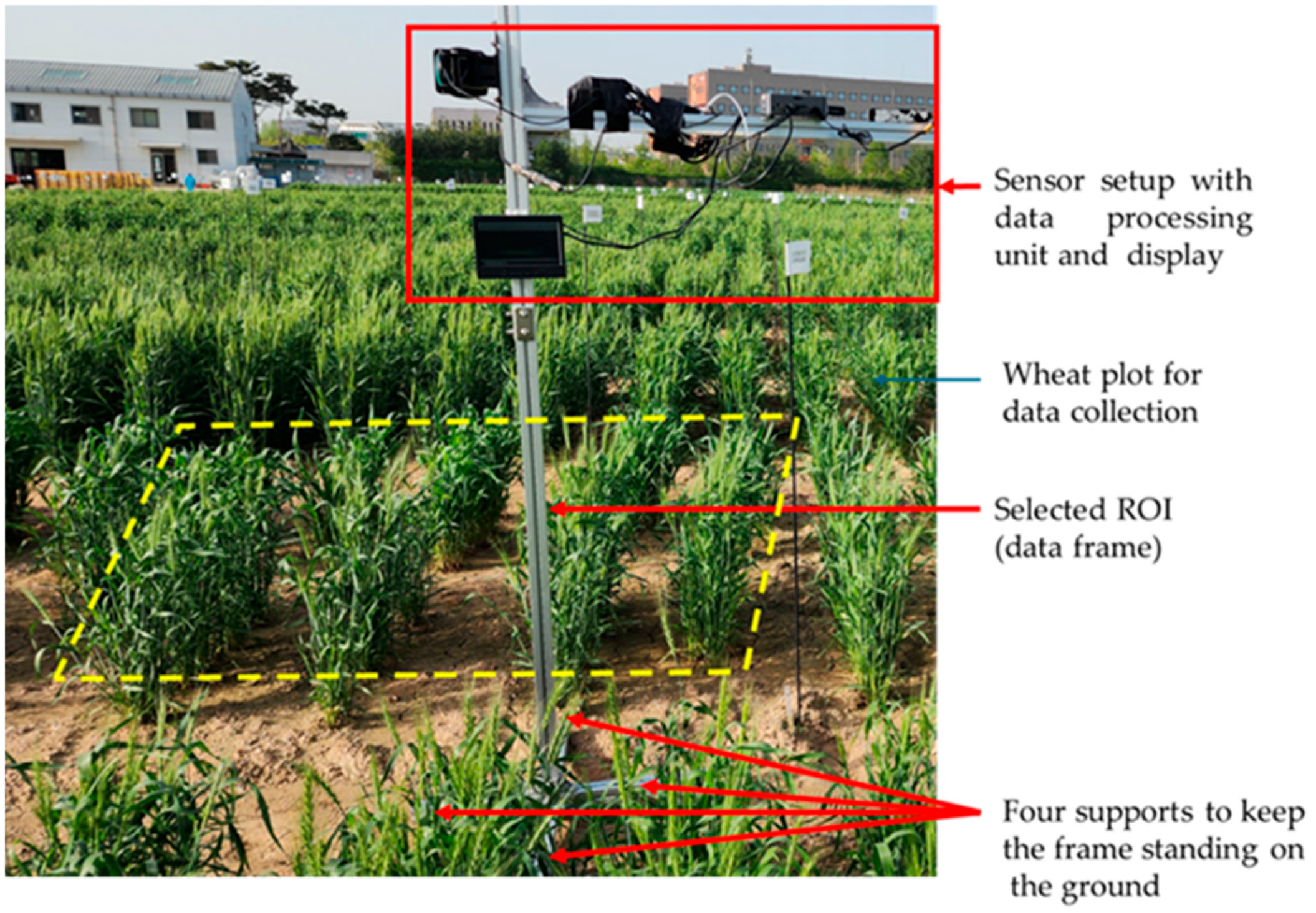
Data were collected in a wheat field belonging to the Rural Development Administration (RDA), Jeonju, Republic of Korea, as shown in Figure 1. Data samples were collected for estimating the wheat plant size and distances between plants and consecutive rows in the middle growth stage, which was 103 days after sowing (DAS) on 18 April 2024, and the late growth stage (129 DAS) on 17 May 2024. Ten regions of interest (ROIs) with diverse wheat plant shapes and sizes were preselected for data collection. A total of 10 data samples across two wheat growth stages (103 and 129 DAS) were used in this study. The data were categorized based on scanning approach (static and dynamic) and LiDAR point cloud data processing method, such as CHM and VGM, for comparative analysis. A commercial LiDAR (model: VLP-16, Ouster, Inc., San Francisco, CA, USA) was attached with a customized aluminum frame for data acquisition as a stationary data collection condition for the middle and late growth stages. The specifications of the LiDAR sensor are detailed in Table 1.
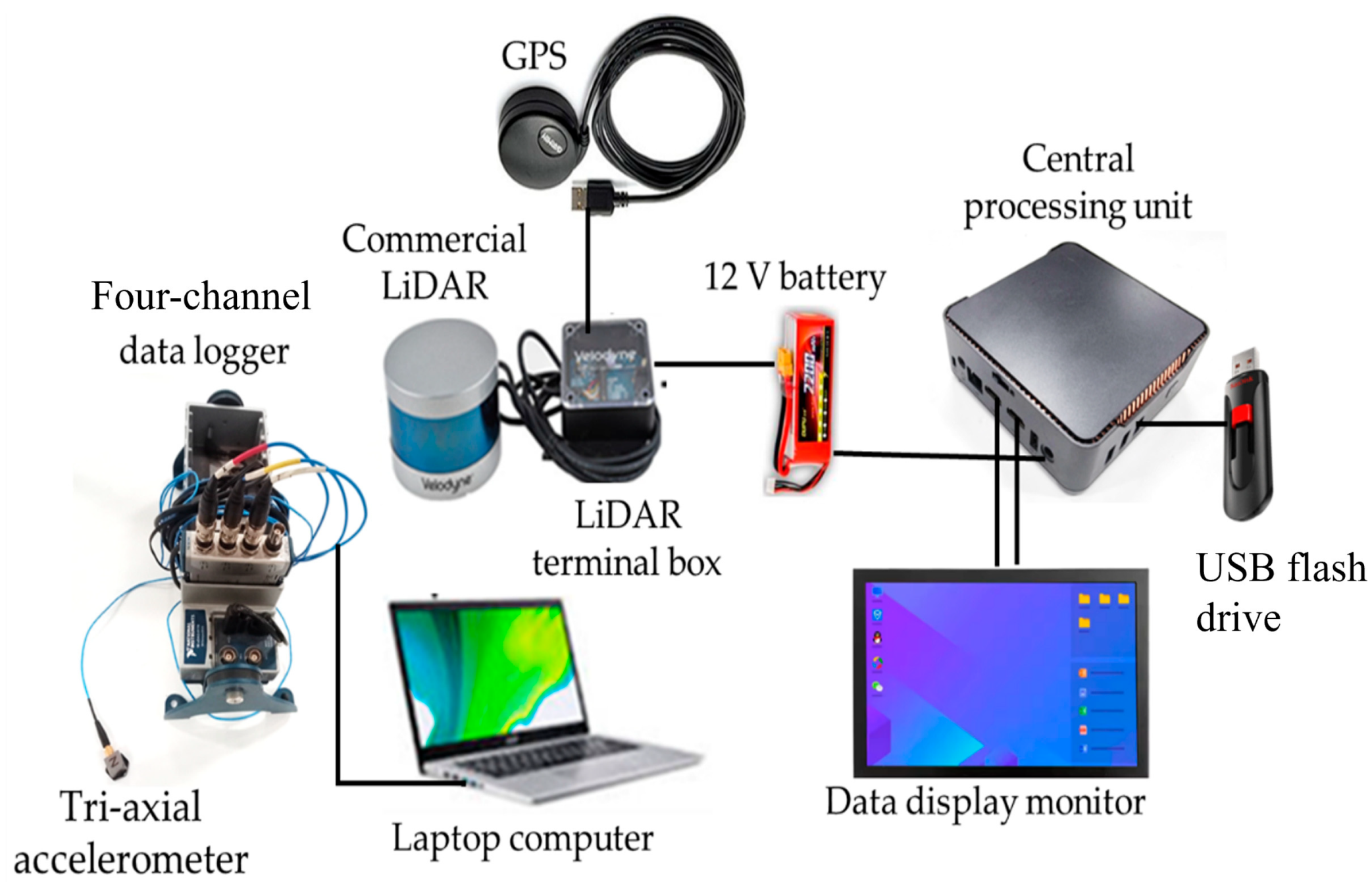
The LiDAR sensor (model: VLP-16, Ouster, Inc., San Francisco, CA, USA) provided a scanning range of up to 100 m with low power consumption, a lightweight design, compact size, and dual-return capability. It featured 16 channels and captured approximately 300,000 points per second. The sensor offered 360° horizontal and 30° vertical fields of view, with laser beams oriented at ±15° from the horizontal plane. The sensor provided a 3D representation of the surrounding objects through the processing of PCD. Vibration effects on sensor-estimated results were investigated using a commercial tri-axial accelerometer (model: 356A15, PCB Piezotronics, Inc., Depew, NY, USA) estimating the vibration exposure using a data logger (model: NIcDAQ-9178, National Instruments, Austin, TX, USA) of a commercial accelerometer and a commercial module (model: NI 9234, National Instruments, Austin, TX, USA), both with four channels. The specifications of the vibration sensor and data logger are detailed in Table 2.

2.2. Data Collection and Processing for Sensor and Manual Measurement

During data collection, the data sampling procedure was designed to include wheat plots with distinct plant heights, sizes, and shapes under field conditions. Four rows of wheat plants, each consisting of an ROI of 1 m × 0.9 m, were used for data collection. Manual measurements were collected from the same ROIs and used as ground-truth references for comparison with LiDAR point cloud data results. Data were collected under both static and dynamic scanning conditions. In the middle growth stage (103 DAS), data were collected to compare the measured plant size and distance with sensor measurement results, considering both stationary and vibration conditions. Similarly, to investigate the vibration effect generated from the data collection platform for the dynamic data collection approach, data were collected under both stationary and vibration conditions to compare the sensor-estimated data results with measured results in the late growth stage (129 DAS). During dynamic data collection, considering vibration conditions, the forward speed of the wheeled aluminum structure was a moderate human walking speed of 1.4 to 1.5 ms−1. Static scanning was performed with the platform maintained in a stationary position within each ROI.
The data collection structure was fabricated with an aluminum profile of 40 × 40 mm. The structure was fabricated according to the design, considering several design criteria such as the structure for collecting point cloud data using the LiDAR sensor in preselected data sampling areas in selected wheat plots. Four support legs, each 45 cm in length, were attached to the bottom corners of the structure to maintain stable and vertical positioning on the ground during data collection. The structure was manually moved forward from one position to another for collecting LiDAR point cloud data under dynamic scanning conditions and investigating the platform-induced vibration effects on measurement accuracy. PCD were captured from a proximal distance of 80 cm above the top of the plant using a LiDAR sensing technique customized with the structure. 3D PCD were collected under field conditions using a commercial LiDAR mounted on a customized wheeled aluminum platform. A commercial LiDAR consists of 16 laser channels with a 360° horizontal field of view and was used for close-range scanning of wheat canopy structures. Measurements were conducted under both static and dynamic conditions within the selected ROIs.
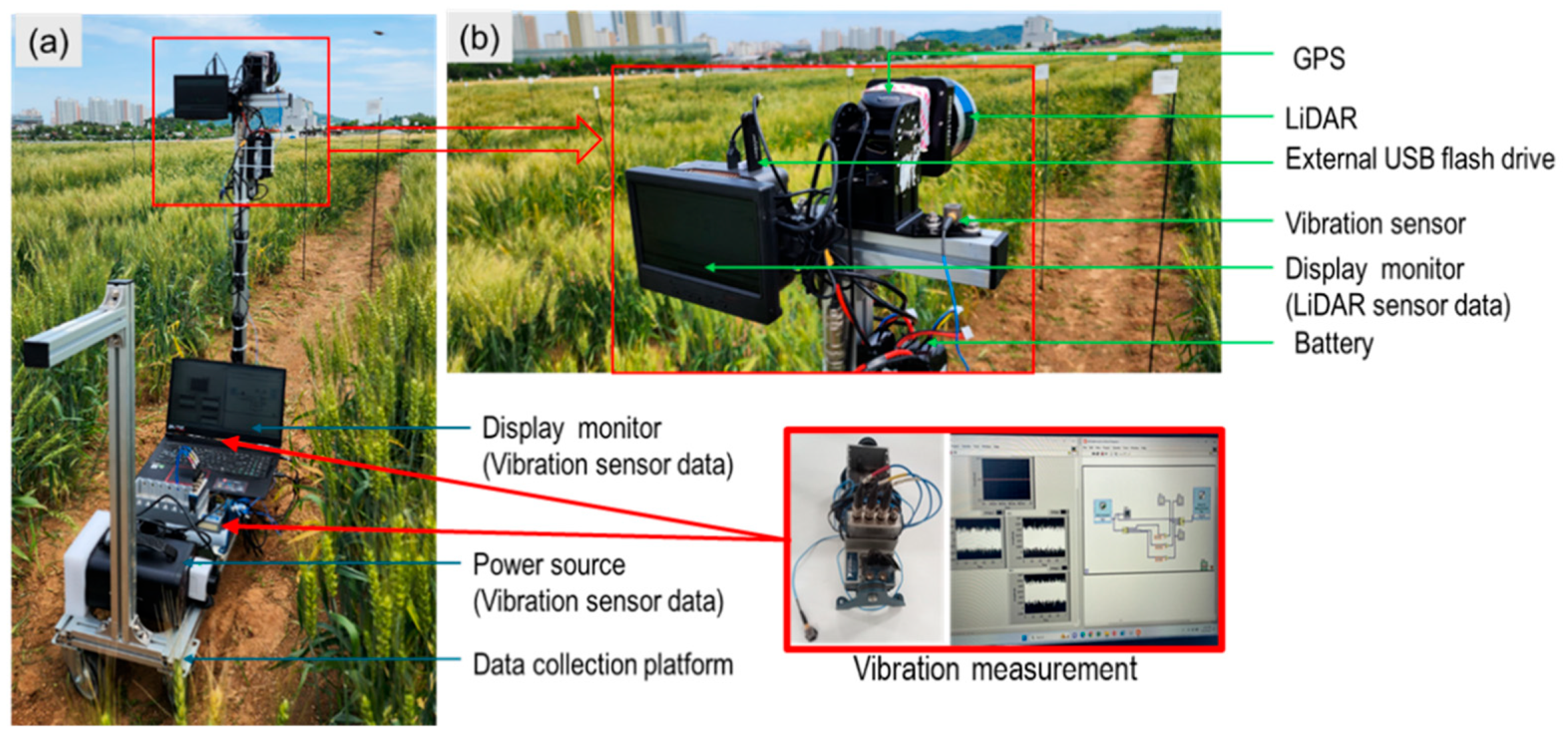
The LiDAR was mounted on a customized aluminum structure, as shown in Figure 1. The structure enabled the LiDAR sensor to smoothly scan the top of the crop canopy during data acquisition in the field. While LiDAR was used for scanning the top of the plant canopy, the sensor was carefully placed, maintaining the desired height of 80 cm. The sensor height was maintained at 80 cm from the top of the canopy during data collection.
The schematic diagram shown in Figure 2 illustrates the interfacing of the commercial LiDAR sensor for data collection in a wheat field. The commercial LiDAR system was interfaced and configured with supporting components to acquire 3D data in a wheat field, using preselected data sampling points and a proximal sensing technique. Data collection was facilitated through a commercial LiDAR terminal box, which was connected to power and routed signals within the sensor and compact computing device as a processing unit. The data collection setup was power-supplied with 12 V batteries. Data were transferred while the terminal box ensured a stable power supply. The LiDAR data were sent to the data-processing unit from the LiDAR terminal box through a high-speed connection, after which the commercial software used for data collection initiated. The data-processing unit preprocessed the data and recorded the incoming PCD under real field conditions. A data display monitor was attached to the data-processing unit to provide real-time visualization of data. Altogether, this setup allowed wheat plant geometry to be scanned under field conditions from a close distance of 80 cm (proximal sensing) and captured detailed 3D point clouds with high resolution, providing 3D information about plant structure. An external GPS unit (model: GPS18x LVC, Garmin, Martinez, CA, USA) was attached with LiDAR for precise geolocation and synchronization of data frames.
A recommended and commercially available software (model: Veloview, Ver 5.1.0, Kitware, Inc., Clifton Park, NY, USA) was utilized for live streaming, visualizing, and analyzing LiDAR-captured data. The software allowed for visualization of data consisting of data labels such as laser ID, intensity of return, dual return type, azimuth, time, and distance, and measurements offering customizable color maps. It facilitated exporting data with coordinates (x, y, or z) in a CSV format. Additionally, commercial software used for data collection, data conversion, and 3D PCD processing was performed with a customized Python programming language script (version 3.11.5). Figure 2 illustrates a schematic diagram of sensor setup, configuration, and detailing on integration of each component associated with the settings for data collection.
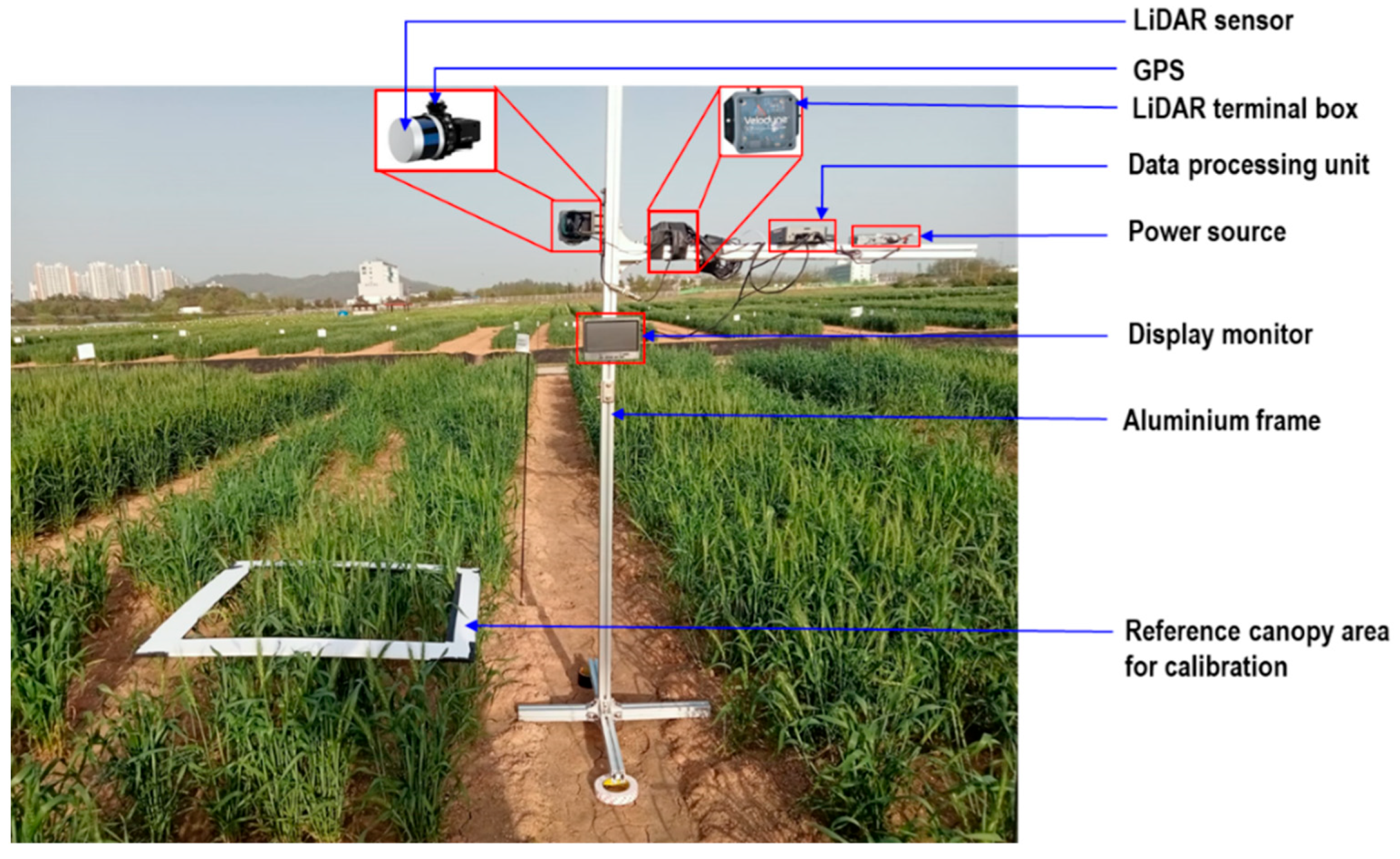
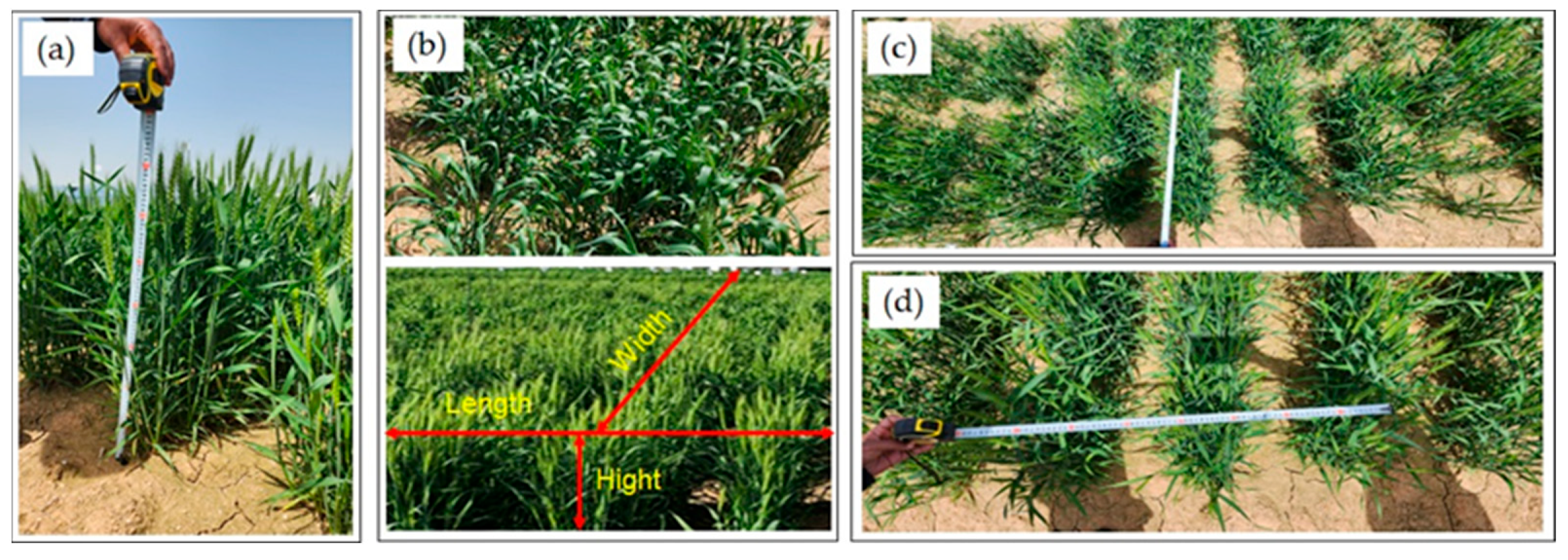
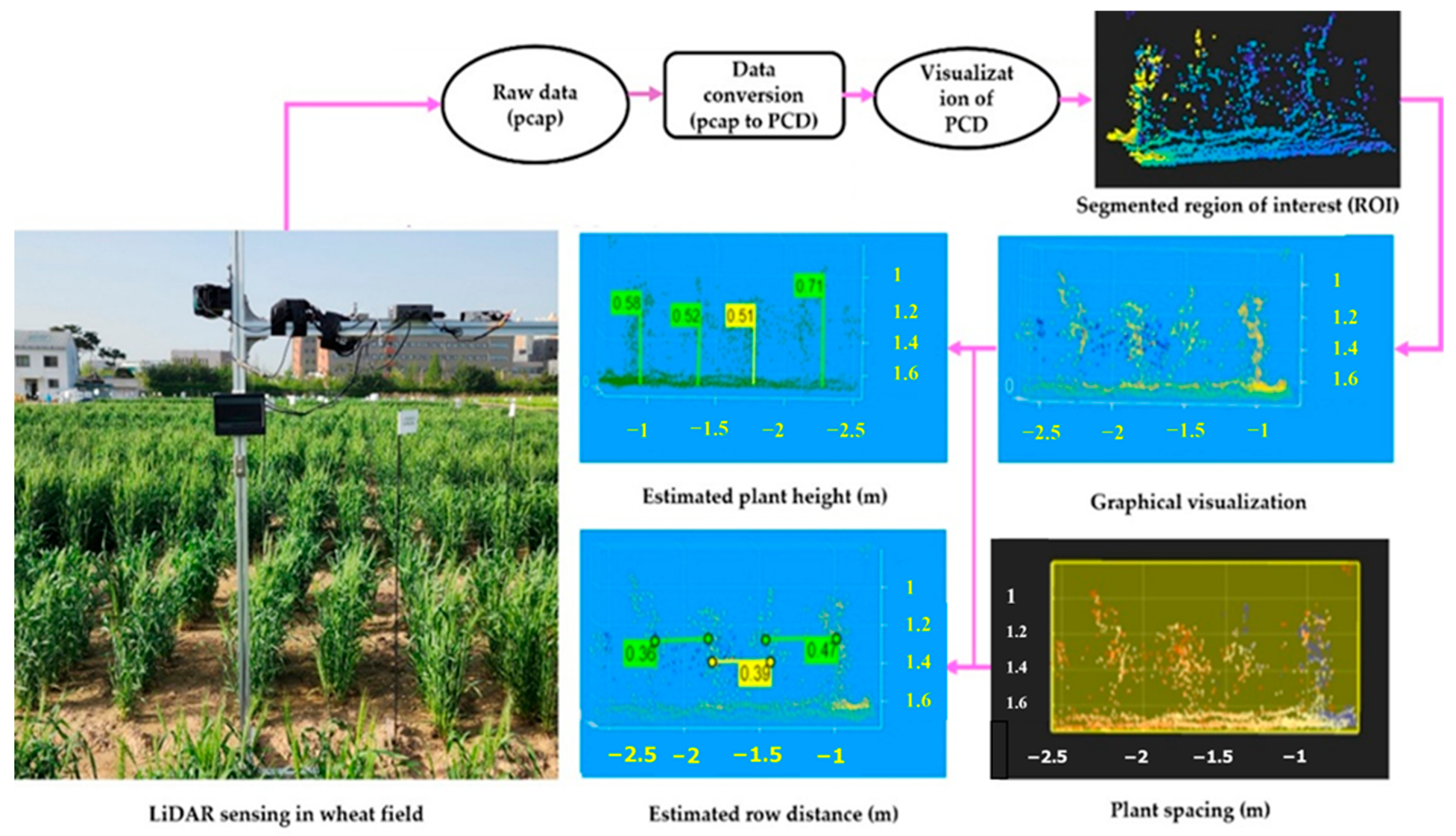
The scanning FOV of the entire ROI was adjusted to fit the plant height. The vertical alignment of the sensor was maintained for measuring and monitoring the vegetative growth of plants. The VFOV was 360° for scanning the top of the plant canopy profile (top view) and the estimation. Differences between the maximum and minimum z coordinates were used to estimate the height and canopy volume of plants. PCD were collected by scanning wheat plant rows in the preselected wheat sample area (equivalent to ROI) for estimating the spacing and row distance of plants. Figure 3 showed PCD collection in a wheat field, considering a lack of vibration effect during the middle growth stage (103 DAS). Dynamic data scanning was also performed in the same sampling plots. The plant height, canopy volume, plant spacing, and row distance were measured using a ruler. The measured data, as shown in Figure 4, were collected from the ten numbers of preselected samples of ROIs of data sampling plots where sensor-estimated data were collected. To investigate the effect of vibration on the sensor-estimated results, data were collected considering dynamic data collection conditions using a customized wheeled structure with an aluminum profile, as shown in Figure 5.
Vibration data were collected by the sensor. PCD were collected by mounting the commercial LiDAR sensor on a customized wheeled aluminum frame (platform) fabricated for static and dynamic proximal LiDAR sensing in the field plots. For assessment of vibration-frequency exposure on LiDAR sensor data, data were collected in the late growth stage of wheat plants using both the static and dynamic scanning approaches. Figure 5 shows all the necessary components and accessories used in this study for data collection. Commercial software was used to collect data using a dynamic scanning approach where the sampling vibration frequency was 1 kHz (1000 frequency data per second). The frequency exposure during commercial LiDAR sensor PCD collection was recorded by a tri-axial accelerometer attached to the platform. The vibration sensor was attached to the T-shaped vertical aluminum profile of the customized frame (platform) because most of the accessories and sensor components for the LiDAR PCD collection system were used for dynamic data collection. Vibration analysis was performed to reveal the distinct vibration along three axes (X, Y, and Z) with respect to time. During the recording of vibration-frequency data, the walking speed was kept relatively steady, and the source of vibration was considered almost stationary, particularly for interaction among wheel-ground and structural vibration. Vibration data were initially collected as frequency of voltage signals along the longitudinal (X), lateral (Y), and vertical (Z) axes. Vibration-frequency data were collected for 260 s to demonstrate the dominant vibration frequencies (X, Y, and Z). PCD data were collected for dynamic scanning at the late growth stage as shown in Figure 5. Static data scanning was also performed in the same sampling plots.

2.3. CHM and VGM for Data Processing, Visualization, and Measurement

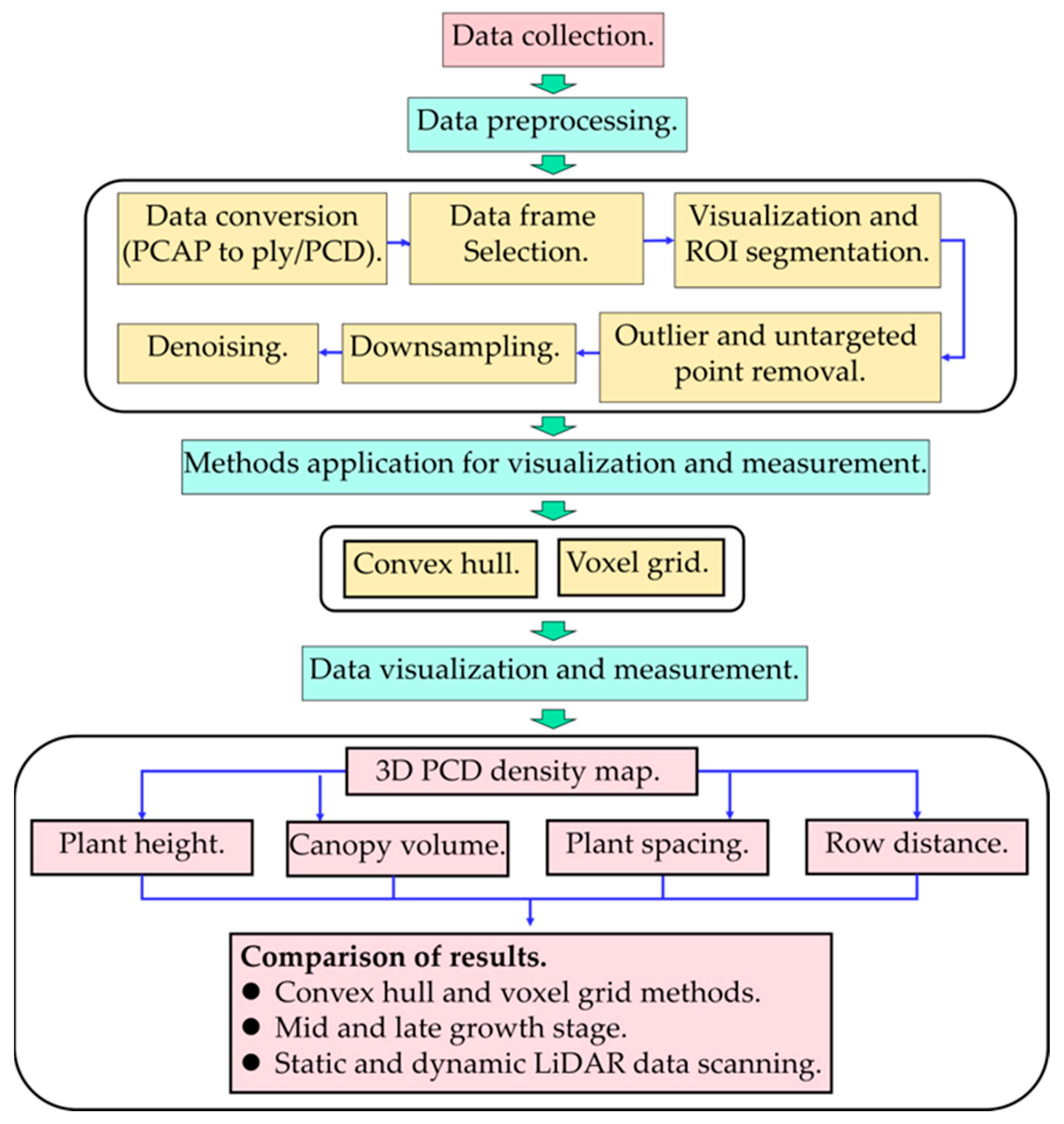
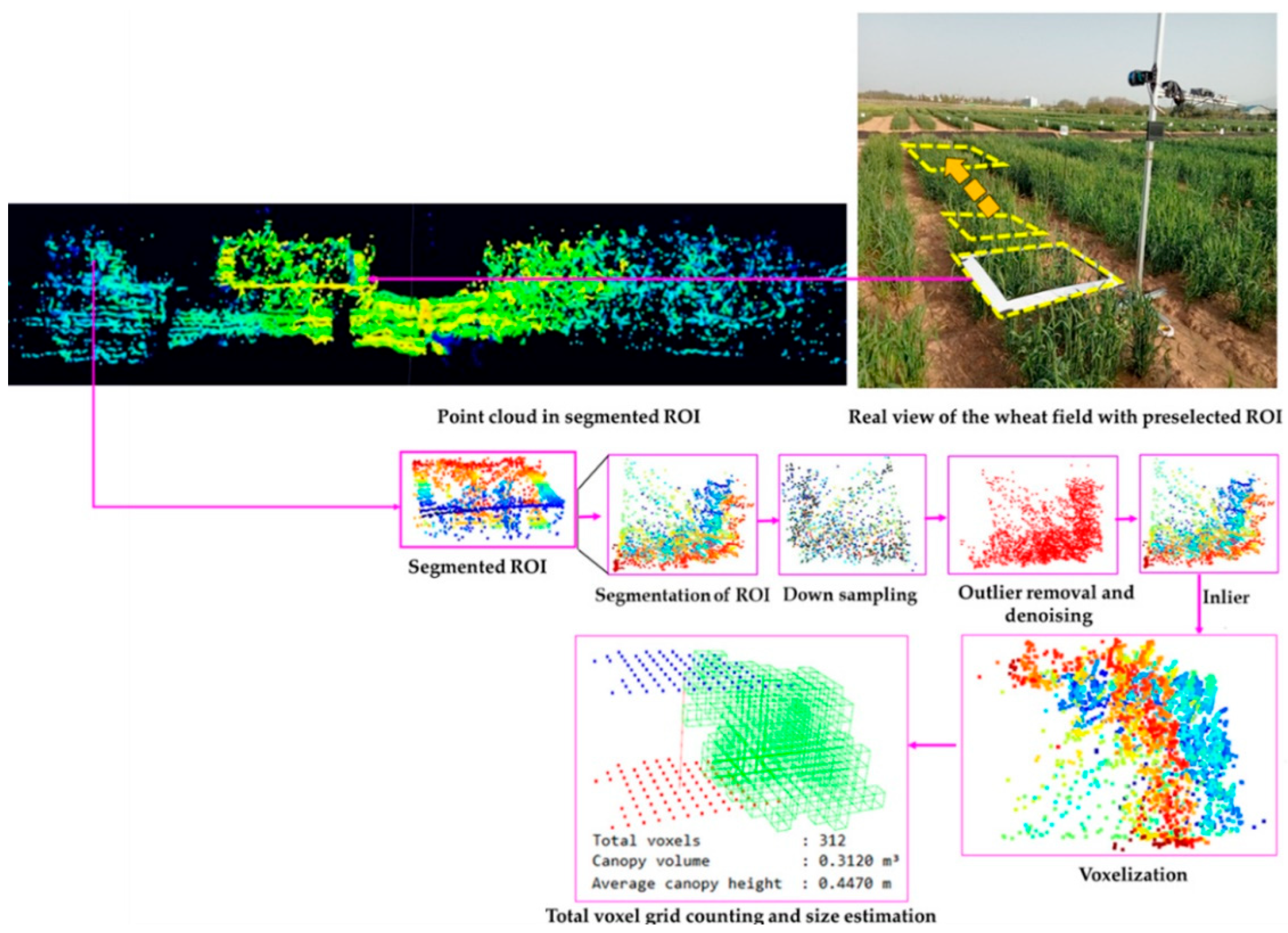
Data processing, visualization, and measurement of plant size and distance for wheat plants were managed using customized open-access programming language scripts (Python version 3.11.5). A comparison of measurement results on PCD collected via static scanning was also performed using the customized Python scripts (Python version 3.11.5). The data preprocessing workflow, as shown in Figure 6, consists of data conversion from PCAP to PLY (polygon file format) or PCD format, targeted data frame selection, visualization and region of interest (ROI) segmentation, outlier and untargeted point removal, downsampling, denoising, voxelization, preparation of convex hull, and the creation of a 3D PCD density map. The PCAP format data were captured as raw data and preprocessed for analysis and interpretation of the results. Automatic segmentation of a 1 m × 0.9 m region of interest (ROI) from each data frame was performed for data processing and measurement. The data preprocessing pipeline is exhibited in Figure 6. Essential Python libraries were imported, and custom functions were used for calculating the volume of CHM of segmented ROI and visualizing the LiDAR 3D PCD. The presence of valid data were ensured by loading the PCD files. For numerical analysis, the data were converted into a suitable structured format. The height and volume of the smooth convex hull were calculated for estimating the plant size, such as plant height and canopy volume. Plant height was estimated using minimum (Hmin) and maximum (Hmax) z-values isolated from the vertical (Z) axis to identify the ground level and the highest canopy points, respectively. The plant height (Hplant) was then calculated by subtracting the minimum z-value (Hmin) from the maximum z-value (Hmax), according to Equation (1) [13,37,52], which also assisted in estimating the canopy elevation.
H p l a n t = H m a x H m i n
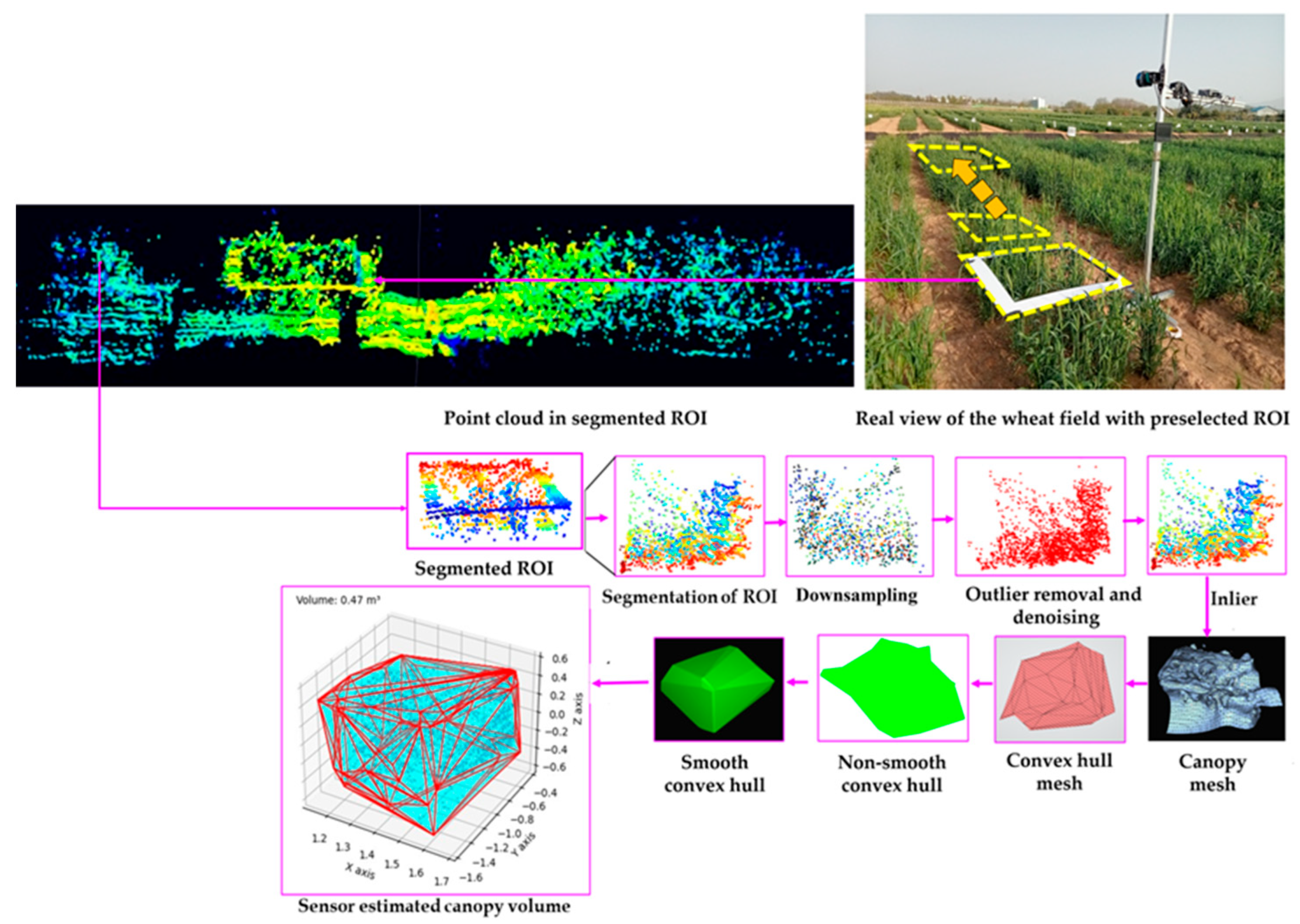
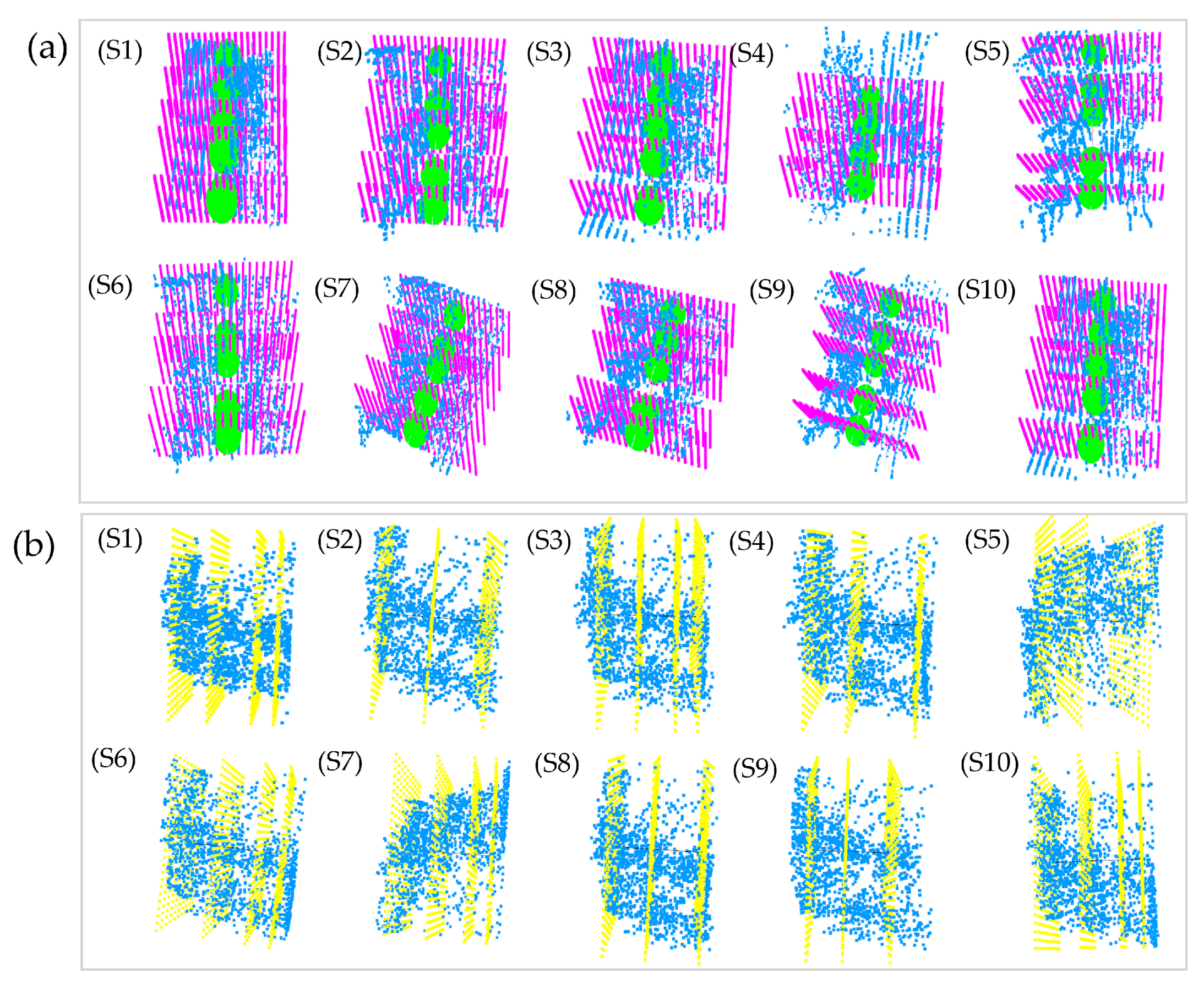
The computational load of data processing was minimized using the downsampling technique, which facilitated more efficient handling of the large PCD sets while maintaining the resolution necessary for accurate size and volume estimation of the canopy. This technique was applied to segment the ROI of data frames, where CHM was used to estimate the canopy volume. Several algorithms are used to measure the convex hull volume, such as the Quickhull algorithm, Graham scan, divide-and-conquer, and incremental algorithm [53,54]. The QuickHull algorithm was used to make the convex hull boundary for plant canopy estimation. This approach was used because QuickHull worked as an incremental and randomized algorithm for convex hull preparation, running faster and using less memory for the input of non-extreme points [53,54]. The algorithm started with the selection of two end points with minimum and maximum values of one dimension, defining a line segment comprising part of the convex hull, and dividing the rest of the points into two subsets. For each subset, the farthest point from the line was identified and added to the part of the convex hull to form a new triangle or tetrahedron, along with the original two points, which were added to the hull. This process was reiterated until no more points were added, at which point the convex hull was shaped by enclosing all existing points. Subsequently, a triangular mesh was formed with a convex hull, which was smoothed by Laplacian filtering and visualized over the PCD data. Finally, the edge of the convex hull was smoothed and exported in PNG format for visualization. Figure 7 and Figure 8 show the plant height, volume, and distance measurements obtained using the CHM.
A point was selected as the representative point in each voxel by averaging all the points within a voxel. Voxelization might be considered for true shaping of the plants’ crown, but occlusion due to complex geometry leads to the loss of a few points and causes underestimation of volume [53,55]. This reduced the overall points in the dataset while estimating the plant geometric structure, focusing on plant size and plant distances. Voxelization technique was applied to split the point clouds into voxels, which referred to small units of cubes. The steps shown in Figure 9 were applied for preprocessing of data for the VGM, including segmentation of region of interest (ROI) according to the pre-fixed region for segmentation, downsampling, outlier removal, denoising, separation of outliers and inliers, and voxelization of point clouds with a voxel size of 0.1 m (dimensions: 0.1 m × 0.1 m × 0.1 m), equal to 0.001 m3 of each voxel’s volume. After segmentation of the ROI, the voxelization technique was applied, and the total number of small voxels in the ROI were summed. Thus, the total canopy volume of each data frame (ROI) was estimated by multiplying the volume of a small-unit voxel with the total number of voxels in each data frame (ROI). In this study, a voxel size of 0.1 m (dimensions: 0.1 m × 0.1 m × 0.1 m) was used for voxelization of the LiDAR point cloud data, which falls within the recommended range for improving canopy representation and estimation performance. Moreover, the average plant height in each data frame was estimated from the Euclidean distance between the topmost and bottom voxels, as shown in Figure 10. The same procedure was followed for wheat plant data processing by VGM, while point cloud data were collected by static and dynamic LiDAR scanning approaches in the middle and late wheat growth stages. For plant spacing and row distance estimation from LiDAR point cloud data using VGM, the point cloud data were converted to voxel grids, where the voxel size was 0.1 m (dimensions: 0.1 m × 0.1 m × 0.1 m). During the data analysis, noise reduction was performed and determined the voxel centers as well as the crop row and cross row directions, as shown in Figure 10, for both the middle and late growth stage data collected using static and dynamic data collection approaches. After that, the voxel centers were identified across the rows, and according to the point density, the row positions were finally considered to estimate the plant spacing (Figure 9a) and row distances (Figure 9b).
During data collection, vibration data were also collected, and the raw voltage signals were processed with a constant time interval of 0.001 s. To characterize the vibration, the dominant vibration frequency was extracted from the raw voltage signals for each axis. The time-domain signals were converted into the frequency domain, and the dominant frequency component was identified for each sampling window. The extracted frequencies were initially obtained in kHz and then converted to Hz using linear unit conversion. Due to noise made by the aluminum-wheeled structure’s motion, the raw frequency signals exhibited short-term variations. The frequency signals represent the vibration of the structure and were used for all subsequent analyses.

2.4. Analytical Procedures

The geometric features, including plant height, canopy volume, row distance, and plant spacing, were compared between the manual measurements and LiDAR point cloud data measurements. For better demonstration and understanding of the measurements of wheat plants, mean error calculation was performed. The mean error in wheat plant feature estimation best reflects the accuracy of the estimation method and accounts for the variability between individual plants of different heights, canopy volumes, plant spacing, and row distance. To assess the accuracy of the developed data processing algorithm, the root mean squared error (RMSE), mean absolute error (MAE), bias (mean difference), confidence interval (CI) with 95% confidence for the mean difference, sample standard deviation ( S D ), and t-test statistic, and relative accuracy (%) were calculated using Equations (2)–(8), respectively, as follows [13,32].
R M S E = 1 n i = 1 n y i y a 2
MAE = 1 n i = 1 n x i y i
Bias = d ¯ = 1 n i = 1 n ( x i y i )
CI = d ¯ ± t · S D n
S D = ( 1 n 1 i = 1 n ( d i d ¯ ) 2 )
t = d ¯ S D n
R e l a t i v e   a c c u r a c y ( % ) = 1 M r L r M r   × 100
where y i  and y a are the measured and LiDAR-estimated results, respectively; x i  and y i  are the LiDAR-estimated results for i th observations; n is the number of observations; Bias indicates whether the LiDAR-estimated results consistently overestimated (>0) or underestimated (<0) the measured results; d ¯ is the mean difference (bias); S D indicates the sample standard deviation of the differences; and t is the critical value of t-distribution with n 1  degrees of freedom at the desired confidence level (95%). CI (95%) refers to the 95% confidence interval for the mean difference. M r  and  L r  indicate the measured results (ground truth measurements) and LiDAR-estimated results, respectively. The relative accuracy (%) in Equation (8) determines how closely L r is associated with M r . A higher relative accuracy (%) indicates a better agreement, while a lower relative accuracy (%) indicates the deviations among respective geometric features of wheat plants during their characterization.

3. Results

3.1. Plant Size and Distance in the Middle and Late Growth Stages

3.1.1. Static Data Scanning

Table 3 shows the results of measured and LiDAR-estimated plant height, canopy volume, plant spacing, and row distance measurement of wheat plants in the middle growth stage. It was estimated by CHM and VGM while static data scanning using LiDAR was performed. Table 3 demonstrated that LiDAR-estimated plant heights were 0.58 ± 0.05 m and 0.47 ± 0.02 m, respectively, for CHM and VGM, whereas measured height was 0.62 ± 0.05 m. The average plant height estimation was lower by 0.04 ± 0 m and 0.15 ± 0.15 m using CHM and VGM, respectively. The RMSE of 0.04 m and 0.16 m indicated the deviation between measured and LiDAR-estimated results for CHM and VGM, respectively. The MAE of 0.04 m and a mean difference of −0.04 m for CHM indicated that LiDAR underestimates the plant height by 0.04 m compared to measured results. An MAE of 0.15 m and a mean difference of −0.15 m for VGM indicated that LiDAR underestimated the plant height by 0.15 m compared to measured results. Although the t-test (t-statistic value of −8.51 and p < 0.001) indicated a difference between the measured and LiDAR-estimated plant heights, the 95% CI (−0.05, −0.03) demonstrated a small difference in plant height within an acceptable range for CHM. While the t-test (t-statistic value of −8.56 and p < 0.001) indicated a difference between measured and LiDAR-estimated plant height, the 95% CI (−0.19, −0.11) demonstrated a significant difference in plant height for VGM, which was comparatively higher than CHM. Thus, LiDAR-estimated the plant height with a strong correlation and low mean difference by CHM compared to VGM while static LiDAR data scanning was performed.
Measured and LiDAR-estimated canopy volumes were 0.43 ± 0.04 m3 and 0.37 ± 0.02 m3, respectively, where LiDAR underestimated the canopy volume by a small value of 0.06 ± 0.02 m3 for CHM. In comparison, a LiDAR-estimated canopy volume was obtained at 0.31 ± 0.01 m3 for VGM. LiDAR underestimates the canopy volume by a small value of 0.12 ± 0.03 m3 for VGM. The deviation was supported by an RMSE of 0.07 m3 for CHM and showed a strong correlation between measured and LiDAR-estimated results, whereas an RMSE of 0.13 m3 for VGM showed a lower correlation between measured and LiDAR-estimated results compared to CHM. The MAE of 0.06 m3 and the mean difference (bias) of −0.06 m3 and MAE of 0.13 m3 and bias of −0.13 m3 were found, respectively, for CHM. The VGM indicated that LiDAR underestimated the canopy volume by 0.06 m3 and 0.13 m3, respectively, for CHM and VGM compared to the measured canopy volume. t-test values of −5.03 and p < 0.001 were obtained for CHM, and values of −9.25 and p < 0.001 were obtained for VGM. It indicated a statistically significant difference between measured and LiDAR-estimated canopy volume. The 95% CI (−0.09, −0.03) and CI (−0.16, −0.09), respectively, for CHM and VGM indicated that LiDAR underestimated the canopy volume by 3% to 9% and 9% to 16%, respectively, for CHM and VGM compared to the measured volume. The negative CI values between 0.09 m3 and 0.03 m3 confirmed that the LiDAR-estimated canopy volumes were lower than the measured canopy volumes.
LiDAR-estimated plant spacings were 0.29 ± 0.01 m and 0.19 ± 0.01 m, respectively, for CHM and VGM, when the measured plant spacing was 0.31 ± 0.01 m. Both methods estimated comparatively lower spacing than the measured plant spacing. A low RMSE value of 0.02 m showed a strong correlation between measured and LiDAR-estimated results for CHM. An RMSE value of 0.12 m for VGM indicated a comparatively lower correlation than CHM between the measured and LiDAR-estimated results. Furthermore, MAE and bias are 0.02 m, −0.02 m, and 0.12 m, −0.12 m, respectively, for CHM and VGM. Spacing indicated that LiDAR underestimated 0.02 m and 0.12 m of lower spacing than the measured spacing, respectively, for CHM and VGM. In addition, the t-statistic value of −5.46 and p < 0.001 for CHM and −40.6, p < 0.001 for VGM indicate several differences between LiDAR-estimated and measured plant spacing. The 95% CI of −0.03 and −0.01 for CHM and −0.13 and −0.06 for VGM confirmed that plant spacing deviations ranged from 1% to 3% and 6% to 13%, respectively, for CHM and VGM compared to the measured plant spacing.
At measurement of row distance, LiDAR-estimated distances were 0.29 ± 0.01 m and 0.22 ± 0.04 m, respectively. They were estimated by CHM and VGM, whereas the measured distance was 0.31 ± 0.01 m. The measurement results showed the RMSE of 0.02 m and 0.10 m for CHM and VGM, respectively, indicating a strong correlation for CHM but a comparatively lower correlation for VGM than CHM. MAE and bias were 0.04 m and 0.04 m, respectively, in estimating the row distance for CHM and 0.09 m and −0.09 m, respectively, for VGM, with proven errors compared to the measured row distance. The bias indicated a higher estimated row distance with a deviation of 0.04 m for CHM and a lower estimated row distance with a deviation of 0.09 m for VGM compared to measured results. t-test values of 4.39 and −6.0 for CHM and VGM, respectively, and p < 0.001 indicate a non-significant statistical difference for CHM, but there was a significant difference for VGM between the measured and LiDAR-estimated row distances. The 95% CI values (0.02, 0.06) and (−0.13, −0.06) for CHM and VGM indicated 2% to 6% positive variation and 6% to 13% negative variation between the measured and LiDAR-estimated row distances, respectively. Similarly, Table 3 shows the measured and LiDAR-estimated plant height, canopy volume, plant distance (such as plant spacing), and row distance in the late growth stage (129 DAS).
Although significant differences were detected in some paired t-tests, the mean differences between the measured and CHM-estimated values were relatively small, indicated by similar letters below. The CHM estimations showed non-significant differences from the measured values across most parameters, whereas the VGM estimations showed significant differences from the measured values across most parameters, as indicated by different letters. Additionally, most comparisons indicated highly significant differences (p < 0.001). CHM demonstrated higher accuracy than VGM across all measured parameters, exhibiting lower RMSE, MAE, and bias values, also indicating closer agreement with the measurements from both growth stages.
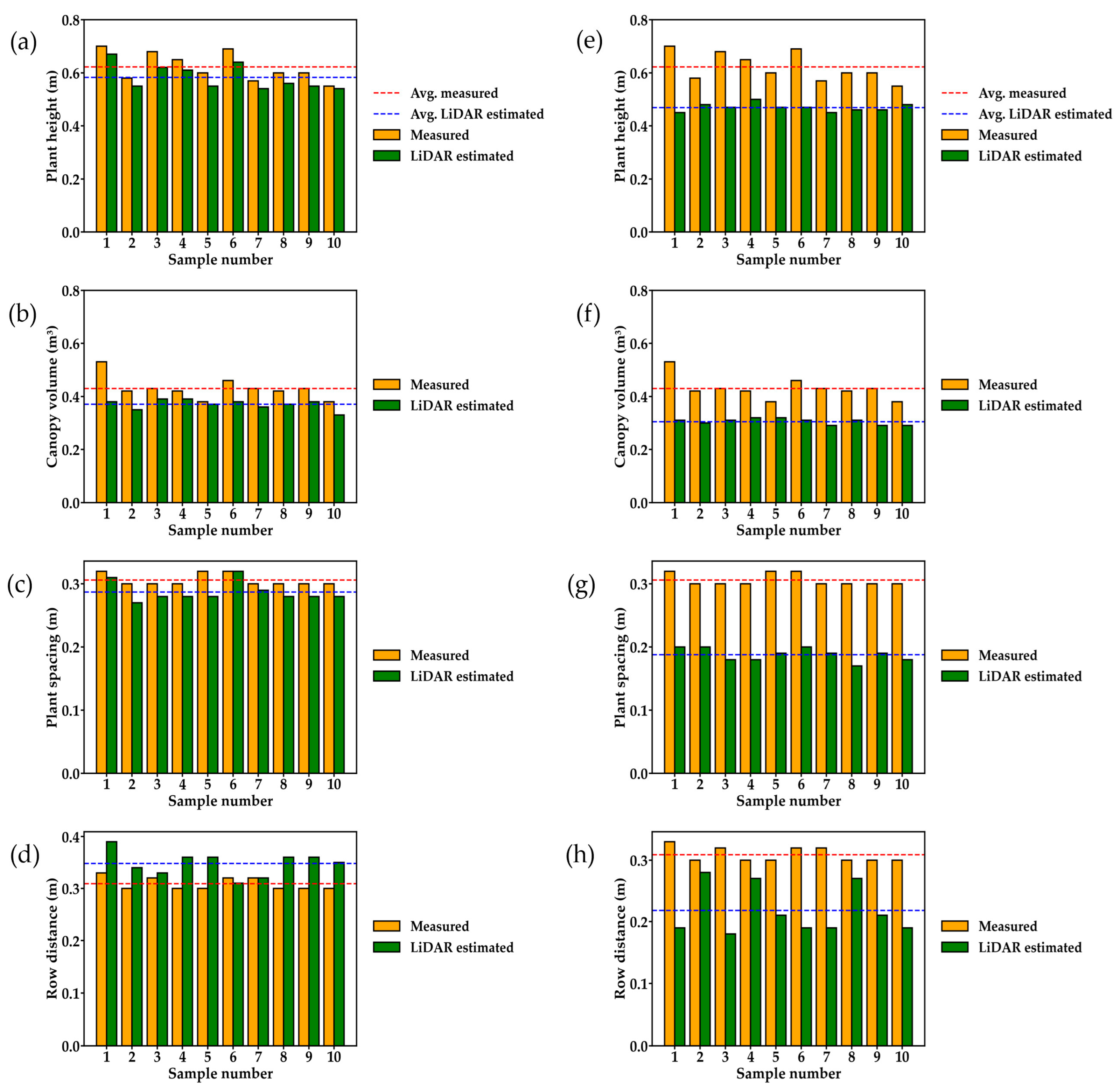
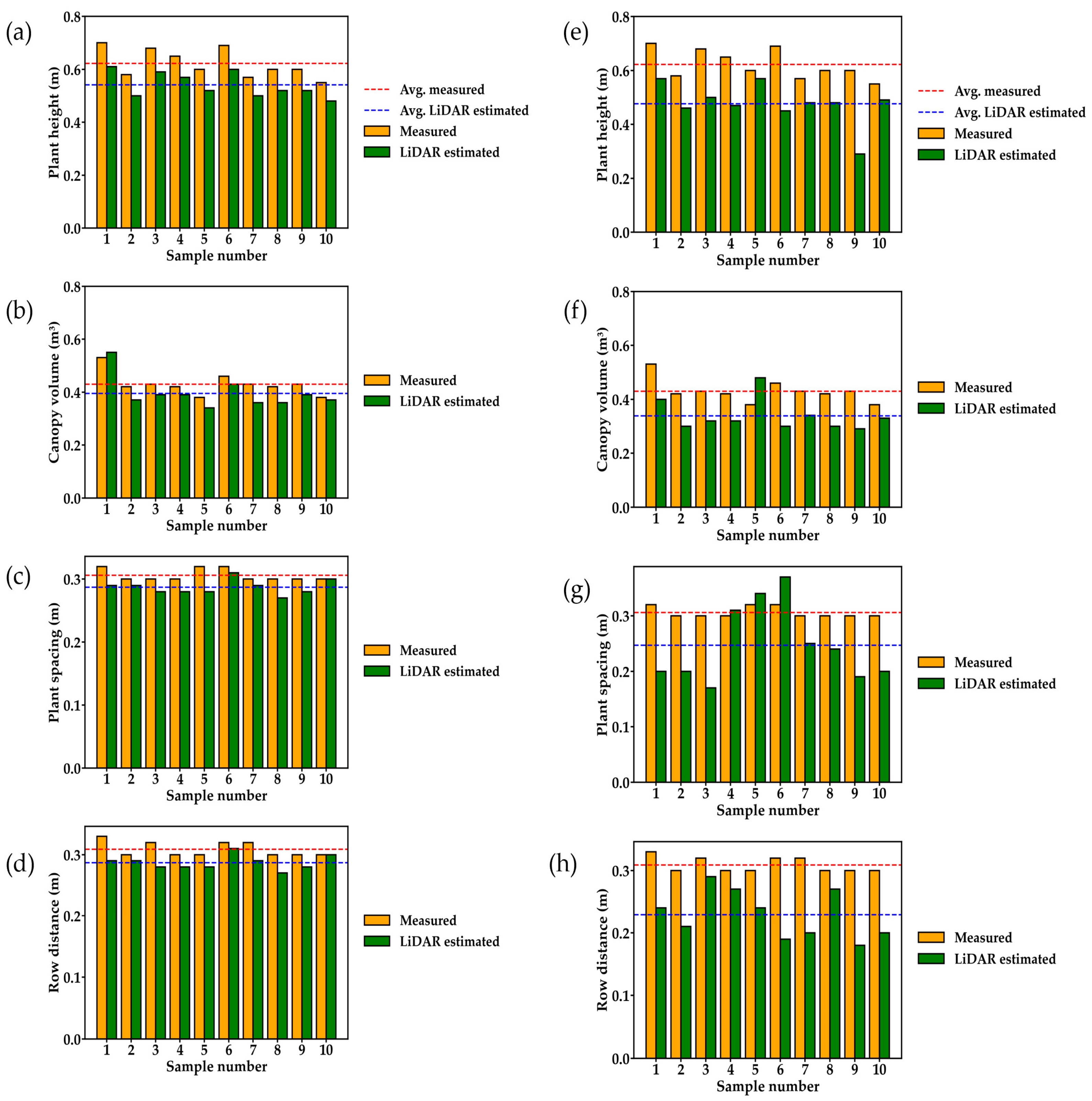
The variability between measured and LiDAR-estimated results is visualized in Figure 11a–d for CHM and in Figure 11e–h for VGM. Orange and green color bars show the measured and LiDAR-estimated results of 10 selected data samples, respectively. The blue and red dotted lines, respectively, indicate LiDAR-estimated and measured average results in the middle growth stage while static data scanning was performed.
Figure 11a–d illustrate the mean differences (bias) between the measured and LiDAR-estimated results for plant height, canopy volume, plant spacing, and row distance in the middle growth stage (103 DAS) by CHM while static data scanning using LiDAR was performed under field conditions. In Figure 11a–d, each bar represents the data sample number, where positive and negative values indicate the overestimation and underestimation of LiDAR-estimated results, respectively. Figure 11a exhibits that LiDAR underestimated the plant height for all the samples (10 samples out of 10), nine samples among them were of 0–0.04 m, and one sample was of 0–0.06 m. This indicated a small mean difference between LiDAR-estimated and measured plant height for CHM. Most of the samples (9 out of 10) showed an underestimation of volume of 0.08 m3, as shown in Figure 11b. Only one sample showed an underestimation of volume of 0.16 m3. LiDAR underestimated plant spacing by 0–0.04 m for 9 out of 10 samples. For one sample, the estimated results were very close to the actual distance measurement, which is shown in Figure 11c. Figure 11d shows that the estimated row distances compare to the measured distances, where bias for most samples (8 out of 10) indicates that the row distance was overestimated by 0–0.06 m. One sample showed underestimation by 0.01 m, and for one sample, the estimated distance was almost equal to the measured distance. This indicates that the distances estimated by CHM were closer to the measured distances for most of the samples in the middle growth stage (103 DAS) when the static data-scanning approach was used.
Figure 11e–h demonstrate the bias between the measured and VGM-estimated LiDAR results for wheat plant height, canopy volume, plant spacing, and row distance in the middle growth stage (103 DAS). A static LiDAR data-scanning approach was used for data collection. In Figure 11e–h, each bar represents the data sample number. Negative values indicate underestimation in the LiDAR results compared to the measured results. Figure 11e shows that LiDAR underestimated plant height for all the samples (10 samples out of 10). For three samples, height was underestimated by up to 0.24 m and for one sample by up to 0.30 m by VGM, which indicates a significant difference in height estimation. Figure 11f shows an underestimation of volume between 0 and 0.15 m3 for 9 samples out of 10. One sample shows an underestimation of volume of 0.22 m. LiDAR underestimated plant spacing and row distances for all the samples, which are shown in Figure 11g and Figure 11h, respectively, in the middle growth stage (103 DAS) by VGM for the static data-scanning approach, where it ranged from 0 to 0.12 m and from 0 to 0.15 m for plant spacing and row distances, respectively.
Figure 12a–h visualizes the plant size and distance variation between the LiDAR-estimated and measured results for CHM and VGM, respectively. Orange and green color bars show the measured and LiDAR-estimated results of 10 selected data samples, respectively. Mean values of the measured and LiDAR-estimated results in the late growth stage are represented by blue and red dotted lines, respectively, for LiDAR-scanned data collected with static scanning.
The bias between the measured and LiDAR-estimated results for plant height, canopy volume, plant spacing, and row distance in the late growth stage (129 DAS) was estimated by CHM while static data scanning was performed under field conditions, as illustrated in Figure 12a–d. For Figure 12a–d, each bar represents the data sample number, where positive and negative values indicate overestimation and underestimation in the LiDAR-estimated results, respectively. It indicates the CHM-estimated measurements in the late growth stage (129 DAS) with static data scanning. Figure 12e–h demonstrate the bias between measured and LiDAR-estimated results in the late growth stage (129 DAS) with VGM, when a static scanning approach was used for data collection. In Figure 12e–h, each bar represents the data sample number, where negative values of bias indicate the underestimation of LiDAR-estimated results for all samples for plant height, canopy volume, plant spacing, and row distance in the late growth stage (129 DAS) by VGM.

3.1.2. Dynamic Data Scanning

Table 4 shows the measured and LiDAR-estimated plant height, canopy volume, plant spacing, and row distance of wheat in the middle growth stage (103 DAS), estimated by CHM and VGM while dynamic LiDAR data scanning was performed. Table 4 shows that LiDAR-estimated heights were 0.54 ± 0.05 m and 0.48 ± 0.08 m, respectively, for CHM and VGM, whereas the measured height was 0.62 ± 0.05 m. CHM and VGM underestimated the average plant height by 0.08 m and 0.14 ± 0.03 m, respectively, compared to the measured results. The RMSE values of 0.08 m and 0.17 m indicated the deviation between the measured and LiDAR-estimated results for CHM and VGM, respectively. The MAE of 0.08 m and the mean difference of −0.08 m for CHM indicated that LiDAR underestimated the plant height by 0.08 m compared to measured results. An MAE of 0.15 m and a mean difference of −0.15 m for VGM indicated that LiDAR underestimated the plant height by 0.15 m compared to the measured results. Although the t-test (t-statistic value of −34.71 and p < 0.001) indicated a difference between the measured and LiDAR-estimated plant height, the 95% CI (−0.09, −0.08) showed a small difference in plant height for CHM, while the t-test (t-statistic value of −5.49 and p < 0.001) indicated a small difference between the measured and LiDAR-estimated plant height. The 95% CI (−0.21, −0.09) indicated a comparatively greater difference in plant height estimation for VGM than for CHM. Thus, the CHM LiDAR-estimated plant height showed a strong correlation with a lower mean difference compared to VGM when a dynamic LiDAR data-scanning approach was used.
For canopy volume, measured and LiDAR-estimated values were 0.43 ± 0.04 m3 and 0.40 ± 0.06 m3, respectively, while LiDAR underestimated the canopy volume with a small value of 0.03 ± 0.02 m3 with CHM. With VGM, the LiDAR-estimated canopy volume was 0.34 ± 0.06 m3, underestimated by a small value of 0.06 m3. This deviation, supported by an RMSE of 0.04 m3 for CHM, showed a strong correlation between the measured and LiDAR-estimated results. Conversely, an RMSE of 0.11 m3 for VGM revealed a lower correlation than CHM between the measured and LiDAR-estimated results. MAEs of 0.04 m3 and 0.11 m3 and mean differences (bias) of −0.04 m3 and −0.11 m3 for the CHM and VGM estimations, respectively, showed that LiDAR underestimated the canopy volume by 0.04 m3 and 0.11 m3 compared to the measured canopy volume. The t-statistic and p-value outcomes of −4.34 and p < 0.001 and −3.94 and p < 0.001 for CHM and VGM, respectively, indicate a statistically significant difference between the LiDAR-estimated and measured canopy volumes. The 95% CI (−0.05, −0.02) and CI (−0.15, −0.04) for CHM and VGM, respectively, indicated that LiDAR underestimated the canopy volume by of 2% to 5% and 4% to 15% compared to the measured volume. The negative CI values confirmed an underestimation of the canopy volumes compared to the measured canopy volume.
LiDAR-estimated plant spacing was 0.29 ± 0.01 m and 0.23 ± 0.04 m, respectively, for CHM and VGM, whereas the measured plant spacing was 0.31 ± 0.01 m. When using both methods, the LiDAR-estimated plant spacing was lower than the measured plant spacing. A low RMSE of 0.02 m showed a strong correlation between measured and LiDAR-estimated results for CHM, while the RMSE value of 0.09 m for VGM showed a lower correlation than for CHM between the measured and LiDAR-estimated results. Furthermore, the MAE and mean difference (bias) values were 0.02 m, −0.02 m and 0.08 m, −0.06 m for CHM and VGM, respectively, indicating that LiDAR underestimated 0.02 m and 0.08 m of lower spacing than the measured spacing, respectively, when using CHM and VGM. In addition, the t-statistic values of −5.02 and p < 0.001 for CHM and −2.88 and p < 0.001 for VGM also indicate moderately small differences between the LiDAR-estimated and measured plant spacings. The 95% CI of −0.03 and −0.01 for CHM and −0.11 and −0.04 indicated that differences in plant spacing ranged from 1% to 3% and 4% to 11%, respectively, for CHM and VGM compared to the measured values.
At measurement of row distance, LiDAR-estimated distances were 0.29 ± 0.01 m and 0.23 ± 0.04 m, respectively, for CHM and VGM, whereas the measured distance was 0.31 ± 0.01 m. The measurement results showed RMSEs of 0.03 m and 0.09 m, respectively, for CHM and VGM, indicating a strong correlation for CHM but a comparatively lower correlation for VGM with the measured row distances. MAE and a mean difference (bias) values of 0.02 m and −0.02 m and 0.08 m and −0.08 m for estimating row distance by CHM and VGM, respectively showed comparatively greater measurement errors by VGM than CHM with respect to the measured row distance. The value of mean differences (bias) indicated a higher estimated row distance with a lower deviation of 0.02 m for CHM and a comparatively higher estimated row distance with a deviation of 0.08 m for VGM with respect to the measured results. The t-statistic values of −5.28 and −6.37 for CHM and VGM, respectively, and p < 0.001 indicated a non-significant statistical difference for CHM but a significant difference for VGM between the measured and LiDAR-estimated row distances. The 95% CI values of (–0.03, –0.01) and (–0.11, −0.05) for CHM and VGM, respectively, indicated 1% to 3% underestimation (negative variation) and 5% to 11% underestimation (negative variation) between the measured and LiDAR-estimated row distances.
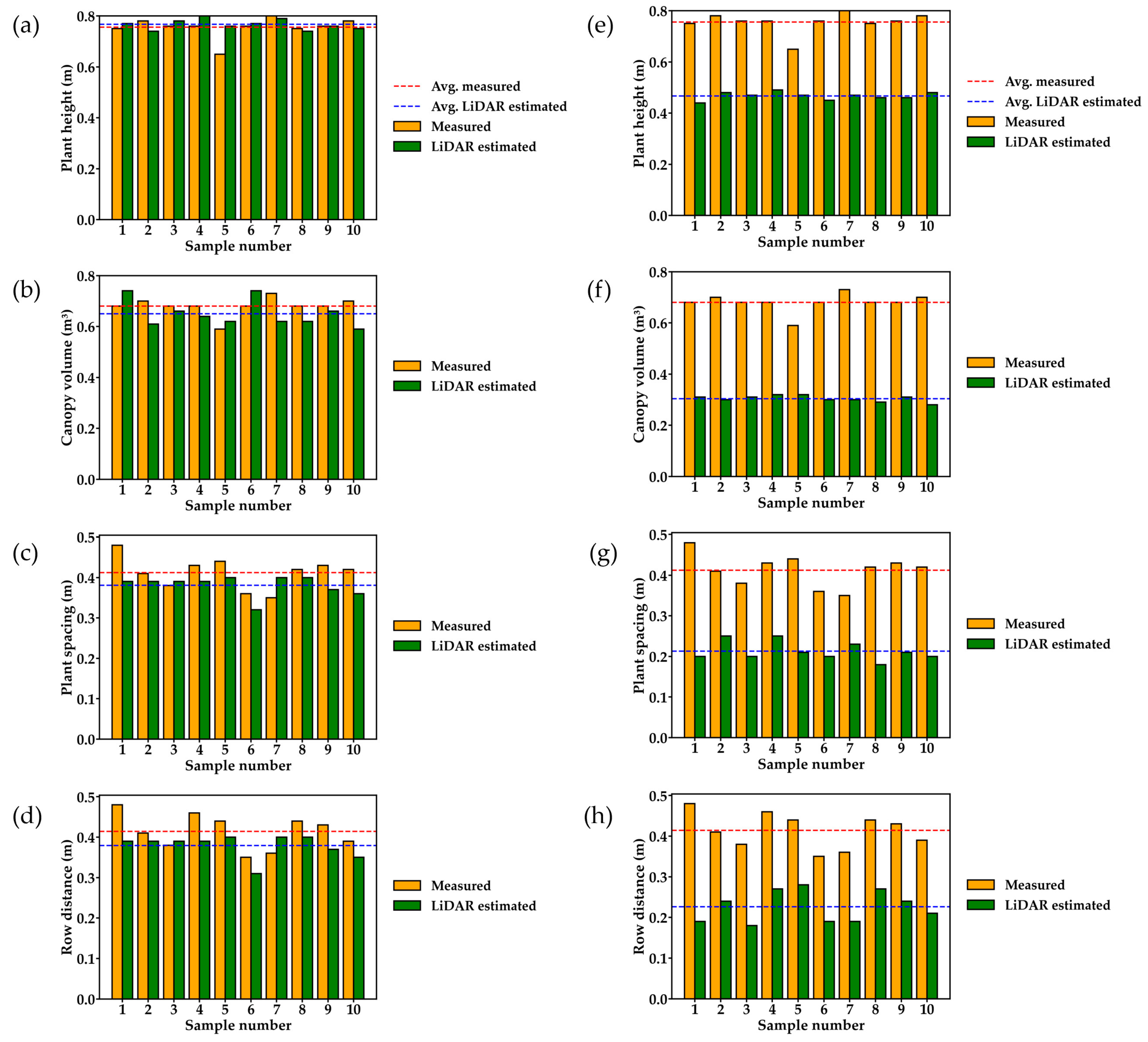
Table 4 presents the measured and LiDAR-estimated results for plant size and distance in the late growth stage (129 DAS). LiDAR-estimated heights of 0.75 ± 0.02 m and 0.48 ± 0.05 m were obtained with CHM and VGM, respectively, whereas the measured height was 0.76 ± 0.04 m. The average plant height was closer to the measured results when estimated with CHM, but it was underestimated by 0.28 ± 0.01 m when VGM was used.
Although significant differences were detected in some paired t-tests, the mean differences between the measured and CHM-estimated values were relatively small, as indicated in the table by similar letters. The CHM outcomes showed non-significant differences from measured values across most parameters, whereas the VGM outcomes showed significant differences from the measured values across most parameters, as indicated with different letters, with most comparisons indicating highly significant differences (p < 0.001). CHM demonstrated higher accuracy than VGM across all measured parameters, exhibiting lower RMSE, MAE, and bias values, indicating closer agreement with the data measured in both growth stages.
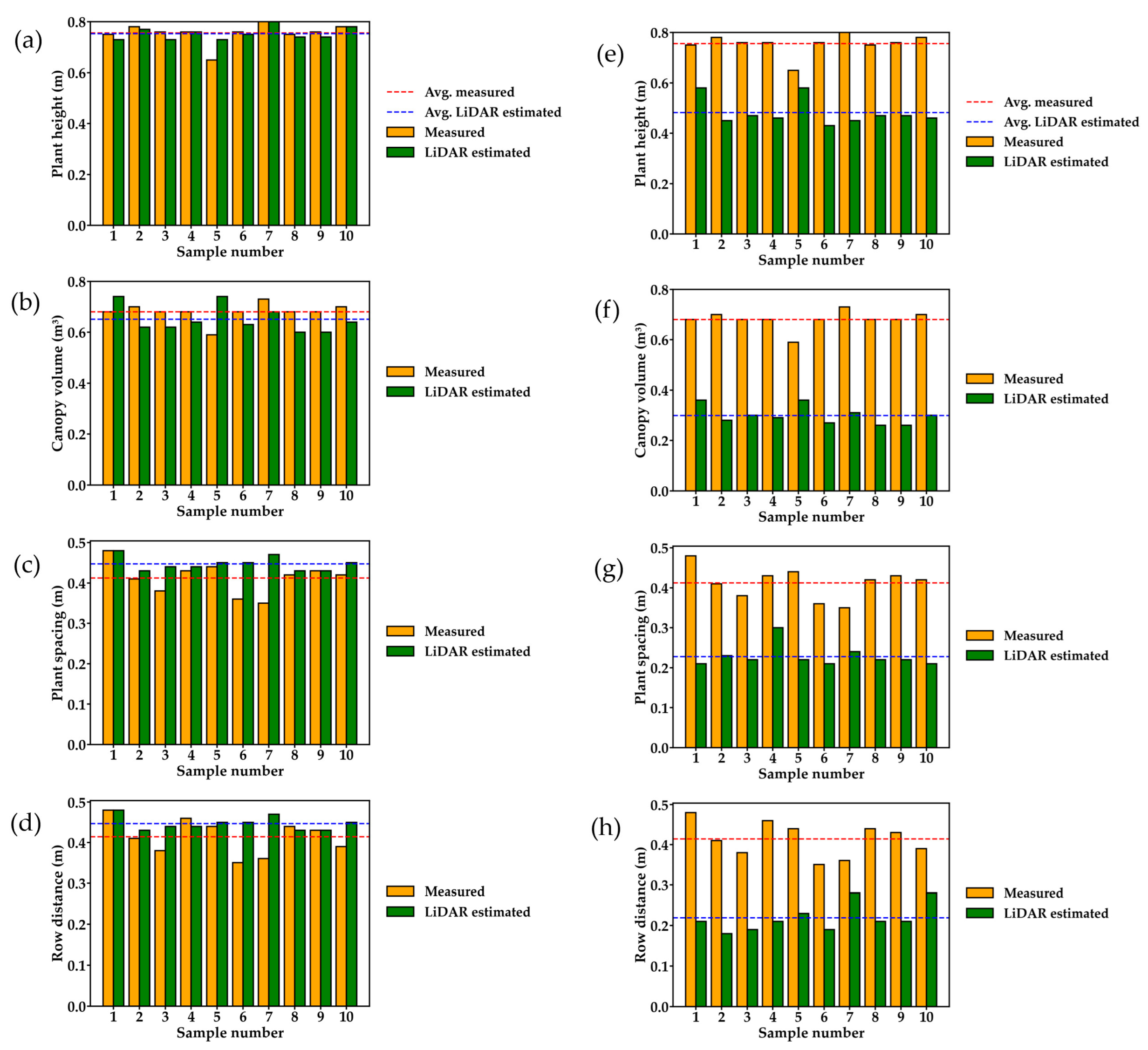
Figure 13a–h visualizes the measured and LiDAR-estimated results for CHM and VGM, respectively. Orange and green color bars show the measured and LiDAR-estimated results of 10 selected data samples, respectively. The blue and red dotted lines, respectively, indicate the mean value of measured and LiDAR-estimated results in the middle growth stage, while dynamic LiDAR data scanning was performed for estimating wheat plant size and distance.
Mean differences (bias) between the measured and LiDAR-estimated results for plant height, canopy volume, plant spacing, and row distance in the middle growth stage (103 DAS) when using CHM are shown in Figure 13a–d. A dynamic LiDAR data-scanning approach was used for data collection. In Figure 13a–d, each bar represents the number of data samples and indicates the overestimation and underestimation in the LiDAR-estimated results, respectively, compared to the measured results. Figure 13a showed that for all samples (10 out of 10), plant height was underestimated with CHM, ranging from 0 to 0.09 m. In Figure 13b, most of the samples (9 samples out of 10) showed an underestimation of canopy volume ranging from 0 to 0.07 m3. LiDAR underestimated plant spacing and row distance for most of the samples (9 out of 10 samples), with values ranging from 0 to 0.04, as shown in Figure 13c,d, respectively, in the middle growth stage (103 DAS), when CHM and dynamic data scanning were applied.
Figure 13e–h show the mean differences (bias) between the measured and LiDAR-estimated results for plant size, such as plant height and canopy volume, and the distances, such as plant spacing and row distance, in the middle growth stage (103 DAS) when using VGM. A dynamic LiDAR data-scanning approach was applied for data collection. Figure 13e shows that for all samples (10 samples out of 10), plant height was underestimated by VGM, with values from 0 to 0.15 for 9 samples out of 10. For only one sample was the plant height underestimated by VGM, with a value of 0.32 m. In Figure 13f, most of the samples (9 out of 10) show an underestimation of canopy volume from 0 to 0.16 m3. Out of 10 samples, only 1 sample showed a value of 0.08 m3, which indicated overestimated volume. Figure 13g showed that for 7 samples out of 10, plant spacing underestimates range from 0 to 0.14. With VGM, LiDAR underestimated the row distances for 10 out of 10 samples, ranging from 0 to 0.13 m, as shown in Figure 13h in the middle growth stage (103 DAS) when dynamic data scanning was applied.
Figure 14a–h illustrates the plant size and distance variation between measured and the LiDAR-estimated results with CHM and VGM, respectively, with dynamic scanning in the late growth stage (129 DAS). Mean differences (bias) between the LiDAR-estimated and measured results are also shown in Figure 14a–h.

3.1.3. Comparison of Relative Accuracy in Growth Stages

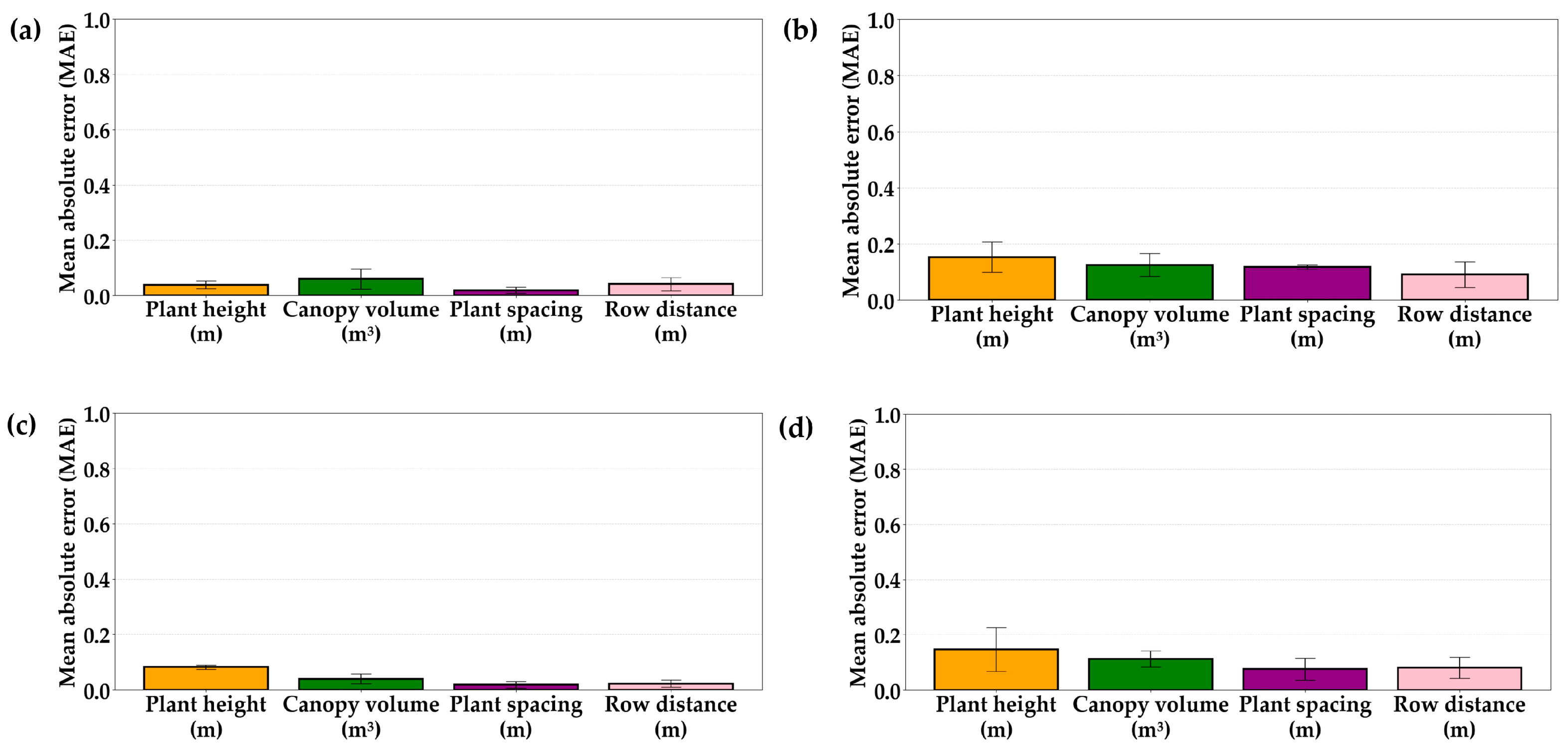
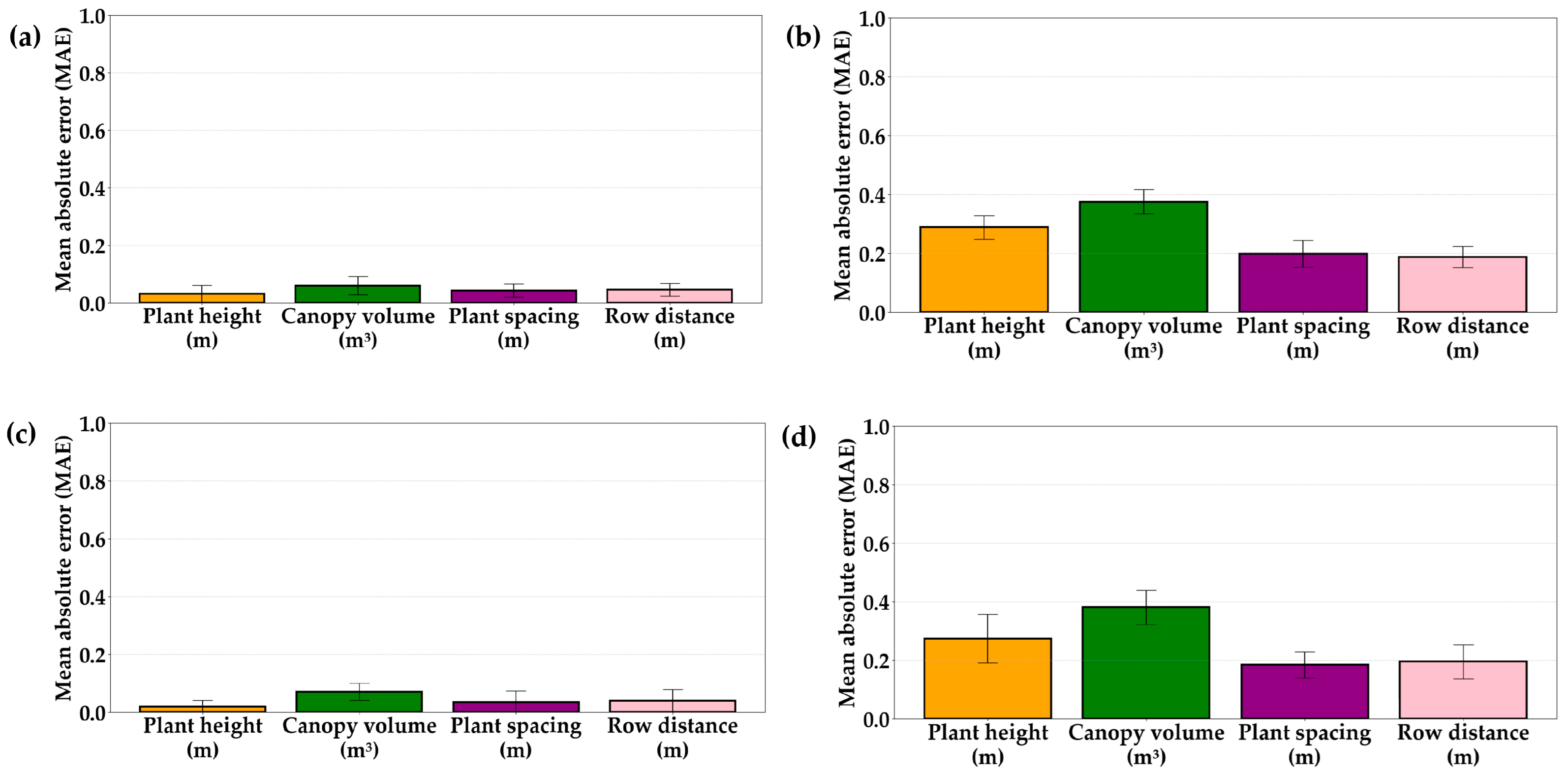
In Figure 15a–d, the bars represent the mean absolute error values, and the error bars indicate the variability (standard deviation) for plant height and canopy volume, plant spacing, and row distance, respectively, while the mean absolute errors were estimated for CHM when data were collected with static LiDAR scanning approach. In Figure 15a, the bars show very low mean absolute error values of 0–0.05, 0–0.1, 0–0.03, and 0–0.05, respectively, for plant height, canopy volume, plant spacing, and row distance within the range of 0 to 0.1. Figure 15b illustrates the mean absolute error for VGM estimation while static LiDAR scanning was performed. The bars show mean absolute error values of 0–0.18, 0–0.15, 0–0.15, and 0–0.1, respectively, which are significant values of mean absolute error for VGM estimation while static LiDAR scanning was performed. Figure 15c,d demonstrates the mean absolute error for the CHM and VGM estimations, respectively, during dynamic data scanning. Figure 15c,d show mean absolute error ranges of 0–0.1, 0–0.05, 0–0.03, 0–0.03, and 0–0.19, 0–0.15, 0–0.11, 0–0.12, respectively, for plant height, canopy volume, plant spacing, and row distance for CHM and VGM when data were collected by dynamic scanning.
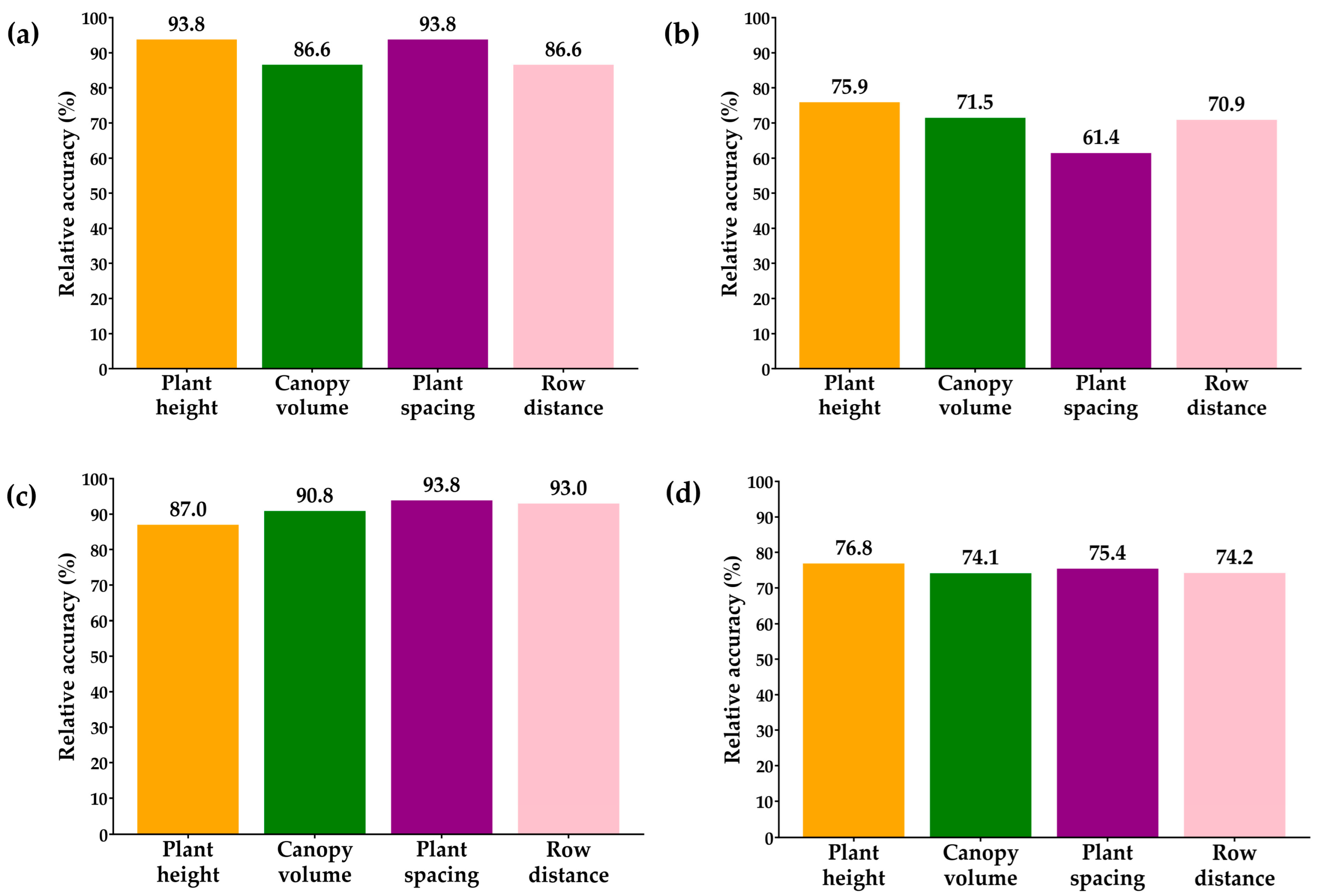
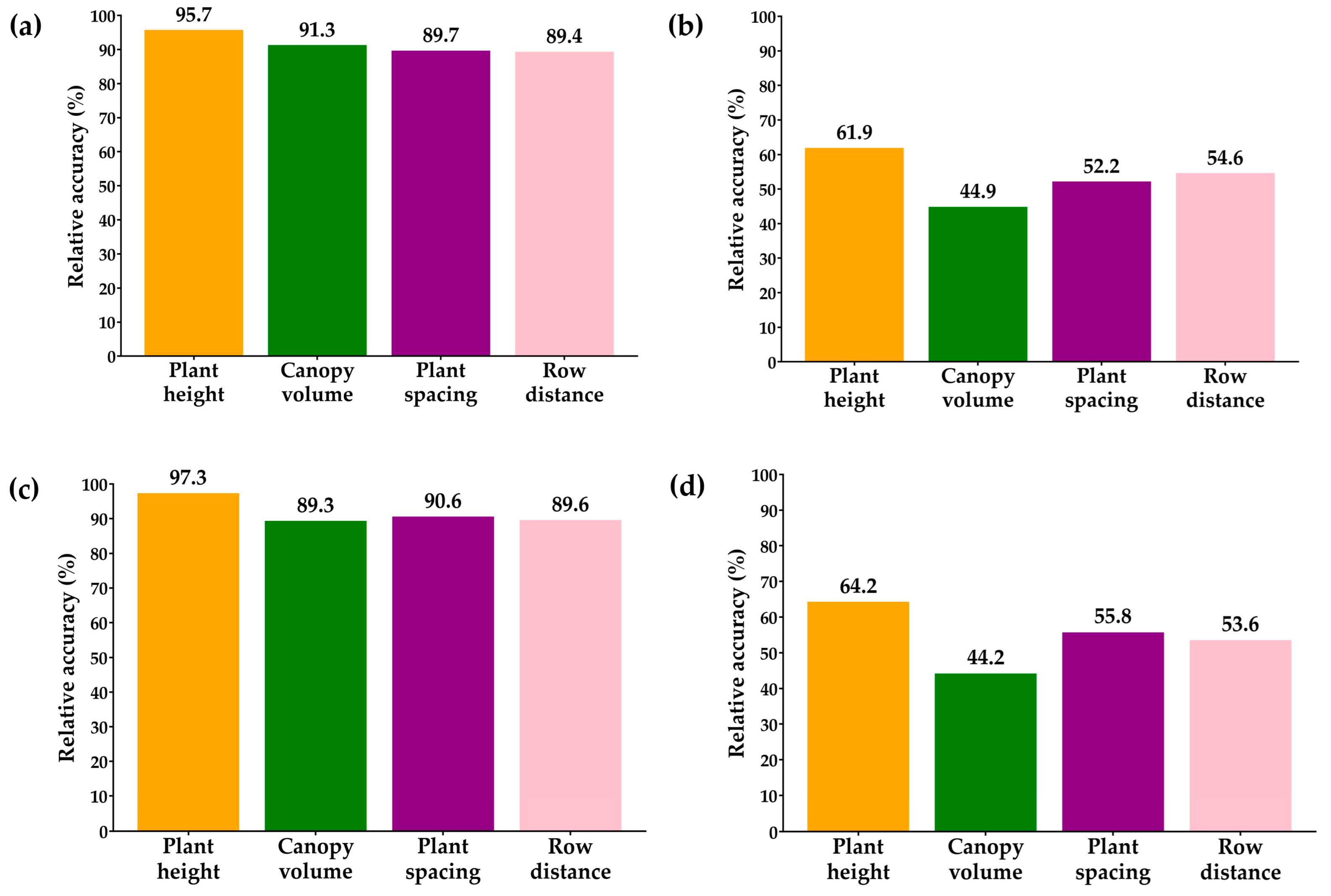
Relative accuracy (%) between the measured and LiDAR-estimated results in the middle growth stage of wheat plants is shown in Figure 16 for CHM (Figure 16a,b) and VGM (Figure 16c,d). Figure 16a,b show that the relative accuracy (%) of the LiDAR-estimated plant height, canopy volume, plant spacing, and row distances with respect to the measured results was 94%, 87%, 94%, and 87%, respectively, for CHM, and 76%, 72%, 62%, and 71% for VGM with the static data-scanning approach. Figure 16c,d show that the relative accuracy (%) of the LiDAR-estimated results for plant height, canopy volume, plant spacing, and row distance compared to the measured results was 87%, 91%, 94%, and 93, respectively, when using CHM and 77%, 74%, 75%, and 74%, respectively, when using VGM with the dynamic scanning approach. These results demonstrate that the LiDAR sensor provided a reliable estimation of wheat plant size and distance, with strong agreement between the estimated and measured results across the plant height, canopy volume, plant spacing, and row distance. The results suggest that between the two methods, CHM and VGM, CHM showed higher accuracy and more reliability than VGM in estimating plant size and distance in the middle and late growth stages with respect to the measured results.
Figure 17a–d illustrate the mean error values, where the error bars indicate the variability (standard deviation) for plant height, canopy volume, plant spacing, and row distance. During this measurements, values were estimated by CHM with static and dynamic LiDAR scanning approaches. The relative accuracy (%) between the LiDAR-estimated and measured results in the late growth stage of wheat plants is shown in Figure 18a,b for CHM and in Figure 17c,d for VGM. The results indicate that between CHM and VGM for estimating the plant size and distance, CHM showed higher accuracy and more reliability than VGM between the two data-scanning approaches in the middle and late growth stages with respect to the measured results.

3.2. Vibration Frequency During Dynamic LiDAR Scanning

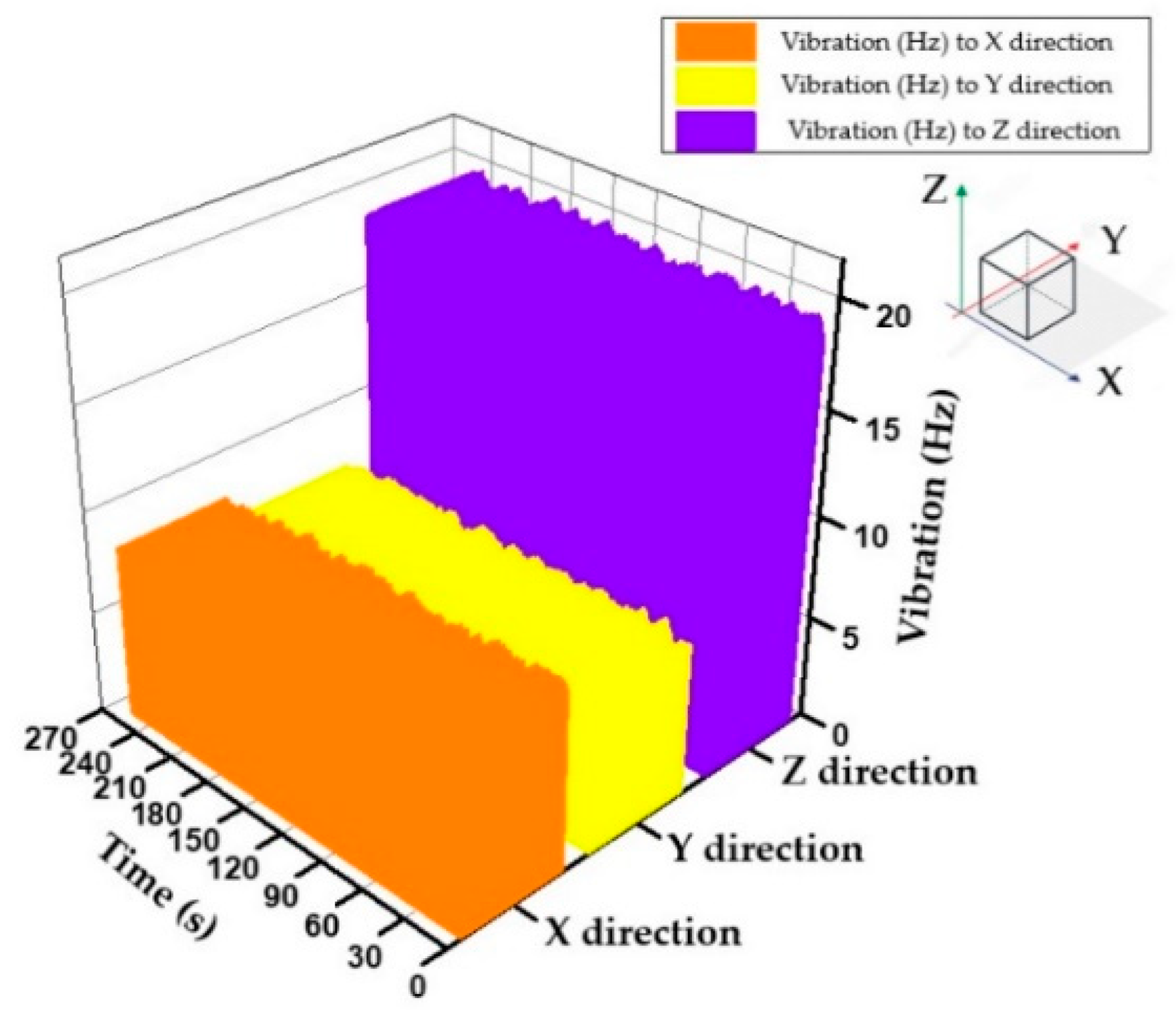
Vibration frequency in the PCD over time is described in Table 5 and illustrated Figure 19 along the three directions (X, Y, and Z) for the late growth stage of wheat plants when a commercial LiDAR setup was used for dynamic data scanning. The highest recorded vibration frequency ranged from 18.18 to 19.99 Hz in the direction of the Z-axis, where the average vibration frequency is 19 ± 0.25 Hz, indicated in violet in Figure 19. Low and medium levels of vibration frequency were recorded from 8.05 to 8.06 Hz and from 6.78 to 8.05 Hz, respectively, in the direction of the X and Y axes, which are indicated with orange and yellow colors in Figure 19. The average values of the lowest and medium levels of vibration frequency were of 9 ± 0.24 Hz and 7 ± 0.18 Hz, respectively, for the direction of the X and Y axes. The most influential vibration frequency is in the vertical (Z-axis) direction, while the vibration frequency in the horizontal directions (X and Y axes) is lower. The stability of vibration frequencies over time demonstrates consistent dynamic movements without significant instability during operation, as well as data collection using sensors. It suggests that during the operation of a LiDAR-mounted data collection platform, the dominant vibration frequencies remain consistent, where random variations occur due to the roughness of the soil surface, wheel and soil interaction, and changes in the forward speed of the sensor.
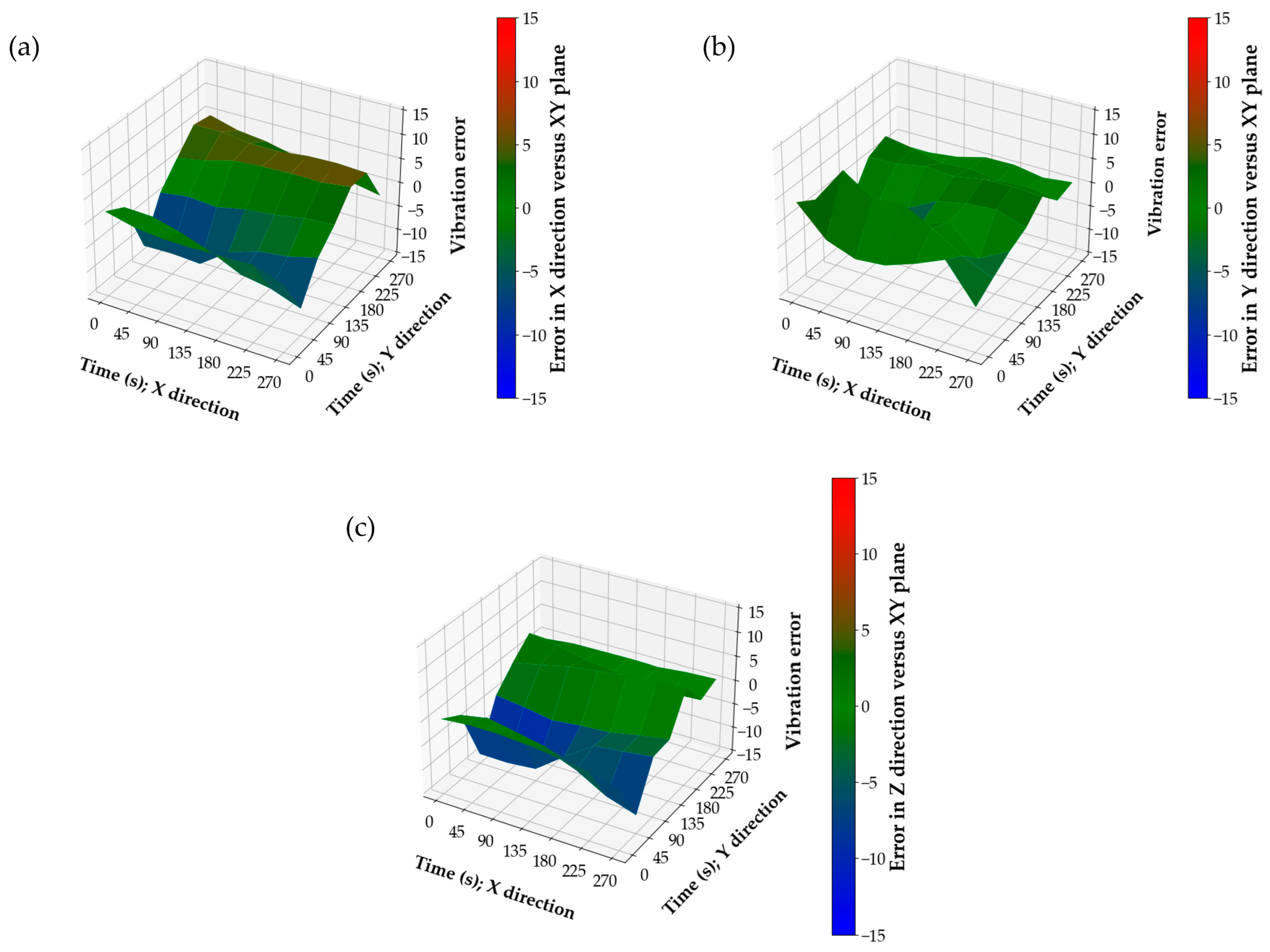
Figure 20a–c illustrate the distribution patterns of smoothed vibration-frequency errors with respect to time, where the vertical (Z) axis represents the vibration-frequency error amplitude. Analytical evaluation of the vibration-frequency data confirms that the vibration-frequency errors for all three axes remain within a fixed range between −15 and +15. The smoothed vibration-frequency errors are exhibited across the 3D index of surface plots as distinct variations over time in the X, Y, and Z directions. Figure 20a–c show that the vibration-frequency errors are changing in the direction of the X, Y, and Z axes ranging from −15 to +15 after applying the Savitzky–Golay filtering technique [56,57]. Moreover, the frequency noise was found to be reduced while there was an underlying vibration condition. Among the three axes, larger error oscillations were enabled in the direction of the X-axis, while more stable and smaller values of errors were found in the direction of the Y and Z axes.
Figure 20a shows the X-axis vibration-frequency error surface, which reveals more vibration-frequency error variations across the grid and is consistent with the time domain plot. Figure 20b,c highlight smoother and comparatively more uniform patterns, reflecting smaller vibration-frequency error variations the in Y- and Z-axis directions. 3D contours clearly visualize the spatial variation in vibration-frequency distribution and show the vibration-frequency exposure differences specified in the axes.

4. Discussion

Two different methods, CHM and VGM, were used to estimate plant size and distance measurements. Zang et al. [5] demonstrated that measured results correlated with LiDAR-estimated results (r > 0.82), and there was variability in the measurement results depending on the different sensing techniques and methods used. In this study, LiDAR underestimated the plant height compared to the measured plant height for both CHM and VGM in the middle and late growth stages for complex plant geometry. Hu et al. [58] demonstrated that LiDAR generally underestimated the plant height compared to the measured height. CHM showed higher accuracy than VGM under all the experimental conditions in this study. In wheat plants, thin leaf structures and dense canopies may influence LiDAR point cloud distribution and measurement accuracy. In this study, CHM showed higher accuracy than VGM. Voxel-based approaches often face difficulties in representing thin leaves, sparse canopy regions, and complex plant geometries. In VGM, voxel size selection is an important factor because individual LiDAR returns do not represent a fixed area or volume [59]. Therefore, voxelization may not fully capture fine canopy structures and empty spaces within the plant canopy. A voxel size of 0.1 m (dimensions: 0.1 m × 0.1 m × 0.1 m) was used in this study, which is within the recommended range for LiDAR canopy analysis. However, some fine canopy structures and sparse leaf regions may not have been fully represented during voxelization. In addition, some missing or sparsely distributed point clouds may have reduced the estimation accuracy of VGM compared with CHM. Numerous reviewed studies also highlighted the importance of voxel size selection, compromising the point density, plant structure, and occlusions, such as a voxel size used for tree characterization that was 0.15 m (dimensions: 0.15 m × 0.15 m × 0.15 m) [60,61]. In this study, a voxel size of 0.1 m (dimensions: 0.1 m × 0.1 m × 0.1 m) was used for the wheat plant size and distance estimation, which was within the limit of the recommended size for better estimation of wheat canopy volume. Ross et al. [59] reported that voxel sizes of 0.1 m (dimensions: 0.1 m × 0.1 m × 0.1 m) and 0.25 m represented canopy gaps ranging from 32 to 78% and 25–68%, respectively, which improved vegetation estimation performance. These findings support the suitability of the 0.1 m (dimensions: 0.1 m × 0.1 m × 0.1 m) voxel size used in the present study. CHM represents the canopy envelope better than VGM, as it is more robust to narrow leaf sparsity. Jang and Ahn [62] compared CHM (alpha shape) and VGM for physical shape analysis of objects and obtained overestimated results in volume estimation regardless of data filtering. The results showed that the eighth filtering stage produced comparatively better measurement accuracy, although the values were still lower than the measured results. CHM appeared to improve dense canopy estimation where LiDAR returns were struggling to penetrate to the top of the highly dense canopy to scan the structure for voxelization [63]. The same challenges need to be addressed in this research for the precise estimation of the canopy volume of the plant.
The sensor-estimated plant size and distance varied under static and dynamic conditions. This phenomenon was caused by the vibration of the platform when it was operating on the uneven terrain of wheat field and affected sensor measurement accuracy. This resulted in vertical smearing of the LiDAR point cloud, shifting the canopy top points downward and leading to the underestimation of the maximum Z-value. Therefore, the estimated plant height was comparatively lower under dynamic conditions than static conditions, despite variations in the density of the point cloud. The static data-scanning approach provided a stationary sensor setup, leading to detecting the top of the canopy and resulting in higher plant height estimates.
Despite the advantages of proximal LiDAR sensing for plant geometric measurements, challenges such as canopy occlusion, complex plant geometry, and overlapping dense leaves may still affect estimation accuracy. Dense canopy structures and overlapping leaves partially blocked the LiDAR laser beams, resulting in incomplete capture of point cloud data, particularly during the late vegetative growth stage. The diverse plant geometry and effect of vibration coming from data collection platforms might be affecting the LiDAR measurement accuracy [13], which was a considerable challenge in this study. Such errors in measurement accuracy limited the effectiveness of the proximal LiDAR sensing technique for size and distance estimation of field crops and the use of a ground vehicle-mounted IoT-derived LiDAR sensing system. Sensor fusion of LiDAR with RGB and RGB-D camera sensors could be a solution [64,65]. Small data samples were another obstacle to obtaining measurements with higher accuracy. Although the data sample size used in this study was limited due to field measurements and LiDAR data-processing constraints, the selected wheat samples exhibited diverse plant sizes, such as height, canopy shapes (area), plant spacing, and row distance between two growth stages under both static and dynamic scanning conditions. Nevertheless, the limited sample size may restrict the broader generalization of the findings under different fields and environmental conditions, wheat cultivars, and field management practices. Therefore, future studies should include larger and more diverse datasets to further validate the performance of LiDAR, CHM, and VGM.

5. Study Limitations

This study has several limitations that should be considered when interpreting the results. The analysis was performed only using data collected in two wheat growth stages, the middle and late growth stages, and the early-growth stage was not considered for data collection. This early-growth stage is characterized by shorter and sparser canopy structures, which should be included in the data collection and processing procedures. Since canopy geometry varies across growth stages, the estimation performance may differ under early-growth stage conditions. Therefore, the consideration of an additional growth stage is necessary to improve the broader applicability of the proposed method and further validate the obtained results.
Manual measurements were used as ground truth references for validation. Although standardized measurement procedures were used to minimize variations in sensor measurements, minor uncertainties associated with manual field measurements may still exist. Nevertheless, manual measurements remain a commonly accepted reference method for evaluating plant characteristics under field conditions.
In addition, the influence of scanning angle, angle of incidence, and sensor-to-plant distance on LiDAR point cloud density and relative accuracy measurements was not separately analyzed in this study. These factors may affect point cloud distribution, canopy occlusion, and the accuracy of plant trait estimation, particularly under dense canopy conditions. Therefore, in future studies, the effects of these parameters should be investigated and compared for the plant size and distance measurements obtained using LiDAR and CHM.

6. Conclusions

This study investigated two methods, CHM and VGM, for estimating the wheat plant size and distances and comparing the relative accuracy for static and dynamic data scanning in the middle and late growth stages. The results demonstrate that the LiDAR sensor provided a reliable estimation of wheat plant size and distance and showed strong agreement with the measured results across the respective plant height, canopy volume, plant spacing, and row distance. The results show that CHM showed higher accuracy in estimating the plant size and distance than VGM in the middle and late growth stages. Several challenges were encountered in this study during data collection, particularly relating to complex plant geometry, occlusion, vibration effects on sensor measurements from the data collection platform, and overlap of densely populated plant leaves. These issues also created several unexpected sources of noise and error in estimating the plant size and plant distance. Future research should focus on considering the combined effects of platform, forward speed, and roughness of field terrain and examine more crop growth stages (considering more data collection intervals) under field conditions, particularly for the dynamic data-scanning approach. Despite having several challenges in PCD processing, the study results provide support for size and plant distance estimation for wheat and similar grains, such as barley, oats, and rice, using a non-destructive approach.

Author Contributions

Conceptualization, M.R.K. and S.-O.C.; methodology, M.R.K. and S.-O.C.; software, M.R.K. and M.N.R.; validation, M.R.K., M.N.R. and D.-H.L.; formal analysis, M.R.K. and M.N.R.; investigation, D.-H.L. and S.-O.C.; resources, S.-O.C.; data curation, M.R.K., M.N.R. and D.-H.L.; writing—original draft preparation, M.R.K.; writing—review and editing, M.R.K., M.N.R., D.-H.L. and S.-O.C.; visualization, M.R.K., M.N.R. and D.-H.L.; supervision, S.-O.C.; project administration, S.-O.C.; funding acquisition, S.-O.C. All authors have read and agreed to the published version of the manuscript.

Funding

This work was supported by Korea Institute of Planning and Evaluation for Technology in Food, Agriculture and Forestry (IPET), through the Agriculture and Food Convergence Technologies Program for Research Manpower Development, funded by Ministry of Agriculture, Food and Rural Affairs (MAFRA) (Project No. RS-2024-00397026), Republic of Korea.

Institutional Review Board Statement

Not applicable.

Data Availability Statement

The original contributions presented in this study are included in the article. Further inquiries can be directed to the corresponding author.

Conflicts of Interest

The authors declare no conflicts of interest.

References

  1. Colaco, A.F.; Schaefer, M.; Bramley, R.G.V. Broadacre mapping of wheat biomass using ground-based LiDAR technology. Remote Sens. 2021, 13, 3218. [Google Scholar] [CrossRef]
  2. Yuan, W.; Li, J.; Bhatta, M.; Shi, Y.; Baenziger, P.S.; Ge, Y. Wheat height estimation using LiDAR in comparison to ultrasonic sensor and UAS. Sensors 2018, 18, 3731. [Google Scholar] [CrossRef]
  3. Zhang, Y.; Yu, C.; Lin, J.; Liu, J.; Liu, B.; Wang, J.; Huang, A.; Li, H.; Zhao, T. OsMPH1 regulates plant height and improves grain yield in rice. PLoS ONE 2017, 12, e0180825. [Google Scholar] [CrossRef] [PubMed]
  4. Guo, T.; Fang, Y.; Cheng, T.; Tian, Y.; Zhu, Y.; Chen, Q.; Qiu, X.; Yao, X. Detection of wheat height using optimized multi-scan mode of LiDAR during the entire growth stages. Comput. Electron. Agric. 2019, 165, 104959. [Google Scholar] [CrossRef]
  5. Zang, J.; Jin, S.; Zhang, S. Field-measured canopy height may not be as accurate and heritable as believed: Evidence from advanced 3D sensing. Plant Methods 2023, 19, 39. [Google Scholar] [CrossRef]
  6. Li, A.; Hao, C.; Wang, Z.; Geng, S.; Jia, M.; Wang, F.; Han, X.; Kong, X.; Yin, L.; Tao, S. Wheat breeding history reveals synergistic selection of pleiotropic genomic sites for plant architecture and grain yield. Mol. Plant 2022, 15, 504–519. [Google Scholar] [CrossRef]
  7. Andujar, D.; Escola, A.; Rosell-Polo, J.R.; Fernandez-Quintanilla, C.; Dorado, J. Potential of a terrestrial LiDAR-based system to characterise weed vegetation in maize crops. Comput. Electron. Agric. 2013, 92, 11–15. [Google Scholar] [CrossRef]
  8. Madec, S.; Baret, F.; de Solan, B.; Thomas, S.; Dutartre, D.; Jezequel, S.; Hemmerle, M.; Colombeau, G.; Comar, A. High-throughput phenotyping of plant height: Comparing unmanned aerial vehicles and ground LiDAR estimates. Front. Plant Sci. 2017, 8, 2002. [Google Scholar] [CrossRef]
  9. Malambo, L.; Popescu, S.C.; Murray, S.C.; Putman, E.; Pugh, N.A.; Horne, D.W.; Richardson, G.; Sheridan, R.; Rooney, W.L.; Avant, R.; et al. Multitemporal field-based plant height estimation using 3D point clouds generated from small unmanned aerial systems high-resolution imagery. Int. J. Appl. Earth Obs. Geoinf. 2018, 64, 31–42. [Google Scholar] [CrossRef]
  10. Araus, J.L.; Cairns, J.E. Field high-throughput phenotyping: The new crop breeding frontier. Trends Plant Sci. 2014, 19, 52–61. [Google Scholar] [CrossRef]
  11. Friedli, M.; Kirchgessner, N.; Grieder, C.; Liebisch, F.; Mannale, M.; Walter, A. Terrestrial 3D laser scanning to track the increase in canopy height of both monocot and dicot crop species under field conditions. Plant Methods 2016, 12, 9. [Google Scholar] [CrossRef]
  12. Morrison, M.J.; Gahagan, A.C.; Hotte, T.; Morrison, H.E.; Kenny, M.; Saumure, A.; Lefevbre, M.B. The Height Pole: Measuring plot height using a single-point LiDAR sensor. Plant Phenome J. 2024, 7, e20097. [Google Scholar] [CrossRef]
  13. Karim, M.R.; Reza, M.N.; Ahmed, S.; Lee, K.-H.; Sung, J.; Chung, S.-O. Proximal LiDAR sensing for monitoring of vegetative growth in rice at different growing stages. Agriculture 2025, 15, 1579. [Google Scholar] [CrossRef]
  14. Tilly, N.; Hoffmeister, D.; Cao, Q.; Huang, S.; Lenz-Wiedemann, V.; Miao, Y.; Bareth, G. Multitemporal crop surface models: Accurate plant height measurement and biomass estimation with terrestrial laser scanning in paddy rice. J. Appl. Remote Sens. 2014, 8, 083671. [Google Scholar] [CrossRef]
  15. Crommelinck, S.; Hofle, B. Simulating an autonomously operating low-cost static terrestrial LiDAR for multitemporal maize crop height measurements. Remote Sens. 2016, 8, 205. [Google Scholar] [CrossRef]
  16. Hammerle, M.; Hoefle, B. Direct derivation of maize plant and crop height from low-cost time-of-flight camera measurements. Plant Methods 2016, 12, 50. [Google Scholar] [CrossRef]
  17. Sun, S.; Li, C.; Paterson, A.H. In-field high-throughput phenotyping of cotton plant height using LiDAR. Remote Sens. 2017, 9, 377. [Google Scholar] [CrossRef]
  18. Eitel, J.U.H.; Magney, T.S.; Vierling, L.A.; Greaves, H.E.; Zheng, G. An automated method to quantify crop height and calibrate satellite-derived biomass using hypertemporal lidar. Remote Sens. Environ. 2016, 187, 414–422. [Google Scholar] [CrossRef]
  19. Eitel, J.U.H.; Vierling, L.; Magney, T. A lightweight, low cost autonomously operating terrestrial laser scanner for quantifying and monitoring ecosystem structural dynamics. Agric. For. Meteorol. 2013, 180, 86–96. [Google Scholar] [CrossRef]
  20. Koren, M.; Mokros, M.; Bucha, T. Accuracy of tree diameter estimation from terrestrial laser scanning by circle-fitting methods. Int. J. Appl. Earth Obs. Geoinf. 2017, 63, 122–128. [Google Scholar]
  21. Wu, D.; Johansen, K.; Phinn, S.; Robson, A. Suitability of airborne and terrestrial laser scanning for mapping tree crop structural metrics for improved orchard management. Remote Sens. 2020, 12, 1647. [Google Scholar] [CrossRef]
  22. Zhou, L.; Gu, X.; Cheng, S.; Yang, G.; Shu, M.; Sun, Q. Analysis of plant height changes of lodged maize using UAV-LiDAR data. Agriculture 2020, 10, 146. [Google Scholar] [CrossRef]
  23. Moreno, H.; Andujar, D. Proximal sensing for geometric characterization of vines: A review of the latest advances. Comput. Electron. Agric. 2023, 210, 107901. [Google Scholar] [CrossRef]
  24. Bao, Y.; Tang, L.; Srinivasan, S.; Schnable, P.S. Field-based architectural traits characterisation of maize plant using time-of-flight 3D imaging. Biosyst. Eng. 2019, 178, 86–101. [Google Scholar] [CrossRef]
  25. Mack, J.; Lenz, C.; Teutrine, J.; Steinhage, V. High-precision 3D detection and reconstruction of grapes from laser range data for efficient phenotyping based on supervised learning. Comput. Electron. Agric. 2017, 135, 300–311. [Google Scholar] [CrossRef]
  26. Cheraiet, A.; Naud, O.; Carra, M.; Codis, S.; Lebeau, F.; Taylor, J. Predicting the site-specific distribution of agrochemical spray deposition in vineyards at multiple phenological stages using 2D LiDAR-based primary canopy attributes. Comput. Electron. Agric. 2021, 189, 106402. [Google Scholar] [CrossRef]
  27. Li, W.; Niu, Z.; Huang, N.; Wang, C.; Gao, S.; Wu, C. Airborne LiDAR technique for estimating biomass components of maize: A case study in Zhangye City, Northwest China. Ecol. Indic. 2015, 57, 486–496. [Google Scholar] [CrossRef]
  28. Anthony, D.; Elbaum, S.; Lorenz, A.; Detweiler, C. On crop height estimation with UAVs. In Proceedings of the 2014 IEEE/RSJ International Conference on Intelligent Robots and Systems (IROS), Chicago, IL, USA, 14–18 September 2014; IEEE: New York, NY, USA, 2014. [Google Scholar]
  29. Liu, L.; Liu, Y.; He, X.; Liu, W. Precision variable-rate spraying robot by using single 3D LIDAR in orchards. Agronomy 2022, 12, 2509. [Google Scholar] [CrossRef]
  30. Rivera, G.; Porras, R.; Florencia, R.; Sánchez-Solís, J.P. LiDAR applications in precision agriculture for cultivating crops: A review of recent advances. Comput. Electron. Agric. 2023, 207, 107737. [Google Scholar] [CrossRef]
  31. Karim, M.R.; Ahmed, S.; Ali, M.; Reza, M.N.; Lee, K.-H.; Sung, J.; Chung, S.-O. A review on stereo vision for feature characterization of upland crops and orchard fruit trees. Precis. Agric. Sci. Technol. 2024, 6, 104–122. [Google Scholar]
  32. Karim, M.R.; Ahmed, S.; Reza, M.N.; Lee, K.-H.; Sung, J.; Chung, S.-O. Geometric feature characterization of apple trees from 3D LiDAR point cloud data. J. Imaging 2025, 11, 5. [Google Scholar] [CrossRef] [PubMed]
  33. Kabir, M.S.; Gulandaz, M.A.; Ali, M.; Reza, M.N.; Kabir, M.S.N.; Chung, S.-O.; Han, K. Yield monitoring systems for non-grain crops: A review. Korean J. Agric. Sci. 2024, 51, 63–77. [Google Scholar] [CrossRef]
  34. Zhang, L.; Grift, T.E. A LIDAR-based crop height measurement system for miscanthus giganteus. Comput. Electron. Agric. 2012, 85, 70–76. [Google Scholar] [CrossRef]
  35. Debnath, S.; Paul, M.; Debnath, T. Applications of LiDAR in Agriculture and Future Research Directions. J. Imaging 2023, 9, 57. [Google Scholar] [CrossRef] [PubMed]
  36. Chakraborty, M.; Khot, L.R.; Sankaran, S.; Jacoby, P.W. Evaluation of mobile 3D light detection and ranging based canopy mapping system for tree fruit crops. Comput. Electron. Agric. 2019, 158, 284–293. [Google Scholar] [CrossRef]
  37. Berk, P.; Stajnko, D.; Belsak, A.; Hocevar, M. Digital evaluation of leaf area of an individual tree canopy in the apple orchard using the LIDAR measurement system. Comput. Electron. Agric. 2020, 169, 105158. [Google Scholar] [CrossRef]
  38. Farhan, S.M.; Yin, J.; Chen, Z.; Memon, M.S. A Comprehensive review of LiDAR applications in crop management for precision agriculture. Sensors 2024, 24, 5409. [Google Scholar] [CrossRef]
  39. Colaco, A.F.; Molin, J.P.; Rosell-Polo, J.R.; Escolà, A. Application of light detection and ranging and ultrasonic sensors to high-throughput phenotyping and precision horticulture: Current status and challenges. Hortic. Res. 2018, 5, 35. [Google Scholar] [CrossRef]
  40. Castrillo, J.; Soilán, M.; Caparrini, N.; Balado, J. A Scoping Review of LiDAR Solutions for Urban Safety of Vulnerable Road Users. Geomatics 2026, 6, 59. [Google Scholar] [CrossRef]
  41. Aasen, H.; Burkart, A.; Bolten, A.; Bareth, G. Generating 3D hyperspectral in formation with lightweight UAV snapshot cameras for vegetation monitoring: From camera calibration to quality assurance. ISPRS J. Photogramm. Remote Sens. 2015, 108, 245–259. [Google Scholar] [CrossRef]
  42. Hu, P.; Chapmanb, C.S.; Wang, X.; Potgieter, A.; Duan, T.; Jordan, D.; Guo, Y.; Zheng, B. Estimation of plant height using a high throughput phenotyping platform based on unmanned aerial vehicle and self-calibration: Example for sorghum breeding. Eur. J. Agron. 2018, 95, 24–32. [Google Scholar] [CrossRef]
  43. Lin, Y. LiDAR: An important tool for next-generation phenotyping technology of high potential for plant phenomics? Comput. Electron. Agric. 2015, 119, 61–73. [Google Scholar] [CrossRef]
  44. Cheraiet, A.; Naud, O.; Carra, M.; Codis, S.; Lebeau, F.; Taylor, J. An algorithm to automate the filtering and classifying of 2D LiDAR data for site-specific estimations of canopy height and width in vineyards. Biosyst. Eng. 2020, 200, 450–465. [Google Scholar] [CrossRef]
  45. Petrovic, I.; Secnik, M.; Hocevar, M.; Berk, P. Vine canopy reconstruction and assessment with terrestrial LiDAR and aerial imaging. Remote Sens. 2022, 14, 5894. [Google Scholar] [CrossRef]
  46. Montazeaud, G.; Langrume, C.; Moinard, S.; Goby, C.; Ducanchez, A.; Tisseyre, B.; Brunel, G. Development of a low cost open-source ultrasonic device for plant height measurements. Smart Agric. Technol. 2021, 1, 100022. [Google Scholar] [CrossRef]
  47. Zhang, Z.; Wang, X.; Lai, Q.; Zhang, Z. Review of variable-rate sprayer applications based on real-time sensor technologies. In Automation in Agriculture—Securing Food Supplies for Future Generations; BoD—Books on Demand: Norderstedt, Germany, 2018; Volume 13, pp. 1–198. [Google Scholar]
  48. Hoffmeister, D. Laser scanning approaches for crop monitoring. Compr. Anal. Chem. 2016, 74, 343–361. [Google Scholar]
  49. Periu, C.F.; Mohsenimanesh, A.; Laguë, C.; McLaughlin, N.B. Isolation of vibrations transmitted to a LIDAR sensor mounted on an agricultural vehicle to improve obstacle detection. Can. Biosyst. Eng. 2013, 55, 33–42. [Google Scholar] [CrossRef]
  50. Schlager, B.; Goelles, T.; Behmer, M.; Muckenhuber, S.; Payer, J.; Watzenig, D. Automotive lidar and vibration: Resonance, inertial measurement unit, and effects on the point cloud. IEEE Open J. Intell. Transp. Syst. 2022, 3, 426–434. [Google Scholar] [CrossRef]
  51. Bietresato, M.; Carabin, G.; Vidoni, R.; Gasparetto, A.; Mazzetto, F. Evaluation of a LiDAR-based 3D-stereoscopic vision system for crop-monitoring applications. Comput. Electron. Agric. 2016, 124, 1–13. [Google Scholar] [CrossRef]
  52. Qi, Y.; Dong, X.; Chen, P.; Lee, K.-H.; Lan, Y.; Lu, X.; Jia, R.; Deng, J.; Zhang, Y. Canopy volume extraction of citrus reticulate blanco cv. shatangju trees using UAV image-based point cloud deep learning. Remote Sens. 2021, 13, 3437. [Google Scholar] [CrossRef]
  53. Wang, F.; Jia, W.; Guo, H.; Zhang, X.; Li, D.; Li, Z.; Sun, Y. Point cloud-based crown volume improves tree biomass estimation: Evaluating different crown volume extraction algorithms. Comput. Electron. Agric. 2024, 225, 109288. [Google Scholar] [CrossRef]
  54. Barber, C.B.; Dobkin, D.P.; Huhdanpaa, H. The Quickhull algorithm for convex hulls. ACM Trans. Math. Softw. (TOMS) 1996, 22, 469–483. [Google Scholar] [CrossRef]
  55. Lecigne, B.; Delagrange, S.; Messier, C. Exploring trees in three dimensions: VoxR, a novel voxel-based R package dedicated to analysing the complex arrangement of tree crowns. Ann. Bot. 2018, 121, 589–601. [Google Scholar] [CrossRef]
  56. Oxby, P.W. An Optimal Weighting Function for the Savitzky-Golay Filter. arXiv 2021, arXiv:2111.11667. [Google Scholar] [CrossRef]
  57. Ma, H.; Wu, J. Analysis of positioning errors caused by platform vibration of airborne LiDAR system. In Proceedings of the 2012 8th IEEE International Symposium on Instrumentation and Control Technology (ISICT) Proceedings, London, UK, 11–13 July 2012; IEEE: New York, NY, USA, 2012; pp. 257–261. [Google Scholar]
  58. Hu, X.; Sun, L.; Gu, X.; Sun, Q.; Wei, Z.; Pan, Y.; Chen, L. Assessing the Self-Recovery Ability of Maize after Lodging Using UAV-LiDAR Data. Remote Sens. 2021, 13, 2270. [Google Scholar] [CrossRef]
  59. Ross, C.W.; Loudermilk, E.L.; Skowronski, N.; Pokswinski, S.; Hiers, J.K.; O’Brien, J. LiDAR Voxel-Size Optimization for Canopy Gap Estimation. Remote Sens. 2022, 14, 1054. [Google Scholar] [CrossRef]
  60. Beland, M.; Baldocchi, D.D.; Widlowski, J.-L.; Fournier, R.A.; Verstraete, M. On seeing the wood from the leaves and the role of voxel size in determining leaf area distribution of forests with terrestrial LiDAR. Agric. For. Meteorol. 2014, 184, 82–97. [Google Scholar] [CrossRef]
  61. Kukenbrink, D.; Schneider, F.D.; Leiterer, R.; Schaepman, M.; Morsdorf, F. Quantification of hidden canopy volume of airborne laser scanning data using a voxel traversal algorithm. Remote Sens. Environ. 2017, 194, 424–436. [Google Scholar] [CrossRef]
  62. Jang, E.K.; Ahn, M. Estimation of single vegetation volume using 3D point cloud-based alpha shape and voxel. Ecol. Resilient Infrastruct. 2021, 8, 204–211. [Google Scholar]
  63. Siebers, M.H.; Fu, P.; Blakely, B.J.; Long, S.P.; Bernacchi, C.J.; McGrath, J.M. Fast, nondestructive and precise biomass measurements are possible using Lidar-based convex hull and voxelization algorithms. Remote Sens. 2024, 16, 2191. [Google Scholar] [CrossRef]
  64. Banerjee, B.P.; Spangenberg, G.; Kant, S. CBM: An IoT enabled LiDAR sensor for in-field crop height and biomass measurements. Biosensors 2022, 12, 16. [Google Scholar] [CrossRef]
  65. Banerjee, B.P.; Spangenberg, G.; Kant, S. Fusion of spectral and structural information from aerial images for improved biomass estimation. Remote Sens. 2020, 12, 3164. [Google Scholar] [CrossRef]
Figure 1. Overview of the wheat experimental site at the Rural Development Administration (RDA), along with a customized data collection structure for PCD collection.
Agriculture 16 01231 g001
Figure 2. Schematic diagram of sensor setup for PCD collection in a wheat field.
Agriculture 16 01231 g002
Figure 3. Customized structure and sensor setup for PCD collection in a wheat field with static data scanning in the middle growth stage (103 DAS).
Agriculture 16 01231 g003
Figure 4. Diagrammatically represented measured data collection of wheat in the middle growth stage (103 DAS). (a) plant height (m); (b) canopy volume (m3); (c) plant spacing (m); (d) row distance (m).
Agriculture 16 01231 g004
Figure 5. PCD collection at the late growth stage (129 DAS) in static and dynamic LiDAR scanning approaches. (a) Commercial accelerometer for vibration measurement; (b) LiDAR sensor setup with customized wheeled aluminum structure for data collection with dynamic LiDAR scanning approach.
Agriculture 16 01231 g005
Figure 6. Schematic diagram of preprocessing and visualization of PCD for estimating wheat plant size and distance.
Agriculture 16 01231 g006
Figure 7. Sensor data processing for visualization and estimating plant size and distance of wheat, such as plant height, plant spacing, and row distance, using PCD at middle growth stage (103 DAS) using CHM and static data scanning. The same steps are applicable for visualization and estimating the plant size and distance at the late growth stage (129 DAS) and static data scanning—a similar, relevant figure is not repeated.
Agriculture 16 01231 g007
Figure 8. Sensor-estimated data preprocessing for visualization and estimation of canopy volume in the middle growth (103 DAS) stage by CHM for static data scanning. Similar steps of CHM are applied also for visualization and estimation of the canopy volume for dynamic data scanning in the middle growth stage. At the late growth stage (129 DAS), similar steps of CHM are applied for both static and dynamic data scanning, and the relevant figure is not repeated. Point cloud colors represent relative height (z-coordinate) values, with blue indicating lower elevations, green intermediate height, yellow height greater than green, and red indicating highest elevations.
Agriculture 16 01231 g008
Figure 9. Sensor-estimated data preprocessing for the visualization and estimation of the distance of ten wheat plant samples in the middle growth stage (103 DAS) by VGM. (a) Plant spacing (distance between green markers) in a single row; (b) row distance (distance between yellow lines).
Agriculture 16 01231 g009
Figure 10. Sensor-estimated data preprocessing for visualization and estimation of canopy volume in the middle-growth (103 DAS) stage using VGM for static data scanning. Similar VGM steps are applied also for visualization and estimation of the canopy volume for dynamic data scanning in the middle growth stage. In the late growth stage (129 DAS), similar VGM steps are applied for both static and dynamic data scanning, and the relevant figure is not repeated. Point cloud colors represent relative height (z-coordinate) values, with blue indicating lower elevations, green intermediate height, yellow height greater than green, and red indicating highest elevations.
Agriculture 16 01231 g010
Figure 11. Wheat plant size estimation in the middle growth stage (103 DAS) by (ad) CHM and (eh) VGM while static data scanning using LiDAR. (a) Plant height (m); (b) canopy volume (m3); (c) plant spacing (m); (d) row distance (m) by CHM; (e) plant height (m); (f) canopy volume (m3); (g) plant spacing (m); and (h) row distance (m) by VGM.
Agriculture 16 01231 g011
Figure 12. Wheat plant size estimation in the late growth stage (129 DAS) by (ad) CHM and voxel grid (eh) method while static data scanning using LiDAR. (a) Plant height (m); (b) canopy volume (m3); (c) plant spacing (m); (d) row distance (m) by CHM; (e) plant height (m); (f) canopy volume (m3); (g) plant spacing (m); and (h) row distance (m) by VGM.
Agriculture 16 01231 g012
Figure 13. Wheat plant size estimation in the middle growth stage (103 DAS) by (ad) CHM and voxel grid (eh) method while dynamic data scanning using LiDAR. (a) Plant height (m); (b) canopy volume (m3); (c) plant spacing (m); (d) row distance (m) by CHM; (e) plant height (m); (f) canopy volume (m3); (g) plant spacing (m); and (h) row distance (m) by VGM.
Agriculture 16 01231 g013
Figure 14. Wheat plant size estimation in the late growth stage (129 DAS) by (ad) CHM and (eh) VGM while dynamic data scanning using LiDAR. (a) Plant height (m); (b) canopy volume (m3); (c) plant spacing (m); (d) row distance (m) by CHM; (e) plant height (m); (f) canopy volume (m3); (g) plant spacing (m); and (h) row distance (m) by VGM.
Agriculture 16 01231 g014
Figure 15. Wheat plant size estimation in the middle growth stage (103 DAS) using LiDAR: (a) Mean absolute error using CHM with static scanning; (b) mean absolute error using VGM with static scanning; (c) mean absolute error using CHM with dynamic scanning; and (d) mean absolute error using VGM with dynamic scanning.
Agriculture 16 01231 g015
Figure 16. Comparison of RA (%) between measured and LiDAR-estimated results of wheat plants for estimating plant size and distances at the middle growth stage (103 DAS): (a) CHM using static scanning, (b) VGM using static scanning, (c) CHM using dynamic scanning, and (d) VGM using dynamic scanning.
Agriculture 16 01231 g016
Figure 17. Wheat plant size estimation in the late growth stage (129 DAS), while static and dynamic scanning were performed using LiDAR. (a) Mean error estimated by CHM while performing the static LiDAR scanning; (b) mean error estimated by VGM while performing the static LiDAR scanning; (c) mean error estimated by CHM while performing the dynamic LiDAR scanning; and (d) mean error estimated by VGM while performing the dynamic LiDAR scanning.
Agriculture 16 01231 g017
Figure 18. Comparison of relative accuracy between measured and LiDAR-estimated results of wheat plants for estimating plant size and distances at the late growth stage (129 DAS), while static and dynamic scanning were performed using LiDAR. (a) CHM during static LiDAR scanning; (b) VGM during static LiDAR scanning; (c) CHM during performing dynamic LiDAR scanning; and (d) VGM during dynamic LiDAR scanning.
Agriculture 16 01231 g018
Figure 19. Visualization of vibration-frequency exposure in X, Y, and Z directions from the data collection platform and the working environment during PCD collection of wheat using LiDAR in the late growth stage (129 DAS).
Agriculture 16 01231 g019
Figure 20. Visualization of vibration-frequency errors of the working environment during LiDAR data acquisition in the late growth stage (129 DAS). (a) Vibration-frequency errors in the X direction versus the XY plane; (b) vibration-frequency errors in the Y direction versus the XY plane; and (c) vibration-frequency errors in the Z direction versus the XY plane.
Agriculture 16 01231 g020
Table 1. Technical features and detailed specifications of the LiDAR sensor used in this study.
Technical FeaturesDetailed Specifications
Operational
features
Number of channels: 16
Measurement range: up to 100 m
Range accuracy: up to ±3 cm (typical)
Field of view (FOV):15.0° to −15.0°
Vertical field of view (VFOV): 30°
Horizontal field of view (HFOV): 360°
Vertical angular resolution (VAR): 2.0°
Horizontal angular resolution (HAR): 0.1–0.4°
Rotation rate: 5–20 Hz
Optical featureLaser wavelength of 903 nm
Electro-mechanical featuresOperational power: 8 W
Operating voltage: 9–18 V
Temperature range: −10 °C to +60 °C
Output100 Mbps Ethernet connection
Scanning rate: 300,000 points s−1 (single return mode)
600,000 points s−1 (dual return mode)
Table 2. Sensors and data loggers were used for vibration-frequency measurement in this study.
Sensor and Data LoggersTechnical Specifications
Tri-axial accelerometerDimension: 20 mm × 14 mm × 14 mm
Sensitivity (±10%): 10.2 mV/(ms−2)
Measurement range: ±490 ms−2 pk
Frequency range (±5%): 2~5000 Hz
Frequency range (±10%): 1.4~6500 Hz
Frequency: ≥25 kHz (resonant)
Transverse sensitivity: ≤5%
Excitation voltage: 20~30 V DC
Constant current excitation: 2~20 mA
Data loggerNumber of channels: 4
Dimension: 254 mm × 88 mm × 59 mm
Slots: 1~4
Timing accuracy: 50 ppm
Resolution: 32 bits
Timing resolution: 12.5 ns
Maximum input or output frequency: 1 MHz; input voltage protection: −20~25 V
Output voltage protection: −15~20 V
Data collection moduleDifferential analog input channels: 4
Analog input voltage range: −5~5 V
Maximum sample rate: 51.2 kS s−1 ch−1
Table 3. Statistical summary of measured and LiDAR-estimated plant size and distance of wheat plants in the middle (103 DAS) and late (129 DAS) growth stages by CHM and VGM with static data scanning.
Growth StageMeasurement ParametersMeasured Results Sensor Measurement Results
MethodsRMSEMAEBiast-Statisticp-ValueCISignificance
CHMVGMCHMVGMCHMVGMCHMVGMCHMVGMCHMVGMCHMVGMCHMVGM
Middle
(103 DAS)
Plant height (m)0.62 ± 0.05 a0.58 ± 0.05 a0.47 ± 0.02 c0.040.160.040.15−0.04−0.15−8.51−8.55<0.001<0.001(−0.05, −0.03)(−0.19, −0.11)NS***
Canopy volume (m3)0.43 ± 0.04 a0.37 ± 0.02 a0.31 ± 0.01 c0.070.130.060.13−0.06−0.13−5.03−9.25<0.001<0.001(−0.09, −0.03)(−0.16, −0.09)NS***
Plant spacing (m)0.31 ± 0.01 a0.29 ± 0.01 a0.19 ± 0.01 b0.020.120.020.12−0.02−0.12−5.46−40.60<0.001<0.001(−0.03, −0.01)(−0.13, −0.06)NS***
Row distance (m)0.31 ± 0.01 a0.29 ± 0.01 a0.22 ± 0.04 b0.020.100.040.090.04−0.094.39−6.00<0.001<0.001(−0.02, −0.06)(−0.13, −0.06)NS***
Late
(129 DAS)
Plant height (m)0.76 ± 0.04 a0.77 ± 0.02 a0.47 ± 0.01 b0.040.290.030.290.01−0.290.79−21.610.45<0.001(−0.02, 0.04)(−0.32, −0.26)NS***
Canopy volume (m3)0.68 ± 0.04 a0.65 ± 0.05 a0.30 ± 0.01 b0.070.370.060.38−0.03−0.38−1.47−27.170.20<0.001(−0.08, 0.02)(−0.41, −0.35)NS***
Plant spacing (m)0.41 ± 0.04 a0.38 ± 0.02 a0.21 ± 0.02 b0.050.200.040.20−0.03−0.202.50−13.320.03<0.001(−0.06, −0.01)(−0.23, −0.17)NS***
Row distance (m)0.41 ± 0.04 a0.38 ± 0.03 a0.23 ± 0.04 b0.050.190.050.19−0.04−0.19−2.93−15.550.02<0.001(−0.06, −0.01)(−0.22, −0.16)NS***
*** indicates highly significant (p < 0.001); NS indicates non-significant differences. The same letter indicates non-significant differences, and different letters within the same row indicate significant differences at p < 0.05. CHM refers to the canopy height method; VGM indicates the voxel grid method; RMSE is root mean square error; and MAE indicates mean absolute error.
Table 4. Statistical summary of measured and LiDAR-estimated plant size and distance of wheat plants in the middle (103 DAS) and late (129 DAS) growth stages by CHM and VGM with dynamic data scanning.
Growth StageMeasurement
Parameters
Measured
Results
Sensor Measurement Results
MethodsRMSEMAEBiast-Statisticp-ValueCISignificance
CHMVGMCHMVGMCHMVGMCHMVGMCHMVGMCHMVGMCHMVGMCHMVGM
Middle (103 DAS)Plant height (m)0.62 ± 0.05 a0.54 ± 0.05 b0.48 ± 0.08 c0.080.170.080.15−0.08−0.15−34.71−5.49<0.001<0.001(−0.09, −0.08)(−0.21, −0.09)****
Canopy
volume (m3)
0.43 ± 0.04 a0.40 ± 0.06 a0.34 ± 0.06 c0.040.120.040.11−0.04−0.09−4.34−3.94<0.001<0.001(−0.05, −0.02)(−0.15, −0.04)NS***
Plant spacing (m)0.31 ± 0.01 a0.29 ± 0.01 a0.25 ± 0.07 b0.020.090.020.08−0.02−0.06−5.02−2.88<0.001<0.001(−0.03, −0.01)(−0.11, −0.01)NS*
Row distance (m)0.31 ± 0.01 a0.29 ± 0.01 a0.23 ± 0.04 b0.030.090.020.08−0.02−0.08−5.28−6.37<0.001<0.001(−0.03, −0.01)(−0.11, −0.05)NS*
Late
(129 DAS)
Plant height (m)0.76 ± 0.04 a0.75 ± 0.02 a0.48 ± 0.05 c0.030.290.190.27−0.01−0.27−0.31−9.860.76<0.001(−0.03, −0.02)(−0.34, −0.21)NS***
Canopy
volume (m3)
0.68 ± 0.04 a0.65 ± 0.05 a0.30 ± 0.03 c0.080.380.070.38−0.03−0.38−1.22−19.630.25<0.001(−0.08, −0.03)(−0.43, −0.34)NS***
Plant spacing (m)0.41 ± 0.04 a0.45 ± 0.02 a0.22 ± 0.01 c0.050.190.040.180.03−0.182.67−12.21<0.05<0.001(0.01, 0.07)(−0.22, −0.15)NS***
Row distance (m)0.41 ± 0.04 a0.45 ± 0.02 a0.22 ± 0.03 c0.060.200.040.200.03−0.202.25−10.09<0.05<0.001(0, 0.07)(−0.24, −0.15)NS***
*** indicates highly significant (p < 0.001); * indicates significant differences (p < 0.05); NS indicates non-significant differences. The same letter indicates non-significant differences, and different letters within the same row indicate significant differences at p < 0.05. CHM refers to the canopy height method; VGM indicates the voxel grid method; RMSE is root mean square error; and MAE indicates mean absolute error.
Table 5. Measurement of vibration-frequency exposure in the field operation environment to investigate the effect on LiDAR sensor data results in the late growth stage (129 DAS).
Vibration Frequency (Hz)Vibration-Frequency Exposure Direction
X-AxisY-AxisZ-Axis
Average9719
Max8.068.0519.99
Min8.056.7818.18
SD0.240.180.25
Disclaimer/Publisher’s Note: The statements, opinions and data contained in all publications are solely those of the individual author(s) and contributor(s) and not of MDPI and/or the editor(s). MDPI and/or the editor(s) disclaim responsibility for any injury to people or property resulting from any ideas, methods, instructions or products referred to in the content.