Article

Drivers of Indonesian Sustainable Palm Oil Certification Adoption: Evidence from Multi-Group Analysis in Riau Province

1
Department of Agricultural and Resource Economics, Kangwon National University, Chuncheon 24341, Republic of Korea
2
Department of Agricultural Technology, Universitas Riau, Pekanbaru 28292, Indonesia
3
Department of Economics, Universitas Riau, Pekanbaru 28292, Indonesia
*
Author to whom correspondence should be addressed.
Agriculture 2026, 16(11), 1229; https://doi.org/10.3390/agriculture16111229

Submission received: 23 April 2026 / Revised: 25 May 2026 / Accepted: 28 May 2026 / Published: 2 June 2026
(This article belongs to the Special Issue Agribusiness’ Role in Food Security)

Abstract

Indonesia, as the world’s major palm oil producer, has promoted the Indonesian Sustainable Palm Oil (ISPO) certification to sustain its global industrial competitiveness and address growing international environmental pressures. Despite being formally introduced in 2011, smallholder participation in ISPO certification remains critically low. In response, the Indonesian government enacted a mandatory ISPO compliance policy, with a transitional phase, for smallholders. This study examines the behavioral predictors of ISPO adoption intention and readiness among two categories of oil palm smallholders in Riau Province, Indonesia: scheme smallholders, who cooperate with firms under nucleus partnership, and independent smallholders, who rely on open market channels with minimal institutional support. Data were collected from 300 smallholders and analyzed using Partial Least Squares Multi-Group Analysis (PLS-MGA), drawing on an extended Theory of Planned Behavior (TPB) framework that incorporates environmental awareness (EA) and collective membership participation (COL) as additional constructs. The findings show that behavioral intention is the influential predictor associated with ISPO adoption readiness across both groups (β = 0.376 for independent; β = 0.229 for scheme smallholders), while perceived behavioral control (PBC) significantly influences readiness among scheme smallholders (β = 0.344), but not among independent smallholders (β = 0.097), reflecting the structural capacity constraints faced by the independent group, particularly land legality. Environmental awareness positively shapes adoption intention among scheme smallholders (β = 0.126) but shows no significant effect among independent smallholders. Collective farmer group membership consistently enhances both adoption intention and readiness across both groups, emerging as the most universally actionable driver of ISPO compliance. These findings underscore the need for differentiated policy interventions, particularly targeted structural support for independent smallholders in terms of land legalization, certification subsidies, and field-based capacity building, to ensure equitable and effective implementation of mandatory ISPO certification.

1. Introduction

Palm oil expansion has emerged as one of the leading drivers of environmental degradation globally, as its cultivation has been closely linked to large-scale deforestation. Apriani et al. [1] reported that land-use change driven by oil palm expansion has accounted for the majority of deforestation over the past five decades. This has been corroborated by numerous scholars documenting a wide range of environmental consequences, including air pollution, land displacement, and biodiversity loss [2,3,4,5]. In response to growing pressure for sustainable commodity production, sustainability certification schemes have expanded considerably in recent years [6].
Among the global oil palm certifications is the Roundtable Sustainable Palm Oil (RSPO), established in 2004, which sets standards encompassing legal compliance, environmental protection, and social responsibility [7]. However, the voluntary nature of RSPO limits its enforcement capacity, particularly among smallholder farmers. In response, Indonesia introduced its own certification scheme, the Indonesian Sustainable Palm Oil (ISPO), in 2011, with legal enforcement mechanisms anchored in government regulation. Despite the strategic importance of ISPO, smallholder participation in certification remains critically low. As of 2022, certified smallholder plantations represented only approximately 1% of total smallholder area, roughly 58,289 out of 6.2 million hectares (1 ha = 10,000 m2) [8]. In their 2024 study, Aisyah et al. [9] observed that smallholder participation in certification remains considerably low, accounting for only 4% of the total certified area, approximately 270,800 hectares. This is particularly concerning given that 2.4 million smallholder farmers manage 41% of Indonesia’s total oil palm area [10].
Prior studies have consistently identified limited knowledge of certification requirements [11,12], high adoption costs, and land legality issues as the primary barriers to ISPO adoption [1,13]. In response to persistently low uptake, the Indonesian government enacted a mandatory ISPO compliance policy for smallholders in 2025, with transition periods to facilitate smallholders’ readiness. Under this regulatory context, smallholders now will face legal consequences for non-compliance, making an understanding of their adoption behavior both timely and policy-relevant.
Nevertheless, the enactment of a mandatory policy does not inherently guarantee smallholder readiness for compliance. Meeting ISPO standards demands not only regulatory awareness but also a demonstrated willingness and sufficient practical capacity to fulfill its technical and administrative requirements. These are conditions that remain uncertain among smallholders characterized by limited financial resources and access to extension services, in addition to inadequate land documentation [14,15]. Denashurya et al. [14] observed that failing to account for smallholder farmers’ willingness to embrace the Indonesian Sustainable Palm Oil (ISPO) certification scheme may give rise to a range of unintended consequences. In this regard, examining the behavioral predictors underlying smallholders’ adoption intention and readiness becomes particularly critical, as it provides an empirical basis for evaluating the extent to which smallholders are genuinely prepared to comply during the transitional period while simultaneously informing targeted policy interventions where support is most urgently needed.
A growing body of literature has applied the Theory of Planned Behavior (TPB) to examine farmers’ intentions toward sustainable agricultural practices, including palm oil certification. Studies by Suroso et al. [16] and Hendrawan & Musshoff [17] demonstrated that attitude, subjective norms, and perceived behavioral control are key predictors of adoption intention in the context of RSPO certification and oil palm agroforestry, respectively. However, research specifically addressing ISPO certification, particularly with its legally binding dimension, remains limited. Denashurya et al. [14] and Revi [18] represent notable exceptions, yet both focus predominantly on barriers to adoption without examining behavioral heterogeneity across different smallholder types, i.e., scheme and independent smallholders. Critically, scheme smallholders operate under corporate nucleus supervision; a partnership program with firms, while independent smallholders rely on open market channels with minimal institutional support; this suggests that adoption behavior may differ substantially between these groups [15]. A limited number of prior studies have applied a multi-group behavioral framework to assess and compare ISPO adoption intention and readiness across these two categories of oil palm smallholders.
To address this gap, this study aims to examine the predictors of ISPO adoption intention and readiness among oil palm smallholders, with a specific focus on comparing behavioral differences between scheme and independent smallholders. The findings are expected to generate differentiated, evidence-based policy recommendations that inform targeted government interventions in support of mandatory ISPO compliance among oil palm smallholders. Drawing on an extended TPB framework that integrates environmental awareness from the Theory of Environmentally Responsible Behavior (ERB) [19] and collective membership participation (COL), the study applies Partial Least Squares Multi-Group Analysis (PLS-MGA).
The theoretical extension of TPB with ERB is particularly essential in this study, given that ISPO certification is fundamentally grounded in environmental compliance with respect to sustainable development goals (SDGs), encompassing biodiversity protection, deforestation prevention, and sustainable land management, with the principles of transparency and good agricultural practices [20]. While TPB effectively captures the motivational and social dimensions of behavioral intention, it does not explicitly account for individuals’ environmental cognition. Drawing on Hines et al. [19], who established that environmental awareness precedes pro-environmental action, incorporating EA as an extended construct enables a more comprehensive assessment of whether smallholders’ environmental cognition shapes their intention and readiness to adopt ISPO, beyond what the core TPB constructs alone can explain. Thus, integrating the environmental perspective into TPB is essential as a predictive factor estimated to drive behavioral intention [21,22].

2. Materials and Methods

2.1. Data Source and Sampling Method

This study was conducted among oil palm smallholders in Riau Province, focusing on three districts: Indragiri Hulu (INHU), Kampar, and Siak. The selection of these districts was determined through a purposive sampling approach, informed by focus group discussions (FGDs) conducted with farmer group representatives, oil palm practitioners, and agricultural extension experts affiliated with the University of Riau (UNRI). These FGDs served to identify districts with the highest concentration of both scheme and independent smallholders, as well as to assess the general conditions and institutional landscape of oil palm farming in each area. At the respondent level, a simple random sampling procedure was applied through coordination with local farmer group leaders in each district, who facilitated access to registered smallholder members within their respective groups. Data collection was conducted between 30 March and 30 April 2024, with the assistance of trained enumerators coordinated through the University of Riau. Table 1 presents the characteristics of smallholders.
The final dataset comprises 300 smallholders, exceeding the minimum sample size requirement of 200 recommended for structural equation modeling [23,24] and satisfying the criterion proposed by Hair et al. [25] that the minimum sample size should be at least ten times the maximum number of estimated paths in the model. The sample consists of 185 scheme smallholders distributed across Kampar (47), Indragiri Hulu (53), and Siak (85), and 115 independent smallholders from Kampar (40), Indragiri Hulu (38), and Siak (37). Although a balanced group distribution was initially intended, the recruitment of independent smallholders proved more challenging in practice due to their geographic dispersion and the absence of a centralized institutional network, which is acknowledged as a limitation of the sampling procedure. Nevertheless, we conducted the post hoc power analysis using the G*power version 3.1.9.7 to estimate whether the value of (N = 115) for independent smallholders is adequate. Using a medium effect size (f2 = 0.15) as a conservative reference, with α = 0.05 and N = 115, the achieved power for the behavioral intention model (INT) with five predictors was 0.899, and for the ISPO adoption readiness model with four predictors it was 0.921. Both results exceed the minimum acceptable threshold of 0.80, indicating that the independent smallholder sample is still sufficiently powered to detect medium-to-large effects and supports the reliability of the group comparison findings. In addition, the unequal group sizes do not compromise the validity of the multi-group comparison, as PLS-MGA employs a nonparametric bootstrapping procedure with 5000 resamples to estimate path coefficients and assess between-group differences, an approach that does not assume equal group sizes or normal distribution of the data [26,27,28].

2.2. Sustainable Palm Oil Certification and Smallholder Adoption: Evidence from Prior Studies

The global expansion of sustainability certification schemes in agricultural commodities has generated a growing body of research examining the factors that facilitate adoption among smallholder farmers. In the context of palm oil, certification has emerged as a central policy instrument to reconcile the economic importance of the sector with mounting international environmental pressure [6]. The Roundtable on Sustainable Palm Oil (RSPO), established in 2004, represents the most widely studied certification scheme, and its adoption dynamics among smallholders have been extensively examined. Studies by Degli Innocenti and Oosterveer [11] and Brandi et al. [12] consistently identify knowledge dissemination, access to technical assistance, and institutional support as critical enablers of RSPO certification among smallholders. Similarly, Vos et al. [13] found that pre-certification conditions, particularly land legality, financial capacity, and organizational membership, constitute fundamental prerequisites that smallholders must meet before initiating the certification process.
Despite the parallel structure of ISPO and RSPO standards, research specifically addressing ISPO adoption behavior remains comparatively limited. Denashurya et al. [14] represent one of the few studies applying a behavioral framework to ISPO adoption, identifying farmers’ motivations, social norms, perceived control, and practice advantages as key determinants. Revi [18] further documented that only 37% of observed smallholders had adopted ISPO-related practices, attributing low uptake primarily to inadequate information dissemination and insufficient socialization of sustainable cultivation standards. Collectively, these studies highlight a persistent gap between policy intent and smallholder readiness, yet neither systematically examines behavioral heterogeneity across different smallholder categories nor incorporates the environmental compliance dimension that is central to ISPO’s regulatory mandate.
A critical but underexplored dimension in the existing literature concerns the structural differences between scheme and independent smallholders and their implications for ISPO adoption. Scheme smallholders, under a contractual partnership with firms (a nucleus program), generally benefit from access to legally designated land, technical extension services, and institutional support that facilitate compliance with certification standards [12,15]. In contrast, independent smallholders operate with minimal institutional assistance, rely on open market channels with relatively lower prices, and frequently encounter barriers related to land legality, financial constraints, and limited access to certification-related information [29,30,31]. Hutabarat [15] underscores that heterogeneity in initial conditions and resource endowments across smallholder types significantly shapes their propensity to engage with certification schemes. However, no prior study has applied a multi-group behavioral framework to empirically compare ISPO adoption intention and readiness across these two categories, leaving a substantive gap in both the theoretical and policy literature.

2.3. Theory of Planned Behavior (TPB) and Its Application in Agricultural Adoption Studies

The Theory of Planned Behavior (TPB), developed by Ajzen [32], provides the primary theoretical foundation for this study. TPB posits that behavioral intention, shaped by three core constructs, attitude (ATT), subjective norms (SN), and perceived behavioral control (PBC), is the most proximal predictor of actual behavior. This framework has been extensively applied in agricultural adoption contexts, demonstrating strong explanatory power across diverse settings. In the context of sustainable palm oil certification, Suroso et al. [16] confirmed that attitude, subjective norms, and perceived behavioral control are the most significant predictors of RSPO adoption intention among smallholders. Similarly, Hendrawan and Musshoff [17] found that perceived behavioral control and attitude are the dominant factors shaping smallholders’ intention to adopt oil palm agroforestry practices.
However, a well-documented limitation of TPB is the intention–behavior gap—the frequently observed disconnect between individuals’ stated intentions and their actual behavioral outcomes [33,34]. Faries [34] demonstrated that intention alone explains only 30–40% of the variance in actual behavior, as the translation of intention into action is contingent on non-motivational factors such as resource availability, technical skills, and opportunity [35]. In the context of ISPO certification, this gap is particularly salient, given that smallholders may express willingness to comply while lacking the practical capacity to fulfill ISPO’s technical and administrative requirements. To address this limitation, this study extends the conventional TPB intention model by incorporating a direct measure of adoption readiness, operationalized through smallholders’ current compliance with ISPO principles, thereby enabling an empirical assessment of the extent to which intention translates into actual preparedness for certification.

2.4. Integration of the Theory of Environmentally Responsible Behavior (ERB)

The Theory of Environmentally Responsible Behavior (ERB), originally developed by Hines et al. [19], posits that pro-environmental action is preceded by a cognitive foundation comprising environmental knowledge, awareness, and the perceived capacity to act. Unlike TPB, which primarily models intention through attitudinal, normative, and control-based mechanisms, ERB explicitly situates environmental cognition as a prerequisite condition for responsible behavior. This distinction is theoretically significant in the context of ISPO adoption, as certification compliance is not merely a voluntary economic decision but a regulatory response to environmental sustainability demands, particularly those arising from international market pressures concerning deforestation and biodiversity loss.
Empirical studies have demonstrated that environmental awareness significantly enhances the explanatory power of TPB-based adoption models in agricultural settings. Panwanitdumrong and Chen [21] confirmed that environmental awareness positively shapes pro-environmental behavioral intention, while Yao et al. [22] found that it influences adoption both directly and indirectly through strengthening perceived behavioral control. In the specific context of palm oil smallholders, Denashurya et al. [14] established that farmers with a stronger environmental knowledge base are more inclined to engage with sustainable certification practices. Thus, integrating ERB theory through environmental awareness cognition into the TPB framework extends its explanatory scope by capturing a dimension of smallholders’ decision-making that attitudinal and normative constructs alone cannot adequately address.

2.5. The Role of Collective Membership Participation

Beyond individual psychological constructs, institutional factors, particularly collective membership participation in farmer groups, play a critical role in shaping smallholders’ capacity and motivation to pursue certification. ISPO regulations formally require smallholders to join farmer groups or cooperatives as a prerequisite for initiating the certification process, underscoring the centrality of collective action in the ISPO adoption pathway. A growing body of empirical evidence supports this relationship. Yang and Wang [36] demonstrated that farmer group participation significantly enhances adoption of sustainable farming practices, while Jia et al. [37] found that collective action within farmer groups shortens adoption timelines and mitigates free-riding behavior. Missiame et al. [38] further confirmed that group membership improves technical efficiency among smallholders by approximately 12%. In the context of ISPO, Hadi et al. [39] specifically established that strengthening smallholder institutions facilitates independent smallholders’ attainment of ISPO certification. Collective membership (COL) is therefore incorporated as an additional construct in the extended TPB model, reflecting its dual role in enhancing both adoption intention and readiness.

2.6. Hypothesis Development

This study constructs an extended TPB-based framework to examine the behavioral predictors of ISPO adoption intention and readiness among oil palm smallholders. The framework incorporates seven constructs: attitude (ATT), subjective norms (SN), perceived behavioral control (PBC), behavioral intention (INT), environmental awareness (EA), collective membership participation (COL), and ISPO adoption readiness (ISPO). Although ISPO adoption readiness was measured through farmer self-report, the instrument employed a practice-based checklist design rather than a conventional perception scale. Respondents were asked to indicate how many checklists of specific ISPO-mandated field practices they had actually carried out, such as implementing fire prevention measures, maintaining biodiversity records, possessing Standard Operating Procedures for zero-burning, and using certified planting seeds. By anchoring responses to concrete, verifiable behavioral acts, this checklist approach substantially reduces the risk of social desirability bias compared to general attitudinal measures. Nevertheless, the absence of formal cross-verification through document spot-checks or field audits is acknowledged as a remaining limitation of the study.
Behavioral intention (INT) represents the motivational disposition of smallholders to pursue ISPO certification, reflecting the strength of their commitment to adopt the program [32]. Rather than treating intention as the terminal outcome, this study extends the conventional TPB model by incorporating adoption readiness as a downstream behavioral measure, thereby addressing the intention–behavior gap identified in prior studies [33,34,35]. INT was measured through three indicators: (1) stated intention to adopt ISPO within the next year, (2) likelihood of adoption within the next five years, and (3) strength of intention to pursue ISPO certification independently, without external support [40].
H1: 
Farmers’ behavioral intention (INT) is expected to positively influence ISPO adoption readiness.
Attitude (ATT) refers to the degree to which an individual evaluates a target behavior as favorable or unfavorable, shaped by beliefs about the expected consequences of performing that behavior [41]. In the context of ISPO certification, smallholders’ attitudes are expected to reflect a cost–benefit evaluation, weighing perceived economic and agronomic benefits against administrative and financial burdens imposed by adoption requirements [14,40]. ATT was measured through four indicators: (1) perceived agronomic and environmental benefits of ISPO adoption, (2) expected economic benefits relative to non-certified farming, (3) anticipated cost neutrality in labor and inputs, and (4) the influence of prior experience with sustainable practices [14,40].
H2: 
Farmers’ attitude (ATT) is expected to positively influence behavioral intention (INT) toward ISPO adoption.
Subjective norms (SN) reflect the perceived social pressure an individual experiences to perform or refrain from a particular behavior [42]. In the context of ISPO adoption, social pressure may originate from family members, peer farmers, community leaders, private firms, and government authorities [14,43]. SN was measured through three indicators capturing perceived pressure from: (1) family members, peer farmers, and community leaders; (2) oil palm industry and market expectations regarding sustainable certification compliance; and (3) government-imposed regulatory pressure related to mandatory ISPO compliance under the extension services [14].
H3: 
Farmers’ subjective norms (SN) are expected to positively influence behavioral intention (INT) toward ISPO adoption.
Perceived behavioral control (PBC) reflects an individual’s assessment of the ease or difficulty of performing a target behavior, given available resources, skills, and opportunities [32,44,45,46]. For ISPO certification, PBC captures smallholders’ self-assessed capacity to fulfill the five core ISPO principles, a particularly critical construct given the well-documented resource and institutional constraints faced by smallholders [11,12,13]. PBC was measured through four indicators: (1) perceived availability of necessary resources, including land, finance, and labor; (2) confidence in overcoming adoption-related barriers; (3) perceived sufficiency of technical skills for ISPO compliance; and (4) access to ISPO-related educational information and training [14,40].
H4: 
Farmers’ perceived behavioral control (PBC) is expected to positively influence behavioral intention (INT) toward ISPO adoption.
H5: 
Farmers’ perceived behavioral control (PBC) is expected to directly and positively influence ISPO adoption readiness.
Environmental awareness (EA) refers to individuals’ cognitive recognition of environmental issues and their consequences for ecosystems and economic outcomes [19,21]. Drawing on ERB theory, EA is incorporated as an extended construct to capture the environmental cognition dimension that is central to ISPO’s regulatory mandate but not explicitly accounted for in the core TPB framework. Prior studies confirm that smallholders with greater environmental awareness are more likely to engage in sustainable agricultural practices [14,22]. EA was measured through three indicators: (1) awareness of the environmental consequences of unsustainable oil palm practices; (2) perceived trade-off between environmental preservation and economic returns; and (3) perception of how unsustainable oil palm practices may restrict market access domestically and internationally [21].
H6: 
Farmers’ environmental awareness (EA) is expected to positively influence behavioral intention (INT) toward ISPO adoption.
H7: 
Farmers’ environmental awareness (EA) is expected to directly and positively influence ISPO adoption readiness.
Collective membership participation (COL) captures smallholders’ active engagement in farmer groups or cooperatives, which ISPO regulations formally require as a prerequisite for initiating the certification process. Beyond the administrative requirement, group membership strengthens smallholders’ governance capacity, facilitates collective action, and enhances access to resources and technical assistance essential for ISPO compliance [36,37,39]. COL was measured through two indicators: (1) active participation in a farmer group or cooperative with a strong collective orientation and (2) receipt of group-based advisory assistance and regular consultation [47].
H8: 
Farmers’ collective membership participation (COL) is expected to positively influence behavioral intention (INT) toward ISPO adoption.
H9: 
Farmers’ collective membership participation (COL) is expected to directly and positively influence ISPO adoption readiness.

2.7. Research Model Using PLS-SEM Estimations

PLS-SEM was deployed to measure the adoption readiness and intention of smallholders towards ISPO certification adoption, as it permits researchers to test hypotheses according to multiple constructs that might be influenced directly or indirectly by either linear or non-linear models [48]. Specifically, PLS-SEM is a suitable estimation method that can combine formative measures, such as internal psychological assessments, in addition to reflective measurement models, i.e., external supporting practices. As previously mentioned by Slijper et al. [49] and Tama et al. [50], the traditional covariance-based SEM models (CB-SEM) struggle to combine both formative and reflective measurement variables. Thus, to overcome this limitation, PLS-SEM is widely applied in multi-disciplinary studies as it allows for estimations of complex models with structural paths of causal relationships [51]. Accordingly, the measurement model in this study utilizing PLS-SEM can be explained using Equation (1) below, adopted from Kim [52]:
X i , j = λ i , j Y i + δ i , j
In the above formula, the notation Yi indicates each construct on the model, such as ISPO, INT, ATT, SN, PBC, EA, and COL. Meanwhile X i , j represents indicators that are affected by each Y i . The other notation λ i , j indicates the outer loadings and δ i , j is the error terms. Specifically, this study combines the structural models with 2 formulas as noted below. First, in Formula (2), it explores the relationship between ISPO adoption readiness and INT, PBC, EA, and Col. Second, Formula (3) establishes the estimation on INT that is influenced by ATT, SN, PBC, EA, and COL.
I S P O = β i I N T + β i P B C + β i E A + β i C O L + ε i
I N T = β i A T T + β i S N + β i P B C + β i E A + β i C O L + ε i
The notation βi symbolizes the path coefficient, while εi indicates the error terms in the structural model. This study further used the software of SmartPLS version 4 to analyze the data among smallholder groups. In addition, as this study evaluated the difference between scheme and independent smallholders, the specific application of PLS-MGA was adopted to assess the measurement invariance [53]. PLS-MGA allowed the comparison of identical models between different groups prior to estimating the measurement association on multiple groups and performing simultaneous assessment [28]. Moreover, PLS-MGA performed three steps under the measurement invariance analysis of composite model (MICOM) to evaluate the measurement invariance and determine full or partial invariance [54].

2.8. Measurement VARIABLES

This study employs seven latent constructs to measure oil palm smallholders’ behavioral intention and readiness toward ISPO certification adoption. The constructs are grounded in the extended TPB framework, incorporating additional dimensions from ERB theory and collective membership participation, as elaborated in Section 2.4 and Section 2.5 explaining the essential contribution of ERB theory and collective membership in the model. Appendix A Table A2 presents the operational definitions of each latent variable along with their theoretical sources and expected roles within the structural model.
The measurement items for each construct were adapted from validated instruments in prior studies, contextualized to reflect the ISPO certification setting. ISPO adoption readiness was operationalized through smallholders’ self-reported compliance with the five core ISPO principles outlined in Appendix A Table A1, serving as a behavioral measure that extends beyond intention alone. The remaining constructs, ATT, SN, PBC, INT, EA, and COL, were measured using multi-item reflective indicators adapted from Buyinza et al. [40], Denashurya et al. [14], and Panwanitdumrong and Chen [21], among others.
Prior to model estimation, all measurement items underwent an initial assessment of factor loadings. Items falling below the recommended threshold of 0.70 [55,56] were excluded from the final model to ensure indicator reliability. Specifically, ATT2, SN3, PBC2, PBC4, EA2, ISPOlandcert, ISPOtransparency, and ISPObusiness were removed due to insufficient loadings, resulting in a final set of 16 indicators across seven constructs. It is acknowledged that the final ISPO readiness construct comprises only two of the five original ISPO principles, environmental compliance and good plantation practices, following the exclusion of items related to transparency, business documentation, and land certification.
Rather than reflecting instrument misspecification, this outcome reveals a theoretically essential distinction between basic operational readiness; dimensions that smallholders can realistically begin to address independently, and administrative and legal readiness; dimensions that are structurally constrained by land legality and institutional capacity gaps [14,57]. The retained indicators thus capture the most proximal and actionable dimensions of ISPO compliance during the transitional period. In addition, the exclusion of SN3, capturing perceived pressure from government extension workers, reflects the limited reach of agricultural extension services among Indonesian oil palm smallholders [14,18], suggesting that government extension workers are not perceived as a meaningful source of normative pressure in practice. This finding itself carries a policy implication where current extension delivery mechanisms are insufficiently reaching smallholders to function as a behavioral driver of ISPO adoption. The complete list of measurement items, including their statements, descriptive statistics, and factor loadings, is provided in Appendix A Table A3.

3. Results

3.1. Measurement Model

The measurement model was evaluated to ensure that the survey instruments reliably and accurately capture the constructs of interest. As presented in Table 2, all seven constructs demonstrate satisfactory reliability, with Cronbach’s Alpha and Composite Reliability values exceeding the recommended threshold of 0.60 [54,58]. We noted the comparatively lower Cronbach’s Alpha values for ISPO (α = 0.630) and SN (α = 0.610), highlighting the need for more robust scale development in future ISPO adoption studies. For the ISPO readiness construct specifically, future research should develop multi-item scales that comprehensively capture all five ISPO principles, while for subjective norms, future scales should more explicitly differentiate between normative pressure sources, distinguishing government, market including middlemen for independent smallholders, firm, and peer channels, and weight them according to their relative influence in mandatory compliance settings.
Furthermore, Table 2 indicates the measurement of reliability and validity, where factor loadings range from 0.73 to 0.95, confirming that each measurement item is strongly associated with its intended construct [56,59]. Convergent validity is supported by Average Variance Extracted (AVE) values exceeding 0.50 across all constructs [58], indicating that each construct explains more than half of the variance in its indicators. Multicollinearity among constructs was assessed through the Variance Inflation Factor (VIF), with all values below 3.0, confirming that the constructs are sufficiently distinct from one another [56].
Discriminant validity, confirming that each construct measures something distinct from the others, was assessed using two complementary criteria. The Fornell–Larcker criterion confirms that each construct shares more variance with its own indicators than with any other construct in the model [59]. The Heterotrait–Monotrait ratio (HTMT) further supports discriminant validity, with all values remaining below the 0.90 threshold [60,61]. Both criteria, as presented in Table 3, confirm that all constructs are empirically distinct, supporting the integrity of the measurement model.

3.2. Measurement Invariance

Before comparing scheme and independent smallholders, it is necessary to confirm that both groups interpret and respond to the survey constructs in the same way, a condition known as measurement invariance. Without this, any observed differences between groups could reflect measurement inconsistency rather than genuine behavioral differences. Compositional invariance was further assessed through the MICOM permutation procedure [53,62]. As presented in Table 4, all seven constructs satisfy the compositional invariance threshold (p > 0.05), supporting the validity of cross-group comparisons. Nevertheless, it should be noted that the strength of evidence varies across constructs: ATT (p = 0.720), EA (p = 0.773), ISPO (p = 0.161), SN (p = 0.530), and PBC (p = 0.240) demonstrate robust compositional invariance, while COL (p = 0.055) and INT (p = 0.086) only marginally satisfy the threshold. Although all constructs meet the minimum requirement for proceeding with Multi-Group Analysis [62], cross-group comparisons involving COL and INT should be interpreted with appropriate caution given their comparatively weaker invariance evidence.
The subsequent step assessed whether construct means and variances are equal across groups. Table 5 shows significant mean differences that were observed across most constructs, while variance equality was confirmed for the majority, indicating that the model achieves partial measurement invariance only. Based on the previous study and application, this outcome is still acceptable for the validity of the comparison. Henseler et al. [53] establish that compositional invariance is the minimum and most critical condition for valid PLS-MGA, and Cheah et al. [54] confirm that path coefficient estimation can support the validity of cross-group comparisons and the interpretation of group-specific differences yielded by PLS-SEM-based multi-group analysis. While the authors suggest this as a limitation, the mean differences observed across groups are theoretically associated with this study’s central finding that scheme and independent smallholders differ substantially in their behavioral profiles toward ISPO adoption.

3.3. Structural Model and Hypothesis Testing

The between-group comparison, in Table 6, reveals that most paths do not differ significantly across groups, indicating broadly consistent behavioral dynamics. The single statistically significant difference is the path from perceived behavioral control to ISPO readiness (H5), which is significantly stronger for scheme smallholders (β = 0.344) than for independent smallholders (β = 0.097), with a between-group difference of −0.246 (p = 0.049). This finding points to a fundamental divide: while both groups express willingness to adopt ISPO, scheme smallholders possess the resource capacity to translate that willingness into actual readiness, whereas independent smallholders are estimated to face structural constraints that prevent their capacity from converting into compliance.
In addition, the model demonstrates acceptable fit, with an SRMR value of 0.085, falling within the recommended threshold of 0.09–0.10 [52,63], as shown in Appendix A Table A4. The extended TPB model explains 58.3% of the variance in adoption intention (Adj. R2 = 0.583) and 51.0% of the variance in ISPO adoption readiness (Adj. R2 = 0.510), indicating moderate-to-substantial explanatory power [58,64]. While factors that are not captured in the model may account for the remaining variance—including the measurement items excluded from the model, such as the ISPO principles of land legality, transparency, and business development—the other factors could cover the subsidy program, trust perception on ISPO benefits, and the strength of the relationship with the market channel among farmers, including proximity. Thus, it is recommended that future studies include these factors that may affect ISPO adoption readiness.
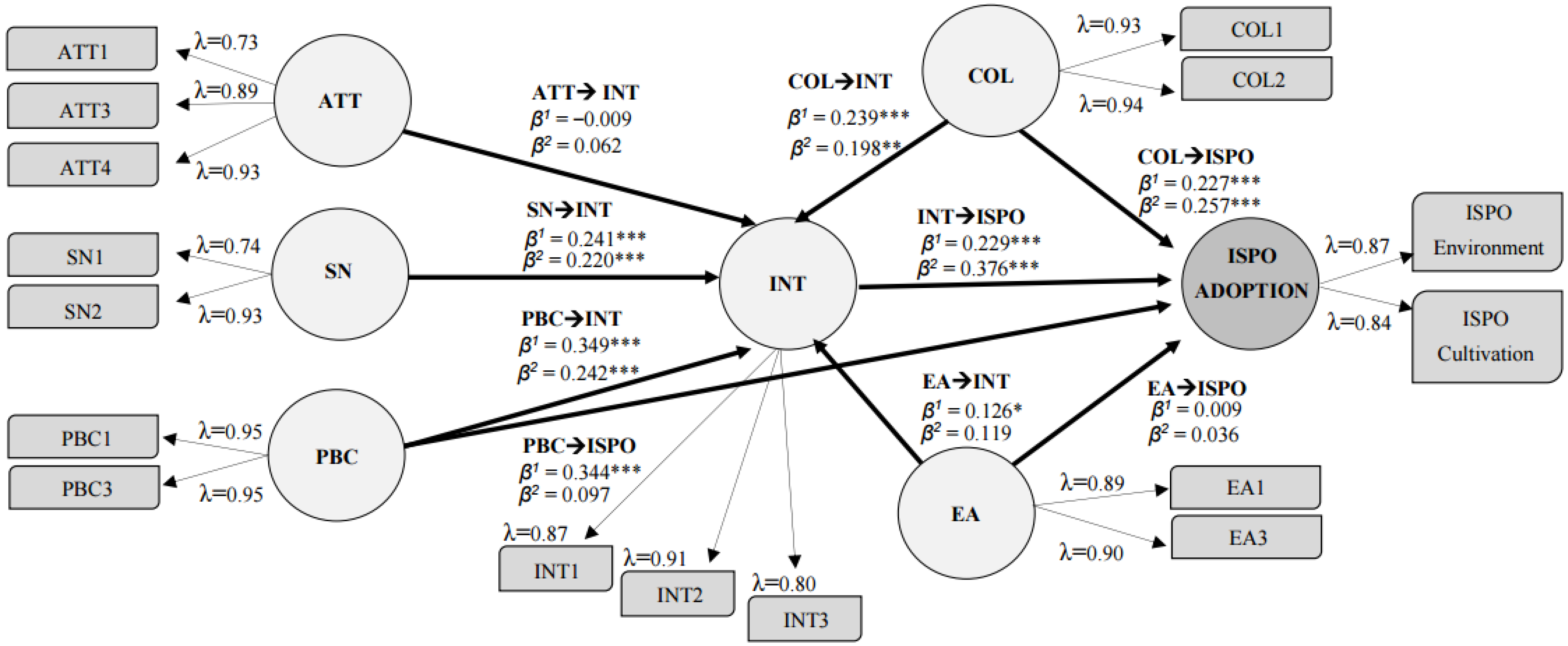
Furthermore, the results in Table 7 reveal both commonalities and important differences between the two groups. Among independent smallholders, adoption intention (H1: β = 0.376 ***), subjective norms (H3: β = 0.220 **), perceived behavioral control (H4: β = 0.242 **), and collective membership (H6: β = 0.198 **; H7: β = 0.257 ***) all show significant effects associated with ISPO adoption, while attitude (H2), environmental awareness (H8, H9), and direct PBC on readiness (H5) do not possess an influence in the model. Among scheme smallholders, a broader set of paths reaches significance, where intention (H1: β = 0.229 ***), subjective norms (H3: β = 0.241 ***), perceived behavioral control on both intention (H4: β = 0.349 ***) and readiness (H5: β = 0.344 ***), collective membership (H6: β = 0.239 ***; H7: β = 0.227 ***), and environmental awareness on intention (H8: β = 0.126 *) are all significant, with attitude remaining insignificant across both groups. Moreover, the results of the final model are graphically shown in Appendix A Figure A1 below. In addition, the indirect effects between the two groups are further presented in Appendix A Table A5.

4. Discussion

4.1. Intention and Perceived Behavioral Control: The Willingness–Capacity Difference

Across both smallholder groups, behavioral intention is positively associated with ISPO adoption readiness. In practical terms, this means that farmers who genuinely want to adopt ISPO are significantly more likely to begin complying with its standards, regardless of whether they are scheme (β = 0.229) or independent smallholders (β = 0.376). This finding aligns with a broad body of agricultural adoption literature confirming that internal motivation is a necessary precondition for behavioral change [65,66,67,68,69]. For policymakers, this implies that awareness campaigns and consistent socialization programs aimed at building genuine adoption motivation, not merely informing farmers of the regulatory requirement, should be prioritized during the transitional period ahead of mandatory enforcement of ISPO certification.
However, the considerably stronger effect of intention on readiness among independent smallholders (β = 0.376) compared to scheme smallholders (β = 0.229) is itself a meaningful finding that requires careful interpretation. Rather than reflecting superior motivation, this pattern may raise the issue related to the intention–behavior gap documented in the prior literature [33,34], a well-established phenomenon in which individuals who intend to perform a behavior are nonetheless unable to follow through due to structural and resource constraints. For independent smallholders, having a strong intention to adopt ISPO does not automatically lead to actual compliance, as good intentions cannot overcome concrete barriers such as unresolved land legality, high certification costs, and limited access to technical support.
This interpretation is supported by the divergent role of perceived behavioral control across the two groups. Among scheme smallholders, PBC directly and significantly predicts ISPO adoption readiness (β = 0.344), meaning that farmers who feel capable of meeting ISPO requirements are also more likely to actually comply, a pathway enabled by their access to legally certified land, technical support from affiliated firms, and subsidization facilities under nucleus contract with firms [22,70]. Among independent smallholders, however, PBC positively shapes intention (β = 0.242) but fails to translate into readiness (β = 0.097, p = 0.286). This finding reveals a critical disconnect between smallholders’ perceived ability to comply and their actual capacity to do so, a gap driven not by lack of awareness or motivation but by the structural constraints that lie beyond individual control.
Among the structural barriers faced by independent smallholders, land legality stands out as the most fundamental and hardest to resolve. ISPO certification requires smallholders to possess valid land certificates as a prerequisite for registration to indicate that their cultivations are outside the protected forest areas. Yet many independent smallholders in Indonesia cultivate on informally claimed or undocumented land, often inherited through customary arrangements without formal legal recognition [1,13,57]. Specifically, Pramudya et al. [70] discovered that a substantial proportion of independent smallholders operate without legally recognized land ownership and function outside formal institutional frameworks. As consequence, this single barrier can exclude a willing farmer from the entire certification process before it even begins, regardless of how motivated, knowledgeable, or financially prepared they may be. Unlike knowledge gaps or cost barriers, which training programs and subsidies can address, land legality is deeply rooted in Indonesia’s agrarian history and requires long-term solutions involving the National Land Agency (BPN), local governments, and community institutions.
Resolving land legality among independent smallholders therefore requires interventions that go beyond the scope of ISPO itself. In practice, Erdi et al. [71] demonstrated that obtaining legal land status is not only administratively complex but also financially burdensome. A critical prerequisite for ISPO registration is the STD-B document (Surat Tanda Daftar Budidaya, the official plantation registration certificate issued by local government), which serves as formal proof that a smallholder’s plantation is legally registered and operates outside designated forest areas. Obtaining this document first requires clarifying the plantation’s spatial status against official forest zone maps, a process that necessitates the involvement of local government and the Ministry of Forestry and can take some time to resolve. Another requirement is obtaining the Environmental Management Statement (SPPL), which is equally complicated, adding further layers of bureaucratic burden that are difficult for many resource-constrained independent smallholders to navigate independently.
The most practical pathway to address these compounding barriers is integrating ISPO certification requirements with Indonesia’s existing agrarian reform mechanisms, particularly the TORA (Tanah Objek Reforma Agraria, Land Objects for Agrarian Reform) scheme, a government program that redistributes and legalizes state land tenure for landless or informally settled smallholder farmers, and the Social Forestry program, which provides time-bound legal access to state-owned forest land for communities residing within or around forest areas [70]. Under this approach, land legalization and ISPO registration could be processed simultaneously through a single administrative pathway, reducing the bureaucratic burden on individual farmers and accelerating their eligibility for certification.
Without such integration, evidence suggests that achieving ISPO certification targets among independent smallholders could take decades without substantial policy reform [71]. Accelerating this process therefore requires coordinated collaboration between the Ministry of Agriculture, the National Land Agency (BPN), the Ministry of Forestry, and local governments, not only to resolve smallholder land tenure but also to streamline ISPO registration. So that land legalization and certification, as one of the main barriers, can be pursued through a single, integrated administrative pathway [57,70,72].

4.2. Social Pressure and Farmer Capacity as Key Drivers of Adoption Intention

Adoption intention is significantly shaped by subjective norms and perceived behavioral control across both groups, while attitude shows no significant effect for either independent or scheme smallholders. The source of social pressure matters considerably, where market and firm pressure (SN2) is the dominant normative driver for both independent (β = 0.220) and scheme smallholders (β = 0.241), whereas peer and family influence (SN1) plays a comparatively weaker role. In plain terms, farmers are more motivated to pursue ISPO certification when they perceive that their buyers and affiliated firms expect them to comply, not when their neighbors or family members encourage them to do so. This reflects the reality that oil palm smallholders are deeply embedded in commodity supply chains and are acutely sensitive to sustainability signals from downstream market actors [16].
Scheme smallholders experience comparatively stronger market pressure, owing to their direct affiliation with private firms operating under nucleus agreements that are subject to government-mandated ISPO compliance. This suggests that the most effective policy lever for accelerating adoption by scheme smallholders is supply chain regulation, specifically, requiring private firms to ensure ISPO compliance throughout their nucleus networks and holding them accountable for their affiliated smallholders’ certification status. For independent smallholders, who lack direct firm affiliation, strengthening market linkages through certified buyer programs and cooperative-based trading arrangements could replicate a similar normative pathway.
In this context, the RSPO mass balance model offers a valuable policy lesson for ISPO implementation related to the inclusion of linkage-independent smallholders in sustainable certification. Under this approach, certified and non-certified fresh fruit bunches (FFBs) of oil palm are processed together at the mill level, where the volume of certified CPO output is administratively tracked to match the certified FFB input, allowing mills to gradually increase their certified proportion as more smallholders complete the certification process under this inclusive model [73]. Adapting a similar transitional mechanism within the ISPO framework could provide independent smallholders with a structured entry point into certified markets without requiring immediate full compliance. To be effective, this approach should be supported by a formal time-bound transition commitment, where mills and the government agree to give independent smallholders a defined period, typically three to five years, to progressively meet ISPO standards while receiving technical assistance and capacity-building support along the process. This recognizes the reality that independent smallholders cannot overcome their structural constraints overnight, specifically for the institution and cost supports [39,72], and that enforcing full certification without adequate transitional support risks leaving the most vulnerable farmers behind.
Furthermore, perceived behavioral control also significantly shapes adoption intention for both groups (β = 0.242 for independent; β = 0.349 for scheme smallholders), reinforcing the importance of capacity-building interventions. Farmers who feel technically equipped and adequately resourced are more motivated to pursue certification [17,74,75,76]. This finding underscores the need for practical, farm-level training programs that go beyond general information dissemination and provide hands-on guidance on fulfilling ISPO’s specific technical and administrative requirements, particularly for independent smallholders who have limited access to firm-provided extension services.
The remaining factor is smallholders’ attitude (ATT), which showed an insignificant association with intention; this result obtained regarding attitude across both groups is a noteworthy finding that requires explanation. In mandatory compliance contexts, personal evaluation of a behavior tends to be overridden by external pressures and structural realities, where farmers may perceive ISPO adoption as a regulatory obligation rather than a discretionary choice, rendering personal attitude less influential in their decision-making. Our findings also show that smallholders, especially independent smallholders, have less trust in the benefits of ISPO certification, given its lack of a guarantee regarding premium pricing post certification. This is linked to previous findings by Rifai et al. [77], suggesting that smallholders face the issue of long-term engagement in sustainable certification as the lack of premium pricing limits their perceived value of compliance. They further observed that receiving a premium price is a main driver for smallholder participation in certification programs. Therefore, the government must enhance smallholders’ understanding of ISPO certification with regard to the essential benefits that it may provide in practice. In addition, a regulated scheme to establish a premium price initiative for ISPO is essential in future public policy. Similarly, Hendrawan and Musshoff [17] found attitude to be a weaker predictor compared to PBC in oil palm agroforestry adoption, suggesting that in regulatory compliance contexts, what farmers can do (capacity) and what others expect them to do (social pressure) matter more than what they personally think about the program.

4.3. The Role of Environmental Awareness on Adoption Intention

Environmental awareness (EA) reflects the extent to which smallholders recognize the environmental consequences of unsustainable oil palm practices and their implications for market access and ecosystem sustainability. The results reveal a notable difference between the two groups. Among scheme smallholders, EA positively and significantly influences adoption intention (β = 0.126), suggesting that environmental cognition plays a meaningful motivational role in their decision to pursue ISPO certification. Among independent smallholders, however, EA shows no significant effect on either intention or readiness. An estimated explanation for this divergence lies in the different institutional environments in which the two groups operate.
Scheme smallholders are routinely exposed to environmental compliance expectations through their contractual relationships with private firms that are themselves already subject to government-mandated ISPO standards and international market scrutiny. This sustained institutional exposure may reinforce and activate their environmental awareness as a behavioral motivator, consistent with Dessart et al. [78], who found that environmental concern is among the cognitive factors most proximally linked to farmers’ decisions to adopt sustainable practices, particularly when supported by integrated, multi-stakeholder programs rather than isolated awareness campaigns. The importance of environmental awareness is also consistent with Savari et al. [79], who illuminated that gaining awareness of the environmental impact was the first step towards achieving the principle of sustainability, where it was an essential prerequisite for the future environmental actions to define the personal decision-making on environmental initiative. By contrast, independent smallholders, despite potentially holding comparable levels of environmental concern, may lack the institutional channels through which environmental awareness can be translated into concrete adoption motivation. Without accessible guidance on how environmental knowledge connects to specific ISPO compliance steps, awareness alone appears insufficient to drive behavioral intention.
This finding extends the work of Suroso et al. [16], who confirmed that environmental concern significantly shapes smallholders’ intention to adopt RSPO certification, suggesting the motivational role of EA as the essential factor impacting smallholders’ intentions (via their attitude) to adopt a voluntary sustainable palm oil certification (RSPO). Reflective of the study’s findings, for policy, this implies that environmental education programs targeted at independent smallholders are unlikely to be effective as standalone awareness campaigns. To be impactful, they must be integrated within action-oriented capacity-building programs that provide clear, practical pathways connecting environmental knowledge to achievable steps toward ISPO compliance, importantly the environmental procedures that should be acquired to comply with ISPO principles and standards.

4.4. The Role of Collective Membership in ISPO Adoption

Collective membership participation emerges as an essential factor associated with ISPO adoption in this study; it is the only construct that significantly influences both adoption intention and readiness across both smallholder groups. For independent smallholders, collective membership positively shapes intention (β = 0.198) and directly enhances ISPO adoption readiness (β = 0.257). For scheme smallholders, the effects are similarly associated with ISPO adoption, by β = 0.239 on intention and β = 0.227 on readiness. This consistency across two structurally distinct groups is particularly noteworthy, as it suggests that farmer group membership functions as a universal behavioral enabler, regardless of whether smallholders operate under nucleus arrangements (scheme) or independently.
This finding is theoretically grounded in the collective action literature. Jia et al. [37] demonstrated that farmer group participation serves as a key instrument for expanding social networks, facilitating access to technical information, and expediting agricultural program adoption by enabling farmers to leverage shared resources and overcome individual-level barriers. Similarly, Mwambi et al. [80] confirmed that membership in producer organizations significantly enhances smallholders’ capacity to adopt food safety and sustainability standards through collective bargaining and institutional support, while Li et al. [81] found that cooperative participation improves uptake of green production technologies. Beyond resource sharing, group membership also facilitates information diffusion and peer learning, mechanisms that are particularly valuable for ISPO adoption, where technical knowledge of certification requirements is both essential and unevenly distributed among smallholders. The policy implications are direct and actionable. Given that ISPO regulations formally require smallholders to be organized in farmer groups or cooperatives as a prerequisite for initiating certification, strengthening group institutional capacity is not merely a behavioral intervention but a regulatory necessity.

5. Conclusions

This study examined the behavioral predictors of ISPO certification adoption intention and readiness among oil palm smallholders in Riau Province, Indonesia, comparing scheme and independent smallholders through an extended TPB framework that incorporates environmental awareness and collective membership participation. We note three overarching insights emerge from the findings. First, the willingness to adopt ISPO, captured through behavioral intention, is among the most consistent predictors associated with actual readiness to comply across both smallholder groups. This means that motivating farmers to genuinely want to adopt ISPO is a necessary predictor for any certification program to succeed. Regulatory enforcement alone, without building genuine adoption motivation, is unlikely to achieve meaningful compliance among smallholders during the transitional period of mandatory ISPO.
Second, scheme and independent smallholders exhibit fundamentally different behavioral profiles that demand differentiated policy responses. Scheme smallholders benefit from institutional support, market pressure from affiliated firms, and greater resource capacity, conditions that collectively translate their willingness into actual readiness. Independent smallholders, by contrast, face structural constraints, particularly land legality issues, high certification costs, and limited access to extension services, that prevent their capacity to transition to readiness, even when the intention to adopt exists. This willingness–capacity divide is the most critical policy challenge identified in this study, and it signals that a uniform compliance approach risks leaving the most vulnerable farmers behind. Third, collective membership participation is the most universally actionable driver of ISPO adoption, the only factor that consistently and significantly enhances both intention and readiness across both smallholder groups. This underscores farmer group strengthening as the single most impactful intervention available, regardless of smallholder type.

5.1. Policy Recommendations

The findings carry several differentiated and actionable implications for government authorities, private sector actors, and farmer organizations involved in ISPO implementation. For independent smallholders, resolving structural barriers before enforcing compliance is essential. The most critical bottleneck for independent smallholders is not a lack of willingness but a lack of capacity. Three structural interventions are most urgently needed: (1) accelerating land legalization programs to enable independent smallholders to obtain the land certificates required for ISPO registration, (2) establishing dedicated certification subsidy programs, potentially co-financed by government, BPDPKS, and NGOs, to make the estimated IDR 150 million certification cost accessible, and (3) fundamentally reorienting extension services from general information delivery toward practical, farm-level capacity building that directly guides smallholders through ISPO’s technical and administrative requirements.
For scheme smallholders, leveraging supply chain regulation is essential. Since market and firm pressure is the dominant driver of adoption intention among scheme smallholders, the most effective policy lever is supply chain regulation. Requiring private palm oil firms to ensure ISPO compliance throughout their nucleus networks, and holding them accountable for their affiliated smallholders’ certification status, would expectedly cascade compliance pressure to the farm level more efficiently than direct government outreach. Meanwhile, for the broader ISPO policy framework, a transitional supply chain mechanism is needed. Drawing from the RSPO mass balance model, ISPO policymakers could explore the development of a transitional supply chain mechanism that allows mills to progressively increase their certified FFB intake as more independent smallholders inclusively advance through certification, accompanied by a formal, time-bound transition commitment that provides independent smallholders with defined timelines, technical support, and market access incentives during the compliance period.
In addition, reflecting on the essential contribution of collective farmer groups, governments should prioritize consolidating existing farmer groups, particularly among independent smallholders, into institutionally stronger associations. This could be capable of providing sustained advisory support, importantly facilitating collective ISPO internal audits, and distributing certification costs across members. Organizing smallholders into regional farmer group federations or sustainable palm oil cooperatives would enable more efficient exchange of technical expertise and reduce per-farmer compliance costs, making ISPO adoption practically feasible for the most resource-constrained smallholders.

5.2. Limitations and Recommendations for Future Research

We note several limitations that require acknowledgment in this study. First, the measurement of ISPO adoption readiness was restricted to two of the five core ISPO principles, environmental compliance and good plantation practices, as the remaining three dimensions related to land certification, business documentation, and transparency returned insufficient factor loadings, reflecting the structural constraints faced by smallholders. Future studies should develop more comprehensive instruments that capture all five ISPO dimensions, particularly as smallholder institutional capacity improves over the transitional period. Second, the unequal group distribution limits the generalization of findings beyond the study districts. Third, as a cross-sectional study, the authors capture smallholders’ behavioral profiles at a single point in time. Longitudinal research tracking intention and readiness before and after the mandatory ISPO compliance deadline would provide valuable insight into how regulatory enforcement shapes adoption dynamics over time. In addition, future studies should explicitly examine whether institutional context moderates the relationship between environmental awareness and adoption intention, a question that the current study identifies but cannot empirically resolve.
We also note that the environmental awareness (EA) construct was operationalized through general environmental awareness indicators rather than ISPO-specific environmental knowledge measures. Future studies should develop EA instruments that directly capture smallholders’ familiarity with specific ISPO environmental mandates, including fire prevention, riparian zone protection, and biodiversity conservation requirements, to strengthen the conceptual link between environmental awareness and policy-ready compliance behavior. Finally, our subjective norm (SN) required an additional item to measure the effect of local traders as an intermediary market channel, especially for independent smallholders who often rely on the open market without any formal contract. Future studies could consider this pivotal factor to estimate the social pressure for independent smallholders from the market side.

Author Contributions

Conceptualization: B.R.P. and J.K.; methodology: B.R.P. and J.K.; software: B.R.P. and J.K.; validation: B.R.P. and J.K.; formal analysis: J.K.; investigation: B.R.P. and A.P.; resources: Y.Z.; data curation: A.P. and Y.Z.; writing—original draft preparation: B.R.P.; writing—review and editing: B.R.P. and J.K.; visualization: B.R.P.; supervision: J.K.; project administration: B.R.P.; funding acquisition: B.R.P. All authors have read and agreed to the published version of the manuscript.

Funding

This research received no external funding.

Institutional Review Board Statement

Not applicable. This study guaranteed anonymity and collected non-sensitive information based on the voluntary participation of respondents.

Data Availability Statement

The data presented in this study are available on request from the corresponding author due to the respondents’ privacy.

Acknowledgments

The authors appreciate the support from Kangwon National University along with Universitas Riau for their help during the research process, especially in the data collection process in Riau Province. This paper is based on the Ph.D. dissertation of Bayu, “Sustainable Pathways of Indonesian Palm Oil: Evidence from Production, Replanting, and Certification”, conducted at Kangwon National University.

Conflicts of Interest

The authors declare no conflicts of interest.

Abbreviations

The following abbreviations are used in this manuscript:
ISPOIndonesian Sustainable Palm Oil
RSPORoundtable Sustainable Palm Oil
SEMStructural Equation Modeling
PLSPartial Least Square

Appendix A

Figure A1. Final PLS-MGA model of scheme and independent smallholders. Note: ***, **, and * indicate 1%, 5%, and 10% significance levels, respectively; β1 represents the scheme smallholder’s coefficient, β2 is the independent smallholder’s coefficient, and λ is the factor loadings of each measurement item.
Agriculture 16 01229 g0a1
Table A1. Principles of ISPO certification for smallholders.
NoPrinciplesCriteriaIndicator of ISPO Principles
1.Compliance with laws and regulationsLegal Compliance and Smallholder ManagementPossesses a land certificate and other valid proof of land ownership.
2.Environmental, natural resource, and biodiversity Protection1. Fire Prevention and Mitigation for the Forest1. Implement fire prevention
2. Implement mitigation efforts collaboratively with nearby communities and relevant local authorities, in accordance with the official Fire Prevention and Mitigation
3. Commitment in ensuring land expansion does not involve deforestation
2. Conservation of Biodiversity1. Identifying the presence of wildlife, and;
2. Identifying the presence of plant species within and around the plantation area after the commencement of plantation operations
3. Maintains records of wildlife, and;
4. Record the plant species present within and around the plantation area
3.Implementation of good palm oil plantation practices (GAP)1. Farmer Institutional Organization1. Smallholders are organized under institutional arrangements such as farmer groups or cooperatives
2. Smallholder Management2. Possesses an operational activity plan document for the smallholder, farmer group, and/or cooperative
3. Technical Practices on Oil Palm Cultivation and Harvest Logistics3. Possesses and implements Standard Operating Procedures (SOPs) and detailed work instructions for zero-burning land clearing practices
4. Seed procurement 4. Uses planting seeds from certified seed producers authorized by the relevant institutions and recognized by the Ministry of Agriculture
5. Technical standards in Mineral Land Planting 5. Possesses and implements planting SOPs in accordance with Good Agricultural Practices (GAP).
6. Oil Palm Crop Cultivation 6. Maintains records of fertilization and crop maintenance activities
7. Harvesting Procedure7. Possesses clear technical guidelines to ensure that only fully ripe fruits are harvested at optimal time
4.Implementation of transparencyInformation on Sale and Pricing Agreement of Fresh Fruit Bunches (FFB)1. Records of FFB prices and actual purchases, with accessible price information sources
5.Sustainable business improvementDeveloping and implementing action plans for improvement of sustainable palm oil production.1. Possess documented evidence of continuous improvements and sustainable enterprise development (evaluation and action plan on sustaining the business)
Source: adapted from Novianto et al. [20].
Table A2. Definition of latent variables.
NoLatent Var.DefinitionSourceExpected Result
1.Adoption Readiness (ISPO)The perspective of current adoption level regarding ISPO standards conducted by the farmers Ajzen [32], Buyinza [82], Buyinza [40]Smallholders’ readiness towards ISPO certification (Outcome)
2.Intention (INT)The position on how much smallholders’ likelihood of adopting ISPO derived by various motivations Ajzen [32], Buyinza [82], Deng [66], Tama [83]H1: INT expected to positively influence farmers’ readiness in pursuit of ISPO certification
3.Attitude (ATT)Refers to the degree to which smallholders have favorable/unfavorable evaluations towards ISPOAjzen [32], Buyicnza [82], Denashurya [14] H2: ATT estimated to provide a positive effect on farmers’ INT towards ISPO certification
4.Subjective Norms (SN)Represents the social pressure to perform or not perform ISPOAjzen [32], Buyinza [82], Denashurya [14] H3: SN expected to affect positively on farmers’ INT of ISPO certification
5.Perceived Behavioral Control (PBC)The perceived ease or difficulty on performing ISPOAjzen [32], Buyinza [82], Denashurya [14]H4: PBC expected to positively affect farmers’ INT
H5: PBC projected to directly affect ISPO adoption readiness
6.Environmental Awareness (EA)Smallholders’ awareness of protecting environmentAkintunde [84], Higgins [85], Panwanitdumrong [21]H6–H7: EA estimated to enhance both INT and readiness of smallholders towards ISPO certification
7.Collective membership participation (COL)Smallholders’ active participation in a farmer group Zheng [86], Zhu [87] H8–H9: COL is expected to affect positively on smallholders’ INT and readiness towards ISPO certification adoption
Table A3. Measurement variables on PLS-SEM model.
ConstructItemStatementMeanSDFactor Loading
ISPOISPOenvironmentI have attempted to comply with the principle of environmental, natural resource, and biodiversity Protection.
In this section, the smallholder is asked to select how many of the following required standards have been conducted:
☐ Implementing fire prevention and mitigation efforts
☐ Collaborating with surrounding communities and relevant local authorities, in accordance with the official Fire Prevention and Mitigation Guidelines
☐ Committing to no land expansion through deforestation
☐ Identifying the presence of wildlife and
☐ Identifying Plant species within and around the plantation area after the commencement of plantation operations
☐ Maintaining records of the presence of wildlife and
☐ Maintaining records of Plant species within and around the plantation area
4.521.460.806
ISPOcultivationI have attempted to comply with good palm oil plantation practices
In this section, the smallholder is asked to select how many of the following required standards have been conducted:
☐ Independent smallholders are organized under institutional arrangements such as farmer groups or cooperatives.
☐ Possess an operational activity plan document for the smallholder, farmer group, and/or cooperative.
☐ Possess and implement Standard Operating Procedures (SOPs) and detailed work instructions for zero-burning land clearing.
☐ Use planting seeds from certified seed producers authorized by the relevant institutions and recognized by the Ministry of Agriculture.
☐ Possess and implement planting SOPs in accordance with Good Agricultural Practices (GAP).
☐ Maintain records of fertilization and crop maintenance activities.
☐ Possess clear technical guidelines to ensure that only fully ripe fruits are harvested at the optimal time
4.681.610.730
ISPOtransparancyI have attempted to provide the records of fresh fruit bunch (FFB) prices and actual purchases5.541.590.679
ISPObusinessI have attempted to provide the document of palm oil business evaluation with action plan for sustainability improvements5.791.590.650
ISPOlandcertI have attempted to fulfill the possession of land certificate and other valid proof of land ownership?6.021.140.528
IntentionINT1How is your intention to plan in adopting or certifying ISPO on your palm oil in the next year?3.731.680.862
INT2How likely is it that you plan to adopt or certify ISPO in the upcoming 5 years?4.111.790.913
INT3How strong is your intention to adopt or certify the ISPO on your palm oil by yourself (even without the government or firms support partnership?)3.001.460.805
AttitudeATT1I believe that adopting ISPO would enhance yields, improve soil health, and reduce environmental impact 4.961.530.720
ATT2I am convinced that adopting ISPO would provide more economic benefits (e.g., income) compared to non-ISPO4.411.560.350
ATT3I am certain that ISPO adoption would not significantly increase labor and input cost4.931.380.880
ATT4My past experiences with sustainable practice have encouraged me to adopt ISPO 4.781.570.926
Subjective NormsSN1I perceive that my family, peer farmers, and farmers’ group or community leader endorses to adopt ISPO 3.181.510.740
SN2I sense industry and market pressure to comply with ISPO standards 4.281.560.928
SN3I feel that extension workers (government) encourage me to adopt ISPO 4.661.490.017
Perceived Behavioral ControlPBC1I have necessary resources (e.g., land, finance, and labor) to adopt ISPO 4.281.730.875
PBC2How confident are you that you could overcome barriers that prevent your adoption in the upcoming year?4.071.650.676
PBC3If I want to adopt ISPO, I have sufficient technical skill in complying with the standards of ISPO certification4.241.620.915
PBC4I have access to educational information related to ISPO adoption3.571.670.685
Envi. AwarenessEA1I am aware unsustainable palm oil practice could damage the environment condition and palm oil production 4.91.590.850
EA2I am valuing environmental preservation more than economic values3.711.670.620
EA3I perceive that unsustainable practice of palm oil would limit palm oil market both nationally and internationally4.781.590.861
Collective Member-
ship
COL1I have become an active member of a group or cooperative with strong relation to perform collectively 3.781.740.933
COL2I receive assistance from groups or cooperative and regular advisory meetings to perform collectively 3.741.880.939
Table A4. Goodness of fit and R2 values of the model.
Model FitVariableR2Adj. R2
Saturated ModelEstimated Model
SRMR0.0850.085INT0.5900.583
ISPO0.5170.510
Table A5. Specific indirect effects between scheme and independent smallholders.
Indirect PathGroupβMeanSTDEVp-Val95% CIVAFMediation
ATT 🡪 INT 🡪 ISPOIndependent0.0230.0290.0420.579[−0.059, 0.106]No mediation
Scheme−0.002−0.0010.0190.915[−0.044, 0.034]No mediation
COL 🡪 INT 🡪 ISPOInd0.075 *0.0740.0400.062[0.014, 0.176]22.6Partial mediation
Scheme0.055 **0.0540.0250.028[0.017, 0.119]19.5Partial mediation
EA 🡪 INT 🡪 ISPOInd0.0450.0440.0430.294[−0.030, 0.141]No mediation
Scheme0.0290.0290.0210.164[−0.001, 0.082]No mediation
PBC 🡪 INT 🡪 ISPOInd0.091 **0.0880.0460.046[0.019, 0.211]48.4Partial mediation
Scheme0.080 **0.0800.0340.020[0.024, 0.161]18.9Partial mediation
SN 🡪 INT 🡪 ISPOInd0.083 **0.0870.0420.050[0.017, 0.182]100.0Full mediation
Scheme0.055 **0.0550.0240.022[0.018, 0.117]100.0Full mediation
Note: Bootstrap resamples = 5000. CI = bias-corrected 95% confidence interval, p < 0.10 *, p < 0.05 **.
The specific indirect effects presented in Table A5 above indicate that smallholders’ intention significantly mediates the relationships of subjective norms (SNs), perceived behavioral control (PBC), and collective action (COL) with ISPO adoption readiness, whereas no significant mediation was found for attitude (ATT) or environmental awareness (EA) in either group. For SNs, full mediation was confirmed in both groups (VAF = 100%), with a significant indirect effect for independent smallholders (β = 0.083, p = 0.050) and scheme smallholders (β = 0.055, p = 0.022), indicating that normative social pressure translates into ISPO adoption readiness solely through the mediation of behavioral intention. Partial mediation was confirmed for COL in both independent (β = 0.075, p = 0.062, VAF = 22.6%) and scheme (β = 0.055, p = 0.028, VAF = 19.5%) smallholders, indicating that while INT partially channels the effect of collective membership on ISPO adoption readiness. COL also exerts a significant direct influence on readiness (H7: β = 0.257 *** for independent; β = 0.227 *** for scheme), confirming that farmer group participation contributes to certification compliance through both motivational and direct behavioral pathways. For PBC, partial mediation was observed in both groups, with VAF values of 48.4% for independent (β = 0.091, p = 0.046) and 18.9% for scheme (β = 0.080, p = 0.020) smallholders. The higher VAF among independent smallholders suggests that their perceived capability predominantly influences ISPO readiness through motivational pathways rather than direct behavioral action, reflecting a wider gap between self-efficacy and actual compliance capacity compared to scheme smallholders. In contrast, this pattern reflects the greater institutional support and resource availability among scheme smallholders, which enables perceived capability to translate more directly into compliance behavior without relying solely on motivational pathways.

References

  1. Apriani, E.; Kim, Y.S.; Fisher, L.A.; Baral, H. Non-state certification of smallholders for sustainable palm oil in Sumatra, Indonesia. Land Use Policy 2020, 99, 105112. [Google Scholar] [CrossRef]
  2. Meijaard, E.; Morgans, C.; Husnayaen, M.; Abram, N.K.; Ancrenaz, M. An Impact Analysis of RSPO Certification on Borneo Forest Cover and Orangutan Populations; Brunei Darussalam Borneo Futures: Bandar Seri Begawan, Brunei, 2017; pp. 1–39. [Google Scholar] [CrossRef]
  3. Carlson, K.M.; Heilmayr, R.; Gibbs, H.K.; Noojipady, P.; Burns, D.N.; Morton, D.C.; Walker, N.F.; Paoli, G.D.; Kremen, C. Effect of oil palm sustainability certification on deforestation and fire in Indonesia. Proc. Natl. Acad. Sci. USA 2018, 115, 121–126. [Google Scholar] [CrossRef]
  4. Morgans, C.L.; Meijaard, E.; Santika, T.; Law, E.; Budiharta, S.; Ancrenaz, M.; Wilson, K.A. Evaluating the effectiveness of palm oil certification in delivering multiple sustainability objectives. Environ. Res. Lett. 2018, 13, 064032. [Google Scholar] [CrossRef]
  5. Tandra, H.; Suroso, A.I.; Syaukat, Y.; Najib, M. Indonesian Oil Palm Export Market Share and Competitiveness to European Union Countries: Is The Roundtable on Sustainable Palm Oil (RSPO) Influential? J. Manag. Agribus. 2021, 18, 342–350. [Google Scholar] [CrossRef]
  6. Lee, J.S.H.; Miteva, D.A.; Carlson, K.M.; Heilmayr, R.; Saif, O. Does oil palm certification create trade-offs between environment and development in Indonesia? Environ. Res. Lett. 2020, 15, 124064. [Google Scholar] [CrossRef]
  7. Wassmann, B.; Siegrist, M.; Hartmann, C. Palm oil and the Roundtable of Sustainable Palm Oil (RSPO) label: Are Swiss consumers aware and concerned? Food Qual. Prefer. 2023, 103, 104686. [Google Scholar] [CrossRef]
  8. European Forest Institute (EFI). Joint Gap Assessment of the EUDR Information Needs and Information Availability from the Indonesian Sustainable Palm Oil (ISPO) Certification; Indonesian Sustainable Palm Oil (ISPO) and European Forest Institute: Joensuu, Finland, 2024; Available online: https://efi.int/sites/default/files/files/flegtredd/Terpercaya/Other%20resources/ISPO_Joint_Gap_Assessment.pdf (accessed on 7 December 2024).
  9. Aisyah, S.; Frinaldi, A.; Rembrandt, R.; Lanin, D. Study of the application of ISPO (Indonesian Sustainable Palm Oil) in the sustainable palm industry to conditions in the community. J. Agro Estate 2024, 8, 76–88. [Google Scholar]
  10. Kompas.id. Petani Sawit Rakyat Masih Kesulitan Dapatkan Sertifikat Berkelanjutan [Smallholder Palm Oil Farmers Still Struggle to Obtain Sustainability Certificates]. Available online: https://www.kompas.id/baca/humaniora/2022/12/08/petani-sawit-rakyat-masih-kesulitan-dapatkan-sertifikat-berkelanjutan (accessed on 10 December 2024). (In Indonesian)
  11. Degli Innocenti, E.; Oosterveer, P. Opportunities and bottlenecks for upstream learning within RSPO certified palm oil value chains: A comparative analysis between Indonesia and Thailand. J. Rural. Stud. 2020, 78, 426–437. [Google Scholar] [CrossRef]
  12. Brandi, C.; Cabani, T.; Hosang, C.; Schirmbeck, S.; Westermann, L.; Wiese, H. Sustainability Standards for Palm Oil: Challenges for Smallholder Certification Under the RSPO. J. Environ. Dev. 2015, 24, 292–314. [Google Scholar] [CrossRef]
  13. de Vos, R.E.; Suwarno, A.; Slingerland, M.; van der Meer, P.J.; Lucey, J.M. Pre-certification conditions of independent oil palm smallholders in Indonesia: Assessing prospects for RSPO certification. Land Use Policy 2023, 130, 106660. [Google Scholar] [CrossRef]
  14. Denashurya, N.I.; Nurliza; Dolorosa, E.; Kurniati, D.; Suswati, D. Overcoming Barriers to ISPO Certification: Analyzing the Drivers of Sustainable Agricultural Adoption Among Farmers. Sustainability 2023, 15, 16507. [Google Scholar] [CrossRef]
  15. Hutabarat, S. ISPO Certification and Indonesian Oil Palm Competitiveness In Global Market: Smallholder Challenges Toward ISPO Certification. Agro Ekon. 2017, 28, 170–188. [Google Scholar] [CrossRef]
  16. Suroso, A.I.; Tandra, H.; Haryono, A. Adoption of sustainable certification in West Borneo palm oil farmers: The role of environmental concern. Cogent Food Agric. 2023, 9, 2266196. [Google Scholar] [CrossRef]
  17. Hendrawan, D.; Musshoff, O. Risky for the income, useful for the environment: Predicting farmers’ intention to adopt oil palm agroforestry using an extended theory of planned behaviour. J. Clean. Prod. 2024, 475, 143692. [Google Scholar] [CrossRef]
  18. Revi, L. Barriers and readiness for implementation of Indonesian sustainable palm oil in independent smallhollders plantations: A case study. J. Trop. Agric. Sci. 2025, 2, 127–144. [Google Scholar] [CrossRef]
  19. Hines, J.M.; Hungerford, H.R.; Tomera, A.N. Analysis and synthesis of research on responsible environmental behavior: A meta-analysis. J. Environ. Educ. 1987, 18, 1–8. [Google Scholar] [CrossRef]
  20. Novianto, E.; Lembasi, M.; Rostanto. Modul I: Sawit Rakyat dan ISPO Pekebun; Yayasan KEHATI: Jakarta, Indonesia, 2021. [Google Scholar]
  21. Panwanitdumrong, K.; Chen, C.L. Investigating factors influencing tourists’ environmentally responsible behavior with extended theory of planned behavior for coastal tourism in Thailand. Mar. Pollut. Bull. 2021, 169, 112507. [Google Scholar] [CrossRef]
  22. Yao, X.; Liu, Y.; Qi, G. Enhancing Environmental Awareness for Sustainable Retail: Analysis of the Buy-Online-and-Return-in-Store Policy Adoption Using Theory of Planned Behavior. J. Theor. Appl. Electron. Commer. Res. 2024, 19, 2694–2713. [Google Scholar] [CrossRef]
  23. Schermelleh-Engel, K.; Moosbrugger, H.; Müller, H. Evaluating the Fit of Structural Equation Models: Tests of Significance and Descriptive Goodness-of-Fit Measures. Methods Psychol. Res. 2003, 8, 23–74. [Google Scholar]
  24. Kyriazos, T.A. Applied Psychometrics: Sample Size and Sample Power Considerations in Factor Analysis (EFA, CFA) and SEM in General. Psychology 2018, 9, 2207–2230. [Google Scholar] [CrossRef]
  25. Hair, J.F.; Hult, G.T.M.; Ringle, C.M. A Primer on Partial Least Squares Structural Equation Modeling (PLS-SEM), 2nd ed.; SAGE Publications: New York, NY, USA, 2017. [Google Scholar]
  26. Goodhue, D.L.; Lewis, W.; Thompson, R. Does PLS Have Advantages for Small Sample Size or Non-Normal Data? MIS Q. 2012, 36, 981–1001. [Google Scholar] [CrossRef]
  27. Hair, J.F.; Ringle, C.M.; Sarstedt, M. PLS-SEM: Indeed a Silver Bullet. J. Mark. Theory Pract. 2011, 19, 139–152. [Google Scholar] [CrossRef]
  28. Thi, L.; Hien, D.; Kim, J. An Analysis of Relationship Quality and Loyalty Between Farmers and Agribusiness Companies in the Rice Industry: Using Multi-Group Analysis. Agriculture 2024, 14, 2197. [Google Scholar] [CrossRef]
  29. Lee, J.S.H.; Ghazoul, J.; Obidzinski, K.; Koh, L.P. Oil palm smallholder yields and incomes constrained by harvesting practices and type of smallholder management in Indonesia. Agron. Sustain. Dev. 2014, 34, 501–513. [Google Scholar] [CrossRef]
  30. Glasbergen, P. Smallholders do not Eat Certificates. Ecol. Econ. 2018, 147, 243–252. [Google Scholar] [CrossRef]
  31. Reich, C.; Musshoff, O. Oil palm smallholders and the road to certification: Insights from Indonesia. J. Environ. Manag. 2025, 375, 124303. [Google Scholar] [CrossRef]
  32. Ajzen, I. The theory of planned behavior. Organ. Behav. Hum. Decis. Process 1991, 50, 179–211. [Google Scholar] [CrossRef]
  33. Sheeran, P. Intention-Behavior Relations: A Conceptual and Empirical Review. Eur. Rev. Soc. Psychol. 2002, 12, 1–36. [Google Scholar] [CrossRef]
  34. Faries, M.D. Why We Don’t “Just Do It”: Understanding the Intention-Behavior Gap in Lifestyle Medicine. Am. J. Lifestyle Med. 2016, 10, 322–329. [Google Scholar] [CrossRef]
  35. Sheeran, P.; Webb, T.L. The Intention-Behavior Gap. Soc. Personal. Psychol. Compass 2016, 10, 503–518. [Google Scholar] [CrossRef]
  36. Yang, W.; Wang, L. Impact of farmer group participation on the adoption of sustainable farming practices: Spatial analysis of New Zealand dairy farmers. Ann. Public Coop. Econ. 2023, 94, 701–717. [Google Scholar] [CrossRef]
  37. Jia, R.; Shuai, Z.; Guo, T.; Lu, Q. Impact of participation in collective action on farmers’ decisions and waiting time to adopt soil and water conservation measures. Int. J. Clim. Change Strateg. Manag. 2024, 16, 201–227. [Google Scholar] [CrossRef]
  38. Missiame, A.; Akrong, R.; Appiah-kubi, G.D. Collective action and farm efficiency of male- and female-headed farm households in Ghana: Collective action and farm efficiency of male- and female-headed farm households in Ghana. Cogent Soc. Sci. 2023, 9, 2270844. [Google Scholar] [CrossRef]
  39. Hadi, S.; Bakce, D.; Muwardi, D.; Yusri, J.; Septya, F. ISPO Certification Acceleration Strategies for Independent Oil Palm Plantations. Anal. Kebijak. Pertan. 2023, 21, 21–42. [Google Scholar] [CrossRef]
  40. Buyinza, J.; Nuberg, I.K.; Muthuri, C.W.; Denton, M.D. Assessing smallholder farmers’ motivation to adopt agroforestry using a multi-group structural equation modeling approach. Agrofor. Syst. 2020, 94, 2199–2211. [Google Scholar] [CrossRef]
  41. Meijer, S.S.; Catacutan, D.; Sileshi, G.W.; Nieuwenhuis, M. Tree planting by smallholder farmers in Malawi: Using the theory of planned behaviour to examine the relationship between attitudes and behaviour. J. Environ. Psychol. 2015, 43, 1–12. [Google Scholar] [CrossRef]
  42. Tonglet, M.; Phillips, P.S.; Read, A.D. Using the Theory of Planned Behaviour to investigate the determinants of recycling behaviour: A case study from Brixworth, UK. Resour. Conserv. Recycl. 2004, 41, 191–214. [Google Scholar] [CrossRef]
  43. Senger, I.; Borges, J.A.R.; Machado, J.A.D. Using the theory of planned behavior to understand the intention of small farmers in diversifying their agricultural production. J. Rural. Stud. 2017, 49, 32–40. [Google Scholar] [CrossRef]
  44. Daxini, A.; Donoghue, C.O.; Ryan, M.; Buckley, C.; Barnes, A.P.; Daly, K. Which factors influence farmers’ intentions to adopt nutrient management planning? J. Environ. Manag. 2018, 224, 350–360. [Google Scholar] [CrossRef] [PubMed]
  45. Nguyen, N.; Drakou, E.G. Farmers intention to adopt sustainable agriculture hinges on climate awareness: The case of Vietnamese coffee. J. Clean. Prod. 2021, 303, 126828. [Google Scholar] [CrossRef]
  46. Tapsoba, P.K.; Aoudji, A.K.N.; Ouédraogo, F.; Dassekpo, I.S.; Kestemont, M.P.; Kabore Konkobo, M.; Achigan-Dako, E.G. Understanding the behavioral drivers of smallholder agro-ecological practice adoption in Benin and Burkina Faso. Farming Syst. 2023, 1, 100023. [Google Scholar] [CrossRef]
  47. Le, L.; Nguyen, H.; Halibas, A.; Nguyen, T.Q. Cooperative performance and lead firm support in cleaner production adoption: SEM-fsQCA analysis of precision agriculture acceptance in Vietnam. J. Clean. Prod. 2024, 475, 143724. [Google Scholar] [CrossRef]
  48. Beran, T.N.; Violato, C. Structural Equation Modeling in Medical Research: A Primer. BMC Res. Notes 2010, 3, 267. [Google Scholar] [CrossRef]
  49. Slijper, T.; Tensi, A.F.; Ang, F.; Ali, B.M.; van der Fels-Klerx, H.J. Investigating the relationship between knowledge and the adoption of sustainable agricultural practices: The case of Dutch arable farmers. J. Clean. Prod. 2023, 417, 138011. [Google Scholar] [CrossRef]
  50. Tama, R.A.Z.; Hoque, M.M.; Liu, Y.; Alam, M.J.; Yu, M. An Application of Partial Least Squares Structural Equation Modeling (PLS-SEM) to Examining Farmers’ Behavioral Attitude and Intention towards Conservation Agriculture in Bangladesh. Agriculture 2023, 13, 503. [Google Scholar] [CrossRef]
  51. Drescher, M.; Hannay, J.; Feick, R.D.; Caldwell, W. Social psychological factors drive farmers’ adoption of environmental best management practices. J. Environ. Manag. 2024, 350, 119491. [Google Scholar] [CrossRef] [PubMed]
  52. Kim, J. Prediction of Determinants Affecting Consumer Purchase Intentions for Mackerel in the Korean Domestic Market. Fishes 2024, 9, 301. [Google Scholar] [CrossRef]
  53. Henseler, J.; Ringle, C.M.; Sarstedt, M. Testing measurement invariance of composites using partial least squares. Int. Mark. Rev. 2016, 33, 405–431. [Google Scholar] [CrossRef]
  54. Cheah, J.H.; Amaro, S.; Roldán, J.L. Multigroup analysis of more than two groups in PLS-SEM: A review, illustration, and recommendations. J. Bus. Res. 2023, 156, 113539. [Google Scholar] [CrossRef]
  55. Agung, A.A.G.; Rusdhi, H.A.; Wibowo, M.A. Analysis of factors affecting design changes in construction project with Partial Least Square (PLS). Procedia Eng. 2015, 125, 40–45. [Google Scholar] [CrossRef]
  56. Hair, J.F.; Howard, M.C.; Nitzl, C. Assessing measurement model quality in PLS-SEM using confirmatory composite analysis. J. Bus. Res. 2020, 109, 101–110. [Google Scholar] [CrossRef]
  57. Dharmawan, A.H.; Mardiyaningsih, D.I.; Rahmadian, F.; Yulian, B.E. The Agrarian, Structural and Cultural Constraints of Smallholders’ Readiness for Sustainability Standards Implementation: The Case of Indonesian Sustainable Palm Oil in East Kalimantan. Sustainability 2021, 13, 2611. [Google Scholar] [CrossRef]
  58. Hair, J.F.; Hult, T.M.; Ringle, C.M.; Sarstedt, M.; Danks, N.P.; Ray, S. Partial Least Squares Structural Equation Modeling (PLS-SEM) Using R; Springer Nature Switzerland: Cham, Switzerland, 2021. [Google Scholar]
  59. Zeng, N.; Liu, Y.; Gong, P.; Hertogh, M.; König, M. Do right PLS and do PLS right: A critical review of the application of PLS-SEM in construction management research. Front. Eng. Manag. 2021, 8, 356–369. [Google Scholar] [CrossRef]
  60. Hamid, M.R.; Sami, W.; Mohmad Sidek, M.H. Discriminant Validity Assessment: Use of Fornell & Larcker criterion versus HTMT Criterion. J. Phys. Conf. Ser. 2017, 890, 012163. [Google Scholar] [CrossRef]
  61. Ringle, C.M.; Sarstedt, M.; Sinkovics, N.; Sinkovics, R.R. A perspective on using partial least squares structural equation modelling in data articles. Data Brief 2023, 48, 109074. [Google Scholar] [CrossRef]
  62. Troiville, J.; Moisescu, O.I.; Radomir, L. Using necessary condition analysis to complement multigroup analysis in partial least squares structural equation modeling. J. Retail. Consum. Serv. 2025, 82, 104018. [Google Scholar] [CrossRef]
  63. Hu, L.T.; Bentler, P.M. Cutoff criteria for fit indexes in covariance structure analysis: Conventional criteria versus new alternatives. Struct. Equ. Model. 1999, 6, 1–55. [Google Scholar] [CrossRef]
  64. Sarstedt, M.; Ringle, C.M.; Hair, J.F. Handbook of Market Research; Homburg, C., Klarmann, M., Vomberg, A., Eds.; Springer: Cham, Switzerland, 2020. [Google Scholar]
  65. Siahaan, H.N.; Waluyati, L.; Masyhuri, M. Intentions and Behavior of Partner Palm Oil Farmers PT. Hari Sawit Jaya on Sustainable Palm Oil Management. J. Ekon. Pertan. Dan Agribisnis (JEPA) 2023, 7, 944–953. [Google Scholar] [CrossRef]
  66. Deng, J.; Sun, P.; Zhao, F.; Han, X.; Yang, G.; Feng, Y. Analysis of the ecological conservation behavior of farmers in payment for ecosystem service programs in eco-environmentally fragile areas using social psychology models. Sci. Total Environ. 2016, 550, 382–390. [Google Scholar] [CrossRef]
  67. Kim, M.; Kim, S.; Jeon, S. One in three or three in one: Integrating three competing theoretical models (TPB, VIP, and PADM) to explain the intentions to act/actions against climate change. Heliyon 2024, 10, e39337. [Google Scholar] [CrossRef]
  68. Lou, S.; Zhang, B.; Zhang, D. Foresight from the hometown of green tea in China: Tea farmers ’ adoption of pro-green control technology for tea plant pests. J. Clean. Prod. 2021, 320, 128817. [Google Scholar] [CrossRef]
  69. Swart, R.; Levers, C.; Davis, J.T.M.; Verburg, P.H. Article Meta-analyses reveal the importance of socio- psychological factors for farmers’ adoption of sustainable agricultural practices. One Earth 2023, 6, 1771–1783. [Google Scholar] [CrossRef]
  70. Pramudya, E.P.; Wibowo, L.R.; Nurfatriani, F.; Nawireja, I.K.; Kurniasari, D.R.; Hutabarat, S.; Kadarusman, Y.B.; Iswardhani, A.O.; Rafik, R. Incentives for Palm Oil Smallholders in Mandatory Certification in Indonesia. Land 2022, 11, 576. [Google Scholar] [CrossRef]
  71. Erdi; Nawireja, I.K.; Wibowo, L.R.; Hutabarat, S.; Utomo, M.M.B.; Kurniasari, D.R.; Pramudya, E.P.; Hapsari, M.; Fuad, Z.; Kurniadi, R.; et al. Acceleration of Smallholder Palm Oil Certification in Riau: Between Rationality and Policy Utopia. For. Sci. Technol. 2026, 22, 119–130. [Google Scholar] [CrossRef]
  72. Putri, E.I.K.; Dharmawan, A.H.; Hospes, O.; Yulian, B.E.; Amalia, R.; Mardiyaningsih, D.I.; Kinseng, R.A.; Tonny, F.; Pramudya, E.P.; Rahmadian, F.; et al. The Oil Palm Governance: Challenges of Sustainability Policy in Indonesia. Sustainability 2022, 14, 1820. [Google Scholar] [CrossRef]
  73. RSPO. Mass Balance Supply Chain Model: Where Flexibility Allows Market Access; Roundtable on Sustainable Palm Oil: Kuala Lumpur, Malaysia, 2024; Available online: https://rspo.org/wp-content/uploads/Supply-ChainMass-Balance.pdf (accessed on 31 December 2024).
  74. Lang, Z.; Rabotyagov, S. Socio-psychological factors influencing intent to adopt conservation practices in the Minnesota River Basin. J. Environ. Manag. 2022, 307, 114466. [Google Scholar] [CrossRef]
  75. Chin, H.C.; Choong, W.W.; Alwi, S.R.W.; Mohammed, A.H. Using Theory of Planned Behaviour to explore oil palm smallholder planters’ intention to supply oil palm residues. J. Clean. Prod. 2016, 126, 428–439. [Google Scholar] [CrossRef]
  76. Laksono, P.; Handoyo, J.; Suryantini, A. Farmers’ willingness to adopt geographical indication practice in Indonesia: A psycho behavioral analysis. Heliyon 2022, 8, e10178. [Google Scholar] [CrossRef]
  77. Rifai, M.A.; Depoorter, C.; Nuryartono, N.; Maertens, M.; Marx, A. National and Voluntary Sustainability Standards: Convergence or Divergence? Insights from Indonesian Agri-Food Export Sectors. Earth Syst. Gov. 2026, 27, 100311. [Google Scholar] [CrossRef]
  78. Dessart, F.J.; Barreiro-Hurlé, J.; Van Bavel, R. Behavioural factors affecting the adoption of sustainable farming practices: A policy-oriented review. Eur. Rev. Agric. Econ. 2019, 46, 417–471. [Google Scholar] [CrossRef]
  79. Savari, M.; Damaneh, H.E.; Damaneh, H.E.; Cotton, M. Integrating the norm activation model and theory of planned behaviour to investigate farmer pro-environmental behavioural intention. Sci. Rep. 2023, 13, 5584. [Google Scholar] [CrossRef] [PubMed]
  80. Mwambi, M.; Bijman, J.; Mshenga, P.; Oosting, S.; Mwambi, M.; Bijman, J.; Mshenga, P.; Oosting, S. Adoption of food safety measures: The role of bargaining and processing producer organizations. NJAS-Wagening. J. Life Sci. 2021, 92, 100337. [Google Scholar] [CrossRef]
  81. Li, C.; Deng, H.; Yu, G.; Kong, R.; Liu, J. Impact Effects of Cooperative Participation on the Adoption Behavior of Green Production Technologies by Cotton Farmers and the Driving Mechanisms. Agriculture 2024, 14, 213. [Google Scholar] [CrossRef]
  82. Buyinza, J.; Nuberg, I.K.; Muthuri, C.W.; Denton, M.D. Psychological Factors Influencing Farmers’ Intention to Adopt Agroforestry: A Structural Equation Modeling Approach. J. Sustain. For. 2020, 39, 854–865. [Google Scholar] [CrossRef]
  83. Tama, R.A.Z.; Ying, L.; Yu, M.; Hoque, M.M.; Adnan, K.M.; Sarker, S.A. Assessing farmers’ intention towards conservation agriculture by using the Extended Theory of Planned Behavior. J. Environ. Manag. 2021, 280, 111654. [Google Scholar] [CrossRef]
  84. Akintunde, E. Theories and Concepts for Human Behavior in Environmental Preservation. J. Environ. Sci. Public Health 2017, 1, 120–133. [Google Scholar] [CrossRef]
  85. Higgins, V.; Richards, C. Framing sustainability: Alternative standards schemes for sustainable palm oil and South-South trade. J. Rural. Stud. 2019, 65, 126–134. [Google Scholar] [CrossRef]
  86. Zheng, X.X.; Guo, J.; Jia, F.; Zhang, S. Cooperative game theory approach to develop an incentive mechanism for biopesticide adoption through farmer producer organizations. J. Environ. Manag. 2022, 319, 115696. [Google Scholar] [CrossRef]
  87. Zhu, X.; Wang, G. Impact of Agricultural Cooperatives on Farmers’ Collective Action: A Study Based on the Socio-Ecological System Framework. Agriculture 2024, 14, 96. [Google Scholar] [CrossRef]
Table 1. Data description.
VariablesLevelFrequencyProportion
Age<30 years82.67%
31–40 years5418%
41–50 years6822.67%
51–60 years9531.67%
>61 years7525%
Palm Area0–2 Hectares27591.67%
2–4 Hectares165.33%
4–6 Hectares31%
>6 Hectares62%
Productivity0–1 Ton/Ha4816%
1–2 Ton/Ha17056.67%
>2 Ton/Ha8227.33%
Cultivation Experience0–5 years93%
5–10 years248%
10–20 years12140.33%
>20 years14648.67%
Income (Monthly)0–2.5 million Rupiah72.33%
2.6–5 million Rupiah22675.33%
>5 million Rupiah6722.33%
Farmers’ GroupIndependent11538.33%
Scheme smallholders18561.66%
Table 2. Reliability and validity measurement results.
ConstructCronbach’s AlphaComposite ReliabilityAVEFactor LoadingsVIF
ATT0.8200.9400.7270.73–0.932.144
COL0.8590.8620.8770.93–0.942.313
EA0.7610.7620.8070.89–0.901.605
INT0.8260.8570.7410.80–0.912.309
ISPO0.6300.6330.7300.84–0.871.268
SN0.6100.7550.7060.74–0.931.239
PBC0.8890.8920.9000.94–0.952.781
Table 3. Discriminant validity of the model.
Fornell–Larcker
ATTCOLEAINTISPOSNPBC
ATT0.853
COL0.6590.936
EA0.6930.4940.898
INT0.6450.6380.5430.861
ISPO0.5710.6010.4350.6580.854
SN0.6530.5650.5220.6280.5180.840
PBC0.7520.6350.5900.6910.6270.6010.949
Discriminant Validity HTMT
ATTCOLEAINTISPOSNPBC
ATT
COL0.751
EA0.8540.609
INT0.6960.7400.662
ISPO0.7390.8150.6250.899
SN0.8310.7280.7250.8110.773
PBC0.8460.7270.7170.7890.8360.771
Table 4. MICOM step 2: Permutation results of Multi-Group Analysis (MGA).
Compositec-Value (=1)p-ValueCompositional Invariance
ATT1.0000.720Yes
COL0.9990.055Yes
EA1.0000.773Yes
INT0.9990.086Yes
ISPO0.9980.161Yes
SN0.9990.530Yes
PBC1.0000.240Yes
Table 5. MICOM step 3: Results of partial measurement invariance.
CompositeDifference in the Composite’s Mean Valuep-ValueEqual Means
ATT−0.4450.000No
COL−0.3810.001No
EA−0.2200.060Yes
INT−0.6780.000No
ISPO−0.7240.000No
SN−0.4150.001No
PBC−0.5010.000No
CompositeComposite’s Variance Ratio p-ValueVariance Means
ATT−0.0240.853Yes
COL−0.3030.006No
EA−0.0020.983Yes
INT−0.4100.002No
ISPO−0.1250.323Yes
SN0.0610.635Yes
PBC−0.1140.381Yes
Table 6. Comparison between independent and scheme groups of smallholder farmers.
Path ResultDifference (Ind. vs. Scheme)Coef. IndependentCoef. Scheme2-Tailed p-Value
H1: INT 🡪 ISPO0.1470.3760.2290.222
H2: ATT 🡪 INT0.0710.062−0.0090.593
H3: SN 🡪 INT−0.0200.2200.2410.858
H4: PBC 🡪 INT−0.1070.2420.3490.407
H5: PBC 🡪 ISPO−0.2460.0970.3440.049 **
H6: COL 🡪 INT−0.0410.1980.2390.715
H7: COL 🡪 ISPO0.0290.2570.2270.792
H8: EA 🡪 INT−0.0070.1190.1260.970
H9: EA 🡪 ISPO0.0270.0360.0090.808
Note: The number of bootstrapping samples is 5000; ** indicates a 5% significance level.
Table 7. The results of the PLS-MGA model for the independent vs. scheme group.
Group of Independent Smallholders
Hypothesis and PathPath Coef.Sample MeanStandard Deviationt-Statp-Values95% BCa CI
H1: INT 🡪 ISPO0.376 ***0.3800.0884.2880.000[0.199, 0.545]
H2: ATT 🡪 INT0.0620.0760.1080.5730.567[−0.166, 0.260]
H3: SN 🡪 INT0.220 **0.2270.0902.4580.014[0.039, 0.388]
H4: PBC 🡪 INT0.242 **0.2320.1082.2410.025[0.042, 0.471]
H5: PBC 🡪 ISPO0.0970.0950.0911.0680.286[−0.084, 0.265]
H6: COL 🡪 INT0.198 **0.1940.0922.1430.032[0.027, 0.387]
H7: COL 🡪 ISPO0.257 ***0.2570.0882.9310.003[0.070, 0.416]
H8: EA 🡪 INT0.1190.1130.1031.1480.251[−0.098, 0.306]
H9: EA 🡪 ISPO0.0360.0410.0970.3710.710[−0.158, 0.220]
Group of Scheme Smallholders
Hypothesis and PathPath Coef.Sample meanStandard deviationt-Stat p-values95% BCa CI
H1: INT 🡪 ISPO0.229 ***0.2310.0822.7950.005[0.067, 0.388]
H2: ATT 🡪 INT−0.009−0.0070.0760.1150.908[−0.161, 0.134]
H3: SN 🡪 INT0.241 ***0.2420.0653.7060.000[0.113, 0.367]
H4: PBC 🡪 INT0.349 ***0.3470.0724.8470.000[0.207, 0.487]
H5: PBC 🡪 ISPO0.344 ***0.3370.0873.9600.000[0.174, 0.509]
H6: COL 🡪 INT0.239 ***0.2370.0683.5240.000[0.104, 0.375]
H7: COL 🡪 ISPO0.227 ***0.2300.0792.8760.004[0.073, 0.384]
H8: EA 🡪 INT0.126 *0.1280.0731.7240.085[−0.018, 0.264]
H9: EA 🡪 ISPO0.0090.0130.0650.1350.892[−0.112, 0.141]
Note: The number of bootstrapping samples is 5000; *, **, and *** indicate 10%, 5%, and 1% significance levels; BCa = bias-corrected and accelerated confidence interval.
Disclaimer/Publisher’s Note: The statements, opinions and data contained in all publications are solely those of the individual author(s) and contributor(s) and not of MDPI and/or the editor(s). MDPI and/or the editor(s) disclaim responsibility for any injury to people or property resulting from any ideas, methods, instructions or products referred to in the content.