Article

Data-Driven Identification of Favorable Multi-Fungal Inoculation Timing for Enhanced Humic Acid Recovery from Pretreated Crop Straws

1
College of Optical, Mechanical and Electrical Engineering, Zhejiang Agriculture and Forestry University, Hangzhou 311300, China
2
College of Engineering, Nanjing Agricultural University, Nanjing 210031, China
3
Faculty of Agricultural Engineering and Technology, Sindh Agriculture University, Tando Jam 70060, Pakistan
*
Author to whom correspondence should be addressed.
Agriculture 2026, 16(11), 1228; https://doi.org/10.3390/agriculture16111228
Submission received: 13 April 2026 / Revised: 23 May 2026 / Accepted: 1 June 2026 / Published: 2 June 2026

Abstract

Humic acid (HA) production from crop straw is often limited by lignocellulosic recalcitrance and insufficient coordination among functional microorganisms. In this study, a data-driven strategy was developed to evaluate multi-fungal inoculation timing for HA recovery from pretreated straws. Three substrate platforms, namely raw wheat straw (SW), steam-exploded corn straw (SC-SE), and ammoniated steam-exploded rice straw (SR-SE-N), were comparatively evaluated across an 81-run experimental matrix. Pretreatment markedly improved lignocellulose degradation and precursor turnover, with SR-SE-N showing the best humification performance. Based on the selected substrate, a two-factor interaction (2FI) model was established to describe the effects of inoculation timing on HA yield. The model was significant for HA prediction (R2 = 0.8768, adjusted R2 = 0.8398, predicted R2 = 0.7795). Inoculation timing strongly affected HA formation, and within the investigated timing range, the highest HA yield was obtained under simultaneous inoculation of Aspergillus niger, Phanerochaete chrysosporium, and Candida sp. Predicted and experimental HA yields were in close agreement, supporting the reliability of the model. These results indicate that favorable fungal inoculation timing is substrate-dependent and can be effectively identified through data-driven analysis within a bounded experimental range. The study provides a practical basis for improving HA biomanufacturing from pretreated agricultural residues.

1. Introduction

Humic acid (HA), the most active, stable, and highly polymerized fraction of humic substances, plays an important role in soil carbon sequestration, plant growth promotion, and the immobilization of environmental pollutants [1,2]. At present, industrial HA production still relies mainly on extraction from non-renewable fossil resources such as lignite and weathered coal. With increasing concerns over fossil resource depletion and the demand for carbon-neutral technologies, the conversion of agricultural wastes, especially crop straws, into HA-rich products has attracted growing attention as a sustainable biomass valorization route [3,4,5,6].
However, the biological humification of crop straw remains strongly constrained by the intrinsic recalcitrance of lignocellulosic biomass. Cellulose, hemicellulose, and lignin are tightly interconnected within a complex and highly ordered matrix, which restricts microbial colonization and limits the release of humification-related precursors [3,7]. As a result, direct biological conversion of raw straw often suffers from slow degradation, insufficient precursor turnover, and low HA yield. To alleviate these limitations, physicochemical pretreatment is generally required to improve structural accessibility [8]. Steam explosion (SE) is an effective strategy for disrupting plant cell walls, cleaving lignin–carbohydrate linkages, and enhancing subsequent enzymatic and microbial conversion [9,10,11,12,13,14,15]. In addition, ammoniation can further weaken ester-linked structures and increase nitrogen availability, which is beneficial for downstream humification reactions involving nitrogen-containing precursors [16,17,18]. Previous studies have shown that the combined application of steam explosion and ammoniation can substantially improve the accessibility and humification performance of straw substrates [16,19].
Nevertheless, improving the physicochemical accessibility of straw is only the first step toward targeted HA production. Humification is a multi-stage process involving the release of soluble carbon sources, oxidative depolymerization of lignin, formation of aromatic and nitrogen-containing intermediates, and their subsequent condensation into stable humic structures [1,2,18,20,21,22,23,24]. Functional fungi such as Aspergillus niger and Phanerochaete chrysosporium provide strong capacities for saccharification and lignin depolymerization, while yeast-like microorganisms such as Candida may contribute to soluble intermediate turnover and nitrogen-related precursor transformation [25,26,27,28]. However, when multiple active strains are introduced into the same system, their overall performance depends not only on species composition but also on the temporal organization of their activities. In such systems, inoculation timing may determine how metabolic labor is partitioned among fungal members, whether functionally differentiated niches can be established during fermentation, and to what extent species coexistence is maintained rather than disrupted by early-stage competition. Therefore, temporal organization is not merely an operational variable, but a potential ecological mechanism regulating the coordination of saccharification, lignin depolymerization, intermediate turnover, and humification. Simultaneous co-inoculation can intensify competition for easily accessible resources at the early stage, whereas temporally differentiated inoculation may reshape microbial succession and improve functional complementarity under certain conditions [5,17,29,30].
Recent studies have increasingly indicated that inoculation timing strongly affects microbial succession, enzyme expression, amino acid metabolism, and humification efficiency [31,32,33,34]. However, the optimal fungal organization for HA formation remains insufficiently understood, especially when different substrate pretreatments create distinct physicochemical and nutritional backgrounds. In other words, the most effective inoculation strategy may be substrate-dependent rather than universally fixed. Despite this, current studies still lack a data-driven framework that systematically links substrate pretreatment, fungal inoculation timing, precursor turnover, and final HA recovery. A recent study using the same pretreatment–inoculation platform clarified the synergistic humification pathways underlying carbon release, nitrogen-related precursor turnover, and lignin-associated aromatic transformation, thereby providing a mechanistic basis for the present timing evaluation study [35].
To address this gap, this study employed a stepwise data-driven strategy to evaluate fungal inoculation timing for HA recovery from crop straw. First, three representative substrates with different pretreatment backgrounds, namely raw wheat straw (SW), steam-exploded corn straw (SC-SE), and ammoniated steam-exploded rice straw (SR-SE-N), were comparatively evaluated to determine how physicochemical conditioning affected lignocellulose degradation, precursor accumulation, and humification performance. Subsequently, based on the superior substrate background, model analysis was conducted to evaluate the inoculation timings of A. niger, P. chrysosporium, and Candida sp. and to identify the timing combination associated with the highest HA yield within the investigated range. By integrating degradation indices, soluble precursor dynamics, humic fraction formation, and statistical modeling, this work aimed to: (1) clarify the respective roles of pretreatment and fungal timing in HA formation; (2) reveal how inoculation timing regulates the coupling between precursor turnover and humification; and (3) establish a data-driven framework for identifying favorable inoculation schedules associated with enhanced HA recovery from ammoniated crop straw. The findings are expected to provide both mechanistic insight and practical guidance for the sustainable biomanufacturing of HA-rich products from agricultural residues.

2. Materials and Methods

2.1. Substrate Preparation and Characterization

This study utilized three distinct crop straws, which represent typical agricultural residues and different pretreatment baselines: raw wheat straw (SW), steam-exploded corn straw (SC-SE), and ammoniated steam-exploded rice straw (SR-SE-N). All raw straws were collected locally in Anhui Province, China, in 2025. The materials were air-dried to a moisture content of less than 10%, stored at room temperature in a dry environment, and milled to pass through a 20-mesh sieve prior to use. The initial compositions of the raw straws (cellulose, hemicellulose, and lignin) were determined to establish the baseline [13]. To establish different structural accessibility baselines, the SC-SE substrate was subjected to steam explosion pretreatment (2.0 MPa for 120 s) using a pilot-scale steam explosion unit. The operating procedure followed that of Li et al. (2023) [16]. The same steam explosion procedure was applied to SR-SE-N after ammoniation (5% w/w). This sequential physicochemical process not only unzipped the lignin–carbohydrate complex (LCC), but also infused endogenous nitrogen into the matrix [16]. All prepared substrates were adjusted to an initial moisture content of 60–65% before solid-state fermentation (SSF). Table 1 provides an overview of the three substrate platforms and the microbial members used in this study.
Table 1. Feedstocks, pretreatment conditions, nitrogen supplementation, and fungal inocula used in this study.
Substrate CodeFeedstockPretreatmentPretreatment ConditionsNitrogen SupplementationFungal Inocula
SWWheat strawNoneNoneNoA. niger, P. chrysosporium, Candida sp.
SC-SECorn strawSteam explosion2.0 MPa, 120 sNoA. niger, P. chrysosporium, Candida sp.
SR-SE-NRice strawAmmoniation + steam explosion5% NH3 + 2.0 MPa, 120 sYesA. niger, P. chrysosporium, Candida sp.
Note: SW, raw wheat straw; SC-SE, steam-exploded corn straw; SR-SE-N, ammoniated steam-exploded rice straw; SE, steam explosion. The table summarizes the substrate backgrounds and fungal strains used for subsequent inoculation strategy screening and model-based timing evaluation. Detailed inoculation combinations and timing codes are provided in Table 2.
Table 2. Experimental design for substrate screening and inoculation timing evaluation.
Stage I. Substrate screening
StageObjectiveFactorLevels
IIdentify the substrate baseline for humificationSubstrateSW, SC-SE, SR-SE-N
ICompare organizational modes of fungal inoculationInoculation modeSingle, simultaneous, sequential
Stage II. Inoculation timing evaluation
FactorMicroorganismCodeLevels (d)
AA. nigerA0, 10, 20
BP. chrysosporiumB0, 10, 20
CCandida sp.C0, 10, 20
Note: For each substrate, 27 inoculation timing combinations were tested, resulting in 81 runs in total across the three substrate platforms.

2.2. Microbial Strains and Inoculum Preparation

To execute the multi-step biochemical cascade required for humification, three specific functional fungal strains were employed. Aspergillus niger (strain preservation number: CICIM F0410), obtained from the Culture Collection of Industrial Microorganisms at Jiangnan University (Wuxi, China), was used for intensive cellulolysis and saccharification. Phanerochaete chrysosporium (strain preservation number: CCTCC AF 96007), purchased from the China Center for Type Culture Collection (Wuhan, China), was used for selective lignin depolymerization. Candida sp. (strain preservation number: CICC 31949), obtained from the China Center of Industrial Culture Collection (Beijing, China), was utilized for biological amino acid synthesis. A. niger and Candida were maintained on Potato Dextrose Agar (PDA) slants, while P. chrysosporium was cultured on Malt Extract Agar (MEA). For inoculum preparation, the fungal spores or yeast cells were washed and harvested using sterile physiological saline (0.9% NaCl) containing 0.1% Tween-80. The concentration of each microbial suspension was standardized to 1 × 10⁷ spores/cells per mL using a hemocytometer. These standardized suspensions were used for subsequent inoculation timing experiments.

2.3. Experimental Design and Inoculation Timing Strategy

Solid-state fermentation was conducted in 5-L fermentation vessels containing 2.0 kg of substrate per vessel. The initial moisture content was adjusted as described above, and the cultures were incubated at 40 °C (with a temperature control accuracy of ±1 °C) for 30 d. The solid-state fermentation was conducted under static conditions without continuous mechanical stirring, but the substrates were manually mixed thoroughly every 5 days during sampling. Aeration was naturally maintained through breathable sealing films/plugs equipped on the fermentation vessels. The total inoculum dosage was set at 10% (w/w, based on wet substrate weight), and each treatment was performed in triplicate. Samples were collected at 5-d intervals for the determination of lignocellulose degradation, precursor pools, and humic fractions. The experimental design was carried out in two consecutive stages. In Stage I, three representative straw substrates with different pretreatment backgrounds, namely raw wheat straw (SW), steam-exploded corn straw (SC-SE), and ammoniated steam-exploded rice straw (SR-SE-N), were comparatively evaluated to identify substrate-dependent differences in lignocellulose deconstruction, precursor generation, and HA formation. This stage was used to establish the baseline effect of substrate accessibility and nitrogen supplementation on the humification process. The overall two-stage experimental framework and the factor settings used for inoculation timing evaluation are summarized in Table 2.
In Stage II, fungal inoculation timing was further evaluated on the selected pretreated substrate using a data-driven modeling strategy. Three functional microorganisms, A. niger, P. chrysosporium, and Candida sp., were assigned as factors A, B, and C, respectively, and their inoculation timings were used as independent variables. Based on the experimental matrix, different inoculation schedules were designed to compare simultaneous and sequential inoculation patterns and to identify the timing combinations associated with higher HA yield. Fermentation runs were conducted under the same substrate loading, inoculum dosage, moisture content, and temperature conditions to ensure comparability among treatments. Because each of the three microorganisms was assigned three timing levels (0, 10, and 20 d), 27 timing combinations were generated for each substrate. Combined with the three substrate platforms, the full experimental matrix comprised 81 fermentation runs in total. The complete 81-run experimental matrix, including the detailed timing combinations and corresponding physicochemical responses, is provided in Table S1 (see Supplementary Materials).
For each fermentation run, the designated substrate was loaded into the fermentation vessel on a dry weight basis and inoculated according to the prescribed schedule. The inoculum dosage of each microbial suspension was maintained at the same level across treatments. The reactors were incubated in the dark under the aforementioned controlled temperature conditions (40 ± 1 °C), and samples were collected during fermentation for the determination of lignocellulose degradation, precursor accumulation, and humic fraction formation. This stepwise design allowed substrate effects and inoculation timing effects to be distinguished, and provided the dataset required for subsequent model analysis and timing evaluation.

2.4. Analytical Methods for Precursor Fluxes and Humic Fractions

Representative samples were destructively collected at predetermined time points during SSF for physicochemical and biochemical analyses. The absolute degradation efficiencies of hemicellulose (HC-D), cellulose (C-D), and lignin (L-D) were quantified using the sequential Van Soest detergent fiber fractionation method. To track the transient humification precursors, reducing sugars (RS) were extracted with distilled water and determined colorimetrically at 540 nm using the 3,5-dinitrosalicylic acid (DNS) method. The accumulation of amino acids (AA) was measured via the ninhydrin reaction assay at 570 nm [13].
The extraction and quantification of humic fractions, specifically fulvic acid (FA) and targeted humic acid (HA), were conducted based on the classical alkali-acid fractionation protocol recommended by the International Humic Substances Society (IHSS). Briefly, the fermented samples were extracted with a mixture of 0.1 M NaOH and 0.1 M Na4P2O7 under N2 protection at a solid-to-liquid ratio of 1:10 w/v. The extraction was performed at 25 °C for 24 h with constant shaking at 150 rpm. Following centrifugation at 8000× g for 10 min, the supernatant was acidified to pH < 2 with 6 M HCl and allowed to stand for 24 h to precipitate the HA fraction, leaving the FA fraction in the soluble phase. The carbon contents of both the purified HA and FA fractions were quantified using a Total Organic Carbon (TOC) analyzer [22]. The analytical procedures for lignocellulose degradation indices and soluble precursor fractions were carried out with minor modifications according to Zhu et al. (2026) [36] and Zhao et al. (2025) [19]. The contents of HA, FA, RS, and AA are expressed as a percentage of the initial dry substrate mass.

2.5. Data Processing and Model Analysis

The experimental data was first used to compare substrate-dependent humification performance and to visualize the overall relationships among lignocellulose degradation, precursor turnover, and HA formation. Three-dimensional scatter plots and Pearson correlation heatmaps were generated using OriginPro 2024 to identify global distribution patterns and variable associations across the full experimental matrix. Based on the superior substrate identified in Stage I, the 27 timing combinations generated for that substrate were further subjected to model analysis in Design-Expert software (Version 13, Stat-Ease Inc., Minneapolis, MN, USA) to evaluate the effects of inoculation timing and their interactions on HA yield. In the present study, the timing variables of the three microorganisms were predefined within a bounded range of 0–20 d, and the model analysis was therefore used to identify the highest HA-yielding timing combination within this experimental window rather than to determine a mathematical stationary optimum. For the selected substrate, a two-factor interaction (2FI) model was fitted to assess the main and pairwise interaction effects of the inoculation timings of A. niger (A), P. chrysosporium (B), and Candida sp. (C) on HA yield. Model selection was based on sequential model sum of squares, goodness-of-fit statistics, and predictive performance. Model significance and term effects were evaluated by analysis of variance (ANOVA). Model adequacy was assessed using the coefficient of determination (R2), adjusted R2, predicted R2, coefficient of variation (CV), and adequate precision. Statistical significance was defined at p < 0.05. The highest HA-yielding condition identified by the model within the investigated timing range was further validated through independent fermentation experiments.

3. Results

3.1. Global Mapping of Substrate-Dependent Humification Performance Under Different Inoculation Strategies

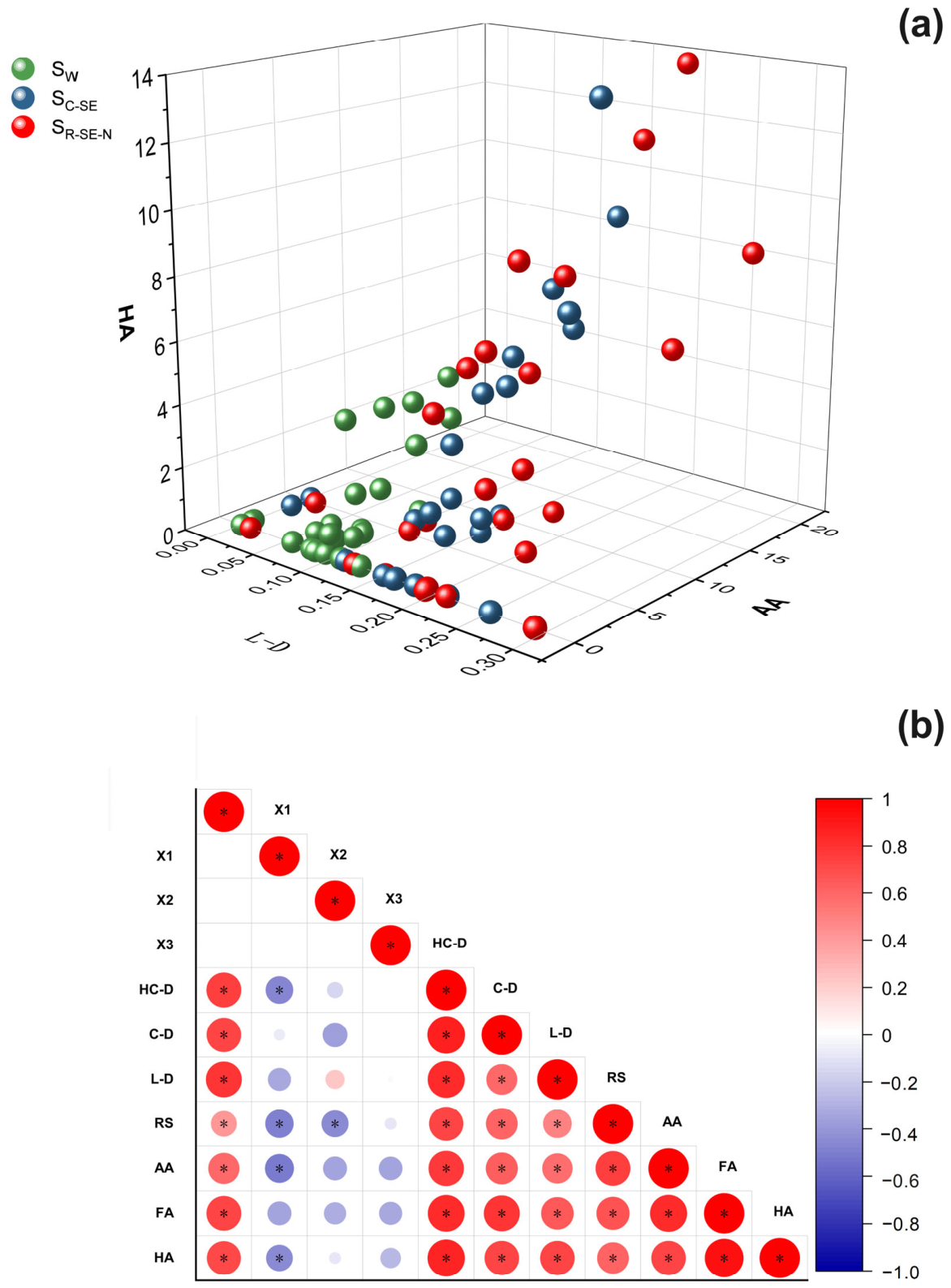
To obtain a global view of humification behavior across the experimental matrix (raw data provided in Table S1, Supplementary Materials), the distributions of lignocellulose degradation, precursor accumulation, and HA formation were visualized using a 3D scatter plot and a Pearson correlation heatmap (Figure 1a,b). The 3D scatter plot revealed a clear substrate-dependent stratification of the fermentation outcomes. Most SW samples were concentrated in the low-performance region, characterized by limited HA accumulation and relatively weak lignocellulose conversion. In contrast, the pretreated substrates, particularly SC-SE and SR-SE-N, extended toward regions associated with higher amino acid (AA) levels, greater lignin degradation (L-D), and increased HA yield. This pattern indicates that physicochemical pretreatment substantially broadened the accessible metabolic space for humification. Notably, SR-SE-N occupied the most favorable region of the distribution, implying that the combined effects of steam explosion and ammoniation provided a particularly suitable physicochemical basis for subsequent model-based evaluation of fungal inoculation timing.
The Pearson correlation heatmap summarizes the overall associations among inoculation timing variables, degradation indices, precursor pools, and humic fractions across the full dataset (Figure 1b). HA showed significant positive correlations with L-D, AA, and FA, indicating that effective lignin depolymerization and the accumulation of nitrogen-containing and soluble intermediates were closely associated with enhanced humification. By contrast, RS showed a weaker or negative association with final HA accumulation, suggesting that soluble sugars mainly acted as transient intermediates and were progressively consumed during downstream conversion. Collectively, these patterns indicate that pretreatment established the baseline accessibility of the substrate, whereas inoculation timing influenced how efficiently released intermediates were redirected toward HA formation. These observations prompted a closer examination of how pretreatment shaped lignocellulosic deconstruction in each substrate.

3.2. Substrate Pretreatment Establishes the Structural Baseline for Lignocellulosic Deconstruction

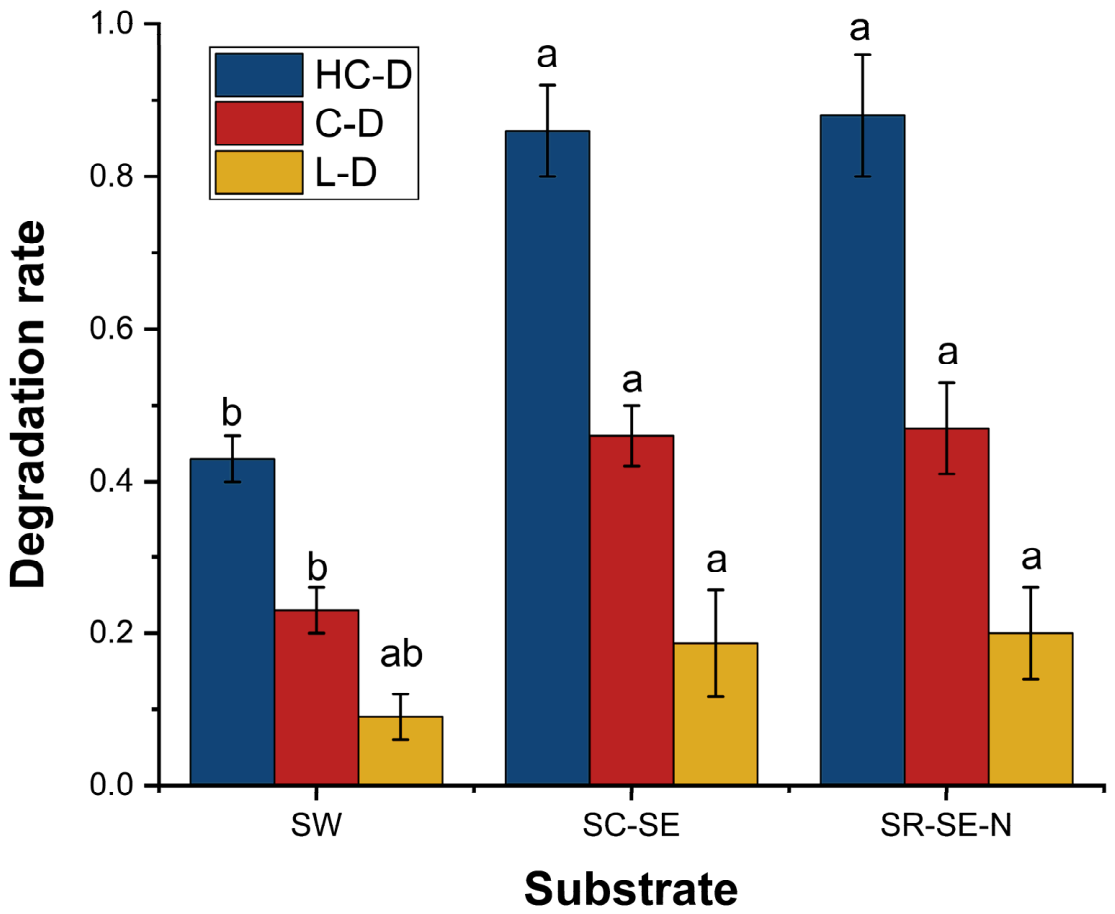
The degradation data showed that pretreatment strongly influenced the structural accessibility of crop straw and thereby determined the initial baseline for microbial conversion. The degradation efficiencies of hemicellulose, cellulose, and lignin under different substrate pretreatments are summarized in Figure 2. Among the three substrates, SW exhibited the lowest degradation efficiencies for hemicellulose, cellulose, and lignin, reflecting the strong structural recalcitrance of the native lignocellulosic matrix. In untreated straw, lignin–carbohydrate complexes and ordered cellulose regions likely restricted fungal colonization and limited enzymatic access to internal polysaccharides and aromatic structures.
By contrast, steam explosion markedly improved substrate deconstruction. In SC-SE, the degradation rates of hemicellulose and cellulose increased substantially relative to SW, indicating that disruption of cell wall integrity and partial cleavage of lignin-associated linkages enhanced the accessibility of structural carbohydrates. The effect became even more evident in SR-SE-N, where the combined treatment of steam explosion and ammoniation generated the highest overall degradation levels. This result suggests that ammoniation further weakened ester-linked structures and improved matrix swelling, thereby increasing the susceptibility of the substrate to microbial attack and enzymatic hydrolysis. At the same time, nitrogen supplementation likely alleviated the nutrient limitation typically associated with straw-based systems.
These results demonstrate that substrate pretreatment did not merely accelerate biomass breakdown, but created distinct physicochemical starting points for humification. SE improved structural openness, whereas the additional ammoniation in SR-SE-N simultaneously enhanced accessibility and nitrogen availability, making this substrate the most promising platform for targeted HA production. However, pretreatment alone could not fully explain the final differences in HA yield, because substantial variation still remained among inoculation schedules within the same pretreated substrate. This indicates that, after the structural barrier was alleviated, the temporal organization of fungal activity became a critical determinant of humification efficiency.

3.3. Timing-Dependent Fungal Organization Regulates HA Recovery

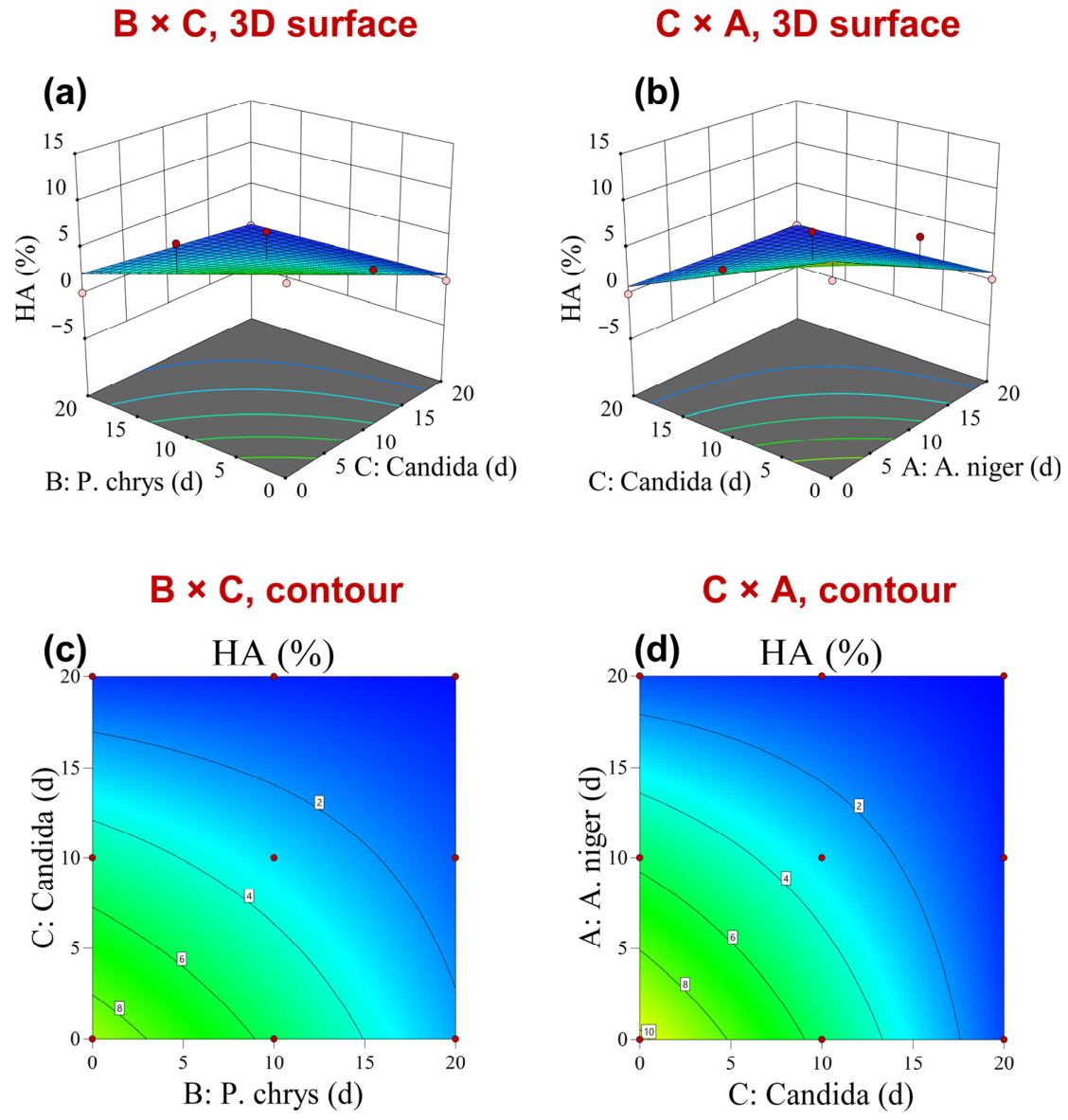
After pretreatment had established substrate accessibility, the final HA yield was strongly influenced by how the fungal inocula were temporally arranged. Across the tested schedules, differences in inoculation timing led to marked variation in HA accumulation, indicating that fungal interactions were highly time-dependent rather than simply additive. In general, introducing all strains simultaneously did not always produce the best humification outcome across the full substrate set, especially when functional overlap or early-stage competition likely interfered with efficient precursor channeling. Instead, the data showed that staggered inoculation could effectively reshape microbial interactions and improve HA recovery under selected substrate conditions. The effects of different inoculation timing combinations on HA recovery are further illustrated by the response surfaces in Figure 3.
This timing effect can be understood as a balance between competition and complementarity. When multiple fungi are introduced at the same stage, they are more likely to compete immediately for accessible carbon sources, oxygen, and colonization space. Such competition may reduce functional specialization, delay ligninolytic activity, or accelerate the non-productive consumption of soluble intermediates. In contrast, sequential inoculation allows early colonizers to establish a favorable metabolic context before the introduction of later functional partners. Under this arrangement, saccharification-related activity can proceed first, followed by more effective lignin depolymerization and subsequent conversion of soluble intermediates into humified products. Therefore, the advantage of sequential inoculation lies in reorganizing the order of functional expression, rather than merely delaying one strain in isolation.
At the whole-system level, the timing-dependent effects observed here indicate that microbial organization acts as a regulatory layer superimposed on substrate pretreatment. Pretreatment determines whether the matrix can be efficiently accessed, whereas inoculation timing determines whether the released carbon and nitrogen pools are converted into transient metabolites or ultimately redirected into HA. The substrate-dependency of this highest-yielding inoculation strategy within the investigated range is clearly evidenced by the divergent humification responses across the 81-run matrix (Figure 1). For instance, in the highly recalcitrant raw wheat straw (SW) system, the maximum HA yield was severely restricted, reaching only 4.17% when all three fungal strains were inoculated simultaneously at Day 0. In contrast, for the steam-exploded corn straw (SC-SE), the peak HA yield was significantly enhanced to 13.7%; however, achieving this maximum required a sequential strategy (A. niger and Candida sp. introduced at Day 0, followed by P. chrysosporium at Day 10). Interestingly, the ammoniated steam-exploded rice straw (SR-SE-N) achieved an identical peak HA production (13.7%), but under a simultaneous inoculation strategy. This suggests that the improved structural accessibility, combined with nitrogen pre-loading in SR-SE-N, alleviated early-stage ecological competition, allowing the fungi to function synergistically from the onset. Because SR-SE-N provided the most favorable physicochemical background for robust HA production without the need for delayed inoculation, it was selected for subsequent model-based analysis to identify the highest HA-yielding inoculation schedule within the investigated timing range.

3.4. Model-Based Analysis of Inoculation Timing on SR-SE-N and Validation of the Highest HA-Yielding Strategy Within the Investigated Range

Based on the favorable pretreatment performance of SR-SE-N, model analysis was further conducted on this substrate to identify the fungal inoculation strategy associated with the highest HA yield within the investigated timing range. The inoculation timings of A. niger (A), P. chrysosporium (B), and Candida sp. (C) were used as independent variables, and HA yield was taken as the response. Sequential model testing indicated that the two-factor interaction (2FI) model was the most appropriate for describing the response pattern of HA formation on SR-SE-N. Compared with the linear model, the 2FI model significantly improved model performance (F = 11.29, p = 0.0001), whereas the quadratic model did not provide a further significant improvement over the 2FI model (F = 1.55, p = 0.2389). Therefore, the 2FI model was selected for subsequent interpretation and identification of the highest HA-yielding timing combination within the investigated range.
The coded regression equation of the selected 2FI model for HA yield on SR-SE-N was as follows:
YHA = 3.05 − 2.51A − 1.82B − 2.60C + 0.956AB + 2.09AC + 1.54BC
where YHA is the predicted HA yield, and A, B, and C represent the coded inoculation timings of A. niger, P. chrysosporium, and Candida sp., respectively. ANOVA confirmed that the model was highly significant (F = 23.72, p < 0.0001; Table 3), with an R2 of 0.8768, an adjusted R2 of 0.8398, and a predicted R2 of 0.7795. The difference between the adjusted and predicted R2 values was below 0.2, indicating acceptable predictive consistency. In addition, the adequate precision was 18.98, indicating a strong signal relative to noise and supporting the use of the model for navigating the design space. The standard deviation of the model was 1.65, and the coefficient of variation (CV) was 53.99%. This relatively high CV should be interpreted in the context of the experimental design space. The 27-run matrix covered both highly unfavorable timing combinations with near-zero HA yield and more favorable combinations yielding up to 13.7% HA, resulting in a wide response range and a relatively low overall mean value, which together increased the calculated CV. Therefore, the CV value should be considered together with the consistency of biological triplicates, the agreement among R2 statistics, and the independent validation results when assessing model adequacy. Among the model terms, the main effects of A, B, and C were all significant (p ≤ 0.0001), while AC (p = 0.0003) and BC (p = 0.0042) were significant interaction terms; by contrast, AB was not significant (p = 0.0582). These results indicate that inoculation timing was a dominant factor governing HA formation on SR-SE-N, and that timing coordination involving Candida sp. played a particularly important role in the selected SR-SE-N system. Importantly, the selection of the 2FI model indicates that HA formation within the investigated timing range was governed primarily by the main effects of inoculation timing and their pairwise interactions, whereas inclusion of higher-order terms did not significantly improve model performance. A formal lack-of-fit test was not available for the fitted matrix because the model was built from one response value per unique timing combination, which did not provide replicated design points for pure error estimation.
The response surface analysis of the significant interaction terms showed that HA production on SR-SE-N was particularly sensitive to the timing coordination involving Candida sp. Specifically, the AC and BC interaction surfaces revealed that the effect of Candida inoculation timing depended on the timing of A. niger and P. chrysosporium, respectively. By contrast, the AB term was not statistically significant and was therefore not further interpreted. Within the investigated timing range (0–20 d for each microorganism), the highest HA recovery was identified under simultaneous inoculation of the three fungi. This result indicates that, under the bounded experimental window used in this study, the ammoniated and steam-exploded substrate SR-SE-N provided a physicochemical background that allowed compatible multi-fungal functioning from the beginning of fermentation, without requiring delayed inoculation to alleviate early-stage ecological constraints.
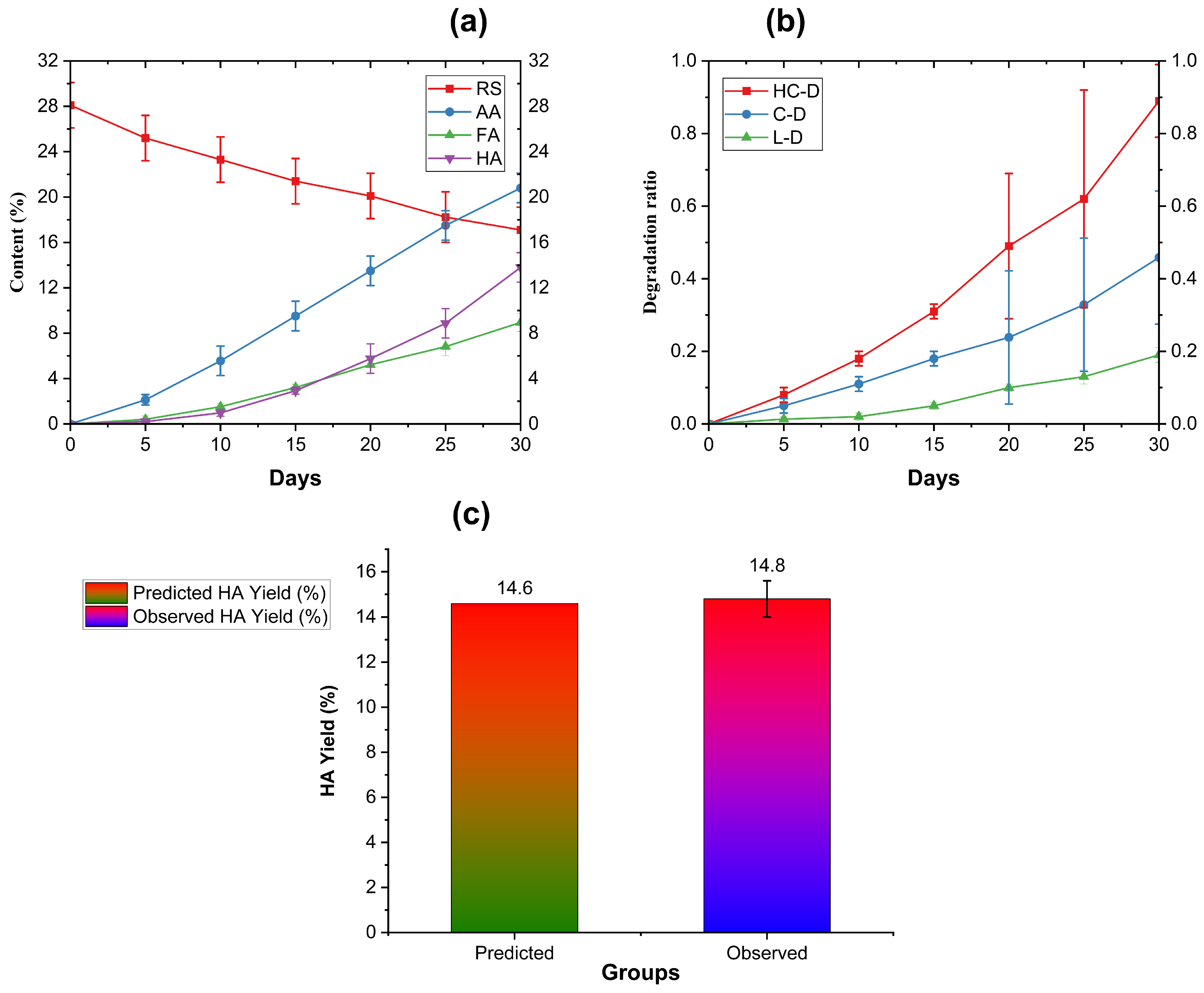
The dynamic changes in precursor pools, lignocellulose degradation, and model validation under the selected treatment are shown in Figure 4a–c. Under this condition, RS and AA showed clear temporal variation during fermentation, indicating active generation and turnover of soluble precursors. FA accumulated transiently before HA increased continuously, suggesting progressive conversion of low-molecular-weight intermediates into more humified products. Meanwhile, hemicellulose, cellulose, and lignin degradation proceeded in parallel, confirming that structural deconstruction and humification were tightly coupled under the selected inoculation strategy identified within the investigated range. The comparison between predicted and experimentally observed HA yields showed close agreement (Figure 4c), further verifying the predictive reliability of the data-driven model within the investigated range. Taken together, these findings demonstrate that, on the ammoniated and steam-exploded substrate SR-SE-N, data-driven model analysis can identify a favorable inoculation strategy within a bounded timing range.

4. Discussion

The present results demonstrate that efficient humic acid (HA) formation from crop straw depends on the coupling of substrate pretreatment and fungal temporal organization rather than on either factor alone. Pretreatment first determines whether the lignocellulosic matrix can be sufficiently opened for microbial access, whereas inoculation timing subsequently governs how the released carbon and nitrogen pools are partitioned between transient intermediates and stable humified products. This combined interpretation is consistent with the global patterns observed in the scatter distribution and correlation analysis, where pretreated substrates, particularly SR-SE-N, occupied the high-performance region characterized by stronger lignin degradation, higher amino acid accumulation, and increased HA production. These findings reinforce the view that effective humification requires both enhanced substrate accessibility and coordinated precursor transformation [2,3,7].
The superior performance of pretreated straw, especially ammoniated steam-exploded straw, confirms that physicochemical conditioning is a prerequisite for directed humification of lignocellulosic residues [37]. Native straw is protected by highly ordered cellulose and dense lignin–carbohydrate complexes, which substantially restrict enzymatic penetration and microbial utilization [3,7]. Steam explosion is widely recognized as an effective pretreatment for loosening plant cell wall structure, partially solubilizing hemicellulose, and improving downstream enzymatic and microbial conversion [9,10,11,12,13]. In addition, ammoniation likely provided two further advantages in the present system: weakening ester-linked structures within the lignocellulosic matrix and increasing nitrogen availability for subsequent humification reactions [16,17,18]. The particularly favorable performance of SR-SE-N suggests that the combination of structural opening and nitrogen pre-supplementation created a more suitable physicochemical environment for fungal colonization, precursor generation, and HA accumulation than pretreatment by steam explosion alone. This interpretation is also consistent with previous observations that combined physicochemical treatment can substantially improve the humification performance of straw-based systems [16,22].
Beyond pretreatment, the present study highlights that fungal inoculation timing acts as a critical ecological regulator of humification. More specifically, inoculation timing influences whether the consortium operates through effective division of metabolic labor, whether partially differentiated ecological niches can emerge over time, and whether the three strains can coexist functionally without severe early-stage exclusion. Under favorable substrate conditions, such temporal organization supports complementary rather than antagonistic interactions among the fungal members. The comparison among inoculation schedules showed that fungal functions were not simply additive, but strongly dependent on temporal arrangement [38]. This agrees with increasing evidence that the performance of composite inoculants or synthetic microbial communities depends not only on taxonomic composition but also on functional succession and ecological compatibility [30,39,40]. When multiple fungi are introduced into the same system, they may compete for accessible carbon sources, oxygen, and colonization space during the early stage of fermentation, thereby constraining the establishment of their specialized metabolic roles. Similar competition-related effects have been reported in mixed biodegradation systems involving Candida and other microorganisms [29]. Therefore, the biological significance of inoculation timing lies in regulating the balance between competition and complementarity, and thereby controlling whether released intermediates are efficiently redirected toward HA formation.
Importantly, the present results do not support a simplistic conclusion that sequential inoculation is universally superior to simultaneous inoculation. Instead, they indicate that the most favorable inoculation strategy is substrate-dependent within the investigated conditions. On SR-SE-N, the highest HA-yielding strategy within the investigated timing range was simultaneous rather than sequential inoculation. Under some substrate conditions, staggered inoculation likely improved functional relay by allowing early saccharification and intermediate accumulation before the establishment of later oxidative or conversion-related activities. Such a mechanism is consistent with previous studies showing that inoculation timing can reshape microbial succession, enzyme expression, nitrogen turnover, and final humification outcomes [33,34,41]. However, once the substrate had been sufficiently conditioned by the combined ammoniation-steam explosion pretreatment, the ecological constraints that normally favor temporal separation appeared to be substantially alleviated. In the SR-SE-N system, simultaneous inoculation was identified by the model as the highest HA-yielding strategy within the investigated range, suggesting that the improved accessibility and pre-existing nitrogen supply enabled the three fungi to function compatibly from the beginning of fermentation. In other words, pretreatment altered not only the physicochemical nature of the substrate, but also the ecological requirements for effective multi-fungal cooperation.
From a microbial ecology perspective, the shift from sequential inoculation (as observed in SC-SE) to simultaneous inoculation (in SR-SE-N) can be explained by the alleviation of niche overlap and nutrient competition. In substrates with limited easily accessible nitrogen and carbon, simultaneously introducing multiple fast-growing fungi inevitably triggers intense early-stage competition for limited resources. This competitive exclusion often suppresses the expression of specialized functions, such as extracellular ligninolytic enzymes. Consequently, sequential inoculation is necessary in those systems to allow pioneer microbes (A. niger) to saccharify polysaccharides before secondary fungi (P. chrysosporium) are introduced. However, the combined ammoniation and steam explosion in SR-SE-N structurally unzipped the matrix and pre-loaded the system with abundant nitrogen. This nutrient superabundance effectively eliminated the ecological bottleneck, allowing all three functional strains to colonize, co-exist, and perform their specific metabolic roles synergistically from Day 0 without destructive competition.
Compared to existing literature, this integrated pretreatment–microbial approach demonstrates significant advantages. Traditional agricultural waste composting typically requires 60 to 90 days to achieve satisfactory humification, heavily relying on spontaneous and uncontrollable microbial succession [2,19]. Even in studies utilizing artificially constructed fungal consortia, the lack of effective nitrogen pre-loading often limits the final humic acid yield. By treating inoculation timing as a controllable ecological variable superimposed on an ammoniated substrate, the present study achieved an HA yield of up to 13.7% within just 30 days. This clearly outperforms conventional single-strain treatments and highlights that microbial functional potential can only be fully realized when substrate stoichiometry (C/N ratio) and structural accessibility are properly aligned.
This highest HA-yielding strategy within the investigated range provides an important mechanistic insight for HA biomanufacturing. This interpretation is also consistent with our recent pathway-oriented study conducted on the same substrate–fungal system, which showed that efficient HA formation depended on the coordinated coupling of saccharification-derived carbon sources, nitrogen-related soluble precursors, and lignin-derived aromatic intermediates [35]. Humification is widely considered to involve the coordinated release, transformation, and condensation of lignin-derived aromatics, reducing sugars, amino compounds, and other reactive intermediates through polyphenol- and Maillard-related pathways [1,2,42]. In the present study, the positive associations of HA with lignin degradation, amino acid accumulation, and fulvic acid are consistent with this framework, suggesting that efficient HA formation requires both adequate aromatic nuclei and sufficient nitrogen-containing precursors. Recent work has similarly emphasized the roles of lignin-derived phenols, amino acids, reactive oxygen-mediated coupling, and precursor synchronization in the assembly of humic substances [18,20,21,43,44]. The dynamic profiles observed under the highest HA-yielding treatment within the investigated range further support this interpretation, as soluble intermediates were generated and subsequently consumed in parallel with progressive HA accumulation. Therefore, the key function of favorable inoculation timing is not merely operational scheduling, but metabolic synchronization of precursor release, turnover, and condensation.
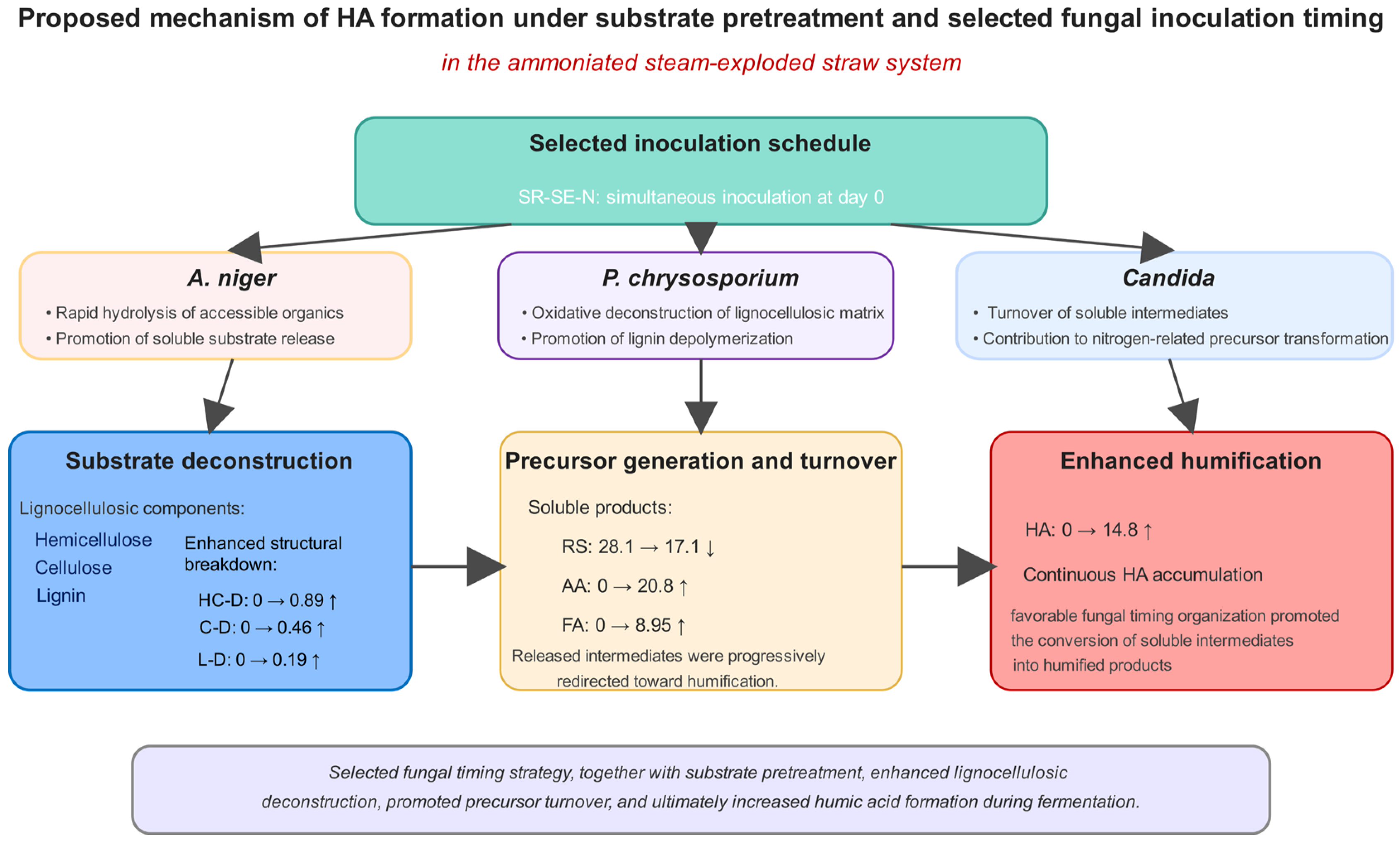
Based on the experimental results, a schematic mechanism is proposed to integrate the effects of substrate conditioning, fungal timing organization, and precursor synchronization on HA formation (Figure 5). The scheme suggests that steam explosion primarily enhanced structural accessibility, whereas ammoniation further increased matrix susceptibility and nitrogen availability, thereby creating a more favorable physicochemical platform for fungal colonization and precursor generation. On this basis, inoculation timing acted as an ecological regulator that controlled the temporal coordination of saccharification, lignin depolymerization, soluble intermediate turnover, and subsequent condensation into humified products. Importantly, the model-supported identification of simultaneous inoculation as the highest HA-yielding schedule on SR-SE-N indicates that once the substrate had been sufficiently opened and nitrogen had been pre-supplemented, the system could support compatible multi-fungal functioning from the onset of fermentation, eliminating the need for temporal separation that may be required under more constrained substrate conditions.
Another important implication of this work is its methodological innovation in treating inoculation timing as a controllable ecological variable. Rather than treating inoculation order as an empirical fermentation parameter, this study used data-driven model analysis to identify the temporal interactions among fungal members and to link them directly with HA output. The selected 2FI model for SR-SE-N showed good explanatory and predictive performance, indicating that the relationship between inoculation timing and HA formation was sufficiently structured to support model-based evaluation. Notably, the final choice of a 2FI model rather than a more complex quadratic model suggests that the dominant response pattern could be captured by a parsimonious interaction structure within the investigated design space. In this sense, the present “data-driven” strategy does not merely refer to statistical fitting, but to the use of experimental data to discriminate among competing model forms, identify the minimum level of model complexity required, and translate those quantitative relationships into an experimentally validated high-HA inoculation strategy within the investigated range. This is valuable because conventional composting or fermentation systems often suffer from stochastic microbial succession and unstable intermediate conversion, which lead to inconsistent humification performance [45,46,47,48]. By contrast, the present approach treats inoculation timing as a controllable ecological variable and integrates substrate pretreatment with microbial organization into a unified evaluation framework. Such a framework may be more broadly applicable to other lignocellulosic bioconversion systems where product formation depends on the coordinated succession of different microbial functions. The fact that a statistically supported 2FI model was sufficient is also advantageous from an engineering perspective, because it provides interpretable timing-design guidance without requiring unnecessarily complex model structures.
Overall, the study suggests that high-value conversion of crop straw into HA-rich products should be understood as a substrate-dependent and ecologically regulated process. Pretreatment determines the physicochemical boundary conditions of the system, whereas inoculation timing determines how efficiently those conditions are exploited by the fungal consortium. The fact that the highest HA-yielding strategy within the investigated range on SR-SE-N was simultaneous rather than sequential inoculation should therefore not be viewed as contradicting the importance of temporal organization; instead, it demonstrates that the favorable temporal pattern within the tested range itself emerges from the interaction between substrate background and microbial function. From an engineering perspective, this finding is particularly meaningful because it implies that process simplification may become possible when pretreatment is sufficiently effective. Thus, the coupling of ammoniation-steam explosion pretreatment with data-driven fungal timing evaluation provides not only a mechanistically interpretable strategy for HA production, but also a potentially scalable route for the sustainable valorization of agricultural residues into humic fertilizers and related bio-based products.
Limitation: One limitation of this study is that the three tested substrate platforms differed in both pretreatment history and straw type. Therefore, the observed differences across SW, SC-SE, and SR-SE-N should be interpreted as integrated substrate-platform effects rather than as isolated pretreatment effects alone.

5. Conclusions

This study established a data-driven framework for evaluating multi-fungal inoculation timing and identifying favorable schedules for improving humic acid recovery from crop straws. Pretreatment increased substrate accessibility, and ammoniation further enhanced nitrogen availability for humification. Among the tested substrate platforms, SR-SE-N showed the best overall performance. A significant 2FI model identified inoculation timing as a key regulator of HA formation, and within the investigated timing range, the highest HA yield on SR-SE-N was obtained under simultaneous inoculation of Aspergillus niger, Phanerochaete chrysosporium, and Candida sp. Overall, the results demonstrate that the most favorable inoculation strategy within the investigated range is substrate-dependent and can be effectively identified through data-driven analysis within a bounded timing range, providing a practical basis for controllable HA biomanufacturing from pretreated agricultural residues.

Supplementary Materials

The following supporting information can be downloaded at: https://www.mdpi.com/article/10.3390/agriculture16111228/s1, Supplementary Materials Table S1: Full experimental matrix and analytical results of the 81 fermentation runs across three substrate platforms.

Author Contributions

Conceptualization, P.Z. and B.L.; methodology, P.Z. and B.L.; software, C.Z.; validation, P.Z. and B.L.; formal analysis, K.C. and F.A.C.; investigation, L.X.; resources, X.Z.; data curation, P.Z. and B.L.; writing—original draft preparation, B.L.; writing—review and editing, B.L.; visualization, L.X.; supervision, B.L.; project administration, B.L. and C.Z.; funding acquisition, P.Z., B.L. and C.Z. All authors have read and agreed to the published version of the manuscript.

Funding

This research was funded by the National Natural Science Foundation of China (grant numbers 31801317 and 32372012), CSC scholarship (grant number 202108330293) and the Natural Science Foundation of Zhejiang Province (grant number LQ17C130001). These organizations made financial contributions.

Institutional Review Board Statement

Not applicable.

Data Availability Statement

The data presented in this study are available upon request from the corresponding author.

Conflicts of Interest

The authors declare no conflicts of interest.

Abbreviations

The following abbreviations are used in this manuscript:
2FITwo-factor interaction
AAAmino acids
ANOVAAnalysis of variance
C-DCellulose degradation
CVCoefficient of variation
DNS3,5-Dinitrosalicylic Acid
FAFulvic Acid
HAHumic acid
HC-DHemicellulose degradation
IHSSInternational Humic Substances Society
L-DLignin degradation
LCCLignin–carbohydrate complex
MEAMalt Extract Agar
PDAPotato Dextrose Agar
RSReducing sugars
SC-SESteam-exploded corn straw
SR-SE-NAmmoniated steam-exploded rice straw
SESteam Explosion
SSFSolid-state fermentation
SWRaw wheat straw
TOCTotal Organic Carbon

References

  1. Waksman, S.A. Humus: Origin, Chemical Composition, and Importance in Nature; Williams & Wilkins: Baltimore, MD, USA, 1936. [Google Scholar]
  2. Guo, X.; Liu, H.; Wu, S. Humic substances developed during organic waste composting: Formation mechanisms, structural properties, and agronomic functions. Sci. Total Environ. 2019, 662, 501–510. [Google Scholar] [CrossRef] [PubMed]
  3. Usmani, Z.; Sharma, M.; Awasthi, A.K.; Lukk, T.; Tuohy, M.G.; Gong, L.; Nguyen-Tri, P.; Goddard, A.D.; Bill, R.M.; Nayak, S.C.; et al. Lignocellulosic biorefineries: The current state of challenges and strategies for efficient commercialization. Renew. Sustain. Energy Rev. 2021, 148, 111258. [Google Scholar] [CrossRef]
  4. Singh, Y.; Sharma, S.; Kumar, U.; Sihag, P.; Balyan, P.; Singh, K.P.; Dhankher, O.P. Strategies for economic utilization of rice straw residues into value-added by-products and prevention of environmental pollution. Sci. Total Environ. 2024, 906, 167714. [Google Scholar] [CrossRef] [PubMed]
  5. Wang, Y.; Zhang, C.; Zhao, Y.; Wei, Z.; Li, J.; Song, C.; Chen, X.; Zhao, M. Lignite drove phenol precursors to participate in the formation of humic acid during chicken manure composting. Sci. Total Environ. 2023, 874, 162609. [Google Scholar] [CrossRef]
  6. Meng, X.; Liu, J.; Ai, S.; Liu, Z.; Yang, F.; Cheng, K. Artificial humic acid and fulvic acid for sustainable soil improvement: Promoting humification and crop growth. Ind. Crops Prod. 2025, 237, 122302. [Google Scholar] [CrossRef]
  7. Wu, D.; Wei, Z.; Mohamed, T.A.; Zheng, G.; Qu, F.; Wang, F.; Zhao, Y.; Song, C. Lignocellulose biomass bioconversion during composting: Mechanism of action of lignocellulase, pretreatment methods and future perspectives. Chemosphere 2022, 286, 131635. [Google Scholar] [CrossRef]
  8. Sajid, S.; Zveushe, O.K.; Resco de Dios, V.; Nabi, F.; Lee, Y.K.; Kaleri, A.R.; Ma, L.; Zhou, L.; Zhang, W.; Dong, F.; et al. Pretreatment of rice straw by newly isolated fungal consortium enhanced lignocellulose degradation and humification during composting. Bioresour. Technol. 2022, 354, 127150. [Google Scholar] [CrossRef]
  9. Theuretzbacher, F.; Lizasoain, J.; Lefever, C.; Saylor, M.K.; Enguidanos, R.; Weran, N.; Gronauer, A.; Bauer, A. Steam explosion pretreatment of wheat straw to improve methane yields: Investigation of the degradation kinetics of structural compounds during anaerobic digestion. Bioresour. Technol. 2015, 179, 299–305. [Google Scholar] [CrossRef]
  10. Monschein, M.; Nidetzky, B. Effect of pretreatment severity in continuous steam explosion on enzymatic conversion of wheat straw: Evidence from kinetic analysis of hydrolysis time courses. Bioresour. Technol. 2016, 200, 287–296. [Google Scholar] [CrossRef]
  11. Hoang, A.T.; Nguyen, X.P.; Duong, X.Q.; Agbulut, U.; Len, C.; Nguyen, P.Q.P.; Kchaou, M.; Chen, W.-H. Steam explosion as sustainable biomass pretreatment technique for biofuel production: Characteristics and challenges. Bioresour. Technol. 2023, 385, 129398. [Google Scholar] [CrossRef]
  12. Chen, X.; Lin, Q.; Rizwan, M.; Zhao, X.; Li, G. Steam explosion of crop straws improves the characteristics of biochar as a soil amendment. J. Integr. Agric. 2019, 18, 1486–1495. [Google Scholar] [CrossRef]
  13. Li, B.; Chen, K.; Gao, X.; Zhao, C.; Shao, Q.; Sun, Q.; Li, H. Influence of steam explosion on rice straw fiber content. J. Biobased Mater. Bioenergy 2015, 9, 596–608. [Google Scholar] [CrossRef]
  14. Zhang, Y.; Bi, Z.; Tian, W.; Ge, Z.; Xu, Y.; Xu, R.; Zhang, H.; Tang, S. Synergistic effect triggered by Fe2O3 and oxygen-induced hydroxyl radical enhances formation of amino-phenolic humic-like substance. J. Environ. Manag. 2023, 348, 119312. [Google Scholar] [CrossRef]
  15. Zhang, H.; Zhang, R.; Song, Y.; Miu, X.; Zhang, Q.; Qu, J.; Sun, Y. Enhanced enzymatic saccharification and ethanol production of corn stover via pretreatment with urea and steam explosion. Bioresour. Technol. 2023, 376, 128856. [Google Scholar] [CrossRef] [PubMed]
  16. Li, B.; Zhao, C.; Sun, Q.; Chen, K.; Zhao, X.; Yang, Z.; Peng, H. Effects of ammonification-steam explosion pretreatment on the production of true protein from rice straw during solid-state fermentation. Sustainability 2023, 15, 5964. [Google Scholar] [CrossRef]
  17. Dong, S.; Wei, Y.; Yu, Q.; Gao, Y.; Chen, H.; Zhou, K.; Cheng, M.; Wang, B.; Wei, Y.; Hu, X. Inoculating functional bacteria improved the humification process by regulating microbial networks and key genera in straw composting by adding different nitrogen sources. Bioresour. Technol. 2024, 393, 130022. [Google Scholar] [CrossRef]
  18. Su, J.; Zhan, Y.; Chang, Y.; Chang, S.; Luo, Y.; Chen, P.; Tao, X.; Chen, Y.; Yang, L.; Xu, T.; et al. Phosphate additives promote humic acid carbon and nitrogen skeleton formation by regulating precursors and composting bacterial communities. Bioresour. Technol. 2024, 399, 130617. [Google Scholar] [CrossRef]
  19. Zhao, X.; Li, B.; Zhao, C.; Chandio, F.A. Effect of steam explosion pretreatment on rice straw humification performance during composting. Waste Biomass Valoriz. 2025, 17, 2221–2235. [Google Scholar] [CrossRef]
  20. Zhang, Z.; Zhao, Y.; Yang, T.; Wei, Z.; Li, Y.; Wei, Y.; Chen, X.; Wang, L. Effects of exogenous protein-like precursors on humification process during lignocellulose-like biomass composting: Amino acids as the key linker to promote humification process. Bioresour. Technol. 2019, 288, 121882. [Google Scholar] [CrossRef]
  21. Zhang, W.; Zhao, Y.; Lu, Q.; Feng, W.; Wang, L.; Wei, Z. Evaluating differences in humic substances formation based on the shikimic acid pathway during different materials composting. Bioresour. Technol. 2022, 364, 128060. [Google Scholar] [CrossRef]
  22. Zhao, X.; Li, B.; Zhao, C.; Chandio, F.A. A physicochemical and biological composite environment for the humification of crop straw in compost. Fermentation 2025, 11, 109. [Google Scholar] [CrossRef]
  23. Zhang, Y.; Yue, D.; Ma, H. Darkening mechanism and kinetics of humification process in catechol-Maillard system. Chemosphere 2015, 130, 40–45. [Google Scholar] [CrossRef]
  24. Mu, D.; Wang, C.; Geng, X.; Zhao, Y.; Mohamed, T.A.; Wu, D.; Wei, Z. Effect of Maillard reaction based on catechol polymerization on the conversion of food waste to humus. Chemosphere 2024, 353, 141560. [Google Scholar] [CrossRef]
  25. Janusz, G.; Pawlik, A.; Sulej, J.; Świderska-Burek, U.; Jarosz-Wilkołazka, A.; Paszczyński, A. Lignin degradation: Microorganisms, enzymes involved, genomes analysis and evolution. FEMS Microbiol. Rev. 2017, 41, 941–962. [Google Scholar] [CrossRef]
  26. Zheng, J.; Wang, X.; Zhang, Y. Synergistic promotion of straw anaerobic digestion by a composite microbial consortium and micro-aeration: Enhancing lignocellulose decomposition and methanogenesis. Chem. Eng. J. 2026, 528, 172265. [Google Scholar] [CrossRef]
  27. Tang, J.; Liu, Y.; Zhang, Q.; Zhang, H.; Ni, B.-J.; Lv, W. Multi-omics dissection of yeast-centric fungal-bacterial synergies in food-processing wastewater: Insights from four full-scale treatment plants. Bioresour. Technol. 2026, 443, 133911. [Google Scholar] [CrossRef]
  28. Srivastava, S.; Dafale, N.A. Tailored microbial consortium producing hydrolytic enzyme cocktail for maximum saccharification of wheat straw. Bioresour. Technol. 2024, 399, 130560. [Google Scholar] [CrossRef]
  29. Kashyap, N.; Roy, K.; Moholkar, V.S. Mechanistic investigation in co-biodegradation of phenanthrene and pyrene by Candida tropicalis MTCC 184. Chem. Eng. J. 2020, 399, 125659. [Google Scholar] [CrossRef]
  30. Zhou, S.-P.; Ke, X.; Jin, L.-Q.; Xue, Y.-P.; Zheng, Y.-G. Sustainable management and valorization of biomass wastes using synthetic microbial consortia. Bioresour. Technol. 2024, 395, 130391. [Google Scholar] [CrossRef] [PubMed]
  31. Wang, L.; Sun, K.; Pan, S.; Wang, S.; Yan, Z.; Zhu, L.; Yang, X. Exogenous microbial antagonism affects the bioaugmentation of humus formation under different inoculation using Trichoderma reesei and Phanerochaete chrysosporium. Bioresour. Technol. 2023, 373, 128717. [Google Scholar] [CrossRef]
  32. Li, X.; Zhang, Z.; Wang, F.; Li, T.; Guo, Q.; Cui, X.; Hansen, H.C.B.; Kjøller, R.; Ekelund, F. Decoding the role of fungal functional groups in dissolved organic matter transformation and humification during co-composting. Bioresour. Technol. 2025, 438, 133230. [Google Scholar] [CrossRef]
  33. Wang, X.; Qiu, M.; Zhang, L. Effects of inoculation timing with lignocellulose-degrading compound microbial inoculum on green waste composting. Bioresour. Technol. 2026, 439, 133291. [Google Scholar] [CrossRef]
  34. Zhao, C.; Yang, L.; Zhang, M.; Jin, C.; Zhang, Q.; Yan, S.; Cao, Y. Effects of two-stage inoculation on humification during composting: Microbial community shifts and molecular transformation pathways of humic acids. J. Environ. Chem. Eng. 2026, 14, 122035. [Google Scholar] [CrossRef]
  35. Wu, Z.; Zhao, C.; Chen, K.; Xu, L.; Chandio, F.A.; Zhao, X.; Li, B. Humification pathways of crop residues under ammonification-steam explosion pretreatment and multi-fungal inoculation. Agriculture 2026, 16, 817. [Google Scholar] [CrossRef]
  36. Zhu, J.; Chen, K.; Li, B. Optimization of protein yield from rice straw via ammonia-steam explosion pretreatment and solid-state fermentation using response surface methodology. Agriculture 2026, 16, 621. [Google Scholar] [CrossRef]
  37. Bai, L.; Deng, Y.; Li, J.; Ji, M.; Ruan, W. Role of the proportion of cattle manure and biogas residue on the degradation of lignocellulose and humification during composting. Bioresour. Technol. 2020, 307, 122941. [Google Scholar] [CrossRef] [PubMed]
  38. Bao, R.; Lu, X.; Huang, W.; Li, Q. Bacillus licheniformis inoculation accelerates the humification process through regulating the shikimic acid pathway and lignin degradation in pilot-scale composting. Biocatal. Agric. Biotechnol. 2025, 70, 103859. [Google Scholar] [CrossRef]
  39. Wang, S.; Long, H.; Hu, X.; Wang, H.; Wang, Y.; Guo, J.; Zheng, X.; Ye, Y.; Shao, R.; Yang, Q. The co-inoculation of Trichoderma viridis and Bacillus subtilis improved the aerobic composting efficiency and degradation of lignocellulose. Bioresour. Technol. 2024, 394, 130285. [Google Scholar] [CrossRef] [PubMed]
  40. Liu, Q.; Xie, Z.; Tang, S.; Xie, Q.; He, X.; Li, D. Synthetic microbial community enhances lignocellulose degradation during composting by assembling fungal communities. Bioresour. Technol. 2025, 419, 132068. [Google Scholar] [CrossRef]
  41. Li, H.; Liu, C.; Ni, J.-Q.; Zhuo, G.; Li, Y.; Zheng, Y.; Zhen, G. Impact of cellulolytic nitrogen-fixing composite inoculants on humification pathways and nitrogen cycling in kitchen waste composting. Bioresour. Technol. 2025, 416, 131819. [Google Scholar] [CrossRef]
  42. Wang, F.; Zhou, F.; Zhang, L.; Liu, W.; Su, Y.; Zhang, Y.; Hong, S.; Zhan, M.; Xie, B.; Zhou, Y. Mechanisms of manganese-modified biochar and white-rot fungi in enhancing compost humification: Boosting polyphenol pathway by lignocellulose degradation. Chem. Eng. J. 2025, 507, 160637. [Google Scholar] [CrossRef]
  43. Mo, J.; Zhao, C.; Fang, C.; Yu, W.; Long, Y.; Mei, Q.; Wu, W. Pre-biodrying treatment enhances lignin-related pathways with phenolic hydroxyls as reactive cores to accelerate humification during composting. Bioresour. Technol. 2025, 416, 131786. [Google Scholar] [CrossRef] [PubMed]
  44. Chen, Y.; Zhao, R.; Jia, L.; Wang, L.; Pan, C.; Zhang, R.; Wei, Z. Microbial inoculants reshape structural distribution of complex components of humic acid based on spectroscopy during straw waste composting. Bioresour. Technol. 2022, 359, 127472. [Google Scholar] [CrossRef]
  45. Wu, J.; Zhao, Y.; Qi, H.; Zhao, X.; Yang, T.; Du, Y.; Zhang, H.; Wei, Z. Identifying the key factors that affect the formation of humic substance during different materials composting. Bioresour. Technol. 2017, 244, 1193–1196. [Google Scholar] [CrossRef]
  46. Huang, Y.; Danyang, L.; Shah, G.M.; Chen, W.; Wang, W.; Xu, Y.; Huang, H. Hyperthermophilic pretreatment composting significantly accelerates humic substances formation by regulating precursors production and microbial communities. Waste Manag. 2019, 92, 89–96. [Google Scholar] [CrossRef]
  47. He, Y.; Lin, R.; Yu, X.; Ma, Y.; Li, J.; Xie, L. Simultaneous enhancement on lignocellulose degradation and humic acid formation using the electric field coupled with an iron anode in the co-composting of food waste and agricultural waste. Chem. Eng. J. 2023, 475, 145846. [Google Scholar] [CrossRef]
  48. Jia, P.; Wang, X.; Liu, S.; Hua, Y.; Zhou, S.; Jiang, Z. Combined use of biochar and microbial agent can promote lignocellulose degradation and humic acid formation during sewage sludge-reed straw composting. Bioresour. Technol. 2022, 353, 128525. [Google Scholar] [CrossRef] [PubMed]
Figure 1. Global mapping of humification performance across the 81-run experimental matrix. (a) Three-dimensional scatter plot showing the distribution of raw wheat straw (SW), steam-exploded corn straw (SC-SE), and ammoniated steam-exploded rice straw (SR-SE-N) as a function of lignin degradation (L-D), amino acid accumulation (AA), and final HA yield. (b) Pearson correlation heatmap showing the relationships among inoculation timing variables, lignocellulose degradation indices, precursor pools, and humic fractions across the full dataset; the color and size of the circles represent the direction and magnitude of the correlation coefficients, respectively. X1, X2, and X3 represent the inoculation timings of A. niger, P. chrysosporium, and Candida sp., respectively. Asterisks indicate significant correlations at p < 0.05.
Agriculture 16 01228 g001
Figure 2. Effects of substrate pretreatment on the maximum degradation of major lignocellulosic components. Maximum degradation rates of hemicellulose (HC-D), cellulose (C-D), and lignin (L-D) achieved in raw wheat straw (SW), steam-exploded corn straw (SC-SE), and ammoniated steam-exploded rice straw (SR-SE-N) under standardized fermentation conditions. Error bars represent standard deviations. Different lowercase letters indicate significant differences among substrates for the same parameter (p < 0.05).
Agriculture 16 01228 g002
Figure 3. Significant pairwise interactions of fungal inoculation timing on humic acid (HA) yield in the SR-SE-N system based on the two-factor interaction (2FI) model: (a) 3D response surface plot showing the interaction between P. chrysosporium (Factor B) and Candida sp. (Factor C); (b) 3D response surface plot showing the interaction between Candida sp. (Factor C) and A. niger (Factor A); (c) 2D contour plot showing the interaction between P. chrysosporium (Factor B) and Candida sp. (Factor C); (d) 2D contour plot showing the interaction between Candida sp. (Factor C) and A. niger (Factor A). The color gradient represents the HA yield level (with warmer colors/red indicating higher yields and cooler colors/blue indicating lower yields); red circles in the 3D response surfaces represent the actual experimental data points; and the numbers on the contour lines indicate the predicted HA yield percentages (%). Note: The AB interaction (A. niger × P. chrysosporium) was not visualized as it was not statistically significant (p = 0.0582). The fitted surfaces illustrate how these significant temporal coordination patterns influence HA yield within the investigated experimental range.
Agriculture 16 01228 g003
Figure 4. Validation of the highest HA-yielding inoculation strategy identified within the investigated range through precursor turnover, structural degradation, and model prediction. (a) Temporal profiles of reducing sugars (RS), amino acids (AA), fulvic acid (FA), and humic acid (HA) during fermentation under the selected inoculation schedule. (b) Dynamic changes in hemicellulose degradation (HC-D), cellulose degradation (C-D), and lignin degradation (L-D) under the same conditions. (c) Comparison between model-predicted and experimentally observed HA yields under the selected condition, showing the predictive reliability of the model. Error bars represent standard deviations of triplicate determinations.
Agriculture 16 01228 g004
Figure 5. Proposed mechanism linking substrate pretreatment, fungal timing organization, precursor turnover, and HA formation. Steam explosion and ammoniation improve straw structural accessibility and nitrogen availability, thereby creating favorable conditions for fungal colonization, precursor generation, and humification. Under the selected inoculation schedule, Aspergillus niger, Phanerochaete chrysosporium, and Candida sp. cooperatively promote lignocellulosic deconstruction, intermediate turnover, and the conversion of soluble precursors into humified products. In the SR-SE-N system, within the investigated timing range, the highest HA-yielding condition corresponded to simultaneous inoculation, resulting in coordinated structural degradation and continuous HA accumulation.
Agriculture 16 01228 g005
Table 3. Analysis of variance (ANOVA) for the selected 2FI model predicting HA yield on SR-SE-N.
SourceSum of SquaresdfMean SquareF-Valuep-Value
Model386.27664.3823.72<0.0001
A113.501113.5041.81<0.0001
B59.48159.4821.910.0001
C121.371121.3744.71<0.0001
AB10.96110.964.040.0582
AC52.63152.6319.390.0003
BC28.34128.3410.440.0042
Residual54.29202.71--
Cor Total440.5626---
Note: A, inoculation timing of A. niger; B, inoculation timing of P. chrysosporium; C, inoculation timing of Candida sp. Factor levels were coded. Sum of squares is Type III (partial). The model was significant at p < 0.05. Additional model statistics were as follows: R2 = 0.8768, adjusted R2 = 0.8398, predicted R2 = 0.7795, standard deviation = 1.65, coefficient of variation = 53.99%, and adequate precision = 18.98. A formal lack-of-fit test was not available because the fitted matrix contained one response value per unique timing combination and therefore did not provide replicated design points for pure error estimation.
Disclaimer/Publisher’s Note: The statements, opinions and data contained in all publications are solely those of the individual author(s) and contributor(s) and not of MDPI and/or the editor(s). MDPI and/or the editor(s) disclaim responsibility for any injury to people or property resulting from any ideas, methods, instructions or products referred to in the content.