Article

Effect of Nitrogen on Interaction Between Carbon, Nitrogen and Phosphorus Cycles in High-Altitude Apple Orchards


1
College of Forestry and Grassland, Xizang Agricultural and Animal Husbandry University, Nyingchi 860000, China
2
Key Laboratory of Forest Ecology in Tibet Plateau, Ministry of Education, Nyingchi 860000, China
*
Author to whom correspondence should be addressed.
These authors contributed equally to this work.
Agriculture 2026, 16(11), 1214; https://doi.org/10.3390/agriculture16111214
Submission received: 1 April 2026 / Revised: 27 May 2026 / Accepted: 27 May 2026 / Published: 30 May 2026
(This article belongs to the Section Agricultural Soils)

Abstract

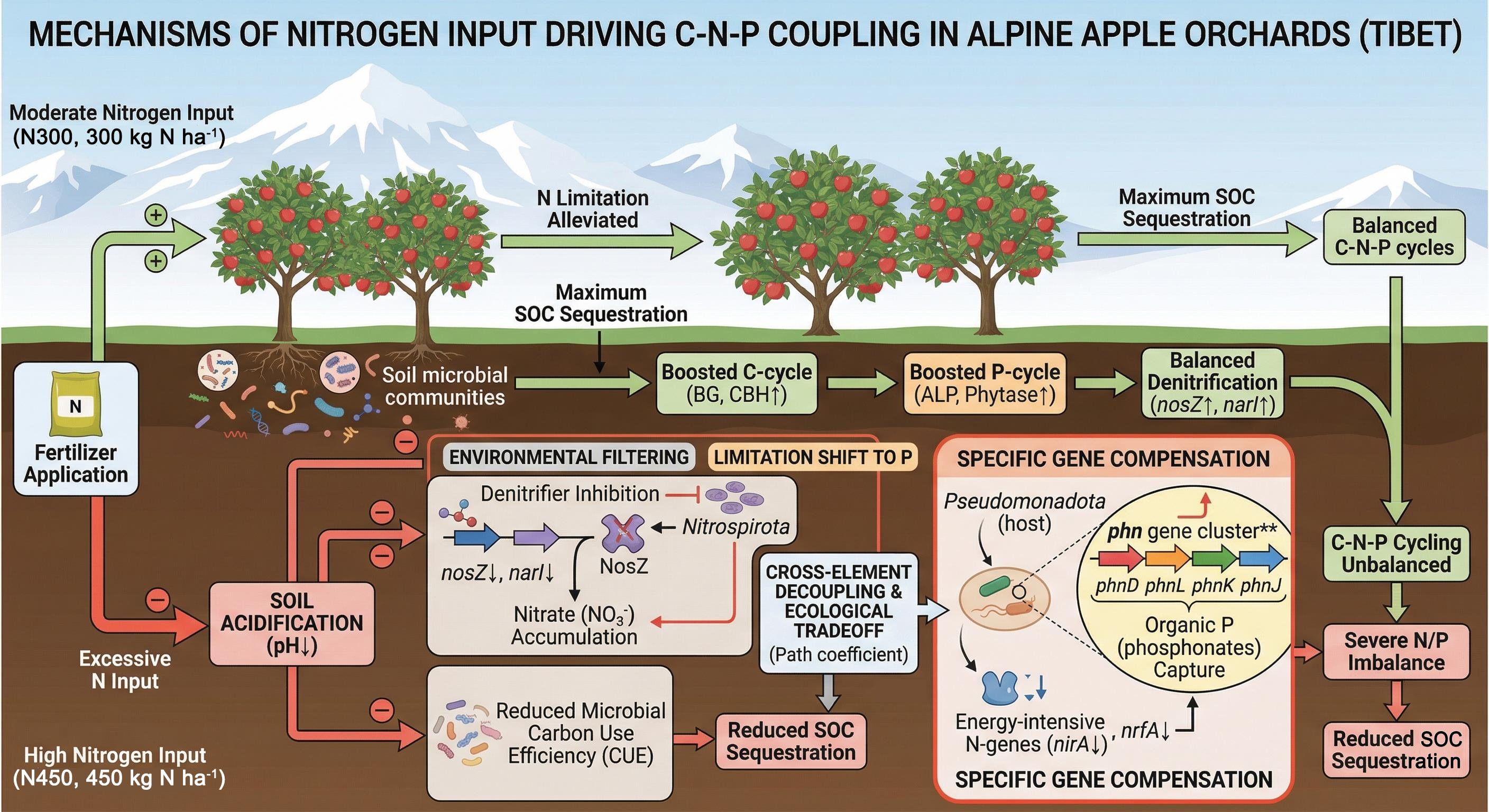
To elucidate the effects of nitrogen (N) addition on soil carbon (C), N, and phosphorus (P) cycling in high-altitude orchards on the Qinghai–Tibet Plateau, a three-year field experiment was conducted at an altitude of 3000 m with four N application rates (0, 150, 300, and 450 kg N ha−1, designated as CK, N150, N300, and N450, respectively). We determined soil physicochemical properties, 12 soil enzyme activities, and metagenomic characteristics, and further adopted partial least squares path modeling (PLS-PM) for data analysis and mechanism exploration. The results were as follows: (1) The N300 treatment yielded the maximum C-hydrolase activities and soil organic carbon content, with a 40.6% increase in soil organic carbon compared with the CK group. (2) The N450 treatment resulted in a 365.4% increase in soil nitrate content and significantly reduced the soil pH (from 6.32 to 5.86). Such environmental filtering significantly decreased the relative abundance of Nitrospirota and its core denitrification genes, including nosZ and narI. (3) Continuous N input induced secondary soil P limitation, leading to a more than 90% increase in phosphatase activities under the N450 treatment. Pseudomonadota activated soil P sources by enriching the functional potential of the phn gene cluster. Furthermore, the PLS-PM analysis revealed a significant negative statistical association between P-cycling enzymes and N-cycling functional potential (p < 0.01). This statistical linkage supports the observation of divergent metabolic responses among different element cycles. In conclusion, under the specific experimental conditions tested, an optimal N application rate of 300 kg N ha−1 is recommended to balance agricultural productivity and soil ecological health. The microbiome of alpine apple orchards responds to elevated N input through metabolic trade-offs, namely reducing the functional potential for denitrification and enhancing the P recycling system. These findings provide vital molecular evidence to guide fertilizer reduction, optimize nutrient management, and promote the sustainable development of high-altitude agroecosystems.

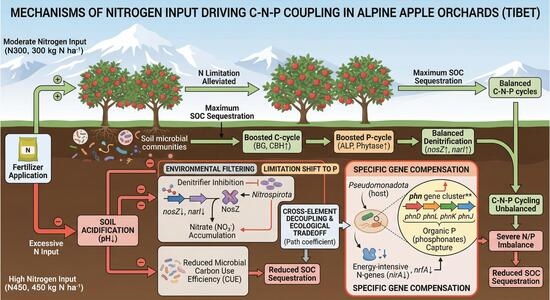
Graphical Abstract

1. Introduction

Nitrogen (N) is a critical limiting nutrient that modulates terrestrial ecosystem productivity and the biogeochemical cycling of carbon (C) and phosphorus (P) [1,2]. In global agricultural systems, exogenous N fertilization is universally implemented to maximize crop yields. However, chronic N inputs inherently disrupt the native stoichiometric equilibrium of soils [3,4]. Specifically, in agroecosystems, these exogenous inputs profoundly alter soil physical, chemical, and biological properties. As demonstrated by Li et al. [5] and Wang et al. [6], heavy N loading frequently induces soil acidification and disrupts inherent C:N:P stoichiometry, which in turn reshapes the microbial community structure and reduces biodiversity. Furthermore, such stoichiometric shifts directly modulate soil enzymatic processes, compelling microorganisms to reallocate metabolic energy toward synthesizing specific extracellular enzymes to acquire limiting nutrients. Crucially, functional groups involved in nitrogen cycling, such as nitrifying and denitrifying bacteria, are highly sensitive to these N-induced environmental fluctuations, potentially leading to significant shifts in their ecological niches and overall nitrogen cycling efficiency. Within this complex biogeochemical network, microbial communities and their secreted extracellular enzymes act as the core engines driving soil elemental cycling [7]. Consequently, elucidating the mechanistic intervention of N inputs on microbial metabolic pathways is a fundamental prerequisite for achieving sustainable agricultural nutrient management.
Recently, advanced molecular ecological techniques have increasingly focused on the evolutionary dynamics of soil functional genes under nutrient enrichment. For instance, Li et al. [8] indicated that the activities of soil hydrolases, nitrogenases, and phosphatases exhibit high spatiotemporal heterogeneity in response to N inputs—a phenomenon fundamentally rooted in the microbial “resource allocation” strategy to adapt to environmental nutrient fluctuations. Furthermore, Krause et al. [9] highlighted that alterations in exogenous nutrient pools directly drive cross-element metabolic tradeoffs within the soil micro-ecosystem, compelling microbial communities to recalibrate the expression of specific functional genes (e.g., those associated with denitrification or organic P cleavage). Despite these advances, a critical knowledge gap remains. The overwhelming majority of existing research is heavily skewed toward low-altitude arable lands or forest ecosystems. Crucially, there is a conspicuous lack of systematic, metagenomic evidence detailing how microorganisms remodel their functional genetic repertoires to cope with prolonged N gradients in extreme habitats, particularly in alpine oligotrophic regions.
The Qinghai–Tibet Plateau is an extreme alpine habitat defined by high altitude, frigid temperatures, intense ultraviolet radiation, and drastic diurnal temperature fluctuations. Its soils are naturally oligotrophic and highly vulnerable to anthropogenic disturbance [10,11]. In recent years, the rapid expansion of plateau-specific agriculture has made the apple industry a significant land use in Tibet. However, this development has been accompanied by increasingly intensive and uniform application of exogenous nitrogen. In this fragile alpine biome, chronic N inputs can easily breach ecological thresholds, precipitating micro-ecological dysbiosis [12,13]. Therefore, accurately defining the response boundaries of alpine orchard soil micro-ecosystems to N inputs and deciphering the underlying microbial functional gene drivers provides valuable insights for maintaining the ecological stability of plateau forestry and fruit industries.
To address these knowledge gaps, we conducted a three-year in situ field experiment with an established N gradient (CK, N150, N300, and N450) in a high-altitude (3000 m) apple orchard in Nyingchi, Tibet. By comprehensively measuring soil physicochemical properties and the activities of 12 key extracellular enzymes involved in C, N, and P cycling, and integrating these data with metagenomic sequencing and Partial Least Squares Path Modeling (PLS-PM), this study aims to: (1) evaluate the non-linear response patterns of soil nutrient pool capacities and enzymatic properties to varying N gradients; (2) elucidate, at the metagenomic level, the mechanisms by which N application drives the structural evolution of key functional gene communities orchestrating C, N, and P cycling; and (3) to determine an appropriate N application rate to synergistically enhance soil C and N sequestration while mitigating soil acidification and micro-ecological degradation. Ultimately, this research provides crucial scientific evidence for optimizing fertilizer guidelines, mitigating soil degradation, and advancing the sustainable agricultural management of high-altitude orchard ecosystems.

2. Materials and Methods

2.1. Study Site Description

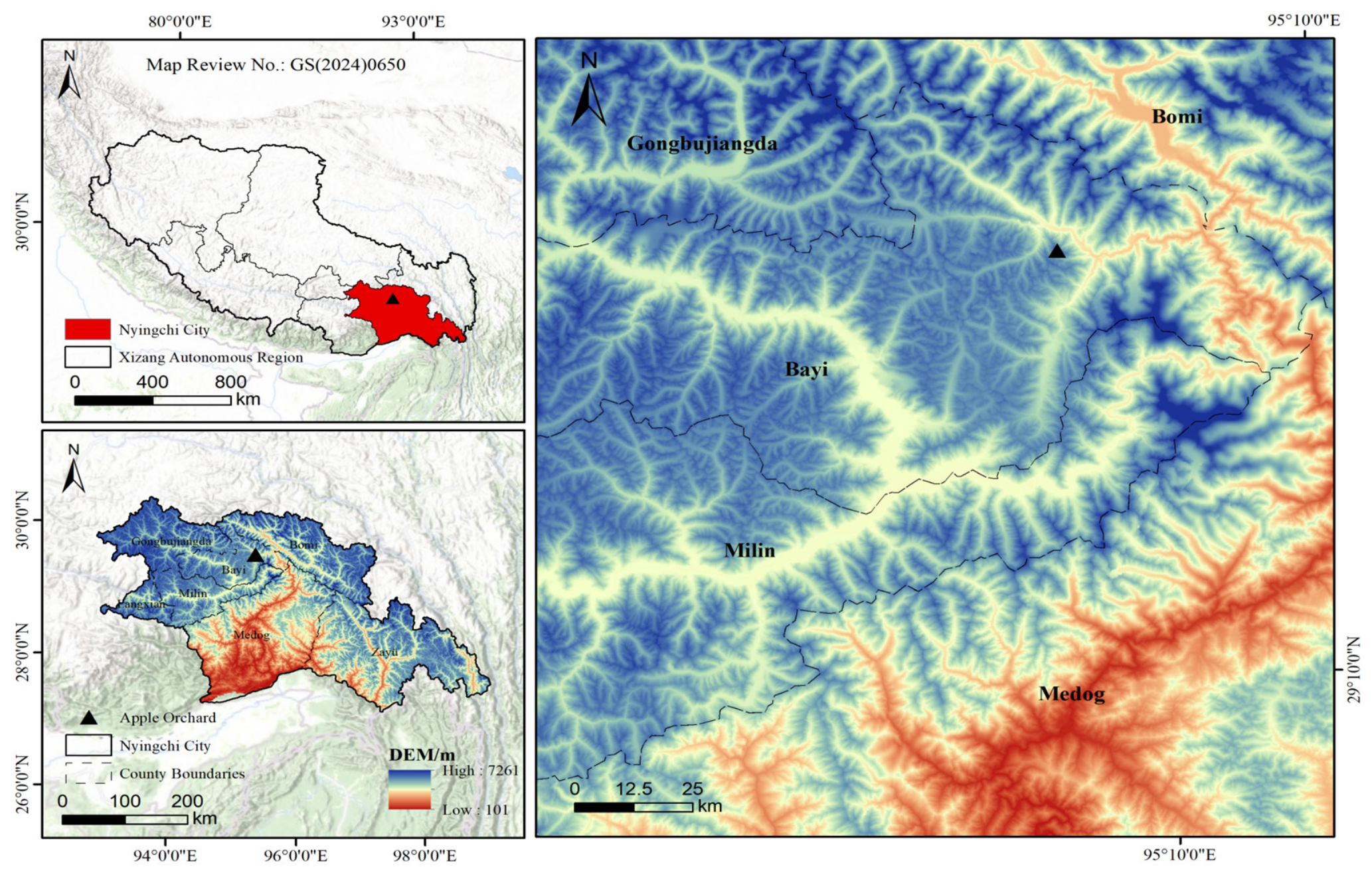
The field experiment was conducted at an established apple orchard (Zanghan Qingyuan Base) in Jiemai Village, Bujiu Township, Bayi District, Nyingchi City, Tibet Autonomous Region, China (29°57′ N, 94°43′ E). The site is situated at an altitude of 3000 m (Figure 1). The region is characterized by a plateau temperate humid monsoon climate. The mean annual precipitation and temperature are 650 mm and 8.7 °C, respectively. During the summer months, the average daytime temperature reaches 21 °C, with a mean minimum temperature of 15.6 °C. The area receives over 2022 h of annual sunshine and has a frost-free period of approximately 180 days. Furthermore, the local microclimate is typified by prolonged solar irradiation, intense radiation exposure, substantial diurnal temperature fluctuations, and frequent nocturnal precipitation. The soil at the experimental site is classified as a yellow-brown earth, which corresponds to Cambisols according to the World Reference Base for Soil Resources (WRB) classification system (Figure 1). The soil texture is predominantly characterized as sandy loam. The baseline physicochemical properties of the topsoil (0–20 cm) prior to the experiment were as follows: pH 6.32, soil organic carbon (SOC) 8.33 g kg−1, total nitrogen (TN) 0.84 g kg−1, available phosphorus (AP) 24.27 mg kg−1, available potassium (AK) 116.98 mg kg−1, alkali-hydrolyzable nitrogen (AN) 54.27 mg kg−1, ammonium nitrogen (NH4+-N) 5.33 mg kg−1, and nitrate nitrogen (NO3-N) 0.52 mg kg−1.

2.2. Experimental Materials and Design

The field experiment was conducted over three consecutive years (2023–2025) at the Zanghan Qingyuan apple orchard. The experimental subjects were 13-year-old ‘Red Fuji’ apple trees (Malus domestica Borkh. cv. Red Fuji) planted at a spacing of 3 m × 4 m (equivalent to a planting density of 833 trees ha−1), with an east–west row orientation. The experiment was laid out in a randomized complete block design (RCBD) consisting of four nitrogen (N) application gradients: a control with zero N addition (CK) and three N fertilization rates (N150, N300, and N450). Each treatment was replicated in five independent blocks. The specific N application rates for each treatment are detailed in Table 1.
Nitrogen fertilizer was supplied in the form of urea (46% N). For the N-addition treatments, the annual N dose was split-applied: 60% of the total N was incorporated as a basal dressing prior to the bud-break stage (20 March), while the remaining 40% was top-dressed during the early fruit expansion stage (15 June). Phosphorus (P) and potassium (K) fertilizers were applied as superphosphate (46% P2O5) and potassium sulfate (51% K2O), respectively. Both P and K fertilizers were applied entirely as a single basal dressing prior to bud break. All routine field management practices were rigorously standardized, ensuring that growth conditions and other cultivation parameters remained strictly consistent across all experimental plots.
Crucially, to isolate the specific ecological effects of the nitrogen gradient from background nutrient variations, the baseline P and K inputs were strategically calibrated. Specifically, the application rate of phosphorus (P) fertilizer was established at the local baseline maintenance level (50 kg ha−1 P2O5) to satisfy the fundamental P requirements of the apple trees while facilitating a systematic investigation into N-gradient-induced secondary P limitation and associated microbial metabolic responses. This strategy was designed to clarify the driving mechanisms of N fertilization on the divergent responses of soil C-N-P cycling in alpine orchard ecosystems. In contrast, the potassium (K) fertilizer rate was fixed at 180 kg ha−1 K2O, consistent with local high-yield cultivation standards for plateau apples, ensuring that K supply remained non-limiting throughout the study. This differentiated fertilization design allows the research to focus exclusively on the driving role of N input in soil metabolic trade-offs, thereby minimizing confounding interference from simultaneous multi-element variations.

2.3. Soil Sampling and Physicochemical Analysis

Soil samples were collected in October 2025, coinciding with the fruit ripening stage, using a randomized sampling strategy [14]. For each treatment, five sampling points were established at a distance of 1.5 m from the tree trunks [15]. At each point, three soil cores were extracted from the topsoil layer (0–20 cm depth) using a stainless-steel soil auger (Zhejiang Top Cloud-agri Technology Co., Ltd., Hangzhou, China), with a 30 cm horizontal interval between cores. These three cores were thoroughly homogenized to constitute a single biological replicate. In total, 20 composite soil samples (4 treatments × 5 replicates) were obtained per sampling event [16].
Upon collection, the composite soil samples were manually cleared of visible stones, plant roots, and other debris, and subsequently divided into two sub-samples. One portion was naturally air-dried in a well-ventilated, shaded environment. The air-dried soil was gently crushed with a wooden rod and passed through 2 mm (10-mesh) and 0.15 mm (100-mesh) nylon sieves for the determination of soil physicochemical properties. The other portion, comprising fresh soil, was sieved through a 2 mm (10-mesh) sieve and immediately stored in a −80 °C ultra-low temperature freezer for subsequent DNA extraction and soil enzyme activity assays.

2.4. Determination of the Physicochemical Properties of Soil

Soil fractions passing through a 2 mm (10-mesh) sieve were reserved for the determination of pH, alkali-hydrolyzable nitrogen (AN), available phosphorus (AP), and available potassium (AK). Concurrently, subsamples sieved through a 0.15 mm (100-mesh) mesh were utilized for the quantification of soil organic carbon (SOC) and total nitrogen (TN) [17]. The specific analytical protocols are summarized in Table 2.

2.5. Soil Enzyme Activity Assays

The activities of 12 soil extracellular enzymes involved in carbon (C), nitrogen (N), and phosphorus (P) cycling, as well as redox processes, were determined using a microplate colorimetric method [18]. All corresponding assay kits were purchased from Shenzhen Microcomm Biotechnology Co., Ltd. (Shenzhen, China).
The specific assay protocols were as follows: The activities of β-1,4-glucosidase (BG), cellobiohydrolase (CBH), β-1,4-xylosidase (BX), β-1,4-N-acetylglucosaminidase (NAG), and alkaline phosphatase (AP) were quantified using specific p-nitrophenyl (pNP) derivatives as substrates [19]. Leucine aminopeptidase (LAP) and neutral protease (NPR) activities were assayed utilizing L-leucine-p-nitroanilide and casein as substrates, respectively [20]. Urease (URE) and phytase activities were quantified based on the generation rates of their respective hydrolysis products, namely ammonium nitrogen and inorganic phosphorus [21]. Following incubation in the dark at 25 °C, the absorbance of the reaction mixtures was measured at 405 nm (or the specific wavelength designated by the kit instructions) using a Multiskan GO microplate spectrophotometer (Thermo Fisher Scientific, Waltham, MA, USA) [22].
Additionally, polyphenol oxidase (PPO) and peroxidase (POD) activities were determined using L-3,4-dihydroxyphenylalanine (L-DOPA) as the substrate, with the POD assay requiring an additional supplementation of 0.3% H2O2; absorbance for both was read at 460 nm. Dehydrogenase (DHA) activity was measured at 485 nm using 2,3,5-triphenyltetrazolium chloride (TTC) as the substrate [23].
To rigorously minimize the impact of inherent field soil heterogeneity, samples from each plot were collected via multi-point composite sampling, followed by cryogenic grinding and thorough homogenization through a 2 mm sieve. All enzymatic assays included appropriate blank controls and were performed with five independent biological replicates. For each biological replicate, three technical replicates were conducted in the laboratory, and the mean values were calculated. To ensure data accuracy and comparability, all enzyme activities were uniformly expressed as the amount of product generated per gram of dry soil per hour (nmol g−1 h−1) [24].

2.6. DNA Extraction, Metagenomic Sequencing, and Bioinformatics Analysis

Total genomic DNA was extracted from fresh soil samples using the Soil Genomic DNA Extraction Kit (Spin Column Type, Cat. No. DP336; TIANGEN Biotech, Beijing, China). Approximately 0.2 μg of DNA per sample was fragmented to ~350 bp using a Covaris LE220R-plus ultrasonicator (Covaris, LLC, Woburn, MA, USA). Libraries were constructed using the Rapid Plus DNA Lib Prep Kit for MGI (ABclonal, Woburn, MA, USA) and sequenced on a DNBSEQ-T7 platform (MGI Tech, Shenzhen, China) via a 150 bp paired-end strategy. The average clean data volume of each sample was 13.11 GB [25,26].
Raw reads were quality-filtered utilizing Trimmomatic (v0.39; parameters: ILLUMINACLIP:TruSeq3-PE.fa:2:30:10, LEADING:3, TRAILING:3, SLIDINGWINDOW:4:20, MINLEN:50). Low-quality reads and adapter sequences were removed to obtain high-quality clean reads. All qualified clean reads were subjected to de novo metagenomic assembly, and contigs longer than 500 bp were retained for subsequent gene prediction and functional annotation. Given the environmental nature of bulk soil samples, no host genome depletion was performed.
Taxonomic classification of assembled contigs was performed with Kraken2 (v2.1.2; confidence 0.2) against a custom microbial database derived from the NCBI NT and RefSeq databases, and microbial relative abundance was further calculated using Bracken (v2.6.2). For functional annotation, predicted genes were aligned to the UniRef90 database using the HUMAnN3 (v3.0.0) pipeline and DIAMOND (v2.0.15) blastx, with parameters set as translated_query_coverage_threshold = 90.0 and evalue_threshold = 1 × 10⁻⁵ [27,28]. The UniRef90 gene family abundances were further summarized into Kyoto Encyclopedia of Genes and Genomes (KEGG) Orthologs (KOs) via the humann_regroup_table program [29,30]. KEGG metabolic pathway profiles were finally constructed by mapping KO information to the KEGG database with in-house scripts [31,32]. To eliminate the influence of sequencing depth variation among samples, all relative abundances of KOs and metabolic pathways were normalized to copies per million (CPM). Raw sequence data have been deposited in the NCBI SRA database (accession number: PRJNA1465038).

2.7. Statistical Analysis

All experimental data were calculated and are expressed as the mean ± standard deviation (SD) of five independent replicates (n = 5). To account for the randomized complete block design (RCBD) employed in the field experiment, data were analyzed using a mixed-effects model. Nitrogen treatment was designated as a fixed effect, while the block was assigned as a random effect to control for potential spatial heterogeneity within the orchard. Following the mixed-effects model, differences among N-addition treatments were evaluated using estimated marginal means (EMMs) with Tukey’s Honest Significant Difference (HSD) post hoc adjustment. The statistical significance threshold was set at p < 0.05. These analyses were performed using the lme4 and emmeans packages in the R statistical environment (Version 4.5.0, R Foundation for Statistical Computing, Vienna, Austria, https://www.R-project.org/). Routine data visualization and graphical representations were generated using Origin 2024 software (OriginLab Corporation, Northampton, MA, USA).
For advanced multivariate statistics, analyses were conducted within the R statistical environment (Version 4.5.0, R Foundation for Statistical Computing, Vienna, Austria, https://www.R-project.org/). Random forest (RF) modeling was employed to evaluate the predictive importance and associations of functional genes involved in C, N, and P cycling with key soil physicochemical indicators. The RF models were constructed utilizing the randomForest package in R. Additionally, Mantel tests were executed via the vegan package to determine the correlations between environmental parameter matrices and functional gene structures.
To visualize the variable importance, a balloon plot was constructed to illustrate the top 10 most critical C, N, and P cycling functional genes identified by the RF analysis. In these plots, the size of the pie symbols corresponds directly to the relative abundance of the respective genes. Differences in relative gene abundances were assessed using Fisher’s Least Significant Difference (LSD) test. Statistically significant differences between the N-addition treatments and the control (CK) were denoted as follows: * p < 0.05, ** p < 0.01, and *** p < 0.001.

3. Results

3.1. Effects of Nitrogen Application on Soil Physicochemical Properties

As detailed in Table 3, varying nitrogen (N) application rates significantly altered the soil physicochemical properties. Regarding soil nutrients, the concentrations of total nitrogen (TN), alkali-hydrolyzable nitrogen (AN), ammonium nitrogen (NH4+-N), and nitrate nitrogen (NO3-N) all exhibited progressive increases with escalating N application. Specifically, TN, AN, and NO3-N contents peaked in the N450 treatment, showing significant increases of 51.2%, 77.1%, and 365.4%, respectively, compared to the unfertilized control (CK) (p < 0.05). The NH4+-N content in the N300 and N450 treatments was significantly higher than that in the CK and N150 plots, with the N450 treatment exhibiting a maximum increase of 141.5% relative to the CK (p < 0.05); however, no significant difference was observed between the N300 and N450 levels.
Soil organic carbon (SOC) content initially increased and subsequently plateaued as the N application rate escalated. The SOC content reached its maximum (11.71 g kg−1) under the N300 treatment, representing a significant 40.6% enhancement over the CK (p < 0.05). When the N rate was further elevated to N450, the magnitude of the SOC increase relative to the CK diminished to 30.1%. Similarly, available phosphorus (AP) accumulated continuously along the N addition gradient, peaking in the N450 treatment with a significant 59.2% increase compared to the CK (p < 0.05).
Conversely, soil pH exhibited a progressive decline with increasing N inputs. The CK treatment recorded the highest pH (6.32), whereas continuous exogenous N addition drove the pH to a minimum of 5.86 in the N450 treatment, marking a significant reduction of 7.2% relative to the CK (p < 0.05).

3.2. Effects of Nitrogen Application on Soil Enzyme Activities

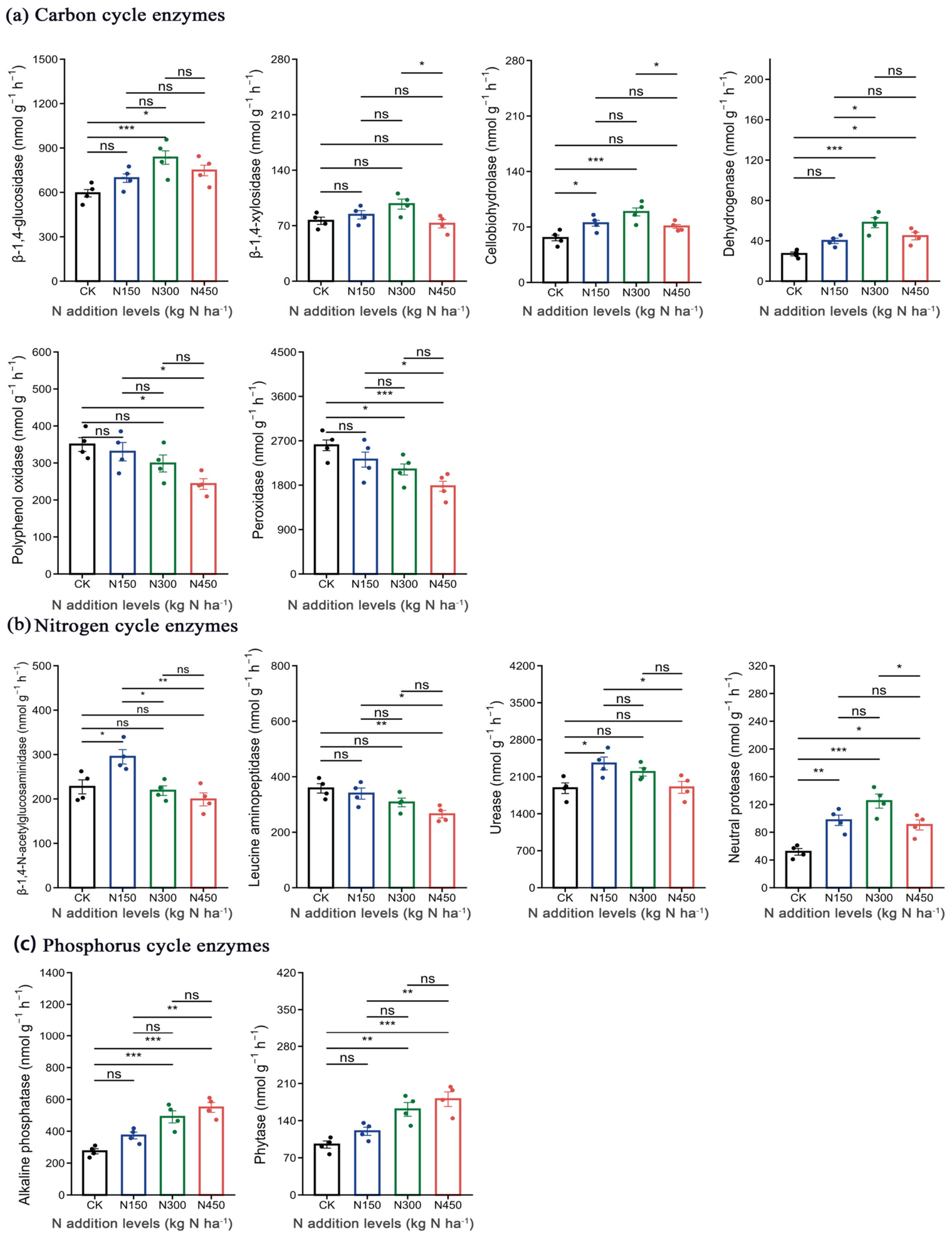
As depicted in Figure 2, varying levels of exogenous N input induced significant shifts in the activities of soil enzymes associated with carbon (C), nitrogen (N), and phosphorus (P) cycling.
Regarding C-cycling enzymes (Figure 2a), hydrolytic and oxidoreductive enzymes exhibited markedly divergent response trajectories. The activities of β-glucosidase (BG), β-xylosidase (BX), cellobiohydrolase (CBH), and dehydrogenase (DHA) all displayed a unimodal response pattern—initially increasing before subsequently declining—with peak values universally observed under the N300 treatment. Notably, the activities of BG, CBH, and DHA in the N300 plots were significantly elevated by 40.6%, 58.5%, and 114.5%, respectively, compared to the unfertilized control (CK) (p < 0.05). Conversely, the activities of polyphenol oxidase (PPO) and peroxidase (POD) underwent a continuous decline with escalating N addition rates; under the N450 treatment, PPO and POD activities were significantly suppressed by 30.6% and 31.9%, respectively, relative to the CK (p < 0.05).
The N-cycling enzymes (Figure 2b) exhibited highly differentiated responses to the N treatments. Specifically, the activities of β-1,4-N-acetylglucosaminidase (NAG) and urease (URE) peaked at the lowest N addition level (N150), registering significant increases of 29.8% and 24.8% over the CK (p < 0.05). However, under higher N inputs (N300 and N450), these activities diminished to levels statistically indistinguishable from the CK (p > 0.05). In contrast, leucine aminopeptidase (LAP) activity was progressively inhibited by continuous N addition, culminating in a significant 26.0% reduction in the N450 treatment compared to the CK (p < 0.05). Meanwhile, neutral protease (NPR) activity followed a unimodal pattern analogous to the C-hydrolyzing enzymes, peaking in the N300 treatment with a substantial 141.3% enhancement relative to the CK (p < 0.05).
Concerning P-cycling enzymes (Figure 2c), both alkaline phosphatase (ALP) and phytase activities demonstrated a continuous, positive monotonic trend in response to the N application gradient. Maximum activities for both enzymes were recorded in the N450 treatment, exhibiting significant increases of 100.3% and 90.0%, respectively, over the CK (p < 0.05).

3.3. Changes in Microbial Metabolic Processes of the Carbon (C), Nitrogen (N), and Phosphorus (P) Cycles

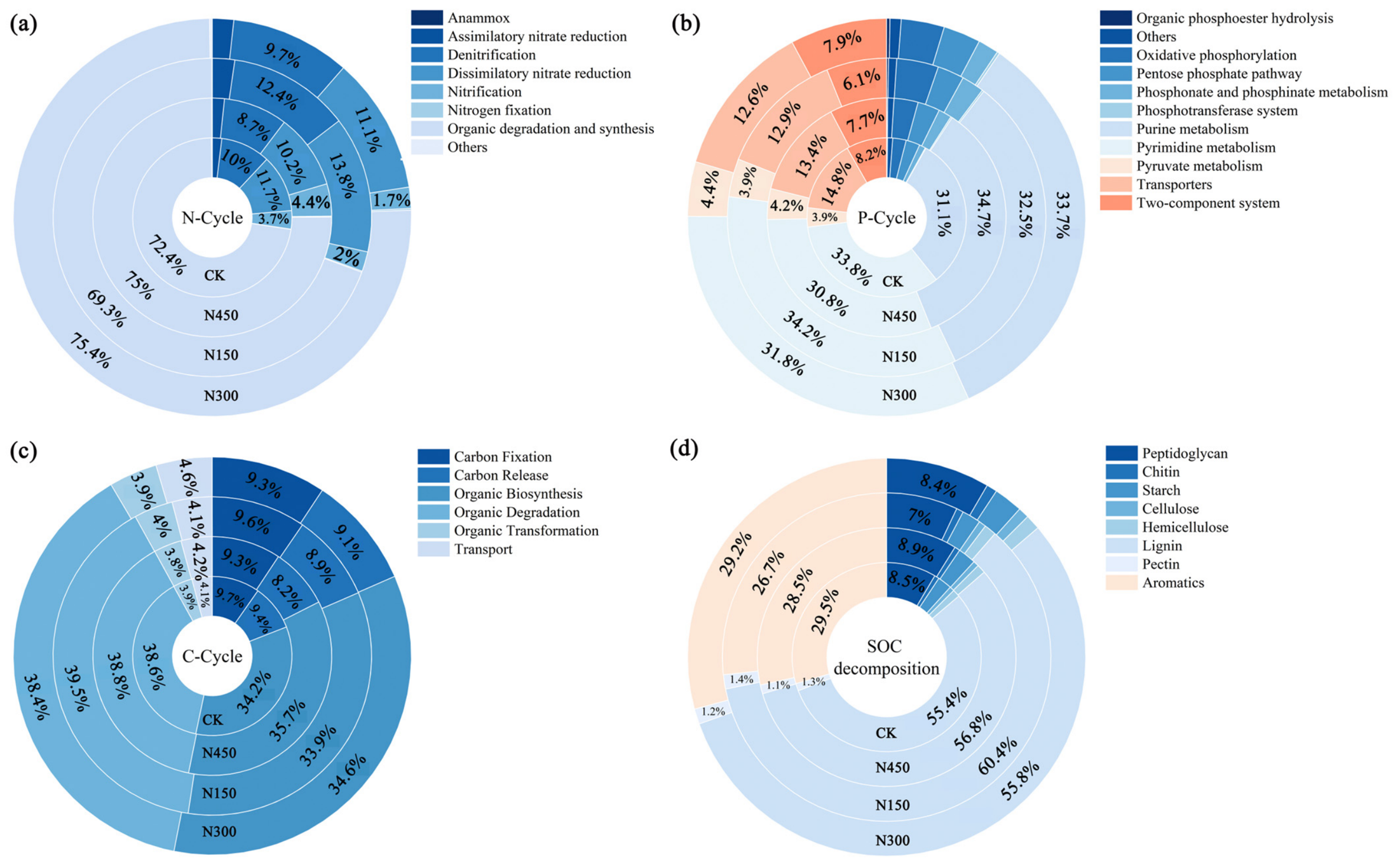
Within the N-cycle (Figure 3a), organic degradation and synthesis constituted the largest proportion (69.4–75.4%). The treatments exhibited divergent effects on N-cycling functional potential: the N150 treatment significantly enriched the relative abundances of denitrification and dissimilatory nitrate reduction (p < 0.05); however, these potentials significantly decreased under higher N inputs (N300 and N450), where a significant enrichment in organic degradation and synthesis pathways was instead observed (p < 0.05). Additionally, the functional potential for nitrification significantly declined in the N150 and N300 treatments (p < 0.05).
For the P-cycle (Figure 3b), metabolic fluxes were predominantly driven by purine and pyrimidine metabolism. All nitrogen additions significantly reduced the relative abundances of transporters and two-component systems (p < 0.05). Under the highest nitrogen input (N450), the relative abundance of purine metabolism significantly expanded (p < 0.01). In contrast, the N150 treatment significantly enriched the functional potential of purine metabolism, pyrimidine metabolism, and oxidative phosphorylation (p < 0.05).
Regarding the C-cycle (Figure 3c), organic degradation (38.4–39.5%) and biosynthesis (33.9–35.7%) pathways were dominant across all treatments. For specific carbon components (Figure 3d), nitrogen addition significantly enriched the relative abundance of lignin degradation potential while compressing that of aromatics (p < 0.05). The most pronounced shift occurred under the N150 treatment, where the lignin degradation flux significantly increased (reaching 60.42%, p < 0.01), while aromatic degradation declined (p < 0.05).

3.4. Correlations Among Soil Physicochemical Properties, Enzyme Activities, and Microbial Functional Genes

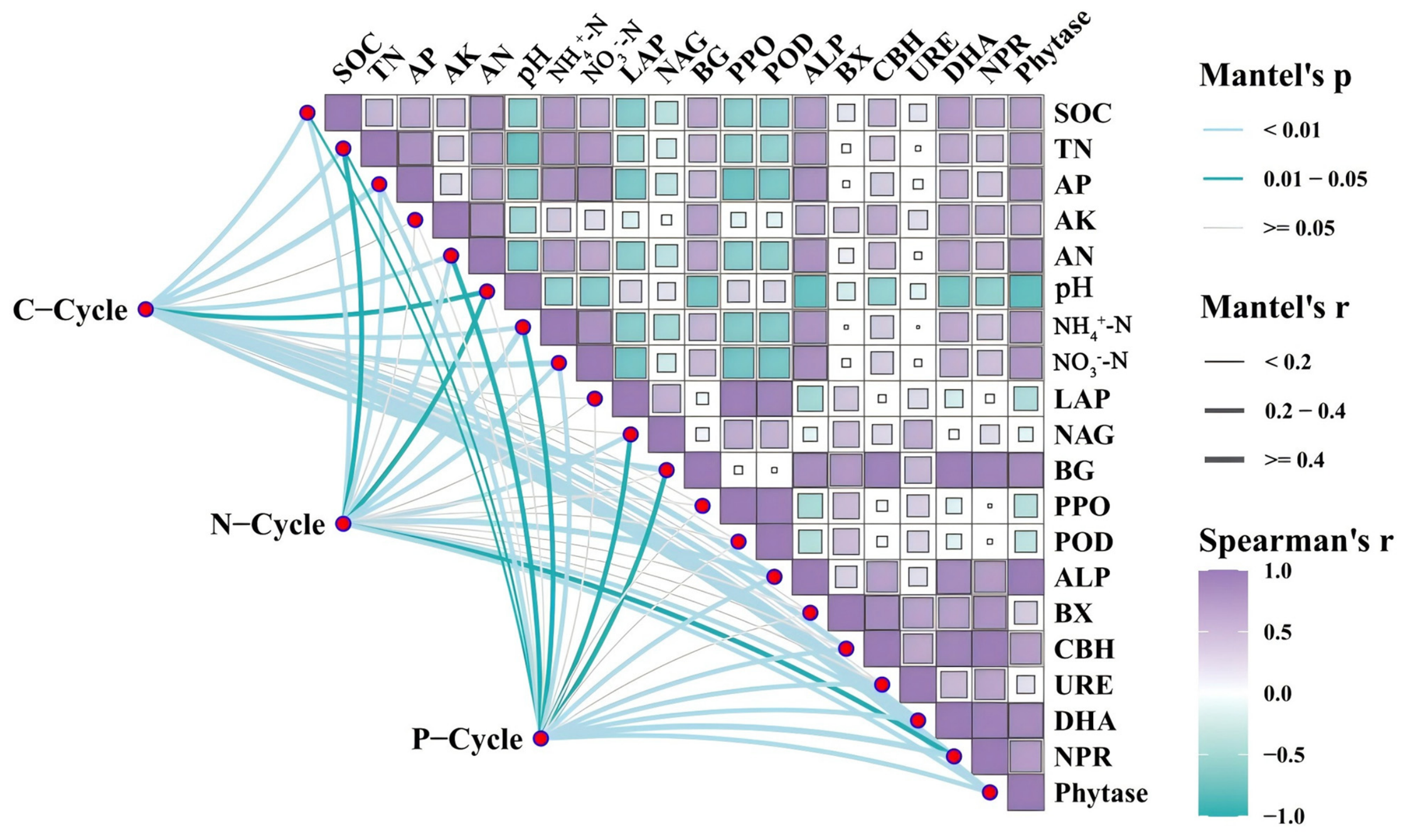
Mantel tests were employed to evaluate the correlations between the functional genes involved in soil carbon (C), nitrogen (N), and phosphorus (P) cycling and both soil physicochemical properties and enzyme activities (Figure 4). The analysis revealed that specific soil physicochemical parameters and enzymatic activities exerted highly significant driving effects on the community structure of these elemental cycling functional genes (p < 0.01).
Regarding the C-cycle, the corresponding functional genes exhibited highly significant positive correlations with available phosphorus (AP, p < 0.01) and nitrate nitrogen (NO3-N, p < 0.01). At the enzymatic level, the C-cycling genes were robustly and highly significantly associated with β-glucosidase (BG, p < 0.01) and cellobiohydrolase (CBH, p < 0.01), which are critical for the degradation of the soil carbon skeleton.
Concerning the N-cycle, the community structure of its functional genes demonstrated highly significant positive correlations with ammonium nitrogen (NH4+-N, p < 0.01) and alkali-hydrolyzable nitrogen (AN, p < 0.01). Enzymatically, these genes were deeply linked to β-1,4-N-acetylglucosaminidase (NAG, p < 0.01), a key enzyme orchestrating the soil nitrogen mineralization process.
For the P-cycle, the physicochemical factors exerting the most profound regulatory effects on functional genes were primarily NO3-N (p < 0.01) and AP (p < 0.01). Furthermore, P-cycling genes displayed highly significant positive correlations with alkaline phosphatase (ALP, p < 0.01) and phytase (p < 0.01), which are directly responsible for the mobilization and cleavage of soil phosphorus.

3.5. Distribution Characteristics of Genes Involved in Soil Carbon, Nitrogen and Phosphorus Cycling Under Different Nitrogen Application Treatments

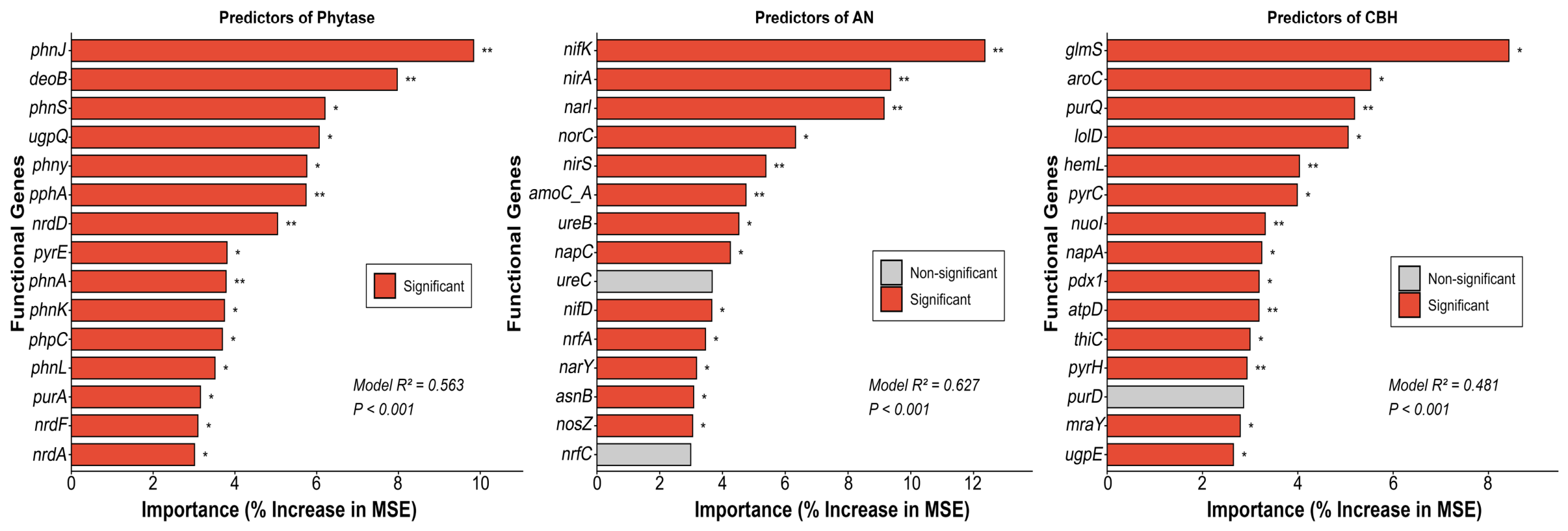
Building upon the Mantel test results, a random forest (RF) model was employed to further evaluate the variable importance of key soil physicochemical properties and enzyme activities in driving the structural variation in specific element-cycling functional gene communities (Figure 5). The analysis demonstrated that C-cycling functional genes were significantly driven by cellobiohydrolase (CBH, p < 0.01). The structural variation within the N-cycling gene community was primarily attributed to indicators of nitrogen availability, specifically alkali-hydrolyzable nitrogen (AN) and ammonium nitrogen (NH4+-N). Conversely, P-cycling functional genes were strongly governed by available phosphorus (AP) and phytase activity.
Based on the variable importance identified by the RF model, the most representative core functional genes were extracted from the C-, N-, and P-cycling modules for detailed taxonomic annotation. The representative C-cycling genes primarily included nuoI, glmS, hemL, pyrC, aroC, purQ, atpD, napA, pdx1, and lolD. The representative N-cycling genes extensively covered the nitrogen metabolic network, specifically encompassing genes for assimilatory nitrate reduction (nirA), core denitrification processes (nosZ, narI, napC, norC), dissimilatory nitrate reduction to ammonium (nrfA), nitrogen fixation (nifD, nifK), nitrification (amoC_A), and urease activity (ureB). The representative P-cycling genes mainly comprised organophosphorus/phosphonate metabolism and transport gene clusters (ugpQ, phnD, phnL, phnK, phnJ, phnA, phnY), alongside other critical nucleotide/phosphate metabolism genes (pyrE, deoB, nrdD).
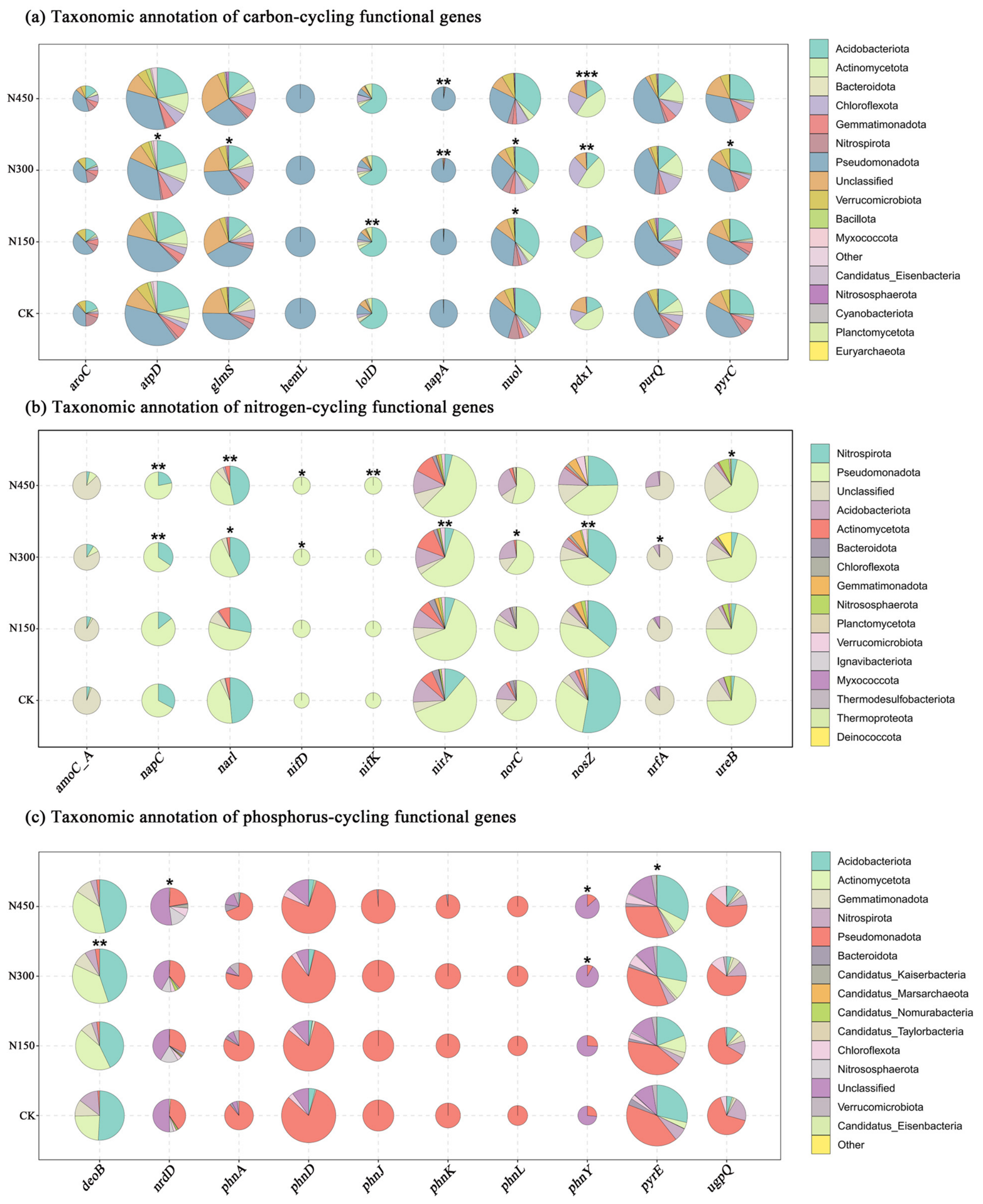
Taxonomic annotation at the phylum level revealed distinct commonalities and specificities among the dominant microbial hosts of these three major categories of element-cycling genes (Figure 6). For key C-cycling genes, Pseudomonadota, Acidobacteriota, and Nitrospirota emerged as the predominant hosts; furthermore, bacteria belonging to Chloroflexota were identified as core hosts specifically for the nuoI gene, while Bacteroidota was the primary carrier of the glmS and atpD genes. Regarding N-cycling genes, Nitrospirota and Pseudomonadota maintained absolute dominance, actively participating in core processes such as denitrification (nosZ, narI) and nitrification (amoC_A). Notably, Nitrososphaerota was the principal host for the urease gene ureB, whereas Acidobacteriota played a crucial role in harboring the nirA, nrfA, and norC genes. For P-cycling genes, Pseudomonadota again constituted the core host cohort, overwhelmingly dominating nearly all phn gene clusters (responsible for phosphonate uptake and cleavage). Concurrently, Actinomycetota and Nitrospirota exhibited higher relative abundances corresponding to the pyrE and deoB genes, while Nitrososphaerota was one of the primary hosts for the nrdD gene.
Overall, the application of varying N gradients significantly altered the relative abundance distribution of these critical element-cycling functional genes across the treatments (p < 0.05 or p < 0.01). Specifically, the relative abundances of the nuoI and glmS genes, which are involved in carbon skeleton degradation and energy metabolism, were significantly enriched under the N300 treatment. The abundances of denitrification genes, such as nosZ and narI, were significantly suppressed under high-N (N450) stress. In contrast, the relative abundances of the phn gene clusters (e.g., phnD, phnJ) associated with P cycling exhibited a pronounced upward trend with escalating N inputs, achieving absolute dominance under the N450 treatment (Figure 6).

3.6. Integrative Driving Mechanisms of N Application on Soil C, N, and P Cycling Functional Genes

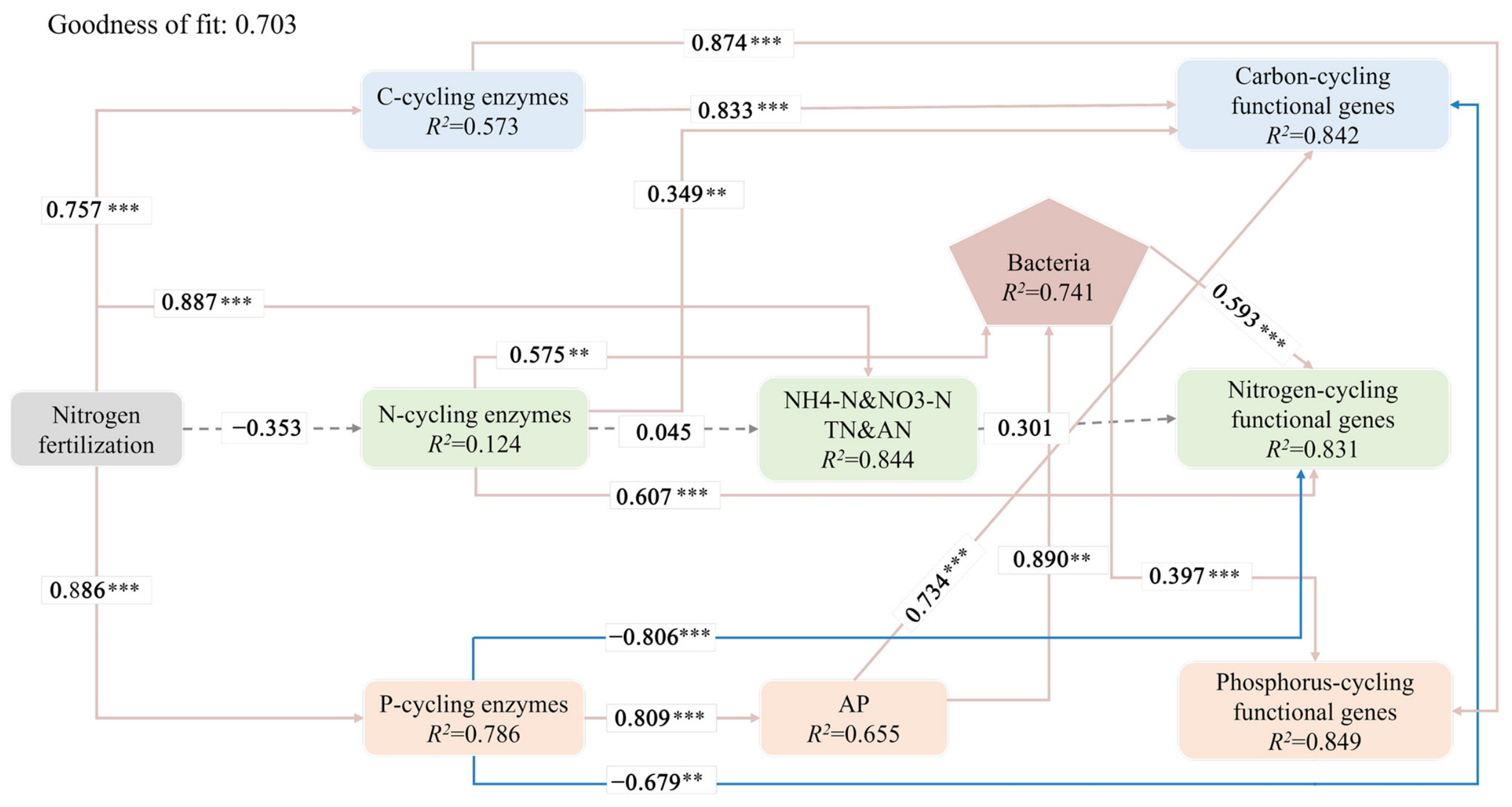
Partial least squares path modeling (PLS-PM) was employed to evaluate the direct and indirect relationships among N application, soil biochemical properties, enzyme activities, the bacterial community, and the abundances of carbon (C), nitrogen (N), and phosphorus (P) cycling functional genes (Figure 7). The results demonstrated that N application exerted significant positive driving effects on C-cycling enzymes (path coefficient = 0.757, p < 0.001), P-cycling enzymes (0.886, p < 0.001), and the available N pool (NH4+-N, NO3-N, TN, and AN; 0.887, p < 0.001). Conversely, N application exhibited a negative direct path effect on N-cycling enzymes (−0.353).
The PLS-PM structure provided a remarkably high explanatory power for the variation in the target functional genes (R2 ranging from 0.831 to 0.849). Specifically, the abundance of C-cycling functional genes was primarily and positively driven by C-cycling enzymes (0.874, p < 0.001) and the bacterial community (0.503, p < 0.001). The abundance of N-cycling functional genes was significantly promoted by the bacterial community (0.890, p < 0.01) but strongly inhibited by P-cycling enzymes (−0.806, p < 0.01). Furthermore, P-cycling functional genes were positively affected by C-cycling enzymes (0.833, p < 0.001), but AP exhibited significant negative regulation of P-cycle-related genes (–0.679, p < 0.01).
Additionally, the standardized total effects analysis elucidated the differentiated response patterns of the various element-cycling genes to N inputs (Figure S1). N application exerted strong positive total effects on both C- and P-cycling functional genes, whereas it demonstrated a significant negative total effect on N-cycling functional genes. The bacterial community and C-cycling enzymes consistently maintained positive total effects on their respective functional genes, serving as pivotal positive drivers for sustaining the soil nutrient cycling potential. In contrast, P-cycling enzymes predominantly exerted negative total effects, with their inhibitory impact on the N-cycling potential being particularly pronounced.

4. Discussion

4.1. Soil Nutrient Enrichment and Soil Acidification Under N Application in Alpine Oligotrophic Environments

In the present study, exogenous N fertilization effectively alleviated the intrinsic N limitation of this extreme biome, significantly expanding the capacities of both total and inorganic N pools (notably, NO3-N increased by 365.4% under the N450 treatment). However, soil organic carbon (SOC) sequestration peaked at the N300 level before experiencing a distinct downturn under the N450 treatment. This pronounced non-linear trajectory profoundly reflects the micro-ecological tradeoffs and stoichiometric constraints induced by high N loading.
Moderate N supplementation (N300) evidently optimized the substrate stoichiometric balance, thereby stimulating the microbial C assimilation potential [33]. Conversely, when the N application rate escalated to N450, the soil pH decreased significantly to 5.86. As elucidated by Manzoni et al. [34], significantly acidic environments coupled with nutrient stoichiometric imbalances compel microorganisms to reallocate substantial metabolic energy toward maintaining cellular osmotic pressure and internal homeostasis. This metabolic shift inevitably results in a marked decline in microbial carbon use efficiency (CUE). Corroborating this mechanistic pathway, a global meta-analysis by Treseder [35] demonstrated that significant soil acidification induced by excessive N inputs universally suppresses microbial biomass and exacerbates C losses via enhanced respiratory metabolism. Therefore, we postulate that the significant soil acidification induced by excessive N loading acts as the primary physicochemical driver that compromises the C sequestration capacity of alpine microbiomes, ultimately stalling further SOC accumulation.

4.2. Resource Allocation and Stoichiometric Trade-Offs of Soil Enzyme Systems in Extreme Alpine Habitats

Soil extracellular enzyme activities serve as a profound proxy for the “resource allocation” strategies governing microbial metabolism. According to the economic model of extracellular enzyme production proposed by Allison et al. [36], microorganisms preferentially invest their finite metabolic energy into synthesizing enzymes targeting the most growth-limiting nutrients. In the present study, the substantial influx of readily available inorganic N drove the microbial community to rapidly downregulate leucine aminopeptidase (LAP) activity, a primary driver of organic N mineralization. This phenomenon perfectly corroborates the “negative feedback regulation and energy-conservation” paradigm predicted by the aforementioned model. Furthermore, the observation that C-hydrolyzing enzymes, notably β-glucosidase (BG), peaked under the N300 treatment further substantiates that moderate N enrichment establishes a more balanced C:N stoichiometric milieu, thereby enhancing microbial C-acquisition efficiency.
Concurrently, this excessive N loading disrupted the native stoichiometric ratios in the high-altitude soil. In response to this shifting N:P ratio, we observed a substantial increase in the activities of phosphatases and phytases. This phenotypic response is consistent with the findings of Marklein et al. [37], who demonstrated that increased nitrogen input can significantly alter phosphorus dynamics and stimulate microbial organic P-mobilization in terrestrial ecosystems. However, as cautioned by Mori et al. [38], elevated extracellular enzyme activity alone may not be sufficient to definitively demonstrate absolute P limitation. Robust evaluation typically requires multi-faceted approaches, as demonstrated by Cui et al. [39]. To overcome this limitation, we integrated metagenomic profiling, which revealed a concurrent massive enrichment of the phn gene clusters (responsible for phosphonate capture). This robust complementary evidence at the functional potential level mitigates the limitation of relying solely on enzymatic indicators, strongly supporting the occurrence of a N-induced shift toward P-acquisition constraints in these alpine orchard soils. Ultimately, this resource reallocation toward P-scavenging reflects a critical metabolic trade-off induced by excessive N-loading.

4.3. Remodeling of C and N Metabolic Pathways and Environmental Filtering Effects Driven by N Application in Alpine Soils

Metagenomic profiling provides robust, system-level molecular evidence to elucidate the reorganization of nutrient cycling networks. Within the carbon (C) metabolic network, all N addition treatments universally enhanced the relative abundance of the lignin degradation flux. It should be noted that lignin is a complex polymer found in plant cell walls (especially in woody residues) and serves as an informative indicator of soil processes, while its decomposition is a component of the overall process of organic matter mineralization. In the nutrient-poor and extreme habitats of the Qinghai–Tibet Plateau, this enhanced degradation manifests a quintessential “priming effect” stimulated by exogenous N [40]. The significant increase in nitrogen availability directly unlocks the microbial metabolic potential to decompose these recalcitrant C skeletons, thereby accelerating the overall turnover and cycling of the soil organic carbon pool in alpine orchard ecosystems.
Regarding the nitrogen (N) metabolic network, the significant decrease in soil pH induced by high N loading (N450) acts as a strong habitat selection pressure, triggering an ‘environmental filtering’ effect. Specifically, our findings reveal that the core genes orchestrating denitrification (nosZ and narI) and their predominant host phylum, Nitrospirota, were significantly suppressed under low-pH conditions. This observation strongly resonates with the seminal works of Bakken et al. [41] and Šimek and Cooper [42], which elegantly demonstrated that denitrification reductases—particularly the N2O reductase encoded by nosZ—are acutely sensitive to low pH. Consequently, this acidification-mediated directional selection forces acid-sensitive populations to reduce their functional potential for denitrification. Ultimately, this gene-level suppression constitutes the fundamental micro-ecological mechanism underlying the massive accumulation of nitrate observed in these high-altitude alpine soils.

4.4. Divergent Metabolic Responses and Stoichiometric Limitation Shifts Based on phn Gene Cluster Enrichment

The cross-element coupling model, structured via PLS-PM, illustrates the statistical associations within the soil micro-ecosystem following N addition. Crucially, the model indicates a strong negative statistical association between phosphorus (P)-cycling enzymes and nitrogen (N)-cycling functional genes. This significant inverse relationship provides quantitative support for the “limitation shift” theory proposed by Vitousek et al. [43]. Confronted with the pressure of relative P limitation, the microbial community appears to execute an ecological trade-off. Specifically, the data suggest a strategy wherein the functional potential of the N metabolic network is reduced, while resources are concurrently channeled toward organic P acquisition.
Taxonomic tracing analysis further corroborates this mechanism, demonstrating that the phylum Pseudomonadota dominates the significant enrichment of the phn gene clusters responsible for phosphonate uptake and cleavage. This aligns perfectly with the observations of Bergkemper et al. [44] in P-deficient forest soils, confirming that Pseudomonadota, acting as a dominant lineage with high metabolic plasticity, can orchestrate the mobilization of environmental P by enriching P recycling systems (such as the phn operon). Ultimately, this taxon-specific metabolic compensation constitutes a critical survival strategy, enabling alpine microbiomes to overcome single-element stoichiometric constraints and sustain the continuous operation of the biogeochemical C-N-P machinery.

5. Conclusions

(1)
Non-linear responses of C and N cycling and environmental filtering effects: The input of exogenous nitrogen (N) significantly altered the nutrient capacity of high-altitude apple orchard soils, exhibiting a strong concentration-threshold dependency. Moderate N application (300 kg N ha−1) maximized the efficacy of extracellular C-hydrolyzing enzymes, thereby substantially enhancing the sequestration potential of soil organic carbon (SOC). Conversely, the decrease in soil pH (to 5.86) induced by excessive N application (450 kg N ha−1) imposed a strong environmental filtering pressure. This directionally suppressed acid-sensitive denitrifying consortia, notably the phylum Nitrospirota (evidenced by a precipitous decline in nosZ and narI relative abundances), contributed to the massive accumulation of nitrate.
(2)
Divergent metabolic responses and ecological tradeoffs: Chronic, singular N inputs disrupted the native oligotrophic equilibrium, triggering a community-level limitation shift. Upon the alleviation of N limitation, the system confronted an increasing pressure of relative phosphorus (P) demand. To navigate this stoichiometric imbalance, the microbial community executed distinct ecological tradeoffs. Phenotypically, this manifested as the downregulation of N-acquisition enzymes (LAP) alongside a compensatory increase in phosphatase activities. At the molecular level, the phylum Pseudomonadota exhibited metabolic plasticity by significantly enriching the functional potential of phn gene clusters involved in phosphonate cleavage.
(3)
Practical implications and future perspectives: Integrating multidimensional evidence, we conclude that an application rate of 300 kg N ha−1 represents an appropriate N application strategy under our specific experimental conditions to synergistically promote soil C and N accumulation while safeguarding against acidification. Applying the concept of metabolic trade-offs in biogeochemical cycles, this study characterizes the survival strategies of alpine microbial communities in response to anthropogenic fluctuations in nutrient availability. However, recognizing the site-specific nature of our findings, further validation across different pedoclimatic conditions and orchard management systems is required before broad application. Consequently, future research must prioritize long-term, multi-site in situ experiments coupled with metatranscriptomics (RNA-seq) to further unravel the dynamic evolution of C-N-P coupled metabolic fluxes driven by the dual forces of climate change and agricultural intensification.

Supplementary Materials

The following supporting information can be downloaded at: https://www.mdpi.com/article/10.3390/agriculture16111214/s1.

Author Contributions

Conceptualization, W.H. and L.T.; methodology, Z.W.; software, M.H.; validation, S.L.; formal analysis, Y.Y.; investigation, Y.H. All authors have read and agreed to the published version of the manuscript.

Funding

This research received external funding. Project of Central Government Guiding Local Science and Technology Development Funds: Investigation, Protection, and Excavation of Superior Strains of Basu Drunk Pear Germplasm Resources (CDKJ-ZYYDDF2024001); Forestry Doctoral Program (Phase I) of Tibet Agriculture and Animal Husbandry University (533325001); Key Research and Development Plan of the Science and Technology Program of the Tibet Autonomous Region: Research and Demonstration of Fruit-Grass Intercropping Technology in Apple Orchards in Tibet (XZ202401ZY0032); Science and Technology Plan Project of Nyingchi City: Research and Demonstration of Fruit-Grass Intercropping and Scientific Formula Fertilization Technology in Apple Orchards in Nyingchi City (2023-XYQ-006); Construction and Comprehensive Service Capacity Enhancement of Science and Technology “Xiaoyuan” for Plateau-Characteristic Agriculture and Animal Husbandry (XY2024-03, XK2024-04, XK2024-01, YJSXK2025-22, YJSXY2025-05); Graduate Education Innovation Program Projects of Tibet Agriculture and Animal Husbandry University (YJS2024-28, YJS2024-26, YJS2024-31); Science and Technology Major Project of the Tibet Autonomous Region of China (XZ202201ZD0005G02); Major Science and Technology Project of the Science and Technology Program of the Tibet Autonomous Region of China (XZ202101ZD003N); The 7th Batch of Flexible Talent Introduction Project of Tibet Agriculture and Animal Husbandry University (53013001804); Funded by the Key Laboratory of Forestry Ecological Engineering in the Tibetan Plateau.

Data Availability Statement

All data used and analyzed during the current study are available from the corresponding author on reasonable request.

Acknowledgments

We gratefully acknowledge the Forestry Nursery of Tibet Agriculture and Animal Husbandry University for providing the experimental site and logistical support. We would like to express our sincere gratitude to Ye Yanhui for their insightful guidance on experimental design, data analysis, and manuscript preparation. We also thank Hu Minghang, Huang Wenqiang, Wu Zheng, Tong Lingchen, and Zhang Shaobing for their assistance with field sampling and physiological measurements. Meteorological data support from the China Meteorological Data Service Center is also acknowledged. Finally, we thank the anonymous reviewers and the editors for their constructive comments, which significantly improved the quality of this manuscript.

Conflicts of Interest

The authors declare no conflicts of interest.

References

  1. Sun, H.; Yu, D.; Zhou, J.; Chen, Y. Large-scale experimental evidence of carbon-mediated N and P co-amplification in proglacial soils. Nat. Commun. 2025, 16, 7028. [Google Scholar] [CrossRef]
  2. Fleischer, K.; Dolman, A.; van Der Molen, M.K.; Rebel, K.T.; Erisman, J.W.; Wassen, M.J.; Pak, B.; Lu, X.; Rammig, A.; Wang, Y.P. Nitrogen deposition maintains a positive effect on terrestrial carbon sequestration in the 21st century despite growing phosphorus limitation at regional scales. Glob. Biogeochem. Cycles 2019, 33, 810–824. [Google Scholar] [CrossRef]
  3. Yuan, B.; Xu, L.; Wei, J.; Cuo, M.; Zhang, H.; Nie, Y.; Guo, M.; Li, J.; Liu, X. Medicago Pasture Soil C: N: P Stoichiometry Mediated by N Fertilization in Northern China. Agronomy 2025, 15, 724. [Google Scholar] [CrossRef]
  4. Gong, H.; Li, J.; Liu, Z.; Hou, R.; Zhang, Y.; Xu, Y.; Zhu, W.; Yang, L.; Ouyang, Z. Linkages of soil and microbial stoichiometry to crop nitrogen use efficiency: Evidence from a long-term nitrogen addition experiment. Catena 2024, 240, 107961. [Google Scholar] [CrossRef]
  5. Li, J.; Sang, C.; Yang, J.; Qu, L.; Xia, Z.; Sun, H.; Jiang, P.; Wang, X.; He, H.; Wang, C. Stoichiometric imbalance and microbial community regulate microbial elements use efficiencies under nitrogen addition. Soil Biol. Biochem. 2021, 156, 108207. [Google Scholar] [CrossRef]
  6. Wang, Q.; Ma, M.; Jiang, X.; Guan, D.; Wei, D.; Zhao, B.; Chen, S.; Cao, F.; Li, L.; Yang, X. Impact of 36 years of nitrogen fertilization on microbial community composition and soil carbon cycling-related enzyme activities in rhizospheres and bulk soils in northeast China. Appl. Soil Ecol. 2019, 136, 148–157. [Google Scholar] [CrossRef]
  7. Taggart, M.G.; Baah, D.S.; Allen, S.; Khan, Z.; Arnscheidt, J.; Jordan, P.; O’Hagan, B.M.; Ibrahim, A.D.; Rao, J.; Ternan, N.G. Fitting soil extracellular enzyme activity into the complex network of abiotic and biotic soil properties often associated with soil health. Front. Microbiol. 2025, 16, 1638267. [Google Scholar] [CrossRef] [PubMed]
  8. Li, J.; Xie, J.; Zhang, Y.; Dong, L.; Shangguan, Z.; Deng, L. Interactive effects of nitrogen and water addition on soil microbial resource limitation in a temperate desert shrubland. Plant Soil 2022, 475, 361–378. [Google Scholar] [CrossRef]
  9. Krause, H.-M.; Mueller, R.C.; Lori, M.; Mayer, J.; Mäder, P.; Hartmann, M. Organic cropping systems alter metabolic potential and carbon, nitrogen and phosphorus cycling capacity of soil microbial communities. Soil Biol. Biochem. 2025, 203, 109737. [Google Scholar] [CrossRef]
  10. Liu, S.; Zamanian, K.; Schleuss, P.-M.; Zarebanadkouki, M.; Kuzyakov, Y. Degradation of Tibetan grasslands: Consequences for carbon and nutrient cycles. Agric. Ecosyst. Environ. 2018, 252, 93–104. [Google Scholar] [CrossRef]
  11. Xu, G.; Kang, X.; Wang, F.; Zhuang, W.; Yan, W.; Zhang, K. Alpine wetlands degradation leads to soil nutrient imbalances that affect plant growth and microbial diversity. Commun. Earth Environ. 2024, 5, 397. [Google Scholar] [CrossRef]
  12. Zong, N.; Zhao, G.; Shi, P. Different sensitivity and threshold in response to nitrogen addition in four alpine grasslands along a precipitation transect on the Northern Tibetan Plateau. Ecol. Evol. 2019, 9, 9782–9793. [Google Scholar] [CrossRef] [PubMed]
  13. Luo, L.; Luo, R.; Liu, Q.; Du, L.; Wang, E.; Tang, B.; Meidl, P.; Li, R.; Yin, C.; Pang, X. Divergent microbial nitrogen-limitation dynamics between primary and secondary succession in subalpine ecosystems of the eastern Tibetan Plateau. Glob. Biogeochem. Cycles 2025, 39, e2025GB008852. [Google Scholar] [CrossRef]
  14. Arnó, J.; Martínez-Casasnovas, J.; Uribeetxebarria, A.; Escolà, A.; Rosell-Polo, J. Comparing efficiency of different sampling schemes to estimate yield and quality parameters in fruit orchards. Adv. Anim. Biosci. 2017, 8, 471–476. [Google Scholar] [CrossRef]
  15. Uribeetxebarria, A.; Martínez-Casasnovas, J.A.; Tisseyre, B.; Guillaume, S.; Escolà, A.; Rosell-Polo, J.R.; Arnó, J. Assessing ranked set sampling and ancillary data to improve fruit load estimates in peach orchards. Comput. Electron. Agric. 2019, 164, 104931. [Google Scholar] [CrossRef]
  16. Hernandes, A.; Rozane, D.E.; Souza, H.A.d.; Romualdo, L.M.; Natale, W. Sampling for diagnosis of nutritional status and assessment of fertility in starfruit orchards. Bragantia 2011, 70, 657–663. [Google Scholar] [CrossRef]
  17. McKenzie, N. Guidelines for Surveying Soil and Land Resources; CSIRO Publishing: Clayton, Australia, 2008; Volume 2. [Google Scholar]
  18. Saiya-Cork, K.; Sinsabaugh, R.; Zak, D. The effects of long term nitrogen deposition on extracellular enzyme activity in an Acer saccharum forest soil. Soil Biol. Biochem. 2002, 34, 1309–1315. [Google Scholar] [CrossRef]
  19. Marx, M.-C.; Wood, M.; Jarvis, S. A microplate fluorimetric assay for the study of enzyme diversity in soils. Soil Biol. Biochem. 2001, 33, 1633–1640. [Google Scholar] [CrossRef]
  20. Vancov, T.; Keen, B. Rapid isolation and high-throughput determination of cellulase and laminarinase activity in soils. J. Microbiol. Methods 2009, 79, 174–177. [Google Scholar] [CrossRef]
  21. Tabatabai, M.A.; Bremner, J.M. Use of p-nitrophenyl phosphate for assay of soil phosphatase activity. Soil Biol. Biochem. 1969, 1, 301–307. [Google Scholar] [CrossRef]
  22. Sinsabaugh, R.L.; Antibus, R.; Linkins, A.; McClaugherty, C.; Rayburn, L.; Repert, D.; Weiland, T. Wood decomposition: Nitrogen and phosphorus dynamics in relation to extracellular enzyme activity. Ecology 1993, 74, 1586–1593. [Google Scholar] [CrossRef]
  23. Thalmann, A. Zur Methodik der Bestimmung der DehydrogenaseaktivitAt im Boden mittels triphenytetrazoliumchlorid (TTC). Landwirtsch. Forsch. 1968, 21, 249–258. [Google Scholar]
  24. DeForest, J.L. The influence of time, storage temperature, and substrate age on potential soil enzyme activity in acidic forest soils using MUB-linked substrates and L-DOPA. Soil Biol. Biochem. 2009, 41, 1180–1186. [Google Scholar] [CrossRef]
  25. Martin, M. Cutadapt removes adapter sequences from high-throughput sequencing reads. EMBnet. J. 2011, 17, 10–12. [Google Scholar] [CrossRef]
  26. Bolger, A.M.; Lohse, M.; Usadel, B. Trimmomatic: A flexible trimmer for Illumina sequence data. Bioinformatics 2014, 30, 2114–2120. [Google Scholar] [CrossRef] [PubMed]
  27. Wood, D.E.; Salzberg, S.L. Kraken: Ultrafast metagenomic sequence classification using exact alignments. Genome Biol. 2014, 15, R46. [Google Scholar] [CrossRef] [PubMed]
  28. Lu, J.; Breitwieser, F.; Thielen, P.; Salzberg, S. Bracken: Estimating species abundance in metagenomics data. PeerJ Comput. Sci. 2017, 3, e104. [Google Scholar] [CrossRef]
  29. Franzosa, E.A.; McIver, L.J.; Rahnavard, G.; Thompson, L.R.; Schirmer, M.; Weingart, G.; Lipson, K.S.; Knight, R.; Caporaso, J.G.; Segata, N. Species-level functional profiling of metagenomes and metatranscriptomes. Nat. Methods 2018, 15, 962–968. [Google Scholar] [CrossRef]
  30. Buchfink, B.; Xie, C.; Huson, D.H. Fast and sensitive protein alignment using DIAMOND. Nat. Methods 2015, 12, 59–60. [Google Scholar] [CrossRef]
  31. Mandal, S.; Van Treuren, W.; White, R.A.; Eggesbø, M.; Knight, R.; Peddada, S.D. Analysis of composition of microbiomes: A novel method for studying microbial composition. Microb. Ecol. Health Dis. 2015, 26, 27663. [Google Scholar] [CrossRef]
  32. Kim, J.; Kim, M.S.; Koh, A.Y.; Xie, Y.; Zhan, X. FMAP: Functional mapping and analysis pipeline for metagenomics and metatranscriptomics studies. BMC Bioinform. 2016, 17, 420. [Google Scholar] [CrossRef]
  33. Cheng, S.; Fang, H.; Yu, G. Threshold responses of soil organic carbon concentration and composition to multi-level nitrogen addition in a temperate needle-broadleaved forest. Biogeochemistry 2018, 137, 219–233. [Google Scholar] [CrossRef]
  34. Manzoni, S.; Taylor, P.; Richter, A.; Porporato, A.; Ågren, G.I. Environmental and stoichiometric controls on microbial carbon-use efficiency in soils. New Phytol. 2012, 196, 79–91. [Google Scholar] [CrossRef] [PubMed]
  35. Treseder, K.K. Nitrogen additions and microbial biomass: A meta-analysis of ecosystem studies. Ecol. Lett. 2008, 11, 1111–1120. [Google Scholar] [CrossRef]
  36. Allison, S.D.; Weintraub, M.N.; Gartner, T.B.; Waldrop, M.P. Evolutionary-economic principles as regulators of soil enzyme production and ecosystem function. In Soil Enzymology; Springer: Berlin/Heidelberg, Germany, 2010; pp. 229–243. [Google Scholar]
  37. Marklein, A.R.; Houlton, B.Z. Nitrogen inputs accelerate phosphorus cycling rates across a wide variety of terrestrial ecosystems. New Phytol. 2012, 193, 696–704. [Google Scholar] [CrossRef] [PubMed]
  38. Mori, T.; Lu, X.; Aoyagi, R.; Mo, J. Reconsidering the phosphorus limitation of soil microbial activity in tropical forests. Funct. Ecol. 2018, 32, 1145–1154. [Google Scholar] [CrossRef]
  39. Cui, J.; Zhang, S.; Wang, X.; Xu, X.; Ai, C.; Liang, G.; Zhu, P.; Zhou, W. Enzymatic stoichiometry reveals phosphorus limitation-induced changes in the soil bacterial communities and element cycling: Evidence from a long-term field experiment. Geoderma 2022, 426, 116124. [Google Scholar] [CrossRef]
  40. Kuzyakov, Y. Priming effects: Interactions between living and dead organic matter. Soil Biol. Biochem. 2010, 42, 1363–1371. [Google Scholar] [CrossRef]
  41. Dörsch, P.; Braker, G.; Bakken, L.R. Community-specific pH response of denitrification: Experiments with cells extracted from organic soils. FEMS Microbiol. Ecol. 2012, 79, 530–541. [Google Scholar] [CrossRef]
  42. Šimek, M.; Cooper, J. The influence of soil pH on denitrification: Progress towards the understanding of this interaction over the last 50 years. Eur. J. Soil Sci. 2002, 53, 345–354. [Google Scholar] [CrossRef]
  43. Vitousek, P.M.; Porder, S.; Houlton, B.Z.; Chadwick, O.A. Terrestrial phosphorus limitation: Mechanisms, implications, and nitrogen–phosphorus interactions. Ecol. Appl. 2010, 20, 5–15. [Google Scholar] [CrossRef]
  44. Bergkemper, F.; Kublik, S.; Lang, F.; Krüger, J.; Vestergaard, G.; Schloter, M.; Schulz, S. Novel oligonucleotide primers reveal a high diversity of microbes which drive phosphorous turnover in soil. J. Microbiol. Methods 2016, 125, 91–97. [Google Scholar] [CrossRef]
Figure 1. Map showing the location of the experimental site.
Agriculture 16 01214 g001
Figure 2. Changes in soil enzyme activity at different nitrogen application rates. * p < 0.05, ** p < 0.01, *** p < 0.001.
Agriculture 16 01214 g002
Figure 3. Soil carbon, nitrogen and phosphorus cycling pathways under different nitrogen application rates: (a) relative abundance of nitrogen (N) cycling pathways; (b) relative abundance of phosphorus (P) cycling pathways; (c) relative abundance of carbon (C) cycling pathways; and (d) relative abundance of decomposition pathways for specific soil organic carbon (SOC) components. Note: The terms ‘transporters’ in (b) and ‘transport’ in (c) refer to the metabolic fluxes associated with the transmembrane translocation of nutrients and metabolites. The ‘two-component system’ presented in (b) represents the microbial signal transduction mechanisms orchestrating the close interaction between microorganisms and phosphorus compounds. Specifically, it drives the dynamic transformation cycle: converting bulk soil phosphorus into available orthophosphates (H2PO4, HPO42−) through key microbial processes including mineralization, immobilization, and solubilization.
Agriculture 16 01214 g003
Figure 4. Relationship between soil carbon, nitrogen, and phosphorus cycling and soil physicochemical properties, as well as soil enzyme activity based on Mantel test.
Agriculture 16 01214 g004
Figure 5. Contribution of functional genes involved in carbon, nitrogen and phosphorus cycles to key environmental factors. * p < 0.05, ** p < 0.01.
Agriculture 16 01214 g005
Figure 6. Changes in the abundance of key genes involved in soil carbon, nitrogen, and phosphorus cycling under different nitrogen application rates, based on metagenomic analysis. Note: The bar charts illustrate the relative abundance and classification of genes involved in the carbon (a), nitrogen (b), and phosphorus (c) cycles. The size of the pie charts represents the relative abundance of the corresponding genes. Statistical significance was assessed using the LSD test; significance between treatment and control groups is indicated by black asterisks (* p < 0.05, ** p < 0.01, *** p < 0.001).
Agriculture 16 01214 g006
Figure 7. PLS-PM analysis of the gene-driven mechanisms underlying nitrogen application on soil carbon, nitrogen and phosphorus cycling. The arrows indicate the direction of the relationships between variables. The numbers adjacent to the arrows represent the standard path coefficients, indicating the strength and direction of the effect. Solid lines and dashed lines represent significant and non-significant pathways, respectively. Red lines indicate positive effects, while blue lines indicate negative effects. The R2 values represent the proportion of variance explained by the model for each dependent variable. ** p < 0.01, *** p < 0.001.
Agriculture 16 01214 g007
Table 1. Experimental treatments with different nitrogen fertiliser application rates.
TreatmentsFertilizer Application Rate
(kg ha−1)(g plant−1)
NP2O5K2ONP2O5K2O
CK050180060216
N1501505018018060216
N3003005018036060216
N4504505018054060216
Table 2. Determination of Soil Physicochemical Parameters.
Measurement IndicatorsUnitMethod of Determination
pH-Measure using a pH meter (Shanghai INESA Scientific Instrument Co., Ltd., Shanghai, China)
Soil Organic Carbon (SOC)g kg−1Potassium dichromate oxidation with external heating
Total Nitrogen (TN)g kg−1Kjeldahl method
Alkali-hydrolysable nitrogen (AN)mg kg−1Alkaline hydrolysis diffusion method
Available phosphorus (AP)mg kg−1Sodium bicarbonate extraction—molybdenum-antimony colourimetric method (Olsen method)
Quick-release potassium (AK)mg kg−1Ammonium acetate extraction—flame photometric method
Nitrate Nitrogen(NO3-N)mg kg−1UV spectrophotometry
Ammonium Nitrogen (NH4+-N)mg kg−1Indophenol blue method
Table 3. Effect of different nitrogen application rates on the physico-chemical properties of the soil.
TreatmentsCKN150N300N450
SOC (g kg−1)8.33 ± 0.67 c9.57 ± 0.77 bc11.71 ± 0.94 a10.84 ± 0.87 ab
TN (g kg−1)0.84 ± 0.08 c1.02 ± 0.10 bc1.14 ± 0.11 ab1.27 ± 0.13 a
AP (mg kg−1)26.27 ± 2.92 c30.27 ± 3.66 bc35.17 ± 4.20 ab41.83 ± 2.85 a
AK (mg kg−1)116.99 ± 11.70 a127.27 ± 12.72 a140.38 ± 14.04 a136.50 ± 13.65 a
AN (mg kg−1)54.25 ± 6.52 c71.58 ± 8.58 bc87.78 ± 10.53 ab96.10 ± 11.53 a
pH6.32 ± 0.19 a6.18 ± 0.18 ab5.99 ± 0.18 ab5.86 ± 0.18 b
NH4+-N (mg kg−1)5.33 ± 1.07 b6.70 ± 1.34 b10.66 ± 2.13 a12.87 ± 2.57 a
NO3-N (mg kg−1)0.52 ± 0.10 c1.26 ± 0.35 b1.73 ± 0.43 b2.42 ± 0.68 a
Note: Values are presented as mean ± standard deviation (SD). Different lowercase letters in the same row indicate significant differences among treatments at p < 0.05 according to Tukey’s HSD test. Abbreviations: SOC—soil organic carbon; TN—total nitrogen; AP—available phosphorus; AK—available potassium; AN—available nitrogen (alkali-hydrolyzable nitrogen); NH4+-N—ammonium nitrogen; NO3-N—nitrate nitrogen; CK—control without nitrogen addition.
Disclaimer/Publisher’s Note: The statements, opinions and data contained in all publications are solely those of the individual author(s) and contributor(s) and not of MDPI and/or the editor(s). MDPI and/or the editor(s) disclaim responsibility for any injury to people or property resulting from any ideas, methods, instructions or products referred to in the content.