Article

Analysis of the Sublethal Effects of Spinetoram on Megalurothrips usitatus Across Multiple Generations Using the Age-Stage, Two-Sex Life Table Method


by
Rui Gong
1,2,3,4,†,
Lifei Huang
1,2,3,†,
Wenjie Huang
1,2,3,
Enhai Chen
5,
Hongquan Liu
4,* and
Lang Yang
1,2,3,4,*
1
Guangxi Key Laboratory of Biology for Crop Diseases and Insect Pests, Nanning 530007, China
2
Key Laboratory of Green Prevention and Control on Fruits and Vegetables in South China, Ministry of Agriculture and Rural Affairs, Plant, Nanning 530007, China
3
Protection Research Institution, Guangxi Academy of Agricultural Sciences, Nanning 530007, China
4
School of Marine Sciences and Biotechnology, Guangxi Minzu University, Nanning 530006, China
5
College of Agricultural Engineering, Guangxi Vocational & Technical College, Nanning 530226, China
*
Authors to whom correspondence should be addressed.
These authors contributed equally to this work.
Agriculture 2026, 16(11), 1164; https://doi.org/10.3390/agriculture16111164
Submission received: 1 April 2026 / Revised: 12 May 2026 / Accepted: 19 May 2026 / Published: 26 May 2026
(This article belongs to the Section Crop Protection, Diseases, Pests and Weeds)

Abstract

Megalurothrips usitatus (Bagnall) is a major pest of cowpeas that severely affects their yield and quality. Spinetoram (a semi-synthetic derivative of natural spinosyns, modified to improve potency, residual activity, and stability) is currently one of the primary insecticides used for its control; however, prolonged or repeated exposure to this insecticide may lead to sublethal effects and the development of resistance. This study aimed to clarify the transgenerational effects of sublethal spinetoram stress on the development, reproduction, and population parameters of M. usitatus, with F4 offspring reared on untreated pods to assess maternal effects. The LC25 of spinetoram against M. usitatus was determined using an improved leaf-tube residual film method, and the thrips were successively selected for three generations (F1–F3) at this concentration. An age-stage, two-sex life table was constructed to systematically analyze the developmental duration, adult longevity, fecundity, and population life table parameters of the F4 generation. The results showed that after three consecutive generations of LC25 stress, the resistance ratio of M. usitatus to spinetoram reached 2.7. Compared with the water control, the F4 generation from the treated group exhibited significantly shortened 1st and 2nd instar nymphal durations, as well as the total egg-to-adult period, while the prepupal duration was significantly prolonged. Adult longevity in females decreased from 23.65 ± 1.05 days to 16.07 ± 1.40 days (32.1% reduction), and male longevity decreased from 18.78 ± 0.96 days to 15.40 ± 0.82 days (18.0% reduction). Mean fecundity per female decreased from 247.15 ± 30.47 to 34.53 ± 6.02 eggs (86.0% decrease). Regarding population parameters, the net reproductive rate (R0) decreased from 98.80 ± 0.07 to 10.36 ± 0.01 (89.5% decrease), the intrinsic rate of increase (r) decreased from 0.2506 ± 0.0001 to 0.1452 ± 0.0001 (40.0% decrease), the finite rate of increase (λ) decreased from 1.2849 ± 0.0001 to 1.1564 ± 0.0001 (10.1% decrease), and the mean generation time (T) was shortened from 18.24 ± 0.001 days to 15.84 ± 0.001 days (13.2% reduction). Age-stage-specific life expectancy (exj) was significantly reduced across all developmental stages, indicating a shorter survival time. The peak age stage-specific reproductive value (vxj) was significantly lower and occurred earlier. The peak values of the age-specific survival rate (lx) and fecundity (fx, mx) curves were significantly lower in the treated group. These findings indicate that multigenerational sublethal exposure to spinetoram can induce low-level resistance in M. usitatus and suppress the population growth potential by shortening developmental duration, reducing life expectancy, and reproductive contribution, and significantly inhibiting fecundity and survival. These results reveal the transgenerational sublethal effects of spinetoram and provide a theoretical basis for the integrated pest management (IPM) and resistance control of M. usitatus.

1. Introduction

Megalurothrips usitatus, also known as cowpea thrips (family: Thripidae), is a major pest that affects cowpea production. This insect pierces cowpea leaves, growing points, and floral organs with its rasping-sucking mouthparts to feed on plant sap, causing stunted plant development and pod drop [1,2,3]. Additionally, M. usitatus can transmit viruses such as tobacco streak virus (TSV) [4,5] and groundnut bud necrosis virus (GBNV) [6], causing indirect damage. As a classic example of “small pest, big damage,” M. usitatus has caused yield reductions and even total crop failure in cowpeas (Vigna unguiculata) in Guangxi, severely impacting local agricultural production [7]. In 2023, the Ministry of Agriculture and Rural Affairs designated Guangxi as a key monitoring area for cowpea pests and diseases to strengthen pesticide regulations [8].
Currently, the control of this pest relies primarily on chemical pesticides [9], but pesticide resistance has become increasingly prominent. Monitoring of multiple regions indicates that thrips have developed high levels of resistance to traditional chemical pesticides such as organophosphates and pyrethroids [10,11]. However, resistance to bio-based pesticides, particularly antibiotics [12], remains low. Spinosad-type insecticides [13] have demonstrated good efficacy against thrips in many areas. Spinetoram, as a next-generation spinosad product [14,15], exerts its insecticidal activity by disrupting nicotinic acetylcholine receptors (nAChRs) and γ-aminobutyric acid receptors (GABARs) in the insect nervous system, thereby impairing normal neural activity until death [16]. This compound offers advantages, including a broad insecticidal spectrum, high activity, ready degradability. Although resistance can develop under continuous selection pressure, the resistance levels remain relatively low after multiple generations compared to other insecticide classes. It combines the safety profile of biological pesticides with rapid efficacy of chemical pesticides [17,18]. Furthermore, spinetoram exhibits minimal potential for cross-resistance with other insecticide classes, establishing it as a key agent for controlling M. usitatus in vegetables.
Following field application, insecticides not only directly kill target pests but also degrade them over time into sublethal residual concentrations that continue to affect them persistently. Current research on the sublethal effects of insecticides primarily focuses on changes in the life-history parameters of target pests exposed to sublethal doses, including survival, development, and reproductive capacity [19]. Yang et al. [20] found that Spinetoram at the LC25 concentration significantly shortened the lifespan of adult male Frankliniella occidentalis. Constructing insect life tables to systematically analyze the effects of sublethal insecticide doses on insect populations helps accurately predict population dynamics and determine optimal control timing [21]. For example, using an age-stage, two-sex life table, Zhang et al. [22] demonstrated through an age-stage, two-sex life table that cyhalothrin at the LC30 concentration significantly suppressed egg production and population growth of Anopheles sinensis. Similarly, Gul et al. [23] used a two-sex life table to confirm that sublethal concentrations of flonicamid significantly inhibited both individual development and population growth in Aphis gossypii. These studies demonstrate the utility of life table approaches for assessing sublethal insecticide effects.
The effects of sublethal concentrations of spinetoram on the reproductive and population life-history parameters of M. usitatus remain unknown. Although spinetoram resistance in M. usitatus has been shown to affect interspecific competition [24], the transgenerational sublethal effects on life-history parameters have not been investigated. Furthermore, due to their short generation time and rapid reproduction, M. usitatus typically experiences continuous multigenerational insecticide stress in the field. Therefore, this study employed spinetoram at the LC25 concentration to continuously select M. usitatus over three generations. Using an age-stage, two-sex life table, we investigated the sublethal effects of spinetoram on the growth, development, and reproduction of M. usitatus to provide theoretical references for resistance studies and integrated management strategies.

2. Materials and Methods

2.1. Test Materials

Test insects: Adult M. usitatus were collected from cowpea plants in Shuangding Town, Nanning City, Guangxi. They were continuously reared for over 14 generations in an artificial climate chamber (temperature 25 ± 2 °C, relative humidity 65 ± 5%, photoperiod 14L:10D) using fresh flat pods of common bean (Phaseolus vulgaris L.) as food. No pesticides were used during rearing. The experiments and data collection were conducted in 2025. Adult populations were maintained in insect-rearing bottles (155 × 165 × 106 mm), with pesticide-free pods replaced every two days. The replaced pods were transferred to new rearing bottles for continued cultivation. After 5–6 days of cultivation, second-instar nymphs of M. usitatus were collected.
Test agent: Radiant SC (60 g/L spinetoram suspension concentrate, Dow AgroSciences LLC, Indianapolis, IN, USA), containing 60 g/L of the active ingredient spinetoram.

2.2. Test Method

2.2.1. Virulence Assay

The leaf tube film method employed in this study was modified from the leaf tube film method [25], which was further refined based on the TIBS (thrips insecticide bioassay system) method [26]. Procedure: The spinetoram suspension concentrate (60 g/L) was diluted with deionized water to prepare a 100 mg/L stock solution. The stock solution was diluted proportionally to obtain five concentrations. Fill 1.5 mL centrifuge tubes with different dilution concentrations (holes were punched in the tube caps and sealed with a 250-mesh gauze to ensure adequate aeration). After 1 h, the solution was poured out and the tubes were air-dried for later use. Each concentration had five replicates. Pesticide-free pods were cut into 1.5 cm segments and split lengthwise into halves. The segments were immersed in solutions of different concentrations for 30 s, then removed, and air-dried for later use. Centrifuge tubes and pod segments treated with deionized water served as blank controls. Each dried centrifuge tube was inoculated with 20 adult M. usitatus and placed on the corresponding concentration-treated pod segments. Rearing conditions were identical to those described above. After 48 h of exposure, the M. usitatus and pod segments were gently poured onto white A4 paper. Individuals were considered dead if they showed no movement when gently touched with a fine brush. The number of dead and alive individuals was recorded separately. Control mortality below 10% was considered valid for the experiment. Corrected mortality was calculated. The Probit module in the DPS data processing system (V7.05) was used to fit the toxicity regression equation and calculate the sublethal concentration (LC25, 95% confidence interval) and median lethal concentration (LC50, 95% confidence interval) of spinetoram against M. usitatus. The relative toxicity index was further calculated using Microsoft Excel 2016 software.

2.2.2. Selection of M. usitatus Resistance to Spinetoram

Common bean pods were immersed in the spinetoram solution at the previously determined LC25 concentration (mg/L) for 30 s, then removed and air-dried. The treated pods were placed in rearing bottles (155 × 165 × 106 mm), with pesticide-free pods immersed in deionized water serving as controls. Approximately 200 early second-instar nymphs (F0), reared long-term on pesticide-free pods, were placed in each rearing bottles. After 48 h, the pods were replaced with pesticide-free pods and the nymphs were reared in an artificial climate chamber (temperature 25 ± 2 °C, relative humidity 65 ± 5%, photoperiod 14L:10D). Emerged adults were collected, with pods replaced every two days (to ensure consistent oviposition timing). The egg-laying pods were then transferred to clean rearing bottles for incubation. The next generation of second-instar nymphs was reared on pods soaked in pesticide solution, repeating this cycle. The toxicity of spinetoram to M. usitatus was determined for each generation (F1, F2, F3) using the method described in Section 2.2.1, and the population was continuously selected at the corresponding LC25 concentration for three consecutive generations. Thus, the F1 spinetoram-treated group was derived from the F0 population after one generation of selection at the LC25 concentration. The LC25 concentration was selected for multigenerational exposure because it represents a true sublethal dose, allowing continuous selection without causing immediate high mortality. Thus, only the F0–F3 generations were directly exposed to spinetoram (48 h per generation). The F4 offspring were reared on untreated pods to evaluate transgenerational effects.

2.2.3. Effects of Spinetoram on Biological Characteristics of M. usitatus

The experimental method was modified based on Wang et al. [27]. The rearing containers were 5 mL centrifuge tubes with perforated lids sealed with 250-mesh gauze to ensure adequate ventilation. Fresh common bean pod segments were prepared by cutting common bean pods into 1.5 cm lengths, halving the segments lengthwise, and placing them in centrifuge tubes. Approximately 3000 F3 generation adult M. usitatus subjected to spinetoram stress at the LC25 concentration were introduced into rearing bottles containing untreated common bean pods for 12 h to induce oviposition. Females laid eggs inside the pod tissue. The eggs hatched into first-instar nymphs after 3 days. The nymphs were individually transferred to common bean segments for feeding, with 50 nymphs per treatment. Fresh common bean segments were replaced daily at 8:00 and 20:00. Insect developmental stages and survival rates from nymph to pre-adult stages were recorded. Adults were identified by the presence of fully developed wings and body coloration. Females and males were separated under a stereomicroscope: males are smaller with a pointed abdomen, while females are larger with a rounded abdomen. Upon reaching adulthood, the males and females were paired and transferred to new centrifuge tubes. Paired adults were fed fresh common bean segments, which were replaced daily at 8:00 and 20:00, and adult survival was monitored. If a paired male died, it was replaced with a new male to ensure continuous mating opportunity. Mating success was confirmed by subsequent oviposition; females that produced no eggs throughout the observation period were considered unsuccessful and were excluded from the final analysis. The pods removed during replacement were transferred to a new centrifuge tube until the eggs were fully hatched. Since M. usitatus lays eggs inside the pod tissue, direct egg counting was not possible. Therefore, fecundity was estimated by counting the hatched first-instar nymphs (each nymph corresponding to one egg). The number of first-instar nymphs in generation F5 served as the fecundity indicator for generation F4 adults. Temperature and humidity were strictly controlled throughout the experiment to minimize external interference.

2.3. Data Processing and Life Table Construction

The experimental data were analyzed using Microsoft Excel 2016. The Probit module in the DPS data processing system (V7.05) was employed to fit the toxicity regression equation and determine the concentrations corresponding to the different lethal rates of the insecticides. Changes in sensitivity were expressed as resistance ratios: Resistance ratio = LC50 after selection/LC50 before selection. Following the age stage and two-sex life table theory [28], statistical analyses were performed on the raw data recorded from the M. usitatus population (F4) to analyze the duration and survival rate at different developmental stages, as well as adult egg production, under various treatments. One-way analysis of variance (ANOVA) was performed, followed by multiple comparisons using the Least Significant Difference (LSD) test at a significance level of 0.05. Using the TWOSEX-MSChart 2026 software [29,30,31] (which employs the bootstrap method with 100,000 resampling replicates), we constructed life history tables for the M. usitatus population (F4) under different treatments and estimated the standard errors (SEs) of the population parameters. Graphical representations were generated using OriginPro 2021 software. The following core parameters were analyzed:
Age-specific survival rate (lx, l x = j = 1 k s x j ): The probability of a population developing from the egg stage (j = 1) to age x.
Age-stage fecundity of females (fxj): The number of eggs laid by adult females at age x.
Age-specific fecundity (mx, m x = j = 1 k s x j f x j j = 1 k s x j ): The average number of eggs laid by the population at age x.
Population age-specific fecundity (lxmx): the net reproductive output of the population at age x.
Age-specific life expectancy (exj, e x j = i = x j = y k s i j ): Remaining lifetime expectancy for individuals at age x and stage j.
Age-specific reproductive value (vxj, v x j = e r ( x + 1 ) s x j i = x e r ( i + 1 ) j = y m s i j f x j ): The average contribution of individuals at age x and stage j to future population growth.
Intrinsic rate of increase (r, x = 0 e r ( x + 1 ) l x m x = 1 ): The maximum instantaneous growth rate of a population with stable age structure.
Finite rate of increase (λ, λ = er): Represents the population growth rate.
Net reproductive rate (R0, R 0 = x = 0 l x m x ): The reproductive coefficient after one generation.
Mean generation time (T, T = ( l n R 0 ) r ): The average time for a population to transition from one generation to the next.

3. Results

3.1. Changes in Sensitivity of M. usitatus to Spinetoram After Multiple Generations of Selection

Sensitivity of M. usitatus changed significantly after successive generations of exposure to spinetoram at LC25 concentrations (Table 1). Using the LC25 (0.267 mg/L) of the F1 control group (distilled water) as the baseline, the LC25 of the F3 generation treated group was 0.711 mg/L, resulting in a 2.7-fold relative resistance based on LC25. To facilitate comparison with standard resistance monitoring studies, which typically report LC50-based resistance ratios, we also calculated this value. Using the F1 control LC50 (0.647 mg/L) as the baseline, the LC50-based resistance ratio of the F3 treated group (2.814 mg/L) was 4.35-fold. These results indicate that as the number of selection generations increased, the sensitivity of M. usitatus to spinetoram decreased and resistance increased. The sensitivity of the untreated control group to spinetoram showed little variation across successive generations.

3.2. Two-Sex Life Tables of F4 M. usitatus Offspring After Three Generations of Selection with LC25 Spinetoram

3.2.1. Effect of LC25 Spinetoram Selection on Growth and Development of F4 M. usitatus

After three generations of continuous exposure to LC25 concentration of spinetoram, the growth and development of M. usitatus offspring (F4) were significantly affected (Table 2). The duration of the first instar nymphal stage (1.50 days), second instar nymphal stage (2.56 days), and total development period from egg to adult (9.00 days) were significantly shortened (p < 0.05), whereas the pre-pupal stage (0.87 days) was significantly prolonged (p < 0.05). The egg and pupal stages showed no significant changes. Furthermore, compared to the water control, the number of specimens at each developmental stage was generally reduced in the spinetoram treatment group, indicating that sublethal doses exerted a certain population-suppressive effect.

3.2.2. Effect of Three Generations of LC25 Spinetoram Selection on Adult Lifespan and Egg Production of F4 M. usitatus

After three generations of continuous exposure to the LC25 concentration of spinetoram, the adult lifespan and reproductive capacity of the fourth-generation (F4) M. usitatus were significantly suppressed (Table 3). Compared to the water control, female adult lifespan in the treated group decreased by approximately 32.1% (from 23.65 days to 16.07 days), and male adult lifespan decreased by approximately 18.0% (from 18.78 days to 15.40 days). Single-female egg production decreased significantly from 247.15 eggs to 34.53 eggs, representing an 86.0% reduction. This indicates that spinetoram exerted a significant suppressive effect on the reproductive capacity of M. usitatus under sublethal stress across multiple generations. In both the water control and spinetoram-treated groups, female adults lived significantly longer than males (control: 23.65 vs. 18.78 days; treated: 16.07 vs. 15.40 days), indicating that female M. usitatus can rapidly increase population size through oviposition.

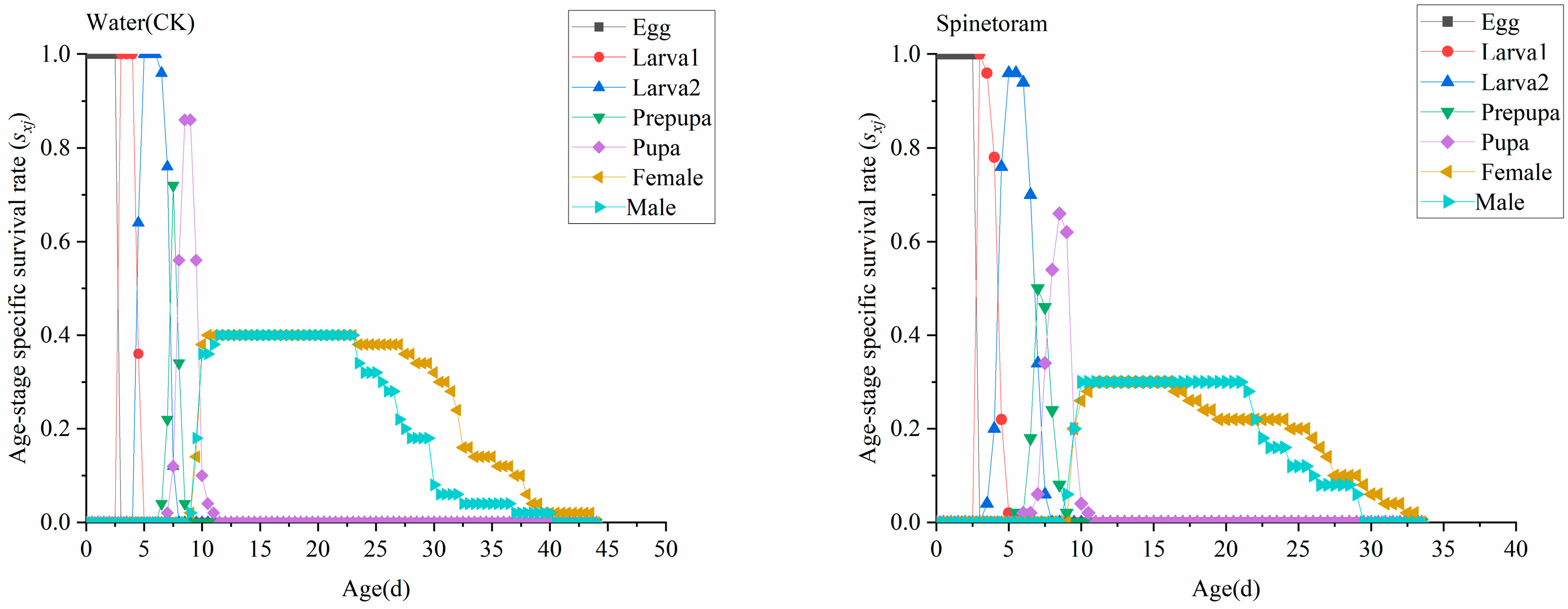
3.2.3. Effect of LC25 Spinetoram Treatment on Age-Stage-Specific Survival Rates of F4 M. usitatus

The degree of overlap in the age-stage survival curves (sxj) reflects the developmental rate variation among M. usitatus individuals. As shown in Figure 1, the sxj curves for the spinetoram-selected M. usitatus line and controls exhibited low overlap, indicating consistent developmental rates across stages. The survival rates and survival times of both male and female adults of M. usitatus after spinetoram selection were lower than those of the controls. Additionally, the survival rates during the pupal and pre-pupal stages were reduced than those of the control, whereas the survival rates during the egg and nymphal stages showed no significant changes.

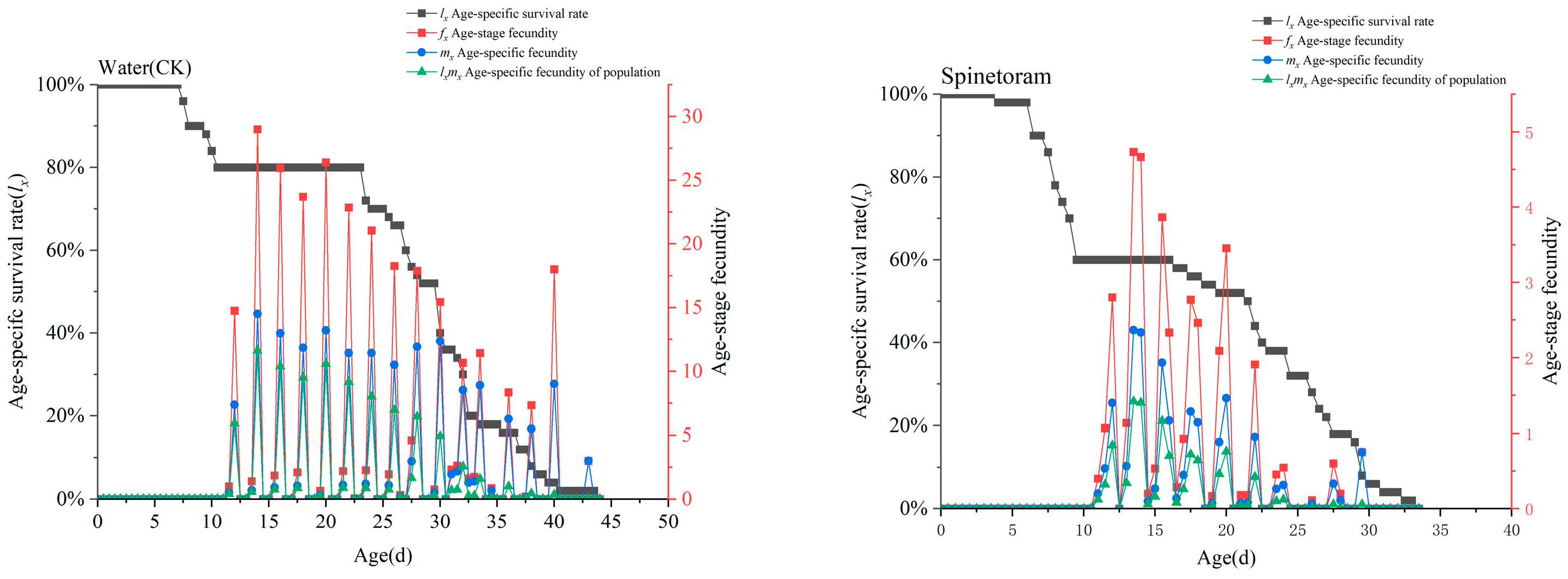
3.2.4. Effect of LC25 Spinetoram on Age-Specific Survival Rates and Reproductive Capacity of F4 Offspring of M. usitatus

Population age-specific survival rate (lx) curves represent survival rates at age x, illustrating changes in survival with age for M. usitatus. As shown in Figure 2, survival curves exhibited similar trends under both spinetoram stress and control conditions: a gradual decline in the early stage indicated low mortality during immature stages, followed by a sharp decline after emergence from the pupal stage. Survival stabilized in the early adulthood, but showed another rapid decline in the late adulthood. The spinetoram-treated and control groups exhibited complete mortality by days 34 and 44, respectively. Survival rates at all age stages were lower in the spinetoram-treated group than in the control group. Age-specific fecundity (mx) in both the spinetoram-treated and control groups initially increased and then decreased, exhibiting multiple peaks and reaching its highest reproductive peak between days 10 and 15. Age-specific female fecundity (fx) showed an identical trend. The reproductive value of all surviving individuals at age x, (egg production per female) is represented by lxmx. As shown in Figure 2, egg production per female at specific ages was significantly lower in the spinetoram-stressed group than in the control group.

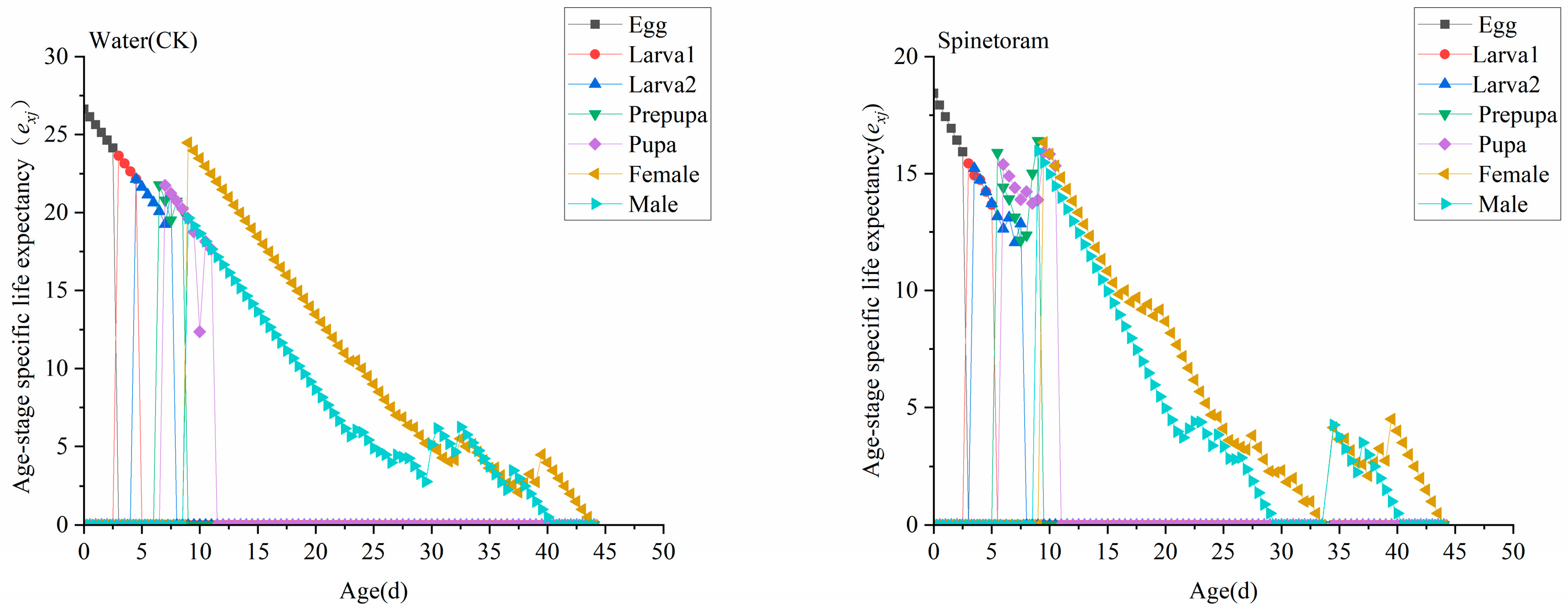
3.2.5. Effect of LC25 Spinetoram on Life Expectancy of F4 Offspring of M. usitatus After Three Generations of Selection

Age-stage-specific life expectancy (exj) represents the life expectancy of M. usitatus individuals at ages x and j (Figure 3). Overall, life expectancy declined gradually with increasing age in both the control and spinetoram-stressed groups. Life expectancy at all age stages was lower in the spinetoram-stressed group than in the control group.

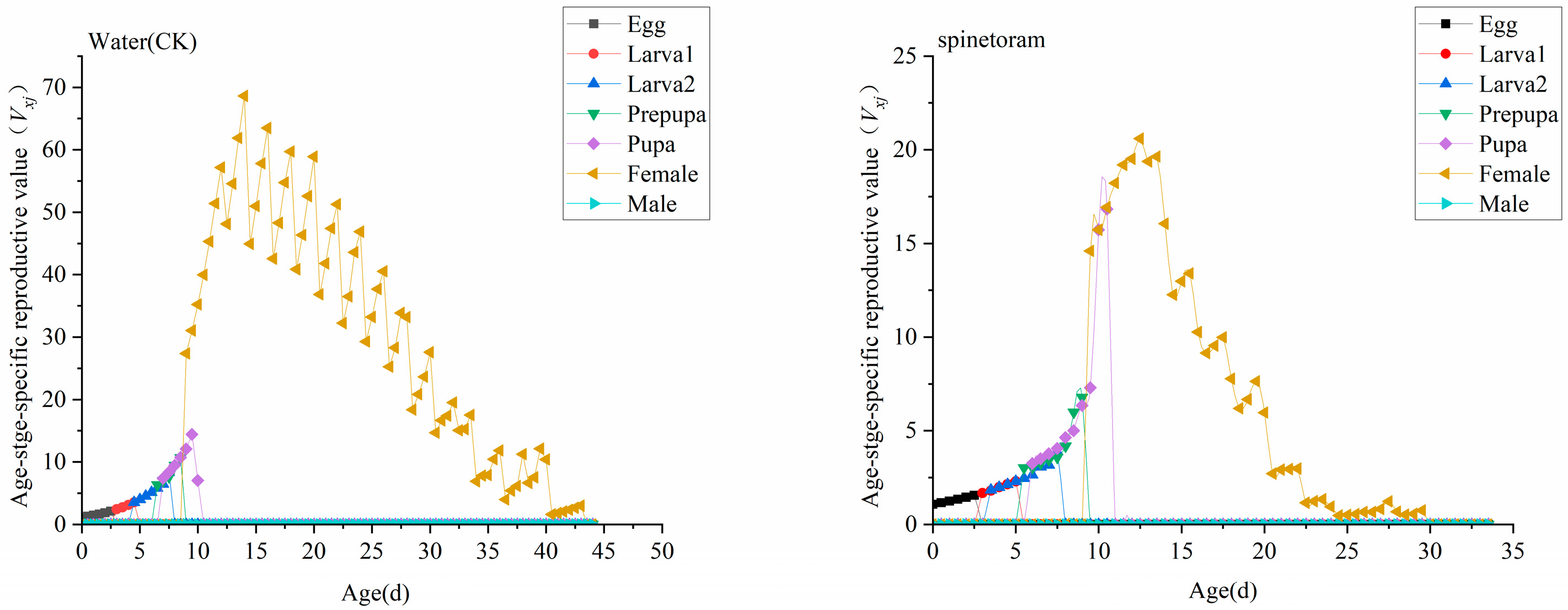
3.2.6. Effect of LC25 Spinetoram Selection on Age-Specific Reproductive Values (vxj) of F4 Offspring in M. usitatus After Three Generations

The age-specific reproductive value (vxj) denotes the average contribution of an individual at age x and stage j to the future population development (Figure 4). Both the control and spinetoram-stressed groups showed a general trend of increasing reproductive value with age, before declining. The reproductive peak was reached at 14 days in the control group and at 12.5 days in the spinetoram-stressed group, with values of 68.62 and 20.60, respectively. The spinetoram-stressed group reached its peak earlier than the control group, with a significantly reduced reproductive capacity.

3.2.7. Effect of LC25 Spinetoram on Population Life History Parameters of F4 Offspring of M. usitatus After Three Generations of Selection

After three generations of continuous exposure to spinetoram at the LC25 concentration, the population life table parameters of F4 offspring of M. usitatus were significantly affected (Table 4). Compared with the water control, the net reproductive rate (R0) in the treatment group decreased from 98.80 to 10.36, a reduction of 89.5%; the intrinsic rate of increase (r) decreased from 0.2506 to 0.1452, a 40.0% reduction; the finite rate of increase (λ) decreased from 1.2849 to 1.1564, and the mean generation time (T) shortened from 18.24 days to 15.84 days. These results indicate that spinetoram significantly suppressed the population growth potential of M. usitatus under sublethal stress across multiple generations while accelerating generational turnover.

4. Discussion

Currently, chemical pesticides are extensively used for the control of M. usitatus. Among these, bio-derived pesticides (e.g., spinosyns) are gaining increasing attention for resistance management because of their dual advantages of effective control and environmental friendliness. Spinetoram, a next-generation spinosyn product [14,15], demonstrates excellent control efficacy against thrips [32,33,34], mites [35]. Its mechanism of action differs from traditional chemical pesticides (such as neonicotinoids, pyrethroids, organophosphates, etc.), simultaneously targeting both the nicotinic acetylcholine receptor (nAChR) and γ-aminobutyric acid receptor (GABAR) in the insect nervous system [16]. This unique dual-targeting mechanism reduces the likelihood of cross-resistance to other pesticides. However, influenced by environmental factors, such as rainfall, light exposure, and temperature in the field, pests are often persistently exposed to sublethal doses after pesticide application. This prolonged exposure can exert lasting effects on pest behavior, reproduction, and resistance development.
Age-stage two-sex life tables serve as vital tools in insect population ecology and pest management, providing practical insights into survival, developmental timing, and reproductive capacity to optimize control strategies [30]. This study employed life tables to assess the transgenerational effects of spinetoram on successive generations of M. usitatus. While Fu et al. [24] focused on resistance-driven interspecific competition, the transgenerational sublethal effects of spinetoram on life-history parameters of M. usitatus remain largely unexplored. The present study evaluated these effects using an age-stage, two-sex life table. The results demonstrated that after three generations of sublethal exposure to spinetoram at an LC25 concentration, the sensitivity of M. usitatus to spinetoram significantly decreased, with a resistance factor reaching 2.7-fold, indicating the development of low-level resistance (Table 1). This suggests that, under sublethal dose selection pressure, the resistance of M. usitatus to spinetoram exhibits a slow but definite upward trend. This finding parallels that of Hou et al. [34], in which F. occidentalis developed J-shaped resistance (i.e., a slow initial increase followed by a rapid sharp rise after a certain number of generations) to spinetoram over 1 to 42 generations. Thus, although the current resistance level in the M. usitatus population remains relatively low, there is a potential risk of resistance development under long-term application. Therefore, monitoring the dynamic changes in resistance evolution is essential for practical pest management.
Regarding development, treatment with the LC25 concentration of spinetoram produced significant cumulative effects on the developmental duration of M. usitatus offspring. The duration of the first- and second-instar nymphal stages and the total period from egg to adult were significantly shortened, whereas the pre-pupal stage was significantly prolonged (Table 2). This differential effect may be explained by a hormetic response during the feeding stages, where sublethal stress accelerates development as an adaptive escape strategy [36]. In contrast, the non-feeding prepupal stage requires additional time for tissue reorganization and metamorphic preparation under physiological stress. Similar stage-specific responses have been reported in other insects, such as the prolonged prepupal duration observed in Evergestis extimalis after beta-cypermethrin exposure [37]. Concurrently, the number of individuals at each developmental stage decreased, indicating that sublethal concentrations of spinetoram exerted a sustained suppressive effect on the thrips population. For example, sublethal concentrations of spinetoram significantly reduced body weight and reproductive capacity in the two-spotted spider mite Tetranychus urticae (Acari: Tetranychidae), accompanied by marked alterations in key energy storage compounds, such as trehalose and glycogen [35]. This confirms that these compounds disrupt insect energy storage and allocation, thereby impairing individual development and population growth.
In terms of reproductive and population dynamics, we found that adult lifespan and reproductive capacity were significantly suppressed in the M. usitatus population after three generations of spinetoram selection at LC25. The lifespan of female adults decreased from 23.65 days to 16.07 days, a reduction of approximately 32.1%; and the number of eggs laid per female decreased from 247.15 to 34.53, representing a reduction of 86.0% (Table 3). In both groups, female adults lived significantly longer than males under control conditions (23.65 vs. 18.78 days), but this sex difference largely disappeared in the spinetoram-treated group (16.07 vs. 15.40 days) because female lifespan was reduced more severely (32.1%) than male lifespan (18.0%) (Figure 1). This suggests that spinetoram has a stronger toxic effect on females, possibly due to the higher metabolic demands of egg production [27]. These findings align with those of Li et al. [38], showing reduced lifespan, reproductive capacity, and survival rates in both sexes of the spinetoram-resistant population of F. occidentalis compared to those of the susceptible strain. This suggests that M. usitatus might sacrifice population fitness during the development of resistance [39]. Furthermore, age-specific life expectancy values (exj) revealed that the spinetoram-stressed group exhibited significantly lower life expectancy values (exj) at all developmental stages compared to the control group (Figure 3). This indicates that sustained chemical stress accelerates the individual aging processes, thereby substantially reducing the overall survival potential of the population. Concurrently, age-specific reproductive values (vxj) revealed that, compared to the water control group, the peak reproductive value of adult females in the spinetoram-treated group was significantly reduced and occurred earlier. The peak reproductive value decreased from 68.62 to 20.60, and its onset shifted from day 14 in the control group to day 12.5 in the treated group (Figure 4). This shift indicates that spinetoram stress not only weakened the reproductive capacity of M. usitatus but also forced them to adjust their life history strategy, reproducing earlier to cope with stress. This finding parallels the observations of Zhang et al. [40] regarding the sublethal effects of emamectin benzoate on Sogatella furcifera (Horváth) populations, where population-specific age-stage reproductive values (vxj) significantly decreased with increasing stress concentrations. This suggests that sublethal stress doses induce convergent adaptive changes in the energy allocation and reproductive strategies of insects.
Collectively, under sublethal spinetoram treatment, the M. usitatus population exhibited pronounced life history trade-offs. Adult lifespan and reproductive capacity declined markedly, resulting in a reduction in the population’s net reproductive rate (R0) from 98.80 to 10.36, intrinsic rate of increase (r) from 0.25 to 0.15, and the finite rate of increase (λ) decreased from 1.29 to 1.16. However, the average generation time (T) did not increase but shortened from 18.24 days to 15.84 days. This indicates that the thrip population attempted to offset the negative effects of the sharp decline in reproductive capacity by accelerating development and shortening generation time, with the aim of maintaining the population’s survival potential under adverse environmental conditions. This life history tradeoff reflects the adaptive response mechanisms in insects under insecticide-induced stress, which is consistent with the findings of Kordestani et al. [41]. Their study demonstrated that an LC25 concentration of matrine treatment significantly reduced population parameters such as intrinsic rate of increase (r), finite rate of increase (λ), and net reproductive rate (R0) in the offspring of western flower thrips, markedly inhibiting their growth, development, and reproduction.

5. Conclusions

This study used an age-stage, two-sex life table to systematically evaluate the transgenerational sublethal effects of spinetoram on M. usitatus over multiple generations, complementing previous research on resistance-driven interspecific competition [40]. The results showed that after three consecutive generations of exposure to an LC25 concentration of spinetoram, M. usitatus developed low-level resistance (2.7-fold based on LC25), while key life-history traits were significantly suppressed. Specifically, female adult longevity and mean fecundity per female decreased by 32.1% and 86.0%, respectively. Regarding population parameters, the net reproductive rate (R0) and intrinsic rate of increase (r) declined by 89.5% and 40.0%, respectively, indicating a marked reduction in population fitness. Although the mean generation time (T) was shortened by 13.2%, reflecting an adaptive trade-off in which insects accelerate development to sustain population survival under stress, overall reproductive output and survival capacity remained severely compromised.
For resistance management, we recommend that spinetoram should not be used continuously; we advise no more than two consecutive applications before rotation to insecticides with other modes of action, such as emamectin benzoate (IRAC Group 6), chlorfenapyr (IRAC Group 13), the botanical insecticide matrine, as well as pyrethroids or organophosphates. Field-recommended application rates should be strictly followed to avoid creating sublethal concentrations, which can delay resistance development and reduce potential harm to natural enemies. Chemical control should be integrated with biological control (e.g., predatory mites, entomopathogenic fungi) and cultural practices (e.g., crop rotation, intercropping with non-host crops) to lower overall selection pressure, and regular resistance monitoring should be conducted to guide timely insecticide rotation.
Future research should investigate the molecular mechanisms underlying resistance development under sublethal spinetoram stress, particularly the relationships between detoxification enzyme activities or target-site mutations and resistance levels. Field validation of the proposed rotation strategy is needed, and the potential for cross-resistance between spinetoram and other commonly used insecticides should be systematically evaluated.

Author Contributions

Conceptualization, L.Y. and H.L.; methodology, L.H.; software, R.G. and W.H. and L.H.; validation, E.C.; formal analysis, L.Y.; investigation, R.G., L.H. and W.H.; data curation, E.C.; writing—original draft preparation, R.G., L.H. and W.H.; writing—review and editing, L.Y.; visualization, R.G., L.H. and W.H.; supervision, H.L.; project administration, L.Y.; funding acquisition, L.Y. All authors have read and agreed to the published version of the manuscript.

Funding

This research was supported by grants from the Guangxi Science, and Technology Major Project (No. Guikenong-AB2506910020), Guangxi Natural Science Foundation (No. 2023GXNSFAA026464), National Key Research and Development Program (2024YFD1400105).

Institutional Review Board Statement

Not applicable.

Data Availability Statement

The data presented in this study are available on request from the corresponding author.

Conflicts of Interest

The authors declare no conflicts of interest.

References

  1. Huang, W.K.; Kong, X.Y.; Ke, Y.C.; Wang, S.; Li, Q.J.; Fu, Q.W.; Wu, Q.X.; Liu, Y. Research progress of Megalurothrips usitatus (Bagnall). China Veg. 2018, 2, 21–27. [Google Scholar] [CrossRef]
  2. Hunter, W.B.; Ullman, D.E. Precibarial and cibarial chemosensilla in the western flower thrips, Frankliniella occidentalis (Pergande) (Thysanoptera: Thripidae). Int. J. Insect Morphol. Embryol. 1994, 23, 69–83. [Google Scholar] [CrossRef]
  3. Yu, H.L.; Wu, M.Y.; Liu, Z.; Li, J.; Li, J.X.; Fu, Q.M.; Mai, J.X.; Liu, Y.; Shi, C.H.; Zhang, Y.J.; et al. Effect of short-term high temperature on survival of Megalurothrips usitatus and its control efficacy in cowpea field. China Veg. 2024, 6, 107–114. [Google Scholar] [CrossRef]
  4. Prasada, R.R.; Reddy, A.S.; Reddy, S.V.; Thirumala-Devi, K.; Chander, R.S. The host range of Tobacco streak virus in India and transmission by thrips. Ann. Appl. Biol. 2003, 142, 365–368. [Google Scholar] [CrossRef]
  5. Reddy, A.S.; Rao, R.P.; Thirumala-Devi, K.; Reddy, S.V.; Mayo, M.A. Occurrence of Tobacco streak virus on peanut (Arachis hypogaea) in India. Plant Dis. 2002, 86, 173–178. [Google Scholar] [CrossRef]
  6. Sharanya, R.; Gayathri, M.; Renukadevi, P.; Saranya, N.; Suganthy, M. First record of the transmission of groundnut bud necrosis virus (GBNV) in tomato by Southeast Asian thrips, Thrips parvispinus. 3 Biotech. 2025, 15, 426. [Google Scholar] [CrossRef]
  7. Guangxi Agricultural and Rural Affairs Department. Strengthening Monitoring and Control Guidance for Cowpea Diseases and Pests. China. 2026. Available online: http://nynct.gxzf.gov.cn/xwdt/zhyyjgl/t17070270.shtml (accessed on 1 January 2026).
  8. Ministry of Agriculture and Rura. Announcement No. 654 of the Ministry of agriculture and rural affairs of the people’s republic of Cl Affairs of the People’s Republic of China. In Gazette of the Ministry of Agriculture and Rural Affairs of the People’s Republic of China; Ministry of Agriculture and Rura: Beijing, China, 2023; pp. 103–104. [Google Scholar]
  9. Huang, T.B.; Zhao, L.Y.; Yu, Q.H.; Dong, W.B.; Li, F.; Wu, S.Y. Growth, development, internal structure observation of Megalurothrips usitatus and its response to emamectin benzoate stress. J. Plant Prot. 2026, 53, 22634. [Google Scholar] [CrossRef]
  10. Yuan, L.L.; Pan, X.L.; Lu, R.C.; Chen, L.W.; Xi, Y.; Wu, S.Y. Resistance monitoring of Megalurothrips usitatus to pyrethroid insecticides and detection of sodium channel mutations in Hainan. Plant Prot. 2023, 49, 60–67. [Google Scholar] [CrossRef]
  11. Sun, J.Y.; Fan, Y.M.; Chen, S.C.; You, J.; Jiang, Y.T. Establishment of baseline susceptibility and resistance monitoring of Megalurothrips usitatus to acetamiprid in laboratory. Jiangsu Agric. Sci. 2017, 45, 98–100. [Google Scholar] [CrossRef]
  12. Souto, A.L.; Sylvestre, M.; Tölke, E.D.; Tavares, J.F. Plant-derived pesticides as an alternative to pest management and sustainable agricultural production: Prospects, applications and challenges. Molecules 2021, 26, 4835. [Google Scholar] [CrossRef]
  13. Shi, X.Y. Research progress on environmental degradation and resistance mechanisms of spinosyn insecticides. Chin. J. Pestic. Sci. 2018, 20, 557–567. [Google Scholar] [CrossRef]
  14. Hua, N.Z. Review on green environmental friendly bio-insecticides spinosad and spinetoram. Agrochemicals 2015, 54, 1–5+13. [Google Scholar] [CrossRef]
  15. Sparks, T.C.; Crouse, G.D.; Dripps, J.E.; Anzeveno, P.; Martynow, J.; DeAmicis, C.V.; Gifford, J. Neural network-based QSAR and insecticide discovery: Spinetoram. J. Comput. Aided Mol. Des. 2008, 22, 393–401. [Google Scholar] [CrossRef]
  16. Orr, N.; Shaffner, A.J.; Richey, K.; Crouse, G.D. Novel mode of action of spinosad: Receptor binding studies demonstrating lack of interaction with known insecticidal target sites. Pestic. Biochem. Physiol. 2009, 95, 1–5. [Google Scholar] [CrossRef]
  17. Wu, H.H.; Cong, S.B.; Lü, L.; Huang, M.S.; Wan, P.; Jiang, G.M.; Wang, P. Bioactivity of spinetoram against rice thrips and its safety to rice. Agrochemicals 2016, 55, 767–770. [Google Scholar] [CrossRef]
  18. Martelli, F.; Ravenscroft, T.A.; Hutchison, W.; Batterham, P. Tissue-specific transcriptome analyses in Drosophila provide novel insights into the mode of action of the insecticide spinosad and the function of its target, nAChRα6. Pest Manag. Sci. 2023, 79, 3913–3925. [Google Scholar] [CrossRef]
  19. Li, X.R.; Li, Y.; Wang, W.; He, N.; Tan, X.L. LC50 of lambda-cyhalothrin stimulates reproduction on the moth Mythimna separata (Walker). Pestic. Biochem. Physiol. 2019, 153, 47–54. [Google Scholar] [CrossRef]
  20. Yang, G.M.; Zhi, J.R.; Li, S.X.; Liu, L. Sublethal effects of spinetoram and azadirachtin on the growth, development and reproduction of Frankliniella occidentalis (Pergande). Chin. J. Appl. Ecol. 2016, 27, 3698–3704. [Google Scholar] [CrossRef]
  21. Qi, X.; Fu, J.W.; You, M.S. Age-stage, two-sex life table and its application in population ecology and integrated pest management. Acta Entomol. Sin. 2019, 62, 255–262. [Google Scholar] [CrossRef]
  22. Zhang, S.Y.; Chen, J.L.; Li, X.; Zang, X.; Lei, X.Y.; He, S.L.; Chen, B.; Qiao, L.; Zhou, C. Sublethal effects of lambda-cyhalothrin on development and reproduction of Anopheles sinensis. Acta Entomol. Sin. 2026; in press.
  23. Gul, H.; Güncan, A.; Ullah, F.; Desneux, N.; Liu, X. Intergenerational sublethal effects of flonicamid on cotton aphid, Aphis gossypii: An age-stage, two-sex life table study. Insects 2024, 15, 529. [Google Scholar] [CrossRef]
  24. Fu, B.; Tao, M.; Xue, H.; Jin, H.; Liu, K.; Gui, L. Spinetoram resistance drives interspecific competition between Megalurothrips usitatus and Frankliniella intonsa. Pest Manag. Sci. 2022, 78, 2129–2140. [Google Scholar] [CrossRef]
  25. Wang, Z.H.; Gong, Y.J.; Jin, G.H.; Li, B.Y.; Chen, J.C. Field-evolved resistance to insecticides in the invasive western flower thrips Frankliniella occidentalis (Pergande) (Thysanoptera: Thripidae) in China. Pest Manag. Sci. 2016, 72, 1440–1444. [Google Scholar] [CrossRef]
  26. Rueda, A.; Shelton, A.M. Development of a bioassay system for monitoring susceptibility in Thrips tabaci. Pest Manag. Sci. 2003, 59, 553–558. [Google Scholar] [CrossRef]
  27. Wang, H.T.; Huang, L.F.; Zheng, X.L.; Gong, R.; Cao, X.; Yang, L. An age-stage, two-sex life table for Megalurothrips usitatus feeding on eight different crop plants. Agronomy 2024, 14, 2283. [Google Scholar] [CrossRef]
  28. Chi, H. Life-table analysis incorporating both sexes and variable development rates among individuals. Environ. Entomol. 1988, 17, 26–34. [Google Scholar] [CrossRef]
  29. Chi, H. TWOSEX-MSChart: A Computer Program for the Age-Stage, Two-Sex Life Table Analysis; Fujian Academy of Agricultural Sciences: Fuzhou, China, 2026; Available online: https://www.faas.cn/cms/sitemanage/index.shtml?siteId=810640925913080000 (accessed on 5 January 2026).
  30. Tuan, S.J.; Lee, C.C.; Chi, H. Population and damage projection of Spodoptera litura (F.) on peanuts (Arachis hypogaea L.) under different conditions using the age stage, two-sex life table. Pest Manag. Sci. 2014, 70, 805–813, Erratum in Pest Manag. Sci. 2014, 70, 1936. https://doi.org/10.1002/ps.3920. [Google Scholar] [CrossRef] [PubMed]
  31. Chang, C.; Huang, C.Y.; Dai, S.M.; Atlihan, R.; Chi, H. Genetically engineered ricin suppresses Bactrocera dorsalis (Diptera: Tephritidae) based on demographic analysis of group-reared life table. J. Econ. Entomol. 2016, 109, 987–992. [Google Scholar] [CrossRef]
  32. Renkema, J.M.; Krey, K.; Devkota, S.; Liburd, O.E.; Funderburk, J. Efficacy of insecticides for season-long control of thrips (Thysanoptera: Thripidae) in winter strawberries in Florida. Crop Prot. 2020, 127, 104945. [Google Scholar] [CrossRef]
  33. Gao, Y.; Reitz, S.R. Special issue on novel management tactics for the western flower thrips. J. Pest Sci. 2021, 94, 1–3. [Google Scholar] [CrossRef]
  34. Hou, W.J. Studies on the Resistance Mechanism of Frankliniella Occidentalis to Spinosad; Chinese Academy of Agricultural Sciences: Beijing, China, 2012. [Google Scholar]
  35. Wang, L.; Zhang, Y.; Xie, W.; Wu, Q.J.; Wang, S. Sublethal effects of spinetoram on the two-spotted spider mite, Tetranychus urticae (Acari: Tetranychidae). Pestic. Biochem. Physiol. 2016, 132, 102–107. [Google Scholar] [CrossRef] [PubMed]
  36. Ullah, F.; Ullah, Z.; Güncan, A.; Govindharaj, G.P.P.; Gul, H.; Desneux, N.; Lu, Y. Tetraniliprole triggers transgenerational hormesis in an invasive Insect herbivore: Molecular and biological insights. Insects 2025, 16, 1073. [Google Scholar] [CrossRef]
  37. Zeng, Y.F.; Shen, Y.Y.; Qin, M.G.; Lai, Y.P. Sublethal effects of beta-cypermethrin on Evergestis extimalis and its molecular detoxification mechanisms. J. Plant Prot. 2025, 52, 1000–1012. [Google Scholar] [CrossRef]
  38. Li, D.Y.; Zhi, J.R.; Zhang, T.; Yue, W.B. Effects of multi-generation spinetoram stress on detoxifying enzyme activities, development and reproduction of Frankliniella occidentalis. Acta Entomol. Sin. 2021, 64, 1176–1186. [Google Scholar] [CrossRef]
  39. Wan, Y.; Zheng, X.; Xu, B.; Xie, W.; Wang, S. Insecticide resistance increases the vector competence: A case study in Frankliniella occidentalis. J. Pest Sci. 2021, 94, 83–91. [Google Scholar] [CrossRef]
  40. Zhang, B.C.; Liao, Q.; Zhang, S.Y.; He, S.L.; Qiao, L.; Zhou, C. Sublethal effects of emamectin benzoate on the white-backed planthopper, Sogatella furcifera (Horváth), based on age-stage two-sex life table. Acta Entomol. Sin. 2024, 67, 753–765. [Google Scholar] [CrossRef]
  41. Kordestani, M.; Mahdian, K.; Baniameri, V.; Sheikhi, A. Lethal and sublethal effects of proteus, matrine, and pyridalyl on Frankliniella occidentalis (Thysanoptera: Thripidae). Environ. Entomol. 2021, 50, 1137–1144. [Google Scholar] [CrossRef]
Figure 1. Age-stage-specific survival rate (sxj) of F4 offspring of M. usitatus after selection with an LC25 concentration of spinetoram for three generations.
Agriculture 16 01164 g001
Figure 2. Age-specific survival rate (lx), female age-specific fecundity (fx), age-specific fecundity of the total population (mx), and age-specific net maternity (lxmx) of F4 offspring of M. usitatus after selection with an LC25 concentration of spinetoram for three generations.
Agriculture 16 01164 g002
Figure 3. Age-specific-life expectancy (exj) of F4 offspring of M. usitatus after selection with an LC25 concentration of spinetoram for three generations.
Agriculture 16 01164 g003
Figure 4. Age-specific reproductive value (vxj) of F4 offspring of M. usitatus after selection with an LC25 concentration of spinetoram for three generations. The Y-axis scales differ between panels due to the large difference in magnitude between treatments.
Agriculture 16 01164 g004
Table 1. Toxicity of spinetoram to the 2nd instar nymphs of M. usitatus.
GenerationTreatmentsToxicity Regression EquationLC25 (mg/L)
(95% FL)
LC50 (mg/L)
(95% FL)
Resistance Ratio (Based on LC25)Resistance Ratio (Based on LC50)
F1Water (CK)y = 1.757x + 0.3320.267 (0.176–0.356)0.647 (0.511–0.797)1.0 1.0
spinetoramy = 1.534x − 0.1160.432 (0.303–0.559)1.190 (0.944–1.564)1.6 1.8
F2Water (CK)y = 1.693x + 0.3230.258 (0.164–0.349)0.645 (0.501–0.804)1.0 1.0
spinetoramy = 1.209x − 0.3950.587 (0.391–0.792)2.120 (1.521–3.552)2.3 3.3
F3Water (CK)y = 1.529x + 0.2630.244 (0.145–0.343)0.673 (0.510–0.853)0.9 1.0
spinetoramy = 1.129x−0.5070.711 (0.468–0.985)2.814 (1.893–5.580)2.7 4.4
The toxicity of spinetoram to M. usitatus was determined for each generation, and the thrip population was subsequently selected at the corresponding LC25 spinetoram concentration for three consecutive generations. The F1 spinetoram-treated group was derived from the F0 population after one generation of selection at the LC25 concentration.
Table 2. Effect of Three Generations of Selection with LC25 Spinetoram on Developmental Duration of F4 M. usitatus.
TreatmentsDevelopmental Duration(d)
Egg1nd Instar Nymphal2nd Instar NymphalPrepupalPupaEgg-Adult
Water (CK)3.00 ± 0.00
(50)
1.68 ± 0.03 *
(50)
2.74 ± 0.05 *
(48)
0.71 ± 0.04 *
(45)
1.74 ± 0.06
(40)
9.67 ± 0.11 *
(40)
Spinetoram3.00 ± 0.00
(50)
1.50 ± 0.06
(49)
2.56 ± 0.07
(44)
0.87 ± 0.07
(39)
1.75 ± 0.43
(30)
9.00 ± 0.18
(30)
Data in the table are mean ± SE. An asterisk (*) indicates a significant difference at the 0.05 level (p < 0.05) by t-test. Egg duration was recorded as the time from adult introduction to the first appearance of first-instar nymphs (following Wang et al. [27]), as direct observation of individual eggs was not feasible due to endophytic oviposition.
Table 3. Effect of Three Consecutive Generations of Selection with LC25 Spinetoram on Adult Longevity and Fecundity of F4 M. usitatus.
TreatmentsLongevity/dSex Ratio (F/M)Fecundity
Female AdultMale Adult
Water (CK)23.65 ± 1.05 *
(20)
18.78 ± 0.96 *
(20)
20:20247.15 ± 30.47 *
(20)
Spinetoram16.07 ± 1.40
(15)
15.40 ± 0.82
(15)
15:1534.53 ± 6.02
(15)
Data in the table are mean ± SE. An asterisk (*) indicates a significant difference at the 0.05 level (p < 0.05) by t-test.
Table 4. Life table parameters of F4 offspring of M. usitatus after selection with an LC25 concentration of spinetoram for three generations.
TreatmentsNet Reproductive Rate
R0
Intrinsic Rate of Increase
r
Finite Rate of Increase
λ
Mean Generation Time
T
Water (CK)98.7997 ± 0.0660 *0.2506 ± 0.0001 *1.2849 ± 0.0001 *18.2428 ± 0.0011 *
Spinetoram10.3554 ± 0.00900.1452 ± 0.00011.1564 ± 0.000115.8389 ± 0.0012
Data in the table are presented as mean ± SE. Standard errors (SEs) were estimated using the bootstrap method with 100,000 resampling replicates. An asterisk (*) following the data within a column indicates a significant difference at the 0.05 level according to the t-test.
Disclaimer/Publisher’s Note: The statements, opinions and data contained in all publications are solely those of the individual author(s) and contributor(s) and not of MDPI and/or the editor(s). MDPI and/or the editor(s) disclaim responsibility for any injury to people or property resulting from any ideas, methods, instructions or products referred to in the content.