Article

Responses of Different Japonica Rice Varieties to Cadmium Stress

1
College of Land and Environment, Shenyang Agricultural University, Shenyang 110866, China
2
College of Bioscience and Biotechnology, Shenyang Agricultural University, Shenyang 110866, China
3
College of Agronomy, Shenyang Agricultural University, Shenyang 110866, China
*
Author to whom correspondence should be addressed.
Agriculture 2026, 16(10), 1078; https://doi.org/10.3390/agriculture16101078
Submission received: 7 April 2026 / Revised: 6 May 2026 / Accepted: 7 May 2026 / Published: 15 May 2026

Abstract

Cadmium (Cd) contamination in paddy soils threatens food security by accumulating in rice grains. This study aimed to elucidate Cd-accumulation mechanisms using major japonica cultivars from Liaoning Province, a key northern Chinese rice-producing region where systematic comparisons remain limited. Four Liaoning japonica varieties (low-Cd: YF47, SN9903; high-Cd: QTXT, TJ) were analyzed for Cd accumulation, physiological responses, including malondialdehyde (MDA), superoxide dismutase (SOD), peroxidase (POD) and catalase (CAT), and expression of Cd-related transporter genes under Cd stress. Cd distribution in rice plants followed the following order: root > stems and leaves > grain. Varietal differences were attributed to root-to-shoot transport rather than root uptake, as low-Cd varieties exhibited lower transport coefficients and higher root Cd retention. Low-Cd varieties showed smaller MDA increases and significantly higher SOD and CAT activities under Cd stress. Notably, OsLCD was significantly down-regulated in low-Cd varieties but up-regulated in high-Cd varieties, an opposite regulation pattern that clearly distinguishes the two groups. The root-to-shoot translocation process and the OsLCD expression pattern are key determinants differentiating low- from high-Cd japonica varieties. These findings provide region-specific mechanistic insights and screening indicators for breeding low-Cd rice in northern China.

1. Introduction

Cadmium (Cd) is a highly toxic heavy metal that poses serious threats to both plant growth and human health. Cd typically exists as a divalent cation, exhibiting high mobility and strong bioaccumulation potential, with a biological half-life ranging from 10 to 30 years. The International Agency for Research on Cancer has classified it as a “Group 1 carcinogen” [1]. Cd can enter the human body through the food chain. When Cd levels in the body exceed safe thresholds, they can suppress liver and kidney function, cause bones to soften and experience brittleness, and increase the risk of lung cell carcinogenesis, posing serious threats to human health [2,3]. Rice (Oryza sativa L.) is a staple food for more than half of the world’s population and is also a major source of dietary Cd intake, because rice plants efficiently absorb Cd from contaminated paddy soils and translocate it to the grains.
Although Cd is a non-essential element for plants, it is readily absorbed by plant roots and transported to the above-ground parts, leading to cellular, molecular, biochemical, and physiological changes that affect plant growth and development, and may even cause death [4]. Research indicates that Cd inhibits amylase activity in plant seeds, reducing seed germination rates and consequently affecting seedling growth and development [5]. Excessive Cd accumulation within plants disrupts chloroplast structure, reduces chloroplast protein complex formation, accelerates chlorophyll degradation, and inhibits photosynthesis, thereby hindering nutrient uptake and transport [6,7]. Furthermore, Cd damages DNA in root cap cells, causing root tip cell injury and resulting in root browning and rot [8]. The activation of plant Cd detoxification mechanisms involves the participation of signaling molecules such as ROS, NO, plant hormones, carbon monoxide (CO), melatonin, and H2S [9]. Cd stress induces the production of reactive oxygen species (ROS) such as superoxide anion (O2), hydroxyl radical (OH), and hydrogen peroxide (H2O2) [6]. The enzymatic antioxidant system participates in the clearance of ROS. If these ROS are not promptly eliminated, they will trigger lipid peroxidation reactions. ROS attack unsaturated fatty acids in cell membranes, generating lipid peroxides through chain reactions, which ultimately decompose to produce malondialdehyde (MDA) [10]. The accumulation of MDA serves as a marker for the degree of membrane lipid peroxidation, and higher levels indicate more severe oxidative damage to cells. Key enzymatic antioxidants include superoxide dismutase (SOD), peroxidase (POD), and catalase (CAT) [11]. SOD converts O2 into O2 and H2O2 [12]; CAT decomposes H2O2 into H2O and O2 [13]; and POD also neutralizes H2O2 toxicity [14]. Under different genetic backgrounds and Cd concentration stresses, the activities of SOD, CAT, and POD undergo varying degrees of change in rice, thereby counteracting the damage caused by the adverse conditions [15]. Moreover, under Cd stress, antioxidant enzyme activity in Cd-tolerant varieties was significantly higher than in Cd-sensitive varieties [16].
The mechanism of Cd accumulation in rice is a complex biological process that involves multiple genes related to absorption and transport genes of Cd in rice. These include genes of the natural-resistance-associated macrophage protein (NRAMP) family, P-type heavy metal ATPase (HMA) family, major facilitator superfamily domain-containing protein (MFS) family, ZRT- and IRT-like protein (ZIP) family and other genes involved in Cd uptake and transport [17]. The expression of genes can influence the absorption, transport, and accumulation of Cd in rice. OsNRAMP5 is a manganese and Cd transporter localized to the plasma membranes, participating in the uptake of external manganese and Cd by root cells; it also plays a crucial role in Cd transport in rice [18,19,20]. Knockout of the OsNRAMP5 gene in rice significantly reduces Cd uptake, with corresponding decreases in Cd and manganese content in grains [20,21]. Cd1 belongs to the major transporter family and is capable of transporting Cd ions and participating in root Cd uptake while promoting Cd accumulation in seed [22,23]. OsLCD is localized in the cytoplasm and nucleus, with predominant expression in leaf phloem companion cells and root vascular tissues. Cd accumulation is reduced in oslcd mutant rice lines from different genetic backgrounds [24,25]. OsHMA3 selectively retains Cd ions within root vacuoles, thereby inhibiting Cd ion translocation to the above-ground parts; it also plays a crucial role in Cd ion transport and homeostasis maintenance in rice [26,27]. OsZIP3 also possesses Cd transport capacity; its heterologous expression in yeast cells reduces Cd uptake, thereby mitigating Cd toxicity [28]. OsHMA2 controls zinc and Cd transport from roots to shoots. Suppressing OsHMA2 expression reduces Cd concentrations in rice leaves and grains compared to wild-type plants [29]. OsLCT1 is strongly expressed in mature leaves and nodes, regulating Cd transport to grains via the phloem [30,31]. Co-expression of OsLCT1, OsHMA2, and OsZIP3 effectively reduces Cd transport and accumulation in grains, thereby mitigating Cd- and zinc-induced oxidative stress responses and ultimately improving rice grain quality and safety [32]. OsNRAMP1, OsIRT1, OsIRT2 and OsMTP1 play crucial roles in mediating Cd uptake and transport in rice [33,34,35,36].
Considerable genotypic variation in Cd accumulation exists among rice varieties, offering the possibility to breed low-Cd cultivars. However, most previous studies have focused on indica rice, while systematic comparisons of Cd-accumulation mechanisms in northern China’s major japonica varieties remain scarce. Therefore, the present study systematically compared four major japonica rice varieties from Liaoning Province, two low-Cd-accumulating varieties (YF47, SN9903) and two high-Cd-accumulating varieties (QTXT, TJ), with respect to their Cd-accumulation patterns, physiological responses, and expression profiles of Cd-related transporter genes. The main objectives were (i) to determine whether varietal differences in Cd accumulation arise from root uptake or root-to-shoot translocation; (ii) to identify key physiological and molecular traits that distinguish low- from high-Cd varieties, with emphasis on antioxidant defense and the expression behavior of OsLCD; and (iii) to provide region-specific mechanistic insights and candidate indicators for breeding low-Cd japonica rice in northern China, thereby supporting the safe utilization of moderately to lightly Cd-contaminated paddy soils.

2. Materials and Methods

2.1. Test Materials

Four japonica rice varieties were used in this study, all of which are major cultivated types in Liaoning Province, China. Two varieties, ‘YF47’ (Yanfeng 47) and ‘SN9903’ (Shennong 9903), are low-Cd-accumulating varieties, while the other two, ‘QTXT’ (Qiutianxiaoting) and ‘TJ’ (Tijin), are high-Cd-accumulating varieties. These varieties were selected based on their contrasting Cd-accumulation phenotypes observed in preliminary field surveys and their distinct agronomic traits.
YF47 and SN9903 are widely cultivated in Liaoning Province. YF47 was developed on saline–alkali land and is extremely hardy, having the largest cumulative planting area in the province. SN9903 is a high-yield japonica variety combining ideal plant architecture with high yield potential. In contrast, QTXT and TJ are high-quality japonica varieties introduced to Liaoning Province. Among them, QTXT is a typical high-quality Japanese rice variety cultivated in Northeast China and Liaoning Province. The obvious genetic and phenotypic differences among these four varieties make them ideal experimental materials to reveal the mechanisms responsible for genotypic differences in Cd accumulation.

2.2. Hydroponic Treatment

Seeds were disinfected and pregerminated by soaking in 30% hydrogen peroxide for 30 min, followed by 1 h immersion in 5% sodium hypochlorite solution. After three rinses with distilled water, seeds were placed in a 30 °C constant-temperature incubator. After germination, uniformly sprouted seeds were selected and sown in 1 L hydroponic trays at 25 plants per tray. Trays underwent dark treatment post-sowing. Following one week of darkness, trays were placed under fluorescent lights simulating natural conditions with 16 h daylight and 8 h darkness cycles. After one week of light exposure, half Kimura B nutrient solution was added for continued cultivation. After three days of half-strength nutrient solution, it was replaced with full-strength nutrient solution. Thereafter, change the nutrient solution every three days. Plants were cultivated until rice plants develop three leaves and a heart, then the seedlings were thinned. Retain 20 uniformly growing rice seedlings per hydroponic tray for Cd treatment. The nutrient solution used was Kimura B nutrient solution, and the Cd treatment reagent was Cd nitrate.
Two hydroponic treatment conditions were established with Cd2+ concentrations of 0 mg/L and 1 mg/L, each with three replicates. Nutrient solution was replaced every three days. Samples were collected at zero, three, six, and nine days post-Cd treatment. Each sample was rinsed three times with tap water and deionized water, with roots and stems and leaves stored separately. A portion was rapidly frozen in liquid nitrogen and stored at −80 °C for subsequent physiological and molecular parameter measurements. The remaining samples were separated by treatment, blanched at 105 °C for 30 min, then dried at 75 °C to constant weight for biomass and elemental content determination.

2.3. Soil Culture Treatment

Rice seeds were treated with fungicide for three days, then placed in a 28 °C environment for germination. When seedlings have grown about 7 mm in length, they were sown in a pollution-free paddy field for seedling cultivation. Transplanting occurred after tillering. Each pot contained 7 kg of soil. Add Cd nitrate to the Cd-treated basin to maintain Cd2+ (10 mg/kg). After flooding and resting for seven days, basal fertilizer was applied: nitrogen (N 0.2 g/kg), phosphorus (P2O5 0.15 g/kg), potassium (K2O 0.2 g/kg), and the soil was left to stand for one day. Uniformly developed seedlings were selected and transplanted into plastic pots (diameter 29 cm, height 23 cm). Four holes were made per pot, with one seedling planted per hole. Additional fertilization was applied during the tillering and grain-filling stages. Water depth was maintained at 2–3 cm throughout the entire growth period after transplanting. To ensure adequate light exposure, pot positions were rotated periodically, and routine management practices were followed. All reagents used in this experiment were analytical grade. For the soil-based trial, four rice varieties were selected, each assigned to two treatments: a control group (CK) and a Cd-supplemented treatment (Cd) (Cd2+ at 10 μg/g). Six replicates were conducted, totaling 72 pots. Rice samples were collected at maturity. Each sample was rinsed three times with tap water and distilled water, the surface moisture was blotted dry, and roots, stems and leaves, and grains were separately collected. Samples were blanched at 105 °C, dried at 75 °C to constant weight, pulverized, and analyzed for Cd content.

2.4. Determination of Cd Content

Rice root, stems and leaves (SLs), and grain were, respectively, digested in a 4:1 (v/v) mixture of nitric acid and perchloric acid, followed by dilution to a fixed volume. The resulting liquid was filtered into 100 mL plastic bottles. Cd content in roots, stems and leaves was determined using flame atomic absorption spectrophotometry, while Cd content in grains was measured via Inductively Coupled Plasma Mass Spectrometry (ICP-MS). For hydroponic rice samples, after digestion with a 4:1 (v/v) mixture of nitric acid and hydrogen peroxide followed by volumetric adjustment, the liquid was filtered into 50 mL plastic bottles. Cd content in rice roots and stems and leaves was determined using Inductively Coupled Plasma Optical Emission Spectrometry (ICP-OES).
Cd Content (μg/g) = (CC0) × V/m
Here, C indicates the detected concentration of the sample (mg/L), C0 signifies the blank reagent concentration (mg/L), V represents the volume to be adjusted (mL), and m is the weighed mass of the sample (g).

2.5. Antioxidant Enzyme Activity and MDA Assay

During the hydroponic cultivation process, rice leaves were collected nine days after Cd and CK treatment, respectively. The samples were placed in liquid nitrogen and then stored at −80 °C. Kits manufactured by Beijing Solabio Technology Co., Ltd. (Beijing, China) were used to measure malondialdehyde content (MDA, Cat:BC0025) and the activities of superoxide dismutase (SOD, Cat:BC5165), peroxidase (POD, Cat:BC0090) and catalase (CAT, Cat:BC0205). All operations were performed according to the manufacturer’s instructions.

2.6. Gene Expression Levels

During the hydroponic cultivation process, stems and leaves were harvested for RNA extraction 9 days after treatment with Cd and CK, respectively. Total RNA was extracted by TRIzol Reagent Kit (Aidlab Biotechnologies Co., Beijing, China). Total RNA was reverse-transcribed with reverse transcriptase to obtain cDNA, using a Star Script II First-strand cDNA Synthesis Kit (Promega, Madison, WI, USA). Quantitative reverse transcription PCR (qRT-PCR) was performed with SYBR Green Master (Roche Diagnostics, Mannheim, Germany) on an ABI ViiA7 Real-Time PCR System (Applied Biosystems, Foster City, CA, USA). The rice OsActin gene (LOC_Os03g50885) was used as an internal reference.
This study selected root Cd transport-related genes that have been extensively researched in previous studies: OsNRAMP5, OsNRAMP1, OsIRT2, OsHMA2, OsHMA3 and Cd1; Cd transport genes in stem nodes were included, with OsLCT1 and OsZIP3, as well as Cd transport genes in leaves, including OsMTP1 and OsLCD. All amplification primers were designed and synthesized by Accurate biotechnology (Hunan) Co., Ltd., Changsha, China. The primers used in this study are listed in Table 1.

2.7. Data Analysis

Experiments were conducted in a completely randomized design. All experimental results were expressed as the mean ± standard error. Statistical analyses were performed using Excel 2016 and OriginPro 2021. Differences among the four rice varieties under the same treatment were analyzed by one-way analysis of variance (ANOVA) followed by Duncan’s multiple range test at a significance level of p < 0.05. For comparisons between control and Cd treatment within the same variety, independent-sample t-test was used (p < 0.05). Translocation factor, stems and leaves to grain transport factor, and root to stems and leaves transport factor for Cd were based on Zhang’s study, with minor modifications [37]. The calculation of bioconcentration factor was based on Wu’s study, with minor modifications [38].
C d   d i s t r i b u t i o n   c o e f f i c i e n t   i n   r o o t   ( % ) = C d   A c c u m u l a t i o n   i n   r o o t C d   a c c u m u l a t i o n   i n   t h e   e n t i r e   p l a n t × 100 %
C d   d i s t r i b u t i o n   c o e f f i c i e n t   i n   S L ( % ) = C d   A c c u m u l a t i o n   i n   s t e m s   a n d   l e a v e s C d   a c c u m u l a t i o n   i n   t h e   e n t i r e   p l a n t × 100 %
C d   d i s t r i b u t i o n   c o e f f i c i e n t   i n   g r a i n % = C d   A c c u m u l a t i o n   i n   g r a i n C d   a c c u m u l a t i o n   i n   t h e   e n t i r e   p l a n t × 100 % T r a n s p o r t   F a c t o r   ( T F ) = C d   c o n t e n t   i n   s t e m s   a n d   l e a v e s + C d   c o n t e n t   i n   g r a i n C d   c o n t e n t   i n   r o o t S t e m s   a n d   l e a v e s   t o   g r a i n   t r a n s p o r t   F a c t o r T F s l - g = C d   c o n t e n t   i n   g r a i n C d   c o n t e n t   i n   s t e m s   a n d   l e a v e s
R o o t   t o   s t e m s   a n d   l e a v e s   t r a n s p o r t   F a c t o r T F r - s l = C d   c o n t e n t   i n   s t e m s   a n d   l e a v e s C d   c o n t e n t   i n   r o o t
B i o c o n c e n t r a t i o n   F a c t o r B C F = C d   c o n t e n t   i n   r o o t C d   c o n t e n t   i n   s o i l

3. Results

3.1. Growth and Biomass Responses to Cd Stress

To evaluate the differential tolerance of low- and high-Cd japonica varieties to Cd stress, we analyzed plant height and biomass parameters under both hydroponic conditions (seedling stage, three, six, and nine days after Cd exposure) and soil culture (mature stage).

3.1.1. Hydroponic Results at Seedling Stage

To investigate the early growth responses to Cd stress, we monitored plant height and the dry weight of roots and stems and leaves at three, six, and nine days after Cd stress under hydroponic conditions (Table 2). Plant height was reduced under cadmium stress conditions (Figure S1). Under control conditions, high-Cd varieties QTXT and TJ consistently exhibited greater plant height than low-Cd varieties YF47 and SN9903 across all time points, with the difference becoming more pronounced by Day 9 (low-Cd: 35.0–35.1 cm; high-Cd: 43.7–43.8 cm). Under Cd stress, all varieties showed reduced height compared to their respective controls at Day 6 and Day 9. However, low-Cd varieties maintained a significantly smaller reduction in height compared to high-Cd varieties. By Day 9, Cd-stressed YF47 (28.9 cm) and SN9903 (29.8 cm) showed reductions of 17.7% and 14.9%, respectively, while QTXT (34.5 cm) and TJ (34.9 cm) showed reductions of 21.2% and 20.1%, respectively. These results indicate that low-Cd varieties exhibit greater shoot growth maintenance under early Cd stress.
Under control conditions, stems and leaves dry weight increased progressively with time in all varieties. By Day 9, high-Cd varieties QTXT (118.7 mg) and TJ (119.0 mg) had significantly greater shoot biomass than low-Cd varieties YF47 (82.7 mg) and SN9903 (64.3 mg). Under Cd stress, low-Cd varieties showed enhanced stems and leaves biomass accumulation compared to their controls, particularly at early time points. At Day 3, YF47 showed a 46.0% increase in shoot dry weight under Cd stress (from 31.3 mg to 45.7 mg), while SN9903 showed no significant change. By Day 9, the stem and leaf biomass of low-Cd varieties under Cd stress remained higher than that of the control group. By Day 9, the stem and leaf biomass of low-Cd varieties under Cd stress remained higher than that of the control group. YF47: 91.3 mg vs. 82.7 mg; SN9903: 83.0 mg vs. 64.3 mg), while high-Cd varieties showed slight reductions (QTXT: 109.7 mg vs. 118.7 mg; TJ: 105.0 mg vs. 119.0 mg). These results demonstrate that low-Cd varieties, particularly YF47, exhibit enhanced stems and leaves growth under Cd stress during early seedling stages.
Under control conditions, high-Cd varieties consistently developed greater root biomass than low-Cd varieties across all time points. By Day 9, QTXT (34.0 mg) and TJ (30.3 mg) had significantly greater root dry weight than YF47 (19.7 mg) and SN9903 (12.3 mg). Under Cd stress, all varieties showed increased root biomass compared to controls, indicating a stimulatory effect of Cd on root growth during early exposure. However, the magnitude of increase differed between groups. On Day 9, following Cd stress, YF47 showed a 57.4% increase in root dry weight (from 19.7 mg to 31.0 mg), while SN9903 showed a 100.8% increase (from 12.3 mg to 24.7 mg). In contrast, high-Cd varieties showed modest increases (QTXT: 2.9%; TJ: 6.6% reduction). These results indicate that low-Cd varieties exhibit a much stronger root growth stimulation under Cd stress compared to high-Cd varieties, which may contribute to their enhanced Cd retention in roots.

3.1.2. Soil Culture in Mature Stage Results

Under CK conditions, high-Cd varieties QTXT (95.1 ± 0.3 cm) and TJ (93.7 ± 0.6 cm) exhibited significantly greater plant height than low-Cd varieties YF47 (90.4 ± 0.9 cm) and SN9903 (89.8 ± 1.3 cm). Under Cd stress, distinct varietal responses were observed. YF47 showed a significant reduction in height (from 90.4 cm to 86.0 cm), while SN9903 unexpectedly increased (from 89.8 cm to 93.5 cm), becoming comparable to the high-Cd varieties. Among high-Cd varieties, QTXT maintained similar height under both conditions, while TJ showed a slight reduction (from 93.7 cm to 90.6 cm) (Table 3). These results indicate that SN9903 exhibits a unique growth response, maintaining or even enhancing shoot elongation under Cd stress.
Under CK conditions, low-Cd variety YF47 (15.2 ± 0.4 g/plant) and high-Cd variety TJ (14.9 ± 0.6 g/plant) exhibited the highest root biomass, while SN9903 (11.1 ± 0.2 g/plant) and QTXT (11.4 ± 0.3 g/plant) were significantly lower. Under Cd stress, YF47 showed a moderate reduction (to 11.6 g/plant), while SN9903 maintained root biomass (11.5 g/plant). Notably, QTXT exhibited a significant reduction (from 11.4 g to 9.9 g/plant), while TJ showed a slight decrease (to 12.8 g/plant). Low-Cd varieties, particularly SN9903, showed better maintenance of root biomass under Cd stress compared to the high-Cd-variety QTXT.
Under control conditions, all four varieties showed comparable stems and leaves dry weights (26.3–27.7 g/plant), with no significant differences among them. Under Cd stress, YF47 exhibited a significant reduction (from 27.7 g to 22.3 g/plant), while SN9903 showed an increase (from 26.3 g to 29.2 g/plant), becoming the highest among all varieties. QTXT and TJ maintained shoot biomass comparable to their control levels. These results indicate that SN9903 is particularly resilient in maintaining shoot biomass under Cd stress, while YF47 shows greater sensitivity in shoot growth despite being classified as a low-Cd variety.
Under control conditions, TJ (32.1 ± 1.5 g/plant), YF47 (31.2 ± 2.2 g/plant), and SN9903 (30.0 ± 1.3 g/plant) exhibited similar grain yields, while QTXT (26.6 ± 1.1 g/plant) was significantly lower. Under Cd stress, TJ maintained the highest grain yield (32.4 ± 2.1 g/plant), showing no reduction. SN9903 (29.7 ± 1.3 g/plant) and QTXT (29.1 ± 1.0 g/plant) showed intermediate values, while YF47 exhibited the lowest grain yield (27.9 ± 1.2 g/plant). Notably, despite being a low-Cd variety, SN9903 maintained grain yield comparable to high-Cd varieties under Cd stress, while YF47 showed a significant yield reduction.

3.2. Cd Accumulation Characteristics and Varietal Differences

3.2.1. Tissue-Specific Cd Distribution Under Soil and Hydroponic Conditions

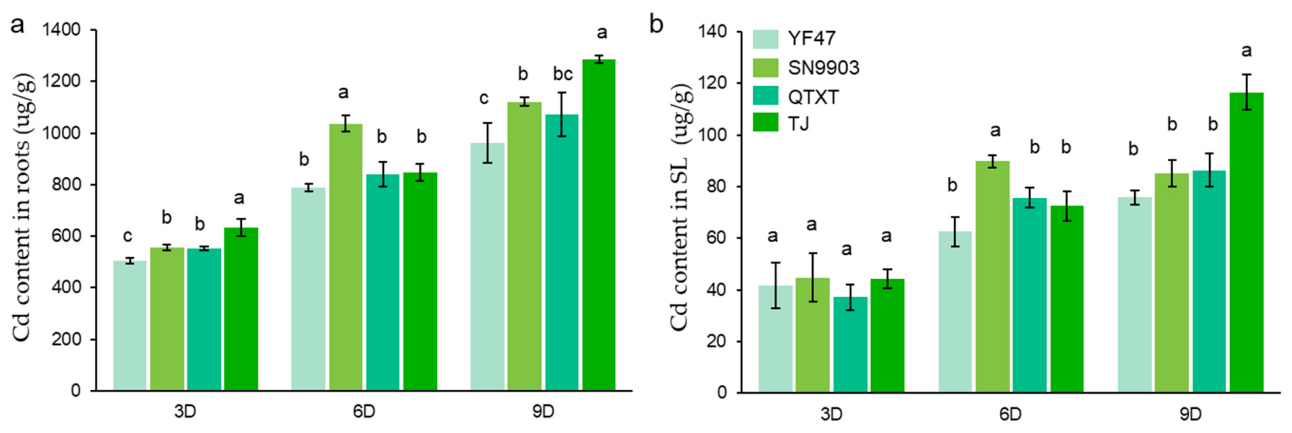
To dissect the dynamic process of Cd accumulation and verify early genotypic differences, we conducted a time-course hydroponic experiment under controlled Cd stress conditions, measuring tissue Cd contents at three, six, and nine days (3D, 6D, 9D) after Cd exposure (Figure 1). Importantly, inter-varietal differences in Cd accumulation were already clearly distinguishable at the early 3D time point, the high-Cd varieties (QTXT and TJ) exhibited slightly higher root Cd concentrations, than the low-Cd varieties (YF47 and SN9903) as early as three days post-exposure, and this genotypic gap was further amplified after nine days of treatment. On Day 3, the high-Cd variety TJ exhibited the highest root Cd content (633.28 μg/g), while the low-Cd variety YF47 exhibited the lowest (505.69 μg/g); shoot Cd concentrations showed no significant differences among varieties at this early time point. By Day 6, the low-Cd variety SN9903 showed significantly higher root and shoot Cd contents (1035.82 μg/g and 89.81 μg/g, respectively) compared to other varieties. By Day 9, the high-Cd variety TJ exhibited significantly higher root and shoot Cd contents (1286.58 μg/g and 116.67 μg/g, respectively) than the other varieties. Notably, except for SN9903, the Cd content in SL increased with prolonged Cd stress duration in all varieties, consistent with changes in root Cd content. This exceptional behavior of SN9903—a low-Cd variety—suggests that the dynamics of Cd uptake and translocation may differ even among low-Cd varieties, warranting further investigation through transport coefficient analysis and gene expression profiling.
As expected, with extended Cd treatment duration, Cd concentrations in both roots and shoots increased significantly in all varieties, reflecting continuous Cd uptake and translocation processes. The early emergence of genotypic divergence, coupled with the observation that root Cd levels did not consistently differentiate low- from high-Cd varieties, further supports the conclusion that varietal differences in Cd accumulation are primarily driven by root-to-shoot translocation rather than root uptake capacity. These findings strongly support the feasibility of early-stage screening for low-Cd japonica rice varieties based on shoot Cd-accumulation patterns.
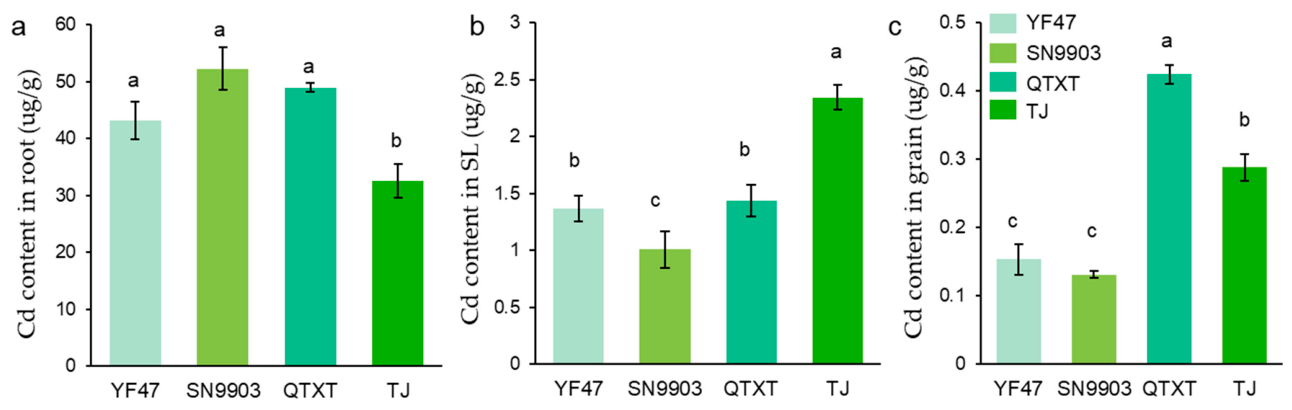
Under field-mimicking soil Cd-contaminated conditions, we first quantified Cd concentrations in different tissues of the four japonica varieties at the mature stage to characterize their Cd-accumulation patterns (Figure 2). Across all tested cultivars, Cd was predominantly retained in the root system, with significantly lower concentrations detected in above-ground tissues. Notably, root Cd levels did not show a consistent lower trend in low-Cd varieties compared to high-Cd ones, suggesting that root uptake capacity alone may not explain the genotypic differences in grain Cd accumulation. Specifically, root Cd content was highest in SN9903 (52.27 μg/g), followed by QTXT (41.27 μg/g), YF47 (36.27 μg/g), and TJ (32.56 μg/g). In SL, Cd content followed the order: TJ (2.34 μg/g) > QTXT (1.42 μg/g) > YF47 (1.39 μg/g) > SN9903 (1.01 μg/g). For grain Cd content, QTXT (0.42 μg/g) and TJ (0.29 μg/g) exceeded the limit of 0.2 μg/g set by the National Food Safety Standard, whereas YF47 (0.15 μg/g) and SN9903 (0.13 μg/g) remained within the safe range. Interestingly, although TJ exhibited the highest SL Cd concentration, its grain Cd was lower than that of QTXT, indicating that translocation efficiency from shoot to grain may vary even among high-Cd varieties. Overall, Cd distribution in all varieties followed the consistent order of root > stems and leaves > grain, reflecting a common defensive strategy to restrict Cd translocation to the edible parts. These observations suggest that the key differences between low- and high-Cd varieties are likely to lie in the translocation process rather than root uptake.

3.2.2. Enrichment and Transport Coefficients

To elucidate the mechanisms underlying varietal differences in Cd accumulation, we analyzed the dynamic changes in Cd accumulation per plant, allocation ratios, and transport efficiency using time-course hydroponic experiments (Figure 3); we also calculated the bioconcentration factor (BCF) and translocation factor (TF) under soil Cd stress conditions (Figure 4).
Hydroponic Time-Course
To further dissect the dynamic processes underlying varietal differences, we analyzed Cd accumulation per plant, distribution coefficient between roots and SL, and TF values at three, six, and nine days after Cd stress under hydroponic conditions.
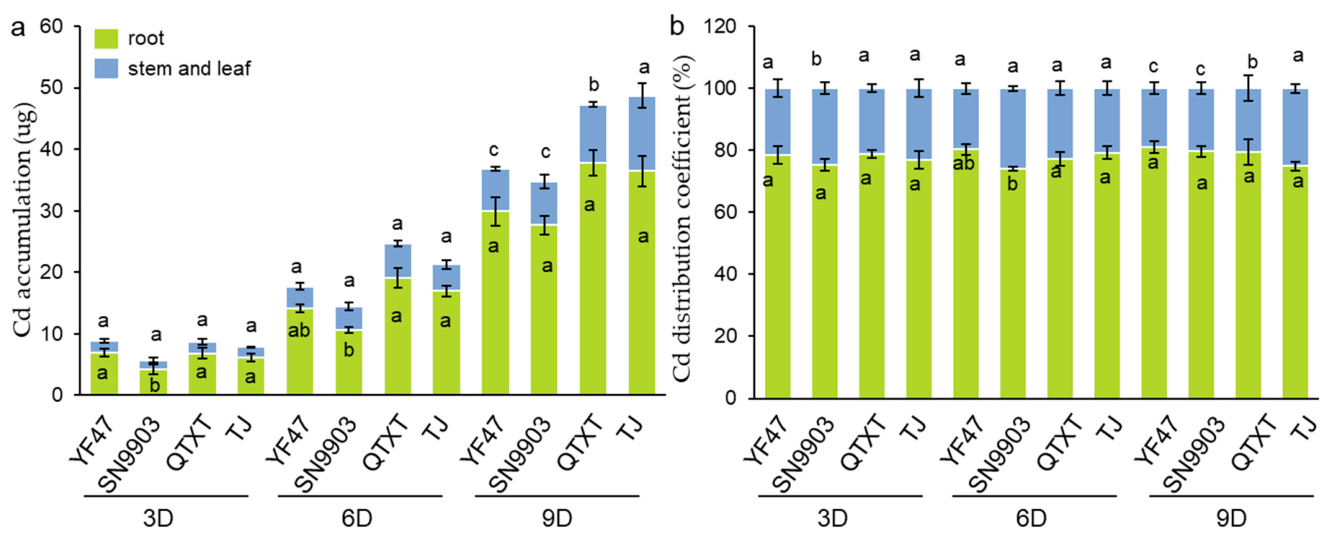
Total Cd accumulation in both roots and SL increased progressively with prolonged Cd stress across all varieties (Figure 3a). At Day 3, root Cd accumulation showed no clear separation between low- and high-Cd groups, with values ranging from 4.26 μg/plant (SN9903) to 6.90 μg/plant (YF47) in low-Cd varieties and from 6.09 μg/plant (TJ) to 6.83 μg/plant (QTXT) in high-Cd varieties. Shoot Cd accumulation at Day 3 also showed no significant difference between groups. By Day 9, however, low-Cd varieties accumulated 29.92 μg/plant (YF47) and 27.66 μg/plant (SN9903) in roots, compared to 37.81 μg/plant (QTXT) and 36.44 μg/plant (TJ) in high-Cd varieties. Similarly, SL Cd accumulation at Day 9 was lower in low-Cd varieties (YF47: 6.91 μg/plant; SN9903: 7.10 μg/plant) than in high-Cd varieties (QTXT: 9.44 μg/plant; TJ: 12.29 μg/plant). These results indicate that the divergence in Cd accumulation between low- and high-Cd varieties becomes more pronounced over time, particularly in the shoot tissues.
Analysis of Cd allocation ratios revealed a consistent and striking pattern (Figure 3b). Low-Cd varieties maintained a higher proportion of Cd retained in roots compared to high-Cd varieties across all time points. At Day 3, root allocation was 78.55% in YF47 and 75.26% in SN9903, compared to 78.77% in QTXT and 76.87% in TJ. By Day 9, the difference became evident, low-Cd varieties retained 81.09% (YF47) and 79.67% (SN9903) of total Cd in roots, while high-Cd varieties showed lower root retention at 79.52% (QTXT) and notably only 74.87% (TJ). Correspondingly, cadmium distribution coefficient in SL at Day 9 was significantly higher in the high-Cd variety TJ (25.13%) compared to low-Cd varieties (YF47: 18.91%; SN9903: 20.33%). These allocation patterns clearly demonstrate that low-Cd varieties effectively restrict Cd translocation to above-ground tissues throughout the Cd stress period.
Root to stems and leaves transport factor (TFr-sl), which directly quantified the efficiency of root-to-SL Cd transport, showed trends consistent with allocation patterns (Table 4). On Day 3, TFr-sl values ranged from 0.067 to 0.082, with no clear separation between groups. By Day 9, low-Cd varieties exhibited TFr-sl values of 0.079 (YF47) and 0.076 (SN9903), while high-Cd varieties showed higher values of 0.082 (QTXT) and 0.091 (TJ). Notably, the high-Cd variety TJ consistently displayed the highest TFr-sl values on Day 6 and Day 9, reinforcing its enhanced capacity for root-to-shoot Cd translocation. The temporal divergence in TFr-sl values between low- and high-Cd groups further supports the conclusion that the key physiological node differentiating these varieties lies in the translocation process.
Soil Culture
To evaluate the Cd-accumulation characteristics of the four Japonica varieties under field-mimicking conditions, we quantified Cd accumulation in different tissues and distribution coefficients based on soil Cd stress experiments (Figure 4).
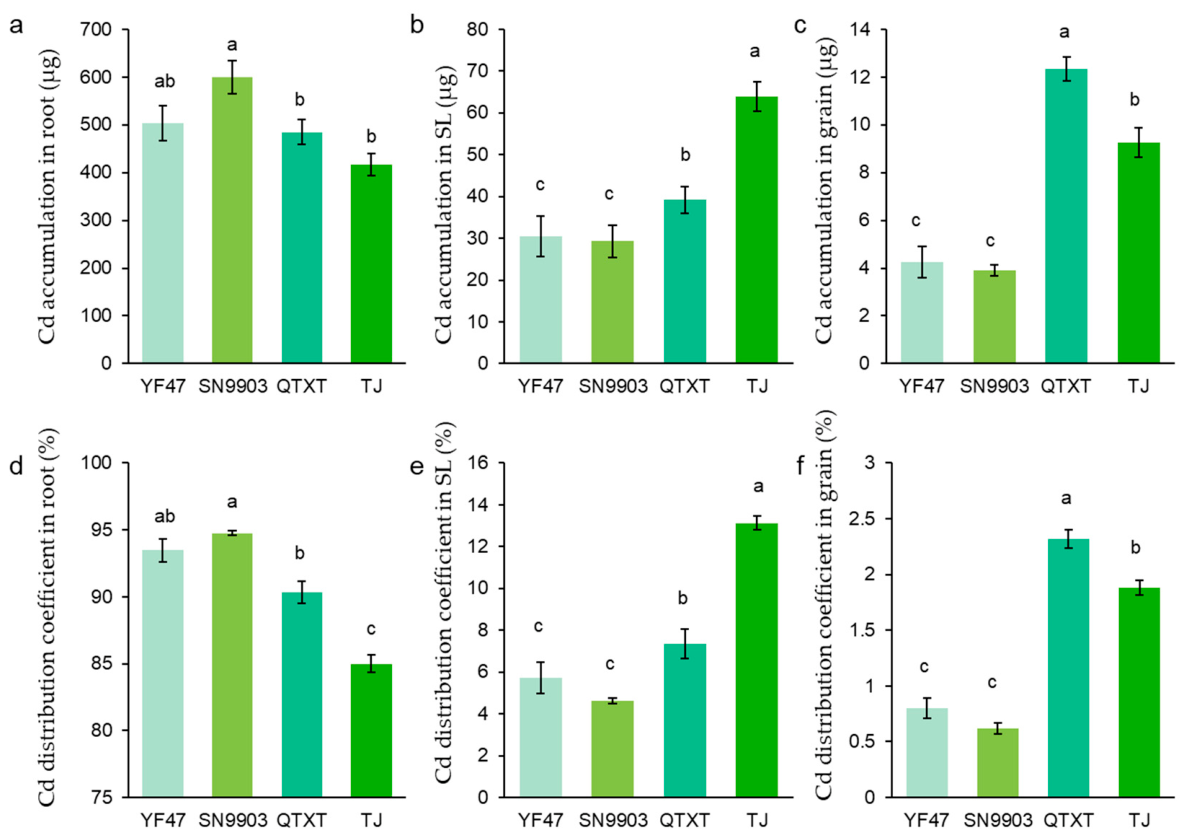
Across all varieties, Cd accumulation followed the consistent order of root > stems and leaves > grain (Figure 4a–c). Notably, root Cd accumulation did not show a consistent lower trend in low-Cd varieties compared to high-Cd varieties. Specifically, the low-Cd variety SN9903 exhibited the highest root Cd accumulation (599.73 μg), followed by YF47 (503.04 μg). In contrast, the high-Cd variety TJ exhibited the lowest root Cd accumulation (416.45 μg), while QTXT accumulated 484.68 μg. This observation indicates that root uptake capacity alone does not explain the genotypic differences in grain Cd accumulation. In stems and leaves, low-Cd varieties accumulated 30.43 μg (YF47) and 29.27 μg (SN9903), which were lower than those of high-Cd varieties QTXT (39.18 μg) and TJ (63.86 μg). For grain Cd accumulation, low-Cd varieties YF47 (4.26 μg) and SN9903 (3.90 μg) accumulated significantly less Cd compared to high-Cd varieties QTXT (12.35 μg) and TJ (9.25 μg). The distinct separation in shoot and grain Cd accumulation, despite comparable or even higher root Cd levels in low-Cd varieties, suggests that varietal differences are primarily driven by differential translocation efficiency rather than root uptake capacity.
Analysis of Cd distribution coefficient showed that low-Cd varieties retained a substantially higher proportion of Cd in roots compared to high-Cd varieties (Figure 4d–f). Specifically, YF47 allocated 93.48% of total Cd to roots, while SN9903 allocated 94.75%. In contrast, high-Cd varieties showed markedly lower root allocation, QTXT retained 90.33% and TJ retained only 84.99% of total Cd in roots. Correspondingly, the proportion of Cd allocated to stems and leaves was significantly lower in low-Cd varieties (YF47: 5.72%; SN9903: 4.63%) compared to high-Cd varieties (QTXT: 7.35%; TJ: 13.12%). A similar trend was observed for grain allocation: low-Cd varieties allocated only 0.80% (YF47) and 0.62% (SN9903) of total Cd to grains, whereas high-Cd varieties allocated 2.32% (QTXT) and 1.88% (TJ).
To further quantify the efficiency of Cd uptake and transport, we calculated the bioconcentration factor (BCF) and three translocation factors: root to stems and leaves transport factor (TFr-sl), stems and leaves to grain transport factor (TFsl-g), and root to above-ground (including both stems and leaves and grain) transport factor (TF) (Table 5).
BCF values, representing Cd uptake efficiency from soil to roots, showed no consistent pattern distinguishing low- from high-Cd varieties. SN9903 exhibited the highest BCF (5.10), with no significant difference between QTXT (4.78). YF47 (4.22) showed intermediate values, while TJ exhibited the lowest BCF (3.18). These results indicate that root uptake capacity alone does not account for the genotypic differences in grain Cd accumulation, as the low-Cd variety SN9903 showed the highest uptake efficiency, while the high-Cd variety TJ showed the lowest. In contrast, TFr-sl values, reflecting Cd transport efficiency from roots to stems and leaves, revealed a clear distinction between the two groups. Low-Cd varieties exhibited significantly lower TFr-sl values, with SN9903 showing the lowest (0.019), followed by YF47 (0.032). High-Cd variety TJ showed the highest TFr-sl (0.072). These results demonstrate that low-Cd varieties, particularly SN9903, effectively restrict Cd translocation from roots to above-ground vegetative tissues. For TFsl-g, which quantifies Cd transport from stems and leaves to grains, QTXT exhibited the highest value (0.30), significantly higher than all other varieties. YF47 (0.11), SN9903 (0.13), and TJ (0.12) showed comparable low values with no significant differences among them. This suggests that while QTXT has a uniquely high capacity for Cd transport from vegetative tissues to grains, the other three varieties including both low- and high-Cd groups exhibit similar restrictions at this stage. The overall TF showed a pattern consistent with TFr-sl. SN9903 exhibited the lowest TF (0.022), followed by YF47 (0.035) and QTXT (0.038), which were not significantly different from each other. TJ exhibited the highest TF (0.081), significantly exceeding all other varieties. These results collectively indicate that low-Cd varieties, particularly SN9903, effectively restrict Cd translocation from roots to above-ground tissues, while the high-Cd variety TJ exhibits markedly enhanced transport efficiency.
Integrating the analyses of Cd accumulation, allocation, and transport coefficients, a consistent conclusion emerges. The key physiological node differentiating low- from high-Cd japonica varieties lies in the root-to-shoot translocation process, rather than the initial root uptake phase.

3.3. Antioxidant Defense System

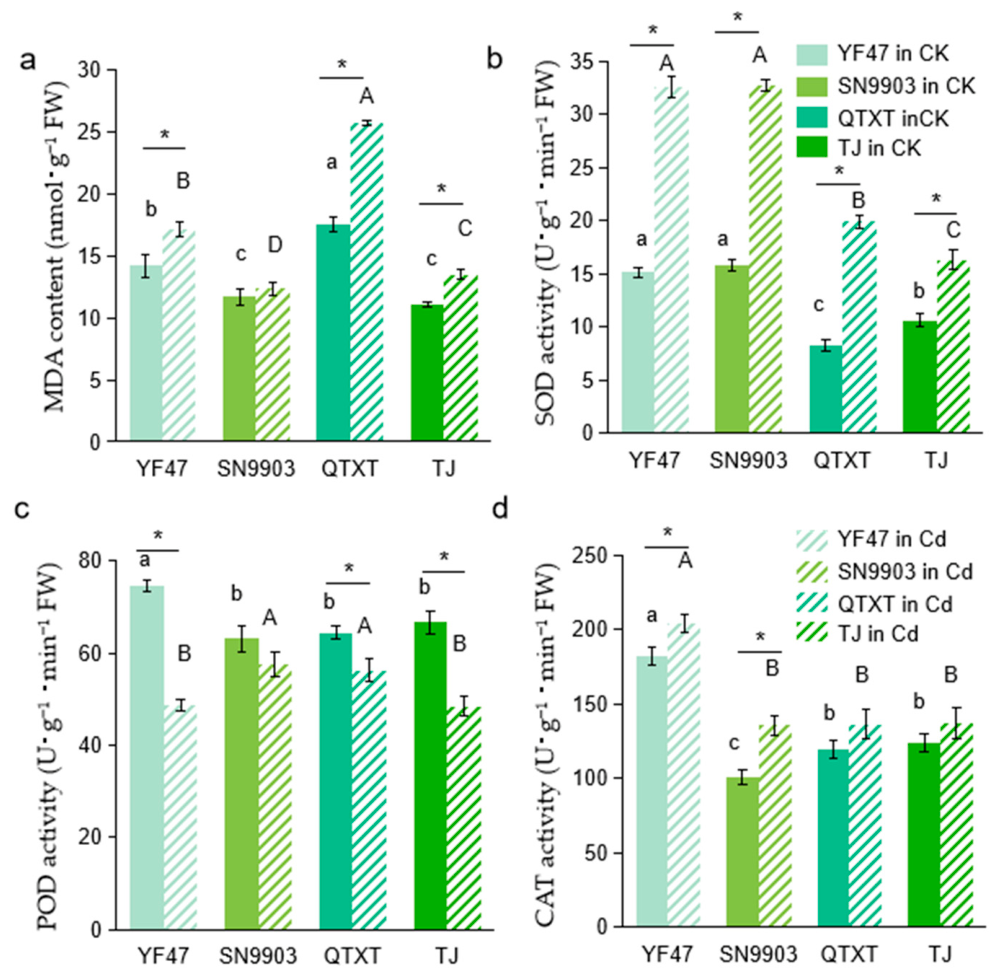
To evaluate the oxidative stress responses and antioxidant defense capacity of low- and high-Cd japonica varieties under Cd stress, we measured MDA content, a marker of lipid peroxidation, and the activities of three key antioxidant enzymes, SOD, POD, and CAT in stems and leaves under hydroponic Cd stress for nine days (Figure 5).
Under CK conditions, MDA content varied significantly among varieties (Figure 5a). High-Cd variety QTXT exhibited the highest MDA content (17.54 nmol·g−1 FW), while low-Cd variety SN9903 (11.67 nmol·g−1 FW) and high-Cd variety TJ (11.07 nmol·g−1 FW) showed the lowest values, with YF47 (14.23 nmol·g−1 FW) at an intermediate level. Under Cd stress, MDA content increased in all varieties, indicating the occurrence of lipid peroxidation and oxidative damage. However, the magnitude of increase differed markedly between low- and high-Cd groups. Low-Cd varieties showed modest increases, YF47 increased by 20.3% (from 14.23 to 17.12 nmol·g−1 FW), while SN9903 increased by only 5.7% (from 11.67 to 12.34 nmol·g−1 FW). In contrast, high-Cd varieties exhibited substantially larger increases: QTXT increased by 46.6% (from 17.54 to 25.71 nmol·g−1 FW), and TJ increased by 22.0% (from 11.07 to 13.51 nmol·g−1 FW). Notably, SN9903 maintained the lowest MDA content under Cd stress (12.34 nmol·g−1 FW), significantly lower than all other varieties, indicating superior membrane integrity under oxidative stress. These results demonstrate that low-Cd varieties, particularly SN9903, experience less severe lipid peroxidation under Cd stress compared to high-Cd varieties.
Under CK conditions, SOD activity showed distinct grouping (Figure 5b). Low-Cd varieties YF47 (15.16 U·g−1·min−1 FW) and SN9903 (15.82 U·g−1·min−1 FW) exhibited significantly higher basal SOD activity compared to high-Cd varieties QTXT (8.27 U·g−1·min−1 FW) and TJ (10.64 U·g−1·min−1 FW), with TJ showing an intermediate value. Under Cd stress, SOD activity increased substantially in all varieties, but the extent of induction differed between groups. Low-Cd varieties showed remarkable increases: YF47 increased by 114.8% (from 15.16 to 32.56 U·g−1·min−1 FW), and SN9903 increased by 106.6% (from 15.82 to 32.69 U·g−1·min−1 FW). In contrast, high-Cd varieties showed more modest increases, QTXT increased by 140.6% (from 8.27 to 19.90 U·g−1·min−1 FW), and TJ increased by 53.5% (from 10.64 to 16.33 U·g−1·min−1 FW). Notably, under Cd stress, low-Cd varieties achieved significantly higher absolute SOD activities (32.56–32.69 U·g−1·min−1 FW) compared to high-Cd varieties (16.33–19.90 U·g−1·min−1 FW). These results indicate that low-Cd varieties possess higher basal SOD activity and mount a stronger SOD induction response under Cd stress, contributing to more effective scavenging of superoxide radicals.
Under CK conditions, low-Cd variety YF47 exhibited the highest POD activity (74.67 U·g−1·min−1 FW), while SN9903 (63.12 U·g−1 ·min−1 FW) and high-Cd varieties QTXT (64.45 U·g−1·min−1 FW) and TJ (66.71 U·g−1·min−1 FW) showed comparable intermediate values (Figure 5c). Under Cd stress, POD activity showed a general decreasing trend across all varieties, but the pattern of change varied. YF47 showed a significant reduction (from 74.67 to 48.64 U·g−1·min−1 FW, a 34.9% decrease). SN9903 showed no significant reduction. QTXT decreased from 64.45 to 56.25 U·g-1 ·min-1 FW (12.7% decrease), while TJ decreased from 66.71 to 48.43 U·g−1·min−1 FW (27.4% decrease). Under Cd stress, SN9903 and QTXT maintained the highest POD activities (57.52 and 56.25 U·g−1·min−1 FW, respectively), while YF47 and TJ showed the lowest values (48.64 and 48.43 U·g−1·min−1 FW, respectively). No clear pattern emerged distinguishing low- from high-Cd varieties, suggesting that POD may play a less critical role in differentiating varietal Cd tolerance compared to SOD and CAT.
Under CK conditions, low-Cd variety YF47 exhibited the highest CAT activity (182.06 U·g−1·min−1 FW), significantly exceeding all other varieties. SN9903 showed the lowest basal CAT activity (100.66 U·g−1·min−1 FW), while high-Cd varieties QTXT (119.57 U·g−1·min−1 FW) and TJ (124.03 U·g−1·min−1 FW) showed intermediate values (Figure 5d). Under Cd stress, CAT activity increased in high-Cd varieties, but the magnitude of increase varied. YF47 showed a modest increase (from 182.06 to 203.96 U·g−1·min−1 FW, a 12.0% increase), maintaining the highest absolute CAT activity among all varieties. SN9903 showed the most substantial relative increase (from 100.66 to 135.52 U·g−1·min−1 FW, a 34.6% increase). QTXT increased from 119.57 to 136.29 U·g−1·min−1 FW (14.0% increase), while TJ increased from 124.03 to 136.82 U·g−1·min−1 FW (10.3% increase). Under Cd stress, YF47 exhibited significantly higher CAT activity (203.96 U·g−1·min−1 FW) compared to all other varieties, while SN9903, QTXT, and TJ showed comparable activities (135.5–136.8 U·g−1·min−1 FW). These results indicate that low-Cd varieties, particularly YF47, possess superior CAT-mediated H2O2 scavenging capacity under Cd stress.

3.4. Expression Profiles of Cd-Related Transporter Genes

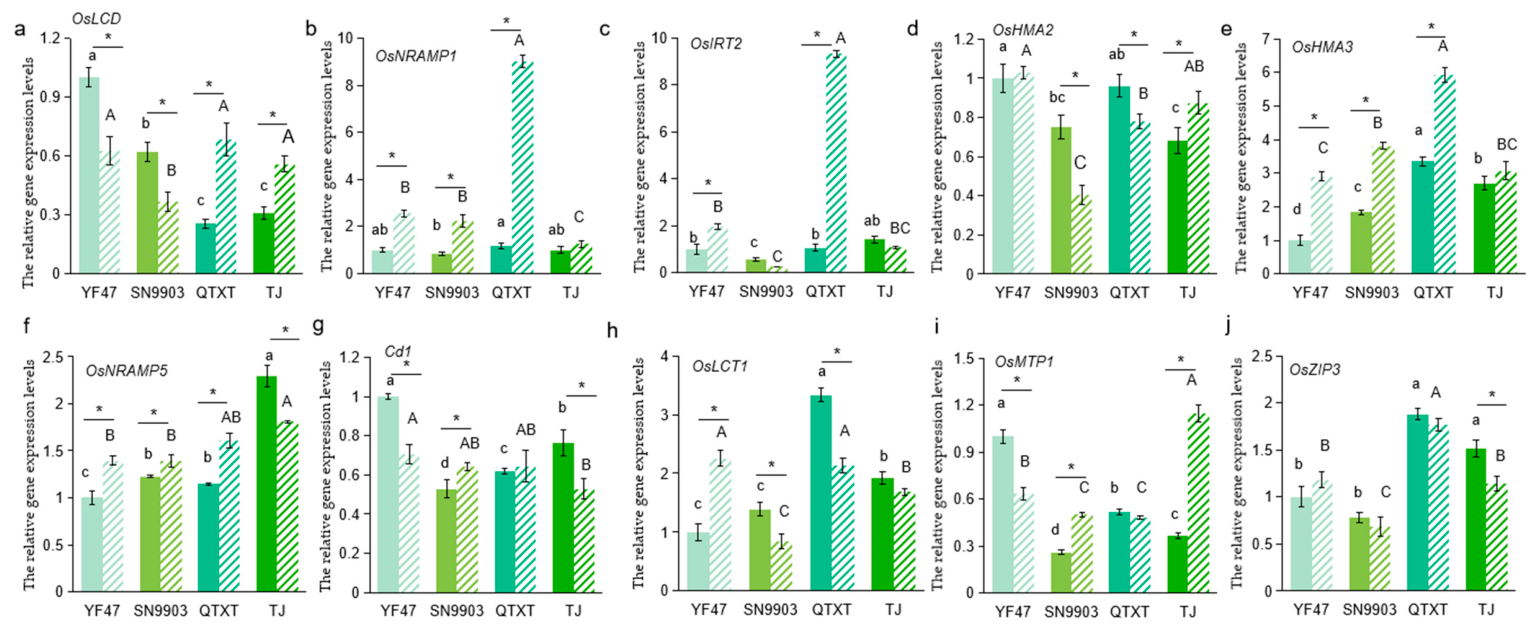
To investigate the molecular basis of varietal differences in Cd accumulation, we analyzed the expression of ten Cd-related transporter genes in stems and leaves under control and Cd stress conditions using qRT-PCR (Figure 6).
OsLCD exhibited the most striking and consistent pattern distinguishing low- from high-Cd varieties (Figure 6a). Under control conditions, low-Cd varieties showed significantly higher basal expression (YF47 and SN9903) compared to high-Cd varieties (QTXT and TJ). Under Cd stress, opposite regulatory responses were observed; low-Cd varieties significantly down-regulated, while high-Cd varieties significantly up-regulated the expression of OsLCD. Consequently, under Cd stress, the expression levels of all four varieties converged to a similar range (0.37–0.68), but the directional difference provides a clear molecular signature separating the two groups. This opposite regulation suggests that OsLCD may function as a negative regulator of Cd accumulation, with down-regulation in low-Cd varieties potentially contributing to restricted Cd translocation.
OsNRAMP1 and OsIRT2 showed exceptionally high induction in the high-Cd variety QTXT (Figure 6b,c). For OsNRAMP1, QTXT reached 9.03-fold under Cd stress, significantly higher than YF47 and SN9903. For OsIRT2, QTXT exhibited a dramatic 9.31-fold induction, far exceeding YF47, SN990, and TJ. These results indicate that QTXT uniquely activates high expression of specific uptake/transport genes under Cd stress, which may contribute to its elevated Cd accumulation.
OsHMA2 displayed a pattern consistent with transport efficiency differences (Figure 6d). Under Cd stress, low-Cd variety SN9903 significantly down-regulated the expression of OsHMA2, while high-Cd variety TJ significantly up-regulated it. This divergent response aligns with the contrasting root-to-shoot transport coefficients observed for these two varieties. OsHMA3 showed higher basal expression in high-Cd varieties and was further induced by Cd in all varieties except TJ.
Under Cd treatment, the relative expression levels of OsNRAMP5 were significantly increased. For Cd1, under CK conditions, YF47 exhibited the highest expression, followed by TJ, QTXT, and SN9903. Under Cd stress, expression patterns varied. Low-Cd varieties showed distinct responses: YF47 decreased, while SN9903 increased. High-Cd varieties also showed contrasting patterns; TJ decreased. No consistent pattern distinguishing low- from high-Cd varieties was observed for Cd1. Under Cd stress, the relative expression level of OsZIP3 was significantly reduced only in TJ, with no significant changes observed in the other three varieties. For OsLCT1, under Cd stress, YF47 showed a marked 2.26-fold increase, while SN9903 showed a reduction. TJ decreased, while QTXT remained relatively stable. For OsMTP1, under control conditions, YF47 showed the highest expression, while SN9903 and TJ showed low expression. Under Cd stress, TJ exhibited a dramatic 3.12-fold increase, becoming the highest among all varieties. In contrast, YF47 showed reduced expression, SN9903 showed increased expression, while QTXT showed moderate increases. OsNRAMP5, Cd1, OsLCT1, OsMTP1 and OsZIP3 showed variable expression patterns but did not exhibit consistent group-level differences between low- and high-Cd varieties.

4. Discussion

4.1. Root-to-Shoot Translocation, Not Root Uptake, Determines Varietal Differences in Cd Accumulation in Japonica Rice

During the early stages of grain development, Cd in the leaves is reactivated and transported via the phloem to the stem nodes, then transported to the grains through the phloem of the vascular bundles [39,40]. During the reproductive growth stage, a portion of Cd absorbed by the roots is transported downward through the xylem to lower nodes, then transported upward through both xylem and phloem to upper nodes and finally transported to the grains via the phloem of the scattered vascular bundles [39]. Additionally, during the grain-filling stage, a small amount of Cd absorbed by roots can be transported to the stem and then directly transported to the grain via the xylem [41]. Once Cd is transported into the grain, it becomes immobilized within the grain and is not transported to other organs [42].
Although the above descriptions provide a general framework for Cd transport in rice, the relative importance of each transport step (root uptake, xylem loading, node-based redistribution, and phloem transport) in determining varietal differences remains debated. Some studies have emphasized root uptake as the dominant mechanism, identifying OsNRAMP5 as the primary gateway for Cd entry into rice roots [18,21]. Others have highlighted xylem loading mediated by OsHMA2 as the key bottleneck for root-to-shoot transport [29]. More recently, node-based redistribution (particularly at node I) has been proposed as a critical control point for Cd allocation into grains [30]. These contradictory findings suggest that the rate limiting step for Cd accumulation may vary depending on genetic background, experimental conditions, and growth stage. A central finding of this study is that for the four Liaoning japonica varieties tested, the marked differences in grain Cd accumulation are primarily governed by root-to-shoot translocation efficiency, rather than root uptake capacity. Several lines of evidence support this conclusion. First, under soil culture, root Cd accumulation did not show a consistent lower trend in low-Cd varieties (YF47 and SN9903) compared to high-Cd varieties (QTXT and TJ). In fact, the low-Cd variety SN9903 had the highest root Cd content, while the high-Cd variety TJ had the lowest. The BCF also showed no clear separation between the two groups. These observations rule out root uptake as the primary driver of genotypic differences, which contrasts with studies that identified OsNRAMP5-mediated uptake as the key differentiator [18]. Instead, our results align with reports that natural variation in Cd accumulation among rice cultivars often links to transport rather than uptake [41,43].
Second, TFr-sl and Cd allocation patterns consistently separated low- from high-Cd varieties. Low-Cd varieties exhibited significantly lower TFr-sl values (YF47: 0.032; SN9903: 0.019) compared to TJ (0.072). Correspondingly, low-Cd varieties retained a substantially higher proportion of Cd in roots than QTXT and TJ. This root retention effectively limits Cd supply to shoots and subsequently to grains. This pattern was already observable within three days of Cd exposure in hydroponic experiments and became more pronounced by Day 9, indicating an early-acting and stable physiological trait.
Third, the enhanced root Cd retention in low-Cd varieties was associated with lower oxidative burden. Low-Cd varieties showed smaller increases in malondialdehyde (MDA) content under Cd stress compared to high-Cd varieties, indicating less lipid peroxidation. This is likely a consequence of reduced Cd flux into photosynthetic tissues. The co-occurrence of low TFr-sl, high root Cd retention, and attenuated oxidative damage strongly suggests that restricting Cd translocation is an effective strategy for both lowering grain Cd and maintaining cellular homeostasis.
Our results extend previous findings from indica or southern japonica rice to northern China’s major japonica germplasm (Liaoning Province), filling a regional knowledge gap. The demonstration that varietal differences are determined by translocation, not uptake, provides a clear physiological target for breeding low-Cd rice in this region.

4.2. Coordinated Antioxidant Defense and Opposite OsLCD Regulation Distinguish Low- from High-Cd Varieties

Cd stress leads to excessive accumulation of ROS, causing an imbalance in redox status and thereby affecting normal growth and development in rice. Antioxidant systems, including enzymes such as SOD, POD, and CAT, are activated to scavenge excess ROS and collectively maintain redox homeostasis. When Cd stress becomes excessive, the antioxidant defense capacity diminishes, leading to the accumulation of MDA, a lipid peroxidation product reflecting the extent of cell membrane damage [44]. Therefore, to investigate the intrinsic mechanism of Cd-accumulation differences in rice, analysis of the enzyme activity of the antioxidant defense systems in Cd-stressed rice is required. In studying the role of ferrous sulfate in resistance to Cd stress, the findings showed that Cd toxicity induces MDA contents, increasing the activities of SOD, POD, CAT and APX [45]. Similar results were demonstrated in studies evaluating the protective effect of nitric oxide against Cd toxicity in rice leaves, where Cd treatment increased H2O2 and MDA content, increasing the activity of SOD, POD and CAT [46]. However, research has also shown that while Cd stress substantially reduces in the MDA contents, it decreases SOD, POD and CAT activity [47].
A recent study used field experiments to investigate the results obtained under Cd stress, where MDA content, POD and CAT enzyme activity increased, while SOD activity decreased [15]. In this study, under Cd stress, all varieties showed increased MDA content and elevated SOD and CAT activities, while POD activity decreased—a pattern that has been observed in some but not all previous studies [15,47]. Importantly, the magnitude of these responses differed markedly between low- and high-Cd groups. Low-Cd varieties (YF47 and SN9903) exhibited significantly higher basal SOD activity and stronger SOD induction under Cd stress, resulting in absolute SOD activities that were nearly double those of high-Cd varieties. Additionally, YF47 maintained exceptionally high CAT activity under Cd stress. The lower MDA increase in low-Cd varieties indicates more efficient scavenging of ROS and better membrane integrity. In contrast, high-Cd varieties, especially QTXT, suffered greater oxidative damage. The coordinated up-regulation of SOD and CAT, together with limited lipid peroxidation, appears to be a protective signature co-segregating with low-Cd translocation.
At the molecular level, among the 10 transporter genes examined, OsLCD exhibited the most striking and consistent pattern distinguishing low- from high-Cd varieties. Under control conditions, low-Cd varieties already had higher basal expression of OsLCD than high-Cd varieties. Upon Cd stress, low-Cd varieties significantly down-regulated OsLCD, whereas high-Cd varieties significantly up-regulated it. This opposite regulation aligns with the transport coefficient data: SN9903 (lowest TFr-sl) showed the strongest down-regulation, while TJ (highest TFr-sl) showed up-regulation.
Other genes also contributed to varietal differences. OsHMA2 plays a role in transporting shoots by loading into the xylem, through node distribution and transport, and from the leaf to grain via the phloem, while OsHAM3 is mainly played in through node distribution and transport [48]. OsHMA2 was down-regulated in SN9903, but up-regulated in TJ, consistent with their contrasting translocation efficiencies. The high-Cd-variety QTXT uniquely displayed massive induction of OsNRAMP1 and OsIRT2 (∼nine-fold each), possibly as a compensatory response to Cd-induced iron deficiency, as these genes are primarily iron transporters [35,49]. Interestingly, although OsHMA3 was highly expressed in QTXT, it did not prevent its high grain Cd, suggesting that vacuolar sequestration alone is insufficient when uptake/transport is strongly enhanced.
Collectively, these results reveal that low-Cd varieties combine efficient root Cd retention, strong SOD/CAT antioxidant defense, and down-regulation of OsLCD, whereas high-Cd varieties display the opposite molecular and physiological profile. The opposite regulation of OsLCD provides a potential approach for the early identification of low-Cd germplasm.

4.3. Physiological and Molecular Traits with Implications for Low-Cd Rice Breeding

The physiological and molecular data obtained in this study can be directly linked to providing practical guidance for breeding low-Cd japonica rice. First, low-Cd varieties YF47 and SN9903 retained >93% of total Cd in roots, which was associated with down-regulation of OsLCD under Cd stress, whereas the high-Cd variety TJ retained only 85% and showed up-regulation of gene. This suggests that root Cd retention (or TFr-sl) can serve as a simple phenotypic indicator, and OsLCD expression levels may be developed as molecular markers for marker-assisted selection. Second, low-Cd varieties exhibited smaller MDA increases and higher SOD/CAT activities, enabling better maintenance of growth and grain yield under Cd stress. SN9903, for example, accumulated low grain Cd (0.13 mg/kg) while maintaining grain yield (29.7 g/plant) comparable to high-Cd varieties. Thus, screening for enhanced SOD/CAT activity alongside low TFr-sl may help identify low-Cd lines with acceptable yield potential. Third, the opposite regulation of OsLCD provides a clear molecular signature that distinguishes the low-Cd and high-Cd groups, which could be used for rapid seedling stage screening. Collectively, these findings support a multi-trait screening framework combining physiological (root Cd retention, MDA increase) and molecular (OsLCD expression direction) indicators to accelerate breeding of low-Cd rice for northern China.
Furthermore, with only four varieties in this study, the hydroponic Cd concentration (1.0 mg/L) is higher than typical field levels. Also, gene expression is analyzed at a single time point, which introduces certain limitations. Therefore, future extensive studies are needed to validate our findings using a larger panel of varieties, under more field-realistic conditions, and with time-course expression profiling.

5. Conclusions

In this study, we systematically compared Cd accumulation, physiological responses, and the expression of Cd-related transporter genes between low- and high-Cd japonica rice varieties (YF47, SN9903 vs. QTXT, TJ) that are typical high-quality varieties in Liaoning Province, northern China. The following conclusions can be drawn:
(1) Root-to-shoot translocation, not root uptake, is the key physiological node differentiating low- from high-Cd varieties. Low-Cd varieties retained a significantly higher proportion of Cd in roots and exhibited lower TFr-sl compared to high-Cd varieties. This pattern was already observable at the early seedling stage (three to nine days after Cd exposure) and persisted to maturity, indicating an early-acting and stable trait. (2) Low-Cd varieties possess a more efficient antioxidant defense system. Under Cd stress, low-Cd varieties showed smaller increases in MDA content and significantly higher SOD and CAT activities, which likely contribute to reduced oxidative damage and better growth maintenance. (3) Opposite regulation of OsLCD under Cd stress provides a clear molecular signature distinguishing the two groups. Low-Cd varieties down-regulated OsLCD, whereas high-Cd varieties up-regulated it. This opposite expression pattern, together with the differential expression of OsHMA2, OsNRAMP1 and OsIRT2, offers potential molecular markers for identifying low-Cd germplasm.
In summary, the identified traits, particularly root Cd retention, TFr-sl, MDA increase, and OsLCD expression direction, can serve as practical indicators for the early screening and selection of low-Cd japonica varieties.

Supplementary Materials

The following supporting information can be downloaded at https://www.mdpi.com/article/10.3390/agriculture16101078/s1, Figure S1: Phenotypic performance of rice seedlings of four varieties under control and Cd stress.

Author Contributions

Conceptualization and writing—original draft preparation, L.Z.; investigation and validation, M.S.; methodology and formal analysis, N.Z.; software and resources, M.Z.; project administration, funding acquisition, writing—review and editing, M.L. All authors have read and agreed to the published version of the manuscript.

Funding

This research was funded by Liaoning Revitalization Talents Program, grant number XLYC2413022.

Data Availability Statement

The original data presented in this study are included in the article. Further inquiries can be directed to the corresponding author.

Conflicts of Interest

The authors declare no conflicts of interest.

References

  1. Wang, P.; Chen, H.; Kopittke, P.M.; Zhao, F.J. Cadmium contamination in agricultural soils of China and the impact on food safety. Environ. Pollut. 2019, 249, 1038–1048. [Google Scholar] [CrossRef]
  2. Coonse, K.G.; Coonts, A.J.; Morrison, E.V.; Heggland, S.J. Cadmium induces apoptosis in the human osteoblast-like cell line Saos-2. J. Toxicol. Environ. Health A 2007, 70, 575–581. [Google Scholar] [CrossRef] [PubMed]
  3. Person, R.J.; Tokar, E.J.; Xu, Y.; Orihuela, R.; Ngalame, N.N.; Waalkes, M.P. Chronic cadmium exposure in vitro induces cancer cell characteristics in human lung cells. Toxicol. Appl. Pharmacol. 2013, 273, 281–288. [Google Scholar] [CrossRef]
  4. Chen, D.; Chen, D.; Xue, R.; Long, J.; Lin, X.; Lin, Y.; Jia, L.; Zeng, R.; Song, Y. Effects of boron, silicon and their interactions on cadmium accumulation and toxicity in rice plants. J. Hazard. Mater. 2019, 367, 447–455. [Google Scholar] [CrossRef] [PubMed]
  5. Nabaei, M.; Amooaghaie, R. Interactive effect of melatonin and sodium nitroprusside on seed germination and seedling growth of catharanthus roseus under cadmium stress. Russ. J. Plant Physiol. 2019, 66, 128–139. [Google Scholar] [CrossRef]
  6. Rizwan, M.; Meunier, J.D.; Davidian, J.C.; Pokrovsky, O.S.; Bovet, N.; Keller, C. Silicon alleviates Cd stress of wheat seedlings (Triticum turgidum L. cv. Claudio) Grown hydroponics. Environ. Sci. Pollut. Res. Int. 2016, 23, 1414–1427. [Google Scholar] [CrossRef] [PubMed]
  7. Fagioni, M.; D’Amici, G.M.; Timperio, A.M.; Zolla, L. Proteomic analysis of multiprotein complexes in the thylakoid membrane upon cadmium treatment. J. Proteome Res. 2009, 8, 310–326. [Google Scholar] [CrossRef]
  8. Seth, C.S.; Misra, V.; Chauhan, L.K.; Singh, R.R. Genotoxicity of cadmium on root meristem cells of Allium cepa: Cytogenetic and Comet assay approach. Ecotoxicol. Environ. Saf. 2008, 71, 711–716. [Google Scholar] [CrossRef]
  9. Yu, Y.; Fotopoulos, V.; Zhou, K.; Fernie, A.R. The role of gasotransmitter hydrogen sulfide in plant cadmium stress responses. Trends Plant Sci. 2025, 30, 35–53. [Google Scholar] [CrossRef]
  10. Chakraborty, U.; Pradhan, B. Oxidative stress in five wheat varieties (Triticum aestivum L.) exposed to water stress and study of their antioxidant enzyme defense system, water stress responsive metabolites and H2O2 accumulation. Braz. J. Plant Physiol. 2012, 24, 117–130. [Google Scholar] [CrossRef]
  11. Hasanuzzaman, M.; Hossain, M.A.; da Silva, J.A.T.; Fujita, M. Plant response and tolerance to abiotic oxidative stress: Antioxidant defense is a key factor. In Crop Stress and Its Management: Perspectives and Strategies; Venkateswarlu, B., Shanker, A., Shanker, C., Maheswari, M., Eds.; Springer: Dordrecht, The Netherlands, 2012; pp. 261–315. [Google Scholar]
  12. Linster, C.L.; Adler, L.N.; Webb, K.; Christensen, K.C.; Brenner, C.; Clarke, S.G. A second GDP-L-galactose phosphorylase in arabidopsis en route to vitamin C. Covalent intermediate and substrate requirements for the conserved reaction. J. Biol. Chem. 2008, 283, 18483–18492. [Google Scholar] [CrossRef]
  13. Mese, Y.; Tuncsoy, B.; Ozalp, P. Effects of Cu, Zn and their mixtures on bioaccumulation and antioxidant enzyme activities in Galleria mellonella L. (Lepidoptera: Pyralidae). Ecotoxicology 2022, 31, 649–656. [Google Scholar] [CrossRef]
  14. Yilmaz, E.; Gul, M. Correction to: Effects of cumin (Cuminum cyminum L.) essential oil and chronic heat stress on growth performance, carcass characteristics, serum biochemistry, antioxidant enzyme activity, and intestinal microbiology in broiler chickens. Vet. Res. Commun. 2023, 47, 877. [Google Scholar] [CrossRef]
  15. Feng, K.; Li, J.; Yang, Y.; Li, Z.; Wu, W. Cadmium Absorption in Various Genotypes of Rice under Cadmium Stress. Int. J. Mol. Sci. 2023, 24, 8019. [Google Scholar] [CrossRef]
  16. Afzal, J.; Hu, C.; Imtiaz, M. Cadmium tolerance in rice cultivars associated with antioxidant enzymes activities and Fe/Zn concentrations. Int. J. Environ. Sci. Technol. 2019, 16, 4241–4252. [Google Scholar] [CrossRef]
  17. Yu, Y.; Alseekh, S.; Zhu, Z.; Zhou, K.; Fernie, A.R. Multiomics and biotechnologies for understanding and influencing cadmium accumulation and stress response in plants. Plant Biotechnol. J. 2024, 22, 2641–2659. [Google Scholar] [CrossRef] [PubMed]
  18. Ishikawa, S.; Ishimaru, Y.; Igura, M.; Kuramata, M.; Abe, T.; Senoura, T.; Hase, Y.; Arao, T.; Nishizawa, N.K.; Nakanishi, H. Ion-beam irradiation, gene identification, and marker-assisted breeding in the development of low-cadmium rice. Proc. Natl. Acad. Sci. USA 2012, 109, 19166–19171. [Google Scholar] [CrossRef]
  19. Sasaki, A.; Yamaji, N.; Yokosho, K.; Ma, J.F. Nramp5 is a major transporter responsible for manganese and cadmium uptake in rice. Plant Cell 2012, 24, 2155–2167. [Google Scholar] [CrossRef]
  20. Chang, J.D.; Gao, W.; Wang, P.; Zhao, F.J. OsNRAMP5 Is a Major Transporter for Lead Uptake in Rice. Environ. Sci. Technol. 2022, 56, 17481–17490. [Google Scholar] [CrossRef]
  21. Tang, L.; Mao, B.; Li, Y.; Lv, Q.; Zhang, L.; Chen, C.; He, H.; Wang, W.; Zeng, X.; Shao, Y.; et al. Knockout of OsNRAMP5 using the CRISPR/Cas9 system produces low Cd-accumulating indica rice without compromising yield. Sci. Rep. 2017, 7, 14438. [Google Scholar] [CrossRef] [PubMed]
  22. Luan, W.; Liu, Y.; Zhang, F.; Song, Y.; Wang, Z.; Peng, Y.; Sun, Z. OsCD1 encodes a putative member of the cellulose synthase-like D sub-family and is essential for rice plant architecture and growth. Plant Biotechnol. J. 2011, 9, 513–524. [Google Scholar]
  23. Yan, H.; Xu, W.; Xie, J.; Gao, Y.; Wu, L.; Sun, L.; Feng, L.; Chen, X.; Zhang, T.; Dai, C.; et al. Variation of a major facilitator superfamily gene contributes to differential cadmium accumulation between rice subspecies. Nat. Commun. 2019, 10, 2562. [Google Scholar] [CrossRef]
  24. Shimo, H.; Ishimaru, Y.; An, G.; Yamakawa, T.; Nakanishi, H.; Nishizawa, N.K. Low cadmium (LCD), a novel gene related to cadmium tolerance and accumulation in rice. J. Exp. Bot. 2011, 62, 5727–5734. [Google Scholar] [CrossRef] [PubMed]
  25. Chen, H.; Ye, R.; Liang, Y.; Zhang, S.; Liu, X.; Sun, C.; Li, F.; Yi, J. Generation of low-cadmium rice germplasms via knockout of OsLCD using CRISPR/Cas9. J. Environ. Sci. 2023, 126, 138–152. [Google Scholar]
  26. Wang, H.Q.; Xuan, W.; Huang, X.Y.; Mao, C.; Zhao, F.J. Cadmium Inhibits Lateral Root Emergence in Rice by Disrupting OsPIN-Mediated Auxin Distribution and the Protective Effect of OsHMA3. Plant Cell Physiol. 2021, 62, 166–177. [Google Scholar] [CrossRef]
  27. Miyadate, H.; Adachi, S.; Hiraizumi, A.; Tezuka, K.; Nakazawa, N.; Kawamoto, T.; Katou, K.; Kodama, I.; Sakurai, K.; Takahashi, H.; et al. OsHMA3, a P1B-type of ATPase affects root-to-shoot cadmium translocation in rice by mediating efflux into vacuoles. New Phytol. 2011, 189, 190–199. [Google Scholar]
  28. Chen, W.R.; Feng, Y.; Chao, Y.E. Genomic analysis and expression pattern of OsZIP1, OsZIP3, and OsZIP4 in two rice (Oryza sativa L.) genotypes with different zinc efficiency. Russ. J. Plant Physiol. 2008, 55, 400–409. [Google Scholar] [CrossRef]
  29. Takahashi, R.; Ishimaru, Y.; Shimo, H.; Ogo, Y.; Senoura, T.; Nishizawa, N.K.; Nakanishi, H. The OsHMA2 transporter is involved in root-to-shoot translocation of Zn and Cd in rice. Plant Cell Environ. 2012, 35, 1948–1957. [Google Scholar] [PubMed]
  30. Uraguchi, S.; Kamiya, T.; Sakamoto, T.; Kasai, K.; Sato, Y.; Nagamura, Y.; Yoshida, A.; Kyozuka, J.; Ishikawa, S.; Fujiwara, T. Low-affinity cation transporter (OsLCT1) regulates cadmium transport into rice grains. Proc. Natl. Acad. Sci. USA 2011, 108, 20959–20964. [Google Scholar] [CrossRef] [PubMed]
  31. Liu, S.; Jiang, J.; Liu, Y.; Meng, J.; Xu, S.; Tan, Y.; Li, Y.; Shu, Q.; Huang, J. Characterization and evaluation of OsLCT1 and OsNRAMP5 mutants generated throμgh CRISPR/Cas9-mediated mutagenesis for breeding low Cd rice. Rice Sci. 2019, 26, 88–97. [Google Scholar]
  32. Tian, S.; Liang, S.; Qiao, K.; Wang, F.; Zhang, Y.; Chai, T. Co-expression of multiple heavy metal transporters changes the translocation, accumulation, and potential oxidative stress of Cd and Zn in rice (Oryza sativa). J. Hazard. Mater. 2019, 380, 120853. [Google Scholar] [CrossRef]
  33. Takahashi, R.; Ishimaru, Y.; Senoura, T.; Shimo, H.; Ishikawa, S.; Arao, T.; Nakanishi, H.; Nishizawa, N.K. The OsNRAMP1 iron transporter is involved in Cd accumulation in rice. J. Exp. Bot. 2011, 62, 4843–4850. [Google Scholar] [CrossRef] [PubMed]
  34. Lee, S.; An, G. Over-expression of OsIRT1 leads to increased iron and zinc accumulations in rice. Plant Cell Environ. 2009, 32, 408–416. [Google Scholar] [CrossRef] [PubMed]
  35. Nakanishi, H.; Ogawa, I.; Ishimaru, Y.; Mori, S.; Nishizawa, N.K. Iron deficiency enhances cadmium uptake and translocation mediated by the Fe2+ transporters OsIRT1 and OsIRT2 in rice. Soil Sci. Plant Nutr. 2006, 52, 464–469. [Google Scholar] [CrossRef]
  36. Menguer, P.K.; Farthing, E.; Peaston, K.A.; Ricachenevsky, F.K.; Fett, J.P.; Williams, L.E. Functional analysis of the rice vacuolar zinc transporter OsMTP1. J. Exp. Bot. 2013, 64, 2871–2883. [Google Scholar] [CrossRef]
  37. Zhang, A.; Wang, K.; Wang, S.; Ye, D.; Liu, T.; Zhang, X.; Huang, H.; Wang, Y.; Zhang, L.; Li, T.; et al. Iron restricts radial cadmium transport via Casparian strip development to reduce root-to-shoot translocation in low cadmium-accumulating rice (Oryza sativa L.). J. Hazard. Mater. 2025, 500, 140402. [Google Scholar] [CrossRef]
  38. Wu, Y.; Santos, S.S.; Vestergård, M.; Martín González, A.M.; Ma, L.; Feng, Y.; Yang, X. A field study reveals links between hyperaccumulating Sedum plants-associated bacterial communities and Cd/Zn uptake and translocation. Sci. Total Environ. 2022, 805, 150400. [Google Scholar] [CrossRef]
  39. Yamaji, N.; Xia, J.; Mitani-Ueno, N.; Yokosho, K.; Feng, M.J. Preferential delivery of zinc to developing tissues in rice is mediated by P-type heavy metal ATPase OsHMA2. Plant Physiol. 2013, 162, 927–939. [Google Scholar] [CrossRef]
  40. Fujimaki, S.; Suzui, N.; Ishioka, N.S.; Kawachi, N.; Ito, S.; Chino, M.; Nakamura, S. Tracing cadmium from culture to spikelet: Noninvasive imaging and quantitative characterization of absorption, transport, and accumulation of cadmium in an intact rice plant. Plant Physiol. 2010, 152, 1796–1806. [Google Scholar] [CrossRef]
  41. Hao, X.; Zeng, M.; Wang, J.; Zeng, Z.; Dai, J.; Xie, Z.; Yang, Y.; Tian, L.; Chen, L.; Li, D. A Node-Expressed Transporter OsCCX2 Is Involved in Grain Cadmium Accumulation of Rice. Front. Plant Sci. 2018, 9, 476. [Google Scholar] [CrossRef] [PubMed]
  42. Tanaka, K.; Fujimaki, S.; Fujiwara, T.; Yoneyama, T.; Hayashi, H. Quantitative estimation of the contribution of the phloem in cadmium transport to grains in rice plants (Oryza sativa L.). Soil Sci. Plant Nutr. 2007, 53, 72–77. [Google Scholar] [CrossRef]
  43. Xiao, Q.; Wang, S.; Chi, Y. Accumulation and chemical forms of cadmium in tissues of different vegetable crops. Agronomy 2023, 13, 680. [Google Scholar] [CrossRef]
  44. Zhu, M.; Duan, X.; Zeng, Q.; Liu, Y.; Qiu, Z. He-Ne laser irradiation ameliorates cadmium toxicity in wheat by modulating cadmium accumulation, nutrient uptake and antioxidant defense system. Ecotoxicol. Environ. Saf. 2022, 236, 113477. [Google Scholar] [CrossRef]
  45. Afzal, J.; Saleem, M.H.; Batool, F.; Elyamine, A.M.; Rana, M.S.; Shaheen, A.; El-Esawi, M.A.; Tariq Javed, M.; Ali, Q.; Arslan Ashraf, M.; et al. Role of Ferrous Sulfate (FeSO4) in Resistance to Cadmium Stress in Two Rice (Oryza sativa L.) Genotypes. Biomolecules 2020, 10, 1693. [Google Scholar] [CrossRef] [PubMed]
  46. Hsu, Y.T.; Kao, C.H. Cd toxicity is reduced by nitric oxide in rice leaves. Plant Growth Regul. 2004, 42, 227–238. [Google Scholar] [CrossRef]
  47. Kanu, A.S.; Ashraf, U.; Mo, Z.; Sabir, S.U.; Baggie, I.; Charley, C.S.; Tang, X. Calcium amendment improved the performance of fragrant rice and reduced metal uptake under cadmium toxicity. Environ. Sci. Pollut. Res. Int. 2019, 26, 24748–24757. [Google Scholar] [CrossRef]
  48. Xia, W.; Ghouri, F.; Zhong, M.; Bukhari, S.A.H.; Ali, S.; Shahid, M.Q. Rice and heavy metals: A review of cadmium impact and potential remediation techniques. Sci. Total Environ. 2024, 957, 177403. [Google Scholar] [CrossRef]
  49. Belouchi, A.; Kwan, T.; Gros, P. Cloning and characterization of the OsNramp family from Oryza sativa, a new family of membrane proteins possibly implicated in the transport of metal ions. Plant Mol. Biol. 1997, 33, 1085–1092. [Google Scholar] [CrossRef]
Figure 1. Cadmium content of root and stems and leaves of different rice varieties under cadmium stress. (a) Cadmium content of roots. (b) Cadmium content of stems and leaves (SLs). Data are presented as means ± standard deviations. The different lowercase letter indicates that the same indicator 0.05 level is significant between different rice varieties under the same treatment.
Agriculture 16 01078 g001
Figure 2. Cd content of root, stems and leaves, and grain of different rice varieties under soil Cd stress. (a) Cd content of roots. (b) Cd content of stems and leaves (SLs). (c) Cd content of grain. Data are presented as means ± standard deviations. The different lowercase letters indicate that the same indicator 0.05 level is significant between different rice varieties under the Cd treatment.
Agriculture 16 01078 g002
Figure 3. Cadmium accumulation and distribution coefficient under cadmium stress. (a) Cadmium accumulation in various organs of different rice varieties. (b) Cadmium distribution coefficient of different rice varieties. The different lowercase letter indicates that the same indicator 0.05 level is significant between different rice varieties under the same treatment.
Agriculture 16 01078 g003
Figure 4. Cadmium accumulation and tissue distribution characteristics in four japonica rice varieties under soil Cd stress. (ac) Cd accumulation in root, SL and seed of different rice varieties. (df) Cd distribution coefficient in root, SL and grain of different rice varieties. The different lowercase letters indicates that the same indicator 0.05 level is significant between different rice varieties under the Cd treatment.
Agriculture 16 01078 g004
Figure 5. Oxidative responses of different varieties under Cd stress. (a) MDA content; (b) SOD activity; (c) POD activity; (d) CAT activity. The different lowercase letters indicates that the same indicator 0.05 level is significant between different rice varieties under the control treatment (CK). The different uppercase letter indicates significant differences at the 0.05 level among rice varieties under Cd treatment (Cd). * indicates a significant difference at the 0.05 level between CK and Cd for the same indicator in the same rice variety. Solid columns represent CK treatment, while diagonal stripes indicate Cd treatment.
Agriculture 16 01078 g005
Figure 6. Expression of Cd-accumulation-related genes. (aj) represent the relative expression levels of OsLCD, OsNRAMP1, OsIRT2, OsHMA2, OsHMA3, OsNRAMP5, Cd1, OsLCT1, OsMTP1 and OsZIP3, respectively. The different lowercase letters indicates that the same indicator 0.05 level is significant between different rice varieties under the control treatment (CK). The different uppercase letter indicates significant differences at the 0.05 level among rice varieties under Cd treatment (Cd). * indicates a significant difference at the 0.05 level between CK and Cd for the same indicator in the same rice variety. Solid columns represent CK treatment, while diagonal stripes indicate Cd treatment.
Agriculture 16 01078 g006
Table 1. The primers used in this study.
GenesForward Primer (5′ to 3′)Reverse Primer (5′ to 3′)
OsActinCCACACCCCTGCTATGTACGCATCACCAGAGTCCAACACAA
OsNramp5AGAGAGCAGTGAGAGAGGGACGGTTTCCAAATTGCCAGGA
OsNramp1TTGGTGTTTGTCATGGCAGGACAAGCAGAGCCACGAAAAG
OsIRT2TCAGGAATCGCGTCATTGTGATCCCCTCGAACATCTGGTG
OsCd1CTGGTCGCAATTGTATCCGGCTGCAACCTTGAACTGGGAC
OsHMA2GAGTCCTTCCCAGTGTCCAACTGATCCTGCCATGACAACG
OsHMA3GTTCAGCATCGACTCGTTCCTTGACTGAGGTGATGACGCI
OsLCT1CACCGTCCAATTCGTCATCCTACCTCCTCTGGCTGACTCI
OsZIP3AGACAGACAGGGTGCAATGACTATCCCCACCACCCCTTTI
OsMTP1ACCATGACCATCACCACCATTGGTTCCTCAGCATCATGGT
OsLCDTGATGGGTCATTCACTGCCTAAGTCATGAGGCCTTGGACA
Table 2. Growth and development of different rice varieties under hydroponic.
VarietiesDaysPlant Height (cm)Stems and Leaves Weight (mg)Root Weight (mg)
CKCdCKCdCKCd
YF47328.9 ± 1.4 b28.2 ± 0.9 b31.3 ± 4.0 a45.7 ± 5.0 a8.0 ± 1.0 b13.7 ± 1.5 a
631.0 ± 0.2 c28.6 ± 0.5 b45.0 ± 4.4 b55.7 ± 4.7 b11.7 ± 2.1 b18.0 ± 1.0 a
935.1 ± 0.3 b28.9 ± 0.3 c82.7 ± 3.5 b91.3 ± 6.7 b19.7 ± 2.1 b31.0 ± 2.0 ab
SN9903327.9 ± 0.8 b28.4 ± 0.4 b30.7 ± 2.1 a31.3 ± 2.9 b7.7 ± 0.6 b7.7 ± 1.5 c
632.5 ± 0.7 b29.3 ± 0.3 b40.3 ± 5.1 b41.7 ± 6.4 c9.0 ± 1.0 b10.3 ± 1.5 b
935.0 ± 0.9 b29.8 ± 0.3 b64.3 ± 3.2 b83.0 ± 4.6 b12.3 ± 1.5 c24.7 ± 1.5 c
QTXT332.3 ± 1.0 a34.0 ± 1.0 a34.0 ± 1.0 a49.7 ± 7.8 a10.7 ± 0.6 a12.3 ± 1.5 ab
637.7 ± 1.0 a34.3 ± 0.7 a76.7 ± 9.5 a73.7 ± 3.5 a17.7 ± 2.5 a22.7 ± 2.9 a
943.8 ± 0.7 a34.5 ± 0.7 a118.7 ± 13.8 a109.7 ± 5.9 a34.0 ± 4.0 a35.0 ± 5.2 a
TJ335.1 ± 2.5 a33.9 ± 0.5 a23.7 ± 1.5 b40.7 ± 1.5 a8.7 ± 0.6 b9.7 ± 2.1 bc
638.2 ± 0.4 a34.5 ± 0.3 a53.7 ± 7.5 b60.0 ± 4.6 b11.0 ± 1.0 b20.1 ± 4.0 a
943.7 ± 0.2 a34.9 ± 0.9 a119.0 ± 12.1 a105.0 ± 9.2 a30.3 ± 3.1 a28.3 ± 2.5 bc
Note: The value in the table is Mean ± SD, and the lowercase letter indicates that the same indicator 0.05 level is significant between different rice varieties under the same treatment.
Table 3. Growth and development of different rice varieties under soil culture.
IndicatorsPlant Height (cm)Root Weight (g)Stems and Leaves Weight (g)Grain Weigh (g)
CKCdCKCdCKCdCKCd
YF4790.4 ± 0.9 c86.0 ± 1.9 c15.2 ± 0.4 a11.6 ± 0.7 a27.7 ± 0.7 a22.3 ± 1.0 b31.2 ± 2.2 a27.9 ± 1.2 c
SN990389.8 ± 1.3 c93.5 ± 1.6 a11.1 ± 0.2 b11.5 ± 0.8 a26.3 ± 2.0 a29.2 ± 1.2 a30.0 ± 1.3 a29.7 ± 1.3 b
QTXT95.1 ± 0.3 a95.9 ± 0.9 a11.4 ± 0.3 b9.9 ± 1.2 b26.4 ± 1.6 a27.3 ± 0.9 a26.6 ± 1.1 b29.1 ± 1.0 b
TJ93.7 ± 0.6 b90.6 ± 1.9 b14.9 ± 0.6 a12.8 ± 0.5 a26.9 ± 0.3 a27.3 ± 1.6 a32.1 ± 1.5 a32.4 ± 2.1 a
Note: The value in the table is Mean ± SD, and the lowercase letter indicates that the same indicator 0.05 level is significant between different rice varieties under the same treatment.
Table 4. Cadmium transport factor of different rice varieties in hydroponic.
IndicatorDaysYF47SN9903QTXTTJ
TFr-sl30.0820.0810.0670.07
60.080.0870.090.086
90.0790.0760.0820.091
Note: TFr-sl indicates root to stems and leaves transport factor.
Table 5. Cadmium bioconcentration factor (BCF) and transport factor (TF) of different rice varieties in soil culture.
VarietiesBCFTFr-slTFsl-gTF
YF474.22 b0.032 b0.11 b0.035 b
SN99035.10 a0.019 c0.13 b0.022 c
QTXT4.78 a0.029 b0.30 a0.038 b
TJ3.18 c0.072 a0.12 b0.081 a
Note: The value in the table is Mean, and the lowercase letter indicates that the same indicator 0.05 level is significant between different rice varieties under the same treatment.
Disclaimer/Publisher’s Note: The statements, opinions and data contained in all publications are solely those of the individual author(s) and contributor(s) and not of MDPI and/or the editor(s). MDPI and/or the editor(s) disclaim responsibility for any injury to people or property resulting from any ideas, methods, instructions or products referred to in the content.