Agronomic Practices for Mitigating Clomazone Mobility: Medium-Term Effects in Rice Agroecosystems
 , ,
, ,  , and
, and
Abstract
1. Introduction
2. Materials and Methods
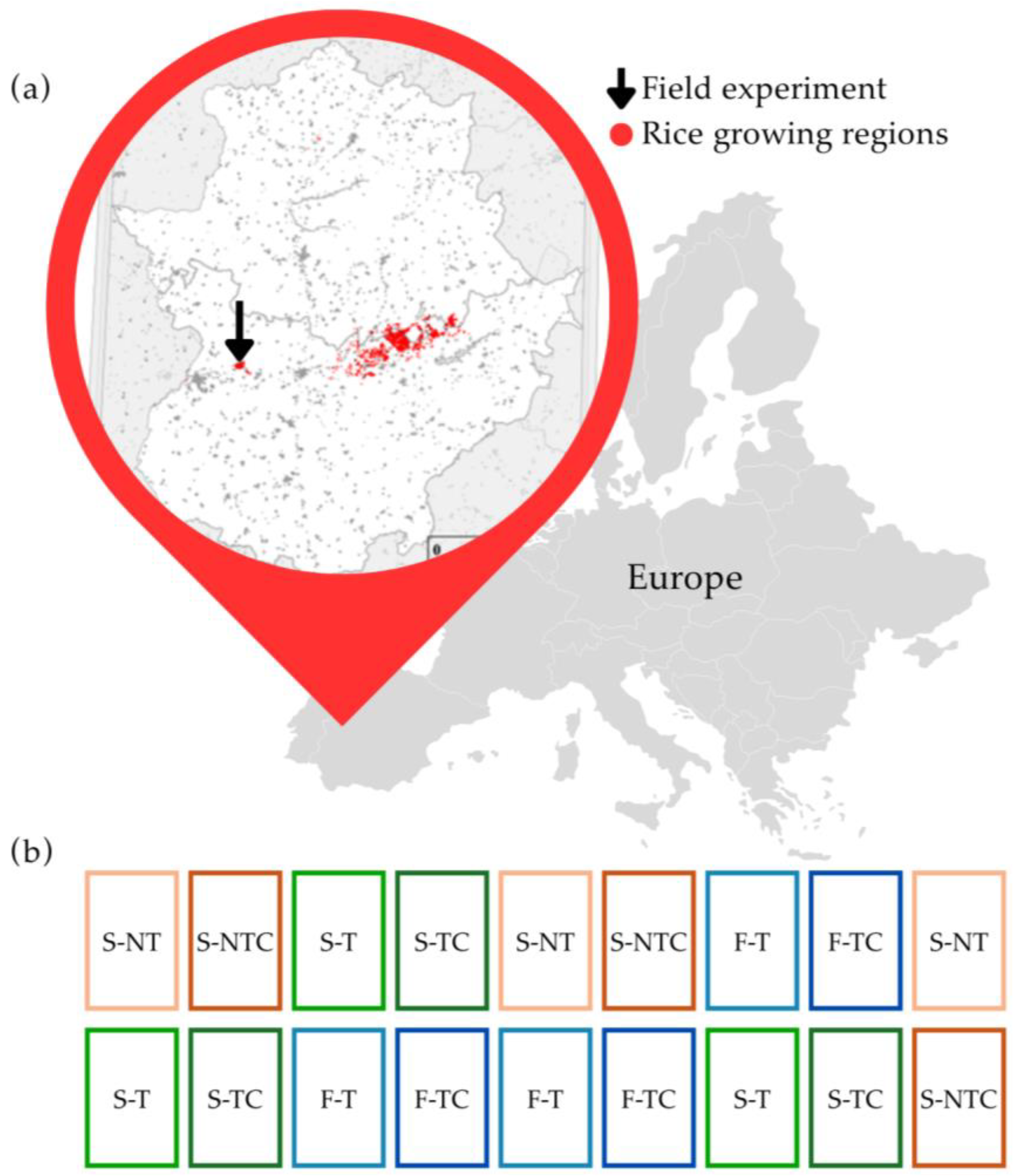
2.1. Experimental Design, Soil Sampling, and Analytical Procedures
2.2. Herbicide
2.3. Sorption–Desorption Studies
2.4. Dissipation Studies
2.5. Leaching Studies
2.6. Statistical Analysis
3. Results and Discussion
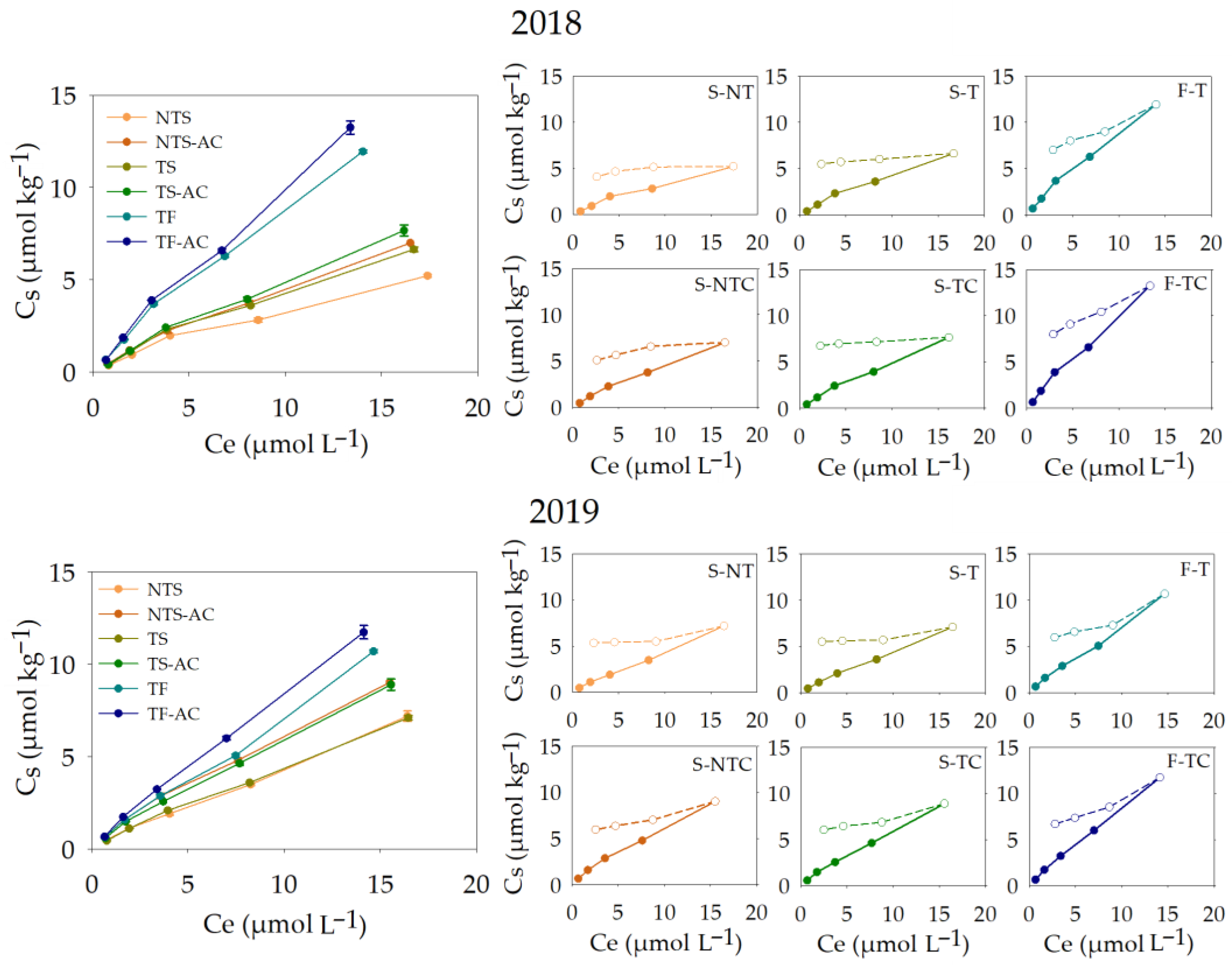
3.1. Sorption–Desorption Experiments
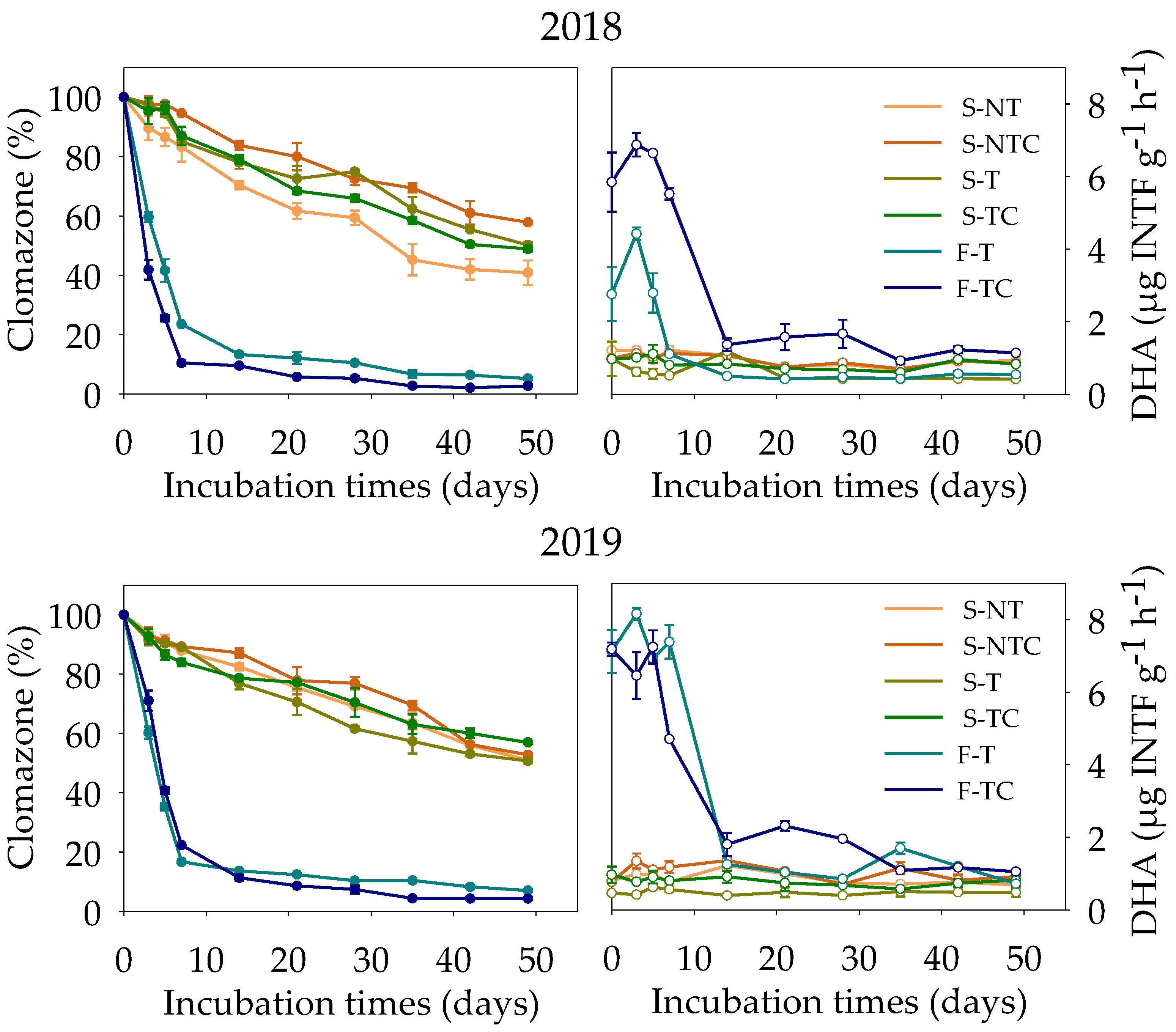
3.2. Dissipation Experiments
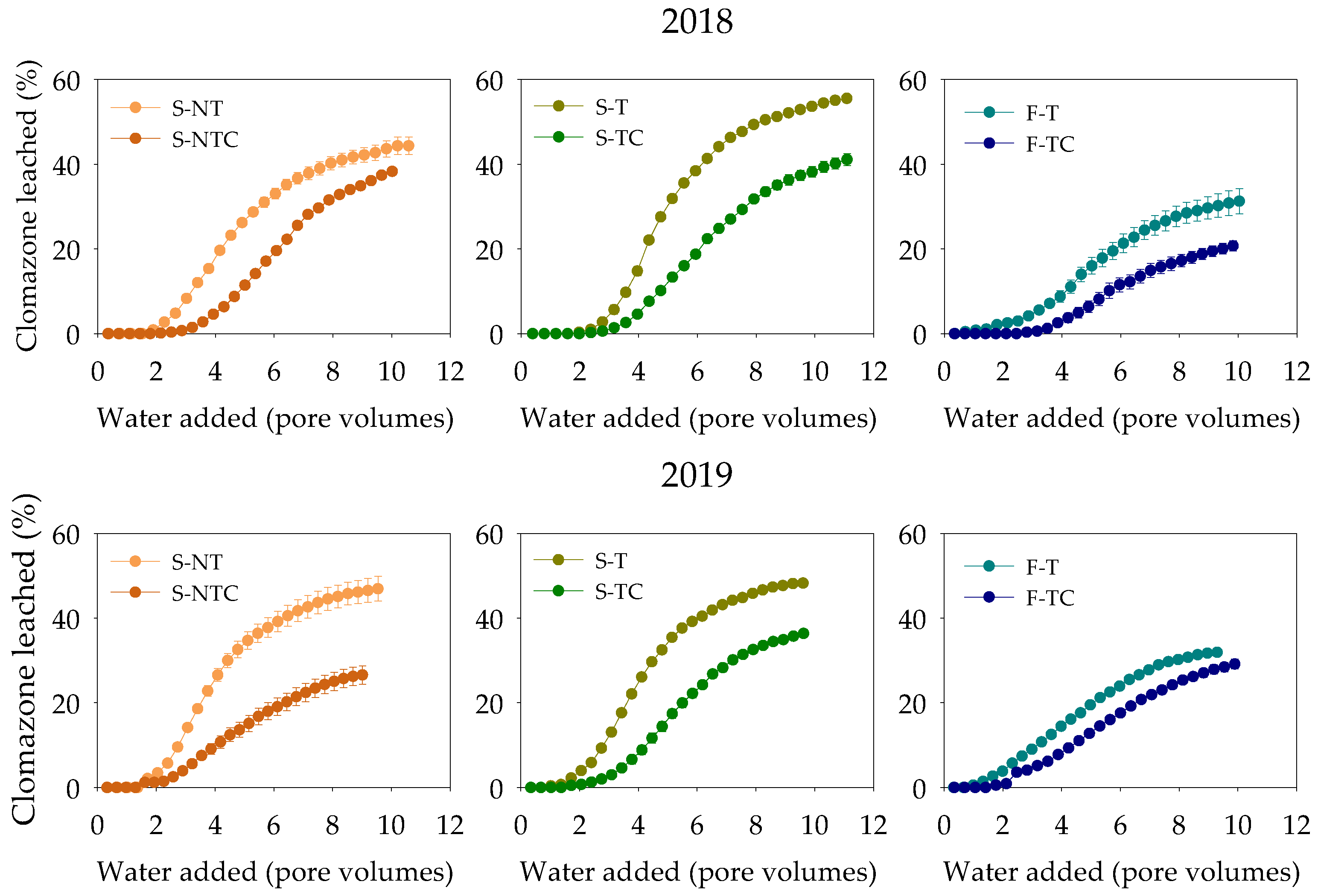
3.3. Leaching Experiments
4. Conclusions
Supplementary Materials
Author Contributions
Funding
Institutional Review Board Statement
Data Availability Statement
Conflicts of Interest
References
- He, X.; Batáry, P.; Zou, Y.; Zhou, W.; Wang, G.; Liu, Z.; Bai, Y.; Gong, S.; Zhu, Z.; Settele, J.; et al. Agricultural diversification promotes sustainable and resilient global rice production. Nat. Food 2023, 4, 788–796. [Google Scholar] [CrossRef]
- Ali, W.; Mao, K.; Zhang, H.; Junaid, M.; Xu, N.; Rasool, A.; Feng, X.; Yang, Z. Comprehensive review of the basic chemical behaviours, sources, processes, and endpoints of trace element contamination in paddy soil-rice systems in rice-growing countries. J. Hazard. Mater. 2020, 397, 122720. [Google Scholar] [CrossRef]
- Zhang, H.; Jing, W.; Zhao, B.; Wang, W.; Xu, Y.; Zhang, W.; Gu, J.; Liu, L.; Wang, Z.; Yang, J. Alternative fertilizer and irrigation practices improve rice yield and resource use efficiency by regulating source-sink relationships. Field Crops Res. 2021, 265, 108124. [Google Scholar] [CrossRef]
- Ishfaq, M.; Farooq, M.; Zulfiqar, U.; Hussain, S.; Akbar, N.; Nawaz, A.; Anjum, S.A. Alternate wetting and drying: A water-saving and ecofriendly rice production system. Agric. Water Manag. 2020, 241, 106363. [Google Scholar] [CrossRef]
- Mondal, S.; Khan, M.I.R.; Entila, F.; Dixit, S.; Pompe, P.C.; Panna Ali, M.; Pittendrigh, B.; Septiningsih, E.M.; Ismail, A.M. Responses of AG1 and AG2 QTL introgression lines and seed pre-treatment on growth and physiological processes during anaerobic germination of rice under flooding. Sci. Rep. 2020, 10, 10214. [Google Scholar] [CrossRef]
- Gusmaroli, L.; Buttiglieri, G.; Petrovic, M. The EU watch list compounds in the Ebro delta region: Assessment of sources, river transport, and seasonal variations. Environ. Pollut. 2019, 253, 606–615. [Google Scholar] [CrossRef] [PubMed]
- Calha, I.; Oliveira, M.D.F.; Reis, P. Weed management challenges in rice cultivation in the context of pesticide use reduction: A survey approach. Sustainability 2023, 15, 244. [Google Scholar] [CrossRef]
- Rodríguez-Seijo, A.; Pérez-Rodríguez, P.; Arias-Estévez, M.; Gómez-Armesto, A.; Conde-Cid, M.; Santás-Miguel, V.; Campillo-Cora, C.; Ollio, I.; Lloret, E.; Martínez-Martínez, S.; et al. Occurrence, persistence and risk assessment of pesticide residues in European wheat fields: A continental scale approach. J. Hazard. Mater. 2025, 494, 138291. [Google Scholar] [CrossRef] [PubMed]
- López-Piñeiro, A.; Martín-Franco, C.; Terrón-Sánchez, J.; Vicente, L.A.; Fernández-Rodríguez, D.; Albarrán, Á.; Nunes, J.M.R.; Peña, D. Environmental fate and efficiency of bispyribac-sodium in rice soils under conventional and alternative production systems affected by fresh and aged biochar amendment. Sci. Total Environ. 2022, 847, 157651. [Google Scholar] [CrossRef]
- Cervantes-Díaz, A.; Alonso-Prados, E.; Alonso-Prados, J.L.; Sandín-España, P. Assessing the effect of organic amendments on the degradation of profoxydim in paddy soils: Kinetic modeling and identification of degradation products. Sci. Total Environ. 2024, 912, 169072. [Google Scholar] [CrossRef]
- Bwire, D.; Saito, H.; Sidle, R.C.; Nishiwaki, J. Water Management and Hydrological Characteristics of Paddy-Rice Fields under Alternate Wetting and Drying Irrigation Practice as Climate Smart Practice: A Review. Agronomy 2024, 14, 1421. [Google Scholar] [CrossRef]
- Vicente, L.A.; Peña, D.; Fernández-Rodríguez, D.; Albarrán, Á.; Rato Nunes, J.M.; López-Piñeiro, A. Sorption, persistence and leaching of clomazone in rice environments under varying severity of alternate wetting and drying irrigation management with and without biochar amendment. J. Environ. Manag. 2025, 386, 125761. [Google Scholar] [CrossRef]
- Sánchez-Llerena, J.; López-Piñeiro, A.; Albarrán, A.; Peña, D.; Becerra, D.; Rato-Nunes, J.M. Short and long-term effects of different irrigation and tillage systems on soil properties and rice productivity under Mediterranean conditions. Eur. J. Agron. 2016, 77, 101–110. [Google Scholar] [CrossRef]
- Pinto, M.A.B.; Parfitt, J.M.B.; Timm, L.C.; Faria, L.C.; Concenço, G.; Stumpf, L.; Nörenberg, B.G. Sprinkler irrigation in lowland rice: Crop yield and its components as a function of water availability in different phenological phases. Field Crops Res. 2020, 248, 107714. [Google Scholar] [CrossRef]
- Fernández, D.; Gómez, S.; Albarrán, A.; Peña, D.; Rozas, M.A.; Rato-Nunes, J.M.; López-Piñeiro, A. How the environmental fate of clomazone in rice fields is influenced by amendment with olive-mill waste under different regimes of irrigation and tillage. Pest Manag. Sci. 2020, 76, 1795–1803. [Google Scholar] [CrossRef]
- Rato Nunes, J.; Cabral, F.; López-Piñeiro, A. Short-term effects on soil properties and wheat production from secondary paper sludge application on two Mediterranean agricultural soils. Bioresour. Technol. 2008, 99, 4935–4942. [Google Scholar] [CrossRef]
- Xue, C.; Yang, X.; Bouman, B.A.M.; Deng, W.; Zhang, Q.; Yan, W.; Zhang, T.; Rouzi, A.; Wang, H. Optimizing yield, water requirements, and water productivity of aerobic rice for the North China. Plain Irrig. Sci. 2008, 26, 459–474. [Google Scholar] [CrossRef]
- Rana, B.; Parihar, C.M.; Jat, M.L.; Patra, K.; Nayak, H.S.; Reddy, K.S.; Sarkar, A.; Anand, A.; Naguib, W.; Gupta, N.; et al. Combining sub-surface fertigation with conservation agriculture in intensively irrigated rice under rice-wheat system can be an option for sustainably improving water and nitrogen use-efficiency. Field Crops Res. 2023, 302, 109074. [Google Scholar] [CrossRef]
- Girsang, S.S.; Quilty, J.R.; Correa, T.Q.; Sanchez, P.B.; Buresh, R.J. Rice yield and relationships to soil properties for production using overhead sprinkler irrigation without soil submergence. Geoderma 2019, 352, 277–288. [Google Scholar] [CrossRef]
- Çolak, Y.B. Comparison of aerobic rice cultivation using drip systems with conventional flooding. J. Agric. Sci. 2021, 159, 544–556. [Google Scholar] [CrossRef]
- Muñoz, A.; López-Piñeiro, A.; Ramírez, M. Soil quality attributes of conservation management regimes in a semi-arid region of south western Spain. Soil Tillage Res. 2007, 95, 255–265. [Google Scholar] [CrossRef]
- Khalil, J.; Jaafar, A.A.; Habib, H.; Bouguerra, S.; Nogueira, V.; Rodríguez-Seijo, A. The impact of olive mill wastewater on soil properties, nutrient and heavy metal availability—A study case from Syrian vertisols. J. Environ. Manag. 2024, 351, 119861. [Google Scholar] [CrossRef]
- Muscolo, A.; Papalia, T.; Settineri, G.; Romeo, F.; Mallamaci, C. Three different methods for turning olive pomace in resource: Benefits of the end products for agricultural purpose. Sci. Total Environ. 2019, 662, 1–7. [Google Scholar] [CrossRef]
- Ameziane, H.; Nounah, A.; Khamar, M.; Zouahri, A. Composting olive pomace: Evolution of organic matter and compost quality. Agron. Res. 2020, 18, 5–17. [Google Scholar] [CrossRef]
- Zipori, I.; Erel, R.; Yermiyahu, U.; Ben-Gal, A.; Dag, A. Sustainable Management of Olive Orchard Nutrition: A Review. Agriculture 2020, 10, 11. [Google Scholar] [CrossRef]
- Gámiz, B.; Velarde, P.; Spokas, K.A.; Hermosin, M.C.; Cox, L. Biochar Soil Additions Affect Herbicide Fate: Importance of Application Timing and Feedstock Species. J. Agric. Food Chem. 2017, 65, 3109–3117. [Google Scholar] [CrossRef] [PubMed]
- Da Silva, M.R.F.; Queiroz, M.E.L.R.; Neves, A.A.; da Silva, A.A.; Oliveira, A.F.; de Oliveira, R.L.; Azevedo, M.M.; Pereira, G.A.M. Effect of the incorporation of sugarcane bagasse biochar in leaching and bioavailability of clomazone in soil. J. Braz. Chem. Soc. 2019, 30, 2386–2394. [Google Scholar] [CrossRef]
- Li, R.; Hu, W.; Liu, H.; Huang, B.; Jia, Z.; Liu, F.; Zhao, Y.; Khan, K.S. Occurrence, distribution and ecological risk assessment of herbicide residues in cropland soils from the Mollisols region of Northeast China. J. Hazard. Mater. 2024, 465, 133054. [Google Scholar] [CrossRef]
- Andrés, A.; Concenço, G.; Theisen, G.; Vidotto, F.; Ferrero, A. Selectivity and weed control efficacy of pre- and post-emergence applications of clomazone in Southern Brazil. Crop Prot. 2013, 53, 103. [Google Scholar] [CrossRef]
- Mattice, J.D.; Skulman, B.W.; Norman, R.J.; Gbur, E.E. Analysis of river water for rice pesticides in eastern Arkansas from 2002 to 2008. J. Soil Water Conserv. 2010, 65, 130–140. [Google Scholar] [CrossRef]
- Tomco, P.L.; Holstege, D.M.; Wei, Z.; Tjeerdema, R.S. Microbial degradation of clomazone under simulated California rice field conditions. J. Agric. Food Chem. 2010, 58, 3674–3680. [Google Scholar] [CrossRef]
- Zanella, R.; Primel, E.G.; Machado, S.L.; Gonçalves, F.F.; Marchezan, E. Monitoring of the herbicide clomazone in environmental water samples by solid-phase extraction and high-performance liquid chromatography with ultraviolet detection. Chromatographia 2002, 55, 573–577. [Google Scholar] [CrossRef]
- He, H.; Huang, J.; Zhao, Z.; Feng, W.; Zheng, X.; Du, P. Clomazone impact on fungal network complexity and stability. Front. Microbiol. 2023, 14, 1124127. [Google Scholar] [CrossRef]
- Stenert, C.; De Mello, I.C.M.F.; Pires, M.M.; Knauth, D.S.; Katayama, N.; Maltchik, L. Responses of macroinvertebrate communities to pesticide application in irrigated rice fields. Environ. Monit. Assess. 2018, 190, 74. [Google Scholar] [CrossRef]
- Schmidt, A.; Auge, H.; Brandl, R.; Heong, K.L.; Hotes, S.; Settele, J.; Villareal, S.; Schädler, M. Small-scale variability in the contribution of invertebrates to litter decomposition in tropical rice fields. Basic Appl. Ecol. 2015, 16, 674–680. [Google Scholar] [CrossRef]
- Cueff, S.; Alletto, L.; Dumény, V.; Benoit, P.; Pot, V. Adsorption and degradation of the herbicide nicosulfuron in a stagnic Luvisol and Vermic Umbrisol cultivated under conventional or conservation agriculture. Environ. Sci. Pollut. Res. Int. 2021, 28, 15934–15946. [Google Scholar] [CrossRef]
- Giuliano, S.; Alletto, L.; Deswarte, C.; Perdrieux, F.; Daydé, J.; Debaeke, P. Reducing herbicide use and leaching in agronomically performant maize-based cropping systems: An 8-year study. Sci. Total Environ. 2021, 788, 147695. [Google Scholar] [CrossRef]
- Bedos, C.; Alletto, L.; Durand, B.; Fanucci, O.; Brut, A.; Bourdat-Deschamps, M.; Giuliano, S.; Loubet, B.; Ceschia, E.; Benoit, P. Observed volatilization fluxes of S-metolachlor and benoxacor applied on soil with and without crop residues. Environ. Sci. Pollut. Res. Int. 2017, 24, 3985–3996. [Google Scholar] [CrossRef] [PubMed]
- Alletto, L.; Coquet, Y.; Benoit, P.; Heddadj, D.; Barriuso, E. Tillage management effects on pesticide fate in soils. A review. Agron. Sustain. Dev. 2010, 30, 367–400. [Google Scholar] [CrossRef]
- Cañero, A.I.; Becerra, D.; Cornejo, J.; Hermosín, M.C.; Albarrán, Á.; López-Piñeiro, A.; Cox, L. Transformation of organic wastes in soil: Effect on bentazone behavior. Sci. Total Environ. 2012, 433, 198–205. [Google Scholar] [CrossRef]
- Ahangar, A.G.; Smernik, R.J.; Kookana, R.S.; Chittleborough, D.J. Separating the effects of organic matter–mineral interactions and organic matter chemistry on the sorption of diuron and phenanthrene. Chemosphere 2008, 72, 886–890. [Google Scholar] [CrossRef]
- López-Piñeiro, A.; Vicente, L.; Fernández-Rodríguez, D.; Albarrán, Á.; Nunes, J.M.R.; Peña, D. Effects of Sustainable Rice Management on the Behavior and Bioefficacy of Bispyribac-Sodium: A Medium-Term Study. Sustainability 2024, 16, 4157. [Google Scholar] [CrossRef]
- Cheng, H.; Xing, D.; Twagirayezu, G.; Lin, S.; Gu, S.; Tu, C.; Hill, P.W.; Chadwick, D.R.; Jones, D.L.A. Effects of field-aging on the impact of biochar on herbicide fate and microbial community structure in the soil environment. Chemosphere 2024, 348, 140682. [Google Scholar] [CrossRef]
- Roldán, A.; Salinas-García, J.R.; Alguacil, M.M.; Caravaca, F. Changes in soil enzyme activity, fertility, aggregation and C sequestration mediated by conservation tillage practices and water regime in a maize field. Appl. Soil Ecol. 2005, 30, 11–20. [Google Scholar] [CrossRef]
- Araya, T.; Cornelis, W.M.; Nyssen, J.; Govaerts, B.; Getnet, F.; Bauer, H.; Amare, K.; Raes, D.; Haile, M.; Deckers, J. Medium-term effects of conservation agriculture based cropping systems for sustainable soil and water management and crop productivity in the Ethiopian highlands. Field Crops Res. 2012, 132, 53–62. [Google Scholar] [CrossRef]
- Li, C.F.; Yang, J.; Zhang, C.; Zhang, Z.S.; Zheng, M.; Ahmad, S.; Cao, C.G. Effects of short-term tillage and fertilization on grain yields and soil properties of rice production systems in central China. J. Food Agric. Environ. 2010, 8, 577–584. [Google Scholar]
- López-Fando, C.; Pardo, M.T. Changes in soil chemical characteristics with different tillage practices in a semi-arid environment. Soil Tillage Res. 2009, 104, 278–284. [Google Scholar] [CrossRef]
- Liben, F.M.; Tadesse, B.; Tola, Y.T.; Wortmann, C.S.; Kim, H.K.; Mupangwa, W. Conservation agriculture effects on crop productivity and soil properties in Ethiopia. Agron. J. 2018, 110, 758–767. [Google Scholar] [CrossRef]
- Gómez, S.; Fernández, D.; Peña, D.; Albarrán, Á.; López-Piñeiro, A. Be-haviour of bispyribac-sodium in aerobic and anaerobic rice-growing con-ditions with and without olive-mill waste amendment. Soil Tillage Res. 2019, 194, 104333. [Google Scholar] [CrossRef]
- Peña, D.; Albarrán, Á.; López-Piñeiro, A.; Rato-Nunes, J.M.; Sánchez-Llerena, J.; Becerra, D. Impact of oiled and de-oiled olive mill waste amendments on the sorption, leaching, and persistence of S-metolachlor in a calcareous clay soil. J. Environ. Sci. Health B 2013, 48, 767–775. [Google Scholar] [CrossRef]
- Cao, D.; Peng, W.; Xu, H.; Fu, X.; Gong, X.; Yu, S.; Wei, H.; Zhou, Q.; Huang, Y. Bioavailability and phytotoxicity of clomazone to corn depend on soil characteristics and can be estimated by in situ pore water. Pest Manag. Sci. 2025, 81, 1316–1323. [Google Scholar] [CrossRef] [PubMed]
- Pereira, G.A.M.; Rodrigues, D.A.; Fonseca, L.A.B.V.; de Jesus Passos, A.B.R.J.; da Silva, M.R.F.; Silva, D.V.; da Silva, A.A. Sorption and desorption behavior of herbicide clomazone in soils from Brazil. J. Biosci. 2018, 34, 1496–1504. [Google Scholar] [CrossRef]
- Đurović-Pejčev, R.D.; Radmanović, S.B.; Tomić, Z.P.; Kaluderović, L.M.; Bursić, V.P.; Šantrić, L.R. Adsorption–desorption behaviour of clomazone in Regosol and Chernozem agricultural soils. J. Serb. Chem. Soc. 2020, 85, 809–819. [Google Scholar] [CrossRef]
- Spark, K.M.; Swift, R.S. Effect of soil composition and dissolved organic matter on pesticide sorption. Sci. Total Environ. 2002, 298, 147–161. [Google Scholar] [CrossRef]
- Cabrera, A.; Trigo, C.; Cox, L.; Celis, R.; Cornejo, J. A comparative study of the use of organoclay-based formulations and organic amendment to reduce the leaching of the herbicide MCPA in soil. Clean-Soil Air Water 2008, 36, 990–995. [Google Scholar] [CrossRef][Green Version]
- López-Piñeiro, A.; Sánchez-Terrón, J.; Martín-Franco, C.; Peña Abades, D.; Vicente, L.A.; Gómez, S.; Fernández-Rodríguez, D.; Albarrán, Á. Impacts of fresh and aged holm-oak biochar on clomazone behaviour in rice cropping soils after transition to sprinkler irrigation. Geoderma 2022, 413, 115768. [Google Scholar] [CrossRef]
- Gunasekara, A.S.; Dela Cruz, I.D.P.; Curtis, M.J.; Claassen, V.P.; Tjeerdema, R.S. The behavior of clomazone in the soil environment. Pest Manag. Sci. 2009, 65, 711–716. [Google Scholar] [CrossRef]
- Tomco, P.L.; Holmes, W.E.; Tjeerdema, R.S. Biodegradation of clomazone in a california rice field soil: Carbon allocation and community effects. J. Agric. Food Chem. 2013, 61, 2618–2624. [Google Scholar] [CrossRef]
- Cao, J.; Diao, X.-P.; Hu, J.-Y. Hydrolysis and photolysis of herbicide clomazone in aqueous solutions and natural water under abiotic conditions. J. Integr. Agric. 2013, 12, 2074–2082. [Google Scholar] [CrossRef]
- Marín-Benito, J.M.; Andrades, M.S.; Sánchez-Martín, M.J.; Rodríguez-Cruz, M.S. Dissipation of Two Acidic Herbicides in Agricultural Soil: Impact of Green Compost Application, Herbicide Rate, and Soil Moisture. Agriculture 2025, 15, 552. [Google Scholar] [CrossRef]
- Rong, L.; Wu, X.; Xu, J.; Dong, F.; Liu, X.; Xu, H.; Cao, J.; Zheng, Y. Clomazone improves the interactions between soil microbes and affects C and N cycling functions. Sci. Total Environ. 2021, 770, 144730. [Google Scholar] [CrossRef] [PubMed]
- Szpyrka, E.; Słowik-Borowiec, M.; Książek-Trela, P.; Zwolak, A.; Podbielska, M. The difference in dissipation of clomazone and metazachlor in soil under field and laboratory conditions and their uptake by plants. Sci. Rep. 2020, 10, 3747. [Google Scholar] [CrossRef] [PubMed]
- Mervosh, T.L.; Sims, G.K.; Stoller, E.W. Clomazone Fate in Soil As Affected by Microbial Activity, Temperature, and Soil Moisture. J. Agric. Food Chem. 1995, 43, 537–543. [Google Scholar] [CrossRef]
- Ćwieląg-Piasecka, I. Soil Organic Matter Composition and pH as Factors Affecting Retention of Carbaryl, Carbofuran and Metolachlor in Soil. Molecules 2023, 28, 5552. [Google Scholar] [CrossRef]
- Włodarczyk, M.; Siwek, H. Influence of Formulation on Mobility of Clomazone in Soil. Bull. Environ. Contam. Toxicol. 2016, 97, 582–587. [Google Scholar] [CrossRef]
- Ðurović-Pejčev, R.; Radmanović, S.; Tomić, Z.P.; Kaluđerović, L.; Đorđević, T. Characterization of the clomazone sorption process in four agricultural soils using different kinetic models. Environ. Sci. Process. Impacts 2023, 25, 542–553. [Google Scholar] [CrossRef]
- Carpio, M.J.; Rodríguez-Cruz, M.S.; Sánchez-Martín, M.J.; Marín-Benito, J.M. Pesticide Fate in Soils Under Different Agricultural Management Practices. Handb. Environ. Chem. 2022, 113, 251–286. [Google Scholar] [CrossRef]
- Peña Abades, D.; Albarrán, Á.; Gómez, S.; Fernández-Rodríguez, D.; Nunes, J.M.; López-Piñeiro, A. Effects of olive mill wastes with different degrees of maturity on behaviour of S-metolachlor in three soils. Geoderma 2019, 348, 86–96. [Google Scholar] [CrossRef]



| Property | Value |
|---|---|
| Chemical name | 2-(2-chlorobenzyl)-4,4-dimethyl-1,2-oxazolidin-3-one |
| Molecular formula | C12H14ClNO2 |
| Molecular weight | 239.7 g mol−1 |
| Physical state (25 °C) | Solid crystalline |
| Water solubility | 1.21 g L−1 |
| Vapor pressure | 27.0 mPa |
| Melting point | 33.9 °C |
| Technical-grade purity | 99.8% |
| HPLC detection limit | 0.015 µM |
| HPLC quantification limit | 0.047 µM |
| nf | R2sorption | Kd (L kg−1) | Kdoc | %D † | R2desorption | |
|---|---|---|---|---|---|---|
| 2018 | ||||||
| S-NT | 0.852 aA | 0.999 | 1.16 aA | 1.25 bA | 32.7 aA | 0.973 |
| S-NTC | 0.855 aA | 0.995 | 1.93 dA | 1.16 aA | 37.7 cA | 0.975 |
| S-T | 0.871 abA | 0.997 | 1.35 bA | 1.35 cA | 34.4 abA | 0.999 |
| S-TC | 0.894 abA | 0.999 | 2.08 eA | 1.24 bA | 37.7 cA | 0.999 |
| F-T | 0.854 aA | 0.999 | 1.60 cA | 1.57 dB | 36.8 bcA | 0.997 |
| F-TC | 0.919 bA | 0.999 | 2.97 fA | 1.40 cA | 36.0 bcA | 0.998 |
| 2019 | ||||||
| S-NT | 0.827 aA | 0.991 | 1.26 aA | 1.30 aA | 45.4 abB | 0.997 |
| S-NTC | 0.919 bA | 0.987 | 2.41 cB | 1.74 bB | 40.7 aA | 0.996 |
| S-T | 0.846 aA | 0.983 | 1.33 aA | 1.25 aA | 48.6 bcB | 0.988 |
| S-TC | 0.862 abA | 0.995 | 2.35 cB | 1.44 aB | 51.2 bcB | 0.999 |
| F-T | 0.877 abA | 0.988 | 1.66 bA | 1.27 aA | 45.4 abB | 0.967 |
| F-TC | 0.914 bA | 0.994 | 3.23 dA | 1.75 bB | 53.2 cB | 0.911 |
| T | * | *** | ** | * | ||
| Y | NS | *** | *** | *** | ||
| T × Y | * | * | *** | ** |
| t1/2 (Days) | R2 | DHA (µg INTF g−1 h−1) | |
|---|---|---|---|
| 2018 | |||
| S-NT | 37.0 bA | 0.970 | 9.75 bB |
| S-NTC | 60.0 eB | 0.969 | 9.43 abA |
| S-T | 40.8 cA | 0.955 | 6.01 aB |
| S-TC | 45.4 dA | 0.982 | 8.52 abA |
| F-T | 12.9 aA | 0.850 | 14.0 cA |
| F-TC | 10.4 aA | 0.820 | 34.8 dA |
| 2019 | |||
| S-NT | 52.9 dB | 0.989 | 8.67 cA |
| S-NTC | 57.4 eA | 0.946 | 10.4 dB |
| S-T | 48.9 cA | 0.979 | 4.85 aA |
| S-TC | 65.0 fB | 0.951 | 7.93 bB |
| F-T | 15.9 bB | 0.882 | 36.4 fB |
| F-TC | 11.1 aB | 0.840 | 35.0 eA |
| T | *** | *** | |
| Y | *** | *** | |
| T × Y | *** | *** |
| Initial Pore Volume † | Max. Concentration Leached (µM) | Total Leached (%) | Total Extracted (%) | |
|---|---|---|---|---|
| 2018 | ||||
| S-NT | 1.89 bB | 1.40 bA | 44.4 dA | 25.9 bA |
| S-NTC | 2.15 cB | 1.08 abB | 38.3 bA | 40.9 cA |
| S-T | 1.98 bB | 2.44 cB | 55.6 eB | 25.3 bA |
| S-TC | 2.38 dB | 1.22 abB | 41.1 cA | 30.1 bA |
| F-T | 0.717 aA | 0.969 abA | 37.3 bB | 30.2 bA |
| F-TC | 2.81 eB | 0.679 aA | 20.7 aA | 17.5 aA |
| 2019 | ||||
| S-NT | 1.70 cA | 1.39 bA | 46.9 bA | 25.1 bA |
| S-NTC | 1.61 cA | 0.635 aA | 26.6 aA | 38.6 cA |
| S-T | 1.03 bA | 1.49 bA | 48.3 bA | 26.3 bA |
| S-TC | 1.72 cA | 0.986 aA | 36.4 aA | 41.6 cA |
| F-T | 0.996 aB | 0.633 aA | 31.9 aA | 33.4 bA |
| F-TC | 1.77 cA | 0.567 aA | 29.1 aB | 19.4 aA |
| T | *** | *** | *** | * |
| Y | *** | ** | * | NS |
| T × Y | *** | NS | ** | NS |
Disclaimer/Publisher’s Note: The statements, opinions and data contained in all publications are solely those of the individual author(s) and contributor(s) and not of MDPI and/or the editor(s). MDPI and/or the editor(s) disclaim responsibility for any injury to people or property resulting from any ideas, methods, instructions or products referred to in the content. |
© 2025 by the authors. Licensee MDPI, Basel, Switzerland. This article is an open access article distributed under the terms and conditions of the Creative Commons Attribution (CC BY) license.
Share and Cite
Vicente, L.; Pérez, M.; Fernández-Rodríguez, D.; Peña, D.; López-Piñeiro, A. Agronomic Practices for Mitigating Clomazone Mobility: Medium-Term Effects in Rice Agroecosystems. Agriculture 2026, 16, 58. https://doi.org/10.3390/agriculture16010058
Vicente L, Pérez M, Fernández-Rodríguez D, Peña D, López-Piñeiro A. Agronomic Practices for Mitigating Clomazone Mobility: Medium-Term Effects in Rice Agroecosystems. Agriculture. 2026; 16(1):58. https://doi.org/10.3390/agriculture16010058
Chicago/Turabian StyleVicente, Luis, Manuel Pérez, Damián Fernández-Rodríguez, David Peña, and Antonio López-Piñeiro. 2026. "Agronomic Practices for Mitigating Clomazone Mobility: Medium-Term Effects in Rice Agroecosystems" Agriculture 16, no. 1: 58. https://doi.org/10.3390/agriculture16010058
APA StyleVicente, L., Pérez, M., Fernández-Rodríguez, D., Peña, D., & López-Piñeiro, A. (2026). Agronomic Practices for Mitigating Clomazone Mobility: Medium-Term Effects in Rice Agroecosystems. Agriculture, 16(1), 58. https://doi.org/10.3390/agriculture16010058